IDENTIFICATIOIDENTIFICATIO
NN
Dr. AJEE KURUVILLADr. AJEE KURUVILLA
Anthropometry-Anthropometry-
BertillonageBertillonage
 Habitual Criminals Register- Great BritainHabitual Criminals Register- Great Britain
 1882- Anthropometry introduced by1882- Anthropometry introduced by
Alphonse BertillonAlphonse Bertillon
 Based on measurements of – total height,Based on measurements of – total height,
span of arms, ht. of trunk, length & width ofspan of arms, ht. of trunk, length & width of
head, length & width of right ear, length ofhead, length & width of right ear, length of
left foot, left middle & ring finger, left forearmleft foot, left middle & ring finger, left forearm
 1888- Dept of Judicial Identity1888- Dept of Judicial Identity
 Probability- 1 in 4 millionProbability- 1 in 4 million
Evolution of finger printEvolution of finger print
as identification toolas identification tool
 1820- Prof Johann Purkinje1820- Prof Johann Purkinje
 1860- William Herschel1860- William Herschel
 Same period- Dr Henry Faulds reported inSame period- Dr Henry Faulds reported in
18801880
 1891- Francis Galton published paper on1891- Francis Galton published paper on
classification of finger printsclassification of finger prints
 Edward Henry-simple classificationEdward Henry-simple classification
 1914- Alphonse Bertillon died a shattered1914- Alphonse Bertillon died a shattered
manman
FINGERFINGER
PRINTSPRINTS
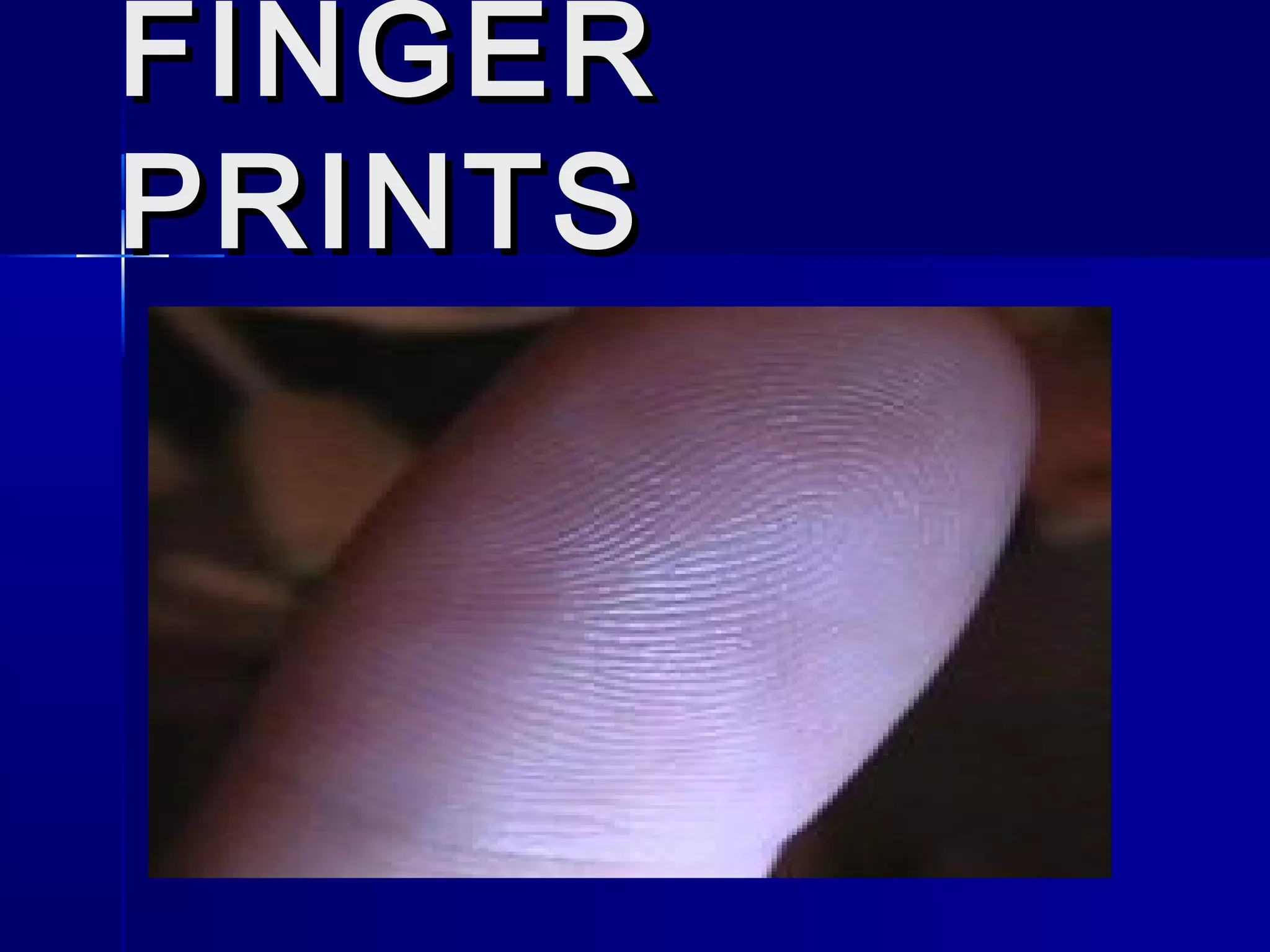
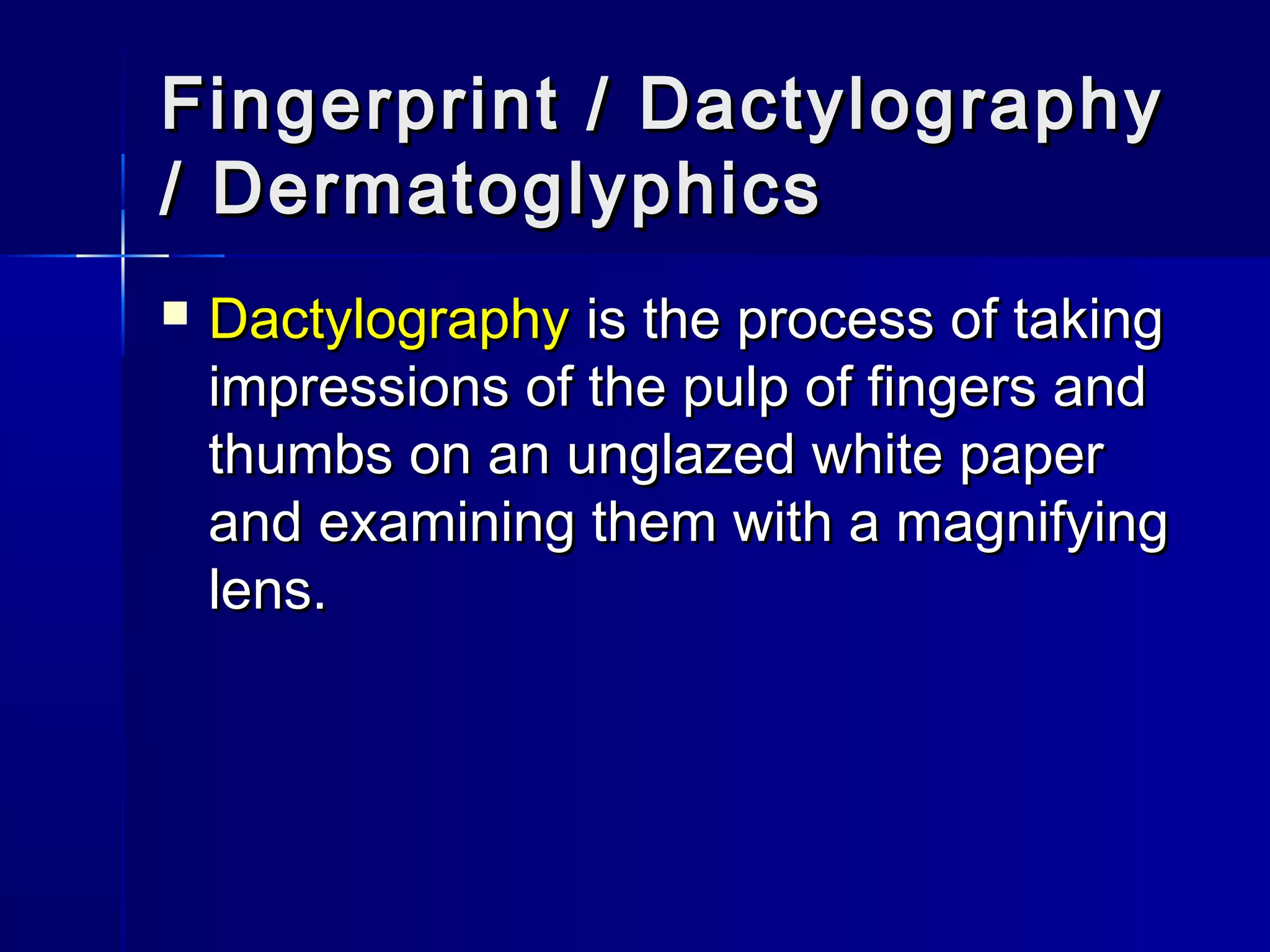
Fingerprint / DactylographyFingerprint / Dactylography
/ Dermatoglyphics/ Dermatoglyphics
 DactylographyDactylography is the process of takingis the process of taking
impressions of the pulp of fingers andimpressions of the pulp of fingers and
thumbs on an unglazed white paperthumbs on an unglazed white paper
and examining them with a magnifyingand examining them with a magnifying
lens.lens.
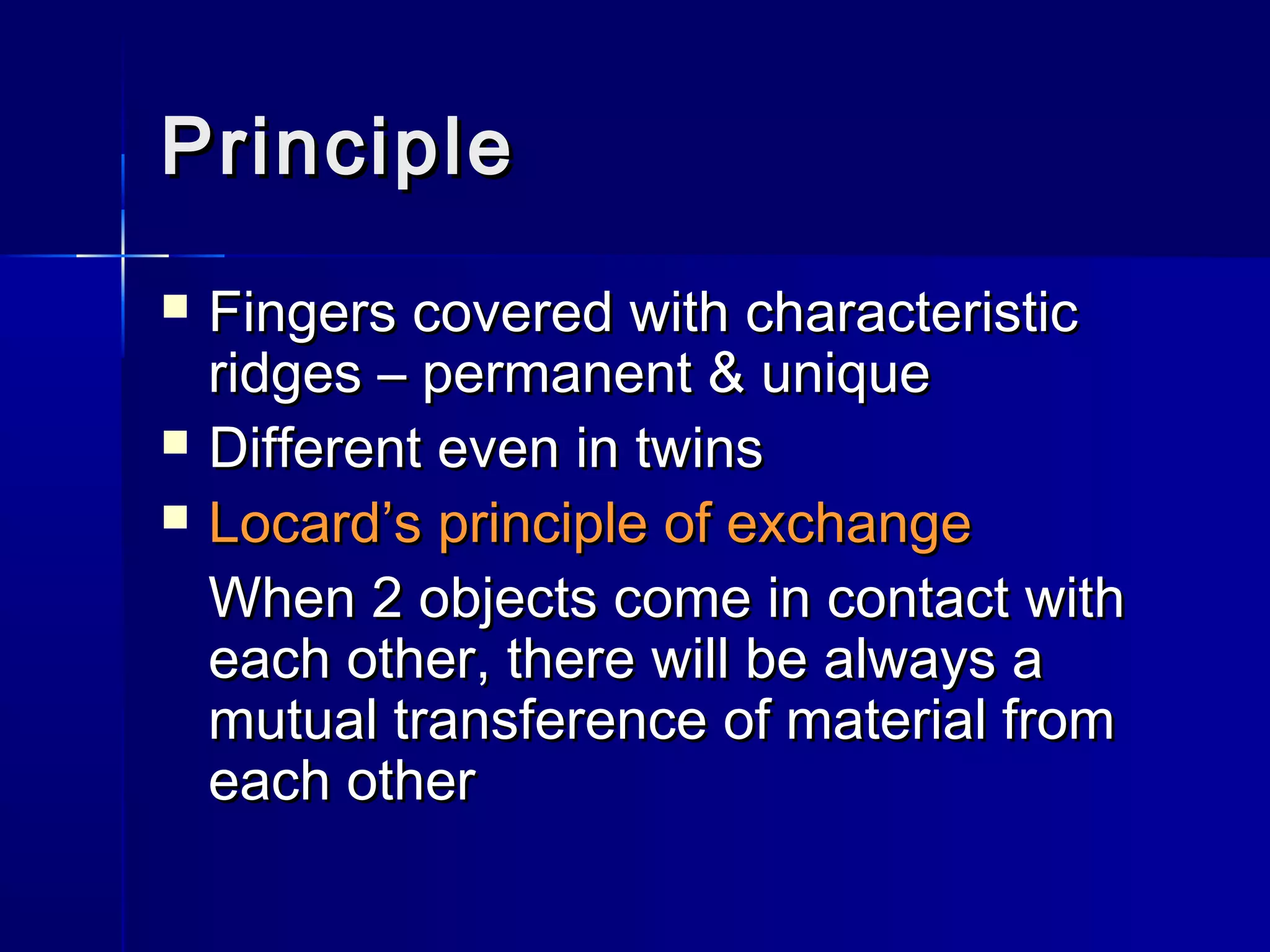
PrinciplePrinciple
 Fingers covered with characteristicFingers covered with characteristic
ridges – permanent & uniqueridges – permanent & unique
 Different even in twinsDifferent even in twins
 Locard’s principle of exchangeLocard’s principle of exchange
When 2 objects come in contact withWhen 2 objects come in contact with
each other, there will be always aeach other, there will be always a
mutual transference of material frommutual transference of material from
each othereach other
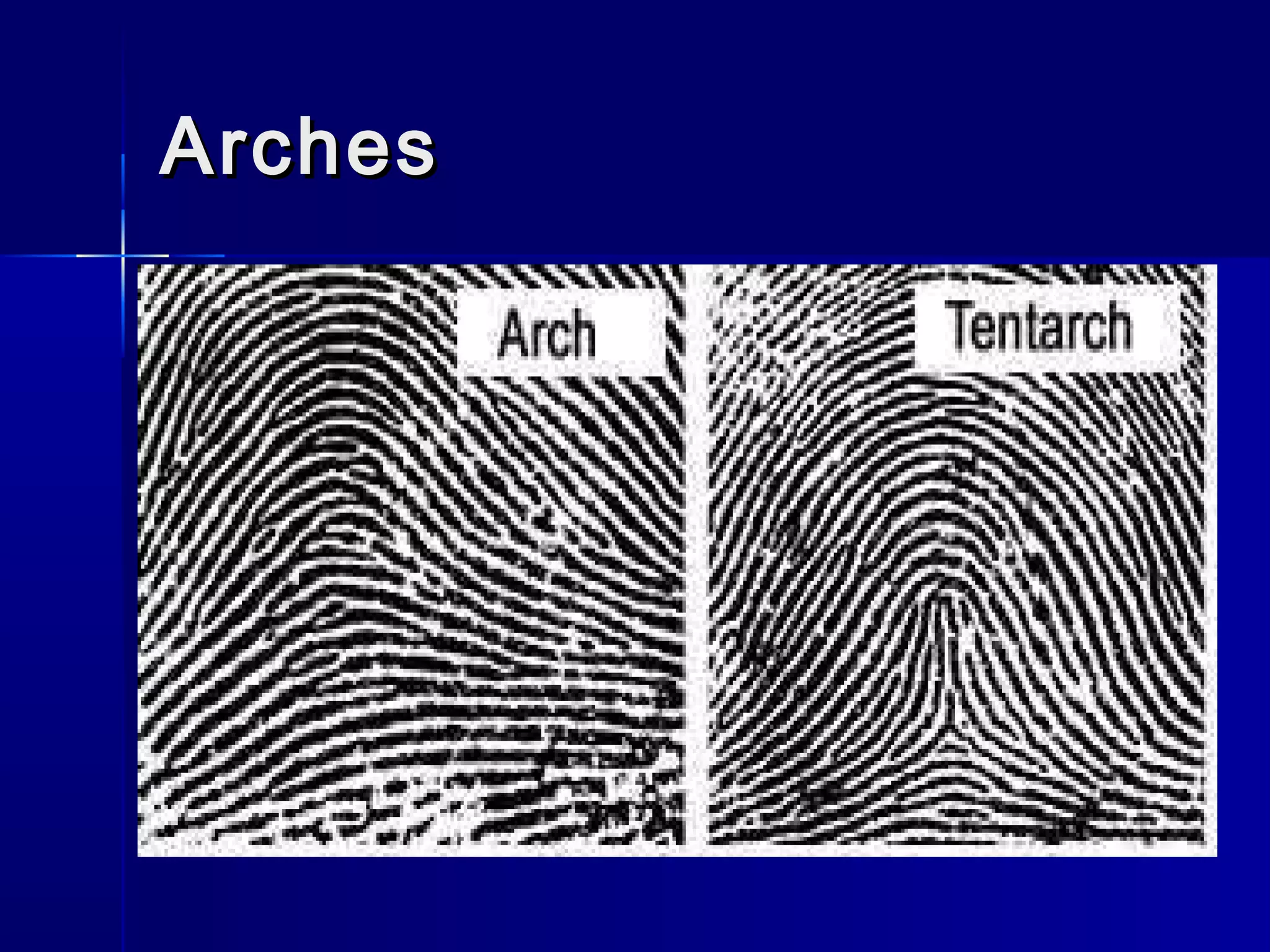
ArchesArches
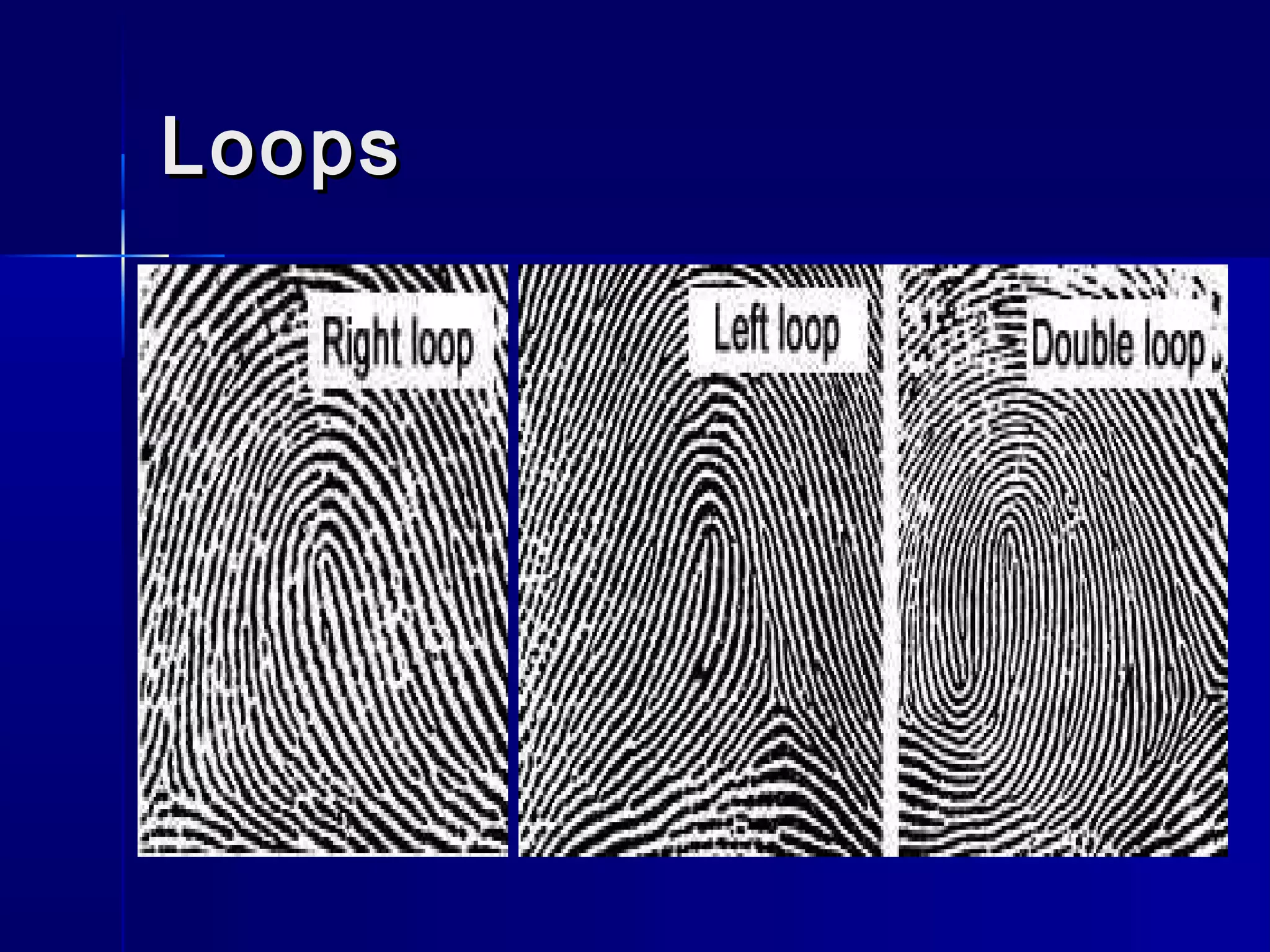
LoopsLoops
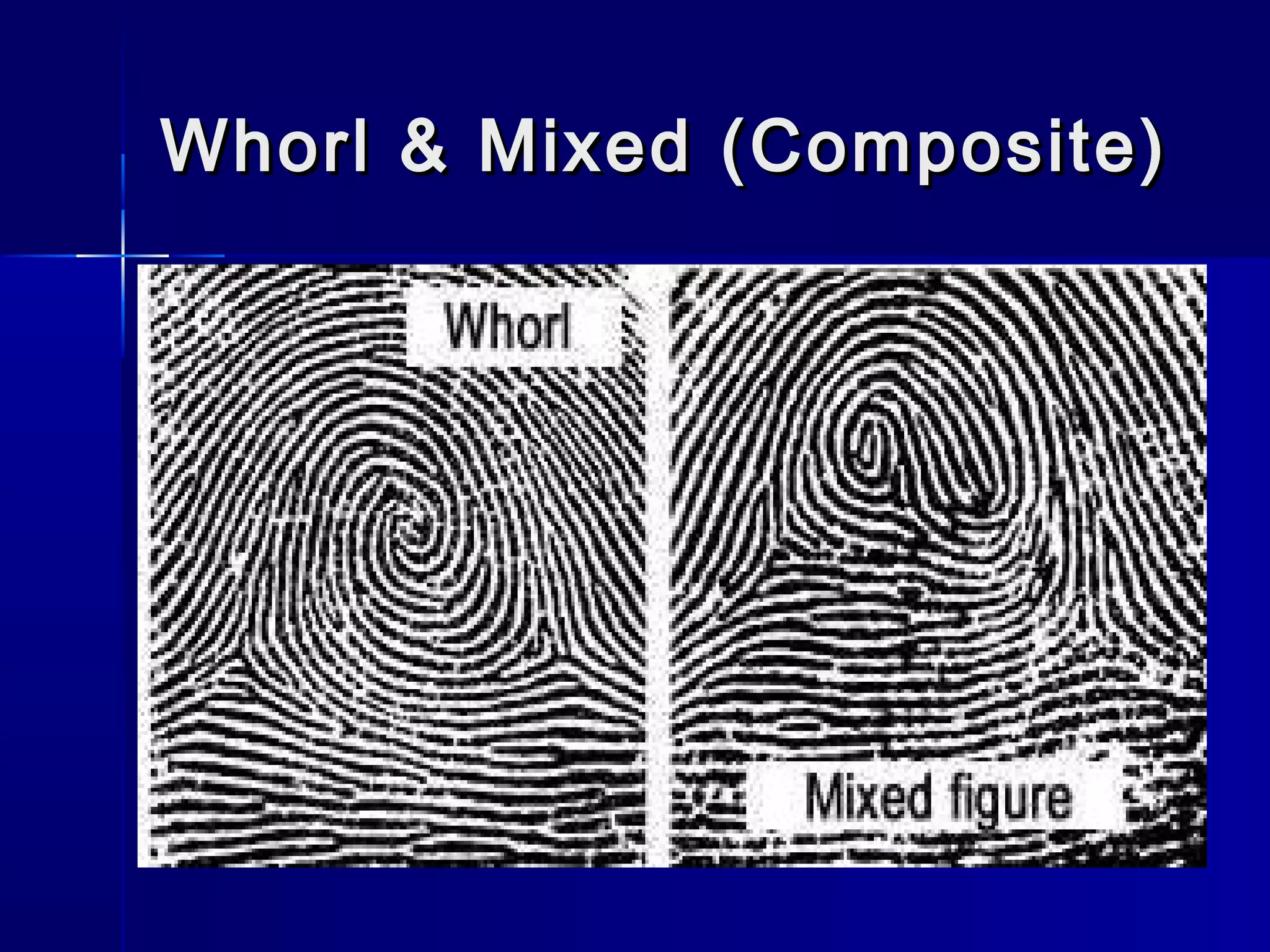
Whorl & Mixed (Composite)Whorl & Mixed (Composite)
ClassificationClassification
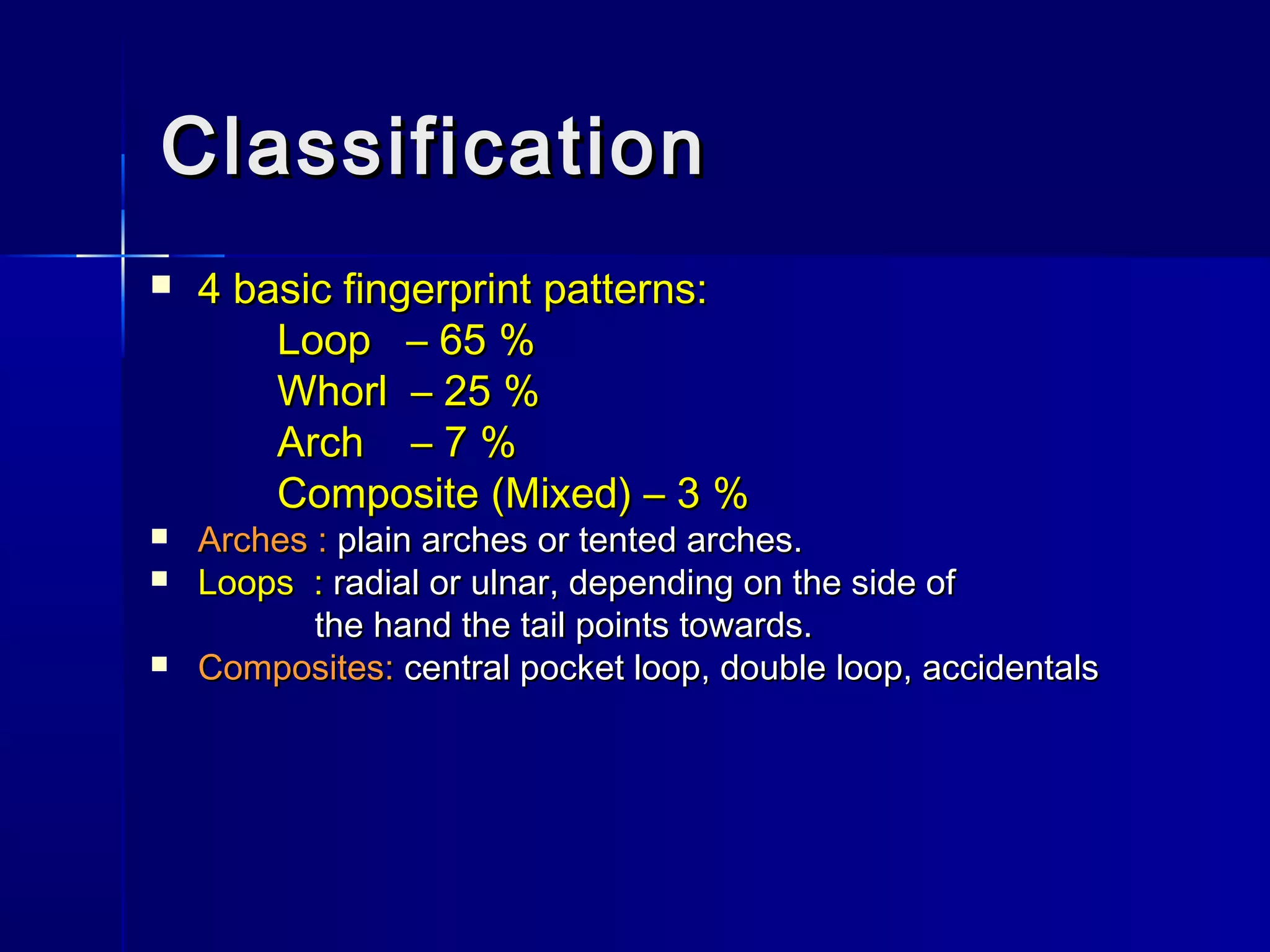
 4 basic fingerprint patterns:4 basic fingerprint patterns:
Loop – 65 %Loop – 65 %
Whorl – 25 %Whorl – 25 %
Arch – 7 %Arch – 7 %
Composite (Mixed) – 3 %Composite (Mixed) – 3 %
 Arches :Arches : plain arches or tented arches.plain arches or tented arches.
 Loops :Loops : radial or ulnar, depending on the side ofradial or ulnar, depending on the side of
the hand the tail points towards.the hand the tail points towards.
 Composites:Composites: central pocket loop, double loop, accidentalscentral pocket loop, double loop, accidentals
Points for comparisonPoints for comparison
 Presence of center [core] and triangle [delta]Presence of center [core] and triangle [delta]
in the printin the print
 Presence of pores [poroscopy]Presence of pores [poroscopy]
 Minutae of ridges- ridge ending, bifurcation,Minutae of ridges- ridge ending, bifurcation,
spur formation, dots, lakes, broken ridge,spur formation, dots, lakes, broken ridge,
short ridge etcshort ridge etc
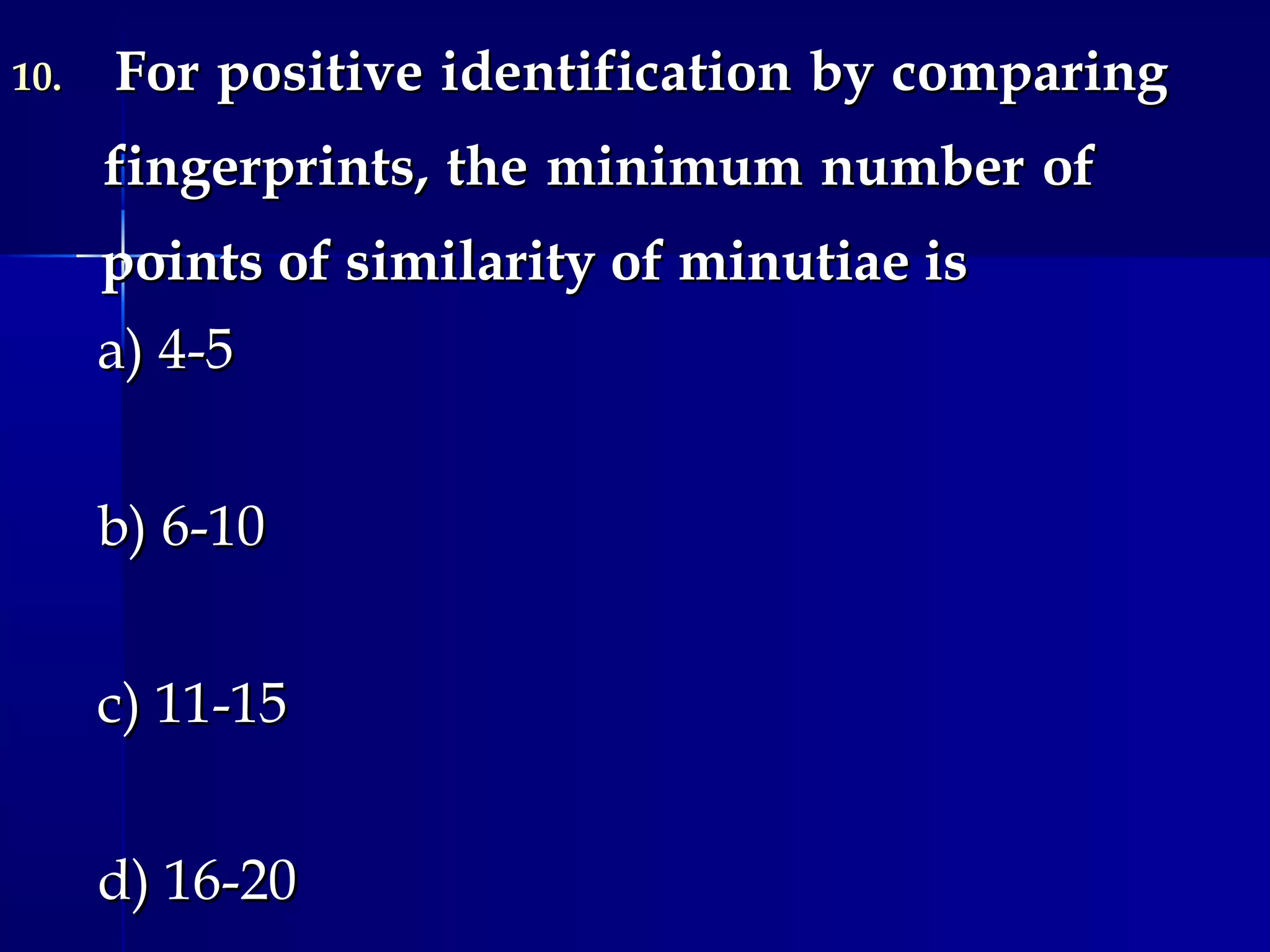
16 -20 points of fine comparison are
accepted as proof of identity
Recording of fingerprintsRecording of fingerprints
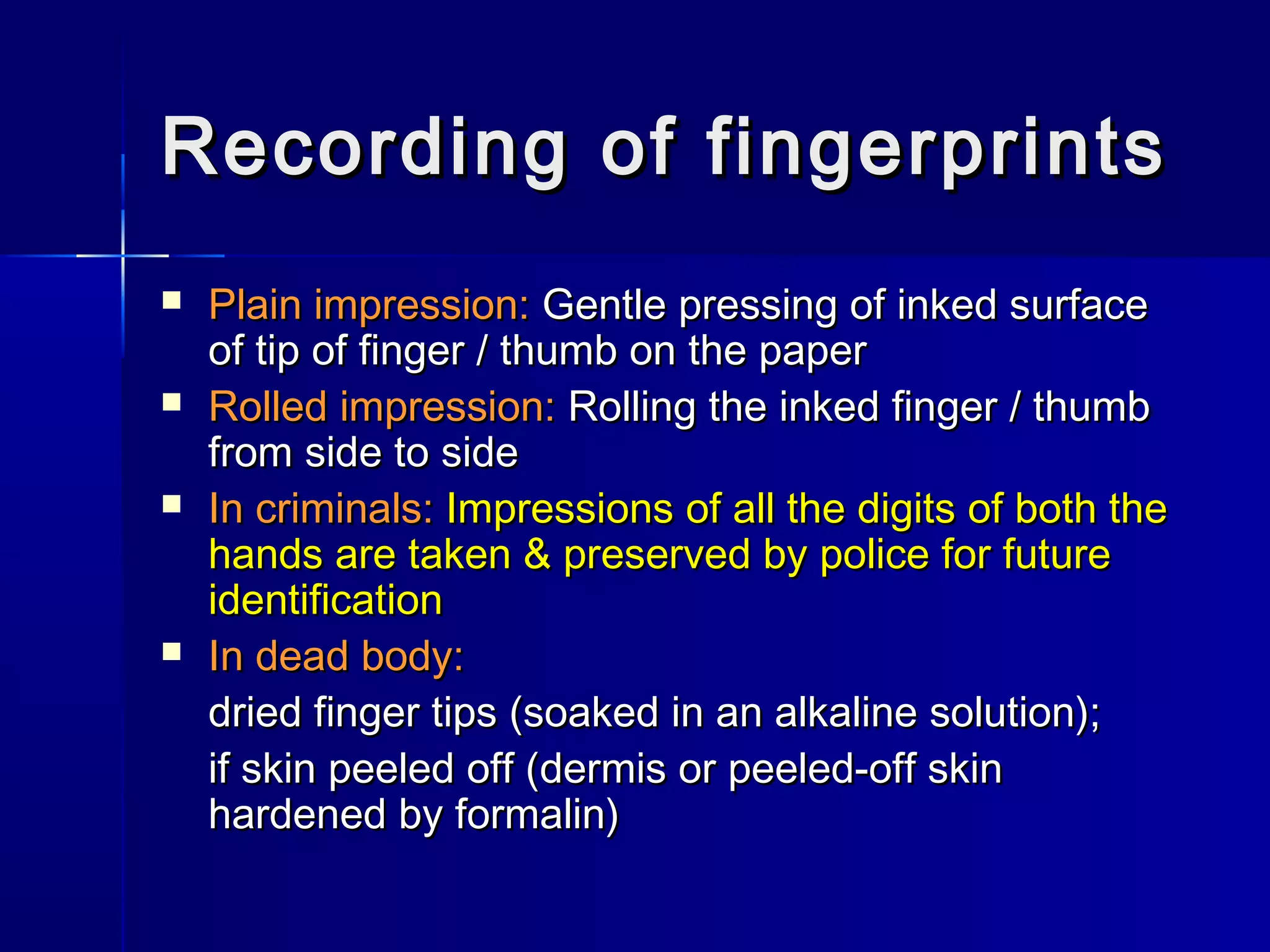
 Plain impression:Plain impression: Gentle pressing of inked surfaceGentle pressing of inked surface
of tip of finger / thumb on the paperof tip of finger / thumb on the paper
 Rolled impression:Rolled impression: Rolling the inked finger / thumbRolling the inked finger / thumb
from side to sidefrom side to side
 In criminals:In criminals: Impressions of all the digits of both theImpressions of all the digits of both the
hands are taken & preserved by police for futurehands are taken & preserved by police for future
identificationidentification
 In dead body:In dead body:
dried finger tips (soaked in an alkaline solution);dried finger tips (soaked in an alkaline solution);
if skin peeled off (dermis or peeled-off skinif skin peeled off (dermis or peeled-off skin
hardened by formalin)hardened by formalin)
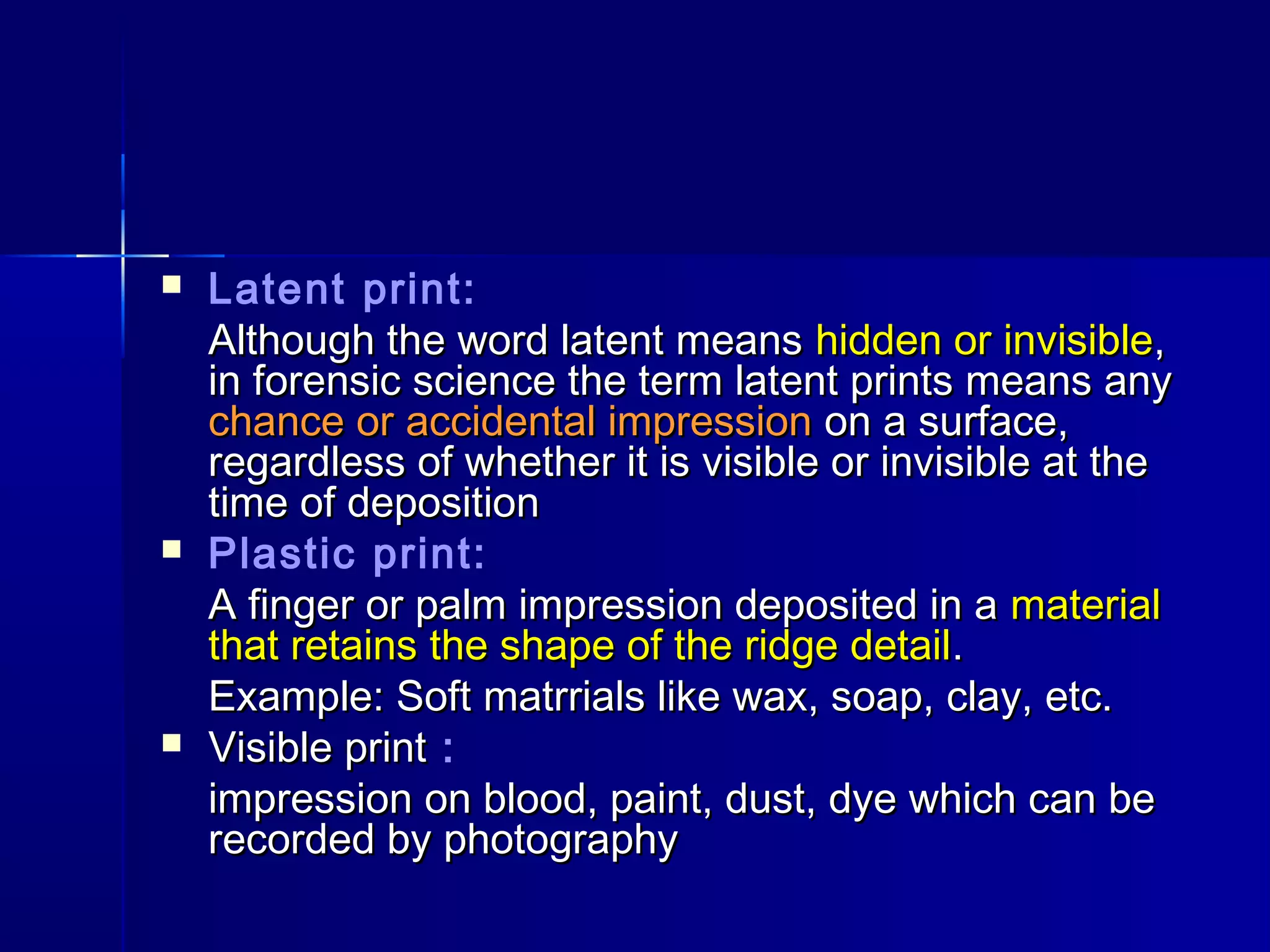
 Latent print:
Although the word latent meansAlthough the word latent means hidden or invisiblehidden or invisible,,
in forensic science the term latent prints means anyin forensic science the term latent prints means any
chance or accidental impressionchance or accidental impression on a surface,on a surface,
regardless of whether it is visible or invisible at theregardless of whether it is visible or invisible at the
time of depositiontime of deposition
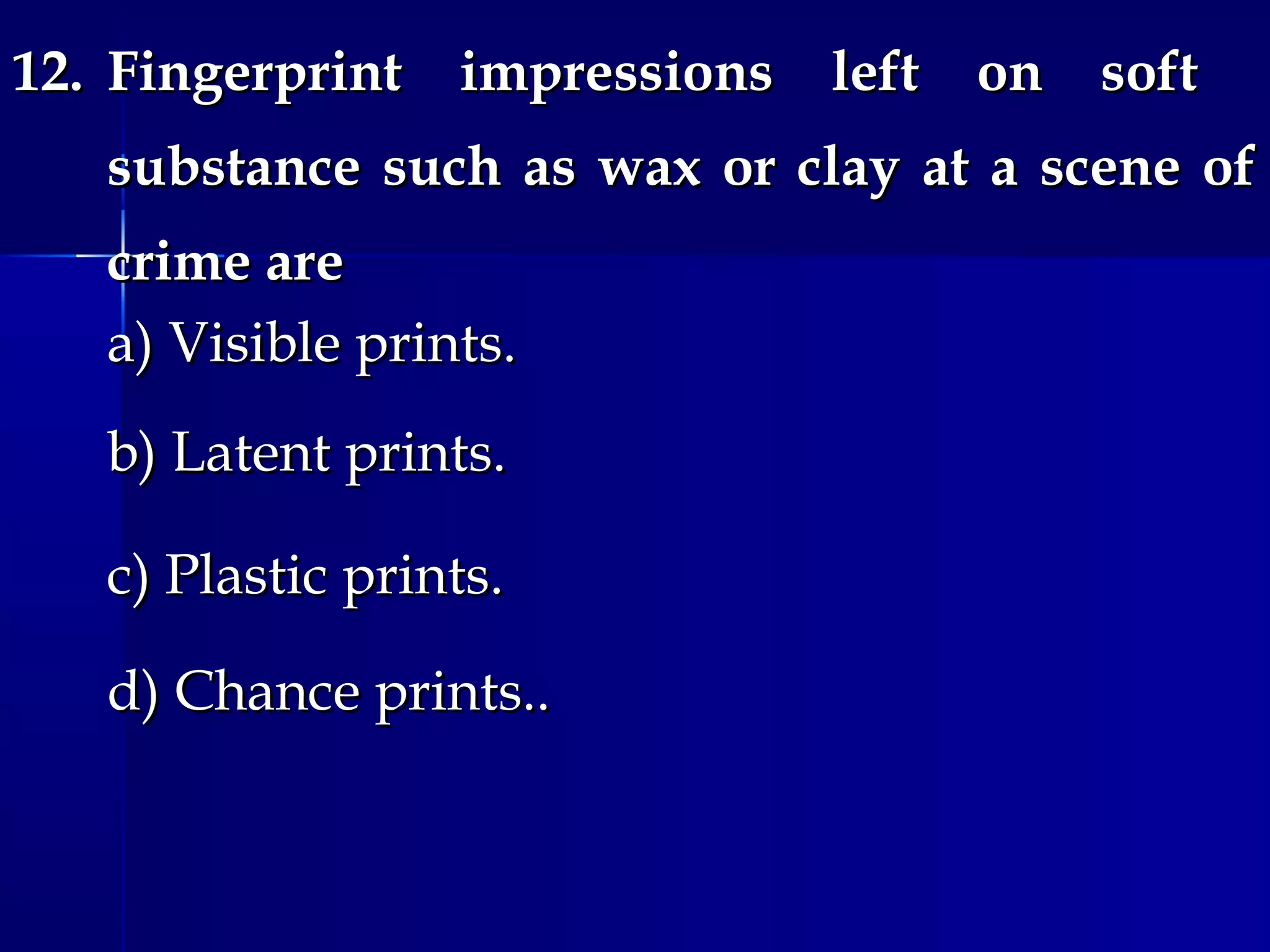
 Plastic print:
A finger or palm impression deposited in aA finger or palm impression deposited in a materialmaterial
that retains the shape of the ridge detailthat retains the shape of the ridge detail..
Example: Soft matrrials like wax, soap, clay, etc.Example: Soft matrrials like wax, soap, clay, etc.
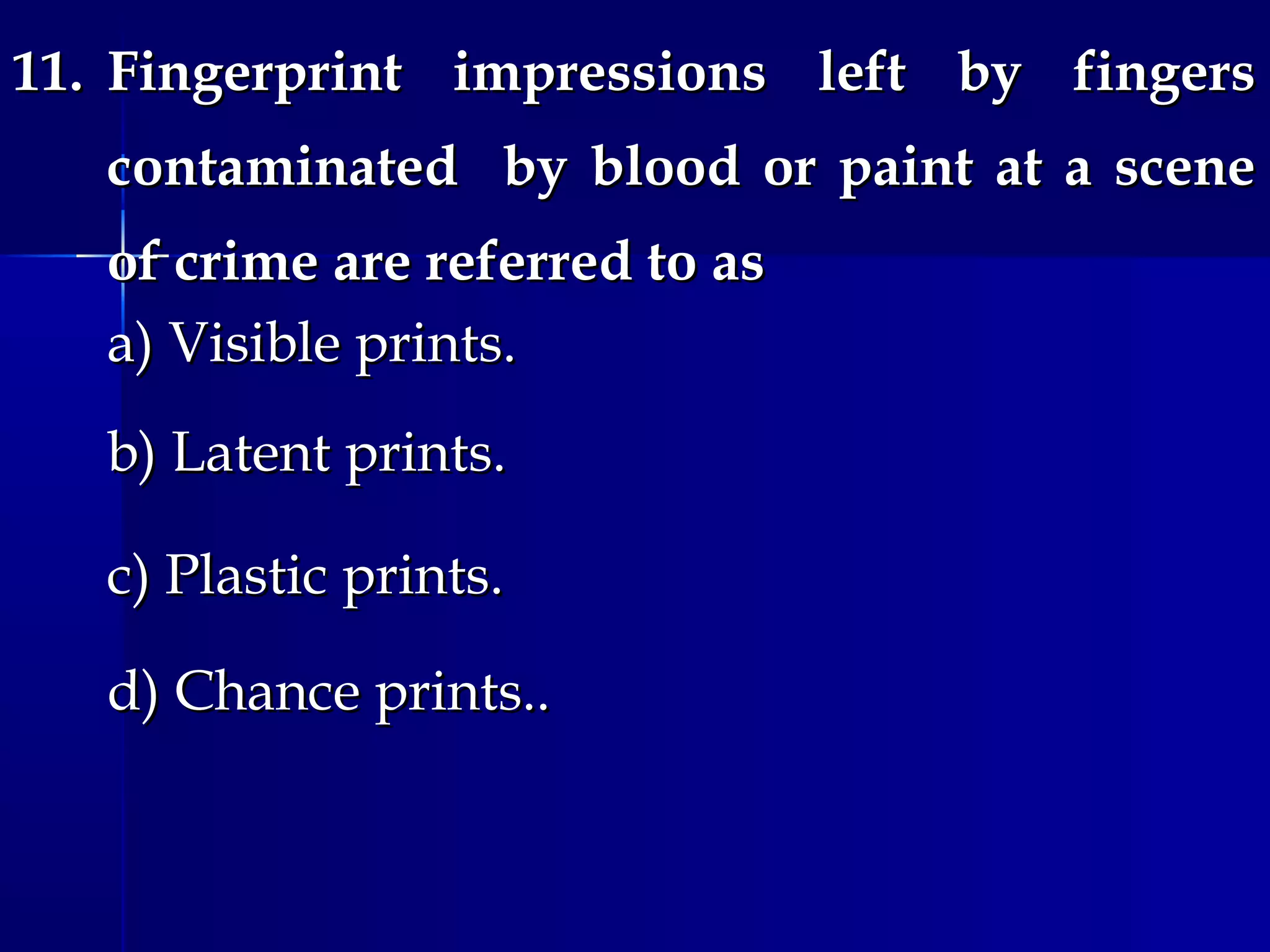
 Visible printVisible print :
impression on blood, paint, dust, dye which can beimpression on blood, paint, dust, dye which can be
recorded by photographyrecorded by photography
PoroscopyPoroscopy
 Study of pores of sweat glands in theStudy of pores of sweat glands in the
papillary ridges of epidermispapillary ridges of epidermis
 Number of pores, their size, shape &Number of pores, their size, shape &
site in a given length of a ridge -site in a given length of a ridge -
individualisticindividualistic
Foot printsFoot prints
Study of impressions of footStudy of impressions of foot
Comparison of DermatoglyphicsComparison of Dermatoglyphics
Measurements of partsMeasurements of parts
Stature = max foot length/ 0.15Stature = max foot length/ 0.15
Walking foot printWalking foot print
Recorded by photographs / castsRecorded by photographs / casts
ScarsScars
 Acquired defectAcquired defect
 Result of repair mechanismResult of repair mechanism
 Covered by epitheliumCovered by epithelium
 Devoid of pigmentation, sweat glands,Devoid of pigmentation, sweat glands,
hair follicleshair follicles
 MLI: identification, nature of injury,MLI: identification, nature of injury,
causative agent, age of scarcausative agent, age of scar
CheiloscopyCheiloscopy
Study of lip printsStudy of lip prints
LinearLinear
BifurcateBifurcate
ReticularReticular
UndeterminedUndetermined
24 individual characteristics24 individual characteristics
RugoscopyRugoscopy
 Study of palatal rugaeStudy of palatal rugae
Protected from TraumaProtected from Trauma
IndividualIndividual
Do not change during growthDo not change during growth
 Harrison Allen (1889)Harrison Allen (1889)
 Primary rugae, secondary rugae,Primary rugae, secondary rugae,
fragmented rugaefragmented rugae
Forensic OdontologyForensic Odontology
(Forensic Dentistry)(Forensic Dentistry)
 Identification: Comparing antemortemIdentification: Comparing antemortem
(AM) & postmortem (PM) records(AM) & postmortem (PM) records
 burnt,mutilated, decomposing remainsburnt,mutilated, decomposing remains
 Estimation of ageEstimation of age
 Race, occupation, sexRace, occupation, sex
 Bite marksBite marks
 Diagnosis of poisoningDiagnosis of poisoning
6. The finger print system (dactylography)6. The finger print system (dactylography)
was devised bywas devised by
a) H.H. Asquith .a) H.H. Asquith .
b) Francis Galton.b) Francis Galton.
c) Alphonse Bertillonc) Alphonse Bertillon
d) Edward Henryd) Edward Henry
8. The term “latent fingerprint” refers to8. The term “latent fingerprint” refers to
a) Invisible fingerprint on any surface thata) Invisible fingerprint on any surface that
requires developing .requires developing .
b) Visible fingerprinting made on soft surfaceb) Visible fingerprinting made on soft surface
c) Visible print made by finger contaminatedc) Visible print made by finger contaminated
with blood, paint etc.with blood, paint etc.
d) all the aboved) all the above
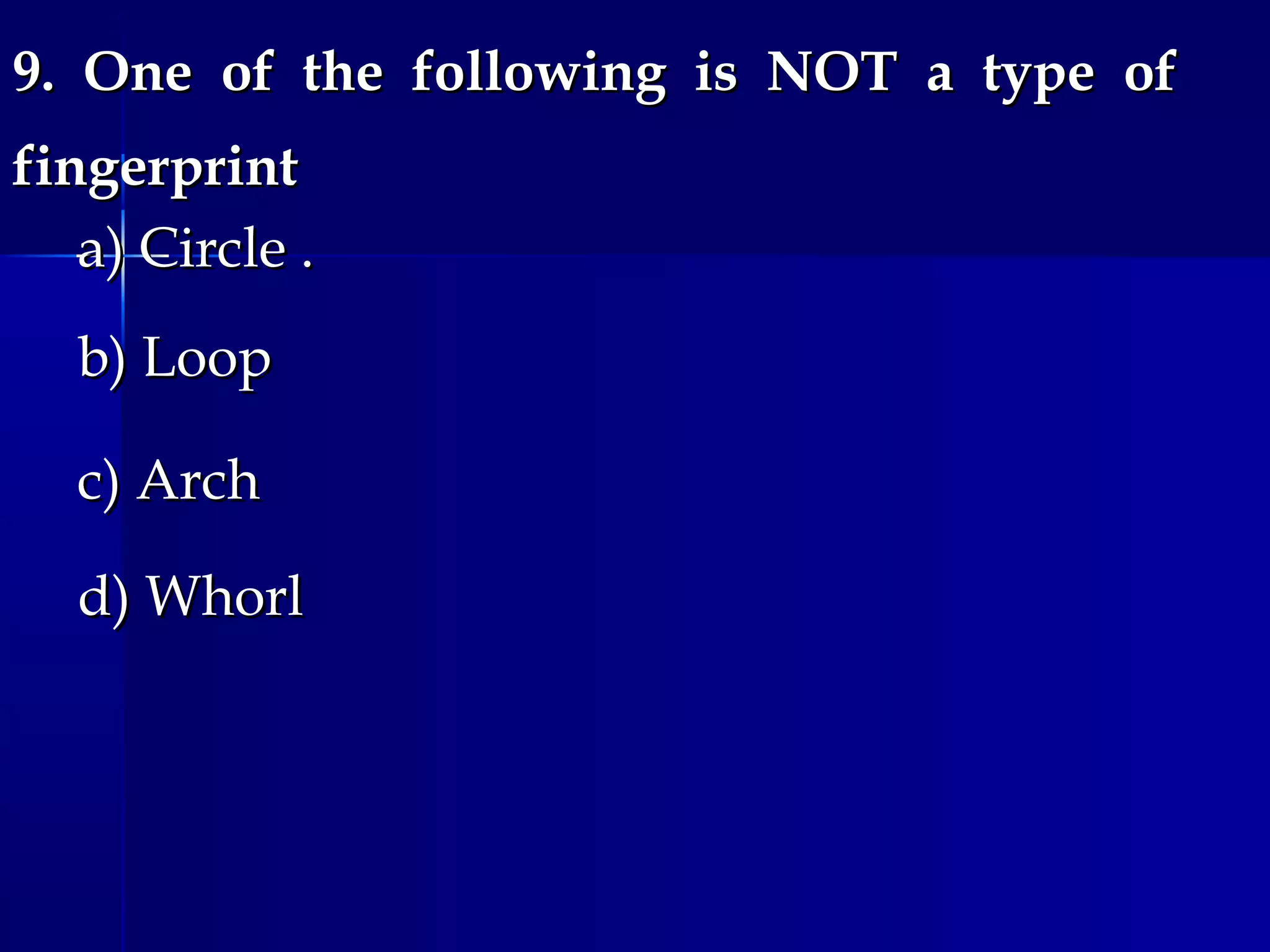
9. One of the following is NOT a type of9. One of the following is NOT a type of
fingerprintfingerprint
a) Circle .a) Circle .
b) Loopb) Loop
c) Archc) Arch
d) Whorld) Whorl
10.10. For positive identification by comparingFor positive identification by comparing
fingerprints, the minimum number offingerprints, the minimum number of
points of similarity of minutiae ispoints of similarity of minutiae is
a) 4-5a) 4-5
b) 6-10b) 6-10
c) 11-15c) 11-15
d) 16-20d) 16-20
11.11. Fingerprint impressions left by fingersFingerprint impressions left by fingers
contaminated by blood or paint at a scenecontaminated by blood or paint at a scene
of crime are referred to asof crime are referred to as
a) Visible prints.a) Visible prints.
b) Latent prints.b) Latent prints.
c) Plastic prints.c) Plastic prints.
d) Chance prints..d) Chance prints..
12.12. Fingerprint impressions left on softFingerprint impressions left on soft
substance such as wax or clay at a scene ofsubstance such as wax or clay at a scene of
crime arecrime are
a) Visible prints.a) Visible prints.
b) Latent prints.b) Latent prints.
c) Plastic prints.c) Plastic prints.
d) Chance prints..d) Chance prints..
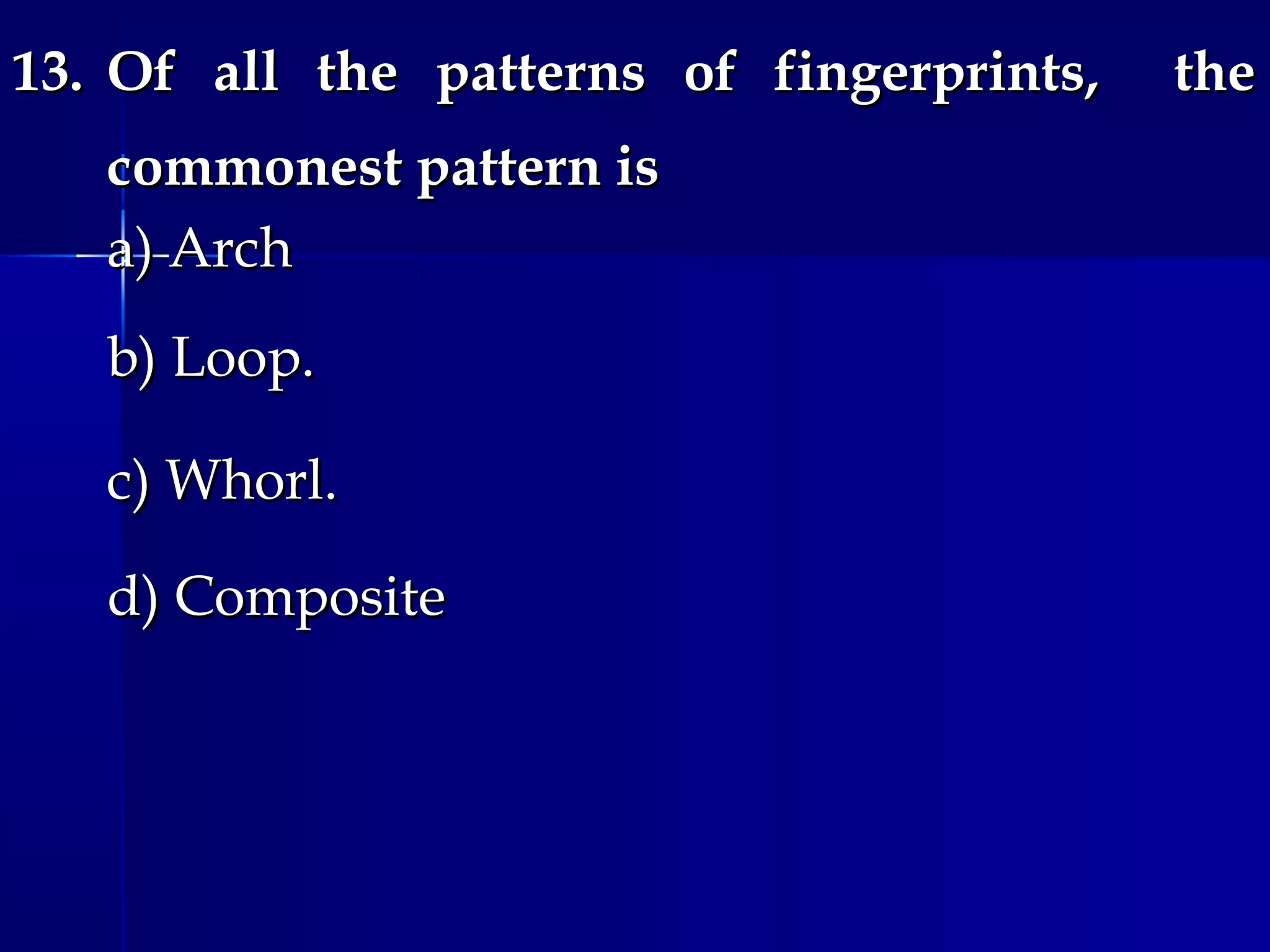
13.13. Of all the patterns of fingerprints, theOf all the patterns of fingerprints, the
commonest pattern iscommonest pattern is
a) Archa) Arch
b) Loop.b) Loop.
c) Whorl.c) Whorl.
d) Composited) Composite
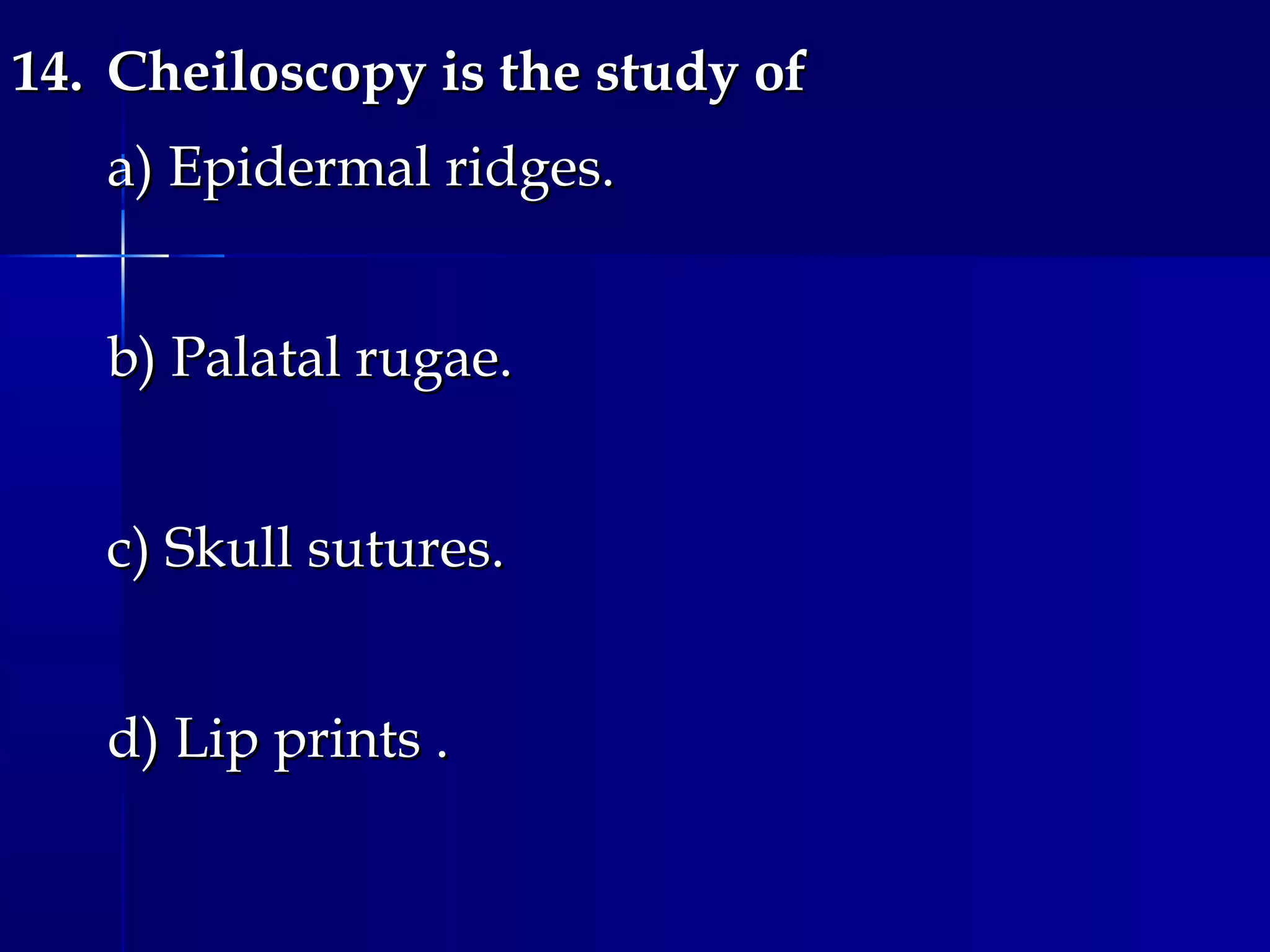
14.14. Cheiloscopy is the study ofCheiloscopy is the study of
a) Epidermal ridges.a) Epidermal ridges.
b) Palatal rugae.b) Palatal rugae.
c) Skull sutures.c) Skull sutures.
d) Lip prints .d) Lip prints .
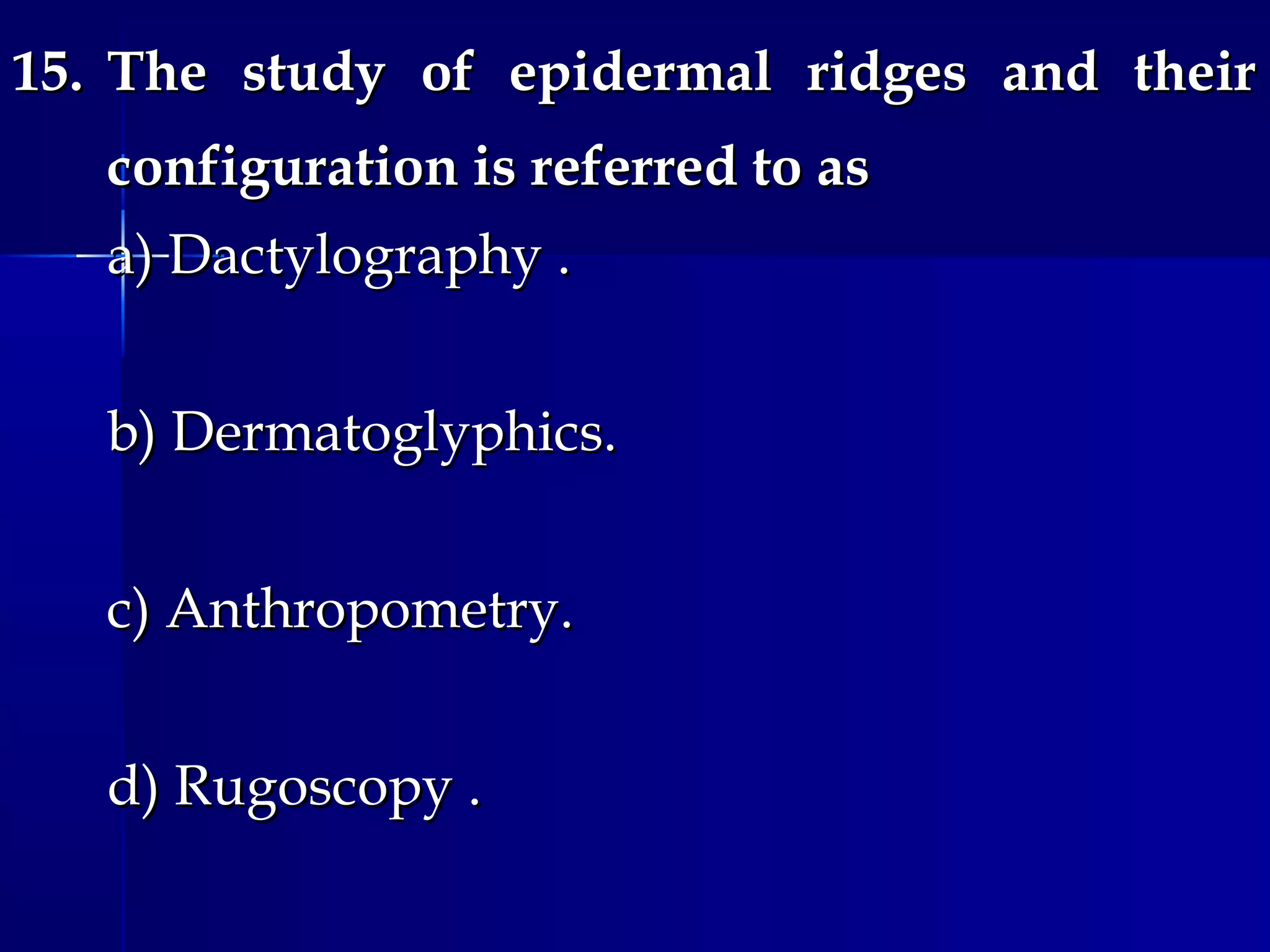
15.15. The study of epidermal ridges and theirThe study of epidermal ridges and their
configuration is referred to asconfiguration is referred to as
a) Dactylography .a) Dactylography .
b) Dermatoglyphics.b) Dermatoglyphics.
c) Anthropometry.c) Anthropometry.
d) Rugoscopy .d) Rugoscopy .
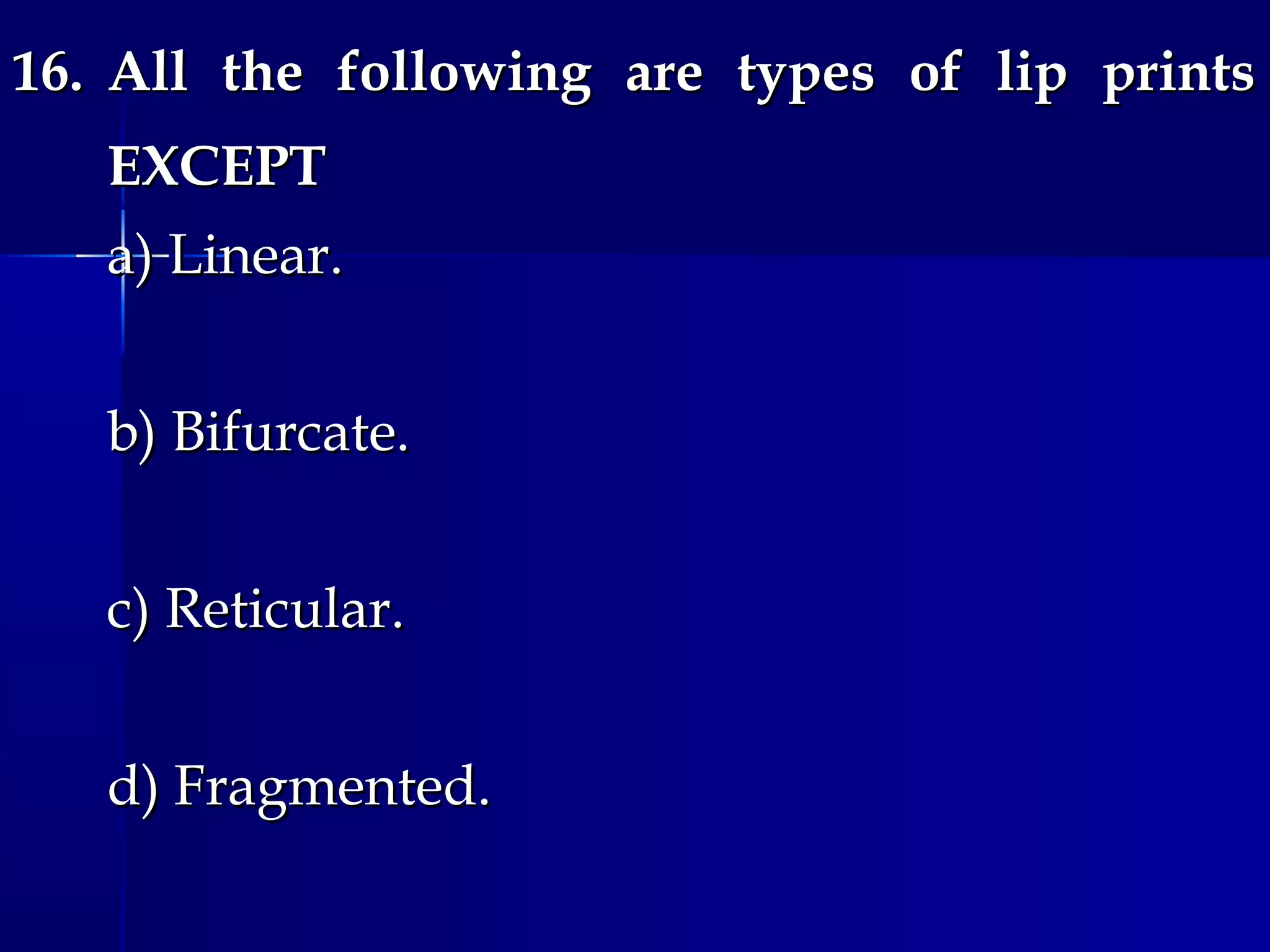
16.16. All the following are types of lip printsAll the following are types of lip prints
EXCEPTEXCEPT
a) Linear.a) Linear.
b) Bifurcate.b) Bifurcate.
c) Reticular.c) Reticular.
d) Fragmented.d) Fragmented.
17.17. Bertillion system is applicable to :Bertillion system is applicable to :
a) Adults.a) Adults.
b) Children .b) Children .
c) Infants.c) Infants.
d) All of them.d) All of them.
THANK YOUTHANK YOU

16 f i d e n t i f i c a t i o n f p

  • 1.
  • 2.
    Anthropometry-Anthropometry- BertillonageBertillonage  Habitual CriminalsRegister- Great BritainHabitual Criminals Register- Great Britain  1882- Anthropometry introduced by1882- Anthropometry introduced by Alphonse BertillonAlphonse Bertillon  Based on measurements of – total height,Based on measurements of – total height, span of arms, ht. of trunk, length & width ofspan of arms, ht. of trunk, length & width of head, length & width of right ear, length ofhead, length & width of right ear, length of left foot, left middle & ring finger, left forearmleft foot, left middle & ring finger, left forearm  1888- Dept of Judicial Identity1888- Dept of Judicial Identity  Probability- 1 in 4 millionProbability- 1 in 4 million
  • 3.
    Evolution of fingerprintEvolution of finger print as identification toolas identification tool  1820- Prof Johann Purkinje1820- Prof Johann Purkinje  1860- William Herschel1860- William Herschel  Same period- Dr Henry Faulds reported inSame period- Dr Henry Faulds reported in 18801880  1891- Francis Galton published paper on1891- Francis Galton published paper on classification of finger printsclassification of finger prints  Edward Henry-simple classificationEdward Henry-simple classification  1914- Alphonse Bertillon died a shattered1914- Alphonse Bertillon died a shattered manman
  • 4.
  • 5.
    Fingerprint / DactylographyFingerprint/ Dactylography / Dermatoglyphics/ Dermatoglyphics  DactylographyDactylography is the process of takingis the process of taking impressions of the pulp of fingers andimpressions of the pulp of fingers and thumbs on an unglazed white paperthumbs on an unglazed white paper and examining them with a magnifyingand examining them with a magnifying lens.lens.
  • 6.
    PrinciplePrinciple  Fingers coveredwith characteristicFingers covered with characteristic ridges – permanent & uniqueridges – permanent & unique  Different even in twinsDifferent even in twins  Locard’s principle of exchangeLocard’s principle of exchange When 2 objects come in contact withWhen 2 objects come in contact with each other, there will be always aeach other, there will be always a mutual transference of material frommutual transference of material from each othereach other
  • 7.
  • 8.
  • 9.
    Whorl & Mixed(Composite)Whorl & Mixed (Composite)
  • 10.
    ClassificationClassification  4 basicfingerprint patterns:4 basic fingerprint patterns: Loop – 65 %Loop – 65 % Whorl – 25 %Whorl – 25 % Arch – 7 %Arch – 7 % Composite (Mixed) – 3 %Composite (Mixed) – 3 %  Arches :Arches : plain arches or tented arches.plain arches or tented arches.  Loops :Loops : radial or ulnar, depending on the side ofradial or ulnar, depending on the side of the hand the tail points towards.the hand the tail points towards.  Composites:Composites: central pocket loop, double loop, accidentalscentral pocket loop, double loop, accidentals
  • 11.
    Points for comparisonPointsfor comparison  Presence of center [core] and triangle [delta]Presence of center [core] and triangle [delta] in the printin the print  Presence of pores [poroscopy]Presence of pores [poroscopy]  Minutae of ridges- ridge ending, bifurcation,Minutae of ridges- ridge ending, bifurcation, spur formation, dots, lakes, broken ridge,spur formation, dots, lakes, broken ridge, short ridge etcshort ridge etc 16 -20 points of fine comparison are accepted as proof of identity
  • 12.
    Recording of fingerprintsRecordingof fingerprints  Plain impression:Plain impression: Gentle pressing of inked surfaceGentle pressing of inked surface of tip of finger / thumb on the paperof tip of finger / thumb on the paper  Rolled impression:Rolled impression: Rolling the inked finger / thumbRolling the inked finger / thumb from side to sidefrom side to side  In criminals:In criminals: Impressions of all the digits of both theImpressions of all the digits of both the hands are taken & preserved by police for futurehands are taken & preserved by police for future identificationidentification  In dead body:In dead body: dried finger tips (soaked in an alkaline solution);dried finger tips (soaked in an alkaline solution); if skin peeled off (dermis or peeled-off skinif skin peeled off (dermis or peeled-off skin hardened by formalin)hardened by formalin)
  • 13.
     Latent print: Althoughthe word latent meansAlthough the word latent means hidden or invisiblehidden or invisible,, in forensic science the term latent prints means anyin forensic science the term latent prints means any chance or accidental impressionchance or accidental impression on a surface,on a surface, regardless of whether it is visible or invisible at theregardless of whether it is visible or invisible at the time of depositiontime of deposition  Plastic print: A finger or palm impression deposited in aA finger or palm impression deposited in a materialmaterial that retains the shape of the ridge detailthat retains the shape of the ridge detail.. Example: Soft matrrials like wax, soap, clay, etc.Example: Soft matrrials like wax, soap, clay, etc.  Visible printVisible print : impression on blood, paint, dust, dye which can beimpression on blood, paint, dust, dye which can be recorded by photographyrecorded by photography
  • 14.
    PoroscopyPoroscopy  Study ofpores of sweat glands in theStudy of pores of sweat glands in the papillary ridges of epidermispapillary ridges of epidermis  Number of pores, their size, shape &Number of pores, their size, shape & site in a given length of a ridge -site in a given length of a ridge - individualisticindividualistic
  • 15.
    Foot printsFoot prints Studyof impressions of footStudy of impressions of foot Comparison of DermatoglyphicsComparison of Dermatoglyphics Measurements of partsMeasurements of parts Stature = max foot length/ 0.15Stature = max foot length/ 0.15 Walking foot printWalking foot print Recorded by photographs / castsRecorded by photographs / casts
  • 16.
    ScarsScars  Acquired defectAcquireddefect  Result of repair mechanismResult of repair mechanism  Covered by epitheliumCovered by epithelium  Devoid of pigmentation, sweat glands,Devoid of pigmentation, sweat glands, hair follicleshair follicles  MLI: identification, nature of injury,MLI: identification, nature of injury, causative agent, age of scarcausative agent, age of scar
  • 17.
    CheiloscopyCheiloscopy Study of lipprintsStudy of lip prints LinearLinear BifurcateBifurcate ReticularReticular UndeterminedUndetermined 24 individual characteristics24 individual characteristics
  • 18.
    RugoscopyRugoscopy  Study ofpalatal rugaeStudy of palatal rugae Protected from TraumaProtected from Trauma IndividualIndividual Do not change during growthDo not change during growth  Harrison Allen (1889)Harrison Allen (1889)  Primary rugae, secondary rugae,Primary rugae, secondary rugae, fragmented rugaefragmented rugae
  • 19.
    Forensic OdontologyForensic Odontology (ForensicDentistry)(Forensic Dentistry)  Identification: Comparing antemortemIdentification: Comparing antemortem (AM) & postmortem (PM) records(AM) & postmortem (PM) records  burnt,mutilated, decomposing remainsburnt,mutilated, decomposing remains  Estimation of ageEstimation of age  Race, occupation, sexRace, occupation, sex  Bite marksBite marks  Diagnosis of poisoningDiagnosis of poisoning
  • 20.
    6. The fingerprint system (dactylography)6. The finger print system (dactylography) was devised bywas devised by a) H.H. Asquith .a) H.H. Asquith . b) Francis Galton.b) Francis Galton. c) Alphonse Bertillonc) Alphonse Bertillon d) Edward Henryd) Edward Henry
  • 21.
    8. The term“latent fingerprint” refers to8. The term “latent fingerprint” refers to a) Invisible fingerprint on any surface thata) Invisible fingerprint on any surface that requires developing .requires developing . b) Visible fingerprinting made on soft surfaceb) Visible fingerprinting made on soft surface c) Visible print made by finger contaminatedc) Visible print made by finger contaminated with blood, paint etc.with blood, paint etc. d) all the aboved) all the above
  • 22.
    9. One ofthe following is NOT a type of9. One of the following is NOT a type of fingerprintfingerprint a) Circle .a) Circle . b) Loopb) Loop c) Archc) Arch d) Whorld) Whorl
  • 23.
    10.10. For positiveidentification by comparingFor positive identification by comparing fingerprints, the minimum number offingerprints, the minimum number of points of similarity of minutiae ispoints of similarity of minutiae is a) 4-5a) 4-5 b) 6-10b) 6-10 c) 11-15c) 11-15 d) 16-20d) 16-20
  • 24.
    11.11. Fingerprint impressionsleft by fingersFingerprint impressions left by fingers contaminated by blood or paint at a scenecontaminated by blood or paint at a scene of crime are referred to asof crime are referred to as a) Visible prints.a) Visible prints. b) Latent prints.b) Latent prints. c) Plastic prints.c) Plastic prints. d) Chance prints..d) Chance prints..
  • 25.
    12.12. Fingerprint impressionsleft on softFingerprint impressions left on soft substance such as wax or clay at a scene ofsubstance such as wax or clay at a scene of crime arecrime are a) Visible prints.a) Visible prints. b) Latent prints.b) Latent prints. c) Plastic prints.c) Plastic prints. d) Chance prints..d) Chance prints..
  • 26.
    13.13. Of allthe patterns of fingerprints, theOf all the patterns of fingerprints, the commonest pattern iscommonest pattern is a) Archa) Arch b) Loop.b) Loop. c) Whorl.c) Whorl. d) Composited) Composite
  • 27.
    14.14. Cheiloscopy isthe study ofCheiloscopy is the study of a) Epidermal ridges.a) Epidermal ridges. b) Palatal rugae.b) Palatal rugae. c) Skull sutures.c) Skull sutures. d) Lip prints .d) Lip prints .
  • 28.
    15.15. The studyof epidermal ridges and theirThe study of epidermal ridges and their configuration is referred to asconfiguration is referred to as a) Dactylography .a) Dactylography . b) Dermatoglyphics.b) Dermatoglyphics. c) Anthropometry.c) Anthropometry. d) Rugoscopy .d) Rugoscopy .
  • 29.
    16.16. All thefollowing are types of lip printsAll the following are types of lip prints EXCEPTEXCEPT a) Linear.a) Linear. b) Bifurcate.b) Bifurcate. c) Reticular.c) Reticular. d) Fragmented.d) Fragmented.
  • 30.
    17.17. Bertillion systemis applicable to :Bertillion system is applicable to : a) Adults.a) Adults. b) Children .b) Children . c) Infants.c) Infants. d) All of them.d) All of them.
  • 31.