Amanda Hurtado,
Katherine McGowan,
Blanca Muñoz
ANCIENT HISTORY OF FINGERPRINTING
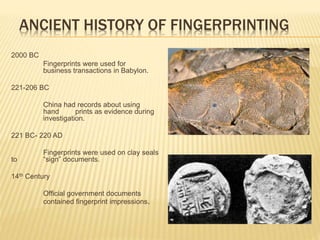
2000 BC
Fingerprints were used for
business transactions in Babylon.
221-206 BC
China had records about using
hand prints as evidence during
investigation.
221 BC- 220 AD
Fingerprints were used on clay seals
to “sign” documents.
14th Century
Official government documents
contained fingerprint impressions.
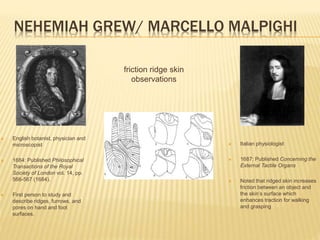
NEHEMIAH GREW/ MARCELLO MALPIGHI
 English botanist, physician and
microscopist
 1684: Published Philosophical
Transactions of the Royal
Society of London vol. 14, pp.
566-567 (1684).
 First person to study and
describe ridges, furrows, and
pores on hand and foot
surfaces.
 Italian physiologist
 1687: Published Concerning the
External Tactile Organs
 Noted that ridged skin increases
friction between an object and
the skin’s surface which
enhances traction for walking
and grasping
friction ridge skin
observations
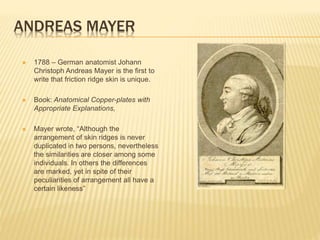
ANDREAS MAYER
 1788 – German anatomist Johann
Christoph Andreas Mayer is the first to
write that friction ridge skin is unique.
 Book: Anatomical Copper-plates with
Appropriate Explanations,
 Mayer wrote, “Although the
arrangement of skin ridges is never
duplicated in two persons, nevertheless
the similarities are closer among some
individuals. In others the differences
are marked, yet in spite of their
peculiarities of arrangement all have a
certain likeness”
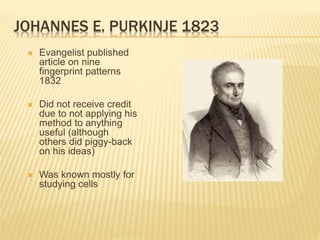
JOHANNES E. PURKINJE 1823
 Evangelist published
article on nine
fingerprint patterns
1832
 Did not receive credit
due to not applying his
method to anything
useful (although
others did piggy-back
on his ideas)
 Was known mostly for
studying cells
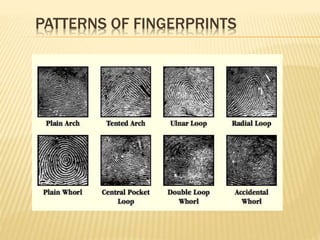
PATTERNS OF FINGERPRINTS
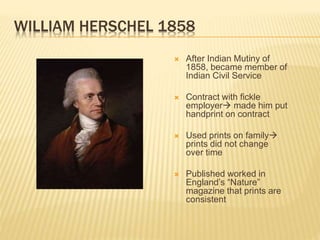
WILLIAM HERSCHEL 1858
 After Indian Mutiny of
1858, became member of
Indian Civil Service
 Contract with fickle
employer made him put
handprint on contract
 Used prints on family
prints did not change
over time
 Published worked in
England’s “Nature”
magazine that prints are
consistent
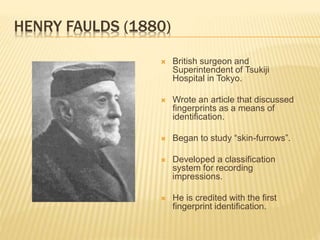
HENRY FAULDS (1880)
 British surgeon and
Superintendent of Tsukiji
Hospital in Tokyo.
 Wrote an article that discussed
fingerprints as a means of
identification.
 Began to study “skin-furrows”.
 Developed a classification
system for recording
impressions.
 He is credited with the first
fingerprint identification.
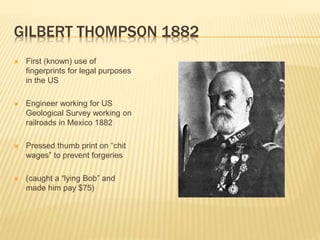
GILBERT THOMPSON 1882
 First (known) use of
fingerprints for legal purposes
in the US
 Engineer working for US
Geological Survey working on
railroads in Mexico 1882
 Pressed thumb print on “chit
wages” to prevent forgeries
 (caught a “lying Bob” and
made him pay $75)
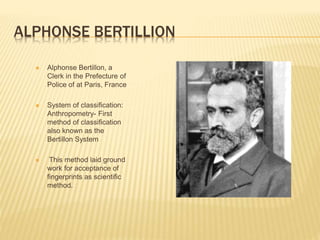
ALPHONSE BERTILLION
 Alphonse Bertillon, a
Clerk in the Prefecture of
Police of at Paris, France
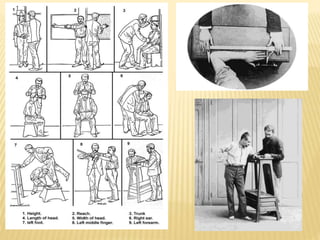
 System of classification:
Anthropometry- First
method of classification
also known as the
Bertillon System
 This method laid ground
work for acceptance of
fingerprints as scientific
method.
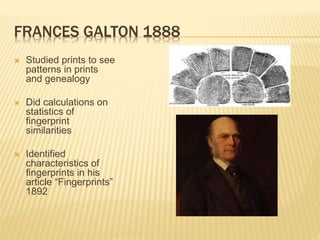
FRANCES GALTON 1888
 Studied prints to see
patterns in prints
and genealogy
 Did calculations on
statistics of
fingerprint
similarities
 Identified
characteristics of
fingerprints in his
article “Fingerprints”
1892
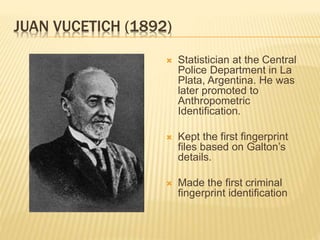
JUAN VUCETICH (1892)
 Statistician at the Central
Police Department in La
Plata, Argentina. He was
later promoted to
Anthropometric
Identification.
 Kept the first fingerprint
files based on Galton’s
details.
 Made the first criminal
fingerprint identification
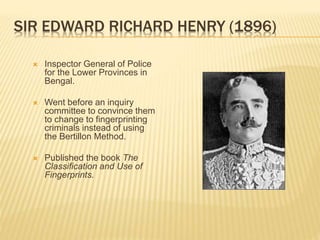
SIR EDWARD RICHARD HENRY (1896)
 Inspector General of Police
for the Lower Provinces in
Bengal.
 Went before an inquiry
committee to convince them
to change to fingerprinting
criminals instead of using
the Bertillon Method.
 Published the book The
Classification and Use of
Fingerprints.
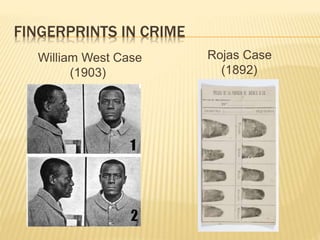
FINGERPRINTS IN CRIME
William West Case
(1903)
Rojas Case
(1892)
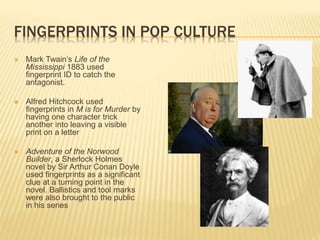
FINGERPRINTS IN POP CULTURE
 Mark Twain’s Life of the
Mississippi 1883 used
fingerprint ID to catch the
antagonist.
 Alfred Hitchcock used
fingerprints in M is for Murder by
having one character trick
another into leaving a visible
print on a letter
 Adventure of the Norwood
Builder, a Sherlock Holmes
novel by Sir Arthur Conan Doyle
used fingerprints as a significant
clue at a turning point in the
novel. Ballistics and tool marks
were also brought to the public
in his series
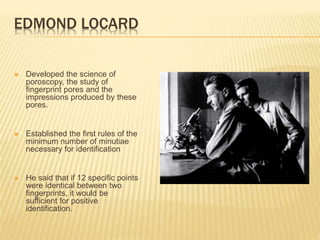
EDMOND LOCARD
 Developed the science of
poroscopy, the study of
fingerprint pores and the
impressions produced by these
pores.
 Established the first rules of the
minimum number of minutiae
necessary for identification
 He said that if 12 specific points
were identical between two
fingerprints, it would be
sufficient for positive
identification.
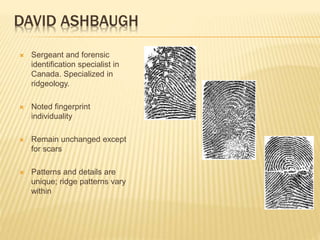
DAVID ASHBAUGH
 Sergeant and forensic
identification specialist in
Canada. Specialized in
ridgeology.
 Noted fingerprint
individuality
 Remain unchanged except
for scars
 Patterns and details are
unique; ridge patterns vary
within
AUTOMATED FINGERPRINT IDENTIFICATION SYSTEM (AFIS)
 Replace intensive processes
of classifying, searching,
and matching ten print cards
used for personal
identification
 Database search for 10 pt.
set of prints
 1963 Special Agent Carl
Voelker: FBI’s fingerprint
identification process.
 1975-1976: System called
Finder was delivered to the
FBI.
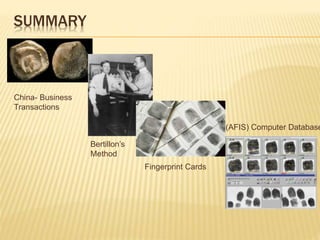
SUMMARY
China- Business
Transactions
Bertillon’s
Method
Fingerprint Cards
(AFIS) Computer Database
WORK CITED
Ashbaugh, David R. Ridgeology Modern Evaluative Friction Ridge Identification.
Canada, 1999. eBook file.
Barnes, Jeffery G. "History." Fingerprint Source Book. Maryland, 2010. 3-18. PDF
file.
Crime Scene Forensics. N.p., n.d. Web. 26 Jan. 2014.
<http://www.crimescene-forensics.com/ History_of_Fingerprints.html>
Ferguson, C. E., B. E. Turvey, and W. A. Petherick. "Edmond Locard." Forensic
Science Central. Elsevier Academic, 2010. Web. 26 Jan. 2014.
<http://forensicsciencecentral.co.uk/edmondlocard.shtml>.
Fingerprint Evidence. N.p., n.d. Web. 26 Jan. 2014. <http://www.finger-
prints.com/>.
Gale, Thomson, ed. "Ashbaugh, David Robinson." Encyclopedia.com.
HighBeam™ Research, 2014. Web. 26 Jan. 2014.
<http://www.encyclopedia.com/doc/1G2-3448300042.html>.
Galton, Francis. Finger Prints. London: MACMILLAN AND CO. AND NEW YORK,
Herschel, William J. The Origin of Finger-Printing. London: OXFORD UP, 1916. N.
pag. eBook file.
Higgins, Peter, et al. "Automated Fingerprint Identification System (AFIS)."
Fingerprint Source Book. By Kenneth R. Moses. Maryland, 2010. 3-33.PDF
file.
History of Forensic Psychology. N.p., n.d. Web. 26 Jan. 2014.
<http://forensicpsych.umwblogs.org/research/criminaljustice/fingerprint-
analysis/>.
Reachinformation. Reach Information, 2009. Web. 26 Jan. 2014.
<http://www.healthcare.reachinformation.com/Nehemiah_Grew.aspx>.
The History of Fingerprints. N.p., n.d. Web. 26 Jan. 2014.
<http://onin.com/fp/ fphistory.html>.
QUESTIONS 

fingerprints-1uo8z6z.pptx

  • 1.
  • 2.
    ANCIENT HISTORY OFFINGERPRINTING 2000 BC Fingerprints were used for business transactions in Babylon. 221-206 BC China had records about using hand prints as evidence during investigation. 221 BC- 220 AD Fingerprints were used on clay seals to “sign” documents. 14th Century Official government documents contained fingerprint impressions.
  • 3.
    NEHEMIAH GREW/ MARCELLOMALPIGHI  English botanist, physician and microscopist  1684: Published Philosophical Transactions of the Royal Society of London vol. 14, pp. 566-567 (1684).  First person to study and describe ridges, furrows, and pores on hand and foot surfaces.  Italian physiologist  1687: Published Concerning the External Tactile Organs  Noted that ridged skin increases friction between an object and the skin’s surface which enhances traction for walking and grasping friction ridge skin observations
  • 4.
    ANDREAS MAYER  1788– German anatomist Johann Christoph Andreas Mayer is the first to write that friction ridge skin is unique.  Book: Anatomical Copper-plates with Appropriate Explanations,  Mayer wrote, “Although the arrangement of skin ridges is never duplicated in two persons, nevertheless the similarities are closer among some individuals. In others the differences are marked, yet in spite of their peculiarities of arrangement all have a certain likeness”
  • 5.
    JOHANNES E. PURKINJE1823  Evangelist published article on nine fingerprint patterns 1832  Did not receive credit due to not applying his method to anything useful (although others did piggy-back on his ideas)  Was known mostly for studying cells
  • 6.
  • 7.
    WILLIAM HERSCHEL 1858 After Indian Mutiny of 1858, became member of Indian Civil Service  Contract with fickle employer made him put handprint on contract  Used prints on family prints did not change over time  Published worked in England’s “Nature” magazine that prints are consistent
  • 8.
    HENRY FAULDS (1880) British surgeon and Superintendent of Tsukiji Hospital in Tokyo.  Wrote an article that discussed fingerprints as a means of identification.  Began to study “skin-furrows”.  Developed a classification system for recording impressions.  He is credited with the first fingerprint identification.
  • 9.
    GILBERT THOMPSON 1882 First (known) use of fingerprints for legal purposes in the US  Engineer working for US Geological Survey working on railroads in Mexico 1882  Pressed thumb print on “chit wages” to prevent forgeries  (caught a “lying Bob” and made him pay $75)
  • 10.
    ALPHONSE BERTILLION  AlphonseBertillon, a Clerk in the Prefecture of Police of at Paris, France  System of classification: Anthropometry- First method of classification also known as the Bertillon System  This method laid ground work for acceptance of fingerprints as scientific method.
  • 12.
    FRANCES GALTON 1888 Studied prints to see patterns in prints and genealogy  Did calculations on statistics of fingerprint similarities  Identified characteristics of fingerprints in his article “Fingerprints” 1892
  • 13.
    JUAN VUCETICH (1892) Statistician at the Central Police Department in La Plata, Argentina. He was later promoted to Anthropometric Identification.  Kept the first fingerprint files based on Galton’s details.  Made the first criminal fingerprint identification
  • 14.
    SIR EDWARD RICHARDHENRY (1896)  Inspector General of Police for the Lower Provinces in Bengal.  Went before an inquiry committee to convince them to change to fingerprinting criminals instead of using the Bertillon Method.  Published the book The Classification and Use of Fingerprints.
  • 15.
    FINGERPRINTS IN CRIME WilliamWest Case (1903) Rojas Case (1892)
  • 16.
    FINGERPRINTS IN POPCULTURE  Mark Twain’s Life of the Mississippi 1883 used fingerprint ID to catch the antagonist.  Alfred Hitchcock used fingerprints in M is for Murder by having one character trick another into leaving a visible print on a letter  Adventure of the Norwood Builder, a Sherlock Holmes novel by Sir Arthur Conan Doyle used fingerprints as a significant clue at a turning point in the novel. Ballistics and tool marks were also brought to the public in his series
  • 17.
    EDMOND LOCARD  Developedthe science of poroscopy, the study of fingerprint pores and the impressions produced by these pores.  Established the first rules of the minimum number of minutiae necessary for identification  He said that if 12 specific points were identical between two fingerprints, it would be sufficient for positive identification.
  • 18.
    DAVID ASHBAUGH  Sergeantand forensic identification specialist in Canada. Specialized in ridgeology.  Noted fingerprint individuality  Remain unchanged except for scars  Patterns and details are unique; ridge patterns vary within
  • 19.
    AUTOMATED FINGERPRINT IDENTIFICATIONSYSTEM (AFIS)  Replace intensive processes of classifying, searching, and matching ten print cards used for personal identification  Database search for 10 pt. set of prints  1963 Special Agent Carl Voelker: FBI’s fingerprint identification process.  1975-1976: System called Finder was delivered to the FBI.
  • 20.
  • 21.
    WORK CITED Ashbaugh, DavidR. Ridgeology Modern Evaluative Friction Ridge Identification. Canada, 1999. eBook file. Barnes, Jeffery G. "History." Fingerprint Source Book. Maryland, 2010. 3-18. PDF file. Crime Scene Forensics. N.p., n.d. Web. 26 Jan. 2014. <http://www.crimescene-forensics.com/ History_of_Fingerprints.html> Ferguson, C. E., B. E. Turvey, and W. A. Petherick. "Edmond Locard." Forensic Science Central. Elsevier Academic, 2010. Web. 26 Jan. 2014. <http://forensicsciencecentral.co.uk/edmondlocard.shtml>. Fingerprint Evidence. N.p., n.d. Web. 26 Jan. 2014. <http://www.finger- prints.com/>. Gale, Thomson, ed. "Ashbaugh, David Robinson." Encyclopedia.com. HighBeam™ Research, 2014. Web. 26 Jan. 2014. <http://www.encyclopedia.com/doc/1G2-3448300042.html>. Galton, Francis. Finger Prints. London: MACMILLAN AND CO. AND NEW YORK,
  • 22.
    Herschel, William J.The Origin of Finger-Printing. London: OXFORD UP, 1916. N. pag. eBook file. Higgins, Peter, et al. "Automated Fingerprint Identification System (AFIS)." Fingerprint Source Book. By Kenneth R. Moses. Maryland, 2010. 3-33.PDF file. History of Forensic Psychology. N.p., n.d. Web. 26 Jan. 2014. <http://forensicpsych.umwblogs.org/research/criminaljustice/fingerprint- analysis/>. Reachinformation. Reach Information, 2009. Web. 26 Jan. 2014. <http://www.healthcare.reachinformation.com/Nehemiah_Grew.aspx>. The History of Fingerprints. N.p., n.d. Web. 26 Jan. 2014. <http://onin.com/fp/ fphistory.html>.
  • 23.