Fire Inspection and Code
Enforcement
8th Edition
Chapter 3 — Fire Behavior
‣ Describe the various components of fire
behavior.
Learning Objective 1
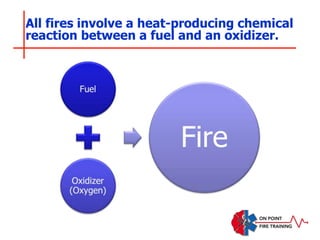
All fires involve a heat-producing chemical
reaction between a fuel and an oxidizer.
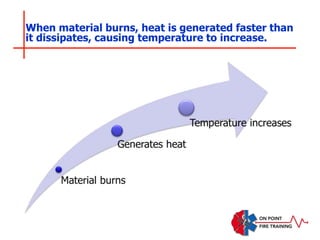
When material burns, heat is generated faster than
it dissipates, causing temperature to increase.
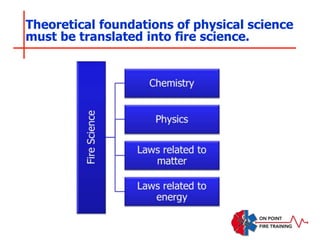
Theoretical foundations of physical science
must be translated into fire science.
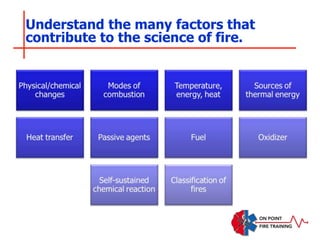
Understand the many factors that
contribute to the science of fire.
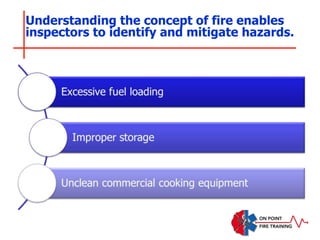
Understanding the concept of fire enables
inspectors to identify and mitigate hazards.
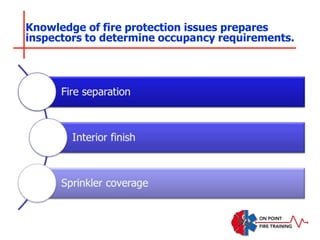
Knowledge of fire protection issues prepares
inspectors to determine occupancy requirements.
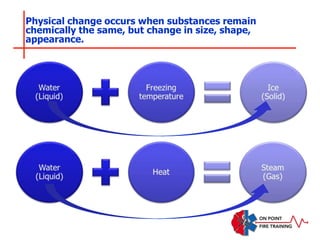
Physical change occurs when substances remain
chemically the same, but change in size, shape,
appearance.
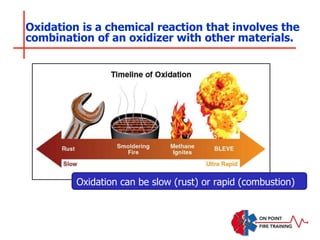
Oxidation is a chemical reaction that involves the
combination of an oxidizer with other materials.
Oxidation can be slow (rust) or rapid (combustion)
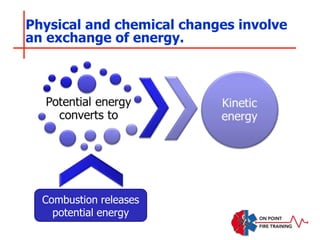
Physical and chemical changes involve
an exchange of energy.
Combustion releases
potential energy
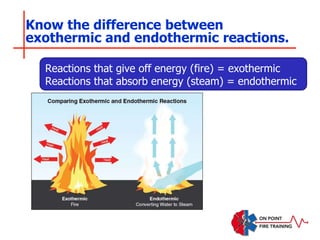
Know the difference between
exothermic and endothermic reactions.
Reactions that give off energy (fire) = exothermic
Reactions that absorb energy (steam) = endothermic
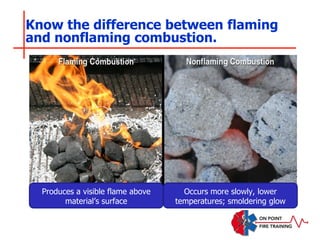
Know the difference between flaming
and nonflaming combustion.
Produces a visible flame above
material’s surface
Occurs more slowly, lower
temperatures; smoldering glow
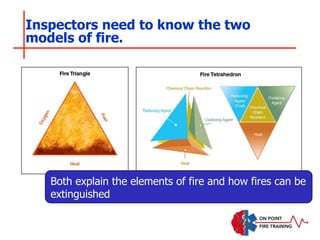
Inspectors need to know the two
models of fire.
Both explain the elements of fire and how fires can be
extinguished
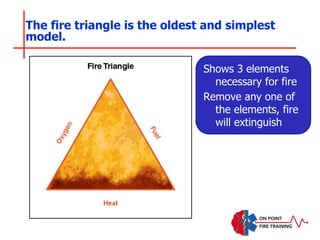
The fire triangle is the oldest and simplest
model.
Shows 3 elements
necessary for fire
Remove any one of
the elements, fire
will extinguish
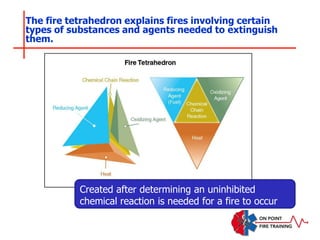
The fire tetrahedron explains fires involving certain
types of substances and agents needed to extinguish
them.
Created after determining an uninhibited
chemical reaction is needed for a fire to occur
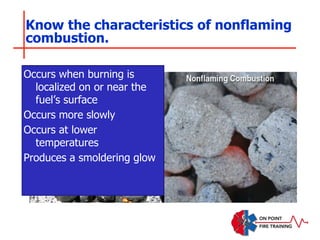
Know the characteristics of nonflaming
combustion.
Occurs when burning is
localized on or near the
fuel’s surface
Occurs more slowly
Occurs at lower
temperatures
Produces a smoldering glow
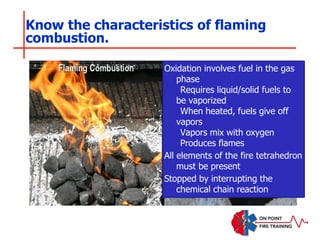
Know the characteristics of flaming
combustion.
Oxidation involves fuel in the gas
phase
Requires liquid/solid fuels to
be vaporized
When heated, fuels give off
vapors
Vapors mix with oxygen
Produces flames
All elements of the fire tetrahedron
must be present
Stopped by interrupting the
chemical chain reaction
Have a clear understanding of
temperature, energy, and heat.
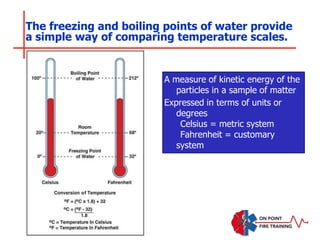
The freezing and boiling points of water provide
a simple way of comparing temperature scales.
A measure of kinetic energy of the
particles in a sample of matter
Expressed in terms of units or
degrees
Celsius = metric system
Fahrenheit = customary
system
Inspectors need to understand the
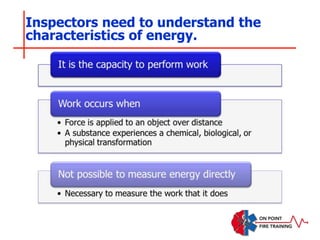
characteristics of energy.
Inspectors should know energy exists
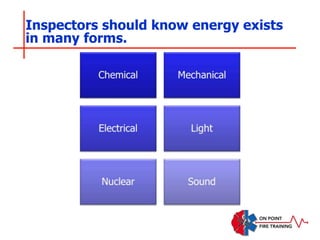
in many forms.
Inspectors need to know energy
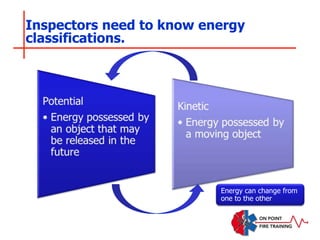
classifications.
Energy can change from
one to the other
Inspectors need to understand the concept
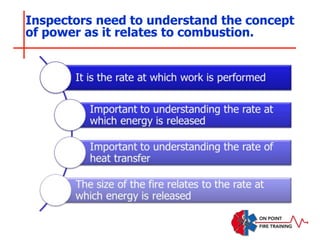
of power as it relates to combustion.
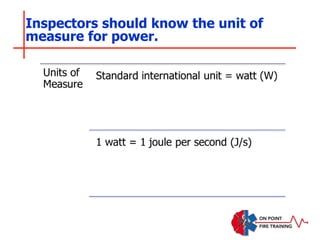
Inspectors should know the unit of
measure for power.
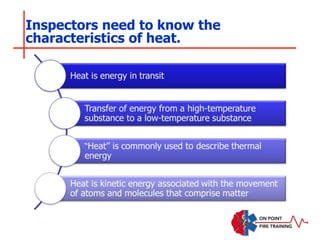
Inspectors need to know the
characteristics of heat.
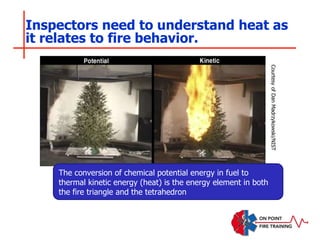
Inspectors need to understand heat as
it relates to fire behavior.
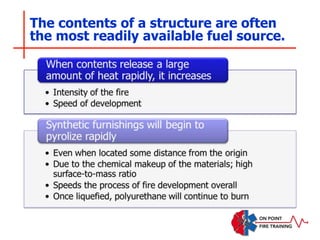
The conversion of chemical potential energy in fuel to
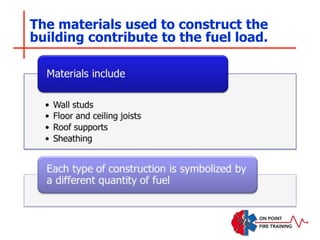
thermal kinetic energy (heat) is the energy element in both
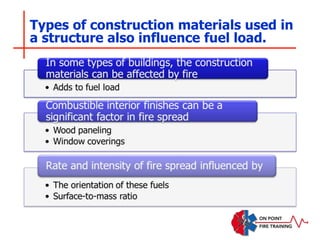
the fire triangle and the tetrahedron
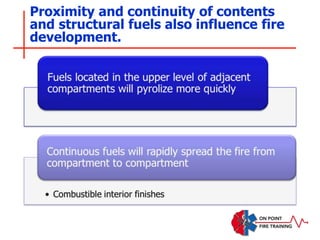
Courtesy
of
Dan
Madrzykowski/NIST
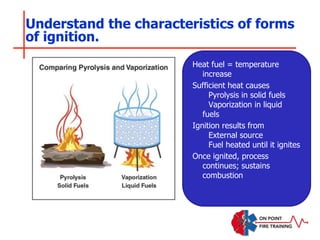
Understand the characteristics of forms
of ignition.
Heat fuel = temperature
increase
Sufficient heat causes
Pyrolysis in solid fuels
Vaporization in liquid
fuels
Ignition results from
External source
Fuel heated until it ignites
Once ignited, process
continues; sustains
combustion
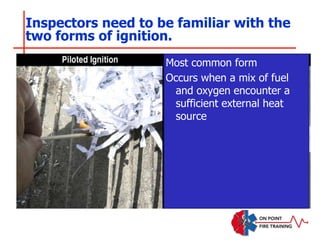
Inspectors need to be familiar with the
two forms of ignition.
Most common form
Occurs when a mix of fuel
and oxygen encounter a
sufficient external heat
source
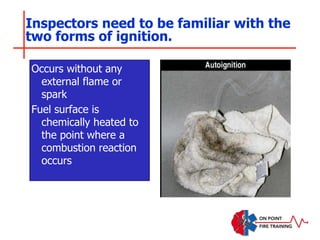
Inspectors need to be familiar with the
two forms of ignition.
Occurs without any
external flame or
spark
Fuel surface is
chemically heated to
the point where a
combustion reaction
occurs
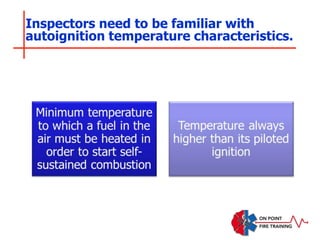
Inspectors need to be familiar with
autoignition temperature characteristics.
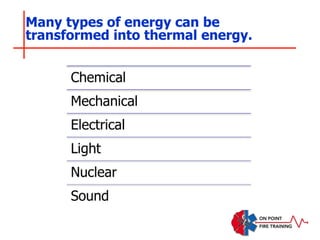
Many types of energy can be
transformed into thermal energy.
Understand the characteristics of
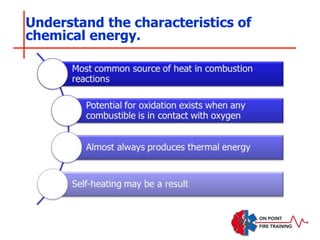
chemical energy.
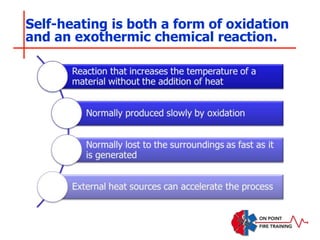
Self-heating is both a form of oxidation
and an exothermic chemical reaction.
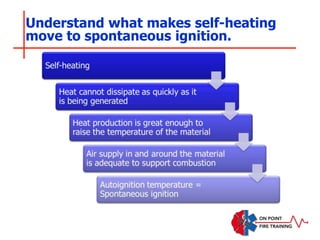
Understand what makes self-heating
move to spontaneous ignition.
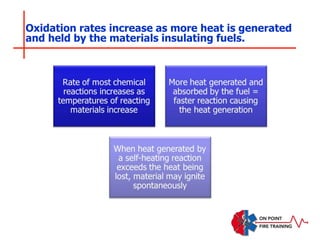
Oxidation rates increase as more heat is generated
and held by the materials insulating fuels.
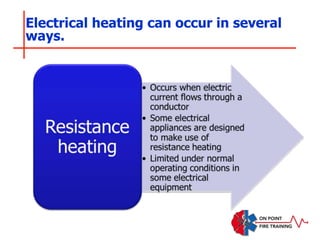
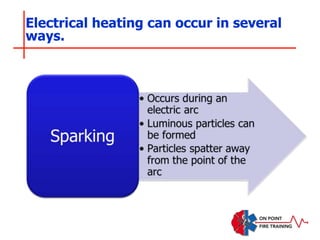
Electrical heating can occur in several
ways.
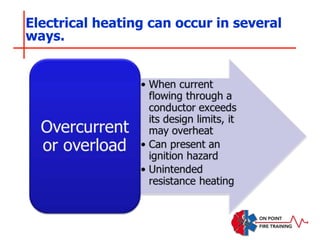
Electrical heating can occur in several
ways.
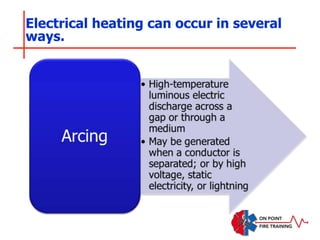
Electrical heating can occur in several
ways.
Electrical heating can occur in several
ways.
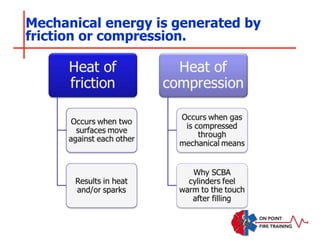
Mechanical energy is generated by
friction or compression.
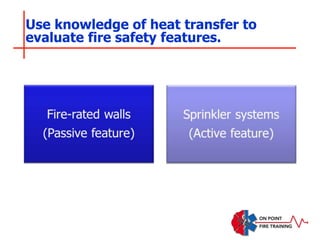
Use knowledge of heat transfer to
evaluate fire safety features.
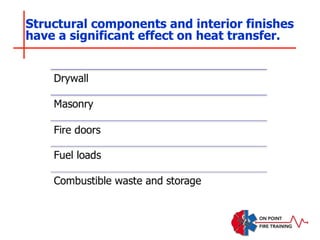
Structural components and interior finishes
have a significant effect on heat transfer.
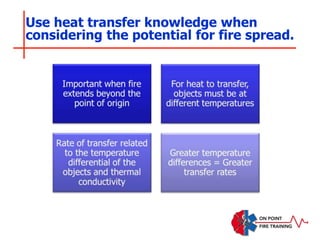
Use heat transfer knowledge when
considering the potential for fire spread.
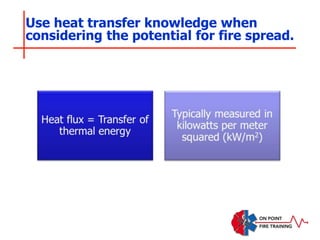
Use heat transfer knowledge when
considering the potential for fire spread.
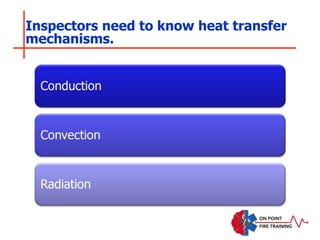
Inspectors need to know heat transfer
mechanisms.
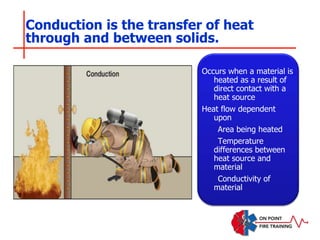
Conduction is the transfer of heat
through and between solids.
Occurs when a material is
heated as a result of
direct contact with a
heat source
Heat flow dependent
upon
Area being heated
Temperature
differences between
heat source and
material
Conductivity of
material
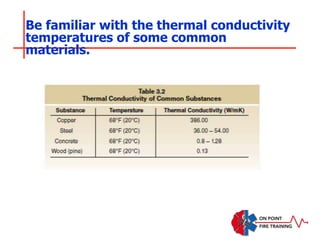
Be familiar with the thermal conductivity
temperatures of some common
materials.
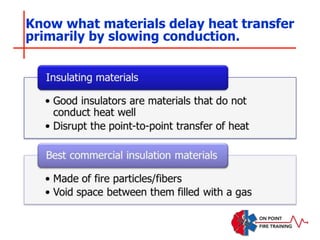
Know what materials delay heat transfer
primarily by slowing conduction.
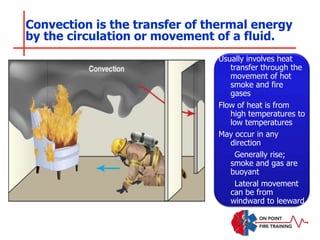
Convection is the transfer of thermal energy
by the circulation or movement of a fluid.
Usually involves heat
transfer through the
movement of hot
smoke and fire
gases
Flow of heat is from
high temperatures to
low temperatures
May occur in any
direction
Generally rise;
smoke and gas are
buoyant
Lateral movement
can be from
windward to leeward
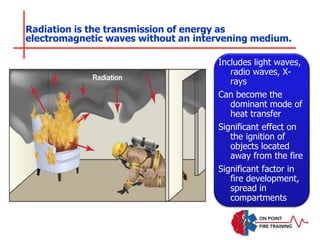
Radiation is the transmission of energy as
electromagnetic waves without an intervening medium.
Includes light waves,
radio waves, X-
rays
Can become the
dominant mode of
heat transfer
Significant effect on
the ignition of
objects located
away from the fire
Significant factor in
fire development,
spread in
compartments
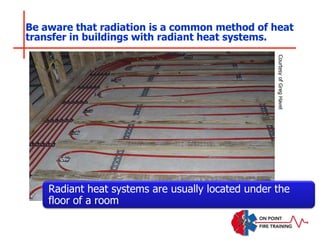
Be aware that radiation is a common method of heat
transfer in buildings with radiant heat systems.
Radiant heat systems are usually located under the
floor of a room
Courtesy
of
Greg
Havel
Know the factors that influence radiant
heat transfer.
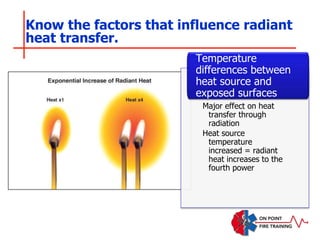
Know the factors that influence radiant
heat transfer.
Major effect on heat
transfer through
radiation
Heat source
temperature
increased = radiant
heat increases to the
fourth power
Temperature
differences between
heat source and
exposed surfaces
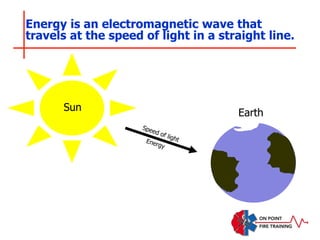
Energy is an electromagnetic wave that
travels at the speed of light in a straight line.
Earth
Sun
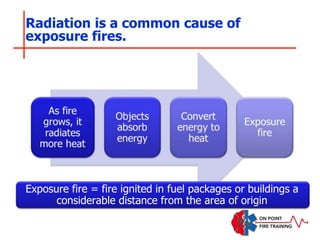
Radiation is a common cause of
exposure fires.
Exposure fire = fire ignited in fuel packages or buildings a
considerable distance from the area of origin
Materials that reflect radiated energy
will disrupt the transmission of heat.
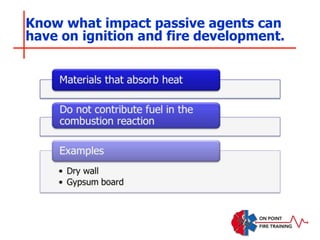
Know what impact passive agents can
have on ignition and fire development.
Fuel is the substance that is burned in
the combustion process.
Understand the influences of the
chemical content of fuel.
Significant to inspectors because of the widespread use of
synthetics in building construction materials
Inspectors should understand heat of
combustion.
Inspectors should understand Heat
release rate (HRR).
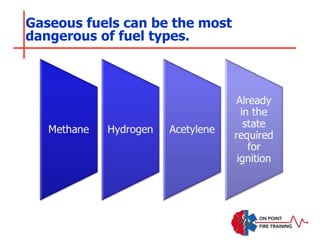
Gaseous fuels can be the most
dangerous of fuel types.
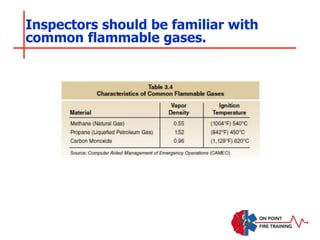
Inspectors should be familiar with
common flammable gases.
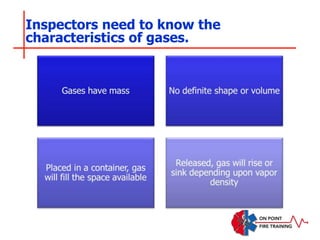
Inspectors need to know the
characteristics of gases.
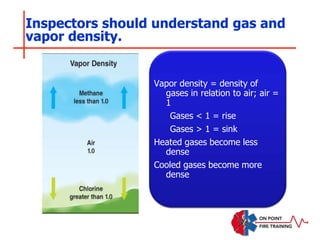
Inspectors should understand gas and
vapor density.
Vapor density = density of
gases in relation to air; air =
1
Gases < 1 = rise
Gases > 1 = sink
Heated gases become less
dense
Cooled gases become more
dense
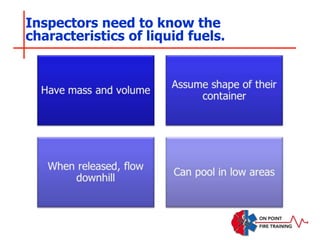
Inspectors need to know the
characteristics of liquid fuels.
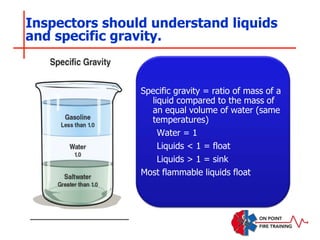
Inspectors should understand liquids
and specific gravity.
Specific gravity = ratio of mass of a
liquid compared to the mass of
an equal volume of water (same
temperatures)
Water = 1
Liquids < 1 = float
Liquids > 1 = sink
Most flammable liquids float
Vaporization is the transformation of a
liquid to vapor or gaseous state.
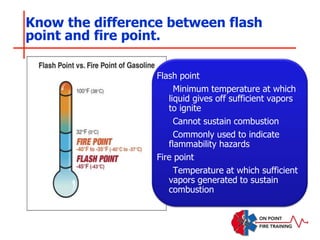
Know the difference between flash
point and fire point.
Flash point
Minimum temperature at which
liquid gives off sufficient vapors
to ignite
Cannot sustain combustion
Commonly used to indicate
flammability hazards
Fire point
Temperature at which sufficient
vapors generated to sustain
combustion
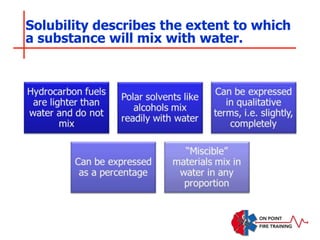
Solubility describes the extent to which
a substance will mix with water.
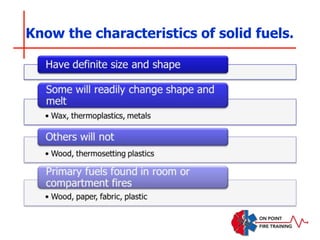
Know the characteristics of solid fuels.
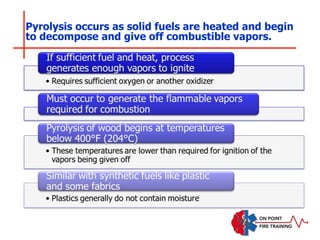
Pyrolysis occurs as solid fuels are heated and begin
to decompose and give off combustible vapors.
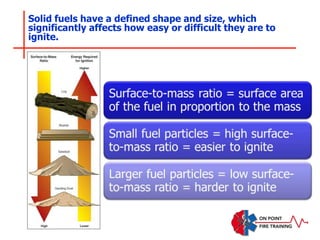
Solid fuels have a defined shape and size, which
significantly affects how easy or difficult they are to
ignite.
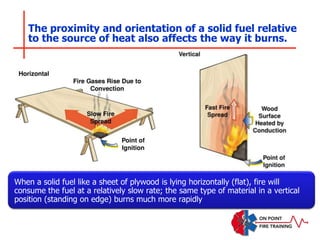
The proximity and orientation of a solid fuel relative
to the source of heat also affects the way it burns.
When a solid fuel like a sheet of plywood is lying horizontally (flat), fire will
consume the fuel at a relatively slow rate; the same type of material in a vertical
position (standing on edge) burns much more rapidly
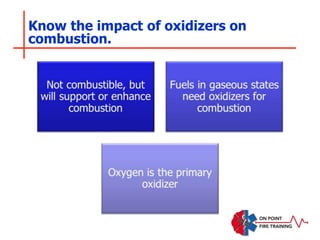
Know the impact of oxidizers on
combustion.
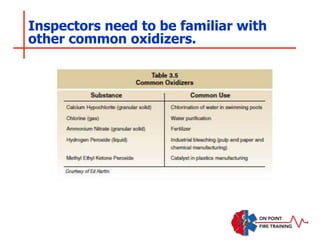
Inspectors need to be familiar with
other common oxidizers.
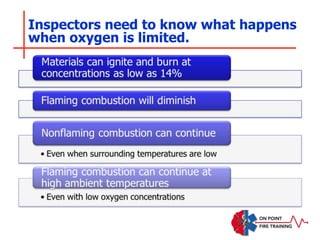
Inspectors need to know what happens
when oxygen is limited.
Inspectors need to know what happens
when oxygen is higher than normal.
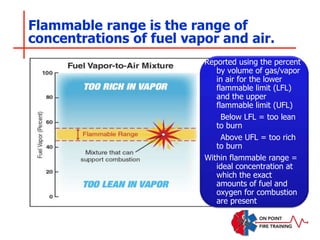
Flammable range is the range of
concentrations of fuel vapor and air.
Reported using the percent
by volume of gas/vapor
in air for the lower
flammable limit (LFL)
and the upper
flammable limit (UFL)
Below LFL = too lean
to burn
Above UFL = too rich
to burn
Within flammable range =
ideal concentration at
which the exact
amounts of fuel and
oxygen for combustion
are present
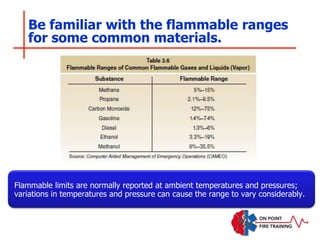
Be familiar with the flammable ranges
for some common materials.
Flammable limits are normally reported at ambient temperatures and pressures;
variations in temperatures and pressure can cause the range to vary considerably.
The self-sustained chemical reaction
involved in flaming combustion is complex.
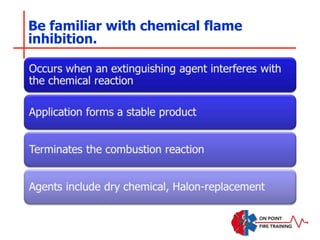
Be familiar with chemical flame
inhibition.
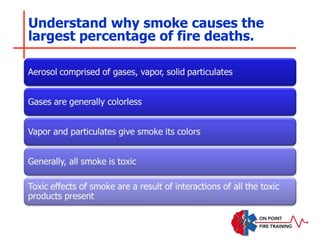
Understand why smoke causes the
largest percentage of fire deaths.
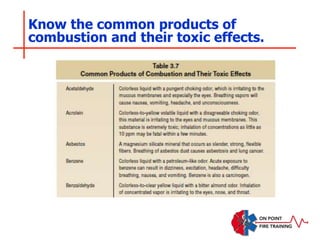
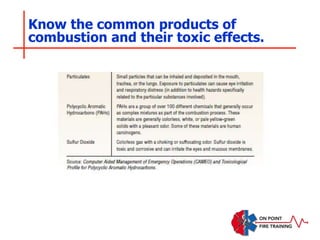
Know the common products of
combustion and their toxic effects.
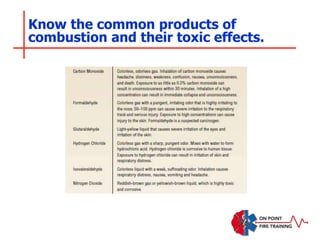
Know the common products of
combustion and their toxic effects.
Know the common products of
combustion and their toxic effects.
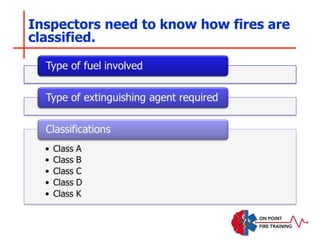
Inspectors need to know how fires are
classified.
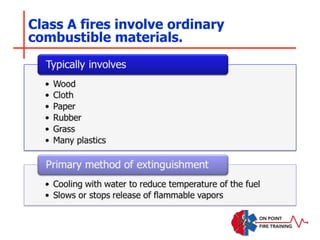
Class A fires involve ordinary
combustible materials.
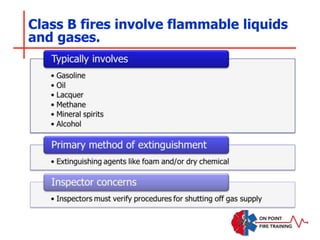
Class B fires involve flammable liquids
and gases.
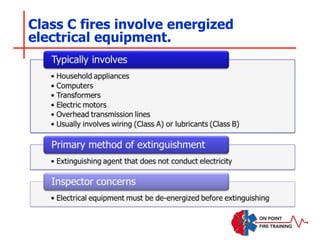
Class C fires involve energized
electrical equipment.
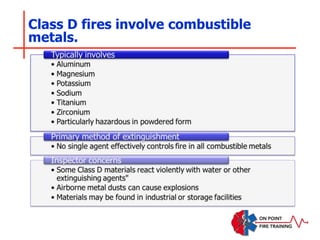
Class D fires involve combustible
metals.
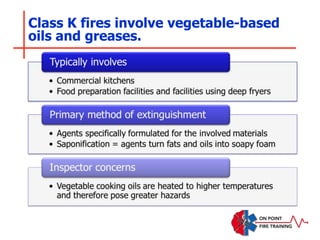
Class K fires involve vegetable-based
oils and greases.
‣ Describe fire development.
Learning Objective 2
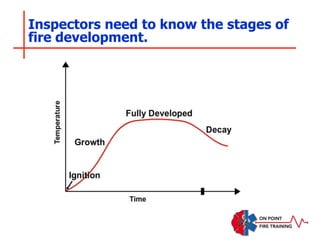
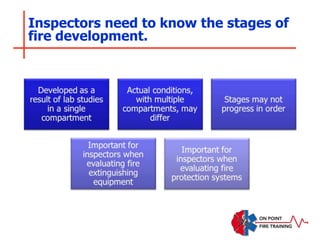
Inspectors need to know the stages of
fire development.
Inspectors need to know the stages of
fire development.
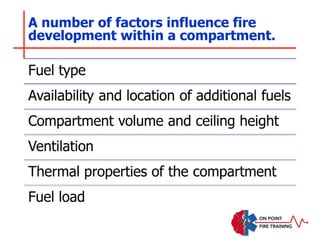
A number of factors influence fire
development within a compartment.
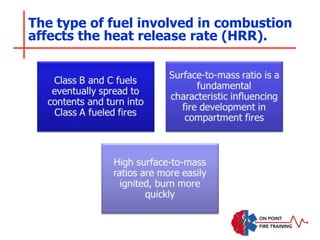
The type of fuel involved in combustion
affects the heat release rate (HRR).
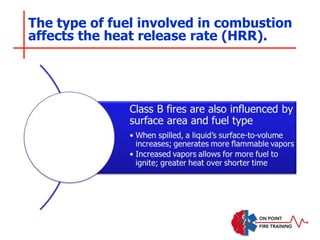
The type of fuel involved in combustion
affects the heat release rate (HRR).
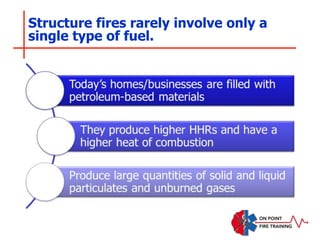
Structure fires rarely involve only a
single type of fuel.
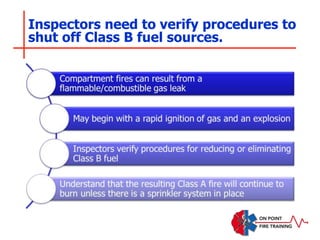
Inspectors need to verify procedures to
shut off Class B fuel sources.
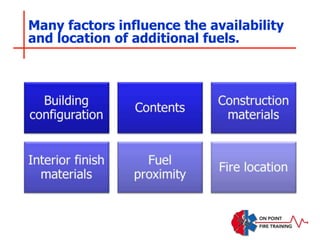
Many factors influence the availability
and location of additional fuels.
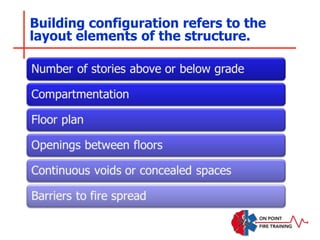
Building configuration refers to the
layout elements of the structure.
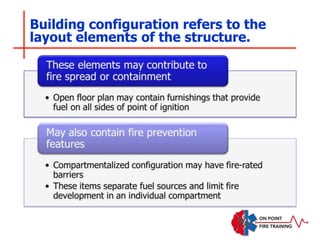
Building configuration refers to the
layout elements of the structure.
The contents of a structure are often
the most readily available fuel source.
The materials used to construct the
building contribute to the fuel load.
Types of construction materials used in
a structure also influence fuel load.
Proximity and continuity of contents
and structural fuels also influence fire
development.
Location of fire within the building will
influence fire development.
Fire in a large compartment will
develop more slowly than one in a
small compartment.
Ventilation in a compartment
significantly influences how fire develops
and spreads.
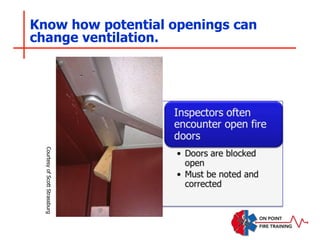
Know how potential openings can
change ventilation.
Know how potential openings can
change ventilation.
Courtesy
of
Scott
Strassburg
Thermal properties of compartments
contribute to rapid fire development
and difficult extinguishment.
The total quantity of combustible
contents of a building, space, or fire
area is referred to as the fuel load.
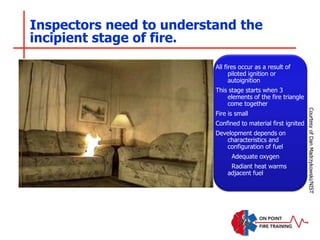
Inspectors need to understand the
incipient stage of fire.
All fires occur as a result of
piloted ignition or
autoignition
This stage starts when 3
elements of the fire triangle
come together
Fire is small
Confined to material first ignited
Development depends on
characteristics and
configuration of fuel
Adequate oxygen
Radiant heat warms
adjacent fuel
Courtesy
of
Dan
Madrzykowski/NIST
Inspectors need to understand the
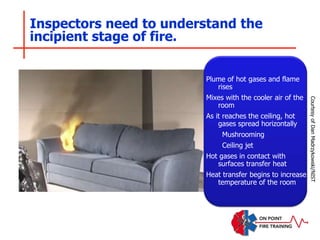
incipient stage of fire.
Plume of hot gases and flame
rises
Mixes with the cooler air of the
room
As it reaches the ceiling, hot
gases spread horizontally
Mushrooming
Ceiling jet
Hot gases in contact with
surfaces transfer heat
Heat transfer begins to increase
temperature of the room
Courtesy
of
Dan
Madrzykowski/NIST
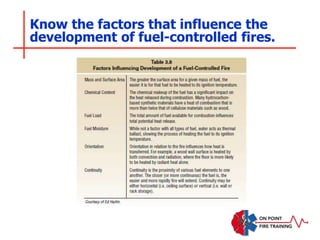
Know the factors that influence the
development of fuel-controlled fires.
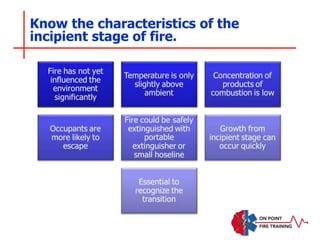
Know the characteristics of the
incipient stage of fire.
Inspectors need to understand the
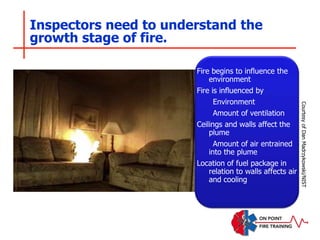
growth stage of fire.
Fire begins to influence the
environment
Fire is influenced by
Environment
Amount of ventilation
Ceilings and walls affect the
plume
Amount of air entrained
into the plume
Location of fuel package in
relation to walls affects air
and cooling
Courtesy
of
Dan
Madrzykowski/NIST
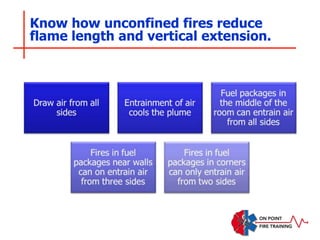
Know how unconfined fires reduce
flame length and vertical extension.
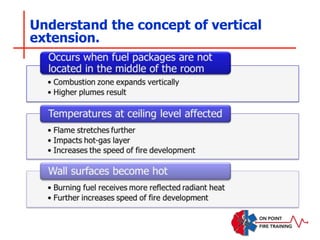
Understand the concept of vertical
extension.
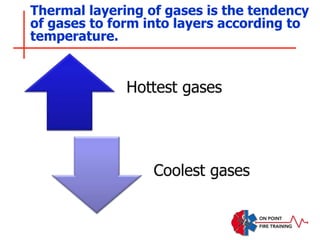
Thermal layering of gases is the tendency
of gases to form into layers according to
temperature.
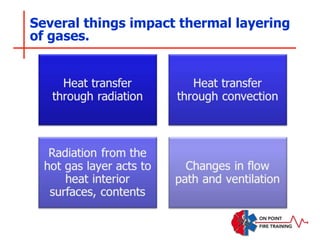
Several things impact thermal layering
of gases.
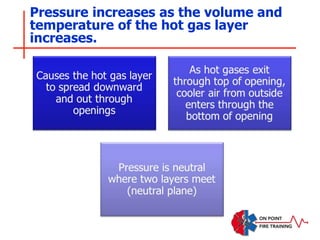
Pressure increases as the volume and
temperature of the hot gas layer
increases.
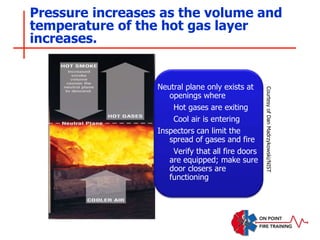
Pressure increases as the volume and
temperature of the hot gas layer
increases.
Neutral plane only exists at
openings where
Hot gases are exiting
Cool air is entering
Inspectors can limit the
spread of gases and fire
Verify that all fire doors
are equipped; make sure
door closers are
functioning
Courtesy
of
Dan
Madrzykowski/NIST
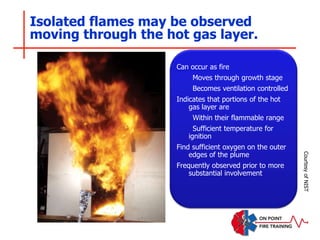
Isolated flames may be observed
moving through the hot gas layer.
Can occur as fire
Moves through growth stage
Becomes ventilation controlled
Indicates that portions of the hot
gas layer are
Within their flammable range
Sufficient temperature for
ignition
Find sufficient oxygen on the outer
edges of the plume
Frequently observed prior to more
substantial involvement
Courtesy
of
NIST
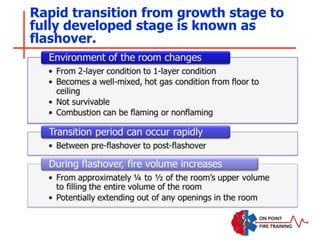
Rapid transition from growth stage to
fully developed stage is known as
flashover.
Flashover does not occur in every
compartment fire.
Most fires that develop beyond the
incipient stage become ventilation
controlled.
Be aware of the type and amount of
combustible furnishings and fuel load
present during an inspection.
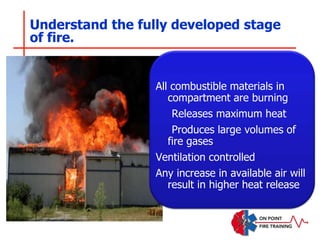
Understand the fully developed stage
of fire.
All combustible materials in
compartment are burning
Releases maximum heat
Produces large volumes of
fire gases
Ventilation controlled
Any increase in available air will
result in higher heat release
Understand the fully developed stage
of fire.
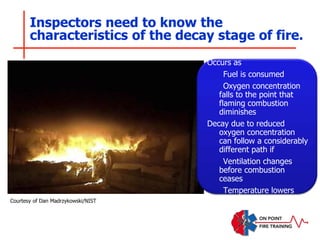
Inspectors need to know the
characteristics of the decay stage of fire.
Occurs as
Fuel is consumed
Oxygen concentration
falls to the point that
flaming combustion
diminishes
Decay due to reduced
oxygen concentration
can follow a considerably
different path if
Ventilation changes
before combustion
ceases
Temperature lowers
Courtesy of Dan Madrzykowski/NIST
Understand fuel consumption in the
decay stage of fire.
Understand limited ventilation in the
decay stage of fire.

1505 Ch 3 PowerPoint.pptx

  • 1.
    Fire Inspection andCode Enforcement 8th Edition Chapter 3 — Fire Behavior
  • 2.
    ‣ Describe thevarious components of fire behavior. Learning Objective 1
  • 3.
    All fires involvea heat-producing chemical reaction between a fuel and an oxidizer.
  • 4.
    When material burns,heat is generated faster than it dissipates, causing temperature to increase.
  • 5.
    Theoretical foundations ofphysical science must be translated into fire science.
  • 6.
    Understand the manyfactors that contribute to the science of fire.
  • 7.
    Understanding the conceptof fire enables inspectors to identify and mitigate hazards.
  • 8.
    Knowledge of fireprotection issues prepares inspectors to determine occupancy requirements.
  • 9.
    Physical change occurswhen substances remain chemically the same, but change in size, shape, appearance.
  • 10.
    Oxidation is achemical reaction that involves the combination of an oxidizer with other materials. Oxidation can be slow (rust) or rapid (combustion)
  • 11.
    Physical and chemicalchanges involve an exchange of energy. Combustion releases potential energy
  • 12.
    Know the differencebetween exothermic and endothermic reactions. Reactions that give off energy (fire) = exothermic Reactions that absorb energy (steam) = endothermic
  • 13.
    Know the differencebetween flaming and nonflaming combustion. Produces a visible flame above material’s surface Occurs more slowly, lower temperatures; smoldering glow
  • 14.
    Inspectors need toknow the two models of fire. Both explain the elements of fire and how fires can be extinguished
  • 15.
    The fire triangleis the oldest and simplest model. Shows 3 elements necessary for fire Remove any one of the elements, fire will extinguish
  • 16.
    The fire tetrahedronexplains fires involving certain types of substances and agents needed to extinguish them. Created after determining an uninhibited chemical reaction is needed for a fire to occur
  • 17.
    Know the characteristicsof nonflaming combustion. Occurs when burning is localized on or near the fuel’s surface Occurs more slowly Occurs at lower temperatures Produces a smoldering glow
  • 18.
    Know the characteristicsof flaming combustion. Oxidation involves fuel in the gas phase Requires liquid/solid fuels to be vaporized When heated, fuels give off vapors Vapors mix with oxygen Produces flames All elements of the fire tetrahedron must be present Stopped by interrupting the chemical chain reaction
  • 19.
    Have a clearunderstanding of temperature, energy, and heat.
  • 20.
    The freezing andboiling points of water provide a simple way of comparing temperature scales. A measure of kinetic energy of the particles in a sample of matter Expressed in terms of units or degrees Celsius = metric system Fahrenheit = customary system
  • 21.
    Inspectors need tounderstand the characteristics of energy.
  • 22.
    Inspectors should knowenergy exists in many forms.
  • 23.
    Inspectors need toknow energy classifications. Energy can change from one to the other
  • 24.
    Inspectors need tounderstand the concept of power as it relates to combustion.
  • 25.
    Inspectors should knowthe unit of measure for power.
  • 26.
    Inspectors need toknow the characteristics of heat.
  • 27.
    Inspectors need tounderstand heat as it relates to fire behavior. The conversion of chemical potential energy in fuel to thermal kinetic energy (heat) is the energy element in both the fire triangle and the tetrahedron Courtesy of Dan Madrzykowski/NIST
  • 28.
    Understand the characteristicsof forms of ignition. Heat fuel = temperature increase Sufficient heat causes Pyrolysis in solid fuels Vaporization in liquid fuels Ignition results from External source Fuel heated until it ignites Once ignited, process continues; sustains combustion
  • 29.
    Inspectors need tobe familiar with the two forms of ignition. Most common form Occurs when a mix of fuel and oxygen encounter a sufficient external heat source
  • 30.
    Inspectors need tobe familiar with the two forms of ignition. Occurs without any external flame or spark Fuel surface is chemically heated to the point where a combustion reaction occurs
  • 31.
    Inspectors need tobe familiar with autoignition temperature characteristics.
  • 32.
    Many types ofenergy can be transformed into thermal energy.
  • 33.
    Understand the characteristicsof chemical energy.
  • 34.
    Self-heating is botha form of oxidation and an exothermic chemical reaction.
  • 35.
    Understand what makesself-heating move to spontaneous ignition.
  • 36.
    Oxidation rates increaseas more heat is generated and held by the materials insulating fuels.
  • 37.
    Electrical heating canoccur in several ways.
  • 38.
    Electrical heating canoccur in several ways.
  • 39.
    Electrical heating canoccur in several ways.
  • 40.
    Electrical heating canoccur in several ways.
  • 41.
    Mechanical energy isgenerated by friction or compression.
  • 42.
    Use knowledge ofheat transfer to evaluate fire safety features.
  • 43.
    Structural components andinterior finishes have a significant effect on heat transfer.
  • 44.
    Use heat transferknowledge when considering the potential for fire spread.
  • 45.
    Use heat transferknowledge when considering the potential for fire spread.
  • 46.
    Inspectors need toknow heat transfer mechanisms.
  • 47.
    Conduction is thetransfer of heat through and between solids. Occurs when a material is heated as a result of direct contact with a heat source Heat flow dependent upon Area being heated Temperature differences between heat source and material Conductivity of material
  • 48.
    Be familiar withthe thermal conductivity temperatures of some common materials.
  • 49.
    Know what materialsdelay heat transfer primarily by slowing conduction.
  • 50.
    Convection is thetransfer of thermal energy by the circulation or movement of a fluid. Usually involves heat transfer through the movement of hot smoke and fire gases Flow of heat is from high temperatures to low temperatures May occur in any direction Generally rise; smoke and gas are buoyant Lateral movement can be from windward to leeward
  • 51.
    Radiation is thetransmission of energy as electromagnetic waves without an intervening medium. Includes light waves, radio waves, X- rays Can become the dominant mode of heat transfer Significant effect on the ignition of objects located away from the fire Significant factor in fire development, spread in compartments
  • 52.
    Be aware thatradiation is a common method of heat transfer in buildings with radiant heat systems. Radiant heat systems are usually located under the floor of a room Courtesy of Greg Havel
  • 53.
    Know the factorsthat influence radiant heat transfer.
  • 54.
    Know the factorsthat influence radiant heat transfer. Major effect on heat transfer through radiation Heat source temperature increased = radiant heat increases to the fourth power Temperature differences between heat source and exposed surfaces
  • 55.
    Energy is anelectromagnetic wave that travels at the speed of light in a straight line. Earth Sun
  • 56.
    Radiation is acommon cause of exposure fires. Exposure fire = fire ignited in fuel packages or buildings a considerable distance from the area of origin
  • 57.
    Materials that reflectradiated energy will disrupt the transmission of heat.
  • 58.
    Know what impactpassive agents can have on ignition and fire development.
  • 59.
    Fuel is thesubstance that is burned in the combustion process.
  • 60.
    Understand the influencesof the chemical content of fuel. Significant to inspectors because of the widespread use of synthetics in building construction materials
  • 61.
    Inspectors should understandheat of combustion.
  • 62.
    Inspectors should understandHeat release rate (HRR).
  • 63.
    Gaseous fuels canbe the most dangerous of fuel types.
  • 64.
    Inspectors should befamiliar with common flammable gases.
  • 65.
    Inspectors need toknow the characteristics of gases.
  • 66.
    Inspectors should understandgas and vapor density. Vapor density = density of gases in relation to air; air = 1 Gases < 1 = rise Gases > 1 = sink Heated gases become less dense Cooled gases become more dense
  • 67.
    Inspectors need toknow the characteristics of liquid fuels.
  • 68.
    Inspectors should understandliquids and specific gravity. Specific gravity = ratio of mass of a liquid compared to the mass of an equal volume of water (same temperatures) Water = 1 Liquids < 1 = float Liquids > 1 = sink Most flammable liquids float
  • 69.
    Vaporization is thetransformation of a liquid to vapor or gaseous state.
  • 70.
    Know the differencebetween flash point and fire point. Flash point Minimum temperature at which liquid gives off sufficient vapors to ignite Cannot sustain combustion Commonly used to indicate flammability hazards Fire point Temperature at which sufficient vapors generated to sustain combustion
  • 71.
    Solubility describes theextent to which a substance will mix with water.
  • 72.
    Know the characteristicsof solid fuels.
  • 73.
    Pyrolysis occurs assolid fuels are heated and begin to decompose and give off combustible vapors.
  • 74.
    Solid fuels havea defined shape and size, which significantly affects how easy or difficult they are to ignite.
  • 75.
    The proximity andorientation of a solid fuel relative to the source of heat also affects the way it burns. When a solid fuel like a sheet of plywood is lying horizontally (flat), fire will consume the fuel at a relatively slow rate; the same type of material in a vertical position (standing on edge) burns much more rapidly
  • 76.
    Know the impactof oxidizers on combustion.
  • 77.
    Inspectors need tobe familiar with other common oxidizers.
  • 78.
    Inspectors need toknow what happens when oxygen is limited.
  • 79.
    Inspectors need toknow what happens when oxygen is higher than normal.
  • 80.
    Flammable range isthe range of concentrations of fuel vapor and air. Reported using the percent by volume of gas/vapor in air for the lower flammable limit (LFL) and the upper flammable limit (UFL) Below LFL = too lean to burn Above UFL = too rich to burn Within flammable range = ideal concentration at which the exact amounts of fuel and oxygen for combustion are present
  • 81.
    Be familiar withthe flammable ranges for some common materials. Flammable limits are normally reported at ambient temperatures and pressures; variations in temperatures and pressure can cause the range to vary considerably.
  • 82.
    The self-sustained chemicalreaction involved in flaming combustion is complex.
  • 83.
    Be familiar withchemical flame inhibition.
  • 84.
    Understand why smokecauses the largest percentage of fire deaths.
  • 85.
    Know the commonproducts of combustion and their toxic effects.
  • 86.
    Know the commonproducts of combustion and their toxic effects.
  • 87.
    Know the commonproducts of combustion and their toxic effects.
  • 88.
    Inspectors need toknow how fires are classified.
  • 89.
    Class A firesinvolve ordinary combustible materials.
  • 90.
    Class B firesinvolve flammable liquids and gases.
  • 91.
    Class C firesinvolve energized electrical equipment.
  • 92.
    Class D firesinvolve combustible metals.
  • 93.
    Class K firesinvolve vegetable-based oils and greases.
  • 94.
    ‣ Describe firedevelopment. Learning Objective 2
  • 95.
    Inspectors need toknow the stages of fire development.
  • 96.
    Inspectors need toknow the stages of fire development.
  • 97.
    A number offactors influence fire development within a compartment.
  • 98.
    The type offuel involved in combustion affects the heat release rate (HRR).
  • 99.
    The type offuel involved in combustion affects the heat release rate (HRR).
  • 100.
    Structure fires rarelyinvolve only a single type of fuel.
  • 101.
    Inspectors need toverify procedures to shut off Class B fuel sources.
  • 102.
    Many factors influencethe availability and location of additional fuels.
  • 103.
    Building configuration refersto the layout elements of the structure.
  • 104.
    Building configuration refersto the layout elements of the structure.
  • 105.
    The contents ofa structure are often the most readily available fuel source.
  • 106.
    The materials usedto construct the building contribute to the fuel load.
  • 107.
    Types of constructionmaterials used in a structure also influence fuel load.
  • 108.
    Proximity and continuityof contents and structural fuels also influence fire development.
  • 109.
    Location of firewithin the building will influence fire development.
  • 110.
    Fire in alarge compartment will develop more slowly than one in a small compartment.
  • 111.
    Ventilation in acompartment significantly influences how fire develops and spreads.
  • 112.
    Know how potentialopenings can change ventilation.
  • 113.
    Know how potentialopenings can change ventilation. Courtesy of Scott Strassburg
  • 114.
    Thermal properties ofcompartments contribute to rapid fire development and difficult extinguishment.
  • 115.
    The total quantityof combustible contents of a building, space, or fire area is referred to as the fuel load.
  • 116.
    Inspectors need tounderstand the incipient stage of fire. All fires occur as a result of piloted ignition or autoignition This stage starts when 3 elements of the fire triangle come together Fire is small Confined to material first ignited Development depends on characteristics and configuration of fuel Adequate oxygen Radiant heat warms adjacent fuel Courtesy of Dan Madrzykowski/NIST
  • 117.
    Inspectors need tounderstand the incipient stage of fire. Plume of hot gases and flame rises Mixes with the cooler air of the room As it reaches the ceiling, hot gases spread horizontally Mushrooming Ceiling jet Hot gases in contact with surfaces transfer heat Heat transfer begins to increase temperature of the room Courtesy of Dan Madrzykowski/NIST
  • 118.
    Know the factorsthat influence the development of fuel-controlled fires.
  • 119.
    Know the characteristicsof the incipient stage of fire.
  • 120.
    Inspectors need tounderstand the growth stage of fire. Fire begins to influence the environment Fire is influenced by Environment Amount of ventilation Ceilings and walls affect the plume Amount of air entrained into the plume Location of fuel package in relation to walls affects air and cooling Courtesy of Dan Madrzykowski/NIST
  • 121.
    Know how unconfinedfires reduce flame length and vertical extension.
  • 122.
    Understand the conceptof vertical extension.
  • 123.
    Thermal layering ofgases is the tendency of gases to form into layers according to temperature.
  • 124.
    Several things impactthermal layering of gases.
  • 125.
    Pressure increases asthe volume and temperature of the hot gas layer increases.
  • 126.
    Pressure increases asthe volume and temperature of the hot gas layer increases. Neutral plane only exists at openings where Hot gases are exiting Cool air is entering Inspectors can limit the spread of gases and fire Verify that all fire doors are equipped; make sure door closers are functioning Courtesy of Dan Madrzykowski/NIST
  • 127.
    Isolated flames maybe observed moving through the hot gas layer. Can occur as fire Moves through growth stage Becomes ventilation controlled Indicates that portions of the hot gas layer are Within their flammable range Sufficient temperature for ignition Find sufficient oxygen on the outer edges of the plume Frequently observed prior to more substantial involvement Courtesy of NIST
  • 128.
    Rapid transition fromgrowth stage to fully developed stage is known as flashover.
  • 129.
    Flashover does notoccur in every compartment fire.
  • 130.
    Most fires thatdevelop beyond the incipient stage become ventilation controlled.
  • 131.
    Be aware ofthe type and amount of combustible furnishings and fuel load present during an inspection.
  • 132.
    Understand the fullydeveloped stage of fire. All combustible materials in compartment are burning Releases maximum heat Produces large volumes of fire gases Ventilation controlled Any increase in available air will result in higher heat release
  • 133.
    Understand the fullydeveloped stage of fire.
  • 134.
    Inspectors need toknow the characteristics of the decay stage of fire. Occurs as Fuel is consumed Oxygen concentration falls to the point that flaming combustion diminishes Decay due to reduced oxygen concentration can follow a considerably different path if Ventilation changes before combustion ceases Temperature lowers Courtesy of Dan Madrzykowski/NIST
  • 135.
    Understand fuel consumptionin the decay stage of fire.
  • 136.
    Understand limited ventilationin the decay stage of fire.