ANAESTHESIA AND
ANALGESIA IN LABOR
Anesthesia: It is the absence of all sensation,
including pain, touch, temperature, and pressure.
Analgesia: It is the absence of nociceptive stimuli,
with the preservation of motor &touch sensation.
1st stage of labor– mostly visceral
 Visceral pain is produced by distention of the uterus and cervix
and ischemia of the uterine and cervical tissue.
 It is dull, aching and poorly localized.
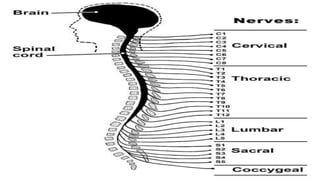
 Slow conducting, visceral C fibers, enter spinal cord at T10 to L1
2nd stage of labor– mostly somatic
 Distention of the pelvic floor, vagina and perineum.
 Sharp, severe and well localized.
 Rapidly conducting A-delta fibers, enter spinal cord at S2 to S4.
PHYSIOLOGY OF PAIN IN LABOR
MATERNAL RISK FACTORS IN ANAESTHESIA
1. Short stature
2. Short neck
3. Marked obesity
4. Severe pre-eclampsia
5. Bleeding disorders
6. Placenta previa
7. Medical disorders, like cardiac, respiratory and
neurological diseases
DOES LABOR PAIN REQUIRE ANALGESIA?
SEDATIVES AND ANALGESICS
The following factors are important to control the dose
of sedative and analgesics:
1. Pain threshold
2. Parity
3. Maturity of the fetus
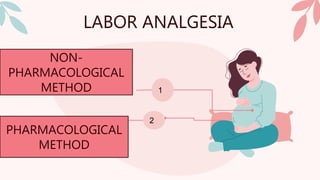
LABOR ANALGESIA
1
2
NON-
PHARMACOLOGICAL
METHOD
PHARMACOLOGICAL
METHOD
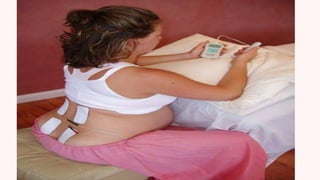
NON- PHARMACOLOGICAL METHOD
1 2 3 4 5
PHARMACOLOGICAL METHOD
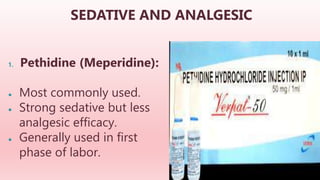
SEDATIVE AND ANALGESIC
1. Pethidine (Meperidine):
● Most commonly used.
● Strong sedative but less
analgesic efficacy.
● Generally used in first
phase of labor.
Dose:
● IM (commonly used): -50-100mg (1-2mg/kg body wt.), can be
repeated after 4-6 hrs, if woman has not delivered yet.
● IV: -25 mg every 2 hrs.
Onset of action:
● Within 45 min after IM administration.
● Almost immediate after IV administration.
SIDE EFFECTS
● Nausea, vomiting, delayed gastric emptying.
● Cross the placenta and accumulates in fetal tissues.
● Depress the respiration and suckling of newborn when
administered before delivery.
● Ranitidine should be given to inhibit gastric acid production
and metoclopramide for vomiting.
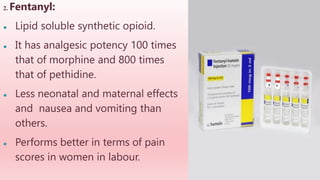
2. Fentanyl:
● Lipid soluble synthetic opioid.
● It has analgesic potency 100 times
that of morphine and 800 times
that of pethidine.
● Less neonatal and maternal effects
and nausea and vomiting than
others.
● Performs better in terms of pain
scores in women in labour.
Dose:
IV bolus of 25-50 ug (given slowly over 1-2minutes) every hour.
Onset of action: Rapid within 2-3 minutes with short duration of
action, making it useful for labor analgesia
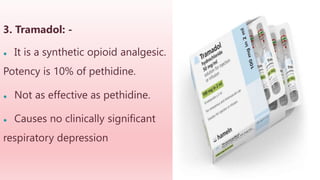
3. Tramadol: -
● It is a synthetic opioid analgesic.
Potency is 10% of pethidine.
● Not as effective as pethidine.
● Causes no clinically significant
respiratory depression
● Dose: -100 mg IM (1-2mg/kg body wt.)
● Onset of action: -within 10 minutes after administration and
effect lasts for 2-3 hrs.
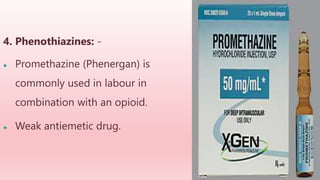
4. Phenothiazines: -
● Promethazine (Phenergan) is
commonly used in labour in
combination with an opioid.
● Weak antiemetic drug.
Side effects: -
 Cause sedation in mother.
 Does not cause major neonatal depression.
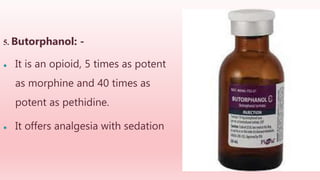
5. Butorphanol: -
● It is an opioid, 5 times as potent
as morphine and 40 times as
potent as pethidine.
● It offers analgesia with sedation
Dose: -1-2 mg IM.
Side effects: -Produce excessive sedation, so not used frequently
for labor analgesia.
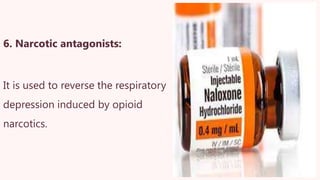
6. Narcotic antagonists:
It is used to reverse the respiratory
depression induced by opioid
narcotics.
● Naloxone is given to mother 0.4mg IV in labour.
● It is given to newborn 10 ug/kg IM or IV and is repeated as
necessary when infant is born with narcotic depression.
● It is given to a newborn of a narcotic addicted mother with
proper ventilation arrangement otherwise withdrawal symptoms
are precipitated.
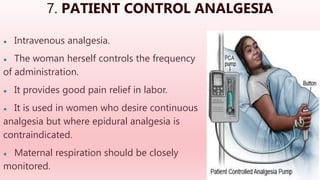
7. PATIENT CONTROL ANALGESIA
● Intravenous analgesia.
● The woman herself controls the frequency
of administration.
● It provides good pain relief in labor.
● It is used in women who desire continuous
analgesia but where epidural analgesia is
contraindicated.
● Maternal respiration should be closely
monitored.
Doses: -
● Fentanyl–20-60 ug every 5-10 minutes
● Remifentanil–25-50 ug every 5-10 minutes
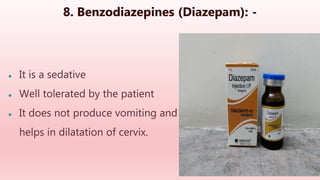
8. Benzodiazepines (Diazepam): -
● It is a sedative
● Well tolerated by the patient
● It does not produce vomiting and
helps in dilatation of cervix.
● However diazepam is avoided in labour.
● May be used in larger doses in the management of pre-
eclampsia.
Dose: -5-10 mg.
Disadvantages: -
 Neonatal hypotonia
 Hypothermia
INHALATION METHODS:
Premixed nitrous oxide and oxygen
Nitrous oxide inhalational analgesia is administered as a blend
of 50% nitrous oxide and 50% oxygen.
● Used in: -Second phase (from 8 cm dilation of cervix to
delivery).
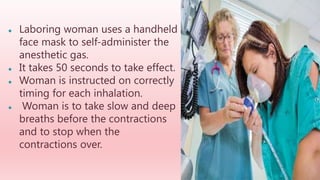
● Laboring woman uses a handheld
face mask to self-administer the
anesthetic gas.
● It takes 50 seconds to take effect.
● Woman is instructed on correctly
timing for each inhalation.
● Woman is to take slow and deep
breaths before the contractions
and to stop when the
contractions over.
● The woman should be monitored with pulse oximetry
● It is safe because when the woman becomes drowsy, she will
automatically drop the mask.
● Provides significant degree of pain relief and may be useful in
situation where epidural analgesia is not available.
● Does not cause neonatal respiratory depression or affect
contractility.
Side effects:
● Hyperventilation,
● Dizziness,
● Hypocapnia.
INFILTRATION ANALGESIA:
Perineal infiltration: -
● For episiotomy-
● Extensively used prior to episiotomy
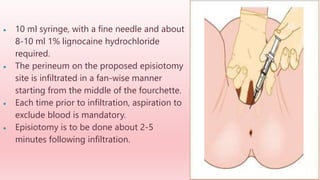
 10 ml syringe, with a fine needle and about
8-10 ml 1% lignocaine hydrochloride
required.
 The perineum on the proposed episiotomy
site is infiltrated in a fan-wise manner
starting from the middle of the fourchette.
 Each time prior to infiltration, aspiration to
exclude blood is mandatory.
 Episiotomy is to be done about 2-5
minutes following infiltration.
REGIONAL (Neuraxial) ANESTHESIA
● When complete relief of pain is needed throughout labor,
epidural analgesia is the safest and simplest method.
● It provides sensory as well as various degrees of motor
blockade over a region of the body.
● Trained personnel is required to make use of this method in
normal and abnormal labor.
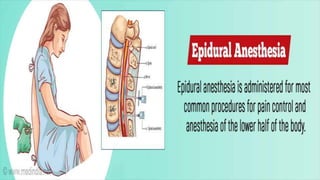
Epidural Analgesia
● It is a central nerve block technique accomplished by injecting a
local anesthetic.
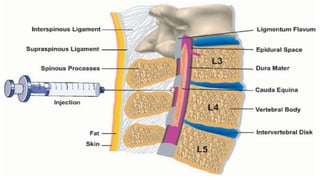
● A lumbar puncture is made between L2 and L3 with the epidural
needle (Tuohy needle).
● For complete analgesia, a block from T10 to the S5
dermatomes is needed. For cesarean delivery, a block from T4 to
S1 is needed. Repeated doses (top ups) of 4-5 mL of 0.5%
bupivacaine or 1% or lignocaine are used to maintain analgesia.
Contraindications: -
 Maternal coagulopathy
 Supine hypotension
 Hypovolemia
 Neurological diseases
 Spinal deformity
 Skin infection at injection site
PROCEDURE
 A preload 500 ml of IV fluids should be given prior to
administering epidural analgesia.
 Aseptic precautions must be used.
 Epidural block can be performed in the lateral or sitting
position.
 Lumbar spine is palpated and the widest interspace below L3 is
chosen.
 A local anesthetic is used to numb the skin.
 A spinal needle is slowly advanced while feeling for resistance.
A sudden loss of resistance is felt as the epidural needle enters
the epidural space. Care is taken not to puncture the dura. An
epidural catheter is threaded through the needle and the
needle is removed.
 The catheter is fixed in place.
 A combination of low conc. Bupivacaine and fentanyl is given
as bolus every 2 hours or as needed to maintain maternal
comfort.
Precaution: -
● Blood pressure should be recorded prior to administration of an
epidural. Thereafter it should be checked at 5-15 minutes
intervals.
● Continuous fetal heart rate monitoring should be done since
the epidural may cause maternal hypotension, leading to fetal
heart rate abnormality.
Complications: -
 Hypotension
 Nausea and vomiting
 Pain at insertion site, back pain
 Post spinal headache due to leakage of CSF through needle
hole in dura
 Ineffective analgesia
 Injury to nerve, convulsions, pyrexia
 Fetal heart rate abnormality
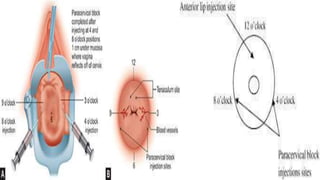
PARACERVICAL NERVE BLOCK
● Relief pain during first stage of labor. It blocks visceral sensory
fibers of lower uterus, cervix and upper vagina.
● It does not affect progression of labor.
● It does not block sensory nerves from perineum, so it is not
effective in 2nd stage of labor.
● It can be given only after a cervical dilatation of 4 cm and may
need to be repeated every 1-2 hrs.
● Not used commonly for pain relief during labor.
PROCEDURE:
● Following the usual antiseptic safe guards, a long needle (15
cm or more) is passed into the lateral fornix, at the 3 and 9
o'clock positions.
● Needle is inserted into vaginal mucosa for a depth of 3-5 mm.
● Five to ten ml of 1% lignocaine are injected the procedure is
repeated on the other side.
● This dose is quite sufficient to relieve pain for about an hour or
two, and injections can be given more than once if necessary.
Complications:
 Post block fetal bradycardia: -occur within 10 minutes of
injection and usually transient but last as long as 40 minutes.
 Systematic toxicity: -occur after administration and may result in
excessive sedation, generalized convulsions, and cardiovascular
collapse.
 Lower extremity paresthesia
Pudendal nerve block
● Safe and simple method of analgesia during delivery.
● It does not relieve the pain of labour but affords perineal
analgesia and relaxation.
Indications:
 Outlet forceps delivery
 Assisted breech delivery
 Repair of episiotomy and perineal lacerations.
Technique: The pudendal nerve may be blocked by either the
transvaginal or the transperineal route
Transvaginal route:
‣ Transvaginal route is commonly preferred.
‣ A 20 mL syringe, one 15 cm (6") 22 gauge spinal needle and
about 20mL of 1% lignocaine hydrochloride are required.
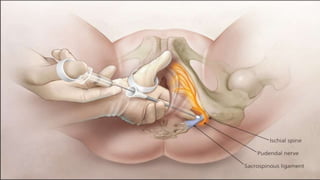
‣The index and middle fingers of one hand are introduced into
the vagina, the finger tips are placed on the tip of the ischial
spine of one side
● The needle is passed in vagina along the groove of the fingers
and guided to pierce the vaginal wall on the apex of ischial
spine and thereafter push a little to pierce the sacrospinous
ligament just above the ischial spine tip.
● After aspirating to exclude blood, about 10 mL of the
anaesthetic solution is injected.
● The similar procedure is adopted to block the nerve of the
other side by changing the hands.
SPINAL ANAESTHESIA
● Spinal anesthesia is achieved by a subarachnoid injection of a
local anesthetic (bupivacaine) and an opioid (fentanyl).
● Spinal anesthesia is not used for labor analgesia because the
effect lasts only for a short time (90-120 min).
● It may be used for short obstetric procedures such as forceps,
vacuum delivery, or manual removal of placenta. It is choice for a
cesarean section.
Advantages over epidural analgesia: -
 Short procedure time
 Rapid onset of the block (within 5 minutes)
 High success rate
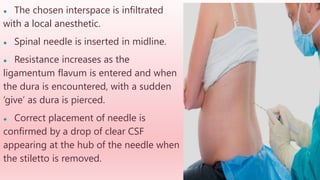
Procedure: -
● A preload of 500-1000 ml of IV fluids is given to prevent
hypotension resulting from sympathetic block from spinal
anesthesia.
● Procedure is done under aseptic precautions.
● Woman can be sitting or lying on her side.
● Woman is instructed to arch her back since flexion of spines
opens the intervertebral spaces. The L3/4, L4/5, or L5/S1
interspace is identified.
● The chosen interspace is infiltrated
with a local anesthetic.
● Spinal needle is inserted in midline.
● Resistance increases as the
ligamentum flavum is entered and when
the dura is encountered, with a sudden
‘give’ as dura is pierced.
● Correct placement of needle is
confirmed by a drop of clear CSF
appearing at the hub of the needle when
the stiletto is removed.
Complications: -
 Hypotension
 Nausea and vomiting
 Pruritus
 Post-dural puncture headache
COMBINED SPINAL-EPIDURAL ANESTHESIA
● Provides rapid onset of action of spinal and longer duration of
action of an epidural.
● It is not a routinely practical technique.
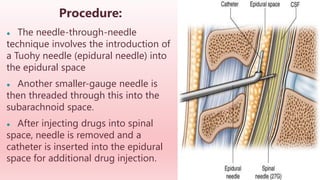
Procedure:
● The needle-through-needle
technique involves the introduction of
a Tuohy needle (epidural needle) into
the epidural space
● Another smaller-gauge needle is
then threaded through this into the
subarachnoid space.
● After injecting drugs into spinal
space, needle is removed and a
catheter is inserted into the epidural
space for additional drug injection.
GENERAL ANESTHESIA
● Indications: -
 Cesarean section
 In urgent situation (shoulder dystocia, head entrapment)
 Removal of retained placenta
 Suturing of extensive vaginal or perineal tears after vaginal
delivery.
 Management of acute uterine inversion
 If there is contraindication to regional anesthesia.
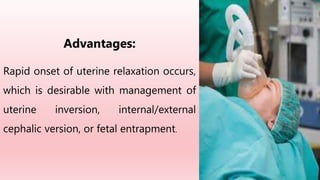
Advantages:
Rapid onset of uterine relaxation occurs,
which is desirable with management of
uterine inversion, internal/external
cephalic version, or fetal entrapment.
Complications:
● Aspiration of gastric contents.
● Failure in intubation and ventilation.
● Nausea, vomiting.
● Sore throat.
“The delivery of the infant into the arms of a conscious
and pain-free mother is one of the most exciting and
rewarding moments in medicine”
ANALGESIA.pptx

ANALGESIA.pptx

  • 1.
  • 2.
    Anesthesia: It isthe absence of all sensation, including pain, touch, temperature, and pressure. Analgesia: It is the absence of nociceptive stimuli, with the preservation of motor &touch sensation.
  • 3.
    1st stage oflabor– mostly visceral  Visceral pain is produced by distention of the uterus and cervix and ischemia of the uterine and cervical tissue.  It is dull, aching and poorly localized.  Slow conducting, visceral C fibers, enter spinal cord at T10 to L1 2nd stage of labor– mostly somatic  Distention of the pelvic floor, vagina and perineum.  Sharp, severe and well localized.  Rapidly conducting A-delta fibers, enter spinal cord at S2 to S4. PHYSIOLOGY OF PAIN IN LABOR
  • 5.
    MATERNAL RISK FACTORSIN ANAESTHESIA 1. Short stature 2. Short neck 3. Marked obesity 4. Severe pre-eclampsia 5. Bleeding disorders 6. Placenta previa 7. Medical disorders, like cardiac, respiratory and neurological diseases
  • 6.
    DOES LABOR PAINREQUIRE ANALGESIA?
  • 7.
    SEDATIVES AND ANALGESICS Thefollowing factors are important to control the dose of sedative and analgesics: 1. Pain threshold 2. Parity 3. Maturity of the fetus
  • 8.
  • 9.
  • 11.
  • 12.
    SEDATIVE AND ANALGESIC 1.Pethidine (Meperidine): ● Most commonly used. ● Strong sedative but less analgesic efficacy. ● Generally used in first phase of labor.
  • 13.
    Dose: ● IM (commonlyused): -50-100mg (1-2mg/kg body wt.), can be repeated after 4-6 hrs, if woman has not delivered yet. ● IV: -25 mg every 2 hrs. Onset of action: ● Within 45 min after IM administration. ● Almost immediate after IV administration.
  • 14.
    SIDE EFFECTS ● Nausea,vomiting, delayed gastric emptying. ● Cross the placenta and accumulates in fetal tissues. ● Depress the respiration and suckling of newborn when administered before delivery. ● Ranitidine should be given to inhibit gastric acid production and metoclopramide for vomiting.
  • 15.
    2. Fentanyl: ● Lipidsoluble synthetic opioid. ● It has analgesic potency 100 times that of morphine and 800 times that of pethidine. ● Less neonatal and maternal effects and nausea and vomiting than others. ● Performs better in terms of pain scores in women in labour.
  • 16.
    Dose: IV bolus of25-50 ug (given slowly over 1-2minutes) every hour. Onset of action: Rapid within 2-3 minutes with short duration of action, making it useful for labor analgesia
  • 17.
    3. Tramadol: - ●It is a synthetic opioid analgesic. Potency is 10% of pethidine. ● Not as effective as pethidine. ● Causes no clinically significant respiratory depression
  • 18.
    ● Dose: -100mg IM (1-2mg/kg body wt.) ● Onset of action: -within 10 minutes after administration and effect lasts for 2-3 hrs.
  • 19.
    4. Phenothiazines: - ●Promethazine (Phenergan) is commonly used in labour in combination with an opioid. ● Weak antiemetic drug.
  • 20.
    Side effects: - Cause sedation in mother.  Does not cause major neonatal depression.
  • 21.
    5. Butorphanol: - ●It is an opioid, 5 times as potent as morphine and 40 times as potent as pethidine. ● It offers analgesia with sedation
  • 22.
    Dose: -1-2 mgIM. Side effects: -Produce excessive sedation, so not used frequently for labor analgesia.
  • 23.
    6. Narcotic antagonists: Itis used to reverse the respiratory depression induced by opioid narcotics.
  • 24.
    ● Naloxone isgiven to mother 0.4mg IV in labour. ● It is given to newborn 10 ug/kg IM or IV and is repeated as necessary when infant is born with narcotic depression. ● It is given to a newborn of a narcotic addicted mother with proper ventilation arrangement otherwise withdrawal symptoms are precipitated.
  • 25.
    7. PATIENT CONTROLANALGESIA ● Intravenous analgesia. ● The woman herself controls the frequency of administration. ● It provides good pain relief in labor. ● It is used in women who desire continuous analgesia but where epidural analgesia is contraindicated. ● Maternal respiration should be closely monitored.
  • 26.
    Doses: - ● Fentanyl–20-60ug every 5-10 minutes ● Remifentanil–25-50 ug every 5-10 minutes
  • 27.
    8. Benzodiazepines (Diazepam):- ● It is a sedative ● Well tolerated by the patient ● It does not produce vomiting and helps in dilatation of cervix.
  • 28.
    ● However diazepamis avoided in labour. ● May be used in larger doses in the management of pre- eclampsia. Dose: -5-10 mg. Disadvantages: -  Neonatal hypotonia  Hypothermia
  • 29.
    INHALATION METHODS: Premixed nitrousoxide and oxygen Nitrous oxide inhalational analgesia is administered as a blend of 50% nitrous oxide and 50% oxygen. ● Used in: -Second phase (from 8 cm dilation of cervix to delivery).
  • 30.
    ● Laboring womanuses a handheld face mask to self-administer the anesthetic gas. ● It takes 50 seconds to take effect. ● Woman is instructed on correctly timing for each inhalation. ● Woman is to take slow and deep breaths before the contractions and to stop when the contractions over.
  • 31.
    ● The womanshould be monitored with pulse oximetry ● It is safe because when the woman becomes drowsy, she will automatically drop the mask. ● Provides significant degree of pain relief and may be useful in situation where epidural analgesia is not available. ● Does not cause neonatal respiratory depression or affect contractility.
  • 32.
    Side effects: ● Hyperventilation, ●Dizziness, ● Hypocapnia.
  • 33.
    INFILTRATION ANALGESIA: Perineal infiltration:- ● For episiotomy- ● Extensively used prior to episiotomy
  • 34.
     10 mlsyringe, with a fine needle and about 8-10 ml 1% lignocaine hydrochloride required.  The perineum on the proposed episiotomy site is infiltrated in a fan-wise manner starting from the middle of the fourchette.  Each time prior to infiltration, aspiration to exclude blood is mandatory.  Episiotomy is to be done about 2-5 minutes following infiltration.
  • 35.
    REGIONAL (Neuraxial) ANESTHESIA ●When complete relief of pain is needed throughout labor, epidural analgesia is the safest and simplest method. ● It provides sensory as well as various degrees of motor blockade over a region of the body. ● Trained personnel is required to make use of this method in normal and abnormal labor.
  • 36.
    Epidural Analgesia ● Itis a central nerve block technique accomplished by injecting a local anesthetic. ● A lumbar puncture is made between L2 and L3 with the epidural needle (Tuohy needle). ● For complete analgesia, a block from T10 to the S5 dermatomes is needed. For cesarean delivery, a block from T4 to S1 is needed. Repeated doses (top ups) of 4-5 mL of 0.5% bupivacaine or 1% or lignocaine are used to maintain analgesia.
  • 37.
    Contraindications: -  Maternalcoagulopathy  Supine hypotension  Hypovolemia  Neurological diseases  Spinal deformity  Skin infection at injection site
  • 38.
    PROCEDURE  A preload500 ml of IV fluids should be given prior to administering epidural analgesia.  Aseptic precautions must be used.  Epidural block can be performed in the lateral or sitting position.  Lumbar spine is palpated and the widest interspace below L3 is chosen.  A local anesthetic is used to numb the skin.
  • 39.
     A spinalneedle is slowly advanced while feeling for resistance. A sudden loss of resistance is felt as the epidural needle enters the epidural space. Care is taken not to puncture the dura. An epidural catheter is threaded through the needle and the needle is removed.  The catheter is fixed in place.  A combination of low conc. Bupivacaine and fentanyl is given as bolus every 2 hours or as needed to maintain maternal comfort.
  • 42.
    Precaution: - ● Bloodpressure should be recorded prior to administration of an epidural. Thereafter it should be checked at 5-15 minutes intervals. ● Continuous fetal heart rate monitoring should be done since the epidural may cause maternal hypotension, leading to fetal heart rate abnormality.
  • 43.
    Complications: -  Hypotension Nausea and vomiting  Pain at insertion site, back pain  Post spinal headache due to leakage of CSF through needle hole in dura  Ineffective analgesia  Injury to nerve, convulsions, pyrexia  Fetal heart rate abnormality
  • 44.
    PARACERVICAL NERVE BLOCK ●Relief pain during first stage of labor. It blocks visceral sensory fibers of lower uterus, cervix and upper vagina. ● It does not affect progression of labor. ● It does not block sensory nerves from perineum, so it is not effective in 2nd stage of labor. ● It can be given only after a cervical dilatation of 4 cm and may need to be repeated every 1-2 hrs. ● Not used commonly for pain relief during labor.
  • 45.
    PROCEDURE: ● Following theusual antiseptic safe guards, a long needle (15 cm or more) is passed into the lateral fornix, at the 3 and 9 o'clock positions. ● Needle is inserted into vaginal mucosa for a depth of 3-5 mm. ● Five to ten ml of 1% lignocaine are injected the procedure is repeated on the other side. ● This dose is quite sufficient to relieve pain for about an hour or two, and injections can be given more than once if necessary.
  • 47.
    Complications:  Post blockfetal bradycardia: -occur within 10 minutes of injection and usually transient but last as long as 40 minutes.  Systematic toxicity: -occur after administration and may result in excessive sedation, generalized convulsions, and cardiovascular collapse.  Lower extremity paresthesia
  • 48.
    Pudendal nerve block ●Safe and simple method of analgesia during delivery. ● It does not relieve the pain of labour but affords perineal analgesia and relaxation.
  • 49.
    Indications:  Outlet forcepsdelivery  Assisted breech delivery  Repair of episiotomy and perineal lacerations.
  • 50.
    Technique: The pudendalnerve may be blocked by either the transvaginal or the transperineal route Transvaginal route: ‣ Transvaginal route is commonly preferred. ‣ A 20 mL syringe, one 15 cm (6") 22 gauge spinal needle and about 20mL of 1% lignocaine hydrochloride are required. ‣The index and middle fingers of one hand are introduced into the vagina, the finger tips are placed on the tip of the ischial spine of one side
  • 51.
    ● The needleis passed in vagina along the groove of the fingers and guided to pierce the vaginal wall on the apex of ischial spine and thereafter push a little to pierce the sacrospinous ligament just above the ischial spine tip. ● After aspirating to exclude blood, about 10 mL of the anaesthetic solution is injected. ● The similar procedure is adopted to block the nerve of the other side by changing the hands.
  • 53.
    SPINAL ANAESTHESIA ● Spinalanesthesia is achieved by a subarachnoid injection of a local anesthetic (bupivacaine) and an opioid (fentanyl). ● Spinal anesthesia is not used for labor analgesia because the effect lasts only for a short time (90-120 min). ● It may be used for short obstetric procedures such as forceps, vacuum delivery, or manual removal of placenta. It is choice for a cesarean section.
  • 54.
    Advantages over epiduralanalgesia: -  Short procedure time  Rapid onset of the block (within 5 minutes)  High success rate
  • 55.
    Procedure: - ● Apreload of 500-1000 ml of IV fluids is given to prevent hypotension resulting from sympathetic block from spinal anesthesia. ● Procedure is done under aseptic precautions. ● Woman can be sitting or lying on her side. ● Woman is instructed to arch her back since flexion of spines opens the intervertebral spaces. The L3/4, L4/5, or L5/S1 interspace is identified.
  • 56.
    ● The choseninterspace is infiltrated with a local anesthetic. ● Spinal needle is inserted in midline. ● Resistance increases as the ligamentum flavum is entered and when the dura is encountered, with a sudden ‘give’ as dura is pierced. ● Correct placement of needle is confirmed by a drop of clear CSF appearing at the hub of the needle when the stiletto is removed.
  • 57.
    Complications: -  Hypotension Nausea and vomiting  Pruritus  Post-dural puncture headache
  • 58.
    COMBINED SPINAL-EPIDURAL ANESTHESIA ●Provides rapid onset of action of spinal and longer duration of action of an epidural. ● It is not a routinely practical technique.
  • 59.
    Procedure: ● The needle-through-needle techniqueinvolves the introduction of a Tuohy needle (epidural needle) into the epidural space ● Another smaller-gauge needle is then threaded through this into the subarachnoid space. ● After injecting drugs into spinal space, needle is removed and a catheter is inserted into the epidural space for additional drug injection.
  • 60.
    GENERAL ANESTHESIA ● Indications:-  Cesarean section  In urgent situation (shoulder dystocia, head entrapment)  Removal of retained placenta  Suturing of extensive vaginal or perineal tears after vaginal delivery.  Management of acute uterine inversion  If there is contraindication to regional anesthesia.
  • 61.
    Advantages: Rapid onset ofuterine relaxation occurs, which is desirable with management of uterine inversion, internal/external cephalic version, or fetal entrapment.
  • 62.
    Complications: ● Aspiration ofgastric contents. ● Failure in intubation and ventilation. ● Nausea, vomiting. ● Sore throat.
  • 63.
    “The delivery ofthe infant into the arms of a conscious and pain-free mother is one of the most exciting and rewarding moments in medicine”