Pain Assessment
Disclaimer: This presentation contains information on the general principles of pain management. This presentation cannot account for
individual variation among patients and cannot be considered inclusive of all proper methods of care or exclusive of other treatments. It
is the responsibility of the treating physician, or health care provider, to determine the best course of treatment for the patient. Treat the
Pain and its partners assume no responsibility for any injury or damage to persons or property arising out of or related to any use of
these materials, or for any errors or omissions. Last updated on January 12, 2015
Objectives
• Explain how pain scales are used to measure pain
• Compare different scales
• Measure pain
2
Measuring pain
• Pain is subjective and two patients may report severity
differently from each other
• Despite the fact that pain is specific to each person, patients
can usually accurately and reproducibly indicate the severity
of their symptom by using a scale
• Scales enhance the ability of patients to communicate the
severity of their pain to health care professionals and the
ability of clinicians to communicate among themselves
• Scales also allow the clinician to assess the effect of
medications
Palliative Care for HIV/AIDS and Cancer Patients in Vietnam, Basic Training Curriculum: Harvard Medical School, Centre for
Palliative Care (2007); Beating Pain, 2nd Ed. APCA (2012) 3
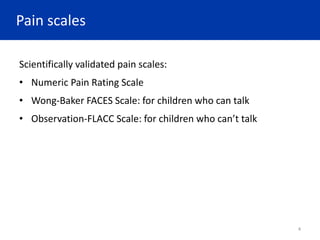
Pain scales
Scientifically validated pain scales:
• Numeric Pain Rating Scale
• Wong-Baker FACES Scale: for children who can talk
• Observation-FLACC Scale: for children who can’t talk
4
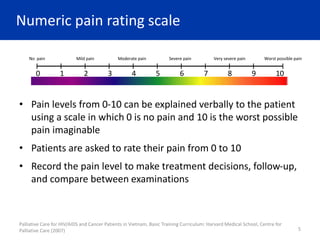
Numeric pain rating scale
• Pain levels from 0-10 can be explained verbally to the patient
using a scale in which 0 is no pain and 10 is the worst possible
pain imaginable
• Patients are asked to rate their pain from 0 to 10
• Record the pain level to make treatment decisions, follow-up,
and compare between examinations
Palliative Care for HIV/AIDS and Cancer Patients in Vietnam, Basic Training Curriculum: Harvard Medical School, Centre for
Palliative Care (2007) 5
0 1 2 3 4 5 6 7 8 9 10
No pain Mild pain Moderate pain Severe pain Very severe pain Worst possible pain
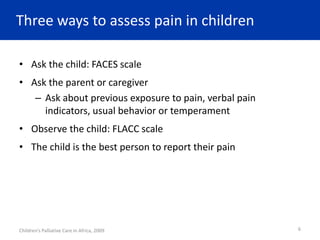
Three ways to assess pain in children
• Ask the child: FACES scale
• Ask the parent or caregiver
– Ask about previous exposure to pain, verbal pain
indicators, usual behavior or temperament
• Observe the child: FLACC scale
• The child is the best person to report their pain
Children’s Palliative Care in Africa, 2009 6
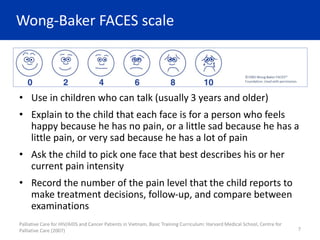
Wong-Baker FACES scale
• Use in children who can talk (usually 3 years and older)
• Explain to the child that each face is for a person who feels
happy because he has no pain, or a little sad because he has a
little pain, or very sad because he has a lot of pain
• Ask the child to pick one face that best describes his or her
current pain intensity
• Record the number of the pain level that the child reports to
make treatment decisions, follow-up, and compare between
examinations
Palliative Care for HIV/AIDS and Cancer Patients in Vietnam, Basic Training Curriculum: Harvard Medical School, Centre for
Palliative Care (2007) 7
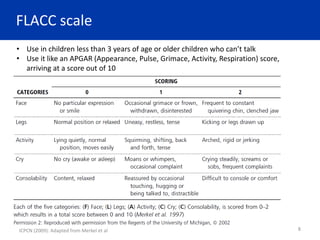
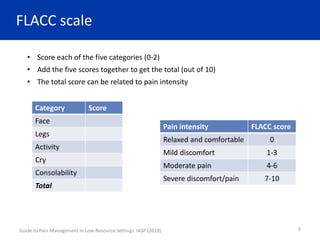
FLACC scale
ICPCN (2009): Adapted from Merkel et al 8
• Use in children less than 3 years of age or older children who can’t talk
• Use it like an APGAR (Appearance, Pulse, Grimace, Activity, Respiration) score,
arriving at a score out of 10
FLACC scale
Guide to Pain Management in Low-Resource Settings. IASP (2010) 9
Category Score
Face
Legs
Activity
Cry
Consolability
Total
Pain intensity FLACC score
Relaxed and comfortable 0
Mild discomfort 1-3
Moderate pain 4-6
Severe discomfort/pain 7-10
• Score each of the five categories (0-2)
• Add the five scores together to get the total (out of 10)
• The total score can be related to pain intensity
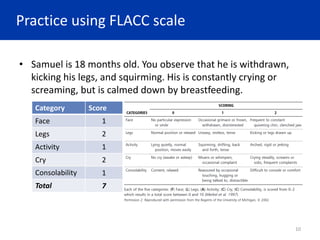
Practice using FLACC scale
• Samuel is 18 months old. You observe that he is withdrawn,
kicking his legs, and squirming. His is constantly crying or
screaming, but is calmed down by breastfeeding.
10
Category Score
Face
Legs
Activity
Cry
Consolability
Total
Score
1
Score
1
2
Score
1
2
1
Score
1
2
1
2
Score
1
2
1
2
1
Score
1
2
1
2
1
7
Detailed pain assessments
11
• Detailed pain assessments are useful for treating patients with
pain
• Tools like the PQRST and body charts provide detailed
information on location and type of pain as well as quality and
response to treatment
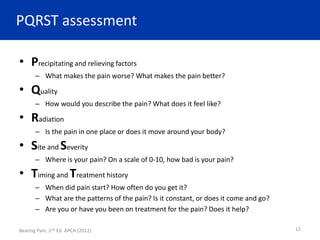
PQRST assessment
• Precipitating and relieving factors
– What makes the pain worse? What makes the pain better?
• Quality
– How would you describe the pain? What does it feel like?
• Radiation
– Is the pain in one place or does it move around your body?
• Site and Severity
– Where is your pain? On a scale of 0-10, how bad is your pain?
• Timing and Treatment history
– When did pain start? How often do you get it?
– What are the patterns of the pain? Is it constant, or does it come and go?
– Are you or have you been on treatment for the pain? Does it help?
Beating Pain, 2nd Ed. APCA (2012) 12
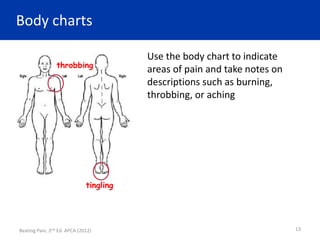
Body charts
Beating Pain, 2nd Ed. APCA (2012) 13
throbbing
tingling
Use the body chart to indicate
areas of pain and take notes on
descriptions such as burning,
throbbing, or aching
Take home messages
• Always ask about your patient’s pain
• Though pain is subjective, patients aged 3 and older can accurately
assess the severity of their pain
– Some patients may need some time and education by the
healthcare provider to understand how to use the different
scales
– In patients younger than 3 years, objective data can be used to
assess pain
• Pain assessments can be a useful clinical tool in treatment and pain
management
• Effective pain measurement leads to appropriate pain management
• Health workers should therefore endeavor to accurately measure a
patient’s pain
14
References
• African Palliative Care Association. Beating Pain: a pocketguide for pain
management in Africa, 2nd Ed. [Internet]. 2012. Available from:
http://www.africanpalliativecare.org/images/stories/pdf/beating_pain.pdf
• African Palliative Care Association. Using opioids to manage pain: a pocket guide
for health professionals in Africa [Internet]. 2010. Available from:
http://www.africanpalliativecare.org/images/stories/pdf/using_opiods.pdf
• Amery J, editor. Children’s Palliative Care in Africa [Internet]. 2009. Available from:
http://www.icpcn.org/wp-content/uploads/2013/08/Childrens-Palliative-Care-in-
Africa-Full-Text.pdf
• Kopf A, Patel N, editors. Guide to Pain Management in Low-Resource Settings
[Internet]. 2010. Available from: http://www.iasp-
pain.org/files/Content/ContentFolders/Publications2/FreeBooks/Guide_to_Pain_
Management_in_Low-Resource_Settings.pdf
• The Palliative Care Association of Uganda and the Uganda Ministry of Health.
Introductory Palliative Care Course for Healthcare Professionals. 2013.
15

3. Pain Assessment.pptx

  • 1.
    Pain Assessment Disclaimer: Thispresentation contains information on the general principles of pain management. This presentation cannot account for individual variation among patients and cannot be considered inclusive of all proper methods of care or exclusive of other treatments. It is the responsibility of the treating physician, or health care provider, to determine the best course of treatment for the patient. Treat the Pain and its partners assume no responsibility for any injury or damage to persons or property arising out of or related to any use of these materials, or for any errors or omissions. Last updated on January 12, 2015
  • 2.
    Objectives • Explain howpain scales are used to measure pain • Compare different scales • Measure pain 2
  • 3.
    Measuring pain • Painis subjective and two patients may report severity differently from each other • Despite the fact that pain is specific to each person, patients can usually accurately and reproducibly indicate the severity of their symptom by using a scale • Scales enhance the ability of patients to communicate the severity of their pain to health care professionals and the ability of clinicians to communicate among themselves • Scales also allow the clinician to assess the effect of medications Palliative Care for HIV/AIDS and Cancer Patients in Vietnam, Basic Training Curriculum: Harvard Medical School, Centre for Palliative Care (2007); Beating Pain, 2nd Ed. APCA (2012) 3
  • 4.
    Pain scales Scientifically validatedpain scales: • Numeric Pain Rating Scale • Wong-Baker FACES Scale: for children who can talk • Observation-FLACC Scale: for children who can’t talk 4
  • 5.
    Numeric pain ratingscale • Pain levels from 0-10 can be explained verbally to the patient using a scale in which 0 is no pain and 10 is the worst possible pain imaginable • Patients are asked to rate their pain from 0 to 10 • Record the pain level to make treatment decisions, follow-up, and compare between examinations Palliative Care for HIV/AIDS and Cancer Patients in Vietnam, Basic Training Curriculum: Harvard Medical School, Centre for Palliative Care (2007) 5 0 1 2 3 4 5 6 7 8 9 10 No pain Mild pain Moderate pain Severe pain Very severe pain Worst possible pain
  • 6.
    Three ways toassess pain in children • Ask the child: FACES scale • Ask the parent or caregiver – Ask about previous exposure to pain, verbal pain indicators, usual behavior or temperament • Observe the child: FLACC scale • The child is the best person to report their pain Children’s Palliative Care in Africa, 2009 6
  • 7.
    Wong-Baker FACES scale •Use in children who can talk (usually 3 years and older) • Explain to the child that each face is for a person who feels happy because he has no pain, or a little sad because he has a little pain, or very sad because he has a lot of pain • Ask the child to pick one face that best describes his or her current pain intensity • Record the number of the pain level that the child reports to make treatment decisions, follow-up, and compare between examinations Palliative Care for HIV/AIDS and Cancer Patients in Vietnam, Basic Training Curriculum: Harvard Medical School, Centre for Palliative Care (2007) 7
  • 8.
    FLACC scale ICPCN (2009):Adapted from Merkel et al 8 • Use in children less than 3 years of age or older children who can’t talk • Use it like an APGAR (Appearance, Pulse, Grimace, Activity, Respiration) score, arriving at a score out of 10
  • 9.
    FLACC scale Guide toPain Management in Low-Resource Settings. IASP (2010) 9 Category Score Face Legs Activity Cry Consolability Total Pain intensity FLACC score Relaxed and comfortable 0 Mild discomfort 1-3 Moderate pain 4-6 Severe discomfort/pain 7-10 • Score each of the five categories (0-2) • Add the five scores together to get the total (out of 10) • The total score can be related to pain intensity
  • 10.
    Practice using FLACCscale • Samuel is 18 months old. You observe that he is withdrawn, kicking his legs, and squirming. His is constantly crying or screaming, but is calmed down by breastfeeding. 10 Category Score Face Legs Activity Cry Consolability Total Score 1 Score 1 2 Score 1 2 1 Score 1 2 1 2 Score 1 2 1 2 1 Score 1 2 1 2 1 7
  • 11.
    Detailed pain assessments 11 •Detailed pain assessments are useful for treating patients with pain • Tools like the PQRST and body charts provide detailed information on location and type of pain as well as quality and response to treatment
  • 12.
    PQRST assessment • Precipitatingand relieving factors – What makes the pain worse? What makes the pain better? • Quality – How would you describe the pain? What does it feel like? • Radiation – Is the pain in one place or does it move around your body? • Site and Severity – Where is your pain? On a scale of 0-10, how bad is your pain? • Timing and Treatment history – When did pain start? How often do you get it? – What are the patterns of the pain? Is it constant, or does it come and go? – Are you or have you been on treatment for the pain? Does it help? Beating Pain, 2nd Ed. APCA (2012) 12
  • 13.
    Body charts Beating Pain,2nd Ed. APCA (2012) 13 throbbing tingling Use the body chart to indicate areas of pain and take notes on descriptions such as burning, throbbing, or aching
  • 14.
    Take home messages •Always ask about your patient’s pain • Though pain is subjective, patients aged 3 and older can accurately assess the severity of their pain – Some patients may need some time and education by the healthcare provider to understand how to use the different scales – In patients younger than 3 years, objective data can be used to assess pain • Pain assessments can be a useful clinical tool in treatment and pain management • Effective pain measurement leads to appropriate pain management • Health workers should therefore endeavor to accurately measure a patient’s pain 14
  • 15.
    References • African PalliativeCare Association. Beating Pain: a pocketguide for pain management in Africa, 2nd Ed. [Internet]. 2012. Available from: http://www.africanpalliativecare.org/images/stories/pdf/beating_pain.pdf • African Palliative Care Association. Using opioids to manage pain: a pocket guide for health professionals in Africa [Internet]. 2010. Available from: http://www.africanpalliativecare.org/images/stories/pdf/using_opiods.pdf • Amery J, editor. Children’s Palliative Care in Africa [Internet]. 2009. Available from: http://www.icpcn.org/wp-content/uploads/2013/08/Childrens-Palliative-Care-in- Africa-Full-Text.pdf • Kopf A, Patel N, editors. Guide to Pain Management in Low-Resource Settings [Internet]. 2010. Available from: http://www.iasp- pain.org/files/Content/ContentFolders/Publications2/FreeBooks/Guide_to_Pain_ Management_in_Low-Resource_Settings.pdf • The Palliative Care Association of Uganda and the Uganda Ministry of Health. Introductory Palliative Care Course for Healthcare Professionals. 2013. 15