Warm-Up
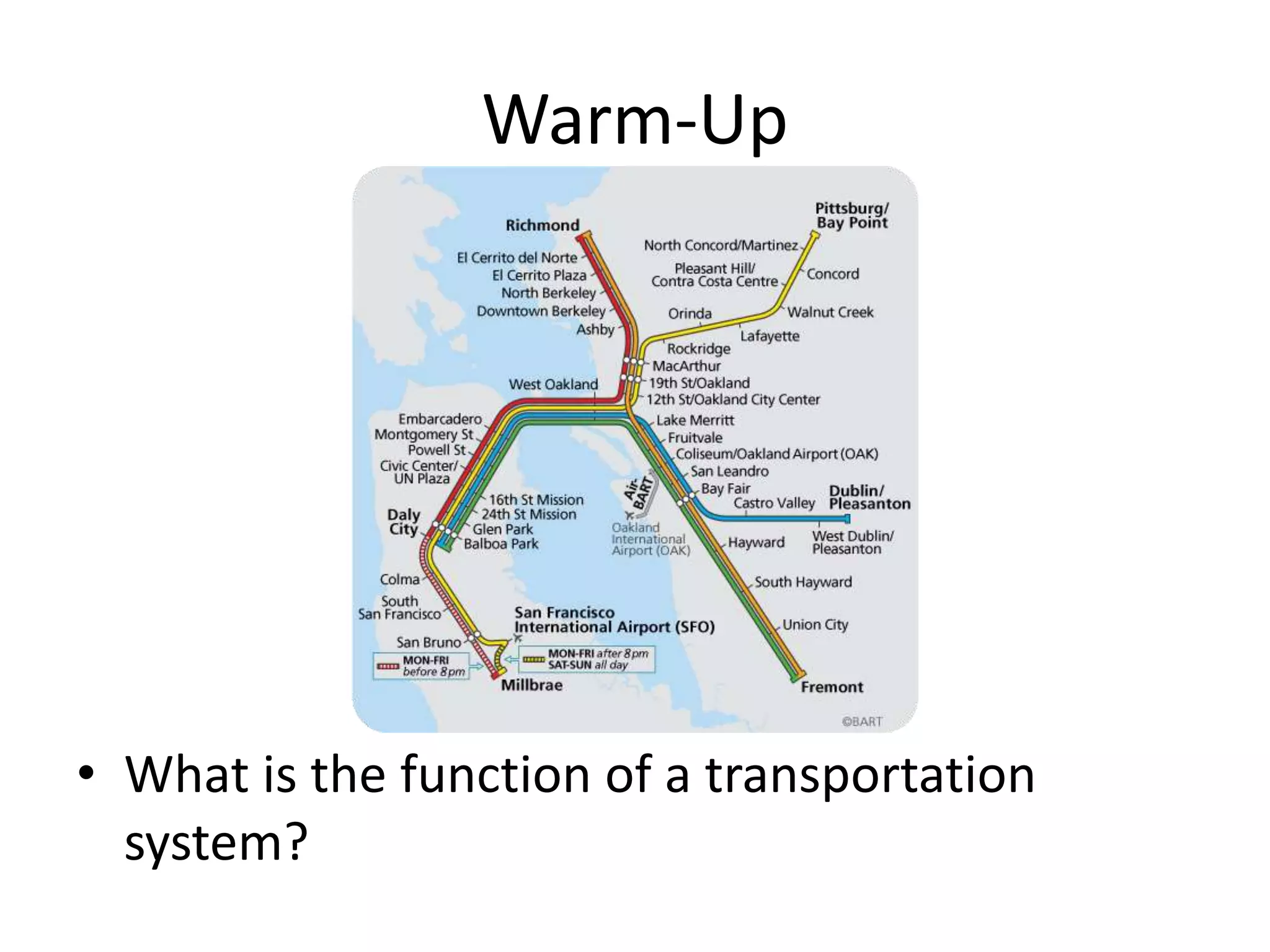
• What is the function of a transportation
system?
Chapter 14
Circulation and Respiration
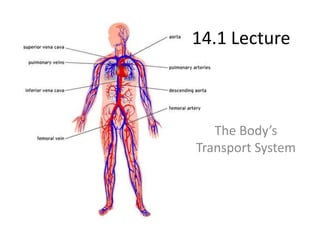
14.1 Lecture
The Body’s
Transport System
Section 1: The Body’s Transport
System
What are the functions of the cardiovascular system?
What is the function and structure of the heart?
What path does blood take through the cardiovascular
system?
What are the functions and structures of arteries,
capillaries, and veins?
• 7.5.a Students know plants and animals have levels of
organization for structure and function, including, cells,
tissues, organs, organ systems, and whole organisms.
• 7.6.j Students know that contractions of the heart
generate blood pressure and that heart valves prevent
back flow of blood in the circulatory system.
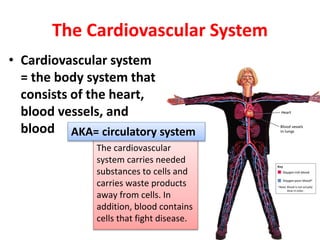
The Cardiovascular System
• Cardiovascular system
= the body system that
consists of the heart,
blood vessels, and
blood
The cardiovascular
system carries needed
substances to cells and
carries waste products
away from cells. In
addition, blood contains
cells that fight disease.
AKA= circulatory system
Delivering Needed Materials
• Most substances that need to get from one
part of the body to another are carried by the
blood.
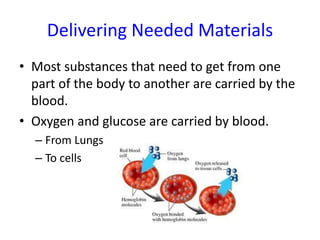
• Oxygen and glucose are carried by blood.
– From Lungs
– To cells
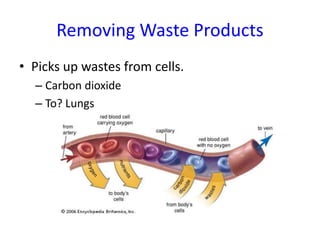
Removing Waste Products
• Picks up wastes from cells.
– Carbon dioxide
– To? Lungs
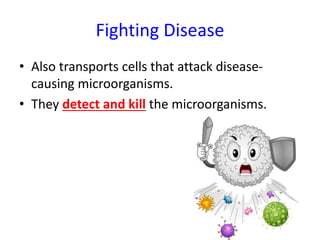
Fighting Disease
• Also transports cells that attack disease-
causing microorganisms.
• They detect and kill the microorganisms.
HOW DOES THE CARDIOVASCULAR
SYSTEM HELP FIGHT DISEASE?
Reading Checkpoint
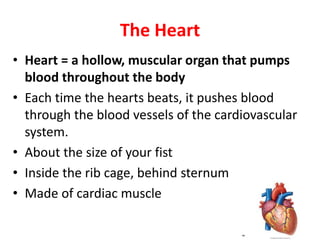
The Heart
• Heart = a hollow, muscular organ that pumps
blood throughout the body
• Each time the hearts beats, it pushes blood
through the blood vessels of the cardiovascular
system.
• About the size of your fist
• Inside the rib cage, behind sternum
• Made of cardiac muscle
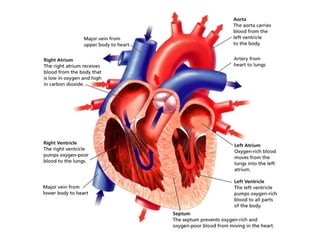
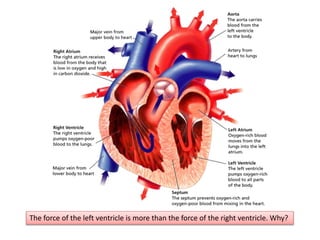
The Heart’s Structure
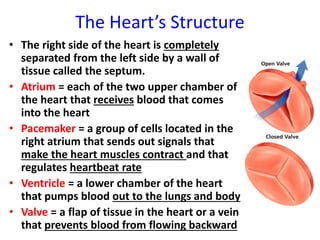
• The right side of the heart is completely
separated from the left side by a wall of
tissue called the septum.
• Atrium = each of the two upper chamber of
the heart that receives blood that comes
into the heart
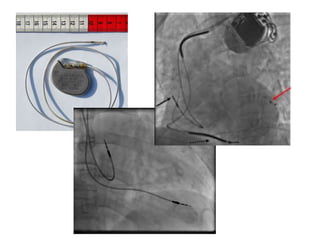
• Pacemaker = a group of cells located in the
right atrium that sends out signals that
make the heart muscles contract and that
regulates heartbeat rate
• Ventricle = a lower chamber of the heart
that pumps blood out to the lungs and body
• Valve = a flap of tissue in the heart or a vein
that prevents blood from flowing backward
How the Heart Works
• Two main phases:
– In one phase, the heart muscle relaxes and the
heart fills with blood.
– In the other phase, the heart muscle contracts
and pumps blood forward.
• Heartbeat can be heard during the pumping
phase.
• When the heart muscles relax, blood flows
into the chambers.
The force of the left ventricle is more than the force of the right ventricle. Why?
WHAT IS THE ROLE OF THE
PACEMAKER?
Reading Checkpoint
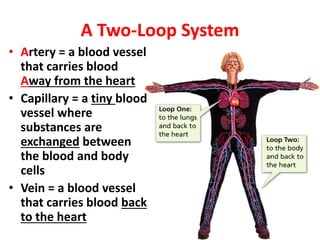
A Two-Loop System
• Artery = a blood vessel
that carries blood
Away from the heart
• Capillary = a tiny blood
vessel where
substances are
exchanged between
the blood and body
cells
• Vein = a blood vessel
that carries blood back
to the heart
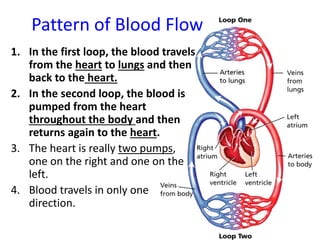
Pattern of Blood Flow
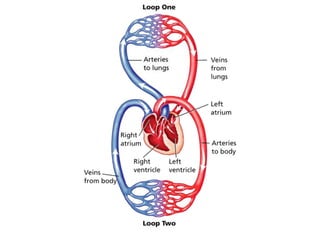
1. In the first loop, the blood travels
from the heart to lungs and then
back to the heart.
2. In the second loop, the blood is
pumped from the heart
throughout the body and then
returns again to the heart.
3. The heart is really two pumps,
one on the right and one on the
left.
4. Blood travels in only one
direction.
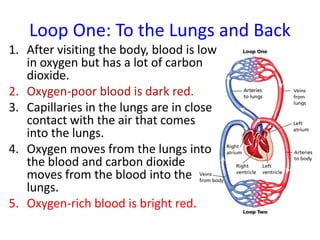
Loop One: To the Lungs and Back
1. After visiting the body, blood is low
in oxygen but has a lot of carbon
dioxide.
2. Oxygen-poor blood is dark red.
3. Capillaries in the lungs are in close
contact with the air that comes
into the lungs.
4. Oxygen moves from the lungs into
the blood and carbon dioxide
moves from the blood into the
lungs.
5. Oxygen-rich blood is bright red.
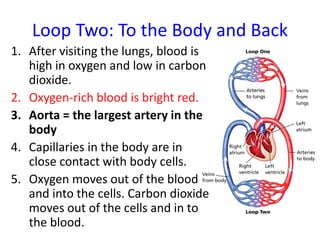
Loop Two: To the Body and Back
1. After visiting the lungs, blood is
high in oxygen and low in carbon
dioxide.
2. Oxygen-rich blood is bright red.
3. Aorta = the largest artery in the
body
4. Capillaries in the body are in
close contact with body cells.
5. Oxygen moves out of the blood
and into the cells. Carbon dioxide
moves out of the cells and in to
the blood.
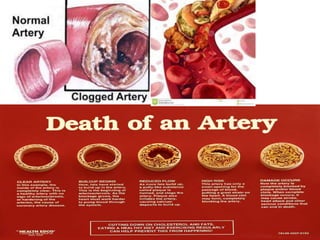
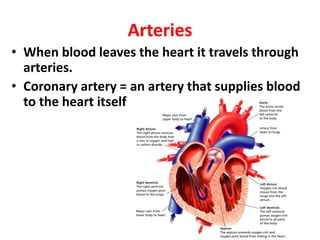
Arteries
• When blood leaves the heart it travels through
arteries.
• Coronary artery = an artery that supplies blood
to the heart itself
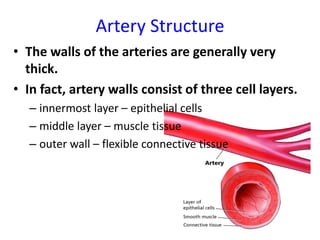
Artery Structure
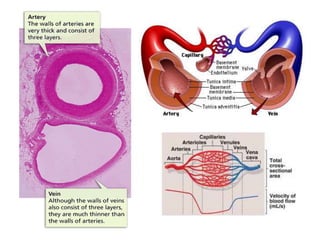
• The walls of the arteries are generally very
thick.
• In fact, artery walls consist of three cell layers.
– innermost layer – epithelial cells
– middle layer – muscle tissue
– outer wall – flexible connective tissue
Pulse
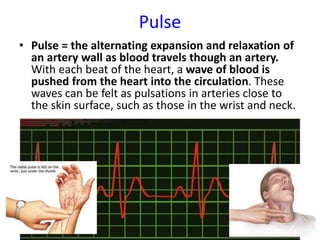
• Pulse = the alternating expansion and relaxation of
an artery wall as blood travels though an artery.
With each beat of the heart, a wave of blood is
pushed from the heart into the circulation. These
waves can be felt as pulsations in arteries close to
the skin surface, such as those in the wrist and neck.
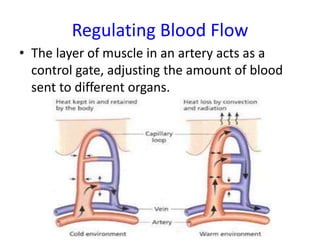
Regulating Blood Flow
• The layer of muscle in an artery acts as a
control gate, adjusting the amount of blood
sent to different organs.
WHAT CAUSES YOUR PULSE?
Reading Checkpoint
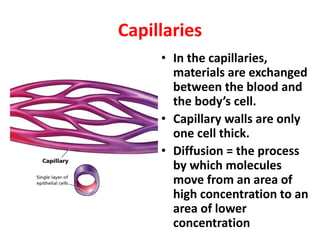
Capillaries
• In the capillaries,
materials are exchanged
between the blood and
the body’s cell.
• Capillary walls are only
one cell thick.
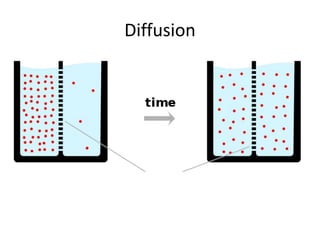
• Diffusion = the process
by which molecules
move from an area of
high concentration to an
area of lower
concentration
Diffusion
Veins
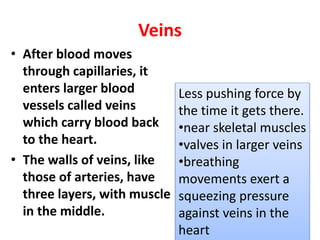
• After blood moves
through capillaries, it
enters larger blood
vessels called veins
which carry blood back
to the heart.
• The walls of veins, like
those of arteries, have
three layers, with muscle
in the middle.
Less pushing force by
the time it gets there.
•near skeletal muscles
•valves in larger veins
•breathing
movements exert a
squeezing pressure
against veins in the
heart
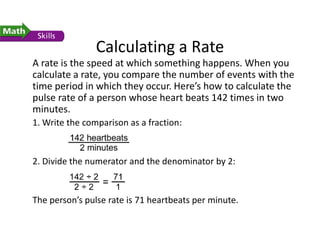
Calculating a Rate
A rate is the speed at which something happens. When you
calculate a rate, you compare the number of events with the
time period in which they occur. Here’s how to calculate the
pulse rate of a person whose heart beats 142 times in two
minutes.
1. Write the comparison as a fraction:
2. Divide the numerator and the denominator by 2:
The person’s pulse rate is 71 heartbeats per minute.
Calculating a Rate
Practice Problem
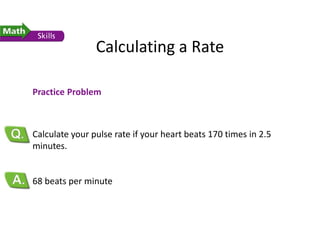
Calculate your pulse rate if your heart beats 170 times in 2.5
minutes.
68 beats per minute
Blood Pressure
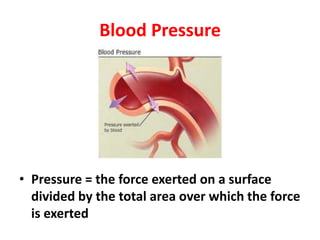
• Pressure = the force exerted on a surface
divided by the total area over which the force
is exerted
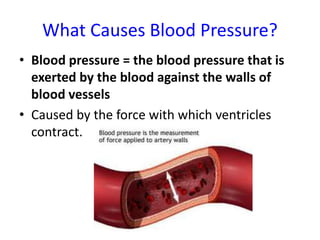
What Causes Blood Pressure?
• Blood pressure = the blood pressure that is
exerted by the blood against the walls of
blood vessels
• Caused by the force with which ventricles
contract.
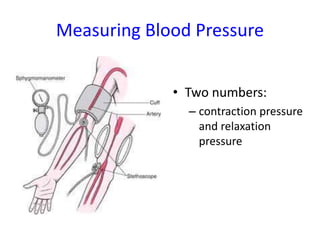
Measuring Blood Pressure
• Two numbers:
– contraction pressure
and relaxation
pressure
Review 1
• What is the difference between arteries and
veins?
Review 2
• What are the two loops of blood flow?
Review 3
• When blood is pumped to the body cells, is it
oxygen-rich?
• Hint: Where has it just come from?
Review 4
• Name one needed material and one waste
product transported by the cardiovascular
system.
Learning Target
What are the functions of the cardiovascular
system?
What is the function and structure of the
heart?
What path does blood take through the
cardiovascular system?
What are the functions and structures of
arteries, capillaries, and veins?

14.1 lecture 2019

  • 1.
    Warm-Up • What isthe function of a transportation system?
  • 3.
  • 4.
  • 5.
    Section 1: TheBody’s Transport System What are the functions of the cardiovascular system? What is the function and structure of the heart? What path does blood take through the cardiovascular system? What are the functions and structures of arteries, capillaries, and veins? • 7.5.a Students know plants and animals have levels of organization for structure and function, including, cells, tissues, organs, organ systems, and whole organisms. • 7.6.j Students know that contractions of the heart generate blood pressure and that heart valves prevent back flow of blood in the circulatory system.
  • 6.
    The Cardiovascular System •Cardiovascular system = the body system that consists of the heart, blood vessels, and blood The cardiovascular system carries needed substances to cells and carries waste products away from cells. In addition, blood contains cells that fight disease. AKA= circulatory system
  • 7.
    Delivering Needed Materials •Most substances that need to get from one part of the body to another are carried by the blood. • Oxygen and glucose are carried by blood. – From Lungs – To cells
  • 8.
    Removing Waste Products •Picks up wastes from cells. – Carbon dioxide – To? Lungs
  • 9.
    Fighting Disease • Alsotransports cells that attack disease- causing microorganisms. • They detect and kill the microorganisms.
  • 10.
    HOW DOES THECARDIOVASCULAR SYSTEM HELP FIGHT DISEASE? Reading Checkpoint
  • 11.
    The Heart • Heart= a hollow, muscular organ that pumps blood throughout the body • Each time the hearts beats, it pushes blood through the blood vessels of the cardiovascular system. • About the size of your fist • Inside the rib cage, behind sternum • Made of cardiac muscle
  • 12.
    The Heart’s Structure •The right side of the heart is completely separated from the left side by a wall of tissue called the septum. • Atrium = each of the two upper chamber of the heart that receives blood that comes into the heart • Pacemaker = a group of cells located in the right atrium that sends out signals that make the heart muscles contract and that regulates heartbeat rate • Ventricle = a lower chamber of the heart that pumps blood out to the lungs and body • Valve = a flap of tissue in the heart or a vein that prevents blood from flowing backward
  • 15.
    How the HeartWorks • Two main phases: – In one phase, the heart muscle relaxes and the heart fills with blood. – In the other phase, the heart muscle contracts and pumps blood forward. • Heartbeat can be heard during the pumping phase. • When the heart muscles relax, blood flows into the chambers.
  • 16.
    The force ofthe left ventricle is more than the force of the right ventricle. Why?
  • 17.
    WHAT IS THEROLE OF THE PACEMAKER? Reading Checkpoint
  • 18.
    A Two-Loop System •Artery = a blood vessel that carries blood Away from the heart • Capillary = a tiny blood vessel where substances are exchanged between the blood and body cells • Vein = a blood vessel that carries blood back to the heart
  • 19.
    Pattern of BloodFlow 1. In the first loop, the blood travels from the heart to lungs and then back to the heart. 2. In the second loop, the blood is pumped from the heart throughout the body and then returns again to the heart. 3. The heart is really two pumps, one on the right and one on the left. 4. Blood travels in only one direction.
  • 20.
    Loop One: Tothe Lungs and Back 1. After visiting the body, blood is low in oxygen but has a lot of carbon dioxide. 2. Oxygen-poor blood is dark red. 3. Capillaries in the lungs are in close contact with the air that comes into the lungs. 4. Oxygen moves from the lungs into the blood and carbon dioxide moves from the blood into the lungs. 5. Oxygen-rich blood is bright red.
  • 21.
    Loop Two: Tothe Body and Back 1. After visiting the lungs, blood is high in oxygen and low in carbon dioxide. 2. Oxygen-rich blood is bright red. 3. Aorta = the largest artery in the body 4. Capillaries in the body are in close contact with body cells. 5. Oxygen moves out of the blood and into the cells. Carbon dioxide moves out of the cells and in to the blood.
  • 22.
    Arteries • When bloodleaves the heart it travels through arteries. • Coronary artery = an artery that supplies blood to the heart itself
  • 23.
    Artery Structure • Thewalls of the arteries are generally very thick. • In fact, artery walls consist of three cell layers. – innermost layer – epithelial cells – middle layer – muscle tissue – outer wall – flexible connective tissue
  • 25.
    Pulse • Pulse =the alternating expansion and relaxation of an artery wall as blood travels though an artery. With each beat of the heart, a wave of blood is pushed from the heart into the circulation. These waves can be felt as pulsations in arteries close to the skin surface, such as those in the wrist and neck.
  • 26.
    Regulating Blood Flow •The layer of muscle in an artery acts as a control gate, adjusting the amount of blood sent to different organs.
  • 27.
    WHAT CAUSES YOURPULSE? Reading Checkpoint
  • 28.
    Capillaries • In thecapillaries, materials are exchanged between the blood and the body’s cell. • Capillary walls are only one cell thick. • Diffusion = the process by which molecules move from an area of high concentration to an area of lower concentration
  • 29.
  • 30.
    Veins • After bloodmoves through capillaries, it enters larger blood vessels called veins which carry blood back to the heart. • The walls of veins, like those of arteries, have three layers, with muscle in the middle. Less pushing force by the time it gets there. •near skeletal muscles •valves in larger veins •breathing movements exert a squeezing pressure against veins in the heart
  • 32.
    Calculating a Rate Arate is the speed at which something happens. When you calculate a rate, you compare the number of events with the time period in which they occur. Here’s how to calculate the pulse rate of a person whose heart beats 142 times in two minutes. 1. Write the comparison as a fraction: 2. Divide the numerator and the denominator by 2: The person’s pulse rate is 71 heartbeats per minute.
  • 33.
    Calculating a Rate PracticeProblem Calculate your pulse rate if your heart beats 170 times in 2.5 minutes. 68 beats per minute
  • 34.
    Blood Pressure • Pressure= the force exerted on a surface divided by the total area over which the force is exerted
  • 35.
    What Causes BloodPressure? • Blood pressure = the blood pressure that is exerted by the blood against the walls of blood vessels • Caused by the force with which ventricles contract.
  • 36.
    Measuring Blood Pressure •Two numbers: – contraction pressure and relaxation pressure
  • 37.
    Review 1 • Whatis the difference between arteries and veins?
  • 38.
    Review 2 • Whatare the two loops of blood flow?
  • 39.
    Review 3 • Whenblood is pumped to the body cells, is it oxygen-rich? • Hint: Where has it just come from?
  • 40.
    Review 4 • Nameone needed material and one waste product transported by the cardiovascular system.
  • 41.
    Learning Target What arethe functions of the cardiovascular system? What is the function and structure of the heart? What path does blood take through the cardiovascular system? What are the functions and structures of arteries, capillaries, and veins?