Speaker e-mail: dlopez@uma.es
 E-learning service was created in1998, and in 2004-05
UMA Virtual Campus was launched
 Technical and formation services
 Provide support for technical and pedagogical for ICT
 Support to computer laboratories as educational
resources
 Initiative of the UMA Master's and Doctorate International
School
◦ Increase numbers of students in low subscription Masters
◦ Provide postgraduate offer for workers and professionals
 In 2012-13, the promotion of a call for blended learning
method in subjects of Master’s degree
 The candidates had to fulfill
◦ Knowledge about online learning resources
◦ Attend a training course about blended learning
◦ Commit to adapt theirs activities and the contents
◦ Collaborate with E-learning Service
 Faculty grants
◦ Reduction of face-to-face classes
◦ Increase official recognition (10 hours per 1 ECTS credit instead
of 7.4 )
 Participation in course 2013-14
◦ 58 subjects
◦ 7 Masters ( 1 included all subjects )
 Participation in course 2014-15
◦ 66 subjects
◦ 8 Masters ( 3 include all subjects )
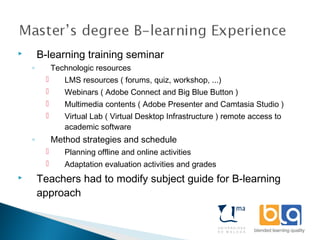
 B-learning training seminar
◦ Technologic resources
 LMS resources ( forums, quiz, workshop, ...)
 Webinars ( Adobe Connect and Big Blue Button )
 Multimedia contents ( Adobe Presenter and Camtasia Studio )
 Virtual Lab ( Virtual Desktop Infrastructure ) remote access to
academic software
◦ Method strategies and schedule
 Planning offline and online activities
 Adaptation evaluation activities and grades
 Teachers had to modify subject guide for B-learning
approach
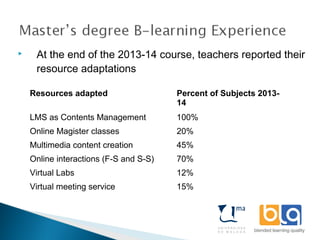
 At the end of the 2013-14 course, teachers reported their
resource adaptations
Resources adapted Percent of Subjects 2013-
14
LMS as Contents Management 100%
Online Magister classes 20%
Multimedia content creation 45%
Online interactions (F-S and S-S) 70%
Virtual Labs 12%
Virtual meeting service 15%
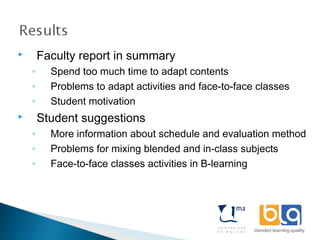
 Faculty report in summary
◦ Spend too much time to adapt contents
◦ Problems to adapt activities and face-to-face classes
◦ Student motivation
 Student suggestions
◦ More information about schedule and evaluation method
◦ Problems for mixing blended and in-class subjects
◦ Face-to-face classes activities in B-learning
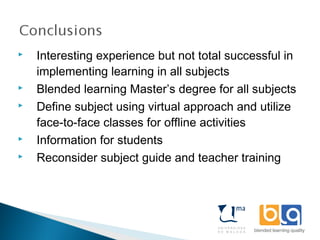
 Interesting experience but not total successful in
implementing learning in all subjects
 Blended learning Master’s degree for all subjects
 Define subject using virtual approach and utilize
face-to-face classes for offline activities
 Information for students
 Reconsider subject guide and teacher training

14 daniel lópez álvarez ortega blearning15_v4

  • 1.
  • 2.
     E-learning servicewas created in1998, and in 2004-05 UMA Virtual Campus was launched  Technical and formation services  Provide support for technical and pedagogical for ICT  Support to computer laboratories as educational resources
  • 3.
     Initiative ofthe UMA Master's and Doctorate International School ◦ Increase numbers of students in low subscription Masters ◦ Provide postgraduate offer for workers and professionals  In 2012-13, the promotion of a call for blended learning method in subjects of Master’s degree  The candidates had to fulfill ◦ Knowledge about online learning resources ◦ Attend a training course about blended learning ◦ Commit to adapt theirs activities and the contents ◦ Collaborate with E-learning Service
  • 4.
     Faculty grants ◦Reduction of face-to-face classes ◦ Increase official recognition (10 hours per 1 ECTS credit instead of 7.4 )  Participation in course 2013-14 ◦ 58 subjects ◦ 7 Masters ( 1 included all subjects )  Participation in course 2014-15 ◦ 66 subjects ◦ 8 Masters ( 3 include all subjects )
  • 5.
     B-learning trainingseminar ◦ Technologic resources  LMS resources ( forums, quiz, workshop, ...)  Webinars ( Adobe Connect and Big Blue Button )  Multimedia contents ( Adobe Presenter and Camtasia Studio )  Virtual Lab ( Virtual Desktop Infrastructure ) remote access to academic software ◦ Method strategies and schedule  Planning offline and online activities  Adaptation evaluation activities and grades  Teachers had to modify subject guide for B-learning approach
  • 6.
     At theend of the 2013-14 course, teachers reported their resource adaptations Resources adapted Percent of Subjects 2013- 14 LMS as Contents Management 100% Online Magister classes 20% Multimedia content creation 45% Online interactions (F-S and S-S) 70% Virtual Labs 12% Virtual meeting service 15%
  • 7.
     Faculty reportin summary ◦ Spend too much time to adapt contents ◦ Problems to adapt activities and face-to-face classes ◦ Student motivation  Student suggestions ◦ More information about schedule and evaluation method ◦ Problems for mixing blended and in-class subjects ◦ Face-to-face classes activities in B-learning
  • 8.
     Interesting experiencebut not total successful in implementing learning in all subjects  Blended learning Master’s degree for all subjects  Define subject using virtual approach and utilize face-to-face classes for offline activities  Information for students  Reconsider subject guide and teacher training

Editor's Notes

  • #2 Good morning. Mi nombre es Daniel López y me gustaría agradecer a
  • #3 The UMA E-learning service was created in 1998 and was offered in 2004 first version of LMS integrated with UMA information system. We offer a technologic and pedagogic support for educational TIC resource.
  • #4 It was an initiative of the UMA Master’s and Doctorate International School, in order to, increase the number of students and provide postgraduate education worker.
  • #5 It was an initiative of the UMA Master’s and Doctorate International School, in order to, increase the number of students and provide postgraduate formation to senior worker.
  • #6 It was an initiative of the UMA Master’s and Doctorate International School, in order to, increase the number of students and provide postgraduate formation to senior worker.
  • #7 It was an initiative of the UMA Master’s and Doctorate International School, in order to, increase the number of students and provide postgraduate formation to senior worker.