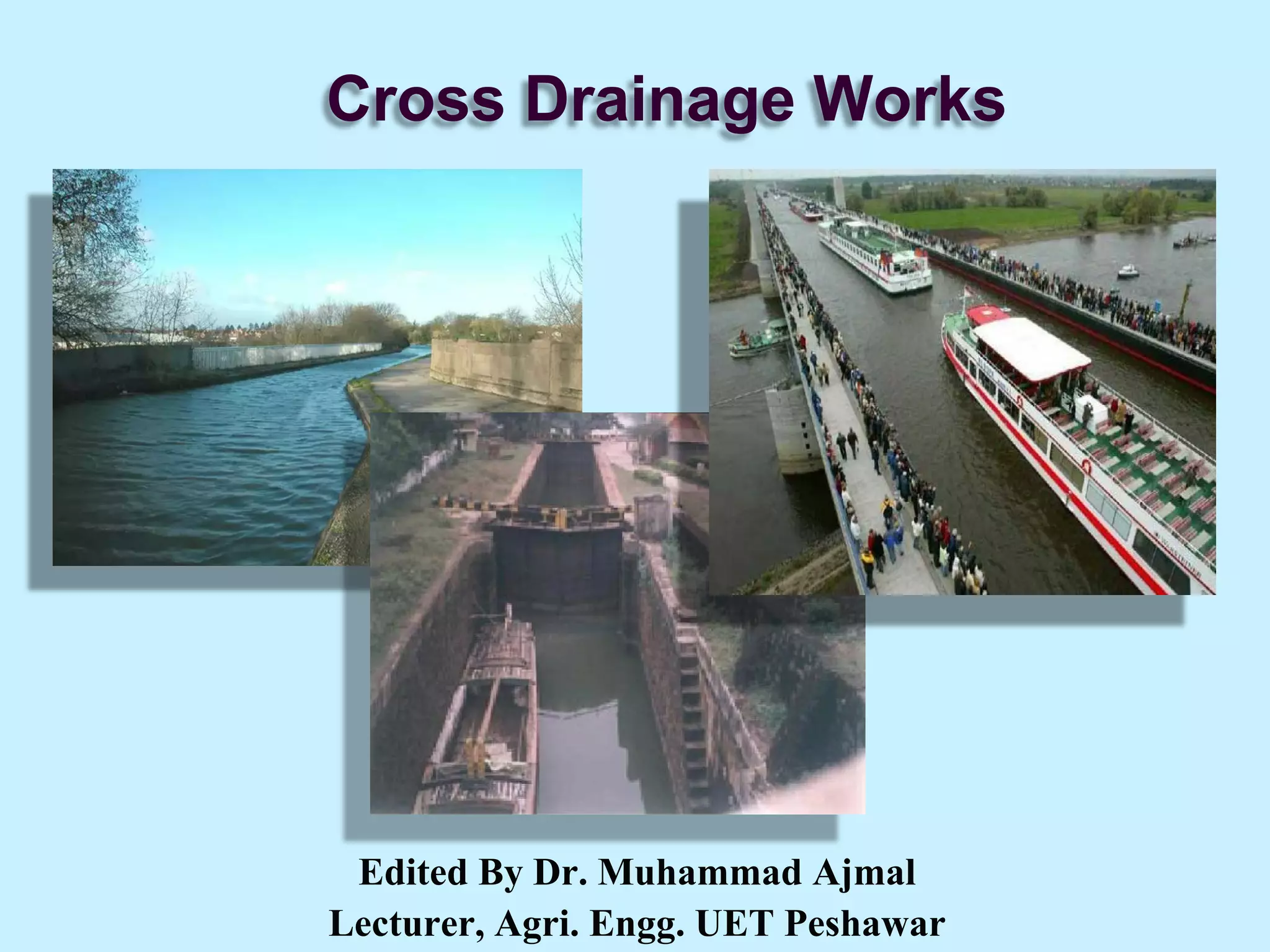
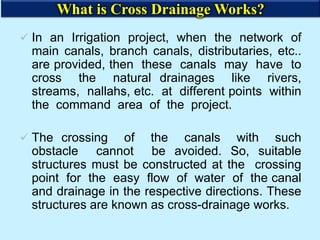
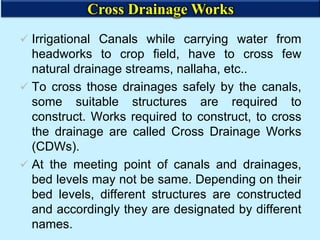
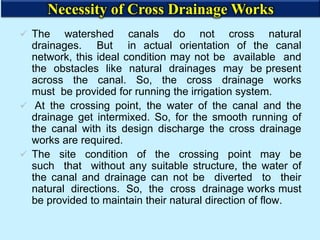
Cross Drainage Works
Edited By Dr. Muhammad Ajmal
Lecturer, Agri. Engg. UET Peshawar
 In an Irrigation project, when the network of
main canals, branch canals, distributaries, etc..
are provided, then these canals may have to
cross the natural drainages like rivers,
streams, nallahs, etc. at different points within
the command area of the project.
 The crossing of the canals with such
obstacle cannot be avoided. So, suitable
structures must be constructed at the crossing
point for the easy flow of water of the canal
and drainage in the respective directions. These
structures are known as cross-drainage works.
What is Cross Drainage Works?
 Irrigational Canals while carrying water from
headworks to crop field, have to cross few
natural drainage streams, nallaha, etc..
 To cross those drainages safely by the canals,
some suitable structures are required to
construct. Works required to construct, to cross
the drainage are called Cross Drainage Works
(CDWs).
 At the meeting point of canals and drainages,
bed levels may not be same. Depending on their
bed levels, different structures are constructed
and accordingly they are designated by different
names.
Cross Drainage Works
 The watershed canals do not cross natural
drainages. But in actual orientation of the canal
network, this ideal condition may not be available and
the obstacles like natural drainages may be present
across the canal. So, the cross drainage works
must be provided for running the irrigation system.
 At the crossing point, the water of the canal and the
drainage get intermixed. So, for the smooth running of
the canal with its design discharge the cross drainage
works are required.
 The site condition of the crossing point may be
such that without any suitable structure, the water of
the canal and drainage can not be diverted to their
natural directions. So, the cross drainage works must
be provided to maintain their natural direction of flow.
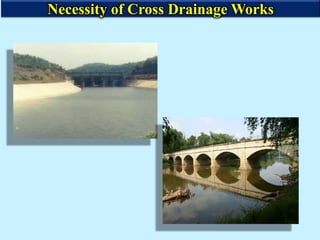
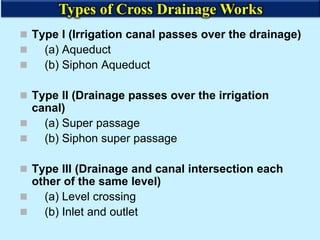
Necessity of Cross Drainage Works
 Type I (Irrigation canal passes over the drainage)
 (a) Aqueduct
 (b) Siphon Aqueduct
 Type II (Drainage passes over the irrigation
canal)
 (a) Super passage
 (b) Siphon super passage
 Type III (Drainage and canal intersection each
other of the same level)
 (a) Level crossing
 (b) Inlet and outlet
Types of Cross Drainage Works
 Relative bed levels
 Availability of suitable foundation
 Economical consideration
 Discharge of the drainage
 Construction problems
Selectin of Types of Cross Drainage Works
 Type-I Irrigation canal Passes over the
Drainage: This condition involves the
construction of following:
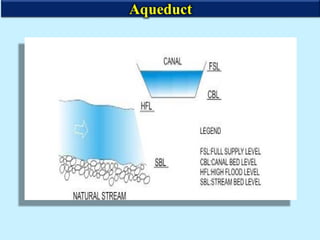
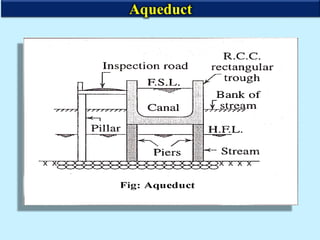
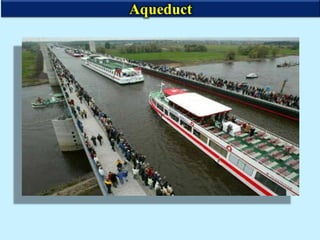
 Aqueduct
 The hydraulic structure in which the irrigation
canal is taken over the drainage (such as river,
stream etc..) is known as aqueduct.
 This structure is suitable when bed level of canal
is above the highest flood level of drainage. In
this case, the drainage water passes clearly
below the canal.
Types of Cross Drainage Works
Aqueduct
Aqueduct
Aqueduct
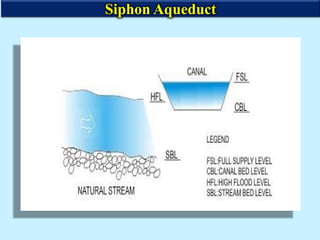
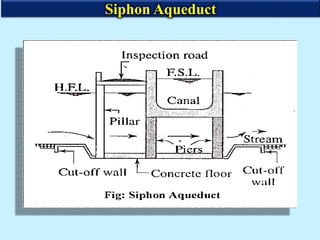
 In a hydraulic structure where the canal is taken
over the drainage, but the drainage water cannot
pass clearly below the canal.
 It flows under siphonic action. So, it is known as
siphon aqueduct.
 This structure is suitable when the bed level of
canal is below the highest flood level.
Siphon Aqueduct
Siphon Aqueduct
Siphon Aqueduct
 Type-II Drainage Passes Over the irrigation
Canal.
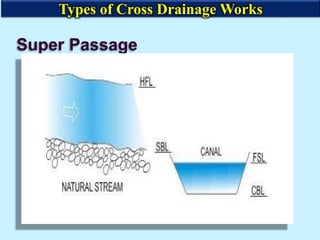
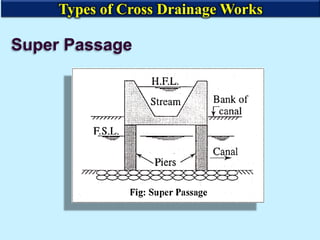
 Super Passage
 The hydraulic structure in which the drainage is
taken over the irrigation canal is known as super
passage.
 The structure is suitable when the bed level of
drainage is above the full supply level of the
canal. The water of the canal passes clearly
below the drainage.
Types of Cross Drainage Works
Super Passage
Types of Cross Drainage Works
Super Passage
Types of Cross Drainage Works
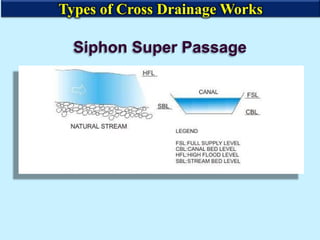
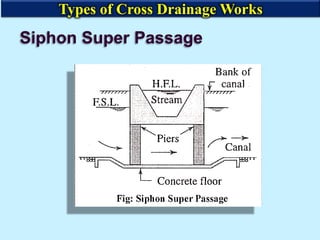
Siphon Super Passage
 The hydraulic structure in which the drainage
is taken over the irrigation canal, but the
canal water passes below the drainage under
siphonic action is known as siphon super
passage. This structure is suitable when the
bed level of drainage is below the full supply
level of the canal.
Types of Cross Drainage Works
Siphon Super Passage
Types of Cross Drainage Works
Siphon Super Passage
Types of Cross Drainage Works
 Type III Drainage and Canal Intersect
each other at the same level.
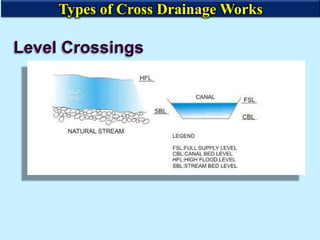
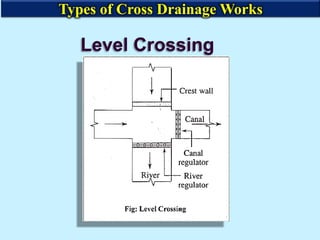
Level Crossings
 When the bed level of canal and the stream are
approximately the same and quality of water in canal and
stream is not much different, the cross drainage work
constructed is called level crossing where water of canal
and stream is allowed to mix.
 With the help of regulators both in canal and stream,
water is disposed through canal and stream in required
quantity.
 Level crossing consists of following components (i) crest
wall (ii) Stream regulator (iii) Canal regulator.
Types of Cross Drainage Works
Level Crossings
Types of Cross Drainage Works
Level Crossing
Types of Cross Drainage Works
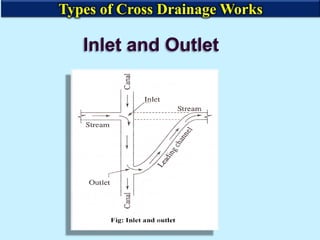
Inlet and Outlet
 When irrigation canal meets a small stream or drain
at same level, drain is allowed to enter the canal as
in inlet.
 At some distance from this inlet point, a part of water
is allowed to drain as outlet which eventually meets
the original stream.
 Stone pitching is required at the inlet and outlet. The
bed and banks between inlet and outlet are also
protected by stone pitching.
 This type of CDW is called Inlet and Outlet.
Types of Cross Drainage Works
Inlet and Outlet
Types of Cross Drainage Works
 The following factors should be considered:
(i) Relative Bed Level
 According to the relative bed levels of the canal and the river
or drainage, the type of cross drainage work are generally
selected which has been discussed earlier. But some
problems may come at the crossing point
 The following points should be remembered while
recommending the type of work,
(a) The crossing should be at right angle to each other,
(b) Well defined cross-section of the river or drainage should be
available.
(c) At the crossing point the drainage should be straight for a
considerable length.
(d) The width of the drainage should be narrow as far as
possible.
 Considering the above points The C/s can be shifted to the
downstream or upstream.
Selection of Type of Cross Drainage Works
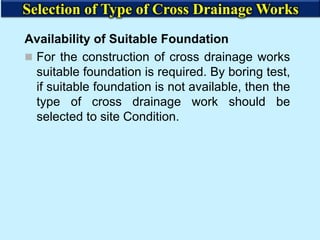
Availability of Suitable Foundation
 For the construction of cross drainage works
suitable foundation is required. By boring test,
if suitable foundation is not available, then the
type of cross drainage work should be
selected to site Condition.
Selection of Type of Cross Drainage Works
 Economic Consideration
 The cost of construction of cross drainage works
should be justified with respect to the project
cost and overall benefits of the project. So, the
type of works should be selected considering the
economical point of view.
Selection of Type of Cross Drainage Works
 Discharge of the drainage
 Practically the discharge of the drainage is very
uncertain in rainy season. So, the structure should
be carefully selected so that it may not be
destroyed due to unexpected heavy discharge of
the river or drainage.
Selection of Type of Cross Drainage Works
 Construction of Problems
 Different types of constructional problems may
arise at the site such as sub soil water,
construction materials, communication, availability
of land etc. So the type of works should be
selected according to the site condition.
Selection of Type of Cross Drainage Works
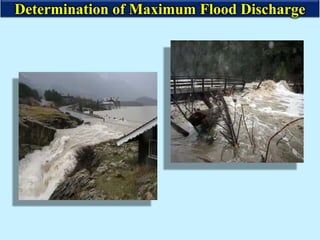
Determination of Maximum Flood Discharge
 The high flood discharge for smaller drain can
be worked out by using empirical formulas; and
for large drains other methods such as
Hydrograph analysis, Rational formula, etc may
be used.
 In general the methods used in the
estimation of the flood flow can be group as:
 Physical Indications of past floods
 Empirical formulae and curves
 Overland flow hydrograph and unit hydrograph
Determination of Maximum Flood Discharge
 Physical Indications of past floods- flood marks
and local inquiry:
 The maximum flood discharge may be
approximately estimated by enquiring from the
residents in the village situated on the banks of the
river about the flood marks that the high flood in
their memory in the past may have left on the river
banks.
 By noting the high water marks along the banks of
the river the cross-section area and wetted
perimeter of the flow section as well as the water
surface slope may be computed and using the
manning’s formulae, with suitable assumed value of
the flood discharge may be determined.
Determination of Maximum Flood Discharge
 Estimation of maximum flood discharge from rating curve: During
the period of high flood, it is almost impossible to measure the
discharge by making the use of markings of the high water marks
on the banks of the river, the elevated water level, can be
calculated.
 Making use of this values high water marks in meters the value
of maximum flood discharge can be calculated, by extrapolation
from the stage or rating discharge curve
 The above mentioned curve needs to be extended for the higher
value of stage. It is done by using following methods.
 Simple Judgment
 Logarithmic method
 The above mentioned curve needs to be extended for the higher
value of stage, it is done by using following methods.
 (a) Simple Judgment
 (b) Logarithmic Method
Determination of Maximum Flood Discharge
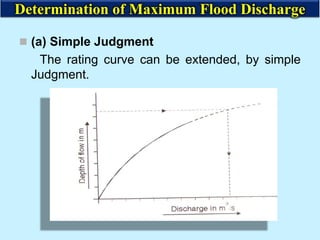
 (a) Simple Judgment
The rating curve can be extended, by simple
Judgment.
Determination of Maximum Flood Discharge
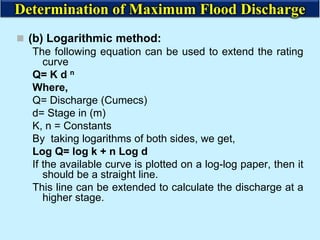
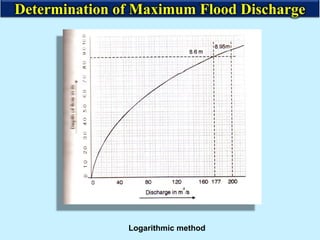
 (b) Logarithmic method:
The following equation can be used to extend the rating
curve
Q= K d n
Where,
Q= Discharge (Cumecs)
d= Stage in (m)
K, n = Constants
By taking logarithms of both sides, we get,
Log Q= log k + n Log d
If the available curve is plotted on a log-log paper, then it
should be a straight line.
This line can be extended to calculate the discharge at a
higher stage.
Determination of Maximum Flood Discharge
Logarithmic method
Determination of Maximum Flood Discharge
Empirical Formulas
Several empirical formula have been developed for
estimating the maximum or peak value of flood
discharge. In these formulae the maximum flood
discharge Q of a river is expressed as a function of the
catchment area A. Most of these formulae may be
written in a general form as:
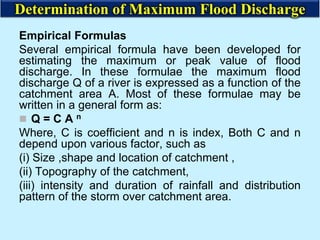
 Q = C A n
Where, C is coefficient and n is index, Both C and n
depend upon various factor, such as
(i) Size ,shape and location of catchment ,
(ii) Topography of the catchment,
(iii) intensity and duration of rainfall and distribution
pattern of the storm over catchment area.
Determination of Maximum Flood Discharge
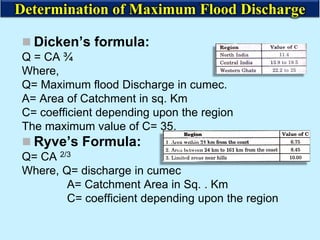
 Dicken’s formula:
Q = CA ¾
Where,
Q= Maximum flood Discharge in cumec.
A= Area of Catchment in sq. Km
C= coefficient depending upon the region
The maximum value of C= 35.
 Ryve’s Formula:
Q= CA 2/3
Where, Q= discharge in cumec
A= Catchment Area in Sq. . Km
C= coefficient depending upon the region
Determination of Maximum Flood Discharge
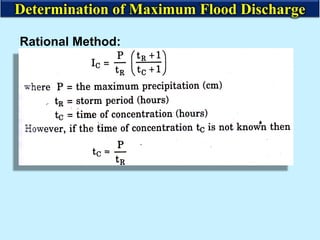
Rational Method:
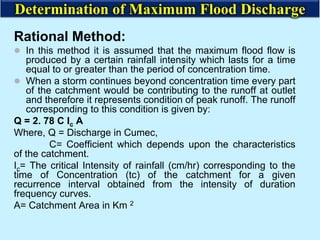
 In this method it is assumed that the maximum flood flow is
produced by a certain rainfall intensity which lasts for a time
equal to or greater than the period of concentration time.
 When a storm continues beyond concentration time every part
of the catchment would be contributing to the runoff at outlet
and therefore it represents condition of peak runoff. The runoff
corresponding to this condition is given by:
Q = 2. 78 C Ic A
Where, Q = Discharge in Cumec,
C= Coefficient which depends upon the characteristics
of the catchment.
Ic= The critical Intensity of rainfall (cm/hr) corresponding to the
time of Concentration (tc) of the catchment for a given
recurrence interval obtained from the intensity of duration
frequency curves.
A= Catchment Area in Km 2
Determination of Maximum Flood Discharge
Rational Method:
Determination of Maximum Flood Discharge
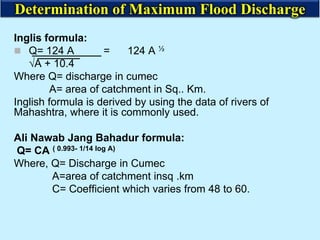
Inglis formula:
 Q= 124 A = 124 A ½
√A + 10.4
Where Q= discharge in cumec
A= area of catchment in Sq.. Km.
Inglish formula is derived by using the data of rivers of
Mahashtra, where it is commonly used.
Ali Nawab Jang Bahadur formula:
Q= CA ( 0.993- 1/14 log A)
Where, Q= Discharge in Cumec
A=area of catchment insq .km
C= Coefficient which varies from 48 to 60.
Determination of Maximum Flood Discharge
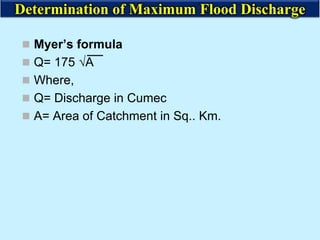
 Myer’s formula
 Q= 175 √A
 Where,
 Q= Discharge in Cumec
 A= Area of Catchment in Sq.. Km.
Determination of Maximum Flood Discharge
References
 Irrigation Engineering
 By Prof N N Basak
 Tata Mcgraw-Hill
 Irrigation Engineering & Hydraulic
Structures
 By Prof. Santosh Kumar Garg
 Khanna Publishers
 Internet Websites
 http://www.uap-bd.edu/
 Lecture Notes By: Dr. M. R. Kabir
 Professor and Head, Department of Civil Engineering
Department ,University of Asia Pacific (UAP), Dhaka
14. Cross Drainage Works.pdf

14. Cross Drainage Works.pdf

  • 1.
    Cross Drainage Works EditedBy Dr. Muhammad Ajmal Lecturer, Agri. Engg. UET Peshawar
  • 2.
     In anIrrigation project, when the network of main canals, branch canals, distributaries, etc.. are provided, then these canals may have to cross the natural drainages like rivers, streams, nallahs, etc. at different points within the command area of the project.  The crossing of the canals with such obstacle cannot be avoided. So, suitable structures must be constructed at the crossing point for the easy flow of water of the canal and drainage in the respective directions. These structures are known as cross-drainage works. What is Cross Drainage Works?
  • 3.
     Irrigational Canalswhile carrying water from headworks to crop field, have to cross few natural drainage streams, nallaha, etc..  To cross those drainages safely by the canals, some suitable structures are required to construct. Works required to construct, to cross the drainage are called Cross Drainage Works (CDWs).  At the meeting point of canals and drainages, bed levels may not be same. Depending on their bed levels, different structures are constructed and accordingly they are designated by different names. Cross Drainage Works
  • 4.
     The watershedcanals do not cross natural drainages. But in actual orientation of the canal network, this ideal condition may not be available and the obstacles like natural drainages may be present across the canal. So, the cross drainage works must be provided for running the irrigation system.  At the crossing point, the water of the canal and the drainage get intermixed. So, for the smooth running of the canal with its design discharge the cross drainage works are required.  The site condition of the crossing point may be such that without any suitable structure, the water of the canal and drainage can not be diverted to their natural directions. So, the cross drainage works must be provided to maintain their natural direction of flow. Necessity of Cross Drainage Works
  • 5.
    Necessity of CrossDrainage Works
  • 6.
     Type I(Irrigation canal passes over the drainage)  (a) Aqueduct  (b) Siphon Aqueduct  Type II (Drainage passes over the irrigation canal)  (a) Super passage  (b) Siphon super passage  Type III (Drainage and canal intersection each other of the same level)  (a) Level crossing  (b) Inlet and outlet Types of Cross Drainage Works
  • 7.
     Relative bedlevels  Availability of suitable foundation  Economical consideration  Discharge of the drainage  Construction problems Selectin of Types of Cross Drainage Works
  • 8.
     Type-I Irrigationcanal Passes over the Drainage: This condition involves the construction of following:  Aqueduct  The hydraulic structure in which the irrigation canal is taken over the drainage (such as river, stream etc..) is known as aqueduct.  This structure is suitable when bed level of canal is above the highest flood level of drainage. In this case, the drainage water passes clearly below the canal. Types of Cross Drainage Works
  • 9.
  • 10.
  • 11.
  • 12.
     In ahydraulic structure where the canal is taken over the drainage, but the drainage water cannot pass clearly below the canal.  It flows under siphonic action. So, it is known as siphon aqueduct.  This structure is suitable when the bed level of canal is below the highest flood level. Siphon Aqueduct
  • 13.
  • 14.
  • 15.
     Type-II DrainagePasses Over the irrigation Canal.  Super Passage  The hydraulic structure in which the drainage is taken over the irrigation canal is known as super passage.  The structure is suitable when the bed level of drainage is above the full supply level of the canal. The water of the canal passes clearly below the drainage. Types of Cross Drainage Works
  • 16.
    Super Passage Types ofCross Drainage Works
  • 17.
    Super Passage Types ofCross Drainage Works
  • 18.
    Siphon Super Passage The hydraulic structure in which the drainage is taken over the irrigation canal, but the canal water passes below the drainage under siphonic action is known as siphon super passage. This structure is suitable when the bed level of drainage is below the full supply level of the canal. Types of Cross Drainage Works
  • 19.
    Siphon Super Passage Typesof Cross Drainage Works
  • 20.
    Siphon Super Passage Typesof Cross Drainage Works
  • 21.
     Type IIIDrainage and Canal Intersect each other at the same level. Level Crossings  When the bed level of canal and the stream are approximately the same and quality of water in canal and stream is not much different, the cross drainage work constructed is called level crossing where water of canal and stream is allowed to mix.  With the help of regulators both in canal and stream, water is disposed through canal and stream in required quantity.  Level crossing consists of following components (i) crest wall (ii) Stream regulator (iii) Canal regulator. Types of Cross Drainage Works
  • 22.
    Level Crossings Types ofCross Drainage Works
  • 23.
    Level Crossing Types ofCross Drainage Works
  • 24.
    Inlet and Outlet When irrigation canal meets a small stream or drain at same level, drain is allowed to enter the canal as in inlet.  At some distance from this inlet point, a part of water is allowed to drain as outlet which eventually meets the original stream.  Stone pitching is required at the inlet and outlet. The bed and banks between inlet and outlet are also protected by stone pitching.  This type of CDW is called Inlet and Outlet. Types of Cross Drainage Works
  • 25.
    Inlet and Outlet Typesof Cross Drainage Works
  • 26.
     The followingfactors should be considered: (i) Relative Bed Level  According to the relative bed levels of the canal and the river or drainage, the type of cross drainage work are generally selected which has been discussed earlier. But some problems may come at the crossing point  The following points should be remembered while recommending the type of work, (a) The crossing should be at right angle to each other, (b) Well defined cross-section of the river or drainage should be available. (c) At the crossing point the drainage should be straight for a considerable length. (d) The width of the drainage should be narrow as far as possible.  Considering the above points The C/s can be shifted to the downstream or upstream. Selection of Type of Cross Drainage Works
  • 27.
    Availability of SuitableFoundation  For the construction of cross drainage works suitable foundation is required. By boring test, if suitable foundation is not available, then the type of cross drainage work should be selected to site Condition. Selection of Type of Cross Drainage Works
  • 28.
     Economic Consideration The cost of construction of cross drainage works should be justified with respect to the project cost and overall benefits of the project. So, the type of works should be selected considering the economical point of view. Selection of Type of Cross Drainage Works
  • 29.
     Discharge ofthe drainage  Practically the discharge of the drainage is very uncertain in rainy season. So, the structure should be carefully selected so that it may not be destroyed due to unexpected heavy discharge of the river or drainage. Selection of Type of Cross Drainage Works
  • 30.
     Construction ofProblems  Different types of constructional problems may arise at the site such as sub soil water, construction materials, communication, availability of land etc. So the type of works should be selected according to the site condition. Selection of Type of Cross Drainage Works
  • 31.
    Determination of MaximumFlood Discharge
  • 32.
     The highflood discharge for smaller drain can be worked out by using empirical formulas; and for large drains other methods such as Hydrograph analysis, Rational formula, etc may be used.  In general the methods used in the estimation of the flood flow can be group as:  Physical Indications of past floods  Empirical formulae and curves  Overland flow hydrograph and unit hydrograph Determination of Maximum Flood Discharge
  • 33.
     Physical Indicationsof past floods- flood marks and local inquiry:  The maximum flood discharge may be approximately estimated by enquiring from the residents in the village situated on the banks of the river about the flood marks that the high flood in their memory in the past may have left on the river banks.  By noting the high water marks along the banks of the river the cross-section area and wetted perimeter of the flow section as well as the water surface slope may be computed and using the manning’s formulae, with suitable assumed value of the flood discharge may be determined. Determination of Maximum Flood Discharge
  • 34.
     Estimation ofmaximum flood discharge from rating curve: During the period of high flood, it is almost impossible to measure the discharge by making the use of markings of the high water marks on the banks of the river, the elevated water level, can be calculated.  Making use of this values high water marks in meters the value of maximum flood discharge can be calculated, by extrapolation from the stage or rating discharge curve  The above mentioned curve needs to be extended for the higher value of stage. It is done by using following methods.  Simple Judgment  Logarithmic method  The above mentioned curve needs to be extended for the higher value of stage, it is done by using following methods.  (a) Simple Judgment  (b) Logarithmic Method Determination of Maximum Flood Discharge
  • 35.
     (a) SimpleJudgment The rating curve can be extended, by simple Judgment. Determination of Maximum Flood Discharge
  • 36.
     (b) Logarithmicmethod: The following equation can be used to extend the rating curve Q= K d n Where, Q= Discharge (Cumecs) d= Stage in (m) K, n = Constants By taking logarithms of both sides, we get, Log Q= log k + n Log d If the available curve is plotted on a log-log paper, then it should be a straight line. This line can be extended to calculate the discharge at a higher stage. Determination of Maximum Flood Discharge
  • 37.
    Logarithmic method Determination ofMaximum Flood Discharge
  • 38.
    Empirical Formulas Several empiricalformula have been developed for estimating the maximum or peak value of flood discharge. In these formulae the maximum flood discharge Q of a river is expressed as a function of the catchment area A. Most of these formulae may be written in a general form as:  Q = C A n Where, C is coefficient and n is index, Both C and n depend upon various factor, such as (i) Size ,shape and location of catchment , (ii) Topography of the catchment, (iii) intensity and duration of rainfall and distribution pattern of the storm over catchment area. Determination of Maximum Flood Discharge
  • 39.
     Dicken’s formula: Q= CA ¾ Where, Q= Maximum flood Discharge in cumec. A= Area of Catchment in sq. Km C= coefficient depending upon the region The maximum value of C= 35.  Ryve’s Formula: Q= CA 2/3 Where, Q= discharge in cumec A= Catchment Area in Sq. . Km C= coefficient depending upon the region Determination of Maximum Flood Discharge
  • 40.
    Rational Method:  Inthis method it is assumed that the maximum flood flow is produced by a certain rainfall intensity which lasts for a time equal to or greater than the period of concentration time.  When a storm continues beyond concentration time every part of the catchment would be contributing to the runoff at outlet and therefore it represents condition of peak runoff. The runoff corresponding to this condition is given by: Q = 2. 78 C Ic A Where, Q = Discharge in Cumec, C= Coefficient which depends upon the characteristics of the catchment. Ic= The critical Intensity of rainfall (cm/hr) corresponding to the time of Concentration (tc) of the catchment for a given recurrence interval obtained from the intensity of duration frequency curves. A= Catchment Area in Km 2 Determination of Maximum Flood Discharge
  • 41.
    Rational Method: Determination ofMaximum Flood Discharge
  • 42.
    Inglis formula:  Q=124 A = 124 A ½ √A + 10.4 Where Q= discharge in cumec A= area of catchment in Sq.. Km. Inglish formula is derived by using the data of rivers of Mahashtra, where it is commonly used. Ali Nawab Jang Bahadur formula: Q= CA ( 0.993- 1/14 log A) Where, Q= Discharge in Cumec A=area of catchment insq .km C= Coefficient which varies from 48 to 60. Determination of Maximum Flood Discharge
  • 43.
     Myer’s formula Q= 175 √A  Where,  Q= Discharge in Cumec  A= Area of Catchment in Sq.. Km. Determination of Maximum Flood Discharge
  • 44.
    References  Irrigation Engineering By Prof N N Basak  Tata Mcgraw-Hill  Irrigation Engineering & Hydraulic Structures  By Prof. Santosh Kumar Garg  Khanna Publishers  Internet Websites  http://www.uap-bd.edu/  Lecture Notes By: Dr. M. R. Kabir  Professor and Head, Department of Civil Engineering Department ,University of Asia Pacific (UAP), Dhaka