








Paper Code: 134
A Review of Maximum Power Point Tracking
Algorithms for Photovoltaic Systems under
Uniform and Non-Uniform irradiances

12/10/2013

1
by
T.LOGESWARAN

Assistant Professor(SRG)
Department of EEE
Kongu Engineering College,
Perundurai, Erode, Tamilnadu, India

Dr.A.SENTHIL KUMAR, M.E.,PhD.,
Prof & Head, Department of EEE
Dr.Mahalingam College of Engineering and Technology,
Pollachi, Tamilnadu, India
12/10/2013

2
Introduction
Why Solar PV power systems?
 maintenance free
 noise free
 environmental friendly

12/10/2013

3
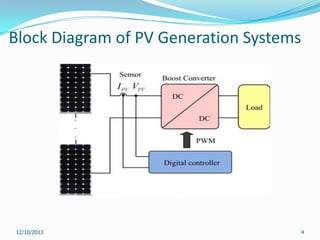
Block Diagram of PV Generation Systems

12/10/2013

4
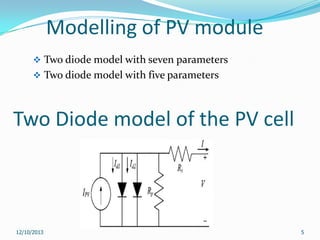
Modelling of PV module
 Two diode model with seven parameters
 Two diode model with five parameters

Two Diode model of the PV cell

12/10/2013

5
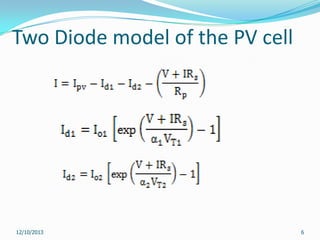
Two Diode model of the PV cell

12/10/2013

6
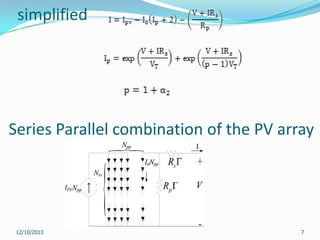
simplified

Series Parallel combination of the PV array

12/10/2013

7
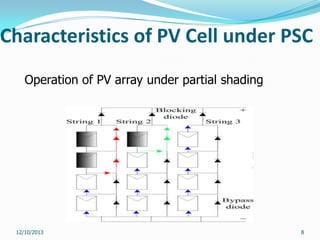
Characteristics of PV Cell under PSC
Operation of PV array under partial shading

12/10/2013

8
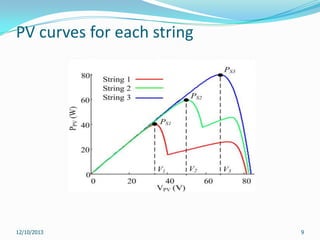
PV curves for each string

12/10/2013

9
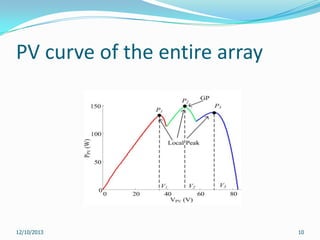
PV curve of the entire array

12/10/2013

10
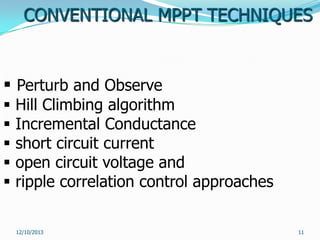
CONVENTIONAL MPPT TECHNIQUES

 Perturb and Observe






Hill Climbing algorithm
Incremental Conductance
short circuit current
open circuit voltage and
ripple correlation control approaches
12/10/2013

11
Intelligent MPPT Techniques
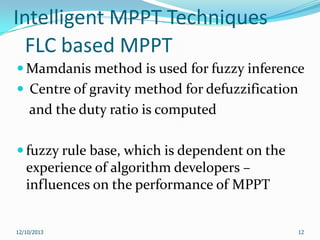
FLC based MPPT
 Mamdanis method is used for fuzzy inference
 Centre of gravity method for defuzzification

and the duty ratio is computed
 fuzzy rule base, which is dependent on the

experience of algorithm developers –
influences on the performance of MPPT

12/10/2013

12
Artificial Neural Network
based MPPT

It is suitable for the system that can get sufficient training
data
12/10/2013

13
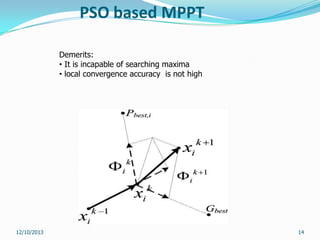
PSO based MPPT
Demerits:
• It is incapable of searching maxima
• local convergence accuracy is not high

12/10/2013

14
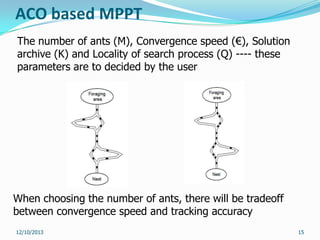
ACO based MPPT
The number of ants (M), Convergence speed (€), Solution
archive (K) and Locality of search process (Q) ---- these
parameters are to decided by the user

When choosing the number of ants, there will be tradeoff
between convergence speed and tracking accuracy
12/10/2013

15
Firefly algorithm
 Firefly algorithm is a bio inspired metaheuristic

algorithm for optimization problems
 Introduced in 2009 at Cambridge University by Yang
Rules for constructing firefly algorithm:
1) All fireflies are unisex
2) Brightness of the firefly is determined from the
encoded objective function
3) Attractiveness is directly proportional to brightness
but decreases with distance and a firefly will move
towards the brighter one and if there is no brighter
one, it will move randomly.
12/10/2013

16
12/10/2013

17
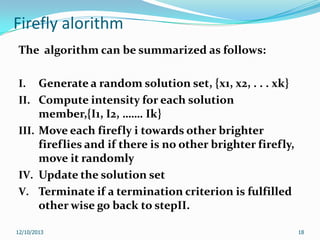
Firefly alorithm
The algorithm can be summarized as follows:
I.
II.
III.

IV.
V.

Generate a random solution set, {x1, x2, . . . xk}
Compute intensity for each solution
member,{I1, I2, ……. Ik}
Move each firefly i towards other brighter
fireflies and if there is no other brighter firefly,
move it randomly
Update the solution set
Terminate if a termination criterion is fulfilled
other wise go back to stepII.

12/10/2013

18
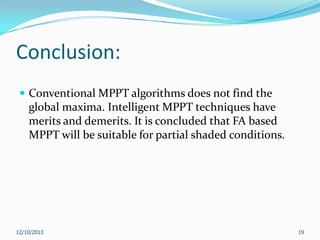
Conclusion:
 Conventional MPPT algorithms does not find the

global maxima. Intelligent MPPT techniques have
merits and demerits. It is concluded that FA based
MPPT will be suitable for partial shaded conditions.

12/10/2013

19
References. .
1.

2.

3.

4.

Bidyadhar Subudhi and Raseswari Pradhan (2013) “A Comparative
Study on Maximum Power Point Tracking Techniques for Photov
oltaic Power Systems” IEEE Transactions on Sustainable Energy,V
ol. 4, No. 1
Moacyr Aureliano Gomes de Brito, Luigi Galotto,(2013) Jr.,
Leonardo Poltronieri Sampaio, Guilherme de Azevedo e Melo,
and Carlos Alberto Canesin, Senior Member, “Evaluation of the
Main MPPT Techniques for Photovoltaic Applications” IEEE
Transactions on Industrial Electronics, VOL. 60, NO. 3.
M. A. S. Masoum, H. Dehbonei, and E. F. Fuchs, 2002
“Theoretical and experimental analyses of photovoltaic systems
with voltage and current based maximum power point tracking,”
IEEE Trans. Energy Conv., vol. 17, no. 4, pp. 514–522
B. Subudhi and R. Pradhan, 2011 “Characteristics evaluation and
parameter extraction of a solar array based on experimental
analysis,” in Proc. 9th IEEE Power Electron. Drives Syst.,
Singapore

12/10/2013

20
References
[T. Esram, J. W. Kimball, P. T. Krein, P. L. Chapman, and P.
Midya, (2006) “Dynamic maximum power point tracking of
photovoltaic arrays using ripple correlation control,” IEEE
Trans. Power Electron., vol. 21, no.5, pp. 1282–1291
6. K. Ishaque, Z. Salam, and H. Taheri,(2011) “Simple, fast and
accurate two diode model for photovoltaic modules,” Solar
Energy Mater. Solar Cells, vol. 95, pp. 586–594
7. K. Ishaque, Z. Salam, and H. Taheri,(2011) “Accurate
MATLAB simulink PV system simulator based on a twodiode model,” J. Power Electron., vol. 11, pp. 179–187
8. Kashif Ishaque, Zainal Salam, Muhammad Amjad, and
Saad Mekhilef,( 2012) “An Improved Particle Swarm
Optimization (PSO)–Based MPPT for PV With Reduced
Steady-State Oscillation” IEEE transactions on Power
Eelectronics, vol. 27, no. 8
5.

12/10/2013

21
References
9. MASAFUMI MIYATAKE, MUMMADI VEERACHARY,

NOBUHIKO FUJII, HIDEYOSHI KO , (2011) “ Maximum Power
Point Tracking of Multiple Photovoltaic Arrays: A PSO Approach”
IEEE Transactions on Aerospace and Electronic Systems VOL. 47,
NO. 1.
10. Yi-Hwa Liu, Shyh-Ching Huang, Jia-Wei Huang, and Wen-Cheng
Liang (2012) “A Particle Swarm Optimization-Based Maximum
Power Point Tracking Algorithm for PV Systems Operating Under
Partially Shaded Conditions” IEEE Transactions on Energy
Conversion, VOL. 27, NO. 4.
11. Mahmoud A. YOUNIS , Tamer KHATIB, Mushtaq NAJEEB, A
Mohd ARIFFIN (2012), An Improved Maximum Power Point
Tracking Controller for PV Systems Using Artificial Neural
Network Przegląd Elektrotechniczny, R. 88 NR 3b
12. Whei-Min Lin, Member, IEEE, Chih-Ming Hong, and ChiungHsing Chen 2011, “Neural-Network-Based MPPT Control of a
Stand-Alone Hybrid Power Generation System” IEEE Transactions
on Power Electronics, VOL. 26, NO. 12.

12/10/2013

22
13. Lian Lian Jiang, Douglas L. Maskell, Jagdish C. Patra (2013), A

14.

15.
16.

17.

Novel Ant Colony optimization based maximum power point t
racking for photovoltaic systems under partially shaded conditi
ons, Energy and Buildings Vol 58. Pgs 227-236.
N. Chai-ead, P. Aungkulanon, and P. Luangpaiboon, Member, I
AENG (2011), Bees and Firefly Algorithms for Noisy Non-Linear
Optimization Problems Proceedings of the 26th International
multi Conference of engineers andComputer ScientistsVolume I
I.
Surafel Luleseged Tilahun and Hong Choon Ong(2012) “Modifi
ed Firefly Algorithm” Hindawi Publishing Corporation, Journa
l of Applied Mathematics, Article ID 467631, 12 pages
A. Mathew and A. I. Selvakumar, (2006) “New MPPT for PV arr
ays using fuzzy controller in close cooperation with fuzzy cogni
tive network,” IEEE Trans. Energy Conv., vol. 21, no. 3, pp. 793
–803.
C.-S. Chiu, (2010)“T-S fuzzy maximum power point tracking co
ntrol of solar power generation systems,” IEEE Trans. Energy C
onv., vol. 25, no. 4, pp. 1123–1132.

12/10/2013

23
THANK YOU

12/10/2013

24

134 logeswaran

  • 1.
    Paper Code: 134 AReview of Maximum Power Point Tracking Algorithms for Photovoltaic Systems under Uniform and Non-Uniform irradiances 12/10/2013 1
  • 2.
    by T.LOGESWARAN Assistant Professor(SRG) Department ofEEE Kongu Engineering College, Perundurai, Erode, Tamilnadu, India Dr.A.SENTHIL KUMAR, M.E.,PhD., Prof & Head, Department of EEE Dr.Mahalingam College of Engineering and Technology, Pollachi, Tamilnadu, India 12/10/2013 2
  • 3.
    Introduction Why Solar PVpower systems?  maintenance free  noise free  environmental friendly 12/10/2013 3
  • 4.
    Block Diagram ofPV Generation Systems 12/10/2013 4
  • 5.
    Modelling of PVmodule  Two diode model with seven parameters  Two diode model with five parameters Two Diode model of the PV cell 12/10/2013 5
  • 6.
    Two Diode modelof the PV cell 12/10/2013 6
  • 7.
    simplified Series Parallel combinationof the PV array 12/10/2013 7
  • 8.
    Characteristics of PVCell under PSC Operation of PV array under partial shading 12/10/2013 8
  • 9.
    PV curves foreach string 12/10/2013 9
  • 10.
    PV curve ofthe entire array 12/10/2013 10
  • 11.
    CONVENTIONAL MPPT TECHNIQUES Perturb and Observe      Hill Climbing algorithm Incremental Conductance short circuit current open circuit voltage and ripple correlation control approaches 12/10/2013 11
  • 12.
    Intelligent MPPT Techniques FLCbased MPPT  Mamdanis method is used for fuzzy inference  Centre of gravity method for defuzzification and the duty ratio is computed  fuzzy rule base, which is dependent on the experience of algorithm developers – influences on the performance of MPPT 12/10/2013 12
  • 13.
    Artificial Neural Network basedMPPT It is suitable for the system that can get sufficient training data 12/10/2013 13
  • 14.
    PSO based MPPT Demerits: •It is incapable of searching maxima • local convergence accuracy is not high 12/10/2013 14
  • 15.
    ACO based MPPT Thenumber of ants (M), Convergence speed (€), Solution archive (K) and Locality of search process (Q) ---- these parameters are to decided by the user When choosing the number of ants, there will be tradeoff between convergence speed and tracking accuracy 12/10/2013 15
  • 16.
    Firefly algorithm  Fireflyalgorithm is a bio inspired metaheuristic algorithm for optimization problems  Introduced in 2009 at Cambridge University by Yang Rules for constructing firefly algorithm: 1) All fireflies are unisex 2) Brightness of the firefly is determined from the encoded objective function 3) Attractiveness is directly proportional to brightness but decreases with distance and a firefly will move towards the brighter one and if there is no brighter one, it will move randomly. 12/10/2013 16
  • 17.
  • 18.
    Firefly alorithm The algorithmcan be summarized as follows: I. II. III. IV. V. Generate a random solution set, {x1, x2, . . . xk} Compute intensity for each solution member,{I1, I2, ……. Ik} Move each firefly i towards other brighter fireflies and if there is no other brighter firefly, move it randomly Update the solution set Terminate if a termination criterion is fulfilled other wise go back to stepII. 12/10/2013 18
  • 19.
    Conclusion:  Conventional MPPTalgorithms does not find the global maxima. Intelligent MPPT techniques have merits and demerits. It is concluded that FA based MPPT will be suitable for partial shaded conditions. 12/10/2013 19
  • 20.
    References. . 1. 2. 3. 4. Bidyadhar Subudhiand Raseswari Pradhan (2013) “A Comparative Study on Maximum Power Point Tracking Techniques for Photov oltaic Power Systems” IEEE Transactions on Sustainable Energy,V ol. 4, No. 1 Moacyr Aureliano Gomes de Brito, Luigi Galotto,(2013) Jr., Leonardo Poltronieri Sampaio, Guilherme de Azevedo e Melo, and Carlos Alberto Canesin, Senior Member, “Evaluation of the Main MPPT Techniques for Photovoltaic Applications” IEEE Transactions on Industrial Electronics, VOL. 60, NO. 3. M. A. S. Masoum, H. Dehbonei, and E. F. Fuchs, 2002 “Theoretical and experimental analyses of photovoltaic systems with voltage and current based maximum power point tracking,” IEEE Trans. Energy Conv., vol. 17, no. 4, pp. 514–522 B. Subudhi and R. Pradhan, 2011 “Characteristics evaluation and parameter extraction of a solar array based on experimental analysis,” in Proc. 9th IEEE Power Electron. Drives Syst., Singapore 12/10/2013 20
  • 21.
    References [T. Esram, J.W. Kimball, P. T. Krein, P. L. Chapman, and P. Midya, (2006) “Dynamic maximum power point tracking of photovoltaic arrays using ripple correlation control,” IEEE Trans. Power Electron., vol. 21, no.5, pp. 1282–1291 6. K. Ishaque, Z. Salam, and H. Taheri,(2011) “Simple, fast and accurate two diode model for photovoltaic modules,” Solar Energy Mater. Solar Cells, vol. 95, pp. 586–594 7. K. Ishaque, Z. Salam, and H. Taheri,(2011) “Accurate MATLAB simulink PV system simulator based on a twodiode model,” J. Power Electron., vol. 11, pp. 179–187 8. Kashif Ishaque, Zainal Salam, Muhammad Amjad, and Saad Mekhilef,( 2012) “An Improved Particle Swarm Optimization (PSO)–Based MPPT for PV With Reduced Steady-State Oscillation” IEEE transactions on Power Eelectronics, vol. 27, no. 8 5. 12/10/2013 21
  • 22.
    References 9. MASAFUMI MIYATAKE,MUMMADI VEERACHARY, NOBUHIKO FUJII, HIDEYOSHI KO , (2011) “ Maximum Power Point Tracking of Multiple Photovoltaic Arrays: A PSO Approach” IEEE Transactions on Aerospace and Electronic Systems VOL. 47, NO. 1. 10. Yi-Hwa Liu, Shyh-Ching Huang, Jia-Wei Huang, and Wen-Cheng Liang (2012) “A Particle Swarm Optimization-Based Maximum Power Point Tracking Algorithm for PV Systems Operating Under Partially Shaded Conditions” IEEE Transactions on Energy Conversion, VOL. 27, NO. 4. 11. Mahmoud A. YOUNIS , Tamer KHATIB, Mushtaq NAJEEB, A Mohd ARIFFIN (2012), An Improved Maximum Power Point Tracking Controller for PV Systems Using Artificial Neural Network Przegląd Elektrotechniczny, R. 88 NR 3b 12. Whei-Min Lin, Member, IEEE, Chih-Ming Hong, and ChiungHsing Chen 2011, “Neural-Network-Based MPPT Control of a Stand-Alone Hybrid Power Generation System” IEEE Transactions on Power Electronics, VOL. 26, NO. 12. 12/10/2013 22
  • 23.
    13. Lian LianJiang, Douglas L. Maskell, Jagdish C. Patra (2013), A 14. 15. 16. 17. Novel Ant Colony optimization based maximum power point t racking for photovoltaic systems under partially shaded conditi ons, Energy and Buildings Vol 58. Pgs 227-236. N. Chai-ead, P. Aungkulanon, and P. Luangpaiboon, Member, I AENG (2011), Bees and Firefly Algorithms for Noisy Non-Linear Optimization Problems Proceedings of the 26th International multi Conference of engineers andComputer ScientistsVolume I I. Surafel Luleseged Tilahun and Hong Choon Ong(2012) “Modifi ed Firefly Algorithm” Hindawi Publishing Corporation, Journa l of Applied Mathematics, Article ID 467631, 12 pages A. Mathew and A. I. Selvakumar, (2006) “New MPPT for PV arr ays using fuzzy controller in close cooperation with fuzzy cogni tive network,” IEEE Trans. Energy Conv., vol. 21, no. 3, pp. 793 –803. C.-S. Chiu, (2010)“T-S fuzzy maximum power point tracking co ntrol of solar power generation systems,” IEEE Trans. Energy C onv., vol. 25, no. 4, pp. 1123–1132. 12/10/2013 23
  • 24.