13.08.24 김준섭
▶Objective : Melanogenesis에 대한 과정을 화학반응과 반응속도에 관한 논점
에서 바라본 논문을 알아보기
INHA University -
Bioengineering
ABSTRACT
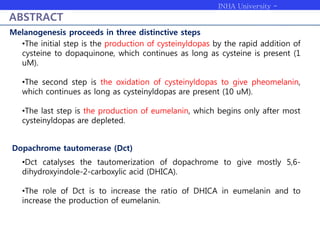
Melanogenesis proceeds in three distinctive steps
•The initial step is the production of cysteinyldopas by the rapid addition of
cysteine to dopaquinone, which continues as long as cysteine is present (1
uM).
•The second step is the oxidation of cysteinyldopas to give pheomelanin,
which continues as long as cysteinyldopas are present (10 uM).
•The last step is the production of eumelanin, which begins only after most
cysteinyldopas are depleted.
Dopachrome tautomerase (Dct)
•Dct catalyses the tautomerization of dopachrome to give mostly 5,6-
dihydroxyindole-2-carboxylic acid (DHICA).
•The role of Dct is to increase the ratio of DHICA in eumelanin and to
increase the production of eumelanin.
INHA University -
Bioengineering
INTRODUCTION
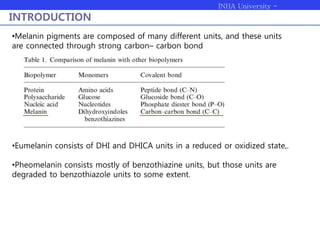
•Melanin pigments are composed of many different units, and these units
are connected through strong carbon– carbon bond
•Eumelanin consists of DHI and DHICA units in a reduced or oxidized state,.
•Pheomelanin consists mostly of benzothiazine units, but those units are
degraded to benzothiazole units to some extent.
INHA University -
Bioengineering
INTRODUCTION
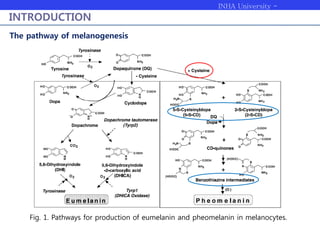
Fig. 1. Pathways for production of eumelanin and pheomelanin in melanocytes.
The pathway of melanogenesis
INHA University -
Bioengineering
DISCUSSION
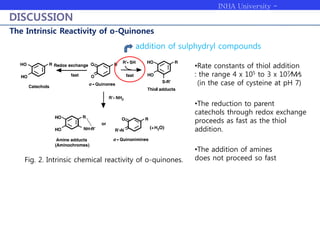
The Intrinsic Reactivity of o-Quinones
Fig. 2. Intrinsic chemical reactivity of o-quinones.
•Rate constants of thiol addition
: the range 4 x 10⁵ to 3 x 10⁷⁄M⁄s
(in the case of cysteine at pH 7)
•The reduction to parent
catechols through redox exchange
proceeds as fast as the thiol
addition.
addition of sulphydryl compounds
•The addition of amines
does not proceed so fast
INHA University -
Bioengineering
DISCUSSION
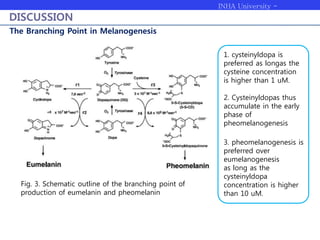
The Branching Point in Melanogenesis
Fig. 3. Schematic outline of the branching point of
production of eumelanin and pheomelanin
1. cysteinyldopa is
preferred as longas the
cysteine concentration
is higher than 1 uM.
2. Cysteinyldopas thus
accumulate in the early
phase of
pheomelanogenesis
3. pheomelanogenesis is
preferred over
eumelanogenesis
as long as the
cysteinyldopa
concentration is higher
than 10 uM.
INHA University -
Bioengineering
DISCUSSION
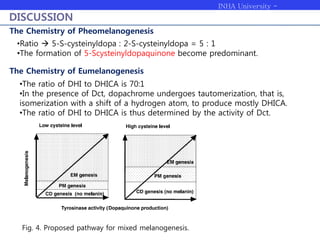
The Chemistry of Pheomelanogenesis
The Chemistry of Eumelanogenesis
•Ratio  5-S-cysteinyldopa : 2-S-cysteinyldopa = 5 : 1
•The formation of 5-Scysteinyldopaquinone become predominant.
Fig. 4. Proposed pathway for mixed melanogenesis.
•The ratio of DHI to DHICA is 70:1
•In the presence of Dct, dopachrome undergoes tautomerization, that is,
isomerization with a shift of a hydrogen atom, to produce mostly DHICA.
•The ratio of DHI to DHICA is thus determined by the activity of Dct.
INHA University -
Bioengineering
DISCUSSION
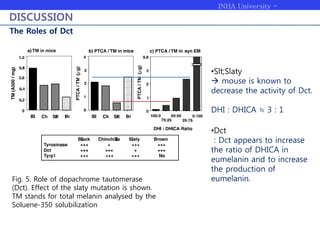
The Roles of Dct
Fig. 5. Role of dopachrome tautomerase
(Dct). Effect of the slaty mutation is shown.
TM stands for total melanin analysed by the
Soluene-350 solubilization
•Slt;Slaty
 mouse is known to
decrease the activity of Dct.
DHI : DHICA ≒ 3 : 1
•Dct
: Dct appears to increase
the ratio of DHICA in
eumelanin and to increase
the production of
eumelanin.
INHA University -
Bioengineering
DISCUSSION
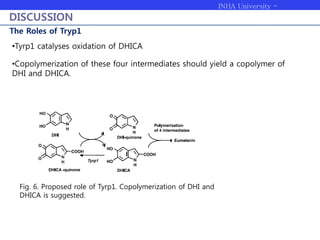
The Roles of Tryp1
Fig. 6. Proposed role of Tyrp1. Copolymerization of DHI and
DHICA is suggested.
•Tyrp1 catalyses oxidation of DHICA
•Copolymerization of these four intermediates should yield a copolymer of
DHI and DHICA.
INHA University -
Bioengineering
DISCUSSION
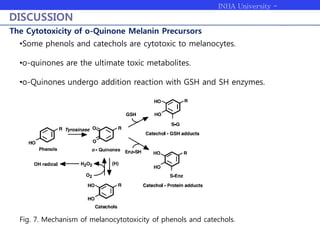
The Cytotoxicity of o-Quinone Melanin Precursors
•Some phenols and catechols are cytotoxic to melanocytes.
•o-quinones are the ultimate toxic metabolites.
•o-Quinones undergo addition reaction with GSH and SH enzymes.
Fig. 7. Mechanism of melanocytotoxicity of phenols and catechols.
INHA University -
Bioengineering
DISCUSSION
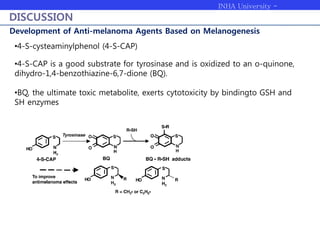
Development of Anti-melanoma Agents Based on Melanogenesis
•4-S-cysteaminylphenol (4-S-CAP)
•4-S-CAP is a good substrate for tyrosinase and is oxidized to an o-quinone,
dihydro-1,4-benzothiazine-6,7-dione (BQ).
•BQ, the ultimate toxic metabolite, exerts cytotoxicity by bindingto GSH and
SH enzymes
INHA University -
Bioengineering
CONCLUSION
In conclusion,
(1) o-quinones are highly reactive chemical species. The addition of SH
compounds to o-quinones proceeds very fast.
(2) In the melanosome, the high reactivity of dopaquinone chemically controls
the early process of melanogenesis.
(3) The availability of cysteine determines the proportion of pheomelanin to
eumelanin.
(4) The cytotoxicity of o-quinones is correlated to their binding to proteins
through the cysteine residues.

130824 paper study 준섭

  • 1.
    13.08.24 김준섭 ▶Objective :Melanogenesis에 대한 과정을 화학반응과 반응속도에 관한 논점 에서 바라본 논문을 알아보기
  • 2.
    INHA University - Bioengineering ABSTRACT Melanogenesisproceeds in three distinctive steps •The initial step is the production of cysteinyldopas by the rapid addition of cysteine to dopaquinone, which continues as long as cysteine is present (1 uM). •The second step is the oxidation of cysteinyldopas to give pheomelanin, which continues as long as cysteinyldopas are present (10 uM). •The last step is the production of eumelanin, which begins only after most cysteinyldopas are depleted. Dopachrome tautomerase (Dct) •Dct catalyses the tautomerization of dopachrome to give mostly 5,6- dihydroxyindole-2-carboxylic acid (DHICA). •The role of Dct is to increase the ratio of DHICA in eumelanin and to increase the production of eumelanin.
  • 3.
    INHA University - Bioengineering INTRODUCTION •Melaninpigments are composed of many different units, and these units are connected through strong carbon– carbon bond •Eumelanin consists of DHI and DHICA units in a reduced or oxidized state,. •Pheomelanin consists mostly of benzothiazine units, but those units are degraded to benzothiazole units to some extent.
  • 4.
    INHA University - Bioengineering INTRODUCTION Fig.1. Pathways for production of eumelanin and pheomelanin in melanocytes. The pathway of melanogenesis
  • 5.
    INHA University - Bioengineering DISCUSSION TheIntrinsic Reactivity of o-Quinones Fig. 2. Intrinsic chemical reactivity of o-quinones. •Rate constants of thiol addition : the range 4 x 10⁵ to 3 x 10⁷⁄M⁄s (in the case of cysteine at pH 7) •The reduction to parent catechols through redox exchange proceeds as fast as the thiol addition. addition of sulphydryl compounds •The addition of amines does not proceed so fast
  • 6.
    INHA University - Bioengineering DISCUSSION TheBranching Point in Melanogenesis Fig. 3. Schematic outline of the branching point of production of eumelanin and pheomelanin 1. cysteinyldopa is preferred as longas the cysteine concentration is higher than 1 uM. 2. Cysteinyldopas thus accumulate in the early phase of pheomelanogenesis 3. pheomelanogenesis is preferred over eumelanogenesis as long as the cysteinyldopa concentration is higher than 10 uM.
  • 7.
    INHA University - Bioengineering DISCUSSION TheChemistry of Pheomelanogenesis The Chemistry of Eumelanogenesis •Ratio  5-S-cysteinyldopa : 2-S-cysteinyldopa = 5 : 1 •The formation of 5-Scysteinyldopaquinone become predominant. Fig. 4. Proposed pathway for mixed melanogenesis. •The ratio of DHI to DHICA is 70:1 •In the presence of Dct, dopachrome undergoes tautomerization, that is, isomerization with a shift of a hydrogen atom, to produce mostly DHICA. •The ratio of DHI to DHICA is thus determined by the activity of Dct.
  • 8.
    INHA University - Bioengineering DISCUSSION TheRoles of Dct Fig. 5. Role of dopachrome tautomerase (Dct). Effect of the slaty mutation is shown. TM stands for total melanin analysed by the Soluene-350 solubilization •Slt;Slaty  mouse is known to decrease the activity of Dct. DHI : DHICA ≒ 3 : 1 •Dct : Dct appears to increase the ratio of DHICA in eumelanin and to increase the production of eumelanin.
  • 9.
    INHA University - Bioengineering DISCUSSION TheRoles of Tryp1 Fig. 6. Proposed role of Tyrp1. Copolymerization of DHI and DHICA is suggested. •Tyrp1 catalyses oxidation of DHICA •Copolymerization of these four intermediates should yield a copolymer of DHI and DHICA.
  • 10.
    INHA University - Bioengineering DISCUSSION TheCytotoxicity of o-Quinone Melanin Precursors •Some phenols and catechols are cytotoxic to melanocytes. •o-quinones are the ultimate toxic metabolites. •o-Quinones undergo addition reaction with GSH and SH enzymes. Fig. 7. Mechanism of melanocytotoxicity of phenols and catechols.
  • 11.
    INHA University - Bioengineering DISCUSSION Developmentof Anti-melanoma Agents Based on Melanogenesis •4-S-cysteaminylphenol (4-S-CAP) •4-S-CAP is a good substrate for tyrosinase and is oxidized to an o-quinone, dihydro-1,4-benzothiazine-6,7-dione (BQ). •BQ, the ultimate toxic metabolite, exerts cytotoxicity by bindingto GSH and SH enzymes
  • 12.
    INHA University - Bioengineering CONCLUSION Inconclusion, (1) o-quinones are highly reactive chemical species. The addition of SH compounds to o-quinones proceeds very fast. (2) In the melanosome, the high reactivity of dopaquinone chemically controls the early process of melanogenesis. (3) The availability of cysteine determines the proportion of pheomelanin to eumelanin. (4) The cytotoxicity of o-quinones is correlated to their binding to proteins through the cysteine residues.

Editor's Notes

  • #2 A chemist’s view of Melanogenesis 라는 제목의 논문이다. melanogenesis를 화학적인 관점에서 본 눈문. 이 논문을 선택한 이유는 melanin을 형성하는 mechanism과 이에 작용하는 중요한 enzyme에 대한 역할을 알기 위해서다.
  • #3 melanogenesis를 크게 3가지 스텝으로 나누고 있다. dopaquinone과 cysteine의 반응으로 cysteinyldopa가 생성되는 과정 이것은 cysteine이 1uM이상 있을 때 진행이 된다. 두번째 단계로는 cysteinyldopa의 산화로 pheomelanin이 생성되는 과정이다. 이것은 cysteinyldopa가 10uM 이상 있을 때 진행 된다. 마지막 단계는 cysteinyldopa가 없을 때 eumelanin이 생성되는 과정이다.
  • #4 melanin과 다른 organic compound와 비교를 하였다.
  • #6 o-quinon과 반응성. sulphydryl group이 있을 경우. quinone이라는 물질은 sulphydryl group과 빠르게 반응을 할 수가 있다.
  • #9 Dct의 역할을 알아 보기 위한 실험. mouse를 이용한 in vivo 실험이며, Slt. slaty라는 mouse는 Dct activity가 줄어든 mouse이다. 첫 번째로는 Black mouse에 비해서 3 종류의 mouse가 melanin 함량이 모두 줄었으며, Dct의 activity가 줄어 들었을 때, DHI가 DHICA에 비해서 상대적으로 늘어난다는 것은 Dct는 DHICA를 만드는데에 관여를 한다는 것을 알 수가 있다.
  • #10 Tryp1의 역할. DHI와 DHICA는 각각 DHI-quinone과 DHICA-quinone으로 산화. 4개의 물질이 copolymerization을 이룰 수가 있다.
  • #11 phenol과 catechole은 melanocyte에 cytotoxic하다. pathway를 보면 quinone 때문에 그렇다. quinone은 유해한 물질이고 GSH와 SH enzyme과 반응성이 있다.
  • #13 o-quinone은 상당히 반응성이 있는 화학물질. melanosome에서는 dopaquinone은 반응성이 있는 물질로, melanogenesis의 초기과정을 결정합니다. cysteine이 pheomelanin과 eumelanin의 비율을 결정. o-quinone의 cytotoxcity는 cysteine을 가지고 있는 protein과 반응을 할 수 있다.