MELASMA
        Epidemiology, Classification,
              Pathophysiology
The International School of Vitiligo & Pigmentary Disorders.
           Barcelona, Spain - 2-5 November 2011

                             Prof. Lotti T, Betti S, M.D.

                                Barcelona, November 2011
 Melasma
 Postinflammatory hyperpigmentation
 Drug induced hyperpigmentation
 Solar lentigos
 Café au lait macules
 Nevus of Ota
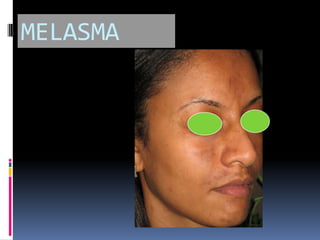
MELASMA
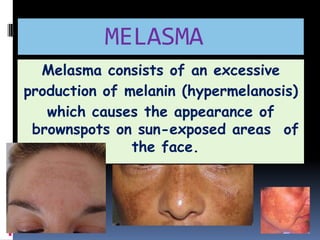
  Melasma consists of an excessive
production of melanin (hypermelanosis)
   which causes the appearance of
 brownspots on sun-exposed areas of
               the face.
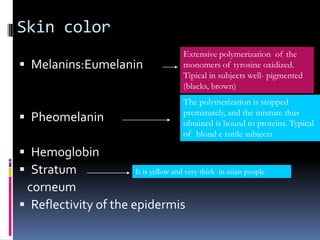
Skin color
                                    Extensive polymerization of the
 Melanins:Eumelanin                monomers of tyrosine oxidized.
                                    Tipical in subjects well- pigmented
                                    (blacks, brown)
                                    The polymerization is stopped
                                    prematurely, and the mixture thus
 Pheomelanin                       obtained is bound to proteins. Typical
                                    of blond e rutile subjects

 Hemoglobin
 Stratum            It is yellow and very thick in asian people

 corneum
 Reflectivity of the epidermis
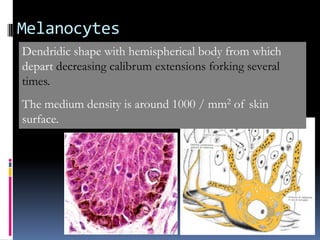
Melanocytes
Dendridic shape with hemispherical body from which
depart decreasing calibrum extensions forking several
times.
The medium density is around 1000 / mm2 of skin
surface.
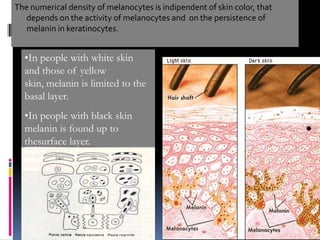
The numerical density of melanocytes is indipendent of skin color, that
   depends on the activity of melanocytes and on the persistence of
   melanin in keratinocytes.


  •In people with white skin
  and those of yellow
  skin, melanin is limited to the
  basal layer.
  •In people with black skin
  melanin is found up to
  thesurface layer.
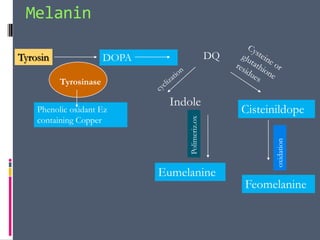
Melanin

Tyrosin                DOPA                       DQ

          Tyrosinase

                               Indole
    Phenolic oxidant Ez                                Cisteinildope
    containing Copper


                                   Polimeriz.ox


                                                              oxidation
                              Eumelanine
                                                       Feomelanine
Melanin
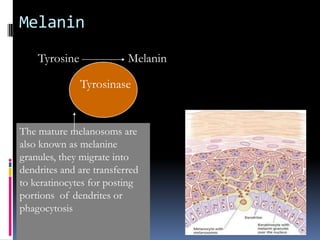
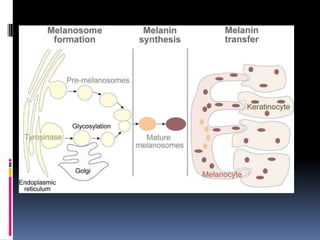
    Tyrosine              Melanin

               Tyrosinase


The mature melanosoms are
also known as melanine
granules, they migrate into
dendrites and are transferred
to keratinocytes for posting
portions of dendrites or
phagocytosis
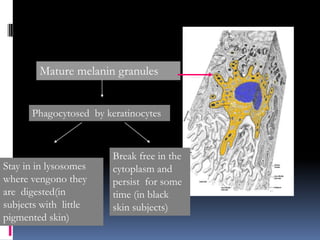
Mature melanin granules


      Phagocytosed by keratinocytes


                        Break free in the
Stay in in lysosomes    cytoplasm and
where vengono they      persist for some
are digested(in         time (in black
subjects with little    skin subjects)
pigmented skin)
Changes in   Melanogenesis


             Melasma
MELASMA
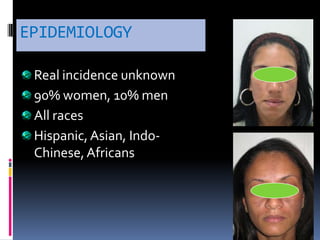
EPIDEMIOLOGY

 Real incidence unknown
 90% women, 10% men
 All races
 Hispanic, Asian, Indo-
 Chinese, Africans
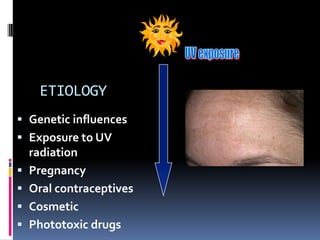
ETIOLOGY
 Genetic influences
 Exposure to UV
  radiation
 Pregnancy
 Oral contraceptives
 Cosmetic
 Phototoxic drugs
GENETIC PREDISPOSITION
the condition is most widespread among women with skin types III or
IV, such as Asian-Americans and people of Mediterranean descent.

EXPOSURE TO UV RADIATION
it is the most important exacerbating factor. Ultraviolet light
normally increases melanogenic activity in melanocytes with resulting
hyperpigmentation. Once melasma has developed, exposure to sunlight
will perpetuate the condition and counteract any other treatment. Use
SPF or higher sunscreens that block both UVA and UVB radiation.

PREGNANCY AND CONTRACEPTIVES
some researchers believe it is induced when extrogen stimulates the
pigment-producing cells in the skin to secrete more pigment.
Melasma it is also known as chloasma or “mask of pregnancy” and it is a
very common condition usually seen in women of childbearing age.
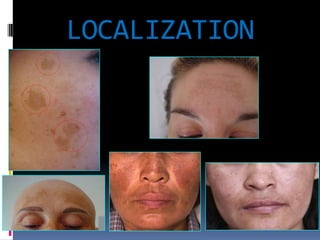
LOCALIZATION
CLINICAL PATTNERS:
                    melasma of the face

                   Centrofacial
                   Malar
                   Mandibular
                   Cleft lip and chin (chin and
                   upper lip)
centrofacial type: 63% of cases (simmetrycal involvement of the cheeks and nose).
   malar type: 21% of cases (simmetrycal involvementof the cheeks and nose).
   jaw type : 8% of cases (involvement of the maxillary branch of the mast).
       Lip-chin type: 8% of cases (involvementof the upper lip and chin).
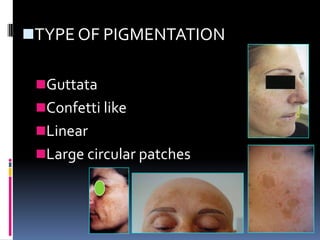
TYPE OF PIGMENTATION

 Guttata
 Confetti like
 Linear
 Large circular patches
Based on Wood’s lamp examination of the
skin, melasma can be classified into four main
clinical types and patterns, with correlation in
histology , in accordance with the depth of
melanin pigment.
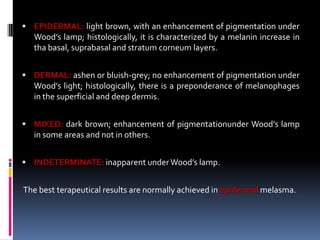
 EPIDERMAL: light brown, with an enhancement of pigmentation under
  Wood’s lamp; histologically, it is characterized by a melanin increase in
  tha basal, suprabasal and stratum corneum layers.


 DERMAL: ashen or bluish-grey; no enhancement of pigmentation under
  Wood’s light; histologically, there is a preponderance of melanophages
  in the superficial and deep dermis.


 MIXED: dark brown; enhancement of pigmentationunder Wood’s lamp
  in some areas and not in others.


 INDETERMINATE: inapparent under Wood’s lamp.


The best terapeutical results are normally achieved in epidermal melasma.
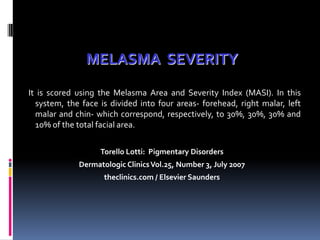
MELASMA SEVERITY
It is scored using the Melasma Area and Severity Index (MASI). In this
  system, the face is divided into four areas- forehead, right malar, left
  malar and chin- which correspond, respectively, to 30%, 30%, 30% and
  10% of the total facial area.

                   Torello Lotti: Pigmentary Disorders
             Dermatologic Clinics Vol.25, Number 3, July 2007
                    theclinics.com / Elsevier Saunders
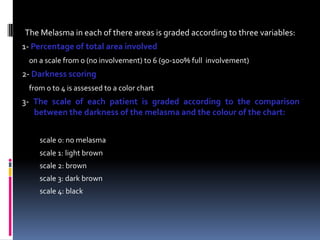
The Melasma in each of there areas is graded according to three variables:
1- Percentage of total area involved
 on a scale from o (no involvement) to 6 (90-100% full involvement)
2- Darkness scoring
 from 0 to 4 is assessed to a color chart
3- The scale of each patient is graded according to the comparison
   between the darkness of the melasma and the colour of the chart:


    scale 0: no melasma
    scale 1: light brown
    scale 2: brown
    scale 3: dark brown
    scale 4: black
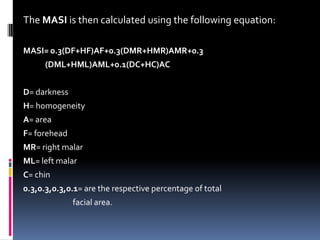
The MASI is then calculated using the following equation:

MASI= 0.3(DF+HF)AF+0.3(DMR+HMR)AMR+0.3
      (DML+HML)AML+0.1(DC+HC)AC


D= darkness
H= homogeneity
A= area
F= forehead
MR= right malar
ML= left malar
C= chin
0.3,0.3,0.3,0.1= are the respective percentage of total
              facial area.
The MASI is measured before
treatment as a baseline and after each
        session of treatment
PATHOGENESIS


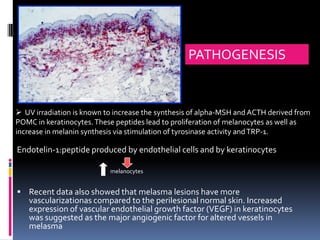
 UV irradiation is known to increase the synthesis of alpha-MSH and ACTH derived from
POMC in keratinocytes. These peptides lead to proliferation of melanocytes as well as
increase in melanin synthesis via stimulation of tyrosinase activity and TRP-1.

Endotelin-1:peptide produced by endothelial cells and by keratinocytes

                           melanocytes


 Recent data also showed that melasma lesions have more
   vascularizationas compared to the perilesional normal skin. Increased
   expression of vascular endothelial growth factor (VEGF) in keratinocytes
   was suggested as the major angiogenic factor for altered vessels in
   melasma
This is confirmed by:
The vascular characteristics of melasma.
Kim EH, Kim YC, Lee ES, Kang HY.
J Dermatol Sci 2007.


OBJECTIVES:
We investigated the vascular characteristics in melasma lesions. The
expression of vascular endothelial growth factor (VEGF), a major
angiogenic factor of the skin, was also investigated in melasma.
METHODS:
Erythema intensity was quantified by the increase of the a* parameter
using a colorimeter. Skin samples were obtained from lesional and non-
lesional facial skin of 50 Korean women with melasma.
Immunohistochemistry was performed to determine the expression of
factor VIIIa-related antigen and VEGF in melasma.
RESULTS
The values of a* was significantly higher in the melasma lesion than
 that of perilesional normal skin. Computer-assisted image
 analyses of factor VIIIa-related antigen-stained sections revealed a
 significant increase of both the number and the size of dermal
 blood vessels in the lesional skin. There was significant
 relationship between the number of vessels and pigmentation in


                      CONCLUSIONS
These data suggest that increased vascularity is one of the major
 findings in melasma. VEGF may be a major angiogenic factor for
 altered vessels in melasma.

                  Torello Lotti: Pigmentary Disorders
            Dermatologic Clinics Vol.25, Number 3, July 2007
                   theclinics.com / Elsevier Saunders
Thank you for your attention


                 Torello Lotti
         Full Professor of Dermatology
      Vice Chancellor, UniMarconi.it , Roma

Melasma – epidemiology, classification - Prof. Torello Lotti, MD

  • 1.
    MELASMA Epidemiology, Classification, Pathophysiology The International School of Vitiligo & Pigmentary Disorders. Barcelona, Spain - 2-5 November 2011 Prof. Lotti T, Betti S, M.D. Barcelona, November 2011
  • 2.
     Melasma  Postinflammatoryhyperpigmentation  Drug induced hyperpigmentation  Solar lentigos  Café au lait macules  Nevus of Ota
  • 3.
    MELASMA Melasmaconsists of an excessive production of melanin (hypermelanosis) which causes the appearance of brownspots on sun-exposed areas of the face.
  • 4.
    Skin color Extensive polymerization of the  Melanins:Eumelanin monomers of tyrosine oxidized. Tipical in subjects well- pigmented (blacks, brown) The polymerization is stopped prematurely, and the mixture thus  Pheomelanin obtained is bound to proteins. Typical of blond e rutile subjects  Hemoglobin  Stratum It is yellow and very thick in asian people corneum  Reflectivity of the epidermis
  • 5.
    Melanocytes Dendridic shape withhemispherical body from which depart decreasing calibrum extensions forking several times. The medium density is around 1000 / mm2 of skin surface.
  • 6.
    The numerical densityof melanocytes is indipendent of skin color, that depends on the activity of melanocytes and on the persistence of melanin in keratinocytes. •In people with white skin and those of yellow skin, melanin is limited to the basal layer. •In people with black skin melanin is found up to thesurface layer.
  • 7.
    Melanin Tyrosin DOPA DQ Tyrosinase Indole Phenolic oxidant Ez Cisteinildope containing Copper Polimeriz.ox oxidation Eumelanine Feomelanine
  • 8.
    Melanin Tyrosine Melanin Tyrosinase The mature melanosoms are also known as melanine granules, they migrate into dendrites and are transferred to keratinocytes for posting portions of dendrites or phagocytosis
  • 9.
    Mature melanin granules Phagocytosed by keratinocytes Break free in the Stay in in lysosomes cytoplasm and where vengono they persist for some are digested(in time (in black subjects with little skin subjects) pigmented skin)
  • 11.
    Changes in Melanogenesis Melasma
  • 12.
  • 13.
    EPIDEMIOLOGY Real incidenceunknown 90% women, 10% men All races Hispanic, Asian, Indo- Chinese, Africans
  • 14.
    ETIOLOGY  Genetic influences Exposure to UV radiation  Pregnancy  Oral contraceptives  Cosmetic  Phototoxic drugs
  • 15.
    GENETIC PREDISPOSITION the conditionis most widespread among women with skin types III or IV, such as Asian-Americans and people of Mediterranean descent. EXPOSURE TO UV RADIATION it is the most important exacerbating factor. Ultraviolet light normally increases melanogenic activity in melanocytes with resulting hyperpigmentation. Once melasma has developed, exposure to sunlight will perpetuate the condition and counteract any other treatment. Use SPF or higher sunscreens that block both UVA and UVB radiation. PREGNANCY AND CONTRACEPTIVES some researchers believe it is induced when extrogen stimulates the pigment-producing cells in the skin to secrete more pigment. Melasma it is also known as chloasma or “mask of pregnancy” and it is a very common condition usually seen in women of childbearing age.
  • 16.
  • 17.
    CLINICAL PATTNERS: melasma of the face Centrofacial Malar Mandibular Cleft lip and chin (chin and upper lip) centrofacial type: 63% of cases (simmetrycal involvement of the cheeks and nose). malar type: 21% of cases (simmetrycal involvementof the cheeks and nose). jaw type : 8% of cases (involvement of the maxillary branch of the mast). Lip-chin type: 8% of cases (involvementof the upper lip and chin).
  • 18.
    TYPE OF PIGMENTATION Guttata Confetti like Linear Large circular patches
  • 19.
    Based on Wood’slamp examination of the skin, melasma can be classified into four main clinical types and patterns, with correlation in histology , in accordance with the depth of melanin pigment.
  • 20.
     EPIDERMAL: lightbrown, with an enhancement of pigmentation under Wood’s lamp; histologically, it is characterized by a melanin increase in tha basal, suprabasal and stratum corneum layers.  DERMAL: ashen or bluish-grey; no enhancement of pigmentation under Wood’s light; histologically, there is a preponderance of melanophages in the superficial and deep dermis.  MIXED: dark brown; enhancement of pigmentationunder Wood’s lamp in some areas and not in others.  INDETERMINATE: inapparent under Wood’s lamp. The best terapeutical results are normally achieved in epidermal melasma.
  • 21.
    MELASMA SEVERITY It isscored using the Melasma Area and Severity Index (MASI). In this system, the face is divided into four areas- forehead, right malar, left malar and chin- which correspond, respectively, to 30%, 30%, 30% and 10% of the total facial area. Torello Lotti: Pigmentary Disorders Dermatologic Clinics Vol.25, Number 3, July 2007 theclinics.com / Elsevier Saunders
  • 22.
    The Melasma ineach of there areas is graded according to three variables: 1- Percentage of total area involved on a scale from o (no involvement) to 6 (90-100% full involvement) 2- Darkness scoring from 0 to 4 is assessed to a color chart 3- The scale of each patient is graded according to the comparison between the darkness of the melasma and the colour of the chart: scale 0: no melasma scale 1: light brown scale 2: brown scale 3: dark brown scale 4: black
  • 23.
    The MASI isthen calculated using the following equation: MASI= 0.3(DF+HF)AF+0.3(DMR+HMR)AMR+0.3 (DML+HML)AML+0.1(DC+HC)AC D= darkness H= homogeneity A= area F= forehead MR= right malar ML= left malar C= chin 0.3,0.3,0.3,0.1= are the respective percentage of total facial area.
  • 24.
    The MASI ismeasured before treatment as a baseline and after each session of treatment
  • 25.
    PATHOGENESIS  UV irradiationis known to increase the synthesis of alpha-MSH and ACTH derived from POMC in keratinocytes. These peptides lead to proliferation of melanocytes as well as increase in melanin synthesis via stimulation of tyrosinase activity and TRP-1. Endotelin-1:peptide produced by endothelial cells and by keratinocytes melanocytes  Recent data also showed that melasma lesions have more vascularizationas compared to the perilesional normal skin. Increased expression of vascular endothelial growth factor (VEGF) in keratinocytes was suggested as the major angiogenic factor for altered vessels in melasma
  • 26.
    This is confirmedby: The vascular characteristics of melasma. Kim EH, Kim YC, Lee ES, Kang HY. J Dermatol Sci 2007. OBJECTIVES: We investigated the vascular characteristics in melasma lesions. The expression of vascular endothelial growth factor (VEGF), a major angiogenic factor of the skin, was also investigated in melasma. METHODS: Erythema intensity was quantified by the increase of the a* parameter using a colorimeter. Skin samples were obtained from lesional and non- lesional facial skin of 50 Korean women with melasma. Immunohistochemistry was performed to determine the expression of factor VIIIa-related antigen and VEGF in melasma.
  • 27.
    RESULTS The values ofa* was significantly higher in the melasma lesion than that of perilesional normal skin. Computer-assisted image analyses of factor VIIIa-related antigen-stained sections revealed a significant increase of both the number and the size of dermal blood vessels in the lesional skin. There was significant relationship between the number of vessels and pigmentation in CONCLUSIONS These data suggest that increased vascularity is one of the major findings in melasma. VEGF may be a major angiogenic factor for altered vessels in melasma. Torello Lotti: Pigmentary Disorders Dermatologic Clinics Vol.25, Number 3, July 2007 theclinics.com / Elsevier Saunders
  • 28.
    Thank you foryour attention Torello Lotti Full Professor of Dermatology Vice Chancellor, UniMarconi.it , Roma