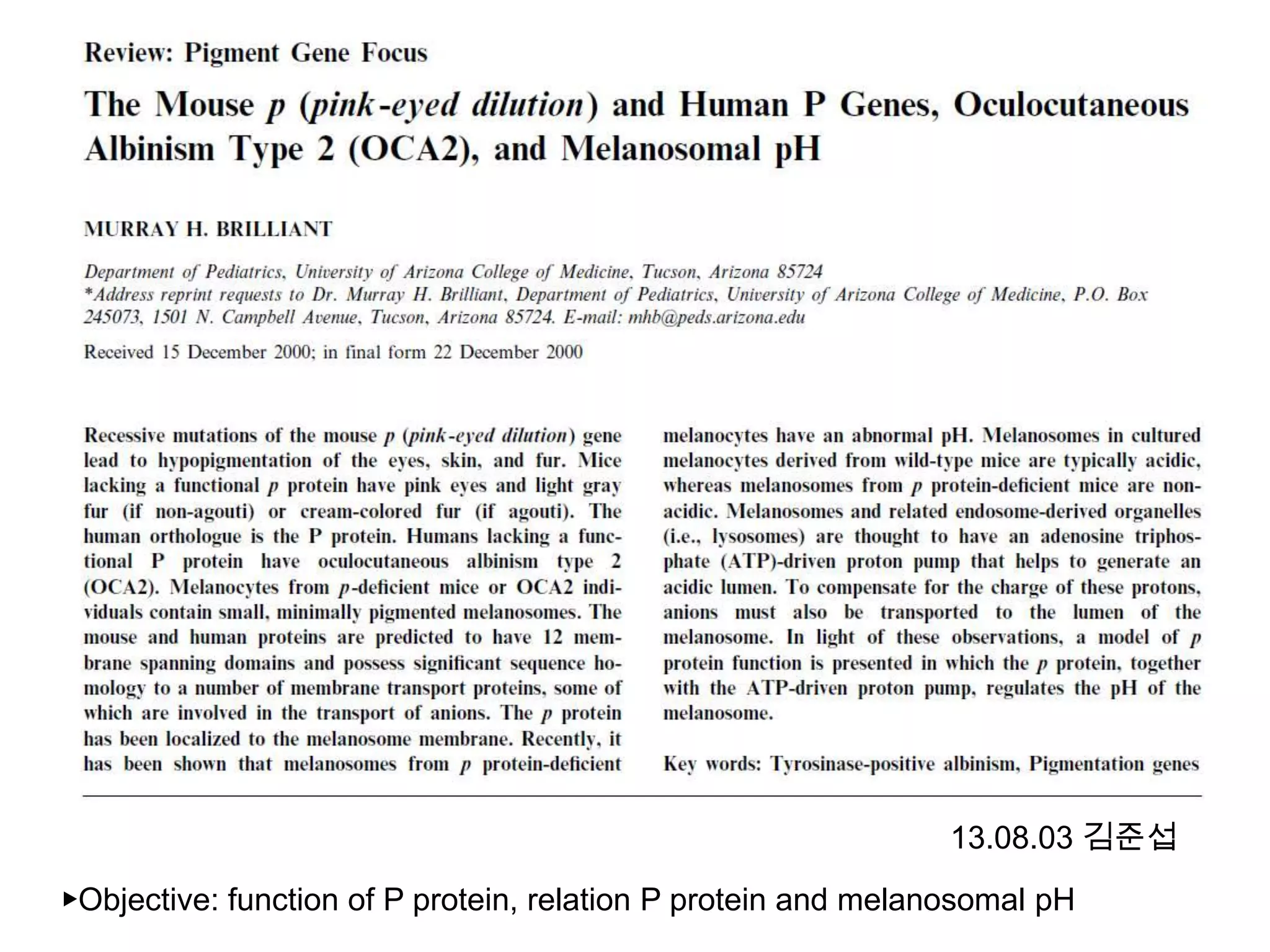
13.08.03 김준섭
▶Objective: function of P protein, relation P protein and melanosomal pH
INHA University - Bioengineering
ABSTRACT
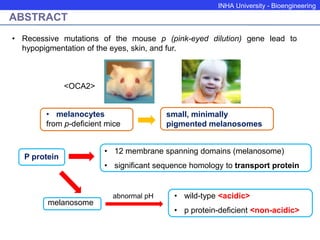
• Recessive mutations of the mouse p (pink-eyed dilution) gene lead to
hypopigmentation of the eyes, skin, and fur.
• melanocytes
from p-deficient mice
small, minimally
pigmented melanosomes
P protein
• 12 membrane spanning domains (melanosome)
• significant sequence homology to transport protein
abnormal pH • wild-type <acidic>
• p protein-deficient <non-acidic>
melanosome
<OCA2>
INHA University - Bioengineering
ABSTRACT
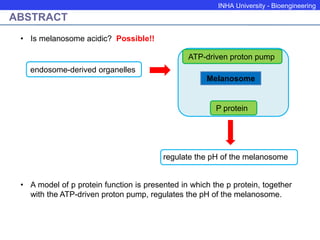
endosome-derived organelles
regulate the pH of the melanosome
Melanosome
ATP-driven proton pump
• Is melanosome acidic? Possible!!
• A model of p protein function is presented in which the p protein, together
with the ATP-driven proton pump, regulates the pH of the melanosome.
P protein
INHA University - Bioengineering
INTRODUCTION
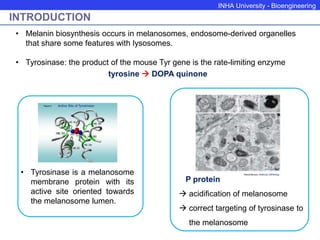
• Melanin biosynthesis occurs in melanosomes, endosome-derived organelles
that share some features with lysosomes.
• Tyrosinase: the product of the mouse Tyr gene is the rate-limiting enzyme
tyrosine  DOPA quinone
• Tyrosinase is a melanosome
membrane protein with its
active site oriented towards
the melanosome lumen.
P protein
 acidification of melanosome
 correct targeting of tyrosinase to
the melanosome
INHA University - Bioengineering
THE P PROTEIN
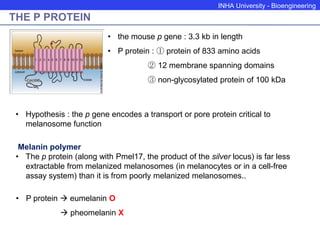
• the mouse p gene : 3.3 kb in length
• P protein : ① protein of 833 amino acids
② 12 membrane spanning domains
③ non-glycosylated protein of 100 kDa
• Hypothesis : the p gene encodes a transport or pore protein critical to
melanosome function
Melanin polymer
• The p protein (along with Pmel17, the product of the silver locus) is far less
extractable from melanized melanosomes (in melanocytes or in a cell-free
assay system) than it is from poorly melanized melanosomes..
• P protein  eumelanin O
 pheomelanin X
INHA University - Bioengineering
FUNCTIONAL STUDIES
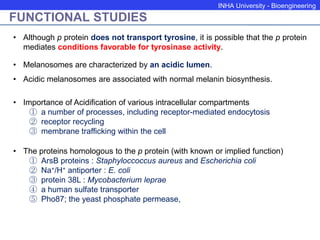
• Although p protein does not transport tyrosine, it is possible that the p protein
mediates conditions favorable for tyrosinase activity.
• Melanosomes are characterized by an acidic lumen.
• Acidic melanosomes are associated with normal melanin biosynthesis.
• Importance of Acidification of various intracellular compartments
① a number of processes, including receptor-mediated endocytosis
② receptor recycling
③ membrane trafficking within the cell
• The proteins homologous to the p protein (with known or implied function)
① ArsB proteins : Staphyloccoccus aureus and Escherichia coli
② Na+/H+ antiporter : E. coli
③ protein 38L : Mycobacterium leprae
④ a human sulfate transporter
⑤ Pho87; the yeast phosphate permease,
INHA University - Bioengineering
FUNCTIONAL STUDIES
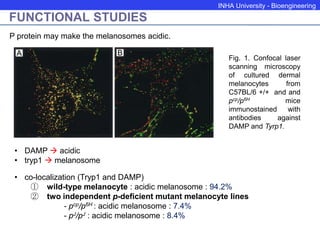
Fig. 1. Confocal laser
scanning microscopy
of cultured dermal
melanocytes from
C57BL/6 +/+ and and
pcp/p6H mice
immunostained with
antibodies against
DAMP and Tyrp1.
• DAMP  acidic
• tryp1  melanosome
• co-localization (Tryp1 and DAMP)
① wild-type melanocyte : acidic melanosome : 94.2%
② two independent p-deficient mutant melanocyte lines
- pcp/p6H : acidic melanosome : 7.4%
- pJ/pJ : acidic melanosome : 8.4%
P protein may make the melanosomes acidic.
INHA University - Bioengineering
FUNCTIONAL STUDIES
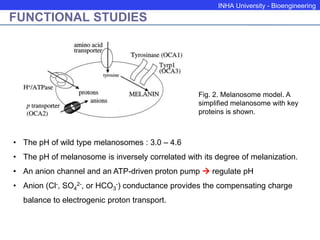
Fig. 2. Melanosome model. A
simplified melanosome with key
proteins is shown.
• The pH of wild type melanosomes : 3.0 – 4.6
• The pH of melanosome is inversely correlated with its degree of melanization.
• An anion channel and an ATP-driven proton pump  regulate pH
• Anion (Cl-, SO4
2-, or HCO3
-) conductance provides the compensating charge
balance to electrogenic proton transport.
INHA University - Bioengineering
FUNCTIONAL STUDIES
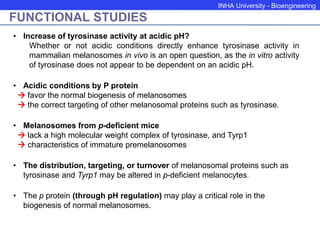
• Increase of tyrosinase activity at acidic pH?
Whether or not acidic conditions directly enhance tyrosinase activity in
mammalian melanosomes in vivo is an open question, as the in vitro activity
of tyrosinase does not appear to be dependent on an acidic pH.
• Acidic conditions by P protein
 favor the normal biogenesis of melanosomes
 the correct targeting of other melanosomal proteins such as tyrosinase.
• Melanosomes from p-deficient mice
 lack a high molecular weight complex of tyrosinase, and Tyrp1
 characteristics of immature premelanosomes
• The distribution, targeting, or turnover of melanosomal proteins such as
tyrosinase and Tyrp1 may be altered in p-deficient melanocytes.
• The p protein (through pH regulation) may play a critical role in the
biogenesis of normal melanosomes.
INHA University - Bioengineering
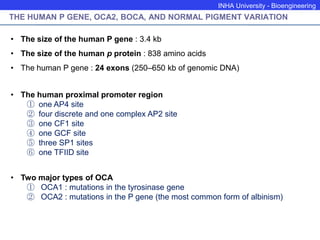
THE HUMAN P GENE, OCA2, BOCA, AND NORMAL PIGMENT VARIATION
• The size of the human P gene : 3.4 kb
• The size of the human p protein : 838 amino acids
• The human P gene : 24 exons (250–650 kb of genomic DNA)
• The human proximal promoter region
① one AP4 site
② four discrete and one complex AP2 site
③ one CF1 site
④ one GCF site
⑤ three SP1 sites
⑥ one TFIID site
• Two major types of OCA
① OCA1 : mutations in the tyrosinase gene
② OCA2 : mutations in the P gene (the most common form of albinism)
INHA University - Bioengineering
THE HUMAN P GENE, OCA2, BOCA, AND NORMAL PIGMENT VARIATION
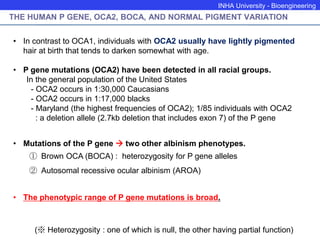
• In contrast to OCA1, individuals with OCA2 usually have lightly pigmented
hair at birth that tends to darken somewhat with age.
• P gene mutations (OCA2) have been detected in all racial groups.
In the general population of the United States
- OCA2 occurs in 1:30,000 Caucasians
- OCA2 occurs in 1:17,000 blacks
- Maryland (the highest frequencies of OCA2); 1/85 individuals with OCA2
: a deletion allele (2.7kb deletion that includes exon 7) of the P gene
• Mutations of the P gene  two other albinism phenotypes.
① Brown OCA (BOCA) : heterozygosity for P gene alleles
② Autosomal recessive ocular albinism (AROA)
• The phenotypic range of P gene mutations is broad.
(※ Heterozygosity : one of which is null, the other having partial function)
INHA University - Bioengineering
CONCLUSIONS
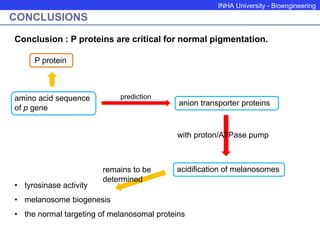
Conclusion : P proteins are critical for normal pigmentation.
amino acid sequence
of p gene
• tyrosinase activity
• melanosome biogenesis
• the normal targeting of melanosomal proteins
anion transporter proteins
P protein
acidification of melanosomes
prediction
with proton/ATPase pump
remains to be
determined

130803 paper study 준섭

  • 1.
    13.08.03 김준섭 ▶Objective: functionof P protein, relation P protein and melanosomal pH
  • 2.
    INHA University -Bioengineering ABSTRACT • Recessive mutations of the mouse p (pink-eyed dilution) gene lead to hypopigmentation of the eyes, skin, and fur. • melanocytes from p-deficient mice small, minimally pigmented melanosomes P protein • 12 membrane spanning domains (melanosome) • significant sequence homology to transport protein abnormal pH • wild-type <acidic> • p protein-deficient <non-acidic> melanosome <OCA2>
  • 3.
    INHA University -Bioengineering ABSTRACT endosome-derived organelles regulate the pH of the melanosome Melanosome ATP-driven proton pump • Is melanosome acidic? Possible!! • A model of p protein function is presented in which the p protein, together with the ATP-driven proton pump, regulates the pH of the melanosome. P protein
  • 4.
    INHA University -Bioengineering INTRODUCTION • Melanin biosynthesis occurs in melanosomes, endosome-derived organelles that share some features with lysosomes. • Tyrosinase: the product of the mouse Tyr gene is the rate-limiting enzyme tyrosine  DOPA quinone • Tyrosinase is a melanosome membrane protein with its active site oriented towards the melanosome lumen. P protein  acidification of melanosome  correct targeting of tyrosinase to the melanosome
  • 5.
    INHA University -Bioengineering THE P PROTEIN • the mouse p gene : 3.3 kb in length • P protein : ① protein of 833 amino acids ② 12 membrane spanning domains ③ non-glycosylated protein of 100 kDa • Hypothesis : the p gene encodes a transport or pore protein critical to melanosome function Melanin polymer • The p protein (along with Pmel17, the product of the silver locus) is far less extractable from melanized melanosomes (in melanocytes or in a cell-free assay system) than it is from poorly melanized melanosomes.. • P protein  eumelanin O  pheomelanin X
  • 6.
    INHA University -Bioengineering FUNCTIONAL STUDIES • Although p protein does not transport tyrosine, it is possible that the p protein mediates conditions favorable for tyrosinase activity. • Melanosomes are characterized by an acidic lumen. • Acidic melanosomes are associated with normal melanin biosynthesis. • Importance of Acidification of various intracellular compartments ① a number of processes, including receptor-mediated endocytosis ② receptor recycling ③ membrane trafficking within the cell • The proteins homologous to the p protein (with known or implied function) ① ArsB proteins : Staphyloccoccus aureus and Escherichia coli ② Na+/H+ antiporter : E. coli ③ protein 38L : Mycobacterium leprae ④ a human sulfate transporter ⑤ Pho87; the yeast phosphate permease,
  • 7.
    INHA University -Bioengineering FUNCTIONAL STUDIES Fig. 1. Confocal laser scanning microscopy of cultured dermal melanocytes from C57BL/6 +/+ and and pcp/p6H mice immunostained with antibodies against DAMP and Tyrp1. • DAMP  acidic • tryp1  melanosome • co-localization (Tryp1 and DAMP) ① wild-type melanocyte : acidic melanosome : 94.2% ② two independent p-deficient mutant melanocyte lines - pcp/p6H : acidic melanosome : 7.4% - pJ/pJ : acidic melanosome : 8.4% P protein may make the melanosomes acidic.
  • 8.
    INHA University -Bioengineering FUNCTIONAL STUDIES Fig. 2. Melanosome model. A simplified melanosome with key proteins is shown. • The pH of wild type melanosomes : 3.0 – 4.6 • The pH of melanosome is inversely correlated with its degree of melanization. • An anion channel and an ATP-driven proton pump  regulate pH • Anion (Cl-, SO4 2-, or HCO3 -) conductance provides the compensating charge balance to electrogenic proton transport.
  • 9.
    INHA University -Bioengineering FUNCTIONAL STUDIES • Increase of tyrosinase activity at acidic pH? Whether or not acidic conditions directly enhance tyrosinase activity in mammalian melanosomes in vivo is an open question, as the in vitro activity of tyrosinase does not appear to be dependent on an acidic pH. • Acidic conditions by P protein  favor the normal biogenesis of melanosomes  the correct targeting of other melanosomal proteins such as tyrosinase. • Melanosomes from p-deficient mice  lack a high molecular weight complex of tyrosinase, and Tyrp1  characteristics of immature premelanosomes • The distribution, targeting, or turnover of melanosomal proteins such as tyrosinase and Tyrp1 may be altered in p-deficient melanocytes. • The p protein (through pH regulation) may play a critical role in the biogenesis of normal melanosomes.
  • 10.
    INHA University -Bioengineering THE HUMAN P GENE, OCA2, BOCA, AND NORMAL PIGMENT VARIATION • The size of the human P gene : 3.4 kb • The size of the human p protein : 838 amino acids • The human P gene : 24 exons (250–650 kb of genomic DNA) • The human proximal promoter region ① one AP4 site ② four discrete and one complex AP2 site ③ one CF1 site ④ one GCF site ⑤ three SP1 sites ⑥ one TFIID site • Two major types of OCA ① OCA1 : mutations in the tyrosinase gene ② OCA2 : mutations in the P gene (the most common form of albinism)
  • 11.
    INHA University -Bioengineering THE HUMAN P GENE, OCA2, BOCA, AND NORMAL PIGMENT VARIATION • In contrast to OCA1, individuals with OCA2 usually have lightly pigmented hair at birth that tends to darken somewhat with age. • P gene mutations (OCA2) have been detected in all racial groups. In the general population of the United States - OCA2 occurs in 1:30,000 Caucasians - OCA2 occurs in 1:17,000 blacks - Maryland (the highest frequencies of OCA2); 1/85 individuals with OCA2 : a deletion allele (2.7kb deletion that includes exon 7) of the P gene • Mutations of the P gene  two other albinism phenotypes. ① Brown OCA (BOCA) : heterozygosity for P gene alleles ② Autosomal recessive ocular albinism (AROA) • The phenotypic range of P gene mutations is broad. (※ Heterozygosity : one of which is null, the other having partial function)
  • 12.
    INHA University -Bioengineering CONCLUSIONS Conclusion : P proteins are critical for normal pigmentation. amino acid sequence of p gene • tyrosinase activity • melanosome biogenesis • the normal targeting of melanosomal proteins anion transporter proteins P protein acidification of melanosomes prediction with proton/ATPase pump remains to be determined