Welcome! We’ll
begin in just a few
minutes.

Everyone is muted
upon arrival.

If you have
questions, use the
chat box on the
right.

We will be sharing
the slides and
recording
after the event.

Indispensable Tools for Today’s ELL Professionals
Writing Goals for English Learners
Jordan Meranus: Ellevation CEO
Allison Balter: EL Teacher, Lawrence MA
AGENDA

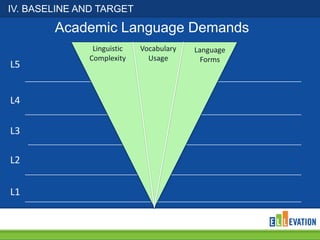
I.

Introduction

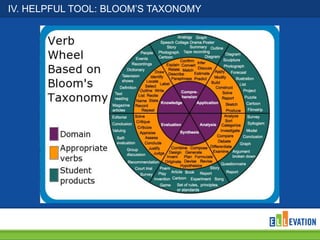
II. Context
III. Goals: Definition, Criteria
IV. Creating Goals: Where to Start

V. Creating Goals: 3 Case Studies
VI. Monitoring Goals
VII. Ellevation Platform Description

2
ELLEVATION
Ellevation is a software company
exclusively dedicated to serving
English Language Learners and
the educators that work with them.
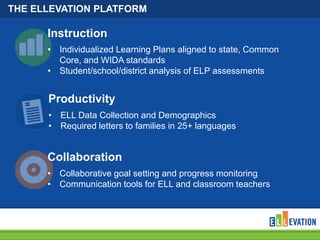
THE ELLEVATION PLATFORM

Instruction
• Individualized Learning Plans aligned to state, Common
Core, and WIDA standards
• Student/school/district analysis of ELP assessments

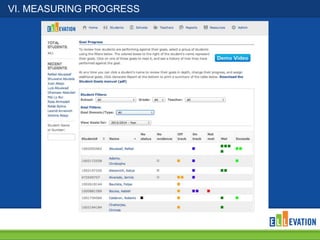
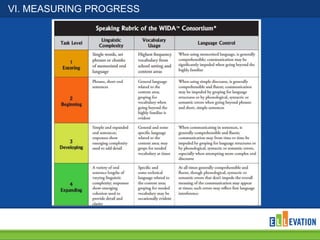
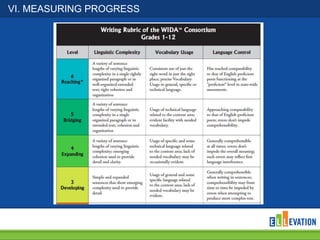
Productivity
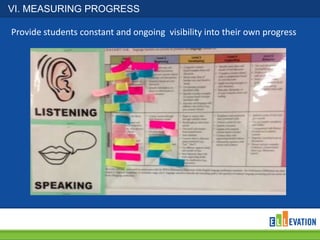
• ELL Data Collection and Demographics
• Required letters to families in 25+ languages

Collaboration
• Collaborative goal setting and progress monitoring
• Communication tools for ELL and classroom teachers
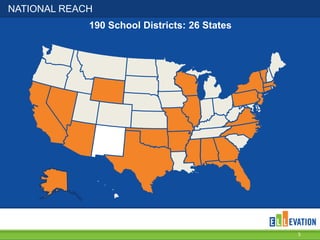
NATIONAL REACH
190 School Districts: 26 States

5
TODAY’S OBJECTIVE

Help all participants gain practical tips for writing goals for
individual English Language Learners or groups of ELs at a
similar level, and ideas on how to monitor student goals.

6
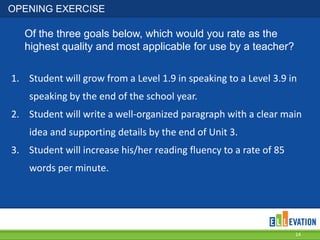
OPENING EXERCISE

Of the three goals below, which would you rate as the
highest quality and most applicable for use by a teacher?
1. Student will grow from a Level 1.9 in speaking to a Level 3.9 in
speaking by the end of the school year.
2. Student will write a well-organized paragraph with a clear main
idea and supporting details by the end of Unit 3.
3. Student will increase his/her reading fluency to a rate of 85
words per minute.

7
AGENDA

I.

Introduction

II. Context
III. Goals: Definition, Criteria
IV. Creating Goals: Where to Start

V. Creating Goals: 3 Case Studies
VI. Monitoring Goals
VII. Ellevation Platform Description

8
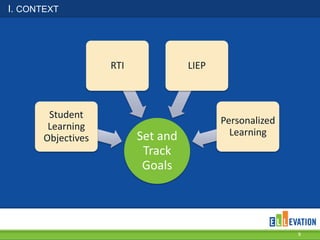
I. CONTEXT

RTI

Student
Learning
Objectives

LIEP

Set and
Track
Goals

Personalized
Learning

9
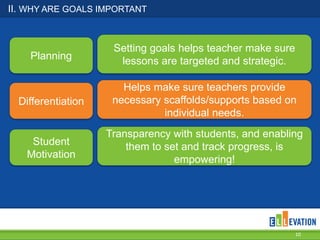
II. WHY ARE GOALS IMPORTANT

Planning

Setting goals helps teacher make sure
lessons are targeted and strategic.

Differentiation

Helps make sure teachers provide
necessary scaffolds/supports based on
individual needs.

Student
Motivation

Transparency with students, and enabling
them to set and track progress, is
empowering!

10
AGENDA

I.

Introduction

II. Context
III. Goals: Definition, Criteria
IV. Creating Goals: Where to Start

V. Creating Goals: 3 Case Studies
VI. Monitoring Goals
VII. Ellevation Platform Description

11
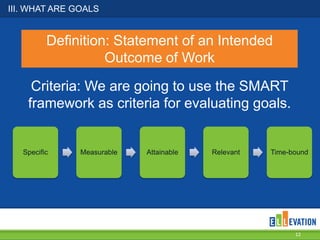
III. WHAT ARE GOALS

Definition: Statement of an Intended
Outcome of Work
Criteria: We are going to use the SMART
framework as criteria for evaluating goals.

Specific

Measurable

Attainable

Relevant

Time-bound

12
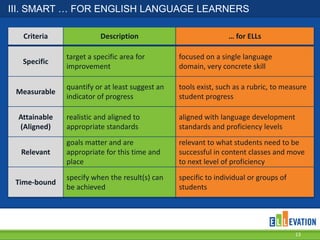
III. SMART … FOR ENGLISH LANGUAGE LEARNERS
Criteria

Description

… for ELLs

target a specific area for
improvement

focused on a single language
domain, very concrete skill

quantify or at least suggest an
indicator of progress

tools exist, such as a rubric, to measure
student progress

realistic and aligned to
appropriate standards

aligned with language development
standards and proficiency levels

Relevant

goals matter and are
appropriate for this time and
place

relevant to what students need to be
successful in content classes and move
to next level of proficiency

Time-bound

specify when the result(s) can
be achieved

specific to individual or groups of
students

Specific

Measurable
Attainable
(Aligned)

13
OPENING EXERCISE

Of the three goals below, which would you rate as the
highest quality and most applicable for use by a teacher?
1. Student will grow from a Level 1.9 in speaking to a Level 3.9 in
speaking by the end of the school year.

2. Student will write a well-organized paragraph with a clear main
idea and supporting details by the end of Unit 3.
3. Student will increase his/her reading fluency to a rate of 85

words per minute.

14
AGENDA

I.

Introduction

II. Context
III. Goals: Definition, Criteria
IV. Creating Goals: Where to Start

V. Creating Goals: 3 Case Studies
VI. Monitoring Goals
VII. Ellevation Platform Description

15
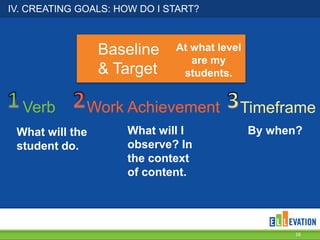
IV. CREATING GOALS: HOW DO I START?

Baseline
& Target
Verb

At what level
are my
students.

Work Achievement

What will the
student do.

What will I
observe? In
the context
of content.

Timeframe
By when?

16
IV. CREATING GOALS: HOW DO I START?

Baseline and Target
1.

Use assessment data to determine where a student is
currently performing across domains

2.

For newcomer/beginner – 2 ELD levels in one year

3.

For intermediate or higher – 1 ELD level in one year

4.

Each student needs an annual goal for each domain.

5.

From there we can chunk up goals into smaller sub
goals.
IV. BASELINE AND TARGET

Academic Language Demands
L5

L4
L3
L2
L1

Linguistic
Complexity

Vocabulary
Usage

Language
Forms
IV. CREATING GOALS: HOW DO I START?

Verb
1. Goals are action oriented.
2. Focused on language skills and functions.
3. Examples:
– Increase
– Critique
– Compare and contrast
4. Sources of verbs that are appropriate for goals
– Bloom’s Taxonomy
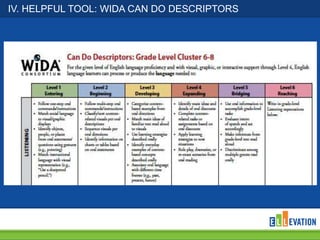
– Can Do Descriptors
IV. HELPFUL TOOL: BLOOM’S TAXONOMY
IV. HELPFUL TOOL: WIDA CAN DO DESCRIPTORS
IV. CREATING GOALS: HOW DO I START?

Work Achievement
1. Specific to language domains
– Speaking; Listening; Reading; Writing
2. Related to what students must do in grade level

content classes
3. Examples
–
–
–

Writing assignment
Oral classroom debate
Annotating in the margin of the text
IV. CREATING GOALS: HOW DO I START?

Timeframe
1. Long-term goals
– Year-long (2 level growth for beginners; 1 level growth
for intermediates and above)
2. Short-term goals
– Unit-specific
– Quarter or semester specific
AGENDA

I.

Introduction

II. Context
III. Goals: Definition, Criteria
IV. Creating Goals: Where to Start

V. Creating Goals: 3 Case Studies
VI. Monitoring Goals
VII. Ellevation Platform Description

24
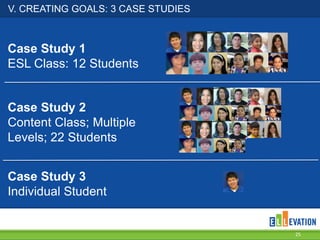
V. CREATING GOALS: 3 CASE STUDIES

Case Study 1
ESL Class: 12 Students

Case Study 2
Content Class; Multiple
Levels; 22 Students

Case Study 3
Individual Student

25
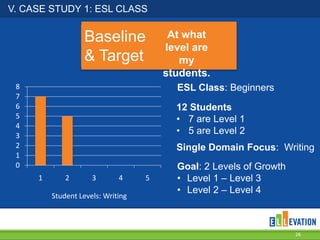
V. CASE STUDY 1: ESL CLASS

Baseline
& Target
8
7
6
5
4
3
2
1
0

At what
level are
my
students.
ESL Class: Beginners
12 Students
• 7 are Level 1
• 5 are Level 2
Single Domain Focus: Writing

1

2

3

4

Student Levels: Writing

5

Goal: 2 Levels of Growth
• Level 1 – Level 3
• Level 2 – Level 4

26
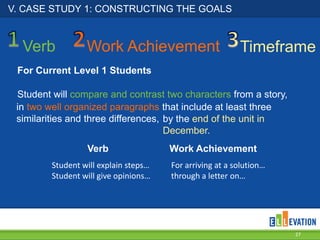
V. CASE STUDY 1: CONSTRUCTING THE GOALS

Verb

Work Achievement

Timeframe

For Current Level 1 Students

Student will compare and contrast two characters from a story,
in two well organized paragraphs that include at least three
similarities and three differences, by the end of the unit in
December.
Verb
Student will explain steps…
Student will give opinions…

Work Achievement
For arriving at a solution…
through a letter on…

27
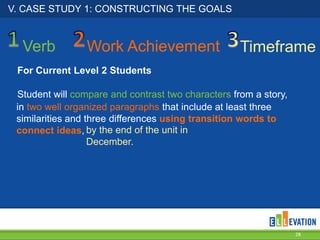
V. CASE STUDY 1: CONSTRUCTING THE GOALS

Verb

Work Achievement

Timeframe

For Current Level 2 Students

Student will compare and contrast two characters from a story,
in two well organized paragraphs that include at least three
similarities and three differences using transition words to
connect ideas, by the end of the unit in
December.

28
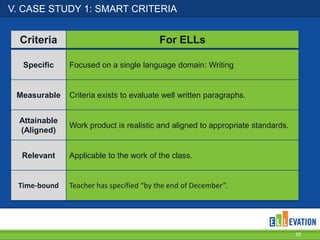
V. CASE STUDY 1: SMART CRITERIA

Criteria
Specific

Measurable
Attainable
(Aligned)
Relevant

Time-bound

For ELLs
Focused on a single language domain: Writing

Criteria exists to evaluate well written paragraphs.

Work product is realistic and aligned to appropriate standards.

Applicable to the work of the class.

Teacher has specified “by the end of December”.

29
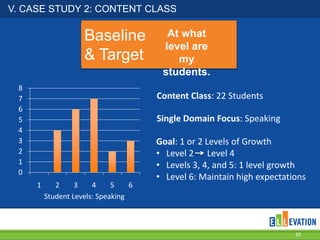
V. CASE STUDY 2: CONTENT CLASS

Baseline
& Target
8
7
6
5
4
3
2
1
0

At what
level are
my
students.
Content Class: 22 Students
Single Domain Focus: Speaking

1

2
3
4
5
6
Student Levels: Speaking

Goal: 1 or 2 Levels of Growth
• Level 2 Level 4
• Levels 3, 4, and 5: 1 level growth
• Level 6: Maintain high expectations

30
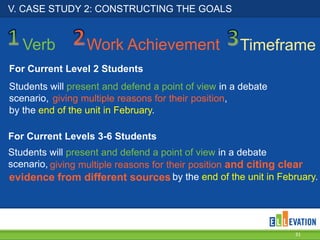
V. CASE STUDY 2: CONSTRUCTING THE GOALS

Verb

Work Achievement

Timeframe

For Current Level 2 Students
Students will present and defend a point of view in a debate
scenario, giving multiple reasons for their position,
by the end of the unit in February.
For Current Levels 3-6 Students
Students will present and defend a point of view in a debate
scenario, giving multiple reasons for their position and citing clear
evidence from different sources by the end of the unit in February.

31
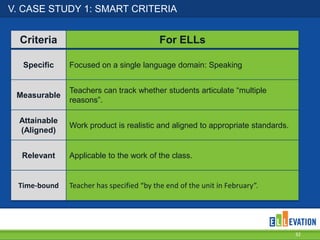
V. CASE STUDY 1: SMART CRITERIA

Criteria
Specific

Measurable
Attainable
(Aligned)
Relevant

Time-bound

For ELLs
Focused on a single language domain: Speaking
Teachers can track whether students articulate “multiple
reasons”.
Work product is realistic and aligned to appropriate standards.

Applicable to the work of the class.

Teacher has specified “by the end of the unit in February”.

32
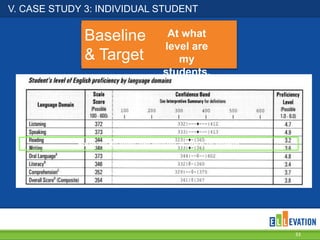
V. CASE STUDY 3: INDIVIDUAL STUDENT

Baseline
& Target

At what
level are
my
students.

Focus on Reading and Writing as areas of growth

33
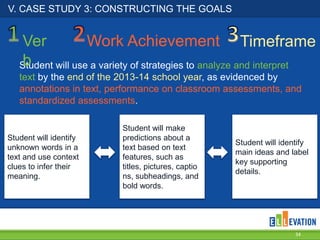
V. CASE STUDY 3: CONSTRUCTING THE GOALS

Ver
Work Achievement Timeframe
b
Student will use a variety of strategies to analyze and interpret
text by the end of the 2013-14 school year, as evidenced by
annotations in text, performance on classroom assessments, and
standardized assessments.

Student will identify
unknown words in a
text and use context
clues to infer their
meaning.

Student will make
predictions about a
text based on text
features, such as
titles, pictures, captio
ns, subheadings, and
bold words.

Student will identify
main ideas and label
key supporting
details.

34
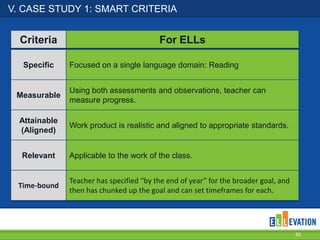
V. CASE STUDY 1: SMART CRITERIA

Criteria
Specific

Measurable
Attainable
(Aligned)
Relevant

Time-bound

For ELLs
Focused on a single language domain: Reading
Using both assessments and observations, teacher can
measure progress.
Work product is realistic and aligned to appropriate standards.

Applicable to the work of the class.
Teacher has specified “by the end of year” for the broader goal, and
then has chunked up the goal and can set timeframes for each.
35
AGENDA

I.

Introduction

II. Context
III. Goals: Definition, Criteria
IV. Creating Goals: Where to Start

V. Creating Goals: 3 Case Studies
VI. Monitoring Goals
VII. Ellevation Platform Description

36
VI. MEASURING PROGRESS

Evaluating progress is difficult; different tools and
approaches are needed
–

Speaking and writing are easier with rubrics
a.
b.
c.
d.

–

Formative and summative assessments
Organic progress monitoring; note taking
WIDA Writing Rubric
WIDA Speaking Rubric

Reading and listening are more difficult; no production
a.
b.

Formative and summative assessments
Organic progress monitoring; note taking
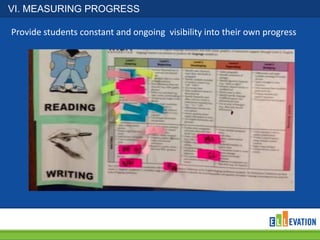
VI. MEASURING PROGRESS
Provide students constant and ongoing visibility into their own progress
VI. MEASURING PROGRESS
Provide students constant and ongoing visibility into their own progress
VI. MEASURING PROGRESS
AGENDA

I.

Introduction

II. Context
III. Goals: Definition, Criteria
IV. Creating Goals: Where to Start

V. Creating Goals: 3 Case Studies
VI. Monitoring Goals
VII. Ellevation Platform Description

43

Writing Goals for English Language Learners

  • 1.
    Welcome! We’ll begin injust a few minutes. Everyone is muted upon arrival. If you have questions, use the chat box on the right. We will be sharing the slides and recording after the event. Indispensable Tools for Today’s ELL Professionals Writing Goals for English Learners Jordan Meranus: Ellevation CEO Allison Balter: EL Teacher, Lawrence MA
  • 2.
    AGENDA I. Introduction II. Context III. Goals:Definition, Criteria IV. Creating Goals: Where to Start V. Creating Goals: 3 Case Studies VI. Monitoring Goals VII. Ellevation Platform Description 2
  • 3.
    ELLEVATION Ellevation is asoftware company exclusively dedicated to serving English Language Learners and the educators that work with them.
  • 4.
    THE ELLEVATION PLATFORM Instruction •Individualized Learning Plans aligned to state, Common Core, and WIDA standards • Student/school/district analysis of ELP assessments Productivity • ELL Data Collection and Demographics • Required letters to families in 25+ languages Collaboration • Collaborative goal setting and progress monitoring • Communication tools for ELL and classroom teachers
  • 5.
    NATIONAL REACH 190 SchoolDistricts: 26 States 5
  • 6.
    TODAY’S OBJECTIVE Help allparticipants gain practical tips for writing goals for individual English Language Learners or groups of ELs at a similar level, and ideas on how to monitor student goals. 6
  • 7.
    OPENING EXERCISE Of thethree goals below, which would you rate as the highest quality and most applicable for use by a teacher? 1. Student will grow from a Level 1.9 in speaking to a Level 3.9 in speaking by the end of the school year. 2. Student will write a well-organized paragraph with a clear main idea and supporting details by the end of Unit 3. 3. Student will increase his/her reading fluency to a rate of 85 words per minute. 7
  • 8.
    AGENDA I. Introduction II. Context III. Goals:Definition, Criteria IV. Creating Goals: Where to Start V. Creating Goals: 3 Case Studies VI. Monitoring Goals VII. Ellevation Platform Description 8
  • 9.
  • 10.
    II. WHY AREGOALS IMPORTANT Planning Setting goals helps teacher make sure lessons are targeted and strategic. Differentiation Helps make sure teachers provide necessary scaffolds/supports based on individual needs. Student Motivation Transparency with students, and enabling them to set and track progress, is empowering! 10
  • 11.
    AGENDA I. Introduction II. Context III. Goals:Definition, Criteria IV. Creating Goals: Where to Start V. Creating Goals: 3 Case Studies VI. Monitoring Goals VII. Ellevation Platform Description 11
  • 12.
    III. WHAT AREGOALS Definition: Statement of an Intended Outcome of Work Criteria: We are going to use the SMART framework as criteria for evaluating goals. Specific Measurable Attainable Relevant Time-bound 12
  • 13.
    III. SMART …FOR ENGLISH LANGUAGE LEARNERS Criteria Description … for ELLs target a specific area for improvement focused on a single language domain, very concrete skill quantify or at least suggest an indicator of progress tools exist, such as a rubric, to measure student progress realistic and aligned to appropriate standards aligned with language development standards and proficiency levels Relevant goals matter and are appropriate for this time and place relevant to what students need to be successful in content classes and move to next level of proficiency Time-bound specify when the result(s) can be achieved specific to individual or groups of students Specific Measurable Attainable (Aligned) 13
  • 14.
    OPENING EXERCISE Of thethree goals below, which would you rate as the highest quality and most applicable for use by a teacher? 1. Student will grow from a Level 1.9 in speaking to a Level 3.9 in speaking by the end of the school year. 2. Student will write a well-organized paragraph with a clear main idea and supporting details by the end of Unit 3. 3. Student will increase his/her reading fluency to a rate of 85 words per minute. 14
  • 15.
    AGENDA I. Introduction II. Context III. Goals:Definition, Criteria IV. Creating Goals: Where to Start V. Creating Goals: 3 Case Studies VI. Monitoring Goals VII. Ellevation Platform Description 15
  • 16.
    IV. CREATING GOALS:HOW DO I START? Baseline & Target Verb At what level are my students. Work Achievement What will the student do. What will I observe? In the context of content. Timeframe By when? 16
  • 17.
    IV. CREATING GOALS:HOW DO I START? Baseline and Target 1. Use assessment data to determine where a student is currently performing across domains 2. For newcomer/beginner – 2 ELD levels in one year 3. For intermediate or higher – 1 ELD level in one year 4. Each student needs an annual goal for each domain. 5. From there we can chunk up goals into smaller sub goals.
  • 18.
    IV. BASELINE ANDTARGET Academic Language Demands L5 L4 L3 L2 L1 Linguistic Complexity Vocabulary Usage Language Forms
  • 19.
    IV. CREATING GOALS:HOW DO I START? Verb 1. Goals are action oriented. 2. Focused on language skills and functions. 3. Examples: – Increase – Critique – Compare and contrast 4. Sources of verbs that are appropriate for goals – Bloom’s Taxonomy – Can Do Descriptors
  • 20.
    IV. HELPFUL TOOL:BLOOM’S TAXONOMY
  • 21.
    IV. HELPFUL TOOL:WIDA CAN DO DESCRIPTORS
  • 22.
    IV. CREATING GOALS:HOW DO I START? Work Achievement 1. Specific to language domains – Speaking; Listening; Reading; Writing 2. Related to what students must do in grade level content classes 3. Examples – – – Writing assignment Oral classroom debate Annotating in the margin of the text
  • 23.
    IV. CREATING GOALS:HOW DO I START? Timeframe 1. Long-term goals – Year-long (2 level growth for beginners; 1 level growth for intermediates and above) 2. Short-term goals – Unit-specific – Quarter or semester specific
  • 24.
    AGENDA I. Introduction II. Context III. Goals:Definition, Criteria IV. Creating Goals: Where to Start V. Creating Goals: 3 Case Studies VI. Monitoring Goals VII. Ellevation Platform Description 24
  • 25.
    V. CREATING GOALS:3 CASE STUDIES Case Study 1 ESL Class: 12 Students Case Study 2 Content Class; Multiple Levels; 22 Students Case Study 3 Individual Student 25
  • 26.
    V. CASE STUDY1: ESL CLASS Baseline & Target 8 7 6 5 4 3 2 1 0 At what level are my students. ESL Class: Beginners 12 Students • 7 are Level 1 • 5 are Level 2 Single Domain Focus: Writing 1 2 3 4 Student Levels: Writing 5 Goal: 2 Levels of Growth • Level 1 – Level 3 • Level 2 – Level 4 26
  • 27.
    V. CASE STUDY1: CONSTRUCTING THE GOALS Verb Work Achievement Timeframe For Current Level 1 Students Student will compare and contrast two characters from a story, in two well organized paragraphs that include at least three similarities and three differences, by the end of the unit in December. Verb Student will explain steps… Student will give opinions… Work Achievement For arriving at a solution… through a letter on… 27
  • 28.
    V. CASE STUDY1: CONSTRUCTING THE GOALS Verb Work Achievement Timeframe For Current Level 2 Students Student will compare and contrast two characters from a story, in two well organized paragraphs that include at least three similarities and three differences using transition words to connect ideas, by the end of the unit in December. 28
  • 29.
    V. CASE STUDY1: SMART CRITERIA Criteria Specific Measurable Attainable (Aligned) Relevant Time-bound For ELLs Focused on a single language domain: Writing Criteria exists to evaluate well written paragraphs. Work product is realistic and aligned to appropriate standards. Applicable to the work of the class. Teacher has specified “by the end of December”. 29
  • 30.
    V. CASE STUDY2: CONTENT CLASS Baseline & Target 8 7 6 5 4 3 2 1 0 At what level are my students. Content Class: 22 Students Single Domain Focus: Speaking 1 2 3 4 5 6 Student Levels: Speaking Goal: 1 or 2 Levels of Growth • Level 2 Level 4 • Levels 3, 4, and 5: 1 level growth • Level 6: Maintain high expectations 30
  • 31.
    V. CASE STUDY2: CONSTRUCTING THE GOALS Verb Work Achievement Timeframe For Current Level 2 Students Students will present and defend a point of view in a debate scenario, giving multiple reasons for their position, by the end of the unit in February. For Current Levels 3-6 Students Students will present and defend a point of view in a debate scenario, giving multiple reasons for their position and citing clear evidence from different sources by the end of the unit in February. 31
  • 32.
    V. CASE STUDY1: SMART CRITERIA Criteria Specific Measurable Attainable (Aligned) Relevant Time-bound For ELLs Focused on a single language domain: Speaking Teachers can track whether students articulate “multiple reasons”. Work product is realistic and aligned to appropriate standards. Applicable to the work of the class. Teacher has specified “by the end of the unit in February”. 32
  • 33.
    V. CASE STUDY3: INDIVIDUAL STUDENT Baseline & Target At what level are my students. Focus on Reading and Writing as areas of growth 33
  • 34.
    V. CASE STUDY3: CONSTRUCTING THE GOALS Ver Work Achievement Timeframe b Student will use a variety of strategies to analyze and interpret text by the end of the 2013-14 school year, as evidenced by annotations in text, performance on classroom assessments, and standardized assessments. Student will identify unknown words in a text and use context clues to infer their meaning. Student will make predictions about a text based on text features, such as titles, pictures, captio ns, subheadings, and bold words. Student will identify main ideas and label key supporting details. 34
  • 35.
    V. CASE STUDY1: SMART CRITERIA Criteria Specific Measurable Attainable (Aligned) Relevant Time-bound For ELLs Focused on a single language domain: Reading Using both assessments and observations, teacher can measure progress. Work product is realistic and aligned to appropriate standards. Applicable to the work of the class. Teacher has specified “by the end of year” for the broader goal, and then has chunked up the goal and can set timeframes for each. 35
  • 36.
    AGENDA I. Introduction II. Context III. Goals:Definition, Criteria IV. Creating Goals: Where to Start V. Creating Goals: 3 Case Studies VI. Monitoring Goals VII. Ellevation Platform Description 36
  • 37.
    VI. MEASURING PROGRESS Evaluatingprogress is difficult; different tools and approaches are needed – Speaking and writing are easier with rubrics a. b. c. d. – Formative and summative assessments Organic progress monitoring; note taking WIDA Writing Rubric WIDA Speaking Rubric Reading and listening are more difficult; no production a. b. Formative and summative assessments Organic progress monitoring; note taking
  • 38.
    VI. MEASURING PROGRESS Providestudents constant and ongoing visibility into their own progress
  • 39.
    VI. MEASURING PROGRESS Providestudents constant and ongoing visibility into their own progress
  • 40.
  • 41.
  • 42.
  • 43.
    AGENDA I. Introduction II. Context III. Goals:Definition, Criteria IV. Creating Goals: Where to Start V. Creating Goals: 3 Case Studies VI. Monitoring Goals VII. Ellevation Platform Description 43

Editor's Notes

  • #3 JordanWelcome. Excited. # of districts. Walk through agenda.
  • #4 Jordan
  • #5 Jordan
  • #6 Jordan
  • #7 JordanWe hope that by the time the hour is up, you have ideas, and guidance, on how you want to set goals for the Els you work with. We understand that all districts have their own approaches…
  • #8 Jordan
  • #9 Jordan
  • #10 JordanThere are many reasons why educators are increasingly focused on setting goals and why our partners and customers have pushed us to focus on this topic:SLOs – having student level goals that can roll up to the classroom and school level are helpful for informing and monitoring SLOsGoal setting and progress monitoring is a critical components of RTILIEPs, or Personalized learning
  • #11 Allison
  • #12 Jordan
  • #13 JordanLet’s start with a definition. While there are certainly other viable definitions, we see a goal Next, we want to utlilize a framework for evaluating whether a goal is well written. WE really like the SMART framework.
  • #14 Allison
  • #15 Jordan
  • #16 Jordan
  • #17 Jordan
  • #18 Allison
  • #19 Allison
  • #20 Allison
  • #21 Jordan
  • #22 Jordan
  • #23 Allison
  • #24 Allison
  • #25 JordanLet’s now put this approach, the combination of SMART for ELLs, and the sequenced process of using a verb, work achievement, and timeframe.
  • #26 JordanWe have prepared 3 case studies
  • #27 Jordan
  • #28 Allison
  • #29 Allison
  • #30 Jordan
  • #31 Allison
  • #32 Allison
  • #33 Jordan
  • #34 Jordan
  • #35 Allison
  • #36 Jordan
  • #37 Jordan
  • #38 Allison
  • #39 Allison
  • #40 Allison
  • #41 Jordan
  • #42 Allison
  • #43 Allison
  • #44 Jordan