Assessment for Learning
(AFL)
Clarity about what is to be learnt
Term 1 2014
Based on work from Evaluation Associates
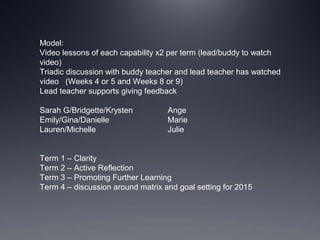
Model:
Video lessons of each capability x2 per term (lead/buddy to watch
video)
Triadic discussion with buddy teacher and lead teacher has watched
video (Weeks 4 or 5 and Weeks 8 or 9)
Lead teacher supports giving feedback
Sarah G/Bridgette/Krysten
Emily/Gina/Danielle
Lauren/Michelle

Ange
Marie
Julie

Term 1 – Clarity
Term 2 – Active Reflection
Term 3 – Promoting Further Learning
Term 4 – discussion around matrix and goal setting for 2015
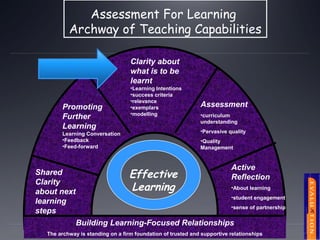
Assessment For Learning
Archway of Teaching Capabilities
Clarity about
what is to be
learnt
Promoting
Further
Learning

•Learning Intentions
•success criteria
•relevance
•exemplars
•modelling

•curriculum
understanding
•Pervasive quality

Learning Conversation
•Feedback
•Feed-forward

Shared
Clarity
about next
learning
steps

Assessment

•Quality
Management

Effective
Learning

Active
Reflection
•About learning
•student engagement
•sense of partnership

Building Learning-Focused Relationships
The archway is standing on a firm foundation of trusted and supportive relationships
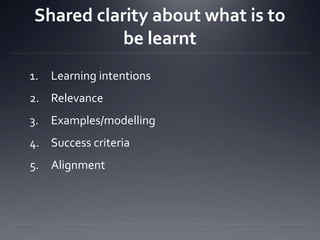
Shared clarity about what is to
be learnt
1.

Learning intentions

2. Relevance
3. Examples/modelling
4. Success criteria
5. Alignment
Learning Intentions
The first ‘active’ element of formative
assessment in the classroom is the sharing
of Learning Intentions.
Shirley Clarke, (2003)

Specific and challenging goals lead to
success as they direct students’ attention,
specify norms of performance and have
positive effects on self-efficacy.
Hattie & Jaeger, (1998); Hattie & Timperley, (2007)
1. Be clear in your own mind:

 What it is that you want the students to learn or understand
 Write it down in ‘teacher-speak’

2. Translate into student - speak
•

Take your ‘teacher - speak’ Learning Intention and put it into language that your
students can understand clearly.

The difference between learning intentions and tasks
 To estimate the length of a horse
 To create text that clearly conveys the sense of a character
 To learn some qualities used in shaping a piece of music
 To sing a song
 To write a recount about school camp
 Learn when to use capital letters and full stops.
The difference between global and specific LIs
 Learning how to write a recount
 Learning how to grab the readers attention
 Learning how to use words to show the order of my events
 Learning how to describe an event in more detail
Global: Learning how to persuade others in our writing.
Specific: Learning to write the opening paragraph of an argument.
More specific:
Learning how to get the reader involved and interested in my
argument from the start, or…
Learning how to back up a point with convincing evidence.
Relevance
 Some challenges with relevance:
1.
2.

We just forget to mention it
We mention it only in passing

 Some useful ideas:
1.
2.
3.
4.

ask the students why its important to learn this?
get the students to talk to their partner about why this is important
Discuss with students why they will use/need this learning
Share with students how it fits into the bigger picture
ModelLing/Exemplars
It is simply about making the learning explicit by
focusing students’ attention on understanding quality.
Learning is improved when notions of quality are
combined with modelling.
Marshall & Drummond, (2006)

What exactly constitutes quality is complicated as it often
involves the articulation of what is inside a teacher’s head and is
affected by the teacher’s previous qualitative judgments about
what students should be able to produce.
Sadler, (1998)
Common challenges with Modelling the Process or
Examining an Exemplar
The timing of the modelling
The standard of the modelling
The alignment – ie does it really exemplify what the students are trying to learn?
Does it demonstrate the process that the students needs to use in order to proceed with the
learning?
When do you model/ when do you use an exemplar?

Examples / Modelling
 Writing: How to add detail to our writing
 Inquiry: How to sort information
 Maths: How to order fractions
 Reading: How to predict what the story might be about
Success Criteria
Criteria are best revealed through an experience-socialization process involving
such processes as: observation, imitation, dialogue and practice, further
explanation, exemplars and quality discussion of the more complex or ‘invisible’
criteria.
Rust, Price & O’Donovan, (2003).

Criteria are best revealed with the use of exemplars to help typify the standard
expected.
Gibbs & Simpson, (2004-05) Sadler, (1998)
Key ideas with success criteria
 not too many
 are they product criteria or process criteria?
Whose idea were they?

‘Product’ and ‘Process’ Criteria:

Product:
What it is about the finished product that shows
you’ve been successful
Process:
What steps I could take to make sure the finished
product is successful
Depending on the learning, one may be more useful
than the other.
Key ideas with co-constructing the success criteria

 To help students be clear about our modelling
 Either give SC, model how to construct SC OR if inviting students to
construct SC with you help them make the links back to your
modelling/example
 So the students can have something definitive to refer back to, to check, to
see if how well they are going
 To guide teacher and students in self- and peer-assessment.
Follow with an opportunity to create the Success Criteria
 The question you ask will make a big difference to what the students suggest
 Try this one: “how did I get my audience interested in my story? What strategies
did I use? Or what steps did I take? What did I do first? Let’s have a look back at my
paragraph and see...”
 Not “what will make you successful?”
ALignment
Alignment is a crucial element in successful pedagogical
approaches. Berliner argues that highly effective teachers deliver
the curriculum in ways that align delivery and learning outcomes
and that alignment can directly lead to success in learning.
Berliner (1987; 1990)
Learning intentions, the model, the success criteria and task need to be separated but
aligned.
The Learning Intention is what you want the students to learn or understand.
The Model is a demonstration of how to reach the learning intention
The Success Criteria answers the question “How will we know we have achieved this?”
The instructions for the Activities and Tasks describe the activities the students will
carry out in order to learn
ALIGNED…
LI: Learn how to describe an event in
detail (so the reader gets a better
picture)
SC: I have written about:
 What I could see
 What I could hear
 What I was feeling.
Task: Re-write your introduction by
focusing on an event that gives the
reader a vivid picture in their heads

NOT ALIGNED…
LI: Learn how to describe an event in
detail (so the reader gets a better
picture)
SC: I have written about:
 What I could see and hear
 What I was feeling
My punctuation is correct
I haven’t used ‘and then… and then…’
Task: Write a recount about yesterday’s
swimming sports.
Check that students understand

 Give frequent opportunities for students to check their understanding with you or
one another
 Model for the students how they might think and share with others
 Give students time to think before responding to a question – ‘Wait-time’

Display L.I and S.C
 These need to be visually displayed so you and students can refer back to
them
 Some ideas to save your time & the school’s money:
 save on the computer
 record on a laminated card that can be shifted from the whiteboard to a
display area.
 Create a flip-chart or A3 Booklet so students can refer back to them
Observation forms
- Blanks and examples

Example of clarity
Please record on observation sheet
Reading
Model II theory
Thoughts? Wonderings? Ah-has?
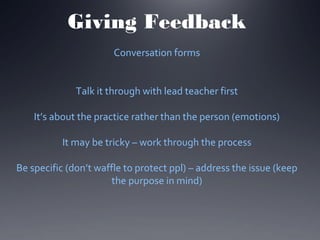
Giving Feedback
Conversation forms
Talk it through with lead teacher first
It’s about the practice rather than the person (emotions)
It may be tricky – work through the process
Be specific (don’t waffle to protect ppl) – address the issue (keep
the purpose in mind)

2014 clarity and model 2

  • 1.
    Assessment for Learning (AFL) Clarityabout what is to be learnt Term 1 2014 Based on work from Evaluation Associates
  • 2.
    Model: Video lessons ofeach capability x2 per term (lead/buddy to watch video) Triadic discussion with buddy teacher and lead teacher has watched video (Weeks 4 or 5 and Weeks 8 or 9) Lead teacher supports giving feedback Sarah G/Bridgette/Krysten Emily/Gina/Danielle Lauren/Michelle Ange Marie Julie Term 1 – Clarity Term 2 – Active Reflection Term 3 – Promoting Further Learning Term 4 – discussion around matrix and goal setting for 2015
  • 3.
    Assessment For Learning Archwayof Teaching Capabilities Clarity about what is to be learnt Promoting Further Learning •Learning Intentions •success criteria •relevance •exemplars •modelling •curriculum understanding •Pervasive quality Learning Conversation •Feedback •Feed-forward Shared Clarity about next learning steps Assessment •Quality Management Effective Learning Active Reflection •About learning •student engagement •sense of partnership Building Learning-Focused Relationships The archway is standing on a firm foundation of trusted and supportive relationships
  • 4.
    Shared clarity aboutwhat is to be learnt 1. Learning intentions 2. Relevance 3. Examples/modelling 4. Success criteria 5. Alignment
  • 5.
    Learning Intentions The first‘active’ element of formative assessment in the classroom is the sharing of Learning Intentions. Shirley Clarke, (2003) Specific and challenging goals lead to success as they direct students’ attention, specify norms of performance and have positive effects on self-efficacy. Hattie & Jaeger, (1998); Hattie & Timperley, (2007)
  • 6.
    1. Be clearin your own mind:  What it is that you want the students to learn or understand  Write it down in ‘teacher-speak’ 2. Translate into student - speak • Take your ‘teacher - speak’ Learning Intention and put it into language that your students can understand clearly. The difference between learning intentions and tasks  To estimate the length of a horse  To create text that clearly conveys the sense of a character  To learn some qualities used in shaping a piece of music  To sing a song  To write a recount about school camp  Learn when to use capital letters and full stops.
  • 7.
    The difference betweenglobal and specific LIs  Learning how to write a recount  Learning how to grab the readers attention  Learning how to use words to show the order of my events  Learning how to describe an event in more detail Global: Learning how to persuade others in our writing. Specific: Learning to write the opening paragraph of an argument. More specific: Learning how to get the reader involved and interested in my argument from the start, or… Learning how to back up a point with convincing evidence.
  • 8.
    Relevance  Some challengeswith relevance: 1. 2. We just forget to mention it We mention it only in passing  Some useful ideas: 1. 2. 3. 4. ask the students why its important to learn this? get the students to talk to their partner about why this is important Discuss with students why they will use/need this learning Share with students how it fits into the bigger picture
  • 9.
    ModelLing/Exemplars It is simplyabout making the learning explicit by focusing students’ attention on understanding quality. Learning is improved when notions of quality are combined with modelling. Marshall & Drummond, (2006) What exactly constitutes quality is complicated as it often involves the articulation of what is inside a teacher’s head and is affected by the teacher’s previous qualitative judgments about what students should be able to produce. Sadler, (1998)
  • 10.
    Common challenges withModelling the Process or Examining an Exemplar The timing of the modelling The standard of the modelling The alignment – ie does it really exemplify what the students are trying to learn? Does it demonstrate the process that the students needs to use in order to proceed with the learning? When do you model/ when do you use an exemplar? Examples / Modelling  Writing: How to add detail to our writing  Inquiry: How to sort information  Maths: How to order fractions  Reading: How to predict what the story might be about
  • 11.
    Success Criteria Criteria arebest revealed through an experience-socialization process involving such processes as: observation, imitation, dialogue and practice, further explanation, exemplars and quality discussion of the more complex or ‘invisible’ criteria. Rust, Price & O’Donovan, (2003). Criteria are best revealed with the use of exemplars to help typify the standard expected. Gibbs & Simpson, (2004-05) Sadler, (1998)
  • 12.
    Key ideas withsuccess criteria  not too many  are they product criteria or process criteria? Whose idea were they? ‘Product’ and ‘Process’ Criteria: Product: What it is about the finished product that shows you’ve been successful Process: What steps I could take to make sure the finished product is successful Depending on the learning, one may be more useful than the other.
  • 13.
    Key ideas withco-constructing the success criteria  To help students be clear about our modelling  Either give SC, model how to construct SC OR if inviting students to construct SC with you help them make the links back to your modelling/example  So the students can have something definitive to refer back to, to check, to see if how well they are going  To guide teacher and students in self- and peer-assessment. Follow with an opportunity to create the Success Criteria  The question you ask will make a big difference to what the students suggest  Try this one: “how did I get my audience interested in my story? What strategies did I use? Or what steps did I take? What did I do first? Let’s have a look back at my paragraph and see...”  Not “what will make you successful?”
  • 14.
    ALignment Alignment is acrucial element in successful pedagogical approaches. Berliner argues that highly effective teachers deliver the curriculum in ways that align delivery and learning outcomes and that alignment can directly lead to success in learning. Berliner (1987; 1990)
  • 15.
    Learning intentions, themodel, the success criteria and task need to be separated but aligned. The Learning Intention is what you want the students to learn or understand. The Model is a demonstration of how to reach the learning intention The Success Criteria answers the question “How will we know we have achieved this?” The instructions for the Activities and Tasks describe the activities the students will carry out in order to learn ALIGNED… LI: Learn how to describe an event in detail (so the reader gets a better picture) SC: I have written about:  What I could see  What I could hear  What I was feeling. Task: Re-write your introduction by focusing on an event that gives the reader a vivid picture in their heads NOT ALIGNED… LI: Learn how to describe an event in detail (so the reader gets a better picture) SC: I have written about:  What I could see and hear  What I was feeling My punctuation is correct I haven’t used ‘and then… and then…’ Task: Write a recount about yesterday’s swimming sports.
  • 16.
    Check that studentsunderstand  Give frequent opportunities for students to check their understanding with you or one another  Model for the students how they might think and share with others  Give students time to think before responding to a question – ‘Wait-time’ Display L.I and S.C  These need to be visually displayed so you and students can refer back to them  Some ideas to save your time & the school’s money:  save on the computer  record on a laminated card that can be shifted from the whiteboard to a display area.  Create a flip-chart or A3 Booklet so students can refer back to them
  • 17.
    Observation forms - Blanksand examples Example of clarity Please record on observation sheet
  • 18.
  • 19.
    Giving Feedback Conversation forms Talkit through with lead teacher first It’s about the practice rather than the person (emotions) It may be tricky – work through the process Be specific (don’t waffle to protect ppl) – address the issue (keep the purpose in mind)

Editor's Notes