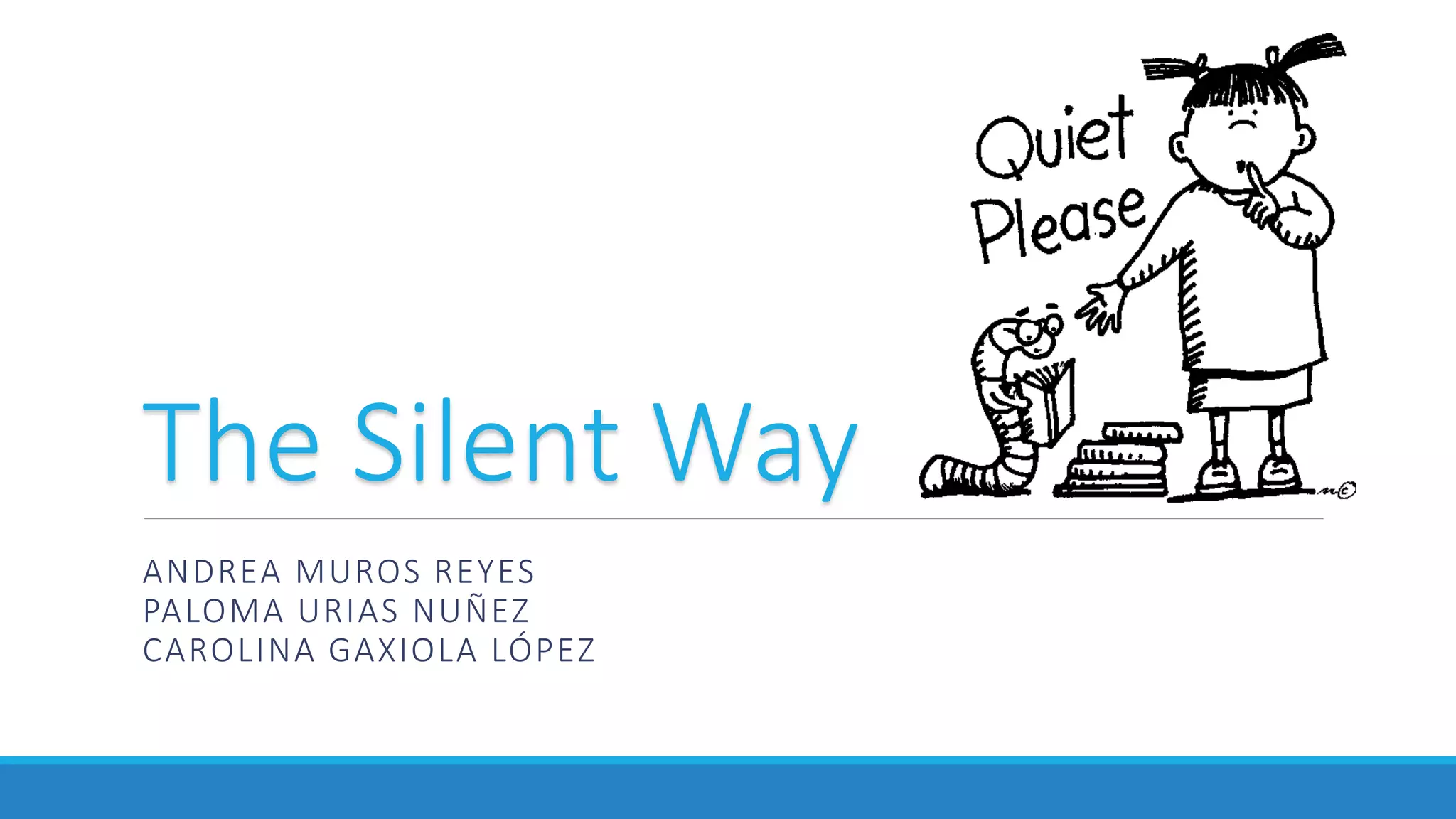
The Silent Way
ANDREA MUROS REYES
PALOMA URIAS NUÑEZ
CAROLINA GAXIOLA LÓPEZ
This method was developed by Caleb Gattegno, who
saw foreign language learning as an intellectually
engaging process of problem solving and discovery.
He claimed that learning is a process where we put
into action our inner resources to meet the challenge
at hand. Then we integrate into ourselves the “new”
knowledge that we created, and we use it as a
stepping Stone for further learning.
Important
Principles
1. The teacher must begin with a topic the students
already know, and build from that to something new.
2. The teacher remains silent and guides the learning
process while responsibility for working out the rules falls
on the learner.
3. Silence is a tool, it helps to Foster autonomy and
initiative.
4. In silence, the student concentrates on the task to be
accomplished.
5. Language is not learned by repeating after a model.
6. Native language and translation is not allowed.
7. This method involves a lot of body language and mimics,
as well as posters and charts.
8. Teacher does not correct mistakes.
The role of
the teacher
1. The teacher is a technician or an engineer who
facilitates learning.
2. Neutral observer.
3. The teacher is silent, his presence in the
classroom is limited to providing a model of the
language that the students are going to work on.
4. Sequence and timing are more important than in
many kinds of language teaching classes, and
teachers’ sensitivity to and management of them is
critical.
5. The teacher uses gestures, charts, and
manipulatives in order to elicit and shape student
responses and so must be both facile and creative
The role of
the student
1. The student is obligated to pay close attention.
2. Independent learners must depend and use what
they already know.
3. Autonomous leaners choose proper expressions
ina given set of circumstances and situations.
4. Must have the ability to choose intelligently.
5. Learners are expected to interact with each
other and suggest alternatives to each other
6. they must learn to work cooperatively rather tan
competitively.
The silent way

The silent way

  • 1.
    The Silent Way ANDREAMUROS REYES PALOMA URIAS NUÑEZ CAROLINA GAXIOLA LÓPEZ
  • 2.
    This method wasdeveloped by Caleb Gattegno, who saw foreign language learning as an intellectually engaging process of problem solving and discovery. He claimed that learning is a process where we put into action our inner resources to meet the challenge at hand. Then we integrate into ourselves the “new” knowledge that we created, and we use it as a stepping Stone for further learning.
  • 3.
    Important Principles 1. The teachermust begin with a topic the students already know, and build from that to something new. 2. The teacher remains silent and guides the learning process while responsibility for working out the rules falls on the learner. 3. Silence is a tool, it helps to Foster autonomy and initiative. 4. In silence, the student concentrates on the task to be accomplished. 5. Language is not learned by repeating after a model. 6. Native language and translation is not allowed. 7. This method involves a lot of body language and mimics, as well as posters and charts. 8. Teacher does not correct mistakes.
  • 4.
    The role of theteacher 1. The teacher is a technician or an engineer who facilitates learning. 2. Neutral observer. 3. The teacher is silent, his presence in the classroom is limited to providing a model of the language that the students are going to work on. 4. Sequence and timing are more important than in many kinds of language teaching classes, and teachers’ sensitivity to and management of them is critical. 5. The teacher uses gestures, charts, and manipulatives in order to elicit and shape student responses and so must be both facile and creative
  • 5.
    The role of thestudent 1. The student is obligated to pay close attention. 2. Independent learners must depend and use what they already know. 3. Autonomous leaners choose proper expressions ina given set of circumstances and situations. 4. Must have the ability to choose intelligently. 5. Learners are expected to interact with each other and suggest alternatives to each other 6. they must learn to work cooperatively rather tan competitively.