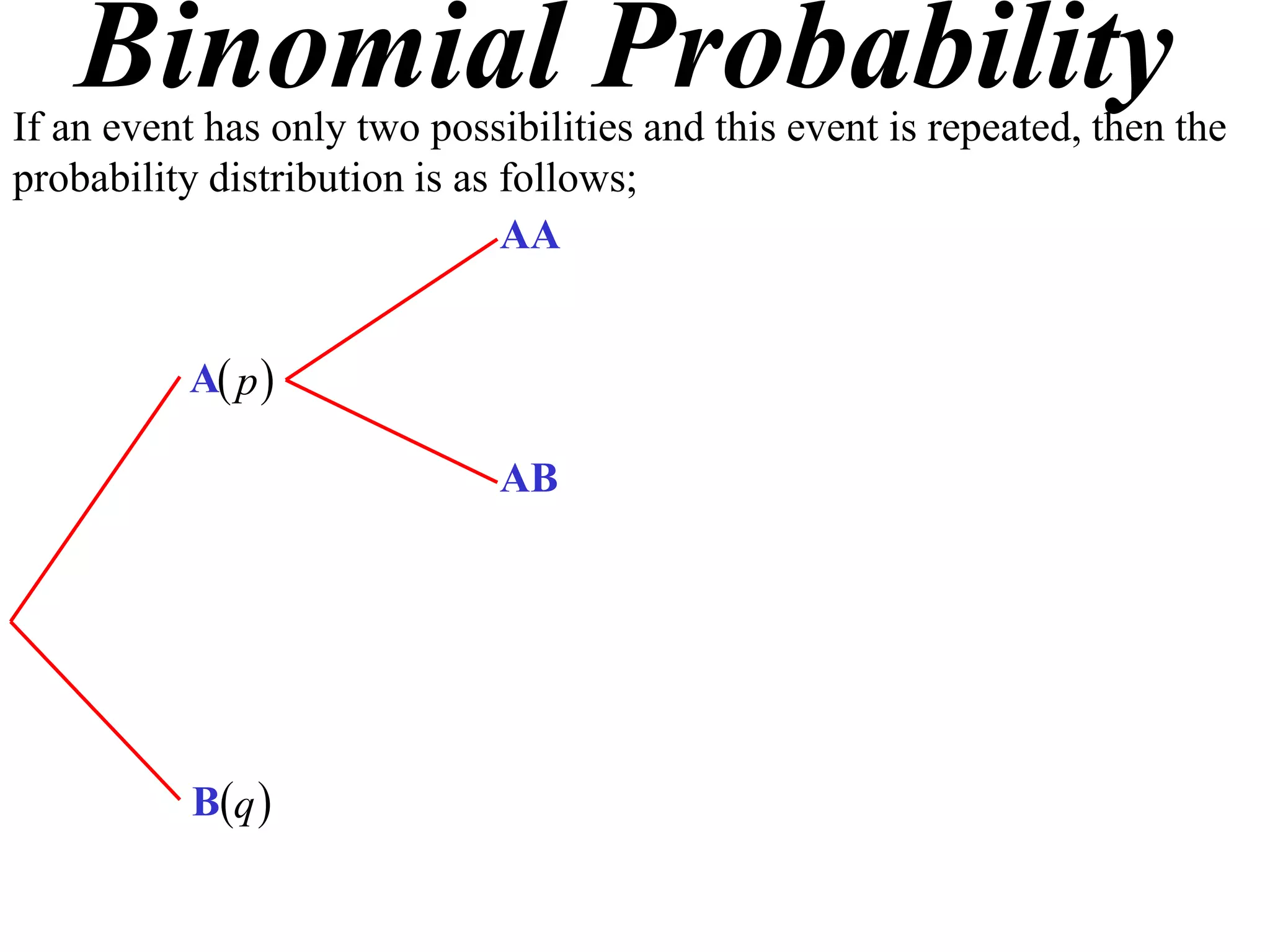
Binomial Probability
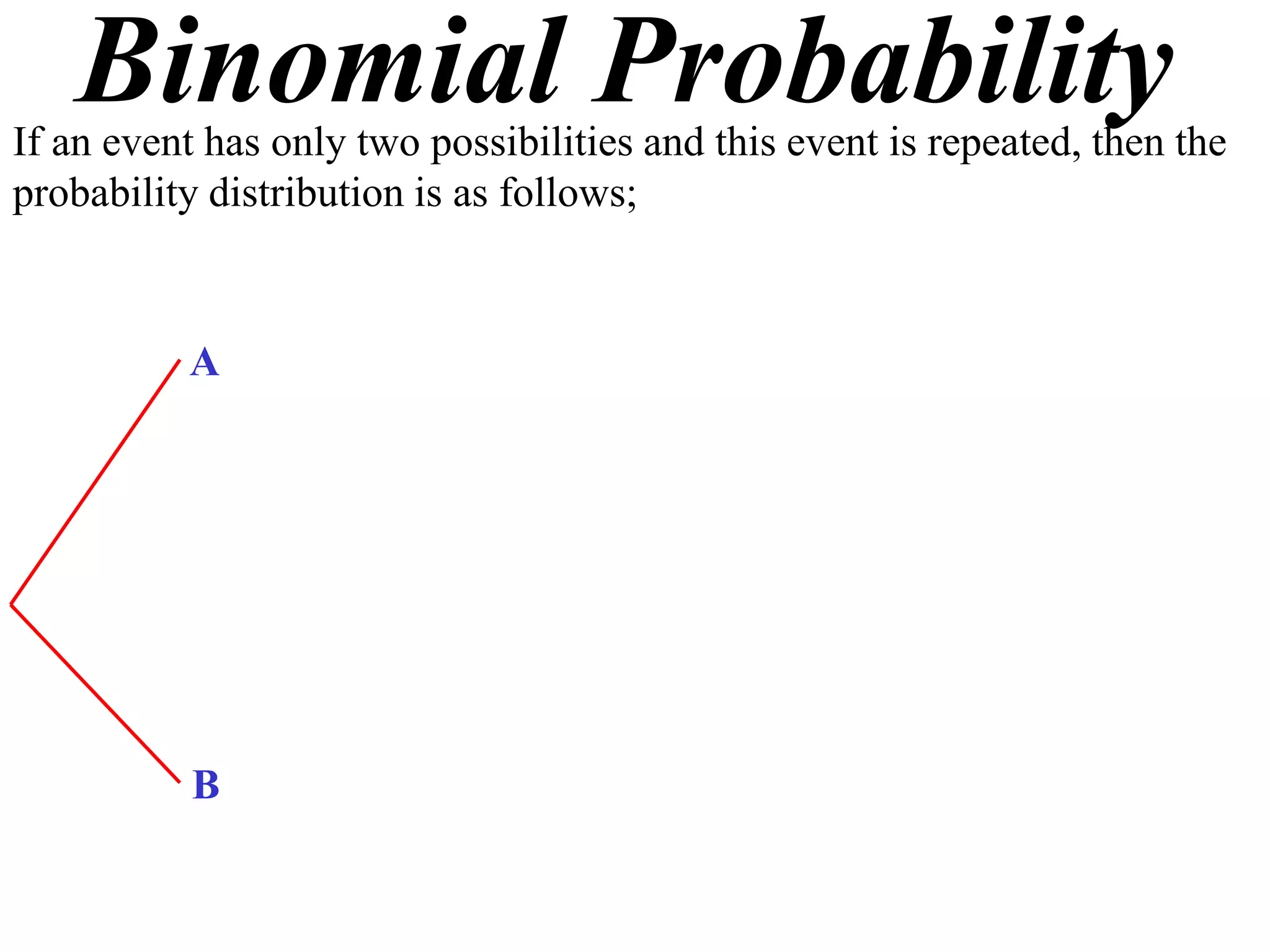
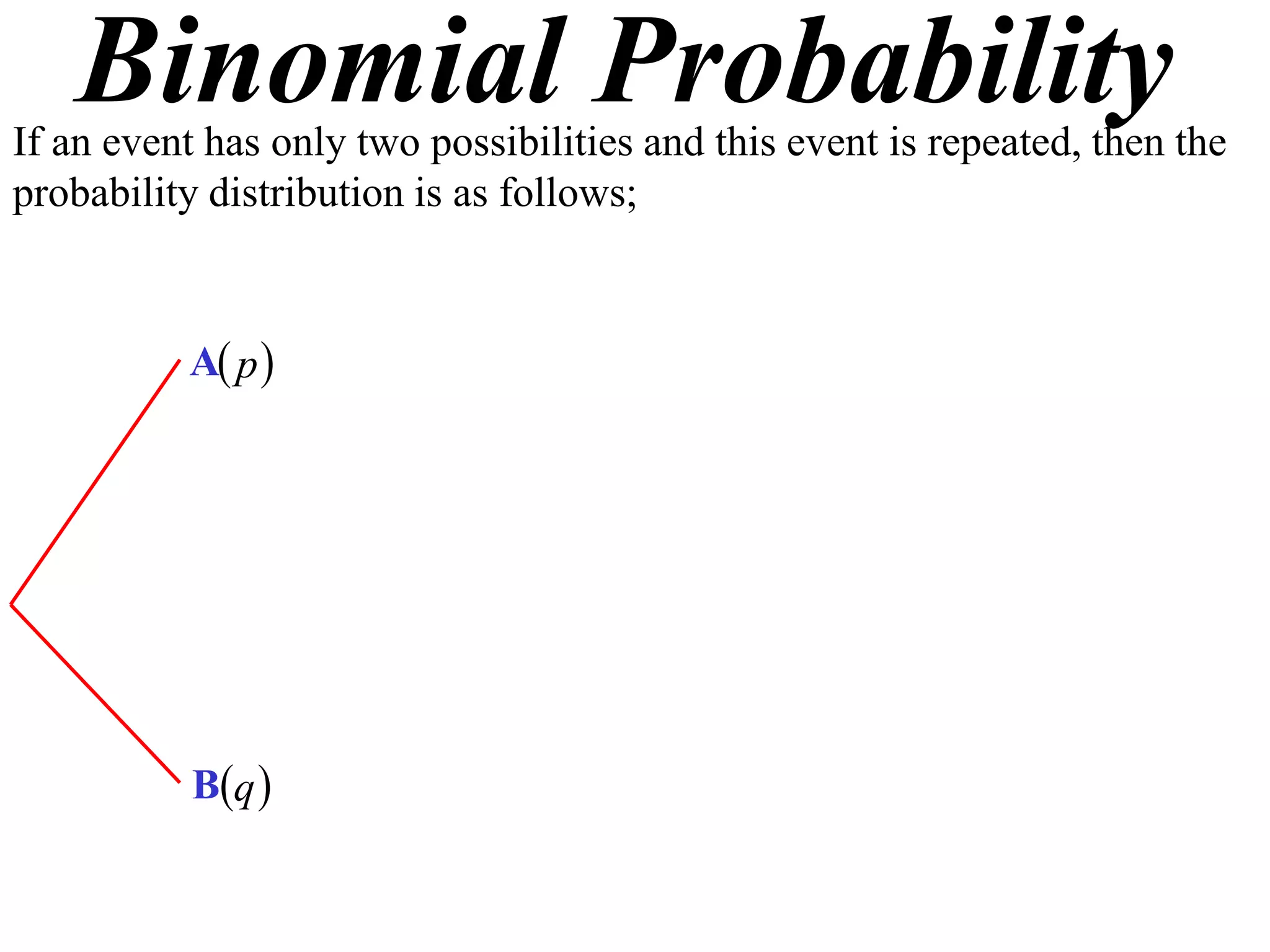
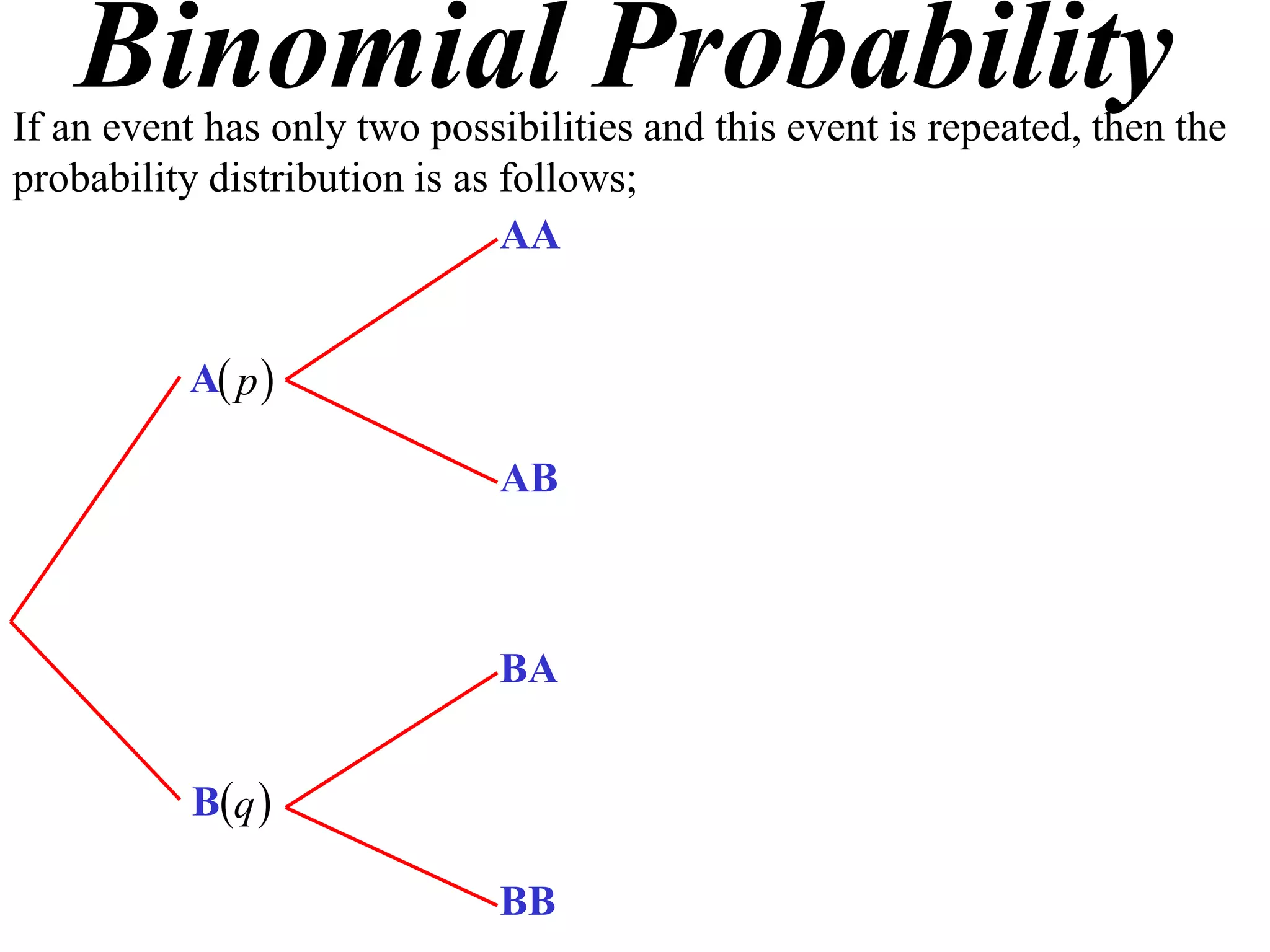
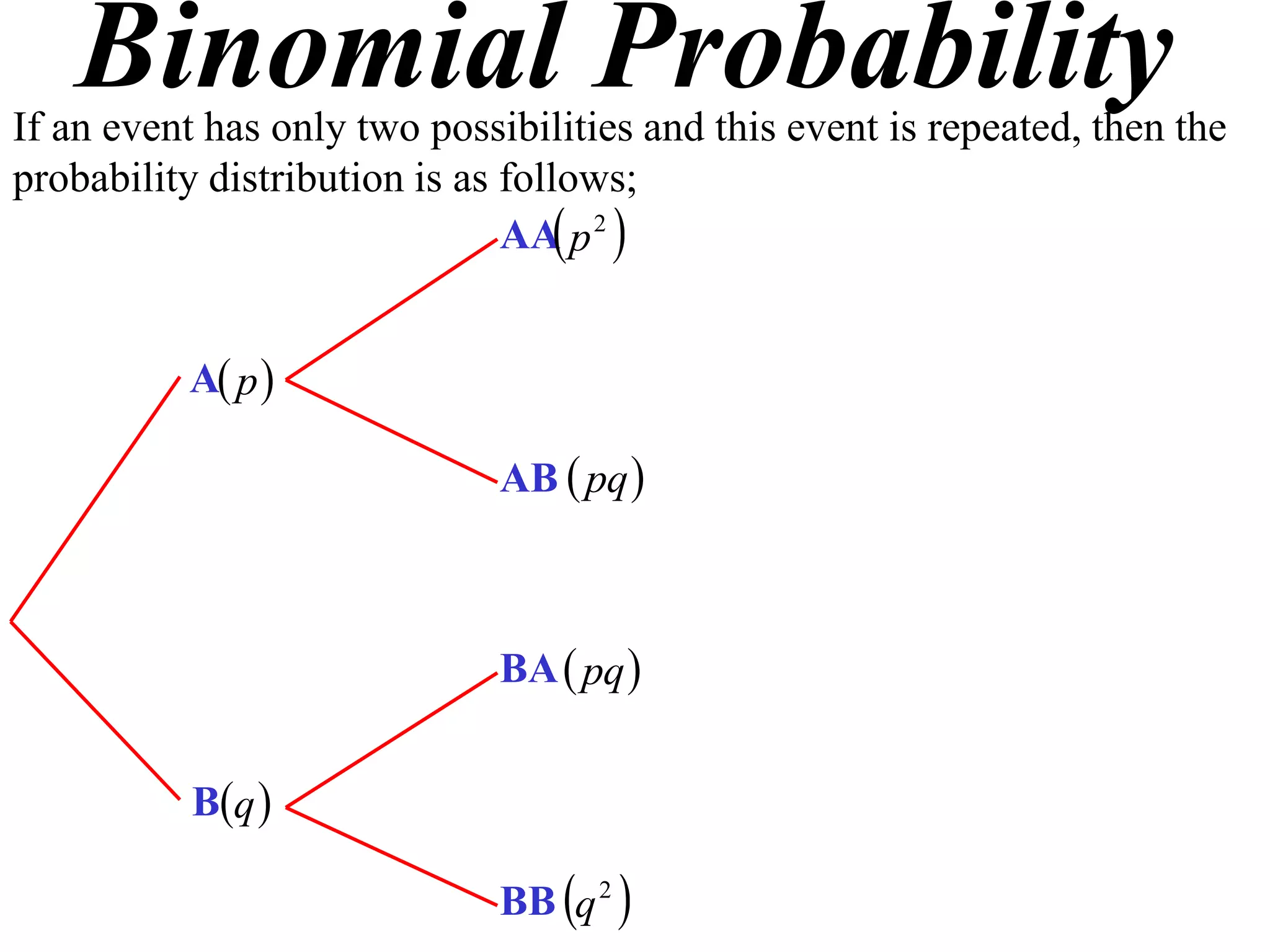
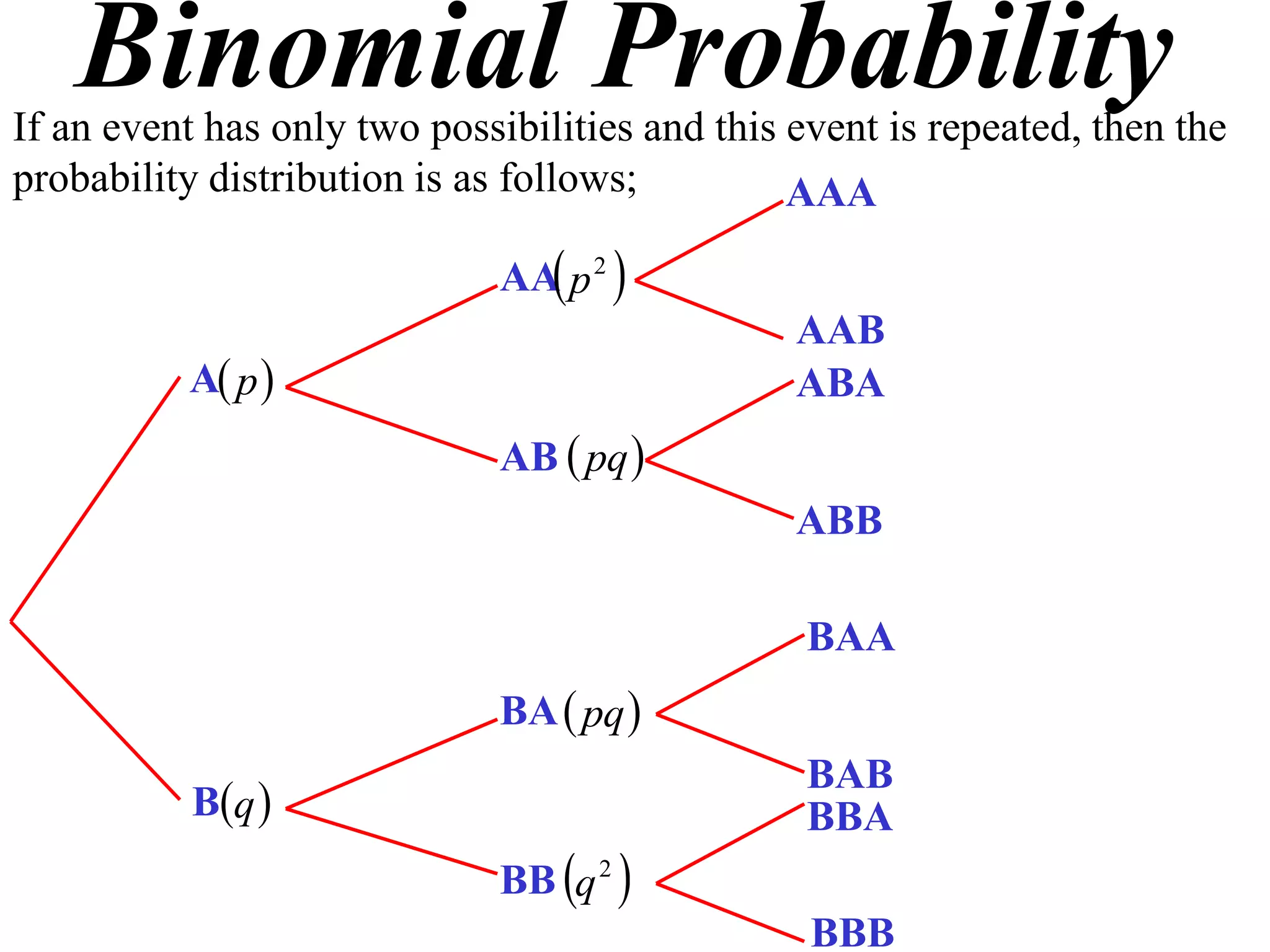
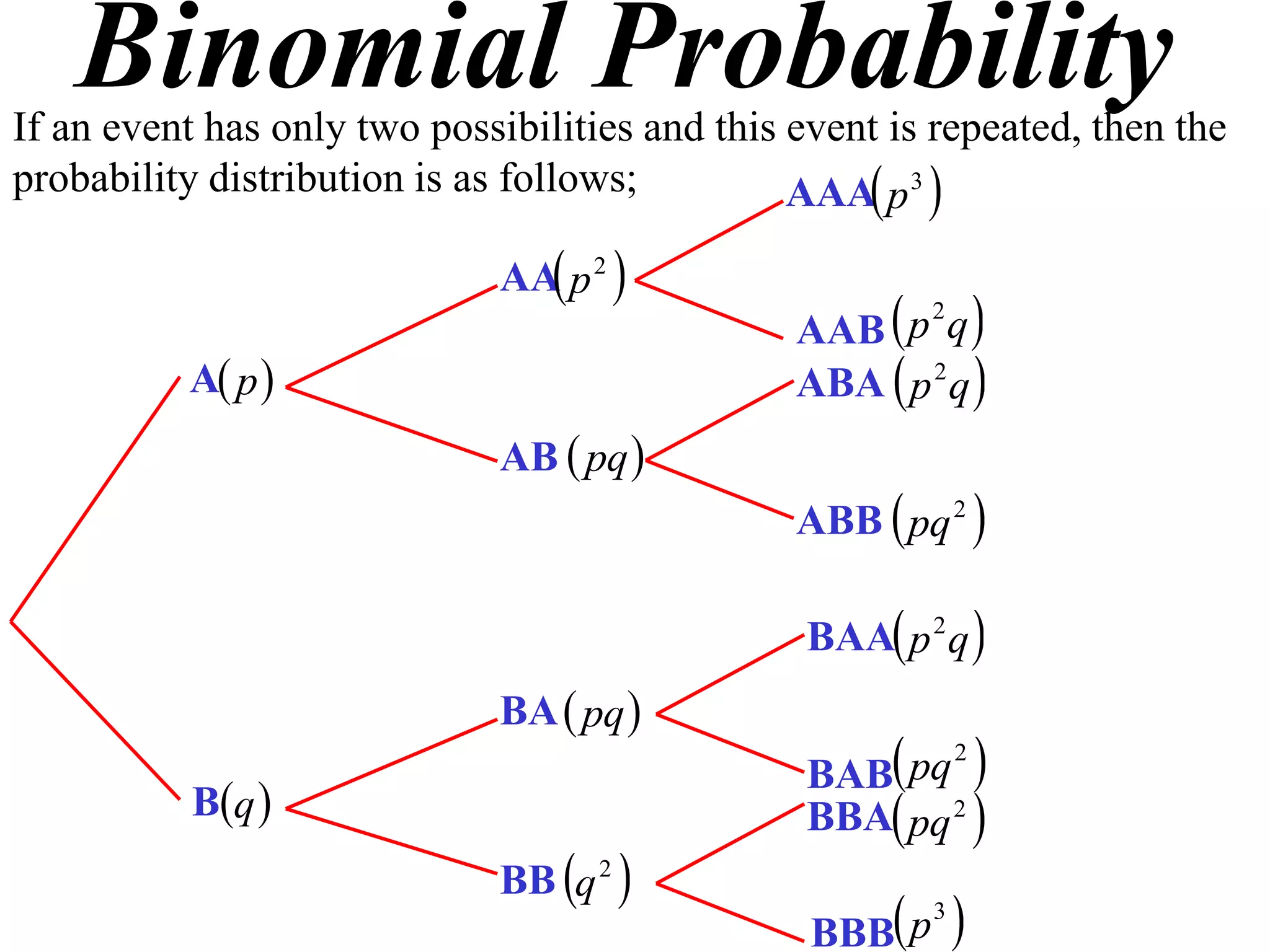
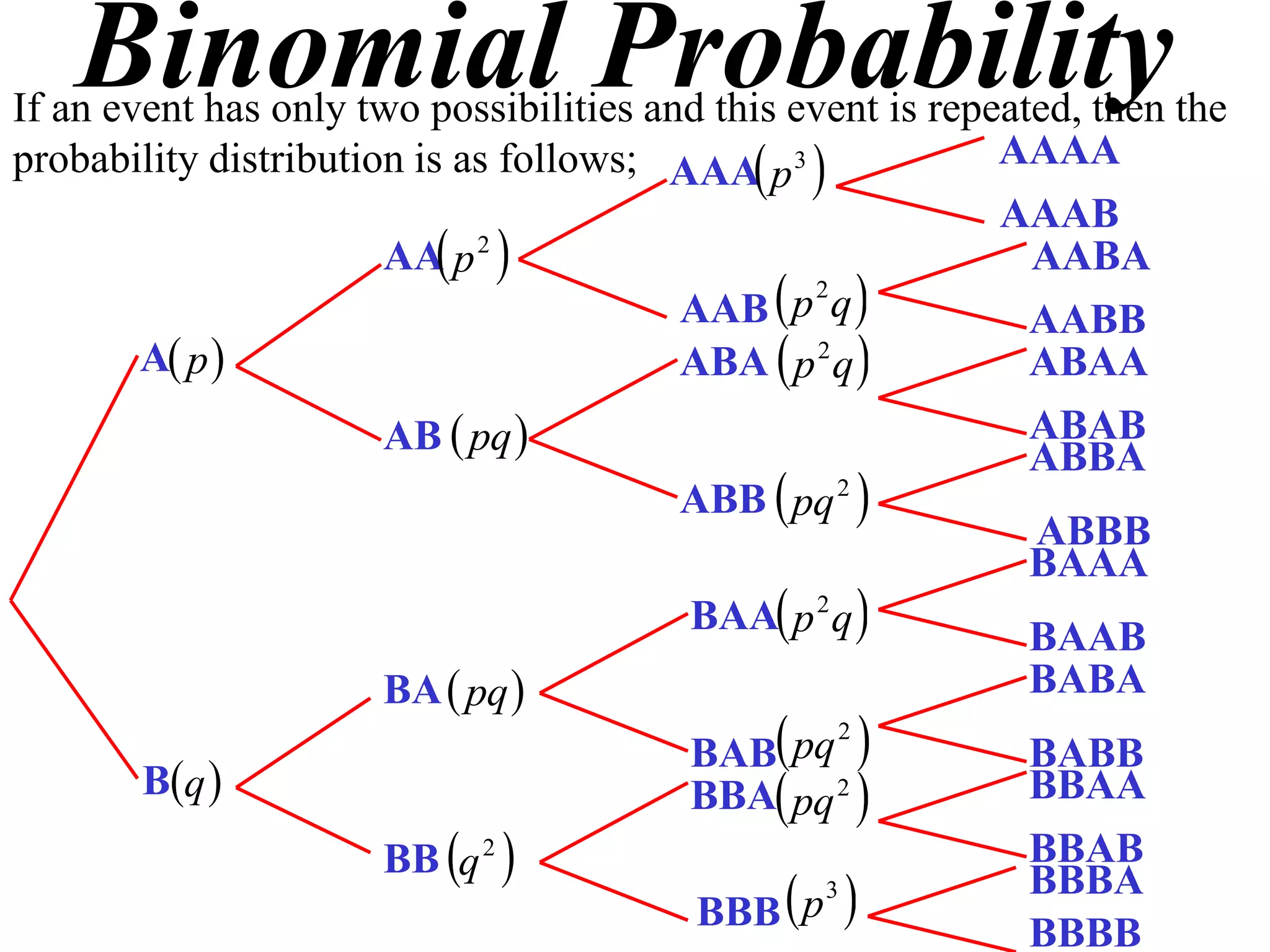
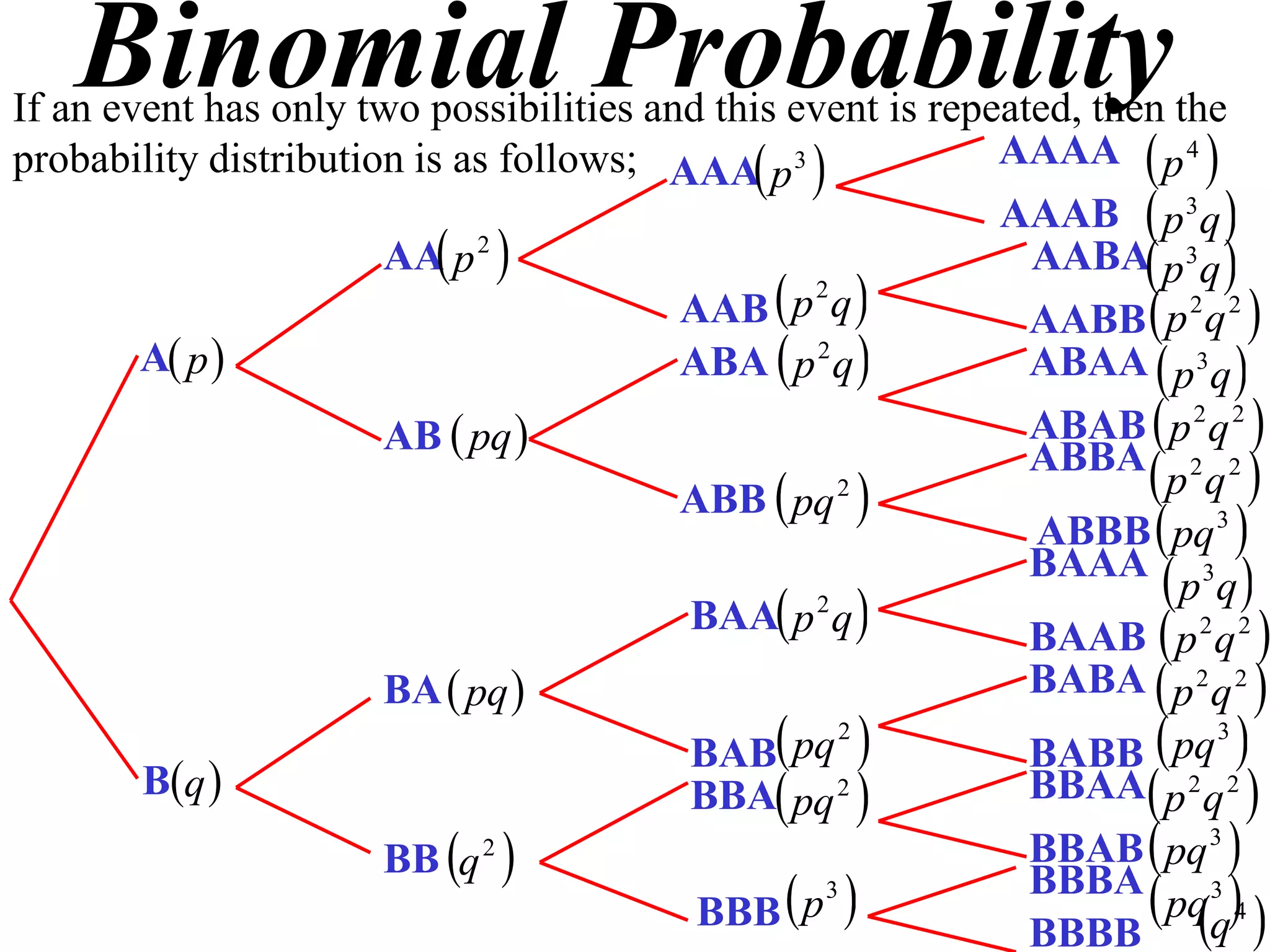
If an event has only two possibilities and this event is repeated, then the
probability distribution is as follows;
Binomial Probability
If an event has only two possibilities and this event is repeated, then the
probability distribution is as follows;


          A


           B
Binomial Probability
If an event has only two possibilities and this event is repeated, then the
probability distribution is as follows;


          A p 


           Bq 
Binomial Probability
If an event has only two possibilities and this event is repeated, then the
probability distribution is as follows;
                               AA


          A p 

                              AB


           Bq 
Binomial Probability
If an event has only two possibilities and this event is repeated, then the
probability distribution is as follows;
                               AA


          A p 

                              AB


                              BA


           Bq 

                              BB
Binomial Probability
If an event has only two possibilities and this event is repeated, then the
probability distribution is as follows;
                               AA p 2 


          A p 

                              AB  pq 


                              BA  pq 


           Bq 

                              BB q 2 
Binomial Probability
If an event has only two possibilities and this event is repeated, then the
probability distribution is as follows;         AAA

                              AA p 2 
                                                AAB
          A p                                 ABA
                              AB  pq 
                                                ABB

                                                 BAA
                              BA  pq 
                                                 BAB
           Bq                                  BBA
                              BB q 2 
                                                 BBB
Binomial Probability
If an event has only two possibilities and this event is repeated, then the
probability distribution is as follows;         AAA p 3 

                              AA p 2 
                                                AAB  p q 
                                                       2

          A p                                 ABA  p 2 q 
                              AB  pq 
                                                ABB  pq 2 

                                                 BAA p 2 q 
                              BA  pq 
                                                 BAB pq 
                                                             2

           Bq                                  BBA pq    2


                              BB q 2 
                                                 BBB p 
                                                         3
Binomial Probability
If an event has only two possibilities and this event is repeated, then the
probability distribution is as follows; AAA p 3            AAAA
                                                             AAAB
                       AA p 
                             2
                                                               AABA
                                         AAB  p q 
                                                 2
                                                               AABB
        A p                            ABA  p q 
                                                  2
                                                               ABAA
                       AB  pq                                ABAB
                                                               ABBA
                                         ABB  pq 2 
                                                               ABBB
                                                               BAAA
                                         BAA p 2 q           BAAB
                       BA  pq                                BABA
                                         BAB pq 
                                                  2
                                                              BABB
       Bq                              BBA pq 2           BBAA
                      BB q 2                                BBAB
                                          BBB  p 
                                                  3           BBBA
                                                              BBBB
Binomial Probability
If an event has only two possibilities and this event is repeated, then the
probability distribution is as follows; AAA p 3            AAAA  p 4 
                                                             AAAB  p 3q 
                       AA p 2                                AABA p 3q 
                                         AAB  p q            AABB  p 2 q 2 
                                                 2

        A p                            ABA  p 2 q          ABAA  p 3q 
                       AB  pq                                ABAB  p 2 q 2 
                                         ABB  pq 2                  p q 
                                                               ABBA 2 2
                                                               ABBB  pq 3 

                                         BAA p q 
                                                               BAAA 3
                                                                       p q
                                                               BAAB  p 2 q 2 
                                                  2


                       BA  pq                                BABA  p 2 q 2 
                                          BAB pq             BABB  pq 
                                                   2                         3

        Bq                              BBA pq 2           BBAA p q 
                                                                         2       2


                       BB q   2
                                                              BBAB  pq    3


                                          BBB  p                   pqq 
                                                   3           BBBA          3
                                                                                 4
                                                               BBBB
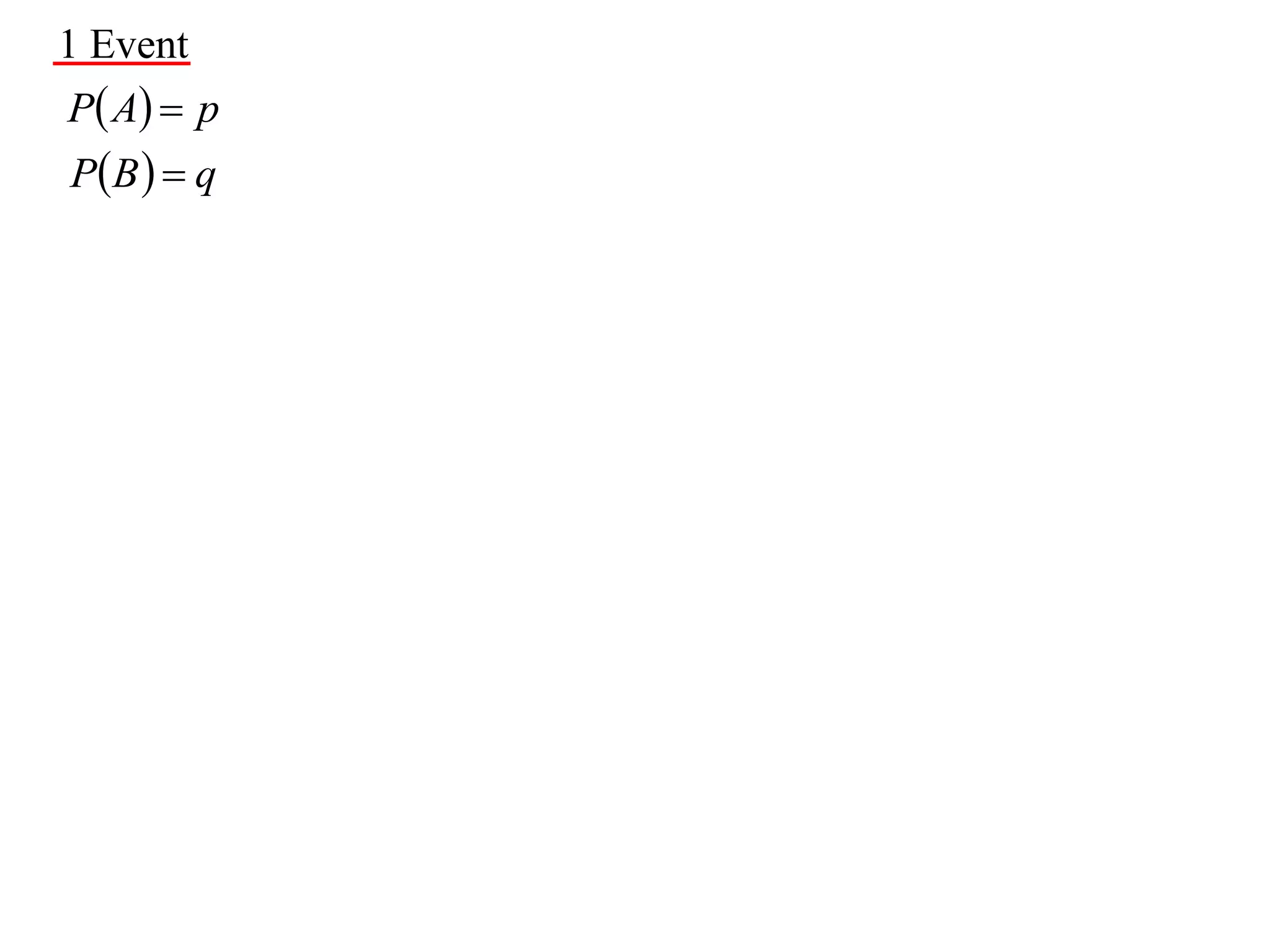
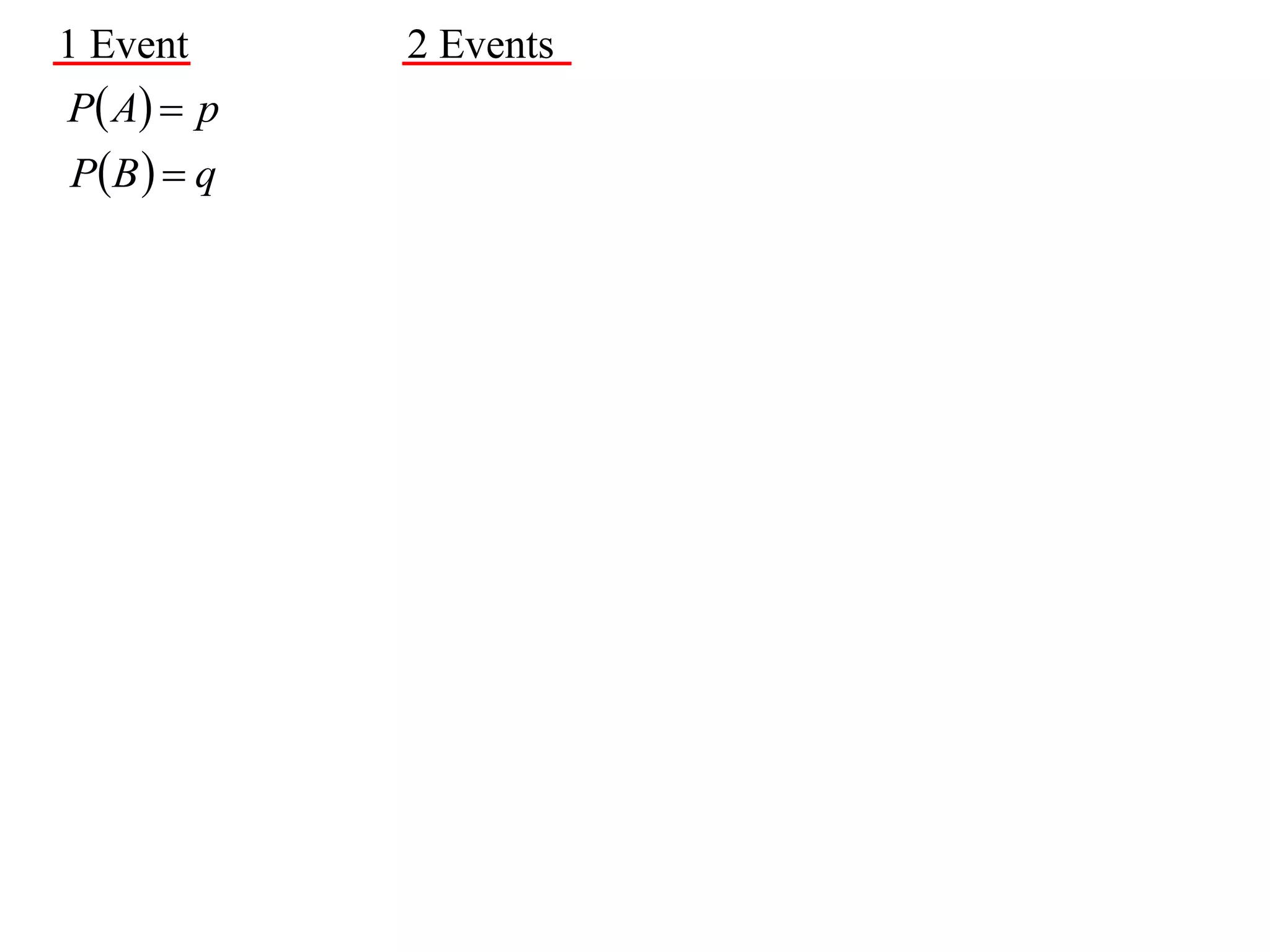
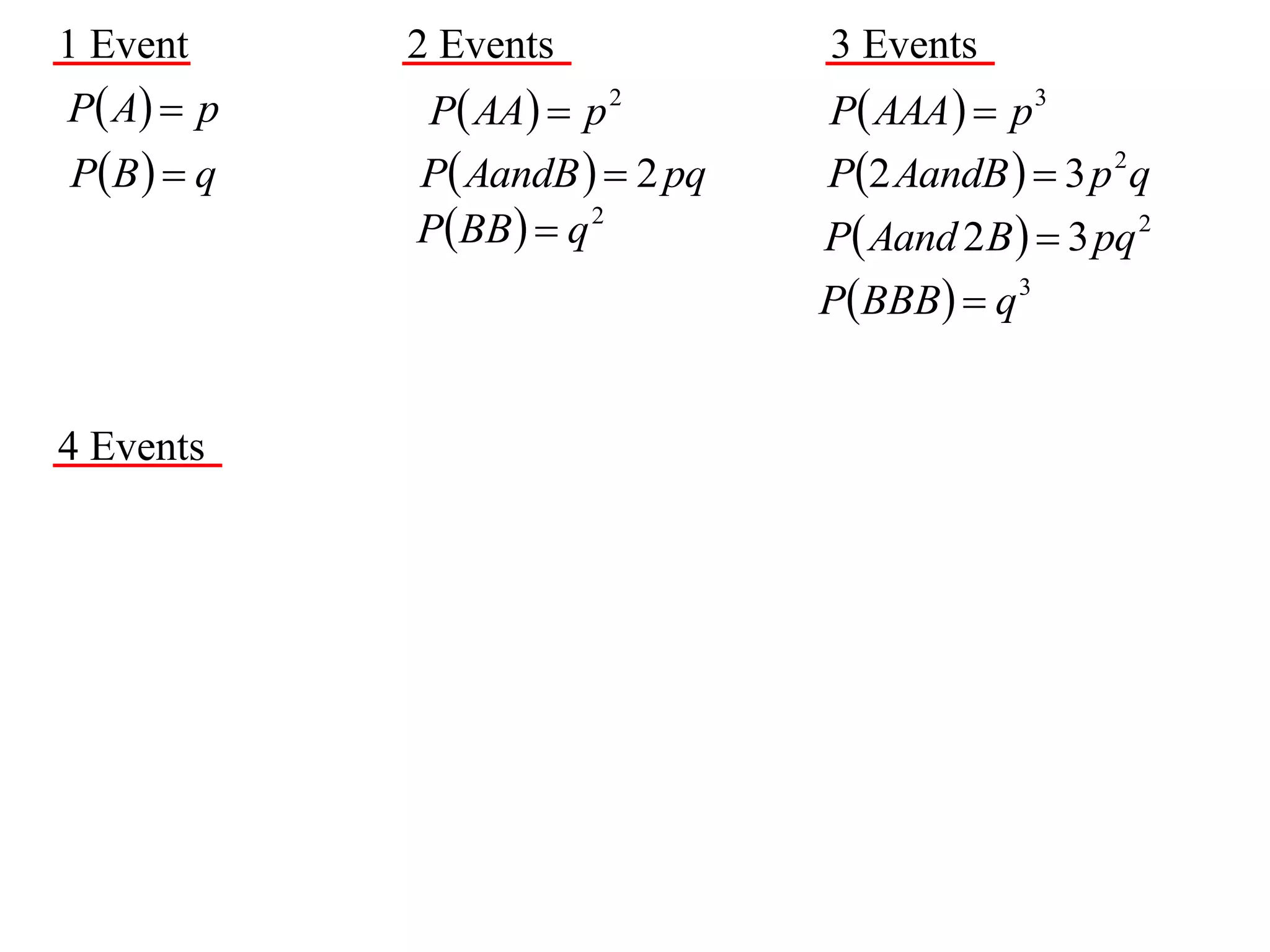
1 Event
1 Event
P  A  p
P B   q
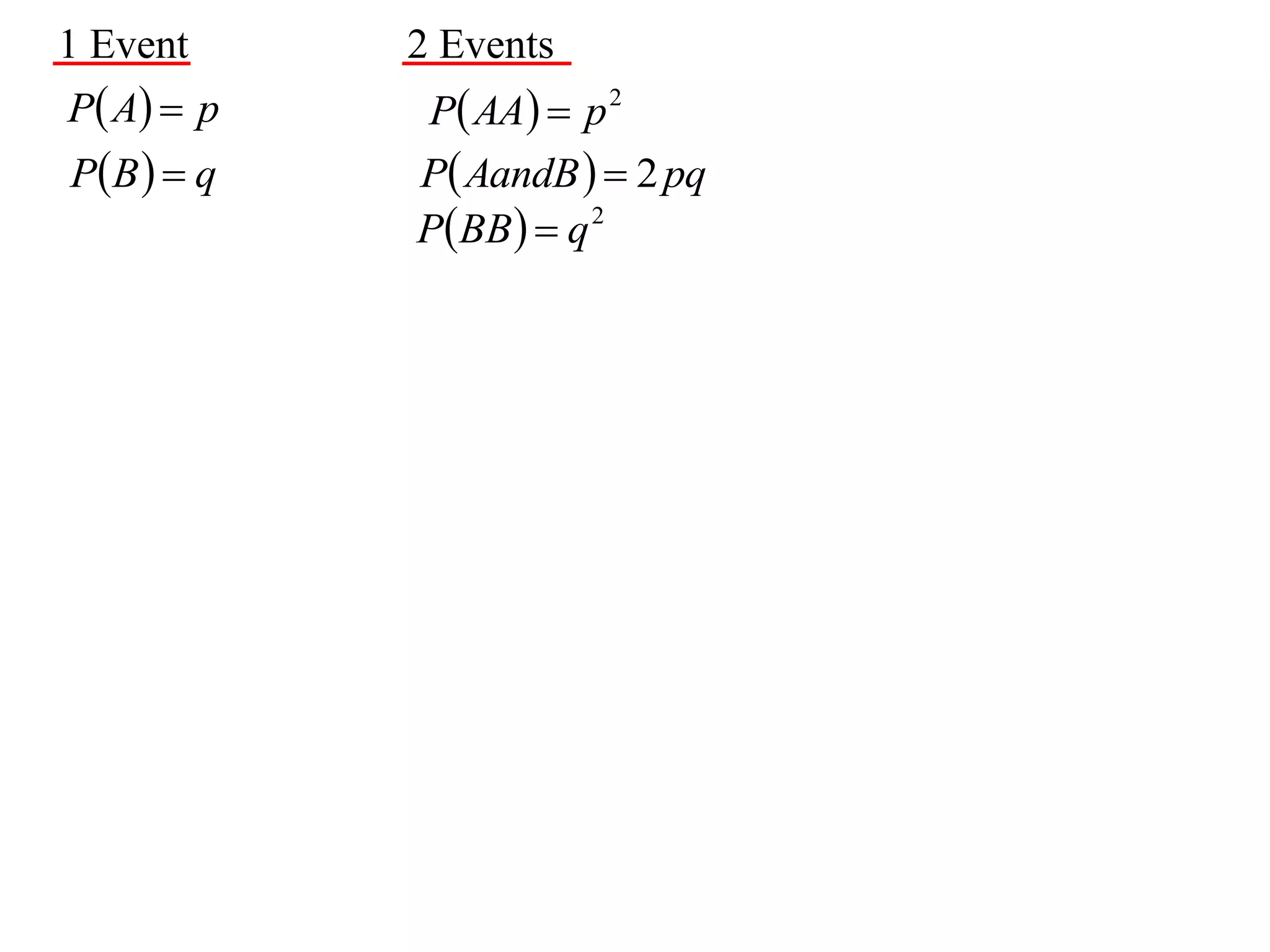
1 Event      2 Events
P  A  p
P B   q
1 Event      2 Events
P  A  p   P AA  p 2
P B   q   P AandB   2 pq
             PBB   q 2
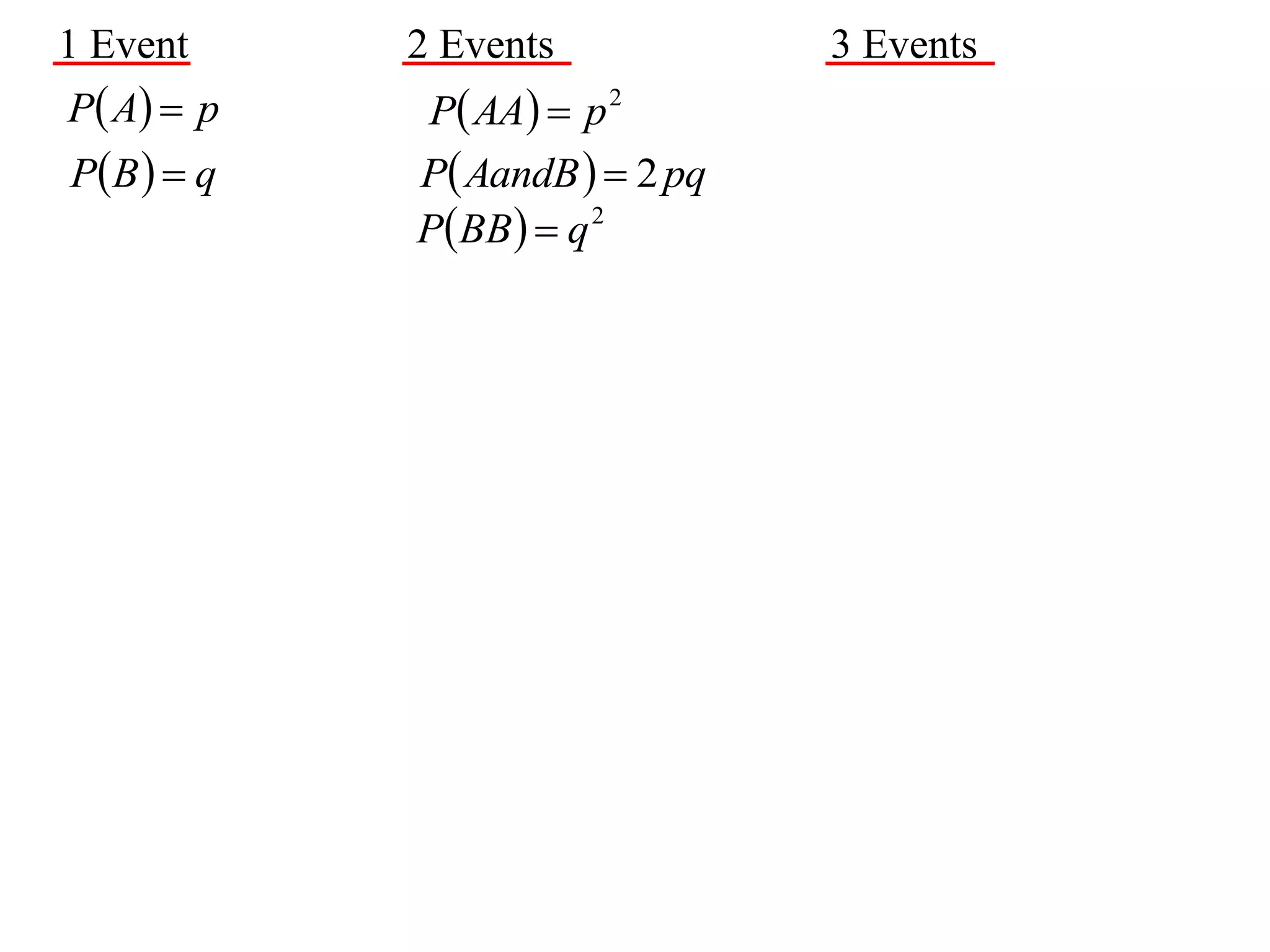
1 Event      2 Events            3 Events
P  A  p   P AA  p 2
P B   q   P AandB   2 pq
             PBB   q 2
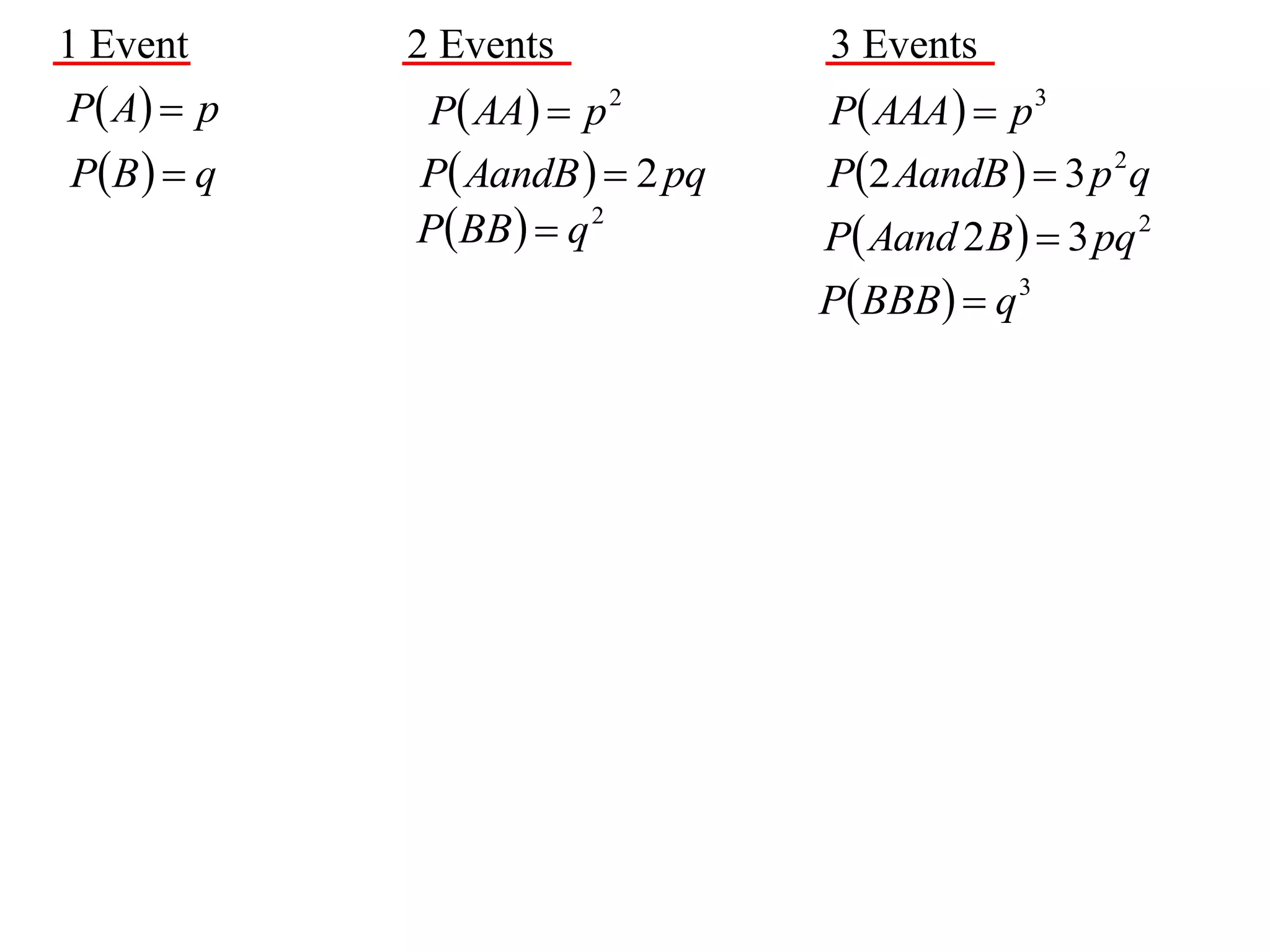
1 Event      2 Events            3 Events
P  A  p   P AA  p 2        P AAA   p 3
P B   q   P AandB   2 pq   P2 AandB   3 p 2 q
             PBB   q 2        P Aand 2 B   3 pq 2
                                 PBBB  q 3
1 Event      2 Events            3 Events
P  A  p   P AA  p 2        P AAA   p 3
P B   q   P AandB   2 pq   P2 AandB   3 p 2 q
             PBB   q 2        P Aand 2 B   3 pq 2
                                 PBBB  q 3


4 Events
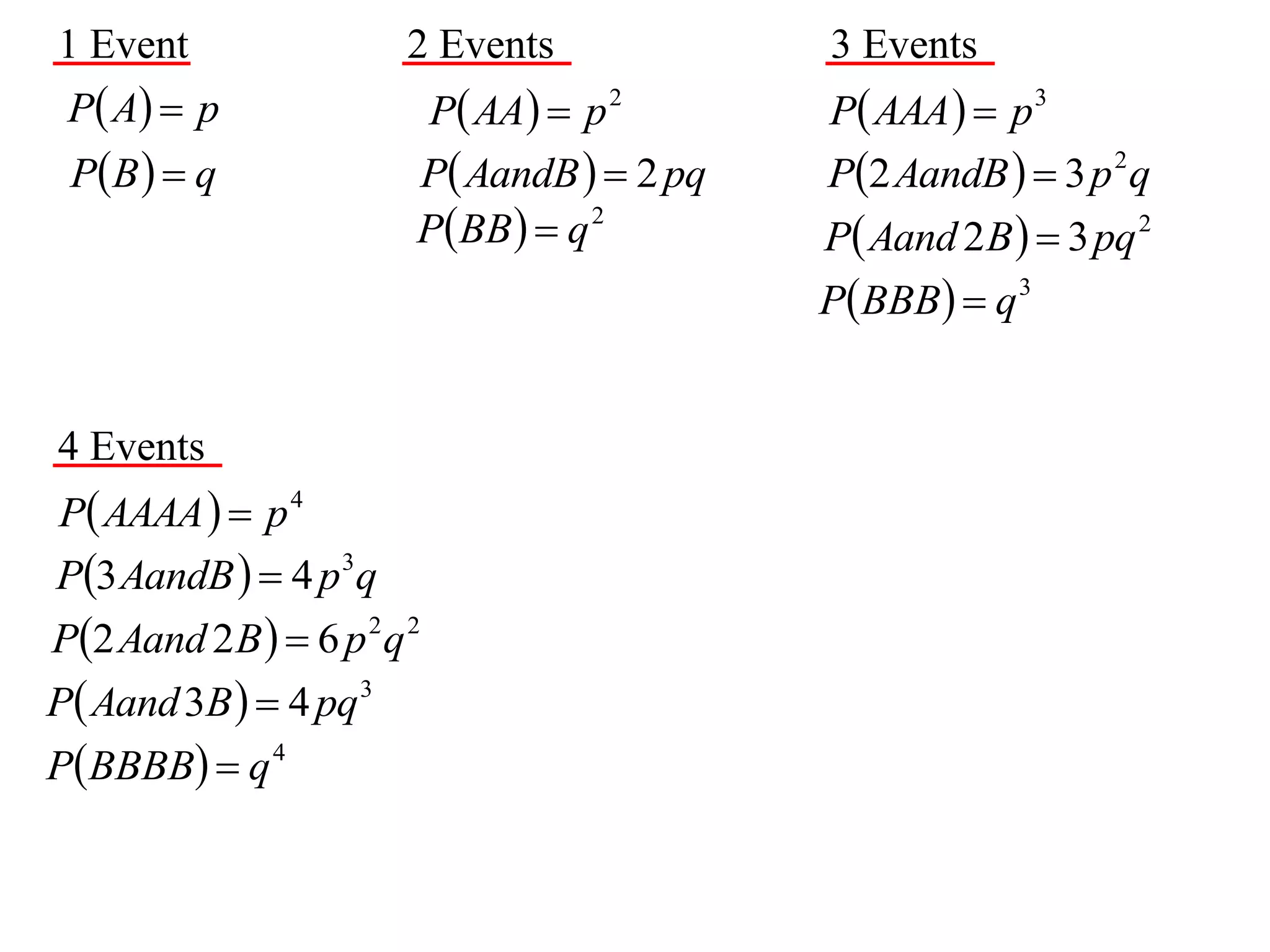
1 Event                  2 Events            3 Events
 P  A  p              P AA  p 2        P AAA   p 3
 P B   q              P AandB   2 pq   P2 AandB   3 p 2 q
                         PBB   q 2        P Aand 2 B   3 pq 2
                                             PBBB  q 3


4 Events
P AAAA   p 4
P3 AandB   4 p 3q
P2 Aand 2 B   6 p 2 q 2
P Aand 3B   4 pq 3
PBBBB  q 4
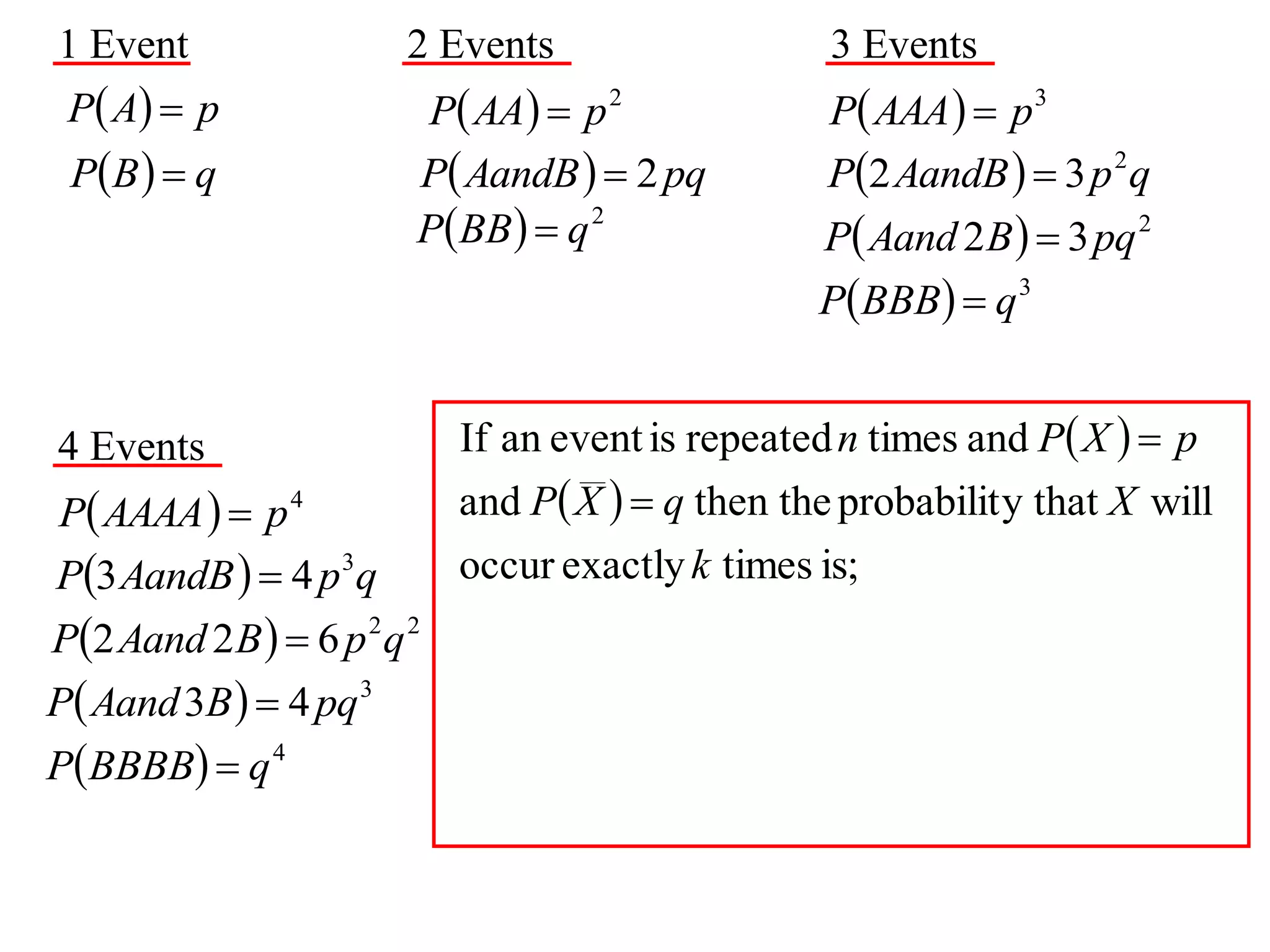
1 Event                2 Events                   3 Events
 P  A  p            P AA  p 2              P AAA   p 3
 P B   q            P AandB   2 pq         P2 AandB   3 p 2 q
                       PBB   q 2              P Aand 2 B   3 pq 2
                                                 PBBB  q 3


4 Events                  If an event is repeated n times and P X   p
P AAAA   p 4            and P X   q then the probabilit y that X will
P3 AandB   4 p 3q       occur exactly k times is;
P2 Aand 2 B   6 p 2 q 2
P Aand 3B   4 pq 3
PBBBB  q 4
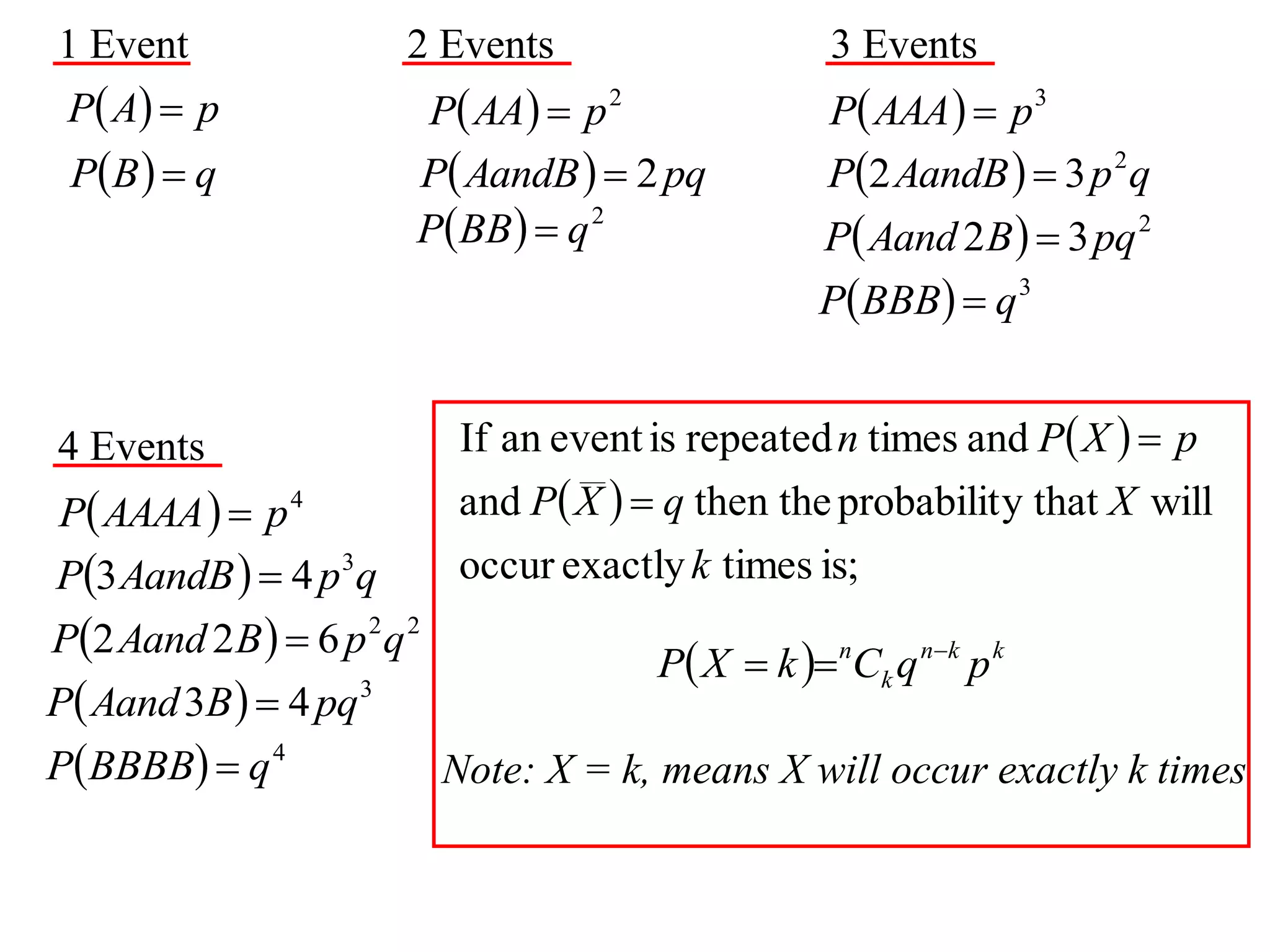
1 Event               2 Events                   3 Events
 P  A  p            P AA  p 2             P AAA   p 3
 P B   q            P AandB   2 pq        P2 AandB   3 p 2 q
                       PBB   q 2             P Aand 2 B   3 pq 2
                                                PBBB  q 3


4 Events                  If an event is repeated n times and P X   p
P AAAA   p 4             and P X   q then the probabilit y that X will
P3 AandB   4 p 3q        occur exactly k times is;
P2 Aand 2 B   6 p 2 q 2
                                        P X  k  nCk q nk p k
P Aand 3B   4 pq 3
PBBBB  q 4              Note: X = k, means X will occur exactly k times
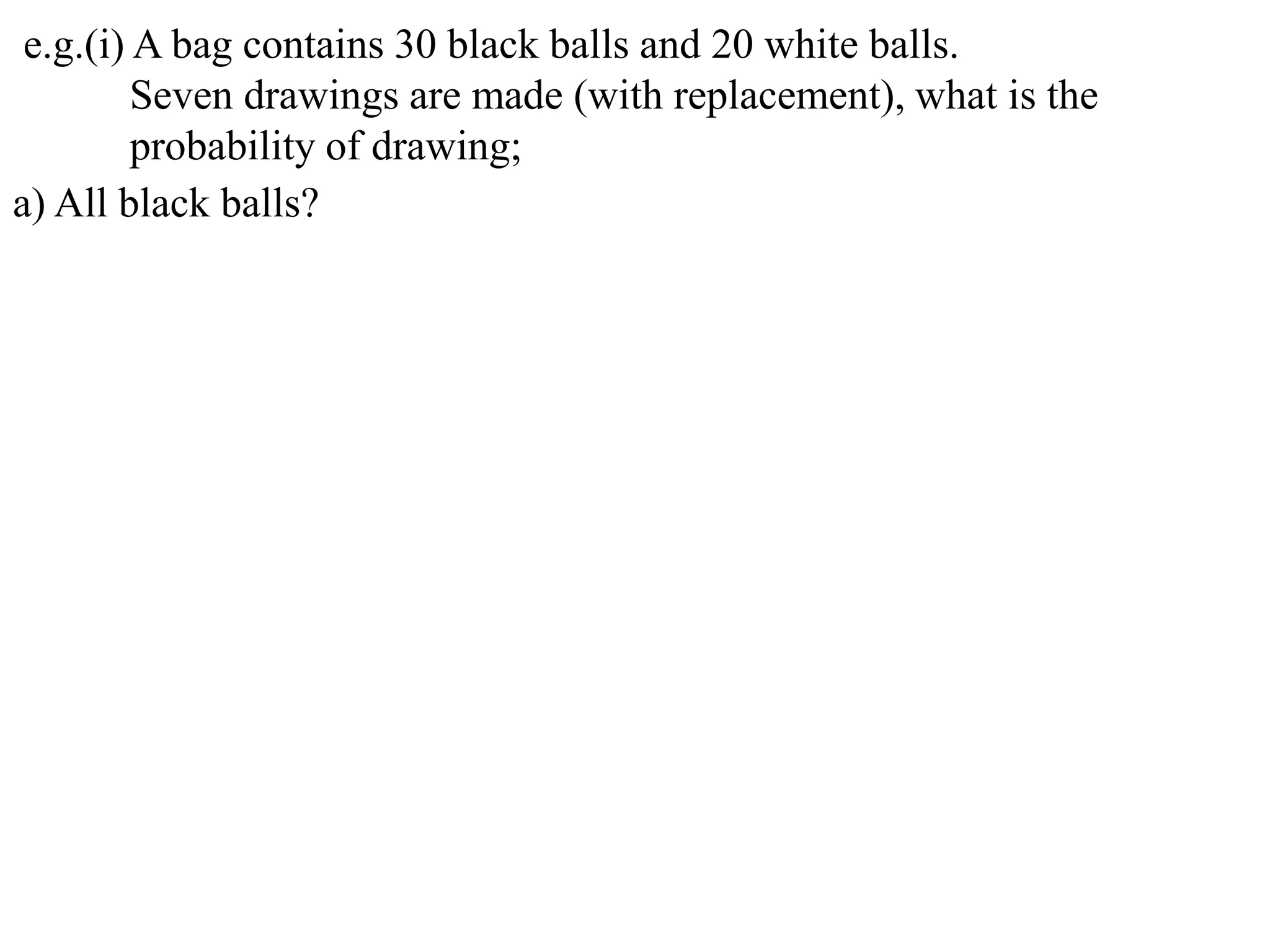
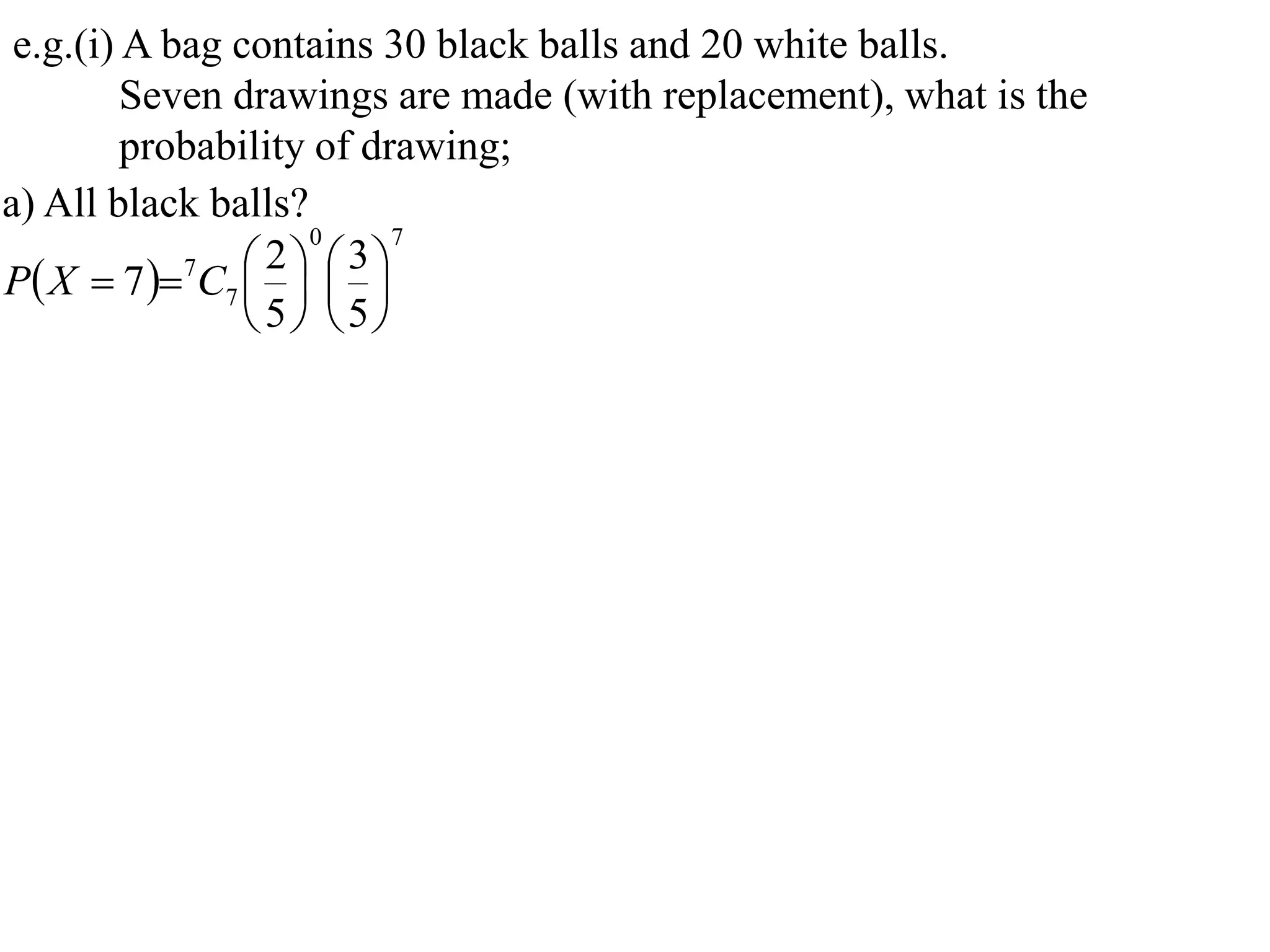
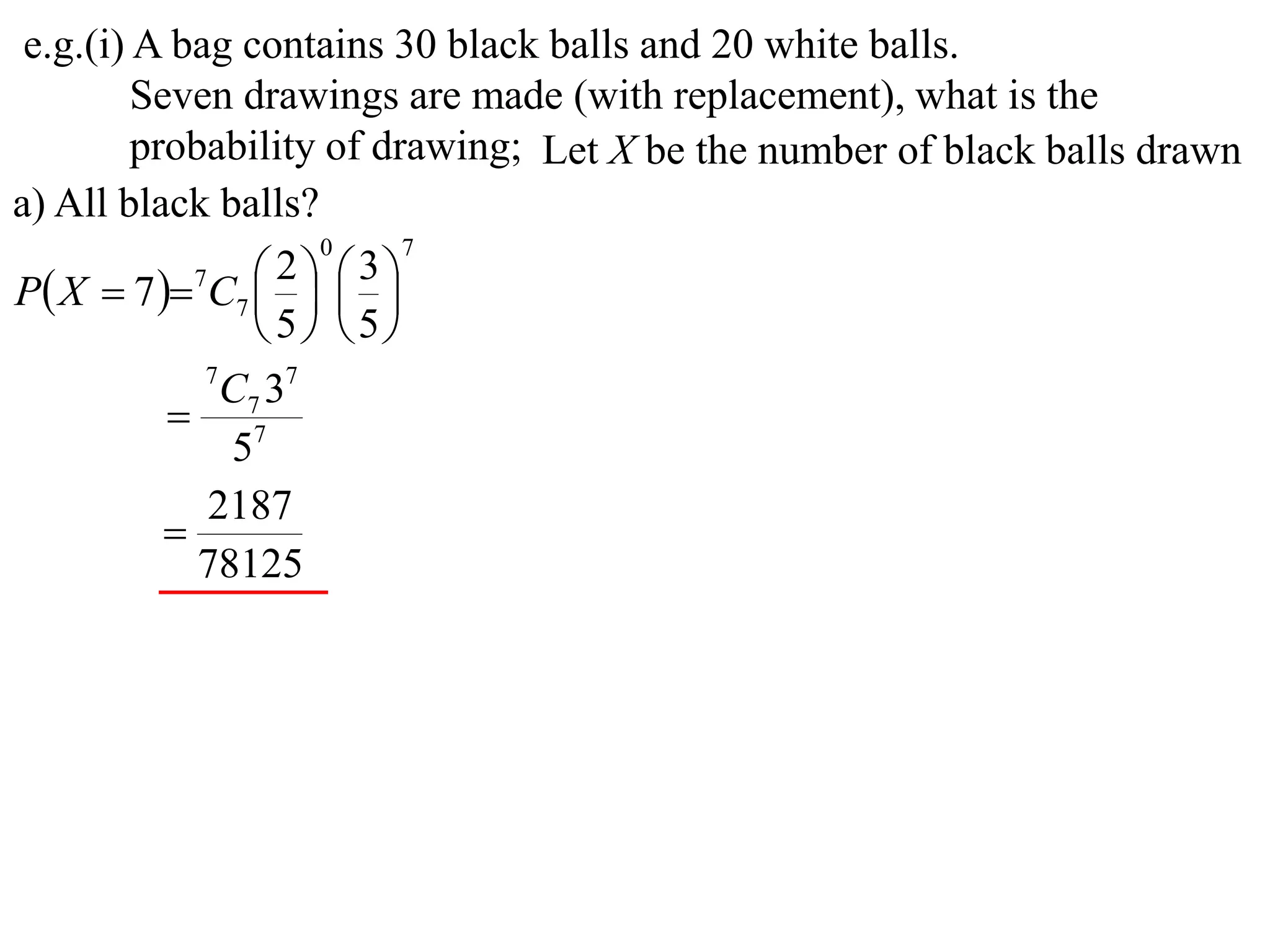
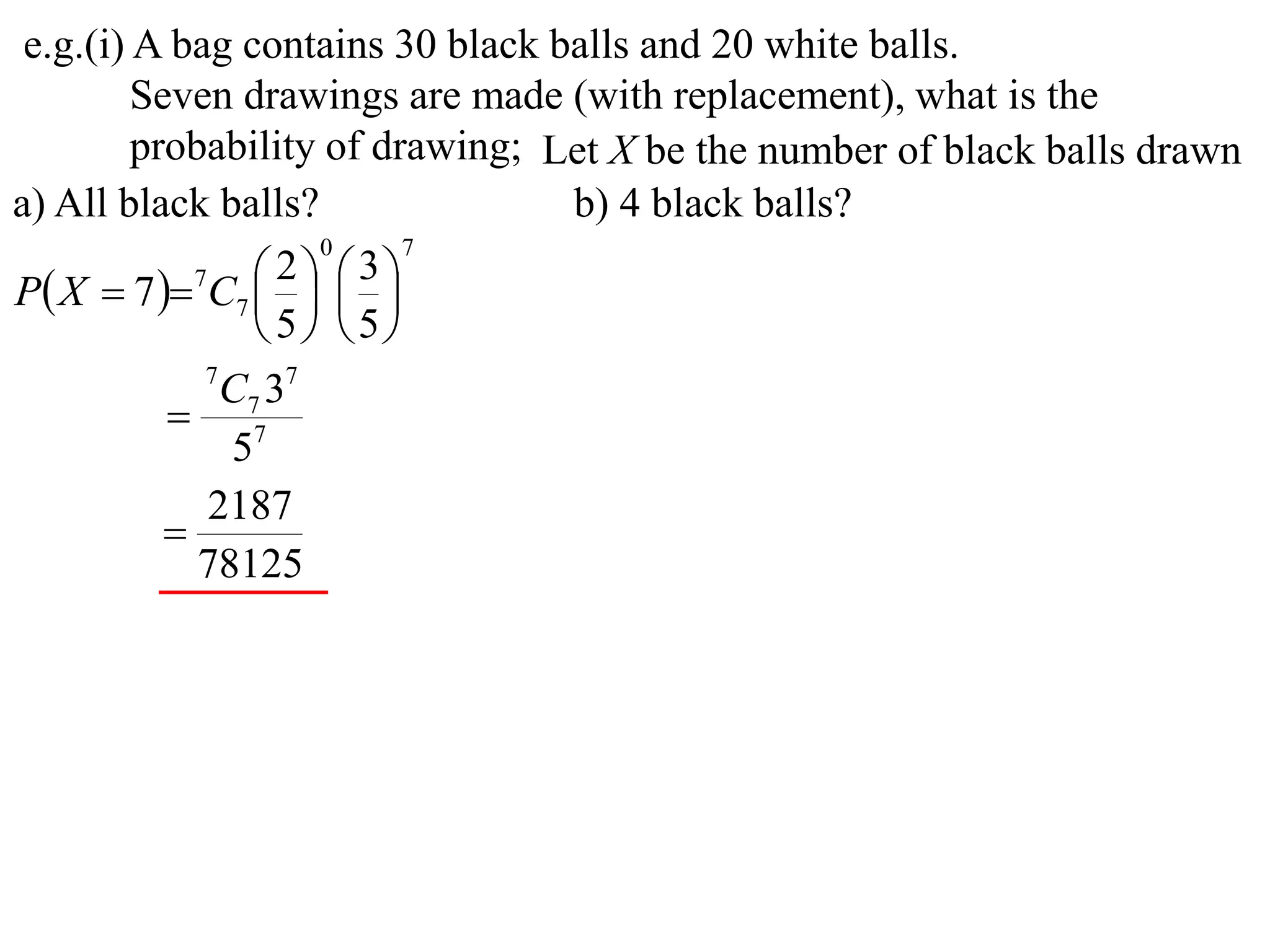
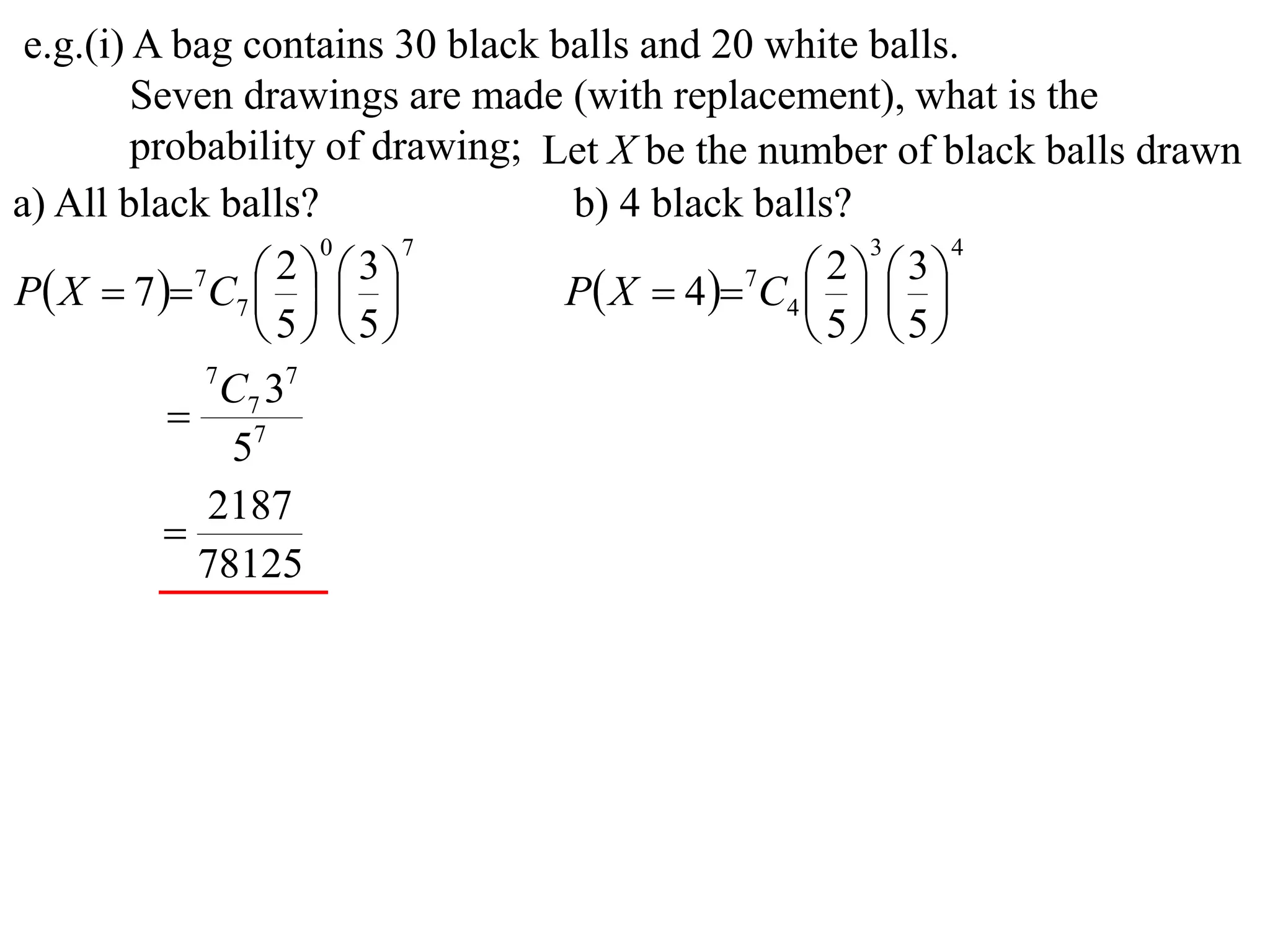
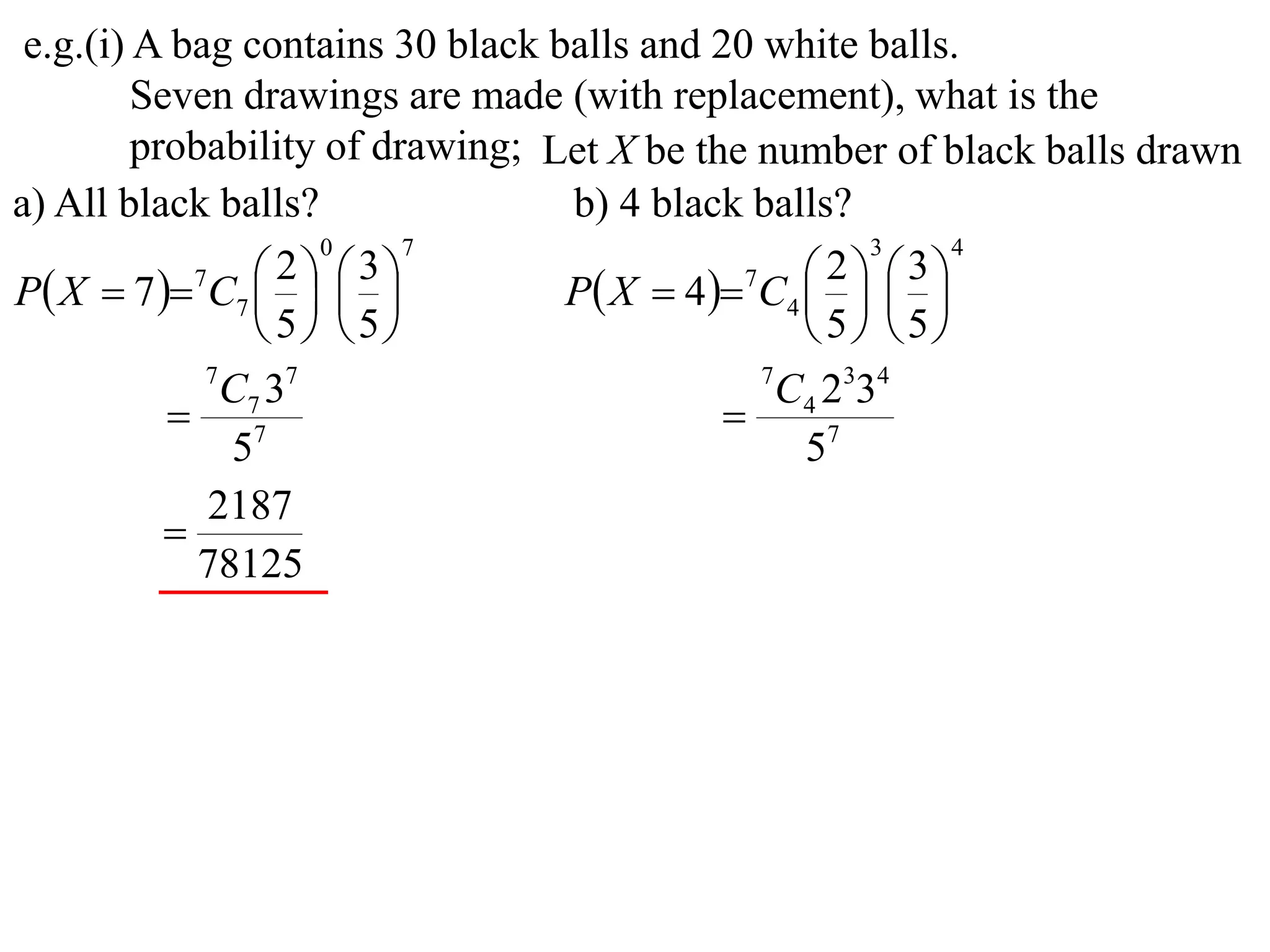
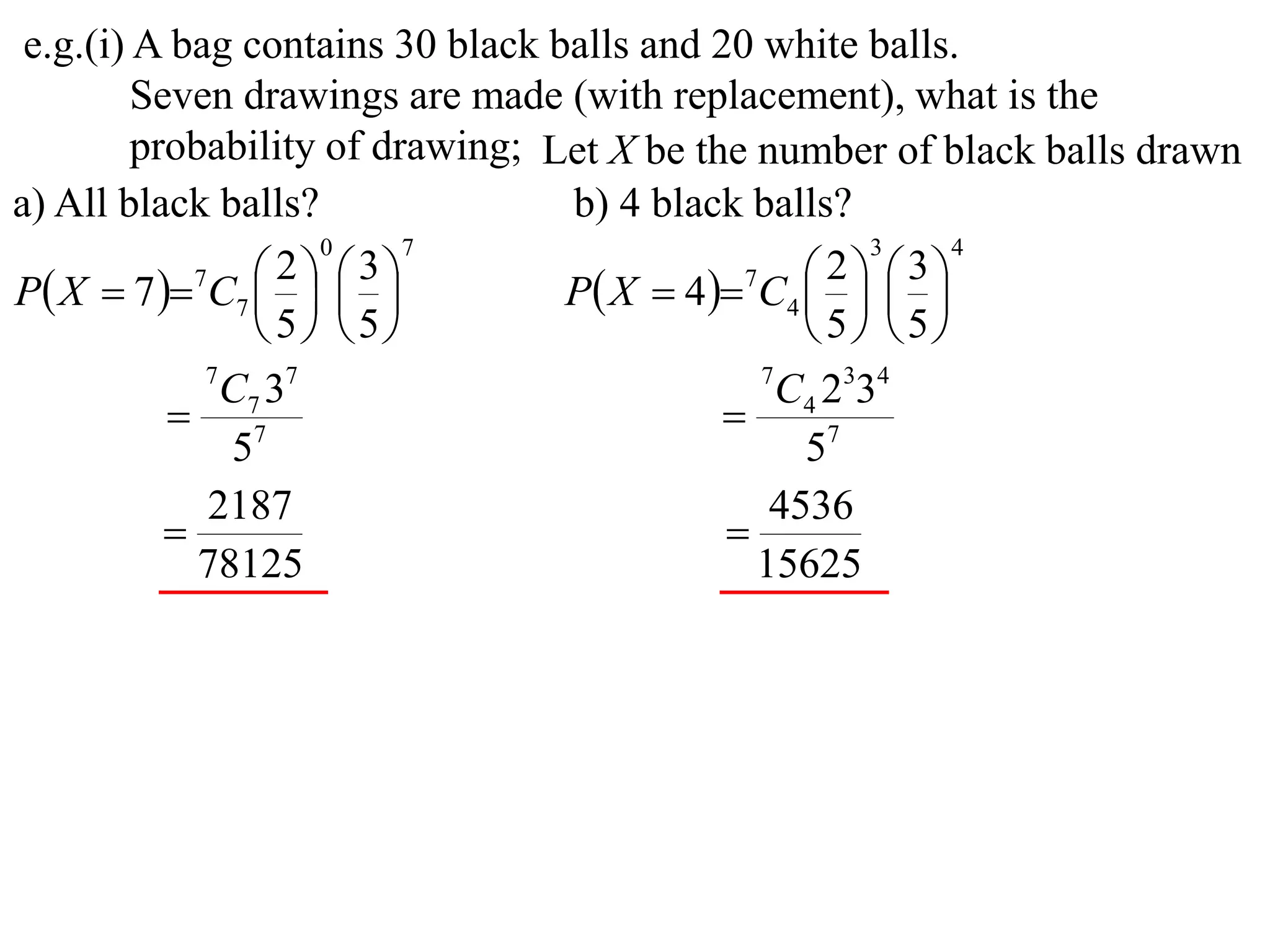
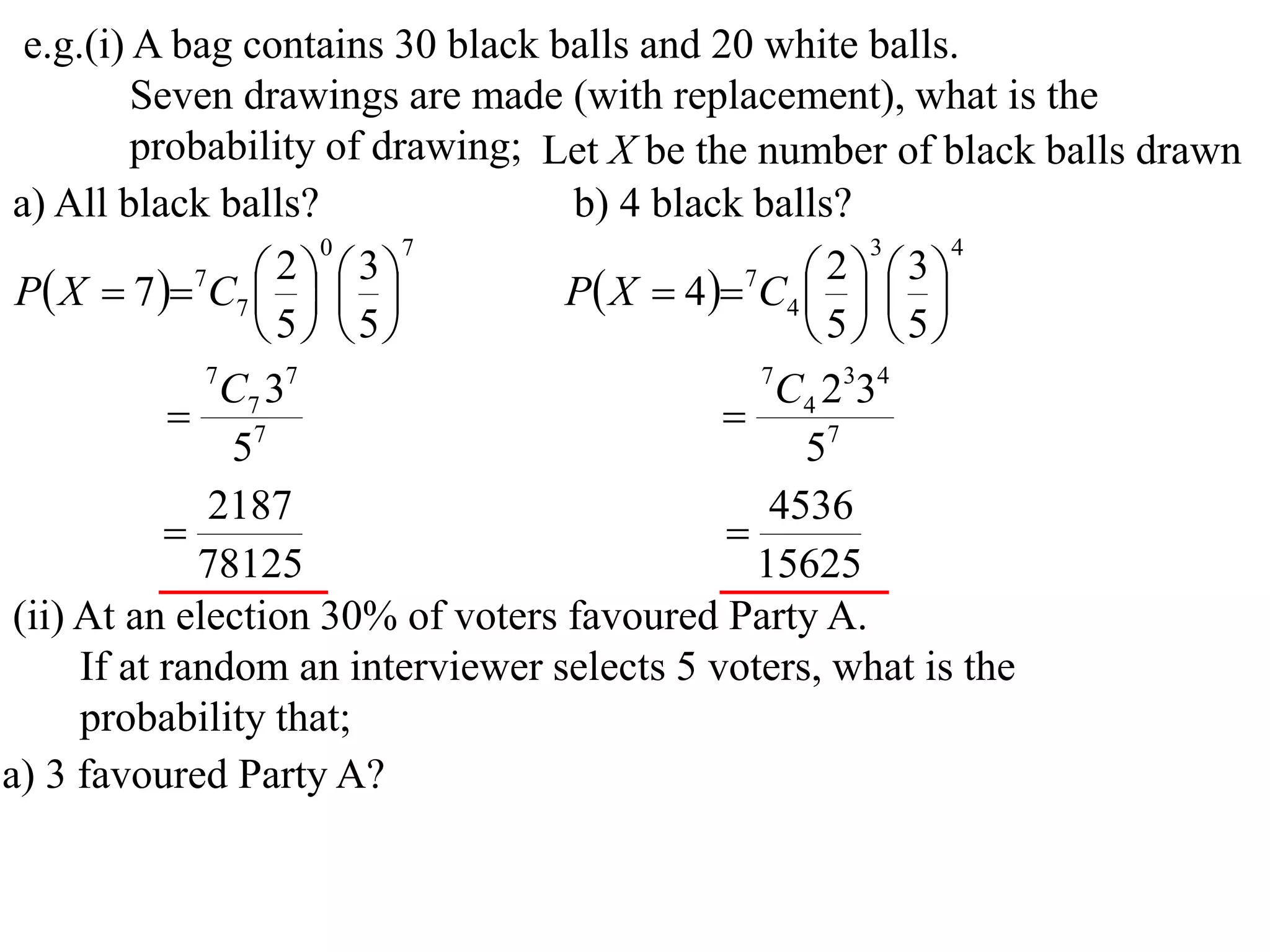
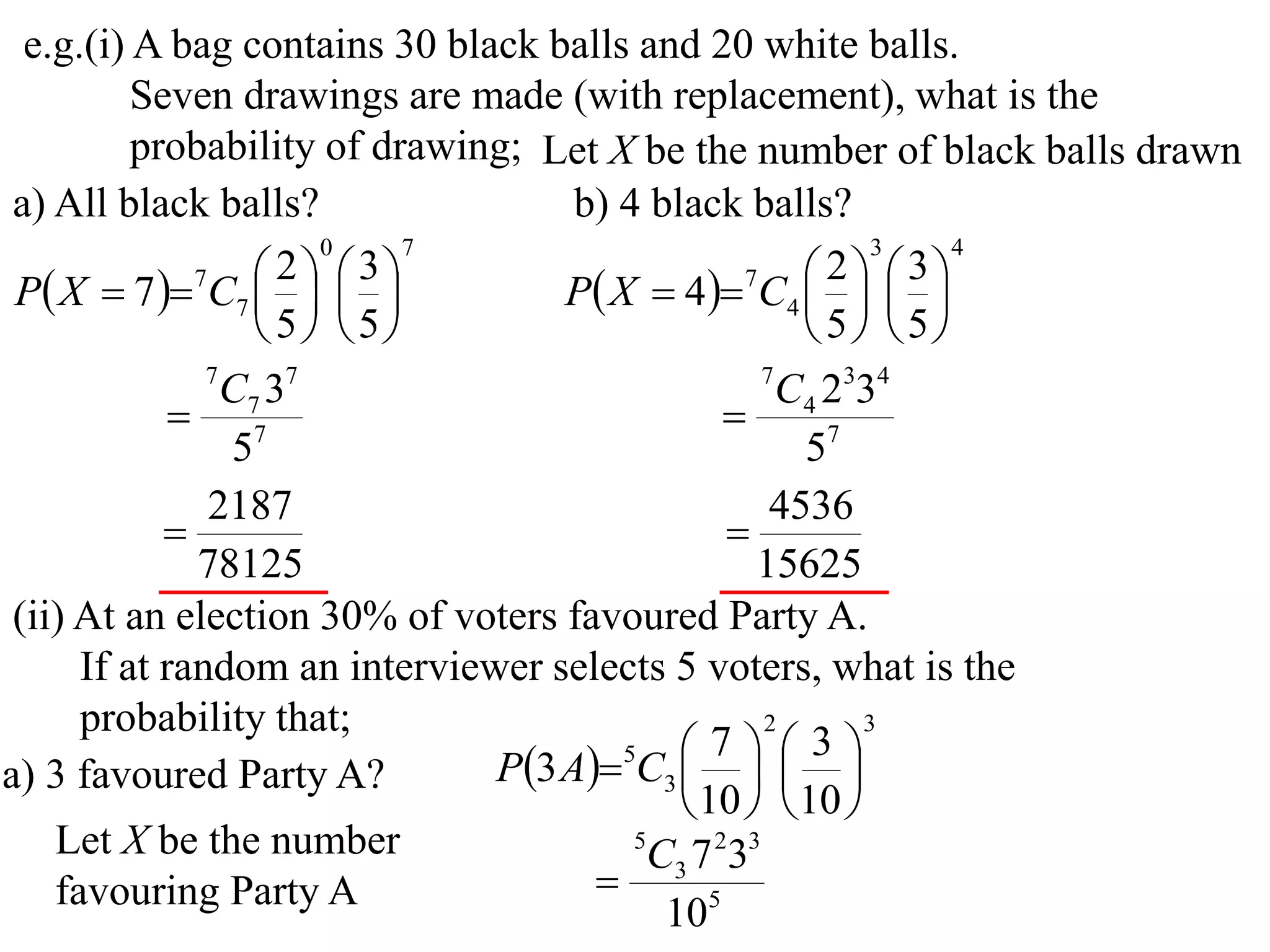
e.g.(i) A bag contains 30 black balls and 20 white balls.
         Seven drawings are made (with replacement), what is the
         probability of drawing;
a) All black balls?
e.g.(i) A bag contains 30 black balls and 20 white balls.
         Seven drawings are made (with replacement), what is the
         probability of drawing;
a) All black balls?
                    0     7

P X  7  7C7    
                  2 3
                   
                 5 5
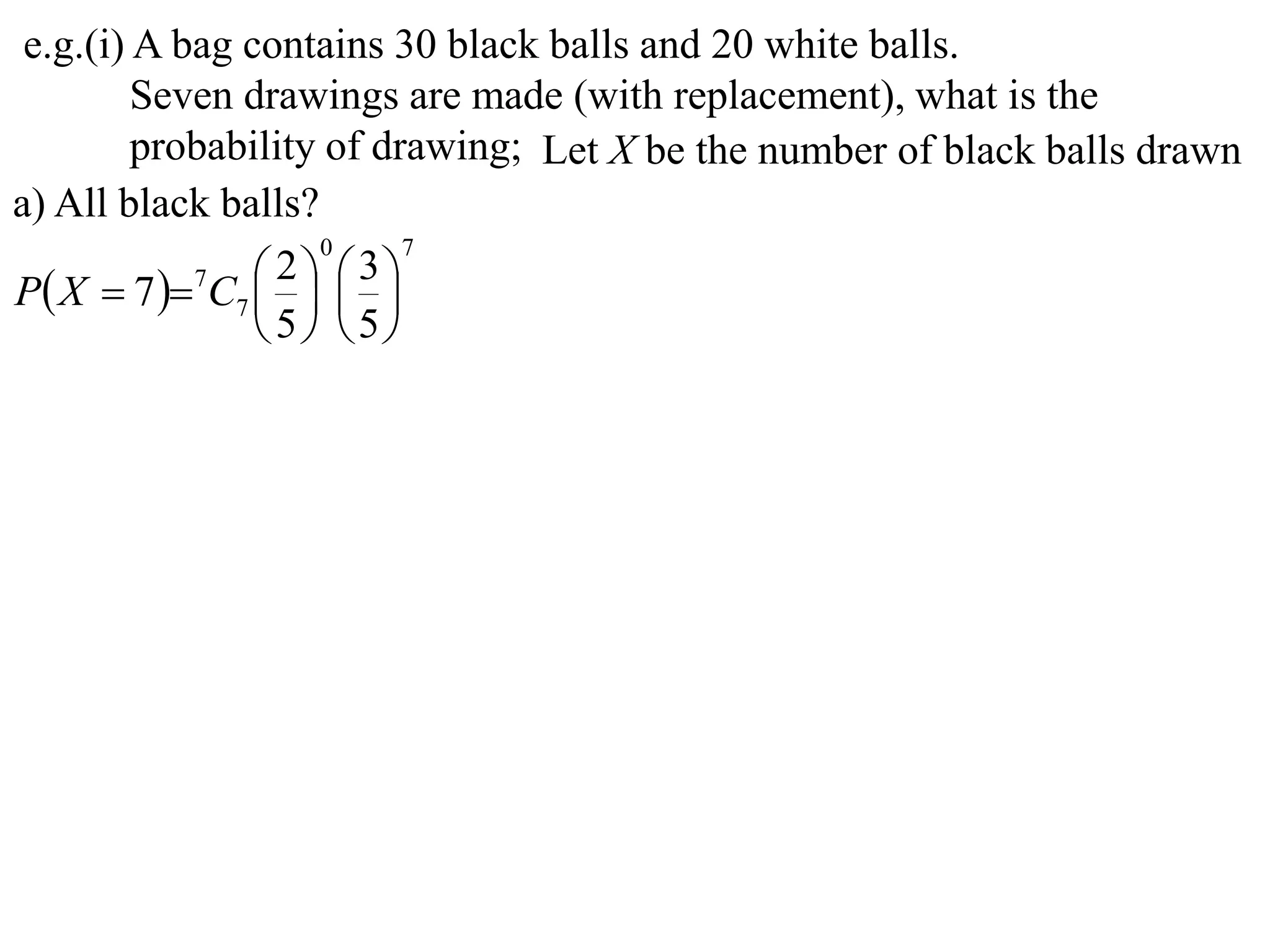
e.g.(i) A bag contains 30 black balls and 20 white balls.
         Seven drawings are made (with replacement), what is the
         probability of drawing; Let X be the number of black balls drawn
a) All black balls?
                    0     7

P X  7  7C7    
                  2  3
                
                 5 5
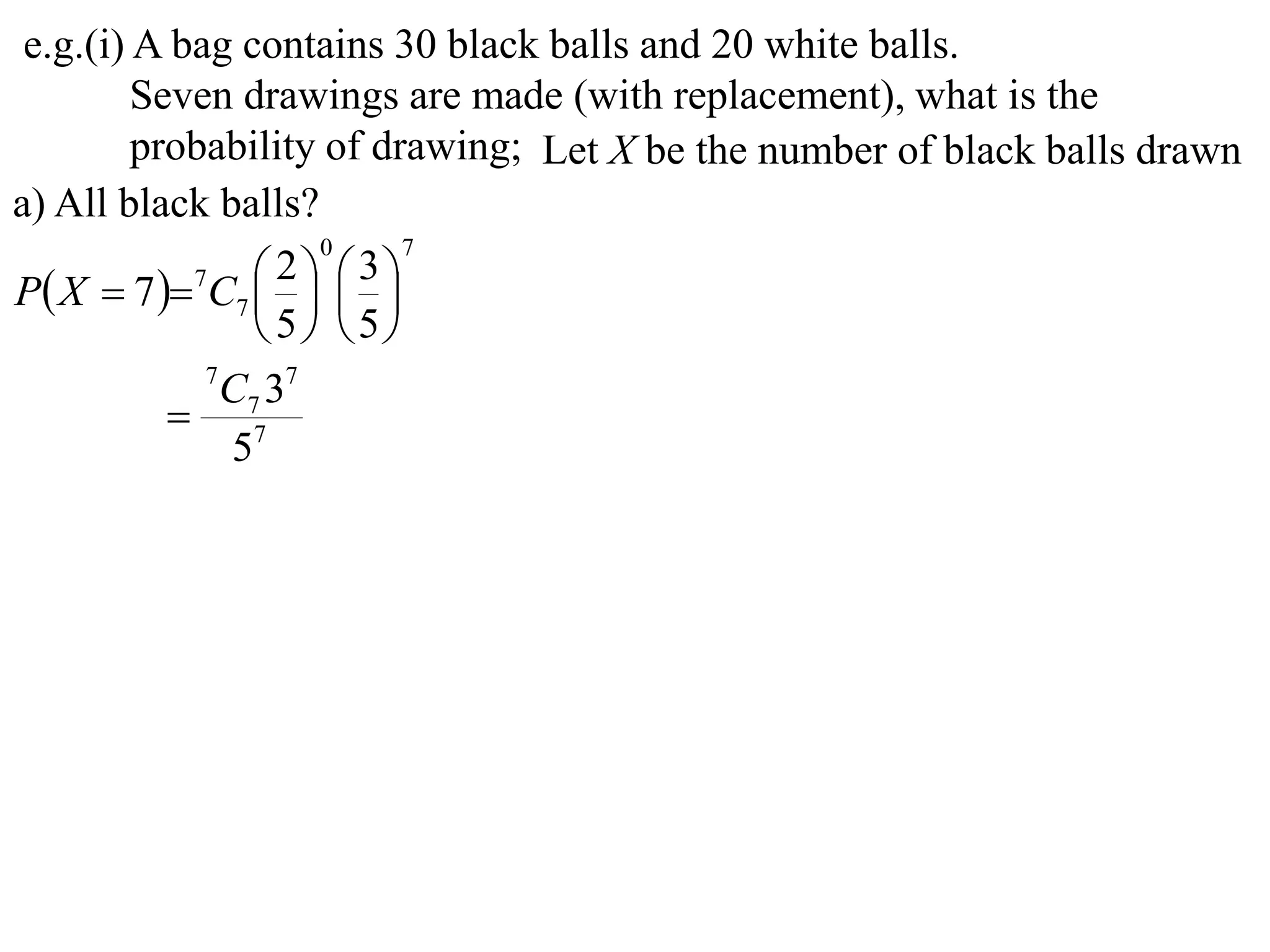
e.g.(i) A bag contains 30 black balls and 20 white balls.
         Seven drawings are made (with replacement), what is the
         probability of drawing; Let X be the number of black balls drawn
a) All black balls?
                     0     7

P X  7  7C7    
                   2  3
                
                 5 5
             7
               C7 37
            7
               5
e.g.(i) A bag contains 30 black balls and 20 white balls.
         Seven drawings are made (with replacement), what is the
         probability of drawing; Let X be the number of black balls drawn
a) All black balls?
                     0     7

P X  7  7C7    
                   2  3
                
                 5 5
             7
               C7 37
            7
               5
             2187
           
             78125
e.g.(i) A bag contains 30 black balls and 20 white balls.
         Seven drawings are made (with replacement), what is the
         probability of drawing; Let X be the number of black balls drawn
a) All black balls?               b) 4 black balls?
                     0     7

P X  7  7C7    
                   2  3
                
                 5 5
             7
               C7 37
            7
               5
             2187
           
             78125
e.g.(i) A bag contains 30 black balls and 20 white balls.
         Seven drawings are made (with replacement), what is the
         probability of drawing; Let X be the number of black balls drawn
a) All black balls?               b) 4 black balls?
                     0     7                         3     4

P X  7  7C7    
                   2  3
                                  P X  4 7C4    
                                                   2  3
                                                
                  5 5                         5 5
             7
               C7 37
            7
               5
             2187
           
             78125
e.g.(i) A bag contains 30 black balls and 20 white balls.
         Seven drawings are made (with replacement), what is the
         probability of drawing; Let X be the number of black balls drawn
a) All black balls?               b) 4 black balls?
                     0     7                          3    4

P X  7  7C7    
                   2  3
                                  P X  4 7C4    
                                                   2  3
                                                
                  5 5                         5 5
             7
               C7 37                          7
                                                C4 2334
            7                              
               5                                 57
             2187
           
             78125
e.g.(i) A bag contains 30 black balls and 20 white balls.
         Seven drawings are made (with replacement), what is the
         probability of drawing; Let X be the number of black balls drawn
a) All black balls?               b) 4 black balls?
                     0     7                          3    4

P X  7  7C7    
                   2  3
                                  P X  4 7C4    
                                                   2  3
                                                
                  5 5                         5 5
             7
               C7 37                          7
                                                C4 2334
            7                              
               5                                 57
             2187                              4536
                                           
             78125                            15625
e.g.(i) A bag contains 30 black balls and 20 white balls.
          Seven drawings are made (with replacement), what is the
          probability of drawing; Let X be the number of black balls drawn
 a) All black balls?               b) 4 black balls?
                       0     7                         3    4

 P X  7  7C7    
                     2  3
                                   P X  4 7C4    
                                                    2  3
                                                 
                    5 5                        5 5
               7
                 C7 37                         7
                                                 C4 2334
              7                             
                 5                                57
               2187                             4536
                                            
              78125                            15625
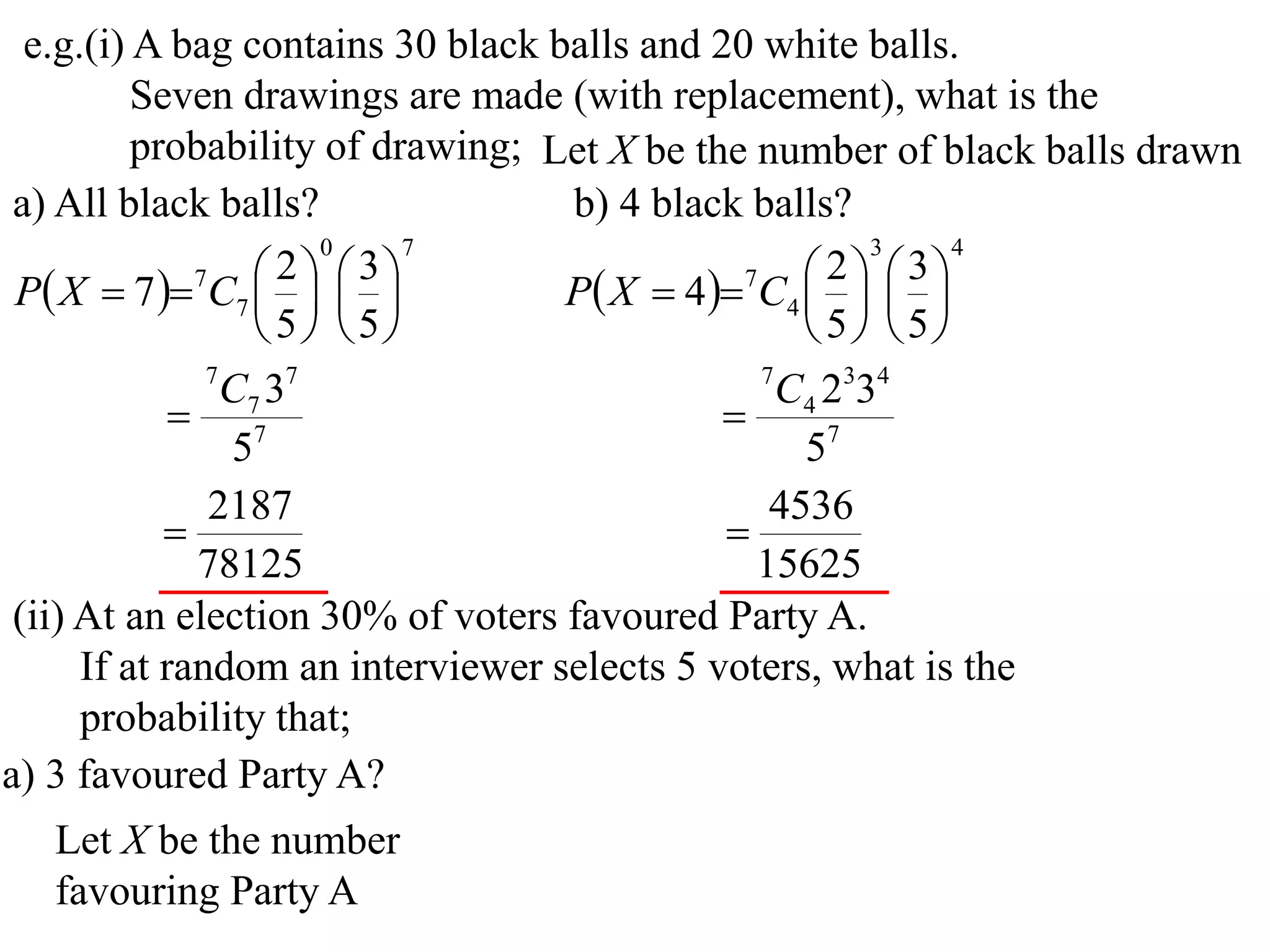
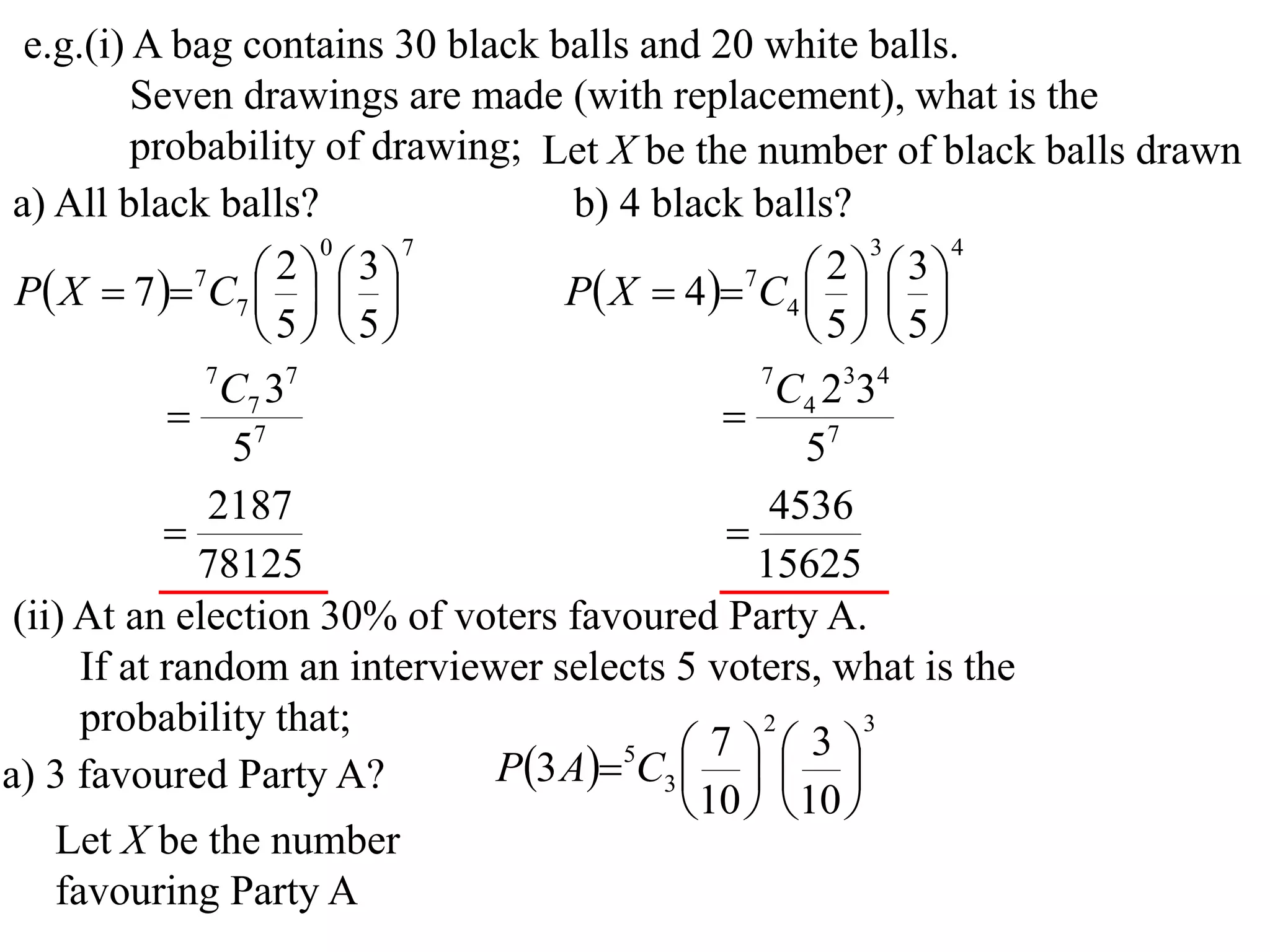
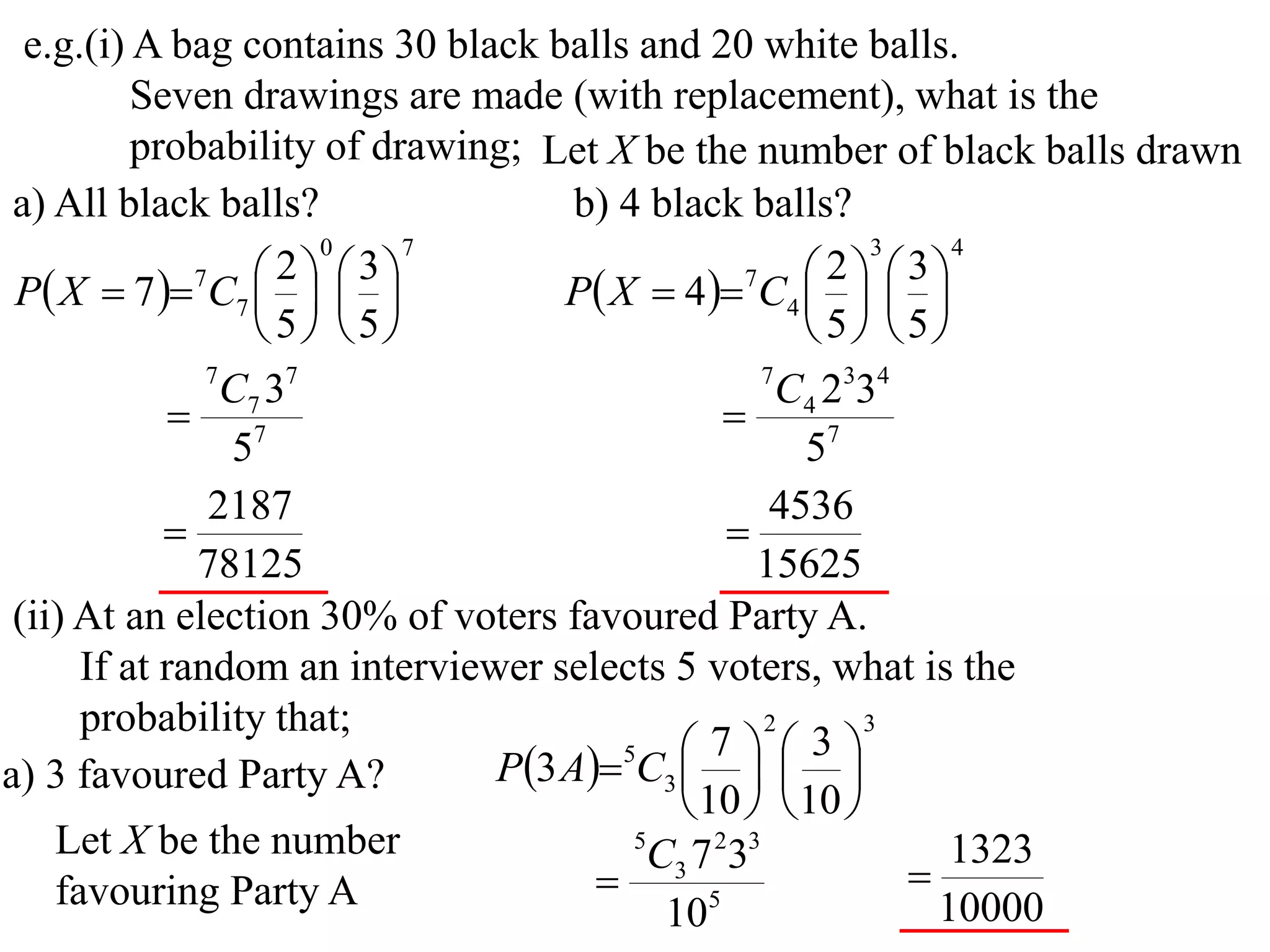
 (ii) At an election 30% of voters favoured Party A.
      If at random an interviewer selects 5 voters, what is the
      probability that;
a) 3 favoured Party A?
e.g.(i) A bag contains 30 black balls and 20 white balls.
          Seven drawings are made (with replacement), what is the
          probability of drawing; Let X be the number of black balls drawn
 a) All black balls?               b) 4 black balls?
                       0     7                         3    4

 P X  7  7C7    
                     2  3
                                   P X  4 7C4    
                                                    2  3
                                                 
                    5 5                        5 5
               7
                 C7 37                         7
                                                 C4 2334
              7                             
                 5                                57
               2187                             4536
                                            
              78125                            15625
 (ii) At an election 30% of voters favoured Party A.
      If at random an interviewer selects 5 voters, what is the
      probability that;
a) 3 favoured Party A?
   Let X be the number
   favouring Party A
e.g.(i) A bag contains 30 black balls and 20 white balls.
          Seven drawings are made (with replacement), what is the
          probability of drawing; Let X be the number of black balls drawn
 a) All black balls?                b) 4 black balls?
                       0     7                            3   4

 P X  7  7C7    
                     2  3
                                   P X  4 7C4    
                                                      2  3
                                                   
                    5 5                          5 5
               7
                 C7 37                           7
                                                   C4 2334
              7                               
                 5                                  57
               2187                               4536
                                              
              78125                              15625
 (ii) At an election 30% of voters favoured Party A.
      If at random an interviewer selects 5 voters, what is the
      probability that;                          2       3

                               P3 A5C3    
                                              7      3
a) 3 favoured Party A?                        
                                            10   10 
    Let X be the number
    favouring Party A
e.g.(i) A bag contains 30 black balls and 20 white balls.
          Seven drawings are made (with replacement), what is the
          probability of drawing; Let X be the number of black balls drawn
 a) All black balls?                b) 4 black balls?
                       0     7                             3    4

 P X  7  7C7    
                     2  3
                                   P X  4 7C4    
                                                        2  3
                                                     
                    5 5                            5 5
               7
                 C7 37                             7
                                                     C4 2334
              7                                
                 5                                    57
               2187                                 4536
                                               
              78125                               15625
 (ii) At an election 30% of voters favoured Party A.
      If at random an interviewer selects 5 voters, what is the
      probability that;                            2      3

                               P3 A5C3    
                                               7       3
a) 3 favoured Party A?                         
                                             10   10 
    Let X be the number                 5
                                          C3 7 233
    favouring Party A                
                                           105
e.g.(i) A bag contains 30 black balls and 20 white balls.
          Seven drawings are made (with replacement), what is the
          probability of drawing; Let X be the number of black balls drawn
 a) All black balls?                b) 4 black balls?
                       0     7                             3    4

 P X  7  7C7    
                     2  3
                                   P X  4 7C4    
                                                        2  3
                                                     
                    5 5                            5 5
               7
                 C7 37                             7
                                                     C4 2334
              7                                
                 5                                    57
               2187                                 4536
                                               
              78125                               15625
 (ii) At an election 30% of voters favoured Party A.
      If at random an interviewer selects 5 voters, what is the
      probability that;                            2      3

                               P3 A5C3    
                                               7       3
a) 3 favoured Party A?                         
                                             10   10 
    Let X be the number                 5
                                          C3 7 233              1323
    favouring Party A                        5
                                                             
                                           10                  10000
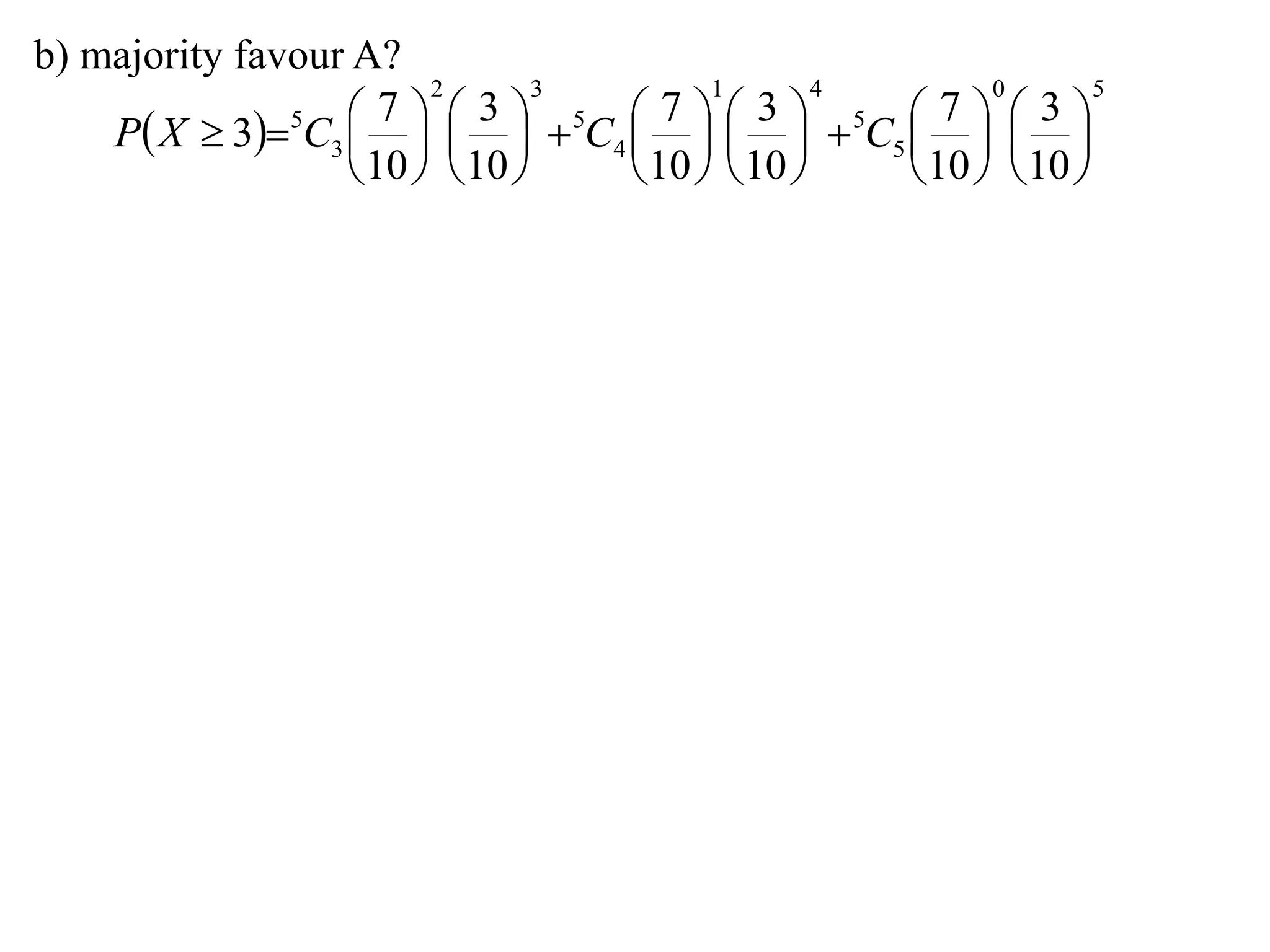
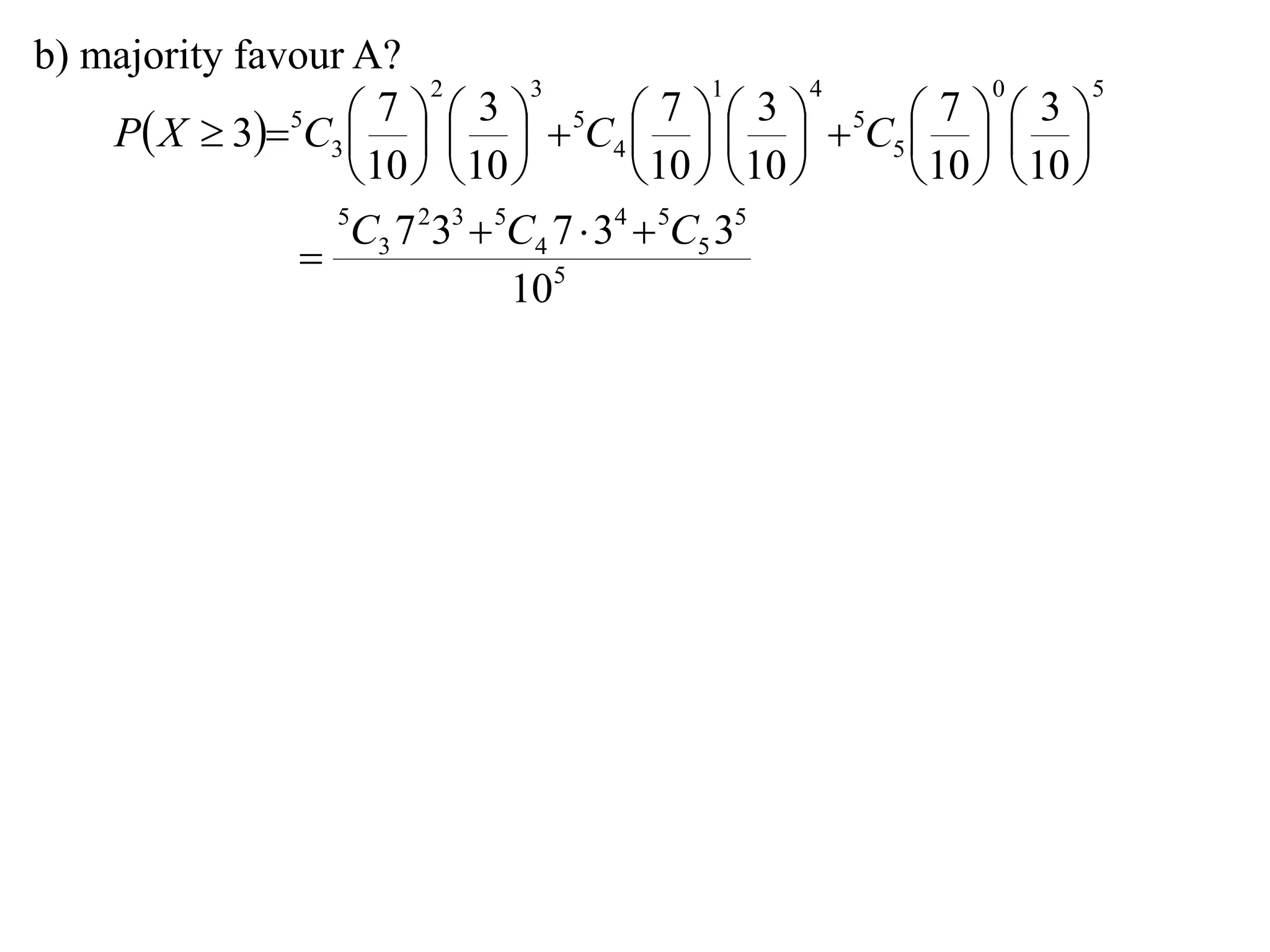
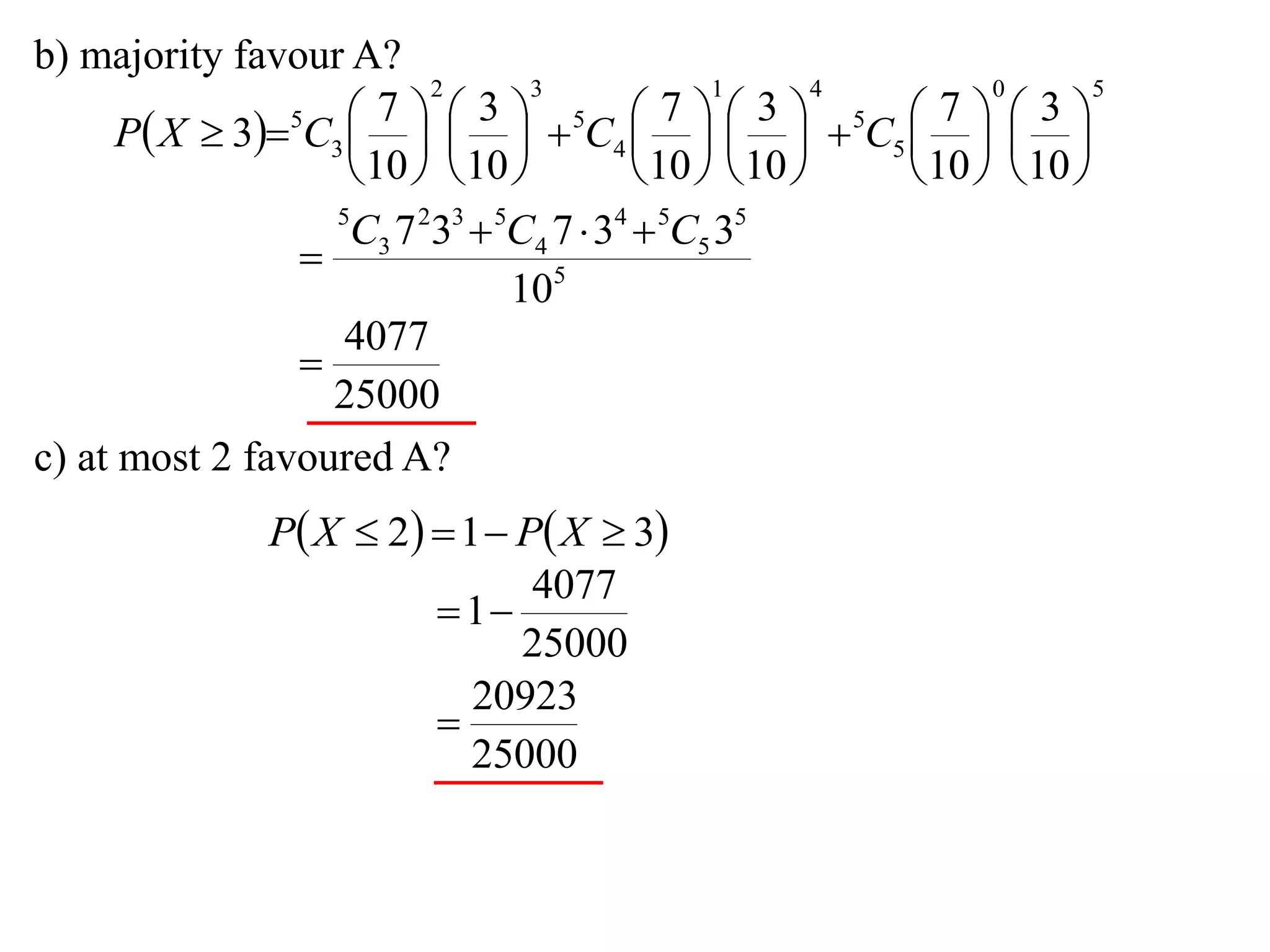
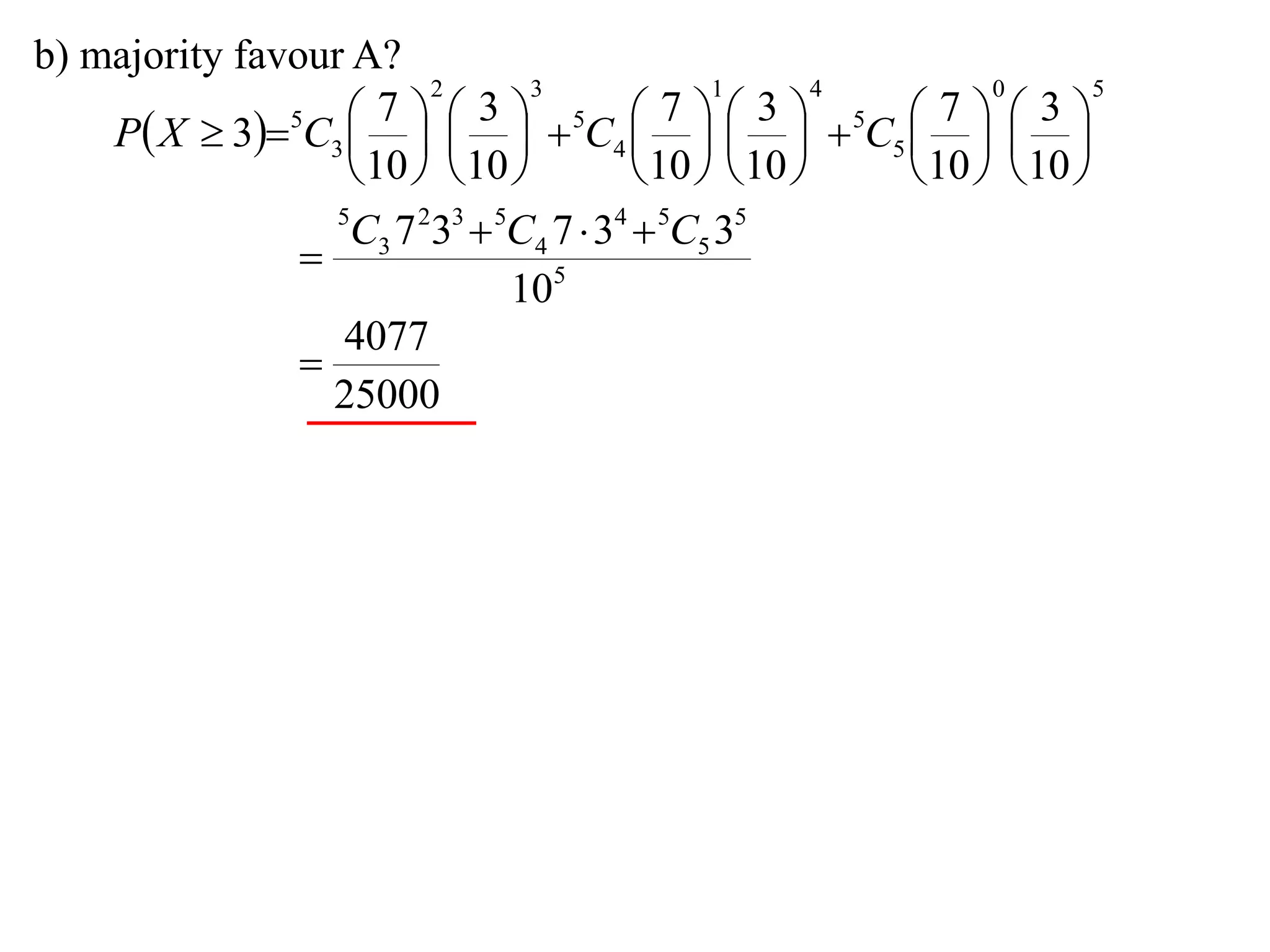
b) majority favour A?
                        2       3       1       4       0       5

    P X  35C3      5C4      5C5    
                     7      3        7      3        7      3
                                             
                   10   10     10   10     10   10 
b) majority favour A?
                         2       3             1       4       0       5

    P X  35C3      5C4      5C5    
                      7      3              7      3        7      3
                                                    
                    10   10           10   10     10   10 
                  5
                   C3 7 233  5C4 7  34  5C5 35
                
                               105
b) majority favour A?
                         2       3             1       4       0       5

    P X  35C3      5C4      5C5    
                      7      3              7      3        7      3
                                                    
                    10   10           10   10     10   10 
                  5
                   C3 7 233  5C4 7  34  5C5 35
                
                               105
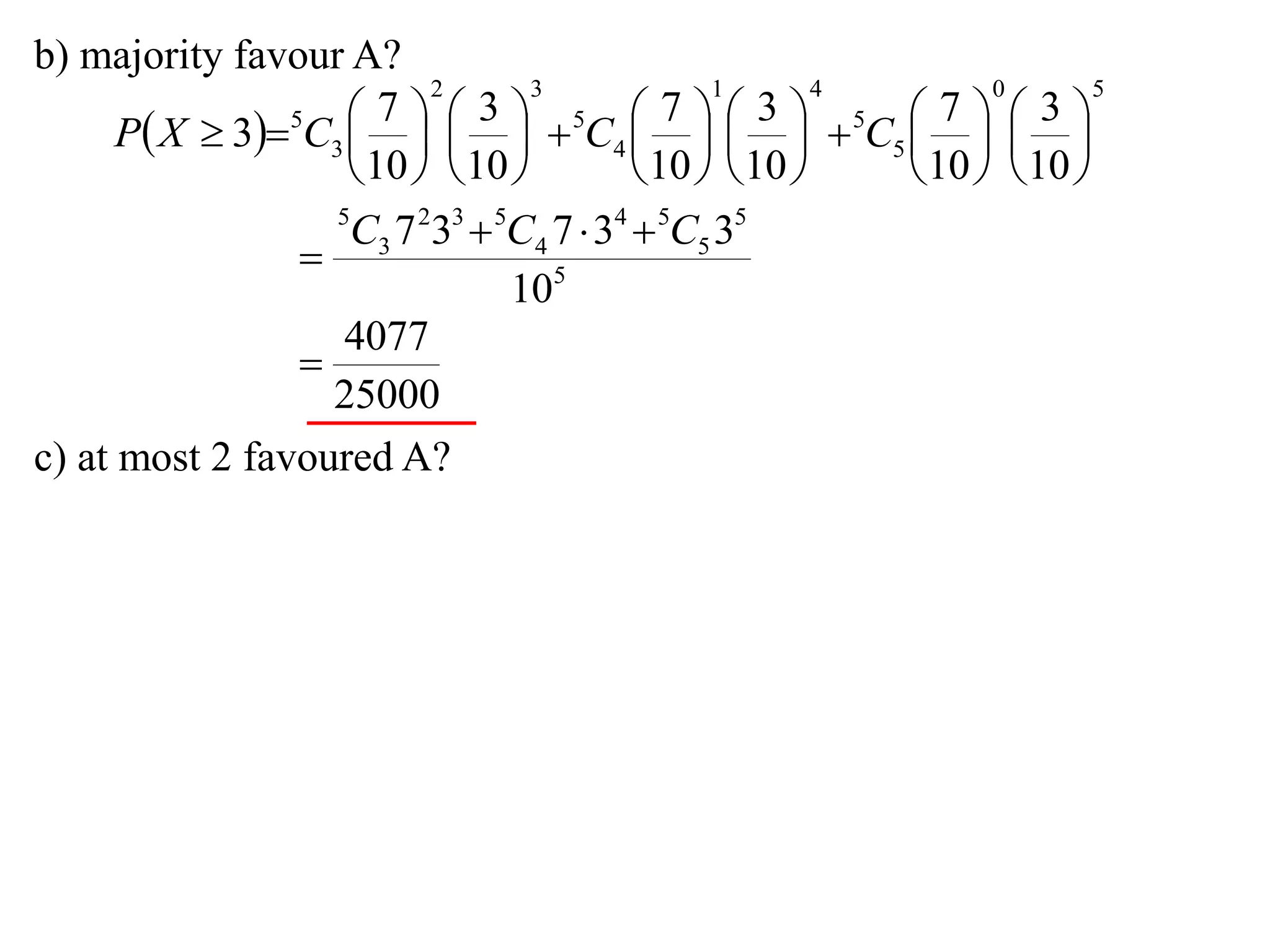
                   4077
                
                  25000
b) majority favour A?
                          2       3             1       4       0       5

      P X  35C3      5C4      5C5    
                       7      3              7      3        7      3
                                                     
                     10   10           10   10     10   10 
                   5
                    C3 7 233  5C4 7  34  5C5 35
                 
                                105
                    4077
                 
                   25000
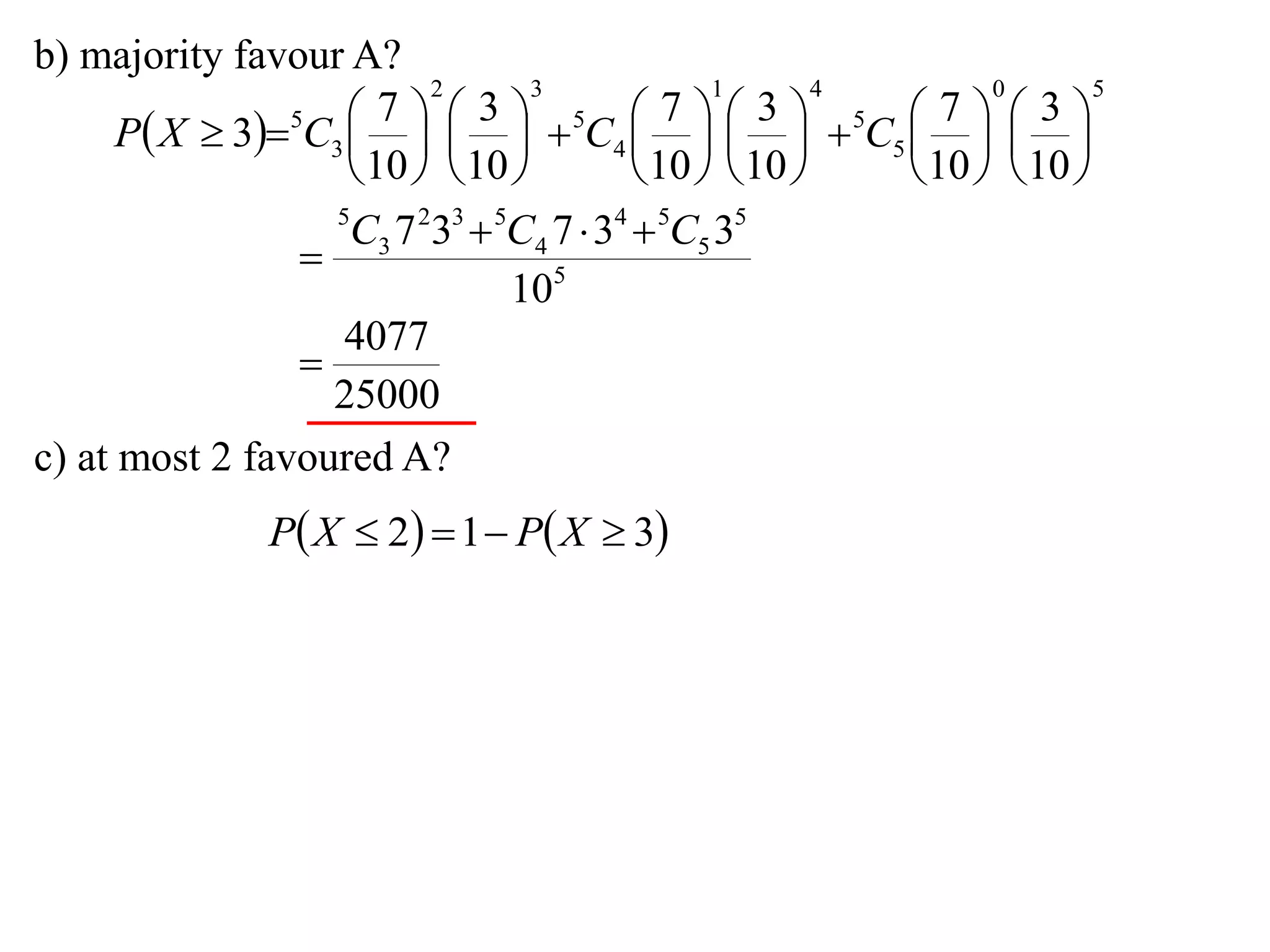
c) at most 2 favoured A?
b) majority favour A?
                          2       3             1       4       0       5

      P X  35C3      5C4      5C5    
                       7      3              7      3        7      3
                                                     
                     10   10           10   10     10   10 
                   5
                    C3 7 233  5C4 7  34  5C5 35
                 
                                105
                    4077
                 
                   25000
c) at most 2 favoured A?
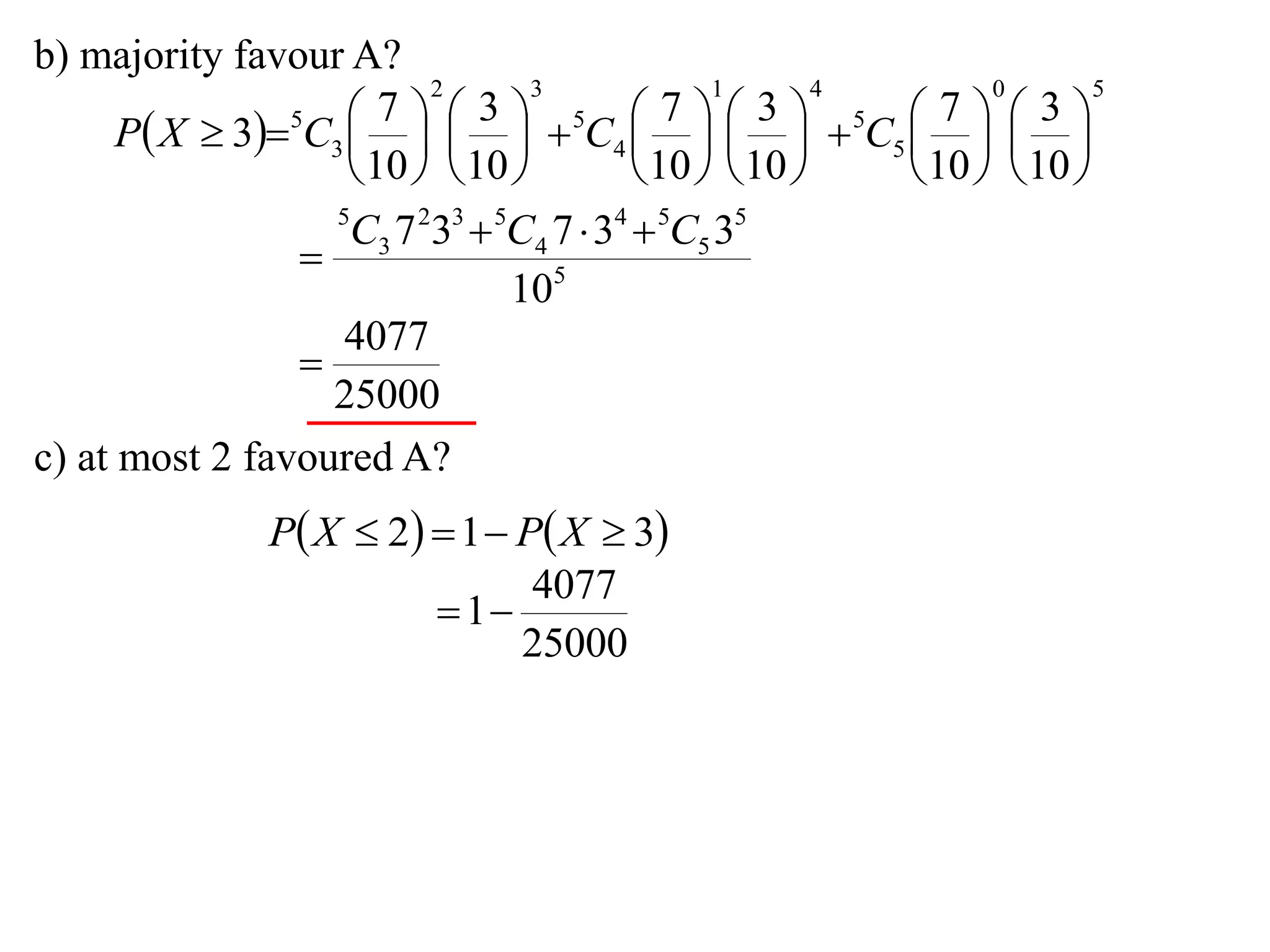
                P X  2  1  P X  3
b) majority favour A?
                          2       3             1       4       0       5

      P X  35C3      5C4      5C5    
                       7      3              7      3        7      3
                                                     
                     10   10           10   10     10   10 
                   5
                    C3 7 233  5C4 7  34  5C5 35
                 
                                105
                    4077
                 
                   25000
c) at most 2 favoured A?
                P X  2  1  P X  3
                                 4077
                           1
                                25000
b) majority favour A?
                          2       3             1       4       0       5

      P X  35C3      5C4      5C5    
                       7      3              7      3        7      3
                                                     
                     10   10           10   10     10   10 
                   5
                    C3 7 233  5C4 7  34  5C5 35
                 
                                105
                    4077
                 
                   25000
c) at most 2 favoured A?
                P X  2  1  P X  3
                                 4077
                           1
                                25000
                             20923
                          
                             25000
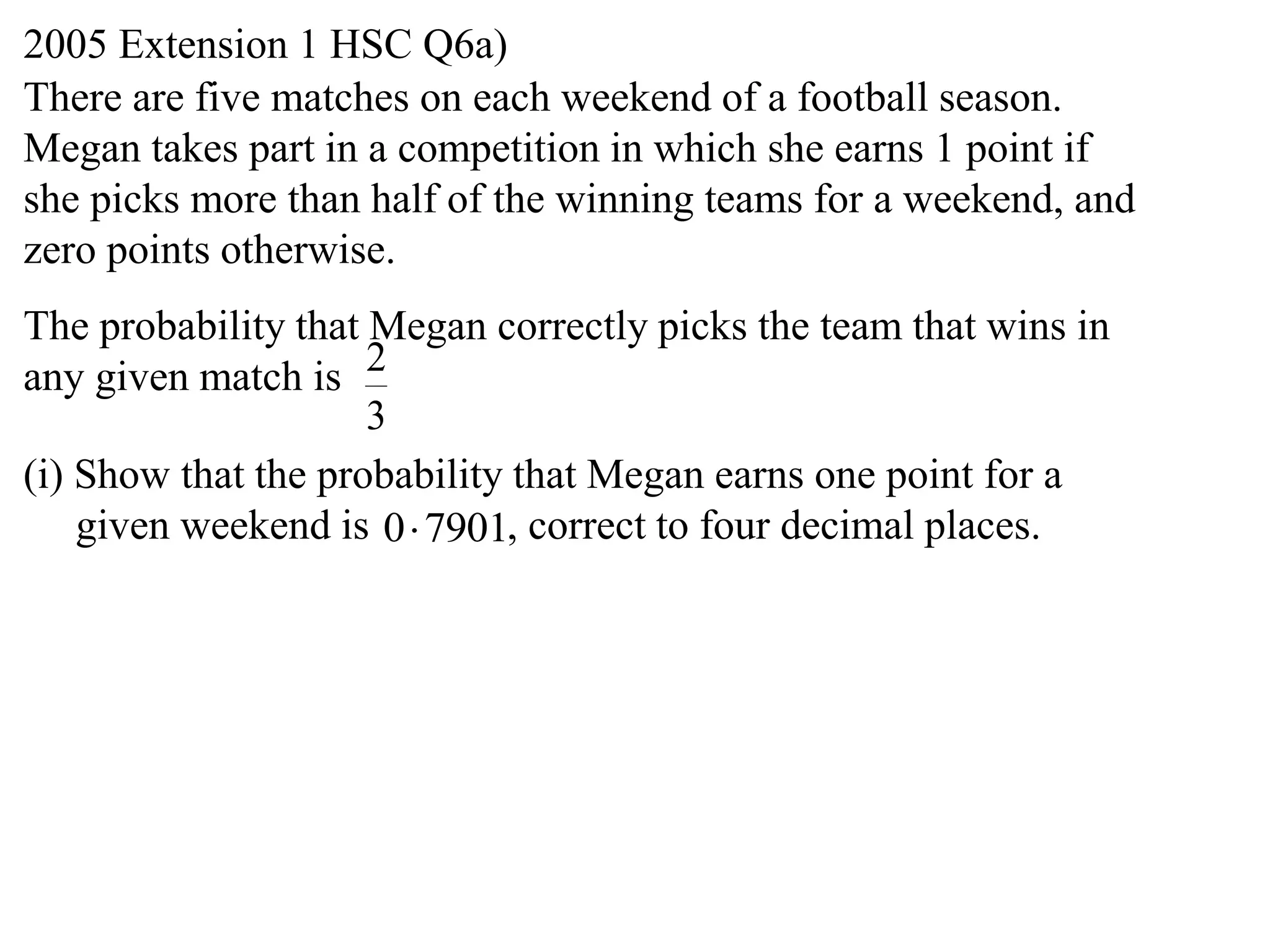
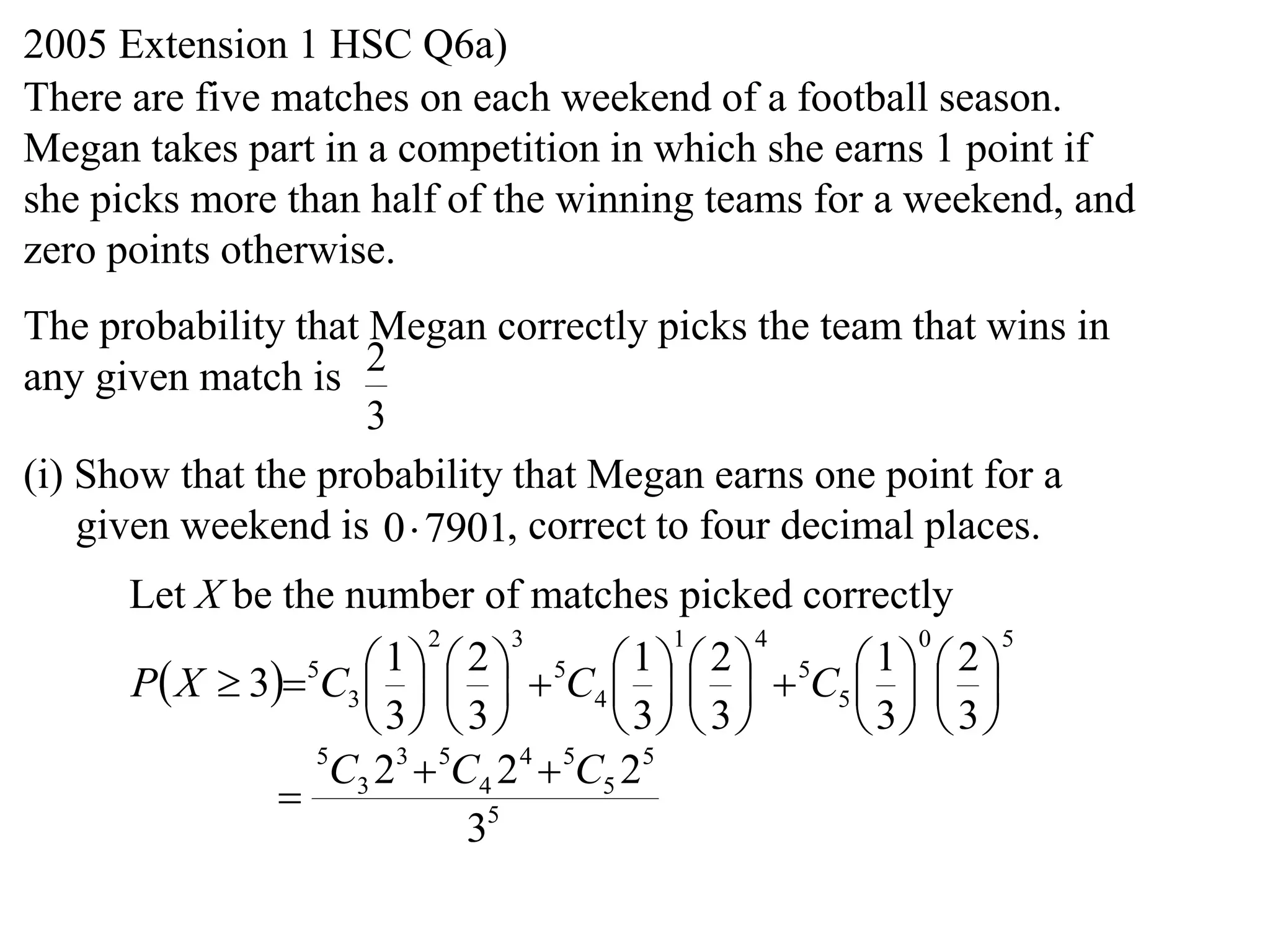
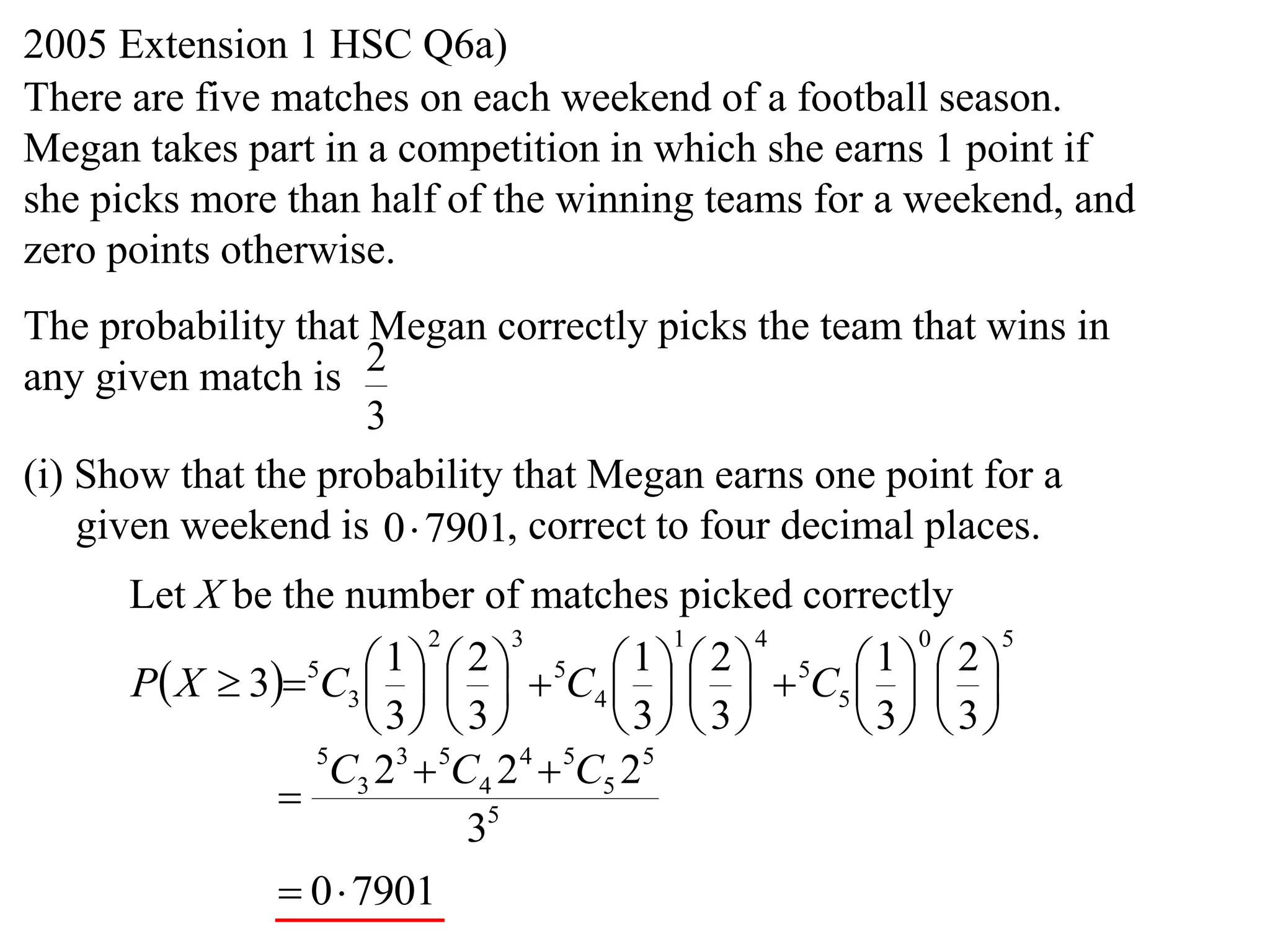
2005 Extension 1 HSC Q6a)
There are five matches on each weekend of a football season.
Megan takes part in a competition in which she earns 1 point if
she picks more than half of the winning teams for a weekend, and
zero points otherwise.
The probability that Megan correctly picks the team that wins in
any given match is 2
                     3
(i) Show that the probability that Megan earns one point for a
    given weekend is 0 7901, correct to four decimal places.
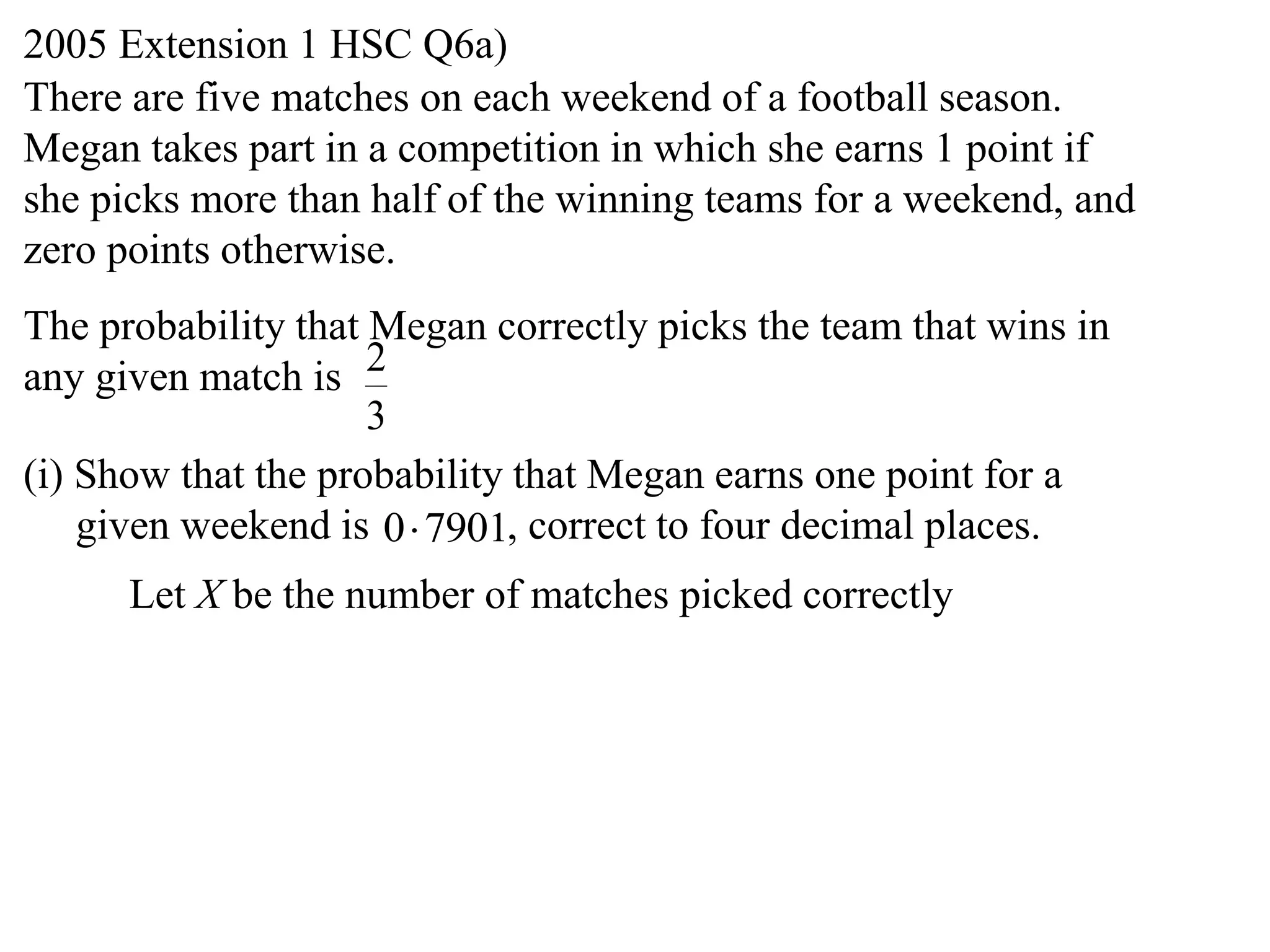
2005 Extension 1 HSC Q6a)
There are five matches on each weekend of a football season.
Megan takes part in a competition in which she earns 1 point if
she picks more than half of the winning teams for a weekend, and
zero points otherwise.
The probability that Megan correctly picks the team that wins in
any given match is 2
                     3
(i) Show that the probability that Megan earns one point for a
    given weekend is 0 7901, correct to four decimal places.
      Let X be the number of matches picked correctly
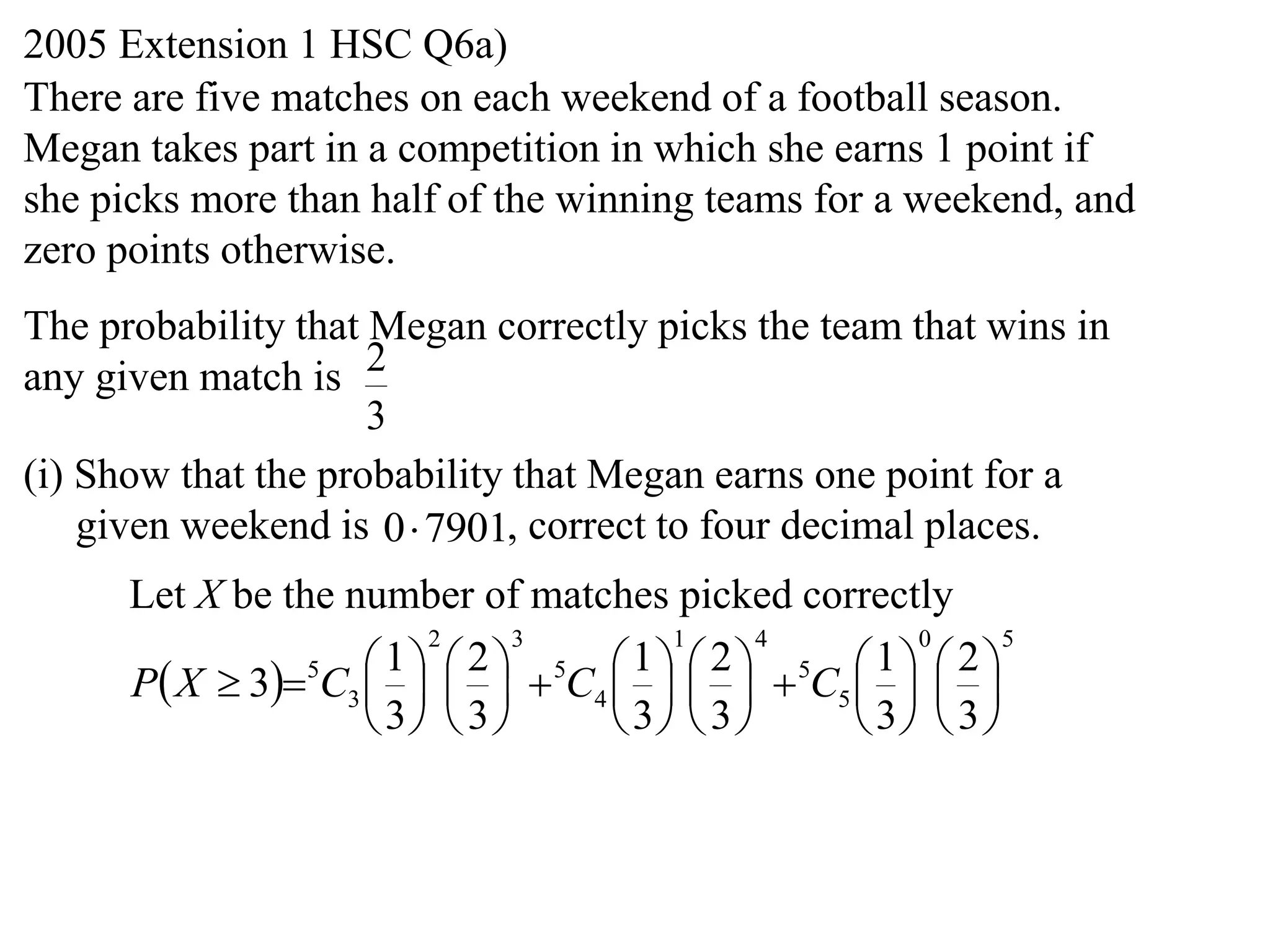
2005 Extension 1 HSC Q6a)
There are five matches on each weekend of a football season.
Megan takes part in a competition in which she earns 1 point if
she picks more than half of the winning teams for a weekend, and
zero points otherwise.
The probability that Megan correctly picks the team that wins in
any given match is 2
                     3
(i) Show that the probability that Megan earns one point for a
    given weekend is 0 7901, correct to four decimal places.
      Let X be the number of matches picked correctly
                        2      3      1      4      0      5

      P X  35C3      5C4      5C5    
                      1 2           1 2           1 2
                                           
                     3  3      3  3      3  3 
2005 Extension 1 HSC Q6a)
There are five matches on each weekend of a football season.
Megan takes part in a competition in which she earns 1 point if
she picks more than half of the winning teams for a weekend, and
zero points otherwise.
The probability that Megan correctly picks the team that wins in
any given match is 2
                     3
(i) Show that the probability that Megan earns one point for a
    given weekend is 0 7901, correct to four decimal places.
      Let X be the number of matches picked correctly
                         2     3           1      4     0      5

      P X  35C3      5C4      5C5    
                      1 2                1 2          1 2
                                               
                     3  3           3  3     3  3 
                 5
                  C3 23  5C4 2 4  5C5 25
               
                            35
2005 Extension 1 HSC Q6a)
There are five matches on each weekend of a football season.
Megan takes part in a competition in which she earns 1 point if
she picks more than half of the winning teams for a weekend, and
zero points otherwise.
The probability that Megan correctly picks the team that wins in
any given match is 2
                     3
(i) Show that the probability that Megan earns one point for a
    given weekend is 0 7901, correct to four decimal places.
      Let X be the number of matches picked correctly
                         2      3          1      4     0      5

      P X  35C3      5C4      5C5    
                       1 2               1 2          1 2
                                               
                      3  3          3  3     3  3 
                 5
                  C3 23  5C4 2 4  5C5 25
               
                            35
                0 7901
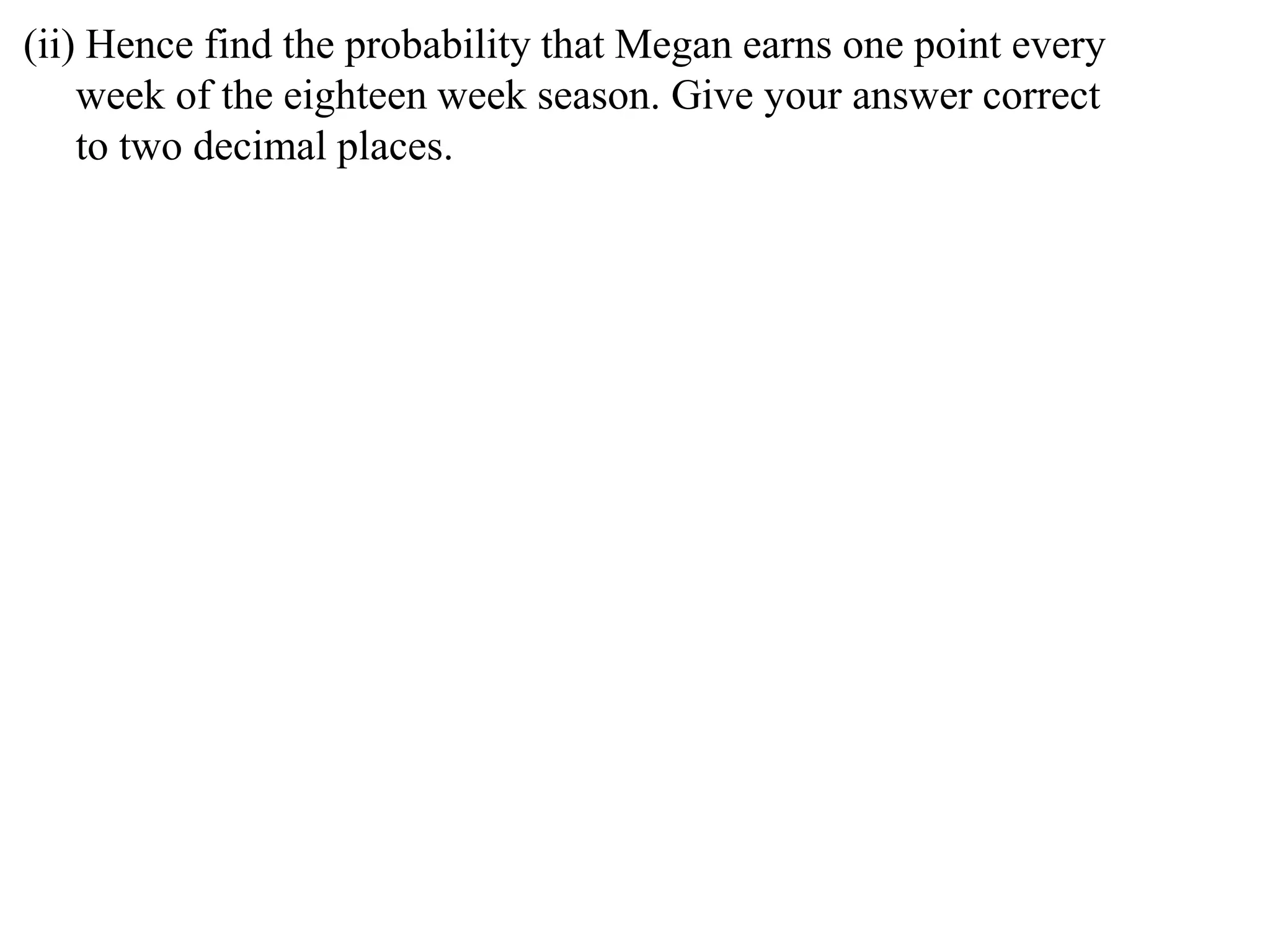
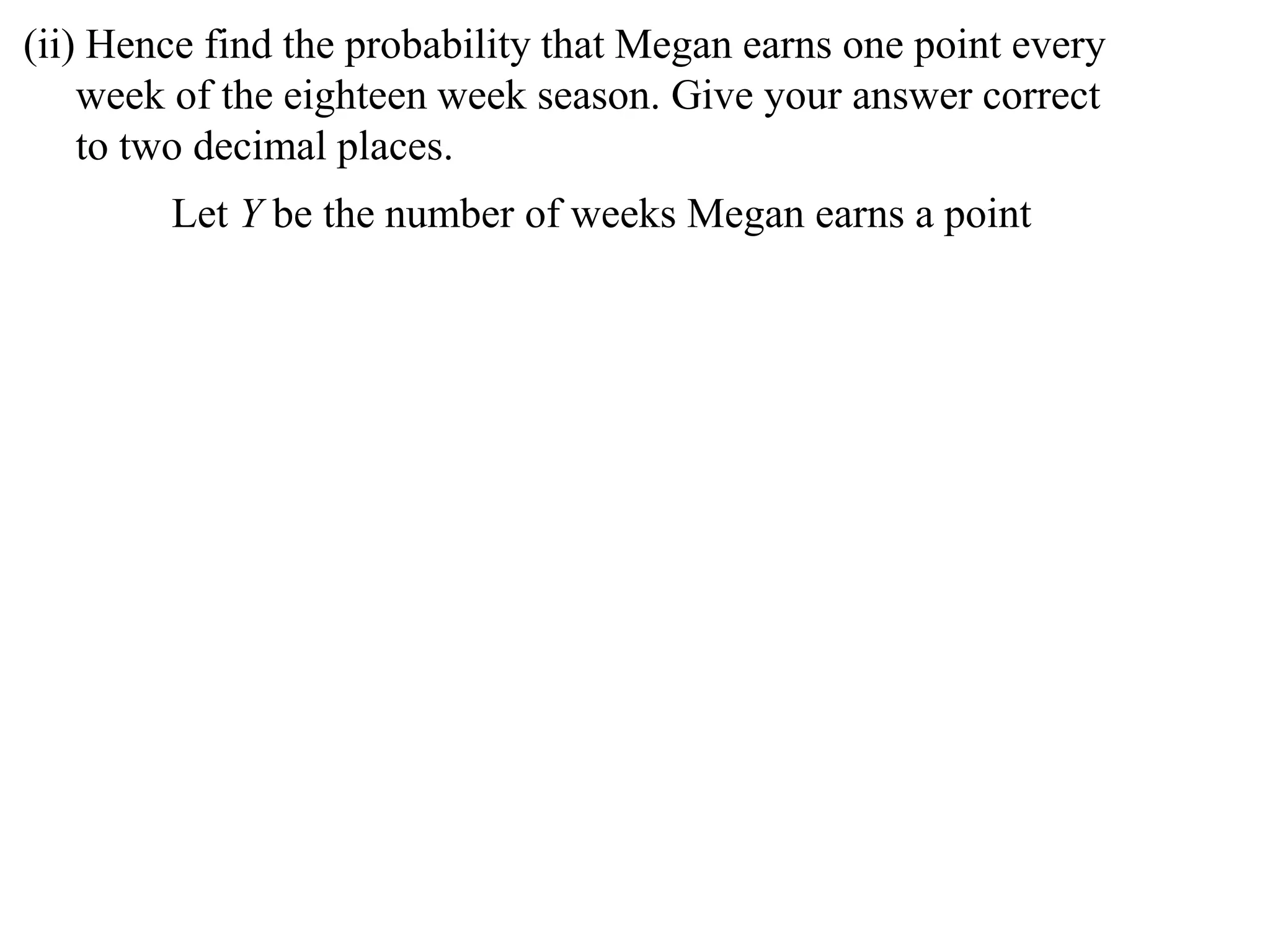
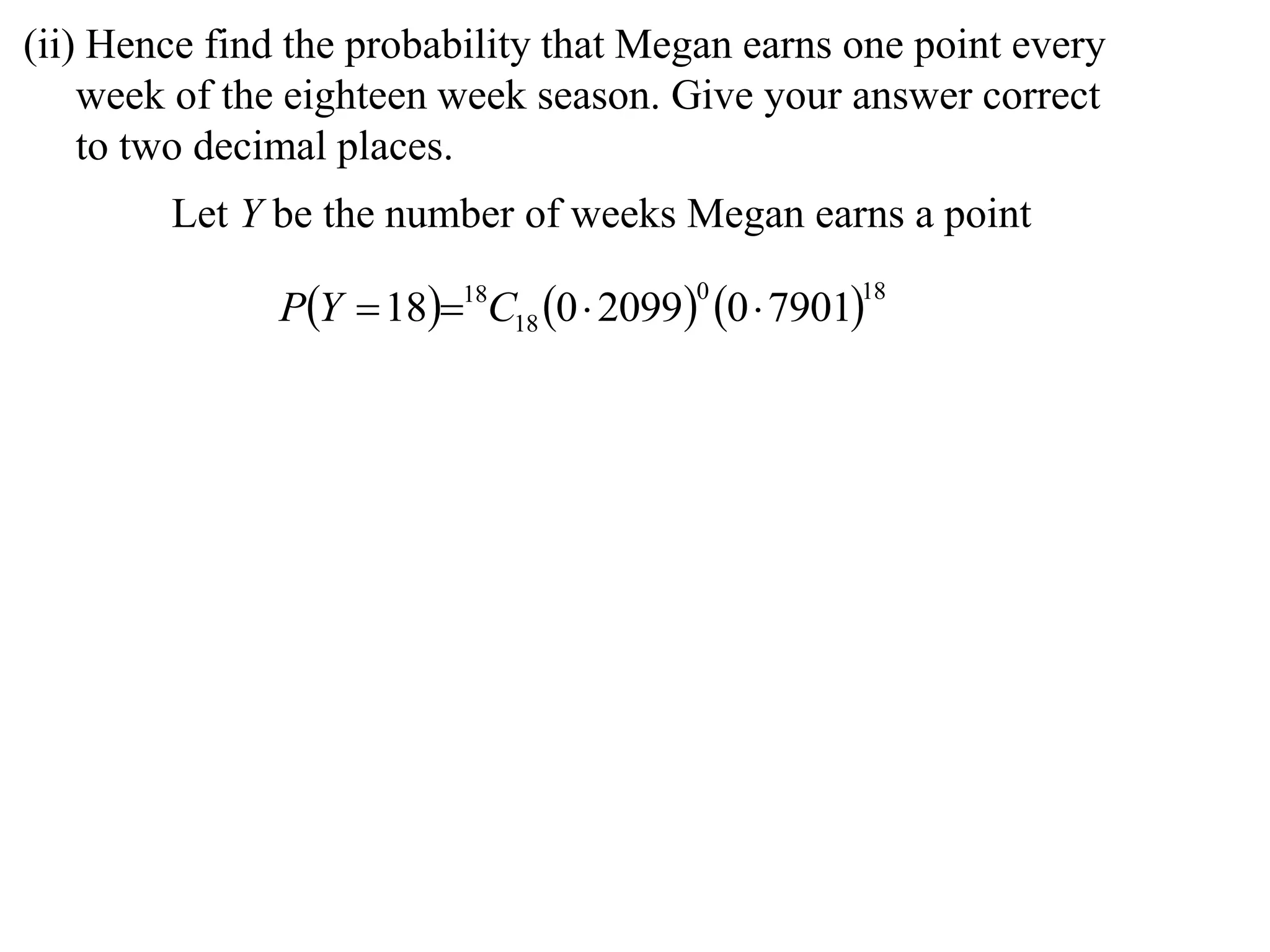
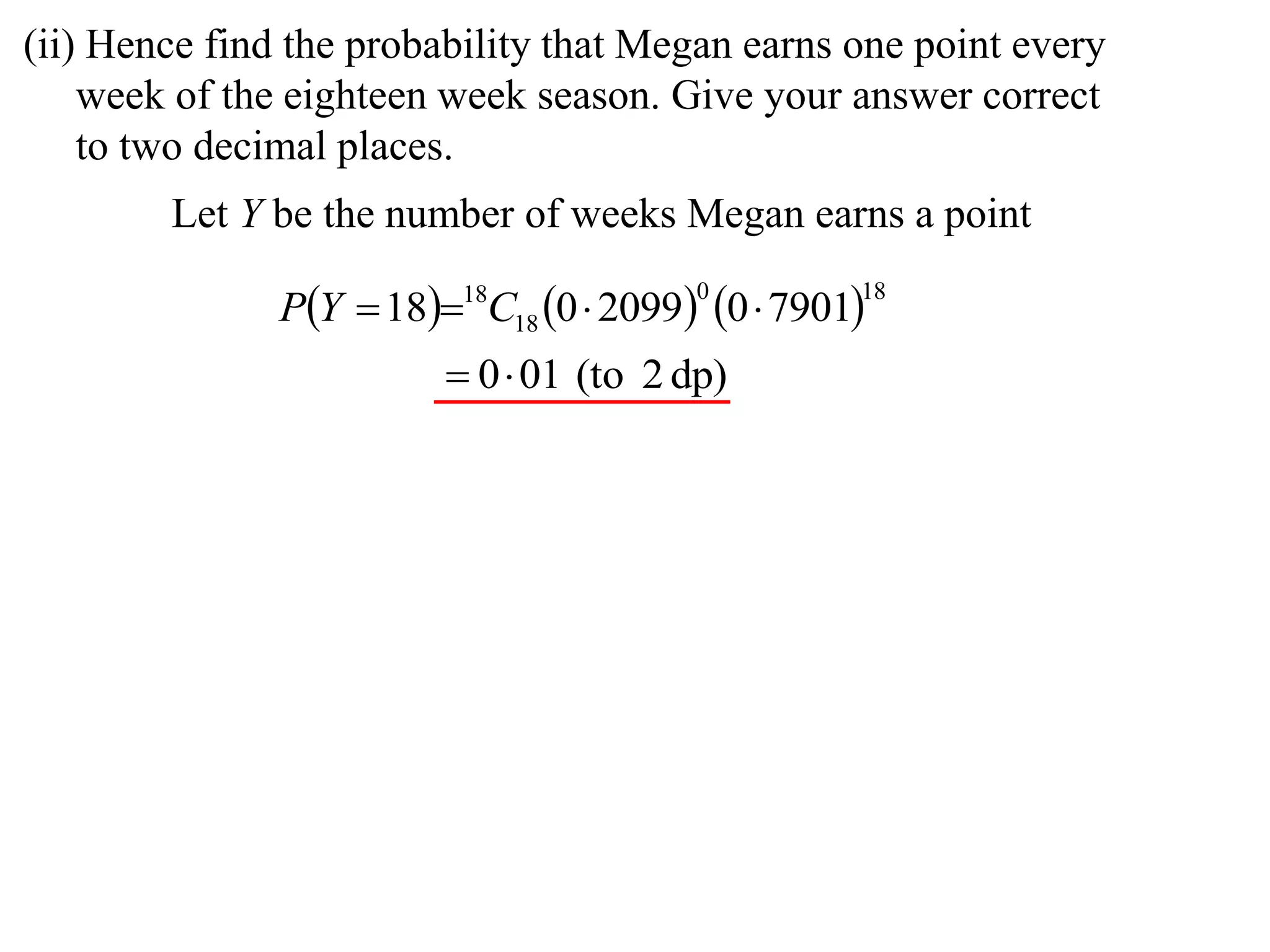
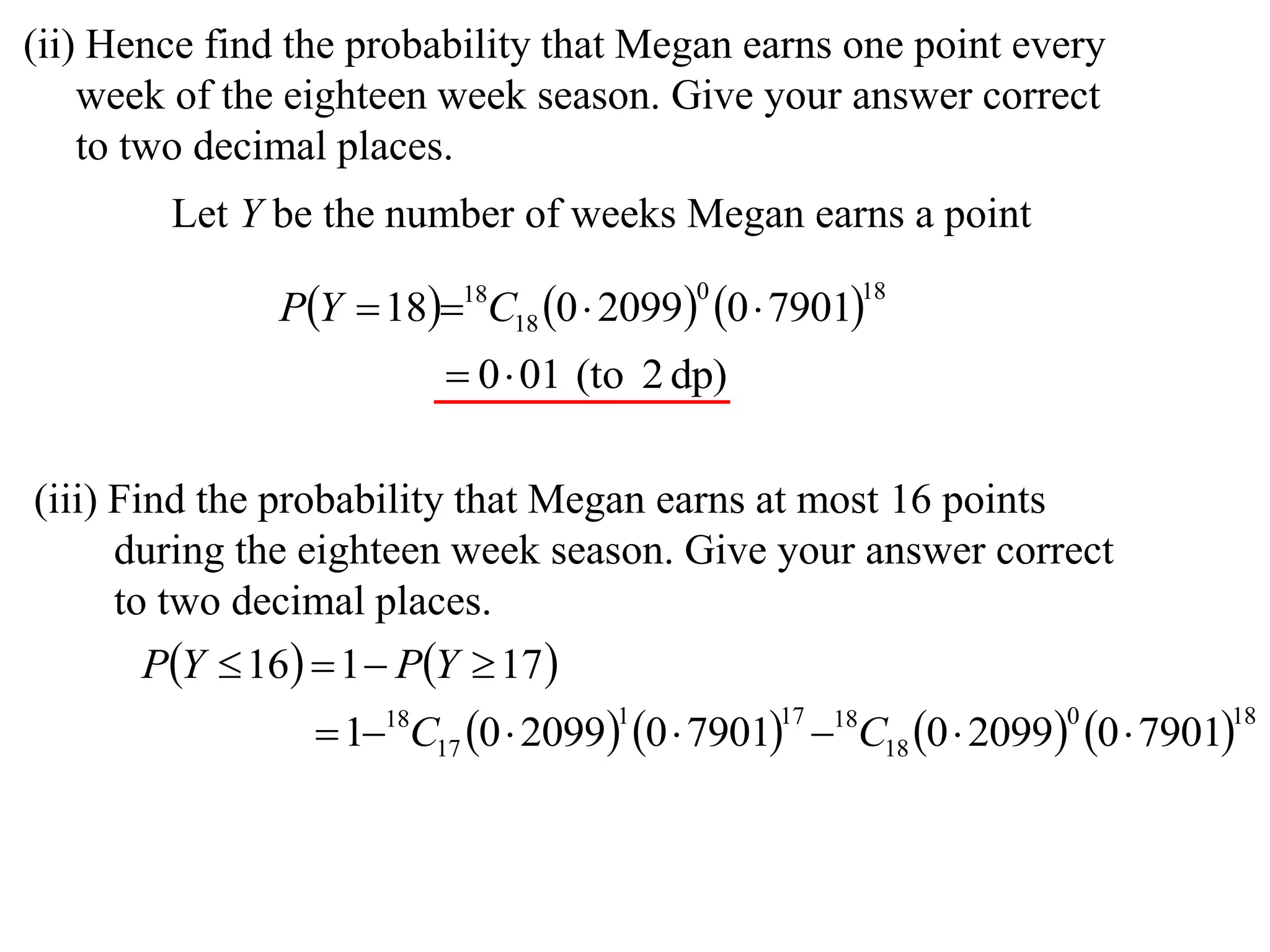
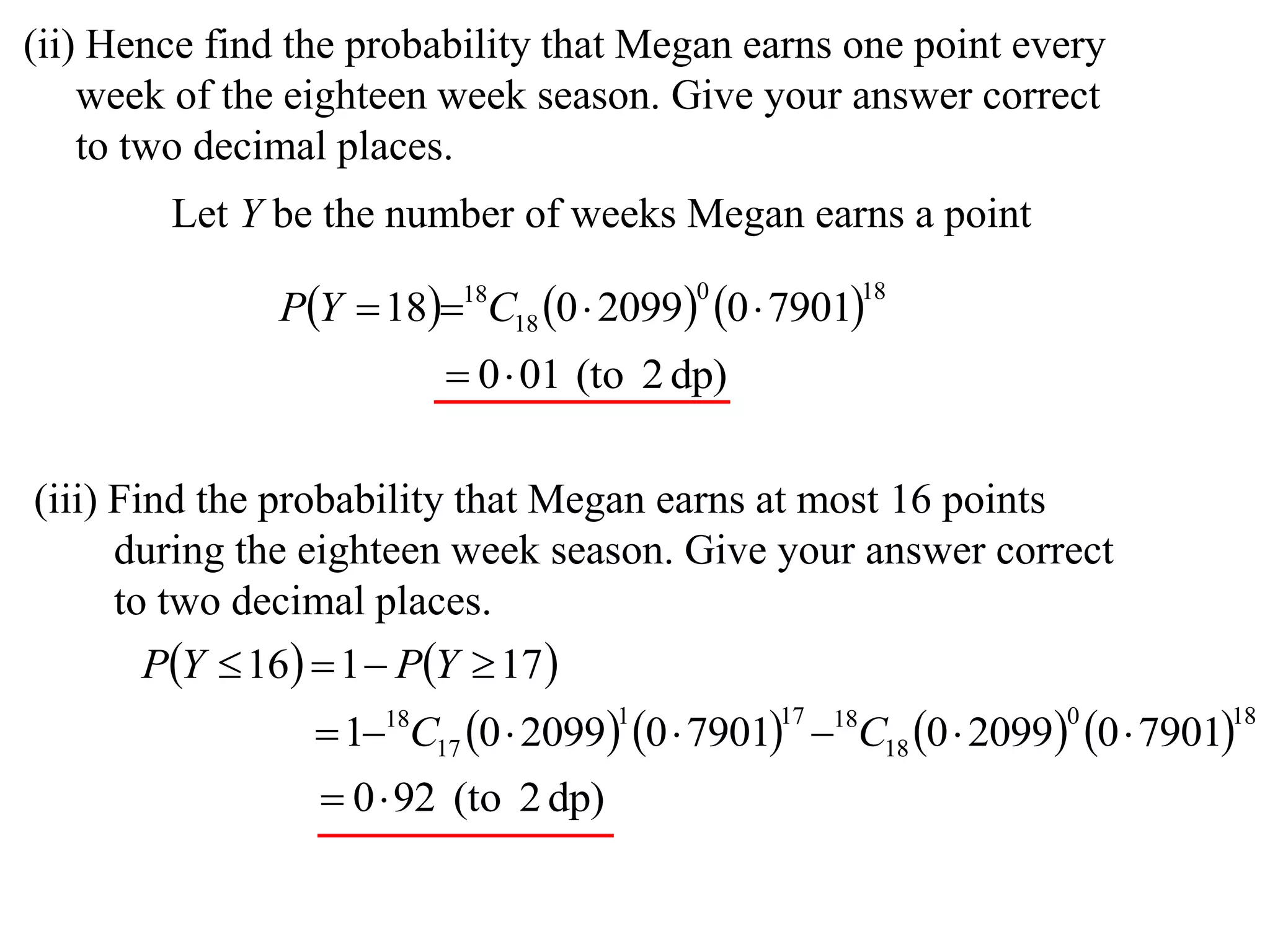
(ii) Hence find the probability that Megan earns one point every
    week of the eighteen week season. Give your answer correct
    to two decimal places.
(ii) Hence find the probability that Megan earns one point every
    week of the eighteen week season. Give your answer correct
    to two decimal places.
        Let Y be the number of weeks Megan earns a point
(ii) Hence find the probability that Megan earns one point every
    week of the eighteen week season. Give your answer correct
    to two decimal places.
        Let Y be the number of weeks Megan earns a point

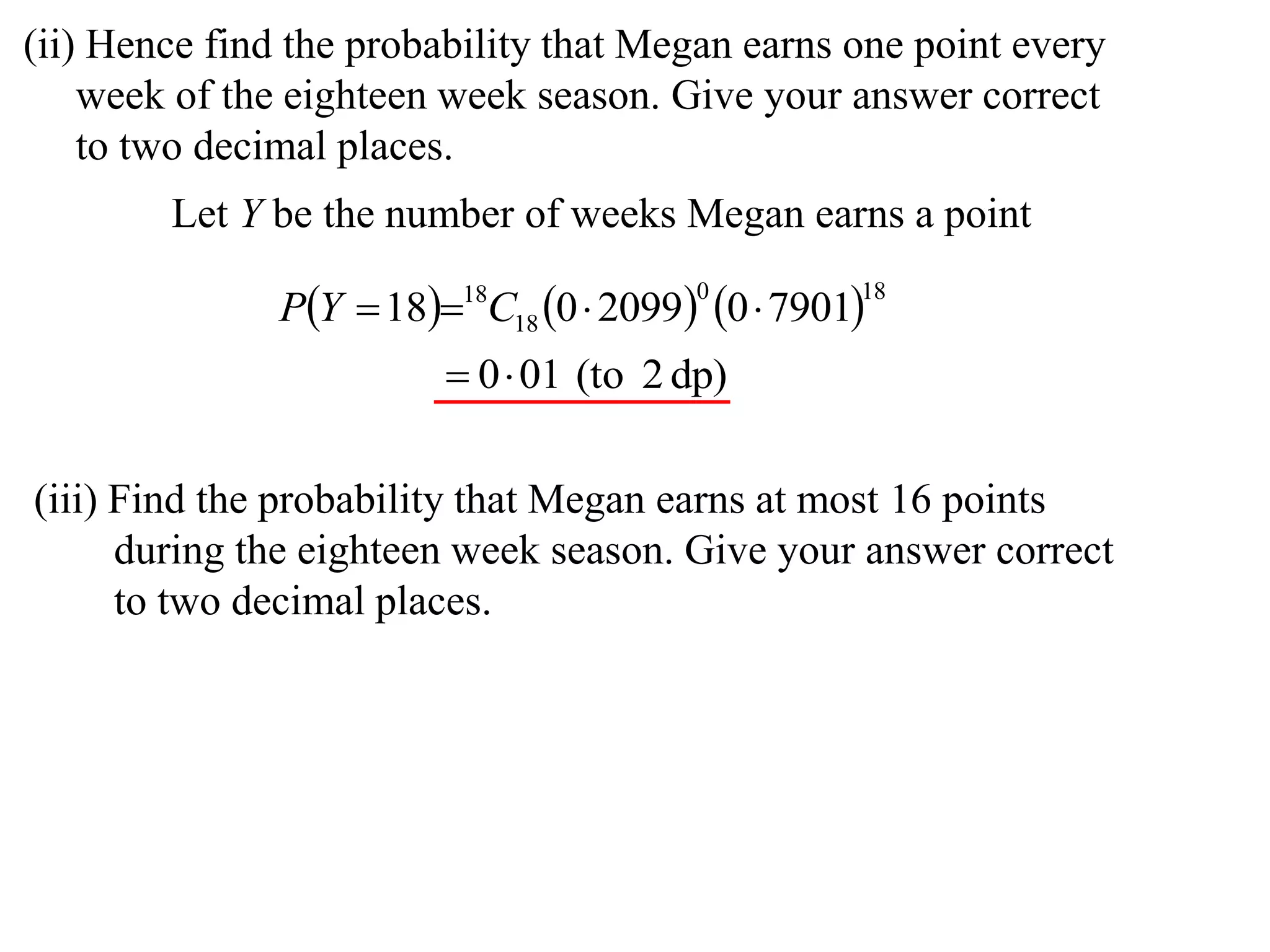
               PY  1818C18 0  2099 0  7901
                                         0         18
(ii) Hence find the probability that Megan earns one point every
    week of the eighteen week season. Give your answer correct
    to two decimal places.
        Let Y be the number of weeks Megan earns a point

               PY  1818C18 0  2099 0  7901
                                         0         18


                          0 01 (to 2 dp)
(ii) Hence find the probability that Megan earns one point every
    week of the eighteen week season. Give your answer correct
    to two decimal places.
        Let Y be the number of weeks Megan earns a point

               PY  1818C18 0  2099 0  7901
                                         0         18


                          0 01 (to 2 dp)

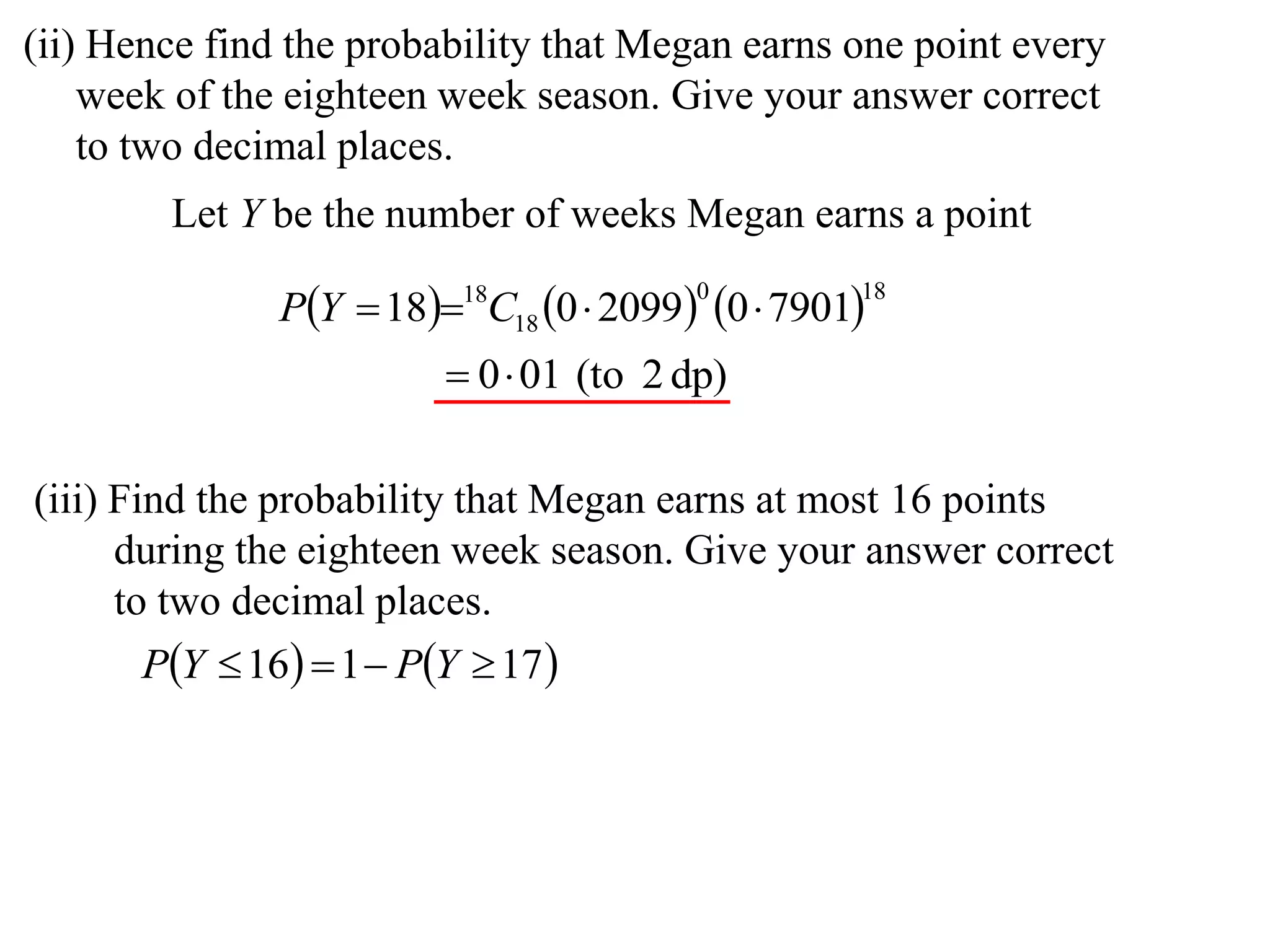
(iii) Find the probability that Megan earns at most 16 points
      during the eighteen week season. Give your answer correct
      to two decimal places.
(ii) Hence find the probability that Megan earns one point every
    week of the eighteen week season. Give your answer correct
    to two decimal places.
        Let Y be the number of weeks Megan earns a point

               PY  1818C18 0  2099 0  7901
                                         0         18


                          0 01 (to 2 dp)

(iii) Find the probability that Megan earns at most 16 points
      during the eighteen week season. Give your answer correct
      to two decimal places.
       PY  16  1  PY  17 
(ii) Hence find the probability that Megan earns one point every
    week of the eighteen week season. Give your answer correct
    to two decimal places.
        Let Y be the number of weeks Megan earns a point

               PY  1818C18 0  2099 0  7901
                                         0          18


                          0 01 (to 2 dp)

(iii) Find the probability that Megan earns at most 16 points
      during the eighteen week season. Give your answer correct
      to two decimal places.
       PY  16  1  PY  17 
                  118C17 0  2099 0  7901 18C18 0  2099 0  7901
                                    1          17                 0         18
(ii) Hence find the probability that Megan earns one point every
    week of the eighteen week season. Give your answer correct
    to two decimal places.
        Let Y be the number of weeks Megan earns a point

               PY  1818C18 0  2099 0  7901
                                          0         18


                          0 01 (to 2 dp)

(iii) Find the probability that Megan earns at most 16 points
      during the eighteen week season. Give your answer correct
      to two decimal places.
       PY  16  1  PY  17 
                  118C17 0  2099 0  7901 18C18 0  2099 0  7901
                                      1        17                 0         18


                   0 92 (to 2 dp)
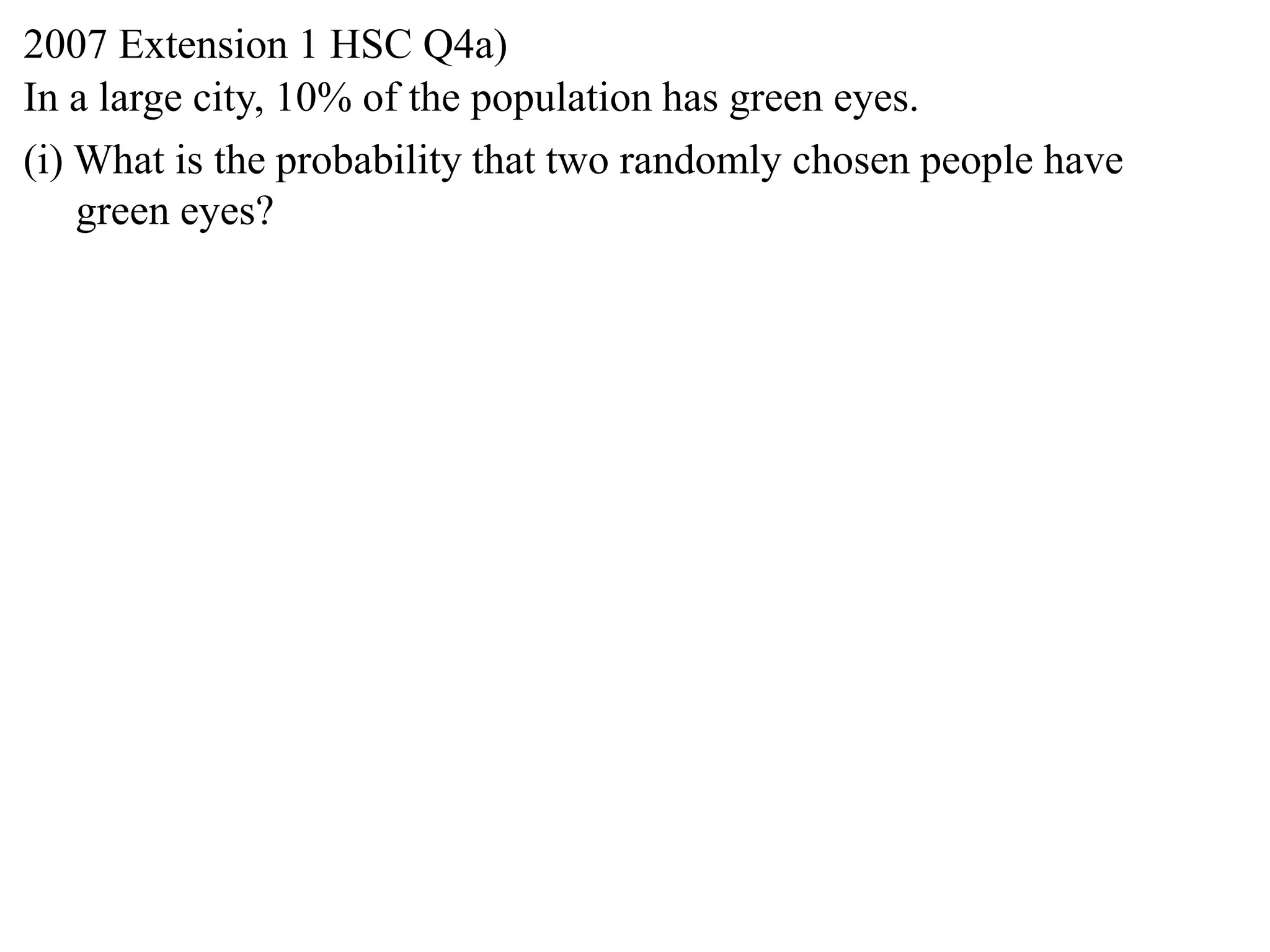
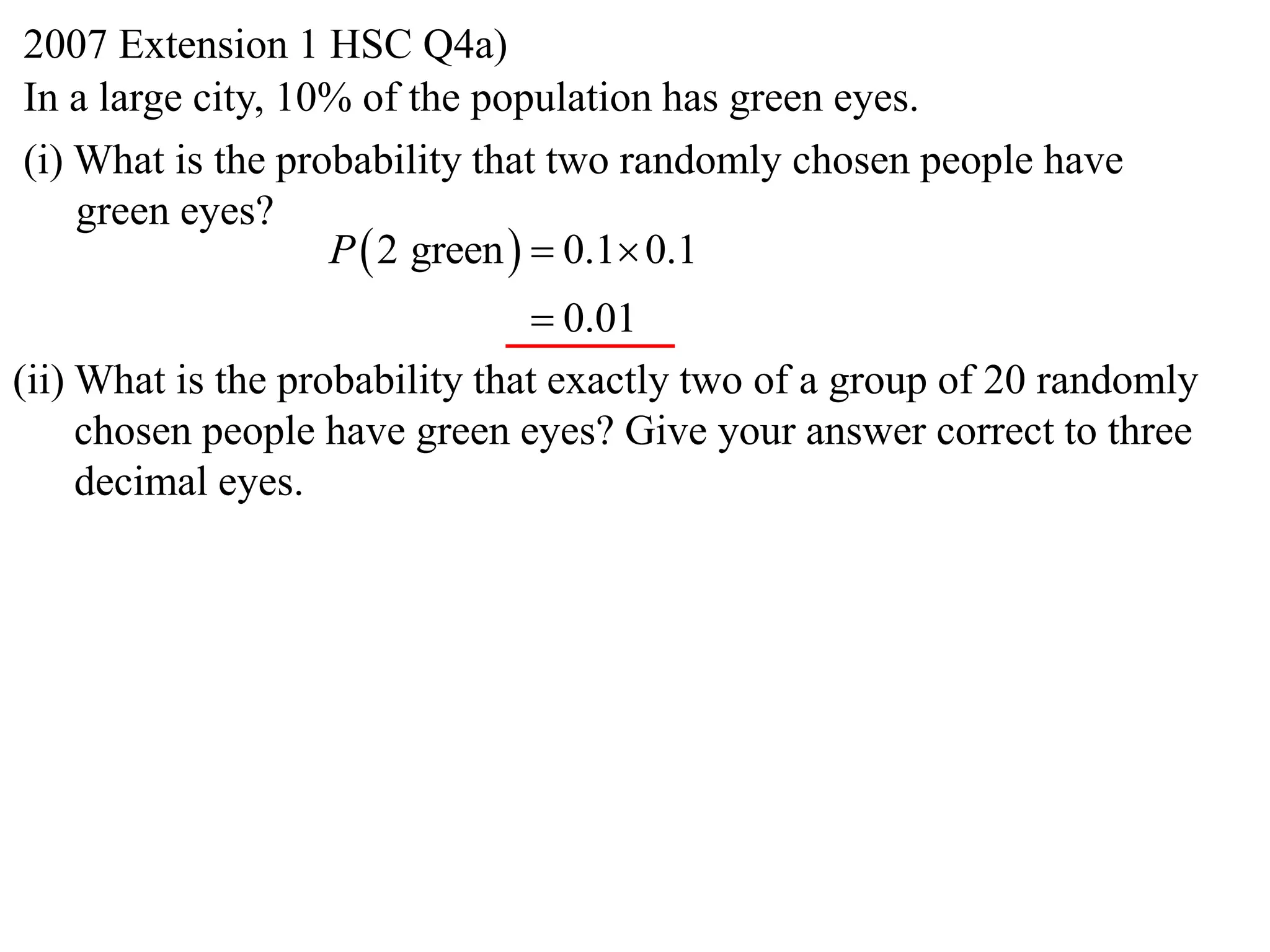
2007 Extension 1 HSC Q4a)
In a large city, 10% of the population has green eyes.
(i) What is the probability that two randomly chosen people have
    green eyes?
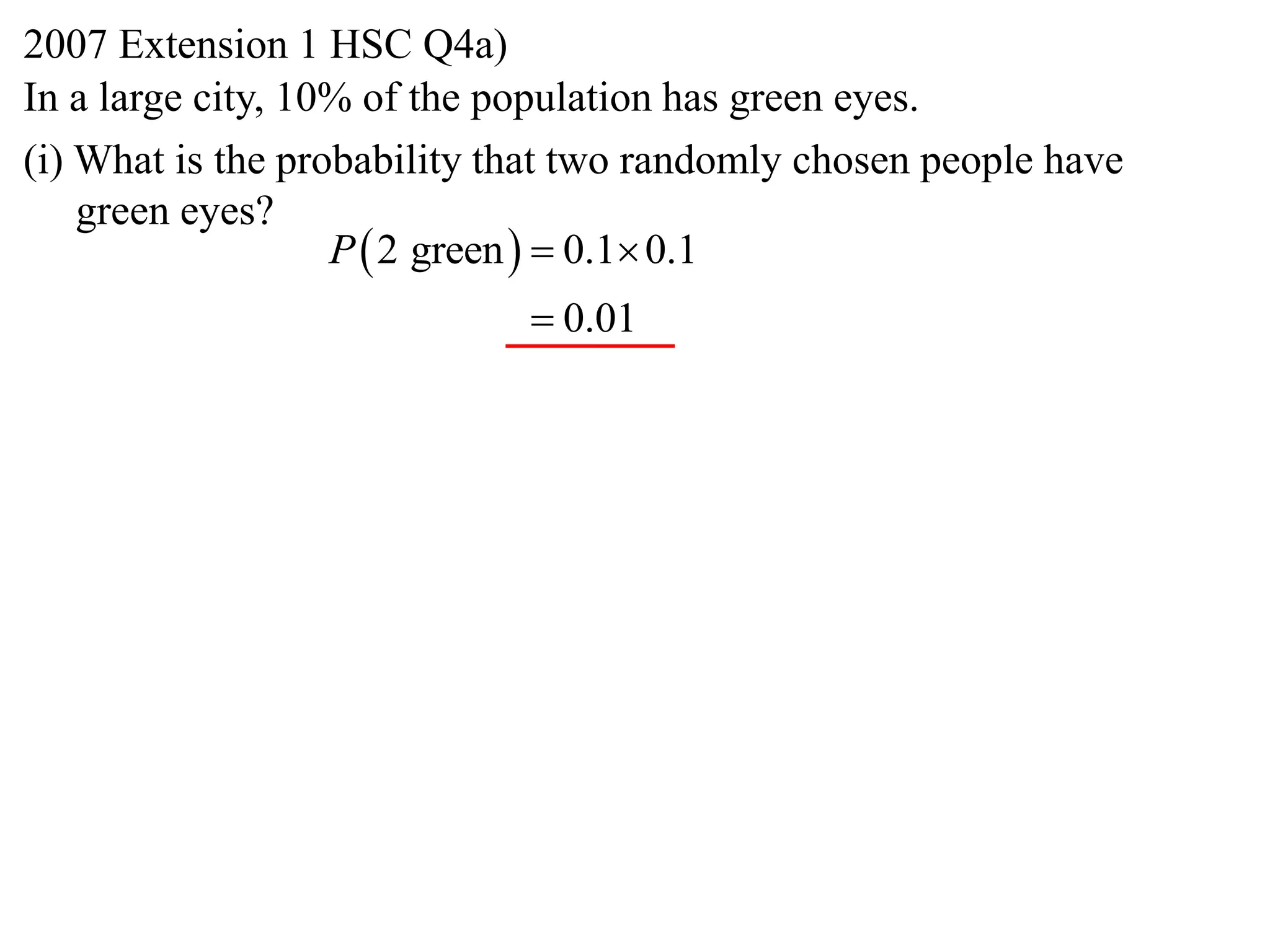
2007 Extension 1 HSC Q4a)
In a large city, 10% of the population has green eyes.
(i) What is the probability that two randomly chosen people have
    green eyes?
                   P  2 green   0.1 0.1
                              0.01
2007 Extension 1 HSC Q4a)
In a large city, 10% of the population has green eyes.
(i) What is the probability that two randomly chosen people have
    green eyes?
                   P  2 green   0.1 0.1
                                 0.01
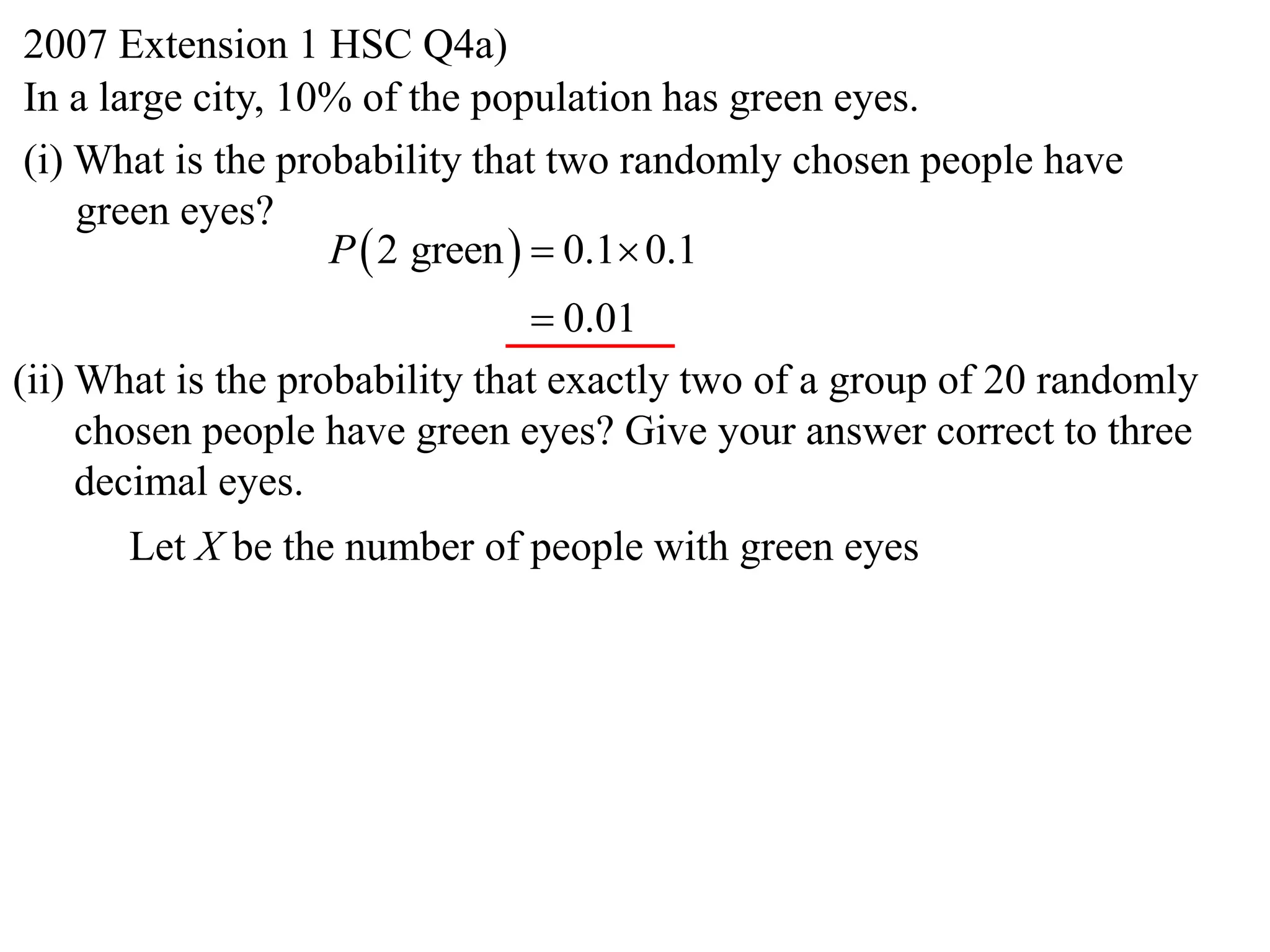
(ii) What is the probability that exactly two of a group of 20 randomly
     chosen people have green eyes? Give your answer correct to three
     decimal eyes.
2007 Extension 1 HSC Q4a)
In a large city, 10% of the population has green eyes.
(i) What is the probability that two randomly chosen people have
    green eyes?
                   P  2 green   0.1 0.1
                                 0.01
(ii) What is the probability that exactly two of a group of 20 randomly
     chosen people have green eyes? Give your answer correct to three
     decimal eyes.
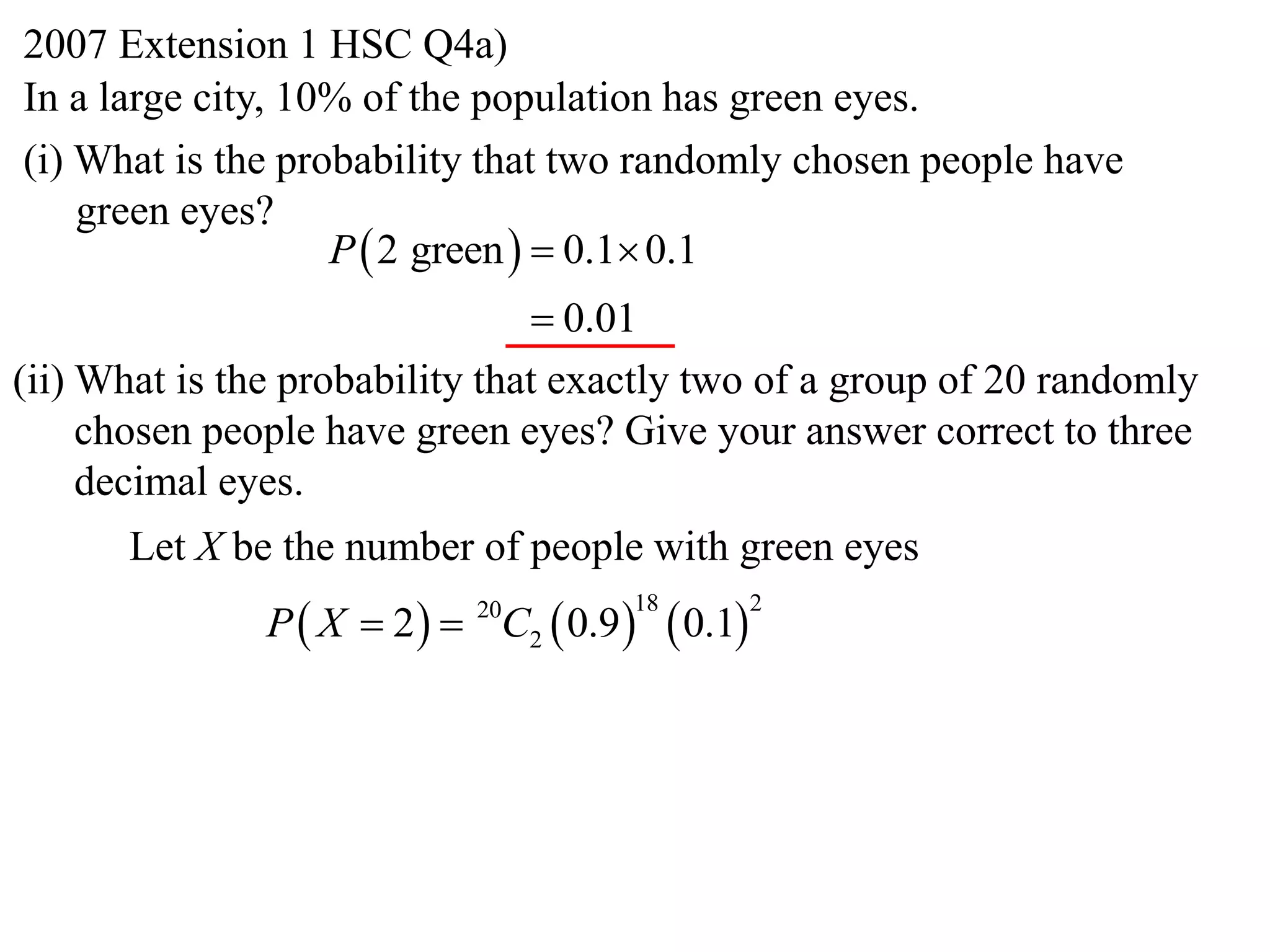
      Let X be the number of people with green eyes
2007 Extension 1 HSC Q4a)
In a large city, 10% of the population has green eyes.
(i) What is the probability that two randomly chosen people have
    green eyes?
                   P  2 green   0.1 0.1
                                 0.01
(ii) What is the probability that exactly two of a group of 20 randomly
     chosen people have green eyes? Give your answer correct to three
     decimal eyes.
      Let X be the number of people with green eyes
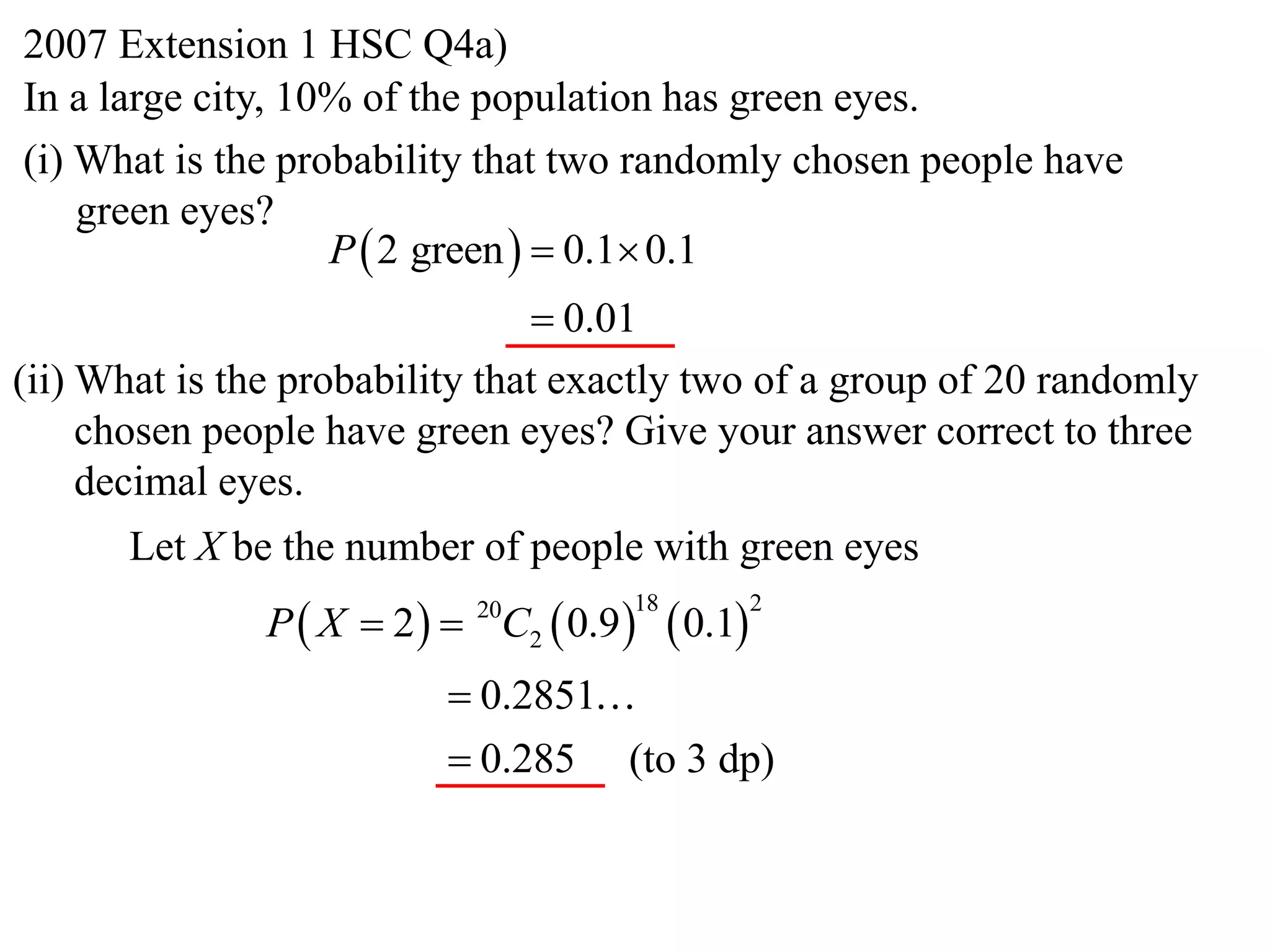
               P  X  2   C2  0.9      0.1
                            20        18            2
2007 Extension 1 HSC Q4a)
In a large city, 10% of the population has green eyes.
(i) What is the probability that two randomly chosen people have
    green eyes?
                   P  2 green   0.1 0.1
                                 0.01
(ii) What is the probability that exactly two of a group of 20 randomly
     chosen people have green eyes? Give your answer correct to three
     decimal eyes.
      Let X be the number of people with green eyes
               P  X  2   C2  0.9      0.1
                            20        18            2


                           0.2851
                           0.285 (to 3 dp)
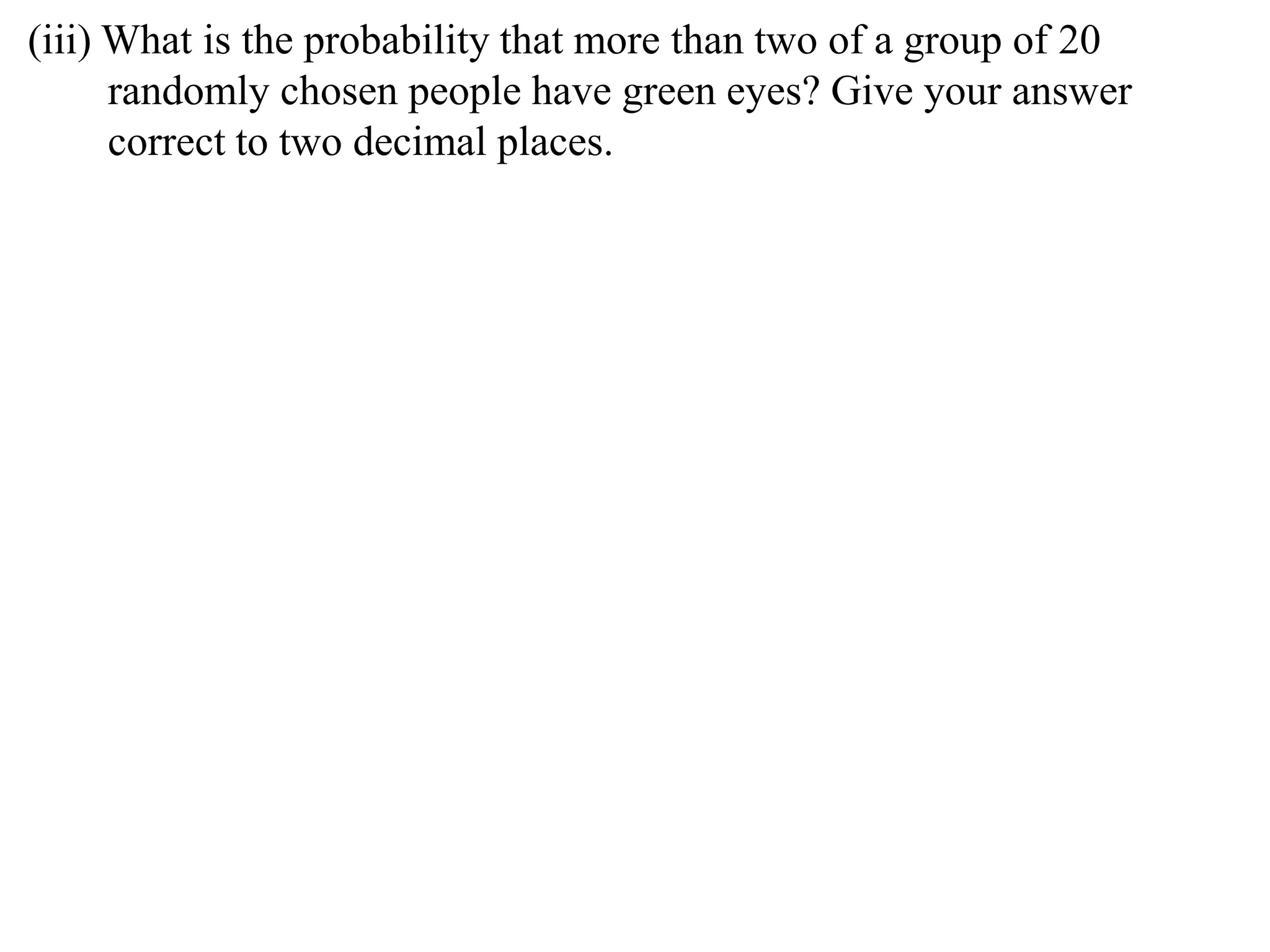
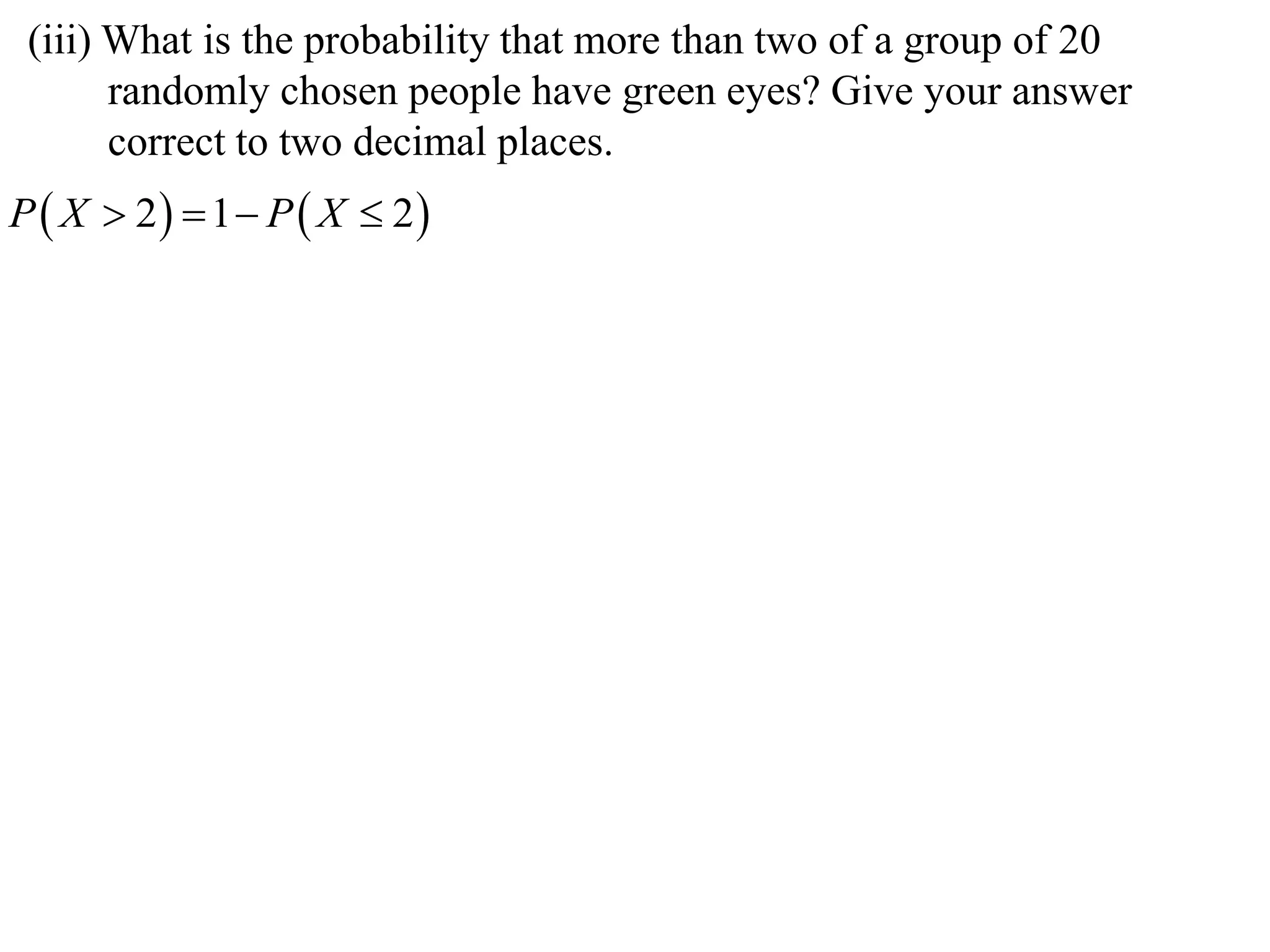
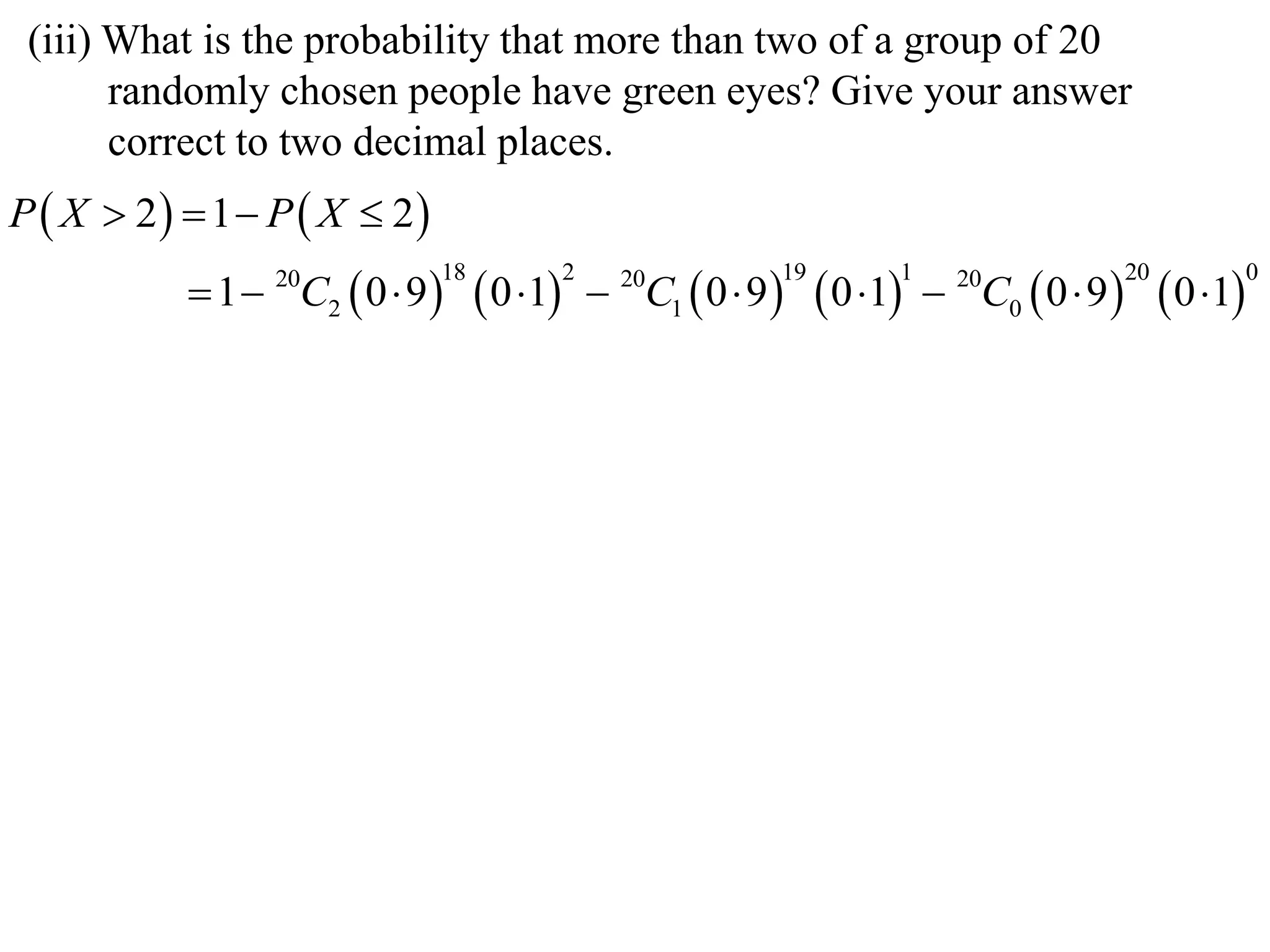
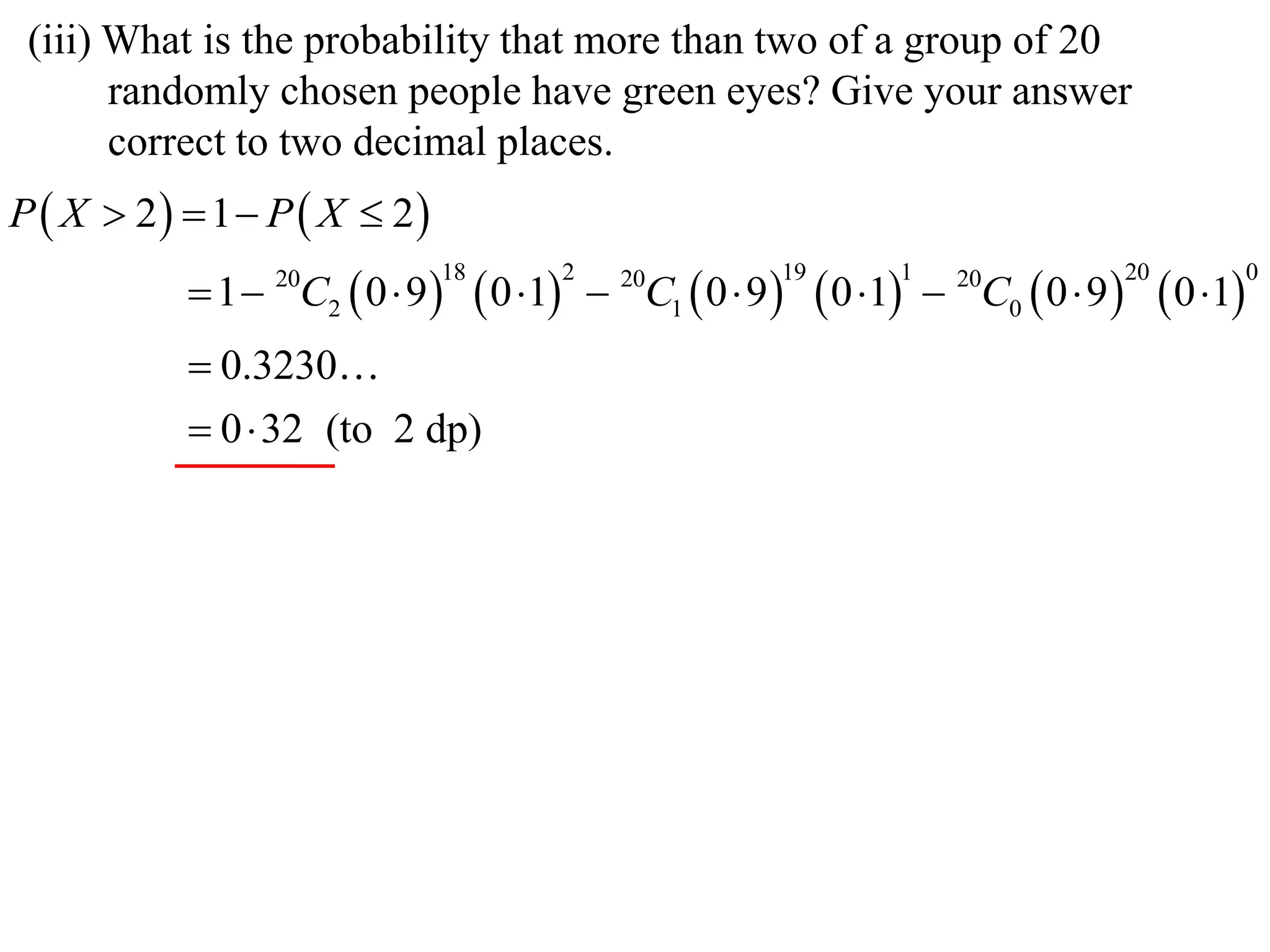
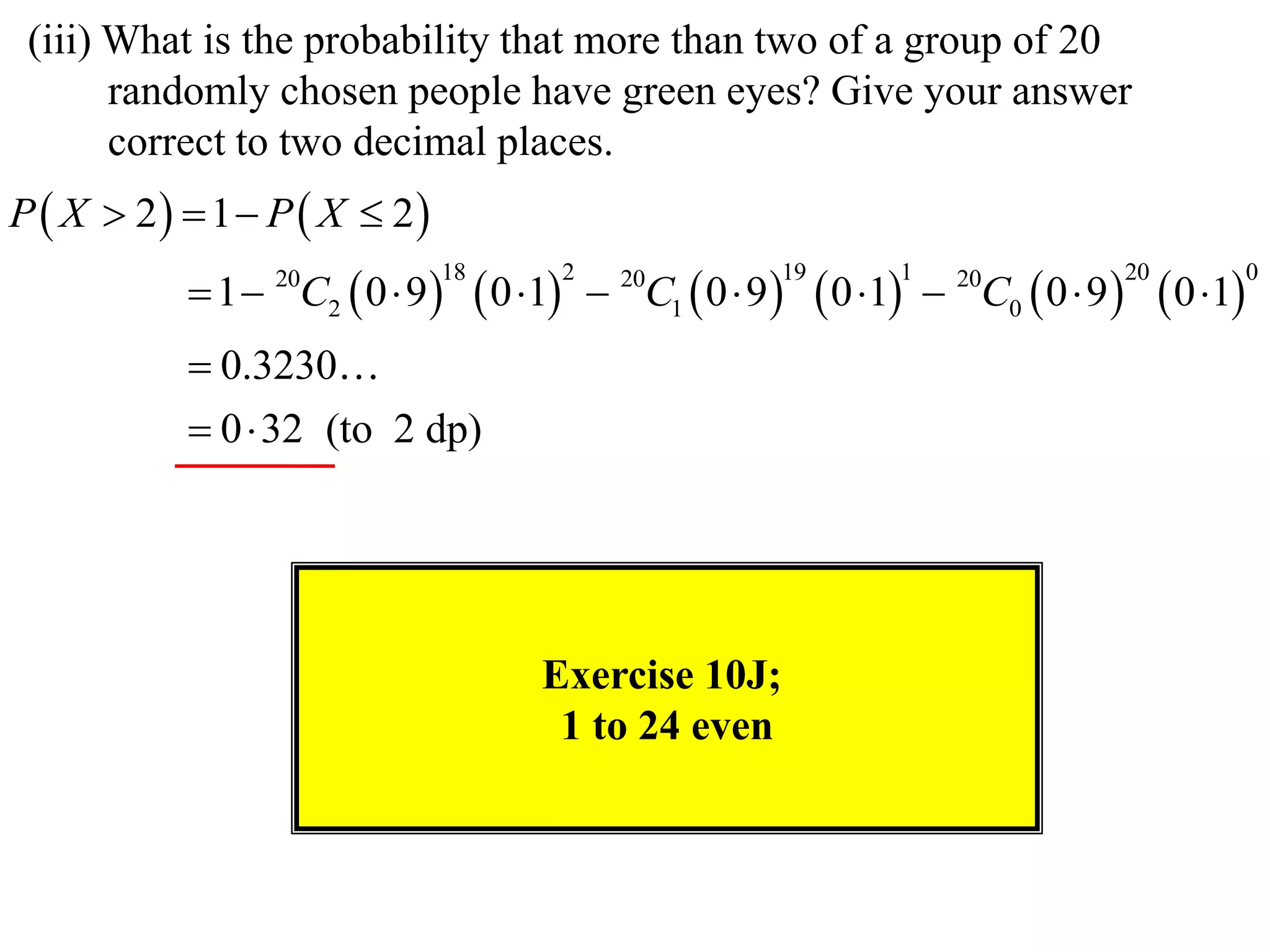
(iii) What is the probability that more than two of a group of 20
      randomly chosen people have green eyes? Give your answer
      correct to two decimal places.
(iii) What is the probability that more than two of a group of 20
       randomly chosen people have green eyes? Give your answer
       correct to two decimal places.
P  X  2  1  P  X  2
(iii) What is the probability that more than two of a group of 20
       randomly chosen people have green eyes? Give your answer
       correct to two decimal places.
P  X  2  1  P  X  2
            1  C2  0  9        0 1        C1  0  9      0 1    C0  0  9          0 1
                 20           18             2     20         19         1     20             20             0
(iii) What is the probability that more than two of a group of 20
       randomly chosen people have green eyes? Give your answer
       correct to two decimal places.
P  X  2  1  P  X  2
            1  C2  0  9        0 1        C1  0  9      0 1    C0  0  9          0 1
                 20           18             2     20         19         1     20             20             0


            0.3230
            0  32 (to 2 dp)
(iii) What is the probability that more than two of a group of 20
       randomly chosen people have green eyes? Give your answer
       correct to two decimal places.
P  X  2  1  P  X  2
            1  C2  0  9        0 1        C1  0  9      0 1    C0  0  9          0 1
                 20           18             2     20         19         1     20             20             0


            0.3230
            0  32 (to 2 dp)


                                        Exercise 10J;
                                         1 to 24 even

12 x1 t08 06 binomial probability (2012)

  • 1.
  • 2.
    Binomial Probability If anevent has only two possibilities and this event is repeated, then the probability distribution is as follows;
  • 3.
    Binomial Probability If anevent has only two possibilities and this event is repeated, then the probability distribution is as follows; A B
  • 4.
    Binomial Probability If anevent has only two possibilities and this event is repeated, then the probability distribution is as follows; A p  Bq 
  • 5.
    Binomial Probability If anevent has only two possibilities and this event is repeated, then the probability distribution is as follows; AA A p  AB Bq 
  • 6.
    Binomial Probability If anevent has only two possibilities and this event is repeated, then the probability distribution is as follows; AA A p  AB BA Bq  BB
  • 7.
    Binomial Probability If anevent has only two possibilities and this event is repeated, then the probability distribution is as follows; AA p 2  A p  AB  pq  BA  pq  Bq  BB q 2 
  • 8.
    Binomial Probability If anevent has only two possibilities and this event is repeated, then the probability distribution is as follows; AAA AA p 2  AAB A p  ABA AB  pq  ABB BAA BA  pq  BAB Bq  BBA BB q 2  BBB
  • 9.
    Binomial Probability If anevent has only two possibilities and this event is repeated, then the probability distribution is as follows; AAA p 3  AA p 2  AAB  p q  2 A p  ABA  p 2 q  AB  pq  ABB  pq 2  BAA p 2 q  BA  pq  BAB pq  2 Bq  BBA pq  2 BB q 2  BBB p  3
  • 10.
    Binomial Probability If anevent has only two possibilities and this event is repeated, then the probability distribution is as follows; AAA p 3  AAAA AAAB AA p  2 AABA AAB  p q  2 AABB A p  ABA  p q  2 ABAA AB  pq  ABAB ABBA ABB  pq 2  ABBB BAAA BAA p 2 q  BAAB BA  pq  BABA BAB pq  2 BABB Bq  BBA pq 2 BBAA BB q 2  BBAB BBB  p  3 BBBA BBBB
  • 11.
    Binomial Probability If anevent has only two possibilities and this event is repeated, then the probability distribution is as follows; AAA p 3  AAAA  p 4  AAAB  p 3q  AA p 2  AABA p 3q  AAB  p q  AABB  p 2 q 2  2 A p  ABA  p 2 q  ABAA  p 3q  AB  pq  ABAB  p 2 q 2  ABB  pq 2  p q  ABBA 2 2 ABBB  pq 3  BAA p q  BAAA 3 p q BAAB  p 2 q 2  2 BA  pq  BABA  p 2 q 2  BAB pq  BABB  pq  2 3 Bq  BBA pq 2 BBAA p q  2 2 BB q 2  BBAB  pq  3 BBB  p   pqq  3 BBBA 3 4 BBBB
  • 12.
  • 13.
    1 Event P A  p P B   q
  • 14.
    1 Event 2 Events P  A  p P B   q
  • 15.
    1 Event 2 Events P  A  p P AA  p 2 P B   q P AandB   2 pq PBB   q 2
  • 16.
    1 Event 2 Events 3 Events P  A  p P AA  p 2 P B   q P AandB   2 pq PBB   q 2
  • 17.
    1 Event 2 Events 3 Events P  A  p P AA  p 2 P AAA   p 3 P B   q P AandB   2 pq P2 AandB   3 p 2 q PBB   q 2 P Aand 2 B   3 pq 2 PBBB  q 3
  • 18.
    1 Event 2 Events 3 Events P  A  p P AA  p 2 P AAA   p 3 P B   q P AandB   2 pq P2 AandB   3 p 2 q PBB   q 2 P Aand 2 B   3 pq 2 PBBB  q 3 4 Events
  • 19.
    1 Event 2 Events 3 Events P  A  p P AA  p 2 P AAA   p 3 P B   q P AandB   2 pq P2 AandB   3 p 2 q PBB   q 2 P Aand 2 B   3 pq 2 PBBB  q 3 4 Events P AAAA   p 4 P3 AandB   4 p 3q P2 Aand 2 B   6 p 2 q 2 P Aand 3B   4 pq 3 PBBBB  q 4
  • 20.
    1 Event 2 Events 3 Events P  A  p P AA  p 2 P AAA   p 3 P B   q P AandB   2 pq P2 AandB   3 p 2 q PBB   q 2 P Aand 2 B   3 pq 2 PBBB  q 3 4 Events If an event is repeated n times and P X   p P AAAA   p 4 and P X   q then the probabilit y that X will P3 AandB   4 p 3q occur exactly k times is; P2 Aand 2 B   6 p 2 q 2 P Aand 3B   4 pq 3 PBBBB  q 4
  • 21.
    1 Event 2 Events 3 Events P  A  p P AA  p 2 P AAA   p 3 P B   q P AandB   2 pq P2 AandB   3 p 2 q PBB   q 2 P Aand 2 B   3 pq 2 PBBB  q 3 4 Events If an event is repeated n times and P X   p P AAAA   p 4 and P X   q then the probabilit y that X will P3 AandB   4 p 3q occur exactly k times is; P2 Aand 2 B   6 p 2 q 2 P X  k  nCk q nk p k P Aand 3B   4 pq 3 PBBBB  q 4 Note: X = k, means X will occur exactly k times
  • 22.
    e.g.(i) A bagcontains 30 black balls and 20 white balls. Seven drawings are made (with replacement), what is the probability of drawing; a) All black balls?
  • 23.
    e.g.(i) A bagcontains 30 black balls and 20 white balls. Seven drawings are made (with replacement), what is the probability of drawing; a) All black balls? 0 7 P X  7  7C7     2 3      5 5
  • 24.
    e.g.(i) A bagcontains 30 black balls and 20 white balls. Seven drawings are made (with replacement), what is the probability of drawing; Let X be the number of black balls drawn a) All black balls? 0 7 P X  7  7C7     2  3   5 5
  • 25.
    e.g.(i) A bagcontains 30 black balls and 20 white balls. Seven drawings are made (with replacement), what is the probability of drawing; Let X be the number of black balls drawn a) All black balls? 0 7 P X  7  7C7     2  3   5 5 7 C7 37  7 5
  • 26.
    e.g.(i) A bagcontains 30 black balls and 20 white balls. Seven drawings are made (with replacement), what is the probability of drawing; Let X be the number of black balls drawn a) All black balls? 0 7 P X  7  7C7     2  3   5 5 7 C7 37  7 5 2187  78125
  • 27.
    e.g.(i) A bagcontains 30 black balls and 20 white balls. Seven drawings are made (with replacement), what is the probability of drawing; Let X be the number of black balls drawn a) All black balls? b) 4 black balls? 0 7 P X  7  7C7     2  3   5 5 7 C7 37  7 5 2187  78125
  • 28.
    e.g.(i) A bagcontains 30 black balls and 20 white balls. Seven drawings are made (with replacement), what is the probability of drawing; Let X be the number of black balls drawn a) All black balls? b) 4 black balls? 0 7 3 4 P X  7  7C7     2  3 P X  4 7C4     2  3    5 5  5 5 7 C7 37  7 5 2187  78125
  • 29.
    e.g.(i) A bagcontains 30 black balls and 20 white balls. Seven drawings are made (with replacement), what is the probability of drawing; Let X be the number of black balls drawn a) All black balls? b) 4 black balls? 0 7 3 4 P X  7  7C7     2  3 P X  4 7C4     2  3    5 5  5 5 7 C7 37 7 C4 2334  7  5 57 2187  78125
  • 30.
    e.g.(i) A bagcontains 30 black balls and 20 white balls. Seven drawings are made (with replacement), what is the probability of drawing; Let X be the number of black balls drawn a) All black balls? b) 4 black balls? 0 7 3 4 P X  7  7C7     2  3 P X  4 7C4     2  3    5 5  5 5 7 C7 37 7 C4 2334  7  5 57 2187 4536   78125 15625
  • 31.
    e.g.(i) A bagcontains 30 black balls and 20 white balls. Seven drawings are made (with replacement), what is the probability of drawing; Let X be the number of black balls drawn a) All black balls? b) 4 black balls? 0 7 3 4 P X  7  7C7     2  3 P X  4 7C4     2  3    5 5  5 5 7 C7 37 7 C4 2334  7  5 57 2187 4536   78125 15625 (ii) At an election 30% of voters favoured Party A. If at random an interviewer selects 5 voters, what is the probability that; a) 3 favoured Party A?
  • 32.
    e.g.(i) A bagcontains 30 black balls and 20 white balls. Seven drawings are made (with replacement), what is the probability of drawing; Let X be the number of black balls drawn a) All black balls? b) 4 black balls? 0 7 3 4 P X  7  7C7     2  3 P X  4 7C4     2  3    5 5  5 5 7 C7 37 7 C4 2334  7  5 57 2187 4536   78125 15625 (ii) At an election 30% of voters favoured Party A. If at random an interviewer selects 5 voters, what is the probability that; a) 3 favoured Party A? Let X be the number favouring Party A
  • 33.
    e.g.(i) A bagcontains 30 black balls and 20 white balls. Seven drawings are made (with replacement), what is the probability of drawing; Let X be the number of black balls drawn a) All black balls? b) 4 black balls? 0 7 3 4 P X  7  7C7     2  3 P X  4 7C4     2  3    5 5  5 5 7 C7 37 7 C4 2334  7  5 57 2187 4536   78125 15625 (ii) At an election 30% of voters favoured Party A. If at random an interviewer selects 5 voters, what is the probability that; 2 3 P3 A5C3     7 3 a) 3 favoured Party A?      10   10  Let X be the number favouring Party A
  • 34.
    e.g.(i) A bagcontains 30 black balls and 20 white balls. Seven drawings are made (with replacement), what is the probability of drawing; Let X be the number of black balls drawn a) All black balls? b) 4 black balls? 0 7 3 4 P X  7  7C7     2  3 P X  4 7C4     2  3    5 5  5 5 7 C7 37 7 C4 2334  7  5 57 2187 4536   78125 15625 (ii) At an election 30% of voters favoured Party A. If at random an interviewer selects 5 voters, what is the probability that; 2 3 P3 A5C3     7 3 a) 3 favoured Party A?      10   10  Let X be the number 5 C3 7 233 favouring Party A  105
  • 35.
    e.g.(i) A bagcontains 30 black balls and 20 white balls. Seven drawings are made (with replacement), what is the probability of drawing; Let X be the number of black balls drawn a) All black balls? b) 4 black balls? 0 7 3 4 P X  7  7C7     2  3 P X  4 7C4     2  3    5 5  5 5 7 C7 37 7 C4 2334  7  5 57 2187 4536   78125 15625 (ii) At an election 30% of voters favoured Party A. If at random an interviewer selects 5 voters, what is the probability that; 2 3 P3 A5C3     7 3 a) 3 favoured Party A?      10   10  Let X be the number 5 C3 7 233 1323 favouring Party A  5  10 10000
  • 36.
  • 37.
    b) majority favourA? 2 3 1 4 0 5 P X  35C3      5C4      5C5     7 3 7 3 7 3             10   10   10   10   10   10 
  • 38.
    b) majority favourA? 2 3 1 4 0 5 P X  35C3      5C4      5C5     7 3 7 3 7 3             10   10   10   10   10   10  5 C3 7 233  5C4 7  34  5C5 35  105
  • 39.
    b) majority favourA? 2 3 1 4 0 5 P X  35C3      5C4      5C5     7 3 7 3 7 3             10   10   10   10   10   10  5 C3 7 233  5C4 7  34  5C5 35  105 4077  25000
  • 40.
    b) majority favourA? 2 3 1 4 0 5 P X  35C3      5C4      5C5     7 3 7 3 7 3             10   10   10   10   10   10  5 C3 7 233  5C4 7  34  5C5 35  105 4077  25000 c) at most 2 favoured A?
  • 41.
    b) majority favourA? 2 3 1 4 0 5 P X  35C3      5C4      5C5     7 3 7 3 7 3             10   10   10   10   10   10  5 C3 7 233  5C4 7  34  5C5 35  105 4077  25000 c) at most 2 favoured A? P X  2  1  P X  3
  • 42.
    b) majority favourA? 2 3 1 4 0 5 P X  35C3      5C4      5C5     7 3 7 3 7 3             10   10   10   10   10   10  5 C3 7 233  5C4 7  34  5C5 35  105 4077  25000 c) at most 2 favoured A? P X  2  1  P X  3 4077  1 25000
  • 43.
    b) majority favourA? 2 3 1 4 0 5 P X  35C3      5C4      5C5     7 3 7 3 7 3             10   10   10   10   10   10  5 C3 7 233  5C4 7  34  5C5 35  105 4077  25000 c) at most 2 favoured A? P X  2  1  P X  3 4077  1 25000 20923  25000
  • 44.
    2005 Extension 1HSC Q6a) There are five matches on each weekend of a football season. Megan takes part in a competition in which she earns 1 point if she picks more than half of the winning teams for a weekend, and zero points otherwise. The probability that Megan correctly picks the team that wins in any given match is 2 3 (i) Show that the probability that Megan earns one point for a given weekend is 0 7901, correct to four decimal places.
  • 45.
    2005 Extension 1HSC Q6a) There are five matches on each weekend of a football season. Megan takes part in a competition in which she earns 1 point if she picks more than half of the winning teams for a weekend, and zero points otherwise. The probability that Megan correctly picks the team that wins in any given match is 2 3 (i) Show that the probability that Megan earns one point for a given weekend is 0 7901, correct to four decimal places. Let X be the number of matches picked correctly
  • 46.
    2005 Extension 1HSC Q6a) There are five matches on each weekend of a football season. Megan takes part in a competition in which she earns 1 point if she picks more than half of the winning teams for a weekend, and zero points otherwise. The probability that Megan correctly picks the team that wins in any given match is 2 3 (i) Show that the probability that Megan earns one point for a given weekend is 0 7901, correct to four decimal places. Let X be the number of matches picked correctly 2 3 1 4 0 5 P X  35C3      5C4      5C5     1 2 1 2 1 2             3  3   3  3   3  3 
  • 47.
    2005 Extension 1HSC Q6a) There are five matches on each weekend of a football season. Megan takes part in a competition in which she earns 1 point if she picks more than half of the winning teams for a weekend, and zero points otherwise. The probability that Megan correctly picks the team that wins in any given match is 2 3 (i) Show that the probability that Megan earns one point for a given weekend is 0 7901, correct to four decimal places. Let X be the number of matches picked correctly 2 3 1 4 0 5 P X  35C3      5C4      5C5     1 2 1 2 1 2             3  3   3  3   3  3  5 C3 23  5C4 2 4  5C5 25  35
  • 48.
    2005 Extension 1HSC Q6a) There are five matches on each weekend of a football season. Megan takes part in a competition in which she earns 1 point if she picks more than half of the winning teams for a weekend, and zero points otherwise. The probability that Megan correctly picks the team that wins in any given match is 2 3 (i) Show that the probability that Megan earns one point for a given weekend is 0 7901, correct to four decimal places. Let X be the number of matches picked correctly 2 3 1 4 0 5 P X  35C3      5C4      5C5     1 2 1 2 1 2             3  3   3  3   3  3  5 C3 23  5C4 2 4  5C5 25  35  0 7901
  • 49.
    (ii) Hence findthe probability that Megan earns one point every week of the eighteen week season. Give your answer correct to two decimal places.
  • 50.
    (ii) Hence findthe probability that Megan earns one point every week of the eighteen week season. Give your answer correct to two decimal places. Let Y be the number of weeks Megan earns a point
  • 51.
    (ii) Hence findthe probability that Megan earns one point every week of the eighteen week season. Give your answer correct to two decimal places. Let Y be the number of weeks Megan earns a point PY  1818C18 0  2099 0  7901 0 18
  • 52.
    (ii) Hence findthe probability that Megan earns one point every week of the eighteen week season. Give your answer correct to two decimal places. Let Y be the number of weeks Megan earns a point PY  1818C18 0  2099 0  7901 0 18  0 01 (to 2 dp)
  • 53.
    (ii) Hence findthe probability that Megan earns one point every week of the eighteen week season. Give your answer correct to two decimal places. Let Y be the number of weeks Megan earns a point PY  1818C18 0  2099 0  7901 0 18  0 01 (to 2 dp) (iii) Find the probability that Megan earns at most 16 points during the eighteen week season. Give your answer correct to two decimal places.
  • 54.
    (ii) Hence findthe probability that Megan earns one point every week of the eighteen week season. Give your answer correct to two decimal places. Let Y be the number of weeks Megan earns a point PY  1818C18 0  2099 0  7901 0 18  0 01 (to 2 dp) (iii) Find the probability that Megan earns at most 16 points during the eighteen week season. Give your answer correct to two decimal places. PY  16  1  PY  17 
  • 55.
    (ii) Hence findthe probability that Megan earns one point every week of the eighteen week season. Give your answer correct to two decimal places. Let Y be the number of weeks Megan earns a point PY  1818C18 0  2099 0  7901 0 18  0 01 (to 2 dp) (iii) Find the probability that Megan earns at most 16 points during the eighteen week season. Give your answer correct to two decimal places. PY  16  1  PY  17   118C17 0  2099 0  7901 18C18 0  2099 0  7901 1 17 0 18
  • 56.
    (ii) Hence findthe probability that Megan earns one point every week of the eighteen week season. Give your answer correct to two decimal places. Let Y be the number of weeks Megan earns a point PY  1818C18 0  2099 0  7901 0 18  0 01 (to 2 dp) (iii) Find the probability that Megan earns at most 16 points during the eighteen week season. Give your answer correct to two decimal places. PY  16  1  PY  17   118C17 0  2099 0  7901 18C18 0  2099 0  7901 1 17 0 18  0 92 (to 2 dp)
  • 57.
    2007 Extension 1HSC Q4a) In a large city, 10% of the population has green eyes. (i) What is the probability that two randomly chosen people have green eyes?
  • 58.
    2007 Extension 1HSC Q4a) In a large city, 10% of the population has green eyes. (i) What is the probability that two randomly chosen people have green eyes? P  2 green   0.1 0.1  0.01
  • 59.
    2007 Extension 1HSC Q4a) In a large city, 10% of the population has green eyes. (i) What is the probability that two randomly chosen people have green eyes? P  2 green   0.1 0.1  0.01 (ii) What is the probability that exactly two of a group of 20 randomly chosen people have green eyes? Give your answer correct to three decimal eyes.
  • 60.
    2007 Extension 1HSC Q4a) In a large city, 10% of the population has green eyes. (i) What is the probability that two randomly chosen people have green eyes? P  2 green   0.1 0.1  0.01 (ii) What is the probability that exactly two of a group of 20 randomly chosen people have green eyes? Give your answer correct to three decimal eyes. Let X be the number of people with green eyes
  • 61.
    2007 Extension 1HSC Q4a) In a large city, 10% of the population has green eyes. (i) What is the probability that two randomly chosen people have green eyes? P  2 green   0.1 0.1  0.01 (ii) What is the probability that exactly two of a group of 20 randomly chosen people have green eyes? Give your answer correct to three decimal eyes. Let X be the number of people with green eyes P  X  2   C2  0.9   0.1 20 18 2
  • 62.
    2007 Extension 1HSC Q4a) In a large city, 10% of the population has green eyes. (i) What is the probability that two randomly chosen people have green eyes? P  2 green   0.1 0.1  0.01 (ii) What is the probability that exactly two of a group of 20 randomly chosen people have green eyes? Give your answer correct to three decimal eyes. Let X be the number of people with green eyes P  X  2   C2  0.9   0.1 20 18 2  0.2851  0.285 (to 3 dp)
  • 63.
    (iii) What isthe probability that more than two of a group of 20 randomly chosen people have green eyes? Give your answer correct to two decimal places.
  • 64.
    (iii) What isthe probability that more than two of a group of 20 randomly chosen people have green eyes? Give your answer correct to two decimal places. P  X  2  1  P  X  2
  • 65.
    (iii) What isthe probability that more than two of a group of 20 randomly chosen people have green eyes? Give your answer correct to two decimal places. P  X  2  1  P  X  2  1  C2  0  9   0 1  C1  0  9   0 1  C0  0  9   0 1 20 18 2 20 19 1 20 20 0
  • 66.
    (iii) What isthe probability that more than two of a group of 20 randomly chosen people have green eyes? Give your answer correct to two decimal places. P  X  2  1  P  X  2  1  C2  0  9   0 1  C1  0  9   0 1  C0  0  9   0 1 20 18 2 20 19 1 20 20 0  0.3230  0  32 (to 2 dp)
  • 67.
    (iii) What isthe probability that more than two of a group of 20 randomly chosen people have green eyes? Give your answer correct to two decimal places. P  X  2  1  P  X  2  1  C2  0  9   0 1  C1  0  9   0 1  C0  0  9   0 1 20 18 2 20 19 1 20 20 0  0.3230  0  32 (to 2 dp) Exercise 10J; 1 to 24 even