Euclidean Geometry
Euclidean Geometry
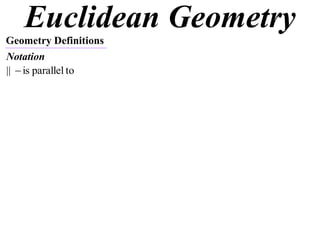
Geometry Definitions
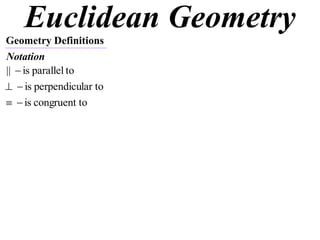
Notation
||  is parallel to
Euclidean Geometry
Geometry Definitions
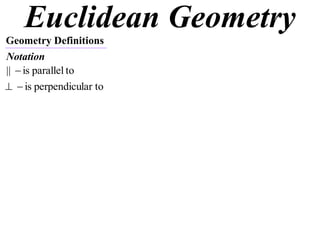
Notation
||  is parallel to
  is perpendicular to
Euclidean Geometry
Geometry Definitions
Notation
||  is parallel to
  is perpendicular to
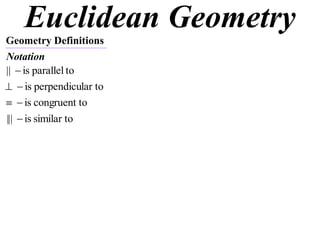
  is congruent to
Euclidean Geometry
Geometry Definitions
Notation
||  is parallel to
  is perpendicular to
  is congruent to
|||  is similar to
Euclidean Geometry
Geometry Definitions
Notation
||  is parallel to
  is perpendicular to
  is congruent to
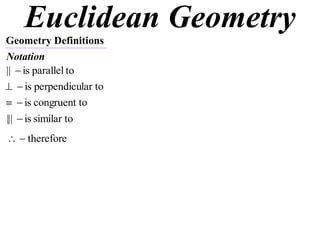
|||  is similar to
  therefore
Euclidean Geometry
Geometry Definitions
Notation
||  is parallel to
  is perpendicular to
  is congruent to
|||  is similar to
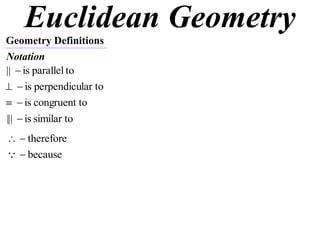
  therefore
  because
Euclidean Geometry
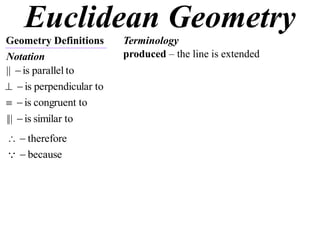
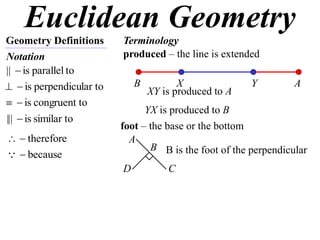
Geometry Definitions      Terminology
Notation                  produced – the line is extended
||  is parallel to
  is perpendicular to
  is congruent to
|||  is similar to
  therefore
  because
Euclidean Geometry
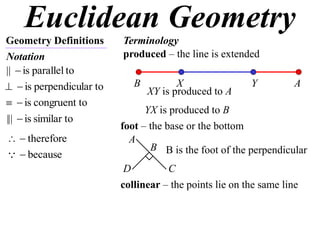
Geometry Definitions      Terminology
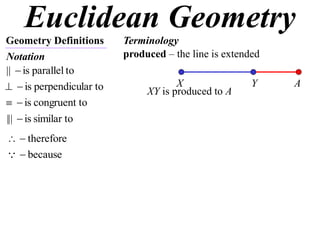
Notation                  produced – the line is extended
||  is parallel to
  is perpendicular to               X
                               XY is produced to A
                                                       Y    A
  is congruent to
|||  is similar to
  therefore
  because
Euclidean Geometry
Geometry Definitions      Terminology
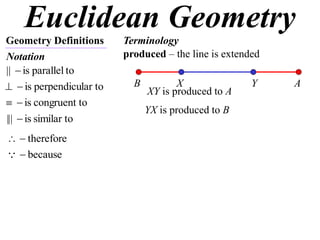
Notation                  produced – the line is extended
||  is parallel to
  is perpendicular to     B          X
                                XY is produced to A
                                                       Y    A
  is congruent to
                                YX is produced to B
|||  is similar to
  therefore
  because
Euclidean Geometry
Geometry Definitions      Terminology
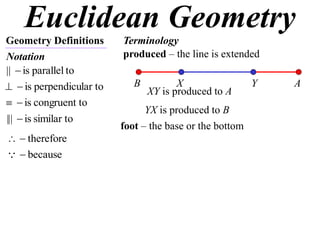
Notation                  produced – the line is extended
||  is parallel to
  is perpendicular to      B          X
                                 XY is produced to A
                                                          Y   A
  is congruent to
                                YX is produced to B
|||  is similar to
                          foot – the base or the bottom
  therefore
  because
Euclidean Geometry
Geometry Definitions      Terminology
Notation                  produced – the line is extended
||  is parallel to
  is perpendicular to       B          X
                                  XY is produced to A
                                                        Y         A
  is congruent to
                                YX is produced to B
|||  is similar to
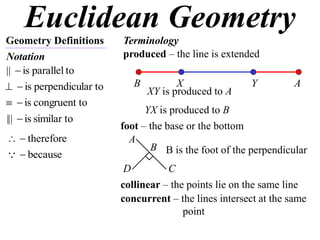
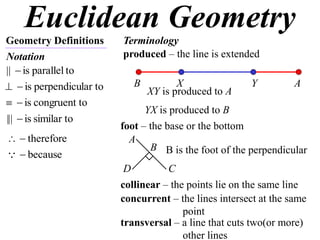
                          foot – the base or the bottom
  therefore               A
                                 B B is the foot of the perpendicular
  because
                          D           C
Euclidean Geometry
Geometry Definitions      Terminology
Notation                  produced – the line is extended
||  is parallel to
  is perpendicular to      B          X
                                 XY is produced to A
                                                         Y          A
  is congruent to
                                YX is produced to B
|||  is similar to
                          foot – the base or the bottom
  therefore               A
                                 B B is the foot of the perpendicular
  because
                           D         C
                          collinear – the points lie on the same line
Euclidean Geometry
Geometry Definitions      Terminology
Notation                  produced – the line is extended
||  is parallel to
  is perpendicular to      B          X
                                 XY is produced to A
                                                        Y          A
  is congruent to
                                YX is produced to B
|||  is similar to
                          foot – the base or the bottom
  therefore               A
                                 B B is the foot of the perpendicular
  because
                           D         C
                          collinear – the points lie on the same line
                          concurrent – the lines intersect at the same
                                         point
Euclidean Geometry
Geometry Definitions      Terminology
Notation                  produced – the line is extended
||  is parallel to
  is perpendicular to      B          X
                                 XY is produced to A
                                                        Y          A
  is congruent to
                                YX is produced to B
|||  is similar to
                          foot – the base or the bottom
  therefore               A
                                 B B is the foot of the perpendicular
  because
                           D         C
                          collinear – the points lie on the same line
                          concurrent – the lines intersect at the same
                                         point
                          transversal – a line that cuts two(or more)
                                         other lines
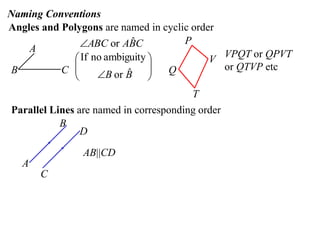
Naming Conventions
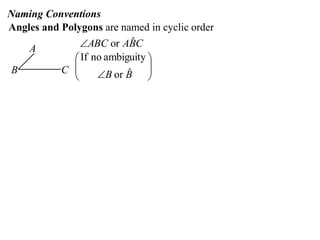
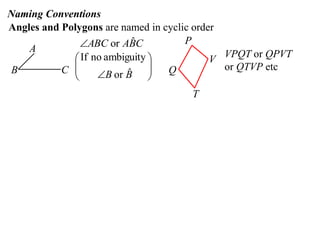
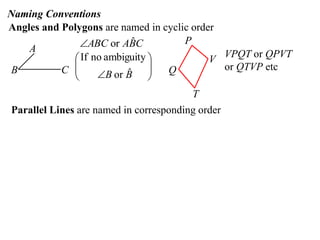
Angles and Polygons are named in cyclic order
Naming Conventions
Angles and Polygons are named in cyclic order
               ABC or ABC ˆ
    A
              If no ambiguity 
B          C 
                  B or B 
                          ˆ
                               
                              
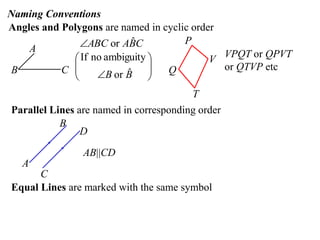
Naming Conventions
Angles and Polygons are named in cyclic order
               ABC or ABC ˆ          P
    A
              If no ambiguity             V VPQT or QPVT
B          C 
                         ˆ
                   B or B 
                               
                                 Q           or QTVP etc
             
                                     T
Naming Conventions
Angles and Polygons are named in cyclic order
               ABC or ABC ˆ          P
    A
              If no ambiguity             V VPQT or QPVT
B          C 
                         ˆ
                   B or B 
                               
                                 Q           or QTVP etc
             
                                        T
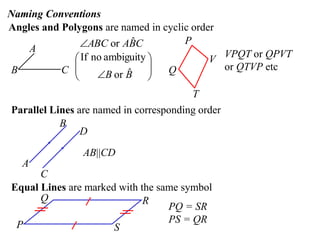
Parallel Lines are named in corresponding order
Naming Conventions
Angles and Polygons are named in cyclic order
               ABC or ABC ˆ          P
    A
              If no ambiguity             V VPQT or QPVT
B          C 
                         ˆ
                   B or B 
                               
                                 Q           or QTVP etc
             
                                        T
Parallel Lines are named in corresponding order
           B
                D

                AB||CD
   A
       C
Naming Conventions
Angles and Polygons are named in cyclic order
               ABC or ABC ˆ          P
    A
              If no ambiguity             V VPQT or QPVT
B          C 
                         ˆ
                   B or B 
                               
                                 Q           or QTVP etc
             
                                        T
Parallel Lines are named in corresponding order
           B
                D

                AB||CD
   A
      C
Equal Lines are marked with the same symbol
Naming Conventions
Angles and Polygons are named in cyclic order
               ABC or ABC ˆ          P
    A
              If no ambiguity             V VPQT or QPVT
B          C 
                         ˆ
                   B or B 
                               
                                 Q           or QTVP etc
             
                                        T
Parallel Lines are named in corresponding order
           B
                D

                AB||CD
   A
      C
Equal Lines are marked with the same symbol
      Q                      R
                                  PQ = SR
 P                                PS = QR
                      S
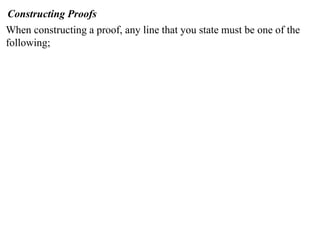
Constructing Proofs
When constructing a proof, any line that you state must be one of the
following;
Constructing Proofs
When constructing a proof, any line that you state must be one of the
following;
 1. Given information, do not assume information is given, e.g. if you
    are told two sides are of a triangle are equal don’t assume it is
    isosceles, state that it is isosceles because two sides are equal.
Constructing Proofs
When constructing a proof, any line that you state must be one of the
following;
 1. Given information, do not assume information is given, e.g. if you
    are told two sides are of a triangle are equal don’t assume it is
    isosceles, state that it is isosceles because two sides are equal.

 2. Construction of new lines, state clearly your construction so that
    anyone reading your proof could recreate the construction.
Constructing Proofs
When constructing a proof, any line that you state must be one of the
following;
 1. Given information, do not assume information is given, e.g. if you
    are told two sides are of a triangle are equal don’t assume it is
    isosceles, state that it is isosceles because two sides are equal.

 2. Construction of new lines, state clearly your construction so that
    anyone reading your proof could recreate the construction.

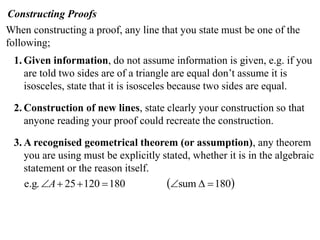
 3. A recognised geometrical theorem (or assumption), any theorem
    you are using must be explicitly stated, whether it is in the algebraic
    statement or the reason itself.
Constructing Proofs
When constructing a proof, any line that you state must be one of the
following;
 1. Given information, do not assume information is given, e.g. if you
    are told two sides are of a triangle are equal don’t assume it is
    isosceles, state that it is isosceles because two sides are equal.

 2. Construction of new lines, state clearly your construction so that
    anyone reading your proof could recreate the construction.

 3. A recognised geometrical theorem (or assumption), any theorem
    you are using must be explicitly stated, whether it is in the algebraic
    statement or the reason itself.
    e.g. A  25  120  180          sum   180
Constructing Proofs
When constructing a proof, any line that you state must be one of the
following;
 1. Given information, do not assume information is given, e.g. if you
    are told two sides are of a triangle are equal don’t assume it is
    isosceles, state that it is isosceles because two sides are equal.

 2. Construction of new lines, state clearly your construction so that
    anyone reading your proof could recreate the construction.

 3. A recognised geometrical theorem (or assumption), any theorem
    you are using must be explicitly stated, whether it is in the algebraic
    statement or the reason itself.
    e.g. A  25  120  180          sum   180
            Your reasoning should be clear and concise
Constructing Proofs
When constructing a proof, any line that you state must be one of the
following;
 1. Given information, do not assume information is given, e.g. if you
    are told two sides are of a triangle are equal don’t assume it is
    isosceles, state that it is isosceles because two sides are equal.

 2. Construction of new lines, state clearly your construction so that
    anyone reading your proof could recreate the construction.

 3. A recognised geometrical theorem (or assumption), any theorem
    you are using must be explicitly stated, whether it is in the algebraic
    statement or the reason itself.
    e.g. A  25  120  180          sum   180
            Your reasoning should be clear and concise
 4. Any working out that follows from lines already stated.
Angle Theorems
Angle Theorems
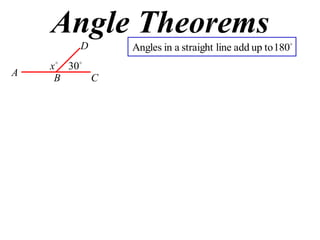
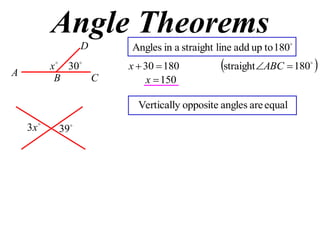
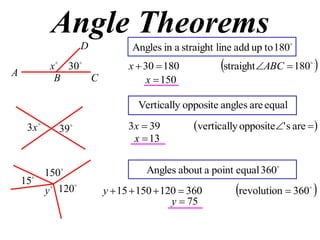
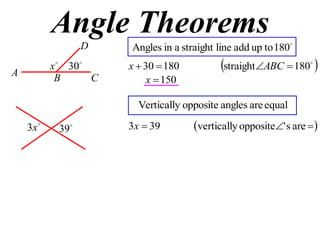
     Angles in a straight line add up to 180
Angle Theorems
         D      Angles in a straight line add up to 180
    x  30
A    B      C
Angle Theorems
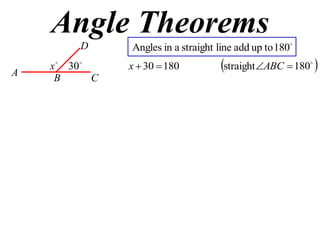
         D      Angles in a straight line add up to 180

A
    x  30     x  30  180          straight ABC  180 
                                                           

     B      C
Angle Theorems
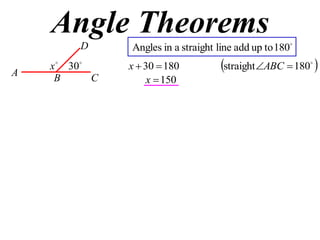
         D      Angles in a straight line add up to 180

A
    x  30     x  30  180          straight ABC  180 
                                                           

     B      C        x  150
Angle Theorems
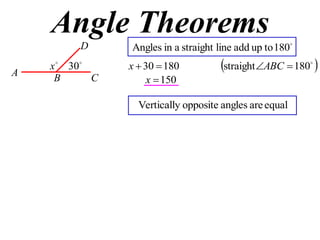
         D      Angles in a straight line add up to 180

A
    x  30     x  30  180          straight ABC  180 
                                                           

     B      C        x  150

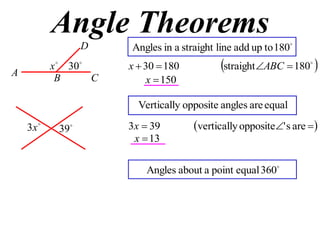
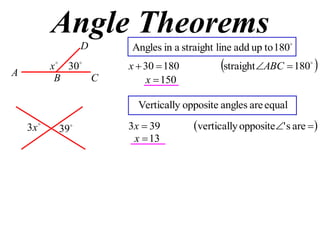
                  Vertically opposite angles are equal
Angle Theorems
                  D    Angles in a straight line add up to 180

A
           x  30     x  30  180          straight ABC  180 
                                                                  

            B      C        x  150

                         Vertically opposite angles are equal

    3x     39
Angle Theorems
                  D    Angles in a straight line add up to 180

A
           x  30     x  30  180          straight ABC  180 

            B      C        x  150

                         Vertically opposite angles are equal

    3x     39        3x  39        vertically opposite' s are 
Angle Theorems
                  D    Angles in a straight line add up to 180

A
           x  30     x  30  180          straight ABC  180 

            B      C        x  150

                         Vertically opposite angles are equal

    3x     39        3x  39        vertically opposite' s are 
                        x  13
Angle Theorems
                  D    Angles in a straight line add up to 180

A
           x  30     x  30  180          straight ABC  180 

            B      C        x  150

                         Vertically opposite angles are equal

    3x     39        3x  39        vertically opposite' s are 
                        x  13

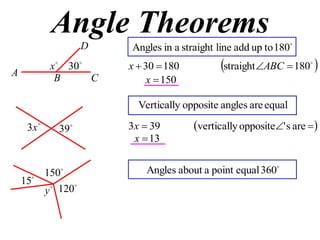
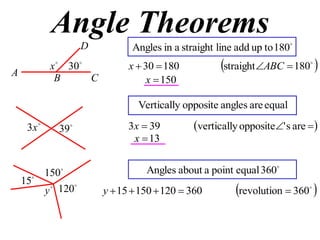
                           Angles about a point equal 360
Angle Theorems
                        D   Angles in a straight line add up to 180

A
              x  30       x  30  180          straight ABC  180 

               B      C          x  150

                              Vertically opposite angles are equal

     3x          39       3x  39        vertically opposite' s are 
                             x  13


             150               Angles about a point equal 360
         
    15
             y120
Angle Theorems
                        D          Angles in a straight line add up to 180

A
              x  30             x  30  180           straight ABC  180 

               B      C                x  150

                                    Vertically opposite angles are equal

     3x          39             3x  39         vertically opposite' s are 
                                   x  13


             150                     Angles about a point equal 360
         
    15
             y120         y  15  150  120  360        revolution  360 
                                                                              
Angle Theorems
                        D          Angles in a straight line add up to 180

A
              x  30             x  30  180           straight ABC  180 

               B      C                x  150

                                    Vertically opposite angles are equal

     3x          39             3x  39         vertically opposite' s are 
                                   x  13


             150                     Angles about a point equal 360
         
    15
             y120         y  15  150  120  360        revolution  360 
                                                                              

                                             y  75
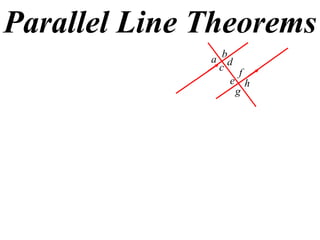
Parallel Line Theorems
              a bd
                c f
                  e h
                   g
Parallel Line Theorems
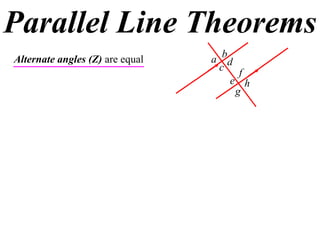
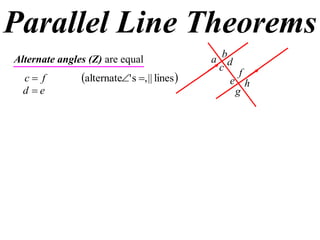
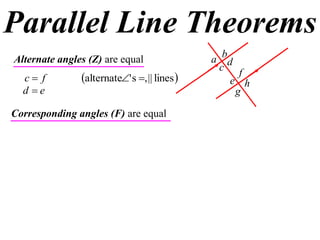
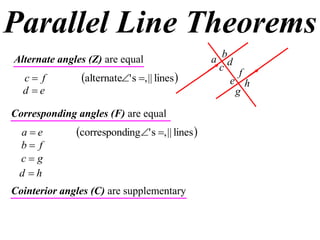
Alternate angles (Z) are equal   a bd
                                   c f
                                     e h
                                      g
Parallel Line Theorems
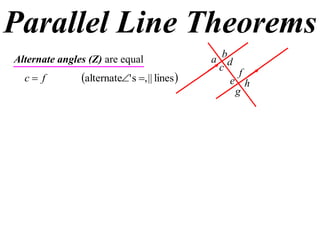
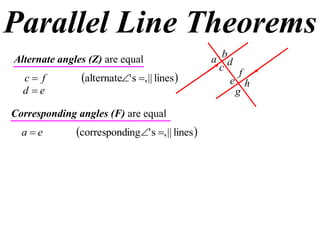
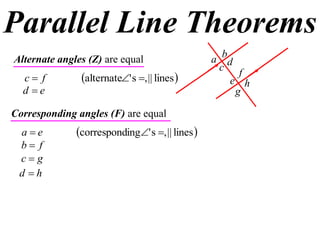
Alternate angles (Z) are equal                a bd
                                                c f
  c f         alternate' s , || lines        e h
                                                   g
Parallel Line Theorems
Alternate angles (Z) are equal                a bd
                                                c f
  c f         alternate' s , || lines        e h
  d e                                             g
Parallel Line Theorems
Alternate angles (Z) are equal                a bd
                                                c f
  c f         alternate' s , || lines        e h
  d e                                             g

Corresponding angles (F) are equal
Parallel Line Theorems
Alternate angles (Z) are equal                   a bd
                                                   c f
  c f         alternate' s , || lines           e h
  d e                                                g

Corresponding angles (F) are equal
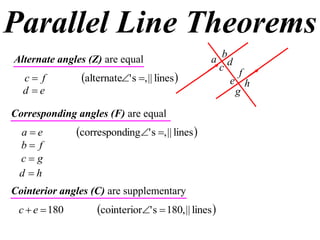
  ae         corresponding' s , || lines 
Parallel Line Theorems
Alternate angles (Z) are equal                   a bd
                                                   c f
  c f         alternate' s , || lines           e h
  d e                                                g

Corresponding angles (F) are equal
 ae          corresponding' s , || lines 
 b f
 cg
 d h
Parallel Line Theorems
Alternate angles (Z) are equal                   a bd
                                                   c f
  c f         alternate' s , || lines           e h
  d e                                                g

Corresponding angles (F) are equal
 ae          corresponding' s , || lines 
 b f
 cg
 d h
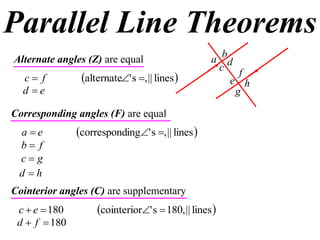
Cointerior angles (C) are supplementary
Parallel Line Theorems
Alternate angles (Z) are equal                     a bd
                                                     c f
  c f          alternate' s , || lines            e h
  d e                                                  g

Corresponding angles (F) are equal
 ae           corresponding' s , || lines 
 b f
 cg
 d h
Cointerior angles (C) are supplementary
 c  e  180        cointerior' s  180, || lines 
Parallel Line Theorems
Alternate angles (Z) are equal                     a bd
                                                     c f
  c f          alternate' s , || lines            e h
  d e                                                  g

Corresponding angles (F) are equal
 ae           corresponding' s , || lines 
 b f
 cg
 d h
Cointerior angles (C) are supplementary
 c  e  180        cointerior' s  180, || lines 
 d  f  180
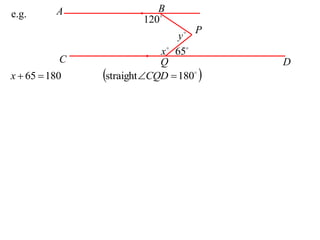
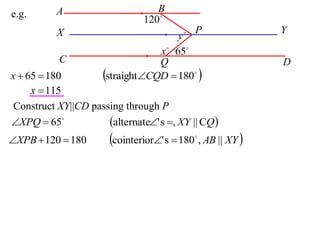
A      B
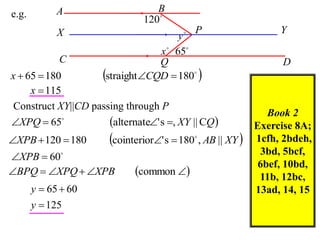
e.g.
           120
                       P
                   y
              x  65
       C      Q             D
A                B
e.g.
                        120
                                    P
                                 y
                            x  65
           C                Q            D
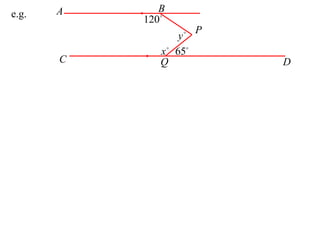
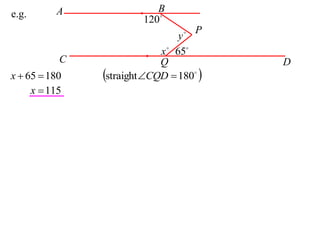
x  65  180   straight CQD  180 
A                B
e.g.
                        120
                                    P
                                 y
                            x  65
           C                Q            D
x  65  180   straight CQD  180 
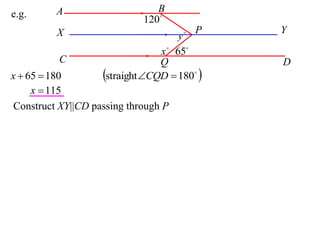
     x  115
A                     B
e.g.
                             120
          X                              P   Y
                                      y
                                 x  65
          C                      Q            D
x  65  180        straight CQD  180 
     x  115
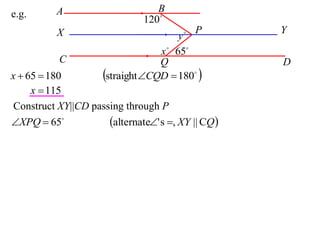
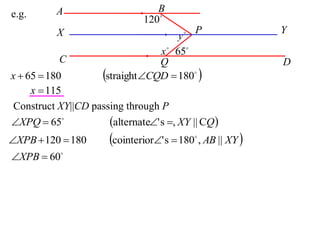
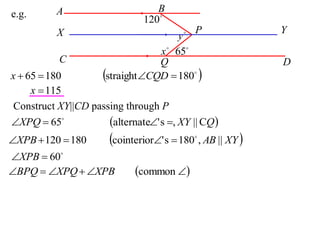
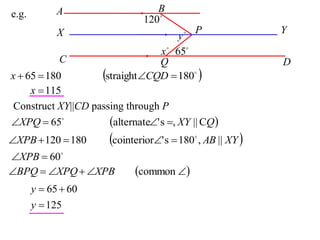
 Construct XY||CD passing through P
A                      B
e.g.
                               120
           X                                P       Y
                                        y
                                   x  65
           C                       Q                 D
x  65  180          straight CQD  180 
     x  115
 Construct XY||CD passing through P
XPQ  65            alternate' s , XY || CQ 
A                      B
e.g.
                               120
           X                                P              Y
                                        y
                                   x  65
           C                       Q                        D
x  65  180          straight CQD  180 
     x  115
 Construct XY||CD passing through P
XPQ  65            alternate' s , XY || CQ 
XPB  120  180       cointerior' s  180 , AB || XY 
                                             
A                      B
e.g.
                               120
           X                                P              Y
                                        y
                                   x  65
           C                       Q                        D
x  65  180          straight CQD  180 
     x  115
 Construct XY||CD passing through P
XPQ  65            alternate' s , XY || CQ 
XPB  120  180       cointerior' s  180 , AB || XY 
                                             


XPB  60
A                      B
e.g.
                               120
           X                                P              Y
                                        y
                                   x  65
           C                       Q                        D
x  65  180          straight CQD  180 
     x  115
 Construct XY||CD passing through P
XPQ  65            alternate' s , XY || CQ 
XPB  120  180       cointerior' s  180 , AB || XY 
                                             


XPB  60
BPQ  XPQ  XPB           common 
A                    B
e.g.
                               120
             X                              P              Y
                                        y
                                   x  65
             C                     Q                        D
x  65  180          straight CQD  180 
     x  115
 Construct XY||CD passing through P
XPQ  65            alternate' s , XY || CQ 
XPB  120  180       cointerior' s  180 , AB || XY 
                                             


XPB  60
BPQ  XPQ  XPB           common 
       y  65  60
       y  125
A                    B
e.g.
                               120
             X                              P                   Y
                                        y
                                   x  65
             C                     Q                              D
x  65  180          straight CQD  180 
     x  115
 Construct XY||CD passing through P
                                                               Book 2
XPQ  65            alternate' s , XY || CQ           Exercise 8A;
XPB  120  180       cointerior' s  180 , AB || XY 
                                             
                                                            1cfh, 2bdeh,
                                                             3bd, 5bcf,
XPB  60
                                                             6bef, 10bd,
BPQ  XPQ  XPB           common                       11b, 12bc,
       y  65  60                                          13ad, 14, 15
       y  125

11x1 t07 01 angle theorems - 2012

  • 1.
  • 2.
  • 3.
    Euclidean Geometry Geometry Definitions Notation || is parallel to   is perpendicular to
  • 4.
    Euclidean Geometry Geometry Definitions Notation || is parallel to   is perpendicular to   is congruent to
  • 5.
    Euclidean Geometry Geometry Definitions Notation || is parallel to   is perpendicular to   is congruent to |||  is similar to
  • 6.
    Euclidean Geometry Geometry Definitions Notation || is parallel to   is perpendicular to   is congruent to |||  is similar to   therefore
  • 7.
    Euclidean Geometry Geometry Definitions Notation || is parallel to   is perpendicular to   is congruent to |||  is similar to   therefore   because
  • 8.
    Euclidean Geometry Geometry Definitions Terminology Notation produced – the line is extended ||  is parallel to   is perpendicular to   is congruent to |||  is similar to   therefore   because
  • 9.
    Euclidean Geometry Geometry Definitions Terminology Notation produced – the line is extended ||  is parallel to   is perpendicular to X XY is produced to A Y A   is congruent to |||  is similar to   therefore   because
  • 10.
    Euclidean Geometry Geometry Definitions Terminology Notation produced – the line is extended ||  is parallel to   is perpendicular to B X XY is produced to A Y A   is congruent to YX is produced to B |||  is similar to   therefore   because
  • 11.
    Euclidean Geometry Geometry Definitions Terminology Notation produced – the line is extended ||  is parallel to   is perpendicular to B X XY is produced to A Y A   is congruent to YX is produced to B |||  is similar to foot – the base or the bottom   therefore   because
  • 12.
    Euclidean Geometry Geometry Definitions Terminology Notation produced – the line is extended ||  is parallel to   is perpendicular to B X XY is produced to A Y A   is congruent to YX is produced to B |||  is similar to foot – the base or the bottom   therefore A B B is the foot of the perpendicular   because D C
  • 13.
    Euclidean Geometry Geometry Definitions Terminology Notation produced – the line is extended ||  is parallel to   is perpendicular to B X XY is produced to A Y A   is congruent to YX is produced to B |||  is similar to foot – the base or the bottom   therefore A B B is the foot of the perpendicular   because D C collinear – the points lie on the same line
  • 14.
    Euclidean Geometry Geometry Definitions Terminology Notation produced – the line is extended ||  is parallel to   is perpendicular to B X XY is produced to A Y A   is congruent to YX is produced to B |||  is similar to foot – the base or the bottom   therefore A B B is the foot of the perpendicular   because D C collinear – the points lie on the same line concurrent – the lines intersect at the same point
  • 15.
    Euclidean Geometry Geometry Definitions Terminology Notation produced – the line is extended ||  is parallel to   is perpendicular to B X XY is produced to A Y A   is congruent to YX is produced to B |||  is similar to foot – the base or the bottom   therefore A B B is the foot of the perpendicular   because D C collinear – the points lie on the same line concurrent – the lines intersect at the same point transversal – a line that cuts two(or more) other lines
  • 16.
    Naming Conventions Angles andPolygons are named in cyclic order
  • 17.
    Naming Conventions Angles andPolygons are named in cyclic order ABC or ABC ˆ A  If no ambiguity  B C   B or B  ˆ   
  • 18.
    Naming Conventions Angles andPolygons are named in cyclic order ABC or ABC ˆ P A  If no ambiguity  V VPQT or QPVT B C   ˆ B or B    Q or QTVP etc  T
  • 19.
    Naming Conventions Angles andPolygons are named in cyclic order ABC or ABC ˆ P A  If no ambiguity  V VPQT or QPVT B C   ˆ B or B    Q or QTVP etc  T Parallel Lines are named in corresponding order
  • 20.
    Naming Conventions Angles andPolygons are named in cyclic order ABC or ABC ˆ P A  If no ambiguity  V VPQT or QPVT B C   ˆ B or B    Q or QTVP etc  T Parallel Lines are named in corresponding order B D AB||CD A C
  • 21.
    Naming Conventions Angles andPolygons are named in cyclic order ABC or ABC ˆ P A  If no ambiguity  V VPQT or QPVT B C   ˆ B or B    Q or QTVP etc  T Parallel Lines are named in corresponding order B D AB||CD A C Equal Lines are marked with the same symbol
  • 22.
    Naming Conventions Angles andPolygons are named in cyclic order ABC or ABC ˆ P A  If no ambiguity  V VPQT or QPVT B C   ˆ B or B    Q or QTVP etc  T Parallel Lines are named in corresponding order B D AB||CD A C Equal Lines are marked with the same symbol Q R PQ = SR P PS = QR S
  • 23.
    Constructing Proofs When constructinga proof, any line that you state must be one of the following;
  • 24.
    Constructing Proofs When constructinga proof, any line that you state must be one of the following; 1. Given information, do not assume information is given, e.g. if you are told two sides are of a triangle are equal don’t assume it is isosceles, state that it is isosceles because two sides are equal.
  • 25.
    Constructing Proofs When constructinga proof, any line that you state must be one of the following; 1. Given information, do not assume information is given, e.g. if you are told two sides are of a triangle are equal don’t assume it is isosceles, state that it is isosceles because two sides are equal. 2. Construction of new lines, state clearly your construction so that anyone reading your proof could recreate the construction.
  • 26.
    Constructing Proofs When constructinga proof, any line that you state must be one of the following; 1. Given information, do not assume information is given, e.g. if you are told two sides are of a triangle are equal don’t assume it is isosceles, state that it is isosceles because two sides are equal. 2. Construction of new lines, state clearly your construction so that anyone reading your proof could recreate the construction. 3. A recognised geometrical theorem (or assumption), any theorem you are using must be explicitly stated, whether it is in the algebraic statement or the reason itself.
  • 27.
    Constructing Proofs When constructinga proof, any line that you state must be one of the following; 1. Given information, do not assume information is given, e.g. if you are told two sides are of a triangle are equal don’t assume it is isosceles, state that it is isosceles because two sides are equal. 2. Construction of new lines, state clearly your construction so that anyone reading your proof could recreate the construction. 3. A recognised geometrical theorem (or assumption), any theorem you are using must be explicitly stated, whether it is in the algebraic statement or the reason itself. e.g. A  25  120  180 sum   180
  • 28.
    Constructing Proofs When constructinga proof, any line that you state must be one of the following; 1. Given information, do not assume information is given, e.g. if you are told two sides are of a triangle are equal don’t assume it is isosceles, state that it is isosceles because two sides are equal. 2. Construction of new lines, state clearly your construction so that anyone reading your proof could recreate the construction. 3. A recognised geometrical theorem (or assumption), any theorem you are using must be explicitly stated, whether it is in the algebraic statement or the reason itself. e.g. A  25  120  180 sum   180 Your reasoning should be clear and concise
  • 29.
    Constructing Proofs When constructinga proof, any line that you state must be one of the following; 1. Given information, do not assume information is given, e.g. if you are told two sides are of a triangle are equal don’t assume it is isosceles, state that it is isosceles because two sides are equal. 2. Construction of new lines, state clearly your construction so that anyone reading your proof could recreate the construction. 3. A recognised geometrical theorem (or assumption), any theorem you are using must be explicitly stated, whether it is in the algebraic statement or the reason itself. e.g. A  25  120  180 sum   180 Your reasoning should be clear and concise 4. Any working out that follows from lines already stated.
  • 30.
  • 31.
    Angle Theorems Angles in a straight line add up to 180
  • 32.
    Angle Theorems D Angles in a straight line add up to 180 x  30 A B C
  • 33.
    Angle Theorems D Angles in a straight line add up to 180 A x  30 x  30  180 straight ABC  180   B C
  • 34.
    Angle Theorems D Angles in a straight line add up to 180 A x  30 x  30  180 straight ABC  180   B C x  150
  • 35.
    Angle Theorems D Angles in a straight line add up to 180 A x  30 x  30  180 straight ABC  180   B C x  150 Vertically opposite angles are equal
  • 36.
    Angle Theorems D Angles in a straight line add up to 180 A x  30 x  30  180 straight ABC  180   B C x  150 Vertically opposite angles are equal 3x  39
  • 37.
    Angle Theorems D Angles in a straight line add up to 180 A x  30 x  30  180 straight ABC  180  B C x  150 Vertically opposite angles are equal 3x  39 3x  39 vertically opposite' s are 
  • 38.
    Angle Theorems D Angles in a straight line add up to 180 A x  30 x  30  180 straight ABC  180  B C x  150 Vertically opposite angles are equal 3x  39 3x  39 vertically opposite' s are  x  13
  • 39.
    Angle Theorems D Angles in a straight line add up to 180 A x  30 x  30  180 straight ABC  180  B C x  150 Vertically opposite angles are equal 3x  39 3x  39 vertically opposite' s are  x  13 Angles about a point equal 360
  • 40.
    Angle Theorems D Angles in a straight line add up to 180 A x  30 x  30  180 straight ABC  180  B C x  150 Vertically opposite angles are equal 3x  39 3x  39 vertically opposite' s are  x  13 150  Angles about a point equal 360  15 y120
  • 41.
    Angle Theorems D Angles in a straight line add up to 180 A x  30 x  30  180 straight ABC  180  B C x  150 Vertically opposite angles are equal 3x  39 3x  39 vertically opposite' s are  x  13 150  Angles about a point equal 360  15 y120 y  15  150  120  360 revolution  360  
  • 42.
    Angle Theorems D Angles in a straight line add up to 180 A x  30 x  30  180 straight ABC  180  B C x  150 Vertically opposite angles are equal 3x  39 3x  39 vertically opposite' s are  x  13 150  Angles about a point equal 360  15 y120 y  15  150  120  360 revolution  360   y  75
  • 43.
  • 44.
    Parallel Line Theorems Alternateangles (Z) are equal a bd c f e h g
  • 45.
    Parallel Line Theorems Alternateangles (Z) are equal a bd c f c f alternate' s , || lines  e h g
  • 46.
    Parallel Line Theorems Alternateangles (Z) are equal a bd c f c f alternate' s , || lines  e h d e g
  • 47.
    Parallel Line Theorems Alternateangles (Z) are equal a bd c f c f alternate' s , || lines  e h d e g Corresponding angles (F) are equal
  • 48.
    Parallel Line Theorems Alternateangles (Z) are equal a bd c f c f alternate' s , || lines  e h d e g Corresponding angles (F) are equal ae corresponding' s , || lines 
  • 49.
    Parallel Line Theorems Alternateangles (Z) are equal a bd c f c f alternate' s , || lines  e h d e g Corresponding angles (F) are equal ae corresponding' s , || lines  b f cg d h
  • 50.
    Parallel Line Theorems Alternateangles (Z) are equal a bd c f c f alternate' s , || lines  e h d e g Corresponding angles (F) are equal ae corresponding' s , || lines  b f cg d h Cointerior angles (C) are supplementary
  • 51.
    Parallel Line Theorems Alternateangles (Z) are equal a bd c f c f alternate' s , || lines  e h d e g Corresponding angles (F) are equal ae corresponding' s , || lines  b f cg d h Cointerior angles (C) are supplementary c  e  180 cointerior' s  180, || lines 
  • 52.
    Parallel Line Theorems Alternateangles (Z) are equal a bd c f c f alternate' s , || lines  e h d e g Corresponding angles (F) are equal ae corresponding' s , || lines  b f cg d h Cointerior angles (C) are supplementary c  e  180 cointerior' s  180, || lines  d  f  180
  • 53.
    A B e.g. 120  P y x  65 C Q D
  • 54.
    A B e.g. 120  P y x  65 C Q D x  65  180 straight CQD  180 
  • 55.
    A B e.g. 120  P y x  65 C Q D x  65  180 straight CQD  180  x  115
  • 56.
    A B e.g. 120 X  P Y y x  65 C Q D x  65  180 straight CQD  180  x  115 Construct XY||CD passing through P
  • 57.
    A B e.g. 120 X  P Y y x  65 C Q D x  65  180 straight CQD  180  x  115 Construct XY||CD passing through P XPQ  65 alternate' s , XY || CQ 
  • 58.
    A B e.g. 120 X  P Y y x  65 C Q D x  65  180 straight CQD  180  x  115 Construct XY||CD passing through P XPQ  65 alternate' s , XY || CQ  XPB  120  180 cointerior' s  180 , AB || XY  
  • 59.
    A B e.g. 120 X  P Y y x  65 C Q D x  65  180 straight CQD  180  x  115 Construct XY||CD passing through P XPQ  65 alternate' s , XY || CQ  XPB  120  180 cointerior' s  180 , AB || XY   XPB  60
  • 60.
    A B e.g. 120 X  P Y y x  65 C Q D x  65  180 straight CQD  180  x  115 Construct XY||CD passing through P XPQ  65 alternate' s , XY || CQ  XPB  120  180 cointerior' s  180 , AB || XY   XPB  60 BPQ  XPQ  XPB common 
  • 61.
    A B e.g. 120 X  P Y y x  65 C Q D x  65  180 straight CQD  180  x  115 Construct XY||CD passing through P XPQ  65 alternate' s , XY || CQ  XPB  120  180 cointerior' s  180 , AB || XY   XPB  60 BPQ  XPQ  XPB common  y  65  60 y  125
  • 62.
    A B e.g. 120 X  P Y y x  65 C Q D x  65  180 straight CQD  180  x  115 Construct XY||CD passing through P Book 2 XPQ  65 alternate' s , XY || CQ  Exercise 8A; XPB  120  180 cointerior' s  180 , AB || XY   1cfh, 2bdeh, 3bd, 5bcf, XPB  60 6bef, 10bd, BPQ  XPQ  XPB common  11b, 12bc, y  65  60 13ad, 14, 15 y  125