METHOD OVERRIDING
Michael Heron
Introduction
• In the last lecture we talked about method overloading.
• In this one we are going to talk about method overriding.
• The two are often confused, but are entirely different systems.
• One is based on the idea of unique identification of
methods.
• The other is based on being able to specialise behaviours
through inheritance.
Method Overriding
• When we override a method, we specialise it as the child
class as part of an inherited relationship.
• The usual rules of virtual functions apply here for C++.
• Usually what we do here is subtly alter the functionality
and then pass the results of our specialisation onto the
parent method.
Method Overriding
• The chain of invocation for a method in C++ depends on
its virtuality.
• If it is not virtual, the base method gets called always.
• If it is virtual, the most specialised implementation gets called.
• For virtual methods, we then have control over the chain
of invocation.
• We can decide how invocations filter up and down the chain.
The Chain of Invocation
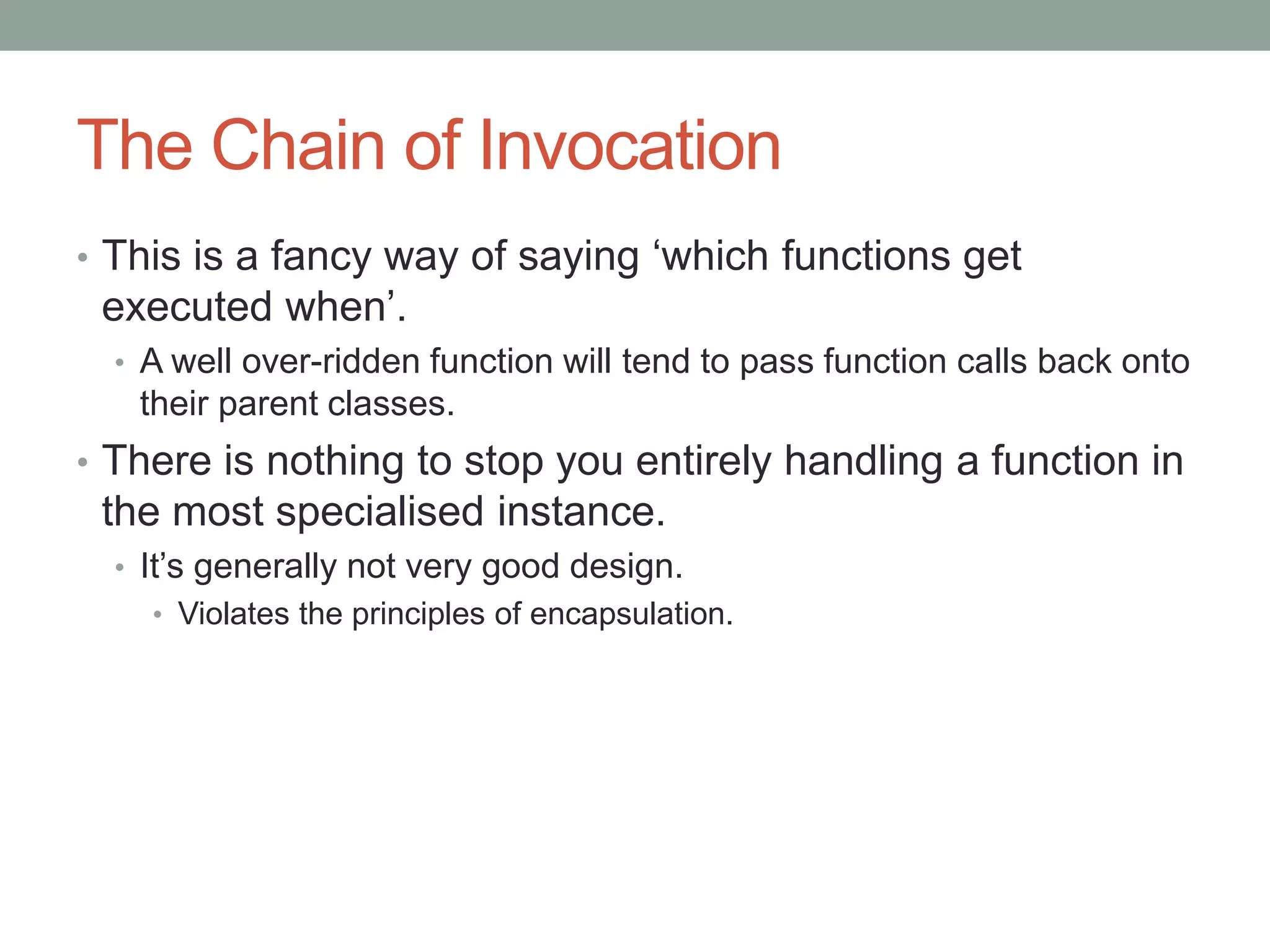
• This is a fancy way of saying ‘which functions get
executed when’.
• A well over-ridden function will tend to pass function calls back onto
their parent classes.
• There is nothing to stop you entirely handling a function in
the most specialised instance.
• It’s generally not very good design.
• Violates the principles of encapsulation.
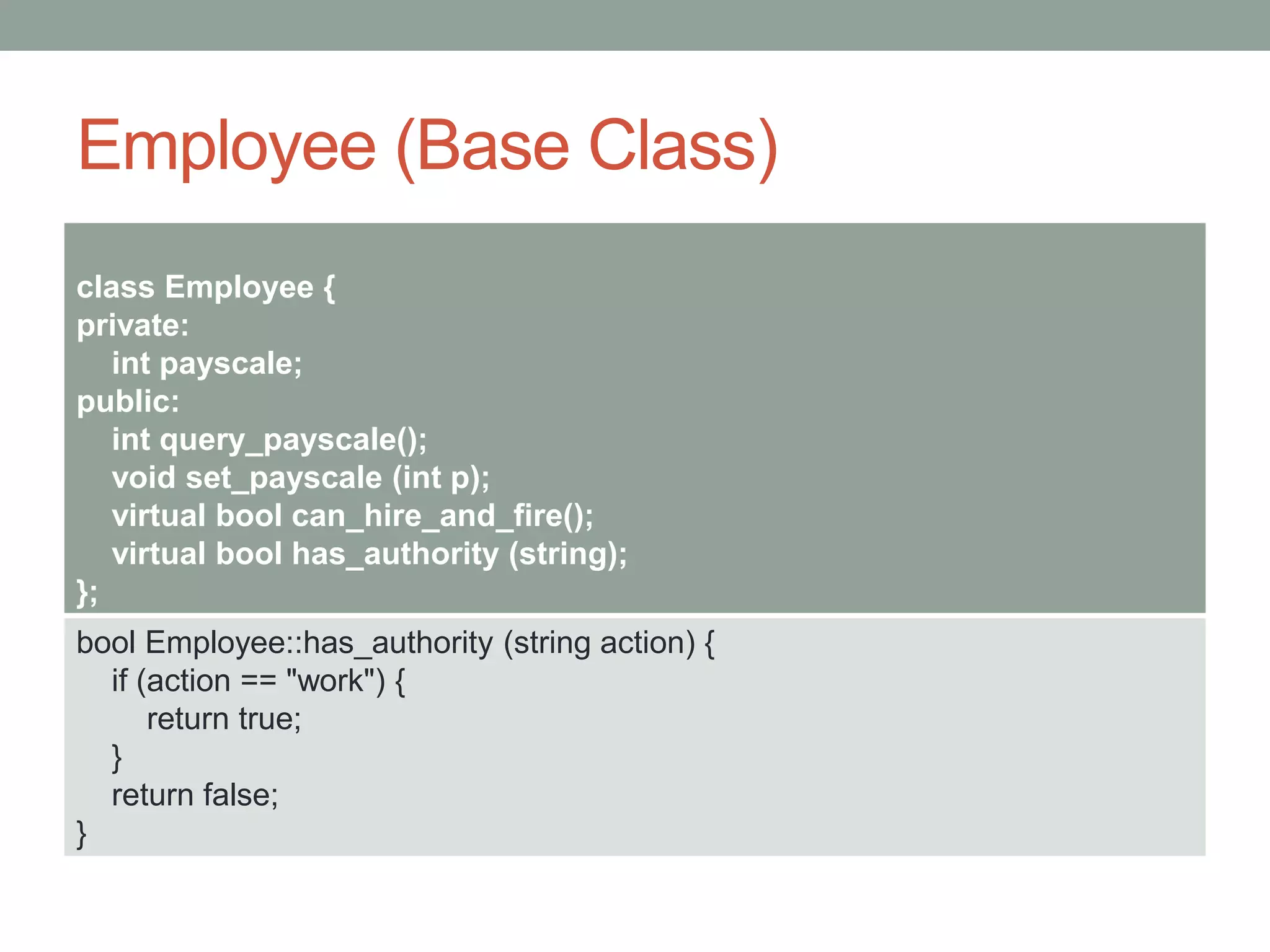
Employee (Base Class)
class Employee {
private:
int payscale;
public:
int query_payscale();
void set_payscale (int p);
virtual bool can_hire_and_fire();
virtual bool has_authority (string);
};
bool Employee::has_authority (string action) {
if (action == "work") {
return true;
}
return false;
}
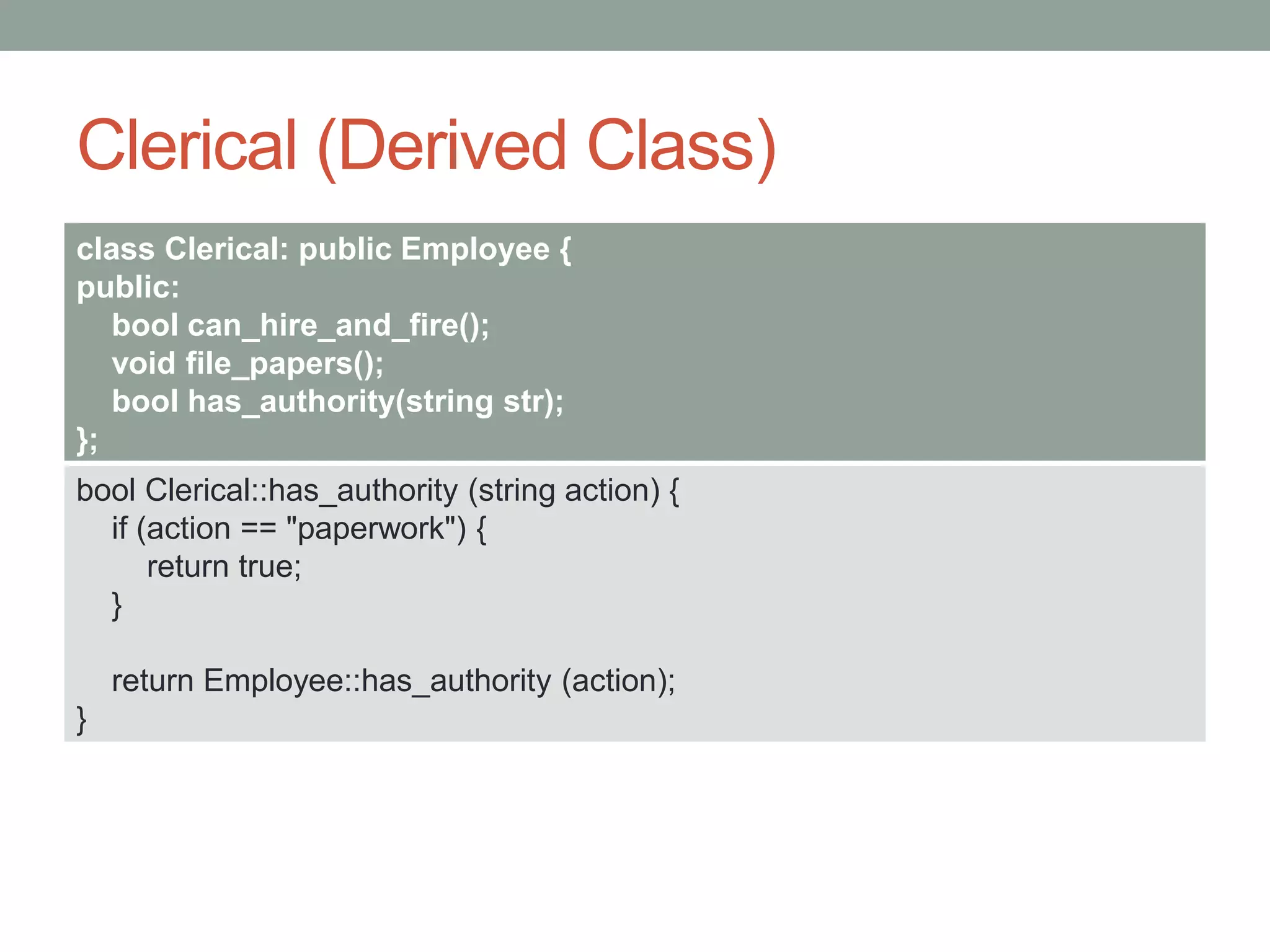
Clerical (Derived Class)
class Clerical: public Employee {
public:
bool can_hire_and_fire();
void file_papers();
bool has_authority(string str);
};
bool Clerical::has_authority (string action) {
if (action == "paperwork") {
return true;
}
return Employee::has_authority (action);
}
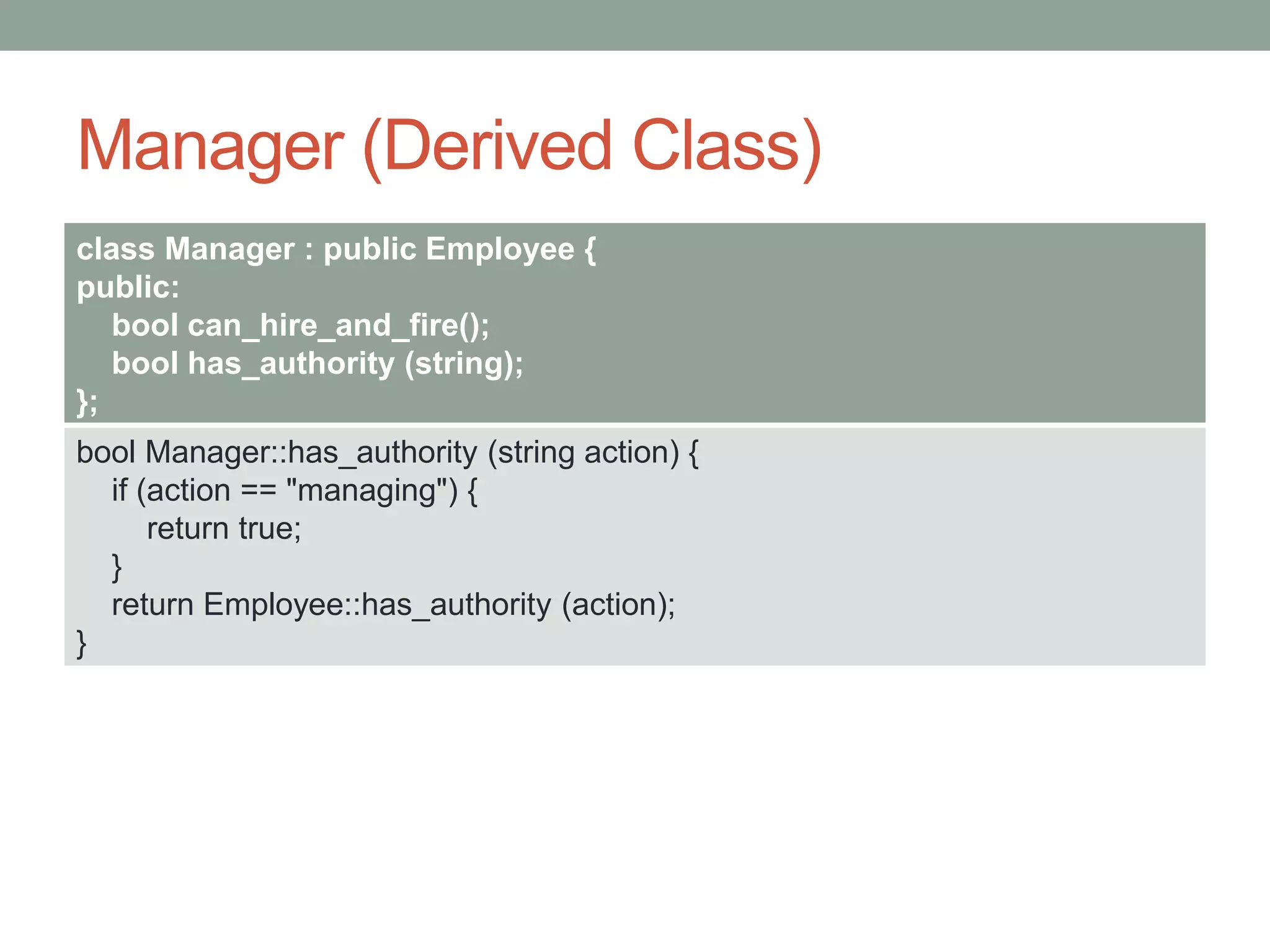
Manager (Derived Class)
class Manager : public Employee {
public:
bool can_hire_and_fire();
bool has_authority (string);
};
bool Manager::has_authority (string action) {
if (action == "managing") {
return true;
}
return Employee::has_authority (action);
}
Main Program
int main(int argc, char** argv) {
Employee *cler = new Clerical();
Employee *man = new Manager();
string actions[3] = {"paperwork", "work", "managing"};
for (int i = 0; i < 3; i++) {
cout << "Managers authority for " << actions[i] << " "
<< man->has_authority (actions[i]) << endl;
cout << "Clerical authority for " << actions[i] << " "
<< cler->has_authority (actions[i]) << endl;
}
}
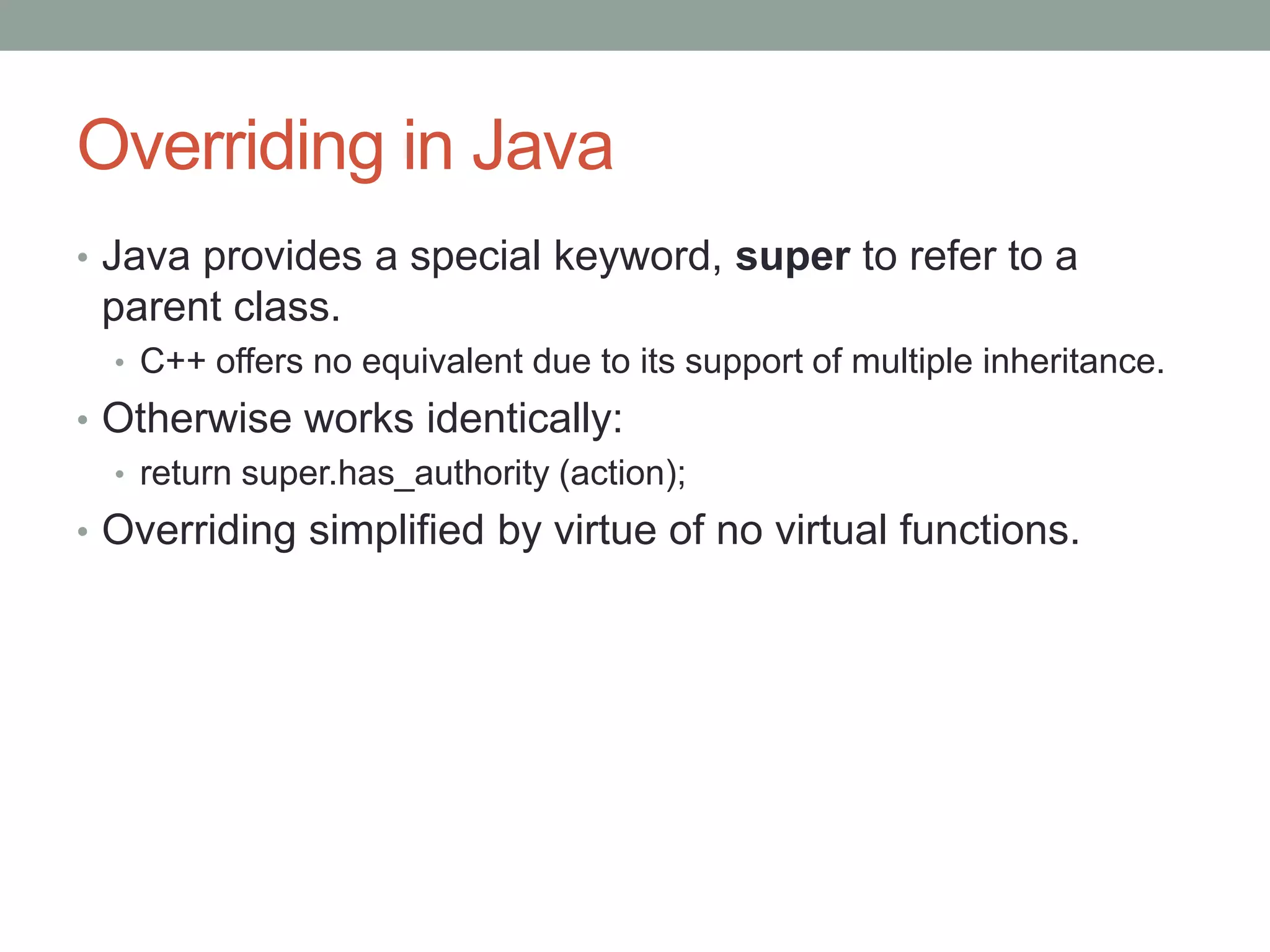
Overriding in Java
• Java provides a special keyword, super to refer to a
parent class.
• C++ offers no equivalent due to its support of multiple inheritance.
• Otherwise works identically:
• return super.has_authority (action);
• Overriding simplified by virtue of no virtual functions.
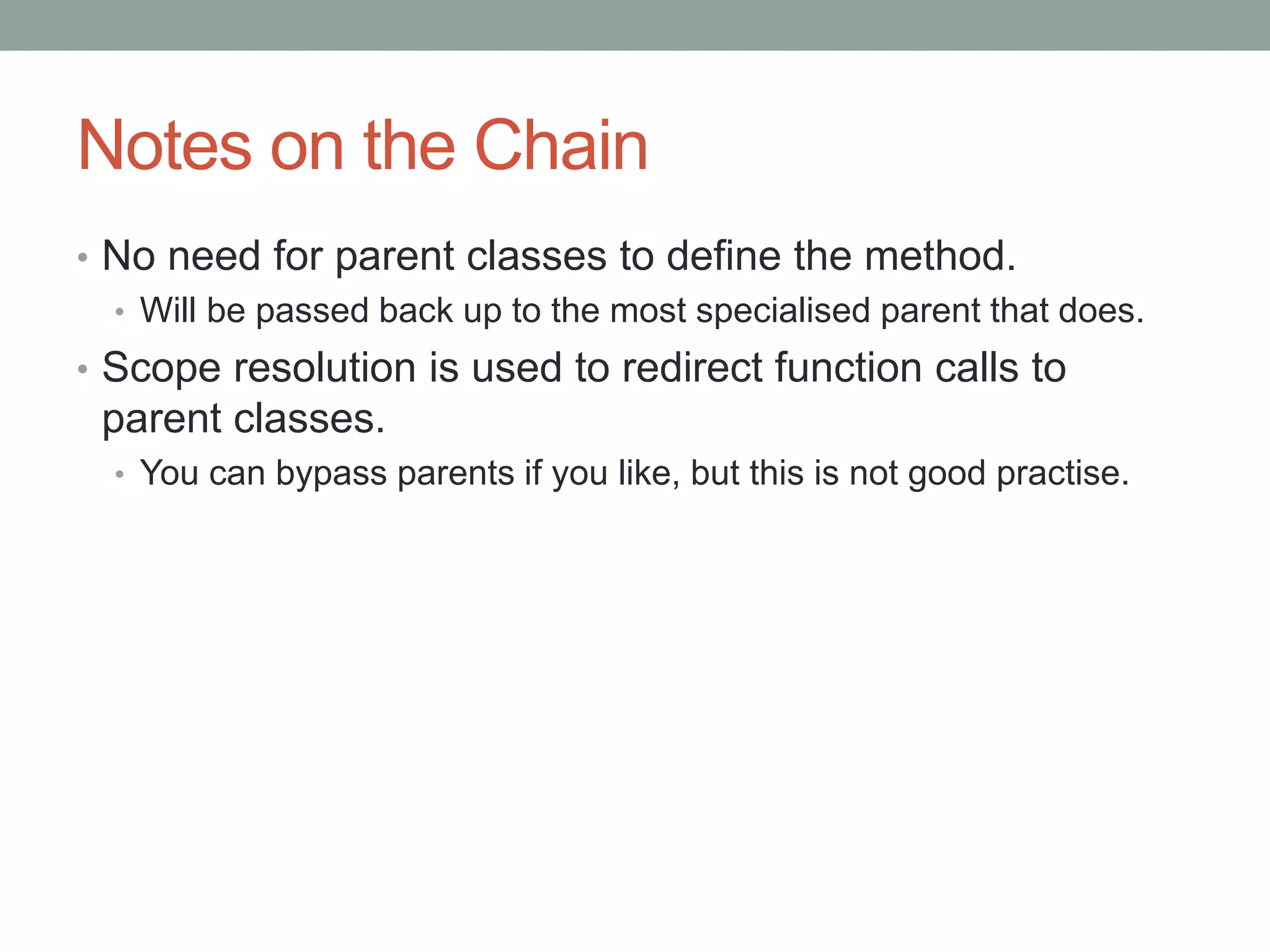
Notes on the Chain
• No need for parent classes to define the method.
• Will be passed back up to the most specialised parent that does.
• Scope resolution is used to redirect function calls to
parent classes.
• You can bypass parents if you like, but this is not good practise.
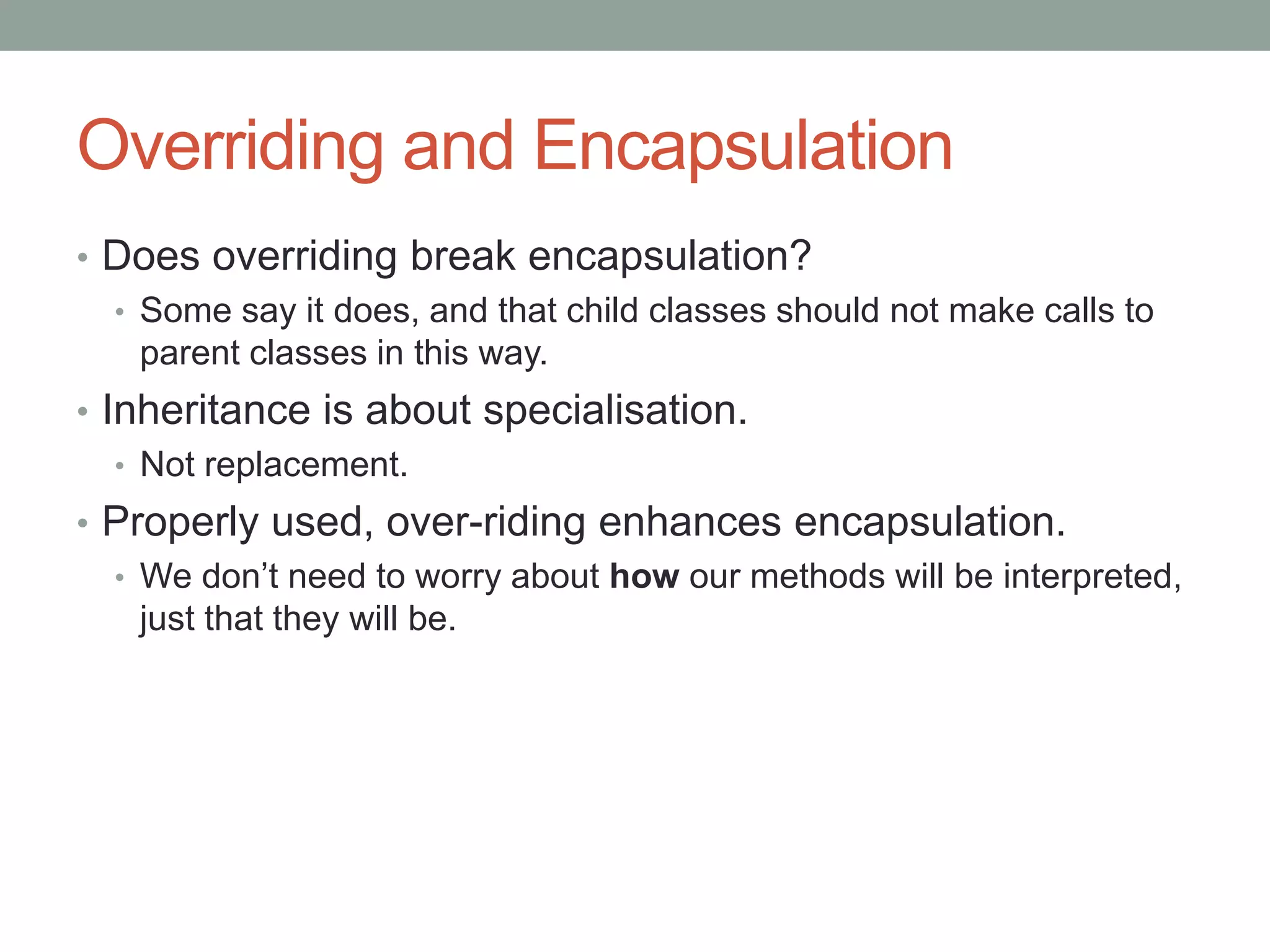
Overriding and Encapsulation
• Does overriding break encapsulation?
• Some say it does, and that child classes should not make calls to
parent classes in this way.
• Inheritance is about specialisation.
• Not replacement.
• Properly used, over-riding enhances encapsulation.
• We don’t need to worry about how our methods will be interpreted,
just that they will be.
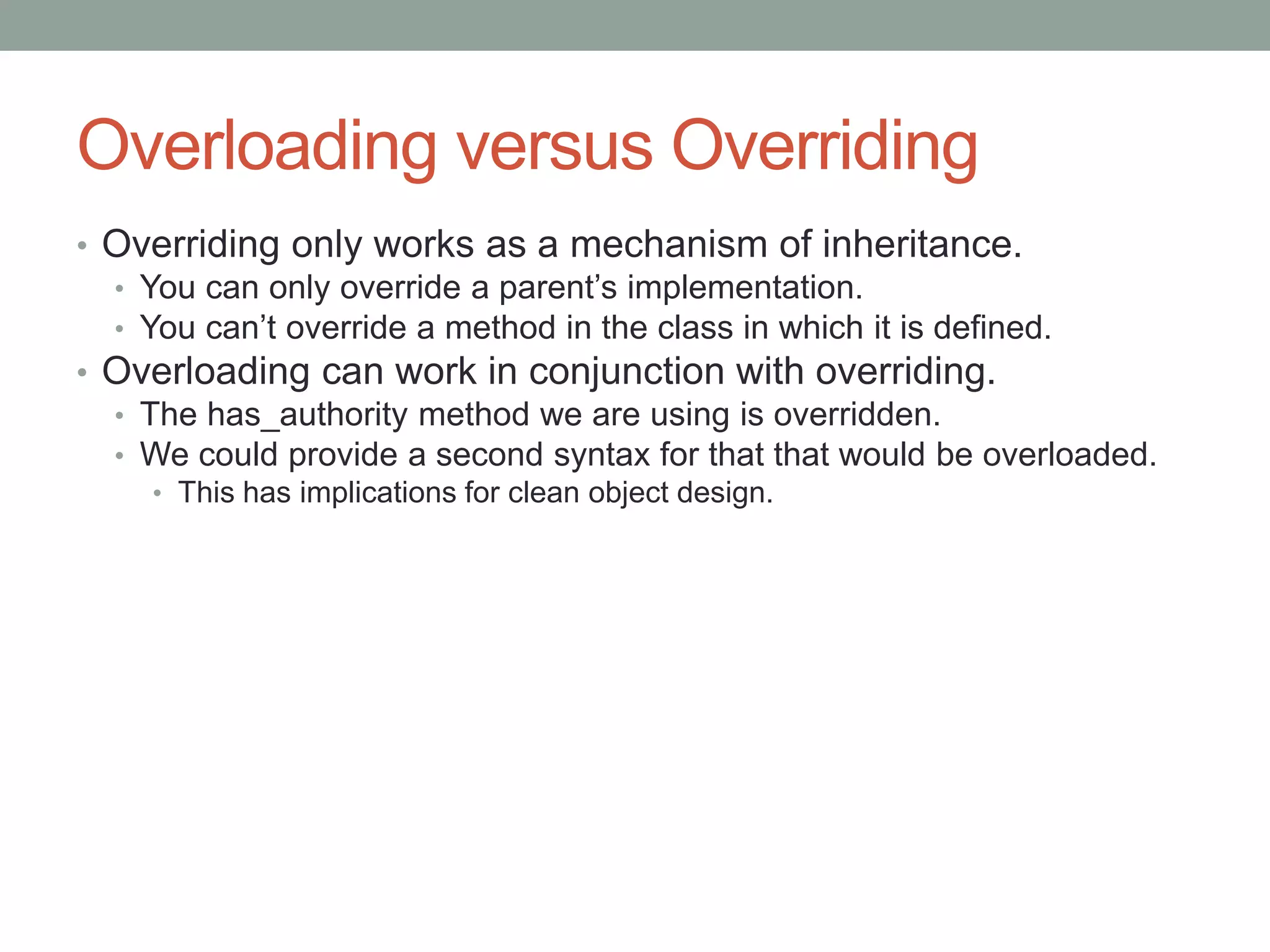
Overloading versus Overriding
• Overriding only works as a mechanism of inheritance.
• You can only override a parent’s implementation.
• You can’t override a method in the class in which it is defined.
• Overloading can work in conjunction with overriding.
• The has_authority method we are using is overridden.
• We could provide a second syntax for that that would be overloaded.
• This has implications for clean object design.
Common Overriding Errors
• Mis-spelled function names
• Won’t be picked up when invoked.
• Mismatched parameter lists
• Will overload rather than override.
• Failing to maintain the chain of invocation.
• Make sure you always pass it on.
• Make sure you always pass it on correctly.
• One of the things that super does is resolve to the parent class without you
needing to specify it.
• If you change an inherit chain in C++, you also need to update all
references.
Why Override Functions?
• Information hiding ensures we don’t have access to
private data fields.
• In many cases, we simply can’t configure objects without
overriding.
• No need to excessively duplicate functionality.
• We handle what is new, and let the parent class handle the rest.
• Properly distributes authority through an object
inheritance chain.
Binding and Polymorphism
• All of this is made possible through the use of inheritance
and polymorphism.
• It’s worth spending a few minutes talking about how this is
actually done.
• C++ makes a distinction between the static type of an
object and its dynamic type.
• Shape *myShape = new Circle();
• myShape has a static type of Shape
• myShape has a dynamic type of Circle
Binding and Polymorphism
• The static type is determined at compile time.
• The dynamic type is determined at run-time.
• And it is determined on an ongoing basis.
• This process is known as dynamic binding.
• Dynamic binding has a toll.
• Virtual function lookups at runtime are expensive.
• Virtual functions must be placed and maintained in a virtual function table.
• Static binding is used for functions that are not virtual.
• The function to be executed is decided at compile time and is not changed.
Binding Styles
• There is a trade-off between static and dynamic.
• Java makes all methods virtual by default.
• Static binding is more efficient.
• The compiler can do all sorts of tricks to make it work more
efficiently.
• Dynamic binding is more flexible.
• The interface is consistent but the implementation will change.
Static Methods in Java
• Static methods in Java are the Java implementation of
static binding.
• Static binding is used for static method calls.
• This is why Java has problems with people calling non-
static methods from static contexts.
• The non-static method is virtual.
• The static method is static.
• You can’t even override a static method in Java.
Summary
• Overriding is separate and distinct from overloading.
• Overloading is in addition
• Overriding is instead of
• Maintaining the chain of invocation is important.
• Overriding is predicated on effective use of inheritance
and polymorphism.

2CPP12 - Method Overriding

  • 1.
  • 2.
    Introduction • In thelast lecture we talked about method overloading. • In this one we are going to talk about method overriding. • The two are often confused, but are entirely different systems. • One is based on the idea of unique identification of methods. • The other is based on being able to specialise behaviours through inheritance.
  • 3.
    Method Overriding • Whenwe override a method, we specialise it as the child class as part of an inherited relationship. • The usual rules of virtual functions apply here for C++. • Usually what we do here is subtly alter the functionality and then pass the results of our specialisation onto the parent method.
  • 4.
    Method Overriding • Thechain of invocation for a method in C++ depends on its virtuality. • If it is not virtual, the base method gets called always. • If it is virtual, the most specialised implementation gets called. • For virtual methods, we then have control over the chain of invocation. • We can decide how invocations filter up and down the chain.
  • 5.
    The Chain ofInvocation • This is a fancy way of saying ‘which functions get executed when’. • A well over-ridden function will tend to pass function calls back onto their parent classes. • There is nothing to stop you entirely handling a function in the most specialised instance. • It’s generally not very good design. • Violates the principles of encapsulation.
  • 6.
    Employee (Base Class) classEmployee { private: int payscale; public: int query_payscale(); void set_payscale (int p); virtual bool can_hire_and_fire(); virtual bool has_authority (string); }; bool Employee::has_authority (string action) { if (action == "work") { return true; } return false; }
  • 7.
    Clerical (Derived Class) classClerical: public Employee { public: bool can_hire_and_fire(); void file_papers(); bool has_authority(string str); }; bool Clerical::has_authority (string action) { if (action == "paperwork") { return true; } return Employee::has_authority (action); }
  • 8.
    Manager (Derived Class) classManager : public Employee { public: bool can_hire_and_fire(); bool has_authority (string); }; bool Manager::has_authority (string action) { if (action == "managing") { return true; } return Employee::has_authority (action); }
  • 9.
    Main Program int main(intargc, char** argv) { Employee *cler = new Clerical(); Employee *man = new Manager(); string actions[3] = {"paperwork", "work", "managing"}; for (int i = 0; i < 3; i++) { cout << "Managers authority for " << actions[i] << " " << man->has_authority (actions[i]) << endl; cout << "Clerical authority for " << actions[i] << " " << cler->has_authority (actions[i]) << endl; } }
  • 10.
    Overriding in Java •Java provides a special keyword, super to refer to a parent class. • C++ offers no equivalent due to its support of multiple inheritance. • Otherwise works identically: • return super.has_authority (action); • Overriding simplified by virtue of no virtual functions.
  • 11.
    Notes on theChain • No need for parent classes to define the method. • Will be passed back up to the most specialised parent that does. • Scope resolution is used to redirect function calls to parent classes. • You can bypass parents if you like, but this is not good practise.
  • 12.
    Overriding and Encapsulation •Does overriding break encapsulation? • Some say it does, and that child classes should not make calls to parent classes in this way. • Inheritance is about specialisation. • Not replacement. • Properly used, over-riding enhances encapsulation. • We don’t need to worry about how our methods will be interpreted, just that they will be.
  • 13.
    Overloading versus Overriding •Overriding only works as a mechanism of inheritance. • You can only override a parent’s implementation. • You can’t override a method in the class in which it is defined. • Overloading can work in conjunction with overriding. • The has_authority method we are using is overridden. • We could provide a second syntax for that that would be overloaded. • This has implications for clean object design.
  • 14.
    Common Overriding Errors •Mis-spelled function names • Won’t be picked up when invoked. • Mismatched parameter lists • Will overload rather than override. • Failing to maintain the chain of invocation. • Make sure you always pass it on. • Make sure you always pass it on correctly. • One of the things that super does is resolve to the parent class without you needing to specify it. • If you change an inherit chain in C++, you also need to update all references.
  • 15.
    Why Override Functions? •Information hiding ensures we don’t have access to private data fields. • In many cases, we simply can’t configure objects without overriding. • No need to excessively duplicate functionality. • We handle what is new, and let the parent class handle the rest. • Properly distributes authority through an object inheritance chain.
  • 16.
    Binding and Polymorphism •All of this is made possible through the use of inheritance and polymorphism. • It’s worth spending a few minutes talking about how this is actually done. • C++ makes a distinction between the static type of an object and its dynamic type. • Shape *myShape = new Circle(); • myShape has a static type of Shape • myShape has a dynamic type of Circle
  • 17.
    Binding and Polymorphism •The static type is determined at compile time. • The dynamic type is determined at run-time. • And it is determined on an ongoing basis. • This process is known as dynamic binding. • Dynamic binding has a toll. • Virtual function lookups at runtime are expensive. • Virtual functions must be placed and maintained in a virtual function table. • Static binding is used for functions that are not virtual. • The function to be executed is decided at compile time and is not changed.
  • 18.
    Binding Styles • Thereis a trade-off between static and dynamic. • Java makes all methods virtual by default. • Static binding is more efficient. • The compiler can do all sorts of tricks to make it work more efficiently. • Dynamic binding is more flexible. • The interface is consistent but the implementation will change.
  • 19.
    Static Methods inJava • Static methods in Java are the Java implementation of static binding. • Static binding is used for static method calls. • This is why Java has problems with people calling non- static methods from static contexts. • The non-static method is virtual. • The static method is static. • You can’t even override a static method in Java.
  • 20.
    Summary • Overriding isseparate and distinct from overloading. • Overloading is in addition • Overriding is instead of • Maintaining the chain of invocation is important. • Overriding is predicated on effective use of inheritance and polymorphism.