SUMMATION
Michael Heron
Introduction
• We have reached the end of our journey through object
orientation in C++
• Huzzah, hooray, etc, etc
• As the last lecture on the topic, we are going to recap on
all the significant theoretical concepts.
• Not rehash, just recap.
• This knowledge will Guide You Well when it comes to the
exam.
• These are things you are expected to know!
The Principles of OO
• OO is based primarily on three key principles.
• Inheritance
• Encapsulation
• Polymorphism.
• Together they form a mighty triad of techniques for
building genuinely powerful programs.
• These three together is why it is a fundamentally different style
from structured programming.
The Principles of OO
• Object oriented structures are not inherently scalable.
• You need to be careful with what you do.
• Metrics such as coupling and cohesion give a view of the
objective quality of a class hierarchy.
• Methods such as impact of change give a view of the
maintainability of a system.
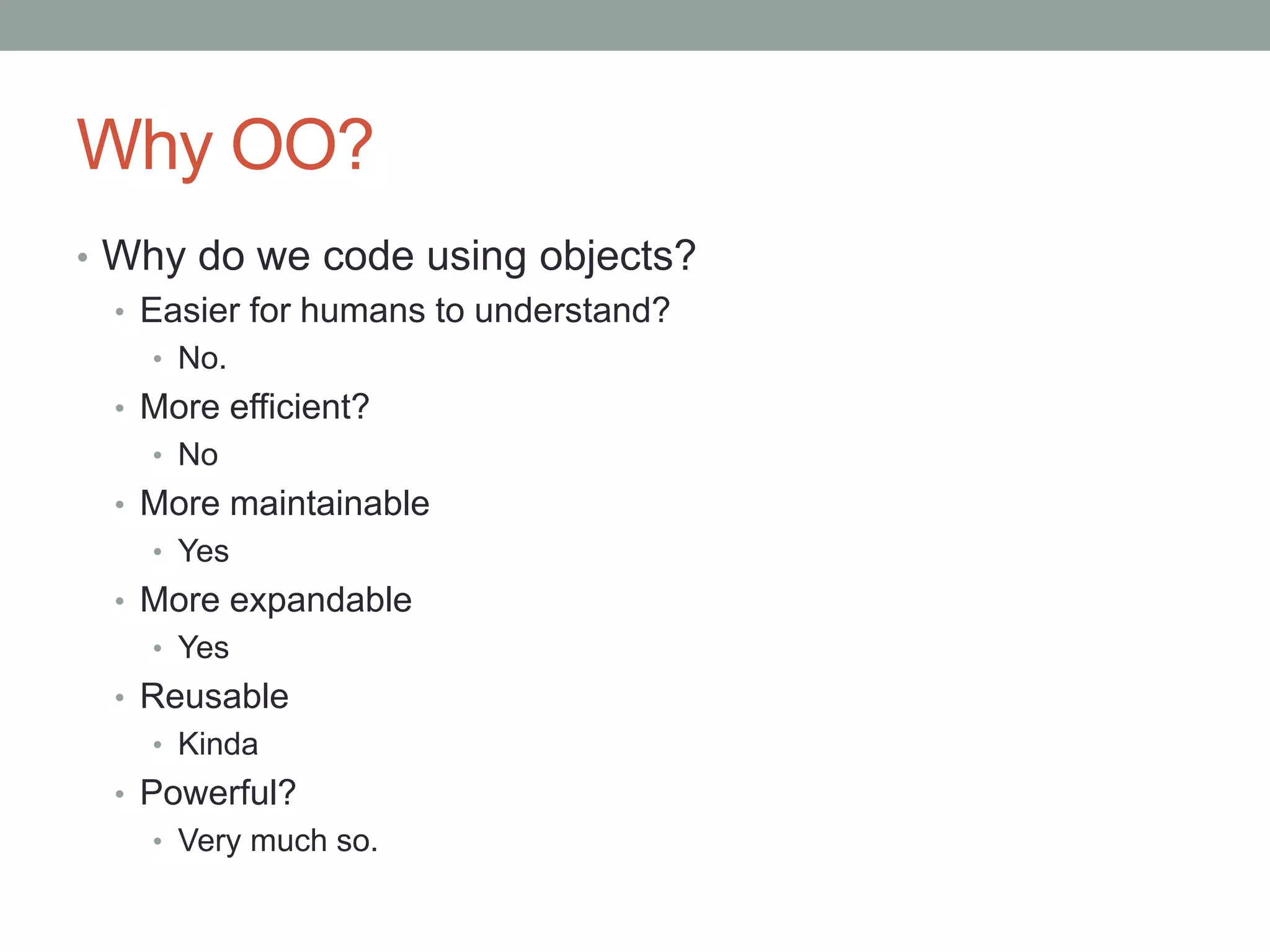
Why OO?
• Why do we code using objects?
• Easier for humans to understand?
• No.
• More efficient?
• No
• More maintainable
• Yes
• More expandable
• Yes
• Reusable
• Kinda
• Powerful?
• Very much so.
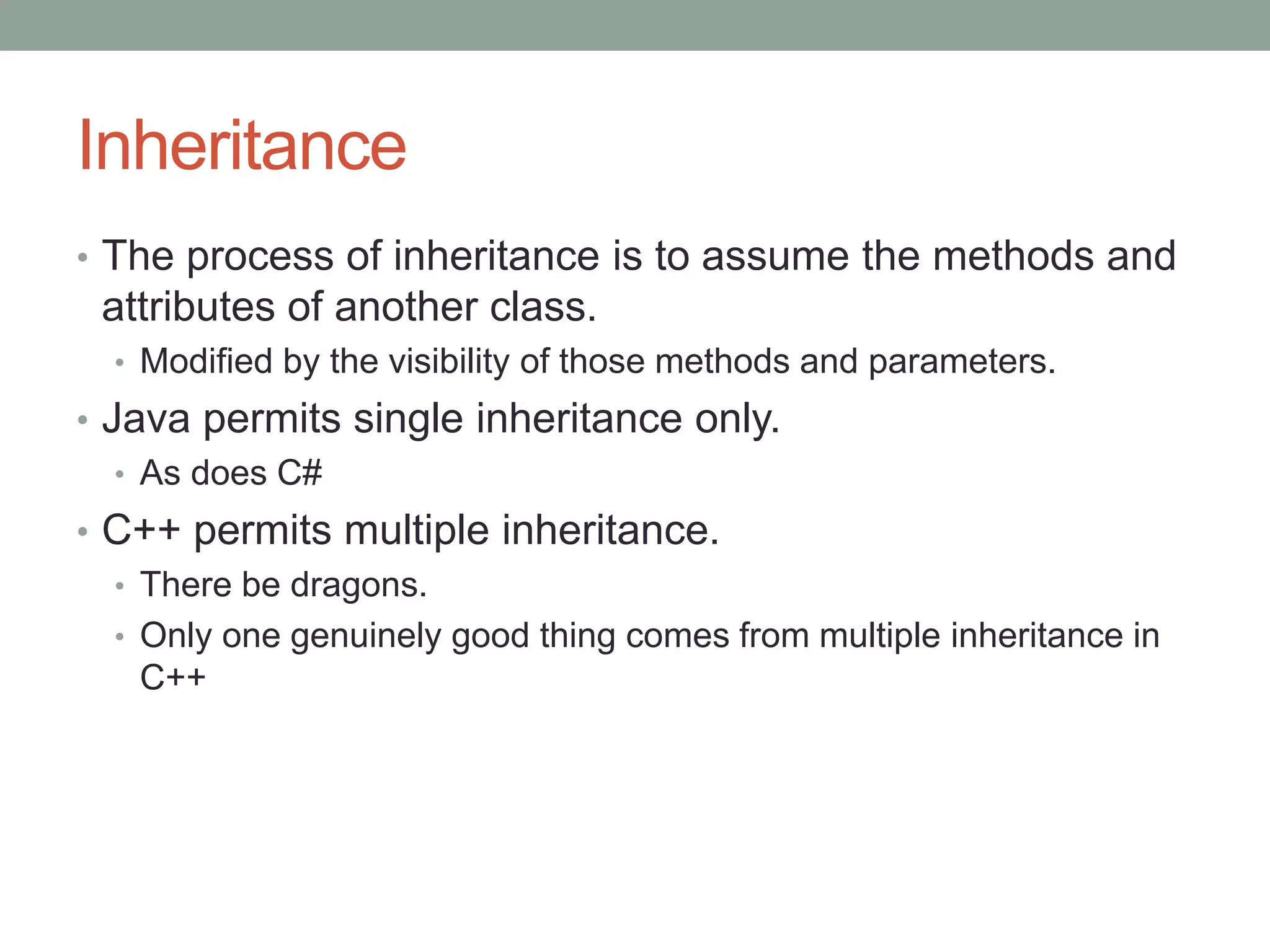
Inheritance
• The process of inheritance is to assume the methods and
attributes of another class.
• Modified by the visibility of those methods and parameters.
• Java permits single inheritance only.
• As does C#
• C++ permits multiple inheritance.
• There be dragons.
• Only one genuinely good thing comes from multiple inheritance in
C++
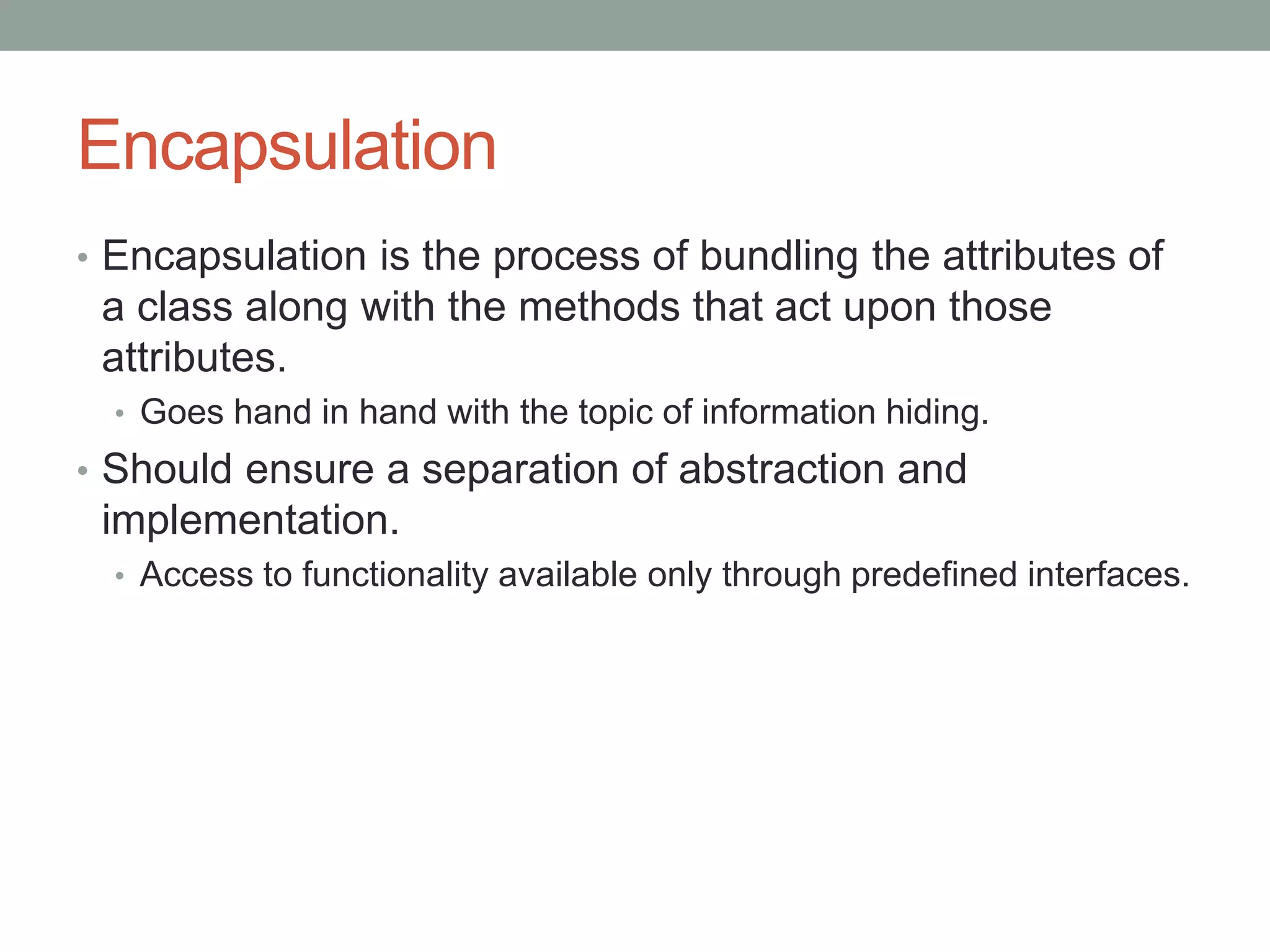
Encapsulation
• Encapsulation is the process of bundling the attributes of
a class along with the methods that act upon those
attributes.
• Goes hand in hand with the topic of information hiding.
• Should ensure a separation of abstraction and
implementation.
• Access to functionality available only through predefined interfaces.
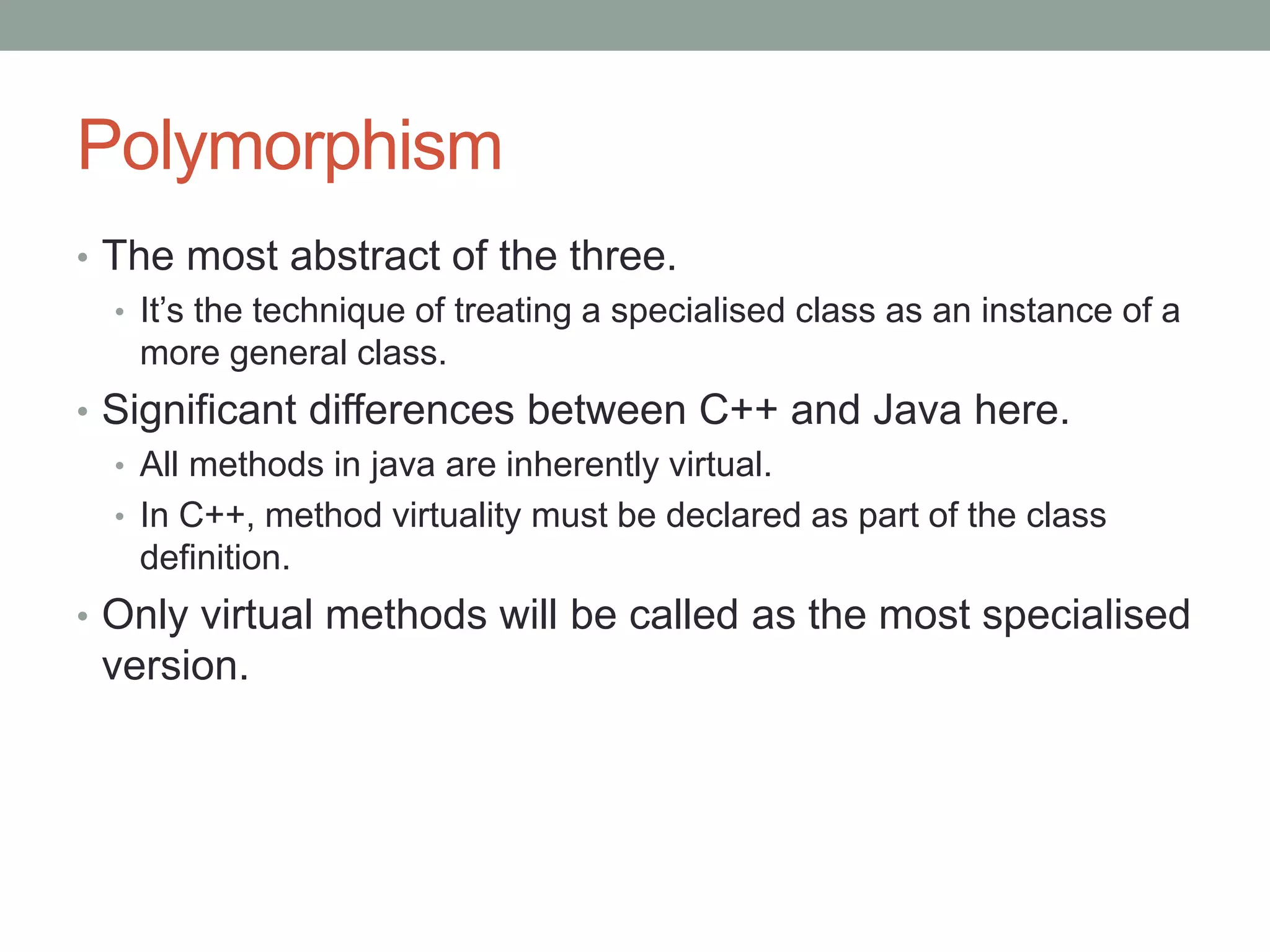
Polymorphism
• The most abstract of the three.
• It’s the technique of treating a specialised class as an instance of a
more general class.
• Significant differences between C++ and Java here.
• All methods in java are inherently virtual.
• In C++, method virtuality must be declared as part of the class
definition.
• Only virtual methods will be called as the most specialised
version.
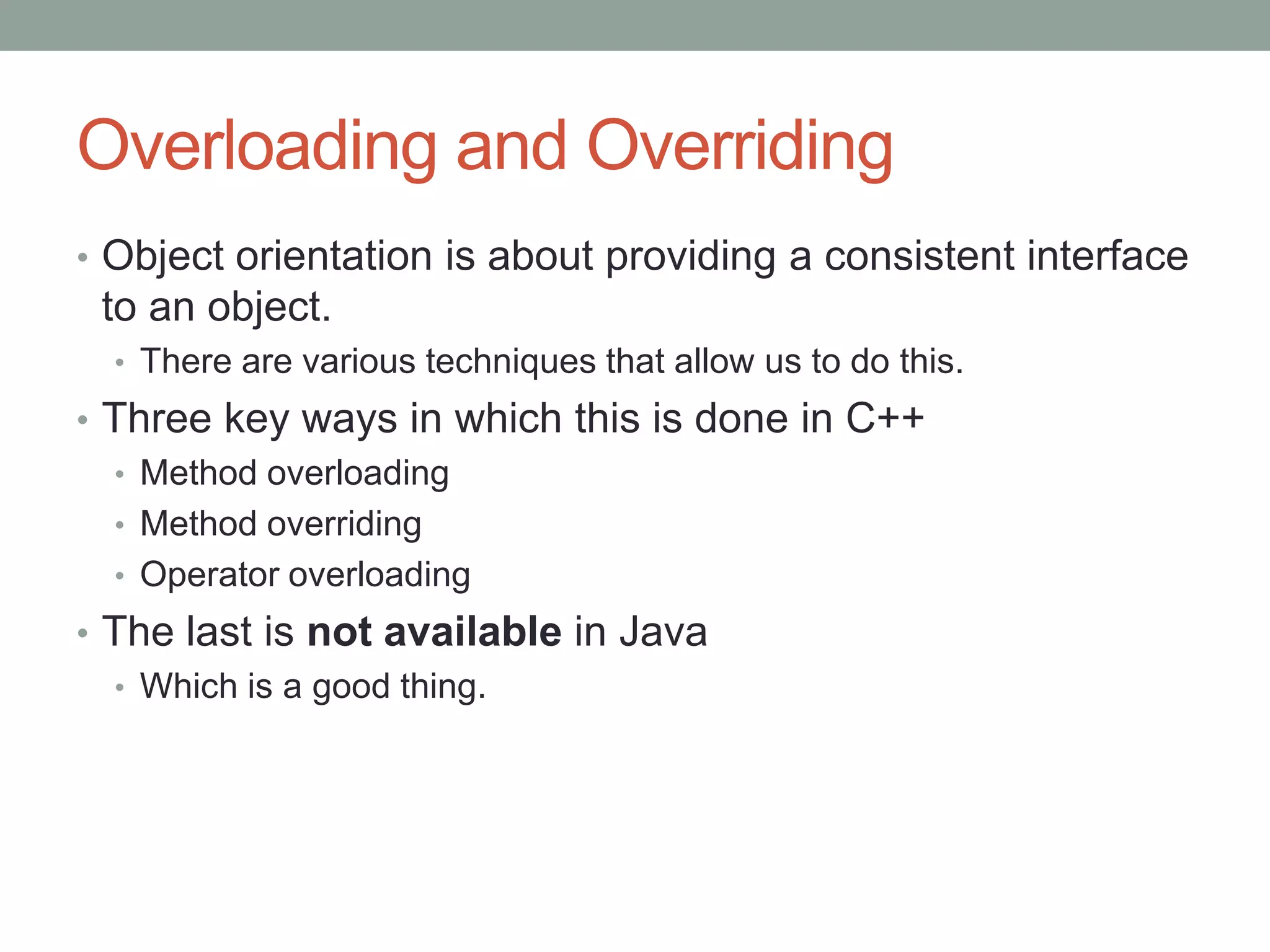
Overloading and Overriding
• Object orientation is about providing a consistent interface
to an object.
• There are various techniques that allow us to do this.
• Three key ways in which this is done in C++
• Method overloading
• Method overriding
• Operator overloading
• The last is not available in Java
• Which is a good thing.
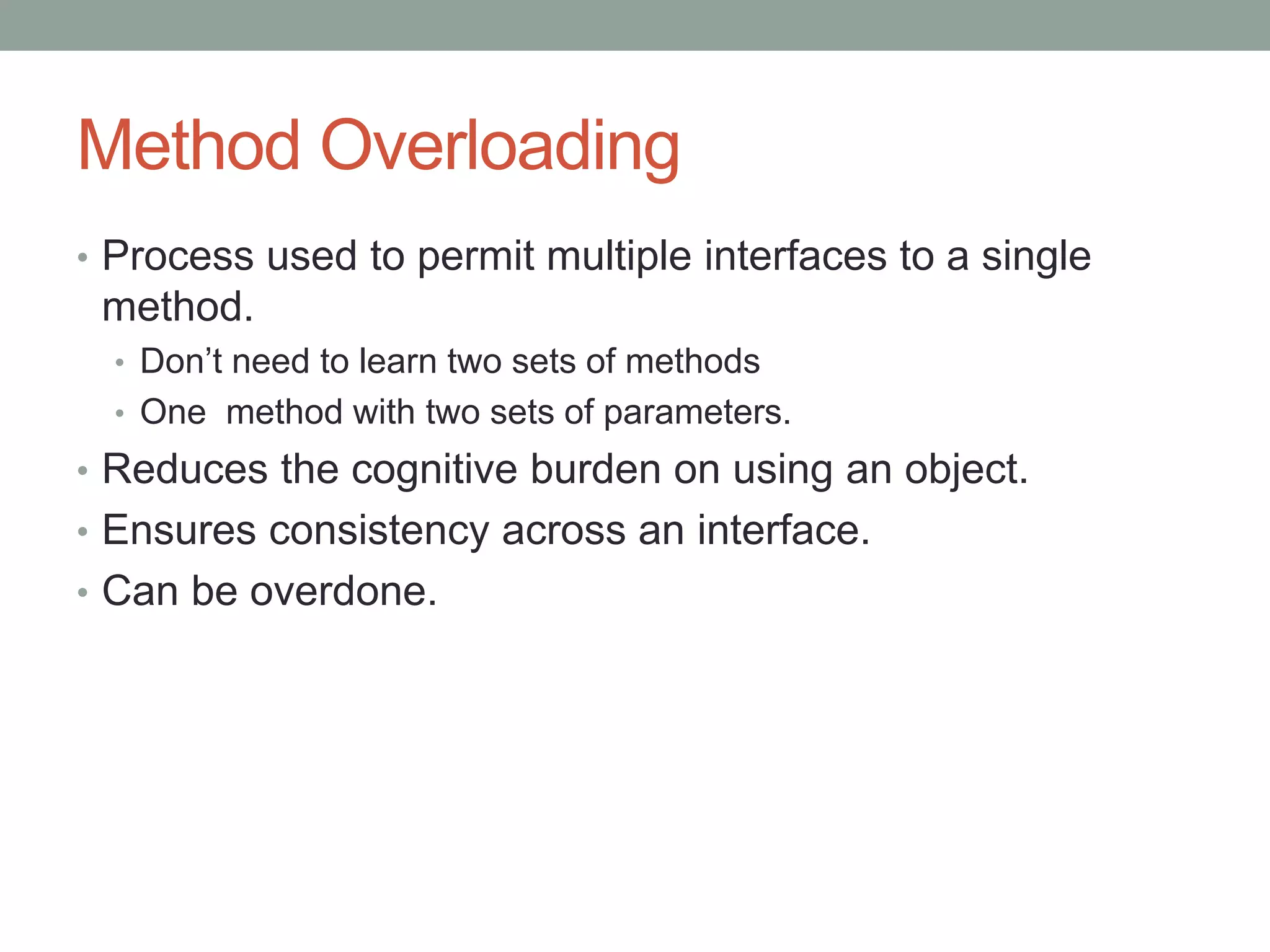
Method Overloading
• Process used to permit multiple interfaces to a single
method.
• Don’t need to learn two sets of methods
• One method with two sets of parameters.
• Reduces the cognitive burden on using an object.
• Ensures consistency across an interface.
• Can be overdone.
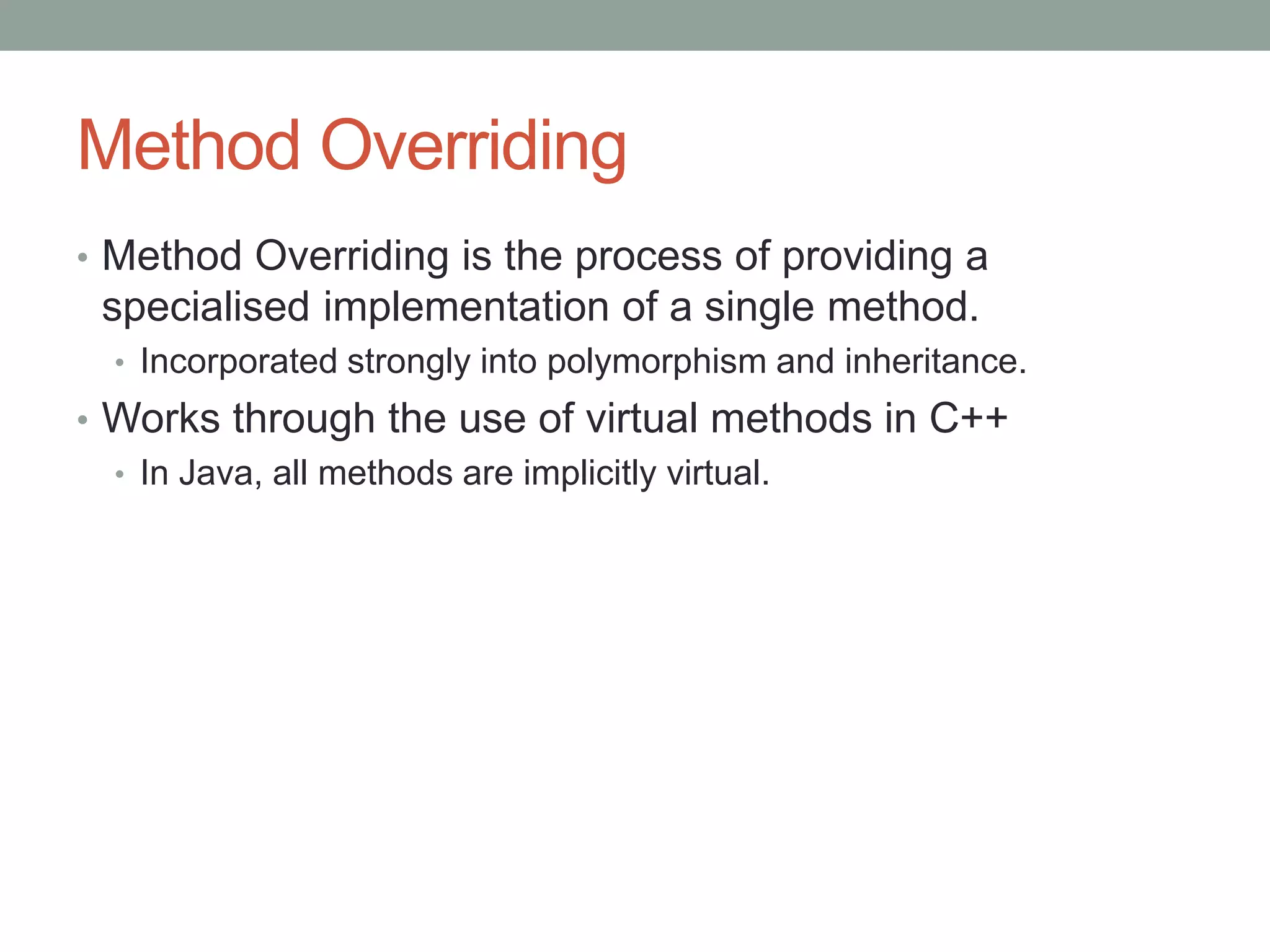
Method Overriding
• Method Overriding is the process of providing a
specialised implementation of a single method.
• Incorporated strongly into polymorphism and inheritance.
• Works through the use of virtual methods in C++
• In Java, all methods are implicitly virtual.
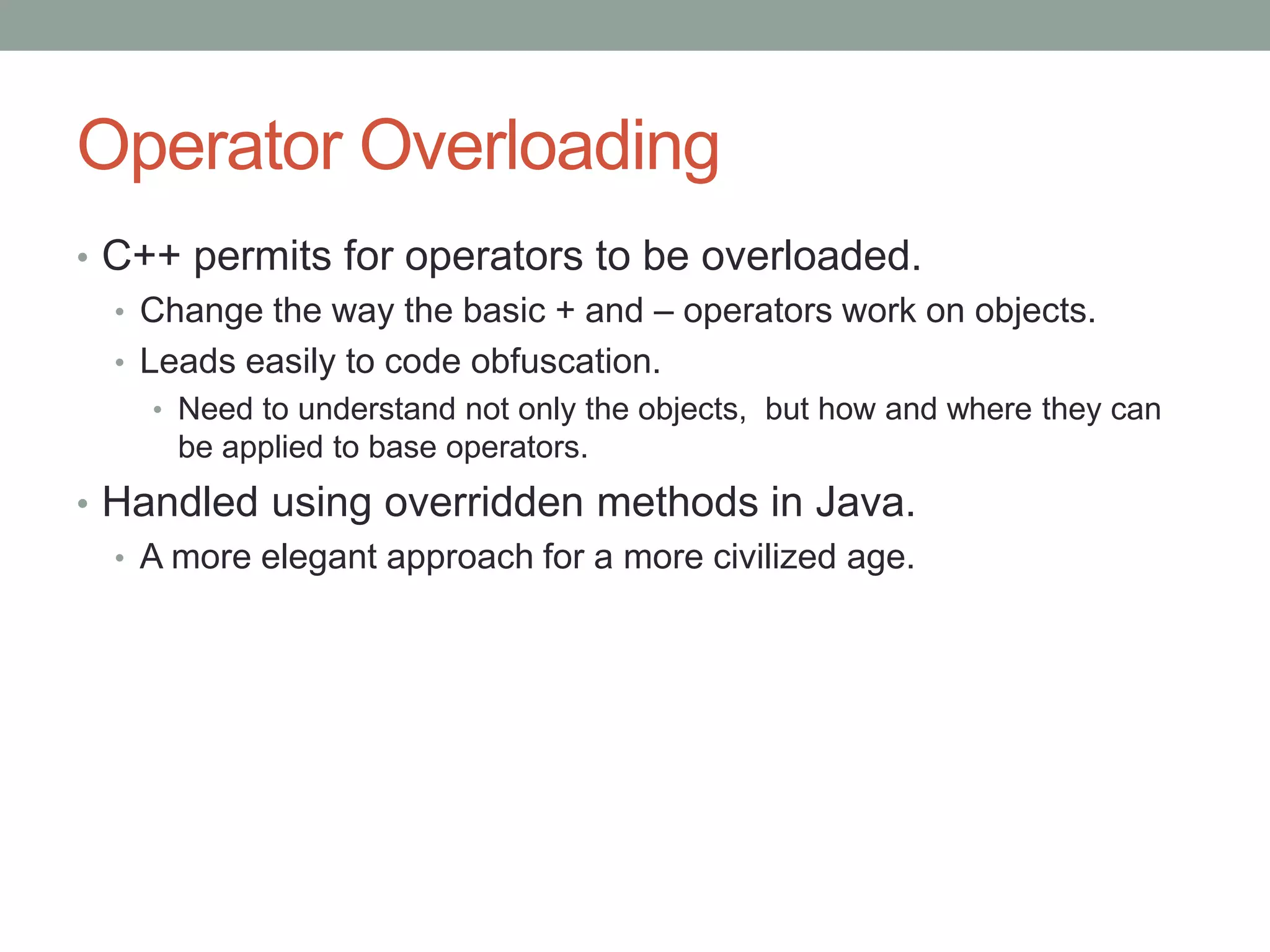
Operator Overloading
• C++ permits for operators to be overloaded.
• Change the way the basic + and – operators work on objects.
• Leads easily to code obfuscation.
• Need to understand not only the objects, but how and where they can
be applied to base operators.
• Handled using overridden methods in Java.
• A more elegant approach for a more civilized age.
Abstraction
• Abstraction is a key element in programming.
• It’s the process of getting rid of the low level details to focus on the
high level interactions.
• Is both conceptual and technical as a term.
• Abstraction is a general process
• Abstract classes are a specific kind of abstraction in object oriented
programs.
• Understanding the flow of execution through a class hierarchy
requires understanding of abstraction.
Abstract Classes
• Abstract classes cannot be instantiated.
• They can only serve as the basis for other derived classes.
• They can enforce a polymorphic contract with the compiler.
• A class in Java is made abstract via a special keyword.
• A class in C++ is made abstract by the inclusion of a pure
virtual method
Pure Virtual Methods
• A virtual method in C++ may be over-riden if the
developer desires.
• A pure virtual method must be over-ridden.
• Classes which incorporate no code and only pure virtual
methods can be used as interfaces.
• Java has a special keyword for this too.
• Only good use of multiple inheritance.
Templates
• Abstraction as a concept leads into the concrete
implementation of templates.
• Boilerplate code
• Code is generated by the compiler based on typing information.
• Templates are a powerful tool
• Used to good effect in the Standard Template Library.
• A library of C++ classes for everyone to use.
STL
• The Standard Template Library contains implementations
of:
• Sequential containers
• Adapter containers
• Associative containers
• Worthwhile exercise to write these structures from
scratch.
• Understanding gained by doing this.
• Worth using the STL structures for ‘live’ code.
Stream Based I/O
• I/O in C++ based primarily on streams.
• Polymorphism allows for the same basic operators to work on file
and keyboard/monitor I/O
• I/O operations quite flexible.
• You can modify the presentation quite a bit.
• However, object representation in files remains complex.
• Serialization is the process used, and not natively supported in
C++.
Static
• Static methods in object oriented languages are class
methods.
• They belong to a class, not to an instance.
• Static attributes in object oriented languages are class
attributes.
• All objects share the same data field for this.
• Static methods are limited.
• Can only call on other static methods or attributes.
Const
• The const modifier in C++ is used to specify different
behaviour depending on where it is used.
• Can specify a constant value
• Can specific an unchangeable value
• Can specify a method that cannot change instance attributes.
• Indiscriminate use of const usually a sign of bad design.
Moving On
• Where do you go… from here?
• Anywhere you like.
• The knowledge of C++ you have gained during this
module is transferable.
• You’ll find related concepts in any real OO language.
• We have spoken quite a bit about how the concepts relate to Java.
• They relate just as well in C#
But… why?
• All of these concepts are complicated by the nature of
pointers.
• Pointers are the secret engine behind C++
• C++ is a complicated language because it layers pointer
troubles on top of conceptual troubles.
• Why do this module in C++?
• Several reasons.
C++ in Industry
• C++ remains one of the most popular languages in
industry.
• It’s not the most popular, but you’ll encounter it often in Real Life.
• People who can code in C++ or C are a dying breed.
• ‘Too complicated’
• However, you learn things in C++ you don’t in other
languages.
C++ The Language
• Even if you never create another pointer, simply
understanding how they work opens up a world that other
languages hide.
• C++ more than any other language requires you to understand the
implications of what you are doing.
• This is an important mental skill.
• It’s not just about the code.
• It’s about the concepts.
Memory Management
• C++ has explicit memory management.
• No inherent, automated
• garbage collection as in Java
• We must manually handler pointers and dynamic memory
ourselves.
• This has implications for our design.
• Copy constructors
• Overloaded assignment operators
• Destructors
• Learning to do this is a good mental exercise.
• Albeit frustrating.
Next Week
• Next week is your consolidation week.
• Use the time wisely, young padawans. Padawen? Padawii?
• The lab will be staffed as always.
• Only two contact hours for the scheduled lecture time.
• Lab prep on Monday.
• Q&A about your current assessment.
• Bring questions about the assessment if you have any.
• Drop in tutorial on Thursday
• Come along if you have any questions relating to OO concepts.
• No planned content otherwise.
Summary
• Our discussion of OO in C++ is at an end.
• Alas, alas
• Next week is the consolidation week.
• Finish up what you’re working with.
• The week after you’ll be learning about data structures with
Manuel.
• These build on the concepts we have discussed over the past few
weeks.
• Have fun!
• Snausages.

2CPP19 - Summation

  • 1.
  • 2.
    Introduction • We havereached the end of our journey through object orientation in C++ • Huzzah, hooray, etc, etc • As the last lecture on the topic, we are going to recap on all the significant theoretical concepts. • Not rehash, just recap. • This knowledge will Guide You Well when it comes to the exam. • These are things you are expected to know!
  • 3.
    The Principles ofOO • OO is based primarily on three key principles. • Inheritance • Encapsulation • Polymorphism. • Together they form a mighty triad of techniques for building genuinely powerful programs. • These three together is why it is a fundamentally different style from structured programming.
  • 4.
    The Principles ofOO • Object oriented structures are not inherently scalable. • You need to be careful with what you do. • Metrics such as coupling and cohesion give a view of the objective quality of a class hierarchy. • Methods such as impact of change give a view of the maintainability of a system.
  • 5.
    Why OO? • Whydo we code using objects? • Easier for humans to understand? • No. • More efficient? • No • More maintainable • Yes • More expandable • Yes • Reusable • Kinda • Powerful? • Very much so.
  • 6.
    Inheritance • The processof inheritance is to assume the methods and attributes of another class. • Modified by the visibility of those methods and parameters. • Java permits single inheritance only. • As does C# • C++ permits multiple inheritance. • There be dragons. • Only one genuinely good thing comes from multiple inheritance in C++
  • 7.
    Encapsulation • Encapsulation isthe process of bundling the attributes of a class along with the methods that act upon those attributes. • Goes hand in hand with the topic of information hiding. • Should ensure a separation of abstraction and implementation. • Access to functionality available only through predefined interfaces.
  • 8.
    Polymorphism • The mostabstract of the three. • It’s the technique of treating a specialised class as an instance of a more general class. • Significant differences between C++ and Java here. • All methods in java are inherently virtual. • In C++, method virtuality must be declared as part of the class definition. • Only virtual methods will be called as the most specialised version.
  • 9.
    Overloading and Overriding •Object orientation is about providing a consistent interface to an object. • There are various techniques that allow us to do this. • Three key ways in which this is done in C++ • Method overloading • Method overriding • Operator overloading • The last is not available in Java • Which is a good thing.
  • 10.
    Method Overloading • Processused to permit multiple interfaces to a single method. • Don’t need to learn two sets of methods • One method with two sets of parameters. • Reduces the cognitive burden on using an object. • Ensures consistency across an interface. • Can be overdone.
  • 11.
    Method Overriding • MethodOverriding is the process of providing a specialised implementation of a single method. • Incorporated strongly into polymorphism and inheritance. • Works through the use of virtual methods in C++ • In Java, all methods are implicitly virtual.
  • 12.
    Operator Overloading • C++permits for operators to be overloaded. • Change the way the basic + and – operators work on objects. • Leads easily to code obfuscation. • Need to understand not only the objects, but how and where they can be applied to base operators. • Handled using overridden methods in Java. • A more elegant approach for a more civilized age.
  • 13.
    Abstraction • Abstraction isa key element in programming. • It’s the process of getting rid of the low level details to focus on the high level interactions. • Is both conceptual and technical as a term. • Abstraction is a general process • Abstract classes are a specific kind of abstraction in object oriented programs. • Understanding the flow of execution through a class hierarchy requires understanding of abstraction.
  • 14.
    Abstract Classes • Abstractclasses cannot be instantiated. • They can only serve as the basis for other derived classes. • They can enforce a polymorphic contract with the compiler. • A class in Java is made abstract via a special keyword. • A class in C++ is made abstract by the inclusion of a pure virtual method
  • 15.
    Pure Virtual Methods •A virtual method in C++ may be over-riden if the developer desires. • A pure virtual method must be over-ridden. • Classes which incorporate no code and only pure virtual methods can be used as interfaces. • Java has a special keyword for this too. • Only good use of multiple inheritance.
  • 16.
    Templates • Abstraction asa concept leads into the concrete implementation of templates. • Boilerplate code • Code is generated by the compiler based on typing information. • Templates are a powerful tool • Used to good effect in the Standard Template Library. • A library of C++ classes for everyone to use.
  • 17.
    STL • The StandardTemplate Library contains implementations of: • Sequential containers • Adapter containers • Associative containers • Worthwhile exercise to write these structures from scratch. • Understanding gained by doing this. • Worth using the STL structures for ‘live’ code.
  • 18.
    Stream Based I/O •I/O in C++ based primarily on streams. • Polymorphism allows for the same basic operators to work on file and keyboard/monitor I/O • I/O operations quite flexible. • You can modify the presentation quite a bit. • However, object representation in files remains complex. • Serialization is the process used, and not natively supported in C++.
  • 19.
    Static • Static methodsin object oriented languages are class methods. • They belong to a class, not to an instance. • Static attributes in object oriented languages are class attributes. • All objects share the same data field for this. • Static methods are limited. • Can only call on other static methods or attributes.
  • 20.
    Const • The constmodifier in C++ is used to specify different behaviour depending on where it is used. • Can specify a constant value • Can specific an unchangeable value • Can specify a method that cannot change instance attributes. • Indiscriminate use of const usually a sign of bad design.
  • 21.
    Moving On • Wheredo you go… from here? • Anywhere you like. • The knowledge of C++ you have gained during this module is transferable. • You’ll find related concepts in any real OO language. • We have spoken quite a bit about how the concepts relate to Java. • They relate just as well in C#
  • 22.
    But… why? • Allof these concepts are complicated by the nature of pointers. • Pointers are the secret engine behind C++ • C++ is a complicated language because it layers pointer troubles on top of conceptual troubles. • Why do this module in C++? • Several reasons.
  • 23.
    C++ in Industry •C++ remains one of the most popular languages in industry. • It’s not the most popular, but you’ll encounter it often in Real Life. • People who can code in C++ or C are a dying breed. • ‘Too complicated’ • However, you learn things in C++ you don’t in other languages.
  • 24.
    C++ The Language •Even if you never create another pointer, simply understanding how they work opens up a world that other languages hide. • C++ more than any other language requires you to understand the implications of what you are doing. • This is an important mental skill. • It’s not just about the code. • It’s about the concepts.
  • 25.
    Memory Management • C++has explicit memory management. • No inherent, automated • garbage collection as in Java • We must manually handler pointers and dynamic memory ourselves. • This has implications for our design. • Copy constructors • Overloaded assignment operators • Destructors • Learning to do this is a good mental exercise. • Albeit frustrating.
  • 26.
    Next Week • Nextweek is your consolidation week. • Use the time wisely, young padawans. Padawen? Padawii? • The lab will be staffed as always. • Only two contact hours for the scheduled lecture time. • Lab prep on Monday. • Q&A about your current assessment. • Bring questions about the assessment if you have any. • Drop in tutorial on Thursday • Come along if you have any questions relating to OO concepts. • No planned content otherwise.
  • 27.
    Summary • Our discussionof OO in C++ is at an end. • Alas, alas • Next week is the consolidation week. • Finish up what you’re working with. • The week after you’ll be learning about data structures with Manuel. • These build on the concepts we have discussed over the past few weeks. • Have fun! • Snausages.