METHOD
OVERLOADING
Michael Heron
Introduction
• One of the facilities available in modern programming
languages is that of method overloading.
• The ability to have more than one method with the same name in a
particular code space.
• This facility can be use to great effect to permit
consistency of an interface across objects.
• We’ll talk about that today.
Method Overloading
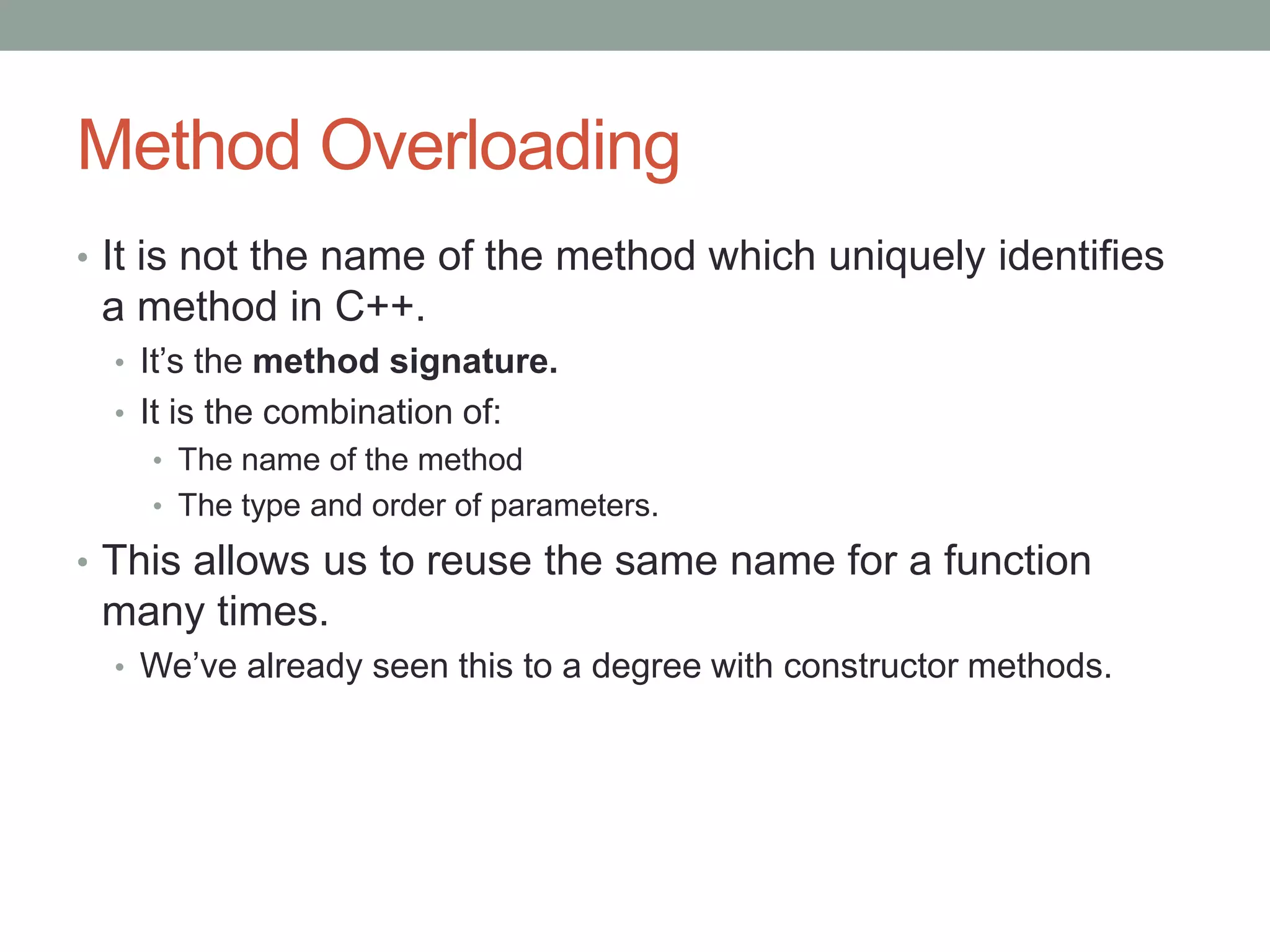
• It is not the name of the method which uniquely identifies
a method in C++.
• It’s the method signature.
• It is the combination of:
• The name of the method
• The type and order of parameters.
• This allows us to reuse the same name for a function
many times.
• We’ve already seen this to a degree with constructor methods.
Method Overloading
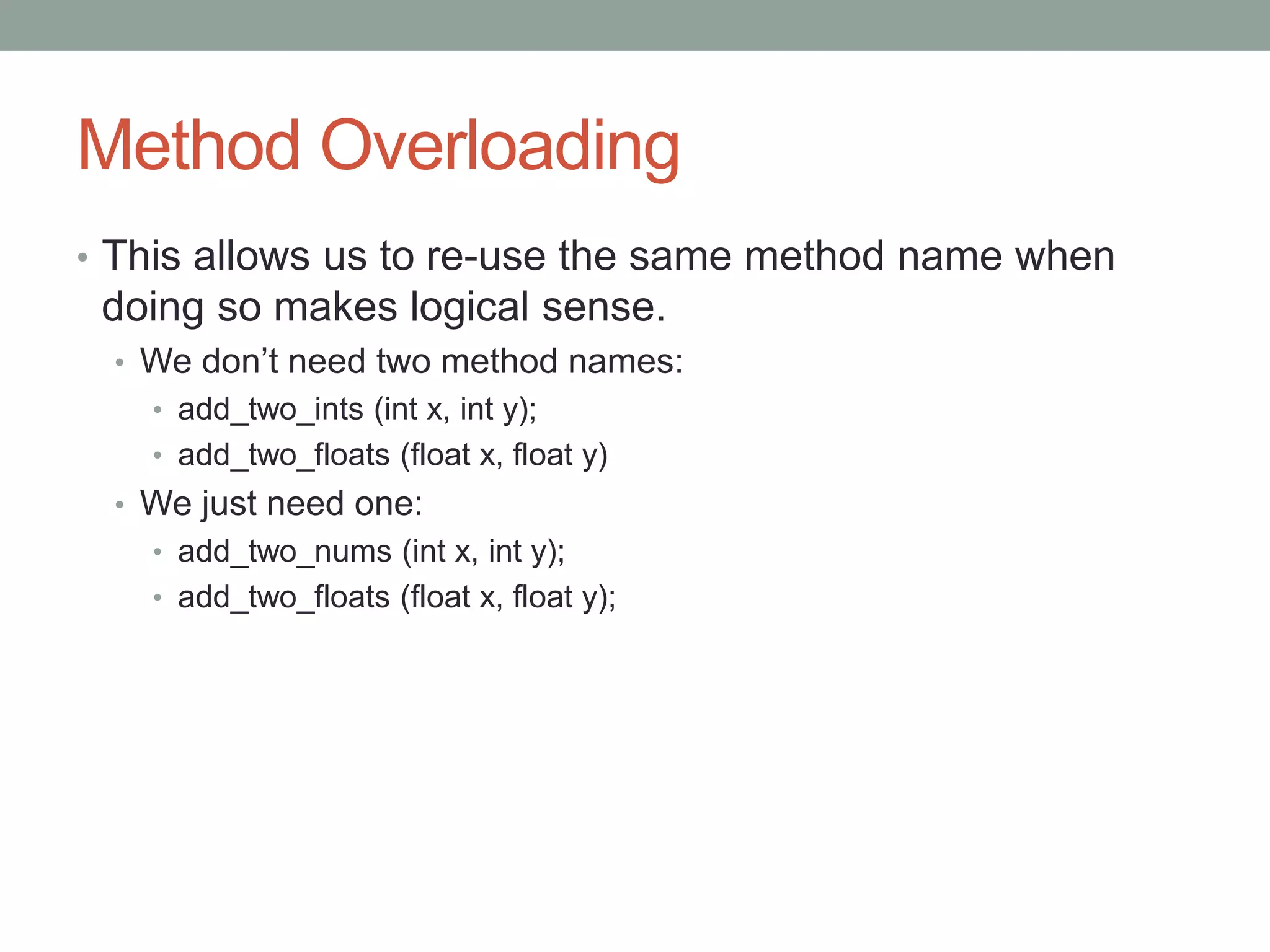
• This allows us to re-use the same method name when
doing so makes logical sense.
• We don’t need two method names:
• add_two_ints (int x, int y);
• add_two_floats (float x, float y)
• We just need one:
• add_two_nums (int x, int y);
• add_two_floats (float x, float y);
Method Overloading
• This allows us to reduce the cognitive burden needed to
use our coded objects.
• The fewer methods people have to memorize, the better.
• This comes at a danger:
• Overload methods only when it makes sense to do so.
• When the output is the same, just the parameters differ.
• Don’t use it when there are side-effects to choosing particular
combinations of parameters.
• As far as possible, their execution should be identical.
Guidelines for Method Overloading
• Like anything in programming, you can do this well or you
can do it badly.
• We’re going to aim to do it well.
• There are some guidelines for overloading methods
properly.
• Use a consistent return type
• Ensure consistent parameter names
• Ensure consistent parameter orders
• Use internal function redirection
• Don’t overdo them
Use A Consistent Return Type
• One of the benefits of method overloading is that it
reduces cognitive burden.
• This benefit is lost when overloaded methods have inconsistent
return types.
• As with most guidelines, this is not an iron-cast rule.
• Sometimes it makes sense, such as methods that perform
arithmetic.
• You don’t want to get an int back when you passed in floats.
Ensure Consistent Parameter Names
• If you call a parameter ‘name’ in one overloaded method,
don’t call it ‘obName in another’
• This is something that is not such an issue for external parties, but
has an impact of ease of maintenance.
• Keep the names of your parameters the same.
• Refactor the code to ensure this if necessary.
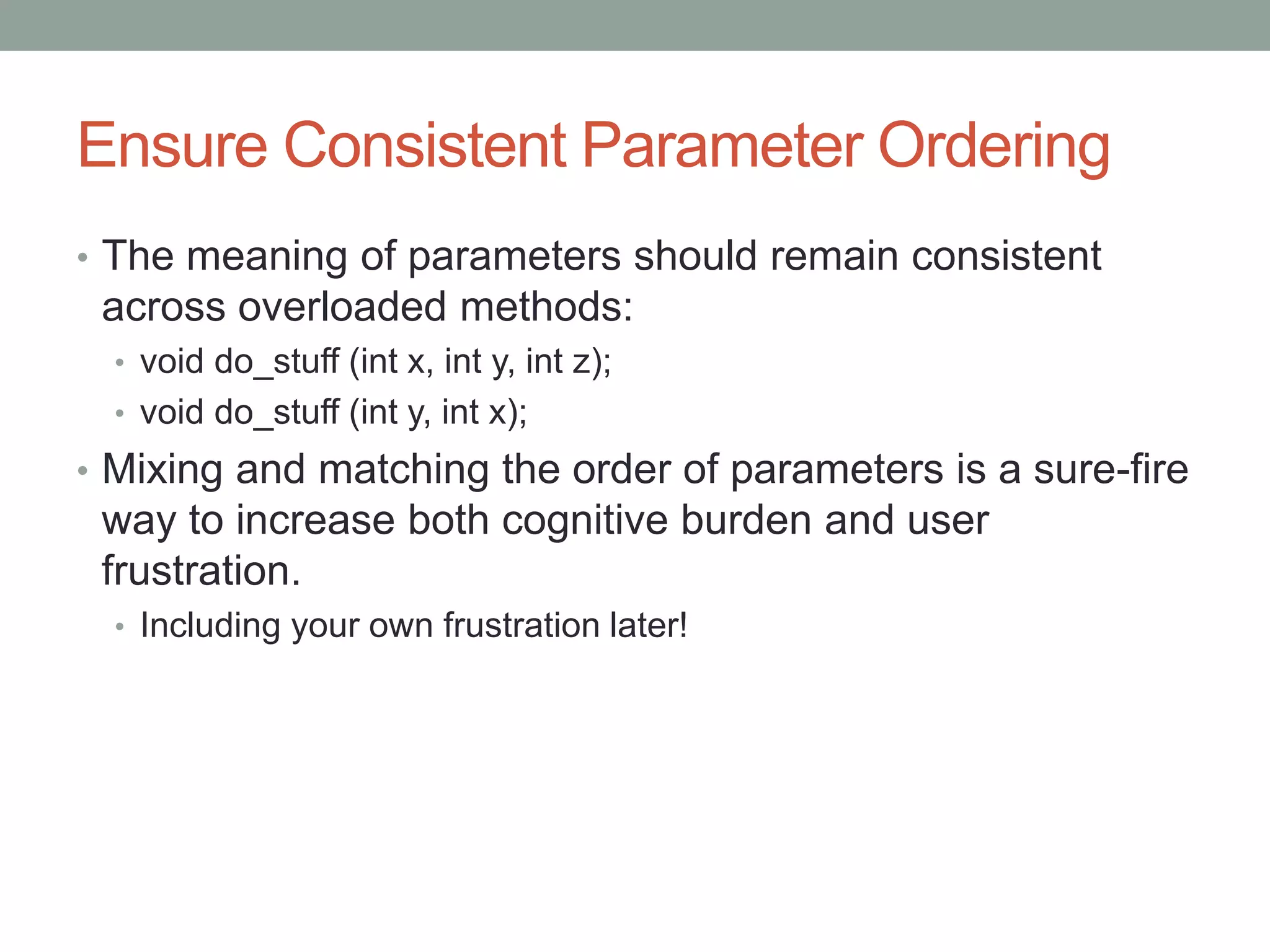
Ensure Consistent Parameter Ordering
• The meaning of parameters should remain consistent
across overloaded methods:
• void do_stuff (int x, int y, int z);
• void do_stuff (int y, int x);
• Mixing and matching the order of parameters is a sure-fire
way to increase both cognitive burden and user
frustration.
• Including your own frustration later!
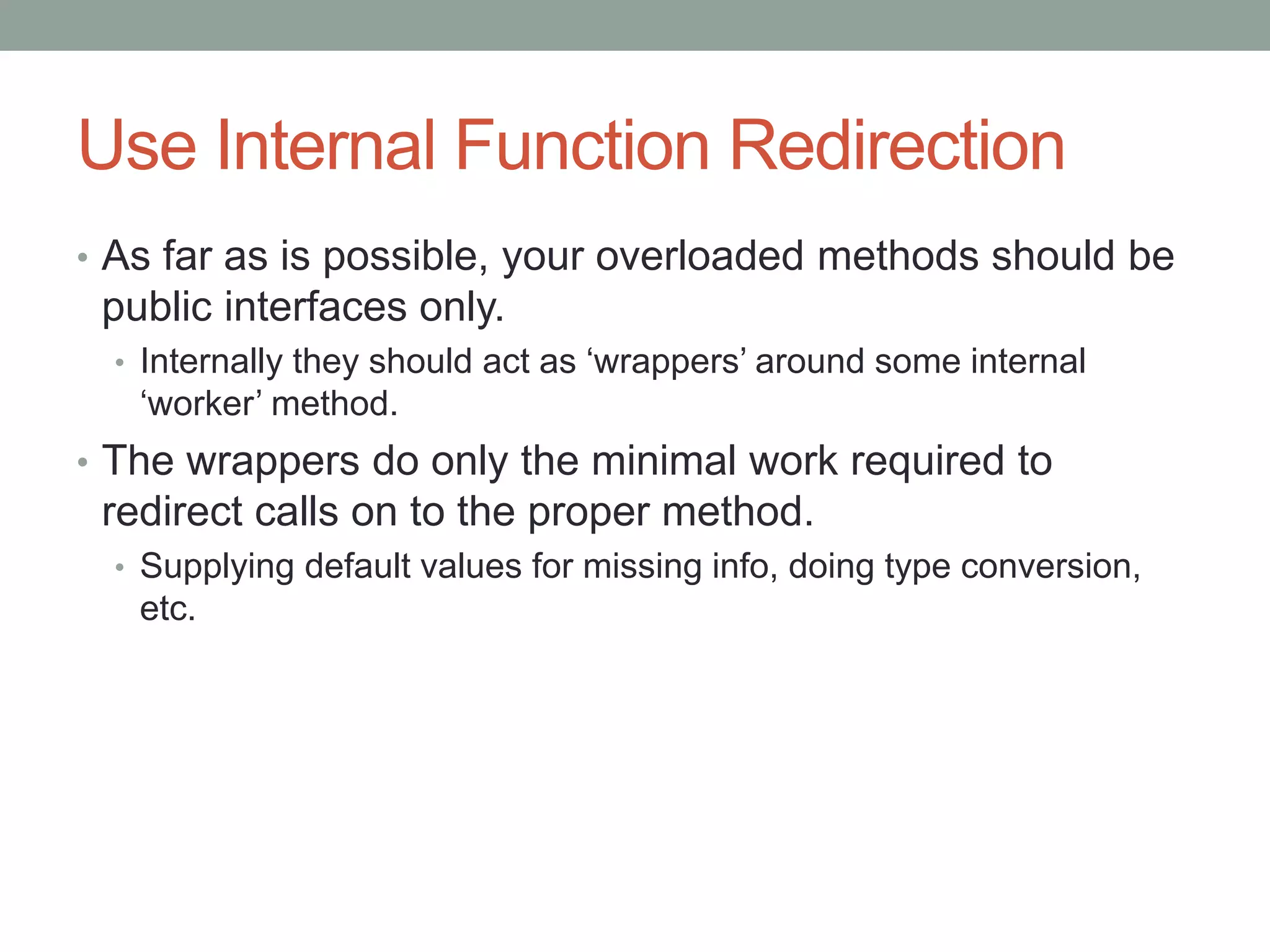
Use Internal Function Redirection
• As far as is possible, your overloaded methods should be
public interfaces only.
• Internally they should act as ‘wrappers’ around some internal
‘worker’ method.
• The wrappers do only the minimal work required to
redirect calls on to the proper method.
• Supplying default values for missing info, doing type conversion,
etc.
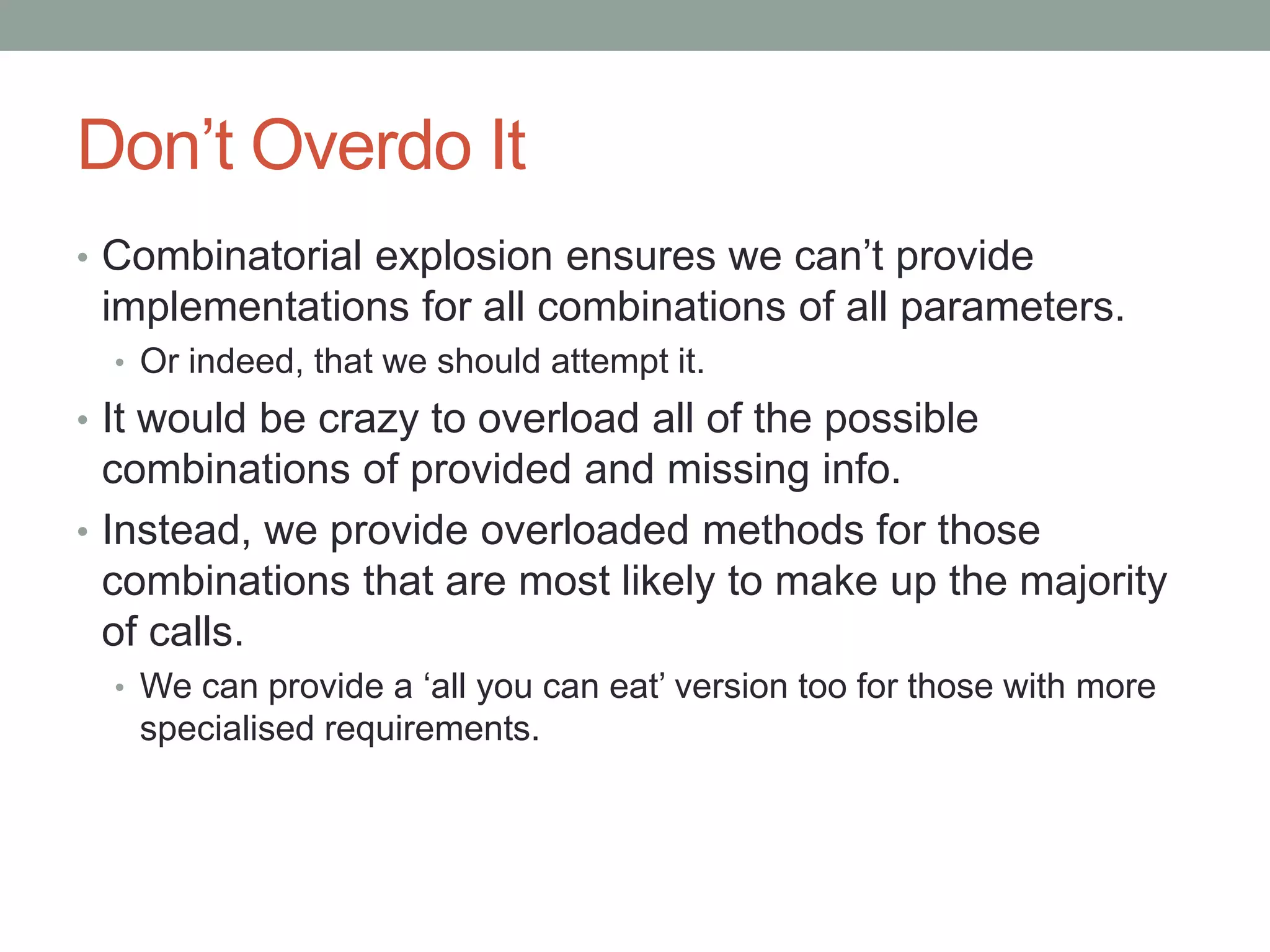
Don’t Overdo It
• Combinatorial explosion ensures we can’t provide
implementations for all combinations of all parameters.
• Or indeed, that we should attempt it.
• It would be crazy to overload all of the possible
combinations of provided and missing info.
• Instead, we provide overloaded methods for those
combinations that are most likely to make up the majority
of calls.
• We can provide a ‘all you can eat’ version too for those with more
specialised requirements.
Why Overload Methods?
• Provides a consistent interface for your objects.
• Reduces cognitive burden on learning new objects.
• Don’t need to learn five methods that do much the same thing.
• This is a feature in many older languages.
• Makes code more readable.
• Makes code more maintainable.
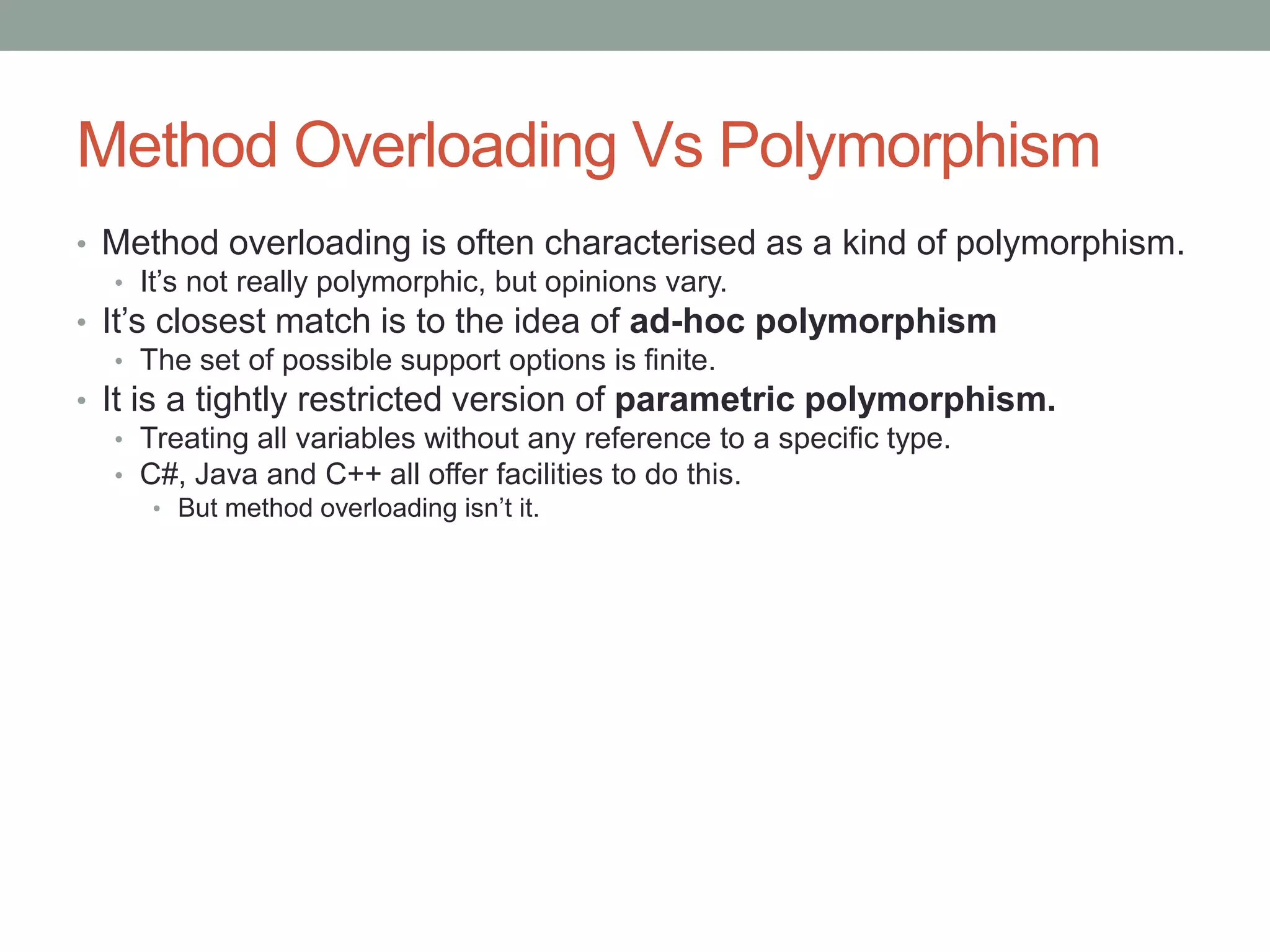
Method Overloading Vs Polymorphism
• Method overloading is often characterised as a kind of polymorphism.
• It’s not really polymorphic, but opinions vary.
• It’s closest match is to the idea of ad-hoc polymorphism
• The set of possible support options is finite.
• It is a tightly restricted version of parametric polymorphism.
• Treating all variables without any reference to a specific type.
• C#, Java and C++ all offer facilities to do this.
• But method overloading isn’t it.
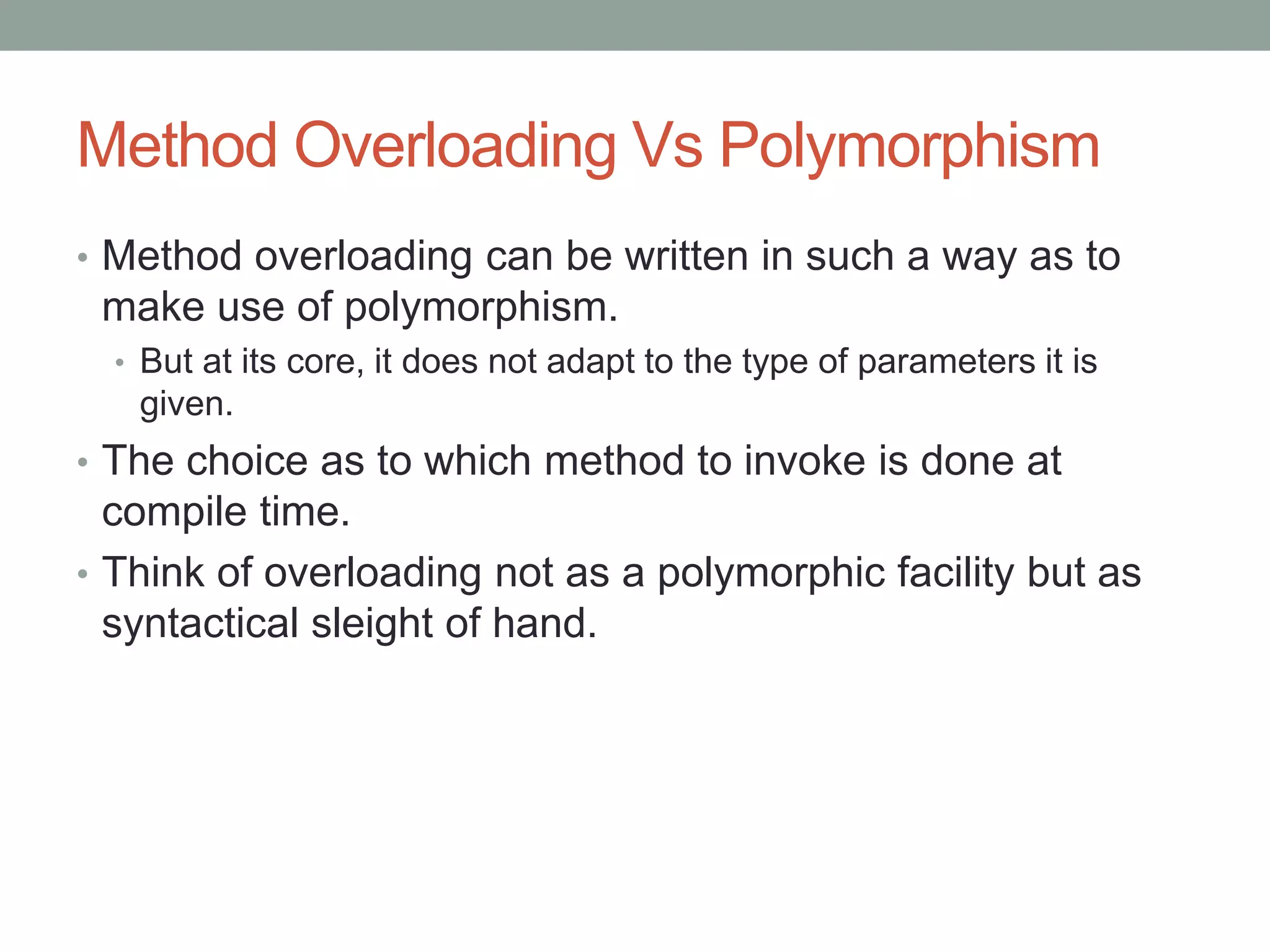
Method Overloading Vs Polymorphism
• Method overloading can be written in such a way as to
make use of polymorphism.
• But at its core, it does not adapt to the type of parameters it is
given.
• The choice as to which method to invoke is done at
compile time.
• Think of overloading not as a polymorphic facility but as
syntactical sleight of hand.
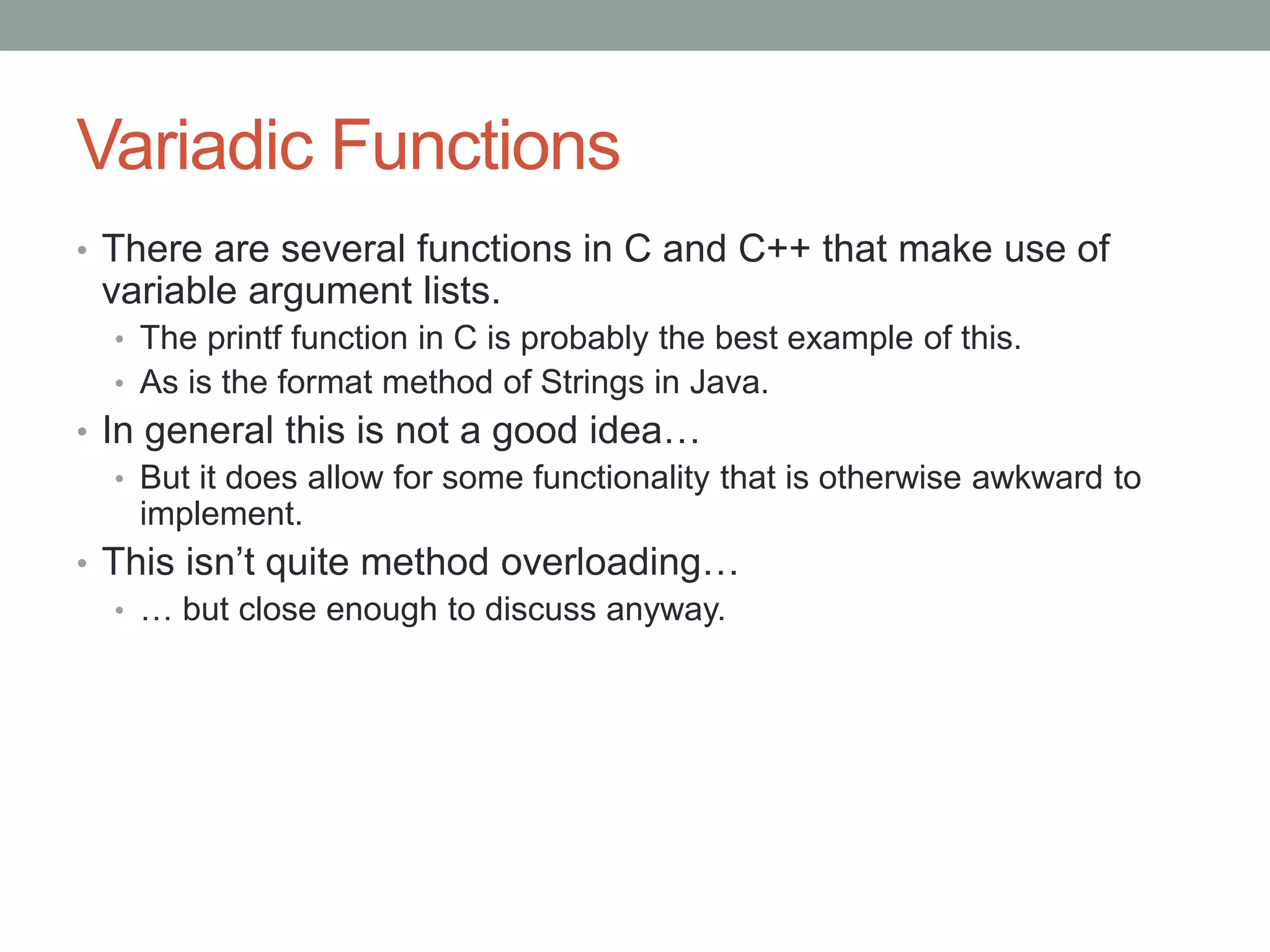
Variadic Functions
• There are several functions in C and C++ that make use of
variable argument lists.
• The printf function in C is probably the best example of this.
• As is the format method of Strings in Java.
• In general this is not a good idea…
• But it does allow for some functionality that is otherwise awkward to
implement.
• This isn’t quite method overloading…
• … but close enough to discuss anyway.
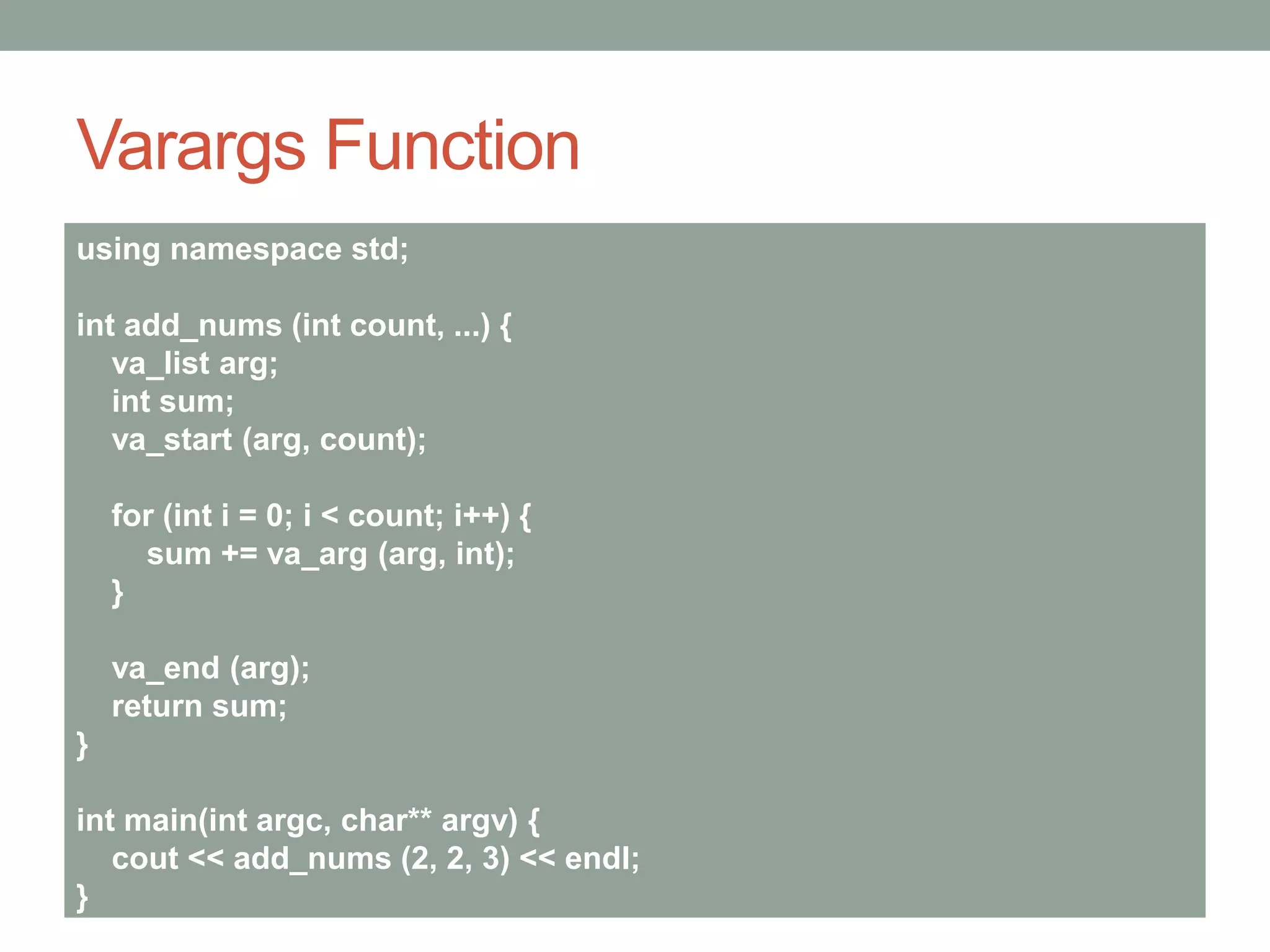
Varargs Function
using namespace std;
int add_nums (int count, ...) {
va_list arg;
int sum;
va_start (arg, count);
for (int i = 0; i < count; i++) {
sum += va_arg (arg, int);
}
va_end (arg);
return sum;
}
int main(int argc, char** argv) {
cout << add_nums (2, 2, 3) << endl;
}
Why Use Varargs?
• Syntactically nicer to user.
• You don’t need to create arrays when you invoke a function.
• When overloading doesn’t meet our needs.
• Overloading does not always play well with varargs.
• Easier to read and understand the code.
• No messy collection manipulation.
Why Not Use Varargs?
• Badly designed functions lead to insecure code.
• Type conversions must be handled manually.
• Type checking can only be done at runtime in many
cases.
• Ideally you want problems to be flagged up by the compiler at
compile-time.
• Doesn’t play nicely with overloading.
Varargs in Java
• Java 1.5 made available the varargs system for the first
time.
• It’s syntatically much easier to do.
• Works in largely the same way.
• It’s an autoboxing feature – it creates the array for you.
• Varargs can be used only in the final argument position.
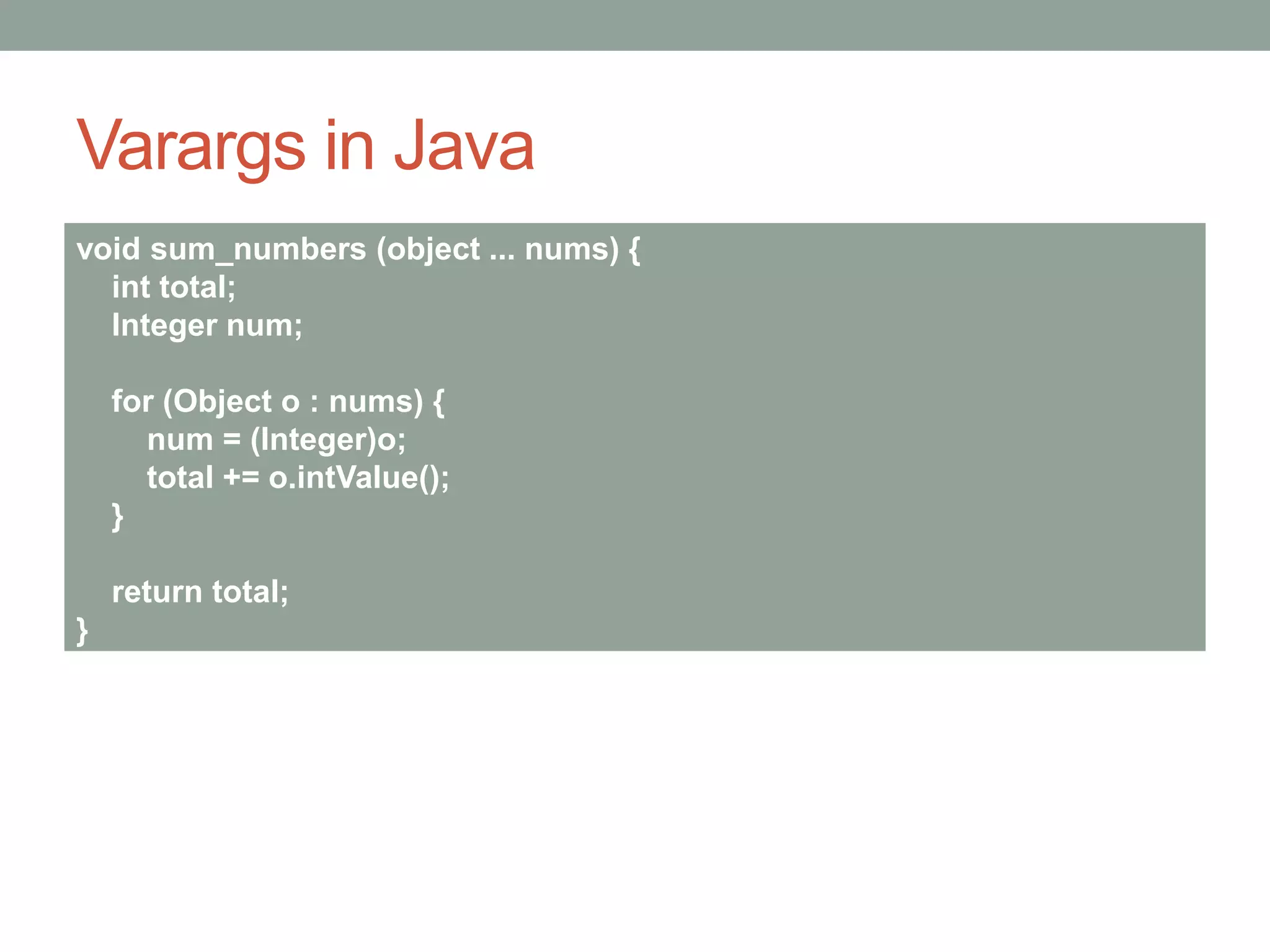
Varargs in Java
void sum_numbers (object ... nums) {
int total;
Integer num;
for (Object o : nums) {
num = (Integer)o;
total += o.intValue();
}
return total;
}
Summary
• Functions have unique signatures that identify them.
• The signature is the name, and then types and order of parameters.
• Overloading functions means that you can produce more
readable and more maintainable code.
• Variadic functions can be created to deal with situations where
array manipulation would be awkward or costly.

2CPP11 - Method Overloading

  • 1.
  • 2.
    Introduction • One ofthe facilities available in modern programming languages is that of method overloading. • The ability to have more than one method with the same name in a particular code space. • This facility can be use to great effect to permit consistency of an interface across objects. • We’ll talk about that today.
  • 3.
    Method Overloading • Itis not the name of the method which uniquely identifies a method in C++. • It’s the method signature. • It is the combination of: • The name of the method • The type and order of parameters. • This allows us to reuse the same name for a function many times. • We’ve already seen this to a degree with constructor methods.
  • 4.
    Method Overloading • Thisallows us to re-use the same method name when doing so makes logical sense. • We don’t need two method names: • add_two_ints (int x, int y); • add_two_floats (float x, float y) • We just need one: • add_two_nums (int x, int y); • add_two_floats (float x, float y);
  • 5.
    Method Overloading • Thisallows us to reduce the cognitive burden needed to use our coded objects. • The fewer methods people have to memorize, the better. • This comes at a danger: • Overload methods only when it makes sense to do so. • When the output is the same, just the parameters differ. • Don’t use it when there are side-effects to choosing particular combinations of parameters. • As far as possible, their execution should be identical.
  • 6.
    Guidelines for MethodOverloading • Like anything in programming, you can do this well or you can do it badly. • We’re going to aim to do it well. • There are some guidelines for overloading methods properly. • Use a consistent return type • Ensure consistent parameter names • Ensure consistent parameter orders • Use internal function redirection • Don’t overdo them
  • 7.
    Use A ConsistentReturn Type • One of the benefits of method overloading is that it reduces cognitive burden. • This benefit is lost when overloaded methods have inconsistent return types. • As with most guidelines, this is not an iron-cast rule. • Sometimes it makes sense, such as methods that perform arithmetic. • You don’t want to get an int back when you passed in floats.
  • 8.
    Ensure Consistent ParameterNames • If you call a parameter ‘name’ in one overloaded method, don’t call it ‘obName in another’ • This is something that is not such an issue for external parties, but has an impact of ease of maintenance. • Keep the names of your parameters the same. • Refactor the code to ensure this if necessary.
  • 9.
    Ensure Consistent ParameterOrdering • The meaning of parameters should remain consistent across overloaded methods: • void do_stuff (int x, int y, int z); • void do_stuff (int y, int x); • Mixing and matching the order of parameters is a sure-fire way to increase both cognitive burden and user frustration. • Including your own frustration later!
  • 10.
    Use Internal FunctionRedirection • As far as is possible, your overloaded methods should be public interfaces only. • Internally they should act as ‘wrappers’ around some internal ‘worker’ method. • The wrappers do only the minimal work required to redirect calls on to the proper method. • Supplying default values for missing info, doing type conversion, etc.
  • 11.
    Don’t Overdo It •Combinatorial explosion ensures we can’t provide implementations for all combinations of all parameters. • Or indeed, that we should attempt it. • It would be crazy to overload all of the possible combinations of provided and missing info. • Instead, we provide overloaded methods for those combinations that are most likely to make up the majority of calls. • We can provide a ‘all you can eat’ version too for those with more specialised requirements.
  • 12.
    Why Overload Methods? •Provides a consistent interface for your objects. • Reduces cognitive burden on learning new objects. • Don’t need to learn five methods that do much the same thing. • This is a feature in many older languages. • Makes code more readable. • Makes code more maintainable.
  • 13.
    Method Overloading VsPolymorphism • Method overloading is often characterised as a kind of polymorphism. • It’s not really polymorphic, but opinions vary. • It’s closest match is to the idea of ad-hoc polymorphism • The set of possible support options is finite. • It is a tightly restricted version of parametric polymorphism. • Treating all variables without any reference to a specific type. • C#, Java and C++ all offer facilities to do this. • But method overloading isn’t it.
  • 14.
    Method Overloading VsPolymorphism • Method overloading can be written in such a way as to make use of polymorphism. • But at its core, it does not adapt to the type of parameters it is given. • The choice as to which method to invoke is done at compile time. • Think of overloading not as a polymorphic facility but as syntactical sleight of hand.
  • 15.
    Variadic Functions • Thereare several functions in C and C++ that make use of variable argument lists. • The printf function in C is probably the best example of this. • As is the format method of Strings in Java. • In general this is not a good idea… • But it does allow for some functionality that is otherwise awkward to implement. • This isn’t quite method overloading… • … but close enough to discuss anyway.
  • 16.
    Varargs Function using namespacestd; int add_nums (int count, ...) { va_list arg; int sum; va_start (arg, count); for (int i = 0; i < count; i++) { sum += va_arg (arg, int); } va_end (arg); return sum; } int main(int argc, char** argv) { cout << add_nums (2, 2, 3) << endl; }
  • 17.
    Why Use Varargs? •Syntactically nicer to user. • You don’t need to create arrays when you invoke a function. • When overloading doesn’t meet our needs. • Overloading does not always play well with varargs. • Easier to read and understand the code. • No messy collection manipulation.
  • 18.
    Why Not UseVarargs? • Badly designed functions lead to insecure code. • Type conversions must be handled manually. • Type checking can only be done at runtime in many cases. • Ideally you want problems to be flagged up by the compiler at compile-time. • Doesn’t play nicely with overloading.
  • 19.
    Varargs in Java •Java 1.5 made available the varargs system for the first time. • It’s syntatically much easier to do. • Works in largely the same way. • It’s an autoboxing feature – it creates the array for you. • Varargs can be used only in the final argument position.
  • 20.
    Varargs in Java voidsum_numbers (object ... nums) { int total; Integer num; for (Object o : nums) { num = (Integer)o; total += o.intValue(); } return total; }
  • 21.
    Summary • Functions haveunique signatures that identify them. • The signature is the name, and then types and order of parameters. • Overloading functions means that you can produce more readable and more maintainable code. • Variadic functions can be created to deal with situations where array manipulation would be awkward or costly.