CSE 332: C++ Overloading
Overview of C++ Overloading
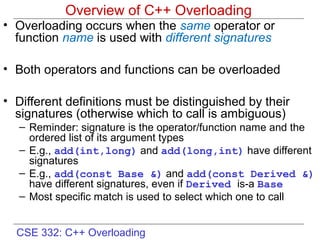
• Overloading occurs when the same operator or
function name is used with different signatures
• Both operators and functions can be overloaded
• Different definitions must be distinguished by their
signatures (otherwise which to call is ambiguous)
– Reminder: signature is the operator/function name and the
ordered list of its argument types
– E.g., add(int,long) and add(long,int) have different
signatures
– E.g., add(const Base &) and add(const Derived &)
have different signatures, even if Derived is-a Base
– Most specific match is used to select which one to call
CSE 332: C++ Overloading
Overloading vs. Overriding
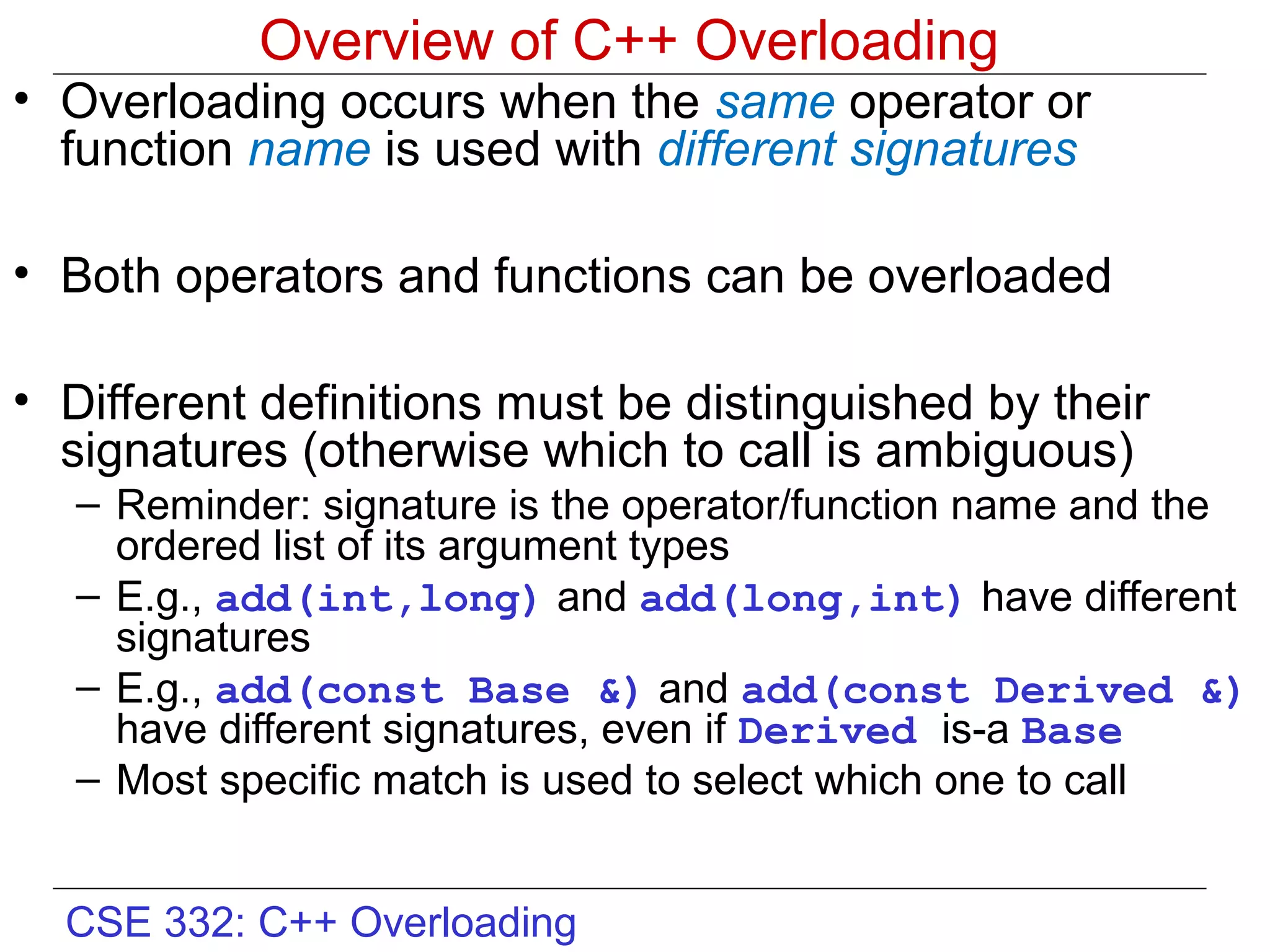
• Overriding a base class member function is
similar to overloading a function or operator
– But for overriding, definitions are distinguished by
their scopes rather than by their signatures
• C++ can distinguish method definitions
according to either static or dynamic type
– Depends on whether a method is virtual or not
– Depends on whether called via a reference or
pointer vs. directly on an object
– Depends on whether the call states the scope
explicitly (e.g., Foo::baz();)
CSE 332: C++ Overloading
Function Overloading
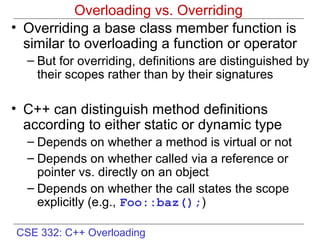
class A {
public:
int add(int i, int j);
// not allowed, would be
// ambiguous with above:
// long add(int m, int n);
// Ok, different signature
long add(long m, long n);
};
int
main (int argc, char **argv) {
int a = 7;
int b = 8;
int c = add(a, b);
return 0;
}
• Calls to overloaded functions and
operators are resolved by
– Finding all possible matches based
on passed arguments
• May involve type promotion
• May involve instantiating templates
– Finding the “best match” among
those possible matches
• Signature does not include the
return type
– Which might not help even if it did,
i.e., calls may ignore result
– So, overloading can’t be resolved by
return type alone
– Compiler generates an error if the
call can’t be resolved
CSE 332: C++ Overloading
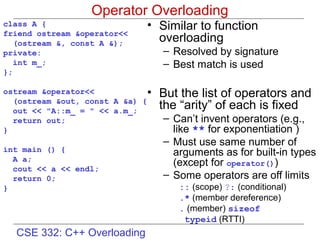
Operator Overloading
class A {
friend ostream &operator<<
(ostream &, const A &);
private:
int m_;
};
ostream &operator<<
(ostream &out, const A &a) {
out << "A::m_ = " << a.m_;
return out;
}
int main () {
A a;
cout << a << endl;
return 0;
}
• Similar to function
overloading
– Resolved by signature
– Best match is used
• But the list of operators and
the “arity” of each is fixed
– Can’t invent operators (e.g.,
like ** for exponentiation )
– Must use same number of
arguments as for built-in types
(except for operator())
– Some operators are off limits
:: (scope) ?: (conditional)
.* (member dereference)
. (member) sizeof
typeid (RTTI)
CSE 332: C++ Overloading
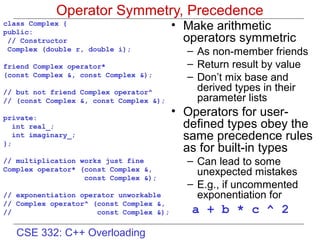
Operator Symmetry, Precedence
class Complex {
public:
// Constructor
Complex (double r, double i);
friend Complex operator*
(const Complex &, const Complex &);
// but not friend Complex operator^
// (const Complex &, const Complex &);
private:
int real_;
int imaginary_;
};
// multiplication works just fine
Complex operator* (const Complex &,
const Complex &);
// exponentiation operator unworkable
// Complex operator^ (const Complex &,
// const Complex &);
• Make arithmetic
operators symmetric
– As non-member friends
– Return result by value
– Don’t mix base and
derived types in their
parameter lists
• Operators for user-
defined types obey the
same precedence rules
as for built-in types
– Can lead to some
unexpected mistakes
– E.g., if uncommented
exponentiation for
a + b * c ^ 2
CSE 332: C++ Overloading
Member vs. Non-Member Overloading
// declarations in .h file
class A {
public:
friend bool operator<
(const A &, const A &);
A operator++(); // prefix
A operator++(int); // postfix
private:
int m_;
};
bool operator==(const A &lhs,
const A &rhs);
// definitions in .cpp file
bool operator==(const A &lhs,
const A &rhs)
{return lhs.m_ == rhs.m_;}
A A::operator++() // prefix
{++m_; return *this;}
A A::operator++(int) // postfix
{A ret(*this); ++*this; return ret;}
• Remember a this pointer is passed
to any non-static member function
– Object doesn’t appear in parameters
– For non-member functions and
operators all parameters are listed
• The rules about operator arity are
obeyed in code on left
– Operator == is binary
– Prefix/postfix ++ are unary, parameter
for postfix distinguishes its signature
• Must declare and define [] and ==
and -> and () as member operators
• Non-member operators are needed
when working with classes you wrote
and classes you didn’t write
– E.g., ostream << and istream >>
• Non-member operators are also
useful to preserve symmetry
– E.g., for arithmetic/relational operators
– May help to avoid unexpected type
conversions, especially with an
inheritance hierarchy
CSE 332: C++ Overloading
Summary: Tips on Overloading
• Use virtual overriding when you want to substitute
different subtypes polymorphically
– E.g., move() in derived and base classes
• Use overloading when you want to provide related
interfaces to similar abstractions
– E.g., migrate(Bird &) vs. migrate(Elephant &)
– Make[] -> () = *= ++ -- etc. members
– Make << >> + * - / == < etc. non-members
• Use different names when the abstractions differ
– E.g., fly() versus walk()

C++ overloading

  • 1.
    CSE 332: C++Overloading Overview of C++ Overloading • Overloading occurs when the same operator or function name is used with different signatures • Both operators and functions can be overloaded • Different definitions must be distinguished by their signatures (otherwise which to call is ambiguous) – Reminder: signature is the operator/function name and the ordered list of its argument types – E.g., add(int,long) and add(long,int) have different signatures – E.g., add(const Base &) and add(const Derived &) have different signatures, even if Derived is-a Base – Most specific match is used to select which one to call
  • 2.
    CSE 332: C++Overloading Overloading vs. Overriding • Overriding a base class member function is similar to overloading a function or operator – But for overriding, definitions are distinguished by their scopes rather than by their signatures • C++ can distinguish method definitions according to either static or dynamic type – Depends on whether a method is virtual or not – Depends on whether called via a reference or pointer vs. directly on an object – Depends on whether the call states the scope explicitly (e.g., Foo::baz();)
  • 3.
    CSE 332: C++Overloading Function Overloading class A { public: int add(int i, int j); // not allowed, would be // ambiguous with above: // long add(int m, int n); // Ok, different signature long add(long m, long n); }; int main (int argc, char **argv) { int a = 7; int b = 8; int c = add(a, b); return 0; } • Calls to overloaded functions and operators are resolved by – Finding all possible matches based on passed arguments • May involve type promotion • May involve instantiating templates – Finding the “best match” among those possible matches • Signature does not include the return type – Which might not help even if it did, i.e., calls may ignore result – So, overloading can’t be resolved by return type alone – Compiler generates an error if the call can’t be resolved
  • 4.
    CSE 332: C++Overloading Operator Overloading class A { friend ostream &operator<< (ostream &, const A &); private: int m_; }; ostream &operator<< (ostream &out, const A &a) { out << "A::m_ = " << a.m_; return out; } int main () { A a; cout << a << endl; return 0; } • Similar to function overloading – Resolved by signature – Best match is used • But the list of operators and the “arity” of each is fixed – Can’t invent operators (e.g., like ** for exponentiation ) – Must use same number of arguments as for built-in types (except for operator()) – Some operators are off limits :: (scope) ?: (conditional) .* (member dereference) . (member) sizeof typeid (RTTI)
  • 5.
    CSE 332: C++Overloading Operator Symmetry, Precedence class Complex { public: // Constructor Complex (double r, double i); friend Complex operator* (const Complex &, const Complex &); // but not friend Complex operator^ // (const Complex &, const Complex &); private: int real_; int imaginary_; }; // multiplication works just fine Complex operator* (const Complex &, const Complex &); // exponentiation operator unworkable // Complex operator^ (const Complex &, // const Complex &); • Make arithmetic operators symmetric – As non-member friends – Return result by value – Don’t mix base and derived types in their parameter lists • Operators for user- defined types obey the same precedence rules as for built-in types – Can lead to some unexpected mistakes – E.g., if uncommented exponentiation for a + b * c ^ 2
  • 6.
    CSE 332: C++Overloading Member vs. Non-Member Overloading // declarations in .h file class A { public: friend bool operator< (const A &, const A &); A operator++(); // prefix A operator++(int); // postfix private: int m_; }; bool operator==(const A &lhs, const A &rhs); // definitions in .cpp file bool operator==(const A &lhs, const A &rhs) {return lhs.m_ == rhs.m_;} A A::operator++() // prefix {++m_; return *this;} A A::operator++(int) // postfix {A ret(*this); ++*this; return ret;} • Remember a this pointer is passed to any non-static member function – Object doesn’t appear in parameters – For non-member functions and operators all parameters are listed • The rules about operator arity are obeyed in code on left – Operator == is binary – Prefix/postfix ++ are unary, parameter for postfix distinguishes its signature • Must declare and define [] and == and -> and () as member operators • Non-member operators are needed when working with classes you wrote and classes you didn’t write – E.g., ostream << and istream >> • Non-member operators are also useful to preserve symmetry – E.g., for arithmetic/relational operators – May help to avoid unexpected type conversions, especially with an inheritance hierarchy
  • 7.
    CSE 332: C++Overloading Summary: Tips on Overloading • Use virtual overriding when you want to substitute different subtypes polymorphically – E.g., move() in derived and base classes • Use overloading when you want to provide related interfaces to similar abstractions – E.g., migrate(Bird &) vs. migrate(Elephant &) – Make[] -> () = *= ++ -- etc. members – Make << >> + * - / == < etc. non-members • Use different names when the abstractions differ – E.g., fly() versus walk()