Breast cancer (BC) epidemiology and pathology Gábor Cserni, MD, PhD, DSc Bács-Kiskun County Teaching Hospital Kecskemét, Hungary
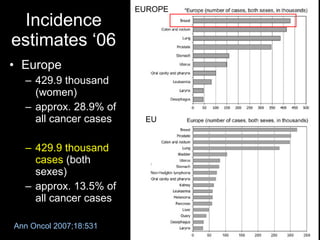
Incidence estimates ‘06 Europe 429.9 thousand (women) approx. 28.9% of all cancer cases 429.9 thousand cases  (both sexes) approx. 13.5% of all cancer cases EUROPE EU Ann Oncol 2007;18:531
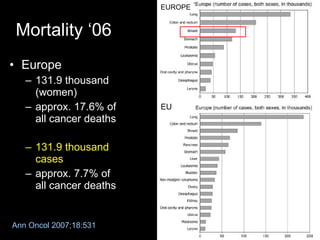
Mortality ‘06 Europe 131.9 thousand (women) approx. 17.6% of all cancer deaths 131.9 thousand cases approx. 7.7% of all cancer deaths EUROPE EU Ann Oncol 2007;18:531
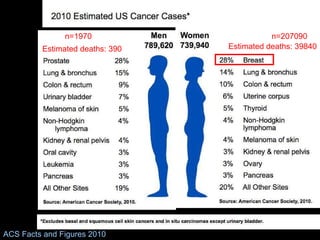
ACS Facts and Figures 2010 n=207090 n=1970 Estimated deaths: 39840 Estimated deaths: 390
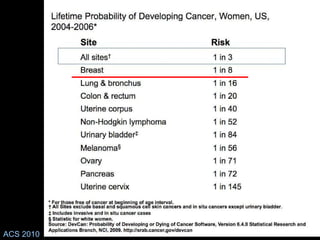
ACS 2010
BC is more common in…(risk factors ) Sex Elderly  women (average age at diagnosis >60 y ) A subset of premenopausal (younger) women with  strong family history  of BC (and/or ovarian cancer)  [ BRCA1,  BRCA2] Western  women as compared to Asian women Obese   postmenopausal  women With  inactivity Women with  long reproductive life  (early menarche and late menopause) Nulliparous  women as com p ared to multiparous Women having their  first child after  the age of  30 Therapeutic  irradiation  of the breast at a  young age Following some pathological findings:  ADH, ALH ; ipsilateral or contralateral  breast cancer .
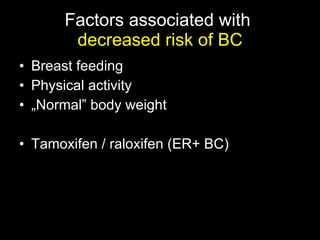
Factors associated with  decreased risk of BC Breast feeding Physical activity „ Normal” body weight Tamoxifen / raloxifen (ER+ BC)
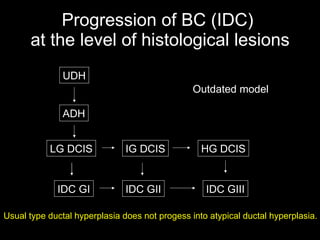
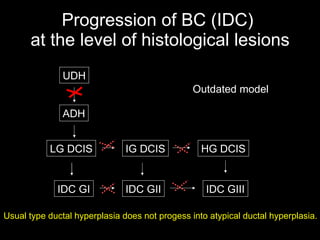
Progression of BC (IDC)  at the level of histological lesions UDH ADH LG DCIS IG DCIS HG DCIS IDC GI IDC GII IDC GIII Outdated model Usual type ductal hyperplasia does not proges s  into atypical ductal hyperplasia.
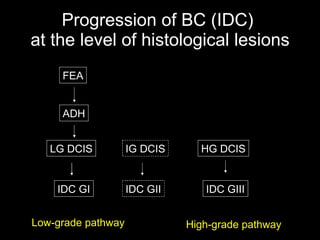
Progression of BC (IDC)  at the level of histological lesions FEA ADH LG DCIS IG DCIS HG DCIS IDC GI IDC GII IDC GIII Low-grade pathway High-grade pathway
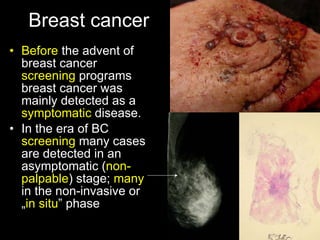
Breast cancer Before  the advent of breast cancer  screening  programs breast cancer was mainly detected as a  symptomatic  disease. In the era of BC  screening  many cases are detected in an asymptomatic ( non-palpable ) stage;  many  in the non-invasive or „ in situ ” phase
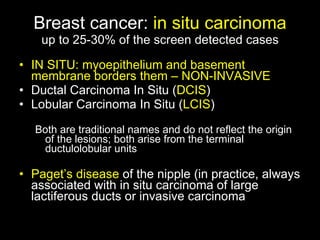
Breast cancer:  in situ carcinoma up to 25-30% of the screen detected cases IN SITU: myoepithelium and basement membrane borders them – NON-INVASIVE Ductal Carcinoma In Situ ( DCIS ) Lobular Carcinoma In Situ ( LCIS ) Both are traditional names and do not reflect the origin of the lesions; both arise from the terminal ductulolobular units Paget’s disease  of the nipple (in practice, always associated with in situ carcinoma of large lactiferous ducts or invasive carcinoma
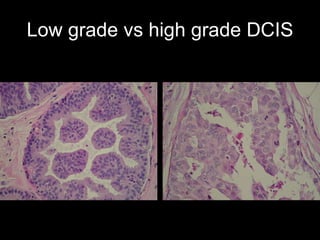
Low grade vs high grade DCIS
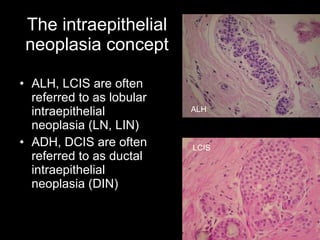
The intraepithelial neoplasia concept ALH, LCIS are often referred to as lobular intraepithelial neoplasia (LN, LIN) ADH, DCIS are often referred to as ductal intraepithelial neoplasia (DIN) ALH LCIS
Invasive carcinoma - histological types Invasive ductal carcinoma  NST (No Special Type) / NOS (Not Otherwise Specified) (about 80% of the invasive cases) Special type carcinomas Invasive lobular carcinoma  ( ~  10%) Tubular carcinoma and cribriform carcinoma  ( ~  6%) Mucinous (colloid) carcinoma  (~ 2%) Medullary carcinoma  (~ 2%) Other less common types  (e.g. micropapillary, papillary, metaplastic, … etc)
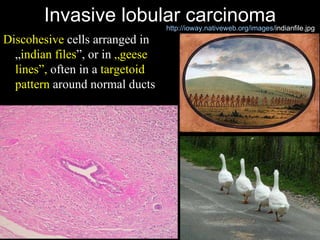
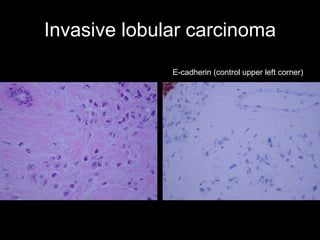
Invasive lobular carcinoma Discohesive  cells arranged in „ indian files ”, or in  „g ee se lines”,  often in a  targetoid pattern  around normal ducts http:// ioway.nativeweb.org / images / indianfile.jpg
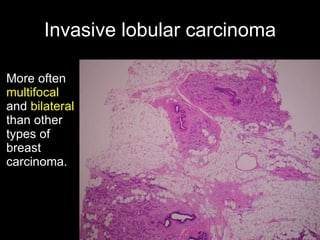
Invasive lobular carcinoma More often  multifocal  and  bilateral  than other types of breast carcinoma.
Invasive lobular carcinoma 5-10%  of invasive carcinomas. The lack of E-cadherin  (silencing of the E-cadherin gene  (CDH1-16q22.1  by mutation or methylation) is believed to be responsible  for  the distinct morphological pattern. E-cadherin is a calcium dependent cell-to-cell adhesion molecule. Tumors  can be scirrhous  or  can have a diffusely infiltrating  pattern that is  difficult to detect  clinically and mammographically. They may remain occult. Lobular carcinomas have a  distant metastatic pattern  that differs from that of ductal cancers. They more often metastasize to the  meninges, serosal surfaces, ovary, uterus, other viscera and bone marrow .
Invasive lobular carcinoma E-cadherin (control upper left corner)
Breast cancer – prognostic factors Prognostic factors: parameters which affect the outcome of the disease (without treatment) Distant metastasis  (Stage IV disease). The presence of distant metastases infers the worst prognosis Lymph node metastases  (The most important prognostic factor in those without evident distant metastasis) With increasing numbers of involved lymph nodes the prognosis worsens:
Breast cancer – prognostic factors (ctd) Tumor  size  (the larger the tumor, the worse the prognosis) Tumor  stage  (the first 3 factors are combined in the  TNM  classification and in the STAGEs of the disease) Tumor histologic  grade  (breast cancers are graded in a 3-tiered system on the basis of their  tubule formation, nuclear pleomorphism and mitotic rate : grade 1 – well differentiated, grade 2 – moderately differentiated, grade 3 – poorly differentiated) Lymphatic or vascular /  (lympho)vascular invasion ; its presence is an adverse sign
Breast cancer – prognostic factors (ctd) Histologic types : tubular, cribriform, mucinous carcinomas are favorable types Estrogen and progesterone  receptor status : ER and PR positive tumors have better prognosis  ( GEP: luminal type A has better prognosis )  and are likely to react to hormonal treatment (ER and PR status is also a  predictive marker  – i.e. predicts the responsiveness to a given therapy)
Breast cancer – prognostic factors (ctd) 9.  HER-2  (c-erb-B2; NEU) status. HER-2 is an oncogen located on chromosome 17q21; it is amplified in 15-30% of breast cancers; the gene amplification is paralleled by protein overexpression. HER-2 positive tumors have worse prognosis.  ( Also a GEP defined subtype ) The HER-2 status is  predictive  of the response to targeted therapy against the HER-2 oncoprotein
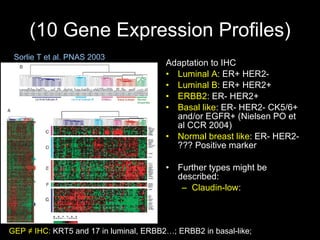
(10  Gene Expression Profiles ) Adaptation to IHC Luminal A : ER+ HER2- Luminal B : ER+ HER2+ ERBB2 : ER- HER2+ Basal like : ER- HER2- CK5/6+ and/or EGFR+ (Nielsen PO et al CCR 2004) Normal breast like : ER- HER2- ??? Positive marker Further types might be described: Claudin-low : Sorlie T et al. PNAS 2003 GEP ≠ IHC:  KRT5 and 17 in luminal, ERBB2…; ERBB2 in basal-like;
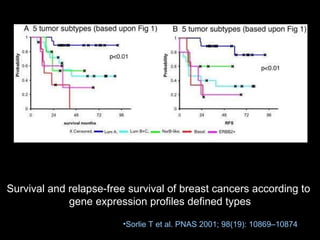
Survival and relapse-free survival of breast cancers according to  gene expression profiles defined types Sorlie T et al. PNAS 2001; 98(19): 10869–10874
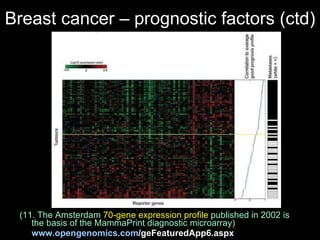
Breast cancer – prognostic factors (ctd) (11.  The Amsterdam   70-gene expression profile   published in 2002 is the basis of the MammaPrint diagnostic microarray ) www.opengenomics.com /geFeaturedApp6.aspx
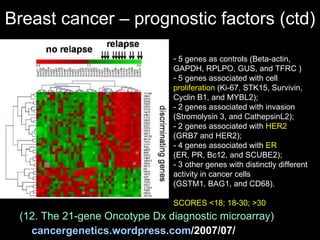
Breast cancer – prognostic factors (ctd) (12.  The  21-gene Oncotype Dx  diagnostic microarray ) cancergenetics.wordpress.com /2007/07/   5 genes as controls (Beta-actin,  GAPDH, RPLPO, GUS, and TFRC )  5 genes associated with cell  proliferation  (Ki-67, STK15, Survivin,  Cyclin B1, and MYBL2);  - 2 genes associated with invasion  (Stromolysin 3, and CathepsinL2);  - 2 genes associated with  HER2   (GRB7 and HER2);  - 4 genes associated with  ER   (ER, PR, Bc12, and SCUBE2);  - 3 other genes with distinctly different  activity in cancer cells  (GSTM1, BAG1, and CD68).  SCORES <18; 18-30; >30
TNM7: Primary tumor: (c)T & pT T & pT   T X : Cannot be assessed  (to be minimized)  ( including R2 ) T0: No tumor Tis: in situ carcinoma (DCIS) (LCIS) (Paget) –  only „pure” Paget’s disease   (TNM7)   (only Paget’s disease without tumor –  TNM6 ) T1 (up to  and inclusive of  2 0 m m);  pT1mi  (pT1mic –  TNM6 ):  1 mm  maximum size  invasive  focus (foci) „ … rare cases … in the absence of noninvasive disease . ” pT1a:  ≤ 5 mm  invasive carcinoma  ( TNM7 UICC   gives definition  in cm ) pT1b:  > 5 mm  and  ≤ 10 mm  invasive carcinoma pT1c:  >10 mm  and  ≤ 20 mm  invasive carcinoma T2:  >2 0   m m  and   ≤  5 0   m m   invasive carcinoma T3:  >5 0   m m   invasive carcinoma T4:  direct extension to chest wall   (pectoral muscles are not part of it)  (T4a) or  skin  (T4b) [skin edema, ulceration, cutaneous satellite nodules] or  both  (T4c) or  inflammatory  carcinoma  (at least one 3rd of the skin to be involved)  (T4d)
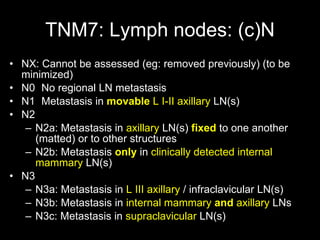
TNM7: Lymph nodes: (c)N N X:   C annot be assessed (eg :  removed   previously)  (to be minimized) N0  No regional  LN  metastasis N1  Metastasis in  movable   L  I - II axillary   LN (s) N2  N2a :  Metastasis in  axillary   LN (s)  fixed  to one another (matted) or to other structures N2b :  Metastasis  only  in  clinically detected internal mammary   LN (s) N3 N3a :  Metastasis in  L III axillary  /  infraclavicular  LN (s) N3b :  Metastasis in  internal mammary  and  axillary   LN s N3c :  Metastasis in  supraclavicular   LN (s)
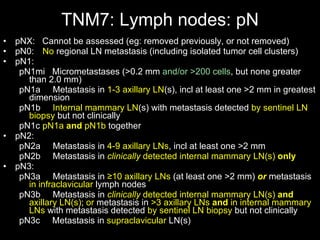
TNM7: Lymph nodes: pN p N X:   C annot be assessed (eg :  removed   previously , or not removed ) p N0 :   No  regional  LN  metastasis  (including isolated tumor cell clusters) pN1: pN1mi   Micrometastases ( > 0.2 mm  and/or  > 200 cells , but none  greater  than 2.0 mm) pN1a  Metastasis in  1-3 axillary  LN (s), incl at least one  > 2 mm in greatest dimension pN1b  Internal mammary  LN ( s )  with metastasis detected  by sentinel  LN  biopsy  but not clinically pN1c  pN1a  and  pN1b   together pN2 :   pN2a  Metastasis in  4-9 axillary  LN s , incl at least one  > 2 mm  pN2b  Metastasis in  clinically  detected internal mammary  LN (s)   only pN3 :   pN3a  Metastasis in  ≥ 10 axillary  LN s  (at least one  > 2 mm)  or   metastasis  in infraclavicular  lymph nodes pN3b  Metastasis in  clinically  detected internal mammary  LN (s)  and   axillary  LN (s) ;  or  metastasis in  > 3 axillary  LN s  and   in internal mammary  LN s  with metastasis detected  by sentinel  LN  biopsy  but not clinically pN3c  Metastasis in  supraclavicular   LN (s)
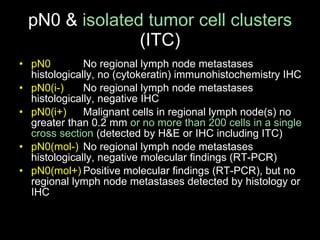
pN0 &  isolated tumor cell clusters  (ITC) pN0 No regional lymph node metastases histologically, no (cytokeratin) immunohistochemistry IHC pN0(i-) No regional lymph node metastases histologically, negative IHC pN0(i+) Malignant cells in regional lymph node(s) no greater than 0.2 mm  or no more than 200   cells   in a single cross section  (detected by H&E or IHC including ITC) pN0(mol-) No regional lymph node metastases histologically, negative molecular findings (RT-PCR) pN0(mol+) Positive molecular findings (RT-PCR), but no regional lymph node metastases detected by histology or IHC
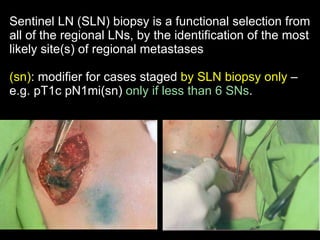
Sentinel LN  (SLN)  biopsy  i s a functional selection from  all of the regional  LNs, by the identification of the most likely site (s)  of regional metastases (sn) : modifier for cases staged  by SLN biopsy only  – e.g. pT1c pN1mi(sn)  only if less than 6 SNs .
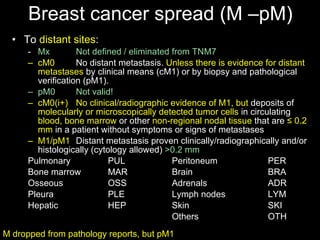
Breast cancer spread (M –pM) To  distant sites : - Mx Not defined / eliminated from TNM7 cM0   No distant metastasis.  Unless there is evidence for distant metastases  by clinical means (cM1) or by biopsy and pathological verification (pM1). pM0 Not valid! cM0(i+) No clinical/radiographic evidence of M1, but  deposits of  molecularly or microscopically detected tumor cells  in circulating  blood, bone marrow  or other  non-regional nodal tissue  that are  ≤  0.2 mm  in a patient without symptoms or signs of metastases M1/pM1   Distant metastasis proven clinically/radiographically and/or histologically  (cytology allowed)   >0.2 mm Pulmonary PUL Peritoneum PER Bone   marrow MAR Brain BRA Osseous OSS Adrenals ADR Pleura PLE Lymph nodes LYM Hepatic HEP Skin SKI Others OTH M dropped from pathology reports, but pM1
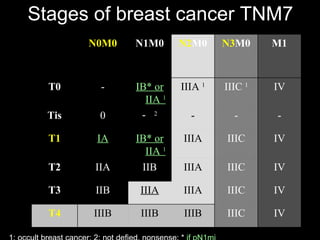
Stages of breast cancer TNM7 1: occult breast cancer; 2: not defied, nonsense ; *  if pN1mi IV IIIC IIIB IIIB IIIB T4 IV IIIC IIIA IIIA IIB T3 IV IIIC IIIA IIB IIA T2 IV IIIC IIIA IB* or IIA  1 IA T1 - - - 2 0 Tis IV IIIC  1 IIIA  1 IB* or IIA  1 - T0 M1 N3 M0 N2 M0 N1M0 N0M0
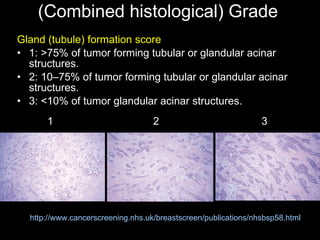
(Combined histological) Grade Gland (tubule) formation   score 1 :  >75% of tumor forming tubular or glandular acinar structures. 2 :  10–75% of tumor forming tubular or glandular acinar structures. 3 :  <10% of tumor glandular acinar structures. http://www.cancerscreening.nhs.uk/breastscreen/publications/nhsbsp58.html 1 2 3
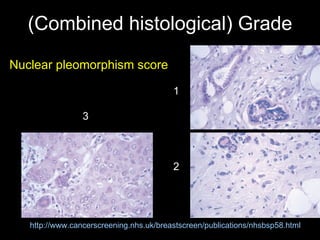
(Combined histological) Grade Nuclear pleomorphism  score http://www.cancerscreening.nhs.uk/breastscreen/publications/nhsbsp58.html 1 2 3
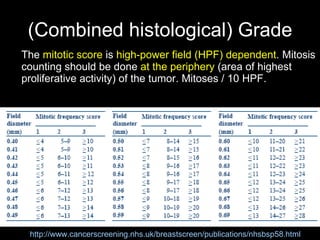
(Combined histological) Grade The  mitotic score  is  high-power field  (HPF)  dependent . Mitosis counting should be done  at the periphery  (area of highest proliferative activity) of the tumor . Mitoses / 10 HPF. http://www.cancerscreening.nhs.uk/breastscreen/publications/nhsbsp58.html
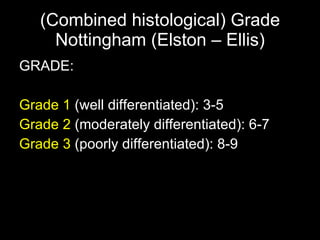
(Combined histological) Grade Nottingham (Elston – Ellis) GRADE: Grade 1  (well differentiated): 3-5 Grade 2  (moderately differentiated): 6-7 Grade 3  (poorly differentiated): 8-9
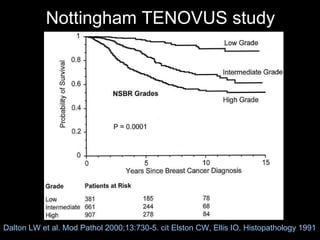
Nottingham TENOVUS study Dalton LW et al. Mod Pathol 2000;13:730-5. cit Elston CW, Ellis IO. Histopathology 1991
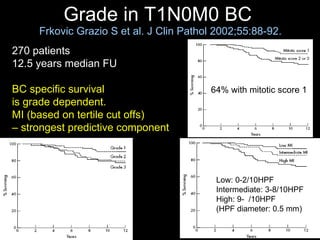
Grade in T1N0M0 BC  Frkovic Grazio S et al. J Clin Pathol 2002;55:88-92. 270 patients 12.5 years median FU BC specific survival  is grade dependent . MI (based on tertile cut offs)  –  strongest predictive component   Low: 0-2/10HPF Intermediate: 3-8/10HPF High: 9-  /10HPF (HPF diameter: 0.5 mm) 64% with mitotic score 1
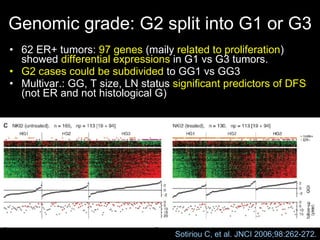
Genomic grade: G2 split into G1 or G3 62 ER+ tumors:  97 genes  (maily  related to proliferation ) showed  differential expressions  in G1 vs G3 tumors. G2 cases could be subdivided  to GG1 vs GG3 Multivar.: GG, T size, LN status  significant predictors of DFS  (not ER and not histological G) Sotiriou C, et al. JNCI 2006;98:262-272.
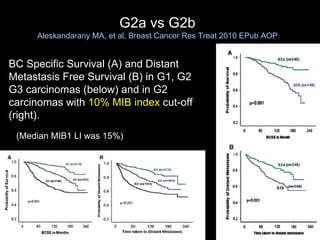
BC Specific Survival (A) and Distant Metastasis Free Survival (B) in G1, G2 G3 carcinomas (below) and in G2  carcinomas with  10% MIB index  cut-off  (right). G2a vs G2b Aleskandarany MA, et al. Breast Cancer Res Treat 2010 EPub AOP (Median MIB1 LI was 15%)
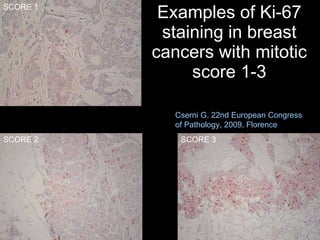
Examples of Ki-67 staining in breast cancers with mitotic score 1-3 SCORE 2 SCORE 3 SCORE 1 Cserni G. 22nd European Congress  of Pathology, 2009, Florence
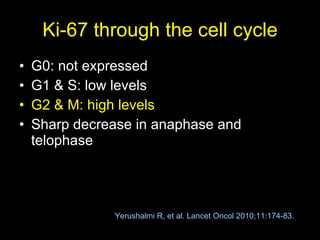
Ki-67 through the cell cycle G0: not expressed G1 & S: low levels G2 & M: high levels Sharp decrease in anaphase and telophase Yerushalmi R, et al. Lancet Oncol 2010;11:174-83.
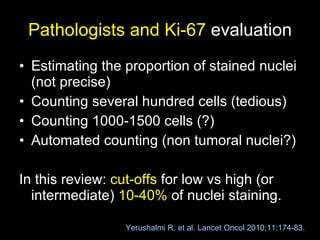
Pathologists and Ki-67  evaluation Estimating the proportion of stained nuclei (not precise) Counting several hundred cells (tedious) Counting 1000-1500 cells (?) Automated counting (non tumoral nuclei?) In this review:  cut-offs  for low vs high (or intermediate)  10-40%  of nuclei staining. Yerushalmi R, et al. Lancet Oncol 2010;11:174-83.
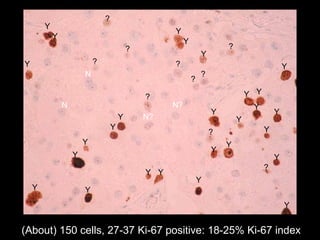
(About) 150 cells, 27-37 Ki-67 positive: 18-25% Ki-67 index Y Y Y Y Y Y Y Y ? ? ? ? Y Y Y Y Y Y Y Y Y Y Y Y Y Y Y Y Y Y Y ? ? ? ? ? N N ? N? N?
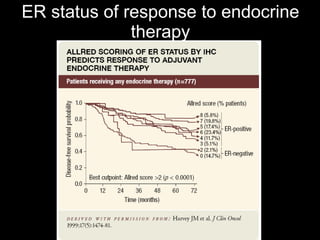
ER:  ASCO 2010 recommendations I. Pretest conditions: Immediate fixation (10% NBF) for 6-72  (48)  hours, slices not thicker than 5 mm. Test with  validated methods with 1% cut-off value . ER: 6F11, 1D5, SP1, 1D5+ER.2.123; PR: 1294, 1A6, 312. Validation, QA (internal, extarnal), Monitoring Arch Pathol Lab Med 2010 / J Clin Oncol 2010
ASCO 2010 recommendations I I . Reporting categories Positive  ( ≥1%  tumor cell nuclei are immunostained) Negative  ( <1%  tumor cell nuclei are immunostained; generally no staining at all) Uninterpretable  (no tumor cell nuclei stain, but internal or external controls do not stain either) Arch Pathol Lab Med 2010 / J Clin Oncol 2010
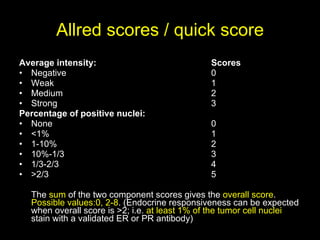
Allred scores / quick score Average intensity:  Scores Negative 0 Weak 1 Medium 2 Strong 3 Percentage of positive nuclei: None 0 <1% 1 1-10% 2 10%-1/3 3 1/3-2/3 4 >2/3 5 The  sum  of the two component scores gives the  overall score .  Possible values:0, 2-8 . (Endocrine responsiveness can be expected when overall score is >2; i.e.  at least 1% of the tumor cell nuclei  stain with a validated ER or PR antibody)
ER status of response to endocrine therapy
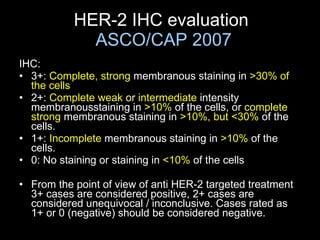
HER-2 IHC evaluation  ASCO/CAP 2007 IHC: 3+:  Complete, strong  membranous staining in  > 30% of the cells 2+:  Complet e  weak  or  intermediate  intensity membranousstaining in  >10%  of the cells, or  complete strong  membranous staining in  >10%, but <30%  of the cells.  1+:  Incomplete  membranous staining in  >10%  of the cells. 0:  No staining or s taining in  <10%  of the cells From the point of view of anti HER-2 targeted treatment 3+ cases are considered positive, 2+ cases are considered unequivocal / inconclusive. Cases rated as 1+ or 0 (negative) should be considered negative.
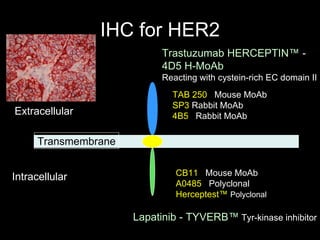
IHC for HER2 Extracellular Intracellular Transmembrane Trastuzumab HERCEPTIN ™ - 4D5 H-MoAb Reacting with cystein-rich EC domain II TAB 250   Mouse MoAb SP3  Rabbit MoAb 4B5   Rabbit MoAb CB11   Mouse MoAb A0485   Polyclonal Herceptest ™  Polyclonal Lapatinib - TYVERB ™  Tyr-kinase inhibitor
HER-2 ISH evaluation FISH: Positive (amplified):  HER2/CEP17 ratio   >2,2  or  average HER2 gene copies per nuclei >6  in assays lacking internal control (CEP17: centromeric probe for chromosome 17). Unequivocal / inconclusive:  HER2/CEP17 ratio between   1,8-2,2  or average  HER2 gene copies per nuclei   ranging between   4-6  in assays lacking internal control. Negative:  HER2/CEP17 ratio   <1,8  or average  HER2 gene copies per nuclei   <4  in assays lacking internal control. ASCO Guidelines 2007
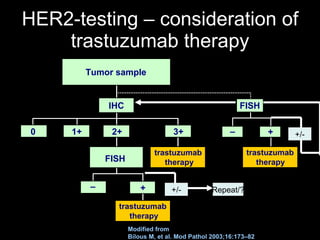
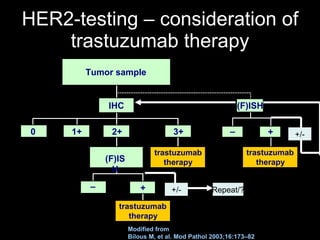
HER2-testing – consideration of trastuzumab therapy Modified from Bilous M, et al. Mod Pathol 2003;16:173–82 FIS H T umo r sample trastuzumab   t herapy + – 2+ 3+ 1+ 0 + – FISH IHC trastuzumab   t herapy trastuzumab   t herapy +/- +/- Repeat/?
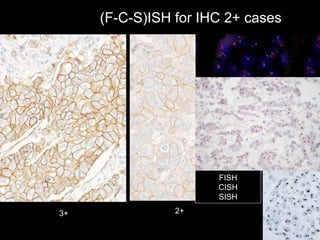
From Hungarian guidelines  2010 In keeping with international guidelines and the costs of individual assays, a practical approach would accept IHC 3+ as positive and enabling „targeted” anti HER-2 treatment.  To avoid false positive results, all 3+ cases with contradicting histological types or grade (e.g. tubular carcinoma, mucinous carcinoma, grade I ductal carcinoma), at least the IHC reaction should be repeated.  IHC   2+ cases and cases with uncert a in IHC interpretation  require further studies by  molecular (ISH) assays.  Although FISH is the most widely used method,  CISH and SISH are viable alternative tests  for assessing 2+ cases.
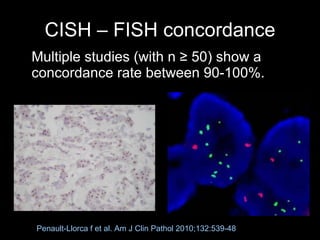
CISH – FISH concordance Multiple studies (with n  ≥ 50)  show a concordance rate between 90-100%. Penault-Llorca f et al. Am J Clin Pathol 2010;132:539-48
HER2-testing – consideration of trastuzumab therapy Modified from Bilous M, et al. Mod Pathol 2003;16:173–82 ( F ) IS H T umo r sample trastuzumab   t herapy + – 2+ 3+ 1+ 0 + – ( F ) ISH IHC trastuzumab   t herapy trastuzumab   t herapy +/- +/- Repeat/?
3+ 2+ (F-C-S)ISH for IHC 2+ cases FISH CISH SISH
Special presentations of breast cancer INFLAMMATORY CARCINOMA Cancer, clinically  presenting as inflammation  (peau d’orange sign – resulting from oedema; or frank redness, inflammation) TNM requires at least third of the breast to be involved. This is generally associated with  dermal lymphatic vessel invasion , although this latter (without the clinical symptoms )  is not sufficient for diagnosing inflammatory cancinoma Poor  associated  prognosis ; this is generally not a surgical disease in this stage – pT4d in the TNM classification
Special presentations of breast cancer OCCULT CARCINOMA Cancer  presenting as metastasis  either to the lymph nodes or to distant sites with  no evidence of  the  primary  tumor Originally, this meant non-palpable tumors with metastases, and such tumors were not so rare. Now this means non-palpable tumors without imaging (mammographic or ultrasound) evidence. (MRI, PET can be further added to imaging modalities) They are rare; many are of  lobular type .
Special presentations of breast cancer MALE BREAST CANCER In men carcinomas tend to  invade skin and chest wall earlier  as there is much less amount of surrounding breast tissue . M atched by stage, prognosis is  believed to be  similar in men and women .  There are however some differences in steroid hormone receptor distribution suggesting that male breast cancer might be somewhat different from female breast cancer. Any clinical relevance?  ( Speirs V et al. personal communication )
THE END

BALKAN MCO 2011 - G. Cserni - Epidemiology and pathology

  • 1.
    Breast cancer (BC)epidemiology and pathology Gábor Cserni, MD, PhD, DSc Bács-Kiskun County Teaching Hospital Kecskemét, Hungary
  • 2.
    Incidence estimates ‘06Europe 429.9 thousand (women) approx. 28.9% of all cancer cases 429.9 thousand cases (both sexes) approx. 13.5% of all cancer cases EUROPE EU Ann Oncol 2007;18:531
  • 3.
    Mortality ‘06 Europe131.9 thousand (women) approx. 17.6% of all cancer deaths 131.9 thousand cases approx. 7.7% of all cancer deaths EUROPE EU Ann Oncol 2007;18:531
  • 4.
    ACS Facts andFigures 2010 n=207090 n=1970 Estimated deaths: 39840 Estimated deaths: 390
  • 5.
  • 6.
    BC is morecommon in…(risk factors ) Sex Elderly women (average age at diagnosis >60 y ) A subset of premenopausal (younger) women with strong family history of BC (and/or ovarian cancer) [ BRCA1, BRCA2] Western women as compared to Asian women Obese postmenopausal women With inactivity Women with long reproductive life (early menarche and late menopause) Nulliparous women as com p ared to multiparous Women having their first child after the age of 30 Therapeutic irradiation of the breast at a young age Following some pathological findings: ADH, ALH ; ipsilateral or contralateral breast cancer .
  • 7.
    Factors associated with decreased risk of BC Breast feeding Physical activity „ Normal” body weight Tamoxifen / raloxifen (ER+ BC)
  • 8.
    Progression of BC(IDC) at the level of histological lesions UDH ADH LG DCIS IG DCIS HG DCIS IDC GI IDC GII IDC GIII Outdated model Usual type ductal hyperplasia does not proges s into atypical ductal hyperplasia.
  • 9.
    Progression of BC(IDC) at the level of histological lesions UDH ADH LG DCIS IG DCIS HG DCIS IDC GI IDC GII IDC GIII Outdated model Usual type ductal hyperplasia does not proges s into atypical ductal hyperplasia.
  • 10.
    Progression of BC(IDC) at the level of histological lesions FEA ADH LG DCIS IG DCIS HG DCIS IDC GI IDC GII IDC GIII Low-grade pathway High-grade pathway
  • 11.
    Breast cancer Before the advent of breast cancer screening programs breast cancer was mainly detected as a symptomatic disease. In the era of BC screening many cases are detected in an asymptomatic ( non-palpable ) stage; many in the non-invasive or „ in situ ” phase
  • 12.
    Breast cancer: in situ carcinoma up to 25-30% of the screen detected cases IN SITU: myoepithelium and basement membrane borders them – NON-INVASIVE Ductal Carcinoma In Situ ( DCIS ) Lobular Carcinoma In Situ ( LCIS ) Both are traditional names and do not reflect the origin of the lesions; both arise from the terminal ductulolobular units Paget’s disease of the nipple (in practice, always associated with in situ carcinoma of large lactiferous ducts or invasive carcinoma
  • 13.
    Low grade vshigh grade DCIS
  • 14.
    The intraepithelial neoplasiaconcept ALH, LCIS are often referred to as lobular intraepithelial neoplasia (LN, LIN) ADH, DCIS are often referred to as ductal intraepithelial neoplasia (DIN) ALH LCIS
  • 15.
    Invasive carcinoma -histological types Invasive ductal carcinoma NST (No Special Type) / NOS (Not Otherwise Specified) (about 80% of the invasive cases) Special type carcinomas Invasive lobular carcinoma ( ~ 10%) Tubular carcinoma and cribriform carcinoma ( ~ 6%) Mucinous (colloid) carcinoma (~ 2%) Medullary carcinoma (~ 2%) Other less common types (e.g. micropapillary, papillary, metaplastic, … etc)
  • 16.
    Invasive lobular carcinomaDiscohesive cells arranged in „ indian files ”, or in „g ee se lines”, often in a targetoid pattern around normal ducts http:// ioway.nativeweb.org / images / indianfile.jpg
  • 17.
    Invasive lobular carcinomaMore often multifocal and bilateral than other types of breast carcinoma.
  • 18.
    Invasive lobular carcinoma5-10% of invasive carcinomas. The lack of E-cadherin (silencing of the E-cadherin gene (CDH1-16q22.1 by mutation or methylation) is believed to be responsible for the distinct morphological pattern. E-cadherin is a calcium dependent cell-to-cell adhesion molecule. Tumors can be scirrhous or can have a diffusely infiltrating pattern that is difficult to detect clinically and mammographically. They may remain occult. Lobular carcinomas have a distant metastatic pattern that differs from that of ductal cancers. They more often metastasize to the meninges, serosal surfaces, ovary, uterus, other viscera and bone marrow .
  • 19.
    Invasive lobular carcinomaE-cadherin (control upper left corner)
  • 20.
    Breast cancer –prognostic factors Prognostic factors: parameters which affect the outcome of the disease (without treatment) Distant metastasis (Stage IV disease). The presence of distant metastases infers the worst prognosis Lymph node metastases (The most important prognostic factor in those without evident distant metastasis) With increasing numbers of involved lymph nodes the prognosis worsens:
  • 21.
    Breast cancer –prognostic factors (ctd) Tumor size (the larger the tumor, the worse the prognosis) Tumor stage (the first 3 factors are combined in the TNM classification and in the STAGEs of the disease) Tumor histologic grade (breast cancers are graded in a 3-tiered system on the basis of their tubule formation, nuclear pleomorphism and mitotic rate : grade 1 – well differentiated, grade 2 – moderately differentiated, grade 3 – poorly differentiated) Lymphatic or vascular / (lympho)vascular invasion ; its presence is an adverse sign
  • 22.
    Breast cancer –prognostic factors (ctd) Histologic types : tubular, cribriform, mucinous carcinomas are favorable types Estrogen and progesterone receptor status : ER and PR positive tumors have better prognosis ( GEP: luminal type A has better prognosis ) and are likely to react to hormonal treatment (ER and PR status is also a predictive marker – i.e. predicts the responsiveness to a given therapy)
  • 23.
    Breast cancer –prognostic factors (ctd) 9. HER-2 (c-erb-B2; NEU) status. HER-2 is an oncogen located on chromosome 17q21; it is amplified in 15-30% of breast cancers; the gene amplification is paralleled by protein overexpression. HER-2 positive tumors have worse prognosis. ( Also a GEP defined subtype ) The HER-2 status is predictive of the response to targeted therapy against the HER-2 oncoprotein
  • 24.
    (10 GeneExpression Profiles ) Adaptation to IHC Luminal A : ER+ HER2- Luminal B : ER+ HER2+ ERBB2 : ER- HER2+ Basal like : ER- HER2- CK5/6+ and/or EGFR+ (Nielsen PO et al CCR 2004) Normal breast like : ER- HER2- ??? Positive marker Further types might be described: Claudin-low : Sorlie T et al. PNAS 2003 GEP ≠ IHC: KRT5 and 17 in luminal, ERBB2…; ERBB2 in basal-like;
  • 25.
    Survival and relapse-freesurvival of breast cancers according to gene expression profiles defined types Sorlie T et al. PNAS 2001; 98(19): 10869–10874
  • 26.
    Breast cancer –prognostic factors (ctd) (11. The Amsterdam 70-gene expression profile published in 2002 is the basis of the MammaPrint diagnostic microarray ) www.opengenomics.com /geFeaturedApp6.aspx
  • 27.
    Breast cancer –prognostic factors (ctd) (12. The 21-gene Oncotype Dx diagnostic microarray ) cancergenetics.wordpress.com /2007/07/ 5 genes as controls (Beta-actin, GAPDH, RPLPO, GUS, and TFRC ) 5 genes associated with cell proliferation (Ki-67, STK15, Survivin, Cyclin B1, and MYBL2); - 2 genes associated with invasion (Stromolysin 3, and CathepsinL2); - 2 genes associated with HER2 (GRB7 and HER2); - 4 genes associated with ER (ER, PR, Bc12, and SCUBE2); - 3 other genes with distinctly different activity in cancer cells (GSTM1, BAG1, and CD68). SCORES <18; 18-30; >30
  • 28.
    TNM7: Primary tumor:(c)T & pT T & pT T X : Cannot be assessed (to be minimized) ( including R2 ) T0: No tumor Tis: in situ carcinoma (DCIS) (LCIS) (Paget) – only „pure” Paget’s disease (TNM7) (only Paget’s disease without tumor – TNM6 ) T1 (up to and inclusive of 2 0 m m); pT1mi (pT1mic – TNM6 ): 1 mm maximum size invasive focus (foci) „ … rare cases … in the absence of noninvasive disease . ” pT1a: ≤ 5 mm invasive carcinoma ( TNM7 UICC gives definition in cm ) pT1b: > 5 mm and ≤ 10 mm invasive carcinoma pT1c: >10 mm and ≤ 20 mm invasive carcinoma T2: >2 0 m m and ≤ 5 0 m m invasive carcinoma T3: >5 0 m m invasive carcinoma T4: direct extension to chest wall (pectoral muscles are not part of it) (T4a) or skin (T4b) [skin edema, ulceration, cutaneous satellite nodules] or both (T4c) or inflammatory carcinoma (at least one 3rd of the skin to be involved) (T4d)
  • 29.
    TNM7: Lymph nodes:(c)N N X: C annot be assessed (eg : removed previously) (to be minimized) N0 No regional LN metastasis N1 Metastasis in movable L I - II axillary LN (s) N2 N2a : Metastasis in axillary LN (s) fixed to one another (matted) or to other structures N2b : Metastasis only in clinically detected internal mammary LN (s) N3 N3a : Metastasis in L III axillary / infraclavicular LN (s) N3b : Metastasis in internal mammary and axillary LN s N3c : Metastasis in supraclavicular LN (s)
  • 30.
    TNM7: Lymph nodes:pN p N X: C annot be assessed (eg : removed previously , or not removed ) p N0 : No regional LN metastasis (including isolated tumor cell clusters) pN1: pN1mi Micrometastases ( > 0.2 mm and/or > 200 cells , but none greater than 2.0 mm) pN1a Metastasis in 1-3 axillary LN (s), incl at least one > 2 mm in greatest dimension pN1b Internal mammary LN ( s ) with metastasis detected by sentinel LN biopsy but not clinically pN1c pN1a and pN1b together pN2 : pN2a Metastasis in 4-9 axillary LN s , incl at least one > 2 mm pN2b Metastasis in clinically detected internal mammary LN (s) only pN3 : pN3a Metastasis in ≥ 10 axillary LN s (at least one > 2 mm) or metastasis in infraclavicular lymph nodes pN3b Metastasis in clinically detected internal mammary LN (s) and axillary LN (s) ; or metastasis in > 3 axillary LN s and in internal mammary LN s with metastasis detected by sentinel LN biopsy but not clinically pN3c Metastasis in supraclavicular LN (s)
  • 31.
    pN0 & isolated tumor cell clusters (ITC) pN0 No regional lymph node metastases histologically, no (cytokeratin) immunohistochemistry IHC pN0(i-) No regional lymph node metastases histologically, negative IHC pN0(i+) Malignant cells in regional lymph node(s) no greater than 0.2 mm or no more than 200 cells in a single cross section (detected by H&E or IHC including ITC) pN0(mol-) No regional lymph node metastases histologically, negative molecular findings (RT-PCR) pN0(mol+) Positive molecular findings (RT-PCR), but no regional lymph node metastases detected by histology or IHC
  • 32.
    Sentinel LN (SLN) biopsy i s a functional selection from all of the regional LNs, by the identification of the most likely site (s) of regional metastases (sn) : modifier for cases staged by SLN biopsy only – e.g. pT1c pN1mi(sn) only if less than 6 SNs .
  • 33.
    Breast cancer spread(M –pM) To distant sites : - Mx Not defined / eliminated from TNM7 cM0 No distant metastasis. Unless there is evidence for distant metastases by clinical means (cM1) or by biopsy and pathological verification (pM1). pM0 Not valid! cM0(i+) No clinical/radiographic evidence of M1, but deposits of molecularly or microscopically detected tumor cells in circulating blood, bone marrow or other non-regional nodal tissue that are ≤ 0.2 mm in a patient without symptoms or signs of metastases M1/pM1 Distant metastasis proven clinically/radiographically and/or histologically (cytology allowed) >0.2 mm Pulmonary PUL Peritoneum PER Bone marrow MAR Brain BRA Osseous OSS Adrenals ADR Pleura PLE Lymph nodes LYM Hepatic HEP Skin SKI Others OTH M dropped from pathology reports, but pM1
  • 34.
    Stages of breastcancer TNM7 1: occult breast cancer; 2: not defied, nonsense ; * if pN1mi IV IIIC IIIB IIIB IIIB T4 IV IIIC IIIA IIIA IIB T3 IV IIIC IIIA IIB IIA T2 IV IIIC IIIA IB* or IIA 1 IA T1 - - - 2 0 Tis IV IIIC 1 IIIA 1 IB* or IIA 1 - T0 M1 N3 M0 N2 M0 N1M0 N0M0
  • 35.
    (Combined histological) GradeGland (tubule) formation score 1 : >75% of tumor forming tubular or glandular acinar structures. 2 : 10–75% of tumor forming tubular or glandular acinar structures. 3 : <10% of tumor glandular acinar structures. http://www.cancerscreening.nhs.uk/breastscreen/publications/nhsbsp58.html 1 2 3
  • 36.
    (Combined histological) GradeNuclear pleomorphism score http://www.cancerscreening.nhs.uk/breastscreen/publications/nhsbsp58.html 1 2 3
  • 37.
    (Combined histological) GradeThe mitotic score is high-power field (HPF) dependent . Mitosis counting should be done at the periphery (area of highest proliferative activity) of the tumor . Mitoses / 10 HPF. http://www.cancerscreening.nhs.uk/breastscreen/publications/nhsbsp58.html
  • 38.
    (Combined histological) GradeNottingham (Elston – Ellis) GRADE: Grade 1 (well differentiated): 3-5 Grade 2 (moderately differentiated): 6-7 Grade 3 (poorly differentiated): 8-9
  • 39.
    Nottingham TENOVUS studyDalton LW et al. Mod Pathol 2000;13:730-5. cit Elston CW, Ellis IO. Histopathology 1991
  • 40.
    Grade in T1N0M0BC Frkovic Grazio S et al. J Clin Pathol 2002;55:88-92. 270 patients 12.5 years median FU BC specific survival is grade dependent . MI (based on tertile cut offs) – strongest predictive component Low: 0-2/10HPF Intermediate: 3-8/10HPF High: 9- /10HPF (HPF diameter: 0.5 mm) 64% with mitotic score 1
  • 41.
    Genomic grade: G2split into G1 or G3 62 ER+ tumors: 97 genes (maily related to proliferation ) showed differential expressions in G1 vs G3 tumors. G2 cases could be subdivided to GG1 vs GG3 Multivar.: GG, T size, LN status significant predictors of DFS (not ER and not histological G) Sotiriou C, et al. JNCI 2006;98:262-272.
  • 42.
    BC Specific Survival(A) and Distant Metastasis Free Survival (B) in G1, G2 G3 carcinomas (below) and in G2 carcinomas with 10% MIB index cut-off (right). G2a vs G2b Aleskandarany MA, et al. Breast Cancer Res Treat 2010 EPub AOP (Median MIB1 LI was 15%)
  • 43.
    Examples of Ki-67staining in breast cancers with mitotic score 1-3 SCORE 2 SCORE 3 SCORE 1 Cserni G. 22nd European Congress of Pathology, 2009, Florence
  • 44.
    Ki-67 through thecell cycle G0: not expressed G1 & S: low levels G2 & M: high levels Sharp decrease in anaphase and telophase Yerushalmi R, et al. Lancet Oncol 2010;11:174-83.
  • 45.
    Pathologists and Ki-67 evaluation Estimating the proportion of stained nuclei (not precise) Counting several hundred cells (tedious) Counting 1000-1500 cells (?) Automated counting (non tumoral nuclei?) In this review: cut-offs for low vs high (or intermediate) 10-40% of nuclei staining. Yerushalmi R, et al. Lancet Oncol 2010;11:174-83.
  • 46.
    (About) 150 cells,27-37 Ki-67 positive: 18-25% Ki-67 index Y Y Y Y Y Y Y Y ? ? ? ? Y Y Y Y Y Y Y Y Y Y Y Y Y Y Y Y Y Y Y ? ? ? ? ? N N ? N? N?
  • 47.
    ER: ASCO2010 recommendations I. Pretest conditions: Immediate fixation (10% NBF) for 6-72 (48) hours, slices not thicker than 5 mm. Test with validated methods with 1% cut-off value . ER: 6F11, 1D5, SP1, 1D5+ER.2.123; PR: 1294, 1A6, 312. Validation, QA (internal, extarnal), Monitoring Arch Pathol Lab Med 2010 / J Clin Oncol 2010
  • 48.
    ASCO 2010 recommendationsI I . Reporting categories Positive ( ≥1% tumor cell nuclei are immunostained) Negative ( <1% tumor cell nuclei are immunostained; generally no staining at all) Uninterpretable (no tumor cell nuclei stain, but internal or external controls do not stain either) Arch Pathol Lab Med 2010 / J Clin Oncol 2010
  • 49.
    Allred scores /quick score Average intensity: Scores Negative 0 Weak 1 Medium 2 Strong 3 Percentage of positive nuclei: None 0 <1% 1 1-10% 2 10%-1/3 3 1/3-2/3 4 >2/3 5 The sum of the two component scores gives the overall score . Possible values:0, 2-8 . (Endocrine responsiveness can be expected when overall score is >2; i.e. at least 1% of the tumor cell nuclei stain with a validated ER or PR antibody)
  • 50.
    ER status ofresponse to endocrine therapy
  • 51.
    HER-2 IHC evaluation ASCO/CAP 2007 IHC: 3+: Complete, strong membranous staining in > 30% of the cells 2+: Complet e weak or intermediate intensity membranousstaining in >10% of the cells, or complete strong membranous staining in >10%, but <30% of the cells. 1+: Incomplete membranous staining in >10% of the cells. 0: No staining or s taining in <10% of the cells From the point of view of anti HER-2 targeted treatment 3+ cases are considered positive, 2+ cases are considered unequivocal / inconclusive. Cases rated as 1+ or 0 (negative) should be considered negative.
  • 52.
    IHC for HER2Extracellular Intracellular Transmembrane Trastuzumab HERCEPTIN ™ - 4D5 H-MoAb Reacting with cystein-rich EC domain II TAB 250 Mouse MoAb SP3 Rabbit MoAb 4B5 Rabbit MoAb CB11 Mouse MoAb A0485 Polyclonal Herceptest ™ Polyclonal Lapatinib - TYVERB ™ Tyr-kinase inhibitor
  • 53.
    HER-2 ISH evaluationFISH: Positive (amplified): HER2/CEP17 ratio >2,2 or average HER2 gene copies per nuclei >6 in assays lacking internal control (CEP17: centromeric probe for chromosome 17). Unequivocal / inconclusive: HER2/CEP17 ratio between 1,8-2,2 or average HER2 gene copies per nuclei ranging between 4-6 in assays lacking internal control. Negative: HER2/CEP17 ratio <1,8 or average HER2 gene copies per nuclei <4 in assays lacking internal control. ASCO Guidelines 2007
  • 54.
    HER2-testing – considerationof trastuzumab therapy Modified from Bilous M, et al. Mod Pathol 2003;16:173–82 FIS H T umo r sample trastuzumab t herapy + – 2+ 3+ 1+ 0 + – FISH IHC trastuzumab t herapy trastuzumab t herapy +/- +/- Repeat/?
  • 55.
    From Hungarian guidelines 2010 In keeping with international guidelines and the costs of individual assays, a practical approach would accept IHC 3+ as positive and enabling „targeted” anti HER-2 treatment. To avoid false positive results, all 3+ cases with contradicting histological types or grade (e.g. tubular carcinoma, mucinous carcinoma, grade I ductal carcinoma), at least the IHC reaction should be repeated. IHC 2+ cases and cases with uncert a in IHC interpretation require further studies by molecular (ISH) assays. Although FISH is the most widely used method, CISH and SISH are viable alternative tests for assessing 2+ cases.
  • 56.
    CISH – FISHconcordance Multiple studies (with n ≥ 50) show a concordance rate between 90-100%. Penault-Llorca f et al. Am J Clin Pathol 2010;132:539-48
  • 57.
    HER2-testing – considerationof trastuzumab therapy Modified from Bilous M, et al. Mod Pathol 2003;16:173–82 ( F ) IS H T umo r sample trastuzumab t herapy + – 2+ 3+ 1+ 0 + – ( F ) ISH IHC trastuzumab t herapy trastuzumab t herapy +/- +/- Repeat/?
  • 58.
    3+ 2+ (F-C-S)ISHfor IHC 2+ cases FISH CISH SISH
  • 59.
    Special presentations ofbreast cancer INFLAMMATORY CARCINOMA Cancer, clinically presenting as inflammation (peau d’orange sign – resulting from oedema; or frank redness, inflammation) TNM requires at least third of the breast to be involved. This is generally associated with dermal lymphatic vessel invasion , although this latter (without the clinical symptoms ) is not sufficient for diagnosing inflammatory cancinoma Poor associated prognosis ; this is generally not a surgical disease in this stage – pT4d in the TNM classification
  • 60.
    Special presentations ofbreast cancer OCCULT CARCINOMA Cancer presenting as metastasis either to the lymph nodes or to distant sites with no evidence of the primary tumor Originally, this meant non-palpable tumors with metastases, and such tumors were not so rare. Now this means non-palpable tumors without imaging (mammographic or ultrasound) evidence. (MRI, PET can be further added to imaging modalities) They are rare; many are of lobular type .
  • 61.
    Special presentations ofbreast cancer MALE BREAST CANCER In men carcinomas tend to invade skin and chest wall earlier as there is much less amount of surrounding breast tissue . M atched by stage, prognosis is believed to be similar in men and women . There are however some differences in steroid hormone receptor distribution suggesting that male breast cancer might be somewhat different from female breast cancer. Any clinical relevance? ( Speirs V et al. personal communication )
  • 62.

Editor's Notes

  • #25 GEP: Gene expression profile; KRT: keratin; PNAS: Proceedings of the National Academy of Sciences
  • #40 NSBR: Nottingham modification of the Bloom-Scarff-Richadrson grading system – i.e. histological grade
  • #41 BC: breast cancer; FU: follow-up; MI: mitotic index; HPF: high power field
  • #42 G: (histological) grade; GG: genomic grade; LN: lymph node; DFS: disease free survival
  • #45 G0: resting phase; G1, G2: gap phases of the cell cycle; S: synthesis phase of the cell cycle; M: mitosis phase of the cell cycle.
  • #48 Notes for translation: NBF: neutral buffered formaline; ER: estrogen receptor; PR: progesterone receptor; QA: qualitiy assurance; ASCO: American Society of Clinical Oncology
  • #49 Notes for translation: NBF: neutral buffered formaline; ER: estrogen receptor; PR: progesterone receptor; QA: qualitiy assurance
  • #52 CAP: College of American Pathologists
  • #53 MoAb: monoclonal antibody; Tyr: tyrosine
  • #54 CEP17: centromeric probe for chromosome 17
  • #55 HER2: testing HER2: testing algorithm FISH IHC Herceptin weekly
  • #58 HER2: testing HER2: testing algorithm FISH IHC Herceptin weekly