BREASTCANCER
CANCER: a disease that is characterized by
uncontrolled cell growth in an organ, the site
the cells originate from.
BREAST CANCER: begins in the breast tissue
and may start in the duct or lobe of the breast.
When the “controls” in breast cells are not
working properly, they divide continually and a
lump or tumor is formed.
incidence
Account 20% of female cancer death
Age : most common above 50yrs but may come any age
Site: commonest in upper outer quadrant 60%
Sex : female>male {99:1}
Race : white>black
Synchronus lesion : 1%
Metachronus lesion :5%
Risk factors
GENETICS
BRCA1
BRCA2
Li-fraumeni
syndrom
Cowden
disease
Peutz-jeghers syndrom
Family
history
1st degree
relative
Risk if
occurred
premonopausal
or bilateral
or affect 2 or
more 1st D
Hormonal
factors
Early
menarche
Late
menopause
Null parity
Non
lactating
Long term CCP &HORMONAL
REPLASMENT
Precancerous
lesions
Duct
papilloma
a( 2 times)
Epithelial
hyperplasia
( 2-5 )
Carcinoma
in situ
(5-10)
Dietary &
environmental
factors
Alcohol
obesity
Radiation
exposure
previous
breast
cancer
W.H.O. Classification of Carcinoma of the Breast
Noninvasive carcinoma
Ductal carcinoma in situ
Lobular carcinoma in situ
Paget's disease of the nipple (without mass)
Invasive carcinoma
Invasive ductal carcinoma -- 80%
Invasive lobular carcinoma – 10%
Mucinous carcinoma -- 2%
Medullary carcinoma – 5%
Papillary carcinoma -- 1%
Tubular carcinoma – 1%
Adenoid cystic carcinoma
Secretory (juvenile) carcinoma
Apocrine carcinoma
Carcinoma with metaplasia (metaplastic carcinoma)
Inflammatory carcinoma
Pathology of breast cancer
(foot & stewart calssifiction)
Carcinoma in situ
( doesn't penetrate the basement
membrane)
Ductal carcinoma
in situ
-originat from terminal duct lobular
units
-CP: mass .pain . discharge
-ipsilateral
-common(25-70%)
Lobular carcinoma
in situ
-no clinical sign
-no microcalcifictions
by mammogram
-bilateral
-less(25-35)
pajet disease
-AFFecting nipple and
areola
-Eczema like condition
-female>40
-1-2%of breast cancer
DCIS TYPES
Papillary Subtype
Cribiform Subtype
Solid Subtype
Comedo Subtype
More malignant than non-comedo subtypes
(40% progress to invasive type)
Ductal
cancer
cells
Normal
ductal
cell
Paget’ s disease of the nipple
 *Eczema like condition of the nipple & areola
 *± Breast mass behind the areolaHyperplasia of all layers
of the epidermis → thickening of epidermis followed by
ulceration of the skin.
 *Paget's cell (large, clear cytoplasm, small dark nuclei
with apparent nucleoli) in the deep layer of the
epidermis.
 Round & plasma cell infiltration of the dermis
 Staging:
 without mass → Stage 0 (carcinoma insitu)
 with mass → according to mass size
 Prognosis: Good due to:
1. Early diagnosis
2. Slow rate of growth
Invasive Breast Carcinoma
1-Infiltrating Ductal Carcinoma (IDC)
-75 % of all breast cancer
-Histologically, the tumor cells are arranged in
groups, cords and gland-like structures.
Scirrhous carcinoma; Hard in consistency
-
- Cut section: gritty sensation , Retract below the cut
surfaces
2- Infiltrating Lobular Carcinoma
-5-10% of breast cancer
-have abundant fibrous stroma, so that macroscopically
they are always scirrhous.
- the cells are small and uniform and are dispersed
singly, or in columns one cell wide (Indian files) in a dense
stroma.
Lobular cancer
cells breaking
through the wall
Ductal cancer
cells breaking
through the
wall
3- MEDALLARY CARCINOMA
-LARGE –SOFT - WELL CIRCUMSCRIB
4-MUSINOUS CARSINOMA
-BULKY &SOFT
5-TUBULAR CARCINOMA
-Diagnosed only when more than 75%of the tumor is
tubular formation
6-papillary carcinoma
-presence of papillae
7-mastitis carcinomatosis
-most malignant form
- during pregnancy & lactation
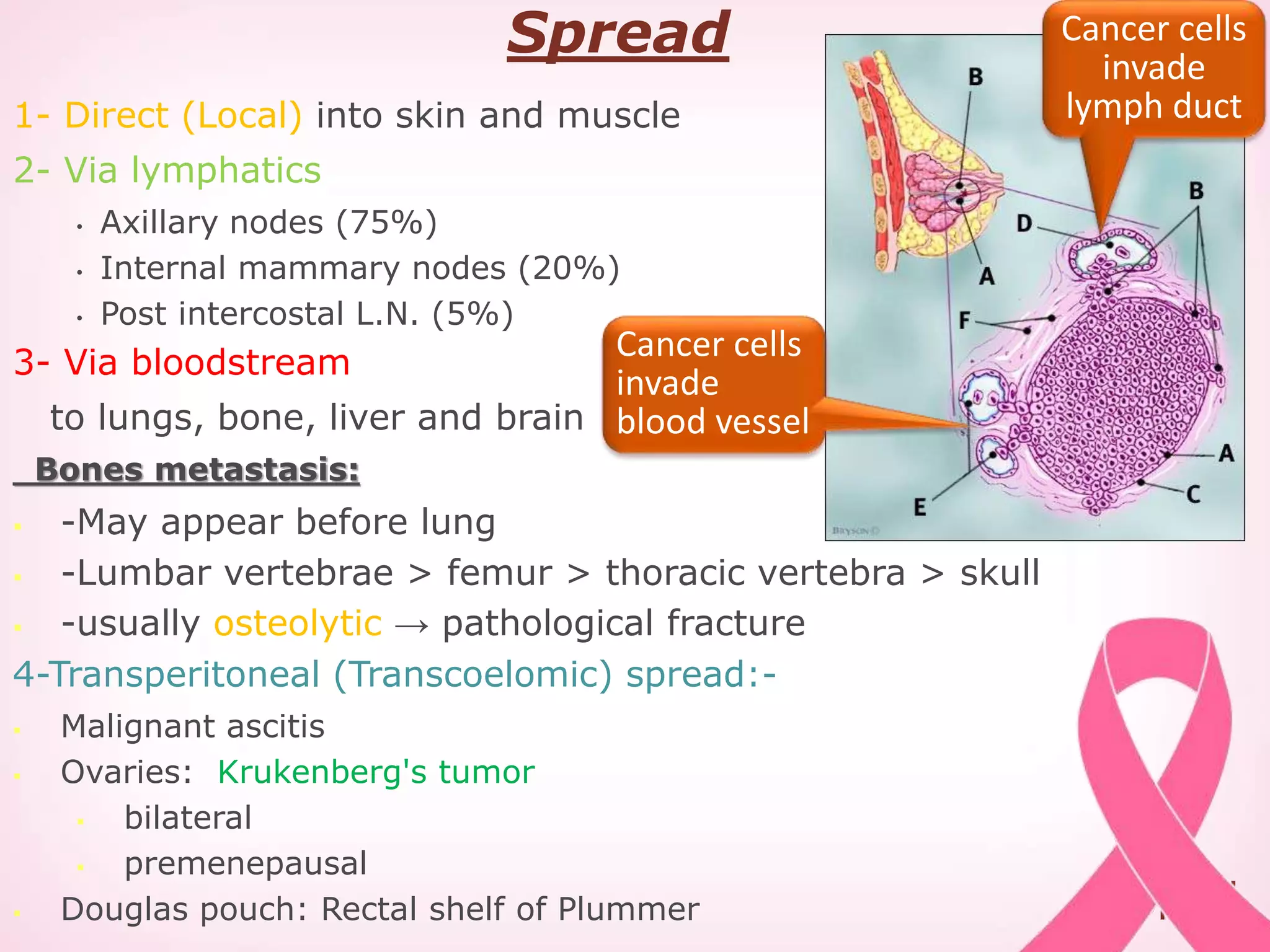
Spread
1- Direct (Local) into skin and muscle
2- Via lymphatics
• Axillary nodes (75%)
• Internal mammary nodes (20%)
• Post intercostal L.N. (5%)
3- Via bloodstream
to lungs, bone, liver and brain
Bones metastasis:
 -May appear before lung
 -Lumbar vertebrae > femur > thoracic vertebra > skull
 -usually osteolytic → pathological fracture
4-Transperitoneal (Transcoelomic) spread:-
 Malignant ascitis
 Ovaries: Krukenberg's tumor
 bilateral
 premenepausal
 Douglas pouch: Rectal shelf of Plummer
Cancer cells
invade
lymph duct
Cancer cells
invade
blood vessel
Diagnosis of Breast Cancer
Clinical Examination
Radiology
• Mammography → > 35y
• US → < 35y
Pathology (Biopsy)
• FNAC
• Core (Tru-cut) Biopsy
1. Painless lump
2. Pain
3. Nipple discharge
4. Paget's disease of the nipple
5. Mastitis carcinomatosa (inflammatory
carcinoma)
6. Skin manifestations of breast cancer
7. Metastatic presentation (if this is the only
presentation → occult presentation)
 Regional axillary or supraclavicular L.N
 Distant metastasis
 May be the 1st complaint
8. Asymptomatic: discovered accidentally during
screening programs
Clinical Presentation
1- Painless lump:
 discovered accidentally by the patient (e.g. during bathing) or by
physician during screening programs
 on examination → usually:
 not tender
 irregular shape and surface
 ill defined edge or well-circumscribed edge, due to difference in
consistency between hard mass & the soft breast.
 hard consistency
freely mobile (at early stages), but become fixed either to overlying
skin or underlying tissues (in late stages)
2- Pain:
 due to infiltration of nerves, infection
 with mastitis carcinomatosa
3- Nipple discharge:
 Bloody in → duct carcinoma
 Past like in → comedo carcinoma
 Necrotic discharge → in degenerating carcinoma
4- Paget's disease of the nipple:
 Crusty, flaking lesion
 Gradual onset over months or years
 Associated with underlying breast malignancy
 Diagnosis confirmed by needle or wedge biopsy
 Mammography is mandatory
5- Mastitis Carcinomatosa (Inflammatory Carcinoma):
 Usually in pregnant & lactating
 Breast is painful
 Skin → erythematous, warm & edematous
6- Skin manifestation of breast cancer:
 Due to Cooper’s ligament infiltration:
 1) Dimpling 2) Tethering 3) Puckering
 Due to direct skin infiltration:
 4) Skin fixation 5) Ulceration 6) Fungation 7) Nipple retraction
 8) Paget's disease of nipple
 Due to lymphatic involvement:
 9) Peau d’orange (Pitted edema) 10) Satellite nodules
 Due to venous involvement:
 11) Dilated veins
2- Radiology
1- Mammography
Def: low voltage compression X-ray taken in 2 directions
(craniocaudal—mediolateral)
Indication:
-
female>35 - Doubtful mass - Nipple discharge
-
-
-paget`s disease - Fllow up
ACCURACY: 90%
2-Xeroradiogeaphy
As mammography but image recevied on selenium plate
-more accurate & easier reading
3-Ductography : to identify filling defect in the duct
4-ultrasonography
-female<35 -differentiat cystic from solid
5-MRI
-differentiate () fibrosis &recurrence
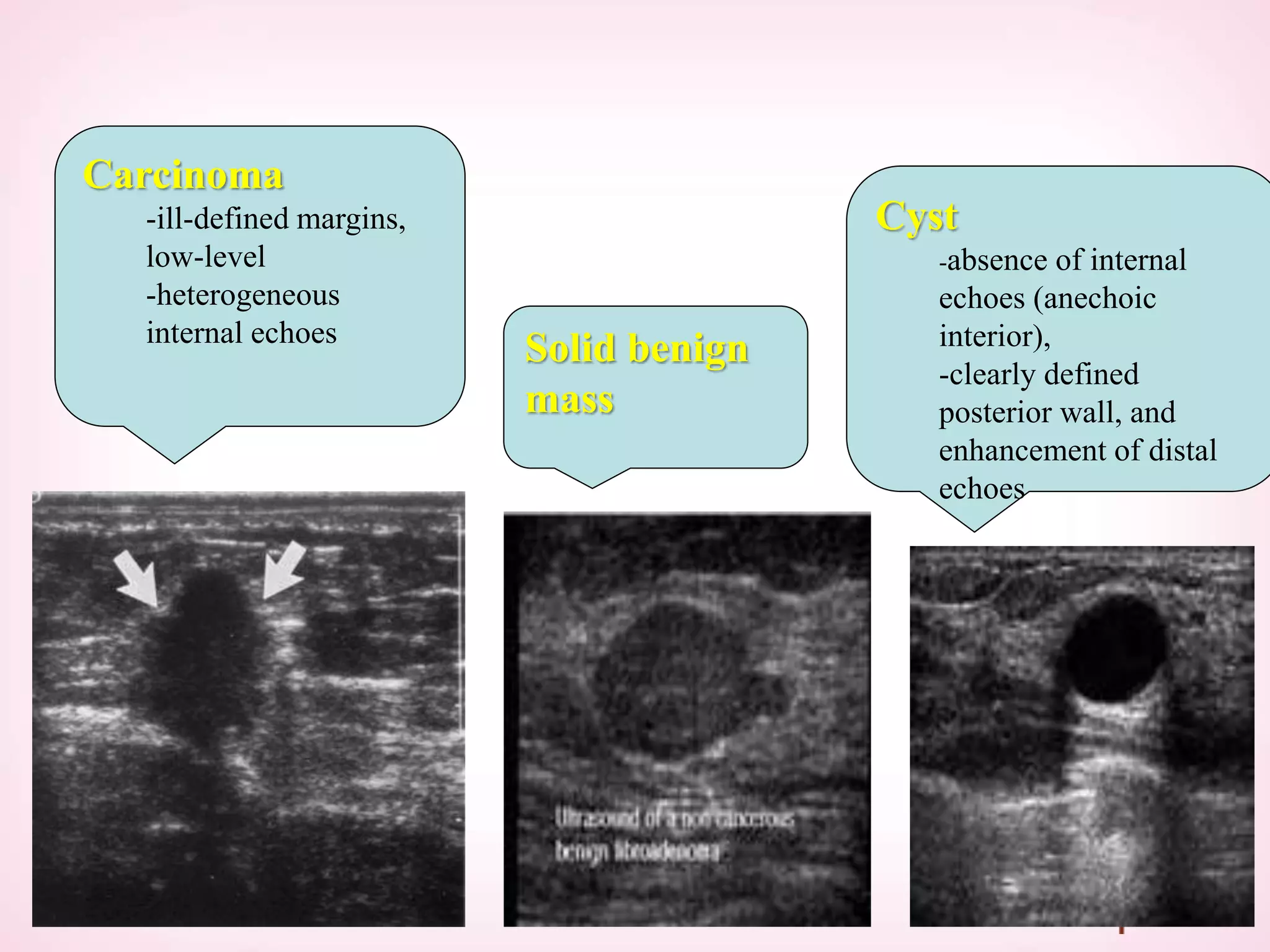
Carcinoma
-ill-defined margins,
low-level
-heterogeneous
internal echoes
Solid benign
mass
Cyst
-absence of internal
echoes (anechoic
interior),
-clearly defined
posterior wall, and
enhancement of distal
echoes
III- Biopsy
FNAC (Fine Needle Aspiration)
•Can be done for non-palpable masses.
•FNAC takes individual cells
Does not show architecture
C0 No epithelial cells
C1 Inadequate
C2 Benign
C3 Atypia
C4 Suspicious
C5 Malignant
Used for
• T≥ 3 cm
• operable cases candidate for mastectomy
Tru-cut (Core Biopsy) Needle
B1 Normal tissue / unsatisfactory
B2 Benign
B3 Lesion uncertain malignant potential
B4 Suspicion of malignancy
B5a In situ malignancy
B5b Invasive malignancy
IV-INVISTIGATION FOR
METASTASES
LUNG : X-ray & CT
LIVER : liver function test –U/S-CT
BONE : bone survey &scan
BRAIN:CT
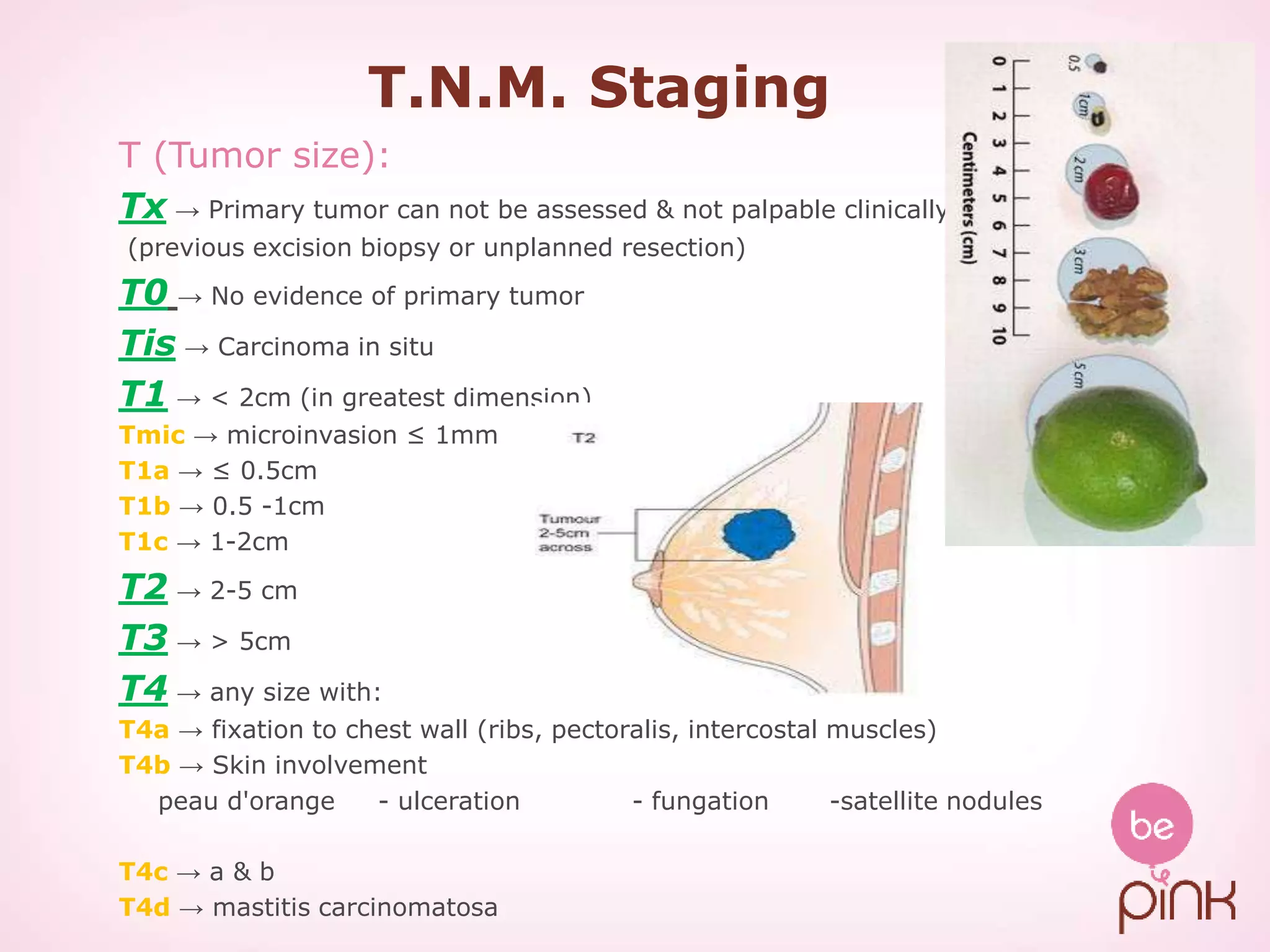
T.N.M. Staging
T (Tumor size):
Tx → Primary tumor can not be assessed & not palpable clinically
(previous excision biopsy or unplanned resection)
T0 → No evidence of primary tumor
Tis → Carcinoma in situ
T1 → < 2cm (in greatest dimension)
Tmic → microinvasion ≤ 1mm
T1a → ≤ 0.5cm
T1b → 0.5 -1cm
T1c → 1-2cm
T2 → 2-5 cm
T3 → > 5cm
T4 → any size with:
T4a → fixation to chest wall (ribs, pectoralis, intercostal muscles)
T4b → Skin involvement
peau d'orange - ulceration - fungation -satellite nodules
T4c → a & b
T4d → mastitis carcinomatosa
N (L.N. status):- All → Ipsilateral
Nx
Regional L.N. cannot be assessed (previously removed)
N0
No regional L.N. metastasis
N1
Ipsilateral mobile axillary L.N.
N2
Ipsilateral fixed axillary L.N. (fixed to one another or to other structures)
N3
Ipsilateral infraclavicular L.N.
ipsilateral internal mammary with axillary L.N.
Ipsilateral supraclavicular L.N.
M (Metastasis):-
M0 → No evidence of metastasis
M1 →
•
Distant metastasis (Lung, Bone, Liver, Brain)
•
Contralateral breast or L.Ns.
T.N.M. Staging
Stage 0
•
carcinoma in situ
Stage I
•
T < 2 cm, no nodes
Stage II
•
T 2 to 5 cm, +/- nodes
Stage III
•
locally advanced disease, fixed
lymph nodes and variable
tumor size
Stage IV
•
distant metastases (bone,
liver, lung, brain)
Prognosis
I- Tumor related factors:
1- L.N. status:
• 1) Number of L.N.
• 2) Size of L.N.
• 3) Level of L.N
2- Tumor size:
3- Tumor grade
4- T.N.M staging
5- Metastasis
6- Tumor site
7- Histopathologic type
8- Biological markers:
• 1) Hormone receptor
status
• 2) Cathepsin D
• 3) P53
• 4) HER-2/neu
II- Patient related factors:
1- Age
2- Sex
3- Pregnancy
4- Obesity
BREAST CANCER TREATMENT
Treatment for breast cancer is often a
combination of the following treatments:
Surgery
Chemotherapy
Radiation
Hormone Treatment
Treatment
I- Early breast cancer:
•
Non invasive (Stage 0) → Surgery ± Adjuvant
(postoperative) therapy
•
Stage I & II → Surgery + Adjuvant (postoperative)
therapy
II- Advanced breast cancer:
•
Stage III (Locally advanced) → Neoadjuvant
(preoperative) therapy + Surgery
•
Stage IV (Metastatic) → Systemic therapy ± Limited
Surgery
Early Breast Cancer
Stage I & II
Surgery
◦ removing the area of concern and some normal
tissue surrounding it is called a lumpectomy
◦ removing the breast is called a mastectomy
(most women with breast cancer will not need the
breast removed)
◦ lymph nodes from under the arm may be
removed with either surgery
Mastectomy
A. Traditional Non Sparing Mastectomy
1. Super (Extended) radical (Urban)
2. Radical mastectomy (Halstedt)
3. Modified radical mastectomy
 Patey’s operation
 Auchen-closs operation
4. Total mastectomy
5. Simple mastectomy
6. Toilet mastectomy
B. Sparing Mastectomy
1. Skin sparing mastectomy (S.S.M)
2. Nipple sparing mastectomy (N.S.M)
3. Subcutaneous mastectomy
Indications of
BREAST CONSERVING THERAPY
1. Single tumor (no multicentricity)
2. Tumor size <4 cm (clincally & mammographic)
3. Peripheral location (not central or retroareolar)
4. No signs of local advancement (T4).
5. N0 or N1 (no extensive nodal involvement).
6. M0 (no metastasis)
Contraindications
1. Multicentricity → high incidence of local recurrence
2. Tumor size > 4 cm or ↑ tumor/breast ratio.
3. Central (retroareolar) location → bad cosmetic result.
4. Signs of local advancement (T4).
5. N2 or N3
6. Metastasis (M1).
7. Pregnancy (3rd trimester; radiotherapy can not be delivered).
8. Collagen vascular disease → high toxicity of radiotherapy.
Early Breast Cancer
Stage I & II
Radiation
◦ standard treatment
after a lumpectomy
to reduce the chance
of the breast cancer
coming back in the
same breast
◦ is also called local
treatment because
it affects only the
area being treated
with radiation
Axillary Surgery in Breast Cancer
1- Axillary lymph node dissection
(ALND):
 At least levels I & II axillary lymph
nodes should be removed
2- Sentinel L.N. biopsy:
 Sentinel L.N. = 1st L.N. to drain the
cancer
 accepted with clinically negative
axillary L.N.
3- Axillary L.N. sampling:
 Excision of the lowest 4 or 5 palpable
L.Ns from level I & sent separately for
histopathologic examination.
Late Breast Cancer
Stage III (Locally Advanced)
 First
• Neo adjuvant chemotherapy (3-4 cycles)
 Then
• Surgery
 Then
• Post operative chemotherapy (6 cycles)
 Then
• Post operative radiotherapy
Late Breast Cancer
Stage IV (Metastatic)
 1-Palliative systemic therapy is the Main line of treatment
Hormone Treatment
◦ growth of many breast cancers can be
blocked by taking hormone therapy
◦ treatment is in the form of a pill which is
taken for 5 years
◦ may be recommended for women who
have a breast cancer that is sensitive to
hormones
Breast cancer

Breast cancer

  • 1.
  • 2.
    CANCER: a diseasethat is characterized by uncontrolled cell growth in an organ, the site the cells originate from. BREAST CANCER: begins in the breast tissue and may start in the duct or lobe of the breast. When the “controls” in breast cells are not working properly, they divide continually and a lump or tumor is formed.
  • 3.
    incidence Account 20% offemale cancer death Age : most common above 50yrs but may come any age Site: commonest in upper outer quadrant 60% Sex : female>male {99:1} Race : white>black Synchronus lesion : 1% Metachronus lesion :5%
  • 4.
    Risk factors GENETICS BRCA1 BRCA2 Li-fraumeni syndrom Cowden disease Peutz-jeghers syndrom Family history 1stdegree relative Risk if occurred premonopausal or bilateral or affect 2 or more 1st D Hormonal factors Early menarche Late menopause Null parity Non lactating Long term CCP &HORMONAL REPLASMENT Precancerous lesions Duct papilloma a( 2 times) Epithelial hyperplasia ( 2-5 ) Carcinoma in situ (5-10) Dietary & environmental factors Alcohol obesity Radiation exposure previous breast cancer
  • 5.
    W.H.O. Classification ofCarcinoma of the Breast Noninvasive carcinoma Ductal carcinoma in situ Lobular carcinoma in situ Paget's disease of the nipple (without mass) Invasive carcinoma Invasive ductal carcinoma -- 80% Invasive lobular carcinoma – 10% Mucinous carcinoma -- 2% Medullary carcinoma – 5% Papillary carcinoma -- 1% Tubular carcinoma – 1% Adenoid cystic carcinoma Secretory (juvenile) carcinoma Apocrine carcinoma Carcinoma with metaplasia (metaplastic carcinoma) Inflammatory carcinoma Pathology of breast cancer (foot & stewart calssifiction)
  • 6.
    Carcinoma in situ (doesn't penetrate the basement membrane) Ductal carcinoma in situ -originat from terminal duct lobular units -CP: mass .pain . discharge -ipsilateral -common(25-70%) Lobular carcinoma in situ -no clinical sign -no microcalcifictions by mammogram -bilateral -less(25-35) pajet disease -AFFecting nipple and areola -Eczema like condition -female>40 -1-2%of breast cancer
  • 7.
    DCIS TYPES Papillary Subtype CribiformSubtype Solid Subtype Comedo Subtype More malignant than non-comedo subtypes (40% progress to invasive type)
  • 8.
  • 9.
    Paget’ s diseaseof the nipple  *Eczema like condition of the nipple & areola  *± Breast mass behind the areolaHyperplasia of all layers of the epidermis → thickening of epidermis followed by ulceration of the skin.  *Paget's cell (large, clear cytoplasm, small dark nuclei with apparent nucleoli) in the deep layer of the epidermis.  Round & plasma cell infiltration of the dermis  Staging:  without mass → Stage 0 (carcinoma insitu)  with mass → according to mass size  Prognosis: Good due to: 1. Early diagnosis 2. Slow rate of growth
  • 10.
    Invasive Breast Carcinoma 1-InfiltratingDuctal Carcinoma (IDC) -75 % of all breast cancer -Histologically, the tumor cells are arranged in groups, cords and gland-like structures. Scirrhous carcinoma; Hard in consistency - - Cut section: gritty sensation , Retract below the cut surfaces 2- Infiltrating Lobular Carcinoma -5-10% of breast cancer -have abundant fibrous stroma, so that macroscopically they are always scirrhous. - the cells are small and uniform and are dispersed singly, or in columns one cell wide (Indian files) in a dense stroma. Lobular cancer cells breaking through the wall Ductal cancer cells breaking through the wall
  • 11.
    3- MEDALLARY CARCINOMA -LARGE–SOFT - WELL CIRCUMSCRIB 4-MUSINOUS CARSINOMA -BULKY &SOFT 5-TUBULAR CARCINOMA -Diagnosed only when more than 75%of the tumor is tubular formation 6-papillary carcinoma -presence of papillae 7-mastitis carcinomatosis -most malignant form - during pregnancy & lactation
  • 12.
    Spread 1- Direct (Local)into skin and muscle 2- Via lymphatics • Axillary nodes (75%) • Internal mammary nodes (20%) • Post intercostal L.N. (5%) 3- Via bloodstream to lungs, bone, liver and brain Bones metastasis:  -May appear before lung  -Lumbar vertebrae > femur > thoracic vertebra > skull  -usually osteolytic → pathological fracture 4-Transperitoneal (Transcoelomic) spread:-  Malignant ascitis  Ovaries: Krukenberg's tumor  bilateral  premenepausal  Douglas pouch: Rectal shelf of Plummer Cancer cells invade lymph duct Cancer cells invade blood vessel
  • 13.
    Diagnosis of BreastCancer Clinical Examination Radiology • Mammography → > 35y • US → < 35y Pathology (Biopsy) • FNAC • Core (Tru-cut) Biopsy
  • 14.
    1. Painless lump 2.Pain 3. Nipple discharge 4. Paget's disease of the nipple 5. Mastitis carcinomatosa (inflammatory carcinoma) 6. Skin manifestations of breast cancer 7. Metastatic presentation (if this is the only presentation → occult presentation)  Regional axillary or supraclavicular L.N  Distant metastasis  May be the 1st complaint 8. Asymptomatic: discovered accidentally during screening programs Clinical Presentation
  • 16.
    1- Painless lump: discovered accidentally by the patient (e.g. during bathing) or by physician during screening programs  on examination → usually:  not tender  irregular shape and surface  ill defined edge or well-circumscribed edge, due to difference in consistency between hard mass & the soft breast.  hard consistency freely mobile (at early stages), but become fixed either to overlying skin or underlying tissues (in late stages) 2- Pain:  due to infiltration of nerves, infection  with mastitis carcinomatosa 3- Nipple discharge:  Bloody in → duct carcinoma  Past like in → comedo carcinoma  Necrotic discharge → in degenerating carcinoma
  • 17.
    4- Paget's diseaseof the nipple:  Crusty, flaking lesion  Gradual onset over months or years  Associated with underlying breast malignancy  Diagnosis confirmed by needle or wedge biopsy  Mammography is mandatory 5- Mastitis Carcinomatosa (Inflammatory Carcinoma):  Usually in pregnant & lactating  Breast is painful  Skin → erythematous, warm & edematous 6- Skin manifestation of breast cancer:  Due to Cooper’s ligament infiltration:  1) Dimpling 2) Tethering 3) Puckering  Due to direct skin infiltration:  4) Skin fixation 5) Ulceration 6) Fungation 7) Nipple retraction  8) Paget's disease of nipple  Due to lymphatic involvement:  9) Peau d’orange (Pitted edema) 10) Satellite nodules  Due to venous involvement:  11) Dilated veins
  • 18.
    2- Radiology 1- Mammography Def:low voltage compression X-ray taken in 2 directions (craniocaudal—mediolateral) Indication: - female>35 - Doubtful mass - Nipple discharge - - -paget`s disease - Fllow up ACCURACY: 90% 2-Xeroradiogeaphy As mammography but image recevied on selenium plate -more accurate & easier reading 3-Ductography : to identify filling defect in the duct 4-ultrasonography -female<35 -differentiat cystic from solid 5-MRI -differentiate () fibrosis &recurrence
  • 20.
    Carcinoma -ill-defined margins, low-level -heterogeneous internal echoes Solidbenign mass Cyst -absence of internal echoes (anechoic interior), -clearly defined posterior wall, and enhancement of distal echoes
  • 21.
    III- Biopsy FNAC (FineNeedle Aspiration) •Can be done for non-palpable masses. •FNAC takes individual cells Does not show architecture C0 No epithelial cells C1 Inadequate C2 Benign C3 Atypia C4 Suspicious C5 Malignant
  • 22.
    Used for • T≥3 cm • operable cases candidate for mastectomy Tru-cut (Core Biopsy) Needle B1 Normal tissue / unsatisfactory B2 Benign B3 Lesion uncertain malignant potential B4 Suspicion of malignancy B5a In situ malignancy B5b Invasive malignancy
  • 23.
    IV-INVISTIGATION FOR METASTASES LUNG :X-ray & CT LIVER : liver function test –U/S-CT BONE : bone survey &scan BRAIN:CT
  • 24.
    T.N.M. Staging T (Tumorsize): Tx → Primary tumor can not be assessed & not palpable clinically (previous excision biopsy or unplanned resection) T0 → No evidence of primary tumor Tis → Carcinoma in situ T1 → < 2cm (in greatest dimension) Tmic → microinvasion ≤ 1mm T1a → ≤ 0.5cm T1b → 0.5 -1cm T1c → 1-2cm T2 → 2-5 cm T3 → > 5cm T4 → any size with: T4a → fixation to chest wall (ribs, pectoralis, intercostal muscles) T4b → Skin involvement peau d'orange - ulceration - fungation -satellite nodules T4c → a & b T4d → mastitis carcinomatosa
  • 25.
    N (L.N. status):-All → Ipsilateral Nx Regional L.N. cannot be assessed (previously removed) N0 No regional L.N. metastasis N1 Ipsilateral mobile axillary L.N. N2 Ipsilateral fixed axillary L.N. (fixed to one another or to other structures) N3 Ipsilateral infraclavicular L.N. ipsilateral internal mammary with axillary L.N. Ipsilateral supraclavicular L.N. M (Metastasis):- M0 → No evidence of metastasis M1 → • Distant metastasis (Lung, Bone, Liver, Brain) • Contralateral breast or L.Ns.
  • 26.
    T.N.M. Staging Stage 0 • carcinomain situ Stage I • T < 2 cm, no nodes Stage II • T 2 to 5 cm, +/- nodes Stage III • locally advanced disease, fixed lymph nodes and variable tumor size Stage IV • distant metastases (bone, liver, lung, brain)
  • 27.
    Prognosis I- Tumor relatedfactors: 1- L.N. status: • 1) Number of L.N. • 2) Size of L.N. • 3) Level of L.N 2- Tumor size: 3- Tumor grade 4- T.N.M staging 5- Metastasis 6- Tumor site 7- Histopathologic type 8- Biological markers: • 1) Hormone receptor status • 2) Cathepsin D • 3) P53 • 4) HER-2/neu II- Patient related factors: 1- Age 2- Sex 3- Pregnancy 4- Obesity
  • 28.
    BREAST CANCER TREATMENT Treatmentfor breast cancer is often a combination of the following treatments: Surgery Chemotherapy Radiation Hormone Treatment
  • 29.
    Treatment I- Early breastcancer: • Non invasive (Stage 0) → Surgery ± Adjuvant (postoperative) therapy • Stage I & II → Surgery + Adjuvant (postoperative) therapy II- Advanced breast cancer: • Stage III (Locally advanced) → Neoadjuvant (preoperative) therapy + Surgery • Stage IV (Metastatic) → Systemic therapy ± Limited Surgery
  • 30.
    Early Breast Cancer StageI & II Surgery ◦ removing the area of concern and some normal tissue surrounding it is called a lumpectomy ◦ removing the breast is called a mastectomy (most women with breast cancer will not need the breast removed) ◦ lymph nodes from under the arm may be removed with either surgery
  • 32.
    Mastectomy A. Traditional NonSparing Mastectomy 1. Super (Extended) radical (Urban) 2. Radical mastectomy (Halstedt) 3. Modified radical mastectomy  Patey’s operation  Auchen-closs operation 4. Total mastectomy 5. Simple mastectomy 6. Toilet mastectomy B. Sparing Mastectomy 1. Skin sparing mastectomy (S.S.M) 2. Nipple sparing mastectomy (N.S.M) 3. Subcutaneous mastectomy
  • 34.
    Indications of BREAST CONSERVINGTHERAPY 1. Single tumor (no multicentricity) 2. Tumor size <4 cm (clincally & mammographic) 3. Peripheral location (not central or retroareolar) 4. No signs of local advancement (T4). 5. N0 or N1 (no extensive nodal involvement). 6. M0 (no metastasis) Contraindications 1. Multicentricity → high incidence of local recurrence 2. Tumor size > 4 cm or ↑ tumor/breast ratio. 3. Central (retroareolar) location → bad cosmetic result. 4. Signs of local advancement (T4). 5. N2 or N3 6. Metastasis (M1). 7. Pregnancy (3rd trimester; radiotherapy can not be delivered). 8. Collagen vascular disease → high toxicity of radiotherapy.
  • 35.
    Early Breast Cancer StageI & II Radiation ◦ standard treatment after a lumpectomy to reduce the chance of the breast cancer coming back in the same breast ◦ is also called local treatment because it affects only the area being treated with radiation
  • 37.
    Axillary Surgery inBreast Cancer 1- Axillary lymph node dissection (ALND):  At least levels I & II axillary lymph nodes should be removed 2- Sentinel L.N. biopsy:  Sentinel L.N. = 1st L.N. to drain the cancer  accepted with clinically negative axillary L.N. 3- Axillary L.N. sampling:  Excision of the lowest 4 or 5 palpable L.Ns from level I & sent separately for histopathologic examination.
  • 38.
    Late Breast Cancer StageIII (Locally Advanced)  First • Neo adjuvant chemotherapy (3-4 cycles)  Then • Surgery  Then • Post operative chemotherapy (6 cycles)  Then • Post operative radiotherapy
  • 39.
    Late Breast Cancer StageIV (Metastatic)  1-Palliative systemic therapy is the Main line of treatment
  • 40.
    Hormone Treatment ◦ growthof many breast cancers can be blocked by taking hormone therapy ◦ treatment is in the form of a pill which is taken for 5 years ◦ may be recommended for women who have a breast cancer that is sensitive to hormones