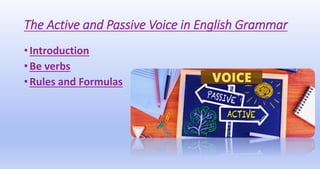
The Active and Passive Voice in English Grammar
•Introduction
•Be verbs
•Rules and Formulas
Introduction-
In English grammar, verbs can be used in two primary voices: active and
passive. The distinction between the two lies in how the subject and
object of a sentence are positioned in relation to the action expressed by
the verb.
Active Voice: In the active voice, the subject performs the action
expressed by the verb, and the object receives the action. The basic
structure of a sentence in active voice is:
Subject (doer) + Verb + Object (receiver)
Example: "John (subject) kicked (verb) the ball (object)."
In this sentence, "John" is the doer (subject) who performs the action of
"kicking," and "the ball" is the receiver (object) of the action.
Active voice is often preferred to provide clarity and directness in
sentence construction.
Passive Voice-
Passive Voice:
In the passive voice, the subject undergoes the action expressed by the verb, and the doer of
the action (if mentioned) is placed in a prepositional phrase (by, with, to) or may be omitted.
The basic structure of a sentence in passive voice is:
Object (receiver) + Verb (past participle) + (optional: Doer) + (optional: Preposition) + Subject
(receiver turned into the subject)
Example: "The ball (object) was kicked (verb) by John (doer)."
In this sentence, "The ball" is now the receiver (object) of the action and has become the
subject of the passive sentence, while "John" (doer) is introduced using the prepositional
phrase "by John."
Passive voice is used when the focus is on the object or when the doer is unknown or less
important. It is also commonly used in scientific or formal writing when the writer wants to
avoid mentioning the doer or when the doer is evident from the context.
Note-
Keep in mind that while passive voice has its uses, active
voice is generally more direct, concise, and preferred in most
writing situations. It is essential to use the appropriate voice
depending on the context and the emphasis you want to
convey.
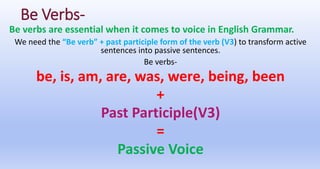
Be Verbs-
Be verbs are essential when it comes to voice in English Grammar.
We need the “Be verb” + past participle form of the verb (V3) to transform active
sentences into passive sentences.
Be verbs-
be, is, am, are, was, were, being, been
+
Past Participle(V3)
=
Passive Voice
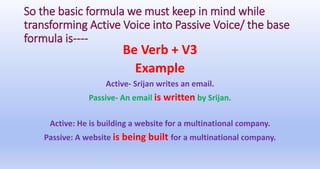
So the basic formula we must keep in mind while
transforming Active Voice into Passive Voice/ the base
formula is----
Be Verb + V3
Example
Active- Srijan writes an email.
Passive- An email is written by Srijan.
Active: He is building a website for a multinational company.
Passive: A website is being built for a multinational company.
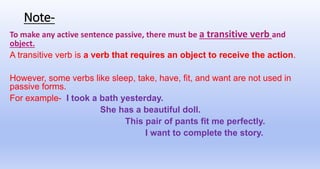
Note-
To make any active sentence passive, there must be a transitive verb and
object.
A transitive verb is a verb that requires an object to receive the action.
However, some verbs like sleep, take, have, fit, and want are not used in
passive forms.
For example- I took a bath yesterday.
She has a beautiful doll.
This pair of pants fit me perfectly.
I want to complete the story.
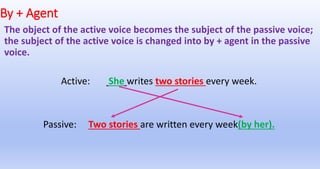
By + Agent
The object of the active voice becomes the subject of the passive voice;
the subject of the active voice is changed into by + agent in the passive
voice.
Active: She writes two stories every week.
Passive: Two stories are written every week(by her).
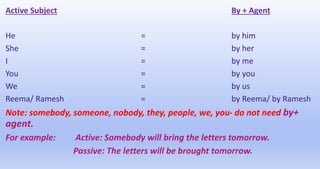
Active Subject By + Agent
He = by him
She = by her
I = by me
You = by you
We = by us
Reema/ Ramesh = by Reema/ by Ramesh
Note: somebody, someone, nobody, they, people, we, you- do not need by+
agent.
For example: Active: Somebody will bring the letters tomorrow.
Passive: The letters will be brought tomorrow.
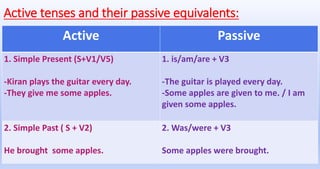
Active tenses and their passive equivalents:
Active Passive
1. Simple Present (S+V1/V5)
-Kiran plays the guitar every day.
-They give me some apples.
1. is/am/are + V3
-The guitar is played every day.
-Some apples are given to me. / I am
given some apples.
2. Simple Past ( S + V2)
He brought some apples.
2. Was/were + V3
Some apples were brought.
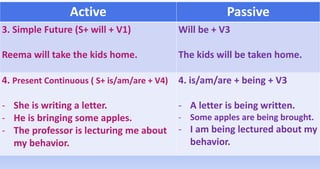
Active Passive
3. Simple Future (S+ will + V1)
Reema will take the kids home.
Will be + V3
The kids will be taken home.
4. Present Continuous ( S+ is/am/are + V4)
- She is writing a letter.
- He is bringing some apples.
- The professor is lecturing me about
my behavior.
4. is/am/are + being + V3
- A letter is being written.
- Some apples are being brought.
- I am being lectured about my
behavior.
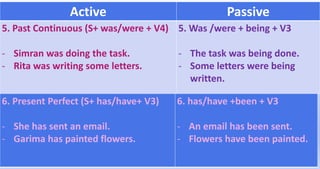
Active Passive
5. Past Continuous (S+ was/were + V4)
- Simran was doing the task.
- Rita was writing some letters.
5. Was /were + being + V3
- The task was being done.
- Some letters were being
written.
6. Present Perfect (S+ has/have+ V3)
- She has sent an email.
- Garima has painted flowers.
6. has/have +been + V3
- An email has been sent.
- Flowers have been painted.
Active Passive
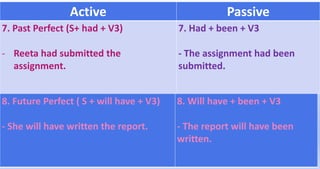
7. Past Perfect (S+ had + V3)
- Reeta had submitted the
assignment.
7. Had + been + V3
- The assignment had been
submitted.
8. Future Perfect ( S + will have + V3)
- She will have written the report.
8. Will have + been + V3
- The report will have been
written.
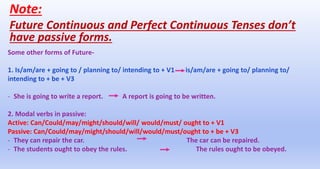
Note:
Future Continuous and Perfect Continuous Tenses don’t
have passive forms.
Some other forms of Future-
1. Is/am/are + going to / planning to/ intending to + V1 is/am/are + going to/ planning to/
intending to + be + V3
- She is going to write a report. A report is going to be written.
2. Modal verbs in passive:
Active: Can/Could/may/might/should/will/ would/must/ ought to + V1
Passive: Can/Could/may/might/should/will/would/must/ought to + be + V3
- They can repair the car. The car can be repaired.
- The students ought to obey the rules. The rules ought to be obeyed.
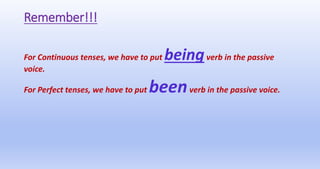
Remember!!!
For Continuous tenses, we have to put beingverb in the passive
voice.
For Perfect tenses, we have to put beenverb in the passive voice.
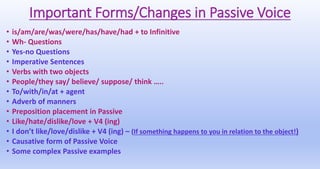
Important Forms/Changes in Passive Voice
• is/am/are/was/were/has/have/had + to Infinitive
• Wh- Questions
• Yes-no Questions
• Imperative Sentences
• Verbs with two objects
• People/they say/ believe/ suppose/ think …..
• To/with/in/at + agent
• Adverb of manners
• Preposition placement in Passive
• Like/hate/dislike/love + V4 (ing)
• I don’t like/love/dislike + V4 (ing) – (If something happens to you in relation to the object!)
• Causative form of Passive Voice
• Some complex Passive examples
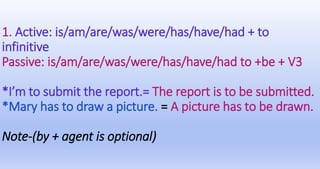
1. Active: is/am/are/was/were/has/have/had + to
infinitive
Passive: is/am/are/was/were/has/have/had to +be + V3
*I’m to submit the report.= The report is to be submitted.
*Mary has to draw a picture. = A picture has to be drawn.
Note-(by + agent is optional)
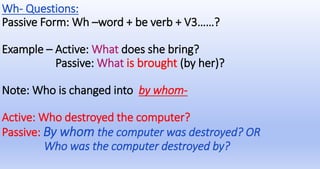
Wh- Questions:
Passive Form: Wh –word + be verb + V3……?
Example – Active: What does she bring?
Passive: What is brought (by her)?
Note: Who is changed into by whom-
Active: Who destroyed the computer?
Passive: By whom the computer was destroyed? OR
Who was the computer destroyed by?
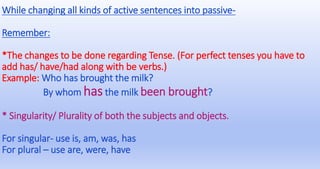
While changing all kinds of active sentences into passive-
Remember:
*The changes to be done regarding Tense. (For perfect tenses you have to
add has/ have/had along with be verbs.)
Example: Who has brought the milk?
By whom has the milk been brought?
* Singularity/ Plurality of both the subjects and objects.
For singular- use is, am, was, has
For plural – use are, were, have
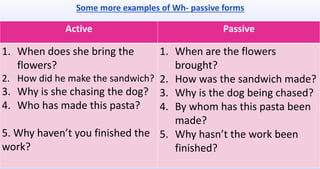
Active Passive
1. When does she bring the
flowers?
2. How did he make the sandwich?
3. Why is she chasing the dog?
4. Who has made this pasta?
5. Why haven’t you finished the
work?
1. When are the flowers
brought?
2. How was the sandwich made?
3. Why is the dog being chased?
4. By whom has this pasta been
made?
5. Why hasn’t the work been
finished?
Some more examples of Wh- passive forms
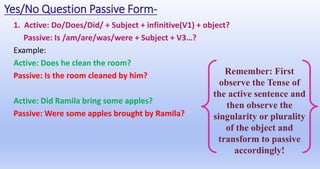
Yes/No Question Passive Form-
1. Active: Do/Does/Did/ + Subject + infinitive(V1) + object?
Passive: Is /am/are/was/were + Subject + V3…?
Example:
Active: Does he clean the room?
Passive: Is the room cleaned by him?
Active: Did Ramila bring some apples?
Passive: Were some apples brought by Ramila?
Remember: First
observe the Tense of
the active sentence and
then observe the
singularity or plurality
of the object and
transform to passive
accordingly!
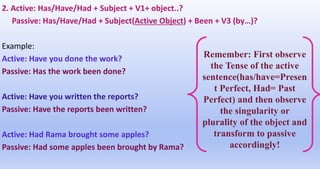
2. Active: Has/Have/Had + Subject + V1+ object..?
Passive: Has/Have/Had + Subject(Active Object) + Been + V3 (by…)?
Example:
Active: Have you done the work?
Passive: Has the work been done?
Active: Have you written the reports?
Passive: Have the reports been written?
Active: Had Rama brought some apples?
Passive: Had some apples been brought by Rama?
Remember: First observe
the Tense of the active
sentence(has/have=Presen
t Perfect, Had= Past
Perfect) and then observe
the singularity or
plurality of the object and
transform to passive
accordingly!
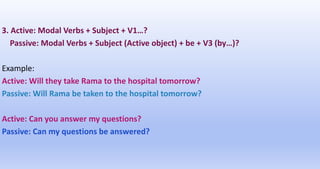
3. Active: Modal Verbs + Subject + V1…?
Passive: Modal Verbs + Subject (Active object) + be + V3 (by…)?
Example:
Active: Will they take Rama to the hospital tomorrow?
Passive: Will Rama be taken to the hospital tomorrow?
Active: Can you answer my questions?
Passive: Can my questions be answered?
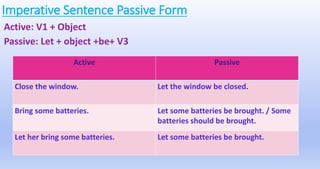
Imperative Sentence Passive Form
Active: V1 + Object
Passive: Let + object +be+ V3
Active Passive
Close the window. Let the window be closed.
Bring some batteries. Let some batteries be brought. / Some
batteries should be brought.
Let her bring some batteries. Let some batteries be brought.
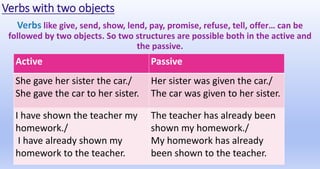
Verbs with two objects
Verbs like give, send, show, lend, pay, promise, refuse, tell, offer… can be
followed by two objects. So two structures are possible both in the active and
the passive.
Active Passive
She gave her sister the car./
She gave the car to her sister.
Her sister was given the car./
The car was given to her sister.
I have shown the teacher my
homework./
I have already shown my
homework to the teacher.
The teacher has already been
shown my homework./
My homework has already
been shown to the teacher.
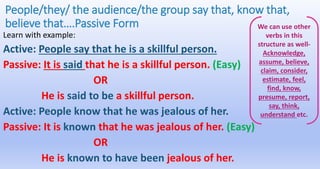
People/they/ the audience/the group say that, know that,
believe that….Passive Form
Learn with example:
Active: People say that he is a skillful person.
Passive: It is said that he is a skillful person. (Easy)
OR
He is said to be a skillful person.
Active: People know that he was jealous of her.
Passive: It is known that he was jealous of her. (Easy)
OR
He is known to have been jealous of her.
We can use other
verbs in this
structure as well-
Acknowledge,
assume, believe,
claim, consider,
estimate, feel,
find, know,
presume, report,
say, think,
understand etc.
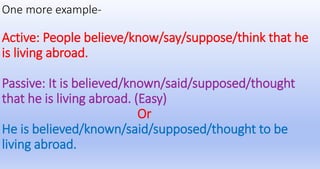
One more example-
Active: People believe/know/say/suppose/think that he
is living abroad.
Passive: It is believed/known/said/supposed/thought
that he is living abroad. (Easy)
Or
He is believed/known/said/supposed/thought to be
living abroad.
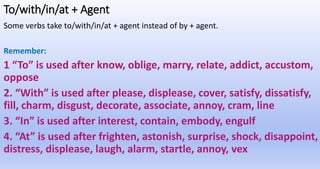
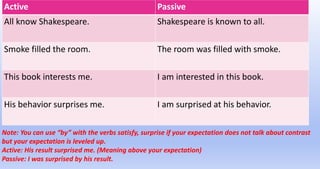
To/with/in/at + Agent
Some verbs take to/with/in/at + agent instead of by + agent.
Remember:
1 “To” is used after know, oblige, marry, relate, addict, accustom,
oppose
2. “With” is used after please, displease, cover, satisfy, dissatisfy,
fill, charm, disgust, decorate, associate, annoy, cram, line
3. “In” is used after interest, contain, embody, engulf
4. “At” is used after frighten, astonish, surprise, shock, disappoint,
distress, displease, laugh, alarm, startle, annoy, vex
Active Passive
All know Shakespeare. Shakespeare is known to all.
Smoke filled the room. The room was filled with smoke.
This book interests me. I am interested in this book.
His behavior surprises me. I am surprised at his behavior.
Note: You can use “by” with the verbs satisfy, surprise if your expectation does not talk about contrast
but your expectation is leveled up.
Active: His result surprised me. (Meaning above your expectation)
Passive: I was surprised by his result.
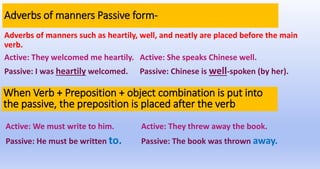
Adverbs of manners Passive form-
Adverbs of manners such as heartily, well, and neatly are placed before the main
verb.
Active: They welcomed me heartily. Active: She speaks Chinese well.
Passive: I was heartily welcomed. Passive: Chinese is well-spoken (by her).
When Verb + Preposition + object combination is put into
the passive, the preposition is placed after the verb
Active: We must write to him. Active: They threw away the book.
Passive: He must be written to. Passive: The book was thrown away.
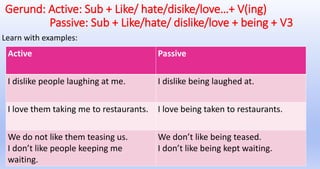
Gerund: Active: Sub + Like/ hate/disike/love…+ V(ing)
Passive: Sub + Like/hate/ dislike/love + being + V3
Learn with examples:
Active Passive
I dislike people laughing at me. I dislike being laughed at.
I love them taking me to restaurants. I love being taken to restaurants.
We do not like them teasing us.
I don’t like people keeping me
waiting.
We don’t like being teased.
I don’t like being kept waiting.
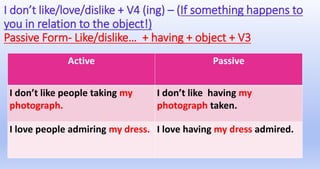
I don’t like/love/dislike + V4 (ing) – (If something happens to
you in relation to the object!)
Passive Form- Like/dislike… + having + object + V3
Active Passive
I don’t like people taking my
photograph.
I don’t like having my
photograph taken.
I love people admiring my dress. I love having my dress admired.
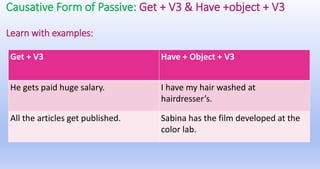
Causative Form of Passive: Get + V3 & Have +object + V3
Learn with examples:
Get + V3 Have + Object + V3
He gets paid huge salary. I have my hair washed at
hairdresser’s.
All the articles get published. Sabina has the film developed at the
color lab.
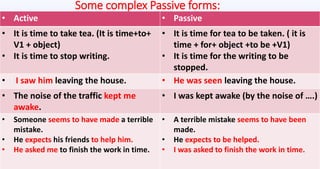
Some complex Passive forms:
• Active • Passive
• It is time to take tea. (It is time+to+
V1 + object)
• It is time to stop writing.
• It is time for tea to be taken. ( it is
time + for+ object +to be +V1)
• It is time for the writing to be
stopped.
• I saw him leaving the house. • He was seen leaving the house.
• The noise of the traffic kept me
awake.
• I was kept awake (by the noise of ….)
• Someone seems to have made a terrible
mistake.
• He expects his friends to help him.
• He asked me to finish the work in time.
• A terrible mistake seems to have been
made.
• He expects to be helped.
• I was asked to finish the work in time.
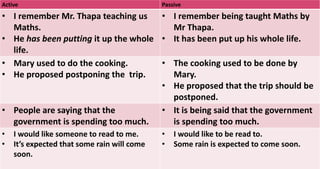
Active Passive
• I remember Mr. Thapa teaching us
Maths.
• He has been putting it up the whole
life.
• I remember being taught Maths by
Mr Thapa.
• It has been put up his whole life.
• Mary used to do the cooking.
• He proposed postponing the trip.
• The cooking used to be done by
Mary.
• He proposed that the trip should be
postponed.
• People are saying that the
government is spending too much.
• It is being said that the government
is spending too much.
• I would like someone to read to me.
• It’s expected that some rain will come
soon.
• I would like to be read to.
• Some rain is expected to come soon.
Active Passive
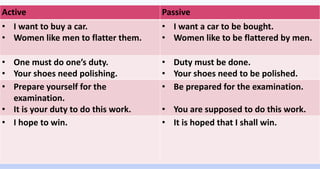
• I want to buy a car.
• Women like men to flatter them.
• I want a car to be bought.
• Women like to be flattered by men.
• One must do one’s duty.
• Your shoes need polishing.
• Duty must be done.
• Your shoes need to be polished.
• Prepare yourself for the
examination.
• It is your duty to do this work.
• Be prepared for the examination.
• You are supposed to do this work.
• I hope to win. • It is hoped that I shall win.
Prepared by-
Bhabika Dangol

voice.pptx

  • 1.
    The Active andPassive Voice in English Grammar •Introduction •Be verbs •Rules and Formulas
  • 2.
    Introduction- In English grammar,verbs can be used in two primary voices: active and passive. The distinction between the two lies in how the subject and object of a sentence are positioned in relation to the action expressed by the verb. Active Voice: In the active voice, the subject performs the action expressed by the verb, and the object receives the action. The basic structure of a sentence in active voice is: Subject (doer) + Verb + Object (receiver) Example: "John (subject) kicked (verb) the ball (object)." In this sentence, "John" is the doer (subject) who performs the action of "kicking," and "the ball" is the receiver (object) of the action. Active voice is often preferred to provide clarity and directness in sentence construction.
  • 3.
    Passive Voice- Passive Voice: Inthe passive voice, the subject undergoes the action expressed by the verb, and the doer of the action (if mentioned) is placed in a prepositional phrase (by, with, to) or may be omitted. The basic structure of a sentence in passive voice is: Object (receiver) + Verb (past participle) + (optional: Doer) + (optional: Preposition) + Subject (receiver turned into the subject) Example: "The ball (object) was kicked (verb) by John (doer)." In this sentence, "The ball" is now the receiver (object) of the action and has become the subject of the passive sentence, while "John" (doer) is introduced using the prepositional phrase "by John." Passive voice is used when the focus is on the object or when the doer is unknown or less important. It is also commonly used in scientific or formal writing when the writer wants to avoid mentioning the doer or when the doer is evident from the context.
  • 4.
    Note- Keep in mindthat while passive voice has its uses, active voice is generally more direct, concise, and preferred in most writing situations. It is essential to use the appropriate voice depending on the context and the emphasis you want to convey.
  • 5.
    Be Verbs- Be verbsare essential when it comes to voice in English Grammar. We need the “Be verb” + past participle form of the verb (V3) to transform active sentences into passive sentences. Be verbs- be, is, am, are, was, were, being, been + Past Participle(V3) = Passive Voice
  • 6.
    So the basicformula we must keep in mind while transforming Active Voice into Passive Voice/ the base formula is---- Be Verb + V3 Example Active- Srijan writes an email. Passive- An email is written by Srijan. Active: He is building a website for a multinational company. Passive: A website is being built for a multinational company.
  • 7.
    Note- To make anyactive sentence passive, there must be a transitive verb and object. A transitive verb is a verb that requires an object to receive the action. However, some verbs like sleep, take, have, fit, and want are not used in passive forms. For example- I took a bath yesterday. She has a beautiful doll. This pair of pants fit me perfectly. I want to complete the story.
  • 8.
    By + Agent Theobject of the active voice becomes the subject of the passive voice; the subject of the active voice is changed into by + agent in the passive voice. Active: She writes two stories every week. Passive: Two stories are written every week(by her).
  • 9.
    Active Subject By+ Agent He = by him She = by her I = by me You = by you We = by us Reema/ Ramesh = by Reema/ by Ramesh Note: somebody, someone, nobody, they, people, we, you- do not need by+ agent. For example: Active: Somebody will bring the letters tomorrow. Passive: The letters will be brought tomorrow.
  • 10.
    Active tenses andtheir passive equivalents: Active Passive 1. Simple Present (S+V1/V5) -Kiran plays the guitar every day. -They give me some apples. 1. is/am/are + V3 -The guitar is played every day. -Some apples are given to me. / I am given some apples. 2. Simple Past ( S + V2) He brought some apples. 2. Was/were + V3 Some apples were brought.
  • 11.
    Active Passive 3. SimpleFuture (S+ will + V1) Reema will take the kids home. Will be + V3 The kids will be taken home. 4. Present Continuous ( S+ is/am/are + V4) - She is writing a letter. - He is bringing some apples. - The professor is lecturing me about my behavior. 4. is/am/are + being + V3 - A letter is being written. - Some apples are being brought. - I am being lectured about my behavior.
  • 12.
    Active Passive 5. PastContinuous (S+ was/were + V4) - Simran was doing the task. - Rita was writing some letters. 5. Was /were + being + V3 - The task was being done. - Some letters were being written. 6. Present Perfect (S+ has/have+ V3) - She has sent an email. - Garima has painted flowers. 6. has/have +been + V3 - An email has been sent. - Flowers have been painted.
  • 13.
    Active Passive 7. PastPerfect (S+ had + V3) - Reeta had submitted the assignment. 7. Had + been + V3 - The assignment had been submitted. 8. Future Perfect ( S + will have + V3) - She will have written the report. 8. Will have + been + V3 - The report will have been written.
  • 14.
    Note: Future Continuous andPerfect Continuous Tenses don’t have passive forms. Some other forms of Future- 1. Is/am/are + going to / planning to/ intending to + V1 is/am/are + going to/ planning to/ intending to + be + V3 - She is going to write a report. A report is going to be written. 2. Modal verbs in passive: Active: Can/Could/may/might/should/will/ would/must/ ought to + V1 Passive: Can/Could/may/might/should/will/would/must/ought to + be + V3 - They can repair the car. The car can be repaired. - The students ought to obey the rules. The rules ought to be obeyed.
  • 15.
    Remember!!! For Continuous tenses,we have to put beingverb in the passive voice. For Perfect tenses, we have to put beenverb in the passive voice.
  • 16.
    Important Forms/Changes inPassive Voice • is/am/are/was/were/has/have/had + to Infinitive • Wh- Questions • Yes-no Questions • Imperative Sentences • Verbs with two objects • People/they say/ believe/ suppose/ think ….. • To/with/in/at + agent • Adverb of manners • Preposition placement in Passive • Like/hate/dislike/love + V4 (ing) • I don’t like/love/dislike + V4 (ing) – (If something happens to you in relation to the object!) • Causative form of Passive Voice • Some complex Passive examples
  • 17.
    1. Active: is/am/are/was/were/has/have/had+ to infinitive Passive: is/am/are/was/were/has/have/had to +be + V3 *I’m to submit the report.= The report is to be submitted. *Mary has to draw a picture. = A picture has to be drawn. Note-(by + agent is optional)
  • 18.
    Wh- Questions: Passive Form:Wh –word + be verb + V3……? Example – Active: What does she bring? Passive: What is brought (by her)? Note: Who is changed into by whom- Active: Who destroyed the computer? Passive: By whom the computer was destroyed? OR Who was the computer destroyed by?
  • 19.
    While changing allkinds of active sentences into passive- Remember: *The changes to be done regarding Tense. (For perfect tenses you have to add has/ have/had along with be verbs.) Example: Who has brought the milk? By whom has the milk been brought? * Singularity/ Plurality of both the subjects and objects. For singular- use is, am, was, has For plural – use are, were, have
  • 20.
    Active Passive 1. Whendoes she bring the flowers? 2. How did he make the sandwich? 3. Why is she chasing the dog? 4. Who has made this pasta? 5. Why haven’t you finished the work? 1. When are the flowers brought? 2. How was the sandwich made? 3. Why is the dog being chased? 4. By whom has this pasta been made? 5. Why hasn’t the work been finished? Some more examples of Wh- passive forms
  • 21.
    Yes/No Question PassiveForm- 1. Active: Do/Does/Did/ + Subject + infinitive(V1) + object? Passive: Is /am/are/was/were + Subject + V3…? Example: Active: Does he clean the room? Passive: Is the room cleaned by him? Active: Did Ramila bring some apples? Passive: Were some apples brought by Ramila? Remember: First observe the Tense of the active sentence and then observe the singularity or plurality of the object and transform to passive accordingly!
  • 22.
    2. Active: Has/Have/Had+ Subject + V1+ object..? Passive: Has/Have/Had + Subject(Active Object) + Been + V3 (by…)? Example: Active: Have you done the work? Passive: Has the work been done? Active: Have you written the reports? Passive: Have the reports been written? Active: Had Rama brought some apples? Passive: Had some apples been brought by Rama? Remember: First observe the Tense of the active sentence(has/have=Presen t Perfect, Had= Past Perfect) and then observe the singularity or plurality of the object and transform to passive accordingly!
  • 23.
    3. Active: ModalVerbs + Subject + V1…? Passive: Modal Verbs + Subject (Active object) + be + V3 (by…)? Example: Active: Will they take Rama to the hospital tomorrow? Passive: Will Rama be taken to the hospital tomorrow? Active: Can you answer my questions? Passive: Can my questions be answered?
  • 24.
    Imperative Sentence PassiveForm Active: V1 + Object Passive: Let + object +be+ V3 Active Passive Close the window. Let the window be closed. Bring some batteries. Let some batteries be brought. / Some batteries should be brought. Let her bring some batteries. Let some batteries be brought.
  • 25.
    Verbs with twoobjects Verbs like give, send, show, lend, pay, promise, refuse, tell, offer… can be followed by two objects. So two structures are possible both in the active and the passive. Active Passive She gave her sister the car./ She gave the car to her sister. Her sister was given the car./ The car was given to her sister. I have shown the teacher my homework./ I have already shown my homework to the teacher. The teacher has already been shown my homework./ My homework has already been shown to the teacher.
  • 26.
    People/they/ the audience/thegroup say that, know that, believe that….Passive Form Learn with example: Active: People say that he is a skillful person. Passive: It is said that he is a skillful person. (Easy) OR He is said to be a skillful person. Active: People know that he was jealous of her. Passive: It is known that he was jealous of her. (Easy) OR He is known to have been jealous of her. We can use other verbs in this structure as well- Acknowledge, assume, believe, claim, consider, estimate, feel, find, know, presume, report, say, think, understand etc.
  • 27.
    One more example- Active:People believe/know/say/suppose/think that he is living abroad. Passive: It is believed/known/said/supposed/thought that he is living abroad. (Easy) Or He is believed/known/said/supposed/thought to be living abroad.
  • 28.
    To/with/in/at + Agent Someverbs take to/with/in/at + agent instead of by + agent. Remember: 1 “To” is used after know, oblige, marry, relate, addict, accustom, oppose 2. “With” is used after please, displease, cover, satisfy, dissatisfy, fill, charm, disgust, decorate, associate, annoy, cram, line 3. “In” is used after interest, contain, embody, engulf 4. “At” is used after frighten, astonish, surprise, shock, disappoint, distress, displease, laugh, alarm, startle, annoy, vex
  • 29.
    Active Passive All knowShakespeare. Shakespeare is known to all. Smoke filled the room. The room was filled with smoke. This book interests me. I am interested in this book. His behavior surprises me. I am surprised at his behavior. Note: You can use “by” with the verbs satisfy, surprise if your expectation does not talk about contrast but your expectation is leveled up. Active: His result surprised me. (Meaning above your expectation) Passive: I was surprised by his result.
  • 30.
    Adverbs of mannersPassive form- Adverbs of manners such as heartily, well, and neatly are placed before the main verb. Active: They welcomed me heartily. Active: She speaks Chinese well. Passive: I was heartily welcomed. Passive: Chinese is well-spoken (by her). When Verb + Preposition + object combination is put into the passive, the preposition is placed after the verb Active: We must write to him. Active: They threw away the book. Passive: He must be written to. Passive: The book was thrown away.
  • 31.
    Gerund: Active: Sub+ Like/ hate/disike/love…+ V(ing) Passive: Sub + Like/hate/ dislike/love + being + V3 Learn with examples: Active Passive I dislike people laughing at me. I dislike being laughed at. I love them taking me to restaurants. I love being taken to restaurants. We do not like them teasing us. I don’t like people keeping me waiting. We don’t like being teased. I don’t like being kept waiting.
  • 32.
    I don’t like/love/dislike+ V4 (ing) – (If something happens to you in relation to the object!) Passive Form- Like/dislike… + having + object + V3 Active Passive I don’t like people taking my photograph. I don’t like having my photograph taken. I love people admiring my dress. I love having my dress admired.
  • 33.
    Causative Form ofPassive: Get + V3 & Have +object + V3 Learn with examples: Get + V3 Have + Object + V3 He gets paid huge salary. I have my hair washed at hairdresser’s. All the articles get published. Sabina has the film developed at the color lab.
  • 34.
    Some complex Passiveforms: • Active • Passive • It is time to take tea. (It is time+to+ V1 + object) • It is time to stop writing. • It is time for tea to be taken. ( it is time + for+ object +to be +V1) • It is time for the writing to be stopped. • I saw him leaving the house. • He was seen leaving the house. • The noise of the traffic kept me awake. • I was kept awake (by the noise of ….) • Someone seems to have made a terrible mistake. • He expects his friends to help him. • He asked me to finish the work in time. • A terrible mistake seems to have been made. • He expects to be helped. • I was asked to finish the work in time.
  • 35.
    Active Passive • Iremember Mr. Thapa teaching us Maths. • He has been putting it up the whole life. • I remember being taught Maths by Mr Thapa. • It has been put up his whole life. • Mary used to do the cooking. • He proposed postponing the trip. • The cooking used to be done by Mary. • He proposed that the trip should be postponed. • People are saying that the government is spending too much. • It is being said that the government is spending too much. • I would like someone to read to me. • It’s expected that some rain will come soon. • I would like to be read to. • Some rain is expected to come soon.
  • 36.
    Active Passive • Iwant to buy a car. • Women like men to flatter them. • I want a car to be bought. • Women like to be flattered by men. • One must do one’s duty. • Your shoes need polishing. • Duty must be done. • Your shoes need to be polished. • Prepare yourself for the examination. • It is your duty to do this work. • Be prepared for the examination. • You are supposed to do this work. • I hope to win. • It is hoped that I shall win.
  • 37.