JAW RELATIONS /
MAXILLOMANDIBULAR RELATIONS
“Any spatial
relationship of the
maxillae to the
mandible & the maxilla
to the base of the
cranium”
MAXILLOMANDIBULAR RELATIONSHIP
RECORD
“A registration of any possible
relationship of the mandible relative
to the maxillae. These records may
be made at any vertical , horizontal,
or lateral positions”
WHY IS RECORDING OF JAW RELATIONS
IMPORTANT ???
To design the dentures in such a way
that they function in harmony with
the 2 jaw bones and the joint in
between them i.e., the
Temporomandibular joint
Types of Jaw Relations
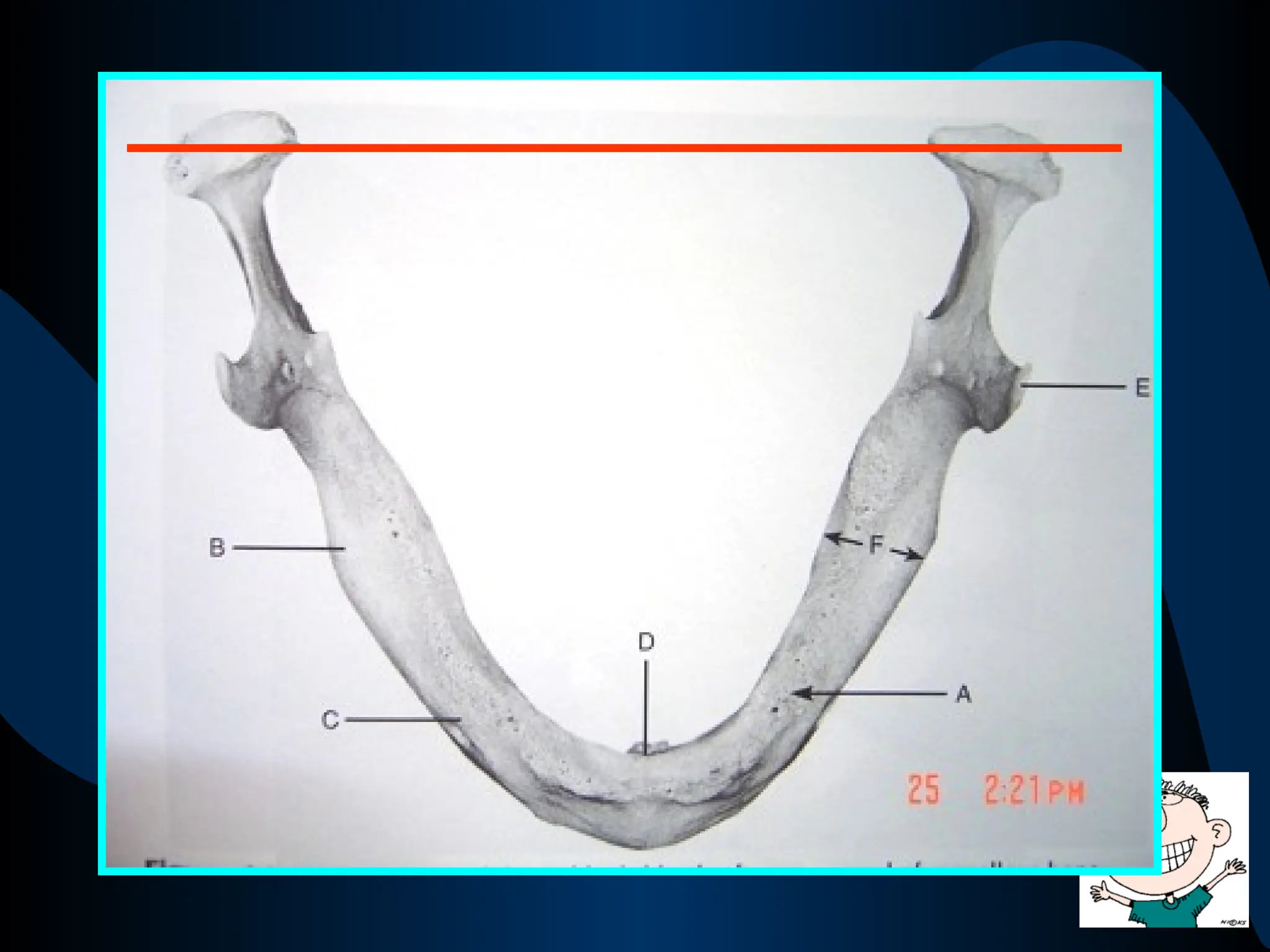
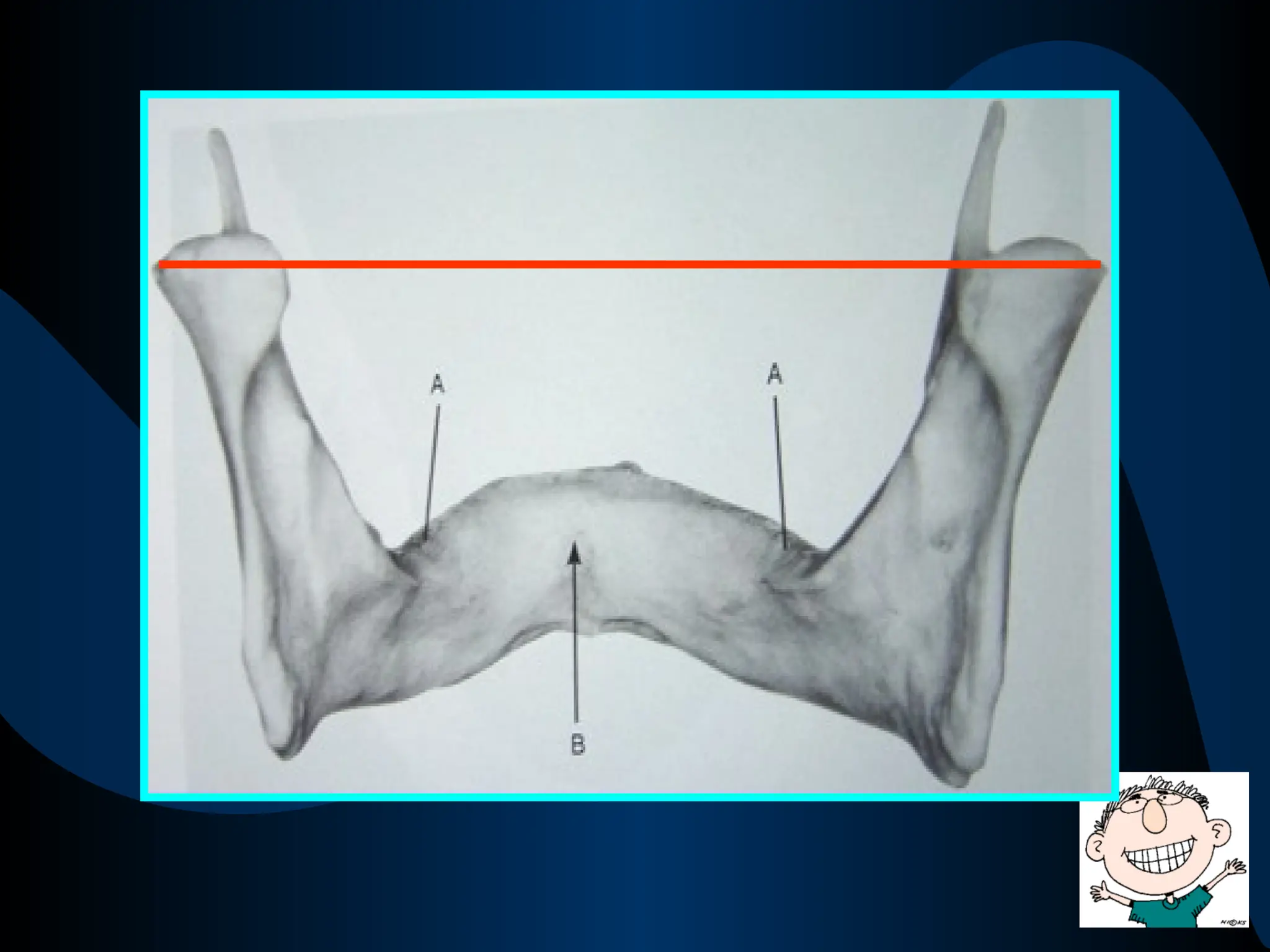
 Orientation Jaw Relation
 Vertical Jaw Relation
Horizontal Jaw Relation
- Centric Jaw Relation
- Eccentric Jaw Relation
“The orientation of the maxilla to the
base of cranium and to the imaginary
transverse axis passing through the
center of the condyles around which
the mandible may rotate within the
sagittal plane ”
ORIENTATION JAW RELATION
VERTICAL JAW RELATION
It involves the establishment of vertical
dimension of the dentures in harmony
with the appearance of the face , for
maximum functional efficiency and
patient comfort
HORIZONTAL JAW RELATION
It involves the relationship of mandible
to the maxillae in the horizontal plane
at centric and eccentric positions
ORIENTATION JAW
RELATION
This record gives the
angulation /inclination /tilt of the
maxilla in relation to the base of the
skull
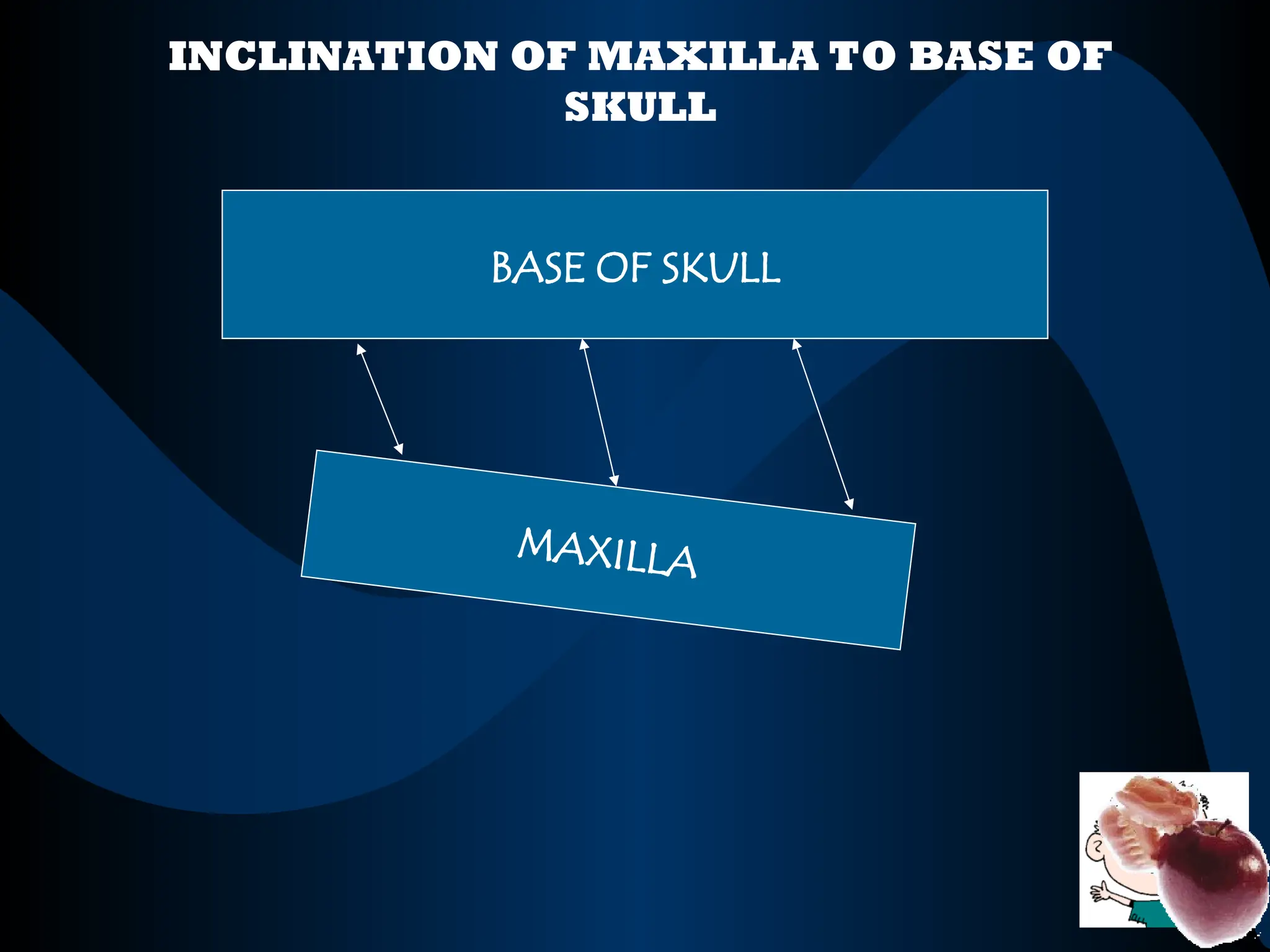
BASE OF SKULL
MAXILLA
INCLINATION OF MAXILLA TO BASE OF
SKULL
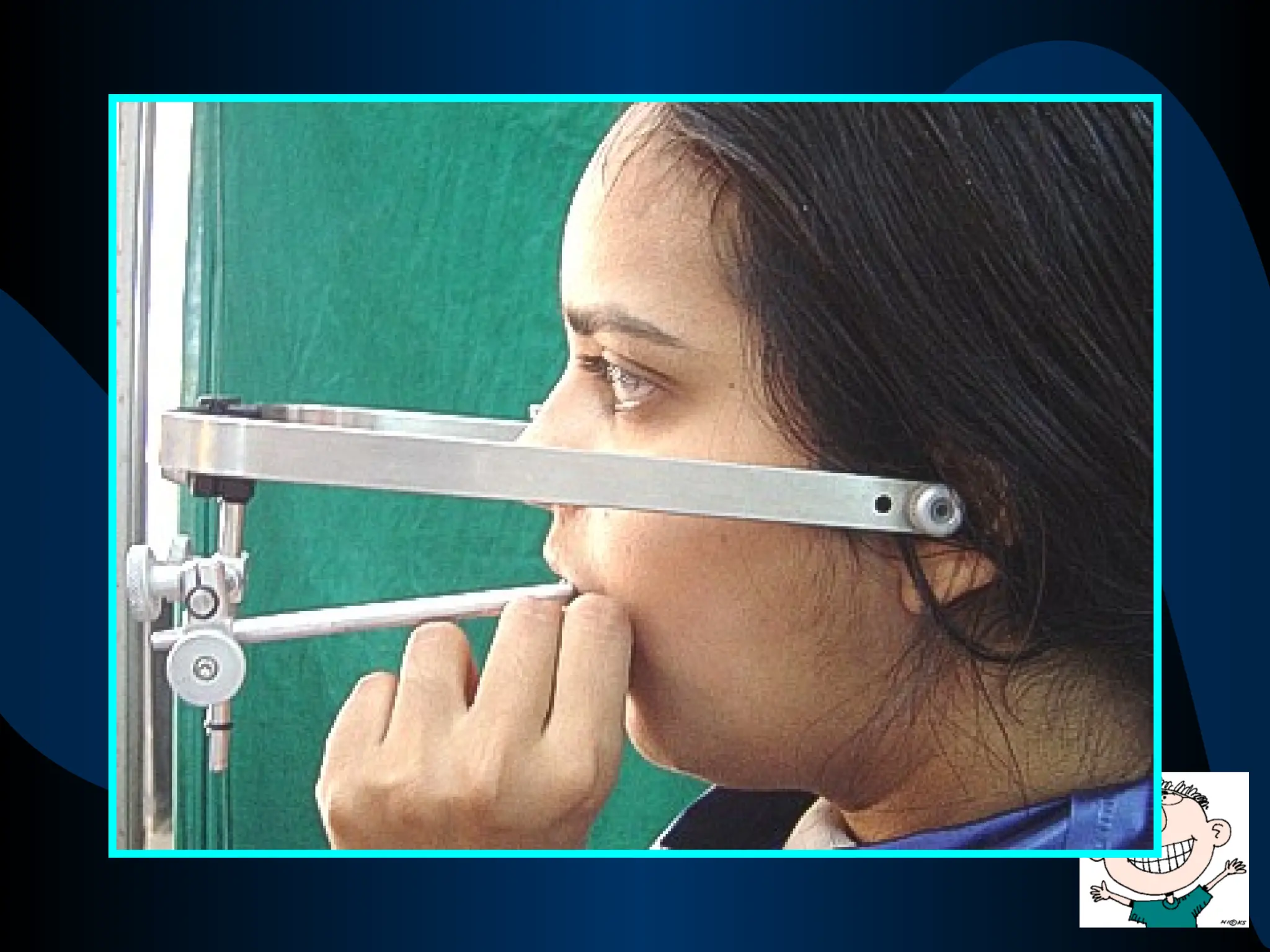
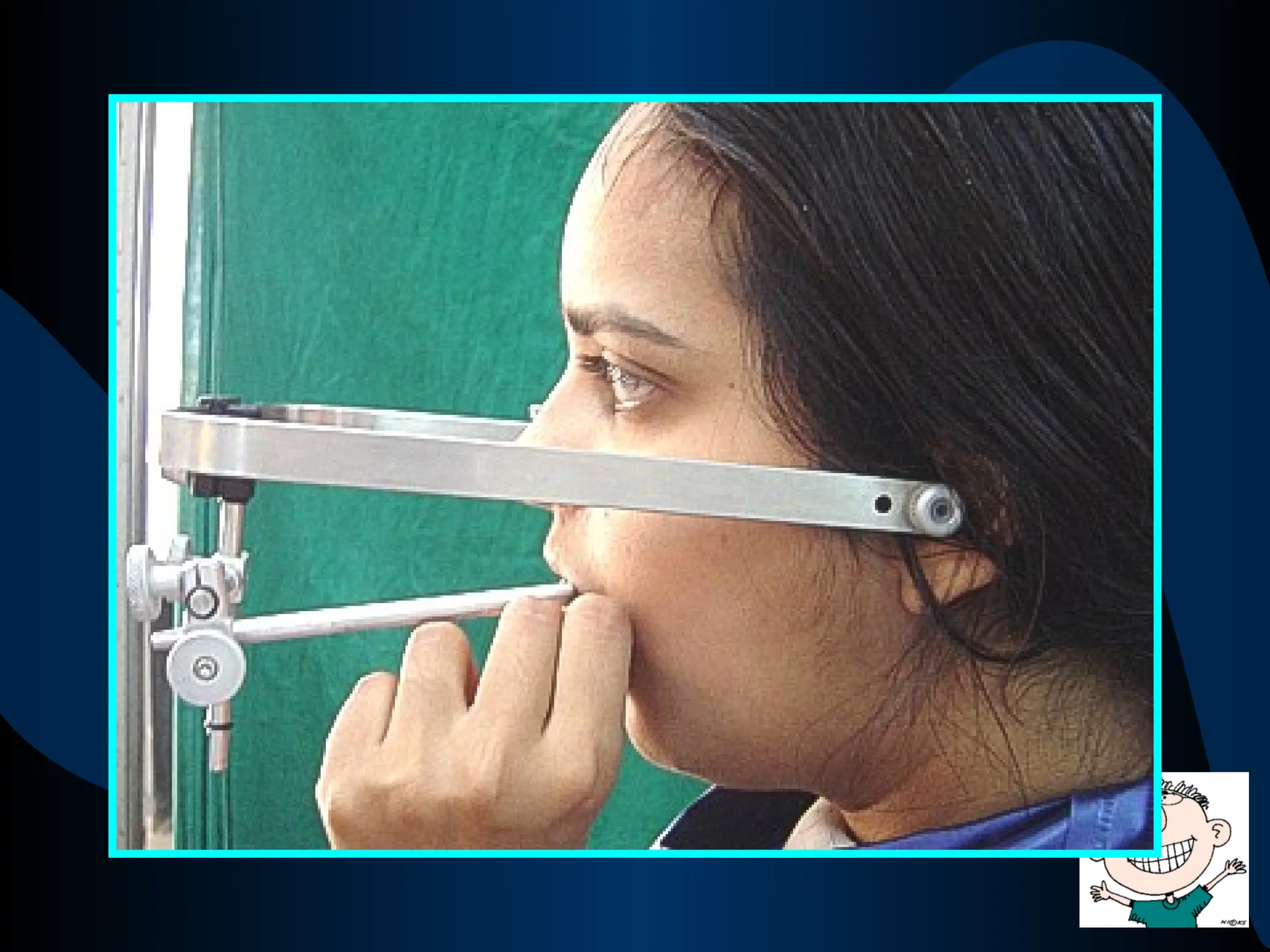
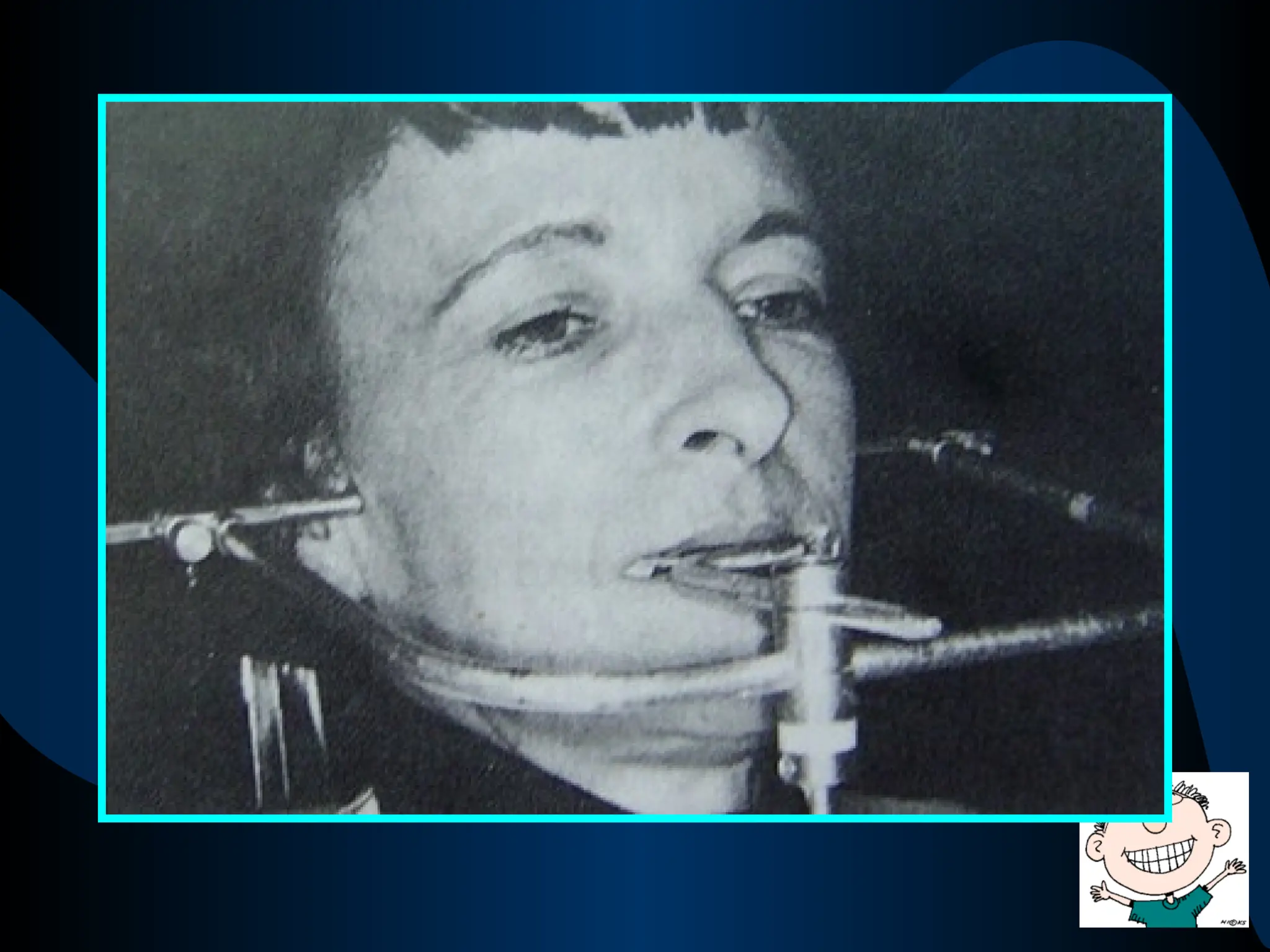
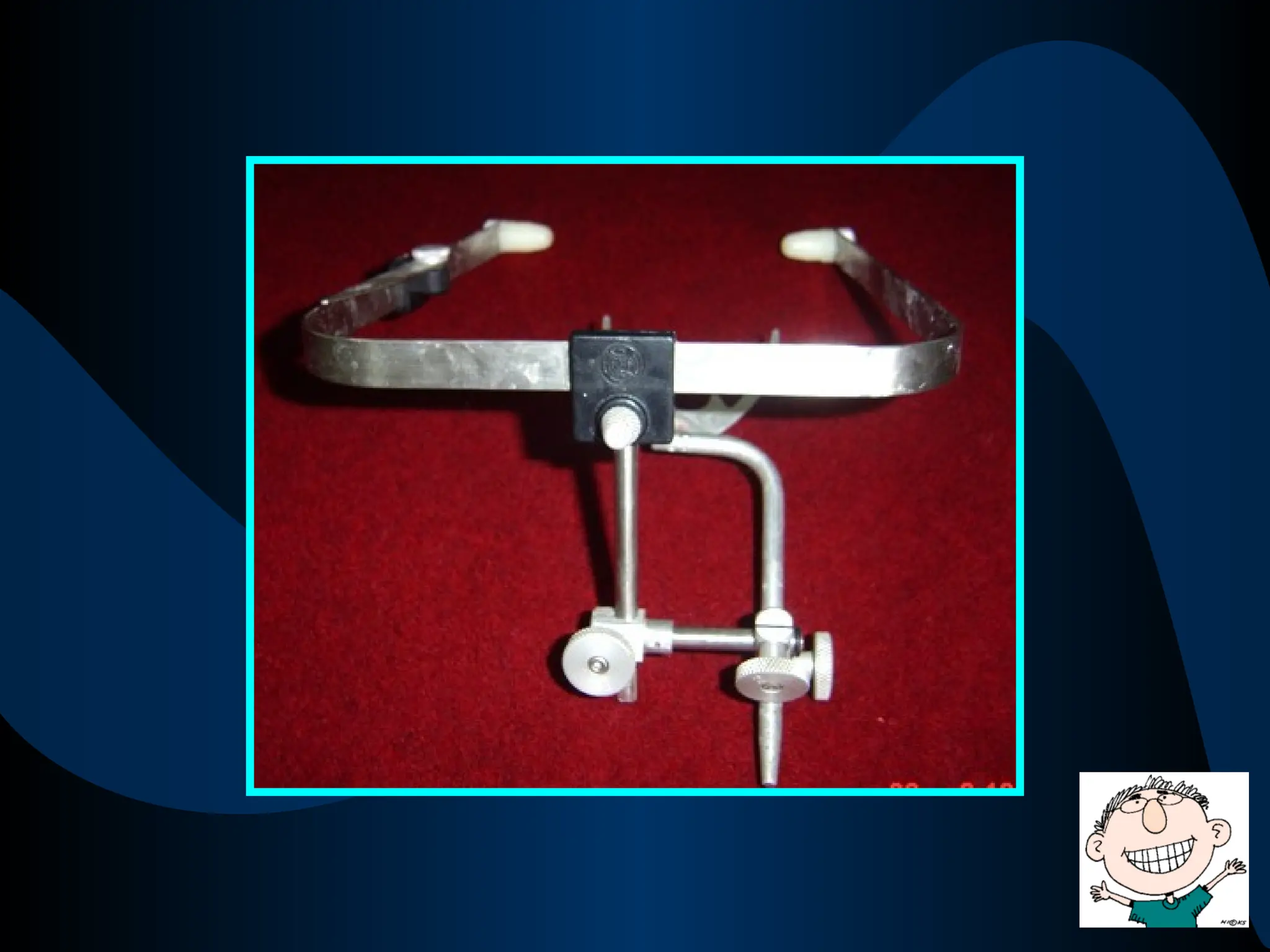
Can be recorded with the help of a
FACE-BOW device
“Face-bow is a caliper like device used
to record the spatial relationship of the
maxilla to the opening axis of TMJ and
the base of skull and then transfer the
maxillary cast in the same relationship
to the opening axis of articulator”
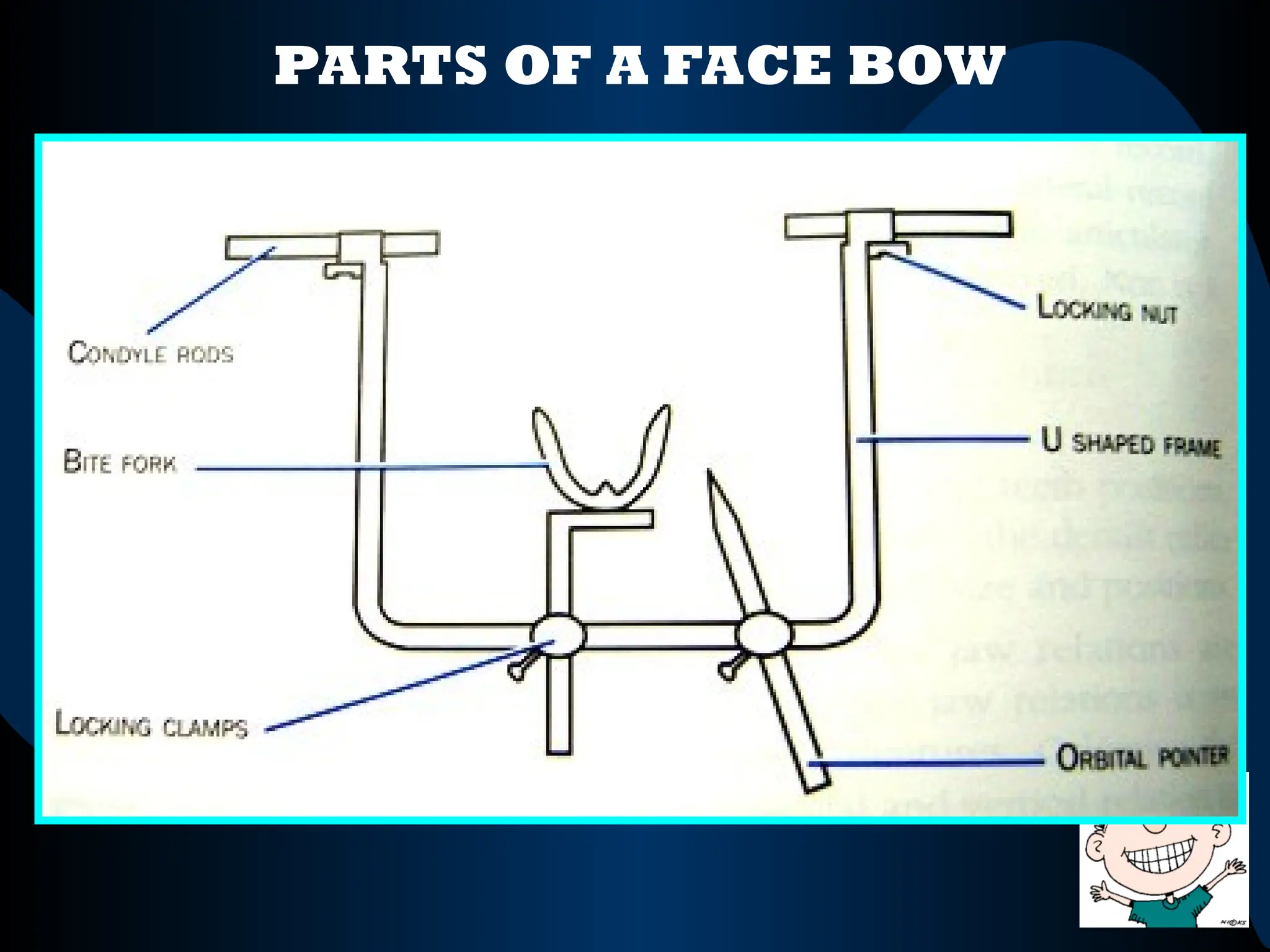
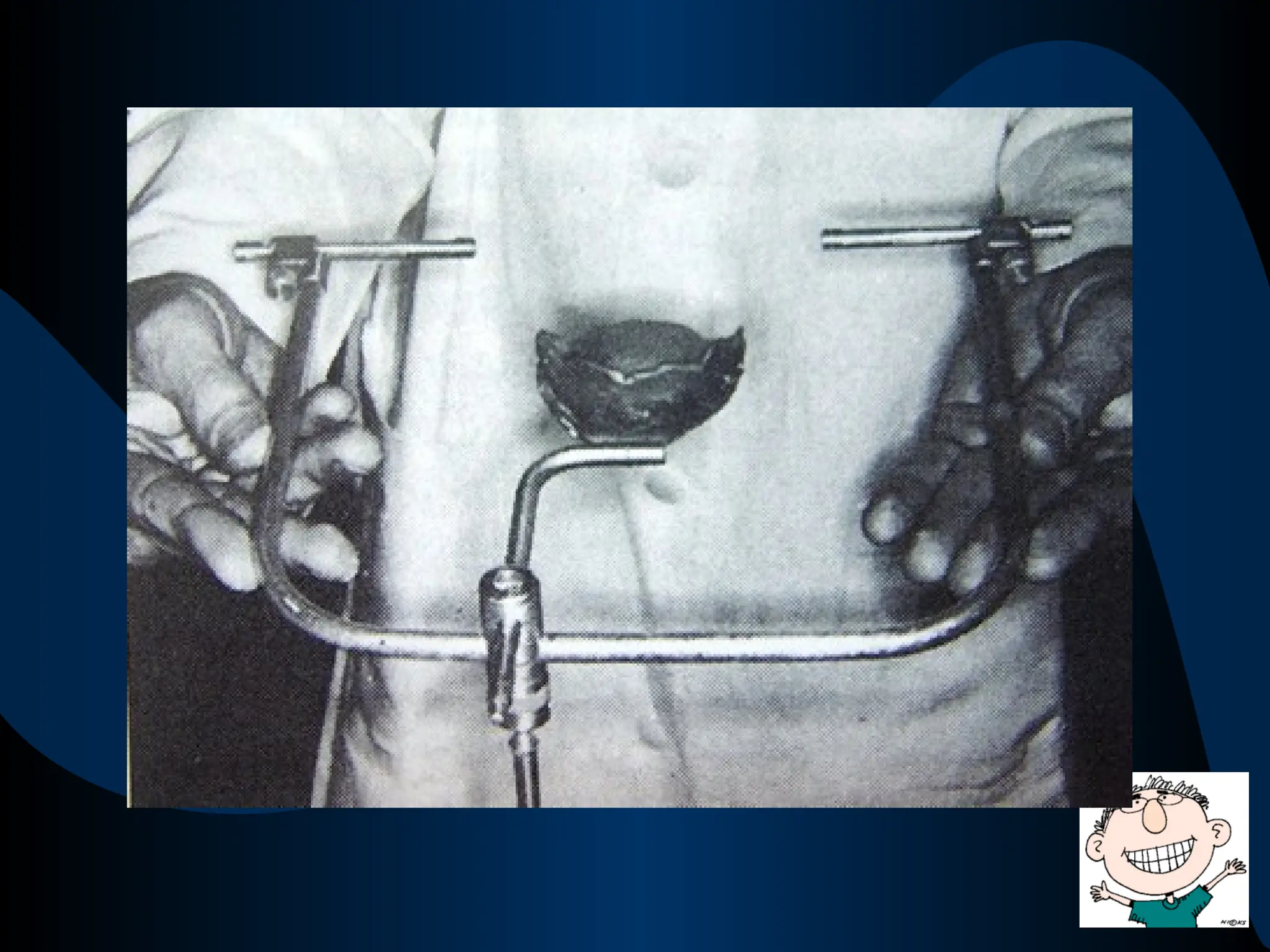
PARTS OF A FACE BOW
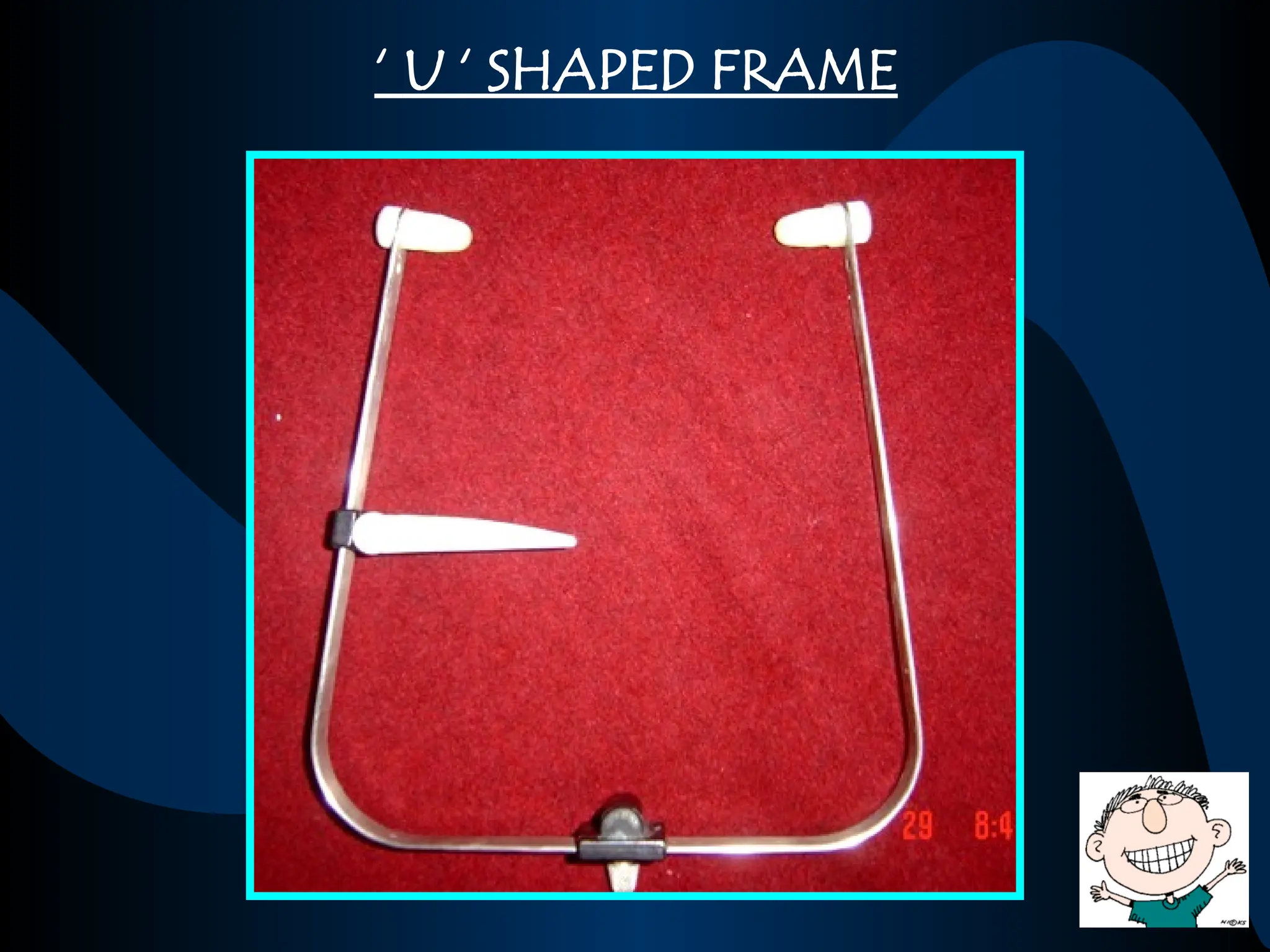
‘ U ‘ SHAPED FRAME
Forms the main frame of the face bow
Records the plane of the cranium
All other components are attached to
this frame with the help of clamps
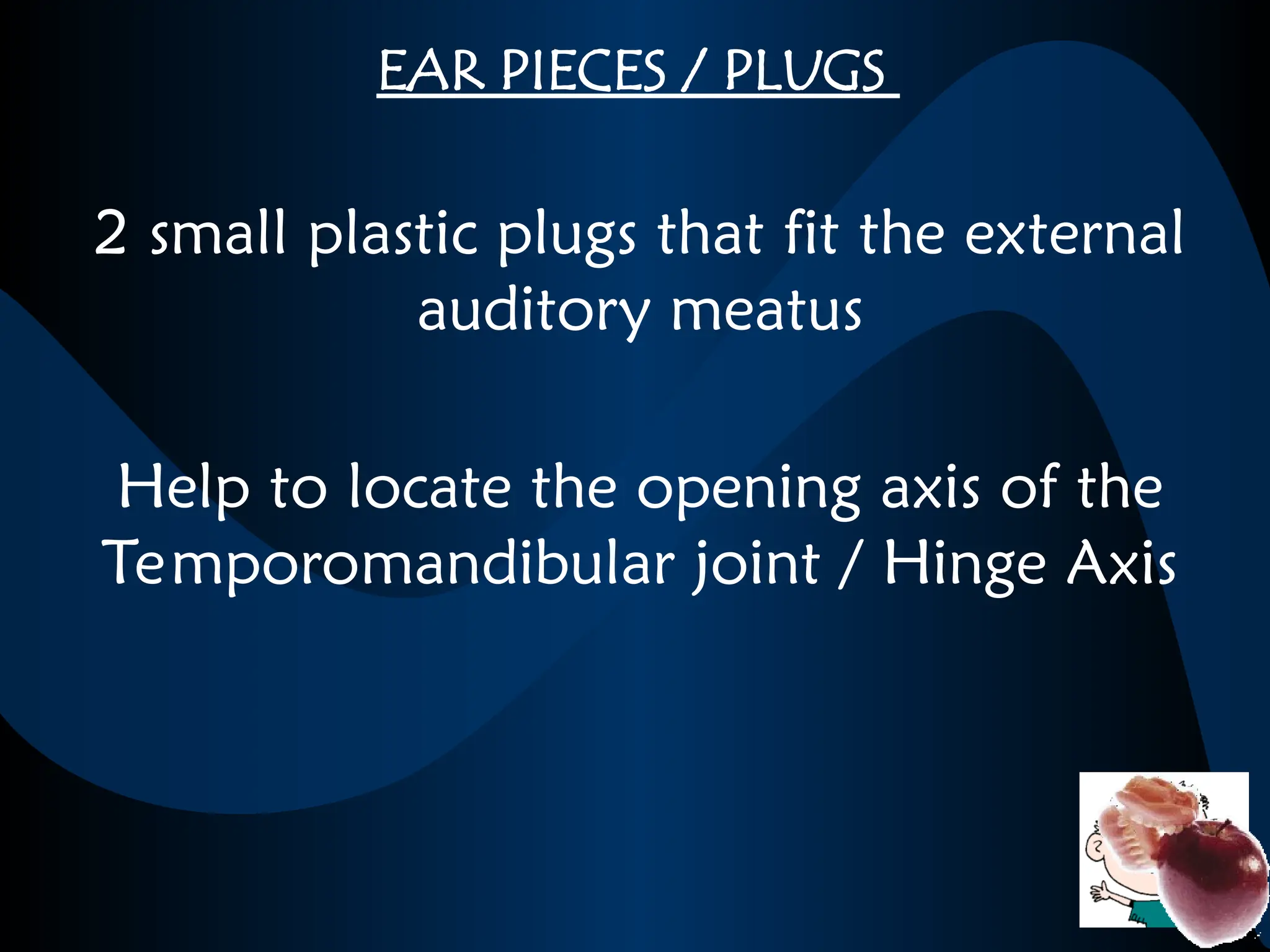
EAR PIECES / PLUGS
2 small plastic plugs that fit the external
auditory meatus
Help to locate the opening axis of the
Temporomandibular joint / Hinge Axis
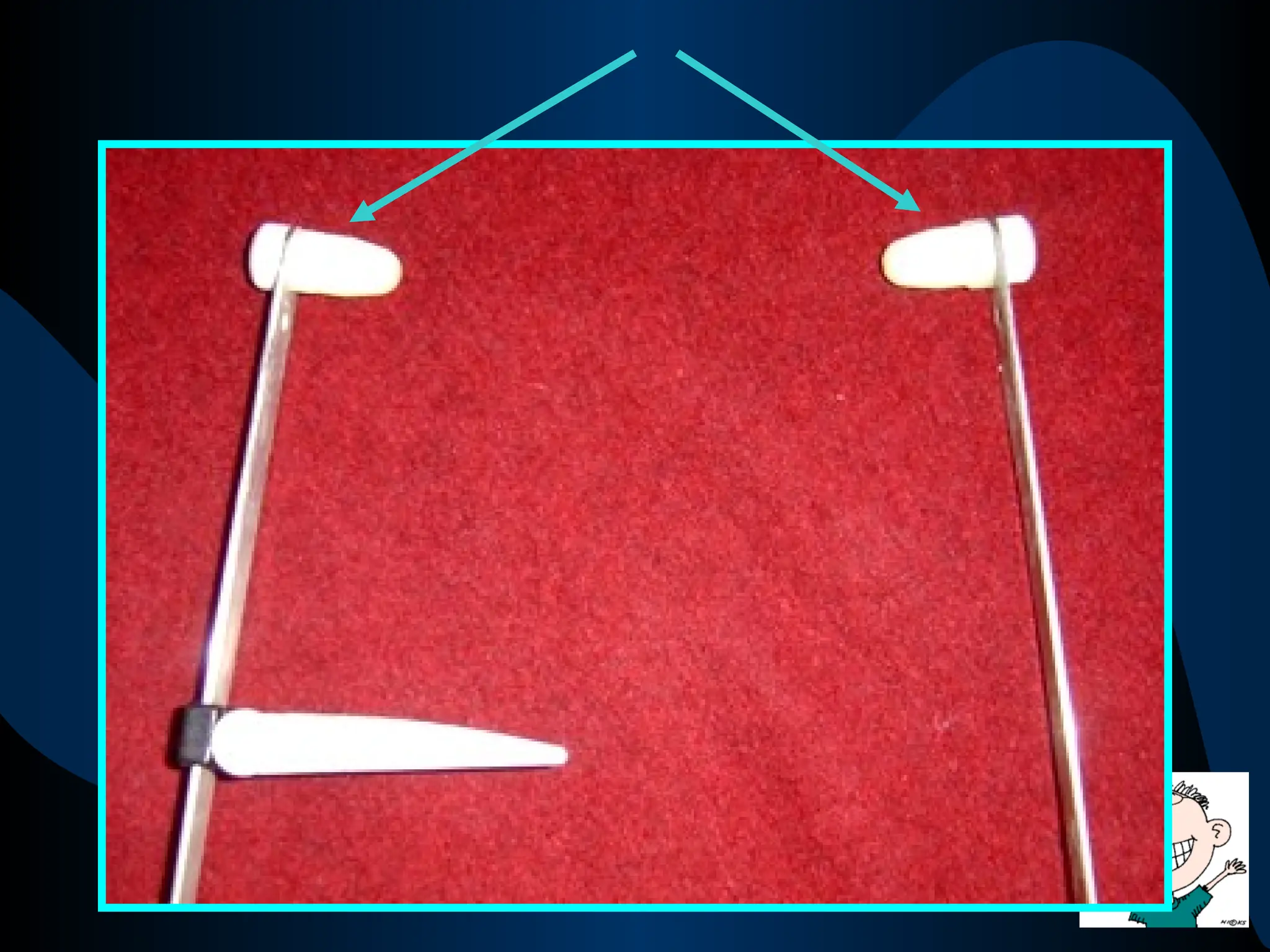
CLAMP
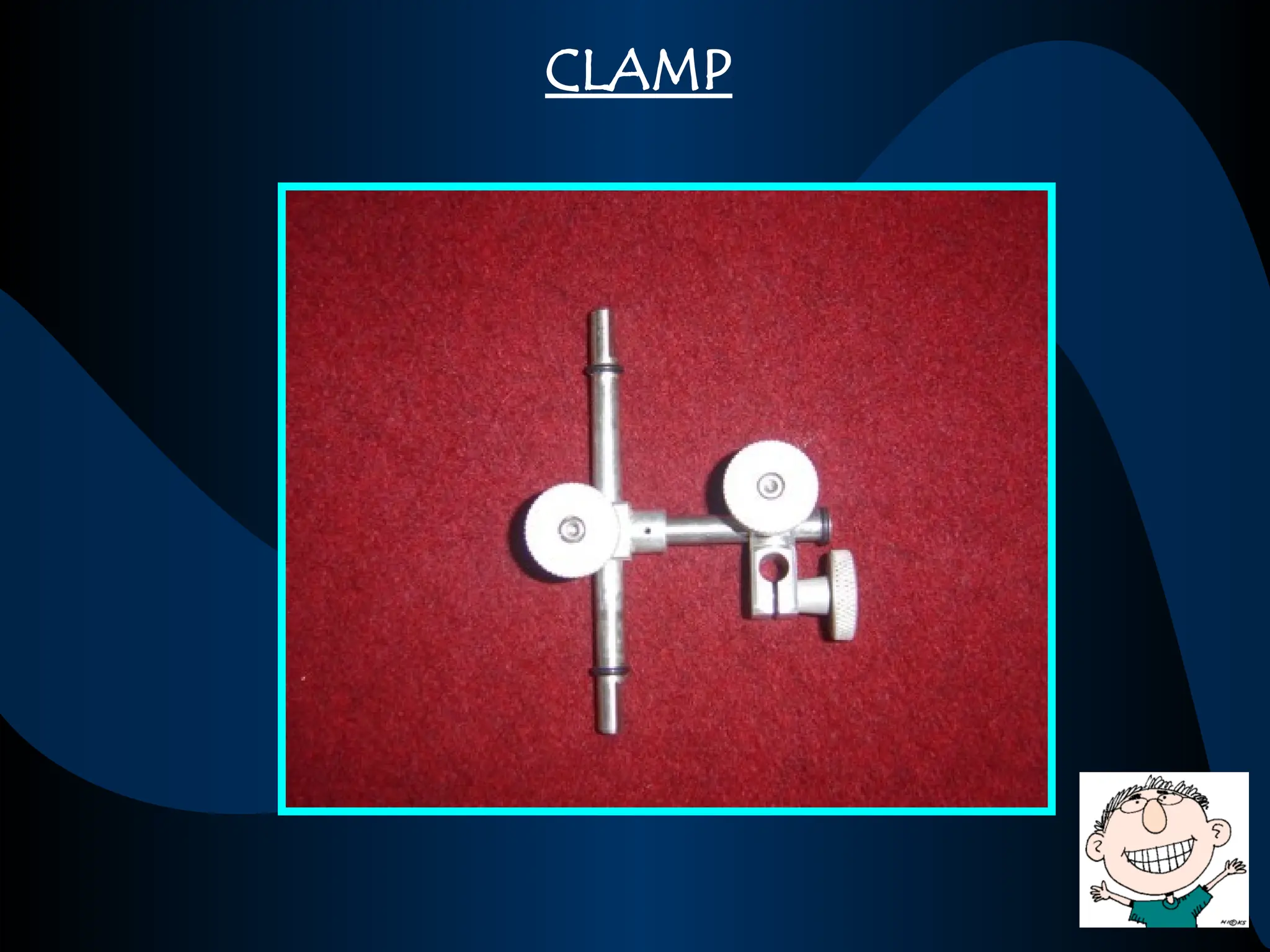
BITE FORK
Maxillary wax rim is attached to this
bite fork
Represents the plane of the maxilla
Attached to the the U frame with the
help of the clamp
ORBITAL POINTER
Indicates the point- Orbitale on the face
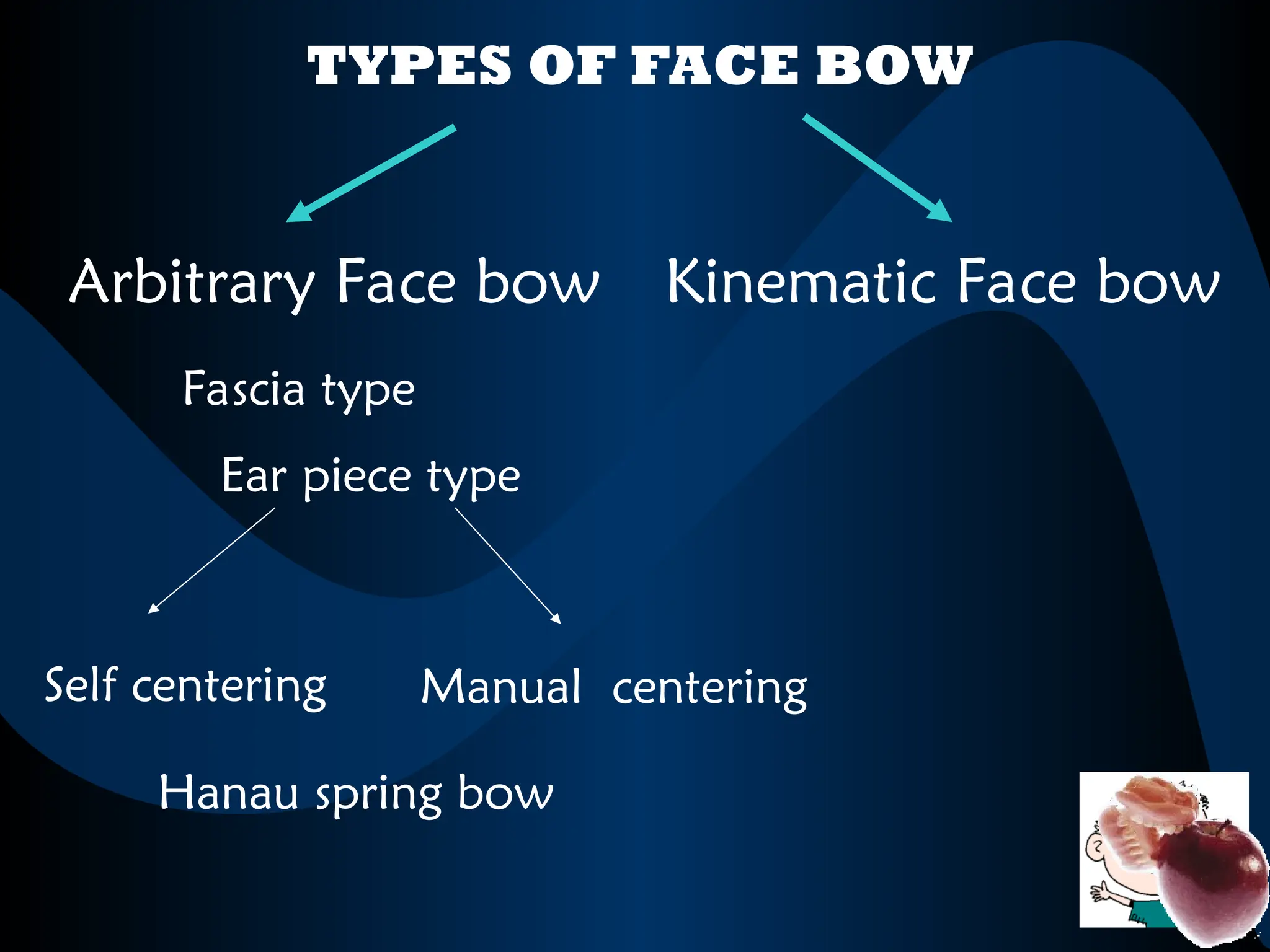
TYPES OF FACE BOW
Arbitrary Face bow
Fascia type
Ear piece type
Self centering Manual centering
Kinematic Face bow
Hanau spring bow
Once the maxilla is oriented to the
opening axis on the face , the entire
assembly is attached to the articulator
to transfer the maxillary cast on the
articulator in the same relationship to
the opening axis of the articulator
Quite some stressssssss !!!
That too just to attach a simple maxillary cast ???
VERTICAL JAW
RELATION
Vertical Jaw Relations/Dimensions are
expressed in terms of amount of
separation of maxillae and mandible
under specified conditions ,as viewed in
the frontal plane
Vertical Jaw Relations/Dimensions can
be classified into 2 types
Vertical
Dimension of
Rest
Vertical
Dimension of
Occlusion
Occlusion
Vertical Dimension of Occlusion (VDO)
When the natural teeth are present and in
occlusion ,the VDO is maintained or
established by them
When the natural teeth are lost & the patient
wears dentures, the VDO is established by
the two dentures when the teeth are in
contact
“The amount of separation of the jaws
when the teeth are in occlusion”
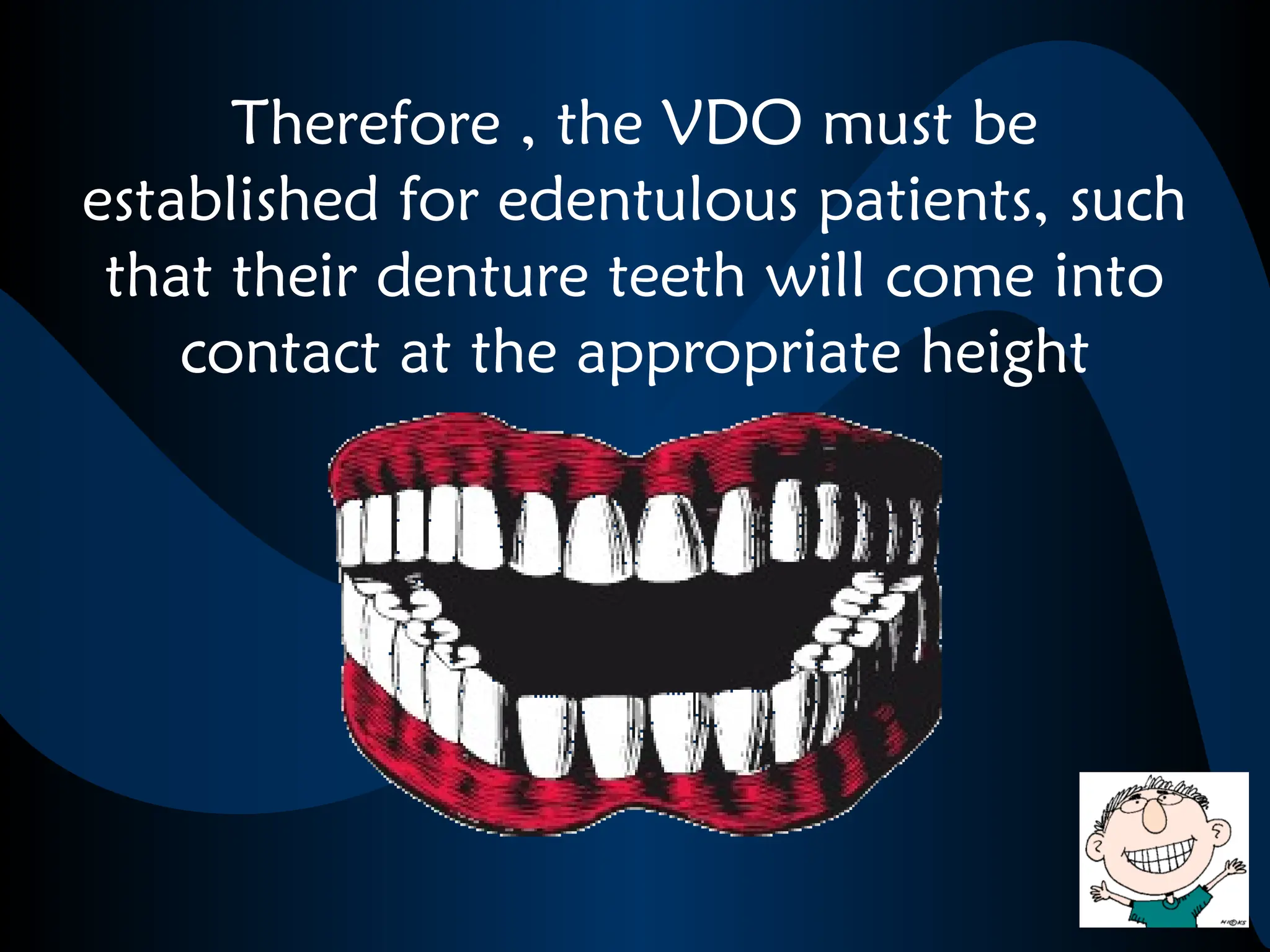
Therefore , the VDO must be
established for edentulous patients, such
that their denture teeth will come into
contact at the appropriate height
Vertical Dimension of Rest (VDR)
“The amount of separation of the jaws
when the mandible is in a
Physiologic Rest Position”
It is the position where the muscles that close
the jaws and those that open the jaws are in a
state of minimal contraction [function], just
enough to maintain the posture of mandible
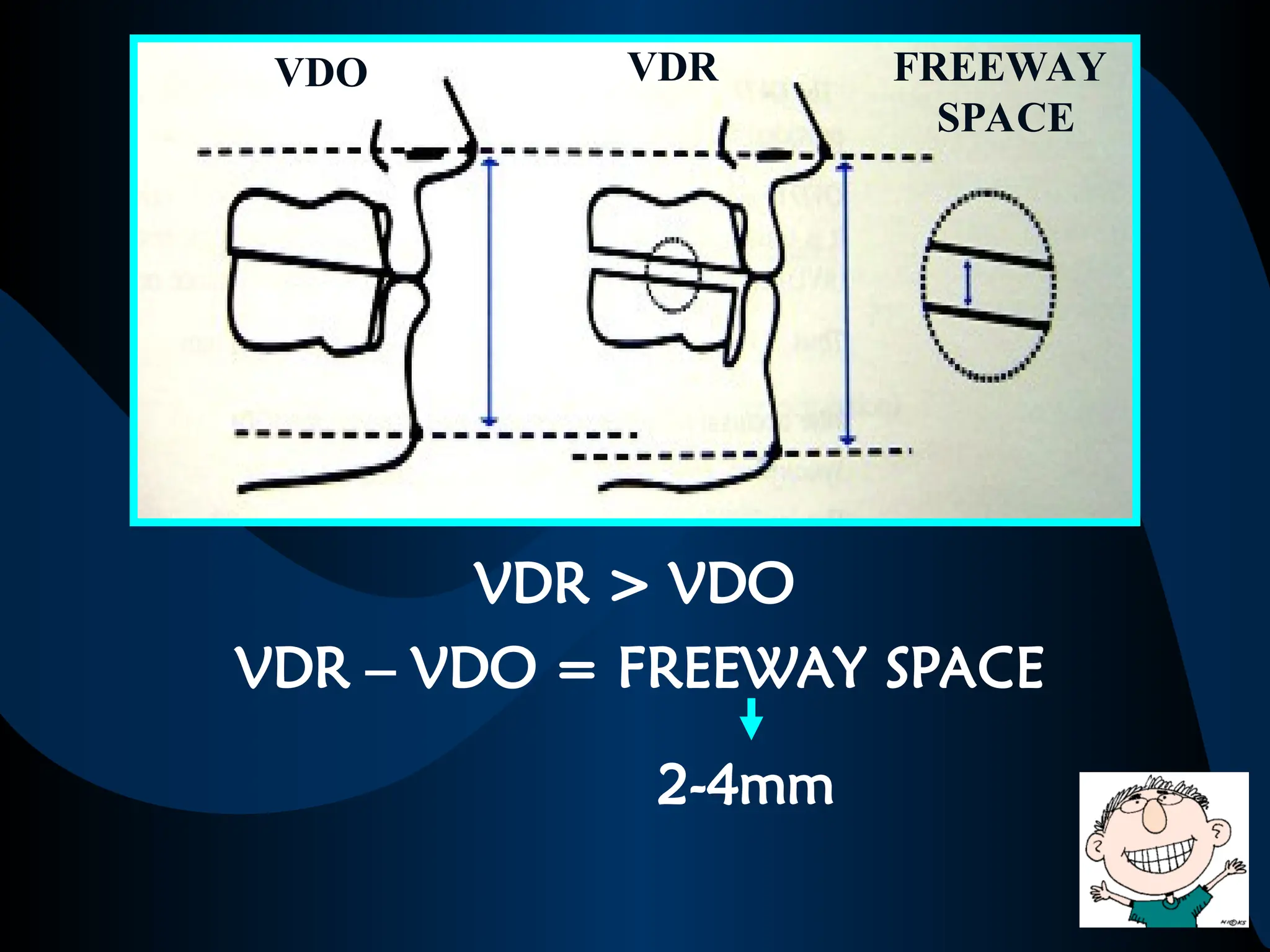
VDR > VDO
VDR – VDO = FREEWAY SPACE
VDO VDR FREEWAY
SPACE
2-4mm
IMPORTANCE OF FREEWAY SPACE
•Assessing the vertical dimension of
occlusion of dentures
If the freeway space is < 2mm , it indicates
that the VDO is increased
If the freeway space is > 4mm , it indicates
that the VDO is decreased
•Relaxation of masticatory apparatus
and denture bearing areas
At rest position , when the teeth are not in
contact & freeway space is adequate, there is
no strain on the TMJ and minimal activity of
elevator and depressor muscles of the mandible
Allows for relaxation of the muscles and TMJs
and avoids fatigue
At the same time , if the dentures have no /
inadequate freeway space , the denture bearing tissues
are continuously and excessively loaded
Resorption of bone is aggravated
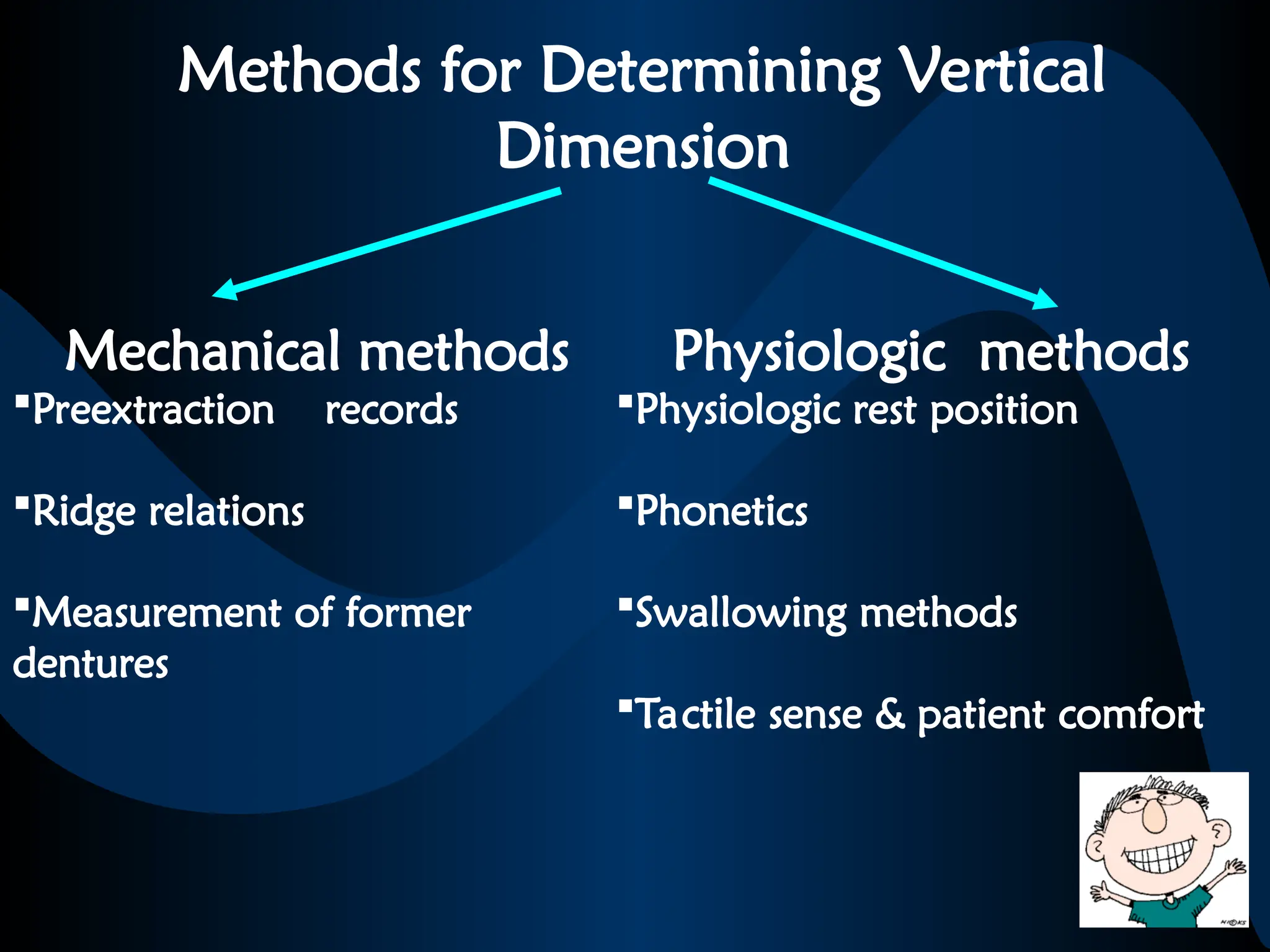
Methods for Determining Vertical
Dimension
Mechanical methods
Preextraction records
Ridge relations
Measurement of former
dentures
Physiologic methods
Physiologic rest position
Phonetics
Swallowing methods
Tactile sense & patient comfort
MECHANICAL METHODS
PRE-EXTRACTION METHODS
Profile radiographs
Can be used to assess the vertical dimension of
occlusion before extraction
The vertical dimension existing before the
removal of teeth can be used as a guide
establishing vertical dimension of the dentures
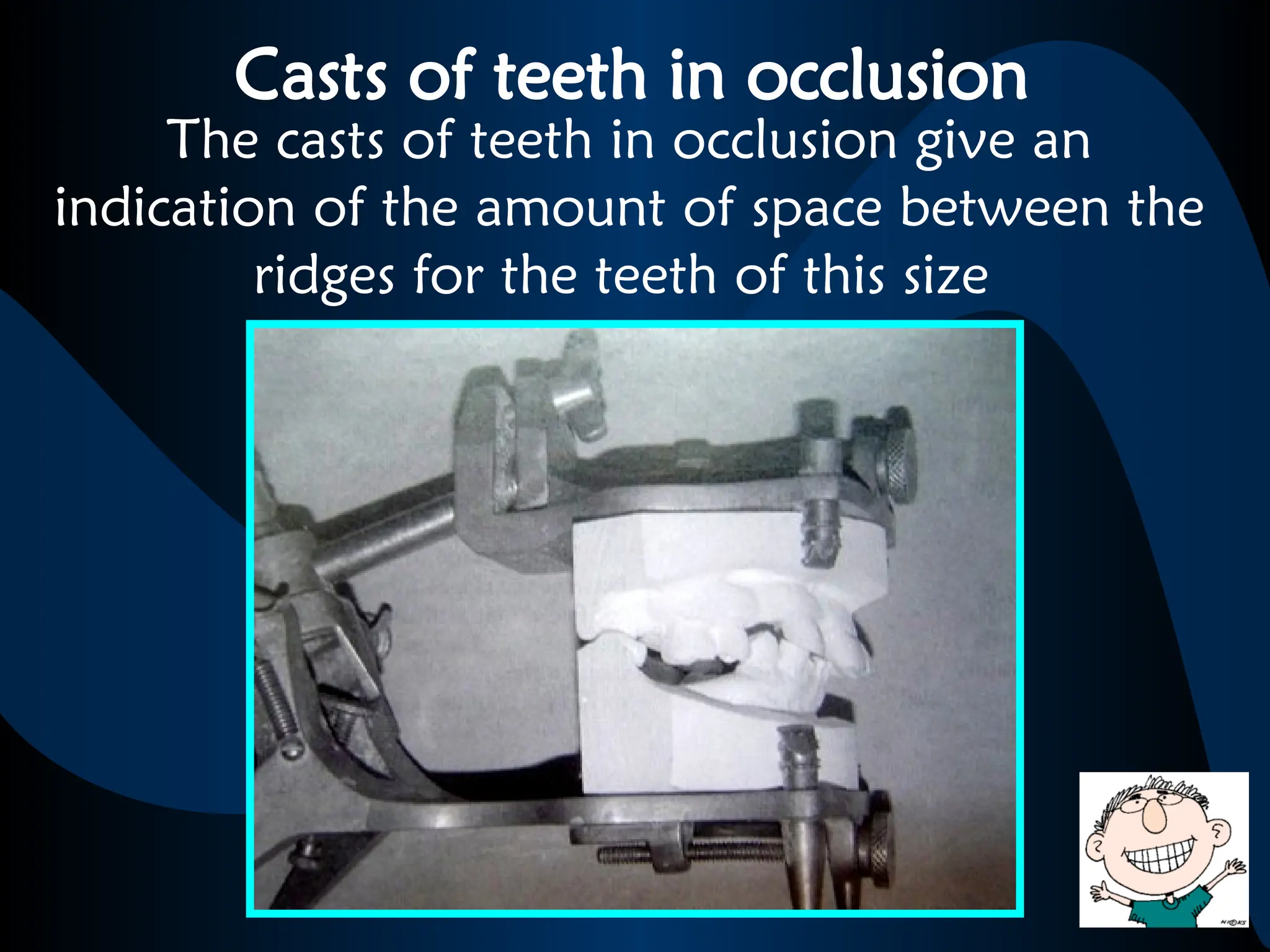
Casts of teeth in occlusion
The casts of teeth in occlusion give an
indication of the amount of space between the
ridges for the teeth of this size
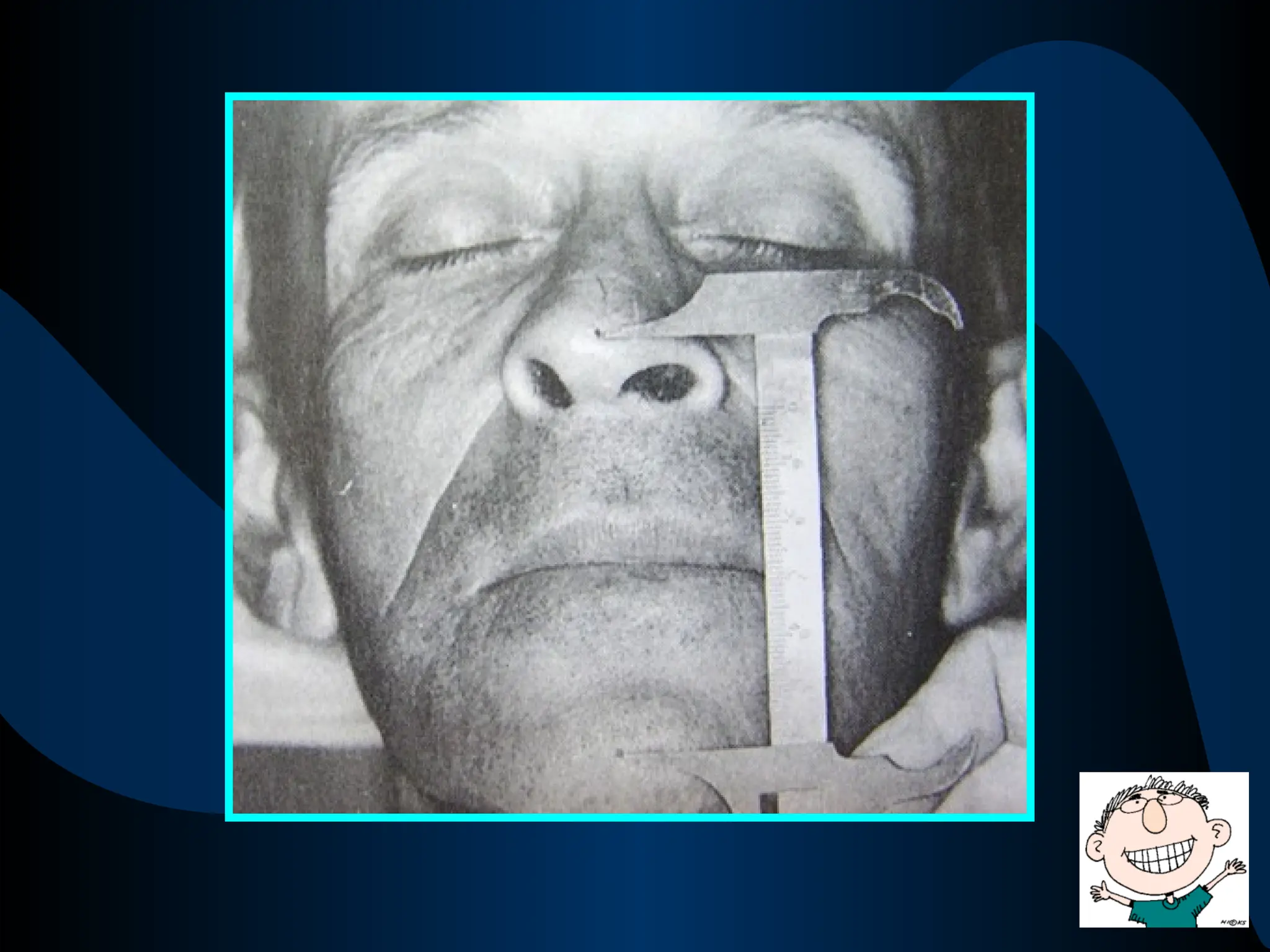
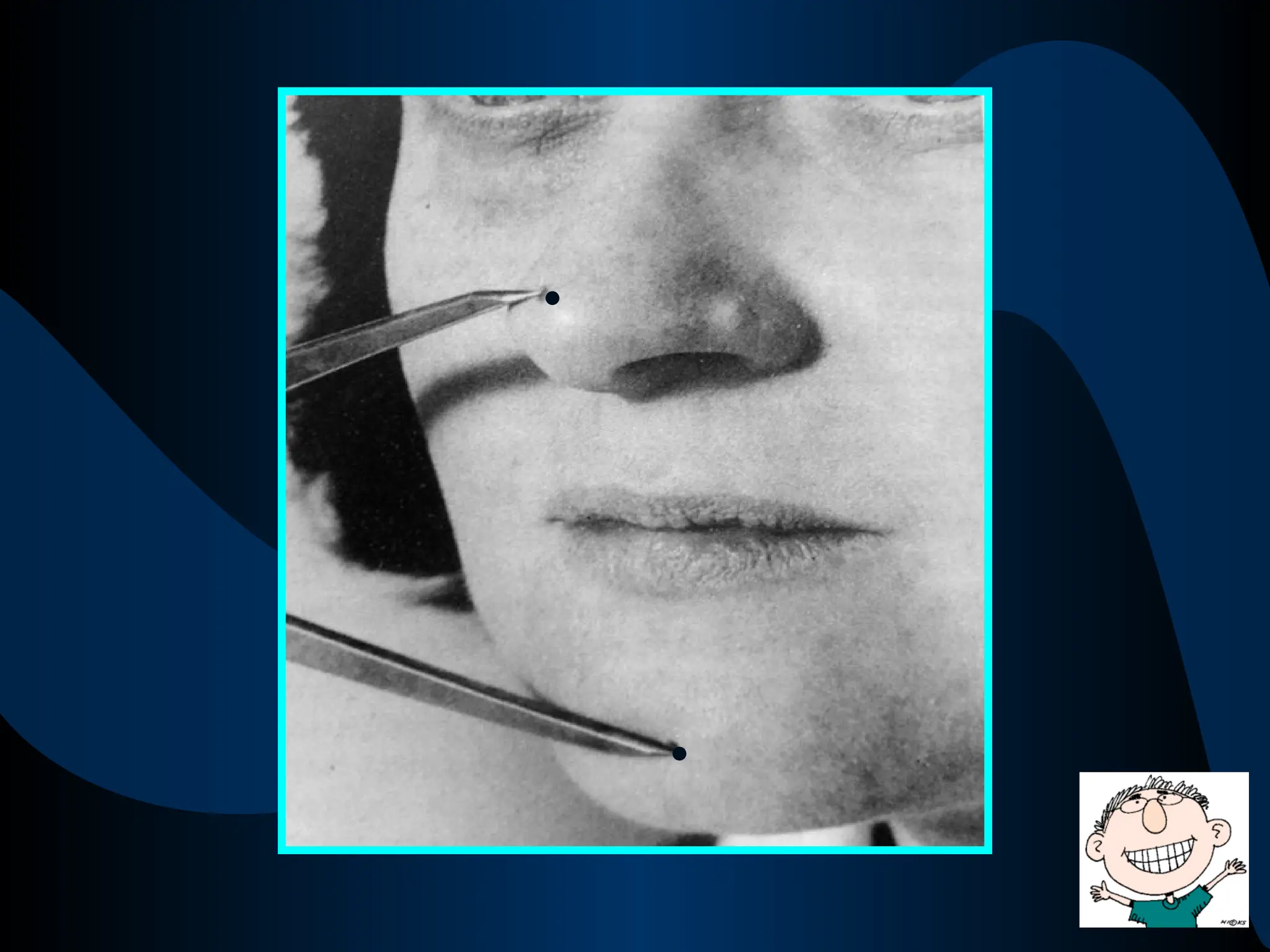
Facial measurements
Devices like calipers or pair of dividers can be
used to make measurements in the middle &
lower 3rd
of the face e.g., from the base of the
nose to the base of the chin , before the
extraction of the teeth
These measurements can be used to establish
the same dimensions during denture fabrication
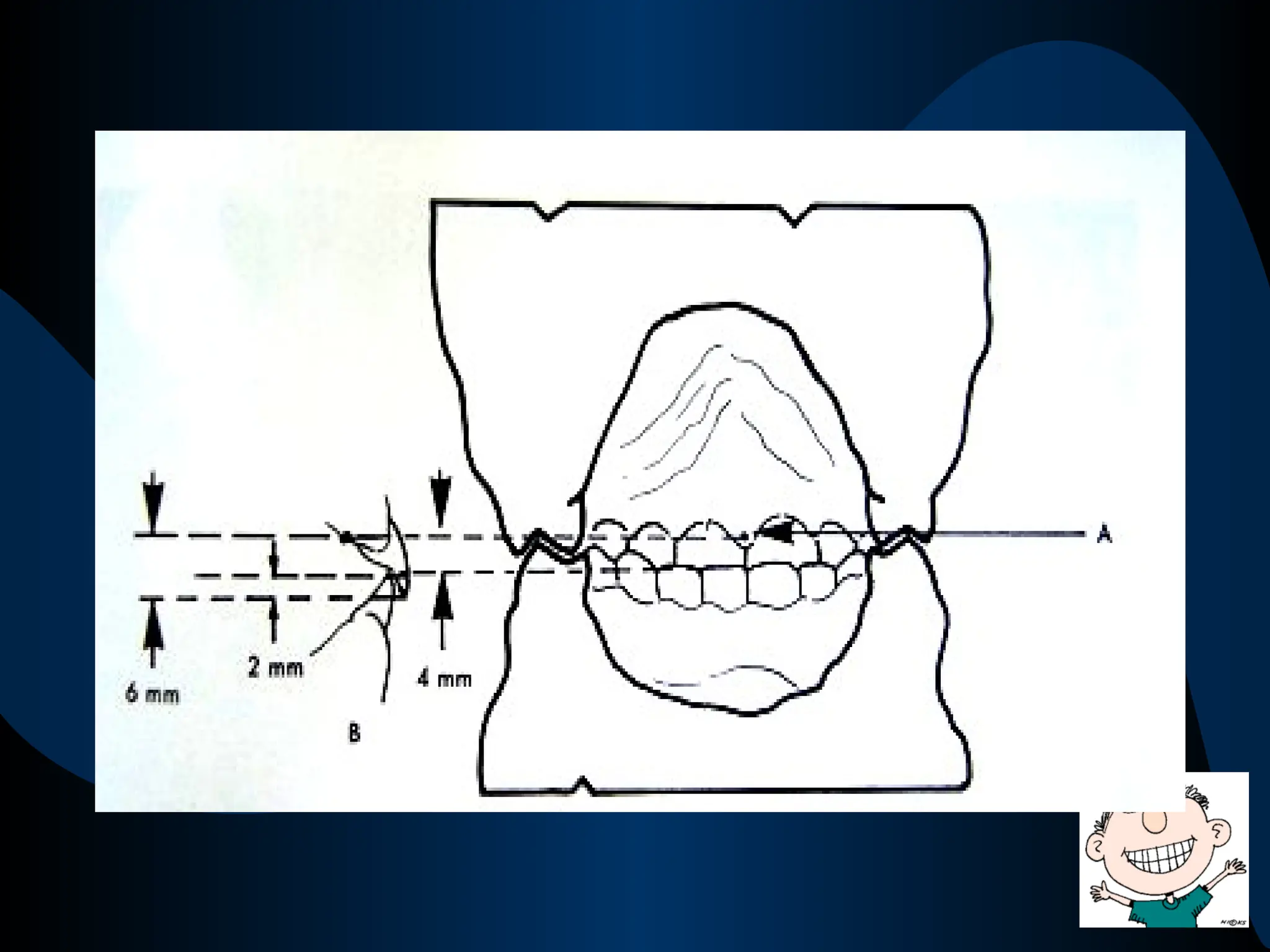
RIDGE RELATIONS
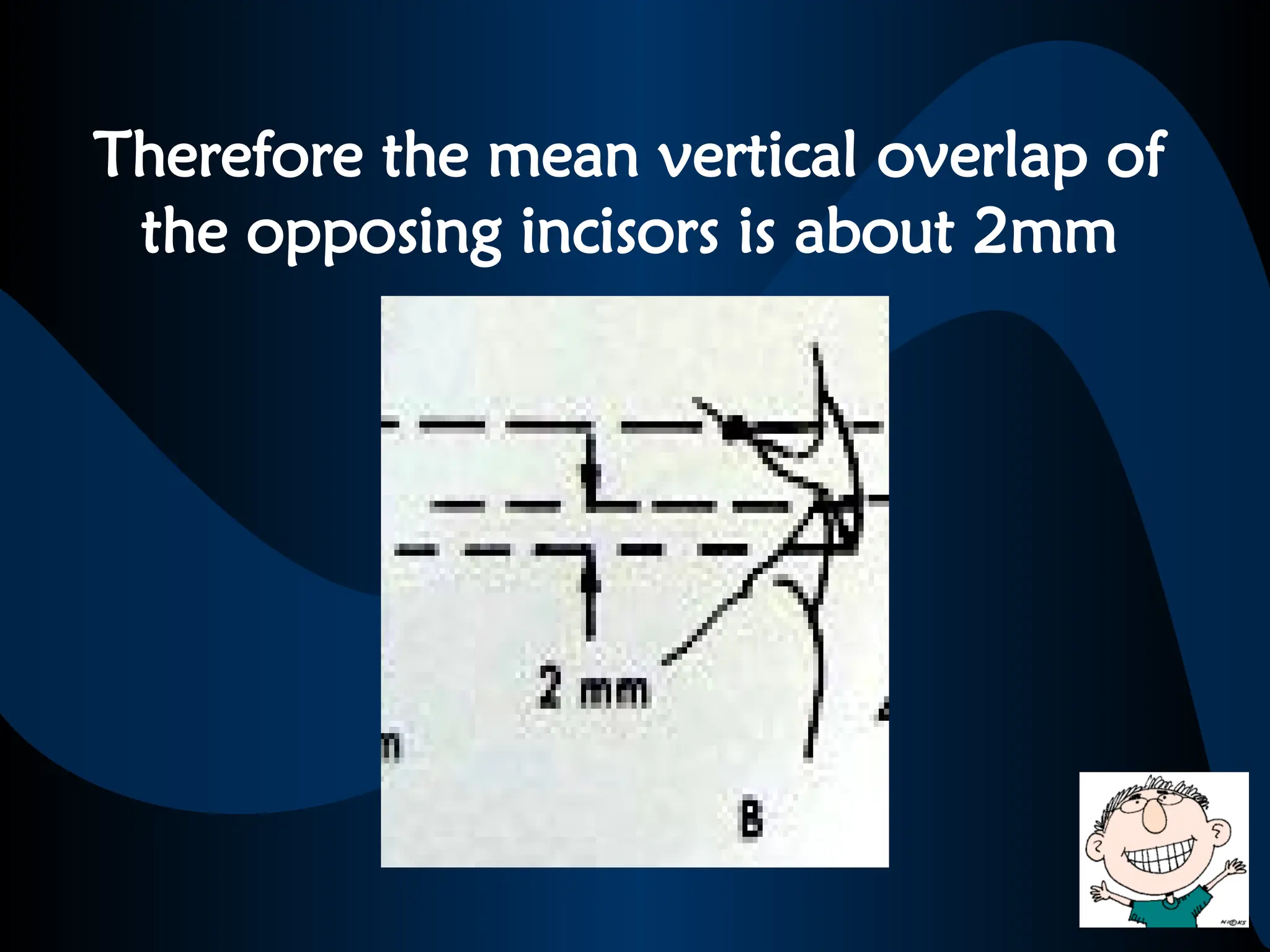
Incisive papilla to mandibular incisors
The distance of papilla from the incisal
edges of the mandibular incisors averages
approximately 4mm in natural dentition
The distance of papilla from the incisal
edges of the maxillary incisors averages
approximately 6mm in natural dentition
Therefore the mean vertical overlap of
the opposing incisors is about 2mm
Parallelism of Ridges
Parallelism of the maxillary & mandibular
ridges , plus a 5-degree opening in the
posterior region, often gives a clue as to
the appropriate amount of jaw separation
Parallelism of the maxillary & mandibular
ridges is natural
Parallelism of the maxillary & mandibular
ridges is favorable from a mechanical
point of view to prevent any
anteroposterior sliding of dentures during
function
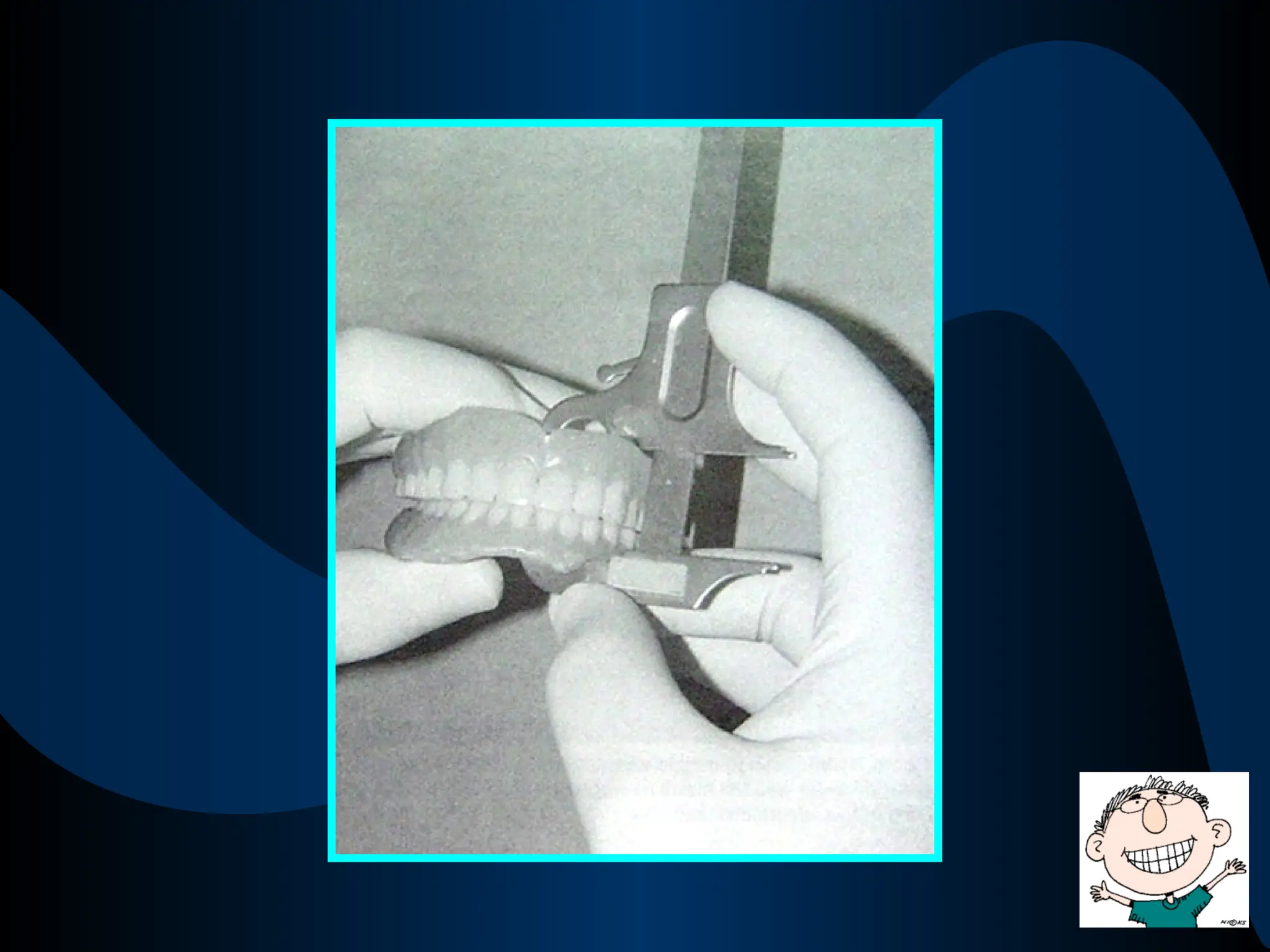
Measurement of former dentures
Measurements can be made between the ridge
crests of the maxillary and mandibular dentures
with a Boley gauge
If the observations on the patients face indicate
that this distance is too short or too long , a
corresponding change can be made in the new
dentures
PHYSIOLOGICAL
METHODS
PHYSIOLOGIC REST POSITION
Registration of the jaw in physiological
rest position gives an indication of the
vertical dimension of occlusion
At the physiological rest position , there
should be a freeway space of 2-4mm
between the occlusal rims
This may not be an exact guide ;
therefore has to used in concordance with
other methods
PHONETICS
Phonetic tests include listening to speech
sound production & observing the
relationships of teeth during speech
The production of ch, s, & j sounds brings
the anterior teeth close together and
almost touch each other but do not touch
If the distance between the upper & lower
incisors is too large , it indicates that the
VDO is too small
If the anterior teeth touch when these
sounds are made / click together during
speech , it indicates that the VDO is too
large
SILVERMAN’S CLOSEST SPEAKING SPACE
Similar to the technique of phonetics
where ‘S’ sounds are used to assess the
vertical dimension
Range of 2-11 mm depending on the
functional range of the patient
The Freeway Space & Closest Speaking
Space are not the same
The freeway space is an assessment of VD
at rest ; while the speaking space is an
assessment of VD during function
ESTHETICS
The vertical relation of the mandible to
the maxillae also affects esthetics.
Normally the tone of the facial skin
should be the same throughout and for
this an appropriate vertical dimension is
necessary
If the vertical dimensions of the dentures
is excessive , it will lead to stretched
appearance of the facial skin
If the vertical dimensions of the dentures
is too less , it will lead to wrinkled
appearance of the facial skin
However , this guide is a relatively
unreliable one ; therefore should be used
with caution or in combination with
other methods
Whether the face is appearing long or
otherwise is subjective
If the facial skin of the patient is already
wrinkled , one may be tempted to
increase the vertical dimension excessively
SWALLOWING THRESHOLD
The position of the mandible at the
beginning of the swallowing act has been
used as a guide establish the vertical
dimension of occlusion
When a person swallows, the teeth come
together with a very light contact at the
beginning of the swallowing
If the denture teeth fail to contact during
swallowing , the VDO is excessively
reduced
TACTILE SENSATION
The patient’s tactile sense can be used as a
guide to the determination of the VDO
The problem with this method relates to
presence of foreign objects in the palate &
the tongue space which can obscure the
patient's judgment
HORIZONTAL JAW
RELATION
Horizontal Jaw Relation is the
relationship of the maxilla to the
mandible in the horizontal plane i.e., in
the anteroposterior and lateral directions
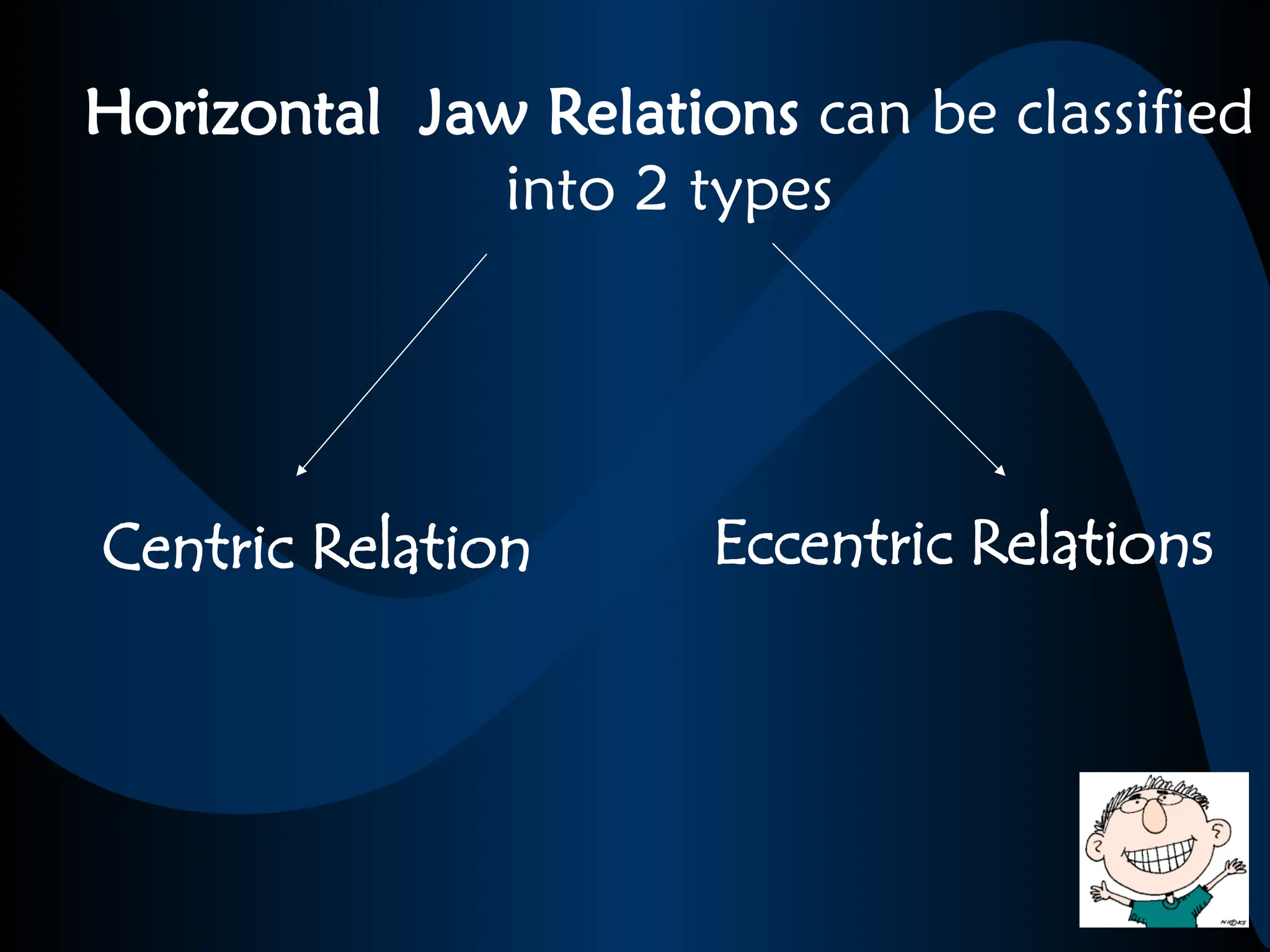
Horizontal Jaw Relations can be classified
into 2 types
Eccentric Relations
Centric Relation
CENTRIC JAW RELATION
The relationship of mandible to maxilla ,
when the mandible is in the most
posterior / retruded ,unstrained position
in relation to the maxilla, at an
established vertical dimension
WHAT DOES THIS STATEMENT
IMPLY ???
“The Maxillomandibular relationship in
which the condyles articulate with the
thinnest avascular portion of the articular
disc & the complex (of articular disc and
the head of condyle) braced
anterosuperiorly against the (posterior)
slopes of the articular eminence”
When the natural teeth are present, the
proprioceptive impulses from the teeth
guide the movement of the mandible so
the teeth can come in occlusion in a
comfortable position
When the natural teeth are absent, the
proprioceptive impulses from the the
Temporomandibular joint guide the
movement of the mandible so that the
mandible can close in a comfortable &
unstrained position
It is at this comfortable position , the
denture teeth should come in occlusion
with each otherc
The comfortable position is the Centric
Relation Position
The occlusion of the denture teeth in this
comfortable position is the Occlusion at
Centric Relation Position / Centric
Occlusion
SIGNIFICANCE OF CENTRIC RELATION
POSITION
•The recording of the Centric relation
position is the starting point for
developing occlusion in the complete
dentures
•It is a bone to bone relation
•It is a hinge position
•It is an ideal arch to arch relation and an
optimum functional position of the jaws
for the health, comfort & function of the
TMJ and musculature
•During swallowing the mandible is at
/near the centric relation position
•It is a learnable , repeatable &
reproducible position
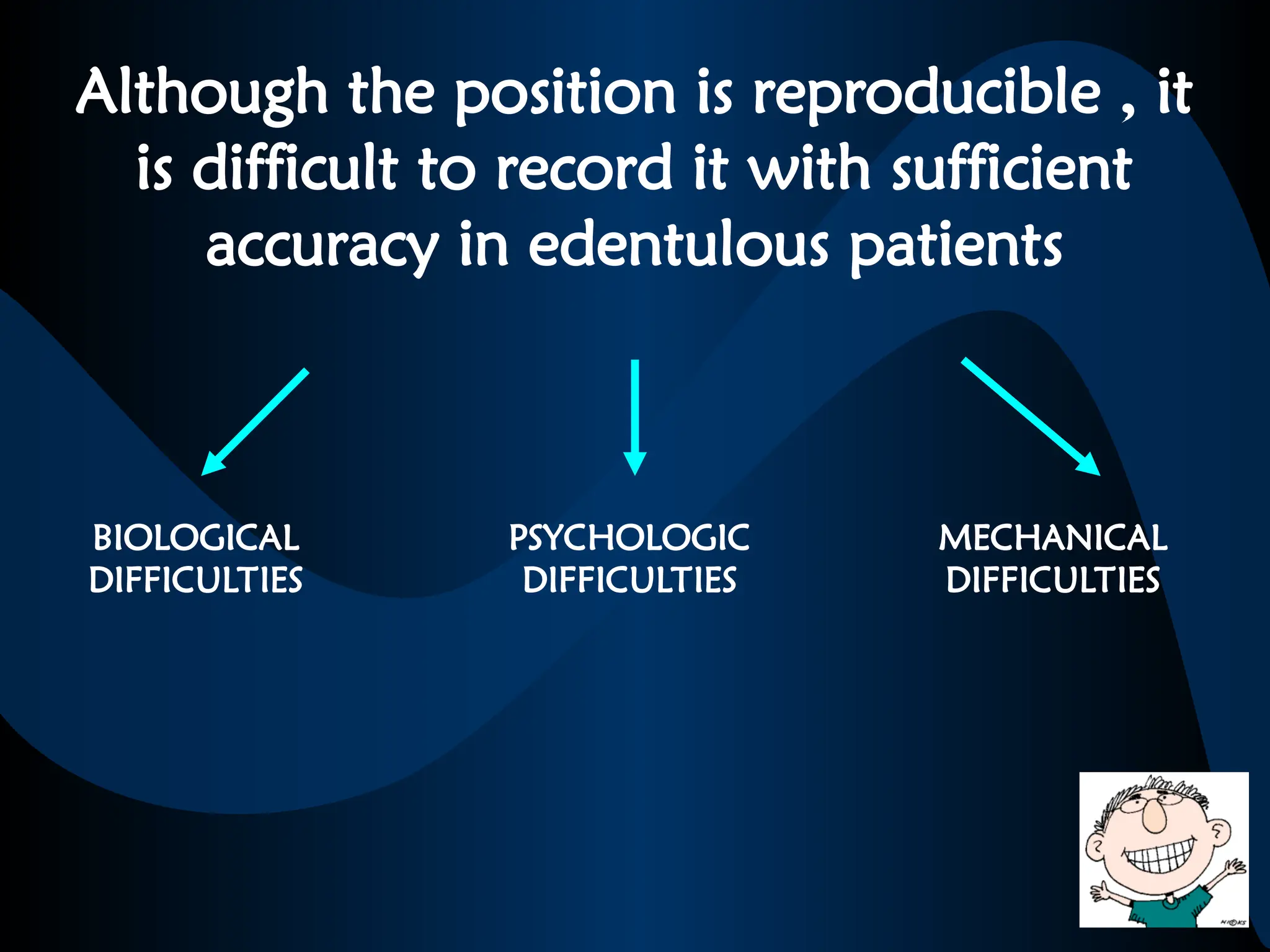
Although the position is reproducible , it
is difficult to record it with sufficient
accuracy in edentulous patients
BIOLOGICAL
DIFFICULTIES
PSYCHOLOGIC
DIFFICULTIES
MECHANICAL
DIFFICULTIES
Instructions can be given to assist patient
to retrude the mandible
“Let your jaw relax , pull it back ,and close
slowly and easily on your back teeth”
“Get the feeling of pushing your upper jaw
out & closing your back teeth together”
Instruct the patient turn the tongue
backwards towards the posterior part of the
hard palate
Instruct the patient to protrude & retrude the
mandible repeatedly while holding his or her
fingers lightly against the chin
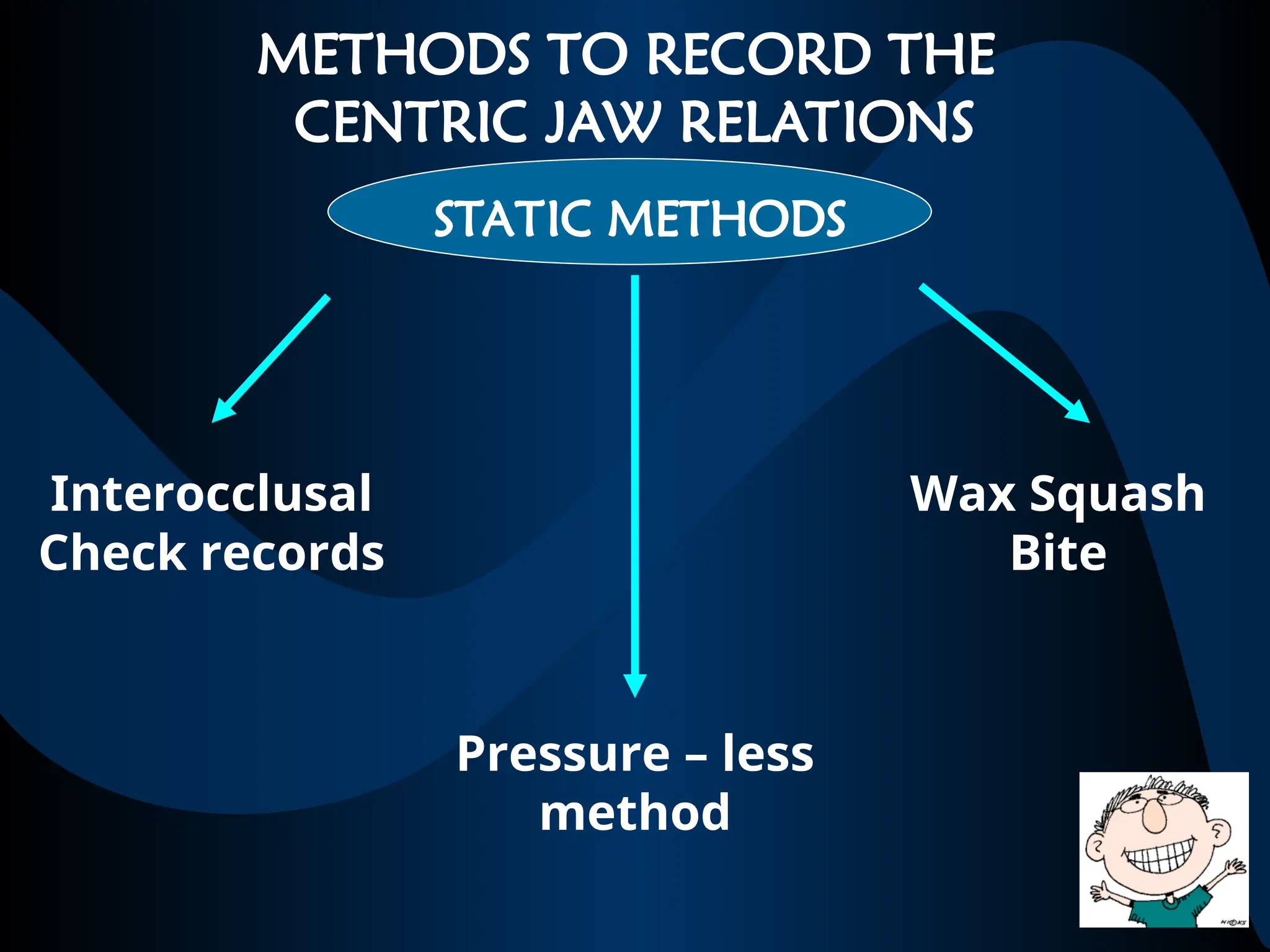
METHODS TO RECORD THE
CENTRIC JAW RELATIONS
Interocclusal
Check records
Wax Squash
Bite
Pressure – less
method
STATIC METHODS
Can be made at the stage of Try- in of the
waxed up trial dentures after the arrangement
of teeth
INTEROCCLUSAL CHECK RECORDS
A softened sheet of Aluwax is placed between
the upper & lower teeth on the trial dentures
The patient is guided into centric relation
position
The patient is then asked to close in that
position without contacting the teeth
WAX SQUASH BITE
Involves placement of a horse-shoe shaped
roll of softened wax between maxillary &
mandibular rims and having the patient close
the jaws in centric relation
PRESSURE - LESS METHOD
The occlusal rims are adjusted to establish the
correct vertical dimension
The patient is trained to close in centric
relation position
The wax can then be sealed in centric relation
position using Nick & Notch method / Staple
pins
These methods use functional movements of
the jaw to record the centric relation
The patient is asked to perform lateral and
protrusive movements in order to identify the
centric relation position of the mandible
NEEDLE HOUSE
TECHNIQUE
PATTERSON’S
TECHNIQUE
FUNCTIONAL METHODS
These methods are called so because they
use graphs / tracings to record various jaw
movements & centric jaw relation position
Done with the help of tracing apparatus
2 types of tracings
ARROW POINT TRACING PANTOGRAPHIC TRACING
One dimensional tracing Three dimensional tracing
GRAPHIC METHODS
RADIOGRAPHIC METHODS
Lateral cephalometric radiograph can be used
to record the centric relation position by
studying the position of the condyles in relation
to the articular eminence
ECCENTRIC JAW RELATION
Any relationship of the mandible to the
maxilla other than centric relation
It includes the recording of protrusive
and lateral movements of the mandible
The basic purpose is to be able to
reproduce these movements on the
articulator
TECHNIQUE FOR
RECORDING JAW
RELATIONS
PATIENT POSITION
The patient should be relaxed, with the trunk
upright ,and head unsupported
ADJUSTMENT OF OCCLUSAL PLANE & VERTICAL
HEIGHT OF THE MAXLLARY RIM
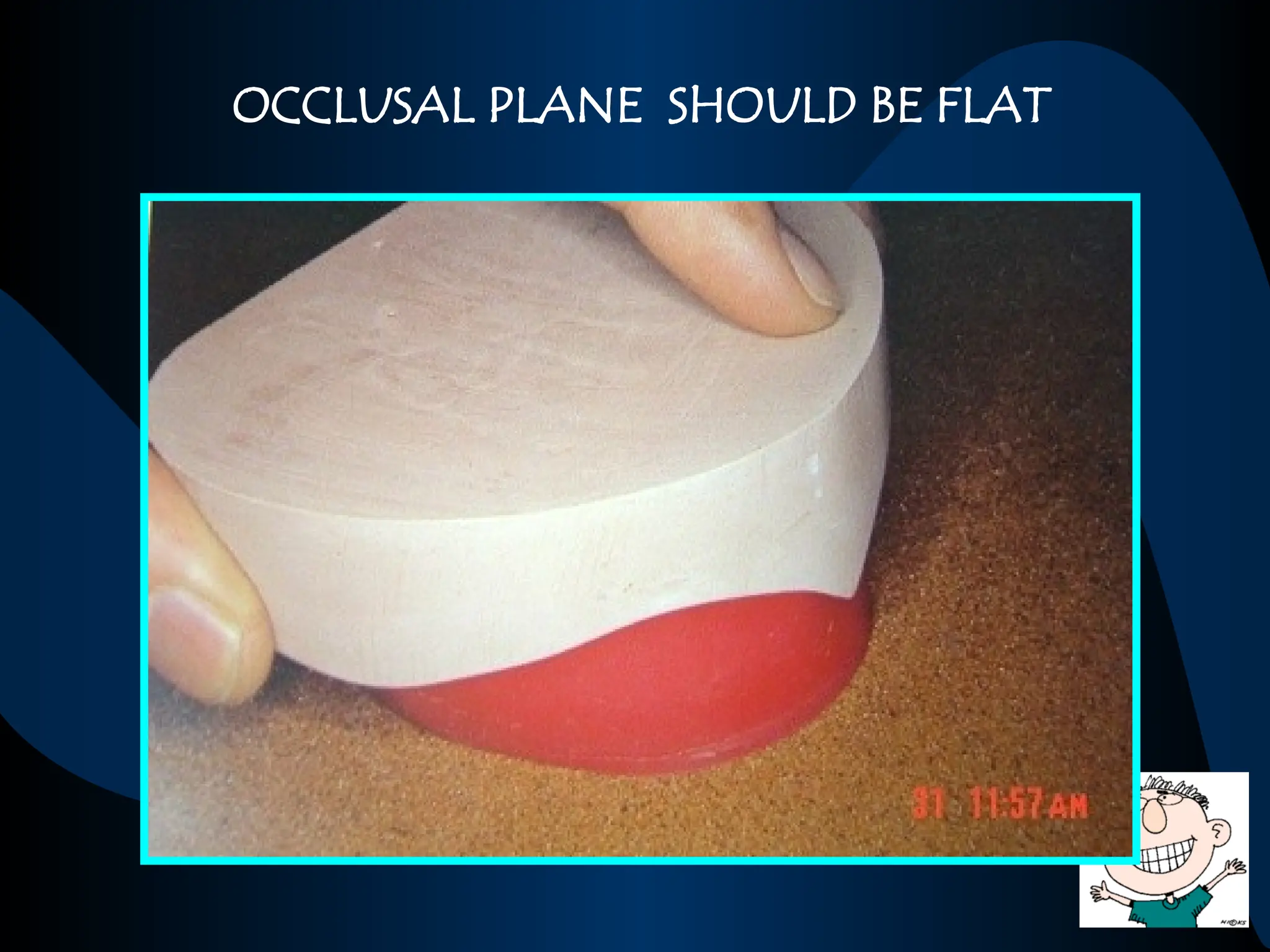
OCCLUSAL PLANE SHOULD BE FLAT
THE OCCLUSAL PLANE OF MAXILLARY RIM IS
EVALUATED USING FOX’S PLANE
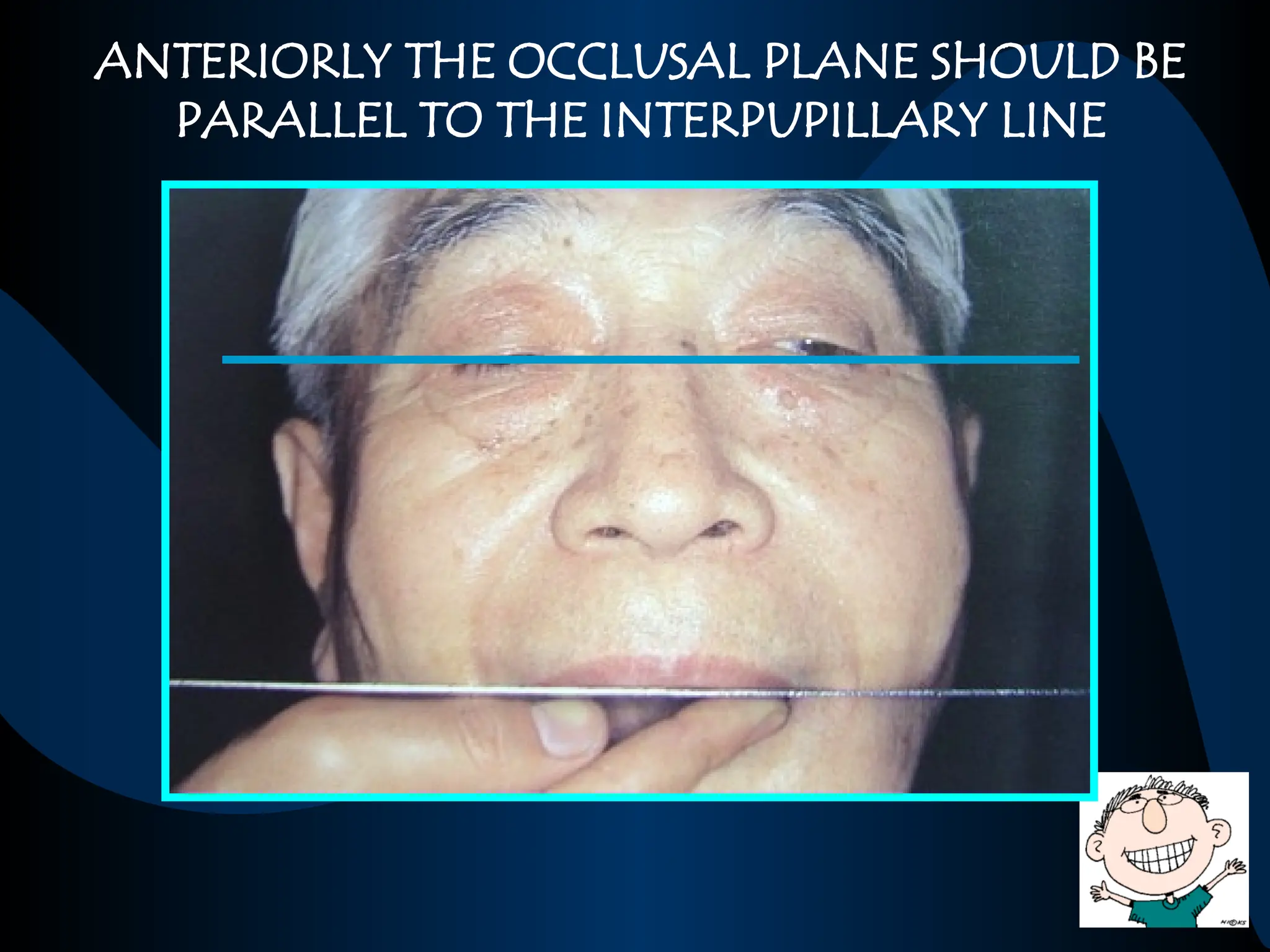
ANTERIORLY THE OCCLUSAL PLANE SHOULD BE
PARALLEL TO THE INTERPUPILLARY LINE
POSTERIORLY THE OCCLUSAL PLANE IS MADE
PARALLEL TO THE ALA-TRAGUS LINE
ALA-TRAGUS LINE
A line drawn from the superior portion of
the tragus to the inferior border of the ala
Also referred to as the ‘CAMPER’S PLANE’
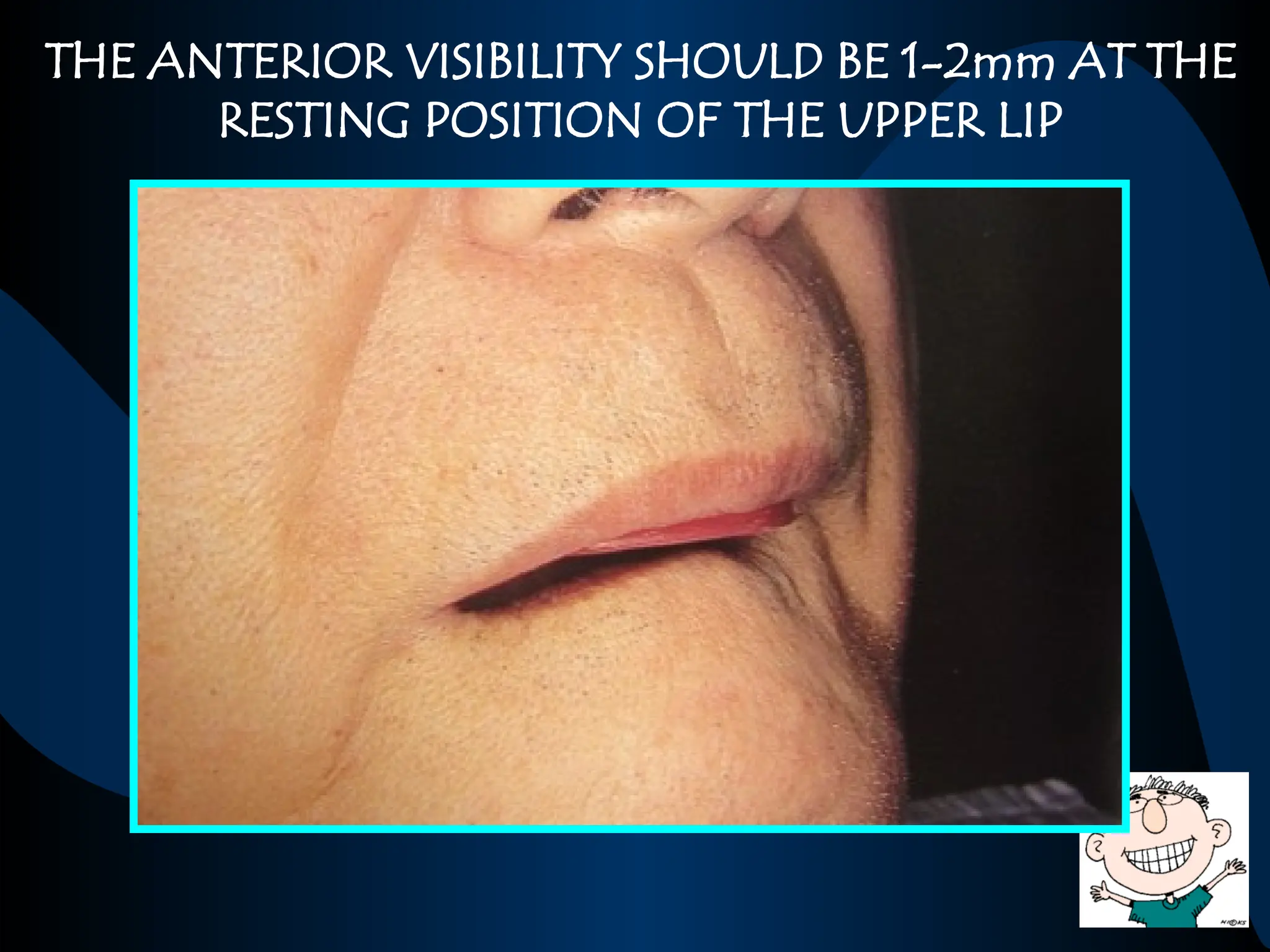
THE ANTERIOR VISIBILITY SHOULD BE 1-2mm AT THE
RESTING POSITION OF THE UPPER LIP
ADJUSTING THE VERTICAL DIMENSION
Once the occlusal plane of maxillary rim is
adjusted corrected, YOU SHOULD NOT
TOUCH THE PLANE AGAIN !!!
The vertical dimension is established by
adjusting the height of the mandibular wax
rim
FREEWAY SPACE OF 2-4 mm AT PHYSIOLOGIC
REST POSITION
The patient is asked to swallow
Relax his lips and cheeks muscles
Lightly contact the lips
The lips are then parted to evaluate the
freeway space
HOW TO CHECK FOR THE CORRECTNESS OF THE
VERTICAL DIMENSION
I.
The patient can be asked to pronounce
words with sounds of ‘M’ instead of
swallowing action and the same procedure
can be repeated
Pronunciation of sibilants (words with
sounds of ‘S’) with clarity can also be used to
evaluate the correctness of VD
II.
The distance between the most prominent
point on the nose and the most prominent
point on the chin at rest and in occlusion can
be measured and the difference can be
calculated to evaluate the freeway space
e.g., VDR - 65 mm
VDO - 62 mm
VDR – VDO = FREEWAY SPACE=3mm
III.
.
.
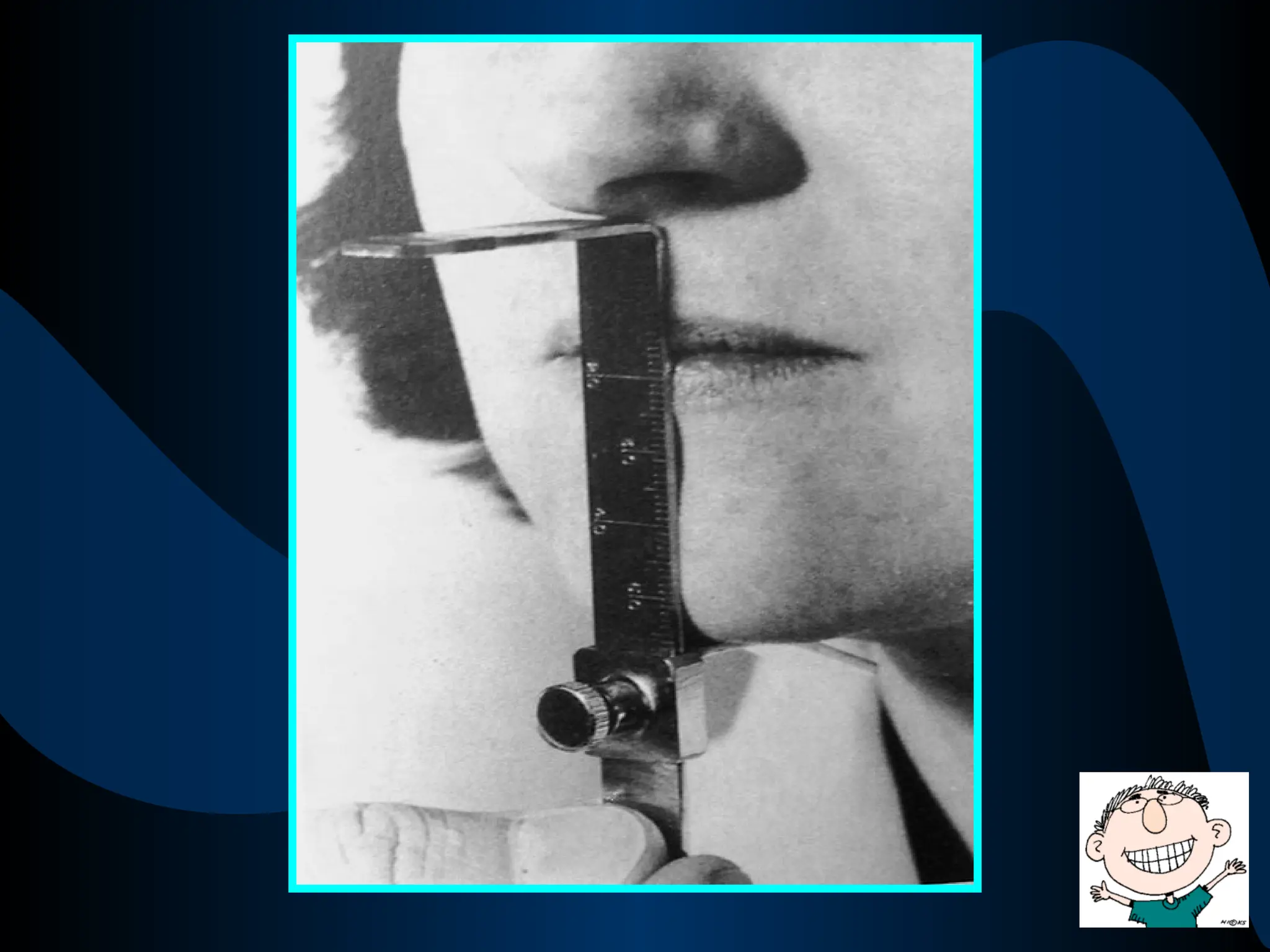
The distance between base of the nose and
the base of the chin at rest and in occlusion
can also be used
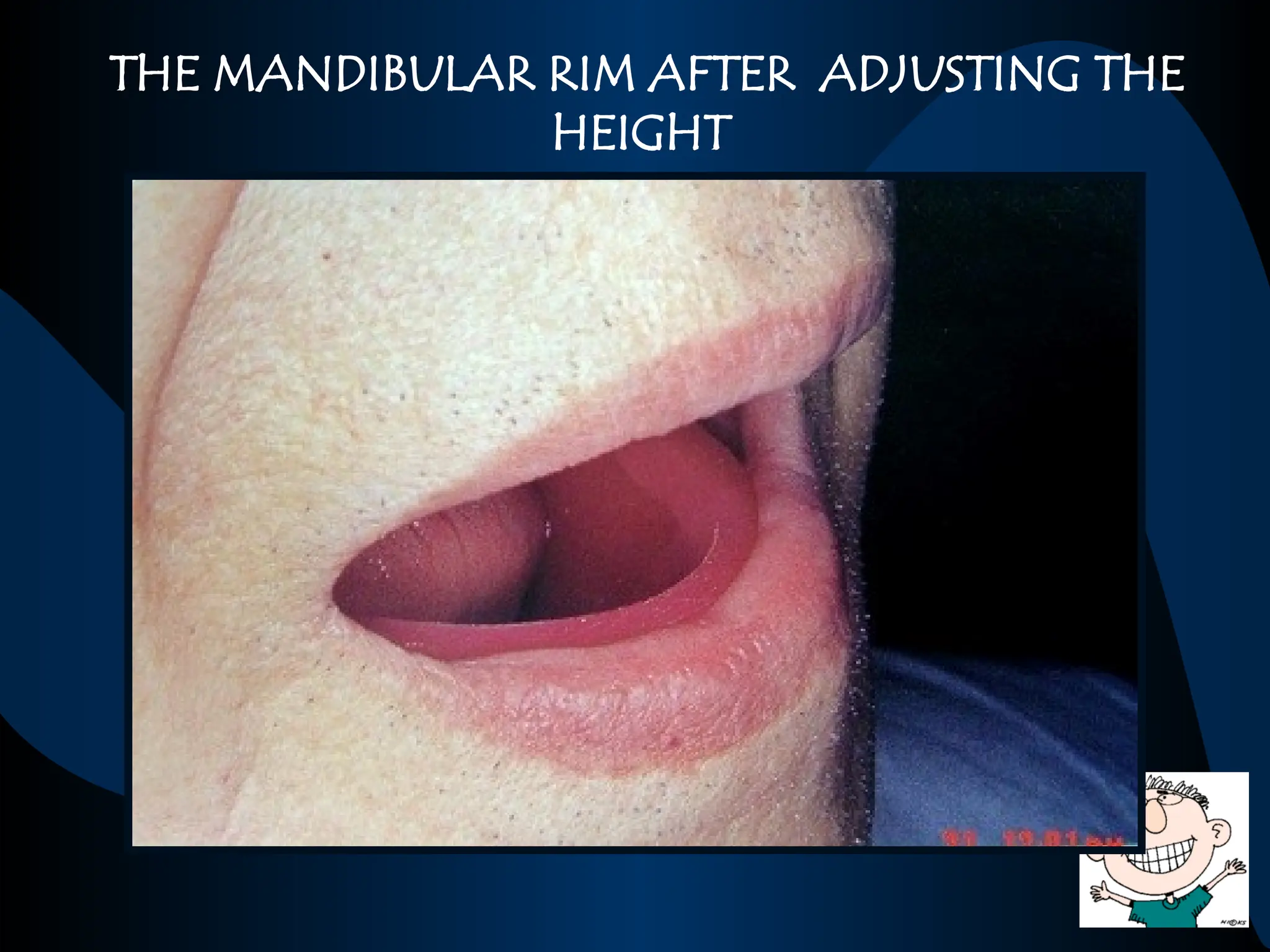
THE MANDIBULAR RIM AFTER ADJUSTING THE
HEIGHT
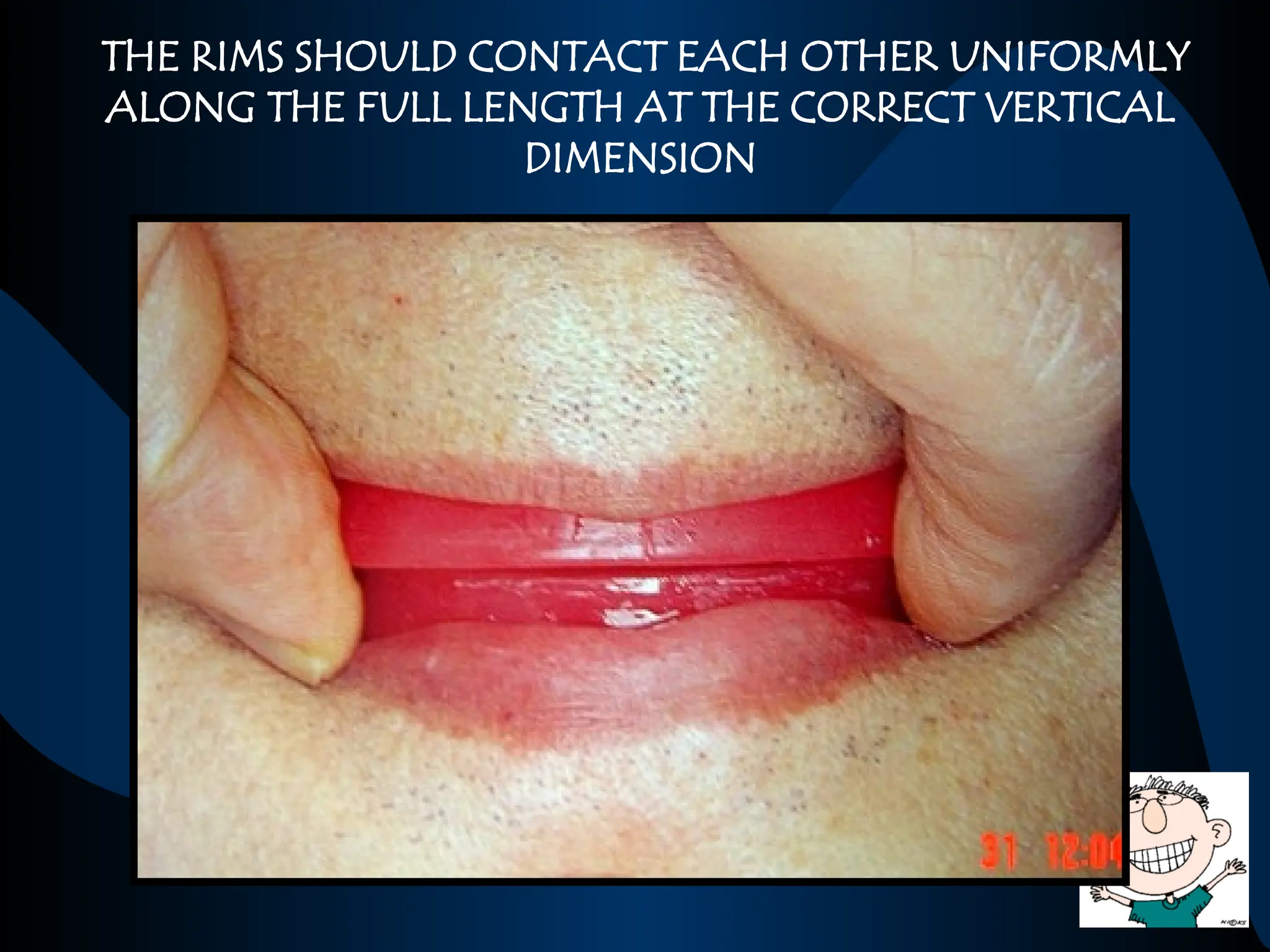
THE RIMS SHOULD CONTACT EACH OTHER UNIFORMLY
ALONG THE FULL LENGTH AT THE CORRECT VERTICAL
DIMENSION
APPEARANCE OF THE PATIENT AFTER ESTABLISHING THE
CORRECT VERTICAL DIMENSION
TRANSFERRING THE FACIAL MIDLINE ON THE MAXILLARY
RIM
MARKING THE CANINE LINES ON THE MAXILLARY RIM
RECORDING THE CENTRIC RELATION
NICK & NOTCH
TECHNIQUE
Static record
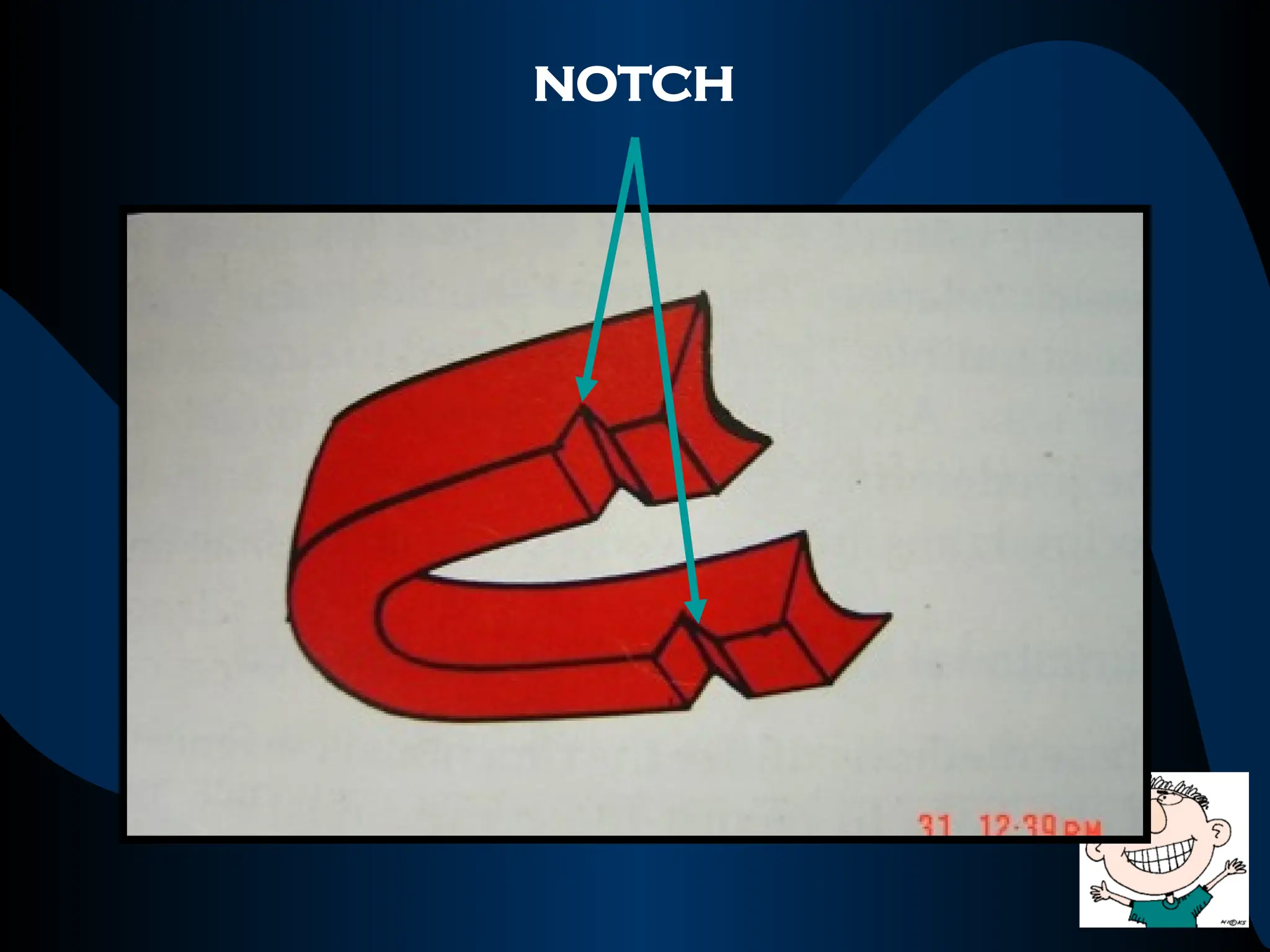
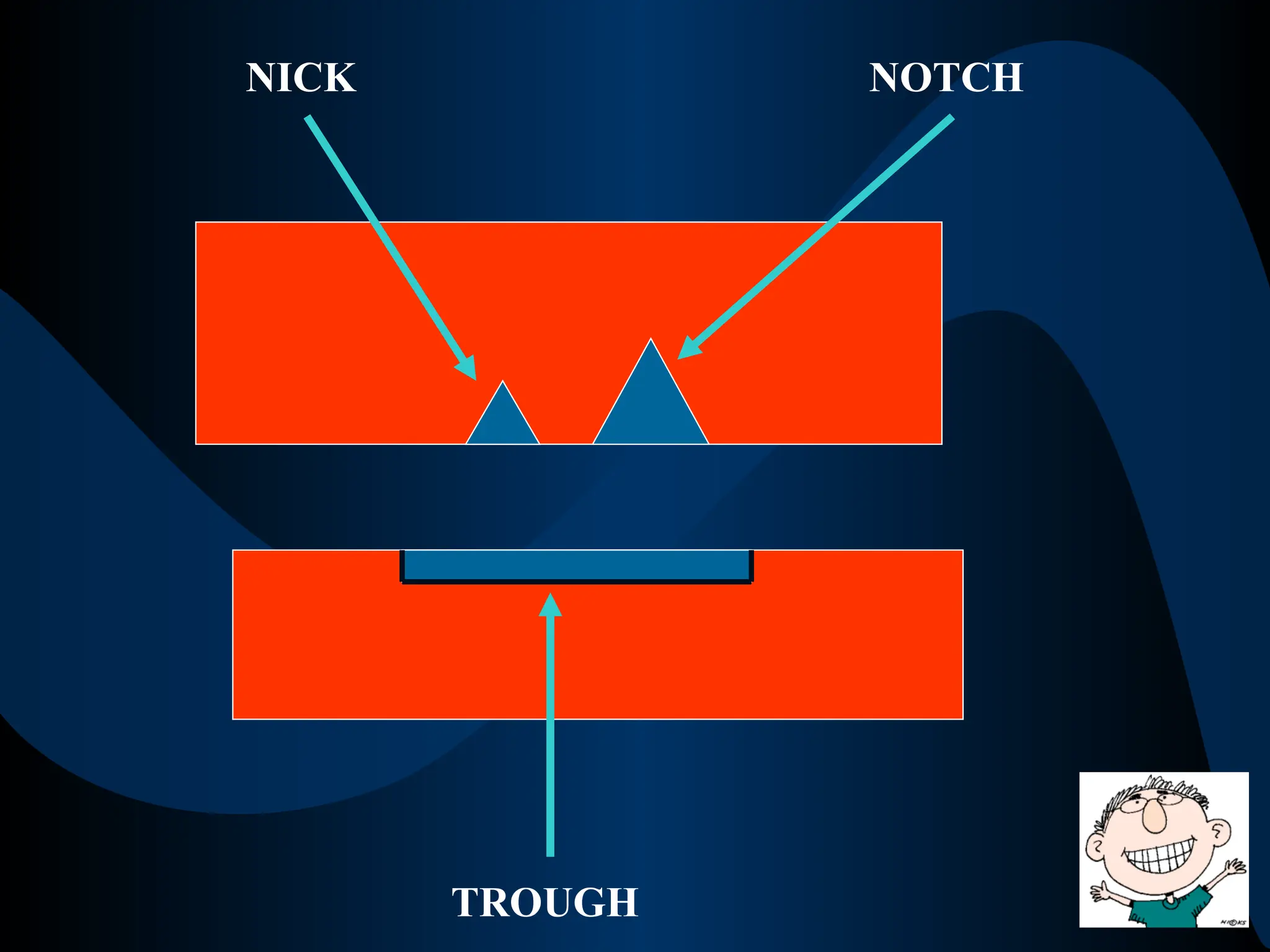
NOTCH
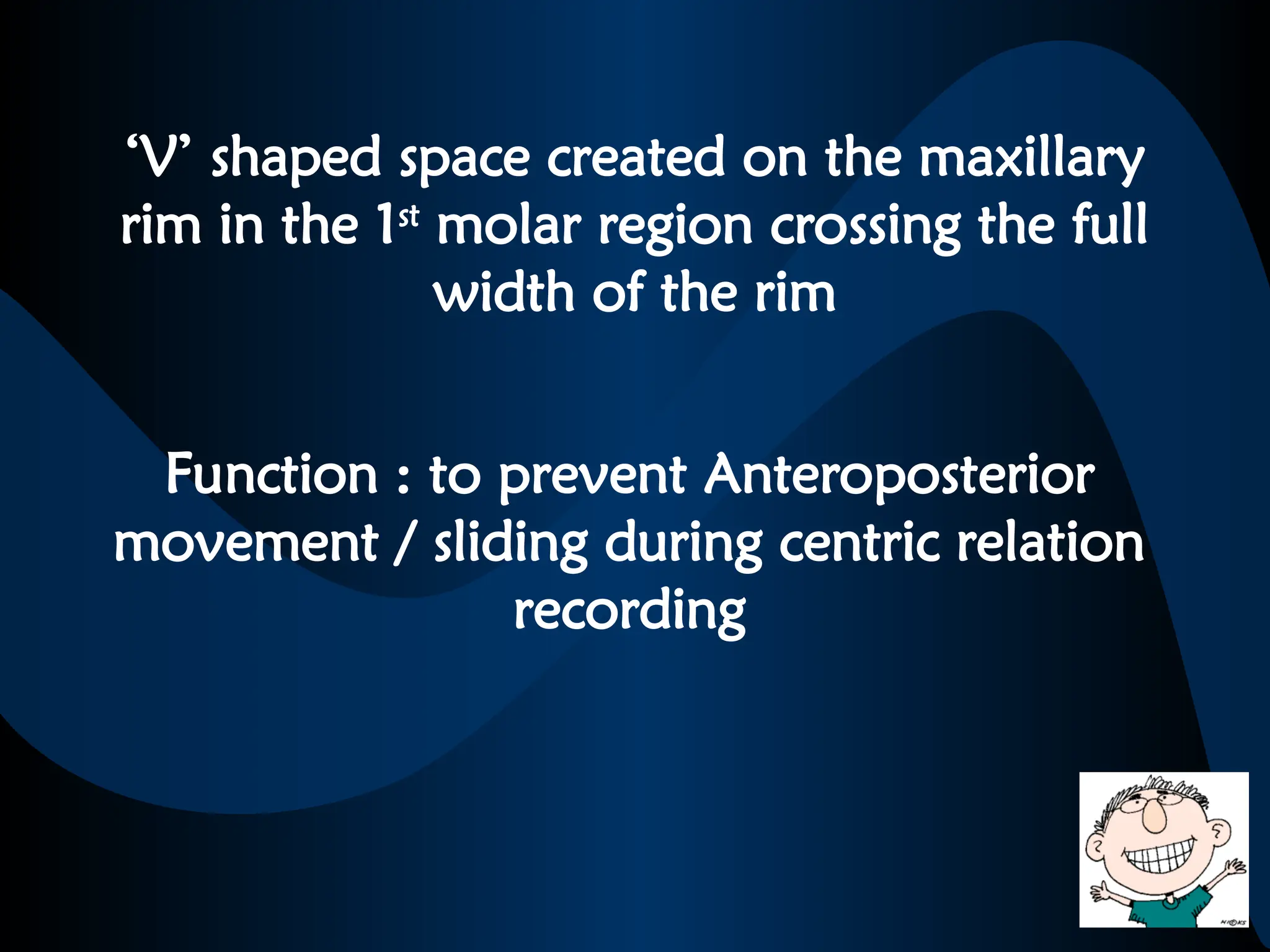
‘V’ shaped space created on the maxillary
rim in the 1st
molar region crossing the full
width of the rim
Function : to prevent Anteroposterior
movement / sliding during centric relation
recording
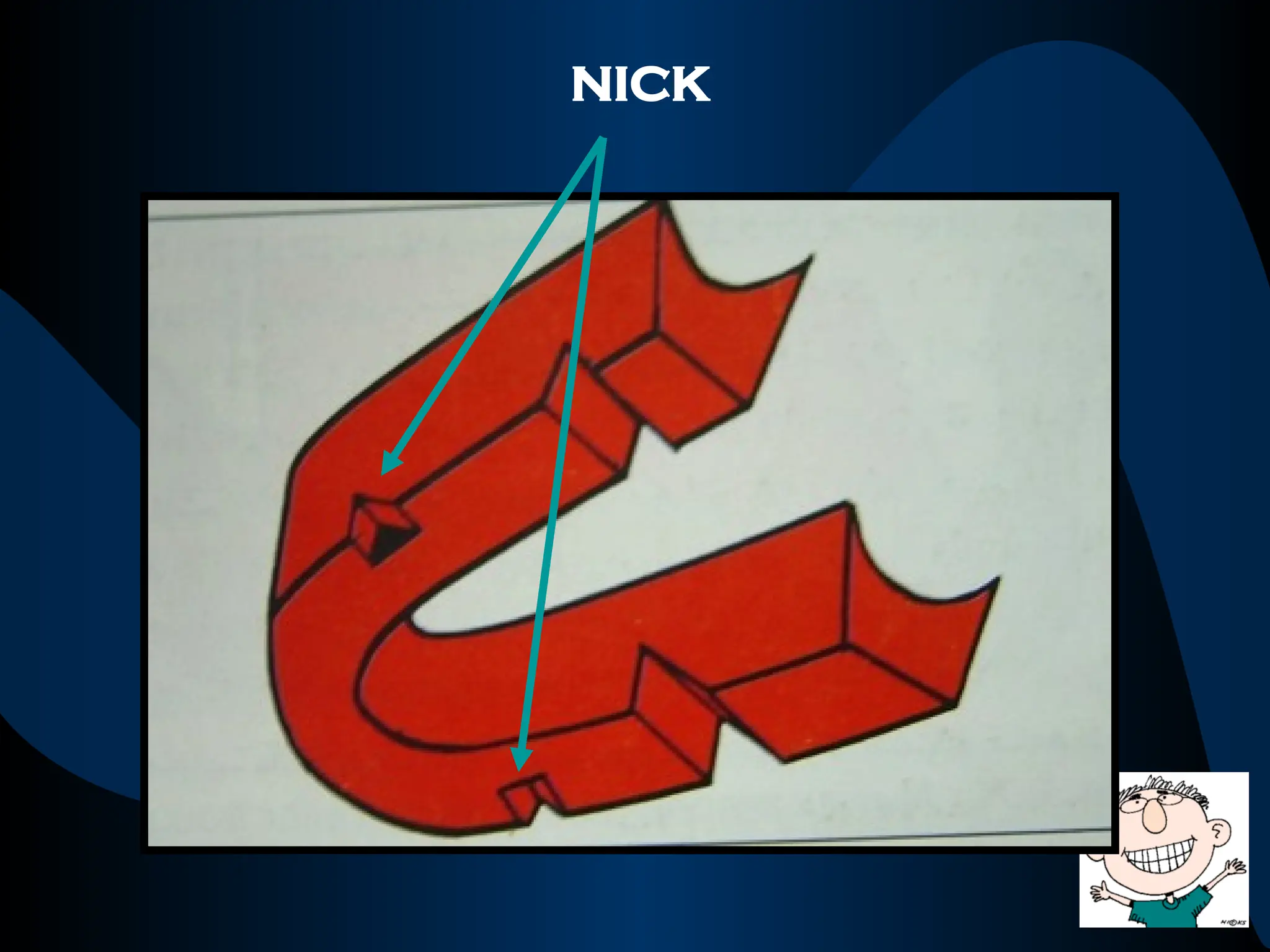
NICK
‘V’ shaped space created on the maxillary
rim in the 2nd
premolar region not crossing
the full width of the rim
FUNCTION : to prevent Lateral movement /
sliding during centric relation recording
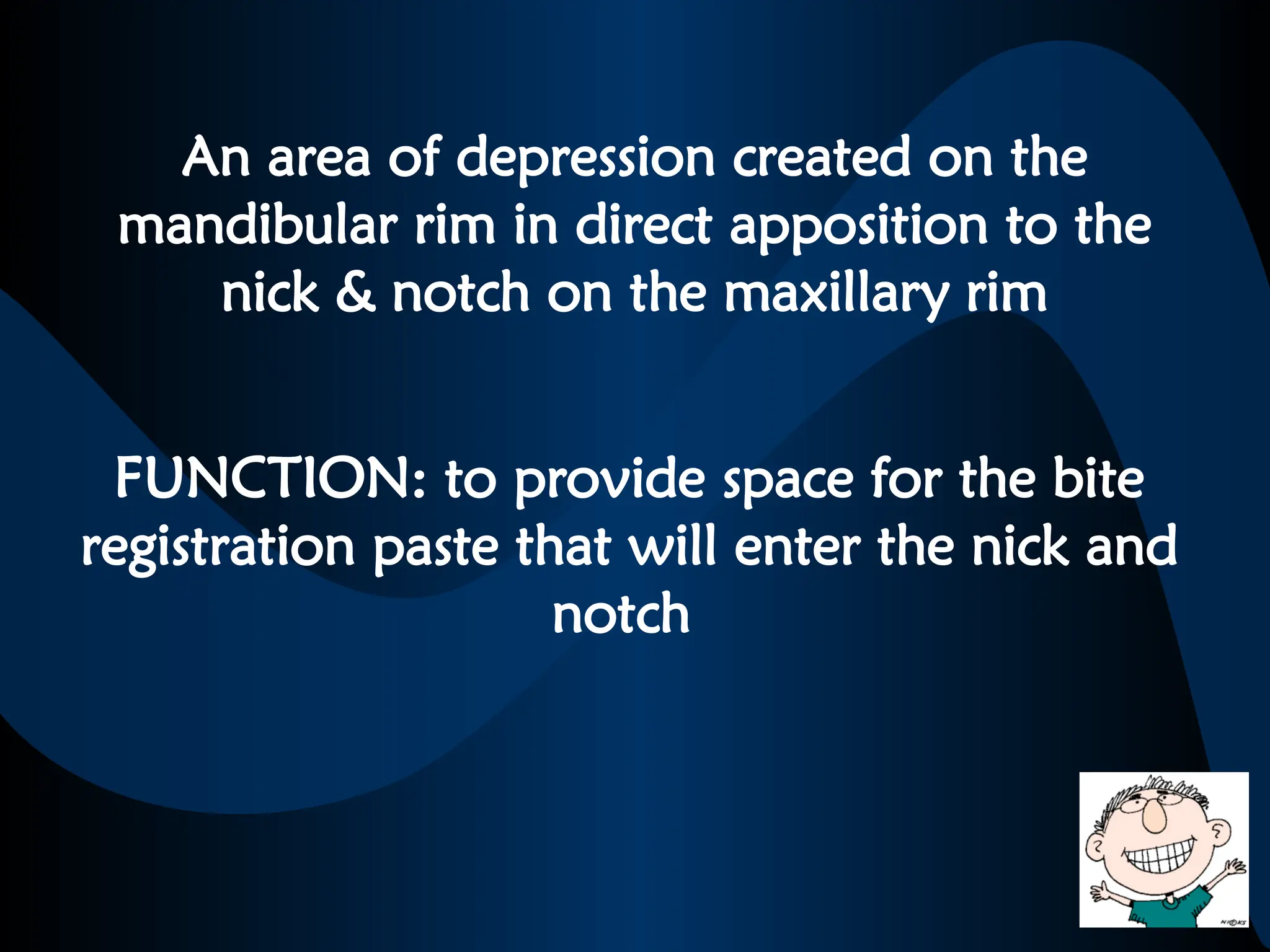
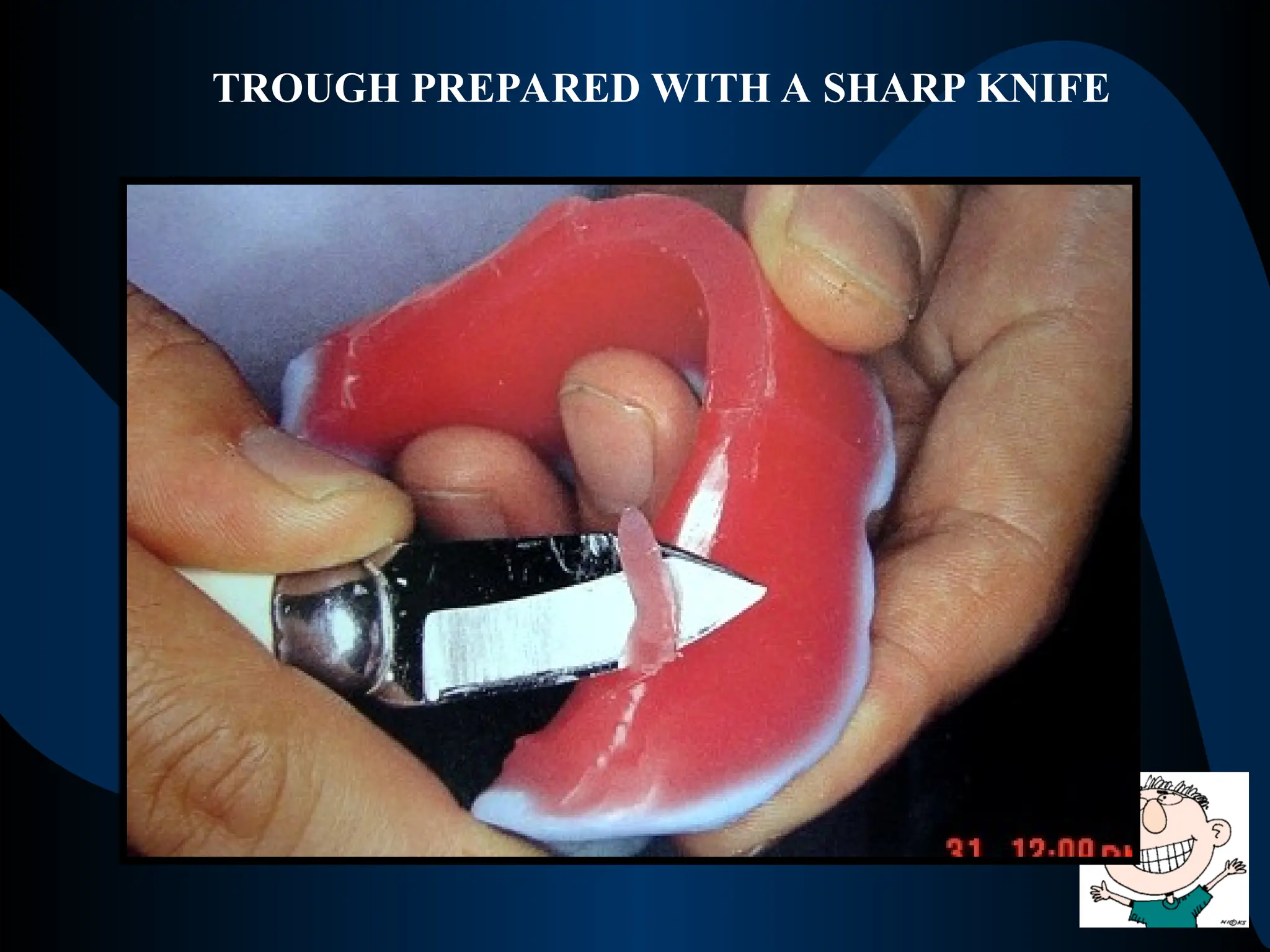
TROUGH
An area of depression created on the
mandibular rim in direct apposition to the
nick & notch on the maxillary rim
FUNCTION: to provide space for the bite
registration paste that will enter the nick and
notch

NICK NOTCH
TROUGH
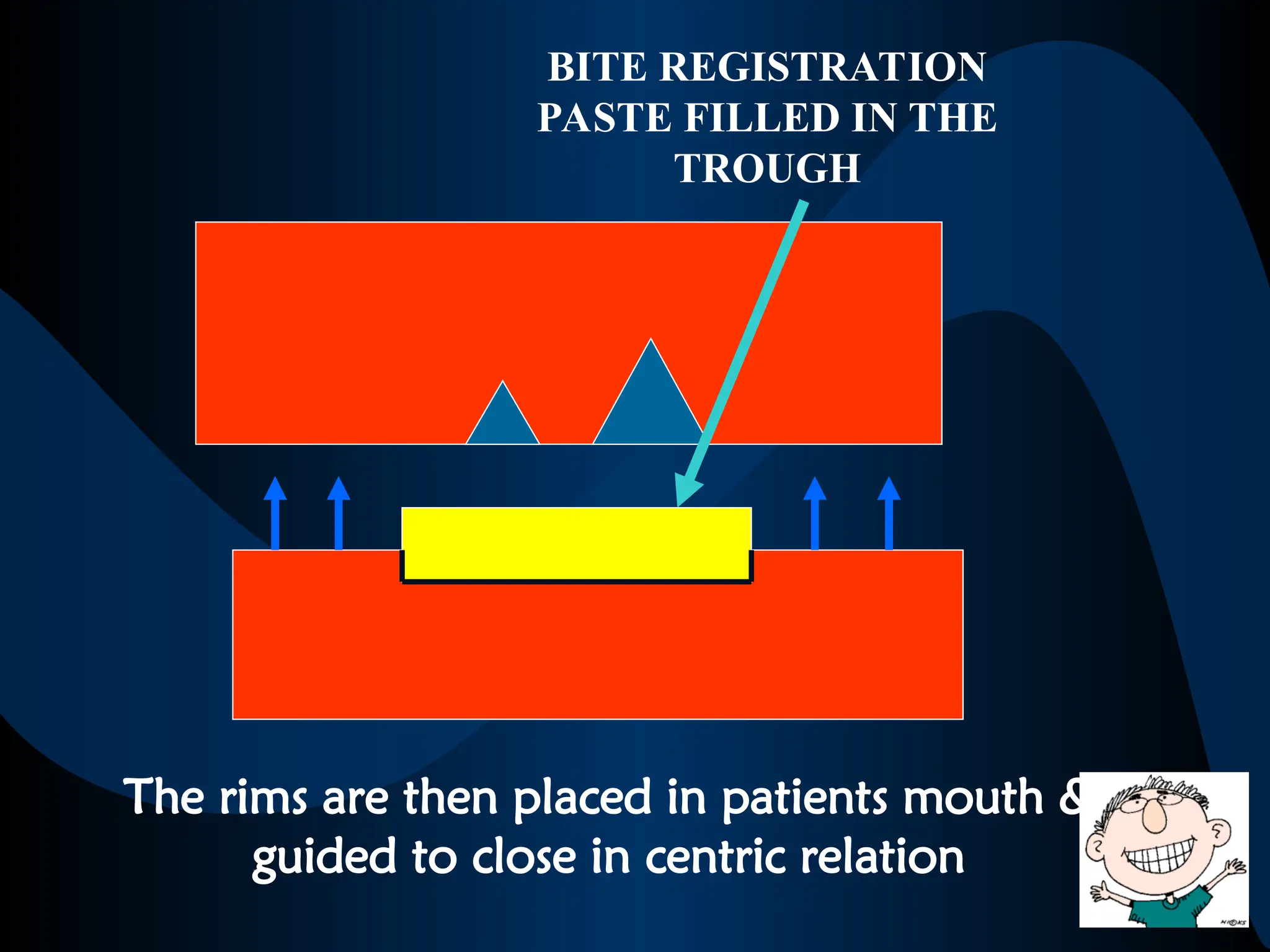
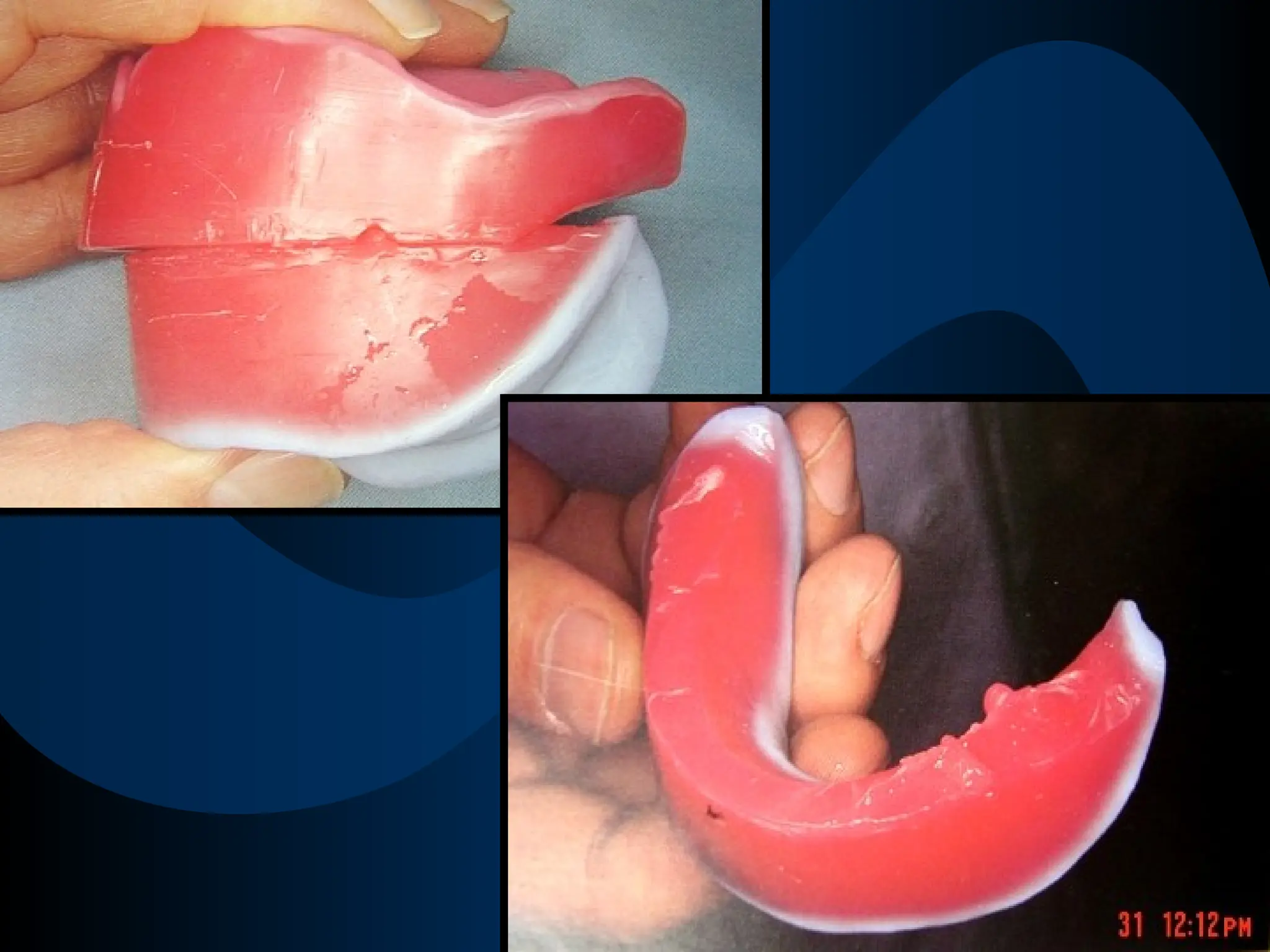
BITE REGISTRATION
PASTE FILLED IN THE
TROUGH
The rims are then placed in patients mouth &
guided to close in centric relation
BITE REGISTRATION PASTE ENTERS THE
NICK & NOTCH
The rims are locked by the bite registration paste
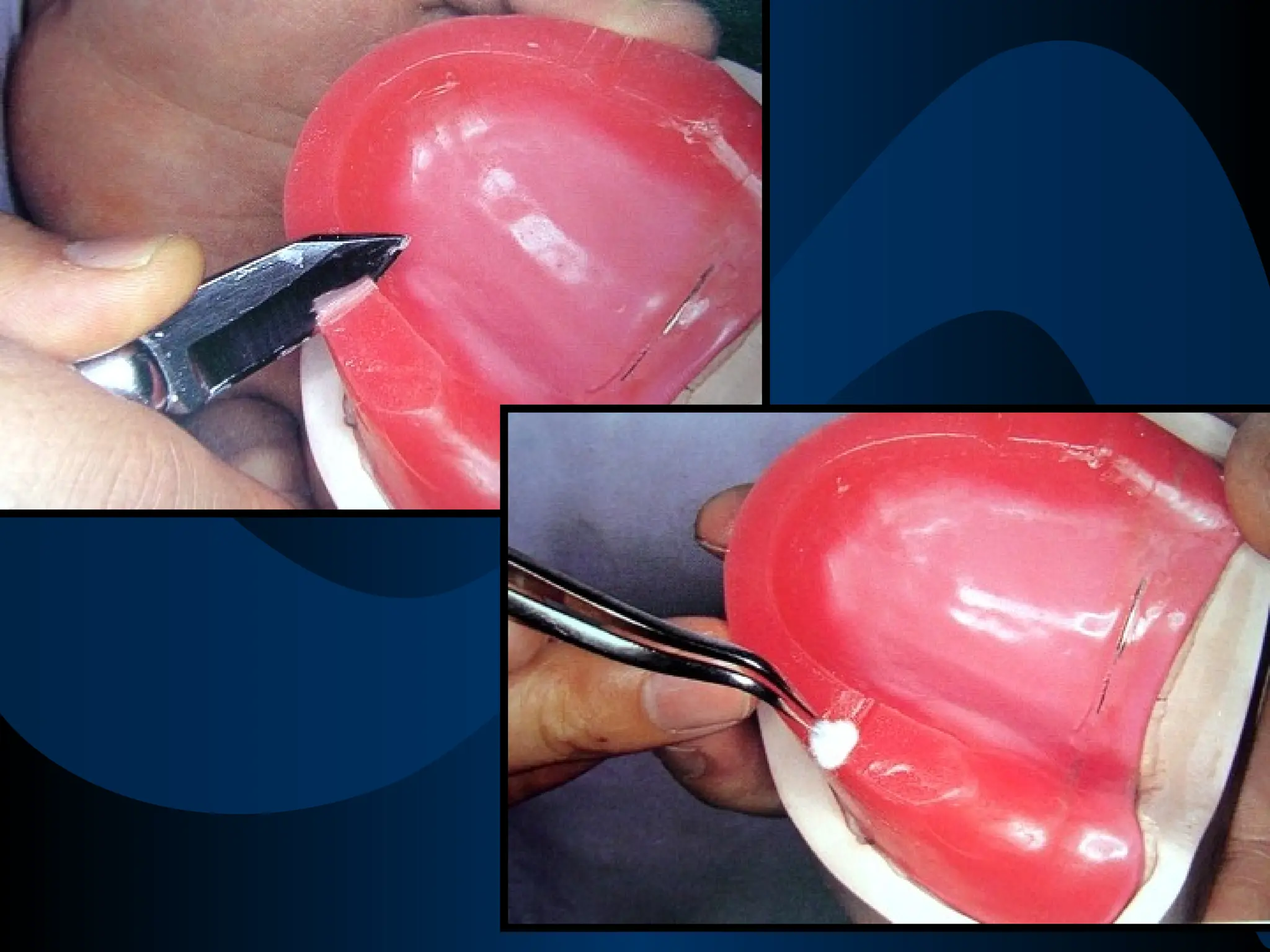
TROUGH PREPARED WITH A SHARP KNIFE
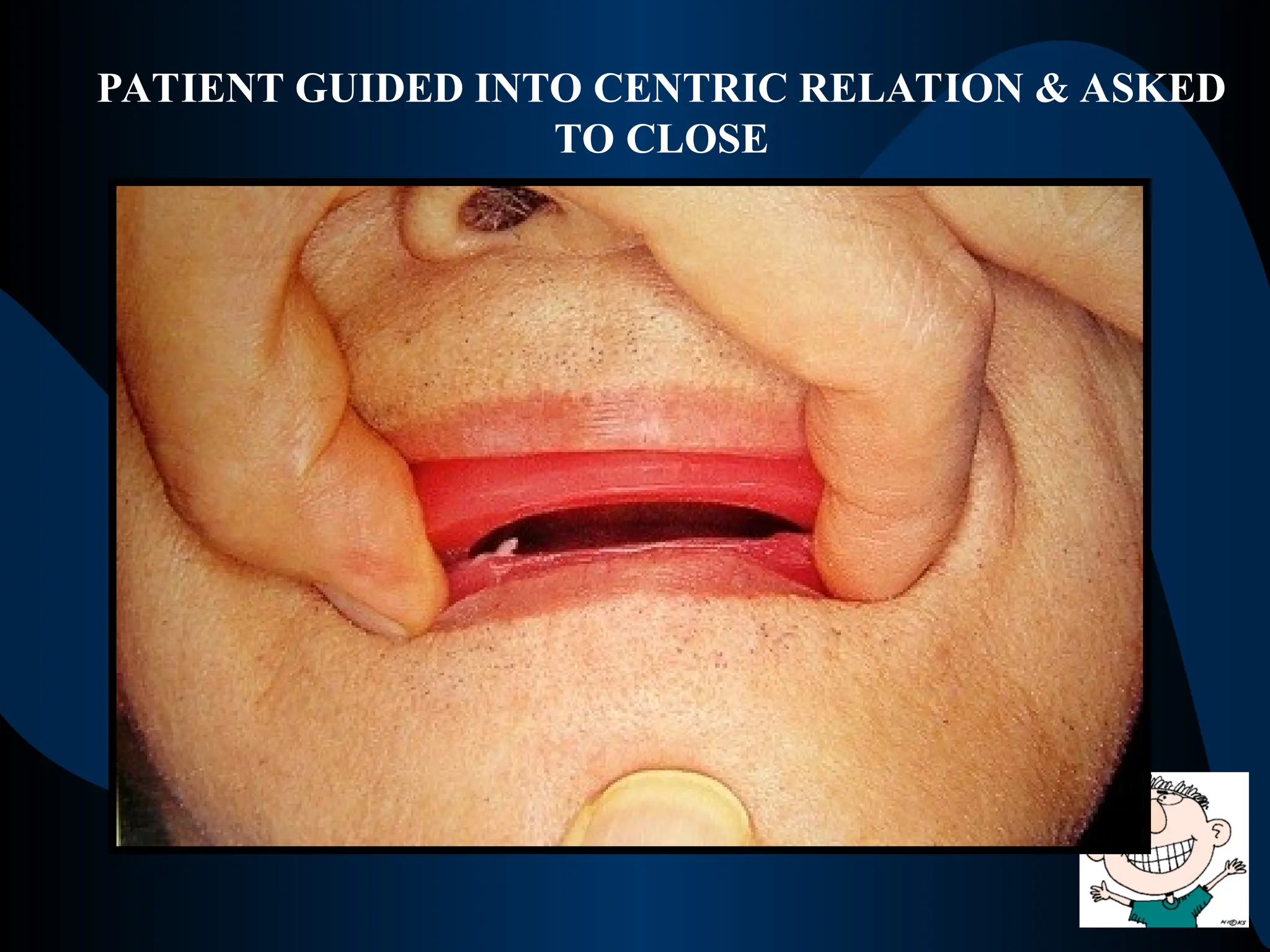
PATIENT GUIDED INTO CENTRIC RELATION & ASKED
TO CLOSE
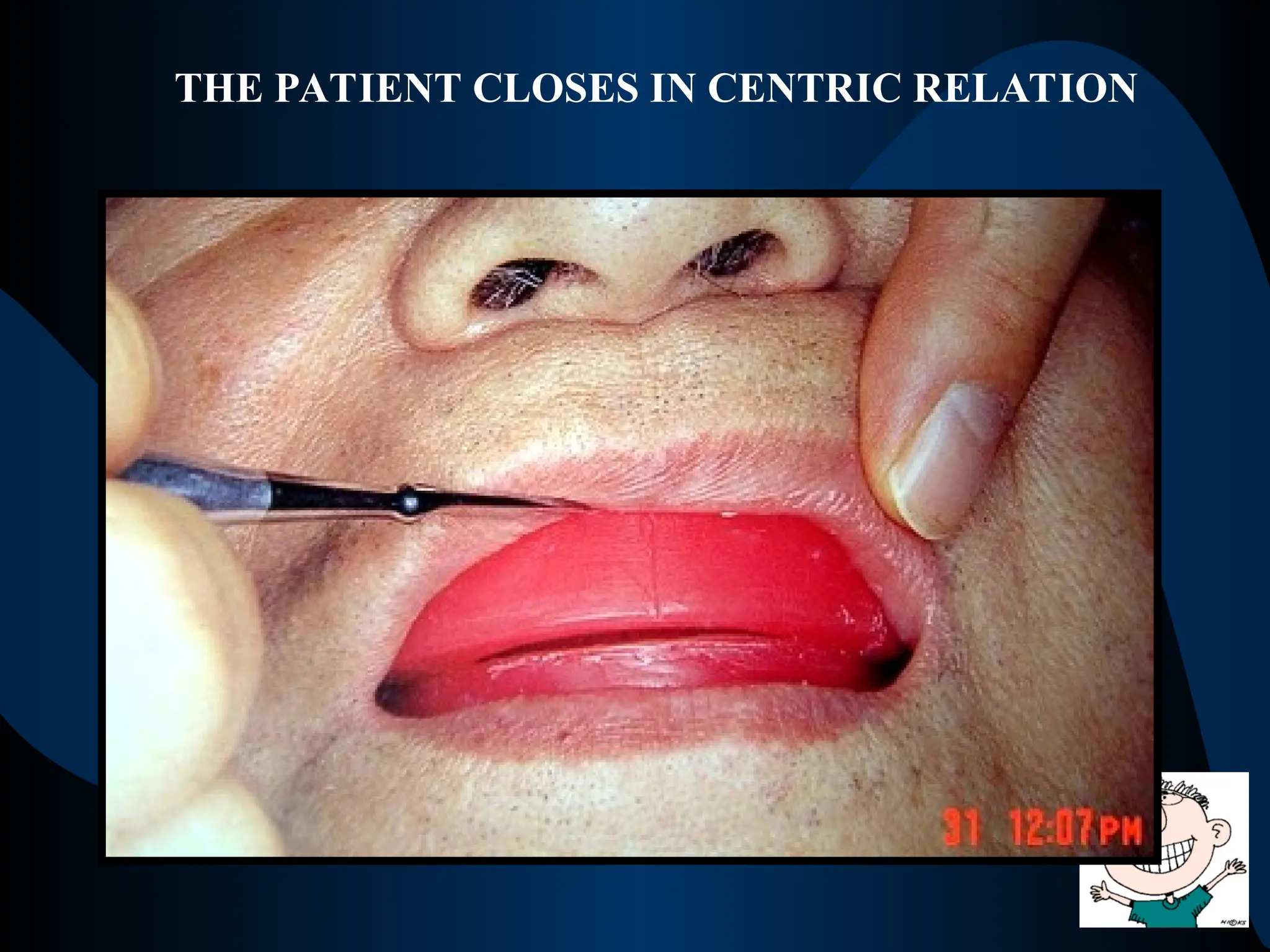
THE PATIENT CLOSES IN CENTRIC RELATION
JAW RELATIONS                                     .ppt

JAW RELATIONS .ppt

  • 2.
    JAW RELATIONS / MAXILLOMANDIBULARRELATIONS “Any spatial relationship of the maxillae to the mandible & the maxilla to the base of the cranium”
  • 3.
    MAXILLOMANDIBULAR RELATIONSHIP RECORD “A registrationof any possible relationship of the mandible relative to the maxillae. These records may be made at any vertical , horizontal, or lateral positions”
  • 4.
    WHY IS RECORDINGOF JAW RELATIONS IMPORTANT ??? To design the dentures in such a way that they function in harmony with the 2 jaw bones and the joint in between them i.e., the Temporomandibular joint
  • 5.
    Types of JawRelations  Orientation Jaw Relation  Vertical Jaw Relation Horizontal Jaw Relation - Centric Jaw Relation - Eccentric Jaw Relation
  • 6.
    “The orientation ofthe maxilla to the base of cranium and to the imaginary transverse axis passing through the center of the condyles around which the mandible may rotate within the sagittal plane ” ORIENTATION JAW RELATION
  • 9.
    VERTICAL JAW RELATION Itinvolves the establishment of vertical dimension of the dentures in harmony with the appearance of the face , for maximum functional efficiency and patient comfort
  • 10.
    HORIZONTAL JAW RELATION Itinvolves the relationship of mandible to the maxillae in the horizontal plane at centric and eccentric positions
  • 11.
  • 12.
    This record givesthe angulation /inclination /tilt of the maxilla in relation to the base of the skull
  • 13.
    BASE OF SKULL MAXILLA INCLINATIONOF MAXILLA TO BASE OF SKULL
  • 14.
    Can be recordedwith the help of a FACE-BOW device “Face-bow is a caliper like device used to record the spatial relationship of the maxilla to the opening axis of TMJ and the base of skull and then transfer the maxillary cast in the same relationship to the opening axis of articulator”
  • 15.
    PARTS OF AFACE BOW
  • 16.
    ‘ U ‘SHAPED FRAME
  • 17.
    Forms the mainframe of the face bow Records the plane of the cranium All other components are attached to this frame with the help of clamps
  • 19.
    EAR PIECES /PLUGS 2 small plastic plugs that fit the external auditory meatus Help to locate the opening axis of the Temporomandibular joint / Hinge Axis
  • 22.
  • 23.
  • 24.
    Maxillary wax rimis attached to this bite fork Represents the plane of the maxilla Attached to the the U frame with the help of the clamp
  • 30.
    ORBITAL POINTER Indicates thepoint- Orbitale on the face
  • 32.
    TYPES OF FACEBOW Arbitrary Face bow Fascia type Ear piece type Self centering Manual centering Kinematic Face bow Hanau spring bow
  • 33.
    Once the maxillais oriented to the opening axis on the face , the entire assembly is attached to the articulator to transfer the maxillary cast on the articulator in the same relationship to the opening axis of the articulator
  • 34.
    Quite some stressssssss!!! That too just to attach a simple maxillary cast ???
  • 35.
  • 36.
    Vertical Jaw Relations/Dimensionsare expressed in terms of amount of separation of maxillae and mandible under specified conditions ,as viewed in the frontal plane
  • 37.
    Vertical Jaw Relations/Dimensionscan be classified into 2 types Vertical Dimension of Rest Vertical Dimension of Occlusion Occlusion
  • 38.
    Vertical Dimension ofOcclusion (VDO) When the natural teeth are present and in occlusion ,the VDO is maintained or established by them When the natural teeth are lost & the patient wears dentures, the VDO is established by the two dentures when the teeth are in contact “The amount of separation of the jaws when the teeth are in occlusion”
  • 39.
    Therefore , theVDO must be established for edentulous patients, such that their denture teeth will come into contact at the appropriate height
  • 40.
    Vertical Dimension ofRest (VDR) “The amount of separation of the jaws when the mandible is in a Physiologic Rest Position” It is the position where the muscles that close the jaws and those that open the jaws are in a state of minimal contraction [function], just enough to maintain the posture of mandible
  • 41.
    VDR > VDO VDR– VDO = FREEWAY SPACE VDO VDR FREEWAY SPACE 2-4mm
  • 42.
    IMPORTANCE OF FREEWAYSPACE •Assessing the vertical dimension of occlusion of dentures If the freeway space is < 2mm , it indicates that the VDO is increased If the freeway space is > 4mm , it indicates that the VDO is decreased
  • 43.
    •Relaxation of masticatoryapparatus and denture bearing areas At rest position , when the teeth are not in contact & freeway space is adequate, there is no strain on the TMJ and minimal activity of elevator and depressor muscles of the mandible Allows for relaxation of the muscles and TMJs and avoids fatigue
  • 44.
    At the sametime , if the dentures have no / inadequate freeway space , the denture bearing tissues are continuously and excessively loaded Resorption of bone is aggravated
  • 45.
    Methods for DeterminingVertical Dimension Mechanical methods Preextraction records Ridge relations Measurement of former dentures Physiologic methods Physiologic rest position Phonetics Swallowing methods Tactile sense & patient comfort
  • 46.
  • 47.
    PRE-EXTRACTION METHODS Profile radiographs Canbe used to assess the vertical dimension of occlusion before extraction The vertical dimension existing before the removal of teeth can be used as a guide establishing vertical dimension of the dentures
  • 48.
    Casts of teethin occlusion The casts of teeth in occlusion give an indication of the amount of space between the ridges for the teeth of this size
  • 49.
    Facial measurements Devices likecalipers or pair of dividers can be used to make measurements in the middle & lower 3rd of the face e.g., from the base of the nose to the base of the chin , before the extraction of the teeth These measurements can be used to establish the same dimensions during denture fabrication
  • 52.
    RIDGE RELATIONS Incisive papillato mandibular incisors The distance of papilla from the incisal edges of the mandibular incisors averages approximately 4mm in natural dentition The distance of papilla from the incisal edges of the maxillary incisors averages approximately 6mm in natural dentition
  • 54.
    Therefore the meanvertical overlap of the opposing incisors is about 2mm
  • 55.
  • 56.
    Parallelism of themaxillary & mandibular ridges , plus a 5-degree opening in the posterior region, often gives a clue as to the appropriate amount of jaw separation
  • 57.
    Parallelism of themaxillary & mandibular ridges is natural Parallelism of the maxillary & mandibular ridges is favorable from a mechanical point of view to prevent any anteroposterior sliding of dentures during function
  • 58.
    Measurement of formerdentures Measurements can be made between the ridge crests of the maxillary and mandibular dentures with a Boley gauge If the observations on the patients face indicate that this distance is too short or too long , a corresponding change can be made in the new dentures
  • 60.
  • 61.
    PHYSIOLOGIC REST POSITION Registrationof the jaw in physiological rest position gives an indication of the vertical dimension of occlusion At the physiological rest position , there should be a freeway space of 2-4mm between the occlusal rims
  • 62.
    This may notbe an exact guide ; therefore has to used in concordance with other methods
  • 63.
    PHONETICS Phonetic tests includelistening to speech sound production & observing the relationships of teeth during speech The production of ch, s, & j sounds brings the anterior teeth close together and almost touch each other but do not touch
  • 64.
    If the distancebetween the upper & lower incisors is too large , it indicates that the VDO is too small If the anterior teeth touch when these sounds are made / click together during speech , it indicates that the VDO is too large
  • 65.
    SILVERMAN’S CLOSEST SPEAKINGSPACE Similar to the technique of phonetics where ‘S’ sounds are used to assess the vertical dimension Range of 2-11 mm depending on the functional range of the patient
  • 66.
    The Freeway Space& Closest Speaking Space are not the same The freeway space is an assessment of VD at rest ; while the speaking space is an assessment of VD during function
  • 67.
    ESTHETICS The vertical relationof the mandible to the maxillae also affects esthetics. Normally the tone of the facial skin should be the same throughout and for this an appropriate vertical dimension is necessary
  • 68.
    If the verticaldimensions of the dentures is excessive , it will lead to stretched appearance of the facial skin If the vertical dimensions of the dentures is too less , it will lead to wrinkled appearance of the facial skin
  • 69.
    However , thisguide is a relatively unreliable one ; therefore should be used with caution or in combination with other methods
  • 70.
    Whether the faceis appearing long or otherwise is subjective If the facial skin of the patient is already wrinkled , one may be tempted to increase the vertical dimension excessively
  • 71.
    SWALLOWING THRESHOLD The positionof the mandible at the beginning of the swallowing act has been used as a guide establish the vertical dimension of occlusion When a person swallows, the teeth come together with a very light contact at the beginning of the swallowing
  • 72.
    If the dentureteeth fail to contact during swallowing , the VDO is excessively reduced
  • 73.
    TACTILE SENSATION The patient’stactile sense can be used as a guide to the determination of the VDO The problem with this method relates to presence of foreign objects in the palate & the tongue space which can obscure the patient's judgment
  • 74.
  • 75.
    Horizontal Jaw Relationis the relationship of the maxilla to the mandible in the horizontal plane i.e., in the anteroposterior and lateral directions
  • 76.
    Horizontal Jaw Relationscan be classified into 2 types Eccentric Relations Centric Relation
  • 77.
    CENTRIC JAW RELATION Therelationship of mandible to maxilla , when the mandible is in the most posterior / retruded ,unstrained position in relation to the maxilla, at an established vertical dimension WHAT DOES THIS STATEMENT IMPLY ???
  • 78.
    “The Maxillomandibular relationshipin which the condyles articulate with the thinnest avascular portion of the articular disc & the complex (of articular disc and the head of condyle) braced anterosuperiorly against the (posterior) slopes of the articular eminence”
  • 79.
    When the naturalteeth are present, the proprioceptive impulses from the teeth guide the movement of the mandible so the teeth can come in occlusion in a comfortable position
  • 80.
    When the naturalteeth are absent, the proprioceptive impulses from the the Temporomandibular joint guide the movement of the mandible so that the mandible can close in a comfortable & unstrained position
  • 81.
    It is atthis comfortable position , the denture teeth should come in occlusion with each otherc The comfortable position is the Centric Relation Position The occlusion of the denture teeth in this comfortable position is the Occlusion at Centric Relation Position / Centric Occlusion
  • 82.
    SIGNIFICANCE OF CENTRICRELATION POSITION •The recording of the Centric relation position is the starting point for developing occlusion in the complete dentures •It is a bone to bone relation •It is a hinge position
  • 83.
    •It is anideal arch to arch relation and an optimum functional position of the jaws for the health, comfort & function of the TMJ and musculature •During swallowing the mandible is at /near the centric relation position •It is a learnable , repeatable & reproducible position
  • 84.
    Although the positionis reproducible , it is difficult to record it with sufficient accuracy in edentulous patients BIOLOGICAL DIFFICULTIES PSYCHOLOGIC DIFFICULTIES MECHANICAL DIFFICULTIES
  • 85.
    Instructions can begiven to assist patient to retrude the mandible “Let your jaw relax , pull it back ,and close slowly and easily on your back teeth” “Get the feeling of pushing your upper jaw out & closing your back teeth together”
  • 86.
    Instruct the patientturn the tongue backwards towards the posterior part of the hard palate Instruct the patient to protrude & retrude the mandible repeatedly while holding his or her fingers lightly against the chin
  • 87.
    METHODS TO RECORDTHE CENTRIC JAW RELATIONS Interocclusal Check records Wax Squash Bite Pressure – less method STATIC METHODS
  • 88.
    Can be madeat the stage of Try- in of the waxed up trial dentures after the arrangement of teeth INTEROCCLUSAL CHECK RECORDS
  • 89.
    A softened sheetof Aluwax is placed between the upper & lower teeth on the trial dentures The patient is guided into centric relation position The patient is then asked to close in that position without contacting the teeth
  • 90.
    WAX SQUASH BITE Involvesplacement of a horse-shoe shaped roll of softened wax between maxillary & mandibular rims and having the patient close the jaws in centric relation
  • 91.
    PRESSURE - LESSMETHOD The occlusal rims are adjusted to establish the correct vertical dimension The patient is trained to close in centric relation position The wax can then be sealed in centric relation position using Nick & Notch method / Staple pins
  • 92.
    These methods usefunctional movements of the jaw to record the centric relation The patient is asked to perform lateral and protrusive movements in order to identify the centric relation position of the mandible NEEDLE HOUSE TECHNIQUE PATTERSON’S TECHNIQUE FUNCTIONAL METHODS
  • 93.
    These methods arecalled so because they use graphs / tracings to record various jaw movements & centric jaw relation position Done with the help of tracing apparatus 2 types of tracings ARROW POINT TRACING PANTOGRAPHIC TRACING One dimensional tracing Three dimensional tracing GRAPHIC METHODS
  • 94.
    RADIOGRAPHIC METHODS Lateral cephalometricradiograph can be used to record the centric relation position by studying the position of the condyles in relation to the articular eminence
  • 95.
    ECCENTRIC JAW RELATION Anyrelationship of the mandible to the maxilla other than centric relation It includes the recording of protrusive and lateral movements of the mandible The basic purpose is to be able to reproduce these movements on the articulator
  • 96.
  • 97.
    PATIENT POSITION The patientshould be relaxed, with the trunk upright ,and head unsupported
  • 98.
    ADJUSTMENT OF OCCLUSALPLANE & VERTICAL HEIGHT OF THE MAXLLARY RIM
  • 99.
  • 100.
    THE OCCLUSAL PLANEOF MAXILLARY RIM IS EVALUATED USING FOX’S PLANE
  • 101.
    ANTERIORLY THE OCCLUSALPLANE SHOULD BE PARALLEL TO THE INTERPUPILLARY LINE
  • 102.
    POSTERIORLY THE OCCLUSALPLANE IS MADE PARALLEL TO THE ALA-TRAGUS LINE
  • 103.
    ALA-TRAGUS LINE A linedrawn from the superior portion of the tragus to the inferior border of the ala Also referred to as the ‘CAMPER’S PLANE’
  • 104.
    THE ANTERIOR VISIBILITYSHOULD BE 1-2mm AT THE RESTING POSITION OF THE UPPER LIP
  • 105.
  • 106.
    Once the occlusalplane of maxillary rim is adjusted corrected, YOU SHOULD NOT TOUCH THE PLANE AGAIN !!! The vertical dimension is established by adjusting the height of the mandibular wax rim
  • 107.
    FREEWAY SPACE OF2-4 mm AT PHYSIOLOGIC REST POSITION
  • 108.
    The patient isasked to swallow Relax his lips and cheeks muscles Lightly contact the lips The lips are then parted to evaluate the freeway space HOW TO CHECK FOR THE CORRECTNESS OF THE VERTICAL DIMENSION I.
  • 110.
    The patient canbe asked to pronounce words with sounds of ‘M’ instead of swallowing action and the same procedure can be repeated Pronunciation of sibilants (words with sounds of ‘S’) with clarity can also be used to evaluate the correctness of VD II.
  • 111.
    The distance betweenthe most prominent point on the nose and the most prominent point on the chin at rest and in occlusion can be measured and the difference can be calculated to evaluate the freeway space e.g., VDR - 65 mm VDO - 62 mm VDR – VDO = FREEWAY SPACE=3mm III.
  • 112.
  • 113.
    The distance betweenbase of the nose and the base of the chin at rest and in occlusion can also be used
  • 115.
    THE MANDIBULAR RIMAFTER ADJUSTING THE HEIGHT
  • 116.
    THE RIMS SHOULDCONTACT EACH OTHER UNIFORMLY ALONG THE FULL LENGTH AT THE CORRECT VERTICAL DIMENSION
  • 117.
    APPEARANCE OF THEPATIENT AFTER ESTABLISHING THE CORRECT VERTICAL DIMENSION
  • 118.
    TRANSFERRING THE FACIALMIDLINE ON THE MAXILLARY RIM
  • 119.
    MARKING THE CANINELINES ON THE MAXILLARY RIM
  • 120.
    RECORDING THE CENTRICRELATION NICK & NOTCH TECHNIQUE Static record
  • 121.
  • 122.
    ‘V’ shaped spacecreated on the maxillary rim in the 1st molar region crossing the full width of the rim Function : to prevent Anteroposterior movement / sliding during centric relation recording
  • 123.
  • 124.
    ‘V’ shaped spacecreated on the maxillary rim in the 2nd premolar region not crossing the full width of the rim FUNCTION : to prevent Lateral movement / sliding during centric relation recording
  • 126.
  • 127.
    An area ofdepression created on the mandibular rim in direct apposition to the nick & notch on the maxillary rim FUNCTION: to provide space for the bite registration paste that will enter the nick and notch
  • 128.
  • 129.
    BITE REGISTRATION PASTE FILLEDIN THE TROUGH The rims are then placed in patients mouth & guided to close in centric relation
  • 130.
    BITE REGISTRATION PASTEENTERS THE NICK & NOTCH The rims are locked by the bite registration paste
  • 131.
    TROUGH PREPARED WITHA SHARP KNIFE
  • 132.
    PATIENT GUIDED INTOCENTRIC RELATION & ASKED TO CLOSE
  • 133.
    THE PATIENT CLOSESIN CENTRIC RELATION