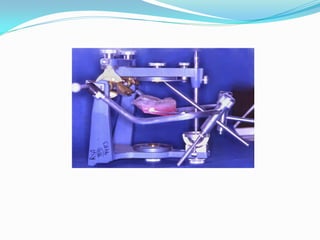
Recording edentulous Jaw
Relationships
(Principles of registration of
maxillomandibular relationships)
 Accurate determination , recording and transfer
of Jaw Relation from the edentulous patient to
the articulator is essential for the restoration of
Function, Facial appearance , and the
maintenance of the patient’s Health.
 Unsatisfactory maxillomandibular relationships
will eventually lead to failure of complete
denture.
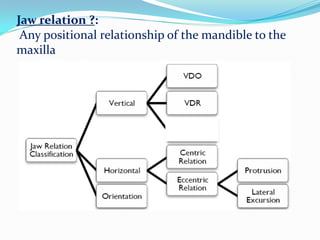
Jaw relation ?:
Any positional relationship of the mandible to the
maxilla
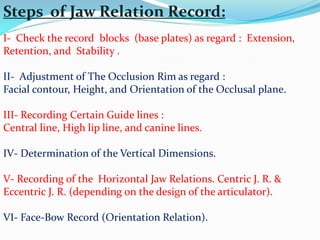
Steps of Jaw Relation Record:
I- Check the record blocks (base plates) as regard : Extension,
Retention, and Stability .
II- Adjustment of The Occlusion Rim as regard :
Facial contour, Height, and Orientation of the Occlusal plane.
III- Recording Certain Guide lines :
Central line, High lip line, and canine lines.
IV- Determination of the Vertical Dimensions.
V- Recording of the Horizontal Jaw Relations. Centric J. R. &
Eccentric J. R. (depending on the design of the articulator).
VI- Face-Bow Record (Orientation Relation).
Record Bases (Baseplates)
and Occlusion Rims
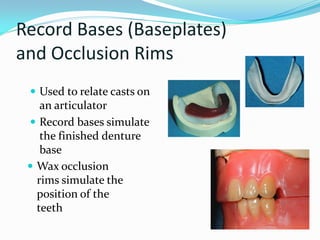
 Used to relate casts on
an articulator
 Record bases simulate
the finished denture
base
 Wax occlusion
rims simulate the
position of the
teeth
1. Check occlusion blocks.
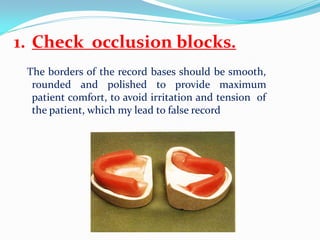
The borders of the record bases should be smooth,
rounded and polished to provide maximum
patient comfort, to avoid irritation and tension of
the patient, which my lead to false record
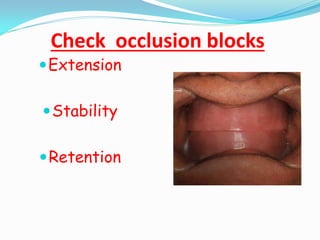
Check occlusion blocks
Extension
Stability
Retention
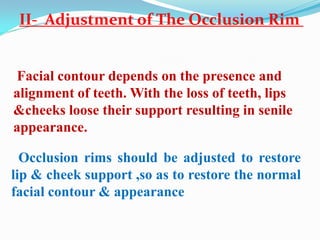
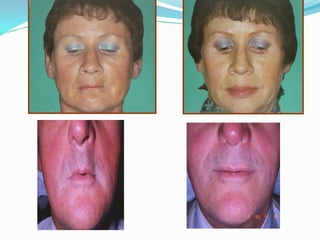
Facial contour depends on the presence and
alignment of teeth. With the loss of teeth, lips
&cheeks loose their support resulting in senile
appearance.
Occlusion rims should be adjusted to restore
lip & cheek support ,so as to restore the normal
facial contour & appearance
II- Adjustment of The Occlusion Rim
II- Adjustment of The Occlusion Rim as regard :
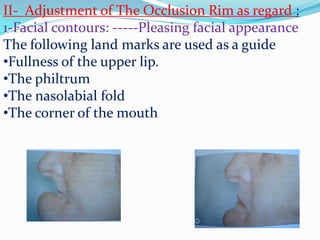
1-Facial contours: -----Pleasing facial appearance
The following land marks are used as a guide
•Fullness of the upper lip.
•The philtrum
•The nasolabial fold
•The corner of the mouth
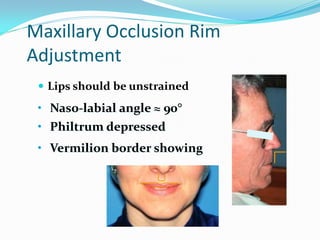
Maxillary Occlusion Rim
Adjustment
 Lips should be unstrained
• Naso-labial angle ≈ 90°
• Philtrum depressed
• Vermilion border showing
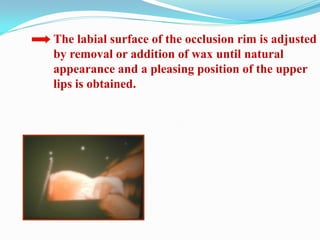
The labial surface of the occlusion rim is adjusted
by removal or addition of wax until natural
appearance and a pleasing position of the upper
lips is obtained.
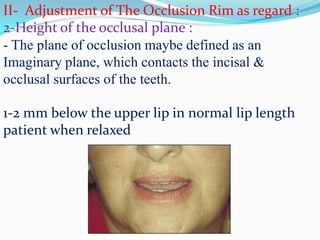
II- Adjustment of The Occlusion Rim as regard :
2-Height of the occlusal plane :
- The plane of occlusion maybe defined as an
Imaginary plane, which contacts the incisal &
occlusal surfaces of the teeth.
1-2 mm below the upper lip in normal lip length
patient when relaxed
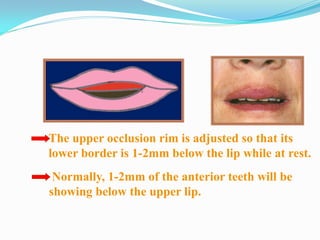
The upper occlusion rim is adjusted so that its
lower border is 1-2mm below the lip while at rest.
Normally, 1-2mm of the anterior teeth will be
showing below the upper lip.
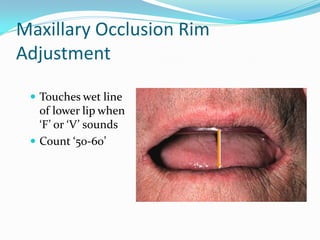
Maxillary Occlusion Rim
Adjustment
 Touches wet line
of lower lip when
‘F’ or ‘V’ sounds
 Count ‘50-60’
Use a Hot Wax
Former
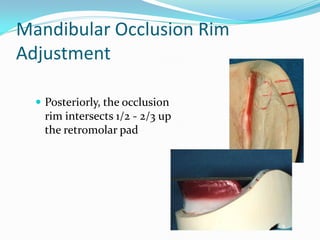
Mandibular Occlusion Rim
Adjustment
 Posteriorly, the occlusion
rim intersects 1/2 - 2/3 up
the retromolar pad
Mandibular Occlusion Rim
Adjustment
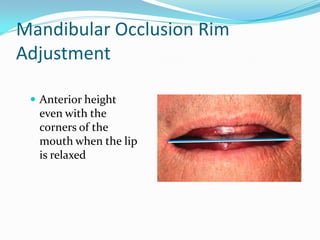
 Anterior height
even with the
corners of the
mouth when the lip
is relaxed
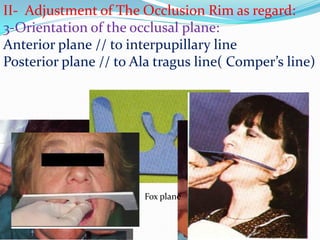
II- Adjustment of The Occlusion Rim as regard:
3-Orientation of the occlusal plane:
Anterior plane // to interpupillary line
Posterior plane // to Ala tragus line( Comper’s line)
Fox plane
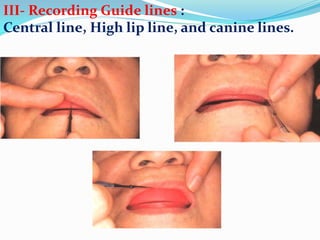
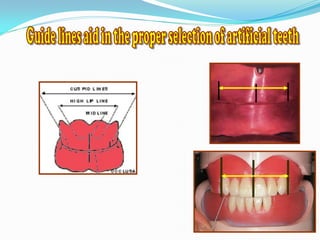
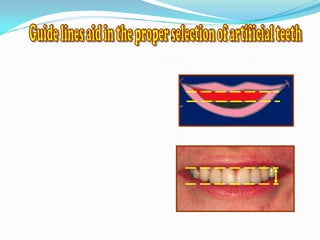
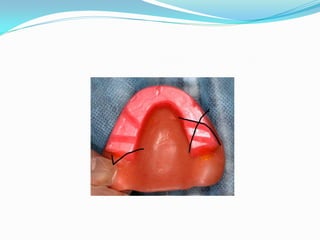
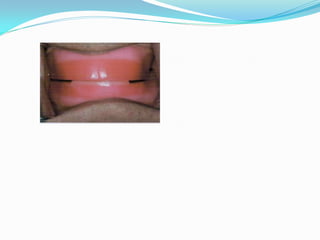
III- Recording Guide lines :
Central line, High lip line, and canine lines.
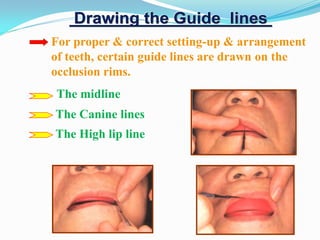
The midline
The Canine lines
The High lip line
For proper & correct setting-up & arrangement
of teeth, certain guide lines are drawn on the
occlusion rims.
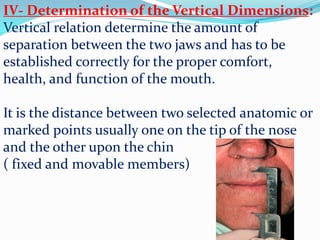
IV- Determination of the Vertical Dimensions:
Vertical relation determine the amount of
separation between the two jaws and has to be
established correctly for the proper comfort,
health, and function of the mouth.
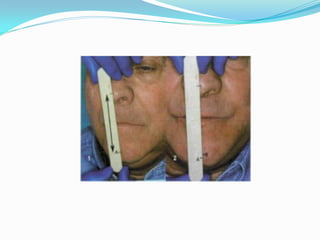
It is the distance between two selected anatomic or
marked points usually one on the tip of the nose
and the other upon the chin
( fixed and movable members)
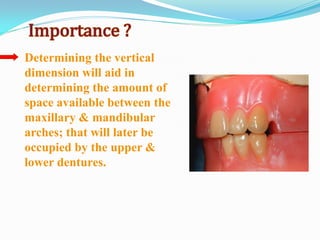
Determining the vertical
dimension will aid in
determining the amount of
space available between the
maxillary & mandibular
arches; that will later be
occupied by the upper &
lower dentures.
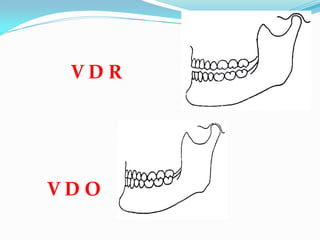
2 Types:
Vertical dimension of rest (VDR):
When the mandible in rest position(after talking, swallowing, or
chewing) , the person is relaxed and the teeth are separated by a gap
( the elevator and depressor muscles of the mandible are in
equilibrium
It can be considered a constant and reproducible position, but may
be subjected to some variables
Vertical dimension of occlusion (VDO):
When the teeth or occluding rims are in maximum occlusal contact
V D R
V D O
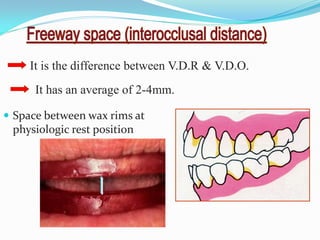
It is the difference between V.D.R & V.D.O.
It has an average of 2-4mm.
 Space between wax rims at
physiologic rest position
 Biological importance of correct
registeration of VDO, the patient
can:dimension ; the patient can
1 - Masticate his food efficiently.
2 - Speak without impediment.
3 - Present a normal facial appearance.
4 - Experience a minimum amount of
discomfort in using his dentures.
Methods of determination of occlusal vertical
dimension in edentulous patient:
1- Pre extraction records:
-Radiograph
-Profile photograph
-Contoured wire profile
-Facial measurements
-Plaster casts of the dentulous condition
-Face mask
Methods of determination of occlusal vertical
dimension in edentulous patient:
2- functional performance methods ( Physiologic) :
-Respiratory (physiologic) rest position
-Phonetics of some labial sound (m m), Closest speaking
space (The space between the occlusal surfaces and incisal edges of the teeth
When the mandible is elevated to the maximum extent during speech ), it is a
dynamic measurement recorded during physiologic function of speech ( Free
way space : resting measurements )
-Let the patient swallow and then relax or wet his lip with
the tip of the tongue then relax
- Swallowing for evaluation of V D
Methods of determination of occlusal vertical
dimension in edentulous patient:
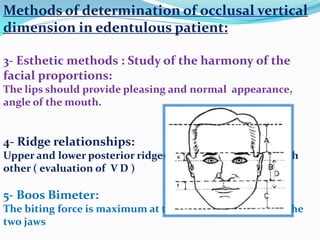
3- Esthetic methods : Study of the harmony of the
facial proportions:
The lips should provide pleasing and normal appearance,
angle of the mouth.
4- Ridge relationships:
Upper and lower posterior ridges should be parallel to each
other ( evaluation of V D )
5- Boos Bimeter:
The biting force is maximum at the correct separation of the
two jaws
Methods of determination of occlusal vertical
dimension in edentulous patient:
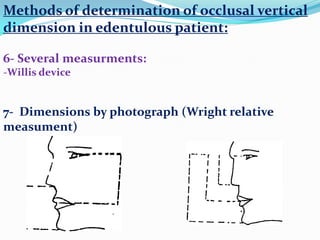
6- Several measurments:
-Willis device
7- Dimensions by photograph (Wright relative
measument)
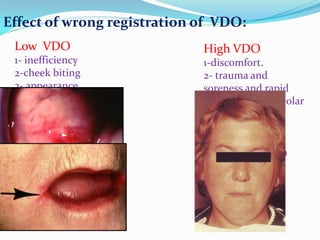
Effect of wrong registration of VDO:
Low VDO
1- inefficiency
2-cheek biting
3- appearance
4- soreness of the
corner of the mouth
5- pain in TMJ
6- lack of tongue
space
High VDO
1-discomfort.
2- trauma and
soreness and rapid
resorption of alveolar
bone
3- loss of free way
space
4-clicking of teeth
during speech
5- appearance
(elongated face)
6- difficulty in
swallowing
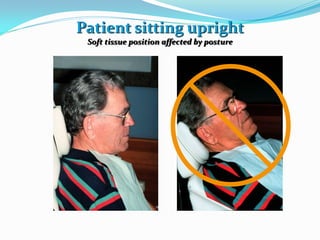
Patient sitting upright
Soft tissue position affected by posture
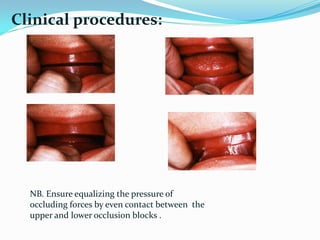
Clinical procedures:
NB. Ensure equalizing the pressure of
occluding forces by even contact between the
upper and lower occlusion blocks .
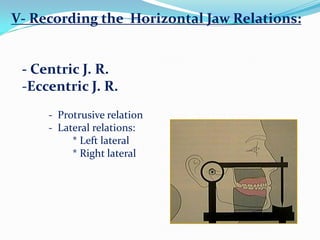
V- Recording the Horizontal Jaw Relations:
- Centric J. R.
-Eccentric J. R.
- Protrusive relation
- Lateral relations:
* Left lateral
* Right lateral
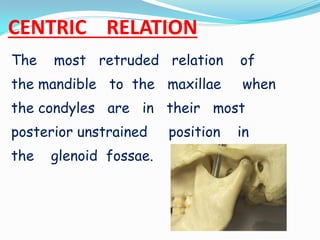
CENTRIC RELATION
The most retruded relation of
the mandible to the maxillae when
the condyles are in their most
posterior unstrained position in
the glenoid fossae.
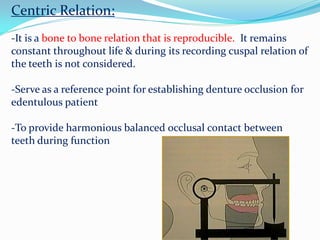
Centric Relation:
-It is a bone to bone relation that is reproducible. It remains
constant throughout life & during its recording cuspal relation of
the teeth is not considered.
-Serve as a reference point for establishing denture occlusion for
edentulous patient
-To provide harmonious balanced occlusal contact between
teeth during function
CENTRIC OCCLUSION
The occlusion of opposing teeth when
the mandible is in centric relation.
-if C R & C O in artificial teeth not
coincide the stability of the denture
decreased and the patient will subjected
to unnecessary pain or discomfort
Significance of centric relation:
It is important to establish a repeatable and
recordable reference position for construction of
occlusion in complete denture, Failure of
construction of occlusion in centric relation will
lead to trauma to denture foundation and TMJ and
affect greatly the stability and the efficiency of the
dentures as well as the comfort of the patient
Significance of centric relation:
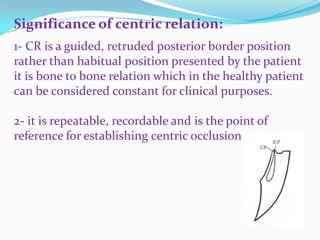
1- CR is a guided, retruded posterior border position
rather than habitual position presented by the patient
it is bone to bone relation which in the healthy patient
can be considered constant for clinical purposes.
2- it is repeatable, recordable and is the point of
reference for establishing centric occlusion
Significance of centric relation:
3-when centric relation and centric occlusion do not
coincide or freedom in centric not present the stability
of the denture will be impaired ….pain and discomfort
4- edentulous patient use the centric relation closure
in mastication and other mandibular activities as
swallowing . CR is the position at which masticatory
cycle is started and ended.
Methods of determination
of centric relation
1- Wax registration method (check
bites).
2- Terminal hinge axis determination
method (Kinematic face bow).
3- Graphic tracing or excursive
method.
4- Chew in or functional record
method.
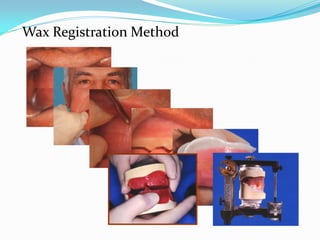
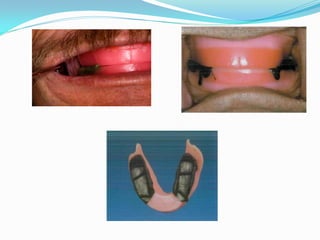
Wax registration
method
=
Check bites
=
Wax wafer method
1- Wax registration method (check bite method):
It is the most commonly used method, ( easy , not time
consuming, no need for complicated instrument or
device)
This procedure make use of a suitable wax interposed
between occlusion rims at the previously determined
occlusal vertical dimension
Wax Registration Method
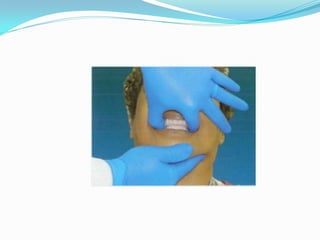
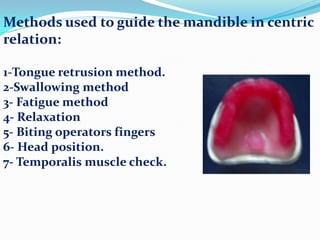
Methods used to guide the mandible in centric
relation:
1-Tongue retrusion method.
2-Swallowing method
3- Fatigue method
4- Relaxation
5- Biting operators fingers
6- Head position.
7- Temporalis muscle check.
Difficulties of retruding the mandible:
1- in patient who have had edentulous posterior areas for
long duration without replacement
2- in patient who have lost the occlusal relations of old
dentures due to a closure of the occlusal V D
3-in patient who have been fully edentulous for a long
period.
4- in patient who are tense and not relaxed at the time of
recording centric relation.
1- Wax registration method (check bite method):
The record should be checked for:
1- the wax rims should be the only contacting surfaces.
2- the trial denture bases should fit exactly on their casts
without rocking to be sure that no warpage has occurred
3- any contact between the upper and lower casts at the
rear should be eliminated as it would prevent the
occlusion blocks from being accurately seated
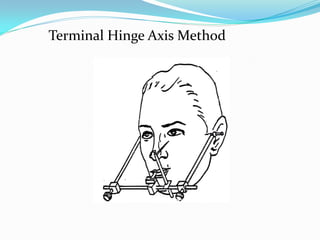
2- Terminal hinge axis method
Kinematic Face Bow
( Mandibular Face Bow )
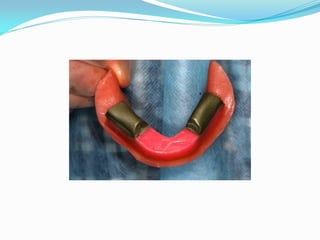
The Kinematic face-bow is
attached to the mandible that is
why it is sometimes called the
mandibular face-bow.
3- Excursive methods
or
Graphic tracing method
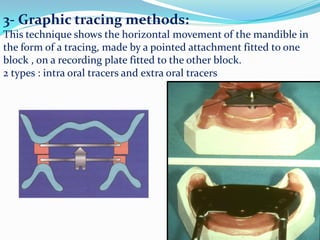
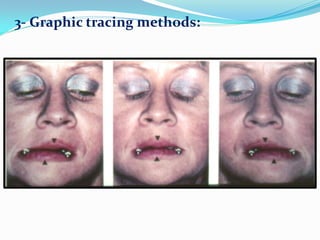
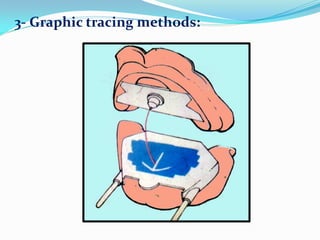
3- Graphic tracing methods:
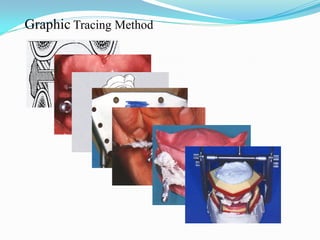
This technique shows the horizontal movement of the mandible in
the form of a tracing, made by a pointed attachment fitted to one
block , on a recording plate fitted to the other block.
2 types : intra oral tracers and extra oral tracers
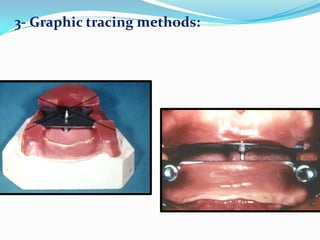
3- Graphic tracing methods:
Graphic Tracing Method
4- chew in- or functional record methods:
a) Needles House’s chew in technique:
a) Essing and Paterson’s chew in technique:
Eccentric Jaw Relationships
Protrusive Record
Right Lateral Record
Left Lateral Record
Any jaw relation other than centric relation .
ECCENTRIC JAW RELATIONS
Methods of Registration:
1.Wax registration method.
2.Graphic tracing method.
3.Chew – in or Functional method.
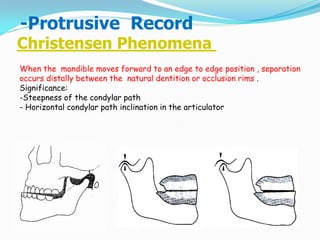
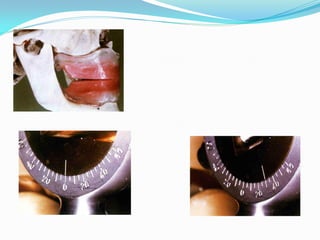
Christensen Phenomena
When the mandible moves forward to an edge to edge position , separation
occurs distally between the natural dentition or occlusion rims .
Significance:
-Steepness of the condylar path
- Horizontal condylar path inclination in the articulator
-Protrusive Record
5- face bow record
Orientation relation
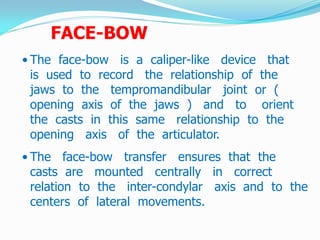
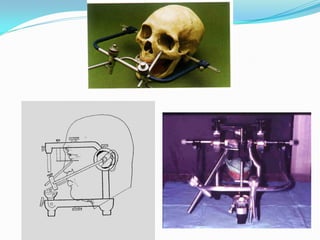
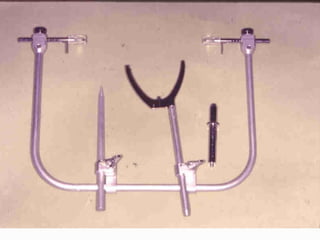
FACE-BOW
• The face-bow is a caliper-like device that
is used to record the relationship of the
jaws to the tempromandibular joint or (
opening axis of the jaws ) and to orient
the casts in this same relationship to the
opening axis of the articulator.
• The face-bow transfer ensures that the
casts are mounted centrally in correct
relation to the inter-condylar axis and to the
centers of lateral movements.
TYPES OF FACE-BOWS
1- Mandibular or kinematic face-bow (
hinge axis face-bow ).
2- Maxillary face-bow (arbitrary face-bow).
1. To locate the exact terminal hinge axis
(rotational axis) for subsequent use of
maxillary face-bow
bow-Uses of Mandibular Face
2. To record the centric relation.
Terminal Hinge Axis Method
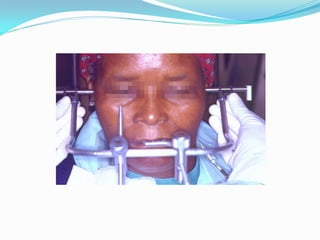
Uses of Maxillary Face-bow
 This relates the maxilla to the exact
or arbitrary position of the condylar axis
and transfers this relationship to the
articulator.
4 & 5 jaw relation 1 & 2

4 & 5 jaw relation 1 & 2

  • 2.
    Recording edentulous Jaw Relationships (Principlesof registration of maxillomandibular relationships)
  • 3.
     Accurate determination, recording and transfer of Jaw Relation from the edentulous patient to the articulator is essential for the restoration of Function, Facial appearance , and the maintenance of the patient’s Health.  Unsatisfactory maxillomandibular relationships will eventually lead to failure of complete denture.
  • 4.
    Jaw relation ?: Anypositional relationship of the mandible to the maxilla
  • 5.
    Steps of JawRelation Record: I- Check the record blocks (base plates) as regard : Extension, Retention, and Stability . II- Adjustment of The Occlusion Rim as regard : Facial contour, Height, and Orientation of the Occlusal plane. III- Recording Certain Guide lines : Central line, High lip line, and canine lines. IV- Determination of the Vertical Dimensions. V- Recording of the Horizontal Jaw Relations. Centric J. R. & Eccentric J. R. (depending on the design of the articulator). VI- Face-Bow Record (Orientation Relation).
  • 7.
    Record Bases (Baseplates) andOcclusion Rims  Used to relate casts on an articulator  Record bases simulate the finished denture base  Wax occlusion rims simulate the position of the teeth
  • 8.
    1. Check occlusionblocks. The borders of the record bases should be smooth, rounded and polished to provide maximum patient comfort, to avoid irritation and tension of the patient, which my lead to false record
  • 9.
  • 10.
    Facial contour dependson the presence and alignment of teeth. With the loss of teeth, lips &cheeks loose their support resulting in senile appearance. Occlusion rims should be adjusted to restore lip & cheek support ,so as to restore the normal facial contour & appearance II- Adjustment of The Occlusion Rim
  • 11.
    II- Adjustment ofThe Occlusion Rim as regard : 1-Facial contours: -----Pleasing facial appearance The following land marks are used as a guide •Fullness of the upper lip. •The philtrum •The nasolabial fold •The corner of the mouth
  • 13.
    Maxillary Occlusion Rim Adjustment Lips should be unstrained • Naso-labial angle ≈ 90° • Philtrum depressed • Vermilion border showing
  • 14.
    The labial surfaceof the occlusion rim is adjusted by removal or addition of wax until natural appearance and a pleasing position of the upper lips is obtained.
  • 15.
    II- Adjustment ofThe Occlusion Rim as regard : 2-Height of the occlusal plane : - The plane of occlusion maybe defined as an Imaginary plane, which contacts the incisal & occlusal surfaces of the teeth. 1-2 mm below the upper lip in normal lip length patient when relaxed
  • 16.
    The upper occlusionrim is adjusted so that its lower border is 1-2mm below the lip while at rest. Normally, 1-2mm of the anterior teeth will be showing below the upper lip.
  • 17.
    Maxillary Occlusion Rim Adjustment Touches wet line of lower lip when ‘F’ or ‘V’ sounds  Count ‘50-60’
  • 18.
    Use a HotWax Former
  • 19.
    Mandibular Occlusion Rim Adjustment Posteriorly, the occlusion rim intersects 1/2 - 2/3 up the retromolar pad
  • 20.
    Mandibular Occlusion Rim Adjustment Anterior height even with the corners of the mouth when the lip is relaxed
  • 21.
    II- Adjustment ofThe Occlusion Rim as regard: 3-Orientation of the occlusal plane: Anterior plane // to interpupillary line Posterior plane // to Ala tragus line( Comper’s line) Fox plane
  • 22.
    III- Recording Guidelines : Central line, High lip line, and canine lines.
  • 23.
    The midline The Caninelines The High lip line For proper & correct setting-up & arrangement of teeth, certain guide lines are drawn on the occlusion rims.
  • 26.
    IV- Determination ofthe Vertical Dimensions: Vertical relation determine the amount of separation between the two jaws and has to be established correctly for the proper comfort, health, and function of the mouth. It is the distance between two selected anatomic or marked points usually one on the tip of the nose and the other upon the chin ( fixed and movable members)
  • 27.
    Determining the vertical dimensionwill aid in determining the amount of space available between the maxillary & mandibular arches; that will later be occupied by the upper & lower dentures.
  • 28.
    2 Types: Vertical dimensionof rest (VDR): When the mandible in rest position(after talking, swallowing, or chewing) , the person is relaxed and the teeth are separated by a gap ( the elevator and depressor muscles of the mandible are in equilibrium It can be considered a constant and reproducible position, but may be subjected to some variables Vertical dimension of occlusion (VDO): When the teeth or occluding rims are in maximum occlusal contact
  • 29.
  • 30.
    It is thedifference between V.D.R & V.D.O. It has an average of 2-4mm.  Space between wax rims at physiologic rest position
  • 31.
     Biological importanceof correct registeration of VDO, the patient can:dimension ; the patient can 1 - Masticate his food efficiently. 2 - Speak without impediment. 3 - Present a normal facial appearance. 4 - Experience a minimum amount of discomfort in using his dentures.
  • 32.
    Methods of determinationof occlusal vertical dimension in edentulous patient: 1- Pre extraction records: -Radiograph -Profile photograph -Contoured wire profile -Facial measurements -Plaster casts of the dentulous condition -Face mask
  • 33.
    Methods of determinationof occlusal vertical dimension in edentulous patient: 2- functional performance methods ( Physiologic) : -Respiratory (physiologic) rest position -Phonetics of some labial sound (m m), Closest speaking space (The space between the occlusal surfaces and incisal edges of the teeth When the mandible is elevated to the maximum extent during speech ), it is a dynamic measurement recorded during physiologic function of speech ( Free way space : resting measurements ) -Let the patient swallow and then relax or wet his lip with the tip of the tongue then relax - Swallowing for evaluation of V D
  • 34.
    Methods of determinationof occlusal vertical dimension in edentulous patient: 3- Esthetic methods : Study of the harmony of the facial proportions: The lips should provide pleasing and normal appearance, angle of the mouth. 4- Ridge relationships: Upper and lower posterior ridges should be parallel to each other ( evaluation of V D ) 5- Boos Bimeter: The biting force is maximum at the correct separation of the two jaws
  • 35.
    Methods of determinationof occlusal vertical dimension in edentulous patient: 6- Several measurments: -Willis device 7- Dimensions by photograph (Wright relative measument)
  • 36.
    Effect of wrongregistration of VDO: Low VDO 1- inefficiency 2-cheek biting 3- appearance 4- soreness of the corner of the mouth 5- pain in TMJ 6- lack of tongue space High VDO 1-discomfort. 2- trauma and soreness and rapid resorption of alveolar bone 3- loss of free way space 4-clicking of teeth during speech 5- appearance (elongated face) 6- difficulty in swallowing
  • 37.
    Patient sitting upright Softtissue position affected by posture
  • 39.
    Clinical procedures: NB. Ensureequalizing the pressure of occluding forces by even contact between the upper and lower occlusion blocks .
  • 40.
    V- Recording theHorizontal Jaw Relations: - Centric J. R. -Eccentric J. R. - Protrusive relation - Lateral relations: * Left lateral * Right lateral
  • 41.
    CENTRIC RELATION The mostretruded relation of the mandible to the maxillae when the condyles are in their most posterior unstrained position in the glenoid fossae.
  • 42.
    Centric Relation: -It isa bone to bone relation that is reproducible. It remains constant throughout life & during its recording cuspal relation of the teeth is not considered. -Serve as a reference point for establishing denture occlusion for edentulous patient -To provide harmonious balanced occlusal contact between teeth during function
  • 43.
    CENTRIC OCCLUSION The occlusionof opposing teeth when the mandible is in centric relation. -if C R & C O in artificial teeth not coincide the stability of the denture decreased and the patient will subjected to unnecessary pain or discomfort
  • 44.
    Significance of centricrelation: It is important to establish a repeatable and recordable reference position for construction of occlusion in complete denture, Failure of construction of occlusion in centric relation will lead to trauma to denture foundation and TMJ and affect greatly the stability and the efficiency of the dentures as well as the comfort of the patient
  • 45.
    Significance of centricrelation: 1- CR is a guided, retruded posterior border position rather than habitual position presented by the patient it is bone to bone relation which in the healthy patient can be considered constant for clinical purposes. 2- it is repeatable, recordable and is the point of reference for establishing centric occlusion
  • 46.
    Significance of centricrelation: 3-when centric relation and centric occlusion do not coincide or freedom in centric not present the stability of the denture will be impaired ….pain and discomfort 4- edentulous patient use the centric relation closure in mastication and other mandibular activities as swallowing . CR is the position at which masticatory cycle is started and ended.
  • 47.
    Methods of determination ofcentric relation 1- Wax registration method (check bites). 2- Terminal hinge axis determination method (Kinematic face bow). 3- Graphic tracing or excursive method. 4- Chew in or functional record method.
  • 48.
  • 49.
    1- Wax registrationmethod (check bite method): It is the most commonly used method, ( easy , not time consuming, no need for complicated instrument or device) This procedure make use of a suitable wax interposed between occlusion rims at the previously determined occlusal vertical dimension
  • 50.
  • 56.
    Methods used toguide the mandible in centric relation: 1-Tongue retrusion method. 2-Swallowing method 3- Fatigue method 4- Relaxation 5- Biting operators fingers 6- Head position. 7- Temporalis muscle check.
  • 57.
    Difficulties of retrudingthe mandible: 1- in patient who have had edentulous posterior areas for long duration without replacement 2- in patient who have lost the occlusal relations of old dentures due to a closure of the occlusal V D 3-in patient who have been fully edentulous for a long period. 4- in patient who are tense and not relaxed at the time of recording centric relation.
  • 58.
    1- Wax registrationmethod (check bite method): The record should be checked for: 1- the wax rims should be the only contacting surfaces. 2- the trial denture bases should fit exactly on their casts without rocking to be sure that no warpage has occurred 3- any contact between the upper and lower casts at the rear should be eliminated as it would prevent the occlusion blocks from being accurately seated
  • 59.
    2- Terminal hingeaxis method Kinematic Face Bow ( Mandibular Face Bow ) The Kinematic face-bow is attached to the mandible that is why it is sometimes called the mandibular face-bow.
  • 60.
  • 61.
    3- Graphic tracingmethods: This technique shows the horizontal movement of the mandible in the form of a tracing, made by a pointed attachment fitted to one block , on a recording plate fitted to the other block. 2 types : intra oral tracers and extra oral tracers
  • 62.
  • 63.
  • 64.
  • 65.
  • 66.
    4- chew in-or functional record methods: a) Needles House’s chew in technique: a) Essing and Paterson’s chew in technique:
  • 67.
    Eccentric Jaw Relationships ProtrusiveRecord Right Lateral Record Left Lateral Record Any jaw relation other than centric relation .
  • 68.
    ECCENTRIC JAW RELATIONS Methodsof Registration: 1.Wax registration method. 2.Graphic tracing method. 3.Chew – in or Functional method.
  • 69.
    Christensen Phenomena When themandible moves forward to an edge to edge position , separation occurs distally between the natural dentition or occlusion rims . Significance: -Steepness of the condylar path - Horizontal condylar path inclination in the articulator -Protrusive Record
  • 71.
    5- face bowrecord Orientation relation
  • 72.
    FACE-BOW • The face-bowis a caliper-like device that is used to record the relationship of the jaws to the tempromandibular joint or ( opening axis of the jaws ) and to orient the casts in this same relationship to the opening axis of the articulator. • The face-bow transfer ensures that the casts are mounted centrally in correct relation to the inter-condylar axis and to the centers of lateral movements.
  • 74.
    TYPES OF FACE-BOWS 1-Mandibular or kinematic face-bow ( hinge axis face-bow ). 2- Maxillary face-bow (arbitrary face-bow).
  • 75.
    1. To locatethe exact terminal hinge axis (rotational axis) for subsequent use of maxillary face-bow bow-Uses of Mandibular Face 2. To record the centric relation.
  • 76.
  • 77.
    Uses of MaxillaryFace-bow  This relates the maxilla to the exact or arbitrary position of the condylar axis and transfers this relationship to the articulator.