Faculty of Dentistry
Assuit university
3rd year student
Feb, 21, 2016
Jaw relations
Recording
Maxillo-Mandibular
Relations
Steps for making full denture
Primary impression
Primary cast
Secondary impression
Master cast
Trial denture base
Occlusion rims
Procedures of Recording
Maxillo-Mandibular Relations
1) Checking extension, retention, and stability of occlusion rim
2) Establishing proper facial contour
3) Orientation of the occlusal plane
4) Determination of vertical dimensions
5) Mounting maxillary cast according to face-bow
6) Registration of centric occluding relations
7) Registration of eccentric jaw relations
Checking extension, retention, and stability
Minimize the liability of recording wrong relationship
Due to :
* ill fitting bases
* Warpage of shellac trial bases
Checking extension, retention, and stability
Extend to functional depth
Rounded and smooth
Fill the vestibule
Post dam area
Lingual extension
Hamular notches area
Checking extension, retention, and stability
Maxilla
Upward and forward ……….... Post-dam
Downward…… border seal anteriorly
Buccal…….. Border seal posteriorly
Mandible
Downward and forward ……….... Posterior portion
Upward …… border seal anteriorly
Buccal…….. Border seal posteriorly
Checking extension, retention, and stability
Alternate vertical pressure on premolar region
The base shouldn’t teeter
Procedures of Recording
Maxillo-Mandibular Relations
1) Checking extension, retention, and stability of occlusion rim
2) Establishing proper facial contour
3) Orientation of the occlusal plane
4) Determination of vertical dimensions
5) Mounting maxillary cast according to face-bow
6) Registration of centric occluding relations
7) Registration of eccentric jaw relations
Establishing proper facial contour
Procedures of Recording
Maxillo-Mandibular Relations
1) Checking extension, retention, and stability of occlusion rim
2) Establishing proper facial contour
3) Orientation of the occlusal plane
4) Determination of vertical dimensions
5) Mounting maxillary cast according to face-bow
6) Registration of centric occluding relations
7) Registration of eccentric jaw relations
Orientation of occlusal plane
Anterior occlusal plane influenced by:
* Esthetics
* Phonetics
Posterior occlusal plane influenced by:
* Anatomical land marks
* Condition of residual ridge
Orientation of occlusal plane
Anterior occlusal plane influenced by:
* Esthetics
* Phonetics
Orientation of occlusal plane
Posterior occlusal plane influenced by:
* Anatomical land marks
* Condition of residual ridge
Procedures of Recording
Maxillo-Mandibular Relations
1) Checking extension, retention, and stability of occlusion rim
2) Establishing proper facial contour
3) Orientation of the occlusal plane
4) Determination of vertical dimensions
5) Mounting maxillary cast according to face-bow
6) Registration of centric occluding relations
7) Registration of eccentric jaw relations
Determination of vertical dimensions
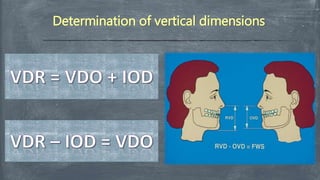
Two measurable lengths of the face are important guides in
making maxillo -mandibular relation records and are referred to as
:
Vertical dimension of rest (VDR).
Vertical dimension of occlusion (VDO).
Determination of vertical dimensions
Vertical dimension of physiologic rest position (VDR)

Vertical separation of the jaws when the opening and closing
muscles of mandible are in a state of minimal tonic contraction
sufficient only to maintain posture
Determination of vertical dimensions
Physiologic rest position
The position assumed by the mandible when the head is in
an upright position, the muscles are in equilibrium in tonic
contraction and the condyles are in a neutral unstrained
position is the physiologic rest position of the mandible.
Determination of vertical dimensions
Vertical dimension of occlusion (VDO)
Vertical separation of the jaws when the teeth or occlusion
rims are in contact.
Determination of vertical dimensions
Interocclusal Distance (IOD)
Vertical separation of the jaws when the opening and closing
muscles of mandible are in a state of minimal tonic
contraction sufficient only to maintain posture.
Determination of vertical dimensions
METHODS OF DETERMINING )VDR(
1. FACIAL MEASUREMENT AFTER SWALLOWING AND RELAXING.
2. SPEECH
3. TACTILE SENSE
4. MEASUREMENT OF ANATOMICAL LANDMARKS
5. FACIAL EXPRESSION.
Determination of vertical dimensions
METHODS OF DETERMINING )VDR(
FACIAL MEASUREMENT AFTER SWALLOWING AND RELAXING.
Determination of vertical dimensions
METHODS OF DETERMINING )VDR(
SPEECH
• 1st method : Ask the patient to repeatedly pronounce the
letter ‘M’, a certain number of times. Distance is measured
immediately after the patient stops.
• 2nd method: keep talking to the patient and measure the
distance immediately after the patient stops talking.
Determination of vertical dimensions
METHODS OF DETERMINING )VDR(
TACTILE SENSE
• Instruct the patient to stand erect and open the jaws wide until
strain is felt in the muscles.
• When the opening becomes uncomfortable, ask him to close
slowly until the jaws reach a comfortable relaxed position.
• Measure the distance and compare it.
Determination of vertical dimensions
METHODS OF DETERMINING )VDR(
MEASUREMENT OF ANATOMICAL LANDMARKS
• Distance between the pupil of the eye and Rima oris and the distance
between anterior nasal spine and lower border of mandible is measured
using Willis guide.
• If both the distances are equal, jaws are considered at rest.
Determination of vertical dimensions
METHODS OF DETERMINING )VDR(
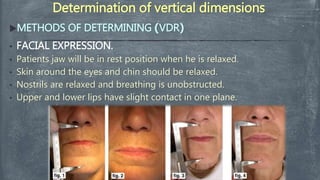
• FACIAL EXPRESSION.
• Patients jaw will be in rest position when he is relaxed.
• Skin around the eyes and chin should be relaxed.
• Nostrils are relaxed and breathing is unobstructed.
• Upper and lower lips have slight contact in one plane.
Determination of vertical dimensions
METHODS OF DETERMINING )VDO(
1. Pre-extraction records.
2. Phonetic : ( closest- speaking space)
Determination of vertical dimensions
METHODS OF DETERMINING )VDO(
Pre-extraction record
Profile photograph : profile photograph are made and enlarged to life
size . measurement of anatomic landmarks on the photograph is
compared with measurement of the same anatomic landmarks on the
face .
Determination of vertical dimensions
METHODS OF DETERMINING )VDO(
Pre-extraction record
Profile silhouettes :- The word silhouettes means " outline "‫ـــ‬ An
accurate reproduction of the profile in silhouette can be cut out in card
board or contoured in wire
Determination of vertical dimensions
METHODS OF DETERMINING )VDO(
Pre-extraction record
Radiograph : profile radiograph of positions of condyles in the fossae
with the teeth in occlusion
Determination of vertical dimensions
METHODS OF DETERMINING )VDO(
Pre-extraction record
Articulated cast : A simple method of recording the vertical relation , as
well as size and shape of the teeth , is through the use of diagnostic cast
mounted on an articulator
Determination of vertical dimensions
METHODS OF DETERMINING )VDO(
Phonetic : ( closest- speaking space)
The vertical dimension can be established by using ” closest-speaking
space “
This technique measures the space when the mandible is involved in
physiologic function of speech
The patient says words beginning with the “ F or V “ to determine
position of maxillary anterior teeth , while position of the mandibular
anterior teeth is determined by position of the mandible when patient
says words beginning with the letter “ S “
Procedures of Recording
Maxillo-Mandibular Relations
1) Checking extension, retention, and stability of occlusion rim
2) Establishing proper facial contour
3) Orientation of the occlusal plane
4) Determination of vertical dimensions
5) Mounting maxillary cast according to face-bow
6) Registration of centric occluding relations
7) Registration of eccentric jaw relations
Mounting the maxillary cast according to face-
bow record :-
Face-bow is a dental instrument that is used in the
prosthodontics . it transfers the relationship of maxillary arch
and temporomandibular joint to the casts. It aids in mounting
maxillary cast on the articulator.
Mounting the maxillary cast according to face-
bow record :-
-The condylar rods of the bow are positioned on a marked point 13 mm in
front of the canthus – tragus line
-The tip of infra-orbital pointer is positioned on the lowest part of infra-
orbital margin .
-The face bow fork is attached to maxillary occlusion rim . it is heated and
pushed into the labial surface of the maxillary occlusion rim , 3mm above its
lower border .
-Wings of the fork must be parallel to occlusal plane , and midline coincide
with the midline drawn on the maxillary occlusion rim
- Condylar rods released , and the upper cast is mounted on the articulator
Procedures of Recording
Maxillo-Mandibular Relations
1) Checking extension, retention, and stability of occlusion rim
2) Establishing proper facial contour
3) Orientation of the occlusal plane
4) Determination of vertical dimensions
5) Mounting maxillary cast according to face-bow
6) Recording of centric occluding relations
7) Recording of eccentric jaw relations
Recording the centric relation
-Centric relation: It is the most retruded
physiologic relation of the mandible to maxilla
, to and from which the individual can make
lateral movements
Centric occlusion: It is the relation between the
opposing teeth when the mandible is in centric
relation
CR is recorded after determination of VDO
Recording the centric relation
Significance:
- it is adefinite position
- can be repeated and the only relation which can be
dublicated
- - occlusion is more stable if the teeth occlude with the
jaws are in CR
Recording the centric relation
Methods of CR recording:
- 1- Static Method( check bites )
- 2- Functional Methods :
- A) Graphic tracing method
- B) Terminal hinge axis recording
- C) chew in functional generating records
Recording the centric relation
Methods of CR recording:
- Static Method( check bites )
mandible should be in the most retruded position
use recording medium as :
1- softened wax
2-plaster of Paris
3- Zinc oxide eugenol paste
Recording the centric relation
Technique for interocclusal record using
softened wax
( Check bite or wax wafet method )
A) Guide the mandible in centric relation
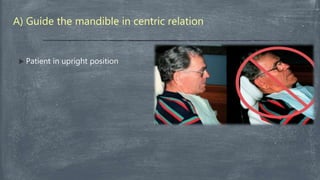
 Patient in upright position
A) Guide the mandible in centric relation
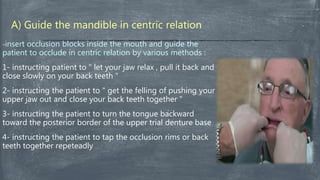
-insert occlusion blocks inside the mouth and guide the
patient to occlude in centric relation by various methods :
1- instructing patient to " let your jaw relax , pull it back and
close slowly on your back teeth "
2- instructing the patient to " get the felling of pushing your
upper jaw out and close your back teeth together "
3- instructing the patient to turn the tongue backward
toward the posterior border of the upper trial denture base
4- instructing the patient to tap the occlusion rims or back
teeth together repeteadly
B ) Mark Guidelines :
- Midline
- Canine lines
C) Locking the maxillary and Mandibular Occlusion blocks :
1- Two v-shaped grooves in occlusal surface of maxillary
occlusion rimin premolar region / not parallel to each other
2 - remove 2 mm. of wax from lower occlusion block and
replace them by softened wax
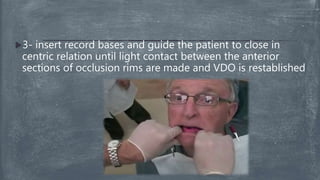
3- insert record bases and guide the patient to close in
centric relation until light contact between the anterior
sections of occlusion rims are made and VDO is restablished
4- remove occlusion blocks as one unit , chill in water
5- remove excess wax
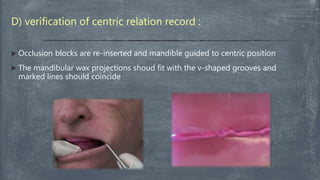
D) verification of centric relation record :
 Occlusion blocks are re-inserted and mandible guided to centric position
 The mandibular wax projections shoud fit with the v-shaped grooves and
marked lines should coincide
Advantages :
1- decrease liability to displace soft tissue
2- equalization of pressure
3- simple method , no mechanical devices
Disadvantages:
1- difficulties in handling softened wax during record or possible distortion of
the record after it was made
2- must be checked several time
Jaw relation-prosthesis

Jaw relation-prosthesis

  • 1.
    Faculty of Dentistry Assuituniversity 3rd year student Feb, 21, 2016 Jaw relations Recording Maxillo-Mandibular Relations
  • 2.
    Steps for makingfull denture Primary impression Primary cast Secondary impression Master cast Trial denture base Occlusion rims
  • 3.
    Procedures of Recording Maxillo-MandibularRelations 1) Checking extension, retention, and stability of occlusion rim 2) Establishing proper facial contour 3) Orientation of the occlusal plane 4) Determination of vertical dimensions 5) Mounting maxillary cast according to face-bow 6) Registration of centric occluding relations 7) Registration of eccentric jaw relations
  • 4.
    Checking extension, retention,and stability Minimize the liability of recording wrong relationship Due to : * ill fitting bases * Warpage of shellac trial bases
  • 5.
    Checking extension, retention,and stability Extend to functional depth Rounded and smooth Fill the vestibule Post dam area Lingual extension Hamular notches area
  • 6.
    Checking extension, retention,and stability Maxilla Upward and forward ……….... Post-dam Downward…… border seal anteriorly Buccal…….. Border seal posteriorly Mandible Downward and forward ……….... Posterior portion Upward …… border seal anteriorly Buccal…….. Border seal posteriorly
  • 7.
    Checking extension, retention,and stability Alternate vertical pressure on premolar region The base shouldn’t teeter
  • 8.
    Procedures of Recording Maxillo-MandibularRelations 1) Checking extension, retention, and stability of occlusion rim 2) Establishing proper facial contour 3) Orientation of the occlusal plane 4) Determination of vertical dimensions 5) Mounting maxillary cast according to face-bow 6) Registration of centric occluding relations 7) Registration of eccentric jaw relations
  • 9.
  • 10.
    Procedures of Recording Maxillo-MandibularRelations 1) Checking extension, retention, and stability of occlusion rim 2) Establishing proper facial contour 3) Orientation of the occlusal plane 4) Determination of vertical dimensions 5) Mounting maxillary cast according to face-bow 6) Registration of centric occluding relations 7) Registration of eccentric jaw relations
  • 11.
  • 12.
    Orientation of occlusalplane Anterior occlusal plane influenced by: * Esthetics * Phonetics Posterior occlusal plane influenced by: * Anatomical land marks * Condition of residual ridge
  • 13.
    Orientation of occlusalplane Anterior occlusal plane influenced by: * Esthetics * Phonetics
  • 14.
    Orientation of occlusalplane Posterior occlusal plane influenced by: * Anatomical land marks * Condition of residual ridge
  • 15.
    Procedures of Recording Maxillo-MandibularRelations 1) Checking extension, retention, and stability of occlusion rim 2) Establishing proper facial contour 3) Orientation of the occlusal plane 4) Determination of vertical dimensions 5) Mounting maxillary cast according to face-bow 6) Registration of centric occluding relations 7) Registration of eccentric jaw relations
  • 16.
    Determination of verticaldimensions Two measurable lengths of the face are important guides in making maxillo -mandibular relation records and are referred to as : Vertical dimension of rest (VDR). Vertical dimension of occlusion (VDO).
  • 17.
    Determination of verticaldimensions Vertical dimension of physiologic rest position (VDR)  Vertical separation of the jaws when the opening and closing muscles of mandible are in a state of minimal tonic contraction sufficient only to maintain posture
  • 18.
    Determination of verticaldimensions Physiologic rest position The position assumed by the mandible when the head is in an upright position, the muscles are in equilibrium in tonic contraction and the condyles are in a neutral unstrained position is the physiologic rest position of the mandible.
  • 19.
    Determination of verticaldimensions Vertical dimension of occlusion (VDO) Vertical separation of the jaws when the teeth or occlusion rims are in contact.
  • 20.
    Determination of verticaldimensions Interocclusal Distance (IOD) Vertical separation of the jaws when the opening and closing muscles of mandible are in a state of minimal tonic contraction sufficient only to maintain posture.
  • 21.
  • 22.
    Determination of verticaldimensions METHODS OF DETERMINING )VDR( 1. FACIAL MEASUREMENT AFTER SWALLOWING AND RELAXING. 2. SPEECH 3. TACTILE SENSE 4. MEASUREMENT OF ANATOMICAL LANDMARKS 5. FACIAL EXPRESSION.
  • 23.
    Determination of verticaldimensions METHODS OF DETERMINING )VDR( FACIAL MEASUREMENT AFTER SWALLOWING AND RELAXING.
  • 24.
    Determination of verticaldimensions METHODS OF DETERMINING )VDR( SPEECH • 1st method : Ask the patient to repeatedly pronounce the letter ‘M’, a certain number of times. Distance is measured immediately after the patient stops. • 2nd method: keep talking to the patient and measure the distance immediately after the patient stops talking.
  • 25.
    Determination of verticaldimensions METHODS OF DETERMINING )VDR( TACTILE SENSE • Instruct the patient to stand erect and open the jaws wide until strain is felt in the muscles. • When the opening becomes uncomfortable, ask him to close slowly until the jaws reach a comfortable relaxed position. • Measure the distance and compare it.
  • 26.
    Determination of verticaldimensions METHODS OF DETERMINING )VDR( MEASUREMENT OF ANATOMICAL LANDMARKS • Distance between the pupil of the eye and Rima oris and the distance between anterior nasal spine and lower border of mandible is measured using Willis guide. • If both the distances are equal, jaws are considered at rest.
  • 27.
    Determination of verticaldimensions METHODS OF DETERMINING )VDR( • FACIAL EXPRESSION. • Patients jaw will be in rest position when he is relaxed. • Skin around the eyes and chin should be relaxed. • Nostrils are relaxed and breathing is unobstructed. • Upper and lower lips have slight contact in one plane.
  • 28.
    Determination of verticaldimensions METHODS OF DETERMINING )VDO( 1. Pre-extraction records. 2. Phonetic : ( closest- speaking space)
  • 29.
    Determination of verticaldimensions METHODS OF DETERMINING )VDO( Pre-extraction record Profile photograph : profile photograph are made and enlarged to life size . measurement of anatomic landmarks on the photograph is compared with measurement of the same anatomic landmarks on the face .
  • 30.
    Determination of verticaldimensions METHODS OF DETERMINING )VDO( Pre-extraction record Profile silhouettes :- The word silhouettes means " outline "‫ـــ‬ An accurate reproduction of the profile in silhouette can be cut out in card board or contoured in wire
  • 31.
    Determination of verticaldimensions METHODS OF DETERMINING )VDO( Pre-extraction record Radiograph : profile radiograph of positions of condyles in the fossae with the teeth in occlusion
  • 32.
    Determination of verticaldimensions METHODS OF DETERMINING )VDO( Pre-extraction record Articulated cast : A simple method of recording the vertical relation , as well as size and shape of the teeth , is through the use of diagnostic cast mounted on an articulator
  • 33.
    Determination of verticaldimensions METHODS OF DETERMINING )VDO( Phonetic : ( closest- speaking space) The vertical dimension can be established by using ” closest-speaking space “ This technique measures the space when the mandible is involved in physiologic function of speech The patient says words beginning with the “ F or V “ to determine position of maxillary anterior teeth , while position of the mandibular anterior teeth is determined by position of the mandible when patient says words beginning with the letter “ S “
  • 34.
    Procedures of Recording Maxillo-MandibularRelations 1) Checking extension, retention, and stability of occlusion rim 2) Establishing proper facial contour 3) Orientation of the occlusal plane 4) Determination of vertical dimensions 5) Mounting maxillary cast according to face-bow 6) Registration of centric occluding relations 7) Registration of eccentric jaw relations
  • 35.
    Mounting the maxillarycast according to face- bow record :- Face-bow is a dental instrument that is used in the prosthodontics . it transfers the relationship of maxillary arch and temporomandibular joint to the casts. It aids in mounting maxillary cast on the articulator.
  • 36.
    Mounting the maxillarycast according to face- bow record :- -The condylar rods of the bow are positioned on a marked point 13 mm in front of the canthus – tragus line -The tip of infra-orbital pointer is positioned on the lowest part of infra- orbital margin . -The face bow fork is attached to maxillary occlusion rim . it is heated and pushed into the labial surface of the maxillary occlusion rim , 3mm above its lower border . -Wings of the fork must be parallel to occlusal plane , and midline coincide with the midline drawn on the maxillary occlusion rim - Condylar rods released , and the upper cast is mounted on the articulator
  • 37.
    Procedures of Recording Maxillo-MandibularRelations 1) Checking extension, retention, and stability of occlusion rim 2) Establishing proper facial contour 3) Orientation of the occlusal plane 4) Determination of vertical dimensions 5) Mounting maxillary cast according to face-bow 6) Recording of centric occluding relations 7) Recording of eccentric jaw relations
  • 38.
    Recording the centricrelation -Centric relation: It is the most retruded physiologic relation of the mandible to maxilla , to and from which the individual can make lateral movements Centric occlusion: It is the relation between the opposing teeth when the mandible is in centric relation CR is recorded after determination of VDO
  • 39.
    Recording the centricrelation Significance: - it is adefinite position - can be repeated and the only relation which can be dublicated - - occlusion is more stable if the teeth occlude with the jaws are in CR
  • 40.
    Recording the centricrelation Methods of CR recording: - 1- Static Method( check bites ) - 2- Functional Methods : - A) Graphic tracing method - B) Terminal hinge axis recording - C) chew in functional generating records
  • 41.
    Recording the centricrelation Methods of CR recording: - Static Method( check bites ) mandible should be in the most retruded position use recording medium as : 1- softened wax 2-plaster of Paris 3- Zinc oxide eugenol paste
  • 42.
    Recording the centricrelation Technique for interocclusal record using softened wax ( Check bite or wax wafet method )
  • 43.
    A) Guide themandible in centric relation  Patient in upright position
  • 44.
    A) Guide themandible in centric relation -insert occlusion blocks inside the mouth and guide the patient to occlude in centric relation by various methods : 1- instructing patient to " let your jaw relax , pull it back and close slowly on your back teeth " 2- instructing the patient to " get the felling of pushing your upper jaw out and close your back teeth together " 3- instructing the patient to turn the tongue backward toward the posterior border of the upper trial denture base 4- instructing the patient to tap the occlusion rims or back teeth together repeteadly
  • 45.
    B ) MarkGuidelines : - Midline - Canine lines
  • 46.
    C) Locking themaxillary and Mandibular Occlusion blocks : 1- Two v-shaped grooves in occlusal surface of maxillary occlusion rimin premolar region / not parallel to each other
  • 47.
    2 - remove2 mm. of wax from lower occlusion block and replace them by softened wax
  • 48.
    3- insert recordbases and guide the patient to close in centric relation until light contact between the anterior sections of occlusion rims are made and VDO is restablished
  • 49.
    4- remove occlusionblocks as one unit , chill in water 5- remove excess wax
  • 50.
    D) verification ofcentric relation record :  Occlusion blocks are re-inserted and mandible guided to centric position  The mandibular wax projections shoud fit with the v-shaped grooves and marked lines should coincide
  • 51.
    Advantages : 1- decreaseliability to displace soft tissue 2- equalization of pressure 3- simple method , no mechanical devices Disadvantages: 1- difficulties in handling softened wax during record or possible distortion of the record after it was made 2- must be checked several time