EHR SYSTEMS IMPLEMENTATION
AND ONGOING MAINTENANCE
Phaniveer Ramji Vallabhaneni
Bharath Kumar Reddy Chinta
December 2016
The University of Findlay
INTRODUCTION
• Electronic Health Records: Is an electronic
version of a patient’s health and medical
records. These are real-time secured information
available for authorized users only. It contains all
the required information about patient’s health
condition, records, test reports.
• The information in the EHR is managed by the
healthcare providers.
• Topic of discussion is EHR implementation and
ongoing maintenance.
• The following topic will be discussed: EHR
functionalities, Benefits of EHR, EHR
Implementation, After EHR Implementation.
• Policy in EHR
EHR FUNCTIONALITIES:
• CDS-Clinical Decision Support System: It helps the provider in making decisions
in regard to patient care.
• It provides the updated information about a drug, cross referencing a patient
allergy etc.,
• CPOE-Computerized Physician Order Entry: In this system the provider enters
the information about patient’s requirements. E.g., drugs, test results, radiology,
physical therapy.
• HIE-Health Information Exchange: through this system hospitals can exchange
their patient's health information with patient's authorization, real time sharing
helps in taking faster decisions in emergency situations.
B E N E F I T S / A D V A N T A G E S
O F E H R :
Benefits/advantages are categorized into
three types
• 1. Clinical Outcomes: Quality of Care
Patient Safety
• 2. Organizational Outcomes: These are
based upon two settings Outpatient
settings and Inpatient settings. Increased
revenue, reduced costs.
• 3. Societal Outcomes: it is an improved
ability to conduct research.
DISADVANTAGES
OF EHR:
The disadvantages are
• Financial Issues
• Adoption and implementation costs
• Ongoing maintenance costs
• Loss of revenue with temporary loss of
productivity
• Financial discourage in hospitals and physicians
to adopt and implement an EHR.
• Installing new software and hardware
EHR IMPLEMENTATION:
The following steps on how to Implement EHRs
• Assess Your Practice Readiness
• Plan Your Approach
• Select or Upgrade to a Certified EHR
• Training and Implementation
• Achieve Meaningful Use
• Continue Quality Improvement
AFTER
IMPLEMENTATION
• Every hospital who has installed EHR will
have same question as “what after
Implementation”
• There comes the ongoing maintenance part
of EHR.
• Large and midsized hospitals will have their
own setup for IT department with all the
required staff, secure locations, back ups
and cool rooms.
• But the small hospitals and clinics could not
afford for such a huge amount in
maintenance
• 75% of the IT budget in a hospital goes for
maintenance and running of the existing
systems and infrastructure.
CONTINUTION
• They will be available 24/7 in service with hospital if the
they face any emergency situation.
• No fear of break down or sudden crash in software
because they’ll have all the back up needed.
• Some of their staff members will completely on the
hospital work.
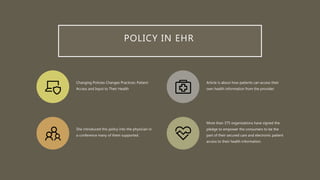
POLICY IN EHR
Changing Policies Changes Practices: Patient
Access and Input to Their Health
Article is about how patients can access their
own health information from the provider.
She introduced this policy into the physician in
a conference many of them supported.
More than 375 organizations have signed the
pledge to empower the consumers to be the
part of their secured care and electronic patient
access to their health information.
CRITICAL THINKING
• In my view for the EHR system implementation and ongoing
maintenance critical thinking is the most needed aid in taking
decisions, implementing and planning. Right from the start of EHR
implementation one should need to know the Purpose for what he is
doing.
• Questioning themselves in each step gives them to find the
Information that they needed, in which they can learn the concepts
that are essential for their project.
• Assumptions can make us see the things in a completed manner so
that what problem that can we would face can be traced way before
doing things. Taking every one’s Point of view can gives us more
options in a single question. Implications is what you do in your final
stage of going ahead in any situation by drawing conclusion with the
help of above steps.
CONCLUSION
• EHR Implementation and the ongoing maintenance gives us the mind map and
knowledge about how the process of EHR happens and what are the advantages
that we get and what disadvantages that we might face. The after implementation
gave all the answers for the disadvantages and questions that have been raised.
• The policy raised Jodi G. Daniel gives out a proper explanation on why patients
should have access to their medical records.
• Critical thinking sums up the process of thinking in a new establishment and how it
can be handled.
REFERENCES
• Nguyen, L., Bellucci, E., & Nguyen, L. T. (2014). Electronic health records implementation: An
evaluation of information system impact and contingency factors. International Journal of
Medical Informatics, 83(11), 779–796. https://doi.org/10.1016/j.ijmedinf.2014.06.011
• Bjarnadottir, R. I., Herzig, C., Travers, J. L., Castle, N. G., & Stone, P. W. (2017).
Implementation of Electronic Health Records in US Nursing Homes. Computers, informatics,
nursing : CIN, 35(8), 417–424. https://doi.org/10.1097/CIN.0000000000000344
• Chinta, Bharath Kumar Reddy (2021): Role of Health Information Exchange in Improving
Patient Safety. figshare. Thesis. https://doi.org/10.6084/m9.figshare.14558484.v1
• Boonstra, A., Versluis, A., & Vos, J. F. (2014). Implementing electronic health records in
hospitals: a systematic literature review. BMC Health Services Research, 14(1).
https://doi.org/10.1186/1472-6963-14-370
THE END

Ehr system implementation and ongoing maintenance

  • 1.
    EHR SYSTEMS IMPLEMENTATION ANDONGOING MAINTENANCE Phaniveer Ramji Vallabhaneni Bharath Kumar Reddy Chinta December 2016 The University of Findlay
  • 2.
    INTRODUCTION • Electronic HealthRecords: Is an electronic version of a patient’s health and medical records. These are real-time secured information available for authorized users only. It contains all the required information about patient’s health condition, records, test reports. • The information in the EHR is managed by the healthcare providers. • Topic of discussion is EHR implementation and ongoing maintenance. • The following topic will be discussed: EHR functionalities, Benefits of EHR, EHR Implementation, After EHR Implementation. • Policy in EHR
  • 3.
    EHR FUNCTIONALITIES: • CDS-ClinicalDecision Support System: It helps the provider in making decisions in regard to patient care. • It provides the updated information about a drug, cross referencing a patient allergy etc., • CPOE-Computerized Physician Order Entry: In this system the provider enters the information about patient’s requirements. E.g., drugs, test results, radiology, physical therapy. • HIE-Health Information Exchange: through this system hospitals can exchange their patient's health information with patient's authorization, real time sharing helps in taking faster decisions in emergency situations.
  • 4.
    B E NE F I T S / A D V A N T A G E S O F E H R : Benefits/advantages are categorized into three types • 1. Clinical Outcomes: Quality of Care Patient Safety • 2. Organizational Outcomes: These are based upon two settings Outpatient settings and Inpatient settings. Increased revenue, reduced costs. • 3. Societal Outcomes: it is an improved ability to conduct research.
  • 5.
    DISADVANTAGES OF EHR: The disadvantagesare • Financial Issues • Adoption and implementation costs • Ongoing maintenance costs • Loss of revenue with temporary loss of productivity • Financial discourage in hospitals and physicians to adopt and implement an EHR. • Installing new software and hardware
  • 6.
    EHR IMPLEMENTATION: The followingsteps on how to Implement EHRs • Assess Your Practice Readiness • Plan Your Approach • Select or Upgrade to a Certified EHR • Training and Implementation • Achieve Meaningful Use • Continue Quality Improvement
  • 7.
    AFTER IMPLEMENTATION • Every hospitalwho has installed EHR will have same question as “what after Implementation” • There comes the ongoing maintenance part of EHR. • Large and midsized hospitals will have their own setup for IT department with all the required staff, secure locations, back ups and cool rooms. • But the small hospitals and clinics could not afford for such a huge amount in maintenance • 75% of the IT budget in a hospital goes for maintenance and running of the existing systems and infrastructure.
  • 8.
    CONTINUTION • They willbe available 24/7 in service with hospital if the they face any emergency situation. • No fear of break down or sudden crash in software because they’ll have all the back up needed. • Some of their staff members will completely on the hospital work.
  • 9.
    POLICY IN EHR ChangingPolicies Changes Practices: Patient Access and Input to Their Health Article is about how patients can access their own health information from the provider. She introduced this policy into the physician in a conference many of them supported. More than 375 organizations have signed the pledge to empower the consumers to be the part of their secured care and electronic patient access to their health information.
  • 10.
    CRITICAL THINKING • Inmy view for the EHR system implementation and ongoing maintenance critical thinking is the most needed aid in taking decisions, implementing and planning. Right from the start of EHR implementation one should need to know the Purpose for what he is doing. • Questioning themselves in each step gives them to find the Information that they needed, in which they can learn the concepts that are essential for their project. • Assumptions can make us see the things in a completed manner so that what problem that can we would face can be traced way before doing things. Taking every one’s Point of view can gives us more options in a single question. Implications is what you do in your final stage of going ahead in any situation by drawing conclusion with the help of above steps.
  • 11.
    CONCLUSION • EHR Implementationand the ongoing maintenance gives us the mind map and knowledge about how the process of EHR happens and what are the advantages that we get and what disadvantages that we might face. The after implementation gave all the answers for the disadvantages and questions that have been raised. • The policy raised Jodi G. Daniel gives out a proper explanation on why patients should have access to their medical records. • Critical thinking sums up the process of thinking in a new establishment and how it can be handled.
  • 12.
    REFERENCES • Nguyen, L.,Bellucci, E., & Nguyen, L. T. (2014). Electronic health records implementation: An evaluation of information system impact and contingency factors. International Journal of Medical Informatics, 83(11), 779–796. https://doi.org/10.1016/j.ijmedinf.2014.06.011 • Bjarnadottir, R. I., Herzig, C., Travers, J. L., Castle, N. G., & Stone, P. W. (2017). Implementation of Electronic Health Records in US Nursing Homes. Computers, informatics, nursing : CIN, 35(8), 417–424. https://doi.org/10.1097/CIN.0000000000000344 • Chinta, Bharath Kumar Reddy (2021): Role of Health Information Exchange in Improving Patient Safety. figshare. Thesis. https://doi.org/10.6084/m9.figshare.14558484.v1 • Boonstra, A., Versluis, A., & Vos, J. F. (2014). Implementing electronic health records in hospitals: a systematic literature review. BMC Health Services Research, 14(1). https://doi.org/10.1186/1472-6963-14-370
  • 13.