101 Concepts for Games Innovation
Why Innovate?
Funding. Talent. Partners. Karma.
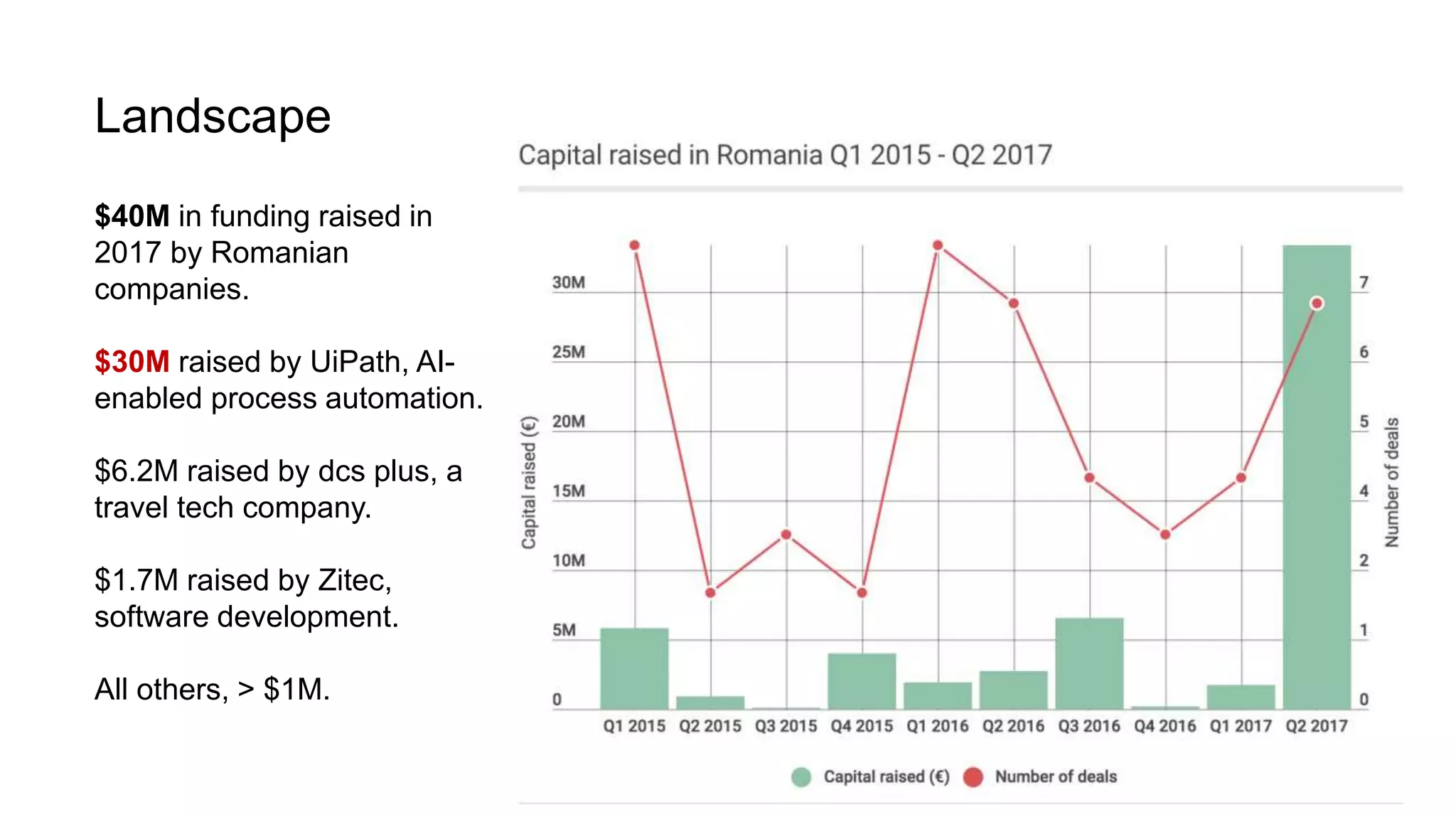
Landscape
$40M in funding raised in
2017 by Romanian
companies.
$30M raised by UiPath, AI-
enabled process automation.
$6.2M raised by dcs plus, a
travel tech company.
$1.7M raised by Zitec,
software development.
All others, > $1M.
Gartner’s Hype Cycle for Emerging Technology, 2017
Emerged Tech
*not covered in this presentation
Virtual Reality
Streamed Games
Wearables
eSports
Location-Based Games
Neurogaming
Adam Gazzaley, Neuroscape Lab at UCSF
Neuroracer, designed to improve cognition in older
adults = “prescription gaming”
Akili: digital medicine startup
Neurable (Boston), brain controlled VR
demo for a dystopic sci-fi game called Awakening
JAZZ Venture Partners: VC investing in neuroscience
startups
Neural Networks
Games = pioneering AI research (NPC behavior,
strategy).
Unlimited computation in the cloud, further enabled
by the advent of game engines in the cloud
(Lumberyard)
1952: First use of AI in the game “Nim”, running on
Ferranti’s Nimrod computer.
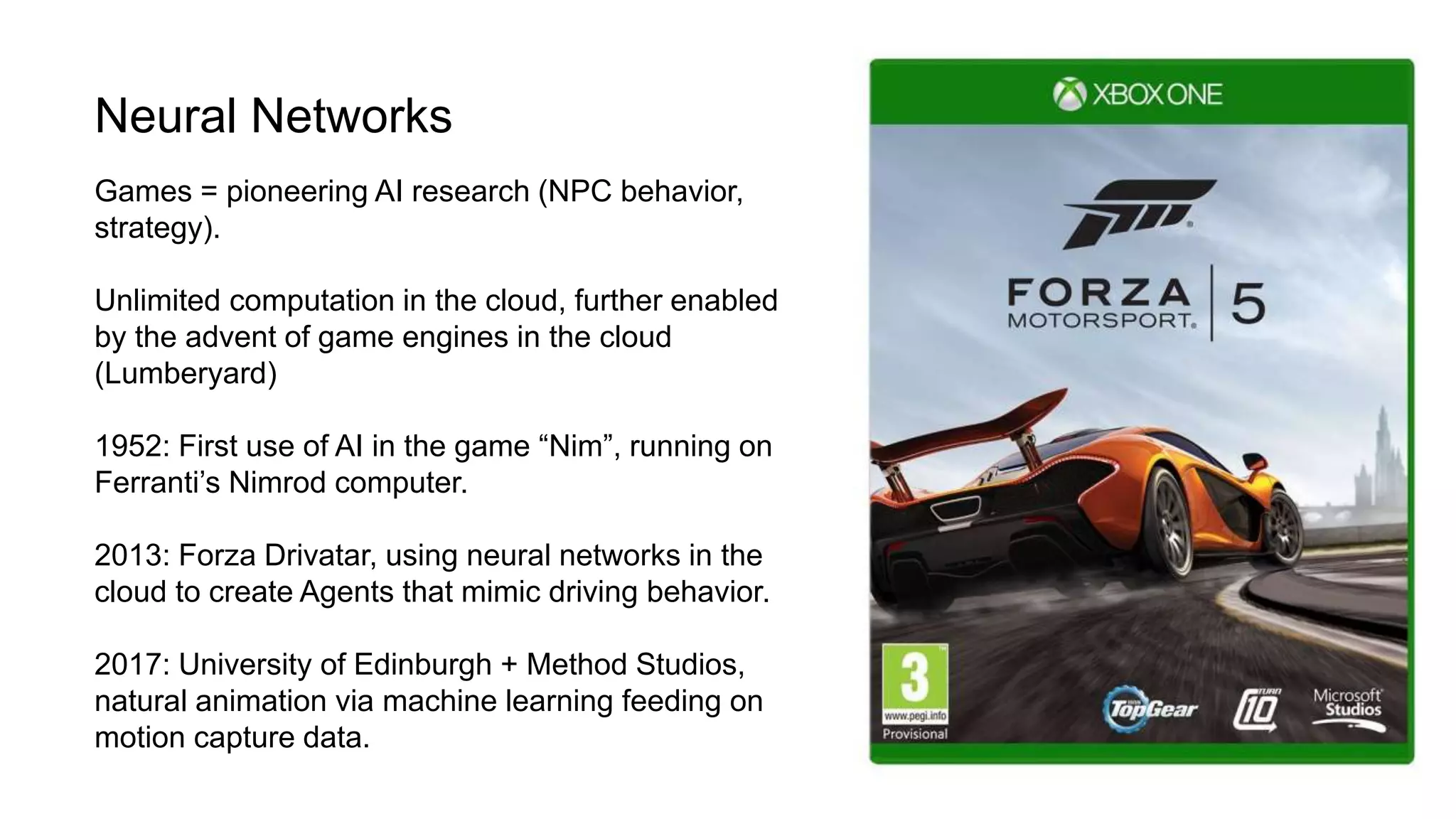
2013: Forza Drivatar, using neural networks in the
cloud to create Agents that mimic driving behavior.
2017: University of Edinburgh + Method Studios,
natural animation via machine learning feeding on
motion capture data.
Neural Networks
Deep learning as a game mechanic = NPCs
responding intelligently to player input, using real time
AI, exhibiting emergent behavior
Personalizing the player experience = the game
responds in real time to user behavior and game
choices:
automatic narrative generation
changing the world
dynamic procedural generation
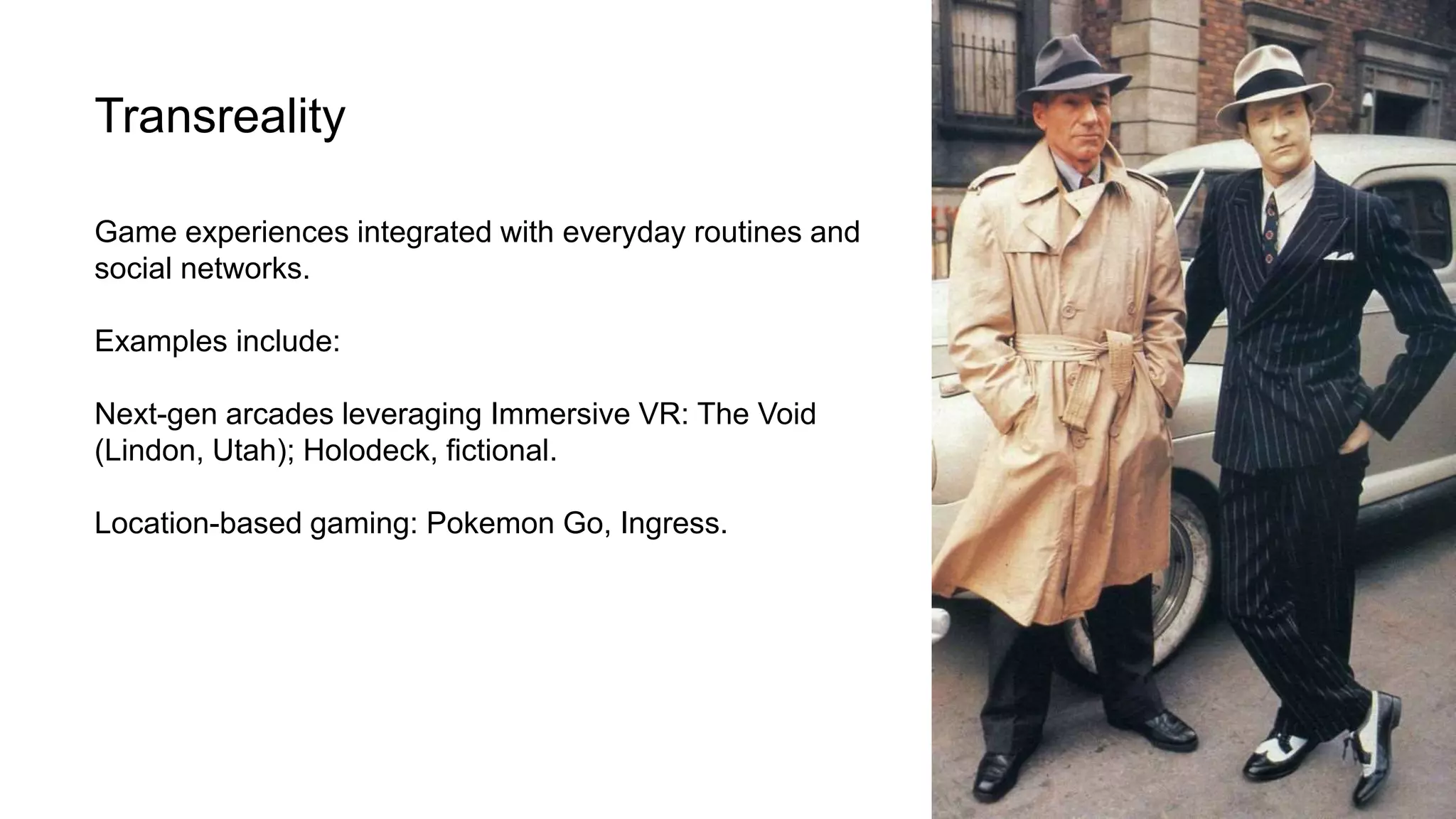
Transreality
Game experiences integrated with everyday routines and
social networks.
Examples include:
Next-gen arcades leveraging Immersive VR: The Void
(Lindon, Utah); Holodeck, fictional.
Location-based gaming: Pokemon Go, Ingress.
Mixed Reality
1992: Virtual Fixtures, by USAF Armstrong
Labs = first Augmented Reality system;
AR: Google Glass, Microsoft Hololens,
Magic Leap
Mobile Enabled: Apple ARKit, Google Tango
+ WorldSense
2016: Pokemon Go by Niantic, location-
based and AR-enabled game mode
2017: Guns of Boom, by Game Insight, FPS
spectator mode enabled via ARKit
Synthetic Reality
Proposed by Robert Wolcott, 2017
Ever-evolving realities, synthesizing our
will or preferences, consciously or
unconsciously provided.
AI-enabled systems, procedural
generation influenced by our individual
personality, emotional states, even
fleeting desires.
Alternate Reality
Transmedia storytelling, using the real world as a
means to augment a digital interactive experience
(internet, email, phones, social media).
1965: John Fowles, The Magus
1997: The Game (movie)
Principles:
 Storytelling as archaeology.
 Platformless narrative.
 Designing for a hive mind.
 A whisper is sometimes louder than a shout.
 “This is not a game" aesthetic. Real life as a
medium.
 Collaborative storytelling.
 Not a hoax.
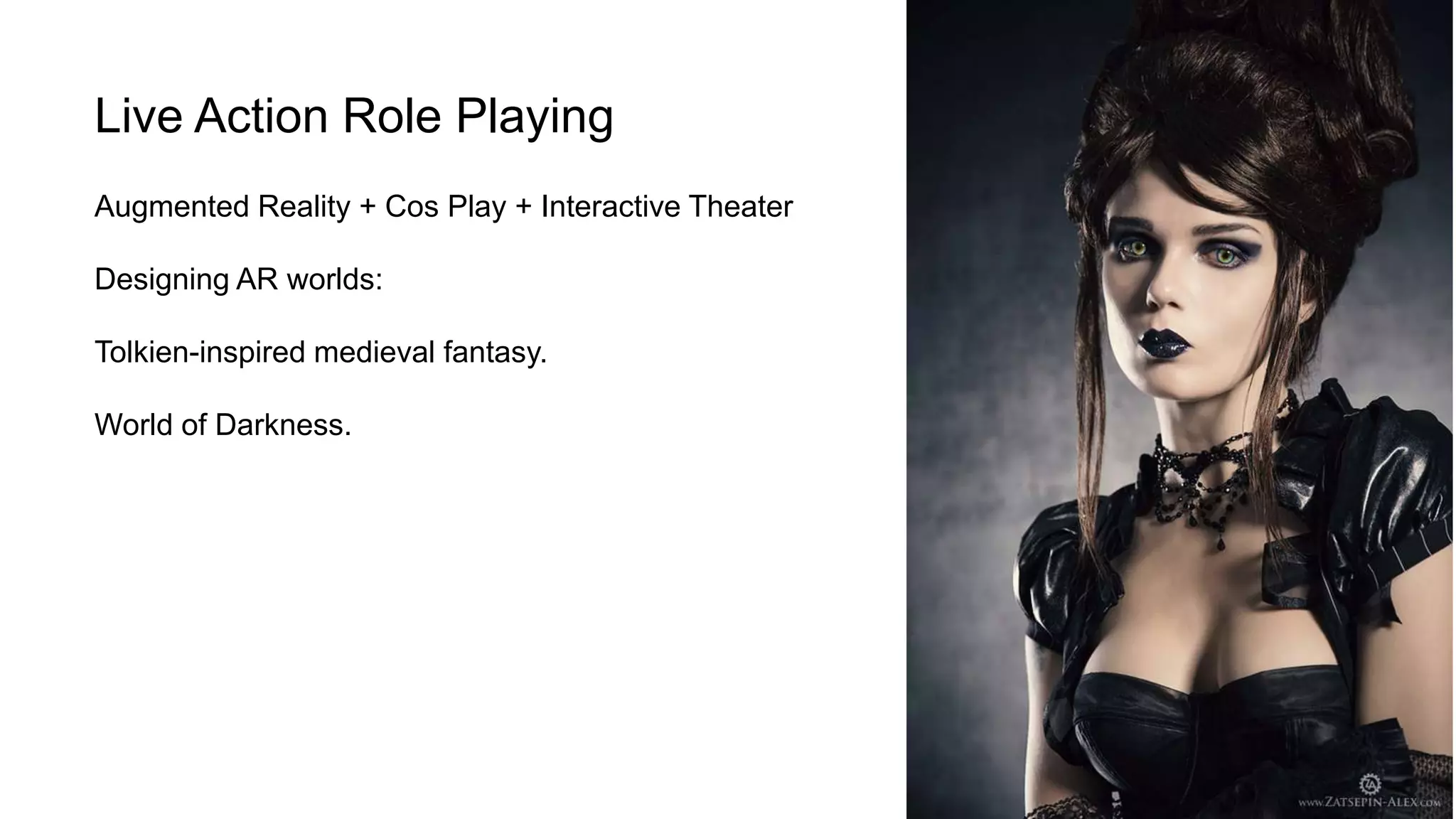
Live Action Role Playing
Augmented Reality + Cos Play + Interactive Theater
Designing AR worlds:
Tolkien-inspired medieval fantasy.
World of Darkness.
Internet of Things
Your smart home can react in real time to game actions:
Windows open and close
AC temperature fluctuates
Lights flicker, change color
TV turns on and starts playing a recording
IoT devices assist in LARP narratives.
Simulate a haunted house.
Simulate a horror experience.
Guide a scavenger hunt.
Extend the experience to a neighborhood or city.
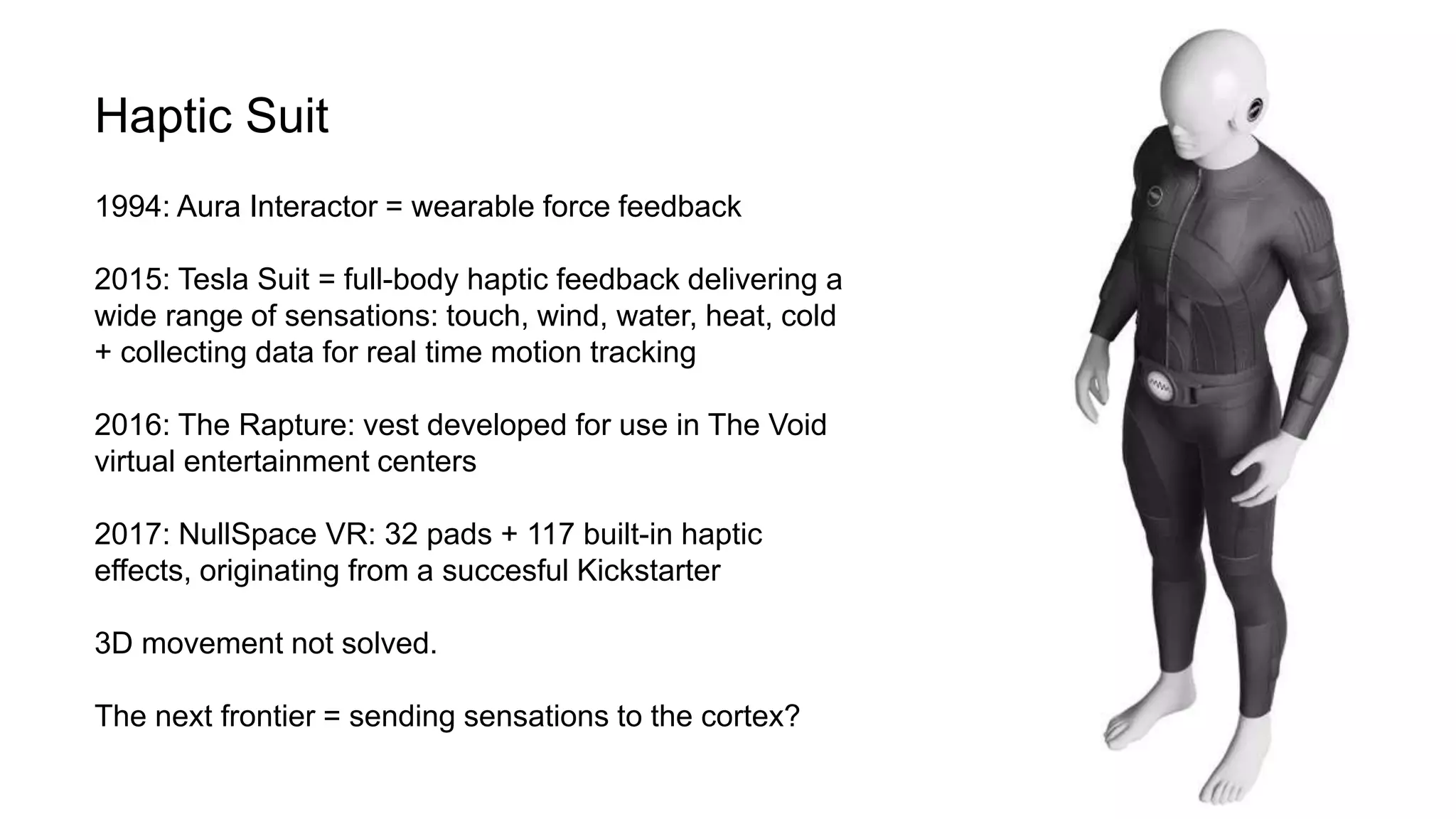
Haptic Suit
1994: Aura Interactor = wearable force feedback
2015: Tesla Suit = full-body haptic feedback delivering a
wide range of sensations: touch, wind, water, heat, cold
+ collecting data for real time motion tracking
2016: The Rapture: vest developed for use in The Void
virtual entertainment centers
2017: NullSpace VR: 32 pads + 117 built-in haptic
effects, originating from a succesful Kickstarter
3D movement not solved.
The next frontier = sending sensations to the cortex?
4D Printing
3D printed objects that can move, are animated
Printed avatars could respond to in-game actions,
potentially via MTX.
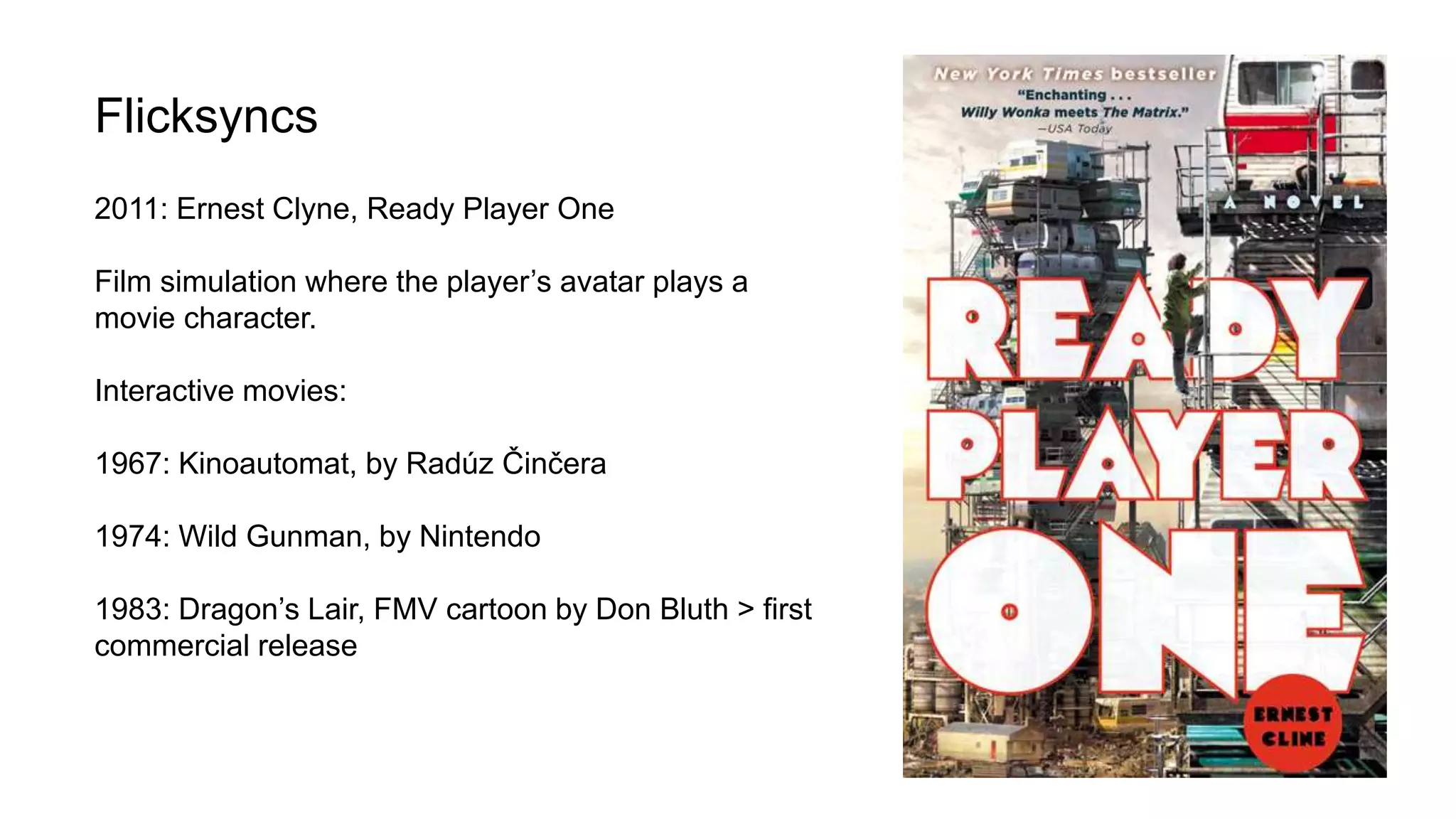
Flicksyncs
2011: Ernest Clyne, Ready Player One
Film simulation where the player’s avatar plays a
movie character.
Interactive movies:
1967: Kinoautomat, by Radúz Činčera
1974: Wild Gunman, by Nintendo
1983: Dragon’s Lair, FMV cartoon by Don Bluth > first
commercial release
Future Sports
Drone Wars
Robot Combat
Geocaching
Urban Scavenger Hunt
Live Action Role Playing
Blockchain
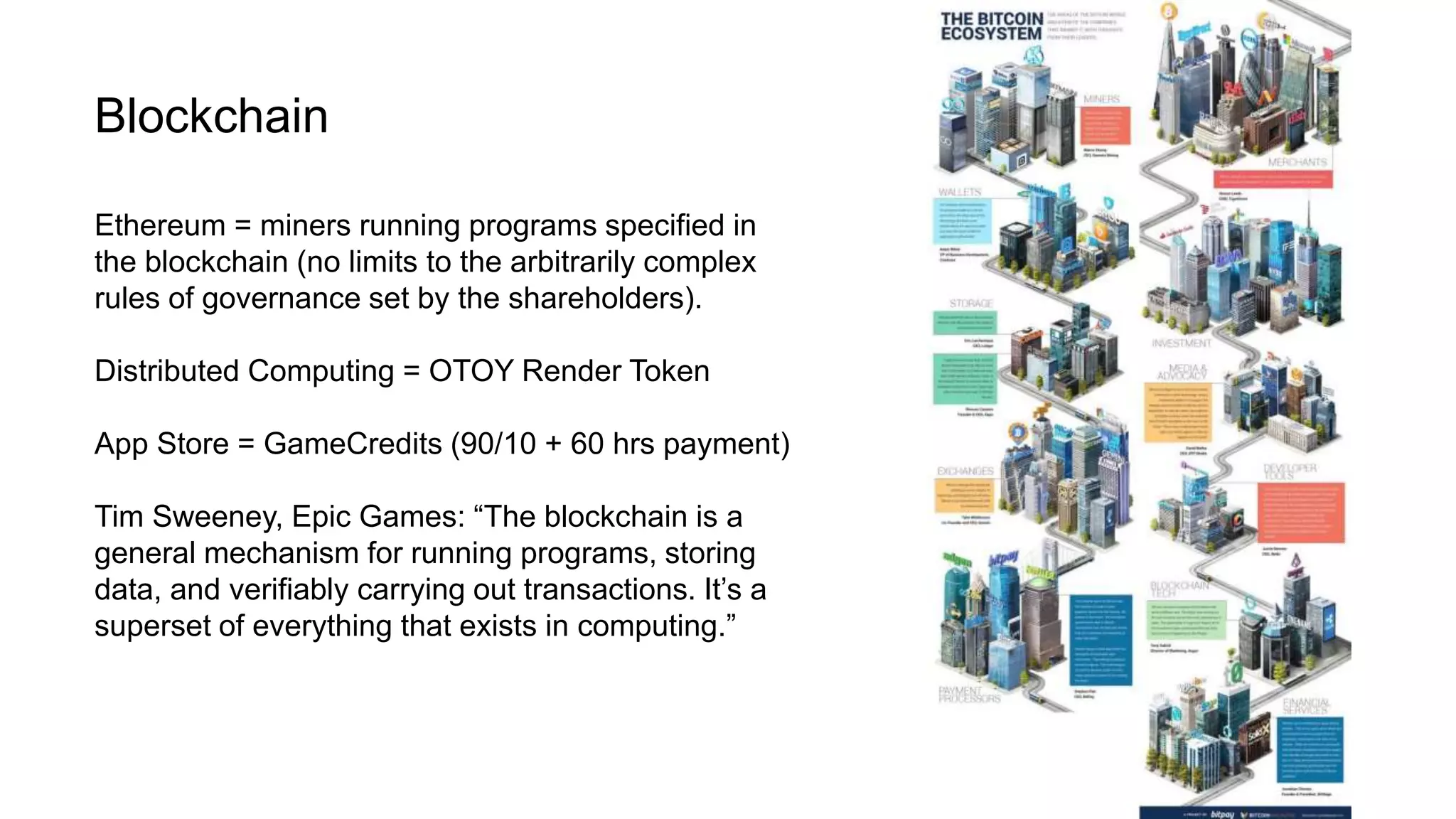
Ethereum = miners running programs specified in
the blockchain (no limits to the arbitrarily complex
rules of governance set by the shareholders).
Distributed Computing = OTOY Render Token
App Store = GameCredits (90/10 + 60 hrs payment)
Tim Sweeney, Epic Games: “The blockchain is a
general mechanism for running programs, storing
data, and verifiably carrying out transactions. It’s a
superset of everything that exists in computing.”
Serious Games
Games designed for a primary purpose
other than entertainment, emphasizing
the pedagogical value of fun and
competition.
1982: Microsoft Flight Simulator
1989: SimCity
1999: Leapfrog, interactive book
2006: A Force More Powerful (PBS)
2006: Darfur Is Dying
2007: Peacemaker
2007: World Without Oil
2008: FoldIt
2010: Second Life
2012: Superbetter
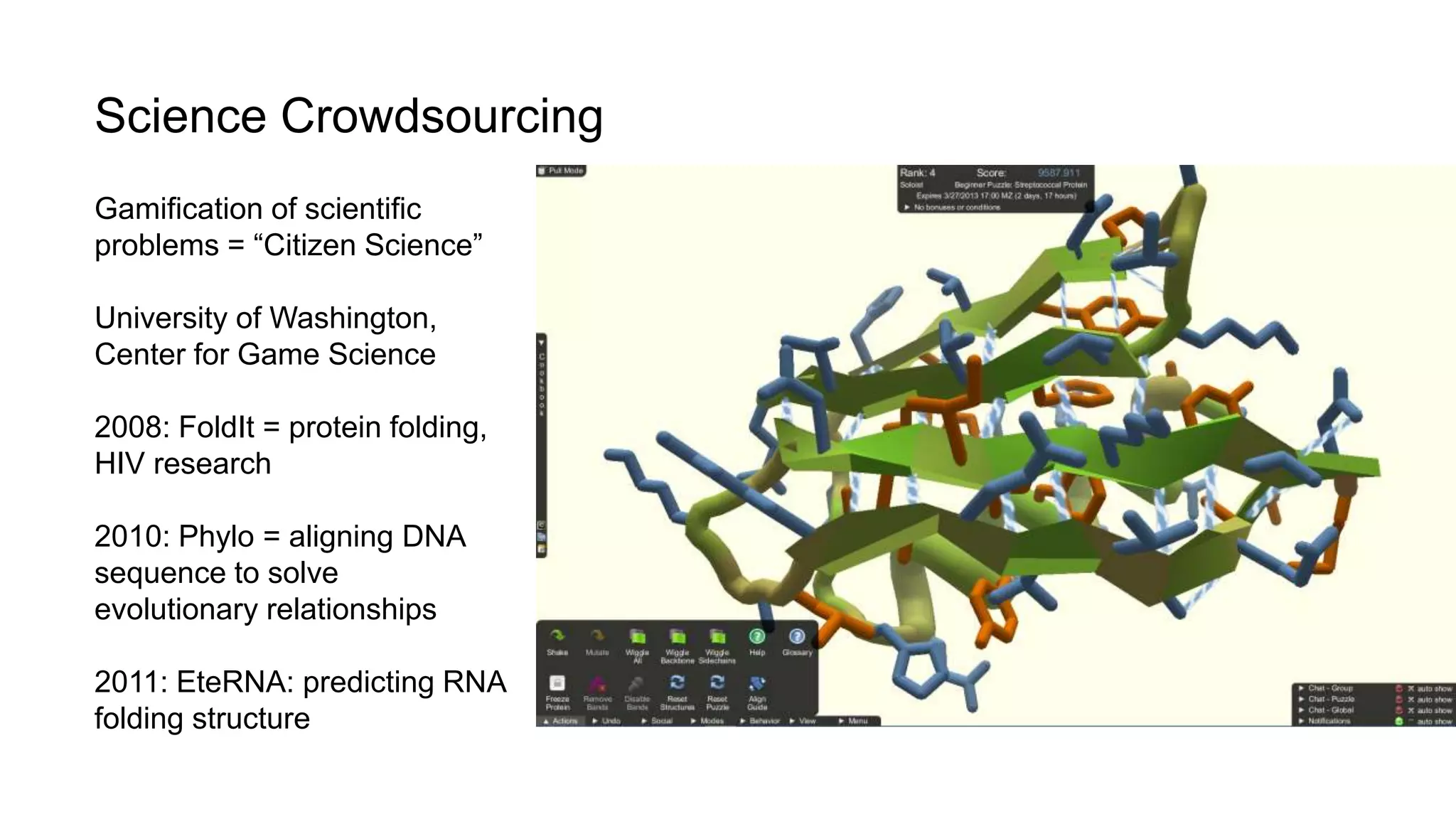
Science Crowdsourcing
Gamification of scientific
problems = “Citizen Science”
University of Washington,
Center for Game Science
2008: FoldIt = protein folding,
HIV research
2010: Phylo = aligning DNA
sequence to solve
evolutionary relationships
2011: EteRNA: predicting RNA
folding structure
Biosphere Simulation
Will Wright / Maxis, SimEarth (1990) + Spore (2008)
Integrated Biosphere Simulator Model
(University of Wisconsin)
 Energy, water, and carbon dioxide exchange
between plants, the atmosphere, and the soil
 Physiological processes of plants and soil
organisms, including photosynthesis and
respiration
 Seasonal changes of vegetation, including spring
budburst, fall senescence, and winter dormancy
 Plant growth and plant competition
 Nutrient cycling and soil processes
Enterprise Innovation
Gamification.
Retention, engagement, virality.
Social features.
Profitable creativity.
Much-needed competition to design &
innovation agencies.
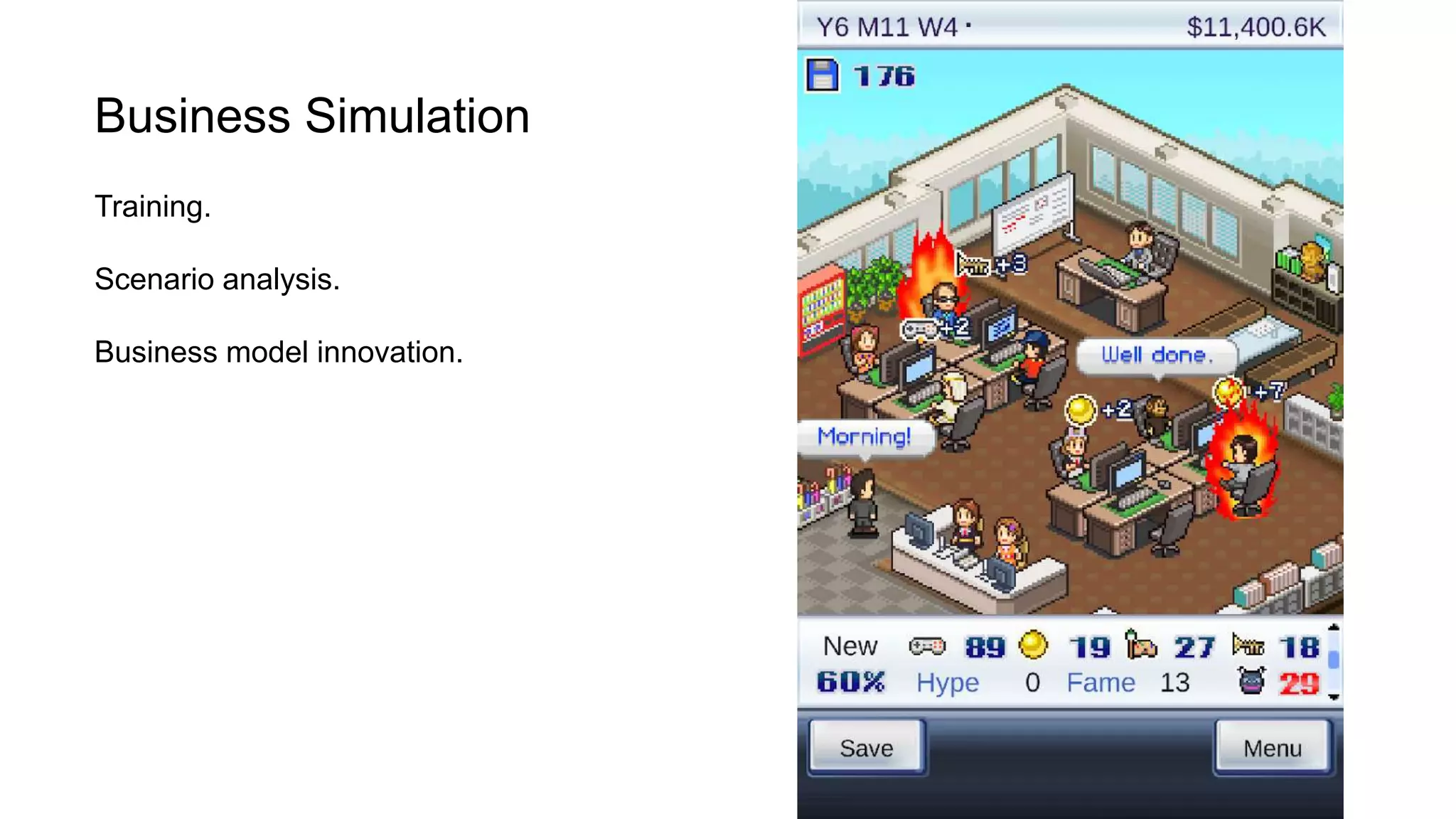
Business Simulation
Training.
Scenario analysis.
Business model innovation.
Educational Games
Oldest idea in the toolshed, yet still a
massive opportunity.
Social community for children, 250M+
users.
Introducing effortless learning through
games.
Intelligent Tutoring
Leveraging AI to craft individualized learning routines.
Duolingo example:
The Human Condition
Such themes are primarily the domain of ”Art
Games” and generally pursued by indie developers.
Sexuality: Dys4ia, by Anna Anthropy
Mortality: That Dragon, Cancer, by Numinous
Games
Misery: This War of Mine, by 11 bit Studios
Grieving: Left to My Own Devices, by Geoffrey
Thomas
Relationships: Façade, by Michael Mateas &
Andrew Stern
Metaverse
Neal Stephenson, Snowcrash (1992)
1975: Colossal Cave Adventure, by Will Crowther
Notable MMOs:
1986: Air Warrior, by Kesmai
1991: Neverwinter Nights, by Stormfront Studios >
first to use graphics
1995: Meridian 59, by Archetype Interactive (John
Hanke of Niantic!) > first to use 3D graphics
2004: World of Warcraft, by Blizzard
101 Concepts for Games Innovation

101 Concepts for Games Innovation

  • 1.
    101 Concepts forGames Innovation
  • 3.
  • 4.
    Landscape $40M in fundingraised in 2017 by Romanian companies. $30M raised by UiPath, AI- enabled process automation. $6.2M raised by dcs plus, a travel tech company. $1.7M raised by Zitec, software development. All others, > $1M.
  • 6.
    Gartner’s Hype Cyclefor Emerging Technology, 2017
  • 7.
    Emerged Tech *not coveredin this presentation Virtual Reality Streamed Games Wearables eSports Location-Based Games
  • 8.
    Neurogaming Adam Gazzaley, NeuroscapeLab at UCSF Neuroracer, designed to improve cognition in older adults = “prescription gaming” Akili: digital medicine startup Neurable (Boston), brain controlled VR demo for a dystopic sci-fi game called Awakening JAZZ Venture Partners: VC investing in neuroscience startups
  • 9.
    Neural Networks Games =pioneering AI research (NPC behavior, strategy). Unlimited computation in the cloud, further enabled by the advent of game engines in the cloud (Lumberyard) 1952: First use of AI in the game “Nim”, running on Ferranti’s Nimrod computer. 2013: Forza Drivatar, using neural networks in the cloud to create Agents that mimic driving behavior. 2017: University of Edinburgh + Method Studios, natural animation via machine learning feeding on motion capture data.
  • 10.
    Neural Networks Deep learningas a game mechanic = NPCs responding intelligently to player input, using real time AI, exhibiting emergent behavior Personalizing the player experience = the game responds in real time to user behavior and game choices: automatic narrative generation changing the world dynamic procedural generation
  • 11.
    Transreality Game experiences integratedwith everyday routines and social networks. Examples include: Next-gen arcades leveraging Immersive VR: The Void (Lindon, Utah); Holodeck, fictional. Location-based gaming: Pokemon Go, Ingress.
  • 12.
    Mixed Reality 1992: VirtualFixtures, by USAF Armstrong Labs = first Augmented Reality system; AR: Google Glass, Microsoft Hololens, Magic Leap Mobile Enabled: Apple ARKit, Google Tango + WorldSense 2016: Pokemon Go by Niantic, location- based and AR-enabled game mode 2017: Guns of Boom, by Game Insight, FPS spectator mode enabled via ARKit
  • 13.
    Synthetic Reality Proposed byRobert Wolcott, 2017 Ever-evolving realities, synthesizing our will or preferences, consciously or unconsciously provided. AI-enabled systems, procedural generation influenced by our individual personality, emotional states, even fleeting desires.
  • 14.
    Alternate Reality Transmedia storytelling,using the real world as a means to augment a digital interactive experience (internet, email, phones, social media). 1965: John Fowles, The Magus 1997: The Game (movie) Principles:  Storytelling as archaeology.  Platformless narrative.  Designing for a hive mind.  A whisper is sometimes louder than a shout.  “This is not a game" aesthetic. Real life as a medium.  Collaborative storytelling.  Not a hoax.
  • 15.
    Live Action RolePlaying Augmented Reality + Cos Play + Interactive Theater Designing AR worlds: Tolkien-inspired medieval fantasy. World of Darkness.
  • 16.
    Internet of Things Yoursmart home can react in real time to game actions: Windows open and close AC temperature fluctuates Lights flicker, change color TV turns on and starts playing a recording IoT devices assist in LARP narratives. Simulate a haunted house. Simulate a horror experience. Guide a scavenger hunt. Extend the experience to a neighborhood or city.
  • 17.
    Haptic Suit 1994: AuraInteractor = wearable force feedback 2015: Tesla Suit = full-body haptic feedback delivering a wide range of sensations: touch, wind, water, heat, cold + collecting data for real time motion tracking 2016: The Rapture: vest developed for use in The Void virtual entertainment centers 2017: NullSpace VR: 32 pads + 117 built-in haptic effects, originating from a succesful Kickstarter 3D movement not solved. The next frontier = sending sensations to the cortex?
  • 18.
    4D Printing 3D printedobjects that can move, are animated Printed avatars could respond to in-game actions, potentially via MTX.
  • 19.
    Flicksyncs 2011: Ernest Clyne,Ready Player One Film simulation where the player’s avatar plays a movie character. Interactive movies: 1967: Kinoautomat, by Radúz Činčera 1974: Wild Gunman, by Nintendo 1983: Dragon’s Lair, FMV cartoon by Don Bluth > first commercial release
  • 20.
    Future Sports Drone Wars RobotCombat Geocaching Urban Scavenger Hunt Live Action Role Playing
  • 21.
    Blockchain Ethereum = minersrunning programs specified in the blockchain (no limits to the arbitrarily complex rules of governance set by the shareholders). Distributed Computing = OTOY Render Token App Store = GameCredits (90/10 + 60 hrs payment) Tim Sweeney, Epic Games: “The blockchain is a general mechanism for running programs, storing data, and verifiably carrying out transactions. It’s a superset of everything that exists in computing.”
  • 22.
    Serious Games Games designedfor a primary purpose other than entertainment, emphasizing the pedagogical value of fun and competition. 1982: Microsoft Flight Simulator 1989: SimCity 1999: Leapfrog, interactive book 2006: A Force More Powerful (PBS) 2006: Darfur Is Dying 2007: Peacemaker 2007: World Without Oil 2008: FoldIt 2010: Second Life 2012: Superbetter
  • 23.
    Science Crowdsourcing Gamification ofscientific problems = “Citizen Science” University of Washington, Center for Game Science 2008: FoldIt = protein folding, HIV research 2010: Phylo = aligning DNA sequence to solve evolutionary relationships 2011: EteRNA: predicting RNA folding structure
  • 24.
    Biosphere Simulation Will Wright/ Maxis, SimEarth (1990) + Spore (2008) Integrated Biosphere Simulator Model (University of Wisconsin)  Energy, water, and carbon dioxide exchange between plants, the atmosphere, and the soil  Physiological processes of plants and soil organisms, including photosynthesis and respiration  Seasonal changes of vegetation, including spring budburst, fall senescence, and winter dormancy  Plant growth and plant competition  Nutrient cycling and soil processes
  • 25.
    Enterprise Innovation Gamification. Retention, engagement,virality. Social features. Profitable creativity. Much-needed competition to design & innovation agencies.
  • 26.
  • 27.
    Educational Games Oldest ideain the toolshed, yet still a massive opportunity. Social community for children, 250M+ users. Introducing effortless learning through games.
  • 28.
    Intelligent Tutoring Leveraging AIto craft individualized learning routines. Duolingo example:
  • 29.
    The Human Condition Suchthemes are primarily the domain of ”Art Games” and generally pursued by indie developers. Sexuality: Dys4ia, by Anna Anthropy Mortality: That Dragon, Cancer, by Numinous Games Misery: This War of Mine, by 11 bit Studios Grieving: Left to My Own Devices, by Geoffrey Thomas Relationships: Façade, by Michael Mateas & Andrew Stern
  • 30.
    Metaverse Neal Stephenson, Snowcrash(1992) 1975: Colossal Cave Adventure, by Will Crowther Notable MMOs: 1986: Air Warrior, by Kesmai 1991: Neverwinter Nights, by Stormfront Studios > first to use graphics 1995: Meridian 59, by Archetype Interactive (John Hanke of Niantic!) > first to use 3D graphics 2004: World of Warcraft, by Blizzard