Landscape of Virtual World Systems   What's available and how do you work with it? Games for Health, 2008 Tim Holt [email_address]
Goals Go over what Virtual Worlds are about Look at a few “rule breaker” Virtual Worlds Discuss development planning based on design, content and technology Look at how developer limitations and development should intermesh Examine noteworthy and accessible 2D and 3D Virtual World technologies
Part 1:  Examining Virtual Worlds Social, big, and persistent
Why you should not make a Virtual World Because they are “hot” Because “everyone” is doing it To be like <Insert Name of Virtual World>
Why you should make a Virtual World To create a space for  social interaction To let players act and react to each other and their environment in a  big world To create a  persistent environment   where people can visit and return
Social interaction means... Lots of people Who can talk, interact and do things together And can find each other again
Big world means... Players have many options Often a far horizon or shore not yet explored A place you can come back to
Persistence means... You can go away And come back The world is as you left it – but changed because others have come and gone
Summary of key Virtual World features Social interaction Big world Persistent environment
Part 2:  Virtual Worlds from Outside the Box Lightweight, rule breaking, and successful
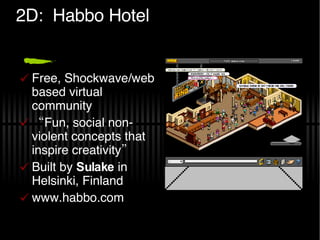
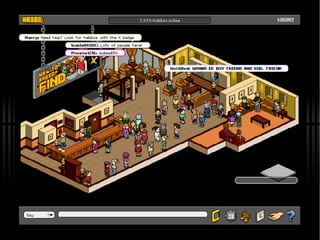
2D:  Habbo Hotel Free, Shockwave/web based virtual community “ Fun, social non-violent concepts that inspire creativity” Built by  Sulake  in Helsinki, Finland www.habbo.com
 
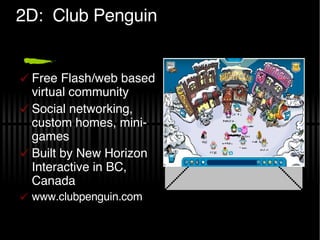
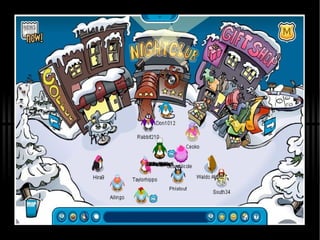
2D:  Club Penguin Free Flash/web based virtual community Social networking, custom homes, mini-games Built by New Horizon Interactive in BC, Canada www.clubpenguin.com
 
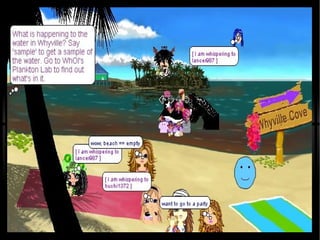
2D:  Whyville Free Java/web based virtual community with strong educational content Extremely simplistic graphics, but highly successful Built by Numedeon www.whyville.net
 
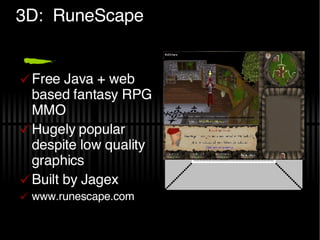
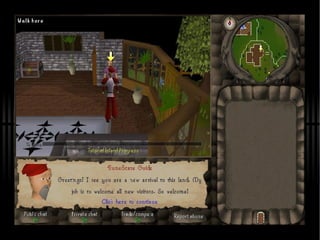
3D:  RuneScape Free Java + web based fantasy RPG MMO Hugely popular despite low quality graphics Built by Jagex www.runescape.com
 
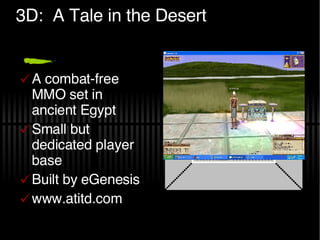
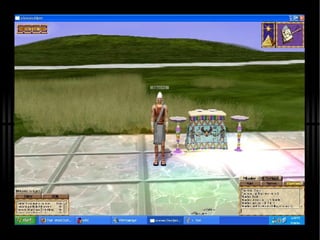
3D:  A Tale in the Desert A combat-free MMO set in ancient Egypt Small but dedicated player base Built by eGenesis www.atitd.com
 
What do these Virtual Worlds have in common? They are small and light They break the “rules” They are successful
Part 3:  Design, Content and Technology Intertwined elements of successful development and planning
Three factors guide development and planning The  design  that describes the game The  content  that makes up the game The  technology  that implements the game
Design is... The description of your game How it plays and looks to the user How it functions and behaves including on the server
Content is... The story or setting behind your game that frames the events The game art and other assets The things people can do in your world
Technology is... The stuff that puts your game on a player's screen The stuff that keeps track of the game state The implementation of the “game logic” that makes your world go
Balancing Design, Content and Technology Design rules and dictates both content and technology Technology and content are closely tied to each other Technology and content can push back and influence design
Part 4:  Working Within Your Capabilities Skill, time and budget considerations
All the great ideas in the world doesn't mean squat if... You don't have the skill set to make it happen You don't have the time to make it happen You don't have the money to make it happen
Therefore... You need to be sure your content is doable You need to be sure your technology is both in your budget and in your grasp You need to craft your design based on these considerations
Scrimping on design... Don't scrimp on design! Design is where you have full control Build on what you know of content and technology limitations
Scrimping on content... Good content does not make a good game, good design does Design simple or abstracted content Allow users to create or combine content to create new things
Scrimping on technology... Roll your own Seek and ye shall find! Follow the trail of indie game developers
Part 5:  Virtual World Technology Specifics 2D or 3D, it's about completeness and accessibility
What Virtual World technology must do Give the player an interface where they can interact with the world and other players Track and manage player and world states Implement “game logic” to make the game come alive
Questions when choosing Virtual World technology Is it complete? Is it affordable? Is it accessible?
Completeness Can it handle multiple players? Can it track the state and persistence of the world and its contents? Does it provide support for common MMO game features?
Affordability The best technology costs a lot of money There are solutions that hover in the “a couple of thousand dollars” price range There are some noteworthy free technologies (w00t!)
Accessibility Access is changing or adding content to your game The more mature the technology, the more tools it will have to make this easier Without good tools, expect to be writing code and crafting database design
Technology for 2D Virtual Worlds Typical implementations are web based using Java, Flash or Shockwave Needs server technology to coordinate and track game activities Needs scripting to define “game logic”
2D:  SmartFoxServer Flash based development of persistent multiplayer games on Windows, Mac and Linux It is extremely affordable It is a complete solution .com
2D:  SmartFoxServer (continued) Design is at times constrained by technology Content can be created using basic “paint” and other art editing tools Technology is accessible by tools plus Java, Javascript, Python and other languages
2D:  Whirled A new system developed by Three Rings Design, the makers of Puzzle Pirates and Bang! Howdy Designed for easy access to creating virtual worlds www.whirled.com
2D:  Metaplace A new system developed by Areae, a company run by Raph Koster Aims to be an “anything, anywhere”  virtual world  platform Not yet released www.metaplace.com
3D:  Active Worlds 3d virtual world development (both shared and private) Varying costs depending on hosting Used by the River City Project and others www.activeworlds.com
3D:  Second Life 3d virtual world development in a large shared world Varying costs depending on how much real estate you use Used by many universities, organizations, corporations (and strange people) www.secondlife.com
3D:  Multiverse A relatively new game development system, recently out of beta System is free, and you pay them a percentage of what you charge Multiverse aims to be a complete solution, but still a bit rough (and getting better)
3D:  Multiverse (continued) The platform does not enforce any particular design restrictions  Content is created by typical 2d and 3d art/asset creation tools such as Photoshop and Maya Company is very open to serious games and other “non traditional” development  www.multiverse.net
3D:  Unity3D A refined and robust solution ready for commercial use Very low price Unique in that the client (games) run in a web browser via plugin
3D:  Unity3D (continued) The platform does not enforce any particular design restrictions Content is created by typical 2d and 3d art/asset creation tools such as Photoshop and Maya Macintosh-only development tool www.unity3d.com
3D:  Garage Games Torque Game Engine Advanced The Torque Game Engine Advanced is a favourite with indie developers, offering a full game engine with source Pricing varies but is based on per-developer seat, and can vary from $300 to $1500 Requires additional libraries to add MMO functionality, such as “My Dream RPG” (www.mydreamrpg.com)
3D:  Garage Games Torque (continued) Design should not be influenced by any aspects of this engine Content is created by typical 2d and 3d art/asset creation tools such as Photoshop and Maya Technology is accessible by tools, scripting and C++
3D:  Monumental Games A refined and robust solution ready for commercial use It is not free to use, however the vendor does recognize the fiscal realities of Serious Games projects This seems to be a complete solution with a full set of tools for development and deployment
3D:  Monumental Games (continued) The platform does not enforce any particular design restrictions Content is created by typical 2d and 3d art/asset creation tools such as Photoshop and Maya Technology is accessible by sophisticated tools and scripting
Other 3D technologies Delta3D - www.delta3d.org Panda3d - www.panda3d.org Baja Engine - www.bajaengine.com
Part 6:  Putting it All Together Dare to innovate (or be crappy even)
How to proceed Think outside the (WoW/SL) box Know your limits as they apply to budget and expertise Innovate with what you've got
Explore technology and games Go play the free games mentioned plus MMOs with free trials Many of the technologies mentioned have free versions – download them and try them out Look at what games people are making now, but with caution
Above all, create something! Get an idea, make a design Pick a technology that's affordable and appropriate Create a game, no matter how simple
More information You can find this talk online at  perludus.com/timh , or email me at tim.m.holt@gmail.com At  perludus.com/timh  there are also links to further information on game design, engines and other good reading

Landscape Of Virtual World Systems

  • 1.
    Landscape of VirtualWorld Systems What's available and how do you work with it? Games for Health, 2008 Tim Holt [email_address]
  • 2.
    Goals Go overwhat Virtual Worlds are about Look at a few “rule breaker” Virtual Worlds Discuss development planning based on design, content and technology Look at how developer limitations and development should intermesh Examine noteworthy and accessible 2D and 3D Virtual World technologies
  • 3.
    Part 1: Examining Virtual Worlds Social, big, and persistent
  • 4.
    Why you shouldnot make a Virtual World Because they are “hot” Because “everyone” is doing it To be like <Insert Name of Virtual World>
  • 5.
    Why you shouldmake a Virtual World To create a space for social interaction To let players act and react to each other and their environment in a big world To create a persistent environment where people can visit and return
  • 6.
    Social interaction means...Lots of people Who can talk, interact and do things together And can find each other again
  • 7.
    Big world means...Players have many options Often a far horizon or shore not yet explored A place you can come back to
  • 8.
    Persistence means... Youcan go away And come back The world is as you left it – but changed because others have come and gone
  • 9.
    Summary of keyVirtual World features Social interaction Big world Persistent environment
  • 10.
    Part 2: Virtual Worlds from Outside the Box Lightweight, rule breaking, and successful
  • 11.
    2D: HabboHotel Free, Shockwave/web based virtual community “ Fun, social non-violent concepts that inspire creativity” Built by Sulake in Helsinki, Finland www.habbo.com
  • 12.
  • 13.
    2D: ClubPenguin Free Flash/web based virtual community Social networking, custom homes, mini-games Built by New Horizon Interactive in BC, Canada www.clubpenguin.com
  • 14.
  • 15.
    2D: WhyvilleFree Java/web based virtual community with strong educational content Extremely simplistic graphics, but highly successful Built by Numedeon www.whyville.net
  • 16.
  • 17.
    3D: RuneScapeFree Java + web based fantasy RPG MMO Hugely popular despite low quality graphics Built by Jagex www.runescape.com
  • 18.
  • 19.
    3D: ATale in the Desert A combat-free MMO set in ancient Egypt Small but dedicated player base Built by eGenesis www.atitd.com
  • 20.
  • 21.
    What do theseVirtual Worlds have in common? They are small and light They break the “rules” They are successful
  • 22.
    Part 3: Design, Content and Technology Intertwined elements of successful development and planning
  • 23.
    Three factors guidedevelopment and planning The design that describes the game The content that makes up the game The technology that implements the game
  • 24.
    Design is... Thedescription of your game How it plays and looks to the user How it functions and behaves including on the server
  • 25.
    Content is... Thestory or setting behind your game that frames the events The game art and other assets The things people can do in your world
  • 26.
    Technology is... Thestuff that puts your game on a player's screen The stuff that keeps track of the game state The implementation of the “game logic” that makes your world go
  • 27.
    Balancing Design, Contentand Technology Design rules and dictates both content and technology Technology and content are closely tied to each other Technology and content can push back and influence design
  • 28.
    Part 4: Working Within Your Capabilities Skill, time and budget considerations
  • 29.
    All the greatideas in the world doesn't mean squat if... You don't have the skill set to make it happen You don't have the time to make it happen You don't have the money to make it happen
  • 30.
    Therefore... You needto be sure your content is doable You need to be sure your technology is both in your budget and in your grasp You need to craft your design based on these considerations
  • 31.
    Scrimping on design...Don't scrimp on design! Design is where you have full control Build on what you know of content and technology limitations
  • 32.
    Scrimping on content...Good content does not make a good game, good design does Design simple or abstracted content Allow users to create or combine content to create new things
  • 33.
    Scrimping on technology...Roll your own Seek and ye shall find! Follow the trail of indie game developers
  • 34.
    Part 5: Virtual World Technology Specifics 2D or 3D, it's about completeness and accessibility
  • 35.
    What Virtual Worldtechnology must do Give the player an interface where they can interact with the world and other players Track and manage player and world states Implement “game logic” to make the game come alive
  • 36.
    Questions when choosingVirtual World technology Is it complete? Is it affordable? Is it accessible?
  • 37.
    Completeness Can ithandle multiple players? Can it track the state and persistence of the world and its contents? Does it provide support for common MMO game features?
  • 38.
    Affordability The besttechnology costs a lot of money There are solutions that hover in the “a couple of thousand dollars” price range There are some noteworthy free technologies (w00t!)
  • 39.
    Accessibility Access ischanging or adding content to your game The more mature the technology, the more tools it will have to make this easier Without good tools, expect to be writing code and crafting database design
  • 40.
    Technology for 2DVirtual Worlds Typical implementations are web based using Java, Flash or Shockwave Needs server technology to coordinate and track game activities Needs scripting to define “game logic”
  • 41.
    2D: SmartFoxServerFlash based development of persistent multiplayer games on Windows, Mac and Linux It is extremely affordable It is a complete solution .com
  • 42.
    2D: SmartFoxServer(continued) Design is at times constrained by technology Content can be created using basic “paint” and other art editing tools Technology is accessible by tools plus Java, Javascript, Python and other languages
  • 43.
    2D: WhirledA new system developed by Three Rings Design, the makers of Puzzle Pirates and Bang! Howdy Designed for easy access to creating virtual worlds www.whirled.com
  • 44.
    2D: MetaplaceA new system developed by Areae, a company run by Raph Koster Aims to be an “anything, anywhere” virtual world platform Not yet released www.metaplace.com
  • 45.
    3D: ActiveWorlds 3d virtual world development (both shared and private) Varying costs depending on hosting Used by the River City Project and others www.activeworlds.com
  • 46.
    3D: SecondLife 3d virtual world development in a large shared world Varying costs depending on how much real estate you use Used by many universities, organizations, corporations (and strange people) www.secondlife.com
  • 47.
    3D: MultiverseA relatively new game development system, recently out of beta System is free, and you pay them a percentage of what you charge Multiverse aims to be a complete solution, but still a bit rough (and getting better)
  • 48.
    3D: Multiverse(continued) The platform does not enforce any particular design restrictions Content is created by typical 2d and 3d art/asset creation tools such as Photoshop and Maya Company is very open to serious games and other “non traditional” development www.multiverse.net
  • 49.
    3D: Unity3DA refined and robust solution ready for commercial use Very low price Unique in that the client (games) run in a web browser via plugin
  • 50.
    3D: Unity3D(continued) The platform does not enforce any particular design restrictions Content is created by typical 2d and 3d art/asset creation tools such as Photoshop and Maya Macintosh-only development tool www.unity3d.com
  • 51.
    3D: GarageGames Torque Game Engine Advanced The Torque Game Engine Advanced is a favourite with indie developers, offering a full game engine with source Pricing varies but is based on per-developer seat, and can vary from $300 to $1500 Requires additional libraries to add MMO functionality, such as “My Dream RPG” (www.mydreamrpg.com)
  • 52.
    3D: GarageGames Torque (continued) Design should not be influenced by any aspects of this engine Content is created by typical 2d and 3d art/asset creation tools such as Photoshop and Maya Technology is accessible by tools, scripting and C++
  • 53.
    3D: MonumentalGames A refined and robust solution ready for commercial use It is not free to use, however the vendor does recognize the fiscal realities of Serious Games projects This seems to be a complete solution with a full set of tools for development and deployment
  • 54.
    3D: MonumentalGames (continued) The platform does not enforce any particular design restrictions Content is created by typical 2d and 3d art/asset creation tools such as Photoshop and Maya Technology is accessible by sophisticated tools and scripting
  • 55.
    Other 3D technologiesDelta3D - www.delta3d.org Panda3d - www.panda3d.org Baja Engine - www.bajaengine.com
  • 56.
    Part 6: Putting it All Together Dare to innovate (or be crappy even)
  • 57.
    How to proceedThink outside the (WoW/SL) box Know your limits as they apply to budget and expertise Innovate with what you've got
  • 58.
    Explore technology andgames Go play the free games mentioned plus MMOs with free trials Many of the technologies mentioned have free versions – download them and try them out Look at what games people are making now, but with caution
  • 59.
    Above all, createsomething! Get an idea, make a design Pick a technology that's affordable and appropriate Create a game, no matter how simple
  • 60.
    More information Youcan find this talk online at perludus.com/timh , or email me at tim.m.holt@gmail.com At perludus.com/timh there are also links to further information on game design, engines and other good reading

Editor's Notes

  • #2 Landscape of Virtual World Systems What&apos;s available and how do you work with it?