SCIENCE AND VIDEOGAMES

PLAYER 1 – ANTONIO M. MORA GARCÍA


       - Press START           -


          ©   GAME-ON   2012
•   Introduction
         videogames market, players taxonomy,
         current game systems. Videogames at the
         University.

•   Videogames applied to science
         videogame system-based science, engineering
         and technology.

•   Science in videogames
         scientific principles of videogames.

•   Researching in videogames
         main research fields in videogames.

•   Examples: Our works
INTRODUCTION
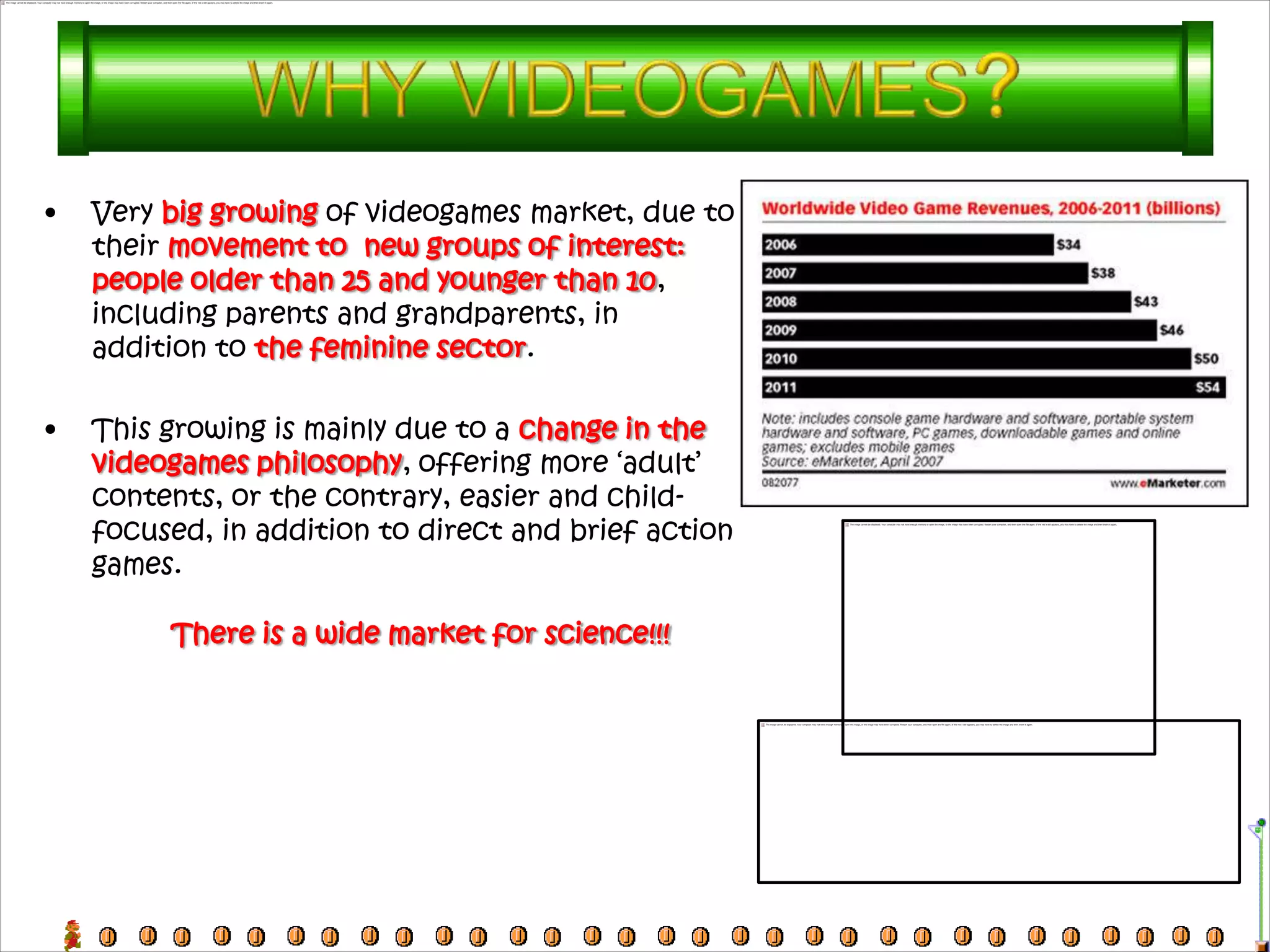
•   Very big growing of videogames market, due to
    their movement to new groups of interest:
    people older than 25 and younger than 10,
    including parents and grandparents, in
    addition to the feminine sector.

•   This growing is mainly due to a change in the
    videogames philosophy, offering more ‘adult’
    contents, or the contrary, easier and child-
    focused, in addition to direct and brief action
    games.

         There is a wide market for science!!!
•   In the current market has arisen the so-called casual gamers:
     sporadic players users of brief and direct action games (arcade, sports, mini-
     games), or the so-called no-games (training games, art games, and so on).

•   The usual players have auto renamed as hardcore gamers.
    They (really) enjoy and profit the games, they are informed, like most types of
     games, and play for long periods (if possible).


               A friendly way to say “Virgin until the age of 37”   More fun if they plug-in the console
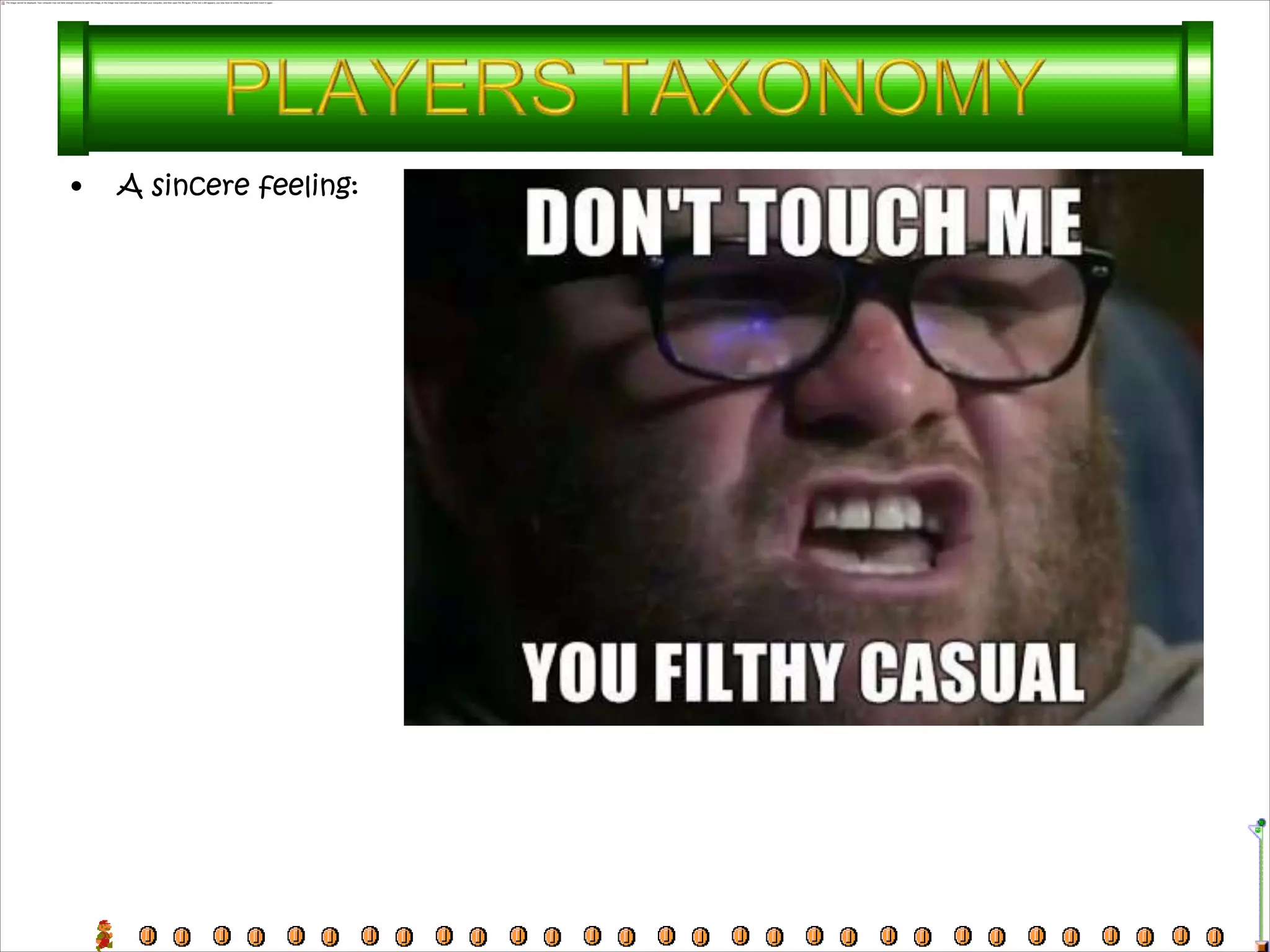
•   A sincere feeling:
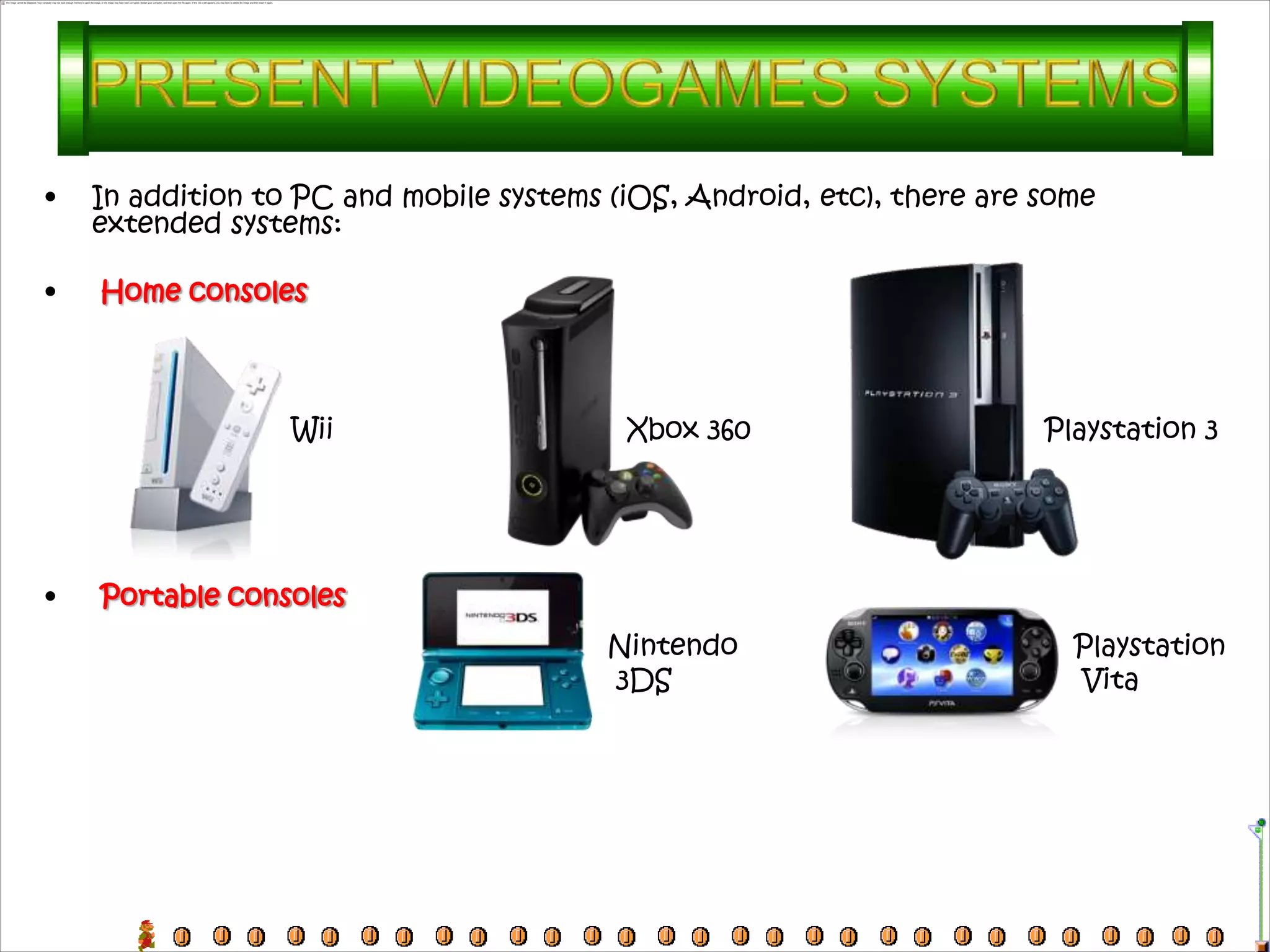
•   In addition to PC and mobile systems (iOS, Android, etc), there are some
    extended systems:

•   Home consoles


                  Wii                     Xbox 360                      Playstation 3


•   Portable consoles
                                        Nintendo                          Playstation
                                        3DS                               Vita
•   And many more (open-philosphy consoles), not known for most of the people.


                            GP2X Wiz       Caanoo


                           Dingoo            Pandora
•   Another (positive) consequence is the adaptation of the study plans
    for videogames development.


•   In Spain there are arising courses in Grades and Masters


•   Anyway, we are still far from other countries in Europe:
     – Example: Center for Computer Game Research (Copenhagen)
SCIENTIFIC
APPLICATIONS
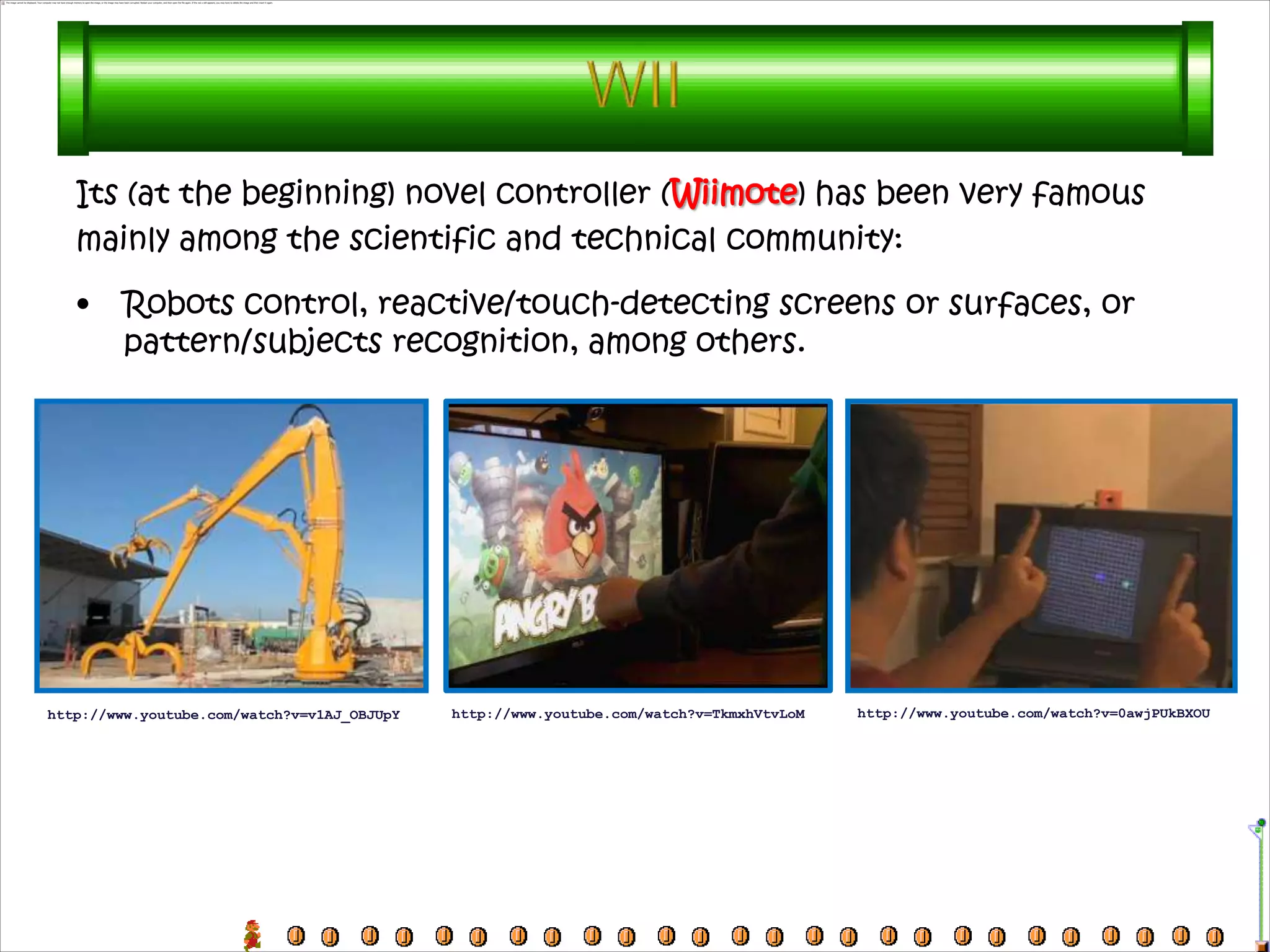
Its (at the beginning) novel controller (Wiimote) has been very famous
   mainly among the scientific and technical community:

   •     Robots control, reactive/touch-detecting screens or surfaces, or
         pattern/subjects recognition, among others.


http://www.youtube.com/watch?v=v1AJ_OBJUpY   http://www.youtube.com/watch?v=TkmxhVtvLoM   http://www.youtube.com/watch?v=0awjPUkBXOU
There is even a project, WiiLab, which has created a Matlab toolbox for
interacting with Wiimote…

                                               …and with Game Maker (an easy
                                                game development framework)


                                                 http://code.google.com/p/giimote/


  http://www.youtube.com/watch?v=EeBAYeoX7-8
•   It was initially used for building
    console-based clusters (super
    computers), due to the powerful
    chip Cell, and the cheap price it
    had.

•   It was possible to use an
    additional Linux O.S. (Yellow
    Dog), very flexible.

•   But later, the console was
    updated for not admitting the
    installation of any additional
    O.S., so Linux was lost forever.
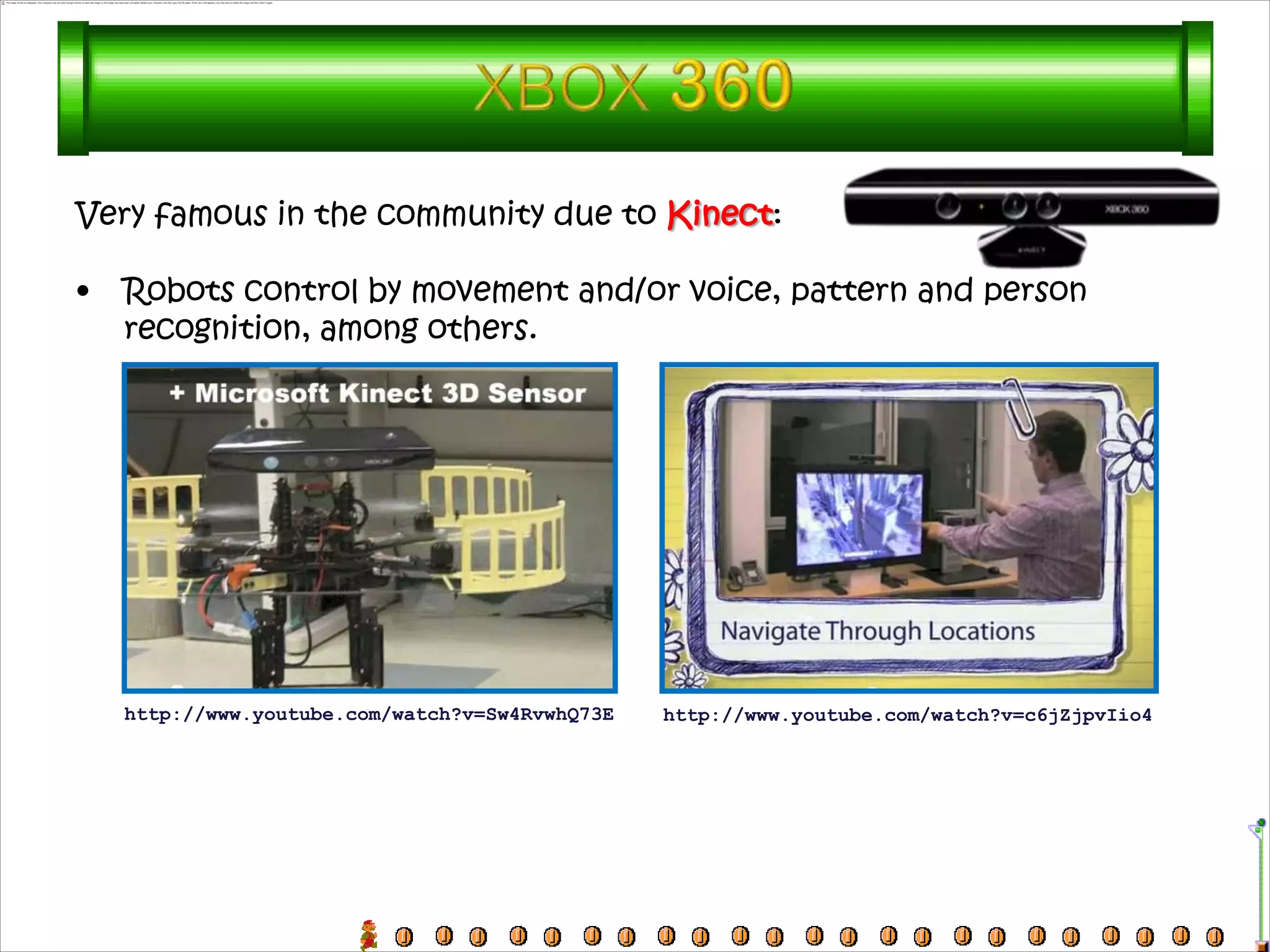
Very famous in the community due to Kinect:

•   Robots control by movement and/or voice, pattern and person
    recognition, among others.


    http://www.youtube.com/watch?v=Sw4RvwhQ73E   http://www.youtube.com/watch?v=c6jZjpvIio4
SCIENCE IN
VIDEOGAMES
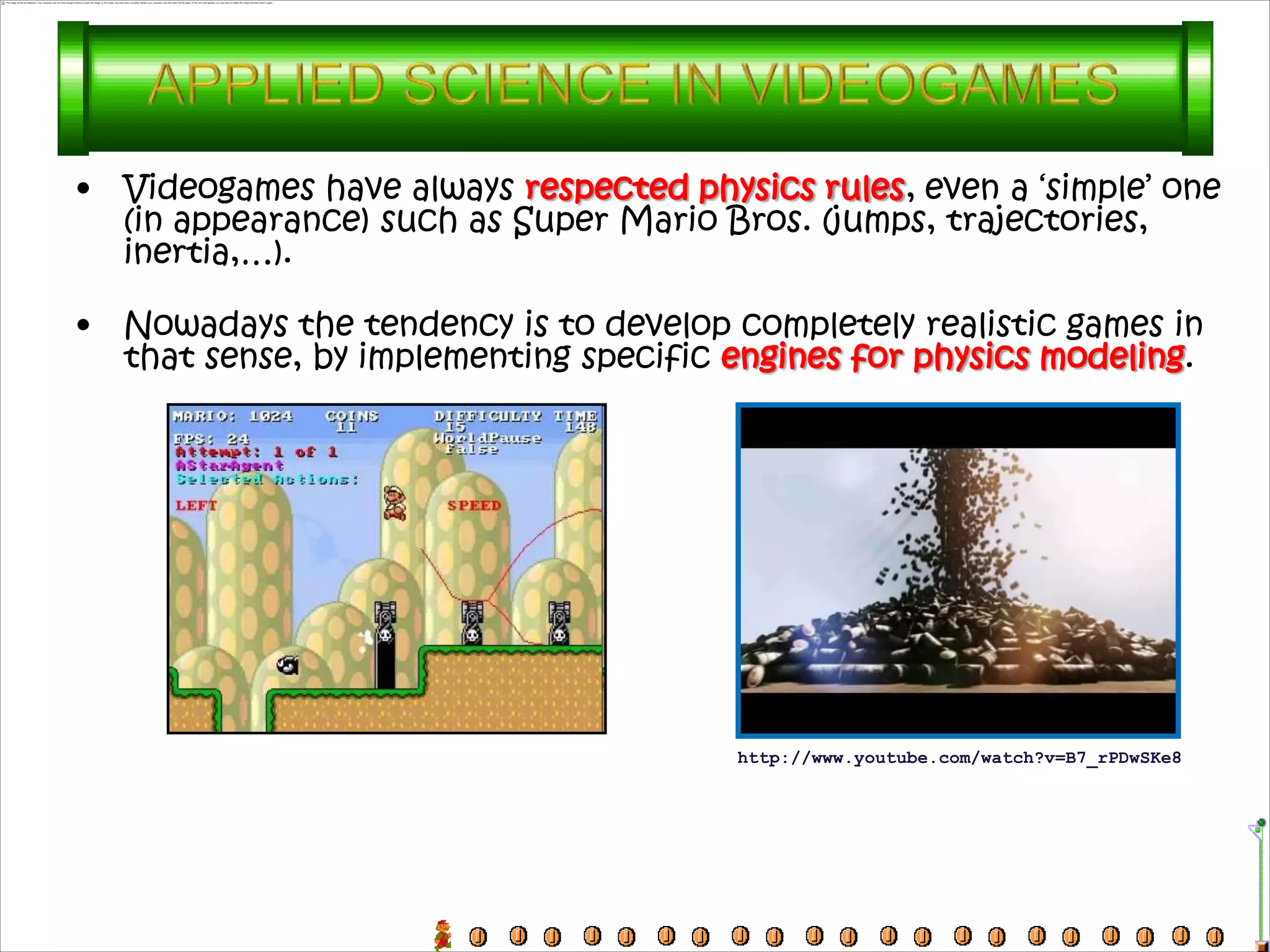
•   Videogames have always respected physics rules, even a ‘simple’ one
    (in appearance) such as Super Mario Bros. (jumps, trajectories,
    inertia,…).

•   Nowadays the tendency is to develop completely realistic games in
    that sense, by implementing specific engines for physics modeling.


                                         http://www.youtube.com/watch?v=B7_rPDwSKe8
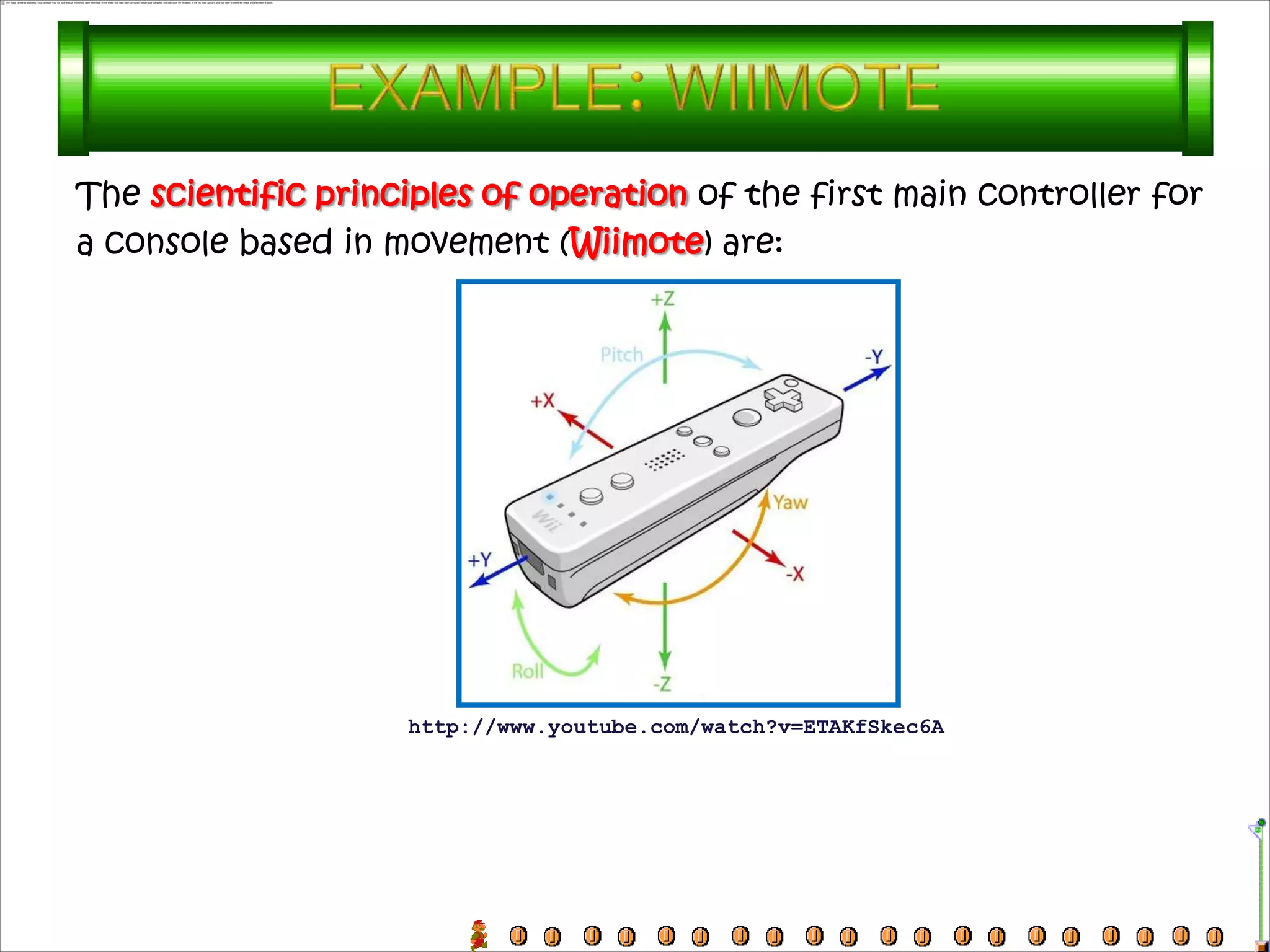
The scientific principles of operation of the first main controller for
a console based in movement (Wiimote) are:


                    http://www.youtube.com/watch?v=ETAKfSkec6A
RESEARCH
IN VIDEOGAMES
•   In addition to visual and physics realism, it is desired to model enemies and
    partners , with an ‘intelligent’ (human) behavior.
•   Thus a big amount of resources have been focused on artificial intelligence.


                                                       Realistic Game
•   AI is the area of computer science devoted to implement
    nonliving rational agents (at least in appearance).

• Inside a videogame, AI is focused on defining behavior
  techniques for non-playable characters (NPCs), commonly
  named bots, which simulate being rational. These characters
  could be enemies or partners.

• It is not a matter of literally showing human behavior, since it
  means the consideration of mistakes.
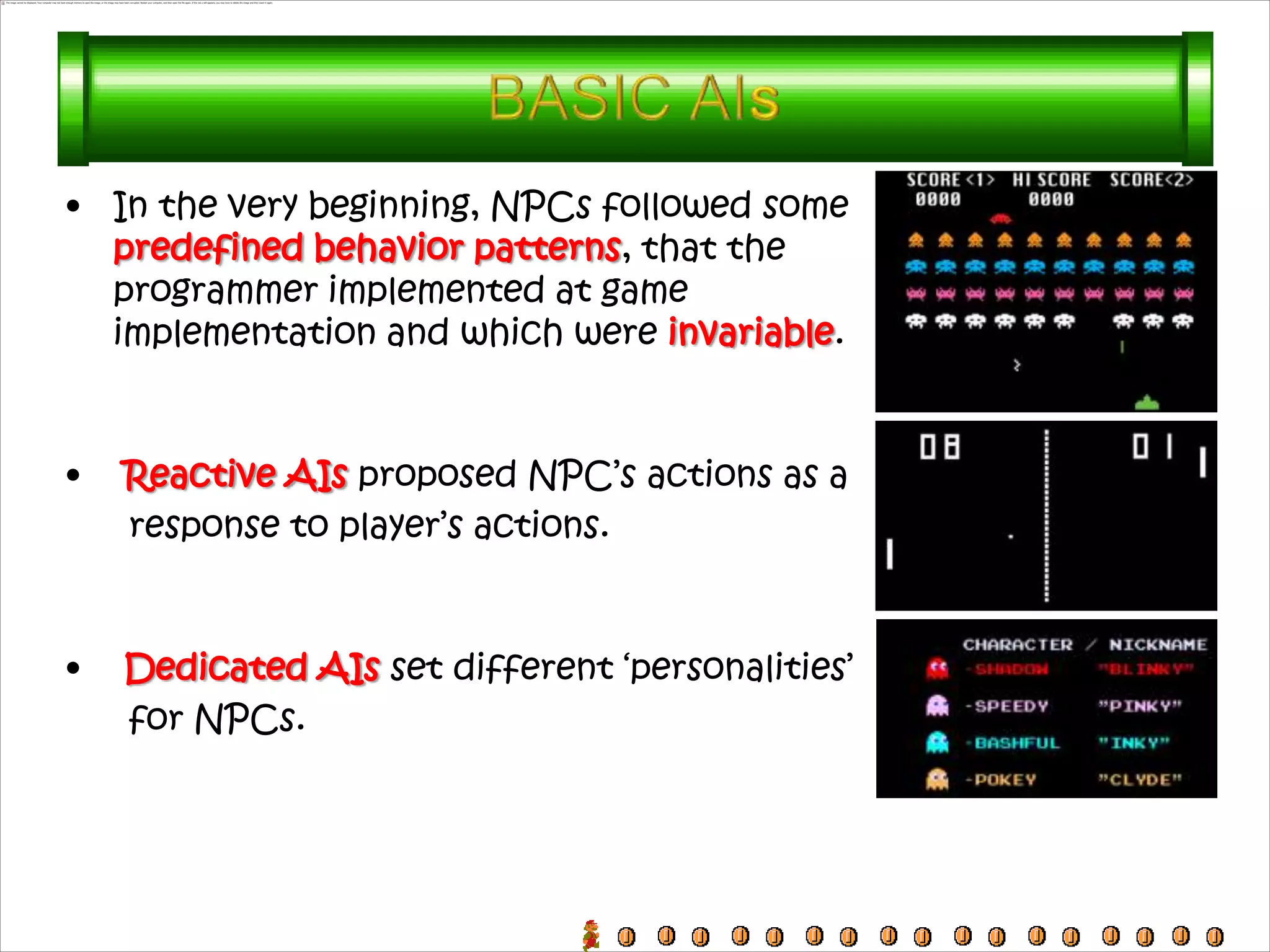
• In the very beginning, NPCs followed some
  predefined behavior patterns, that the
  programmer implemented at game
  implementation and which were invariable.


•   Reactive AIs proposed NPC’s actions as a
    response to player’s actions.


•   Dedicated AIs set different ‘personalities’
    for NPCs.
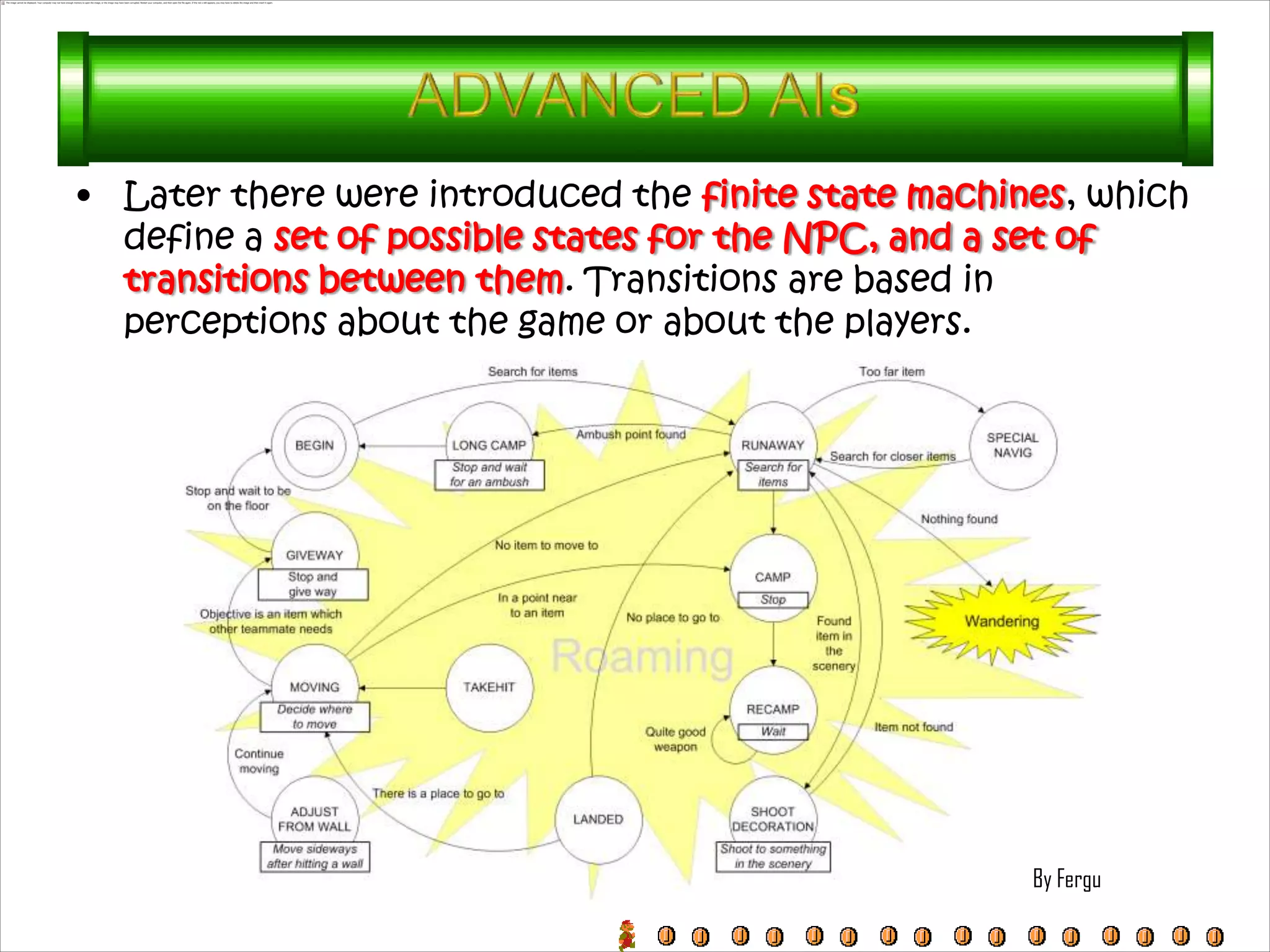
• Later there were introduced the finite state machines, which
  define a set of possible states for the NPC, and a set of
  transitions between them. Transitions are based in
  perceptions about the game or about the players.


                                                     By Fergu
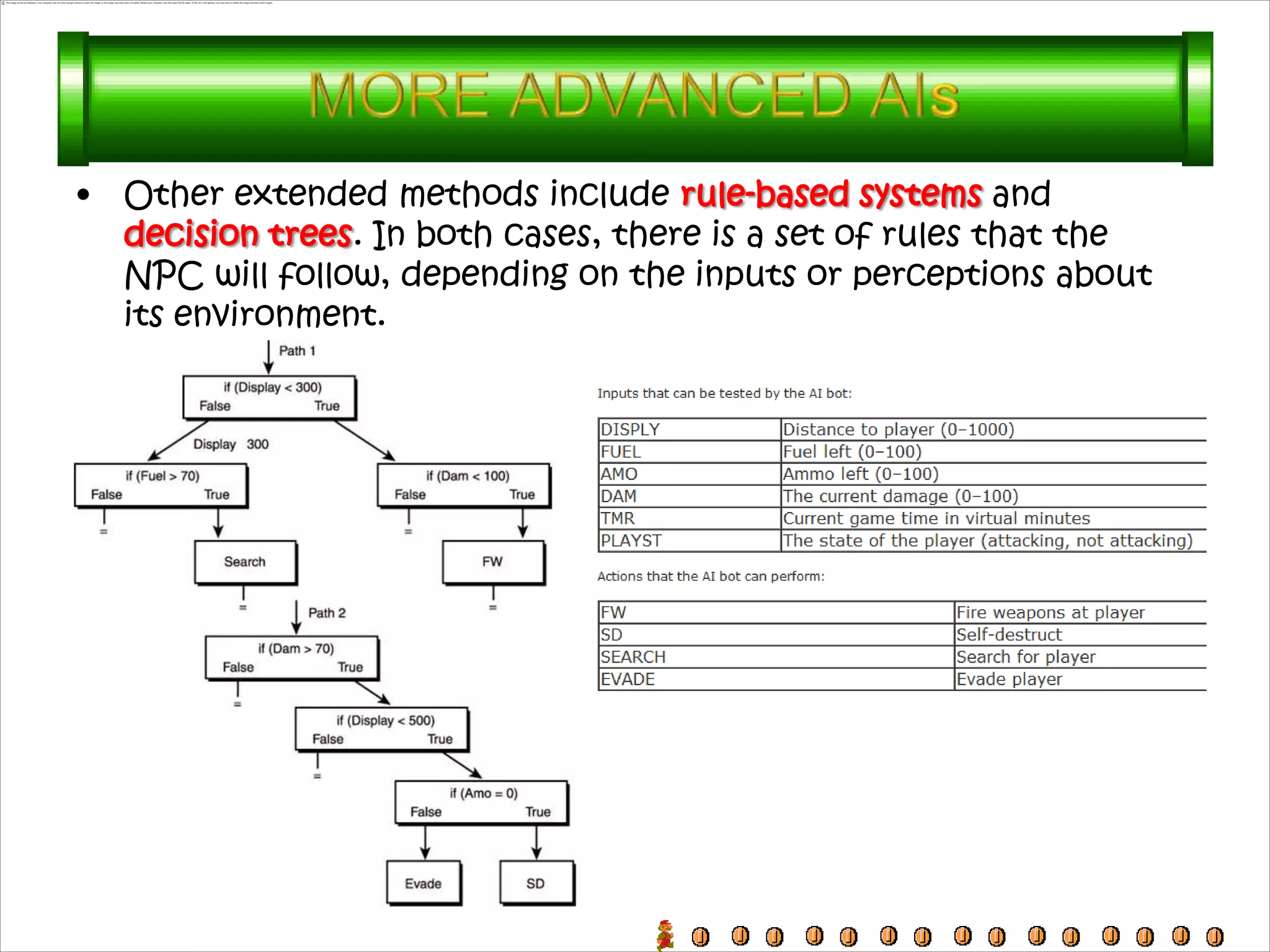
•   Other extended methods include rule-based systems and
    decision trees. In both cases, there is a set of rules that the
    NPC will follow, depending on the inputs or perceptions about
    its environment.
•   Nowadays it is usual to mix some of these techniques, thus in most games
    NPCs follow predefined behavioral models (scripts), depending on player’s
    actions.

•   Their advantage is that it is easy to define them, considering programmer’s
    experience and modeling player’s behavior.
•   Their main disadvantage is the low flexibility they have in order to adapt to
    new situations/events.

•   Moreover, NPCs have additional advantages over the human player, such as
    perfect aim (based in exact coordinates), or navigation points (waypoints in
    maps modeling advantageous routes, shortest paths, etc).

•   Just a few ‘scientific techniques’ have been used in commercial games…
•   Traditionally in the scientific area it was called Game Theory, a
    branch of applied mathematics in which there are some rewards
    depending on the chosen decision. It involved simple, but difficult
    to solve, games: Hanoi towers, prisoner’s dilemma, game of life.

•   These games proposed problems to be solved by means of exact
    methods, heuristics or metaheuristics: tree-based search, A*,
    evolutionary algorithms, ant colony optimization,…

•   Moreover, the resolution of traditional games (usually puzzles) has
    also been studied from the ‘ancient times’ in science life: chess,
    backgammon, mastermind, sudoku
•    videogames provide a new environment for solving heterogeneous
    problems.

•   The most famous (and probably the first) problem addressed was AI
    related issues. It still remains as the main (the most studied) problem
    in the area.

•   However, with the advances and improvement of technology,
    videogames have increased their complexity, so new researching lines
    have been arisen:
     – Search in maps, combat prediction, or simulation, to cite a few

•   Nowadays, there are a huge number of research fields inside
    videogames scope, so research studies and publications have grown
    exponentially.
• AI branch which applies metaheuristics and bioinspired
  methods for the resolution of complex problems, usually by
  means of adaptive systems.

• It is necessary to model the game (or a part of it) as an
  optimization, search or learning problem, among others.

• Examples:
   –   Pathfinding
   –   Combat prediction
   –   Automated generation of behavioral rules
   –   Parameter tuning
   –   Objective decision
• The most used metaheuristics are: Genetic Algorithms (GA),
  Ant Colony Optimization (ACO), Monte-Carlo Tree Search
  (MCTS), A*, Genetic Programming (GP), Fuzzy Logic, Neural
  Networks…

• Which are mostly applied over finite state machines (FSM),
  scripts, rule-based systems (RS) or expert system (ES), among
  others.
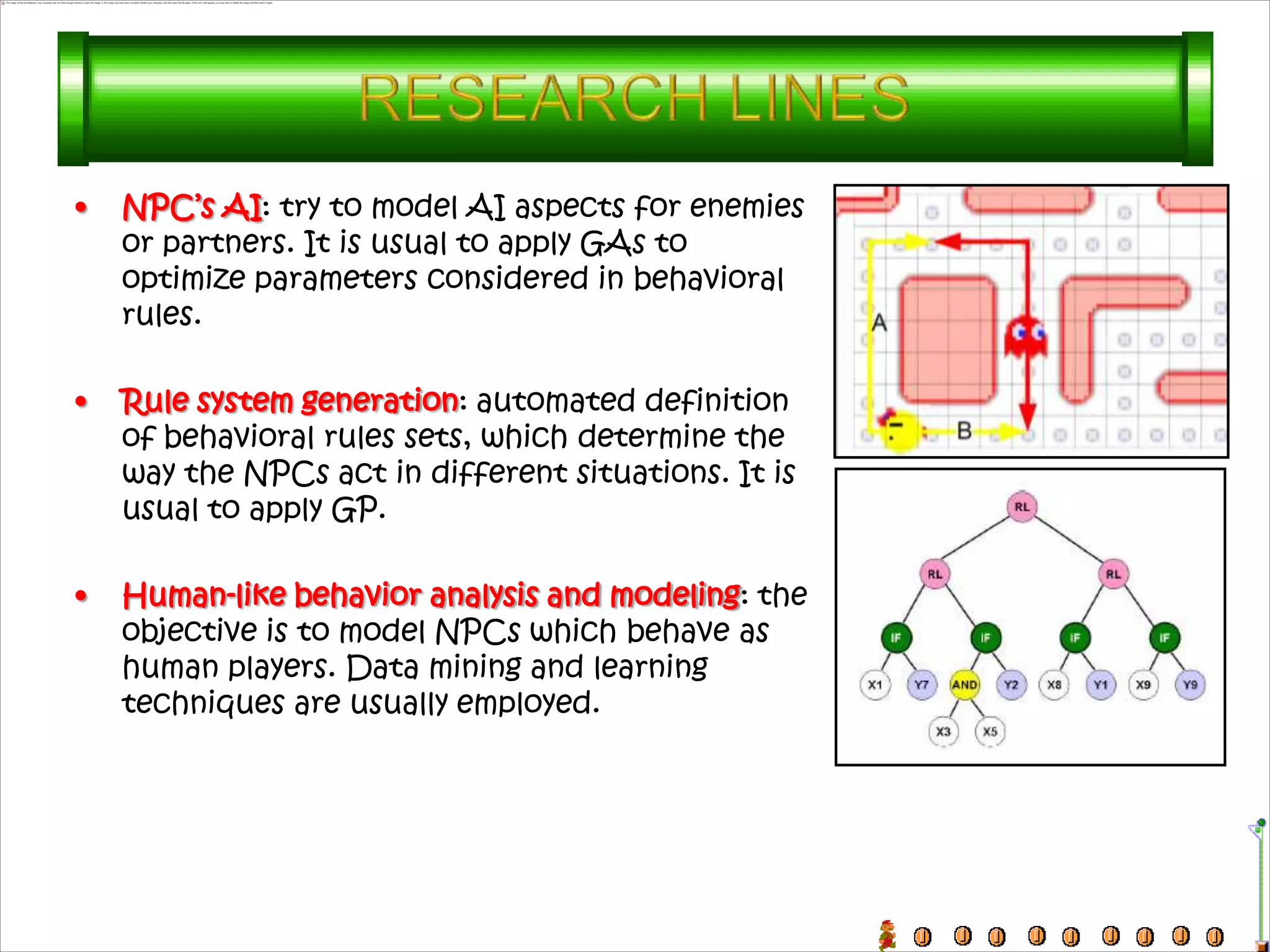
•   NPC’s AI: try to model AI aspects for enemies
    or partners. It is usual to apply GAs to
    optimize parameters considered in behavioral
    rules.

•   Rule system generation: automated definition
    of behavioral rules sets, which determine the
    way the NPCs act in different situations. It is
    usual to apply GP.

•   Human-like behavior analysis and modeling: the
    objective is to model NPCs which behave as
    human players. Data mining and learning
    techniques are usually employed.
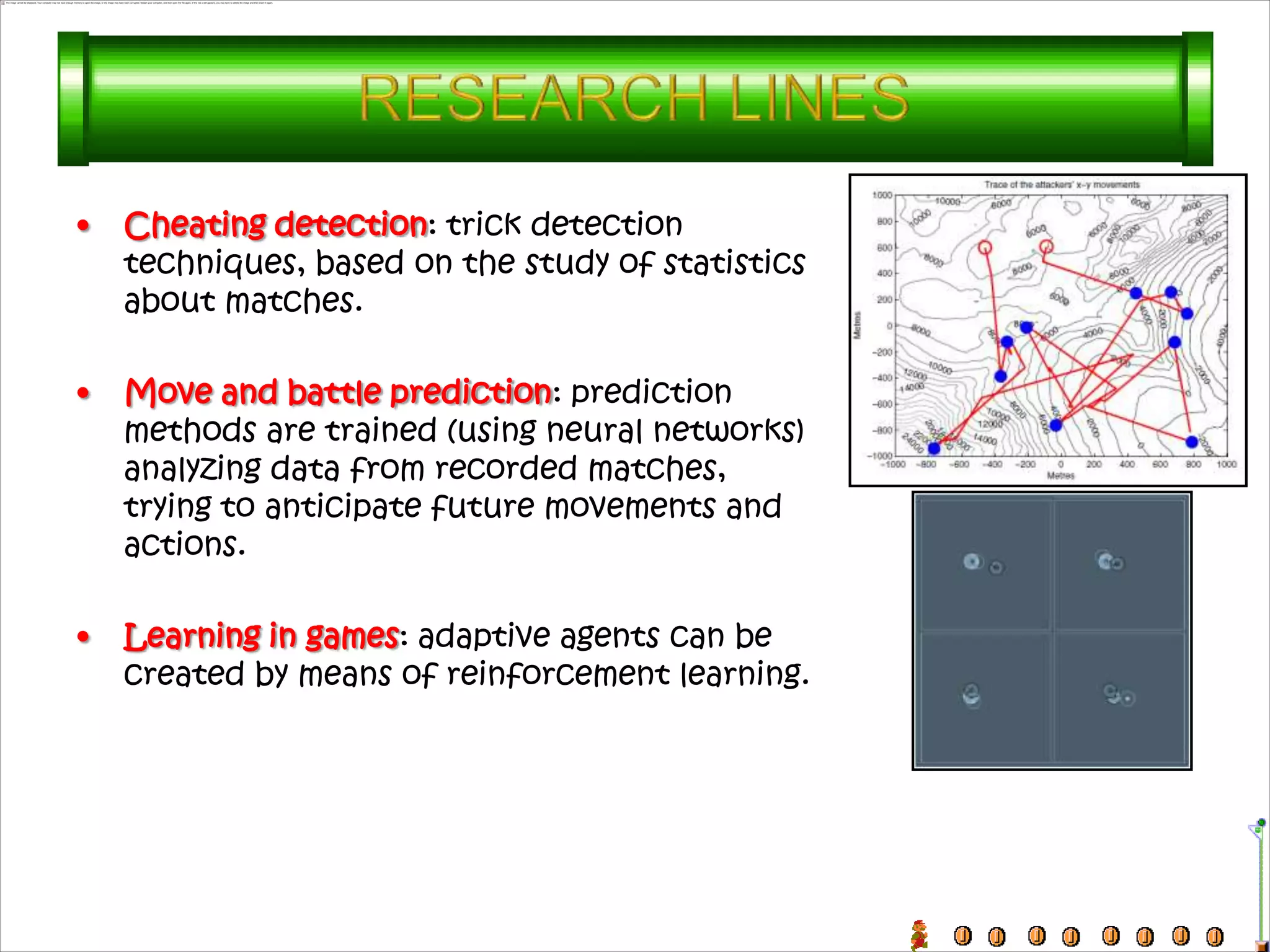
•   Cheating detection: trick detection
    techniques, based on the study of statistics
    about matches.

•   Move and battle prediction: prediction
    methods are trained (using neural networks)
    analyzing data from recorded matches,
    trying to anticipate future movements and
    actions.

•   Learning in games: adaptive agents can be
    created by means of reinforcement learning.
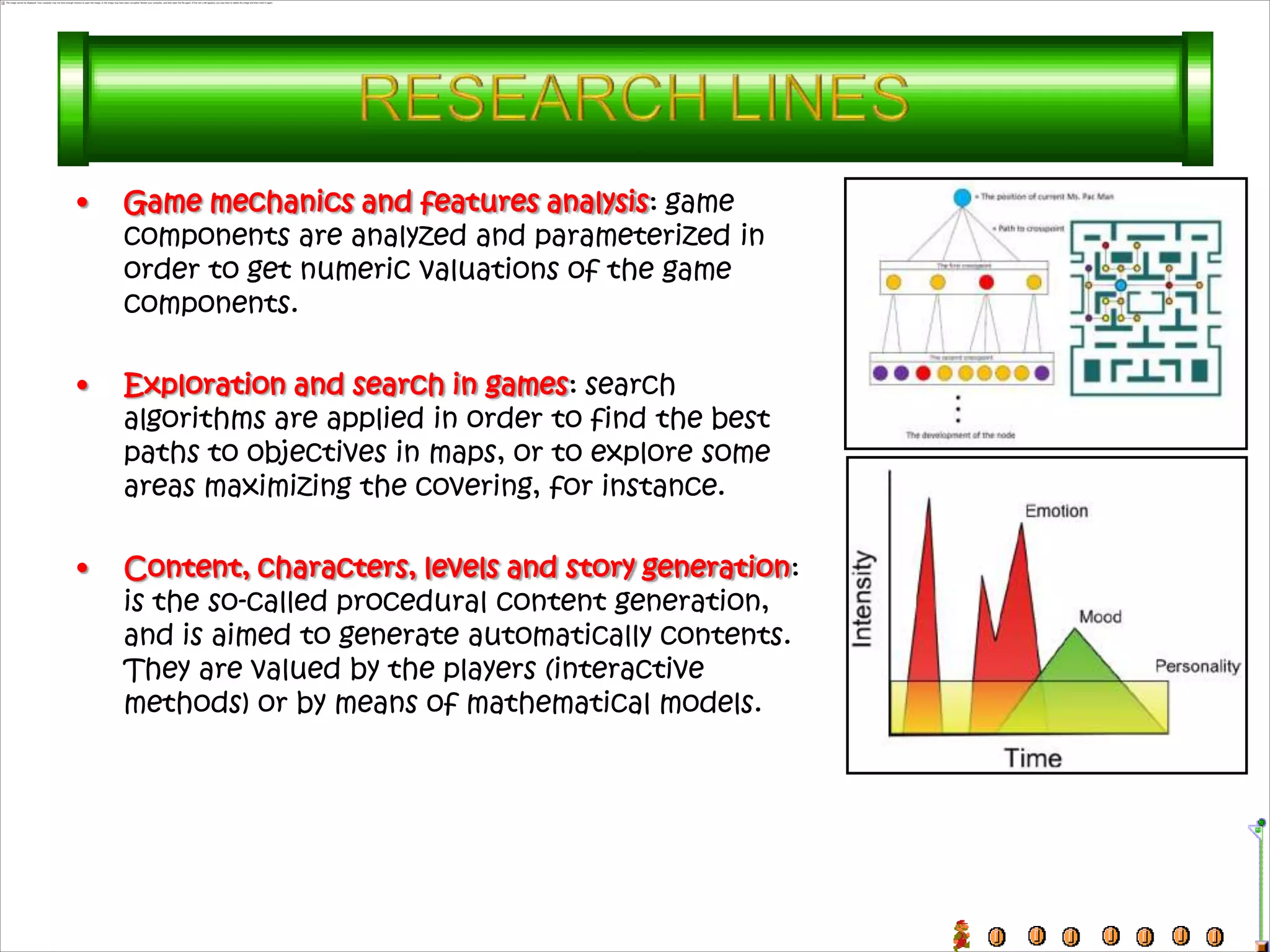
•   Game mechanics and features analysis: game
    components are analyzed and parameterized in
    order to get numeric valuations of the game
    components.

•   Exploration and search in games: search
    algorithms are applied in order to find the best
    paths to objectives in maps, or to explore some
    areas maximizing the covering, for instance.

•   Content, characters, levels and story generation:
    is the so-called procedural content generation,
    and is aimed to generate automatically contents.
    They are valued by the players (interactive
    methods) or by means of mathematical models.
EXAMPLES
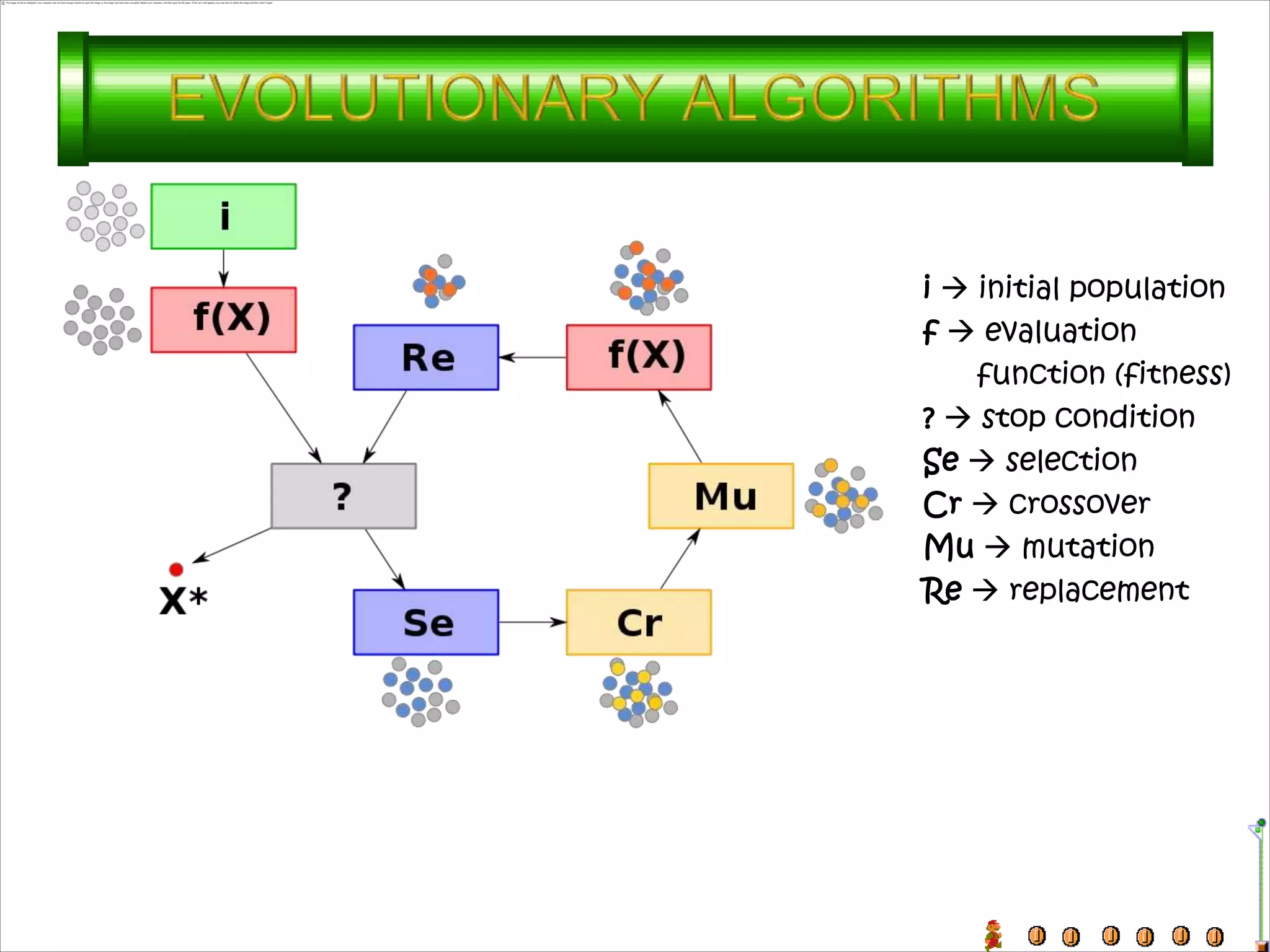
i  initial population
                 f  evaluation
                     function (fitness)
                 ?  stop condition
                 Se  selection
                 Cr  crossover
                 Mu  mutation
                 Re  replacement


by Johann Dréo
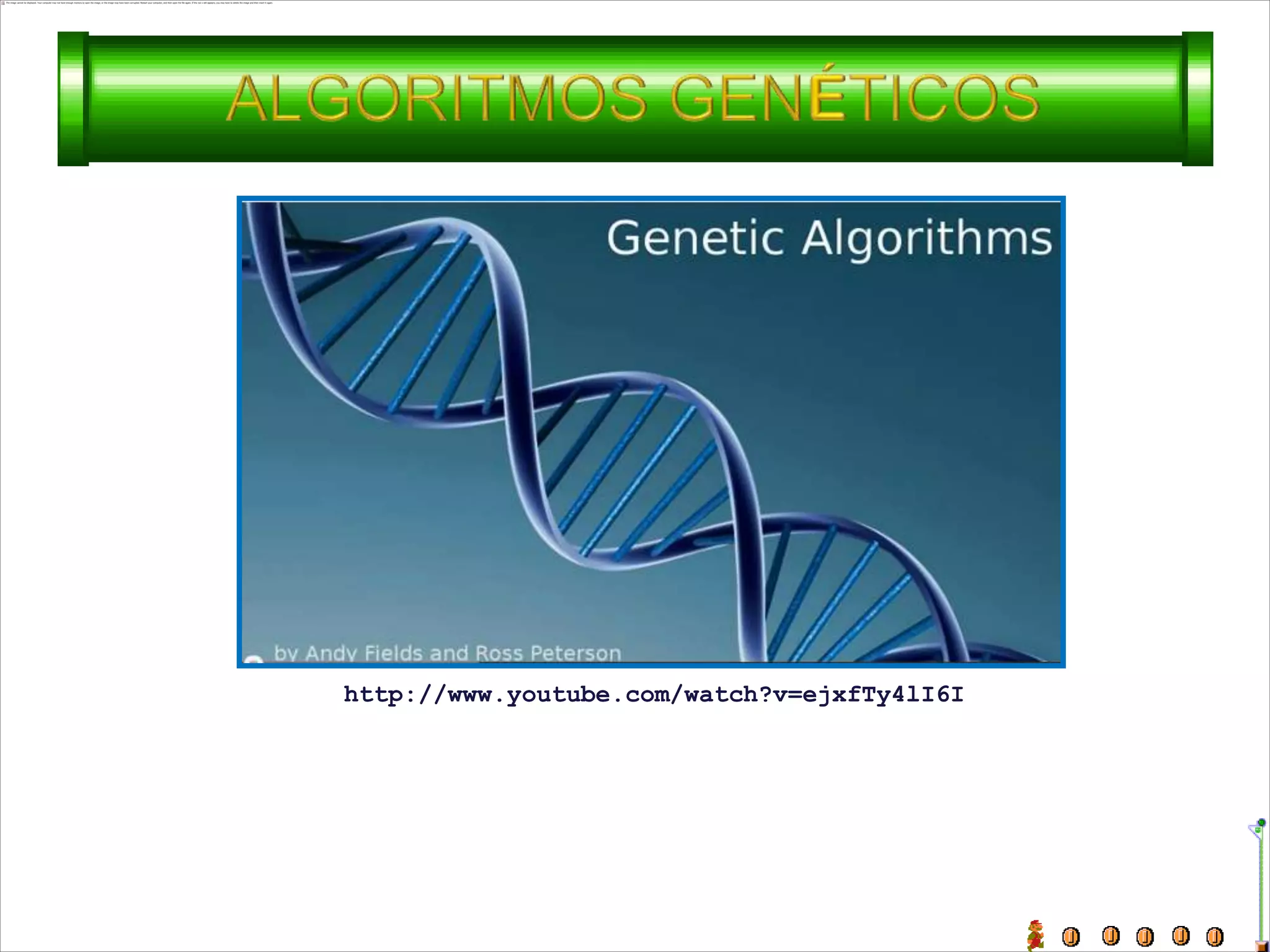
http://www.youtube.com/watch?v=ejxfTy4lI6I
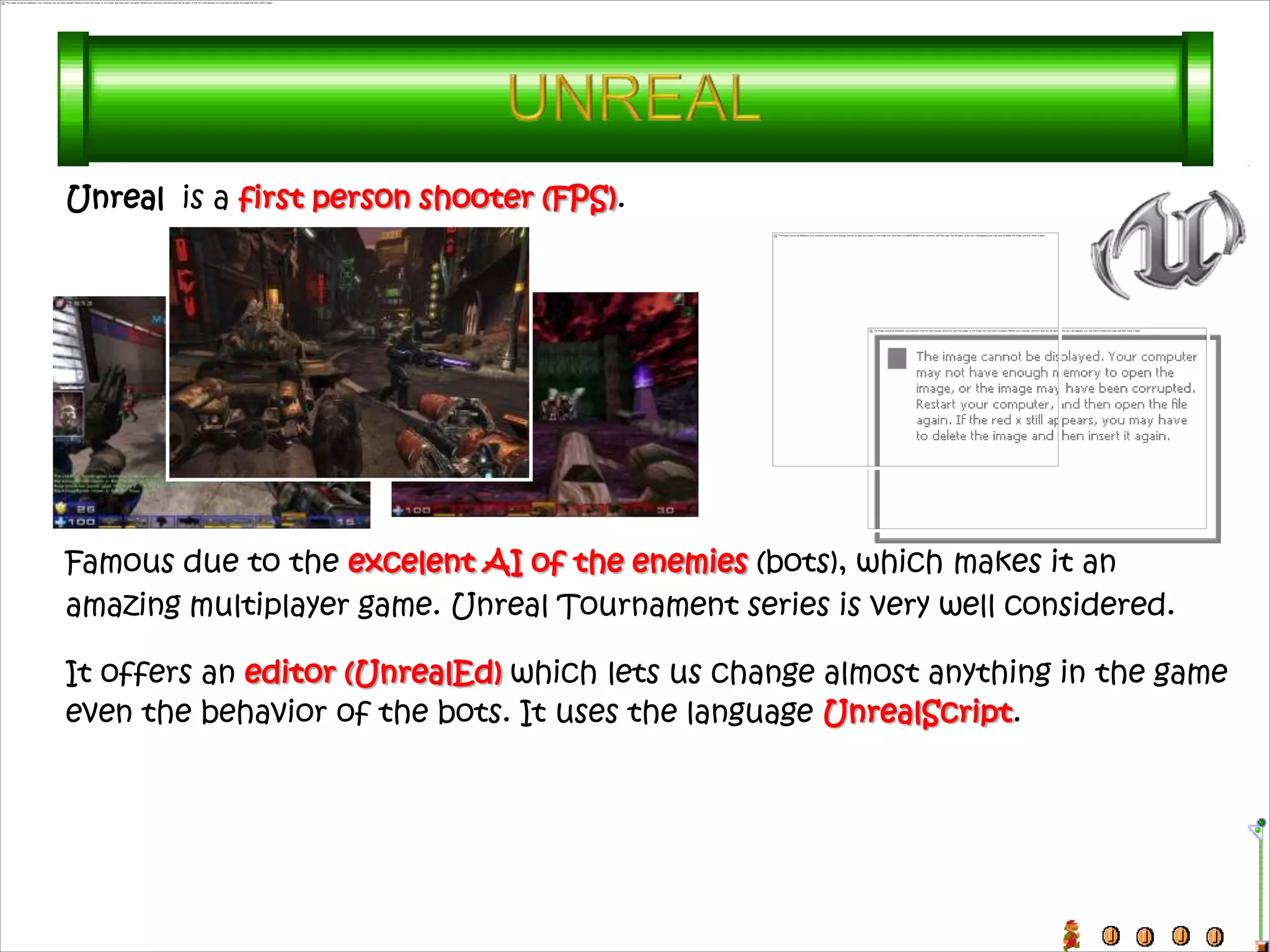
Unreal is a first person shooter (FPS).


Famous due to the excelent AI of the enemies (bots), which makes it an
amazing multiplayer game. Unreal Tournament series is very well considered.

It offers an editor (UnrealEd) which lets us change almost anything in the game
even the behavior of the bots. It uses the language UnrealScript.
A java middleware for Unreal Tournament series games and
Defcon games.

The architecture is as follows:


It is possible to interact with the game from a java program, getting higher
independence (avoiding Unrealscript restrictions) and increasing the
Possibilities (java libraries).
On the contrary, the structures, classes, functions and workflows defined
in the Unreal engine, cannot be accessed, nor used.
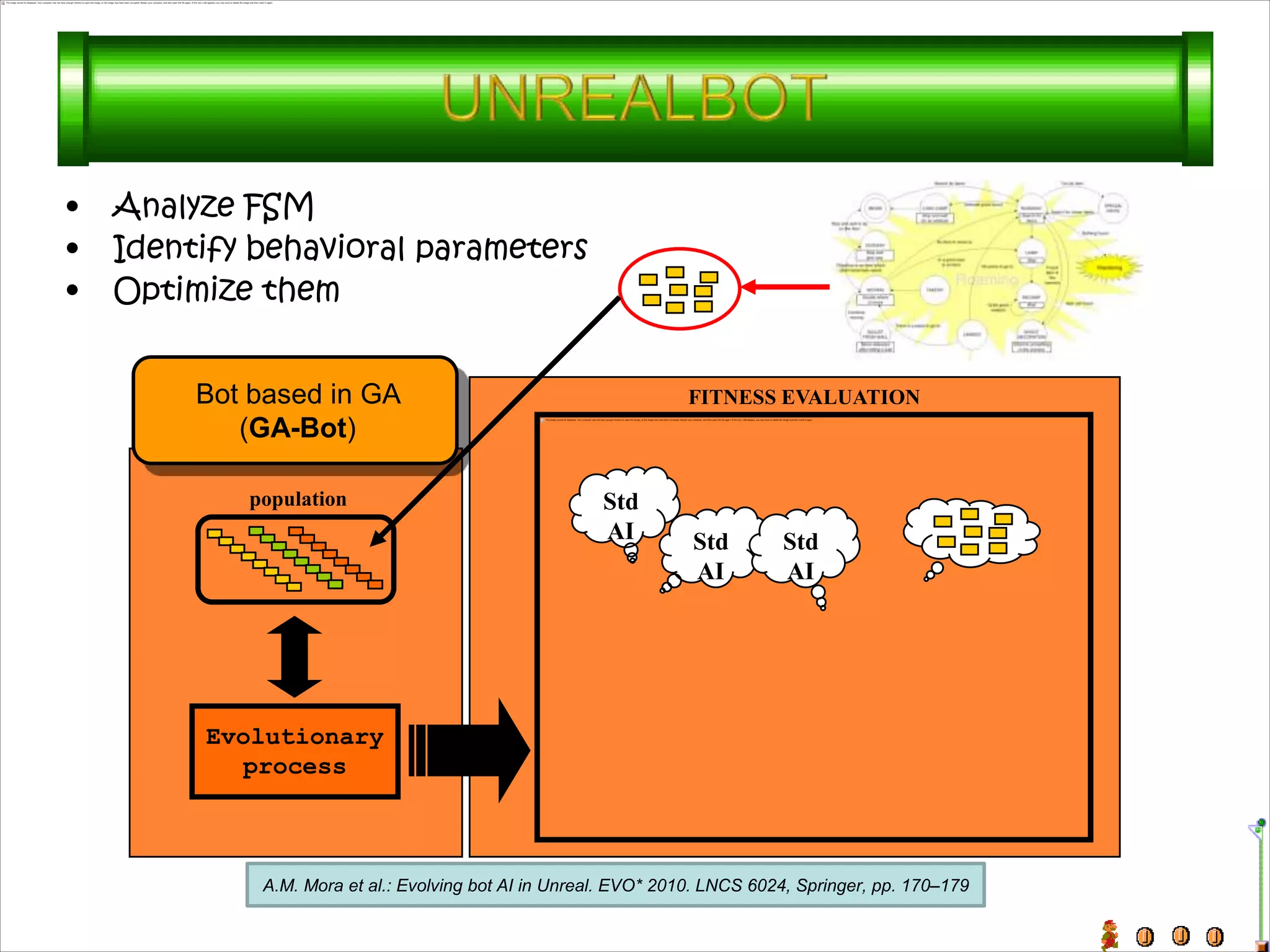
•   Analyze FSM
•   Identify behavioral parameters
•   Optimize them


        Bot based in GA                                           FITNESS EVALUATION
           (GA-Bot)

            population                                 Std
                                                       AI         Std        Std
                                                                  AI         AI


         Evolutionary
           process


             A.M. Mora et al.: Evolving bot AI in Unreal. EVO* 2010. LNCS 6024, Springer, pp. 170–179
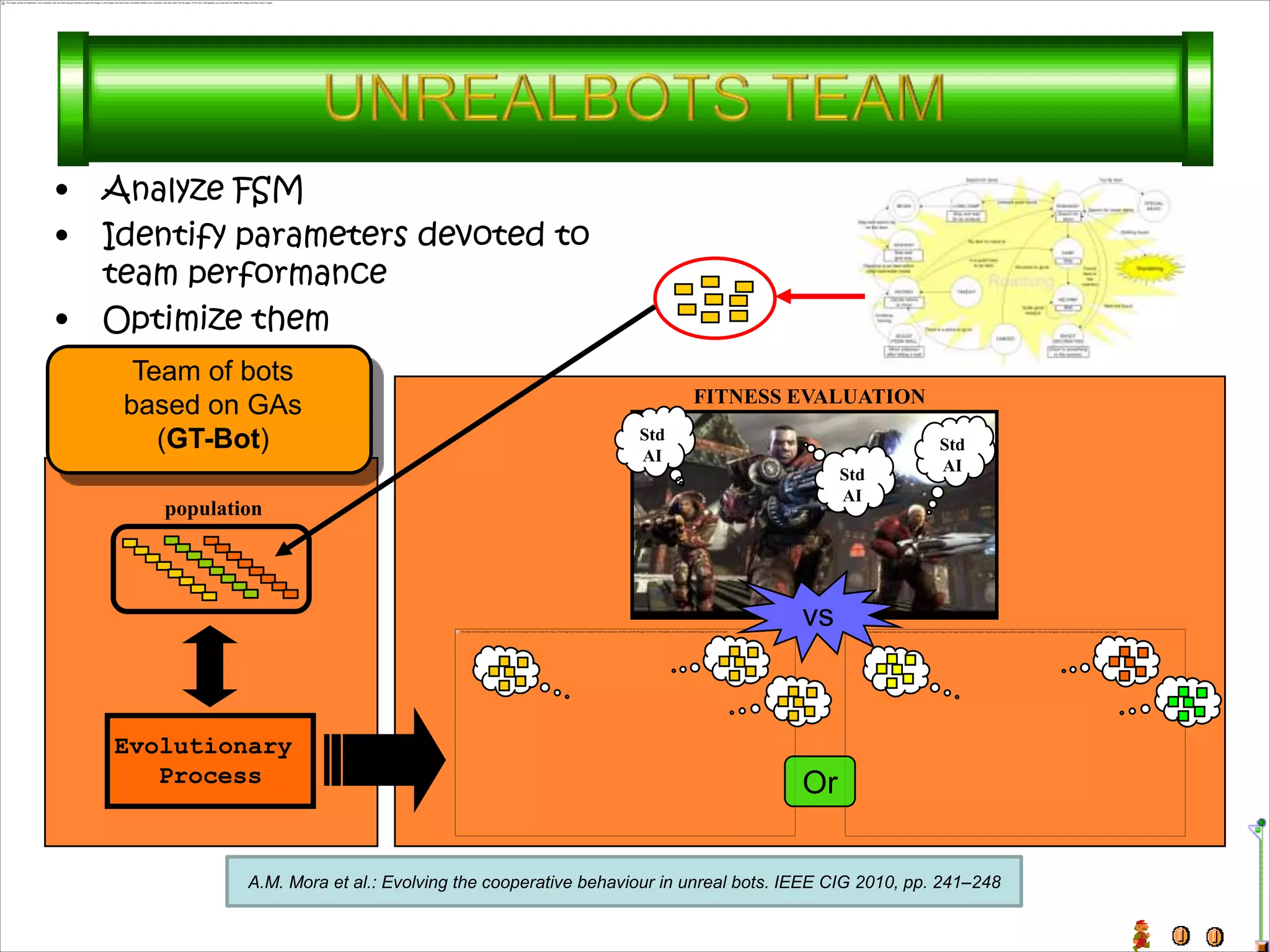
•   Analyze FSM
•   Identify parameters devoted to
    team performance
•   Optimize them
     Team of bots
     based on GAs                                                      FITNESS EVALUATION

       (GT-Bot)                                                 Std
                                                                                                      Std
                                                                AI
                                                                                                      AI
                                                                                         Std
                                                                                         AI
       population


                                                                                    vs


    Evolutionary
       Process                                                                      Or

               A.M. Mora et al.: Evolving the cooperative behaviour in unreal bots. IEEE CIG 2010, pp. 241–248
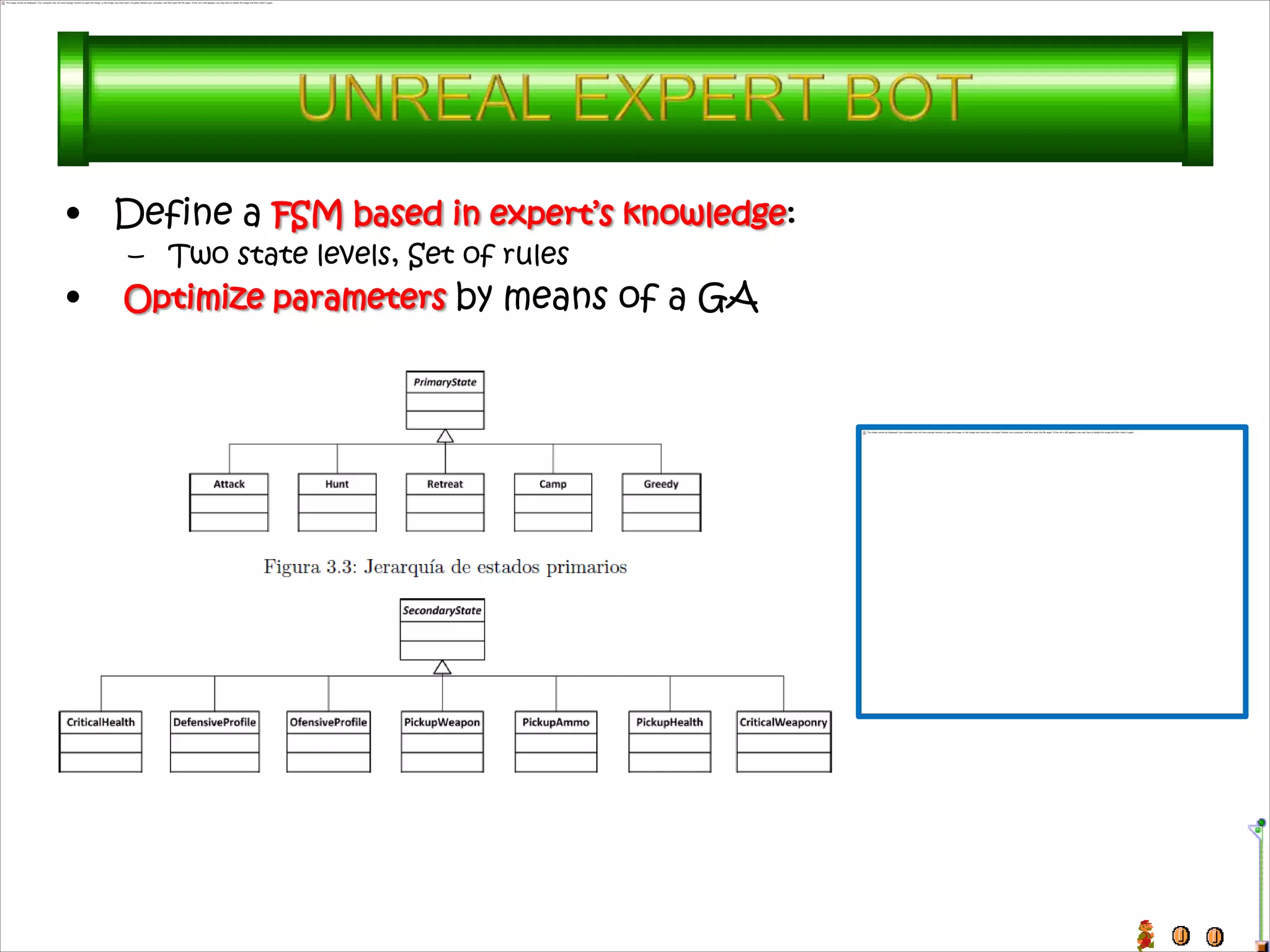
• Define a FSM based in expert’s knowledge:
    – Two state levels, Set of rules
•   Optimize parameters by means of a GA
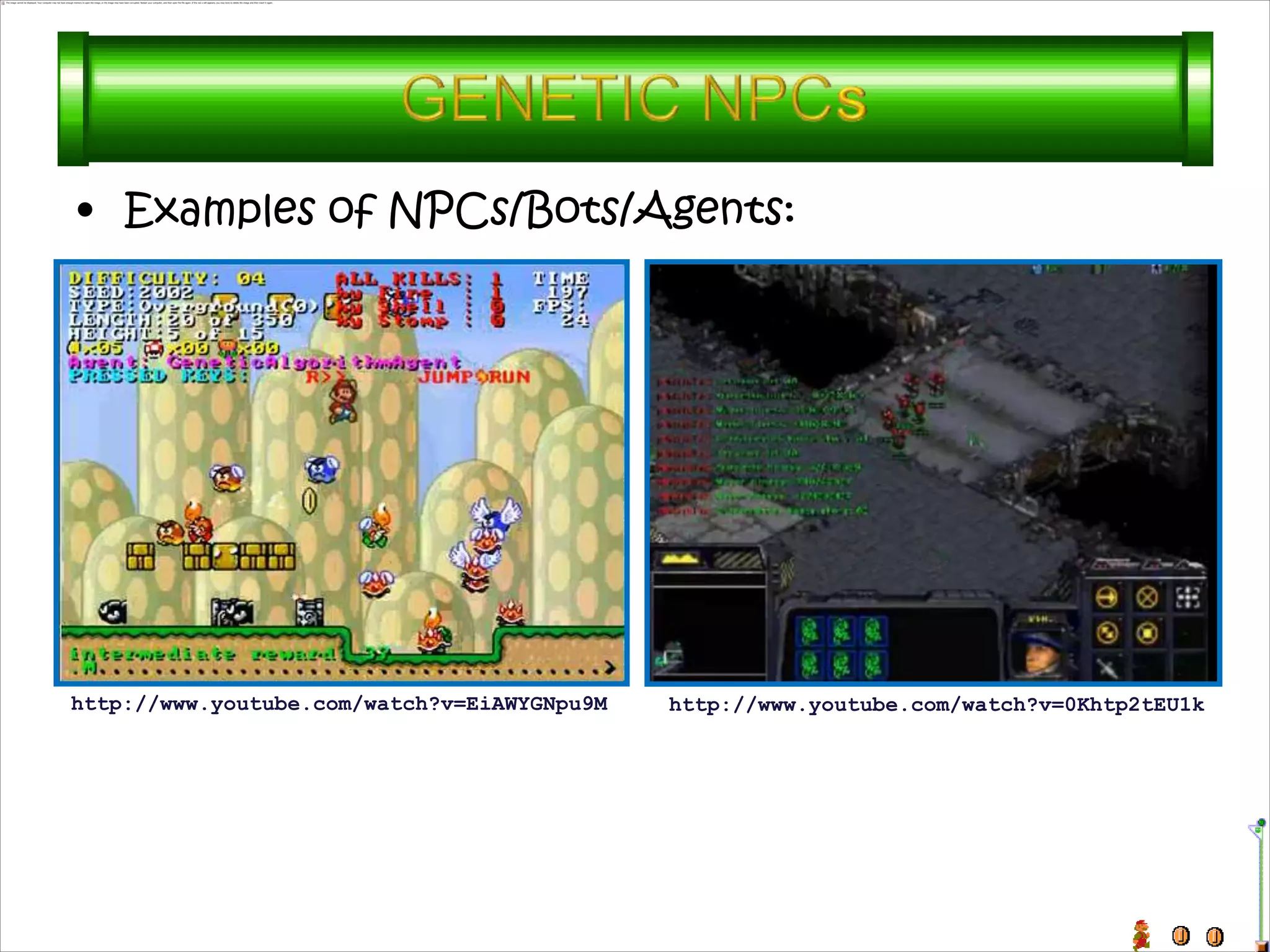
• Examples of NPCs/Bots/Agents:


http://www.youtube.com/watch?v=EiAWYGNpu9M   http://www.youtube.com/watch?v=0Khtp2tEU1k
A good way to start working:

•   2K BotPrize: Unreal bots which should behave as human as possible.
•   Starcraft: combats inside the famous RTS.
•   Planet Wars: simpler RTS game. Google AI Challenge 2010.
•   ANTS: RTS modeling ant’s fighting. Google AI Challenge 2011.
•   Pac-Man: It can be implemented pac-man’s or ghosts intelligence.
•   Simulated Car Racing: Car races, track generation, mechanical
    optimization.
•   Mario AI: Agent, learning, level generation.

    http://geneura.ugr.es/cig2012/competitions.html
•   Conferences:
     – IEEE CIG
     – CGAMES
     – GAME-ON
     – CGAT
     – Special Sessions:
         LION, IWANN, EVO*, GECCO, WCCI

•   Journals:
     – Transactions on Computational
       Intelligence and AI in Games (IEEE)
     – Entertainment Computing (Springer)
                 …
     –   Anyone which accept your paper
Science and Videogames. Computational intelligence in videogames

Science and Videogames. Computational intelligence in videogames

  • 1.
    SCIENCE AND VIDEOGAMES PLAYER1 – ANTONIO M. MORA GARCÍA - Press START - © GAME-ON 2012
  • 2.
    Introduction videogames market, players taxonomy, current game systems. Videogames at the University. • Videogames applied to science videogame system-based science, engineering and technology. • Science in videogames scientific principles of videogames. • Researching in videogames main research fields in videogames. • Examples: Our works
  • 3.
  • 4.
    Very big growing of videogames market, due to their movement to new groups of interest: people older than 25 and younger than 10, including parents and grandparents, in addition to the feminine sector. • This growing is mainly due to a change in the videogames philosophy, offering more ‘adult’ contents, or the contrary, easier and child- focused, in addition to direct and brief action games. There is a wide market for science!!!
  • 5.
    In the current market has arisen the so-called casual gamers: sporadic players users of brief and direct action games (arcade, sports, mini- games), or the so-called no-games (training games, art games, and so on). • The usual players have auto renamed as hardcore gamers. They (really) enjoy and profit the games, they are informed, like most types of games, and play for long periods (if possible). A friendly way to say “Virgin until the age of 37” More fun if they plug-in the console
  • 6.
    A sincere feeling:
  • 7.
    In addition to PC and mobile systems (iOS, Android, etc), there are some extended systems: • Home consoles Wii Xbox 360 Playstation 3 • Portable consoles Nintendo Playstation 3DS Vita
  • 8.
    And many more (open-philosphy consoles), not known for most of the people. GP2X Wiz Caanoo Dingoo Pandora
  • 9.
    Another (positive) consequence is the adaptation of the study plans for videogames development. • In Spain there are arising courses in Grades and Masters • Anyway, we are still far from other countries in Europe: – Example: Center for Computer Game Research (Copenhagen)
  • 11.
  • 12.
    Its (at thebeginning) novel controller (Wiimote) has been very famous mainly among the scientific and technical community: • Robots control, reactive/touch-detecting screens or surfaces, or pattern/subjects recognition, among others. http://www.youtube.com/watch?v=v1AJ_OBJUpY http://www.youtube.com/watch?v=TkmxhVtvLoM http://www.youtube.com/watch?v=0awjPUkBXOU
  • 13.
    There is evena project, WiiLab, which has created a Matlab toolbox for interacting with Wiimote… …and with Game Maker (an easy game development framework) http://code.google.com/p/giimote/ http://www.youtube.com/watch?v=EeBAYeoX7-8
  • 14.
    It was initially used for building console-based clusters (super computers), due to the powerful chip Cell, and the cheap price it had. • It was possible to use an additional Linux O.S. (Yellow Dog), very flexible. • But later, the console was updated for not admitting the installation of any additional O.S., so Linux was lost forever.
  • 15.
    Very famous inthe community due to Kinect: • Robots control by movement and/or voice, pattern and person recognition, among others. http://www.youtube.com/watch?v=Sw4RvwhQ73E http://www.youtube.com/watch?v=c6jZjpvIio4
  • 16.
  • 18.
    Videogames have always respected physics rules, even a ‘simple’ one (in appearance) such as Super Mario Bros. (jumps, trajectories, inertia,…). • Nowadays the tendency is to develop completely realistic games in that sense, by implementing specific engines for physics modeling. http://www.youtube.com/watch?v=B7_rPDwSKe8
  • 19.
    The scientific principlesof operation of the first main controller for a console based in movement (Wiimote) are: http://www.youtube.com/watch?v=ETAKfSkec6A
  • 20.
  • 21.
    In addition to visual and physics realism, it is desired to model enemies and partners , with an ‘intelligent’ (human) behavior. • Thus a big amount of resources have been focused on artificial intelligence. Realistic Game
  • 22.
    AI is the area of computer science devoted to implement nonliving rational agents (at least in appearance). • Inside a videogame, AI is focused on defining behavior techniques for non-playable characters (NPCs), commonly named bots, which simulate being rational. These characters could be enemies or partners. • It is not a matter of literally showing human behavior, since it means the consideration of mistakes.
  • 23.
    • In thevery beginning, NPCs followed some predefined behavior patterns, that the programmer implemented at game implementation and which were invariable. • Reactive AIs proposed NPC’s actions as a response to player’s actions. • Dedicated AIs set different ‘personalities’ for NPCs.
  • 24.
    • Later therewere introduced the finite state machines, which define a set of possible states for the NPC, and a set of transitions between them. Transitions are based in perceptions about the game or about the players. By Fergu
  • 25.
    Other extended methods include rule-based systems and decision trees. In both cases, there is a set of rules that the NPC will follow, depending on the inputs or perceptions about its environment.
  • 26.
    Nowadays it is usual to mix some of these techniques, thus in most games NPCs follow predefined behavioral models (scripts), depending on player’s actions. • Their advantage is that it is easy to define them, considering programmer’s experience and modeling player’s behavior. • Their main disadvantage is the low flexibility they have in order to adapt to new situations/events. • Moreover, NPCs have additional advantages over the human player, such as perfect aim (based in exact coordinates), or navigation points (waypoints in maps modeling advantageous routes, shortest paths, etc). • Just a few ‘scientific techniques’ have been used in commercial games…
  • 27.
    Traditionally in the scientific area it was called Game Theory, a branch of applied mathematics in which there are some rewards depending on the chosen decision. It involved simple, but difficult to solve, games: Hanoi towers, prisoner’s dilemma, game of life. • These games proposed problems to be solved by means of exact methods, heuristics or metaheuristics: tree-based search, A*, evolutionary algorithms, ant colony optimization,… • Moreover, the resolution of traditional games (usually puzzles) has also been studied from the ‘ancient times’ in science life: chess, backgammon, mastermind, sudoku
  • 28.
    videogames provide a new environment for solving heterogeneous problems. • The most famous (and probably the first) problem addressed was AI related issues. It still remains as the main (the most studied) problem in the area. • However, with the advances and improvement of technology, videogames have increased their complexity, so new researching lines have been arisen: – Search in maps, combat prediction, or simulation, to cite a few • Nowadays, there are a huge number of research fields inside videogames scope, so research studies and publications have grown exponentially.
  • 29.
    • AI branchwhich applies metaheuristics and bioinspired methods for the resolution of complex problems, usually by means of adaptive systems. • It is necessary to model the game (or a part of it) as an optimization, search or learning problem, among others. • Examples: – Pathfinding – Combat prediction – Automated generation of behavioral rules – Parameter tuning – Objective decision
  • 30.
    • The mostused metaheuristics are: Genetic Algorithms (GA), Ant Colony Optimization (ACO), Monte-Carlo Tree Search (MCTS), A*, Genetic Programming (GP), Fuzzy Logic, Neural Networks… • Which are mostly applied over finite state machines (FSM), scripts, rule-based systems (RS) or expert system (ES), among others.
  • 31.
    NPC’s AI: try to model AI aspects for enemies or partners. It is usual to apply GAs to optimize parameters considered in behavioral rules. • Rule system generation: automated definition of behavioral rules sets, which determine the way the NPCs act in different situations. It is usual to apply GP. • Human-like behavior analysis and modeling: the objective is to model NPCs which behave as human players. Data mining and learning techniques are usually employed.
  • 32.
    Cheating detection: trick detection techniques, based on the study of statistics about matches. • Move and battle prediction: prediction methods are trained (using neural networks) analyzing data from recorded matches, trying to anticipate future movements and actions. • Learning in games: adaptive agents can be created by means of reinforcement learning.
  • 33.
    Game mechanics and features analysis: game components are analyzed and parameterized in order to get numeric valuations of the game components. • Exploration and search in games: search algorithms are applied in order to find the best paths to objectives in maps, or to explore some areas maximizing the covering, for instance. • Content, characters, levels and story generation: is the so-called procedural content generation, and is aimed to generate automatically contents. They are valued by the players (interactive methods) or by means of mathematical models.
  • 34.
  • 35.
    i  initialpopulation f  evaluation function (fitness) ?  stop condition Se  selection Cr  crossover Mu  mutation Re  replacement by Johann Dréo
  • 36.
  • 37.
    Unreal is afirst person shooter (FPS). Famous due to the excelent AI of the enemies (bots), which makes it an amazing multiplayer game. Unreal Tournament series is very well considered. It offers an editor (UnrealEd) which lets us change almost anything in the game even the behavior of the bots. It uses the language UnrealScript.
  • 38.
    A java middlewarefor Unreal Tournament series games and Defcon games. The architecture is as follows: It is possible to interact with the game from a java program, getting higher independence (avoiding Unrealscript restrictions) and increasing the Possibilities (java libraries). On the contrary, the structures, classes, functions and workflows defined in the Unreal engine, cannot be accessed, nor used.
  • 39.
    Analyze FSM • Identify behavioral parameters • Optimize them Bot based in GA FITNESS EVALUATION (GA-Bot) population Std AI Std Std AI AI Evolutionary process A.M. Mora et al.: Evolving bot AI in Unreal. EVO* 2010. LNCS 6024, Springer, pp. 170–179
  • 40.
    Analyze FSM • Identify parameters devoted to team performance • Optimize them Team of bots based on GAs FITNESS EVALUATION (GT-Bot) Std Std AI AI Std AI population vs Evolutionary Process Or A.M. Mora et al.: Evolving the cooperative behaviour in unreal bots. IEEE CIG 2010, pp. 241–248
  • 41.
    • Define aFSM based in expert’s knowledge: – Two state levels, Set of rules • Optimize parameters by means of a GA
  • 42.
    • Examples ofNPCs/Bots/Agents: http://www.youtube.com/watch?v=EiAWYGNpu9M http://www.youtube.com/watch?v=0Khtp2tEU1k
  • 43.
    A good wayto start working: • 2K BotPrize: Unreal bots which should behave as human as possible. • Starcraft: combats inside the famous RTS. • Planet Wars: simpler RTS game. Google AI Challenge 2010. • ANTS: RTS modeling ant’s fighting. Google AI Challenge 2011. • Pac-Man: It can be implemented pac-man’s or ghosts intelligence. • Simulated Car Racing: Car races, track generation, mechanical optimization. • Mario AI: Agent, learning, level generation. http://geneura.ugr.es/cig2012/competitions.html
  • 44.
    Conferences: – IEEE CIG – CGAMES – GAME-ON – CGAT – Special Sessions: LION, IWANN, EVO*, GECCO, WCCI • Journals: – Transactions on Computational Intelligence and AI in Games (IEEE) – Entertainment Computing (Springer) … – Anyone which accept your paper