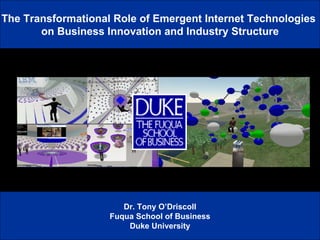
The Transformational Role of Emergent Internet Technologies  on Business Innovation and Industry Structure Dr. Tony O’Driscoll Fuqua School of Business Duke University
Tony’s Brief Bio 18 Years of industry experience in Telecom and High-Tech Industries: HW, SW, Services, Research, Learning Founding member of IBM’s Strategy and Change Consulting Practice Professor of the Practice at Duke’s Fuqua School of Business Teach in the areas of Strategic Management, Management of Innovation and Technology, Management Consulting and Services Management. Research focuses on impact of technology on business strategy and operational efficiency Consult with clients around the world on how to leverage technology to drive sustainable competitive advantage.
Topics We Will Explore Technology   Definition, Diffusion, Adoption & Division Progression, Compression & Disruption Webvolution, Pervasion and Co-Creation Transformation & Distribution
“ Official” Definitions Technology is a broad concept that deals with the usage and knowledge of  tools  and  crafts , and how it affects the ability to control and adapt to the  environment . In human society, it is a consequence of  science  and  engineering , although several technological advances predate the two concepts. The practical  application of knowledge  especially in a particular area" and "a capability given by the practical application of knowledge”.
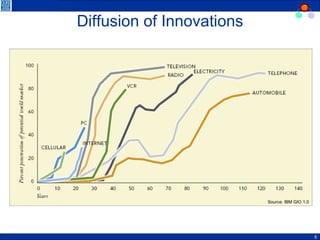
Diffusion of Innovations Source: IBM GIO 1.0
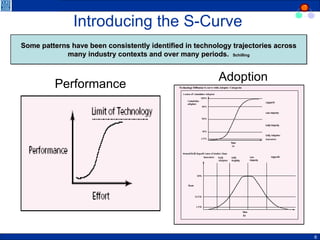
Introducing the S-Curve  Some patterns have been consistently identified in technology trajectories across many industry contexts and over many periods.  Schilling Adoption Performance
From Patterns to Predictions Video Clip (Kurzweil, Anderson)
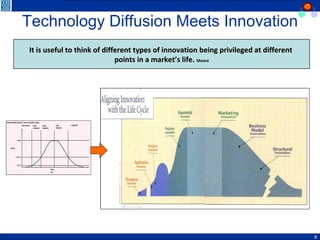
Technology Diffusion Meets Innovation Sources: Global Innovation Outlook 2.0, 2006 It is useful to think of different types of innovation being privileged at different  points in a market’s life.  Moore
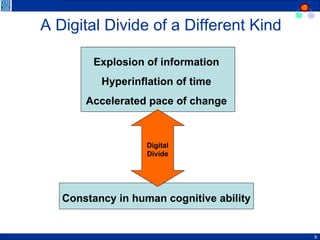
A Digital Divide of a Different Kind Explosion of information Hyperinflation of time Accelerated pace of change Constancy in human cognitive ability Digital Divide
Topics We Will Explore Technology   Definition, Diffusion, Adoption & Division Progression, Compression & Disruption Webvolution, Pervasion and Co-Creation Transformation & Distribution
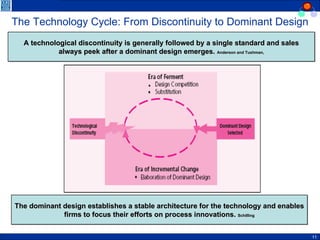
The Technology Cycle: From Discontinuity to Dominant Design The dominant design establishes a stable architecture for the technology and enables firms to focus their efforts on process innovations.  Schilling A technological discontinuity is generally followed by a single standard and sales always peek after a dominant design emerges.  Anderson and Tushman,
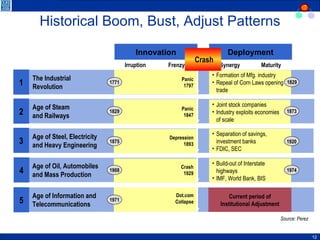
Historical Boom, Bust, Adjust Patterns Irruption Innovation The Industrial  Revolution Age of Steam  and Railways Age of Steel, Electricity and Heavy Engineering Age of Oil, Automobiles and Mass Production Age of Information and Telecommunications Frenzy Synergy Deployment Maturity Panic 1797 Depression 1893 Crash 1929 Dot.com Collapse Formation of Mfg. industry Repeal of Corn Laws opening trade Joint stock companies  Industry exploits economies  of scale Current period of Institutional Adjustment Separation of savings,  investment banks  FDIC, SEC Build-out of Interstate  highways  IMF, World Bank, BIS 1 2 3 4 5 Source: Perez Panic 1847 1771 1829 1875 1908 1971 1873 1920 1974 1829 Crash
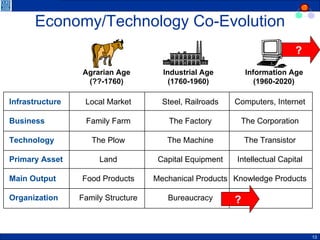
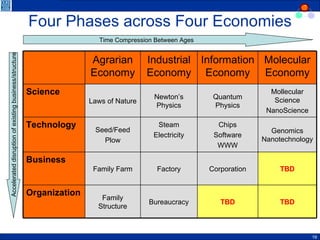
Economy/Technology Co-Evolution Infrastructure Business Technology Primary Asset Main Output Organization ?  ?  Agrarian Age (??-1760) Local Market Family Farm The Plow Land Food Products Family Structure Industrial Age (1760-1960) Steel, Railroads The Factory The Machine Capital Equipment Mechanical Products Bureaucracy Information Age (1960-2020) Computers, Internet The Corporation The Transistor Intellectual Capital Knowledge Products
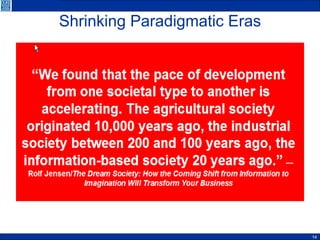
Shrinking Paradigmatic Eras
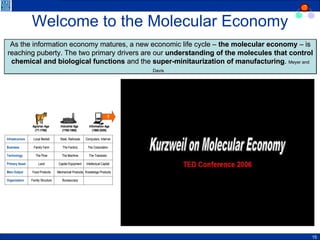
Welcome to the Molecular Economy Video Clip (Kurzweil and Venter) As the information economy matures, a new economic life cycle –  the molecular economy  – is reaching puberty. The two primary drivers are our  understanding of the molecules that control chemical and biological functions  and the  super-minitaurization of manufacturing .   Meyer and Davis
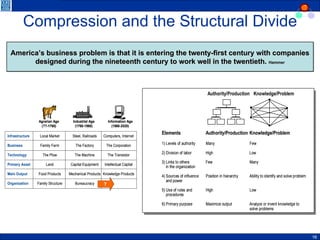
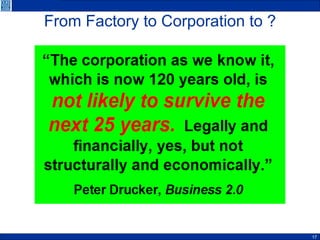
Compression and the Structural Divide America’s business problem is that it is entering the twenty-first century with companies designed during the nineteenth century to work well in the twentieth.  Hammer
From Factory to Corporation to ?
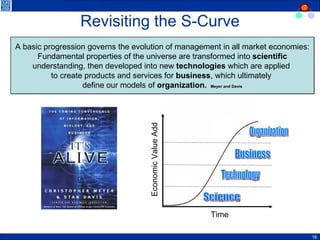
Revisiting the S-Curve A basic progression governs the evolution of management in all market economies: Fundamental properties of the universe are transformed into  scientific  understanding, then developed into new  technologies   which are applied  to create products and services for  business , which ultimately  define our models of  organization .  Meyer and Davis Economic Value Add Time Science Technology Business Organization
Four Phases across Four Economies Time Compression Between Ages Accelerated disruption of existing business/structure  Agrarian Economy Industrial Economy Information Economy Molecular Economy Science Laws of Nature Newton’s Physics Quantum Physics Mollecular Science NanoScience Technology Seed/Feed Plow Steam Electricity Chips Software WWW Genomics Nanotechnology Business Family Farm Factory Corporation TBD Organization Family Structure Bureaucracy TBD TBD
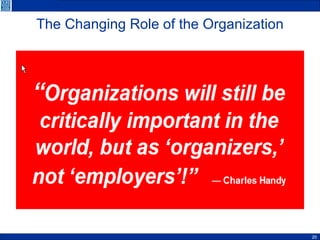
The Changing Role of the Organization
Topics We Will Explore Technology   Definition, Diffusion, Adoption & Division Progression, Compression & Disruption Webvolution, Pervasion and Co-Creation Transformation & Distribution
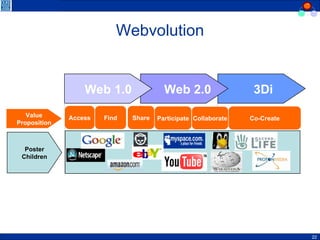
Webvolution 3Di  Web 2.0 Web 1.0 Access Participate Value Proposition Poster Children Find Share Collaborate Co-Create
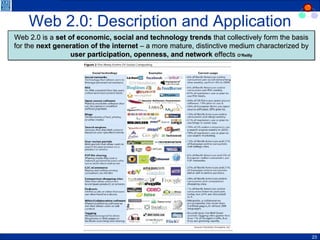
Web 2.0: Description and Application Web 2.0 is a  set of economic, social and technology trends  that collectively form the basis for the  next generation of the internet  – a more mature, distinctive medium characterized by  user participation, openness, and network  effects   O’Reilly
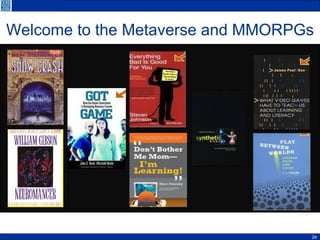
Welcome to the Metaverse and MMORPGs
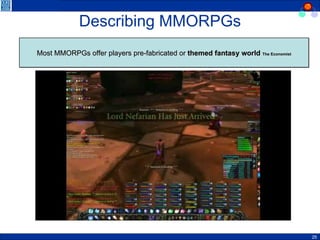
Describing MMORPGs Most MMORPGs offer players pre-fabricated or  themed fantasy world  The Economist
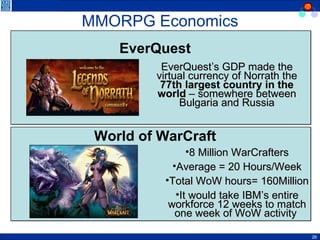
MMORPG Economics EverQuest EverQuest’s GDP made the virtual currency of Norrath the  77th largest country   in the world  – somewhere between Bulgaria and Russia World of WarCraft 8 Million WarCrafters Average = 20 Hours/Week Total WoW hours= 160Million It would take IBM’s entire workforce 12 weeks to match one week of WoW activity
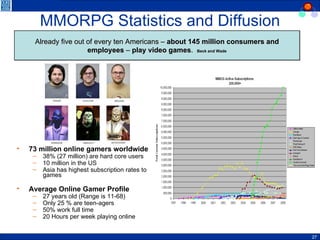
MMORPG Statistics and Diffusion 73 million online gamers worldwide 38% (27 million) are hard core users 10 million in the US  Asia has highest subscription rates to games Average Online Gamer Profile 27 years old (Range is 11-68) Only 25 % are teen-agers 50% work full time 20 Hours per week playing online Already five out of every ten Americans –  about 145 million consumers and employees  –  play video games .  Beck and Wade
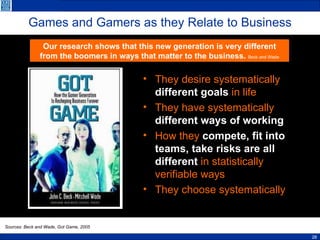
Games and Gamers as they Relate to Business Our research shows that this new generation is very different from the boomers in ways that matter to the business.  Beck and Wade They desire systematically  different   goals  in life They have systematically  different ways of working How they  compete, fit into teams, take risks are all different  in statistically verifiable ways They choose systematically  different ways to learn Sources: Beck and Wade, Got Game, 2005
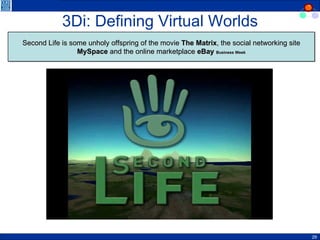
3Di: Defining Virtual Worlds Sources: Business Week April 2006,  The Economist. Living a Second Life, Sept. 28, 2006 Second Life is some unholy offspring of the movie  The Matrix , the social networking site  MySpace  and the online marketplace  eBay  Business Week
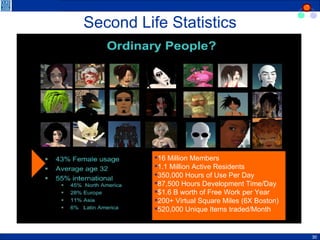
Second Life Statistics Source: Joe Miller. Linden Lab  All Data: (Industry, Job Level, Company Size, # Learners Impacted) 16 Million Members 1.1 Million Active Residents 350,000 Hours of Use Per Day 87,500 Hours Development Time/Day $1.6 B worth of Free Work per Year 200+ Virtual Square Miles (6X Boston) 520,000 Unique Items traded/Month
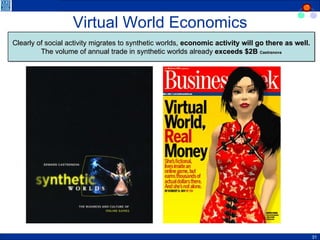
Virtual World Economics Source: Joe Miller. Linden Lab  Clearly of social activity migrates to synthetic worlds,  economic activity will go there as well.  The volume of annual trade in synthetic worlds already  exceeds $2B  Castranova
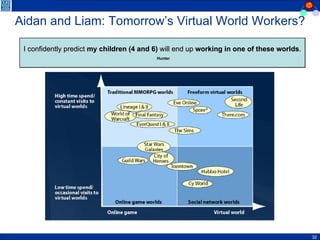
Aidan and Liam: Tomorrow’s Virtual World Workers? I confidently predict  my children (4 and 6)  will end up  working in one of these worlds .  Hunter
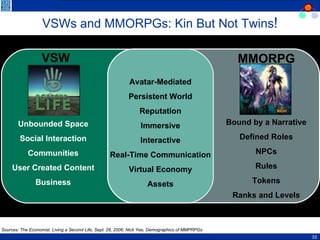
VSWs and MMORPGs: Kin But Not Twins ! Sources: The Economist. Living a Second Life, Sept. 28, 2006; Nick Yee, Demographics of MMPRPGs Unbounded Space Social Interaction Communities User Created Content Business VSW MMORPG Avatar-Mediated Persistent World Reputation Immersive Interactive Real-Time Communication Virtual Economy Assets Bound by a Narrative Defined Roles NPCs Rules Tokens Ranks and Levels
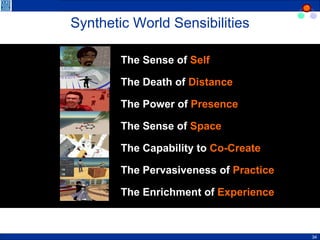
Synthetic World Sensibilities The Sense of   Self The Death of   Distance The Power of   Presence The Sense of   Space The Capability to   Co-Create The Pervasiveness of   Practice The Enrichment of   Experience
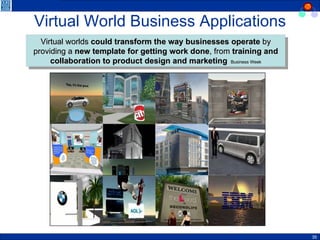
Virtual World Business Applications Virtual worlds  could transform the way businesses operate  by providing a  new template for getting work done , from  training and collaboration to product design and marketing   Business Week
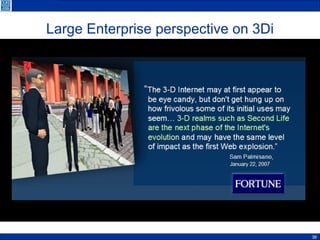
Large Enterprise perspective on 3Di
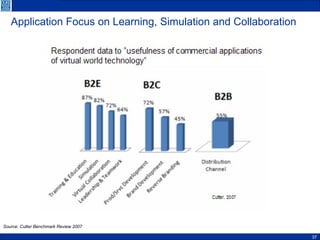
Application Focus on Learning, Simulation and Collaboration Source: Cutter Benchmark Review 2007
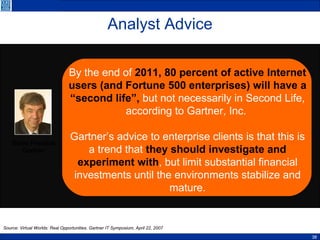
Analyst Advice By the end of  2011,   80 percent of active Internet users (and Fortune 500 enterprises) will have a “second life”,  but not necessarily in Second Life, according to Gartner, Inc.  Gartner’s advice to enterprise clients is that this is a trend that  they should investigate and experiment with , but limit substantial financial investments until the environments stabilize and mature. Steve Prentice Gartner Source: Virtual Worlds: Real Opportunities. Gartner IT Symposium, April 22, 2007
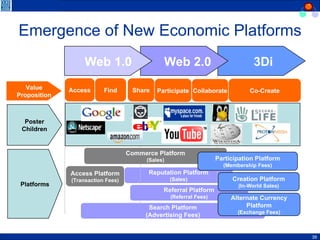
Emergence of New Economic Platforms Reputation Platform (Sales) 3Di  Web 2.0 Web 1.0 Access Participate Value Proposition Poster Children Platforms Find Access Platform (Transaction Fees) Search Platform (Advertising Fees) Commerce Platform (Sales) Participation Platform (Membership Fees) Referral Platform (Referral Fees) Alternate Currency Platform (Exchange Fees) Share Collaborate Co-Create Creation Platform (In-World Sales)
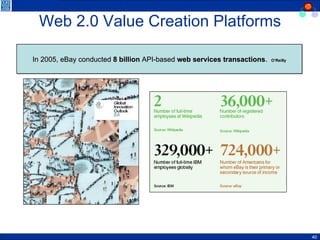
Web 2.0 Value Creation Platforms In 2005, eBay conducted  8 billion  API-based  web services transactions .  O’Reilly
Wikinomics and Prosumption Leaders must  think differently about how to compete and be profitable , and embrace and new art and science of collaboration we call  Wikinomics .  Tapscott
Collaborative Value Co-Creation Billions of connected individuals  can now actively participate in innovation, wealth creation, and social development in ways we once only dreamed of.  Tapscott
The “Always On” Pervasive Web There are more transistors produced per year than grains of rice and each rice grain can buy hundreds of transistors .  Goodall (2002)
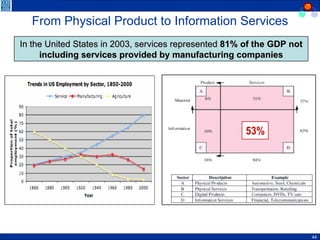
From Physical Product to Information Services In the United States in 2003, services represented  81% of the GDP not including services provided by manufacturing companies
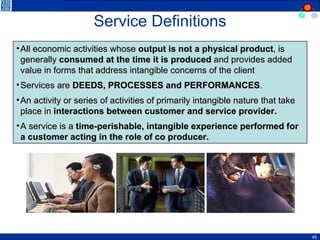
Service Definitions All economic activities whose  output is not a physical product , is generally  consumed at the time it is produced  and provides added value in forms that address intangible concerns of the client Services are  DEEDS, PROCESSES and PERFORMANCES . An activity or series of activities of primarily intangible nature that take place in  interactions between customer and service provider. A service is a  time-perishable, intangible experience performed for a customer acting in the role of co producer.
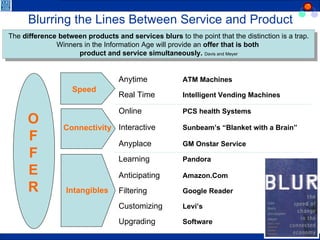
Blurring the Lines Between Service and Product Anytime ATM Machines Real Time Intelligent Vending Machines Online PCS health Systems Interactive Sunbeam’s “Blanket with a Brain” Anyplace GM Onstar Service Learning Pandora Anticipating Amazon.Com Filtering Google Reader Customizing Levi’s  Upgrading Software Intangibles Source: Blur The  difference between products and services blurs  to the point that the distinction is a trap. Winners in the Information Age will provide an  offer that is both  product and service simultaneously.  Davis and Meyer Speed Connectivity O F F E R
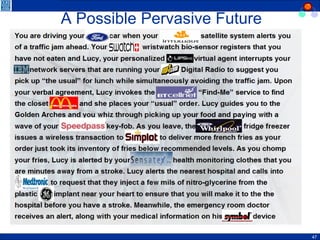
A Possible Pervasive Future
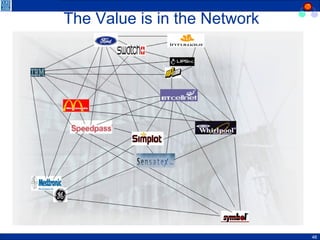
The Value is in the Network
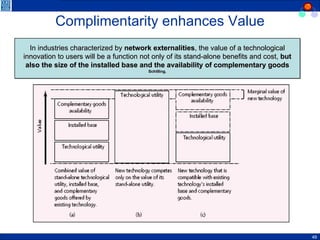
Complimentarity enhances Value In industries characterized by  network externalities , the value of a technological innovation to users will be a function not only of its stand-alone benefits and cost,  but also the size of the installed base and the availability of complementary goods  Schilling.
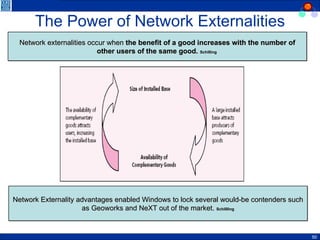
The Power of Network Externalities Network externalities occur when  the benefit of a good increases with the number of other users of the same good.  Schilling  Network Externality advantages enabled Windows to lock several would-be contenders such as Geoworks and NeXT out of the market.   Schillling
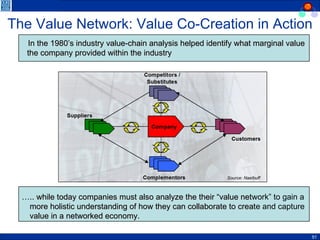
The Value Network: Value Co-Creation in Action In the 1980’s industry value-chain analysis helped identify what marginal value the company provided within the industry … .. while today companies must also analyze the their “value net work” to gain a  more holistic understanding of how they can collaborate to creat e and capture  value in a networked economy. Source: Naelbuff
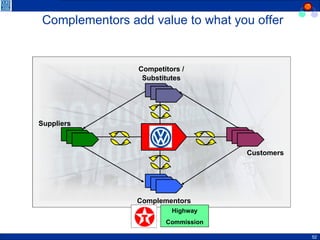
Complementors add value to what you offer Suppliers Customers Competitors / Substitutes Complementors Highway Commission
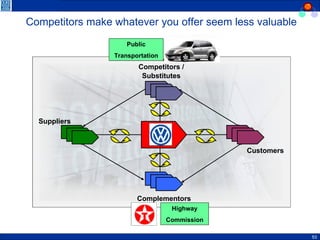
Competitors make whatever you offer seem less valuable Suppliers Customers Competitors / Substitutes Complementors Highway Commission Public Transportation
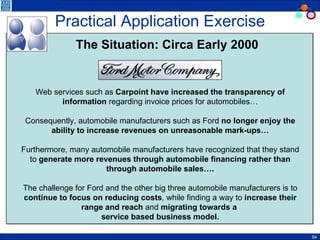
Practical Application Exercise Web services such as  Carpoint have increased the transparency of information  regarding invoice prices for automobiles… Consequently, automobile manufacturers such as Ford  no longer enjoy the ability to increase revenues on unreasonable mark-ups… Furthermore, many automobile manufacturers have recognized that they stand to  generate more revenues through automobile financing rather than through automobile sales…. The challenge for Ford and the other big three automobile manufacturers is to  continue to focus on reducing costs , while finding a way to  increase their range and reach  and  migrating towards a  service based business model. The Situation: Circa Early 2000
Topics We Will Explore Technology   Definition, Diffusion, Adoption & Division Progression, Compression & Disruption Webvolution, Pervasion and Co-Creation Transformation & Distribution
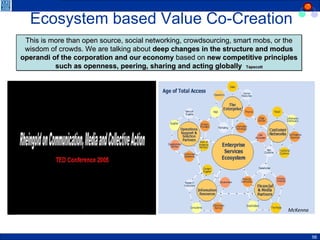
Ecosystem based Value Co-Creation McKenna This is more than open source, social networking, crowdsourcing, smart mobs, or the wisdom of crowds. We are talking about  deep changes in the structure and modus operandi of the corporation and our economy  based on  new competitive principles such as openness, peering, sharing and acting globally   Tapscott Video Clip (Leadbeater Platforms and Rheingold)
The Future of Enterprise? Soon it may be time to  redefine what we in the business world think of as “the enterprise.”  Further, notions of “employer” and “employee” might become more and more antiquated as  looser aggregations of collaborators form and disband  on an opportunity-by opportunity basis. The future might consist of  a billion one-person “enterprises” people who move frequently from project to project as their skills and focus shift. Sources: Global Innovation Outlook 2.0, 2006
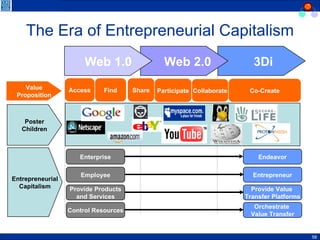
The Era of Entrepreneurial Capitalism 3Di  Web 2.0 Web 1.0 Access Participate Value Proposition Poster Children Find Share Collaborate Co-Create Entrepreneurial Capitalism Enterprise Endeavor Employee Entrepreneur Control Resources Orchestrate  Value Transfer Provide Products and Services Provide Value  Transfer Platforms
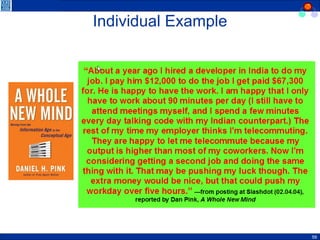
Individual Example
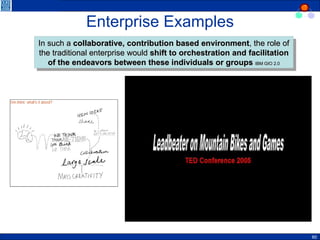
Enterprise Examples In such a  collaborative, contribution based environment , the role of the traditional enterprise would  shift to orchestration and facilitation of the endeavors between these individuals or groups   IBM GIO 2.0
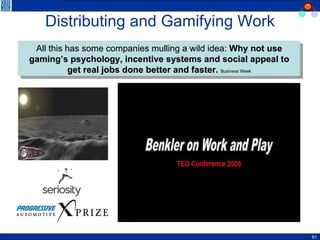
Distributing and Gamifying Work All this has some companies mulling a wild idea:  Why not use gaming’s psychology, incentive systems and social appeal to get real jobs done better and faster.   Business Week Video Clip (Crater Recognition)
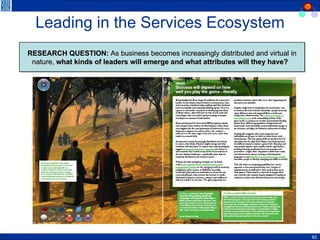
Leading in the Services Ecosystem Source: GIO 2.0, p. 21, 22 RESEARCH QUESTION:  As business becomes increasingly distributed and virtual in nature,  what kinds of leaders will emerge and what attributes will they have?
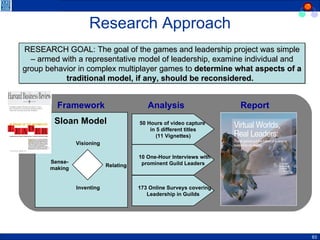
Research Approach 50 Hours of video capture  in 5 different titles (11 Vignettes) 10 One-Hour Interviews with  prominent Guild Leaders 173 Online Surveys covering Leadership in Guilds Sloan Model Visioning Inventing Sense- making Relating Framework Analysis Report Source: Seriosity Report, p. 3. RESEARCH GOAL: The goal of the games and leadership project was simple – armed with a representative model of leadership, examine individual and group behavior in complex multiplayer games to  determine what aspects of a traditional model, if any, should be reconsidered.
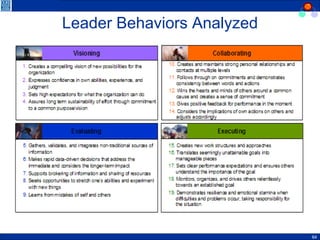
Leader Behaviors Analyzed
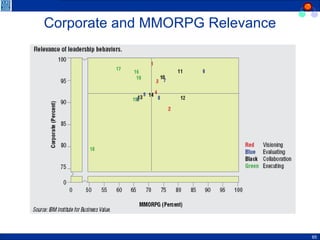
Corporate and MMORPG Relevance
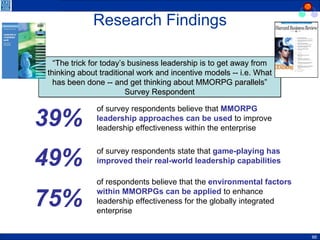
of survey respondents believe that  MMORPG leadership approaches   can be used  to improve leadership effectiveness within the enterprise of survey respondents state that  game-playing has improved their real-world leadership capabilities of respondents believe that the  environmental factors within MMORPGs can be applied  to enhance leadership effectiveness for the globally integrated enterprise 39% 49% 75% Research Findings “ The trick for today’s business leadership is to get away from thinking about traditional work and incentive models -- i.e. What has been done -- and get thinking about MMORPG parallels” Survey Respondent
Lets do the Web 2.0 Thing wadatripp.wordpress.com [email_address]
Thank You !

Global Executive Printout 111108

  • 1.
    The Transformational Roleof Emergent Internet Technologies on Business Innovation and Industry Structure Dr. Tony O’Driscoll Fuqua School of Business Duke University
  • 2.
    Tony’s Brief Bio18 Years of industry experience in Telecom and High-Tech Industries: HW, SW, Services, Research, Learning Founding member of IBM’s Strategy and Change Consulting Practice Professor of the Practice at Duke’s Fuqua School of Business Teach in the areas of Strategic Management, Management of Innovation and Technology, Management Consulting and Services Management. Research focuses on impact of technology on business strategy and operational efficiency Consult with clients around the world on how to leverage technology to drive sustainable competitive advantage.
  • 3.
    Topics We WillExplore Technology Definition, Diffusion, Adoption & Division Progression, Compression & Disruption Webvolution, Pervasion and Co-Creation Transformation & Distribution
  • 4.
    “ Official” DefinitionsTechnology is a broad concept that deals with the usage and knowledge of tools and crafts , and how it affects the ability to control and adapt to the environment . In human society, it is a consequence of science and engineering , although several technological advances predate the two concepts. The practical application of knowledge especially in a particular area" and "a capability given by the practical application of knowledge”.
  • 5.
    Diffusion of InnovationsSource: IBM GIO 1.0
  • 6.
    Introducing the S-Curve Some patterns have been consistently identified in technology trajectories across many industry contexts and over many periods. Schilling Adoption Performance
  • 7.
    From Patterns toPredictions Video Clip (Kurzweil, Anderson)
  • 8.
    Technology Diffusion MeetsInnovation Sources: Global Innovation Outlook 2.0, 2006 It is useful to think of different types of innovation being privileged at different points in a market’s life. Moore
  • 9.
    A Digital Divideof a Different Kind Explosion of information Hyperinflation of time Accelerated pace of change Constancy in human cognitive ability Digital Divide
  • 10.
    Topics We WillExplore Technology Definition, Diffusion, Adoption & Division Progression, Compression & Disruption Webvolution, Pervasion and Co-Creation Transformation & Distribution
  • 11.
    The Technology Cycle:From Discontinuity to Dominant Design The dominant design establishes a stable architecture for the technology and enables firms to focus their efforts on process innovations. Schilling A technological discontinuity is generally followed by a single standard and sales always peek after a dominant design emerges. Anderson and Tushman,
  • 12.
    Historical Boom, Bust,Adjust Patterns Irruption Innovation The Industrial Revolution Age of Steam and Railways Age of Steel, Electricity and Heavy Engineering Age of Oil, Automobiles and Mass Production Age of Information and Telecommunications Frenzy Synergy Deployment Maturity Panic 1797 Depression 1893 Crash 1929 Dot.com Collapse Formation of Mfg. industry Repeal of Corn Laws opening trade Joint stock companies Industry exploits economies of scale Current period of Institutional Adjustment Separation of savings, investment banks FDIC, SEC Build-out of Interstate highways IMF, World Bank, BIS 1 2 3 4 5 Source: Perez Panic 1847 1771 1829 1875 1908 1971 1873 1920 1974 1829 Crash
  • 13.
    Economy/Technology Co-Evolution InfrastructureBusiness Technology Primary Asset Main Output Organization ? ? Agrarian Age (??-1760) Local Market Family Farm The Plow Land Food Products Family Structure Industrial Age (1760-1960) Steel, Railroads The Factory The Machine Capital Equipment Mechanical Products Bureaucracy Information Age (1960-2020) Computers, Internet The Corporation The Transistor Intellectual Capital Knowledge Products
  • 14.
  • 15.
    Welcome to theMolecular Economy Video Clip (Kurzweil and Venter) As the information economy matures, a new economic life cycle – the molecular economy – is reaching puberty. The two primary drivers are our understanding of the molecules that control chemical and biological functions and the super-minitaurization of manufacturing . Meyer and Davis
  • 16.
    Compression and theStructural Divide America’s business problem is that it is entering the twenty-first century with companies designed during the nineteenth century to work well in the twentieth. Hammer
  • 17.
    From Factory toCorporation to ?
  • 18.
    Revisiting the S-CurveA basic progression governs the evolution of management in all market economies: Fundamental properties of the universe are transformed into scientific understanding, then developed into new technologies which are applied to create products and services for business , which ultimately define our models of organization . Meyer and Davis Economic Value Add Time Science Technology Business Organization
  • 19.
    Four Phases acrossFour Economies Time Compression Between Ages Accelerated disruption of existing business/structure Agrarian Economy Industrial Economy Information Economy Molecular Economy Science Laws of Nature Newton’s Physics Quantum Physics Mollecular Science NanoScience Technology Seed/Feed Plow Steam Electricity Chips Software WWW Genomics Nanotechnology Business Family Farm Factory Corporation TBD Organization Family Structure Bureaucracy TBD TBD
  • 20.
    The Changing Roleof the Organization
  • 21.
    Topics We WillExplore Technology Definition, Diffusion, Adoption & Division Progression, Compression & Disruption Webvolution, Pervasion and Co-Creation Transformation & Distribution
  • 22.
    Webvolution 3Di Web 2.0 Web 1.0 Access Participate Value Proposition Poster Children Find Share Collaborate Co-Create
  • 23.
    Web 2.0: Descriptionand Application Web 2.0 is a set of economic, social and technology trends that collectively form the basis for the next generation of the internet – a more mature, distinctive medium characterized by user participation, openness, and network effects O’Reilly
  • 24.
    Welcome to theMetaverse and MMORPGs
  • 25.
    Describing MMORPGs MostMMORPGs offer players pre-fabricated or themed fantasy world The Economist
  • 26.
    MMORPG Economics EverQuestEverQuest’s GDP made the virtual currency of Norrath the 77th largest country in the world – somewhere between Bulgaria and Russia World of WarCraft 8 Million WarCrafters Average = 20 Hours/Week Total WoW hours= 160Million It would take IBM’s entire workforce 12 weeks to match one week of WoW activity
  • 27.
    MMORPG Statistics andDiffusion 73 million online gamers worldwide 38% (27 million) are hard core users 10 million in the US Asia has highest subscription rates to games Average Online Gamer Profile 27 years old (Range is 11-68) Only 25 % are teen-agers 50% work full time 20 Hours per week playing online Already five out of every ten Americans – about 145 million consumers and employees – play video games . Beck and Wade
  • 28.
    Games and Gamersas they Relate to Business Our research shows that this new generation is very different from the boomers in ways that matter to the business. Beck and Wade They desire systematically different goals in life They have systematically different ways of working How they compete, fit into teams, take risks are all different in statistically verifiable ways They choose systematically different ways to learn Sources: Beck and Wade, Got Game, 2005
  • 29.
    3Di: Defining VirtualWorlds Sources: Business Week April 2006, The Economist. Living a Second Life, Sept. 28, 2006 Second Life is some unholy offspring of the movie The Matrix , the social networking site MySpace and the online marketplace eBay Business Week
  • 30.
    Second Life StatisticsSource: Joe Miller. Linden Lab All Data: (Industry, Job Level, Company Size, # Learners Impacted) 16 Million Members 1.1 Million Active Residents 350,000 Hours of Use Per Day 87,500 Hours Development Time/Day $1.6 B worth of Free Work per Year 200+ Virtual Square Miles (6X Boston) 520,000 Unique Items traded/Month
  • 31.
    Virtual World EconomicsSource: Joe Miller. Linden Lab Clearly of social activity migrates to synthetic worlds, economic activity will go there as well. The volume of annual trade in synthetic worlds already exceeds $2B Castranova
  • 32.
    Aidan and Liam:Tomorrow’s Virtual World Workers? I confidently predict my children (4 and 6) will end up working in one of these worlds . Hunter
  • 33.
    VSWs and MMORPGs:Kin But Not Twins ! Sources: The Economist. Living a Second Life, Sept. 28, 2006; Nick Yee, Demographics of MMPRPGs Unbounded Space Social Interaction Communities User Created Content Business VSW MMORPG Avatar-Mediated Persistent World Reputation Immersive Interactive Real-Time Communication Virtual Economy Assets Bound by a Narrative Defined Roles NPCs Rules Tokens Ranks and Levels
  • 34.
    Synthetic World SensibilitiesThe Sense of Self The Death of Distance The Power of Presence The Sense of Space The Capability to Co-Create The Pervasiveness of Practice The Enrichment of Experience
  • 35.
    Virtual World BusinessApplications Virtual worlds could transform the way businesses operate by providing a new template for getting work done , from training and collaboration to product design and marketing Business Week
  • 36.
  • 37.
    Application Focus onLearning, Simulation and Collaboration Source: Cutter Benchmark Review 2007
  • 38.
    Analyst Advice Bythe end of 2011, 80 percent of active Internet users (and Fortune 500 enterprises) will have a “second life”, but not necessarily in Second Life, according to Gartner, Inc. Gartner’s advice to enterprise clients is that this is a trend that they should investigate and experiment with , but limit substantial financial investments until the environments stabilize and mature. Steve Prentice Gartner Source: Virtual Worlds: Real Opportunities. Gartner IT Symposium, April 22, 2007
  • 39.
    Emergence of NewEconomic Platforms Reputation Platform (Sales) 3Di Web 2.0 Web 1.0 Access Participate Value Proposition Poster Children Platforms Find Access Platform (Transaction Fees) Search Platform (Advertising Fees) Commerce Platform (Sales) Participation Platform (Membership Fees) Referral Platform (Referral Fees) Alternate Currency Platform (Exchange Fees) Share Collaborate Co-Create Creation Platform (In-World Sales)
  • 40.
    Web 2.0 ValueCreation Platforms In 2005, eBay conducted 8 billion API-based web services transactions . O’Reilly
  • 41.
    Wikinomics and ProsumptionLeaders must think differently about how to compete and be profitable , and embrace and new art and science of collaboration we call Wikinomics . Tapscott
  • 42.
    Collaborative Value Co-CreationBillions of connected individuals can now actively participate in innovation, wealth creation, and social development in ways we once only dreamed of. Tapscott
  • 43.
    The “Always On”Pervasive Web There are more transistors produced per year than grains of rice and each rice grain can buy hundreds of transistors . Goodall (2002)
  • 44.
    From Physical Productto Information Services In the United States in 2003, services represented 81% of the GDP not including services provided by manufacturing companies
  • 45.
    Service Definitions Alleconomic activities whose output is not a physical product , is generally consumed at the time it is produced and provides added value in forms that address intangible concerns of the client Services are DEEDS, PROCESSES and PERFORMANCES . An activity or series of activities of primarily intangible nature that take place in interactions between customer and service provider. A service is a time-perishable, intangible experience performed for a customer acting in the role of co producer.
  • 46.
    Blurring the LinesBetween Service and Product Anytime ATM Machines Real Time Intelligent Vending Machines Online PCS health Systems Interactive Sunbeam’s “Blanket with a Brain” Anyplace GM Onstar Service Learning Pandora Anticipating Amazon.Com Filtering Google Reader Customizing Levi’s Upgrading Software Intangibles Source: Blur The difference between products and services blurs to the point that the distinction is a trap. Winners in the Information Age will provide an offer that is both product and service simultaneously. Davis and Meyer Speed Connectivity O F F E R
  • 47.
  • 48.
    The Value isin the Network
  • 49.
    Complimentarity enhances ValueIn industries characterized by network externalities , the value of a technological innovation to users will be a function not only of its stand-alone benefits and cost, but also the size of the installed base and the availability of complementary goods Schilling.
  • 50.
    The Power ofNetwork Externalities Network externalities occur when the benefit of a good increases with the number of other users of the same good. Schilling Network Externality advantages enabled Windows to lock several would-be contenders such as Geoworks and NeXT out of the market. Schillling
  • 51.
    The Value Network:Value Co-Creation in Action In the 1980’s industry value-chain analysis helped identify what marginal value the company provided within the industry … .. while today companies must also analyze the their “value net work” to gain a more holistic understanding of how they can collaborate to creat e and capture value in a networked economy. Source: Naelbuff
  • 52.
    Complementors add valueto what you offer Suppliers Customers Competitors / Substitutes Complementors Highway Commission
  • 53.
    Competitors make whateveryou offer seem less valuable Suppliers Customers Competitors / Substitutes Complementors Highway Commission Public Transportation
  • 54.
    Practical Application ExerciseWeb services such as Carpoint have increased the transparency of information regarding invoice prices for automobiles… Consequently, automobile manufacturers such as Ford no longer enjoy the ability to increase revenues on unreasonable mark-ups… Furthermore, many automobile manufacturers have recognized that they stand to generate more revenues through automobile financing rather than through automobile sales…. The challenge for Ford and the other big three automobile manufacturers is to continue to focus on reducing costs , while finding a way to increase their range and reach and migrating towards a service based business model. The Situation: Circa Early 2000
  • 55.
    Topics We WillExplore Technology Definition, Diffusion, Adoption & Division Progression, Compression & Disruption Webvolution, Pervasion and Co-Creation Transformation & Distribution
  • 56.
    Ecosystem based ValueCo-Creation McKenna This is more than open source, social networking, crowdsourcing, smart mobs, or the wisdom of crowds. We are talking about deep changes in the structure and modus operandi of the corporation and our economy based on new competitive principles such as openness, peering, sharing and acting globally Tapscott Video Clip (Leadbeater Platforms and Rheingold)
  • 57.
    The Future ofEnterprise? Soon it may be time to redefine what we in the business world think of as “the enterprise.” Further, notions of “employer” and “employee” might become more and more antiquated as looser aggregations of collaborators form and disband on an opportunity-by opportunity basis. The future might consist of a billion one-person “enterprises” people who move frequently from project to project as their skills and focus shift. Sources: Global Innovation Outlook 2.0, 2006
  • 58.
    The Era ofEntrepreneurial Capitalism 3Di Web 2.0 Web 1.0 Access Participate Value Proposition Poster Children Find Share Collaborate Co-Create Entrepreneurial Capitalism Enterprise Endeavor Employee Entrepreneur Control Resources Orchestrate Value Transfer Provide Products and Services Provide Value Transfer Platforms
  • 59.
  • 60.
    Enterprise Examples Insuch a collaborative, contribution based environment , the role of the traditional enterprise would shift to orchestration and facilitation of the endeavors between these individuals or groups IBM GIO 2.0
  • 61.
    Distributing and GamifyingWork All this has some companies mulling a wild idea: Why not use gaming’s psychology, incentive systems and social appeal to get real jobs done better and faster. Business Week Video Clip (Crater Recognition)
  • 62.
    Leading in theServices Ecosystem Source: GIO 2.0, p. 21, 22 RESEARCH QUESTION: As business becomes increasingly distributed and virtual in nature, what kinds of leaders will emerge and what attributes will they have?
  • 63.
    Research Approach 50Hours of video capture in 5 different titles (11 Vignettes) 10 One-Hour Interviews with prominent Guild Leaders 173 Online Surveys covering Leadership in Guilds Sloan Model Visioning Inventing Sense- making Relating Framework Analysis Report Source: Seriosity Report, p. 3. RESEARCH GOAL: The goal of the games and leadership project was simple – armed with a representative model of leadership, examine individual and group behavior in complex multiplayer games to determine what aspects of a traditional model, if any, should be reconsidered.
  • 64.
  • 65.
  • 66.
    of survey respondentsbelieve that MMORPG leadership approaches can be used to improve leadership effectiveness within the enterprise of survey respondents state that game-playing has improved their real-world leadership capabilities of respondents believe that the environmental factors within MMORPGs can be applied to enhance leadership effectiveness for the globally integrated enterprise 39% 49% 75% Research Findings “ The trick for today’s business leadership is to get away from thinking about traditional work and incentive models -- i.e. What has been done -- and get thinking about MMORPG parallels” Survey Respondent
  • 67.
    Lets do theWeb 2.0 Thing wadatripp.wordpress.com [email_address]
  • 68.