Disruptive enterprise
communications
technologies
© Martin Geddes Consulting Ltd December 2014
WHAT ARE THE POTENTIAL
DISRUPTIVE TECHNOLOGY
CHANGES IN THE NEXT
10 YEARS?
Resurgence in voice
There is a world of post-telephony voice emerging.
Rather than being a vertically-integrated silo, it is
software-based and can be embedded into many
applications.
These new modalities of voice interaction blend
synchronous and asynchronous communications.
They will add on a wide range of value-adding
capabilities: recording, activity streaming, search,
media processing, data mining and analytics, and
predictive decision-making.
The dominant paradigm is likely to be “show and
tell”. Users have a (business) object they are
discussing in front of them, which could be a simple
PowerPoint slide or complex customer workflow.
4
Application
to person
messaging
The world of Communications Enabled Business
Processes (CEBP), also known as Application to Person
(A2P) messaging, has been growing fast for the past
few years. This includes functions like process alerts,
alarms and triggers which require human
intervention.
These increasingly have mobile and workflow
element, where they are distributed in real-time to
teams for action. The key goal is to have fast decision
loops.
6
On-the-go
communications
The connected vehicle is a transition of similar
magnitude to the arrival of the connected home
with broadband in the 1990s. It covers cars, buses,
trains, trucks, boats and planes. These vehicles
include telemetry, sensors, and integration with
workflows and transport management systems.
It is not merely a new location in which demand
forms. Connected or autonomous vehicles can be
seen as a form of supply too. They have
permanent power, and can easily host advanced
communications. They can form meshes, and
create extended canopies of communications.
8
Adios to email?
Enterprise social collaboration and networking will
continue to grow. All content created by
knowledge workers will be shared among
workgroups by default.
9
Email is the cockroach of
communications: it
seems to survive all forms
of attack by more
advanced life forms. Yet
we could well see ‘peak
email’ in the next few
years.
WearablesVirtualReality
Telephony can be thought of an Immersive Virtual
Reality v0.1. It is audio-only, but creates the cognitive
absorption illusion nonetheless. At least 7 different
virtual reality headsets are due to be in market or to
be launched in 2014/15. The price point is already
mass market (<$500). It is reasonable to assume this
technology will be ubiquitous in the mid-2020s.
Indeed, we have always been building a succession of
ever more sophisticated virtual worlds. These appeal
to wider range of senses, integrating sight, sound and
touch. Gesture interfaces, sensory UX and perceptual
computing are the current key trends.
11
spirit of america / Shutterstock.com
Sensor
revolution
Computers meet the real world
Computers have historically lived in a ‘bubble’,
separated from the real world. We have interacted
with them by typing symbols on keyboards, reducing
us to their level. The world of M2M, Internet of Things,
Smart Cities and the Connected Home are changing
this. The barrier between intelligence machines and
the rest of the world is dissolving.
The human environment will be festooned with
machines that sense us, and send back signals to us.
Wearables, augmented reality, and flexible giant
wall-size displays will be normal everyday items. In
this ‘ambient computing’ paradigm, all screens and
sensors are resources for everyone to draw upon.
13
Wearables
14
Workplace use of biosensing
wearable technology is
already beginning. This feeds
into the ‘quantified
workplace’ sector.
Social
Robotics
Source: Jibo.com
15
That desk phone you
have today is
paralysed, blind and
in a vegetative state.
Future ‘phones’ will
be able to see,
autonomously move,
and interact with us
via voice.
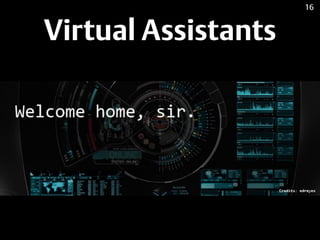
Virtual Assistants
16
Voice comes in two flavors: content (aimed at
other humans) and commands (aimed at
machines). Virtual assistants today wait
patiently for our commands, but in future
they will be full participants in our
conversations.
This will, for example, change how we search
for information and services, as these
technologies become trusted life partners. It
may be easier to change spouse than retrain a
new AI engine in your quirks!
17
Novel access
technologies
It is easy to extrapolate existing mainstream
wireless technologies. Meanwhile, there are
numerous potential disruptors. These include
peer-to-peer meshes, ultrawideband,
millimetre microwave, visible light, and
spectrum-hopping white spaces.
Both incumbent and new wireless
technologies may find themselves mounted
onto non-traditional network access
mechanisms, such as balloons and drones.
19
Fundamental advances
in network
architecture
Recursive Internet Architecture
(RINA)
Recursive Internet Architecture
(RINA) offers the promise of far
higher performance, mobility,
resilience, security at lower cost
than current networks.
It could be thought of as the end
game of SDN: virtualisations within
virtualisations within virtualisations.
There are two EU-funded projects
(IRATI and PRISTINE) building
working prototypes.
21
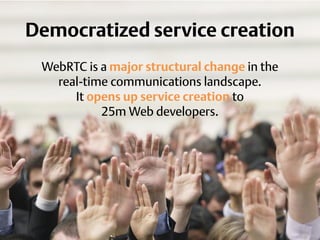
Democratized service creation
WebRTC is a major structural change in the
real-time communications landscape.
It opens up service creation to
25m Web developers.
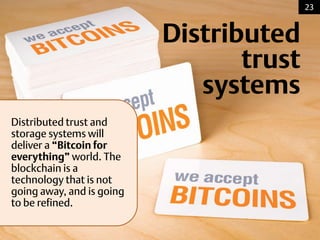
Distributed
trust
systems
Distributed trust and
storage systems will
deliver a “Bitcoin for
everything” world. The
blockchain is a
technology that is not
going away, and is going
to be refined.
23
Storage and search
The list of personal storage
buzzwords is long:
quantified self; life
tracking; dashcams;
lifelogging; and personal
data locker. Everyone will
soon have a “Personal
Wikipedia” and “Personal
Watson”.
The countervailing trend is
for ephemeral applications,
and associated privacy &
steganography services.
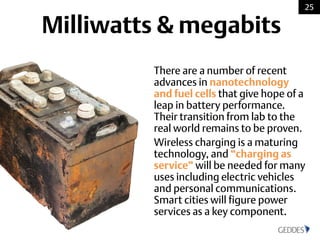
There are a number of recent
advances in nanotechnology
and fuel cells that give hope of a
leap in battery performance.
Their transition from lab to the
real world remains to be proven.
Wireless charging is a maturing
technology, and “charging as
service” will be needed for many
uses including electric vehicles
and personal communications.
Smart cities will figure power
services as a key component.
25
Milliwatts & megabits
Long shots
It is not possible to cover every
possible technology disruption:
quantum computing, cognitive
enhancement, personal drones,
“smart dust” sensors, in-
building navigation, ultra-
wideband radios, 3D printing
and artisanal manufacturing…
There are bound to be left-field
technologies that come along
in the next decade.
26
Sign up for here
for my free
Future of Communications
newsletter.
“In preparing for battle
I have always found
that plans are useless,
but planning is
indispensable.”
— Dwight D. Eisenhower
Thank you
More fresh thinking at
www.martingeddes.com/think-tank
Get in touch! mail@martingeddes.com

Disruptive enterprise communications technologies

  • 1.
  • 2.
    WHAT ARE THEPOTENTIAL DISRUPTIVE TECHNOLOGY CHANGES IN THE NEXT 10 YEARS?
  • 3.
  • 4.
    There is aworld of post-telephony voice emerging. Rather than being a vertically-integrated silo, it is software-based and can be embedded into many applications. These new modalities of voice interaction blend synchronous and asynchronous communications. They will add on a wide range of value-adding capabilities: recording, activity streaming, search, media processing, data mining and analytics, and predictive decision-making. The dominant paradigm is likely to be “show and tell”. Users have a (business) object they are discussing in front of them, which could be a simple PowerPoint slide or complex customer workflow. 4
  • 5.
  • 6.
    The world ofCommunications Enabled Business Processes (CEBP), also known as Application to Person (A2P) messaging, has been growing fast for the past few years. This includes functions like process alerts, alarms and triggers which require human intervention. These increasingly have mobile and workflow element, where they are distributed in real-time to teams for action. The key goal is to have fast decision loops. 6
  • 7.
  • 8.
    The connected vehicleis a transition of similar magnitude to the arrival of the connected home with broadband in the 1990s. It covers cars, buses, trains, trucks, boats and planes. These vehicles include telemetry, sensors, and integration with workflows and transport management systems. It is not merely a new location in which demand forms. Connected or autonomous vehicles can be seen as a form of supply too. They have permanent power, and can easily host advanced communications. They can form meshes, and create extended canopies of communications. 8
  • 9.
    Adios to email? Enterprisesocial collaboration and networking will continue to grow. All content created by knowledge workers will be shared among workgroups by default. 9 Email is the cockroach of communications: it seems to survive all forms of attack by more advanced life forms. Yet we could well see ‘peak email’ in the next few years.
  • 10.
  • 11.
    Telephony can bethought of an Immersive Virtual Reality v0.1. It is audio-only, but creates the cognitive absorption illusion nonetheless. At least 7 different virtual reality headsets are due to be in market or to be launched in 2014/15. The price point is already mass market (<$500). It is reasonable to assume this technology will be ubiquitous in the mid-2020s. Indeed, we have always been building a succession of ever more sophisticated virtual worlds. These appeal to wider range of senses, integrating sight, sound and touch. Gesture interfaces, sensory UX and perceptual computing are the current key trends. 11
  • 12.
    spirit of america/ Shutterstock.com Sensor revolution Computers meet the real world
  • 13.
    Computers have historicallylived in a ‘bubble’, separated from the real world. We have interacted with them by typing symbols on keyboards, reducing us to their level. The world of M2M, Internet of Things, Smart Cities and the Connected Home are changing this. The barrier between intelligence machines and the rest of the world is dissolving. The human environment will be festooned with machines that sense us, and send back signals to us. Wearables, augmented reality, and flexible giant wall-size displays will be normal everyday items. In this ‘ambient computing’ paradigm, all screens and sensors are resources for everyone to draw upon. 13
  • 14.
    Wearables 14 Workplace use ofbiosensing wearable technology is already beginning. This feeds into the ‘quantified workplace’ sector.
  • 15.
    Social Robotics Source: Jibo.com 15 That deskphone you have today is paralysed, blind and in a vegetative state. Future ‘phones’ will be able to see, autonomously move, and interact with us via voice.
  • 16.
  • 17.
    Voice comes intwo flavors: content (aimed at other humans) and commands (aimed at machines). Virtual assistants today wait patiently for our commands, but in future they will be full participants in our conversations. This will, for example, change how we search for information and services, as these technologies become trusted life partners. It may be easier to change spouse than retrain a new AI engine in your quirks! 17
  • 18.
  • 19.
    It is easyto extrapolate existing mainstream wireless technologies. Meanwhile, there are numerous potential disruptors. These include peer-to-peer meshes, ultrawideband, millimetre microwave, visible light, and spectrum-hopping white spaces. Both incumbent and new wireless technologies may find themselves mounted onto non-traditional network access mechanisms, such as balloons and drones. 19
  • 20.
  • 21.
    Recursive Internet Architecture (RINA) RecursiveInternet Architecture (RINA) offers the promise of far higher performance, mobility, resilience, security at lower cost than current networks. It could be thought of as the end game of SDN: virtualisations within virtualisations within virtualisations. There are two EU-funded projects (IRATI and PRISTINE) building working prototypes. 21
  • 22.
    Democratized service creation WebRTCis a major structural change in the real-time communications landscape. It opens up service creation to 25m Web developers.
  • 23.
    Distributed trust systems Distributed trust and storagesystems will deliver a “Bitcoin for everything” world. The blockchain is a technology that is not going away, and is going to be refined. 23
  • 24.
    Storage and search Thelist of personal storage buzzwords is long: quantified self; life tracking; dashcams; lifelogging; and personal data locker. Everyone will soon have a “Personal Wikipedia” and “Personal Watson”. The countervailing trend is for ephemeral applications, and associated privacy & steganography services.
  • 25.
    There are anumber of recent advances in nanotechnology and fuel cells that give hope of a leap in battery performance. Their transition from lab to the real world remains to be proven. Wireless charging is a maturing technology, and “charging as service” will be needed for many uses including electric vehicles and personal communications. Smart cities will figure power services as a key component. 25 Milliwatts & megabits
  • 26.
    Long shots It isnot possible to cover every possible technology disruption: quantum computing, cognitive enhancement, personal drones, “smart dust” sensors, in- building navigation, ultra- wideband radios, 3D printing and artisanal manufacturing… There are bound to be left-field technologies that come along in the next decade. 26
  • 27.
    Sign up forhere for my free Future of Communications newsletter.
  • 28.
    “In preparing forbattle I have always found that plans are useless, but planning is indispensable.” — Dwight D. Eisenhower
  • 29.
    Thank you More freshthinking at www.martingeddes.com/think-tank Get in touch! mail@martingeddes.com