Year 11 100 
Science 
Genetics 
Ms Gibellini
Achievement Standard 
Biological concepts and processes relating to variation in phenotypes 
as adaptive features will be selected from: 
 inheritable and non-inheritable variations that exist within a group of 
living organisms 
 differing rates of survival by various members of a group may 
depend on their phenotype 
 the importance of variation within populations (population and 
species survival) in a changing environment such as pest infestation, 
disease, drought, or flood 
 the advantages and disadvantages of sexual reproduction. 
The student must be familiar with the following genetic language and 
conventions: gene, allele, mutation, genotype, phenotype, gamete, 
zygote, dominant, recessive, homozygous, heterozygous, pure 
breeding, Punnett square, and pedigree chart. 
Contexts may be drawn from animals or plants. Links between DNA and 
variation of phenotypes may require simple understanding of DNA structure 
(bases).
Introduction to Genetics 
What is genetics about? 
Why is it important? How might it affect 
you in the future? 
 Complete page 89 of Scipad
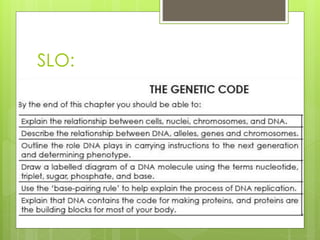
SLO:
SLO 
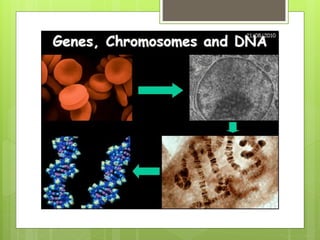
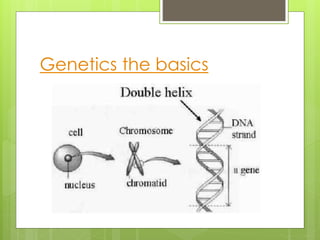
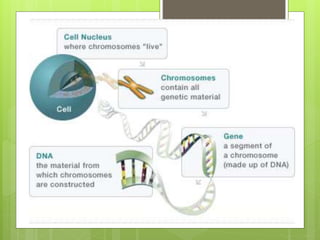
• Explain the relationship between cells, nuclei, 
chromosomes and DNA 
• Describe the relationship between DNA, alleles, 
genes and chromosomes.
Genetics the basics
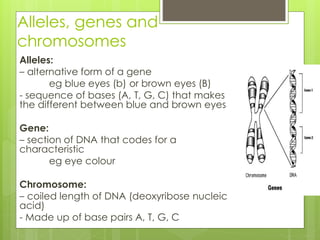
Alleles, genes and 
chromosomes 
Alleles: 
– alternative form of a gene 
eg blue eyes (b) or brown eyes (B) 
- sequence of bases (A, T, G, C) that makes 
the different between blue and brown eyes 
Gene: 
– section of DNA that codes for a 
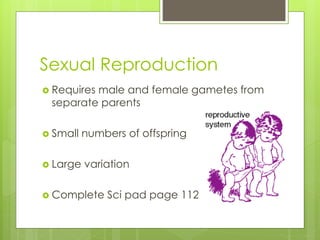
characteristic 
eg eye colour 
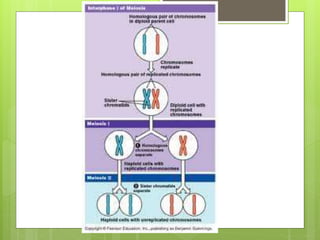
Chromosome: 
– coiled length of DNA (deoxyribose nucleic 
acid) 
- Made up of base pairs A, T, G, C
SLOs 
 Draw a labelled diagram of a DNA molecule 
using the terms nucleotide, triplet, sugar, 
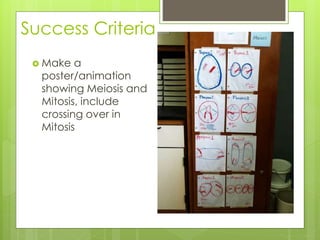
phosphate and base. 
 Outline the role DNA plays in carrying 
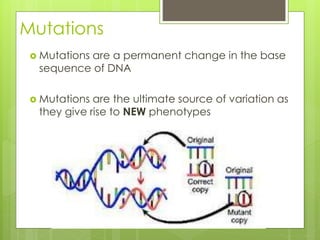
instructions to the next generation and 
determining phenotype 
 Explain that DNA contains the code for 
making proteins, and proteins are the building 
blocks for most of your body
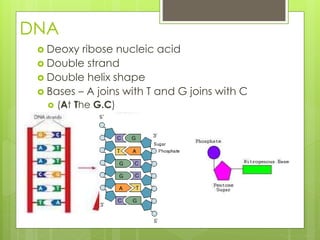
DNA 
 Deoxy ribose nucleic acid 
 Double strand 
 Double helix shape 
 Bases – A joins with T and G joins with C 
 (At The G.C)
Function of DNA 
 DNA (base sequence (A,T,G,C) tell the cells what to 
do, how to function and what type of cell to become 
 DNA has the instructions of how to make proteins, 
proteins are the building blocks of organisms and 
make up enzymes 
 DNA is structure simple and easily replicated over 
and over using base pairing 
 Double helix can coil into tiny chromosomes that fit 
into the nucleus and carry a huge amount of 
information
Success Criteria 
1. Complete Scipad pages 90 - 96 
2. One trait in squash plants is the colour of the fruit. 
White fruit are due to a dominant allele (F) and 
yellow fruit are due to a recessive allele (f). 
 Explain the difference between a gene and an 
allele. 
 Discuss the difference between a chromosome, 
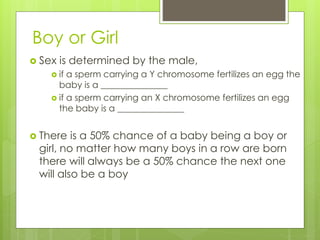
gene and allele 
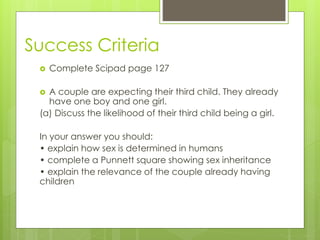
 Discuss the structure and importance of DNA
 Explain the difference between a gene and an allele. 
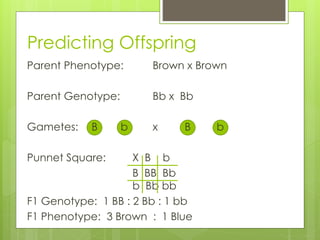
A gene is a section of DNA that codes for a characteristic (eye 
colour), an allele is the alternative forms of that characteristic or 
trait can take (blue or brown eyes) 
 Discuss the difference between a chromosome, gene and allele 
Chromosomes are coiled up lengths of DNA, sections of DNA make 
up a gene and code for a characteristic, that characteristic (trait) 
can come in different forms, these forms are called alleles 
 Discuss the structure and importance of DNA 
DNA (deoxyribose nucleic acid) is a double helix, it has a repeating 
unit that consists of a phosphate group, carbon sugar and 
nucleotide bases. The bases pair up A-T and G-C. DNA controls 
the functioning of the cell, carries instructions for making proteins 
and enzymes and determines which type of cell will form. 
The importance of this structure is that DNA can be copied, it is 
simple and can carry a huge range of information, coiled up to 
become small enough to fit into nucelus
SLO 
 Use the ‘base paring rule’ to help explain 
the process of DNA replication
DNA Replication 
 Every cell MUST have a complete copy of 
DNA, 
so before new cells can be made all the 
DNA must be replicated (copied)
DNA Replication 
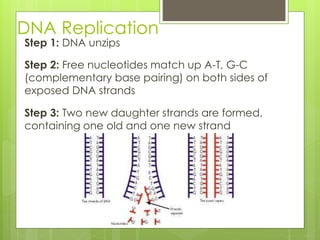
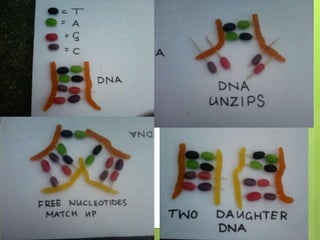
Step 1: DNA unzips 
Step 2: Free nucleotides match up A-T, G-C 
(complementary base pairing) on both sides of 
exposed DNA strands 
Step 3: Two new daughter strands are formed, 
containing one old and one new strand
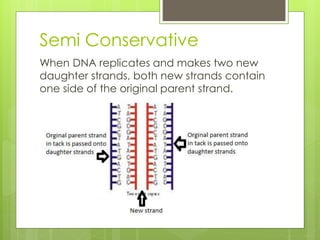
Semi Conservative 
When DNA replicates and makes two new 
daughter strands, both new strands contain 
one side of the original parent strand.
Success Criteria 
1. Complete Scipad pages 97 
2. Describe the roles of DNA in both carrying 
instructions to next generation and determining 
phenotype 
3. Explain how the base sequence on DNA 
determines a particular feature (eg, flower colour) 
and different forms (variations) of that feature (eg, 
red and white flowers). 
4. Complete Scipad pages 98-103
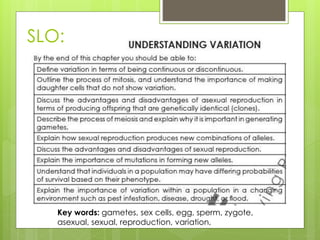
SLO: 
Key words: gametes, sex cells, egg, sperm, zygote, 
asexual, sexual, reproduction, variation,
SLO 
 Define variation in terms of being 
continuous or discontinuous
25/09/2014 
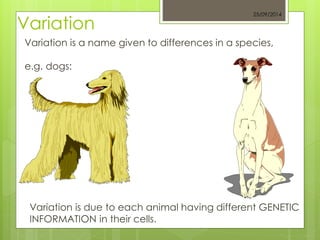
Variation 
Variation is a name given to differences in a species, 
e.g. dogs: 
Variation is due to each animal having different GENETIC 
INFORMATION in their cells.
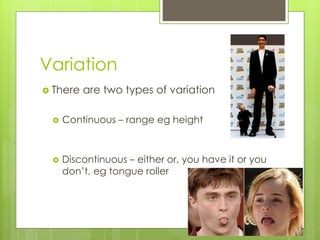
Variation 
 There are two types of variation 
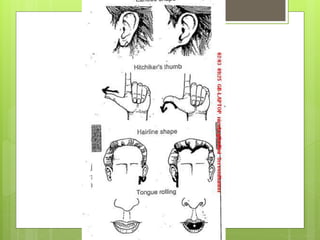
 Continuous – range eg height 
 Discontinuous – either or, you have it or you 
don’t, eg tongue roller
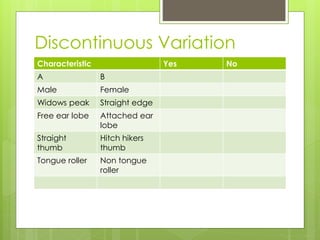
Discontinuous Variation 
Characteristic Yes No 
A B 
Male Female 
Widows peak Straight edge 
Free ear lobe Attached ear 
lobe 
Straight 
thumb 
Hitch hikers 
thumb 
Tongue roller Non tongue 
roller
Continuous Variation 
 Complete Scipad pages 104-107 
What shape is your graph? 
 If your graph does not show a bell shaped 
curve why not? 
What is the biological importance of 
variation?
SLO 
 Discuss the advantages and 
disadvantages of asexual reproduction in 
terms of producing offspring that are 
genetically identical (clones)
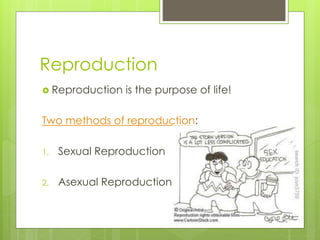
Reproduction 
 Reproduction is the purpose of life! 
Two methods of reproduction: 
1. Sexual Reproduction 
2. Asexual Reproduction
Chromosome Number 
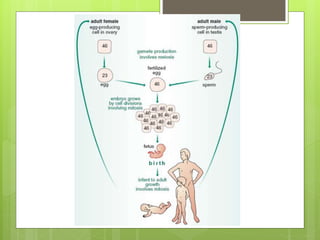
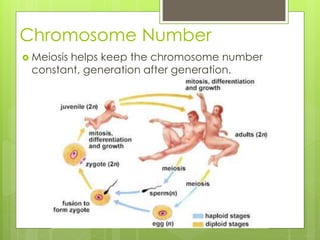
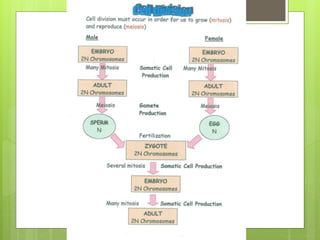
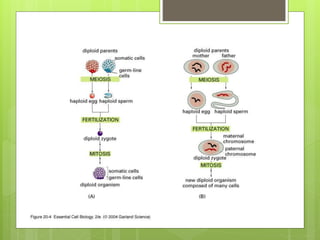
 Meiosis helps keep the chromosome number 
constant, generation after generation.
Chromosome Numbers 
 Chromosome numbers must be halved 
during meiosis so that when an egg and 
sperm join they only have 46 
chromosomes (not 92, then 184, then 368!) 
 If a problem occurs and there is an 
uneven number of chromosomes then 
division cannot occur and the individual is 
usually sterile (cannot create offspring) 
 Complete pages 154-155, 113 of 
Workbook
Asexual Reproduction 
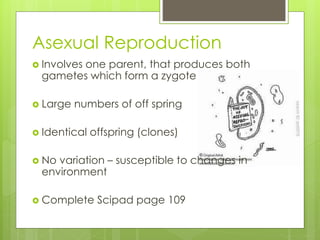
 Involves one parent, that produces both 
gametes which form a zygote 
 Large numbers of off spring 
 Identical offspring (clones) 
 No variation – susceptible to changes in 
environment 
 Complete Scipad page 109
Why have sex? 
What are the advantages of asexual 
reproduction? 
 Safer (less chance of predation during intercourse) 
 Uses less energy (so energy can be used for growth 
and repair) 
 Faster 
 Makes identical copies of organism that is currently 
surviving well 
 So why do most organisms carry out sexual NOT 
asexual reproduction?
SLO 
 Outline the process of mitosis and 
understand the importance of making 
daughter cells that do not show variation
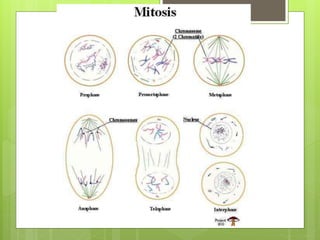
Mitosis 
 In order for an 
organism to grow and 
repair itself it needs to 
make new cells 
 Mitosis is cell division 
which makes new cells 
 Each new cell must 
have a complete set 
(46) of DNA in order for 
the cell to function 
properly (made via 
DNA replication)
Mitosis 
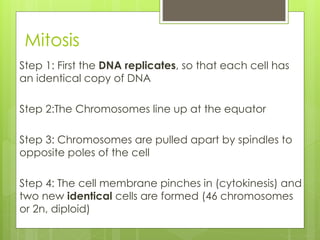
Step 1: First the DNA replicates, so that each cell has 
an identical copy of DNA 
Step 2:The Chromosomes line up at the equator 
Step 3: Chromosomes are pulled apart by spindles to 
opposite poles of the cell 
Step 4: The cell membrane pinches in (cytokinesis) and 
two new identical cells are formed (46 chromosomes 
or 2n, diploid)
Success Criteria 
 Complete Scipad page 108 
 Explain why any body cell from an individual can 
be used to establish their DNA profile. 
Because every body cell has a complete set of DNA, 
when new cells are made via Mitosis, DNA is 
replicated creating two identical cells with complete 
copies of DNA. Every cell requires a complete set in 
order for the new cell to know how to function and to 
be able to make more new cells
SLO 
 Discuss the advantages and 
disadvantages of sexual reproduction 
 Describe the process of meiosis and 
explain why it is important in generating 
gametes.
Sexual Reproduction 
 Requires male and female gametes from 
separate parents 
 Small numbers of offspring 
 Large variation 
 Complete Sci pad page 112
Sex gives rise to 
Variation!!!! 
Variation increases 
chances of 
Survival!!!!
Meiosis 
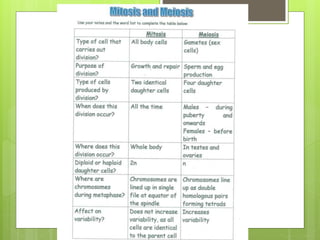
 Meiosis is cell division which creates sex cells 
(egg and sperm) 
 Meiosis only occurs in testes and ovaries 
 The new cells have half (haploid) the number 
of chromosomes 
 Involves two cell divisions, creating four cells 
 The new cells are different from the parent cell
Success Criteria 
 Complete Scipad page 110 
 Meiosis is a particular form of cell division 
that produces male and female gametes. 
 Describe what gametes are and explain why 
they are needed for sexual reproduction.
SLO: 
• Explain how sexual reproduction 
produces new combinations of alleles 
Key words: crossing over, recombination, recombinants, 
homologous pairs
Crossing Over 
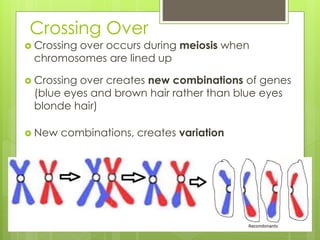
 Crossing over occurs during meiosis when 
chromosomes are lined up 
 Crossing over creates new combinations of genes 
(blue eyes and brown hair rather than blue eyes 
blonde hair) 
 New combinations, creates variation
Success Criteria 
Meiosis contributes to genetic variation. 
2. Discuss how meiosis contributes to genetic variation, 
and why genetic variation is important in a population. 
In your answer, you should: 
 describe what is meant by genetic variation 
 explain how the process of meiosis leads to genetic 
variation 
 explain why genetic variation is of benefit to a 
population. 
You may draw labelled diagrams to support your 
answer.
Success Criteria 
 Make a 
poster/animation 
showing Meiosis and 
Mitosis, include 
crossing over in 
Mitosis
SLO 
 Explain the importance of mutations in 
forming new alleles
Mutations 
 Mutations are a permanent change in the base 
sequence of DNA 
 Mutations are the ultimate source of variation as 
they give rise to NEW phenotypes
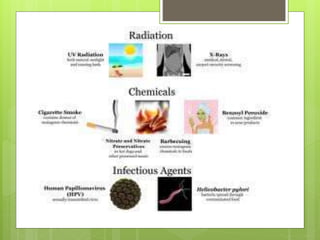
Mutagens 
 Mutations (changes in base sequence of DNA 
are caused by: 
 UV A rays 
 Radio waves 
 Some chemicals 
 Heavy metals 
 Problems during meiosis or DNA replication
Passing on Mutations 
 Mutations can occur in the body cells or 
the sex cells 
 Mutations in the body cells only affect 
that individual (skin cancer) 
 Mutations in the sex cells are passed onto 
the next generations (breast cancer)
Establishing mutations… 
 Mutations can lead to phenotypes that 
give an individual an advantage in 
survival and therefore is selected for 
mating and passes on the mutation to the 
next generation 
 Eg disease resistant, stronger muscles 
 Mutations can also be disadvantageous 
and lead to the organism being less fit 
and therefore not reproducing and 
passing on
Success Criteria 
1. One process that produces genetic variation is 
mutation. 
 Explain what mutations are and how they contribute to 
genetic variation. 
In your answer you should include: 
• what a mutation is 
• the effect of mutations on genes, alleles and DNA 
• whether all mutations are passed on to the next 
generation 
2. Complete Scipad 114-115
SLO 
 Discuss that individuals in a population 
may have differing probabilities' of survival 
based on their phenotype 
 Explain the importance of variation within 
a population in a changing environment 
such as pest infestation, disease, drought, 
or flood
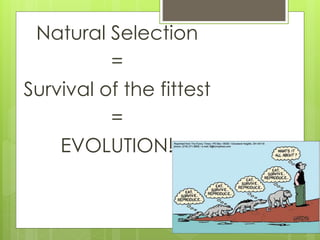
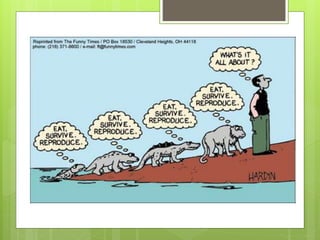
Natural Selection 
= 
Survival of the fittest 
= 
EVOLUTION!
Natural Selection 
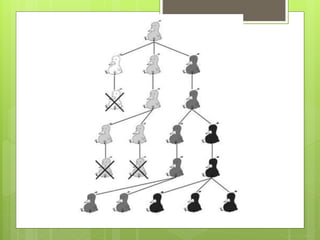
Step 1: Variation; A variety of genes causes variation 
in characteristics 
Step 2: Differential Success; Some variations are 
better at surviving 
Step 3: Differential Fitness; The best survivors make the 
best and most offspring 
Step 4: Gene Pool Changes; Varieties that make 
more offspring pass on more genes 
Step 5: Evolution; Over time the population changes 
towards one variety (the fittest)
25/09/2014 
Evolution 
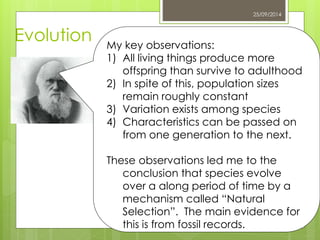
My key observations: 
1) All living things produce more 
offspring than survive to adulthood 
2) In spite of this, population sizes 
remain roughly constant 
3) Variation exists among species 
4) Characteristics can be passed on 
from one generation to the next. 
These observations led me to the 
conclusion that species evolve 
over a along period of time by a 
mechanism called “Natural 
Selection”. The main evidence for 
this is from fossil records.
25/09/2014 
Natural Selection 
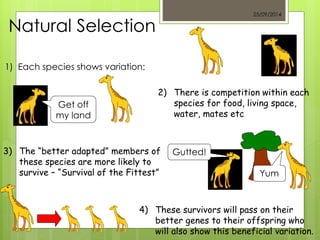
1) Each species shows variation: 
2) There is competition within each 
species for food, living space, 
water, mates etc 
4) These survivors will pass on their 
better genes to their offspring who 
will also show this beneficial variation. 
Get off 
my land 
Gutted! 
Yum 
3) The “better adapted” members of 
these species are more likely to 
survive – “Survival of the Fittest”
Genetic Variation 
Variation within your genes can arise during: 
 Fertilization 
Sexual recombination (egg and sperm joining) 
 Meiosis: 
 Independent assortment (Mixing of mother and fathers 
genes – random alignment of homologous pairs during 
metaphase) 
 Crossing over 
Mutations
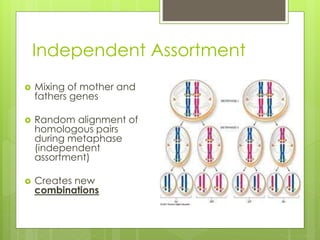
Independent Assortment 
 Mixing of mother and 
fathers genes 
 Random alignment of 
homologous pairs 
during metaphase 
(independent 
assortment) 
 Creates new 
combinations
Types of Variation 
 New combinations 
 Meiosis – Independent assortment (mixing of 
mothers and fathers genes) 
 Crossing over 
 Totally new trait (characteristic) 
 Mutations 
 Ultimate source of variation
Success Criteria 
Genetic variation is important in a 
population. 
(a) Describe what is meant by the term 
genetic variation 
(b) How does genetic variation arise 
(c) Explain its importance to a population.
Selective Breeding 
 Video 
 Complete Scipad pages 116-119
Selective Breeding 
 Over many generations farmers select 
organism with desirable traits and mate 
them 
 Along the way the organisms without the 
desirable trait are discarded 
 Eventually all the population carry the 
desirable trait
Nature or Nurture 
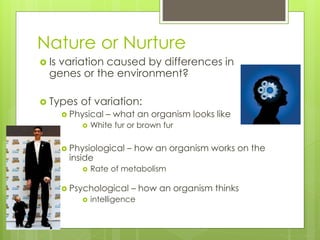
 Is variation caused by differences in 
genes or the environment? 
 Types of variation: 
 Physical – what an organism looks like 
 White fur or brown fur 
 Physiological – how an organism works on the 
inside 
 Rate of metabolism 
 Psychological – how an organism thinks 
 intelligence
Nature or Nurture? 
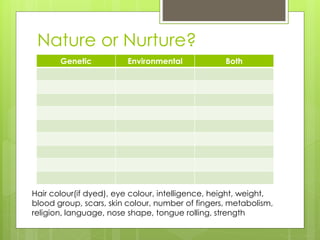
Genetic Environmental Both 
Hair colour(if dyed), eye colour, intelligence, height, weight, 
blood group, scars, skin colour, number of fingers, metabolism, 
religion, language, nose shape, tongue rolling, strength
Success Criteria 
 Complete Scipad pages 105, 116-125 
 List all the different words that mean 
nature and nurture 
 Describe what is meant by the term 
genetic variation, and explain its 
importance to a population.
Success Criteria 
 Nature 
 Born with it 
 Inherited 
 Innate 
 Genetic 
 Nurture 
 Get it over time 
 Acquired 
 Environment 
 Learned 
 Not inherited
Success Criteria 
A teacher developed deafness last year as 
a result of having noisy classes. 
 Discuss the likelihood of this type of 
deafness being inherited by the new 
baby. 
In your answer you should consider: 
 the reason for the parent’s deafness 
 what types of characteristics are inherited 
 the effects of genetics and the 
environment on deafness in offspring
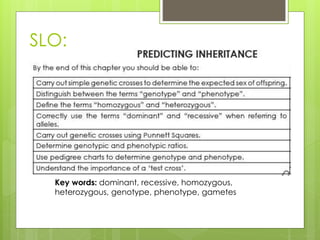
SLO: 
Key words: dominant, recessive, homozygous, 
heterozygous, genotype, phenotype, gametes
SLO 
 Distinguish between the terms genotype 
and phenotype 
 Distinguish between the terms 
heterozygous and homozygous 
 Distinguish between the terms dominant 
and recessive
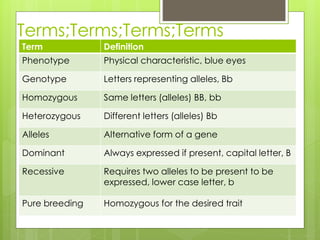
Terms;Terms;Terms;Terms 
Term Definition 
Phenotype Physical characteristic, blue eyes 
Genotype Letters representing alleles, Bb 
Homozygous Same letters (alleles) BB, bb 
Heterozygous Different letters (alleles) Bb 
Alleles Alternative form of a gene 
Dominant Always expressed if present, capital letter, B 
Recessive Requires two alleles to be present to be 
expressed, lower case letter, b 
Pure breeding Homozygous for the desired trait
Success Criteria 
 Complete Scipad page 126, 128, 143, 144
SLO 
Describe how gender is determined
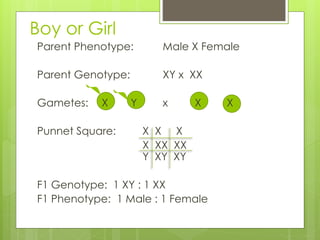
Boy or Girl 
Parent Phenotype: Male X Female 
Parent Genotype: XY x XX 
Gametes: X Y x X X 
Punnet Square: X X X 
X XX XX 
Y XY XY 
F1 Genotype: 1 XY : 1 XX 
F1 Phenotype: 1 Male : 1 Female
Boy or Girl 
 Sex is determined by the male, 
 if a sperm carrying a Y chromosome fertilizes an egg the 
baby is a _______________ 
 if a sperm carrying an X chromosome fertilizes an egg 
the baby is a _______________ 
 There is a 50% chance of a baby being a boy or 
girl, no matter how many boys in a row are born 
there will always be a 50% chance the next one 
will also be a boy
Success Criteria 
 Complete Scipad page 127 
 A couple are expecting their third child. They already 

have one boy and one girl. 
(a) Discuss the likelihood of their third child being a girl. 
In your answer you should: 
• explain how sex is determined in humans 
• complete a Punnett square showing sex inheritance 
• explain the relevance of the couple already having 
children
SLO 
 Carry out genetic crosses using Punnett 
Squares. 
 Determine genotypic and phenotypic 
ratios
Predicting Offspring 
Parent Phenotype: Brown x Brown 
Parent Genotype: Bb x Bb 
Gametes: B b x B b 
Punnet Square: X B b 
B BB Bb 
b Bb bb 
F1 Genotype: 1 BB : 2 Bb : 1 bb 
F1 Phenotype: 3 Brown : 1 Blue
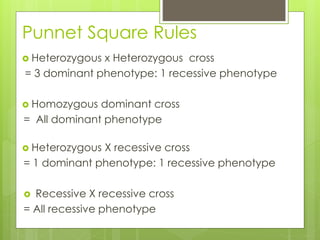
Punnet Square Rules 
 Heterozygous x Heterozygous cross 
= 3 dominant phenotype: 1 recessive phenotype 
 Homozygous dominant cross 
= All dominant phenotype 
 Heterozygous X recessive cross 
= 1 dominant phenotype: 1 recessive phenotype 
 Recessive X recessive cross 
= All recessive phenotype
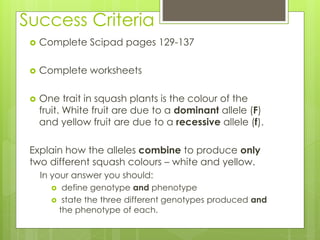
Success Criteria 
 Complete Scipad pages 129-137 
 Complete worksheets 
 One trait in squash plants is the colour of the 
fruit. White fruit are due to a dominant allele (F) 
and yellow fruit are due to a recessive allele (f). 
Explain how the alleles combine to produce only 
two different squash colours – white and yellow. 
In your answer you should: 
 define genotype and phenotype 
 state the three different genotypes produced and 
the phenotype of each.
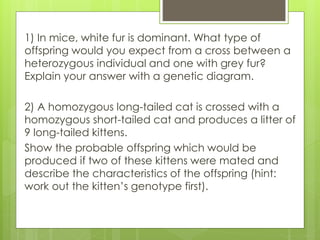
1) In mice, white fur is dominant. What type of 
offspring would you expect from a cross between a 
heterozygous individual and one with grey fur? 
Explain your answer with a genetic diagram. 
2) A homozygous long-tailed cat is crossed with a 
homozygous short-tailed cat and produces a litter of 
9 long-tailed kittens. 
Show the probable offspring which would be 
produced if two of these kittens were mated and 
describe the characteristics of the offspring (hint: 
work out the kitten’s genotype first).
SLO: 
• Use pedigree charts to determine 
genotype and phenotype 
Key words: dominant, recessive, homozygous, 
heterozygous, genotype, phenotype, gametes
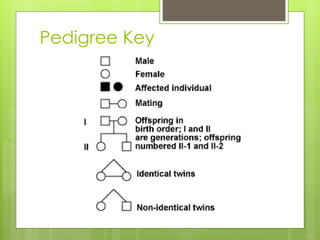
Pedigree Key
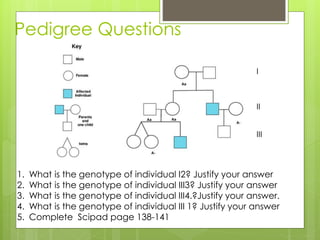
Pedigree Questions 
I 
II 
III 
1. What is the genotype of individual I2? Justify your answer 
2. What is the genotype of individual III3? Justify your answer 
3. What is the genotype of individual III4.?Justify your answer. 
4. What is the genotype of individual III 1? Justify your answer 
5. Complete Scipad page 138-141
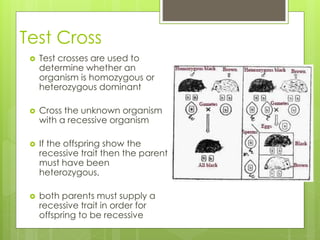
Test Cross 
 Test crosses are used to 
determine whether an 
organism is homozygous or 
heterozygous dominant 
 Cross the unknown organism 
with a recessive organism 
 If the offspring show the 
recessive trait then the parent 
must have been 
heterozygous, 
 both parents must supply a 
recessive trait in order for 
offspring to be recessive
Success Criteria 
 Complete Scipad page 142 
 Complete Worksheets
Revision 
 Complete worksheets 
 Complete Scipad pages 146-155 
 Complete all activities on the workbook cd 
 Complete revision summary notes 
 Create a mind map of this topic 
 Complete practice test, on moodle, and mark it
Achievement Standard 
Biological ideas relating to genetic variation are limited to concepts and processes 
connected with: 
 the continuity of life based on the inheritable nature of DNA 
 links between DNA and variation in phenotypes 
 variation in phenotypes as adaptive features. 
Biological concepts and processes relating to the inheritable nature of DNA will be selected 
from: 
 the roles of DNA in both carrying instructions to the next generation and determining 
phenotype 
 the relationship between DNA, alleles, genes, and chromosomes 
 the way in which genotype determines phenotype 
 the way chromosomes exist as pairs so that individuals inherit two copies of each gene. 
Biological concepts and processes relating to variation in phenotype will be selected from: 
 the significance of an allele as an alternative version of a gene 
 the role of mutations in forming new alleles 
 the role of meiosis in generating gametes (students are not required to provide the 
names of the stages of meiosis) 
 the significance of sexual reproduction (in producing a new mix of alleles) 
 the patterns of inheritance involving simple monohybrid inheritance showing complete 
dominance, sex determination, possible genotypes, and phenotype ratios.
Achievement Standard 
Biological concepts and processes relating to variation in phenotypes 
as adaptive features will be selected from: 
 inheritable and non-inheritable variations that exist within a group of 
living organisms 
 differing rates of survival by various members of a group may 
depend on their phenotype 
 the importance of variation within populations (population and 
species survival) in a changing environment such as pest infestation, 
disease, drought, or flood 
 the advantages and disadvantages of sexual reproduction. 
The student must be familiar with the following genetic language and 
conventions: gene, allele, mutation, genotype, phenotype, gamete, 
zygote, dominant, recessive, homozygous, heterozygous, pure 
breeding, Punnett square, and pedigree chart. 
Contexts may be drawn from animals or plants. Links between DNA and 
variation of phenotypes may require simple understanding of DNA structure 
(bases).

100 Science Genetics

  • 1.
    Year 11 100 Science Genetics Ms Gibellini
  • 2.
    Achievement Standard Biologicalconcepts and processes relating to variation in phenotypes as adaptive features will be selected from:  inheritable and non-inheritable variations that exist within a group of living organisms  differing rates of survival by various members of a group may depend on their phenotype  the importance of variation within populations (population and species survival) in a changing environment such as pest infestation, disease, drought, or flood  the advantages and disadvantages of sexual reproduction. The student must be familiar with the following genetic language and conventions: gene, allele, mutation, genotype, phenotype, gamete, zygote, dominant, recessive, homozygous, heterozygous, pure breeding, Punnett square, and pedigree chart. Contexts may be drawn from animals or plants. Links between DNA and variation of phenotypes may require simple understanding of DNA structure (bases).
  • 3.
    Introduction to Genetics What is genetics about? Why is it important? How might it affect you in the future?  Complete page 89 of Scipad
  • 4.
  • 5.
    SLO • Explainthe relationship between cells, nuclei, chromosomes and DNA • Describe the relationship between DNA, alleles, genes and chromosomes.
  • 7.
  • 8.
    Alleles, genes and chromosomes Alleles: – alternative form of a gene eg blue eyes (b) or brown eyes (B) - sequence of bases (A, T, G, C) that makes the different between blue and brown eyes Gene: – section of DNA that codes for a characteristic eg eye colour Chromosome: – coiled length of DNA (deoxyribose nucleic acid) - Made up of base pairs A, T, G, C
  • 10.
    SLOs  Drawa labelled diagram of a DNA molecule using the terms nucleotide, triplet, sugar, phosphate and base.  Outline the role DNA plays in carrying instructions to the next generation and determining phenotype  Explain that DNA contains the code for making proteins, and proteins are the building blocks for most of your body
  • 11.
    DNA  Deoxyribose nucleic acid  Double strand  Double helix shape  Bases – A joins with T and G joins with C  (At The G.C)
  • 12.
    Function of DNA  DNA (base sequence (A,T,G,C) tell the cells what to do, how to function and what type of cell to become  DNA has the instructions of how to make proteins, proteins are the building blocks of organisms and make up enzymes  DNA is structure simple and easily replicated over and over using base pairing  Double helix can coil into tiny chromosomes that fit into the nucleus and carry a huge amount of information
  • 13.
    Success Criteria 1.Complete Scipad pages 90 - 96 2. One trait in squash plants is the colour of the fruit. White fruit are due to a dominant allele (F) and yellow fruit are due to a recessive allele (f).  Explain the difference between a gene and an allele.  Discuss the difference between a chromosome, gene and allele  Discuss the structure and importance of DNA
  • 14.
     Explain thedifference between a gene and an allele. A gene is a section of DNA that codes for a characteristic (eye colour), an allele is the alternative forms of that characteristic or trait can take (blue or brown eyes)  Discuss the difference between a chromosome, gene and allele Chromosomes are coiled up lengths of DNA, sections of DNA make up a gene and code for a characteristic, that characteristic (trait) can come in different forms, these forms are called alleles  Discuss the structure and importance of DNA DNA (deoxyribose nucleic acid) is a double helix, it has a repeating unit that consists of a phosphate group, carbon sugar and nucleotide bases. The bases pair up A-T and G-C. DNA controls the functioning of the cell, carries instructions for making proteins and enzymes and determines which type of cell will form. The importance of this structure is that DNA can be copied, it is simple and can carry a huge range of information, coiled up to become small enough to fit into nucelus
  • 15.
    SLO  Usethe ‘base paring rule’ to help explain the process of DNA replication
  • 16.
    DNA Replication Every cell MUST have a complete copy of DNA, so before new cells can be made all the DNA must be replicated (copied)
  • 17.
    DNA Replication Step1: DNA unzips Step 2: Free nucleotides match up A-T, G-C (complementary base pairing) on both sides of exposed DNA strands Step 3: Two new daughter strands are formed, containing one old and one new strand
  • 18.
    Semi Conservative WhenDNA replicates and makes two new daughter strands, both new strands contain one side of the original parent strand.
  • 20.
    Success Criteria 1.Complete Scipad pages 97 2. Describe the roles of DNA in both carrying instructions to next generation and determining phenotype 3. Explain how the base sequence on DNA determines a particular feature (eg, flower colour) and different forms (variations) of that feature (eg, red and white flowers). 4. Complete Scipad pages 98-103
  • 21.
    SLO: Key words:gametes, sex cells, egg, sperm, zygote, asexual, sexual, reproduction, variation,
  • 22.
    SLO  Definevariation in terms of being continuous or discontinuous
  • 23.
    25/09/2014 Variation Variationis a name given to differences in a species, e.g. dogs: Variation is due to each animal having different GENETIC INFORMATION in their cells.
  • 24.
    Variation  Thereare two types of variation  Continuous – range eg height  Discontinuous – either or, you have it or you don’t, eg tongue roller
  • 25.
    Discontinuous Variation CharacteristicYes No A B Male Female Widows peak Straight edge Free ear lobe Attached ear lobe Straight thumb Hitch hikers thumb Tongue roller Non tongue roller
  • 26.
    Continuous Variation Complete Scipad pages 104-107 What shape is your graph?  If your graph does not show a bell shaped curve why not? What is the biological importance of variation?
  • 27.
    SLO  Discussthe advantages and disadvantages of asexual reproduction in terms of producing offspring that are genetically identical (clones)
  • 28.
    Reproduction  Reproductionis the purpose of life! Two methods of reproduction: 1. Sexual Reproduction 2. Asexual Reproduction
  • 31.
    Chromosome Number Meiosis helps keep the chromosome number constant, generation after generation.
  • 33.
    Chromosome Numbers Chromosome numbers must be halved during meiosis so that when an egg and sperm join they only have 46 chromosomes (not 92, then 184, then 368!)  If a problem occurs and there is an uneven number of chromosomes then division cannot occur and the individual is usually sterile (cannot create offspring)  Complete pages 154-155, 113 of Workbook
  • 35.
    Asexual Reproduction Involves one parent, that produces both gametes which form a zygote  Large numbers of off spring  Identical offspring (clones)  No variation – susceptible to changes in environment  Complete Scipad page 109
  • 36.
    Why have sex? What are the advantages of asexual reproduction?  Safer (less chance of predation during intercourse)  Uses less energy (so energy can be used for growth and repair)  Faster  Makes identical copies of organism that is currently surviving well  So why do most organisms carry out sexual NOT asexual reproduction?
  • 37.
    SLO  Outlinethe process of mitosis and understand the importance of making daughter cells that do not show variation
  • 38.
    Mitosis  Inorder for an organism to grow and repair itself it needs to make new cells  Mitosis is cell division which makes new cells  Each new cell must have a complete set (46) of DNA in order for the cell to function properly (made via DNA replication)
  • 39.
    Mitosis Step 1:First the DNA replicates, so that each cell has an identical copy of DNA Step 2:The Chromosomes line up at the equator Step 3: Chromosomes are pulled apart by spindles to opposite poles of the cell Step 4: The cell membrane pinches in (cytokinesis) and two new identical cells are formed (46 chromosomes or 2n, diploid)
  • 41.
    Success Criteria Complete Scipad page 108  Explain why any body cell from an individual can be used to establish their DNA profile. Because every body cell has a complete set of DNA, when new cells are made via Mitosis, DNA is replicated creating two identical cells with complete copies of DNA. Every cell requires a complete set in order for the new cell to know how to function and to be able to make more new cells
  • 42.
    SLO  Discussthe advantages and disadvantages of sexual reproduction  Describe the process of meiosis and explain why it is important in generating gametes.
  • 43.
    Sexual Reproduction Requires male and female gametes from separate parents  Small numbers of offspring  Large variation  Complete Sci pad page 112
  • 44.
    Sex gives riseto Variation!!!! Variation increases chances of Survival!!!!
  • 45.
    Meiosis  Meiosisis cell division which creates sex cells (egg and sperm)  Meiosis only occurs in testes and ovaries  The new cells have half (haploid) the number of chromosomes  Involves two cell divisions, creating four cells  The new cells are different from the parent cell
  • 47.
    Success Criteria Complete Scipad page 110  Meiosis is a particular form of cell division that produces male and female gametes.  Describe what gametes are and explain why they are needed for sexual reproduction.
  • 49.
    SLO: • Explainhow sexual reproduction produces new combinations of alleles Key words: crossing over, recombination, recombinants, homologous pairs
  • 50.
    Crossing Over Crossing over occurs during meiosis when chromosomes are lined up  Crossing over creates new combinations of genes (blue eyes and brown hair rather than blue eyes blonde hair)  New combinations, creates variation
  • 51.
    Success Criteria Meiosiscontributes to genetic variation. 2. Discuss how meiosis contributes to genetic variation, and why genetic variation is important in a population. In your answer, you should:  describe what is meant by genetic variation  explain how the process of meiosis leads to genetic variation  explain why genetic variation is of benefit to a population. You may draw labelled diagrams to support your answer.
  • 52.
    Success Criteria Make a poster/animation showing Meiosis and Mitosis, include crossing over in Mitosis
  • 53.
    SLO  Explainthe importance of mutations in forming new alleles
  • 54.
    Mutations  Mutationsare a permanent change in the base sequence of DNA  Mutations are the ultimate source of variation as they give rise to NEW phenotypes
  • 56.
    Mutagens  Mutations(changes in base sequence of DNA are caused by:  UV A rays  Radio waves  Some chemicals  Heavy metals  Problems during meiosis or DNA replication
  • 57.
    Passing on Mutations  Mutations can occur in the body cells or the sex cells  Mutations in the body cells only affect that individual (skin cancer)  Mutations in the sex cells are passed onto the next generations (breast cancer)
  • 58.
    Establishing mutations… Mutations can lead to phenotypes that give an individual an advantage in survival and therefore is selected for mating and passes on the mutation to the next generation  Eg disease resistant, stronger muscles  Mutations can also be disadvantageous and lead to the organism being less fit and therefore not reproducing and passing on
  • 59.
    Success Criteria 1.One process that produces genetic variation is mutation.  Explain what mutations are and how they contribute to genetic variation. In your answer you should include: • what a mutation is • the effect of mutations on genes, alleles and DNA • whether all mutations are passed on to the next generation 2. Complete Scipad 114-115
  • 60.
    SLO  Discussthat individuals in a population may have differing probabilities' of survival based on their phenotype  Explain the importance of variation within a population in a changing environment such as pest infestation, disease, drought, or flood
  • 61.
    Natural Selection = Survival of the fittest = EVOLUTION!
  • 63.
    Natural Selection Step1: Variation; A variety of genes causes variation in characteristics Step 2: Differential Success; Some variations are better at surviving Step 3: Differential Fitness; The best survivors make the best and most offspring Step 4: Gene Pool Changes; Varieties that make more offspring pass on more genes Step 5: Evolution; Over time the population changes towards one variety (the fittest)
  • 65.
    25/09/2014 Evolution Mykey observations: 1) All living things produce more offspring than survive to adulthood 2) In spite of this, population sizes remain roughly constant 3) Variation exists among species 4) Characteristics can be passed on from one generation to the next. These observations led me to the conclusion that species evolve over a along period of time by a mechanism called “Natural Selection”. The main evidence for this is from fossil records.
  • 66.
    25/09/2014 Natural Selection 1) Each species shows variation: 2) There is competition within each species for food, living space, water, mates etc 4) These survivors will pass on their better genes to their offspring who will also show this beneficial variation. Get off my land Gutted! Yum 3) The “better adapted” members of these species are more likely to survive – “Survival of the Fittest”
  • 67.
    Genetic Variation Variationwithin your genes can arise during:  Fertilization Sexual recombination (egg and sperm joining)  Meiosis:  Independent assortment (Mixing of mother and fathers genes – random alignment of homologous pairs during metaphase)  Crossing over Mutations
  • 68.
    Independent Assortment Mixing of mother and fathers genes  Random alignment of homologous pairs during metaphase (independent assortment)  Creates new combinations
  • 69.
    Types of Variation  New combinations  Meiosis – Independent assortment (mixing of mothers and fathers genes)  Crossing over  Totally new trait (characteristic)  Mutations  Ultimate source of variation
  • 70.
    Success Criteria Geneticvariation is important in a population. (a) Describe what is meant by the term genetic variation (b) How does genetic variation arise (c) Explain its importance to a population.
  • 71.
    Selective Breeding Video  Complete Scipad pages 116-119
  • 72.
    Selective Breeding Over many generations farmers select organism with desirable traits and mate them  Along the way the organisms without the desirable trait are discarded  Eventually all the population carry the desirable trait
  • 73.
    Nature or Nurture  Is variation caused by differences in genes or the environment?  Types of variation:  Physical – what an organism looks like  White fur or brown fur  Physiological – how an organism works on the inside  Rate of metabolism  Psychological – how an organism thinks  intelligence
  • 74.
    Nature or Nurture? Genetic Environmental Both Hair colour(if dyed), eye colour, intelligence, height, weight, blood group, scars, skin colour, number of fingers, metabolism, religion, language, nose shape, tongue rolling, strength
  • 75.
    Success Criteria Complete Scipad pages 105, 116-125  List all the different words that mean nature and nurture  Describe what is meant by the term genetic variation, and explain its importance to a population.
  • 76.
    Success Criteria Nature  Born with it  Inherited  Innate  Genetic  Nurture  Get it over time  Acquired  Environment  Learned  Not inherited
  • 77.
    Success Criteria Ateacher developed deafness last year as a result of having noisy classes.  Discuss the likelihood of this type of deafness being inherited by the new baby. In your answer you should consider:  the reason for the parent’s deafness  what types of characteristics are inherited  the effects of genetics and the environment on deafness in offspring
  • 78.
    SLO: Key words:dominant, recessive, homozygous, heterozygous, genotype, phenotype, gametes
  • 79.
    SLO  Distinguishbetween the terms genotype and phenotype  Distinguish between the terms heterozygous and homozygous  Distinguish between the terms dominant and recessive
  • 80.
    Terms;Terms;Terms;Terms Term Definition Phenotype Physical characteristic, blue eyes Genotype Letters representing alleles, Bb Homozygous Same letters (alleles) BB, bb Heterozygous Different letters (alleles) Bb Alleles Alternative form of a gene Dominant Always expressed if present, capital letter, B Recessive Requires two alleles to be present to be expressed, lower case letter, b Pure breeding Homozygous for the desired trait
  • 81.
    Success Criteria Complete Scipad page 126, 128, 143, 144
  • 82.
    SLO Describe howgender is determined
  • 83.
    Boy or Girl Parent Phenotype: Male X Female Parent Genotype: XY x XX Gametes: X Y x X X Punnet Square: X X X X XX XX Y XY XY F1 Genotype: 1 XY : 1 XX F1 Phenotype: 1 Male : 1 Female
  • 84.
    Boy or Girl  Sex is determined by the male,  if a sperm carrying a Y chromosome fertilizes an egg the baby is a _______________  if a sperm carrying an X chromosome fertilizes an egg the baby is a _______________  There is a 50% chance of a baby being a boy or girl, no matter how many boys in a row are born there will always be a 50% chance the next one will also be a boy
  • 85.
    Success Criteria Complete Scipad page 127  A couple are expecting their third child. They already have one boy and one girl. (a) Discuss the likelihood of their third child being a girl. In your answer you should: • explain how sex is determined in humans • complete a Punnett square showing sex inheritance • explain the relevance of the couple already having children
  • 86.
    SLO  Carryout genetic crosses using Punnett Squares.  Determine genotypic and phenotypic ratios
  • 87.
    Predicting Offspring ParentPhenotype: Brown x Brown Parent Genotype: Bb x Bb Gametes: B b x B b Punnet Square: X B b B BB Bb b Bb bb F1 Genotype: 1 BB : 2 Bb : 1 bb F1 Phenotype: 3 Brown : 1 Blue
  • 88.
    Punnet Square Rules  Heterozygous x Heterozygous cross = 3 dominant phenotype: 1 recessive phenotype  Homozygous dominant cross = All dominant phenotype  Heterozygous X recessive cross = 1 dominant phenotype: 1 recessive phenotype  Recessive X recessive cross = All recessive phenotype
  • 89.
    Success Criteria Complete Scipad pages 129-137  Complete worksheets  One trait in squash plants is the colour of the fruit. White fruit are due to a dominant allele (F) and yellow fruit are due to a recessive allele (f). Explain how the alleles combine to produce only two different squash colours – white and yellow. In your answer you should:  define genotype and phenotype  state the three different genotypes produced and the phenotype of each.
  • 90.
    1) In mice,white fur is dominant. What type of offspring would you expect from a cross between a heterozygous individual and one with grey fur? Explain your answer with a genetic diagram. 2) A homozygous long-tailed cat is crossed with a homozygous short-tailed cat and produces a litter of 9 long-tailed kittens. Show the probable offspring which would be produced if two of these kittens were mated and describe the characteristics of the offspring (hint: work out the kitten’s genotype first).
  • 92.
    SLO: • Usepedigree charts to determine genotype and phenotype Key words: dominant, recessive, homozygous, heterozygous, genotype, phenotype, gametes
  • 93.
  • 94.
    Pedigree Questions I II III 1. What is the genotype of individual I2? Justify your answer 2. What is the genotype of individual III3? Justify your answer 3. What is the genotype of individual III4.?Justify your answer. 4. What is the genotype of individual III 1? Justify your answer 5. Complete Scipad page 138-141
  • 95.
    Test Cross Test crosses are used to determine whether an organism is homozygous or heterozygous dominant  Cross the unknown organism with a recessive organism  If the offspring show the recessive trait then the parent must have been heterozygous,  both parents must supply a recessive trait in order for offspring to be recessive
  • 96.
    Success Criteria Complete Scipad page 142  Complete Worksheets
  • 97.
    Revision  Completeworksheets  Complete Scipad pages 146-155  Complete all activities on the workbook cd  Complete revision summary notes  Create a mind map of this topic  Complete practice test, on moodle, and mark it
  • 98.
    Achievement Standard Biologicalideas relating to genetic variation are limited to concepts and processes connected with:  the continuity of life based on the inheritable nature of DNA  links between DNA and variation in phenotypes  variation in phenotypes as adaptive features. Biological concepts and processes relating to the inheritable nature of DNA will be selected from:  the roles of DNA in both carrying instructions to the next generation and determining phenotype  the relationship between DNA, alleles, genes, and chromosomes  the way in which genotype determines phenotype  the way chromosomes exist as pairs so that individuals inherit two copies of each gene. Biological concepts and processes relating to variation in phenotype will be selected from:  the significance of an allele as an alternative version of a gene  the role of mutations in forming new alleles  the role of meiosis in generating gametes (students are not required to provide the names of the stages of meiosis)  the significance of sexual reproduction (in producing a new mix of alleles)  the patterns of inheritance involving simple monohybrid inheritance showing complete dominance, sex determination, possible genotypes, and phenotype ratios.
  • 99.
    Achievement Standard Biologicalconcepts and processes relating to variation in phenotypes as adaptive features will be selected from:  inheritable and non-inheritable variations that exist within a group of living organisms  differing rates of survival by various members of a group may depend on their phenotype  the importance of variation within populations (population and species survival) in a changing environment such as pest infestation, disease, drought, or flood  the advantages and disadvantages of sexual reproduction. The student must be familiar with the following genetic language and conventions: gene, allele, mutation, genotype, phenotype, gamete, zygote, dominant, recessive, homozygous, heterozygous, pure breeding, Punnett square, and pedigree chart. Contexts may be drawn from animals or plants. Links between DNA and variation of phenotypes may require simple understanding of DNA structure (bases).

Editor's Notes

  • #29 http://lgfl.skoool.co.uk/content/primary/science/how_animals_reproduce/index.html
  • #37 Complete variation worksheet
  • #45 Giraffee video
  • #72 Ask students to come up with own definition – choosing an organism for its particular traits and breeding it with another over many generations discarding the ones that don’t have
  • #81 u
  • #98 http://www.abpischools.org.uk/page/modules/genome/.cfm?coSiteNavigation_allTopic=1