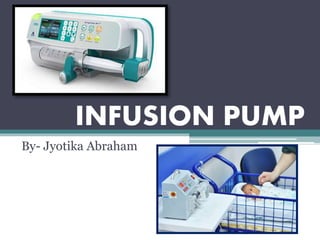
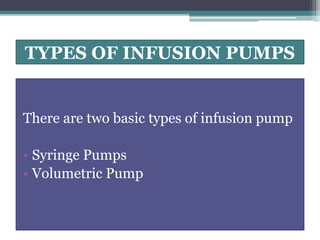
INFUSION PUMP
By- Jyotika Abraham
INTRODUCTION
• There are various types of infusion pump
designed with a view to serve different
purpose of therapy but it is important that
the pumps selected can deliver the fluids
at desired rate and volume.
DEFINITION
• Infusion pumps are devices that are used
to deliver therapeutic fluids which can be
either medication or nutrients at a
predetermined rate.
PRINCIPLE
• It use pumping action to infuse fluids,
medication or nutrients into patient. It is
suitable for intravenous, subcutaneous,
enteral and epidural infusions
 Chemotherapy
 Pain management
 Total parental nutrition
 Anesthesia/sedation
USES OF INFUSION PUMP
TYPES OF INFUSION PUMPS
There are two basic types of infusion pump
• Syringe Pumps
• Volumetric Pump
SYRINGE PUMP
VOLUMETRIC PUMP
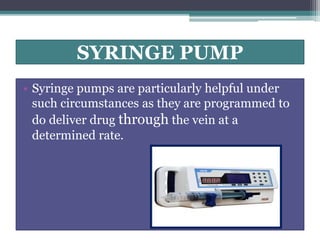
SYRINGE PUMP
• Syringe pumps are particularly helpful under
such circumstances as they are programmed to
do deliver drug through the vein at a
determined rate.
WORKING OF SYRINGE PUMP
• Syringe pump generally consist of a drum that is
attached to a piston.
• The piston is operated by a motor through a
drive screw or worm gear which helps in pushing
the plunger of syringe in or out resulting in a
smooth flow.
• • The syringe is engaged on a clamp on the
frame and the plunger of the syringe is displaced
by movement of drum.
CONTD.
• Most of the syringe pump can work with
different syringes of different diameters, but the
diameter has to be entered in beginning to make
sure correct volume is dispensed.
• These guidelines should be read from
manufacturer guidelines, and made sure
whether syringes with different diameter can be
used.
• The user can set the parameters such as flow
rate, dispense volume and syringe diameter.
Volumetric Pumps
• The pump has an advantage to deliver
high volume of fluid at precise
administered rate where other pumps
might have limited or no use at all.
WORKING OF VOLUMETRIC
PUMPS
• Volumetric pumps are designed for and suited to
delivery of larger volumes of fluid at medium to
high flow rates. Almost all volumetric pumps are
accurate to well within the specified ±5% when
measured over one hour.
• It is used to accurately deliver intravascular
drugs, fluids, whole blood, and blood products to
the patient. A linear peristaltic or piston cassette
pump insert is utilized to control the prescribed
infusion volume.
CONTD.
• They use computer-controlled rollers
compressing a silicone which the medicine
flows.
MAINTAINANCE OF PUMPS
• Always place pump and supplies on a clean surface.
• Keep food and drinks away from the area around the
pump.
• Monitor children when in the pump area.
• Before touching the pump
 wash hands
 dry with a clean paper towel
 change tubing according to pump's instructions
 change batteries or recharge the pump as directed
by healthcare provider.
MAINTAINANCE OF PUMP CONTD.
• Surroundings
-Radio transmitters (such as cell phones,
wireless hand-held computers, two way radios are
sources of strong electric and magnetic
interference (EMI), such as large electric motors,
could affect pump.
Contd.
– Pump users, care givers, and others should use
caution and keep electromagnetic sources away
from the pump.
CONCLUSION
• Infusion pumps have been a source of multiple
patient safety concerns, and problems with such
pumps have been linked to more than 56,000
adverse event reports from 2005 to 2009,
including at least 500 deaths. As a result, the
U.S. Food and Drug Administration (FDA) has
launched comprehensive initiative to improve
their safety, called the Infusion Pump
Improvement Initiative.
Infusion Pump

Infusion Pump

  • 1.
  • 2.
    INTRODUCTION • There arevarious types of infusion pump designed with a view to serve different purpose of therapy but it is important that the pumps selected can deliver the fluids at desired rate and volume.
  • 3.
    DEFINITION • Infusion pumpsare devices that are used to deliver therapeutic fluids which can be either medication or nutrients at a predetermined rate.
  • 4.
    PRINCIPLE • It usepumping action to infuse fluids, medication or nutrients into patient. It is suitable for intravenous, subcutaneous, enteral and epidural infusions
  • 5.
     Chemotherapy  Painmanagement  Total parental nutrition  Anesthesia/sedation USES OF INFUSION PUMP
  • 6.
    TYPES OF INFUSIONPUMPS There are two basic types of infusion pump • Syringe Pumps • Volumetric Pump
  • 7.
  • 8.
  • 9.
    SYRINGE PUMP • Syringepumps are particularly helpful under such circumstances as they are programmed to do deliver drug through the vein at a determined rate.
  • 10.
    WORKING OF SYRINGEPUMP • Syringe pump generally consist of a drum that is attached to a piston. • The piston is operated by a motor through a drive screw or worm gear which helps in pushing the plunger of syringe in or out resulting in a smooth flow. • • The syringe is engaged on a clamp on the frame and the plunger of the syringe is displaced by movement of drum.
  • 11.
    CONTD. • Most ofthe syringe pump can work with different syringes of different diameters, but the diameter has to be entered in beginning to make sure correct volume is dispensed. • These guidelines should be read from manufacturer guidelines, and made sure whether syringes with different diameter can be used. • The user can set the parameters such as flow rate, dispense volume and syringe diameter.
  • 12.
    Volumetric Pumps • Thepump has an advantage to deliver high volume of fluid at precise administered rate where other pumps might have limited or no use at all.
  • 13.
    WORKING OF VOLUMETRIC PUMPS •Volumetric pumps are designed for and suited to delivery of larger volumes of fluid at medium to high flow rates. Almost all volumetric pumps are accurate to well within the specified ±5% when measured over one hour. • It is used to accurately deliver intravascular drugs, fluids, whole blood, and blood products to the patient. A linear peristaltic or piston cassette pump insert is utilized to control the prescribed infusion volume.
  • 14.
    CONTD. • They usecomputer-controlled rollers compressing a silicone which the medicine flows.
  • 15.
    MAINTAINANCE OF PUMPS •Always place pump and supplies on a clean surface. • Keep food and drinks away from the area around the pump. • Monitor children when in the pump area. • Before touching the pump  wash hands  dry with a clean paper towel  change tubing according to pump's instructions  change batteries or recharge the pump as directed by healthcare provider.
  • 16.
    MAINTAINANCE OF PUMPCONTD. • Surroundings -Radio transmitters (such as cell phones, wireless hand-held computers, two way radios are sources of strong electric and magnetic interference (EMI), such as large electric motors, could affect pump.
  • 17.
    Contd. – Pump users,care givers, and others should use caution and keep electromagnetic sources away from the pump.
  • 18.
    CONCLUSION • Infusion pumpshave been a source of multiple patient safety concerns, and problems with such pumps have been linked to more than 56,000 adverse event reports from 2005 to 2009, including at least 500 deaths. As a result, the U.S. Food and Drug Administration (FDA) has launched comprehensive initiative to improve their safety, called the Infusion Pump Improvement Initiative.