MODALS
MODALS
MODALS
MODALS
LET’S LEARN MORE ABOUT MODALS
• Modals are special verbs
What’s special about
MODALS?
they are uniquely behaving verbs.
CAN” as a Modal
‘I can run’ – is an example of the
modal verb ‘can’ impacting upon
the verb ‘run’.
CAN
CAN” as a Modal
‘Can I borrow your trainers?’ – this
sentence shows the modal verb ‘can’
impacting upon the verb ‘borrow’.
CAN
CAN” as a Modal
‘Running can make you ache’ – again,
‘can’ is impacting upon a new verb,
‘make’.
CAN
“MAY”
as a Modal
‘I may swim tomorrow’ – ‘may’ is being
used here to express both
possibility and probability.
MAY
“MAY”
as a Modal
‘May I swim tomorrow?’ – in this
instance we have simply moved the
positioning of the words to create a new
sentence.
MAY
MUST
MUST
MUST
“MUST” as a
MODAL
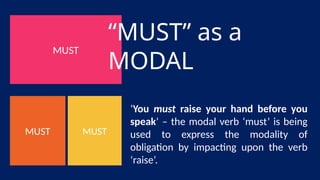
‘You must raise your hand before you
speak’ – the modal verb ‘must’ is being
used to express the modality of
obligation by impacting upon the verb
‘raise’.
MUST
MUST
MUST
“MUST” as a
MODAL
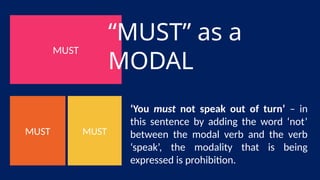
‘You must not speak out of turn’ – in
this sentence by adding the word ‘not’
between the modal verb and the verb
‘speak’, the modality that is being
expressed is prohibition.
SHOULD
SHOULD
SHOULD
“SHOULD” as a
MODAL
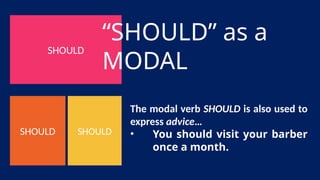
The modal verb SHOULD is also used to
express advice…
• You should visit your barber
once a month.
Here are more MODALS you
must pay attention to…
• Will
• Shall
• Would
• Ought to
• Don’t/Doesn’t
have to
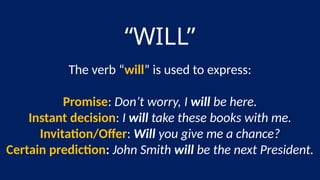
“WILL”
The verb “will” is used to express:
Promise: Don’t worry, I will be here.
Instant decision: I will take these books with me.
Invitation/Offer: Will you give me a chance?
Certain prediction: John Smith will be the next President.
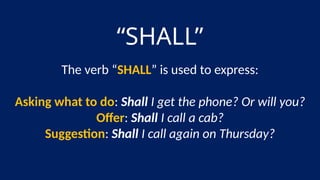
“SHALL”
The verb “SHALL” is used to express:
Asking what to do: Shall I get the phone? Or will you?
Offer: Shall I call a cab?
Suggestion: Shall I call again on Thursday?
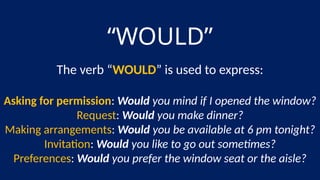
“WOULD”
The verb “WOULD” is used to express:
Asking for permission: Would you mind if I opened the window?
Request: Would you make dinner?
Making arrangements: Would you be available at 6 pm tonight?
Invitation: Would you like to go out sometimes?
Preferences: Would you prefer the window seat or the aisle?
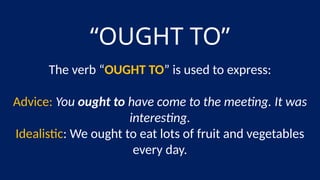
“OUGHT TO”
The verb “OUGHT TO” is used to express:
Advice: You ought to have come to the meeting. It was
interesting.
Idealistic: We ought to eat lots of fruit and vegetables
every day.
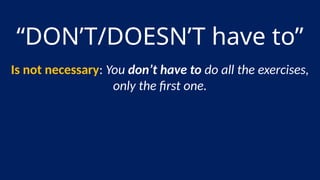
“DON’T/DOESN’T have to”
Is not necessary: You don’t have to do all the exercises,
only the first one.
more more modals for grade 9  modalities

more more modals for grade 9 modalities

  • 3.
  • 5.
    LET’S LEARN MOREABOUT MODALS • Modals are special verbs
  • 6.
    What’s special about MODALS? theyare uniquely behaving verbs.
  • 7.
    CAN” as aModal ‘I can run’ – is an example of the modal verb ‘can’ impacting upon the verb ‘run’. CAN
  • 8.
    CAN” as aModal ‘Can I borrow your trainers?’ – this sentence shows the modal verb ‘can’ impacting upon the verb ‘borrow’. CAN
  • 9.
    CAN” as aModal ‘Running can make you ache’ – again, ‘can’ is impacting upon a new verb, ‘make’. CAN
  • 10.
    “MAY” as a Modal ‘Imay swim tomorrow’ – ‘may’ is being used here to express both possibility and probability. MAY
  • 11.
    “MAY” as a Modal ‘MayI swim tomorrow?’ – in this instance we have simply moved the positioning of the words to create a new sentence. MAY
  • 12.
    MUST MUST MUST “MUST” as a MODAL ‘Youmust raise your hand before you speak’ – the modal verb ‘must’ is being used to express the modality of obligation by impacting upon the verb ‘raise’.
  • 13.
    MUST MUST MUST “MUST” as a MODAL ‘Youmust not speak out of turn’ – in this sentence by adding the word ‘not’ between the modal verb and the verb ‘speak’, the modality that is being expressed is prohibition.
  • 14.
    SHOULD SHOULD SHOULD “SHOULD” as a MODAL Themodal verb SHOULD is also used to express advice… • You should visit your barber once a month.
  • 15.
    Here are moreMODALS you must pay attention to… • Will • Shall • Would • Ought to • Don’t/Doesn’t have to
  • 16.
    “WILL” The verb “will”is used to express: Promise: Don’t worry, I will be here. Instant decision: I will take these books with me. Invitation/Offer: Will you give me a chance? Certain prediction: John Smith will be the next President.
  • 17.
    “SHALL” The verb “SHALL”is used to express: Asking what to do: Shall I get the phone? Or will you? Offer: Shall I call a cab? Suggestion: Shall I call again on Thursday?
  • 18.
    “WOULD” The verb “WOULD”is used to express: Asking for permission: Would you mind if I opened the window? Request: Would you make dinner? Making arrangements: Would you be available at 6 pm tonight? Invitation: Would you like to go out sometimes? Preferences: Would you prefer the window seat or the aisle?
  • 19.
    “OUGHT TO” The verb“OUGHT TO” is used to express: Advice: You ought to have come to the meeting. It was interesting. Idealistic: We ought to eat lots of fruit and vegetables every day.
  • 20.
    “DON’T/DOESN’T have to” Isnot necessary: You don’t have to do all the exercises, only the first one.