MIGRATIONS 
UNIT 12
SIMPLE PAST TENSE 
• FORM 
• [VERB+ed] or irregular verbs 
• Examples: 
• You called Debbie. 
• Did you call Debbie? 
• You did not call Debbie.
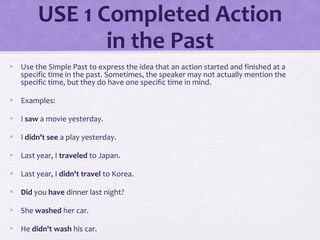
USE 1 Completed Action 
in the Past 
• Use the Simple Past to express the idea that an action started and finished at a 
specific time in the past. Sometimes, the speaker may not actually mention the 
specific time, but they do have one specific time in mind. 
• Examples: 
• I saw a movie yesterday. 
• I didn't see a play yesterday. 
• Last year, I traveled to Japan. 
• Last year, I didn't travel to Korea. 
• Did you have dinner last night? 
• She washed her car. 
• He didn't wash his car.
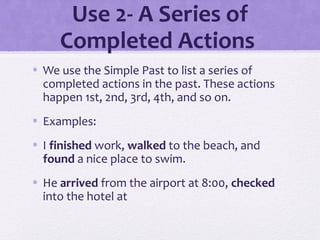
Use 2- A Series of 
Completed Actions 
• We use the Simple Past to list a series of 
completed actions in the past. These actions 
happen 1st, 2nd, 3rd, 4th, and so on. 
• Examples: 
• I finished work, walked to the beach, and 
found a nice place to swim. 
• He arrived from the airport at 8:00, checked 
into the hotel at
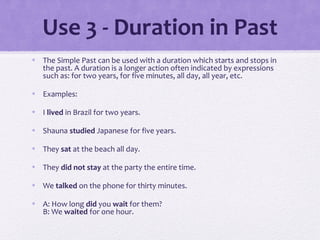
Use 3 - Duration in Past 
• The Simple Past can be used with a duration which starts and stops in 
the past. A duration is a longer action often indicated by expressions 
such as: for two years, for five minutes, all day, all year, etc. 
• Examples: 
• I lived in Brazil for two years. 
• Shauna studied Japanese for five years. 
• They sat at the beach all day. 
• They did not stay at the party the entire time. 
• We talked on the phone for thirty minutes. 
• A: How long did you wait for them? 
B: We waited for one hour.
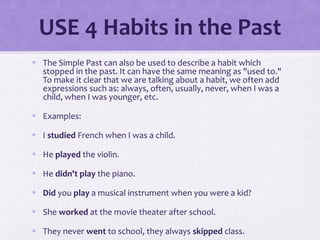
USE 4 Habits in the Past 
• The Simple Past can also be used to describe a habit which 
stopped in the past. It can have the same meaning as "used to." 
To make it clear that we are talking about a habit, we often add 
expressions such as: always, often, usually, never, when I was a 
child, when I was younger, etc. 
• Examples: 
• I studied French when I was a child. 
• He played the violin. 
• He didn't play the piano. 
• Did you play a musical instrument when you were a kid? 
• She worked at the movie theater after school. 
• They never went to school, they always skipped class.
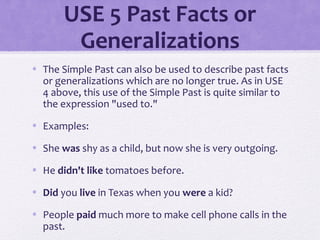
USE 5 Past Facts or 
Generalizations 
• The Simple Past can also be used to describe past facts 
or generalizations which are no longer true. As in USE 
4 above, this use of the Simple Past is quite similar to 
the expression "used to." 
• Examples: 
• She was shy as a child, but now she is very outgoing. 
• He didn't like tomatoes before. 
• Did you live in Texas when you were a kid? 
• People paid much more to make cell phone calls in the 
past.
EXERCISES 
• http://www.englishpage.com/verbpage/verbs3 
.htm 
• http://www.englishpage.com/verbpage/verbs1 
6.htm

Unit12 sem1

  • 1.
  • 2.
    SIMPLE PAST TENSE • FORM • [VERB+ed] or irregular verbs • Examples: • You called Debbie. • Did you call Debbie? • You did not call Debbie.
  • 3.
    USE 1 CompletedAction in the Past • Use the Simple Past to express the idea that an action started and finished at a specific time in the past. Sometimes, the speaker may not actually mention the specific time, but they do have one specific time in mind. • Examples: • I saw a movie yesterday. • I didn't see a play yesterday. • Last year, I traveled to Japan. • Last year, I didn't travel to Korea. • Did you have dinner last night? • She washed her car. • He didn't wash his car.
  • 4.
    Use 2- ASeries of Completed Actions • We use the Simple Past to list a series of completed actions in the past. These actions happen 1st, 2nd, 3rd, 4th, and so on. • Examples: • I finished work, walked to the beach, and found a nice place to swim. • He arrived from the airport at 8:00, checked into the hotel at
  • 5.
    Use 3 -Duration in Past • The Simple Past can be used with a duration which starts and stops in the past. A duration is a longer action often indicated by expressions such as: for two years, for five minutes, all day, all year, etc. • Examples: • I lived in Brazil for two years. • Shauna studied Japanese for five years. • They sat at the beach all day. • They did not stay at the party the entire time. • We talked on the phone for thirty minutes. • A: How long did you wait for them? B: We waited for one hour.
  • 6.
    USE 4 Habitsin the Past • The Simple Past can also be used to describe a habit which stopped in the past. It can have the same meaning as "used to." To make it clear that we are talking about a habit, we often add expressions such as: always, often, usually, never, when I was a child, when I was younger, etc. • Examples: • I studied French when I was a child. • He played the violin. • He didn't play the piano. • Did you play a musical instrument when you were a kid? • She worked at the movie theater after school. • They never went to school, they always skipped class.
  • 7.
    USE 5 PastFacts or Generalizations • The Simple Past can also be used to describe past facts or generalizations which are no longer true. As in USE 4 above, this use of the Simple Past is quite similar to the expression "used to." • Examples: • She was shy as a child, but now she is very outgoing. • He didn't like tomatoes before. • Did you live in Texas when you were a kid? • People paid much more to make cell phone calls in the past.
  • 8.
    EXERCISES • http://www.englishpage.com/verbpage/verbs3 .htm • http://www.englishpage.com/verbpage/verbs1 6.htm