PRAYER
S.Y. 2021-2022
OLIVETH D. SAGORIO
Teacher III
CLASSROOM
OBSERVATION
TOOL
Use modal verbs, modal nouns, and
modal adverbs appropriately ENGG-
IIIa-3.6
MOST ESSENTIAL LEARNING COMPETENCY
● Classify modal verbs
● Use modal verbs in constructing a dialogue
● Appreciates the value of modal verb in real life
by composing an informative essay
LEARNING OBJECTIVES
Take a look at the picture below and answer the
questions that follow.
LET’S REVIEW
Guided Questions:
1. What is a verb?
2.What can you observe in the picture
above? What do you think is the similarities of
the words being illustrated in the picture?
LET’S REVIEW
Let us sing the Modal Song
LET’S SING
 What is the song all about?
 Can you identify the colored words in the
video?
GRADE 8
ACTIVITY
The class will be divided into two (2) groups. Each
group will be going to construct a dialogue using modal
verbs. They will be given three (3) minutes to prepare.
Then after that, they will choose a representative to
deliver the dialogue in front. Each group will be given
two (2) minutes and 30 seconds to present. Before
they start the activity, the teacher will first show the
criteria for the students to be guided with their task.
CRITERIA
CRITERIA
Correctness of
answer
15 pts
Presentation 10 pts
Cooperation 5 pts
TOTAL 30 pts
LET’S ANALYZE
Guided Questions
 What are the modal verbs being used in the dialogue
of the Group 1-2?
 What was the dialogue looks like without modal
verbs?
 How were you able to write a dialogue using modal
verbs?
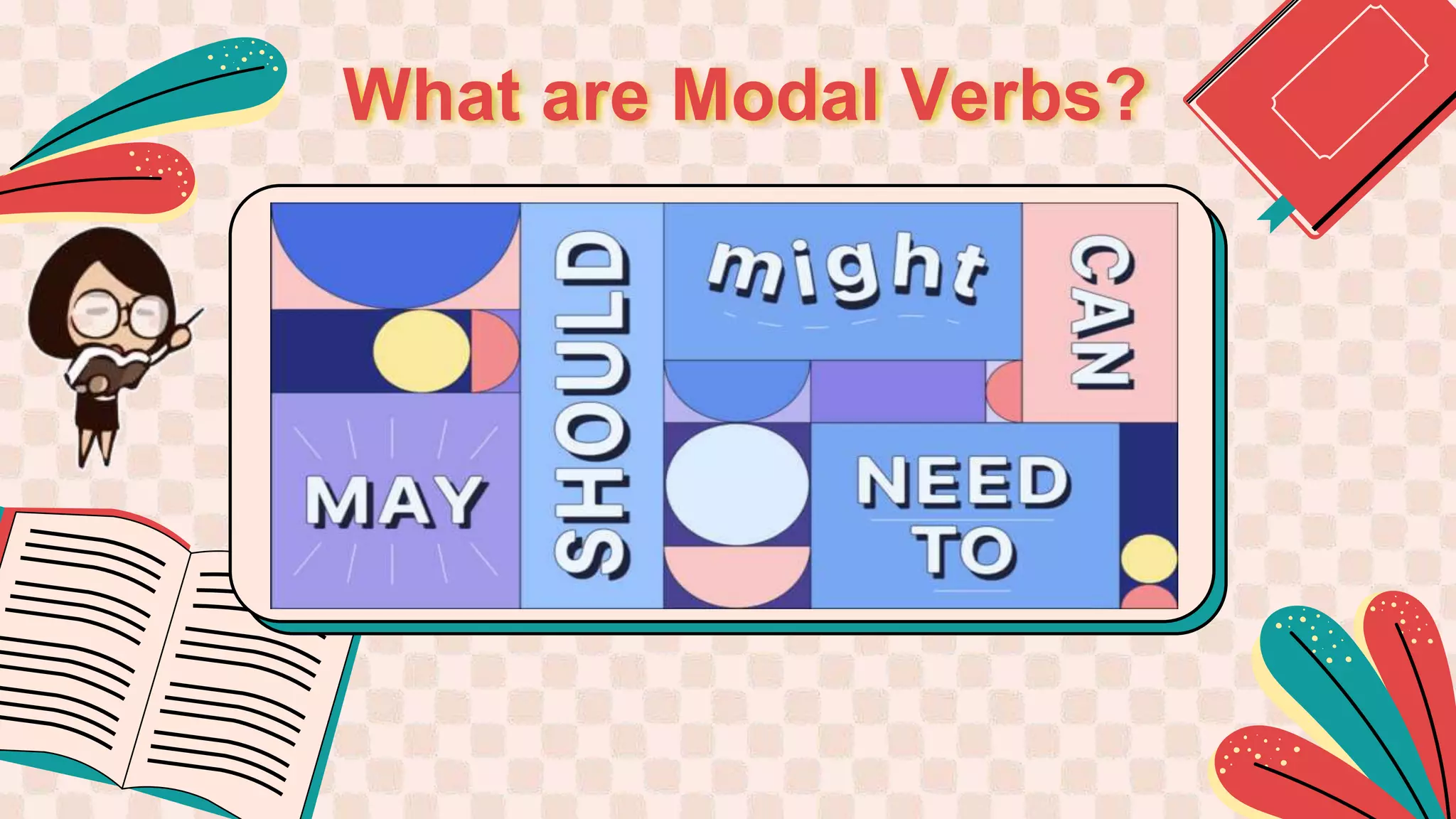
What are Modal Verbs?
MODAL VERBS
• Modal verbs show possibility, intent, ability, or necessity.
Because they’re a type of auxiliary verb (helper verb), they’re
used together with the main verb of the sentence. Common
examples include can, should, and must.
• Modal verbs are used to express certain hypothetical conditions,
such as advice, capability, or requests (there’s a full list in the
next section). They’re used alongside a main verb to change its
meaning slightly. Because they’re auxiliary verbs, they can’t
necessarily be used on their own.
Consider the difference between
these two examples:
 I swim every Tuesday.
 I can swim every Tuesday.
The first example is a simple factual statement. The speaker
participates in a swimming activity every week on Tuesdays.
The second example uses the modal verb can. Notice how the meaning
changes slightly. The speaker does not swim every Tuesday; they’re
saying they are capable of swimming every Tuesday if they need to. It’s
hypothetical.
The most frequently used ones are:
o can
o may
o might
o could
o should
o would
o will
o must
When are modal verbs used?
What special conditions do modal verbs show? Here’s a list of when
to use modal verbs, along with examples:
1. Likelihood
Some things seem likely, but we don’t know for sure. In these
cases, you can use the modal verbs should and must to show
probability without certainty.
Her parents must be so proud.
My baby brother should be asleep by now.
2. Possibility
In situations when something is possible but not
certain, use the modal verbs could, may, or might.
Judging by the clouds, it might rain today.
She may become the youngest pro soccer player
ever.
3. Ability
The modal verb can shows whether or not the subject is
able to do something, such as perform an action or
demonstrate an ability. Likewise, the negative
form, cannot or can’t, shows that the subject is unable to
do something.
She can speak three languages, but none of them well.
You can lead a horse to water, but you can’t make it drink.
4. Asking permission
If you want to ask permission to do something, start your question
with can, may, or could. Traditionally, in more formal and polite
usage, may is better for permission; if you ask “can I go to the
bathroom?” it could be misinterpreted as, “do I have the ability to go
to the bathroom?” (However, in modern usage may and can are both
perfectly acceptable options when describing possibility or permission.)
May I leave early today?
Could I play too?
5. Request
Similarly, if you want to ask someone else to do
something, start your question
with will, would, can, or could.
Would you get that box off the top shelf?
Will you turn that music down?
6. Suggestion/advice
What if you want to recommend something, but not
command it? If you’re giving suggestions or advice
without ordering someone around, you can use the
modal verb should.
You should try the lasagna.
That guy should wear less cologne.
7. Command
On the other hand, if you want to command
someone, use the modal verbs must, have to,
or need to.
You must wash your hands before cooking.
You need to be here before 8:00.
8. Obligation or necessity
Modal verbs can express a necessary action, such as an
obligation, duty, or requirement. Likewise, the negative
form expresses that an action is not necessary. Use the
same modal verbs as with commands: must, have to,
or need to.
We have to wait for our boss to arrive before we open.
You don’t need to come if you don’t want to.
9. Habit
To show an ongoing or habitual action—something the
subject does regularly—you can use the modal
verb would for the past tense and will for the present and
future. The phrase used to is also acceptable if you’re
talking about a habit that no longer exists.
When I lived alone, I would fall asleep with music.
I will arrive early and leave late to every meeting.
LET’S APPLY
The class will divided into two (2) groups. Each group
will create an informative essay about “Positive
Thoughts on Mental Illness and Its Effect to People”.
They will use modals appropriately and cite their
references. Before they start the activity, the teacher
will first show the criteria for the students to be guided
with their task.
CRITERIA
Critical Understanding of Material 20 pts
Organization of Thoughts 15 pts
Appropriate Use of Modals 15 pts
TOTAL 50 pts
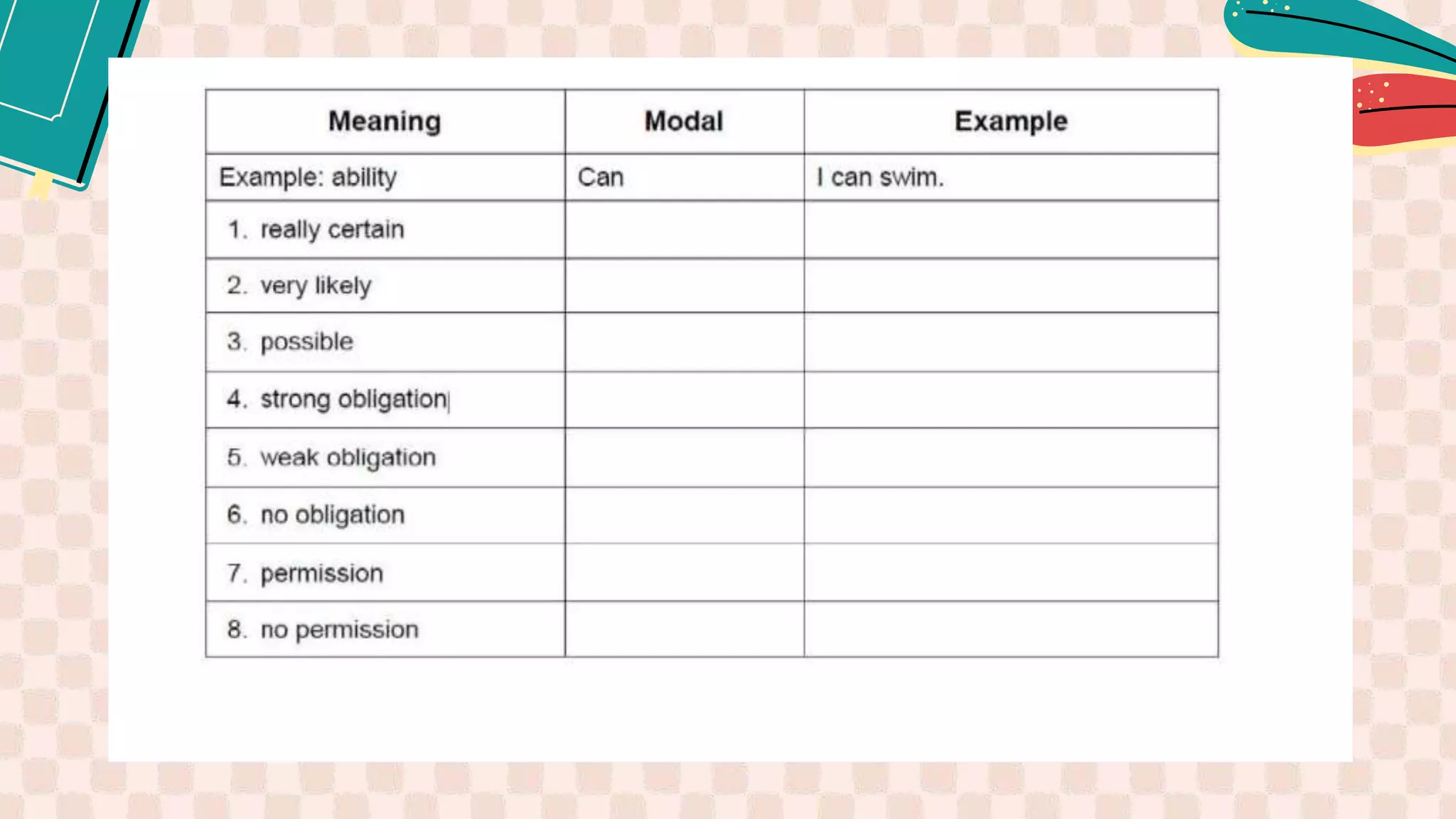
ASSIGNMENT
Look at the table below. Based from the meaning
of the modal in column A, write the appropriate
modal verb for column B and its sample sentence in
column C. Write your answers on a one (1) whole sheet
of paper.
COT Modal Verbs.pptx

COT Modal Verbs.pptx

  • 1.
  • 3.
    S.Y. 2021-2022 OLIVETH D.SAGORIO Teacher III CLASSROOM OBSERVATION TOOL
  • 4.
    Use modal verbs,modal nouns, and modal adverbs appropriately ENGG- IIIa-3.6 MOST ESSENTIAL LEARNING COMPETENCY
  • 5.
    ● Classify modalverbs ● Use modal verbs in constructing a dialogue ● Appreciates the value of modal verb in real life by composing an informative essay LEARNING OBJECTIVES
  • 6.
    Take a lookat the picture below and answer the questions that follow. LET’S REVIEW
  • 7.
    Guided Questions: 1. Whatis a verb? 2.What can you observe in the picture above? What do you think is the similarities of the words being illustrated in the picture? LET’S REVIEW
  • 8.
    Let us singthe Modal Song LET’S SING
  • 10.
     What isthe song all about?  Can you identify the colored words in the video?
  • 11.
  • 12.
    ACTIVITY The class willbe divided into two (2) groups. Each group will be going to construct a dialogue using modal verbs. They will be given three (3) minutes to prepare. Then after that, they will choose a representative to deliver the dialogue in front. Each group will be given two (2) minutes and 30 seconds to present. Before they start the activity, the teacher will first show the criteria for the students to be guided with their task.
  • 13.
  • 14.
    LET’S ANALYZE Guided Questions What are the modal verbs being used in the dialogue of the Group 1-2?  What was the dialogue looks like without modal verbs?  How were you able to write a dialogue using modal verbs?
  • 15.
  • 16.
    MODAL VERBS • Modalverbs show possibility, intent, ability, or necessity. Because they’re a type of auxiliary verb (helper verb), they’re used together with the main verb of the sentence. Common examples include can, should, and must. • Modal verbs are used to express certain hypothetical conditions, such as advice, capability, or requests (there’s a full list in the next section). They’re used alongside a main verb to change its meaning slightly. Because they’re auxiliary verbs, they can’t necessarily be used on their own.
  • 17.
    Consider the differencebetween these two examples:  I swim every Tuesday.  I can swim every Tuesday. The first example is a simple factual statement. The speaker participates in a swimming activity every week on Tuesdays. The second example uses the modal verb can. Notice how the meaning changes slightly. The speaker does not swim every Tuesday; they’re saying they are capable of swimming every Tuesday if they need to. It’s hypothetical.
  • 18.
    The most frequentlyused ones are: o can o may o might o could o should o would o will o must
  • 19.
    When are modalverbs used? What special conditions do modal verbs show? Here’s a list of when to use modal verbs, along with examples: 1. Likelihood Some things seem likely, but we don’t know for sure. In these cases, you can use the modal verbs should and must to show probability without certainty. Her parents must be so proud. My baby brother should be asleep by now.
  • 20.
    2. Possibility In situationswhen something is possible but not certain, use the modal verbs could, may, or might. Judging by the clouds, it might rain today. She may become the youngest pro soccer player ever.
  • 21.
    3. Ability The modalverb can shows whether or not the subject is able to do something, such as perform an action or demonstrate an ability. Likewise, the negative form, cannot or can’t, shows that the subject is unable to do something. She can speak three languages, but none of them well. You can lead a horse to water, but you can’t make it drink.
  • 22.
    4. Asking permission Ifyou want to ask permission to do something, start your question with can, may, or could. Traditionally, in more formal and polite usage, may is better for permission; if you ask “can I go to the bathroom?” it could be misinterpreted as, “do I have the ability to go to the bathroom?” (However, in modern usage may and can are both perfectly acceptable options when describing possibility or permission.) May I leave early today? Could I play too?
  • 23.
    5. Request Similarly, ifyou want to ask someone else to do something, start your question with will, would, can, or could. Would you get that box off the top shelf? Will you turn that music down?
  • 24.
    6. Suggestion/advice What ifyou want to recommend something, but not command it? If you’re giving suggestions or advice without ordering someone around, you can use the modal verb should. You should try the lasagna. That guy should wear less cologne.
  • 25.
    7. Command On theother hand, if you want to command someone, use the modal verbs must, have to, or need to. You must wash your hands before cooking. You need to be here before 8:00.
  • 26.
    8. Obligation ornecessity Modal verbs can express a necessary action, such as an obligation, duty, or requirement. Likewise, the negative form expresses that an action is not necessary. Use the same modal verbs as with commands: must, have to, or need to. We have to wait for our boss to arrive before we open. You don’t need to come if you don’t want to.
  • 27.
    9. Habit To showan ongoing or habitual action—something the subject does regularly—you can use the modal verb would for the past tense and will for the present and future. The phrase used to is also acceptable if you’re talking about a habit that no longer exists. When I lived alone, I would fall asleep with music. I will arrive early and leave late to every meeting.
  • 28.
    LET’S APPLY The classwill divided into two (2) groups. Each group will create an informative essay about “Positive Thoughts on Mental Illness and Its Effect to People”. They will use modals appropriately and cite their references. Before they start the activity, the teacher will first show the criteria for the students to be guided with their task.
  • 29.
    CRITERIA Critical Understanding ofMaterial 20 pts Organization of Thoughts 15 pts Appropriate Use of Modals 15 pts TOTAL 50 pts
  • 31.
    ASSIGNMENT Look at thetable below. Based from the meaning of the modal in column A, write the appropriate modal verb for column B and its sample sentence in column C. Write your answers on a one (1) whole sheet of paper.