
MODAL
VERBS
Uses or
functions
PROBABILITY
O We use these modal verbs when we
 want to make a guess about
 something:
  O Must     We choose the
  O Might
            verb depending
  O Could
            on how sure we
  O May
                     are
  O Can
I am waiting for Julie with
another friend, David.

I ask: “Where is Julie?”
David guesses:

She must be on the bus
She might come soon
She could be lost
She may be in the wrong
classroom
She can’t still be at home
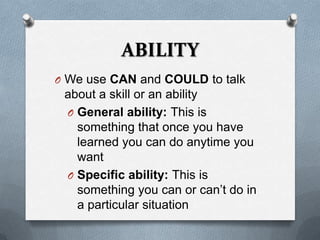
ABILITY
O We use CAN and COULD to talk
 about a skill or an ability
 O General ability: This is
   something that once you have
   learned you can do anytime you
   want
 O Specific ability: This is
   something you can or can’t do in
   a particular situation
OBLIGATION & ADVICE
O Use MUST, SHOULD, or OUGHT
 TO to say when something is
 necessary (or unnecessary) or to
 give advice.
 O Students must do their
    homework
 O We ought to wear a uniform at
    work
 O You should stop smoking
PERMISSION
O We can use verbs such as CAN and MAY
  to ask for and give permission
   O May I leave early today?
   O Can we swim in the pool?
O We also use modal verbs to say something
  is not allowed.
   O You may not use the computer tonight
   O You cannot leave your clothes on the
     floor
HABITS
O We use WILL or WOULD to talk
 about things we usually do or things
 we did in the past

  O She would always play the piano
    after everyone else was in bed
  O If I have fun at school, I will
    always go to class
RULES
O Modal verbs are auxiliary verbs
 because they are NOT
 complete. The can only be
 used WITH other verbs

  O You can a computer
  O You CAN USE a computer
They are different from
       other verbs
O They don’t use an “s” for the
 third person singular

  O He sings
  O He cans sing
  O He can sing
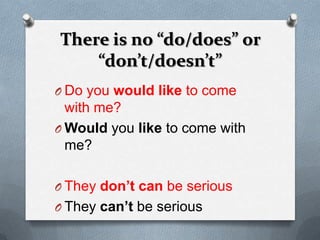
There is no “do/does” or
    “don’t/doesn’t”
O Do you would like to come
  with me?
O Would you like to come with
  me?

O They don’t can be serious
O They can’t be serious
Modal verbs do not have
infinitives; they are followed
 directly by the infinitive of
         another verb
  DON’T USE “TO” WITH THEM!!!

    O She can to speak French.
    O She can speak French
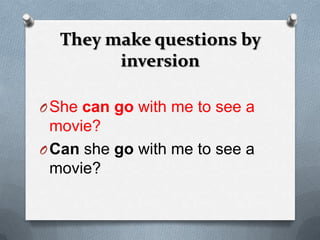
They make questions by
        inversion

O She can go with me to see a
  movie?
O Can she go with me to see a
  movie?
According to modal
verbs’ functions, look
  at the images and
   create your own
      sentences!
Modal verbs
Modal verbs
Modal verbs
Modal verbs
Modal verbs
Modal verbs
Modal verbs
Modal verbs
Modal verbs

Modal verbs

  • 1.
  • 2.
  • 3.
    PROBABILITY O We usethese modal verbs when we want to make a guess about something: O Must We choose the O Might verb depending O Could on how sure we O May are O Can
  • 4.
    I am waitingfor Julie with another friend, David. I ask: “Where is Julie?” David guesses: She must be on the bus She might come soon She could be lost She may be in the wrong classroom She can’t still be at home
  • 6.
    ABILITY O We useCAN and COULD to talk about a skill or an ability O General ability: This is something that once you have learned you can do anytime you want O Specific ability: This is something you can or can’t do in a particular situation
  • 8.
    OBLIGATION & ADVICE OUse MUST, SHOULD, or OUGHT TO to say when something is necessary (or unnecessary) or to give advice. O Students must do their homework O We ought to wear a uniform at work O You should stop smoking
  • 10.
    PERMISSION O We canuse verbs such as CAN and MAY to ask for and give permission O May I leave early today? O Can we swim in the pool? O We also use modal verbs to say something is not allowed. O You may not use the computer tonight O You cannot leave your clothes on the floor
  • 13.
    HABITS O We useWILL or WOULD to talk about things we usually do or things we did in the past O She would always play the piano after everyone else was in bed O If I have fun at school, I will always go to class
  • 15.
    RULES O Modal verbsare auxiliary verbs because they are NOT complete. The can only be used WITH other verbs O You can a computer O You CAN USE a computer
  • 16.
    They are differentfrom other verbs O They don’t use an “s” for the third person singular O He sings O He cans sing O He can sing
  • 17.
    There is no“do/does” or “don’t/doesn’t” O Do you would like to come with me? O Would you like to come with me? O They don’t can be serious O They can’t be serious
  • 18.
    Modal verbs donot have infinitives; they are followed directly by the infinitive of another verb DON’T USE “TO” WITH THEM!!! O She can to speak French. O She can speak French
  • 19.
    They make questionsby inversion O She can go with me to see a movie? O Can she go with me to see a movie?
  • 20.
    According to modal verbs’functions, look at the images and create your own sentences!