PV system
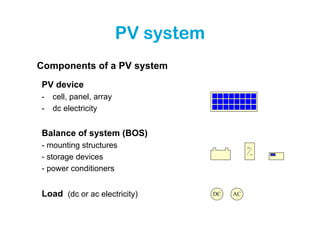
Components of a PV system
PV device
-   cell, panel, array
-   dc electricity


Balance of system (BOS)
- mounting structures                          =
- storage devices                               ~

- power conditioners


Load (dc or ac electricity)          DC   AC
PV system
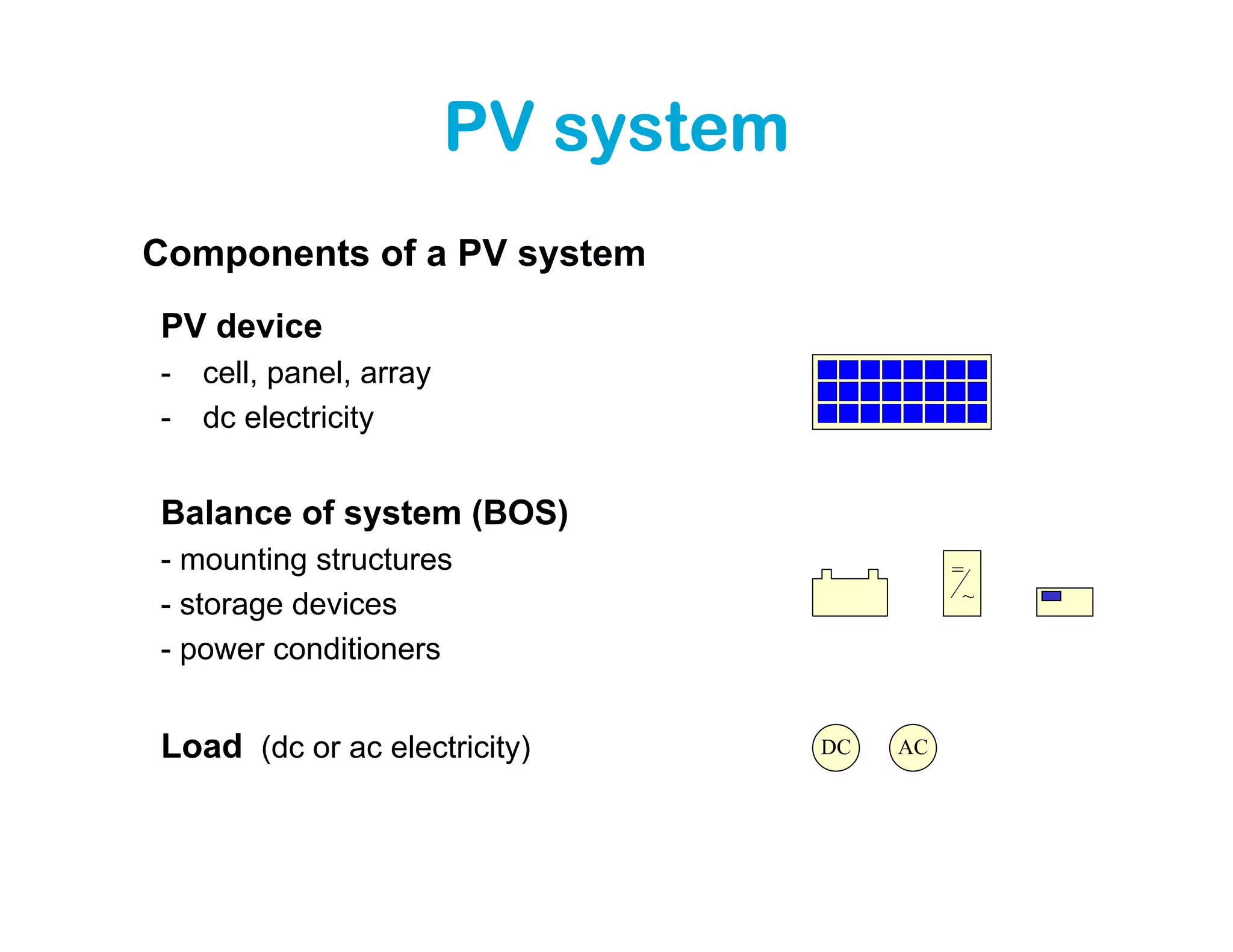
From a solar cell to an array: modularity


       Cell (c-Si 10×10 cm2 η=15% P=1.5Wp V=0.5V I=3A)
       Solar panel (36 c-Si cells P=54Wp I=3A V=18V )
       Solar array
Specifications of PV modules
Module                             Shell           Shell            Kaneka              First Solar
Type                              SM50-H           ST40              PLE                  FS-50

Solar cell type                   Mono c-Si          CIS              a-Si:H                CdTe
Rated power Pmax          [Wp]       50              40                 50                   52
Rated current IMPP         [A]      3.15                               3.03                 0.80
Rated voltage VMPP         [V]      15.9             16.6              16.5                  63
Shirt circuit current ISC  [A]      3.40             2.68              3.65                 0.95
Open circuit voltage VOC [V]        19.8             23.3              23.0                  88

Configuration             [V]        12               12                 12                    12
Cells per module                     33
Dimensions               [mm]     1219x329        1293x328           952x920             1200x600
Warranty                [years]      25              10                10                   20
                                  www.shell.com   www.shell.com   www.pv.kaneka.co.jp   www.firstsolar.com
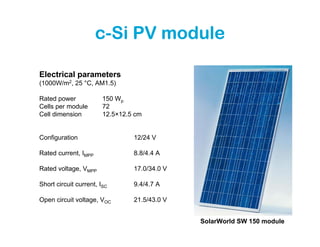
c-Si PV module

Electrical parameters
(1000W/m2, 25 °C, AM1.5)

Rated power             150 Wp
Cells per module        72
Cell dimension          12.5×12.5 cm


Configuration                    12/24 V

Rated current, IMPP              8.8/4.4 A

Rated voltage, VMPP              17.0/34.0 V

Short circuit current, ISC       9.4/4.7 A

Open circuit voltage, VOC        21.5/43.0 V


                                               SolarWorld SW 150 module
Components of a PV system
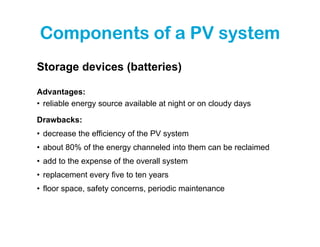
Storage devices (batteries)

Advantages:
• reliable energy source available at night or on cloudy days

Drawbacks:
• decrease the efficiency of the PV system
• about 80% of the energy channeled into them can be reclaimed
• add to the expense of the overall system
• replacement every five to ten years
• floor space, safety concerns, periodic maintenance
Components of a PV system
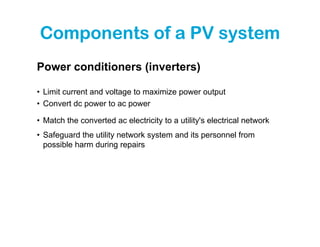
Power conditioners (inverters)

• Limit current and voltage to maximize power output
• Convert dc power to ac power

• Match the converted ac electricity to a utility's electrical network
• Safeguard the utility network system and its personnel from
  possible harm during repairs
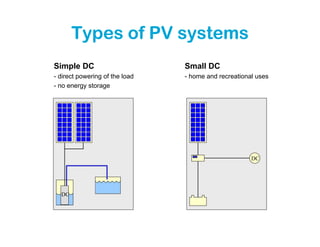
Types of PV systems
Simple DC                       Small DC
- direct powering of the load   - home and recreational uses
- no energy storage


                                                      DC


  DC
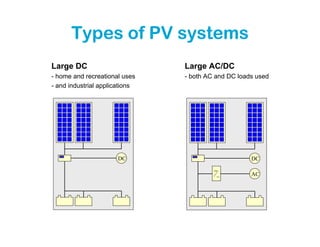
Types of PV systems
Large DC                        Large AC/DC
- home and recreational uses    - both AC and DC loads used
- and industrial applications


                       DC                            DC

                                         =
                                          ~          AC
Types of PV systems
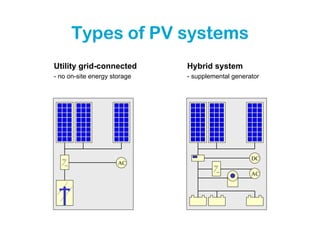
Utility grid-connected        Hybrid system
- no on-site energy storage   - supplemental generator


  =                                                DC
   ~                  AC
                                      =
                                       ~           AC
Off-grid PV system
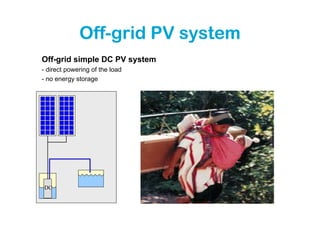
Off-grid simple DC PV system
- direct powering of the load
- no energy storage


DC
Off-grid PV system
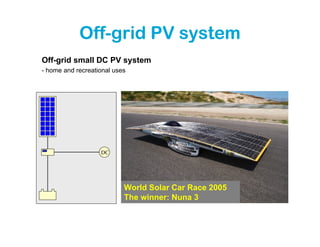
Off-grid small DC PV system
- home and recreational uses


                   DC


                           World Solar Car Race 2005
                           The winner: Nuna 3
Grid-connected PV system
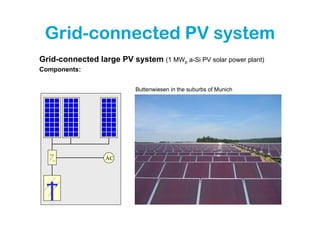
Grid-connected large PV system (1 MWp a-Si PV solar power plant)
Components:


                           Buttenwiesen in the suburbs of Munich


  =
   ~              AC
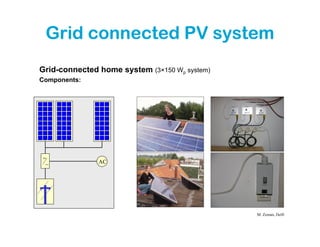
Grid connected PV system
Grid-connected home system (3×150 Wp system)
Components:


=
 ~             AC


                                               M. Zeman, Delft
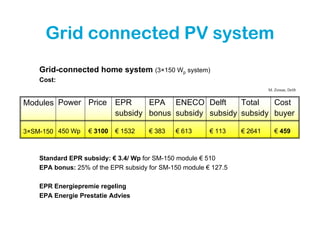
Grid connected PV system
                              Grid-connected home system (3×150 Wp system)
                              Performance:


                                                              321.8 kWh                                                                          406.2 kWh
                         55                                                                                 55
                                                                       Year 2002                                                                          Year 2003
                         50                                                                                 50
Generated energy [kWh]


                         45                                                                                 45


                                                                                   Generated energy [kWh]
                         40                                                                                 40
                         35                                                                                 35
                         30                                                                                 30
                         25                                                                                 25
                         20                                                                                 20
                         15                                                                                 15
                         10                                                                                 10
                         5                                                                                  5
                         0                                                                                  0
                              1   2   3   4   5   6   7   8   9   10     11   12                                 1   2   3   4   5   6   7   8   9   10     11   12
                                                  Month                                                                              Month

                                                                                                                                                     M. Zeman, Delft
Grid connected PV system
                              Grid-connected home system (3×150 Wp system)
                              Performance:


                                                              321.4 kWh                                                                          318.2 kWh
                         55                                                                                 55
                                                                       Year 2004                                                                          Year 2005
                         50                                                                                 50
                         45                                                                                 45
Generated energy [kWh]


                                                                                   Generated energy [kWh]
                         40                                                                                 40
                         35                                                                                 35
                         30                                                                                 30
                         25                                                                                 25
                         20                                                                                 20
                         15                                                                                 15
                         10                                                                                 10
                         5                                                                                  5
                         0                                                                                  0
                              1   2   3   4   5   6   7   8   9   10     11   12                                 1   2   3   4   5   6   7   8   9   10     11   12
                                                  Month                                                                              Month


                                                                                                                                                     M. Zeman, Delft
Grid connected PV system
    Grid-connected home system (3×150 Wp system)
    Cost:
                                                                           M. Zeman, Delft


Modules Power Price         EPR     EPA ENECO Delft       Total   Cost
                            subsidy bonus subsidy subsidy subsidy buyer

3×SM-150 450 Wp    € 3100   € 1532    € 383   € 613      € 113    € 2641      € 459


    Standard EPR subsidy: € 3.4/ Wp for SM-150 module € 510
    EPA bonus: 25% of the EPR subsidy for SM-150 module € 127.5

    EPR Energiepremie regeling
    EPA Energie Prestatie Advies
Grid connected PV system
                         Nederland:
                         System: SolarWorld SW 150 module
                         Power: 3×150 Wp = 0.450 kWp Area: 3×0.75×1.50 = 3.375 m2
                         Performance: 330 kWh/year
                         Annual yield: 730 kWh/kWp 98 kWh/m2

                              321.4 kWh
                         55
                                                                       Year 2004
                                                                                   Case:
                         50
                         45                                                        Average electricity use in NL:
Generated energy [kWh]


                         40
                         35
                                                                                   3000 kWh/year
                         30                                                        Area needed:
                         25
                         20                                                        3000 kWh / 98 kWh/m2 = 31 m2
                         15
                         10                                                        Number of modules:
                         5
                         0                                                         3000 kWh/ 110 kWh = 28 modules
                              1   2   3   4   5   6   7   8   9   10     11   12
                                                  Month
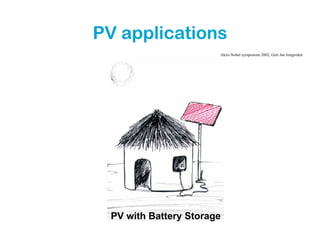
PV applications
                        Akzo-Nobel symposium 2002, Gert Jan Jongerden


  PV with Battery Storage
PV applications
PV with Battery Storage:
•   PV modules are connected to a battery and the battery to the load
•   can be designed to power dc or ac equipment
•   lights, sensors, recording equipment, switches, appliances,
    telephones, televisions, and even power tools


•   charge controller (properly charged battery)
•   battery maintenance
•   optimal design of PV system size required to balance the costs
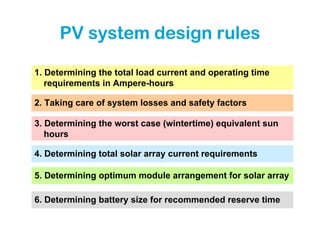
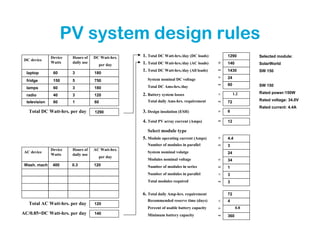
PV system design rules

1. Determining the total load current and operating time
   requirements in Ampere-hours

2. Taking care of system losses and safety factors

3. Determining the worst case (wintertime) equivalent sun
   hours

4. Determining total solar array current requirements

5. Determining optimum module arrangement for solar array

6. Determining battery size for recommended reserve time
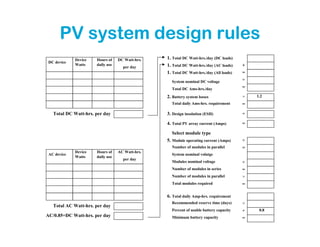
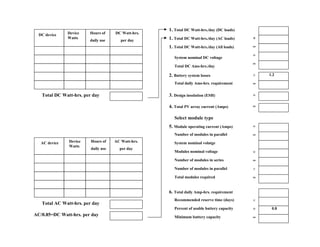
PV system design rules
             Device   Hours of    DC Watt-hrs.   1. Total DC Watt-hrs./day (DC loads)
 DC device
             Watts    daily use                  1. Total DC Watt-hrs./day (AC loads)    +
                                    per day
                                                 1. Total DC Watt-hrs./day (All loads)   =
                                                   System nominal DC voltage             ÷
                                                   Total DC Ams-hrs./day                 =

                                                 2. Battery system losses                ×   1.2
                                                   Total daily Ams-hrs. requirement      =

   Total DC Watt-hrs. per day                    3. Design insolation (ESH)              ÷

                                                 4. Total PV array current (Amps)        =

                                                   Select module type
                                                 5. Module operating current (Amps)      ÷
                                                   Number of modules in parallel         =
             Device   Hours of    AC Watt-hrs.
 AC device                                         System nominal volatge
             Watts    daily use
                                    per day
                                                   Modules nominal voltage               ÷
                                                   Number of modules in series           =
                                                   Number of modules in parallel         ×
                                                   Total modules required                =

                                                 6. Total daily Amp-hrs. requirement
                                                   Recommended reserve time (days)       ×
   Total AC Watt-hrs. per day
                                                   Percent of usable battery capacity    ÷    0.8
AC/0.85=DC Watt-hrs. per day                       Minimum battery capacity              =
Power consumption

DC             [W]     AC            [W]     AC                [W]
Television      60     Television    175     Refrigerator      350
Refrigerator   60      Radio/tape    70-80   Freezer           350-600
Fan            15-30                         Microwave oven    300-1450
Radio/tape      35                           Toaster           1100-1250
                       Lighting              Washing machine   375-550
Lighting               Bathroom      75      Coffee maker      850-1500
Bathroom       25-50   Bedroom       75      Air conditioner   3000-4000
Bedroom        25-50   Dining room   100
Dining room    70      Kitchen       100     Tools
Kitchen        75      Living room   75      Saw circular      800-1200
Living room    75                            Saw table         800-950
                                             Drill             240
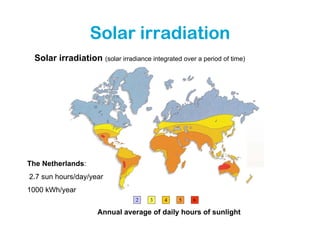
Solar irradiation
 Solar irradiation (solar irradiance integrated over a period of time)


The Netherlands:
2.7 sun hours/day/year
1000 kWh/year
                                  2   3    4    5    6

                     Annual average of daily hours of sunlight
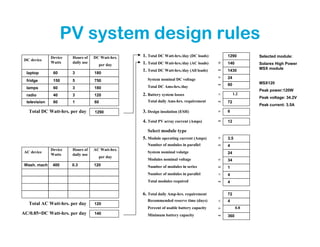
PV system design rules
               Device   Hours of    DC Watt-hrs.   1. Total DC Watt-hrs./day (DC loads)        1290        Selected module:
 DC device
               Watts    daily use                  1. Total DC Watt-hrs./day (AC loads)    +   140         Solarex High Power
                                      per day
                                                   1. Total DC Watt-hrs./day (All loads)   =   1430        MSX module
  laptop        60      3           180
                                                     System nominal DC voltage             ÷   24
  fridge        150     5           750
                                                                                           =   60          MSX120
  lamps         60      3           180              Total DC Ams-hrs./day
                                                                                                           Peak power:120W
  radio         40      3           120            2. Battery system losses                ×        1.2
                                                                                                           Peak voltage: 34.2V
  television    60      1           60               Total daily Ams-hrs. requirement      =   72
                                                                                                           Peak current: 3.5A
   Total DC Watt-hrs. per day       1290           3. Design insolation (ESH)              ÷   6

                                                   4. Total PV array current (Amps)        =   12

                                                     Select module type
                                                   5. Module operating current (Amps)      ÷   3.5
                                                     Number of modules in parallel         =   4
               Device   Hours of    AC Watt-hrs.
 AC device                                           System nominal volatge                    24
               Watts    daily use
                                      per day
                                                     Modules nominal voltage               ÷   34
 Wash. mach     400     0.3         120              Number of modules in series           =   1
                                                     Number of modules in parallel         ×   4
                                                     Total modules required                =   4

                                                   6. Total daily Amp-hrs. requirement         72
                                                     Recommended reserve time (days)       ×   4
   Total AC Watt-hrs. per day       120
                                                     Percent of usable battery capacity    ÷         0.8
AC/0.85=DC Watt-hrs. per day        140              Minimum battery capacity              =   360
PV system design rules
               Device   Hours of    DC Watt-hrs.   1. Total DC Watt-hrs./day (DC loads)        1290        Selected module:
 DC device
               Watts    daily use                  1. Total DC Watt-hrs./day (AC loads)    +   140         SolarWorld
                                      per day
                                                   1. Total DC Watt-hrs./day (All loads)   =   1430        SW 150
  laptop        60      3           180
                                                     System nominal DC voltage             ÷   24
  fridge        150     5           750
                                                     Total DC Ams-hrs./day                 =   60          SW 150
  lamps         60      3           180
                                                   2. Battery system losses                ×        1.2    Rated power:150W
  radio         40      3           120
  television    60      1           60               Total daily Ams-hrs. requirement      =   72          Rated voltage: 34.0V
                                                                                                           Rated current: 4.4A
   Total DC Watt-hrs. per day       1290           3. Design insolation (ESH)              ÷   6

                                                   4. Total PV array current (Amps)        =   12

                                                     Select module type
                                                   5. Module operating current (Amps)      ÷   4.4
                                                     Number of modules in parallel         =   3
               Device   Hours of    AC Watt-hrs.
 AC device                                           System nominal volatge                    24
               Watts    daily use
                                      per day
                                                     Modules nominal voltage               ÷   34
 Wash. mach     400     0.3         120              Number of modules in series           =   1
                                                     Number of modules in parallel         ×   3
                                                     Total modules required                =   3

                                                   6. Total daily Amp-hrs. requirement         72
                                                     Recommended reserve time (days)       ×   4
   Total AC Watt-hrs. per day       120
                                                     Percent of usable battery capacity    ÷         0.8
AC/0.85=DC Watt-hrs. per day        140              Minimum battery capacity              =   360
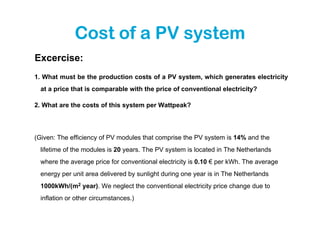
Cost of a PV system
Excercise:
1. What must be the production costs of a PV system, which generates electricity
  at a price that is comparable with the price of conventional electricity?

2. What are the costs of this system per Wattpeak?


(Given: The efficiency of PV modules that comprise the PV system is 14% and the
  lifetime of the modules is 20 years. The PV system is located in The Netherlands
  where the average price for conventional electricity is 0.10 € per kWh. The average
  energy per unit area delivered by sunlight during one year is in The Netherlands
  1000kWh/(m2 year). We neglect the conventional electricity price change due to
  inflation or other circumstances.)
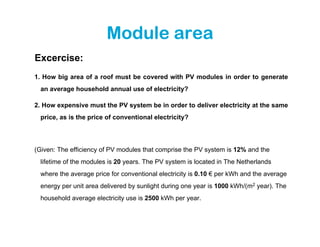
Module area
Excercise:
1. How big area of a roof must be covered with PV modules in order to generate
  an average household annual use of electricity?

2. How expensive must the PV system be in order to deliver electricity at the same
  price, as is the price of conventional electricity?


(Given: The efficiency of PV modules that comprise the PV system is 12% and the
  lifetime of the modules is 20 years. The PV system is located in The Netherlands
  where the average price for conventional electricity is 0.10 € per kWh and the average
  energy per unit area delivered by sunlight during one year is 1000 kWh/(m2 year). The
  household average electricity use is 2500 kWh per year.
1. Total DC Watt-hrs./day (DC loads)
  DC device    Device   Hours of     DC Watt-hrs.
               Watts                                1. Total DC Watt-hrs./day (AC loads)    +
                        daily use       per day
                                                    1. Total DC Watt-hrs./day (All loads)   =

                                                       System nominal DC voltage
                                                                                            ÷

                                                       Total DC Ams-hrs./day
                                                                                            =

                                                    2. Battery system losses                ×   1.2

                                                       Total daily Ams-hrs. requirement     =

   Total DC Watt-hrs. per day                       3. Design insolation (ESH)              ÷

                                                    4. Total PV array current (Amps)        =

                                                       Select module type
                                                    5. Module operating current (Amps)      ÷
                                                       Number of modules in parallel        =
   AC device   Device    Hours of    AC Watt-hrs.      System nominal volatge
               Watts
                         daily use     per day
                                                       Modules nominal voltage              ÷
                                                       Number of modules in series          =
                                                       Number of modules in parallel        ×
                                                       Total modules required               =

                                                    6. Total daily Amp-hrs. requirement
                                                       Recommended reserve time (days)      ×
   Total AC Watt-hrs. per day
                                                       Percent of usable battery capacity   ÷    0.8
AC/0.85=DC Watt-hrs. per day                           Minimum battery capacity             =

10 pv system_design

  • 1.
    PV system Components ofa PV system PV device - cell, panel, array - dc electricity Balance of system (BOS) - mounting structures = - storage devices ~ - power conditioners Load (dc or ac electricity) DC AC
  • 2.
    PV system From asolar cell to an array: modularity Cell (c-Si 10×10 cm2 η=15% P=1.5Wp V=0.5V I=3A) Solar panel (36 c-Si cells P=54Wp I=3A V=18V ) Solar array
  • 3.
    Specifications of PVmodules Module Shell Shell Kaneka First Solar Type SM50-H ST40 PLE FS-50 Solar cell type Mono c-Si CIS a-Si:H CdTe Rated power Pmax [Wp] 50 40 50 52 Rated current IMPP [A] 3.15 3.03 0.80 Rated voltage VMPP [V] 15.9 16.6 16.5 63 Shirt circuit current ISC [A] 3.40 2.68 3.65 0.95 Open circuit voltage VOC [V] 19.8 23.3 23.0 88 Configuration [V] 12 12 12 12 Cells per module 33 Dimensions [mm] 1219x329 1293x328 952x920 1200x600 Warranty [years] 25 10 10 20 www.shell.com www.shell.com www.pv.kaneka.co.jp www.firstsolar.com
  • 4.
    c-Si PV module Electricalparameters (1000W/m2, 25 °C, AM1.5) Rated power 150 Wp Cells per module 72 Cell dimension 12.5×12.5 cm Configuration 12/24 V Rated current, IMPP 8.8/4.4 A Rated voltage, VMPP 17.0/34.0 V Short circuit current, ISC 9.4/4.7 A Open circuit voltage, VOC 21.5/43.0 V SolarWorld SW 150 module
  • 5.
    Components of aPV system Storage devices (batteries) Advantages: • reliable energy source available at night or on cloudy days Drawbacks: • decrease the efficiency of the PV system • about 80% of the energy channeled into them can be reclaimed • add to the expense of the overall system • replacement every five to ten years • floor space, safety concerns, periodic maintenance
  • 6.
    Components of aPV system Power conditioners (inverters) • Limit current and voltage to maximize power output • Convert dc power to ac power • Match the converted ac electricity to a utility's electrical network • Safeguard the utility network system and its personnel from possible harm during repairs
  • 7.
    Types of PVsystems Simple DC Small DC - direct powering of the load - home and recreational uses - no energy storage DC DC
  • 8.
    Types of PVsystems Large DC Large AC/DC - home and recreational uses - both AC and DC loads used - and industrial applications DC DC = ~ AC
  • 9.
    Types of PVsystems Utility grid-connected Hybrid system - no on-site energy storage - supplemental generator = DC ~ AC = ~ AC
  • 10.
    Off-grid PV system Off-gridsimple DC PV system - direct powering of the load - no energy storage DC
  • 11.
    Off-grid PV system Off-gridsmall DC PV system - home and recreational uses DC World Solar Car Race 2005 The winner: Nuna 3
  • 12.
    Grid-connected PV system Grid-connectedlarge PV system (1 MWp a-Si PV solar power plant) Components: Buttenwiesen in the suburbs of Munich = ~ AC
  • 13.
    Grid connected PVsystem Grid-connected home system (3×150 Wp system) Components: = ~ AC M. Zeman, Delft
  • 14.
    Grid connected PVsystem Grid-connected home system (3×150 Wp system) Performance: 321.8 kWh 406.2 kWh 55 55 Year 2002 Year 2003 50 50 Generated energy [kWh] 45 45 Generated energy [kWh] 40 40 35 35 30 30 25 25 20 20 15 15 10 10 5 5 0 0 1 2 3 4 5 6 7 8 9 10 11 12 1 2 3 4 5 6 7 8 9 10 11 12 Month Month M. Zeman, Delft
  • 15.
    Grid connected PVsystem Grid-connected home system (3×150 Wp system) Performance: 321.4 kWh 318.2 kWh 55 55 Year 2004 Year 2005 50 50 45 45 Generated energy [kWh] Generated energy [kWh] 40 40 35 35 30 30 25 25 20 20 15 15 10 10 5 5 0 0 1 2 3 4 5 6 7 8 9 10 11 12 1 2 3 4 5 6 7 8 9 10 11 12 Month Month M. Zeman, Delft
  • 16.
    Grid connected PVsystem Grid-connected home system (3×150 Wp system) Cost: M. Zeman, Delft Modules Power Price EPR EPA ENECO Delft Total Cost subsidy bonus subsidy subsidy subsidy buyer 3×SM-150 450 Wp € 3100 € 1532 € 383 € 613 € 113 € 2641 € 459 Standard EPR subsidy: € 3.4/ Wp for SM-150 module € 510 EPA bonus: 25% of the EPR subsidy for SM-150 module € 127.5 EPR Energiepremie regeling EPA Energie Prestatie Advies
  • 17.
    Grid connected PVsystem Nederland: System: SolarWorld SW 150 module Power: 3×150 Wp = 0.450 kWp Area: 3×0.75×1.50 = 3.375 m2 Performance: 330 kWh/year Annual yield: 730 kWh/kWp 98 kWh/m2 321.4 kWh 55 Year 2004 Case: 50 45 Average electricity use in NL: Generated energy [kWh] 40 35 3000 kWh/year 30 Area needed: 25 20 3000 kWh / 98 kWh/m2 = 31 m2 15 10 Number of modules: 5 0 3000 kWh/ 110 kWh = 28 modules 1 2 3 4 5 6 7 8 9 10 11 12 Month
  • 18.
    PV applications Akzo-Nobel symposium 2002, Gert Jan Jongerden PV with Battery Storage
  • 19.
    PV applications PV withBattery Storage: • PV modules are connected to a battery and the battery to the load • can be designed to power dc or ac equipment • lights, sensors, recording equipment, switches, appliances, telephones, televisions, and even power tools • charge controller (properly charged battery) • battery maintenance • optimal design of PV system size required to balance the costs
  • 20.
    PV system designrules 1. Determining the total load current and operating time requirements in Ampere-hours 2. Taking care of system losses and safety factors 3. Determining the worst case (wintertime) equivalent sun hours 4. Determining total solar array current requirements 5. Determining optimum module arrangement for solar array 6. Determining battery size for recommended reserve time
  • 21.
    PV system designrules Device Hours of DC Watt-hrs. 1. Total DC Watt-hrs./day (DC loads) DC device Watts daily use 1. Total DC Watt-hrs./day (AC loads) + per day 1. Total DC Watt-hrs./day (All loads) = System nominal DC voltage ÷ Total DC Ams-hrs./day = 2. Battery system losses × 1.2 Total daily Ams-hrs. requirement = Total DC Watt-hrs. per day 3. Design insolation (ESH) ÷ 4. Total PV array current (Amps) = Select module type 5. Module operating current (Amps) ÷ Number of modules in parallel = Device Hours of AC Watt-hrs. AC device System nominal volatge Watts daily use per day Modules nominal voltage ÷ Number of modules in series = Number of modules in parallel × Total modules required = 6. Total daily Amp-hrs. requirement Recommended reserve time (days) × Total AC Watt-hrs. per day Percent of usable battery capacity ÷ 0.8 AC/0.85=DC Watt-hrs. per day Minimum battery capacity =
  • 22.
    Power consumption DC [W] AC [W] AC [W] Television 60 Television 175 Refrigerator 350 Refrigerator 60 Radio/tape 70-80 Freezer 350-600 Fan 15-30 Microwave oven 300-1450 Radio/tape 35 Toaster 1100-1250 Lighting Washing machine 375-550 Lighting Bathroom 75 Coffee maker 850-1500 Bathroom 25-50 Bedroom 75 Air conditioner 3000-4000 Bedroom 25-50 Dining room 100 Dining room 70 Kitchen 100 Tools Kitchen 75 Living room 75 Saw circular 800-1200 Living room 75 Saw table 800-950 Drill 240
  • 23.
    Solar irradiation Solarirradiation (solar irradiance integrated over a period of time) The Netherlands: 2.7 sun hours/day/year 1000 kWh/year 2 3 4 5 6 Annual average of daily hours of sunlight
  • 24.
    PV system designrules Device Hours of DC Watt-hrs. 1. Total DC Watt-hrs./day (DC loads) 1290 Selected module: DC device Watts daily use 1. Total DC Watt-hrs./day (AC loads) + 140 Solarex High Power per day 1. Total DC Watt-hrs./day (All loads) = 1430 MSX module laptop 60 3 180 System nominal DC voltage ÷ 24 fridge 150 5 750 = 60 MSX120 lamps 60 3 180 Total DC Ams-hrs./day Peak power:120W radio 40 3 120 2. Battery system losses × 1.2 Peak voltage: 34.2V television 60 1 60 Total daily Ams-hrs. requirement = 72 Peak current: 3.5A Total DC Watt-hrs. per day 1290 3. Design insolation (ESH) ÷ 6 4. Total PV array current (Amps) = 12 Select module type 5. Module operating current (Amps) ÷ 3.5 Number of modules in parallel = 4 Device Hours of AC Watt-hrs. AC device System nominal volatge 24 Watts daily use per day Modules nominal voltage ÷ 34 Wash. mach 400 0.3 120 Number of modules in series = 1 Number of modules in parallel × 4 Total modules required = 4 6. Total daily Amp-hrs. requirement 72 Recommended reserve time (days) × 4 Total AC Watt-hrs. per day 120 Percent of usable battery capacity ÷ 0.8 AC/0.85=DC Watt-hrs. per day 140 Minimum battery capacity = 360
  • 25.
    PV system designrules Device Hours of DC Watt-hrs. 1. Total DC Watt-hrs./day (DC loads) 1290 Selected module: DC device Watts daily use 1. Total DC Watt-hrs./day (AC loads) + 140 SolarWorld per day 1. Total DC Watt-hrs./day (All loads) = 1430 SW 150 laptop 60 3 180 System nominal DC voltage ÷ 24 fridge 150 5 750 Total DC Ams-hrs./day = 60 SW 150 lamps 60 3 180 2. Battery system losses × 1.2 Rated power:150W radio 40 3 120 television 60 1 60 Total daily Ams-hrs. requirement = 72 Rated voltage: 34.0V Rated current: 4.4A Total DC Watt-hrs. per day 1290 3. Design insolation (ESH) ÷ 6 4. Total PV array current (Amps) = 12 Select module type 5. Module operating current (Amps) ÷ 4.4 Number of modules in parallel = 3 Device Hours of AC Watt-hrs. AC device System nominal volatge 24 Watts daily use per day Modules nominal voltage ÷ 34 Wash. mach 400 0.3 120 Number of modules in series = 1 Number of modules in parallel × 3 Total modules required = 3 6. Total daily Amp-hrs. requirement 72 Recommended reserve time (days) × 4 Total AC Watt-hrs. per day 120 Percent of usable battery capacity ÷ 0.8 AC/0.85=DC Watt-hrs. per day 140 Minimum battery capacity = 360
  • 26.
    Cost of aPV system Excercise: 1. What must be the production costs of a PV system, which generates electricity at a price that is comparable with the price of conventional electricity? 2. What are the costs of this system per Wattpeak? (Given: The efficiency of PV modules that comprise the PV system is 14% and the lifetime of the modules is 20 years. The PV system is located in The Netherlands where the average price for conventional electricity is 0.10 € per kWh. The average energy per unit area delivered by sunlight during one year is in The Netherlands 1000kWh/(m2 year). We neglect the conventional electricity price change due to inflation or other circumstances.)
  • 27.
    Module area Excercise: 1. Howbig area of a roof must be covered with PV modules in order to generate an average household annual use of electricity? 2. How expensive must the PV system be in order to deliver electricity at the same price, as is the price of conventional electricity? (Given: The efficiency of PV modules that comprise the PV system is 12% and the lifetime of the modules is 20 years. The PV system is located in The Netherlands where the average price for conventional electricity is 0.10 € per kWh and the average energy per unit area delivered by sunlight during one year is 1000 kWh/(m2 year). The household average electricity use is 2500 kWh per year.
  • 28.
    1. Total DCWatt-hrs./day (DC loads) DC device Device Hours of DC Watt-hrs. Watts 1. Total DC Watt-hrs./day (AC loads) + daily use per day 1. Total DC Watt-hrs./day (All loads) = System nominal DC voltage ÷ Total DC Ams-hrs./day = 2. Battery system losses × 1.2 Total daily Ams-hrs. requirement = Total DC Watt-hrs. per day 3. Design insolation (ESH) ÷ 4. Total PV array current (Amps) = Select module type 5. Module operating current (Amps) ÷ Number of modules in parallel = AC device Device Hours of AC Watt-hrs. System nominal volatge Watts daily use per day Modules nominal voltage ÷ Number of modules in series = Number of modules in parallel × Total modules required = 6. Total daily Amp-hrs. requirement Recommended reserve time (days) × Total AC Watt-hrs. per day Percent of usable battery capacity ÷ 0.8 AC/0.85=DC Watt-hrs. per day Minimum battery capacity =