• Introduction.
• Solar panel parts.
• Types of solar panels.
• Advantage and disadvantage of solar panels.
• How it work?
• Advantages And Disadvantages of Solar Energy.
• Summary.
INTRODUCTION
 Solar energy is radiant light and heat from the Sun harnessed
using a range of ever-evolving technologies such as solar
heating, photovoltaics, solar thermal energy, solar architecture
and artificial photosynthesis. It is an important source of
renewable energy and its technologies are broadly characterized
as either passive solar or active solar depending on the way they
capture and distribute solar energy or convert it into solar power.
Active solar techniques include the use of photovoltaic systems,
concentrated solar power and solar water heating to harness the
energy. Passive solar techniques include orienting a building to
the Sun, selecting materials with favorable thermal mass or light
dispersing properties, and designing spaces that naturally
circulate air. The large magnitude of solar energy available
makes it a highly appealing source of electricity.
WHO IS THE INVENTOR OF THE SOLAR
PANELS
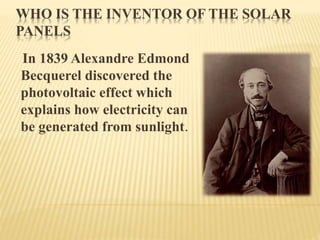
In 1839 Alexandre Edmond
Becquerel discovered the
photovoltaic effect which
explains how electricity can
be generated from sunlight.
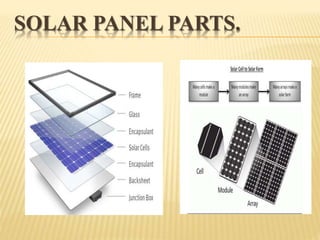
SOLAR PANEL PARTS.
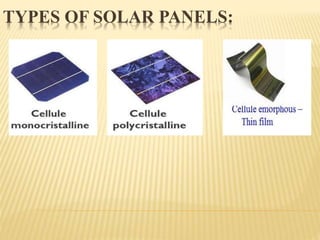
TYPES OF SOLAR PANELS:
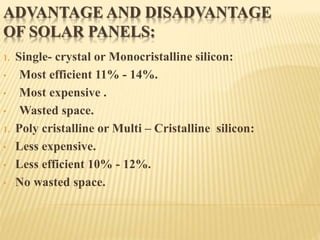
ADVANTAGE AND DISADVANTAGE
OF SOLAR PANELS:
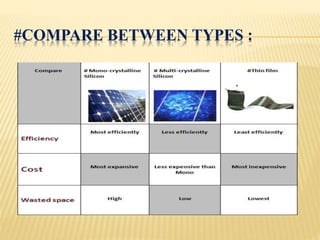
1. Single- crystal or Monocristalline silicon:
• Most efficient 11% - 14%.
• Most expensive .
• Wasted space.
1. Poly cristalline or Multi – Cristalline silicon:
• Less expensive.
• Less efficient 10% - 12%.
• No wasted space.
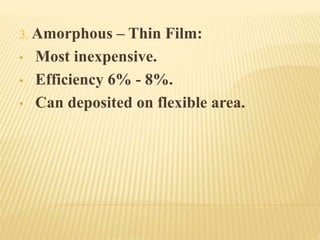
3. Amorphous – Thin Film:
• Most inexpensive.
• Efficiency 6% - 8%.
• Can deposited on flexible area.
#COMPARE BETWEEN TYPES :
HOW IT WORK?
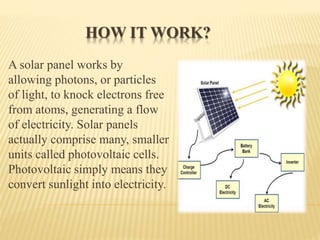
A solar panel works by
allowing photons, or particles
of light, to knock electrons free
from atoms, generating a flow
of electricity. Solar panels
actually comprise many, smaller
units called photovoltaic cells.
Photovoltaic simply means they
convert sunlight into electricity.
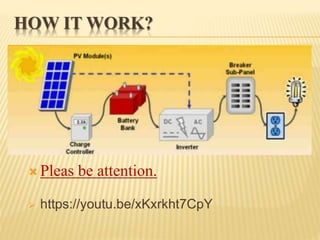
HOW IT WORK?
 Pleas be attention.
 https://youtu.be/xKxrkht7CpY
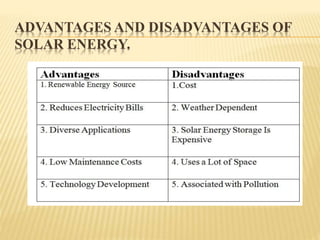
ADVANTAGES AND DISADVANTAGES OF
SOLAR ENERGY.
REVIEW
Solar Energy 034
Solar Energy 034

Solar Energy 034

  • 2.
    • Introduction. • Solarpanel parts. • Types of solar panels. • Advantage and disadvantage of solar panels. • How it work? • Advantages And Disadvantages of Solar Energy. • Summary.
  • 3.
    INTRODUCTION  Solar energyis radiant light and heat from the Sun harnessed using a range of ever-evolving technologies such as solar heating, photovoltaics, solar thermal energy, solar architecture and artificial photosynthesis. It is an important source of renewable energy and its technologies are broadly characterized as either passive solar or active solar depending on the way they capture and distribute solar energy or convert it into solar power. Active solar techniques include the use of photovoltaic systems, concentrated solar power and solar water heating to harness the energy. Passive solar techniques include orienting a building to the Sun, selecting materials with favorable thermal mass or light dispersing properties, and designing spaces that naturally circulate air. The large magnitude of solar energy available makes it a highly appealing source of electricity.
  • 4.
    WHO IS THEINVENTOR OF THE SOLAR PANELS In 1839 Alexandre Edmond Becquerel discovered the photovoltaic effect which explains how electricity can be generated from sunlight.
  • 5.
  • 6.
  • 7.
    ADVANTAGE AND DISADVANTAGE OFSOLAR PANELS: 1. Single- crystal or Monocristalline silicon: • Most efficient 11% - 14%. • Most expensive . • Wasted space. 1. Poly cristalline or Multi – Cristalline silicon: • Less expensive. • Less efficient 10% - 12%. • No wasted space.
  • 8.
    3. Amorphous –Thin Film: • Most inexpensive. • Efficiency 6% - 8%. • Can deposited on flexible area.
  • 9.
  • 10.
    HOW IT WORK? Asolar panel works by allowing photons, or particles of light, to knock electrons free from atoms, generating a flow of electricity. Solar panels actually comprise many, smaller units called photovoltaic cells. Photovoltaic simply means they convert sunlight into electricity.
  • 11.
    HOW IT WORK? Pleas be attention.  https://youtu.be/xKxrkht7CpY
  • 12.
  • 13.