How to Design Solar PV System
What is solar PV system?
Solar photovoltaic system
• One of renewable energy system which uses PV modules to convert sunlight into electricity.
• The electricity generated can be either stored or used directly, fed back into grid line or combined with
one or more other electricity generators or more renewable energy source.
• Solar PV system is very reliable and clean source of electricity that can suit a wide range of
applications such as residence, industry, agriculture, livestock, etc.
Major system components
Solar PV system components -- selected according to system type, site
location and applications.
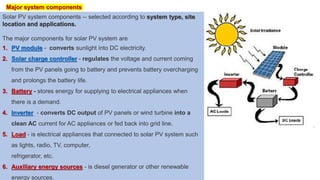
The major components for solar PV system are
1. PV module - converts sunlight into DC electricity.
2. Solar charge controller - regulates the voltage and current coming
from the PV panels going to battery and prevents battery overcharging
and prolongs the battery life.
3. Battery - stores energy for supplying to electrical appliances when
there is a demand.
4. Inverter - converts DC output of PV panels or wind turbine into a
clean AC current for AC appliances or fed back into grid line.
5. Load - is electrical appliances that connected to solar PV system such
as lights, radio, TV, computer,
refrigerator, etc.
6. Auxiliary energy sources - is diesel generator or other renewable
energy sources.
Load Estimation
Determine power consumption demands
a) The total energy requirement of the system (total load) i.e Total connected load to PV panel
system
= No. of units × rating of equipment
= (2 × 18) + (2 × 60)
= 156 watts
b) Total watt -hours rating of the system
= Total connected load (watts) × Operating hours
= 156 × 6 = 936 watt-hours
Base condition: 2 CFLs(18 watts each),2 fans (60 watts each) for 6hrs a day
SOLAR PV SYSTEM DESIGN
ASSUMPTIONS TAKEN FOR DESIGN
1. Inverter converts DC into AC power with efficiency of about 90%.
2. Battery voltage used for operation = 12 volts
3. The combined efficiency of inverter and battery will be calculated as :
combined efficiency = inverter efficiency × battery efficiency
=0.9 × 0.9 = 0.81 = 81%
4. Sunlight available in a day = 8 hours/day (equivalent of peak radiation.
5. Operation of lights and fan = 6 hours/day of PV panels.
6. PV panel power rating = 40 Wp (Wp, meaning, watt (peak), gives only peak power output of a PV panel)
7. A factor called „ operating factor‟ is used to estimate the actual output from a PV module.
[The operating factor between 0.60 and 0.90 (implying the output power is 60 to 90% lower than rated output
power) in normal operating conditions, depending on temperature, dust on module, etc.]
Estimation of
battery bank
Inverter size is to be calculated as:
1. Total connected load to PV panel system = 156 watts
2. Inverter are available with rating of 100, 200, 500 VA, etc.
3. Therefore, the choice of the inverter should be 200 VA.
Cost estimation of
the system
a)Cost of arrays
= No. of PV modules × Cost/Module
= 5 × 8000 (for a 40 Wp panel @ Rs.200/Wp)
= Rs.40000
(b)Cost of batteries
= No. of Batteries × Cost/Module
=1 × 7500= Rs.7500
(c)Cost of Inverter
= No. of inverters × Cost/Inverter
= 1 × 5000=1 × 5000=Rs.5000
Total cost of system
= A + B + C
= 40000 + 7500 + 5000
=Rs.52500
[Additional cost of wiring may
be taken as 5% of total system
cost]
Estimation of
number of PV
panels
c) Actual power output of a PV panel
=Peak power rating × operating factor
= 40 × 0.75 = 30 watt
d) The power used at the end use is less (due to lower
combined efficiency of the system)
= Actual power output of a panel × combined efficiency
=30 × 0.81 = 24.3 watts (VA) 𝜂𝑖 + 𝜂𝑏
= 24.3 watts
e) Energy produced by one 40 Wp panel in a day
= Actual power output × 8 hours/day (peak
equivalent)
= 24.3 × 8 = 194.4 watts-hour
f) Number of solar panels required to satisfy given
estimated daily load :
= (Total watt-hour rating (daily load)/(Daily energy
produced by a panel)
=936/194.4 = 4.81 = 5 (round figure)
0.6 − 0.9

solar PV design.pptx

  • 2.
    How to DesignSolar PV System What is solar PV system? Solar photovoltaic system • One of renewable energy system which uses PV modules to convert sunlight into electricity. • The electricity generated can be either stored or used directly, fed back into grid line or combined with one or more other electricity generators or more renewable energy source. • Solar PV system is very reliable and clean source of electricity that can suit a wide range of applications such as residence, industry, agriculture, livestock, etc.
  • 3.
    Major system components SolarPV system components -- selected according to system type, site location and applications. The major components for solar PV system are 1. PV module - converts sunlight into DC electricity. 2. Solar charge controller - regulates the voltage and current coming from the PV panels going to battery and prevents battery overcharging and prolongs the battery life. 3. Battery - stores energy for supplying to electrical appliances when there is a demand. 4. Inverter - converts DC output of PV panels or wind turbine into a clean AC current for AC appliances or fed back into grid line. 5. Load - is electrical appliances that connected to solar PV system such as lights, radio, TV, computer, refrigerator, etc. 6. Auxiliary energy sources - is diesel generator or other renewable energy sources.
  • 4.
    Load Estimation Determine powerconsumption demands a) The total energy requirement of the system (total load) i.e Total connected load to PV panel system = No. of units × rating of equipment = (2 × 18) + (2 × 60) = 156 watts b) Total watt -hours rating of the system = Total connected load (watts) × Operating hours = 156 × 6 = 936 watt-hours Base condition: 2 CFLs(18 watts each),2 fans (60 watts each) for 6hrs a day SOLAR PV SYSTEM DESIGN ASSUMPTIONS TAKEN FOR DESIGN 1. Inverter converts DC into AC power with efficiency of about 90%. 2. Battery voltage used for operation = 12 volts 3. The combined efficiency of inverter and battery will be calculated as : combined efficiency = inverter efficiency × battery efficiency =0.9 × 0.9 = 0.81 = 81% 4. Sunlight available in a day = 8 hours/day (equivalent of peak radiation. 5. Operation of lights and fan = 6 hours/day of PV panels. 6. PV panel power rating = 40 Wp (Wp, meaning, watt (peak), gives only peak power output of a PV panel) 7. A factor called „ operating factor‟ is used to estimate the actual output from a PV module. [The operating factor between 0.60 and 0.90 (implying the output power is 60 to 90% lower than rated output power) in normal operating conditions, depending on temperature, dust on module, etc.]
  • 5.
    Estimation of battery bank Invertersize is to be calculated as: 1. Total connected load to PV panel system = 156 watts 2. Inverter are available with rating of 100, 200, 500 VA, etc. 3. Therefore, the choice of the inverter should be 200 VA. Cost estimation of the system a)Cost of arrays = No. of PV modules × Cost/Module = 5 × 8000 (for a 40 Wp panel @ Rs.200/Wp) = Rs.40000 (b)Cost of batteries = No. of Batteries × Cost/Module =1 × 7500= Rs.7500 (c)Cost of Inverter = No. of inverters × Cost/Inverter = 1 × 5000=1 × 5000=Rs.5000 Total cost of system = A + B + C = 40000 + 7500 + 5000 =Rs.52500 [Additional cost of wiring may be taken as 5% of total system cost] Estimation of number of PV panels c) Actual power output of a PV panel =Peak power rating × operating factor = 40 × 0.75 = 30 watt d) The power used at the end use is less (due to lower combined efficiency of the system) = Actual power output of a panel × combined efficiency =30 × 0.81 = 24.3 watts (VA) 𝜂𝑖 + 𝜂𝑏 = 24.3 watts e) Energy produced by one 40 Wp panel in a day = Actual power output × 8 hours/day (peak equivalent) = 24.3 × 8 = 194.4 watts-hour f) Number of solar panels required to satisfy given estimated daily load : = (Total watt-hour rating (daily load)/(Daily energy produced by a panel) =936/194.4 = 4.81 = 5 (round figure) 0.6 − 0.9