Least Developed Countries Expert Group (LEG)
LEG regional training workshop on national adaptation plans (NAPs) for Asia
13 to 16 June 2017
Manila, Philippines
Identifying systems for assessment: a demo using
Food Security
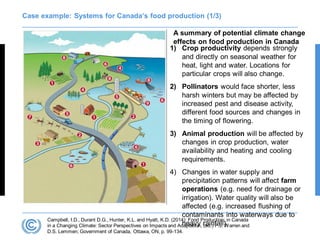
Case example: Systems for Canada’s food production (1/3)
A summary of potential climate change
effects on food production in Canada
Campbell, I.D., Durant D.G., Hunter, K.L. and Hyatt, K.D. (2014): Food Production; in Canada
in a Changing Climate: Sector Perspectives on Impacts and Adaptation, (ed.) F.J. Warren and
D.S. Lemmen; Government of Canada, Ottawa, ON, p. 99-134.
1) Crop productivity depends strongly
and directly on seasonal weather for
heat, light and water. Locations for
particular crops will also change.
2) Pollinators would face shorter, less
harsh winters but may be affected by
increased pest and disease activity,
different food sources and changes in
the timing of flowering.
3) Animal production will be affected by
changes in crop production, water
availability and heating and cooling
requirements.
4) Changes in water supply and
precipitation patterns will affect farm
operations (e.g. need for drainage or
irrigation). Water quality will also be
affected (e.g. increased flushing of
contaminants into waterways due to
heavy rainfall).
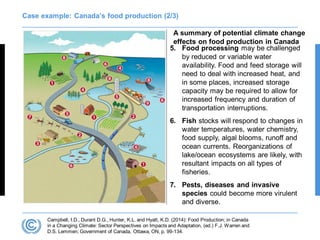
Case example: Canada’s food production (2/3)
A summary of potential climate change
effects on food production in Canada
Campbell, I.D., Durant D.G., Hunter, K.L. and Hyatt, K.D. (2014): Food Production; in Canada
in a Changing Climate: Sector Perspectives on Impacts and Adaptation, (ed.) F.J. Warren and
D.S. Lemmen; Government of Canada, Ottawa, ON, p. 99-134.
5. Food processing may be challenged
by reduced or variable water
availability. Food and feed storage will
need to deal with increased heat, and
in some places, increased storage
capacity may be required to allow for
increased frequency and duration of
transportation interruptions.
6. Fish stocks will respond to changes in
water temperatures, water chemistry,
food supply, algal blooms, runoff and
ocean currents. Reorganizations of
lake/ocean ecosystems are likely, with
resultant impacts on all types of
fisheries.
7. Pests, diseases and invasive
species could become more virulent
and diverse.
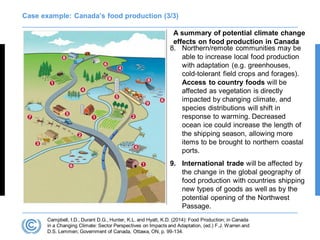
Case example: Canada’s food production (3/3)
A summary of potential climate change
effects on food production in Canada
Campbell, I.D., Durant D.G., Hunter, K.L. and Hyatt, K.D. (2014): Food Production; in Canada
in a Changing Climate: Sector Perspectives on Impacts and Adaptation, (ed.) F.J. Warren and
D.S. Lemmen; Government of Canada, Ottawa, ON, p. 99-134.
8. Northern/remote communities may be
able to increase local food production
with adaptation (e.g. greenhouses,
cold-tolerant field crops and forages).
Access to country foods will be
affected as vegetation is directly
impacted by changing climate, and
species distributions will shift in
response to warming. Decreased
ocean ice could increase the length of
the shipping season, allowing more
items to be brought to northern coastal
ports.
9. International trade will be affected by
the change in the global geography of
food production with countries shipping
new types of goods as well as by the
potential opening of the Northwest
Passage.
Characterizing each development theme
 Define each ‘theme’ in terms of its essential function(s), structure,
knowledge base, boundary, relationships with other systems,
applicable risk/vuln framework, and later, collection of main
adaptation solutions/options
 Lets consider examples for food security and water for a city/district
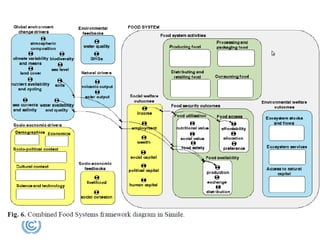
Food Security Example
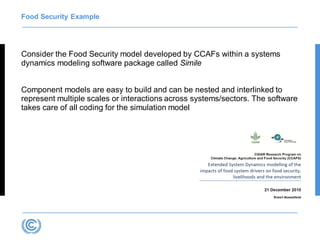
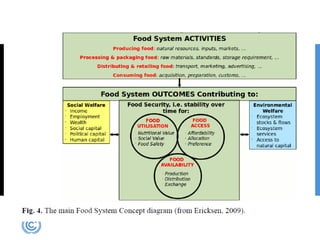
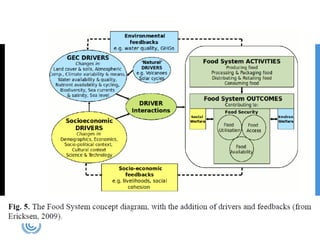
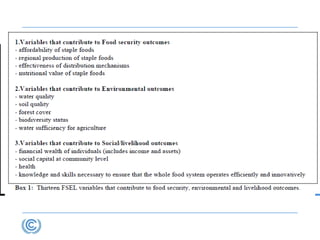
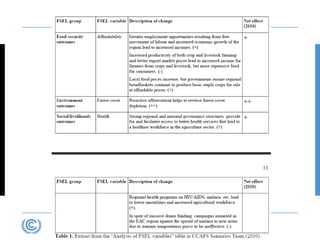
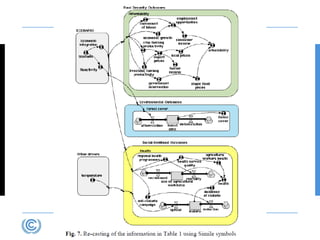
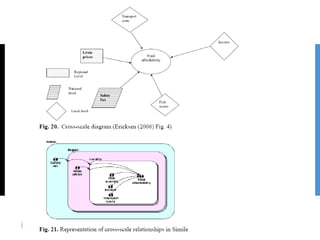
Consider the Food Security model developed by CCAFs within a systems
dynamics modeling software package called Simile
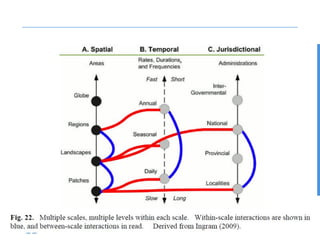
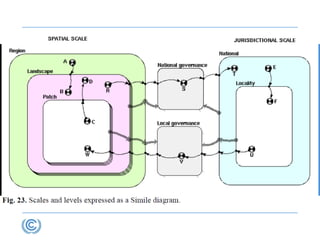
Component models are easy to build and can be nested and interlinked to
represent multiple scales or interactions across systems/sectors. The software
takes care of all coding for the simulation model
Can apply Systems Modeling …
Summary of Food Security case study
 The above case studies illustrates the approach for assembling an
integrated model that can be used to generate baseline and dynamic
outputs that would inform decision making and reporting, using the very
accessible Simile modeling platform
 Similar models exist and can be adjusted to other dynamic/interlinked
systems
 A fully integrated national system through a modeling approach is possible
through existing tools such as the Threshold 21 Model by the Millennium
Institute (iSDG Model is a version that is specific to generating SDG
indicators), or the International Futures system (IFs) by Barry Hughes of
University of Denver
Another simple example for a water supply system
• A water supply system can be simple – representing one source
and supplying users in a small city, or in many cases, can be
network of sources, often over great distances, with pipelines
transporting water from a river, dam or lake into one or several
treatment plants, then to various holding tanks for distribution to
different parts of a city.
• In some states (e.g. California), the whole system is a connected
network
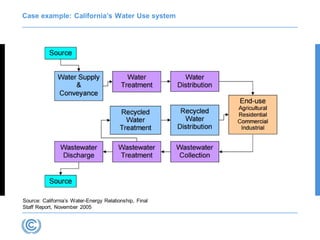
Case example: California’s Water Use system
Source: California’s Water-Energy Relationship, Final
Staff Report, November 2005
Source
Water Supply &
Conveyance
Water Treatment
Water
Distribution
End-use:
Agricultural, Residential,
Commercial, Industrial
Wastewater
Collection
Wasterwater
Treatment
Wastewater
Discharge
Source
Recycled Water
Treatment
Recycled Water
Distribution
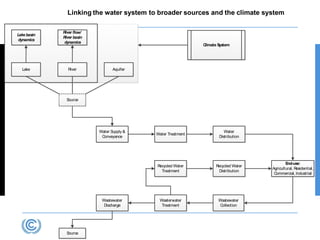
RiverLake Aquifer
Lake basin
dynamics
River flow/
River basin
dynamics
Climate System
Linking the water system to broader sources and the climate system
Contact:
Least Developed Countries Expert Group (LEG)
leghelp@unfccc.int

10. identifying systems for assessment a demo using food security

  • 1.
    Least Developed CountriesExpert Group (LEG) LEG regional training workshop on national adaptation plans (NAPs) for Asia 13 to 16 June 2017 Manila, Philippines Identifying systems for assessment: a demo using Food Security
  • 2.
    Case example: Systemsfor Canada’s food production (1/3) A summary of potential climate change effects on food production in Canada Campbell, I.D., Durant D.G., Hunter, K.L. and Hyatt, K.D. (2014): Food Production; in Canada in a Changing Climate: Sector Perspectives on Impacts and Adaptation, (ed.) F.J. Warren and D.S. Lemmen; Government of Canada, Ottawa, ON, p. 99-134. 1) Crop productivity depends strongly and directly on seasonal weather for heat, light and water. Locations for particular crops will also change. 2) Pollinators would face shorter, less harsh winters but may be affected by increased pest and disease activity, different food sources and changes in the timing of flowering. 3) Animal production will be affected by changes in crop production, water availability and heating and cooling requirements. 4) Changes in water supply and precipitation patterns will affect farm operations (e.g. need for drainage or irrigation). Water quality will also be affected (e.g. increased flushing of contaminants into waterways due to heavy rainfall).
  • 3.
    Case example: Canada’sfood production (2/3) A summary of potential climate change effects on food production in Canada Campbell, I.D., Durant D.G., Hunter, K.L. and Hyatt, K.D. (2014): Food Production; in Canada in a Changing Climate: Sector Perspectives on Impacts and Adaptation, (ed.) F.J. Warren and D.S. Lemmen; Government of Canada, Ottawa, ON, p. 99-134. 5. Food processing may be challenged by reduced or variable water availability. Food and feed storage will need to deal with increased heat, and in some places, increased storage capacity may be required to allow for increased frequency and duration of transportation interruptions. 6. Fish stocks will respond to changes in water temperatures, water chemistry, food supply, algal blooms, runoff and ocean currents. Reorganizations of lake/ocean ecosystems are likely, with resultant impacts on all types of fisheries. 7. Pests, diseases and invasive species could become more virulent and diverse.
  • 4.
    Case example: Canada’sfood production (3/3) A summary of potential climate change effects on food production in Canada Campbell, I.D., Durant D.G., Hunter, K.L. and Hyatt, K.D. (2014): Food Production; in Canada in a Changing Climate: Sector Perspectives on Impacts and Adaptation, (ed.) F.J. Warren and D.S. Lemmen; Government of Canada, Ottawa, ON, p. 99-134. 8. Northern/remote communities may be able to increase local food production with adaptation (e.g. greenhouses, cold-tolerant field crops and forages). Access to country foods will be affected as vegetation is directly impacted by changing climate, and species distributions will shift in response to warming. Decreased ocean ice could increase the length of the shipping season, allowing more items to be brought to northern coastal ports. 9. International trade will be affected by the change in the global geography of food production with countries shipping new types of goods as well as by the potential opening of the Northwest Passage.
  • 5.
    Characterizing each developmenttheme  Define each ‘theme’ in terms of its essential function(s), structure, knowledge base, boundary, relationships with other systems, applicable risk/vuln framework, and later, collection of main adaptation solutions/options  Lets consider examples for food security and water for a city/district
  • 6.
    Food Security Example Considerthe Food Security model developed by CCAFs within a systems dynamics modeling software package called Simile Component models are easy to build and can be nested and interlinked to represent multiple scales or interactions across systems/sectors. The software takes care of all coding for the simulation model
  • 9.
    Can apply SystemsModeling …
  • 17.
    Summary of FoodSecurity case study  The above case studies illustrates the approach for assembling an integrated model that can be used to generate baseline and dynamic outputs that would inform decision making and reporting, using the very accessible Simile modeling platform  Similar models exist and can be adjusted to other dynamic/interlinked systems  A fully integrated national system through a modeling approach is possible through existing tools such as the Threshold 21 Model by the Millennium Institute (iSDG Model is a version that is specific to generating SDG indicators), or the International Futures system (IFs) by Barry Hughes of University of Denver
  • 18.
    Another simple examplefor a water supply system • A water supply system can be simple – representing one source and supplying users in a small city, or in many cases, can be network of sources, often over great distances, with pipelines transporting water from a river, dam or lake into one or several treatment plants, then to various holding tanks for distribution to different parts of a city. • In some states (e.g. California), the whole system is a connected network
  • 19.
    Case example: California’sWater Use system Source: California’s Water-Energy Relationship, Final Staff Report, November 2005
  • 20.
    Source Water Supply & Conveyance WaterTreatment Water Distribution End-use: Agricultural, Residential, Commercial, Industrial Wastewater Collection Wasterwater Treatment Wastewater Discharge Source Recycled Water Treatment Recycled Water Distribution RiverLake Aquifer Lake basin dynamics River flow/ River basin dynamics Climate System Linking the water system to broader sources and the climate system
  • 21.
    Contact: Least Developed CountriesExpert Group (LEG) leghelp@unfccc.int