A Partnership of U.S. Federal, State and Tribal Fish and Wildlife
Agencies
with support from the
Association of Fish & Wildlife Agencies
Shared solutions to
protect shared values
1
Photos: Chase Fountain, James Jordan, George Andrejko
www.wildlifeadaptationstrategy.gov
National Fish, Wildlife and Plants Climate
Adaptation Strategy
A framework for
coordinated action by
multiple partners to
reduce risks and
impacts of climate
change on U.S. natural
resources and the
people that depend on
them.
2
Strategy Development
Response to:
1.Impacts to resources we depend on
2.Respond to calls for action
3.Need for coordination
Led by FWS, NOAA, & the States
1.Intergovernmental Steering Committee
2.Management Team
3.Technical Teams
3
Linkages with Other Efforts
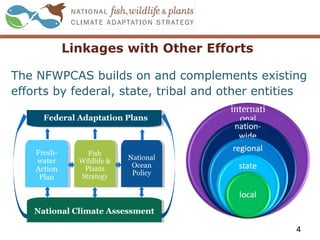
The NFWPCAS builds on and complements existing
efforts by federal, state, tribal and other entities
4
Federal Adaptation Plans
National Climate AssessmentNational Climate Assessment
Fresh-
water
Action
Plan
Fresh-
water
Action
Plan
National
Ocean
Policy
National
Ocean
Policy
Fish
Wildlife &
Plants
Strategy
Fish
Wildlife &
Plants
Strategy
Strategy Release
– Final Strategy Released
3.26.2013
– Federal Register
Announcement 4.1.2013
– Notification to partners and
stakeholders
5
Reactions and Impacts
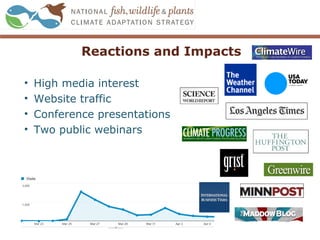
• High media interest
• Website traffic
• Conference presentations
• Two public webinars
Strategy Implementation
1. Five to ten-year time horizon
2. Agencies and partners incorporate appropriate
elements of Strategy in their plans and actions
3. Intergovernmental Working Group to Promote
Implementation
Result: Effective, well coordinated action by many
partners at across scales that increases resiliency
and adaptation
www.wildlifeadaptationstrategy.gov
7
Goals of the Strategy
1. Conserve and connect habitat
2. Manage species and habitats
3. Enhance management capacity
4. Support adaptive management
5. Increase knowledge and information
6. Increase awareness and motivate action
7. Reduce non-climate stressors
8
7 Goals
22 strategies
100+ actions
Progress Lists
Case studies
What You do is Really Important
9
1. Closest thing to geographically/taxonomically complete systematic
conservation planning in U.S.
2.Reviewed at reasonable interval (10 yrs)
3.Most appropriate level of government to influence local/regional
land use planning and decision-making
4.Demonstrated ability to target funding (public and private) to the
right places
5.Continued relevance requires treating climate change
6.Consistency = power
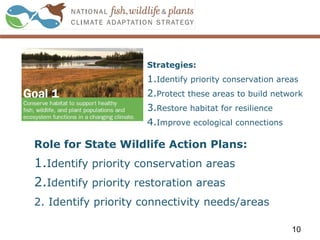
Strategies:
1.Identify priority conservation areas
2.Protect these areas to build network
3.Restore habitat for resilience
4.Improve ecological connections
10
Role for State Wildlife Action Plans:
1.Identify priority conservation areas
2.Identify priority restoration areas
2. Identify priority connectivity needs/areas
Strategies
1.Update species and habitat plans
2.Apply climate-smart management
3.Conserve genetic diversity
11
• Role for Action Plans
• Biggest species/habitat plan of all
• #1 Role model for other plans
• 2.1.1. Integrate climate change in revision
Strategies
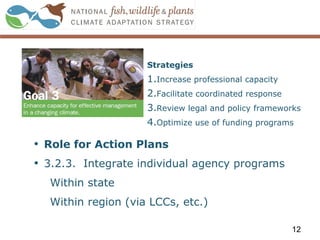
1.Increase professional capacity
2.Facilitate coordinated response
3.Review legal and policy frameworks
4.Optimize use of funding programs
12
• Role for Action Plans
• 3.2.3. Integrate individual agency programs
Within state
Within region (via LCCs, etc.)
Strategies
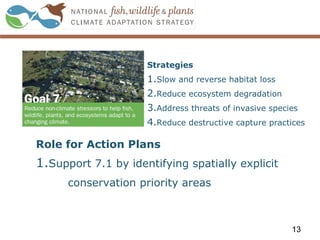
1.Slow and reverse habitat loss
2.Reduce ecosystem degradation
3.Address threats of invasive species
4.Reduce destructive capture practices
13
Role for Action Plans
1.Support 7.1 by identifying spatially explicit
conservation priority areas
Action Plans AND LCCs
14
Major role for LCCs in
implementation as “convener”
Major role for action plans as
“pilot”
Partners:
Washington Department of Fish & Wildlife, Bureau of Indian Affairs, Animal & Plant
Health Inspection Service, U.S. Department of Defense, Bureau of Land Management,
Bureau of Reclamation, Northwest Indian Fisheries Commission, National Park Service,
California Department of Fish & Game, Council on Environmental Quality, U.S. Geological
Survey, U.S. Environmental Protection Agency, North Carolina Wildlife Resources
Commission, Natural Resources Conservation Service, New York, Division of Fish,
Wildlife & Marine Resources, U.S. Army Corps of Engineers, Farm Service Agency, Tulalip
Tribe, U.S. Forest Service, Great Lakes Indian Fish & Wildlife Commission, Georgia
Department of Natural Resources, Florida Fish and Wildlife Conservation Commission,
West Virginia Division of Natural Resources, Maryland Department of Natural Resources,
Wildlife and Heritage Service, Massachusetts Division of Fisheries and Wildlife, Yakama
Nation, Wisconsin Department of Natural Resources, California Department of Forestry
and Fire Protection, Texas Parks and Wildlife Department, New Jersey Division of Fish
and Wildlife, Nevada Department of Wildlife, Oregon Department of State Lands,
Pennsylvania Fish and Boat Commission, Miccosukee Tribe, Columbia Intertribal Fish
Commission, Connecticut Department of Environmental Protection Inland Fisheries
Division, Passamaquoddy Tribe at Pleasant Point
Shared solutions to
protect shared values
15
Photos: Chase Fountain, James Jordan, George Andrejko
Shared solutions to protect
shared values
16
Photos: Chuck Olsen, Tom Woodward, Jane Pellicciotto, Lynette Schimming
www.wildlifeadaptationstrategy.gov

Shaffer, Climate Adaptation Strategy

  • 1.
    A Partnership ofU.S. Federal, State and Tribal Fish and Wildlife Agencies with support from the Association of Fish & Wildlife Agencies Shared solutions to protect shared values 1 Photos: Chase Fountain, James Jordan, George Andrejko www.wildlifeadaptationstrategy.gov
  • 2.
    National Fish, Wildlifeand Plants Climate Adaptation Strategy A framework for coordinated action by multiple partners to reduce risks and impacts of climate change on U.S. natural resources and the people that depend on them. 2
  • 3.
    Strategy Development Response to: 1.Impactsto resources we depend on 2.Respond to calls for action 3.Need for coordination Led by FWS, NOAA, & the States 1.Intergovernmental Steering Committee 2.Management Team 3.Technical Teams 3
  • 4.
    Linkages with OtherEfforts The NFWPCAS builds on and complements existing efforts by federal, state, tribal and other entities 4 Federal Adaptation Plans National Climate AssessmentNational Climate Assessment Fresh- water Action Plan Fresh- water Action Plan National Ocean Policy National Ocean Policy Fish Wildlife & Plants Strategy Fish Wildlife & Plants Strategy
  • 5.
    Strategy Release – FinalStrategy Released 3.26.2013 – Federal Register Announcement 4.1.2013 – Notification to partners and stakeholders 5
  • 6.
    Reactions and Impacts •High media interest • Website traffic • Conference presentations • Two public webinars
  • 7.
    Strategy Implementation 1. Fiveto ten-year time horizon 2. Agencies and partners incorporate appropriate elements of Strategy in their plans and actions 3. Intergovernmental Working Group to Promote Implementation Result: Effective, well coordinated action by many partners at across scales that increases resiliency and adaptation www.wildlifeadaptationstrategy.gov 7
  • 8.
    Goals of theStrategy 1. Conserve and connect habitat 2. Manage species and habitats 3. Enhance management capacity 4. Support adaptive management 5. Increase knowledge and information 6. Increase awareness and motivate action 7. Reduce non-climate stressors 8 7 Goals 22 strategies 100+ actions Progress Lists Case studies
  • 9.
    What You dois Really Important 9 1. Closest thing to geographically/taxonomically complete systematic conservation planning in U.S. 2.Reviewed at reasonable interval (10 yrs) 3.Most appropriate level of government to influence local/regional land use planning and decision-making 4.Demonstrated ability to target funding (public and private) to the right places 5.Continued relevance requires treating climate change 6.Consistency = power
  • 10.
    Strategies: 1.Identify priority conservationareas 2.Protect these areas to build network 3.Restore habitat for resilience 4.Improve ecological connections 10 Role for State Wildlife Action Plans: 1.Identify priority conservation areas 2.Identify priority restoration areas 2. Identify priority connectivity needs/areas
  • 11.
    Strategies 1.Update species andhabitat plans 2.Apply climate-smart management 3.Conserve genetic diversity 11 • Role for Action Plans • Biggest species/habitat plan of all • #1 Role model for other plans • 2.1.1. Integrate climate change in revision
  • 12.
    Strategies 1.Increase professional capacity 2.Facilitatecoordinated response 3.Review legal and policy frameworks 4.Optimize use of funding programs 12 • Role for Action Plans • 3.2.3. Integrate individual agency programs Within state Within region (via LCCs, etc.)
  • 13.
    Strategies 1.Slow and reversehabitat loss 2.Reduce ecosystem degradation 3.Address threats of invasive species 4.Reduce destructive capture practices 13 Role for Action Plans 1.Support 7.1 by identifying spatially explicit conservation priority areas
  • 14.
    Action Plans ANDLCCs 14 Major role for LCCs in implementation as “convener” Major role for action plans as “pilot”
  • 15.
    Partners: Washington Department ofFish & Wildlife, Bureau of Indian Affairs, Animal & Plant Health Inspection Service, U.S. Department of Defense, Bureau of Land Management, Bureau of Reclamation, Northwest Indian Fisheries Commission, National Park Service, California Department of Fish & Game, Council on Environmental Quality, U.S. Geological Survey, U.S. Environmental Protection Agency, North Carolina Wildlife Resources Commission, Natural Resources Conservation Service, New York, Division of Fish, Wildlife & Marine Resources, U.S. Army Corps of Engineers, Farm Service Agency, Tulalip Tribe, U.S. Forest Service, Great Lakes Indian Fish & Wildlife Commission, Georgia Department of Natural Resources, Florida Fish and Wildlife Conservation Commission, West Virginia Division of Natural Resources, Maryland Department of Natural Resources, Wildlife and Heritage Service, Massachusetts Division of Fisheries and Wildlife, Yakama Nation, Wisconsin Department of Natural Resources, California Department of Forestry and Fire Protection, Texas Parks and Wildlife Department, New Jersey Division of Fish and Wildlife, Nevada Department of Wildlife, Oregon Department of State Lands, Pennsylvania Fish and Boat Commission, Miccosukee Tribe, Columbia Intertribal Fish Commission, Connecticut Department of Environmental Protection Inland Fisheries Division, Passamaquoddy Tribe at Pleasant Point Shared solutions to protect shared values 15 Photos: Chase Fountain, James Jordan, George Andrejko
  • 16.
    Shared solutions toprotect shared values 16 Photos: Chuck Olsen, Tom Woodward, Jane Pellicciotto, Lynette Schimming www.wildlifeadaptationstrategy.gov

Editor's Notes

  • #2 Thank you for the opportunity to meet with you today. We are very pleased to be here to provide some information on the National Fish Wildlife and Plant Climate Adaptation Strategy.
  • #3 First nation-wide adaptation strategy by federal, state, tribal partners Unified approaches at multiple scales Engage and empower multiple sectors Inspire and enable decision makers Effective action over the next 5 years to conserve fish, wildlife, plants in a changing climate. Purpose: to inspire and enable natural resource administrators, elected officials, and other decision makers to take action to adapt to a changing climate Audience: Primarily Federal, State, and Tribal natural resource decision-makers Non-govt decision-makers Decision-makers in other sectors
  • #4 Why Developed – in brief Impacts to natural systems we care about and depend on CONGRESSIONAL DIRECTIVE (FY2010 Appropriations Act Conference Report, Urges CEQ and DOI to Develop a national, government-wide strategy to address climate impacts on fish, wildlife, plants and associated ecological processes. ADMINISTRATION CALL FOR STRATEGY: The Interagency Climate Change Adaptation Task Force called for development of the NFWPCAS in its 2010 report to the President. MANY STAKEHOLDER CALLS FOR ACTION: There have been many calls for action from wide range of stakeholders and organizations from coalitions of hunting and fishing organizations to state and tribal organizations to AFWA We Need Coordinated Action (Changes happening over large scales, Impacts cross administrative boundaries, No entity can do it alone Effective responses require increased coordination) Developed by Steering Committee (15 Federal, 5 State, 2 Tribal Agencies) Management Team (FWS, NOAA, AFWA, GLIFWIC, BIA, CEQ) Technical Teams (90+ Researchers and Managers, 8 Teams (by ecosystem type) Federal, State, Tribal members Continuous engagement
  • #5 As most of you know, there have been a number of efforts over the past few years to help the federal government plan for climate change. The most comprehensive being Executive Order 13514, which requires each Federal agency to develop an adaptation plan that will address climate impacts to mission/programs/operations. These agency adaptation plans are being informed by cross-cutting, sector specific plans/strategies/policies, such as the FAP, NFWPCAS, and the NOP. National Action Plan for managing freshwater resources in a changing climate in order to assure adequate water supplies and protect water quality, human health, property, and aquatic ecosystems, released in October of 2011.   President Obama's National Ocean Policy includes a series of actions to address the Resiliency and Adaptation to Climate Change and Ocean Acidification, also just released. The NFWPCAS is unique in that it is the only one of these planning efforts (outside the NCA – which is not a planning effort) that is truly NATIONAL in scope, with input and engagement from non-federal partners. Data and information reported by the National Climate Assessment provides the scientific basis for the development of actions in these plans, as well as various regional and state adaptation planning efforts.
  • #6 Proud to officially present the final NFWPCAS to this group. As you recall, was completed back in the fall, worked to get official clearance over the winter Received clearance in early March from the White House, worked through DOI and NOAA to publish as quickly as possible, in conjunction with the North American Wildlife and Natural Resources Conference Released via an official joint press release on March 26 Federal register announcement followed a few days later Notification was sent to all participating agencies and partners as well as stakeholders and the public
  • #7 Brief review of some of the reactions and input to date: Media coverage—quite a bit of coverage from national, regional, local media, blogs, etc., including feature on the weather channel Many of agency partners as well as NGOs linked to it, blogged about it, sent out announcements about it, etc. Website traffic – huge jump in visits around the release Presented at North American (announced that week) and at the NAF as well as numerous interagency workshops and meetings as requested Held two public webinars with very high interest and participation (close to 500 people have registered)
  • #8 Also through the development of an interagency implementation working group that is being developed to: Facilitate communication and collaboration Encourage adoption and implementation Promote coordinated and collaborative activities Identify mechanisms to assess and report on actions Guide updates or revisions of the Strategy Result: Effective, well coordinated action by many partners at across scales that increases resiliency and adaptation. Report on Strategy implementation progress. (Biennial; JIWG; first report due June 2015) Revised Strategy (Every four-five years in sync with NCA; JIWG; first revision due 2018).
  • #9 Strategy calls for seven overarching goals to help fish, wildlife, plants, and ecosystems cope with the impacts of climate change were developed collectively by diverse teams of federal, state, and tribal technical and management experts, based on existing research and understanding regarding the needs of fish, wildlife, and plants in the face of climate change. Each goal identifies a set of initial strategies and actions that should be taken or initiated over the next five to ten years. Part of the Goal of this discussion is to identify some priority science needs (data, models, tools, etc.) in the Strategy that USGCRP could help address. CLICK MOUSE Discussion of science and research needs and capacities are integrated throughout the report, but are especially emphasized under Goals 4 and 5.
  • #10 Strategy calls for seven overarching goals to help fish, wildlife, plants, and ecosystems cope with the impacts of climate change were developed collectively by diverse teams of federal, state, and tribal technical and management experts, based on existing research and understanding regarding the needs of fish, wildlife, and plants in the face of climate change. Each goal identifies a set of initial strategies and actions that should be taken or initiated over the next five to ten years. Part of the Goal of this discussion is to identify some priority science needs (data, models, tools, etc.) in the Strategy that USGCRP could help address. CLICK MOUSE Discussion of science and research needs and capacities are integrated throughout the report, but are especially emphasized under Goals 4 and 5.
  • #15 For discussion – what are the opportunities/challenges for collaboration with this group?