Dr.S.PRIYA, Asst Professor,
MG College
Thiruvananthapuram
Meaning
Strategic decision
making are decisions
that are made
according to a
company's goals or
mission. It takes
courage for a manager
to implement strategic
decision making.
These decisions could
take the company into
new directions that
may or may not
succeed.
Dr.S.PRIYA, Asst.Professor,MG College,
Thiruvananthapuram
Characteristics/Features of Strategic
Decisions
• Strategic decisions have major
resource propositions for an
organization. These decisions may be
concerned with possessing new
resources, organizing others or
reallocating others.
• Strategic decisions deal with
harmonizing organizational resource
capabilities with the threats and
opportunities.
• Strategic decisions deal with the range
of organizational activities. It is all
about what they want the organization
to be like and to be about.
• Strategic decisions involve a change of
major kind since an organization
operates in ever-changing
environment.
• Strategic decisions are complex in
nature.
• Strategic decisions are at the top most
level, are uncertain as they deal with
the future, and involve a lot of risk.
Dr.S.PRIYA, Asst.Professor,MG College,
Thiruvananthapuram
Dr.S.PRIYA, Asst.Professor,MG College,
Thiruvananthapuram
Mintzberg’s
Modes of
Strategic
Decision-
Making
Henry Mintzberg has
given three most typical
approaches of strategic decision
making which include:
1. Entrepreneurial mode
2. Adaptive mode
3. Planning mode
Dr.S.PRIYA, Asst.Professor,MG College,
Thiruvananthapuram
Entrepreneurial Mode
Strategy is made by one powerful individual who
has entrepreneurial competencies like innovation and risk
taking. The focus is on opportunities. Problems are
secondary. Generally the founder is the entrepreneur and
the strategy is guided by his or her own vision of direction
and is exemplified by bold decisions.
The success of Biocon India founded by Kiran
Mazumdur shaw is an example of this mode of strategic
decision making.
Dr.S.PRIYA, Asst.Professor,MG College,
Thiruvananthapuram
Adaptive Mode
Sometimes referred to as “muddling
through,” this decision-making mode is
characterized by reactive solutions to existing
problems, rather than a proactive search for new
opportunities. Much bargaining goes on
concerning priorities of objectives. Strategy is
fragmented and is developed to move the
corporation forward incrementally. This mode is
typical of most universities, many large hospitals
and a large number of governmental agencies.
Dr.S.PRIYA, Asst.Professor,MG College,
Thiruvananthapuram
Planning Mode
This decision making mode
involves the systematic gathering of
appropriate information for situation
analysis, the generation of feasible
alternative strategies, and the rational
selection of the most appropriate
strategy. It includes both the proactive
search for new opportunities and the
reactive solution of existing problems.
Dr.S.PRIYA, Asst.Professor,MG College,
Thiruvananthapuram
Strategic
Intent
Definition
Strategic Intent can be
understood as the philosophical base
of the strategic management
process. It implies the purpose,
which an organization endeavor of
achieving. It is a statement, that
provides a perspective of the means,
which will lead the organization,
reach the vision in the long run.
Dr.S.PRIYA, Asst.Professor,MG College,
Thiruvananthapuram
Strategic intent gives an idea of what
the organization desires to attain in future.
It answers the question what the
organization strives or stands for It
indicates the long-term market position,
which the organization desires to create or
occupy and the opportunity for exploring
new possibilities.
Dr.S.PRIYA, Asst.Professor,MG College,
Thiruvananthapuram
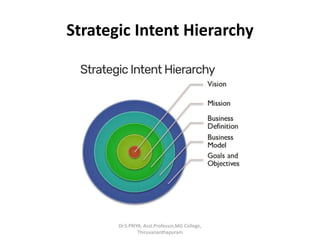
Strategic Intent Hierarchy
Dr.S.PRIYA, Asst.Professor,MG College,
Thiruvananthapuram
Vision
Vision implies the blueprint of the
company’s future position. It describes where
the organization wants to land. It is the dream of
the business and inspiration, base for the
planning process. It depicts the company’s
aspirations for the business and provides a peep
of what the organization would like to become
in future. Every single component of the
organization is required to follow its vision.
Dr.S.PRIYA, Asst.Professor,MG College,
Thiruvananthapuram
Mission
Mission delineates the firm’s business, its
goals and ways to reach the goals. It explains the
reason for the existence of the business. It is
designed to help potential shareholders and
investors understand the purpose of the
company. A mission statement helps to identify,
‘what business the company undertakes.’ It
defines the present capabilities, activities,
customer focus and business makeup.
Dr.S.PRIYA, Asst.Professor,MG College,
Thiruvananthapuram
Business Definition
It seeks to explain the business undertaken
by the firm, with respect to customer needs,
target audience, and alternative technologies.
With the help of business definition, one can
ascertain the strategic business choices. The
corporate restructuring also depends upon the
business definition.
Dr.S.PRIYA, Asst.Professor,MG College,
Thiruvananthapuram
Business Model
Business model, as the name implies is a
strategy for the effective operation of the
business, ascertaining sources of income,
desired customer base, and financing details.
Rival firms, operating in the same industry relies
on the different business model due to their
strategic choice.
Dr.S.PRIYA, Asst.Professor,MG College,
Thiruvananthapuram
Goals and Objectives
These are the base of measurement. Goals
are the end results, that the organization
attempts to achieve. On the other hand,
objectives are time-based measurable actions,
which help in the accomplishment of goals.
These are the end results which are to be
attained with the help of an overall plan, over
the particular period.
Dr.S.PRIYA, Asst.Professor,MG College,
Thiruvananthapuram
Thankyou
Dr.S.PRIYA, Asst.Professor,MG College,
Thiruvananthapuram

Strategic Decision Making

  • 1.
    Dr.S.PRIYA, Asst Professor, MGCollege Thiruvananthapuram
  • 2.
    Meaning Strategic decision making aredecisions that are made according to a company's goals or mission. It takes courage for a manager to implement strategic decision making. These decisions could take the company into new directions that may or may not succeed. Dr.S.PRIYA, Asst.Professor,MG College, Thiruvananthapuram
  • 3.
    Characteristics/Features of Strategic Decisions •Strategic decisions have major resource propositions for an organization. These decisions may be concerned with possessing new resources, organizing others or reallocating others. • Strategic decisions deal with harmonizing organizational resource capabilities with the threats and opportunities. • Strategic decisions deal with the range of organizational activities. It is all about what they want the organization to be like and to be about. • Strategic decisions involve a change of major kind since an organization operates in ever-changing environment. • Strategic decisions are complex in nature. • Strategic decisions are at the top most level, are uncertain as they deal with the future, and involve a lot of risk. Dr.S.PRIYA, Asst.Professor,MG College, Thiruvananthapuram
  • 4.
  • 5.
    Mintzberg’s Modes of Strategic Decision- Making Henry Mintzberghas given three most typical approaches of strategic decision making which include: 1. Entrepreneurial mode 2. Adaptive mode 3. Planning mode Dr.S.PRIYA, Asst.Professor,MG College, Thiruvananthapuram
  • 6.
    Entrepreneurial Mode Strategy ismade by one powerful individual who has entrepreneurial competencies like innovation and risk taking. The focus is on opportunities. Problems are secondary. Generally the founder is the entrepreneur and the strategy is guided by his or her own vision of direction and is exemplified by bold decisions. The success of Biocon India founded by Kiran Mazumdur shaw is an example of this mode of strategic decision making. Dr.S.PRIYA, Asst.Professor,MG College, Thiruvananthapuram
  • 7.
    Adaptive Mode Sometimes referredto as “muddling through,” this decision-making mode is characterized by reactive solutions to existing problems, rather than a proactive search for new opportunities. Much bargaining goes on concerning priorities of objectives. Strategy is fragmented and is developed to move the corporation forward incrementally. This mode is typical of most universities, many large hospitals and a large number of governmental agencies. Dr.S.PRIYA, Asst.Professor,MG College, Thiruvananthapuram
  • 8.
    Planning Mode This decisionmaking mode involves the systematic gathering of appropriate information for situation analysis, the generation of feasible alternative strategies, and the rational selection of the most appropriate strategy. It includes both the proactive search for new opportunities and the reactive solution of existing problems. Dr.S.PRIYA, Asst.Professor,MG College, Thiruvananthapuram
  • 9.
    Strategic Intent Definition Strategic Intent canbe understood as the philosophical base of the strategic management process. It implies the purpose, which an organization endeavor of achieving. It is a statement, that provides a perspective of the means, which will lead the organization, reach the vision in the long run. Dr.S.PRIYA, Asst.Professor,MG College, Thiruvananthapuram
  • 10.
    Strategic intent givesan idea of what the organization desires to attain in future. It answers the question what the organization strives or stands for It indicates the long-term market position, which the organization desires to create or occupy and the opportunity for exploring new possibilities. Dr.S.PRIYA, Asst.Professor,MG College, Thiruvananthapuram
  • 11.
    Strategic Intent Hierarchy Dr.S.PRIYA,Asst.Professor,MG College, Thiruvananthapuram
  • 12.
    Vision Vision implies theblueprint of the company’s future position. It describes where the organization wants to land. It is the dream of the business and inspiration, base for the planning process. It depicts the company’s aspirations for the business and provides a peep of what the organization would like to become in future. Every single component of the organization is required to follow its vision. Dr.S.PRIYA, Asst.Professor,MG College, Thiruvananthapuram
  • 13.
    Mission Mission delineates thefirm’s business, its goals and ways to reach the goals. It explains the reason for the existence of the business. It is designed to help potential shareholders and investors understand the purpose of the company. A mission statement helps to identify, ‘what business the company undertakes.’ It defines the present capabilities, activities, customer focus and business makeup. Dr.S.PRIYA, Asst.Professor,MG College, Thiruvananthapuram
  • 14.
    Business Definition It seeksto explain the business undertaken by the firm, with respect to customer needs, target audience, and alternative technologies. With the help of business definition, one can ascertain the strategic business choices. The corporate restructuring also depends upon the business definition. Dr.S.PRIYA, Asst.Professor,MG College, Thiruvananthapuram
  • 15.
    Business Model Business model,as the name implies is a strategy for the effective operation of the business, ascertaining sources of income, desired customer base, and financing details. Rival firms, operating in the same industry relies on the different business model due to their strategic choice. Dr.S.PRIYA, Asst.Professor,MG College, Thiruvananthapuram
  • 16.
    Goals and Objectives Theseare the base of measurement. Goals are the end results, that the organization attempts to achieve. On the other hand, objectives are time-based measurable actions, which help in the accomplishment of goals. These are the end results which are to be attained with the help of an overall plan, over the particular period. Dr.S.PRIYA, Asst.Professor,MG College, Thiruvananthapuram
  • 17.