By : Dr. Kriti Maheshwari
1st year Resident (M.D. DVL)
Methotrexate in Dermatology
 Structure : Methotrexate (4-amino-N10methyl
pteroylglutamic acid) is a potent competitive
antagonist (inhibitor) of the enzyme dihydrofolate
reductase. It is structurally similar to folic acid, the
natural substrate for this enzyme.
 Absorption and distribution:
- MTX can be administered orally, intravenously,
intramuscularly, or subcutaneously.
- Concurrent food intake, especially milk-based
meals, may reduce bioavailability in children.
However, in adults the drug is unaffected by
concurrent food ingestion.
- The drug is well distributed throughout the body
except in the brain, penetrating the blood–brain
barrier poorly
 Metabolism and Excretion :
- Once absorbed, the level of MTX in the plasma
has a triphasic reduction.
- The first phase occurs rapidly (0.75 h) and
reflects distribution of the drug throughout the
body.
- The second phase of the plasma level reduction
is represented by renal excretion and occurs over
2–4 hours.
- The third phase represents the terminal half-life
and varies between 10 and 27 hours. This phase
shows a slow release of MTX, primarily bound to
dihydrofolate reductase, from the tissues.
- 50% of MTX is bound to plasma proteins.
Mechanism Of Action
 DNA synthesis effects: inhibition of cell division being
specific for the S phase (DNA synthesis)
 T cell effects: blocks migration of activated T cells into
certain tissues
 Immunosuppresive effects : Suppresion of primary
and secodary antibody responses
 Anti inflammatory effects: mediated by adenosine
(which is anti inflammatory)
 Concurrent use of folic acid with MTX: controversial
role
- may decrease risk of GI side effects and
pancytopenia
Clinical Uses
 FDA Approved Indications :
- Psoriasis
- Sezary syndrome.
 Off label uses:
 Proliferative dermatoses : Pityriasis rubra pilaris, PLEVA, Reiter’s
disease
 Immunobullous dermatoses : Pemphigus vulgaris, Bullous
pemphigoid, Cicatricial pemphigoid, Epidermolysis bullosa acquisita.
 Autoimmune connective tissue diseases : Dermatomyositis,
Subacute cutaneous lupus erythematosus, Systemic lupus
erythematosus, Systemic scleroderma, Morphea/localized
scleroderma, Scleredema diabeticorum.
 Vasculitis – neutrophilic dermatoses : Leukocytoclastic vasculitis,
Cutaneous PAN, Behcet’s disease, Kawasaki disease, Pyoderma
gangrenosum.
 Dermatitis : Atopic dermatitis
Contraindications
 Absolute : Pregnancy (Category X), Lactation.
 Relative :
- Unreliable patients
- Decreased renal function
- DM, obesity
- Hepatic diseases: active hepatitis, cirrhosis, h/o
liver disease
- Severe haematological abnormality
- Man/ woman contemplating conception
- Active infection.
- Immunodeficiency syndromes.
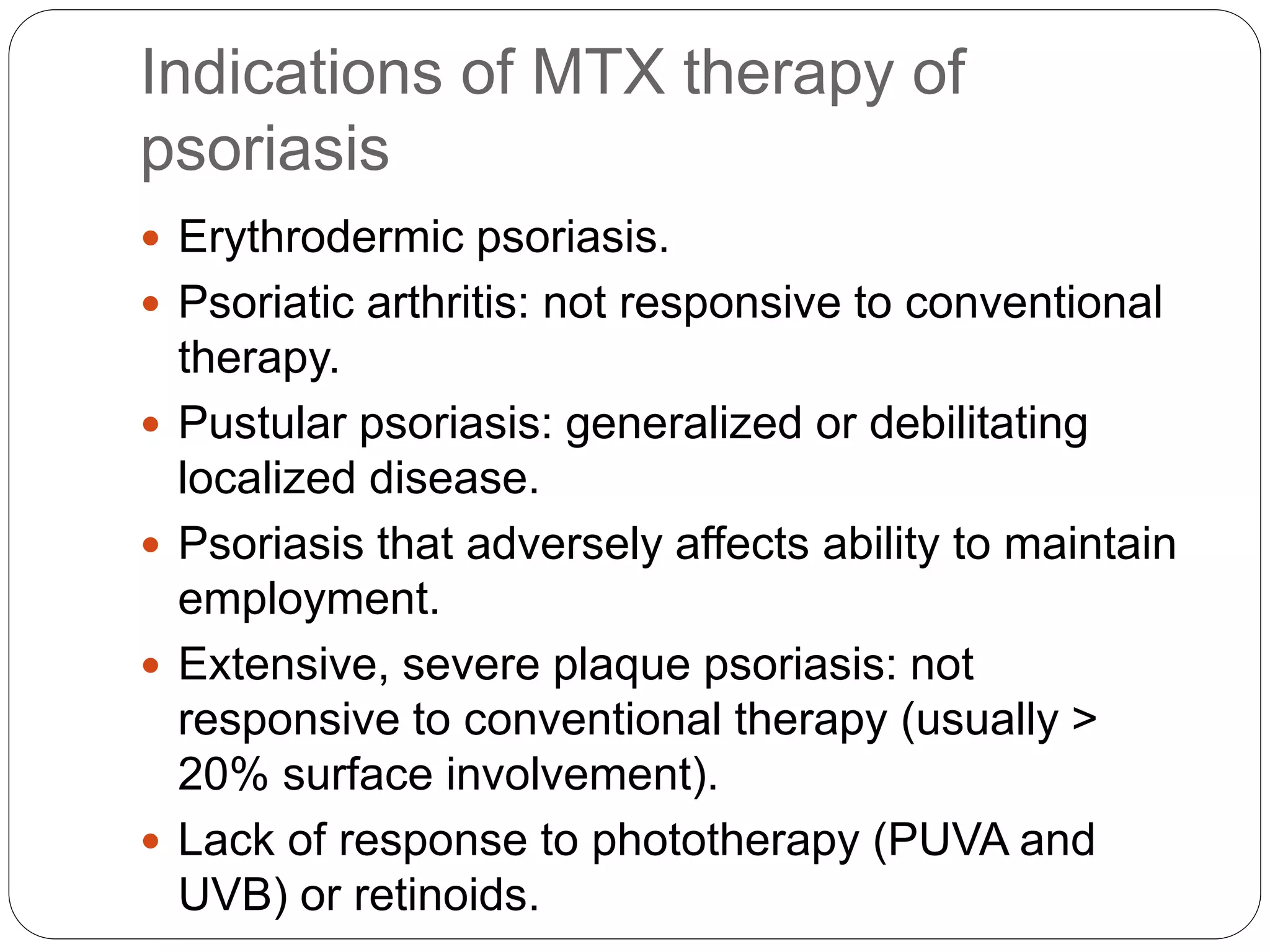
Indications of MTX therapy of
psoriasis
 Erythrodermic psoriasis.
 Psoriatic arthritis: not responsive to conventional
therapy.
 Pustular psoriasis: generalized or debilitating
localized disease.
 Psoriasis that adversely affects ability to maintain
employment.
 Extensive, severe plaque psoriasis: not
responsive to conventional therapy (usually >
20% surface involvement).
 Lack of response to phototherapy (PUVA and
UVB) or retinoids.
Adverse Effects
 Hepatotoxicity : PIIINP serum test to help assess
hepatic fibrosis
 Pulmonary toxicity – acute pneumonitis, pulmonary
fibrosis.
 Haematologic effects - pancytopenia
 Malignancy induction - lymphomas
 GI effects – diarrhoea, vomiting, ulcerative stomatitis
(Stop MTX)
 Potent teratogen and abortifacient
 Oligospermia
 Renal toxicity on high dose treatment
 Others: mild alopecia, headache, fatigue, dizziness,
potentially phototoxic.
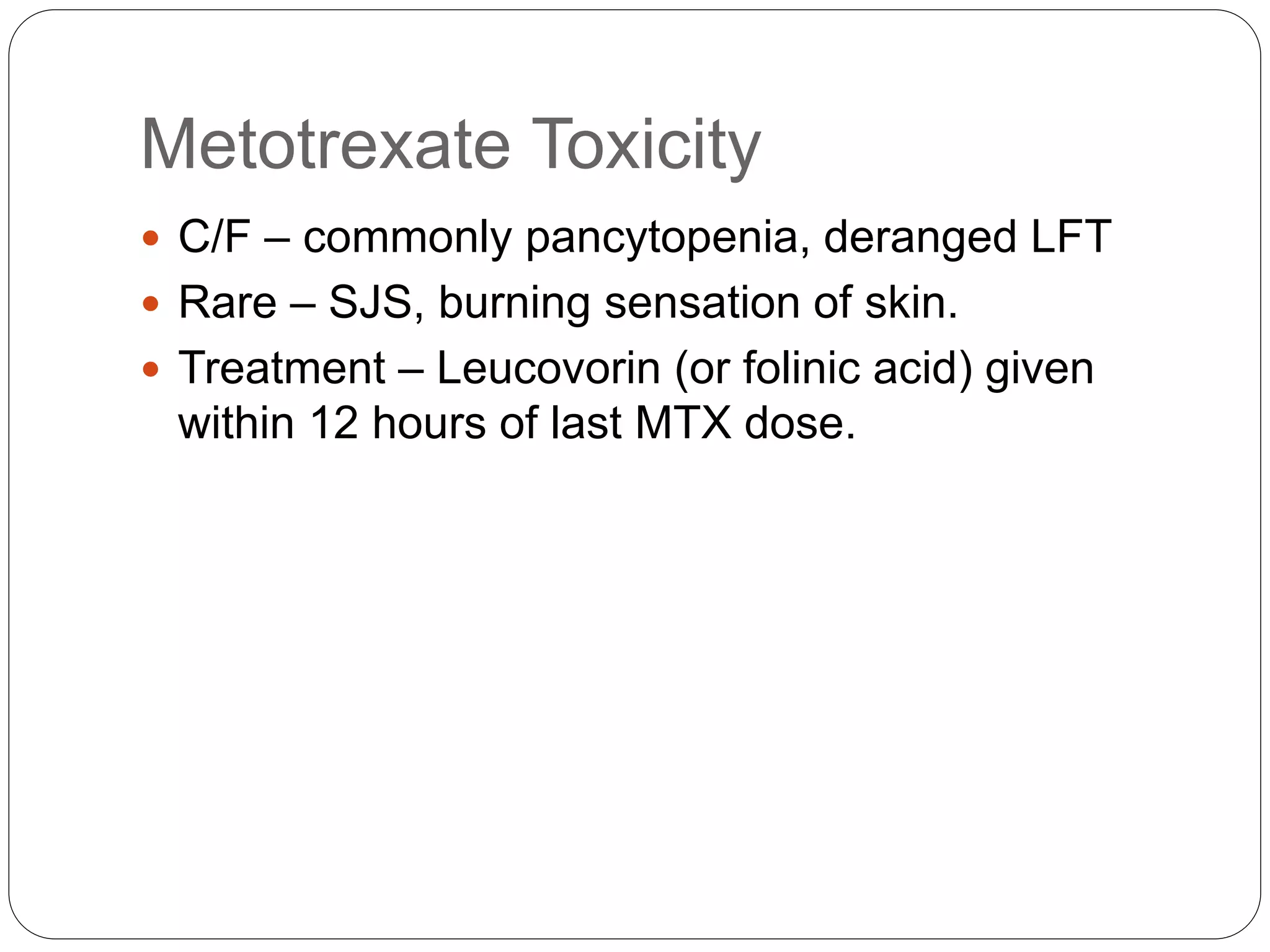
Metotrexate Toxicity
 C/F – commonly pancytopenia, deranged LFT
 Rare – SJS, burning sensation of skin.
 Treatment – Leucovorin (or folinic acid) given
within 12 hours of last MTX dose.
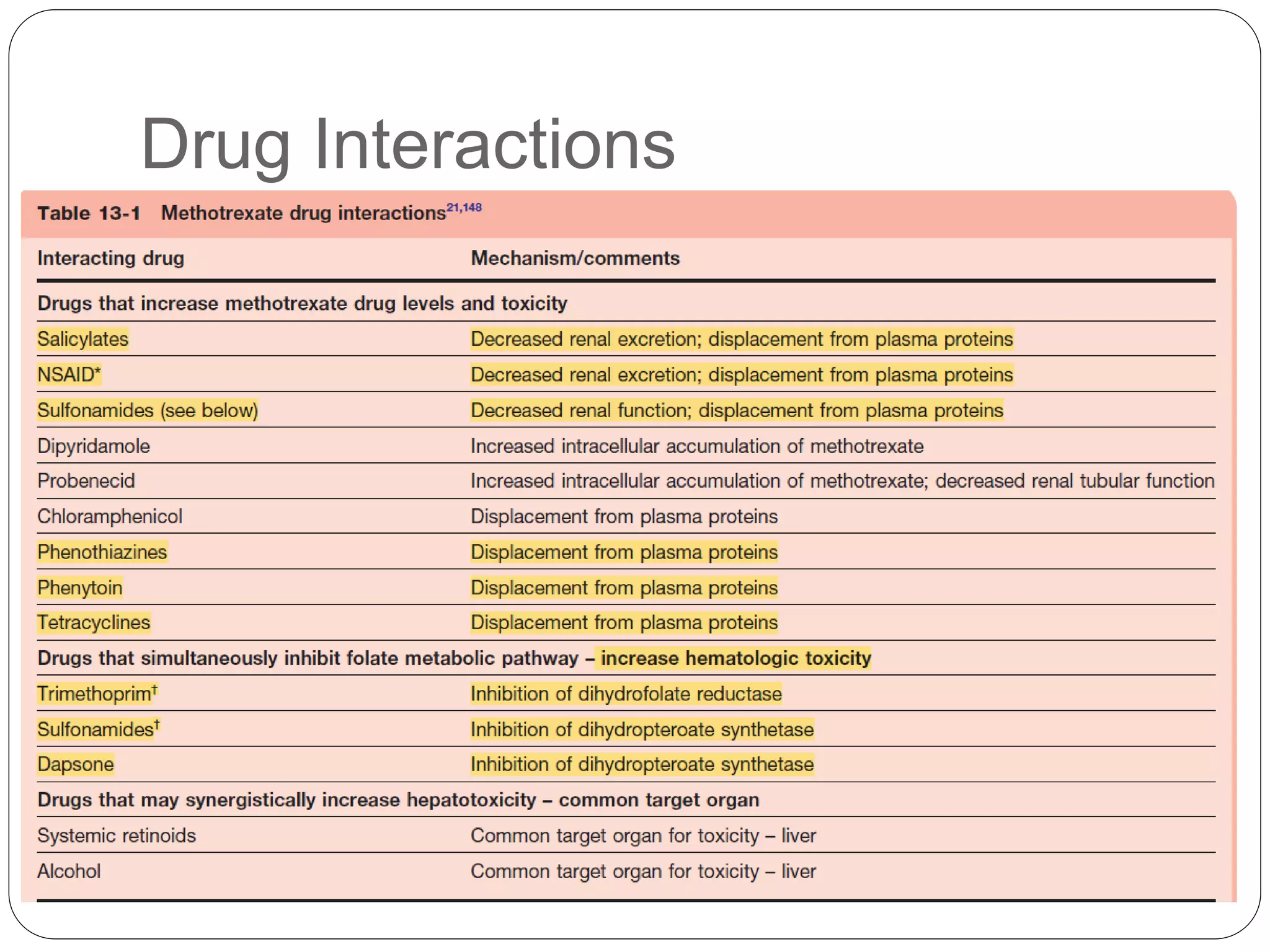
Drug Interactions
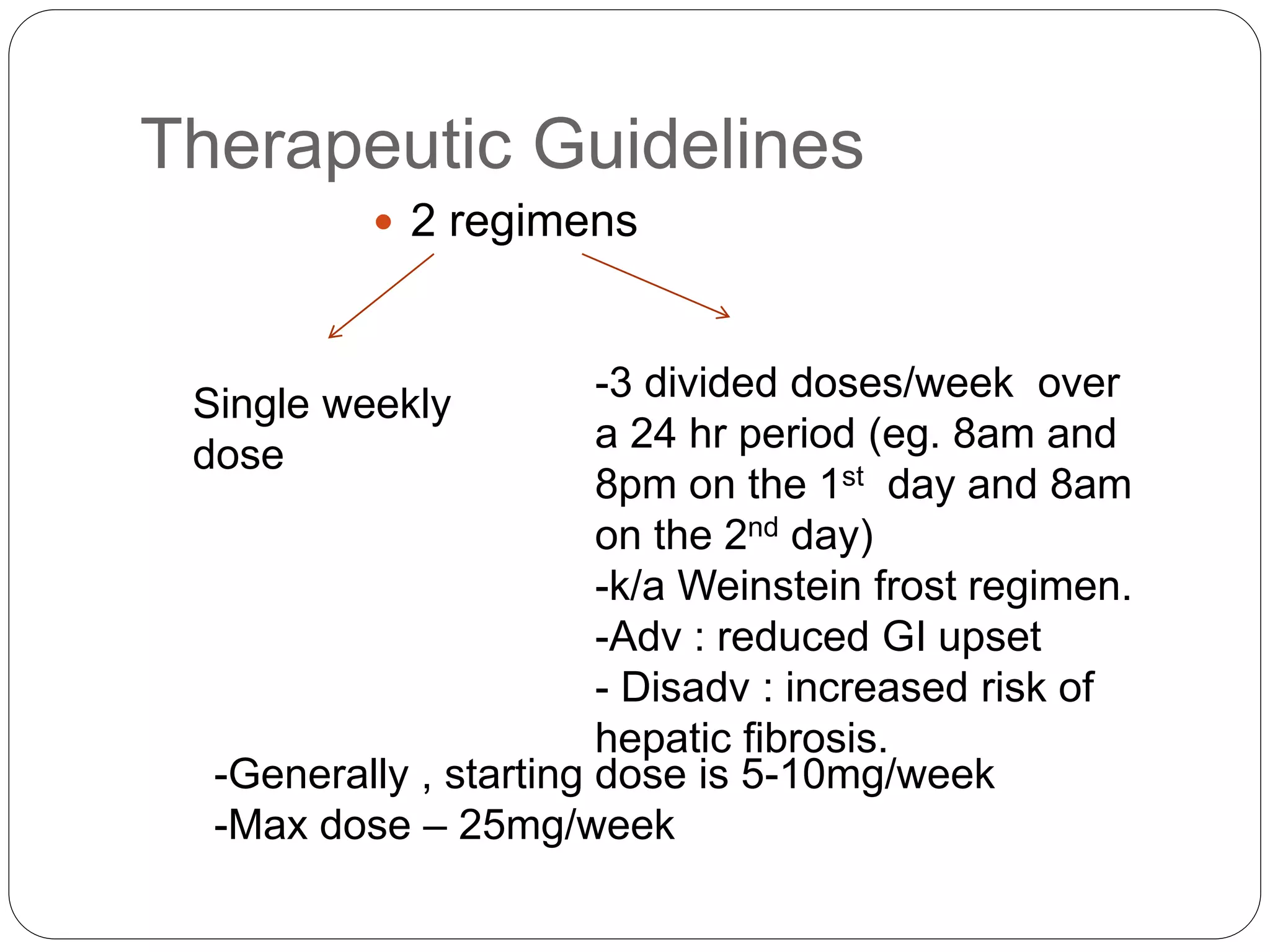
Therapeutic Guidelines
 2 regimens
Single weekly
dose
-3 divided doses/week over
a 24 hr period (eg. 8am and
8pm on the 1st day and 8am
on the 2nd day)
-k/a Weinstein frost regimen.
-Adv : reduced GI upset
- Disadv : increased risk of
hepatic fibrosis.
-Generally , starting dose is 5-10mg/week
-Max dose – 25mg/week
Other Antifolate agents
 Also act by inhibiting dihydrofolate reductase
(DHFR).
 Proguanil: Malaria - prevention and treatment
 Trimethoprim: treatment & prophylaxis
for pneumocystis jiroveci
pneumonia, malaria and toxoplasmosis.
 Pyrimethamine: used in malaria, toxoplasmosis
 Pemetrexed : used in non small cell lung
carcinoma and mesothelioma
Thank you

Methotrexate in dermatology

  • 1.
    By : Dr.Kriti Maheshwari 1st year Resident (M.D. DVL) Methotrexate in Dermatology
  • 2.
     Structure :Methotrexate (4-amino-N10methyl pteroylglutamic acid) is a potent competitive antagonist (inhibitor) of the enzyme dihydrofolate reductase. It is structurally similar to folic acid, the natural substrate for this enzyme.  Absorption and distribution: - MTX can be administered orally, intravenously, intramuscularly, or subcutaneously. - Concurrent food intake, especially milk-based meals, may reduce bioavailability in children. However, in adults the drug is unaffected by concurrent food ingestion. - The drug is well distributed throughout the body except in the brain, penetrating the blood–brain barrier poorly
  • 3.
     Metabolism andExcretion : - Once absorbed, the level of MTX in the plasma has a triphasic reduction. - The first phase occurs rapidly (0.75 h) and reflects distribution of the drug throughout the body. - The second phase of the plasma level reduction is represented by renal excretion and occurs over 2–4 hours. - The third phase represents the terminal half-life and varies between 10 and 27 hours. This phase shows a slow release of MTX, primarily bound to dihydrofolate reductase, from the tissues. - 50% of MTX is bound to plasma proteins.
  • 4.
    Mechanism Of Action DNA synthesis effects: inhibition of cell division being specific for the S phase (DNA synthesis)  T cell effects: blocks migration of activated T cells into certain tissues  Immunosuppresive effects : Suppresion of primary and secodary antibody responses  Anti inflammatory effects: mediated by adenosine (which is anti inflammatory)  Concurrent use of folic acid with MTX: controversial role - may decrease risk of GI side effects and pancytopenia
  • 5.
    Clinical Uses  FDAApproved Indications : - Psoriasis - Sezary syndrome.  Off label uses:  Proliferative dermatoses : Pityriasis rubra pilaris, PLEVA, Reiter’s disease  Immunobullous dermatoses : Pemphigus vulgaris, Bullous pemphigoid, Cicatricial pemphigoid, Epidermolysis bullosa acquisita.  Autoimmune connective tissue diseases : Dermatomyositis, Subacute cutaneous lupus erythematosus, Systemic lupus erythematosus, Systemic scleroderma, Morphea/localized scleroderma, Scleredema diabeticorum.  Vasculitis – neutrophilic dermatoses : Leukocytoclastic vasculitis, Cutaneous PAN, Behcet’s disease, Kawasaki disease, Pyoderma gangrenosum.  Dermatitis : Atopic dermatitis
  • 6.
    Contraindications  Absolute :Pregnancy (Category X), Lactation.  Relative : - Unreliable patients - Decreased renal function - DM, obesity - Hepatic diseases: active hepatitis, cirrhosis, h/o liver disease - Severe haematological abnormality - Man/ woman contemplating conception - Active infection. - Immunodeficiency syndromes.
  • 7.
    Indications of MTXtherapy of psoriasis  Erythrodermic psoriasis.  Psoriatic arthritis: not responsive to conventional therapy.  Pustular psoriasis: generalized or debilitating localized disease.  Psoriasis that adversely affects ability to maintain employment.  Extensive, severe plaque psoriasis: not responsive to conventional therapy (usually > 20% surface involvement).  Lack of response to phototherapy (PUVA and UVB) or retinoids.
  • 8.
    Adverse Effects  Hepatotoxicity: PIIINP serum test to help assess hepatic fibrosis  Pulmonary toxicity – acute pneumonitis, pulmonary fibrosis.  Haematologic effects - pancytopenia  Malignancy induction - lymphomas  GI effects – diarrhoea, vomiting, ulcerative stomatitis (Stop MTX)  Potent teratogen and abortifacient  Oligospermia  Renal toxicity on high dose treatment  Others: mild alopecia, headache, fatigue, dizziness, potentially phototoxic.
  • 9.
    Metotrexate Toxicity  C/F– commonly pancytopenia, deranged LFT  Rare – SJS, burning sensation of skin.  Treatment – Leucovorin (or folinic acid) given within 12 hours of last MTX dose.
  • 10.
  • 11.
    Therapeutic Guidelines  2regimens Single weekly dose -3 divided doses/week over a 24 hr period (eg. 8am and 8pm on the 1st day and 8am on the 2nd day) -k/a Weinstein frost regimen. -Adv : reduced GI upset - Disadv : increased risk of hepatic fibrosis. -Generally , starting dose is 5-10mg/week -Max dose – 25mg/week
  • 12.
    Other Antifolate agents Also act by inhibiting dihydrofolate reductase (DHFR).  Proguanil: Malaria - prevention and treatment  Trimethoprim: treatment & prophylaxis for pneumocystis jiroveci pneumonia, malaria and toxoplasmosis.  Pyrimethamine: used in malaria, toxoplasmosis  Pemetrexed : used in non small cell lung carcinoma and mesothelioma
  • 13.