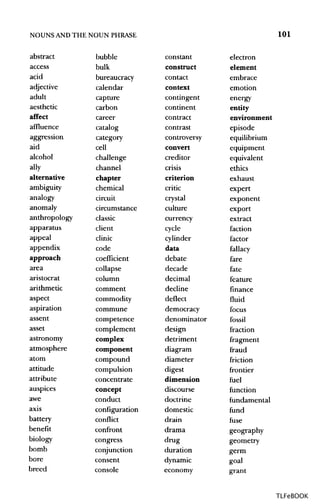
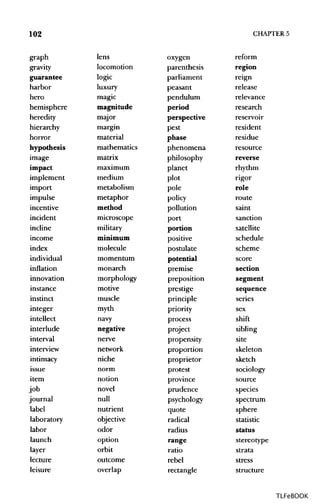
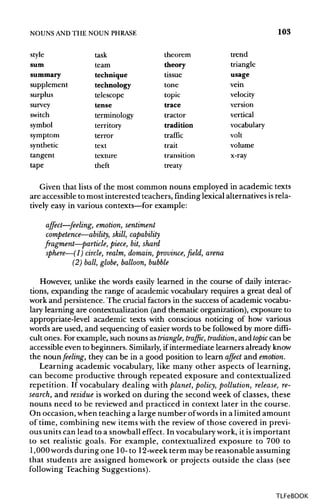
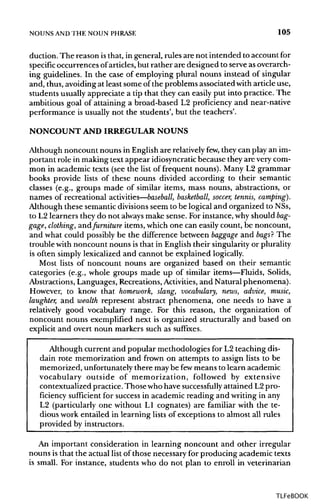
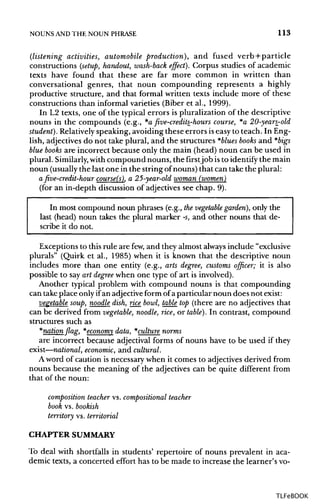
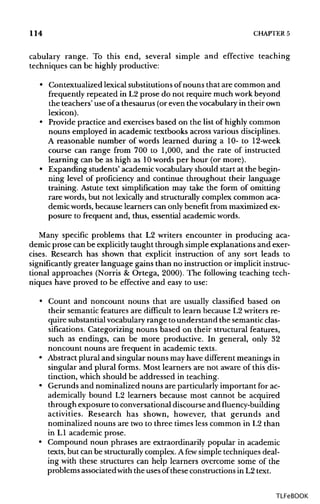
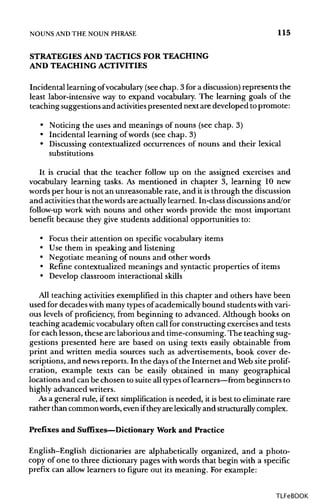
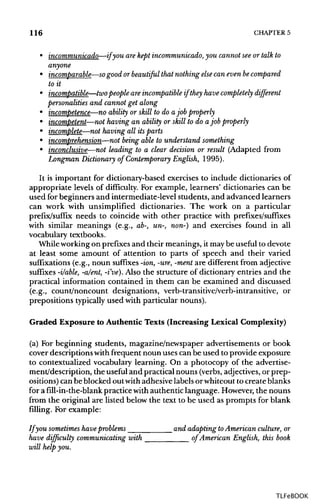
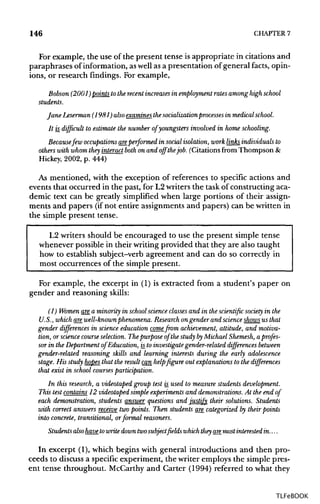
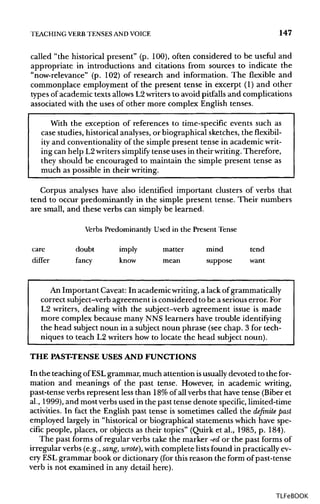
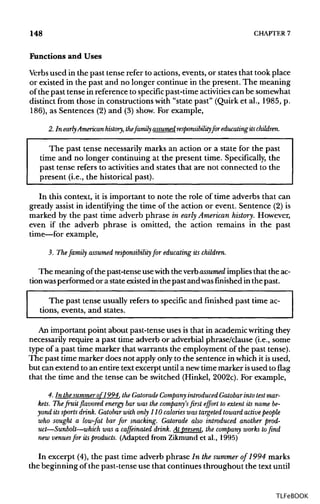
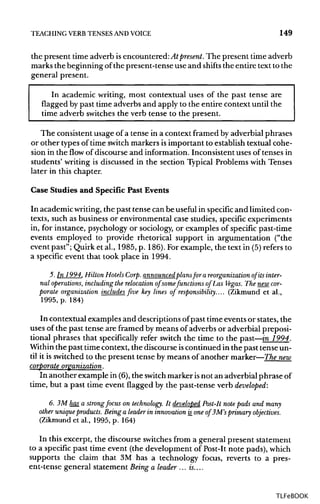
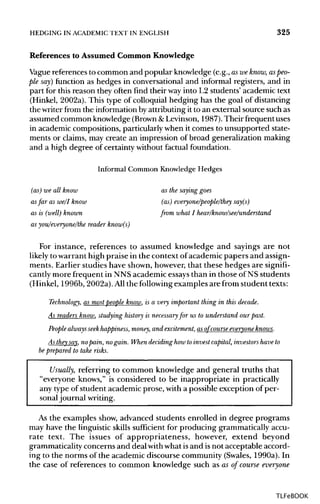
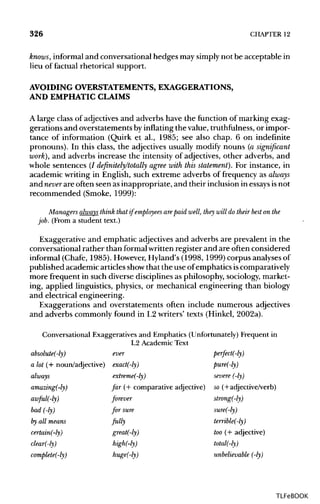
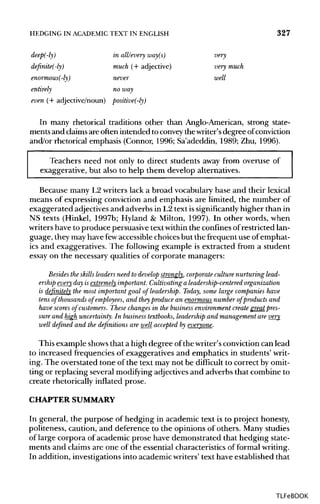
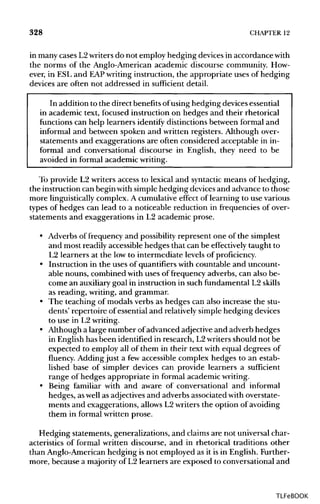
TLFeBOOK
TEACHINGACADEMIC
ESL WRITING
Practical Techniques in Vocabulary
and Grammar
TLFeBOOK
ESL & Applied Linguistics Professor Series
Eli Hinkel, Series Editor
Birch • English L2 Reading: Getting to the Bottom
Fotos/Browne • New Perspectives on CALLfor Second Language Classrooms
Hinkel • Second Language Writers' Text: Linguistic and Rhetorical Features
Hinkel • Teaching Academic ESL Writing: Practical Techniques in Vocabulary
and Grammar
Hinkel/Fotos, Eds. • New Perspectives on Grammar Teaching in Second
Language Classrooms
TLFeBOOK
Teaching Academic
ESL Writing
Practical Techniques inVocabulary
and Grammar
Eli Hinkel
Seattle University
LAWRENCE ERLBAUM ASSOCIATES, PUBLISHERS
2004 Mahwah, NewJersey London
TLFeBOOK
Copyright © 2004 by Lawrence Erlbaum Associates, Inc.
All rights reserved. No part of this book may be reproduced in any form, by
photostat, microform, retrieval system, or any other means, without prior
written permission of the publisher.
Lawrence Erlbaum Associates, Inc., Publishers
10 Industrial Avenue
Mahwah, NJ 07430
Cover design by Kathryn Houghtaling Lacey
Library of Congress Cataloging-in-Publication Data
Hinkel, Eli.
Teaching Academic ESL writing : practical techniques in vocabulary and
grammar / Eli Hinkel.
p. cm.
Includes bibliographical references and index.
ISBN 0-8058-3889-9 (cloth : alk. paper)
ISBN 0-8058-3890-2 (pbk. : alk. paper)
1.English language—Rehtoric—Study and teaching. 2. English language—
Study and teaching—Foreign speakers 3. Academic writing—Studying
and teaching. I. Title.
PE1404.H57 2003
808'042'071—dc21 2003046234
CIP
Books published by Lawrence Erlbaum Associates areprinted on acid-
free paper, and their bindings are chosen for strength and durability.
Printed in the United States of America
1 0 9 8 7 6 5 4 3 2 1
TLFeBOOK
To RH with love and gratitude
TLFeBOOK
This page intentionally left blank
TLFeBOOK
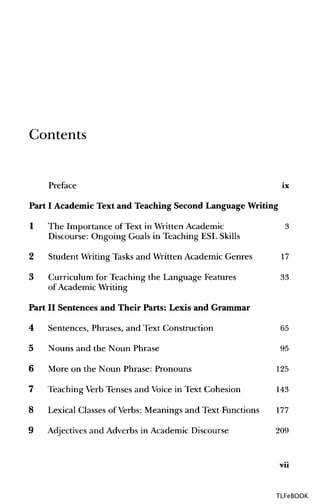
Contents
Preface ix
Part I Academic Text and Teaching Second Language Writing
1 The Importance of Text in WrittenAcademic 3
Discourse: Ongoing Goals in Teaching ESL Skills
2 Student WritingTasks and WrittenAcademic Genres 17
3 Curriculum for Teaching the Language Features 33
of AcademicWriting
Part II Sentences and Their Parts: Lexis and Grammar
4 Sentences, Phrases, and Text Construction 65
5 Nouns and the Noun Phrase 95
6 More on the Noun Phrase: Pronouns 125
7 Teaching Verb Tenses and Voice in Text Cohesion 143
8 Lexical Classesof Verbs: Meanings and Text Functions 177
9 Adjectives and Adverbs in Academic Discourse 209
vii
TLFeBOOK
viii CONTENTS
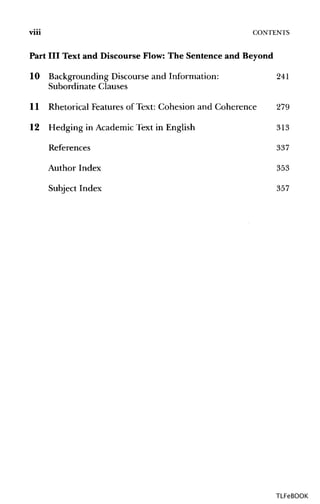
Part III Text and Discourse Flow: The Sentence and Beyond
10 Backgrounding Discourse and Information: 241
Subordinate Clauses
11 Rhetorical Features of Text: Cohesion and Coherence 279
12 Hedging in AcademicText in English 313
References 337
Author Index 353
Subject Index 357
TLFeBOOK
Preface
Language is power.
—Angela Carter
Power to the people.
—A slogan from the 1960s
Since the late 1970s and early 1980s, a great deal of time, energy, and re-
sources have been devoted to teaching non-native L2writers the rhetorical
features ofwritten academic discourse in English. In addition, to meet mar-
ket demands and the expectations of professional training and preparation
for English as a Second Language and English for Academic Purposes
teachers, teacher-training and graduate programs have set out to address
teachers' on-the-job skills that pertain to teaching L2 academicwritershow
to generate and organize ideas into coherent essays and compositions, asis
expected of practically all students at undergraduate and graduate levels.
There islittle doubt that L2writersneed to be familiar with many rhetor-
ical and discourse features of written English and that the teaching of col-
lege- or university-levelwriting cannot do without them. In teaching L2
writing to academicallybound learners, what has become of smaller impor-
tance, however,isthe language tools (i.e.,the grammar and vocabularythat
L2 writers must have to construct academic text, which in turn can be orga-
nized into a coherent written academic discourse). To put it plainly, no mat-
ter howwell discourse isorganized or howbrilliant the writer'sideas may be,
it would be hard to understand them if the language is opaque.
The purpose of this book is to bridge an important gap that exists in
teacher training today: the teaching of the second language and its gram-
matical and lexical features that are essential for any L2writingteacher and
student writer to know.The teaching ofrhetorical and discourse properties
of academic writingin English can be made far more effective and efficient
if L2 learners have language toolswithwhichto build the text. The ultimate
ix
TLFeBOOK
X PREFACE
goal of this book, however,is to benefit language learners who aspire to suc-
cess in academic degree programs beyond their ESL and Englishcourses.
Few EAPstudents set out to major in intensiveEnglish study and obtain de-
grees in English composition, and practically all have other educational,
professional, and career goals in mind.
This book deals with techniques for teaching L2 writing, grammar, and
lexis that can inform L2 instruction and effectively target specific areas of
L2 text that require substantial improvements. ESL teachers are usually
keenly aware of how short the course and class time are. The scope of mate-
rial is designed to be taught during one or, at most, twocourses at the high
intermediate and/or advanced levels of learner proficiency. In such courses,
the teacher's goal isusually to provide the critical preparation for students
who are almost ready to begin their studies in regular college and university
courses. Teaching strategies and techniques discussed here are based on a
highly practical principle of maximizing learners' language gains by em-
ploying a fewshortcuts. This book—based on current research and, in par-
ticular, a large-scale research of almost 1,500 NNS (non-native speakers)
essays (Hinkel, 2002a, Second Language Writers' Text: Linguistic and Rhetorical
Features, Lawrence Erlbaum) in addition to 25 years of ESL teaching and
teacher-training experience—workswith several sets of simple rules that
collectively can make a noticeable and important difference in the qualityof
NNS students' writing.
The philosophical goal of thisbook is to focus the attention of practicing
and preservice ESL/EAP teachers on the fact that without clear, reasonably
accurate, and coherent text, there can be no academic writing in a second
language. The practical and immediate purpose, however, is to provide a
compendium of teaching techniques for the grammatical and lexical fea-
tures ofacademic language that "every teacher (and student) mustknow."
Several key differences between this book and many other books on
teaching ESL should be highlighted:
• The decision about what a L2 writing course has to address and
what L2writersmust know isbased on the findings of research into
academic text and the text produced by L2 writers. Therefore, the
material sets out to address the gaps in current curricula for teach-
ing L2 writing. In addition, the aspects of L2 that are traditionally
included in L2 teaching, but hardly ever found in academic text,
are highlighted throughout the book.
• Becauseacademicvocabulary, the grammar offormal written English,
and specific features of academic prose represent integral aspects of
academic writing in a second language, curriculum and teaching
techniques presented in this book workwith these concurrently.
• The curriculum and itselements discussed herein are not based on
an incremental progression of material, such as "first, the course
TLFeBOOK
PREFACE xi
covers the present tense, then the present perfect tense, and then
the past tense." Although the curriculum is organized in a particu-
lar order, instruction on academic L2 writing and language has to
include all its elements. For this reason, the material and teaching
techniques discussed here can have a variety of logical organiza-
tional structures, all ofwhich could be more or less appropriate for
a specific course or particular group of studentsin a particular con-
text. It isa widely knownfact that fewESL teachers follow the order
of curriculum developed by someone else, and this book does not
expect to be an exception.
This book isoriented for teachers ofhigh intermediate and advanced ac-
ademic ESL students. One of its fundamental assumptions is that learning
towrite academic text in a second language takesa lot ofhard work,and that
for L2 academic writers, the foundations of language must be in place be-
fore they can begin to produce passable academic papers and assignments.
To this end, the teaching materials, teaching activities, and suggestions
for teaching are based on a single objective:The quality of language teach-
ing and student language learning must improve ifnon-nativewritersare to
succeed in their academic careers.
ORGANIZATION OF THEVOLUME
The volume is divided into three Parts. Part I begins with chapter 1, which
explains the importance of text in written academic discourse. It also pro-
vides a detailed overviewof the essential ESL skills that every student must
have to function in the academic milieu. Chapter 2 delves into the specific
student writing tasks that all students must face—and deal with—in their
studies in the disciplines. Chapter 3 presents the guidelines for a course
curriculum that addresses the specifics of academic vocabulary, grammar,
dealing with errors, teaching students to edit their text, and other funda-
mental writing skills essential for students' academic survival.
The chapters in Part II plowinto the nitty grittyof the classroom teaching
of language. This section begins in chapter 4 with a core and expanded
analysis of the English sentence structure to enable writers to construct rea-
sonably complete sentences and edit their owntext. The chapters on the es-
sential sentence elements largely follow the order of the sentence.Essential
academic nouns and the structure ofthe noun phrase are dealt within chap-
ter 5, followed by the place and types of pronouns in academic prose in
chapter 6. Chapter 7workswith the teaching of a limited range ofEnglish
verb tenses and the ever-important uses of the passive voice. Lexicaltypes
of foundational academic verbs and their textual functions are the focus of
chapter 8. The construction of adjective and adverb phrases, as well as the
essential adjective and adverb vocabulary,follow in chapter 9.
TLFeBOOK
xii PREFACE
The teaching of academic text building beyond the simple sentence is
the focus of Part III. Chapter 10 outlines instruction in the functions and
types of subordinate clauses: adverbial, adjective,and noun. In chapter 11,
the classroom teaching of elements of cohesion and coherence (a famously
neglected aspect of L2 writing instruction) is specifically addressed. Chap-
ter 12concludes with the teaching of hedges and their crucial functions in
academic text.
The three chapters in Part I are different from the rest of the chapters in the
book. Chapters 1and 2 are intended to provide the background for the restof
the volume, and chapter 3 presents a sample of course curriculum guidelines
to meet the learning needs of L2 teachers of writing and L2writers.
The chapters in Parts II and III include the keyelements of classroom
teaching: what should be taught and why, possible ways of teaching the
material in the classroom, common errors found in student text and ways
of teaching students to avoid them, teaching activities and suggestions
for teaching, and questions for discussion in a teacher-training course.
Appendixes included with the chapters provide supplementary word
and phrase lists, collocations, sentence chunks, and diagrams that teach-
ers can use as needed.
As with all the material in the book, suggestions for teaching and teach-
ing activitiesexemplified in one chapter can be perfectlyusable in another
chapter: If a particular activity workswellfor teaching academic nouns, it is
likely to work well for teaching lexical types of academic verbs.
ACKNOWLEDGMENTS
My sincere thanks to Robert B. Kaplan, who over the years has become a
mentor and friend and whose idea this book was in the first place. I owe a
debt to my long-sufferingfriends of many years who read earlier drafts of
chapters and provided many helpful comments that greatly helped to im-
prove the book: Mary Geary, formerly of Seattle University;Bruce Rogers,
Ohio State University; Peter Clements, University of Washington; and
Bethany Plett, Texas A&M University.
My devoted comrade and software executive, Rodney Hill, receives my
undying gratitude for not only creating a large number of computer pro-
grams that enormously eased my life, such as statistical tools, bibliography
software, and text macros, but also enduring the reading of countless ver-
sions of chapters and formatting the text and layout.
When the book wasalmost cooked, Jeanette DeCarrico, Portland State
University; and Marcella Frank, New York University,served as reviewers
and provided helpful comments and suggestionsfor the styleand content.
Naomi Silverman, Senior Editor at Lawrence Erlbaum Associates, de-
serves a special word of thanks for her friendship, invaluable support, pa-
tience, and insight.
TLFeBOOK
I
ACADEMIC TEXT
AND TEACHING SECOND
LANGUAGE WRITING
Chapters 1,2, and 3 establish some of the groundwork for the book. Chap-
ter 1presents the main assumptions of the book, which may seem fairly ob-
vious, but are often overlooked in the teaching of L2writing: (1)Learning to
write in an L2 isdifferent from learning to write in an L1, so (2) teaching L2
writing the way LI writing is taught is not effective. (3) The knowl-
edge-transforming type of writing expected in academic disciplines is dif-
ferent from personal experience narratives or conversational discourse and
cannot be developed through conversational or interactional activi-
ties—whether written or spoken. On the contrary, (4) extensive, thorough,
and focused instruction in L2 academic vocabulary, grammar, and dis-
course is essential for developing L2 written proficiency.
More groundwork is covered in chapter 2, which discusses writing re-
quirements in auniversity,characteristicsofacademicwritingand academic
text, as well as common writing tasks students need to perform in their
mainstream studies in particular disciplines in the university.
Chapter 3 examines the importance ofaccuracy in academic writing and
how to approach the teaching of NNS writing so that accuracy can be
achieved.
1
TLFeBOOK
This page intentionally left blank
TLFeBOOK
1
The Importance of Text in Written
Academic Discourse: Ongoing Goals
in Teaching ESL Skills
OVERVIEW
• NNS academic writing skills in English.
• Keyassumptions of the book and support for the assumptions.
In the past several decades, the proliferation of college- and univer-
sity-level courses, textbooks, and all manner of learning aids for second
language (L2)academic writershas become a fact of life that most English
as a Second Language (ESL), English for Academic Purposes (EAP), and
writing teachers have had no choice but notice. The rapid rise in the num-
ber of L2 teacher-training courses, workshops,and MA-levelprograms in
TESL (Teaching English as a Second Language) has also become com-
monplace in U.S. education.
The emergence of L2 writing courses, teacher-training programs, and
textbooks is not particularly surprising given college/university enrollment
statistics. During the 2000-2001 school year,approximately 547,867 inter-
national students were enrolled in degree programs in U.S. colleges and
universities (i.e., 4% of the entire student population; Institute of Interna-
tional Education, 2001). In addition, U.S. intensive and preparatory pro-
grams teach ESL and EAPskills, including writing, to another 866,715 L2
learners, some ofwhom return to their home countries, but many ofwhom
seek admission to institutions of higher learning.
In addition, U.S.colleges enroll almost 1,800,000 immigrantstudents—
that is, 6% of all students (U.S. Census, October 2000). Together interna-
tional and immigrant students represent about 10%of all college and uni-
versity enrollees in the United States. In the next 4 years or so, a large pro-
3
TLFeBOOK
4 CHAPTER 1
portion of the current 3 million immigrant high school students (up from
approximately 2.3 millionat the time of the 1990 U.S.Census)are expected
to continue their education in U.S. colleges and universities.
ACADEMIC WRITINGSKILLS IN ENGLISH
In the past two decades, a number of publications have emerged to point
out that, despite having studied English aswellas academic writingin Eng-
lish in their native and English-speaking countries, non-native speaking
students experience a great deal of difficulty in their studies at the college
and university level in English-speaking countries (Hinkel, 2002a; Johns,
1997; Johnson 1989a; Jordan, 1997; Leki & Carson, 1997; Prior, 1998;
Santos, 1988). These and other researchers have identified important rea-
sons that the academic writing of even highly advanced and trained NNS
students continues to exhibit numerous problems and shortfalls.
For instance,Johns (1997) found that many NNS graduate and under-
graduate students, after years of ESL training, often fail to recognize and
appropriately use the conventions and features of academic written prose.
She explained that these students produce academic papers and essays that
faculty perceive to be vague and confusing, rhetorically unstructured, and
overly personal. In the view of many faculty Johns interviewed, NNS stu-
dents' writing lacks sentence-level features considered to be basic—for ex-
ample, appropriate uses of hedging,1
modal verbs, pronouns, active and
passive voice (commonlyfound in texts on sciences),balanced generaliza-
tions, and even exemplification. As an outcome of the faculty views of the
NNSs' overall language and particularly writing skills, many NNS univer-
sity students experience frustration and alienation because they often be-
lieve the faculty to be unreasonably demanding and exclusive and their own
best efforts unvalued and unrecognized (Johns, 1997).
Information regarding the high failure rate among NNS students invari-
ous U.S. colleges and universities abounds. For instance, dropout rates
among foreign-born college students are more than twice that of students
born in the United States (U.S. Department of Commerce, Bureau of the
Census, 1995). Similarly, analyses of student enrollment data carried out in
many large universities in Pennsylvania, California, and New York, as well
universities in other states, attribute the dropout rate among NNS students,
even at the PhD level, directly to the shortcomings in their academicEnglish
skills (Asian American Federation of New York, 2001; Hargreaves, 2001).
The effectiveness of ESLand EAP writingcourses in preparing NNS stu-
dents for actual academic writing in universitieswas discussed by Leki and
1
Hedging refers to the uses ofparticles, words,phrases,or clauses to reducethe extent of the
writer's responsibility for the extent and truth value of statements, show hesitation or uncer-
tainty, and display politeness and indirectness. Hedgingin academicwriting isdiscussed in de-
tail in chapter 12.
TLFeBOOK
ONGOING GOALS IN TEACHING ESLSKILLS 5
Carson (1997). They found that, "what is valued in writing for writing
classes is different from what is valued in writing for other academic
courses" (p. 64). Leki and Carson further emphasized that the teaching of
writing in ESLand EAPprograms needs to provide students withlinguistic
and writing skills that can enable the learners to "encounter, manage, and
come to terms with new information" and expand their knowledge base.
Other researchers such as Chang and Swales (1999) investigated specific
discourse and sentence-level writing skills of highly advanced NNS stu-
dents. These authors indicate that even in the case of advanced and highly
literate NNSs,exposure to substantial amounts of reading and experience
with writing in academic contexts does not ensure their becoming aware of
discourse and sentence-level linguistic features ofacademicwriting and the
attainment of the necessary writing skills.Chang and Swalesconcluded that
explicit instruction in advanced academic writing and text is needed.
A large number of extensive and detailed studies carried out since
1990 have demonstrated that mere exposure to L2vocabulary, gram-
mar, discourse, and formalwritten text isnot the most effective means
of attaining academic L2 proficiency (e.g., Ellis, 1990; Hinkel, 2002a;
Nation, 2001; Norris & Ortega, 2000; Schmitt, 2000).
Since the early 1980s, the predominant method of instruction in the
teaching of L2writing has remained focused on the writing process similar to
the pedagogy adopted in L1 writing instruction for native speakers of Eng-
lish (Johns, 1990a;Reid, 1993;Zamel, 1982, 1983). The process-centered in-
structional methodology for teaching writing focuses on invention, creating
ideas, and discovering the purpose of writing (Reid, 1993). Within the pro-
cess-centered paradigm for teaching L2 writing, student writingis evaluated
on the quality of prewriting, writing, and revision. Because the product of
writing isseen as secondary to the writingprocess, and even inhibitory in the
early stages of writing, issues of L2 grammar, lexis, and errors are to be ad-
dressed only as needed in the context of writing, and L2 writers with profi-
ciency levels higher than beginning are exposed to text and discourse to
learn from them and, thus, acquire L2 grammar and lexis naturally.
On the other hand, outside L2writing and English composition courses,
the evaluations of the qualityof NNSs' L2writing skillsby faculty in the dis-
ciplines and general education courses has continued to focus on the prod-
uct of writing (Hinkel, 2002a; Johns, 1997; Santos, 1988). In academic
courses such as history, sociology, business, or natural sciences at both the
undergraduate and graduate levels,evaluations of NNS students' academic
skills are determined bytheir performance on traditional product-oriented
language tasks—mostfrequently reading and writing (Ferris & Hedgcock,
1998; Johns, 1997; Leki &Carson, 1997; see also chap. 2). However, outside
ESL and English department writing programs, the faculty in the disci-
TLFeBOOK
6 CHAPTER1
plines are not particularly concerned about the writing process that affects
(or does not affect) the quality of the writing product (i.e., students' assign-
ments and papers that the professors read, evaluate, and grade; Dudley-Ev-
ans & St.John, 1998; Horowitz, 1986a; Johns, 1981, 1997; Jordan, 1997).
The skillsrequired for NNSstudents to succeed in mainstream general edu-
cation courses, aswell as those in the disciplines, have remained largely un-
changed despite the shift in the writing instruction methodology.
Similarly, the assessment of L2 writing skills by ESL professionals on
standardized and institutional placement testing has largely remained fo-
cused on the writing product without regard to the writing process (ETS,
1996; MELAB, 1996; Vaughan, 1991). The disparity between the teaching
methods adopted in L2 writing instruction and evaluation criteria of the
quality of L2 writing has produced outcomes that are damaging and costly
for most ESLstudents, who are taught brainstorming techniques and inven-
tion, prewriting, drafting, and revising skills, whereas their essential lin-
guistic skills, such as academic vocabulary and formal features of grammar
and text, are only sparsely and inconsistently addressed.
KEY ASSUMPTIONS
In this book, teaching techniques and approaches to teaching L2writingto
academically bound NNS students are based on four keyassumptions about
learning to write in an L2.
(1) Learning to write in an L2 is fundamentally different from
learning to write in an L1. NS writers already have highly developed
(native) language proficiency in English, whereas most NNSs must
dedicate years to learning it as a second language—in most cases as
adults. To date research has not determined whether a majority of
NNS students in colleges and universitiescan succeed in attaining na-
tive-like English proficiency even after years of intensive study that in-
cludes exposure to English-language interaction, text, and discourse.
(2) Research has established that applying the writing and
composition pedagogy for NSs to teaching L2writing to NNSs—even
over the course of several years—does not lead to sufficient improve-
ments in L2 writing to enable NNS students to produce aca-
demic-level text requisite in the academy in English-speaking
countries (Hinkel, 2002b;Johns, 1997; Silva, 1993).
(3) The knowledge-telling and knowledge-transforming model of the
writing process developed by Bereiter and Scardamalia (1985, 1987,
1989) stipulates that exposure to conversational language experi-
TLFeBOOK
ONGOING GOALS IN TEACHING ESLSKILLS 7
ences and access to written text apply to practicallyall language users.
However, proficiency in L2 conversational linguistic features, famil-
iarity with L2writing, and "telling" what one already knowsin written
form do not lead to producing cognitively complex academic writing
that relies on obtaining and "transforming" knowledge (i.e., logically
organizing information and employing linguistic features and style
that attend to audience expectations and the genre).
(4) Extensive, thorough, and focused instruction in L2 academicvo-
cabulary, grammar, and discourse is essential for developing the L2
written proficiencyexpected in general education courses and studies
in the disciplines.
These assumptions are based on a large body ofresearch, some examples
of which are cited next.
Assumption 1: Unlike Learning to Write in an L1, Learning to Write
in an L2FirstRequires an Attainment of Sufficient L2
Linguistic Proficiency
In the past several decades, studies of L2 learning and acquisition have
shown that, although the rate of L2 learning and acquisition depends on
many complex factors, adult learners' ultimate attainment of L2proficiency
does not become native-likeeven after many years of exposure to L2 usage in
L2 environments (Bialystok, 2001; Celce-Murcia, 1991; d'Anglejan, 1990;
Dietrich, Klein, & Noyau, 1995; Larsen-Freeman, 1993; Larsen-Freeman &
Long, 1991; Schmidt, 1983). Other researchers have distinguished between
advanced academic language proficiencyand basicconversational and com-
munication proficiency necessary to engage in daily interactions (Bratt
Paulston, 1990; Cummins, 1979; Schachter, 1990). Conversational fluency
does not carry withit the skillsnecessary for the production ofacademic text.
In addition, much research has been carried out indicating that a sub-
stantial and advanced L2 proficiency in lexis and grammar may not be pos-
sible to achieve without explicit, focused, and consistent instruction
(Celce-Murcia, 1991, 1993; Celce-Murcia &Hilles, 1988; Coady & Huckin,
1997; N. Ellis, 1994; R. Ellis, 1984, 1990, 1994, 1997, 2002; Hammerly,
1991; Hinkel, 1992, 1997a, 2002a; Huckin, Haynes, & Coady, 1993;
Larsen-Freeman, 1991; Lewis, 1993, 1997; Nation, 1990, 2001; Norris &
Ortega, 2000; Richards, 2002; Schmidt, 1990, 1994, 1995; Schmitt, 2000;
Schmitt & McCarthy, 1997, to mention just a few).2
2
Because this chapter establishes much of the theoretical groundwork for the book, a large
number of references are necessary. The author promises, however, that the rest of the book
will not be as reference heavy as this chapter.
TLFeBOOK
8 CHAPTER1
A large number of studies have also established that learning to write in a
second language and, in particular, learning to write the formal L2 aca-
demic prose crucial in NNSs' academic and professional careers requires
the development of an advanced linguistic foundation, without which
learners simply do not have the range of lexical and grammar skills re-
quired in academic writing (Berkenkotter & Huckin, 1995; Bizzell,1982;
Byrd & Reid, 1998; Chang & Swales, 1999; Grabe & Kaplan, 1996;
Hamp-Lyons, 1991a, 1991b; Hinkel, 1999a, 2002a; Horowitz, 1986a,
1986b, 1991; Hvitfeld, 1992Johns, 1981, 1991,1997Jordan, 1997;Kroll,
1979; Nation, 1990, 2001; Nation &Waring, 1997; Ostler, 1980;Paltridge,
2001; Poole, 1991;Raimes, 1983,1993;Read, 2000; Santos, 1984, 1988;
Swales, 1971).
Assumption 2: Writing Pedagogy for NSs with Highly Developed
(Native) Language Proficiency, Which NNSs
(By Definition) Do Not Have, Is Not Readily
Applicable to L2 Writing Instruction
Prior to the 1980s, the teaching of university-level rhetoric and composi-
tion was predominantly concerned with analyzing literature and thestu-
dents' writing style, lexical precision and breadth, grammar, and
rhetorical structure (e.g., the presence of thesis and rhetorical support, co-
herence, and cohesion). The teaching and evaluation of student writing
focused almost exclusively on the product of writing without explicit in-
struction of how high-quality writing could be attained. In reaction to
rigid and somewhat restrictive views of stylistic quality and evaluations of
writing, L1 methodologies for teaching writingand composition began to
move away from a focus on the product of composing, classical rhetorical
formality, study of literature, and accepted standards for grammatical ac-
curacy (Hairston, 1982). Instead the humanistic teaching of composition
began to emphasize the writing process with a reduced emphasis onrhe-
torical structure, vocabulary, and grammar.
In the late 1970s and early 1980s, some specialists in the teaching of L1
basic writing observed that a number of similarities exist among the strate-
gies used by basic NS and NNS writers. Therefore, they concluded that if
the writing behaviors of both types of writers exhibit similarities, the ap-
proaches to teaching writingto NSscan be applied to the teaching of NNSs.
Although at that time the research on the applicability of L1 writing peda-
gogy to learning to writein L2 consisted of only a small number ofcase stud-
ies and student self-reports, the methodology for teaching basicL1writers
took hold in the teaching of NNSs. Followingthe methodological shift in L1
writing pedagogy, the process-centered paradigm wassimilarlyadopted as
the preeminent methodology in teaching L2writing (i.e., in L2 instruction
focused on the process of writing, the quality of writing is evaluated based
TLFeBOOK
ONGOING GOALS IN TEACHING ESLSKILLS 9
on prewriting, drafting, and revising; Reid, 1993). The process methodol-
ogy further presupposes that issues of L2 grammar and lexis are to be ad-
dressed only as needed in the context of writing, and that if NNSs with
proficiency levels higher than beginning are exposed to text and discourse
to learn from, they will acquire L2 grammar and lexis naturally. Teaching
ESL writing through the writing process and revising multiple drafts also
permitted many ESLpractitioners to hope that over time, as L2writers de-
veloped and matured, their L2 errors and concerns about linguistic accu-
racy in grammar and vocabularyusewould decrease (Zamel, 1982, 1983).
Another reason for the enormous popularity of process instruction for
NNSs lies in the fact that the teaching of L1 writingrelied on the research
and experience of the full-fledged and mature discipline of rhetoric and
composition. Theoretically, the teaching of the writingprocess allowedESL
teachers and curriculum designers to accomplish their instructional goals
based on solid research findings and pedagogical frameworks (Leki, 1995),
which were developed, however, for a different type of learners.
In addition, because many ESLpractitioners were trained in methodolo-
gies for teaching the writing process, employing these approaches, tech-
niques, and classroom activities entailed workingwith known and familiar
ways of teaching.
However, the new instructional methodology centered squarely and al-
most exclusivelyon the writing process that fundamentallyoverlooked the
fact that NNS writersmay simplylack the necessary language skills(e.g.,vo-
cabulary and grammar) to take advantage of the benefitsofwriting process
instruction. Furthermore, the process methodology for teaching focused
disproportionately on only the first of three components that are essential
to produce good academic writing:(1) the process of writing with self-revi-
sion and editing, (2) formal rhetorical organization, and (3) quality of lan-
guage (e.g., grammatical and lexical accuracy). In addition, although the
methodologies for teaching L2writing changed, in the academic arena as-
sessment of student writinghas remained focused on the end product with-
out regard to the writing process required to arrive at the end product.
Differences Between L1 and L2 Writing
The differences between LI and L2writingare soextensivethat they can be
identified in practicallyall aspects ofwritten text and discourse. According
to numerous studies of LI and L2 written discourse and text, distinctions
between them extend to:
• discourse and rhetorical organization
• ideas and content ofwriting
• rhetorical modes (e.g., exposition, narration, and argumentation)
• reliance on external knowledge and information
TLFeBOOK
10 CHAPTER1
• references to sources of knowledge and information
• assumptions about the reader's knowledge and expectations (e.g.,
references to assumed common knowledge and familiarity with
certain classical works)
• the role ofaudience in discourse and text production, aswell as the
appraisal of the expected discourse and text complexity (e.g.,
reader vs.writer responsible text)
• discourse and text cohesion
• employment of linguistic and rhetorical features of formalwritten
text (e.g., fewer/less complex sentences, descriptive adjectives,
passivization, nominalization, lexical variety, and more conjunc-
tions, conversational amplifiers and emphatics, simple nouns and
verbs) (Bickner & Peyasantiwong, 1988; Byrd & Nelson, 1995;
Carlson, 1988; Connor, 1996; Connor & Carrell, 1993; Connor &
Kaplan, 1987; Davidson, 1991; Friedlander, 1990; Grabe &
Kaplan, 1989, 1996; Hamp-Lyons, 1990, 199la, 1991b; Hinds,
1983, 1987, 1990; Hinkel, 1994, 1995a, 1995b, 1997b, 1999a;
Hyland, 1999, 2002a; Hyland & Milton, 1997; Hvitfeld, 1992;
Indrasuta, 1988; Johnstone, 1989; Kachru, 1999; Kaplan 1983,
1987, 1988, 2000; Kroll, 1990; Leki, 1995; Matalene, 1985; Silva,
1990, 1993, 1997).
In addition to numerous studies of the L1 and L2writingproduct, other
studies have identified fundamental and substantial differences between
approaches to writing and writing processes in L1 and L2 (Jones, 1985;
Jourdenais, 2001;Widdowson, 1983). Forinstance, Raimes(1994) reported
that although writingability in an L1 iscloselylinked to fluency and conven-
tions of expository discourse, L2 writing requires a developed L2 profi-
ciency, as well as writing skills that pertain to the knowledge of discourse
conventions and organizing the information flow. Similarly, Gumming's
(1994) empirical study pointed out that L2 proficiency and expertise in
writing are in fact two "psychologically" different skills; as individuals gain
L2 proficiency, "they become better able to perform in writing in their sec-
ond language, producing more effective texts" (p. 201),and attend to larger
aspects of their writing production. He further underscored that L2 profi-
ciency adds to and enhances L2 writing expertise.
An extensive studybyWarden (2000)found that "implementing a multi-
ple-stage process" of draft revising in writing pedagogy represents a mis-
match with the reality of "social, cultural, and historical trends" (p. 607) in
non-Western countries, where the emphasis is placed on vocabulary and
grammar accuracy rather than revising one's writingfor meaning and con-
tent. In his study, over 100 Taiwanese students revised multiple drafts,
showing that redrafting essays results in generally unproductive writing
strategies, such as correcting incremental phrase-level errors. Warden also
TLFeBOOK
ONGOING GOALS IN TEACHING ESLSKILLS 11
pointed out that "direct application of multiple drafts and non-sen-
tence-level feedback" results in a lower level of student motivation for revi-
sion and "increased dependence of reference material," when students
simply copy directly from sources.
Silva's (1993) surveyof NNS writingresearch includes 72 empirical stud-
ies published between 1980 and 1991. He concluded that, "in general, com-
pared to NS writing, L2 writers' texts were less fluent (fewer words), less
accurate (more errors), and less effective (lowerholistic scores)... and ... ex-
hibited less lexical control, variety, and sophistication overall" (p. 668).
Silva summarized his research overviewby stating that, "the research com-
paring L1 and L2 writing ... strongly suggests that ... they are different in
numerous and important ways. This difference needs to be acknowledged
and addressed by those who deal with L2 writers if these writers are to be
treated fairly, taught effectively, and thus, given an equal chance to succeed
in their writing-related personal and academic endeavors" (p. 668).
Assumption 3: Writing Personal Narratives/Opinions ("Telling" What
One Already Knows) Is Not Similar to Producing Aca-
demic Writing, Which Requires Obtaining and Trans-
forming Knowledge
In their examination of the writing process, Bereiter and Scardamalia
(1985, 1987, 1989) distinguished two types of writing: knowledge telling
and knowledge transforming. They explained that "telling" about personal
experiences or opinions represents the easiest form of writing production
that is accessible to practically all language users, who often perform such
tasks in conversations. For example, writingassignments such asMyfirstday
in the United States, My most embarrassing/happiest day, or My views on abor-
tion/animal research do not require writers to do much beyond telling what
they already know and simplywriting down their memories or opinions in
response to the prompt. Toproduce an essay, writers need to organize infor-
mation, often in a chronological order, according to a form appropriate
within the structure of composition and in accordance with a few prescribed
conventions for discourse organization (e.g., overt topic markers and/or
lists of reasons—my first reason, the second reason, the third reason, ...in conclu-
sion ...) that are also retrieved from memory. In the case of L2 students, such
writing taskscan be produced even withinthe constraints oflimitedvocabu-
lary and grammar because the degree of textual simplicity or complexity
demonstrated in the writing is determined by the writer.
Opinion essays (Bereiter &Scardamalia, 1987) include only two main el-
ements: statement of belief and reason. Some assignments of this type may
involve multiple reasons and, at slightly more advanced levels of writing,
anticipation of counterarguments, as is often expected of ESLwriters in L2
writing instruction dealing withwhat is often called written arguments (Leki,
TLFeBOOK
12 CHAPTER 1
1999; Lunsford & Ruszkiewicz, 2001). Opinion writing also necessitates
knowledge telling because stating one's views requires little informationbe-
yond the writer's personal beliefs or thoughts. In these types of essays, writ-
ers can produce text on practically any topic within their available
knowledge without external information or support. Opinion-based writ-
ten assignments or essaysreport personal thoughts in the form of a simple
discourse organization that usually meets the expectations of the genre.
It is important to note that the teaching of L2 writing focuses predomi-
nantly on topics purposely designed to be accessible for L2 learners. Writ-
ing prompts in many L2 writing classes are often highly predictable and
may actually require students to produce personal narratives and experi-
ences (e.g., why I want tostudy in the United States, holidays in mycountry, the per-
son who influenced me most, my family, my favorite sport/pet/book/movie/
class/teacher/relative). Opinion essays are also ubiquitous at high intermedi-
ate and advanced levelsof pre-university ESL/EAP instruction because they
appear to be pseudoacademic and are based on short readings: Please read
the article/text and give your reaction/response to (itscontent on) pollution/gender
differences/racial discrimination/the homeless/urban crime/TV advertising/teenage
smoking/human cloning/gays/women in themilitary. However,a counterproduc-
tive outcome of topic accessibility is that NNS academically bound students
have fewopportunities to engage in cognitivelyand linguistically advanced
types of academicwriting expected of them in their university-level courses
(Leki & Carson, 1997).
In addition to knowledge telling inwriting, the Bereiter and Scardamalia
model ofwriting also addresses a far more psychologicallycomplex type of
writing that they called knowledge transforming. Knowledgetransforming ne-
cessitates thinking about an issue, obtaining the information needed for
analysis, and modifying one's thinking. This type ofwriting leads writers to
expand their knowledge base and develop new knowledge by processing
new information obtained for the purpose ofwriting on a topic. Knowledge
transforming is considerably more cognitively complex than knowledge
telling because writers do not merely retrieve information already available
to them in memory, but derive it from reading and integrate with that al-
ready available to become obtained knowledge.
Bereiter and Scardamalia emphasized that knowledge telling andknowl-
edge transforming require different rhetorical and text-generating skills
for producing written discourse. Such important considerations of writing
as content integration, expectations of the audience, conventions and form
of the genre, use of language and linguistic features (e.g., lexis and gram-
mar), logic ofthe informationflow,and rhetorical organization are all inter-
twined in knowledge transforming (e.g., defining terms, explaining ideas,
and clarifying). In general terms, Bereiter and Scardamalia described the
classical academic model of writing expected in the disciplineswhen stu-
dents are required to obtain, synthesize, integrate, and analyzeinformation
TLFeBOOK
ONGOING GOALS IN TEACHING ESLSKILLS 13
from various sources, such as published materials, textbooks, or laboratory
experiments.
Advanced cognitive and information-processing tasks entailed in trans-
forming knowledge and demonstrating knowledge in writing place great
demands on 12writers' language skills.
Assumption 4: Intensive and Consistent Instruction in L2 Vocabulary
and Grammar, as Well as Discourse Organization, Is
Paramount for Academically Bound NNSs
Instruction in L2 vocabulary and grammar improves learners' receptive
and productive skills and provides important means of expanding NNS lex-
ical and syntactic repertoires necessary in L2 reading, constructing aca-
demic text, listening, and other fundamental facets of functioning in the
academy. The effectiveness and necessity of teaching L2 vocabulary has
been demonstrated in a large number of studies such as Channell (1988),
Coady (1997), Cowie (1988), Coxhead (1998, 2000), Dudley-Evansand St.
John (1998), N. Ellis (1994, 1997), N. Ellis and Beaton (1993), Harley
(1989), Huckin, Haynes, and Coady (1993), Hulstijn (1990, 1992, 1997),
Hulstijn and Laufer (2001), Jordan (1997), Kelly (1986), Laufer (1994),
Carter and McCarthy (1988), Nation (2001), Paribakht and Wesche (1993,
1997), Santos (1988), Sinclair and Renouf (1988), Schmitt (2000), and
Schmitt and McCarthy(1997).
For instance, Laufer and Nation (1995) identified significant positive
correlations between learners' gains on vocabulary tests based on Na-
tion's (1990) UniversityWord List (see also chaps. 5, 8, and 9) and the in-
crease of academic vocabulary in the compositions written by the same
group of learners. Similarly, Laufer (1994) reported that persistent in-
struction in L2 vocabulary increases learners' vocabulary range in writ-
ing to include the foundational university-levelvocabulary and progress
beyond it. However, Nation (2001)cautioned that productive knowledge
of vocabulary requires more learning and greater motivation for learn-
ing than receptive knowledge, in which effective and measurable gains
can be made within a matter of days.3
The fact that consistent grammar instruction is important to develop
learner language awareness and improvement in the quality of L2 produc-
tion has long been established in the work of, for example, Allen, Swain,
Harley, and Cummins (1990), Celce-Murcia and Hilles (1988), R. Ellis
(1984, 1989, 1990, 1994, 1997, 2001), Fotos (1994, 1998, 2002), Fotos and
Ellis (1991), Kumaravadivelu (1993), Mitchell and Martin (1997), Norris
and Ortega (2001), Muranoi (2000), Rutherford (1984), Rutherford and
3
Asresearch has confirmed, it follows from this observation that vocabulary teaching can re-
sult in improvements in L2 reading comprehension earlier than in the increased quality of
writing production (Huckin, Haynes, & Coady, 1993; Nation, 2001).
TLFeBOOK
14 CHAPTER1
Sharwood Smith (1985), Sharwood Smith (1981, 1991, 1993), Schmidt
(1990, 1993, 1994), Swain (1985), and Williams (1999).
A recent studybyNorris and Ortega (2000)undertook probably the most
comprehensive analysisof published data on the value of grammar instruc-
tion. These authors stated that in many cases it is not easy to tell whether
communicative, explicit, or meaning-focused instruction led to greater de-
grees of L2 learning and acquisition because of the disparate sample sizes
and statistical analyses employed in various research studies and publica-
tions. Thus, to make sense ofresearch findingspublished in the past twode-
cades, Norris and Ortega standardized the results of 49 studies on L2
learning, acquisition, and grammar instruction. The outcomes of their sub-
stantial undertaking show clearly that in L2 teaching, "focused instruc-
tional treatments of whatever sort far surpass non- or minimally focused
exposure to the L2" (p. 463).
It isimportant to emphasize that the purpose of thisbook isnotto enable
teachers to help students attain the skills necessary to become sophisticated
writers of fiction or journalistic investigative reports. The narrow and in-
strumental goal of instruction presented here deals with helping NNSwrit-
ers become better equipped for their academic survival.
Furthermore, outside of a brief nod in chapter 11, the contents of the
book do not include the teaching of the macro (discourse)features ofaca-
demic writing, such as introductions, thesis statements, body para-
graphs, and conclusions. Dozens of other books on the market, for both
teachers and students, address the organization of information in aca-
demic and student essaysaccording to the norms and conventions of aca-
demic writing in English.
Although both discourse- and text-level features play a crucial role in
teaching L2 writing, the curriculum and teaching techniques discussed in
this book focus primarily on lexical, syntactic, and rhetorical features of aca-
demic text. The importance of these features in text and discourse serve as
the organizing principle for instruction, narrowlytargeting their pedagogi-
cal utility. Whenever possible, variations in the uses of the features across
such different disciplines as business, economics, psychology, or sociology
are discussed throughout the volume.
This book presents a compendium of many practical teaching tech-
niques, strategies, and tacticsthat a teacher can use in writing and composi-
tion classes to help students improve the quality of their academic text.
These include the teaching of phrase and sentence patterns that are com-
monly found in academic writing and can be taught in chunks. The teach-
ing of academic nouns and verbs in the book centers around the basic core
vocabulary students must learn to produce writing more lexically advanced
than can be attained by means of exposure to spoken interactions and the
conversational register. In addition, the material in thisbook covers the tex-
tual and discourse functions of such important features of academic writing
TLFeBOOK
ONGOING GOALS IN TEACHING ESLSKILLS 15
as essential verb tenses, passive voice, and necessary main and subordinate
clauses, as well as adjectives, adverbs, hedges, and pronouns.
FURTHER READINGSABOUT WRITTENACADEMIC TEXT
AND DISCOURSE,AND TEACHING ACADEMIC ESL WRITING
L2 Written Academic Text and Discourse
Atkinson, D. (1991). Discourse analysis and written discourse conventions. Annual
Review of Applied Linguistics, 11, 57-76.
Bereiter, C., & Scardamalia, M. (1987). Thepsychology of written composition. Hillsdale,
NJ: Lawrence Erlbaum Associates.
Bereiter, C., &Scardamalia, M. (1989). Intentional learning as a goal of instruction.
In L. Resnick (Ed.), Knowing, learning, and instruction (pp. 361-391). Hillsdale,
NJ: Lawrence Erlbaum Associates.
Bratt Paulston, C. (1990). Educational language policies in Utopia. In B. Harley,P.
Allen, J. Cummins, & M. Swain (Eds.), The development of second language profi-
ciency (pp. 187-197). Cambridge: Cambridge University Press.
Byrd, P.,& Nelson, G. (1995). NNS performance on writing proficiency exams: Fo-
cus on students who failed.Journal of Second Language Writing, 4, 273-285.
Carlson, S. (1988). Cultural differences in writing and reasoning skills. In A. Purves
(Ed.), Writing across languages and cultures: Issues in contrastive rhetoric (pp.
109-137). Newbury Park, CA: Sage.
Grabe, W.,& Kaplan, R. B. (1996). Theory andpractice of writing. London: Longman.
Johns, A. (1991). Faculty assessment of ESL student literacy skills: Implications for
writing assessment. In L. Hamp-Lyons (Ed.), Assessing second language writing (pp.
167-180). Norwood, NJ: Ablex.
Johns, A. (1997). Text, role, and context: Developing academic literacies. Cambridge:
Cambridge University Press.
Jordan, R. (1997). English for academic purposes. Cambridge: Cambridge University
Press.
Poole, D. (1991). Discourse analysisin enthnographic research.Annual Reviewof Ap-
plied Linguistics 11, 42-56.
Teaching Academic ESL Writing
Chang, Y, & Swales, J. (1999). Informal elements in English academic writing:
Threats or opportunities for advanced non-native speakers. In C. Candlin &K.
Hyland (Eds.), Writing texts, processes and practices (pp. 145-167). London:
Longman.
Grabe, W, & Kaplan, R. B. (1989). Writingin a second language: Contrastive rheto-
ric. In D.Johnson & D. Roen (Eds.), Richness in writing (pp.263-283). New York:
Longman.
Grabe, W.,& Kaplan, R. B. (1996). Theory andpractice of writing. London: Longman.
Hamp-Lyons, L. (199la). Reconstructing academic writing proficiency. In L.
Hamp-Lyons (Ed.), Assessing second language writing (pp. 127-153). Norwood, NJ:
Ablex.
Hamp-Lyons, L. (1991b). Scoring procedures for ESL contexts. In L. Hamp-Lyons
(Ed.), Assessing second language writing (pp.241-277). Norwood, NJ: Ablex.
TLFeBOOK
16 CHAPTER 1
Paltridge, B. (2001). Genre and the language learning classroom. Ann Arbor: The Uni-
versity of Michigan Press.
Santos, T. (1988). Professors' reactions to the academic writingof nonnative-speak-
ing students. TESOL Quarterly, 22, 69-90.
Shaw, P., & Liu, E. T. K. (1998). What develops in the development of second lan-
guage writing.Applied Linguistics, 19(2), 225-254.
Silva, T. (1993). Toward an understanding of the distinct nature of L2 writing: The
ESL research and its implications. TESOL Quarterly, 27(4), 657-676.
Silva, T. (1997). On the ethical treatment of ESL writers. TESOL Quarterly, 31(2),
359-363.
TLFeBOOK
2
Student Writing Tasks
and Written Academic Genres
OVERVIEW
• Writing requirements in theuniversity
• Most important characteristics of academic writing
• Most common written academic assignments and tasks
• Essential featuresofacademic text and importance ofteaching them
• Research findings on explicit instruction in L2 academic text
• Types of writing tasks in commonly required academic courses
Although ESL instruction to non-native speakers (NNSs) takes place in
various domains of language skills, such as reading, speaking, listening,
and pronunciation, L2 learners who undertake to become proficient L2
writers are usually academically bound. In light of the fact that most stu-
dents who prepare to enter degree programs dedicate vast amounts of
time and resources to learn to produce written academic discourse and
text, the teaching of English to academically bound NNS students must in-
clude an academic writing component. Although it is a verifiable and es-
tablished fact that NNS students need to develop academic writingskills,
ESL teachers in EAP,intensive, and college-level writingprograms do not
always have a clear picture of the types ofwriting and written discourse ex-
pected of students once they achieve their short-term goals ofentering de-
gree programs. In particular, students rarely need to be proficient nar-
rators ofpersonal experiences and good writersofpersonal stories. In fact
what they need is to become relativelygood at displaying academicknowl-
edge within the formats expected in academic discourse and text. More
important, NNS students' academic survivaloften depends on their abil-
ity to construct written prose of at least passable quality in the context of
academic discourse expectations. This chapter presents an overview of
17
TLFeBOOK
18 CHAPTERS
those written discourse genres and formats common in the academy in
English-speaking environments.
WRITING REQUIREMENTS IN THE UNIVERSITY
Undergraduate students in U.S. colleges and universities are required to
take general education courses in such disciplines as the sciences,history,
philosophy, psychology,and sociology prior to their studies in their chosen
majors. One implication of this structure in U.S. college education is that
the greatest demand on students' language skills occurs during the first 2
years of their academic careers, when they are expected to read large
amounts of diverse types academic text, write many short and long assign-
ments, and take numerous tests and exams.
In the academy in English-speakingcountries, the purpose ofwritten as-
signments and of examinations and testing is to require students todisplay
their knowledge and familiarity with the course material. Examinations
vary in types and formats, ranging from multiple-choice tests to lengthy
term papers, including essay tests and short essay-likeresponses. Outside
multiple-choice tests, a great deal ofwriting isexpected in most undergrad-
uate courses, and it is not unusual for students to have to produce up to a
dozen written assignments per term (Horowitz, 1986a). Even some multi-
ple-choice tests—suchas the TOEFL, ACT, or SAT—incorporate an essay
component designed to measure test takers' writingproficiencies.
It is important to note that practically all writing assignments necessi-
tate more than one writingtask, such as exposition in the introduction, fol-
lowed by cause/effect or comparison/contrast rhetorical structures, and
possibly back to exposition in the conclusion. For instance, most types of
writing assignments can include summaries of published works or synthe-
ses of multiple sources of information or data. In this case, the writing
tasks would include synthesis (or analysis)of information, paraphrasing,
and restatement skills.
Beginning in the early 1980s, several studies undertook to investigate
the types of writing assignments and tasks required of undergraduate and
graduate students in academic mainstream courses in various disciplines,
such asthe natural sciences (e.g., biology,chemistry,and physics), engineer-
ing, business, and the humanities including English.
MOST IMPORTANTCHARACTERISTICS OF ACADEMICWRITING
A survey of 155undergraduate and 215 graduate faculty in 21 U.S. universi-
ties specifically identified the essential NNS students' L2 writing skills in
courses that ranged from history,psychology,business,chemistry,and engi-
neering (Rosenfeld, Leung, &Oltman, 2001).The responses of undergrad-
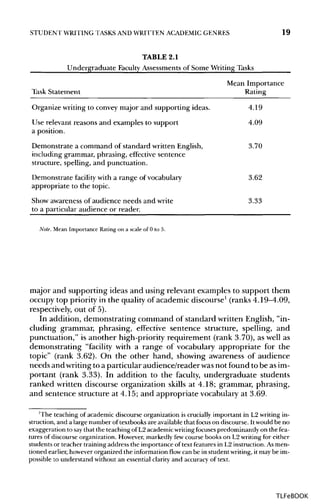
uate faculty (Table 2.1) clearly indicate that organizing writing to convey
TLFeBOOK
STUDENT WRITING TASKS AND WRITTEN ACADEMICGENRES 19
TABLE 2.1
Undergraduate Faculty Assessmentsof Some WritingTasks
Mean Importance
Task Statement Rating
Organize writingto convey major and supporting ideas. 4.19
Use relevant reasons and examples to support 4.09
a position.
Demonstrate a command of standard written English, 3.70
including grammar, phrasing, effective sentence
structure, spelling, and punctuation.
Demonstrate facility with a range of vocabulary 3.62
appropriate to the topic.
Show awareness of audience needs and write 3.33
to a particular audience or reader.
Note. Mean Importance Rating on a scale of 0 to 5.
major and supporting ideas and using relevant examples to support them
occupy top priority in the quality of academic discourse1
(ranks4.19-4.09,
respectively, out of 5).
In addition, demonstrating command of standard written English, "in-
cluding grammar, phrasing, effective sentence structure, spelling, and
punctuation," is another high-priority requirement (rank 3.70), as well as
demonstrating "facility with a range of vocabulary appropriate for the
topic" (rank 3.62). On the other hand, showing awareness of audience
needs and writingto a particular audience/reader wasnot found to be asim-
portant (rank 3.33). In addition to the faculty, undergraduate students
ranked written discourse organization skills at 4.18; grammar, phrasing,
and sentence structure at 4.15; and appropriate vocabulary at 3.69.
'The teaching of academic discourse organization is crucially important in L2 writing in-
struction, and a large number of textbooks are availablethat focus on discourse. It would be no
exaggeration to saythat the teaching of L2 academic writing focusespredominantly on the fea-
tures of discourse organization. However, markedly fewcourse books on L2 writing for either
students or teacher training address the importance of text features in L2 instruction.Asmen-
tioned earlier, however organized the information flow can be in student writing,it may be im-
possible to understand withoutan essential clarity and accuracy of text.
TLFeBOOK
20 CHAPTER2
Graduate faculty (Table 2.2)identified largely similar priorities in student
writingwithregard to the importance of information/discourse organization
and examples (ranks 4.46 and 4.34, respectively),grammar, phrasing, and
sentence structure (rank 4.06), and appropriate vocabulary (3.74).
On the other hand, graduate students ranked discourse organization
and exemplificationat 4.32 and 3.96, respectively;grammar, phrasing, and
sentence structure at 3.83; and vocabulary 3.56 (i.e.,below the importance
rankings assigned by graduate faculty in practicallyall categories).
In a separate subset of survey items,both undergraduate and graduate fac-
ulty also specified the specific writing skills that in their experiences deter-
mined the successof NNS students in their courses. Forundergraduate faculty,
the top three L2 writing skills included (in declining order of importance):
• discourse and information organization (2.40 out of 3)
• standard written English (i.e., grammar, phrasing, and sentence
structure; 2.35)
• vocabulary (2.26).
Among graduate faculty, the top three skills essential for success in aca-
demic courses consisted of:
• information/discourse organization (2.49 out of 3)
TABLE 2.2
Graduate Faculty Assessmentsof Some WritingTasks
Mean Importance
Task Statement Rating
Organize writingto convey major and supporting 4.46
ideas.
Use relevant reasons and examples to support 4.34
a position.
Demonstrate a command of standard written 4.06
English, including grammar, phrasing, effective
sentence structure, spelling, and punctuation.
Demonstrate facility with a range of vocabulary 3.74
appropriate to the topic.
Show awareness of audience needs and write 3.62
to a particular audience or reader.
Note. Mean Importance Rating on a scale of 0 to 5.
TLFeBOOK
STUDENT WRITING TASKS AND WRITTEN ACADEMICGENRES 21
• command of standard written English (2.37)
• using background knowledge, reference materials, and other re-
sources to analyze and refine arguments (2.35).
The employment ofappropriate vocabularyreceived a ranking of2.27.
The Rosenfeld, Leung, and Oltman (2001) study demonstrated unam-
biguously that L2 grammar and vocabulary skills play a crucial role in stu-
dent academic success (and obviouslysurvival).
MOST COMMON STUDENT WRITTEN ACADEMIC
ASSIGNMENTS AND TASKS
The most comprehensive study of academic writing taskswascarried out by
the Educational Testing Service (Hale et al., 1996), which surveyed eight
large comprehensive universities in the United States. The information dis-
cussed in this investigation is summarized next.
Major Writing Assignments
Major academic essays typicallyhave a specified length of 5 to 10 or more
than 10 pages. These papers predominantly take the forms ofout-of-class
assignments and are required far more frequently in humanities courses
such aspsychology,economics, history,and English than in the sciences, en-
gineering, or computer science. Most of these projects also necessitate li-
brary research and syntheses of literature and relevant information from a
variety of sources. According to the Hale et al. (1996) findings, undergradu-
ate courses in the sciences and engineering rarely expect students to write
papers as long as 5 to 10 pages, and most of these types of essays are ex-
pected in English department courses.
Medium-Length Essays and Short Written Tasks
Medium-length essays between 1 and 5 pages are required as in-class and
out-of-class assignments in practically all disciplines, with the exceptions of
undergraduate courses in physics, mathematics, and engineering. In social
science and humanities studies, they are expected in a majority of under-
graduate courses. Similarly, short written assignments of about 0.5 to 1.5
pages represent course components in approximately half ofall undergrad-
uate courses, including physics,math, and engineering, and 94%ofEnglish
courses (Hale et al., 1996). These essaysare assigned both in and out ofclass
in undergraduate and graduate studies alike. Among these assignments, li-
brary research reports, laboratory or experiment reportswith or withoutin-
terpretation, and book reviewsrepresent the most common typesofwriting.
TLFeBOOK
22 CHAPTER 2
Short writing tasks (also called expanded answers) found in many written
in-class and out-of-class exams, laboratory reports, case studies, annota-
tions of literature, and computer program documentation assignments
constitute the most common type of writing across all disciplines and
courses. Furthermore, short writing assignments are significantly more
common in undergraduate than graduate courses and in in-classthan out-
of-class assignments.
English Composition Writing Tasks
English composition instruction often provides the model for teaching writ-
ing in EAPs.According to the Hale et al. (1996) study,short writingtasksare
far less common in English than in social or natural sciences (29% of all
in-class assignments vs. 53% and 79%, respectively). On the other hand,
out-of-class essaysare required in 94% of all English courses, for example,
compared with 53% in social and 47% in natural sciences. Among the as-
signment types, summaries and unstructured writing genre defined as free
writing, journal entries, or notes, all which consist of writing down one's
thoughts and experiences, are found almost exclusivelyin English courses,
as well as twice as many assigned library research papers as in other disci-
plines. Major papers of 5 to 10pages in length are assigned in 41% of Eng-
lish courses and only rarely in social science courses. Similarly, 1-to 5-page
essays are required in 82% of English courses versus 39% of those in social
sciences and 21% in physical/naturalsciences.
FEATURES OF ACADEMIC GENRE AND TEXT
Research into various types of discourse and text (Biber, 1988; Biber,
Johansson, Leech, Conrad, &Finegan, 1999; Swales, 1990a) showed explic-
itly and clearly that academic discourse and text are constructed differently
than other types of text, such as fiction, newsreportage, or personal corre-
spondence. In fact, Swales (1990a) identified what he called "the academic
discourse community" (p. 5),which prescribes somewhat rigid forms ofdis-
course construction and organization combined withsimilarlyinflexible ex-
pectations ofvocabulary and grammar uses. Biber et al. (1999) examined a
large corpus of specific microfeatures of texts in diverse spoken and written
genres, and their findings are described in a 1,200-page volume. Their
analysis includes the cross-genre uses of nouns, determiners, pronouns,
verb tenses, and semantic classes of verbs, adjectives,adverbs, and clauses.
Textual uses of practically all features indicate that written academic text is
markedly distinct from many other types of texts, such as personal narra-
tive, conversation, and even academic lectures.
Other corpus studies investigated frequencies of use of various lexical
and syntactic featuresemployed in academic and other typesoftext to eluci-
TLFeBOOK
STUDENT WRITING TASKS AND WRITTEN ACADEMIC GENRES 23
date the differences between the academic and other types ofwritten gen-
res. Forexample, these examinations focus on various hedges, modal verbs,
epistemic adjectives, adverbs, and nouns (Collins, 1991; Hoye, 1997;
Hyland, 1998), as well as classes of collocations, idioms, synonyms, adverb
clauses, and text-referential cohesion (Partington, 1996). These studies ex-
panded the current knowledge base regarding specific structures and lexi-
cal features of written academic text, as well as other common features of
text such asnoun and prepositional phrases, stockphrases, and collocations
(Kennedy, 1991; Kjellmer, 1991; Renouf & Sinclair, 1991).
For instance, analyses of large corpora have led to the development of
pattern grammar to identifycombinations ofwords that occur relatively fre-
quently in academic texts and that may be dependent on a particular word
choice to convey clear and definable meaning (Hunston & Francis, 2000).
Because of great strides made in corpus analysesin the past fewdecades, to-
day much more is known about frequent patterns of verb, noun, and adjec-
tive uses and variations in their meanings, aswellas the syntacticand lexical
contexts in which particular lexical and syntactic features occur.
Although findings of text and corpus analyses of the written academic
genre may not be directly applicable to classroom instruction and studiesof
student texts, they provide insight into discourse and text conventions of
published academic and other types of texts. Furthermore, they often help
explain howwritten academic prose isconstructed and, by implication, can
inform writing instruction and pedagogy. An additional benefit of corpus
studies is that they shed light on how enormously complex and frequently
lexicalized the usesoflanguage and text in the academic genre actually are.
TEACHING ACADEMIC TEXT FEATURES
Several researchers have identified English composition essays and the
pedagogical essays (Johns, 1997) ubiquitous in English for Academic Pur-
poses (EAPs) programs to be dramatically different from those students are
required to write in the disciplines. Among other researchers, Horowitz
(1986a) identified some of the writing tasks in undergraduate humanities
courses. According to his findings, these included:
• summary/reaction to ajournal article or reading
• annotated bibliography in such disciplines as biology, lab, and ex-
periment reports
• connections between theory and data
• synthesisof multiple literature sources
• various research projects
Horowitz further noted that these assignments do not include invention
and personal discovery and "the academic writer's task isnot to create per-
TLFeBOOK
24 CHAPTER2
sonal meaning but to find, organize, and present data according to fairly ex-
plicit instructions" (p. 452). According to the author, sentence-level
grammar, use of discourse markers, and clarityof academic text remain "vi-
tal" (p. 454) in the teaching of academically bound NNS students.
In the 1980s, several studies endeavored to learn about the reactions of
faculty to particular features of NNS students' text (Johns, 1981; Ostler,
1980; Santos, 1988; Vann,Lorenz, & Meyer, 1991; Vann, Meyer, & Lorenz,
1984). Mostprofessors in the disciplines are not wellversed in the complex-
ities of ESL instruction or L2 learning and acquisition. Nonetheless, their
perceptions of text quality are important because they are the ones who
grade students' assignments. According to the results of these studies, the
employment ofsyntactic, lexical,and discourse featuresoftext and errors in
the uses of these features have an influentialeffect on the perceived quality
of students' text. Although sentence- and phrase-level errors are often seen
in relative rather than absolute terms, the problems in students' uses ofverb
tenses, word order, subordinate clauses, passive voice, and impersonal con-
structions have been found to obscure the text's meaning. In the view of fac-
ulty in various disciplines, such as physical and natural sciences, human-
ities, business, and the arts, accuracy in the uses of these and other syntactic
and lexical features isvery important and, in most cases, syntacticand lexi-
cal errors result in lower assignment grades.
When thinkingabout the importance ofaccuracy in the academicwriting
of NNS students, many ESLand EAP teachers believe that syntactic and lex-
ical errors in L2 texts are not particularly damaging because NSwriters also
make numerous mistakesin their texts. However, several studies have found
that faculty in the disciplineshave a far more criticalview of ESLerrors than
those of NSs (Santos, 1988; Vann et al., 1984, 1991). Although the indica-
tions of error gravityvary across disciplines and even vary according to the
age of faculty, the conclusions in all investigations largely remain similar:
ESL errors in students' texts are costly in terms ofgrades and overall evalua-
tions of work quality.
To determine whether the needs of academically bound NNS learners
were adequately addressed in EAP writing instruction, Leki and Carson
(1997) interviewed a large group of students who began their ESL training
and then continued their studies invarious disciplines, such asengineering,
biology, business, communications, and socialwork.The students reported
great differences between the demands ofwriting in EAPclasses and those
in the disciplines. Among other important considerations, many students
identified shortfallsin their vocabulary repertoire and a lack of familiarity
with the dry academic textual style. Most important, the students spoke
about the fact that EAP writinginstruction represents what Leki and Carson
called "non-text-responsiblewriting" (p. 63), whereas in the disciplines stu-
dents are held accountable for the context ofthe text they read and the con-
tent and accuracyofthe text they produce. The authors concluded thatwhat
TLFeBOOK
STUDENT WRITING TASKS AND WRITTEN ACADEMIC GENRES 25
is valued in writingclasses that emphasize personal growth and experience
is distinct from that necessary in academic writing in the disciplines. They
further stated that EAPwriting instruction has the responsibilityfor prepar-
ing students for "real" academic courses because without adequate expo-
sure to the demands ofacademicwriting students are essentiallyleft to their
own devices once their EAP training is completed.
Johns (1997) explained that the narrow focus of writing instruction in
EAPs and itsfocus on experiential essaysisoften based on the principle that,
"if you can write [or read] an essay, you can write [or read] anything" (p.
122). She pointed out that in mainstream courses the expectations and
grading of writing are different from those of ESL/EAPfaculty. In fact she
commented thatwhen NNS students are exposed to largely one type ofwrit-
ing task, they come to believe that "this is the only way to write." Such lim-
ited experience with writing actually does students a disservice and causes
problems in their academic and professional careers.
Like Horowitz, Johns emphasized the importance of text in students' ac-
ademic writing.She emphasized that faculty often complain that students
do not usevocabularyand data withcare. However,in her view, because per-
sonal essaysare highly valued in ESL and EAPwriting instruction and be-
cause many instructional readings are in story form and/or simplified
specifically for NNS readers, students are not exposed to the precision often
expected in much of the academic prose. Furthermore, considerations of
academic objectivity often conveyed by lexical and syntacticmeans, such as
uses of personal pronouns and passivevoice, are in conflict with those fea-
tures of text encouraged in personal essays.Johns emphasized that formal
academic register requires writers to be guarded and personally and emo-
tionally removed from the text. She underscored that the hedged and de-
personalized register of academic text is rarely addressed in ESL/EAP
writing instruction, but should be if students are to attain the proficiency
necessary for their success in mainstream academic courses.
In other studies, Dudley-Evansand St. John (1998) also stated that
"the process approach [to teaching L2writing], although extremelyvalu-
able in helping students organize and plan their writing has failed to
tackle the actual texts that students have to produce as part of their aca-
demic or professional work" (p. 117).They also noted that in the United
States, most of those who advocate a process approach see the teaching of
generalized strategies of planning, writing,and revisingas sufficient and
believe that a detailed analysis of academic texts lies beyond the job of
the writing teacher (Raimes, 1993; Zamel, 1983). However, according to
Dudley-Evans and St.John, the considerations of end-product quality in
L2 writing is important in academic and professional writing, and com-
bining the strengths of both the product- and process-oriented ap-
proaches to the teaching of writing can lead to overall improvements in
L2 writinginstruction.
TLFeBOOK
26 CHAPTER 2
THE NEED FOR EXPLICITINSTRUCTION IN L2 ACADEMICTEXT
In an important study that surveyed 77 published research reports on the
effectiveness of explicit grammar instruction, Norris and Ortega (2000)
normed the results of investigations in an attempt to achieveconsistency
across various investigative and analytical methodologies. Their
meta-analysis shows that in grammar learning focused instruction of any
sort is far more effective than any type of teaching methodology based on
focused exposure to L2without explicit teaching. They further found that
focused L2 instruction resulted in large language gains over the course of
the instructional term and that the effects of the instruction seem to be du-
rable over time. Furthermore, Norris and Ortega explained that explicit
instruction based on inductive or deductive approaches leads to greater
L2 gains than implicit instruction of any sort. Thus, given that academi-
cally bound L2 learners need to make substantial L2 gains to begin their
studies, it seems clear that L2 grammar and vocabulary should be taught
thoroughly and intensively.
When students matriculate from ESL/EAP programs, the quality of their
writing and text isevaluated bynon-ESLspecialists who are faculty in the dis-
ciplines. Furthermore, when students' academic studies are completed, the
accuracy of their text production iscontinuallyappraised by subsequent non-
specialists in on-the-job writing whenever college-educated NNSs write
e-mail, notes, reports, and old-fashioned memos. Considerate, understand-
ing, and compassionate ESLteachers who seek to benefit their students have
to teach the skills and language features that students must have to achieve
their desired professional and career goals. In fact, this iswhat ESL teachers
are hired to do. If instruction in the essential language skills is not provided,
students are largely left to their own devices when attempting to attain L2
proficiency needed for their academic and professional endeavors.
Much recent research has shown that exposure to dailyand classroom in-
teractions, as well as fluency-oriented instruction, does not represent an ef-
fective pedagogical approach to developing syntacticand lexical accuracy
(Chang &Swales, 1999; Dudley-Evans &St.John, 1998; Ellis, 2001 Jordan,
1997; Richards, 2002). Although teachers in academic preparatory and
writing programs often believe that they set out to develop learners' aca-
demic reading and writingproficiencies,in actualityfeware closely familiar
with the types of writing assignments and tasks that NNS students need to
perform once they complete their language training. For example, a list in
chapter 5 includes the most frequently encountered nouns in course mate-
rials across all disciplines in college-level general education courses and
contains suchwordsasambiguity, anomaly, apparatus, appeal, and aristocrat. In
all likelihood, few practicing ESL teachers in EAP programs have under-
taken to teach the meanings of these wordsunless they are fortuitously used
in student reading texts. Fluency development activities in writing that re-
TLFeBOOK
STUDENT WRITING TASKS AND WRITTEN ACADEMIC GENRES 27
quire students to keep personaljournals or carry outjournal-centered cor-
respondence with the teacher are not designed to increase learners'
academic vocabularyor grammar repertoire, with its almost requisite uses
of passive voice, impersonal construction, and complex hedging. In fact
such fluency-based activitiesencourage the use of immediately accessible
lexicon and grammar structures without a means of language gains and
perpetuate learners' misunderstanding and confusion with regard to the
high degree of accuracy expected in formal academic prose.
A teacher of writingwould do a disservice to academically bound NNS
students by not preparing them for academic writingassignments,particu-
larly those in the more common forms the students are certain to encounter
later in their studies. Within these academic assignments and tasks, stu-
dents must produce text that isacademically sophisticated enough to dem-
onstrate their understanding ofand familiarity withthe course material. Yet
few ESL/EAPprograms undertake to at least expose their students to vari-
ous types of academic assignments and require production of written aca-
demic (rather than personal) prose (Chang & Swales, 1999; Johns, 1997;
Leki& Carson, 1997).
TYPES OF WRITING TASKS
The discussion ofwriting tasksin this section relies on the findings of Hale
et al. (1996) to survey the writing requirements in eight comprehensive
U.S. universities.Overall the types of writing expected of undergraduate
and graduate students do not seem to vary greatly with regard to the rhe-
torical and discourse patterns they elicit. Most assignments combine sev-
eral rhetorical tasks (e.g., exposition and analysisin business case studies
or historyessays).
The most common types of rhetorical formats found in in-class and
out-of-class assignments represent (in declining order of frequency):
• Exposition (short tasks required largely in introductions and ex-
planations of material or content to follow, and thus it is a compo-
nent of all assignmenttypes)
• Cause-effect interpretation (by far the most prevalent writing
task, found in over half of all writingassignments)
• Classification of events, facts, and developments according to a
generalized theoretical or factual scheme
• Comparison/contrast of entities, theories, methods, analyses, and
approaches (in short assignments)
• Analysis of information/facts (in medium-length assignments)
• Argumentation based on facts/research/published literature (in
medium-length assignments)
TLFeBOOK
28 CHAPTER 2
Less common writing tasks include:
• Expanded definition (least common in medium-length and
out-of-class assignments)
• Process analysis in such disciplinesaspolitical science,economics,
sociology, psychology, accounting, marketing, and management
(hardly ever found in out-of-class assignments)
• Fact-based exemplification of concepts and theoretical premises
and constructs (overall least common in both in-class and
out-of-class assignments)
• Not found in any assignments—narration/description in the disci-
plines or English courses
In general, the frequency of rhetorical patterns does not seem to differ
greatly among the writing tasks in undergraduate and graduate courses.
Specifically, cause-effect essays can be found in over half of allwrittentasks
in in- and out-of-classassignments,with exemplification,processanalysis,
and definition being comparatively least common.
Exposition rhetorical tasks require writers to explain or clarify the
topic/subject. In general terms, exposition is entailed in expressing ideas,
opinions, or explanation pertaining to a particular piece of knowledge or
fact. For example,
1. What nonverbal cues communicated the most conflict in the newlywed
study? (Psychology) (Epstein, 1999, p. 291)
2. Discuss the various types of accounting information most companies routinely
use. (Business) (Zikmund, Middlemist, &Middlemist,1995, p. 447)
3. Which forms of governmentpredominated among the Italian city-states ? In
the end, which was the most successful? Why? (History) (Perry et al.,
2000, p. 322)
Cause-effect interpretation tasksdeal with establishing causal relation-
ships and are based on causal reasoning. Most assignments of this type in-
clude a discussion or an explanation of a cause-effect relationship among
events or problems, identificationof causes or effects, and a presentation of
problem solutions in the case of problem-solution tasks.
Examples of cause-effect interpretation assignments can be:
1. PabstBlue Ribbon was a major beercompany when I was in college. However,
recently it has lost market share, and now you hardly even hear about it. What
happened at Pabst and why? (Business) (Adapted from Bean, 1996)
2. Why does culture arise in the first place? Why is culture a necessary part of
all organized life? (Sociology)(Charon, 1999, p. 105)
TLFeBOOK
STUDENT WRITING TASKS AND WRITTEN ACADEMIC GENRES 29
3. Why is the Renaissance considered a departure from the Middle Ages and
the beginning of modernity? (History) (Perry et al., 2000, p. 322)
Classification of events, facts, and developments assignmentsinvolve
cognitive tasks in which writers are expected to determine what types of
group members share particular features or characteristics. Therefore, stu-
dents are required to classify clusters or groups of objects, events, or situa-
tions according to their common attributes, create a system to classify
objects or events, and list them based on this classification.For example,
1. In what ways can a company maintaingood relations with its union em-
ployees without being unfair to its nonunion employees? (Business)
(Zikmund, Middlemist, & Middlemist, 1995, p. 421)
2. What do Elaine Walster and Ellen Berscheid say are the ingredients for
love? (Psychology)(Epstein, 1999, p. 326)
3. What was the traditional relationship between the people and their rulers
during the Middle Ages? How and why did this relationship begin to
change in thesixteenth century and with what results ?(History)(Perry et
al., 2000, p. 376)
Comparison/contrast tasks expect writers to discuss or examine objects
or domains ofknowledgeby identifying their characteristics/properties that
make them similaror different. In general, the purpose of suchassignments
is to identify the specific points that make objects, events, or situations simi-
lar and/or different as well as explain one in terms of the other.
Examples of these assignments can be:
1. Compare and contrast medieval universities with universities today (His-
tory) (Perry et al., 2000, p. 278)
2. What distinguishes thephilosophy of religionfrom theology ? (Philosophy)
(Schoedinger, 2000, p. 225)
3. Compare the reaction ofOlaudah Equino on first encountering Europeans
with that of the Spaniards encountering Aztecs. (History)(Perry, Peden,
&VonLaue, 1999, p. 351)
Analysis of information or facts (in medium-length assignments) requires
writers to separate awhole into elements or component parts and identify re-
lationships among these parts. Other types of analysis assignments include
applying theories or interpretive methods to the object ofanalysis or a partic-
ular school of thought, distinguishing facts from theories, evaluating the va-
lidity of stated or unstated assumptions and/or various types of relationships
among events, identifying logical fallacies in arguments, or specifying the au-
thor's purpose, bias, or point of view. For example:
TLFeBOOK
30 CHAPTER2
1. How does the bourgeoisie gradually undermine its own existence according
to Marx? (Philosophy) (Schoedinger, 2000, p. 215)
2. How do the elasticities of supply and demand affect the deadweight loss of a
tax ?Why do they have thiseffect ?(Economics) (Mankiw, 2001, p. 176)
3. If class, race,and gender arepositions within socialstructures,we shouldbe
able to describe them in terms of power, prestige, privileges, role, identity,
and perspective. Can you do this? (Sociology) (Charon, 1999, p. 86)
Argumentation assignments largely represent a form of exposition that
includes an element of persuasion. Therefore, the rhetorical purpose of
these writing tasks extends beyond the presentation, explanation, or discus-
sion to convince the reader of a particular point of view. In argumentation
tasks, the writersare required to recognize that issueshave at least twosides
and present the facts or information to develop a reasoned and logical con-
clusion based on the presented evidence. In practicallyallassignments, pre-
sentations of unsupported assertions are not considered to be argument-
ation (Hale et al., 1996).
1. Human beings are social to their very core. How does the material covered
in Chapter xxx/this termsofar support this proposition? What doyou think
of this argument? (Sociology) (Adapted from Charon, 1999)
2. What isfreedom? What is individuality? To what extent do you think hu-
man beingsarefree or individuals ? What doyou think is the origin of free-
dom and individuality? (Sociology) (Charon, 1999, p. 148)
3. Why would removing trade restrictions, such as a tariff, lead to more rapid
economic growth? (Economics) (Mankiw, 2001, p. 262)
Less Common Rhetorical and Writing Tasks
Three types of writingtasks appear markedly less common than those dis-
cussed earlier: definition, process description, and exemplification.
Expanded definition assignments consist of explanations of exact mean-
ings or significanceof a phrase or term. Usuallythese assignments consistof
defining the term, listing the concept towhich the term belongs, and specify-
ing the attributes that distinguish it from others in its class. For example:
1. What is social order? (Sociology)(Charon, 1999, p. 147)
2. Explain the meaning of nominal interest rate and real interest rate. How
are they related? (Economics) (Mankiw, 2001, p. 237)
Process analysis involvesdirections on how someone should do some-
thing or howsomething should be done, including chronological details in
a series of steps/operations/ actions necessary to achieve a particular result
or happening. In most cases, a discussion of reasons for the steps and nega-
tive directions are needed. For example,
TLFeBOOK
STUDENT WRITING TASKS AND WRITTENACADEMIC GENRES 31
1. Suppose that you were to set up an organization—for example, a club, a
church, a school,or a small community. What would you do to try to ensure
that social order would successfully be established? (Sociology) (Charon,
1999, p. 147)
2. What isthe business value chain ? Usefrozen pizza sold in supermarkets toex-
plain your answer. (Business) (Zikmund, Middlemist, & Middlemist,
1995, p. 17)
Exemplification and illustration largely deals with expanding on theo-
ries/concepts/ ideas and providing reasonable amounts ofdetail to explain a
type, class, or group of objects or events by presenting examples. These as-
signments largely rely on general-to-specific discourse organization flow.
For example,
1. Give at least two examples of what children can learn from playing
peek-a-boo. (Psychology) (Epstein, 1999, p. 258)
2. What is a simple idea, according to Locke? Give examples. (Philosophy)
(Adapted from Schoedinger, 2000, p. 351)
QUESTIONS FOR DISCUSSION
1. What are the keywriting tasks with which NNS writers need to
be competent based on research and interviews with undergraduate
and graduate faculty? What kinds of instruction can help NNS writers
improve these skills?
2. What are the most common forms of academic writing assign-
ments? How can a teacher in an ESL or EAPwriting course help stu-
dents prepare for these kinds of assignments?
3. What can be possible reasons that the common types of es-
says/writing tasks required of students in ESL/EAPwriting courses are
distinct from those in courses in the disciplines? If you were in charge
of the curriculum in preparatory ESLwriting courses, would you
change the types of writing tasks required of students? If yes, in what
way? If no, why not?
FURTHER READINGS ABOUT WRITING TASKS
AND WRITTEN ACADEMICGENRES
Writing Tasks
Johnson, D. (1989a). Enriching task contexts for second language writing: Power
through interpersonal roles. In D.Johnson & D. Roen (Eds.), Richness in writing
(pp. 39-54). NewYork: Longman.
Leki, I., & Carson, J. (1997). "Completely Different Worlds": EAPand the writing
experiences ofESLstudents in university courses. TESOL Quarterly, 31(1), 39-70.
TLFeBOOK
32 CHAPTER 2
Ostler, S. (1980). A survey of needs of advanced ESL. TESOL Quarterly, 14(4),
489-502.
Rosenfeld, M., Leung, S., & Oilman, P.(2001). The reading, writing, speaking, and lis-
tening tasks important for academic success at undergraduate and graduate levels (MS
21). Princeton, NJ: ETS.
Swales,J., &Peak, C. (2000).English in today's research world.Ann Arbor, MI: The Uni-
versity of Michigan Press.
Written Academic Genres
Berkenkotter, C., & Huckin, T. (1995). Genre knowledge in disciplinary communities.
Hillsdale, NJ: Lawrence Erlbaum Associates.
Johns, A. (1997). Text, role, and context: Developing academic literacies. Cambridge:
Cambridge University Press.
Johns, A. (2002). Genres in the classroom: Multiple perspectives. Mahwah, NJ: Lawrence
Erlbaum Associates.
Paltridge, B. (2001). Genre and the language learning classroom. Ann Arbor: The Uni-
versity of Michigan Press.
Swales, J. (1990). Genre analysis. Cambridge: Cambridge University Press.
TLFeBOOK
3
Curriculum for Teaching the Language
Features of Academic Writing
OVERVIEW
• The importance of accuracy in academic writing
• Recurrent features of academic discourse in English
• The benefits ofwritten academic discourse conventions
• Instructed L2 grammar and noticing
• Vocabularysize and academic text
• Incidental learning of grammar and vocabulary
• Self-editing skills development
• Unimportant features of academic text
The purpose of this chapter is to establish a research-based framework for
teaching academic writing courses that focusonjust the core, academic sur-
vival-level skills students need to be successful in their universitywork.To
this end, the L2writingcourse curriculum needs to be designed around the
key areas that deal with accuracy in grammar and lexis, intensive vocabulary
instruction, and fundamental editing of one's own text. In addition, the
chapter also discusses the benefits and shortfalls of incidental vocabulary
learning and the grammatical and lexical featuresof academic text that are
customarily taught in ESLclasses,but that maybe relativelyunimportant.
The essential elements ofthe course that must be addressed can be de-
signed to be flexible within the curriculum structure, and the amount of
effort and time devoted to each can be adjusted for a particular group of
students. This chapter presents an overview of research to show whycore
components of the course are critical in teaching L2 academic writing
and lays the groundwork for the teaching approach developed in the
subsequent chapters on sentence and phrase structure, nouns, pro-
33
TLFeBOOK
34 CHAPTER 3
nouns, verb tenses, verb lexical classes, and rhetorical features of text
such as cohesion and hedging.
The curriculum design outlined in this chapter centers on current re-
search findings about what it takes to attain viable academic L2writing skills
and presents dozens of techniques for teaching them. The teacher'swork-
load and the student's "learning burden" (Nation, 2001, p. 23)—that is, the
amount of effort required to learn L2 grammar and vocabulary—areex-
pected to be realistic, but certainly not very light. Although activities to de-
velop learners' conversational fluency or invention techniques are typically
less work and more fun for both teachers and students, they have not de-
monstrably equipped students for success in university-level academic
courses (Hinkel, 2002a; Hyland, 1996, 2002a).
ACCURACY, ACADEMICTEXT, AND PRACTICAL GOALS
As the teaching of English became increasingly important during and after
World War II, Charles Fries developed one of the first U.S. textbooks for
training ESL teachers. In 1945, his definition of syntactic and lexical accu-
racy in L2 use was flexible and pragmatic:
The "accuracy" which isadvocatedhere does not mean the so-called "cor-
rectness" of the common handbooks.... The accuracyhere stressed refers to
an accuracy based upon a realistic description of the actual languageasused
by native speakers in carryingon their affairs.... It is fruitless to argue in the
abstract concerningthe relative merits of the various types of English.... In
learningEnglish asa foreign language it isnecessary to decideupon aparticu-
lar type to be mastered,for there is no single kind that isused throughout all
the English speaking world. The practical approach is to decidefor the kind
of English thatwill be used by the particulargroup with which one wishes to
associate...." (Fries, 1945 pp. 3-4)
The important point made by Fries more than half a century ago is that
L2 learners need to identify their goals for learning L2 and the typesof the
NS populationwithwhich they wish to associate. In the case of academically
bound NNS learners, these populations consist of the university faculty in
mainstream courses who evaluate the assignment quality of the NS and
NNS students enrolled in the same classes.
If NNS college and university students are to succeed in competi-
tion for grades and attain their educational objectives,the level ofac-
curacy in their L2 writing needs to at least attempt to approximate
that of NS students of similar academic standing.
Without a doubt, this isan ambitious goal. It goes withoutsayingthat NS
students have been socialized in, schooled in, and exposed to their L1
TLFeBOOK
TEACHING LANGUAGE FEATURES OF ACADEMIC WRITING 35
throughout their entire lives,whereas most NNS students have studied EFL
in their nativecountries and began their ESL/EAP studies asadults. The fact
that NNS writers have a reduced English proficiency compared with their
NS counterparts further underscores the need for thorough L2 training
and instruction. In light of the fact that L2writers'vocabularyand grammar
ranges are usuallygreatly limited compared with those of NSs, for NNS stu-
dents, producing academic writing proximate to that of NSs is not atrivial
task.Without instruction in and learning how to construct L2academic text,
NNS students often find themselves at a great disadvantage in their aca-
demic and professional careers (Horowitz, 1986a; Johns, 1981, 1997; Leki
& Carson, 1997; Nation & Waring, 1997; Santos, 1984, 1988).
The curriculum outline for teaching the essential features of academic
text in English is based on the research findings discussed in the bookSec-
ond Language Writers' Text (Hinkel, 2002a). That volume presents detailed
analyses of NNS students' texts and their quantitative comparisons to the
types and frequency rates of textual features in NS students' texts.
Research has demonstrated that English-language academicwriting
is governed by several rigid conventions in its discourse structure and
language features. Based on the findings of numerous studies and in
simple terms, the teaching techniques and strategies discussed in this
book aim for maximum gain for minimal workby capitalizing on the ri-
gidity and conventionalizationof written academic prose in English.
The fundamental principle of the L2 academic writing curriculum
presented in this volume centers around acceptable and contextually
relevant lexical substitutionswithin a limited range of lexical and syn-
tactic constructions (i.e., text and sentence chunking and focused in-
struction in replacement parts for chunk components).
DISCOURSE AND TEXTUAL FEATURES OF ACADEMIC WRITING
To some extent, the uses of specific linguistic features may depend on the
discipline for which an assignment is written. Predictably, an essay in his-
tory, business case studies, or descriptions of experiments in psychology
may contain a greater number of past-tense verbs than a paper that dis-
cusses generally applicable observations and interpretations of research
data. For example, most introductory textbooks in philosophy, sociology,
economics, or biology include high numbers of present-tense verbs.
Despite some amount of variation that can be identified in the linguistic
features oftexts across disciplinesand particular academic subgenres, many
represent whatJohns (1997) called "recurring features" (p. 27) of the aca-
demic genre and text—that is, "formal features of text in this genre do not
appear to vary considerably from class to class, nor ... have the genre re-
TLFeBOOK
36 CHAPTER 3
quirements varied much since the mid-1980s" (p. 29). Based on the find-
ings of Swales (1990a), Johns explained that some of these recurring
features are at the discourse level of academic text and largelyconsistof four
purposeful introductory moves to prepare readers to read and understand
text efficiently. These moves include:
1. establishing or introducing the topic and discussing its importance,
2. reviewing published (or other) sources of information,
3. preparing the ground and reasoning for the present analysis
and/or synthesisof information (or demonstrating howthe present
examination can accomplish what has not been accomplished pre-
viously), and
4. introducing the present examination and stating its purpose.
In addition to the discourse-level features of the academic genre, Johns
also noted that linguistic features of text are also recurrent and can be found
across practically all disciplines and subgenres. She emphasized that these
are often neglected in the teaching ofL2writing and suggested various ways
to include them in L2 writing instruction.
In particular, Johns summarized the findings of text analysis and
research on academic text and pointed out that several lexical and
syntactic features are highly valued "in general expository academic
prose" (pp. 58-59):
• Lexical precision and careful use of vocabulary
• Careful and purposeful uses oftext "maps" and "signposts," such as
discourse and metadiscourse markers (e.g., First this essays discusses
xxx and yyy and then presents solutions to the zzz problem)
• Appearance ofthe writer's objectivityand impersonal register (e.g.,
avoidance of first-person pronouns and use of "author-evacua-
tion," the strategic passive voice, and it-cleft constructions; e.g., it
is/seems/appears that ...)
• Nonjudgmental interpretations of information, findings, and
events (e.g., avoidance of emotive descriptors—nouns, adverbs,
and adjectives such as great, wonderful, exciting, terrible)
• A guarded stance in presenting argumentation and results (e.g.,
employment of frequent hedges such as modal verbs, adverbs of
frequency, or linking verbs)
Other studies of L2written academic text have identified a range oflexi-
cal and grammar features that required focused instruction and concerted
effort from both teachers and learners (Dudley-Evans& St. John, 1998;
TLFeBOOK
TEACHING LANGUAGE FEATURES OF ACADEMIC WRITING 37
Johns & Dudley-Evans, 1991; Jordan, 1997; Nation, 1990, 2001). Among
the most urgent are:
• Expanding the accessible repertoire of common academic nouns,
verbs, adjectives, and adverbs (e.g., analysis,develop, dramatic,ev-
idently)
• Contextual functions and uses of verb tenses in discourse
• Functions and uses of the passive voice in academic text
• Functions of adverbs in pivoting discourse and information flow
• Regularities in phrase and sentence construction
• Backgrounding information in subordinate clauses
• Textual features of cohesion and coherence in discourse
• Functionsand uses of hedges in academic prose (based on Hinkel,
2002a)
Although at first glance producing academic assignments and papers
may seem difficult and daunting, the greatest advantage of the fact that
written academic discourse is highly conventionalized and its features are
recurrent isthat, withthe groundwork in place and consistent practice, pro-
ducing academic writing is actually relativelyeasy.
THE IMPORTANCE OF LANGUAGEPROFICIENCY FORWRITING
In the production of academic writing,various L2 skills have divergent de-
grees of importance. Forinstance, P.Johnson's (1988) studyof international
undergraduate students' GPAs and TOEFL scores in listening comprehen-
sion, grammar, and reading sections established strong positive correla-
tions between students' academic performance and grammar and reading
proficiencies. The correlations between listeningscores and undergraduate
GPAs were not significant, and Johnson concluded that L2 grammar and
reading skills play a highly influentialrole in students' abilities to perform
well in humanities, social sciences, and business courses.
Celce-Murcia (1991)emphasized that for educated, academically
oriented, and advanced L2 learners, grammar instruction is essen-
tial if they are to achieve their educational and professional goals.
She commented that, "the importance of a reasonable degree of
grammatical accuracy in academic or professionalwritingcannot be
overstated" (p. 465). Celce-Murciacited a study that indicates that a
high frequency of grammar errors in NNS students' academic writ-
ing can make essaysunacceptable to universityfaculty, and an aver-
age of 7.2 grammatical errors per 100 words in L2 academic prose
was judged to be nonpassing by professors in mainstream courses.
TLFeBOOK
38 CHAPTER 3
Other researchers also identified the critical role of grammatical accu-
racy in L2 academic writing and stressed that instruction in grammatical
features of formal written genres is paramount. Without teaching and ex-
tensive practice, many learners are unable to develop a full range of L2 ad-
vanced grammatical features essential in formal and written discourse
(Celce-Murcia & Hilles, 1988; R. Ellis, 1994; Hammerly, 1991; Schmidt,
1994; Shaw & Liu, 1998). R. Ellis (1990) explained that "formal classroom
teaching with its emphasis on linguistic accuracy will engage the learner in
planned [spoken or written] discourse and develop the corresponding type
of competence" (p. 121).
It is important to keep in mind, however, that the teaching of
grammar essential for the production of L2writingisnot intended to
develop NNS students' overall native-like proficiency (Pica, 1994).
For instance, in her overview of L2 learning research, Larsen-Free-
man (1991) concluded explicitly that "for most adult learners, com-
plete mastery of the L2 may be impossible," and that the purpose of
L2 teaching and learning isto enable "learners to go as far as they are
capable of going in the L2, but [ESL] teachers should be realistic in
their expectations" (p. 337).
PREFABRICATED SENTENCES AND LEXICALIZED CHUNKS
Grammar instruction that has the goal of preparing students for academic
studies in English-speaking countries needs to be designed to develop
learners' practical and useful skills that are directly relevant to producing
academic text. Teaching grammar for writingcannot take place in isolation
from the lexical and discourse features of text (e.g., the verb tenses in aca-
demic prose are determined by the type of context in which they are used:
The present tense is useful in citations of sources, but not descriptions of
case studies; Swales & Feak, 1994).
Most important, grammar instruction has to take place in tandem with
instruction on vocabulary and academic collocations. A great deal of re-
search carried out on the effectiveness of learning grammar in contextual
lexicalized chunks and sentence stems (i.e., whole sentences and phrases,
and recurrent patterned expressions) has shown that these arefundamental
to both L1 and L2 learning and use (N. Ellis, 1997; R. Ellis, 1994; Lewis,
1993, 1997; Nattinger & DeCarrico, 1992). Stock grammatical and lexical
chunks can become an efficient means to expand L2writers'arsenals partic-
ularly when learners are also taught howto substitute discrete elements ap-
propriately and in practical ways. For example, the fact that the function of
noun clausesissimilar to that of simple nouns can be addressed bymeans of
substitutions in patterned expressions common in academic prose:
TLFeBOOK
TEACHING LANGUAGE FEATURES OF ACADEMIC WRITING 39
The experiment/ data/study shows that xxx increases(with yyy) I an increase of xxx/
the growth/rise of xxx.
As Wilkins(1972)commented, learning an L2 in lexical and grammati-
cal units (chunks), instead of discrete words or word elements, can often
"cover in half the time what is ... expected from a whole year's of language
learning" (p. 102).Peters (1983) pointed out that, despite the linguistic and
psycholinguistic evidence that memorizing language chunks represents an
effective and unrestrictive means to expand learners' lexical and grammati-
cal ranges, a cultural and pedagogical bias existsagainst the idea of memo-
rization of long chunks of text. She further underscored that making
substitutions within formulaic expressions is objected to "on the grounds
that they are so mindless that they are ineffective in promoting second lan-
guage learning." Peters' research, however, showed that memorizing long
chunks of text "is at its simplest the equivalent of memorizing so many long
'words,' but only if no grammatical analysis(e.g. segmentation) is ever per-
formed on these items" (p. 109)—a virtual impossibility in the contexts of
creative second language learning.
An important confirmation of Peters' (1983) empirical study of the role
chunks in first and second language learning came from the work ofCowie
(1988), who analyzeda large body of authentic English data. He found that
thousands of multiword units of language (or chunks)remain stable in form
across much of their range of occurrence, and thousands of others "tolerate
only minor variations" (p. 131),which are themselves regular and predict-
able in their uses.
In light of the fact that L2 instruction almost always takes place under
great time constraints for many teachers and learners, it is important to
maximize language gains and make learning as efficient as possible. Using
language chunks in instruction and learning is likely to be one of the few
available expedient routes to relative L2 accuracy and fluency that leads to
production and subsequent automatization (DeKeyser & Juffs, in press;
Wood, 2001). For example, according to Wrayand Perkins (2000)and Wray
(2002), in L2 teaching prefabricated chunks can and should be treated as
various types of "word strings" that are to be stored and retrieved whole
from memory. Many adults can recite L1 or L2 poems or texts that they
learned several decades earlier, and there is little reason to doubt that L2
learners are quite capable of similar feats in their L2 writing.
According to N. Ellis (1997, pp. 129-130), collocational chunks can con-
sist of entire memorized sentences or phrases that include from 4 to 10
words, and these can allow learners to create new constructions to add to
their stock of expressions. In this sense, for learners, grammatical construc-
tions such as commonly occurring sentences, clauses, and phrases can be
"viewed as big words" and memorized as lexicalized stems. Following
Pawley and Syder (1983), Moon (1997) called many of these preconstructed
TLFeBOOK
40 CHAPTER 3
sentences and phrases "institutionalized" because they occur more fre-
quently in certain types of discourse than in others.
Throughout this book, appendixes for most chapters include stock
lexicalized sentence stems and phrases that can be very effective and efficient
in teaching skeletal frameworksin academic papers and written discourse.
INSTRUCTED L2 GRAMMAR AND NOTICING
Grammar teaching can be made productive for learners if it is cumula-
tive—when the curriculum is designed to build on the structures that
learners already know or from the formally and functionally simple to
more complex constructions (R. Ellis, 2002; Larsen-Freeman, 1991). To
this end, grammar curriculum even at the intermediate levels of student
proficiency can begin with an examination and analysis of structures in
formal written discourse. Initially, the goal of instruction is to develop
learners' awareness and noticing of common grammatical features; build-
ing on this foundation, the regularities in grammar structures can be ex-
plicitly addressed and practiced in the production of academic writing(R.
Ellis, 1990, 1994, 1997, 2002; James, 1998).
For example, at the high intermediate and/or advanced levels, grammar
teaching can focus on constructions typically found in introductory aca-
demic textbooks (e.g., history texts heavily rely on the use of the past tense,
and political science and sociology books can be practical in instruction on
the present tense and passive voice). At higher proficiency levels, instruc-
tion can also highlight the effects of grammatical features on context, dis-
course, and text (e.g., tense uses in generalizations or the important
difference between totally and a great deal). In addition, the discourse func-
tions of referential and impersonal pronouns, the hedging functions of
modal verbs, and parallel phrase constructions found in abundance in prac-
tically all academic prose can be noticed, analyzed,and practiced. The goal
of practice (practice, and practice) with grammar constructions is to help
learners develop productive fluency in academic writing and, to some de-
gree, automaticity in generating academic prose. Practice activitiescan in-
clude brief restatements of chapter/section contents, objective summaries,
paraphrases, explanations, or using sources asthesis support in short pieces
ofwriting at lower proficiencylevelsor longer essays for advanced learners.
Heightening learners' awareness of the structure of complete sentences
in academic prose (as opposed to fragments),as well as important distinc-
tions between conversational and formal written register, should represent
ongoing instructional objectives at all levelsof proficiency. Because in Eng-
lish-speaking countries most learners are exposed to a great deal more con-
versational discourse than formal written prose, they usually employ
conversational grammar and lexis in their academic essays (Hinkel, 2002a,
2003a, 2003b; Shaw & Liu, 1998). Thus, when they are encountered in
TLFeBOOK
TEACHING LANGUAGE FEATURES OF ACADEMIC WRITING 41
reading or speaking, noticing and analyzing the differences between the
features of casual spoken and formal written text is vital (Biber, 1995;
Hinkel, 2003b; Hyland, 2002a; Hyland & Milton, 1997).
While working with written academic discourse at any level of learner
proficiency, it is cruciallyimportant to take opportunities to bring learners'
attention to global features of academic discourse and discourse moves,vo-
cabulary uses in context, and definitions of important, discipline-specific
terms usuallyprovided in almost all introductory academic texts for first- or
second-year students.
VOCABULARY AND L2ACADEMIC TEXT
Nation and Waring's (1997)research outlines the enormous task entailed in
learning the vocabulary needed to produced academic text in an L2. As a
point of reference, they explained that a complete dictionary of the English
language contains around 55,000 word families. Aword family includes the
base form of a word, its inflected forms, and closely related derived forms
(Nation, 2001; e.g., sing, sings, singing, sang, sung, or cold, colder, coldest, coldly,
coldness). Nation and Waringalso commented that a 5-year-old NS child has
a vocabulary range of 4,000 to 5,000 word families, an average university
student 17,000, and a universitygraduate around 20,000. According to the
authors' estimates, native speakers add approximately 1,000 word families
per year to their vocabulary size.
Thus, for adult ESLlearners, the gap between their vocabularysize
and that of NSs is usually very large because adult learners who have
typically dedicated several years to L2 learning have a vocabulary size
of much less than 5,000 words. It is possible, however, as in the case of
educated non-native speakers, to achieve a significant growth in L2
vocabulary with persistent and consistent effort.
Studies on the importance of vocabulary in L2 writing have been car-
ried out bymany researchers. Forexample, Santos (1988) determined that
lexical errors were considered to be the most serious in professors' evalua-
tions of NNS student writing,followed by problems with discourse and in-
formation organization and syntacticerrors, with the matters of content
downgraded to being least important of all. Other studies also demon-
strated that the proportion of core academic vocabulary in L2writers' text
correlated positivelywith higher ratings of essays on standardized tests
(Laufer & Nation, 1995). On the whole, based on several earlier studies,
Nation (2001) concluded that an increase in the amount of academic vo-
cabulary in L2 writing contributes significantly to the higher evaluations
of the quality of L2 academic writing. In light of this finding, it is not par-
ticularly surprising that NS student writingusuallyreceives higher evalua-
TLFeBOOK
42 CHAPTER 3
tions and ratings (i.e., NSs simply have ready access to a much greater
vocabulary base).
In general, the work of Nation (1990, 2001) has provided a great deal of
insight needed to understand the crucial role of vocabulary in L2 writing
production. However, one of the most important issues in learning aca-
demic vocabulary is its extraordinarily large size. For example, Coxhead
(2000) showed that in basic textbooks in various disciplines, such as human-
ities, business, and the sciences, the academic vocabulary range of common
words includes approximately 10%of 3,500,000 of all words included in an
academic word corpus.
As Nation (2001) commented, "[a]n impossibly large number of texts
would be needed to cover all of the vocabulary of the UWL [University Word
List]" (p. 193).Another factor that greatly complicates the learning of L2 aca-
demic vocabulary is that it is not the common words that create the greatest
difficulties in reading and writing, but the relatively rare words that actually
represent the largest number of words used even in basic academic texts.
Thus, for a vast majority of NNS students, the task of becoming
proficient users of L2 academic vocabulary may not be attainable
within the time commonly considered reasonable for the completion
of their EAP preparatory and academic studies. A more reasonable
and attainable goal in increasing the vocabulary range in students' L2
writing is to workwith lexical items that learners can use in construct-
ing texts in most writing tasks across all disciplines. For example, the
number ofreporting verbs that can be employed to mark paraphrases
is around a dozen, and they can be learned with relative ease while
working on a writing assignment (e.g., the author says, states, indicates,
comments, notes, observes, believes,points out,emphasizes, advocates, reports,
concludes, underscores, mentions,finds), not to mention phraseswith sim-
ilar textual functions such as according to the author, as the author
states/indicates, in the author's view/opinion/ understanding, or as
noted/stated/mentioned.
Teaching vocabulary and grammar essential for success in the academy
may be tedious and somewhat boring because, unlike the fun activities for
developing conversational fluency, even the most basic academic lexicon
consists of 850 words that include such nouns as assent, asset, astronomy, atmo-
sphere, and atom. Teaching and learning academic vocabulary extends far
beyond field trips and reading short stories.
Not teaching the foundational vocabulary basics puts students at a
great disadvantage in mainstream courses in various disciplineswhen
academic proficiency is requisite.
TLFeBOOK
TEACHING LANGUAGE FEATURES OF ACADEMIC WRITING 43
Students who complete their language preparation in intensiveEnglish
programs may have a vocabularyrange of 2,000 words (Nation & Waring,
1997). However,the accessiblelexicon in academic studiesdoes not need to
include nouns to describe recipe ingredients, names of interestinganimals,
or current fashions. It includes words not common in dailyconversations
that are not learned through conversational activities. Academicwords and
grammatical structurescannot be learned in casual talk because they do not
occur there. Essentially, in most people's dailyfunctioning and interactions,
academic lexis and advanced syntactic constructions cannot be learned in
naturalistic language settings iftheyare not taught explicitly(R. Ellis, 1994,
1997, 2001; Hinkel, 2001a, 2003a, 2003b; Nation, 1990, 2001).
INCIDENTAL LEARNING AND NOTICING
In general terms, two types of vocabulary and grammar learning have
been identified in research: explicit learning, which takes place through
focused study, and incidental learning, when new vocabulary and gram-
mar structures are picked up from exposure to and experience with lan-
guage. However, research has established that learners typically need at
least 10 or 12 repeated exposures to a word over time to learn it well
(Coady, 1997).To further complicate matters, several studies of adult L2
learners concluded that the long-term retention ofwords learned inciden-
tally and through exposure in extensive reading can be particularly low
(Hafiz & Tudor, 1990; Hulstijn, 1992).
On the whole, because L2 learning is determined by a number of com-
plex factors, such as LI literacyand culture, personal motivation and goals,
as well as L1 and L2 similarities,the processes of L2 vocabulary and gram-
mar learning have not been clearly established (Schmitt,2000).In all likeli-
hood, an effective curriculum for L2 teaching relies on both explicit and
implicit learning and incorporates a balanced amount offocused study and
opportunities for exposure to academiclanguage and text (Nation, 2001).
There islittledoubt that for incidentallearning of academictextfeatures
to occur,students have to have extensiveexposure to academic reading with
repeated uses of words. Extensivereading can be carried out in and out of
class, but an important fact is that students need to be interested in the sub-
ject matter to sustainreading the material that often requires them towork
hard, concentrate, and memorize new vocabulary.In the days when most
forms of entertainment rely on visual media, such as TV, videos, and
Internet, the number of learners who read for pleasure has declined
(Hinkel, 2001b).Asa result, a majority of readers, especiallywhen they are
reading in a L2, read for information. Hence, to increase learners' motiva-
tion in extensive reading, the teacher may need to find out what types of
subject matter can be of particular use or interest to a specific group ofstu-
dents. For instance, learners who plan to enroll as undergraduates in col-
TLFeBOOK
44 CHAPTER 3
leges and universities in English-speaking countries are required to take
courses in the disciplines that range from humanities to the sciences, and
their exposure to useful vocabulary can be flexible. However, matriculated
or graduate students maybe more motivated ifthey read texts that dealwith
their chosen specialties rather than general education courses.1
One of the crucial features of effective learning is noticing words and
grammar structures, their uses and meanings, and contexts in which they
occur (R. Ellis, 1990, 2002; Schmidt, 1990, 1994, 1995). To learn different
meanings that words and constructions may have in different contexts,
learners need to pay attention to textual features as they read or write (e.g.,
in written academic text, the modal verb mayrarely has the meaning of per-
mission as isdescribed in most grammar books, but usuallyhas the function
of a hedging device).
The greatest issue with noticing words and features is that, first,
learners need to know what specific text features they should notice
and, second, what about these features requires attention. Therefore, it
is the teacher's job to guide learners and point out the important and
necessary vocabulary and grammar constructions and then discuss
their uses and meanings in the academic text. Nation (2001) com-
mented that the discussion of vocabulary items, subsequent to notic-
ing, represents ahighly productive wayto learn newwordsin reading.
Noticing forms ofwords and structures can take place while students lis-
ten and read, participate in activities, or even look for synonyms.To notice
uses, meanings, and functionsofwords and grammar constructions, learn-
ers need to be aware of language as a complex system. For example, they
need to be able to identify nouns, verbs, prepositions, and adverbs to notice
that sometimes words or parts ofwords can have different syntacticproper-
ties and, therefore, play different roles in sentences. Noticing and identify-
ing the functions ofwords and structures isa slowand laborious process that
affects a student's reading speed and takes away some of the enjoyment of
reading because it removes attention from the context/messages to focus it
on the component parts.
In many cases, preteaching texts at the appropriate level of difficulty
(i.e., providing definitionsofwords that occur in the text and explaining the
text's purpose) can simplify the learner's tasks particularly when the
prereading (or prelistening) activities are followed by a discussion or an-
other focused activity. For example, R. Ellis (1994) found that simple and
'it is important to keep in mind that what is of interest to the teacher may not be to the stu-
dents. Most experienced instructors know that political events and ideological controversies,
such as elections or political issues—hotly debated in the country where students study—can
actually be of little relevance to a majority of L2 students, who are newto their geographical lo-
cation or community.
TLFeBOOK
TEACHING LANGUAGE FEATURES OF ACADEMIC WRITING 45
short definitions that include only a fewimportant characteristicsof aword
or structure lead to significant increases in vocabulary gains. Similarly,vo-
cabulary learning from cards with L1 approximations is also effective when
accompanied bya contextualized reading/activityin L2. In general, explicit
vocabulary and grammar teaching can contribute directly to learners' de-
velopment of implicit L2 knowledge (R. Ellis, 1990, 2002).
In grammar learning, becoming aware of how structures are used, com-
bined with explicit teaching, can provide an additional benefit because
learners can notice structures that otherwise they may simplymiss (R. Ellis,
1997). According to R. Ellis (1990), noticing and awareness play a particu-
larly prominent role in developing accuracy in uses of structures and notic-
ing errors. If learners notice correct uses of structures, they can then
compare them to those they produce and self-correct. Self-correction or ed-
iting are activities that undertake an analysis oferrors that begin with notic-
ing (James, 1998). Explanations of structure forms and their regularities
further aid language learning (e.g., in English, subject-verb agreement is
based on a systemof regularities that is so complex it requires teaching even
to NSs).It may be unreasonable to expect that L2 learners be able to figure
out the systematicintricacies that govern subject-verb agreement on their
own. However, noticing combined with an explanation may help L2writers
improve their skills.
When, guided by the teacher, learners are engaged in conscious notic-
ing and learning, explicit teaching of vocabulary and grammar plays a
crucial role. For instance, carefully selected thematic writing tasks that
require learners to employ specificvocabulary items and grammar struc-
tures in text production can lead to increased opportunities to revisit and
practice the items learned or noticed earlier. Learners can be engaged in
varied tasks to promote vocabularygains and retention, and teachers can
employ diverse attention-focusing techniques when designing class-
room teaching activities.
TEACHING L2 WRITERSTO EDIT THEIR TEXT
Editing one's own text and learning to identify mistakesis notoriously diffi-
cult even for advanced NNS academic writers. Causes of errors can be nu-
merous and may be an outcome of first-language transfer, incomplete
understanding of word meanings or syntacticrules, or casual mistakes. In
addition, in different lexical and grammatical contexts, seemingly similar
types of errors can have a varietyof causes (e.g., a lack of subject-verb agree-
ment can be an outcome of a writer's inabilityto identify correctly the sub-
ject noun phrase, a misconstrual of a count for a noncount noun or vice
versa [see chap. 5], or simply omitting the inflection marker -swith either a
noun or verb). For instance, James (1998) referred to "dictionaries of er-
rors" (p. 97), and Swanand Smith (2001) published a 350-page volume de-
TLFeBOOK
46 CHAPTER3
voted to descriptions, analyses, and approaches to correcting errors made
by speakers of approximately 20 languages.
Although similartypes of errors can have numerous causes, it may not be
particularly important to figure them out simply because causes of learner
problems with particular linguisticfeatures can be highly numerous. How-
ever, for academic writers, learning to identify and correct their own errors
is essential. In composition and writing instruction, peer editing is often
employed withthe stated learning goal ofproviding student writers a more
realistic audience than only the instructor, developing learners' editing
skills, and establishing a social context for writing (Ferris & Hedgcock,
1998; Johnson, 1989a; Reid, 1993, 2000a, 2000b). However, peer editing
(also called peer response), as a technique for teaching writing,wasoriginally
created for NS students who wrote in their L1 and were more socially and
culturally open to the idea of reading and responding to their classmates'
writing than a majority of L2writers socialized in collectivist cultures, which
place a great deal of emphasis on group harmony and cohesiveness and the
importance of saving face (Carson & Nelson, 1994, 1996; Hinkel, 1999b;
Hyland, 2002a; see also Silva, 1997; Ferris & Hedgcock, 1998).
Although some researchers of L2writingbelieve that the benefitsof peer
editing outweigh the disadvantages and that peer response to writingcan
be made effective when used with care, others have voiced concerns about
the effectiveness of this technique in light of the fact among various cultural
groups, harmony has to be maintained almost at anycost (Carson &Nelson,
1996). For instance, Carson and Nelson (1994) reported the unease of Chi-
nese L2 learnerswhen working on peer response tasksand their reluctance
to provide honest feedback. In fact these authors noted that in this case,
learners' responses are likely to reflect a need for positive ingroup relation-
ships than a need to improve their peer's writing.
Several studies of peer editing/response in L2writingclassesreported ad-
ditional complications (Connor &Asenavage, 1994; Grabe & Kaplan, 1996;
W. Zhu, 2001). For example, Nelson and Murphy (1993) found that in many
cases, NNS students "tended notto act upon their peers' comments" and "in
fact, writers may actually weaken their drafts by incorporating peer com-
ments" (p. 140). These authors suggested a varietyof strategies for conduct-
ing ESL peer response groups that rely on instruction, teacher modeling,
awareness, and practical training for students to provide appropriate and
useful comments, aswellas audio- and videotaping peer interactions for sub-
sequent review, withthe goal of improving peer feedback on classmates'writ-
ing. Similarly,Tsui and Ng (2000)found that "teacher comments were more
favored by most students than peer comments and induced more revisions"
because teacher comments were more specific,"were able to explain what the
problems were, and were better able to make concrete suggestions for revi-
sion" (pp. 165-166). Tsui and Ng's study also proposed a number of tech-
niques to train students to make peer response more effective.
TLFeBOOK
TEACHING LANGUAGE FEATURES OF ACADEMIC WRITING 47
On the whole,the resultsofstudies on the benefitsofpeer response
in L2 composition instruction appears to be highly mixed. Although
peer feedback may be more effective in the case of graduate students,
this technique developed for L1 writersin the United States seems to
be of questionable value when it comes to L2 learners.
Zhang's (1995) surveyof ESLstudents found that all prefer teacher com-
ments over peer feedback because ESLpeer respondents are not always on
the mark when it comes to suggesting revisions. Furthermore, Zhang noted
that LI and L2 students may have distinctly different conceptualizations
and priorities in revision (e.g., L2 writers are far more likely to respond to
surface-level and morphological errors than to suggest substantiverevi-
sion). Arndt (1993, p. 1ll) reported mismatchesbetween teachers' and stu-
dents' perceptions of the value of peer responses because students largely
see them asunhelpful to both writersand respondents, who lackconfidence
as well as linguistic skills to be effective. However, "teachers tended to ig-
nore or even be unaware of this factor, glibly assuming" peer responses
would come "naturally."
Hyland (2002a) summed up the entire issue with theapplicability
and usefulness ofpeer response in L2writingclasses:"The benefitsof
peer response have been hard to confirm empirically, however, par-
ticularly in ESLclassrooms, and many studies have reported that stu-
dents themselvesdoubt itsvalue, overwhelminglypreferring teacher
feedback" (p. 169).
Hyland also pointed out that generally ESLand NNS students perceive
revision to mean error correction that can be culturally uncomfortable be-
cause it entails "criticizing peers' work."
In L2writinginstruction,however,teacher feedback on errors does seem
to be effective. Experimental studies (Ashwell, 2000; Fathman & Whalley,
1990; Ferris, 1995) have demonstrated that correcting errors "universally
(for every student and every composition) brought about improvement" in
the qualityoftext "and at the same time led to a 44 per cent improvement in
content expression" (James, 1998, p. 246). Furthermore, from a different
perspective, learners want and expect teachers to correct their errors in al-
most all cases. For example, Leki (1991) found that, without exception, stu-
dents stronglypreferred that teachers' correct their errors inwriting. Thus,
an important consideration in teaching L2 academic writingisnot whether
to correct textual errors and help students learn to edit their text, but howto
deal with numerous and sometimes pervasive errors.
First and above all, the purpose oferror correction isnot for the teacher
to edit the student text and, thus, unintentionally promote student reli-
ance on the teacher. Much more importantly,the educational goal of error
TLFeBOOK
48 CHAPTER 3
correction is to help L2 writers become independent editors of their own
text. Toachieve this objective,both teachers and students need to be aware
that all errors are not created equal. Many studies have addressed the
gravity of errors in the perceptions of university faculty (Vann, Lorenz, &
Meyer, 1991; Vann, Meyer, & Lorenz, 1984). For example, as mentioned
earlier, among other researchers, Santos (1988) found that lexical and se-
mantic errors are often considered to be particularly grievous in L2 aca-
demic text. Other reports note that grammar errors also vary in their
importance to the L2 text quality.
According to studies cited in this section, the most egregious gram-
mar errors include:
• word order
• verb tense
• word morphology (word form)
• it-deletion in cleft constructions
• relative (adjective) clauses
• subject-verb agreement.
Errors that have less impact on evaluations of student text include:
• articles
• prepositions
• comma splices
• spelling
Above all, however,studies of error gravityand other investigationshave
established clearly that faculty in the disciplines are far less tolerant of NNS
than NS errors and view L2 language-related errors as sufficiently impor-
tant to negatively affect their overall evaluations (Byrd&Reid, 1998; Ferris
& Hedgcock, 1998).
Thus, teaching students to become independent self-editorsrepresents a
crucial component ofwriting instruction. Some approaches to teaching L2
writing advocate text-level editing only as the final stage of writing—after
matters of discourse organization and content are addressed. However,be-
cause the ultimate objectiveofediting instruction isto teach studentsessen-
tial self-editing skills that can be useful for the duration of their academic
careers, working on lexical and grammar errors can take place at any point
of essay development (Ashwell, 2000).
Self-editing instruction can proceed in stages and be selective. The first
step is to raise students' awareness of ubiquitous and egregious errors and
improve noticing skills. Editingexercises can begin with text/papers that are
not students' own and that contain limited and controlled types of errors.
TLFeBOOK
TEACHING LANGUAGE FEATURES OF ACADEMIC WRITING 49
At the outset, it isreasonable and manageable to begin self-editing
work on four to six types of errors depending on their complexity
(e.g., countable and uncountable nouns, singular and plural noun
choices, repetitious usesof simplenouns [see chap. 5 on nouns], pres-
ent and past tenses, unmarked tense shifts, and stative verbs [see
chap. 7 on verb tenses and aspects]).
Error exercises of the first group of errors can be assigned as homework
and followed up by an explicit in-class analysis and discussion, either in
small groups or as a whole class. Both research and experience haveshown
that explanations of how particular structures can be used in context and
typical errors that occur with these structures mayneed to be persistent and
even repetitive to be effective. Explanations of erroneous structures and
their correct uses contribute to overall instructionalinput in L2 learning (R.
Ellis, 1994, 1997;James, 1998). Subsequent (impersonal)editing exercises
assigned as homework or for in-classpractice can be expanded to errors in
contexts that are directly and immediately relevant to students' own errors
in writing. Most teachers usually note the specific structures or discourse
features that require additional attention when they read, mark, and grade
students' written assignments.
Editing students' own errors can begin in tandem with editing exercises.
Ideally the types of errors in exercises should match those addressed in the
teacher's marking and/or correction. If the follow-up analysisand discus-
sion of the selected error types takes place in class, the teacher's workload
can be greatly reduced when dealing with explanations of errors (e.g., in in-
dividual conferences or during office hours).
Although the writingassignmentsearly in the course can be based ontwo
drafts, closer to the completion of the term, onlyone draft ofwritingassign-
ments should be evaluated and graded, similar to assignment grading in
mainstream courses. Due to the gradual increase in students' responsibility
for the quality of their writing throughout the course, significant instruc-
tional and learning benefits can be obtained because students are required
to pay close attention to language in their writing and editing (additional
editing techniques are discussed in chap. 4).
STEPS IN TEACHING SELF-EDITING SKILLS
1. In the first draft of the first assignment, the teacher should cor-
rect all errors of the selected types practiced in the exercises.
2. In the second (final) draft, the teacher highlights all remaining
errors of these types and corrects many.
3. In the next assignment, the teacher should correct only some er-
rors of these types in the first draft and underline other errors of these
TLFeBOOK
50 CHAPTER 3
same types,with explicit instructionsthat the student needs to correct
the underlined structures.
4. In the second (final) draft of the second assignment, the teacher
should correct only the most complex occurrences of these types of er-
rors, and the responsibilityfor the rest needs to be shifted from the
teacher to the student.
5. It is vital, however, that the first group of error types not be
abandoned when editing practice on the second group of errors be-
gins. Rather, students' awareness of and learning to correct errors of
various types has to be cumulative.
6. When practice exercises on the second group of errors begin, the
teacher should not correct the errors from the first group (except in
rare cases of complex constructions),but underline or highlight them
in student writingas they occur. Teacher corrections should be limited
to the second group of error types (see Step 1).
7. When workingon the third (or subsequent) assignment, the first
group of errors should become fully a student's responsibility, and the
types of errors in editing exercises can be expanded to the next group
of four to six types.
8. Again in the first piece of writing that takes place during the
work on the second group of errors, the teacher should correct all oc-
currences and highlight them in subsequent student writing (see Step
2), and then the cycle is repeated.
Throughout the course, it isvery important that the teacher beconsistent
in correcting, underlining/highlighting, and shifting the responsibilityfor
editing errors to students (R. Ellis, 1984). Bythe end of the course, it is rea-
sonable to expect students to notice and correct 20 to 40 common typesof
errors in their own writing.
Some examples of the grouped error types, beginning with the most ac-
cessible.
The First Group of Error Types
• Uncountable nouns (e.g., equipment, information, knowledge)
• Irregular plural formsofnouns (focus on academic vocabulary—
see also chap. 5 on nouns; e.g., criterion-criteria, phenomenon-phe-
nomena, medium-media, analysis-analyses, basis-bases, hypothe-
sis-hypotheses)
• Quantifiers (e.g.,few/a few, little/a little), subject noun phrases with
quantifiers and verb agreement (e.g.,some/many books + plural verb
or some/much information + singular verb)
• Subjectnoun + prepositional phrase and verb agreement (e.g., The
researcher with two assistants investigates ... vs. The researcher and two
assistants investigate0) ...
TLFeBOOK
TEACHING LANGUAGE FEATURES OF ACADEMIC WRITING 51
• Compound noun phrases (e.g., afive-credit-hour university composi-
tion course(s), a twenty-five-year-old student(s) vs. the student is
twenty-five years old)
Subsequent Error Types Group
• Word order in noun and adjective clauses (e.g., Theauthors state that
they know which way the wind is blowing; It is not clear whether the price
will rise; The lab where the research takesplace is located in Pennsylvania}
• Also,word order in how-noun clauses (e.g., Thescientists described
how they identified the virus; The scale was used to measure how much
the minerals weighed)
• Word order withadverbs ofmanner, time, and indefinite frequency
(e.g., Investors need to make decisions quickly; Usually, car mileage (usu-
ally) depends on the size of its engine)
• The placement of even and also (e.g., she was even/also elected, (also)
she also/even finished the book, ... was high also/even in the 1990s)
• The placement and uses of enough (e.g., high enough, enough
time/funds, enough of that/them, enough to complete the experiment; op-
tional: the placement and uses of almost, almost + enough,e.g. almost
+ enough time/funds; almost never, almost the same, almost finished/the
tallest, almost + every [+ noun])
• Quantifiers with prepositional phrases (e.g., some/many/most manag-
ers vs. some/many/most of the managers in the accounting department),
most as an adverb (e.g., thestock price of dot-corns grew themost in 1999}
L2writers maynot be able to identify and correct allerrors covered in the in-
struction no matter how much effort and time during one or twocomposition
courses isdevoted to the task.Teaching learners to edit their writing independ-
ently does not have the goal ofmaking their writingnative-like, and it iscrucial
that both teachers and students set realistic expectations of noticeable im-
provement in student writing,but not the elimination oferrors. The goal of the
error awarenesspractice and self-editingtraining isto enable students tomini-
mize the number and extent ofthe most egregious types oferrors in their texts.
A key to effective and productive teaching of self-editing skills is to
hold students responsible for their errors just as theywould be in real
coursework.
In many cases, when students receive low grades on their assignments
and papers in mainstream courses, they do not know the reasons that their
work received a lowevaluation, and fewwould actually endeavor to find out
by asking their professors (Johns, 1997). Even in the rare cases when some
TLFeBOOK
52 CHAPTER 3
do attempt to discuss their writing with their professors, university faculty
who are not trained in analysesof L2writingare unlikelyto provide detailed
explanations that, for example, a student's essay has too many errors in
noun clauses, verb tenses, or word suffixes.
It is a fact of life that after learners move from ESL and EAP programs
into their universitystudies, with the exception of the writing center tutors,
they are largely left to their own devices in producing academic writingof
passing quality.According to Bratt Paulston (1992), a prominent scholar in
language teaching, "now the truth of the matter is most normal people
don't find language learning tasks very interesting" (pp. 106-107). She
added that learning in many disciplines, such as reading or mathematics,
"errors and correction are part of school life," but good teaching prepares
students to be competent learners—not necessarily always successful learn-
ers, but those who are able to achieve success when they are given access to
information and skills for how to achieve success.
WHAT NOT TO TEACH—LOW-PRIORITY CONSTRUCTIONS
The following features of academic writing and text have been identified as
rare; in fact, some are never encountered in large written academic and NS
student writing corpora (Biber, 1988; Biber et al., 1999; Hinkel, 2002a;
Quirk, Greenbaum, Leech, & Svartvik, 1985). Although many of these are
traditionally taught in practically all ESL grammar courses, the features
listed next mayhave a verifiably reduced importance in teaching L2learners
to become proficient academic writers.These constructions have a lowprior-
ity particularly when the teacher and learners have a limited amount of time
to makemaximum gains in improvingthe qualityof students'writingskills.
Nouns and the Noun Phrase
• first- and second-person pronouns and contexts that require their
uses (e.g., personal narratives/examples/experiences)
• indefinite pronouns (someone, anything, nobody, everything)
• existential there- constructions (there is a view that ...)
• prepositions with the exception of collocations (see chaps. 4,
Nouns, and 8, Lexical Verbs)
Verbs and the Verb Phrase
• progressive and perfect aspects (issinging, hassung,hasbeen singing)
• the future tense and the predictive modal would
• modals of obligation (must, have to)
• contractions (don't, can't)
• place adverbials (here, in the house)
TLFeBOOK
TEACHING LANGUAGE FEATURES OF ACADEMIC WRITING 53
• emphatic constructions and markers (/ do_agree that this method is
better; absolutely, all, always)
• by- phrase passives (the depth is determined by the technician during the
experiment)
Main and Subordinate Clause Constructions
• Wh- and yes/no questions (What is the main idea of this article? Does it
matter what the public thinks?)
• That- noun clauses in the subject position (that fruit farming is not
profitable is an established fact)
• Sentential clauses (she did not recognizeme, which was not surprising)
• Adverb clauses of cause (because ..., since ...,for ...)
• Reduced adverb clauses (when moving theequipment; having moved the
equipment)
• Reduced adjective clauses (the team developing a new system)
NEEDS ANALYSIS FOR CURRICULUM DEVELOPMENT
To date much research has been conducted to identify the prevalent fea-
tures of student academic writing and text (Byrd & Reid, 1998; Chang &
Swales, 1999; Coxhead, 1998; Hinkel, 1995c, 1997b, 1999a, 2002a;
Hyland, 1998; Hyland & Milton, 1997; Johns, 1997; Laufer & Nation,
1995; Myers, 1996, 1999; Nation, 1990, 2001; Ostler, 1987; Poole, 1991;
Santos, 1984, 1988; Scollon, 1991, 1993a, 1993b; Shaw&Liu, 1998; Swales,
1990a, 1990b, to mention just a few). However, as experienced teachers
know, students are different in each class,and soare their language learning
needs, even when the majority have the same educational goals of becom-
ing successful academic writers and preparing for studies in their disci-
plines. Forthis reason, identifying the linguisticand discourse features that
need to be taught to a particular group of students represents an important
starting point when developing L2 academic writing courses.
A teacher may choose to analyzediagnostic essaysthat can be very useful
in at least the initial course planning (see the appendix in this chapter for a
sample of a course curriculum). Although the writing of different students
may include a broad range of issues that can benefit from instruction, it is
not difficult to identify commonalities.
Realistic expectations of student progress should take into ac-
count that:
1. not every problematic issue in student writing needs to be ad-
dressed in teaching, just the important ones (see the section on
egregious errors earlier in this chapter)
TLFeBOOK
54 CHAPTER 3
2. problems in student writing can be broadly similar, but not neces-
sarily identical
3. if the writing of most (or even several) students exhibits a specific
problem (e.g., sentence fragments, countable/uncountable nouns,
or repetitive vocabulary), it should be addressed in teaching even
when one or twostudents' writing does not seem to have this typeof
problem
4. a flexible course plan can be amended when the teacher concludes
that (further) instruction in a particular aspect of language use is
not needed
Diagnostic essaysare similar to other product-oriented pieces of in-class
writing that students are expected to generate in their mainstream classes
(see chap. 2). Thus, to an extent, what the teacher sees in the diagnostic
piece of writing is what the mainstream teacher gets.
In general terms, most teachers can anticipate the followingaspects
of L2 academic writingto be in need ofat least some degree of polishing
and additional work for practically all academic L2 learners:
• academic vocabulary and, specifically, nouns and verbs
• sentence boundaries and phrase construction
• verb tenses in academic discourse
• the functions of the passive voice in academic prose
• noun clauses
• hedges
• textual cohesion devices
A FINAL NOTE
One of the crucial issues with learning a second language is that most of it
cannot take place in the classroom because learning a second language well
enough to be able to write academic papers in it requires a great deal more
work than can be done in class. Hence, iflearners are seriously intent on im-
proving their L2writing skills, the greatest portion of the work that, in fact,
represents language learning has to take the form of homework. The learn-
ing of many L2 academic skills, such aswriting, reading, vocabulary,and/or
essay editing, is largely a solitary activity.
On the other hand, if students approach L2 learning as being engaged in
interactive and social classroom activities, their conversational listening and
speaking skills may improve dramatically, but attaining L2 proficiency suffi-
cient towritepapers in sociology or political science mayappear to be a remote
objective. Unfortunately,to date a method of learning an L2 well as an adult
TLFeBOOK
TEACHING LANGUAGE FEATURES OF ACADEMIC WRITING 55
more effective than memorizing and practicing vocabulary,practicing gram-
mar structures in writing, producing large amounts of academic writing, and
improving one's self-editingskills has not been invented. Students'motivation
to study and learn usually increases markedly if the teacher explains that L2
learning takesa great deal ofhard workand persistence, and there are fewways
known to humanity of how to make it either easier or quicker.
When a teacher develops a course curriculum, it isalso helpful to explain
it because if learners understand the direction of the course and incremen-
tal means of attaining its objectives,they are able to take the responsibility
for their own learning. In addition, it is also important that students be in-
formed ofweekly and daily learning objectives as the course moves alongits
path. These explanations do not need to be detailed orjustified by research,
but theyneed to be grounded in students' ownlearning and academic goals.
CHAPTER SUMMARY
A great deal of research on L2vocabularylearning carried out in the past
several decades points to a direct connection between an improvement
in learners' vocabularybase and range and the quality of their academic
writing (Johns, 1981, 1997; Jordan, 1997; Nation, 1990, 2001). Al-
though much vocabulary instruction focuses on reading as a means to
help learners expand their lexicon, some psycholinguisticstudies have
shown L2 vocabulary learning is different from the acquisition of L1 vo-
cabulary that takes place in daily interaction and exposure to new lexis in
reading. That is, L2 lexicon may be processed as an independent entity
and, therefore, requires separate and concerted effort and focused in-
struction. Specifically, expanding learners' lexical range represents an
important pedagogical activity in its own right (Channell, 1988; Coady,
1997; Lewis, 1997; Nation, 1990). Teaching reading and hoping that es-
sential academic vocabulary items are encountered can be inefficient
and sometimes ineffective because the vocabulary that students must
know simply does not occur frequently enough to be learned from mere
exposure to L2 text.
In addition, a large body of research on language and discourse features
of academic writing, as well as the writing of NNS universitystudents, has
identified the paramount role of lexical and syntactic accuracyin the evalu-
ations ofwriting quality.In general terms, studies of the recurring features
of the academic genre have established that, although some variationsoc-
cur across disciplines,by and large rigid conventionalized norms predomi-
nate in academic discourse and text. However, investigations of NNS
students' academicwritinghave determined that it exhibitsa number of sys-
tematic shortfalls that can be addressed in detailed, focused, and goal-ori-
ented instruction.
TLFeBOOK
56 CHAPTER 3
• Explicit teaching and analyses of L2 grammar structures, com-
bined with extensive writing practice, lead to marked improve-
ments in NNS students' productive skills. One of the most practical
approaches to teaching formal features of L2 grammar entails the
learning of lexicalized sentence stems with an itinerary of appro-
priate replacements for substitutable parts.
• Raising learners' awareness and noticing of grammar and vocabu-
lary in academicwritingisessential in reducing the number of NNS
writers' lexical errors that have been found to be among the most
egregious in L2writing.
• Avast majority of NNS academic writerswho begin to study L2vo-
cabulary as adults have such a limited vocabulary range that it
consists of only a small fraction of that of NS university-level writ-
ers. An intensiveand concerted effort in learning the core L2 aca-
demic vocabulary is key to successful NNS writing in regular
academic courses.
• Incidental vocabulary and grammar learning can supplement, but
does not replace intensive and focused vocabulary learning by
means ofvocabulary and sentence-stemmemorization and practice.
• Independent self-editingskills require much training and practice
(and practice, and practice) for L2 learners. Several experimental
studies have shown that peer editing/response represents a cultur-
ally biased and ineffective language learning practice.
• In addition to determining what should be taught in L2writing,re-
search has also identified a number of lexical and syntactic features
that play a reduced role in evaluations. Instruction in these features
represents a lowreturn on investment of teachers' and students' ef-
fort and time.
• A course curriculum that is rooted in L2 proficiency goals can in-
crease motivationwhen the goals are explicitlyarticulated in terms
of learners' own language learning needs for success in their aca-
demic studies.
QUESTIONS FOR DISCUSSION
1. In your opinion, whydo some methodologies for teaching ESLem-
phasize and others deemphasize the importance of explicit gram-
mar and vocabularyteaching?
2. If you were to design L2 writing courses for intermediate or ad-
vanced learners, what features of English-language discourse and
text features would you consider to be most important? Why?
3. What are the primary differences between the needs of academic
and other types of learners in English-speaking countries?
TLFeBOOK
TEACHING LANGUAGE FEATURES OF ACADEMIC WRITING 57
4. The notion of incidental learning of L2 grammar structures and
vocabulary has become highly controversial in LI and L2 instruc-
tion. What do you think are the reasons for this development?
5. Extrapolating from the information in this chapter, what are some
of the possible frictionsbetween communicative and instructed ap-
proaches to language teaching? Which methodology do you per-
sonally advocate, and howcan opposing arguments be countered?
FURTHER READINGS ABOUT COURSE DESIGN AND ELEMENTS
Course Curriculum
Lewis, M. (1993). The lexical approach. Hove, UK: LTP.
Richards, J. (2001). Accuracy and fluency revisited. In E. Hinkel & S. Fotos (Eds.),
New perspectives on grammar teaching in second language classrooms (pp. 35-50).
Mahwah, NJ: Lawrence Erlbaum Associates.
Sinclair, J., & Renouf, A. (1988). A lexical syllabus for language learning. In R.
Carter & M. McCarthy (Eds.), Vocabulary and language teaching (pp. 140-160).
Harlow, Essex: Longman.
Lexical Chunks in Academic Writing
Nation, P.,&Waring, R. (1997). Vocabulary size, text coverage, and word lists. In N.
Schmitt & M. McCarthy (Eds.), Vocabulary: Description, acquisition, and pedagogy
(pp. 6-20). Cambridge: Cambridge University Press.
Nattinger, J., & DeCarrico, J. (1992). Lexical phrases and language teaching. Oxford:
Oxford University Press.
Wray, A. (2002). Formulaiclanguage and the lexicon. Cambridge: Cambridge Univer-
sity Press.
Wray, A. (2003). The transition to language. Oxford: Oxford University Press.
Teaching Grammar for Academic Writing
Byrd, P., & Reid, J. (1998). Grammar in the composition classroom. Boston: Heinle &
Heinle.
Celce-Murcia, M. (1991). Grammar pedagogy in second and foreign language
teaching. TESOL Quarterly, 25, 459-480.
Jacobs, R. (1995). English syntax:A grammarfor English language professionals. Oxford:
Oxford University Press.
Errors and Self-Editing
James, C. (1998). Errors in language learning and use. London: Longman.
Leki, I. (1991). The preference of ESLstudents for error correction in college-level
wring classes. Foreign Language Annals, 24, 203-228.
Vaughan, C. (1991). Holistic assessment: What goes on in the raters' minds? In L.
Hamp-Lyons (Ed.), Assessingsecond language writing (pp. 111-126). Norwood, NJ:
Ablex.
TLFeBOOK
58 CHAPTER 3
Appendix to Chapter 3
The samplesofcourse outlines and weekly plans and dailylesson plans pre-
sented here are only examples based on realistic instructional goals.
SAMPLE CURRICULUM GUIDELINES FOR A PRE-ACADEMIC
WRITING COURSE
Course Goals
To prepare for the demands of academic writingtaskson the students' lan-
guage skills, the course is designed to accomplish several main lan-
guage-building and writing objectives. The development of increased
academic lexical repertoire, grammatical accuracy in sentence- and
phrase-structure use, and fluency with written and formal academic dis-
course organization are imperative for pre-academic learners at the
high-intermediate and advanced proficiencylevels.
Language Work (Ongoing)
• expanding learners' academic vocabulary range at the rate of at
least 10 to 15 chunks (or words) per day or 70 to 100 chunks (or
words) per week (mostly independent work at home withfollow-up
as-needed in-class contextual practice, word analyses, and review;
mandatory weekly quizzes)
• building a grammar-structure base at the rate of at least three to
five essentialconstructionsper week,withas-needed in-class analy-
sis and practice; a combination of work on sentence-stems, as well
as select discrete language elements (e.g., countable-uncountable
nouns and present and past tenses) leading to increased grammar
accuracy
• lexical and grammatical precision iscumulativewith additional in-
dependent and in-classwork as needed (as structures occur in stu-
dent writing)
• self-editing skills(cumulative)
Initial and Incremental Writing Assignments
(In tandem with major writing assignments and the relevant learning of lexis)
• daily summaries of readings (or sections of larger readings) and/or
paraphrase practice (assigned daily as homework for 2 to 3 weeks,
15 to 20 total)
TLFeBOOK
TEACHING LANGUAGE FEATURES OF ACADEMIC WRITING 59
• information synthesisfrom several or long readings (assigned daily
as homework for 2 to 3 weeks, 15 to 20 total)
• writing assignments marked and returned daily
Writing Skills and Discourse-Level Work (Ongoing)
• information synthesis/analysis—from multiple readings on the
same topic/issue for each written assignment
• readings assigned as independent work with a follow-up in-class
discussion as needed; ideally readings including book length (2-3
weeks per book) on a single and specific topic continue throughout
the course
• organizing information in a thesis-driven coherent academic dis-
course structure—ongoing
Reading Strategies and Tactics
Remedial and as needed (2-6 hours per course). In many cases, reading as-
signments in three regular universitycourses combined (afull-time student
load) consist of 150 to 300 pages of academic reading per week.
Major Writing Assignments
Seven to 12 (depending on the course length) major writing assignments
are based on two drafts (one per week) at the outset and single/final drafts
only in the second half of the course. Thus, the first twoto three writingas-
signments require two drafts (one per week), and five to seven subsequent
assignments require students to submit a single draft. Within this structure,
the teacher has the flexibility to encourage additional and preliminary
drafts that are not graded if students choose to submit them. However, pre-
liminary drafts require the teacher to give preliminary drafts a quick turn
around to allow students to take advantage of the teacher's comments.
The length of major assignments should range from 750 to 1,500 words
each (three to six typed double-spaced pages). Lexical and grammatical ac-
curacy, issues of academic register and audience, and self-editing skills are
dealt with in each writing task.
In addition to developing students' language base, the curriculum em-
phasizes the ability to extract and arrange information from sources to ad-
dress a particular writing topic, assignment purpose, and audience.
Course Materials
After the course begins, topics for readings can be determined by the inter-
ests of the student majority.Traditional favoritesinclude (introductory uni-
TLFeBOOK
60 CHAPTER 3
versity course material): sociology of dating, microeconomics, consumer
behavior, and psychologyof learning, memory, intelligence, or motivation.
Topics to avoid: personal matters and beliefs, experience narratives, reli-
gion, and politics.Alltopics ofmajor writtenassignmentshave to be cleared
with the instructor if they are chosen by each individual student.
Discussion of content topics is a necessary prewriting activity for most
writing tasks, as students are usually guided in selecting appropriate and
manageable topics, narrowing the thesis, and choosing convincing sup-
porting information. Content from readings can serve as a base forwriting
assignments and tasks, as well as reading-based in-classwriting to prompts
and/or expanded essay questions (15-30 minutes per week in the second
half of the course).
Course Duration
The classmeets for 50 or 70 hours per term (quarters or semesters),and, in
all likelihood, it may be the last (or second to last) formal ESLwriting class
the majority of the students will ever take.
ATTENDANT WRITING CONCEPTS AND SKILLS
(REMEDIAL, ASNEEDED)
High-Intermediate Proficiency Level or Review at Advanced Level
A number offeatures ofacademic discourse and text in Englishrepresent cul-
turally bound concepts that are not shared in non-Anglo-American discourse
traditions (including continental European). Thus, these featuresmay seem
particularly foreign and difficult to understand or relate to for a majority of
L2 writers socialized in different cultures. For this reason, the concepts and
written discourse constructs that underlie the production of academic dis-
course in English often require additional and repeated teaching.
Language Work (As Needed)
• Academic register and audience
• Lexical and syntacticaccuracy, increased sentence complexity and
clause use, and noun and verb inflections
• Unity (rhetorical purpose: explication and/or persuasion), cohe-
sion of paragraphs and ideas, and logical connectors
• Avoiding lexical and discourse-level redundancy (concept of re-
dundancy).
TLFeBOOK
TEACHING LANGUAGEFEATURES OF ACADEMICWRITING 61
Discourse-Level Work
• Upfront thesis statement (that incorporates parts of or references
to topic sentences as rhetorical supports)
• Information synthesis,extracting information from sources
• Academic argumentation and argument development
• The notion of plagiarism, restatement, and paraphrase
• Contextual relevance of information; one paragraph—one idea
discussed and supported
• Introductory paragraph, closing sentence/paragraph (conclusions
are optional)
• Body paragraphs: hierarchy/organization and structure or sup-
port, relevance and detail
TLFeBOOK
This page intentionally left blank
TLFeBOOK
II
SENTENCES AND THEIR PARTS:
LEXIS AND GRAMMAR
The chapters in Part II cover the core information that NNSs need to be
taught about English sentence and text construction. Chapter 4 introduces
the regularities of English sentences and their elements—sentence
slots—that can be taught to and used by students to efficiently improve their
writing. Chapters 5 through 9 delve into the major components that fill the
slots in sentences, howtheyare used, and howtheycan be effectively taught to
NNS students. Chapters 5 and 6 cover nouns, noun phrases, and pronouns.
Chapters 7 and 8 discussverb tenses and voice, and lexical classesand func-
tions of verbs. Chapter 9 describes the types and functions of adjectives and
adverbs, as well as adjectiveand adverb phrases, in academicwriting.
63
TLFeBOOK
This page intentionally left blank
TLFeBOOK
4
Sentences, Phrases,
and Text Construction
OVERVIEW
• Rigid and mobile sentence elements
• The order of elements in the noun phrase
• The order of elements in the verb phrase
• Transitiveand intransitive verbs
• Compound sentences
• Common errors in sentence construction
In Englishthe structure of a basicsentence isrelativelyeasyto teach because
English has rigid word order (e.g., the subject is followed by a verb,whichis
followed by an object). Although many variationsof this skeletal structure
are possible, the additions also adhere to somewhat inflexible patterns. For
example, a prepositional phrase cannot perform the function of a subject:
Only noun phrases can function as a subject, and a verb must be present in
every sentence for it to be grammatical. For example, the structure *For most
students gotothe U.S.tostudy is incorrect because a prepositional phrase occu-
pies the subject position.
The simplest approach to teaching the basicsentence structure can take
advantage of the relative rigidity in English sentence structure.1
An exam-
ple of a basic sentence structure can consist of an optional adverb/preposi-
tional phrase, subjectnoun (phrase),averb, and an objectifthe mainverbis
transitive (requires a direct object). The essential sentence elements and
'in his teaching of composition courses, Kenneth L. Pike originally developed the idea in
the 1950s and 1960s. His tagmemics theory wasbased on the principle that grammatical units
are simultaneously marked for two features: the slot that they occupy relative to other units
within a structure (e.g., the subject slot or the predicate slot in a sentence) and the syntactic
class/type (e.g., noun [phrase], verb [phrase], or adjective [phrase]; Pike, 1964).
65
TLFeBOOK
66 CHAPTER4
their positions relative to one another are sometimes called slots, and in
many sentences some slots can be empty (e.g., the object slot is not filled if
the verb is intransitive—does not require an object). However, in English
sentences, for example, the verb slot is never empty because verbs are re-
quired for all sentences to be grammatical, and the subject slot can be empty
only in the case of imperatives (commands), (e.g., 0 dose the door).
It is important to note that an approach to teaching sentence- and
phrase-structure systemsof English does not place a great deal of emphasis
on conveyinga particular meaning. Rather, the regularities and rigid order
of sentence and phrase elements deals with syntacticaccuracy as discussed
in detail in chapter 3.Also as mentioned, for academically bound L2 learn-
ers, a reasonable degree of grammatical accuracy represents a factor of cru-
cial importance in their academic, professional, and social opportunities
(Celce-Murcia, 1991; Celce-Murcia & Hilles, 1988; R. Ellis, 1990, 1994;
Fries, 1945; Hammerly, 1991; Schmidt, 1994).
RIGID AND MOBILESENTENCE ELEMENTS
In general, the breakdown of a sentence into ordered and sequential slots
is based on three fundamental principles. The first principle states that
sentence units occur not in isolation, but in relationship to other sentence
elements (e.g., in most sentences [other than questions], the subject pre-
cedes the verb.
A Minimal Sentence
Sentence Slots
Subject
Particles
Commercials
Computer technology
The temperature
Verb Predicate
expand,
proliferate.
evolves,
rises.
According to the second principle, the contexts in which sentence ele-
ments occur determine the variation among them (e.g., singular subject
nouns require singularverbsor transitiveverbs [e.g., construct,develop, make]
require the presence ofobjects that follow them). On the other hand, prepo-
sitional phrases are slippery elements, and they can occur in various
slots—at the beginnings or ends of sentences and/or followinga subject or
an object noun phrase.
TLFeBOOK
SENTENCES, PHRASES,ANDTEXT CONSTRUCTION 67
Sentence structures are always dynamic,but variationsamong them fol-
low predictable patterns that should be explained to students.
• Subject orobject slots can be filled by all sorts of words or phrases that
belong in the class of nouns/pronouns—for example,
• proper and common nouns (e.g.,John, Smith, desk)
• countable and uncountable nouns (e.g.,pens, equipment)
• abstract and concrete nouns (e.g., happiness, a cloud) or gerunds
(e.g., reading, writing)
• compound noun phrases (e.g., vegetable soup, a grammar book)
• pronouns (e.g., /, we,they,one)
• setsof parallel nouns (e.g.,pens,pencils, andpapers;flowers and trees)
Noun phrases include all their attendant elements (e.g., articles,posses-
sives, quantifiers, and numerals—a book, (0 article) information, their book,
most of the book(s), three books).
In fact, subject and object slots are usually filled by a noun phrase rather
than a single-wordnoun because in real language use single-word nouns are
relatively rare (i.e., proper, uncountable, and abstract nouns represent a ma-
jority of all cases). To explain the noun phrase elements to students, the sim-
plest wayto proceed isto practice identifying the main noun and all itspieces
(e.g., vegetable soup/the blue book—does the word vegetable describe the soup'?
the word blue describe the book? do these two words go together; most of the
book—do the wordsmost, of, and therefer to the book? do all these words go to-
gether?). Similar techniques for identifying elements and their order in the
verb phrase and the prepositionalphrase are discussed later in thischapter.
An important and simple technique for identifying entire noun phrases,
as well as their elements, and the singular versus plural properties of sub-
jects is to replace phrases with pronouns. For example,
Marie Curie studied the chemistry and medical uses of radium.
She studied the chemistry and medical uses of radium.
Mary Peters and John Smith areplanning to attend the conference.
[ 1 + 1 ] They areplanning to attend the conference.
The E-commerceseminar and the technology presentationstart at 9 am on Saturdays.
They start at 9 am on Saturdays.
The idea to develop a new type of packaging appealed to store managers.
/£ appealed to store managers.
TLFeBOOK
68 CHAPTER 4
Once the noun phrase isreplaced with apronoun, subject-verb agreement
is relatively easy to check. An important step in locating the subject noun
phrase isto find the verb and then go to the left to look for the subject noun.
Building on this core structure, it is possible to construct more compli-
cated sentences that adhere largely to the same order of elements. It is im-
portant to note that this approach to sentence structure analysis ishighly
flexible in its ability to account for practically any number of syntactic and
contextual variations, even though the core sentence elements remain rigid
in their order relative to one another.
The third principle of the unit organization in a sentence specifies that
sentence elements are organized according to a hierarchy based on their
importance for a sentence to be grammatical (i.e., each sentence must have
the most important elements, such as the subject and the verb, and, in most
cases, an object or a subject complement). Other elements, such as adverbs
or prepositional phrases, are mobile and can occur in various predictable
locations. For example, the next sentence includes several units (preposi-
tional phrases) that are added to the core structure, twofollowing the sub-
ject noun phrase and one at the end of the sentence.
2
Shaded slots in the tables are for optional elements in a sentence.
TLFeBOOK
SENTENCES, PHRASES, AND TEXT CONSTRUCTION 69
From a practical point of view, for example, explanations of the English
sentence structure based on the core elements with other elements added
can greatly simplify instruction in learning to identify the subject, predicate
verb phrase, and importance of subject-verb agreement (seefurtherdiscus-
sion later in this chapter). For instance, in the case of a compound noun
phrase and/or a compound verbphrase, a similarapproach can be useful.
For teachers, analyzingsentences as sequences ofunits that are relative to
one another in their order and importance can provide a practical and use-
ful tool for dealing with diverse large and small features of sentences, from
subordinate clausesto the role ofnouns as subjectsor objects, parallel struc-
tures, or effects of verb transitivity on the presence of objects.
Most important, the slot organization of sentence elements ac-
counts for fluidity in sentence construction and stylistic variation
while being sufficiently clear cut for L2 writers to understand how to
use it to their advantage in both constructing new sentences or edit-
ing their text.
Speaking broadly,noun phrases have a limited number of functions and
can play the roles of a sentence subject, object, or compliment; the type of
the main verb largely determines the structure of a sentence.
THE ORDEROF ELEMENTS IN THE NOUN PHRASE
Rigidity in the order of sentence slots can be similarlyprofitable for teach-
ing elements of the noun phrase structure and the verb phrase structure.
Articles mark noun phrases, and the article isalways the first element in the
noun phrase (e.g., thebook, a lunch). Articlesoccur in the same slot as proper
possessive nouns (e.g., John's book/lunch}, possessive pronouns (e.g.,
his/her/their book), or indefinite pronouns (e.g.,some, any),and therefore can-
not be used together in the same position—oncethe pronoun or article isin
the slot, the slot is full. Articlesand possessivescan be followed by quantifi-
TLFeBOOK
70 CHAPTER 4
ers (the five books,Johns five books} and quantifiers by adjectives (e.g., the ten
blue books, Mary's/her ten blue books).
In the case of (general/nonspecific) plural nouns (e.g.,Researchers investi-
gate processes in language learning) or noncount nouns (e.g., Health/honesty is
more important than wealth), indefinite articles cannot be used. On the other
hand, definite articles are possible in specifically marked contexts, such as
The researchers from the Famous University ... or The health of thepatient/The hon-
esty of the accountant.... Articles, plural, count, and noncount nouns of all
sorts are discussed in detail in chapter 5.
In general, noun phrases are not very complex. In noun phrases with
plural main (head) nouns, all elements are optional except of course the
main noun, and in noun phrases with singular head nouns, the article or
possessive also represent a required element.
THE ORDER OF ELEMENTS IN THE VERBPHRASE
As mentioned, the type of the main verb determines the sentence pattern
and itsoptional and required slots. Mainverbsbelong to several classesthat
vary in their prevalence in academic texts.
Biber's, et al. (1999) large corpus analysis ofvarious types ofwritten texts in-
dicates that lexicalverbs (e.g., walk, sing, talk) are far less common in academic
prose than copula be in all its forms. Other verb types common in academic
texts are linkingverbs (e.g.,appear, become, seem), intransitiveverbs, and transi-
tive verbs that require direct objects (e.g., read a book, write apaper). The follow-
ing discussion of the main verb typesisorganized based on their prevalence in
academic prose as identified in variousanalysesof academic English language
corpora (Biber, 1988; Biber et al., 1999; Hyland, 1996; Quirk et al., 1985).
Be-verbs
Copula bemain verbs can be followed by nouns and noun phrases, adjec-
tives and adjective phrases, or adverbs of time and place (when and where
TLFeBOOK
SENTENCES, PHRASES, ANDTEXTCONSTRUCTION 71
words and phrases). Main fo-verbs are often considered to be a subset of
linking verbs (see the next section).
Be-verbs
is
are
was
were
is/are
was/were/been
can/will/may be
Nouns, Adjectives, OR Adverbs oftime/place
a book (noun)
an important book (noun phrase)
important (adjective)
highly important (adjective phrase)
yesterday/inJanuary (words and phrases of time)
here/in the text/on the top (words and phrases of place)
the case (noun phrase)
true/necessary (adjective)
on time/at the right place (adverb phrases)
Because sentences with be-verbs, are easy to construct, many NNSwriters
overuse them in their academic writing (Hinkel, 2002a). One of the most
common structures that follows be is the prepositional phrase (a preposi-
tion and a noun/noun phrase—e.g., in the lab, at the start).
The second most prevalent pattern isbe-verbs with adjectives (also called
predicative adjectives because they are a part of the sentence predicate). In
some texts, predicative adjectivesthat follow be-verbs and linking verbs are
also called subject complements because they describe (complete) the subject
noun. (The function of adjectives is to describe nouns no matter whether
adjectives precede nouns or occur behind be-and linkingverbs.)
A good (attributive adjective) book (noun) is ajoy.
A book is good (predicative adjective).
The student is very intelligent (predicative adjective phrase).
Linking Verbs
The most common linking verb, become, can be followed bynouns and ad-
jectives, but not adverbs. However, most other types of linking verbs,
such as seem/appear, get,3
prove, remain, sound, smell, and turn, rarely occur
with nouns. Byfar the most prevalent types of structures with these verbs
include adjectives (e.g., get old/cold, seems small/large, proved boring/excit-
ing). Another prevalent conversational pattern includes an insertion of
the preposition like:
*Get is common only in conversational discourse.
TLFeBOOK
72 CHAPTER 4
He seemed like a nice man.
That seemed like a boring movie.
Linking Verb Patterns
Linking Verbs (become,seem)
becomes
became
seems
seemed/remained
Nouns and Adjectives only
a task/a consideration
a difficult task/an important consideration
a good plan (a noun phrase—relatively rare)
ridiculous/wonderful/cute
The adjectives and nouns that occur after linking verbs, similar to those
with be-verbs, are part of the sentence predicate that complement the sub-
ject noun. In general terms, because be-verbs and linking verbs are the
only two types that can be followed by adjectives, identifying linking verbs
can be based on the presence or absence of the predicative adjective (i.e.,if
a = b,then b = a). In this case, if an adjective follows the verb, it isprobably a
be- or linking verb.
The presence a predicative adjective can be used to catch missing
be-verbs in structures, such as *itpossible or *average temperature high.
Intransitive Verbs
Intransitive verbs (those that do not require an object or adjective for a
sentence to be grammatical) are actually somewhat infrequent and alto-
gether number fewer than 25 (Biber et al., 1999). In fact most verbs in
English can be both transitive and intransitive (e.g., John reads/writes;
Mary reads/writes a book). Because intransitive verbs make for short sen-
tences, they are usually followed by optional adverb phrases (some ex-
ceptions, such as reside and glance, require an adverb—e.g., Bob resides
on/glanced at Market Street).
What makes intransitive verbs relatively tricky is that they are most often
found among two-wordverbs (see chap. 8)and are therefore idiomatic (e.g.,
turn in, turn up, turn around). A majority of intransitive two-wordverbs occur
with adverbs. E.g.,
in—out John jumped in/slept m, and afight broke out.
TLFeBOOK
SENTENCES, PHRASES, ANDTEXT CONSTRUCTION 73
up—down Mary cannot come down because something came up.
over However, Peter can take over/move over/run over.
It is important to keep in mind that two-and three-word verbs are highly
infrequent in academic prose4
and may not be worth the effort expended on
teaching them unless one goal of the course is to improve students' conver-
sational skills.
Intransitive Verb
remain
occurred
look
gave
Adverbial
on thejob/at rest
regularly/in the library
carefully/everywhere/up
in/out/up
In general terms, intransitiveverbsare simple to use, but they are impor-
tant inasmuch as they have to be distinguished from transitive verbs,which
are far more numerous and complex.
Transitive Verbs
Transitive verbs require direct objects (monotransitiveverbs—e.g.,cause an
accident), direct and indirect objects (ditransitive verbs—e.g., give John a
sandwich), or direct objects and additional noun or adjective complements
(e.g., elect Mary president, considerJane studious). The important thing about
transitive verbs is that all of them require a direct object (always used with-
out a preposition), similar to the noun complement following be-or linking
verbs. For example,
John
This book
His memoirs
reads
is
became
a novel.
a novel.
a novel.
The tricky aspect of object constructions is to distinguish between direct
and indirect objects (this distinction becomes important in chap. 7 in the
4
Analyses ofwritten English corpora have shown that two- and three-word verbs are hardly
ever used in academic prose (Biber et al., 1999). The most common are tobe setoutin or tobe set
up in used at the rate of 0.002% (20 occurrences per 1million words).
TLFeBOOK
74 CHAPTER 4
discussion of passiveverbs).All verbs that require two types of objects en-
tail an element of meaning associated with giving and can be calledgiving
verbs; e.g.,
announce give owe recommend show tell
bring hand pass remember speak write
deny lend pay report suggest
describe mention prove sell take
explain offer read send teach
Two techniques can be used effectively to tell direct and indirectobjects
apart. First, to determine whichobject is direct and which is indirect, a"giv-
ing" preposition to orfor may be inserted:
The professor sent me an email message.
The professor sent an email message to me.
Ifyou can put the preposition in front ofthe noun or pronoun, it isthe in-
direct object because direct objects never occur with prepositions. For in-
stance, all verbs listed previously take the preposition to and a few others
takefor; e.g.,
answer catch design find order
build change do hire prepare
buy close draw leave save
call correct fill make
The second technique for distinguishing direct and indirect pronouns is
to ask a what (or whom) question:
Option 1: The professor sent me (what?) fan e-mail message]
Option 2: What did the professor send? fan e-mail message]
Overnight delivery companies fill the market demand.
Option 1: Overnight delivery companies fill (what?) [the market demand]
Option 2: What do overnight delivery companies fill? [the market demand]
The noun that answers the what question is the direct object.
TLFeBOOK
SENTENCES, PHRASES, ANDTEXT CONSTRUCTION 75
Direct objects are important to identify when the voice is changed from
the active to the passive: direct objects become subjectsofpassiveverbs, and
indirect objects are not affected (see chap. 7). For example,
Advertising brings new information to consumers, [active] ->
New information is brought to consumers, [passive]
On the other hand, transitive verbs that require object complements (ad-
jectives or nouns) are relatively easy to figure out. In the case of noun com-
plements (e.g., consider thebook aproblem), the first noun is the direct object,
and the second noun is the object complement (e.g., thebook [is] a problem).
With adjective complements (e.g., consider the book difficult), the only noun
that follows the verb is the direct object (e.g., consider the book ...).
A useful technique can be used to decide whether an adjective or adverb
should be used after a verb:
Mary considers herjob hard/easy, vs. *John finds his course hardly.
In this case, the insertion of to becan clarify the ambiguity:
Mary considers her job [to be] hard/easy, vs. *John considers hisjob [to be] hardly.
One ofthe common learner errors entails inserting a*in the wrong place
and with the wrong verbs, such as consider:
*We consider our changes in the program design as_important, or
*Locke considered this human talent as_a gift.
With object complements, as is required with such verbs as refer (to), know,
and think (to)(e.g., We refer to Locke as the greatest philosopher of our time], but
not with consider, which takes tobe.
The Order of Elements in the Main Verb Slot
Several verbs, such as be,have, or do, have a variety of syntactic and lexical
functions: They can be main or auxiliary verbs.
John isastudent, and hedoes hishomework daily, [beand doare main lexicalverbs]
Bob has been working on his termpaper, [work is the main lexical verb, and has
and been are auxiliary]
The order in which main verb elements occur is also rigid and can be il-
lustrated by means of slots, similar to the elements of the noun phrase.Ev-
TLFeBOOK
76 CHAPTER 4
ery English sentence needs to have a verb to be grammatical. However,only
the main verb is absolutely essential, and all other slots inside the verb
phrase system are optional. For example,
Peter
Peter should
Peter should have
Peter has been
cooks/cooked. [The essential main verb]
cook. [Optional should and the main verb]
cooked. [Optional should and have, and the main
verb]
cooking. [Optional has, been, and -ing, and the main
verb]
Inside the verb system,the optional slot is reserved for modal verbs (e.g.,
can, may, should) or the future tense marker, will. If this slot is occupied, the
rest of the slots can contain only the base form of the main verb (e.g., I/he
should go, we/she can sing). If the slot is not occupied, the form of the main
verb depends on the tense and number of the subject noun (e.g., / walk, he
walks, they walked; I go, he goes, they went).
However, as noted in the examples earlier, the verb phrase can include
more slots than just those for modals/future markers and the main verb.
For this reason, the slot system has to allow for more options to account
for various tense auxiliaries, such as was,have/has, or been because all sen-
tence verbs have some sort of tense. For instance, even in the case of
modal verbs, two options are possible (e.g., should cook or should have
cooked, not to mention such complex constructions as will be cooking or will
have finished/sung).
In effect, the tense of the verb isthe first thing that needs to be identified
because it determines what happens to the rest of the elements in the verb
system. For example, What tense is used in the preceding text—the present or the
past ?Are time markers and adverbsfound toallow the tense switch?Identifying the
TLFeBOOK
SENTENCES, PHRASES, ANDTEXT CONSTRUCTION 77
tense/time in which to use verbs in a particular context is the first step, fol-
lowed by marking the verb for a particular tense (see chap. 7).
The tense can be marked (e.g., talks., talked., goes., went) or unmarked (e.g.,
I/we/you/they talk/go). Once the tense of the verb is determined, it creates a
domino effect in the rest of the verb phrase elements.
Another important element of the verb systemisaspect, such as progres-
sive and/or perfect, both of which require auxiliaries:
issinging [progressive];hassung [perfect];hasbeensinging [perfectprogressive]
were eating [progressive];hadeaten [perfect];had been eating [perfectprogressive]
In the case of the progressive verb, the order ofthe verb phrase elements
is as follows:
be + the base form of + -ing
the main verb
present -> am/is +sing +-ing
I am/ He is singing.
Similarly, in the case of the perfect aspect, the auxiliaryhave is followed
by the past participle form of the main verb:
have + past participle
present -> have/has + spoken/eaten
In addition, perfect and progressive aspects can occur together in the
present perfect progressive (e.g., have/has been speaking) or the past perfect
progressive (had been singing). A quick overviewof auxiliaryverbswith a few
tense and aspect combinations can be:
am/is/was sing+ing/cook+ing [BE + base verb + -ing]
have/had talked/spoken [HAVE + past participle]
has/had been talking/speaking [HAVE + BE-en (past participle)
+ base verb + -ing)
To combine the various elements of the verb phrase, such as the tense,
modals, and other auxiliaries, a slot system can be created specifically tai-
lored toward the regularities in the verb system:
TLFeBOOK
78 CHAPTER 4
1. The tense determines the form ofverb in the next slot (e.g., present
tense ->• walk/walks;, past tense -> walked?), including aspect auxilia-
ries (e.g., present progressive —>•is_walking, past progressive -> was
walking^, or present/past perfect -> has/had eaten).
2. The aspect (including zero marked aspect as in simple tenses) de-
termines the form of verb in the slot that follows, usually,the main
verb (e.g., progressive—the base verb + -ing,and perfect—the past
participle)
3. The combination of the tense and both progressive and perfect as-
pects results in a series of verb elements: the tense, the optional
perfect auxiliaryhave or had,be+ en (past participle), and the main
verb + -ing.
As mentioned, the verb phrase has only twoessential elements, the tense/
aspect and the main verb. In light of the enormous complexity of the English
verb system, it is hardly surprising that many advanced L2 learners often
have trouble using verb tenses and aspects appropriately in their academic
writing. Techniques for teaching L2academicwriters to get around the com-
plexities of the verb phrase are further discussed in chapter 7.
SUBJECT AND VERB AGREEMENT
Based on the systemofrequired and optional sentence slots, in the teaching
of subject and verb agreement, two easy techniques can be used. However,
TLFeBOOK
SENTENCES, PHRASES, ANDTEXT CONSTRUCTION 79
both require a successful identification of the main (head) subject noun or
noun phrase. For L2 writers, one of the thorniest issues with subject-verb
agreement lies in the fact that it is often difficult to locate the head subject
noun and separate it from other elements, such as prepositional phrases
that obtrusively sit between the subject and verb.
For example, in Sentence (1),the subject noun phrase isobscured by the
prepositional phrases that follow it, making the use of the appropriate verb
form somewhat difficult.
1. Current developments in technology and broadcasting are at acrossroads
comparable to the early development of television.
In (1), the main noun phrase includes the plural noun developments,
which requires the verb are also to be plural. However, the prepositional
phrase in technology and broadcasting contains two singular nouns that ob-
scure a connecting relationship between developments and are.
The first technique for identifying the main subject noun involves
identifying the prepositional phrases and nouns included in them to
simply ignore them by, for example, blocking them off with a thumb,
piece of paper, or cap of a pen. As noted in the Basic Sentence illustra-
tion, prepositional phrases always sit at a lower level than the subject and
object phrase.
Locating and "doing away with" the prepositional phrases between the
main subjectnoun or noun phrase isrelativelyeasy.According to Biber et al.
(1999), in academic written text, only sixprepositions account for 90%ofall
prepositional phrases:
of in for on to with
An additional six prepositions each account for approximately 1.00%of
all prepositional phrases:
about at between by from like
Thus, to identify a sentence subjectcorrectly, all phrases located between
the subject and verb and marked with any of these 12 prepositions simply
need to be ignored.
For example,
Some improvement in employees' working conditions come about....
Some improvement come about....
TLFeBOOK
80 CHAPTER 4
This technique for identifying head subject nouns can also be effectively
applied to blocking off adjectives, adverbs, or whole subordinate clauses
(see chap. 10).
The second technique for finding sentence subjects can be useful for
learners at intermediate and higher levels of proficiency. This technique is
based on converting sentences intoyes/no questions and moving the verb to
the front of the question. In this case, the subject is the very first element or
phrase that occurs after the verb.
2. One of the mostpowerful ways of increasing ones levels of education isreading.
Is (main verb)one [of the most powerful ways of increasing one's levels of
education reading]?
3. Various personal accounts of the events during World WarII help the reader
to construct afull picture of the impact of war on families.
Do various personal accounts [of the events during World War II] help
(main verb) the reader ...?
Thus, if the subject noun is singular, the verb needs to be singular (as in
Sentence [2]),and if the subject is plural, the verb is also plural (as in Sen-
tence [3]).
Other types of elements that locate themselves between the subject and
verb can include adjectivephrases and clauses or appositives.Allthese can
be done away with by means the analysisof slots and yes/no questions.
4. Someone who isself-confident isless likely to find agiven situation stressful.
Is (main verb)someone [who is self-confident] less likely to find ... ?
5. Psychologists workingfrom a biological perspective point out that similar
experiences can lead to different reactions.
Do psychologists [working from a biological perspective] point out (main
verb) that...?
COMPOUND SENTENCES
Compound sentences are those that consist of two or more simple sen-
tences. (Similarly,compound nouns and compound verbs consist of two or
more parallel nouns or verbs; see chap. 11 for further discussion.) Com-
pound sentences can bejoined by the following:
TLFeBOOK
SENTENCES, PHRASES, AND TEXT CONSTRUCTION 81
1. Comma Plus Coordinating Conjunction
Sentence #1 , and Sentence #2
, or
, yet
, but
Washington is the nation's top cherry producer, and farmers in the state grew a re-
cord 85,000 tons of cherries last summer.
Sentence #1 , Sentence #2 , and Sentence #3
, or
, but
, yet
People like to eat sweet cherries2 bakers put them in their pies, and jam-makers
cannot get enough of them.
In formalacademic text in general, according to Quirk et al. (1985),com-
pound sentences may be of limited value, and most are found in informal
prose. These authors also noted that formalwrittendiscourse highly prefers
the use of comma in compound sentences joined by conjunctions.3
The use of commas without conjunctions results in one of the most fre-
quent sentence-boundary errors found in L2writing, usually referred to as
run-on sentences (or comma splices).
*The new advances in technology in the 20th century are amazing, we now have
the World Wide Web to connect people for communication, scientists have invented
new AIDS drugs.
Run-ons of this type are relatively easy to fix bysimply inserting a coordi-
nating conjunction at the sentence boundary after the comma: The con-
junction is necessary to add power to the separate the sentences.
3
The punctuationrules for compound sentences do not apply to compoundnoun and verb
phrases (seechap.11).
TLFeBOOK
82 CHAPTER 4
2. Semicolons
Semicolons are used without coordinating conjunctions, but they can
conjoin only fairly short sentences.
Sentence # 1 ; Sentence #2
Books are sold here; software and magazines are next door.
Semicolons can also be used with sentence transitions (conjunctive ad-
verbs), such as however,thus, or therefore.
Sentence #1 ; however, Sentence #2
; thus,
; therefore
When teaching the comma + coordinator and semicolon uses in com-
pound sentences, it isuseful to mention that these twopatterns largelyhave
the same power to conjoin short simple sentences and mark their bound-
aries. However, their power is less than that of a period (.). (For complex
sentences with subordinate clauses, see chap. 10.)
PUNCTUATION
The easiest punctuation rule of all can be obtained from the systemof sen-
tence slots:
No single (lonely) commas can be used betweenrequired sentence slots.
Commas are separators of sentence elements, and the essential sentence
slots, such as subjectsand verbs, verbs and direct objects,and direct objects
and indirect objectscannot be separated. No matter howlong the subject or
object noun phrases can be, the required sentence slots are never separated
by single commas.6
However, paired commas (e.g., Smith [2003], whore-
searched xxx), mark modifiersof the head/subject noun phrase. Such modifi-
ers are part of the noun phrase.
6
Appositives, My father, thescientist, are discussedin chapter 5. These structures actually oc-
cur inside the subject slot and are set off by twocommas.
TLFeBOOK
SENTENCES, PHRASES, AND TEXT CONSTRUCTION 83
COMMON ERRORS: MISSINGOR TOO MANY
REQUIRED SENTENCE SLOTS
One of the most common errors in L2 sentences isthe missing main verb or
its elements. Other types of sentence-level errors frequently found in stu-
dent writing can be more than one subject noun (phrase; e.g., Freud, he...),
prepositional phrases used in place of the subject, missing objects of transi-
tive verbs, and missing subject or object complements. Although some of
these errors cannot be completely avoided, students can be taught to edit
many of them by identifying the filled or unfilled required sentence slots.
In practically all cases, for a sentence to be grammatical, it must in-
clude a subject noun phrase, verb, and, most often, direct object. The fol-
lowing examples from student academic essays demonstrate that
teaching students to identify the required sentence slots can lead to cor-
rection of many sentence- and phrase-level errors. The following exam-
ples of various L2 errors can be corrected relatively easily when
sentences are parsed into slots.
Counting Sentence Parts
Checking sentences for grammaticality entails locating all required sen-
tence elements and making sure that they occupy their correct slots.
Step 1. Find all verb phrases and go to the left to locate their subject
noun phrases.
Step 2. Block off all the prepositional phrases that sit between the
subject noun phrase and the verb.
Step 3. Go to the right of the verb phrase and locate the direct object,
the subject complement, or the object complement.
Step 4. Find the required slots and check to see whether they are
empty or overfilled.
Step 5. Fill the required slots, ifthey are empty, or delete overfillers.
The following example illustrates this:
1. There are differences and similarities between the two theories are easy to notice.
The Original Sentence
Subject
There
Verb
are
Object/
Comple-
ment
differences
am, . .
similarities
Prep.
Phrase
between
the two
major the-
ories
Comma +
Conjunct
or;
Subject Verb
are. [verb
without
a subject]
Object/
Complement
easy to notice
TLFeBOOK
84 CHAPTER 4
The Corrected Sentence
Subject
There
Verb
are
Object/
Complement
differences
ana., . .
similarities
Prep.
Phrase
between,the
two major
theories
Comma +
Conjunct
or;
, and
[comma +
conjunction
added]
Subject
they
[sybkct
added]
Verb
are
Object/
Complement
easy to notice
2. These chemical elements, they combineat a high temperature.
The Original Sentence
Subject
/. These chemical elements,
2. they
Verb
combine
Object/Complement
at a high temperature
The Corrected Sentence
These chemical elements combine at a high temperature
3. We are work very hard to reach our dream.
The Original Sentence
Subject
We
Verb
Tense
(present)
Aux be
are
Main Verb
+ing
work
Object/Complement
very hard to reach our
dream
The Corrected Sentences
(two possibilities with slightly different meanings)
We
We
(present)
(present
progressive)
are
work
working
very hard to reach our
dream
very hard to reach our
dream
TLFeBOOK
SENTENCES, PHRASES, ANDTEXT CONSTRUCTION 85
For additional examples of sentence correction, see Suggestions for
Teaching.
CHAPTER SUMMARY
Rigid and predictable patterns in English syntax provide framework for
teaching sentence structure by means of slots that must or may be filled.
Once they are understood, students can use the slot patterns to more effec-
tively edit their own writing for grammaticality:
• Sentences must have a verb and a subject (except for imperative
sentences with an understood subject you).
• In academic prose, adverbs and prepositional phrases are mobile,
but subjects and verbs are not.
• Noun phrases must include a main (or head) noun, which can be
preceded with, in this order, an article or possessive, quantifiers,
adverbs to describe adjectives, and adjectives.
• Main be-verbs can be followed by nouns, adjectives,or adverbs/ad-
verbial phrases of time or place.
• Mainlinkingverbs are similar to main be-verbs and can followed by
nouns or adjectives,but not adverbials of any kind.
• Transitiveverbsrequire a direct object,and some transitiveverbs(giv-
ing verbs) can also take an indirect object. Students can insert the
prepositionstoorfor or ask awhat question to identify the directobject.
• The verb phrase has two essential elements: tense (which can be
marked or not) and the main verb. Optional verb slots include
modals and auxiliaryverbs.
• Isolating the subject and the verb helps students check for sub-
ject-verb agreement.
STRATEGIES AND TACTICS FOR TEACHING
AND TEACHING ACTIVITIES
Teaching suggestions presented here advance in the degree of their sophis-
tication. Their primary instructional objectives are to reduce the frequency
of preventable errors and/or fine tune students' self-editingskills. The exer-
cises and teaching activities are designed to focus on the following sentence
structure skills:
• Identifying missing or incorrectly added sentence elements based
on the regular structural patterns in English (focus noted; e.g.,
please find and correct all errors in subject-verb agreement).
TLFeBOOK
86 CHAPTER 4
• Identifying and correcting incorrectlyused sentence and phrase el-
ements (focus unspecified).
• Noticing and correcting fragments and run-ons.
• Editingentire textpassageswrittenbysomeone other than the editor.
• Editing one's own essay-length texts.
As mentioned in chapter 3, it isvery important that practicewith identi-
fying regular sentence patterns be cumulative.When the workwith particu-
lar focus structures is completed, they cannot be simply abandoned on the
assumption that students can productively use these structures forwriting
and editing. Allgrammar, lexical,and editing practice must be designed to
build on the structures that learners are familiar with or from the structur-
ally and functionally simple to more complex constructions.
Depending on students' proficiency level, the sentences in this exercise
can be extracted from authentic texts of varied degrees of complexity. It is
important to select somewhat lengthy sentences, such as those in authentic
texts or academic textbooks. The sentences should include prepositional,
adjectival, and adverbial phrases that sit between the subject and verb.
Arealisticdegree ofsentence complexity represents an important featureof
this type of practice. Useful sentences can be reasonably easily adapted from
those found in the science and health sections of newspapers; popular print
media such as magazines,Internet news, businessreports, and moviereviews;
and introductory college-level textbooks. Allexercises exemplified next can be
assigned as individual or group tasksor homeworkwith a follow-up in-classdis-
cussion. Students can discuss them with one another or the teacher.
(1) Sentence-Level Practice: Parsing Sentence Slots
In the following sentences, please draw a vertical line to separate subjects
and predicates in asmanycasesasyou can identify. Alsoplease markvarious
parts ofthe predicate: auxiliaryverbs, the main verb, and the object noun or
the subject complement.
(a)The experiment proved the point.
(b) Later studies and additional experiments provide additional positive information.
(c) Researchers at Ohio State University report early evidence that berriesare actually
good for one's health.
(d) Various fruit trees and berry shrubs have been selling quite well in Ohio and
neighboring states.
(e) Making phone calls is usually difficult for those individuals who do not speak the
language very well.
(f) At this time of year, all over the country, celebrities,politicians, and writers have
been asked to give graduation speeches in high schools and colleges.
TLFeBOOK
SENTENCES, PHRASES,AND TEXT CONSTRUCTION 87
(2) Parsing Sentence and Phrase Slots
In the following texts, please find all subject phrases and all predicate
phrases and all objects/complements in all sentences. Circle the entire sub-
jects and predicates and include all their elements. Please do not forget that
sentences can be compound and complex, in addition to simple. After all
subject, predicate, and object phrases arefound, underline the main subject
noun, the main predicate verb, and the main object noun.
(a) Vitamin C and minerals, such as iron, can befound in many types of foods.
(b) Frequently, a shortage of vitamin D occurs during the winter months.
(c) Nationwide, the average commute increased 3.1 minutes from 22.4 minutes to
25.5 between 1990 and 2000.Among the25 large cities, Seattle's average commute
time ranked 15th in 2000, up slightly from 17th in 1990. Los Angeles, Houston,
Boston, Philadelphia, and Dallas were ahead of Seattle on the latest list. (Adapted
from the Seattle Times, June 8, 2002, Local News, Section B, p. 1)
(d) The basiccategoriesof marketing mix elements areproduct, place, price, and pro-
motion.... Theproduct variable includes the brand name, thepackage, the warranty,
and customerservice. Sometimes emotional aspects of theproduct are very important.
We will discussthese topics in the secondhalf of the book.... Decisionsabout transpor-
tation and storage are examples of distribution activities. Price is the amount of
money, goods, or services that the customer exchangesfor the product. Pricing goods
and services involves establishing appropriate price levels.... Using discounts, re-
bates, and other techniques is a way of adjusting prices to make them low.... Cost,
competition, and desired profit determine prices. (Adapted from Zikmund,
Middlemist, & Middlemist, 1995, pp. 292-293)
(3) Text-Level Editing Practice With an Explicitly Stated Focus7
Identifying Specified Missing or Incorrectly Added Sentence Elements.
Depending on students' proficiency levels, the exercise can consist of typed
(but not photocopied) short text excerpts from one to four sentences. Typed
text can allow the flexibility of deleting or adding elements without visible
deletions and omissions.
In thefollowing text, please correct all errors in the subject-verb agreement and
object/adjective constructions that follow the verb phrase [explicitly stated foci].
Missing and added elements are included in the square bracketsand they should not
appear in the student copy of the text.
(a) Formany parents, recreation with kids differ[S—deleted] greatly from
the days when they could take [object missing—their hiking boots/noun] and
'The benefits of various types of editing/error correction practice (sometimes called nega-
tive models or negative instances] have been noted by many researchers, including Corder (1973),
Hammerly, (1991), and James (1998).
TLFeBOOK
88 CHAPTER 4
head out for eight miles on the spur of the moment.... Parents who
[ARE—deleted] unfamiliar with the sport or newto the area canjoin [missing
object—activity groups/noun] for ideas on places to go and tips on how to be
safe. Many families in the Northwestbelieves [added -s]that it [IS—deleted]
especially important for parents to encourage lifelong exercise habits. Many
experts says [added -s]that the best wayto do this [IS—deleted] by setting a
positive example and being activeas a family. (Adapted from the Seattle Times,
June 8, 2002, Northwest Life, Section E, p. 1)
(4) Text-Level Editing Practice Without an Explicitly Stated Focus
This exercise can be used asan individual or small-group practice, or it can be
assigned ashomeworkto be spot-checked and discussed in class asneeded.
In thefollowing texts,please correct all errors that you can find. Please beready to
explain each structure that you believe to be incorrect and show how you arrived at
your conclusion.
Text 1 Direct mail marketing generate about $244 billion per year
in sales. There is at least two issue related to direct mail advertising
that needs a thorough examination. Direct mail advertisers, or direct
marketing companies, as they are sometimes called, develops and
maintains customer information data. Data information include name,
address, and estimated income. They also contain a list of products
that purchases. Your name is probably on the list, marketers sell to
other mailers. Youmight say, I've never ordered anything by mail. If
your have ever fills out a warranty card for an item or if your have ever
uses a credit card to purchase something in a store, chance are that the
data were transmitted somewhere to add to the list of your preferences
in. (Adapted from Leslie, 2000)
Text 2 The human family relationship in the 20th century com-
plex. Society is composed of individuals pursue different goals in life
and have different interests and personality. The family is the basic
form of societywe are from the moment we are born.
Text 3 Abig problem in this story. Mathilde in the story "The
Necklace," she needs to work very hard for 10year to earn some
money to replace the lost necklace. After she done her jobs, whichis
work for ten years to replace it, she can breathe freely. Do not see is
that, a small problem or big problem.
(5) Sentence Building I
(For additional sentences building practice, see appendix in chap. 4.)
Students can be given stripped-down sentences without optional slots
and asked to build them up. For example:
TLFeBOOK
SENTENCES, PHRASES, ANDTEXTCONSTRUCTION 89
Please add optional elements to thesesentences that consist only of filled required
slots. You may beasked to explain the differences between the meanings of the original
sentences and your own.
1. People dream about two hours every night.
2. Most dreams are quickly forgotten.
3. Dreams are vivid visualand auditory experiences that occur during
Rapid Eye Movement periods.
4. Most young children cannot distinguish between dreams andwak-
ing experiences.
5. Psychologists have been fascinated by dreamactivity.
6. Dreams can be made of false or useless information to remove it
from memory.
(6) Sentence Building II
Chapters 5 and 8 include lists of academic nouns and verbs extracted from
the University Word List developed byNation (1990).Students can be given
a fewof these items singly or in combinations and asked to build sentences
that include them, paying special attention to required and optional sen-
tence slots.This activity can be carried out in pairs or assigned ashomework
to be discussed in class or small groups. The same exercise can be repeated
for nouns, adjectives, and adverbs (see chap. 9).
Please construct sentences with thefollowing verbs and be particularly careful
with required and/optional sentence elements (e.g., some of these verbs require ob-
jects and some do not). Youcan include as many of these verbs asyou like in a sin-
gle sentence:
accumulate concentrate contradict enumerate function
approximate conclude elaborate establish generate
challenge constitute eliminate estimate identify
communicate cooperate emphasize found integrate
(7) Sentence Building III
This task can be associated withan assignment on a particular topic or con-
sist of individual sentences.
Please complete thefollowing sentences paying special attention to required and
optional slots.
1. The first step in a research project
TLFeBOOK
90 CHAPTER 4
2. The statement ofa problem can consist of
3. gather data, such as facts and information.
4. can be divided
5. Each research design
6. The researcher collects
QUESTIONS FOR DISCUSSION
1. In English, various sentence types belong to several relatively rigid
patterns. To make their teaching efficient and clear, how can the
patterns noted in this chapter be made even more explicit?
2. Why do you think L2 learners can have difficulty identifying sen-
tence subjects and predicates? Why isit important to teach students
to identify sentence elements?
3. The sentences This sandwich isfor you or The drinks arefor theparty do
not neatly fit into the patterns discussed in this chapter. Can you de-
termine why? How can this structure and others like it be taught ef-
fectively?
4. In your opinion, which features of the English verb system are most
difficult for L2 learners to learn and use correctly? Why?
5. Do you think it is possible to teach the sentence slot system to be-
ginning learners? What could be advantages or disadvantages of
teaching the slot system to beginners or advanced learners?
6. Would the sentence slot system be easier to work with for native or
non-native speakers of English?Why?
FURTHER READINGS ABOUT SENTENCE
AND PHRASE STRUCTURE
Burton-Roberts, N. (1997).Analyzing sentences (2ndecL). Harlow,Essex:Longman.
Celce-Murcia, M., & Hilles, S. (1988). Techniques and resources in teaching grammar.
New York: Oxford University Press.
Celce-Murcia, M., & Larsen-Freeman, D. (1999). The grammar book (2nd ed.).
Boston: Heinle &Heinle.
Fabb, N. (1994). Sentence structure.London: Routledge.
Jacobs, R. (1995). Englishsyntax: A grammarfor Englishlanguageprofessionals. Oxford:
Oxford University Press.
Pike, K. (1964). A linguisticcontribution to composition: A hypothesis. CollegeCom-
position and Communication, 15(1), 82-88.
Young, R., Becker, A. L., & Pike, K. (1970). Rhetoric: Discovery and change.New York:
Harcourt Brace Jovanovich.
TLFeBOOK
SENTENCES, PHRASES, ANDTEXT CONSTRUCTION 91
Appendix A to Chapter 4
SENTENCE STEMS FOR WRITTEN ACADEMIC DISCOURSE
As discussed in chapter 3, the teaching of sentence and phrase structure
needs to co-occur with instruction on vocabulary and common academic
collocations. Using stock sentence stems in actualwritingcan become prob-
ably one of the most efficient ways to expand L2 writers' vocabulary and
grammatical repertoire particularly when supplemented with substituting
their discrete elements. Grammatical constructions, such as commonly oc-
curring sentences, clauses, and phrases, can be "viewed as big words" and
memorized as lexicalized stems.
All sentence stemspresented in Appendixes Aand Bcan be used for Sen-
tence-Building activities (see Suggestions for Teaching Strategies and Tac-
tics in this chapter), as well as activities in slot structure analysis and
replacement of slot elements (see chaps. 5, 8, and 9).
Openings/Introductions
The central issue in xxx is yyy ...
The development of xxx is a typical/common problem in ...
Xxx and yyy are of particular interest and complexity ...
For a long time xxx, it has been the case that yyy.
Most accounts/reports/publications claim/state/maintain that xxx.
According to Smith/recent (media) articles/reports/studies, xxx is/seems to be yyy.
One of the most controversial/important/interesting issues/problems/xxxS (recently/in
recent literature/media reports) is yyy.
Thesis/Topic Statements
The purpose of this essay/paper/analysis/overview is toxxx (e.g., take a look at/exam-
ine/discuss yyy).
The main emphasis/focus/goal/purpose of the/this essay/paper/project is to xxx (e.g.,
is to analyze/provide an overview/discussion of xxx)
This paper describes and analyzes ... xxx.
This paper discusses/examines/investigates xxx.
This paper claims/shows that xxx is / is not yyy.
This essay/paper addresses/examines/... is designed to analyze/provide an overview
of/take a look at xxx.
My aim in this paper is to ...
TLFeBOOK
92 CHAPTER 4
In this paper, I/we report on/discuss ...
I intend/will demonstrate/show/explain/ illustrate that xxx.
My (basic/main/most important) argument/claim is largely/essentially that xxx.
Secondary Purpose
The primary aim/purpose of thispaper isxxx. In addition, it examines/discusses... yyy.
Additionally, yyy is discussed/examined.
A secondary aim of this paper is to yyy.
Another reason/point/issue addressed/discussed in this paper is yyy.
Rhetorical Mode/Discourse Organization Statement
This paper (will) compare(s)/'describe/illustrate xxx first by analyzing/compar-
ing/demonstrating yyy (that yyy iszzz), then byyyyingzzz, and finally byyyyingaaa.
This paper first analyzes/discusses xxx,followed byan examination/illustration/over-
view of yyy and zzz.
Other Types of Sentence Stems for Essay Development
1. Assertion
It can be claimed/said/assumed that xxx.
It seems certain/likely/doubtful that xxx.
I/we maintain/claim that xxx.
2. Agreement with the author/source
As XXX perceptively/insightfully states I
correctly notes I
rightly observes /
appropriately points out,xxx is/seems to beyyy (adjective/noun).
I/we rather/somewhat/strongly agree with/support (theidea that) xxx.
XXX provides/lends support to YYY's argument/claim/conclusion that zzz.
3. Disagreement with the author/source
I/we rather/somewhat/strongly disagree with XXX/ that yyy.
As XXX states (somewhat) undearly/erroneously,
XXX does not support YYY's argument/claim/conclusion about zzz/that zzz.
Although XXX contends that yyy, I/we believe that zzz.
However, it remains unclear whether ...
It would (thus) be of interest to learn more about yyy/how ...
TLFeBOOK
SENTENCES, PHRASES, ANDTEXT CONSTRUCTION 93
4. Comparison
Both xxx and yyy are (quite) similar in that zzz.
Xxx is like/resembles yyy.
Both xxx and yyy are/seem to be zzz (adjective/noun).
Xxx and yyy have/share some aspects of zzz.
Xxx is similar to I not unlike yyy (with respect to zzz).
5. Contrast
Xxx is (quite) different from yyy (in regard to zzz).
Xxx is not the case with yyy/the same as yyy.
Xxx does not resembleyyy (in regard to zzz).
Xxx contrasts with yyy (with regard to zzz).
Xxx is unlike yyy in that/with respect to zzz.
6. Recommendations
Let me recommend/suggest that xxx be/have/do yyy.
What I want/would like to recommend/suggest is that xxx.
One suggestion is/may be that xxx (do yyy).
7. Citing sources/supporting arguments, claims, conclusions, and general-
izations
As proof/evidence/an example (for this), (let me cite/quote xxx).
According to xxx, ...
As XXX says/claims, ...
XXX provides evidence/support for yyy / that yyy.
XXX demonstrates that yyy shows evidence for yyy / that yyy.
Xxx is an illustration/example of yyy.
8. Citing sources/referring to external sources of knowledge
It is/has been (often) asserted/believed/noted that xxx. (YYY, 2003)
It is believed that xxx. (YYY, 1999)
It is often asserted that xxx.
It has been noted that xxx.
9. Classification
Xxx can/may be divided/classified into yyy (and zzz).
Xxx and yyy are categories/divisions of zzz.
There are xxx categories/types/classes of yyy.
TLFeBOOK
94 CHAPTER 4
10. Generalization (see also chap. 11)
Overall,
In general,
On the whole,
Generally speaking,
In most cases,
One can generalize that xxx,
For the most part,
With the exception of xxx,
With one exception,
11. Closing statement
In sum/conclusion,
To sum up/conclude,
To tie this (all) together,
(Adapted from Nattinger & DeCarrico [1992] and Swales & Feak [1994].)
Appendix B to Chapter 4
The most common verb/preposition combinations in academic prose
(Biber et al., 1999; see also appendix to chap. 7) are:
The Top Most Common:
be applied to
be associated with
be based on
be derived from
be known as
be used in
deal with
depend on
lead to
refer to
result in
The Second Most Common:
account for
add to
be composed of
be divided into
be included in
be involved in
be related to
be required for
belong to
come from
consist of
contribute to
differ from
look at
look for
obtain [noun] from
occur in
think of
TLFeBOOK
5
Nouns and the Noun Phrase
OVERVIEW
• Noun groupings and substitutions to expand vocabulary
• Vocabularyin academicwriting
• 380 essential nouns in academic texts
• Required elements of the noun phrase
o Articles
o Count and noncount nouns
• Different meanings of singular and plural noun forms
• The importance ofgerunds and nominalizationsin academic text
• Compound noun phrases
• Strategies for teaching nouns and teachingactivities
Most people who have learned a foreign language and attempted to use it
for their daily tasksare painfully aware of howan insufficient repertoirewith
regard to nouns and verbs can become a severe handicap in practically any
interaction—even trying to place an order in a restaurant. In academic
texts, when students need to demonstrate their understanding of assign-
ments and readings, and in addition explain their ideas on the subject mat-
ter, the shortfallsin their lexical repertoire often turn into greatobstacles.
Both in reading and writing, many learners are faced with either having
to look up numerous words in a dictionary or make do with the lexicon ac-
cessible to them. If theyelect to look up words, translating dictionaries often
provide "matching" items that can render a student's text incomprehensi-
ble, while working with English-English dictionaries may take an inordi-
nate amount of time—again due to the simple fact that one needs to have a
solid lexical foundation in place to be able to understand distinctions be-
tween partial synonymsprovided in dictionary entries.
95
TLFeBOOK
96 CHAPTER 5
Research on L2 written academic text shows that most NNS students,
whose time is limited and who deal with large amounts of weekly reading
and writing assignments, fall back on the lexicon immediately accessible to
them or found in the reading at hand (Johns, 1990a, 1990b; Vann et al.,
1991). Although many books for teaching vocabulary can be found on the
market, NNS students often find the task of learning thousands of new
words daunting. The laborious processes ofvocabulary teaching and learn-
ing are further constrained bythe fact that many teachers and teacher train-
ers believe that mere exposure to L2 and reading texts at the level
appropriate for students' proficiencyeventuallyresults in vocabulary acqui-
sition sufficient for academic studies in colleges and universities.
However, several recent investigations in NNS students' reading, writ-
ing, and text demonstrate that even advanced NNS students enrolled inac-
ademic programs in U.S. universities do not have the vocabulary range
requisite in their degree studies (Hinkel, 2001c; Johns, 1997).
One of the tasksteachers ofwriting face istrying to build up students'vo-
cabulary to provide them with tools for survival in academic courses and
writing tasks.Although today it iswidelyknownthat memorizing listsof ac-
ademic vocabulary is not particularly useful in the long run, other options
for learning and teaching vocabulary and lexicalized features of nouns are
available. Teaching techniques discussed in this chapter focus on expand-
ing contextualized vocabulary for lexical substitutions, essential and foun-
dational vocabulary for university reading and writing (the University Word
List), singular and plural constraints on nouns and changes in their mean-
ings, increasing the range of gerunds and abstract nominalizations, and
compound noun phrases.
In each following section, the subheading marks what to teach, and the
first paragraph followingthe heading explains whyto teach it. The reasons
that something should be taught are useful not only for teachers, but stu-
dents aswell. Experience has shown that explaining to studentswhy some-
thing is taught and how the material and teaching techniques can improve
their writing and, consequently, grades in academic courses usually creates
a more willingand receptive audience who have their self-interest in mind.
In addition, such explanations can improve the teacher's credibility and
give the impressions of efficiency, preparedness, and professional compe-
tence (assuming that the teacher wants to make such impressions).
CONTEXTUALIZED GROUPINGS OF NOUNS
TO EXPAND VOCABULARY
When theywriteassignmentsfor university classes, students often have a fa-
miliar noun or two that they use repeatedly in similar contexts. Such over-
use of nouns results in redundant text constructions that create an
impression of lexical paucity and awkwardness.For example,
TLFeBOOK
NOUNS ANDTHE NOUN PHRASE 97
(1) The people with higherlevelof education definitely have a betterfuture than the
people who have less. Mostly, people also choose higher education because of its status.
People would ratherhave an averagestatus than a lowstatus. The reason isthat theso-
ciety viewsthesepeople as underachievers in the community. ...In the 21st century,one
of the reasons that people will try to get higher educationis to have a better status. The
other reason is to earn more money. With status and money, people can afford to have a
higher standard of living. (From a student assignment on the economic impact
of education on the life of a local community.)
In this excerpt, the noun people is repeated seven times, higher education
three times, and reason twice. The lexical redundancy clearly demonstrates
the shortfalls in the writer's vocabulary associated with a particular lexical
domain. Most NNS students who have taken the TOEFL are familiar with
the notion (but not necessarily the term) of lexical redundancy because on
the test the section on Structure includes items with redundant meanings.
In studies of particularly problematic errors in NNS students' writing, uni-
versity faculty repeatedly indicated that inappropriate and redundant uses
of vocabulary are among the most egregious shortfalls in L2 academic
texts—on par witherrors inverb tenses and subject-verb agreement (Johns,
1997; Santos, 1988; Vann, Lorenz, & Meyer, 1991).
To help learners expand their vocabulary range in the domain people, al-
ternatives can be provided and practiced in context:
People—adults, employees of local businesses, individuals, persons, population, the
public, residents, community/group members, workers.
Higher education—college/university education, advanced training, college/ uni-
versity degree studies, education beyond the high school, professional preparation,
professional training, college/university-level training.
Reason—aim, basis, cause, consideration, expectation, explanation, goal, purpose,
thinking, understanding.
An important advantage of teaching vocabulary in semantic and
contextually applicable clusters is that students see its immediate
uses and practicality. Although to expand students' vocabulary
ranges in various semantic domains simultaneouslyisa gradual and
painstaking process, it is much easier and more profitable to work
with papers, contexts, and assignments at hand because such an ap-
proach meets students' immediate needs for developing a set of in-
terchangeable lexical "plugs" that can be reused from one written
assignment to the next.
Another important consideration when providing students with lexical
alternatives is that they are essential in maintaining text cohesion by means
of lexical substitutions (see further discussion on cohesion in chaps. 7, 8,
TLFeBOOK
98 CHAPTER 5
and 11). A study based on a large corpus of L2 academic essays has shown
that even advanced L2writers employ lexical substitutions significantlyless
frequently than first-year NS students simply because NNSs rely on a se-
verely restricted lexical repertoire. NNS students who have taken the
TOEFL are familiar with lexical replacements (e.g., The word substitution in
line/paragraph 3 is closest in meaning to (1) replacement, (2) restitution, (3) recon-
struction, (4) replication).
Towrite papers in the disciplines, students need to know keyterms used
in each domain of studies such as economics, physics, or history. Usually dis-
cipline-specific terms are heavily emphasized in courses, lectures, and text-
books, and most students learn them as a part of their coursework.
However, even in discipline-specific papers, increasing the vocabulary asso-
ciated with nouns can be essential. The following excerpt comes from an as-
signment in basic physics:
(2) Density is an important unit and usually used in measuring and calculating
amount of material. Density is the mass of a specific compound divided by its volume,
such as the density of water is 1 g/cm3
. However, when different subunits represent den-
sity, the amount of density becomes different.
Although the term density isused to refer to a particular property of a ma-
terial, its repetition can be avoided by means of pronouns and sentence
combining (e.g., the first sentence in this excerpt can easily be combined
with the second; see chap. 6, Pronouns; and chap. 10,Subordinate Clauses).
In addition, however, the word amount isalso repeated, and the redundancy
can be avoided:
Amount—computation result, ratio, value.
However, as with uses of dictionaries, the teacher needs to preselect ap-
plicable and contextually appropriate lexical items that can meet students'
needs without pitfalls. The following example is extracted from an assign-
ment in an economics course:
(3) There areat least 2900 companies listed on the New York Stock Exchange, 1000
companies on the American Stock Exchange, 2700 companies traded on the
over-the-counter, to name afew. This is only publicly traded companies in the U.S., not
to mention theforeign companies. With so many options at hand, how should we decided
which company to be our best shot? ... A lot of ratios could be used to measure the com-
pany's profitability. The combined use of these ratios can not only tell us if the company is
making money but alsogive us some information such as the expenses and the number of
outstanding shares inside the company. ... Youare rich because others arepoorer than
you. If every company in the world makes more than two million dollars this year and
your company only makes one million dollars. Your company is still profitable but it is
not worth investing.
TLFeBOOK
NOUNS ANDTHE NOUN PHRASE 99
It isapparent from this example that, in addition to other problems such
as fragments, personal pronoun uses, punctuation, and somewhat informal
register, the noun company isrepeated excessively.However, other nouns are
readily accessible and practical for students to use in similar courses and
contexts:
Company—business, concern (if large), firm, enterprise, venture (if new)
To construct such lists of nouns with similar or contextually appropriate
meanings, not much research is required. In many cases, when teachers
have trouble coming up with a list of useful alternatives in a particular con-
text, they can resort to looking up words in a thesaurus. Most experienced
teachers have discovered that they cannot just recommend that their stu-
dents use a thesaurus. Aswithdictionaries, using a thesaurus without the ad-
equate lexical base needed to tell appropriate from inappropriate entries
can be difficult. For example, according to the Roget's Thesaurus (1994), the
noun company can have the following partial synonyms:
NOUNS 1. fellowship, companionship, society, fraternity, fraternization 2. firm,
business firm, concern, house,... business, industry, enterprise, business establishment,
commercial enterprise; cast, acting company, troupe, repertory company, stock company
Unless NNS writers already know the meaning of such words as cast,
troupe, and repertory, they may simply be unable to tell the difference be-
tween a business company and acting company (does the acting company mean
an active company?).Furthermore, the distinctionsamong the meanings of
company, house, and industry are substantial enough to make the student's ex-
cerpt in (3)very confusing.Asmentioned earlier, a strong vocabularybase is
needed to consult dictionaries and thesauri and choose a noun appropriate
in a particular context.
Constructing a list of appropriate lexical substitutionsthat can be used in
writing does not have to be complicated. A typical college-educated NSof
English has a vocabulary range of 17,000 word families that together com-
prise about 150,000 words (Nation, 1990; see chap. 3).Thus, when compil-
ing lists of nouns that can be used in similar contexts, most L2 teachers do
not need to look much farther than their own lexicon, even if in doing so
they stand a chance of missing an appropriate noun or two.
VOCABULARY IN UNIVERSITY WRITING
Research on the vocabulary range needed to write basic academic text has
shown that a foundation of 2,000 to 3,000 words can go a longwaytoward a
successful production ofassignments and essays in many disciplines. In fact,
according to some studies, 95% of all academic texts at the undergraduate
TLFeBOOK
100 CHAPTER 5
level can be understood and written within this lexical range (Nation,
1990). It is important to note, however,that words commonly found in aca-
demic texts are different from those used in casual conversation (Biber et
al., 1999).Therefore, academic vocabulary and grammar need to be explic-
itly taught (Norris &Ortega, 2000). In general, the importance of noun us-
age in academic prose cannot be overestimated. For example, Biber et al.
(1999) pointed out that, although pronouns are more common than nouns
in conversations, "at the other extreme, nouns are many times more com-
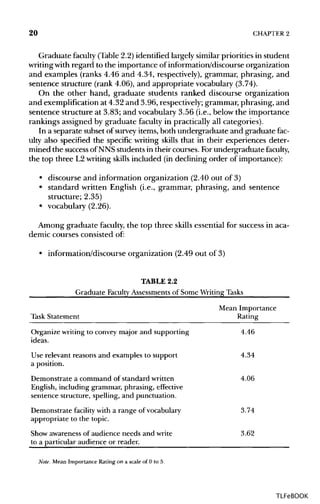
mon than pronouns in ... academic prose" (p. 235).
Another important distinction should be made between what has been
typically called productive and passive vocabulary. Productive vocabulary re-
fers to the vocabulary items that learners can use in speech or writing, and
passive vocabulary represents the words that learners are familiar with and
understand in listening and reading. In written text production, one of the
most important instructional goals is to increase NNS writers' productive
vocabulary range. A study of NNS advanced academic texts showsthat they
contain two to three times as many simple nouns (e.g.,people, world, human,
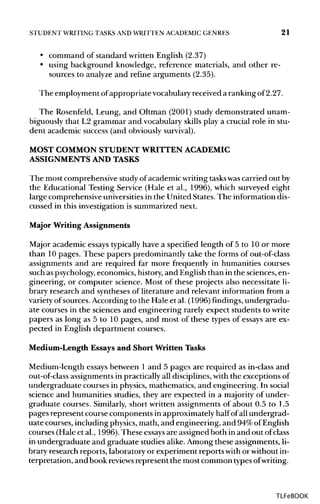
man, woman,stuff, thing,way) than similar prose of NS high school graduates
(Hinkel, 2002a, 2003b).
Over the past century, research on various large corpora ofEnglish words
has identified lists of most common vocabulary items employed in under-
graduate and introductory texts across several disciplines (Coxhead, 2000;
Nation, 1990). The UniversityWord List (Nation, 1990) and the Academic
Word List (Coxhead, 1998; cited in Nation, 2001) include 800 words and
567 head words ofword families in academic texts, respectively.The follow-
ing list includes only 375 words extracted from the UniversityWord List
(Nation, 1990). Many of these are frequently used as nouns, but can also ap-
pear in noun, verb, or adjective form (for a list of verbs, see chap. 8).
Lists ofwords, such as the noun list in this chapter, the verb list in chapter
8, or the entire UniversityWord List (Nation, 1990), can be handed out to
studentswith an explanation ofwhat it isand why they need to have it.When
the words from the lists come up in readings, exercises, and activities, it im-
portant to point them out to provide learners a sense ofpurpose in light of
the amount of tedious and difficult work they need to do to improve their
vocabulary. Nation (2001) called vocabulary work "the learning burden."
Most Common Nouns in Introductory Course Texts
at the University Level
The words in the bold font are found most frequently and in highly varied
texts across all disciplines. (Nation, (1990) Extracted1
)
'In many cases, noun and verb forms can be identical (e.g., access, aid, influence, advocate).
These are included on both the list of common nouns and the parallel list of frequent verbs.
TLFeBOOK
NOUNS AND THE NOUN PHRASE 101
abstract
access
acid
adjective
adult
aesthetic
affect
affluence
aggression
aid
alcohol
ally
alternative
ambiguity
analogy
anomaly
anthropology
apparatus
appeal
appendix
approach
area
aristocrat
arithmetic
aspect
aspiration
assent
asset
astronomy
atmosphere
atom
attitude
attribute
auspices
awe
axis
battery
benefit
biology
bomb
bore
breed
bubble
bulk
bureaucracy
calendar
capture
carbon
career
catalog
category
cell
challenge
channel
chapter
chemical
circuit
circumstance
classic
client
clinic
code
coefficient
collapse
column
comment
commodity
commune
competence
complement
complex
component
compound
compulsion
concentrate
concept
conduct
configuration
conflict
confront
congress
conjunction
consent
console
constant
construct
contact
context
contingent
continent
contract
contrast
controversy
convert
creditor
crisis
criterion
critic
crystal
culture
currency
cycle
cylinder
data
debate
decade
decimal
decline
deflect
democracy
denominator
design
detriment
diagram
diameter
digest
dimension
discourse
doctrine
domestic
drain
drama
drug
duration
dynamic
economy
electron
element
embrace
emotion
energy
entity
environment
episode
equilibrium
equipment
equivalent
ethics
exhaust
expert
exponent
export
extract
faction
factor
fallacy
fare
fate
feature
finance
fluid
focus
fossil
fraction
fragment
fraud
friction
frontier
fuel
function
fundamental
fund
fuse
geography
geometry
germ
goal
grant
TLFeBOOK
102 CHAPTER 5
graph
gravity
guarantee
harbor
hero
hemisphere
heredity
hierarchy
horror
hypothesis
image
impact
implement
import
impulse
incentive
incident
incline
income
index
individual
inflation
innovation
instance
instinct
integer
intellect
interlude
interval
interview
intimacy
issue
item
job
journal
label
laboratory
labor
launch
layer
lecture
leisure
lens
locomotion
logic
luxury
magic
magnitude
major
margin
material
mathematics
matrix
maximum
medium
metabolism
metaphor
method
microscope
military
minimum
molecule
momentum
monarch
morphology
motive
muscle
myth
navy
negative
nerve
network
niche
norm
notion
novel
null
nutrient
objective
odor
option
orbit
outcome
overlap
oxygen
parenthesis
parliament
peasant
pendulum
period
perspective
pest
phase
phenomena
philosophy
planet
plot
pole
policy
pollution
port
portion
positive
postulate
potential
premise
preposition
prestige
principle
priority
process
project
propensity
proportion
proprietor
protest
province
prudence
psychology
quote
radical
radius
range
ratio
rebel
rectangle
reform
region
reign
release
relevance
research
reservoir
resident
residue
resource
reverse
rhythm
rigor
role
route
saint
sanction
satellite
schedule
scheme
score
section
segment
sequence
series
sex
shift
sibling
site
skeleton
sketch
sociology
source
species
spectrum
sphere
statistic
status
stereotype
strata
stress
structure
TLFeBOOK
NOUNS ANDTHE NOUN PHRASE 103
style task theorem trend
sum team theory triangle
summary technique tissue usage
supplement technology tone vein
surplus telescope topic velocity
survey tense trace version
switch terminology tractor vertical
symbol territory tradition vocabulary
symptom terror traffic volt
synthetic text trait volume
tangent texture transition x-ray
tape theft treaty
Given that lists of the most common nouns employed in academic texts
are accessible to most interested teachers, finding lexical alternatives isrela-
tively easy in various contexts—for example:
affect—feeling, emotion, sentiment
competence—ability, skill, capability
fragment—-particle, piece, bit, shard
sphere—(1) circle, realm, domain, province, field, arena
(2) ball, globe, balloon, bubble
However, unlike the words easily learned in the course of daily interac-
tions, expanding the range of academic vocabulary requires a great deal of
work and persistence. The crucial factors in the success of academic vocabu-
lary learning are contextualization (and thematic organization), exposure to
appropriate-level academic texts with conscious noticing of how various
words are used, and sequencing of easier words to be followed by more diffi-
cult ones. For example, such nouns astriangle, traffic, tradition, and topic can be
accessible even to beginners. Similarly, ifintermediate learners already know
the nounfeeling, they can be in a good position to learn affect and emotion.
Learning academic vocabulary, like many other aspects of learning,
can become productive through repeated exposure and contextualized
repetition. If vocabulary dealing with planet, policy, pollution, release, re-
search, and residue is worked on during the second week of classes, these
nouns need to be reviewed and practiced in context later in the course.
On occasion, when teaching a large number ofwords in a limited amount
of time, combining new items with the review of those covered in previ-
ous units can lead to a snowball effect. In vocabulary work, it is important
to set realistic goals. For example, contextualized exposure to 700 to
1,000 words during one 10-to 12-weekterm maybe reasonable assuming
that students are assigned homework or projects outside the class (see
following Teaching Suggestions).
TLFeBOOK
104 CHAPTER 5
Research has demonstrated that gaining initialfamiliarity with the
meanings of 30 words per hour is possible when variousvocabulary
learning techniques are combined (e.g., word lists, vocabulary logs,
and keywords; Schmitt,2000). However,thisrate oflearning requires
learners to be focused and motivated; but as vocabulary grows, so
does the ability to increase the vocabularyrange. The greater the stu-
dents' vocabulary repertoire, the wider the possible exposure to new
vocabulary through reading. Thus, learners with a vocabulary range
of 5,000 service and academic words combined are likely to have an
easier time learning newwords than those with 1,500.
ARTICLES AND SINGULAR/PLURAL CHOICES
The English article system ishighlylexicalized and context-bound. Thatis,
in many cases, it is difficult to tell whether a definite or an indefinitearticle
is appropriate in different contexts or even if an article is required at all.
Comprehension isfar easier than production. One of the solutionsto the ar-
ticle dilemmas in production can be to encourage students to use plural in-
stead of singular count nouns. This teaching technique does not do away
with all the articleproblems, but it reduces their frequencies. For example,
Taking risks can produce bad result. Forexample, the investor buys stocks from new
company, and he expects to gain their capital. These people, however, may lose some of
their money on stock if their estimation about the stock isfalse. Stock price declines from
$10 to $6 after they bought the stocks at $10 each. Despite the bad result of taking risk,
people can succeed and accomplish their goal because the stock market can give them
chance to become successful. (From a student's assignment on investmentrisk.)
This excerpt contains nine errors in article and singular/plural noun
uses. Most of these can be avoided (or corrected) ifthe excerpt relies on the
usage of plural instead of singular nouns.
Taking risks can produce bad results. Forexample, investors buy stocksfrom new
companies, and they expect togain (break evenon) their capital (investment). These
people, however, may lose some of their money on stocks if their estimations (evalua-
[If] stock prices declinefrom $10 to $6 after they bought[buy] the stocks at $10 each,
[investors lose money]. Despite bad results of [from] taking risks, people can succeed
and accomplish their goals because the stock market can give them the/a chance to
become successful.
An important difference between learning how to cope with difficulties
in production and learning general rules that apply to most (or many) arti-
cle uses in English is this: In the broad-based approach, the tendency is to
gloss over the problem areas that students encounter in real language pro-
TLFeBOOK
NOUNS ANDTHE NOUN PHRASE 105
duction. The reason isthat, in general, rules are not intended to account for
specific occurrences ofarticles, but rather are designed to serve as overarch-
ing guidelines. In the case of employing plural nouns instead of singular
and, thus, avoiding at least some of the problems associated witharticle use,
students usually appreciate a tip that they can easily put into practice. The
ambitious goal of attaining a broad-based L2 proficiency and near-native
performance is usually not the students', but the teachers'.
NONCOUNT AND IRREGULAR NOUNS
Although noncount nouns in Englishare relatively few, they can play an im-
portant role in making text appear idiosyncratic because they are verycom-
mon in academic texts (see the list of frequent nouns). Many L2 grammar
books provide lists of these nouns divided according to their semantic
classes (e.g., groups made of similar items, mass nouns, abstractions, or
names of recreational activities—baseball, basketball, soccer, tennis, camping).
Although these semantic divisionsseem to be logical and organized toNSs,
to L2 learners they do not always make sense. For instance, why should bag-
gage, clothing, andfurniture items, which one can easily count, be noncount,
and what could possibly be the difference between baggage and bags? The
trouble with noncount nouns is that in English their singularity or plurality
is often simply lexicalized and cannot be explained logically.
Most lists of noncount nouns are organized based on their semantic
categories (e.g., whole groups made up of similar items—Fluids, Solids,
Abstractions, Languages, Recreations, Activities, and Natural phenomena).
However, to know that homework, slang, vocabulary, news, advice, music,
laughter, and wealth represent abstract phenomena, one needs to have a
relatively good vocabulary range. For this reason, the organization of
noncount nouns exemplified next is organized structurally and based on
explicit and overt noun markers such as suffixes.
Although current and popular methodologies for L2 teaching dis-
dain rote memorization and frown on attempts to assign lists to be
memorized, unfortunately there maybe fewmeans to learn academic
vocabulary outside of memorization, followed by extensive
contextualized practice.Thosewho have successfully attained L2 pro-
ficiency sufficient for success in academic reading and writing in any
L2 (particularly one without L1 cognates) are familiar with the te-
dious work entailed in learning lists of exceptions to almost all rules
provided by instructors.
An important consideration in learning noncount and other irregular
nouns is that the actual list of those necessary for producing academic texts
is small. For instance, students who do not plan to enroll in veterinarian
TLFeBOOK
106 CHAPTER 5
studies may not need to know that the plural of calf is calves, and learners
who do not play cards should not bother remembering that poker does not
have a plural form.
Lexical groupings of noncount nouns can be further simplified by
organizing the list by their endings. Plural cannot be used with:
• -work nouns—homework, coursework, work, fieldwork (i.e., all types of
work performed by people, but notframeworkand network)
• -age nouns—courage, voltage, postage, luggage, baggage, barrage,
change (money), garbage (but not garage)
• -edge nouns—knowledge, pledge
• -ice nouns—advice,juice,practice, malice, including ice
• -ware nouns—-freeware, hardware, shareware, software, silverware, flat-
ware, stoneware
• -fare nouns—welfare, warfare, fare,
• -th nouns—breadth, health, warmth, wealth, strength, truth, youth (but
not myth, depth, width, or length; see singular and plural meanings of
nouns later)
• many -a/ence, -ment, -ness, -(s/t)ure, -(i)ty, -ing nouns, usually called
abstractions in students textbooks. These derived nouns often have
different meanings in singular and plural forms (see Nominali-
zations and Gerunds).
• nouns that have the same form as verbs—air,fish,fog (up), help, ice,
iron, mail, play, oil,rain, slang, snow, smoke, traffic, water, weather, work
(some nouns are duplicated in these categories based on the what-
ever works principle)
• nouns that exist only in noun form—art, business, energy, fun, gram-
mar, music, oxygen, trouble, virtue, vocabulary, wisdom
Languages and People Rule. If a noun ends with -n or -i (American, Korean,
German, Moroccan, Indonesian, Norwegian; Iraqi, Irani, Emirati, Somali), the
plural marker is required. No plural can be used with any other types of
nouns and adjectives that refer to languages and people. For example,
Arabic [language]—Arab [person] have different adjective-noun forms. On
the other hand, Amharic, Chinese, Japanese, Vietnamese, Burmese, Dutch,
French, English, Spanish refer to both languages and people and do not take
plural markers.
It is important to distinguish between the names of languages and
people that function as nouns or adjectives. If the name is followed by
another noun, as in Indonesian students/people/professors/culture, plural
markers cannot be used with the first noun (see Compound Nouns)because
in this case Indonesian/American/Somali has the function of an adjective.
However, if a noun follows immediately, the plural form is required (e.g.,
Indonesians, Americans, Somalis).
TLFeBOOK
NOUNS ANDTHE NOUN PHRASE 107
Nouns that refer to languages and people can also be used in the
adjective form (e.g., American professors, Chinese/Japanese speakers). If these
language/people nouns are immediately followed by another noun, they
are used as adjectives. In thiscase, they never take the plural form no matter
what ending they have (see Compound Nouns).
A good rule of thumb is to identify the nouns and adjectives of the
people/languages type that frequently show up in students' texts or are
simply verycommon and focus on these particular items instead of trying to
work with the entire list of irregular plurals. In this case, the nouns hair, help,
junk, space, music, rain, snow, poverty, news, progress, people, pride, sleep,
vocabulary, grammar,slang, and life are highlyproductive,whereasflour,chalk,
corn, grass, silver, gold, dirt, and dust may be less so.
Possessives. Possessive nouns are relatively rare in academic prose and
structures such as: ?Indonesia's economy,? company's management,? course's as-
signments usually sound awkward.In most cases where L2 writers employ
these constructions, possessives should be replaced with adjective + noun
or compound noun constructions:
Indonesian economy, company management, course assignments. Possessive
constructions are usually limited to nouns that refer to humans:
John's lunch, teacher's pet.
However, even in the case of nouns that refer to groups of humans, the
use of possessives can be obscure:
*faculty's lounge, *employee's quarters, *government's benefits.
In those cases where possessivescan be used, the rule to follow is that if
the noun is singular (aboy/a nurse), the apostrophe is placed at the end of the
singular noun (a boy's/a nurse's). However, if the noun is plural (students/
professors), the apostrophe isstill placed at the end of the noun, and only one
-s is needed (students'/professors'). If the teacher has limited time to work on
various structures, possessives can be skipped because they are compara-
tively rare in student texts.
ESSENTIAL NOUNS IN ACADEMIC TEXTS
An important point to remember is that the University Words List and Aca-
demic Word List (Nation, 1990, 2001) include only a handful of noncount
nouns that are essential for students to use correctly:alcohol, atmosphere,awe,
biology, consent, equipment, ethics, friction, geography, geometry, gravity, hemi-
sphere, inflation, integrity, intimacy, labor, logic,mathematics,minimum, maximum,
navy, philosophy, pollution, prestige, psychology, reluctance, research, sociology,
trade, traffic, vocabulary, welfare.
Common Nouns That Are Always Plural, (and, therefore, require plu-
ral verb forms, when used in the subject position) include: clothes, glasses,
grounds, jeans, odds, pants,people, savings, shorts, stairs, surroundings, tropics.
TLFeBOOK
108 CHAPTER 5
Irregular Plural Forms of Nouns. Other highly common nouns from
the University Word List and Academic Word List that have irregular plu-
ral forms are: axis, crisis, criteria, emphasis,focus, hypothesis, index, matrix, me-
dia/medium, overseas, parenthesis, pendulum, phenomenon, radius, series,
species, strata,thesis.
All nouns that end in -is take the plural marker -es (crises, emphases,
hypotheses, parentheses), -ex/ix endings become plural -ces(indices, matrices),
-um nouns take -a (medium—media, stratum—strata), and -on endings have
the plural form of -a (criterion—criteria, phenomenon—phenomena). Such
nouns as overseas,series, and species have identical plural and singular forms
(one series—several series, one species—many species).
These nouns are not likely to be frequent in conversations and daily
spoken interactions. For this reason, they probably cannot be learned in the
course of routine communications and activities for developing conversa-
tional fluency (see chap. 1). This may be one of the reasons that the
vocabulary of even advanced and proficient L2 students does not include
them. Although teachers may attempt to design activitiesand exercises to
provide students practice with these nouns, it is doubtful that many
enjoyable tasks can be constructed with nouns such as axis, crisis, and
hypothesis. Nonetheless, it is essential for students to know the meaning,
pronunciation, and spelling of these nouns at least to recognize them when
they appear in academic reading and lectures. There are few better
solutions to the dilemma of their learning beyond simple memorization
and contextualized practice and use. The keyto success in students' vocabu-
lary learning is the teacher's insistence that essential vocabulary nouns be
used when they are needed.
SINGULAR AND PLURALNOUNS WITH DIFFERENT MEANINGS
Many essential countable nouns such as business, development, difficulty, fail-
ure, industry, injustice, technology, and truthhave different meanings in singu-
lar and plural forms.When used in singular they refer to concepts or whole
notions, and when used in plural they refer to specific instances, types,
kinds, and occurrences of these notions. The singular form technology refers
to all types of technology as a concept, but the plural technologies to various
types/subsets of technology such as computer, automotive, or telecommuni-
cation. For example,
The development of economy isthe most importantjob of thegovernment in my coun-
try. (From a student text.)
In this sentence, the noun development refers to the entire collective
notion that consists of many components, such as the development of
TLFeBOOK
NOUNS ANDTHE NOUN PHRASE 109
agriculture, transportation, and commerce. On the other hand, the plural form
developments refers to events and occurrences:
Many developments in the political arenapoint to a possibility of early elections.
The plural form developments refers to small and separate events or
occasions. In other words,whenused in singular these nouns refer to overall
constructs, and in plural to smaller instances/subdivisions of these
constructs.
The same principle of identifying meanings of singular and plural forms
can apply to other nouns that may be considered noncount, but are
employed in both plural and singular:
beer—beers, cake—cakes, change—changes, cheese—cheeses, chocolate—choco-
lates, coffee-coffees, coke—cokes, hair—hairs, glass—glasses, milk—milks, pa-
per—papers, tea—teas, time—times, wine—wines, work—works, youth—youths
All these refer towhole notions/concepts/massquantities or one instance
of in singular and specific instances in plural:
Beautiful hair [as a total mass/collective] requires much care vs. If youfound two
gray hairs [two instances/small occurrences of] onyourhead, donotpanic. Wehave
a solution to grays.
Most nouns that can have different meanings in singular or plural are usu-
ally (and unfortunately) found in the lists of noncount nouns that are ubiqui-
tous in ESLgrammar texts.To avoid confusion on the part of students, some
researchers (DeCarrico, 2000, p. 21) have called them "crossover" nouns; if
this label is helpful to learners, there is little reason not to use it.
GERUNDS AND ABSTRACT NOMINALIZATIONS
Analyses ofwritten and academic English corpora have demonstrated that
gerunds and abstract derived nouns are very common in academic and pro-
fessional texts (Bhatia, 1993).According to Biber'set al. (1999) findings, ab-
stract nominalizations are encountered far more frequently in academic
writing than in news reportage or fiction. On the other hand, conversa-
tional discourse has the lowest rates of nominalization occurrences among
all other language genre. Biber et al. explained that "academic discourse is
much more concerned withabstract concepts than the other registers, espe-
cially conversation" (p. 323).
Analysis of L2 text, however, shows that in academic texts advanced
NNS writers employ significantly fewer gerunds and nominalizations
than first-year NS students without formal training in writing (Hinkel,
TLFeBOOK
110 CHAPTERS
2002a, 2003b). The outcome of the NNS shortfalls in the uses of these
lexical features is that L2 academic text—both spoken and written—ap-
pears to be far less academic than maybe expected in college and univer-
sity settings. In addition, given their lack of academic vocabulary needed
to convey abstract concepts, L2 writers may simply be unable to explain
their ideas and adequately demonstrate their familiarity with readings
and material. Therefore, using gerunds and abstract nominalizations
can make students' texts appear less childish and simple and, ultimately,
lead to better grades in mainstream courses. Although teaching the uses
of gerunds and abstract nominalizations is not particularly exciting,
these structures are essential for the development of students' academic
language skills.
Both gerunds and nominalizations represent nouns and nounlike forms
derived from other parts of speech. Gerunds are always derived from verbs,
but nominalizations can be derived from verbs, adjectives, and other nouns
(e.g., read—reading, learn—learning, develop—development, ship—shipment,
dark—darkness, warm—warmth). A gerund can be derived from practically
any verb by adding -ing to its base form (e.g., sing—singing, write—writing,
listen—listening, speak—speaking).
An important characteristic shared by nouns (including nominal-
izations) and gerunds is that they frequently occur as objects/complements
of prepositions (e.g., a chance of obtaining funding/failure, a discussion about
learning/equipment, an opportunity for improving teenagers'diet/improvement). In
academic writing, the most common nouns that take of + gerund construc-
tions are in declining order (Biber et al., 1999):
way idea problem experience form system
method possibility process purpose important
means effect cost advantage practice
Derived abstract nominalizations are more complex than gerunds
because several various suffixes exist, all of which have the function of
converting words, including simple nouns, to abstract nouns: -age (acreage,
mileage), -ance/ence (assistance, dependence), -cy (accuracy, fluency), -ity (ability,
simplicity), -ment (predicament, government), -ness (readiness, cleanliness), and
-ion (solution, intrusion). Other nominalizers, such as -er/or (teacher, doctor), -ee
(employee, interviewee), -ent/ant (attendant, student), are also common, but they
are relatively semantically simpler than abstract nouns because in most
cases they refer to people or concrete objects that perform a particular
action or are from/in a particular place (senator, New Englander).
Although lists of these suffixes are found in most L2 reading and vocabu-
lary books, in general terms it is not possible to predict what types of verbs,
adjectives, or nouns can be derived by the suffixes -ment, -ness, -ity, or-ure.
TLFeBOOK
NOUNS ANDTHE NOUN PHRASE 111
In academicwriting, nouns with the suffix -ness refer to characteriza-
tions and states,whereas -ion nouns are particularly prevalent in the ac-
ademic genre, where the suffix occurs in frequent and rare words.
The Most Common Nouns with -tionDerivations
action direction infection production
addition distribution information reaction
application education instruction relation
association equation ooperation situation
communication examination organization variation
concentration formation population
(Biberetal., 1999)
In terms of their semantic content, most gerunds and nominal-
izations, which are frequent in generalizations, refer to concepts, ac-
tions, and processes that would be difficult to convey by other lexical
means. For example,
lure have the most togain bydeveloping, teaching, and protecting theprevailing institu-
tions and culture. Culture normally justifies the institutions and structure, and
institutionsgenerally work tosupport the structure and culture. Together, social structure,
culture, and institutions areimportant towhat individuals do. (Charon, 1999,p. 125)
Gerunds, even more than nominalized nouns, refer to processes (some
linguists actually call them process nouns)—for example:
developing (ideas)—development
creating (software)—creation
observing (animals)—observation
suggesting (new directions)—suggestion
In fact, one of the key differences between gerunds and nominalized
nouns is that of a process referred to by means of gerund versus an
abstraction, concept, or action expressed in nominalizations. Thus,
instituting something is different from an institution and organizing from an
organization. There are various derivations of both types that exist in only
one form (e.g., reading, writing, teaching, learning, hoping or culture, moisture,
revolution, possibility, probability}.
Traditionally, practically all L2 grammar books provide lists of verbs that
are followed by gerunds, infinitives, or both (e.g., enjoy + swimming (but not
TLFeBOOK
112 CHAPTER5
to swim), decide + to go (but not going), or like to dance/dancing). Although
these lists are essential, in reality the uses of gerunds are a bit more
complicated than this. For example, the sentence
*Developing is expensive
is incorrect because develop is a transitive verb, which requires a direct ob-
ject. Thus, the sentence
Developing software is expensive
is correct. Because all gerunds are derived from verbs, the point of fact is
that if gerunds are derived from transitiveverbs, which require a direct ob-
ject, the process nominals retain their transitivity feature.
A good explanation to give students can be a metaphor: When a
verb goes to a newjob and becomes a noun, it takes its possessions
with it;when a verb isconverted to a nominal by means of adding-ing
to its basic form (suggest+ing), it drags the object with it (e.g., Sug-
gesting a new plan requires preparation).
For a list of common transitive verbs, see chapter 3.
In addition, another level of complexity is added with gerund singular
and plural distinctionswhen some gerunds can be used in plural and some
cannot (e.g.,
reading—readings, swimming—*swimmings).
As a general rule, gerunds that refer to concrete objects and events can
take plural, and other gerund forms that refer to processes cannot.
Therefore, gerunds that can be used in a plural form are far less common
than those that are noncount (e.g.,beginnings, endings [of books/movies/stones],
markings, paintings [but not *clothings]).
COMPOUND NOUN PHRASES
Noun phrases consist of several nouns, among which the first noun or two
function as adjectives to describe the main (head) noun:
composition class
university composition class
university-level composition class
In these phrases, the noun class is the head noun, and all other nouns
describe the class.
Compound noun phrases are extraordinarily popular in academic texts,
and some linguists call them "notorious" (Bhatia, 1993, p. 148). These
structures can come in various forms: Some consist of two simple nouns
(book cover, vocabulary list), gerund/nominalization and another noun
TLFeBOOK
NOUNS ANDTHE NOUN PHRASE 113
(listening activities, automobile production), and fused verb + particle
constructions (setup, handout, wash-back effect). Corpus studies of academic
texts have found that these are far more common in written than
conversational genres, that noun compounding represents a highly
productive structure, and that formal written texts include more of these
constructions than informal varieties (Biber et al., 1999).
In L2 texts, one of the typical errors is pluralization of the descriptive
nouns in the compounds (e.g., *afive-credits_-hours course, *a 20-years_-old
student}. Relativelyspeaking, avoiding these errors iseasy to teach. In Eng-
lish, adjectives do not take plural, and the structures *blues books and *bigs
blue books are incorrect because only the main (head) noun can be used in
plural. Similarly, withcompound nouns, the firstjob isto identify the main
noun (usuallythe last one in the string of nouns) that can take the plural:
a five-credit-hour course(s), a 25-year-old woman (women)
(for an in-depth discussion of adjectives see chap. 9).
In most compound noun phrases (e.g., thevegetable garden), only the
last (head) noun takes the plural marker -s, and other nouns that de-
scribe it do not.
Exceptions to this rule are few, and they almost always include "exclusive
plurals" (Quirk et al., 1985) when it is known that the descriptive noun
includes more than one entity (e.g., arts degree, customs officer; it is also
possible to say art degree when one type of art is involved).
Another typical problem with compound nouns is that compounding
can take place only ifan adjective form of a particular noun does not exist:
vegetable soup, noodle dish, rice bowl, table top (there are no adjectives that
can be derived from vegetable, noodle, rice, or table). In contrast, compound
structures such as
*nationflag, *economy data, *culture norms
are incorrect because adjectival forms of nouns have to be used if they
exist—national, economic, and cultural.
A word of caution is necessary when it comes to adjectives derived from
nouns because the meaning of the adjectives can be quite different from
that of the noun:
composition teacher vs. compositional teacher
book vs. bookish
territory vs. territorial
CHAPTERSUMMARY
To deal with shortfalls in students' repertoire of nouns prevalent in aca-
demic texts, a concerted effort has to be made to increase the learner's vo-
TLFeBOOK
114 CHAPTER 5
cabulary range. To this end, several simple and effective teaching
techniques can be highly productive:
• Contextualized lexical substitutions of nouns that are common and
frequently repeated in L2 prose do not require much work beyond
the teachers' use of a thesaurus (or even the vocabulary in theirown
lexicon).
• Provide practice and exercises based on the list of highly common
nouns employed in academic textbooks across variousdisciplines.
A reasonable number of words learned during a 10- to 12-week
course can range from 700 to 1,000, and the rate of instructed
learning can be as high as 10words per hour (or more).
• Expanding students' academicvocabularyshould start at the begin-
ning level of proficiency and continue throughout their language
training. Astute text simplification may take the form of omitting
rare words,but not lexicallyand structurallycomplex common aca-
demic words, because learners can onlybenefit from maximizedex-
posure to frequent and, thus, essential academicwords.
Many specific problems that L2 writers encounter in producing aca-
demic prose can be explicitlytaught through simple explanations and exer-
cises. Research has shown that explicit instruction of any sort leads to
significantly greater language gains than no instruction or implicitinstruc-
tional approaches (Norris & Ortega, 2000). The following teaching tech-
niques have proved to be effective and easy to use:
• Count and noncount nouns that are usually classified based on
their semanticfeatures are difficult to learn because L2 writers re-
quire substantial vocabularyrange tounderstand the semantic clas-
sifications. Categorizing nouns based on their structural features,
such as endings, can be more productive. In general, only 32
noncount nouns are frequent in academic texts.
• Abstractplural and singular nouns mayhave different meanings in
singular and plural forms. Most learners are not aware of this dis-
tinction, which should be addressed in teaching.
• Gerunds and nominalized nouns are particularly important forac-
ademically bound L2 learners because most cannot be acquired
through exposure to conversational discourse and fluency-building
activities. Research has shown, however, that gerunds and
nominalized nouns are twoto three times less common in L2 than
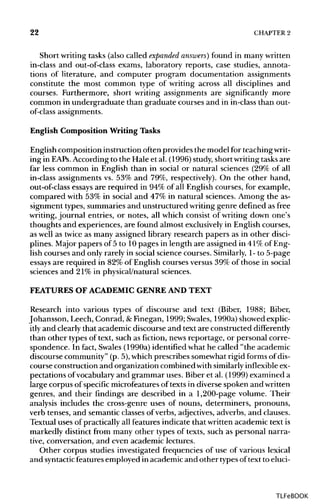
in LI academic prose.
• Compound noun phrases are extraordinarily popular in academic
texts, but can be structurallycomplex. Afewsimpletechniques deal-
ing with these structures can help learners overcome some of the
problems associatedwiththe usesof these constructionsin L2text.
TLFeBOOK
NOUNS ANDTHE NOUN PHRASE 115
STRATEGIES AND TACTICS FOR TEACHING
AND TEACHING ACTIVITIES
Incidental learning ofvocabulary (seechap. 3 for a discussion)represents the
least labor-intensive way to expand vocabulary. The learning goals of the
teaching suggestions and activities presented next are developed to promote:
• Noticing the uses and meanings of nouns (see chap. 3)
• Incidental learning of words (see chap. 3)
• Discussing contextualized occurrences of nouns and their lexical
substitutions
It is crucial that the teacher follow up on the assigned exercises and
vocabulary learning tasks. As mentioned in chapter 3, learning 10 new
words per hour isnot an unreasonable rate, and it isthrough the discussion
and activitiesthat the words are actuallylearned. In-classdiscussions and/or
follow-up work with nouns and other words provide the most important
benefit because they give students additional opportunities to:
• Focus their attention on specific vocabulary items
• Use them in speaking and listening
• Negotiate meaning of nouns and other words
• Refine contextualized meanings and syntacticproperties of items
• Develop classroom interactional skills
All teaching activitiesexemplified in this chapter and others have been
used for decades with many typesof academicallybound students withvari-
ous levels of proficiency, from beginning to advanced. Although books on
teaching academic vocabulary often call for constructing exercises and tests
for each lesson, these are laborious and time-consuming. The teaching sug-
gestions presented here are based on using texts easily obtainable from
print and written media sources such as advertisements, book cover de-
scriptions, and newsreports. In the days of the Internet and Website prolif-
eration, example texts can be easily obtained in many geographical
locations and can be chosen to suite all typesoflearners—from beginners to
highly advanced writers.
As a general rule, if text simplification is needed, it is best to eliminate rare
rather than commonwords, even iftheyare lexicallyand structurallycomplex.
Prefixes and Suffixes—Dictionary Work and Practice
English-English dictionaries are alphabetically organized, and a photo-
copy of one to three dictionary pages withwords that begin with a specific
prefix can allow learners to figure out its meaning. For example:
TLFeBOOK
116 CHAPTER 5
• incommunicado—if you arekept incommunicado, you cannot seeor talk to
anyone
• incomparable—so good or beautiful that nothing else can even be compared
to it
• incompatible—two people are incompatibleif they have completely different
personalities and cannot get along
• incompetence—no ability or skill to do ajob properly
• incompetent—not having an ability or skill to do ajob properly
• incomplete—not having all itsparts
• incomprehension—not being able to understand something
• inconclusive—not leading to a clear decision or result (Adapted from
Longman Dictionary of Contemporary English, 1995).
It is important for dictionary-based exercises to include dictionaries of
appropriate levels of difficulty. For example, learners' dictionaries can be
used for beginners and intermediate-level students, and advanced learners
can work with unsimplified dictionaries. The work on a particular
prefix/suffix needs to coincide with other practice with prefixes/suffixes
with similar meanings (e.g., ab-, un-, new-) and exercises found in all
vocabulary textbooks.
Whileworkingon prefixesand their meanings, it maybe useful to devote
at least some amount of attention to parts of speech and their varied
suffixations (e.g., noun suffixes -ion,-ure,-ment are different from adjective
suffixes -i/able, -a/ent, -i've). Also the structure of dictionary entries and the
practical information contained in them can be examined and discussed
(e.g., count/noncount designations, verb-transitive/verb-intransitive, or
prepositions typically used with particular nouns).
Graded Exposure to Authentic Texts (Increasing Lexical Complexity)
(a) For beginning students, magazine/newspaper advertisements or book
cover descriptions withfrequent noun uses can be used to provide exposure
to contextualized vocabulary learning. On a photocopy of the advertise-
ment/description, the useful and practical nouns (verbs,adjectives, or prep-
ositions) canbe blocked out withadhesive labels or whiteout to create blanks
for a fill-in-the-blank practice withauthentic language. However,the nouns
from the original are listed below the text to be used as prompts for blank
filling. For example:
If you sometimeshaveproblems and adapting toAmerican culture, or
have difficulty communicating with of American English, this book
will help you.
TLFeBOOK
NOUNS ANDTHE NOUN PHRASE 117
Each chapter in this book has two (1) readings and exercises about
cross-cultural and selected areas of American ,• and (2)
intercultural communication designed topromote discussion ofcross-cul-
tural communication. Tohelp you betterunderstand the material, the book includes
• reading ,
• comprehension questions,
• discussion questions,
• exercises,and
• conversational .
Omitted nouns and gerunds:
sections activities exercies culture understanding
speakers communication vocabulary activities
(Adapted from Levine & Adelman, 1993.)
Vocabulary expansion practice:
sections—parts, portions
understanding—comprehending
activities—exercises, work, practice, doing something
conversation—speaking, talking, discussing
(b) An activity such as described in (a) can be used without the list of
original nouns (or other types of words) when students are expected to
come up with lexical alternatives or various possibilities for appropriate
context completion. For instance, all appropriate lexical replacement
options can be acceptable if students supply them.
In intermediate-level classes, newspaper articles on various topics of
interest, aswell as science and market reports, can become a good means to
increase the level oftext complexityand lexicalvariety(seelater example).
If the original nouns/words are not provided, students can work in
groups to complete the text and supply as many contextually appropriate
fillers as they can. Groups can compete for finding as many lexically
appropriate and syntactically correct fillers, and the winner of each blank
can be awarded a token (e.g., a piece of colored paper). The group that
accumulates the most tokens wins the competition. Students usually enjoy
this type of competition, and the amount of discussion associated with
appropriate lexical and syntactic choicesofwords can be highlyproductive.
TLFeBOOK
118 CHAPTER 5
(c) For advanced students, this technique can be used with excerpts from
introductory textsin the disciplines or literature on any topicthat the teacher
considers to be useful and appropriate. As intermediate learners, students
can work in groups or complete the assignment as homework, followed by a
substantial class discussion of their lexical choices. For example,
• Whyisa particular wordappropriate/inappropriate in thissentence?
• What better word can be found?
• Why is another choice of a word better?
• How many parts does a particular word consist of?
• What are they?
• Is this word a noun, adjective, verb, or adverb, and how do we
know?
• What lexical substitutionsfor this word can we thinkof?
• Are some better than others and why?
Lexical Substitution Exercises
Restatement and paraphrase are often considered to be essentialacademic
tasks. However, many NNS students lack the necessary lexical and reading
skills to restate an idea. Teaching restatement by means of lexical substitu-
tions issimpler than paraphrasing, and lexicalrestatement can be practiced
even with high beginners. For example,
Task 1. Please replace the underlined nouns with other nouns (or
phrases) with similar meanings.
1. Education abroad is rapidly expanding due to an increasing number of ad-
venturous students who take advantage of going abroad to explore their eth-
nic roots.
[education—studying, going to school, learning; abroad—in a foreign
country; expanding—growing, becomingpopular; roots—origins, family
history]
2. Several factors play an important role in this trend,
[facts, points, ideas]
3. Colleges and universities in England remain the top destination for U.S.
students.
[choice, place, location, goal]
Paraphrase practice is a little more complex and requires examples for
students to complete it successfully. However,ifthe lexical substitutionwork
takes place prior to restatement, students will have little trouble.
Task 2. Please explain in your ownwords and in one sentence whatthese
three sentences say together.
TLFeBOOK
NOUNS ANDTHE NOUN PHRASE 119
Also in writing practice, after students produce a paragraph or an essay,
the teacher can underline nouns/words in the students' texts to be replaced
with other words with similar meanings.
Editing and Finding Mistakes in Noun Forms and Uses
(a) Noticing and drawing attention
The first step in teaching students to edit their own text is to present one
written by someone elsewith several mistakesof the same or similartypes:
"You got a mail." Technology can provide various ways for communicate. Most
American have already visited WWW,but in my country, people stilldon't use technolo-
gies often. With the technology development, we, people, can get more and more benefit.
We use technologies doesn't mean we abandonthe traditionalway to communicate with
otherpeople. I really enjoy to meet withfriends and havefun withfamily. But everybody
is so busy today, technology provides a more convenientwayfor communication.Every-
body havedifferent wayto communicate, and / believe technology make us having more
communicate with other, it also makes our life more beautiful. (From a student essay
on the influence of technology on communication.)
This text can be put on a transparency and the mistakes in it discussed in
class. Alternatively, students can work on several similar texts in small
groups and then present their findings to the class with explanations for
each error they identified. In this case, the entire class may have additional
opportunities for noticing and working with problematic nouns.
(b) When proofreading text for structural, morphological, or inflectional
errors, most students begin reading their text from the beginning. In doing
so, the reader almost immediately gets caught in the flow of the text and
stops paying attention to errors in word/noun form. Furthermore, when
students read their own text silently, they employ only one type of
memory—visual. For students in ESL/EAP programs in English-speaking
countries, aural memory (remembering how the word sounds) can provide
an additional boost in mistake-hunting power:
• It is far more effective to start reading one's own text from the be-
ginning of the last sentence to the end of this sentence. In this way
the reader proofs the text by reading it backward, sentence by sen-
tence, to avoid getting caught in the text flow.
• Then move up to the one before the last sentence and read to the
end of this sentence.
• Then move up one sentence higher still (the third sentence from
the end) and proofread it.
• The proofreading of text should be done aloud (but not necessarily
loudly) while paying close attention to word forms.
TLFeBOOK
120 CHAPTER 5
• This proofreading technique can help students locate and correct
about one third to half of the word-form errors in theirwriting.
• In most cases, students need to be shown this technique only one
time because it is simple to understand and use. They just need to
be reminded to proofread their text, read it out loud, and follow
what iswritten (rather than what they think iswritten).Reminding
writers to proofread is not a new task for any writing teacher.
For example:
(This is the last sentence to be proof-read (6)]When I wasachild, all thetechnolo-
gies in myhometown were still simple. [The fifth sentence to the end (5)] Started from
television tocomputers, allwere changed. [Then the fourth sentence to the end of the
sentence (4)]Basically, all technologies that people discovered in communications werenot
to make money. [Then read the third sentence to the end (3)] They were madefor im-
provements. [Then continue with the second sentence to the end of the sentence
(2)] It is true that until now there are no technologies that can promote person contact.
[Start reading here to the end of the sentence—(1)] Forexample, people can only
hear voices from telepJwne and people can only see thefaces and voices through internet.
(From another student's text on technology and communication.)
Gerund Practice
As mentioned, gerunds derived from transitive verbs often retain their objects
evenwhen theyplaythe role ofsentence subjects. Identifying the sentencesub-
ject appropriately when working with gerund constructions is important in
subject-verb agreement editing. To raise students' awarenessof gerund com-
plexities, many gerund + direct object constructions can be found. Students
usually learn a great deal from such practice and enjoy it. For example,
Please explainwhichverb form iscorrect and isan appropriate choice in
this sentence. How many are possible and why?
Trusting friends becomes/become necessary at the time of trouble.
Eating fresh vegetables is/are recommendedfor children and adults of all ages.
Reading books is/are essential in learning a second language.
Hiding cookiesfromchildren is/are something that many parents do, when they
want to control their children's diet.
Writing exerciseshelp/helps students to improve their vocabulary skills.
Choosing universities is/are complicated for teenagers without their parents'
assistance.
In general, gerund + direct object constructions are extremely common
(e.g., understanding parents/children/students, building blocks (of houses), buying
cars, answering phones, typing letters), and many similar sentences can be
made for practice.
TLFeBOOK
NOUNS ANDTHE NOUN PHRASE 121
QUESTIONS FOR DISCUSSION
1. In teaching ESL to L2 university-bound students, instruction in vo-
cabulary and grammar usuallytake place in courses separate from
the teaching of L2 writing.Whywere ESL curricula and language
work designed like this? Ifyou were in charge of the curriculum de-
sign, what course structure would you develop?
2. In your opinion, why did Nation (1990) call vocabulary learning a
learning burden? How can learners acquire academic vocabulary in
classroom activities? Howcan these activities be designed to bepro-
ductive for learners?
3. Whydoes the learning of academic vocabulary need to become one
of the central foci of classroom instruction?What current L2 teach-
ing methodologies match the needs of academically oriented
learners?
4. What methodological and research premise underlies the expan-
sion of learners' range of nouns by means of contextual lexicalsub-
stitution?
5. Among the L2 learners' problems with nouns addressed in this
chapter (e.g., countable-uncountable nouns, articles, names oflan-
guages and people), in your opinion which ones are more impor-
tant than others for L2 learners to be aware of? Why?
FURTHER READINGS ABOUT ACADEMIC VOCABULARY
AND VOCABULARYTEACHING
Vocabulary Teaching
Carter, R., & McCarthy,M. (Eds.). (1988). Vocabulary and language teaching. Harlow,
Essex: Longman.
Coady, J., & Huckin, T. (Eds.). (1997). Second language vocabulary acquisition. Cam-
bridge: Cambridge UniversityPress.
Dudley-Evans, T., & St.John, M.j. (1998). Developments in Englishfor specific purposes.
Cambridge: Cambridge UniversityPress.
Jordan, R. (1997). Englishfor academic purposes. Cambridge: Cambridge University
Press.
Milton,J. (1999). Lexical thicketsand electronic gateways: Making text accessible by
novice writers. In C. Candlin & K. Hyland (Eds.), Writing texts, processes and prac-
tices (pp. 221-243). London: Longman.
Schmitt, N. (2000). Vocabulary in language teaching. Cambridge: Cambridge Univer-
sity Press.
Schmitt, N., & McCarthy,M. (1997). Vocabulary description, acquisition,and pedagogy.
Cambridge: Cambridge University Press.
Academic Vocabulary
Adams, V (2001). Complex words in English. Harlow, Essex: Longman.
TLFeBOOK
122 CHAPTER 5
Arnaud, P, & Savignon, S. (1997). Rare words, complex lexical units and the ad-
vanced learner. InJ. Coady &T. Huckin (Eds.), Secondlanguage vocabulary acquisi-
tion (pp. 157-173). Cambridge: Cambridge University Press.
Coxhead, A. (2000). The new academicword list. TESOL Quarterly,34(2), 213-238.
Francis, G. (1994). Labelling discourse: An aspect of nominal-group cohesion. InM.
Coulthard (Ed.), Advances in written text analysis (pp. 83-101). New York:
Routledge.
Nation, I. S. P.(1990). Teaching and learning vocabulary. New York:Newbury House.
Nation, I. S. P. (2001). Learning vocabulary in another language. Cambridge:Cam-
bridge University Press.
Vocabulary in Discourse
Celce-Murcia, M., & Olshtain, E. (2000). Discourse and context in language teaching.
Cambridge: Cambridge University Press.
Hatch, E. (1992). Discourse and language education. Cambridge: Cambridge Univer-
sity Press.
McCarthy, M. (1991). Discourse analysisfor language teachers.Cambridge: Cambridge
University Press.
Appendix to Chapter 5
LEXICAL CHUNKS WITH VARIOUS TYPES OF NOUNS
AND NOUN PHRASES
Negative Openings: Uncountable Nouns
(However),
little information is available about xxx
little attention has been devoted to yyy
Negative Openings: Countable nouns
few reports have discussed/examined zzz
few discussions have addressed/noted/examined
few articles havefocused on/noted
few studies have investigated/dealt with
(Adapted from Swales & Peak, 1994)
TLFeBOOK
NOUNS AND THE NOUN PHRASE 123
Most Common Noun Phrases Found in Academic Prose
Nouns with Prepositional Phrases
the relationship between the
the difference between the
an important part in
an important role in
an increase in the
the same way as
Prepositional Phrases Followed by the Of-phrase
as a result of the
as in the case of the
at the end of the
at the beginning of the
at the time of the ...
at the time of writing
from the point of view (of)
in the context of the
in the division of labor
in the course of the
in the early stages of
Most Common Noun Phrases Found in Academic Prose
Four-Word Units: Noun Phrases Followed by an O/-phrase
(and) the development of the
different parts of the
one of the main/most
other parts of the
part(s) of the body
parts of the world
per cent of the
point of view of
the ability of the
the absence of a
the base/basis of the
the beginning of the
the case of a/the
the center of the
the composition of the
the context of the
the course of the
the division of labor
the early stages of
and the number of
the edge of the
the effect(s) of the
the end of the
the existence of a
the first of these
the form of a/the
the formation of the
the history of the
the importance of the
the length of the
the level of the
the magnitude of the
the nature of the
the needs of the
the origin of the
the point of view
the position of the
the presence of a/the
both sides of the
the presence or absenceof the
the purpose of the
the rest of the
the results of the
the role of the
the shape of the
the size of the
the start of the
the structure of the
the sum of the
the temperature of the
the time of the
the top of the
the total number of
the use of a/the
the value of the
the work of the
(Adapted from Biber et al., 1999)
TLFeBOOK
124 CHAPTERS
Five-Word Units: Noun Phrases Followed by an Of-phrase
one of the most important the point of view of
the aim of this study the presence or absence of
the first part of the the rate of change of
the other end of the
(Adapted from Biber et al., 1999)
TLFeBOOK
6
More on the Noun Phrase:Pronouns
OVERVIEW
• The place of personal pronouns in academic text and their associ-
ated genres.
• Uses of impersonal pronouns.
• Demonstratives,text cohesion, and lexical substitution.
• The prevalence ofindefinite pronouns and learning to avoid them.
Although the term pronouns suggests that they can be used in place of
nouns, in reality pronouns have characteristics and functions that make
them different in important ways. First,unlikenouns, pronouns represent
a closed class of words (Quirk et al., 1985)—that is, they are limited in
number and functions, and newwords of this type are not coined. Unlike
nouns, pronouns can be used in place of whole phrases or concepts with
nominal functions (e.g., the phrase the big blue grammar books can be re-
placed by a pronoun they, which refers to the entire noun phrase). Further-
more, in English pronouns have syntactic properties that nouns do not
have: Pronoun forms can vary depending on whether they occur in the
sentence subject or object position (I/me, she/her) or refer to first, second,
or third person, or male or female.
In addition to personal pronouns, various other types of pronouns are
very common in English: demonstrative (this/that, these/those), indefinite
(somebody, anybody, everything), and slot fillers (it/there). Although many L2
learners believe pronouns to be syntactically and lexically simple, and al-
though words or particles with demonstrative and indefinite functionsexist
in most languages, various types of problems in pronoun use have been
identified in NNS students' academic prose (Indrasuta, 1988; Johns, 1991,
1997; Vaughan, 1991).
125
TLFeBOOK
126 CHAPTER 6
Additional levels of complexity arise when L2 writers transferculturally
determined considerations of appropriateness in pronoun use, as is the
case, for example, with personal pronouns. In the teaching of L2writingin
ESL/EAP and writing/composition courses, frequent employment of per-
sonal pronouns isoften perceived to be appropriate and acceptable, partic-
ularly in essays associated with expressing personal views and ideas.
However, several studies of large corpora of formal academic text have
found that in many disciplines uses of personal pronouns are very infre-
quent. With regard to L1 and L2 essay texts, prominent and significant dis-
tinctions have been identified between NS students' uses of various typesof
pronouns and those encountered in NNS academic prose in English
(Hinkel, 2001c, 2002a).
This chapter begins with an examination of personal pronouns in aca-
demic texts,followed by slot fillers (it/there), and then demonstrative and in-
definite pronouns and their functions in academic discourse and text.
PERSONAL PRONOUNS IN ACADEMIC TEXTS
The textual purpose ofpersonal pronouns inwritten discourse isto refer di-
rectly to the writer, the audience of writing, and specific things or persons
other than the writer or audience. Corpus analyses of various genres have
shown that personal pronouns are orders ofmagnitude more common than
other typesofpronouns, and these features are far more common in conver-
sational than in any other type of genres. In addition to conversational dis-
course, personal pronouns are alsoencountered in fiction, but only rarely in
academic text. As Biber et al. (1999) pointed out, because personal pro-
nouns mostly refer to persons, "human beings are a more marginal topic"
(p. 333) in academic prose.
First- and Second-Person Pronouns
In written text, the uses of first-person pronouns usuallymark personal nar-
ratives and/or examples that are often considered inappropriate in aca-
demic writing. Many researchers of academic discourse and prose have
noted the highly depersonalized and objectivecharacter ofacademic prose
that requires "author evacuation" (Johns, 1997, p. 57). Explicitteaching of
features of formal and academic discourse and text requires avoiding per-
sonal pronouns, personal tone, and personal references (Jordan, 1997;
Raimes, 1992; Swales & Feak, 1994).
In fact, Swales' (1990a)analysisofwritten academic genre found that ac-
ademic textsare often expected to project objectivity in presenting informa-
tion and depersonalize text by various lexical and syntactic means. Swales
further argued that the teaching ofwriting and "student writing in colleges
and universitiesshould not be viewedas an individually-oriented, inner-di-
TLFeBOOK
PRONOUNS 127
reeled cognitive process" (p. 4), but as tasks in discourse and text construc-
tion withinthe conventions ofcommunicating knowledge withinthe norms
of the academic community. According to Swales,L2writingteachers need
to prepare students to write in the disciplinesbecause academic writingisa
socially situated act that extends far beyond the writer's analysisofhis or her
inner explorations and thoughts.
Second-person singular and plural pronouns are also considered inap-
propriate in academic prose because they are employed to address the
reader directly (Smoke, 1999; Swales & Feak, 1994). The use of these pro-
nouns requires a specificindividualtowhom the text isaddressed, indicates
a high degree ofthe writer's involvementwith the addressee, and marks the
conversational register (Biber, 1988, 1995).
Corpus analyseshave shown that first- and second-person pronouns are
rare in academic prose. In all the rate of occurrences of I, me,we,and uscon-
stitutes 0.006% (6 per 100,000 words) in a large corpus of academic text
(Biber et al., 1999). The rate of occurrences of you is rarer still with0.001%.
Some amount of variation of personal pronoun use has been noted across
various disciplines. Prose in philosophy included the highest rates of
first-person pronouns of 6.5 per 1,000 words (0.65%), followed by texts in
marketing and applied linguisticswith 6.2 (0.62%) and 4.8 (0.48%) occur-
rences per 1,000 words, respectively (Hyland, 1999).
However, in NNS students' academic texts, personal narratives and ex-
amples can be common, and rates of first-person pronoun usage varies be-
tween 1.89 and 3.97% (Hinkel, 2002a). In addition, the frequency rate of
second-person pronouns are also relatively high—between 0.5% and
1.00%. For example, in a senior-level psychology assignment, included
next, a student employed several types of personal pronouns to an extent
that may make her text appear to be a personal narrative.
Extroversion
(This excerpt startsat the beginning of the third paragraph of the paper.)
Is it possiblefor everyone to change one's behavior and thoughts by different environ-
mental/actors? 7 believe the answer is no doubt. One's childhood experience and back-
ground constitute his disposition for thefirst period. During this period, hisfamily or
school teachers might influence his development of character. Furthermore, he, as an
adult in the secondperiod, could transfer whetherfrom introversion to extroversion or
from extroversion to introversion, depending on his religion, culture, and personal ex-
perience in society. Perhaps, hispersonality will bechanged again in thefuture. The best
successful example is my personal experience to support this approach. 7 was soisolated
and shy that 7 was not popular in my parents' eyes when 7 was a child. It won't be
changed until 7 entering high school. Mr. Lee, one of my high school teachers, encour-
aged me and helped me to understand my own ability in languages that completely de-
cided my future. After 7 attending many speech contests in school, 7 have become a
self-confidence and talkative girl as a leader. Most friends consider me to be an extra-
TLFeBOOK
128 CHAPTER 6
verted person. Nevertheless, I discover that my personality has changing again and
again after getting my teaching experience. (The student wrote two more para-
graphs to complete the assignment.)
In this excerpt, the use of a personal example as supportinginformation
does not seem appropriate because, for one thing, it does not demonstrate
familiarity with course material and/or relevant literature. Furthermore,
personal examples cannot be considered generalizable and are most often
perceived asanecdotal. Forthe purposes ofan academiccourse assignment,
the writer needs to be directed to cite research, literature, or other typesof
formal academicevidence that can support her position that extroversionis
a variable trait.
Third-Person Pronouns
In addition to first-person narratives, NNS students also employ third-per-
son recounts and stories to support their positions. In many cases,due to the
narrative-like character of NNS academicprose and insufficiency of theirvo-
cabulary, L2writersinclude high rates of third-person pronouns in their text
(Hinkel, 2002a). For example, in an essay on the economic benefits and pit-
falls of credit cards, the student writer tells the story of his friend.
(This excerpt starts at the beginning of the third paragraph.) It istrue that
credit cards are really popular these days, but it hasproblems, likedebt. Forinstance, one
of my friends, who is Dan, had two gold credit cards. But he_didn't concernthe budget of
his account, whilehe_was using the plastic money. So, he_had heavy debt on his account.
It took about two and half years topay offhis_ debt. After he_had big trouble with charge
cards, he_cut his two gold credit cards with scissors. Now he_does not have any kinds of
credit cards.
Moreover, according to the Social Security statistic, in 1996, only 30% of the credit card
holders payfull pay amountand another 70% pay only minimum amountorless thana full
amount. The statistic shows us howpeople areabusingthe credit card, and thephenomenon
gets worse and worse. (The essays includes three additional paragraphs.)
In this excerpt, the function of personal or third-party recounts islargely
the same (i.e., to provide validation for the main points expressed in the es-
say). Another point to make is that, despite the fact that in many cases, L2
writers are familiar with employing published sources (e.g., the Social Secu-
rity statistic) as a means of rhetorical support, this technique might not be
used consistently and appropriately. In the credit card example, thestatistic
cited bythe student does not support the observation that users abuse credit
cards or the claim that the phenomenon gets worse and worse. Thus, in-
struction on the limited power of personal narratives to support essay
points should coincide with the teaching of citing elaborated discussionsof
TLFeBOOK
PRONOUNS 129
data and sources, combined with the fact that the citationsmust validateall
points made in the text and not just some of them.
In general terms, NNS students need to be explicitly instructed to
avoid the uses of:
• personal examples, narratives,and recounts ofpersonal experiences
• addressing the reader directlyand, thus, second-person pronouns
• personal tone and its attendant linguistic features, such as adjec-
tives (wonderful, great, terrible, horrible, disgusting}, adverbs (very, much,
really, definitely, pretty (good)), and context-specific nouns (winner, loser,
miracle, magic)
If these textual features appear in student texts, they can be replaced by
common nouns or impersonal/indefinite pronouns.
Highly advanced NNS students employ first- and second-person pro-
nouns in texts written in various disciplines such as business, finance, and
management. Forexample, in the following excerpt from an assignment on
Profitability, the NNS student employs first- and second-person pronouns
in contextswhere common nouns may be more appropriate. As mentioned
(see chap. 3), L2writerswho are pressed for time and are dealing with high
demands placed on their language skills often resort to employingvocabu-
lary immediatelyaccessible to them. Also as discussed in chapter 5, the vo-
cabulary itemsused extensively in courses and texts in particulardisciplines
are acquired incidentallyby virtue of their prevalence in academic reading
texts, textbooks, and lectures.
An excerpt from a student's academic assignment on profitability illus-
trates the use of first-person pronouns that do not seem to be necessary:
Profitability is especially useful for potential investors. Comparing Martin Marietta
to its competitorsover theprofitability ratios, we can see that it performed well above the
industry. The only concern is its businessnature. Any political change will influence its
business. Ifour_perception toward the worldfuture situation issame as current one, then
Martin Marietta is a good buy. If not, then if the moneyyou have isfor the rest of your
life then try someotherindustry. Otherwise, in thegood timeyou get stablereturn and in
war time, you get a lot more back. My recommendation is that if Martin Marietta gets
new contracts in the new administration, you should buy their stock. (From a student
paper on profitability.)
In this excerpt, the uses of first-person pronouns can be replaced by im-
personal constructions:
• we can see—it is easy to see,one can see, an analysis can show
• If ourperception toward the worldfuture situation—in thefuture, if the sit-
uation remains the same/all things being equal, if the world does not change
much/a great deal, if thepresent situation continues tohold/remain thesame
TLFeBOOK
130 CHAPTER 6
Similarly, second-person pronouns canbe replaced bythe indefinitepro-
noun one (Jordan, 1997) or common nouns such as buyers/investors:
• if the money you have isfor the rest of your life—if the money one/buyers/in-
vestors invest(s) is/represents their entire savings, if one invests all his or her
money
• you (should buy their stock)—one/investors/buyers/interested consumers
According to Biber et al. (1999), in conversation the first-person pro-
noun / is repeated 10 times more frequently than all other personal pro-
nouns combined. Thus, the uses of the first-personpronoun tend to impart
conversational and colloquial tone to written academic prose—a point
worth making in teaching formal academicwriting.
Pronouns as Noun Replacements
In academic essays, the use of third-person singular and plural pronouns
can be advisablebecause they impart detachment, formality, and objectivity
(Hacker, 1994; Leki, 1999). Although functions of pronouns are far more
complex than mere noun replacement, in L2academic prose their usesmay
be necessary when a particular noun is repeated to excess (see chap. 5). For
example, in the following excerpt from a student's assignment, the noun
phrase employed women is repeated several times in a relativelyshort text:
As the numberof employed womenhas increased, marketers and consumerresearch-
ers interested in employed women who are young and have great consumptionpower.
Women's employment outside of the home has led to changes the lifestyle which affect
consumption patterns.As theirlifestyle ischanged,the employed womenhave beendom-
inated by many factors in selecting clothing. What factors influenced the employed
women in the selection of apparel? So it is important for marketers to understand the
factors that have impact on employed women's clothingdecision making.
However, merely replacing repeated nouns and noun phrases with corre-
sponding pronouns (e.g.,employed women—they) can lead to ambiguous and
unclear constructions. For example,
?Many stores accept credit cards, but they can be expensive.
The reason that simply substituting pronouns for repeated nouns may
not workwell in thisexample isthat the sentence many stores accept credit cards
contains two plural nouns: stores and credit cards, both of which can be re-
ferred to by the pronoun they, resulting in a confusing structure. Another
problem with replacing nouns with pronouns can be noted if a relatively
lengthy amount oftext separates the noun and the pronoun replacement:
cation. That is, the contentand the method of education changenot due to theproblems
TLFeBOOK
PRONOUNS 131
in education in itself, but due to thepolitical and economic situations, and ideology at
the time. The reasonsfor the change are outside of education. They interpret history of
education of the early republic period, the late eighteenth and early nineteenth century.
(Excerpted from a student essay on ideology in education.)
In this example, the pronoun they in the third sentence refers to scholars
in the first. However,in the context of the excerpt, it may be somewhat diffi-
cult to track back the reference and determine that they does not refer to the
noun reasons or problems.
Another important point about pronouns that function as noun replace-
ments is that repeated pronouns may appear to bejust as redundant as re-
peated nouns. For example,
With above context, some scholars believe thatpoorpeople orpoor classes in our soci-
ety maintain their own unique culture. Usually, they aredirty and are reluctant to clean
their environment. They are also lazy and don't like to work hard. They depend on the
incomefrom their daily job or temporary employment or they receive welfare benefits.
They are skeptical about life and aggressive to the current social structure. They use al-
cohol and drugs, and they are criminals. These attitudes of the first generation can be
transferred tothe next generation and bemaintainedfor along time. (Excerpted from
a student's assignmenton socioeconomic stratification and discrimination.)
This and earlier examples illustrate that merely replacing nouns with
pronouns can be somewhattricky and requires detailed familiarity with con-
textual constraints on pronoun referential uses and functions. As noted in
chapter 5, replacing redundant nouns with other contextually appropriate
nouns, aswell as pronouns, can be a productive wayto construct a less repe-
titious text.
/T-CLEFT AND IMPERSONAL IT STRUCTURES
AND THEIR TEXTUAL FUNCTIONS
The impersonal pronoun it with copula be (where it is also called a dummy
subject because it is empty of meaning) is more common in academic texts
than practically any other written or spoken genre (Biber et al., 1999). This
structure has several discourse functions, one of which is to focus the sen-
tence on the information provided later in the sentence (see also chap. 8).
The most prominent contextual feature of it+be is to depersonalize text and
create an impression of the writer's distance and objectivity. In manycases,
it-cleft constructionscan be accompanied by adjectives, as in it isclear/ useful/
important/ advantageous. Other uses of the impersonal pronoun it can be
found with such verbs as seems, appears, or looks, which, like adjectives, pro-
vide an element of hedging:
It looks therefore as if proved oil reserves should be enoughfor forty years ...at the
current rate of consumption. (Schumacher, 1999, p. 103)
TLFeBOOK
132 CHAPTER 6
It-cleft constructions are syntactically complex, and for this reason, they
frequently present an area of difficulty for academic L2writers.In the prac-
tical reality of writing academic text to be submitted for a grade, many
it-deft structures can be avoided and replaced by other simpler construc-
tions with similar focal and hedging functions.
Typical problems associated with the uses of it clefts and other imper-
sonal constructions often lie in the fact that many L2 writers do not use
them when they are necessary, as in the following two student sentences:
*Companies may be difficult to hire qualified employees when thejob market is
high.
*Students are useful topractice individual notes and scales after they learn the
piano keys.
It-cleft constructions can be confusing because the concept of a dummy
subject is not particularly easy to understand for speakers of many lan-
guages other than Germanic. (Asimilarissue may arisewith existential there
subjects, which are often confused with locativeadverbials there). Although
for the teacher the easiest way to correct the first sentence is simply to re-
write it as in it isdifficult for companies to hire qualified employees ..., another so-
lution can be to provide syntacticallysimpler options:
(a) Hiring/to hire qualified employees may be difficult for companies ...
(b) For companies, qualified employees may be difficult to find/hire ...
In these alternative constructions, the focal information of the sentence
that follows the it+be structures is moved from the beginning of the sen-
tence to the position of the sentence subject, where it continues to play an
important informational role.
In general terms, impersonal it constructions can be presented as sen-
tence slots, some that are always filled regardless of context, and some that
are open for optional informational content (see chap. 4 for an extended
discussion).
(optional
Filled slot + BE slot Adjective prepositional slot Infinitive slot
IT may be/is hard easy (for xxx) to study
A similar systemof slots can be used for other structures with the dummy
subject it:
TLFeBOOK
PRONOUNS 133
Filled slot + seems/appears THAT-clause
IT seems that oil reserves should lastfor anotherforty years
An advantage of this visual piece-by-piece constructing of sentences with
it is that students can see that the subject has no referent (and is thus
"empty" of meaning) and that it is a constant and invariable feature of
it-cleft constructions.
Various analyses of written academic corpora have shown that
nonreferential it occurs frequently in the following combinations that may
be useful for academic writers to become familiarwith:
• With adjectives—
it is (not) (im)possible to/that it is interesting to
it is likely/unlikely that it is difficult/easy to
it is important to/that it is (not) clear that
it is necessary to it is true that
• With modal verbs—it may bethat
• Withmodal verbs and adjectives—it may (not) be(impossible to/that, it
should bepossible to/that, it may benecessary to/that, it is dear that,it is im-
portant to/that
• With passiveverbs—itcan beseen that, itshould benoted that, it has been
suggested that, it has also been ... (determined, found, argued, stated, im-
plied, shown, noted, written). Mostpassive constructions are accompa-
nied by that-clausesthat contain the focal information.
THERE EXISTENTIAL SUBJECT
Like the nonreferential it, the existential there has little semantic content. In
general, however, the syntactic structure ofthere-constructionsis much sim-
pler than zY-constructions, and the existential there is frequent in L2 written
texts. The discourse function of existential constructions isto introduce new
information and/or topics, and most co-occur with place and time adverbs
(e.g., there arefew of them in the world today, there are many such teachers in my
country). It is important to note, however, that the existential there structures
are particularly rare in most written genre, including academic, where they
are encountered fewer than 10 times per million words (Biber et al., 1999).
Overall, existential there is more frequent in conversational than written dis-
course. Becausethere-constructionsare relativelysyntacticallysimple, L2ac-
TLFeBOOK
134 CHAPTER 6
ademic writers tend to overuse them in their prose (Hinkel,2003b). Forthis
reason, students may be encouraged to employ them judiciously.
In written text, there-subject occurs in such constructions as:
• seem/appear tobe
• be supposed to be
• used to be (past time and past tense contexts)
• exist—themost common alternative to befound almost exclusively
in academic prose
• occur
These verbs can provide acceptable variations for the uses of there-con-
structions that academic writers may encounter in readings. However, it is
important to bring students' attention to the limited uses of there-subjects.
REFERRING TO EARLIERTEXT:
FUNCTIONS OFDEMONSTRATIVES
Demonstrative pronouns (this, that, these, those) play an important role in text
cohesion because they have indexal (pointing) and referential functions
(Halliday &Hasan, 1976). However, demonstratives can be ambiguous and
vague when it isnot immediately clear what specificnoun or phrase they re-
fer to. Research into academic text has found that demonstratives are com-
paratively common precisely due to their lack of specificity and their ability
to project objectivity (Biber, 1988; Myers, 1989). However, this occurs far
more frequently than these, that, or those, whereas the combined frequency
rate ofall demonstrative pronouns stands at 0.45%per million wordsof aca-
demic prose (Biber et al., 1999).
In general terms, demonstratives are one of the simplest cohesive de-
vices in English.In their attempts to make their text cohesive, L2writersof-
ten misconstrue the limited cohesive capacity of demonstratives or rely on
them to excess (Hinkel, 2001a, 2002a). The followingexample is extracted
from a student's academic assignment on the rising costs of farming:
Since cows are housed in areas that cannot hekept dean, there is an increased disease
incident and other health problems, which result in high input costs. This is the reason
why otherfarming systems are being consideredfor lowering this cost of milk production.
In the example, the first occurrence of this actually refers to several "rea-
sons" that "other farming methods are being considered" (i.e., a lack of
cleanliness in cowhousing, increased incidence of disease, and high input
costs). However, in English a singular demonstrative pronoun has a limited
referential capacityand cannot refer to a number ofreferential points at one
TLFeBOOK
PRONOUNS 135
time.1
The second this refers to a plural noun costs that is not located in the
immediate proximity to the pronoun. In both cases, the use of
demonstratives makes the text appear confusing and somewhat obscure.
In general terms, the use ofdemonstratives requires adherence to largely
rigid noun-pronoun agreement in number (i.e., singular pronouns this and
that cannot refer to plural nouns). In most cases,this and these can "point" to
nouns in their close proximity (or a close proximity to the speaker, as in This
is agreat computer, when one islooking or pointing to a computer). However,
that and those are markers of a more distant reference. However, neither type
of demonstratives can refer to a sizable portion of text, as can often be en-
countered in students' texts (Hinkel, 200la) .
REFERRING TO EARLIER AND FOLLOWING TEXT:
NOUNS TO ENUMERATE
In addition to demonstratives, various lexicalmeans of establishing text co-
hesion have been identified and can be used with greater positiveeffect and
sophistication for the text (Halliday &Hasan, 1976; Tadros, 1994). In Eng-
lish, a number of lexically simple nouns can refer to several textual points or
entire classes of nouns at one time. For example,
(1) Until now, we have not considered socialchange. Our emphasishas beenon or-
der and stability in organization. But social organization also changes. Change is easily
as important a topic in organization as order and stability. With all the/actors defending
order in organization, how is change possible? (Charon, 1999, pp. 181-182)
(2) How does economicsrelate to the problems discussed in the previous chapters?
(Schumacher, 1999, p. 26)
Such nouns asfactor and problem have a cohesive property of catch-alls be-
cause theyhave enumerative meanings and usuallyrefer to a fewpoints pre-
viously mentioned or those that follow. Although not particularlylexically
sophisticated, they appear to be more advanced than, for example, demon-
strative pronouns (Partington, 1996).
Many highly useful and flexible enumerative nouns are presented next
(Tadros, 1994). It is important to note that fewof these can be found in con-
versational register because their functions in text are lexicallyand semanti-
cally complex. However, the explicit teaching of enumerative catch-all
'In some contexts, this can refer to several points provided that a restatement/paraphrase
noun is used to apply to all points covered by this. For example, Senator Smith called members of his
party useless civil servants, and thisgaff is likely tocausehis resignation (this tip was suggested by Mar-
cella Frank, New York University).
TLFeBOOK
136 CHAPTER 6
nouns has an additional benefit of highlighting the differencesbetween in-
formal conversational and formal written registers.
Common Enumerative "Catch-All" Nouns
advance
advantage
angle
approach
aspect
attempt
background
behavior
category
challenge
change
characteristic
circumstance
class
consequence
course [of action]
criterion [a]
deal
difficulty
dilemma
disadvantage
drawback practice
element problem
episode process
event program
evidence project
exercise purpose
experience reason
facet result
fact scenario
factor shortfall
feature stage
form step
issue system
item subject
manner task
method technique
objective tendency
occurrence term
phase topic
period trend
plan type
Some of these nouns have very similar meanings and can be used inter-
changeably to form semanticand associativenetworks(and cohesive ties)in
many contexts:
aspect—facet
category—class
characteristic—-feature
disadvantage—drawback
element—item
phase—stage
process—system
approach—method
difficulty—problem—issue
task—project
TLFeBOOK
PRONOUNS 137
EVERYONE HAS SOMETHING: INDEFINITE PRONOUNS
Indefinite pronouns that consist of every-, no-, some-, and awy-words (every-
body, everything, nothing, anyone) are markedly more frequent in L2 academic
texts than in comparable NS prose (Hinkel, 2002a). Among these pro-
nouns, every- and no-words are usually associated with overstatement and
exaggerations and considered to be inappropriate in formal written texts
(Quirk et al., 1985). However, some- and any-words are often so vague that
they may have little semantic content. For example,
People hear the word "information " everywhere any day and usually define "in-
formation" as news,facts, knowledge,data, and so on. Everyone wants to have as
much information as they can when they makebusiness decisions. However, in every
field of business, information is different for many people, and it depends on what
people specialize in. Every student using the internet as the information system tries
to searchfor something that they want to gain through it. And the information sys-
tems transmit something to learners.People have heard the concepts of facts, data,
and knowledge. Although these concepts have different meaning, facts are some-
thing that have happened or have been done. This is the type of information that is
valuable for everyone in any business. (Excerpted from a student's academic
paper on information technology.)
Studies of written English-language corpora have shown that every- and
no-words are marked exaggeratives, and they are particularly rare in aca-
demic prose, although quantifiers such as some and no are encountered oc-
casionally (2.5 occurrences per 100,000 words—i.e., 0.0025%; Biber et al.,
1999). Their uses often create an impression of overstatement, inflation of
facts, or hyperbole (see also chap. 12 on Hedges). In the spoken register,
however, every- and no-words occur with greater frequencies.
Studies of L2 text have demonstrated that students often rely on over-
statements and exaggerations as a means of rhetorical persuasion common
in rhetorical traditions other than Anglo-American (Hinkel, 1997b;
Matalene, 1985). In addition, as mentioned in chapter 3, when the NNS
writers' lexical range islimited, they rely on the accessible lexical arsenal to
produce academic prose. For this reason, instruction on constructing writ-
ten academic text must focus on the development of learners' vocabulary.
However, some- andan^-words (someone, something, anybody) often function
as hedges with the goal of expressing vague general truths, commonly held
opinions, together withuncertainty and imprecision. In some discourse tra-
ditions, such as Chinese and Japanese, indefmiteness and hesitation are
considered to be desirable characteristics because they allowwriters to state
their opinions indirectlywithout the risk ofoffending or losing rapportwith
the reader (Maynard, 1997).
TLFeBOOK
138 CHAPTER 6
However, in Anglo-American academic prose, neither exaggerations nor
vagueness are valued highly, thus the usage of indefinite pronouns is not
likely to make a favorable impression on the reader. For instance, in the
prior excerpt, the -body and-one pronouns can be relatively easily replaced
with nouns such as business managers/researchers/students/community and -thing
pronouns with contextually relevant nouns.
In general terms, it isimportant that NNSwriterslearn to avoid ev-
ery- and no-pronouns and use some- and any-words sparingly.
CHAPTER SUMMARY
On the whole, the uses of specific personal pronouns differ by genre and
text types.Thus, the work on pronouns represents only one aspect of a big-
ger picture of teaching students to identify their audience and adjust their
text accordingly.
• First-person pronouns are common in personal narratives and oc-
casionally fiction, but they are relatively rare in academic prose.
• Bythe same token, second-person pronouns are associated with di-
rect appeals to and/or establishing common ground with the audi-
ence. This type of text is particularly rare in Anglo-American
academic prose.
• Third-person pronouns can be useful in avoiding repetition of
proper nouns. However, uses of third-person pronouns require
care to ensure that pronouns refer to specific and easily identifiable
nouns in the preceding text.
• It-cleft constructions are common in academic text because they
project authorial distance and depersonalization. However, they
represent a persistent problem for students and may require addi-
tional and specifically focused work and persistence.
• Because demonstratives represent the simplest cohesive device, L2
students frequently overuse them in their text or employ them in
inappropriate contexts. The popularity of demonstratives can be
reduced to some extent iflearners' lexical repertoire isexpanded to
include enumerative catch-all nouns.
• Indefinite pronouns with their exaggerative or vague meanings
should be avoided.
STRATEGIES AND TACTICSFOR TEACHING
AND TEACHINGACTIVITIES
Various written genres can be relatively easily identified by their text fea-
tures. The goal of the activities described next is to help learners identify
TLFeBOOK
PRONOUNS 139
and notice pronouns (and other textual characteristics such as adjectives
and adverbs) that distinguish various types of genres.
Genres and Pronouns: Personal Narratives or Academic Text
A copy of a couple of pages from memoirs orjuvenile romantic fiction can
be handed out to students to analyze the uses ofpersonal pronouns and de-
termine the frequency count of first-, second-, or third-person pronouns in
a paragraph or page. Then a similar analysis and/or computation can be
performed in a text excerpt of a proximate length photocopied (or shown
on an overhead projector) from an introductory level textbook or a science
or business report from a newspaper.
Why do pronoun counts differ? What is the author's purpose in either
text? Is it to tell a personal story or present impersonal information?How
many occurrences ofthe impersonal pronoun it, for example, can be identi-
fied in each text?
When writing essays or assignments,what is the students' rhetorical pur-
pose? If they set out to tell a personal story, then certainly the use of first-per-
son pronouns is necessary. If it is not, how should they approach the text?
In group activities,students can be handed different types of text (e.g.,
a student essay/personal narrative may be contrasted with a published ar-
gumentation/position essay, a newspaper editorial with company promo-
tional materials, or excerpts on textbooks on philosophy and business/
economics). Topics of the materials can differ widely to match students' in-
terests and can range from those on fashion, cars, and computer games to
pollution, nutrition, and military history. After students analyze various
genres of text, depending on the students' proficiencylevel, they can pres-
ent their results to another group or the entire class or they can write a
short report to describe their findingsand observations. Part of the benefit
of this exercise ishelping students develop the habit of noticing features of
the text they are reading.
Demonstratives and Enumerative Nouns in Text Cohesion
(a) Work with demonstrative pronouns needs to address their limited co-
hesive power in English and the requisite noun-pronoun agreement in
number (e.g., employees—these workers, theauthor's argument/claim—this posi-
tion}. The fact that demonstratives require the presence of identifiable
noun or phrase references in the immediate proximity to the pronoun
should be emphasized.
Another important consideration in the appropriate use of demons-
tratives is that they can refer only to nouns, noun phrases, or clauses and
cannot be used to refer to entire contexts or implied referents. For this pur-
pose, learners can be asked to identify the specific nouns or phrases to
TLFeBOOK
140 CHAPTER 6
which demonstratives in texts refer. For example, drawing connecting lines
or arrows in texts or their own essays can help students understand the
highly limited cohesive power of demonstratives in English (as opposed to
that in many other languages, such asArabic, Chinese, or Korean).This ex-
ercise can emphasize that ifa demonstrative pronoun does not point to any
particular noun, phrase, or clause, then this type of pronoun probably can-
not be used as an effective cohesive device.
(b) In addition, the textual uses and functions of enumerative nouns can
also be discussed, and students can be similarly asked to draw the connect-
ing "strings" to establish lexical ties between particular words or phrases.
For instance, nouns such as advantage, factor, problem, reason, stage, term, and
type are expected to have specific identifiable referents in text, to which
these nouns are connected. Thus, students can be asked to "tie" each of the
enumeratives to the structures, text elements, or text excerpts to which
these nouns refer. If such structures or short contexts cannot be easily iden-
tified, enumerative nouns may not be the best choice of a cohesive device.
For activities toworkwithindefinite pronouns, see chapter 12on Hedges.
QUESTIONS FOR DISCUSSION
1. Why should teachers direct students to reduce the number of first-
and second-person pronouns in academic writingassignments?
2. If pronouns can make awkwardnoun replacements, what can be the
reasons that in the teaching of writing, pronouns are often "over-
sold" as noun substitutions? What could be better ways to teach the
functions and uses of pronouns?
3. What could be the reasons that indefinite pronouns are far more
common in L2 than in L1 academic essayswrittenby NSsof English?
4. What can students do to correct overuse of demonstrative pro-
nouns?
FURTHER READINGSABOUT PRONOUNS AND TEACHING
Pronouns in Various Genres of Academic Text
Chang, Y.-Y, & Swales, J. (1999). Informal elements in English academic writing:
Threats or opportunities for advanced non-native speakers. In C. Candlin &K.
Hyland (Eds.), Writing texts, processes and practices (pp. 145-167). London:
Longman.
Horowitz, D. (1986a). What professors actually require: Academic tasks for the ESL
classroom. TESOL Quarterly, 20(4), 445-462.
Horowitz, D. (1986b). Process, not product: Less than meets the eye.TESOL Quar-
terly, 20/1, 141-144.
Horowitz, D. (1991). ESLwriting assessment: Contradictions and resolutions. In L.
Hamp-Lyons (Ed.), Assessing second language writing (pp.71-86). Norwood, NJ:
Ablex.
TLFeBOOK
PRONOUNS 141
Johns, A. (1981). Necessary English: A faculty survey. TESOL Quarterly, 15(1),
51-57.
Johns, A. (1991). Faculty assessment of ESL student literacy skills: Implications for
writing assessment. In L. Hamp-Lyons (Ed.),Assessing second language writing (pp.
167-180). Norwood, NJ: Ablex.
Johns, A. (1997). Text, role, and context: Developing academic literacies. Cambridge:
Cambridge University Press.
Swales, J. (1990). Genre analysis. Cambridge: Cambridge UniversityPress.
Enumerative Nouns and Text Cohesion
Francis, G. (1994). Labelling discourse: An aspect of nominal-group cohesion. In M.
Coulthard (Ed.), Advances in written text analysis (pp. 83-101). New York:
Routledge.
Halliday, M. A. K., & Hasan, R. (1976). Cohesion in English. London: Longman.
Tadros, A. (1994). Predictive categories in expository text. InM. Coulthard (Ed.), Ad-
vances in written text analysis (pp. 69-82). New York: Routledge.
Impersonal and Demonstrative Pronouns
Diessel, H. (1999). Demonstratives: Form,function, andgrammaticalization. Amsterdam:
John Benjamins.
Haspelmath, M. (1997). Indefinite pronouns. Oxford: Oxford University Press.
McCarthy, M. (1994). It, this, and that. In M. Coulthard (Ed.), Advances in written text
analysis (pp. 266-275). New York: Routledge.
TLFeBOOK
This page intentionally left blank
TLFeBOOK
7
Teaching Verb Tenses and Voice
in Text Cohesion
OVERVIEW
• Tenses and aspects
• Tense and time
• The simple present tense
• The past tense
• The future tense
• Aspect
• Problems with the uses of tenses and aspects
• Active and PassiveVoice in Academic Writing
Much earlier research has demonstrated that, in general, English tenses
are often difficult for L2 learners to use appropriately (Guiora, 1983;
Hinkel, 1992, 1997a; Riddle, 1986; Sharwood Smith & Rutherford, 1988).
However, errors in the uses of tenses are considered to be among the most
egregious problems in the quality of academic L2 text (Horowitz, 1986a;
Johns, 1981; Ostler, 1980; Reid, 1993; Santos, 1988; Vann et al., 1984,
1991;Vaughan, 1991).
TENSES AND ASPECTS
Although ESL grammar textbooks describe around 12 tenses or more
(e.g., the present progressive, the present perfect, or the present perfect
progressive), the simplest way to teach tenses is to start by separating
tenses and aspects (see also chap. 4). Thus, there are three tenses in Eng-
lish: the past, the present, and the future. In addition, there are twoas-
pects: the progressive and the perfect. The tenses and aspects can
143
TLFeBOOK
144 CHAPTER 7
combine to create a nice stew that can include such ingredients as the past
perfect or present perfect progressive.
Fortunately, in effect, only a few combinations of tenses and aspects are
used in academic writing (as opposed to, for example, conversational dis-
course or ESL grammar classes),and for academic writers the task ofusing
tenses and aspects correctly is greatly simplified. For example, Biber's
(1988) study of various spoken, written, and published genre shows that
past-tense constructions are relatively infrequent in academic prose com-
pared with, for instance, press reportage, personal letters, or face-to-face
conversations.
TENSE AND TIME
In all human languages, time (but not necessarily tense) is divided into
three large categories: now (the present), before now (the past), and after
now (the future).
In English, asin other languages, the tense marks the time and connects
an action or event to a particular time. For example,
• Scientists sought knowledge—the past tense (sought) marks a finished
action that took place before now.
• Scientists seek knowledge—the present tense (seek) refers to a general
action that took place in the past, takes place in the present, and is
likely to continue into the future.
• Scientists will seek knowledge—thefuture tense (will) marks an ac-
tion that did not take place in the past, does not take place in the
present, but is certain to take place in the future (the time for-
ward from now).
According to Biber et al. (1999), avast majorityof allverb phrases—over
85%—are employed with tenses. In academic writing, the usage of the pres-
ent tense is over threefold that of the past tense. Phrases with modal verbs,
and hence no overt tense markers, represent 10%to 15% of allverb phrases
(see chap. 12 for a detailed discussion).Thus, in light of the fact that the
present tense is greatly prevalent in academic writing,the following discus-
sion focuses primarily on itsuses and functions and, to a smaller extent, on
those associated with the past tense and verb aspects.
TLFeBOOK
TEACHING VERB TENSES ANDVOICE 145
THE SIMPLE PRESENT-TENSEUSES AND FUNCTIONS
Forms and Meanings
The simple present tense refers to actions and events that are general (i.e.,
they have no specific [or definite] time to which they refer). In academic
writing, present-tense verbs refer to states or habitual (and repeated) activi-
ties (e.g., be-verbs, linking verbs [become, seem, appear], consist, believe, know;
Quirk etal., 1985).
The simple present tense refers to actions/events that take place gen-
erally in the present, but not necessaryat the present moment or time.
For example, in (1), the action study refers to general time (i.e., it took
place in the past, takes place in the present, and is likely to continue to take
place in the future).
1. Sociologists study social experiences in each stage of life.
However, the present-tense action study may not necessarily take place at
this moment if none of the sociologists is at work, at this moment, studying
social experiences. In fact, the simple present tense cannot be used to refer
to actions and events that take place at this very moment (or at any specific
moment).
Simple present-tense verbs are not marked for plural and first-person
singular subjects (e.g., /, we,you, they study), but are marked by -s or -es for
third-person singular subjects (e.g., he, she,it studies).
Functions and Uses
In general terms, in academic writing the present tense is strongly associ-
ated with verbs that refer to mental and logical states,whereas the past tense
denotes specific actions and events in the past time (Biber et al., 1999). For
the purposes ofwritten academic discourse outside of references to specific
past-time events, such as those in business case studies or specificevents, the
present tense provides a relatively safe venue because in academic text the
uses of the simple present tense are highly conventionalized (Swales, 1990a)
and, hence, may be appropriate in various contexts.
One of the contexts where the past tense can be appropriate—but en-
tirely optional—is citations of earlier research, as in Smith (2000) found/in-
vestigated/reported. ... Even in these constructions, the present tense can be
used appropriately -.Johnson (1999)finds/investigates/reports....According to
Swales and Feak (1994), the uses of "citational" present are very common in
the academic genre. They pointed out that in general, citing, reviewing, or
referring to sources allowswriters options in their choice of tenses.
TLFeBOOK
146 CHAPTER 7
For example, the use of the present tense is appropriate in citations and
paraphrases of information, as well as a presentation of general facts, opin-
ions, or research findings. For example,
Bobson (2001) points to the recent increasesin employment rates among high school
students.
Jane Leserman(1981) also examines the socialization process in medical school.It is. difficult to estimate the number of youngsters involved in home schooling.
Becausefew occupations areperformed in social isolation, work links individuals to
others with whom they interact both on and off thejob. (Citations from Thompson &
Hickey, 2002, p. 444)
As mentioned, with the exception of references to specific actions and
events that occurred in the past, for L2 writers the task of constructing aca-
demic text can be greatly simplified when large portions of their assign-
ments and papers (ifnot entire assignmentsand papers) can be written in
the simple present tense.
L2 writers should be encouraged to use the present simple tense
whenever possible in their writingprovided that they are also taught
how to establish subject-verb agreement and can do so correctly in
most occurrences of the simple present.
For example, the excerpt in (1) is extracted from a student's paper on
gender and reasoning skills:
(1) Women are a minority in schoolscience classes and in the scientific society in the
U.S., which arewell-known phenomena. Research on gender and scienceshows us that
gender differences in science education come from achievement, attitude, and motiva-
tion, or science course selection. The purpose of the study by Michael Shemesh, a profes-
sor in the Department of Education, is to investigate gender-related differences between
gender-related reasoning skills and learning interests during the early adolescence
stage. His study hopes that the result can help figure out explanations to the differences
that exist in school courses participation.
In this research, a videotaped group test is_used to measure students development.
This test contains 12 videotaped simple experiments and demonstrations. At the end of
each demonstration, students answer questions and justify their solutions. Students
with correct answers receive two points. Then students are categorized by their points
into concrete, transitional, orformal reasoners.
Students also have to write down twosubject fields which they aremostinterested in....
In excerpt (1),which begins with general introductions and then pro-
ceeds to discuss a specific experiment, the writer employs the simple pres-
ent tense throughout. McCarthy and Carter (1994) referred to what they
TLFeBOOK
TEACHING VERB TENSES ANDVOICE 147
called "the historical present" (p. 100), often considered to be useful and
appropriate in introductions and citations from sources to indicate the
"now-relevance" (p. 102) of research and information. The flexible and
commonplace employment of the present tense in excerpt (1) and other
types of academic texts allows L2writers to avoid pitfalls and complications
associated with the uses of other more complex English tenses.
With the exception of references to time-specific events such as
case studies, historical analyses, or biographical sketches, theflexibil-
ity and conventionality of the simple present tense in academicwrit-
ing can help L2writers simplify tense uses in their writing. Therefore,
they should be encouraged to maintain the simple present tense as
much as possible in their writing.
Corpus analyses have also identified important clusters of verbs that
tend to occur predominantly in the simple present tense. Their numbers
are small, and these verbs can simply be learned.
Verbs Predominantly Used in the Present Tense
care doubt imply matter mind tend
differ fancy know mean suppose want
An Important Caveat: In academic writing, a lack ofgrammatically
correct subject-verb agreement isconsidered to be a serious error. For
L2 writers, dealing with the subject-verb agreement issue is made
more complex because many NNS learners have trouble identifying
the head subject noun in a subject noun phrase (see chap. 3 for tech-
niques to teach L2 writers how to locate the head subject noun).
THE PAST-TENSEUSES AND FUNCTIONS
In the teaching of ESLgrammar, much attention isusually devoted to the for-
mation and meanings of the past tense. However, in academic writing,
past-tense verbs represent less than 18%of all verbs that have tense (Biber et
al., 1999), and most verbs used in the past tense denote specific, limited-time
activities. In fact the English past tense is sometimes called the definite past
employed largely in "historical or biographical statements which have spe-
cific people, places, or objects as their topics" (Quirk et al., 1985, p. 184).
The past forms of regular verbs take the marker -edor the past forms of
irregular verbs (e.g., sang, wrote), with complete listsfound in practicallyev-
ery ESLgrammar book or dictionary (for this reason the form of past-tense
verb is not examined in any detail here).
TLFeBOOK
148 CHAPTER 7
Functions and Uses
Verbs used in the past tense refer to actions, events, or states that took place
or existed in the past and no longer continue in the present. The meaning
of the past tense in reference to specific past-time activitiescan be somewhat
distinct from those in constructions with "state past" (Quirk et al., 1985, p.
186), as Sentences (2) and (3) show. For example,
2. In early Americanhistory, thefamily assumed responsibility for educating itschildren.
The past tense necessarily marks an action or a state for the past
time and no longer continuing at the present time. Specifically, the
past tense refers to activities and states that are not connected to the
present (i.e., the historical past).
In this context, it is important to note the role of time adverbs that can
greatly assist in identifying the time of the action or event. Sentence (2) is
marked by the past time adverb phrase in early American history. However,
even if the adverb phrase is omitted, the action remains in the past
time—for example,
3. The family assumed responsibility for educating its children.
The meaning of the past-tense usewith the verbassumed implies that the ac-
tionwas performed or a stateexisted in the past and wasfinished in the past.
The past tense usually refers to specific and finished past time ac-
tions, events, and states.
An important point about past-tense uses is that in academic writingthey
necessarily require a past time adverb or adverbial phrase/clause (i.e., some
type of a past time marker that warrants the employment of the past tense).
The past time marker does not apply only to the sentence inwhich it isused,
but can extend to an entire text excerpt until a newtime marker isused to flag
that the time and the tense can be switched (Hinkel, 2002c). For example,
4. In thesummer of 1994, the Gatorade Company introduced Gatobarinto test mar-
kets. The fruit flavored energy bar was the company's first effort to extent its name be-
yond its sports drink. Gatobar with only 110 calories was targeted toward active people
who sought a low-fat bar for snacking. Gatorade also introduced another prod-
uct—Sunbolt—which was a caffeinated drink. At present, the company works to find
new venuesfor itsproducts. (Adapted from Zikmund et al., 1995)
In excerpt (4), the past time adverb phrase In thesummer of 1994 marks
the beginning of the past-tense use that continues throughout the text until
TLFeBOOK
TEACHING VERB TENSES ANDVOICE 149
the present time adverb isencountered: Atpresent. The present time adverb
marks the beginning of the present-tense use and shifts the entire text to the
general present.
In academic writing, most contextual uses of the past tense are
flagged by past time adverbs and apply to the entire context until the
time adverb switchesthe verb tense to the present.
The consistent usage of a tense in a context framed by adverbial phrases
or other types of time switch markers is important to establish textual cohe-
sion in the flow of discourse and information. Inconsistent uses of tenses in
students' writing is discussed in the section Typical Problems with Tenses
later in this chapter.
Case Studies and Specific Past Events
In academicwriting,the past tense can be useful in specific and limited con-
texts, such as business or environmental case studies, specific experiments
in, for instance, psychology or sociology, or examples of specific past-time
events employed to provide rhetorical support in argumentation ("the
event past"; Quirk et al., 1985, p. 186). For example, the text in (5) refers to
a specific event that took place in 1994.
5. In 1994, Hilton Hotels Corp. announced plansfor a reorganization of itsinter-
nal operations, including the relocation of somefunctions of Las Vegas. The newcor-
porate organization includes five key lines of responsibility.... (Zikmund et al.,
1995, p. 184)
In contextual examples and descriptions ofpast time events or states, the
uses of the past tense are framed by means of adverbs or adverbial preposi-
tional phrases that specifically refer switch the time to the past—in 1994.
Within the past time context, the discourse iscontinued in the past tense un-
til it is switched to the present tense by means of another marker—The new
corporate organization.
In another example in (6),the switch marker isnot an adverbial phrase of
time, but a past time event flagged by the past-tense verb developed:
6. 3M has a strongfocus on technology. It developed Post-It note pads and many
other unique products. Being a leader in innovationis_one ofBM's primary objectives.
(Zikmund et al., 1995, p. 164)
In this excerpt, the discourse switches from a general present statement
to a specific past time event (the development of Post-It note pads),which
supports the claim that 3M has a technology focus, reverts to a pres-
ent-tense general statement Being a leader ... is....
TLFeBOOK
150 CHAPTER 7
The switch time markers can take many forms, such as adverbs and
phrases (e.g., now/then, today/at that time, currently/in thepast, in today's
society/in theearly days) as well as adjectives(e.g.,new/old, recent/past, cur-
rent/previous/early) or even other verbs with a different tense.
However, academic texts required of students in some disciplines,such as
history and philosophy, seem to be somewhat more prone to the uses of the
past tense than those in the natural sciences, political science, psychology,
sociology, or economics.
Like the list of verbs employed predominantly in the present tense, the
list of specific verbs that occur mostlyin the past tense isalsoverylimited.
Verbs Predominantly Used in the Past Tense
bend lean remark set off turn away
bow light reply shake wrap
(Adapted from Biber et al., 1999)
THE FUTURE-TENSE FUNCTIONS AND USES
The future tense marks the future time that follows now. The future tense is
marked by auxiliary verbs will or going to + the base (infinitive) form of the
main verb (see a brief discussion in the Infinitive section of this chapter;
e.g., will sell, will determine). Another common means of marking the future
is the employment of the present tense in conjunction with future time
adverbials (e.g., tomorrow, next month, in 2015).The usage of the present
simple tense to refer to future activitiesisparticularlyprevalent with subor-
dinate clauses of time and condition marked by such conjunctions as if,
whether, when, before (e.g., The interest rates will rise when the Federal Reserve
Board approves the new fiscal policy).
When teaching the uses of the future tense, it is important to em-
phasize at the outset that future-tense markers are never used in
clauses of time and condition and constructions such as *when theFed-
eral Reserve will increase theprime rate result in ungrammatical and ob-
viously non-native sentences (see chap. 10 for further and more
emphatic discussion).
The general function of the future tense is to refer to future actions,
events, or states. However,the meaning of the future tense expressed either
by means of the auxiliaryverb will or the simple present tense represents "a
marked future of unusual definiteness, attributing to the future the degree
of certainty" usually associated with the present and the past (Quirk et al.,
TLFeBOOK
TEACHING VERB TENSES ANDVOICE 151
1985, p. 215).In academicwriting, such definitive references to future activ-
ities or states are extremely rare because the writer is usually expected to
project "modesty and proper caution," as well as anticipate negative reac-
tions to the "claims being advanced" (Swales, 1990a, p. 175).On the other
hand, the future-tense markingby means of going tohas not been widely ac-
cepted in formal written prose.
Thus, an important outcome ofvarious analysesofwritten academic cor-
pora isthat the future tense marked byany type of future verb forms, such as
will,going to,or the simple present tense, is often considered to be inappro-
priately definite and/or conversationaland colloquial. Instead modal verbs
such as may, can,or could represent the hedging devices of choice to project
an appropriate amount of hesitation and cautious claim making (see chap.
12 on Hedges).
Studies of L2writingand text have noted that NNS academic prose often
creates an impression of a high degree of certainty (Hyland & Milton,
1997). Among other textual features that conveyan exaggerated degree of
defmiteness is the fact that L2 writingemploys significantly more markers
of the future tense than NS college-levelwriting does. For example, thedif-
ferences in the degree of certainty and defmiteness expressed by means of
the future marker will and the modal verbs mayand can is readily apparent
in the following contrasting sentences:
a.) When goals arehard todefine, managers may tell employees to do their best.
b.) When goals arehard to define, managers can tell employees todo their best,
c.) When goals arehard to define, managers will tell employees todo their best.
Sentence (c) clearly expresses definitively what the manager will say as
opposed to noting a possibility in (a) or an ability in (b).
Due to defmiteness and certainty constraints associated with the
usage of the future tense, it is hardly ever used in academicwriting,
and L2 academic writers should be encouraged to employ modal
verbs such as may, can, and could instead.
In teaching it is helpful to present excerpts from student texts and ask stu-
dents to analyzethem to determine which displays a higher degree of definite-
ness and certainty in the future outcomes of events. Excerpt (a) is extracted
from a student's paper on the role of the government in a market economy.
a) In countries like Costa Rica, political decisions are based on the economic model.
Under this model, the market competition will increase, and the market economy will
solve most problems in an efficient way without any interruption of the government.
TLFeBOOK
152 CHAPTER 7
When markets don't work well, the government will try to fix them, but they will
fail becausethe market cannot befixed bythe government. The market will solve its own
problems, and it will benefit the people and createa stable economy. In turn, the stable
economy will lead the country topolitical stability, and the political order will give the
people peacefor a long time.
In excerpt (a), the uses of the future tense project a high degree of defi-
niteness in the success of the implementation of a market economy without
government interference. In this text, the writer appears to be certain about
the outcomes of the market policies, which in reality may not be nearly as
certain. The same excerpt can be slightly reworded, as in (b), where the defi-
nite future tense is avoided and replaced by modal verbs with less definite
meanings, as is the convention in academic writing (Swales, 1990).
b) In countries like Costa Rica, political decisions are based on the economic model.
Under this model, the market competition may increase, and the market economy can
solve most problems in an efficient way without any interruption of the government.
When markets don't work well, the government may try to fix them, but they may/are
likely tofail becausethe market cannot be fixed bythe government. The market may/can
solve its own problems, and it may/is likely to benefit the people and createa stable econ-
omy. In turn,thestable economy can lead thecountry topolitical stability, and the politi-
cal order may give the people peacefor a long time.
The text in (b)rephrases the same text without the uses of the future tense;
in combination, the employment of modal verbs can and may, as well as the
hedge tobe likely to,help makethe text pivoton possibility rather thancertainty.
(For "future in the past" constructions—e.g., Sam Walton predicted that
Wal-Mart would turn into the largest discount chain in the U.S.—see chap. 10,
Subordinate Clauses.)
ASPECT
The time of an activity or a state is denoted by means of a tense. On the
other hand, the verb aspect marks actions and events for progression or
continuity during a particular marked period of time (the progressive as-
pect) or occurrence during the time period leading up to or prior to an-
other specific time marker, activity, or event (the perfect aspect). Thus, the
activity or state expressed by the verb can be marked for tense (and time)
and aspect (progressive and/or perfect) to denote the progression of an ac-
tivity during a period of time, which isalways overtly or implicitlymarked or
up to a particular specific time/event. For example,
• Television socializes its viewers to become mass consumers—the (general)
present tense, zero aspect (i.e., neither progression nor completion
of the activity is marked).
TLFeBOOK
TEACHING VERB TENSES ANDVOICE 153
• Television issocializing itsviewers—the simple present tense (marked
by the present tense of the auxiliaryverb is)combined with the pro-
gressive aspect to refer to the progression of the activity at the pres-
ent moment
• Television hassocialized itsviewers—the present tense (marked by the
present of the auxiliaryverb has) combined with the perfect aspect
to refer to the activity up to (or relevant to) the present moment
• Television socialized its viewers—the past tense, zero aspect
• Television was socializing its viewers ... in 1990 and 1991—the past
tense (marked by the past tense of the auxiliary was] combined with
the progressive aspect to refer to the progression of the activity dur-
ing a marked period, 1990 and 1991
• Television had socialized its viewers ... prior to 1990—the past tense
(marked by the past of the auxiliary had] combined with the per-
fect aspect to mark the completion of the activity up to the time
marker, 1990
(For a detailed discussion of tense and aspect auxiliaries in English, see
chap. 4.)
Although a great deal of time and effort is expended on teaching
students how to use English tenses and aspects correctly, the point of
fact is that this instruction may not be particularly necessarily for the
purposes of academicwriting. According to Biber's, et al. (1999)anal-
ysis, across various typesof language use (e.g., newsreportage or aca-
demic writing), about 90% of the most common verb phrases have
zero aspect.
In academic prose specifically, only a small fraction (around 8%) of all
verb phrases is used with the perfect aspect, and the progressive aspect is
employed witheven fewer verbs. In addition, the combination of the perfect
and the progressive aspects in all tenses (e.g., have/had been writing) is en-
countered so rarely that Biber's et al. (1999)analysis specifies its proportion
at approximately 0.5% of all verbal tense and aspect markers.
The teaching of perfect progressive verb forms and their uses may
not be worth the time in L2 academic writing instruction. Further-
more, devoting class time, work, and effort to the teaching of the
forms and meanings associated with the uses of the progressive aspect
in general can also take a lowpriority.
In academic writing,a large majority ofverb phrases with the progressive
and perfect aspects are used in the present tense, but not in the past or fu-
TLFeBOOK
154 CHAPTER 7
ture. To thisend, instruction in the present perfect maybe moreworthwhile
than teaching the past or future perfect.
The Progressive Aspect
Progressive verb phrases consist of at least twoelements: the auxiliary verb
be and the main verb + -ing.The tense of the verb phrase isreflected in the
form of the auxiliaryverb (e.g., is/are [present] and was/were [past]). The us-
age of the progressive aspect is predominately in conversational and infor-
mal registers and can be encountered in personal and/or expressive
narratives (Chafe, 1994).
The progressive aspect is used to refer to action and events that are in
progress during a particular specified period of time or at the time of an-
other specific action and event. When the progressive aspect is combined
with the present tense, the activity takes place at the present moment, and
this meaning is implicit. For example,
• The students areconducting an experiment [at the present moment]
• The water wasboiling steadily from 1:05to 1:10 [past progressive; time
duration/period specified]
• The technician was mixing the solvents when the chemical reaction took
place [past progressive; the time ofanother event overtlyspecified]
Asmentioned, progressive tenses rarely occur in academic prose, and the
number ofverbs that are useful in the teaching of L2 academic writingisac-
tually quite small.
Verbs That Tend to Occur in Progressive Tenses
bring carry hold lock move stand wait
buy do listen make say take watch
A large classof stative and other types of nonprogressive verbs, however,
is practically never used with the progressive aspect in any tense. Broadly
defined, progressive verbs can refer to actions and events that, by virtue of
their meaning, can take place in progression. Conversely,the meanings of
nonprogressive verbs fall into three groups (Quirk et al., 1985):
1. states rather than actions (e.g., believe, know, understand, possess)
2. actions that are momentary (and, therefore, cannot have progres-
sion [e.g., doubt, note, notice, realize])1
'Some verbs that denote momentaryactions (e.g., blink, bounce, explode) are used in the pro-
gressive aspect to refer to a succession of momentary actions.
TLFeBOOK
TEACHING VERB TENSES ANDVOICE 155
3. perceptions that are involuntary (i.e., the doer of the action [the
grammatical subject]has little control of the action; e.g., consist [of],
contain, hear, resemble, perceive)
In teaching, whenever possible, it is helpful to contrast the
nonprogressive uses of some verbs in formal prose with progressive uses of
proximate activity verbs. For example,
know—learn *is/was knowing—is/was learning
see—look—watch—observe *is/was seeing —is/was looking—watching—observing
hear—listen *is/was fiearing—is/was listening
contain—place/put (into) *is/was containing—is/was placing
The complex meanings of nonprogressive verbs, such as stative, may
make them difficult for L2 writers to use appropriately. However, the com-
mon few items can be simply learned.
Common Non-progressive Verbs
agree belong dislike have matter promise understand
appear concern dissolve hear mean realize weigh
appreciate conclude doubt include need recognize
associate consist (of) equal initiate owe resemble
attain contain exist interest own see
attribute correlate fear invent perceive seem
base cost find know possess sound
believe desire guarantee like prefer surprise
Nonprogressive verbs are important for L2writers to knowbecause these
items can be used only in simple tenses (the simple present or simple past).
On the whole, progressive tenses are rare in academic prose. How-
ever, they are common in conversations and spoken discourse. For
this reason, the usage of progressive verbs may impart a somewhat
conversational flavor to academic writing. In formal academic writ-
ing, simple present (and occasionallysimple past) tenses can be much
more effective and easier for students to use.
2
In such constructions as Mary isseeingJohn orJohn isseeing a new doctor, seehas the meanings
of date or visit, both of which can take the progressive tense. Also in conversational register, it is
possible to say, lam hearingyou.Such structures, however, maybe inappropriate in most contexts.
TLFeBOOK
156 CHAPTER 7
Research has demonstrated that the meanings of aspects create an addi-
tional level of complexity for NNSs (Hinkel, 1992; Sharwood Smith &
Rutherford, 1988). In teaching L2 writers to use tenses appropriately, it
seems that the simpler is indeed the better.
The Perfect Aspect
As mentioned, the perfect aspect combines with tenses to create for a com-
plex verb phrase forms and meanings, e.g. the present perfect, has devel-
oped, or the past perfect, hadcome.The most common verbs that are encoun-
tered in the present perfect in academic writing are (in declining order):
has/have + been the rate of 0.1%
shown the rate of 0.01 %
had, made, seen, become the rate of 0.004% each
(All rates here and below computed based on the data cited in Biber et
al., 1999)
In addition to the relatively infrequent uses of the present perfect, the
past perfect verb phrases are hardly ever found in academic writing, and
practically all uses entail fo-copula verb that occur with frequency rates of
0.01% per million words (Biber etal., 1999; e.g., Prior tothe 1980s, public ser-
vice announcements had been aimed at adults, informing them of possible environ-
mental or military dangers). In formal academic writing, however, the past
perfect verb phrases tend to occur in the adjective clauses of complex sen-
tences (see chap. 10 for more information).
Verbs Rarely Used in Perfect Tenses
accomodate comprise depend illustrate quit smell
afford connect differ induce reflect suppose
aim consist distinguish inhibit regulate want
await constitute doubt lean relate
base contain ensure matter remember
believe correspond entitle mind represent
boil cost excuse need require
compete denote glance protect resemble
(Adapted from Biber et al., 1999)
TLFeBOOK
TEACHING VERB TENSES ANDVOICE 157
On the whole, the teaching of verb tenses and aspects in L2 aca-
demic writing needs to focus first on the meanings and uses of the
simple present. In instruction the meanings and uses of the simple
past represent the next order of priority, followed possibly by the
present perfect tense. Based on the frequencies of occurrences in for-
mal academic writing, the teaching of other verb tenses and aspects
may be of reduced value compared with the top three tenses.
TYPICAL PROBLEMSWITH THE USES OF TENSES AND ASPECTS
Inconsistent Contextual Uses of Tenses
In written text in English, the tense systemprovides an important means of
textual cohesion (Halliday & Hasan, 1976; Matthiessen, 1996; see also
chap. 11). Inconsistent uses of tenses (aka "jumping" tenses) represent
highly common types of errors in L2 academicwriting. Fortunately, it is rel-
atively easy to teach students to avoid and correct them.
The uses of tenses in academic writing are highly conventional-
ized, and their uses do not necessarily reflect objective reality. Forthis
reason the conventional uses of the "academic" present tense often
appear untruthful and incorrect to L2 writers.
In L2 academic writing, tenses are often employed inconsistently be-
cause of NNS students' logical analysesof the organization of events along
the time continuum.
Errors with inconsistent uses of tenses are so prevalent in L2 stu-
dents' academic writing that in the long run it may be helpful and ef-
fective to address them in classroom teaching to provide L2writers a
means of correcting or preventing such errors in their ownwriting.
Some of the most common and logical reasons for writers' errors can in-
clude the following:
• Past-tense verbs may be used refer to activities that took place
prior to those denoted by present-tense verbs (e.g., *last quarter,
the student studied hard, and hegets_ good grades). Thus, in those cases
when L2 writers feel the need to highlight the sequence of activi-
ties and mark an action that precedes another, the past tense
seems to be a logical choice to indicate to the reader that one ac-
tion took place before another.
TLFeBOOK
158 CHAPTER 7
o To correct these types of errors, a past time adverbial marker
needs to be inserted to reframe the context for the present time
and tense (e.g., Last quarter, student studied hard, and now he gets
good grades').
• In other occurrences of mixed present and past tenses, one verb
may refer to an activity that takes place in the general present, but
another verb denotes a past-tense activity (e.g., *When the market
moves up and down every day, thefund manager issued a new policy). In
this sentence, both tenses—present and past—are used logically:
The market moves every day refers to an action that is generally true,
whereas the fund manager took a onetime, past-tense action to is-
sue a new policy. In this case, the inconsistentuse of tenses can be
corrected in twoways:
(1) by inserting an adverbial or other marker (such as an adjec-
tive) to reframe the context for a different tense (and time)asdis-
cussed earlier, or
(2) by changing the past tense to the general present tense to
match the other verb(s) (e.g., When themarket moves up and down
every day, thefund manager issues a new policy).
The problem with merely changing the tense of the verb, as in (2),isthis
correction may appear factually untruthful to the writer—if it is known
that the past time action of the manager's issuing a new policy is a factual
past time event.
It is important to emphasize that the uses of the general present
tense are highlyconventionalized in academicwriting in English and
that the verb tenses must meet the requirements of the conventions
even when they may appear to be somewhat factually incorrect.
The following extended example demonstrates various inconsistent
uses of tenses in an excerpt from a student's paper on efficiency in public
administration:
Every country in the world has [simple present] many problems such aspollution,
unemployment, crime, war, and so on. And in most modern countries, the government
takes [simple present] a role tosolve theseproblems. It w [simple present] due tothe
fact that any individual or organization can't afford [simplepresent] to manage costs
to do this. As society becomes [simple present]more complicated, the government ex-
panded [simple past] its role dramatically.
Thefundamental services, which we use [simple present] every day such as water,
gas, electricity, public transportation were produced [simple past] byindividualven-
dors. But there was [simple past]a critical problem with these individual suppliers,
and in industrial societies the government provides [simple past] these services. Itis_
TLFeBOOK
TEACHING VERB TENSESANDVOICE 159
[simple present] a question whether the government really provides [simple pres-
ent] these services as efficiently as possible.Actually, it was [simple past] the funda-
mental question in public administration, since public administration began [simple
past] as an independent discipline.
As onesolutiontothisproblem,Luther Gulick presents [simple present]some princi-
ples of public administration to improve efficiency. Accordingto his suggestion, a higher
level of efficiency can be achieved [simple present] by specializationof tasks. Gulick's
principles also mentioned [simple past] how to improve efficiency in public administra-
tion, such as unity of command, process, and clients. These principles are called [simple
present] theprinciples of efficiency, and they became [simple past] thefocus of research.
Many scholars present [simple present] new principles every day, when public de-
manded [simple past] more public services and goods from the government.
(Extracted from a student paper on efficiency in public administration.)
Throughout the text, the present-tense verbs are mixed with those in the
past tense. Most of the inconsistent uses of tenses can be corrected (or pre-
vented) byemploying the typesofcorrections discussed earlier. For example,
• As society becomes [simple present] more complicated, the government ex-
panded [simple past] O [expands—simple present] itsrole dramatically.
• In the past/In the 1920s/In the early days, thefundamental services,
which we use [simple present] every day such as water, gas, electricity,
public transportation wereproduced [simple past] byindividual vendors.
• But in those days/at that time/during that period, there was [simple
past] a critical problem with these individual suppliers, and in to-
day's/current/modern industrial societies thegovernment provides [sim-
ple present] these services.
• Today/These days/Currently it is [simple present] a question whether
the government really provides [simple present] these services as effi-
ciently as possible.
• Actually, it was[simple past] theinitial/early/original/old fundamental
question in publicadministration, since the time/the beginning (when)
public administration began [simple past] as an independent discipline.
Exercises for correcting inconsistent tense errors in actual student writ-
ing can be highly productive and useful for practice with conventionalized
uses of tense in academic written discourse in English.
Progressive Aspects with Nonprogressive Verbs
A common type of errors with the usage of progressive tenses occurs when
L2 writers employ nonprogressive verbs. For example,
This essay isconcerning the studies that have shown a sharp decline in the number
of recycling plants in the New York area and other U.S. cities. Thosepeople who listen
TLFeBOOK
160 CHAPTER7
to the news are hearingabout the high cost of recycling that makes it too expensive for
the industry to continuecollecting metal and paper. The news quote recycling plant
owners and operators who are depending on recyclingfor theirjobs and who are com-
plaining that there is simply not enoughmaterialto recyclefor themto earn a living
and that operating too many plants is costing too much. So, theplant owners propose
to close downsome of their collection centers and reduce recycling. However, theplant
owners and news media are dealing withthisproblem totally incorrectly. They need to
educate the public to recycle more instead of closing down plants that will lead to the
public recycling less. (Extracted from a student paper on how to educate the
public on recycling.)
The progressive tenses are exceptionally rarewithverbs such asconcern,
hear, depend, and cost. Thus, their use of nonprogressive verbs in progres-
sive tenses needs to be avoided, and simple tenses can be used instead.
However, in real contexts the issue may seem to be more complex thanjust
simply changing the aspect of the nonprogressive verbs because other
verbs, such ascomplain and deal found in the same context, are perfectlyac-
ceptable in the progressive form: arecomplaining and are dealing.
Two points are important to remember:
• Progressive verbs seldom occur in academic writing.
• Anumber of important academic verbs are not used in the progres-
sive aspect, and these verbs need to be learned.
Thus, in academicwriting,itmaybe best to avoid progressive tenses.
THE ACTIVE VOICE AND THE PASSIVE VOICE
IN ACADEMIC WRITING
The form and grammatical derivation ofpassiveconstructionscan befound
in all ESL grammar books. For example:
The student bought the book. -> The book was bought bythe student.
John helped the boy. -> The boy was helped byJohn
Because passivederivations are highlyregular in their form, L2 learners
generally quicklyfigure out how to convert active constructions into passive
ones. Then when it comes to fill in the blank exercises on sentence convert-
ing, learners fill in all the blanks, and their learning of how to use the pas-
sive voice is thus completed.
Unfortunately, as isoften the case with other English structures, the uses
of passives in real academic writing are far more complex than doing exer-
cises in an ESL grammar textbook or filling in the blanks.
TLFeBOOK
TEACHING VERB TENSESANDVOICE 161
The Uses and Functions of Passives in Academic Writing
The uses of the passivevoiceare extraordinarily common in academic writ-
ing, and to a large extent the prevalence of passivevoice is determined by
academic discourse conventions (Biber, 1988; Myers, 1989; Poole, 1991;
Swales, 1990a). The use of passivevoice in formal writing has a number of
important textual functions. One of these is to project an academic indi-
rectness, detachment, and objectivity in whatJohns (1997)called "the au-
thor-evacuated prose" considered to be requisite in Western scientific
tradition, and particularly soin natural sciences and engineering. However,
in reaction to the conventionalized use of passive in rigidly structured aca-
demic discourse in the United States, much writing instruction and many
composition texts discourage the use of the passivevoice except on rare oc-
casions (Hacker, 1994, 2000; Kennedy et al., 2002; Lunsford & Connors,
1997; Lunsford & Ruszkiewicz, 2001).
In addition to creating an impression of detachment and objectivity, a
more sophisticated function of the passivevoice is to develop cohesive text
by organizing information in sentences along the known/old-to-new/impor-
tant pattern in sentences. For example:
The population problem is mostpronounced in Third World nations. The pop-
ulation of the African continent exceeds 650 million. (Adapted from
Thompson & Hickey,2002)
In the 1930s and 1940, live music was generally considered superior to re-
corded music. Early diskjockeys made a significant contribution to change the
public opinion.
The second strategy, knownoriginally as the "spectacular," is today recognized
by a more modest term, the "television special. "At NBC, Weaver bought special
programs, like Laurence Olivier's filmed version of Richard III. (Adapted
from Campbell et al., 2001)
In these examples, the passive voice constructions shift the new/impor-
tant idea to the end of the sentence and thus help create lexical and seman-
tic cohesive chain by connecting the end of the first sentence to the
beginning to the next (see chap. 11 for more information on cohesion).
There are probably fewconstructions in writing and writing instruction
that have been subject to as much debate and controversy as the use of pas-
sive voice. The opponents claim that active voice is more emphatic, vigor-
ous, and clear than passive; that in active the doer of the action isplaced in
the sentence subject position; and that "active verbs are usually more effec-
tive because they are simpler and more direct" (Hacker, 2000, p. 241). All
these evaluations are undoubtedly true. However,based on the corpus anal-
TLFeBOOK
162 CHAPTER 7
yses of academic prose, it appears that in real academic writing discourse,
outside of the teaching of composition, passive voice is ubiquitous and re-
mains a prevalent feature of academic text in various disciplines (Biber,
1988; Hyland, 1998; Johns, 1997; Swales, 1990a).
A commonsense recommendation is provided in the writing guide spe-
cifically geared toward efficiency and clarity in writing (Williams, 2002, pp.
41 and 43; see also chap. 11 on cohesion).
"The uses of the passivevoice should not be avoided merely based
on a general principle because they can be highlyuseful in many con-
texts. The important use of the passiveisthat it allowsthe sentence to
focus on what is done rather than who does it and that it can be of
great value in developing cohesive text, by means of shifting the most
important and new information to the end of the sentence."
To put it simply, ifthe passiveworksbetter than the active in a par-
ticular context and for a particular discourse purpose, then use it; if
not, then don't.
The Contexts and Uses of the Active Versus the Passive Voice in English
Several studies ofthe uses ofpassive constructions in English have shown that
the passivevoice isvery difficult for L2 learners to use appropriately because,
generally speaking, many passive structures are lexicalized (Atkinson, 1991;
Owen, 1993). That is, many passive constructions and specific contextual
uses are idiomatic and cannot be structurally derived in some cases.
However, it maybe practically impossible to avoid using the passivevoice
in academic writing: 25% of all sentence predicate verbs are employed in
the passive (Biber et al., 1999). However, analyses of L2 academic texts has
shown that compared with NS first-year university students, NNS writers
even at advanced levelsofproficiency do not use passive structures nearly as
frequently (Hinkel, 2002a). (As a side note, it should be mentioned that
get-passives, such as get confused/finished/married, are extremely rare and oc-
cur only in conversation, and even then they seem to be highlyinfrequent.)
For L2 writers, another important complication arises with regard to
learning to use passive constructions in English.Passive-likestructures exist
in many languages, such as Spanish, Chinese, Japanese, Arabic, or Russian.
However, also in many languages the doer of the action expressed by the
verb must be a person or an animal (i.e., some type of livingbeing that isac-
tually enabled to perform the action; Hinkel, 2002d; Master, 1991). In such
languages itwouldbe correct to say,Themanwrites well, but incorrect to use a
subject that is not capable of acting on its own (e.g., Thepencil writes well).
The problem withsuch structures isfurther compounded by the fact that in-
struments and abstract concepts as subjects (rather than alivebeings) ofac-
tive verbs are highly common in academic writing (e.g., thechapter discusses/
TLFeBOOK
TEACHING VERB TENSES ANDVOICE 163
reviews/presents, theprogram/machine runs, thefactory produces, the office develops,
the process begins, theforecast compares').
For L2 writers, a key issuewith these constructions is to realize that
in English it does not really matter whether the subject of the active
verb is alive or not, or whether it has the capacity to perform the ac-
tion expressed bythe verb. Thus, all such structures and sentences are
grammatical no matter whether the subject of the active verb actually
and effectively performs the action.
In addition, a small number of verbs are never used in the passive voice
and are always encountered in the active.These verbs need to be learned be-
cause verbs with similar meanings exist in other languages, in which they can
be and often are used in the passive voice (e.g., Spanish). Hence, L2 writers
need to be particularly careful when employing these verbs in their text.
Verbs That Are Always (or Almost Always) Used in the Active Voice3
appear* consist happen last resemble stay
arrive come fall occur rest wait
belong die lack remain seem
*The verbs in bold are always used in the active voice.
(Adapted from Biber et al, 1999; Swales & Peak, 1994)
Transitive Verbs, Direct Objects, and Agents
In teaching it is important to emphasize that only transitive verbs (those
that require direct objects) can be used in the passive voice (see chap. 3 for
more information). The reason that only the structures with transitive verbs
can be converted from active to passive is that only the direct object can be
moved to make it the subject of the passive verb:
Managers considered [past tense] the price ->
The price was [past tense] considered (by managers)
In this construction, the direct object "jumps" to the subjectposition, the
verb tense stays the same, the main verb isused in the past participle form
(e.g., written, gone, shown, considered), and the subject of the active verbs
3
Linking verbs, such asappear, become, remain, and seem, cannotbe used in passivevoice be-
cause they are not (and cannot be) transitive.
TLFeBOOK
164 CHAPTER7
moves to the back of the sentence and into the fry-phrase. In passive con-
structions, the nouns and noun phrases in the fry-phrase are called agents
(and the entire phrase is called the agentivephrase).
In English passive construction, all agentive phrases are optional.
In fact some of them can be downright incorrect.
A quick check to see whether a verb can be used in passiveisto place it in
a structure with a direct object:
report -> The book/article/xxx reports the finding. If the verb can be used
with a direct object, the verb can be converted into passive. The verb
report can be used in passive: Thefinding isreported (*by the book/article).
hold -> xxx holds thebook ->•passiveconstructions are possible ->• Thebook
is held (by xxx).
appear —>*The book appeared the page -> passive constructions are not
possible.
last ->• The rain lasted (two hours) -> passiveconstructions are not possi-
ble because twohours is adverbial of time and not a direct object (see
chap. 3 for techniques to identify direct objects).
Analyses ofwritten academic texts have demonstrated thatfry-phrasesoc-
cur infrequently, and the presence of afry-phrasedepends on whether it is
needed for cohesion and the continuity of new information from one sen-
tence to the next by means of cohesive chains (e.g., Most consumer goods are
soldfryretailers. Many in the retail trade industry have a size standard of 3.5 million
in average annual receipts'). In other contexts, however, the fry-phrase is usu-
ally omitted.
In such contexts where the agent isunknown,unimportant to the dis-
cussion, or is easilyunderstood from the context, the fry-phrase needs to
be omitted:
(1) ?Thefuel injector was designed byus toshow it at the Engineering Senior Fair.
(2) ? Weweretold bysomeone that a company in Everett has a similarfuel injector.
(3) ?When their original designed was developed by them, they had to re-do it be-
cause at first the injector did not work, but the one developed byus worked from the start.
(All examples are from a student assignmentinengineering.)
TLFeBOOK
TEACHING VERB TENSESANDVOICE 165
In (1), the fry-phrase can be understood from the context of a written
group assignment; in (2),the writers did not know or did not care to men-
tion the agent, and the sentence can easily do without the by-phrase. In (3),
both fry-phrases—the bythem and byus—are unnecessary because the agent
in each phrase can be understood from the context.
Avast majority of passive sentences in formal academic writing do
not include the by-phrase.
In summary, L2writers encounter a number of difficulties with appropri-
ate uses of passive constructions in English. Some have to do with various
complexities in the meanings and uses of passivesand others with the influ-
ence of the first language grammar on the learners' uses of passive in Eng-
lishwhen it islearned as a second language. However, due to the prevalence
of the passive voice in academic writing in English, L2writers need to learn
to employ passive constructions correctly.
Several important considerations must be taken into account in
instruction on the passive voice in academic writing.
• The greatest differencebetween active and passive constructions is
stylistic, and in English passiveshave no additional meanings com-
pared with those of active structures.
• Many passive constructions in English are idiomatic, and these
need to be learned.
• In English sentences, instruments and abstract concepts can be
subject of active verbs even when the sentence subject does not ac-
tually perform the activity expressed by the verb. For this reason,
for example, such structures as the book fell, the door is sliding, or the
newspaper arrives late every time are perfectly grammatical.
• Only transitive verbs that require direct objects can be used in the
passive voice.
• The fry-phrase is always optional in English sentences, and it is
rarely used in academic writing.
Working With Passive Constructions
In light of the many complexities associated with the contextual uses of the
passivevoice in English, one of the easier techniques that L2writers can rely
on with great effect is to select verbs that almost alwaysoccur in passive and
learn and practice using them.
TLFeBOOK
166 CHAPTER 7
The Most Common Passive Verbs in Academic Writing (in declining order)
For all verbs: be (is/are/was/were) + the Past Participle Form of the Main Verb (aslisted)
made seen found considered
given used done shown
(Lists of common academic passive verbs here and elsewhere are
adopted from the research of Biber etal., 1999; Nation, 1990, 2001; Swales
& Feak, 1994.)
These especially common passive verbs are usually familiar to L2writers
at intermediate and higher levels of proficiency simplybecause they are en-
countered in most academic reading and other types of textbooks. For this
reason, the practice with common passivescan be combined withother verb
constructions, such as modal verbs or infinitive complements (see also
chaps. 3 and 12; e.g., can/may befound, isconsidered tobe,or wasshown tobe; see
additional suggestions for teaching at the end of this chapter).
In addition to these highly common verbs, other important academic
verbs include a large number of those noted in chapter 8. Some of these
verbs are often accompanied by relatively fixed prepositions, which can be
also learned and practiced in contexts.
Other Academic Verbs Predominantly Used in the Passive Voice
For all verbs: be (is/are/was/were) + the Past Participle Form of the Main Verb (aslisted)
achieved
aligned (with)
applied
approved
asked
associated (with)
attributed(to)
based(on)
born
brought
calculated
called
carried
chosen
classified (as)
compared
composed (of)
coupled (with)
situated
deemed
defined
derived
described
designed
determined
discussed
distributed
documented
drawn
entitled(to)
estimated
examined
expected
explained
expressed
extracted
flattened
subjected(to)
formed
given
grouped (with/by)
held
identified
illustrated
inclined
intended
introducted
involved
kept
known
labeled
left
limited(to)
linked (to/with)
located (at/in)
lost
transferred
measured
needed
noted
observed
obtained
performed
plotted
positioned
prepared
presented
recognized
regarded
related(to)
replaced
reported
represented
required
said
viewed
TLFeBOOK
TEACHING VERB TENSES ANDVOICE 167
stored thought treated
studied told understood
Typical Problems With Passives
Verb Forms. Many,many errorswithpassiveconstructions have to do with
verb forms:
1. *The articles on the sociology of crime was write/wrote byJohn Smith.
2. *Psychology studies were conduct at Harvard University.
It isimportant to emphasize that the past participle form of the verb isre-
quired in passive constructions following fo-verbs. Many L2writers—even
those who are highly advanced—do not attribute sufficient importance to
the distinctions between the past-tense and past-participle forms of irregu-
lar verbs, and both types of forms need to be learned.
Other similar types of problems occur simply because even at the college
level L2 writers have not learned the three basic forms of irregular verbs.
3. *Cheaters are usually catched by their professors.
When such ugly constructions are encountered in academicassignments
and term papers, theyusuallyprove to be highly embarrassing regardless of
whether L2 writers are actually embarrassed by them.
Learning the forms of irregular verbs isone of the basicessentialsin
university-level studies, similar to learning the multiplication table to
be able to do suchbasicmath operations ascounting the change due.
Intransitive Verbs in Passive Constructions. Avery common type of error
includes perfectly correct passive structures with verbs that can never be
used in the passive:
4. *This problem was happened in my country.
5. *The change in climate was occurred in coastal areas.
As mentioned earlier, only transitiveverbs (those that require direct ob-
jects) can be used in passive. Hence, L2 writers must learn the verbs that
never occur in the passive (see the list earlier in this chapter).
Agentive (Who Does It) and Instrumental (by Means of) By-Phrases.
These typesof errors are encountered occasionallyand may be worth men-
tioning only when necessary:
TLFeBOOK
168 CHAPTER7
6. *The students are taught by the Silent Method.
If this sentence isconverted back from the passive to the activevoice, the
following structure results:
7. *The Silent Method teaches the students.
As noted, in passive sentences agentive by-phrases are located at the end
and include nouns and noun phrases that would be subjects of parallel ac-
tive constructions (e.g., The solution was mixed by the student [passive]—The
student mixed the solution [active]).
In this case, the test question can be used to identify the doer of the verb
action: Does the subject noun of the sentence perform/do the action expressed by the
verb"? If the answer is no, then the passive cannot be used (e.g., Teachers teach
the students). Thus, the sentence may need to be completely rewritten:
8. Teachers taught the students bymeans of the Silent Method [instrumental
meaning]
9. Students were taught bymeans of the Silent Method [instrumental meaning]
When workingwith passive sentences, it is important that L2writ-
ers learn to identify the differences in meaning and function between
the agentive meaning of the fry-phrase [the action was done by
whom?/who did the action?] and the instrumental meaning in the fry
means of phrase (see also chap. 11) [howwas the action donef/by what
means was the action done?].
The agentivefry-phraserefers directly to the doer of the action, and the
sentence subject that did the action can be always reconstructed when the
passive sentence isconverted back to active, as in (6).On the other hand, in-
strumentalfrymeans of (prepositional) phrases can never be sentences sub-
jects of any sentence (see chap. 3).
In general terms, the uses of tenses and aspects in English are complex,
and tense-related errors are considered to be one of the most grievous in L2
writing. However, written academic discourse and text are relatively rigid
and conventionalized; from this perspective, L2 writers do not need to be-
come excellent users of the entire range offenses in English, but only some
of them. A great proportion of contextualized verb phrases in academic
prose employs the simple present tense, and it is probably one of the sim-
pler tenses in English in terms of its attendant verb forms and contextual
application. The simple past tense is also not particularly complicated to
use. Byconsistentlymaintaining these twotenses in appropriate and overtly
marked contexts, L2 writers may be able to construct a large variety of rea-
TLFeBOOK
TEACHING VERB TENSES ANDVOICE 169
sonably accurate context at least in terms of tenses. However, the
contextualized uses of the active and passive voices present a number of
problems for L2 writers, who need to become proficient with passive verb
forms and meanings. Although the form of passiveverbs can become easier
to employ with some practice, the meanings and functions of the passive
voice in sentences and broader contexts require a great deal of work from
students and attention, effort, and knowledge from teachers.
CHAPTERSUMMARY
English tenses are often difficult for students to understand and use appro-
priately. The simplestway to teach tenses isto start by separating tenses and
aspects. There are three tenses in English: the past, the present, and the fu-
ture. There are two aspects: the progressive and the perfect.
In general terms, the simple present tense is very flexible, and its uses
are highly conventionalized. For this reason the simple present can be em-
ployed even in contexts where, logically speaking, the past tense should be
used (e.g., citations from and references to earlier publications). The sim-
ple past tense can be used in the specific contexts of historical and bio-
graphical descriptions of specific people, events, and/or places such as case
studies. The future tense is rarely used in academic writing—more com-
monly, modal verbs (e.g., can, may) are used to express future expectation.
Progressive tenses are rarely found in academic writing, and perfect tenses
are employed only occasionally and mostly with a limited class of verbs.
The passive voice is common in academic writing, although some com-
position books advise against its use. Students need to be taught judicious
use ofthe passivevoice—that only transitiveverbs can be used in the passive
voice, that the fry-phrase is optional and rarely used in academic writing,
and that some passive constructions are idiomatic and must be learned in-
dependently of general rules.
STRATEGIES AND TACTICS FOR TEACHING
AND TEACHING ACTIVITIES
The following sixexercises and practice assignments can help students with
verb tenses and voice.
(1) Learning to Notice Typical Errors in the Verb Phrase and Articu-
late the Reasons for the Errors
This exercise is similar to those found in many ESL grammar books. The
primary benefit of this practice is that students need to explicitly indicate
what the problems with the sentences are and devise a general rule to avoid
making similar errors in their ownwriting. Students can work in pairs and
TLFeBOOK
170 CHAPTER7
then compare their generalizations to decide on the most accurate and easi-
est to remember.
Please correct the errors in thefollowing sentences and create specific rules that
can befollowed toavoid making such errors in writing. What types of errors have you
noticed in these sentences? How many?
1. College graduates will earning more money than people without
college degrees.
2. The Internet has everything, the news, shopping, and gossip, and
the Internet has reach everyaspect ofour lives.When I searched for
the information for my classes, I have find all the facts I need.
3. The purpose of my essay will be to focus on the workof Pendelton's
early paintings that has been giving the credit for founding the
still-art school.
4. It is not Pendeltons style that waswidely imitating among the local
group of painters in the 16th century, but the style of his pupil
Johnson (1479-1559).
5. Johnson didn't just only learned painting from Pendelton; hewas
also often imitated the styles of earlier artists, such as Ellison,
Dickerson, and Morris.
6. Abraham Maslow did identified the order of human needs from the
lowest to the highest.
7. The interviewer have not spoke to the study subjects in detail, but
he should.
8. The topic of the causesof Second WorldWarhas been discussingin
many articles.
(2) English Is a Strange Language: Strange Subjects of ActiveVerbs
and Strange ActiveVerbs
This exercise leads to interesting discussions for pairs or smallgroups ofstu-
dents. It is important that the teacher follow up with a whole-classdiscus-
sion and explanation.
In your opinion, which of thefollowing sentences aregrammatical, which arealit-
tle strange, and which are not grammatical ?Please explain whyyou think that some
of the sentences seem strange or incorrect and how they can be corrected.
1. It wasa dark and stormy night, and students studied in the library
because they will have a test tomorrow.
2. Engineers will make a decision about the design for the bridge.
They will choose one of the three designs: a floating bridge, a sus-
pension bridge, or an arch bridge. The public vote will approve
their choice.
TLFeBOOK
TEACHING VERB TENSES ANDVOICE 171
3. The dog ate my homework. The food processor ate my homework.
The vacuum cleaner ate my homework.
4. The tree is growing.John's paper is growing. The city is growing.
The child is growing.
5. The man isrunning. The water isrunning. The car isrunning. The
test is running. The tape is running. Time is running.
6. A barometer predicts the weather. A TV station predicts the
weather. A meteorologist predicts the weather.
7. The weather ispredicted (bya barometer). The weather is predicted
(by a TV station). The weather is predicted (by a meteorologist).
(3) "English Is Not my Native Language and I Can't Write Like Native
Students" Practice
The purpose of this practice isto provide L2writersexamples of tenses and
passiveuses in authentic NSwriting.L2writersoften believe that the quality
of language usage (and discourse organization) usually found in NS texts is
superb and that the standards of quality expected of L2 writing can be un-
fair and unreasonable. Firstof all, these beliefs are based on a simple lackof
facts: Nativestudents' writingoften leaves a great deal to be desired in terms
of both the quality of language and discourse organization. An important
teaching objective is to demonstrate to L2 students that being a native
speaker does not guarantee superb writing, and that the writing of native
students, like L2 writing, also varies widely in quality.
Samples of native students' writing can be requested from the Writing
Center, a mainstream composition/writing instructor, or even individual
students on campus. If the teacher has access to the writing of several NS
students, the best wayto proceed isto collect three or four pieces of LI writ-
ing: the not-so-good, passable (and passing), and a good one. If the NS pa-
pers/essays are written on the same topic (or in similar disciplines), text and
discourse analysiscan be made very profitable for L2 writers. Most impor-
tant, however, the analysisof NS essays can address a number of points si-
multaneously or in the course of a couple of class meetings:
• discourseorganization and structure (includingthesisand topic sup-
ports and the amount of elaboration—see appendix to chap. 11)
• uses of tenses and passives, as well as adverbial time (and tense)
markers and frames, and tense shifts
• uses of adjectives and descriptive adverbials such as prepositional
phrases (see chap. 6)
• vocabulary range (e.g., nouns, verbs; see chaps. 4 and 8)
• any useful/relevant type of discourse and text features
TLFeBOOK
172 CHAPTER7
In addition to highlighting how NS writers of similar academic profi-
ciency employ text features, one of the main benefits of this exercise isthat it
helps take away the illusions of NS writing perfection that many L2 aca-
demic writers have regarding NS academic papers.
(4) Functions of the Passive Voice in Academic Writing
The goal of this activity is to help students identify the functions ofpassive
in academic writingand develop their skills as astute users of the active and
passive voices. An attendant objective is to practice revising and editing
skills with tenses and passive/active constructions.
Please read thefollowing excerpt from a student assignment. Someconstructions
used in it contain errors that need to be corrected. In addition, some otherconstruc-
tions are grammatically correct, but they can bewritten better. Please (1) identify both
types of structures, and (2) correct the errors; also please (3) explain whichsentences
should be improved and why, and then (4) show how they can be rewritten.
As a part of our marketingassignment,wehad to go to a smallcheese farm
where the husband and wife ownit. The husband and the wife sent a letter to
our marketing professor,and they requested that someone come there to an-
alyze their marketing techniques to help them improve their sales. We went
through their entire production chain, and we tried to figure out twothings:
how they can cut their costs and how they can improve their sales.
In this paper, we analyzehow they can cut their costs.Wefound out that
each cheese is poured into a container for ripening and storage. The con-
tainers cost 9 cents each and the lid costs 2 cents. So, if they store the con-
tainers one on top of the other than they do not need lids, and they cansave
2 cents on each lid. Ofcourse, the container on the top needs to have a lid.
Then we analyzed how they can cut their storage costs.They keep all the
cheese in a huge refrigerator for ripening, and when it is ready, they take to
the market. They keep the new cheese for at least twomonths and the aged
cheese for up to 18 months. They keep the temperature between 40° and
45°. So, we performed a little calculation and figured out that if they keep
the temperature at 45° instead of 40°, then they can save about a dollar a
day on their electric costs.
Then we analyzed their shipping costs. We asked them to tell us how
much they pay for shipping. They told us that the shipping of each
cheese iscosted them $2.80 because they have to ship the cheese in a spe-
cial container so it does not warm up and spoil in the truck or when it is
waited for the customer to come home and take it inside. Each container
costs $1.20, and they have to pay $1.60 for transportation. So, we did
some research, and wefound out that they can find a cheaper supplier for
their containers, and the new supplier will sell them the container for
$1.05. We are told them that they can save 15 cents on each container if
they will buy it from the new supplier we found. But they said that they
TLFeBOOK
TEACHING VERB TENSES ANDVOICE 173
have a relationship going with their old supplier and that the new sup-
plier will not like it if they switch.
When we heard that we said to them do you care ifyour old supplier will
not like it or do you care to save money?And then we said that if they will
have trouble in their business in the future than their old supplier will have
to sell them fewer containers because they will ship fewer cheeses. We rec-
ommended that they talk to their old supplier and explain the problem with
the price. Wesaid maybe your old supplier will match the price of the new
supplier then you'll be in good shape. But they said that they always buy
from the old supplier for almost 30 years and that they cannot talk to them
about a new price after all this time.
(Extracted from a group student assignment in marketing.)
When you are finishedwith the revisions, please explain the various func-
tions of the passive voice thatyou noticed while workingto improve thisessay.
(5) Subjects of ActiveVerbs
The goal of this activity is help learners become adept at using activeverbs
with subjects that are not live beings and that are seeminglyunable to per-
form the verb action.
Please complete thefollowing sentences. The main verbs are provided.
1. Hot weather [lead]
2. Ice cream and diaryconsumption [increase]
3. In some regions, climate[change]
4. The chapter in the book [lack]
5. Human eyes [adapt (to)]
6. Mixingcolors [produce]
(6) Mixing Active and Passive Constructions in Academic Writing
The goal of thisexercise isto help L2writersemploy both activeand passive
constructions to the best advantage of their text (e.g., employ varied struc-
tures in a reasonably cohesive text).This practice can be particularly useful
for paired work when students can discuss their suggested revisions and
changes. The teacher needs to be sure to follow up with awhole-class review
when students are finished working. Exercises of this type can also be as-
signed as homework with a follow-up in-classdiscussion.
Please decide which structures should be used in the active or the passive voice to
improve the text. Some structures should beconverted (l)from active topassive, oth-
ers (2) from passive to active, and (3) some should be left unchanged. Also please pay
special attention to (4) various types of errors and (5) the uses of by-phrases. It isyour
decision how to improve this text, but your goal is revise it to help its author get the
TLFeBOOK
174 CHAPTER 7
highest grade possible.Please beready to explain whyyou think aparticular structure
should be rewritten and how your revision improves the original.
When the world population increases dramatically, more food is de-
manded by all people. Only 40 years ago, the world population was counted
at 4 billion, in 1990 itwas5.3 billion,and it expects to grow to 8billionby the
year 2020. However,the speed offood production cannot be kept up the rate
of growth of population under the limited farmland, and it is already fallen
far behind the demand. This problem could solve by the development of en-
gineered foods.The newbiotechnology can be contributed by increasing the
productivity of crops and improve diversificationin food sources.
It isclear that to eliminatehunger isinvolvedexpansion ofcrop production.
The potential yield of existed crops isnecessary to decrease or eliminate hun-
ger, and in the process, the environment cannot be destroyed.Thisbe required
further scientific advances in food production, and plant biology can play an
important role in it. Growing new crops requires the use of variouspesticides
and irrigation, in addition to fertilizing. Creating new foods isrequires chang-
ing the local crops by the agricultural scientistsbecause it is possible to ob-
tained certain plants that canbe made more productive and better adaptive.A
"miracle rice" wasdeveloped under this process at the founded International
Rice Research Institute in the Philippines in the 1970s by biologists. The re-
searchers created a new shorter rice plant with better crops. The newricewas
matured more quickly sofarmersdid not lost their crops to floods. Engineered
plans also have the ability to reduce the use of chemicals. The cost to farmers
will be reduced, and the pollution will be decreased aswell.
Opponents argue that engineered foods offend nature. They think that
the creation of a new type of life form should be left alone and evolution will
be taken care of that by itself. They have these ideas only because people are
always distrusted newproducts, particularlyfood.Weshould knowthat tradi-
tional creating of new crops is almost as old as agriculture. The first farmer
who wasbred the best bullwith the best cow in the heard to improve the stock,
was implemented agricultural engineering in a very simple way.The first
baker who used yeast to make bread pie wasalso used a lining thing to pro-
duce an improving product. Science always finds newways for them to intro-
duce quickly and directly a specificcrop, and animal improvements willlead
to more people with food by technology. These days, it can take a decade to
produce something thatwastakenbygenerations of farmers to come up with.
(Extracted from a student assignmentonworldhunger andbiotechnology.)
QUESTIONS FOR DISCUSSION
1. In your opinion, what does the term conventionalized uses mean
when it comes to English tenses and the passivevoice in formal aca-
demic writing? Can you think of other conventionalized constructions
in academic text? Do textual conventions exist in written genres other
than the academic?
TLFeBOOK
TEACHING VERB TENSESANDVOICE 175
2. In the following excerpt from a student assignment, please iden-
tify the tense-related (and other types of) errors, and state how these er-
rors can be clearly explained to students so that they can the correct
them independently without having to rely on the teacher's corrections.
Around the world, there are numbers of people with diseases that were inher-
ited from their ancestors. Every day, approximately 14% of newborn infants
were afflicted by some sort of inherited physical or mental problems when they
were born. The diseases dealing with genes are very hard to know who will in-
herit it. Gene therapy is a medical procedure that treats a disease by replacing a
faulty gene. Though many people thought that gene therapy has some side ef-
fects, I believe that gene therapy will be important to us for our future. Nowa-
days, scientists are trying to solve the problem of AIDS. Gene therapy
researchers are trying to find a cure for the disease that many infants inherited
from their mothers when they were born. There are many developments that
were occurred in gene therapy recently that will bring the world around.
(Extracted from a student assignment on the influence of technol-
ogy on health care.)
3. As discussed earlier in the chapter, the progressive and perfect
tenses are rare in academic writing, and, for example, the perfect pro-
gressive is hardly ever encountered. In your opinion, why is the teach-
ing of these tenses so common in L2 grammar instruction? Can
similar observations also be true about other English constructions?
4. When it comes to tenses and the active and the passive voices, do
you think that the findings of corpus analyses of academic writing in
English can be applied to L2 student writing?Why or why not? If the
findings of corpus analyses cannot be useful in L2 classroom, what
should the basis of ESL and EAP curricula be?
5. The information in this chapter explains that many passive con-
structions in English are idiomatic and have to be learned. Can you
come up with a fewexamples of passive constructions that you believe
to be idiomatic or derived and explain your determination? A fewex-
amples are provided.
(a) The importance of small business to the U.S. economy cannot be
overstated.
(b)The speaker waslong winded, and the listeners were quicklylost in
his citations of numbers.
(c) Once the production plans are made for the next business cycle,
they are continually altered in response to the new information.
FURTHER READINGS ABOUT VERB TENSES
AND VOICEAND TEACHING
Carlson, G., &Tanenhaus, M. (1984). Lexical meanings, structural meanings, and
concepts. In D. Testen, V.Mishra, & J. Drogo (Eds.), Papers from the Parasession on
Lexical Semantics (pp. 39-52). Chicago: Chicago Linguistic Society.
Chafe, W. (1994). Discourse, consciousness, and time. Chicago: University of Chicago
Press.
TLFeBOOK
176 CHAPTER7
Croft, W. (1998). The structure of events and the structure of language. In M.
Tomasello (Ed.), The new psychology of language (pp. 67-92). Mahwah, NJ: Law-
rence Erlbaum Associates.
DeCarrico, J. (1986).Tense, aspect, and time in the English modality.TESOL Quar-
terly, 20(4), 665-682.
Deitrich, R., Klein,W., & Noyau, C. (1995). The acquisition of temporality in a second
language. Amsterdam: John Benjamins.
DeLancey, S. (1985). Agentivity and syntax. Chicago Linguistic Society, 21, 1-12.
Hinkel, E. (1997). The past tense and temporal verb meanings in a contextual
frame. TESOL Quarterly, 31(2), 289-313.
Hinkel, E. (2002).Why English passive is difficult to teach (and learn). In E. Hinkel
& S. Fotos (Eds.), New perspectives on grammar teaching (pp. 233-260). Mahwah,
NJ: Lawrence Erlbaum Associates.
Levin, B. (1993). English verb classes and alternations. Chicago: Universityof Chicago
Press.
Master, P.(1991).Activeverbs with inanimate subjects in scientific prose. English for
Specific Purposes, 10(1), 15-33.
Matthiessen, C. (1996). Tense in English seen through systemic-functional theory.
In M. Berry, C. Butler, R. Fawcett, & G. Hwang (Eds.), Meaning andform: Systemic
functional interpretations (pp. 431-498). Norwood, NJ: Ablex.
Owen, C. (1993). Corpus-based grammar and the Heineken effect: Lexico-gram-
matical description for language learners. Applied Linguistics, 14(2), 167-187.
Thompson, P.(2000). Citation practices in PhD theses. In L. Burnard &T.McEnery
(Eds.), Rethinkinglanguage pedagogy from a corpus perspective (pp. 91-101). Frank-
furt: Peter Lang.
Vassivela, I. (2001). Commitment and detachment in English and Bulgarian aca-
demic writing.Englishfor Specific Purpose, 20, 83-102.
Appendix to Chapter 7
DISCOURSE-DRIVEN SENTENCE STEMS WITH THE PRESENT
PERFECT TENSE
The increasing interest in xxx has heightened the need for ... / to ...
Recently, there has been growing interest in
The possibility of... has generated wide interest in ...
The development of xxx has lead to the hope that...
The xxx lias been / become afavorite topicfor analysis /discussion / examination....
Knowledge of xxx has become an important aspect of...
The xxx has been extensively studied in recent years.
Many educators/scientists/analysts have recently turned to ...
The relationship between xxx andyyy has been investigated/studied bymany researchers.
Many recent articles/reports havefocused on ...
(From Swales & Peak, 1994)
TLFeBOOK
8
Lexical Classes of Verbs:
Meanings and Text Functions
OVERVIEW
• The most essential academic verbs
• 350 foundational verbs
• Text functions and syntacticproperties of lexical verb classes
• Activity verbs
• Reporting verbs
• Mental/emotiveverbs
• Linkingverbs
• Logical-semantic relationship verbs
Verbs represent one of the most important elements in sentences and text
construction (Quirk et al., 1985). In the teaching of ESL grammar, a great
deal of attention is typically devoted to such features of the verb phrase as
tenses, aspects, and auxiliary fronting (for verb tenses and their uses, see
chap. 7).In addition to these syntactic properties ofverbs, verb meanings and
textual functions playaprominent role in the construction ofacademic text.
This chapter covers the functions and uses of lexical classes of verb and
their specific textual meanings and implications. Aswithnouns, the promi-
nent role of verbs in academic writing and text cannot be underestimated.
Because L2 writers' academic prose often appears to rely on severely re-
stricted vocabularyrange, learners need to be taught the functions and uses
of a wide range of verbs, without which their writing appears constrained
and repetitious.Asmentioned earlier in thisbook, it may not be possible to
express many ideas withinthe confinesofa 500-word repertoire. Tohelp L2
writers expand their range of accessible academic verbs, they need to be ex-
plicitly and persistently taught.
177
TLFeBOOK
178 CHAPTER8
In this chapter, the most essential academic verbs are highlighted. Then
a foundational set of approximately 350 verbs is discussed in some detail
because they constitute one of the keys to NNS students' production of uni-
versity-level text (Jordan, 1997; Nation, 1990). This chapter also deals with
context and discourse functions of several lexical classes of verbs that can
noticeably improve the quality of students' academic prose.
WHAT ARE LEXICALVERBS?
In general terms, lexical verbs have been divided into several large classes
that have been assigned different labels and components depending on the
purpose of a particular classification. Because this book is primarily con-
cerned with functions of verbs in L2 academic prose, the specific labels of
constituent verbs are not greatly important. However, because some sort of
verb labeling isnecessary, whenever possible, the discussion follows the ter-
minology adopted in many ESL student textbooks. In addition, because
textbook classifications do not always examine verb types in sufficient de-
tail, some of the labels rely on those developed by Quirk et al. (1985) and
Biber et al. (1999). In teaching lexicalverbs to L2 learners, the transparency
of the labels is of greatest importance.
Some analyses of lexical verbs identify as many as 30 semantic
classes and others around a dozen. However, only five are particularly
important in L2 instruction: activity verbs, reporting verbs, men-
tal/emotive verbs, linking verbs, and logical-semantic relationship
verbs (the functions and uses of modal verbs are discussed in chap. 12
on hedging). In actual classroom teaching, these labels can be further
simplified for students:
• "doing" verbs (activity)
• "speaking" verbs (reporting)
• "thinking/feeling" verbs (mental/emotive)
• "being/becoming" verbs (linking)
• "relationship" verbs (logical-semantic relationship)
Verbs in different lexical and semanticclasses do not play the same role in
teaching L2 academic writing, and some are more important than others.
For example, few activity and mental/emotive verbs are actually encoun-
tered in academic text, but linking and logical-semantic relationship verbs
are a great deal more common. In addition, although many simple activity
and mental/emotive verbs (e.g., do, feel, think] are so common that they can
be learned in daily living, logical-semantic relationship verbs are far more
advanced and need to be taught.
TLFeBOOK
LEXICAL CLASSES OF VERBS 179
Another small but tremendously important note needs to be made when
it comes to teaching academic verbs. As most teachers know from experi-
ence, even advanced university students enrolled in graduate courses con-
tinue to make numerous mistakes in the spelling of irregular verbs. In
academic texts, however, the number of irregular verbs that are actually
used is not particularly large, but such spelling mistakes are usually pro-
foundly embarrassing. Even in the age ofubiquitous spellcheckers, students
need to learn to spell irregular verbs because without knowing the correct
verb form it is difficult to know which form suggested by the spellchecker
should be accepted and which can make the text almost incomprehensible.
Furthermore, a large proportion of university-level courses requires stu-
dents to produce in-classassignments and exams, most ofwhich are written
by hand—without spellcheckers.
It is strongly recommended that teachers insist that students learn
the correct spelling of common academic verbs. In many cases, even
for students at the low-intermediate level, about a month of persistent
effort can do the job.
THE MOST ESSENTIALVERBS
Various studies of academic prose have determined that certain verbs con-
sistently recur in diverse genres of academic texts ranging from introduc-
tory course books to publications of innovative research (Biber et al., 1999;
Leech et al., 2001; Nation, 1990, 2001). Therefore, it stands to reason that
these verbs are essential for students to know and use in their writing.These
verbs number fewer than 100, and they may not be especially difficult to
learn, particularly because they are encountered repeatedly.
Such relatively simple and common verbs as make,give, take, use, and
show predominate in the verb vocabulary across all written genres as sin-
gle words or in combinations with particles as two- or three-word verbs.
These extremely common verbs are not included on the followinglistof
the academic must-have verbs because they can be easily learned in the
course of daily exposure to English. Other highly common academic
verbs (e.g., describe, imply, refer) are also not included because they are fa-
miliar to practicallyall NNS university-bound students who are required
to take the TOEFL, and they are included dozens of times in test ques-
tions and instructions.
Thus, The Most Essential Verbs constitute a somewhat reduced list of
core verbs. Without at least some of these, it may not be possible to write an
academic essay or paper in any discipline or on any topic.
TLFeBOOK
180 CHAPTERS
The 40 Most Essential Verbs1
affect consider form matter reflect
allow constitute include obtain relate
appear contain increase occur remain
apply determine indicate produce represent
(a)rise (from) develop investigate prove require
assume emerge involve provide result (in)
cause find lack reach seem
change follow leave reduce tend
(Adapted from Biber et al., 1999; Leech et al, 2001; Nation 1990, 2001)
Learning many of the essential verbs may take little effort because they
can be encountered in all kinds of settings that are not necessarily academic
(e.g., change,find,follow, or leave). These can be practiced in conversational
activities, reading, or listening exercises. On the other hand, others have
been traditionally difficult for students to learn and use appropriately (e.g.,
affect, cause,form, lack, or matter). In part, the reason for learners' difficulties
with these verbs stems from the fact that they have identical noun-verb
forms. The similarity in the spelling of these dual noun-verb forms can
make identifying their syntactic functions particularly confusing.
Identical spelling and divergent syntacticfunctionsof nouns, verbs, and
adjectives have to be explicitly addressed in teaching. To determine
whether a particular word isa noun or a verb, one needs to look around the
sentence when an ambiguous word isencountered in reading and exercises.
For instance, if an article or a possessive pronoun can be found in front of
the word, it isprobably a noun. On the other hand, ifthe word follows some-
thing that looks like a noun, it is likely to be a verb. Contrasting nouns and
verbs that have identical spelling (e.g., change, form, lack, and matter) can
clarify their uses as nouns or verbs:
1. A lack of rain in thepastfew days has caused an increase in water consump-
tion.
2. The companies lack funding for a new venture.
3. A change in the weather pattern may bring us a welcome precipitation.
4. The weather patterns will change in the next few days.
For instance, in (1),a lack is preceded by the article a, and therefore, it is
probably a noun. However, in (2), the companies is probably a noun
phrase—the article again followed by lack and funding. In this case, lack is
'Some of the verbs on this list are discussed and exemplified later in this chapter.
TLFeBOOK
LEXICAL CLASSES OF VERBS 181
likely to be a verb, andfunding a gerund because -ingverbs require an auxil-
iary beto be present (arefunding). Similarly, in (3),a change isa noun, and will
change is a verb phrase with the future auxiliary will.
Because verbs such aschange,form, lack, and matter are verycommon, they
are easy to find in newspaper text or Internet news or business reports. To
highlight the high frequencies of words with identical noun-verb(-adjec-
tive) forms, students can be assigned to find and bring to class news and
magazine articles or printouts of Internet text with, for example, three uses
of these words as nouns and three as verbs. Although locating the words in
the media is not difficult, students need to learn to differentiate between
noun or verb word forms of these words in contexts or sentences. To accom-
plish this learning goal, students need to become careful analystsof the ba-
sic English sentence structure.
THE FOUNDATIONAL ACADEMICVERBS
As discussed in chapter 5 on nouns, the restricted vocabulary and syntactic
range accessible to NNS students can effectively reduce their abilitytowrite
academic text. Thus, the crucial learning of the foundational nouns needs
to extend to a similar learning ofverbs (i.e., it may simply not be possible to
construct academic text ifone'svocabulary range isfewer than 1,000 words;
Nation, 1990, 2001). The list of approximately 350 foundational verbs is
presented next, and the words in the bold font are found most frequently
and in highly varied texts across all academic disciplines.
Common Verbs in Introductory CourseTexts at the University Level
(Extracted from the University Word List [Nation, 1990]2
)
abandon
accelerate
access
accompany
accomplish
accumulate
achieve
acquire
adhere
adjust
administer
advocate
affiliate
agitate
aid
align
allege
allude
alter
analyze
appeal
append
appraise
appreciate
approach
arouse
ascribe
assemble
assert
assess
assign
assimilate
assist
assume
assure
attach
attain
avail
benefit
bore
breed
cancel
capture
cater
cease
challenge
circulate
clarify
coincide
collide
commit
communicate
compel
compensate
complement
complicate
comply
compound
comprehend
comprise
compute
conceive
concentrate
conclude
condense
conduct
confer
confine
conflict
conform
confront
conserve
2
In many cases, noun and verb forms can be identical (e.g., access, aid, influence, advocate).
These are included on both the list ofcommon nouns and the parallel list ofcommon verbs.
TLFeBOOK
182 CHAPTER 8
consist
console
constitute
construct
construe
consult
consume
contact
contaminate
contemplate
contend
contract
contradict
contrast
contribute
convene
converge
converse
convert
cooperate
coordinate
correlate
correspond
create
debate
decline
dedicate
defect
defer
define
deflect
degenerate
degrade
deliberate
demonstrate
denote
deny
depress
deprive
derive
design
detect
deviate
devise
devote
dictate
diffuse
digest
discern
dispense
disperse
displace
dispose
dispute
dissipate
dissolve
distinct
distort
distribute
diverge
dominate
edit
elaborate
elevate
elicit
eliminate
emancipate
embody
embrace
emerge
emphasize
enable
enhance
enlighten
enrich
ensure
enumerate
equate
err
establish
estimate
evaluate
evaporate
evoke
evolve
exclude
execute
exert
exhaust
expand
expel
exploit
export
expose
extract
facilitate
factor
fare
feature
fluctuate
focus
forgo
formulate
found
frustrate
fuel
fulfill
function
fund
fuse
generate
grant
guarantee
harbor
identify
ignore
illuminate
illustrate
impact
implement
imply
import
impose
impress
incline
incorporate
indicate
induce
infer
inhibit
injure
insist
inspect
institute
instruct
integrate
interact
interlock
interpret
interrelate
intersect
interview
intervene
invade
invest
investigate
invoke
involve
irrigate
isolate
issue
justify
label
launch
lecture
legislate
liberate
locate
maintain
manifest
manipulate
migrate
modify
notate
oblige
obtain
occupy
occur
orientate
oscillate
overlap
participate
perpetrate
persist
pervade
plead
plot
postulate
precede
precipitate
predict
presume
prevail
proceed
process
proclaim
procure
prohibit
project
propagate
prosper
protest
provoke
publish
purport
pursue
quote
react
rebel
recur
reform
refute
reign
reinforce
reject
release
rely
remove
render
repress
reproduce
repudiate
require
research
respond
restore
restrict
retain
retard
reveal
reverberate
reverse
revise
revive
revolt
revolve
rotate
route
saturate
schedule
scheme
score
seek
select
shift
shrink
signify
sketch
specify
speculate
starve
stimulate
stipulate
stress
structure
subdivide
TLFeBOOK
LEXICAL CLASSES OF VERBS 183
subside supplement sum transact underlie violate
subsidize suppress tape transfer undertake withdraw
subtle survey team transform utilize x-ray
suffice suspend tire transmit utter
sum sustain tolerate transport vary
superimpose switch trace undergo verify
As with nouns, expanding the lexical range of verbs can take place by
means of building semantic domains of verbs with similar meanings to in-
crease writers' options in constructing text. For this purpose, two- and
three-word verbs and formal idiomatic expressions (Moon, 1998) can also
be practiced in context, together with other verbs with similar meanings.
For example:
abandon—give up—leave discuss—take up—raise—talk over
accelerate—speed up—quicken finish—complete—get through
access—enter—go in(to) investigate—look into—research—examine
accompany—go hand in hand (with) leave—go away—depart
accomplish—achieve—fulfill— maintain—keep up—continue
attain—realize
appear—emerge—show up reject—turn down
choose—select—elect—opt—pick (out) remove—take off-—take away
continue—go on—keep on review—look over
discover—find out—learn—determine search (for)—look for
The verbs in semantic domains can be practiced in editing or
contextualized substitutions. The following example of a student text can
benefit from an expanded range of verbs and a bit of editing:
As a development of science and technology, the research fields of human beings are
changing into more variety. Medical technology is also changing, and computers are
changing everything. Most of the projects cannot be completed by the person whojust
knows the one field. These projects require the researcher who knows many disciplines.
This produces a contemporary scientific research approach that is also changing. With
the development of microelectronics, muchprogress has been achieved in electrical engi-
neering. The research area of electrical engineering has increased much more. On the
other hand,people change to care about themselves moreand more. There ismuch devel-
opment in medical fields in recentyears. Research has given us a lot of information that
is always changing. (An introduction from a junior-level term paper on the
technological advancement in the 1990s.)
TLFeBOOK
184 CHAPTER8
Although the basic ideas in this excerpt may not be difficult to under-
stand, the student's repertoire appears to be severely limited. In a 122-word
extract, the word change is repeated six times, development three times, and
know twice. In this case, as in numerous other cases of L2 academic text, ru-
dimentary vocabulary workcan lead to a direct, even ifsuperficial, improve-
ment. For instance, both nouns and verbs can be somewhat more diverse
(see chaps. 5, 7, and 12on nouns, verb tenses, and hedges for additional in-
formation):
• change (verb)—evolve—expand—develop—transform—modify—al-
ter—advance
• produce (verb)—create—bring about
• know—be informed/trained/educated—be familiar with—be an expert
in—have experience in—work in
• increase (verb)—advance—gain(momentum)—grow—broaden—
spread—enhance—expand—rise—strengthen—boom (if rapid)
Although few of these substitute expressions are lexically and syntacti-
cally sophisticated, their uses in L2 academic prose can make a noticeable
difference in the linguistic variety of textual features.
ACTIVITY ("DOING")VERBS
Activity verbs comprise the largest class of verbs, and some of the following
verb classes actually refer to actions that are a subclassof activity verbs (e.g.,
see Reporting Verbs and Relationship Verbs herein). Activity verbs refer to
voluntary (e.g., eat,give, take) and nonvoluntary (e.g.,precipitation falls, the
river overflows) physical actions (Quirk et al., 1985). Two- and three-word
verbs also belong in this class (e.g.,give up, look into, bring about). Because ac-
tivity verbs are numerous in English, practically every ESLvocabulary and
reading skills textbook incorporates at least some practice with these items.
Activity verbs can be transitive and intransitive (i.e.,used with orwithout
direct objects), and they can be used with animate subjects (e.g., thesociolo-
gist adheres to ..., thewriter labors) or inanimate subjects (the valve turns,thecon-
clusion sums up ...). Nation's (1990) analysis showed that among vocabulary
lists based on introductory university-level texts, activity verbs were not par-
ticularly frequent (see the complete list ofverbs earlier in this chapter). Sim-
ilarly, Biber's, et al. (1999) examinations of various English-language
corpora found that in academic prose, activity verbs were far less common
than existence verbs, although activity verbs predominate in conversations,
fiction, and news reports.
Forexample, in Nation's (1990) list, activityverbs largely refer to physical
actions, but not necessarily in their literal meanings:
TLFeBOOK
LEXICAL CLASSES OF VERBS 185
abandon fa direction/venture]
accelerate [growth/development]
access [information/facilities]
accompany [innovation/change]
accumulate [resources/ capital]
acquire [meaning/business]
adhere [to rules/guidance /direction]
adjust [figures/course of action]
According to Biber's, et al. (1999) findings, in academic text the most
common activity verbs include in declining order (including various forms
and combinations with other words):
make use show provide obtain
give deal move apply reduce
take with produce form
These verbs also provide an effective venue for two-and three-word verb
or idiom practice, e.g.
• make up—consist (of)—form; also idiomatic expressions: make a differ-
ence, make do, make time, make way,make something up
• take up—start; take out—remove—omit; take on—undertake; also idi-
omatic expressions: take place, take part, take time (money/space), take
something well/badly
• give off-—emit—produce; give up—stop—leave—abandon; give in—
agree (unwillingly); also give a thought, give time, give impression,give
credit, give authority
Practice materials for these common verbs can be found in various types
of print media and used for group or individual work in context (see also
Teaching Strategies later in this chapter). For example, newspapers (and
news article titles)and other authentic materials provide awealth of oppor-
tunities for exposure to activityverbs:
• Heinz will catch up in California (Seattle Times, January 31, 2001)
• Making wayfor theNew Student Center (The Spectator, February 8, 2001)
• New clam showing up in Oregon (Seattle Times, March 23, 2001)
• More college students drop out thangraduate (Yahoo Daily News, August
15,2001)
On the other hand, such basic activity verbs such as buy, put, pay, bring,
meet, play, run, or wait are hardly ever encountered in academic prose, even
TLFeBOOK
186 CHAPTER 8
though they are prevalent in conversation and fiction (Biber et al., 1999).
Relatively fewactivity verbs play a keyrole in academic discourse, and those
that are actuallyneeded can be learned incidentallywhen students are en-
gaged in other typesof L2 study(Jordan, 1997; Sinclair&Renouf, 1988).
REPORTING ("SPEAKING") VERBS
Lists of reporting verbs can be found in most ESL grammar books, begin-
ningwith those for intermediate-level students. Reportingverbscan denote
such simple acts as ask,say, speak, or tell. Indeed these reporting verbs pre-
dominate in informal spoken discourse. On the other hand, in academic
prose, the most frequent reporting verbs are more lexically and semanti-
cally complex:
acknowledge
address
admit
advise
announce
appeal
argue
call (for)
carry out
challenge
deny
describe
determine
discuss
emphasize
encourage
explain
express
indicate
inform
mention
note
offer
point out
propose
publish
question
quote
recommend
remark
report
respond
specify
state
suggest
teach
urge
warn
write
Reporting verbs are particularly important in paraphrasing, writingre-
views ofreadings, and citinginformationfrom sourcesin rhetorical support
of awriter's position and/or opinion. Reporting verbs are used to introduce
indirect (and reported) statements in the form of noun phrases or noun
clauses (see also chaps. 5 and 10). For example,
"... Sandra Scarr,Ph.D., hasshown thatfraternal twins who resembleone an-
other enough to bemistaken for identical twins have more similar personalities
than other such twins."
"The researchersreported finding a gene nearly identical to the mouse obesity
gene in humans."
"This research indicates that people really are born with a tendency to have a
certain weight...."
TLFeBOOK
LEXICAL CLASSES OF VERBS 187
"Earlier Simon LeVay, M.D., ... noted that an area of a brains hypothalamus
was smaller among gay than heterosexual men." (Allcitations from Peele
and DeGrandpre, 1999, pp. 73-75)
In academic discourse, citations of data, research findings, and scholarly
studies citations are a ubiquitous means of demonstrating one's familiarity
with readings and sources. In fact references to external sources ofknowl-
edge represent a requisite means of supporting one's position in rhetorical
argumentation (Swales, 1990a). Thus, it is highlyprofitable for NNSwriters
to develop a stock of expressions to cite information from readings. In writ-
ten assignments and papers, a varied stock of citation formats can help
make the writers' text appear somewhat diverse.
The following examples of stock phrases and sentences with reporting
verbs are organized by subject animacy, new/repeated reference mentions,
and other linguistic and discourse features. In addition, however, it is im-
portant for students to know that in English the subject animacy makes no
difference in the functions of reporting verbs used as predicates. That is,
Smith (2001) shows or thestudy/research shows are equally grammatical and can
be used in similar contexts (Hinkel, 2002d).
However, for many students the use of inanimate subjects with active
verbs can seem ungrammatical, and the combinations of animate subjects
with activeverbs may be a better place to start (e.g.,Jones [2002] states that...
or According toJones [2002], ...). For further discussion of subjectanimacy,
verb transitivity, and their importance in passiveconstructions, see chapter
7 on the functions and uses of the passivevoice.
Stock Phrases and Sentences for Reporting Information
From Published Sources
1. Reporting verbs in sentences with animate subjects
(a) The first mention of the author's name/source
Smith (2002) states that
notes
mentions
comments
remarks
indicates
explains
TLFeBOOK
188 CHAPTERS
Syntactically advanced construction with dual reporting verbs and
infinitives
Smith/The author(s) describe xxx to show that
explain xxx to demonstrate
present xxx to emphasize
xxx can include such nouns as: data, information, examples,
illustrations,facts, statistics, study results, observations
Adverbial constructionsand hedges (seealsochap. 12onhedges)
According to Smith (2002), ...
(b) The second or subsequent mention ofthe author's name/source
The author(s) propose that
report
comment
point out
remark
suggest
(c) The second or subsequent mention in a paraphrase from the
same source
The researcher(s)/this scholar goes on to say that
further writes
additionally states
2. Reporting information in sentences with inanimate subjects
(a) First or second/subsequent mentions of study results
Smith's (2002) study shows that
proposes
emphasizes
maintains
Smith's (2002) findings point out
The analysis of xxx suggests
The investigation of xxx argues
denies
TLFeBOOK
LEXICAL CLASSESOF VERBS 189
(b) Advanced structures with object complements
Smith (2002) presents the opinion that
holds the position
advocates the view
(c) Advanced constructions with various types of noun clauses and
object complements
Their results help explain that/how/why
The study results explain the reasons that
the view
the position
challenge the argument that
the claim
The new findings offer (the) explanations that
When teaching the uses of reporting verbs in references to sources
and literature citations, it may be helpful to present these construc-
tions in columns for students to see clearly how the syntactic regulari-
ties in these constructions can work to the learners' advantage. That
is, by simply replacing the subjectnoun or the verbwith variousproxi-
mate alternatives, L2 writers can actually come up with a great num-
ber of diverse and contextually appropriate expressions.
In real terms, however,fewstudents may need a supply larger than five or
six citational expressions, and practicing reporting verbsin the context of ref-
erences to sources mayhelp L2writersbecome comfortable with their uses.
MENTAL/EMOTIVE (THINKING/FEELING) VERBS
On the whole, mental verbs are not popular in academic prose, and their
rate ofuse in academic prose stands at approximately 0.42% in a large Eng-
lish-language corpus (Biber et al., 1999). In general, mental verbs refer to
intellectual states (e.g., know, learn, think) and nonobservable intellectual
acts (e.g., notice, suspect, trust). Other verbs in this class refer to mental and
cognitive processes (compare, calculate, recognize).
The teaching of mental/emotive verbs needs to proceed judiciously.Al-
though some of the verbs in this class are relatively common in academic
writing, others are hardly ever encountered because they often impart per-
sonal and subjective tone to formal discourse. In classroom teaching, the
former can be combined with reporting verbs, and the latter should be dis-
TLFeBOOK
190 CHAPTER 8
couraged in L2 academic writing.Both of these types of mental/emotive are
highlighted in this chapter.
The most common mental verbs found in academic text are actually fewer
than 10 (listed here in declining order of frequency; Biber et al., 1999):
see consider think determine read
find know assume mean
A majority of mental verbs found in published academic text largely de-
note cognition, although this class also includes highly emotive verbs such
as bear, enjoy, face, hate, and want.These verbs do not refer to physicalactions
of any kind and involve "thinking" or, in rare cases, receiving information
(e.g., observe, read, recognize).
In addition to the most frequent verbs noted earlier, other mental verbs
found substantially less often in large English-language corpora include
other verbs that refer to mental/cognitive processes (Leech et al., 2001).
accept confirm estimate note solve
appreciate decide examine notice study
assess determine identify observe suspect
calculate discover intend prefer
choose distinguish interpret prove
compare doubt judge realize
conclude establish learn recognize
Mentalverbs refer to "private" intellectual statesand acts; for this reason,
their uses in academic prose mark the text as somewhat subjective(Quirk et
al., 1985). Indeed mental verbs are far more prevalent in conversational
and informal discourse and fiction than academic text. Such verbs as at-
tempt, plan, try,and want refer to the future time and are often employed in
tentative or personal constructions with an element of uncertainty
(Huddleston & Pullum, 2002; Quirk et al., 1985).
In formal papers, NNS students employ substantially more emotive
and tentative verbs than do NSs because L2 writers rely on hesitation to
avoid projecting an overly confident stance in propositions and claims
(Johnson, 1989b), as is considered to be desirable and appropriate in
many non-Anglo-American discourse traditions. For example, / will try to
graduate in spring sounds more tenuous than I will graduate in spring. An-
other reason that NNSwriters employ mental and tentative verbs signifi-
cantly more frequently is that many learners are exposed to a great deal
more informal conversational discourse than formal written prose
(Hinkel, 2002a).
TLFeBOOK
LEXICAL CLASSES OF VERBS 191
In addition to working with common academic verbs, it is also im-
portant to alert NNSwriters to the fact that the mental/emotiveverbs
are hardly ever encountered in formal academic text and that their
uses may make the text appear conversational and informal.
Conversational and Emotive Verbs Not Found in Academic Prose
attempt expect like plan try
believe feel listen remember want
desire hear love suppose wonder
The uses of these verbs may seem somewhat subjective in formal aca-
demic writing when discourse is expected to project objectivity, distance,
and detachment (Swales, 1990a). For example,
Many American scholars havestudied the history of American education. They have
tried tofind out what made education change. I feel that there are different causes for
that. (From a student text on early American history and education.)
Nonetheless, despite their apparent subjectivity and personal tone, cer-
tain mental verbs can be used effectively in the references to sources similar
to reporting verbs:
assess calculate conclude confirm observe note
However, it isadvisable that L2writers employ theseverbs with caution.
In the following example, the author's description appears to be some-
what personalized and even slightlyobsequious (mental/emotiveverbs are
underlined):
Biologists like to work with eachother becausetheyfeel that they need knowledge
from otherfields, such as chemistry and physics. They think that one person cannot
work alone. Wecan notice the same in otherfields, such as geology, when they share
information, and everyone likes to takepart that is related to his major. Whenbiolog-
ical research starts a new project, we want to listen to one another and plan what we
will do because we expect to get results together. Knowledge grows rapidly in this
world, and biologiststry to keep up with the current knowledge by working together
to design research.After researchdesign is evaluated, we can recognize what went
well and what didn't. (Extracted from a students' paper about research de-
sign in biology.)
Due to the preponderance of mental verbs in this text, it may need to be
thoroughly and laboriously edited to make the text appear more detached
and objective. (Also repeated uses of first-person pronouns, characteristic
TLFeBOOK
192 CHAPTER8
of formal written discourse in various non-Anglo-American rhetorical tra-
ditions, seem to be distracting. Seechap. 6 on pronoun functions and uses.)
LINKING (BEING/BECOMING) VERBS
Linking verbs refer to a syntactic "link" that exists between the subject on
the left-hand side of the verb phrase and the subject complement on the
right-hand side of the verb (see also chap. 3):
Deviance is_universal; however,eachsociety has a different view of what is_ deviant,
and it changesfrom generation togeneration. Even when it might appear that almost
all societies agreeon somegeneral category of action as deviant..., careful examination
will show that they differ in their definitions of what specific actsare to beincluded in the
category. (Charon, 1999, p. 145)
Symbols are the basicsfor human thinking, and thinking in turn is_basic to what we
do in situations (Charon, 1999, p. 173)
In these texts, the subject deviance is linked to the adjectives universal and
deviant or the subject it isconnected to the complement clause that all societies
agree on some general category of action as deviant. Similarly, the noun symbols is
linked to the complement phrase thebasicsfor human thinking, and thinkingis
linked to basic to what we do in situations.In many cases, the function of the
verb becan be taught as subject approximately equal to (~) or directly refer-
ring to the complement. For example:
Jane istall (i.e., tall refers directly to Jane). One ofJane's characteristics
(*) tall.
John is a student (i.e., a student directly refers to John). One of John's
characteristics (~) student.
Symbols are basics for human thinking (i.e., symbols [~] basics for human
thinking, and vice versa).
Although the fact that linking verbs are not very numerous in English,
they are by far more predominant in academic text than in any other genre
(Biber et al., 1999).
Highly Common Academic Linking Verbs
appear become keep remain stay
be grow prove seem turn out
TLFeBOOK
LEXICAL CLASSES OF VERBS 193
The most common copula/linking verbs are beand become, and beis em-
ployed over 20 times more frequently than any other linking verb. Be often
marks stative constructions (Huddleston & Pullum, 2002; Quirk et al.,
1985)—that is, states and/or existence, but not actions, activities, or men-
tal/emotive processes.
Other linking verbs prevalent in academic prose include seem and appear,
which refer to likelihood or strong possibility (e.g., theeconomy seems stable). In
addition, seem and appear refer to the process of reasoning or conclusions from
reasoning that maynot be completely certain (Chafe, 1985, 1986). In academic
texts, these verbs are usually employed as hedges (Huebler, 1983; Hyland,
1998; see chap. 12on hedges). Various linking verbsthat refer tocontinuation,
such as remain, keep, and stay, are far less common than be,become, seem, and ap-
pear (e.g., This definition might seem simple enough; Mankiw, 2001, p. 208).
The verbs beand become are followed by adjectivecomplements in a vast
majority of their uses (e.g., beimportant, become necessary). According to the
Biber et al. (1999) corpus analysis,the most common adjectivesthat accom-
pany linking verbs in academic text are:
true important possible necessary present
different difficult likely available useful
On the other hand, adjectivesof subjective evaluation such as nice, good,
wonderful, terrible, good, pleasant, terrific, or terrible are not employed in aca-
demicwriting.
In academic prose, the verb be is very frequently followed by a noun
phrase. Additionally, linking verbs can be followed by complement noun
clauses and, rarely, prepositional phrases (Leech & Svartvik, 1994).
The reason that an economy's income is_the same as its expenditure is_that every
transaction has twoparties.... (Mankiw, 2001, p. 206)
Gross domestic product (GDP) is_the market value of all final goods and ser-
vicesproduced within a country in agivenperiod of time.... Usually, theinter-
val is_a year. (Mankiw, 2001, p. 208)
Although domestic quantity supplied and domestic quantity demanded differ,
the steel market is_still in equilibrium....(Mankiw, 2001, p. 182)
Impersonal it-cleft constructions prevalent in academic writing are almost
always followed bya linkingverb (Quirk et al., 1985; seechap. 6 on pronouns):
It is the existence of values that underlies facts.
... and it is reasonable to conclude that there issome "higher" being that is the ra-
TLFeBOOK
194 CHAPTER 8
tionale behind such inconsistency.
It isat thispointthat theconcept of moral worthplays a role in his[Sorley 's] theory.
It is throughphysical and mental adversity that happiness orpleasureare not
properly to be construed at the end of our conduct. (All citations from
Schoedinger, 2000, pp. 280-283)
In teaching, a small chart maybe helpful to explain the syntactic regular-
ities of the structure and uses of linking verbs.
Common Structureswith LinkingVerbs
It is important to note, however, that the structures with linking verb +
adjective are often overused in L2 academic discourse. Asaresult, a text that
relies too much on linking verb + adjective constructions may appear sim-
plistic and overly descriptive.
The use of predicative adjectives with linking verbs (bewealthy, be impor-
tant) limits the amount and type of information that a sentence can convey
(i.e., predicative adjectives can only refer to states or particular properties of
the subject; Chafe, 1994). For example,
In history, science grows more complex, and it growsfrom general to specific. When
science is_still new, scientists do not have to have a special kind of knowledge. They work
TLFeBOOK
LEXICAL CLASSES OF VERBS 195
in generalknowledge. But when knowledge is_more complex, scientists begin to choose
special partfrom knowledge as a whole. Theirjobs become more specialized. This special
approach in science is_important because scientists can accurately makeconclusions....
The new approach in research is_important because by this approach scientists can ex-
plain a phenomenonor solve a complicated problem. When science is_mature,thenre-
search needs more special knowledge, and technical knowledge becomes essential.
(From a student paper on the history of science.)
To deal with a high number of simplistic linkingverb + adjectivestruc-
tures, the issue of sentence compactness needs to be explicitly addressed.
For example, if the predicative adjective is moved and placed in front of the
subject noun, the second half (the predicate) of the sentence can be "freed
up" to include more information (see chap. 9 on adjectives).
science is complex -> complex science (requires specialized knowledge)
science is mature —>• mature science
technical knowledge becomes essential -> essential technical knowledge (can
lead to more accurate conclusions)
jobs become specialized —> specialized jobs
In classroom instruction, the teaching of copula and linkingverbs often
takes place at the beginning levelsof proficiency because the uses and func-
tions of these verbs are relativelyuncomplicated. However, as the students'
proficiency continues to increase in the course of language study, more di-
verse constructions and text functions of other lexical verbs should be
brought to the forefront.
LOGICAL-SEMANTIC RELATIONSHIP VERBS3
In formal academic texts, certain verb classes refer to concepts, causes,
proofs, embodiments of knowledge, and other complex relationships be-
tween actions and events (Halliday, 1994). The function of logical-semantic
relationship verbs is to refer to the construction of knowledge by establish-
ing cause and/or providing proof for events or denoting a change in the
state of affairs. Although the lexical content of some of these verbs is ad-
vanced, their contextual uses do not need to be.
accompany allow (for) approximate belong to change
account (for) alternate(with) arise (from) cause combine (with)
3
Some of these verbs are mentioned earlier in this chapter among the essential academic
verbs.
TLFeBOOK
196 CHAPTER 8
complement contrast (with) follow involve represent
conflict contribute (to) imply involve resemble
consist of decrease include occur result (in)
constitute depend on illustrate precede result (in)
contain develop increase reflect
contradict differ from indicate replace
Aswith other types of lexical verbs, a productive approach to teaching
relationship verbs can take place in the form of collocational expressions
that can be learned in chunks. Collocations are combinations of two or
more words that tend to be found together in text and discourse
(Schmitt, 2000). These can include relationship verbs in combinations
with nouns, prepositions and prepositional phrases, or other verbs.A few
examples are presented next (forTeaching Techniques, see the next sec-
tion of this chapter).
Identical Verb and Noun Forms
cause (verb) cause concern
cause problems, cause inconvenience
(noun) a root cause, an underlying cause
with good cause, without cause
a causefor concern
a common cause; a lost cause
a cause of death
change (verb) (leaves) change color
change (from xxx) to yyy (change from stocks to bonds)
change jobs
change direction,change course, change gears (conversational)
change the subject (conversational)
change sides
change one's mind
change hands (one million shares changed hands)
change places with
(noun) to be/represent a change (the new policy represents a dramatic change)
a change for the better
a change of heart (= to change one's mind)
in change, loose change, small change
TLFeBOOK
LEXICAL CLASSES OF VERBS 197
For many learners, it is easier to work with relationship verbs and
collocational expressions as lexical entities in contexts rather than trying to
assemble phrases from their component parts (Nation, 2001; Wray,2002).
Forexample, collocational practice can take the form of newsreportage and
restatement of information from the Business section of a newspaper (e.g.,
"And nowwebring you the latest from the stock market"). Other alternative
formats for verb practice can take formal business plans or presentations to
"the board ofdirectors" or a company president, or poster sessionswithfor-
mal explanations to report information to fellow-professionals, "stock hold-
ers," or potential "investors."
The keyconsideration in learning practice isto give learners an oppor-
tunity to use the lexical and syntactic structures that they would not other-
wise have in their casual and informal interactions. For example, many
relationship verbs can be employed in somewhat formal academic writing
and presentations.
Verbs and Attendant Forms and Expressions
combine combine to do xxx
combine business with pleasure
combined with xxx (acid combined with alkali)
combined effort/action, combined income
combination in combination with
a winning/perfect combination
a combinationoffactors, combinations of (numbers/variables)
develop develop an idea, a plan (of action),
develop a relationship (with customers)
develop into (a long-lasting peace, a full-scale war)
(designed/created/positioned) to develop (markets/products)
develop land
develop film
develop an illness
developed country—developing country
development child development
a new development, a significant development
Another popular venue for exposure to and usage of academic and ad-
vanced verbs isthe traditionalwork with prefixes and suffixes. However, the
teaching of prefixes and some types of suffixes may need to account for a
few caveats.
TLFeBOOK
198 CHAPTER 8
• First, it is important to keep in mind that for many NNSs, who are
not speakers of Romance, Germanic, or other Indo-European lan-
guages, learning the meaningsofprefixes, roots, and suffixes, most
ofwhich have Latin or Greek origin, creates an additional learning
burden (Nation, 2001). This is particularly true about the many
words whose meaning does not represent the sum of its meaning
parts (Schmitt,2000).For example, does the de-in demonstrate have
the same meaning as it does in denounce or deliberate? Alsoisthe pre-
fix in antipollution related to the one in antiquity?
• To further complicate matters, an ability to identify meanings of
prefixes, word roots, and suffixes requires L2 learners to parse
words correctly. As many teachers know from experience, this is
certainly not an easy task even for NSsof English. Thus, havingstu-
dents work on prefixes, roots, and meaningful suffixes (e.g., -less,
-en) may be of somewhat limitedvaluewhenit comesto learners' ac-
tual ability to apply their skills to understanding and producing ac-
ademic text. For this reason, learning new vocabulary by means of
learning word parts may not always be the most efficient wayto ex-
pand a student's lexical range.
• In spite of all the complexities associated with teaching prefixes
and suffixes, a number of prefixes, suffixes, and word roots are so
common in academicdiscourse that it maybe difficult to dowithout
them (e.g., non-,il-,intro-,post-). In teaching, productive and trans-
parentword parts should be selected carefully because devotingef-
fort to learning many others maybring benefits reduced relative to
the invested labor and time.
An additional argument for teaching prefixes and suffixes is that some
amount of incidental vocabulary learning can result because, first of all,
learners are exposed to and workwith advanced academic lexis. Forexam-
ple, relationship verbs include several with widely used prefixes con-, de-,
and in-, and helping learners notice them and apparent similarities inverb
meanings can create an additional opportunity for learning. Nation (2001)
commented that "it takestime to learn the important prefixes and suffixes,"
and that for thorough vocabularylearning the needed time "isplanned and
provided" (p. 280). According to Nation, learningword parts "can help the
learning of thousands of Englishwords,"with both high and lowfrequen-
cies of use in academic vocabulary.
TLFeBOOK
LEXICAL CLASSES OF VERBS 199
Verb Prefixes and Academic Verbs
con- (also: col-, cor-, co-) with, together, in- conflict, constitute, contain,
side contradict, contrast
de- not,away from, decrease (vs. increase)
down from decline (vs. incline, recline)
in- (also: im-, il-, ir-) into or not illustrate ([shine] light in)
imply (Vs. comply)
include (Vs. exclude)
indicate (i.e., into point)
involve (i.e., into volition/action)
re- (also: retro-) back, again, reflect (vs. deflect, inflect)
backwards replace (i.e., place again/back)
represent (i.e., before others again)
resemble (vs. semblance; similar)
result (i.e., as a consequence—back)
Tocircumventthe tedium often associated withlearning a high number
of English affixes, students can learn whole words without parsing them
into constituentparts in those caseswhen affixes appear to be particularly
opaque (Adams, 2001; Schmitt, 2000). Numerous teaching materials are
available for prefixes and suffixes practice, and lists, exercises, classroom
activities, and homework assignments can be found in practically all read-
ing and vocabulary textbooks for NNSs,aswell as NS basic college-prepa-
ration textbooks.
Because in English derivational suffixes are less numerous than lexically
abstract Greco-Latinate prefixes, teaching derived deverbal forms (e.g.,
compete-completiori) is comparatively easier (Sinclair & Renouf, 1988). Most
dictionary entries for verbs (and other words) provide all possible
derivational suffixes, derived word forms, and essential syntacticinforma-
tion, aswell ascollocational expressions and sentence examples (see the dic-
tionary exercise in the Teaching Section of this chapter).
Morphologically complex relationship verbs are a good place to start
work on derivational forms and suffixes whileproviding learners an oppor-
tunity to learn words in other ways. In general terms, deverbal nouns (ger-
TLFeBOOK
200 CHAPTER 8
unds and nominalization)play a prominent role in academic discourse, and
learning noun-forming derivational suffixes is essential for L2 academic
writers (see also chap. 5 on nouns).
The following examples of such verbs as alternate and approximate and
their attendant forms and other wordswith similar meanings illustrateonly
a few of the numerous possibilities.
alternate (verb)—alter—alternate (adj.)—alternative (adj./noun)—alter-
natively—alternating (current)
Noun relatives:alternative (see adjective form above);alteration—alter-
nation—alternator (an engine part)
Similar meanings: modify—change—vary; alternation—modification—
change—variation
approximate (verb)—approximate (adj.)—approx. (written abbrevia-
tion)—approximately
Noun relatives: approximation (expressions: close/rough approximation)
Similar meanings: about, nearly, roughly, close to
Studies of effective techniques for learning L2 vocabulary have demon-
strated thatwordscloselyrelated in meaning and/or form are easier to learn
and recall than unrelated words or antonyms (Nation, 1990, 2001). Al-
though NNSassociativeword chains or networksdo not necessarily approx-
imate those of NSs, the learning of L2 words can be made more efficient if
words are grouped by meaning similarities or synonymy because such
groupings encourage a development ofnewword associations. Most impor-
tant, however, for the purposes of learning new academic verbs (and other
words) to be employed in text production, according to Nation (1990),
learners do not need to remember every item in a synonymcluster (e.g., if
the word approximately does not immediately come to mind, then easier
words such as about or nearly may also work well in a context).
CHAPTER SUMMARY
Constructing university-levelL2 academic prose places great demands on
students' lexical and syntacticskills. One of the key domains in L2 vocabu-
lary instruction must specificallyaddress learners' range ofand fluencywith
lexical classes of verbs, which are essential in all academic discourse and
text. In addition to approximately 40 essential verbs that recur in formalac-
ademic prose across various genres and disciplines, 350 foundationalverbs
need to become a focus of L2 vocabulary teaching.
TLFeBOOK
LEXICAL CLASSES OF VERBS 201
Overall, most verbs employed in academic texts can be roughly divided
into five lexical classes: activity verbs, reporting verbs, mental/emotive
verbs, linkingverbs, and logical-semantic relationship verbs. In L2text pro-
duction, lexical verb classes do not have an equal importance (e.g., activity
verbs and mental/emotive verbs play a lesscentral role than reporting, link-
ing, and logical-semantic relationship verbs). Therefore, the bulk of in-
struction in academic vocabulary dealing with verb functions and uses in
formal prose needs to concentrate on the latter lexical classes.
In particular, reporting verbs play an instrumental role in demonstrating
familiarity with readings, referring to sources, and citations of published
works. These academic discourse tasks, aswell asparaphrasing material from
reading and literature, constitute a requisite component of formal academic
discourse. Because academic text largely deals with descriptions of states and
reports ofabstract relationships among entities and events, linkingverbs and
logical-semantic relationship verbs are far more common in formalwritten
prose than in anyother genre. Hence, the teaching ofappropriate contextual
uses of relativelylexically simple linking verbs and, on the other hand, com-
plex relationship verbs iscrucial in L2vocabularyand grammar instruction.
A variety of effective pedagogical approaches to vocabulary teaching
have been developed during the decades of vocabulary research:
• The most valuable techniques entail helping learners build seman-
tic domains (or associativenetworks)of verbs that are synonymsor
near synonymsand that can provide readily accessible contextual
substitutions in discourse.
• Teaching verb collocations with nouns, particles, and other words
represents another important discourse-oriented technique invo-
cabulary instruction when learners can learn phrases or groups of
words as lexical chunks, instead of incremental constituent parts.
• To expand the range of verbal semantic networks, the traditional
foci ofvocabulary teaching, such as formal two-or three-word verbs
and idioms, as well as derivational prefixes and suffixes can also
prove to be highly profitable because they provide additional ven-
ues for learning and expanding vocabulary.
STRATEGIES AND TACTICS FOR TEACHING
AND TEACHING ACTIVITIES
The following six exercises are designed to increase students' mastery of
English verbs.
(1) Dictionary Exercise
To show learners how to use an English-English dictionary to their best
advantage, a copy of a dictionary entry can be blown up to make it easier
to notice details.An example of the entry for the verb occur can be reason-
TLFeBOOK
202 CHAPTER 8
ably interesting to present and explain in class (adapted from Webster's
Dictionary, 1996). Discussionpoints have been added to the definition in-
side square brackets.
occur/pronunciation symbols/v.i.[verb intransitive,i.e.not takinga di-
rect object], -curred, -curring [the spelling of the past and -ingforms re-
quires two -rr-'s.
1. [the first and common meaning] to happen; take place; come to pass
[these can be used as replacements/synonyms]:When didtheaccident occur? [the
teacher can provide additional examples of phrases and sentences for this
meaning, e.g. The event occurs/takes place annually/frequently/in the summer.]
2. [thesecond most common meaning] to be met withor found; present it-
self; appear [possible replacements for the second meaning].
3. to suggest itself in thought; come to mind (usually fol.by to); An ideaoc-
curred to me.
L [from Latin] occurrere to run,to meet, arrive, meet, equiv to oc- + currere
to run.
—Syn. 1. befall [somewhat dated]. See happen [this is an importantsyn-
onym] 2. arise, offer.
occurrence /pronunciation symbols/n. [this is a derived noun] 1. the ac-
tion, fact, or instance of occurring.
2. something that happens; event; incident [these can be possible noun
synonyms]; We were delayed by several unexpected occurrences.
—Syn. 1. circumstance. See event.
In learners' dictionaries, additional information can be found, such as
attendant prepositions (occur in/among, as in Viral infections occur mainly
among school children) or collocations (it occurs to somebody that, as in It oc-
curred to him that new sports drinks may bepopular among baseballfans), or dis-
tinctions between formal and informal registers (occur isformal and not
common in spoken English).
In general, dictionary exercises can provide learners with the necessary
skills to navigate English-English dictionaries, which are daunting for
many academically bound students even when they have outgrown their bi-
lingual dictionaries. Such teacher-guided dictionary practice can also help
learners notice occurrences of important words in reading.
(2) Building Semantic Clusters and Sets of Lexical Substitutions
(a) A list of verbs with various clusters of similar meanings can be pro-
vided in random order. Working in pairs or small groups of three or four,
learners need to sort out verbs into the clusters according to the similari-
TLFeBOOK
LEXICAL CLASSES OF VERBS 203
ties of their meanings (e.g., Change-verbs or Organize-verbs). Then stu-
dents need to supply additional verbs from their knowledge to bring the
number ofverbs in each cluster to 10(or some other number). It is neces-
sary to inform students at the outset that the pairs should be prepared to
defend their choices and attributions during the extension portion of
this verb practice.
The starting set can include:
analyze elaborate distinguish propose arrange precede
investigate operate structure fulfill enlarge remove
perform schedule state coordinate organize follow
decline balance identify debate broaden mention
decide conclude note observe work move
research run view expand complete
distribute serve reduce notice decrease
The semantic clusters for categorizing the verbs can include several
options, such as those next or some other broader or narrower combina-
tions of these:
Change size/amount Organize Differentiate
Restate ideas Function Study in depth
It is important to keep in mind that more than one reasonable cluster-
ing of verbs is possible when the clusters are based on abstract semantic
and lexical constructs such as organize,function, and differentiate. For exam-
ple, the verb observe can fit well into the clusters Study in Depth and Re-
state Ideas orprecede andfollow into Organize and Differentiate. However,
the teacher can take advantage of this conceptual fluidity and move to the
next step of this exercise.
Here is one version of the verbs grouped by meaning (various possible
options are listed in parentheses):
Change size/amount Organize Differentiate
decline distribute (distinguish)
(balance) schedule (structure)
reduce (balance) (identify)
expand (structure) (note)
(arrange) (identify)
enlarge (coordinate)
broaden (arrange)
TLFeBOOK
204 CHAPTER 8
(complete) organize
decrease precede
remove follow
(move) (move)
Restate ideas Function Study in depth
(elaborate) perform analyze
conclude operate investigate
(distinguish) (schedule) (elaborate)
conclude run (observe)
(identify) serve (expand)
(note) fulfill
view (coordinate)
propose work
(observe) (complete)
notice
(expand)
mention
Unless the teacher is working with beginners, including simple action
verbs (e.g., giggle, laugh, cackle, chuckle) in the starting set is less advanta-
geous for learners because such verbs are rarely employed in academic
prose and because they are concrete.
(b) When students have completed their clusters, they need to be given
five minutes to review and assess their verb lists for each semantic group
(time tohuddle). Then twopairs (or groups) compare their verb lists in each
cluster and defend their choices, which invariablydiffer from those made
by another pair of students. Much productive direct and incidental learn-
ing takes place when students need to explain meanings of verbs to other
students and the reasons for their choices. In fact the greatest benefit of
the exercise lies in the follow-up discussion of verb meanings and the stu-
dents' reasons for placing them in a particular cluster. Furthermore, stu-
dents who are familiar with secondary and nonliteral meanings ofabstract
verbs have an opportunity to teach other students and verbalize their
knowledge explicitly.
Usually the preparation for this exercise in terms of homework,
classwork, and the final discussion of the verb meanings combined lead to
almost immediate and noticeable productive usesofthese verbs in students'
academic text.
4
I am grateful to Bruce Rogers, Ohio State University, for this exercise.
TLFeBOOK
LEXICAL CLASSES OF VERBS 205
(3) Editing Practice and Word Replacements4
Students receive lists of sentences and/or text excerpts in which conversa-
tional or colloquial words are used (nouns or verbs). The students have to
replace conversational vocabulary with academic equivalents or contextu-
ally appropriate items whenever possible (some possible replacements are
noted in square brackets):
1. These days, education is the most important thing [objective, achieve-
ment, opportunity for advancement] in people's lives since without educa-
tion we cannot do [accomplish, attain, carry out] anything [our objectives,
goals, advancement] in our lives.
2. People [individuals,students, youth] whoget [acquire, obtain, re-
ceive,] better education will [may,can] get [find, secure, compete for]a better
job, and people whoget [have] less education will get [have]a hard time [trou-
ble, difficulty] getting ajob [position, employment, job opportunities].
3. Students use telecommunication and try [attempt, undertake] to
searchfor [find, learn, locate, obtain] something [information, fact, data]
that they want [aspire, seek] to gain through [benefit from, increase their
knowledge].
4. When we discuss [describe, examine, undertake to study, take a
look at] the history of western music, we discuss [analyze, classify, catego-
rize] the music history by dividing it into several parts [types, groups, cate-
gories, classes].
5. Many scholars think [believe, have the opinion, hold the view] that
since ancient times, music has not had a direct relation [connection] to painting.
(4) Describing Graphs/Charts and Writing Data Analysis
Various graphs, charts, or data can be given to students with instructions to
write a report based on the data. Individual students or pairs of students can
each receive different graphs and data (e.g., CountryA, Country B, Country C
[The WorldAlmanac, The World Book, and numerous encyclopedias contain a
wealth ofall sortsof information]), and company businessgraphs, stock prices,
the stock market overviewarticles, and other sources can be used. In addition,
students receive a similar or different list ofverbs for each graph or set of data.
The students' task is to write a report that presents the data and includes the
verbs from the list. Asan extension activity, students can also produce specula-
tive explanations for the distribution of data in their graphs and set.
Common Verbs for Various Graphs/Data
combine drop (off) lead reduce slip
decline fall level reflect speculate
TLFeBOOK
206 CHAPTER 8
decrease grow notice resemble
deduce hold (up) observe result
determine increase precede rise
deviate judge raise sink
College Enrollments and the Cost of Tuition in State and PrivateUniversities
Topic Specific Verbs
apply (for) charge enroll pay
admit drop out fail retain
afford employ graduate teach
Normal High and LowTemperatures and Precipitation in Twoto Four States
Topic Specific Verbs
coincide cool off fall heat up warm (up)
compound deviate flood rain
cool down dry out form snow
50 (or 5) Top Grossing Movies/VideoGames in 2002
Topic Specific Verbs
award generate market (verb) sell
come out gross (verb) reign top
earn import release win
Large U.S. Centers of Population 1900-2000
Topic SpecificVerbs
arrive locate populate revive stimulate
gain lose relocate seek supplement
inhabit maintain reside shift sustain
leave move (in/out) reverse stabilize
TLFeBOOK
LEXICAL CLASSES OF VERBS 207
(5) Word, Verb, or Prefix Competitions
Individual or pairs of students receive a list ofverbs where each represents a
lexical synonym starting point.
Report Research Develop
Each student or a pair needs to come up with as many lexical synonyms,
associations, collocational phrases, or sentences for each verb in a limited
amount of time. Then students can count and compare their lists to see
which students won the competition.
With prefixes, students receive a list of similar starting points:
Re- Con- De- In- Pro-
Similarly, students need to come up with as many verbs, phrases with
verbs, or sentences with these prefixes to seewho can top the classcounts.
It is important that at the completion of each competition, the winning
student or team read out their list to the rest of the class. In addition, if the
winners missed some verbs or phrases, the rest of the class can supplement
it; as a result of the cooperative effort, the entire class arrives at the com-
plete accessible list. Later the list can be photocopied and distributed to
the entire class for all students to have and review.To maximize the learn-
ing benefits, students should be told a fewdays in advance of the competi-
tion when it is scheduled to take place so that they have the opportunity to
study their words, verbs, and affixes for an extended period of time.
(6) Omitted Verbs
(see chap. 5 on nouns for a similar exercise)
In an excerpt from an academic text or textbook, all verbs should be deleted
(whiteoutwouldworkwell), and the list of the omitted verbs should be given to
students on a separate sheet of paper. Individuallyor in pairs, students can re-
place all the omitted verbs. To add a level of complexity, students may be re-
quired to confirm that verb tenses are used correctlyin the replaced structures.
As in (1),when the task is completed, students can compare their replaced
verbs with those of other students and seewho has correctly replaced the most
verbs. It is important that when comparing the replaced verbs, students or
pairs ofstudentsdiscusstheir reasons for makingparticular (correct) choices.
QUESTIONS FOR DISCUSSION
1. What would be an effective lesson plan for teaching verbs to be-
ginning level students? To advanced students?
TLFeBOOK
208 CHAPTER 8
2. How would you make the best use of students' time teaching
verbs for academic writing?With limited class time, what would you
not devote much attention to?
3. Some classes of verbs are used less in academic writing than are
other classes. Why do you think this is so? How can you help students
differentiate between them?
4. How can the learning of new verbs (or nouns) be made more ef-
ficient? How can you as a teacher promote long-term retention of vo-
cabulary items?
5. What may be the differences between idioms and collocations?
Which type of expressions is more common in written academic prose?
What are the possible reasons?
FURTHER READINGS ABOUT LEXICALCLASSES OFVERBS
AND TEACHING
Verbs in Academic Prose
Berkenkotter, C., & Huckin, T. (1995). Genre knowledge in disciplinary communities.
Hillsdale, NJ: Lawrence Erlbaum Associates.
Chafe, W.(1985). Linguistic differences produced by differences between speaking
and writing. In D. R. Olson, N. Torrance, & A. Hildyard (Eds.), Literature, lan-
guage, and learning: The nature and consequences of reading and writing (pp.
105-123). Cambridge: Cambridge University Press.
Chafe, W.(1986). Evidentiality in English conversation and academic writing. In W.
Chafe &J. Nichols, (Eds.), Evidentiality: The linguistic coding of epistemology (pp.
261-272). Norwood, NJ: Ablex.
Leech, G., & Svartvik, J. (1994). A communicative grammar of English (2nd ed.). Lon-
don: Longman.
Leech, G., Rayson, P.,&Wilson, A. (2001). Word frequencies in written and spoken Eng-
lish. London: Longman
Logical-Semantic Relationship and Other Types of Verbs
Halliday, M.A. K. (1994). The construction of knowledge and value in the grammar of
scientific discourse, with reference to Charles Darwin's The Origin of Species. In M.
Coulthard (Ed.),Advances in written text analysis (pp. 136-156). NewYork: Routledge.
Hunston, S., & Francis, G. (2000). Pattern grammar. Amsterdam: John Benjanims.
Palmer, F. R. (1994). Grammatical roles and relations.Cambridge: Cambridge Univer-
sity Press.
Partington, A. (1998). Patterns and meanings. Amsterdam: John Benjamins.
Scollon, R. (1993a). Maxims of stance. Research Report No. 26. Hong Kong: City Poly-
technic of Hong Kong.
Verbs and Collocations
Moon, R. (1994). The analysis of fixed expressions in text. In M.Coulthard (Ed.), Ad-
vances in written text analysis (pp. 117-135). New York: Routledge.
Moon, R. (1998).Fixed expressions and idioms in English.Oxford: Oxford University Press.
Renouf, A., &Sinclair, J. (1991). Collocational frameworks in English. In K.Aijmer &
B.Altenberg (Eds.), Englishcorpus linguistics(pp. 128-143). NewYork: Longman.
Tadros, A. (1994). Predictive categories in expository text. In M. Coulthard (Ed.), Ad-
vances in written text analysis (pp. 69-82). New York: Routledge.
TLFeBOOK
9
Adjectives and Adverbs
in Academic Discourse
OVERVIEW
• Essential academic adjectives (and derived adverbs)
• Expanding the lexical range of adverbs and adjectives
• How to distinguish adjectives and adverbs
• Comparative and superlativeadjectives and adverbs in academic text
• Prepositional phrases with adjectival and adverbial functions
• Participles and infinitives as modifiers
• Adjectives in thesis statements
Textual and discourse functions of adjectives and adverbs represents one of
the keyareas in L2 instruction on grammar and lexis. In written academic
discourse, adjectives and adverbs can perform a variety of rhetorical func-
tions, many of which are discussed in some detail in this chapter. Although
adjectives and adverbs are not as numerous as nouns and verbs, adjectives,
for instance, are extraordinarily frequent in academic writing—much more
so than in conversational discourse or other types of writing (Biber et al.,
1999). According to Huddleston and Pullum (2002), practically every sen-
tence includes adjectives and/or adverbs.
For L2 learners, adjectivesand adverbs often present a number of prob-
lems. To begin, various studies of NNS academic writing and text have
shown that L2 writers often do not employ adjectives and adverbs in ways
congruent with the norms of formal academic and professional writing
(Hinkel, 1995b, 1997b, 1999a, 2003a; Hyland, 1998, 1999, 2002b; Hyland
& Milton, 1997;Johnson, 1989b). For instance, advanced NNS writers use
significantly fewer attributive adjectivesand significantlymore predicative
adjectives than NS students with less training in writing and composition
(Hinkel, 2002a). In addition, L2 academic texts often contain particularly
209
TLFeBOOK
210 CHAPTER 9
high rates of intensifying adverbs (e.g., really, very, totally) and low frequen-
cies of hedging devices to limit the breadth of generalizations and claims
(e.g., many/most, possible/possibly) that are often expected in academic prose
(Swales, 1990a; Swales & Feak, 1994; see also chap. 12 on hedges).
To compound some of these discourse-based complexities, syntactic and
morphological irregularities among various classes of adjectives and ad-
verbs can make L2 academic writing appear particularly error-prone. For
instance, a vast majority of ESL teachers are familiarwith */ work hardly and
walk fastly and *Students are confusing about the assignment types of structures
encountered all too often in L2 production. Although errors and misusesof
adjectives and adverbs in student texts can appear to be a curse that cannot
be broken, many of these problems can be addressed in instruction.
For instance, hard andfast are adverbs, and they do not take the -ly suffix.
To find out whether a word isan adjective or adverb, one needs to ask ques-
tions how?, when?, where?, or why? Allwords that answer these questions are
adverbs. Nongradable adjectives, such as those that refer to colors or shapes
(e.g., blue, long, tall) cannot be turned into adverbs. To seewhether an adjec-
tive can or cannot become an adverb, a command can be used: *Be
blue/long/tall! If the command does not work, an adverb cannot be derived.
Similarly, answers to such ubiquitous student questions are actually not
complicated: Why can't I say in this month or in last year? Why is I am boring in-
correct, if the movie is_boring isperfectly fine ? What's wrong with it is_a good the time
for going shopping? I can say it is_a good day_for_ going shopping, can't I?
The truth of the matter is that many of the constructions that lead stu-
dents to these typesof errors and questions that teachers deal with daily are
actually not difficult to address. These and other adjectival and adverbial
mysteries are clarified in this chapter.
THE IMPORTANCE OF ADJECTIVES (AND ADVERBS)
IN ACADEMIC PROSE
The syntacticfunction of adjectives is to modify nouns and noun phrases,
and adverbs similarly modify verbs. Thus, it stands to reason that if nouns
predominate in academic prose, sowould adjectives to describe them. The
following example, a short paragraph from an introductory textbook on
business and economics, consists of 83 words and contains four definitions,
all of which pivot on at least nine attributive and predicative adjectives.
(1) Management is the effective and efficient integration and coordination of re-
sources to achieve desired objectives. Efficiency refers to the ratio of benefits to costs as
resources are used and depleted to produce goods and services. Effectiveness refers to
the degree to which the company's goals are being attained.Managers are those people
who areresponsiblefor ensuring that this happens. A manager integrates and combines
human, capital, and technological resources in the best way possible to ensure that the
TLFeBOOK
ADJECTIVES ANDADVERBS 211
organization's objectives are achieved.1
(Zikmund, Middlemist, & Middlemist,
1995, p. 140;italics in original).
From this short excerpt, it may be easy to see that neither the definition
of management or a manager can be constructed withoutthe crucial role of
adjectives.
On the other hand, adverbs are far less frequent. The next example is
similarly extracted from an introductory textbook on macroeconomics to
outline competitive markets:
(2) Markets take many forms. Sometimes markets arehighly organized, such as the
marketsfor many agricultural commodities, In thesemarkets, buyersand sellersmeet at
a specific time and place, where an auctioneer helps setprices and arrange sales. More
often, markets are less organized. For example, consider the market for ice cream in a
particular town. Buyers of ice cream do not meet together at any one time. The sellersof
ice cream are in different locations and offer somewhat different products. (Mankiw,
2001, p. 66)
The text in (2),like that in (1),also contains 83 words, one definition,
and seven adverbs, including one adverbial phrase (in these markets).
However, the most important difference between the uses of adjectives in
(1) and adverbs in (2) is that it may not be possible to define management
and a manager in (1) without adjectives, whereas the brief description of
markets in (2) is likely to remain clear even if most adverbs are dropped
(see also chap. 3).
In academic discourse, adjectivesplay important cohesive, classificatory,
and evaluativeroles (Francis, 1994; Halliday &Hasan, 1976). For example,
numerous nouns with broad meanings highly frequent in academic prose
can be narrowed down by means of adjectives (Bhatia, 1992, 1993); as in
concept, decision, recommendation, or development can be made more specific to
fit in particular contexts:
new-innovative /_difficult-complex /_dear-transparent concept
positive/negative/radical/creative/fantastic decision/ recommendation/development
(See the sections on thesis statements and evaluative adjectives later in
this chapter.)
Adverbs can play a similar focusingrole for the meanings of semantically
broad verbs or entire sentences. For example, the meanings of the verbs
from the University Word List dissipate, establish, or rely can be delimited to
such an extent as to make them different in their textual implications:
1
Highlighting of keyterms isretained from the original texts in both Examples (1) and (2).
Adjectives and adverbs are underlined.
TLFeBOOK
212 CHAPTER 9
dissipate quickly/immediately vs. slowly/eventually
establish firmly/solidly vs. weakly/temporarily
rely completely/greatly vs. sporadically/occasionally
Adjectives have two main syntactic functions: attributive and predicative
(see also chap. 4).Attributive (descriptive) adjectives precede nouns and noun
phrases and modify them (e.g.,human andfinancial capital). On the other hand,
predicative adjectives mostly occur as subject complements following linking
verbs (e.g. Computer chip markets arenew/competitive/profitable). Thus, predicative
adjectives actuallybelong to a different typeof syntactic structures than attribu-
tive adjectives. The teaching of predicative adjective uses is discussed in some
detail in chapter 4 on sentence and predicate constructions.
SYNTACTIC AND TEXTUAL FUNCTIONS OF ADJECTIVES
AND ADVERBS
In most cases, adverbs, like attributive adjectives,represent optional phrase
or sentence elements (the only exceptions are those that function as subject
or object complements). The primary function of adverbs is to modify ad-
jectives (e.g., highly/somewhat desirable), other adverbs (e.g., very/particularly
quickly), or entire sentences (e.g., Occasionally/Usually, economists disagree
about their conclusions).
In general terms, adverbs can be classified by their meanings, such as
time, place, reason, manner,2
and duration. Adverbs, as modifiers of all
types, supply information that deals with How? When? Where? Why? How
long? How often? To what extent? Regardless of their meanings, however,
among the main parts of speech (i.e.,nouns, verbs, adjectives,and adverbs),
adverbs are the least frequent in academic writing (Biber et al., 1999).
Adjectives, as modifiers of nouns, and adverbs, as modifiers of adjectives,
adverbs, verbs, and entire sentences, can take a variety of forms: simple,
usually one-word adjectives and adverbs (e.g., tall/short or quickly/slowly), as
well asmore complex, such asprepositional and other types ofphrases (e.g.,
the partridge in thepear tree and In_thepear tree, we have a partridge). Complex
modifiers of nouns are usually referred to as adjectivals, whereas
adverbials modify everything that adverbs do. Both terms—the adjectival
and the adverbial—refer to functions rather than parts of speech.
Analyses of large written and spoken corpora have demonstrated that
adjectivals of all types aswellas nouns are particularly common in academic
writing, whereas adverbials and verbs in conversation and fiction (Biber et
al., 1999) are less so. In addition, other studies of academic L2 learners have
also shown that many L2 writers rely on limited vocabulary and restricted
2
For the textual and discourse function of the subclass ofcertainty and intensity adverbs, see
chapter 12.
TLFeBOOK
ADJECTIVES ANDADVERBS 213
grammatical repertoire when constructing academic text and may simply
lack syntactic and lexical repertoire to express their intended meanings
(Jordan, 1997; Read, 2000). Toput it simply,focused instruction is essential
to help L2 academic writers expand their ranges of simple and complex
adjectivals and adverbials they can use in their writing.
THE ESSENTIAL ADJECTIVES (AND ADVERBS)
Similar to the lists ofnouns and verbs (see chaps. 5 and 8), a number of adjec-
tives and adverbs have been identified asfoundational and recurrent in intro-
ductory textbooks across various disciplines (Coxhead, 1998, 2000; Nation,
1990, 2001). In fact most of these lexical items are so common that it may be
difficult to imagine doing without them in practically any context including
academic (e.g., annual, appropriate, classic, constant, identical, or incessant).
In English it may be a little tricky to tell an adjective from an adverb or an
adjective from a noun or a verb without context (e.g., an abstract paint-
ing—the article abstract, a novel idea—a great novel). This is one of the disad-
vantages of word lists. However, if L2 learners are aware that a particular
word can have different syntacticfunctions and notice how these words are
used in contexts, learning new and recurrent vocabulary and grammar
structures can be made productive and contextually relevant (R. Ellis, 1990,
2002; Schmidt, 1990, 1994, 1995; see also chap. 8).
Most Englishadverbs are derived from corresponding adjectives and are
marked by the suffix -ly, with the exception of those that have identical ad-
jective/adverb forms and masquerade as either adjectives (e.g., fast, hard,
high) or adverbs (e.g., costly, early,friendly). Because adverbs require an addi-
tion of the suffix -ly,adjectives are considered to be lexically and morpho-
logically simpler than adverbs because they are the base forms from which
adverbs are derived (e.g., accurate—accurately, annual—annually, approxi-
mate—approximately; Adams, 2001; Leech, Rayson, & Wilson, 2001).
For this reason, the University Word List developed by Nation (1990) in-
cludes just the adjective form for both adjectives and corresponding ad-
verbs. In many analyses of large text corpora, word frequency counts rarely
distinguish between adjective and adverb forms of the same lexical base
(sometimes also called word root).
Thus, it ispossible to think of learning the 160 adjectives of the list
as expanding one's vocabulary by approximately 250 to 260 words
(not every adjective has a corresponding adverb—see stative and dy-
namic adjectives later). As discussed in chapter 3, research has estab-
lished that, for a majority of L2 learners, learning 10 to 15 newwords
per dayrepresents a reasonable and attainable learning goal (Nation,
2001). Thus, the entire list of essential academic adjectives can actu-
ally be learned in slightly under 2 weeks.
TLFeBOOK
214 CHAPTER 9
The 160 Most Essential Academic Adjectives
(Nation [1990] Extracted3
)
abnormal
abstract
academic
accurate
adequate
adjacent
amorphous
angular
annual
anonyous
appropriate
approximate
automatic
averse
aware
capable
civic
classic
cogent
colloquial
concentric
consequent
constant
contingent
contrary
corporate
credible
crucial
crystal
cumbersome
deficient
definite
dense
distinct
diverse
divine
domestic
drastic
dynamic
dfficient
elaborate
elicit
eloquent
empirical
equidistant
equivalent
eventual
evident
explicit
external
feasible
federal
fertile
final
finite
fluent
fundamental
genuine
homogeneous
hostile
huge
identical
imperial
implicit
incessant
incompatible
inconsistent
indigenous
ingenious
inherent
initial
innate
intelligent
intense
intermediate
internal
inverse
judicial
kindred
legal
legitimate
liable
linguistic
magnetic
major
meterial
maternal
mature
mental
miliarty
minor
mobile
moist
negative
neutral
novel
nuclear
obvious
odd
partisan
passive
perpendicular
perpetual
pertinent
physical
positive
potential
pragmatic
precise
premininary
previous
radical
random
rational
reluctant
respective
rigid
rudimenarry
rural
scalar
secure
similar
simulatneous
solar
sophisticated
spatial
spontaneous
stable
stationary
subjective
subordinate
subsequent
subtle
superficial
superior
supreme
synthetic
tangible
temporary
tense
tentative
thermal
tiny
transparent
trivial
tropical
ultimate
unduly
urban
utter
vague
valid
vast
verbal
vertical
virtual
visual
vital
As with the teaching of nouns and verbs in academic writing,
contextualized substitutions of adjectives represent one of the easiest
techniques to produce lexically diverse constructions and text. In the
case of some of the University List adjectives, lexical replacementsmay
not be possible in some contexts. For example, it would be difficult to
3
When adjective and noun forms or adjective and verb forms are identical, they are in-
cluded on both lists.
TLFeBOOK
ADJECTIVES ANDADVERBS 215
come up with flexible and relatively context-independent substitutions
for abstract, angular, civic, concentric, divine, synthetic, or vertical. On the
other hand, numerous other highly common adjectives can have a vari-
ety of approximate and contextually appropriate descriptors, including
words on the list (e.g., amorphous—vague, definite—positive, or radi-
cal—drastic).
For most instructors, compiling sets of lexical substitutionfor frequently
used adjectives would not require much special preparation. It iseasy to de-
rive adverbs from most adjectives on the list as well as their substitutions:
accurate exact, meticulous, precise, thorough
accurately exactly, meticulously, precisely, thoroughly
adequate satisfactory, sufficient, fair, acceptable, passable
adequately satisfactorily, sufficiently, fairly, acceptably, passably
adjacent next, nearby, adjoining, immediate
adjacently next, nearby, immediately
amorphous vague, unclear, undefined, unspecified
amorphously vaguely, unclearly
annualyearly, per year,per annum
annually yearly, per year, per annum
appropriate applicable, suitable, fitting, relevant
appropriately applicably, suitably, fittingly, relevantly
According to Biber et al. (1999), the most common adjectivesused in aca-
demic corpora of English number fewer than 25.These can be used both in
attributive and predicative functions:
able clear difficult important likely necessary small
available common great impossible long new sure
better different high large low possible true
As mentioned, in academic prose adverbs are not nearly as common as
adjectives, and even the most common are encountered at a rate ofless than
1% (Biberet al., 1999). In academic writing,a handfulmake up the vast ma-
jority of adverbs and have the function of intensifiers, hedges, restrictives,
or additives (Hoye, 1997; see also chap. 12):
Intensifiers: even, very, quite, more, well
Hedges: sometimes, often, usually, relatively, probably, perhaps, generally
Restrictives: only, especially, particularly
Additive: also
TLFeBOOK
216 CHAPTER 9
Most single-word adverbs or adverbial phrases in academic text occur
in the medial position in the sentence, rather than at the beginning or end
(e.g., Measuring the temperature by_hand and at unevenintervals proved to be...;
It is often noted that air-born particles do not usually move in predictablepatterns.).
TELLING ADJECTIVES AND ADVERBSAPART
Although most adverbs are marked by the suffix -ly,many are not. Forexam-
ple, adverbs without markers include:
almost now seldom today
already often sometimes tomorrow
here quite then yesterday
next rather there yet
On the other hand, some adjectives have the -ly suffix:
costly likely/unlikely sickly ugly
early lively silly yearly
elderly manly shapely
friendly lovely womanly
Some words can have the functions of both adjectives and adverbwith-
out changes in their form:
deep, early, fast, hard, hardly, high, late, long, low,near
To determine whether a particular word is an adjective or an ad-
verb, a simple technique can be used: If a particular word or phrase
answers the questions where when, why, how, how often/long, this
word/phrase is an adverb.
For example,
Every business must operate (how?) profitably to stay around (when/how
long)for a while.
With the exception of their occurrences as part of predicate following be-
and linkingverbs, all adverbs and adjectivesrepresent optional sentence el-
ements (see also chap. 3).
TLFeBOOK
ADJECTIVES AND ADVERBS 217
NONADVERBABLES ANDNONCOMPARABLES
Adjectives can be divided into various semantic classes such as stative and
dynamic, and gradable and nongradable. These classifications are impor-
tant only inasmuch as their syntactic irregularities are concerned.
The first two semantic classes of adjectives, stative and dynamic,
are important and common in academic text because they usually de-
note shapes, measurements, colors, or nationalities. Stative adjectives
refer to those qualities that cannot be changed by the noun they de-
scribe (the possessor; Quirk et al., 1985).
For example,
tall, short, old, young, fat, large, flat, round, square, long, hard, red, yellow,
German, Korean
Because academic writing in general employs a high number of
descriptors of size that are, in effect, stative adjectives, it is important
that L2 writers be mindful of their syntactic idiosyncrasies (Biber et al.,
1999; Channell, 1994). From this perspective, an important syntactic
characteristic of these items is that they do not derive corresponding
manner adverbs. Adverb forms of these adjectives that do exist have
completely different meanings (e.g., shortly [soon], hardly [almost not],
broadly/largely [generally], widely [in many places/among many people]).
The most common academic stative adjectives are long, small, high,low,
and large.
To test whether an adverb form of an adjectiveexists, it can be used in an
imperative sentence (e.g., *Be tall/short/old/young/round/long).
On the other hand, dynamic adjectives can be converted to adverbs by
adding the suffix -ly (e.g., anonymous—anonymously, arbitrary—arbitrarily,
fair—-fairly, feasible—feasibly, legal—legally, neutral—neutrally, objective—objec-
tively, rational—rationally).
Two additional classes of quirky adjectives include gradable and
nongradable. Gradable adjectives can be used for comparisons, and
nongradable adjectives cannot:
Gradable more/most complex/drastic/fluent/flexible/intense, vs.
Nongradable *more/*most potential/total/uncountable/countless/mam/wrong
TLFeBOOK
218 CHAPTER 9
Nongradable adjectives refer to everything-or-nothing qualities of
nouns (either you are total or you are not). For the same reason,
nongradable adjectives cannot be used with the intensifying adverb very
or have sentence predicate functions (and occur after linkingverbs).
For example,
*The new project is more potential/main and very right/principal.
COMPARATIVE AND SUPERLATIVEDEGREEOFADJECTIVES
AND ADVERBS IN ACADEMICWRITING
Comparative and superlative degree adjectives have the function ofcom-
paring nouns (e.g., bigdifference—bigger difference). Comparative/superlative
degree constructions can have a small number of syntactic constructions, of
which three are prevalent in academic writing:
1. Comparative/superlative degree forms with the markers -er/est
2. Phrasal comparatives with more/most (e.g., more/most complex)
3. Structures with comparative clauses than and as ... as:
The report is longer than I expected [it to be].
The pricesfor commodities are(not) ashigh asanalysts predicted [them to be].
For monosyllabic adjectives, as well as two-syllableadjectives with -y,-ly, or
-le endings, comparative and superlative degrees are marked by -er and -est
and discussed in practically every grammar textbook (e.g., hot—hotter—hot-
test,pretty—prettier—prettiest). In academic writing, comparative degree adjec-
tiveswith -erare far more prevalent than other comparative constructions. In
addition, academic writing in general employs more comparatives than
other types of writing, such as fiction or news (Biber et al., 1999).
Other comparative degree adjectives adhere to a phrasal pattern with
more/most + adjective (e.g., more accurate, most prominent). Like -er compara-
tive forms, more and most phrases are also found more frequently in aca-
demic text than any other.
In addition to the more/most comparative and superlative degree adjec-
tives, all adverbs with the -ly suffix also take more/most forms of comparative
and superlative degrees. Such adverbs are far more numerous than those
that take -er/-est comparative forms simply because more adverbs end in-ly
than those that do not. Those adverbs that have formsidentical toadjectives
(e.g., early—earlier—earliest, friendly—-friendlier—-friendliest, fast—-faster—-fast-
est, late—later—latest, low—lower—lowest) follow the adjective comparative
degree pattern for words with similar syllable structure.
What Not to Teach. Constructions with comparative clauses such as -er
than and as ... asare actually relatively rare despite the fact that they are ad-
TLFeBOOK
ADJECTIVES AND ADVERBS 219
dressed in most ESL textbooks. Specifically, in corpus research, both these
types of clauses are identified at the rate of approximately 0.03% per 1mil-
lion wordsof academic text (Biberet al., 1999). Thus, if ESLwriting instruc-
tors have a limited amount of time and need to make choices, it does not
seem that these constructions should have a high priority.
Similarly, superlative degree adjectives and adverbs are particularly rare
in formal prose (e.g., most impressive[-ly], most clean[-ly], most clear[-ly]}. Occa-
sionally and in specific collocational contexts, simple adverbs without-ly
can be used in superlative degree, but largely not in academic essays (e.g.,at
your earliest convenience, at the earliest/soonest, most nicely, or most pleasantly).
On the whole in their corpus of academic text, Biber et al. (1999) found
only 800 superlative degree adjectives and adverbs per one million words
(0.08%). These researchers pointed out that the markedly lowfrequency of
superlatives "in academic writing probably reflects a general reluctance to
make extreme claims" (p. 524). This finding can be contrasted with a much
greater frequency of superlatives in news reportage or conversation.
What to Teach. The comparative and superlative degree adjectives and
adverbs that do occur in academic writing are actually limited to only afew
common items. These are presented next in two groups and organized by
the frequencies of occurrence: first those with particularly high rates and
then the second tier (Biber et al., 1999).
The Most Frequent Comparative/Superlative Degree Adjectives and Adverbs
in Academic Writing (in declining order)
Pairs of One-Word
Comparatives/Superlatives
better—best
greater—greatest
higher—highest
larger—largest
One-Word
Comparatives Only
earlier
easier
lower
older
smaller
wider
Phrasal Comparatives/
Superlatives With More and
Most
most important
more difficult
more important
more likely
most likely
The second tierof common more/most combinations with adjectivesinac-
ademic writing includes:
most common
more complex
more complicated
most effective
more frequent
more general
most significant
more sophisticated
most suitable
TLFeBOOK
220 CHAPTER 9
more convenient more powerful more useful
more detailed more recent most useful
Overall only a handful of attributive adjectives persistently recur in aca-
demic writing. Therefore, it seems reasonable that L2 students need to
learn and use them interchangeably in their ownwriting.
ADJECTIVAL AND ADVERBIALPREPOSITIONAL PHRASES
In academic writing, prepositional phrases are highly frequent—more so
than in any other type of writing. Their functions can be either adjectival
and adverbial depending on the word or phrase they modify. Forexample, a
prepositional phrase can have the function of an adjectivewhen it modifies
a noun (e.g., a dinner ata restaurant) or an adverb when it describes a verb or
an entire sentence (e.g., Important clients eatat a restaurant or At a restaurant,
we can observe an important separation of goods and services).
Because the contextual uses of prepositional phrases (and prepo-
sitions) are often lexicalized, itwould be unreasonable to expect that
L2 writers learn to use them correctly every time or even in most
cases. At the very least, academically bound L2 students need to rec-
ognize prepositional phrases when they occur in the texts they read
and their ownwriting.
Academic writing isparticularly packed with prepositional phrases because
they allow a writer to structure a great deal of information compactly. In fact
several adverbial phrases can occur in one sentence, and often theydo. It isthis
particularly high density of prepositional phrases in academic writing that
makes them essential for students to know. As mentioned, prepositional
phrases are flexible in their syntacticroles, modifying functions, and sentence
positions. The extraordinarily high frequency of prepositional phrases, com-
bined with their flexibility, isthe reason that students have to learn to recognize
prepositional phrases and use them appropriately in their ownwriting.
1. Many uses of prepositional phrases in academic writing are idi-
omatic and, thus, are difficult to use correctly without learning
the specific idiomatic use (Channell, 1994; Huddleston &
Pullum, 2002; Nattinger & DeCarrico, 1992). In fact several
studies of L2 academic text have demonstrated that NNS writers
employ adjectival and adverbial prepositional phrases signifi-
cantly differently than NS students do (Hinkel, 1996a, 1997b,
2001a, 2002a, 2003a; Hyland, 1998, 1999). In light of these con-
TLFeBOOK
ADJECTIVES ANDADVERBS 221
siderations, it seems important that these prevalent features of
academic writing need to be taught.
2. Like adjectives and adverbs, prepositional phrases serve keymodi-
fying functions of nouns and verbs and play a crucial role in con-
structing specific and clear sentences expected in academicwriting
in English (Johns, 1997; Jordan, 1997; Swales, 1990a).
3. Because of the flexibility in their sentence positions and func-
tions, prepositional phrases located in various sentence slots can
change the meaning of the sentence or a phrase (Hoye, 1997; Kay,
1997). For this reason, they need to be used with care. For in-
stance, in many sentences, prepositional phrases occupy the ob-
trusive position between the subject and verb and make it difficult
to identify the main subject noun and construct grammaticalsen-
tences (see chap. 4).
On the whole, there are only a fewprepositions that are frequently en-
countered in academic writing. The six most common prepositional
phrases with any type of function account for 90% of all uses, and they are
limited to:
of in for on to with
The second frequent set of prepositions consistsof only two:at and by
(see also appendix to chap. 4). Among all these, however, the phrases
with of and at are encountered far more frequently than others and usu-
ally in texts about nonhuman entities (inanimate objects—things; Biber
et al., 1999).
Prepositional phrases with adjectival functions predominate in lexical
chunks with o/and can play various textual roles such as those of quantifi-
ers (one/two/of the ...; a set/number of), possessives (the door of the house),
classes of nouns (type/kind/class of books) containers (a box of chocolates),
measures (agallon of gasoline), direction or position, (the back of the founda-
tion of the building), and time (thebeginning of the experiment). Like adjec-
tives, prepositional phrases with of have an important function—
delimiting broad meanings of nouns (e.g., the style of communication, the
mode of rhetoric, the function of nouns, the role of verbs, the psychology of
dreams).
Additionally, lexical chunks with in also proliferate, but to a smaller ex-
tent than those with of. The phrases with in often follow a large number of
nouns that deal with physical location and logical relations between two
nouns/noun phrases. These are extremely common in academic text, and
their examples abound:
TLFeBOOK
222 CHAPTER 9
increase/decrease/gain/growth/advance in profit/sales/crime/thenumber of incidents
involvement/participation/part/role/lead in politics/markets/research/the study of...
factor/issue/component/element/ingredient in this decision/development/plan/choice
difference/similarity/variation/contrast inmeaning/their performance/the level of...
difficulty/success/progress/delay in theanalysis/determining ... /identifying ...
(mostly followed by gerunds, see chap. 5)
In addition to their adjectival functions, prepositional phrases also play
the role of adverbials in practically all academic texts. In fact they represent
the most frequent form of adverbial modification, followed by single-word
adverbs (Kucera & Francis, 1967; comparatively speaking, adverb clauses
are much rarer; see chap. 10).Adverbials of manner predominate and de-
scribe how an action occurred or something was done (e.g., with care, by
air/water, piece-by-piece; Quirk et al., 1985). The second most common type
consists of agentive/instrumental adverbials (e.g., byusers/software developers,
with/for this purpose; Biber et al., 1999).
It is important to note that adverbial phrases of time, place, and condi-
tion are not particularly common in formal academicwriting (e.g., inJanu-
ary, at the lab/in this city, and if the company sells).... On the other hand,
research has demonstrated that L2 academic writers overuse adverbials in
these three semantic classes, and their prose often appears repetitive
(Hinkel, 2002a). For example,
Nowadays, knowledge explosion is a term we often hear of. Knowledge explosion in
technology today means massiveaccumulation of data. Sixty years ago, there is even no
computer, but these days there is computer science. Computers are now used everywhere,
in laboratories, on assembly lines,and in offices. Computers are used to controlproduc-
tion on_assembly linesand at_thefactory. If we need computers, we need to know how they
work. Nowadays in offices, mostpaperwork can be done on computers. If computersdo_
notfunction well, our society cannot work well either. (Extracted from a student as-
signment on knowledge explosion and technology.)
This short excerpt from a student's text contains seven adverbials of
place, six adverbials of time, and twoconditional clauses (see chap. 10), not
even to mention two manner adverbs, an intensifier, and a frequency ad-
verb. Clearly the redundant adverbials oftime and place need to be omitted
and, possibly, replaced with other information.
Another large and important class of adverbials consistsofvarious hedg-
ing devices that express hesitation (possibly, perhaps), an element of doubt
and uncertainty (probably, quite likely), attribution of knowledge and infor-
mation (according to the article], and limitation (in this case, in my view). These
are discussed in chapter 12.
TLFeBOOK
ADJECTIVES ANDADVERBS 223
NOUN PHRASES OF TIME, MANNER, AND FREQUENCY
A subset of time adverbs can be particularly difficult for L2 writers to use
correctly: those with demonstrative pronouns this, that, these, and those, as
well as time phrases with every, last, next, all, as in *in this/that/last
week/month/year. This type of error occurs when these time phrases are
formed similar to other time adverbials such as in March/2001. The main
point to make to students about these constructions is that this, that, these,
those, every, last, next, and all + time phrase do not take the prepositions in or
on (as in *on this Monday), although it is possible to say on this day or during
this/that/the last month/year. As a general rule, nouns function as adverbials in
contexts when they can answer the questions When? How often? How long?
(see also chap. 4).
With all prepositional phrases, regardless of their functions, students must
learn to recognize and use them appropriately in varied constructions. To
construct coherent and grammatical sentences, students also have to sepa-
rate prepositional phrases from the required key sentence elements such as
subjects, verbs, and objects/complements. When working on academic text,
L2 writersneed to be aware of howthe placement of the prepositional phrase
in a particular sentence slot can change the meaning of the sentence.
PARTICIPLES AND INFINITIVES WITH MODIFYING FUNCTIONS
Present and past participles and infinitives represent other frequent types
of adjectival and adverbial modifiers. For example, in the phrase developing
countries, the present participle modifies the noun countries and therefore
has an adjectival function, as does the past participle in developed nations or
the infinitive in a method to_check the water level. However, such constructions
as a solution emerged tosimplify ...,to calculate the temperature, we ..., compared to
the average increase, or bydrawing a straight line, all have adverbial functions
because they modify verbs or entire sentences.
Participial Adjectives and Adverbs
Only a fewthings need to be mentioned about these modifiers because, on
the whole, participials are relatively simple. However, participial adjective
phrases (e.g., thethermostat controlling thetemperature ... or thetemperature held
constant at 50+F) are very common in academic writing, far more so than the
adjective clauses from which they are derived (see the following discussion;
Biber et al., 1999; Swales & Feak, 1994).
(1) The labelspresent and past participle actually have little to do with the
present or past. Present participles that end in -ing (e.g., amazing, boring,
leading) actually mark active adjectives (i.e., the noun that they describe per-
forms the action expressed by the participle). In fact, it ispossible to think of
TLFeBOOK
224 CHAPTER 9
these constructions as shortened (reduced) adjective clauses (see chap. 10).
For example,
nations [that are] developing -> developing nations
the research [that is] amazing ->• the amazing research
(2) Past participles that end in -edor take the -en form (e.g., reported, lost,
hidden) mark passive adjectives (i.e., the noun that they modify does not per-
form the action but some other entity does). For example,
the data [that are] reported -> the reported data
the continent [that is] lost -> the lost continent
The distinction between -ing and -edforms of participial adjectives is
often difficult for students, and such errors as 7amboring withthis book or /
am confusing about the homework are common. Emphasizing active or pas-
sive (doing and receptive) functions of these adjectives is particularly
helpful and can clarify a great deal of misunderstanding about the usage
of these adjectivals. For example, in the sentence 7am boring or 7am con-
fusing, areyou performing/doing the action?areyou boring/confusing (to) some-
one? or is something else performing the action? in this case, are you boring or
bored? confusing or confused? Looking at the pairs boring teacher—bored stu-
dents and boring students—bored teacher, can you tell me how this bor-
ing/bored structure works?
It isimportant to note, however,that most activeor passiveparticipial ad-
jectives in English are lexicalized (i.e., they do not follow particular syntactic
rules and can be impossible to derive; Hinkel, 2002d; Owen, 1993; Palmer,
1990, 1994). Thus, those constructions that students need to use frequently
in their writingsimplyhave to be learned as set (or fixed) expressions (e.g.,a
winding road, a long-winded speaker).
(3) One-word adjectivesof any type precede the noun they describe as in
reported data orforgotten legends. On the other hand, adjectival phrases are
placed after the noun and do not move from their original position:
the objects [that are] moving slowly approach one another ->
the objects moving slowly approach one another
the couples [that are] described in thejournal article ->
the couples described in thejournal article
TLFeBOOK
ADJECTIVES ANDADVERBS 225
Like all other nouns, nouns with participial adjectives can occupy the
subject or object sentence slot.
(4) Present or past participles can also perform the function of active or
passive adverbials (aka reduced adverb clauses) in such constructions as:
Revolving around the earth, the moon is revered in many religions or
Revered in many religions, the moon revolves around the earth.
However, participial adverbial phrases are singularly rare in student aca-
demic writing (Hinkel, 2002a) and are not worth the time and effort ex-
pended on teaching them.
The Most Common Active and Passive Participles in Academic Writing
(in any function)
Active
being
containing
using
Participles
concerning
involving
having
Passive Participles
based
given
used
caused
concerned
made
obtained
produced
taken
A side note. There are three types of -ing constructions in English: the
progressive verb aspect (e.g., I/he am/is singing) (see chap. 6); the gerund
that is, in fact, a noun derived from a verb (e.g., Singing is enjoy able/Peter
enjoys singing) (see chap. 5); and the present participle that can perform
the function of an adjective (e.g., a singing bird) or an adverb (While sing-
ing, the bird ...).
Totell the difference among the progressive verb aspect, the gerund, and
the present participle, the sentence function of an -ingword needs to be de-
termined. For instance, an -ing word that ispart of the verb phrase islikely to
be a progressive verb (e.g., Thecake isbaking). An -ing word in a subjector ob-
ject sentence position is a gerund (e.g., The keyto learning is reading and writ-
ing), and an -ing word that describes a noun or is a subject/object
complement is likely to be an adjective (e.g., an amazing story or the story is
amazing [to me]).
In many cases, however, it is impossible to tell the differencebetween the
functions of various -ingwords (e.g., / am confusing vs. I am confusing you right
now). Also, for example, in the phrase reading books, the function of the word
reading can be identified only when it is placed into a sentence (e.g., Reading
books are expensive [adjective]vs. Reading books is important [gerund]).
TLFeBOOK
226 CHAPTER 9
Students need to be made aware of the various sentence roles of
-ing words to be able to identify at least their important functions in
sentences and contexts, such as gerunds or active/passive adjectives.
Infinitives as Adjectives and Adverbs
Infinitives have a large number of functions; for example, for postverb
(predictative) positions of infinitives, some researchers identify as many as
10 (Biber et al., 1999) and others up to 20 functions (Huddleston &Pullum,
2002). The most common function of infinitives, noted in practically every
ESL grammar book, is that of a nominal in the subject and/or object posi-
tion (e.g., Tosee_ is to believe or To_know her is to_love her).Another ubiquitous
type of infinitive is that with lexical verbs + noun/gerund/infinitive con-
structions as in Young consumers prefer denims/wearing stiletto heels/to_ wearsti-
letto heels (see also chap. 5 on nouns and (3)). In this section, only the
adjectival and adverbial functions of infinitives are discussed.
In academic writing, only twotypes of infinitives occur in adjectival func-
tions (Biber et al., 1999):
a/the way to + verb a/the time to + verb
Other modifications by means of infinitive phrases have adverbial func-
tions. Infinitives as adverbials adhere to several lexicalized patterns that
simply need to be learned.
1. Infinitives of purpose with omitted [in order] to constructions:
The experiment was conducted fin order] to ...
This type of constructions can be relatively easy to teach: If the
phrase[inorder to]can be inserted after the verb, an infinitive can be
used; if not, a gerund may be an alternative. For example, which
structure is correct: Students went to the library for studying or to study?
In this sentence, the insertion seems to work: Students went totheli-
brary [in order] to study. Therefore, the infinitive is correct.
2. Infinitives after linking verbs such as be,seem, appear, tend (e.g., The
water level seems to increase/be constant/be held at...). This is the most
frequent type of construction in academic writing.
3. Infinitives in academic texts following particular types of lexical
verbs, the most common ofwhich are try, attempt,fail, allow, continue,
enable, require4
(e.g., The market continues to drop/rise ...).
4
Some of these frequent verbs can be used with infinitives that function as nominals (e.g.,
fail topass/the test, continues tofall/its decline) or without modification/complementation (e.g., The
experiment failed, The downturn continues).
TLFeBOOK
ADJECTIVES ANDADVERBS 227
4. Infinitives after specific adjectives that predominate in academic
writing. The most frequent among these are: possible/impossible,
easy, difficult, and hard, as well as a few others that can be grouped
by their meanings (Hunston & Francis, 2000; Quirk et al., 1985;
Swales & Feak, 1994).
Necessity adjectives:important, essential, necessary, vital (e.g., Heat is essen-
tial boil the water or It is necessary to calculate ...).
Evaluation adjectives: better/best, appropriate/inappropriate, desirable, inter-
esting, logical, reasonable/unreasonable, surprising, useful/useless, wise, wrong
(e.g., Thepower of nonverbal communication can beuseful tonotice in routine inter-
actions or By the age of twelve, most children know when it isappropriate or inappro-
priate to establish eye contact with another person").
On the whole infinitives with adverbial functions are much more com-
mon in written than in conversational discourse, and they are so prevalent
in practically any type of writing that it may not be possible to produce a
written assignment without them.
THE-RICH-AND-THE-POOR CONSTRUCTIONS
The conversion of adjectives to noun phrases isactually quite rare and occurs
only in limited contexts, such as highly general texts in humanities. In fact
some analyses call these constructions generic (Huddleston & Pullum, 2002):
the young, theelderly, theimpossible. Because these constructions are rare in aca-
demic texts, only a couple of their characteristics need to be mentioned:
1. The-rich-and-the-poor phrases that refer to groups of people never
take singular verbs (e.g., *the rich gets richer). In fact these structures refer to
concrete nouns (i.e., those people who are rich or those people who are poor).
2. The-impossible phrases, such as the unlikely or the ridiculous, can
take singular verbs because they have abstract meanings (i.e., what is
impossible or that which is ridiculous). However, these structures are ex-
ceptionally rare in academic writing (e.g., the impossible/the unthink-
able has happened). These structures may not be worth the time and
effort expended on teaching them.
3. Adjective-to-noun phrases are very inflexible and can only add
the intensifier very (e.g., the very old and the very young). In fact, they
cannot even take demonstratives or possessives (e.g., *these rich, *those
very poor, *our old).
KEY ADJECTIVES IN THESIS STATEMENTS
As noted at the beginning of the chapter, adjectives play a defining role in
academic prose. Although common descriptive adjectives are found practi-
TLFeBOOK
228 CHAPTER9
cally anywhere in academic text, noun modifiers play a key role in thesis
statements and statements of purpose.
Adjectives (and adjective phrases) can be used specifically for
marking/signaling thesis statements considered to be obligatory in
academic papers and essays (Swales, 1990a; Swales & Feak, 1994).
Thesis statements are crucially important to provide coherence in ac-
ademic prose, and their function is to highlight and summarize the
central idea of the paper—usually in a single and clear sentence.
In many cases thesis statements in L2 academic papers appear to be
broad and general, and one ofthe persistent problems that teachers need to
work with students on ishow to narrow the thesis down and make sure it has
a clear focus.
Relying on adjectivesto delimit the power of nouns can be a practi-
cal and useful technique to accomplish this goal.
Research into academic text has shown that thesis statements can be nar-
rowed down in two ways:
1. bymarking the relational qualities ofthe essay (i.e., the strategic plan
for its development—e.g., two main arguments/different theories), and
2. by restricting the breadth of abstract nouns widely prevalent in ac-
ademic writing (e.g., the maincharacter's story of natural and personal
disaster).
Corpus analyses of academic prose have shown that the most common
adjectives used to refer to the relational qualities of thesis statements in-
clude slightly over a dozen:
The top two: same, different
The second five: whole,general, major, main, single
Other possibilities: basic, common,following, individual,par-
ticular, similar, specific, various
(Adapted from Biber et al., 1999)
Relative qualities of the topic delimiters can be used in the followingcon-
texts:
1. The mainpoint of this paper is to discuss two/three major/different influ-
ences on/factors in ...
TLFeBOOK
ADJECTIVES ANDADVERBS 229
2. This paper evaluates the general/basic principles of Keynesian econom-
ics/economic injustice ...
3. In this essay, I will argue that the single most important factor in the success
of recycling/the increase of sports gambling is ...
Additional adjectivesemployed to delimit broad noun meanings in aca-
demic prose consist of the seven most frequent (Biber et al., 1999).
Topic delimiters are usually derived from nouns (e.g., finance-fi-
nancial or politics-political), and these are ubiquitously used in thesis
statements, as well as introductory and opening paragraphs, when
writers need to orient the reader to the main points made in theessay
(Swales, 1990a).
The Most Common Adjectives Used as Topic Classifiers
economic international national public
human local political social
These adjectives have the function of narrowing down the scope of the
main topic noun:
1. My essay discussesand outlines thepolitical beliefs held byAmericans prior
to/ before the beginning of the cold war.
2. This essay describes and explores social impact of television viewing on
public attitudes and behaviors.
3. This paper explains the human and economic outcomes of/factors in/con-
siderations of teen marriage.
WRITING FROM SOURCES AND EVALUATIVE
ADJECTIVES/ADVERBS
Most academic papers and assignments of any length are expected to be
based on information obtained from published sources such as books, arti-
cles, reports, or print news. Thus, following the thesis statement, the dis-
course frame moves to supporting information that takes the form of
summaries, paraphrasing, or citations from sources (Swales, 1990a;Swales
& Feak, 1994). Usually in academic papers or assignments, in addition to
simply making summaries and paraphrasing information, writers are ex-
pected to evaluate their sources and the opinions expressed in them criti-
cally. According to Swales and Feak (1994), for instance, in literature
TLFeBOOK
230 CHAPTER 9
overviews and summaries, evaluative adjectives represent an integral part
of the writer's description of a work or source.
To this end, particularly in paperswritten for social sciences and hu-
manities courses, after summarizing the information, writers are ex-
pected to signal their own views on the topic, issue, or author's tone.
Evaluations of the material obtained from sources necessitate uses of
evaluative adjectives and adverbs. Familiarity with these modifiers canallow
L2 writers to recognize them in text when they are reading and, addition-
ally, employ them in their own writing. Analyses of written academic cor-
pora in English have shown that evaluative adjectives belong to the largest
class of adjectives followed by descriptors of size.
In academic prose, evaluations of information and the author's tone can be
positive or negative depending on whether the main thrust of the paper sup-
ports or rejects the ideas expressed in a particular source. For this reason,
evaluative adjectives/ adverbs canalso be positive ornegative. For example,
1. In the history of the United States, the struggle for women's rights plays a
very important/special role, [positive]
2. The author accurately presents a clear picture of today's life in Japan.
[positive]
3. The currently popular account of causes of youth violence appears to be
based on incomplete facts, [negative]
4. The articles blame the threat of overpopulation on controversial/mis-
guided/questionable data, [negative]
A number ofboth positive and negative evaluativeadjectivesand adverbs
have been identified as more common in academic prose than in any other
type of genre (Biber et al., 1999; Swales & Feak, 1994).
Positive Evaluative Adjectives and Adverbs
accurate(-ly) competent(-ly) impressive(-ly) thorough(-ly)
careful (-ly) good/well innovative(-ly) signiflcant(-ly) useful(-ly)
clear(-ly) important(-ly) interesting(-ly) special(-ly)
Negative Evaluative Adjectives
controversial(-ly) inconclusive(-ly) misguided(-ly) unconvincing(-ly)
inaccurate(-ly) limited(-ly) questionable(-ly) unsatisfactory(-ly)
incomplete(-ly) minor restricted
TLFeBOOK
ADJECTIVES ANDADVERBS 231
CHAPTER SUMMARY
The syntacticfunction of adjectives is to modify nouns and noun phrases,
and adverbs similarly modify verbs, adjectives, or entire sentences. How-
ever, those descriptions do not convey the complexities L2writers encoun-
ter with actual uses of adjectives and adverbs in contexts. Research has
shown that L2 writers often employ adjectivesand adverbs in ways that are
not congruent with the norms offormal academicand professionalwriting.
• Students need to learn the most common adjectives and adverbs
and understand how and where to use them.
• Students can tell adverbs from adjectives by askingwhether a par-
ticular word or phrase answers the questions where, when, why, how,
and how often/long, and, if so, then this word/phrase is an adverb.
• The comparative and superlative degree adjectives and adverbs
that occur in academic writing are actually limited to only a few
common items and should be taught to students.
• Prepositional phrases with adjectival or adverbial functions are
particularly prevalent in academic text, and instruction and prac-
tice should explicitly address placement and use of prepositional
phrases.
• Active and passive adjectivals (e.g., bored/boring) are confusing for
NNS students and often misused, but grammaticallycorrect usage
can be explained by examining whether the noun modified by the
adjectival is the doer of the action or whether something else is the
source of the action leading to the condition indicated bythe adjec-
tive (e.g., The boring/bored teacher—who is boring and who is
bored?).
• Positiveand negative evaluativeadjectives are useful for narrowing
the focus of thesis statements and extracting information from
sources.
STRATEGIES AND TACTICS FORTEACHING
AND TEACHING ACTIVITIES
The following three exercises can help students increase their competence
in adjective and adverb use.
(1) Expanding the Vocabulary Range for Adjectives and Adverbs
Students read a set of sentences with avarietyofadjectives and adverbs used
in contexts. The sentences should be extracted from academic textbooks,
materials, or NS academic writing and can be made graded if desired, be-
TLFeBOOK
232 CHAPTER 9
ginning with easier ones and progressing to the more complex. The num-
ber of sentences in each set should range between 5 and 10.
The fist step isto find newadjectives and adverbs in the sentences and re-
member their meanings in the sentences/contexts (this task can be assigned
as homework).The second step involves the same sentenceswithlexicalitems
omitted, when learners need to recall the meanings of the new words and
complete the sentences. For additional flexibility or challenge, learners may
be able to complete the sentence withlexicalsubstitutesor list the newlexical
item and additional substitute items. When the work is completed, students
can discuss newwords and substitutes in small groups or as a whole class.
This exercise can be used for learning any type of vocabulary items, not
just adjectives and adverbs.
Step 1.Read the sentences/texts, identify the newwords, and do yourbest
to remember them. Some vocabulary items are repeated in different sen-
tences.
1. When faced with the need to identify an odor (smell), people are surprisingly
imprecise and inconsistent.2.Theexprimentthatresultedinaratherlowidentificationof20recognizable
smells requiredparticipants tonote as many unfamiliar odors as they could.
3. Even with correctionsfrom the experimenters, theprobability that the same
vaguely familiar smell would be recognized remained low. [Psychology]
4. Perhaps the most dramatic change in the U.S.economy over thepast six de-
cades has beenthe increasing importance of international trade and finance.
5. Technologicalprogress has also led togrowth in trade in raw materials (such
as steel) and perishable goods (such asfood) by making transporting goods
less costly.
6. Goodsproduced by modern technology are often light and easy to transport
because they have low weight and relatively compact size.
7. Clearly, international trade policies of a particular country also affect fi-
nancial and political decisions made byitsgovernment and often lead to im-
portant changes in themarket place. [Macroeconomics](Adapted from
Mankiw, 2001)
Step 2.Students receivesheets ofpaper with approximately half ofthe origi-
nal sentences. However, the sentenceson the sheetscan include various combi-
nations (e.g.,Sentences 1,3, 5, and 7, or 2, 4, and 6). Some of the lexicalitems
in each sentence are omitted, and students have to complete the sentenceswith
the original lexical itemsor their substitutes. When students complete thework
on their first sheet with, for example, Sentences 1,3, 5, and 7, they receive the
second sheet with the other set of sentences (e.g., 2, 4, and 6).
Occasionally these can be collected and graded to evaluate students'
progress. Forpair or group work,when allsheets are completed, both sheets
TLFeBOOK
ADJECTIVES ANDADVERBS 233
can be handed back to their authors, and students can discusstheir results.
Pairs or groups ofstudents can alsobe asked to come up withas manysubsti-
tutes as they can for each filled-in word.
Version 1.
(1) When faced with the need to identify an odor (smell), people are
imprecise and .
(3) Evenwith corrections from the experimenters, the probabilitythat the
same familiar smell would be recognized remained low.
(5) progress has also led to growth in trade in ma-
terials (such as steel) and goods (such as food) by making
transporting goods less costly.
(7) Clearly, international trade policies of a country also affect
and decisions made by its government and often
lead to important changes in the market place.
Version 2.
(2) The experiment that resulted in a lowidentification of 20 recog-
nizable smellsrequired participants to note as many odors as
they could.
(4) the most change in the U.S. economy over the
past sixdecades has been the increasing importance of international trade
and finance.
(6) Goods produced by modern technology are often and easy to
transport because they have lowweight and compact size.
An important note: If this practice is repeated two or three times per
week during the term, the number of new vocabularyitems from the sen-
tences will continue to grow. To provide students an opportunity to review
vocabulary learned earlier, sentences can include a growing number of
combinations: those with newitems,aswell as the vocabularystudied earlier
in the week or during the previous week or two.
(2) What Is Your Function?
Modifiers are slippery characters because they occupy various slots in the
sentence structure (see chap. 4) and, depending on their position, have the
functions of modifying nouns, verbs, entire sentences, or other construc-
tions. The practice with identifying the functions ofmodifiers can be partic-
ularly suitablefor pair or group work.When the exercise iscompleted, pairs
or groups can compare their results and discuss them.
TLFeBOOK
234 CHAPTER 9
Step 1
In the following sentences, please identify the function of the underlined
modifying phrase(s) and indicate whatword(s)or phrase(s) it modifies. Also
please explain whether it is possible for this modifying phrase to be moved
to a different position in the sentence. If so, howwould the meaning of the
sentence change? Please be ready to discuss and explain your choices.
1. In the old days, mothers used topurchase clothesfor their daughters. How-
ever, that approach didn't work anymore, becausein the 1990s girlsstarted
to want independence at a younger age.
2. Good health care and maintenance, balanced diet, regular exercise, and
sufficient amounts of sleep can lead to tangible benefits in the long term.
3. Long-term success of sales often depends on the ability of advertising and the
sales personnel to build a good relationship with the buyer.
4. Advertising consists of any type of communication carriedby_a mass medium
for a company selling the product. When consumers think of advertising,
they normally think of television, radio, and magazines, but any mass me-
dium may be used for advertising over the long term.
5. The ability to convey messagesto_a largenumber of people at onceis the ma-
jor benefit of advertising.
6. In the_ mass media, such as television and particularly radio, advertising
companies have tofollow strictguidelines and a number offederal regula-
tions designed to control the types of messages intended for the public.
7. Publicity can also appear to be similar to advertising in the mass media.
However, publicity isfree, while advertising is not. Advertisers have a great
deal of control over the content of promotional messages,and mass-media
advertising has its disadvantages.
(Adapted from Campbell et al., 2001)
Step 2.
In the following sentences, please identify possible positions/places
where a prepositional phrase or a couple of prepositional phrases can be
placed to make the sentence meaning as precise and clear as possible.
Please be ready to explain your choices.
1. Twopsychologists interviewed 50 newlywed couples.
in several states in an experiment
2. Happily married couplessat close, looked at each other, and talked to their
spouses.
together during the interview frequently
3. It turned out that the style of being together seems to continue.
TLFeBOOK
ADJECTIVES ANDADVERBS 235
over time in afollow-up stud ynine months later
4. The concept of self plays an important role, and we will explore two ques-
tions: "Who am I?" and "Why I am here?"
today basic in interpersonal communication for this reason
5. We will move to the third question, "Who are these others?"
to complete the discussion then necessary all
6. CharlesH. Cooley proposed a novel ideaabout theformation of self-concepts
beginning with first interactions.
at a young age in 1902 with others first
7. Our self-concepts are affected.
during childhood by others deeply in addition
(Adapted from Beebe, Beebe, & Redmond, 2001)
(3) Restatement and Paraphrase
(This exercise can be combined with work on nouns and/or verbs—see
Strategies for Teaching in chaps. 5 and 8.)
In Part 1,the adjectives need to be replaced to restate the authors' text. In
Part 2, please paraphrase the sentences whenever possible. (Optional defi-
nitions: Restatement uses different words to say the same thing in a short
phrase or sentence. Paraphrasing means taking one or twosentences from
the text and expressing their meaning in your own words. Good paraphras-
ing contains all the necessary information from the original text, but uses a
different sentence structure andvocabulary.)
Please restate the adjectives in the following phrases:
1. a precise measure 6. a contrary view
2. a negative impression 7. an elaborate design
3. an explicit statement 8. pertinent information
4. believable evidence 9. a potential improvement
5. huge profits 10. indigenous people
Please do yourbest to paraphrase the following sentences (Adapted from
Campbell et al., 2001).
1. In modern America, the reporter's job is toprovide accurate information to
enable citizens to make intelligent decisions.
TLFeBOOK
236 CHAPTER 9
Paraphrase
2. A number of tough issuesface the newspaper industry as it adapts to changes in
the economyand technology.
Paraphrase
3. Modern technology began radically revolutionizing newspapers in the
1970s.
Paraphrase
4. Although newspapers remain a strong mediumfor communication, anum-
ber of significant concerns have been raised about their future.
Paraphrase
5. In the 1990s, the development of faster means of communication created in-
tense demandfor moreefficient waysof transmitting data and thehuman voice.
Paraphrase
QUESTIONS FOR DISCUSSION
1. In much of the traditional teaching of L2 writing, the meanings
and discourse functions of adjectives and adverbs have not received a
great deal of attention. In fact instruction is usually limited to the syn-
tactic forms of these lexical items. Why do you think this development
has occurred?
2. Please take a look at the following sentences. Can you explain
the reasons for the meaning differences between Sentences (1) and (2)
and between Sentences (3) and (4)?
1. With the professor, students discussed their problems.
2. Students discussed their problems with the professor.
3. *With the book, students discussed their problems.
4. Students discussed their problems with the book.
TLFeBOOK
ADJECTIVES ANDADVERBS 237
Why do you think Sentence (3) does not make much sense even when
Sentence (1)seems to be perfectly acceptable? Can you quicklyformulate an
explanation that students can use when working with sentence or word
modifiers to reduced the number of similar ungrammatical constructions?
3. Can you explain why and how the placement of adverbials makes a
great deal of difference in the following sentences?
The experiment was conducted, and the book was published later in 2003.
In 2003, the experiment was conducted and the book was published later.
In 2003, the experiment was conducted and later the book was published.
The experiment was conducted in 2003, and the book was published later.
4. As noted, adjectivals and adverbials play different modifying roles
and can describe different sentence elements such as nouns, verbs, adjec-
tives, or entire sentences. Do you think it is always possible to identify the
modifying functions of adjectivals and adverbials unambiguously? Can you
come up with a fewexamples/ sentences in which it is hard to tell what par-
ticular word or phrase is being modified? Can you also explain the reasons
that make it difficult to clearly identify the function of these modifiers?
5. There is a certain intuitive order in which native speakers of English
organize sequences of modifiers. For example, the sentence, The scientists
conducted the experiment can be modified by means of the following
adverbials:
at The Big University in 2002 with great fanfare
(a)What isthe order in which these modifierscan be arranged? In the sen-
tence-initial position? In the sentence-final position? What would happen if
you add the adverb of frequency twice to the mix? If you add another adverb
of manner brilliantly? If you add another place adverbial in Beautiful State?
(b) Can you formulate a rule that students can usewhen constructing sen-
tences with multiple adverbials?
FURTHER READINGS ABOUT ADJECTIVES,ADVERBS,
AND TEACHING
Duffley, P J. (1992). The English infinitive. London: Longman.
Halliday, M. A. K., & Hasan, R. (1976). Cohesion in English. London: Longman.
Hinkel, E. (1997). Indirectness in L1 and L2 academic writing.Journal of Pragmatics,
27(3), 360-386.
Hoye, L. (1997). Adverbs and modality in English. London: Longman.
Maynard, S. (1993). Discourse modality: Subjectivity, emotion and voice in theJapaneselan-
guage. Amsterdam: John Benjamins.
McGloin, N. (1996). Subjectivization and adverbs in Japanese. In N. Akatsuka,S.
Iwasaki, & S. Strauss (Eds.), Japanese and Korean linguistics (pp.187-199). Palo
Alto, CA: Center for Study of Language and Information.
TLFeBOOK
238 CHAPTER 9
Myers, G. (1996). Strategic vagueness in academic writing. In E. Ventola & A.
Mauranen (Eds.), Academic writing (pp. 1-18). Amsterdam: John Benjamins.
Myers, G. (1999). Interaction in writing: Principles and problems. In C. Candlin &
K. Hyland (Eds.), Writing texts, processes and practices (pp. 40-61). London:
Longman.
Renouf, A., & Sinclair,J. (1991). Collocational frameworks in English. In K.Aijmer
& B. Altenberg (Eds.), English corpus linguistics (pp. 128-143). New York:
Longman.
Scott, M. (2000). Focusing on the text and its keywords.In L. Burnard &T. McEnery
(Eds.), Rethinking languagepedagogy from a corpus perspective (pp. 103-121). Frank-
furt: Peter Lang.
Stevens, V.(1991). Concordance-based vocabulary exercises: Aviable alternative to
gap fillers. In T.Johns & P.King (Eds.), Classroom concordancing (pp. 47-61). Bir-
mingham: Universityof Birmingham Press.
Tribble, C. (2000). Genres, keywords, teaching: Towards a pedagogic account of the
language of project proposals. In L. Burnard &T. McEnery(Eds.), Rethinkinglan-
guage pedagogy from a corpus perspective (pp. 75-90). Frankfurt am Main: Peter
Lang..
Tribble, C. (2002). Corpora and corpus analysis:newwindows on academic writing.
InJ. Flowerdew (Ed.), Academic discourse (pp. 131-149). Harlow, UK: Longman.
Appendix to Chapter9
Evaluative Adjectives and Noun Chunks Frequent in Academic Writing
Evaluative
Adjective
good
important
special
right
Main (Head) Noun
judges, readers, separation, communication, relations, fortune,
yields, indication (e.g., good judges, good fortune)
changes, advances, step, part, consequences, respect
factor (e.g., important changes, important step[s])
cases, process, regulations, class, types, method (e.g.
special process[es])
principles, level, relation, direction, answer, criteria
principles, right level[s])
, role, point,
, special cases,
(e.g., right
Contrasting Pairs of Adjectives for Paraphrasing
large—small long—short young—old
low—high final—initial previous—following
general—particular same—different simple—complex
primary—secondary necessary—possible positive—negative
(Adapted from Biber et al, 1999; Swales & Feak, 1994)
TLFeBOOK
Ill
TEXT AND DISCOURSE FLOW:
THE SENTENCE AND BEYOND
The chapters in Part III move from the major sentence elements to clauses
and rhetorical features of text. Chapter 10covers the construction and dis-
course functions of adverbial, adjective, and noun clauses, and how these
subordinate clauses can be taught.
Chapter 11focuses on rhetorical features of text that can improve the co-
hesion and coherence of NNS text, including cohesive ties and lexical sub-
stitution, lexical and semantic cohesion, phrase-level conjunctions, parallel
structure, and sentence transitions. Other rhetorical features that are dis-
cussed deal with rhetorical questions and exemplification.
Chapter 12 covers how to explain and teach academic hedging to NNS
writers. The need for hedging statements, generalizations, and claimsinac-
ademic prose isnot an obviousconsideration for many NNSwritersand has
to be explicitly addressed.
239
TLFeBOOK
This page intentionally left blank
TLFeBOOK
10
Backgrounding Discourse
and Information: Subordinate Clauses
OVERVIEW
• Adverbial clauses of:
• Time
• Condition
• Contrast/concession
• Cause
• Adjectiveclauses and adjective participle phrases
• Noun clauses and reporting verbs
Similar to coordinating conjunctions (such as and, but, and or) that con-
join twoor more simple sentences into more complex compound construc-
tions, subordinate clauses can conjoin two or more simple sentences into
much more complex sentence units. Forexample, twosimple sentences can
be conjoined byvarious means and turned into a number ofcompound (see
chap. 3) or complex sentences:
Facial expressions are the most obvious emotional indicators.
Some emotions are easier to express facially than others.
These two sentences can be conjoined by various means:
1. (a) Facial expressions are the most obvious emotional indicators, and/but
some emotions are easier to express facially than others,
(b) Some emotions are easier to express facially than others, and facial ex-
pressions are the most obvious emotional indicators.
241
TLFeBOOK
242 CHAPTER 10
2. (a) Facial expressions are the most obvious emotional indicators; however,
some emotions easier to express facially than others.
(b) Some emotions easier to express facially than others; however,facial ex-
pressions are the most obvious emotional indicators.
3. (a) Because facial expressions are the most obvious emotional indicators,
some emotions are easier to express facially than others.
(b) Because some emotions are easier to express facially than others, facial
expressions are the most obvious emotional indicators.
(c) Facial expressions are the most obvious emotional indicators because
some emotions are easier to express facially than others.
4. (a) When facial expressions are the most obvious emotional indicators, some
emotions are easier to express facially than others.
(b) Facial expressions are the most obvious emotional indicators, when some
emotions are easier to express facially than others.
5. (a) Althoughfacial expressions are the most obvious emotional indicators,
some emotions are easier to express facially than others.
(b) Facial expressions are the most obvious emotional indicators, although
some emotions are easier to express facially than others.
6. Facial expressions are the most obvious emotional indicators that some emo-
tions are easier to express facially than others.
Depending on how sentences are conjoined, the contextual meaning
can change in dramatic ways even when all resulting sentences are per-
fectly grammatical. In seemingly simple variants of compound construc-
tions in (1),the mere order of simple sentences in a compound sentences
can result in two slightly different meanings. Also in the two compound
sentences in (2), the order of simple sentences and placement of the con-
junction however changes the meanings of the contrast. Important mean-
ing differences can be noted among sentences (3a, 3b, and 3c)where the
order of the simple sentences and placement of the causative conjunc-
tion because can completely alter the sequence of a cause and its result.
Similarly, the placement of the concessive conjunction although in (5a
and 5b) can differently mark two ideas for their importance in the con-
text (and, possibly, contextual continuity). The most dramatic structural
and meaning differences can be noticed in the complex sentence in (6)
with a descriptive subordinate clause ... that some emotions are easier toex-
press facially thanothers, whereas the clause actuallyexplains what the indi-
cators are.
Roughly speaking, most ESLgrammar books identify three types ofsub-
ordinate clauses: adverbial, adjective (also called relative), and noun (also
called nominal) clauses. In complex sentences, adverbial clausesusually per-
form the function of simple adverbs or adverbial phrases (Chafe, 1986,
1994). For example, the function of the time adverbial can be performed by
simple adverbs or complex adverbialsalike:
TLFeBOOK
SUBORDINATE CLAUSES 243
Soon/Now/Today, most water is lost to plants
due to runoff.
due to runoff.
During spring/In thefall/After the rain, most water is lost to plants
When some of the vegetation on land most water is lost to Plants -duetorunoff.
is removed, due to runoff.
Similarly, adjective clauses perform the functions of simple adjectives or
adjective phrases, all of which describe nouns or noun phrases:
Soil erosion and soil loss cause a change in the ecology of the entire region.
Soil erosion and soil loss cause a change that affects the ecology of the entire region.
Following the line of similarity, noun clauses perform the functions of
nouns and noun phrases. Thus, noun clauses, like nouns, can be sentence
subjects or objects (direct or indirect), as well as objects of prepositions. For
example,
Experience tells us that males and females differ considerably [noun
clause—direct object] in how they express emotion [noun clause—object
of the preposition in].
Subordinate clauses of all types represent advanced syntactic construc-
tions. Thus, it isnot particularly surprising that they are more common inac-
ademic writingthan in speech or conversational register (Biber, 1988; Ford,
1993). On the other hand, analyses of L2writing have shown that NNS texts
include significantly fewer subordinate clauses ofmost typesthan those iden-
tified in the academic writing of NSs first-year students (Hinkel, 2002a).
For L2 writers, however, it is important to use complex sentences in aca-
demic text at the college or university level because awriter cannot credibly
build an entire assignment or term paper using only simple or compound
sentences (Davidson, 1991; Hamp-Lyons, 1991b; Vaughan, 1991), al-
though some brave soulshave been known to try.It isnotjust that L2 writers
have touse complex sentences, but they have touse subordinate clauses cor-
rectly. Using complex constructions is not likely to win any accolades if the
assignment contains numerous errors.
Practically all ESLgrammar and writingtextbooks provide explanations,
recommendations, directions, and exercises for using subordinate clauses
in academic writing to improve the organization of information and con-
nections between ideas (Holten &Marasco, 1998; Leki, 1999; Smoke, 1999;
Swales & Feak, 1994). However, as with the material discussed in earlier
chapters, only a fewvarieties of subordinate clauses are usuallyemployed in
academic writing, and for L2 writers it may not be necessary to become ex-
TLFeBOOK
244 CHAPTER 10
cellent and proficient users of all the types of complex sentences found in
ESL grammar books.
Among the three typesof subordinate clauses, adverbial clauses are prob-
ably easier to teach and learn than adjective or noun clauses, and the mate-
rial in this chapter is organized in the order of easier first.
ADVERBIALCLAUSES
In general, adverbial clauses are more common in speech than inwriting.
However, in instruction in academic writing, and argumentative writing in
particular, the uses ofvarious types of adverb clauses such as causative, con-
trast/concessive, and conditional are often recommended in explication,
reasoning, and analysis (Hacker, 2000; Raimes, 1992, 1999; Smoke, 1999;
Swales & Feak, 1994).
Earlier studies of L2 academic writing have demonstrated that
NNS writers do not employ a great variety of clauses in their prose
and largely use similar types of adverb clauses repeatedly. For this
reason, the uses of complex sentences with subordinate clauses
need to be encouraged in L2writing, and students have to become
familiar and comfortable with employing these constructions in
their text.
What Adverbial Clauses Are For and What They Do
Adverbial clauses modify the entire sentences found in the main (independ-
ent) clauses. Adverbialclauses express a varietyof contextual relationships,
some of which refer to time, cause, contrast, and condition (Leech &
Svartvik, 1994). Some adverb clause subordinators such as while, since, and
as are ambiguous because they can be found in adverb clausesof cause, time,
and contrast. However, for L2writers, being able to name the types of par-
ticular clauses is not very important, and the fact that some of them are am-
biguous does not matter a great deal.
ESL grammar books usually classify adverb clauses by the meanings of
adverbial subordinators, and those found in most textbooks books include
those with the following labels:
• Time clauses that are marked by such subordinating conjunctions
as after, as before, when, while, until (e.g., When water tables drop, water
flow from springs and seeps diminishes, or As the air rises, it cools).
• Cause clauseswith the highly common subordinator because and an
occasional as and since (e.g., Because oceans cover about 70% of the
TLFeBOOK
SUBORDINATE CLAUSES 245
earth's surface, the largest amount of water enters the atmosphere by evapo-
rationfrom the ocean surfaces).
• Contrast clauses, also called concessive or concession clauses, iden-
tified by subordinating conjunctions such as although, even though,
or though (e.g., Althoughwater evaporates from lakes and rivers, large
amounts of water enter the atmosphere by transpiration from plants).
• Condition clauses, in most cases marked by conjunctions if, some-
times unless, and rarely even if or whether or not (e.g., If a river is di-
verted, ecological impacts may be difficult to predict).
What is important for L2 writers to know is that structurally adverb
clauses of all typesare conjoined with (or attached to) the main clauses, and
the meaning of the subordinate clause is always external to the meaning of
the main. From this perspective, constructing adverb clauses is always op-
tional because simple sentences can be conjoined in a variety of ways.
Syntactically, adverbial clauses are peripheral to the structure of the
independent clause, but they play an important role in marking primary
and secondary information in text (Quirk et al., 1985). In general terms,
adverbial clauses are used to frame discourse for time and/or place, for
example, and present background information relevant to that in the in-
dependent clause.
Because adverb clauses represent optional constructions (not integral to
the syntacticstructure of the main clause),combined with the fact that there
can be numerous ways to conjoin simple sentences in the flow of text (see
also chap. 4), varioustypes of syntactic sentence errors with these construc-
tions, such as fragments, can be encountered in L2 academic writing (see
the following section on Common Errors in Adverbial Clauses).
Essentially, when workingwith adverbial clauses, L2writers need
to decide what information is important in their sentences: The
most important information goes into the main clause, and second-
ary/background information goes into the adverbial clause (Quirk et
al., 1985).
In academicwriting,the most common adverb clause varietiescan have
various meanings, but their prevalence differs a great deal. In teaching,
particularly when time is a concern, the teacher needs to determine what
structures are more useful for students to become familiarwith and which
are less fruitful. For example, adverb clauses of place or purpose are not
very common even in the academic writingof native speakers, but clauses
of time and condition are worthwhile to address in instruction (Hinkel,
2002a, 2003a).
TLFeBOOK
246 CHAPTER 10
Prevalent Clauses in Formal Academic Writing
• Condition clauses are common in contexts that introduce the
writer's position or argumentation (Biber, 1988): If aproblem cannot
be denied or repressed completely, some individuals distort its nature so that
they can handle it more easily. (Psychology)
• Time clauses are far less frequent than condition clauses: When the
Etruscans expanded their territory in Italy during the seventh and sixth
centuries B.C., they controlled the monarchy in Rome. (History)
• Concession (contrast) clauses are also prevalent in contexts where
they play the role of hedges to limit the power of generalizations
and claims, as well as account for opposing points of view: Although
irrigation can becostly, drip irrigation greatly reduces water use and waste.
(Environmental sciences) It isimportant to note, however, that con-
cession clauses with whereas are hardly ever encountered in student
academic texts.
• Cause clauses are not as prevalent in academic writing as clauses
of condition, time, and concession, and they occur mainly in con-
versation (Leech et al., 2001): Because marketing is primarily re-
sponsible for conception and development of products, marketing
analysts also test and refine product ideas. (Marketing) One of the
reasons that cause clauses may not be very popular in academic
writing is that in real academic analyses (as opposed to cause-ef-
fect compositions usually assigned in composition courses) di-
rect and clear-cut causes of events and developments may be
difficult to identify (Biber, 1988).
However, cause clauses are relatively frequent in student academic writ-
ing possibly because they are common in the conversational register. Other
important adverb clauses, such as concession and condition, are rarely en-
countered in L2 student writing, and it may be that the importance of their
contextual and academic uses needs to be emphasized in instruction
(Hinkel, 200la, 2002a).
Cautionary notes should be made in regard to the lists of adverbial
subordinators ubiquitously found in composition textbooks and writing
guides alike. Some of them are hardly ever found even in published aca-
demic prose (e.g., as if, every time that, for [purpose, e.g., ?for I need to study
hard], in case, in the event that, in order that, now that, provided that, so that,
whereas). The long lists of seemingly redundant subordinators with similar
meanings, as they are listed, can be confusing and discouraging for NNS
learners. In teaching, the best approach may be to focus on a small number
of practical subordinators (but not so small that writers have to use them re-
peatedly) that L2 writers can use in various contexts.
TLFeBOOK
SUBORDINATE CLAUSES 247
The Most Common Adverbial Clause Subordinators in Academic Writing
Condition if (and rarely, unless)
Time when (and occasionally, as, after, before, until)
Concession although, while, though (in declining order)
Cause because, (and occasionally, since)
In general terms, concessive clauses can be employed as sophisticated
hedging devices that can also help writers have a balanced perspective on
an issue/topic at hand.
Prefabricated sentence chunks with concessive clauses can be
highly useful and easy to employ in introductions, thesis statements,
topic sentences, and generalizations:
Although/While xxx, yyy (thesis/topic/generalization)
It is important for L2 writers to remember that their main point should
be placed in the main clause (the-main-for-main types of constructions;
Quirk et al., 1985):
Although many among minorities do not have money to go to school, they need
to get education to win the struggle for power in society.
Need for achievement varies widely from person toperson, although psycholo-
gists suggest a learned achievement motive.
On the other hand, cause clauses mayneed to be used sparingly and with
caution.
Discourse Functions of Adverbial Clauses
The mobilityof adverb clauses,just as that of adverbs and adverbial phrases
(see chaps. 3 and 9), can be used to the writer's advantage. If the subordinate
clause isplaced at the beginning of the sentence, it can play an important role
in establishing a cohesive and discourse-organizing link between the text
and/or ideas that immediately precede the clause and the new information
that follows (seealso chap. 11on text cohesion). On the other hand, adverbial
clauses placed at the ends of sentences provide expansion of the information
in the main clause (Celce-Murcia, 1998; DeCarrico, 2000). For example,
This ability to influence publicopinion and mobilize the entire nation againstapar-
ticular deviant activity ... illustrates the vastpowerof the mass media in defining devi-
TLFeBOOK
248 CHAPTER 10
ance and mobilizing support for strong socialcontrol. Because they need to capture the
public interest,themassmedia often sensationalize crimeand deviance. (Thompson &
Hickey, 2002, p. 183)
In this excerpt, the sentence-initial position of the because clause con-
nects the information in the preceding sentence to that in the main clause
(e.g., public opinion—public interest, the mass media—they, and vast power—cap-
ture}. Specifically, adverbial clauses at the beginning of sentences play the
role of connectives and transitions between ideas and information in keep-
ing with the-old-information-first-and-the-new-information last pattern
(see chap. 11). Some researchers have found that the majority of all initial
clauses consist of if-conditionals that have the function of organizing dis-
course and establishing and maintaining topics (Ford &Thompson, 1986).
On the other hand, corpus analyses of various genres have demonstrated
that conditional clauses are less common in academic writing than in con-
versation or fiction (Biber et al., 1999; Leech et al., 2001).
The ability of the sentence-final adverb clause to expand the informa-
tion in the main clause can be further noted in the following text, where
the information in the clause provides an example for the point made in
the main clause:
The annihilation of a minority may be unintentional, as when Puritans brought
deadly diseasesthat Native Americans had no immunity to. (Thompson & Hickey,
2002, p. 237)
In addition to the sentence-initial and sentence-final positions, adverb
clauses can also occur in the middles of sentences. However, these types of
constructions require a break in the flow of information in a sentence, re-
sulting in syntactically complex constructions that most (if not all) L2 writ-
ers probably would not miss a great deal.
Tenses in Adverb Clauses of Time and Condition
In adverb clauses of time and condition, only the present and past tense can
be used:
When medical trials are completed, patients' records will be kept indefinitely.
If multinational companies increase their control of the global market, cross-cultural
employment training will become an essentialjob requirement.
In complex sentences with clauses of time and condition, only the main
clause can be marked for the future tense.
TLFeBOOK
SUBORDINATE CLAUSES 249
The future tense is never used in time and condition clauses
marked by such subordinate conjunctions as after, as (soon as), before,
when, while, until, and if In time and condition clauses, perfect tenses
are also singularly rare. Asdiscussed in chapter 7, in general the uses
of the future and perfect tenses are rare in academic writing.
Position and Punctuation of Adverbial Clauses
As mentioned earlier, complex sentences with adverbial clauses in effect
represent two conjoined simple sentences, which can be moved around
freely until they are conjoined:
1. In thepast, colleges and universities wereprimarily the domain of students
in their late teens and early twenties.
2. Now increasing numbers of older students are returning to school.
These twosentences can be combined in variousways depending on the
writer's ideas and desired context: The main point of a sentence isplaced in
the main (independent clause) and secondary information in the adverb
clause. The two sentences can be sequenced in a way that best fits the con-
text as well:
3. Although in thepast, colleges and universities wereprimarily the domain of
students in their late teens and early twenties, now increasing numbers of
older students arereturning toschool, [the adverb clause precedes the
main clause]
4. Now increasing numbers of older students are returning to school, al-
though in the past, colleges and universities were primarily the domain
of students in their late teens and early twenties, [the same basic mean-
ing can be conveyed when the adverb clause follows the main
clause]
5. Although now increasing numbers of older students are returning to school,
in the past, colleges and universities wereprimarily the domain of students
in their late teens and early twenties, [the main and background infor-
mation is switched, and the meaning of sentence (5) is different
from that in either (3) or (4)]
6. In thepast, colleges and universities were primarily the domain of students
in their late teens and early twenties, although now the increasing number
of older students are returning to school, . [the basic meaning of sen-
tence (6) is the same as that in (5),and both (5) and (6)are different
from (3) and (4)]
TLFeBOOK
250 CHAPTER 10
In L2academic writing,there are only a couple of important things to re-
member about the placement and punctuation of adverb clauses:
If adverb clauses are placed at the beginning of a complex sen-
tence, a comma must be used to separate it from the main clause. No
comma is necessary when the clause is at the end of the sentence.
COMMON ERRORS WITH ADVERBIAL CLAUSES
Three Steps Back: Although ... but Errors
The main discourse and contextual function of concessive clauses is to
hedge the idea/generalization/statement in the main clause and present a
balanced position by accounting for other perspectives:
Although not all communities and groups accept society's institutions, a majority
of the citizensin any country do not challenge the socialorder and accepted social
patterns.
Economic descriptions of buying decision making assume buyers' purely rational
purchase decisions, even though many buying decisions have emotional aspects.
To put it simply, concessive clauses play a role analogous to "one step
back" and the main clause "two steps forward." In thisway, writers advance
their ideas/positions gradually and diplomatically, as isusually expected in
academic writing, rather than rushing forward (Swales, 1990a).
In L2writing, however,whenwriters misunderstand the "one step back"
function of concessives, they additionally employ the conjunction butwith
main clauses:
*Although managers believe that a worker's salary is everything, but they for-
get to think about other benefits.
*Even though art was very important in the 18th century, but it is not so im-
portant now because technology is where thefuture is.
In effect such structures result in one-step-back (although) + two-
steps-back (but with the main clause) = three steps back, and the thrust of
the writer's main point does not seem to advance.
A common student error is using although/even though and but in
one complex sentence. The teacher mayhave to persistently and em-
phatically warn against this use.
TLFeBOOK
SUBORDINATE CLAUSES 251
Sentence Fragments
The most common types of sentence fragments found in students' writing
consist of separated adverb clauses or prepositional phrases. The first type
of error is usually easy to notice and correct:
*Becauseengineering isapracticalfield of theapplication of science and math.
*Although education and training are an investment.
*When students earn more knowledge and hospital experience in nursing.
To a large extent, such errors occur (in L1 and L2writingalike) because sep-
arated adverb clauses are acceptable and highly common in conversations:
• Why did you decide to study engineering?
—Because engineering isapractical field of application of science and math.
• Education is expensive these days. Hmmm.
—Education and trainingare an investment though.
• So, when do students get a chance to do clinical training?
—When students earn more knowledge and hospital experience innursing.
The purpose of subordinate conjunctionssuch as because, although,when,
and if is to conjoin the main and subordinate clauses. Thus, when conjunc-
tions are used, they need to have twoclauses to conjoin. In a sense conjunc-
tions play the role of glue to glue two sentences together; if a sentence
includes only one simple sentence and a bit of glue, there isnothing for the
conjunction to conjoin.
To correct separated adverb clauses, two options are possible: Ei-
ther the glue must be removed (and the conjunction deleted), or an-
other sentence needs to be added to make use of the gluing
conjunction power.
Other types of sentence fragments such as separated prepositional
phrases are also highly common in conversations:
• Where did you read about xxx?
—In an article about the importance of visual art in advertising.
• When did World War I begin ?
—On theday when theAustrian crownprince wasassassinated in Sarajevo.
In written text separated prepositional phrases are more difficult to no-
tice and correct than abandoned adverb clauses. Fortunately, however,
lonely prepositional phrases are less common.
TLFeBOOK
252 CHAPTER 10
As discussed in chapter 4, every English sentence must have at least a
subject and a verb to be grammatical. Thus, to identify separated preposi-
tional phrases, the first step isto ask the student to find the sentence verb.
If there isno verb, it is a safe guess that there isprobably no sentence. How-
ever, ifone merely inserts a verb into a prepositional phrase to turn it into a
sentence, the next step isto find the subject. Asalso discussed in chapters 4
and 9, prepositional phrases cannot be sentence subjects. For this reason
the last step is to give the sentence a subject, in addition to the verb, and if
the subject and verb "agree" in number (singular or plural), the sentence is
finally complete.
ADJECTIVE (RELATIVE)CLAUSES
Adjective clauses have functions similar to those of simple adjectivesor ad-
jective phrases. An important difference among these adjectival construc-
tions is that single-word adjectives (even a series of single-wordadjectives)
are placed in front ofthe noun they describe, whereas adjective phrases and
clauses follow the noun they describe. For example,
• Yellow ribbonsplay an important symbolic role in American culture. [a sin-
gle-word adjective]
• Contemporary educational reform is an issuefor thepublic debate. [serial
single-word adjectives]
• A study carried out at the University of Kansas focuses on TV viewing
among adolescents, [an adjective phrase that describes the study]
• Today, a typical American couple consists of a husband and wife, who both
work outside the home. [an adjective clause that describes a husband
and wife noun phrase]
• Many of the children who attend day care centers do not seem topay much
attention totheir mothers'departure and return, [an adjective clause that
describes the noun phrase the children]
In academic writing, an advantage ofusing adjectiveclauses, as opposed
to attributive (descriptive)adjectives, is that the amount of information in-
cluded in a clause can be greater than that conveyed by single-word adjec-
tives (Chafe, 1994). Adjective clauses can be used to modify practically any
type of noun or noun phrase, and in these subordinate clause constructions
the relative pronouns that, who,and which replace the noun that the adjec-
tive clause modifies:
1. Livia (58 B.C.-A.D. 29), who [Livia]was Octavian's third wife, was_ ad-
mired for her wisdom and dignity.
2. In search of spices that [spices] were in extraordinarily high demand, the
Portuguese went directly to the source, to India.
TLFeBOOK
SUBORDINATE CLAUSES 253
In academic writing, among all types of relative pronouns, who,that, and
which are used far more frequently than whom,l
whose, when, or why. The fourth
common relative pronoun is where to modify nouns that refer to places or
nouns in prepositional phrases of place (e.g., theregions where, in thecity where,
or at thesite where). Other types of relativizersoccasionallyfound in academic
writing include in which and towhich (Biber et al., 1999). A list of chunks with
nouns and relative pronouns that follow them in frequently encountered ad-
jective clauses is included in the appendix to this chapter.
When working with adjective clauses, L2 writers must remember an im-
portant point:
Relative pronouns (e.g., that, who, and which) "copy" the grammati-
cal information from the noun phrase they replace (i.e., if the noun
phrase is plural, then the relative pronoun remains plural and re-
quires the plural form of the verb).
In Example (1), Livia is a singular noun, therefore the pronoun whois
also singular, and therefore the verb wasisalso singular. On the other hand,
in Example (2),the noun spices is plural, therefore the pronoun that is also
plural, and therefore the verb were is plural.
In addition to these relatively simple adjective clauses, one more type of
these constructions exists, and it isnot so simple. In adjective clauses (1) and
(2) with Livia and spices, the verb immediately follows the relative pronouns
who (was) and that (were). Thus, a conclusion can be made that who and that
are subjectsof the adjective clauses who was Octavian's third wife and that were
in extraordinarily high demand.
However, adjective clauses can become far more complex (and far more er-
ror-prone) when the relative pronoun isthe object ofthe adjective clauseverb:
European expansion advanced outside the continent with the development of
the sail and thegun. Western Europeans combined the sail and thegun in the
form of the gunned ship.
European expansion advanced outside the continent with the development of
the sail and the gun, which Western Europeans combined [the sail and the
gun] in theform of the gunned ship.
In (3)and (4), the adjective clause modifies the noun phrase that actually
has the function of the verb object. When the verb object in the adjective
clause is turned into a relative pronoun (e.g., who,that, which), two things
happen:
'The pronoun whom is required only when it follows a preposition (e.g., towhom,for whom, about
whom). In all other cases, who wouldbe appropriate (Leech &Svartvik, 1994; Quirk et al., 1985).
TLFeBOOK
254 CHAPTER10
• The relative pronoun ismoved to the first position in the clause to
follow the noun it describes
• The object noun phrase (the sail and thegun) is omitted because it
has taken the form of the relative pronoun2
The following points are important for L2 writers to know:
• The structure such as *European expansion advanced outside theconti-
nent with the development of the sail and the gun, which Western Europe-
ans combined *them* in theform of the gunned ship is incorrect because
it includes two pronouns—which and them—to refer to the same
noun phrase when only one is needed.
• Relative pronouns of any kind always follow the noun phrase they
describe.
• In general, adjective clauses always immediately follow the noun
phrase they describe.
Restrictive and Nonrestrictive Adjective Clauses
As mentioned, the purpose of adjective clauses is to modify (describe) the
nouns that they follow. All grammar textbooks that deal with adjective
clauses invariably mention restrictive and nonrestrictive adjectiveclauses.
Restrictive clauses, bymeans of narrowly identifying a particular noun, re-
strict the range and type of nouns they modify only to one specific noun or
type of nouns:
A primary group consists of a small number of people who regularly inter-
act on a face-to-face basis, have close personal ties, and are emotionally com-
mitted to the relationship. (Thompson & Hickey, 2002, p. 158)
In this example, the rather vague noun phrase a small number of people is
"restricted" or limited by the specific definition in the adjective clause. Re-
strictive adjectiveclauses are never separated bycommasbecause the infor-
mation in the adjectiveclauses isnecessary (and cannot be separated out) to
define and identify the noun.
On the other hand, nonrestrictive clausesare those that supply additional
information to describe nouns that are already known or well defined:
In preindustrial societies, most interactions occur in primary groups of friends,
neighbors, and kin, who can consist of parents, siblings,aunts and uncles, cousins,and
other relations.
2
In some languages such as Arabic,Hebrew, or Amharic, the repetition of the object noun
or pronoun isrequired, and L2writerswho are speakersof these languages may makethistype
of error particularlyfrequently.
TLFeBOOK
SUBORDINATE CLAUSES 255
The adjective clause in this sentence largely defines the word kin, which
actually may not need a specific definition and is likelyto be known to most
native speakers ofEnglish. Nonrestrictive clauses do not delimit the noun to
one specificobject or range of objects in the context because a narrow iden-
tification of this specific noun is not needed (e.g., low rainfall regions, which
...)the Romans,who..., feudal law,which ...). In this case, the adjective clause
is separated by commas: It provides helpful but inessential information.
The greatest issues with the ever-popular discussions on restrictive and
nonrestrictive adjectiveclauses, included in every grammar and composition
book, is that they are extraordinarily difficult for L2 writers to identify. In an
earlier example, for instance, the L2writer would have to know the meaning
of the word kin and then be able to figure out that thisword already has a rela-
tively limited meaning in English, and therefore be able to conclude that the
adjective clause has to be separated out by commas. The teaching of restric-
tive and nonrestrictive adjective clauses and their punctuation may simply
not be worth the time and work expended on their conceptual (and abstract)
definitions and the ambiguous rules that govern their uses.
In formal academic writing, only 15% of all adjective clauses are
nonrestrictive, and the information included in them is usually tan-
gential and somewhat unnecessary (Biber et al., 1999).
Undoubtedly, the quality and types of prose in the formal academic
writing research in English language corpora are different from that in
student writing.
Nonetheless, in teaching ESLor academic L2writing, the distinc-
tion between restrictive and nonrestrictive clauses, aswell as this par-
ticular aspect of punctuation, may simply occupy very low priority.
In light of the lexical and conceptual complexities associated with the
distinctions between restrictive and nonrestrictive clauses, a general rule of
thumb may be useful for L2 writers:
Adjective clauseswiththat relative pronouns are never separatedby
commas.
Adjective Participial Phrases
Adjective participial phrases are derived by reducing an adjective clause to
an adjective phrase, and the functions of participial phrases are largely the
same as those of single-word adjectives and adjective clauses (i.e., to modify
nouns and noun phrases; Meyer, 1991). In formal academic writing, the
TLFeBOOK
256 CHAPTER 10
main purpose of these advanced constructions is to package information as
compactly as possible (Biber, 1988). In various studies of written discourse
and the assessment of L2 writing, reduced clauses and participial phrases
are often identified with formal written (rather than informal) discourse
and advanced facility in writing and grammar (Davidson, 1991;Hamp-Ly-
ons, 1991a, 1991b).
It is important to note that participial phrases of any type are hardly
ever found in L2 academic writing,but using them occasionally(and cor-
rectly) in academic text may project a certain degree of linguistic sophis-
tication.
Adjective participles can be active or passive (see also chap. 7):
Most water flowing in irrigation canals comesfrom nearby rivers
[active participial phrase]
Water stored in artificial lakes evaporates during dry and hot summers
[passive participial phrase]
When teaching advanced ESL/EAP writing classes, teachers need
to be familiar with the mechanisms for adjective clause reductions
even if they are not explicitlytaught. For instructors, familiarity with
the participial phrase derivation may come in handy when working
with common student errors in the uses of active and passiveadjec-
tives (see chap. 7 for more information).
Adjective clauses are reduced by means ofjust a few steps:
1. The relative pronoun—the adjective clause subject (e.g., who,that,
which)—is deleted
2. The adjective clause verb is converted to a participle.
a. In the case of the active verb, -ingisadded to the base form of the
verb (e.g., flow + ing, contain + ing, include + ing)
b. In the case of the passive verb, the auxiliary -be verb is deleted,
and the past participle form of the verb is used (or simply re-
tained withoutchange as it isused in passiveverb constructions;
e.g., [is/are] found, [was] reduced, [were] taught]
Adjective Participial Phrase: Active
In regions that face the most serious water shortages, about 85% of the water is
used in irrigation.
In regions face + ing the most serious water shortage, about 85% of the water is
used in irrigation.
TLFeBOOK
SUBORDINATE CLAUSES 257
Adjective Participial Phrase: Passive
The volume of ground water that isfound in underground reservoirsexceeds that of
all surface water.
The volume of ground water found in underground reservoirsexceeds that of
all surface water.
Adjective clause reduction in most contexts is considered optional
(Chafe, 1970).According to a detailed study by Master (2002), the preva-
lence of adjective clause reduction depends on the discipline to some ex-
tent. For example, in biology, chemistry, psychology, computer science,
geology, math, and physics, adjective clauses are reduced far more rarely
than in humanities. On the whole, however, discipline-relateddistinctions
are not very pronounced. Most important, however, Master (2002) found
that in a vast majority of cases, adjective clause reduction occurs when
relative pronouns (e.g., who,that, which) occupy the clause subject posi-
tion (e.g., theriverflowing...). These types of participial phrases are far eas-
ier to teach (and for students to learn) than those where the relative clause
pronoun occupies the clause object position (fortunately indeed).
A small number of active or passive adjective participles have been en-
countered repeatedly in formal academic writing, and these are derived
from highlycommon academic verbs(seechap. 8).The frequent participles
can be learned and used as needed in academicwriting.
With the exception of using, the -ing participles in the list hardly
ever occur in the form of progressive verbs, and L2 writers do not
need to be concerned about confusing them.
Common Academic Participles
Active (in declining order)
containing involving relating
using arising requiring
concerning consisting resulting
having corresponding
Passive (in declining order)
based caused obtained
given concerned produced
used made taken
(Adapted from Biber et al., 1999)
TLFeBOOK
258 CHAPTER 10
Some examples of the chunks with these participles can be taught in
combinationswithcatch-all and other academic nouns found in chapter 4:
the issue concerning a solution requiring
the experiment involving the result produced
the problem relating to/resulting the information taken (together)
the data containing/using given these facts
As mentioned, however,the reduction of adjective clausesto adjective par-
ticipial phrases isan optional and advanced syntacticoperation. Forthis rea-
son, it should only be taught in the case of highly proficient L2 writers or
when a specific need arises in light ofstudent errors withthese constructions.
NOUN CLAUSES
Noun clauses are highly common in academic writing, and they are proba-
bly the most common type of subordinate construction. Asthe followingin-
formation demonstrates, they are also byfar the most structurally complex.
As mentioned earlier, the functions of nouns can be performed by single
words, phrases, full clauses, and reduced clauses (such as infinitive or gerund
phrases; see chap. 4). Noun clauses can fill the noun slot in a complex sen-
tence (e.g., the subject, the object, the subject complement, or the adjective
complement; see chap. 3). However, noun clauses that fill the object slot are
by far the most frequent in academic writing (Biberet al., 1999). For example:
Psychologists know that information in short-term memory must be repeated.
[Psychologists know the fact/something/xxx—noun].
The sentence pattern with noun clauses in object slots, following the
main verb phrase, is very common indeed:
Millions of students have learned that they need to repeat the multiplication ta-
ble to remember it.
Bartlett's research shows that material in long-term memory interacts in inter-
esting ways.
The most important discourse function of noun clauses is to pres-
ent and paraphrase information from sources. For this reason, noun
clauses are particularly prevalent in academic writing when they fol-
low reporting verbs in summaries, restatements, and citations(Leki,
1999; Swales, 1990a; Swales&Feak, 1994; see chap. 8for information
on reporting verbs).
TLFeBOOK
SUBORDINATE CLAUSES 259
Other types of constructions where noun clauses occur is followinga spe-
cific and limited class of adjectives, such as:
It isapparent/clear/evident/well-known/true/vital that students learn vocabulary.
The author iscertain/dear/correct/right that students' writing needs improvement.
Another function of noun clauses is to provide for extensive cohesive ties
by means of recapitulation of the information stated earlier (e.g., It was
stated/mentioned previously/above that ...) or predicting the development of
discourse/argumentation moves, particularly in introductions (e.g., This es-
say/I will show/argue/prove that...).
As opposed to adverb clauses, in noun clauses the secondary infor-
mation is presented in the main clause, the most important informa-
tion is presented in the subordinate clause, which is almost always
placed at the end of the sentence.
Noun clauses in the subject position (e.g., That students study hard is a
well-known fact) are very rare in formal academic prose. Although most
grammar books include them in their explanations of noun clauses, such
structures practically never occur in student academic writing, native and
non-native alike (Hinkel, 2002a).
Noun Clause Structure
Simple Sentences as Noun Clauses. Practically all simple sentences, as
well as questions, can become noun clauses. Simple sentences that are sen-
tences are embedded into complex sentences and marked by means of the
subordinate (and occasionally optional) conjunction that:
Some psychologists believe (that) changes occur in steps and stages.
Others maintain (that) changes take place in smooth, steady progression.
Although officially the clause marker that is optional, it serves an
important function and marks the beginning of a noun clause. In for-
mal writing, the omission of that can lead to confusing constructions
that are somewhat informal. For this reason, L2 writers are best ad-
vised to keep their thats, on.
By far the most common pattern of noun clauses entails reporting/belief
verbs followed by that clauses (see also chap. 8).Additional lists of reporting
and belief verbs are included in appendix to this chapter.
TLFeBOOK
260 CHAPTER 10
The Most Frequent Academic Reporting Verbs Followed by That Noun Clauses
(in declining order)
say suggest see ensure think mean
show know find indicate believe feel
(Adapted from Leech et al., 2001)
As mentioned earlier, another type of construction with that noun clauses
is the construction in which the clause follows an adjective. In these con-
structions, noun clauses have the function of adjective complement:
It is apparent that the current recycling policy is not working.
The author iscorrect that theAmerican pubic needs to beeducated about waste.
Such constructions are far more common in the conversational register
than in any type of written prose, and they are relatively rare in formal aca-
demic writing. However, they occasionally appear in evaluative types of texts
written by native and non-native students alike possibly because these struc-
tures occur in conversations (e.g., I am angry/glad/happy/pleased/sorry/ sureyou
had problems or It is nice/great/incredible/shocking/terrible that he was elected).
The number of common adjectives followed by noun clauses is actually
relatively small.
The Most Common Academic Adjectives Followed by That Clauses
GeneralPurpose
accepted/acceptable doubtful right
apparent evident true
certain likely/unlikely well known
clear possible/impossible
correct probable
Evaluative Adjectives
critical vital preferable
crucial interesting sufficient
desirable disappointing understandable
essential notable unusual
important noteworthy
necessary noticeable
(Adapted from Leech et al., 2001; Swales & Feak, 1994)
TLFeBOOK
SUBORDINATE CLAUSES 261
Wh- Questions as Noun Clauses. Wh- noun clauses that represent embed-
ded wh-questions also serve to delay the most important and new informa-
tion to the secondary clause position and provide a lead to the topic the
writer intends to introduce and address (Francis, 1994). This function of
wh-clauses is particularly important in developing cohesive ties from the
old-to-the-new information structure (see also chap. 11).
In many cases with nouns clauses, it is the constructions with
wh-questions, marked by wh-subordinators such as what, where, and
who, that cause the greatest number of L2 errors.
In direct questions, subjectsand verbs are inverted, and an auxiliaryverb
is added in almost all cases (with the exceptions of who and what questions to
sentence subjects). For example:
What are some problems with Bentham's utilitarian theory?
How does the need for political theory arise ?
What does Aquinas mean by "motion" and why cannot something be both
"moved" and "mover"?
To convert direct wh-questions to noun clauses (and make them indi-
rect questions), the questions need to be turned into statements—with
the subject (first)—verb (second) word order as is required in all state-
ments in English.
Also when wh- questions are converted to indirect questions in noun
clauses, all wh- words must be retained. For example, when paraphrasing
direct wh- questions, most of the work takes place inside the noun clause:
Main Clause Noun Clause—Embedded Question
The author asks what [are] some problems are with Bentham's
utilitarian theory.
The article discusses how [doeS] the need for political theory ariseS.
Philosophers what [doeS]Aquinas meanS by "motion" and why
continue to debate [cannot] something cannot beboth "moved" and "mover."
It seems clear from the examples that be-and modal verbs (e.g., can,
may] are moved to follow the subject slot. With other types of verbs, auxil-
iary verb information such as tense, person, and number (e.g., does, do, did)
is merged with the main verb (e.g., doeS ... mean -> meanS, did ... mean ->
meanT, ariseS -» arose).
TLFeBOOK
262 CHAPTER 10
In teaching wh-questions to noun clause conversions, it is impor-
tant to emphasize that students need to:
a) identify the entire subject slot to determine where to put be- and
modal verbs
b) locate the head noun in the subject slot to figure out whether it is
singular or plural to attend to subject-verb agreement
Embedding questionswith subject wh-wordsimmediatelyfollowed by
main verbs does not require moving any elements of the noun clause:
What determines status or class within society?
Hegel's theory explains what determines status or class within society.
What distinguishes philosophy from theology?
This essay presents Burke's views on what distinguishes philosophy from theology.
Caveat: In examples such as What aresome problems with Bentham's utilitar-
ian theory?, the sentence subject isthe noun phrase someproblems, and not the
relative pronoun what. As mentioned earlier, it is necessary to identify the
entire subject noun phrase and head noun to convert wh-questions to noun
clauses. To locate the subject and head noun, the litmus test is a full-sen-
tence response to the question:
What are some problems with Bentham's utilitarian theory?
Some problems with Bentham's theory are xxx.
What distinguishes philosophy from theology?
YYY distinguishes philosophy from theology.
After direct questions are converted into statements, no question mark is
needed: It isreplaced bya period to mark the end of the sentence. This isan
important point to make in teaching: The concept of a sentence and
marked sentence boundaries is difficult even for NS students. To add to the
mix, the syntactic distinctions between questions and sentences, markedby
intonation alone in many languages,3
maybe particularlypuzzlingto speak-
ers ofmany languages (e.g., the inverted subject-verb order, not to mention
the separation of verbs into various parts, and questions marks).
Yes/No Questions as Noun Clauses. With yes/no questions that have no
wh- words (e.g., does utilitarian theory explain xxx?...), a wh- word must be
added—whether. For example,
3
In many Indo-European and non-Indo-European languages, such as Russian, Ukrainian,
and Arabic, questions are intonation marked.
TLFeBOOK
SUBORDINATE CLAUSES 263
Is government in civil society a necessary evil [yes/no]
No one knows whether [Is] government in civil society is a necessary evil?
Does anarchy arise in the absence of government? [yes/no]
Taylor investigates whether [DoeS] anarchy ariseS in the absence of government.
Contrary to explanations found in many ESL books that whether and if
can be equally well employed in constructing noun clauses, in academic
writing if occasionally occurs with only three verbs:
see (if) determine (if) find out (if)
As the examples demonstrate, to convert a question into a noun clause cor-
rectly, L2writers need to be able to identify the entire subject noun phrase in
the subject slot (in this case, government in civil society) because the verbfollows
the subject.Then it is necessary to identify the head noun withwhich the verb
must agree in number. Clearly, noun clause construction is not a trivial task.
• To summarize, when L2 writers work with noun clauses, a number
of syntactic operations need to be attended to:
1. Embedding statements is the easiest task:
• Build the main clause, add that,and then add the statement.
Biologists claim that cellular theories can explain aging.
2. With wh- questions:
• Build the main clause, keep the wh- word, and identify the
whole subject slot.
After years of research, it is still not known what the causes of de-
pression are.
• Move be-or modal verbs to follow the entire subject slot. In
the case of the auxiliary-and-main verb split, merge the verbs.
If the verb follows the wh-word, do not move anything.
Entomologists continue to investigate what eradicates pests in food
crops.
• Locate the head noun in the subject slot and make sure that
the number of the head noun agrees with that of the verb
phrase elements (including auxiliaryverbs)
What doeS carbon dating show researchers?
The articles discusses what carbon dating showS researchers.
3. With yes/no questions:
• Build the main clause and add the conjunction whether after
the main clause.
• Identify the whole subject slot and move be- or modal verbs to
follow the entire subject slot. In the case of the auxil-
iary-and-main verb split, merge the verbs.
TLFeBOOK
264 CHAPTER10
Locate the head noun in the subject slot and make sure that the number
of the head noun agrees with that of the verb phrase elements (including
auxiliary verbs).
An important rule of thumb that applies to all noun clauses (and particu-
larly embedded questions):
When questions become clauses, they are no longer questions—theyare
clauses, and clauses are actually sentences. For this reason, the question
word order (the verb before the subject) and separated verbs (e.g., what does
it do?does itdo...?) cannot be used in statements even when a larger sentence
includes a question in it.
A useful analogy can be a pencil box/pouch, a ring binder, a file folder, or
any type of a container that includes smaller items in it: The main clause can
include all sorts of items in it, such as noun (or adjective) clauses, but whatis
seen on the outside isthe container and not its contents. Sowhen the larger
"container" isa sentence, the entire structure isa sentence. Helping L2 writ-
ers to learn tonotice their ownerrors in the word order and the verbs in em-
bedded noun clauses can take the form of simple prompting: Is this a
question or a sentence? Is this a question? This is a sentence, right?
Tenses in Noun Clauses. Asmentioned throughout this book, the distinc-
tions between the conversational and formal written registers need to beex-
plicitly addressed in teaching (Hinkel, 200la, 2003a, 2003b). A majority of
L2 learners in English-speaking environments have far greater exposure to
and experience with conversational than written academic discourse, and
many structures that may be common place in casual interaction find their
way into formalwriting:
?Johnsaid that he'llcall me tomorrow; ?Mary told me that she'llbehere at 8.
Although the uses of the past and future tenses in complex sentences
with noun clauses is ubiquitous in conversational register, it is not accept-
able in formal written English. As mentioned in chapter 7 on tenses, the
usage of tenses in formal writing is highly conventionalized. A formalsys-
tem of rules, also called the sequence of tenses, governs the uses of tenses in
noun clauses:
• If the main verb takes the past tense, the subordinate clause can
only take past or present tenses. Future markers and modal verbs
undergo some of the following changes (these are only about halfof
all the rules):
• Simple present turns into past (e.g., He said that he studied every
day).
• Simple past turns into past perfect (e.g., Shesaidshehad studied).
TLFeBOOK
SUBORDINATE CLAUSES 265
• The future marker will is turned into would; and would have in
negative with the meaning of did not... (e.g., He said that hewould
study for the test [he did], and He said he would havestudiedfor the test
[he actually did not]).
• Can turns into could in positive constructions, and could have in
negative also with the meaning of did not... (e.g., Shetold methat
she could help me, and She told me that she could have helped me).
• May becomes might (e.g., They mentioned that they might come).
• Should and might do not change (e.g., Wesaid that we should/might
go).
• Must becomes had to (e.g., They told us that we had togo).
Given that these rules mention only some of the most important tense
and verb changes in noun clauses, it isnot difficult to see how implementing
them may become hairy indeed. However, the conventionalized uses of
tenses in academic writingcan be used to L2writers' advantage because the
range of tenses and aspects in written prose isfar more limited than that in
conversational discourse (or most ESL grammar books).
In academic writing, the large number of rules and specific verb conver-
sions in noun clauses can be simplified to a great extent:
The verb tense in the main clause determines the tense in the noun
clause. If the main clause is in the past, the noun clause verb can take
the simple present or simple past tenses. The present tense is far eas-
ier to use in both main and noun clauses than to change verbs to
past-tense forms (no positive/negative worries) or replace the verbs
altogether.
In a sentence such as, Researchers noted that it may/might bedifficult to tell
the difference between depression and learned helplessness, the verb in the noun
clause can be changed to the past tense or remain in the present tense,
and both constructions can be perfectly usable, although their meanings
differ slightly.
Another possibility for using tenses in noun clauses correctly is simpler
still (see chap. 7):
Whenever possible, the simple present tense should be used in
the main and the noun clauses, with the exception of case studies
and historical or biographical contexts, which are specifically
flagged for the past tense by means of past time adverb phrases (or
other markers).
In the following two examples, the present tense and past tense in the
main and noun clauses work equally well:
TLFeBOOK
266 CHAPTER 10
NancySnidmanshowedthatshynessrepresentedarelative,culture-boundlable.She found that no differences existed in the reactions of four-month-old babies.
Nancy Snidman shows that shyness represents a relative, culture-bound label.
She finds that no differences exist in the reactions of four-month-old babies.
Theflexibilityof meanings and functions in the simplepresent tense makes
it a highly versatile and practical construction. Simple is as simple does.
In light of structural complexities in the uses of noun clause, it is
hardly surprising that even advanced L2 writers continue to make
syntactic errors in these structures. Most important, what is needed
for these students is practice, practice, and practice.
A Side Note
In English, the pronoun that can serve many masters and do many things,
and for this reason it is very confusing for L2 learners:
• The easiest form of that is demonstrative:
That article wason achievement and learned motives, as in this, that, and
the other
To identify the demonstrative that, it can be simply replaced by this
or the other, and the sentence remains largely similar in meaning and
structure: this article was ..., the other article was ... (see also chap. 6 on
pronouns).
• The second form of that is the least useful because it introduces
noun clauses but does not have a function in them:
The author thinks that the earth is flat.
In this sentence, that can be simply omitted without any damage to or
change in the sentence: The author thinks the earth is flat.
• In noun clauses that occupy the subject position of the entire com-
plex sentence, the introductory that cannot be omitted:
That students have trouble with noun clauses is understandable.
• The third form of that is probably the most complex: It replaces
subject or object noun phrases in adjective clauses and, thus,
takes over the functions and grammatical features of the noun
phrases it replaces:
TLFeBOOK
SUBORDINATE CLAUSES 267
Social interaction that isfound in many human activities plays an important
role in socialization.
When the relative pronoun that is the subject of the adjective clause, it is
easy to identify because it isimmediately followed by the sentence predicate
(verb). When that isnot followed by the sentence predicate, it is the object of
the adjective clause:
Emotions that people are not willing to discuss include aggression, envy, or
disdain.
In this example, that is the verb object of the adjective clause: It isfol-
lowed by the subject people and the verb are.In either case, when that is the
subject or the object of the adjective clause, it cannot be merely dropped (as
is the case with that in noun clauses) because without it the sentence would
be ungrammatical.
CHAPTERSUMMARY
Subordinate clauses of all types represent advanced syntactic constructions.
These clauses are necessary for L2 writers to use in academic writing to
avoid having their writing appear too simple. However, to benefit from the
sophistication subordinate clauses add to the students' writing, students
must use these constructions correctly.
• Adverbial clauses are probably the easiest subordinate clauses for
L2 writers to master, and they express a variety of contextual rela-
tionships, some of which refer to time, cause, contrast, and condi-
tion. Adverbial clauses are separate from the main clause of a
sentence and contain supplemental information to the primary in-
formation in the main clause.
• Adjective clauses perform the same function that adjectivesand ad-
jective phrases perform, but where adjectives precede the nouns
they describe, adjective clauses follow the nouns they describe. Ad-
jective clauses can be used to modify practically any type of noun or
noun phrase, and in these subordinate clause constructions the rel-
ative pronouns that,who,and which replace the noun that the adjec-
tive clause modifies. Adjective clauses are easier for students when
the relative pronoun is the subject in the clause. When the relative
pronoun isthe object, students need to be taught to move the rela-
tive pronoun to the beginning of the clause and make sure that
there is only one object to the verb.
• Noun clauses are probably the most common type of subordinate
construction. Unfortunately, they are also the most structurally
TLFeBOOK
268 CHAPTER 10
complex. In addition to embedding simple noun clausesin the sub-
ject or object position of a sentence, students must be able to con-
vert wh-question and yes/no question sentences into statement
format when creating noun clauses from question sentences.
STRATEGIES AND TACTICSFORTEACHING
AND TEACHING ACTIVITIES
The following four exercises (somewithextended activities) are designed to
help students improve their use of subordinate clausesappropriate for aca-
demicwriting.
(1) Reviewing the Reviewer
(a) Students are assigned to read an article, op-ed piece, or book/movie re-
view. Their task is to assessthe writer's position on the issue discussed in an
article or evaluate the review.The first step is to identify the articlewriter's
position conveyed in citations of the opinions and arguments of others,
agreement/disagreement with these opinions/arguments, and points that
the writer chooses to emphasize. In addition, students focus on reporting
verbs and their contextual meaningsbymeans ofwhich the writer'sposition
is established.
The reporting verbs and evaluative adjectives (see also Suggestions for
Teaching in chaps. 8 and 9) can be organized into several groups such as
positive-negative, supporting-rejecting, or neutral. As the next step, stu-
dents can be asked to add their ownitems to supplement the lists (e.g., Posi-
tive Reporting Verbs, Positive Evaluative Adjectives, Negative Reporting
Verbs, or NegativeEvaluativeAdjectives). Students can workin pairs to con-
struct the lists.
Another option isto supplystudents withstarter lists from which they can
begin making their own:
Positive Reporting Verbs Negative Reporting Verbs Neutral Reporting Verbs
agree deny maintain
confirm claim demonstrate
assert allege note
When the lists are completed in pairs or individually,students write an
evaluation of the article, op-ed piece, or review they read or another arti-
cle/review. This taskscan be assigned several times throughout the term or a
couple of times per week provided that students continue to build on the
items already included in their lists.
TLFeBOOK
SUBORDINATE CLAUSES 269
(b) The same task can be carried out if students are asked to identify the
writer's implications or possible outcomes of the argument/position ex-
pressed in the article/review. The reporting verbs in the starter list can in-
clude those in the belief verb list (see appendix to this chapter; e.g., imply,
forget, deduce, conclude).
(2) Analyzing and Explaining Data
This activity can take 2 to 3 hours of class time and can be carried out in in-
termittent phrases with gaps of 1 to 3 days between phrases.
(a) Students can be presented with data in graph, charts, table, or text
form. The data should deal with issuesthat most students find useful and in-
teresting. For instance, the U.S. Census Web site (www.census.gov) contains a
wealth of such information, including data on immigrants and immigra-
tion, education, men and women, college enrollments, cost of housing in a
particular area of the country, or food. Sociological and demographic data
can also be useful for students to practice their academic vocabulary in writ-
ing (see chaps. 4, 8, and 9).
Students can be asked to describe and explain the data. In some cases, it
may be helpful for students if the data in the graphs or text are discussed
without explanations before students begin writing. This exercise can be
useful for students to work in pairs.
Sample 1. Figure 10.1 shows that the number of college students 25 years
of age and older has grown dramatically over the past half century. The
same can be said about traditional students who are younger than 25.What
can explain these changes? In your opinion, why do older students in the
United States attend colleges and universities?
Sample 2. According to the U.S. Census, in 1999, 54% of all college stu-
dents were women. Among traditional students who are 25 years old or
younger, 52% are women, and their proportion among older students
overall constitutes 57%. In addition, in the age group of students older
than 35 years, 62% are women. Approximately 3 million students attend
graduate school, and graduate students consist of 1.8 million women and
1.4 million men.
(a) Please propose a tentative explanation (3-5 paragraphs) for these develop-
ments in U.S.education from a social and economicpoint of view. What do these fig-
ures demonstrate ? What possible trends and changes in the social structure does the
gender imbalance imply? What could demographers, sociologists, economists, and
employers conclude from these census findings'?
Please use some or all of thefollowing verbs (or any other types of verbs) to help you
construct your text:
TLFeBOOK
270 CHAPTER 10
FIG. 10.1.
assume conjecture doubt explain infer reason suppose
believe deduce exemplify illustrate mean reveal
conclude demonstrate expect imply note show
Please do not forget such important modal verbs as can, may, or might (see
chap. 12).
(b) When you arefinished with yourpossible suggestions and discussion of the data
trends, please exchange your proposed hypotheses to explain the data with another
pair of students.
(c) Please read the alternative explanation of the data and suggested trends pro-
posed by other students. Also please write a brief evaluation of the alternative expla-
nation: Do you agree with other explanatory approaches suggested by another
student/pair of students? What good points are observed and mentioned in the alter-
native discussion ? What possible points or issues does an alternative explanation
overlook ? What broad conclusions can be made about the data if both your own and
alternative explanations are combined to write a general comprehensive report?
TLFeBOOK
SUBORDINATE CLAUSES 271
Please do not forget some of the useful evaluative adjectives and adverbs such as
(see chap. 9):]
Positive Evaluative Adjectives and Adverbs
accurate(-ly) correct(-ly) impressive(-ly) significant(-ly)
careful(-ly) good/well interesting(-ly) special(-ly)
clear(-ly) important(-ly) right(-ly) thorough(-ly)
Negative Evaluative Adjectives
inaccurate(-ly) limited(-ly) misguided(-ly) unconvincing(-ly)
inconclusive(-ly) minor questionable(-ly) unsatisfactory(-ly)
Sample 3. In 2000, 84% of the U.S. population lived in the same place of
residence they did 1year earlier. Of the remainder, 10%moved to a different
residence in the same area or city, 3%relocated from another area in the same
state, 3%moved from another state,and 1% moved from abroad. In addition,
11%of the U.S.population are foreign-born, whereas89%are native.Among
the native population, 67% continue to live in the state of their birth.
Pleasepropose a tentative explanation (3-5 paragraphs) for thereasons that arel-
atively large number of individuals move in the same area or city orfrom one state to
another. What do thesefigures pointto in the U.S. demographics and social and eco-
nomic mobility ? What do these census data imply about the number of immigrants in
the United States? What could demographers, sociologists, and economists conclude
from these census findings ?
Teachers can also provide verb and adjective lists for Sample 3 as in
Sample 2.
(3) Error Correction and Editing
The goal of this activity is to help students articulate and reason their edit-
ing of text.
Please correctthe errors in thefollowing texts and sentences and explain what you
think needs to be corrected. Please keep in mind that some of the text needs to becom-
pletely rewritten.
1. The biologists and zoologists who study the environment where
we live in they are called environmentalists. But in addition, social sci-
entists who work in sociology, education, and public science, they also
examine how do we talk about environment. Our thinking reveals
more about what don't we understand about nature than about what
TLFeBOOK
272 CHAPTER10
can we count on as we study. How to carry out the effective advocacy
approach. I will take an environmental issue which is solid waste man-
agement to make an example to utter clearly how does the process of
environmental education work on it.
Solid waste management defining as that an area of study associate
with the control of generation, storage, collection, and disposal in a
manner that are in accord with the principles of economics, public
health, conservation, and other environmental consideration, and that
are also responsibly to the public. Solid waste management includes
administrative functions involving in the whole solution to the prob-
lems of solid waste thrust the community by its inhabitants. Because it
is important for our future and for the life.
According to EPA Journal, 1989, it provided a general introduc-
tion to solid waste management and served as a way for under-
standing. To solve specific solid waste problems, the various
elements that are combining in what is usually knows as a solid
waste management system. In most cities, a solid waste manage-
ment system that is existed for collection of solid waste. In below,
these are relationships among four functional elements and solid
waste concerns. (From a student paper on the importance of solid
waste management for the environment).
2. The reason of I mention the culture of poverty can be relate with
work incentive although different opinion for different people. In la-
bor economics and with public assist that is providing in the field of
social work, the author of the article states that as a dominating social
perspective seen by higher social class on the poor people.
3. Because the brightest focus about this matter is that was put in
our society in the dilemma that we should provide economic assist
with the poor who are not working or not. Another matter thatwe
should look for it further is if the culture of poverty is really existed in
them and is maintaining generation by generation. (From a student
assignment on the culture ofpoverty).
(4) What Is Your Point?
Students read an editorial, op-ed piece, or article from a newspaper or pro-
fessionaljournal of their choice. The teacher can select articles for students
or students choose their own. (Caveat:Acommon complaint, "But I could-
n't find a suitable/interesting/good article," is easy to counter if the teacher
has a small stock of articles—possibly saved back from earlier courses.)
When students submit their work, they should be required to submit copies
of their articles. If the work isdone in class, they need to bring an additional
copy to hand in with their writing.
Option: Students may be asked to read two articles on a similar topic,
particularly when some "hot" issue is discussed in print media or on the
Internet news sites, and articles are relatively easy to find.
TLFeBOOK
SUBORDINATE CLAUSES 273
Step 1. Please read the article, identify the author's thesis and main points/thesis
supports [see appendix to chap. 11], and underline them. Then build a para-
phrase of the author's main points, point bypoint. Be sure not to copy the author's
wording.
For example, Skeleton Summary:
The author's main point is that ...
The article also states/notes/observes that ...
In addition, the author believes/thinksthat ...
The conclusion of the article is that ...
A variety of sentence stems for summary making is presented in ap-
pendix to this chapter.
Step 2. Please decide which of the author's points are valid and which are not.
Then expressyour support or disagreement with each of the author's points. Please do
not neglect to makeyour arguments balanced byacknowledging that even though you
may disagree with a particularpoint. Expand onyour Skeleton Summary and give it
some argumentation muscle.
For example, Muscular Summary and Solid Argumentation:
The author's main point isthat.... Although I can see her point, xxx is
not the only issue inyyy.
The article alsostates/notes/observesthat.... I alsothink/believethatzzz.
In addition, the author believes/thinks that She supports her posi-
tion based on xxx, but she may remember that zzz.
The conclusion of the article is that.... Other authors/reports/articles
state that.... In myopinion, the author mayneed to consider that....
Step 3—Optional. Students can exchange articles and do it all again,
Round 2, based on an article chosen by their classmate. Then when both
Muscular Summaries and Argumentations are completed, students can
compare (a) how they identified the article author's main point(s), and (b)
what points in the article they chose to support or argue against.
QUESTIONS FOR DISCUSSION
1. In English, complex sentences with subordinate clauses represent
highly advanced constructions that are difficult for L2writersto use
correctly. If you have a few students in your class who continue to
TLFeBOOK
274 CHAPTER 10
make errors in these constructions,will you consider these students
to be ready for academic work in mainstream courses? Among the
many types of errors that students are likely to make with these
structures, whichones wouldyou consider to be more severe or less
severe? Why? Wouldyou make such distinctionsin the gravityof er-
rors in subordinate clauses?Which ones and why?
2. Aswas discussed in chapter 4, it is important for L2 writers to learn
to identify sentence elements such as subject phrases and head sub-
ject nouns, auxiliaryverbs, main verbs, and objects. However, it is
quite common that at the college level even nativespeakers ofEng-
lish are not always able to identify subject, verb, and object phrases
correctly. In this case, how proficient should non-native speakers
become in identifying sentence parts? Is it reasonable to expect
non-native speakers to become better at identifying sentence ele-
ments than many native speakers are? Why or whynot?
3. The following sentences include subordinate clauses. Can you
identify their sentence functions and explain your decision? Are
these sentence acceptable in formal academic writtenEnglish?
• Many L2 writers dislike learning vocabulary—a common problem that
can bother ESL teachers.
• It goes without saying that learning to write academic essays in a second
language takes a great deal of work.
• Copernicus proposed that the Earth revolved around the Sun, which
came as a complete surprise to his contemporaries.
• In Wisconsin and other Great Lake states, snowstorms canproduce large
amounts of precipitation, which can impede transportation.
• At a recent gathering of environmentalists, angry spats arose between
the proponents and opponents of conservation, which were relished by
the media.
4. In your opinion, whydo fewer sentence fragment errors occur with
adjective and noun clauses than with adverb clauses?
5. In many constructions it isperfectly acceptable to mix the past and
future tenses:
• This morning,psychologists announced to the media that they will finish
the experiment next year.
• John told Sue that he will buy a new computer when he is ready.
• The spokeswoman for thepresident stated that no new taxes will be imple-
mented in theforthcoming future.
In your opinion, in what contexts and under what circumstancesis
it acceptable to mix the past and future tenses? Can you come up
with a quick rule to explain this distinction to students?
6. Would the semanticor structural regularities (and irregularities)of
English be easier for L2 learners to deal within their academicwrit-
ing? Why? Bythe same token, would discourse organization or sen-
TLFeBOOK
SUBORDINATE CLAUSES 275
tence structure be easier for L2 writers to learn to use approp-
riately? Why?
FURTHER READINGS ABOUT SENTENCE
AND PHRASE STRUCTURE
Chafe, W.(1985). Linguistic differences produced by differences between speaking
and writing. In D. R. Olson, N. Torrance, & A. Hildyard (Eds.), Literature, lan-
guage, and learning: The nature and consequences of reading and writing (pp.
105-123). Cambridge: Cambridge UniversityPress.
Croft, W. (1998). The structure of events and the structure of language. In M.
Tomasello (Ed.), The new psychology of language (pp. 67-92). Mahwah, NJ: Law-
rence Erlbaum Associates.
Davidson, F.(1991). Statisticalsupport for training in ESL composition rating. In L.
Hamp-Lyons (Ed.), Assessing second language writing (pp. 155-165). Norwood, NJ:
Ablex.
Dixon, R. M. W. (1995). Complement clauses and complementation strategies. In
F.R. Palmer (Ed.), Grammar and meaning (pp. 175-220 ). Cambridge: Cambridge
University Press.
Ford, C. (1993). Grammar in interaction. Cambridge: Cambridge UniversityPress.
Hamp-Lyons, L. (1991). Reconstructing academic writing proficiency. In L.
Hamp-Lyons (Ed.), Assessing second language writing (pp. 127-153). Norwood, NJ:
Ablex.
Hinkel, E. (2003).Adverbial markers and tone in L1 and L2 students'writing.Jour-
nal of Pragmatics, 35(7), 1049-1068.
Nash, W., & Stacey, D. (1997). Creating texts. London: Longman.
Ragan, P (2001).Classroom use of a systemicfunctional small learner corpus. In M.
Ghadessy, A. Henry, & R. Roseberry (Eds.), Small corpus studies and ELT: Theory
and practice (pp. 207-236). Amsterdam: John Benjamins.
Vann, R., Lorenz, F., & Meyer, D. (1991). Error gravity: Response to errors in the
written discourse of nonnative speakers of English. In L. Hamp-Lyons (Ed.), As-
sessing second language writing (pp. 181-196). Norwood, NJ: Ablex.
Appendix to Chapter 10
REPORTING AND BELIEF VERBS FOR ACADEMIC WRITING
Common Academic Reporting Verbs
affirm assume discuss illustrate presume
allege claim examine imply reveal
argue contend exemplify maintain state
assert describe explain present
TLFeBOOK
276 CHAPTER 10
Other Academic Reporting Verbs
add comment describe object report
agree concede discuss present reveal
allege confirm examine presume say
announce convey imply promise suggest
assume deny mention remark write
Belief Verbs Common in Academic Writing
accept deduce expect mean reason
assume deem forget note understand
believe demonstrate hold (the view presume
conclude determine that) presuppose
conjecture doubt imply prove
consider establish infer realize
(Adapted from Quirk et al., 1985)
REPORTING VERBS AND NOUN CLAUSE CHUNKS
FOR SUMMARY MAKING
The authorgoes on to say/state/show that xxx
The authorfarther argues/explains/shows that
The articlefurther states that
(Smith) also states/maintains/argues/asserts that
(Smith) also believes/concludes/feels that
The article/report concludes that
In the second half of the article/report, (Johnson) presents xxx toshow/explain that
(Adapted from Swales &Peak, 1994)
ADJECTIVE CLAUSE CHUNKS FOR ACADEMIC WRITING
Common Noun + Adjective Clause Chunks
Place
area(s) where case(s) where
area(s) in/to which country where
TLFeBOOK
SUBORDINATE CLAUSES 277
situation where conditions where
situation in/to which examples where
point where
Time
time(s) when case(s) when
time(s) in/at which period(s) when
Other Frequent Noun + Adjective Clause Chunks
the way in which (the) extent to which the
the ways in which thefact that the
way in which the thefact that it
such a way that the degree to which
the extent to which (the) and the extent to which the
(Adapted from Biber et al., 1999)
Academic Nouns Most Frequently Modified by That-Clauses
(in declining order, thefact that pattern)
fact idea view report
possibility suggestion sense sign
doubt conclusion notion
belief claim hypothesis
assumption grounds observation
(Adapted from Nation, 2001; Biber et al., 1999)
TLFeBOOK
This page intentionally left blank
TLFeBOOK
11
Rhetorical Features of Text:
Cohesion and Coherence
OVERVIEW
• Cohesive ties and lexical substitution
• Teaching lexical and semantic cohesion
• Expanding the range: lexical synonyms,near synonyms,and gen-
eral words
• Phrase-level conjunctions
• Following the laws of parallel structure
• Sentence transitions and idea connectors
• Complex prepositions
• Clarifying and giving examples
• Structures not to use or to use sparingly
• Punctuation
This chapter addresses a number of rhetorical features of L2 academicwrit-
ing, largely focusing on those that specifically require additional attention
in L2writinginstruction. In particular various studies have noted that inac-
ademic writingcohesion represents an important characteristic of text and
discourse flow and that for L2 learners constructing cohesive texts requires
focused instruction and additional attention (Byrd & Reid, 1998; Carrell,
1982; Hinkel, 2001a, 2002a; Ostler, 1987; Reid, 1993).
In general terms, cohesion refers to the connectivity of ideas in discourse
and sentences to one another in text, thus creating the flow of information
in a unified way.In addition, in textbooks on writing and composition, co-
hesion can also refer to the ways of connecting sentences and paragraphs
into a unified whole. Although the terms cohesion and coherence are often
used together, they do not refer to the same properties oftext and discourse.
Cohesion usually refers to connections between sentences and paragraphs,
279
TLFeBOOK
280 CHAPTER11
and coherence can also refer to the organization of discourse with all ele-
ments present and fitting together logically. For example, the presence of
an introduction, a thesis statement, rhetorical support, and a conclusion
can create a coherent essay that is not necessarily cohesive (Carrell, 1982;
Chafe, 1994; Scollon & Scollon, 2001).
Since the 1970s, a great deal of research has been carried out into the ef-
fects of features of text on discourse. Many studies have determined what
syntactic and lexical constructions are used in writing, and how and when
they are used alters the text's clarity, cohesion, contextual and social accept-
ability, and communicative effectiveness (Coulthard, 1985; de Beaugrande
& Dressier, 1972; Halliday & Hasan, 1976; van Dijk, 1985, 1997).
The descriptions of a text's qualities, however,are constructed in abstract
terms, and it isnot always possible to definetext clarity,cohesion, or effective-
ness with any degree of precision. Any two well-educated native English
speakers may disagree (and often do) about whether a particular textwritten
in English isclear, cohesive, or developed. On the other hand, when it comes
to L2 text written in English by non-native speakers, the imprecise terms in
which the text's qualities are described acquire a whole new meaning.
As with other instructional fundamentals discussed at length in this
book, the teacher's objective is not to try to develop learners' skills to write
sharp journalistic prose or artful essays composed with grace, originality,
and eloquence. Nevertheless, ESL teachers should not be satisfied with a
quality of text that will doom the student to failure or barely passing grades
in writing assignments in mainstream classes.
To this end, the approach to teaching cohesion, conjunctions, and the
functions of prepositions and examples relies on concrete guidelines that
are relatively easy for teachers to teach and writers to use in their writtenas-
signments, papers, essays,and reports, which are required in all academic
disciplines and of all students.
The rhetorical features of academic text addressed in this chapter pre-
dominantly discussmatters of lexical and semantic cohesion, the syntactic
and discourse functions ofphrase coordinators, sentence transitions, aswell
as the appropriate types of examples in academic writing and areas where
NNS writers typicallyencounter difficulties. Numerous studies of L2writ-
ten prose have pointed to the fact that these specificfeatures of L2 text can
benefit from specific and focused instruction.
COHESIVE TIES AND LEXICAL SUBSTITUTION
The terms cohesive ties (chains)and lexical substitution were originally devel-
oped by Hallidayand Hasan (1976) to explain howcohesive elements act to
conjoin text by direct reference to (or substitution for) another lexical item
in the immediately preceding sentence. According to Halliday and Hasan,
cohesive chains can refer back to not just the immediately preceding sen-
TLFeBOOK
COHESION ANDCOHERENCE 281
tence but even three or four sentences in a sequence. In Example (1),theco-
hesive chain spans the entire text excerpt by means of a chain from Johnde
Witt to His, he, and the final He while the reader does not lose track of the
chain's starting point.
(1)John de Witt was one of the foremost European statesmen of theseventeenth
century and grand pensionary (in effect, the first minister) of Holland. His interna-
tionalfame was all the more remarkable whenwe realize that he_was one of thefew rep-
resentatives of a state who spoke on the behalf of the republic. He was an avid devote of
reading and culture and belonged to a circle that discussed the latest ideas. (Adapted
from Perry et al., 2000).
In this excerpt, the pronouns hisor herefer back toJohn de Witt, and the
cohesive chain is established by means of personal pronouns across three
relatively long sentences. However, such a clear-cut cohesive chain would
require strict adherence to singular or plural noun-pronoun references.
Halliday's and Hasan's (1976, p. 279) lexical substitutionswork in similar
ways acrossseveral sentences inwhich a lexicalitemisnot onlyrepeated, but re-
placed bya related item, synonym,or near synonymof the original word—ora
"general word" that can refer to an entire classof similar words. In the follow-
ing example, the noun phrase a baby boom is substituted by the related phrase
this 75-million-person-bulge, then a general word people, as in middle-aged people,
followed by a pronoun they, and finally the repeated noun bulge.
(2) A baby boom took place in the United States between 1945 and 1965. This
75-million-person bulge will move upward through the country's age structure during
the 80-year period between 1945 and 2025.... Today, these middle-aged people make
up nearly half of all adult Americans. In sheer numbers they dominate the population's
demand for goods and services. Companies not providing products and servicesfor this
bulge in thepopulation can go bankrupt. (Adapted from Miller, 2000)
This excerpt actually includes another lexical substitution chain that
moves from the United States, to thecountry, then to Americans, the population,
and again repeated thepopulation (this lexical chain isunderscored bya bro-
ken line). The second cohesive chain does not interfere with the first one
originating from the phrased baby boom at the beginning of the excerpt. The
second chain of lexical substitutions largely follows the same pattern identi-
fied for the first: The original noun the United States is substituted by a re-
lated noun phrase thecountry, then by another related noun Americans, and
finally by a near synonym repeated twice thepopulation.
TEACHING LEXICALAND SEMANTIC COHESION
The importance of lexical substitutions to expand the L2 writer's lexical
range has been emphasized throughout this book. For this reason, when the
TLFeBOOK
282 CHAPTER 11
teaching of lexical substitutes comes up again, this time in connection with
helping learners develop cohesive and unified prose, it may seem a little
tired. Without belaboring the topic, this section sets out to offer a fewteach-
ing techniques and tricksthat have the goal of simplifying the matters oftext
cohesion asmuchas theycan be simplified without a great deal of damage.
In 1981, Joseph M.Williams(Williams, 2002) created an intelligent and
intelligible system for teaching text cohesion to anyone. His system was
based on a few highly useful and accessible principles:
• It is more difficult to begin a sentence well than to end it well be-
cause the writer needs to decide which idea is the newest and most
important.
• The newest and most important idea goes to the end of the sen-
tence because it will be expanded on in the next sentence.
• However, the beginning of the sentence strongly sets up the
reader's expectations about what follows, therefore the beginning
of the sentence needs to be constructed carefully.
Figure 11.1 illustrates the organization of old-new information in a suc-
cession of several sentences. The first sentence starts with knowninforma-
tion—for instance, a noun phrase that refers to the paragraph topic as itis
stated in the title (or mentioned in the preceding paragraph).
The techniques to accomplish the goals ofconstructing cohesive text are
practical and straightforward (Williams,2002).
• Preliminary contexts and evaluative adverbs frame the sentence
and are placed at the very beginnings of sentences (e.g., in many
ways, generally speaking, it is important to note that, perhaps).
• The time and place of an action or event are also placed at the out-
set (e.g., in the 20thcentury, during theexperiment, at the time of the Ref-
ormation, in Rome, in American social structure).
• After the preliminary elements, the sentence states what is already
known and supplies the new information at the end.
FIG. 11.1. Sentence cohesion: old-new information connectivity.
TLFeBOOK
COHESION ANDCOHERENCE 283
• In most cases, sentence topics are their grammatical subjects, and
the rest of the sentence provides information about (comments
on) the topic.
For example:
Unlike many lower animals that use their noses to detect mates,predators, and
humans[subject=topic]donotdependontheirsenseofsmellforsurvival[informa-
tionabout the topic—new]. Nevertheless,the sense of smellSubject = topic—re-
peated/old information] in humans isincrediblysensitivejjinformation about the
topic—new]. (Adapted from Morris, 2002)
• Repeating short and specific sentence subjects/topics creates a co-
hesive text particularly in sentences with long predicate phrases
(see examples in Strategies for Teaching at the end of the chapter).
• For L2 writers, to simplify the construction of a cohesive chain, the
next sentence should repeat at least one word from the preceding
sentence or provide itslexical/ semantic substitute (e.g., a nearsyn-
onym or pronoun).
• The third sentence similarly repeats or substitutes one word from
the second sentence to create an identifiable cohesive chain.
For example, in Excerpt (3), the cohesive chain is relatively easy to iden-
tify, and several cohesive chains are developed simultaneously without in-
terfering with one another. Chain [1]moves from coastal erosion to it and
then to east coast and west coast, coastal erosion, coastal area, and coastal areas,
as well as related (and repeated) nouns shoreline and shorelines. Environment
and society[2] is connected to cities and villages and then to localpeople. Cohe-
sive line[3] begins with changes and moves to changed, different, and adjust,
and line [4] connects fishing to make their living,fishing, and theirjobs (also
connected to local people by means of the pronoun their in their living, their
traditional ways, and their jobs).
(3) Coastal erosion[1] is aproblem throughout the United States, and it[1] occurs on
the east coast and the west coast[1]. The coastal erosion[1]will directly influence the envi-
ronment and society[2] in the coastal area [1]. Cities and villages[2] that are located in
coastalareas[1]willexperience changes 3 in the shape of the shoreline[1]. When shore-
lines[1]have changed[1]shapes. fishing 4 in tide pooh andfrom boats will also need to
become different[3]. So, the localpeople[2]who make theirliving[4]by fishing[4] will also
have to adjust[3] their traditional ways of doing theirjobs® every day. (Excerpted
from a student paper on Ffeople and Environment: Coastal Erosion.)
Although the text in (3) isslightlyrepetitive, it is highly cohesive and uni-
fied. The technique of repeating a word from the immediately preceding
sentence iseasy to use for L2writersat most levels of language proficiency.
TLFeBOOK
284 CHAPTER 11
ENUMERATIVE "CATCH-ALL"NOUNS
Halliday and Hasan's (1976) study of cohesion noted the importance of
what they calledgeneral words withsuchbroad and vague meanings thatthey
can play the role of lexical substitutesfor avariety of nouns. In various anal-
yses of written academic corpora in English, these nouns are also called
enumerative (Partington, 1996; Tadros, 1994; see chap. 6 for additional dis-
cussion and teaching suggestions). Enumerative nouns are far more com-
mon in academic than other types of writing. Highly prevalent items
include the following.
approach event manner subject
aspect experience method system
category facet phase task
challenge fact problem tendency
change factor process topic
characteristic feature purpose trend
circumstance form reason type
class issue result
difficulty item stage
These nouns can be very useful for establishing cohesive chains in aca-
demic text because, for instance, such nouns as approach—method, sub-
ject—topic, problem—difficulty, or tendency—trend can be employed
interchangeably as lexical substitutes for other nouns with more specific
meanings. A few examples from student papers illustrate the usefulness of
enumerative catch-all nouns in text:
• The author mentionspollution, water shortage, and loss of soil issues con-
cerning the threat of overpopulation. In his article, he mostly talks about the
environment but does not mention the health and nutrition problems. The
health challengesarecreated when there aretoomanypeople in the world.
Lexical ties/substitutions: issues—problems—challenges
• Fora long time,philosophers have been discussing thefactors that create a
happy marriage. We find characteristics of happy marriages in the work of
Aquinas, Singer, and sociologist Wallerstein, who argue about the aspects of
marriage to show which ones are happy and which ones are not and why.
Lexical ties/substitutions: factors—characteristics—aspects
• Americans aregetting more and more uninterested in politics, and political
scientists and educators have been trying tounderstand thetrend thatAmer-
TLFeBOOK
COHESION ANDCOHERENCE 285
icans do not care about politics. In my country, people think that they are
powerless to control thepolitical system, and they don't careabout politics ei-
ther. So, American researchers have been studying the tendency that many
people do not even go to vote.
Lexical ties: trend—tendency
On the whole, the number ofenumerative nouns in English probably does
not exceed a hundred, and learning them is wellworth the time and effort be-
cause of the breadth of their meanings and their flexible contextual uses.
DEMONSTRATIVE PRONOUNS1
Demonstrative pronouns such asthis,that,these, and those are also a promi-
nent feature of cohesive discourse. For instance, Excerpt (2) showed how
demonstratives can be used effectively to connect nouns and ideas across
sentences.
Similar to articles or possessive pronouns, demonstrative pronouns be-
long in the classof determiners and play a prominent role in text cohesion.
Demonstratives have referential functions in written English (Halliday &
Hasan, 1976)—theypoint to particular objectsor events discussed in earlier
text. Quirk et al. (1985) identified several functions of demonstratives in
discourse and pointed out that these pronouns are often ambiguous in their
referential and determinative properties. Because demonstrative pronouns
are relativelyeasy to use, L2writers frequentlyemploy too many of them in
their writing (Hinkel, 2001a, 2002a).
In addition, in various languages such as Chinese, Japanese, or Viet-
namese, the uses of demonstratives can be a great deal more elaborate
than they are in English (Levinson, 1983; Palmer, 1994; Watanabe, 1993).
Earlier studies have determined that L2 writers frequently transfer the
meanings of demonstratives from their Lls and may attribute to these
markers more referential implications than they actually have in English
(McCarthy, 1991). For this reason, the limitations of demonstratives as a
cohesive and "pointing" device need to be addressed in teaching (see
chap. 6 for teaching suggestions).
PHRASE-LEVEL CONJUNCTIONS
AND THE LAWS OF PARALLEL STRUCTURE
Officially, the functionof conjunctions isto mark connections between ideas
in discourse and text, and conjunctions are the most ubiquitous and proba-
1
The uses of demonstratives and the pitfalls associated with their overuses in studenttext
are discussed in detail in chapter6. Forthis reason, the mention of demonstratives here serves
merely as a reminderof their important cohesive function.
TLFeBOOK
286 CHAPTER 11
bly the most lexicallysimple means of developing text cohesion (Halliday&
Hasan, 1976). Among the various types of conjunctions, coordinating con-
junctions in particular determine a parallel relationship of ideas and syn-
tactic units:
1.Labor, management, owners, and buyers in a corporation areno longer confined
to a single society. The laborersin Hong Kong, theowners in New York, the managers in
both Hong Kong and New York, and the customers in Africa all make up the modern
corporate world. (Charon, 1999, p. 129)
Unofficially, however, coordinating conjunctions can be used to make
sentences of practically any length one wishes:
2. Somepeopleseemto disagreewith someof the aspects of advertising becausethey feel
that some advertisements are toodangerousfor their children, and one of the examples is
alcohol advertisement, but accordingto the advertisers, thepurpose of the advertisers isto
attract morecustomers, and unique and attractive advertisements will leadpeople tobuy-
ing moreproducts, goods, and services, and companies attract their consumers by adver-
tising in magazines or newspapers or TV, and most advertisements are shown on TV,
especially during breaks of sports events and popular shows, and the customers can see
these advertisements and find outabout newproducts. (Extracted from a paperwrit-
ten by an Arabic-speaking student on social impacts of advertising.)
Coordinating conjunctions such as and, but, yet, and socan establish par-
allel relationships between and among virtuallyany typesof syntactic units:
nouns, pronouns, verbs, adjectives, adverbs, phrases, and sentences. Forex-
ample, the phrase labor, management, owners, and buyers consists of parallel
nouns, all ofwhich constitute the subject noun phrase of the sentence in(1).
(Subject-verb agreement rules for parallel noun phrases in the subjectposi-
tion are discussed in chap. 4.)
However, the structure the laborers in Hong Kong, the owners in New York,
and the managers in both Hong Kong and New York, in fact, represents two dif-
ferent parallel constructions: (1) the phrase thelaborers in Hong Kong is par-
allel to the owners in New York and themanagers in ... and (2) the next phrase
both Hong Kong and New York contains yet another parallel construc-
tion—Hong Kong andNew York—conjoined by the both... and... coordinator.
On the other hand, two simple parallel sentences or two subordinate
clauses can also be conjoined into parallel constructions:
[Parallel simple sentences] Marcus Tullius Cicero was a distinguished orator,
and he was also a student of Greek philosophy.
[Parallel subordinate clauses] Cicero adopted the Stoic belief that natural law
governs the universe and that all belong to common humanity.
(Adapted from Perry, Peden, &Von Laue, 1999)
TLFeBOOK
COHESION ANDCOHERENCE 287
(For punctuation rules in parallel simple sentences, see chap. 4.)
The flexibility of the coordinating conjunctions that allows them to con-
join practicallyany typesof parallel words, phrases, or sentences isunques-
tionably a wonderful characteristic. However, it is this very characteristic
that can cause much turmoil among the parallel syntactic elements and lead
some L2 writers into peril when sentences do not seem to end. Another
problem with coordinators is that, as mentioned, they are by far the most
common and simple of all cohesive devices in English, and no matter how
long one's sentences are, they do not fool many people into thinking that
their author is a sophisticatedwriter.
For instance, corpus analyses of spoken and written English have de-
termined that and is one of the most frequent words and that it occurs at
the rate of approximately 27,000 times per million words. But and soare
also fairly prevalent, with rates of approximately 5,000 occurrences each
(Leech, Rayson, &Wilson, 2001). Coordinating conjunctions are partic-
ularly common when they conjoin parallel phrases and simple sen-
tences, whereas but is least frequent in academic text. It is interesting to
note that in academic writing slightly over 30% of all occurrences of and
conjoin simple sentences, with the large majorityof these features found
in parallel phrase constructions (Biberet al., 1999). Thus, when it comes
to developing cohesion between sentences in formal academic text, em-
ploying coordinating conjunctions may not be the most impressiveway
to proceed. In fact, as mentioned, L2writers greatly overuse and, but, and
so to not-so-good effect (Hinkel, 200la, 2002a).Simplyincluding coordi-
nating conjunctions in the text without connecting meanings of sen-
tences and phrases results in a simplechainingof ideas and a fragmented
writing style (Chafe, 1985).
However, the conjunction or finds many more uses in academic writing
than in other types of text mostlydue to the fact that academicdefinitions,
explanations, and discussions often have the goal of providing descriptions
of alternatives and options.
It isnecessaryto note that correlative conjunctionssuch as both ... and, ei-
ther ...or, and neither... nor, widely popular in the teaching of ESLgrammar,
are actuallyrare in any types of discourse, including spoken and/or written
(Leech, Rayson,&Wilson,2001). For instance, Biber et al. (1999) foundnor
to be far lesscommon than all other coordinators in academic prose. In ad-
dition, according to their analysis,both ... and occur with frequency rates of
0.1%, either ...or with the rates of 0.05%, and neither ... nor hardly at all.
The Rigidity of the Parallel Structure
Using coordinating conjunctions that develop cohesion between sen-
tences and sentence elements is not withoutpitfalls. L2 written text often
contains various parallel structure errors that are actuallyrelativelyeasy to
TLFeBOOK
288 CHAPTER 11
teach because parallel sentence elements are highly regular and predict-
able in their rigidity.
Tobegin, the uses ofcoordinating conjunctionswith simple sentencesre-
quire that identicalor repeated sentence elements be omitted. Forexample,
(1) ?We measured the thicknessof the bar before applying the solvent, and
we measured the thickness after applying the solvent.
In this sentence, several elements are repeated in the second sentence:
the subject, the verb, and the object, aswell as the gerund applying the sol-
vent followingthe preposition after. It is possible to think of these repeated
elements as simplifying a basic algebraic expression 2a + 2b = 2(a +
b)—when the common elements between the two sentences are placed at
the beginning ofthe sentence and apply equally to all subsequent elements.
In this case, the second occurrences of we measured the thickness of the bar
and applying thesolvent would be extracted:
(2) ??We measured the thickness of the bar before applying the solvent,and... after...
Then the and... after elements that arenowleft behindwith nothing to con-
join should be moved forward tojoin the lonely before with and ... after ...:
(3) We measuredthe thickness of the bar before and after applying the solvent.
The same approach can also be used to eliminate repeated elements of
phrases as in the following examples:
*can be measured and can be increased -> can be measuredand ... increased
*the metal spoon and the metal bowl -» the metal spoon and ... bowl
*largefactories, wholesalers, and big retailers -» large factories, wholesalers, and retailers
Another important point to make about using coordinate conjunctions is
that they conjoin series of elements that have to be of the same type (e.g.,
nouns, noun phrases, or gerunds [see chap. 5],verbs or verb phrases of the
same tense and number, adjective or adjective phrases, or prepositional
phrases). In effect, the term parallel structure refers to "a string" of elements
that are similar to beads in a necklace: They can be a littlebit different, but
not dramatically so. Several examples from an authentic text on sources of
the Western tradition are presented next.
Stoicism and itsfollowers taught the universal principles or the natural law.
[Parallel noun phrases in the subject position: The first element of the subject
contains a simple noun and the second a noun phrase. Also identical parallel
noun phrases in the object position: Both consist of an article, an adjective,
and a head noun.]
TLFeBOOK
COHESION ANDCOHERENCE 289
Natural laws applied to all people and were grasped through reason.
[Parallel verb phrases in the predicate position: Both consist of a past tense
verb + a prepositional phrase; however, the first verbis in the active voice and
the second in the passivevoice.]
In the tradition of Socrates, the Stoics believed people to bemorally self-sufficient and
capable of regulating their own lives.
[Parallel adjectivephrases in the predicate infinitive phrase (see chap. 4): The
first adjective phrase has no prepositional phrase and the second one
does—of regulating ...]
The Romansvalued the Stoic emphasis on self-discipline and the molding of charac-
ter according to worthy standards.
[Parallel noun phrases inside two parallel prepositional phrases on self-disci-
pline and [on] the molding of character, the second of which is omitted. Also, the
second prepositional phrase includes two additional prepositional phrases at
lower levels of importance of character and according to....]
(Adapted from Perry et al., 1999,p. 141)
If the string of parallel elements consistsof more than twophrases, commas
are used to separate them, and the conjunction comes before the last item
(this ishowreaders knowthat theyhavearrived at the lastitem in the string):
Stoicism gave expressionto the universalism of the Hellenistic Age, and it held that
Greeks, barbarians, senators, patricians, gladiators, or slaves were essentially equal
because they all had capacity to reason.
In constructions withparallel noun (ormore rarely) adjective clauses,
clause markers must be retained (evenwhen they are identical in form and
function) because dependent clauses are marked as clauses by means of
these subordinators. For example:
[Augustine] cautions the optimist thatprogress isnot certain, thatpeople, weak and
ever prone to wickedness, are their own worst enemies, that success is illusory, and that
misery is the essential human reality. (Perry et al., 2000, p. 192)
Duns Scotus (1265-1308), a Scottish Franciscan, held that human reason cannot
prove that God is omnipotent, that heforgives sins, that he rewards the righteous and
punishes the wicked, or that the soul is immortal.(Perry et al, 2000, p. 289)
Such structures usually occur following reporting verbs (e.g., cautions,
holds, mentions, notes, states [see chap. 8]), and, in general, in these and other
contexts parallel clauses are not very common. In L2 prose, they may be
particularly rare (Hinkel,2002a).
Common Types of Errors in Parallel Structures
Common student errors found with the parallel structure largely involve
similar problems when their parallel elements (head words or phrases) be-
TLFeBOOK
290 CHAPTER 11
long to different types and/or parts of speech. In most cases, they can be
easy to correct and explain.
(1) Faulty Parallelisms: Infinitive—Gerund and OtherVerb Phrase Elements
*The article describes how today youngpeople do not like reading but to play com-
puter games and other visual media.
This sentence actually contains two errors in two different parallel
structures. The first structure donot like reading but *[to play] hinges on the
fact that gerunds mostly have the function of abstract nouns (see chap.
5), whereas infinitives have many adverbial characteristics (see chap. 9).
To correct this error, the infinitive toplay needs to be turned into a ger-
und (playing) or the gerund reading into an infinitive to read to make it
parallel to to play.
The second error is somewhat more complex because it builds parallel
construction between the two noun phrases play games and [...] other visual
media. In thiscase, the structurewould mean that young people play ... other
visual media. However,visual media such as TV or the Internet cannot be
played, but rather they are used. To correct this construction,the parallelism
needs to be build on two verbs—play and use (or enjoy, rely on, depend on) in-
stead of the noun phrases games and visual media.
(2) Un-Parallel Nouns/Noun Phrases
*Pascal wasaphilosopher, lawscholar, educator,scientist,and hestudied mathematics.
In this sentence, the seriesof nouns isnot parallel to the sentence hestud-
ied mathematics, which can simply be turned into another noun to match
other elements: mathematician.
(3) Unparallel Simple Sentences in a Compound Sentence
Other common types of errors entail partial parallelisms of two simple
sentences. In the following example, the second construction exists the belief
is a sentence withoutthe subjectthat attempts to be parallel to the complete
simple sentence this definition is obscure.
*For the public, this definition is obscure, and exists the belief that engineers are tech-
nical people who don't have much knowledge in anything.
Although the two simple sentences this definition is obscure and exists the be-
lief. .. are intended to be parallel, they are not because the second sentence
does not have a subject. Two corrections are possible: there exists [a] belief that
or many believe that....
TLFeBOOK
COHESION ANDCOHERENCE 291
(4) Un-Parallel Adjectives—Noun Noun Modifiers and Linking/be-verbs—
Activity Verbs
Sentence (4) contains two different parallelism errors: Adjective noun
modifiers do not formverygood parallels to noun modifiers that are nouns.
In addition, linking andfo-verbs,which often involvepredicative adjectives
(see chap. 4), do not get alongwithactivityverbs (e.g., read, write, measure}:
*In urban and high-expense settings, a proper treatment ofwastewater isnecessary
and preserve a healthy environment.
The adjective urban is not parallel to the noun phrase high-expense,
which can become highly expensive (or simply expensive). Similarly, the
predicative adjective necessary does not match the verb preserve, nor does
the first linking verb is_ (necessary) form a good parallel to the second activ-
ity verb preserve (a healthy environment). In this case, the second predicate
phrase may need to be rewritten as infor thepreservation of a healthyenviron-
ment or topreserve a healthy environment without the conjunction and. In ei-
ther variant, the meaning may be slightly different from that originally
intended by the writer.
(5) Un-Parallel Comparisons
One of the most confusing and difficult types of errors with the parallel
structure entails faulty parallelism in complex comparisons in two con-
joined sentences with omitted elements (see also chap. 4). The choice of
which elements to omit,whichto retain, and whichto replace can cause ava-
riety of problems:
a) *The precipitation rates in Portland are lower than Seattle.
b) *The conventional treatment ofwastewater is more expensive than mechani-
cal equipment.
c) *Math teaching inJapan is more than the U.S.
In all these constructions, the necessary parallel (or replacement) ele-
ments have been omitted (i.e., the subjectnoun those/that + the preposition
in or bymeans of; see the followingcomplex prepositions):
a) The precipitation rates in Portland are lower than [those] [in] Seattle.
b) The conventional treatment ofwastewater is more expensive than [that] [by
means of] mechanical equipment.
c) Math teaching inJapan is more [intensive/thorough] / [better] than [that]
[in] the U.S.
TLFeBOOK
292 CHAPTER 11
Replacing the omitted elements can usuallycorrect the errors.However,
it is important to make students aware of the complex comparative parallel
structures with than.
SENTENCE TRANSITIONS AND IDEA CONNECTORS
Sentence transitions (also called sentences connectors or linking
adverbials) have the primary function of connecting ideas between sen-
tences and identifying the relationship between ideas (Swales & Feak,
1994). Practically every textbook on teaching college-level and academic
writing to NS or NNS students presents detailed lists of sentence transi-
tions, in which they are classified by their meanings (Bates, 1998; Hacker,
2000; Leki, 1999; Lunsford & Ruszkiewicz, 2001; Raimes, 1992, 1999;
Smoke, 1999). In fact most textbooks for ESLlearners encourage the use of
sentence transitions because, as most textbook authors believe, they help
novice writers establish clear cohesion between the ideas expressed in ad-
joining sentences and overtly mark the flow of information in discourse.
Teachers also emphasize these sentence linkers because they are relatively
easy to explain and also because the ideas in L2 writing may occasionally
seem so disjointed that every little bit can help.
The major problem with sentence connectors in L2 academic writingis
that, because these linkers are easy to understand and use, NNSwriters em-
ploy far too many of them in their text. The second issuewith these features
of academic prose isthat the use of sentence transitions does not necessarily
make the L2 academic writing cohesive or the information flow easy to fol-
low (Hinkel, 200la, 2002a).The following example from a student's text il-
lustrates this point:
First, the teenage crime rate is increasing very fast. Besides, the age of criminals is
going down. Therefore, this is a serious problem. The society structure is toward the
money principle, and moreover, everybody thinks that money is the most important
thing. But, it isabout thesource of crime. In addition, the common crimefor teenagers is
stealing because they lack money. Nevertheless, sociologists havedebated how toprevent
teenage crime. Conclusively, family is the basic component of society, and family prob-
lems can cause teenagers to do maleficent things because theirfamily cannot let themfeel
warm. Thus, they lack parents' love and care. (Excerpted from a paper on the
causes of youth crime, written by a Korean student.)
In light of the emphasis on sentence transitions in writinginstruc-
tion for university-levelstudents, the misuse and overuse of these co-
hesive devices is not particularly surprising. In fact in teaching L2
writing, an important point to stressisthat the uses ofsentence transi-
tions cannot make the text unified when the ideas in discourse flow
are disjointed no matter how many transitions are employed.
TLFeBOOK
COHESION ANDCOHERENCE 293
In formal academic prose, the rate of sentence transitions is the highest
among other types of written or spoken genre. However, sentence connec-
tors account for less than 10%of all adverbials in the academic register. In
addition to these facts, an interesting finding made by Biber et al. (1999) is
that conversational discourse employs far more sentence transitions than
academic writing does.
In academic writing, the most frequently encountered sentence tran-
sitions are actually notfirst(-ly), second(-ly), third(-ly), or moreover as un-
doubtedly many teachers have noticed in their students' writing. In fact
by far the most common sentence transitions deal with contrast and con-
cession (e.g., however, on the other hand, instead, nevertheless), as well as
enumerative, additive, and summative meanings (Tadros, 1994) such as
to begin with,for one thing, in addition, further, also, similarly, in sum, tosum-
marize, allin all, and overall.The most common transitions number fewer
than half a dozen.
The Most Common Sentence Transitions in Formal AcademicWriting
(in declining order)
however thus therefore then so
According to corpus analyses by Biber et al. (1999), the most frequent
sentence transition however occurs at the rate of 0.10%, followed by thus
and therefore at the rates of 0.07% and 0.06% per million words, respec-
tively. Other sentence connectors found in academic texts include first, fi-
nally, furthermore, hence, nevertheless, rather, yet, in addition, on the other hand,
and that is, all of which are encountered at frequency rates of 0.01% each.
To put it simply, in formal academic writing, sentence transitions are actu-
ally not common at all.
COMPLEX PREPOSITIONS AND OTHER ALTERNATIVES
In general, the syntacticfunction of prepositions is to express a relation-
ship between two entities; in this way they are similar to coordinating
conjunctions and sentence transitions, which mark a relationship be-
tween ideas in two sentences. Complex prepositions are those that con-
sist of more than word—usually of two or three words (e.g., asfor, except
for, in line with).
2
In their research-based textbook for advanced academic writers at the graduate levels,
Swales and Peak (1994) similarly reported that the uses of the following sentence transitions
may be useful: however, thus, also, in addition,finally, therefore, on theother hand, then, and neverthe-
less. Based on these findings, these authors further pointed out, for example, that "conclusive"
sentence transitions such as in conclusionare rare indeed.
TLFeBOOK
294 CHAPTER 11
Prepositions Versus Conjunctions
According to Quirk et al. (1985),sentence and discourse functionsofprepo-
sitions (and complex prepositions as a subclass)have much in common with
those of conjunctions and adverbs. Both prepositions and conjunctions
have connecting functions:
the time when Ireland experienced a population crash in 1845
the time of a population crash in Ireland in 1845
the time of the 1845 population crash in Ireland
the time of the 1845 Irish population crash
In fact many prepositions and conjunctions have identical forms and, for
this reason, can be confusing for learners (e.g.,after, as,before, since, until).
The keydifference between conjunctions and prepositions isthat prep-
ositions are always followed by a noun, noun phrase, or nominalizations,
including gerunds, but conjunctions conjoin the main and subordinate
clauses, which necessarily have the predicate verb or verb phrase (see
chap. 5 for nominalizations and gerunds). Thus, if the constructions fol-
lowing such words as after or before contain a verb, this sentence unit is a
subordinate clause. If no verb can be identified, the word is the preposi-
tion in a prepositional phrase.
Distinguishing Prepositions and Conjunctions with Identical Forms
after Preposition After a large-scaledisaster, life begins to recolonize the site.
[no verb]
Conjunction After a large-scaledisaster occurs, life begins to recolonize the
site, [verb—occurs]
as Preposition A few hardy pioneer species invade the environment as a start.
[no verb]
Conjunction As the environment begins to renew itself, afew hardy pioneer
species invade the site, [verb—begins]
before Preposition Before the restoration of the ecosystems,the pioneer species
change the soil, [no verb]
Conjunction Before the ecosystems can be restored,the pioneer species change
the soil, [verb phrase—can berestored]
3
Other identical forms of prepositions and conjunctions include but and but (except allbut
one) and/or and/or (because/orheloved hiscountry), but the latterof the twoin thesepairsisrare.
TLFeBOOK
COHESION ANDCOHERENCE 295
since Preposition Since the 1960s, the urban growth has declined, [no verb]
Conjunction Since suburbs began to attract urban residents, a large number
of jobs also shifted to smaller cities, [verb phrase—began to
attract]
till/until Preposition Until the expansion of suburbanjob markets, most urban dwell-
ers lived in central cities, [no verb]
Conjunction Until manufacturing job markets emerged in the early 1800s,
only 5% of Americans lived, in cities, [verb—emerged]
(Adapted from Miller, 2000)
In addition to simple (one-word) prepositions and conjunctions with
identical forms, many complex prepositions and subordinating conjunc-
tions also have similar meanings and text functions. In academic writing,
some can be used interchangeably provided that verbs are not included in
constructions following complex prepositions.
Complex Prepositions
Complex prepositions can be divided into two groups: two-word and
three-word units. They are relativelyeasy to identify.
Two-word prepositions consist of a word + a simple preposition.
Three-word sequences include a simple preposition + a Noun
+ a simple preposition.
The uses of complex prepositions, in addition to sentence transitions and
subordinate conjunctions in complex sentences, can provide writerswith a
large number of options among lexical connectors. However, as with sen-
tence transitions, the mere usage of connectives of any type does not serve
to make disjointed text cohesive (see Suggestions for Teaching).
Many two- and three-word prepositions have similar connective func-
tions and can be used in proximate syntactic constructions. In addition, the
meanings of complex prepositions are also similarto those of sentence con-
nectives such as transitions and subordinators (see chap. 10). Variouscon-
structions with the connective functions can be used interchangeably
provided that the syntactic constructionsthey conjoin are modified accord-
ingly (e.g., only nouns and noun phrases can be used following preposi-
tions, and whole clauses after sentence transitions and subordinators in
complex sentences). For example:
TLFeBOOK
296 CHAPTER 11
• In spite of [preposition]such localand regional disasters [noun phrase],
the overall human population on earth has continued to grow.
• Despite [preposition] joblessness and overcrowding [noun phrase],
shantytown residents cling to life with resourcefulness, tenacity, and hope.
• Nevertheless/However [transition], municipal governments do not
strive to improve the quality of life for new urban arrivals. Not only lack-
ing the money, officials alsofear that improving services will attract even
more of the rural poor.
• Although/Even though [subordinator] disease is rampant in the squalor
[adverb clause], most urban migrants do have moreopportunities and are
better off than the rural poor they left behind.
Most Common Two- and Three-Word Prepositions and Their Substitutions
Two-Word Prepositions
according to
ahead of
along with, aside from,
together with
because of, due to
contrary to
except for
instead of
prior to
subsequent to
Three-Word Prepositions and Substitutions
Prepositions, etc.: in accordance with, in line with, based on
Prepositions: in front of (place), prior to (time)
Preposition/Transition: before (place/time)
Prepositions: in addition to
Transitions: also, further
Subordinators: because, since
Transitions: therefore, as a result, so
Transitions: however, on the other hand, on the contrary, in
contrast to/with
Prepositions: apart from, aside from, with the exception of
Prepositions: in lieu of, in place of
Prepositions and Subordinators: before (time), until
Prepositions: after, following
Most Common Three-Word Prepositions and Their Substitutions
by means of
in (the) case of
in (the) process of
in spite of
in view of, in light of
Preposition: with (instruments/tools only)
Subordinators: if, as long as, unless, provided that
Preposition: during
Subordinators: while, when
Transitions: meanwhile,in the meantime
Preposition: despite
Subordinators: though,although,even though
Transition: nevertheless
Preposition: due to
TLFeBOOK
COHESION ANDCOHERENCE 297
As many teachers know from experience, a common tendency among L2
writers is to employ a particular set of connectives repeatedly in their text
(e.g., according to, moreover, therefore}. However, the quality of academicwrit-
ing is often evaluated based on lexical and syntactic variety,and providing
writers with options for essential academic expressions may help create less
stilted prose (Davidson, 1991; Hale et al., 1996; Read, 2000).To thisend the
usage of complex prepositions in addition to sentence transitions and sub-
ordinate clauses (seealso chap. 10)can provide at least some degree ofvari-
ation among lexical connectives and syntactic structures.
CLARIFYING AND GIVINGEXAMPLES
In academic writing instruction, giving examples is often strongly encour-
aged. In most textbooks on academic writing, among other types of sup-
porting evidence, examples are presented as a common means of rhetorical
support for the writer's position in academic writing (Raimes, 1999; Reid,
2000a; Smoke, 1999). Many teachers emphasize that providing contextu-
ally relevant examples and illustrations represents a reasonable and valid
means of thesis support in explaining one's position on an issue.
Instructional materials in L2 academic writingconsistently point out that
the examples employed in written academic discourse need to be represen-
tative of general points and ideas discussed in support of the writer's thesis.
The types of examples included as supporting illustrationsalso need to be
varied and rely on materials such as pertinent facts, statistics, descriptive
details, and elaborate explanations (Raimes, 1999; Smalley et al., 2000).
However, what actually represents pertinent facts, descriptive details,
and elaborate explanations is not clear cut. Although giving examples rep-
resents a prevalent explanatory and thesis support strategy in constructing
persuasive text in English, teachers and researchers have found that col-
lege-level L2 writers rarely employ this strategy successfully and in accor-
dance with the guidelines identified in L2 composition instruction (Dong,
1998; Hvitfeld, 1992). In fact in many cases, the strategy is counterproduc-
tive and leads to L2 writers' academic prose that seem to be particularly
un-academic, when it includes high frequencies of discourse and text fea-
tures incongruous with common characteristics of written academic dis-
course in English (Johns, 1991, 1997; Jordan, 1997). Some examples of
incorrect and/inappropriate examples found in student writing can in-
clude: *For example, my brother/my country/my case; *For example, I do too;*For
example, I agree/I hate it. Other studies have noted that L2 writersfrequently
misunderstand how to provide appropriate exemplification and use brief
mentions of situations or events rather than elaborated examples expected
in formal college-level compositions (Hinkel, 1994). In many cases, stu-
dents recount lengthy, highly personal narratives in lieu of representative
examples (Hinkel,200Ic).
TLFeBOOK
298 CHAPTER 11
Examples provided in support of the writer's thesis or specific
points made in the text can be used in the following contexts:
• To support a generalization
o by means of information obtained from published and
citable sources (such as statisticaldata, research findings, or
opinions of experts; e.g., Forexample, Peters (2004) has a differ-
ent view and states that...)
o by explicitly stating that generalizations indeed apply to most
(or many) cases/people/situations/events (e.g., For example,
42% of all high school students havepart-timejobs or in U.S.universi-
ties today, only a minority of students are male, 49%)
• To clarify and explain unfamiliar terms and abstract concepts
o by means of specific cases that demonstrably apply to most (or
many) cases/people/situations (e.g., For example, when coastline
changes its shape, the tide pools where people fish will also become differ-
ent. In this case, the localpeople cannotgo to fish where they used to before)
o by means of expanded/detailed descriptions that deal with the
publicly knownand verifiable events(such as political, financial,
social, demographic, medical, natural, or historical develop-
ments), lives of public figures, communities, groups of people,
or sets of circumstances, or explanations examined from several
perspectives. For instance, an example of how the teaching of
math inJapan isbetter than that in the United States has to in-
clude points about elementary and secondary schools, boys and
girls, and/or teacher training and expectations of students.
In academic writing, examples and extended examples present factual
information that isclear and well organized. Examplesthat are used to sup-
port the writer's thesiscan provide the highlightsor an outline of the restof
the information that follows. All extended examples usually begin with a
statement of fact. For example:
Education is important for the economic survival of thepoor. Forexample, in the
course of his or her working life, an average high school graduate can earn 1.2 mil-
lion dollars. Collegegraduates can earn 2.1 milliondollars, and people with master's
degrees, on average, can make 2.5 million. It seems clear that the more education
workers have, the more money they can make. Educated adults have greater earning
power and can have a higher standard of living.
Students need to be warned that examples should NOT include:
• narrations of personal experiences, as well as those of one's family
members, classmates,roommates, or neighbors
TLFeBOOK
COHESION ANDCOHERENCE 299
• explanations ofpersonal opinions, whichare not based on demon-
strable and verifiable facts
• stories or rumors that one has heard from other people
In all cases, examples included in academic writing need to be selected
carefully to include verifiably representative and accurate information. Oc-
casionally (and only occasionally), an example of a dramatic situation or
event can be used to illustrate howit relates to an extreme and untypical de-
velopment.
STRUCTURES NOT TO USE OR TO USE SPARINGLY
Students need to be warned about using rhetorical questions and some pre-
supposition words and phrases.
Rhetorical and Tag Questions
Many textbooks for writingusuallyrecommend that writers ask provocative
or disturbing questions in introductions or use questions as an atten-
tion-getting device, similar to their uses in journalistic prose (Axelrod &
Cooper, 2001; Connelly, 2000; Hacker, 1994, 2000; Kennedy et al., 2002;
McWhorter, 2000). However, in general, rhetorical questions are not con-
sidered to be appropriate in written academic texts in English because they
can be excessively personal and subjective(Swales &Feak, 1994; e.g., Whydo
theseyoungpeople get married?, Who knows the truth?, Why does the U.S.govern-
ment refuse topay its U.N. debt?, or The anti-terrorist bodies of government should
know what they are doing, shouldn't they?).
Other studies indicates that direct questions in writing are often viewed
as personal and artificial, and analyses of published English language cor-
pora indicate that they are exceedingly rare in formal academic writing
(Myers, 1989). Biber's, et al. (1999) study found that questions are used at
the rate of 0.05% of all words in formal written text. Chang and Swales
(1999) found that direct questions are actively discouraged in academic
prose in many disciplines.
In various rhetorical traditions other than Anglo-American, rhetorical
questions are often seen as an appropriate device to convey hesitation
and/or uncertainty offacts, and their discourse function can be compared to
that of hedging devices in English (Biq, 1990; Hwang, 1987; Maynard,
1993; Ohta, 1991;Sa'adeddin, 1989; Taylor, 1995). Studies of formal L2 ac-
ademic writing have demonstrated that NNSs writers employ rhetorical
questions significantly more frequently than NS students with less training
in academic writing and composition (Hinkel, 2002a). Other studies have
also established that L2 writers often transfer rhetorical uses of questions in
TLFeBOOK
300 CHAPTER 11
formal writingfrom their L1sand employ them to excess (G.Taylor &Chen,
1991; Wong, 1990).
On the whole, L2 writers should be strongly discouraged from us-
ing rhetorical questions in formal academic writing.
As Williams (2002) astutely commented, asking questions may be a bit
dangerous because they can invite a wrong answer.
Presupposition Words and Phrases
Presupposition markers such as obvious,obviously, and of course are used to re-
fer to assumptions that the writer believes to be common knowledge, widely
known facts, and universal truths (and, in this sense, they are pre-
suppositional; e.g., Of course, if children watch violent TV shows, they becomevio-
lent or Obviously, Exxon should pay for the cleanup because they were the ones who
spilled theoil). Halliday and Hasan (1976) noted that in formal writing these
markers imply a slightly adversative force because they suggest that some-
thing is or should have been obvious, but may have been overlooked.
Sinclair (1991) explained that the uses of of course have become largely idi-
omatic in spoken English because it functions as a one-word marker similar
to other vague cliches that refer to assumed presuppositions.
Presupposition markers and similar references to universal truths make
written texts particularly prone to misunderstandings and negative evalua-
tions (Chafe, 1994; Moon, 1998). In academic and composition writing in
English, of course and obviously often indicate flawed organization of infor-
mation into given and newbecause in the Anglo-American rhetorical tradi-
tion the writer's responsibility for text clarity and minimal shared
knowledge is customarily assumed (Tickoo, 1992).
Presupposition words and phrases such as obvious, obviously, and of
course should be avoided in formal academic writing.
PUNCTUATION OF COHESIVEELEMENTS
In English academic writing, about a dozen punctuation rules make up the
relatively rigid basics.An academic text written without using them can ap-
pear ungrammatical no matter howwell it adheres to the rules of the Eng-
lish sentence structure. In alllanguages, punctuation rules are largely based
on convention; for this reason, they may seem somewhat random and hap-
hazard to L2 writerswho were not exposed to them from the time they be-
gan reading. One of the outcomes of thisview can be L2writers' tendency to
ignore punctuation rules altogether, with the exception of capitalization
and periods, on which most writing teachers insist.
TLFeBOOK
COHESION ANDCOHERENCE 301
In English, the fundamental purpose of punctuation marks is to divide
sentences into their component parts (see chap. 4).Therefore, to a great ex-
tent, the rules of punctuation follow those developed for sentence and
phrase structures. It is possible to think of punctuation marks as sentence
and phrase dividers or partitions that most often adhere to boundaries of
sentence and phrase slots.A small number of punctuation rules depend on
the meaning of sentences elements (e.g., restrictive and nonrestrictive
clauses), and the semantic purposes of punctuation are usually the hardest
for L2 writers to use correctly.
In teaching it is important to emphasize that the purpose of punc-
tuation (and the punctuation rules) is to make the sentence easy to
read by visually dividing it into component parts.
The basic punctuation rules outlined next represent the bare bones of
the punctuation system in English.These rules mustbe learned and used in
the production of academicwriting.
The Basic and Most Important Punctuation Rules
Sentence Transitions and Prepositional Phrases
• All sentence transitions at the beginnings of sentences have to be
separated by a comma (e.g.,However, ... Forthis reason, ...In light of
this information, ...
[Transition11 ,| |the rest of the sentence).
• Sentence transitions in the middle of a sentence are separated by
commas on both sides (e.g., Hill's research,however,emphasizes theim-
portance of...; The American democracy, on the other hand, ...).
[The beginning of the sentenceII,||transition||,||the rest of the sentence!
• In compound sentences, two short simple sentences can be sepa-
rated by a semicolon (see chap. 4 for a detailed discussion).
[Sentence #l| [jj {sentence #2|.
• If the short sentences in a compound construction are also con-
joined by a transition, the transition has to be separated by a
comma in all cases (e.g., Soil depletion is very costly; however, it can be
prevented; Factories concentrate in cities; additionally, distribution net-
works center around major water ways).
TLFeBOOK
302 CHAPTER 11
[Sentence #l| |jj transition, [sentence #2 .
Example and Other Markers
• Example markers (e.g., for example, for instance, namely}, informa-
tion sequencers/discourse organizers (e.g., in thefirstplace,second, fi-
nally, also, then), as well as adverbial emphasizers (e.g., indeed, above
all, most important), play the role of connectives/transitions and fol-
low the same punctuation rules.
Prepositional Phrases and Other Preliminary Information
• Prepositional phrases [preposition + phrase], adverbials of all
types (time, place, and evaluation), and infinitives at the begin-
nings of sentences often play the role of sentence connectives and
transitions (e.g., In 2002, ...In the state capital, ...At the start of the
20th century, ...In the view of the author, ...In light of the study findings,
...In spite of the rain, ... Usually, ... Perhaps, ... Fortunately, ... To be-
gin/conclude/summarize) .
• When they are placed at the beginnings of sentence, all elements
that supply preliminary information and/or that have connective
functions have to be separated by commas.4
[Prepositional phrase/connective/adverbialj [J the rest of the sentence .
• Prepositional phrases in the middle or at the end of sentences are not
separated out, and commas are not used (e.g., Theindustrial revolution
began in England in the mid-17OOs. Massproduction techniquesemerged af-
ter World War I and formed the basis of advanced industrial societies).
Parallel Structure
• In parallel structures, punctuation depends on the number of ele-
ments in the string.
• TWo elements take no commas (e.g., rain or snow; advertising and
marketing staff; bought and sold).
|xxx and |yyy|
4
Some grammar referencebooks suggest that the comma after a short introductoryexpres-
sion isoptional. However,other reference books indicate the comma isrequired, and it iseasier
to explain to ESLwriters that the comma is required so that they do not need to deliberate at
what length of the introductory phrase the comma does become necessary.
TLFeBOOK
COHESION ANDCOHERENCE 303
• Three or more elements: comma after each element; a phrase con-
junction (e.g., and/but/or) is required before the last element. In
fact the conjunction and marks the last element in the parallel
structure (e.g., soil, minerals, and water;production, trade, and distribu-
tion of goods; buy,sell, or trade commodities}.
xxxj , yyy , and zzz OR [aaa , [bbbj , |ccc , or ddd
As mentioned in chapter 4, various punctuation marks have different
"power," with the period being the most powerful sentence divider, fol-
lowed by the semicolon and comma. In some contexts the semicolon and a
conjunction + a comma can have the same power:
The United States is inhabited by5% of the world population, but/; it uses roughly
25% of the world's commercial energy.
The comma, possiblybecause of its relatively small dividing power, has a
large number of uses. It can set off prepositional phrases, sentence transi-
tions, elements of parallel structures (words or phrases alike), subordinate
clauses, or short simple sentences when boosted by a conjunction. It is in
part due to the comma's flexibility that L2writers find the punctuation rules
dealing with commas confusing (and who can blame them!).
CHAPTER SUMMARY
Cohesion refers to connections between sentences and paragraphs, and co-
herence can also refer to the organization of discourse with all elements pres-
ent and fitting together logically. The following are techniques studentscan
use to increase the cohesion and coherence of their writing:
• One effective wayto teach cohesion isshowstudents how to provide
known information, usually with repeated lexical items or substi-
tuted lexical items in the first part or a sentence with new informa-
tion presented at the end of the sentence. The new information
from one sentence ispresented as old or known information in the
subsequent sentence. There can be multiple cohesive chains of old
and new information in paragraphs.
• Enumerative nouns (e.g., aspect, characteristic, issue} are common in
academic writing. Students can learn them and use them for lexical
substitution to provide cohesion without undue redundancy.
• In coherent papers, examples are commonly used in support of
points, but students need to focus on using academic typesof exam-
ples in academicwriting.
TLFeBOOK
304 CHAPTER 11
• For the most part students should avoid rhetorical questions and
presupposition markers such as obvious, obviously, and of course in
their academic writing.
• There are a fewbasic punctuation rules that are fairly straightfor-
ward. Students should be instructed on the application of these
rules and held accountable for following them.
STRATEGIES AND TACTICS FOR TEACHING
AND TEACHING ACTIVITIES
(See also Teaching Strategies and Tactics in chaps. 5 and 6, Nouns and
Noun Phrases, and Pronouns for additional exercises with various types of
nouns and personal and demonstrative pronouns.)
A number of effective teaching techniques may be useful in instruction
dealing specifically with text cohesion in academicwriting.These can focus
on thejudicious usage ofsentence transitions, lexical and semanticcohesive
ties, lexical substitutions, parallel structure, and punctuation.
(1) Identifying Cohesive Ties: Recognition Practice I
Students read excerpts ofvaried lengths from published sources, beginning
with those that are one or twoparagraphs long and ranging to those that
consist of several pages (the lengthy reading/cohesive ties excerpts can be
assigned as homework). The texts can be selected from newspapers for in-
termediate-level students, Internet news reports or society/human interest
stories, or introductory university-leveltextbooks. The students' task is to
identify and mark as many cohesive ties and lexical substitutionsas possible.
[Toadd a level of complexity, students can also be asked to identify known/
old and new information in each sentence.] Then in pairs or small groups,
students can compare their findings. In short text excerpts at the beginning
of the practice, the teacher should spot check or guide the activity. Students
can use numbers to mark cohesive ties, as is shownin Example (3)earlier in
this chapter. A illustration is provided next.
The paragraph in (a) can be used as a stand-alone excerpt or used to-
gether with the paragraph in (b). Both tasks (a) and (b) have been com-
pleted as an example.
(a) Cooperation [His a pattern of interaction ® in which individuals,
groups, and societies|2|work togetherfljto achieveJ7J shared[T)goals[|). Coop-
eration [T] is fundamental (5] to human survival[H and without it social life [H
would be impossible §]. Cooperation [T] sustains routine, face-to-face en-
counters U. It 00 is also necessary § for people J2] to raise children, protect
themselves 2. and make a living.Some societies[2lplace greater emphasis on
cooperation [I|than others [2J.
TLFeBOOK
COHESION ANDCOHERENCE 305
(b) Competition |5l is much like cooperation I]because both individuals
and groupsJ2l strive to achieve[7|a shared j[ goaljs). However, competitionIs]
is different |6|in that instead [ojof joining I with others to achieve[7] valued
goals[3J competitors [5|contestjsl for them 3j: society's prizes are in limited[6|
supply, and only onelHperson or group[2]can attain 7 them. (Adapted from
Thompson and Hickey, 2002).
Note: The cohesivechain ofverbs 7 across the twoparagraphs can be ex-
pected of advanced students: achieve—achieve—achieve—attain.
(2) Identifying Missing Cohesive Ties: Recognition Practice II
In addition to identifying cohesive ties and lexical substations that are es-
tablished by the author of the text, it is also helpful for students to work
with text lacking in cohesion. For this practice, the teacher may choose a
student text withoutsufficiently developed cohesion. [The texts should be
written by students who are not in the class, and the author's permission
must be secured to use the text for teaching purposes.] To add a level of
complexity, students can also be asked to add cohesive elements to the
text. It is important that texts selected for correcting contain a varietyof
cohesion problems/errors, including repetitive transitions, faulty parallel
structures, and redundant lexis.
In pairs or small groups, students can compare their additions and re-
pairs, and results can be spot checked. Students can be asked to write in or
rewrite phrases and sentences in need ofcorrection. An example of textwith
insufficiently developed cohesion is presented next. Some corrections are
suggested in [square brackets].
Assignment topic: Please choose one (or more) historical event,individ-
ual, or a group of individuals in American history that had an important in-
fluence on American education. Your paper needs to explain how this event
or individual influenced or changed the currents in the norms of schooling
widely accepted in their time.
Since puritansarrived in America, politics, economical [economy], and other
parts [aspects of the United States]have changed [Sentence 1is not related to
the rest of the text and should be deleted].In thefieldof education, many things
have occurred. [Possibleintroductory sentence: it requires a specific mention
of what has occurred to lead to changes in education throughout American
history]Many American scholars have studied American history. They have tried to
find out what made education change. They state different causes about it [non-ref-
erential pronoun]. They [the third use of the pronoun they—too far away
from the original noun] view history from different sights [perspectives/posi-
tions]. [The last four sentences are redundant, vague, and very broad—
probably should be deleted]
Some scholars argue that thepolitical and economy situations and religion [poli-
tics, economy, and religion] affect education. The content and method of political
TLFeBOOK
306 CHAPTER 11
and education [political and educational] change [no main verb] not due tothe
problems [the first mention of the problems—to what noun phrase(s)/text do
the problems tie?] in education itself, but due to the political and economy situa-
tions and religion [politics, economy, and religion] at that time [the first men-
tion of that time—to what noun/noun phrase does the pronoun that
point?]. They [non-referential pronoun: it is too far from some scholars in
the first line] stated that thereasonfor thechange [no specific change has been
mentioned, but only change in general—to what noun or noun phrase does
the change tie?] are outside of [delete of] education.
The texts and the essays q/Ton/for?] education, which were writtenat that time [to
what specifictime does the pronoun that point?], supported this interpretation
[to what interpretation does the phrase this interpretation point?]. Noah
Webster was a writer of texts,for example, Webster's spelling book [Noah Websteris
mentioned for the first time—who was he, when, what was his profession?
Noah Webster may be a good topic for the paper, but his historical role
needs to be the focus]. Webster's Federal Catechism [Webster's work is men-
tioned for the first time—what was it? whatwas it about? what was it for?],
which were [howmanyCatechisms?]themostpopular textbooks [howmany text-
books?why were they popular?]at that time [atwhat time?]in thelate 18th and
early 19th centuries. Webster believed that his texts would make good and patriotic
Americans, develop American language, and unified nation spirit [and build/cre-
ate a unified national spirit; faulty parallelism: the third verb is missingin
make—develop—??] [Why did Webster believe so strongly in his textbook?
What did the textbook do, what did it include, and what was it for?].
(3) Lexical Substitutions: Odd Man Out
Students are provided sentences withwords and a number oftheir nearsyn-
onyms. Each set of near synonymsincludes one word that has a different
meaning and does not belong in the set. The task is to write another sen-
tence or two to follow the first and make it cohesive with the first sentence.
Possible idea continuations are provided in [square brackets].
(a) The exact causes of various natural disasters, such as torrential rains
and hurricanes, cannot always be (established/determined/sepa-
rated/identified) because a number of natural phenomena can combine to
bring about a particular weather event. [A sentence or two about the work
of scientistswho work to predict/anticipate/foresee natural disasters or
weather events.]
(b) In the past several decades, it has become clear that individual physical
(features/characteristics/positions) are hereditary and transferable from one
generation to the another. [A sentence about/a short discussionof the in-
fluence of heredity on physical appearance; e.g. height or the color of
hair/eyes.]
TLFeBOOK
COHESION ANDCOHERENCE 307
(c) Biologists and medical scientists (collaborate/work together/corre-
late) in their research devoted to the (role/influence/method/influence) of
heredity on an individual's health, as well as psychological tendencies andhab-
its. [A sentence about/a short description of possible connections be-
tween heredity and psychology/habits.]
(d) The paintings of the 17th and 18thcenturies often (focused/concen-
trated/ centered/leaned) on a historical or religious scenes that (depicted/por-
trayed/conveyed/ proclaimed) a military victory or conquest. [A sentence
about other types of paintings, drawings, or a work of visual art.]
(e) In many cultures, paintings and drawing usually include several
(main/prominent/crucial/essential) (elements/details/compo-
nents/contributions) that attract the attention of the viewer. [A sentence
about/a short description of a composition of a painting, a drawing,
or a work of art.]
(f) Cable TV broadcasts (rely/depend/hinge) on satellites to (transmit/re-
lay/deliver/contain) the visual and audio signals to local stations that carry it
further to their customers in the area. [A sentence about/a short description
of how other similar instruments work; e.g., cellular phones, radio, or
computer networks.]
(4) Functions and Limitations of Sentence Transitions
The goal of this exercise is to demonstrate that sentence transitions alone
cannot make the text cohesive, but can merely enhance textual cohesion
that exists largely independently of transitional words and phrases.
Step 1. To highlight the function of sentence transitions as a rela-
tively superficial cohesive device, students can be asked to produce
text without using transitions at all.
Step 2. Then students can be requested to identify mean-
ing-based relationships that exist between sentences or paragraphs
in terms traditionally used in the semantic groupings of transitions
found in many L2 writing texts—for example, additional informa-
tion (In addition, Additionally, Moreover), result (As a result, As a conse-
quence), or concession (although, even though). [This step can be
combined with another for identifying a new idea in each sentence
or a continuation of the same idea.]
Step 3. After students identify relationships between sentences (or
portions of the text), they can be asked to decide which sentence or
paragraph would be easier to understand with the addition of a sen-
tence transition and which seems to be clear without one.
(5) Punctuation/Sentence Combining
(a) Any excerpt from student and/or authentic texts can be used for
punctuation practice. All punctuation in the original should be elimi-
TLFeBOOK
308 CHAPTER 11
nated before students are asked to insert punctuation marks (and/or
combine simple sentences whenever possible).
(b) For students at the intermediate level of proficiency, the teacher
may need to simplify authentic texts by replacing rare or advanced vo-
cabulary items.
Retyped (but not copied) newsmedia texts can also be useful for thistype
of practice.
QUESTIONS FOR DISCUSSION
1. In addition to cohesive ties and lexical substitutions, in what other
ways can text cohesion be established? Please consider the follow-
ing examples: Which ones are cohesive and which ones are not?
Why is it that some of these short contexts seem to be more cohe-
sive than others?
(a) The end-of-the-year sales are a boon for merchants. The
spring merchandise begins to ship in early February.
(b) Florida's Apalachicola Bay is one example of pollution dan-
gers. In economic terms, water contamination means that vari-
ous sea products are threatened.
(c) Only a few thousand people came to the opening night. The
players were devastated.
(d) This paper will discuss the decline in the importance of the
Constitution and the standards of behavior expected of gov-
ernment officials.
(e) Since the end of the WWII, European countries have not been
the same. The changes in the mindsets of Europeans following
the war have had a broad effect on their policies.
2. From the point of view of rhetorical features, it appears that L2
writing produced by NNSs almost always differs from that writ-
ten by NSs in their LI, English. Multiple reasons can exist for
these divergences between the rhetorical characteristics of L2
and LI text. Can you identify the most important divergences
and the reasons they exist?
3. In your opinion, what can be the reasons that textbooks for teach-
ingwriting to LI and L2writers alikeemphasize particular features
such as sentence transitions or examples, but not others (e.g., cohe-
sive ties, lexical substitutions, or complex prepositions)?
4. In academic writing in English, it maybe precarious to assume that
the writer and reader share a good deal ofcommon knowledge and
are equally well familiar with certain universal truths. Yetto some
degree such an assumption must be made for the writer to produce
practically any piece ofwriting. Howcan new L2writers strikea bal-
TLFeBOOK
COHESION ANDCOHERENCE 309
ance between explaining too much and not providing enough in-
formation for the reader to understand their text?
5. A number of structures and textual devices are discussed in this
chapter. Please explain which of these would be the most difficult
for teachers to teach or students to learn. Why?Are the difficult
teaching structures the same as the complex learning structures?
FURTHER READINGSABOUTRHETORICAL
DEVICES AND COHESION
Biq, Y.-O. (1990). Question words as hedges in Chinese. In L. Bouton & Y.Kachru
(Eds.), Pragmatics and Language Learning (Vol. 1, pp. 149-158). Urbana-Cham-
paign: Intensive English Institute.
Carrell, P.(1982). Cohesion is not coherence. TESOL Quarterly, 16(4), 479-488.
Carrell, P.(1992). Awareness of text structure: Effects on recall. Language learning,
42, 1-20.
Francis, G. (1994). Labelling discourse: An aspect of nominal-group cohesion. In M.
Coulthard (Ed.),Advances in written text analysis (pp. 83-101). New York:Routledge.
Halliday, M. A. K., &: Hasan, R. (1976). Cohesion in English. London: Longman.
Hinkel, E. (2001). Matters of cohesion in LI and L2 academic texts. Applied Lan-
guage learning, 12(2), 111-132.
Kim, H. (1990). Continuity of action and topic in discourse. In H. Hoji (Ed.), Japa-
nese and Korean linguistics (pp. 79-96). Palo Alto, CA: Center for Study of Lan-
guage and Information.
Master, P. (2002). Relative clause reduction in technical research articles. In E.
Hinkel & S. Fotos (Eds.), New perspectives on grammar teachingsecond and foreign
language classrooms (pp. 201-231).Mahwah, NJ: Lawrence Erlbaum Associates.
McCarthy, M. (1994). It, this, and that. In M. Coulthard (Ed.), Advances in writtentext
analysis (pp. 266-275). New York: Routledge.
Ostler, S. (1987). English in parallels: Acomparison of English and Arabic prose. In
U. Connor & R. Kaplan (Eds.), Writing across languages:Analysis of L2 text (pp.
169-185). Reading, MA:Addison-Wesley.
Scollon, R. (1991). Eight legs and one elbow: Stance and structure in Chinese Eng-
lish compositions. Proceedings of the 2nd NorthAmerican Conference on Adult and Ad-
olescent Literacy (pp. 26-41). Ottawa: International Reading Association.
Tickoo, A. (1992). Seeking a pedagogically useful understanding of given-new: An
analysis of native speaker errors in written discourse. In L. Bouton and Y.Kachru
(Eds.), Pragmatics and language learning (Vol. 3, pp. 130-143). Urbana-Cham-
paign: Intensive English Institute.
Wong, H. (1990). The use of rhetorical questions in written argumentative dis-
course. In L. Bouton &Y.Kachru (Eds.), Pragmatics and Language Learning (Vol. 1,
pp. 187-208). Urbana-Champaign: Intensive English Institute.
Appendix to Chapter 11
The diagram The Structure of an Academic Essay is intended to illustrate the
fundamental structure of the classical, traditional, and sometimes depre-
TLFeBOOK
310 CHAPTER 11
cated academic essay. The structure ofwritten academic discourse and text
has not changed during the past two or three decades despite upheavals
and revolutions in writing instruction (Johns, 1997).
The advantageof a clear and not-too-complex diagram isthat it iseasy to
draw on a chalkboard, white board, or overhead transparency.
Academic essays usually include an Introduction, which names and
briefly describes the topic. The essay must include a Thesis Statement,
which specifies how the writer will approach the topic and what support-
ing points (1, 2, 3, or more) he or she will use to shore up the thesis. The
thesis statement serves as an outline for the rest of the essay: The order of
the Points made in the thesis statement always determines the order of
Thesis Supports (1, 2, 3, or more). A useful analogy that can be made is
that the Thesis Statement is the container that holds the entire essay to-
gether and in one place.
THESIS SUPPORT
Each Point made in the Thesis has to be supported. The informationto
support the Thesis should be divided into Paragraphs, one expanded and
developed idea per paragraph (aka onethought at a time}. Each paragraph
should include aTopic Sentence that supports the Thesis Statement and is
directly connected to a particular Point in the Thesis Statement, in the or-
der of the Points.
TLFeBOOK
COHESION ANDCOHERENCE 311
(Thesis Support §,§,§, etc. —optional depending on # of points)
Closing Paragraph—1 - 3 Sentences
TLFeBOOK
312 CHAPTER 11
Similarly, each Topic Sentence also has to be supported by Topic Sup-
ports (A, B, C or D, E, F) directly connected to the topic sentence. If more
than one paragraph is used to support a Thesis Point (1, 2, 3, +), other
Topic Sentences in each paragraph also need to be directly relevant to the
Thesis Point.
All Topic Supports (A,B, C and D, E, F) have to be related to their own
Topic Sentence, and all Topic Sentences have to support the Thesis (every
Topic Sentence wants to be the BigKahuna—the Thesis).
WhenThesis Point 1iswell supported, the essay moveson to Thesis Point 2.
THESIS SUPPORT 2
Thesis Support 2consists ofa number ofparagraphs (1-4). Each paragraph
includes a TopicSentence that is directly connected to Point 2in the Thesis.
Topic Sentences are supported byTopic Supports (G, H, I and K, L, M). All
Topic Supports are directlyconnected to their own Topic Sentences, which
are directly connected to the Thesis Point 2.
A useful analogy: In an organizationor business,employees in a depart-
ment (or unit) have their direct boss, who isactually a small boss. The small
boss, together with several other small bosses, has a medium-sizeboss.Sev-
eral medium-sizebosses report to an upper medium-sizeboss, and several
upper medium bosses report to the Big Boss, the Kahuna (aka the Thesis
Statement).
WhenThesis Point2iswell supported, the essaymoveson to ThesisPoint
3. When Thesis Point 3 is supported, on to Thesis Point 4, and so on.
In academic essays, a proper Conclusion is not always possible to make
simply because many academic assignments and papers are written about
issues that do not have conclusions. However, conclusion making is not re-
quired, but a Closing Paragraph is.To close an essay, it is also not necessary
to repeat the Thesis Points(as students often do). Aclosing paragraph can
look forward into the future and, for example, note possible developments,
events, or steps than can be taken with regard to the essay topic or issue.
Other types of Closing Paragraphs can include the writer's personal
hopes/views/expectations that deal with the topic or simply a couple of
summative sentences.
A practical exercise can be to ask students to underline the Thesis State-
ment in their assignment/essay and then underline the Topic Sentence in
each paragraph and connect it to a specific Thesis Ibint, one at a time.
TLFeBOOK
12
Hedging in Academic Text in English
OVERVIEW
• The role and importance of hedges in academic text
• Helping learners expand their hedging repertoire
• Various types of hedges such as frequency adverbs, possibility
hedges, modal verbs, and adjective/adverb hedges
• Developing stock vocabulary and hedges
• Overstatements and learning to avoid them
In the past several decades, much research has been devoted to hedging in
academic prose, among other types of discourse (e.g., Channell, 1994;
Hinkel, 1997b; Holmes, 1984; Huebler, 1983; Hyland, 1998; Kay, 1997;
Pagano, 1994). Analyses of large English-language corpora continue to un-
derscore the importance and prevalence ofvarious types ofhedging devices
in academic prose (Biber, 1988; Biber et al., 1999; Hoye, 1997).
According to Hyland (1998), the purpose of hedging is to reduce the
writer's commitment to the truthfulness of a statement. In addition, hedg-
ing represents the use oflinguisticdevices to showhesitation or uncertainty,
display politeness and indirectness, and defer to the reader's point of view
(Hinkel, 1996a, 1997b). In academic prose, hedging has numerous social
and rhetorical purposes, and it can take many linguistic forms, including
adverbs, adjectives,modal and mental/emotive verbs, and conjunctions. In
linguistic research, various definitions and classifications of hedging de-
vices have been constructed to account for their complex and frequently
culturally bound contextual uses.
In Anglo-American formalwritten text, hedges are used extensivelywith
the general goal of projecting "honesty, modesty, proper caution," and di-
plomacy (Swales, 1990a, p. 174).
313
TLFeBOOK
314 CHAPTER 12
The uses of hedges are highly conventionalizedin academic writ-
ing and practically requisite in expressions of personal positions or
points of view.
Based on his corpus analysis of published academic prose, Hyland
(1998) confirmed that "hedges were by far the most frequent features of
writer perspective" (p. 106) and stated that, in academic writing, this find-
ing reflects the criticalimportance of distinguishingfact from opinion and
rhetorical persuasion.
However, in composition textbooks and writing guides for basicwrit-
ers, hedges, often called limiting modifiers (Hacker, 1994; Lunsford &
Connors, 1997), are not discussed in detail. Despite the prevalence and
importance of hedges in written academic prose, textbooks for teaching
ESL and EAPwritingrarely focus on hedges of any kind with the excep-
tion of modal verbs (Hyland, 1998). One notable exception is the workof
Jordan (1997), whopointed out that hedging in academicwritinginbusi-
ness, economics, medical sciences is notjust desirable, but requisite. He
emphasized that hedging is a "vitally important" (p. 241) skill in L2 aca-
demic writingand suggested various teaching techniques for givingstu-
dents practice in the uses of hedges. Similarly, other researchers have
noted that L2 learners need to gain an understanding of how hedging
the extent of one's claimsand certainty reflects the politeness of the aca-
demic genre because NNSwriters need to correctly interpret the polite-
ness strategies employed by other writers aswell as produce appropriate
text and language (Channell, 1994).
However, several studies have found that L2 academic text frequently
contains overstatements,exaggerations, and forceful persuasion (Hinkel,
1997b, 2002a). In general terms, although there may be a variety of rea-
sons for the impressions of overstatement and inflation projected in NNS
texts, one important consideration may have to do with the fact that rhe-
torical uncertainty and the employment of hedges isvalued greatly in the
Anglo-American, but not necessarilyin other, rhetorical traditions(Oliver,
1972; Sa'adeddin, 1989). Furthermore, research has shownthat NNSwrit-
ers have a restricted lexical repertoire that often leads to a shortage of
hedging devices employed in L2 written text (Hinkel, 2003a; Hyland,
2002a). Therefore, focusedinstruction in appropriate uses ofvaried hedg-
ing is urgently needed.
The discussion of various types of hedging devices presented in this
chapter is organized to begin with the lexicallyand syntactically simple de-
vices and proceed to those of greater complexity.(For additional informa-
tion about the hedging properties of conditional, concessive, and time
[when] clauses, see chap. 10; the passivevoice as hedging, see chap. 7; and
indefinite pronouns as hedges, chap. 6.)
TLFeBOOK
HEDGING IN ACADEMIC TEXT IN ENGLISH 315
WHY HEDGING NEEDS TO BE TAUGHT
Because in various non-Anglo-American rhetorical traditions, rhetorical
persuasion does not necessarily call for hedging, the desirabilityof hedging
statements, generalizations, and claims is not an obvious consideration for
many NNS writers.Therefore, the need for hedging in academic prose has
to be explicitly addressed. Noting the distinctionsin uses of hedges in infor-
mal conversational and formal written discourse is a good place to start.
For example, in casual conversations, English speakers often say,I always
forget to xxx!, Youalways doyyy!, or Everything isfalling apart today. Speakers of
other languages saythese things, too, in both English and their native lan-
guages. However, in all languages, informal conversations with friends re-
quire a different type of discourse and language features than, for instance,
writing a petition to the dean. In fact, if someone talks to his or her friends
and uses language features similar to those found in the petition, within a
short time this individual would not have many friends left. So, the lan-
guage features employed in formal academic writingare almost always sub-
stantially and markedly different from those used in conversations.
In many discourse traditions, overstatements and exaggerations can be
so common that practically no one notices them. Also in English some
conversational exaggerations are not likely to get much attention (e.g., 7
have a thousand things to do today or Every time I get in the shower, thephone
rings). On the other hand, in formal writing, these sentences may become,
/ am busy today or Thephoneoften rings whenI am in theshower. Such exagger-
ations are usually assumed to be innocent hyperboles that are used to
make a point, and both speakers and hearers are aware that the actual state
of affairs is inflated. In contrast, the information in formal written dis-
course is expected to be far more precise and cautiously hedged, and in
various types of formal prose, such as professional correspondence,
memos, or reports, exaggerations and overstatements can be precarious
and appear to be irresponsible and untruthful.
With conversational hyperboles, the speaker's and the hearer's shared
and mutual assumptions apply to overstatements and exaggerations, allow-
ing them to understand the intended meaning. Furthermore, apart from
such shared and mutual assumptions that exist in the Anglo-American dis-
course tradition, there islittle objective reason to believe that these assump-
tions should only apply to casual conversations, but not formal written
prose. It may not be difficult to imagine that in non-Anglo-American rhe-
torical traditions, hyperboles can be a perfectly acceptable persuasion de-
vice when both the writer and the reader assume that the actual value of the
information in a statement is smaller than the stated.
For example, in Students always study hard, the writer simply assumes
that the reader knows that the intended meaning is not that all (100%)
TLFeBOOK
316 CHAPTER 12
students study hard at all times. The shared and mutual assumptions preva-
lent in various discourse traditions apply to allow the reader to under-
stand that the writer knowsthat 100% of students do not work hard 100%
of the time. In this case, the reader does not necessarily think that the
writer's text is overstated, and reality hedging is assumed by both the
writer and the reader.
THE SNOWBALL EFFECT TO EXPAND HEDGING REPERTOIRE
In L2 instruction, teaching NNSwritersto hedge often requires persistence
and effort because, in many discourse traditions other than Anglo-Ameri-
can, hedging is not considered to be an important feature of academic
prose. In many cases, L2writers have a restricted lexical range of accessible
hedging devices. If a small number of hedges are used repeatedly, the L2
text mayappear to be redundant and repetitious. Hence, teaching students
to hedge their claims also has an attendant objective of helping them ex-
pand their lexical repertoire and advance their awareness of the important
differences between academic writingand other written and conversational
registers (Jordan, 1997).
The instruction on hedging may need to begin withlexicallyand syntac-
tically accessibletypesof hedges, such as adverbs of frequency (usually, often)
and quantifiers (most, many, some}. These two types of hedges can be used by
L2 learners even at the lowto intermediate level of proficiency. Building on
this base, teaching the meanings and hedging functions of modal verbs,
such ascanand may, can further help students increase their lexicalrange at
a relatively low cost in terms of work and time.
Adjective and adverb hedges are by far the most numerous in English,
and they include a wide variety of lexically simple items (e.g., almost and
only] as wellas semantically and syntactically complex items (e.g., apparently
and relative to). However, even though adjectival and adverbial hedges are
numerous, L2 writers certainly do not need to become fluent users of the
entire group. In fact in combination with frequency adverbs, quantifiers,
and modal verbs learned earlier, a relatively good range of hedges can be-
come accessible for use in essaysand assignments ifonly a portion of adjec-
tive and adverb hedges are addressed in instruction.
An important ingredient in teaching NNS writersto constructac-
ademic text entails examining the features that should be avoided.
These include hedging devicesassociated with informal and conver-
sational register, which are rarely encountered in academic prose
(e.g., kind of, maybe, and tobesupposed to). A prevalence of such hedges
can make a piece of writing appear conversational and inappropri-
ate in tone.
TLFeBOOK
HEDGING IN ACADEMIC TEXT IN ENGLISH 317
In addition, overstatements and exaggerations are identifiednot only by
absence of hedging, as noted earlier, but also explicit markers such as com-
pletely, extremely, strongly, and totally. Conversational hedges and exag-
geratives are also dealt with in this chapter.
ADVERBS OF FREQUENCY AND POSSIBILITY HEDGES
With the exception of always and never, which mark the extremes of the fre-
quency continuum,frequency adverbs such asfrequently, often, usually, and
occasionally represent one of the most common and simple hedging de-
vices. In fact because these adverbs are lexically and syntactically simple,
they can be accessible to most L2 learners, from those with intermediate to
advanced L2 proficiency.In addition, due to their ubiquity,frequency ad-
verbs can be employed to hedge the meanings ofverbs or whole sentences
and can be easier to use in editing than other more complex types of
hedges. For instance, sometimes, often, usually, and generally are more com-
mon in academic prose than, for example, ever or never,which are particu-
larly rare (Biber et al., 1999).
Although frequency adverbs can be definite (e.g., hourly, daily, weekly,
monthly], the indefinite frequencyadverbs have the function ofhedges when
used in appropriate contexts. These include (in the order of declining fre-
quency rates in academic text):
• frequently, often
• generally/in general, usually, ordinarily
• occasionally/on occasion, sometimes, at times,from time totime, every so often
• most of the time, on many/numerous occasions ,
• almost never, rarely, seldom, hardly ever (negative meanings)
• almost/nearly always, invariably
Adverb phrases of frequency such as on many occasions or at times can be
placed at the beginnings of sentences or at the ends of short sentences. For
example, a student's sentence,
Cracks propagate when loads are applied to structural components,
can be relatively easy to hedge by means of adverbial phrases of fre-
quency depending on the intended meaning:
[In general/almost always/usually/on occasion/once in a while], cracks propa-
gate when loads are applied to structural components.
Single-word adverbs follow the general rules of adverb placement in a
sentence:
TLFeBOOK
318 CHAPTER 12
• in front of the main verb, if the main sentence verb is not be(allex-
amples are from student texts):
Scientists [generally/usually/often] think that byconducting research on
human cloning, they will make a betterquality humankind in the future.
The definition of workplace competence has [frequently/seldom/occa-
sionally] included learning new knowledge and skills.
• after be, if the main sentence verb is be
This definition is [frequently/usually/sometimes] too broad.
The reasonsfor the change are [generally/often] not outside education,
but they are connected to it.
In many cases,uses of frequency adverbs are accompanied by the present
simple tense.
Possibility hedges can be used as adjectives with nouns (a probable/possible
cause/reason) and as adverbs in practically all other constructions (i.e.,with
verbs, adjectives, whole sentences, and other adverbs). Such adverbial
hedges asprobably,perhaps, possibly, andm (this/that) case are particularly com-
mon in formal academic writing (Hyland, 1998), and similar to frequency
adverbs, they are lexicallyand syntacticallyeasy to use. The placement rules
of these adverbs follow those for frequency adverbs.
Other types of possibility hedges are more characteristic of the
conversational than the formal written register (e.g., by [some/any]
chance, hopefully, and conditional clauses employed as cliches as in if
you know/understand what I mean [to say], if you catch/get my meaning/drift,
or as everyone/the reader knows).
Aswith adverbs of frequency, possibilityhedges are not particularly com-
plicated to teach. For instance, formal possibilityhedges can be added to a
student's sentences and conversational hedges and overstatements deleted
as in (1) and(2):
(1) Statistics is [perhaps] the newest science of mathematics. In our society, it is
[probably] used [everywhere] [in many places/for many purposes].
(2) [As everyone knows,] [Good/careful] judgment is [possibly/probably] the most
important characteristic of a professional engineer.
In these two excerpts, possibility hedges possibly/perhaps/probably can be
employed to reduce the power of broad generalizations and claims made
with regard to the universal usefulness of statisticsin (1) and the single most
important characteristic of an engineer in (2).In addition, the exaggerative
adverb everywhere in (1) may not be particularly appropriate in an academic
essay, and neither is the reference to common and assumed knowledge as
TLFeBOOK
HEDGING IN ACADEMIC TEXT IN ENGLISH 319
everyone knows in (2).These two conversational overstatement markers can
simply be deleted.
In the context of academic prose, instruction should explicitly ad-
dress the extent of the writer's full and unwavering commitment to
the universal truthfulness, applicability, and knowledge expressed in
statements such as (1) and (2).As the next step, the defensive stance
and the power-reducing function ofpossibility hedges can be demon-
strated and emphasized.
QUANTIFIERS AS HEDGES
Quantifiers refer to definite (a half, a quarter} and indefinite quantities and
modify nouns. Indefinite quantifiers can function as hedges and include the
following:
• all, many/much
• some, afew/a little
• a numberof + noun/noun phrase
• a good/great deal of + noun/noun phrase
• a bit (of)
Clearly, the quantifier all would not make a very good hedging device,
and its uses can make writers' claims appear somewhat overstated (e.g.,All
teachers worry about how their pupils learn). However, an addition of, for in-
stance, many/a few and much/a little with countable and uncountable nouns,
respectively, can help reduce the effect of broad generalizations in an essay
about technological innovations:
[Many/Most] [PJeople have heard the concepts of facts, data, and knowledge.
[Many/Some/A few] [S]dentists around the world seem to compete with each other for
inventing new technology. [Many/Most/A number off [People believe that technology
cannot be limited, and it will keep going forever.
Similarly, negative quantifiers such asfew/fewer with countable nouns and
little/less with uncountable nouns can hedge the somewhat extreme position
implicit in the uses of indefinite pronouns no oneand nobody in the following
excerpt on fossil fuel consumption and passenger cars:
[Few consumers/drivers/car owners] [No one] wantfsj to return to the energy cri-
sis of the early 1970s. In those days, lowfuel prices allowed consumers tofocus on vehi-
cle prices, performance, and comfort, and [few individuals/drivers/engineers]
[nobody] cared about thefuel economy in passenger cars.... [Totally,] [tjhis period can
divided into three small periods for analysis.
TLFeBOOK
320 CHAPTER 12
Investigations of student LI and L2 essays have shown that NNS texts in-
clude significantly greater frequencies of every- and wo-words (everybody, every-
thing, nothing, no one] than the prose of NSwriters (foradditionaldiscussion,
see chap. 6 on pronouns; Hinkel, 2002a).However,research into formal aca-
demic prose shows that the quantifiernone occurs at the rate of 0.01% and in-
definite pronouns with every- 0.04%, as opposed to, for example, the
quantifiers many and some with the rates of 0.1% and 0.28%,respectively. On
the other hand, no-words and none are rarer still (Biber et al., 1999).
MODAL VERBS ASHEDGES
In general terms, in formal writing the meanings and functions of modal
verbs can be divided into three classes (Hermeren, 1978; Quirk et al., 1985):
• Ability and possibility can,may, might, could, beable to
• Obligation and necessity must, have to,should, ought, need to,tobe to,
to be supposed to (highlyinformal)
• Prediction will, would
Although most ESL grammar texts state that the primary purposes of
modal verbs are to express meanings of ability (can, could}, possibility (may,
might), and obligation (have to,must}, in academic texts the main function of
modals is hedging. For example,
A life without mastery may produce vulnerability to depression. (Seligman, 1999,
p. 147)
Promotionprovides information about the company and itsproducts. It may convey
a message that encourages consumers to respond. (Zikmund et al., 1995, p. 293)
Will Versus Can and May
The meaning differences among modals largely deal with the degree of cer-
tainty, probability, and/or possibility. For instance, will refers to the future
with a high degree of certainty, and may indicates a possibility. Therefore,
because the function of will is to predict the future, unless the writer can as-
sure the reader of the outcome certainty, the uses of the future tense in aca-
demic texts is considered to be somewhat inappropriate (see also chap. 7,
the Future Tense).
Studies have shown that the future tense occurs significantly more fre-
quently in L2 academic prose than in NS text. For example,
When parents take care of their children's social skills, their offspring will befar more
successful than in families where children are ignored. Children from caring families
TLFeBOOK
HEDGING IN ACADEMIC TEXT IN ENGLISH 321
will getalong with theirpeer group and have afriendly environment. (From a student
essay on the parental role in child development.)
In thisexample, the uses ofthe future tense creates an impression of defi-
niteness and a direct relationship between the parental care and children's
success. In such cases, the discourse appears to contain exaggerated claims
about definite outcomes. However, teaching appropriate structures in aca-
demic text in this case may be relatively simple (i.e., the future auxiliary will
can simply be replaced with may).
In academic prose, modal verbs of possibility can have the function of
hedges, and necessity modals can refer to reasoning and conclusion making
(Chafe, 1994; Hinkel, 1995c, 1999a; Hoye, 1997). For example, the modal
may expresses a possibility and should to a reasoned conclusion:
Ecological studies may give an answer to environmental problems in many coun-tries.Ourworldshouldbehealthierifpollutioniscontrolled.(Fromastudentpaper,)
The meanings of may and should can be contrasted with those of
will,whichprojects a great deal of certainty, and must,which conveysa
high degree of obligation or probability.
An example of definitive predictions of future events demonstrates
somewhat ambitious uses of will in a student paper:
For very sick patients with heart or lung diseases, doctors will use organs to help hu-
mans. The organs will be used as a "bridge" until doctors can find another human or-
gan. However, animal rights activists will break into hospitals and laboratories where
the operation takesplace.... The doctors and the surgeons must practice their skills on
animals before they do any surgery on humans. (Excerpted from a student assign-
ment about medical experiments on animals.)
In addition to the meanings of obligation, must (not) can also express pro-
hibition, which is seldom employed in academic writing.
The key distinction between the meanings of may and can lies in the
fact that may refers to a possibilityand canto an ability.Both may and can
are rarely used in academic textswiththe meaning of permission (Biber et
al., 1999). Although caniscommon in the conversational register, infor-
mal discourse may ismore appropriate particularly in academic prose in
humanities and social sciences (Hyland, 1998). In formal writing,can
rarely refers to abilities, but rather possibilities and implications.
On the other hand, the negative modal cannot occurs in academic texts
that have to do with denials, refutations, or counterexamples. The weak
TLFeBOOK
322 CHAPTER 12
meanings of possibility in could and might do not project great confidence in
an outcome, action, or event.
The predictive modal would in English may also have the function of a
hedge in formaland informalacademic writing,when it servesto reduce the
writer's responsibility for the truth value and accuracy of evidence:
This would really help saving human lives, but there are also people who disagree
with this. (Excerpted from a student assignment about medical experiments on
animals.)
However, because would conveys hypothetical and presuppositional
meanings, it is often difficult for learners to use appropriately.1
In composition writing, the line between the meanings of modals of pos-
sibility, necessity, and prediction can be blurred (Raimes, 1992; Smoke,
1999). However, in general terms, in L2 academic writing modal verbs can
be used effectively to moderate claimsand avoid strong predictions and im-
plications of certainty (Swales& Feak, 1994). Analysesof academic corpora
have shown that canand mayare by far the most common modals, whereas
must, should, and have to are less frequent as are will and would (Biberet al.,
1999; Hyland, 1998). Forthisreason, when teaching modal verbs as hedges,
it isimportant to concentrate on the contextual meanings of only some, but
not necessarily all, modal verbs.
Teach the uses of may, can,and could. Do not spend time teaching
the hedging uses of the other modal verbs.
ADJECTIVE AND ADVERB HEDGES
To put it simply, adjective and adverb hedges modify nouns and verbs, re-
spectively. Adjectival hedges serve to reduce the force ofnoun meanings, and
adverbial hedges have a similareffect on verb or sentence meanings (Quirk et
al., 1985). In English the number of these hedges islarge. In academic prose,
many adverbial hedges function as markers of probability (e.g.,almost, nearly,
practically). Adjective and adverb hedges include advanced and diverse fea-
tures that range from single-wordadjectivessuch asapparent, approximate, and
essential to more complex constructions suchasaccording to + noun, most + ad-
jective (e.g., most advantageous), and relative to + noun. Because complete lists
of these devices differ among research findings, only the most common are
presented next as identified in analyses of large corpora ofwritten academic
prose (Biber et al., 1999; Hoye, 1997; Hyland, 1998).
'Palmer (1990) specified that the predictive conditional would refers to future events that
are contingent on a particular proposition that maybe unreal or counterfactual. The predic-
tive conditional with real or unreal meanings refers to the future in complexways and depends
on particular mixed time relations that preclude the use of the future tense maker will.
TLFeBOOK
HEDGING IN ACADEMIC TEXT IN ENGLISH 323
Adjective and adverb hedges differ in the degree of their formality, se-
mantic complexity,and frequencies of occurrence. Formal hedges are pre-
dominant in academic written discourse. In teaching these can be
contrasted withinformalconversational hedges to bring learners' attention
to distinctions between formal and academic writing and informal lan-
guage uses.
It is important for L2 academic writers to note the differences
among various English-language registers, and focusing on hedges
represents only one means of instructional practice.
Formal Hedges Employed in Academic Writing
about fairly presumably
according to (+ noun) likely relatively)
actually merely relative to
apparent(-ly) most (+ adjective) slightly
approximate(-ly) nearly somehow
broad(-ly) normal(-ly) somewhat
clear(-ly) partially sufficiently
comparative(-ly) partly theoretically
essential(-ly) potential(-ly) unlikely
On the other hand, items such as those listed next are prevalent in con-
versational discourse. Therefore, their frequentuse in academic writingcan
mark the text asexcessively casual, informal,and somewhat inappropriate.
Common Informal and Conversational Hedges
almost enough only
at all (a) few pretty
at least hardly quite
basically just
dead (+ adjective) (a) little
In the teaching of L2 academic writing, however,it is not necessary that
learners undertake to use many of these hedges. Students simply need to
have ready accessto a stock of these words and phrases that can be used in-
terchangeably throughout their essays and assignments, in combination
TLFeBOOK
324 CHAPTER 12
with other types of hedges discussed earlier. For instance, with practicees-
sentially, nearly, and slightly can be accessibleto learners who can use basically,
almost, and a little bit.2
CONVERSATIONAL AND INFORMAL HEDGES
Lexical hedges represent a simpler varietyprevalent in conversational and
informal register that is often characterized byvagueness (Channell, 1994),
and they have not been found in written academic corpora.
Informal Lexical Hedges Not Employed in Academic Prose
actually kind of more or pretty sort of
anyway maybe less something
in a way like more like
Informal lexical hedges are often considered inappropriate in formal ac-
ademic writing, although individual instructors may be somewhat flexible
with regard to their uses. According to Kay (1997), lexical hedges includes
prepositional modifiers of nouns, verbs, and whole sentences that are par-
ticularly vague and mark a shortage of factual information or knowledge.
For example,
Before this turning point fin the history of industrial production], everything was
sort of undefined and sporadic. They just ran production using their own intuitions
with a more or less successful manufacturing. ...Asa result, lots of creations could not
be accomplished. This kind of working didn't hurt companies because there were not
many competitors toshare themarket. (From a student paper on the history of in-
dustrial production.)
The uses of such hedges as sort of kind of, or lots in a formal academic as-
signment may actually create an impression that the writer is onlyvaguely
familiar with the subject matter and isunable to cite specific information to
make his or her text credible. The prior excerpt demonstrates that the stu-
dent has a general idea of the history of industrial production, but did not
make much effort or take the time for an in-depth studyof the material. (See
also Suggestions for Teaching at the end of the chapter.)
2
Trying to teach semantic variance between such hedges as essentially and basically is not
worth the time it takes forboththe teacher and the student. In almost allcases, these and other
hedging devices are interchangeable and should be used to avoid redundancy rather than ex-
press fine nuances of meaning.
TLFeBOOK
HEDGING IN ACADEMIC TEXT IN ENGLISH 325
References to Assumed Common Knowledge
Vague references to common and popular knowledge (e.g., asweknow, aspeo-
ple say) function as hedges in conversational and informal registers, and in
part for this reason they often find their wayinto L2 students' academic text
(Hinkel, 2002a). This type of colloquial hedging has the goal of distancing
the writer from the information byattributing it to an external source such as
assumed common knowledge (Brown&Levinson, 1987).Their frequent uses
in academic compositions, particularly when it comes to unsupported state-
ments or claims, may create an impression of broad generalization making
and a high degree of certainty without factual foundation.
Informal Common Knowledge Hedges
(as) we all know as the saying goes
asfar as we/I know (as) everyone/people/they say(s)
as is (well) known from what I hear/know/see/understand
as you/everyone/the reader know(s)
For instance, references to assumed knowledge and sayings are not
likely towarrant high praise in the context of academic papers and assign-
ments. Earlier studies have shown, however, that these hedges are signifi-
cantly more frequent in NNS academic essaysthan in those of NS students
(Hinkel, 1996b, 2002a).Allthe following examples are from student texts:
Technology, as mostpeople know, is a very important thing in this decade.
As readers know, studying history is necessary for us to understand our past.
People alwaysseek happiness, money,and excitement, as of course everyone knows.
As they say, nopain, no gain. When deciding how toinvest capital, investors have to
be prepared to take risks.
Usually, referring to common knowledge and general truths that
"everyone knows," is considered to be inappropriate in practically
any type of student academic prose, with a possible exception of per-
sonaljournal writing.
As the examples show, advanced students enrolled in degree programs
may have the linguistic skills sufficient for producing grammatically accu-
rate text. The issues of appropriateness, however, extend beyond
grammaticality concerns and deal withwhat isand isnot acceptable accord-
ing to the norms of the academic discourse community (Swales, 1990a). In
the case of references to common knowledge such as as of course everyone
TLFeBOOK
326 CHAPTER 12
knows, informal and conversational hedges may simply not be acceptable in
lieu of factual rhetorical support.
AVOIDING OVERSTATEMENTS, EXAGGERATIONS,
AND EMPHATIC CLAIMS
A large class of adjectives and adverbs have the function of marking exag-
gerations and overstatements byinflatingthe value, truthfulness, or impor-
tance of information (Quirk et al., 1985; see also chap. 6 on indefinite
pronouns). In this class, the adjectives usually modify nouns (a significant
work), and adverbs increase the intensity of adjectives, other adverbs, and
whole sentences (/ definitely/totally agree with this statement). For instance, in
academic writing in English, such extreme adverbs of frequency as always
and never are often seen as inappropriate, and their inclusion in essays is not
recommended (Smoke, 1999):
Managers always think that if employees are paid well, they will do their best on the
job. (From a student text.)
Exaggerative and emphatic adjectives and adverbs are prevalent in the
conversational rather than formal written register and are often considered
informal (Chafe, 1985). However, Hyland's (1998, 1999) corpus analysesof
published academic articles showthat the use of emphatics is comparatively
more frequent in such diverse disciplines as philosophy, sociology, market-
ing, applied linguistics, physics, or mechanical engineering than biology
and electrical engineering.
Exaggerations and overstatements often include numerous adjectives
and adverbs commonly found in L2 writers' texts (Hinkel,2002a).
Conversational Exaggeratives and Emphatics (Unfortunately) Frequent in
L2 Academic Text
absolute(-ly) ever perfect(-ly)
a lot (+ noun/adjective) exact(-ly) pure(-ly)
always extreme(-ly) severe (-ly)
amazing(-ly) far (+ comparative adjective) 50 (+adjective/verb)
awful(-ly) forever strong(-ly)
bad (-ly) for sure sure(-ly)
by all means fully terrible(-ly)
certain(-ly) great(-ly) too (+ adjective)
dear(-ly) high(-ly) total(-ly)
complete(-ly) huge(-ly) unbelievable (-ly)
TLFeBOOK
HEDGING IN ACADEMIC TEXT IN ENGLISH 327
deep(-ly) in all/every way(s) very
definite(-ly) much (+ adjective) very much
enormous(-ly) never well
entirely no way
even (+ adjective/noun) positive(-ly)
In many rhetorical traditions other than Anglo-American, strong state-
ments and claimsare often intended to conveythe writer's degree ofconviction
and/or rhetorical emphasis (Connor, 1996; Sa'adeddin, 1989; Zhu, 1996).
Teachers need not only to direct students away from overuse of
exaggerative, but also to help them develop alternatives.
Because many L2 writers lack a broad vocabulary base and their lexical
means of expressing conviction and emphasis are limited, the number of
exaggerated adjectives and adverbs in L2 text issignificantly higher than in
NS texts (Hinkel, 1997b; Hyland & Milton, 1997). In other words, when
writers have to produce persuasive textwithinthe confinesofrestricted lan-
guage, they may have fewaccessible choicesbut the frequent use of emphat-
ics and exaggeratives. The following example is extracted from a student
essay on the necessary qualities of corporate managers:
Besides the skills leaders need to develop strongly, corporate culture nurturing lead-
ership every day is extremely important. Cultivating a leadership-centered organization
is definitely the most important goal of leadership. Today, some large companies have
tens of thousands of employees, and they produce an enormous number of products and
have scores of customers. These changes in the businessenvironment create greatpres-
sure and high uncertainty. In businesstextbooks, leadership and management are very
well defined and the definitions are well accepted by everyone.
This example showsthat a high degree ofthe writer's conviction can lead
to increased frequencies of exaggeratives and emphatics in students' writ-
ing. The overstated tone of the text may not be difficult to correct by omit-
ting or replacing several modifying adjectivesand adverbs that combine to
create rhetorically inflated prose.
CHAPTER SUMMARY
In general, the purpose of hedging in academic text is to project honesty,
politeness, caution, and deference to the opinions of others. Many studies
of large corpora of academic prose have demonstrated that hedging state-
ments and claims are one of the essential characteristics of formalwriting.
In addition, investigationsinto academic writers' text have established that
TLFeBOOK
328 CHAPTER 12
in many cases L2writers do not employ hedging devices in accordance with
the norms of the Anglo-American academic discourse community. How-
ever, in ESL and EAPwriting instruction, the appropriate uses of hedging
devices are often not addressed in sufficient detail.
In addition to the direct benefits ofusing hedging devicesessential
in academic text, focused instruction on hedges and their rhetorical
functions can help learners identify distinctions between formal and
informal and between spoken and written registers. Although over-
statements and exaggerations are often considered acceptable in in-
formal and conversational discourse in English, they need to be
avoided in formal academic writing.
To provide L2 writers access to lexical and syntactic means of hedging,
the instruction can begin with simple hedging devices and advance to those
more linguisticallycomplex. A cumulative effect of learning to use various
types of hedges can lead to a noticeable reduction in frequencies of over-
statements and exaggerations in L2 academic prose.
• Adverbs of frequency and possibilityrepresent one of the simplest
and most readily accessible hedges that can be effectively taught to
L2 learners at the low to intermediate levels of proficiency.
• Instruction in the uses of quantifiers with countable and uncount-
able nouns, combined with uses of frequency adverbs, can also be-
come an auxiliary goal in instruction in such fundamental L2 skills
as reading, writing, and grammar.
• The teaching of modals verbs as hedges can also increase the stu-
dents' repertoire of essential and relatively simple hedging devices
to use in L2writing.
• Although a large number ofadvanced adjective and adverb hedges
in English has been identified in research, L2writers should not be
expected to employ all of them in their text with equal degrees of
fluency. Adding just a few accessible complex hedges to an estab-
lished base of simpler devices can provide learners a sufficient
range of hedges appropriate in formal academic writing.
• Being familiar with and aware of conversational and informal
hedges, aswell as adjectivesand adverbs associated withoverstate-
ments and exaggerations, allowsL2writers the option of avoiding
them in formal written prose.
Hedging statements, generalizations, and claims are not universal char-
acteristics of formal written discourse, and in rhetorical traditions other
than Anglo-American hedging is not employed as it is in English. Further-
more, because a majority of L2 learners are exposed to conversational and
TLFeBOOK
HEDGING IN ACADEMIC TEXT IN ENGLISH 329
informal discourse to a far greater extent than they are to formalwriting, in-
struction on the functions and uses of hedging in English requires persis-
tence and focused attention. On the whole, learning to hedge academic
prose appropriately is unlikely to take place in informal conversations
and/or by means of fluency activities.
STRATEGIES AND TACTICS FOR TEACHING
AND TEACHING ACTIVITIES
As with other work on improving students' vocabulary aswell as lexical and
syntactic range, a practical approach can begin with helping students learn
to notice that hedging devices are very common in written text in English,
but not in conversations. Noticing the types of hedges in written prose can
be followed by learning to distinguish between formal and informal regis-
ters aswell as hedges. In addition to giving attention to the hedges frequent
in formal written prose, it isalso important to notice those that are not. The
teaching suggestions and activitiespresented next are designed to enhance:
• Noticing the functions and uses of hedges in written text
• Distinguishingbetween the featuresofformal and informal registers
• Developing editing skills to hedge L2 students' writing and avoid
overstatements
In teaching students howto use hedging devicesappropriately, the snow-
ball effect helps increase learners' range of hedges. "Growing" hedges rep-
resents one of the most effective and least work- and time-consuming
strategies. To this end, the teacher needs to encourage students to employ
diverse types of hedges in their writing because many hedges are not lexi-
cally or syntactically complex. Holding students accountable for the hedged
quality of their written text may require both teachers' and students' atten-
tion to detail in working on the features of formal academic prose.
The teaching suggestions presented next rely on written texts easily ob-
tainable from students' own writing, textbooks, and other print media
sources, such as newspaper science, business, and society reports. For learn-
ing to notice the functionsand uses of hedges, the teacher may also choose
to begin with simplifiedjuvenile formal prose usuallyfound in books on en-
vironment, geography, wild life, plants, science, nutrition, sports, and other
nonfiction literature.
(1) Noticing Hedges in Academic or News Media Texts
Students can be asked to bring samples ofwritten materials from their disci-
plines or the teacher can supply a newspaper report on health issues, sci-
TLFeBOOK
330 CHAPTER 12
ence, or the current news.Then a series of leading questions can focus on
the analysisof the function and types of hedges in the text:
• What hedging (softening, politeness, power-limiting)devices can
students identify?
• Whydid the author use these hedging devices?
• In general, what isthe author's responsibilityfor the truthfulness of
his or her statements? In English? In students' Lls?
• Do writers in students' Lls also use various words and phrases to
limit their responsibility for the truthfulnessand/or inclusivity or
breadth of their statements/generalizations (or to limit the power
of their statements)? Whatare some of the examples of such soften-
ing/limiting words and phrases?
• In thisparticular text or sentence, what isthe extent of the author's
responsibility for the truthfulnessof his or her text?
• Whydid he or she use this particular typeof hedge in this particu-
lar sentence?
• What is the difference in the "power" of the statement/sentence
with the hedge or without the hedge? If the sentence is used with-
out the hedge, can its meaning be seen as too strong or too inclu-
sive? What can be possible meanings for variousindividual readers
if the sentence is used without a hedge?
• Can students think of other ways to hedge this particular sentence
or several sentences in a paragraph?
A few examples of sentences and text excerpts illustrate this activity.
(a) What are the differences in the "power" among the three sen-
tences? Why are there differences in the meanings of these sentences?
Can you identify the reasons for these differences?
People are totally against genetic engineering, but it provides benefits for hu-
mankind.
Some people are totally against genetic engineering, but it can provide benefits
for humankind.
Some people are against genetic engineering, but it can provide many benefits
for humankind.
(b) In your opinion, which sentence is more inclusive (and can be
true in more cases)?
Genetic engineering improves the taste offood and the nutritional value of food
products.
TLFeBOOK
HEDGING IN ACADEMIC TEXT IN ENGLISH 331
Genetic engineering can improve the taste of some types of food and the nutri-
tional value of many food products.
(c) The following excerpt presents an author's opinion on a particu-
lar topic. Do you think the author accurately describes the situation?
Why or why not? What particular words and phrases make the author's
opinion appear very strong? Can this excerpt be made to describe the
situation more accurately and the author's opinion less strong?
We really need the information on the Internet to befree. We must not pay
money for all the advertising companies put on the Web. Information about
smoking and alcohol leads to bad effects and will encourage people to become
involved with them. It is also totally wrong to say that advertising is the main
factor that causes these problems. People have to have all the information they
need to make their decisions about their health. Therefore, advertisers have to
reveal all the information about the products they sell.
(2) Hedges in Diverse Written Genre
Nonacademic, commercial prose such as tourism promotional fliers; com-
pany, product, and servicesadvertisements; or beauty and fashionmaterials
(i.e., texts intended to inflate rather than hedge the virtuesof their prod-
ucts) can provide a useful venue for contrasting various typesofwritten gen-
res. These materialscan also be analyzed,and the usesofexaggeratives and
emphatics in promotional texts can be effectively compared with those in
academic prose:
• What are the goals of the promotional materials?
• What is the purpose of academictexts?
• Whydo the authors ofpromotional flyers employ inflated language
features such as adjectives,adverbs, or nouns?
• Whyare there fewer exaggeratives and overstatements in academic
prose than in promotional materials?
In pairs or small groups, students can be assigned to write short texts
(100-200 words) for a promotional flier to advertise travel to their home
towns or their favorite travel destinations (e.g., cities, beaches, resorts, or
hotels). Such fliers can promote shopping in students' favorite stores or
food/service in favorite restaurants; other popular venuesforwritingcan in-
clude beauty products, fashions and brand names (clothing, shoes, back-
packs, handbags), athletic gear, as well as cars, computers, Web sites,
computer games, music, TV shows, movies, magazines, or even celebrities
(singers, movie stars, TV personalities, or sports figures). These promo-
TLFeBOOK
332 CHAPTER 12
tional materials can be presented to other groups or the entire classinmock
commercials or skits.
In a follow-up exercise, to contrast inflated and hedged prose, students
can alsowriteup academic descriptions of similaror different places,items,
or people when writersneed to scrupulously stay away from exaggerations
and provide (real or imaginary)facts to support their claims.
(3) Distinctions Between Spoken and Written/Formal
and Informal Registers
In addition to written promotional materials, audio- and videotaped com-
mercials, infomercials,and/or casual conversation clips from movies, soap
operas, talk shows, or situational comedies can be used to help learners
identify important and numerous differences between formal and informal
spoken registers. Distinguishing features of informal conversational and
formal writtentextscan alsobe highlighted (i.e., academic essays cannot be
written as if the writer were talking to his or her friends).
(4) Editing and Adding Appropriate Hedges
and Weeding Out Exaggeratives
This is a very important exercise that can be used in stages throughout a
course on learning to write academic prose. The learning goal of this prac-
tice is to focus students' attention on:
• Quantifiers: limiting the noun power
• Adverbs of frequency and modal verbs: limiting the verb power
• Predicting the future and modal verb hedges
• Identifying and replacing conversational hedges
• Avoidingexaggeratives and emphatics
Students canworkin pairs, smallgroups, or individually to edit theirown
text or texts supplied by the teacher. The practice can be varied between
work on "stripped-down" prose without any hedges or exaggeratives and
text excerpts with added conversational hedges or exaggeratives that stu-
dents need to find and correct.
(a) An example of a "stripped-down" text, in which students need to
add hedges of various types (but not too many!):
These days, students plagiarize theirpapers by using the Internet. They do not
write their own papers or do their own homework. Students easily access the
companies that sell various coursepapers via the Internet. These students go to
a website that sells papers and buy them. Plagiarized papers get excellent
TLFeBOOK
HEDGING IN ACADEMIC TEXT IN ENGLISH 333
grades. In other cases, students get caught and expelled from the university.
Educatorsfeel that students need tofulfill their responsibilities in studying, and
they say that students cheat by buying their papers. (Adapted from a stu-
dent's essay.)
Another version of the same text with a few hedges added. Ad-
vanced-level hedges are underlined:
These days, [some/many] students plagiarize theirpapers byusing the Internet.
They do not write [some of] their own papers or do [much of/ their own home-
work. Students [can] easily access the [many] companies that sell various
coursepapers via the Internet. These students [can] [usually/essentially] go to
a website that sells papers and buy them. [Sometimes/Occasionally]
[Some/Many/Most] [Perhaps,] Plagiarized papers [can/may] get excellent
grades. In other cases,students [may] get caught and [possibly/potentially] ex-
pelled from the university. [Some/Many/Most] Educators [usually/may] feel
that students need tofulfill their responsibilitiesin studying, and they say that
students [may/possibly] cheat by [actually/apparently] buying [some of/many
of] their papers.
(b) Editing text with conversational hedges and exaggeratives (un-
derlined):
There are lots of books written about the Four Great masters, and everyone re^
ally admires their paintings. The Four Great masters are well-known all over
China; all of them played a very important role in the history of Ming paint-
ing. Wen Cheng-ming camefrom a very rich and educated family; therefore,
he never had to worry about any financial problems and could definitely re-
ceive great education. He was one ofShen Choi's students; therefore, we can
clearly recognize that his works were totally influenced by Shen Chou. But it
as not Shen Chou but Wen Cheng-ming who was the most influential and the
most widely copied among the localgroup of scholar-painters in the 16th cen-
tury. In his early period, the structure of his painting is sort of similar to the
style of Shen Chou, and both of them used the world-famous green-and-color
style that presented kind of a tranquilfeeling. (Excerpted from a student
term paper in art history.)
Overstated examples such as this text can be easy to edit by correcting
and replacing some of the inflated and colloquial features. Other editing
practice can come from shorter excerpts or sentence-level contexts.
(c) Sentence-level editing practice (all examples arefrom student texts):
1. Companies are really dealing with all kinds of businesses.
2. Computers are the most popular equipment because they absolutely
make our work easier and faster.
3. A lotof studentsjust go tothe Internet instead of watching TV all day.
TLFeBOOK
334 CHAPTER 12
4. Nobody wants any trouble in their life, and risk management is the
best course of actionfor all investors.
5. Wehave a lot of mass media to give us a lot of information about ev-
erything, so that we know what's going on in the world every day.
QUESTIONS FOR DISCUSSION
1. In your opinion, why are overstatements and exaggerations be-
lieved to be an effective means of rhetorical persuasion in non-An-
glo-American discourse traditions?
2. What can be the reasons that little attention is devoted to teaching
the functions and uses of hedging devices in L2 composition in-
struction in some English-speaking countries?
3. How do culturally determined discourse conventions affect whatis
considered tobe appropriate or inappropriate invarious text genre
(e.g., formal speaking or formal/informal)?
4. If one compares two or three different types of written prose (e.g.,
newspaper editorials/opinion pieces/letters to the editor vs. pub-
lished academic articles), in addition to the employment ofhedges,
what other differencesin the uses of linguistic and lexical features
can be noted?
FURTHER READINGSABOUT HEDGING
Hedges in Academic Prose
Channel, J. (1994). Vague language. Oxford: Oxford University Press.
Holmes, J. (1984). Hedging your bets and sitting on the fence: Some evidence for
hedges as support structures. TeReo, 27(1), 47-62.
Huebler, A. (1983). Understatements and hedges in English. Amsterdam: John
Benjamins.
Hyland, K. (1998).Hedging in scientific research articles.Amsterdam:John Benjamins.
Myers, G. (1989). The pragmatics of politeness in scientific articles.Applied Linguis-
tics, 10, 1-35.
Myers, G. (1996). Strategic vagueness in academic writing. In E. Ventola & A.
Mauranen (Eds.), Academic writing (pp. 1-18). Amsterdam:John Benjamins.
Myers, G. (1999). Interaction in writing: Principles and problems. In C. Candlin &
K. Hyland (Eds.), Writing texts, processes and practices (pp. 40-61). London:
Longman.
Hedging in ESL/EAP Textbooks
Hyland, K. (1994). Hedging in academic writing and EAPtextbooks. Englishfor Spe-
cific Purposes, 13(3), 239-256.
TLFeBOOK
HEDGING IN ACADEMIC TEXT IN ENGLISH 335
Modal Verbs and Hedging
Coates, J. (1983). The semantics of the modal auxiliaries. Beckenham, Kent: Groom
Helm.
Hoye, L. (1997). Adverbs and modality in English. London: Longman.
Hinkel, E. (1995). The use of modal verbs as a reflection of cultural values. TESOL
Quarterly, 29, 325-343.
Hinkel, E. (1999). Objectivity and credibility in LI and L2 academic writing. In E.
Hinkel (Ed.), Culture in second languageteaching and learning (pp. 90-108). Cam-
bridge: Cambridge University Press.
Hoye, L. (1997). Adverbs and modality in English. London: Longman.
Hedging in L2 Academic Writing
Hyland, K., & Milton, J. (1997). Hedging in LI and L2 student writing.Journal of
Second Language Writing, 6(2), 183-206.
Hinkel, E. (1997b). Indirectness in LI and L2 academic writing. Journal of
Pragmatics, 27(3), 360-386.
Hinkel, E. (2002a). Second languagewriters' text. Mahwah, NJ: Lawrence Erlbaum As-
sociates.
Conversational Hedges
Brazil, D. (1995). A grammar of speech. Oxford: Oxford University Press.
Chafe, W. (1985). Linguistic differences produced by differences between speaking
and writing. In D. R. Olson, N. Torrance, & A. Hildyard (Eds.), Literature,lan-
guage, and learning: The nature and consequences of reading and writing (pp.
105-123). Cambridge: Cambridge University Press.
Moxey, L., & Sanford, A. (1997). Choosing the right quantifier: Usage in context of
communication. InT. Givon (Ed.), Conversation: Cognitive, communicative, andso-
cial perspectives (pp. 207-232). Amsterdam: John Benjamins.
Tsui, A. (1994). English conversation. Oxford: Oxford University Press.
TLFeBOOK
This page intentionally left blank
TLFeBOOK
References
Adams, V (2001). Complex words in English. Harlow, Essex: Longman.
Allen, P.,Swain, M., Harley, B., & Cummins, J. (1990). Aspects of classroom treat-
ment: Towards a more comprehensive view of second language education. In B.
Harley, P. Allen,J. Cummins, & M. Swain (Eds.), The development of second language
proficiency (pp. 57-80). Cambridge: Cambridge University Press.
Arndt, V. (1993). Response to writing: Using feedback to inform the writing process.
In M. Brock & L. Walters (Eds.), Teaching composition around the Pacific Rim: Politics
and Pedagogy (pp. 90-116). Clevedon, UK: Multilingual Matters.
Ashwell, T. (2000). Patterns of teacher response to student writing in a multi-
ple-draft composition classroom: Is content feedback followed by form feedback
the best method?Journal of Second Language Writing, 9(3), 227-258.
Asian American Federation of New York. (2001). New census estimates tell two stories
about Asian and Pacific Islander students [On-line]. Available http://www.aafny.org
/proom/pr/pr_main.asp
Atkinson, D. (1991). Discourse analysis and written discourse conventions. Annual
Review of Applied Linguistics, 11, 57-76.
Axelrod, R., &Cooper, C. (2001). The St. Martin's guide towriting(6th ed.). New York:
St Martin's.
Bates, L. (1998). Transitions (2nd ed.). New York: Cambridge University Press.
Bean, J. (1996). Engaging ideas. San Francisco, CA: Jossey-Bass.
Beebe, S. A., Beebe, S.J., & Redmond, M. (2001).Interpersonal communication (3rd
ed.) Boston: Allyn and Bacon.
Bereiter, C., &Scardamalia, M. (1985). Cognitive coping strategies and the problem
of "inert knowledge." In S. Chipman, J. Segal, & R. Glaser (Eds.), Thinkingand
learning skills: Research and open questions (Vol.2, pp. 65-80). Hillsdale, NJ: Law-
rence Erlbaum Associates.
Bereiter, C., & Scardamalia, M. (1987). Thepsychology of written composition. Hillsdale,
NJ: Lawrence Erlbaum Associates.
Bereiter, C., &Scardamalia, M. (1989). Intentional learning as a goal of instruction.
In L. Resnick (Ed.), Knowing, learning,and instruction (pp. 361-391). Hillsdale,
NJ: Lawrence Erlbaum Associates.
Berkenkotter, C., & Huckin, T. (1995). Genre knowledge in disciplinary communities.
Hillsdale, NJ: Lawrence Erlbaum Associates.
337
TLFeBOOK
338 REFERENCES
Bhatia, V.(1992). Pragmatics of the use of nominals in academic and professional
genres. In L. Bouton &Y.Kachru (Eds.), Pragmatics and language learning (Vol.3,
pp. 217-230). Urbana-Champaign: University of Illinois Press.
Bhatia, V. (1993). Analysing genre: Language use in professional settings. London:
Longman.
Bialystok, E. (2001).Bilingualism in development. Cambridge: Cambridge University
Press.
Biber, D. (1988). Variation across speech and writing.Cambridge: Cambridge Univer-
sity Press.
Biber, D. (1995). Dimensions of register variation. Cambridge: Cambridge University
Press.
Biber, D.,Johansson, S., Leech, G., Conrad, S., &Finegan, E. (1999). Longman gram-
mar of spoken and written English. Harlow, Essex: Pearson.
Bickner, R., &Peyasantiwong,P.(1988). Cultural variation in reflectivewriting. In A.
Purves (Ed.), Writing across languages and cultures: Issues in contrastive rhetoric (pp.
160-175). Newbury Park, CA: Sage.
Biq, Y.-O. (1990). Question words as hedges in Chinese. In L. Bouton &Y.Kachru
(Eds.), Pragmatics and language learning (Vol. 1, pp. 149-158). Urbana-Cham-
paign: Universityof Illinois Press.
Bizzell, P. (1982). Cognition, convention, and certainty: What we need to know
about writing. Pre/Text, 3(3), 213-241.
Bratt Paulston, C. (1990). Educational language policies in Utopia. In B. Harley, P
Allen, J. Cummins, & M. Swain (Eds.), The development of second language profi-
ciency (pp. 187-197). Cambridge: Cambridge University Press.
Bratt Paulston, C. (1992). Linguistic and communicative competence. Clevedon, UK:
Multilingual Matters.
Brown, P.,&Levinson, S. (1987).Politeness. Cambridge: Cambridge UniversityPress.
Byrd, P, &Reid,J. (1998). Grammar in the composition classroom. Boston: Heinle & Heinle.
Byrd, P.,& Nelson, G. (1995). NNS performance on writing proficiency exams: Fo-
cus on students who failed.Journal of Second Language Writing, 4, 273-285.
Campbell, R., Martin, C., & Bettina, F. (2001).Media and culture: An introduction to
mass communication (3rd ed.). New York: St. Martin's Press.
Carlson, S. (1988). Cultural differencesin writing and reasoning skills.In A. Purves
(Ed.), Writing across languages and cultures: Issues in contrastive rhetoric (pp.
109-137). Newbury Park, CA: Sage.
Carrell, P.(1982). Cohesion is not coherence. TESOL Quarterly, 16(4), 479-488.
Carson, J., &Nelson, G. (1994). Writing groups: Cross-cultural issues.Journalof Sec-
ond Language Writing, 3, 17-30.
Carson,J., &Nelson, G. (1996). Chinese students'perceptions of ESL peer response
group interaction.Journal of Second Language Writing, 5, 1-19.
Carter, R., & McCarthy, M. (Eds.). (1988). Vocabulary and language teaching. Harlow:
Longman.
Celce-Murcia, M. (1991). Grammar pedagogy in second and foreign language
teaching. TESOL Quarterly, 25, 459-480.
Celce-Murcia, M. (1993). Grammar pedagogy in second and foreign language
teaching. In S. Silberstein (Ed.), State of theArt: TESOL essays (pp. 288-309).Alex-
andria, VA: TESOL.
Celce-Murcia, M. (1998). Discourse analysis and grammar instruction. In D. Oaks
(Ed.), Linguistics at work: A reader in applications (pp. 687-704). Fort Worth, TX:
Hartcourt Brace College Publishers..
TLFeBOOK
REFERENCES 339
Celce-Murcia, M., & Hilles, S. (1988). Techniques and resources in teaching grammar.
New York: Oxford University Press.
Chafe, W.(1970).Meaning and thestructure of'language. Chicago: University of Chicago.
Chafe, W.(1985). Linguistic differences produced by differencesbetween speaking
and writing. In D.R. Olson, N. Torrance, & A. Hildyard (Eds.), Literature, lan-
guage, and learning: The nature and consequences of reading and writing (pp.
105-123). Cambridge: Cambridge University Press.
Chafe, W.(1986). Evidentiality in English conversation and academic writing. InW.
Chafe & J. Nichols (Eds.), Evidentiality: The linguistic coding of epistemology (pp.
261-272). Norwood, NJ: Ablex.
Chafe, W. (1994). Discourse, consciousness, and time. Chicago: Universityof Chicago
Press.
Chang, Y, & Swales, J. (1999). Informal elements in English academic writing:
Threats or opportunities for advanced non-native speakers. In C. Candlin &K.
Hyland (Eds.), Writing texts, processes and practices (pp. 145-167). London:
Longman.
Channell, J. (1988). Psycholinguistic considerations in the study of L2 vocabulary
acquisition. In R. Carter & M. McCarthy (Eds.), Vocabulary and language teaching
(pp. 83-96). Harlow, Essex: Longman.
Channell, J. (1994). Vague language. Oxford: Oxford UniversityPress.
Chapman, R. (1994). Roget's thesaurus. New York: HarperCollins.
Charon, J. (1999). The meaning of sociology (6th ed.). Upper Saddle River, NJ:
Prentice-Hall.
Coady,J. (1997). L2 vocabulary acquisition through extensive reading. In J. Coady
& T. Huckin (Eds.), Second language vocabulary acquisition (pp. 225-237). Cam-
bridge: Cambridge UniversityPress.
Coady, J., & Huckin, T. (1997). Second language vocabulary acquisition: A rationale for
pedagogy. Cambridge: Cambridge University Press.
Collins, P.(1991). The rnodals of obligation and necessity in Australian English. In
K. Aijmer & B. Altenberg (Eds.), English corpus linguistics (pp. 145-165). New
York: Longman.
Connelly, M. (2000). The Sundance writer. New York: Harcourt.
Connor, U. (1996). Contrastive rhetoric. Cambridge: Cambridge UniversityPress.
Connor, U., & Asenavage, K. (1994). Peer response groups in ESL writing classes:
How much impact on revision?Journal of Second Language Writing, 3(2), 257-276.
Connor, U., &Carrell, P. (1993). The interpretation of tasksbywriters and readers in
holistically rated direct assessment ofwriting. InJ. Carson &I. Leki (Eds.), Read-
ing in the composition classroom (pp. 141-160). Boston: Heinle & Heinle.
Connor, U., & Kaplan, R. B. (Eds.). (1987). Writing across languages.-Analysis ofL2 text.
Reading, MA: Addison-Wesley.
Coulthard, M. (1985). An introduction to discourse analysis (2nd ed.). London:
Longman.
Cowie, A. R (1988). Stable and creative aspects of vocabulary use. In R. Carter & M.Mc-
Carthy (Eds.), Vocabulary and language teaching (pp. 126-137). Harlow: Longman.
Coxhead, A. (1998).An academic word list. Occasional Publications Number 18, LALS,
Victoria University of Wellington, New Zealand.
Coxhead, A. (2000).The newacademicword list. TESOLQuarterly, 34(2),213-238.
Gumming, A. (1994). Writing expertise and second language proficiency. In A.
Gumming (Ed.), Bilingualperformance in reading and writing (pp. 173-221). Ann
Arbor, MI/Amsterdam: Language Learning/John Benjamins.
TLFeBOOK
340 REFERENCES
Cummins, J. (1979). Cognitive/academic language proficiency, linguistic interde-
pendence, the optimal age question and some other matters. Working Papers in
Bilingualism, 19, 197-205.
d'Anglejan, A. (1990). The role of context and age in the development of bilingual
proficiency. In B. Harley, P. Allen,J. Cummins, &M. Swain (Eds.), The development
of second language proficiency (pp. 146-157). Cambridge: Cambridge University
Press.
Davidson, F.(1991). Statisticalsupport for training in ESL composition rating. In L.
Hamp-Lyons (Ed.), Assessing second language writing (pp. 155-165). Norwood, NJ:
Ablex.
de Beaugrande, R. (1996). The "pragmatics" of doing language science: The "war-
rant" for large-corpus linguistics.Journal of Pragmatics, 25, 503-535.
de Beaugrande, R., & Dressier, W. (1972). Introduction to text linguistics. London:
Longman.
DeCarrico, J. (2000). The structure of English: Studies inform andfunction for language
teaching. Ann Arbor: The Universityof Michigan Press.
DeKeyser, R., &Juffs, A. (in press). Cognitive considerations in L2 learning. In E.
Hinkel (Ed.), Handbook of research in second language teaching and learning.
Mahwah, NJ: Lawrence Erlbaum Associates.
Dietrich, R., Klein, W, & Noyau, C. (1995). The acquisition of temporality in a second
language. Amsterdam: John Benjamins.
Dong, Y. R. (1998). From writing in their native language to writing in English:What
ESL students bring to our writing classroom. College English,8(2), 87-105.
Dudley-Evans, T, &St.John, M. J. (1998). Developments in Englishfor specific purposes.
Cambridge: Cambridge University Press.
Ellis, N. (Ed.). (1994). Implicit and explicit learning of languages. San Diego: Academic
Press.
Ellis, N. (1997). Vocabularyacquisition: Word structure, collocation, word-class, and
meaning. In N. Schmitt & M. McCarthy (Eds.), Vocabulary: Description, acquisition,
and pedagogy (pp. 122-139). Cambridge: Cambridge University Press.
Ellis, N., & Beaton, A. (1993). Factors affecting the learning of foreign language vo-
cabulary: Imagery keyword mediators and phonological short-term memory.
Quarterly Journal of Experimental Psychology, 46A, 533-558.
Ellis, R. (1984). Classroom second language development. Oxford: Pergamon.
Ellis, R. (1989). Are classroom and naturalistic acquisition the same. Studies in Second
Language Acquisition, 11(2), 305-328.
Ellis, R. (1990). Instructed second language acquisition. Oxford: Blackwell.
Ellis, R. (1994). The study of second language acquisition. Oxford: Oxford University
Press.
Ellis, R. (1997). SLA research and language teaching. Oxford: Oxford UniversityPress.
Ellis, R. (2001). Investigating form-focused instruction. In R. Ellis (Ed.), Form-fo-
cused instruction and second language learning (Language Learning51: Supplement 1)
(pp. 1-46). Ann Arbor: University of Michigan/Blackwell.
Ellis, R. (2002). The place of grammar instruction in the second/foreign language
curriculum. In E. Hinkel & S. Fotos (Eds.), New perspectives ongrammar teaching in
second language classrooms (pp. 17-35). Mahwah, NJ: Lawrence Erlbaum Associ-
ates.
Epstein, R. (1999). The new Psychology Today reader. Dubuque, IA: Kendall/Hunt.
ETS. (1996). Test of Written English Instructional Guide. Princeton, NJ: Author.
TLFeBOOK
REFERENCES 341
Fathman, A., & Whalley, E. (1990). Teacher response to student writing: Focus on
form versus content. In B. Kroll (Ed.), Second language writing (pp. 178-190).
Cambridge: Cambridge University Press.
Ferris, D. (1995). Teaching ESL composition students to become independent
self-editors. TESOLJournal, 4, 18-22.
Ferris, D., & Hedgcock, J. (1998). Teaching ESL composition. Mahwah, NJ: Lawrence
Erlbaum Associates.
Ford, C. (1993). Grammar in interaction. Cambridge: Cambridge University Press.
Ford, C., &Thompson, S. (1986). Conditionals in discourse: Atext-based studyfrom
English. In E. Traugott (Ed.), On conditionals (pp. 353-372). Cambridge: Cam-
bridge University Press..
Fotos, S. (1994). Integrating grammar instruction and communicative language use
through grammar consciousness-raising tasks. TESOL Quarterly, 28(2), 323-351.
Fotos, S. (1998). Shifting the focus from forms to form in the EFL classroom. ELT
Journal, 52(4), 301-307.
Fotos, S. (2002). Structure-based interactive tasks for the EFL grammar learner. In
E. Hinkel & S. Fotos (Eds.), New perspectives ongrammar teaching in second language
classrooms (pp. 135-154). Mahwah, NJ: Lawrence Erlbaum Associates.
Fotos, S., & Ellis, R. (1991). Communicating about grammar: A task-based ap-
proach. TESOL Quarterly, 25(4), 605-628.
Francis, G. (1994). Labelling discourse: An aspect of nominal-group cohesion. In M.
Coulthard (Ed.), Advances in written text analysis (pp. 83-101). New York:
Routledge.
Friedlander, A. (1990). Composing in English: Effects of a first language on writing
in English as a second language. In B. Kroll (Ed.), Second language writing (pp.
109-125). Cambridge: Cambridge University Press.
Fries, C. (1945). Teaching and learningEnglish as aforeign language.Ann Arbor: Uni-
versity of Michigan Press.
Grabe, W., & Kaplan, R. B. (1989). Writingin a second language: Contrastive rheto-
ric. In D.Johnson & D. Roen (Eds.), Richness in writing (pp. 263-283). New York:
Longman.
Grabe, W., &Kaplan, R. B. (1996). Theory andpractice of writing. London: Longman.
Guiora, A. (1983). The dialectic of language acquisition. LanguageLearning, 33(1),
3-12.
Hacker, D. (1994). The Bedford handbook for writers (4th ed.). Boston: Bedford.
Hacker, D. (2000). Rulesfor writers (4th ed.). Boston: Bedford/St Martin's.
Hafiz, F.,&Tudor, I. (1990). Graded readers as an input medium in L2 learning. Sys-
tem, 18(1), 31-42.
Hairston, M. (1982). The winds of change: Thomas Kuhn and the revolution in the
teaching of writing. College Composition and Communication, 33(1), 76-88.
Hale, G.,Taylor, C., Bridgeman, B., Carson,J., Kroll, B., & Kantor, R. (996).Astudy
of writing tasks assigned in academic degree programs (Research Report 54). Prince-
ton, NJ: Educational Testing Service.
Halliday, M.A. K. (1994). The construction of knowledge and value in the grammar
of scientific discourse, with reference to Charles Darwin's The Origin of Species. In
M. Coulthard (Ed.), Advances in written text analysis (pp. 136-156). New York:
Routledge.
Halliday, M. A. K., & Hasan, R. (1976). Cohesion in English. London: Longman.
Hammerly, H. (1991). Fluency and accuracy. Clevedon, UK: Multilingual Matters.
TLFeBOOK
342 REFERENCES
Hamp-Lyons, L. (1990). Second language writing: Assessment issues. In B. Kroll
(Ed.), Second language writing (pp. 69-86). Cambridge: Cambridge University
Press.
Hamp-Lyons, L. (1991a). Reconstructing academicwriting proficiency. In L. Hamp-Ly-
ons (Ed.), Assessing second language uniting (pp. 127-153). Norwood, NJ: Ablex.
Hamp-Lyons, L. (1991b). Scoring procedures for ESL contexts. In L. Hamp-Lyons
(Ed.), Assessing second language writing (pp. 241-277). Norwood, NJ: Ablex.
Hargreaves, L. (2001, May). Dropout rate among Chinese physics PhD students
seems high; community considers why.Physics Today, p. 42.
Harley, B. (1989). Transfer in the written composition of French immersion stu-
dents. In H. Dechert & M. Raupach (Eds.), Transfer in language production (pp.
3-19). New York: Ablex.
Hermeren, L. (1978). Onmodality in English:Astudy ofthe semantics ofthe modals. Lund:
CWK Gleerup.
Hinds, J. (1983). Contrastive rhetoric. Text, 3(2), 183-195.
Hinds, J. (1987). Reader versus writer responsibility: A new typology. In U. Connor
& R. B. Kaplan (Eds.), Writing across languages: Analysis ofL2 text (pp. 141-152).
Reading, MA: Addison-Wesley.
Hinds,J. (1990). Inductive, deductive, quasi-inductive: Expository writing inJapa-
nese, Korean, Chinese, and Thai. In U. Connor & A.Johns (Eds.), Coherence in
writing (pp. 87-110). Alexandria, VA: TESOL.
Hinkel, E. (1992). L2 tense and time reference. TESOL Quarterly, 26(3), 556-572.
Hinkel, E. (1994). Native and nonnative speakers' pragmatic interpretation of Eng-
lish text. TESOL Quarterly, 28(2), 353-376.
Hinkel, E. (1995a, April). Projecting credibility in academic writing: LI and L2 discourse
paradigms. Paper presented at the Ninth International Conference on Pragmatics
& Language Learning, Universityof Illinois, Urbana, Illinois.
Hinkel, E. (1995b, March). What isyourpoint? Indirectness in L2 writing. Paper pre-
sented at TESOL, Long Beach, CA.
Hinkel, E. (1995c). The use of modal verbs as a reflection of cultural values. TESOL
Quarterly, 29, 325-343.
Hinkel, E. (1996a, March). Audience and the writer's stance in L2 writing. Paper pre-
sented at TESOL, Chicago, Illinois.
Hinkel, E. (1996b). When in Rome: Evaluations of L2 pragmalinguistic behaviors.
Journal of Pragmatics, 26(1), 51-70.
Hinkel, E. (1997a). The past tense and temporal verb meanings in a contextual
frame. TESOL Quarterly, 31(2), 289-313.
Hinkel, E. (1997b). Indirectness in LI and L2 academic writing. Journal of
Pragmatics, 27(3), 360-386.
Hinkel, E. (1999a). Objectivityand credibility in LI and L2 academic writing. In E.
Hinkel (Ed.), Culture in second language teaching and learning (pp. 90-108). Cam-
bridge: Cambridge University Press.
Hinkel, E. (1999b). Introduction: Culture in research and second language peda-
gogy. In E. Hinkel (Ed.), Culture in second language teaching and learning (pp. 1-7).
Cambridge: Cambridge University Press.
Hinkel, E. (2001a). Matters of cohesion in LI and L2 academic texts. Applied Lan-
guage Learning, 12(2), 111-132.
Hinkel, E. (200Ib). Building awareness and practical skills for cross-cultural com-
munication in ESL/EFL. In M. Celce-Murcia (Ed.), Teaching Englishas a second or
foreign language (3rd ed., pp. 443-458). Boston: Heinle & Heinle.
TLFeBOOK
REFERENCES 343
Hinkel, E. (2001c).Giving examples and telling stories in academic essays.Issues in
Applied Linguistics, 12(2), 149-170.
Hinkel, E. (2002a).Second language writers'text. Mahwah, NJ: Lawrence ErlbaumAs-
sociates.
Hinkel, E. (2002b). Expressing L1 literacy in L2 writing. In D.S. Li (Ed.), Discourses
in search of members: Festschrift in honor of Ronald Scollon's 60th birthday (pp.
465-482). Greenwood, CT:Ablex.
Hinkel, E. (2002c). Teaching grammar in writing classes:Tenses and cohesion. In E.
Hinkel & S. Fotos (Eds.), New perspectives on grammar teaching in second language
classrooms (pp. 181-198). Mahwah, NJ: Lawrence Erlbaum Associates.
Hinkel, E. (2002d).Why English passive is difficult to teach (and learn). In E. Hinkel
& S. Fotos (Eds.), New perspectives on grammarteaching (pp. 233-260). Mahwah,
NJ: Lawrence Erlbaum Associates.
Hinkel, E. (2003a). Adverbial markers and tone in L1 and L2 students' writing./0Mr-
nal of Pragmatics, 35(7), 1049-1068.
Hinkel, E. (2003b). Simplicitywithout elegance: Features of sentences in L2 and L1
academic texts. TESOL Quarterly, 37.
Holmes, J. (1984). Hedging your bets and sitting on the fence: Some evidence for
hedges as support structures. TeReo,27(1), 47-62.
Holten, C., & Marasco,J. (1998). Looking ahead: Mastering academic writing. Boston:
Heinle & Heinle.
Horowitz, D. (1986a). What professors actuallyrequire: Academic tasks for the ESL
classroom. TESOL Quarterly, 20(4), 445-462.
Horowitz, D. (1986b). Process, not product: Less than meets the eye. TESOL Quar-
terly, 20(1), 141-144.
Horowitz, D. (1991). ESLwriting assessment: Contradictions and resolutions. In L.
Hamp-Lyons (Ed.), Assessing second language writing (pp. 71-86). Norwood, NJ:
Ablex.
Hoye, L. (1997).Adverbs and modality in English. London: Longman.
Huckin, T, Haynes, M., &Coady,J. (Eds).(1993). Second language reading and vocab-
ulary learning.Norwood, NJ: Ablex.
Huddleston, R., & Pullum, K. (2002).The Cambridge grammar of the English language.
Cambridge: Cambridge University Press.
Huebler, A. (1983). Understatements and hedges in English. Amsterdam: John
Benjamins.
Hulstijn, J. (1990). A comparison between the information-processing and the
analysis/control approaches to language learning. Applied Linguistics, 11(1),
30-45.
Hulstijn, J. (1992). Retention of inferred and given word meanings: Experiments in
vocabulary learning. In P.Arnaud & H. Bejoint (Eds.), Vocabulary and applied lin-
guistics (pp. 113-125). London: Macmillan.
Hulstijn,J. (1997). Mnemonic methods in foreign language vocabulary learning. In
J. Coady &T. Huckin (Eds.), Second language vocabulary acquisition (pp. 203-224).
Cambridge: Cambridge University Press.
Hulstijn, J., & Laufer, B. (2001).Some empirical evidence for the involvement load
hypothesis in vocabulary acquisition. LanguageLearning 57(3), 539-558.
Hunston, S., & Francis, G. (2000). Pattern grammar. Amsterdam: John Benjamins.
Hvitfeld,C. (1992). Oral orientations in ESLacademicwriting.College ESL,2(1), 29-39.
Hwang, S.J. (1987). Discoursefeatures of Korean narration. Arlington, TX: The Sum-
mer Institute of Linguistics and The Universityof Texas.
TLFeBOOK
344 REFERENCES
Hyland, K.(1996).Talking to the academy: Formsofhedging in science research ar-
ticles. Written Communication, 13, 251-281.
Hyland, K. (1998). Hedging in scientific research articles. Amsterdam/Philadelphia:
John Benjamin Publishing Company.
Hyland, K. (1999). Disciplinarydiscourses: Writer stance in research articles. In C.
Candlin & K. Hyland (Eds.), Writing texts,processes andpractices (pp. 99-120). Lon-
don: Longman.
Hyland, K. (2002a). Teaching and researching writing. Harlow, Essex: Longman.
Hyland, K. (2002b). Authority and invisibility in academic writing. Journal of
Pragmatics, 34(8), 1091-1112.
Hyland, K., & Milton, J. (1997).Qualification and certainty in L1 and L2 students'
writing.Journal of Second Language Writing, 6(2), 183-205.
Indrasuta, C. (1988). Narrative stylesin the writing of Thai and American students.
In A. Purves (Ed.), Writing across languages and cultures: Issues in contrastive rhetoric
(pp. 206-227). Newbury Park, CA: Sage.
Institute of International Education. (2001). Open doors New York: Author.
James, C. (1998). Errors in language learning and use. London: Longman.
Johns, A. (1981).NecessaryEnglish:Afaculty survey.TESOL Quarterly, 15( 1),51-57.
Johns, A. (1990a). L1 composition theories: Implications for developing theories
for L2 composition. In B. Kroll (Ed.), Second language writing (pp. 24-36). Cam-
bridge: Cambridge University Press.
Johns, A. (1990b). Coherence as a cultural phenomenon: Employing ethnographic
principles in the academic milieu. In U. Connor &A.Johns (Eds.), Coherence in
writing (pp. 211-225). Alexandria, VA:TESOL.
Johns, A. (1991). Faculty assessment of ESL student literacy skills: Implications for
writing assessment. In L. Hamp-Lyons (Ed.), Assessing second language writing (pp.
167-180). Norwood, NJ: Ablex.
Johns, A. (1997). Text, role, and context: Developing academic literacies. Cambridge:
Cambridge University Press.
Johns, A., &Dudley-Evans, T (1991).Englishfor specific purposes: International in
scope, specific in purpose. TESOL Quarterly, 25, 297-314.
Johnson, D. (1989a). Enriching task contexts for second language writing: Power
through interpersonal roles. In D.Johnson & D. Roen (Eds.), Richness in writing
(pp. 39-54). NewYork: Longman.
Johnson, D. (1989b). Politeness strategies in L2written discourse.Journal of Intensive
English Studies, 3, 71-91.
Johnson, P.(1988). English language proficiency and academic performance of un-
dergraduate international students. TESOL Quarterly, 22, 164-168.
Johnstone, B. (1989). Linguistic strategies and cultural styles for persuasive dis-
course. In S. Ting-Toomey & F. Korzenny (Eds.), Language,communication, and
culture (pp. 139-157). Newbury Park, CA: Sage.
Jones, C. (1985). Problems with monitor use in second language composing. In M.
Rose (Ed.), When a writer can't write: Studies in writer's block and other composing-pro-
cess problems (pp. 96-118). New York: Guilford.
Jordan, R. (1997). Englishfor academic purposes. Cambridge: Cambridge University
Press.
Jourdenais, R. (2001). Cognition, instruction and protocol analysis.In P.Robinson
(Ed.), Cognition and second language instruction (pp. 354-376). Cambridge: Cam-
bridge UniversityPress.
Kachru, Y. (1999). Culture, context, and writing.In E. Hinkel (Ed.), Culture in second lan-
guage teaching and learning (pp. 75-89). Cambridge: Cambridge University Press.
TLFeBOOK
REFERENCES 345
Kaplan, R. B. (1983). Contrastive rhetorics: Some implications for the writing pro-
cess. In A. Freedman, I. Pringle, & J. Yalden (Eds.), Learning to write: First lan-
guage/second language (pp. 139-161). London: Longman.
Kaplan, R. B. (1987). Cultural thought patterns revisited. In U. Connor & R.B.
Kaplan (Eds.),Writing across languages:Analysis ofL2 text (pp. 9-22). Reading, MA:
Addison-Wesley.
Kaplan, R. B. (1988). Contrastive rhetoric and second language learning: Notes to-
ward a theory of Contrastive rhetoric. In A. Purves (Ed.), Writing across languages
and cultures: Issues in contrastive rhetoric (pp. 275-303). NewburyPark, CA: Sage.
Kaplan, R. B. (2000). Contrastive rhetoric and discourse analysis:Who writewhat to
whom? When? In what circumstances? In S. Sarangi & M. Coulthard (Eds.), Dis-
course and social life (pp. 82-102 ). Harlow, UK: Longman.
Kay, P. (1997). Words and the grammarof context. Stanford, CA: CSLI.
Kelly, P.(1986). Solving the vocabulary retention problem. ITL Review of Applied Lin-
guistics, 74, 1-16.
Kennedy, G. (1991). Between and through: The company they keep and the func-
tions they serve. In K. Aijmer & B. Altenberg (Eds.), English corpus linguistics (pp.
95-110). New York: Longman.
Kennedy, X., Kennedy, D., & Holladay, S. (2002). The Bedford guidefor college writers
(6th ed.). Boston: Bedford/St Martin's.
Kjellmer, G. (1991). A mint of phrases. In K. Aijmer & B. Altenberg (Eds.), English
corpus linguistics (pp. 111-127). New York: Longman.
Kroll, B. (1979). A survey of writing needs of foreign and American college fresh-
men. ELTJ, 33(2), 219-227.
Kroll, B. (1990). What does time buy? ESL student performance on home versus
class compositions. In B. Kroll (Ed.), Second language writing(pp. 140-154). Cam-
bridge: Cambridge University Press.
Kucera, H. and Francis, N. (1967). Computational analysis of preesnt-day English.Provi-
dence: Brown University Press.
Kumaravadivelu, B. (1993). Maximizing learning potential in the communicative
classroom. ELTJournal, 47(1), 12-21.
Larsen-Freeman, D. (1991). Second language acquisition research: Staking out the
territory. TESOL Quarterly, 25, 315-350.
Larsen-Freeman, D. (1993). Second language acquisition research: Staking out the
territory. In S. Sliberstein (Ed.), State of theArt TESOL Essays (pp. 133-168).Alex-
andria, VA: TESOL.
Larsen-Freeman, D., & Long, M. (1991). Introduction tosecond language acquisitionre-
search. New York: Longman.
Laufer, B. (1994). The lexical profile of second language writing: Does it change
over time? RELCJournal, 25(1), 21-33.
Laufer, B., & Nation, P.(1995). Vocabulary size and use: Lexical richness in L2writ-
ten production. Applied Linguistics, 16, 307-322.
Leech, G., Rayson, P., & Wilson, A. (2001). Word frequencies in written and spoken Eng-
lish. London: Longman.
Leech, G., & Svartvik, J. (1994). A communicative grammarof English (2nd ed.). Lon-
don: Longman.
Leki, I. (1991). The preference of ESLstudents for error correction in college-level
wring classes. Foreign LanguageAnnals, 24, 203-228.
Leki, I. (1995). Coping strategies of ESLstudents. TESOL Quarterly, 29(2), 235-260.
Leki, I. (1999).Academic writing: techniques and tasks (Srded.). New York: Cambridge
University Press.
TLFeBOOK
346 REFERENCES
Leki, I., & Carson, J. (1997). "Completely Different Worlds": EAPand the writing
experiences of ESLstudents in universitycourses. TESOL Quarterly, 31(1), 39-70.
Leslie, L. (2000).Mass communication ethics. Boston: Houghton-Mifflin.
Levine, D., & Adelman, M. (1993). Beyond language: Cross-cultural communication.
Englewood Cliffs, NJ: Prentice-Hall.
Levinson, S. (1983). Pragmatics. Cambridge: Cambridge University Press.
Lewis, M. (1993). The lexical approach. Hove, UK: LTP.
Lewis, M. (1997). Pedagogical implications of the lexical approach. In J. Coady & T.
Huckin (Eds.), Second language vocabulary acquisition:A rationalefor pedagogy (pp.
255-270). Cambridge: Cambridge University Press.
Lunsford, A., &Connors, R. (1997). Theevery day writer. New York: St Martin's Press.
Lunsford, A., & Ruszkiewicz, J. (2001).Everything's an argument. Boston: Bedford/St
Martin's.
Mankiw, N. G. (2001). Principles of macroeconomics (2nd ed.). Fort Worth, TX: Har-
court.
Master, P.(1991).Activeverbs with inanimate subjects in scientificprose. English for
Specific Purposes, 10(1), 15-33.
Master, P. (2002). Relative clause reduction in technical research articles. In E.
Hinkel & S. Fotos (Eds.), New perspectives on grammarteaching second and foregin
language classrooms (pp. 201-231). Mahwah, NJ: Lawrence Erlbaum Associates.
Matalene, C. (1985). Contrastive rhetoric: An American writing teacher in China.
College English,47, 789-807.
Matthiessen, C. (1996). Tense in English seen through systemic-functional theory.
In M. Berry, C. Butler, R. Fawcett, & G. Hwang (Eds.),Meaning andform: Systemic
functional interpretations (pp. 431-498). Norwood, NJ: Ablex.
Maynard, S. (1993). Discourse modality: Subjectivity, emotion and voice in theJapanese lan-
guage. Amsterdam: John Benjamins.
Maynard, S. (1997). Japanese communication. Honolulu: Universityof Hawaii Press.
McCarthy, M. (1991). Discourse analysis for language teachers. Cambridge: Cambridge
University Press.
McCarthy, M., & Carter, R. (1994). Languageas discourse. London: Longman.
McWhorter, K. (2000). Successful college writing. Boston: Bedford/St. Martin's.
MELAB. (1996). Technical manual Ann Arbor, MI: English Language Institute, The
University of Michigan.
Meyer, C. (1991). A corpus-based study of apposition in English. In K. Aijmer & B.
Altenberg (Eds.), Englishcorpus linguistics (pp. 166-181). New York: Longman.
Miller, T. (2000).Environmental science: Working with theEarth(8th ed.). Belmont, CA:
Brooks/Cole..
Mitchell, R., & Martin, C. (1997). Rote learning, creativity, and "understanding" in
classroom foreign language teaching. Language Teaching Research, 1(1), 1-28.
Moon, R. (1997). Vocabulary connections: Multi-word items in English. In N.
Schmitt & M. McCarthy (Eds.), Vocabulary: Description, acquisition, and pedagogy
(pp. 40-63). Cambridge: Cambridge University Press.
Moon, R. (1998). Fixed expressions and idioms in English. Oxford: Oxford University
Press.
Morris, C. (2002). Understanding psychology (6th ed.). Englwood Cliffs, NJ:
Prentice-Hall.
Muranoi, H. (2000). Focus on form through interaction enhancement: Integrating
formal instruction into a communicative task in EFL classroom. Language
Learning, 50(4), 617-673.
TLFeBOOK
REFERENCES 347
Myers, G. (1989). The pragmatics of politeness in scientific articles.Applied Linguis-
tics, 10, 1-35.
Myers, G. (1996). Strategic vagueness in academic writing. In E. Ventola & A.
Mauranen (Eds,.), Academic writing (pp. 1-18). Amsterdam: John Benjamins.
Myers, G. (1999). Interaction in writing: Principles and problems. In C. Candlin &
K. Hyland (Eds.), Writing texts, processes and practices (pp. 40-61). London:
Longman.
Nation, I. S. P.(1990). Teaching and learning vocabulary. New York: Newbury House.
Nation, I. S. P. (2001). Learning vocabulary in another language. Cambridge: Cam-
bridge University Press.
Nation, P.,&Waring, R. (1997). Vocabulary size, text coverage, and word lists. In N.
Schmitt & M. McCarthy (Eds.), Vocabulary: Description, acquisition, and pedagogy
(pp. 6-20). Cambridge: Cambridge University Press.
Nattinger, J., & DeCarrico, J. (1992). Lexical phrases and language teaching. Oxford:
Oxford University Press.
Nelson, G., &Murphy,J. (1993). Peer response groups: Do L2writers use peer com-
ments in revising their drafts? TESOL Quarterly, 27(1), 135-142.
Norris, J., &Ortega, L. (2000). Effectiveness of L2 instruction: A research synthesis
and quantitative meta-analysis. LanguageLearning,50(3), 417-528.
Norris,J., &Ortega, L. (2001). Does type of instruction make a difference: Substan-
tive findingsfrom a meta-analytic review. In R. Ellis (Ed.), Form-focused instruction
and second language learning [Language Learning51: Supplement 1] (pp. 157-213).
Ann Arbor: University of Michigan/Blackwell.
Ohta, A. S. (1991). Evidentialityand politeness inJapanese. Issues inApplied Linguis-
tics, 2(2), 183-210.
Oliver, R. (1972). Communication and culture in ancient India and China.Syracuse, NY:
Syracuse University Press.
Ostler, S. (1980). A survey of needs of advanced ESL. TESOL Quarterly, 14(4),
489-502.
Ostler, S. (1987). English in parallels: A comparison of English and Arabic prose. In
U. Connor & R. Kaplan (Eds.), Writing across languages: Analysis of L2 text (pp.
169-185). Reading, MA: Addison-Wesley.
Owen, C. (1993). Corpus-based grammar and the Heineken effect: Lexico-gram-
matical description for language learners. Applied Linguistics, 14(2), 167-187.
Pagano, A. (1994). Negatives in written text. In M. Coulthard (Ed.), Advances in writ-
ten text analysis (pp. 250-265). New York: Routledge.
Palmer, F. R. (1990). Modality and the English modals (2nd ed.). London: Longman.
Palmer, E R. (1994). Grammatical roles and relations. Cambridge: Cambridge Univer-
sity Press.
Paltridge, B. (2001). Genre and the language learning classroom. Ann Arbor: The Uni-
versity of Michigan Press.
Paribakht, T, &Wesche, M. (1993). The relationship between reading comprehen-
sion and second language development in a comprehension-based ESL pro-
gram. TESL CanadaJournal, 11(1), 9-29.
Paribakht, T, &Wesche, M. (1997). Vocabularyenhancement activities and reading
for meaning in second language vocabulary acquisition. In J. Coady &T. Huckin
(Eds.), Second language vocabulary acquisition (pp. 174-200). Cambridge: Cam-
bridge University Press.
Partington, A. (1996). Patterns and meanings. Amsterdam: John Benjamins.
TLFeBOOK
348 REFERENCES
Pawley, A., & Syder, F.(1983). Two puzzles for linguistic theory: Nativelike selection
and nativelike fluency. InJ. Richards &E. Schmidt (Eds.), Language and communi-
cation (pp. 191-227). New York: Longman.
Perry, M., Chase, M.,Jacob, J., Jacob, M., &Von Laue, T. (2000). Western civilization:
Ideas, politics, and society. Boston: Houghton-Mifflin.
Perry, M., Peden, J., & Von Laue, T. (1999). Sources of the Western tradition (4th ed.).
Boston: Houghton-Mifflin.
Peters, A. (1983). The units of language acquisition.Cambridge: Cambridge University
Press.
Pica, T. (1994). Questions from the language classroom: Research perspectives.
TESOL Quarterly, 28(1), 49-79.
Pike, K. (1964). A linguistic contribution to composition: A hypothesis. CollegeCom-
position and Communication, 15(1), 82-88.
Poole, D. (1991). Discourse analysis in enthnographic research. Annual Review of Ap-
plied Linguistics, 11, 42-56.
Prior, P.(1998). Writing/disciplinary: A sociohistoric accountof literate activity in the acad-
emy. Mahwah, NJ: Lawrence Erlbaum Associates.
Quirk, R., Greenbaum, S., Leech, G., & Svartvik, J. (1985).A comprehensive grammar
of the English language. New York: Longman.
Raimes, A. (1983). Techniques in teaching writing. Oxford: Oxford University Press.
Raimes, A. (1992). Exploring throughwriting (2nded.). New York: St Martin's Press.
Raimes, A. (1993).Out of the woods: Emerging traditions in the teaching ofwriting.
In S. Silberstein (Ed.), Stateof theArt: TESOL essays (pp. 237-260).Alexandria,VA:
TESOL.
Raimes, A. (1994). Language proficiency, writing ability, and composition strate-
gies: A study of ESLcollege student writers. In A. Gumming (Ed.), Bilingual per-
formance in reading and writing (pp. 139-172). Ann Arbor, MI/Amsterdam:
Language Learning/John Benjamins.
Raimes, A. (1999). Keys for writers: A brief handbook. Boston: Houghton-Mifflin.
Read, J. (2000). Assessingvocabulary. Cambridge: Cambridge University Press.
Reid,J. (1993). Teaching ESL writing. Englewood Cliffs, NJ: Prentice-Hall.
Reid, J. (2000a). The process of composition (3rd ed.). New York: Longman.
Reid, J. (2000b). The process of paragraph writing (3rd ed.). New York: Longman.
Renouf, A., & Sinclair, J. (1991). Collocational frameworks in English. In K. Aijmer
& B. Altenberg (Eds.), English corpus linguistics (pp. 128-143). New York:
Longman.
Richards, J. (2002). Accuracy and fluency revisited. In E. Hinkel & S. Fotos (Eds.),
New perspectives on grammar teaching in second language classrooms (pp. 35-50).
Mahwah, NJ: Lawrence Erlbaum Associates.
Riddle, E. (1986). Meaning and discourse function of the past tense in English.
TESOL Quarterly, 20(2), 267-286.
Rosenfeld, M., Leung, S., & Oilman, P.(2001). The reading, writing, speaking, and lis-
tening tasks important for academic success at undergraduate and graduate levels (MS
21). Princeton, NJ: ETS.
Rutherford, W. (1984). Second language grammar learning and teaching. New York:
Longman.
Rutherford, W., &Sharwood Smith, M. (1985). Consciousness-raising and universal
grammar. In W.Rutherford &M. Sharwood Smith (Eds.), Grammarand second lan-
guage learning (pp. 274-82). New York: Newbury House.
TLFeBOOK
REFERENCES 349
Sa'adeddin, M. A. (1989). Text development and Arabic-English negative interfer-
ence. Applied Linguistics, 10(1), 36-51.
Santos, T. (1984). Error gravity: A study of faculty opinion of ESL errors. TESOL
Quarterly, 18(1), 69-90.
Santos, T. (1988). Professors' reactions to the academic writingofnonnative-speak-
ing students. TESOL Quarterly, 22, 69-90.
Schachter,J. (1990). Communicative competence revisited. In B. Harley, P. Allen, J.
Cummins, & M. Swain (Eds.), The development of second language proficiency (pp.
39-54). Cambridge: Cambridge University Press.
Schmidt, R. (1983). Interaction, acculturation, and acquisition of communicative
competence. In N. Wolfson & E.Judd (Eds.), Sociolinguistics and second language
acquisition (pp. 137-174). Rowley, MA: Newbury House.
Schmidt, R. (1990). The role of consciousness in second language learning. Applied
Linguistics, 11(1), 129-158.
Schmidt, R. (1993). Awareness and second language acquisition. Annual Review of
Applied Linguistics, 13, 206-226.
Schmidt, R. (1994). Implicit learning and the cognitive unconscious: Of artificial
grammars and SLA. In N. Ellis (Ed.), Implicit and explicit learning of languages(pp.
165-210). San Diego: Academic Press.
Schmidt, R. (1995). Can there be learning without attention? In R. Schmidt (Ed.),
Attention &awareness inforeign language learning (pp. 9-64). Honolulu: University
of Hawaii Press.
Schmitt, N. (2000). Vocabulary in language teaching. Cambridge: Cambridge Univer-
sity Press.
Schmitt, N., & McCarthy, M. (Eds.). (1997). Vocabulary: Description, acquisition, and
pedagogy. Cambridge: Cambridge University Press.
Schoedinger, A. (2000). Our philosophical heritage (3rd ed.). Dubuque, IA: Kend-
all/Hunt.
Schumacher, E. (1999). Small is beautiful: Economics as if people mattered.Vancouver,
BC: Hartley & Marks/Harper Collins.
Scollon, R. (1991). Eight legs and one elbow: Stance and structure in ChineseEng-
lish compositions. Proceedings of the 2nd North American Conference onAdult and Ad-
olescent Literacy, pp. 26-41. Ottawa: International Reading Association.
Scollon, R. (1993a). Maxims of stance (Research Report No. 26).Hong Kong: City
Polytechnic of Hong Kong.
Scollon, R. (1993b). Cumulative ambiguity: Conjunctions in Chinese-English
intercultural communication. Working Papers of the Department of English, City Poly-
technic of Hong Kong, 5(1), 55-73.
Scollon, R., & Scollon, S. (2001). Intercultural communication (2nd ed.). Oxford:
Blackwell.
Seligman, M. (1999). Fall into helplessness. In R. Epstein (Ed.), Thenewpsychology to-
day reader (pp. 142-147). Dubuque, IA: Kendall/Hunt.
Sharwood Smith, M. (1981). Consciousness raising and the second language
earner.AppliedLinguistics, 2(1), 159-168.
Sharwood Smith, M. (1991).Speaking to many minds: On the relevance of different
types of language information for the L2 learner. Second Language Research,7(2),
18-32.
Sharwood Smith, M. (1993). Input enhancement in instructed SLA: Theoretical
bases. Studies in Second Language Acquisition, 15(2), 165-179.
TLFeBOOK
350 REFERENCES
Sharwood Smith, M., & Rutherford, W. (1988). Grammar and second language teach-
ing. New York: Newbury House.
Shaw, P., & Liu, E. T. K. (1998). What develops in the development of second lan-
guage writing? Applied Linguistics, 19(2), 225-254.
Silva, T. (1990). Second language composition instruction: Developments, issues,
and directions in ESL. In B. Kroll (Ed.), Second language writing: Research insights
for the classroom (pp. 11-23). New York: Cambridge University Press.
Silva, T. (1993). Toward an understanding of the distinct nature of L2 writing: The
ESL research and its implications. TESOL Quarterly, 27(4), 657-676.
Silva, T. (1997). On the ethical treatment of ESL writers. TESOL Quarterly, 31(2),
359-363.
Sinclair,J. (1991).Corpus, concordance, collocation. Oxford: Oxford University Press.
Sinclair, J., & Renouf, A. (1988). A lexical syllabus for language learning. In R.
Carter & M. McCarthy (Eds.), Vocabulary and language teaching (pp. 140-160).
Harlow, Essex: Longman.
Smalley, R., Ruetten, M., & Kozyrev, J. (2000). Refining composition skills (5th ed.).
Boston: Heinle & Heinle.
Smoke, T. (1999). A writer's workbook (3rd ed.). New York: Cambridge University
Press.
Swain, M. (1985). Communicative competence: Some roles of comprehensible input
and comprehensible output in its development. In S.Gass&C. Madden (Eds.), In-
put in second language acquisition (pp. 235-253). Rowley, MA: Newbury House.
Swales,J. (1971). Writing scientific English.Walton-on-Thames, UK:Thomas Nelson.
Swales, J. (1990a). Genre analysis. Cambridge: Cambridge UniversityPress.
Swales, J. (1990b). Nonnative speaker graduate engineering students and their in-
troductions: Global coherence and local management. In U. Connor &A. Johns
(Eds.), Coherence in writing (pp. 189-207). Alexandria, VA:TESOL.
Swales, J., & Feak, C. (1994). Academic writing for graduate students. Ann Arbor, MI:
University of Michigan Press.
Swan, M., & Smith, B. (2001). Learner English:A teacher's guide to interference and other
problems (3rd ed.). Cambridge: Cambridge UniversityPress.
Tadros, A. (1994). Predictivecategories in expository text. In M. Coulthard (Ed.), Ad-
vances in written text analysis (pp. 69-82). New York: Routledge.
Taylor, G., & Chen, T. (1991). Linguistic, cultural, and subcultural issues in
contrastive discourse analysis: Anglo-American and Chinese scientific texts.Ap-
plied Linguistics, 12, 319-336.
Taylor, I. (1995). Writing and literacy in Chinese, Korean, and Japanese. Amsterdam:
John Benjamins.
Thompson, W., & Hickey,J. (2002). Society in focus: An introduction to sociology (4th
ed.). New York: Allyn & Bacon..
Tickoo, A. (1992). Seeking a pedagogically useful understanding of given-new:An
analysis of native speaker errors in written discourse. In L. Bouton and Y. Kachru
(Eds.), Pragmatics and Language Learning (Vol.3, pp. 130-143). Urbana-Cham-
paign: Intensive English Institute.
Tsui, A., & Ng, M. (2000). Do secondary L2 writers benefit from peer comments?
Journal of Second Language Writing, 9(2), 147-170.
U.S. Census. (2000).Enrollment status of thepopulation 3 years old and over, byage, sex,
race, Hispanic origin, nativity, and selected educational characteristics: October
[On-line]. Available http://www.census.gov/population/socdemo/school/
ppl-148/tabOl.txt
TLFeBOOK
REFERENCES 351
U.S. Department of Commerce, Bureau of the Census. (1995). Dropout rates in the
United States. Washington, DC: Author.
van Dijk, T. (Ed.). (1985). Handbook of discourse analysis (4 vols.). London: Academic
Press.
van Dijk, T. (Ed.). (1997). Discourse asstructure andprocess (2vols.). London: SAGE.
Vann, R., Lorenz, F., & Meyer, D. (1991). Error gravity: Response to errors in the
written discourse of nonnative speakers of English. In L. Hamp-Lyons (Ed.), As-
sessing second language writing (pp. 181-196). Norwood, NJ: Ablex.
Vann, R., Meyer, D., & Lorenz, F.(1984). Error gravity: A study of faculty opinion of
ESL errors. TESOL Quarterly, 75(3), 427-440.
Vaughan, C. (1991). Holistic assessment: What goes on in the raters' minds? In L.
Hamp-Lyons (Ed.), Assessing second language writing(pp. 111-126). Norwood, NJ:
Ablex.
Warden, C. (2000). EFL business writing behaviors in differing feedback environ-
ments. Language Learning, 50(4), 573-616.
Watanabe, S. (1993). Anote on so-called "donkey sentences" inJapanese: Aprelimi-
nary study. In P.Clancy (Ed.),Japanese and Korean linguistics (pp. 299-315). Stan-
ford, CA: CSLI/Standford University Press.
Widdowson, H. (1983). New starts and different kinds of failure. In A. Freedman, I.
Pringle, & J. Yalden (Eds.), Learning to write: First language/second language:Se-
lected papers from the 1979 CCTE Conference, Ottawa, Canada (pp. 31-47). London:
Longman.
Wilkins, D. (1972). Linguistics in languageteaching. London: Edward Arnold.
Williams,J. (1999). Learner-generated attention to form. LanguageLearning, 49(4),
583-625.
Williams,J. M. (2002).Style: Tenlessons in clarity and grace (6th ed.). New York: Addi-
son-Wesley.
Wong, H. (1990). The use of rhetorical questions in written argumentative dis-
course. In L. Bouton &Y.Kachru (Eds.), Pragmatics and LanguageLearning (Vol.1,
pp. 187-208). Urbana-Champaign: Intensive English Institute.
Wood, D. (2001). In search of fluency: What is it and how can we teach it? Canadian
Modern Language Review,57, 573-589.
Wray, A. (2002). Formulaic languageand the lexicon. Cambridge: Cambridge Univer-
sity Press.
Wray, A., & Perkins, M. R. (2000). The functions of formulaic language: An inte-
grated model. Language and Communication, 20, 1-28.
Zamel, V.(1982). Writing: The process of discovering meaning. TESOL Quarterly,
16(1), 195-210.
Zamel, V. (1983). The composing processes of advanced ESL students: Six case stud-
ies. TESOL Quarterly, 17(1), 165-187.
Zhang, S. (1995). Reexamining the affective advantage of peer feedback in the ESL
writing class.Journal of Second Language Writing, 4, 209-222.
Zhu, W.(2001). Interaction and feedback in mixed peer response groups./oMrwa/ of
Second Language Writing, 10(4), 251-276.
Zhu, Y. (1996). Modality and modulation in Chinese. In M. Berry, C. Butler, R.
Fawcett, & G. Hwang (Eds.), Meaning and form: Systemic functional interpretations
(pp. 183-209). Norwood, NJ: Ablex.
Zikmund, W, Middlemist, R., & Middlemist, M. (1995). Business: TheAmerican chal-
lengefor global competitiveness. Burr Ridge, IL: Richard Irwin/Austen Press.
TLFeBOOK
This page intentionally left blank
TLFeBOOK
Author Index
A
Adams, V, 121, 199, 213,337
Allen, P., 13,337
Arnaud, P. 122,337
Arndt, V, 47, 337
Asenavage, K., 46, 339
Ashwell, T., 47, 48, 337
Atkinson, D., 15, 162,337
Axelrod, R., 299, 337
B
Bates, L., 292, 339
Beaton, A., 13,340
Bereiter, C., 6, 11, 15,337
Berkenkotter, C., 8, 32, 208, 337
Bhatia, V, 109, 112,335
Bialystok, E., 7, 338
Biber, D., 22, 41,52, 70, 100, 111, 123, 126,
127, 130, 133, 134, 144, 153, 156,
161, 166, 179, 180, 184, 185, 189,
215, 219, 222, 226, 229, 238, 243,
247, 257, 258, 293, 299, 313, 317,
321,322,335
Bickner, R., 10, 335
Biq, Y.-O., 299, 309, 335
Bizzell, P., 8, 335
Bratt Paulston, C., 7, 15, 52, 335
Brown, P., 325, 335
Byrd, P., 8, 10, 15, 48, 53, 57, 279, 335
C
Carlson, S., 10, 15, 175,335
Carrell, P., 10, 279, 280, 309, 335, 339
Carson, J., 4, 5, 12, 24, 27, 31, 46, 335
Carter, R., 13, 121, 147,335
Celce-Murcia, M., 7, 13, 37, 38, 57, 66, 90,
122,247,335,339
Chafe, W, 154, 175, 193, 194, 208, 242, 257,
275, 280, 287, 300, 321, 335, 339
Chang, Y, 5, 8, 15,26,27,53, 140,299,339
Channell, J., 13, 55, 217, 313, 314, 324, 334,
339
Charon,J., 28, 30, 111, 192,286,339
Chen, T., 300, 350
Coady, J., 7, 13, 14, 43, 55, 121, 339
Coates.J., 335
Collins, P., 23, 339
Connelly, M., 299, 339
Connor, U., 10, 46, 327, 339
Connors, R., 161, 314,346
Conrad, S., 22, 335
Cooper, C., 299, 337
Coulthard, M., 280, 339
Cowie, A, 13, 39,339
Coxhead, A, 13, 53, 100, 122, 213, 339
Gumming, A., 10, 339
Cummins, J., 7, 13,340
D
d'Anglejan, A., 7, 340
Davidson, E, 10, 243 256, 275, 297, 340
de Beaugrande, 280, 340
DeCarrico, J., 38, 57, 94, 109, 176, 220, 247,
340, 347
Deitrich, R., 176,340
DeKeyeser, R., 39, 340
Dietrich, R., 7, 340
Dong, Y, 297, 340
Dressier, W, 280, 340
353
TLFeBOOK
354 AUTHOR INDEX
Dudley-Evans, T., 6, 13, 25, 26, 36, 121, 340
E
Ellis, N., 7, 13,38,39,340
Ellis, R., 5, 7, 13, 26, 38, 40, 43, 44, 49, 66,
213,340
Epstein, R., 28, 29, 31,340
F
Fathman, A, 47, 341
Feak, C., 32, 38, 94, 122, 126, 127, 145, 166,
176, 209, 227, 229, 238, 243, 258,
260, 292, 350
Ferris, D., 46, 47, 48, 341
Finegan, E., 22, 338
Ford, C., 243, 275, 341
Fotos, S., 15,341
Francis, N., 222, 345
Francis, G., 23, 122,141,208,211,227,261,
309,347, 342, 343
Friedlander, A., 10, 341
Fries, C., 34, 66, 341
G
134, 135, 143, 148, 156, 162, 176,
190, 209, 220, 222, 224, 237, 243,
245, 246, 259, 275, 279, 285, 287,
289, 292, 297, 299, 309, 313, 314,
320, 321, 326, 325, 335, 342, 343
Holmes, J., 313, 334, 343
Holten, C., 243, 343
Horowitz, D., 6, 8, 23, 35, 140, 143, 343
Hoye, L., 23, 237 215, 221, 313, 321, 322,
335,343
Huckin,T.,7,8, 13, 14,32, 121,208,339,343
Huddleston, G., 190 193, 220, 226, 343
Huebler, A., 193, 313, 334, 343
Hulstijn,J., 13,43,343
Hunston, S., 23, 208, 227, 343
Hvitfeld, C., 8, 10, 297343
Hwang, S., 299, 343
Hyland, K., 10,23,34,41,46,47,53, 70, 127,
162, 193, 209, 220, 313, 314, 322,
327, 335, 334, 344
I
Indrasuta, C., 10, 125,344
Grabe,W, 8, 10, 15,46,347
Greenbaum, S., 52, 348
Guiora, A., 143, 341
H
Hacker, D., 130, 161, 244,292, 299, 314,347
Hafiz, E, 43, 341
Hairston, M., 8, 341
Hale, G., 21,22, 27, 297, 347
Halliday, M., 134, 135, 141, 157, 208, 211,
237, 280, 281, 284, 285, 300, 309,
347
Hammerly, H., 38, 66, 87, 347
Hamp-Lyons, L.,8,10,15,243 256, 275,342
Harley, B., 13,342
Hermeren, L., 334, 342
Hasan, R., 134, 135, 141, 157, 211, 227, 280,
281,284,285,300,309,347
Haynes, M., 7, 13, 14,339
HedgcockJ., 5, 46, 48, 341
Mickey, J., 176, 248, 254, 350
Hilles, S., 7, 13,38,66,335
Hinds, J., 10,342
Hinkel, E., 4, 5, 6, 7, 8, 10, 34, 40, 41, 43, 46,
52,53,96, 100,109, 126, 127,128,
J
James, C., 40, 44, 47, 49, 57, 87, 344
Johansson, S., 22, 338
Johns,A., 4,6,8, 15,23, 24,25,27,32,35,49,
53,55,96, 125, 126, 141, 143,162,
221,297,344
Johnson, D., 31, 46, 209, 344
Johnson, P., 37, 344
Johnstone, B., 10, 344
Jones, C., 10, 344
Jordan, R., 4, 6, 8, 13, 15, 26, 37, 55, 121,
126, 130, 178, 186, 213, 297, 314,
316,344
Jourdenais, R., 10, 344
Juffs, A., 39, 340
K
Kachru, Y., 10,344
Kaplan, R. B., 8, 10 15, 46, 341, 345
Kay, P., 221,313, 324, 345
Kelly, P., 13,345
Kennedy, G., 23, 345
Kennedy, X., 161,299,345
Kjellmer, G., 23, 345
Klein, W., 7, 176,339
Kroll, B., 8, 10,345
Kucera, H., 222, 345
TLFeBOOK
AUTHOR INDEX 355
Kumaravadivelu, B., 13, 345
L
Larsen-Freeman, D., 7, 40, 345
Laufer, B., 13, 41, 53, 341, 345, 341
Leech, G., 22, 52, 179, 180, 208, 213, 244,
248, 253, 260, 287, 338, 345
Leki, I., 4, 5, 9, 10, 11, 12, 24, 27, 31, 35, 47,
57, 130, 243, 258, 292, 345, 346
Levinson, S., 32, 51, 285, 338, 346
Lewis, M., 7, 38, 55, 57, 346
Liu, E. T. K., 16, 38, 40, 53, 350
Long, M., 7, 345,
Lorenz, 24, 48, 97, 275, 346
Lunsford, A., 12, 161, 292, 314, 346
M
Mankiw, N., 30, 193, 346
Marasco,J., 243,343
Master, E, 162, 176, 257, 309, 346
Matalene, C., 10, 137,346
Maynard, S., 137, 237, 299, 346
McCarthy, M., 7, 13, 121, 122, 141, 147, 285,
309, 338, 346, 349
McWhorter, K., 299, 346
Meyer, D., 24, 48, 97, 351
Meyer, C., 255, 275, 346
Miller, T., 295, 346
MiltonJ., 10,41,53, 121,209,327,335,340
Mitchell, R., 13,346
Martin, C., 13,346
Moon, R., 39, 183, 208, 300, 346
Muranoi, H., 13, 346
Murphy, J., 46, 338
Myers, G., 53, 134, 238, 299, 334, 341
N
Nation, I.S.P., 5, 7, 8, 13, 14, 34, 35, 37, 41,
42, 53, 55, 57, 99, 100, 107, 120,
122, 166, 178, 179, 180, 181, 185,
197, 198, 199,213,217,347
Nattinger, J., 38, 57, 94, 220, 347
Nelson, G., 10, 15,46,335
Ng, M., 46, 350
Norris,J., 5, 7, 13, 26, 100,347
Noyau, C., 7, 176,340
o
Ohta, A., 299,347
Oliver, R., 314, 347
Olshtain, E., 122,339
Oltman, P., 18,21,32,349
Ortega, L., 5, 7, 13, 26, 100, 347
Ostler, S., 8, 24, 32, 53, 143, 279, 309, 347
Owen, C., 162, 176,224,347
p
Pagano, A., 313,347
Palmer, F.R., 208, 224, 285, 341
Paltridge, B., 8, 16, 32, 341
Paribakht, T., 13,347
Partington, A., 135, 208, 284, 341
Pawley, A., 39, 348
Peden.J., 29, 286, 348
Perry, M., 28, 29, 286, 348
Peters, A., 39, 348
Peyasantiwong, P., 10, 338
Pica, T., 38, 348
Pike, K., 65, 90, 348
Poole, D., 8, 15,53, 161,345
Prior, P.,4, 348
Pullum, G., 190, 193, 220, 226, 343
Q
Quirk, R., 52, 70, 81, 125, 137, 145, 147, 148,
149, 150, 285, 294, 320, 322, 326,
348
R
Raimes, A., 8, 10, 25, 126,244,292, 297,322,
348
Rayson, P, 208 213, 287, 345
Read.J., 8, 213, 297, 348
Reid,J., 5, 8, 9, 46, 48, 53, 57, 143, 279,338,
348
Renouf, A., 13, 23, 57, 186, 199, 208, 238,
348, 350
Richards,]., 7, 26, 51,348
Riddle, E., 143, 348
Rosenfeld, M., 18, 21, 32, 348
Ruszkiewicz, J., 12, 161, 292, 348
Rutherford, W., 13, 143, 156,348,349,350
s
Sa'adeddin, A., 299, 314, 327, 349
Santos, T., 4, 5, 8, 13, 16, 24, 35, 48, 53, 97,
143, 349
Scardamalia, M., 6, 11, 15, 335
TLFeBOOK
356 AUTHOR INDEX
Schachter.J., 1,349
Schmidt, R., 38, 66, 213, 349
Schmitt, N., 5, 7, 13, 14, 121, 196, 198, 199,
349
Schoedinger, A., 29, 30, 31, 194, 349
Scollon, R., 53, 208, 280, 309, 349
Scollon, S., 53, 208, 349
Sharwood Smith, M., 14, 143, 156, 348, 349,
350
Shaw, P., 16,38,40,53,350
Silva, T., 6, 10, 11, 16,46,350
Sinclair, J., 13, 23, 57, 186, 199, 208, 238,
300, 348, 350
Smalley, R., 297, 350
Smith, B., 45, 350
Smoke, T., 243, 292, 322, 326, 350
St.John, M., 6, 13,26, 121,340
Svartvik,J., 52,208,243, 253,343,345,348
Swain, M., 13, 14, 25, 26, 36, 340, 350
Swales,J., 5, 8, 15, 22, 26, 27, 32, 36, 38, 53,
94, 122, 126, 127, 140, 141, 145,
152, 161, 162, 166, 176, 192, 209,
221, 227, 229, 238, 243, 258, 260,
292,293,299,313,325,350
Swan, M., 45,
Syder, 39
Tribble, C., 238
Tsui, A., 46, 335, 350
Tudor, 43
V
van Dijk, T, 280, 351
Vann, R., 24, 48, 96, 97, 143, 275, 351
Vaughan, C., 6, 57, 125, 143, 243, 351
Von Laue, T., 29, 286, 348
w
Warden, C., 10,351
Waring, R., 8, 35, 41, 43, 57, 347
Wesche, ML, 13, 347
Whalley, E., 47, 343
Widdowson, H., 10, 351
Wilkins, D., 39, 351
Williams,J., 14, 162, 282, 300, 351
Wilson, A., 208, 213, 287,345
Wong, H., 300, 309, 351
Wood, D., 39, 351
Wray, A., 39, 57, 197, 351
T
Tadros, A., 135, 141, 208, 284, 293
Tanenhaus, M., 175
Taylor, I., 288, 350
Taylor, G., 300, 350
Thompson, W, 176, 248, 254, 350
Tickoo, A., 300, 309, 350
z
Zamel, V, 5, 9, 25, 351
Zhang, S., 47, 351
Zhu, Y, 46, 327, 351
Zikmund W, 28, 29, 31, 87, 211, 28, 351
TLFeBOOK
Subject Index
A
Academic indirectness, 161
Academic objectivity, 25, 161
Academic verbs, 14, 89, 177, 181-192,
195-197
Academic vocabulary, x, 7, 54, 55, 103
Accuracy, 9, 24, 33-35, 39, 58, 60, 66
Active voice, 143 160-170, 170-171, 173
Adjective clause reduction, 256-258
Adjective phrases, 70, 80
Adjective, participial, 255-257
Adjective, predicative, 71, 194-195,
210-211,212
Adjectives, 15, 70, 71-72, 80, 106-107, 212
Adjectives, 209, 210-216
Adjectives, attributive, 220, 252
Adjectives, comparative, 218-220, 231
Adjectives, dynamic, 217-218
Adjectives, functions, 211, 213-216
Adjectives, necessity, 227
Adjectives, stative, 213, 217-218
Adjectives, superlatives, 218-220, 231
Advanced proficiency, x, xi, 162
Adverb clauses, 53
Adverb phrases, 72, 73, 149
Adverb placement, 51
Adverbials, 212, 222
Adverbs, 68, 71, 76, 80, 85, 209, 210-216,
225
Adverbs, frequency, 316-318, 328
Adverbs, functions, 212, 213-216
Adverbs, intensifiers, 215
Adverbs, noncomparable, 217-218
Adverbs, nongradable, 217-218
Affixes, 198-200
Agents, 163, 167-169
Articles, 67, 69, 70, 104-105
Audience, 19, 20, 126
Authentic text, 116
Auxiliary verbs, 75, 77-78, 154-160
B
Be-verb/copula, 70-72, 73, 145, 192-195
By-phrase, 164-165
c
Case studies, 149-150
Cause conjunction, 242
Chunks/chunking, 14, 38-40, 122
Citations, 187-189, 229
Cleft constructions, 48, 131-133, 138, 193
Coherence, 279-280
Cohesion, 54, 97, 134, 139, 279-284, 287,
300-303
Cohesive chain, 280-285
Cohesive ties, 136, 279, 280-281
Collocation, 39, 90
Common errors, 65, 75, 82-84, 113
Common errors, adverbial clause, 250-252
Common errors, parallel structure, 289-292
Common/assumed knowledge, 325-326
Comparison, parallel, 291-292
Composition pedagogy, 6
Compound noun phrases, 51, 112, 114
Compound nouns, 80, 81
Compound sentences, 65, 80-82, 87, 242,
243
Compound verbs, 80, 81
Conjunctions, 81, 294-297
Conjunctions, coordinating, 80, 286-287
357
TLFeBOOK
358 SUBJECT INDEX
Conjunctions, correlative, 287-288
Conjunctions, phrase-level, 279, 285-289
Contractions, 52
Controlled error types, 48-49
Conversational discourse/register, 40, 109,
136, 144,227,260,315-318
Conversational features, 7, 40
Conversational fluency, 108
Conversational grammar, 40
Corpus analyses/studies, 22-23, 70, 73, 98,
126, 127, 228, 322
Countable nouns, 45, 54, 58, 95
Course curriculum, x, 33-37, 54-56
Curriculum development, 53, 55
Graduate writing tasks, 19, 20
Grammar instruction/teaching, 14, 38,
40-41, 177
Greco-Latinate verbs, 198-199, 202-203
H
Hedges/hedging, 15, 54, 131, 137, 188, 215,
222,238,313-326
Hedges, conversational/informal, 323-324
Hedges, possibility,317-318
D
Diagnostic essays, 53, 54
Direct objects, 65, 70, 73-75, 120, 163
Direct questions, 261, 299
Discourse markers, 36
Discourse organization, 11, 19, 20, 58, 171
Discourse traditions, 50, 299-300, 314-316
Discourse, 14, 17, 22
E
EAP, 4, 12, 17, 23
Editing instruction, 48, 49, 50
Editing, 9, 33, 85
Egregious errors, 48, 97, 168
Emphatics, 53
English composition, 22
Error correction, 46, 47-50, 52, 58
Errors, article, 48
Errors, grammatical, 48, 50-51, 52
Errors, lexical, 48
Errors, preposition, 48
Errors, spelling, 48
Evaluative adjectives, 227, 229-230, 260
Exaggerations/overstatements, 137, 138,
313,314,326-327
Examples/exemplification, 20, 279,
297-299, 302
Examples, personal, 128, 129
Explicit instruction, 26-27, 43, 56
F
Fluency development, 26
Formal written register, x, 40-41
G
Gerunds, 95, 109-112, 120, 225, 226
I
Imperative/command, 66
Impersonal constructions, 129
Impersonal register, 36
Inanimate subjects, 184, 187
Incidental learning, 43, 56, 115
Indirect objects, 73,
Indirect questions, 261-263
Infinitives, 111, 226
Information relevance, 61
Information synthesis, 21, 59-61
K
Knowledge-telling, 6-7, 12, 13
Knowledge-transforming, 6-7, 12, 13
L
LI culture, 43
L2 errors, 9
L2 instruction, 8, 11
L2 proficiency, 7, 10
L2 writing, 1, 7, 11-12, 18, 19-20, 26, 34,
41-43, 54, 178, 190, 243
Language proficiency, 6, 9
Learning needs, 56
Lexical accuracy/precision, 9, 12, 36, 58, 59,
60
Lexical alternatives/replacements, 96-99
Lexical classes, verbs, 63
Lexical paucity, 11, 96
Lexical redundancy/repetition, 97, 98
Lexical substitution, 114-115, 118-119,
214-216,232,280-284
Lexical verbs, activity/doing, 177, 178,
184-186
Lexical verbs, giving, 74, 85
TLFeBOOK
SUBJECTINDEX 359
Lexical verbs, linking, 70-72, 73, 145, 163,
177, 178, 192-195,226
Lexical verbs, logical/semantic relationship,
177, 178, 195-200
Lexical verbs, mental/emotive/feeling, 177,
178
Lexical verbs, reporting/speaking, 177, 178,
186-189, 214, 258, 259-260
Literacy, 43
M
Main clauses, 15, 76, 78-80
MELAB, 6
Modal verbs, 44, 76, 133, 144, 166, 313,
320-322
Modal verbs, obligation, 52, 320-322
Modal verbs, possibility,321-322
Modal verbs, predictive, 52
Multiword units, 39
N
Narratives, personal, 298
Needs analysis, 53
Nominalization, 95, 110-112, 294
Noticing, 40-41, 44, 56, 85, 115
Noun clauses, 38, 52, 189, 258-267
Noun functions, 180, 181
Noun phrases, 63, 67-73, 75, 95
Nouns, 63, 74, 95-124
Nouns, abstract, 67, 109-112, 114
Nouns, proper, 67
Nouns, enumerative/catch-all, 135-136, 140,
284-285
Nouns, irregular, 50, 105-107
Numerals, 67
o
Object slots, 66, 67-69, 258
Opinion essays, 11, 12
Out-of-class assignments, 21
Personal narratives, 127, 128
Personal tone, 129
Phrase patterns, 14
Phrase-level errors, 10
Place adverbials, 52
Plural markers, 106, 112-113
Possessives, 67, 69, 70, 107
Predicate slots, 65
Predicate verbs (phrase), 69, 87
Prepositions, 52, 74, 79-80, 196
Prepositions, complex, 279, 293-297
Prepositional phrase, 65, 68, 71, 79, 82, 85,
196, 220-223, 251, 301-303
Present participles, 223, 224
Pre-teaching, 44
Process approach, 8, 25
Pronouns, 15, 125
Pronouns, demonstrative, 125, 134-135,
138,223
Pronouns, personal, first person, 126, 127,
129, 138
Pronouns, personal, second person, 127,
129, 130, 138
Pronouns, personal, third person, 128
Pronouns, relative, 253-255
Pronouns, demonstrative, 266, 285
Pronouns, impersonal, 74, 131-133
Pronouns, indefinite, 52, 125, 137-138
Pronouns, personal, 52, 99, 125, 126-139
Punctuation, 279, 300-303
Q
Quantifiers, 50, 51, 67, 63, 69, 319-320
R
Reading, 44, 46, 95, 96, 105, 108, 110
Redundancy, 60
Revision, 9, 47
Rhetorical organization, 9
Rhetorical presuppositions, 300
Rhetorical questions, 299-300
P
Parallel structure, 69, 80, 279, 285-289
Paraphrase, 188-189, 235, 229, 238, 258
Participials adjectives, 223-226
Passive voice, xi, 15, 40, 74, 133, 134,
160-170, 172,173
Past participles, 223
Peer editing/response, 46-47
s
Self-editing, 48-51, 55, 58, 119
Self-reports, 8
Sentence elements, mobile, 65, 66—69,
247-248
Sentence elements, rigid, 65, 66-69, 75
Sentence fragments, 54, 63, 99, 251-252
Sentence patterns, 14
Sentence stems, 90-91
TLFeBOOK
360 SUBJECT INDEX
Sentence transitions, 239, 279, 292,
295-297, 301
Speaking skills, 54
Spoken interaction, 14
Standard written English, 19, 20, 21
Statements of belief, 11,
Stock expressions, 313
Stock expressions, 39, 313
Student assignments, 11
Stylistic variation, 69
Subject noun (phrase), 65, 67-69, 79, 80, 83,
79-80, 82, 97, 194, 252, 263-264
Subject slot, 65, 66-69, 264
Subjective tone, 189, 191
Subject-topic, 281-285
Subject-verb agreement, 45, 50, 69, 78-80,
85, 146, 147
Subordinate clauses, 15, 150, 239, 243
Subordinate clauses, adjective, 242-243,
252-258, 267
Subordinate clauses, adjective, restric-
tive/nonrestrictive, 254-255
Subordinate clauses, adverbial, 241, 242,
244-252, 267
Subordinate clauses, cause, 245, 246-252
Subordinate clauses, concession, 250
Subordinate clauses, condition, 245,
246-252
Subordinate clauses, contrast, 245
Subordinate clauses, time, 245, 246-252
Subordinate conjunctions, 251
Synonyms, 200, 279
T
Tense auxiliary, 76
There, existential, 52, 133-134
Thesis statement, 61, 229-230
Thesis support, 297-299, 310-312
Time marker, 76
TOEFL, 179
Topic delimiters/classifiers, 228-229
Two-/three-word verbs, 183
U
Uncountable/noncount nouns, 45, 50, 54, 58,
67,95, 105-107
Undergraduate writing tasks, 18, 19, 20
University Word List, 100, 107-108,213,214
Verb aspects, progressive, 77-78, 154-156,
159-160, 225
Verb phrases, 65, 76-79, 83, 85, 144
Verb slots, 65
Verb tenses, future, 52, 76, 144, 150-152,
169, 264-265, 320-322
Verb tenses, noun clause 264-266
Verb tenses, past, 143, 144, 147-150, 156,
157, 158, 159, 169, 264
Verb tenses, present, 40, 143, 144-147, 149,
169
Verb tenses, xi, 48, 52, 54, 63, 76, 77-79, 85,
143-144
Verb tenses, time/condition clause, 248-249
Verbs, intransitive, 68, 70, 72-73, 167-168,
184
Verbs, transitive, 65, 68, 73-75, 82, 85, 112,
163, 184
Vocabulary learning, 56, 104-105, 180-202
Vocabulary range, 13, 99, 113, 171
Vocabulary teaching, 13, 96-99
Vocabulary, ix, 8, 11, 13, 14, 19, 19, 20, 21,
41-43, 44, 45, 96-99, 129
w
Wh-questions, 261-263
Word definitions, 44
Word families, 41-43
Word forms, 48
Word functions, 44
Word order, 51,250-260
Word strings, 39
Writing assignments, 18, 26, 59, 96
Writing instruction, 6, 24-25, 35, 46, 47
Writing process, 5, 6, 9, 25
Writing product, 5, 6, 9
Writing tasks, 18, 20-23, 27, 59
Writing tasks, Analysis,27, 29
Writing tasks, Argumentation, 27, 30
Writing tasks, Cause/effect, 27, 28-29
Writing tasks, Classification,27, 29
Writing tasks, Comparison/contrast, 29
Writing tasks, Exemplification,28, 31
Writing tasks, Expanded definition, 28
Writing tasks, Exposition, 27
Writing tasks, Narration/description, 28
Writing tasks, Process analysis 28, 30
Written academic discourse, ix, 23, 40, 90
Written arguments, 11
V
Verb aspects, 52, 78, 143, 152-160,
Verb aspects, perfect, 78, 156-157
Y
Yes/no questions, 80, 262-263
TLFeBOOK

1 teaching academic writing -337 p

  • 1.
  • 2.
    TEACHINGACADEMIC ESL WRITING Practical Techniquesin Vocabulary and Grammar TLFeBOOK
  • 3.
    ESL & AppliedLinguistics Professor Series Eli Hinkel, Series Editor Birch • English L2 Reading: Getting to the Bottom Fotos/Browne • New Perspectives on CALLfor Second Language Classrooms Hinkel • Second Language Writers' Text: Linguistic and Rhetorical Features Hinkel • Teaching Academic ESL Writing: Practical Techniques in Vocabulary and Grammar Hinkel/Fotos, Eds. • New Perspectives on Grammar Teaching in Second Language Classrooms TLFeBOOK
  • 4.
    Teaching Academic ESL Writing PracticalTechniques inVocabulary and Grammar Eli Hinkel Seattle University LAWRENCE ERLBAUM ASSOCIATES, PUBLISHERS 2004 Mahwah, NewJersey London TLFeBOOK
  • 5.
    Copyright © 2004by Lawrence Erlbaum Associates, Inc. All rights reserved. No part of this book may be reproduced in any form, by photostat, microform, retrieval system, or any other means, without prior written permission of the publisher. Lawrence Erlbaum Associates, Inc., Publishers 10 Industrial Avenue Mahwah, NJ 07430 Cover design by Kathryn Houghtaling Lacey Library of Congress Cataloging-in-Publication Data Hinkel, Eli. Teaching Academic ESL writing : practical techniques in vocabulary and grammar / Eli Hinkel. p. cm. Includes bibliographical references and index. ISBN 0-8058-3889-9 (cloth : alk. paper) ISBN 0-8058-3890-2 (pbk. : alk. paper) 1.English language—Rehtoric—Study and teaching. 2. English language— Study and teaching—Foreign speakers 3. Academic writing—Studying and teaching. I. Title. PE1404.H57 2003 808'042'071—dc21 2003046234 CIP Books published by Lawrence Erlbaum Associates areprinted on acid- free paper, and their bindings are chosen for strength and durability. Printed in the United States of America 1 0 9 8 7 6 5 4 3 2 1 TLFeBOOK
  • 6.
    To RH withlove and gratitude TLFeBOOK
  • 7.
    This page intentionallyleft blank TLFeBOOK
  • 8.
    Contents Preface ix Part IAcademic Text and Teaching Second Language Writing 1 The Importance of Text in WrittenAcademic 3 Discourse: Ongoing Goals in Teaching ESL Skills 2 Student WritingTasks and WrittenAcademic Genres 17 3 Curriculum for Teaching the Language Features 33 of AcademicWriting Part II Sentences and Their Parts: Lexis and Grammar 4 Sentences, Phrases, and Text Construction 65 5 Nouns and the Noun Phrase 95 6 More on the Noun Phrase: Pronouns 125 7 Teaching Verb Tenses and Voice in Text Cohesion 143 8 Lexical Classesof Verbs: Meanings and Text Functions 177 9 Adjectives and Adverbs in Academic Discourse 209 vii TLFeBOOK
  • 9.
    viii CONTENTS Part IIIText and Discourse Flow: The Sentence and Beyond 10 Backgrounding Discourse and Information: 241 Subordinate Clauses 11 Rhetorical Features of Text: Cohesion and Coherence 279 12 Hedging in AcademicText in English 313 References 337 Author Index 353 Subject Index 357 TLFeBOOK
  • 10.
    Preface Language is power. —AngelaCarter Power to the people. —A slogan from the 1960s Since the late 1970s and early 1980s, a great deal of time, energy, and re- sources have been devoted to teaching non-native L2writers the rhetorical features ofwritten academic discourse in English. In addition, to meet mar- ket demands and the expectations of professional training and preparation for English as a Second Language and English for Academic Purposes teachers, teacher-training and graduate programs have set out to address teachers' on-the-job skills that pertain to teaching L2 academicwritershow to generate and organize ideas into coherent essays and compositions, asis expected of practically all students at undergraduate and graduate levels. There islittle doubt that L2writersneed to be familiar with many rhetor- ical and discourse features of written English and that the teaching of col- lege- or university-levelwriting cannot do without them. In teaching L2 writing to academicallybound learners, what has become of smaller impor- tance, however,isthe language tools (i.e.,the grammar and vocabularythat L2 writers must have to construct academic text, which in turn can be orga- nized into a coherent written academic discourse). To put it plainly, no mat- ter howwell discourse isorganized or howbrilliant the writer'sideas may be, it would be hard to understand them if the language is opaque. The purpose of this book is to bridge an important gap that exists in teacher training today: the teaching of the second language and its gram- matical and lexical features that are essential for any L2writingteacher and student writer to know.The teaching ofrhetorical and discourse properties of academic writingin English can be made far more effective and efficient if L2 learners have language toolswithwhichto build the text. The ultimate ix TLFeBOOK
  • 11.
    X PREFACE goal ofthis book, however,is to benefit language learners who aspire to suc- cess in academic degree programs beyond their ESL and Englishcourses. Few EAPstudents set out to major in intensiveEnglish study and obtain de- grees in English composition, and practically all have other educational, professional, and career goals in mind. This book deals with techniques for teaching L2 writing, grammar, and lexis that can inform L2 instruction and effectively target specific areas of L2 text that require substantial improvements. ESL teachers are usually keenly aware of how short the course and class time are. The scope of mate- rial is designed to be taught during one or, at most, twocourses at the high intermediate and/or advanced levels of learner proficiency. In such courses, the teacher's goal isusually to provide the critical preparation for students who are almost ready to begin their studies in regular college and university courses. Teaching strategies and techniques discussed here are based on a highly practical principle of maximizing learners' language gains by em- ploying a fewshortcuts. This book—based on current research and, in par- ticular, a large-scale research of almost 1,500 NNS (non-native speakers) essays (Hinkel, 2002a, Second Language Writers' Text: Linguistic and Rhetorical Features, Lawrence Erlbaum) in addition to 25 years of ESL teaching and teacher-training experience—workswith several sets of simple rules that collectively can make a noticeable and important difference in the qualityof NNS students' writing. The philosophical goal of thisbook is to focus the attention of practicing and preservice ESL/EAP teachers on the fact that without clear, reasonably accurate, and coherent text, there can be no academic writing in a second language. The practical and immediate purpose, however, is to provide a compendium of teaching techniques for the grammatical and lexical fea- tures ofacademic language that "every teacher (and student) mustknow." Several key differences between this book and many other books on teaching ESL should be highlighted: • The decision about what a L2 writing course has to address and what L2writersmust know isbased on the findings of research into academic text and the text produced by L2 writers. Therefore, the material sets out to address the gaps in current curricula for teach- ing L2 writing. In addition, the aspects of L2 that are traditionally included in L2 teaching, but hardly ever found in academic text, are highlighted throughout the book. • Becauseacademicvocabulary, the grammar offormal written English, and specific features of academic prose represent integral aspects of academic writing in a second language, curriculum and teaching techniques presented in this book workwith these concurrently. • The curriculum and itselements discussed herein are not based on an incremental progression of material, such as "first, the course TLFeBOOK
  • 12.
    PREFACE xi covers thepresent tense, then the present perfect tense, and then the past tense." Although the curriculum is organized in a particu- lar order, instruction on academic L2 writing and language has to include all its elements. For this reason, the material and teaching techniques discussed here can have a variety of logical organiza- tional structures, all ofwhich could be more or less appropriate for a specific course or particular group of studentsin a particular con- text. It isa widely knownfact that fewESL teachers follow the order of curriculum developed by someone else, and this book does not expect to be an exception. This book isoriented for teachers ofhigh intermediate and advanced ac- ademic ESL students. One of its fundamental assumptions is that learning towrite academic text in a second language takesa lot ofhard work,and that for L2 academic writers, the foundations of language must be in place be- fore they can begin to produce passable academic papers and assignments. To this end, the teaching materials, teaching activities, and suggestions for teaching are based on a single objective:The quality of language teach- ing and student language learning must improve ifnon-nativewritersare to succeed in their academic careers. ORGANIZATION OF THEVOLUME The volume is divided into three Parts. Part I begins with chapter 1, which explains the importance of text in written academic discourse. It also pro- vides a detailed overviewof the essential ESL skills that every student must have to function in the academic milieu. Chapter 2 delves into the specific student writing tasks that all students must face—and deal with—in their studies in the disciplines. Chapter 3 presents the guidelines for a course curriculum that addresses the specifics of academic vocabulary, grammar, dealing with errors, teaching students to edit their text, and other funda- mental writing skills essential for students' academic survival. The chapters in Part II plowinto the nitty grittyof the classroom teaching of language. This section begins in chapter 4 with a core and expanded analysis of the English sentence structure to enable writers to construct rea- sonably complete sentences and edit their owntext. The chapters on the es- sential sentence elements largely follow the order of the sentence.Essential academic nouns and the structure ofthe noun phrase are dealt within chap- ter 5, followed by the place and types of pronouns in academic prose in chapter 6. Chapter 7workswith the teaching of a limited range ofEnglish verb tenses and the ever-important uses of the passive voice. Lexicaltypes of foundational academic verbs and their textual functions are the focus of chapter 8. The construction of adjective and adverb phrases, as well as the essential adjective and adverb vocabulary,follow in chapter 9. TLFeBOOK
  • 13.
    xii PREFACE The teachingof academic text building beyond the simple sentence is the focus of Part III. Chapter 10 outlines instruction in the functions and types of subordinate clauses: adverbial, adjective,and noun. In chapter 11, the classroom teaching of elements of cohesion and coherence (a famously neglected aspect of L2 writing instruction) is specifically addressed. Chap- ter 12concludes with the teaching of hedges and their crucial functions in academic text. The three chapters in Part I are different from the rest of the chapters in the book. Chapters 1and 2 are intended to provide the background for the restof the volume, and chapter 3 presents a sample of course curriculum guidelines to meet the learning needs of L2 teachers of writing and L2writers. The chapters in Parts II and III include the keyelements of classroom teaching: what should be taught and why, possible ways of teaching the material in the classroom, common errors found in student text and ways of teaching students to avoid them, teaching activities and suggestions for teaching, and questions for discussion in a teacher-training course. Appendixes included with the chapters provide supplementary word and phrase lists, collocations, sentence chunks, and diagrams that teach- ers can use as needed. As with all the material in the book, suggestions for teaching and teach- ing activitiesexemplified in one chapter can be perfectlyusable in another chapter: If a particular activity workswellfor teaching academic nouns, it is likely to work well for teaching lexical types of academic verbs. ACKNOWLEDGMENTS My sincere thanks to Robert B. Kaplan, who over the years has become a mentor and friend and whose idea this book was in the first place. I owe a debt to my long-sufferingfriends of many years who read earlier drafts of chapters and provided many helpful comments that greatly helped to im- prove the book: Mary Geary, formerly of Seattle University;Bruce Rogers, Ohio State University; Peter Clements, University of Washington; and Bethany Plett, Texas A&M University. My devoted comrade and software executive, Rodney Hill, receives my undying gratitude for not only creating a large number of computer pro- grams that enormously eased my life, such as statistical tools, bibliography software, and text macros, but also enduring the reading of countless ver- sions of chapters and formatting the text and layout. When the book wasalmost cooked, Jeanette DeCarrico, Portland State University; and Marcella Frank, New York University,served as reviewers and provided helpful comments and suggestionsfor the styleand content. Naomi Silverman, Senior Editor at Lawrence Erlbaum Associates, de- serves a special word of thanks for her friendship, invaluable support, pa- tience, and insight. TLFeBOOK
  • 14.
    I ACADEMIC TEXT AND TEACHINGSECOND LANGUAGE WRITING Chapters 1,2, and 3 establish some of the groundwork for the book. Chap- ter 1presents the main assumptions of the book, which may seem fairly ob- vious, but are often overlooked in the teaching of L2writing: (1)Learning to write in an L2 isdifferent from learning to write in an L1, so (2) teaching L2 writing the way LI writing is taught is not effective. (3) The knowl- edge-transforming type of writing expected in academic disciplines is dif- ferent from personal experience narratives or conversational discourse and cannot be developed through conversational or interactional activi- ties—whether written or spoken. On the contrary, (4) extensive, thorough, and focused instruction in L2 academic vocabulary, grammar, and dis- course is essential for developing L2 written proficiency. More groundwork is covered in chapter 2, which discusses writing re- quirements in auniversity,characteristicsofacademicwritingand academic text, as well as common writing tasks students need to perform in their mainstream studies in particular disciplines in the university. Chapter 3 examines the importance ofaccuracy in academic writing and how to approach the teaching of NNS writing so that accuracy can be achieved. 1 TLFeBOOK
  • 15.
    This page intentionallyleft blank TLFeBOOK
  • 16.
    1 The Importance ofText in Written Academic Discourse: Ongoing Goals in Teaching ESL Skills OVERVIEW • NNS academic writing skills in English. • Keyassumptions of the book and support for the assumptions. In the past several decades, the proliferation of college- and univer- sity-level courses, textbooks, and all manner of learning aids for second language (L2)academic writershas become a fact of life that most English as a Second Language (ESL), English for Academic Purposes (EAP), and writing teachers have had no choice but notice. The rapid rise in the num- ber of L2 teacher-training courses, workshops,and MA-levelprograms in TESL (Teaching English as a Second Language) has also become com- monplace in U.S. education. The emergence of L2 writing courses, teacher-training programs, and textbooks is not particularly surprising given college/university enrollment statistics. During the 2000-2001 school year,approximately 547,867 inter- national students were enrolled in degree programs in U.S. colleges and universities (i.e., 4% of the entire student population; Institute of Interna- tional Education, 2001). In addition, U.S. intensive and preparatory pro- grams teach ESL and EAPskills, including writing, to another 866,715 L2 learners, some ofwhom return to their home countries, but many ofwhom seek admission to institutions of higher learning. In addition, U.S.colleges enroll almost 1,800,000 immigrantstudents— that is, 6% of all students (U.S. Census, October 2000). Together interna- tional and immigrant students represent about 10%of all college and uni- versity enrollees in the United States. In the next 4 years or so, a large pro- 3 TLFeBOOK
  • 17.
    4 CHAPTER 1 portionof the current 3 million immigrant high school students (up from approximately 2.3 millionat the time of the 1990 U.S.Census)are expected to continue their education in U.S. colleges and universities. ACADEMIC WRITINGSKILLS IN ENGLISH In the past two decades, a number of publications have emerged to point out that, despite having studied English aswellas academic writingin Eng- lish in their native and English-speaking countries, non-native speaking students experience a great deal of difficulty in their studies at the college and university level in English-speaking countries (Hinkel, 2002a; Johns, 1997; Johnson 1989a; Jordan, 1997; Leki & Carson, 1997; Prior, 1998; Santos, 1988). These and other researchers have identified important rea- sons that the academic writing of even highly advanced and trained NNS students continues to exhibit numerous problems and shortfalls. For instance,Johns (1997) found that many NNS graduate and under- graduate students, after years of ESL training, often fail to recognize and appropriately use the conventions and features of academic written prose. She explained that these students produce academic papers and essays that faculty perceive to be vague and confusing, rhetorically unstructured, and overly personal. In the view of many faculty Johns interviewed, NNS stu- dents' writing lacks sentence-level features considered to be basic—for ex- ample, appropriate uses of hedging,1 modal verbs, pronouns, active and passive voice (commonlyfound in texts on sciences),balanced generaliza- tions, and even exemplification. As an outcome of the faculty views of the NNSs' overall language and particularly writing skills, many NNS univer- sity students experience frustration and alienation because they often be- lieve the faculty to be unreasonably demanding and exclusive and their own best efforts unvalued and unrecognized (Johns, 1997). Information regarding the high failure rate among NNS students invari- ous U.S. colleges and universities abounds. For instance, dropout rates among foreign-born college students are more than twice that of students born in the United States (U.S. Department of Commerce, Bureau of the Census, 1995). Similarly, analyses of student enrollment data carried out in many large universities in Pennsylvania, California, and New York, as well universities in other states, attribute the dropout rate among NNS students, even at the PhD level, directly to the shortcomings in their academicEnglish skills (Asian American Federation of New York, 2001; Hargreaves, 2001). The effectiveness of ESLand EAP writingcourses in preparing NNS stu- dents for actual academic writing in universitieswas discussed by Leki and 1 Hedging refers to the uses ofparticles, words,phrases,or clauses to reducethe extent of the writer's responsibility for the extent and truth value of statements, show hesitation or uncer- tainty, and display politeness and indirectness. Hedgingin academicwriting isdiscussed in de- tail in chapter 12. TLFeBOOK
  • 18.
    ONGOING GOALS INTEACHING ESLSKILLS 5 Carson (1997). They found that, "what is valued in writing for writing classes is different from what is valued in writing for other academic courses" (p. 64). Leki and Carson further emphasized that the teaching of writing in ESLand EAPprograms needs to provide students withlinguistic and writing skills that can enable the learners to "encounter, manage, and come to terms with new information" and expand their knowledge base. Other researchers such as Chang and Swales (1999) investigated specific discourse and sentence-level writing skills of highly advanced NNS stu- dents. These authors indicate that even in the case of advanced and highly literate NNSs,exposure to substantial amounts of reading and experience with writing in academic contexts does not ensure their becoming aware of discourse and sentence-level linguistic features ofacademicwriting and the attainment of the necessary writing skills.Chang and Swalesconcluded that explicit instruction in advanced academic writing and text is needed. A large number of extensive and detailed studies carried out since 1990 have demonstrated that mere exposure to L2vocabulary, gram- mar, discourse, and formalwritten text isnot the most effective means of attaining academic L2 proficiency (e.g., Ellis, 1990; Hinkel, 2002a; Nation, 2001; Norris & Ortega, 2000; Schmitt, 2000). Since the early 1980s, the predominant method of instruction in the teaching of L2writing has remained focused on the writing process similar to the pedagogy adopted in L1 writing instruction for native speakers of Eng- lish (Johns, 1990a;Reid, 1993;Zamel, 1982, 1983). The process-centered in- structional methodology for teaching writing focuses on invention, creating ideas, and discovering the purpose of writing (Reid, 1993). Within the pro- cess-centered paradigm for teaching L2 writing, student writingis evaluated on the quality of prewriting, writing, and revision. Because the product of writing isseen as secondary to the writingprocess, and even inhibitory in the early stages of writing, issues of L2 grammar, lexis, and errors are to be ad- dressed only as needed in the context of writing, and L2 writers with profi- ciency levels higher than beginning are exposed to text and discourse to learn from them and, thus, acquire L2 grammar and lexis naturally. On the other hand, outside L2writing and English composition courses, the evaluations of the qualityof NNSs' L2writing skillsby faculty in the dis- ciplines and general education courses has continued to focus on the prod- uct of writing (Hinkel, 2002a; Johns, 1997; Santos, 1988). In academic courses such as history, sociology, business, or natural sciences at both the undergraduate and graduate levels,evaluations of NNS students' academic skills are determined bytheir performance on traditional product-oriented language tasks—mostfrequently reading and writing (Ferris & Hedgcock, 1998; Johns, 1997; Leki &Carson, 1997; see also chap. 2). However, outside ESL and English department writing programs, the faculty in the disci- TLFeBOOK
  • 19.
    6 CHAPTER1 plines arenot particularly concerned about the writing process that affects (or does not affect) the quality of the writing product (i.e., students' assign- ments and papers that the professors read, evaluate, and grade; Dudley-Ev- ans & St.John, 1998; Horowitz, 1986a; Johns, 1981, 1997; Jordan, 1997). The skillsrequired for NNSstudents to succeed in mainstream general edu- cation courses, aswell as those in the disciplines, have remained largely un- changed despite the shift in the writing instruction methodology. Similarly, the assessment of L2 writing skills by ESL professionals on standardized and institutional placement testing has largely remained fo- cused on the writing product without regard to the writing process (ETS, 1996; MELAB, 1996; Vaughan, 1991). The disparity between the teaching methods adopted in L2 writing instruction and evaluation criteria of the quality of L2 writing has produced outcomes that are damaging and costly for most ESLstudents, who are taught brainstorming techniques and inven- tion, prewriting, drafting, and revising skills, whereas their essential lin- guistic skills, such as academic vocabulary and formal features of grammar and text, are only sparsely and inconsistently addressed. KEY ASSUMPTIONS In this book, teaching techniques and approaches to teaching L2writingto academically bound NNS students are based on four keyassumptions about learning to write in an L2. (1) Learning to write in an L2 is fundamentally different from learning to write in an L1. NS writers already have highly developed (native) language proficiency in English, whereas most NNSs must dedicate years to learning it as a second language—in most cases as adults. To date research has not determined whether a majority of NNS students in colleges and universitiescan succeed in attaining na- tive-like English proficiency even after years of intensive study that in- cludes exposure to English-language interaction, text, and discourse. (2) Research has established that applying the writing and composition pedagogy for NSs to teaching L2writing to NNSs—even over the course of several years—does not lead to sufficient improve- ments in L2 writing to enable NNS students to produce aca- demic-level text requisite in the academy in English-speaking countries (Hinkel, 2002b;Johns, 1997; Silva, 1993). (3) The knowledge-telling and knowledge-transforming model of the writing process developed by Bereiter and Scardamalia (1985, 1987, 1989) stipulates that exposure to conversational language experi- TLFeBOOK
  • 20.
    ONGOING GOALS INTEACHING ESLSKILLS 7 ences and access to written text apply to practicallyall language users. However, proficiency in L2 conversational linguistic features, famil- iarity with L2writing, and "telling" what one already knowsin written form do not lead to producing cognitively complex academic writing that relies on obtaining and "transforming" knowledge (i.e., logically organizing information and employing linguistic features and style that attend to audience expectations and the genre). (4) Extensive, thorough, and focused instruction in L2 academicvo- cabulary, grammar, and discourse is essential for developing the L2 written proficiencyexpected in general education courses and studies in the disciplines. These assumptions are based on a large body ofresearch, some examples of which are cited next. Assumption 1: Unlike Learning to Write in an L1, Learning to Write in an L2FirstRequires an Attainment of Sufficient L2 Linguistic Proficiency In the past several decades, studies of L2 learning and acquisition have shown that, although the rate of L2 learning and acquisition depends on many complex factors, adult learners' ultimate attainment of L2proficiency does not become native-likeeven after many years of exposure to L2 usage in L2 environments (Bialystok, 2001; Celce-Murcia, 1991; d'Anglejan, 1990; Dietrich, Klein, & Noyau, 1995; Larsen-Freeman, 1993; Larsen-Freeman & Long, 1991; Schmidt, 1983). Other researchers have distinguished between advanced academic language proficiencyand basicconversational and com- munication proficiency necessary to engage in daily interactions (Bratt Paulston, 1990; Cummins, 1979; Schachter, 1990). Conversational fluency does not carry withit the skillsnecessary for the production ofacademic text. In addition, much research has been carried out indicating that a sub- stantial and advanced L2 proficiency in lexis and grammar may not be pos- sible to achieve without explicit, focused, and consistent instruction (Celce-Murcia, 1991, 1993; Celce-Murcia &Hilles, 1988; Coady & Huckin, 1997; N. Ellis, 1994; R. Ellis, 1984, 1990, 1994, 1997, 2002; Hammerly, 1991; Hinkel, 1992, 1997a, 2002a; Huckin, Haynes, & Coady, 1993; Larsen-Freeman, 1991; Lewis, 1993, 1997; Nation, 1990, 2001; Norris & Ortega, 2000; Richards, 2002; Schmidt, 1990, 1994, 1995; Schmitt, 2000; Schmitt & McCarthy, 1997, to mention just a few).2 2 Because this chapter establishes much of the theoretical groundwork for the book, a large number of references are necessary. The author promises, however, that the rest of the book will not be as reference heavy as this chapter. TLFeBOOK
  • 21.
    8 CHAPTER1 A largenumber of studies have also established that learning to write in a second language and, in particular, learning to write the formal L2 aca- demic prose crucial in NNSs' academic and professional careers requires the development of an advanced linguistic foundation, without which learners simply do not have the range of lexical and grammar skills re- quired in academic writing (Berkenkotter & Huckin, 1995; Bizzell,1982; Byrd & Reid, 1998; Chang & Swales, 1999; Grabe & Kaplan, 1996; Hamp-Lyons, 1991a, 1991b; Hinkel, 1999a, 2002a; Horowitz, 1986a, 1986b, 1991; Hvitfeld, 1992Johns, 1981, 1991,1997Jordan, 1997;Kroll, 1979; Nation, 1990, 2001; Nation &Waring, 1997; Ostler, 1980;Paltridge, 2001; Poole, 1991;Raimes, 1983,1993;Read, 2000; Santos, 1984, 1988; Swales, 1971). Assumption 2: Writing Pedagogy for NSs with Highly Developed (Native) Language Proficiency, Which NNSs (By Definition) Do Not Have, Is Not Readily Applicable to L2 Writing Instruction Prior to the 1980s, the teaching of university-level rhetoric and composi- tion was predominantly concerned with analyzing literature and thestu- dents' writing style, lexical precision and breadth, grammar, and rhetorical structure (e.g., the presence of thesis and rhetorical support, co- herence, and cohesion). The teaching and evaluation of student writing focused almost exclusively on the product of writing without explicit in- struction of how high-quality writing could be attained. In reaction to rigid and somewhat restrictive views of stylistic quality and evaluations of writing, L1 methodologies for teaching writingand composition began to move away from a focus on the product of composing, classical rhetorical formality, study of literature, and accepted standards for grammatical ac- curacy (Hairston, 1982). Instead the humanistic teaching of composition began to emphasize the writing process with a reduced emphasis onrhe- torical structure, vocabulary, and grammar. In the late 1970s and early 1980s, some specialists in the teaching of L1 basic writing observed that a number of similarities exist among the strate- gies used by basic NS and NNS writers. Therefore, they concluded that if the writing behaviors of both types of writers exhibit similarities, the ap- proaches to teaching writingto NSscan be applied to the teaching of NNSs. Although at that time the research on the applicability of L1 writing peda- gogy to learning to writein L2 consisted of only a small number ofcase stud- ies and student self-reports, the methodology for teaching basicL1writers took hold in the teaching of NNSs. Followingthe methodological shift in L1 writing pedagogy, the process-centered paradigm wassimilarlyadopted as the preeminent methodology in teaching L2writing (i.e., in L2 instruction focused on the process of writing, the quality of writing is evaluated based TLFeBOOK
  • 22.
    ONGOING GOALS INTEACHING ESLSKILLS 9 on prewriting, drafting, and revising; Reid, 1993). The process methodol- ogy further presupposes that issues of L2 grammar and lexis are to be ad- dressed only as needed in the context of writing, and that if NNSs with proficiency levels higher than beginning are exposed to text and discourse to learn from, they will acquire L2 grammar and lexis naturally. Teaching ESL writing through the writing process and revising multiple drafts also permitted many ESLpractitioners to hope that over time, as L2writers de- veloped and matured, their L2 errors and concerns about linguistic accu- racy in grammar and vocabularyusewould decrease (Zamel, 1982, 1983). Another reason for the enormous popularity of process instruction for NNSs lies in the fact that the teaching of L1 writingrelied on the research and experience of the full-fledged and mature discipline of rhetoric and composition. Theoretically, the teaching of the writingprocess allowedESL teachers and curriculum designers to accomplish their instructional goals based on solid research findings and pedagogical frameworks (Leki, 1995), which were developed, however, for a different type of learners. In addition, because many ESLpractitioners were trained in methodolo- gies for teaching the writing process, employing these approaches, tech- niques, and classroom activities entailed workingwith known and familiar ways of teaching. However, the new instructional methodology centered squarely and al- most exclusivelyon the writing process that fundamentallyoverlooked the fact that NNS writersmay simplylack the necessary language skills(e.g.,vo- cabulary and grammar) to take advantage of the benefitsofwriting process instruction. Furthermore, the process methodology for teaching focused disproportionately on only the first of three components that are essential to produce good academic writing:(1) the process of writing with self-revi- sion and editing, (2) formal rhetorical organization, and (3) quality of lan- guage (e.g., grammatical and lexical accuracy). In addition, although the methodologies for teaching L2writing changed, in the academic arena as- sessment of student writinghas remained focused on the end product with- out regard to the writing process required to arrive at the end product. Differences Between L1 and L2 Writing The differences between LI and L2writingare soextensivethat they can be identified in practicallyall aspects ofwritten text and discourse. According to numerous studies of LI and L2 written discourse and text, distinctions between them extend to: • discourse and rhetorical organization • ideas and content ofwriting • rhetorical modes (e.g., exposition, narration, and argumentation) • reliance on external knowledge and information TLFeBOOK
  • 23.
    10 CHAPTER1 • referencesto sources of knowledge and information • assumptions about the reader's knowledge and expectations (e.g., references to assumed common knowledge and familiarity with certain classical works) • the role ofaudience in discourse and text production, aswell as the appraisal of the expected discourse and text complexity (e.g., reader vs.writer responsible text) • discourse and text cohesion • employment of linguistic and rhetorical features of formalwritten text (e.g., fewer/less complex sentences, descriptive adjectives, passivization, nominalization, lexical variety, and more conjunc- tions, conversational amplifiers and emphatics, simple nouns and verbs) (Bickner & Peyasantiwong, 1988; Byrd & Nelson, 1995; Carlson, 1988; Connor, 1996; Connor & Carrell, 1993; Connor & Kaplan, 1987; Davidson, 1991; Friedlander, 1990; Grabe & Kaplan, 1989, 1996; Hamp-Lyons, 1990, 199la, 1991b; Hinds, 1983, 1987, 1990; Hinkel, 1994, 1995a, 1995b, 1997b, 1999a; Hyland, 1999, 2002a; Hyland & Milton, 1997; Hvitfeld, 1992; Indrasuta, 1988; Johnstone, 1989; Kachru, 1999; Kaplan 1983, 1987, 1988, 2000; Kroll, 1990; Leki, 1995; Matalene, 1985; Silva, 1990, 1993, 1997). In addition to numerous studies of the L1 and L2writingproduct, other studies have identified fundamental and substantial differences between approaches to writing and writing processes in L1 and L2 (Jones, 1985; Jourdenais, 2001;Widdowson, 1983). Forinstance, Raimes(1994) reported that although writingability in an L1 iscloselylinked to fluency and conven- tions of expository discourse, L2 writing requires a developed L2 profi- ciency, as well as writing skills that pertain to the knowledge of discourse conventions and organizing the information flow. Similarly, Gumming's (1994) empirical study pointed out that L2 proficiency and expertise in writing are in fact two "psychologically" different skills; as individuals gain L2 proficiency, "they become better able to perform in writing in their sec- ond language, producing more effective texts" (p. 201),and attend to larger aspects of their writing production. He further underscored that L2 profi- ciency adds to and enhances L2 writing expertise. An extensive studybyWarden (2000)found that "implementing a multi- ple-stage process" of draft revising in writing pedagogy represents a mis- match with the reality of "social, cultural, and historical trends" (p. 607) in non-Western countries, where the emphasis is placed on vocabulary and grammar accuracy rather than revising one's writingfor meaning and con- tent. In his study, over 100 Taiwanese students revised multiple drafts, showing that redrafting essays results in generally unproductive writing strategies, such as correcting incremental phrase-level errors. Warden also TLFeBOOK
  • 24.
    ONGOING GOALS INTEACHING ESLSKILLS 11 pointed out that "direct application of multiple drafts and non-sen- tence-level feedback" results in a lower level of student motivation for revi- sion and "increased dependence of reference material," when students simply copy directly from sources. Silva's (1993) surveyof NNS writingresearch includes 72 empirical stud- ies published between 1980 and 1991. He concluded that, "in general, com- pared to NS writing, L2 writers' texts were less fluent (fewer words), less accurate (more errors), and less effective (lowerholistic scores)... and ... ex- hibited less lexical control, variety, and sophistication overall" (p. 668). Silva summarized his research overviewby stating that, "the research com- paring L1 and L2 writing ... strongly suggests that ... they are different in numerous and important ways. This difference needs to be acknowledged and addressed by those who deal with L2 writers if these writers are to be treated fairly, taught effectively, and thus, given an equal chance to succeed in their writing-related personal and academic endeavors" (p. 668). Assumption 3: Writing Personal Narratives/Opinions ("Telling" What One Already Knows) Is Not Similar to Producing Aca- demic Writing, Which Requires Obtaining and Trans- forming Knowledge In their examination of the writing process, Bereiter and Scardamalia (1985, 1987, 1989) distinguished two types of writing: knowledge telling and knowledge transforming. They explained that "telling" about personal experiences or opinions represents the easiest form of writing production that is accessible to practically all language users, who often perform such tasks in conversations. For example, writingassignments such asMyfirstday in the United States, My most embarrassing/happiest day, or My views on abor- tion/animal research do not require writers to do much beyond telling what they already know and simplywriting down their memories or opinions in response to the prompt. Toproduce an essay, writers need to organize infor- mation, often in a chronological order, according to a form appropriate within the structure of composition and in accordance with a few prescribed conventions for discourse organization (e.g., overt topic markers and/or lists of reasons—my first reason, the second reason, the third reason, ...in conclu- sion ...) that are also retrieved from memory. In the case of L2 students, such writing taskscan be produced even withinthe constraints oflimitedvocabu- lary and grammar because the degree of textual simplicity or complexity demonstrated in the writing is determined by the writer. Opinion essays (Bereiter &Scardamalia, 1987) include only two main el- ements: statement of belief and reason. Some assignments of this type may involve multiple reasons and, at slightly more advanced levels of writing, anticipation of counterarguments, as is often expected of ESLwriters in L2 writing instruction dealing withwhat is often called written arguments (Leki, TLFeBOOK
  • 25.
    12 CHAPTER 1 1999;Lunsford & Ruszkiewicz, 2001). Opinion writing also necessitates knowledge telling because stating one's views requires little informationbe- yond the writer's personal beliefs or thoughts. In these types of essays, writ- ers can produce text on practically any topic within their available knowledge without external information or support. Opinion-based writ- ten assignments or essaysreport personal thoughts in the form of a simple discourse organization that usually meets the expectations of the genre. It is important to note that the teaching of L2 writing focuses predomi- nantly on topics purposely designed to be accessible for L2 learners. Writ- ing prompts in many L2 writing classes are often highly predictable and may actually require students to produce personal narratives and experi- ences (e.g., why I want tostudy in the United States, holidays in mycountry, the per- son who influenced me most, my family, my favorite sport/pet/book/movie/ class/teacher/relative). Opinion essays are also ubiquitous at high intermedi- ate and advanced levelsof pre-university ESL/EAP instruction because they appear to be pseudoacademic and are based on short readings: Please read the article/text and give your reaction/response to (itscontent on) pollution/gender differences/racial discrimination/the homeless/urban crime/TV advertising/teenage smoking/human cloning/gays/women in themilitary. However,a counterproduc- tive outcome of topic accessibility is that NNS academically bound students have fewopportunities to engage in cognitivelyand linguistically advanced types of academicwriting expected of them in their university-level courses (Leki & Carson, 1997). In addition to knowledge telling inwriting, the Bereiter and Scardamalia model ofwriting also addresses a far more psychologicallycomplex type of writing that they called knowledge transforming. Knowledgetransforming ne- cessitates thinking about an issue, obtaining the information needed for analysis, and modifying one's thinking. This type ofwriting leads writers to expand their knowledge base and develop new knowledge by processing new information obtained for the purpose ofwriting on a topic. Knowledge transforming is considerably more cognitively complex than knowledge telling because writers do not merely retrieve information already available to them in memory, but derive it from reading and integrate with that al- ready available to become obtained knowledge. Bereiter and Scardamalia emphasized that knowledge telling andknowl- edge transforming require different rhetorical and text-generating skills for producing written discourse. Such important considerations of writing as content integration, expectations of the audience, conventions and form of the genre, use of language and linguistic features (e.g., lexis and gram- mar), logic ofthe informationflow,and rhetorical organization are all inter- twined in knowledge transforming (e.g., defining terms, explaining ideas, and clarifying). In general terms, Bereiter and Scardamalia described the classical academic model of writing expected in the disciplineswhen stu- dents are required to obtain, synthesize, integrate, and analyzeinformation TLFeBOOK
  • 26.
    ONGOING GOALS INTEACHING ESLSKILLS 13 from various sources, such as published materials, textbooks, or laboratory experiments. Advanced cognitive and information-processing tasks entailed in trans- forming knowledge and demonstrating knowledge in writing place great demands on 12writers' language skills. Assumption 4: Intensive and Consistent Instruction in L2 Vocabulary and Grammar, as Well as Discourse Organization, Is Paramount for Academically Bound NNSs Instruction in L2 vocabulary and grammar improves learners' receptive and productive skills and provides important means of expanding NNS lex- ical and syntactic repertoires necessary in L2 reading, constructing aca- demic text, listening, and other fundamental facets of functioning in the academy. The effectiveness and necessity of teaching L2 vocabulary has been demonstrated in a large number of studies such as Channell (1988), Coady (1997), Cowie (1988), Coxhead (1998, 2000), Dudley-Evansand St. John (1998), N. Ellis (1994, 1997), N. Ellis and Beaton (1993), Harley (1989), Huckin, Haynes, and Coady (1993), Hulstijn (1990, 1992, 1997), Hulstijn and Laufer (2001), Jordan (1997), Kelly (1986), Laufer (1994), Carter and McCarthy (1988), Nation (2001), Paribakht and Wesche (1993, 1997), Santos (1988), Sinclair and Renouf (1988), Schmitt (2000), and Schmitt and McCarthy(1997). For instance, Laufer and Nation (1995) identified significant positive correlations between learners' gains on vocabulary tests based on Na- tion's (1990) UniversityWord List (see also chaps. 5, 8, and 9) and the in- crease of academic vocabulary in the compositions written by the same group of learners. Similarly, Laufer (1994) reported that persistent in- struction in L2 vocabulary increases learners' vocabulary range in writ- ing to include the foundational university-levelvocabulary and progress beyond it. However, Nation (2001)cautioned that productive knowledge of vocabulary requires more learning and greater motivation for learn- ing than receptive knowledge, in which effective and measurable gains can be made within a matter of days.3 The fact that consistent grammar instruction is important to develop learner language awareness and improvement in the quality of L2 produc- tion has long been established in the work of, for example, Allen, Swain, Harley, and Cummins (1990), Celce-Murcia and Hilles (1988), R. Ellis (1984, 1989, 1990, 1994, 1997, 2001), Fotos (1994, 1998, 2002), Fotos and Ellis (1991), Kumaravadivelu (1993), Mitchell and Martin (1997), Norris and Ortega (2001), Muranoi (2000), Rutherford (1984), Rutherford and 3 Asresearch has confirmed, it follows from this observation that vocabulary teaching can re- sult in improvements in L2 reading comprehension earlier than in the increased quality of writing production (Huckin, Haynes, & Coady, 1993; Nation, 2001). TLFeBOOK
  • 27.
    14 CHAPTER1 Sharwood Smith(1985), Sharwood Smith (1981, 1991, 1993), Schmidt (1990, 1993, 1994), Swain (1985), and Williams (1999). A recent studybyNorris and Ortega (2000)undertook probably the most comprehensive analysisof published data on the value of grammar instruc- tion. These authors stated that in many cases it is not easy to tell whether communicative, explicit, or meaning-focused instruction led to greater de- grees of L2 learning and acquisition because of the disparate sample sizes and statistical analyses employed in various research studies and publica- tions. Thus, to make sense ofresearch findingspublished in the past twode- cades, Norris and Ortega standardized the results of 49 studies on L2 learning, acquisition, and grammar instruction. The outcomes of their sub- stantial undertaking show clearly that in L2 teaching, "focused instruc- tional treatments of whatever sort far surpass non- or minimally focused exposure to the L2" (p. 463). It isimportant to emphasize that the purpose of thisbook isnotto enable teachers to help students attain the skills necessary to become sophisticated writers of fiction or journalistic investigative reports. The narrow and in- strumental goal of instruction presented here deals with helping NNSwrit- ers become better equipped for their academic survival. Furthermore, outside of a brief nod in chapter 11, the contents of the book do not include the teaching of the macro (discourse)features ofaca- demic writing, such as introductions, thesis statements, body para- graphs, and conclusions. Dozens of other books on the market, for both teachers and students, address the organization of information in aca- demic and student essaysaccording to the norms and conventions of aca- demic writing in English. Although both discourse- and text-level features play a crucial role in teaching L2 writing, the curriculum and teaching techniques discussed in this book focus primarily on lexical, syntactic, and rhetorical features of aca- demic text. The importance of these features in text and discourse serve as the organizing principle for instruction, narrowlytargeting their pedagogi- cal utility. Whenever possible, variations in the uses of the features across such different disciplines as business, economics, psychology, or sociology are discussed throughout the volume. This book presents a compendium of many practical teaching tech- niques, strategies, and tacticsthat a teacher can use in writing and composi- tion classes to help students improve the quality of their academic text. These include the teaching of phrase and sentence patterns that are com- monly found in academic writing and can be taught in chunks. The teach- ing of academic nouns and verbs in the book centers around the basic core vocabulary students must learn to produce writing more lexically advanced than can be attained by means of exposure to spoken interactions and the conversational register. In addition, the material in thisbook covers the tex- tual and discourse functions of such important features of academic writing TLFeBOOK
  • 28.
    ONGOING GOALS INTEACHING ESLSKILLS 15 as essential verb tenses, passive voice, and necessary main and subordinate clauses, as well as adjectives, adverbs, hedges, and pronouns. FURTHER READINGSABOUT WRITTENACADEMIC TEXT AND DISCOURSE,AND TEACHING ACADEMIC ESL WRITING L2 Written Academic Text and Discourse Atkinson, D. (1991). Discourse analysis and written discourse conventions. Annual Review of Applied Linguistics, 11, 57-76. Bereiter, C., & Scardamalia, M. (1987). Thepsychology of written composition. Hillsdale, NJ: Lawrence Erlbaum Associates. Bereiter, C., &Scardamalia, M. (1989). Intentional learning as a goal of instruction. In L. Resnick (Ed.), Knowing, learning, and instruction (pp. 361-391). Hillsdale, NJ: Lawrence Erlbaum Associates. Bratt Paulston, C. (1990). Educational language policies in Utopia. In B. Harley,P. Allen, J. Cummins, & M. Swain (Eds.), The development of second language profi- ciency (pp. 187-197). Cambridge: Cambridge University Press. Byrd, P.,& Nelson, G. (1995). NNS performance on writing proficiency exams: Fo- cus on students who failed.Journal of Second Language Writing, 4, 273-285. Carlson, S. (1988). Cultural differences in writing and reasoning skills. In A. Purves (Ed.), Writing across languages and cultures: Issues in contrastive rhetoric (pp. 109-137). Newbury Park, CA: Sage. Grabe, W.,& Kaplan, R. B. (1996). Theory andpractice of writing. London: Longman. Johns, A. (1991). Faculty assessment of ESL student literacy skills: Implications for writing assessment. In L. Hamp-Lyons (Ed.), Assessing second language writing (pp. 167-180). Norwood, NJ: Ablex. Johns, A. (1997). Text, role, and context: Developing academic literacies. Cambridge: Cambridge University Press. Jordan, R. (1997). English for academic purposes. Cambridge: Cambridge University Press. Poole, D. (1991). Discourse analysisin enthnographic research.Annual Reviewof Ap- plied Linguistics 11, 42-56. Teaching Academic ESL Writing Chang, Y, & Swales, J. (1999). Informal elements in English academic writing: Threats or opportunities for advanced non-native speakers. In C. Candlin &K. Hyland (Eds.), Writing texts, processes and practices (pp. 145-167). London: Longman. Grabe, W, & Kaplan, R. B. (1989). Writingin a second language: Contrastive rheto- ric. In D.Johnson & D. Roen (Eds.), Richness in writing (pp.263-283). New York: Longman. Grabe, W.,& Kaplan, R. B. (1996). Theory andpractice of writing. London: Longman. Hamp-Lyons, L. (199la). Reconstructing academic writing proficiency. In L. Hamp-Lyons (Ed.), Assessing second language writing (pp. 127-153). Norwood, NJ: Ablex. Hamp-Lyons, L. (1991b). Scoring procedures for ESL contexts. In L. Hamp-Lyons (Ed.), Assessing second language writing (pp.241-277). Norwood, NJ: Ablex. TLFeBOOK
  • 29.
    16 CHAPTER 1 Paltridge,B. (2001). Genre and the language learning classroom. Ann Arbor: The Uni- versity of Michigan Press. Santos, T. (1988). Professors' reactions to the academic writingof nonnative-speak- ing students. TESOL Quarterly, 22, 69-90. Shaw, P., & Liu, E. T. K. (1998). What develops in the development of second lan- guage writing.Applied Linguistics, 19(2), 225-254. Silva, T. (1993). Toward an understanding of the distinct nature of L2 writing: The ESL research and its implications. TESOL Quarterly, 27(4), 657-676. Silva, T. (1997). On the ethical treatment of ESL writers. TESOL Quarterly, 31(2), 359-363. TLFeBOOK
  • 30.
    2 Student Writing Tasks andWritten Academic Genres OVERVIEW • Writing requirements in theuniversity • Most important characteristics of academic writing • Most common written academic assignments and tasks • Essential featuresofacademic text and importance ofteaching them • Research findings on explicit instruction in L2 academic text • Types of writing tasks in commonly required academic courses Although ESL instruction to non-native speakers (NNSs) takes place in various domains of language skills, such as reading, speaking, listening, and pronunciation, L2 learners who undertake to become proficient L2 writers are usually academically bound. In light of the fact that most stu- dents who prepare to enter degree programs dedicate vast amounts of time and resources to learn to produce written academic discourse and text, the teaching of English to academically bound NNS students must in- clude an academic writing component. Although it is a verifiable and es- tablished fact that NNS students need to develop academic writingskills, ESL teachers in EAP,intensive, and college-level writingprograms do not always have a clear picture of the types ofwriting and written discourse ex- pected of students once they achieve their short-term goals ofentering de- gree programs. In particular, students rarely need to be proficient nar- rators ofpersonal experiences and good writersofpersonal stories. In fact what they need is to become relativelygood at displaying academicknowl- edge within the formats expected in academic discourse and text. More important, NNS students' academic survivaloften depends on their abil- ity to construct written prose of at least passable quality in the context of academic discourse expectations. This chapter presents an overview of 17 TLFeBOOK
  • 31.
    18 CHAPTERS those writtendiscourse genres and formats common in the academy in English-speaking environments. WRITING REQUIREMENTS IN THE UNIVERSITY Undergraduate students in U.S. colleges and universities are required to take general education courses in such disciplines as the sciences,history, philosophy, psychology,and sociology prior to their studies in their chosen majors. One implication of this structure in U.S. college education is that the greatest demand on students' language skills occurs during the first 2 years of their academic careers, when they are expected to read large amounts of diverse types academic text, write many short and long assign- ments, and take numerous tests and exams. In the academy in English-speakingcountries, the purpose ofwritten as- signments and of examinations and testing is to require students todisplay their knowledge and familiarity with the course material. Examinations vary in types and formats, ranging from multiple-choice tests to lengthy term papers, including essay tests and short essay-likeresponses. Outside multiple-choice tests, a great deal ofwriting isexpected in most undergrad- uate courses, and it is not unusual for students to have to produce up to a dozen written assignments per term (Horowitz, 1986a). Even some multi- ple-choice tests—suchas the TOEFL, ACT, or SAT—incorporate an essay component designed to measure test takers' writingproficiencies. It is important to note that practically all writing assignments necessi- tate more than one writingtask, such as exposition in the introduction, fol- lowed by cause/effect or comparison/contrast rhetorical structures, and possibly back to exposition in the conclusion. For instance, most types of writing assignments can include summaries of published works or synthe- ses of multiple sources of information or data. In this case, the writing tasks would include synthesis (or analysis)of information, paraphrasing, and restatement skills. Beginning in the early 1980s, several studies undertook to investigate the types of writing assignments and tasks required of undergraduate and graduate students in academic mainstream courses in various disciplines, such asthe natural sciences (e.g., biology,chemistry,and physics), engineer- ing, business, and the humanities including English. MOST IMPORTANTCHARACTERISTICS OF ACADEMICWRITING A survey of 155undergraduate and 215 graduate faculty in 21 U.S. universi- ties specifically identified the essential NNS students' L2 writing skills in courses that ranged from history,psychology,business,chemistry,and engi- neering (Rosenfeld, Leung, &Oltman, 2001).The responses of undergrad- uate faculty (Table 2.1) clearly indicate that organizing writing to convey TLFeBOOK
  • 32.
    STUDENT WRITING TASKSAND WRITTEN ACADEMICGENRES 19 TABLE 2.1 Undergraduate Faculty Assessmentsof Some WritingTasks Mean Importance Task Statement Rating Organize writingto convey major and supporting ideas. 4.19 Use relevant reasons and examples to support 4.09 a position. Demonstrate a command of standard written English, 3.70 including grammar, phrasing, effective sentence structure, spelling, and punctuation. Demonstrate facility with a range of vocabulary 3.62 appropriate to the topic. Show awareness of audience needs and write 3.33 to a particular audience or reader. Note. Mean Importance Rating on a scale of 0 to 5. major and supporting ideas and using relevant examples to support them occupy top priority in the quality of academic discourse1 (ranks4.19-4.09, respectively, out of 5). In addition, demonstrating command of standard written English, "in- cluding grammar, phrasing, effective sentence structure, spelling, and punctuation," is another high-priority requirement (rank 3.70), as well as demonstrating "facility with a range of vocabulary appropriate for the topic" (rank 3.62). On the other hand, showing awareness of audience needs and writingto a particular audience/reader wasnot found to be asim- portant (rank 3.33). In addition to the faculty, undergraduate students ranked written discourse organization skills at 4.18; grammar, phrasing, and sentence structure at 4.15; and appropriate vocabulary at 3.69. 'The teaching of academic discourse organization is crucially important in L2 writing in- struction, and a large number of textbooks are availablethat focus on discourse. It would be no exaggeration to saythat the teaching of L2 academic writing focusespredominantly on the fea- tures of discourse organization. However, markedly fewcourse books on L2 writing for either students or teacher training address the importance of text features in L2 instruction.Asmen- tioned earlier, however organized the information flow can be in student writing,it may be im- possible to understand withoutan essential clarity and accuracy of text. TLFeBOOK
  • 33.
    20 CHAPTER2 Graduate faculty(Table 2.2)identified largely similar priorities in student writingwithregard to the importance of information/discourse organization and examples (ranks 4.46 and 4.34, respectively),grammar, phrasing, and sentence structure (rank 4.06), and appropriate vocabulary (3.74). On the other hand, graduate students ranked discourse organization and exemplificationat 4.32 and 3.96, respectively;grammar, phrasing, and sentence structure at 3.83; and vocabulary 3.56 (i.e.,below the importance rankings assigned by graduate faculty in practicallyall categories). In a separate subset of survey items,both undergraduate and graduate fac- ulty also specified the specific writing skills that in their experiences deter- mined the successof NNS students in their courses. Forundergraduate faculty, the top three L2 writing skills included (in declining order of importance): • discourse and information organization (2.40 out of 3) • standard written English (i.e., grammar, phrasing, and sentence structure; 2.35) • vocabulary (2.26). Among graduate faculty, the top three skills essential for success in aca- demic courses consisted of: • information/discourse organization (2.49 out of 3) TABLE 2.2 Graduate Faculty Assessmentsof Some WritingTasks Mean Importance Task Statement Rating Organize writingto convey major and supporting 4.46 ideas. Use relevant reasons and examples to support 4.34 a position. Demonstrate a command of standard written 4.06 English, including grammar, phrasing, effective sentence structure, spelling, and punctuation. Demonstrate facility with a range of vocabulary 3.74 appropriate to the topic. Show awareness of audience needs and write 3.62 to a particular audience or reader. Note. Mean Importance Rating on a scale of 0 to 5. TLFeBOOK
  • 34.
    STUDENT WRITING TASKSAND WRITTEN ACADEMICGENRES 21 • command of standard written English (2.37) • using background knowledge, reference materials, and other re- sources to analyze and refine arguments (2.35). The employment ofappropriate vocabularyreceived a ranking of2.27. The Rosenfeld, Leung, and Oltman (2001) study demonstrated unam- biguously that L2 grammar and vocabulary skills play a crucial role in stu- dent academic success (and obviouslysurvival). MOST COMMON STUDENT WRITTEN ACADEMIC ASSIGNMENTS AND TASKS The most comprehensive study of academic writing taskswascarried out by the Educational Testing Service (Hale et al., 1996), which surveyed eight large comprehensive universities in the United States. The information dis- cussed in this investigation is summarized next. Major Writing Assignments Major academic essays typicallyhave a specified length of 5 to 10 or more than 10 pages. These papers predominantly take the forms ofout-of-class assignments and are required far more frequently in humanities courses such aspsychology,economics, history,and English than in the sciences, en- gineering, or computer science. Most of these projects also necessitate li- brary research and syntheses of literature and relevant information from a variety of sources. According to the Hale et al. (1996) findings, undergradu- ate courses in the sciences and engineering rarely expect students to write papers as long as 5 to 10 pages, and most of these types of essays are ex- pected in English department courses. Medium-Length Essays and Short Written Tasks Medium-length essays between 1 and 5 pages are required as in-class and out-of-class assignments in practically all disciplines, with the exceptions of undergraduate courses in physics, mathematics, and engineering. In social science and humanities studies, they are expected in a majority of under- graduate courses. Similarly, short written assignments of about 0.5 to 1.5 pages represent course components in approximately half ofall undergrad- uate courses, including physics,math, and engineering, and 94%ofEnglish courses (Hale et al., 1996). These essaysare assigned both in and out ofclass in undergraduate and graduate studies alike. Among these assignments, li- brary research reports, laboratory or experiment reportswith or withoutin- terpretation, and book reviewsrepresent the most common typesofwriting. TLFeBOOK
  • 35.
    22 CHAPTER 2 Shortwriting tasks (also called expanded answers) found in many written in-class and out-of-class exams, laboratory reports, case studies, annota- tions of literature, and computer program documentation assignments constitute the most common type of writing across all disciplines and courses. Furthermore, short writing assignments are significantly more common in undergraduate than graduate courses and in in-classthan out- of-class assignments. English Composition Writing Tasks English composition instruction often provides the model for teaching writ- ing in EAPs.According to the Hale et al. (1996) study,short writingtasksare far less common in English than in social or natural sciences (29% of all in-class assignments vs. 53% and 79%, respectively). On the other hand, out-of-class essaysare required in 94% of all English courses, for example, compared with 53% in social and 47% in natural sciences. Among the as- signment types, summaries and unstructured writing genre defined as free writing, journal entries, or notes, all which consist of writing down one's thoughts and experiences, are found almost exclusivelyin English courses, as well as twice as many assigned library research papers as in other disci- plines. Major papers of 5 to 10pages in length are assigned in 41% of Eng- lish courses and only rarely in social science courses. Similarly, 1-to 5-page essays are required in 82% of English courses versus 39% of those in social sciences and 21% in physical/naturalsciences. FEATURES OF ACADEMIC GENRE AND TEXT Research into various types of discourse and text (Biber, 1988; Biber, Johansson, Leech, Conrad, &Finegan, 1999; Swales, 1990a) showed explic- itly and clearly that academic discourse and text are constructed differently than other types of text, such as fiction, newsreportage, or personal corre- spondence. In fact, Swales (1990a) identified what he called "the academic discourse community" (p. 5),which prescribes somewhat rigid forms ofdis- course construction and organization combined withsimilarlyinflexible ex- pectations ofvocabulary and grammar uses. Biber et al. (1999) examined a large corpus of specific microfeatures of texts in diverse spoken and written genres, and their findings are described in a 1,200-page volume. Their analysis includes the cross-genre uses of nouns, determiners, pronouns, verb tenses, and semantic classes of verbs, adjectives,adverbs, and clauses. Textual uses of practically all features indicate that written academic text is markedly distinct from many other types of texts, such as personal narra- tive, conversation, and even academic lectures. Other corpus studies investigated frequencies of use of various lexical and syntactic featuresemployed in academic and other typesoftext to eluci- TLFeBOOK
  • 36.
    STUDENT WRITING TASKSAND WRITTEN ACADEMIC GENRES 23 date the differences between the academic and other types ofwritten gen- res. Forexample, these examinations focus on various hedges, modal verbs, epistemic adjectives, adverbs, and nouns (Collins, 1991; Hoye, 1997; Hyland, 1998), as well as classes of collocations, idioms, synonyms, adverb clauses, and text-referential cohesion (Partington, 1996). These studies ex- panded the current knowledge base regarding specific structures and lexi- cal features of written academic text, as well as other common features of text such asnoun and prepositional phrases, stockphrases, and collocations (Kennedy, 1991; Kjellmer, 1991; Renouf & Sinclair, 1991). For instance, analyses of large corpora have led to the development of pattern grammar to identifycombinations ofwords that occur relatively fre- quently in academic texts and that may be dependent on a particular word choice to convey clear and definable meaning (Hunston & Francis, 2000). Because of great strides made in corpus analysesin the past fewdecades, to- day much more is known about frequent patterns of verb, noun, and adjec- tive uses and variations in their meanings, aswellas the syntacticand lexical contexts in which particular lexical and syntactic features occur. Although findings of text and corpus analyses of the written academic genre may not be directly applicable to classroom instruction and studiesof student texts, they provide insight into discourse and text conventions of published academic and other types of texts. Furthermore, they often help explain howwritten academic prose isconstructed and, by implication, can inform writing instruction and pedagogy. An additional benefit of corpus studies is that they shed light on how enormously complex and frequently lexicalized the usesoflanguage and text in the academic genre actually are. TEACHING ACADEMIC TEXT FEATURES Several researchers have identified English composition essays and the pedagogical essays (Johns, 1997) ubiquitous in English for Academic Pur- poses (EAPs) programs to be dramatically different from those students are required to write in the disciplines. Among other researchers, Horowitz (1986a) identified some of the writing tasks in undergraduate humanities courses. According to his findings, these included: • summary/reaction to ajournal article or reading • annotated bibliography in such disciplines as biology, lab, and ex- periment reports • connections between theory and data • synthesisof multiple literature sources • various research projects Horowitz further noted that these assignments do not include invention and personal discovery and "the academic writer's task isnot to create per- TLFeBOOK
  • 37.
    24 CHAPTER2 sonal meaningbut to find, organize, and present data according to fairly ex- plicit instructions" (p. 452). According to the author, sentence-level grammar, use of discourse markers, and clarityof academic text remain "vi- tal" (p. 454) in the teaching of academically bound NNS students. In the 1980s, several studies endeavored to learn about the reactions of faculty to particular features of NNS students' text (Johns, 1981; Ostler, 1980; Santos, 1988; Vann,Lorenz, & Meyer, 1991; Vann, Meyer, & Lorenz, 1984). Mostprofessors in the disciplines are not wellversed in the complex- ities of ESL instruction or L2 learning and acquisition. Nonetheless, their perceptions of text quality are important because they are the ones who grade students' assignments. According to the results of these studies, the employment ofsyntactic, lexical,and discourse featuresoftext and errors in the uses of these features have an influentialeffect on the perceived quality of students' text. Although sentence- and phrase-level errors are often seen in relative rather than absolute terms, the problems in students' uses ofverb tenses, word order, subordinate clauses, passive voice, and impersonal con- structions have been found to obscure the text's meaning. In the view of fac- ulty in various disciplines, such as physical and natural sciences, human- ities, business, and the arts, accuracy in the uses of these and other syntactic and lexical features isvery important and, in most cases, syntacticand lexi- cal errors result in lower assignment grades. When thinkingabout the importance ofaccuracy in the academicwriting of NNS students, many ESLand EAP teachers believe that syntactic and lex- ical errors in L2 texts are not particularly damaging because NSwriters also make numerous mistakesin their texts. However, several studies have found that faculty in the disciplineshave a far more criticalview of ESLerrors than those of NSs (Santos, 1988; Vann et al., 1984, 1991). Although the indica- tions of error gravityvary across disciplines and even vary according to the age of faculty, the conclusions in all investigations largely remain similar: ESL errors in students' texts are costly in terms ofgrades and overall evalua- tions of work quality. To determine whether the needs of academically bound NNS learners were adequately addressed in EAP writing instruction, Leki and Carson (1997) interviewed a large group of students who began their ESL training and then continued their studies invarious disciplines, such asengineering, biology, business, communications, and socialwork.The students reported great differences between the demands ofwriting in EAPclasses and those in the disciplines. Among other important considerations, many students identified shortfallsin their vocabulary repertoire and a lack of familiarity with the dry academic textual style. Most important, the students spoke about the fact that EAP writinginstruction represents what Leki and Carson called "non-text-responsiblewriting" (p. 63), whereas in the disciplines stu- dents are held accountable for the context ofthe text they read and the con- tent and accuracyofthe text they produce. The authors concluded thatwhat TLFeBOOK
  • 38.
    STUDENT WRITING TASKSAND WRITTEN ACADEMIC GENRES 25 is valued in writingclasses that emphasize personal growth and experience is distinct from that necessary in academic writing in the disciplines. They further stated that EAPwriting instruction has the responsibilityfor prepar- ing students for "real" academic courses because without adequate expo- sure to the demands ofacademicwriting students are essentiallyleft to their own devices once their EAP training is completed. Johns (1997) explained that the narrow focus of writing instruction in EAPs and itsfocus on experiential essaysisoften based on the principle that, "if you can write [or read] an essay, you can write [or read] anything" (p. 122). She pointed out that in mainstream courses the expectations and grading of writing are different from those of ESL/EAPfaculty. In fact she commented thatwhen NNS students are exposed to largely one type ofwrit- ing task, they come to believe that "this is the only way to write." Such lim- ited experience with writing actually does students a disservice and causes problems in their academic and professional careers. Like Horowitz, Johns emphasized the importance of text in students' ac- ademic writing.She emphasized that faculty often complain that students do not usevocabularyand data withcare. However,in her view, because per- sonal essaysare highly valued in ESL and EAPwriting instruction and be- cause many instructional readings are in story form and/or simplified specifically for NNS readers, students are not exposed to the precision often expected in much of the academic prose. Furthermore, considerations of academic objectivity often conveyed by lexical and syntacticmeans, such as uses of personal pronouns and passivevoice, are in conflict with those fea- tures of text encouraged in personal essays.Johns emphasized that formal academic register requires writers to be guarded and personally and emo- tionally removed from the text. She underscored that the hedged and de- personalized register of academic text is rarely addressed in ESL/EAP writing instruction, but should be if students are to attain the proficiency necessary for their success in mainstream academic courses. In other studies, Dudley-Evansand St. John (1998) also stated that "the process approach [to teaching L2writing], although extremelyvalu- able in helping students organize and plan their writing has failed to tackle the actual texts that students have to produce as part of their aca- demic or professional work" (p. 117).They also noted that in the United States, most of those who advocate a process approach see the teaching of generalized strategies of planning, writing,and revisingas sufficient and believe that a detailed analysis of academic texts lies beyond the job of the writing teacher (Raimes, 1993; Zamel, 1983). However, according to Dudley-Evans and St.John, the considerations of end-product quality in L2 writing is important in academic and professional writing, and com- bining the strengths of both the product- and process-oriented ap- proaches to the teaching of writing can lead to overall improvements in L2 writinginstruction. TLFeBOOK
  • 39.
    26 CHAPTER 2 THENEED FOR EXPLICITINSTRUCTION IN L2 ACADEMICTEXT In an important study that surveyed 77 published research reports on the effectiveness of explicit grammar instruction, Norris and Ortega (2000) normed the results of investigations in an attempt to achieveconsistency across various investigative and analytical methodologies. Their meta-analysis shows that in grammar learning focused instruction of any sort is far more effective than any type of teaching methodology based on focused exposure to L2without explicit teaching. They further found that focused L2 instruction resulted in large language gains over the course of the instructional term and that the effects of the instruction seem to be du- rable over time. Furthermore, Norris and Ortega explained that explicit instruction based on inductive or deductive approaches leads to greater L2 gains than implicit instruction of any sort. Thus, given that academi- cally bound L2 learners need to make substantial L2 gains to begin their studies, it seems clear that L2 grammar and vocabulary should be taught thoroughly and intensively. When students matriculate from ESL/EAP programs, the quality of their writing and text isevaluated bynon-ESLspecialists who are faculty in the dis- ciplines. Furthermore, when students' academic studies are completed, the accuracy of their text production iscontinuallyappraised by subsequent non- specialists in on-the-job writing whenever college-educated NNSs write e-mail, notes, reports, and old-fashioned memos. Considerate, understand- ing, and compassionate ESLteachers who seek to benefit their students have to teach the skills and language features that students must have to achieve their desired professional and career goals. In fact, this iswhat ESL teachers are hired to do. If instruction in the essential language skills is not provided, students are largely left to their own devices when attempting to attain L2 proficiency needed for their academic and professional endeavors. Much recent research has shown that exposure to dailyand classroom in- teractions, as well as fluency-oriented instruction, does not represent an ef- fective pedagogical approach to developing syntacticand lexical accuracy (Chang &Swales, 1999; Dudley-Evans &St.John, 1998; Ellis, 2001 Jordan, 1997; Richards, 2002). Although teachers in academic preparatory and writing programs often believe that they set out to develop learners' aca- demic reading and writingproficiencies,in actualityfeware closely familiar with the types of writing assignments and tasks that NNS students need to perform once they complete their language training. For example, a list in chapter 5 includes the most frequently encountered nouns in course mate- rials across all disciplines in college-level general education courses and contains suchwordsasambiguity, anomaly, apparatus, appeal, and aristocrat. In all likelihood, few practicing ESL teachers in EAP programs have under- taken to teach the meanings of these wordsunless they are fortuitously used in student reading texts. Fluency development activities in writing that re- TLFeBOOK
  • 40.
    STUDENT WRITING TASKSAND WRITTEN ACADEMIC GENRES 27 quire students to keep personaljournals or carry outjournal-centered cor- respondence with the teacher are not designed to increase learners' academic vocabularyor grammar repertoire, with its almost requisite uses of passive voice, impersonal construction, and complex hedging. In fact such fluency-based activitiesencourage the use of immediately accessible lexicon and grammar structures without a means of language gains and perpetuate learners' misunderstanding and confusion with regard to the high degree of accuracy expected in formal academic prose. A teacher of writingwould do a disservice to academically bound NNS students by not preparing them for academic writingassignments,particu- larly those in the more common forms the students are certain to encounter later in their studies. Within these academic assignments and tasks, stu- dents must produce text that isacademically sophisticated enough to dem- onstrate their understanding ofand familiarity withthe course material. Yet few ESL/EAPprograms undertake to at least expose their students to vari- ous types of academic assignments and require production of written aca- demic (rather than personal) prose (Chang & Swales, 1999; Johns, 1997; Leki& Carson, 1997). TYPES OF WRITING TASKS The discussion ofwriting tasksin this section relies on the findings of Hale et al. (1996) to survey the writing requirements in eight comprehensive U.S. universities.Overall the types of writing expected of undergraduate and graduate students do not seem to vary greatly with regard to the rhe- torical and discourse patterns they elicit. Most assignments combine sev- eral rhetorical tasks (e.g., exposition and analysisin business case studies or historyessays). The most common types of rhetorical formats found in in-class and out-of-class assignments represent (in declining order of frequency): • Exposition (short tasks required largely in introductions and ex- planations of material or content to follow, and thus it is a compo- nent of all assignmenttypes) • Cause-effect interpretation (by far the most prevalent writing task, found in over half of all writingassignments) • Classification of events, facts, and developments according to a generalized theoretical or factual scheme • Comparison/contrast of entities, theories, methods, analyses, and approaches (in short assignments) • Analysis of information/facts (in medium-length assignments) • Argumentation based on facts/research/published literature (in medium-length assignments) TLFeBOOK
  • 41.
    28 CHAPTER 2 Lesscommon writing tasks include: • Expanded definition (least common in medium-length and out-of-class assignments) • Process analysis in such disciplinesaspolitical science,economics, sociology, psychology, accounting, marketing, and management (hardly ever found in out-of-class assignments) • Fact-based exemplification of concepts and theoretical premises and constructs (overall least common in both in-class and out-of-class assignments) • Not found in any assignments—narration/description in the disci- plines or English courses In general, the frequency of rhetorical patterns does not seem to differ greatly among the writing tasks in undergraduate and graduate courses. Specifically, cause-effect essays can be found in over half of allwrittentasks in in- and out-of-classassignments,with exemplification,processanalysis, and definition being comparatively least common. Exposition rhetorical tasks require writers to explain or clarify the topic/subject. In general terms, exposition is entailed in expressing ideas, opinions, or explanation pertaining to a particular piece of knowledge or fact. For example, 1. What nonverbal cues communicated the most conflict in the newlywed study? (Psychology) (Epstein, 1999, p. 291) 2. Discuss the various types of accounting information most companies routinely use. (Business) (Zikmund, Middlemist, &Middlemist,1995, p. 447) 3. Which forms of governmentpredominated among the Italian city-states ? In the end, which was the most successful? Why? (History) (Perry et al., 2000, p. 322) Cause-effect interpretation tasksdeal with establishing causal relation- ships and are based on causal reasoning. Most assignments of this type in- clude a discussion or an explanation of a cause-effect relationship among events or problems, identificationof causes or effects, and a presentation of problem solutions in the case of problem-solution tasks. Examples of cause-effect interpretation assignments can be: 1. PabstBlue Ribbon was a major beercompany when I was in college. However, recently it has lost market share, and now you hardly even hear about it. What happened at Pabst and why? (Business) (Adapted from Bean, 1996) 2. Why does culture arise in the first place? Why is culture a necessary part of all organized life? (Sociology)(Charon, 1999, p. 105) TLFeBOOK
  • 42.
    STUDENT WRITING TASKSAND WRITTEN ACADEMIC GENRES 29 3. Why is the Renaissance considered a departure from the Middle Ages and the beginning of modernity? (History) (Perry et al., 2000, p. 322) Classification of events, facts, and developments assignmentsinvolve cognitive tasks in which writers are expected to determine what types of group members share particular features or characteristics. Therefore, stu- dents are required to classify clusters or groups of objects, events, or situa- tions according to their common attributes, create a system to classify objects or events, and list them based on this classification.For example, 1. In what ways can a company maintaingood relations with its union em- ployees without being unfair to its nonunion employees? (Business) (Zikmund, Middlemist, & Middlemist, 1995, p. 421) 2. What do Elaine Walster and Ellen Berscheid say are the ingredients for love? (Psychology)(Epstein, 1999, p. 326) 3. What was the traditional relationship between the people and their rulers during the Middle Ages? How and why did this relationship begin to change in thesixteenth century and with what results ?(History)(Perry et al., 2000, p. 376) Comparison/contrast tasks expect writers to discuss or examine objects or domains ofknowledgeby identifying their characteristics/properties that make them similaror different. In general, the purpose of suchassignments is to identify the specific points that make objects, events, or situations simi- lar and/or different as well as explain one in terms of the other. Examples of these assignments can be: 1. Compare and contrast medieval universities with universities today (His- tory) (Perry et al., 2000, p. 278) 2. What distinguishes thephilosophy of religionfrom theology ? (Philosophy) (Schoedinger, 2000, p. 225) 3. Compare the reaction ofOlaudah Equino on first encountering Europeans with that of the Spaniards encountering Aztecs. (History)(Perry, Peden, &VonLaue, 1999, p. 351) Analysis of information or facts (in medium-length assignments) requires writers to separate awhole into elements or component parts and identify re- lationships among these parts. Other types of analysis assignments include applying theories or interpretive methods to the object ofanalysis or a partic- ular school of thought, distinguishing facts from theories, evaluating the va- lidity of stated or unstated assumptions and/or various types of relationships among events, identifying logical fallacies in arguments, or specifying the au- thor's purpose, bias, or point of view. For example: TLFeBOOK
  • 43.
    30 CHAPTER2 1. Howdoes the bourgeoisie gradually undermine its own existence according to Marx? (Philosophy) (Schoedinger, 2000, p. 215) 2. How do the elasticities of supply and demand affect the deadweight loss of a tax ?Why do they have thiseffect ?(Economics) (Mankiw, 2001, p. 176) 3. If class, race,and gender arepositions within socialstructures,we shouldbe able to describe them in terms of power, prestige, privileges, role, identity, and perspective. Can you do this? (Sociology) (Charon, 1999, p. 86) Argumentation assignments largely represent a form of exposition that includes an element of persuasion. Therefore, the rhetorical purpose of these writing tasks extends beyond the presentation, explanation, or discus- sion to convince the reader of a particular point of view. In argumentation tasks, the writersare required to recognize that issueshave at least twosides and present the facts or information to develop a reasoned and logical con- clusion based on the presented evidence. In practicallyallassignments, pre- sentations of unsupported assertions are not considered to be argument- ation (Hale et al., 1996). 1. Human beings are social to their very core. How does the material covered in Chapter xxx/this termsofar support this proposition? What doyou think of this argument? (Sociology) (Adapted from Charon, 1999) 2. What isfreedom? What is individuality? To what extent do you think hu- man beingsarefree or individuals ? What doyou think is the origin of free- dom and individuality? (Sociology) (Charon, 1999, p. 148) 3. Why would removing trade restrictions, such as a tariff, lead to more rapid economic growth? (Economics) (Mankiw, 2001, p. 262) Less Common Rhetorical and Writing Tasks Three types of writingtasks appear markedly less common than those dis- cussed earlier: definition, process description, and exemplification. Expanded definition assignments consist of explanations of exact mean- ings or significanceof a phrase or term. Usuallythese assignments consistof defining the term, listing the concept towhich the term belongs, and specify- ing the attributes that distinguish it from others in its class. For example: 1. What is social order? (Sociology)(Charon, 1999, p. 147) 2. Explain the meaning of nominal interest rate and real interest rate. How are they related? (Economics) (Mankiw, 2001, p. 237) Process analysis involvesdirections on how someone should do some- thing or howsomething should be done, including chronological details in a series of steps/operations/ actions necessary to achieve a particular result or happening. In most cases, a discussion of reasons for the steps and nega- tive directions are needed. For example, TLFeBOOK
  • 44.
    STUDENT WRITING TASKSAND WRITTENACADEMIC GENRES 31 1. Suppose that you were to set up an organization—for example, a club, a church, a school,or a small community. What would you do to try to ensure that social order would successfully be established? (Sociology) (Charon, 1999, p. 147) 2. What isthe business value chain ? Usefrozen pizza sold in supermarkets toex- plain your answer. (Business) (Zikmund, Middlemist, & Middlemist, 1995, p. 17) Exemplification and illustration largely deals with expanding on theo- ries/concepts/ ideas and providing reasonable amounts ofdetail to explain a type, class, or group of objects or events by presenting examples. These as- signments largely rely on general-to-specific discourse organization flow. For example, 1. Give at least two examples of what children can learn from playing peek-a-boo. (Psychology) (Epstein, 1999, p. 258) 2. What is a simple idea, according to Locke? Give examples. (Philosophy) (Adapted from Schoedinger, 2000, p. 351) QUESTIONS FOR DISCUSSION 1. What are the keywriting tasks with which NNS writers need to be competent based on research and interviews with undergraduate and graduate faculty? What kinds of instruction can help NNS writers improve these skills? 2. What are the most common forms of academic writing assign- ments? How can a teacher in an ESL or EAPwriting course help stu- dents prepare for these kinds of assignments? 3. What can be possible reasons that the common types of es- says/writing tasks required of students in ESL/EAPwriting courses are distinct from those in courses in the disciplines? If you were in charge of the curriculum in preparatory ESLwriting courses, would you change the types of writing tasks required of students? If yes, in what way? If no, why not? FURTHER READINGS ABOUT WRITING TASKS AND WRITTEN ACADEMICGENRES Writing Tasks Johnson, D. (1989a). Enriching task contexts for second language writing: Power through interpersonal roles. In D.Johnson & D. Roen (Eds.), Richness in writing (pp. 39-54). NewYork: Longman. Leki, I., & Carson, J. (1997). "Completely Different Worlds": EAPand the writing experiences ofESLstudents in university courses. TESOL Quarterly, 31(1), 39-70. TLFeBOOK
  • 45.
    32 CHAPTER 2 Ostler,S. (1980). A survey of needs of advanced ESL. TESOL Quarterly, 14(4), 489-502. Rosenfeld, M., Leung, S., & Oilman, P.(2001). The reading, writing, speaking, and lis- tening tasks important for academic success at undergraduate and graduate levels (MS 21). Princeton, NJ: ETS. Swales,J., &Peak, C. (2000).English in today's research world.Ann Arbor, MI: The Uni- versity of Michigan Press. Written Academic Genres Berkenkotter, C., & Huckin, T. (1995). Genre knowledge in disciplinary communities. Hillsdale, NJ: Lawrence Erlbaum Associates. Johns, A. (1997). Text, role, and context: Developing academic literacies. Cambridge: Cambridge University Press. Johns, A. (2002). Genres in the classroom: Multiple perspectives. Mahwah, NJ: Lawrence Erlbaum Associates. Paltridge, B. (2001). Genre and the language learning classroom. Ann Arbor: The Uni- versity of Michigan Press. Swales, J. (1990). Genre analysis. Cambridge: Cambridge University Press. TLFeBOOK
  • 46.
    3 Curriculum for Teachingthe Language Features of Academic Writing OVERVIEW • The importance of accuracy in academic writing • Recurrent features of academic discourse in English • The benefits ofwritten academic discourse conventions • Instructed L2 grammar and noticing • Vocabularysize and academic text • Incidental learning of grammar and vocabulary • Self-editing skills development • Unimportant features of academic text The purpose of this chapter is to establish a research-based framework for teaching academic writing courses that focusonjust the core, academic sur- vival-level skills students need to be successful in their universitywork.To this end, the L2writingcourse curriculum needs to be designed around the key areas that deal with accuracy in grammar and lexis, intensive vocabulary instruction, and fundamental editing of one's own text. In addition, the chapter also discusses the benefits and shortfalls of incidental vocabulary learning and the grammatical and lexical featuresof academic text that are customarily taught in ESLclasses,but that maybe relativelyunimportant. The essential elements ofthe course that must be addressed can be de- signed to be flexible within the curriculum structure, and the amount of effort and time devoted to each can be adjusted for a particular group of students. This chapter presents an overview of research to show whycore components of the course are critical in teaching L2 academic writing and lays the groundwork for the teaching approach developed in the subsequent chapters on sentence and phrase structure, nouns, pro- 33 TLFeBOOK
  • 47.
    34 CHAPTER 3 nouns,verb tenses, verb lexical classes, and rhetorical features of text such as cohesion and hedging. The curriculum design outlined in this chapter centers on current re- search findings about what it takes to attain viable academic L2writing skills and presents dozens of techniques for teaching them. The teacher'swork- load and the student's "learning burden" (Nation, 2001, p. 23)—that is, the amount of effort required to learn L2 grammar and vocabulary—areex- pected to be realistic, but certainly not very light. Although activities to de- velop learners' conversational fluency or invention techniques are typically less work and more fun for both teachers and students, they have not de- monstrably equipped students for success in university-level academic courses (Hinkel, 2002a; Hyland, 1996, 2002a). ACCURACY, ACADEMICTEXT, AND PRACTICAL GOALS As the teaching of English became increasingly important during and after World War II, Charles Fries developed one of the first U.S. textbooks for training ESL teachers. In 1945, his definition of syntactic and lexical accu- racy in L2 use was flexible and pragmatic: The "accuracy" which isadvocatedhere does not mean the so-called "cor- rectness" of the common handbooks.... The accuracyhere stressed refers to an accuracy based upon a realistic description of the actual languageasused by native speakers in carryingon their affairs.... It is fruitless to argue in the abstract concerningthe relative merits of the various types of English.... In learningEnglish asa foreign language it isnecessary to decideupon aparticu- lar type to be mastered,for there is no single kind that isused throughout all the English speaking world. The practical approach is to decidefor the kind of English thatwill be used by the particulargroup with which one wishes to associate...." (Fries, 1945 pp. 3-4) The important point made by Fries more than half a century ago is that L2 learners need to identify their goals for learning L2 and the typesof the NS populationwithwhich they wish to associate. In the case of academically bound NNS learners, these populations consist of the university faculty in mainstream courses who evaluate the assignment quality of the NS and NNS students enrolled in the same classes. If NNS college and university students are to succeed in competi- tion for grades and attain their educational objectives,the level ofac- curacy in their L2 writing needs to at least attempt to approximate that of NS students of similar academic standing. Without a doubt, this isan ambitious goal. It goes withoutsayingthat NS students have been socialized in, schooled in, and exposed to their L1 TLFeBOOK
  • 48.
    TEACHING LANGUAGE FEATURESOF ACADEMIC WRITING 35 throughout their entire lives,whereas most NNS students have studied EFL in their nativecountries and began their ESL/EAP studies asadults. The fact that NNS writers have a reduced English proficiency compared with their NS counterparts further underscores the need for thorough L2 training and instruction. In light of the fact that L2writers'vocabularyand grammar ranges are usuallygreatly limited compared with those of NSs, for NNS stu- dents, producing academic writing proximate to that of NSs is not atrivial task.Without instruction in and learning how to construct L2academic text, NNS students often find themselves at a great disadvantage in their aca- demic and professional careers (Horowitz, 1986a; Johns, 1981, 1997; Leki & Carson, 1997; Nation & Waring, 1997; Santos, 1984, 1988). The curriculum outline for teaching the essential features of academic text in English is based on the research findings discussed in the bookSec- ond Language Writers' Text (Hinkel, 2002a). That volume presents detailed analyses of NNS students' texts and their quantitative comparisons to the types and frequency rates of textual features in NS students' texts. Research has demonstrated that English-language academicwriting is governed by several rigid conventions in its discourse structure and language features. Based on the findings of numerous studies and in simple terms, the teaching techniques and strategies discussed in this book aim for maximum gain for minimal workby capitalizing on the ri- gidity and conventionalizationof written academic prose in English. The fundamental principle of the L2 academic writing curriculum presented in this volume centers around acceptable and contextually relevant lexical substitutionswithin a limited range of lexical and syn- tactic constructions (i.e., text and sentence chunking and focused in- struction in replacement parts for chunk components). DISCOURSE AND TEXTUAL FEATURES OF ACADEMIC WRITING To some extent, the uses of specific linguistic features may depend on the discipline for which an assignment is written. Predictably, an essay in his- tory, business case studies, or descriptions of experiments in psychology may contain a greater number of past-tense verbs than a paper that dis- cusses generally applicable observations and interpretations of research data. For example, most introductory textbooks in philosophy, sociology, economics, or biology include high numbers of present-tense verbs. Despite some amount of variation that can be identified in the linguistic features oftexts across disciplinesand particular academic subgenres, many represent whatJohns (1997) called "recurring features" (p. 27) of the aca- demic genre and text—that is, "formal features of text in this genre do not appear to vary considerably from class to class, nor ... have the genre re- TLFeBOOK
  • 49.
    36 CHAPTER 3 quirementsvaried much since the mid-1980s" (p. 29). Based on the find- ings of Swales (1990a), Johns explained that some of these recurring features are at the discourse level of academic text and largelyconsistof four purposeful introductory moves to prepare readers to read and understand text efficiently. These moves include: 1. establishing or introducing the topic and discussing its importance, 2. reviewing published (or other) sources of information, 3. preparing the ground and reasoning for the present analysis and/or synthesisof information (or demonstrating howthe present examination can accomplish what has not been accomplished pre- viously), and 4. introducing the present examination and stating its purpose. In addition to the discourse-level features of the academic genre, Johns also noted that linguistic features of text are also recurrent and can be found across practically all disciplines and subgenres. She emphasized that these are often neglected in the teaching ofL2writing and suggested various ways to include them in L2 writing instruction. In particular, Johns summarized the findings of text analysis and research on academic text and pointed out that several lexical and syntactic features are highly valued "in general expository academic prose" (pp. 58-59): • Lexical precision and careful use of vocabulary • Careful and purposeful uses oftext "maps" and "signposts," such as discourse and metadiscourse markers (e.g., First this essays discusses xxx and yyy and then presents solutions to the zzz problem) • Appearance ofthe writer's objectivityand impersonal register (e.g., avoidance of first-person pronouns and use of "author-evacua- tion," the strategic passive voice, and it-cleft constructions; e.g., it is/seems/appears that ...) • Nonjudgmental interpretations of information, findings, and events (e.g., avoidance of emotive descriptors—nouns, adverbs, and adjectives such as great, wonderful, exciting, terrible) • A guarded stance in presenting argumentation and results (e.g., employment of frequent hedges such as modal verbs, adverbs of frequency, or linking verbs) Other studies of L2written academic text have identified a range oflexi- cal and grammar features that required focused instruction and concerted effort from both teachers and learners (Dudley-Evans& St. John, 1998; TLFeBOOK
  • 50.
    TEACHING LANGUAGE FEATURESOF ACADEMIC WRITING 37 Johns & Dudley-Evans, 1991; Jordan, 1997; Nation, 1990, 2001). Among the most urgent are: • Expanding the accessible repertoire of common academic nouns, verbs, adjectives, and adverbs (e.g., analysis,develop, dramatic,ev- idently) • Contextual functions and uses of verb tenses in discourse • Functions and uses of the passive voice in academic text • Functions of adverbs in pivoting discourse and information flow • Regularities in phrase and sentence construction • Backgrounding information in subordinate clauses • Textual features of cohesion and coherence in discourse • Functionsand uses of hedges in academic prose (based on Hinkel, 2002a) Although at first glance producing academic assignments and papers may seem difficult and daunting, the greatest advantage of the fact that written academic discourse is highly conventionalized and its features are recurrent isthat, withthe groundwork in place and consistent practice, pro- ducing academic writing is actually relativelyeasy. THE IMPORTANCE OF LANGUAGEPROFICIENCY FORWRITING In the production of academic writing,various L2 skills have divergent de- grees of importance. Forinstance, P.Johnson's (1988) studyof international undergraduate students' GPAs and TOEFL scores in listening comprehen- sion, grammar, and reading sections established strong positive correla- tions between students' academic performance and grammar and reading proficiencies. The correlations between listeningscores and undergraduate GPAs were not significant, and Johnson concluded that L2 grammar and reading skills play a highly influentialrole in students' abilities to perform well in humanities, social sciences, and business courses. Celce-Murcia (1991)emphasized that for educated, academically oriented, and advanced L2 learners, grammar instruction is essen- tial if they are to achieve their educational and professional goals. She commented that, "the importance of a reasonable degree of grammatical accuracy in academic or professionalwritingcannot be overstated" (p. 465). Celce-Murciacited a study that indicates that a high frequency of grammar errors in NNS students' academic writ- ing can make essaysunacceptable to universityfaculty, and an aver- age of 7.2 grammatical errors per 100 words in L2 academic prose was judged to be nonpassing by professors in mainstream courses. TLFeBOOK
  • 51.
    38 CHAPTER 3 Otherresearchers also identified the critical role of grammatical accu- racy in L2 academic writing and stressed that instruction in grammatical features of formal written genres is paramount. Without teaching and ex- tensive practice, many learners are unable to develop a full range of L2 ad- vanced grammatical features essential in formal and written discourse (Celce-Murcia & Hilles, 1988; R. Ellis, 1994; Hammerly, 1991; Schmidt, 1994; Shaw & Liu, 1998). R. Ellis (1990) explained that "formal classroom teaching with its emphasis on linguistic accuracy will engage the learner in planned [spoken or written] discourse and develop the corresponding type of competence" (p. 121). It is important to keep in mind, however, that the teaching of grammar essential for the production of L2writingisnot intended to develop NNS students' overall native-like proficiency (Pica, 1994). For instance, in her overview of L2 learning research, Larsen-Free- man (1991) concluded explicitly that "for most adult learners, com- plete mastery of the L2 may be impossible," and that the purpose of L2 teaching and learning isto enable "learners to go as far as they are capable of going in the L2, but [ESL] teachers should be realistic in their expectations" (p. 337). PREFABRICATED SENTENCES AND LEXICALIZED CHUNKS Grammar instruction that has the goal of preparing students for academic studies in English-speaking countries needs to be designed to develop learners' practical and useful skills that are directly relevant to producing academic text. Teaching grammar for writingcannot take place in isolation from the lexical and discourse features of text (e.g., the verb tenses in aca- demic prose are determined by the type of context in which they are used: The present tense is useful in citations of sources, but not descriptions of case studies; Swales & Feak, 1994). Most important, grammar instruction has to take place in tandem with instruction on vocabulary and academic collocations. A great deal of re- search carried out on the effectiveness of learning grammar in contextual lexicalized chunks and sentence stems (i.e., whole sentences and phrases, and recurrent patterned expressions) has shown that these arefundamental to both L1 and L2 learning and use (N. Ellis, 1997; R. Ellis, 1994; Lewis, 1993, 1997; Nattinger & DeCarrico, 1992). Stock grammatical and lexical chunks can become an efficient means to expand L2writers'arsenals partic- ularly when learners are also taught howto substitute discrete elements ap- propriately and in practical ways. For example, the fact that the function of noun clausesissimilar to that of simple nouns can be addressed bymeans of substitutions in patterned expressions common in academic prose: TLFeBOOK
  • 52.
    TEACHING LANGUAGE FEATURESOF ACADEMIC WRITING 39 The experiment/ data/study shows that xxx increases(with yyy) I an increase of xxx/ the growth/rise of xxx. As Wilkins(1972)commented, learning an L2 in lexical and grammati- cal units (chunks), instead of discrete words or word elements, can often "cover in half the time what is ... expected from a whole year's of language learning" (p. 102).Peters (1983) pointed out that, despite the linguistic and psycholinguistic evidence that memorizing language chunks represents an effective and unrestrictive means to expand learners' lexical and grammati- cal ranges, a cultural and pedagogical bias existsagainst the idea of memo- rization of long chunks of text. She further underscored that making substitutions within formulaic expressions is objected to "on the grounds that they are so mindless that they are ineffective in promoting second lan- guage learning." Peters' research, however, showed that memorizing long chunks of text "is at its simplest the equivalent of memorizing so many long 'words,' but only if no grammatical analysis(e.g. segmentation) is ever per- formed on these items" (p. 109)—a virtual impossibility in the contexts of creative second language learning. An important confirmation of Peters' (1983) empirical study of the role chunks in first and second language learning came from the work ofCowie (1988), who analyzeda large body of authentic English data. He found that thousands of multiword units of language (or chunks)remain stable in form across much of their range of occurrence, and thousands of others "tolerate only minor variations" (p. 131),which are themselves regular and predict- able in their uses. In light of the fact that L2 instruction almost always takes place under great time constraints for many teachers and learners, it is important to maximize language gains and make learning as efficient as possible. Using language chunks in instruction and learning is likely to be one of the few available expedient routes to relative L2 accuracy and fluency that leads to production and subsequent automatization (DeKeyser & Juffs, in press; Wood, 2001). For example, according to Wrayand Perkins (2000)and Wray (2002), in L2 teaching prefabricated chunks can and should be treated as various types of "word strings" that are to be stored and retrieved whole from memory. Many adults can recite L1 or L2 poems or texts that they learned several decades earlier, and there is little reason to doubt that L2 learners are quite capable of similar feats in their L2 writing. According to N. Ellis (1997, pp. 129-130), collocational chunks can con- sist of entire memorized sentences or phrases that include from 4 to 10 words, and these can allow learners to create new constructions to add to their stock of expressions. In this sense, for learners, grammatical construc- tions such as commonly occurring sentences, clauses, and phrases can be "viewed as big words" and memorized as lexicalized stems. Following Pawley and Syder (1983), Moon (1997) called many of these preconstructed TLFeBOOK
  • 53.
    40 CHAPTER 3 sentencesand phrases "institutionalized" because they occur more fre- quently in certain types of discourse than in others. Throughout this book, appendixes for most chapters include stock lexicalized sentence stems and phrases that can be very effective and efficient in teaching skeletal frameworksin academic papers and written discourse. INSTRUCTED L2 GRAMMAR AND NOTICING Grammar teaching can be made productive for learners if it is cumula- tive—when the curriculum is designed to build on the structures that learners already know or from the formally and functionally simple to more complex constructions (R. Ellis, 2002; Larsen-Freeman, 1991). To this end, grammar curriculum even at the intermediate levels of student proficiency can begin with an examination and analysis of structures in formal written discourse. Initially, the goal of instruction is to develop learners' awareness and noticing of common grammatical features; build- ing on this foundation, the regularities in grammar structures can be ex- plicitly addressed and practiced in the production of academic writing(R. Ellis, 1990, 1994, 1997, 2002; James, 1998). For example, at the high intermediate and/or advanced levels, grammar teaching can focus on constructions typically found in introductory aca- demic textbooks (e.g., history texts heavily rely on the use of the past tense, and political science and sociology books can be practical in instruction on the present tense and passive voice). At higher proficiency levels, instruc- tion can also highlight the effects of grammatical features on context, dis- course, and text (e.g., tense uses in generalizations or the important difference between totally and a great deal). In addition, the discourse func- tions of referential and impersonal pronouns, the hedging functions of modal verbs, and parallel phrase constructions found in abundance in prac- tically all academic prose can be noticed, analyzed,and practiced. The goal of practice (practice, and practice) with grammar constructions is to help learners develop productive fluency in academic writing and, to some de- gree, automaticity in generating academic prose. Practice activitiescan in- clude brief restatements of chapter/section contents, objective summaries, paraphrases, explanations, or using sources asthesis support in short pieces ofwriting at lower proficiencylevelsor longer essays for advanced learners. Heightening learners' awareness of the structure of complete sentences in academic prose (as opposed to fragments),as well as important distinc- tions between conversational and formal written register, should represent ongoing instructional objectives at all levelsof proficiency. Because in Eng- lish-speaking countries most learners are exposed to a great deal more con- versational discourse than formal written prose, they usually employ conversational grammar and lexis in their academic essays (Hinkel, 2002a, 2003a, 2003b; Shaw & Liu, 1998). Thus, when they are encountered in TLFeBOOK
  • 54.
    TEACHING LANGUAGE FEATURESOF ACADEMIC WRITING 41 reading or speaking, noticing and analyzing the differences between the features of casual spoken and formal written text is vital (Biber, 1995; Hinkel, 2003b; Hyland, 2002a; Hyland & Milton, 1997). While working with written academic discourse at any level of learner proficiency, it is cruciallyimportant to take opportunities to bring learners' attention to global features of academic discourse and discourse moves,vo- cabulary uses in context, and definitions of important, discipline-specific terms usuallyprovided in almost all introductory academic texts for first- or second-year students. VOCABULARY AND L2ACADEMIC TEXT Nation and Waring's (1997)research outlines the enormous task entailed in learning the vocabulary needed to produced academic text in an L2. As a point of reference, they explained that a complete dictionary of the English language contains around 55,000 word families. Aword family includes the base form of a word, its inflected forms, and closely related derived forms (Nation, 2001; e.g., sing, sings, singing, sang, sung, or cold, colder, coldest, coldly, coldness). Nation and Waringalso commented that a 5-year-old NS child has a vocabulary range of 4,000 to 5,000 word families, an average university student 17,000, and a universitygraduate around 20,000. According to the authors' estimates, native speakers add approximately 1,000 word families per year to their vocabulary size. Thus, for adult ESLlearners, the gap between their vocabularysize and that of NSs is usually very large because adult learners who have typically dedicated several years to L2 learning have a vocabulary size of much less than 5,000 words. It is possible, however, as in the case of educated non-native speakers, to achieve a significant growth in L2 vocabulary with persistent and consistent effort. Studies on the importance of vocabulary in L2 writing have been car- ried out bymany researchers. Forexample, Santos (1988) determined that lexical errors were considered to be the most serious in professors' evalua- tions of NNS student writing,followed by problems with discourse and in- formation organization and syntacticerrors, with the matters of content downgraded to being least important of all. Other studies also demon- strated that the proportion of core academic vocabulary in L2writers' text correlated positivelywith higher ratings of essays on standardized tests (Laufer & Nation, 1995). On the whole, based on several earlier studies, Nation (2001) concluded that an increase in the amount of academic vo- cabulary in L2 writing contributes significantly to the higher evaluations of the quality of L2 academic writing. In light of this finding, it is not par- ticularly surprising that NS student writingusuallyreceives higher evalua- TLFeBOOK
  • 55.
    42 CHAPTER 3 tionsand ratings (i.e., NSs simply have ready access to a much greater vocabulary base). In general, the work of Nation (1990, 2001) has provided a great deal of insight needed to understand the crucial role of vocabulary in L2 writing production. However, one of the most important issues in learning aca- demic vocabulary is its extraordinarily large size. For example, Coxhead (2000) showed that in basic textbooks in various disciplines, such as human- ities, business, and the sciences, the academic vocabulary range of common words includes approximately 10%of 3,500,000 of all words included in an academic word corpus. As Nation (2001) commented, "[a]n impossibly large number of texts would be needed to cover all of the vocabulary of the UWL [University Word List]" (p. 193).Another factor that greatly complicates the learning of L2 aca- demic vocabulary is that it is not the common words that create the greatest difficulties in reading and writing, but the relatively rare words that actually represent the largest number of words used even in basic academic texts. Thus, for a vast majority of NNS students, the task of becoming proficient users of L2 academic vocabulary may not be attainable within the time commonly considered reasonable for the completion of their EAP preparatory and academic studies. A more reasonable and attainable goal in increasing the vocabulary range in students' L2 writing is to workwith lexical items that learners can use in construct- ing texts in most writing tasks across all disciplines. For example, the number ofreporting verbs that can be employed to mark paraphrases is around a dozen, and they can be learned with relative ease while working on a writing assignment (e.g., the author says, states, indicates, comments, notes, observes, believes,points out,emphasizes, advocates, reports, concludes, underscores, mentions,finds), not to mention phraseswith sim- ilar textual functions such as according to the author, as the author states/indicates, in the author's view/opinion/ understanding, or as noted/stated/mentioned. Teaching vocabulary and grammar essential for success in the academy may be tedious and somewhat boring because, unlike the fun activities for developing conversational fluency, even the most basic academic lexicon consists of 850 words that include such nouns as assent, asset, astronomy, atmo- sphere, and atom. Teaching and learning academic vocabulary extends far beyond field trips and reading short stories. Not teaching the foundational vocabulary basics puts students at a great disadvantage in mainstream courses in various disciplineswhen academic proficiency is requisite. TLFeBOOK
  • 56.
    TEACHING LANGUAGE FEATURESOF ACADEMIC WRITING 43 Students who complete their language preparation in intensiveEnglish programs may have a vocabularyrange of 2,000 words (Nation & Waring, 1997). However,the accessiblelexicon in academic studiesdoes not need to include nouns to describe recipe ingredients, names of interestinganimals, or current fashions. It includes words not common in dailyconversations that are not learned through conversational activities. Academicwords and grammatical structurescannot be learned in casual talk because they do not occur there. Essentially, in most people's dailyfunctioning and interactions, academic lexis and advanced syntactic constructions cannot be learned in naturalistic language settings iftheyare not taught explicitly(R. Ellis, 1994, 1997, 2001; Hinkel, 2001a, 2003a, 2003b; Nation, 1990, 2001). INCIDENTAL LEARNING AND NOTICING In general terms, two types of vocabulary and grammar learning have been identified in research: explicit learning, which takes place through focused study, and incidental learning, when new vocabulary and gram- mar structures are picked up from exposure to and experience with lan- guage. However, research has established that learners typically need at least 10 or 12 repeated exposures to a word over time to learn it well (Coady, 1997).To further complicate matters, several studies of adult L2 learners concluded that the long-term retention ofwords learned inciden- tally and through exposure in extensive reading can be particularly low (Hafiz & Tudor, 1990; Hulstijn, 1992). On the whole, because L2 learning is determined by a number of com- plex factors, such as LI literacyand culture, personal motivation and goals, as well as L1 and L2 similarities,the processes of L2 vocabulary and gram- mar learning have not been clearly established (Schmitt,2000).In all likeli- hood, an effective curriculum for L2 teaching relies on both explicit and implicit learning and incorporates a balanced amount offocused study and opportunities for exposure to academiclanguage and text (Nation, 2001). There islittledoubt that for incidentallearning of academictextfeatures to occur,students have to have extensiveexposure to academic reading with repeated uses of words. Extensivereading can be carried out in and out of class, but an important fact is that students need to be interested in the sub- ject matter to sustainreading the material that often requires them towork hard, concentrate, and memorize new vocabulary.In the days when most forms of entertainment rely on visual media, such as TV, videos, and Internet, the number of learners who read for pleasure has declined (Hinkel, 2001b).Asa result, a majority of readers, especiallywhen they are reading in a L2, read for information. Hence, to increase learners' motiva- tion in extensive reading, the teacher may need to find out what types of subject matter can be of particular use or interest to a specific group ofstu- dents. For instance, learners who plan to enroll as undergraduates in col- TLFeBOOK
  • 57.
    44 CHAPTER 3 legesand universities in English-speaking countries are required to take courses in the disciplines that range from humanities to the sciences, and their exposure to useful vocabulary can be flexible. However, matriculated or graduate students maybe more motivated ifthey read texts that dealwith their chosen specialties rather than general education courses.1 One of the crucial features of effective learning is noticing words and grammar structures, their uses and meanings, and contexts in which they occur (R. Ellis, 1990, 2002; Schmidt, 1990, 1994, 1995). To learn different meanings that words and constructions may have in different contexts, learners need to pay attention to textual features as they read or write (e.g., in written academic text, the modal verb mayrarely has the meaning of per- mission as isdescribed in most grammar books, but usuallyhas the function of a hedging device). The greatest issue with noticing words and features is that, first, learners need to know what specific text features they should notice and, second, what about these features requires attention. Therefore, it is the teacher's job to guide learners and point out the important and necessary vocabulary and grammar constructions and then discuss their uses and meanings in the academic text. Nation (2001) com- mented that the discussion of vocabulary items, subsequent to notic- ing, represents ahighly productive wayto learn newwordsin reading. Noticing forms ofwords and structures can take place while students lis- ten and read, participate in activities, or even look for synonyms.To notice uses, meanings, and functionsofwords and grammar constructions, learn- ers need to be aware of language as a complex system. For example, they need to be able to identify nouns, verbs, prepositions, and adverbs to notice that sometimes words or parts ofwords can have different syntacticproper- ties and, therefore, play different roles in sentences. Noticing and identify- ing the functions ofwords and structures isa slowand laborious process that affects a student's reading speed and takes away some of the enjoyment of reading because it removes attention from the context/messages to focus it on the component parts. In many cases, preteaching texts at the appropriate level of difficulty (i.e., providing definitionsofwords that occur in the text and explaining the text's purpose) can simplify the learner's tasks particularly when the prereading (or prelistening) activities are followed by a discussion or an- other focused activity. For example, R. Ellis (1994) found that simple and 'it is important to keep in mind that what is of interest to the teacher may not be to the stu- dents. Most experienced instructors know that political events and ideological controversies, such as elections or political issues—hotly debated in the country where students study—can actually be of little relevance to a majority of L2 students, who are newto their geographical lo- cation or community. TLFeBOOK
  • 58.
    TEACHING LANGUAGE FEATURESOF ACADEMIC WRITING 45 short definitions that include only a fewimportant characteristicsof aword or structure lead to significant increases in vocabulary gains. Similarly,vo- cabulary learning from cards with L1 approximations is also effective when accompanied bya contextualized reading/activityin L2. In general, explicit vocabulary and grammar teaching can contribute directly to learners' de- velopment of implicit L2 knowledge (R. Ellis, 1990, 2002). In grammar learning, becoming aware of how structures are used, com- bined with explicit teaching, can provide an additional benefit because learners can notice structures that otherwise they may simplymiss (R. Ellis, 1997). According to R. Ellis (1990), noticing and awareness play a particu- larly prominent role in developing accuracy in uses of structures and notic- ing errors. If learners notice correct uses of structures, they can then compare them to those they produce and self-correct. Self-correction or ed- iting are activities that undertake an analysis oferrors that begin with notic- ing (James, 1998). Explanations of structure forms and their regularities further aid language learning (e.g., in English, subject-verb agreement is based on a systemof regularities that is so complex it requires teaching even to NSs).It may be unreasonable to expect that L2 learners be able to figure out the systematicintricacies that govern subject-verb agreement on their own. However, noticing combined with an explanation may help L2writers improve their skills. When, guided by the teacher, learners are engaged in conscious notic- ing and learning, explicit teaching of vocabulary and grammar plays a crucial role. For instance, carefully selected thematic writing tasks that require learners to employ specificvocabulary items and grammar struc- tures in text production can lead to increased opportunities to revisit and practice the items learned or noticed earlier. Learners can be engaged in varied tasks to promote vocabularygains and retention, and teachers can employ diverse attention-focusing techniques when designing class- room teaching activities. TEACHING L2 WRITERSTO EDIT THEIR TEXT Editing one's own text and learning to identify mistakesis notoriously diffi- cult even for advanced NNS academic writers. Causes of errors can be nu- merous and may be an outcome of first-language transfer, incomplete understanding of word meanings or syntacticrules, or casual mistakes. In addition, in different lexical and grammatical contexts, seemingly similar types of errors can have a varietyof causes (e.g., a lack of subject-verb agree- ment can be an outcome of a writer's inabilityto identify correctly the sub- ject noun phrase, a misconstrual of a count for a noncount noun or vice versa [see chap. 5], or simply omitting the inflection marker -swith either a noun or verb). For instance, James (1998) referred to "dictionaries of er- rors" (p. 97), and Swanand Smith (2001) published a 350-page volume de- TLFeBOOK
  • 59.
    46 CHAPTER3 voted todescriptions, analyses, and approaches to correcting errors made by speakers of approximately 20 languages. Although similartypes of errors can have numerous causes, it may not be particularly important to figure them out simply because causes of learner problems with particular linguisticfeatures can be highly numerous. How- ever, for academic writers, learning to identify and correct their own errors is essential. In composition and writing instruction, peer editing is often employed withthe stated learning goal ofproviding student writers a more realistic audience than only the instructor, developing learners' editing skills, and establishing a social context for writing (Ferris & Hedgcock, 1998; Johnson, 1989a; Reid, 1993, 2000a, 2000b). However, peer editing (also called peer response), as a technique for teaching writing,wasoriginally created for NS students who wrote in their L1 and were more socially and culturally open to the idea of reading and responding to their classmates' writing than a majority of L2writers socialized in collectivist cultures, which place a great deal of emphasis on group harmony and cohesiveness and the importance of saving face (Carson & Nelson, 1994, 1996; Hinkel, 1999b; Hyland, 2002a; see also Silva, 1997; Ferris & Hedgcock, 1998). Although some researchers of L2writingbelieve that the benefitsof peer editing outweigh the disadvantages and that peer response to writingcan be made effective when used with care, others have voiced concerns about the effectiveness of this technique in light of the fact among various cultural groups, harmony has to be maintained almost at anycost (Carson &Nelson, 1996). For instance, Carson and Nelson (1994) reported the unease of Chi- nese L2 learnerswhen working on peer response tasksand their reluctance to provide honest feedback. In fact these authors noted that in this case, learners' responses are likely to reflect a need for positive ingroup relation- ships than a need to improve their peer's writing. Several studies of peer editing/response in L2writingclassesreported ad- ditional complications (Connor &Asenavage, 1994; Grabe & Kaplan, 1996; W. Zhu, 2001). For example, Nelson and Murphy (1993) found that in many cases, NNS students "tended notto act upon their peers' comments" and "in fact, writers may actually weaken their drafts by incorporating peer com- ments" (p. 140). These authors suggested a varietyof strategies for conduct- ing ESL peer response groups that rely on instruction, teacher modeling, awareness, and practical training for students to provide appropriate and useful comments, aswellas audio- and videotaping peer interactions for sub- sequent review, withthe goal of improving peer feedback on classmates'writ- ing. Similarly,Tsui and Ng (2000)found that "teacher comments were more favored by most students than peer comments and induced more revisions" because teacher comments were more specific,"were able to explain what the problems were, and were better able to make concrete suggestions for revi- sion" (pp. 165-166). Tsui and Ng's study also proposed a number of tech- niques to train students to make peer response more effective. TLFeBOOK
  • 60.
    TEACHING LANGUAGE FEATURESOF ACADEMIC WRITING 47 On the whole,the resultsofstudies on the benefitsofpeer response in L2 composition instruction appears to be highly mixed. Although peer feedback may be more effective in the case of graduate students, this technique developed for L1 writersin the United States seems to be of questionable value when it comes to L2 learners. Zhang's (1995) surveyof ESLstudents found that all prefer teacher com- ments over peer feedback because ESLpeer respondents are not always on the mark when it comes to suggesting revisions. Furthermore, Zhang noted that LI and L2 students may have distinctly different conceptualizations and priorities in revision (e.g., L2 writers are far more likely to respond to surface-level and morphological errors than to suggest substantiverevi- sion). Arndt (1993, p. 1ll) reported mismatchesbetween teachers' and stu- dents' perceptions of the value of peer responses because students largely see them asunhelpful to both writersand respondents, who lackconfidence as well as linguistic skills to be effective. However, "teachers tended to ig- nore or even be unaware of this factor, glibly assuming" peer responses would come "naturally." Hyland (2002a) summed up the entire issue with theapplicability and usefulness ofpeer response in L2writingclasses:"The benefitsof peer response have been hard to confirm empirically, however, par- ticularly in ESLclassrooms, and many studies have reported that stu- dents themselvesdoubt itsvalue, overwhelminglypreferring teacher feedback" (p. 169). Hyland also pointed out that generally ESLand NNS students perceive revision to mean error correction that can be culturally uncomfortable be- cause it entails "criticizing peers' work." In L2writinginstruction,however,teacher feedback on errors does seem to be effective. Experimental studies (Ashwell, 2000; Fathman & Whalley, 1990; Ferris, 1995) have demonstrated that correcting errors "universally (for every student and every composition) brought about improvement" in the qualityoftext "and at the same time led to a 44 per cent improvement in content expression" (James, 1998, p. 246). Furthermore, from a different perspective, learners want and expect teachers to correct their errors in al- most all cases. For example, Leki (1991) found that, without exception, stu- dents stronglypreferred that teachers' correct their errors inwriting. Thus, an important consideration in teaching L2 academic writingisnot whether to correct textual errors and help students learn to edit their text, but howto deal with numerous and sometimes pervasive errors. First and above all, the purpose oferror correction isnot for the teacher to edit the student text and, thus, unintentionally promote student reli- ance on the teacher. Much more importantly,the educational goal of error TLFeBOOK
  • 61.
    48 CHAPTER 3 correctionis to help L2 writers become independent editors of their own text. Toachieve this objective,both teachers and students need to be aware that all errors are not created equal. Many studies have addressed the gravity of errors in the perceptions of university faculty (Vann, Lorenz, & Meyer, 1991; Vann, Meyer, & Lorenz, 1984). For example, as mentioned earlier, among other researchers, Santos (1988) found that lexical and se- mantic errors are often considered to be particularly grievous in L2 aca- demic text. Other reports note that grammar errors also vary in their importance to the L2 text quality. According to studies cited in this section, the most egregious gram- mar errors include: • word order • verb tense • word morphology (word form) • it-deletion in cleft constructions • relative (adjective) clauses • subject-verb agreement. Errors that have less impact on evaluations of student text include: • articles • prepositions • comma splices • spelling Above all, however,studies of error gravityand other investigationshave established clearly that faculty in the disciplines are far less tolerant of NNS than NS errors and view L2 language-related errors as sufficiently impor- tant to negatively affect their overall evaluations (Byrd&Reid, 1998; Ferris & Hedgcock, 1998). Thus, teaching students to become independent self-editorsrepresents a crucial component ofwriting instruction. Some approaches to teaching L2 writing advocate text-level editing only as the final stage of writing—after matters of discourse organization and content are addressed. However,be- cause the ultimate objectiveofediting instruction isto teach studentsessen- tial self-editing skills that can be useful for the duration of their academic careers, working on lexical and grammar errors can take place at any point of essay development (Ashwell, 2000). Self-editing instruction can proceed in stages and be selective. The first step is to raise students' awareness of ubiquitous and egregious errors and improve noticing skills. Editingexercises can begin with text/papers that are not students' own and that contain limited and controlled types of errors. TLFeBOOK
  • 62.
    TEACHING LANGUAGE FEATURESOF ACADEMIC WRITING 49 At the outset, it isreasonable and manageable to begin self-editing work on four to six types of errors depending on their complexity (e.g., countable and uncountable nouns, singular and plural noun choices, repetitious usesof simplenouns [see chap. 5 on nouns], pres- ent and past tenses, unmarked tense shifts, and stative verbs [see chap. 7 on verb tenses and aspects]). Error exercises of the first group of errors can be assigned as homework and followed up by an explicit in-class analysis and discussion, either in small groups or as a whole class. Both research and experience haveshown that explanations of how particular structures can be used in context and typical errors that occur with these structures mayneed to be persistent and even repetitive to be effective. Explanations of erroneous structures and their correct uses contribute to overall instructionalinput in L2 learning (R. Ellis, 1994, 1997;James, 1998). Subsequent (impersonal)editing exercises assigned as homework or for in-classpractice can be expanded to errors in contexts that are directly and immediately relevant to students' own errors in writing. Most teachers usually note the specific structures or discourse features that require additional attention when they read, mark, and grade students' written assignments. Editing students' own errors can begin in tandem with editing exercises. Ideally the types of errors in exercises should match those addressed in the teacher's marking and/or correction. If the follow-up analysisand discus- sion of the selected error types takes place in class, the teacher's workload can be greatly reduced when dealing with explanations of errors (e.g., in in- dividual conferences or during office hours). Although the writingassignmentsearly in the course can be based ontwo drafts, closer to the completion of the term, onlyone draft ofwritingassign- ments should be evaluated and graded, similar to assignment grading in mainstream courses. Due to the gradual increase in students' responsibility for the quality of their writing throughout the course, significant instruc- tional and learning benefits can be obtained because students are required to pay close attention to language in their writing and editing (additional editing techniques are discussed in chap. 4). STEPS IN TEACHING SELF-EDITING SKILLS 1. In the first draft of the first assignment, the teacher should cor- rect all errors of the selected types practiced in the exercises. 2. In the second (final) draft, the teacher highlights all remaining errors of these types and corrects many. 3. In the next assignment, the teacher should correct only some er- rors of these types in the first draft and underline other errors of these TLFeBOOK
  • 63.
    50 CHAPTER 3 sametypes,with explicit instructionsthat the student needs to correct the underlined structures. 4. In the second (final) draft of the second assignment, the teacher should correct only the most complex occurrences of these types of er- rors, and the responsibilityfor the rest needs to be shifted from the teacher to the student. 5. It is vital, however, that the first group of error types not be abandoned when editing practice on the second group of errors be- gins. Rather, students' awareness of and learning to correct errors of various types has to be cumulative. 6. When practice exercises on the second group of errors begin, the teacher should not correct the errors from the first group (except in rare cases of complex constructions),but underline or highlight them in student writingas they occur. Teacher corrections should be limited to the second group of error types (see Step 1). 7. When workingon the third (or subsequent) assignment, the first group of errors should become fully a student's responsibility, and the types of errors in editing exercises can be expanded to the next group of four to six types. 8. Again in the first piece of writing that takes place during the work on the second group of errors, the teacher should correct all oc- currences and highlight them in subsequent student writing (see Step 2), and then the cycle is repeated. Throughout the course, it isvery important that the teacher beconsistent in correcting, underlining/highlighting, and shifting the responsibilityfor editing errors to students (R. Ellis, 1984). Bythe end of the course, it is rea- sonable to expect students to notice and correct 20 to 40 common typesof errors in their own writing. Some examples of the grouped error types, beginning with the most ac- cessible. The First Group of Error Types • Uncountable nouns (e.g., equipment, information, knowledge) • Irregular plural formsofnouns (focus on academic vocabulary— see also chap. 5 on nouns; e.g., criterion-criteria, phenomenon-phe- nomena, medium-media, analysis-analyses, basis-bases, hypothe- sis-hypotheses) • Quantifiers (e.g.,few/a few, little/a little), subject noun phrases with quantifiers and verb agreement (e.g.,some/many books + plural verb or some/much information + singular verb) • Subjectnoun + prepositional phrase and verb agreement (e.g., The researcher with two assistants investigates ... vs. The researcher and two assistants investigate0) ... TLFeBOOK
  • 64.
    TEACHING LANGUAGE FEATURESOF ACADEMIC WRITING 51 • Compound noun phrases (e.g., afive-credit-hour university composi- tion course(s), a twenty-five-year-old student(s) vs. the student is twenty-five years old) Subsequent Error Types Group • Word order in noun and adjective clauses (e.g., Theauthors state that they know which way the wind is blowing; It is not clear whether the price will rise; The lab where the research takesplace is located in Pennsylvania} • Also,word order in how-noun clauses (e.g., Thescientists described how they identified the virus; The scale was used to measure how much the minerals weighed) • Word order withadverbs ofmanner, time, and indefinite frequency (e.g., Investors need to make decisions quickly; Usually, car mileage (usu- ally) depends on the size of its engine) • The placement of even and also (e.g., she was even/also elected, (also) she also/even finished the book, ... was high also/even in the 1990s) • The placement and uses of enough (e.g., high enough, enough time/funds, enough of that/them, enough to complete the experiment; op- tional: the placement and uses of almost, almost + enough,e.g. almost + enough time/funds; almost never, almost the same, almost finished/the tallest, almost + every [+ noun]) • Quantifiers with prepositional phrases (e.g., some/many/most manag- ers vs. some/many/most of the managers in the accounting department), most as an adverb (e.g., thestock price of dot-corns grew themost in 1999} L2writers maynot be able to identify and correct allerrors covered in the in- struction no matter how much effort and time during one or twocomposition courses isdevoted to the task.Teaching learners to edit their writing independ- ently does not have the goal ofmaking their writingnative-like, and it iscrucial that both teachers and students set realistic expectations of noticeable im- provement in student writing,but not the elimination oferrors. The goal of the error awarenesspractice and self-editingtraining isto enable students tomini- mize the number and extent ofthe most egregious types oferrors in their texts. A key to effective and productive teaching of self-editing skills is to hold students responsible for their errors just as theywould be in real coursework. In many cases, when students receive low grades on their assignments and papers in mainstream courses, they do not know the reasons that their work received a lowevaluation, and fewwould actually endeavor to find out by asking their professors (Johns, 1997). Even in the rare cases when some TLFeBOOK
  • 65.
    52 CHAPTER 3 doattempt to discuss their writing with their professors, university faculty who are not trained in analysesof L2writingare unlikelyto provide detailed explanations that, for example, a student's essay has too many errors in noun clauses, verb tenses, or word suffixes. It is a fact of life that after learners move from ESL and EAP programs into their universitystudies, with the exception of the writing center tutors, they are largely left to their own devices in producing academic writingof passing quality.According to Bratt Paulston (1992), a prominent scholar in language teaching, "now the truth of the matter is most normal people don't find language learning tasks very interesting" (pp. 106-107). She added that learning in many disciplines, such as reading or mathematics, "errors and correction are part of school life," but good teaching prepares students to be competent learners—not necessarily always successful learn- ers, but those who are able to achieve success when they are given access to information and skills for how to achieve success. WHAT NOT TO TEACH—LOW-PRIORITY CONSTRUCTIONS The following features of academic writing and text have been identified as rare; in fact, some are never encountered in large written academic and NS student writing corpora (Biber, 1988; Biber et al., 1999; Hinkel, 2002a; Quirk, Greenbaum, Leech, & Svartvik, 1985). Although many of these are traditionally taught in practically all ESL grammar courses, the features listed next mayhave a verifiably reduced importance in teaching L2learners to become proficient academic writers.These constructions have a lowprior- ity particularly when the teacher and learners have a limited amount of time to makemaximum gains in improvingthe qualityof students'writingskills. Nouns and the Noun Phrase • first- and second-person pronouns and contexts that require their uses (e.g., personal narratives/examples/experiences) • indefinite pronouns (someone, anything, nobody, everything) • existential there- constructions (there is a view that ...) • prepositions with the exception of collocations (see chaps. 4, Nouns, and 8, Lexical Verbs) Verbs and the Verb Phrase • progressive and perfect aspects (issinging, hassung,hasbeen singing) • the future tense and the predictive modal would • modals of obligation (must, have to) • contractions (don't, can't) • place adverbials (here, in the house) TLFeBOOK
  • 66.
    TEACHING LANGUAGE FEATURESOF ACADEMIC WRITING 53 • emphatic constructions and markers (/ do_agree that this method is better; absolutely, all, always) • by- phrase passives (the depth is determined by the technician during the experiment) Main and Subordinate Clause Constructions • Wh- and yes/no questions (What is the main idea of this article? Does it matter what the public thinks?) • That- noun clauses in the subject position (that fruit farming is not profitable is an established fact) • Sentential clauses (she did not recognizeme, which was not surprising) • Adverb clauses of cause (because ..., since ...,for ...) • Reduced adverb clauses (when moving theequipment; having moved the equipment) • Reduced adjective clauses (the team developing a new system) NEEDS ANALYSIS FOR CURRICULUM DEVELOPMENT To date much research has been conducted to identify the prevalent fea- tures of student academic writing and text (Byrd & Reid, 1998; Chang & Swales, 1999; Coxhead, 1998; Hinkel, 1995c, 1997b, 1999a, 2002a; Hyland, 1998; Hyland & Milton, 1997; Johns, 1997; Laufer & Nation, 1995; Myers, 1996, 1999; Nation, 1990, 2001; Ostler, 1987; Poole, 1991; Santos, 1984, 1988; Scollon, 1991, 1993a, 1993b; Shaw&Liu, 1998; Swales, 1990a, 1990b, to mention just a few). However, as experienced teachers know, students are different in each class,and soare their language learning needs, even when the majority have the same educational goals of becom- ing successful academic writers and preparing for studies in their disci- plines. Forthis reason, identifying the linguisticand discourse features that need to be taught to a particular group of students represents an important starting point when developing L2 academic writing courses. A teacher may choose to analyzediagnostic essaysthat can be very useful in at least the initial course planning (see the appendix in this chapter for a sample of a course curriculum). Although the writing of different students may include a broad range of issues that can benefit from instruction, it is not difficult to identify commonalities. Realistic expectations of student progress should take into ac- count that: 1. not every problematic issue in student writing needs to be ad- dressed in teaching, just the important ones (see the section on egregious errors earlier in this chapter) TLFeBOOK
  • 67.
    54 CHAPTER 3 2.problems in student writing can be broadly similar, but not neces- sarily identical 3. if the writing of most (or even several) students exhibits a specific problem (e.g., sentence fragments, countable/uncountable nouns, or repetitive vocabulary), it should be addressed in teaching even when one or twostudents' writing does not seem to have this typeof problem 4. a flexible course plan can be amended when the teacher concludes that (further) instruction in a particular aspect of language use is not needed Diagnostic essaysare similar to other product-oriented pieces of in-class writing that students are expected to generate in their mainstream classes (see chap. 2). Thus, to an extent, what the teacher sees in the diagnostic piece of writing is what the mainstream teacher gets. In general terms, most teachers can anticipate the followingaspects of L2 academic writingto be in need ofat least some degree of polishing and additional work for practically all academic L2 learners: • academic vocabulary and, specifically, nouns and verbs • sentence boundaries and phrase construction • verb tenses in academic discourse • the functions of the passive voice in academic prose • noun clauses • hedges • textual cohesion devices A FINAL NOTE One of the crucial issues with learning a second language is that most of it cannot take place in the classroom because learning a second language well enough to be able to write academic papers in it requires a great deal more work than can be done in class. Hence, iflearners are seriously intent on im- proving their L2writing skills, the greatest portion of the work that, in fact, represents language learning has to take the form of homework. The learn- ing of many L2 academic skills, such aswriting, reading, vocabulary,and/or essay editing, is largely a solitary activity. On the other hand, if students approach L2 learning as being engaged in interactive and social classroom activities, their conversational listening and speaking skills may improve dramatically, but attaining L2 proficiency suffi- cient towritepapers in sociology or political science mayappear to be a remote objective. Unfortunately,to date a method of learning an L2 well as an adult TLFeBOOK
  • 68.
    TEACHING LANGUAGE FEATURESOF ACADEMIC WRITING 55 more effective than memorizing and practicing vocabulary,practicing gram- mar structures in writing, producing large amounts of academic writing, and improving one's self-editingskills has not been invented. Students'motivation to study and learn usually increases markedly if the teacher explains that L2 learning takesa great deal ofhard workand persistence, and there are fewways known to humanity of how to make it either easier or quicker. When a teacher develops a course curriculum, it isalso helpful to explain it because if learners understand the direction of the course and incremen- tal means of attaining its objectives,they are able to take the responsibility for their own learning. In addition, it is also important that students be in- formed ofweekly and daily learning objectives as the course moves alongits path. These explanations do not need to be detailed orjustified by research, but theyneed to be grounded in students' ownlearning and academic goals. CHAPTER SUMMARY A great deal of research on L2vocabularylearning carried out in the past several decades points to a direct connection between an improvement in learners' vocabularybase and range and the quality of their academic writing (Johns, 1981, 1997; Jordan, 1997; Nation, 1990, 2001). Al- though much vocabulary instruction focuses on reading as a means to help learners expand their lexicon, some psycholinguisticstudies have shown L2 vocabulary learning is different from the acquisition of L1 vo- cabulary that takes place in daily interaction and exposure to new lexis in reading. That is, L2 lexicon may be processed as an independent entity and, therefore, requires separate and concerted effort and focused in- struction. Specifically, expanding learners' lexical range represents an important pedagogical activity in its own right (Channell, 1988; Coady, 1997; Lewis, 1997; Nation, 1990). Teaching reading and hoping that es- sential academic vocabulary items are encountered can be inefficient and sometimes ineffective because the vocabulary that students must know simply does not occur frequently enough to be learned from mere exposure to L2 text. In addition, a large body of research on language and discourse features of academic writing, as well as the writing of NNS universitystudents, has identified the paramount role of lexical and syntactic accuracyin the evalu- ations ofwriting quality.In general terms, studies of the recurring features of the academic genre have established that, although some variationsoc- cur across disciplines,by and large rigid conventionalized norms predomi- nate in academic discourse and text. However, investigations of NNS students' academicwritinghave determined that it exhibitsa number of sys- tematic shortfalls that can be addressed in detailed, focused, and goal-ori- ented instruction. TLFeBOOK
  • 69.
    56 CHAPTER 3 •Explicit teaching and analyses of L2 grammar structures, com- bined with extensive writing practice, lead to marked improve- ments in NNS students' productive skills. One of the most practical approaches to teaching formal features of L2 grammar entails the learning of lexicalized sentence stems with an itinerary of appro- priate replacements for substitutable parts. • Raising learners' awareness and noticing of grammar and vocabu- lary in academicwritingisessential in reducing the number of NNS writers' lexical errors that have been found to be among the most egregious in L2writing. • Avast majority of NNS academic writerswho begin to study L2vo- cabulary as adults have such a limited vocabulary range that it consists of only a small fraction of that of NS university-level writ- ers. An intensiveand concerted effort in learning the core L2 aca- demic vocabulary is key to successful NNS writing in regular academic courses. • Incidental vocabulary and grammar learning can supplement, but does not replace intensive and focused vocabulary learning by means ofvocabulary and sentence-stemmemorization and practice. • Independent self-editingskills require much training and practice (and practice, and practice) for L2 learners. Several experimental studies have shown that peer editing/response represents a cultur- ally biased and ineffective language learning practice. • In addition to determining what should be taught in L2writing,re- search has also identified a number of lexical and syntactic features that play a reduced role in evaluations. Instruction in these features represents a lowreturn on investment of teachers' and students' ef- fort and time. • A course curriculum that is rooted in L2 proficiency goals can in- crease motivationwhen the goals are explicitlyarticulated in terms of learners' own language learning needs for success in their aca- demic studies. QUESTIONS FOR DISCUSSION 1. In your opinion, whydo some methodologies for teaching ESLem- phasize and others deemphasize the importance of explicit gram- mar and vocabularyteaching? 2. If you were to design L2 writing courses for intermediate or ad- vanced learners, what features of English-language discourse and text features would you consider to be most important? Why? 3. What are the primary differences between the needs of academic and other types of learners in English-speaking countries? TLFeBOOK
  • 70.
    TEACHING LANGUAGE FEATURESOF ACADEMIC WRITING 57 4. The notion of incidental learning of L2 grammar structures and vocabulary has become highly controversial in LI and L2 instruc- tion. What do you think are the reasons for this development? 5. Extrapolating from the information in this chapter, what are some of the possible frictionsbetween communicative and instructed ap- proaches to language teaching? Which methodology do you per- sonally advocate, and howcan opposing arguments be countered? FURTHER READINGS ABOUT COURSE DESIGN AND ELEMENTS Course Curriculum Lewis, M. (1993). The lexical approach. Hove, UK: LTP. Richards, J. (2001). Accuracy and fluency revisited. In E. Hinkel & S. Fotos (Eds.), New perspectives on grammar teaching in second language classrooms (pp. 35-50). Mahwah, NJ: Lawrence Erlbaum Associates. Sinclair, J., & Renouf, A. (1988). A lexical syllabus for language learning. In R. Carter & M. McCarthy (Eds.), Vocabulary and language teaching (pp. 140-160). Harlow, Essex: Longman. Lexical Chunks in Academic Writing Nation, P.,&Waring, R. (1997). Vocabulary size, text coverage, and word lists. In N. Schmitt & M. McCarthy (Eds.), Vocabulary: Description, acquisition, and pedagogy (pp. 6-20). Cambridge: Cambridge University Press. Nattinger, J., & DeCarrico, J. (1992). Lexical phrases and language teaching. Oxford: Oxford University Press. Wray, A. (2002). Formulaiclanguage and the lexicon. Cambridge: Cambridge Univer- sity Press. Wray, A. (2003). The transition to language. Oxford: Oxford University Press. Teaching Grammar for Academic Writing Byrd, P., & Reid, J. (1998). Grammar in the composition classroom. Boston: Heinle & Heinle. Celce-Murcia, M. (1991). Grammar pedagogy in second and foreign language teaching. TESOL Quarterly, 25, 459-480. Jacobs, R. (1995). English syntax:A grammarfor English language professionals. Oxford: Oxford University Press. Errors and Self-Editing James, C. (1998). Errors in language learning and use. London: Longman. Leki, I. (1991). The preference of ESLstudents for error correction in college-level wring classes. Foreign Language Annals, 24, 203-228. Vaughan, C. (1991). Holistic assessment: What goes on in the raters' minds? In L. Hamp-Lyons (Ed.), Assessingsecond language writing (pp. 111-126). Norwood, NJ: Ablex. TLFeBOOK
  • 71.
    58 CHAPTER 3 Appendixto Chapter 3 The samplesofcourse outlines and weekly plans and dailylesson plans pre- sented here are only examples based on realistic instructional goals. SAMPLE CURRICULUM GUIDELINES FOR A PRE-ACADEMIC WRITING COURSE Course Goals To prepare for the demands of academic writingtaskson the students' lan- guage skills, the course is designed to accomplish several main lan- guage-building and writing objectives. The development of increased academic lexical repertoire, grammatical accuracy in sentence- and phrase-structure use, and fluency with written and formal academic dis- course organization are imperative for pre-academic learners at the high-intermediate and advanced proficiencylevels. Language Work (Ongoing) • expanding learners' academic vocabulary range at the rate of at least 10 to 15 chunks (or words) per day or 70 to 100 chunks (or words) per week (mostly independent work at home withfollow-up as-needed in-class contextual practice, word analyses, and review; mandatory weekly quizzes) • building a grammar-structure base at the rate of at least three to five essentialconstructionsper week,withas-needed in-class analy- sis and practice; a combination of work on sentence-stems, as well as select discrete language elements (e.g., countable-uncountable nouns and present and past tenses) leading to increased grammar accuracy • lexical and grammatical precision iscumulativewith additional in- dependent and in-classwork as needed (as structures occur in stu- dent writing) • self-editing skills(cumulative) Initial and Incremental Writing Assignments (In tandem with major writing assignments and the relevant learning of lexis) • daily summaries of readings (or sections of larger readings) and/or paraphrase practice (assigned daily as homework for 2 to 3 weeks, 15 to 20 total) TLFeBOOK
  • 72.
    TEACHING LANGUAGE FEATURESOF ACADEMIC WRITING 59 • information synthesisfrom several or long readings (assigned daily as homework for 2 to 3 weeks, 15 to 20 total) • writing assignments marked and returned daily Writing Skills and Discourse-Level Work (Ongoing) • information synthesis/analysis—from multiple readings on the same topic/issue for each written assignment • readings assigned as independent work with a follow-up in-class discussion as needed; ideally readings including book length (2-3 weeks per book) on a single and specific topic continue throughout the course • organizing information in a thesis-driven coherent academic dis- course structure—ongoing Reading Strategies and Tactics Remedial and as needed (2-6 hours per course). In many cases, reading as- signments in three regular universitycourses combined (afull-time student load) consist of 150 to 300 pages of academic reading per week. Major Writing Assignments Seven to 12 (depending on the course length) major writing assignments are based on two drafts (one per week) at the outset and single/final drafts only in the second half of the course. Thus, the first twoto three writingas- signments require two drafts (one per week), and five to seven subsequent assignments require students to submit a single draft. Within this structure, the teacher has the flexibility to encourage additional and preliminary drafts that are not graded if students choose to submit them. However, pre- liminary drafts require the teacher to give preliminary drafts a quick turn around to allow students to take advantage of the teacher's comments. The length of major assignments should range from 750 to 1,500 words each (three to six typed double-spaced pages). Lexical and grammatical ac- curacy, issues of academic register and audience, and self-editing skills are dealt with in each writing task. In addition to developing students' language base, the curriculum em- phasizes the ability to extract and arrange information from sources to ad- dress a particular writing topic, assignment purpose, and audience. Course Materials After the course begins, topics for readings can be determined by the inter- ests of the student majority.Traditional favoritesinclude (introductory uni- TLFeBOOK
  • 73.
    60 CHAPTER 3 versitycourse material): sociology of dating, microeconomics, consumer behavior, and psychologyof learning, memory, intelligence, or motivation. Topics to avoid: personal matters and beliefs, experience narratives, reli- gion, and politics.Alltopics ofmajor writtenassignmentshave to be cleared with the instructor if they are chosen by each individual student. Discussion of content topics is a necessary prewriting activity for most writing tasks, as students are usually guided in selecting appropriate and manageable topics, narrowing the thesis, and choosing convincing sup- porting information. Content from readings can serve as a base forwriting assignments and tasks, as well as reading-based in-classwriting to prompts and/or expanded essay questions (15-30 minutes per week in the second half of the course). Course Duration The classmeets for 50 or 70 hours per term (quarters or semesters),and, in all likelihood, it may be the last (or second to last) formal ESLwriting class the majority of the students will ever take. ATTENDANT WRITING CONCEPTS AND SKILLS (REMEDIAL, ASNEEDED) High-Intermediate Proficiency Level or Review at Advanced Level A number offeatures ofacademic discourse and text in Englishrepresent cul- turally bound concepts that are not shared in non-Anglo-American discourse traditions (including continental European). Thus, these featuresmay seem particularly foreign and difficult to understand or relate to for a majority of L2 writers socialized in different cultures. For this reason, the concepts and written discourse constructs that underlie the production of academic dis- course in English often require additional and repeated teaching. Language Work (As Needed) • Academic register and audience • Lexical and syntacticaccuracy, increased sentence complexity and clause use, and noun and verb inflections • Unity (rhetorical purpose: explication and/or persuasion), cohe- sion of paragraphs and ideas, and logical connectors • Avoiding lexical and discourse-level redundancy (concept of re- dundancy). TLFeBOOK
  • 74.
    TEACHING LANGUAGEFEATURES OFACADEMICWRITING 61 Discourse-Level Work • Upfront thesis statement (that incorporates parts of or references to topic sentences as rhetorical supports) • Information synthesis,extracting information from sources • Academic argumentation and argument development • The notion of plagiarism, restatement, and paraphrase • Contextual relevance of information; one paragraph—one idea discussed and supported • Introductory paragraph, closing sentence/paragraph (conclusions are optional) • Body paragraphs: hierarchy/organization and structure or sup- port, relevance and detail TLFeBOOK
  • 75.
    This page intentionallyleft blank TLFeBOOK
  • 76.
    II SENTENCES AND THEIRPARTS: LEXIS AND GRAMMAR The chapters in Part II cover the core information that NNSs need to be taught about English sentence and text construction. Chapter 4 introduces the regularities of English sentences and their elements—sentence slots—that can be taught to and used by students to efficiently improve their writing. Chapters 5 through 9 delve into the major components that fill the slots in sentences, howtheyare used, and howtheycan be effectively taught to NNS students. Chapters 5 and 6 cover nouns, noun phrases, and pronouns. Chapters 7 and 8 discussverb tenses and voice, and lexical classesand func- tions of verbs. Chapter 9 describes the types and functions of adjectives and adverbs, as well as adjectiveand adverb phrases, in academicwriting. 63 TLFeBOOK
  • 77.
    This page intentionallyleft blank TLFeBOOK
  • 78.
    4 Sentences, Phrases, and TextConstruction OVERVIEW • Rigid and mobile sentence elements • The order of elements in the noun phrase • The order of elements in the verb phrase • Transitiveand intransitive verbs • Compound sentences • Common errors in sentence construction In Englishthe structure of a basicsentence isrelativelyeasyto teach because English has rigid word order (e.g., the subject is followed by a verb,whichis followed by an object). Although many variationsof this skeletal structure are possible, the additions also adhere to somewhat inflexible patterns. For example, a prepositional phrase cannot perform the function of a subject: Only noun phrases can function as a subject, and a verb must be present in every sentence for it to be grammatical. For example, the structure *For most students gotothe U.S.tostudy is incorrect because a prepositional phrase occu- pies the subject position. The simplest approach to teaching the basicsentence structure can take advantage of the relative rigidity in English sentence structure.1 An exam- ple of a basic sentence structure can consist of an optional adverb/preposi- tional phrase, subjectnoun (phrase),averb, and an objectifthe mainverbis transitive (requires a direct object). The essential sentence elements and 'in his teaching of composition courses, Kenneth L. Pike originally developed the idea in the 1950s and 1960s. His tagmemics theory wasbased on the principle that grammatical units are simultaneously marked for two features: the slot that they occupy relative to other units within a structure (e.g., the subject slot or the predicate slot in a sentence) and the syntactic class/type (e.g., noun [phrase], verb [phrase], or adjective [phrase]; Pike, 1964). 65 TLFeBOOK
  • 79.
    66 CHAPTER4 their positionsrelative to one another are sometimes called slots, and in many sentences some slots can be empty (e.g., the object slot is not filled if the verb is intransitive—does not require an object). However, in English sentences, for example, the verb slot is never empty because verbs are re- quired for all sentences to be grammatical, and the subject slot can be empty only in the case of imperatives (commands), (e.g., 0 dose the door). It is important to note that an approach to teaching sentence- and phrase-structure systemsof English does not place a great deal of emphasis on conveyinga particular meaning. Rather, the regularities and rigid order of sentence and phrase elements deals with syntacticaccuracy as discussed in detail in chapter 3.Also as mentioned, for academically bound L2 learn- ers, a reasonable degree of grammatical accuracy represents a factor of cru- cial importance in their academic, professional, and social opportunities (Celce-Murcia, 1991; Celce-Murcia & Hilles, 1988; R. Ellis, 1990, 1994; Fries, 1945; Hammerly, 1991; Schmidt, 1994). RIGID AND MOBILESENTENCE ELEMENTS In general, the breakdown of a sentence into ordered and sequential slots is based on three fundamental principles. The first principle states that sentence units occur not in isolation, but in relationship to other sentence elements (e.g., in most sentences [other than questions], the subject pre- cedes the verb. A Minimal Sentence Sentence Slots Subject Particles Commercials Computer technology The temperature Verb Predicate expand, proliferate. evolves, rises. According to the second principle, the contexts in which sentence ele- ments occur determine the variation among them (e.g., singular subject nouns require singularverbsor transitiveverbs [e.g., construct,develop, make] require the presence ofobjects that follow them). On the other hand, prepo- sitional phrases are slippery elements, and they can occur in various slots—at the beginnings or ends of sentences and/or followinga subject or an object noun phrase. TLFeBOOK
  • 80.
    SENTENCES, PHRASES,ANDTEXT CONSTRUCTION67 Sentence structures are always dynamic,but variationsamong them fol- low predictable patterns that should be explained to students. • Subject orobject slots can be filled by all sorts of words or phrases that belong in the class of nouns/pronouns—for example, • proper and common nouns (e.g.,John, Smith, desk) • countable and uncountable nouns (e.g.,pens, equipment) • abstract and concrete nouns (e.g., happiness, a cloud) or gerunds (e.g., reading, writing) • compound noun phrases (e.g., vegetable soup, a grammar book) • pronouns (e.g., /, we,they,one) • setsof parallel nouns (e.g.,pens,pencils, andpapers;flowers and trees) Noun phrases include all their attendant elements (e.g., articles,posses- sives, quantifiers, and numerals—a book, (0 article) information, their book, most of the book(s), three books). In fact, subject and object slots are usually filled by a noun phrase rather than a single-wordnoun because in real language use single-word nouns are relatively rare (i.e., proper, uncountable, and abstract nouns represent a ma- jority of all cases). To explain the noun phrase elements to students, the sim- plest wayto proceed isto practice identifying the main noun and all itspieces (e.g., vegetable soup/the blue book—does the word vegetable describe the soup'? the word blue describe the book? do these two words go together; most of the book—do the wordsmost, of, and therefer to the book? do all these words go to- gether?). Similar techniques for identifying elements and their order in the verb phrase and the prepositionalphrase are discussed later in thischapter. An important and simple technique for identifying entire noun phrases, as well as their elements, and the singular versus plural properties of sub- jects is to replace phrases with pronouns. For example, Marie Curie studied the chemistry and medical uses of radium. She studied the chemistry and medical uses of radium. Mary Peters and John Smith areplanning to attend the conference. [ 1 + 1 ] They areplanning to attend the conference. The E-commerceseminar and the technology presentationstart at 9 am on Saturdays. They start at 9 am on Saturdays. The idea to develop a new type of packaging appealed to store managers. /£ appealed to store managers. TLFeBOOK
  • 81.
    68 CHAPTER 4 Oncethe noun phrase isreplaced with apronoun, subject-verb agreement is relatively easy to check. An important step in locating the subject noun phrase isto find the verb and then go to the left to look for the subject noun. Building on this core structure, it is possible to construct more compli- cated sentences that adhere largely to the same order of elements. It is im- portant to note that this approach to sentence structure analysis ishighly flexible in its ability to account for practically any number of syntactic and contextual variations, even though the core sentence elements remain rigid in their order relative to one another. The third principle of the unit organization in a sentence specifies that sentence elements are organized according to a hierarchy based on their importance for a sentence to be grammatical (i.e., each sentence must have the most important elements, such as the subject and the verb, and, in most cases, an object or a subject complement). Other elements, such as adverbs or prepositional phrases, are mobile and can occur in various predictable locations. For example, the next sentence includes several units (preposi- tional phrases) that are added to the core structure, twofollowing the sub- ject noun phrase and one at the end of the sentence. 2 Shaded slots in the tables are for optional elements in a sentence. TLFeBOOK
  • 82.
    SENTENCES, PHRASES, ANDTEXT CONSTRUCTION 69 From a practical point of view, for example, explanations of the English sentence structure based on the core elements with other elements added can greatly simplify instruction in learning to identify the subject, predicate verb phrase, and importance of subject-verb agreement (seefurtherdiscus- sion later in this chapter). For instance, in the case of a compound noun phrase and/or a compound verbphrase, a similarapproach can be useful. For teachers, analyzingsentences as sequences ofunits that are relative to one another in their order and importance can provide a practical and use- ful tool for dealing with diverse large and small features of sentences, from subordinate clausesto the role ofnouns as subjectsor objects, parallel struc- tures, or effects of verb transitivity on the presence of objects. Most important, the slot organization of sentence elements ac- counts for fluidity in sentence construction and stylistic variation while being sufficiently clear cut for L2 writers to understand how to use it to their advantage in both constructing new sentences or edit- ing their text. Speaking broadly,noun phrases have a limited number of functions and can play the roles of a sentence subject, object, or compliment; the type of the main verb largely determines the structure of a sentence. THE ORDEROF ELEMENTS IN THE NOUN PHRASE Rigidity in the order of sentence slots can be similarlyprofitable for teach- ing elements of the noun phrase structure and the verb phrase structure. Articles mark noun phrases, and the article isalways the first element in the noun phrase (e.g., thebook, a lunch). Articlesoccur in the same slot as proper possessive nouns (e.g., John's book/lunch}, possessive pronouns (e.g., his/her/their book), or indefinite pronouns (e.g.,some, any),and therefore can- not be used together in the same position—oncethe pronoun or article isin the slot, the slot is full. Articlesand possessivescan be followed by quantifi- TLFeBOOK
  • 83.
    70 CHAPTER 4 ers(the five books,Johns five books} and quantifiers by adjectives (e.g., the ten blue books, Mary's/her ten blue books). In the case of (general/nonspecific) plural nouns (e.g.,Researchers investi- gate processes in language learning) or noncount nouns (e.g., Health/honesty is more important than wealth), indefinite articles cannot be used. On the other hand, definite articles are possible in specifically marked contexts, such as The researchers from the Famous University ... or The health of thepatient/The hon- esty of the accountant.... Articles, plural, count, and noncount nouns of all sorts are discussed in detail in chapter 5. In general, noun phrases are not very complex. In noun phrases with plural main (head) nouns, all elements are optional except of course the main noun, and in noun phrases with singular head nouns, the article or possessive also represent a required element. THE ORDER OF ELEMENTS IN THE VERBPHRASE As mentioned, the type of the main verb determines the sentence pattern and itsoptional and required slots. Mainverbsbelong to several classesthat vary in their prevalence in academic texts. Biber's, et al. (1999) large corpus analysis ofvarious types ofwritten texts in- dicates that lexicalverbs (e.g., walk, sing, talk) are far less common in academic prose than copula be in all its forms. Other verb types common in academic texts are linkingverbs (e.g.,appear, become, seem), intransitiveverbs, and transi- tive verbs that require direct objects (e.g., read a book, write apaper). The follow- ing discussion of the main verb typesisorganized based on their prevalence in academic prose as identified in variousanalysesof academic English language corpora (Biber, 1988; Biber et al., 1999; Hyland, 1996; Quirk et al., 1985). Be-verbs Copula bemain verbs can be followed by nouns and noun phrases, adjec- tives and adjective phrases, or adverbs of time and place (when and where TLFeBOOK
  • 84.
    SENTENCES, PHRASES, ANDTEXTCONSTRUCTION71 words and phrases). Main fo-verbs are often considered to be a subset of linking verbs (see the next section). Be-verbs is are was were is/are was/were/been can/will/may be Nouns, Adjectives, OR Adverbs oftime/place a book (noun) an important book (noun phrase) important (adjective) highly important (adjective phrase) yesterday/inJanuary (words and phrases of time) here/in the text/on the top (words and phrases of place) the case (noun phrase) true/necessary (adjective) on time/at the right place (adverb phrases) Because sentences with be-verbs, are easy to construct, many NNSwriters overuse them in their academic writing (Hinkel, 2002a). One of the most common structures that follows be is the prepositional phrase (a preposi- tion and a noun/noun phrase—e.g., in the lab, at the start). The second most prevalent pattern isbe-verbs with adjectives (also called predicative adjectives because they are a part of the sentence predicate). In some texts, predicative adjectivesthat follow be-verbs and linking verbs are also called subject complements because they describe (complete) the subject noun. (The function of adjectives is to describe nouns no matter whether adjectives precede nouns or occur behind be-and linkingverbs.) A good (attributive adjective) book (noun) is ajoy. A book is good (predicative adjective). The student is very intelligent (predicative adjective phrase). Linking Verbs The most common linking verb, become, can be followed bynouns and ad- jectives, but not adverbs. However, most other types of linking verbs, such as seem/appear, get,3 prove, remain, sound, smell, and turn, rarely occur with nouns. Byfar the most prevalent types of structures with these verbs include adjectives (e.g., get old/cold, seems small/large, proved boring/excit- ing). Another prevalent conversational pattern includes an insertion of the preposition like: *Get is common only in conversational discourse. TLFeBOOK
  • 85.
    72 CHAPTER 4 Heseemed like a nice man. That seemed like a boring movie. Linking Verb Patterns Linking Verbs (become,seem) becomes became seems seemed/remained Nouns and Adjectives only a task/a consideration a difficult task/an important consideration a good plan (a noun phrase—relatively rare) ridiculous/wonderful/cute The adjectives and nouns that occur after linking verbs, similar to those with be-verbs, are part of the sentence predicate that complement the sub- ject noun. In general terms, because be-verbs and linking verbs are the only two types that can be followed by adjectives, identifying linking verbs can be based on the presence or absence of the predicative adjective (i.e.,if a = b,then b = a). In this case, if an adjective follows the verb, it isprobably a be- or linking verb. The presence a predicative adjective can be used to catch missing be-verbs in structures, such as *itpossible or *average temperature high. Intransitive Verbs Intransitive verbs (those that do not require an object or adjective for a sentence to be grammatical) are actually somewhat infrequent and alto- gether number fewer than 25 (Biber et al., 1999). In fact most verbs in English can be both transitive and intransitive (e.g., John reads/writes; Mary reads/writes a book). Because intransitive verbs make for short sen- tences, they are usually followed by optional adverb phrases (some ex- ceptions, such as reside and glance, require an adverb—e.g., Bob resides on/glanced at Market Street). What makes intransitive verbs relatively tricky is that they are most often found among two-wordverbs (see chap. 8)and are therefore idiomatic (e.g., turn in, turn up, turn around). A majority of intransitive two-wordverbs occur with adverbs. E.g., in—out John jumped in/slept m, and afight broke out. TLFeBOOK
  • 86.
    SENTENCES, PHRASES, ANDTEXTCONSTRUCTION 73 up—down Mary cannot come down because something came up. over However, Peter can take over/move over/run over. It is important to keep in mind that two-and three-word verbs are highly infrequent in academic prose4 and may not be worth the effort expended on teaching them unless one goal of the course is to improve students' conver- sational skills. Intransitive Verb remain occurred look gave Adverbial on thejob/at rest regularly/in the library carefully/everywhere/up in/out/up In general terms, intransitiveverbsare simple to use, but they are impor- tant inasmuch as they have to be distinguished from transitive verbs,which are far more numerous and complex. Transitive Verbs Transitive verbs require direct objects (monotransitiveverbs—e.g.,cause an accident), direct and indirect objects (ditransitive verbs—e.g., give John a sandwich), or direct objects and additional noun or adjective complements (e.g., elect Mary president, considerJane studious). The important thing about transitive verbs is that all of them require a direct object (always used with- out a preposition), similar to the noun complement following be-or linking verbs. For example, John This book His memoirs reads is became a novel. a novel. a novel. The tricky aspect of object constructions is to distinguish between direct and indirect objects (this distinction becomes important in chap. 7 in the 4 Analyses ofwritten English corpora have shown that two- and three-word verbs are hardly ever used in academic prose (Biber et al., 1999). The most common are tobe setoutin or tobe set up in used at the rate of 0.002% (20 occurrences per 1million words). TLFeBOOK
  • 87.
    74 CHAPTER 4 discussionof passiveverbs).All verbs that require two types of objects en- tail an element of meaning associated with giving and can be calledgiving verbs; e.g., announce give owe recommend show tell bring hand pass remember speak write deny lend pay report suggest describe mention prove sell take explain offer read send teach Two techniques can be used effectively to tell direct and indirectobjects apart. First, to determine whichobject is direct and which is indirect, a"giv- ing" preposition to orfor may be inserted: The professor sent me an email message. The professor sent an email message to me. Ifyou can put the preposition in front ofthe noun or pronoun, it isthe in- direct object because direct objects never occur with prepositions. For in- stance, all verbs listed previously take the preposition to and a few others takefor; e.g., answer catch design find order build change do hire prepare buy close draw leave save call correct fill make The second technique for distinguishing direct and indirect pronouns is to ask a what (or whom) question: Option 1: The professor sent me (what?) fan e-mail message] Option 2: What did the professor send? fan e-mail message] Overnight delivery companies fill the market demand. Option 1: Overnight delivery companies fill (what?) [the market demand] Option 2: What do overnight delivery companies fill? [the market demand] The noun that answers the what question is the direct object. TLFeBOOK
  • 88.
    SENTENCES, PHRASES, ANDTEXTCONSTRUCTION 75 Direct objects are important to identify when the voice is changed from the active to the passive: direct objects become subjectsofpassiveverbs, and indirect objects are not affected (see chap. 7). For example, Advertising brings new information to consumers, [active] -> New information is brought to consumers, [passive] On the other hand, transitive verbs that require object complements (ad- jectives or nouns) are relatively easy to figure out. In the case of noun com- plements (e.g., consider thebook aproblem), the first noun is the direct object, and the second noun is the object complement (e.g., thebook [is] a problem). With adjective complements (e.g., consider the book difficult), the only noun that follows the verb is the direct object (e.g., consider the book ...). A useful technique can be used to decide whether an adjective or adverb should be used after a verb: Mary considers herjob hard/easy, vs. *John finds his course hardly. In this case, the insertion of to becan clarify the ambiguity: Mary considers her job [to be] hard/easy, vs. *John considers hisjob [to be] hardly. One ofthe common learner errors entails inserting a*in the wrong place and with the wrong verbs, such as consider: *We consider our changes in the program design as_important, or *Locke considered this human talent as_a gift. With object complements, as is required with such verbs as refer (to), know, and think (to)(e.g., We refer to Locke as the greatest philosopher of our time], but not with consider, which takes tobe. The Order of Elements in the Main Verb Slot Several verbs, such as be,have, or do, have a variety of syntactic and lexical functions: They can be main or auxiliary verbs. John isastudent, and hedoes hishomework daily, [beand doare main lexicalverbs] Bob has been working on his termpaper, [work is the main lexical verb, and has and been are auxiliary] The order in which main verb elements occur is also rigid and can be il- lustrated by means of slots, similar to the elements of the noun phrase.Ev- TLFeBOOK
  • 89.
    76 CHAPTER 4 eryEnglish sentence needs to have a verb to be grammatical. However,only the main verb is absolutely essential, and all other slots inside the verb phrase system are optional. For example, Peter Peter should Peter should have Peter has been cooks/cooked. [The essential main verb] cook. [Optional should and the main verb] cooked. [Optional should and have, and the main verb] cooking. [Optional has, been, and -ing, and the main verb] Inside the verb system,the optional slot is reserved for modal verbs (e.g., can, may, should) or the future tense marker, will. If this slot is occupied, the rest of the slots can contain only the base form of the main verb (e.g., I/he should go, we/she can sing). If the slot is not occupied, the form of the main verb depends on the tense and number of the subject noun (e.g., / walk, he walks, they walked; I go, he goes, they went). However, as noted in the examples earlier, the verb phrase can include more slots than just those for modals/future markers and the main verb. For this reason, the slot system has to allow for more options to account for various tense auxiliaries, such as was,have/has, or been because all sen- tence verbs have some sort of tense. For instance, even in the case of modal verbs, two options are possible (e.g., should cook or should have cooked, not to mention such complex constructions as will be cooking or will have finished/sung). In effect, the tense of the verb isthe first thing that needs to be identified because it determines what happens to the rest of the elements in the verb system. For example, What tense is used in the preceding text—the present or the past ?Are time markers and adverbsfound toallow the tense switch?Identifying the TLFeBOOK
  • 90.
    SENTENCES, PHRASES, ANDTEXTCONSTRUCTION 77 tense/time in which to use verbs in a particular context is the first step, fol- lowed by marking the verb for a particular tense (see chap. 7). The tense can be marked (e.g., talks., talked., goes., went) or unmarked (e.g., I/we/you/they talk/go). Once the tense of the verb is determined, it creates a domino effect in the rest of the verb phrase elements. Another important element of the verb systemisaspect, such as progres- sive and/or perfect, both of which require auxiliaries: issinging [progressive];hassung [perfect];hasbeensinging [perfectprogressive] were eating [progressive];hadeaten [perfect];had been eating [perfectprogressive] In the case of the progressive verb, the order ofthe verb phrase elements is as follows: be + the base form of + -ing the main verb present -> am/is +sing +-ing I am/ He is singing. Similarly, in the case of the perfect aspect, the auxiliaryhave is followed by the past participle form of the main verb: have + past participle present -> have/has + spoken/eaten In addition, perfect and progressive aspects can occur together in the present perfect progressive (e.g., have/has been speaking) or the past perfect progressive (had been singing). A quick overviewof auxiliaryverbswith a few tense and aspect combinations can be: am/is/was sing+ing/cook+ing [BE + base verb + -ing] have/had talked/spoken [HAVE + past participle] has/had been talking/speaking [HAVE + BE-en (past participle) + base verb + -ing) To combine the various elements of the verb phrase, such as the tense, modals, and other auxiliaries, a slot system can be created specifically tai- lored toward the regularities in the verb system: TLFeBOOK
  • 91.
    78 CHAPTER 4 1.The tense determines the form ofverb in the next slot (e.g., present tense ->• walk/walks;, past tense -> walked?), including aspect auxilia- ries (e.g., present progressive —>•is_walking, past progressive -> was walking^, or present/past perfect -> has/had eaten). 2. The aspect (including zero marked aspect as in simple tenses) de- termines the form of verb in the slot that follows, usually,the main verb (e.g., progressive—the base verb + -ing,and perfect—the past participle) 3. The combination of the tense and both progressive and perfect as- pects results in a series of verb elements: the tense, the optional perfect auxiliaryhave or had,be+ en (past participle), and the main verb + -ing. As mentioned, the verb phrase has only twoessential elements, the tense/ aspect and the main verb. In light of the enormous complexity of the English verb system, it is hardly surprising that many advanced L2 learners often have trouble using verb tenses and aspects appropriately in their academic writing. Techniques for teaching L2academicwriters to get around the com- plexities of the verb phrase are further discussed in chapter 7. SUBJECT AND VERB AGREEMENT Based on the systemofrequired and optional sentence slots, in the teaching of subject and verb agreement, two easy techniques can be used. However, TLFeBOOK
  • 92.
    SENTENCES, PHRASES, ANDTEXTCONSTRUCTION 79 both require a successful identification of the main (head) subject noun or noun phrase. For L2 writers, one of the thorniest issues with subject-verb agreement lies in the fact that it is often difficult to locate the head subject noun and separate it from other elements, such as prepositional phrases that obtrusively sit between the subject and verb. For example, in Sentence (1),the subject noun phrase isobscured by the prepositional phrases that follow it, making the use of the appropriate verb form somewhat difficult. 1. Current developments in technology and broadcasting are at acrossroads comparable to the early development of television. In (1), the main noun phrase includes the plural noun developments, which requires the verb are also to be plural. However, the prepositional phrase in technology and broadcasting contains two singular nouns that ob- scure a connecting relationship between developments and are. The first technique for identifying the main subject noun involves identifying the prepositional phrases and nouns included in them to simply ignore them by, for example, blocking them off with a thumb, piece of paper, or cap of a pen. As noted in the Basic Sentence illustra- tion, prepositional phrases always sit at a lower level than the subject and object phrase. Locating and "doing away with" the prepositional phrases between the main subjectnoun or noun phrase isrelativelyeasy.According to Biber et al. (1999), in academic written text, only sixprepositions account for 90%ofall prepositional phrases: of in for on to with An additional six prepositions each account for approximately 1.00%of all prepositional phrases: about at between by from like Thus, to identify a sentence subjectcorrectly, all phrases located between the subject and verb and marked with any of these 12 prepositions simply need to be ignored. For example, Some improvement in employees' working conditions come about.... Some improvement come about.... TLFeBOOK
  • 93.
    80 CHAPTER 4 Thistechnique for identifying head subject nouns can also be effectively applied to blocking off adjectives, adverbs, or whole subordinate clauses (see chap. 10). The second technique for finding sentence subjects can be useful for learners at intermediate and higher levels of proficiency. This technique is based on converting sentences intoyes/no questions and moving the verb to the front of the question. In this case, the subject is the very first element or phrase that occurs after the verb. 2. One of the mostpowerful ways of increasing ones levels of education isreading. Is (main verb)one [of the most powerful ways of increasing one's levels of education reading]? 3. Various personal accounts of the events during World WarII help the reader to construct afull picture of the impact of war on families. Do various personal accounts [of the events during World War II] help (main verb) the reader ...? Thus, if the subject noun is singular, the verb needs to be singular (as in Sentence [2]),and if the subject is plural, the verb is also plural (as in Sen- tence [3]). Other types of elements that locate themselves between the subject and verb can include adjectivephrases and clauses or appositives.Allthese can be done away with by means the analysisof slots and yes/no questions. 4. Someone who isself-confident isless likely to find agiven situation stressful. Is (main verb)someone [who is self-confident] less likely to find ... ? 5. Psychologists workingfrom a biological perspective point out that similar experiences can lead to different reactions. Do psychologists [working from a biological perspective] point out (main verb) that...? COMPOUND SENTENCES Compound sentences are those that consist of two or more simple sen- tences. (Similarly,compound nouns and compound verbs consist of two or more parallel nouns or verbs; see chap. 11 for further discussion.) Com- pound sentences can bejoined by the following: TLFeBOOK
  • 94.
    SENTENCES, PHRASES, ANDTEXT CONSTRUCTION 81 1. Comma Plus Coordinating Conjunction Sentence #1 , and Sentence #2 , or , yet , but Washington is the nation's top cherry producer, and farmers in the state grew a re- cord 85,000 tons of cherries last summer. Sentence #1 , Sentence #2 , and Sentence #3 , or , but , yet People like to eat sweet cherries2 bakers put them in their pies, and jam-makers cannot get enough of them. In formalacademic text in general, according to Quirk et al. (1985),com- pound sentences may be of limited value, and most are found in informal prose. These authors also noted that formalwrittendiscourse highly prefers the use of comma in compound sentences joined by conjunctions.3 The use of commas without conjunctions results in one of the most fre- quent sentence-boundary errors found in L2writing, usually referred to as run-on sentences (or comma splices). *The new advances in technology in the 20th century are amazing, we now have the World Wide Web to connect people for communication, scientists have invented new AIDS drugs. Run-ons of this type are relatively easy to fix bysimply inserting a coordi- nating conjunction at the sentence boundary after the comma: The con- junction is necessary to add power to the separate the sentences. 3 The punctuationrules for compound sentences do not apply to compoundnoun and verb phrases (seechap.11). TLFeBOOK
  • 95.
    82 CHAPTER 4 2.Semicolons Semicolons are used without coordinating conjunctions, but they can conjoin only fairly short sentences. Sentence # 1 ; Sentence #2 Books are sold here; software and magazines are next door. Semicolons can also be used with sentence transitions (conjunctive ad- verbs), such as however,thus, or therefore. Sentence #1 ; however, Sentence #2 ; thus, ; therefore When teaching the comma + coordinator and semicolon uses in com- pound sentences, it isuseful to mention that these twopatterns largelyhave the same power to conjoin short simple sentences and mark their bound- aries. However, their power is less than that of a period (.). (For complex sentences with subordinate clauses, see chap. 10.) PUNCTUATION The easiest punctuation rule of all can be obtained from the systemof sen- tence slots: No single (lonely) commas can be used betweenrequired sentence slots. Commas are separators of sentence elements, and the essential sentence slots, such as subjectsand verbs, verbs and direct objects,and direct objects and indirect objectscannot be separated. No matter howlong the subject or object noun phrases can be, the required sentence slots are never separated by single commas.6 However, paired commas (e.g., Smith [2003], whore- searched xxx), mark modifiersof the head/subject noun phrase. Such modifi- ers are part of the noun phrase. 6 Appositives, My father, thescientist, are discussedin chapter 5. These structures actually oc- cur inside the subject slot and are set off by twocommas. TLFeBOOK
  • 96.
    SENTENCES, PHRASES, ANDTEXT CONSTRUCTION 83 COMMON ERRORS: MISSINGOR TOO MANY REQUIRED SENTENCE SLOTS One of the most common errors in L2 sentences isthe missing main verb or its elements. Other types of sentence-level errors frequently found in stu- dent writing can be more than one subject noun (phrase; e.g., Freud, he...), prepositional phrases used in place of the subject, missing objects of transi- tive verbs, and missing subject or object complements. Although some of these errors cannot be completely avoided, students can be taught to edit many of them by identifying the filled or unfilled required sentence slots. In practically all cases, for a sentence to be grammatical, it must in- clude a subject noun phrase, verb, and, most often, direct object. The fol- lowing examples from student academic essays demonstrate that teaching students to identify the required sentence slots can lead to cor- rection of many sentence- and phrase-level errors. The following exam- ples of various L2 errors can be corrected relatively easily when sentences are parsed into slots. Counting Sentence Parts Checking sentences for grammaticality entails locating all required sen- tence elements and making sure that they occupy their correct slots. Step 1. Find all verb phrases and go to the left to locate their subject noun phrases. Step 2. Block off all the prepositional phrases that sit between the subject noun phrase and the verb. Step 3. Go to the right of the verb phrase and locate the direct object, the subject complement, or the object complement. Step 4. Find the required slots and check to see whether they are empty or overfilled. Step 5. Fill the required slots, ifthey are empty, or delete overfillers. The following example illustrates this: 1. There are differences and similarities between the two theories are easy to notice. The Original Sentence Subject There Verb are Object/ Comple- ment differences am, . . similarities Prep. Phrase between the two major the- ories Comma + Conjunct or; Subject Verb are. [verb without a subject] Object/ Complement easy to notice TLFeBOOK
  • 97.
    84 CHAPTER 4 TheCorrected Sentence Subject There Verb are Object/ Complement differences ana., . . similarities Prep. Phrase between,the two major theories Comma + Conjunct or; , and [comma + conjunction added] Subject they [sybkct added] Verb are Object/ Complement easy to notice 2. These chemical elements, they combineat a high temperature. The Original Sentence Subject /. These chemical elements, 2. they Verb combine Object/Complement at a high temperature The Corrected Sentence These chemical elements combine at a high temperature 3. We are work very hard to reach our dream. The Original Sentence Subject We Verb Tense (present) Aux be are Main Verb +ing work Object/Complement very hard to reach our dream The Corrected Sentences (two possibilities with slightly different meanings) We We (present) (present progressive) are work working very hard to reach our dream very hard to reach our dream TLFeBOOK
  • 98.
    SENTENCES, PHRASES, ANDTEXTCONSTRUCTION 85 For additional examples of sentence correction, see Suggestions for Teaching. CHAPTER SUMMARY Rigid and predictable patterns in English syntax provide framework for teaching sentence structure by means of slots that must or may be filled. Once they are understood, students can use the slot patterns to more effec- tively edit their own writing for grammaticality: • Sentences must have a verb and a subject (except for imperative sentences with an understood subject you). • In academic prose, adverbs and prepositional phrases are mobile, but subjects and verbs are not. • Noun phrases must include a main (or head) noun, which can be preceded with, in this order, an article or possessive, quantifiers, adverbs to describe adjectives, and adjectives. • Main be-verbs can be followed by nouns, adjectives,or adverbs/ad- verbial phrases of time or place. • Mainlinkingverbs are similar to main be-verbs and can followed by nouns or adjectives,but not adverbials of any kind. • Transitiveverbsrequire a direct object,and some transitiveverbs(giv- ing verbs) can also take an indirect object. Students can insert the prepositionstoorfor or ask awhat question to identify the directobject. • The verb phrase has two essential elements: tense (which can be marked or not) and the main verb. Optional verb slots include modals and auxiliaryverbs. • Isolating the subject and the verb helps students check for sub- ject-verb agreement. STRATEGIES AND TACTICS FOR TEACHING AND TEACHING ACTIVITIES Teaching suggestions presented here advance in the degree of their sophis- tication. Their primary instructional objectives are to reduce the frequency of preventable errors and/or fine tune students' self-editingskills. The exer- cises and teaching activities are designed to focus on the following sentence structure skills: • Identifying missing or incorrectly added sentence elements based on the regular structural patterns in English (focus noted; e.g., please find and correct all errors in subject-verb agreement). TLFeBOOK
  • 99.
    86 CHAPTER 4 •Identifying and correcting incorrectlyused sentence and phrase el- ements (focus unspecified). • Noticing and correcting fragments and run-ons. • Editingentire textpassageswrittenbysomeone other than the editor. • Editing one's own essay-length texts. As mentioned in chapter 3, it isvery important that practicewith identi- fying regular sentence patterns be cumulative.When the workwith particu- lar focus structures is completed, they cannot be simply abandoned on the assumption that students can productively use these structures forwriting and editing. Allgrammar, lexical,and editing practice must be designed to build on the structures that learners are familiar with or from the structur- ally and functionally simple to more complex constructions. Depending on students' proficiency level, the sentences in this exercise can be extracted from authentic texts of varied degrees of complexity. It is important to select somewhat lengthy sentences, such as those in authentic texts or academic textbooks. The sentences should include prepositional, adjectival, and adverbial phrases that sit between the subject and verb. Arealisticdegree ofsentence complexity represents an important featureof this type of practice. Useful sentences can be reasonably easily adapted from those found in the science and health sections of newspapers; popular print media such as magazines,Internet news, businessreports, and moviereviews; and introductory college-level textbooks. Allexercises exemplified next can be assigned as individual or group tasksor homeworkwith a follow-up in-classdis- cussion. Students can discuss them with one another or the teacher. (1) Sentence-Level Practice: Parsing Sentence Slots In the following sentences, please draw a vertical line to separate subjects and predicates in asmanycasesasyou can identify. Alsoplease markvarious parts ofthe predicate: auxiliaryverbs, the main verb, and the object noun or the subject complement. (a)The experiment proved the point. (b) Later studies and additional experiments provide additional positive information. (c) Researchers at Ohio State University report early evidence that berriesare actually good for one's health. (d) Various fruit trees and berry shrubs have been selling quite well in Ohio and neighboring states. (e) Making phone calls is usually difficult for those individuals who do not speak the language very well. (f) At this time of year, all over the country, celebrities,politicians, and writers have been asked to give graduation speeches in high schools and colleges. TLFeBOOK
  • 100.
    SENTENCES, PHRASES,AND TEXTCONSTRUCTION 87 (2) Parsing Sentence and Phrase Slots In the following texts, please find all subject phrases and all predicate phrases and all objects/complements in all sentences. Circle the entire sub- jects and predicates and include all their elements. Please do not forget that sentences can be compound and complex, in addition to simple. After all subject, predicate, and object phrases arefound, underline the main subject noun, the main predicate verb, and the main object noun. (a) Vitamin C and minerals, such as iron, can befound in many types of foods. (b) Frequently, a shortage of vitamin D occurs during the winter months. (c) Nationwide, the average commute increased 3.1 minutes from 22.4 minutes to 25.5 between 1990 and 2000.Among the25 large cities, Seattle's average commute time ranked 15th in 2000, up slightly from 17th in 1990. Los Angeles, Houston, Boston, Philadelphia, and Dallas were ahead of Seattle on the latest list. (Adapted from the Seattle Times, June 8, 2002, Local News, Section B, p. 1) (d) The basiccategoriesof marketing mix elements areproduct, place, price, and pro- motion.... Theproduct variable includes the brand name, thepackage, the warranty, and customerservice. Sometimes emotional aspects of theproduct are very important. We will discussthese topics in the secondhalf of the book.... Decisionsabout transpor- tation and storage are examples of distribution activities. Price is the amount of money, goods, or services that the customer exchangesfor the product. Pricing goods and services involves establishing appropriate price levels.... Using discounts, re- bates, and other techniques is a way of adjusting prices to make them low.... Cost, competition, and desired profit determine prices. (Adapted from Zikmund, Middlemist, & Middlemist, 1995, pp. 292-293) (3) Text-Level Editing Practice With an Explicitly Stated Focus7 Identifying Specified Missing or Incorrectly Added Sentence Elements. Depending on students' proficiency levels, the exercise can consist of typed (but not photocopied) short text excerpts from one to four sentences. Typed text can allow the flexibility of deleting or adding elements without visible deletions and omissions. In thefollowing text, please correct all errors in the subject-verb agreement and object/adjective constructions that follow the verb phrase [explicitly stated foci]. Missing and added elements are included in the square bracketsand they should not appear in the student copy of the text. (a) Formany parents, recreation with kids differ[S—deleted] greatly from the days when they could take [object missing—their hiking boots/noun] and 'The benefits of various types of editing/error correction practice (sometimes called nega- tive models or negative instances] have been noted by many researchers, including Corder (1973), Hammerly, (1991), and James (1998). TLFeBOOK
  • 101.
    88 CHAPTER 4 headout for eight miles on the spur of the moment.... Parents who [ARE—deleted] unfamiliar with the sport or newto the area canjoin [missing object—activity groups/noun] for ideas on places to go and tips on how to be safe. Many families in the Northwestbelieves [added -s]that it [IS—deleted] especially important for parents to encourage lifelong exercise habits. Many experts says [added -s]that the best wayto do this [IS—deleted] by setting a positive example and being activeas a family. (Adapted from the Seattle Times, June 8, 2002, Northwest Life, Section E, p. 1) (4) Text-Level Editing Practice Without an Explicitly Stated Focus This exercise can be used asan individual or small-group practice, or it can be assigned ashomeworkto be spot-checked and discussed in class asneeded. In thefollowing texts,please correct all errors that you can find. Please beready to explain each structure that you believe to be incorrect and show how you arrived at your conclusion. Text 1 Direct mail marketing generate about $244 billion per year in sales. There is at least two issue related to direct mail advertising that needs a thorough examination. Direct mail advertisers, or direct marketing companies, as they are sometimes called, develops and maintains customer information data. Data information include name, address, and estimated income. They also contain a list of products that purchases. Your name is probably on the list, marketers sell to other mailers. Youmight say, I've never ordered anything by mail. If your have ever fills out a warranty card for an item or if your have ever uses a credit card to purchase something in a store, chance are that the data were transmitted somewhere to add to the list of your preferences in. (Adapted from Leslie, 2000) Text 2 The human family relationship in the 20th century com- plex. Society is composed of individuals pursue different goals in life and have different interests and personality. The family is the basic form of societywe are from the moment we are born. Text 3 Abig problem in this story. Mathilde in the story "The Necklace," she needs to work very hard for 10year to earn some money to replace the lost necklace. After she done her jobs, whichis work for ten years to replace it, she can breathe freely. Do not see is that, a small problem or big problem. (5) Sentence Building I (For additional sentences building practice, see appendix in chap. 4.) Students can be given stripped-down sentences without optional slots and asked to build them up. For example: TLFeBOOK
  • 102.
    SENTENCES, PHRASES, ANDTEXTCONSTRUCTION89 Please add optional elements to thesesentences that consist only of filled required slots. You may beasked to explain the differences between the meanings of the original sentences and your own. 1. People dream about two hours every night. 2. Most dreams are quickly forgotten. 3. Dreams are vivid visualand auditory experiences that occur during Rapid Eye Movement periods. 4. Most young children cannot distinguish between dreams andwak- ing experiences. 5. Psychologists have been fascinated by dreamactivity. 6. Dreams can be made of false or useless information to remove it from memory. (6) Sentence Building II Chapters 5 and 8 include lists of academic nouns and verbs extracted from the University Word List developed byNation (1990).Students can be given a fewof these items singly or in combinations and asked to build sentences that include them, paying special attention to required and optional sen- tence slots.This activity can be carried out in pairs or assigned ashomework to be discussed in class or small groups. The same exercise can be repeated for nouns, adjectives, and adverbs (see chap. 9). Please construct sentences with thefollowing verbs and be particularly careful with required and/optional sentence elements (e.g., some of these verbs require ob- jects and some do not). Youcan include as many of these verbs asyou like in a sin- gle sentence: accumulate concentrate contradict enumerate function approximate conclude elaborate establish generate challenge constitute eliminate estimate identify communicate cooperate emphasize found integrate (7) Sentence Building III This task can be associated withan assignment on a particular topic or con- sist of individual sentences. Please complete thefollowing sentences paying special attention to required and optional slots. 1. The first step in a research project TLFeBOOK
  • 103.
    90 CHAPTER 4 2.The statement ofa problem can consist of 3. gather data, such as facts and information. 4. can be divided 5. Each research design 6. The researcher collects QUESTIONS FOR DISCUSSION 1. In English, various sentence types belong to several relatively rigid patterns. To make their teaching efficient and clear, how can the patterns noted in this chapter be made even more explicit? 2. Why do you think L2 learners can have difficulty identifying sen- tence subjects and predicates? Why isit important to teach students to identify sentence elements? 3. The sentences This sandwich isfor you or The drinks arefor theparty do not neatly fit into the patterns discussed in this chapter. Can you de- termine why? How can this structure and others like it be taught ef- fectively? 4. In your opinion, which features of the English verb system are most difficult for L2 learners to learn and use correctly? Why? 5. Do you think it is possible to teach the sentence slot system to be- ginning learners? What could be advantages or disadvantages of teaching the slot system to beginners or advanced learners? 6. Would the sentence slot system be easier to work with for native or non-native speakers of English?Why? FURTHER READINGS ABOUT SENTENCE AND PHRASE STRUCTURE Burton-Roberts, N. (1997).Analyzing sentences (2ndecL). Harlow,Essex:Longman. Celce-Murcia, M., & Hilles, S. (1988). Techniques and resources in teaching grammar. New York: Oxford University Press. Celce-Murcia, M., & Larsen-Freeman, D. (1999). The grammar book (2nd ed.). Boston: Heinle &Heinle. Fabb, N. (1994). Sentence structure.London: Routledge. Jacobs, R. (1995). Englishsyntax: A grammarfor Englishlanguageprofessionals. Oxford: Oxford University Press. Pike, K. (1964). A linguisticcontribution to composition: A hypothesis. CollegeCom- position and Communication, 15(1), 82-88. Young, R., Becker, A. L., & Pike, K. (1970). Rhetoric: Discovery and change.New York: Harcourt Brace Jovanovich. TLFeBOOK
  • 104.
    SENTENCES, PHRASES, ANDTEXTCONSTRUCTION 91 Appendix A to Chapter 4 SENTENCE STEMS FOR WRITTEN ACADEMIC DISCOURSE As discussed in chapter 3, the teaching of sentence and phrase structure needs to co-occur with instruction on vocabulary and common academic collocations. Using stock sentence stems in actualwritingcan become prob- ably one of the most efficient ways to expand L2 writers' vocabulary and grammatical repertoire particularly when supplemented with substituting their discrete elements. Grammatical constructions, such as commonly oc- curring sentences, clauses, and phrases, can be "viewed as big words" and memorized as lexicalized stems. All sentence stemspresented in Appendixes Aand Bcan be used for Sen- tence-Building activities (see Suggestions for Teaching Strategies and Tac- tics in this chapter), as well as activities in slot structure analysis and replacement of slot elements (see chaps. 5, 8, and 9). Openings/Introductions The central issue in xxx is yyy ... The development of xxx is a typical/common problem in ... Xxx and yyy are of particular interest and complexity ... For a long time xxx, it has been the case that yyy. Most accounts/reports/publications claim/state/maintain that xxx. According to Smith/recent (media) articles/reports/studies, xxx is/seems to be yyy. One of the most controversial/important/interesting issues/problems/xxxS (recently/in recent literature/media reports) is yyy. Thesis/Topic Statements The purpose of this essay/paper/analysis/overview is toxxx (e.g., take a look at/exam- ine/discuss yyy). The main emphasis/focus/goal/purpose of the/this essay/paper/project is to xxx (e.g., is to analyze/provide an overview/discussion of xxx) This paper describes and analyzes ... xxx. This paper discusses/examines/investigates xxx. This paper claims/shows that xxx is / is not yyy. This essay/paper addresses/examines/... is designed to analyze/provide an overview of/take a look at xxx. My aim in this paper is to ... TLFeBOOK
  • 105.
    92 CHAPTER 4 Inthis paper, I/we report on/discuss ... I intend/will demonstrate/show/explain/ illustrate that xxx. My (basic/main/most important) argument/claim is largely/essentially that xxx. Secondary Purpose The primary aim/purpose of thispaper isxxx. In addition, it examines/discusses... yyy. Additionally, yyy is discussed/examined. A secondary aim of this paper is to yyy. Another reason/point/issue addressed/discussed in this paper is yyy. Rhetorical Mode/Discourse Organization Statement This paper (will) compare(s)/'describe/illustrate xxx first by analyzing/compar- ing/demonstrating yyy (that yyy iszzz), then byyyyingzzz, and finally byyyyingaaa. This paper first analyzes/discusses xxx,followed byan examination/illustration/over- view of yyy and zzz. Other Types of Sentence Stems for Essay Development 1. Assertion It can be claimed/said/assumed that xxx. It seems certain/likely/doubtful that xxx. I/we maintain/claim that xxx. 2. Agreement with the author/source As XXX perceptively/insightfully states I correctly notes I rightly observes / appropriately points out,xxx is/seems to beyyy (adjective/noun). I/we rather/somewhat/strongly agree with/support (theidea that) xxx. XXX provides/lends support to YYY's argument/claim/conclusion that zzz. 3. Disagreement with the author/source I/we rather/somewhat/strongly disagree with XXX/ that yyy. As XXX states (somewhat) undearly/erroneously, XXX does not support YYY's argument/claim/conclusion about zzz/that zzz. Although XXX contends that yyy, I/we believe that zzz. However, it remains unclear whether ... It would (thus) be of interest to learn more about yyy/how ... TLFeBOOK
  • 106.
    SENTENCES, PHRASES, ANDTEXTCONSTRUCTION 93 4. Comparison Both xxx and yyy are (quite) similar in that zzz. Xxx is like/resembles yyy. Both xxx and yyy are/seem to be zzz (adjective/noun). Xxx and yyy have/share some aspects of zzz. Xxx is similar to I not unlike yyy (with respect to zzz). 5. Contrast Xxx is (quite) different from yyy (in regard to zzz). Xxx is not the case with yyy/the same as yyy. Xxx does not resembleyyy (in regard to zzz). Xxx contrasts with yyy (with regard to zzz). Xxx is unlike yyy in that/with respect to zzz. 6. Recommendations Let me recommend/suggest that xxx be/have/do yyy. What I want/would like to recommend/suggest is that xxx. One suggestion is/may be that xxx (do yyy). 7. Citing sources/supporting arguments, claims, conclusions, and general- izations As proof/evidence/an example (for this), (let me cite/quote xxx). According to xxx, ... As XXX says/claims, ... XXX provides evidence/support for yyy / that yyy. XXX demonstrates that yyy shows evidence for yyy / that yyy. Xxx is an illustration/example of yyy. 8. Citing sources/referring to external sources of knowledge It is/has been (often) asserted/believed/noted that xxx. (YYY, 2003) It is believed that xxx. (YYY, 1999) It is often asserted that xxx. It has been noted that xxx. 9. Classification Xxx can/may be divided/classified into yyy (and zzz). Xxx and yyy are categories/divisions of zzz. There are xxx categories/types/classes of yyy. TLFeBOOK
  • 107.
    94 CHAPTER 4 10.Generalization (see also chap. 11) Overall, In general, On the whole, Generally speaking, In most cases, One can generalize that xxx, For the most part, With the exception of xxx, With one exception, 11. Closing statement In sum/conclusion, To sum up/conclude, To tie this (all) together, (Adapted from Nattinger & DeCarrico [1992] and Swales & Feak [1994].) Appendix B to Chapter 4 The most common verb/preposition combinations in academic prose (Biber et al., 1999; see also appendix to chap. 7) are: The Top Most Common: be applied to be associated with be based on be derived from be known as be used in deal with depend on lead to refer to result in The Second Most Common: account for add to be composed of be divided into be included in be involved in be related to be required for belong to come from consist of contribute to differ from look at look for obtain [noun] from occur in think of TLFeBOOK
  • 108.
    5 Nouns and theNoun Phrase OVERVIEW • Noun groupings and substitutions to expand vocabulary • Vocabularyin academicwriting • 380 essential nouns in academic texts • Required elements of the noun phrase o Articles o Count and noncount nouns • Different meanings of singular and plural noun forms • The importance ofgerunds and nominalizationsin academic text • Compound noun phrases • Strategies for teaching nouns and teachingactivities Most people who have learned a foreign language and attempted to use it for their daily tasksare painfully aware of howan insufficient repertoirewith regard to nouns and verbs can become a severe handicap in practically any interaction—even trying to place an order in a restaurant. In academic texts, when students need to demonstrate their understanding of assign- ments and readings, and in addition explain their ideas on the subject mat- ter, the shortfallsin their lexical repertoire often turn into greatobstacles. Both in reading and writing, many learners are faced with either having to look up numerous words in a dictionary or make do with the lexicon ac- cessible to them. If theyelect to look up words, translating dictionaries often provide "matching" items that can render a student's text incomprehensi- ble, while working with English-English dictionaries may take an inordi- nate amount of time—again due to the simple fact that one needs to have a solid lexical foundation in place to be able to understand distinctions be- tween partial synonymsprovided in dictionary entries. 95 TLFeBOOK
  • 109.
    96 CHAPTER 5 Researchon L2 written academic text shows that most NNS students, whose time is limited and who deal with large amounts of weekly reading and writing assignments, fall back on the lexicon immediately accessible to them or found in the reading at hand (Johns, 1990a, 1990b; Vann et al., 1991). Although many books for teaching vocabulary can be found on the market, NNS students often find the task of learning thousands of new words daunting. The laborious processes ofvocabulary teaching and learn- ing are further constrained bythe fact that many teachers and teacher train- ers believe that mere exposure to L2 and reading texts at the level appropriate for students' proficiencyeventuallyresults in vocabulary acqui- sition sufficient for academic studies in colleges and universities. However, several recent investigations in NNS students' reading, writ- ing, and text demonstrate that even advanced NNS students enrolled inac- ademic programs in U.S. universities do not have the vocabulary range requisite in their degree studies (Hinkel, 2001c; Johns, 1997). One of the tasksteachers ofwriting face istrying to build up students'vo- cabulary to provide them with tools for survival in academic courses and writing tasks.Although today it iswidelyknownthat memorizing listsof ac- ademic vocabulary is not particularly useful in the long run, other options for learning and teaching vocabulary and lexicalized features of nouns are available. Teaching techniques discussed in this chapter focus on expand- ing contextualized vocabulary for lexical substitutions, essential and foun- dational vocabulary for university reading and writing (the University Word List), singular and plural constraints on nouns and changes in their mean- ings, increasing the range of gerunds and abstract nominalizations, and compound noun phrases. In each following section, the subheading marks what to teach, and the first paragraph followingthe heading explains whyto teach it. The reasons that something should be taught are useful not only for teachers, but stu- dents aswell. Experience has shown that explaining to studentswhy some- thing is taught and how the material and teaching techniques can improve their writing and, consequently, grades in academic courses usually creates a more willingand receptive audience who have their self-interest in mind. In addition, such explanations can improve the teacher's credibility and give the impressions of efficiency, preparedness, and professional compe- tence (assuming that the teacher wants to make such impressions). CONTEXTUALIZED GROUPINGS OF NOUNS TO EXPAND VOCABULARY When theywriteassignmentsfor university classes, students often have a fa- miliar noun or two that they use repeatedly in similar contexts. Such over- use of nouns results in redundant text constructions that create an impression of lexical paucity and awkwardness.For example, TLFeBOOK
  • 110.
    NOUNS ANDTHE NOUNPHRASE 97 (1) The people with higherlevelof education definitely have a betterfuture than the people who have less. Mostly, people also choose higher education because of its status. People would ratherhave an averagestatus than a lowstatus. The reason isthat theso- ciety viewsthesepeople as underachievers in the community. ...In the 21st century,one of the reasons that people will try to get higher educationis to have a better status. The other reason is to earn more money. With status and money, people can afford to have a higher standard of living. (From a student assignment on the economic impact of education on the life of a local community.) In this excerpt, the noun people is repeated seven times, higher education three times, and reason twice. The lexical redundancy clearly demonstrates the shortfalls in the writer's vocabulary associated with a particular lexical domain. Most NNS students who have taken the TOEFL are familiar with the notion (but not necessarily the term) of lexical redundancy because on the test the section on Structure includes items with redundant meanings. In studies of particularly problematic errors in NNS students' writing, uni- versity faculty repeatedly indicated that inappropriate and redundant uses of vocabulary are among the most egregious shortfalls in L2 academic texts—on par witherrors inverb tenses and subject-verb agreement (Johns, 1997; Santos, 1988; Vann, Lorenz, & Meyer, 1991). To help learners expand their vocabulary range in the domain people, al- ternatives can be provided and practiced in context: People—adults, employees of local businesses, individuals, persons, population, the public, residents, community/group members, workers. Higher education—college/university education, advanced training, college/ uni- versity degree studies, education beyond the high school, professional preparation, professional training, college/university-level training. Reason—aim, basis, cause, consideration, expectation, explanation, goal, purpose, thinking, understanding. An important advantage of teaching vocabulary in semantic and contextually applicable clusters is that students see its immediate uses and practicality. Although to expand students' vocabulary ranges in various semantic domains simultaneouslyisa gradual and painstaking process, it is much easier and more profitable to work with papers, contexts, and assignments at hand because such an ap- proach meets students' immediate needs for developing a set of in- terchangeable lexical "plugs" that can be reused from one written assignment to the next. Another important consideration when providing students with lexical alternatives is that they are essential in maintaining text cohesion by means of lexical substitutions (see further discussion on cohesion in chaps. 7, 8, TLFeBOOK
  • 111.
    98 CHAPTER 5 and11). A study based on a large corpus of L2 academic essays has shown that even advanced L2writers employ lexical substitutions significantlyless frequently than first-year NS students simply because NNSs rely on a se- verely restricted lexical repertoire. NNS students who have taken the TOEFL are familiar with lexical replacements (e.g., The word substitution in line/paragraph 3 is closest in meaning to (1) replacement, (2) restitution, (3) recon- struction, (4) replication). Towrite papers in the disciplines, students need to know keyterms used in each domain of studies such as economics, physics, or history. Usually dis- cipline-specific terms are heavily emphasized in courses, lectures, and text- books, and most students learn them as a part of their coursework. However, even in discipline-specific papers, increasing the vocabulary asso- ciated with nouns can be essential. The following excerpt comes from an as- signment in basic physics: (2) Density is an important unit and usually used in measuring and calculating amount of material. Density is the mass of a specific compound divided by its volume, such as the density of water is 1 g/cm3 . However, when different subunits represent den- sity, the amount of density becomes different. Although the term density isused to refer to a particular property of a ma- terial, its repetition can be avoided by means of pronouns and sentence combining (e.g., the first sentence in this excerpt can easily be combined with the second; see chap. 6, Pronouns; and chap. 10,Subordinate Clauses). In addition, however, the word amount isalso repeated, and the redundancy can be avoided: Amount—computation result, ratio, value. However, as with uses of dictionaries, the teacher needs to preselect ap- plicable and contextually appropriate lexical items that can meet students' needs without pitfalls. The following example is extracted from an assign- ment in an economics course: (3) There areat least 2900 companies listed on the New York Stock Exchange, 1000 companies on the American Stock Exchange, 2700 companies traded on the over-the-counter, to name afew. This is only publicly traded companies in the U.S., not to mention theforeign companies. With so many options at hand, how should we decided which company to be our best shot? ... A lot of ratios could be used to measure the com- pany's profitability. The combined use of these ratios can not only tell us if the company is making money but alsogive us some information such as the expenses and the number of outstanding shares inside the company. ... Youare rich because others arepoorer than you. If every company in the world makes more than two million dollars this year and your company only makes one million dollars. Your company is still profitable but it is not worth investing. TLFeBOOK
  • 112.
    NOUNS ANDTHE NOUNPHRASE 99 It isapparent from this example that, in addition to other problems such as fragments, personal pronoun uses, punctuation, and somewhat informal register, the noun company isrepeated excessively.However, other nouns are readily accessible and practical for students to use in similar courses and contexts: Company—business, concern (if large), firm, enterprise, venture (if new) To construct such lists of nouns with similar or contextually appropriate meanings, not much research is required. In many cases, when teachers have trouble coming up with a list of useful alternatives in a particular con- text, they can resort to looking up words in a thesaurus. Most experienced teachers have discovered that they cannot just recommend that their stu- dents use a thesaurus. Aswithdictionaries, using a thesaurus without the ad- equate lexical base needed to tell appropriate from inappropriate entries can be difficult. For example, according to the Roget's Thesaurus (1994), the noun company can have the following partial synonyms: NOUNS 1. fellowship, companionship, society, fraternity, fraternization 2. firm, business firm, concern, house,... business, industry, enterprise, business establishment, commercial enterprise; cast, acting company, troupe, repertory company, stock company Unless NNS writers already know the meaning of such words as cast, troupe, and repertory, they may simply be unable to tell the difference be- tween a business company and acting company (does the acting company mean an active company?).Furthermore, the distinctionsamong the meanings of company, house, and industry are substantial enough to make the student's ex- cerpt in (3)very confusing.Asmentioned earlier, a strong vocabularybase is needed to consult dictionaries and thesauri and choose a noun appropriate in a particular context. Constructing a list of appropriate lexical substitutionsthat can be used in writing does not have to be complicated. A typical college-educated NSof English has a vocabulary range of 17,000 word families that together com- prise about 150,000 words (Nation, 1990; see chap. 3).Thus, when compil- ing lists of nouns that can be used in similar contexts, most L2 teachers do not need to look much farther than their own lexicon, even if in doing so they stand a chance of missing an appropriate noun or two. VOCABULARY IN UNIVERSITY WRITING Research on the vocabulary range needed to write basic academic text has shown that a foundation of 2,000 to 3,000 words can go a longwaytoward a successful production ofassignments and essays in many disciplines. In fact, according to some studies, 95% of all academic texts at the undergraduate TLFeBOOK
  • 113.
    100 CHAPTER 5 levelcan be understood and written within this lexical range (Nation, 1990). It is important to note, however,that words commonly found in aca- demic texts are different from those used in casual conversation (Biber et al., 1999).Therefore, academic vocabulary and grammar need to be explic- itly taught (Norris &Ortega, 2000). In general, the importance of noun us- age in academic prose cannot be overestimated. For example, Biber et al. (1999) pointed out that, although pronouns are more common than nouns in conversations, "at the other extreme, nouns are many times more com- mon than pronouns in ... academic prose" (p. 235). Another important distinction should be made between what has been typically called productive and passive vocabulary. Productive vocabulary re- fers to the vocabulary items that learners can use in speech or writing, and passive vocabulary represents the words that learners are familiar with and understand in listening and reading. In written text production, one of the most important instructional goals is to increase NNS writers' productive vocabulary range. A study of NNS advanced academic texts showsthat they contain two to three times as many simple nouns (e.g.,people, world, human, man, woman,stuff, thing,way) than similar prose of NS high school graduates (Hinkel, 2002a, 2003b). Over the past century, research on various large corpora ofEnglish words has identified lists of most common vocabulary items employed in under- graduate and introductory texts across several disciplines (Coxhead, 2000; Nation, 1990). The UniversityWord List (Nation, 1990) and the Academic Word List (Coxhead, 1998; cited in Nation, 2001) include 800 words and 567 head words ofword families in academic texts, respectively.The follow- ing list includes only 375 words extracted from the UniversityWord List (Nation, 1990). Many of these are frequently used as nouns, but can also ap- pear in noun, verb, or adjective form (for a list of verbs, see chap. 8). Lists ofwords, such as the noun list in this chapter, the verb list in chapter 8, or the entire UniversityWord List (Nation, 1990), can be handed out to studentswith an explanation ofwhat it isand why they need to have it.When the words from the lists come up in readings, exercises, and activities, it im- portant to point them out to provide learners a sense ofpurpose in light of the amount of tedious and difficult work they need to do to improve their vocabulary. Nation (2001) called vocabulary work "the learning burden." Most Common Nouns in Introductory Course Texts at the University Level The words in the bold font are found most frequently and in highly varied texts across all disciplines. (Nation, (1990) Extracted1 ) 'In many cases, noun and verb forms can be identical (e.g., access, aid, influence, advocate). These are included on both the list of common nouns and the parallel list of frequent verbs. TLFeBOOK
  • 114.
    NOUNS AND THENOUN PHRASE 101 abstract access acid adjective adult aesthetic affect affluence aggression aid alcohol ally alternative ambiguity analogy anomaly anthropology apparatus appeal appendix approach area aristocrat arithmetic aspect aspiration assent asset astronomy atmosphere atom attitude attribute auspices awe axis battery benefit biology bomb bore breed bubble bulk bureaucracy calendar capture carbon career catalog category cell challenge channel chapter chemical circuit circumstance classic client clinic code coefficient collapse column comment commodity commune competence complement complex component compound compulsion concentrate concept conduct configuration conflict confront congress conjunction consent console constant construct contact context contingent continent contract contrast controversy convert creditor crisis criterion critic crystal culture currency cycle cylinder data debate decade decimal decline deflect democracy denominator design detriment diagram diameter digest dimension discourse doctrine domestic drain drama drug duration dynamic economy electron element embrace emotion energy entity environment episode equilibrium equipment equivalent ethics exhaust expert exponent export extract faction factor fallacy fare fate feature finance fluid focus fossil fraction fragment fraud friction frontier fuel function fundamental fund fuse geography geometry germ goal grant TLFeBOOK
  • 115.
    102 CHAPTER 5 graph gravity guarantee harbor hero hemisphere heredity hierarchy horror hypothesis image impact implement import impulse incentive incident incline income index individual inflation innovation instance instinct integer intellect interlude interval interview intimacy issue item job journal label laboratory labor launch layer lecture leisure lens locomotion logic luxury magic magnitude major margin material mathematics matrix maximum medium metabolism metaphor method microscope military minimum molecule momentum monarch morphology motive muscle myth navy negative nerve network niche norm notion novel null nutrient objective odor option orbit outcome overlap oxygen parenthesis parliament peasant pendulum period perspective pest phase phenomena philosophy planet plot pole policy pollution port portion positive postulate potential premise preposition prestige principle priority process project propensity proportion proprietor protest province prudence psychology quote radical radius range ratio rebel rectangle reform region reign release relevance research reservoir resident residue resource reverse rhythm rigor role route saint sanction satellite schedule scheme score section segment sequence series sex shift sibling site skeleton sketch sociology source species spectrum sphere statistic status stereotype strata stress structure TLFeBOOK
  • 116.
    NOUNS ANDTHE NOUNPHRASE 103 style task theorem trend sum team theory triangle summary technique tissue usage supplement technology tone vein surplus telescope topic velocity survey tense trace version switch terminology tractor vertical symbol territory tradition vocabulary symptom terror traffic volt synthetic text trait volume tangent texture transition x-ray tape theft treaty Given that lists of the most common nouns employed in academic texts are accessible to most interested teachers, finding lexical alternatives isrela- tively easy in various contexts—for example: affect—feeling, emotion, sentiment competence—ability, skill, capability fragment—-particle, piece, bit, shard sphere—(1) circle, realm, domain, province, field, arena (2) ball, globe, balloon, bubble However, unlike the words easily learned in the course of daily interac- tions, expanding the range of academic vocabulary requires a great deal of work and persistence. The crucial factors in the success of academic vocabu- lary learning are contextualization (and thematic organization), exposure to appropriate-level academic texts with conscious noticing of how various words are used, and sequencing of easier words to be followed by more diffi- cult ones. For example, such nouns astriangle, traffic, tradition, and topic can be accessible even to beginners. Similarly, ifintermediate learners already know the nounfeeling, they can be in a good position to learn affect and emotion. Learning academic vocabulary, like many other aspects of learning, can become productive through repeated exposure and contextualized repetition. If vocabulary dealing with planet, policy, pollution, release, re- search, and residue is worked on during the second week of classes, these nouns need to be reviewed and practiced in context later in the course. On occasion, when teaching a large number ofwords in a limited amount of time, combining new items with the review of those covered in previ- ous units can lead to a snowball effect. In vocabulary work, it is important to set realistic goals. For example, contextualized exposure to 700 to 1,000 words during one 10-to 12-weekterm maybe reasonable assuming that students are assigned homework or projects outside the class (see following Teaching Suggestions). TLFeBOOK
  • 117.
    104 CHAPTER 5 Researchhas demonstrated that gaining initialfamiliarity with the meanings of 30 words per hour is possible when variousvocabulary learning techniques are combined (e.g., word lists, vocabulary logs, and keywords; Schmitt,2000). However,thisrate oflearning requires learners to be focused and motivated; but as vocabulary grows, so does the ability to increase the vocabularyrange. The greater the stu- dents' vocabulary repertoire, the wider the possible exposure to new vocabulary through reading. Thus, learners with a vocabulary range of 5,000 service and academic words combined are likely to have an easier time learning newwords than those with 1,500. ARTICLES AND SINGULAR/PLURAL CHOICES The English article system ishighlylexicalized and context-bound. Thatis, in many cases, it is difficult to tell whether a definite or an indefinitearticle is appropriate in different contexts or even if an article is required at all. Comprehension isfar easier than production. One of the solutionsto the ar- ticle dilemmas in production can be to encourage students to use plural in- stead of singular count nouns. This teaching technique does not do away with all the articleproblems, but it reduces their frequencies. For example, Taking risks can produce bad result. Forexample, the investor buys stocks from new company, and he expects to gain their capital. These people, however, may lose some of their money on stock if their estimation about the stock isfalse. Stock price declines from $10 to $6 after they bought the stocks at $10 each. Despite the bad result of taking risk, people can succeed and accomplish their goal because the stock market can give them chance to become successful. (From a student's assignment on investmentrisk.) This excerpt contains nine errors in article and singular/plural noun uses. Most of these can be avoided (or corrected) ifthe excerpt relies on the usage of plural instead of singular nouns. Taking risks can produce bad results. Forexample, investors buy stocksfrom new companies, and they expect togain (break evenon) their capital (investment). These people, however, may lose some of their money on stocks if their estimations (evalua- [If] stock prices declinefrom $10 to $6 after they bought[buy] the stocks at $10 each, [investors lose money]. Despite bad results of [from] taking risks, people can succeed and accomplish their goals because the stock market can give them the/a chance to become successful. An important difference between learning how to cope with difficulties in production and learning general rules that apply to most (or many) arti- cle uses in English is this: In the broad-based approach, the tendency is to gloss over the problem areas that students encounter in real language pro- TLFeBOOK
  • 118.
    NOUNS ANDTHE NOUNPHRASE 105 duction. The reason isthat, in general, rules are not intended to account for specific occurrences ofarticles, but rather are designed to serve as overarch- ing guidelines. In the case of employing plural nouns instead of singular and, thus, avoiding at least some of the problems associated witharticle use, students usually appreciate a tip that they can easily put into practice. The ambitious goal of attaining a broad-based L2 proficiency and near-native performance is usually not the students', but the teachers'. NONCOUNT AND IRREGULAR NOUNS Although noncount nouns in Englishare relatively few, they can play an im- portant role in making text appear idiosyncratic because they are verycom- mon in academic texts (see the list of frequent nouns). Many L2 grammar books provide lists of these nouns divided according to their semantic classes (e.g., groups made of similar items, mass nouns, abstractions, or names of recreational activities—baseball, basketball, soccer, tennis, camping). Although these semantic divisionsseem to be logical and organized toNSs, to L2 learners they do not always make sense. For instance, why should bag- gage, clothing, andfurniture items, which one can easily count, be noncount, and what could possibly be the difference between baggage and bags? The trouble with noncount nouns is that in English their singularity or plurality is often simply lexicalized and cannot be explained logically. Most lists of noncount nouns are organized based on their semantic categories (e.g., whole groups made up of similar items—Fluids, Solids, Abstractions, Languages, Recreations, Activities, and Natural phenomena). However, to know that homework, slang, vocabulary, news, advice, music, laughter, and wealth represent abstract phenomena, one needs to have a relatively good vocabulary range. For this reason, the organization of noncount nouns exemplified next is organized structurally and based on explicit and overt noun markers such as suffixes. Although current and popular methodologies for L2 teaching dis- dain rote memorization and frown on attempts to assign lists to be memorized, unfortunately there maybe fewmeans to learn academic vocabulary outside of memorization, followed by extensive contextualized practice.Thosewho have successfully attained L2 pro- ficiency sufficient for success in academic reading and writing in any L2 (particularly one without L1 cognates) are familiar with the te- dious work entailed in learning lists of exceptions to almost all rules provided by instructors. An important consideration in learning noncount and other irregular nouns is that the actual list of those necessary for producing academic texts is small. For instance, students who do not plan to enroll in veterinarian TLFeBOOK
  • 119.
    106 CHAPTER 5 studiesmay not need to know that the plural of calf is calves, and learners who do not play cards should not bother remembering that poker does not have a plural form. Lexical groupings of noncount nouns can be further simplified by organizing the list by their endings. Plural cannot be used with: • -work nouns—homework, coursework, work, fieldwork (i.e., all types of work performed by people, but notframeworkand network) • -age nouns—courage, voltage, postage, luggage, baggage, barrage, change (money), garbage (but not garage) • -edge nouns—knowledge, pledge • -ice nouns—advice,juice,practice, malice, including ice • -ware nouns—-freeware, hardware, shareware, software, silverware, flat- ware, stoneware • -fare nouns—welfare, warfare, fare, • -th nouns—breadth, health, warmth, wealth, strength, truth, youth (but not myth, depth, width, or length; see singular and plural meanings of nouns later) • many -a/ence, -ment, -ness, -(s/t)ure, -(i)ty, -ing nouns, usually called abstractions in students textbooks. These derived nouns often have different meanings in singular and plural forms (see Nominali- zations and Gerunds). • nouns that have the same form as verbs—air,fish,fog (up), help, ice, iron, mail, play, oil,rain, slang, snow, smoke, traffic, water, weather, work (some nouns are duplicated in these categories based on the what- ever works principle) • nouns that exist only in noun form—art, business, energy, fun, gram- mar, music, oxygen, trouble, virtue, vocabulary, wisdom Languages and People Rule. If a noun ends with -n or -i (American, Korean, German, Moroccan, Indonesian, Norwegian; Iraqi, Irani, Emirati, Somali), the plural marker is required. No plural can be used with any other types of nouns and adjectives that refer to languages and people. For example, Arabic [language]—Arab [person] have different adjective-noun forms. On the other hand, Amharic, Chinese, Japanese, Vietnamese, Burmese, Dutch, French, English, Spanish refer to both languages and people and do not take plural markers. It is important to distinguish between the names of languages and people that function as nouns or adjectives. If the name is followed by another noun, as in Indonesian students/people/professors/culture, plural markers cannot be used with the first noun (see Compound Nouns)because in this case Indonesian/American/Somali has the function of an adjective. However, if a noun follows immediately, the plural form is required (e.g., Indonesians, Americans, Somalis). TLFeBOOK
  • 120.
    NOUNS ANDTHE NOUNPHRASE 107 Nouns that refer to languages and people can also be used in the adjective form (e.g., American professors, Chinese/Japanese speakers). If these language/people nouns are immediately followed by another noun, they are used as adjectives. In thiscase, they never take the plural form no matter what ending they have (see Compound Nouns). A good rule of thumb is to identify the nouns and adjectives of the people/languages type that frequently show up in students' texts or are simply verycommon and focus on these particular items instead of trying to work with the entire list of irregular plurals. In this case, the nouns hair, help, junk, space, music, rain, snow, poverty, news, progress, people, pride, sleep, vocabulary, grammar,slang, and life are highlyproductive,whereasflour,chalk, corn, grass, silver, gold, dirt, and dust may be less so. Possessives. Possessive nouns are relatively rare in academic prose and structures such as: ?Indonesia's economy,? company's management,? course's as- signments usually sound awkward.In most cases where L2 writers employ these constructions, possessives should be replaced with adjective + noun or compound noun constructions: Indonesian economy, company management, course assignments. Possessive constructions are usually limited to nouns that refer to humans: John's lunch, teacher's pet. However, even in the case of nouns that refer to groups of humans, the use of possessives can be obscure: *faculty's lounge, *employee's quarters, *government's benefits. In those cases where possessivescan be used, the rule to follow is that if the noun is singular (aboy/a nurse), the apostrophe is placed at the end of the singular noun (a boy's/a nurse's). However, if the noun is plural (students/ professors), the apostrophe isstill placed at the end of the noun, and only one -s is needed (students'/professors'). If the teacher has limited time to work on various structures, possessives can be skipped because they are compara- tively rare in student texts. ESSENTIAL NOUNS IN ACADEMIC TEXTS An important point to remember is that the University Words List and Aca- demic Word List (Nation, 1990, 2001) include only a handful of noncount nouns that are essential for students to use correctly:alcohol, atmosphere,awe, biology, consent, equipment, ethics, friction, geography, geometry, gravity, hemi- sphere, inflation, integrity, intimacy, labor, logic,mathematics,minimum, maximum, navy, philosophy, pollution, prestige, psychology, reluctance, research, sociology, trade, traffic, vocabulary, welfare. Common Nouns That Are Always Plural, (and, therefore, require plu- ral verb forms, when used in the subject position) include: clothes, glasses, grounds, jeans, odds, pants,people, savings, shorts, stairs, surroundings, tropics. TLFeBOOK
  • 121.
    108 CHAPTER 5 IrregularPlural Forms of Nouns. Other highly common nouns from the University Word List and Academic Word List that have irregular plu- ral forms are: axis, crisis, criteria, emphasis,focus, hypothesis, index, matrix, me- dia/medium, overseas, parenthesis, pendulum, phenomenon, radius, series, species, strata,thesis. All nouns that end in -is take the plural marker -es (crises, emphases, hypotheses, parentheses), -ex/ix endings become plural -ces(indices, matrices), -um nouns take -a (medium—media, stratum—strata), and -on endings have the plural form of -a (criterion—criteria, phenomenon—phenomena). Such nouns as overseas,series, and species have identical plural and singular forms (one series—several series, one species—many species). These nouns are not likely to be frequent in conversations and daily spoken interactions. For this reason, they probably cannot be learned in the course of routine communications and activities for developing conversa- tional fluency (see chap. 1). This may be one of the reasons that the vocabulary of even advanced and proficient L2 students does not include them. Although teachers may attempt to design activitiesand exercises to provide students practice with these nouns, it is doubtful that many enjoyable tasks can be constructed with nouns such as axis, crisis, and hypothesis. Nonetheless, it is essential for students to know the meaning, pronunciation, and spelling of these nouns at least to recognize them when they appear in academic reading and lectures. There are few better solutions to the dilemma of their learning beyond simple memorization and contextualized practice and use. The keyto success in students' vocabu- lary learning is the teacher's insistence that essential vocabulary nouns be used when they are needed. SINGULAR AND PLURALNOUNS WITH DIFFERENT MEANINGS Many essential countable nouns such as business, development, difficulty, fail- ure, industry, injustice, technology, and truthhave different meanings in singu- lar and plural forms.When used in singular they refer to concepts or whole notions, and when used in plural they refer to specific instances, types, kinds, and occurrences of these notions. The singular form technology refers to all types of technology as a concept, but the plural technologies to various types/subsets of technology such as computer, automotive, or telecommuni- cation. For example, The development of economy isthe most importantjob of thegovernment in my coun- try. (From a student text.) In this sentence, the noun development refers to the entire collective notion that consists of many components, such as the development of TLFeBOOK
  • 122.
    NOUNS ANDTHE NOUNPHRASE 109 agriculture, transportation, and commerce. On the other hand, the plural form developments refers to events and occurrences: Many developments in the political arenapoint to a possibility of early elections. The plural form developments refers to small and separate events or occasions. In other words,whenused in singular these nouns refer to overall constructs, and in plural to smaller instances/subdivisions of these constructs. The same principle of identifying meanings of singular and plural forms can apply to other nouns that may be considered noncount, but are employed in both plural and singular: beer—beers, cake—cakes, change—changes, cheese—cheeses, chocolate—choco- lates, coffee-coffees, coke—cokes, hair—hairs, glass—glasses, milk—milks, pa- per—papers, tea—teas, time—times, wine—wines, work—works, youth—youths All these refer towhole notions/concepts/massquantities or one instance of in singular and specific instances in plural: Beautiful hair [as a total mass/collective] requires much care vs. If youfound two gray hairs [two instances/small occurrences of] onyourhead, donotpanic. Wehave a solution to grays. Most nouns that can have different meanings in singular or plural are usu- ally (and unfortunately) found in the lists of noncount nouns that are ubiqui- tous in ESLgrammar texts.To avoid confusion on the part of students, some researchers (DeCarrico, 2000, p. 21) have called them "crossover" nouns; if this label is helpful to learners, there is little reason not to use it. GERUNDS AND ABSTRACT NOMINALIZATIONS Analyses ofwritten and academic English corpora have demonstrated that gerunds and abstract derived nouns are very common in academic and pro- fessional texts (Bhatia, 1993).According to Biber'set al. (1999) findings, ab- stract nominalizations are encountered far more frequently in academic writing than in news reportage or fiction. On the other hand, conversa- tional discourse has the lowest rates of nominalization occurrences among all other language genre. Biber et al. explained that "academic discourse is much more concerned withabstract concepts than the other registers, espe- cially conversation" (p. 323). Analysis of L2 text, however, shows that in academic texts advanced NNS writers employ significantly fewer gerunds and nominalizations than first-year NS students without formal training in writing (Hinkel, TLFeBOOK
  • 123.
    110 CHAPTERS 2002a, 2003b).The outcome of the NNS shortfalls in the uses of these lexical features is that L2 academic text—both spoken and written—ap- pears to be far less academic than maybe expected in college and univer- sity settings. In addition, given their lack of academic vocabulary needed to convey abstract concepts, L2 writers may simply be unable to explain their ideas and adequately demonstrate their familiarity with readings and material. Therefore, using gerunds and abstract nominalizations can make students' texts appear less childish and simple and, ultimately, lead to better grades in mainstream courses. Although teaching the uses of gerunds and abstract nominalizations is not particularly exciting, these structures are essential for the development of students' academic language skills. Both gerunds and nominalizations represent nouns and nounlike forms derived from other parts of speech. Gerunds are always derived from verbs, but nominalizations can be derived from verbs, adjectives, and other nouns (e.g., read—reading, learn—learning, develop—development, ship—shipment, dark—darkness, warm—warmth). A gerund can be derived from practically any verb by adding -ing to its base form (e.g., sing—singing, write—writing, listen—listening, speak—speaking). An important characteristic shared by nouns (including nominal- izations) and gerunds is that they frequently occur as objects/complements of prepositions (e.g., a chance of obtaining funding/failure, a discussion about learning/equipment, an opportunity for improving teenagers'diet/improvement). In academic writing, the most common nouns that take of + gerund construc- tions are in declining order (Biber et al., 1999): way idea problem experience form system method possibility process purpose important means effect cost advantage practice Derived abstract nominalizations are more complex than gerunds because several various suffixes exist, all of which have the function of converting words, including simple nouns, to abstract nouns: -age (acreage, mileage), -ance/ence (assistance, dependence), -cy (accuracy, fluency), -ity (ability, simplicity), -ment (predicament, government), -ness (readiness, cleanliness), and -ion (solution, intrusion). Other nominalizers, such as -er/or (teacher, doctor), -ee (employee, interviewee), -ent/ant (attendant, student), are also common, but they are relatively semantically simpler than abstract nouns because in most cases they refer to people or concrete objects that perform a particular action or are from/in a particular place (senator, New Englander). Although lists of these suffixes are found in most L2 reading and vocabu- lary books, in general terms it is not possible to predict what types of verbs, adjectives, or nouns can be derived by the suffixes -ment, -ness, -ity, or-ure. TLFeBOOK
  • 124.
    NOUNS ANDTHE NOUNPHRASE 111 In academicwriting, nouns with the suffix -ness refer to characteriza- tions and states,whereas -ion nouns are particularly prevalent in the ac- ademic genre, where the suffix occurs in frequent and rare words. The Most Common Nouns with -tionDerivations action direction infection production addition distribution information reaction application education instruction relation association equation ooperation situation communication examination organization variation concentration formation population (Biberetal., 1999) In terms of their semantic content, most gerunds and nominal- izations, which are frequent in generalizations, refer to concepts, ac- tions, and processes that would be difficult to convey by other lexical means. For example, lure have the most togain bydeveloping, teaching, and protecting theprevailing institu- tions and culture. Culture normally justifies the institutions and structure, and institutionsgenerally work tosupport the structure and culture. Together, social structure, culture, and institutions areimportant towhat individuals do. (Charon, 1999,p. 125) Gerunds, even more than nominalized nouns, refer to processes (some linguists actually call them process nouns)—for example: developing (ideas)—development creating (software)—creation observing (animals)—observation suggesting (new directions)—suggestion In fact, one of the key differences between gerunds and nominalized nouns is that of a process referred to by means of gerund versus an abstraction, concept, or action expressed in nominalizations. Thus, instituting something is different from an institution and organizing from an organization. There are various derivations of both types that exist in only one form (e.g., reading, writing, teaching, learning, hoping or culture, moisture, revolution, possibility, probability}. Traditionally, practically all L2 grammar books provide lists of verbs that are followed by gerunds, infinitives, or both (e.g., enjoy + swimming (but not TLFeBOOK
  • 125.
    112 CHAPTER5 to swim),decide + to go (but not going), or like to dance/dancing). Although these lists are essential, in reality the uses of gerunds are a bit more complicated than this. For example, the sentence *Developing is expensive is incorrect because develop is a transitive verb, which requires a direct ob- ject. Thus, the sentence Developing software is expensive is correct. Because all gerunds are derived from verbs, the point of fact is that if gerunds are derived from transitiveverbs, which require a direct ob- ject, the process nominals retain their transitivity feature. A good explanation to give students can be a metaphor: When a verb goes to a newjob and becomes a noun, it takes its possessions with it;when a verb isconverted to a nominal by means of adding-ing to its basic form (suggest+ing), it drags the object with it (e.g., Sug- gesting a new plan requires preparation). For a list of common transitive verbs, see chapter 3. In addition, another level of complexity is added with gerund singular and plural distinctionswhen some gerunds can be used in plural and some cannot (e.g., reading—readings, swimming—*swimmings). As a general rule, gerunds that refer to concrete objects and events can take plural, and other gerund forms that refer to processes cannot. Therefore, gerunds that can be used in a plural form are far less common than those that are noncount (e.g.,beginnings, endings [of books/movies/stones], markings, paintings [but not *clothings]). COMPOUND NOUN PHRASES Noun phrases consist of several nouns, among which the first noun or two function as adjectives to describe the main (head) noun: composition class university composition class university-level composition class In these phrases, the noun class is the head noun, and all other nouns describe the class. Compound noun phrases are extraordinarily popular in academic texts, and some linguists call them "notorious" (Bhatia, 1993, p. 148). These structures can come in various forms: Some consist of two simple nouns (book cover, vocabulary list), gerund/nominalization and another noun TLFeBOOK
  • 126.
    NOUNS ANDTHE NOUNPHRASE 113 (listening activities, automobile production), and fused verb + particle constructions (setup, handout, wash-back effect). Corpus studies of academic texts have found that these are far more common in written than conversational genres, that noun compounding represents a highly productive structure, and that formal written texts include more of these constructions than informal varieties (Biber et al., 1999). In L2 texts, one of the typical errors is pluralization of the descriptive nouns in the compounds (e.g., *afive-credits_-hours course, *a 20-years_-old student}. Relativelyspeaking, avoiding these errors iseasy to teach. In Eng- lish, adjectives do not take plural, and the structures *blues books and *bigs blue books are incorrect because only the main (head) noun can be used in plural. Similarly, withcompound nouns, the firstjob isto identify the main noun (usuallythe last one in the string of nouns) that can take the plural: a five-credit-hour course(s), a 25-year-old woman (women) (for an in-depth discussion of adjectives see chap. 9). In most compound noun phrases (e.g., thevegetable garden), only the last (head) noun takes the plural marker -s, and other nouns that de- scribe it do not. Exceptions to this rule are few, and they almost always include "exclusive plurals" (Quirk et al., 1985) when it is known that the descriptive noun includes more than one entity (e.g., arts degree, customs officer; it is also possible to say art degree when one type of art is involved). Another typical problem with compound nouns is that compounding can take place only ifan adjective form of a particular noun does not exist: vegetable soup, noodle dish, rice bowl, table top (there are no adjectives that can be derived from vegetable, noodle, rice, or table). In contrast, compound structures such as *nationflag, *economy data, *culture norms are incorrect because adjectival forms of nouns have to be used if they exist—national, economic, and cultural. A word of caution is necessary when it comes to adjectives derived from nouns because the meaning of the adjectives can be quite different from that of the noun: composition teacher vs. compositional teacher book vs. bookish territory vs. territorial CHAPTERSUMMARY To deal with shortfalls in students' repertoire of nouns prevalent in aca- demic texts, a concerted effort has to be made to increase the learner's vo- TLFeBOOK
  • 127.
    114 CHAPTER 5 cabularyrange. To this end, several simple and effective teaching techniques can be highly productive: • Contextualized lexical substitutions of nouns that are common and frequently repeated in L2 prose do not require much work beyond the teachers' use of a thesaurus (or even the vocabulary in theirown lexicon). • Provide practice and exercises based on the list of highly common nouns employed in academic textbooks across variousdisciplines. A reasonable number of words learned during a 10- to 12-week course can range from 700 to 1,000, and the rate of instructed learning can be as high as 10words per hour (or more). • Expanding students' academicvocabularyshould start at the begin- ning level of proficiency and continue throughout their language training. Astute text simplification may take the form of omitting rare words,but not lexicallyand structurallycomplex common aca- demic words, because learners can onlybenefit from maximizedex- posure to frequent and, thus, essential academicwords. Many specific problems that L2 writers encounter in producing aca- demic prose can be explicitlytaught through simple explanations and exer- cises. Research has shown that explicit instruction of any sort leads to significantly greater language gains than no instruction or implicitinstruc- tional approaches (Norris & Ortega, 2000). The following teaching tech- niques have proved to be effective and easy to use: • Count and noncount nouns that are usually classified based on their semanticfeatures are difficult to learn because L2 writers re- quire substantial vocabularyrange tounderstand the semantic clas- sifications. Categorizing nouns based on their structural features, such as endings, can be more productive. In general, only 32 noncount nouns are frequent in academic texts. • Abstractplural and singular nouns mayhave different meanings in singular and plural forms. Most learners are not aware of this dis- tinction, which should be addressed in teaching. • Gerunds and nominalized nouns are particularly important forac- ademically bound L2 learners because most cannot be acquired through exposure to conversational discourse and fluency-building activities. Research has shown, however, that gerunds and nominalized nouns are twoto three times less common in L2 than in LI academic prose. • Compound noun phrases are extraordinarily popular in academic texts, but can be structurallycomplex. Afewsimpletechniques deal- ing with these structures can help learners overcome some of the problems associatedwiththe usesof these constructionsin L2text. TLFeBOOK
  • 128.
    NOUNS ANDTHE NOUNPHRASE 115 STRATEGIES AND TACTICS FOR TEACHING AND TEACHING ACTIVITIES Incidental learning ofvocabulary (seechap. 3 for a discussion)represents the least labor-intensive way to expand vocabulary. The learning goals of the teaching suggestions and activities presented next are developed to promote: • Noticing the uses and meanings of nouns (see chap. 3) • Incidental learning of words (see chap. 3) • Discussing contextualized occurrences of nouns and their lexical substitutions It is crucial that the teacher follow up on the assigned exercises and vocabulary learning tasks. As mentioned in chapter 3, learning 10 new words per hour isnot an unreasonable rate, and it isthrough the discussion and activitiesthat the words are actuallylearned. In-classdiscussions and/or follow-up work with nouns and other words provide the most important benefit because they give students additional opportunities to: • Focus their attention on specific vocabulary items • Use them in speaking and listening • Negotiate meaning of nouns and other words • Refine contextualized meanings and syntacticproperties of items • Develop classroom interactional skills All teaching activitiesexemplified in this chapter and others have been used for decades with many typesof academicallybound students withvari- ous levels of proficiency, from beginning to advanced. Although books on teaching academic vocabulary often call for constructing exercises and tests for each lesson, these are laborious and time-consuming. The teaching sug- gestions presented here are based on using texts easily obtainable from print and written media sources such as advertisements, book cover de- scriptions, and newsreports. In the days of the Internet and Website prolif- eration, example texts can be easily obtained in many geographical locations and can be chosen to suite all typesoflearners—from beginners to highly advanced writers. As a general rule, if text simplification is needed, it is best to eliminate rare rather than commonwords, even iftheyare lexicallyand structurallycomplex. Prefixes and Suffixes—Dictionary Work and Practice English-English dictionaries are alphabetically organized, and a photo- copy of one to three dictionary pages withwords that begin with a specific prefix can allow learners to figure out its meaning. For example: TLFeBOOK
  • 129.
    116 CHAPTER 5 •incommunicado—if you arekept incommunicado, you cannot seeor talk to anyone • incomparable—so good or beautiful that nothing else can even be compared to it • incompatible—two people are incompatibleif they have completely different personalities and cannot get along • incompetence—no ability or skill to do ajob properly • incompetent—not having an ability or skill to do ajob properly • incomplete—not having all itsparts • incomprehension—not being able to understand something • inconclusive—not leading to a clear decision or result (Adapted from Longman Dictionary of Contemporary English, 1995). It is important for dictionary-based exercises to include dictionaries of appropriate levels of difficulty. For example, learners' dictionaries can be used for beginners and intermediate-level students, and advanced learners can work with unsimplified dictionaries. The work on a particular prefix/suffix needs to coincide with other practice with prefixes/suffixes with similar meanings (e.g., ab-, un-, new-) and exercises found in all vocabulary textbooks. Whileworkingon prefixesand their meanings, it maybe useful to devote at least some amount of attention to parts of speech and their varied suffixations (e.g., noun suffixes -ion,-ure,-ment are different from adjective suffixes -i/able, -a/ent, -i've). Also the structure of dictionary entries and the practical information contained in them can be examined and discussed (e.g., count/noncount designations, verb-transitive/verb-intransitive, or prepositions typically used with particular nouns). Graded Exposure to Authentic Texts (Increasing Lexical Complexity) (a) For beginning students, magazine/newspaper advertisements or book cover descriptions withfrequent noun uses can be used to provide exposure to contextualized vocabulary learning. On a photocopy of the advertise- ment/description, the useful and practical nouns (verbs,adjectives, or prep- ositions) canbe blocked out withadhesive labels or whiteout to create blanks for a fill-in-the-blank practice withauthentic language. However,the nouns from the original are listed below the text to be used as prompts for blank filling. For example: If you sometimeshaveproblems and adapting toAmerican culture, or have difficulty communicating with of American English, this book will help you. TLFeBOOK
  • 130.
    NOUNS ANDTHE NOUNPHRASE 117 Each chapter in this book has two (1) readings and exercises about cross-cultural and selected areas of American ,• and (2) intercultural communication designed topromote discussion ofcross-cul- tural communication. Tohelp you betterunderstand the material, the book includes • reading , • comprehension questions, • discussion questions, • exercises,and • conversational . Omitted nouns and gerunds: sections activities exercies culture understanding speakers communication vocabulary activities (Adapted from Levine & Adelman, 1993.) Vocabulary expansion practice: sections—parts, portions understanding—comprehending activities—exercises, work, practice, doing something conversation—speaking, talking, discussing (b) An activity such as described in (a) can be used without the list of original nouns (or other types of words) when students are expected to come up with lexical alternatives or various possibilities for appropriate context completion. For instance, all appropriate lexical replacement options can be acceptable if students supply them. In intermediate-level classes, newspaper articles on various topics of interest, aswell as science and market reports, can become a good means to increase the level oftext complexityand lexicalvariety(seelater example). If the original nouns/words are not provided, students can work in groups to complete the text and supply as many contextually appropriate fillers as they can. Groups can compete for finding as many lexically appropriate and syntactically correct fillers, and the winner of each blank can be awarded a token (e.g., a piece of colored paper). The group that accumulates the most tokens wins the competition. Students usually enjoy this type of competition, and the amount of discussion associated with appropriate lexical and syntactic choicesofwords can be highlyproductive. TLFeBOOK
  • 131.
    118 CHAPTER 5 (c)For advanced students, this technique can be used with excerpts from introductory textsin the disciplines or literature on any topicthat the teacher considers to be useful and appropriate. As intermediate learners, students can work in groups or complete the assignment as homework, followed by a substantial class discussion of their lexical choices. For example, • Whyisa particular wordappropriate/inappropriate in thissentence? • What better word can be found? • Why is another choice of a word better? • How many parts does a particular word consist of? • What are they? • Is this word a noun, adjective, verb, or adverb, and how do we know? • What lexical substitutionsfor this word can we thinkof? • Are some better than others and why? Lexical Substitution Exercises Restatement and paraphrase are often considered to be essentialacademic tasks. However, many NNS students lack the necessary lexical and reading skills to restate an idea. Teaching restatement by means of lexical substitu- tions issimpler than paraphrasing, and lexicalrestatement can be practiced even with high beginners. For example, Task 1. Please replace the underlined nouns with other nouns (or phrases) with similar meanings. 1. Education abroad is rapidly expanding due to an increasing number of ad- venturous students who take advantage of going abroad to explore their eth- nic roots. [education—studying, going to school, learning; abroad—in a foreign country; expanding—growing, becomingpopular; roots—origins, family history] 2. Several factors play an important role in this trend, [facts, points, ideas] 3. Colleges and universities in England remain the top destination for U.S. students. [choice, place, location, goal] Paraphrase practice is a little more complex and requires examples for students to complete it successfully. However,ifthe lexical substitutionwork takes place prior to restatement, students will have little trouble. Task 2. Please explain in your ownwords and in one sentence whatthese three sentences say together. TLFeBOOK
  • 132.
    NOUNS ANDTHE NOUNPHRASE 119 Also in writing practice, after students produce a paragraph or an essay, the teacher can underline nouns/words in the students' texts to be replaced with other words with similar meanings. Editing and Finding Mistakes in Noun Forms and Uses (a) Noticing and drawing attention The first step in teaching students to edit their own text is to present one written by someone elsewith several mistakesof the same or similartypes: "You got a mail." Technology can provide various ways for communicate. Most American have already visited WWW,but in my country, people stilldon't use technolo- gies often. With the technology development, we, people, can get more and more benefit. We use technologies doesn't mean we abandonthe traditionalway to communicate with otherpeople. I really enjoy to meet withfriends and havefun withfamily. But everybody is so busy today, technology provides a more convenientwayfor communication.Every- body havedifferent wayto communicate, and / believe technology make us having more communicate with other, it also makes our life more beautiful. (From a student essay on the influence of technology on communication.) This text can be put on a transparency and the mistakes in it discussed in class. Alternatively, students can work on several similar texts in small groups and then present their findings to the class with explanations for each error they identified. In this case, the entire class may have additional opportunities for noticing and working with problematic nouns. (b) When proofreading text for structural, morphological, or inflectional errors, most students begin reading their text from the beginning. In doing so, the reader almost immediately gets caught in the flow of the text and stops paying attention to errors in word/noun form. Furthermore, when students read their own text silently, they employ only one type of memory—visual. For students in ESL/EAP programs in English-speaking countries, aural memory (remembering how the word sounds) can provide an additional boost in mistake-hunting power: • It is far more effective to start reading one's own text from the be- ginning of the last sentence to the end of this sentence. In this way the reader proofs the text by reading it backward, sentence by sen- tence, to avoid getting caught in the text flow. • Then move up to the one before the last sentence and read to the end of this sentence. • Then move up one sentence higher still (the third sentence from the end) and proofread it. • The proofreading of text should be done aloud (but not necessarily loudly) while paying close attention to word forms. TLFeBOOK
  • 133.
    120 CHAPTER 5 •This proofreading technique can help students locate and correct about one third to half of the word-form errors in theirwriting. • In most cases, students need to be shown this technique only one time because it is simple to understand and use. They just need to be reminded to proofread their text, read it out loud, and follow what iswritten (rather than what they think iswritten).Reminding writers to proofread is not a new task for any writing teacher. For example: (This is the last sentence to be proof-read (6)]When I wasachild, all thetechnolo- gies in myhometown were still simple. [The fifth sentence to the end (5)] Started from television tocomputers, allwere changed. [Then the fourth sentence to the end of the sentence (4)]Basically, all technologies that people discovered in communications werenot to make money. [Then read the third sentence to the end (3)] They were madefor im- provements. [Then continue with the second sentence to the end of the sentence (2)] It is true that until now there are no technologies that can promote person contact. [Start reading here to the end of the sentence—(1)] Forexample, people can only hear voices from telepJwne and people can only see thefaces and voices through internet. (From another student's text on technology and communication.) Gerund Practice As mentioned, gerunds derived from transitive verbs often retain their objects evenwhen theyplaythe role ofsentence subjects. Identifying the sentencesub- ject appropriately when working with gerund constructions is important in subject-verb agreement editing. To raise students' awarenessof gerund com- plexities, many gerund + direct object constructions can be found. Students usually learn a great deal from such practice and enjoy it. For example, Please explainwhichverb form iscorrect and isan appropriate choice in this sentence. How many are possible and why? Trusting friends becomes/become necessary at the time of trouble. Eating fresh vegetables is/are recommendedfor children and adults of all ages. Reading books is/are essential in learning a second language. Hiding cookiesfromchildren is/are something that many parents do, when they want to control their children's diet. Writing exerciseshelp/helps students to improve their vocabulary skills. Choosing universities is/are complicated for teenagers without their parents' assistance. In general, gerund + direct object constructions are extremely common (e.g., understanding parents/children/students, building blocks (of houses), buying cars, answering phones, typing letters), and many similar sentences can be made for practice. TLFeBOOK
  • 134.
    NOUNS ANDTHE NOUNPHRASE 121 QUESTIONS FOR DISCUSSION 1. In teaching ESL to L2 university-bound students, instruction in vo- cabulary and grammar usuallytake place in courses separate from the teaching of L2 writing.Whywere ESL curricula and language work designed like this? Ifyou were in charge of the curriculum de- sign, what course structure would you develop? 2. In your opinion, why did Nation (1990) call vocabulary learning a learning burden? How can learners acquire academic vocabulary in classroom activities? Howcan these activities be designed to bepro- ductive for learners? 3. Whydoes the learning of academic vocabulary need to become one of the central foci of classroom instruction?What current L2 teach- ing methodologies match the needs of academically oriented learners? 4. What methodological and research premise underlies the expan- sion of learners' range of nouns by means of contextual lexicalsub- stitution? 5. Among the L2 learners' problems with nouns addressed in this chapter (e.g., countable-uncountable nouns, articles, names oflan- guages and people), in your opinion which ones are more impor- tant than others for L2 learners to be aware of? Why? FURTHER READINGS ABOUT ACADEMIC VOCABULARY AND VOCABULARYTEACHING Vocabulary Teaching Carter, R., & McCarthy,M. (Eds.). (1988). Vocabulary and language teaching. Harlow, Essex: Longman. Coady, J., & Huckin, T. (Eds.). (1997). Second language vocabulary acquisition. Cam- bridge: Cambridge UniversityPress. Dudley-Evans, T., & St.John, M.j. (1998). Developments in Englishfor specific purposes. Cambridge: Cambridge UniversityPress. Jordan, R. (1997). Englishfor academic purposes. Cambridge: Cambridge University Press. Milton,J. (1999). Lexical thicketsand electronic gateways: Making text accessible by novice writers. In C. Candlin & K. Hyland (Eds.), Writing texts, processes and prac- tices (pp. 221-243). London: Longman. Schmitt, N. (2000). Vocabulary in language teaching. Cambridge: Cambridge Univer- sity Press. Schmitt, N., & McCarthy,M. (1997). Vocabulary description, acquisition,and pedagogy. Cambridge: Cambridge University Press. Academic Vocabulary Adams, V (2001). Complex words in English. Harlow, Essex: Longman. TLFeBOOK
  • 135.
    122 CHAPTER 5 Arnaud,P, & Savignon, S. (1997). Rare words, complex lexical units and the ad- vanced learner. InJ. Coady &T. Huckin (Eds.), Secondlanguage vocabulary acquisi- tion (pp. 157-173). Cambridge: Cambridge University Press. Coxhead, A. (2000). The new academicword list. TESOL Quarterly,34(2), 213-238. Francis, G. (1994). Labelling discourse: An aspect of nominal-group cohesion. InM. Coulthard (Ed.), Advances in written text analysis (pp. 83-101). New York: Routledge. Nation, I. S. P.(1990). Teaching and learning vocabulary. New York:Newbury House. Nation, I. S. P. (2001). Learning vocabulary in another language. Cambridge:Cam- bridge University Press. Vocabulary in Discourse Celce-Murcia, M., & Olshtain, E. (2000). Discourse and context in language teaching. Cambridge: Cambridge University Press. Hatch, E. (1992). Discourse and language education. Cambridge: Cambridge Univer- sity Press. McCarthy, M. (1991). Discourse analysisfor language teachers.Cambridge: Cambridge University Press. Appendix to Chapter 5 LEXICAL CHUNKS WITH VARIOUS TYPES OF NOUNS AND NOUN PHRASES Negative Openings: Uncountable Nouns (However), little information is available about xxx little attention has been devoted to yyy Negative Openings: Countable nouns few reports have discussed/examined zzz few discussions have addressed/noted/examined few articles havefocused on/noted few studies have investigated/dealt with (Adapted from Swales & Peak, 1994) TLFeBOOK
  • 136.
    NOUNS AND THENOUN PHRASE 123 Most Common Noun Phrases Found in Academic Prose Nouns with Prepositional Phrases the relationship between the the difference between the an important part in an important role in an increase in the the same way as Prepositional Phrases Followed by the Of-phrase as a result of the as in the case of the at the end of the at the beginning of the at the time of the ... at the time of writing from the point of view (of) in the context of the in the division of labor in the course of the in the early stages of Most Common Noun Phrases Found in Academic Prose Four-Word Units: Noun Phrases Followed by an O/-phrase (and) the development of the different parts of the one of the main/most other parts of the part(s) of the body parts of the world per cent of the point of view of the ability of the the absence of a the base/basis of the the beginning of the the case of a/the the center of the the composition of the the context of the the course of the the division of labor the early stages of and the number of the edge of the the effect(s) of the the end of the the existence of a the first of these the form of a/the the formation of the the history of the the importance of the the length of the the level of the the magnitude of the the nature of the the needs of the the origin of the the point of view the position of the the presence of a/the both sides of the the presence or absenceof the the purpose of the the rest of the the results of the the role of the the shape of the the size of the the start of the the structure of the the sum of the the temperature of the the time of the the top of the the total number of the use of a/the the value of the the work of the (Adapted from Biber et al., 1999) TLFeBOOK
  • 137.
    124 CHAPTERS Five-Word Units:Noun Phrases Followed by an Of-phrase one of the most important the point of view of the aim of this study the presence or absence of the first part of the the rate of change of the other end of the (Adapted from Biber et al., 1999) TLFeBOOK
  • 138.
    6 More on theNoun Phrase:Pronouns OVERVIEW • The place of personal pronouns in academic text and their associ- ated genres. • Uses of impersonal pronouns. • Demonstratives,text cohesion, and lexical substitution. • The prevalence ofindefinite pronouns and learning to avoid them. Although the term pronouns suggests that they can be used in place of nouns, in reality pronouns have characteristics and functions that make them different in important ways. First,unlikenouns, pronouns represent a closed class of words (Quirk et al., 1985)—that is, they are limited in number and functions, and newwords of this type are not coined. Unlike nouns, pronouns can be used in place of whole phrases or concepts with nominal functions (e.g., the phrase the big blue grammar books can be re- placed by a pronoun they, which refers to the entire noun phrase). Further- more, in English pronouns have syntactic properties that nouns do not have: Pronoun forms can vary depending on whether they occur in the sentence subject or object position (I/me, she/her) or refer to first, second, or third person, or male or female. In addition to personal pronouns, various other types of pronouns are very common in English: demonstrative (this/that, these/those), indefinite (somebody, anybody, everything), and slot fillers (it/there). Although many L2 learners believe pronouns to be syntactically and lexically simple, and al- though words or particles with demonstrative and indefinite functionsexist in most languages, various types of problems in pronoun use have been identified in NNS students' academic prose (Indrasuta, 1988; Johns, 1991, 1997; Vaughan, 1991). 125 TLFeBOOK
  • 139.
    126 CHAPTER 6 Additionallevels of complexity arise when L2 writers transferculturally determined considerations of appropriateness in pronoun use, as is the case, for example, with personal pronouns. In the teaching of L2writingin ESL/EAP and writing/composition courses, frequent employment of per- sonal pronouns isoften perceived to be appropriate and acceptable, partic- ularly in essays associated with expressing personal views and ideas. However, several studies of large corpora of formal academic text have found that in many disciplines uses of personal pronouns are very infre- quent. With regard to L1 and L2 essay texts, prominent and significant dis- tinctions have been identified between NS students' uses of various typesof pronouns and those encountered in NNS academic prose in English (Hinkel, 2001c, 2002a). This chapter begins with an examination of personal pronouns in aca- demic texts,followed by slot fillers (it/there), and then demonstrative and in- definite pronouns and their functions in academic discourse and text. PERSONAL PRONOUNS IN ACADEMIC TEXTS The textual purpose ofpersonal pronouns inwritten discourse isto refer di- rectly to the writer, the audience of writing, and specific things or persons other than the writer or audience. Corpus analyses of various genres have shown that personal pronouns are orders ofmagnitude more common than other typesofpronouns, and these features are far more common in conver- sational than in any other type of genres. In addition to conversational dis- course, personal pronouns are alsoencountered in fiction, but only rarely in academic text. As Biber et al. (1999) pointed out, because personal pro- nouns mostly refer to persons, "human beings are a more marginal topic" (p. 333) in academic prose. First- and Second-Person Pronouns In written text, the uses of first-person pronouns usuallymark personal nar- ratives and/or examples that are often considered inappropriate in aca- demic writing. Many researchers of academic discourse and prose have noted the highly depersonalized and objectivecharacter ofacademic prose that requires "author evacuation" (Johns, 1997, p. 57). Explicitteaching of features of formal and academic discourse and text requires avoiding per- sonal pronouns, personal tone, and personal references (Jordan, 1997; Raimes, 1992; Swales & Feak, 1994). In fact, Swales' (1990a)analysisofwritten academic genre found that ac- ademic textsare often expected to project objectivity in presenting informa- tion and depersonalize text by various lexical and syntactic means. Swales further argued that the teaching ofwriting and "student writing in colleges and universitiesshould not be viewedas an individually-oriented, inner-di- TLFeBOOK
  • 140.
    PRONOUNS 127 reeled cognitiveprocess" (p. 4), but as tasks in discourse and text construc- tion withinthe conventions ofcommunicating knowledge withinthe norms of the academic community. According to Swales,L2writingteachers need to prepare students to write in the disciplinesbecause academic writingisa socially situated act that extends far beyond the writer's analysisofhis or her inner explorations and thoughts. Second-person singular and plural pronouns are also considered inap- propriate in academic prose because they are employed to address the reader directly (Smoke, 1999; Swales & Feak, 1994). The use of these pro- nouns requires a specificindividualtowhom the text isaddressed, indicates a high degree ofthe writer's involvementwith the addressee, and marks the conversational register (Biber, 1988, 1995). Corpus analyseshave shown that first- and second-person pronouns are rare in academic prose. In all the rate of occurrences of I, me,we,and uscon- stitutes 0.006% (6 per 100,000 words) in a large corpus of academic text (Biber et al., 1999). The rate of occurrences of you is rarer still with0.001%. Some amount of variation of personal pronoun use has been noted across various disciplines. Prose in philosophy included the highest rates of first-person pronouns of 6.5 per 1,000 words (0.65%), followed by texts in marketing and applied linguisticswith 6.2 (0.62%) and 4.8 (0.48%) occur- rences per 1,000 words, respectively (Hyland, 1999). However, in NNS students' academic texts, personal narratives and ex- amples can be common, and rates of first-person pronoun usage varies be- tween 1.89 and 3.97% (Hinkel, 2002a). In addition, the frequency rate of second-person pronouns are also relatively high—between 0.5% and 1.00%. For example, in a senior-level psychology assignment, included next, a student employed several types of personal pronouns to an extent that may make her text appear to be a personal narrative. Extroversion (This excerpt startsat the beginning of the third paragraph of the paper.) Is it possiblefor everyone to change one's behavior and thoughts by different environ- mental/actors? 7 believe the answer is no doubt. One's childhood experience and back- ground constitute his disposition for thefirst period. During this period, hisfamily or school teachers might influence his development of character. Furthermore, he, as an adult in the secondperiod, could transfer whetherfrom introversion to extroversion or from extroversion to introversion, depending on his religion, culture, and personal ex- perience in society. Perhaps, hispersonality will bechanged again in thefuture. The best successful example is my personal experience to support this approach. 7 was soisolated and shy that 7 was not popular in my parents' eyes when 7 was a child. It won't be changed until 7 entering high school. Mr. Lee, one of my high school teachers, encour- aged me and helped me to understand my own ability in languages that completely de- cided my future. After 7 attending many speech contests in school, 7 have become a self-confidence and talkative girl as a leader. Most friends consider me to be an extra- TLFeBOOK
  • 141.
    128 CHAPTER 6 vertedperson. Nevertheless, I discover that my personality has changing again and again after getting my teaching experience. (The student wrote two more para- graphs to complete the assignment.) In this excerpt, the use of a personal example as supportinginformation does not seem appropriate because, for one thing, it does not demonstrate familiarity with course material and/or relevant literature. Furthermore, personal examples cannot be considered generalizable and are most often perceived asanecdotal. Forthe purposes ofan academiccourse assignment, the writer needs to be directed to cite research, literature, or other typesof formal academicevidence that can support her position that extroversionis a variable trait. Third-Person Pronouns In addition to first-person narratives, NNS students also employ third-per- son recounts and stories to support their positions. In many cases,due to the narrative-like character of NNS academicprose and insufficiency of theirvo- cabulary, L2writersinclude high rates of third-person pronouns in their text (Hinkel, 2002a). For example, in an essay on the economic benefits and pit- falls of credit cards, the student writer tells the story of his friend. (This excerpt starts at the beginning of the third paragraph.) It istrue that credit cards are really popular these days, but it hasproblems, likedebt. Forinstance, one of my friends, who is Dan, had two gold credit cards. But he_didn't concernthe budget of his account, whilehe_was using the plastic money. So, he_had heavy debt on his account. It took about two and half years topay offhis_ debt. After he_had big trouble with charge cards, he_cut his two gold credit cards with scissors. Now he_does not have any kinds of credit cards. Moreover, according to the Social Security statistic, in 1996, only 30% of the credit card holders payfull pay amountand another 70% pay only minimum amountorless thana full amount. The statistic shows us howpeople areabusingthe credit card, and thephenomenon gets worse and worse. (The essays includes three additional paragraphs.) In this excerpt, the function of personal or third-party recounts islargely the same (i.e., to provide validation for the main points expressed in the es- say). Another point to make is that, despite the fact that in many cases, L2 writers are familiar with employing published sources (e.g., the Social Secu- rity statistic) as a means of rhetorical support, this technique might not be used consistently and appropriately. In the credit card example, thestatistic cited bythe student does not support the observation that users abuse credit cards or the claim that the phenomenon gets worse and worse. Thus, in- struction on the limited power of personal narratives to support essay points should coincide with the teaching of citing elaborated discussionsof TLFeBOOK
  • 142.
    PRONOUNS 129 data andsources, combined with the fact that the citationsmust validateall points made in the text and not just some of them. In general terms, NNS students need to be explicitly instructed to avoid the uses of: • personal examples, narratives,and recounts ofpersonal experiences • addressing the reader directlyand, thus, second-person pronouns • personal tone and its attendant linguistic features, such as adjec- tives (wonderful, great, terrible, horrible, disgusting}, adverbs (very, much, really, definitely, pretty (good)), and context-specific nouns (winner, loser, miracle, magic) If these textual features appear in student texts, they can be replaced by common nouns or impersonal/indefinite pronouns. Highly advanced NNS students employ first- and second-person pro- nouns in texts written in various disciplines such as business, finance, and management. Forexample, in the following excerpt from an assignment on Profitability, the NNS student employs first- and second-person pronouns in contextswhere common nouns may be more appropriate. As mentioned (see chap. 3), L2writerswho are pressed for time and are dealing with high demands placed on their language skills often resort to employingvocabu- lary immediatelyaccessible to them. Also as discussed in chapter 5, the vo- cabulary itemsused extensively in courses and texts in particulardisciplines are acquired incidentallyby virtue of their prevalence in academic reading texts, textbooks, and lectures. An excerpt from a student's academic assignment on profitability illus- trates the use of first-person pronouns that do not seem to be necessary: Profitability is especially useful for potential investors. Comparing Martin Marietta to its competitorsover theprofitability ratios, we can see that it performed well above the industry. The only concern is its businessnature. Any political change will influence its business. Ifour_perception toward the worldfuture situation issame as current one, then Martin Marietta is a good buy. If not, then if the moneyyou have isfor the rest of your life then try someotherindustry. Otherwise, in thegood timeyou get stablereturn and in war time, you get a lot more back. My recommendation is that if Martin Marietta gets new contracts in the new administration, you should buy their stock. (From a student paper on profitability.) In this excerpt, the uses of first-person pronouns can be replaced by im- personal constructions: • we can see—it is easy to see,one can see, an analysis can show • If ourperception toward the worldfuture situation—in thefuture, if the sit- uation remains the same/all things being equal, if the world does not change much/a great deal, if thepresent situation continues tohold/remain thesame TLFeBOOK
  • 143.
    130 CHAPTER 6 Similarly,second-person pronouns canbe replaced bythe indefinitepro- noun one (Jordan, 1997) or common nouns such as buyers/investors: • if the money you have isfor the rest of your life—if the money one/buyers/in- vestors invest(s) is/represents their entire savings, if one invests all his or her money • you (should buy their stock)—one/investors/buyers/interested consumers According to Biber et al. (1999), in conversation the first-person pro- noun / is repeated 10 times more frequently than all other personal pro- nouns combined. Thus, the uses of the first-personpronoun tend to impart conversational and colloquial tone to written academic prose—a point worth making in teaching formal academicwriting. Pronouns as Noun Replacements In academic essays, the use of third-person singular and plural pronouns can be advisablebecause they impart detachment, formality, and objectivity (Hacker, 1994; Leki, 1999). Although functions of pronouns are far more complex than mere noun replacement, in L2academic prose their usesmay be necessary when a particular noun is repeated to excess (see chap. 5). For example, in the following excerpt from a student's assignment, the noun phrase employed women is repeated several times in a relativelyshort text: As the numberof employed womenhas increased, marketers and consumerresearch- ers interested in employed women who are young and have great consumptionpower. Women's employment outside of the home has led to changes the lifestyle which affect consumption patterns.As theirlifestyle ischanged,the employed womenhave beendom- inated by many factors in selecting clothing. What factors influenced the employed women in the selection of apparel? So it is important for marketers to understand the factors that have impact on employed women's clothingdecision making. However, merely replacing repeated nouns and noun phrases with corre- sponding pronouns (e.g.,employed women—they) can lead to ambiguous and unclear constructions. For example, ?Many stores accept credit cards, but they can be expensive. The reason that simply substituting pronouns for repeated nouns may not workwell in thisexample isthat the sentence many stores accept credit cards contains two plural nouns: stores and credit cards, both of which can be re- ferred to by the pronoun they, resulting in a confusing structure. Another problem with replacing nouns with pronouns can be noted if a relatively lengthy amount oftext separates the noun and the pronoun replacement: cation. That is, the contentand the method of education changenot due to theproblems TLFeBOOK
  • 144.
    PRONOUNS 131 in educationin itself, but due to thepolitical and economic situations, and ideology at the time. The reasonsfor the change are outside of education. They interpret history of education of the early republic period, the late eighteenth and early nineteenth century. (Excerpted from a student essay on ideology in education.) In this example, the pronoun they in the third sentence refers to scholars in the first. However,in the context of the excerpt, it may be somewhat diffi- cult to track back the reference and determine that they does not refer to the noun reasons or problems. Another important point about pronouns that function as noun replace- ments is that repeated pronouns may appear to bejust as redundant as re- peated nouns. For example, With above context, some scholars believe thatpoorpeople orpoor classes in our soci- ety maintain their own unique culture. Usually, they aredirty and are reluctant to clean their environment. They are also lazy and don't like to work hard. They depend on the incomefrom their daily job or temporary employment or they receive welfare benefits. They are skeptical about life and aggressive to the current social structure. They use al- cohol and drugs, and they are criminals. These attitudes of the first generation can be transferred tothe next generation and bemaintainedfor along time. (Excerpted from a student's assignmenton socioeconomic stratification and discrimination.) This and earlier examples illustrate that merely replacing nouns with pronouns can be somewhattricky and requires detailed familiarity with con- textual constraints on pronoun referential uses and functions. As noted in chapter 5, replacing redundant nouns with other contextually appropriate nouns, aswell as pronouns, can be a productive wayto construct a less repe- titious text. /T-CLEFT AND IMPERSONAL IT STRUCTURES AND THEIR TEXTUAL FUNCTIONS The impersonal pronoun it with copula be (where it is also called a dummy subject because it is empty of meaning) is more common in academic texts than practically any other written or spoken genre (Biber et al., 1999). This structure has several discourse functions, one of which is to focus the sen- tence on the information provided later in the sentence (see also chap. 8). The most prominent contextual feature of it+be is to depersonalize text and create an impression of the writer's distance and objectivity. In manycases, it-cleft constructionscan be accompanied by adjectives, as in it isclear/ useful/ important/ advantageous. Other uses of the impersonal pronoun it can be found with such verbs as seems, appears, or looks, which, like adjectives, pro- vide an element of hedging: It looks therefore as if proved oil reserves should be enoughfor forty years ...at the current rate of consumption. (Schumacher, 1999, p. 103) TLFeBOOK
  • 145.
    132 CHAPTER 6 It-cleftconstructions are syntactically complex, and for this reason, they frequently present an area of difficulty for academic L2writers.In the prac- tical reality of writing academic text to be submitted for a grade, many it-deft structures can be avoided and replaced by other simpler construc- tions with similar focal and hedging functions. Typical problems associated with the uses of it clefts and other imper- sonal constructions often lie in the fact that many L2 writers do not use them when they are necessary, as in the following two student sentences: *Companies may be difficult to hire qualified employees when thejob market is high. *Students are useful topractice individual notes and scales after they learn the piano keys. It-cleft constructions can be confusing because the concept of a dummy subject is not particularly easy to understand for speakers of many lan- guages other than Germanic. (Asimilarissue may arisewith existential there subjects, which are often confused with locativeadverbials there). Although for the teacher the easiest way to correct the first sentence is simply to re- write it as in it isdifficult for companies to hire qualified employees ..., another so- lution can be to provide syntacticallysimpler options: (a) Hiring/to hire qualified employees may be difficult for companies ... (b) For companies, qualified employees may be difficult to find/hire ... In these alternative constructions, the focal information of the sentence that follows the it+be structures is moved from the beginning of the sen- tence to the position of the sentence subject, where it continues to play an important informational role. In general terms, impersonal it constructions can be presented as sen- tence slots, some that are always filled regardless of context, and some that are open for optional informational content (see chap. 4 for an extended discussion). (optional Filled slot + BE slot Adjective prepositional slot Infinitive slot IT may be/is hard easy (for xxx) to study A similar systemof slots can be used for other structures with the dummy subject it: TLFeBOOK
  • 146.
    PRONOUNS 133 Filled slot+ seems/appears THAT-clause IT seems that oil reserves should lastfor anotherforty years An advantage of this visual piece-by-piece constructing of sentences with it is that students can see that the subject has no referent (and is thus "empty" of meaning) and that it is a constant and invariable feature of it-cleft constructions. Various analyses of written academic corpora have shown that nonreferential it occurs frequently in the following combinations that may be useful for academic writers to become familiarwith: • With adjectives— it is (not) (im)possible to/that it is interesting to it is likely/unlikely that it is difficult/easy to it is important to/that it is (not) clear that it is necessary to it is true that • With modal verbs—it may bethat • Withmodal verbs and adjectives—it may (not) be(impossible to/that, it should bepossible to/that, it may benecessary to/that, it is dear that,it is im- portant to/that • With passiveverbs—itcan beseen that, itshould benoted that, it has been suggested that, it has also been ... (determined, found, argued, stated, im- plied, shown, noted, written). Mostpassive constructions are accompa- nied by that-clausesthat contain the focal information. THERE EXISTENTIAL SUBJECT Like the nonreferential it, the existential there has little semantic content. In general, however, the syntactic structure ofthere-constructionsis much sim- pler than zY-constructions, and the existential there is frequent in L2 written texts. The discourse function of existential constructions isto introduce new information and/or topics, and most co-occur with place and time adverbs (e.g., there arefew of them in the world today, there are many such teachers in my country). It is important to note, however, that the existential there structures are particularly rare in most written genre, including academic, where they are encountered fewer than 10 times per million words (Biber et al., 1999). Overall, existential there is more frequent in conversational than written dis- course. Becausethere-constructionsare relativelysyntacticallysimple, L2ac- TLFeBOOK
  • 147.
    134 CHAPTER 6 ademicwriters tend to overuse them in their prose (Hinkel,2003b). Forthis reason, students may be encouraged to employ them judiciously. In written text, there-subject occurs in such constructions as: • seem/appear tobe • be supposed to be • used to be (past time and past tense contexts) • exist—themost common alternative to befound almost exclusively in academic prose • occur These verbs can provide acceptable variations for the uses of there-con- structions that academic writers may encounter in readings. However, it is important to bring students' attention to the limited uses of there-subjects. REFERRING TO EARLIERTEXT: FUNCTIONS OFDEMONSTRATIVES Demonstrative pronouns (this, that, these, those) play an important role in text cohesion because they have indexal (pointing) and referential functions (Halliday &Hasan, 1976). However, demonstratives can be ambiguous and vague when it isnot immediately clear what specificnoun or phrase they re- fer to. Research into academic text has found that demonstratives are com- paratively common precisely due to their lack of specificity and their ability to project objectivity (Biber, 1988; Myers, 1989). However, this occurs far more frequently than these, that, or those, whereas the combined frequency rate ofall demonstrative pronouns stands at 0.45%per million wordsof aca- demic prose (Biber et al., 1999). In general terms, demonstratives are one of the simplest cohesive de- vices in English.In their attempts to make their text cohesive, L2writersof- ten misconstrue the limited cohesive capacity of demonstratives or rely on them to excess (Hinkel, 2001a, 2002a). The followingexample is extracted from a student's academic assignment on the rising costs of farming: Since cows are housed in areas that cannot hekept dean, there is an increased disease incident and other health problems, which result in high input costs. This is the reason why otherfarming systems are being consideredfor lowering this cost of milk production. In the example, the first occurrence of this actually refers to several "rea- sons" that "other farming methods are being considered" (i.e., a lack of cleanliness in cowhousing, increased incidence of disease, and high input costs). However, in English a singular demonstrative pronoun has a limited referential capacityand cannot refer to a number ofreferential points at one TLFeBOOK
  • 148.
    PRONOUNS 135 time.1 The secondthis refers to a plural noun costs that is not located in the immediate proximity to the pronoun. In both cases, the use of demonstratives makes the text appear confusing and somewhat obscure. In general terms, the use ofdemonstratives requires adherence to largely rigid noun-pronoun agreement in number (i.e., singular pronouns this and that cannot refer to plural nouns). In most cases,this and these can "point" to nouns in their close proximity (or a close proximity to the speaker, as in This is agreat computer, when one islooking or pointing to a computer). However, that and those are markers of a more distant reference. However, neither type of demonstratives can refer to a sizable portion of text, as can often be en- countered in students' texts (Hinkel, 200la) . REFERRING TO EARLIER AND FOLLOWING TEXT: NOUNS TO ENUMERATE In addition to demonstratives, various lexicalmeans of establishing text co- hesion have been identified and can be used with greater positiveeffect and sophistication for the text (Halliday &Hasan, 1976; Tadros, 1994). In Eng- lish, a number of lexically simple nouns can refer to several textual points or entire classes of nouns at one time. For example, (1) Until now, we have not considered socialchange. Our emphasishas beenon or- der and stability in organization. But social organization also changes. Change is easily as important a topic in organization as order and stability. With all the/actors defending order in organization, how is change possible? (Charon, 1999, pp. 181-182) (2) How does economicsrelate to the problems discussed in the previous chapters? (Schumacher, 1999, p. 26) Such nouns asfactor and problem have a cohesive property of catch-alls be- cause theyhave enumerative meanings and usuallyrefer to a fewpoints pre- viously mentioned or those that follow. Although not particularlylexically sophisticated, they appear to be more advanced than, for example, demon- strative pronouns (Partington, 1996). Many highly useful and flexible enumerative nouns are presented next (Tadros, 1994). It is important to note that fewof these can be found in con- versational register because their functions in text are lexicallyand semanti- cally complex. However, the explicit teaching of enumerative catch-all 'In some contexts, this can refer to several points provided that a restatement/paraphrase noun is used to apply to all points covered by this. For example, Senator Smith called members of his party useless civil servants, and thisgaff is likely tocausehis resignation (this tip was suggested by Mar- cella Frank, New York University). TLFeBOOK
  • 149.
    136 CHAPTER 6 nounshas an additional benefit of highlighting the differencesbetween in- formal conversational and formal written registers. Common Enumerative "Catch-All" Nouns advance advantage angle approach aspect attempt background behavior category challenge change characteristic circumstance class consequence course [of action] criterion [a] deal difficulty dilemma disadvantage drawback practice element problem episode process event program evidence project exercise purpose experience reason facet result fact scenario factor shortfall feature stage form step issue system item subject manner task method technique objective tendency occurrence term phase topic period trend plan type Some of these nouns have very similar meanings and can be used inter- changeably to form semanticand associativenetworks(and cohesive ties)in many contexts: aspect—facet category—class characteristic—-feature disadvantage—drawback element—item phase—stage process—system approach—method difficulty—problem—issue task—project TLFeBOOK
  • 150.
    PRONOUNS 137 EVERYONE HASSOMETHING: INDEFINITE PRONOUNS Indefinite pronouns that consist of every-, no-, some-, and awy-words (every- body, everything, nothing, anyone) are markedly more frequent in L2 academic texts than in comparable NS prose (Hinkel, 2002a). Among these pro- nouns, every- and no-words are usually associated with overstatement and exaggerations and considered to be inappropriate in formal written texts (Quirk et al., 1985). However, some- and any-words are often so vague that they may have little semantic content. For example, People hear the word "information " everywhere any day and usually define "in- formation" as news,facts, knowledge,data, and so on. Everyone wants to have as much information as they can when they makebusiness decisions. However, in every field of business, information is different for many people, and it depends on what people specialize in. Every student using the internet as the information system tries to searchfor something that they want to gain through it. And the information sys- tems transmit something to learners.People have heard the concepts of facts, data, and knowledge. Although these concepts have different meaning, facts are some- thing that have happened or have been done. This is the type of information that is valuable for everyone in any business. (Excerpted from a student's academic paper on information technology.) Studies of written English-language corpora have shown that every- and no-words are marked exaggeratives, and they are particularly rare in aca- demic prose, although quantifiers such as some and no are encountered oc- casionally (2.5 occurrences per 100,000 words—i.e., 0.0025%; Biber et al., 1999). Their uses often create an impression of overstatement, inflation of facts, or hyperbole (see also chap. 12 on Hedges). In the spoken register, however, every- and no-words occur with greater frequencies. Studies of L2 text have demonstrated that students often rely on over- statements and exaggerations as a means of rhetorical persuasion common in rhetorical traditions other than Anglo-American (Hinkel, 1997b; Matalene, 1985). In addition, as mentioned in chapter 3, when the NNS writers' lexical range islimited, they rely on the accessible lexical arsenal to produce academic prose. For this reason, instruction on constructing writ- ten academic text must focus on the development of learners' vocabulary. However, some- andan^-words (someone, something, anybody) often function as hedges with the goal of expressing vague general truths, commonly held opinions, together withuncertainty and imprecision. In some discourse tra- ditions, such as Chinese and Japanese, indefmiteness and hesitation are considered to be desirable characteristics because they allowwriters to state their opinions indirectlywithout the risk ofoffending or losing rapportwith the reader (Maynard, 1997). TLFeBOOK
  • 151.
    138 CHAPTER 6 However,in Anglo-American academic prose, neither exaggerations nor vagueness are valued highly, thus the usage of indefinite pronouns is not likely to make a favorable impression on the reader. For instance, in the prior excerpt, the -body and-one pronouns can be relatively easily replaced with nouns such as business managers/researchers/students/community and -thing pronouns with contextually relevant nouns. In general terms, it isimportant that NNSwriterslearn to avoid ev- ery- and no-pronouns and use some- and any-words sparingly. CHAPTER SUMMARY On the whole, the uses of specific personal pronouns differ by genre and text types.Thus, the work on pronouns represents only one aspect of a big- ger picture of teaching students to identify their audience and adjust their text accordingly. • First-person pronouns are common in personal narratives and oc- casionally fiction, but they are relatively rare in academic prose. • Bythe same token, second-person pronouns are associated with di- rect appeals to and/or establishing common ground with the audi- ence. This type of text is particularly rare in Anglo-American academic prose. • Third-person pronouns can be useful in avoiding repetition of proper nouns. However, uses of third-person pronouns require care to ensure that pronouns refer to specific and easily identifiable nouns in the preceding text. • It-cleft constructions are common in academic text because they project authorial distance and depersonalization. However, they represent a persistent problem for students and may require addi- tional and specifically focused work and persistence. • Because demonstratives represent the simplest cohesive device, L2 students frequently overuse them in their text or employ them in inappropriate contexts. The popularity of demonstratives can be reduced to some extent iflearners' lexical repertoire isexpanded to include enumerative catch-all nouns. • Indefinite pronouns with their exaggerative or vague meanings should be avoided. STRATEGIES AND TACTICSFOR TEACHING AND TEACHINGACTIVITIES Various written genres can be relatively easily identified by their text fea- tures. The goal of the activities described next is to help learners identify TLFeBOOK
  • 152.
    PRONOUNS 139 and noticepronouns (and other textual characteristics such as adjectives and adverbs) that distinguish various types of genres. Genres and Pronouns: Personal Narratives or Academic Text A copy of a couple of pages from memoirs orjuvenile romantic fiction can be handed out to students to analyze the uses ofpersonal pronouns and de- termine the frequency count of first-, second-, or third-person pronouns in a paragraph or page. Then a similar analysis and/or computation can be performed in a text excerpt of a proximate length photocopied (or shown on an overhead projector) from an introductory level textbook or a science or business report from a newspaper. Why do pronoun counts differ? What is the author's purpose in either text? Is it to tell a personal story or present impersonal information?How many occurrences ofthe impersonal pronoun it, for example, can be identi- fied in each text? When writing essays or assignments,what is the students' rhetorical pur- pose? If they set out to tell a personal story, then certainly the use of first-per- son pronouns is necessary. If it is not, how should they approach the text? In group activities,students can be handed different types of text (e.g., a student essay/personal narrative may be contrasted with a published ar- gumentation/position essay, a newspaper editorial with company promo- tional materials, or excerpts on textbooks on philosophy and business/ economics). Topics of the materials can differ widely to match students' in- terests and can range from those on fashion, cars, and computer games to pollution, nutrition, and military history. After students analyze various genres of text, depending on the students' proficiencylevel, they can pres- ent their results to another group or the entire class or they can write a short report to describe their findingsand observations. Part of the benefit of this exercise ishelping students develop the habit of noticing features of the text they are reading. Demonstratives and Enumerative Nouns in Text Cohesion (a) Work with demonstrative pronouns needs to address their limited co- hesive power in English and the requisite noun-pronoun agreement in number (e.g., employees—these workers, theauthor's argument/claim—this posi- tion}. The fact that demonstratives require the presence of identifiable noun or phrase references in the immediate proximity to the pronoun should be emphasized. Another important consideration in the appropriate use of demons- tratives is that they can refer only to nouns, noun phrases, or clauses and cannot be used to refer to entire contexts or implied referents. For this pur- pose, learners can be asked to identify the specific nouns or phrases to TLFeBOOK
  • 153.
    140 CHAPTER 6 whichdemonstratives in texts refer. For example, drawing connecting lines or arrows in texts or their own essays can help students understand the highly limited cohesive power of demonstratives in English (as opposed to that in many other languages, such asArabic, Chinese, or Korean).This ex- ercise can emphasize that ifa demonstrative pronoun does not point to any particular noun, phrase, or clause, then this type of pronoun probably can- not be used as an effective cohesive device. (b) In addition, the textual uses and functions of enumerative nouns can also be discussed, and students can be similarly asked to draw the connect- ing "strings" to establish lexical ties between particular words or phrases. For instance, nouns such as advantage, factor, problem, reason, stage, term, and type are expected to have specific identifiable referents in text, to which these nouns are connected. Thus, students can be asked to "tie" each of the enumeratives to the structures, text elements, or text excerpts to which these nouns refer. If such structures or short contexts cannot be easily iden- tified, enumerative nouns may not be the best choice of a cohesive device. For activities toworkwithindefinite pronouns, see chapter 12on Hedges. QUESTIONS FOR DISCUSSION 1. Why should teachers direct students to reduce the number of first- and second-person pronouns in academic writingassignments? 2. If pronouns can make awkwardnoun replacements, what can be the reasons that in the teaching of writing, pronouns are often "over- sold" as noun substitutions? What could be better ways to teach the functions and uses of pronouns? 3. What could be the reasons that indefinite pronouns are far more common in L2 than in L1 academic essayswrittenby NSsof English? 4. What can students do to correct overuse of demonstrative pro- nouns? FURTHER READINGSABOUT PRONOUNS AND TEACHING Pronouns in Various Genres of Academic Text Chang, Y.-Y, & Swales, J. (1999). Informal elements in English academic writing: Threats or opportunities for advanced non-native speakers. In C. Candlin &K. Hyland (Eds.), Writing texts, processes and practices (pp. 145-167). London: Longman. Horowitz, D. (1986a). What professors actually require: Academic tasks for the ESL classroom. TESOL Quarterly, 20(4), 445-462. Horowitz, D. (1986b). Process, not product: Less than meets the eye.TESOL Quar- terly, 20/1, 141-144. Horowitz, D. (1991). ESLwriting assessment: Contradictions and resolutions. In L. Hamp-Lyons (Ed.), Assessing second language writing (pp.71-86). Norwood, NJ: Ablex. TLFeBOOK
  • 154.
    PRONOUNS 141 Johns, A.(1981). Necessary English: A faculty survey. TESOL Quarterly, 15(1), 51-57. Johns, A. (1991). Faculty assessment of ESL student literacy skills: Implications for writing assessment. In L. Hamp-Lyons (Ed.),Assessing second language writing (pp. 167-180). Norwood, NJ: Ablex. Johns, A. (1997). Text, role, and context: Developing academic literacies. Cambridge: Cambridge University Press. Swales, J. (1990). Genre analysis. Cambridge: Cambridge UniversityPress. Enumerative Nouns and Text Cohesion Francis, G. (1994). Labelling discourse: An aspect of nominal-group cohesion. In M. Coulthard (Ed.), Advances in written text analysis (pp. 83-101). New York: Routledge. Halliday, M. A. K., & Hasan, R. (1976). Cohesion in English. London: Longman. Tadros, A. (1994). Predictive categories in expository text. InM. Coulthard (Ed.), Ad- vances in written text analysis (pp. 69-82). New York: Routledge. Impersonal and Demonstrative Pronouns Diessel, H. (1999). Demonstratives: Form,function, andgrammaticalization. Amsterdam: John Benjamins. Haspelmath, M. (1997). Indefinite pronouns. Oxford: Oxford University Press. McCarthy, M. (1994). It, this, and that. In M. Coulthard (Ed.), Advances in written text analysis (pp. 266-275). New York: Routledge. TLFeBOOK
  • 155.
    This page intentionallyleft blank TLFeBOOK
  • 156.
    7 Teaching Verb Tensesand Voice in Text Cohesion OVERVIEW • Tenses and aspects • Tense and time • The simple present tense • The past tense • The future tense • Aspect • Problems with the uses of tenses and aspects • Active and PassiveVoice in Academic Writing Much earlier research has demonstrated that, in general, English tenses are often difficult for L2 learners to use appropriately (Guiora, 1983; Hinkel, 1992, 1997a; Riddle, 1986; Sharwood Smith & Rutherford, 1988). However, errors in the uses of tenses are considered to be among the most egregious problems in the quality of academic L2 text (Horowitz, 1986a; Johns, 1981; Ostler, 1980; Reid, 1993; Santos, 1988; Vann et al., 1984, 1991;Vaughan, 1991). TENSES AND ASPECTS Although ESL grammar textbooks describe around 12 tenses or more (e.g., the present progressive, the present perfect, or the present perfect progressive), the simplest way to teach tenses is to start by separating tenses and aspects (see also chap. 4). Thus, there are three tenses in Eng- lish: the past, the present, and the future. In addition, there are twoas- pects: the progressive and the perfect. The tenses and aspects can 143 TLFeBOOK
  • 157.
    144 CHAPTER 7 combineto create a nice stew that can include such ingredients as the past perfect or present perfect progressive. Fortunately, in effect, only a few combinations of tenses and aspects are used in academic writing (as opposed to, for example, conversational dis- course or ESL grammar classes),and for academic writers the task ofusing tenses and aspects correctly is greatly simplified. For example, Biber's (1988) study of various spoken, written, and published genre shows that past-tense constructions are relatively infrequent in academic prose com- pared with, for instance, press reportage, personal letters, or face-to-face conversations. TENSE AND TIME In all human languages, time (but not necessarily tense) is divided into three large categories: now (the present), before now (the past), and after now (the future). In English, asin other languages, the tense marks the time and connects an action or event to a particular time. For example, • Scientists sought knowledge—the past tense (sought) marks a finished action that took place before now. • Scientists seek knowledge—the present tense (seek) refers to a general action that took place in the past, takes place in the present, and is likely to continue into the future. • Scientists will seek knowledge—thefuture tense (will) marks an ac- tion that did not take place in the past, does not take place in the present, but is certain to take place in the future (the time for- ward from now). According to Biber et al. (1999), avast majorityof allverb phrases—over 85%—are employed with tenses. In academic writing, the usage of the pres- ent tense is over threefold that of the past tense. Phrases with modal verbs, and hence no overt tense markers, represent 10%to 15% of allverb phrases (see chap. 12 for a detailed discussion).Thus, in light of the fact that the present tense is greatly prevalent in academic writing,the following discus- sion focuses primarily on itsuses and functions and, to a smaller extent, on those associated with the past tense and verb aspects. TLFeBOOK
  • 158.
    TEACHING VERB TENSESANDVOICE 145 THE SIMPLE PRESENT-TENSEUSES AND FUNCTIONS Forms and Meanings The simple present tense refers to actions and events that are general (i.e., they have no specific [or definite] time to which they refer). In academic writing, present-tense verbs refer to states or habitual (and repeated) activi- ties (e.g., be-verbs, linking verbs [become, seem, appear], consist, believe, know; Quirk etal., 1985). The simple present tense refers to actions/events that take place gen- erally in the present, but not necessaryat the present moment or time. For example, in (1), the action study refers to general time (i.e., it took place in the past, takes place in the present, and is likely to continue to take place in the future). 1. Sociologists study social experiences in each stage of life. However, the present-tense action study may not necessarily take place at this moment if none of the sociologists is at work, at this moment, studying social experiences. In fact, the simple present tense cannot be used to refer to actions and events that take place at this very moment (or at any specific moment). Simple present-tense verbs are not marked for plural and first-person singular subjects (e.g., /, we,you, they study), but are marked by -s or -es for third-person singular subjects (e.g., he, she,it studies). Functions and Uses In general terms, in academic writing the present tense is strongly associ- ated with verbs that refer to mental and logical states,whereas the past tense denotes specific actions and events in the past time (Biber et al., 1999). For the purposes ofwritten academic discourse outside of references to specific past-time events, such as those in business case studies or specificevents, the present tense provides a relatively safe venue because in academic text the uses of the simple present tense are highly conventionalized (Swales, 1990a) and, hence, may be appropriate in various contexts. One of the contexts where the past tense can be appropriate—but en- tirely optional—is citations of earlier research, as in Smith (2000) found/in- vestigated/reported. ... Even in these constructions, the present tense can be used appropriately -.Johnson (1999)finds/investigates/reports....According to Swales and Feak (1994), the uses of "citational" present are very common in the academic genre. They pointed out that in general, citing, reviewing, or referring to sources allowswriters options in their choice of tenses. TLFeBOOK
  • 159.
    146 CHAPTER 7 Forexample, the use of the present tense is appropriate in citations and paraphrases of information, as well as a presentation of general facts, opin- ions, or research findings. For example, Bobson (2001) points to the recent increasesin employment rates among high school students. Jane Leserman(1981) also examines the socialization process in medical school.It is. difficult to estimate the number of youngsters involved in home schooling. Becausefew occupations areperformed in social isolation, work links individuals to others with whom they interact both on and off thejob. (Citations from Thompson & Hickey, 2002, p. 444) As mentioned, with the exception of references to specific actions and events that occurred in the past, for L2 writers the task of constructing aca- demic text can be greatly simplified when large portions of their assign- ments and papers (ifnot entire assignmentsand papers) can be written in the simple present tense. L2 writers should be encouraged to use the present simple tense whenever possible in their writingprovided that they are also taught how to establish subject-verb agreement and can do so correctly in most occurrences of the simple present. For example, the excerpt in (1) is extracted from a student's paper on gender and reasoning skills: (1) Women are a minority in schoolscience classes and in the scientific society in the U.S., which arewell-known phenomena. Research on gender and scienceshows us that gender differences in science education come from achievement, attitude, and motiva- tion, or science course selection. The purpose of the study by Michael Shemesh, a profes- sor in the Department of Education, is to investigate gender-related differences between gender-related reasoning skills and learning interests during the early adolescence stage. His study hopes that the result can help figure out explanations to the differences that exist in school courses participation. In this research, a videotaped group test is_used to measure students development. This test contains 12 videotaped simple experiments and demonstrations. At the end of each demonstration, students answer questions and justify their solutions. Students with correct answers receive two points. Then students are categorized by their points into concrete, transitional, orformal reasoners. Students also have to write down twosubject fields which they aremostinterested in.... In excerpt (1),which begins with general introductions and then pro- ceeds to discuss a specific experiment, the writer employs the simple pres- ent tense throughout. McCarthy and Carter (1994) referred to what they TLFeBOOK
  • 160.
    TEACHING VERB TENSESANDVOICE 147 called "the historical present" (p. 100), often considered to be useful and appropriate in introductions and citations from sources to indicate the "now-relevance" (p. 102) of research and information. The flexible and commonplace employment of the present tense in excerpt (1) and other types of academic texts allows L2writers to avoid pitfalls and complications associated with the uses of other more complex English tenses. With the exception of references to time-specific events such as case studies, historical analyses, or biographical sketches, theflexibil- ity and conventionality of the simple present tense in academicwrit- ing can help L2writers simplify tense uses in their writing. Therefore, they should be encouraged to maintain the simple present tense as much as possible in their writing. Corpus analyses have also identified important clusters of verbs that tend to occur predominantly in the simple present tense. Their numbers are small, and these verbs can simply be learned. Verbs Predominantly Used in the Present Tense care doubt imply matter mind tend differ fancy know mean suppose want An Important Caveat: In academic writing, a lack ofgrammatically correct subject-verb agreement isconsidered to be a serious error. For L2 writers, dealing with the subject-verb agreement issue is made more complex because many NNS learners have trouble identifying the head subject noun in a subject noun phrase (see chap. 3 for tech- niques to teach L2 writers how to locate the head subject noun). THE PAST-TENSEUSES AND FUNCTIONS In the teaching of ESLgrammar, much attention isusually devoted to the for- mation and meanings of the past tense. However, in academic writing, past-tense verbs represent less than 18%of all verbs that have tense (Biber et al., 1999), and most verbs used in the past tense denote specific, limited-time activities. In fact the English past tense is sometimes called the definite past employed largely in "historical or biographical statements which have spe- cific people, places, or objects as their topics" (Quirk et al., 1985, p. 184). The past forms of regular verbs take the marker -edor the past forms of irregular verbs (e.g., sang, wrote), with complete listsfound in practicallyev- ery ESLgrammar book or dictionary (for this reason the form of past-tense verb is not examined in any detail here). TLFeBOOK
  • 161.
    148 CHAPTER 7 Functionsand Uses Verbs used in the past tense refer to actions, events, or states that took place or existed in the past and no longer continue in the present. The meaning of the past tense in reference to specific past-time activitiescan be somewhat distinct from those in constructions with "state past" (Quirk et al., 1985, p. 186), as Sentences (2) and (3) show. For example, 2. In early Americanhistory, thefamily assumed responsibility for educating itschildren. The past tense necessarily marks an action or a state for the past time and no longer continuing at the present time. Specifically, the past tense refers to activities and states that are not connected to the present (i.e., the historical past). In this context, it is important to note the role of time adverbs that can greatly assist in identifying the time of the action or event. Sentence (2) is marked by the past time adverb phrase in early American history. However, even if the adverb phrase is omitted, the action remains in the past time—for example, 3. The family assumed responsibility for educating its children. The meaning of the past-tense usewith the verbassumed implies that the ac- tionwas performed or a stateexisted in the past and wasfinished in the past. The past tense usually refers to specific and finished past time ac- tions, events, and states. An important point about past-tense uses is that in academic writingthey necessarily require a past time adverb or adverbial phrase/clause (i.e., some type of a past time marker that warrants the employment of the past tense). The past time marker does not apply only to the sentence inwhich it isused, but can extend to an entire text excerpt until a newtime marker isused to flag that the time and the tense can be switched (Hinkel, 2002c). For example, 4. In thesummer of 1994, the Gatorade Company introduced Gatobarinto test mar- kets. The fruit flavored energy bar was the company's first effort to extent its name be- yond its sports drink. Gatobar with only 110 calories was targeted toward active people who sought a low-fat bar for snacking. Gatorade also introduced another prod- uct—Sunbolt—which was a caffeinated drink. At present, the company works to find new venuesfor itsproducts. (Adapted from Zikmund et al., 1995) In excerpt (4), the past time adverb phrase In thesummer of 1994 marks the beginning of the past-tense use that continues throughout the text until TLFeBOOK
  • 162.
    TEACHING VERB TENSESANDVOICE 149 the present time adverb isencountered: Atpresent. The present time adverb marks the beginning of the present-tense use and shifts the entire text to the general present. In academic writing, most contextual uses of the past tense are flagged by past time adverbs and apply to the entire context until the time adverb switchesthe verb tense to the present. The consistent usage of a tense in a context framed by adverbial phrases or other types of time switch markers is important to establish textual cohe- sion in the flow of discourse and information. Inconsistent uses of tenses in students' writing is discussed in the section Typical Problems with Tenses later in this chapter. Case Studies and Specific Past Events In academicwriting,the past tense can be useful in specific and limited con- texts, such as business or environmental case studies, specific experiments in, for instance, psychology or sociology, or examples of specific past-time events employed to provide rhetorical support in argumentation ("the event past"; Quirk et al., 1985, p. 186). For example, the text in (5) refers to a specific event that took place in 1994. 5. In 1994, Hilton Hotels Corp. announced plansfor a reorganization of itsinter- nal operations, including the relocation of somefunctions of Las Vegas. The newcor- porate organization includes five key lines of responsibility.... (Zikmund et al., 1995, p. 184) In contextual examples and descriptions ofpast time events or states, the uses of the past tense are framed by means of adverbs or adverbial preposi- tional phrases that specifically refer switch the time to the past—in 1994. Within the past time context, the discourse iscontinued in the past tense un- til it is switched to the present tense by means of another marker—The new corporate organization. In another example in (6),the switch marker isnot an adverbial phrase of time, but a past time event flagged by the past-tense verb developed: 6. 3M has a strongfocus on technology. It developed Post-It note pads and many other unique products. Being a leader in innovationis_one ofBM's primary objectives. (Zikmund et al., 1995, p. 164) In this excerpt, the discourse switches from a general present statement to a specific past time event (the development of Post-It note pads),which supports the claim that 3M has a technology focus, reverts to a pres- ent-tense general statement Being a leader ... is.... TLFeBOOK
  • 163.
    150 CHAPTER 7 Theswitch time markers can take many forms, such as adverbs and phrases (e.g., now/then, today/at that time, currently/in thepast, in today's society/in theearly days) as well as adjectives(e.g.,new/old, recent/past, cur- rent/previous/early) or even other verbs with a different tense. However, academic texts required of students in some disciplines,such as history and philosophy, seem to be somewhat more prone to the uses of the past tense than those in the natural sciences, political science, psychology, sociology, or economics. Like the list of verbs employed predominantly in the present tense, the list of specific verbs that occur mostlyin the past tense isalsoverylimited. Verbs Predominantly Used in the Past Tense bend lean remark set off turn away bow light reply shake wrap (Adapted from Biber et al., 1999) THE FUTURE-TENSE FUNCTIONS AND USES The future tense marks the future time that follows now. The future tense is marked by auxiliary verbs will or going to + the base (infinitive) form of the main verb (see a brief discussion in the Infinitive section of this chapter; e.g., will sell, will determine). Another common means of marking the future is the employment of the present tense in conjunction with future time adverbials (e.g., tomorrow, next month, in 2015).The usage of the present simple tense to refer to future activitiesisparticularlyprevalent with subor- dinate clauses of time and condition marked by such conjunctions as if, whether, when, before (e.g., The interest rates will rise when the Federal Reserve Board approves the new fiscal policy). When teaching the uses of the future tense, it is important to em- phasize at the outset that future-tense markers are never used in clauses of time and condition and constructions such as *when theFed- eral Reserve will increase theprime rate result in ungrammatical and ob- viously non-native sentences (see chap. 10 for further and more emphatic discussion). The general function of the future tense is to refer to future actions, events, or states. However,the meaning of the future tense expressed either by means of the auxiliaryverb will or the simple present tense represents "a marked future of unusual definiteness, attributing to the future the degree of certainty" usually associated with the present and the past (Quirk et al., TLFeBOOK
  • 164.
    TEACHING VERB TENSESANDVOICE 151 1985, p. 215).In academicwriting, such definitive references to future activ- ities or states are extremely rare because the writer is usually expected to project "modesty and proper caution," as well as anticipate negative reac- tions to the "claims being advanced" (Swales, 1990a, p. 175).On the other hand, the future-tense markingby means of going tohas not been widely ac- cepted in formal written prose. Thus, an important outcome ofvarious analysesofwritten academic cor- pora isthat the future tense marked byany type of future verb forms, such as will,going to,or the simple present tense, is often considered to be inappro- priately definite and/or conversationaland colloquial. Instead modal verbs such as may, can,or could represent the hedging devices of choice to project an appropriate amount of hesitation and cautious claim making (see chap. 12 on Hedges). Studies of L2writingand text have noted that NNS academic prose often creates an impression of a high degree of certainty (Hyland & Milton, 1997). Among other textual features that conveyan exaggerated degree of defmiteness is the fact that L2 writingemploys significantly more markers of the future tense than NS college-levelwriting does. For example, thedif- ferences in the degree of certainty and defmiteness expressed by means of the future marker will and the modal verbs mayand can is readily apparent in the following contrasting sentences: a.) When goals arehard todefine, managers may tell employees to do their best. b.) When goals arehard to define, managers can tell employees todo their best, c.) When goals arehard to define, managers will tell employees todo their best. Sentence (c) clearly expresses definitively what the manager will say as opposed to noting a possibility in (a) or an ability in (b). Due to defmiteness and certainty constraints associated with the usage of the future tense, it is hardly ever used in academicwriting, and L2 academic writers should be encouraged to employ modal verbs such as may, can, and could instead. In teaching it is helpful to present excerpts from student texts and ask stu- dents to analyzethem to determine which displays a higher degree of definite- ness and certainty in the future outcomes of events. Excerpt (a) is extracted from a student's paper on the role of the government in a market economy. a) In countries like Costa Rica, political decisions are based on the economic model. Under this model, the market competition will increase, and the market economy will solve most problems in an efficient way without any interruption of the government. TLFeBOOK
  • 165.
    152 CHAPTER 7 Whenmarkets don't work well, the government will try to fix them, but they will fail becausethe market cannot befixed bythe government. The market will solve its own problems, and it will benefit the people and createa stable economy. In turn, the stable economy will lead the country topolitical stability, and the political order will give the people peacefor a long time. In excerpt (a), the uses of the future tense project a high degree of defi- niteness in the success of the implementation of a market economy without government interference. In this text, the writer appears to be certain about the outcomes of the market policies, which in reality may not be nearly as certain. The same excerpt can be slightly reworded, as in (b), where the defi- nite future tense is avoided and replaced by modal verbs with less definite meanings, as is the convention in academic writing (Swales, 1990). b) In countries like Costa Rica, political decisions are based on the economic model. Under this model, the market competition may increase, and the market economy can solve most problems in an efficient way without any interruption of the government. When markets don't work well, the government may try to fix them, but they may/are likely tofail becausethe market cannot be fixed bythe government. The market may/can solve its own problems, and it may/is likely to benefit the people and createa stable econ- omy. In turn,thestable economy can lead thecountry topolitical stability, and the politi- cal order may give the people peacefor a long time. The text in (b)rephrases the same text without the uses of the future tense; in combination, the employment of modal verbs can and may, as well as the hedge tobe likely to,help makethe text pivoton possibility rather thancertainty. (For "future in the past" constructions—e.g., Sam Walton predicted that Wal-Mart would turn into the largest discount chain in the U.S.—see chap. 10, Subordinate Clauses.) ASPECT The time of an activity or a state is denoted by means of a tense. On the other hand, the verb aspect marks actions and events for progression or continuity during a particular marked period of time (the progressive as- pect) or occurrence during the time period leading up to or prior to an- other specific time marker, activity, or event (the perfect aspect). Thus, the activity or state expressed by the verb can be marked for tense (and time) and aspect (progressive and/or perfect) to denote the progression of an ac- tivity during a period of time, which isalways overtly or implicitlymarked or up to a particular specific time/event. For example, • Television socializes its viewers to become mass consumers—the (general) present tense, zero aspect (i.e., neither progression nor completion of the activity is marked). TLFeBOOK
  • 166.
    TEACHING VERB TENSESANDVOICE 153 • Television issocializing itsviewers—the simple present tense (marked by the present tense of the auxiliaryverb is)combined with the pro- gressive aspect to refer to the progression of the activity at the pres- ent moment • Television hassocialized itsviewers—the present tense (marked by the present of the auxiliaryverb has) combined with the perfect aspect to refer to the activity up to (or relevant to) the present moment • Television socialized its viewers—the past tense, zero aspect • Television was socializing its viewers ... in 1990 and 1991—the past tense (marked by the past tense of the auxiliary was] combined with the progressive aspect to refer to the progression of the activity dur- ing a marked period, 1990 and 1991 • Television had socialized its viewers ... prior to 1990—the past tense (marked by the past of the auxiliary had] combined with the per- fect aspect to mark the completion of the activity up to the time marker, 1990 (For a detailed discussion of tense and aspect auxiliaries in English, see chap. 4.) Although a great deal of time and effort is expended on teaching students how to use English tenses and aspects correctly, the point of fact is that this instruction may not be particularly necessarily for the purposes of academicwriting. According to Biber's, et al. (1999)anal- ysis, across various typesof language use (e.g., newsreportage or aca- demic writing), about 90% of the most common verb phrases have zero aspect. In academic prose specifically, only a small fraction (around 8%) of all verb phrases is used with the perfect aspect, and the progressive aspect is employed witheven fewer verbs. In addition, the combination of the perfect and the progressive aspects in all tenses (e.g., have/had been writing) is en- countered so rarely that Biber's et al. (1999)analysis specifies its proportion at approximately 0.5% of all verbal tense and aspect markers. The teaching of perfect progressive verb forms and their uses may not be worth the time in L2 academic writing instruction. Further- more, devoting class time, work, and effort to the teaching of the forms and meanings associated with the uses of the progressive aspect in general can also take a lowpriority. In academic writing,a large majority ofverb phrases with the progressive and perfect aspects are used in the present tense, but not in the past or fu- TLFeBOOK
  • 167.
    154 CHAPTER 7 ture.To thisend, instruction in the present perfect maybe moreworthwhile than teaching the past or future perfect. The Progressive Aspect Progressive verb phrases consist of at least twoelements: the auxiliary verb be and the main verb + -ing.The tense of the verb phrase isreflected in the form of the auxiliaryverb (e.g., is/are [present] and was/were [past]). The us- age of the progressive aspect is predominately in conversational and infor- mal registers and can be encountered in personal and/or expressive narratives (Chafe, 1994). The progressive aspect is used to refer to action and events that are in progress during a particular specified period of time or at the time of an- other specific action and event. When the progressive aspect is combined with the present tense, the activity takes place at the present moment, and this meaning is implicit. For example, • The students areconducting an experiment [at the present moment] • The water wasboiling steadily from 1:05to 1:10 [past progressive; time duration/period specified] • The technician was mixing the solvents when the chemical reaction took place [past progressive; the time ofanother event overtlyspecified] Asmentioned, progressive tenses rarely occur in academic prose, and the number ofverbs that are useful in the teaching of L2 academic writingisac- tually quite small. Verbs That Tend to Occur in Progressive Tenses bring carry hold lock move stand wait buy do listen make say take watch A large classof stative and other types of nonprogressive verbs, however, is practically never used with the progressive aspect in any tense. Broadly defined, progressive verbs can refer to actions and events that, by virtue of their meaning, can take place in progression. Conversely,the meanings of nonprogressive verbs fall into three groups (Quirk et al., 1985): 1. states rather than actions (e.g., believe, know, understand, possess) 2. actions that are momentary (and, therefore, cannot have progres- sion [e.g., doubt, note, notice, realize])1 'Some verbs that denote momentaryactions (e.g., blink, bounce, explode) are used in the pro- gressive aspect to refer to a succession of momentary actions. TLFeBOOK
  • 168.
    TEACHING VERB TENSESANDVOICE 155 3. perceptions that are involuntary (i.e., the doer of the action [the grammatical subject]has little control of the action; e.g., consist [of], contain, hear, resemble, perceive) In teaching, whenever possible, it is helpful to contrast the nonprogressive uses of some verbs in formal prose with progressive uses of proximate activity verbs. For example, know—learn *is/was knowing—is/was learning see—look—watch—observe *is/was seeing —is/was looking—watching—observing hear—listen *is/was fiearing—is/was listening contain—place/put (into) *is/was containing—is/was placing The complex meanings of nonprogressive verbs, such as stative, may make them difficult for L2 writers to use appropriately. However, the com- mon few items can be simply learned. Common Non-progressive Verbs agree belong dislike have matter promise understand appear concern dissolve hear mean realize weigh appreciate conclude doubt include need recognize associate consist (of) equal initiate owe resemble attain contain exist interest own see attribute correlate fear invent perceive seem base cost find know possess sound believe desire guarantee like prefer surprise Nonprogressive verbs are important for L2writers to knowbecause these items can be used only in simple tenses (the simple present or simple past). On the whole, progressive tenses are rare in academic prose. How- ever, they are common in conversations and spoken discourse. For this reason, the usage of progressive verbs may impart a somewhat conversational flavor to academic writing. In formal academic writ- ing, simple present (and occasionallysimple past) tenses can be much more effective and easier for students to use. 2 In such constructions as Mary isseeingJohn orJohn isseeing a new doctor, seehas the meanings of date or visit, both of which can take the progressive tense. Also in conversational register, it is possible to say, lam hearingyou.Such structures, however, maybe inappropriate in most contexts. TLFeBOOK
  • 169.
    156 CHAPTER 7 Researchhas demonstrated that the meanings of aspects create an addi- tional level of complexity for NNSs (Hinkel, 1992; Sharwood Smith & Rutherford, 1988). In teaching L2 writers to use tenses appropriately, it seems that the simpler is indeed the better. The Perfect Aspect As mentioned, the perfect aspect combines with tenses to create for a com- plex verb phrase forms and meanings, e.g. the present perfect, has devel- oped, or the past perfect, hadcome.The most common verbs that are encoun- tered in the present perfect in academic writing are (in declining order): has/have + been the rate of 0.1% shown the rate of 0.01 % had, made, seen, become the rate of 0.004% each (All rates here and below computed based on the data cited in Biber et al., 1999) In addition to the relatively infrequent uses of the present perfect, the past perfect verb phrases are hardly ever found in academic writing, and practically all uses entail fo-copula verb that occur with frequency rates of 0.01% per million words (Biber etal., 1999; e.g., Prior tothe 1980s, public ser- vice announcements had been aimed at adults, informing them of possible environ- mental or military dangers). In formal academic writing, however, the past perfect verb phrases tend to occur in the adjective clauses of complex sen- tences (see chap. 10 for more information). Verbs Rarely Used in Perfect Tenses accomodate comprise depend illustrate quit smell afford connect differ induce reflect suppose aim consist distinguish inhibit regulate want await constitute doubt lean relate base contain ensure matter remember believe correspond entitle mind represent boil cost excuse need require compete denote glance protect resemble (Adapted from Biber et al., 1999) TLFeBOOK
  • 170.
    TEACHING VERB TENSESANDVOICE 157 On the whole, the teaching of verb tenses and aspects in L2 aca- demic writing needs to focus first on the meanings and uses of the simple present. In instruction the meanings and uses of the simple past represent the next order of priority, followed possibly by the present perfect tense. Based on the frequencies of occurrences in for- mal academic writing, the teaching of other verb tenses and aspects may be of reduced value compared with the top three tenses. TYPICAL PROBLEMSWITH THE USES OF TENSES AND ASPECTS Inconsistent Contextual Uses of Tenses In written text in English, the tense systemprovides an important means of textual cohesion (Halliday & Hasan, 1976; Matthiessen, 1996; see also chap. 11). Inconsistent uses of tenses (aka "jumping" tenses) represent highly common types of errors in L2 academicwriting. Fortunately, it is rel- atively easy to teach students to avoid and correct them. The uses of tenses in academic writing are highly conventional- ized, and their uses do not necessarily reflect objective reality. Forthis reason the conventional uses of the "academic" present tense often appear untruthful and incorrect to L2 writers. In L2 academic writing, tenses are often employed inconsistently be- cause of NNS students' logical analysesof the organization of events along the time continuum. Errors with inconsistent uses of tenses are so prevalent in L2 stu- dents' academic writing that in the long run it may be helpful and ef- fective to address them in classroom teaching to provide L2writers a means of correcting or preventing such errors in their ownwriting. Some of the most common and logical reasons for writers' errors can in- clude the following: • Past-tense verbs may be used refer to activities that took place prior to those denoted by present-tense verbs (e.g., *last quarter, the student studied hard, and hegets_ good grades). Thus, in those cases when L2 writers feel the need to highlight the sequence of activi- ties and mark an action that precedes another, the past tense seems to be a logical choice to indicate to the reader that one ac- tion took place before another. TLFeBOOK
  • 171.
    158 CHAPTER 7 oTo correct these types of errors, a past time adverbial marker needs to be inserted to reframe the context for the present time and tense (e.g., Last quarter, student studied hard, and now he gets good grades'). • In other occurrences of mixed present and past tenses, one verb may refer to an activity that takes place in the general present, but another verb denotes a past-tense activity (e.g., *When the market moves up and down every day, thefund manager issued a new policy). In this sentence, both tenses—present and past—are used logically: The market moves every day refers to an action that is generally true, whereas the fund manager took a onetime, past-tense action to is- sue a new policy. In this case, the inconsistentuse of tenses can be corrected in twoways: (1) by inserting an adverbial or other marker (such as an adjec- tive) to reframe the context for a different tense (and time)asdis- cussed earlier, or (2) by changing the past tense to the general present tense to match the other verb(s) (e.g., When themarket moves up and down every day, thefund manager issues a new policy). The problem with merely changing the tense of the verb, as in (2),isthis correction may appear factually untruthful to the writer—if it is known that the past time action of the manager's issuing a new policy is a factual past time event. It is important to emphasize that the uses of the general present tense are highlyconventionalized in academicwriting in English and that the verb tenses must meet the requirements of the conventions even when they may appear to be somewhat factually incorrect. The following extended example demonstrates various inconsistent uses of tenses in an excerpt from a student's paper on efficiency in public administration: Every country in the world has [simple present] many problems such aspollution, unemployment, crime, war, and so on. And in most modern countries, the government takes [simple present] a role tosolve theseproblems. It w [simple present] due tothe fact that any individual or organization can't afford [simplepresent] to manage costs to do this. As society becomes [simple present]more complicated, the government ex- panded [simple past] its role dramatically. Thefundamental services, which we use [simple present] every day such as water, gas, electricity, public transportation were produced [simple past] byindividualven- dors. But there was [simple past]a critical problem with these individual suppliers, and in industrial societies the government provides [simple past] these services. Itis_ TLFeBOOK
  • 172.
    TEACHING VERB TENSESANDVOICE159 [simple present] a question whether the government really provides [simple pres- ent] these services as efficiently as possible.Actually, it was [simple past] the funda- mental question in public administration, since public administration began [simple past] as an independent discipline. As onesolutiontothisproblem,Luther Gulick presents [simple present]some princi- ples of public administration to improve efficiency. Accordingto his suggestion, a higher level of efficiency can be achieved [simple present] by specializationof tasks. Gulick's principles also mentioned [simple past] how to improve efficiency in public administra- tion, such as unity of command, process, and clients. These principles are called [simple present] theprinciples of efficiency, and they became [simple past] thefocus of research. Many scholars present [simple present] new principles every day, when public de- manded [simple past] more public services and goods from the government. (Extracted from a student paper on efficiency in public administration.) Throughout the text, the present-tense verbs are mixed with those in the past tense. Most of the inconsistent uses of tenses can be corrected (or pre- vented) byemploying the typesofcorrections discussed earlier. For example, • As society becomes [simple present] more complicated, the government ex- panded [simple past] O [expands—simple present] itsrole dramatically. • In the past/In the 1920s/In the early days, thefundamental services, which we use [simple present] every day such as water, gas, electricity, public transportation wereproduced [simple past] byindividual vendors. • But in those days/at that time/during that period, there was [simple past] a critical problem with these individual suppliers, and in to- day's/current/modern industrial societies thegovernment provides [sim- ple present] these services. • Today/These days/Currently it is [simple present] a question whether the government really provides [simple present] these services as effi- ciently as possible. • Actually, it was[simple past] theinitial/early/original/old fundamental question in publicadministration, since the time/the beginning (when) public administration began [simple past] as an independent discipline. Exercises for correcting inconsistent tense errors in actual student writ- ing can be highly productive and useful for practice with conventionalized uses of tense in academic written discourse in English. Progressive Aspects with Nonprogressive Verbs A common type of errors with the usage of progressive tenses occurs when L2 writers employ nonprogressive verbs. For example, This essay isconcerning the studies that have shown a sharp decline in the number of recycling plants in the New York area and other U.S. cities. Thosepeople who listen TLFeBOOK
  • 173.
    160 CHAPTER7 to thenews are hearingabout the high cost of recycling that makes it too expensive for the industry to continuecollecting metal and paper. The news quote recycling plant owners and operators who are depending on recyclingfor theirjobs and who are com- plaining that there is simply not enoughmaterialto recyclefor themto earn a living and that operating too many plants is costing too much. So, theplant owners propose to close downsome of their collection centers and reduce recycling. However, theplant owners and news media are dealing withthisproblem totally incorrectly. They need to educate the public to recycle more instead of closing down plants that will lead to the public recycling less. (Extracted from a student paper on how to educate the public on recycling.) The progressive tenses are exceptionally rarewithverbs such asconcern, hear, depend, and cost. Thus, their use of nonprogressive verbs in progres- sive tenses needs to be avoided, and simple tenses can be used instead. However, in real contexts the issue may seem to be more complex thanjust simply changing the aspect of the nonprogressive verbs because other verbs, such ascomplain and deal found in the same context, are perfectlyac- ceptable in the progressive form: arecomplaining and are dealing. Two points are important to remember: • Progressive verbs seldom occur in academic writing. • Anumber of important academic verbs are not used in the progres- sive aspect, and these verbs need to be learned. Thus, in academicwriting,itmaybe best to avoid progressive tenses. THE ACTIVE VOICE AND THE PASSIVE VOICE IN ACADEMIC WRITING The form and grammatical derivation ofpassiveconstructionscan befound in all ESL grammar books. For example: The student bought the book. -> The book was bought bythe student. John helped the boy. -> The boy was helped byJohn Because passivederivations are highlyregular in their form, L2 learners generally quicklyfigure out how to convert active constructions into passive ones. Then when it comes to fill in the blank exercises on sentence convert- ing, learners fill in all the blanks, and their learning of how to use the pas- sive voice is thus completed. Unfortunately, as isoften the case with other English structures, the uses of passives in real academic writing are far more complex than doing exer- cises in an ESL grammar textbook or filling in the blanks. TLFeBOOK
  • 174.
    TEACHING VERB TENSESANDVOICE161 The Uses and Functions of Passives in Academic Writing The uses of the passivevoiceare extraordinarily common in academic writ- ing, and to a large extent the prevalence of passivevoice is determined by academic discourse conventions (Biber, 1988; Myers, 1989; Poole, 1991; Swales, 1990a). The use of passivevoice in formal writing has a number of important textual functions. One of these is to project an academic indi- rectness, detachment, and objectivity in whatJohns (1997)called "the au- thor-evacuated prose" considered to be requisite in Western scientific tradition, and particularly soin natural sciences and engineering. However, in reaction to the conventionalized use of passive in rigidly structured aca- demic discourse in the United States, much writing instruction and many composition texts discourage the use of the passivevoice except on rare oc- casions (Hacker, 1994, 2000; Kennedy et al., 2002; Lunsford & Connors, 1997; Lunsford & Ruszkiewicz, 2001). In addition to creating an impression of detachment and objectivity, a more sophisticated function of the passivevoice is to develop cohesive text by organizing information in sentences along the known/old-to-new/impor- tant pattern in sentences. For example: The population problem is mostpronounced in Third World nations. The pop- ulation of the African continent exceeds 650 million. (Adapted from Thompson & Hickey,2002) In the 1930s and 1940, live music was generally considered superior to re- corded music. Early diskjockeys made a significant contribution to change the public opinion. The second strategy, knownoriginally as the "spectacular," is today recognized by a more modest term, the "television special. "At NBC, Weaver bought special programs, like Laurence Olivier's filmed version of Richard III. (Adapted from Campbell et al., 2001) In these examples, the passive voice constructions shift the new/impor- tant idea to the end of the sentence and thus help create lexical and seman- tic cohesive chain by connecting the end of the first sentence to the beginning to the next (see chap. 11 for more information on cohesion). There are probably fewconstructions in writing and writing instruction that have been subject to as much debate and controversy as the use of pas- sive voice. The opponents claim that active voice is more emphatic, vigor- ous, and clear than passive; that in active the doer of the action isplaced in the sentence subject position; and that "active verbs are usually more effec- tive because they are simpler and more direct" (Hacker, 2000, p. 241). All these evaluations are undoubtedly true. However,based on the corpus anal- TLFeBOOK
  • 175.
    162 CHAPTER 7 ysesof academic prose, it appears that in real academic writing discourse, outside of the teaching of composition, passive voice is ubiquitous and re- mains a prevalent feature of academic text in various disciplines (Biber, 1988; Hyland, 1998; Johns, 1997; Swales, 1990a). A commonsense recommendation is provided in the writing guide spe- cifically geared toward efficiency and clarity in writing (Williams, 2002, pp. 41 and 43; see also chap. 11 on cohesion). "The uses of the passivevoice should not be avoided merely based on a general principle because they can be highlyuseful in many con- texts. The important use of the passiveisthat it allowsthe sentence to focus on what is done rather than who does it and that it can be of great value in developing cohesive text, by means of shifting the most important and new information to the end of the sentence." To put it simply, ifthe passiveworksbetter than the active in a par- ticular context and for a particular discourse purpose, then use it; if not, then don't. The Contexts and Uses of the Active Versus the Passive Voice in English Several studies ofthe uses ofpassive constructions in English have shown that the passivevoice isvery difficult for L2 learners to use appropriately because, generally speaking, many passive structures are lexicalized (Atkinson, 1991; Owen, 1993). That is, many passive constructions and specific contextual uses are idiomatic and cannot be structurally derived in some cases. However, it maybe practically impossible to avoid using the passivevoice in academic writing: 25% of all sentence predicate verbs are employed in the passive (Biber et al., 1999). However, analyses of L2 academic texts has shown that compared with NS first-year university students, NNS writers even at advanced levelsofproficiency do not use passive structures nearly as frequently (Hinkel, 2002a). (As a side note, it should be mentioned that get-passives, such as get confused/finished/married, are extremely rare and oc- cur only in conversation, and even then they seem to be highlyinfrequent.) For L2 writers, another important complication arises with regard to learning to use passive constructions in English.Passive-likestructures exist in many languages, such as Spanish, Chinese, Japanese, Arabic, or Russian. However, also in many languages the doer of the action expressed by the verb must be a person or an animal (i.e., some type of livingbeing that isac- tually enabled to perform the action; Hinkel, 2002d; Master, 1991). In such languages itwouldbe correct to say,Themanwrites well, but incorrect to use a subject that is not capable of acting on its own (e.g., Thepencil writes well). The problem withsuch structures isfurther compounded by the fact that in- struments and abstract concepts as subjects (rather than alivebeings) ofac- tive verbs are highly common in academic writing (e.g., thechapter discusses/ TLFeBOOK
  • 176.
    TEACHING VERB TENSESANDVOICE 163 reviews/presents, theprogram/machine runs, thefactory produces, the office develops, the process begins, theforecast compares'). For L2 writers, a key issuewith these constructions is to realize that in English it does not really matter whether the subject of the active verb is alive or not, or whether it has the capacity to perform the ac- tion expressed bythe verb. Thus, all such structures and sentences are grammatical no matter whether the subject of the active verb actually and effectively performs the action. In addition, a small number of verbs are never used in the passive voice and are always encountered in the active.These verbs need to be learned be- cause verbs with similar meanings exist in other languages, in which they can be and often are used in the passive voice (e.g., Spanish). Hence, L2 writers need to be particularly careful when employing these verbs in their text. Verbs That Are Always (or Almost Always) Used in the Active Voice3 appear* consist happen last resemble stay arrive come fall occur rest wait belong die lack remain seem *The verbs in bold are always used in the active voice. (Adapted from Biber et al, 1999; Swales & Peak, 1994) Transitive Verbs, Direct Objects, and Agents In teaching it is important to emphasize that only transitive verbs (those that require direct objects) can be used in the passive voice (see chap. 3 for more information). The reason that only the structures with transitive verbs can be converted from active to passive is that only the direct object can be moved to make it the subject of the passive verb: Managers considered [past tense] the price -> The price was [past tense] considered (by managers) In this construction, the direct object "jumps" to the subjectposition, the verb tense stays the same, the main verb isused in the past participle form (e.g., written, gone, shown, considered), and the subject of the active verbs 3 Linking verbs, such asappear, become, remain, and seem, cannotbe used in passivevoice be- cause they are not (and cannot be) transitive. TLFeBOOK
  • 177.
    164 CHAPTER7 moves tothe back of the sentence and into the fry-phrase. In passive con- structions, the nouns and noun phrases in the fry-phrase are called agents (and the entire phrase is called the agentivephrase). In English passive construction, all agentive phrases are optional. In fact some of them can be downright incorrect. A quick check to see whether a verb can be used in passiveisto place it in a structure with a direct object: report -> The book/article/xxx reports the finding. If the verb can be used with a direct object, the verb can be converted into passive. The verb report can be used in passive: Thefinding isreported (*by the book/article). hold -> xxx holds thebook ->•passiveconstructions are possible ->• Thebook is held (by xxx). appear —>*The book appeared the page -> passive constructions are not possible. last ->• The rain lasted (two hours) -> passiveconstructions are not possi- ble because twohours is adverbial of time and not a direct object (see chap. 3 for techniques to identify direct objects). Analyses ofwritten academic texts have demonstrated thatfry-phrasesoc- cur infrequently, and the presence of afry-phrasedepends on whether it is needed for cohesion and the continuity of new information from one sen- tence to the next by means of cohesive chains (e.g., Most consumer goods are soldfryretailers. Many in the retail trade industry have a size standard of 3.5 million in average annual receipts'). In other contexts, however, the fry-phrase is usu- ally omitted. In such contexts where the agent isunknown,unimportant to the dis- cussion, or is easilyunderstood from the context, the fry-phrase needs to be omitted: (1) ?Thefuel injector was designed byus toshow it at the Engineering Senior Fair. (2) ? Weweretold bysomeone that a company in Everett has a similarfuel injector. (3) ?When their original designed was developed by them, they had to re-do it be- cause at first the injector did not work, but the one developed byus worked from the start. (All examples are from a student assignmentinengineering.) TLFeBOOK
  • 178.
    TEACHING VERB TENSESANDVOICE165 In (1), the fry-phrase can be understood from the context of a written group assignment; in (2),the writers did not know or did not care to men- tion the agent, and the sentence can easily do without the by-phrase. In (3), both fry-phrases—the bythem and byus—are unnecessary because the agent in each phrase can be understood from the context. Avast majority of passive sentences in formal academic writing do not include the by-phrase. In summary, L2writers encounter a number of difficulties with appropri- ate uses of passive constructions in English. Some have to do with various complexities in the meanings and uses of passivesand others with the influ- ence of the first language grammar on the learners' uses of passive in Eng- lishwhen it islearned as a second language. However, due to the prevalence of the passive voice in academic writing in English, L2writers need to learn to employ passive constructions correctly. Several important considerations must be taken into account in instruction on the passive voice in academic writing. • The greatest differencebetween active and passive constructions is stylistic, and in English passiveshave no additional meanings com- pared with those of active structures. • Many passive constructions in English are idiomatic, and these need to be learned. • In English sentences, instruments and abstract concepts can be subject of active verbs even when the sentence subject does not ac- tually perform the activity expressed by the verb. For this reason, for example, such structures as the book fell, the door is sliding, or the newspaper arrives late every time are perfectly grammatical. • Only transitive verbs that require direct objects can be used in the passive voice. • The fry-phrase is always optional in English sentences, and it is rarely used in academic writing. Working With Passive Constructions In light of the many complexities associated with the contextual uses of the passivevoice in English, one of the easier techniques that L2writers can rely on with great effect is to select verbs that almost alwaysoccur in passive and learn and practice using them. TLFeBOOK
  • 179.
    166 CHAPTER 7 TheMost Common Passive Verbs in Academic Writing (in declining order) For all verbs: be (is/are/was/were) + the Past Participle Form of the Main Verb (aslisted) made seen found considered given used done shown (Lists of common academic passive verbs here and elsewhere are adopted from the research of Biber etal., 1999; Nation, 1990, 2001; Swales & Feak, 1994.) These especially common passive verbs are usually familiar to L2writers at intermediate and higher levels of proficiency simplybecause they are en- countered in most academic reading and other types of textbooks. For this reason, the practice with common passivescan be combined withother verb constructions, such as modal verbs or infinitive complements (see also chaps. 3 and 12; e.g., can/may befound, isconsidered tobe,or wasshown tobe; see additional suggestions for teaching at the end of this chapter). In addition to these highly common verbs, other important academic verbs include a large number of those noted in chapter 8. Some of these verbs are often accompanied by relatively fixed prepositions, which can be also learned and practiced in contexts. Other Academic Verbs Predominantly Used in the Passive Voice For all verbs: be (is/are/was/were) + the Past Participle Form of the Main Verb (aslisted) achieved aligned (with) applied approved asked associated (with) attributed(to) based(on) born brought calculated called carried chosen classified (as) compared composed (of) coupled (with) situated deemed defined derived described designed determined discussed distributed documented drawn entitled(to) estimated examined expected explained expressed extracted flattened subjected(to) formed given grouped (with/by) held identified illustrated inclined intended introducted involved kept known labeled left limited(to) linked (to/with) located (at/in) lost transferred measured needed noted observed obtained performed plotted positioned prepared presented recognized regarded related(to) replaced reported represented required said viewed TLFeBOOK
  • 180.
    TEACHING VERB TENSESANDVOICE 167 stored thought treated studied told understood Typical Problems With Passives Verb Forms. Many,many errorswithpassiveconstructions have to do with verb forms: 1. *The articles on the sociology of crime was write/wrote byJohn Smith. 2. *Psychology studies were conduct at Harvard University. It isimportant to emphasize that the past participle form of the verb isre- quired in passive constructions following fo-verbs. Many L2writers—even those who are highly advanced—do not attribute sufficient importance to the distinctions between the past-tense and past-participle forms of irregu- lar verbs, and both types of forms need to be learned. Other similar types of problems occur simply because even at the college level L2 writers have not learned the three basic forms of irregular verbs. 3. *Cheaters are usually catched by their professors. When such ugly constructions are encountered in academicassignments and term papers, theyusuallyprove to be highly embarrassing regardless of whether L2 writers are actually embarrassed by them. Learning the forms of irregular verbs isone of the basicessentialsin university-level studies, similar to learning the multiplication table to be able to do suchbasicmath operations ascounting the change due. Intransitive Verbs in Passive Constructions. Avery common type of error includes perfectly correct passive structures with verbs that can never be used in the passive: 4. *This problem was happened in my country. 5. *The change in climate was occurred in coastal areas. As mentioned earlier, only transitiveverbs (those that require direct ob- jects) can be used in passive. Hence, L2 writers must learn the verbs that never occur in the passive (see the list earlier in this chapter). Agentive (Who Does It) and Instrumental (by Means of) By-Phrases. These typesof errors are encountered occasionallyand may be worth men- tioning only when necessary: TLFeBOOK
  • 181.
    168 CHAPTER7 6. *Thestudents are taught by the Silent Method. If this sentence isconverted back from the passive to the activevoice, the following structure results: 7. *The Silent Method teaches the students. As noted, in passive sentences agentive by-phrases are located at the end and include nouns and noun phrases that would be subjects of parallel ac- tive constructions (e.g., The solution was mixed by the student [passive]—The student mixed the solution [active]). In this case, the test question can be used to identify the doer of the verb action: Does the subject noun of the sentence perform/do the action expressed by the verb"? If the answer is no, then the passive cannot be used (e.g., Teachers teach the students). Thus, the sentence may need to be completely rewritten: 8. Teachers taught the students bymeans of the Silent Method [instrumental meaning] 9. Students were taught bymeans of the Silent Method [instrumental meaning] When workingwith passive sentences, it is important that L2writ- ers learn to identify the differences in meaning and function between the agentive meaning of the fry-phrase [the action was done by whom?/who did the action?] and the instrumental meaning in the fry means of phrase (see also chap. 11) [howwas the action donef/by what means was the action done?]. The agentivefry-phraserefers directly to the doer of the action, and the sentence subject that did the action can be always reconstructed when the passive sentence isconverted back to active, as in (6).On the other hand, in- strumentalfrymeans of (prepositional) phrases can never be sentences sub- jects of any sentence (see chap. 3). In general terms, the uses of tenses and aspects in English are complex, and tense-related errors are considered to be one of the most grievous in L2 writing. However, written academic discourse and text are relatively rigid and conventionalized; from this perspective, L2 writers do not need to be- come excellent users of the entire range offenses in English, but only some of them. A great proportion of contextualized verb phrases in academic prose employs the simple present tense, and it is probably one of the sim- pler tenses in English in terms of its attendant verb forms and contextual application. The simple past tense is also not particularly complicated to use. Byconsistentlymaintaining these twotenses in appropriate and overtly marked contexts, L2 writers may be able to construct a large variety of rea- TLFeBOOK
  • 182.
    TEACHING VERB TENSESANDVOICE 169 sonably accurate context at least in terms of tenses. However, the contextualized uses of the active and passive voices present a number of problems for L2 writers, who need to become proficient with passive verb forms and meanings. Although the form of passiveverbs can become easier to employ with some practice, the meanings and functions of the passive voice in sentences and broader contexts require a great deal of work from students and attention, effort, and knowledge from teachers. CHAPTERSUMMARY English tenses are often difficult for students to understand and use appro- priately. The simplestway to teach tenses isto start by separating tenses and aspects. There are three tenses in English: the past, the present, and the fu- ture. There are two aspects: the progressive and the perfect. In general terms, the simple present tense is very flexible, and its uses are highly conventionalized. For this reason the simple present can be em- ployed even in contexts where, logically speaking, the past tense should be used (e.g., citations from and references to earlier publications). The sim- ple past tense can be used in the specific contexts of historical and bio- graphical descriptions of specific people, events, and/or places such as case studies. The future tense is rarely used in academic writing—more com- monly, modal verbs (e.g., can, may) are used to express future expectation. Progressive tenses are rarely found in academic writing, and perfect tenses are employed only occasionally and mostly with a limited class of verbs. The passive voice is common in academic writing, although some com- position books advise against its use. Students need to be taught judicious use ofthe passivevoice—that only transitiveverbs can be used in the passive voice, that the fry-phrase is optional and rarely used in academic writing, and that some passive constructions are idiomatic and must be learned in- dependently of general rules. STRATEGIES AND TACTICS FOR TEACHING AND TEACHING ACTIVITIES The following sixexercises and practice assignments can help students with verb tenses and voice. (1) Learning to Notice Typical Errors in the Verb Phrase and Articu- late the Reasons for the Errors This exercise is similar to those found in many ESL grammar books. The primary benefit of this practice is that students need to explicitly indicate what the problems with the sentences are and devise a general rule to avoid making similar errors in their ownwriting. Students can work in pairs and TLFeBOOK
  • 183.
    170 CHAPTER7 then comparetheir generalizations to decide on the most accurate and easi- est to remember. Please correct the errors in thefollowing sentences and create specific rules that can befollowed toavoid making such errors in writing. What types of errors have you noticed in these sentences? How many? 1. College graduates will earning more money than people without college degrees. 2. The Internet has everything, the news, shopping, and gossip, and the Internet has reach everyaspect ofour lives.When I searched for the information for my classes, I have find all the facts I need. 3. The purpose of my essay will be to focus on the workof Pendelton's early paintings that has been giving the credit for founding the still-art school. 4. It is not Pendeltons style that waswidely imitating among the local group of painters in the 16th century, but the style of his pupil Johnson (1479-1559). 5. Johnson didn't just only learned painting from Pendelton; hewas also often imitated the styles of earlier artists, such as Ellison, Dickerson, and Morris. 6. Abraham Maslow did identified the order of human needs from the lowest to the highest. 7. The interviewer have not spoke to the study subjects in detail, but he should. 8. The topic of the causesof Second WorldWarhas been discussingin many articles. (2) English Is a Strange Language: Strange Subjects of ActiveVerbs and Strange ActiveVerbs This exercise leads to interesting discussions for pairs or smallgroups ofstu- dents. It is important that the teacher follow up with a whole-classdiscus- sion and explanation. In your opinion, which of thefollowing sentences aregrammatical, which arealit- tle strange, and which are not grammatical ?Please explain whyyou think that some of the sentences seem strange or incorrect and how they can be corrected. 1. It wasa dark and stormy night, and students studied in the library because they will have a test tomorrow. 2. Engineers will make a decision about the design for the bridge. They will choose one of the three designs: a floating bridge, a sus- pension bridge, or an arch bridge. The public vote will approve their choice. TLFeBOOK
  • 184.
    TEACHING VERB TENSESANDVOICE 171 3. The dog ate my homework. The food processor ate my homework. The vacuum cleaner ate my homework. 4. The tree is growing.John's paper is growing. The city is growing. The child is growing. 5. The man isrunning. The water isrunning. The car isrunning. The test is running. The tape is running. Time is running. 6. A barometer predicts the weather. A TV station predicts the weather. A meteorologist predicts the weather. 7. The weather ispredicted (bya barometer). The weather is predicted (by a TV station). The weather is predicted (by a meteorologist). (3) "English Is Not my Native Language and I Can't Write Like Native Students" Practice The purpose of this practice isto provide L2writersexamples of tenses and passiveuses in authentic NSwriting.L2writersoften believe that the quality of language usage (and discourse organization) usually found in NS texts is superb and that the standards of quality expected of L2 writing can be un- fair and unreasonable. Firstof all, these beliefs are based on a simple lackof facts: Nativestudents' writingoften leaves a great deal to be desired in terms of both the quality of language and discourse organization. An important teaching objective is to demonstrate to L2 students that being a native speaker does not guarantee superb writing, and that the writing of native students, like L2 writing, also varies widely in quality. Samples of native students' writing can be requested from the Writing Center, a mainstream composition/writing instructor, or even individual students on campus. If the teacher has access to the writing of several NS students, the best wayto proceed isto collect three or four pieces of LI writ- ing: the not-so-good, passable (and passing), and a good one. If the NS pa- pers/essays are written on the same topic (or in similar disciplines), text and discourse analysiscan be made very profitable for L2 writers. Most impor- tant, however, the analysisof NS essays can address a number of points si- multaneously or in the course of a couple of class meetings: • discourseorganization and structure (includingthesisand topic sup- ports and the amount of elaboration—see appendix to chap. 11) • uses of tenses and passives, as well as adverbial time (and tense) markers and frames, and tense shifts • uses of adjectives and descriptive adverbials such as prepositional phrases (see chap. 6) • vocabulary range (e.g., nouns, verbs; see chaps. 4 and 8) • any useful/relevant type of discourse and text features TLFeBOOK
  • 185.
    172 CHAPTER7 In additionto highlighting how NS writers of similar academic profi- ciency employ text features, one of the main benefits of this exercise isthat it helps take away the illusions of NS writing perfection that many L2 aca- demic writers have regarding NS academic papers. (4) Functions of the Passive Voice in Academic Writing The goal of this activity is to help students identify the functions ofpassive in academic writingand develop their skills as astute users of the active and passive voices. An attendant objective is to practice revising and editing skills with tenses and passive/active constructions. Please read thefollowing excerpt from a student assignment. Someconstructions used in it contain errors that need to be corrected. In addition, some otherconstruc- tions are grammatically correct, but they can bewritten better. Please (1) identify both types of structures, and (2) correct the errors; also please (3) explain whichsentences should be improved and why, and then (4) show how they can be rewritten. As a part of our marketingassignment,wehad to go to a smallcheese farm where the husband and wife ownit. The husband and the wife sent a letter to our marketing professor,and they requested that someone come there to an- alyze their marketing techniques to help them improve their sales. We went through their entire production chain, and we tried to figure out twothings: how they can cut their costs and how they can improve their sales. In this paper, we analyzehow they can cut their costs.Wefound out that each cheese is poured into a container for ripening and storage. The con- tainers cost 9 cents each and the lid costs 2 cents. So, if they store the con- tainers one on top of the other than they do not need lids, and they cansave 2 cents on each lid. Ofcourse, the container on the top needs to have a lid. Then we analyzed how they can cut their storage costs.They keep all the cheese in a huge refrigerator for ripening, and when it is ready, they take to the market. They keep the new cheese for at least twomonths and the aged cheese for up to 18 months. They keep the temperature between 40° and 45°. So, we performed a little calculation and figured out that if they keep the temperature at 45° instead of 40°, then they can save about a dollar a day on their electric costs. Then we analyzed their shipping costs. We asked them to tell us how much they pay for shipping. They told us that the shipping of each cheese iscosted them $2.80 because they have to ship the cheese in a spe- cial container so it does not warm up and spoil in the truck or when it is waited for the customer to come home and take it inside. Each container costs $1.20, and they have to pay $1.60 for transportation. So, we did some research, and wefound out that they can find a cheaper supplier for their containers, and the new supplier will sell them the container for $1.05. We are told them that they can save 15 cents on each container if they will buy it from the new supplier we found. But they said that they TLFeBOOK
  • 186.
    TEACHING VERB TENSESANDVOICE 173 have a relationship going with their old supplier and that the new sup- plier will not like it if they switch. When we heard that we said to them do you care ifyour old supplier will not like it or do you care to save money?And then we said that if they will have trouble in their business in the future than their old supplier will have to sell them fewer containers because they will ship fewer cheeses. We rec- ommended that they talk to their old supplier and explain the problem with the price. Wesaid maybe your old supplier will match the price of the new supplier then you'll be in good shape. But they said that they always buy from the old supplier for almost 30 years and that they cannot talk to them about a new price after all this time. (Extracted from a group student assignment in marketing.) When you are finishedwith the revisions, please explain the various func- tions of the passive voice thatyou noticed while workingto improve thisessay. (5) Subjects of ActiveVerbs The goal of this activity is help learners become adept at using activeverbs with subjects that are not live beings and that are seeminglyunable to per- form the verb action. Please complete thefollowing sentences. The main verbs are provided. 1. Hot weather [lead] 2. Ice cream and diaryconsumption [increase] 3. In some regions, climate[change] 4. The chapter in the book [lack] 5. Human eyes [adapt (to)] 6. Mixingcolors [produce] (6) Mixing Active and Passive Constructions in Academic Writing The goal of thisexercise isto help L2writersemploy both activeand passive constructions to the best advantage of their text (e.g., employ varied struc- tures in a reasonably cohesive text).This practice can be particularly useful for paired work when students can discuss their suggested revisions and changes. The teacher needs to be sure to follow up with awhole-class review when students are finished working. Exercises of this type can also be as- signed as homework with a follow-up in-classdiscussion. Please decide which structures should be used in the active or the passive voice to improve the text. Some structures should beconverted (l)from active topassive, oth- ers (2) from passive to active, and (3) some should be left unchanged. Also please pay special attention to (4) various types of errors and (5) the uses of by-phrases. It isyour decision how to improve this text, but your goal is revise it to help its author get the TLFeBOOK
  • 187.
    174 CHAPTER 7 highestgrade possible.Please beready to explain whyyou think aparticular structure should be rewritten and how your revision improves the original. When the world population increases dramatically, more food is de- manded by all people. Only 40 years ago, the world population was counted at 4 billion, in 1990 itwas5.3 billion,and it expects to grow to 8billionby the year 2020. However,the speed offood production cannot be kept up the rate of growth of population under the limited farmland, and it is already fallen far behind the demand. This problem could solve by the development of en- gineered foods.The newbiotechnology can be contributed by increasing the productivity of crops and improve diversificationin food sources. It isclear that to eliminatehunger isinvolvedexpansion ofcrop production. The potential yield of existed crops isnecessary to decrease or eliminate hun- ger, and in the process, the environment cannot be destroyed.Thisbe required further scientific advances in food production, and plant biology can play an important role in it. Growing new crops requires the use of variouspesticides and irrigation, in addition to fertilizing. Creating new foods isrequires chang- ing the local crops by the agricultural scientistsbecause it is possible to ob- tained certain plants that canbe made more productive and better adaptive.A "miracle rice" wasdeveloped under this process at the founded International Rice Research Institute in the Philippines in the 1970s by biologists. The re- searchers created a new shorter rice plant with better crops. The newricewas matured more quickly sofarmersdid not lost their crops to floods. Engineered plans also have the ability to reduce the use of chemicals. The cost to farmers will be reduced, and the pollution will be decreased aswell. Opponents argue that engineered foods offend nature. They think that the creation of a new type of life form should be left alone and evolution will be taken care of that by itself. They have these ideas only because people are always distrusted newproducts, particularlyfood.Weshould knowthat tradi- tional creating of new crops is almost as old as agriculture. The first farmer who wasbred the best bullwith the best cow in the heard to improve the stock, was implemented agricultural engineering in a very simple way.The first baker who used yeast to make bread pie wasalso used a lining thing to pro- duce an improving product. Science always finds newways for them to intro- duce quickly and directly a specificcrop, and animal improvements willlead to more people with food by technology. These days, it can take a decade to produce something thatwastakenbygenerations of farmers to come up with. (Extracted from a student assignmentonworldhunger andbiotechnology.) QUESTIONS FOR DISCUSSION 1. In your opinion, what does the term conventionalized uses mean when it comes to English tenses and the passivevoice in formal aca- demic writing? Can you think of other conventionalized constructions in academic text? Do textual conventions exist in written genres other than the academic? TLFeBOOK
  • 188.
    TEACHING VERB TENSESANDVOICE175 2. In the following excerpt from a student assignment, please iden- tify the tense-related (and other types of) errors, and state how these er- rors can be clearly explained to students so that they can the correct them independently without having to rely on the teacher's corrections. Around the world, there are numbers of people with diseases that were inher- ited from their ancestors. Every day, approximately 14% of newborn infants were afflicted by some sort of inherited physical or mental problems when they were born. The diseases dealing with genes are very hard to know who will in- herit it. Gene therapy is a medical procedure that treats a disease by replacing a faulty gene. Though many people thought that gene therapy has some side ef- fects, I believe that gene therapy will be important to us for our future. Nowa- days, scientists are trying to solve the problem of AIDS. Gene therapy researchers are trying to find a cure for the disease that many infants inherited from their mothers when they were born. There are many developments that were occurred in gene therapy recently that will bring the world around. (Extracted from a student assignment on the influence of technol- ogy on health care.) 3. As discussed earlier in the chapter, the progressive and perfect tenses are rare in academic writing, and, for example, the perfect pro- gressive is hardly ever encountered. In your opinion, why is the teach- ing of these tenses so common in L2 grammar instruction? Can similar observations also be true about other English constructions? 4. When it comes to tenses and the active and the passive voices, do you think that the findings of corpus analyses of academic writing in English can be applied to L2 student writing?Why or why not? If the findings of corpus analyses cannot be useful in L2 classroom, what should the basis of ESL and EAP curricula be? 5. The information in this chapter explains that many passive con- structions in English are idiomatic and have to be learned. Can you come up with a fewexamples of passive constructions that you believe to be idiomatic or derived and explain your determination? A fewex- amples are provided. (a) The importance of small business to the U.S. economy cannot be overstated. (b)The speaker waslong winded, and the listeners were quicklylost in his citations of numbers. (c) Once the production plans are made for the next business cycle, they are continually altered in response to the new information. FURTHER READINGS ABOUT VERB TENSES AND VOICEAND TEACHING Carlson, G., &Tanenhaus, M. (1984). Lexical meanings, structural meanings, and concepts. In D. Testen, V.Mishra, & J. Drogo (Eds.), Papers from the Parasession on Lexical Semantics (pp. 39-52). Chicago: Chicago Linguistic Society. Chafe, W. (1994). Discourse, consciousness, and time. Chicago: University of Chicago Press. TLFeBOOK
  • 189.
    176 CHAPTER7 Croft, W.(1998). The structure of events and the structure of language. In M. Tomasello (Ed.), The new psychology of language (pp. 67-92). Mahwah, NJ: Law- rence Erlbaum Associates. DeCarrico, J. (1986).Tense, aspect, and time in the English modality.TESOL Quar- terly, 20(4), 665-682. Deitrich, R., Klein,W., & Noyau, C. (1995). The acquisition of temporality in a second language. Amsterdam: John Benjamins. DeLancey, S. (1985). Agentivity and syntax. Chicago Linguistic Society, 21, 1-12. Hinkel, E. (1997). The past tense and temporal verb meanings in a contextual frame. TESOL Quarterly, 31(2), 289-313. Hinkel, E. (2002).Why English passive is difficult to teach (and learn). In E. Hinkel & S. Fotos (Eds.), New perspectives on grammar teaching (pp. 233-260). Mahwah, NJ: Lawrence Erlbaum Associates. Levin, B. (1993). English verb classes and alternations. Chicago: Universityof Chicago Press. Master, P.(1991).Activeverbs with inanimate subjects in scientific prose. English for Specific Purposes, 10(1), 15-33. Matthiessen, C. (1996). Tense in English seen through systemic-functional theory. In M. Berry, C. Butler, R. Fawcett, & G. Hwang (Eds.), Meaning andform: Systemic functional interpretations (pp. 431-498). Norwood, NJ: Ablex. Owen, C. (1993). Corpus-based grammar and the Heineken effect: Lexico-gram- matical description for language learners. Applied Linguistics, 14(2), 167-187. Thompson, P.(2000). Citation practices in PhD theses. In L. Burnard &T.McEnery (Eds.), Rethinkinglanguage pedagogy from a corpus perspective (pp. 91-101). Frank- furt: Peter Lang. Vassivela, I. (2001). Commitment and detachment in English and Bulgarian aca- demic writing.Englishfor Specific Purpose, 20, 83-102. Appendix to Chapter 7 DISCOURSE-DRIVEN SENTENCE STEMS WITH THE PRESENT PERFECT TENSE The increasing interest in xxx has heightened the need for ... / to ... Recently, there has been growing interest in The possibility of... has generated wide interest in ... The development of xxx has lead to the hope that... The xxx lias been / become afavorite topicfor analysis /discussion / examination.... Knowledge of xxx has become an important aspect of... The xxx has been extensively studied in recent years. Many educators/scientists/analysts have recently turned to ... The relationship between xxx andyyy has been investigated/studied bymany researchers. Many recent articles/reports havefocused on ... (From Swales & Peak, 1994) TLFeBOOK
  • 190.
    8 Lexical Classes ofVerbs: Meanings and Text Functions OVERVIEW • The most essential academic verbs • 350 foundational verbs • Text functions and syntacticproperties of lexical verb classes • Activity verbs • Reporting verbs • Mental/emotiveverbs • Linkingverbs • Logical-semantic relationship verbs Verbs represent one of the most important elements in sentences and text construction (Quirk et al., 1985). In the teaching of ESL grammar, a great deal of attention is typically devoted to such features of the verb phrase as tenses, aspects, and auxiliary fronting (for verb tenses and their uses, see chap. 7).In addition to these syntactic properties ofverbs, verb meanings and textual functions playaprominent role in the construction ofacademic text. This chapter covers the functions and uses of lexical classes of verb and their specific textual meanings and implications. Aswithnouns, the promi- nent role of verbs in academic writing and text cannot be underestimated. Because L2 writers' academic prose often appears to rely on severely re- stricted vocabularyrange, learners need to be taught the functions and uses of a wide range of verbs, without which their writing appears constrained and repetitious.Asmentioned earlier in thisbook, it may not be possible to express many ideas withinthe confinesofa 500-word repertoire. Tohelp L2 writers expand their range of accessible academic verbs, they need to be ex- plicitly and persistently taught. 177 TLFeBOOK
  • 191.
    178 CHAPTER8 In thischapter, the most essential academic verbs are highlighted. Then a foundational set of approximately 350 verbs is discussed in some detail because they constitute one of the keys to NNS students' production of uni- versity-level text (Jordan, 1997; Nation, 1990). This chapter also deals with context and discourse functions of several lexical classes of verbs that can noticeably improve the quality of students' academic prose. WHAT ARE LEXICALVERBS? In general terms, lexical verbs have been divided into several large classes that have been assigned different labels and components depending on the purpose of a particular classification. Because this book is primarily con- cerned with functions of verbs in L2 academic prose, the specific labels of constituent verbs are not greatly important. However, because some sort of verb labeling isnecessary, whenever possible, the discussion follows the ter- minology adopted in many ESL student textbooks. In addition, because textbook classifications do not always examine verb types in sufficient de- tail, some of the labels rely on those developed by Quirk et al. (1985) and Biber et al. (1999). In teaching lexicalverbs to L2 learners, the transparency of the labels is of greatest importance. Some analyses of lexical verbs identify as many as 30 semantic classes and others around a dozen. However, only five are particularly important in L2 instruction: activity verbs, reporting verbs, men- tal/emotive verbs, linking verbs, and logical-semantic relationship verbs (the functions and uses of modal verbs are discussed in chap. 12 on hedging). In actual classroom teaching, these labels can be further simplified for students: • "doing" verbs (activity) • "speaking" verbs (reporting) • "thinking/feeling" verbs (mental/emotive) • "being/becoming" verbs (linking) • "relationship" verbs (logical-semantic relationship) Verbs in different lexical and semanticclasses do not play the same role in teaching L2 academic writing, and some are more important than others. For example, few activity and mental/emotive verbs are actually encoun- tered in academic text, but linking and logical-semantic relationship verbs are a great deal more common. In addition, although many simple activity and mental/emotive verbs (e.g., do, feel, think] are so common that they can be learned in daily living, logical-semantic relationship verbs are far more advanced and need to be taught. TLFeBOOK
  • 192.
    LEXICAL CLASSES OFVERBS 179 Another small but tremendously important note needs to be made when it comes to teaching academic verbs. As most teachers know from experi- ence, even advanced university students enrolled in graduate courses con- tinue to make numerous mistakes in the spelling of irregular verbs. In academic texts, however, the number of irregular verbs that are actually used is not particularly large, but such spelling mistakes are usually pro- foundly embarrassing. Even in the age ofubiquitous spellcheckers, students need to learn to spell irregular verbs because without knowing the correct verb form it is difficult to know which form suggested by the spellchecker should be accepted and which can make the text almost incomprehensible. Furthermore, a large proportion of university-level courses requires stu- dents to produce in-classassignments and exams, most ofwhich are written by hand—without spellcheckers. It is strongly recommended that teachers insist that students learn the correct spelling of common academic verbs. In many cases, even for students at the low-intermediate level, about a month of persistent effort can do the job. THE MOST ESSENTIALVERBS Various studies of academic prose have determined that certain verbs con- sistently recur in diverse genres of academic texts ranging from introduc- tory course books to publications of innovative research (Biber et al., 1999; Leech et al., 2001; Nation, 1990, 2001). Therefore, it stands to reason that these verbs are essential for students to know and use in their writing.These verbs number fewer than 100, and they may not be especially difficult to learn, particularly because they are encountered repeatedly. Such relatively simple and common verbs as make,give, take, use, and show predominate in the verb vocabulary across all written genres as sin- gle words or in combinations with particles as two- or three-word verbs. These extremely common verbs are not included on the followinglistof the academic must-have verbs because they can be easily learned in the course of daily exposure to English. Other highly common academic verbs (e.g., describe, imply, refer) are also not included because they are fa- miliar to practicallyall NNS university-bound students who are required to take the TOEFL, and they are included dozens of times in test ques- tions and instructions. Thus, The Most Essential Verbs constitute a somewhat reduced list of core verbs. Without at least some of these, it may not be possible to write an academic essay or paper in any discipline or on any topic. TLFeBOOK
  • 193.
    180 CHAPTERS The 40Most Essential Verbs1 affect consider form matter reflect allow constitute include obtain relate appear contain increase occur remain apply determine indicate produce represent (a)rise (from) develop investigate prove require assume emerge involve provide result (in) cause find lack reach seem change follow leave reduce tend (Adapted from Biber et al., 1999; Leech et al, 2001; Nation 1990, 2001) Learning many of the essential verbs may take little effort because they can be encountered in all kinds of settings that are not necessarily academic (e.g., change,find,follow, or leave). These can be practiced in conversational activities, reading, or listening exercises. On the other hand, others have been traditionally difficult for students to learn and use appropriately (e.g., affect, cause,form, lack, or matter). In part, the reason for learners' difficulties with these verbs stems from the fact that they have identical noun-verb forms. The similarity in the spelling of these dual noun-verb forms can make identifying their syntactic functions particularly confusing. Identical spelling and divergent syntacticfunctionsof nouns, verbs, and adjectives have to be explicitly addressed in teaching. To determine whether a particular word isa noun or a verb, one needs to look around the sentence when an ambiguous word isencountered in reading and exercises. For instance, if an article or a possessive pronoun can be found in front of the word, it isprobably a noun. On the other hand, ifthe word follows some- thing that looks like a noun, it is likely to be a verb. Contrasting nouns and verbs that have identical spelling (e.g., change, form, lack, and matter) can clarify their uses as nouns or verbs: 1. A lack of rain in thepastfew days has caused an increase in water consump- tion. 2. The companies lack funding for a new venture. 3. A change in the weather pattern may bring us a welcome precipitation. 4. The weather patterns will change in the next few days. For instance, in (1),a lack is preceded by the article a, and therefore, it is probably a noun. However, in (2), the companies is probably a noun phrase—the article again followed by lack and funding. In this case, lack is 'Some of the verbs on this list are discussed and exemplified later in this chapter. TLFeBOOK
  • 194.
    LEXICAL CLASSES OFVERBS 181 likely to be a verb, andfunding a gerund because -ingverbs require an auxil- iary beto be present (arefunding). Similarly, in (3),a change isa noun, and will change is a verb phrase with the future auxiliary will. Because verbs such aschange,form, lack, and matter are verycommon, they are easy to find in newspaper text or Internet news or business reports. To highlight the high frequencies of words with identical noun-verb(-adjec- tive) forms, students can be assigned to find and bring to class news and magazine articles or printouts of Internet text with, for example, three uses of these words as nouns and three as verbs. Although locating the words in the media is not difficult, students need to learn to differentiate between noun or verb word forms of these words in contexts or sentences. To accom- plish this learning goal, students need to become careful analystsof the ba- sic English sentence structure. THE FOUNDATIONAL ACADEMICVERBS As discussed in chapter 5 on nouns, the restricted vocabulary and syntactic range accessible to NNS students can effectively reduce their abilitytowrite academic text. Thus, the crucial learning of the foundational nouns needs to extend to a similar learning ofverbs (i.e., it may simply not be possible to construct academic text ifone'svocabulary range isfewer than 1,000 words; Nation, 1990, 2001). The list of approximately 350 foundational verbs is presented next, and the words in the bold font are found most frequently and in highly varied texts across all academic disciplines. Common Verbs in Introductory CourseTexts at the University Level (Extracted from the University Word List [Nation, 1990]2 ) abandon accelerate access accompany accomplish accumulate achieve acquire adhere adjust administer advocate affiliate agitate aid align allege allude alter analyze appeal append appraise appreciate approach arouse ascribe assemble assert assess assign assimilate assist assume assure attach attain avail benefit bore breed cancel capture cater cease challenge circulate clarify coincide collide commit communicate compel compensate complement complicate comply compound comprehend comprise compute conceive concentrate conclude condense conduct confer confine conflict conform confront conserve 2 In many cases, noun and verb forms can be identical (e.g., access, aid, influence, advocate). These are included on both the list ofcommon nouns and the parallel list ofcommon verbs. TLFeBOOK
  • 195.
    182 CHAPTER 8 consist console constitute construct construe consult consume contact contaminate contemplate contend contract contradict contrast contribute convene converge converse convert cooperate coordinate correlate correspond create debate decline dedicate defect defer define deflect degenerate degrade deliberate demonstrate denote deny depress deprive derive design detect deviate devise devote dictate diffuse digest discern dispense disperse displace dispose dispute dissipate dissolve distinct distort distribute diverge dominate edit elaborate elevate elicit eliminate emancipate embody embrace emerge emphasize enable enhance enlighten enrich ensure enumerate equate err establish estimate evaluate evaporate evoke evolve exclude execute exert exhaust expand expel exploit export expose extract facilitate factor fare feature fluctuate focus forgo formulate found frustrate fuel fulfill function fund fuse generate grant guarantee harbor identify ignore illuminate illustrate impact implement imply import impose impress incline incorporate indicate induce infer inhibit injure insist inspect institute instruct integrate interact interlock interpret interrelate intersect interview intervene invade invest investigate invoke involve irrigate isolate issue justify label launch lecture legislate liberate locate maintain manifest manipulate migrate modify notate oblige obtain occupy occur orientate oscillate overlap participate perpetrate persist pervade plead plot postulate precede precipitate predict presume prevail proceed process proclaim procure prohibit project propagate prosper protest provoke publish purport pursue quote react rebel recur reform refute reign reinforce reject release rely remove render repress reproduce repudiate require research respond restore restrict retain retard reveal reverberate reverse revise revive revolt revolve rotate route saturate schedule scheme score seek select shift shrink signify sketch specify speculate starve stimulate stipulate stress structure subdivide TLFeBOOK
  • 196.
    LEXICAL CLASSES OFVERBS 183 subside supplement sum transact underlie violate subsidize suppress tape transfer undertake withdraw subtle survey team transform utilize x-ray suffice suspend tire transmit utter sum sustain tolerate transport vary superimpose switch trace undergo verify As with nouns, expanding the lexical range of verbs can take place by means of building semantic domains of verbs with similar meanings to in- crease writers' options in constructing text. For this purpose, two- and three-word verbs and formal idiomatic expressions (Moon, 1998) can also be practiced in context, together with other verbs with similar meanings. For example: abandon—give up—leave discuss—take up—raise—talk over accelerate—speed up—quicken finish—complete—get through access—enter—go in(to) investigate—look into—research—examine accompany—go hand in hand (with) leave—go away—depart accomplish—achieve—fulfill— maintain—keep up—continue attain—realize appear—emerge—show up reject—turn down choose—select—elect—opt—pick (out) remove—take off-—take away continue—go on—keep on review—look over discover—find out—learn—determine search (for)—look for The verbs in semantic domains can be practiced in editing or contextualized substitutions. The following example of a student text can benefit from an expanded range of verbs and a bit of editing: As a development of science and technology, the research fields of human beings are changing into more variety. Medical technology is also changing, and computers are changing everything. Most of the projects cannot be completed by the person whojust knows the one field. These projects require the researcher who knows many disciplines. This produces a contemporary scientific research approach that is also changing. With the development of microelectronics, muchprogress has been achieved in electrical engi- neering. The research area of electrical engineering has increased much more. On the other hand,people change to care about themselves moreand more. There ismuch devel- opment in medical fields in recentyears. Research has given us a lot of information that is always changing. (An introduction from a junior-level term paper on the technological advancement in the 1990s.) TLFeBOOK
  • 197.
    184 CHAPTER8 Although thebasic ideas in this excerpt may not be difficult to under- stand, the student's repertoire appears to be severely limited. In a 122-word extract, the word change is repeated six times, development three times, and know twice. In this case, as in numerous other cases of L2 academic text, ru- dimentary vocabulary workcan lead to a direct, even ifsuperficial, improve- ment. For instance, both nouns and verbs can be somewhat more diverse (see chaps. 5, 7, and 12on nouns, verb tenses, and hedges for additional in- formation): • change (verb)—evolve—expand—develop—transform—modify—al- ter—advance • produce (verb)—create—bring about • know—be informed/trained/educated—be familiar with—be an expert in—have experience in—work in • increase (verb)—advance—gain(momentum)—grow—broaden— spread—enhance—expand—rise—strengthen—boom (if rapid) Although few of these substitute expressions are lexically and syntacti- cally sophisticated, their uses in L2 academic prose can make a noticeable difference in the linguistic variety of textual features. ACTIVITY ("DOING")VERBS Activity verbs comprise the largest class of verbs, and some of the following verb classes actually refer to actions that are a subclassof activity verbs (e.g., see Reporting Verbs and Relationship Verbs herein). Activity verbs refer to voluntary (e.g., eat,give, take) and nonvoluntary (e.g.,precipitation falls, the river overflows) physical actions (Quirk et al., 1985). Two- and three-word verbs also belong in this class (e.g.,give up, look into, bring about). Because ac- tivity verbs are numerous in English, practically every ESLvocabulary and reading skills textbook incorporates at least some practice with these items. Activity verbs can be transitive and intransitive (i.e.,used with orwithout direct objects), and they can be used with animate subjects (e.g., thesociolo- gist adheres to ..., thewriter labors) or inanimate subjects (the valve turns,thecon- clusion sums up ...). Nation's (1990) analysis showed that among vocabulary lists based on introductory university-level texts, activity verbs were not par- ticularly frequent (see the complete list ofverbs earlier in this chapter). Sim- ilarly, Biber's, et al. (1999) examinations of various English-language corpora found that in academic prose, activity verbs were far less common than existence verbs, although activity verbs predominate in conversations, fiction, and news reports. Forexample, in Nation's (1990) list, activityverbs largely refer to physical actions, but not necessarily in their literal meanings: TLFeBOOK
  • 198.
    LEXICAL CLASSES OFVERBS 185 abandon fa direction/venture] accelerate [growth/development] access [information/facilities] accompany [innovation/change] accumulate [resources/ capital] acquire [meaning/business] adhere [to rules/guidance /direction] adjust [figures/course of action] According to Biber's, et al. (1999) findings, in academic text the most common activity verbs include in declining order (including various forms and combinations with other words): make use show provide obtain give deal move apply reduce take with produce form These verbs also provide an effective venue for two-and three-word verb or idiom practice, e.g. • make up—consist (of)—form; also idiomatic expressions: make a differ- ence, make do, make time, make way,make something up • take up—start; take out—remove—omit; take on—undertake; also idi- omatic expressions: take place, take part, take time (money/space), take something well/badly • give off-—emit—produce; give up—stop—leave—abandon; give in— agree (unwillingly); also give a thought, give time, give impression,give credit, give authority Practice materials for these common verbs can be found in various types of print media and used for group or individual work in context (see also Teaching Strategies later in this chapter). For example, newspapers (and news article titles)and other authentic materials provide awealth of oppor- tunities for exposure to activityverbs: • Heinz will catch up in California (Seattle Times, January 31, 2001) • Making wayfor theNew Student Center (The Spectator, February 8, 2001) • New clam showing up in Oregon (Seattle Times, March 23, 2001) • More college students drop out thangraduate (Yahoo Daily News, August 15,2001) On the other hand, such basic activity verbs such as buy, put, pay, bring, meet, play, run, or wait are hardly ever encountered in academic prose, even TLFeBOOK
  • 199.
    186 CHAPTER 8 thoughthey are prevalent in conversation and fiction (Biber et al., 1999). Relatively fewactivity verbs play a keyrole in academic discourse, and those that are actuallyneeded can be learned incidentallywhen students are en- gaged in other typesof L2 study(Jordan, 1997; Sinclair&Renouf, 1988). REPORTING ("SPEAKING") VERBS Lists of reporting verbs can be found in most ESL grammar books, begin- ningwith those for intermediate-level students. Reportingverbscan denote such simple acts as ask,say, speak, or tell. Indeed these reporting verbs pre- dominate in informal spoken discourse. On the other hand, in academic prose, the most frequent reporting verbs are more lexically and semanti- cally complex: acknowledge address admit advise announce appeal argue call (for) carry out challenge deny describe determine discuss emphasize encourage explain express indicate inform mention note offer point out propose publish question quote recommend remark report respond specify state suggest teach urge warn write Reporting verbs are particularly important in paraphrasing, writingre- views ofreadings, and citinginformationfrom sourcesin rhetorical support of awriter's position and/or opinion. Reporting verbs are used to introduce indirect (and reported) statements in the form of noun phrases or noun clauses (see also chaps. 5 and 10). For example, "... Sandra Scarr,Ph.D., hasshown thatfraternal twins who resembleone an- other enough to bemistaken for identical twins have more similar personalities than other such twins." "The researchersreported finding a gene nearly identical to the mouse obesity gene in humans." "This research indicates that people really are born with a tendency to have a certain weight...." TLFeBOOK
  • 200.
    LEXICAL CLASSES OFVERBS 187 "Earlier Simon LeVay, M.D., ... noted that an area of a brains hypothalamus was smaller among gay than heterosexual men." (Allcitations from Peele and DeGrandpre, 1999, pp. 73-75) In academic discourse, citations of data, research findings, and scholarly studies citations are a ubiquitous means of demonstrating one's familiarity with readings and sources. In fact references to external sources ofknowl- edge represent a requisite means of supporting one's position in rhetorical argumentation (Swales, 1990a). Thus, it is highlyprofitable for NNSwriters to develop a stock of expressions to cite information from readings. In writ- ten assignments and papers, a varied stock of citation formats can help make the writers' text appear somewhat diverse. The following examples of stock phrases and sentences with reporting verbs are organized by subject animacy, new/repeated reference mentions, and other linguistic and discourse features. In addition, however, it is im- portant for students to know that in English the subject animacy makes no difference in the functions of reporting verbs used as predicates. That is, Smith (2001) shows or thestudy/research shows are equally grammatical and can be used in similar contexts (Hinkel, 2002d). However, for many students the use of inanimate subjects with active verbs can seem ungrammatical, and the combinations of animate subjects with activeverbs may be a better place to start (e.g.,Jones [2002] states that... or According toJones [2002], ...). For further discussion of subjectanimacy, verb transitivity, and their importance in passiveconstructions, see chapter 7 on the functions and uses of the passivevoice. Stock Phrases and Sentences for Reporting Information From Published Sources 1. Reporting verbs in sentences with animate subjects (a) The first mention of the author's name/source Smith (2002) states that notes mentions comments remarks indicates explains TLFeBOOK
  • 201.
    188 CHAPTERS Syntactically advancedconstruction with dual reporting verbs and infinitives Smith/The author(s) describe xxx to show that explain xxx to demonstrate present xxx to emphasize xxx can include such nouns as: data, information, examples, illustrations,facts, statistics, study results, observations Adverbial constructionsand hedges (seealsochap. 12onhedges) According to Smith (2002), ... (b) The second or subsequent mention ofthe author's name/source The author(s) propose that report comment point out remark suggest (c) The second or subsequent mention in a paraphrase from the same source The researcher(s)/this scholar goes on to say that further writes additionally states 2. Reporting information in sentences with inanimate subjects (a) First or second/subsequent mentions of study results Smith's (2002) study shows that proposes emphasizes maintains Smith's (2002) findings point out The analysis of xxx suggests The investigation of xxx argues denies TLFeBOOK
  • 202.
    LEXICAL CLASSESOF VERBS189 (b) Advanced structures with object complements Smith (2002) presents the opinion that holds the position advocates the view (c) Advanced constructions with various types of noun clauses and object complements Their results help explain that/how/why The study results explain the reasons that the view the position challenge the argument that the claim The new findings offer (the) explanations that When teaching the uses of reporting verbs in references to sources and literature citations, it may be helpful to present these construc- tions in columns for students to see clearly how the syntactic regulari- ties in these constructions can work to the learners' advantage. That is, by simply replacing the subjectnoun or the verbwith variousproxi- mate alternatives, L2 writers can actually come up with a great num- ber of diverse and contextually appropriate expressions. In real terms, however,fewstudents may need a supply larger than five or six citational expressions, and practicing reporting verbsin the context of ref- erences to sources mayhelp L2writersbecome comfortable with their uses. MENTAL/EMOTIVE (THINKING/FEELING) VERBS On the whole, mental verbs are not popular in academic prose, and their rate ofuse in academic prose stands at approximately 0.42% in a large Eng- lish-language corpus (Biber et al., 1999). In general, mental verbs refer to intellectual states (e.g., know, learn, think) and nonobservable intellectual acts (e.g., notice, suspect, trust). Other verbs in this class refer to mental and cognitive processes (compare, calculate, recognize). The teaching of mental/emotive verbs needs to proceed judiciously.Al- though some of the verbs in this class are relatively common in academic writing, others are hardly ever encountered because they often impart per- sonal and subjective tone to formal discourse. In classroom teaching, the former can be combined with reporting verbs, and the latter should be dis- TLFeBOOK
  • 203.
    190 CHAPTER 8 couragedin L2 academic writing.Both of these types of mental/emotive are highlighted in this chapter. The most common mental verbs found in academic text are actually fewer than 10 (listed here in declining order of frequency; Biber et al., 1999): see consider think determine read find know assume mean A majority of mental verbs found in published academic text largely de- note cognition, although this class also includes highly emotive verbs such as bear, enjoy, face, hate, and want.These verbs do not refer to physicalactions of any kind and involve "thinking" or, in rare cases, receiving information (e.g., observe, read, recognize). In addition to the most frequent verbs noted earlier, other mental verbs found substantially less often in large English-language corpora include other verbs that refer to mental/cognitive processes (Leech et al., 2001). accept confirm estimate note solve appreciate decide examine notice study assess determine identify observe suspect calculate discover intend prefer choose distinguish interpret prove compare doubt judge realize conclude establish learn recognize Mentalverbs refer to "private" intellectual statesand acts; for this reason, their uses in academic prose mark the text as somewhat subjective(Quirk et al., 1985). Indeed mental verbs are far more prevalent in conversational and informal discourse and fiction than academic text. Such verbs as at- tempt, plan, try,and want refer to the future time and are often employed in tentative or personal constructions with an element of uncertainty (Huddleston & Pullum, 2002; Quirk et al., 1985). In formal papers, NNS students employ substantially more emotive and tentative verbs than do NSs because L2 writers rely on hesitation to avoid projecting an overly confident stance in propositions and claims (Johnson, 1989b), as is considered to be desirable and appropriate in many non-Anglo-American discourse traditions. For example, / will try to graduate in spring sounds more tenuous than I will graduate in spring. An- other reason that NNSwriters employ mental and tentative verbs signifi- cantly more frequently is that many learners are exposed to a great deal more informal conversational discourse than formal written prose (Hinkel, 2002a). TLFeBOOK
  • 204.
    LEXICAL CLASSES OFVERBS 191 In addition to working with common academic verbs, it is also im- portant to alert NNSwriters to the fact that the mental/emotiveverbs are hardly ever encountered in formal academic text and that their uses may make the text appear conversational and informal. Conversational and Emotive Verbs Not Found in Academic Prose attempt expect like plan try believe feel listen remember want desire hear love suppose wonder The uses of these verbs may seem somewhat subjective in formal aca- demic writing when discourse is expected to project objectivity, distance, and detachment (Swales, 1990a). For example, Many American scholars havestudied the history of American education. They have tried tofind out what made education change. I feel that there are different causes for that. (From a student text on early American history and education.) Nonetheless, despite their apparent subjectivity and personal tone, cer- tain mental verbs can be used effectively in the references to sources similar to reporting verbs: assess calculate conclude confirm observe note However, it isadvisable that L2writers employ theseverbs with caution. In the following example, the author's description appears to be some- what personalized and even slightlyobsequious (mental/emotiveverbs are underlined): Biologists like to work with eachother becausetheyfeel that they need knowledge from otherfields, such as chemistry and physics. They think that one person cannot work alone. Wecan notice the same in otherfields, such as geology, when they share information, and everyone likes to takepart that is related to his major. Whenbiolog- ical research starts a new project, we want to listen to one another and plan what we will do because we expect to get results together. Knowledge grows rapidly in this world, and biologiststry to keep up with the current knowledge by working together to design research.After researchdesign is evaluated, we can recognize what went well and what didn't. (Extracted from a students' paper about research de- sign in biology.) Due to the preponderance of mental verbs in this text, it may need to be thoroughly and laboriously edited to make the text appear more detached and objective. (Also repeated uses of first-person pronouns, characteristic TLFeBOOK
  • 205.
    192 CHAPTER8 of formalwritten discourse in various non-Anglo-American rhetorical tra- ditions, seem to be distracting. Seechap. 6 on pronoun functions and uses.) LINKING (BEING/BECOMING) VERBS Linking verbs refer to a syntactic "link" that exists between the subject on the left-hand side of the verb phrase and the subject complement on the right-hand side of the verb (see also chap. 3): Deviance is_universal; however,eachsociety has a different view of what is_ deviant, and it changesfrom generation togeneration. Even when it might appear that almost all societies agreeon somegeneral category of action as deviant..., careful examination will show that they differ in their definitions of what specific actsare to beincluded in the category. (Charon, 1999, p. 145) Symbols are the basicsfor human thinking, and thinking in turn is_basic to what we do in situations (Charon, 1999, p. 173) In these texts, the subject deviance is linked to the adjectives universal and deviant or the subject it isconnected to the complement clause that all societies agree on some general category of action as deviant. Similarly, the noun symbols is linked to the complement phrase thebasicsfor human thinking, and thinkingis linked to basic to what we do in situations.In many cases, the function of the verb becan be taught as subject approximately equal to (~) or directly refer- ring to the complement. For example: Jane istall (i.e., tall refers directly to Jane). One ofJane's characteristics (*) tall. John is a student (i.e., a student directly refers to John). One of John's characteristics (~) student. Symbols are basics for human thinking (i.e., symbols [~] basics for human thinking, and vice versa). Although the fact that linking verbs are not very numerous in English, they are by far more predominant in academic text than in any other genre (Biber et al., 1999). Highly Common Academic Linking Verbs appear become keep remain stay be grow prove seem turn out TLFeBOOK
  • 206.
    LEXICAL CLASSES OFVERBS 193 The most common copula/linking verbs are beand become, and beis em- ployed over 20 times more frequently than any other linking verb. Be often marks stative constructions (Huddleston & Pullum, 2002; Quirk et al., 1985)—that is, states and/or existence, but not actions, activities, or men- tal/emotive processes. Other linking verbs prevalent in academic prose include seem and appear, which refer to likelihood or strong possibility (e.g., theeconomy seems stable). In addition, seem and appear refer to the process of reasoning or conclusions from reasoning that maynot be completely certain (Chafe, 1985, 1986). In academic texts, these verbs are usually employed as hedges (Huebler, 1983; Hyland, 1998; see chap. 12on hedges). Various linking verbsthat refer tocontinuation, such as remain, keep, and stay, are far less common than be,become, seem, and ap- pear (e.g., This definition might seem simple enough; Mankiw, 2001, p. 208). The verbs beand become are followed by adjectivecomplements in a vast majority of their uses (e.g., beimportant, become necessary). According to the Biber et al. (1999) corpus analysis,the most common adjectivesthat accom- pany linking verbs in academic text are: true important possible necessary present different difficult likely available useful On the other hand, adjectivesof subjective evaluation such as nice, good, wonderful, terrible, good, pleasant, terrific, or terrible are not employed in aca- demicwriting. In academic prose, the verb be is very frequently followed by a noun phrase. Additionally, linking verbs can be followed by complement noun clauses and, rarely, prepositional phrases (Leech & Svartvik, 1994). The reason that an economy's income is_the same as its expenditure is_that every transaction has twoparties.... (Mankiw, 2001, p. 206) Gross domestic product (GDP) is_the market value of all final goods and ser- vicesproduced within a country in agivenperiod of time.... Usually, theinter- val is_a year. (Mankiw, 2001, p. 208) Although domestic quantity supplied and domestic quantity demanded differ, the steel market is_still in equilibrium....(Mankiw, 2001, p. 182) Impersonal it-cleft constructions prevalent in academic writing are almost always followed bya linkingverb (Quirk et al., 1985; seechap. 6 on pronouns): It is the existence of values that underlies facts. ... and it is reasonable to conclude that there issome "higher" being that is the ra- TLFeBOOK
  • 207.
    194 CHAPTER 8 tionalebehind such inconsistency. It isat thispointthat theconcept of moral worthplays a role in his[Sorley 's] theory. It is throughphysical and mental adversity that happiness orpleasureare not properly to be construed at the end of our conduct. (All citations from Schoedinger, 2000, pp. 280-283) In teaching, a small chart maybe helpful to explain the syntactic regular- ities of the structure and uses of linking verbs. Common Structureswith LinkingVerbs It is important to note, however, that the structures with linking verb + adjective are often overused in L2 academic discourse. Asaresult, a text that relies too much on linking verb + adjective constructions may appear sim- plistic and overly descriptive. The use of predicative adjectives with linking verbs (bewealthy, be impor- tant) limits the amount and type of information that a sentence can convey (i.e., predicative adjectives can only refer to states or particular properties of the subject; Chafe, 1994). For example, In history, science grows more complex, and it growsfrom general to specific. When science is_still new, scientists do not have to have a special kind of knowledge. They work TLFeBOOK
  • 208.
    LEXICAL CLASSES OFVERBS 195 in generalknowledge. But when knowledge is_more complex, scientists begin to choose special partfrom knowledge as a whole. Theirjobs become more specialized. This special approach in science is_important because scientists can accurately makeconclusions.... The new approach in research is_important because by this approach scientists can ex- plain a phenomenonor solve a complicated problem. When science is_mature,thenre- search needs more special knowledge, and technical knowledge becomes essential. (From a student paper on the history of science.) To deal with a high number of simplistic linkingverb + adjectivestruc- tures, the issue of sentence compactness needs to be explicitly addressed. For example, if the predicative adjective is moved and placed in front of the subject noun, the second half (the predicate) of the sentence can be "freed up" to include more information (see chap. 9 on adjectives). science is complex -> complex science (requires specialized knowledge) science is mature —>• mature science technical knowledge becomes essential -> essential technical knowledge (can lead to more accurate conclusions) jobs become specialized —> specialized jobs In classroom instruction, the teaching of copula and linkingverbs often takes place at the beginning levelsof proficiency because the uses and func- tions of these verbs are relativelyuncomplicated. However, as the students' proficiency continues to increase in the course of language study, more di- verse constructions and text functions of other lexical verbs should be brought to the forefront. LOGICAL-SEMANTIC RELATIONSHIP VERBS3 In formal academic texts, certain verb classes refer to concepts, causes, proofs, embodiments of knowledge, and other complex relationships be- tween actions and events (Halliday, 1994). The function of logical-semantic relationship verbs is to refer to the construction of knowledge by establish- ing cause and/or providing proof for events or denoting a change in the state of affairs. Although the lexical content of some of these verbs is ad- vanced, their contextual uses do not need to be. accompany allow (for) approximate belong to change account (for) alternate(with) arise (from) cause combine (with) 3 Some of these verbs are mentioned earlier in this chapter among the essential academic verbs. TLFeBOOK
  • 209.
    196 CHAPTER 8 complementcontrast (with) follow involve represent conflict contribute (to) imply involve resemble consist of decrease include occur result (in) constitute depend on illustrate precede result (in) contain develop increase reflect contradict differ from indicate replace Aswith other types of lexical verbs, a productive approach to teaching relationship verbs can take place in the form of collocational expressions that can be learned in chunks. Collocations are combinations of two or more words that tend to be found together in text and discourse (Schmitt, 2000). These can include relationship verbs in combinations with nouns, prepositions and prepositional phrases, or other verbs.A few examples are presented next (forTeaching Techniques, see the next sec- tion of this chapter). Identical Verb and Noun Forms cause (verb) cause concern cause problems, cause inconvenience (noun) a root cause, an underlying cause with good cause, without cause a causefor concern a common cause; a lost cause a cause of death change (verb) (leaves) change color change (from xxx) to yyy (change from stocks to bonds) change jobs change direction,change course, change gears (conversational) change the subject (conversational) change sides change one's mind change hands (one million shares changed hands) change places with (noun) to be/represent a change (the new policy represents a dramatic change) a change for the better a change of heart (= to change one's mind) in change, loose change, small change TLFeBOOK
  • 210.
    LEXICAL CLASSES OFVERBS 197 For many learners, it is easier to work with relationship verbs and collocational expressions as lexical entities in contexts rather than trying to assemble phrases from their component parts (Nation, 2001; Wray,2002). Forexample, collocational practice can take the form of newsreportage and restatement of information from the Business section of a newspaper (e.g., "And nowwebring you the latest from the stock market"). Other alternative formats for verb practice can take formal business plans or presentations to "the board ofdirectors" or a company president, or poster sessionswithfor- mal explanations to report information to fellow-professionals, "stock hold- ers," or potential "investors." The keyconsideration in learning practice isto give learners an oppor- tunity to use the lexical and syntactic structures that they would not other- wise have in their casual and informal interactions. For example, many relationship verbs can be employed in somewhat formal academic writing and presentations. Verbs and Attendant Forms and Expressions combine combine to do xxx combine business with pleasure combined with xxx (acid combined with alkali) combined effort/action, combined income combination in combination with a winning/perfect combination a combinationoffactors, combinations of (numbers/variables) develop develop an idea, a plan (of action), develop a relationship (with customers) develop into (a long-lasting peace, a full-scale war) (designed/created/positioned) to develop (markets/products) develop land develop film develop an illness developed country—developing country development child development a new development, a significant development Another popular venue for exposure to and usage of academic and ad- vanced verbs isthe traditionalwork with prefixes and suffixes. However, the teaching of prefixes and some types of suffixes may need to account for a few caveats. TLFeBOOK
  • 211.
    198 CHAPTER 8 •First, it is important to keep in mind that for many NNSs, who are not speakers of Romance, Germanic, or other Indo-European lan- guages, learning the meaningsofprefixes, roots, and suffixes, most ofwhich have Latin or Greek origin, creates an additional learning burden (Nation, 2001). This is particularly true about the many words whose meaning does not represent the sum of its meaning parts (Schmitt,2000).For example, does the de-in demonstrate have the same meaning as it does in denounce or deliberate? Alsoisthe pre- fix in antipollution related to the one in antiquity? • To further complicate matters, an ability to identify meanings of prefixes, word roots, and suffixes requires L2 learners to parse words correctly. As many teachers know from experience, this is certainly not an easy task even for NSsof English. Thus, havingstu- dents work on prefixes, roots, and meaningful suffixes (e.g., -less, -en) may be of somewhat limitedvaluewhenit comesto learners' ac- tual ability to apply their skills to understanding and producing ac- ademic text. For this reason, learning new vocabulary by means of learning word parts may not always be the most efficient wayto ex- pand a student's lexical range. • In spite of all the complexities associated with teaching prefixes and suffixes, a number of prefixes, suffixes, and word roots are so common in academicdiscourse that it maybe difficult to dowithout them (e.g., non-,il-,intro-,post-). In teaching, productive and trans- parentword parts should be selected carefully because devotingef- fort to learning many others maybring benefits reduced relative to the invested labor and time. An additional argument for teaching prefixes and suffixes is that some amount of incidental vocabulary learning can result because, first of all, learners are exposed to and workwith advanced academic lexis. Forexam- ple, relationship verbs include several with widely used prefixes con-, de-, and in-, and helping learners notice them and apparent similarities inverb meanings can create an additional opportunity for learning. Nation (2001) commented that "it takestime to learn the important prefixes and suffixes," and that for thorough vocabularylearning the needed time "isplanned and provided" (p. 280). According to Nation, learningword parts "can help the learning of thousands of Englishwords,"with both high and lowfrequen- cies of use in academic vocabulary. TLFeBOOK
  • 212.
    LEXICAL CLASSES OFVERBS 199 Verb Prefixes and Academic Verbs con- (also: col-, cor-, co-) with, together, in- conflict, constitute, contain, side contradict, contrast de- not,away from, decrease (vs. increase) down from decline (vs. incline, recline) in- (also: im-, il-, ir-) into or not illustrate ([shine] light in) imply (Vs. comply) include (Vs. exclude) indicate (i.e., into point) involve (i.e., into volition/action) re- (also: retro-) back, again, reflect (vs. deflect, inflect) backwards replace (i.e., place again/back) represent (i.e., before others again) resemble (vs. semblance; similar) result (i.e., as a consequence—back) Tocircumventthe tedium often associated withlearning a high number of English affixes, students can learn whole words without parsing them into constituentparts in those caseswhen affixes appear to be particularly opaque (Adams, 2001; Schmitt, 2000). Numerous teaching materials are available for prefixes and suffixes practice, and lists, exercises, classroom activities, and homework assignments can be found in practically all read- ing and vocabulary textbooks for NNSs,aswell as NS basic college-prepa- ration textbooks. Because in English derivational suffixes are less numerous than lexically abstract Greco-Latinate prefixes, teaching derived deverbal forms (e.g., compete-completiori) is comparatively easier (Sinclair & Renouf, 1988). Most dictionary entries for verbs (and other words) provide all possible derivational suffixes, derived word forms, and essential syntacticinforma- tion, aswell ascollocational expressions and sentence examples (see the dic- tionary exercise in the Teaching Section of this chapter). Morphologically complex relationship verbs are a good place to start work on derivational forms and suffixes whileproviding learners an oppor- tunity to learn words in other ways. In general terms, deverbal nouns (ger- TLFeBOOK
  • 213.
    200 CHAPTER 8 undsand nominalization)play a prominent role in academic discourse, and learning noun-forming derivational suffixes is essential for L2 academic writers (see also chap. 5 on nouns). The following examples of such verbs as alternate and approximate and their attendant forms and other wordswith similar meanings illustrateonly a few of the numerous possibilities. alternate (verb)—alter—alternate (adj.)—alternative (adj./noun)—alter- natively—alternating (current) Noun relatives:alternative (see adjective form above);alteration—alter- nation—alternator (an engine part) Similar meanings: modify—change—vary; alternation—modification— change—variation approximate (verb)—approximate (adj.)—approx. (written abbrevia- tion)—approximately Noun relatives: approximation (expressions: close/rough approximation) Similar meanings: about, nearly, roughly, close to Studies of effective techniques for learning L2 vocabulary have demon- strated thatwordscloselyrelated in meaning and/or form are easier to learn and recall than unrelated words or antonyms (Nation, 1990, 2001). Al- though NNSassociativeword chains or networksdo not necessarily approx- imate those of NSs, the learning of L2 words can be made more efficient if words are grouped by meaning similarities or synonymy because such groupings encourage a development ofnewword associations. Most impor- tant, however, for the purposes of learning new academic verbs (and other words) to be employed in text production, according to Nation (1990), learners do not need to remember every item in a synonymcluster (e.g., if the word approximately does not immediately come to mind, then easier words such as about or nearly may also work well in a context). CHAPTER SUMMARY Constructing university-levelL2 academic prose places great demands on students' lexical and syntacticskills. One of the key domains in L2 vocabu- lary instruction must specificallyaddress learners' range ofand fluencywith lexical classes of verbs, which are essential in all academic discourse and text. In addition to approximately 40 essential verbs that recur in formalac- ademic prose across various genres and disciplines, 350 foundationalverbs need to become a focus of L2 vocabulary teaching. TLFeBOOK
  • 214.
    LEXICAL CLASSES OFVERBS 201 Overall, most verbs employed in academic texts can be roughly divided into five lexical classes: activity verbs, reporting verbs, mental/emotive verbs, linkingverbs, and logical-semantic relationship verbs. In L2text pro- duction, lexical verb classes do not have an equal importance (e.g., activity verbs and mental/emotive verbs play a lesscentral role than reporting, link- ing, and logical-semantic relationship verbs). Therefore, the bulk of in- struction in academic vocabulary dealing with verb functions and uses in formal prose needs to concentrate on the latter lexical classes. In particular, reporting verbs play an instrumental role in demonstrating familiarity with readings, referring to sources, and citations of published works. These academic discourse tasks, aswell asparaphrasing material from reading and literature, constitute a requisite component of formal academic discourse. Because academic text largely deals with descriptions of states and reports ofabstract relationships among entities and events, linkingverbs and logical-semantic relationship verbs are far more common in formalwritten prose than in anyother genre. Hence, the teaching ofappropriate contextual uses of relativelylexically simple linking verbs and, on the other hand, com- plex relationship verbs iscrucial in L2vocabularyand grammar instruction. A variety of effective pedagogical approaches to vocabulary teaching have been developed during the decades of vocabulary research: • The most valuable techniques entail helping learners build seman- tic domains (or associativenetworks)of verbs that are synonymsor near synonymsand that can provide readily accessible contextual substitutions in discourse. • Teaching verb collocations with nouns, particles, and other words represents another important discourse-oriented technique invo- cabulary instruction when learners can learn phrases or groups of words as lexical chunks, instead of incremental constituent parts. • To expand the range of verbal semantic networks, the traditional foci ofvocabulary teaching, such as formal two-or three-word verbs and idioms, as well as derivational prefixes and suffixes can also prove to be highly profitable because they provide additional ven- ues for learning and expanding vocabulary. STRATEGIES AND TACTICS FOR TEACHING AND TEACHING ACTIVITIES The following six exercises are designed to increase students' mastery of English verbs. (1) Dictionary Exercise To show learners how to use an English-English dictionary to their best advantage, a copy of a dictionary entry can be blown up to make it easier to notice details.An example of the entry for the verb occur can be reason- TLFeBOOK
  • 215.
    202 CHAPTER 8 ablyinteresting to present and explain in class (adapted from Webster's Dictionary, 1996). Discussionpoints have been added to the definition in- side square brackets. occur/pronunciation symbols/v.i.[verb intransitive,i.e.not takinga di- rect object], -curred, -curring [the spelling of the past and -ingforms re- quires two -rr-'s. 1. [the first and common meaning] to happen; take place; come to pass [these can be used as replacements/synonyms]:When didtheaccident occur? [the teacher can provide additional examples of phrases and sentences for this meaning, e.g. The event occurs/takes place annually/frequently/in the summer.] 2. [thesecond most common meaning] to be met withor found; present it- self; appear [possible replacements for the second meaning]. 3. to suggest itself in thought; come to mind (usually fol.by to); An ideaoc- curred to me. L [from Latin] occurrere to run,to meet, arrive, meet, equiv to oc- + currere to run. —Syn. 1. befall [somewhat dated]. See happen [this is an importantsyn- onym] 2. arise, offer. occurrence /pronunciation symbols/n. [this is a derived noun] 1. the ac- tion, fact, or instance of occurring. 2. something that happens; event; incident [these can be possible noun synonyms]; We were delayed by several unexpected occurrences. —Syn. 1. circumstance. See event. In learners' dictionaries, additional information can be found, such as attendant prepositions (occur in/among, as in Viral infections occur mainly among school children) or collocations (it occurs to somebody that, as in It oc- curred to him that new sports drinks may bepopular among baseballfans), or dis- tinctions between formal and informal registers (occur isformal and not common in spoken English). In general, dictionary exercises can provide learners with the necessary skills to navigate English-English dictionaries, which are daunting for many academically bound students even when they have outgrown their bi- lingual dictionaries. Such teacher-guided dictionary practice can also help learners notice occurrences of important words in reading. (2) Building Semantic Clusters and Sets of Lexical Substitutions (a) A list of verbs with various clusters of similar meanings can be pro- vided in random order. Working in pairs or small groups of three or four, learners need to sort out verbs into the clusters according to the similari- TLFeBOOK
  • 216.
    LEXICAL CLASSES OFVERBS 203 ties of their meanings (e.g., Change-verbs or Organize-verbs). Then stu- dents need to supply additional verbs from their knowledge to bring the number ofverbs in each cluster to 10(or some other number). It is neces- sary to inform students at the outset that the pairs should be prepared to defend their choices and attributions during the extension portion of this verb practice. The starting set can include: analyze elaborate distinguish propose arrange precede investigate operate structure fulfill enlarge remove perform schedule state coordinate organize follow decline balance identify debate broaden mention decide conclude note observe work move research run view expand complete distribute serve reduce notice decrease The semantic clusters for categorizing the verbs can include several options, such as those next or some other broader or narrower combina- tions of these: Change size/amount Organize Differentiate Restate ideas Function Study in depth It is important to keep in mind that more than one reasonable cluster- ing of verbs is possible when the clusters are based on abstract semantic and lexical constructs such as organize,function, and differentiate. For exam- ple, the verb observe can fit well into the clusters Study in Depth and Re- state Ideas orprecede andfollow into Organize and Differentiate. However, the teacher can take advantage of this conceptual fluidity and move to the next step of this exercise. Here is one version of the verbs grouped by meaning (various possible options are listed in parentheses): Change size/amount Organize Differentiate decline distribute (distinguish) (balance) schedule (structure) reduce (balance) (identify) expand (structure) (note) (arrange) (identify) enlarge (coordinate) broaden (arrange) TLFeBOOK
  • 217.
    204 CHAPTER 8 (complete)organize decrease precede remove follow (move) (move) Restate ideas Function Study in depth (elaborate) perform analyze conclude operate investigate (distinguish) (schedule) (elaborate) conclude run (observe) (identify) serve (expand) (note) fulfill view (coordinate) propose work (observe) (complete) notice (expand) mention Unless the teacher is working with beginners, including simple action verbs (e.g., giggle, laugh, cackle, chuckle) in the starting set is less advanta- geous for learners because such verbs are rarely employed in academic prose and because they are concrete. (b) When students have completed their clusters, they need to be given five minutes to review and assess their verb lists for each semantic group (time tohuddle). Then twopairs (or groups) compare their verb lists in each cluster and defend their choices, which invariablydiffer from those made by another pair of students. Much productive direct and incidental learn- ing takes place when students need to explain meanings of verbs to other students and the reasons for their choices. In fact the greatest benefit of the exercise lies in the follow-up discussion of verb meanings and the stu- dents' reasons for placing them in a particular cluster. Furthermore, stu- dents who are familiar with secondary and nonliteral meanings ofabstract verbs have an opportunity to teach other students and verbalize their knowledge explicitly. Usually the preparation for this exercise in terms of homework, classwork, and the final discussion of the verb meanings combined lead to almost immediate and noticeable productive usesofthese verbs in students' academic text. 4 I am grateful to Bruce Rogers, Ohio State University, for this exercise. TLFeBOOK
  • 218.
    LEXICAL CLASSES OFVERBS 205 (3) Editing Practice and Word Replacements4 Students receive lists of sentences and/or text excerpts in which conversa- tional or colloquial words are used (nouns or verbs). The students have to replace conversational vocabulary with academic equivalents or contextu- ally appropriate items whenever possible (some possible replacements are noted in square brackets): 1. These days, education is the most important thing [objective, achieve- ment, opportunity for advancement] in people's lives since without educa- tion we cannot do [accomplish, attain, carry out] anything [our objectives, goals, advancement] in our lives. 2. People [individuals,students, youth] whoget [acquire, obtain, re- ceive,] better education will [may,can] get [find, secure, compete for]a better job, and people whoget [have] less education will get [have]a hard time [trou- ble, difficulty] getting ajob [position, employment, job opportunities]. 3. Students use telecommunication and try [attempt, undertake] to searchfor [find, learn, locate, obtain] something [information, fact, data] that they want [aspire, seek] to gain through [benefit from, increase their knowledge]. 4. When we discuss [describe, examine, undertake to study, take a look at] the history of western music, we discuss [analyze, classify, catego- rize] the music history by dividing it into several parts [types, groups, cate- gories, classes]. 5. Many scholars think [believe, have the opinion, hold the view] that since ancient times, music has not had a direct relation [connection] to painting. (4) Describing Graphs/Charts and Writing Data Analysis Various graphs, charts, or data can be given to students with instructions to write a report based on the data. Individual students or pairs of students can each receive different graphs and data (e.g., CountryA, Country B, Country C [The WorldAlmanac, The World Book, and numerous encyclopedias contain a wealth ofall sortsof information]), and company businessgraphs, stock prices, the stock market overviewarticles, and other sources can be used. In addition, students receive a similar or different list ofverbs for each graph or set of data. The students' task is to write a report that presents the data and includes the verbs from the list. Asan extension activity, students can also produce specula- tive explanations for the distribution of data in their graphs and set. Common Verbs for Various Graphs/Data combine drop (off) lead reduce slip decline fall level reflect speculate TLFeBOOK
  • 219.
    206 CHAPTER 8 decreasegrow notice resemble deduce hold (up) observe result determine increase precede rise deviate judge raise sink College Enrollments and the Cost of Tuition in State and PrivateUniversities Topic Specific Verbs apply (for) charge enroll pay admit drop out fail retain afford employ graduate teach Normal High and LowTemperatures and Precipitation in Twoto Four States Topic Specific Verbs coincide cool off fall heat up warm (up) compound deviate flood rain cool down dry out form snow 50 (or 5) Top Grossing Movies/VideoGames in 2002 Topic Specific Verbs award generate market (verb) sell come out gross (verb) reign top earn import release win Large U.S. Centers of Population 1900-2000 Topic SpecificVerbs arrive locate populate revive stimulate gain lose relocate seek supplement inhabit maintain reside shift sustain leave move (in/out) reverse stabilize TLFeBOOK
  • 220.
    LEXICAL CLASSES OFVERBS 207 (5) Word, Verb, or Prefix Competitions Individual or pairs of students receive a list ofverbs where each represents a lexical synonym starting point. Report Research Develop Each student or a pair needs to come up with as many lexical synonyms, associations, collocational phrases, or sentences for each verb in a limited amount of time. Then students can count and compare their lists to see which students won the competition. With prefixes, students receive a list of similar starting points: Re- Con- De- In- Pro- Similarly, students need to come up with as many verbs, phrases with verbs, or sentences with these prefixes to seewho can top the classcounts. It is important that at the completion of each competition, the winning student or team read out their list to the rest of the class. In addition, if the winners missed some verbs or phrases, the rest of the class can supplement it; as a result of the cooperative effort, the entire class arrives at the com- plete accessible list. Later the list can be photocopied and distributed to the entire class for all students to have and review.To maximize the learn- ing benefits, students should be told a fewdays in advance of the competi- tion when it is scheduled to take place so that they have the opportunity to study their words, verbs, and affixes for an extended period of time. (6) Omitted Verbs (see chap. 5 on nouns for a similar exercise) In an excerpt from an academic text or textbook, all verbs should be deleted (whiteoutwouldworkwell), and the list of the omitted verbs should be given to students on a separate sheet of paper. Individuallyor in pairs, students can re- place all the omitted verbs. To add a level of complexity, students may be re- quired to confirm that verb tenses are used correctlyin the replaced structures. As in (1),when the task is completed, students can compare their replaced verbs with those of other students and seewho has correctly replaced the most verbs. It is important that when comparing the replaced verbs, students or pairs ofstudentsdiscusstheir reasons for makingparticular (correct) choices. QUESTIONS FOR DISCUSSION 1. What would be an effective lesson plan for teaching verbs to be- ginning level students? To advanced students? TLFeBOOK
  • 221.
    208 CHAPTER 8 2.How would you make the best use of students' time teaching verbs for academic writing?With limited class time, what would you not devote much attention to? 3. Some classes of verbs are used less in academic writing than are other classes. Why do you think this is so? How can you help students differentiate between them? 4. How can the learning of new verbs (or nouns) be made more ef- ficient? How can you as a teacher promote long-term retention of vo- cabulary items? 5. What may be the differences between idioms and collocations? Which type of expressions is more common in written academic prose? What are the possible reasons? FURTHER READINGS ABOUT LEXICALCLASSES OFVERBS AND TEACHING Verbs in Academic Prose Berkenkotter, C., & Huckin, T. (1995). Genre knowledge in disciplinary communities. Hillsdale, NJ: Lawrence Erlbaum Associates. Chafe, W.(1985). Linguistic differences produced by differences between speaking and writing. In D. R. Olson, N. Torrance, & A. Hildyard (Eds.), Literature, lan- guage, and learning: The nature and consequences of reading and writing (pp. 105-123). Cambridge: Cambridge University Press. Chafe, W.(1986). Evidentiality in English conversation and academic writing. In W. Chafe &J. Nichols, (Eds.), Evidentiality: The linguistic coding of epistemology (pp. 261-272). Norwood, NJ: Ablex. Leech, G., & Svartvik, J. (1994). A communicative grammar of English (2nd ed.). Lon- don: Longman. Leech, G., Rayson, P.,&Wilson, A. (2001). Word frequencies in written and spoken Eng- lish. London: Longman Logical-Semantic Relationship and Other Types of Verbs Halliday, M.A. K. (1994). The construction of knowledge and value in the grammar of scientific discourse, with reference to Charles Darwin's The Origin of Species. In M. Coulthard (Ed.),Advances in written text analysis (pp. 136-156). NewYork: Routledge. Hunston, S., & Francis, G. (2000). Pattern grammar. Amsterdam: John Benjanims. Palmer, F. R. (1994). Grammatical roles and relations.Cambridge: Cambridge Univer- sity Press. Partington, A. (1998). Patterns and meanings. Amsterdam: John Benjamins. Scollon, R. (1993a). Maxims of stance. Research Report No. 26. Hong Kong: City Poly- technic of Hong Kong. Verbs and Collocations Moon, R. (1994). The analysis of fixed expressions in text. In M.Coulthard (Ed.), Ad- vances in written text analysis (pp. 117-135). New York: Routledge. Moon, R. (1998).Fixed expressions and idioms in English.Oxford: Oxford University Press. Renouf, A., &Sinclair, J. (1991). Collocational frameworks in English. In K.Aijmer & B.Altenberg (Eds.), Englishcorpus linguistics(pp. 128-143). NewYork: Longman. Tadros, A. (1994). Predictive categories in expository text. In M. Coulthard (Ed.), Ad- vances in written text analysis (pp. 69-82). New York: Routledge. TLFeBOOK
  • 222.
    9 Adjectives and Adverbs inAcademic Discourse OVERVIEW • Essential academic adjectives (and derived adverbs) • Expanding the lexical range of adverbs and adjectives • How to distinguish adjectives and adverbs • Comparative and superlativeadjectives and adverbs in academic text • Prepositional phrases with adjectival and adverbial functions • Participles and infinitives as modifiers • Adjectives in thesis statements Textual and discourse functions of adjectives and adverbs represents one of the keyareas in L2 instruction on grammar and lexis. In written academic discourse, adjectives and adverbs can perform a variety of rhetorical func- tions, many of which are discussed in some detail in this chapter. Although adjectives and adverbs are not as numerous as nouns and verbs, adjectives, for instance, are extraordinarily frequent in academic writing—much more so than in conversational discourse or other types of writing (Biber et al., 1999). According to Huddleston and Pullum (2002), practically every sen- tence includes adjectives and/or adverbs. For L2 learners, adjectivesand adverbs often present a number of prob- lems. To begin, various studies of NNS academic writing and text have shown that L2 writers often do not employ adjectives and adverbs in ways congruent with the norms of formal academic and professional writing (Hinkel, 1995b, 1997b, 1999a, 2003a; Hyland, 1998, 1999, 2002b; Hyland & Milton, 1997;Johnson, 1989b). For instance, advanced NNS writers use significantly fewer attributive adjectivesand significantlymore predicative adjectives than NS students with less training in writing and composition (Hinkel, 2002a). In addition, L2 academic texts often contain particularly 209 TLFeBOOK
  • 223.
    210 CHAPTER 9 highrates of intensifying adverbs (e.g., really, very, totally) and low frequen- cies of hedging devices to limit the breadth of generalizations and claims (e.g., many/most, possible/possibly) that are often expected in academic prose (Swales, 1990a; Swales & Feak, 1994; see also chap. 12 on hedges). To compound some of these discourse-based complexities, syntactic and morphological irregularities among various classes of adjectives and ad- verbs can make L2 academic writing appear particularly error-prone. For instance, a vast majority of ESL teachers are familiarwith */ work hardly and walk fastly and *Students are confusing about the assignment types of structures encountered all too often in L2 production. Although errors and misusesof adjectives and adverbs in student texts can appear to be a curse that cannot be broken, many of these problems can be addressed in instruction. For instance, hard andfast are adverbs, and they do not take the -ly suffix. To find out whether a word isan adjective or adverb, one needs to ask ques- tions how?, when?, where?, or why? Allwords that answer these questions are adverbs. Nongradable adjectives, such as those that refer to colors or shapes (e.g., blue, long, tall) cannot be turned into adverbs. To seewhether an adjec- tive can or cannot become an adverb, a command can be used: *Be blue/long/tall! If the command does not work, an adverb cannot be derived. Similarly, answers to such ubiquitous student questions are actually not complicated: Why can't I say in this month or in last year? Why is I am boring in- correct, if the movie is_boring isperfectly fine ? What's wrong with it is_a good the time for going shopping? I can say it is_a good day_for_ going shopping, can't I? The truth of the matter is that many of the constructions that lead stu- dents to these typesof errors and questions that teachers deal with daily are actually not difficult to address. These and other adjectival and adverbial mysteries are clarified in this chapter. THE IMPORTANCE OF ADJECTIVES (AND ADVERBS) IN ACADEMIC PROSE The syntacticfunction of adjectives is to modify nouns and noun phrases, and adverbs similarly modify verbs. Thus, it stands to reason that if nouns predominate in academic prose, sowould adjectives to describe them. The following example, a short paragraph from an introductory textbook on business and economics, consists of 83 words and contains four definitions, all of which pivot on at least nine attributive and predicative adjectives. (1) Management is the effective and efficient integration and coordination of re- sources to achieve desired objectives. Efficiency refers to the ratio of benefits to costs as resources are used and depleted to produce goods and services. Effectiveness refers to the degree to which the company's goals are being attained.Managers are those people who areresponsiblefor ensuring that this happens. A manager integrates and combines human, capital, and technological resources in the best way possible to ensure that the TLFeBOOK
  • 224.
    ADJECTIVES ANDADVERBS 211 organization'sobjectives are achieved.1 (Zikmund, Middlemist, & Middlemist, 1995, p. 140;italics in original). From this short excerpt, it may be easy to see that neither the definition of management or a manager can be constructed withoutthe crucial role of adjectives. On the other hand, adverbs are far less frequent. The next example is similarly extracted from an introductory textbook on macroeconomics to outline competitive markets: (2) Markets take many forms. Sometimes markets arehighly organized, such as the marketsfor many agricultural commodities, In thesemarkets, buyersand sellersmeet at a specific time and place, where an auctioneer helps setprices and arrange sales. More often, markets are less organized. For example, consider the market for ice cream in a particular town. Buyers of ice cream do not meet together at any one time. The sellersof ice cream are in different locations and offer somewhat different products. (Mankiw, 2001, p. 66) The text in (2),like that in (1),also contains 83 words, one definition, and seven adverbs, including one adverbial phrase (in these markets). However, the most important difference between the uses of adjectives in (1) and adverbs in (2) is that it may not be possible to define management and a manager in (1) without adjectives, whereas the brief description of markets in (2) is likely to remain clear even if most adverbs are dropped (see also chap. 3). In academic discourse, adjectivesplay important cohesive, classificatory, and evaluativeroles (Francis, 1994; Halliday &Hasan, 1976). For example, numerous nouns with broad meanings highly frequent in academic prose can be narrowed down by means of adjectives (Bhatia, 1992, 1993); as in concept, decision, recommendation, or development can be made more specific to fit in particular contexts: new-innovative /_difficult-complex /_dear-transparent concept positive/negative/radical/creative/fantastic decision/ recommendation/development (See the sections on thesis statements and evaluative adjectives later in this chapter.) Adverbs can play a similar focusingrole for the meanings of semantically broad verbs or entire sentences. For example, the meanings of the verbs from the University Word List dissipate, establish, or rely can be delimited to such an extent as to make them different in their textual implications: 1 Highlighting of keyterms isretained from the original texts in both Examples (1) and (2). Adjectives and adverbs are underlined. TLFeBOOK
  • 225.
    212 CHAPTER 9 dissipatequickly/immediately vs. slowly/eventually establish firmly/solidly vs. weakly/temporarily rely completely/greatly vs. sporadically/occasionally Adjectives have two main syntactic functions: attributive and predicative (see also chap. 4).Attributive (descriptive) adjectives precede nouns and noun phrases and modify them (e.g.,human andfinancial capital). On the other hand, predicative adjectives mostly occur as subject complements following linking verbs (e.g. Computer chip markets arenew/competitive/profitable). Thus, predicative adjectives actuallybelong to a different typeof syntactic structures than attribu- tive adjectives. The teaching of predicative adjective uses is discussed in some detail in chapter 4 on sentence and predicate constructions. SYNTACTIC AND TEXTUAL FUNCTIONS OF ADJECTIVES AND ADVERBS In most cases, adverbs, like attributive adjectives,represent optional phrase or sentence elements (the only exceptions are those that function as subject or object complements). The primary function of adverbs is to modify ad- jectives (e.g., highly/somewhat desirable), other adverbs (e.g., very/particularly quickly), or entire sentences (e.g., Occasionally/Usually, economists disagree about their conclusions). In general terms, adverbs can be classified by their meanings, such as time, place, reason, manner,2 and duration. Adverbs, as modifiers of all types, supply information that deals with How? When? Where? Why? How long? How often? To what extent? Regardless of their meanings, however, among the main parts of speech (i.e.,nouns, verbs, adjectives,and adverbs), adverbs are the least frequent in academic writing (Biber et al., 1999). Adjectives, as modifiers of nouns, and adverbs, as modifiers of adjectives, adverbs, verbs, and entire sentences, can take a variety of forms: simple, usually one-word adjectives and adverbs (e.g., tall/short or quickly/slowly), as well asmore complex, such asprepositional and other types ofphrases (e.g., the partridge in thepear tree and In_thepear tree, we have a partridge). Complex modifiers of nouns are usually referred to as adjectivals, whereas adverbials modify everything that adverbs do. Both terms—the adjectival and the adverbial—refer to functions rather than parts of speech. Analyses of large written and spoken corpora have demonstrated that adjectivals of all types aswellas nouns are particularly common in academic writing, whereas adverbials and verbs in conversation and fiction (Biber et al., 1999) are less so. In addition, other studies of academic L2 learners have also shown that many L2 writers rely on limited vocabulary and restricted 2 For the textual and discourse function of the subclass ofcertainty and intensity adverbs, see chapter 12. TLFeBOOK
  • 226.
    ADJECTIVES ANDADVERBS 213 grammaticalrepertoire when constructing academic text and may simply lack syntactic and lexical repertoire to express their intended meanings (Jordan, 1997; Read, 2000). Toput it simply,focused instruction is essential to help L2 academic writers expand their ranges of simple and complex adjectivals and adverbials they can use in their writing. THE ESSENTIAL ADJECTIVES (AND ADVERBS) Similar to the lists ofnouns and verbs (see chaps. 5 and 8), a number of adjec- tives and adverbs have been identified asfoundational and recurrent in intro- ductory textbooks across various disciplines (Coxhead, 1998, 2000; Nation, 1990, 2001). In fact most of these lexical items are so common that it may be difficult to imagine doing without them in practically any context including academic (e.g., annual, appropriate, classic, constant, identical, or incessant). In English it may be a little tricky to tell an adjective from an adverb or an adjective from a noun or a verb without context (e.g., an abstract paint- ing—the article abstract, a novel idea—a great novel). This is one of the disad- vantages of word lists. However, if L2 learners are aware that a particular word can have different syntacticfunctions and notice how these words are used in contexts, learning new and recurrent vocabulary and grammar structures can be made productive and contextually relevant (R. Ellis, 1990, 2002; Schmidt, 1990, 1994, 1995; see also chap. 8). Most Englishadverbs are derived from corresponding adjectives and are marked by the suffix -ly, with the exception of those that have identical ad- jective/adverb forms and masquerade as either adjectives (e.g., fast, hard, high) or adverbs (e.g., costly, early,friendly). Because adverbs require an addi- tion of the suffix -ly,adjectives are considered to be lexically and morpho- logically simpler than adverbs because they are the base forms from which adverbs are derived (e.g., accurate—accurately, annual—annually, approxi- mate—approximately; Adams, 2001; Leech, Rayson, & Wilson, 2001). For this reason, the University Word List developed by Nation (1990) in- cludes just the adjective form for both adjectives and corresponding ad- verbs. In many analyses of large text corpora, word frequency counts rarely distinguish between adjective and adverb forms of the same lexical base (sometimes also called word root). Thus, it ispossible to think of learning the 160 adjectives of the list as expanding one's vocabulary by approximately 250 to 260 words (not every adjective has a corresponding adverb—see stative and dy- namic adjectives later). As discussed in chapter 3, research has estab- lished that, for a majority of L2 learners, learning 10 to 15 newwords per dayrepresents a reasonable and attainable learning goal (Nation, 2001). Thus, the entire list of essential academic adjectives can actu- ally be learned in slightly under 2 weeks. TLFeBOOK
  • 227.
    214 CHAPTER 9 The160 Most Essential Academic Adjectives (Nation [1990] Extracted3 ) abnormal abstract academic accurate adequate adjacent amorphous angular annual anonyous appropriate approximate automatic averse aware capable civic classic cogent colloquial concentric consequent constant contingent contrary corporate credible crucial crystal cumbersome deficient definite dense distinct diverse divine domestic drastic dynamic dfficient elaborate elicit eloquent empirical equidistant equivalent eventual evident explicit external feasible federal fertile final finite fluent fundamental genuine homogeneous hostile huge identical imperial implicit incessant incompatible inconsistent indigenous ingenious inherent initial innate intelligent intense intermediate internal inverse judicial kindred legal legitimate liable linguistic magnetic major meterial maternal mature mental miliarty minor mobile moist negative neutral novel nuclear obvious odd partisan passive perpendicular perpetual pertinent physical positive potential pragmatic precise premininary previous radical random rational reluctant respective rigid rudimenarry rural scalar secure similar simulatneous solar sophisticated spatial spontaneous stable stationary subjective subordinate subsequent subtle superficial superior supreme synthetic tangible temporary tense tentative thermal tiny transparent trivial tropical ultimate unduly urban utter vague valid vast verbal vertical virtual visual vital As with the teaching of nouns and verbs in academic writing, contextualized substitutions of adjectives represent one of the easiest techniques to produce lexically diverse constructions and text. In the case of some of the University List adjectives, lexical replacementsmay not be possible in some contexts. For example, it would be difficult to 3 When adjective and noun forms or adjective and verb forms are identical, they are in- cluded on both lists. TLFeBOOK
  • 228.
    ADJECTIVES ANDADVERBS 215 comeup with flexible and relatively context-independent substitutions for abstract, angular, civic, concentric, divine, synthetic, or vertical. On the other hand, numerous other highly common adjectives can have a vari- ety of approximate and contextually appropriate descriptors, including words on the list (e.g., amorphous—vague, definite—positive, or radi- cal—drastic). For most instructors, compiling sets of lexical substitutionfor frequently used adjectives would not require much special preparation. It iseasy to de- rive adverbs from most adjectives on the list as well as their substitutions: accurate exact, meticulous, precise, thorough accurately exactly, meticulously, precisely, thoroughly adequate satisfactory, sufficient, fair, acceptable, passable adequately satisfactorily, sufficiently, fairly, acceptably, passably adjacent next, nearby, adjoining, immediate adjacently next, nearby, immediately amorphous vague, unclear, undefined, unspecified amorphously vaguely, unclearly annualyearly, per year,per annum annually yearly, per year, per annum appropriate applicable, suitable, fitting, relevant appropriately applicably, suitably, fittingly, relevantly According to Biber et al. (1999), the most common adjectivesused in aca- demic corpora of English number fewer than 25.These can be used both in attributive and predicative functions: able clear difficult important likely necessary small available common great impossible long new sure better different high large low possible true As mentioned, in academic prose adverbs are not nearly as common as adjectives, and even the most common are encountered at a rate ofless than 1% (Biberet al., 1999). In academic writing,a handfulmake up the vast ma- jority of adverbs and have the function of intensifiers, hedges, restrictives, or additives (Hoye, 1997; see also chap. 12): Intensifiers: even, very, quite, more, well Hedges: sometimes, often, usually, relatively, probably, perhaps, generally Restrictives: only, especially, particularly Additive: also TLFeBOOK
  • 229.
    216 CHAPTER 9 Mostsingle-word adverbs or adverbial phrases in academic text occur in the medial position in the sentence, rather than at the beginning or end (e.g., Measuring the temperature by_hand and at unevenintervals proved to be...; It is often noted that air-born particles do not usually move in predictablepatterns.). TELLING ADJECTIVES AND ADVERBSAPART Although most adverbs are marked by the suffix -ly,many are not. Forexam- ple, adverbs without markers include: almost now seldom today already often sometimes tomorrow here quite then yesterday next rather there yet On the other hand, some adjectives have the -ly suffix: costly likely/unlikely sickly ugly early lively silly yearly elderly manly shapely friendly lovely womanly Some words can have the functions of both adjectives and adverbwith- out changes in their form: deep, early, fast, hard, hardly, high, late, long, low,near To determine whether a particular word is an adjective or an ad- verb, a simple technique can be used: If a particular word or phrase answers the questions where when, why, how, how often/long, this word/phrase is an adverb. For example, Every business must operate (how?) profitably to stay around (when/how long)for a while. With the exception of their occurrences as part of predicate following be- and linkingverbs, all adverbs and adjectivesrepresent optional sentence el- ements (see also chap. 3). TLFeBOOK
  • 230.
    ADJECTIVES AND ADVERBS217 NONADVERBABLES ANDNONCOMPARABLES Adjectives can be divided into various semantic classes such as stative and dynamic, and gradable and nongradable. These classifications are impor- tant only inasmuch as their syntactic irregularities are concerned. The first two semantic classes of adjectives, stative and dynamic, are important and common in academic text because they usually de- note shapes, measurements, colors, or nationalities. Stative adjectives refer to those qualities that cannot be changed by the noun they de- scribe (the possessor; Quirk et al., 1985). For example, tall, short, old, young, fat, large, flat, round, square, long, hard, red, yellow, German, Korean Because academic writing in general employs a high number of descriptors of size that are, in effect, stative adjectives, it is important that L2 writers be mindful of their syntactic idiosyncrasies (Biber et al., 1999; Channell, 1994). From this perspective, an important syntactic characteristic of these items is that they do not derive corresponding manner adverbs. Adverb forms of these adjectives that do exist have completely different meanings (e.g., shortly [soon], hardly [almost not], broadly/largely [generally], widely [in many places/among many people]). The most common academic stative adjectives are long, small, high,low, and large. To test whether an adverb form of an adjectiveexists, it can be used in an imperative sentence (e.g., *Be tall/short/old/young/round/long). On the other hand, dynamic adjectives can be converted to adverbs by adding the suffix -ly (e.g., anonymous—anonymously, arbitrary—arbitrarily, fair—-fairly, feasible—feasibly, legal—legally, neutral—neutrally, objective—objec- tively, rational—rationally). Two additional classes of quirky adjectives include gradable and nongradable. Gradable adjectives can be used for comparisons, and nongradable adjectives cannot: Gradable more/most complex/drastic/fluent/flexible/intense, vs. Nongradable *more/*most potential/total/uncountable/countless/mam/wrong TLFeBOOK
  • 231.
    218 CHAPTER 9 Nongradableadjectives refer to everything-or-nothing qualities of nouns (either you are total or you are not). For the same reason, nongradable adjectives cannot be used with the intensifying adverb very or have sentence predicate functions (and occur after linkingverbs). For example, *The new project is more potential/main and very right/principal. COMPARATIVE AND SUPERLATIVEDEGREEOFADJECTIVES AND ADVERBS IN ACADEMICWRITING Comparative and superlative degree adjectives have the function ofcom- paring nouns (e.g., bigdifference—bigger difference). Comparative/superlative degree constructions can have a small number of syntactic constructions, of which three are prevalent in academic writing: 1. Comparative/superlative degree forms with the markers -er/est 2. Phrasal comparatives with more/most (e.g., more/most complex) 3. Structures with comparative clauses than and as ... as: The report is longer than I expected [it to be]. The pricesfor commodities are(not) ashigh asanalysts predicted [them to be]. For monosyllabic adjectives, as well as two-syllableadjectives with -y,-ly, or -le endings, comparative and superlative degrees are marked by -er and -est and discussed in practically every grammar textbook (e.g., hot—hotter—hot- test,pretty—prettier—prettiest). In academic writing, comparative degree adjec- tiveswith -erare far more prevalent than other comparative constructions. In addition, academic writing in general employs more comparatives than other types of writing, such as fiction or news (Biber et al., 1999). Other comparative degree adjectives adhere to a phrasal pattern with more/most + adjective (e.g., more accurate, most prominent). Like -er compara- tive forms, more and most phrases are also found more frequently in aca- demic text than any other. In addition to the more/most comparative and superlative degree adjec- tives, all adverbs with the -ly suffix also take more/most forms of comparative and superlative degrees. Such adverbs are far more numerous than those that take -er/-est comparative forms simply because more adverbs end in-ly than those that do not. Those adverbs that have formsidentical toadjectives (e.g., early—earlier—earliest, friendly—-friendlier—-friendliest, fast—-faster—-fast- est, late—later—latest, low—lower—lowest) follow the adjective comparative degree pattern for words with similar syllable structure. What Not to Teach. Constructions with comparative clauses such as -er than and as ... asare actually relatively rare despite the fact that they are ad- TLFeBOOK
  • 232.
    ADJECTIVES AND ADVERBS219 dressed in most ESL textbooks. Specifically, in corpus research, both these types of clauses are identified at the rate of approximately 0.03% per 1mil- lion wordsof academic text (Biberet al., 1999). Thus, if ESLwriting instruc- tors have a limited amount of time and need to make choices, it does not seem that these constructions should have a high priority. Similarly, superlative degree adjectives and adverbs are particularly rare in formal prose (e.g., most impressive[-ly], most clean[-ly], most clear[-ly]}. Occa- sionally and in specific collocational contexts, simple adverbs without-ly can be used in superlative degree, but largely not in academic essays (e.g.,at your earliest convenience, at the earliest/soonest, most nicely, or most pleasantly). On the whole in their corpus of academic text, Biber et al. (1999) found only 800 superlative degree adjectives and adverbs per one million words (0.08%). These researchers pointed out that the markedly lowfrequency of superlatives "in academic writing probably reflects a general reluctance to make extreme claims" (p. 524). This finding can be contrasted with a much greater frequency of superlatives in news reportage or conversation. What to Teach. The comparative and superlative degree adjectives and adverbs that do occur in academic writing are actually limited to only afew common items. These are presented next in two groups and organized by the frequencies of occurrence: first those with particularly high rates and then the second tier (Biber et al., 1999). The Most Frequent Comparative/Superlative Degree Adjectives and Adverbs in Academic Writing (in declining order) Pairs of One-Word Comparatives/Superlatives better—best greater—greatest higher—highest larger—largest One-Word Comparatives Only earlier easier lower older smaller wider Phrasal Comparatives/ Superlatives With More and Most most important more difficult more important more likely most likely The second tierof common more/most combinations with adjectivesinac- ademic writing includes: most common more complex more complicated most effective more frequent more general most significant more sophisticated most suitable TLFeBOOK
  • 233.
    220 CHAPTER 9 moreconvenient more powerful more useful more detailed more recent most useful Overall only a handful of attributive adjectives persistently recur in aca- demic writing. Therefore, it seems reasonable that L2 students need to learn and use them interchangeably in their ownwriting. ADJECTIVAL AND ADVERBIALPREPOSITIONAL PHRASES In academic writing, prepositional phrases are highly frequent—more so than in any other type of writing. Their functions can be either adjectival and adverbial depending on the word or phrase they modify. Forexample, a prepositional phrase can have the function of an adjectivewhen it modifies a noun (e.g., a dinner ata restaurant) or an adverb when it describes a verb or an entire sentence (e.g., Important clients eatat a restaurant or At a restaurant, we can observe an important separation of goods and services). Because the contextual uses of prepositional phrases (and prepo- sitions) are often lexicalized, itwould be unreasonable to expect that L2 writers learn to use them correctly every time or even in most cases. At the very least, academically bound L2 students need to rec- ognize prepositional phrases when they occur in the texts they read and their ownwriting. Academic writing isparticularly packed with prepositional phrases because they allow a writer to structure a great deal of information compactly. In fact several adverbial phrases can occur in one sentence, and often theydo. It isthis particularly high density of prepositional phrases in academic writing that makes them essential for students to know. As mentioned, prepositional phrases are flexible in their syntacticroles, modifying functions, and sentence positions. The extraordinarily high frequency of prepositional phrases, com- bined with their flexibility, isthe reason that students have to learn to recognize prepositional phrases and use them appropriately in their ownwriting. 1. Many uses of prepositional phrases in academic writing are idi- omatic and, thus, are difficult to use correctly without learning the specific idiomatic use (Channell, 1994; Huddleston & Pullum, 2002; Nattinger & DeCarrico, 1992). In fact several studies of L2 academic text have demonstrated that NNS writers employ adjectival and adverbial prepositional phrases signifi- cantly differently than NS students do (Hinkel, 1996a, 1997b, 2001a, 2002a, 2003a; Hyland, 1998, 1999). In light of these con- TLFeBOOK
  • 234.
    ADJECTIVES ANDADVERBS 221 siderations,it seems important that these prevalent features of academic writing need to be taught. 2. Like adjectives and adverbs, prepositional phrases serve keymodi- fying functions of nouns and verbs and play a crucial role in con- structing specific and clear sentences expected in academicwriting in English (Johns, 1997; Jordan, 1997; Swales, 1990a). 3. Because of the flexibility in their sentence positions and func- tions, prepositional phrases located in various sentence slots can change the meaning of the sentence or a phrase (Hoye, 1997; Kay, 1997). For this reason, they need to be used with care. For in- stance, in many sentences, prepositional phrases occupy the ob- trusive position between the subject and verb and make it difficult to identify the main subject noun and construct grammaticalsen- tences (see chap. 4). On the whole, there are only a fewprepositions that are frequently en- countered in academic writing. The six most common prepositional phrases with any type of function account for 90% of all uses, and they are limited to: of in for on to with The second frequent set of prepositions consistsof only two:at and by (see also appendix to chap. 4). Among all these, however, the phrases with of and at are encountered far more frequently than others and usu- ally in texts about nonhuman entities (inanimate objects—things; Biber et al., 1999). Prepositional phrases with adjectival functions predominate in lexical chunks with o/and can play various textual roles such as those of quantifi- ers (one/two/of the ...; a set/number of), possessives (the door of the house), classes of nouns (type/kind/class of books) containers (a box of chocolates), measures (agallon of gasoline), direction or position, (the back of the founda- tion of the building), and time (thebeginning of the experiment). Like adjec- tives, prepositional phrases with of have an important function— delimiting broad meanings of nouns (e.g., the style of communication, the mode of rhetoric, the function of nouns, the role of verbs, the psychology of dreams). Additionally, lexical chunks with in also proliferate, but to a smaller ex- tent than those with of. The phrases with in often follow a large number of nouns that deal with physical location and logical relations between two nouns/noun phrases. These are extremely common in academic text, and their examples abound: TLFeBOOK
  • 235.
    222 CHAPTER 9 increase/decrease/gain/growth/advancein profit/sales/crime/thenumber of incidents involvement/participation/part/role/lead in politics/markets/research/the study of... factor/issue/component/element/ingredient in this decision/development/plan/choice difference/similarity/variation/contrast inmeaning/their performance/the level of... difficulty/success/progress/delay in theanalysis/determining ... /identifying ... (mostly followed by gerunds, see chap. 5) In addition to their adjectival functions, prepositional phrases also play the role of adverbials in practically all academic texts. In fact they represent the most frequent form of adverbial modification, followed by single-word adverbs (Kucera & Francis, 1967; comparatively speaking, adverb clauses are much rarer; see chap. 10).Adverbials of manner predominate and de- scribe how an action occurred or something was done (e.g., with care, by air/water, piece-by-piece; Quirk et al., 1985). The second most common type consists of agentive/instrumental adverbials (e.g., byusers/software developers, with/for this purpose; Biber et al., 1999). It is important to note that adverbial phrases of time, place, and condi- tion are not particularly common in formal academicwriting (e.g., inJanu- ary, at the lab/in this city, and if the company sells).... On the other hand, research has demonstrated that L2 academic writers overuse adverbials in these three semantic classes, and their prose often appears repetitive (Hinkel, 2002a). For example, Nowadays, knowledge explosion is a term we often hear of. Knowledge explosion in technology today means massiveaccumulation of data. Sixty years ago, there is even no computer, but these days there is computer science. Computers are now used everywhere, in laboratories, on assembly lines,and in offices. Computers are used to controlproduc- tion on_assembly linesand at_thefactory. If we need computers, we need to know how they work. Nowadays in offices, mostpaperwork can be done on computers. If computersdo_ notfunction well, our society cannot work well either. (Extracted from a student as- signment on knowledge explosion and technology.) This short excerpt from a student's text contains seven adverbials of place, six adverbials of time, and twoconditional clauses (see chap. 10), not even to mention two manner adverbs, an intensifier, and a frequency ad- verb. Clearly the redundant adverbials oftime and place need to be omitted and, possibly, replaced with other information. Another large and important class of adverbials consistsofvarious hedg- ing devices that express hesitation (possibly, perhaps), an element of doubt and uncertainty (probably, quite likely), attribution of knowledge and infor- mation (according to the article], and limitation (in this case, in my view). These are discussed in chapter 12. TLFeBOOK
  • 236.
    ADJECTIVES ANDADVERBS 223 NOUNPHRASES OF TIME, MANNER, AND FREQUENCY A subset of time adverbs can be particularly difficult for L2 writers to use correctly: those with demonstrative pronouns this, that, these, and those, as well as time phrases with every, last, next, all, as in *in this/that/last week/month/year. This type of error occurs when these time phrases are formed similar to other time adverbials such as in March/2001. The main point to make to students about these constructions is that this, that, these, those, every, last, next, and all + time phrase do not take the prepositions in or on (as in *on this Monday), although it is possible to say on this day or during this/that/the last month/year. As a general rule, nouns function as adverbials in contexts when they can answer the questions When? How often? How long? (see also chap. 4). With all prepositional phrases, regardless of their functions, students must learn to recognize and use them appropriately in varied constructions. To construct coherent and grammatical sentences, students also have to sepa- rate prepositional phrases from the required key sentence elements such as subjects, verbs, and objects/complements. When working on academic text, L2 writersneed to be aware of howthe placement of the prepositional phrase in a particular sentence slot can change the meaning of the sentence. PARTICIPLES AND INFINITIVES WITH MODIFYING FUNCTIONS Present and past participles and infinitives represent other frequent types of adjectival and adverbial modifiers. For example, in the phrase developing countries, the present participle modifies the noun countries and therefore has an adjectival function, as does the past participle in developed nations or the infinitive in a method to_check the water level. However, such constructions as a solution emerged tosimplify ...,to calculate the temperature, we ..., compared to the average increase, or bydrawing a straight line, all have adverbial functions because they modify verbs or entire sentences. Participial Adjectives and Adverbs Only a fewthings need to be mentioned about these modifiers because, on the whole, participials are relatively simple. However, participial adjective phrases (e.g., thethermostat controlling thetemperature ... or thetemperature held constant at 50+F) are very common in academic writing, far more so than the adjective clauses from which they are derived (see the following discussion; Biber et al., 1999; Swales & Feak, 1994). (1) The labelspresent and past participle actually have little to do with the present or past. Present participles that end in -ing (e.g., amazing, boring, leading) actually mark active adjectives (i.e., the noun that they describe per- forms the action expressed by the participle). In fact, it ispossible to think of TLFeBOOK
  • 237.
    224 CHAPTER 9 theseconstructions as shortened (reduced) adjective clauses (see chap. 10). For example, nations [that are] developing -> developing nations the research [that is] amazing ->• the amazing research (2) Past participles that end in -edor take the -en form (e.g., reported, lost, hidden) mark passive adjectives (i.e., the noun that they modify does not per- form the action but some other entity does). For example, the data [that are] reported -> the reported data the continent [that is] lost -> the lost continent The distinction between -ing and -edforms of participial adjectives is often difficult for students, and such errors as 7amboring withthis book or / am confusing about the homework are common. Emphasizing active or pas- sive (doing and receptive) functions of these adjectives is particularly helpful and can clarify a great deal of misunderstanding about the usage of these adjectivals. For example, in the sentence 7am boring or 7am con- fusing, areyou performing/doing the action?areyou boring/confusing (to) some- one? or is something else performing the action? in this case, are you boring or bored? confusing or confused? Looking at the pairs boring teacher—bored stu- dents and boring students—bored teacher, can you tell me how this bor- ing/bored structure works? It isimportant to note, however,that most activeor passiveparticipial ad- jectives in English are lexicalized (i.e., they do not follow particular syntactic rules and can be impossible to derive; Hinkel, 2002d; Owen, 1993; Palmer, 1990, 1994). Thus, those constructions that students need to use frequently in their writingsimplyhave to be learned as set (or fixed) expressions (e.g.,a winding road, a long-winded speaker). (3) One-word adjectivesof any type precede the noun they describe as in reported data orforgotten legends. On the other hand, adjectival phrases are placed after the noun and do not move from their original position: the objects [that are] moving slowly approach one another -> the objects moving slowly approach one another the couples [that are] described in thejournal article -> the couples described in thejournal article TLFeBOOK
  • 238.
    ADJECTIVES ANDADVERBS 225 Likeall other nouns, nouns with participial adjectives can occupy the subject or object sentence slot. (4) Present or past participles can also perform the function of active or passive adverbials (aka reduced adverb clauses) in such constructions as: Revolving around the earth, the moon is revered in many religions or Revered in many religions, the moon revolves around the earth. However, participial adverbial phrases are singularly rare in student aca- demic writing (Hinkel, 2002a) and are not worth the time and effort ex- pended on teaching them. The Most Common Active and Passive Participles in Academic Writing (in any function) Active being containing using Participles concerning involving having Passive Participles based given used caused concerned made obtained produced taken A side note. There are three types of -ing constructions in English: the progressive verb aspect (e.g., I/he am/is singing) (see chap. 6); the gerund that is, in fact, a noun derived from a verb (e.g., Singing is enjoy able/Peter enjoys singing) (see chap. 5); and the present participle that can perform the function of an adjective (e.g., a singing bird) or an adverb (While sing- ing, the bird ...). Totell the difference among the progressive verb aspect, the gerund, and the present participle, the sentence function of an -ingword needs to be de- termined. For instance, an -ing word that ispart of the verb phrase islikely to be a progressive verb (e.g., Thecake isbaking). An -ing word in a subjector ob- ject sentence position is a gerund (e.g., The keyto learning is reading and writ- ing), and an -ing word that describes a noun or is a subject/object complement is likely to be an adjective (e.g., an amazing story or the story is amazing [to me]). In many cases, however, it is impossible to tell the differencebetween the functions of various -ingwords (e.g., / am confusing vs. I am confusing you right now). Also, for example, in the phrase reading books, the function of the word reading can be identified only when it is placed into a sentence (e.g., Reading books are expensive [adjective]vs. Reading books is important [gerund]). TLFeBOOK
  • 239.
    226 CHAPTER 9 Studentsneed to be made aware of the various sentence roles of -ing words to be able to identify at least their important functions in sentences and contexts, such as gerunds or active/passive adjectives. Infinitives as Adjectives and Adverbs Infinitives have a large number of functions; for example, for postverb (predictative) positions of infinitives, some researchers identify as many as 10 (Biber et al., 1999) and others up to 20 functions (Huddleston &Pullum, 2002). The most common function of infinitives, noted in practically every ESL grammar book, is that of a nominal in the subject and/or object posi- tion (e.g., Tosee_ is to believe or To_know her is to_love her).Another ubiquitous type of infinitive is that with lexical verbs + noun/gerund/infinitive con- structions as in Young consumers prefer denims/wearing stiletto heels/to_ wearsti- letto heels (see also chap. 5 on nouns and (3)). In this section, only the adjectival and adverbial functions of infinitives are discussed. In academic writing, only twotypes of infinitives occur in adjectival func- tions (Biber et al., 1999): a/the way to + verb a/the time to + verb Other modifications by means of infinitive phrases have adverbial func- tions. Infinitives as adverbials adhere to several lexicalized patterns that simply need to be learned. 1. Infinitives of purpose with omitted [in order] to constructions: The experiment was conducted fin order] to ... This type of constructions can be relatively easy to teach: If the phrase[inorder to]can be inserted after the verb, an infinitive can be used; if not, a gerund may be an alternative. For example, which structure is correct: Students went to the library for studying or to study? In this sentence, the insertion seems to work: Students went totheli- brary [in order] to study. Therefore, the infinitive is correct. 2. Infinitives after linking verbs such as be,seem, appear, tend (e.g., The water level seems to increase/be constant/be held at...). This is the most frequent type of construction in academic writing. 3. Infinitives in academic texts following particular types of lexical verbs, the most common ofwhich are try, attempt,fail, allow, continue, enable, require4 (e.g., The market continues to drop/rise ...). 4 Some of these frequent verbs can be used with infinitives that function as nominals (e.g., fail topass/the test, continues tofall/its decline) or without modification/complementation (e.g., The experiment failed, The downturn continues). TLFeBOOK
  • 240.
    ADJECTIVES ANDADVERBS 227 4.Infinitives after specific adjectives that predominate in academic writing. The most frequent among these are: possible/impossible, easy, difficult, and hard, as well as a few others that can be grouped by their meanings (Hunston & Francis, 2000; Quirk et al., 1985; Swales & Feak, 1994). Necessity adjectives:important, essential, necessary, vital (e.g., Heat is essen- tial boil the water or It is necessary to calculate ...). Evaluation adjectives: better/best, appropriate/inappropriate, desirable, inter- esting, logical, reasonable/unreasonable, surprising, useful/useless, wise, wrong (e.g., Thepower of nonverbal communication can beuseful tonotice in routine inter- actions or By the age of twelve, most children know when it isappropriate or inappro- priate to establish eye contact with another person"). On the whole infinitives with adverbial functions are much more com- mon in written than in conversational discourse, and they are so prevalent in practically any type of writing that it may not be possible to produce a written assignment without them. THE-RICH-AND-THE-POOR CONSTRUCTIONS The conversion of adjectives to noun phrases isactually quite rare and occurs only in limited contexts, such as highly general texts in humanities. In fact some analyses call these constructions generic (Huddleston & Pullum, 2002): the young, theelderly, theimpossible. Because these constructions are rare in aca- demic texts, only a couple of their characteristics need to be mentioned: 1. The-rich-and-the-poor phrases that refer to groups of people never take singular verbs (e.g., *the rich gets richer). In fact these structures refer to concrete nouns (i.e., those people who are rich or those people who are poor). 2. The-impossible phrases, such as the unlikely or the ridiculous, can take singular verbs because they have abstract meanings (i.e., what is impossible or that which is ridiculous). However, these structures are ex- ceptionally rare in academic writing (e.g., the impossible/the unthink- able has happened). These structures may not be worth the time and effort expended on teaching them. 3. Adjective-to-noun phrases are very inflexible and can only add the intensifier very (e.g., the very old and the very young). In fact, they cannot even take demonstratives or possessives (e.g., *these rich, *those very poor, *our old). KEY ADJECTIVES IN THESIS STATEMENTS As noted at the beginning of the chapter, adjectives play a defining role in academic prose. Although common descriptive adjectives are found practi- TLFeBOOK
  • 241.
    228 CHAPTER9 cally anywherein academic text, noun modifiers play a key role in thesis statements and statements of purpose. Adjectives (and adjective phrases) can be used specifically for marking/signaling thesis statements considered to be obligatory in academic papers and essays (Swales, 1990a; Swales & Feak, 1994). Thesis statements are crucially important to provide coherence in ac- ademic prose, and their function is to highlight and summarize the central idea of the paper—usually in a single and clear sentence. In many cases thesis statements in L2 academic papers appear to be broad and general, and one ofthe persistent problems that teachers need to work with students on ishow to narrow the thesis down and make sure it has a clear focus. Relying on adjectivesto delimit the power of nouns can be a practi- cal and useful technique to accomplish this goal. Research into academic text has shown that thesis statements can be nar- rowed down in two ways: 1. bymarking the relational qualities ofthe essay (i.e., the strategic plan for its development—e.g., two main arguments/different theories), and 2. by restricting the breadth of abstract nouns widely prevalent in ac- ademic writing (e.g., the maincharacter's story of natural and personal disaster). Corpus analyses of academic prose have shown that the most common adjectives used to refer to the relational qualities of thesis statements in- clude slightly over a dozen: The top two: same, different The second five: whole,general, major, main, single Other possibilities: basic, common,following, individual,par- ticular, similar, specific, various (Adapted from Biber et al., 1999) Relative qualities of the topic delimiters can be used in the followingcon- texts: 1. The mainpoint of this paper is to discuss two/three major/different influ- ences on/factors in ... TLFeBOOK
  • 242.
    ADJECTIVES ANDADVERBS 229 2.This paper evaluates the general/basic principles of Keynesian econom- ics/economic injustice ... 3. In this essay, I will argue that the single most important factor in the success of recycling/the increase of sports gambling is ... Additional adjectivesemployed to delimit broad noun meanings in aca- demic prose consist of the seven most frequent (Biber et al., 1999). Topic delimiters are usually derived from nouns (e.g., finance-fi- nancial or politics-political), and these are ubiquitously used in thesis statements, as well as introductory and opening paragraphs, when writers need to orient the reader to the main points made in theessay (Swales, 1990a). The Most Common Adjectives Used as Topic Classifiers economic international national public human local political social These adjectives have the function of narrowing down the scope of the main topic noun: 1. My essay discussesand outlines thepolitical beliefs held byAmericans prior to/ before the beginning of the cold war. 2. This essay describes and explores social impact of television viewing on public attitudes and behaviors. 3. This paper explains the human and economic outcomes of/factors in/con- siderations of teen marriage. WRITING FROM SOURCES AND EVALUATIVE ADJECTIVES/ADVERBS Most academic papers and assignments of any length are expected to be based on information obtained from published sources such as books, arti- cles, reports, or print news. Thus, following the thesis statement, the dis- course frame moves to supporting information that takes the form of summaries, paraphrasing, or citations from sources (Swales, 1990a;Swales & Feak, 1994). Usually in academic papers or assignments, in addition to simply making summaries and paraphrasing information, writers are ex- pected to evaluate their sources and the opinions expressed in them criti- cally. According to Swales and Feak (1994), for instance, in literature TLFeBOOK
  • 243.
    230 CHAPTER 9 overviewsand summaries, evaluative adjectives represent an integral part of the writer's description of a work or source. To this end, particularly in paperswritten for social sciences and hu- manities courses, after summarizing the information, writers are ex- pected to signal their own views on the topic, issue, or author's tone. Evaluations of the material obtained from sources necessitate uses of evaluative adjectives and adverbs. Familiarity with these modifiers canallow L2 writers to recognize them in text when they are reading and, addition- ally, employ them in their own writing. Analyses of written academic cor- pora in English have shown that evaluative adjectives belong to the largest class of adjectives followed by descriptors of size. In academic prose, evaluations of information and the author's tone can be positive or negative depending on whether the main thrust of the paper sup- ports or rejects the ideas expressed in a particular source. For this reason, evaluative adjectives/ adverbs canalso be positive ornegative. For example, 1. In the history of the United States, the struggle for women's rights plays a very important/special role, [positive] 2. The author accurately presents a clear picture of today's life in Japan. [positive] 3. The currently popular account of causes of youth violence appears to be based on incomplete facts, [negative] 4. The articles blame the threat of overpopulation on controversial/mis- guided/questionable data, [negative] A number ofboth positive and negative evaluativeadjectivesand adverbs have been identified as more common in academic prose than in any other type of genre (Biber et al., 1999; Swales & Feak, 1994). Positive Evaluative Adjectives and Adverbs accurate(-ly) competent(-ly) impressive(-ly) thorough(-ly) careful (-ly) good/well innovative(-ly) signiflcant(-ly) useful(-ly) clear(-ly) important(-ly) interesting(-ly) special(-ly) Negative Evaluative Adjectives controversial(-ly) inconclusive(-ly) misguided(-ly) unconvincing(-ly) inaccurate(-ly) limited(-ly) questionable(-ly) unsatisfactory(-ly) incomplete(-ly) minor restricted TLFeBOOK
  • 244.
    ADJECTIVES ANDADVERBS 231 CHAPTERSUMMARY The syntacticfunction of adjectives is to modify nouns and noun phrases, and adverbs similarly modify verbs, adjectives, or entire sentences. How- ever, those descriptions do not convey the complexities L2writers encoun- ter with actual uses of adjectives and adverbs in contexts. Research has shown that L2 writers often employ adjectivesand adverbs in ways that are not congruent with the norms offormal academicand professionalwriting. • Students need to learn the most common adjectives and adverbs and understand how and where to use them. • Students can tell adverbs from adjectives by askingwhether a par- ticular word or phrase answers the questions where, when, why, how, and how often/long, and, if so, then this word/phrase is an adverb. • The comparative and superlative degree adjectives and adverbs that occur in academic writing are actually limited to only a few common items and should be taught to students. • Prepositional phrases with adjectival or adverbial functions are particularly prevalent in academic text, and instruction and prac- tice should explicitly address placement and use of prepositional phrases. • Active and passive adjectivals (e.g., bored/boring) are confusing for NNS students and often misused, but grammaticallycorrect usage can be explained by examining whether the noun modified by the adjectival is the doer of the action or whether something else is the source of the action leading to the condition indicated bythe adjec- tive (e.g., The boring/bored teacher—who is boring and who is bored?). • Positiveand negative evaluativeadjectives are useful for narrowing the focus of thesis statements and extracting information from sources. STRATEGIES AND TACTICS FORTEACHING AND TEACHING ACTIVITIES The following three exercises can help students increase their competence in adjective and adverb use. (1) Expanding the Vocabulary Range for Adjectives and Adverbs Students read a set of sentences with avarietyofadjectives and adverbs used in contexts. The sentences should be extracted from academic textbooks, materials, or NS academic writing and can be made graded if desired, be- TLFeBOOK
  • 245.
    232 CHAPTER 9 ginningwith easier ones and progressing to the more complex. The num- ber of sentences in each set should range between 5 and 10. The fist step isto find newadjectives and adverbs in the sentences and re- member their meanings in the sentences/contexts (this task can be assigned as homework).The second step involves the same sentenceswithlexicalitems omitted, when learners need to recall the meanings of the new words and complete the sentences. For additional flexibility or challenge, learners may be able to complete the sentence withlexicalsubstitutesor list the newlexical item and additional substitute items. When the work is completed, students can discuss newwords and substitutes in small groups or as a whole class. This exercise can be used for learning any type of vocabulary items, not just adjectives and adverbs. Step 1.Read the sentences/texts, identify the newwords, and do yourbest to remember them. Some vocabulary items are repeated in different sen- tences. 1. When faced with the need to identify an odor (smell), people are surprisingly imprecise and inconsistent.2.Theexprimentthatresultedinaratherlowidentificationof20recognizable smells requiredparticipants tonote as many unfamiliar odors as they could. 3. Even with correctionsfrom the experimenters, theprobability that the same vaguely familiar smell would be recognized remained low. [Psychology] 4. Perhaps the most dramatic change in the U.S.economy over thepast six de- cades has beenthe increasing importance of international trade and finance. 5. Technologicalprogress has also led togrowth in trade in raw materials (such as steel) and perishable goods (such asfood) by making transporting goods less costly. 6. Goodsproduced by modern technology are often light and easy to transport because they have low weight and relatively compact size. 7. Clearly, international trade policies of a particular country also affect fi- nancial and political decisions made byitsgovernment and often lead to im- portant changes in themarket place. [Macroeconomics](Adapted from Mankiw, 2001) Step 2.Students receivesheets ofpaper with approximately half ofthe origi- nal sentences. However, the sentenceson the sheetscan include various combi- nations (e.g.,Sentences 1,3, 5, and 7, or 2, 4, and 6). Some of the lexicalitems in each sentence are omitted, and students have to complete the sentenceswith the original lexical itemsor their substitutes. When students complete thework on their first sheet with, for example, Sentences 1,3, 5, and 7, they receive the second sheet with the other set of sentences (e.g., 2, 4, and 6). Occasionally these can be collected and graded to evaluate students' progress. Forpair or group work,when allsheets are completed, both sheets TLFeBOOK
  • 246.
    ADJECTIVES ANDADVERBS 233 canbe handed back to their authors, and students can discusstheir results. Pairs or groups ofstudents can alsobe asked to come up withas manysubsti- tutes as they can for each filled-in word. Version 1. (1) When faced with the need to identify an odor (smell), people are imprecise and . (3) Evenwith corrections from the experimenters, the probabilitythat the same familiar smell would be recognized remained low. (5) progress has also led to growth in trade in ma- terials (such as steel) and goods (such as food) by making transporting goods less costly. (7) Clearly, international trade policies of a country also affect and decisions made by its government and often lead to important changes in the market place. Version 2. (2) The experiment that resulted in a lowidentification of 20 recog- nizable smellsrequired participants to note as many odors as they could. (4) the most change in the U.S. economy over the past sixdecades has been the increasing importance of international trade and finance. (6) Goods produced by modern technology are often and easy to transport because they have lowweight and compact size. An important note: If this practice is repeated two or three times per week during the term, the number of new vocabularyitems from the sen- tences will continue to grow. To provide students an opportunity to review vocabulary learned earlier, sentences can include a growing number of combinations: those with newitems,aswell as the vocabularystudied earlier in the week or during the previous week or two. (2) What Is Your Function? Modifiers are slippery characters because they occupy various slots in the sentence structure (see chap. 4) and, depending on their position, have the functions of modifying nouns, verbs, entire sentences, or other construc- tions. The practice with identifying the functions ofmodifiers can be partic- ularly suitablefor pair or group work.When the exercise iscompleted, pairs or groups can compare their results and discuss them. TLFeBOOK
  • 247.
    234 CHAPTER 9 Step1 In the following sentences, please identify the function of the underlined modifying phrase(s) and indicate whatword(s)or phrase(s) it modifies. Also please explain whether it is possible for this modifying phrase to be moved to a different position in the sentence. If so, howwould the meaning of the sentence change? Please be ready to discuss and explain your choices. 1. In the old days, mothers used topurchase clothesfor their daughters. How- ever, that approach didn't work anymore, becausein the 1990s girlsstarted to want independence at a younger age. 2. Good health care and maintenance, balanced diet, regular exercise, and sufficient amounts of sleep can lead to tangible benefits in the long term. 3. Long-term success of sales often depends on the ability of advertising and the sales personnel to build a good relationship with the buyer. 4. Advertising consists of any type of communication carriedby_a mass medium for a company selling the product. When consumers think of advertising, they normally think of television, radio, and magazines, but any mass me- dium may be used for advertising over the long term. 5. The ability to convey messagesto_a largenumber of people at onceis the ma- jor benefit of advertising. 6. In the_ mass media, such as television and particularly radio, advertising companies have tofollow strictguidelines and a number offederal regula- tions designed to control the types of messages intended for the public. 7. Publicity can also appear to be similar to advertising in the mass media. However, publicity isfree, while advertising is not. Advertisers have a great deal of control over the content of promotional messages,and mass-media advertising has its disadvantages. (Adapted from Campbell et al., 2001) Step 2. In the following sentences, please identify possible positions/places where a prepositional phrase or a couple of prepositional phrases can be placed to make the sentence meaning as precise and clear as possible. Please be ready to explain your choices. 1. Twopsychologists interviewed 50 newlywed couples. in several states in an experiment 2. Happily married couplessat close, looked at each other, and talked to their spouses. together during the interview frequently 3. It turned out that the style of being together seems to continue. TLFeBOOK
  • 248.
    ADJECTIVES ANDADVERBS 235 overtime in afollow-up stud ynine months later 4. The concept of self plays an important role, and we will explore two ques- tions: "Who am I?" and "Why I am here?" today basic in interpersonal communication for this reason 5. We will move to the third question, "Who are these others?" to complete the discussion then necessary all 6. CharlesH. Cooley proposed a novel ideaabout theformation of self-concepts beginning with first interactions. at a young age in 1902 with others first 7. Our self-concepts are affected. during childhood by others deeply in addition (Adapted from Beebe, Beebe, & Redmond, 2001) (3) Restatement and Paraphrase (This exercise can be combined with work on nouns and/or verbs—see Strategies for Teaching in chaps. 5 and 8.) In Part 1,the adjectives need to be replaced to restate the authors' text. In Part 2, please paraphrase the sentences whenever possible. (Optional defi- nitions: Restatement uses different words to say the same thing in a short phrase or sentence. Paraphrasing means taking one or twosentences from the text and expressing their meaning in your own words. Good paraphras- ing contains all the necessary information from the original text, but uses a different sentence structure andvocabulary.) Please restate the adjectives in the following phrases: 1. a precise measure 6. a contrary view 2. a negative impression 7. an elaborate design 3. an explicit statement 8. pertinent information 4. believable evidence 9. a potential improvement 5. huge profits 10. indigenous people Please do yourbest to paraphrase the following sentences (Adapted from Campbell et al., 2001). 1. In modern America, the reporter's job is toprovide accurate information to enable citizens to make intelligent decisions. TLFeBOOK
  • 249.
    236 CHAPTER 9 Paraphrase 2.A number of tough issuesface the newspaper industry as it adapts to changes in the economyand technology. Paraphrase 3. Modern technology began radically revolutionizing newspapers in the 1970s. Paraphrase 4. Although newspapers remain a strong mediumfor communication, anum- ber of significant concerns have been raised about their future. Paraphrase 5. In the 1990s, the development of faster means of communication created in- tense demandfor moreefficient waysof transmitting data and thehuman voice. Paraphrase QUESTIONS FOR DISCUSSION 1. In much of the traditional teaching of L2 writing, the meanings and discourse functions of adjectives and adverbs have not received a great deal of attention. In fact instruction is usually limited to the syn- tactic forms of these lexical items. Why do you think this development has occurred? 2. Please take a look at the following sentences. Can you explain the reasons for the meaning differences between Sentences (1) and (2) and between Sentences (3) and (4)? 1. With the professor, students discussed their problems. 2. Students discussed their problems with the professor. 3. *With the book, students discussed their problems. 4. Students discussed their problems with the book. TLFeBOOK
  • 250.
    ADJECTIVES ANDADVERBS 237 Whydo you think Sentence (3) does not make much sense even when Sentence (1)seems to be perfectly acceptable? Can you quicklyformulate an explanation that students can use when working with sentence or word modifiers to reduced the number of similar ungrammatical constructions? 3. Can you explain why and how the placement of adverbials makes a great deal of difference in the following sentences? The experiment was conducted, and the book was published later in 2003. In 2003, the experiment was conducted and the book was published later. In 2003, the experiment was conducted and later the book was published. The experiment was conducted in 2003, and the book was published later. 4. As noted, adjectivals and adverbials play different modifying roles and can describe different sentence elements such as nouns, verbs, adjec- tives, or entire sentences. Do you think it is always possible to identify the modifying functions of adjectivals and adverbials unambiguously? Can you come up with a fewexamples/ sentences in which it is hard to tell what par- ticular word or phrase is being modified? Can you also explain the reasons that make it difficult to clearly identify the function of these modifiers? 5. There is a certain intuitive order in which native speakers of English organize sequences of modifiers. For example, the sentence, The scientists conducted the experiment can be modified by means of the following adverbials: at The Big University in 2002 with great fanfare (a)What isthe order in which these modifierscan be arranged? In the sen- tence-initial position? In the sentence-final position? What would happen if you add the adverb of frequency twice to the mix? If you add another adverb of manner brilliantly? If you add another place adverbial in Beautiful State? (b) Can you formulate a rule that students can usewhen constructing sen- tences with multiple adverbials? FURTHER READINGS ABOUT ADJECTIVES,ADVERBS, AND TEACHING Duffley, P J. (1992). The English infinitive. London: Longman. Halliday, M. A. K., & Hasan, R. (1976). Cohesion in English. London: Longman. Hinkel, E. (1997). Indirectness in L1 and L2 academic writing.Journal of Pragmatics, 27(3), 360-386. Hoye, L. (1997). Adverbs and modality in English. London: Longman. Maynard, S. (1993). Discourse modality: Subjectivity, emotion and voice in theJapaneselan- guage. Amsterdam: John Benjamins. McGloin, N. (1996). Subjectivization and adverbs in Japanese. In N. Akatsuka,S. Iwasaki, & S. Strauss (Eds.), Japanese and Korean linguistics (pp.187-199). Palo Alto, CA: Center for Study of Language and Information. TLFeBOOK
  • 251.
    238 CHAPTER 9 Myers,G. (1996). Strategic vagueness in academic writing. In E. Ventola & A. Mauranen (Eds.), Academic writing (pp. 1-18). Amsterdam: John Benjamins. Myers, G. (1999). Interaction in writing: Principles and problems. In C. Candlin & K. Hyland (Eds.), Writing texts, processes and practices (pp. 40-61). London: Longman. Renouf, A., & Sinclair,J. (1991). Collocational frameworks in English. In K.Aijmer & B. Altenberg (Eds.), English corpus linguistics (pp. 128-143). New York: Longman. Scott, M. (2000). Focusing on the text and its keywords.In L. Burnard &T. McEnery (Eds.), Rethinking languagepedagogy from a corpus perspective (pp. 103-121). Frank- furt: Peter Lang. Stevens, V.(1991). Concordance-based vocabulary exercises: Aviable alternative to gap fillers. In T.Johns & P.King (Eds.), Classroom concordancing (pp. 47-61). Bir- mingham: Universityof Birmingham Press. Tribble, C. (2000). Genres, keywords, teaching: Towards a pedagogic account of the language of project proposals. In L. Burnard &T. McEnery(Eds.), Rethinkinglan- guage pedagogy from a corpus perspective (pp. 75-90). Frankfurt am Main: Peter Lang.. Tribble, C. (2002). Corpora and corpus analysis:newwindows on academic writing. InJ. Flowerdew (Ed.), Academic discourse (pp. 131-149). Harlow, UK: Longman. Appendix to Chapter9 Evaluative Adjectives and Noun Chunks Frequent in Academic Writing Evaluative Adjective good important special right Main (Head) Noun judges, readers, separation, communication, relations, fortune, yields, indication (e.g., good judges, good fortune) changes, advances, step, part, consequences, respect factor (e.g., important changes, important step[s]) cases, process, regulations, class, types, method (e.g. special process[es]) principles, level, relation, direction, answer, criteria principles, right level[s]) , role, point, , special cases, (e.g., right Contrasting Pairs of Adjectives for Paraphrasing large—small long—short young—old low—high final—initial previous—following general—particular same—different simple—complex primary—secondary necessary—possible positive—negative (Adapted from Biber et al, 1999; Swales & Feak, 1994) TLFeBOOK
  • 252.
    Ill TEXT AND DISCOURSEFLOW: THE SENTENCE AND BEYOND The chapters in Part III move from the major sentence elements to clauses and rhetorical features of text. Chapter 10covers the construction and dis- course functions of adverbial, adjective, and noun clauses, and how these subordinate clauses can be taught. Chapter 11focuses on rhetorical features of text that can improve the co- hesion and coherence of NNS text, including cohesive ties and lexical sub- stitution, lexical and semantic cohesion, phrase-level conjunctions, parallel structure, and sentence transitions. Other rhetorical features that are dis- cussed deal with rhetorical questions and exemplification. Chapter 12 covers how to explain and teach academic hedging to NNS writers. The need for hedging statements, generalizations, and claimsinac- ademic prose isnot an obviousconsideration for many NNSwritersand has to be explicitly addressed. 239 TLFeBOOK
  • 253.
    This page intentionallyleft blank TLFeBOOK
  • 254.
    10 Backgrounding Discourse and Information:Subordinate Clauses OVERVIEW • Adverbial clauses of: • Time • Condition • Contrast/concession • Cause • Adjectiveclauses and adjective participle phrases • Noun clauses and reporting verbs Similar to coordinating conjunctions (such as and, but, and or) that con- join twoor more simple sentences into more complex compound construc- tions, subordinate clauses can conjoin two or more simple sentences into much more complex sentence units. Forexample, twosimple sentences can be conjoined byvarious means and turned into a number ofcompound (see chap. 3) or complex sentences: Facial expressions are the most obvious emotional indicators. Some emotions are easier to express facially than others. These two sentences can be conjoined by various means: 1. (a) Facial expressions are the most obvious emotional indicators, and/but some emotions are easier to express facially than others, (b) Some emotions are easier to express facially than others, and facial ex- pressions are the most obvious emotional indicators. 241 TLFeBOOK
  • 255.
    242 CHAPTER 10 2.(a) Facial expressions are the most obvious emotional indicators; however, some emotions easier to express facially than others. (b) Some emotions easier to express facially than others; however,facial ex- pressions are the most obvious emotional indicators. 3. (a) Because facial expressions are the most obvious emotional indicators, some emotions are easier to express facially than others. (b) Because some emotions are easier to express facially than others, facial expressions are the most obvious emotional indicators. (c) Facial expressions are the most obvious emotional indicators because some emotions are easier to express facially than others. 4. (a) When facial expressions are the most obvious emotional indicators, some emotions are easier to express facially than others. (b) Facial expressions are the most obvious emotional indicators, when some emotions are easier to express facially than others. 5. (a) Althoughfacial expressions are the most obvious emotional indicators, some emotions are easier to express facially than others. (b) Facial expressions are the most obvious emotional indicators, although some emotions are easier to express facially than others. 6. Facial expressions are the most obvious emotional indicators that some emo- tions are easier to express facially than others. Depending on how sentences are conjoined, the contextual meaning can change in dramatic ways even when all resulting sentences are per- fectly grammatical. In seemingly simple variants of compound construc- tions in (1),the mere order of simple sentences in a compound sentences can result in two slightly different meanings. Also in the two compound sentences in (2), the order of simple sentences and placement of the con- junction however changes the meanings of the contrast. Important mean- ing differences can be noted among sentences (3a, 3b, and 3c)where the order of the simple sentences and placement of the causative conjunc- tion because can completely alter the sequence of a cause and its result. Similarly, the placement of the concessive conjunction although in (5a and 5b) can differently mark two ideas for their importance in the con- text (and, possibly, contextual continuity). The most dramatic structural and meaning differences can be noticed in the complex sentence in (6) with a descriptive subordinate clause ... that some emotions are easier toex- press facially thanothers, whereas the clause actuallyexplains what the indi- cators are. Roughly speaking, most ESLgrammar books identify three types ofsub- ordinate clauses: adverbial, adjective (also called relative), and noun (also called nominal) clauses. In complex sentences, adverbial clausesusually per- form the function of simple adverbs or adverbial phrases (Chafe, 1986, 1994). For example, the function of the time adverbial can be performed by simple adverbs or complex adverbialsalike: TLFeBOOK
  • 256.
    SUBORDINATE CLAUSES 243 Soon/Now/Today,most water is lost to plants due to runoff. due to runoff. During spring/In thefall/After the rain, most water is lost to plants When some of the vegetation on land most water is lost to Plants -duetorunoff. is removed, due to runoff. Similarly, adjective clauses perform the functions of simple adjectives or adjective phrases, all of which describe nouns or noun phrases: Soil erosion and soil loss cause a change in the ecology of the entire region. Soil erosion and soil loss cause a change that affects the ecology of the entire region. Following the line of similarity, noun clauses perform the functions of nouns and noun phrases. Thus, noun clauses, like nouns, can be sentence subjects or objects (direct or indirect), as well as objects of prepositions. For example, Experience tells us that males and females differ considerably [noun clause—direct object] in how they express emotion [noun clause—object of the preposition in]. Subordinate clauses of all types represent advanced syntactic construc- tions. Thus, it isnot particularly surprising that they are more common inac- ademic writingthan in speech or conversational register (Biber, 1988; Ford, 1993). On the other hand, analyses of L2writing have shown that NNS texts include significantly fewer subordinate clauses ofmost typesthan those iden- tified in the academic writing of NSs first-year students (Hinkel, 2002a). For L2 writers, however, it is important to use complex sentences in aca- demic text at the college or university level because awriter cannot credibly build an entire assignment or term paper using only simple or compound sentences (Davidson, 1991; Hamp-Lyons, 1991b; Vaughan, 1991), al- though some brave soulshave been known to try.It isnotjust that L2 writers have touse complex sentences, but they have touse subordinate clauses cor- rectly. Using complex constructions is not likely to win any accolades if the assignment contains numerous errors. Practically all ESLgrammar and writingtextbooks provide explanations, recommendations, directions, and exercises for using subordinate clauses in academic writing to improve the organization of information and con- nections between ideas (Holten &Marasco, 1998; Leki, 1999; Smoke, 1999; Swales & Feak, 1994). However, as with the material discussed in earlier chapters, only a fewvarieties of subordinate clauses are usuallyemployed in academic writing, and for L2 writers it may not be necessary to become ex- TLFeBOOK
  • 257.
    244 CHAPTER 10 cellentand proficient users of all the types of complex sentences found in ESL grammar books. Among the three typesof subordinate clauses, adverbial clauses are prob- ably easier to teach and learn than adjective or noun clauses, and the mate- rial in this chapter is organized in the order of easier first. ADVERBIALCLAUSES In general, adverbial clauses are more common in speech than inwriting. However, in instruction in academic writing, and argumentative writing in particular, the uses ofvarious types of adverb clauses such as causative, con- trast/concessive, and conditional are often recommended in explication, reasoning, and analysis (Hacker, 2000; Raimes, 1992, 1999; Smoke, 1999; Swales & Feak, 1994). Earlier studies of L2 academic writing have demonstrated that NNS writers do not employ a great variety of clauses in their prose and largely use similar types of adverb clauses repeatedly. For this reason, the uses of complex sentences with subordinate clauses need to be encouraged in L2writing, and students have to become familiar and comfortable with employing these constructions in their text. What Adverbial Clauses Are For and What They Do Adverbial clauses modify the entire sentences found in the main (independ- ent) clauses. Adverbialclauses express a varietyof contextual relationships, some of which refer to time, cause, contrast, and condition (Leech & Svartvik, 1994). Some adverb clause subordinators such as while, since, and as are ambiguous because they can be found in adverb clausesof cause, time, and contrast. However, for L2writers, being able to name the types of par- ticular clauses is not very important, and the fact that some of them are am- biguous does not matter a great deal. ESL grammar books usually classify adverb clauses by the meanings of adverbial subordinators, and those found in most textbooks books include those with the following labels: • Time clauses that are marked by such subordinating conjunctions as after, as before, when, while, until (e.g., When water tables drop, water flow from springs and seeps diminishes, or As the air rises, it cools). • Cause clauseswith the highly common subordinator because and an occasional as and since (e.g., Because oceans cover about 70% of the TLFeBOOK
  • 258.
    SUBORDINATE CLAUSES 245 earth'ssurface, the largest amount of water enters the atmosphere by evapo- rationfrom the ocean surfaces). • Contrast clauses, also called concessive or concession clauses, iden- tified by subordinating conjunctions such as although, even though, or though (e.g., Althoughwater evaporates from lakes and rivers, large amounts of water enter the atmosphere by transpiration from plants). • Condition clauses, in most cases marked by conjunctions if, some- times unless, and rarely even if or whether or not (e.g., If a river is di- verted, ecological impacts may be difficult to predict). What is important for L2 writers to know is that structurally adverb clauses of all typesare conjoined with (or attached to) the main clauses, and the meaning of the subordinate clause is always external to the meaning of the main. From this perspective, constructing adverb clauses is always op- tional because simple sentences can be conjoined in a variety of ways. Syntactically, adverbial clauses are peripheral to the structure of the independent clause, but they play an important role in marking primary and secondary information in text (Quirk et al., 1985). In general terms, adverbial clauses are used to frame discourse for time and/or place, for example, and present background information relevant to that in the in- dependent clause. Because adverb clauses represent optional constructions (not integral to the syntacticstructure of the main clause),combined with the fact that there can be numerous ways to conjoin simple sentences in the flow of text (see also chap. 4), varioustypes of syntactic sentence errors with these construc- tions, such as fragments, can be encountered in L2 academic writing (see the following section on Common Errors in Adverbial Clauses). Essentially, when workingwith adverbial clauses, L2writers need to decide what information is important in their sentences: The most important information goes into the main clause, and second- ary/background information goes into the adverbial clause (Quirk et al., 1985). In academicwriting,the most common adverb clause varietiescan have various meanings, but their prevalence differs a great deal. In teaching, particularly when time is a concern, the teacher needs to determine what structures are more useful for students to become familiarwith and which are less fruitful. For example, adverb clauses of place or purpose are not very common even in the academic writingof native speakers, but clauses of time and condition are worthwhile to address in instruction (Hinkel, 2002a, 2003a). TLFeBOOK
  • 259.
    246 CHAPTER 10 PrevalentClauses in Formal Academic Writing • Condition clauses are common in contexts that introduce the writer's position or argumentation (Biber, 1988): If aproblem cannot be denied or repressed completely, some individuals distort its nature so that they can handle it more easily. (Psychology) • Time clauses are far less frequent than condition clauses: When the Etruscans expanded their territory in Italy during the seventh and sixth centuries B.C., they controlled the monarchy in Rome. (History) • Concession (contrast) clauses are also prevalent in contexts where they play the role of hedges to limit the power of generalizations and claims, as well as account for opposing points of view: Although irrigation can becostly, drip irrigation greatly reduces water use and waste. (Environmental sciences) It isimportant to note, however, that con- cession clauses with whereas are hardly ever encountered in student academic texts. • Cause clauses are not as prevalent in academic writing as clauses of condition, time, and concession, and they occur mainly in con- versation (Leech et al., 2001): Because marketing is primarily re- sponsible for conception and development of products, marketing analysts also test and refine product ideas. (Marketing) One of the reasons that cause clauses may not be very popular in academic writing is that in real academic analyses (as opposed to cause-ef- fect compositions usually assigned in composition courses) di- rect and clear-cut causes of events and developments may be difficult to identify (Biber, 1988). However, cause clauses are relatively frequent in student academic writ- ing possibly because they are common in the conversational register. Other important adverb clauses, such as concession and condition, are rarely en- countered in L2 student writing, and it may be that the importance of their contextual and academic uses needs to be emphasized in instruction (Hinkel, 200la, 2002a). Cautionary notes should be made in regard to the lists of adverbial subordinators ubiquitously found in composition textbooks and writing guides alike. Some of them are hardly ever found even in published aca- demic prose (e.g., as if, every time that, for [purpose, e.g., ?for I need to study hard], in case, in the event that, in order that, now that, provided that, so that, whereas). The long lists of seemingly redundant subordinators with similar meanings, as they are listed, can be confusing and discouraging for NNS learners. In teaching, the best approach may be to focus on a small number of practical subordinators (but not so small that writers have to use them re- peatedly) that L2 writers can use in various contexts. TLFeBOOK
  • 260.
    SUBORDINATE CLAUSES 247 TheMost Common Adverbial Clause Subordinators in Academic Writing Condition if (and rarely, unless) Time when (and occasionally, as, after, before, until) Concession although, while, though (in declining order) Cause because, (and occasionally, since) In general terms, concessive clauses can be employed as sophisticated hedging devices that can also help writers have a balanced perspective on an issue/topic at hand. Prefabricated sentence chunks with concessive clauses can be highly useful and easy to employ in introductions, thesis statements, topic sentences, and generalizations: Although/While xxx, yyy (thesis/topic/generalization) It is important for L2 writers to remember that their main point should be placed in the main clause (the-main-for-main types of constructions; Quirk et al., 1985): Although many among minorities do not have money to go to school, they need to get education to win the struggle for power in society. Need for achievement varies widely from person toperson, although psycholo- gists suggest a learned achievement motive. On the other hand, cause clauses mayneed to be used sparingly and with caution. Discourse Functions of Adverbial Clauses The mobilityof adverb clauses,just as that of adverbs and adverbial phrases (see chaps. 3 and 9), can be used to the writer's advantage. If the subordinate clause isplaced at the beginning of the sentence, it can play an important role in establishing a cohesive and discourse-organizing link between the text and/or ideas that immediately precede the clause and the new information that follows (seealso chap. 11on text cohesion). On the other hand, adverbial clauses placed at the ends of sentences provide expansion of the information in the main clause (Celce-Murcia, 1998; DeCarrico, 2000). For example, This ability to influence publicopinion and mobilize the entire nation againstapar- ticular deviant activity ... illustrates the vastpowerof the mass media in defining devi- TLFeBOOK
  • 261.
    248 CHAPTER 10 anceand mobilizing support for strong socialcontrol. Because they need to capture the public interest,themassmedia often sensationalize crimeand deviance. (Thompson & Hickey, 2002, p. 183) In this excerpt, the sentence-initial position of the because clause con- nects the information in the preceding sentence to that in the main clause (e.g., public opinion—public interest, the mass media—they, and vast power—cap- ture}. Specifically, adverbial clauses at the beginning of sentences play the role of connectives and transitions between ideas and information in keep- ing with the-old-information-first-and-the-new-information last pattern (see chap. 11). Some researchers have found that the majority of all initial clauses consist of if-conditionals that have the function of organizing dis- course and establishing and maintaining topics (Ford &Thompson, 1986). On the other hand, corpus analyses of various genres have demonstrated that conditional clauses are less common in academic writing than in con- versation or fiction (Biber et al., 1999; Leech et al., 2001). The ability of the sentence-final adverb clause to expand the informa- tion in the main clause can be further noted in the following text, where the information in the clause provides an example for the point made in the main clause: The annihilation of a minority may be unintentional, as when Puritans brought deadly diseasesthat Native Americans had no immunity to. (Thompson & Hickey, 2002, p. 237) In addition to the sentence-initial and sentence-final positions, adverb clauses can also occur in the middles of sentences. However, these types of constructions require a break in the flow of information in a sentence, re- sulting in syntactically complex constructions that most (if not all) L2 writ- ers probably would not miss a great deal. Tenses in Adverb Clauses of Time and Condition In adverb clauses of time and condition, only the present and past tense can be used: When medical trials are completed, patients' records will be kept indefinitely. If multinational companies increase their control of the global market, cross-cultural employment training will become an essentialjob requirement. In complex sentences with clauses of time and condition, only the main clause can be marked for the future tense. TLFeBOOK
  • 262.
    SUBORDINATE CLAUSES 249 Thefuture tense is never used in time and condition clauses marked by such subordinate conjunctions as after, as (soon as), before, when, while, until, and if In time and condition clauses, perfect tenses are also singularly rare. Asdiscussed in chapter 7, in general the uses of the future and perfect tenses are rare in academic writing. Position and Punctuation of Adverbial Clauses As mentioned earlier, complex sentences with adverbial clauses in effect represent two conjoined simple sentences, which can be moved around freely until they are conjoined: 1. In thepast, colleges and universities wereprimarily the domain of students in their late teens and early twenties. 2. Now increasing numbers of older students are returning to school. These twosentences can be combined in variousways depending on the writer's ideas and desired context: The main point of a sentence isplaced in the main (independent clause) and secondary information in the adverb clause. The two sentences can be sequenced in a way that best fits the con- text as well: 3. Although in thepast, colleges and universities wereprimarily the domain of students in their late teens and early twenties, now increasing numbers of older students arereturning toschool, [the adverb clause precedes the main clause] 4. Now increasing numbers of older students are returning to school, al- though in the past, colleges and universities were primarily the domain of students in their late teens and early twenties, [the same basic mean- ing can be conveyed when the adverb clause follows the main clause] 5. Although now increasing numbers of older students are returning to school, in the past, colleges and universities wereprimarily the domain of students in their late teens and early twenties, [the main and background infor- mation is switched, and the meaning of sentence (5) is different from that in either (3) or (4)] 6. In thepast, colleges and universities were primarily the domain of students in their late teens and early twenties, although now the increasing number of older students are returning to school, . [the basic meaning of sen- tence (6) is the same as that in (5),and both (5) and (6)are different from (3) and (4)] TLFeBOOK
  • 263.
    250 CHAPTER 10 InL2academic writing,there are only a couple of important things to re- member about the placement and punctuation of adverb clauses: If adverb clauses are placed at the beginning of a complex sen- tence, a comma must be used to separate it from the main clause. No comma is necessary when the clause is at the end of the sentence. COMMON ERRORS WITH ADVERBIAL CLAUSES Three Steps Back: Although ... but Errors The main discourse and contextual function of concessive clauses is to hedge the idea/generalization/statement in the main clause and present a balanced position by accounting for other perspectives: Although not all communities and groups accept society's institutions, a majority of the citizensin any country do not challenge the socialorder and accepted social patterns. Economic descriptions of buying decision making assume buyers' purely rational purchase decisions, even though many buying decisions have emotional aspects. To put it simply, concessive clauses play a role analogous to "one step back" and the main clause "two steps forward." In thisway, writers advance their ideas/positions gradually and diplomatically, as isusually expected in academic writing, rather than rushing forward (Swales, 1990a). In L2writing, however,whenwriters misunderstand the "one step back" function of concessives, they additionally employ the conjunction butwith main clauses: *Although managers believe that a worker's salary is everything, but they for- get to think about other benefits. *Even though art was very important in the 18th century, but it is not so im- portant now because technology is where thefuture is. In effect such structures result in one-step-back (although) + two- steps-back (but with the main clause) = three steps back, and the thrust of the writer's main point does not seem to advance. A common student error is using although/even though and but in one complex sentence. The teacher mayhave to persistently and em- phatically warn against this use. TLFeBOOK
  • 264.
    SUBORDINATE CLAUSES 251 SentenceFragments The most common types of sentence fragments found in students' writing consist of separated adverb clauses or prepositional phrases. The first type of error is usually easy to notice and correct: *Becauseengineering isapracticalfield of theapplication of science and math. *Although education and training are an investment. *When students earn more knowledge and hospital experience in nursing. To a large extent, such errors occur (in L1 and L2writingalike) because sep- arated adverb clauses are acceptable and highly common in conversations: • Why did you decide to study engineering? —Because engineering isapractical field of application of science and math. • Education is expensive these days. Hmmm. —Education and trainingare an investment though. • So, when do students get a chance to do clinical training? —When students earn more knowledge and hospital experience innursing. The purpose of subordinate conjunctionssuch as because, although,when, and if is to conjoin the main and subordinate clauses. Thus, when conjunc- tions are used, they need to have twoclauses to conjoin. In a sense conjunc- tions play the role of glue to glue two sentences together; if a sentence includes only one simple sentence and a bit of glue, there isnothing for the conjunction to conjoin. To correct separated adverb clauses, two options are possible: Ei- ther the glue must be removed (and the conjunction deleted), or an- other sentence needs to be added to make use of the gluing conjunction power. Other types of sentence fragments such as separated prepositional phrases are also highly common in conversations: • Where did you read about xxx? —In an article about the importance of visual art in advertising. • When did World War I begin ? —On theday when theAustrian crownprince wasassassinated in Sarajevo. In written text separated prepositional phrases are more difficult to no- tice and correct than abandoned adverb clauses. Fortunately, however, lonely prepositional phrases are less common. TLFeBOOK
  • 265.
    252 CHAPTER 10 Asdiscussed in chapter 4, every English sentence must have at least a subject and a verb to be grammatical. Thus, to identify separated preposi- tional phrases, the first step isto ask the student to find the sentence verb. If there isno verb, it is a safe guess that there isprobably no sentence. How- ever, ifone merely inserts a verb into a prepositional phrase to turn it into a sentence, the next step isto find the subject. Asalso discussed in chapters 4 and 9, prepositional phrases cannot be sentence subjects. For this reason the last step is to give the sentence a subject, in addition to the verb, and if the subject and verb "agree" in number (singular or plural), the sentence is finally complete. ADJECTIVE (RELATIVE)CLAUSES Adjective clauses have functions similar to those of simple adjectivesor ad- jective phrases. An important difference among these adjectival construc- tions is that single-word adjectives (even a series of single-wordadjectives) are placed in front ofthe noun they describe, whereas adjective phrases and clauses follow the noun they describe. For example, • Yellow ribbonsplay an important symbolic role in American culture. [a sin- gle-word adjective] • Contemporary educational reform is an issuefor thepublic debate. [serial single-word adjectives] • A study carried out at the University of Kansas focuses on TV viewing among adolescents, [an adjective phrase that describes the study] • Today, a typical American couple consists of a husband and wife, who both work outside the home. [an adjective clause that describes a husband and wife noun phrase] • Many of the children who attend day care centers do not seem topay much attention totheir mothers'departure and return, [an adjective clause that describes the noun phrase the children] In academic writing, an advantage ofusing adjectiveclauses, as opposed to attributive (descriptive)adjectives, is that the amount of information in- cluded in a clause can be greater than that conveyed by single-word adjec- tives (Chafe, 1994). Adjective clauses can be used to modify practically any type of noun or noun phrase, and in these subordinate clause constructions the relative pronouns that, who,and which replace the noun that the adjec- tive clause modifies: 1. Livia (58 B.C.-A.D. 29), who [Livia]was Octavian's third wife, was_ ad- mired for her wisdom and dignity. 2. In search of spices that [spices] were in extraordinarily high demand, the Portuguese went directly to the source, to India. TLFeBOOK
  • 266.
    SUBORDINATE CLAUSES 253 Inacademic writing, among all types of relative pronouns, who,that, and which are used far more frequently than whom,l whose, when, or why. The fourth common relative pronoun is where to modify nouns that refer to places or nouns in prepositional phrases of place (e.g., theregions where, in thecity where, or at thesite where). Other types of relativizersoccasionallyfound in academic writing include in which and towhich (Biber et al., 1999). A list of chunks with nouns and relative pronouns that follow them in frequently encountered ad- jective clauses is included in the appendix to this chapter. When working with adjective clauses, L2 writers must remember an im- portant point: Relative pronouns (e.g., that, who, and which) "copy" the grammati- cal information from the noun phrase they replace (i.e., if the noun phrase is plural, then the relative pronoun remains plural and re- quires the plural form of the verb). In Example (1), Livia is a singular noun, therefore the pronoun whois also singular, and therefore the verb wasisalso singular. On the other hand, in Example (2),the noun spices is plural, therefore the pronoun that is also plural, and therefore the verb were is plural. In addition to these relatively simple adjective clauses, one more type of these constructions exists, and it isnot so simple. In adjective clauses (1) and (2) with Livia and spices, the verb immediately follows the relative pronouns who (was) and that (were). Thus, a conclusion can be made that who and that are subjectsof the adjective clauses who was Octavian's third wife and that were in extraordinarily high demand. However, adjective clauses can become far more complex (and far more er- ror-prone) when the relative pronoun isthe object ofthe adjective clauseverb: European expansion advanced outside the continent with the development of the sail and thegun. Western Europeans combined the sail and thegun in the form of the gunned ship. European expansion advanced outside the continent with the development of the sail and the gun, which Western Europeans combined [the sail and the gun] in theform of the gunned ship. In (3)and (4), the adjective clause modifies the noun phrase that actually has the function of the verb object. When the verb object in the adjective clause is turned into a relative pronoun (e.g., who,that, which), two things happen: 'The pronoun whom is required only when it follows a preposition (e.g., towhom,for whom, about whom). In all other cases, who wouldbe appropriate (Leech &Svartvik, 1994; Quirk et al., 1985). TLFeBOOK
  • 267.
    254 CHAPTER10 • Therelative pronoun ismoved to the first position in the clause to follow the noun it describes • The object noun phrase (the sail and thegun) is omitted because it has taken the form of the relative pronoun2 The following points are important for L2 writers to know: • The structure such as *European expansion advanced outside theconti- nent with the development of the sail and the gun, which Western Europe- ans combined *them* in theform of the gunned ship is incorrect because it includes two pronouns—which and them—to refer to the same noun phrase when only one is needed. • Relative pronouns of any kind always follow the noun phrase they describe. • In general, adjective clauses always immediately follow the noun phrase they describe. Restrictive and Nonrestrictive Adjective Clauses As mentioned, the purpose of adjective clauses is to modify (describe) the nouns that they follow. All grammar textbooks that deal with adjective clauses invariably mention restrictive and nonrestrictive adjectiveclauses. Restrictive clauses, bymeans of narrowly identifying a particular noun, re- strict the range and type of nouns they modify only to one specific noun or type of nouns: A primary group consists of a small number of people who regularly inter- act on a face-to-face basis, have close personal ties, and are emotionally com- mitted to the relationship. (Thompson & Hickey, 2002, p. 158) In this example, the rather vague noun phrase a small number of people is "restricted" or limited by the specific definition in the adjective clause. Re- strictive adjectiveclauses are never separated bycommasbecause the infor- mation in the adjectiveclauses isnecessary (and cannot be separated out) to define and identify the noun. On the other hand, nonrestrictive clausesare those that supply additional information to describe nouns that are already known or well defined: In preindustrial societies, most interactions occur in primary groups of friends, neighbors, and kin, who can consist of parents, siblings,aunts and uncles, cousins,and other relations. 2 In some languages such as Arabic,Hebrew, or Amharic, the repetition of the object noun or pronoun isrequired, and L2writerswho are speakersof these languages may makethistype of error particularlyfrequently. TLFeBOOK
  • 268.
    SUBORDINATE CLAUSES 255 Theadjective clause in this sentence largely defines the word kin, which actually may not need a specific definition and is likelyto be known to most native speakers ofEnglish. Nonrestrictive clauses do not delimit the noun to one specificobject or range of objects in the context because a narrow iden- tification of this specific noun is not needed (e.g., low rainfall regions, which ...)the Romans,who..., feudal law,which ...). In this case, the adjective clause is separated by commas: It provides helpful but inessential information. The greatest issues with the ever-popular discussions on restrictive and nonrestrictive adjectiveclauses, included in every grammar and composition book, is that they are extraordinarily difficult for L2 writers to identify. In an earlier example, for instance, the L2writer would have to know the meaning of the word kin and then be able to figure out that thisword already has a rela- tively limited meaning in English, and therefore be able to conclude that the adjective clause has to be separated out by commas. The teaching of restric- tive and nonrestrictive adjective clauses and their punctuation may simply not be worth the time and work expended on their conceptual (and abstract) definitions and the ambiguous rules that govern their uses. In formal academic writing, only 15% of all adjective clauses are nonrestrictive, and the information included in them is usually tan- gential and somewhat unnecessary (Biber et al., 1999). Undoubtedly, the quality and types of prose in the formal academic writing research in English language corpora are different from that in student writing. Nonetheless, in teaching ESLor academic L2writing, the distinc- tion between restrictive and nonrestrictive clauses, aswell as this par- ticular aspect of punctuation, may simply occupy very low priority. In light of the lexical and conceptual complexities associated with the distinctions between restrictive and nonrestrictive clauses, a general rule of thumb may be useful for L2 writers: Adjective clauseswiththat relative pronouns are never separatedby commas. Adjective Participial Phrases Adjective participial phrases are derived by reducing an adjective clause to an adjective phrase, and the functions of participial phrases are largely the same as those of single-word adjectives and adjective clauses (i.e., to modify nouns and noun phrases; Meyer, 1991). In formal academic writing, the TLFeBOOK
  • 269.
    256 CHAPTER 10 mainpurpose of these advanced constructions is to package information as compactly as possible (Biber, 1988). In various studies of written discourse and the assessment of L2 writing, reduced clauses and participial phrases are often identified with formal written (rather than informal) discourse and advanced facility in writing and grammar (Davidson, 1991;Hamp-Ly- ons, 1991a, 1991b). It is important to note that participial phrases of any type are hardly ever found in L2 academic writing,but using them occasionally(and cor- rectly) in academic text may project a certain degree of linguistic sophis- tication. Adjective participles can be active or passive (see also chap. 7): Most water flowing in irrigation canals comesfrom nearby rivers [active participial phrase] Water stored in artificial lakes evaporates during dry and hot summers [passive participial phrase] When teaching advanced ESL/EAP writing classes, teachers need to be familiar with the mechanisms for adjective clause reductions even if they are not explicitlytaught. For instructors, familiarity with the participial phrase derivation may come in handy when working with common student errors in the uses of active and passiveadjec- tives (see chap. 7 for more information). Adjective clauses are reduced by means ofjust a few steps: 1. The relative pronoun—the adjective clause subject (e.g., who,that, which)—is deleted 2. The adjective clause verb is converted to a participle. a. In the case of the active verb, -ingisadded to the base form of the verb (e.g., flow + ing, contain + ing, include + ing) b. In the case of the passive verb, the auxiliary -be verb is deleted, and the past participle form of the verb is used (or simply re- tained withoutchange as it isused in passiveverb constructions; e.g., [is/are] found, [was] reduced, [were] taught] Adjective Participial Phrase: Active In regions that face the most serious water shortages, about 85% of the water is used in irrigation. In regions face + ing the most serious water shortage, about 85% of the water is used in irrigation. TLFeBOOK
  • 270.
    SUBORDINATE CLAUSES 257 AdjectiveParticipial Phrase: Passive The volume of ground water that isfound in underground reservoirsexceeds that of all surface water. The volume of ground water found in underground reservoirsexceeds that of all surface water. Adjective clause reduction in most contexts is considered optional (Chafe, 1970).According to a detailed study by Master (2002), the preva- lence of adjective clause reduction depends on the discipline to some ex- tent. For example, in biology, chemistry, psychology, computer science, geology, math, and physics, adjective clauses are reduced far more rarely than in humanities. On the whole, however, discipline-relateddistinctions are not very pronounced. Most important, however, Master (2002) found that in a vast majority of cases, adjective clause reduction occurs when relative pronouns (e.g., who,that, which) occupy the clause subject posi- tion (e.g., theriverflowing...). These types of participial phrases are far eas- ier to teach (and for students to learn) than those where the relative clause pronoun occupies the clause object position (fortunately indeed). A small number of active or passive adjective participles have been en- countered repeatedly in formal academic writing, and these are derived from highlycommon academic verbs(seechap. 8).The frequent participles can be learned and used as needed in academicwriting. With the exception of using, the -ing participles in the list hardly ever occur in the form of progressive verbs, and L2 writers do not need to be concerned about confusing them. Common Academic Participles Active (in declining order) containing involving relating using arising requiring concerning consisting resulting having corresponding Passive (in declining order) based caused obtained given concerned produced used made taken (Adapted from Biber et al., 1999) TLFeBOOK
  • 271.
    258 CHAPTER 10 Someexamples of the chunks with these participles can be taught in combinationswithcatch-all and other academic nouns found in chapter 4: the issue concerning a solution requiring the experiment involving the result produced the problem relating to/resulting the information taken (together) the data containing/using given these facts As mentioned, however,the reduction of adjective clausesto adjective par- ticipial phrases isan optional and advanced syntacticoperation. Forthis rea- son, it should only be taught in the case of highly proficient L2 writers or when a specific need arises in light ofstudent errors withthese constructions. NOUN CLAUSES Noun clauses are highly common in academic writing, and they are proba- bly the most common type of subordinate construction. Asthe followingin- formation demonstrates, they are also byfar the most structurally complex. As mentioned earlier, the functions of nouns can be performed by single words, phrases, full clauses, and reduced clauses (such as infinitive or gerund phrases; see chap. 4). Noun clauses can fill the noun slot in a complex sen- tence (e.g., the subject, the object, the subject complement, or the adjective complement; see chap. 3). However, noun clauses that fill the object slot are by far the most frequent in academic writing (Biberet al., 1999). For example: Psychologists know that information in short-term memory must be repeated. [Psychologists know the fact/something/xxx—noun]. The sentence pattern with noun clauses in object slots, following the main verb phrase, is very common indeed: Millions of students have learned that they need to repeat the multiplication ta- ble to remember it. Bartlett's research shows that material in long-term memory interacts in inter- esting ways. The most important discourse function of noun clauses is to pres- ent and paraphrase information from sources. For this reason, noun clauses are particularly prevalent in academic writing when they fol- low reporting verbs in summaries, restatements, and citations(Leki, 1999; Swales, 1990a; Swales&Feak, 1994; see chap. 8for information on reporting verbs). TLFeBOOK
  • 272.
    SUBORDINATE CLAUSES 259 Othertypes of constructions where noun clauses occur is followinga spe- cific and limited class of adjectives, such as: It isapparent/clear/evident/well-known/true/vital that students learn vocabulary. The author iscertain/dear/correct/right that students' writing needs improvement. Another function of noun clauses is to provide for extensive cohesive ties by means of recapitulation of the information stated earlier (e.g., It was stated/mentioned previously/above that ...) or predicting the development of discourse/argumentation moves, particularly in introductions (e.g., This es- say/I will show/argue/prove that...). As opposed to adverb clauses, in noun clauses the secondary infor- mation is presented in the main clause, the most important informa- tion is presented in the subordinate clause, which is almost always placed at the end of the sentence. Noun clauses in the subject position (e.g., That students study hard is a well-known fact) are very rare in formal academic prose. Although most grammar books include them in their explanations of noun clauses, such structures practically never occur in student academic writing, native and non-native alike (Hinkel, 2002a). Noun Clause Structure Simple Sentences as Noun Clauses. Practically all simple sentences, as well as questions, can become noun clauses. Simple sentences that are sen- tences are embedded into complex sentences and marked by means of the subordinate (and occasionally optional) conjunction that: Some psychologists believe (that) changes occur in steps and stages. Others maintain (that) changes take place in smooth, steady progression. Although officially the clause marker that is optional, it serves an important function and marks the beginning of a noun clause. In for- mal writing, the omission of that can lead to confusing constructions that are somewhat informal. For this reason, L2 writers are best ad- vised to keep their thats, on. By far the most common pattern of noun clauses entails reporting/belief verbs followed by that clauses (see also chap. 8).Additional lists of reporting and belief verbs are included in appendix to this chapter. TLFeBOOK
  • 273.
    260 CHAPTER 10 TheMost Frequent Academic Reporting Verbs Followed by That Noun Clauses (in declining order) say suggest see ensure think mean show know find indicate believe feel (Adapted from Leech et al., 2001) As mentioned earlier, another type of construction with that noun clauses is the construction in which the clause follows an adjective. In these con- structions, noun clauses have the function of adjective complement: It is apparent that the current recycling policy is not working. The author iscorrect that theAmerican pubic needs to beeducated about waste. Such constructions are far more common in the conversational register than in any type of written prose, and they are relatively rare in formal aca- demic writing. However, they occasionally appear in evaluative types of texts written by native and non-native students alike possibly because these struc- tures occur in conversations (e.g., I am angry/glad/happy/pleased/sorry/ sureyou had problems or It is nice/great/incredible/shocking/terrible that he was elected). The number of common adjectives followed by noun clauses is actually relatively small. The Most Common Academic Adjectives Followed by That Clauses GeneralPurpose accepted/acceptable doubtful right apparent evident true certain likely/unlikely well known clear possible/impossible correct probable Evaluative Adjectives critical vital preferable crucial interesting sufficient desirable disappointing understandable essential notable unusual important noteworthy necessary noticeable (Adapted from Leech et al., 2001; Swales & Feak, 1994) TLFeBOOK
  • 274.
    SUBORDINATE CLAUSES 261 Wh-Questions as Noun Clauses. Wh- noun clauses that represent embed- ded wh-questions also serve to delay the most important and new informa- tion to the secondary clause position and provide a lead to the topic the writer intends to introduce and address (Francis, 1994). This function of wh-clauses is particularly important in developing cohesive ties from the old-to-the-new information structure (see also chap. 11). In many cases with nouns clauses, it is the constructions with wh-questions, marked by wh-subordinators such as what, where, and who, that cause the greatest number of L2 errors. In direct questions, subjectsand verbs are inverted, and an auxiliaryverb is added in almost all cases (with the exceptions of who and what questions to sentence subjects). For example: What are some problems with Bentham's utilitarian theory? How does the need for political theory arise ? What does Aquinas mean by "motion" and why cannot something be both "moved" and "mover"? To convert direct wh-questions to noun clauses (and make them indi- rect questions), the questions need to be turned into statements—with the subject (first)—verb (second) word order as is required in all state- ments in English. Also when wh- questions are converted to indirect questions in noun clauses, all wh- words must be retained. For example, when paraphrasing direct wh- questions, most of the work takes place inside the noun clause: Main Clause Noun Clause—Embedded Question The author asks what [are] some problems are with Bentham's utilitarian theory. The article discusses how [doeS] the need for political theory ariseS. Philosophers what [doeS]Aquinas meanS by "motion" and why continue to debate [cannot] something cannot beboth "moved" and "mover." It seems clear from the examples that be-and modal verbs (e.g., can, may] are moved to follow the subject slot. With other types of verbs, auxil- iary verb information such as tense, person, and number (e.g., does, do, did) is merged with the main verb (e.g., doeS ... mean -> meanS, did ... mean -> meanT, ariseS -» arose). TLFeBOOK
  • 275.
    262 CHAPTER 10 Inteaching wh-questions to noun clause conversions, it is impor- tant to emphasize that students need to: a) identify the entire subject slot to determine where to put be- and modal verbs b) locate the head noun in the subject slot to figure out whether it is singular or plural to attend to subject-verb agreement Embedding questionswith subject wh-wordsimmediatelyfollowed by main verbs does not require moving any elements of the noun clause: What determines status or class within society? Hegel's theory explains what determines status or class within society. What distinguishes philosophy from theology? This essay presents Burke's views on what distinguishes philosophy from theology. Caveat: In examples such as What aresome problems with Bentham's utilitar- ian theory?, the sentence subject isthe noun phrase someproblems, and not the relative pronoun what. As mentioned earlier, it is necessary to identify the entire subject noun phrase and head noun to convert wh-questions to noun clauses. To locate the subject and head noun, the litmus test is a full-sen- tence response to the question: What are some problems with Bentham's utilitarian theory? Some problems with Bentham's theory are xxx. What distinguishes philosophy from theology? YYY distinguishes philosophy from theology. After direct questions are converted into statements, no question mark is needed: It isreplaced bya period to mark the end of the sentence. This isan important point to make in teaching: The concept of a sentence and marked sentence boundaries is difficult even for NS students. To add to the mix, the syntactic distinctions between questions and sentences, markedby intonation alone in many languages,3 maybe particularlypuzzlingto speak- ers ofmany languages (e.g., the inverted subject-verb order, not to mention the separation of verbs into various parts, and questions marks). Yes/No Questions as Noun Clauses. With yes/no questions that have no wh- words (e.g., does utilitarian theory explain xxx?...), a wh- word must be added—whether. For example, 3 In many Indo-European and non-Indo-European languages, such as Russian, Ukrainian, and Arabic, questions are intonation marked. TLFeBOOK
  • 276.
    SUBORDINATE CLAUSES 263 Isgovernment in civil society a necessary evil [yes/no] No one knows whether [Is] government in civil society is a necessary evil? Does anarchy arise in the absence of government? [yes/no] Taylor investigates whether [DoeS] anarchy ariseS in the absence of government. Contrary to explanations found in many ESL books that whether and if can be equally well employed in constructing noun clauses, in academic writing if occasionally occurs with only three verbs: see (if) determine (if) find out (if) As the examples demonstrate, to convert a question into a noun clause cor- rectly, L2writers need to be able to identify the entire subject noun phrase in the subject slot (in this case, government in civil society) because the verbfollows the subject.Then it is necessary to identify the head noun withwhich the verb must agree in number. Clearly, noun clause construction is not a trivial task. • To summarize, when L2 writers work with noun clauses, a number of syntactic operations need to be attended to: 1. Embedding statements is the easiest task: • Build the main clause, add that,and then add the statement. Biologists claim that cellular theories can explain aging. 2. With wh- questions: • Build the main clause, keep the wh- word, and identify the whole subject slot. After years of research, it is still not known what the causes of de- pression are. • Move be-or modal verbs to follow the entire subject slot. In the case of the auxiliary-and-main verb split, merge the verbs. If the verb follows the wh-word, do not move anything. Entomologists continue to investigate what eradicates pests in food crops. • Locate the head noun in the subject slot and make sure that the number of the head noun agrees with that of the verb phrase elements (including auxiliaryverbs) What doeS carbon dating show researchers? The articles discusses what carbon dating showS researchers. 3. With yes/no questions: • Build the main clause and add the conjunction whether after the main clause. • Identify the whole subject slot and move be- or modal verbs to follow the entire subject slot. In the case of the auxil- iary-and-main verb split, merge the verbs. TLFeBOOK
  • 277.
    264 CHAPTER10 Locate thehead noun in the subject slot and make sure that the number of the head noun agrees with that of the verb phrase elements (including auxiliary verbs). An important rule of thumb that applies to all noun clauses (and particu- larly embedded questions): When questions become clauses, they are no longer questions—theyare clauses, and clauses are actually sentences. For this reason, the question word order (the verb before the subject) and separated verbs (e.g., what does it do?does itdo...?) cannot be used in statements even when a larger sentence includes a question in it. A useful analogy can be a pencil box/pouch, a ring binder, a file folder, or any type of a container that includes smaller items in it: The main clause can include all sorts of items in it, such as noun (or adjective) clauses, but whatis seen on the outside isthe container and not its contents. Sowhen the larger "container" isa sentence, the entire structure isa sentence. Helping L2 writ- ers to learn tonotice their ownerrors in the word order and the verbs in em- bedded noun clauses can take the form of simple prompting: Is this a question or a sentence? Is this a question? This is a sentence, right? Tenses in Noun Clauses. Asmentioned throughout this book, the distinc- tions between the conversational and formal written registers need to beex- plicitly addressed in teaching (Hinkel, 200la, 2003a, 2003b). A majority of L2 learners in English-speaking environments have far greater exposure to and experience with conversational than written academic discourse, and many structures that may be common place in casual interaction find their way into formalwriting: ?Johnsaid that he'llcall me tomorrow; ?Mary told me that she'llbehere at 8. Although the uses of the past and future tenses in complex sentences with noun clauses is ubiquitous in conversational register, it is not accept- able in formal written English. As mentioned in chapter 7 on tenses, the usage of tenses in formal writing is highly conventionalized. A formalsys- tem of rules, also called the sequence of tenses, governs the uses of tenses in noun clauses: • If the main verb takes the past tense, the subordinate clause can only take past or present tenses. Future markers and modal verbs undergo some of the following changes (these are only about halfof all the rules): • Simple present turns into past (e.g., He said that he studied every day). • Simple past turns into past perfect (e.g., Shesaidshehad studied). TLFeBOOK
  • 278.
    SUBORDINATE CLAUSES 265 •The future marker will is turned into would; and would have in negative with the meaning of did not... (e.g., He said that hewould study for the test [he did], and He said he would havestudiedfor the test [he actually did not]). • Can turns into could in positive constructions, and could have in negative also with the meaning of did not... (e.g., Shetold methat she could help me, and She told me that she could have helped me). • May becomes might (e.g., They mentioned that they might come). • Should and might do not change (e.g., Wesaid that we should/might go). • Must becomes had to (e.g., They told us that we had togo). Given that these rules mention only some of the most important tense and verb changes in noun clauses, it isnot difficult to see how implementing them may become hairy indeed. However, the conventionalized uses of tenses in academic writingcan be used to L2writers' advantage because the range of tenses and aspects in written prose isfar more limited than that in conversational discourse (or most ESL grammar books). In academic writing, the large number of rules and specific verb conver- sions in noun clauses can be simplified to a great extent: The verb tense in the main clause determines the tense in the noun clause. If the main clause is in the past, the noun clause verb can take the simple present or simple past tenses. The present tense is far eas- ier to use in both main and noun clauses than to change verbs to past-tense forms (no positive/negative worries) or replace the verbs altogether. In a sentence such as, Researchers noted that it may/might bedifficult to tell the difference between depression and learned helplessness, the verb in the noun clause can be changed to the past tense or remain in the present tense, and both constructions can be perfectly usable, although their meanings differ slightly. Another possibility for using tenses in noun clauses correctly is simpler still (see chap. 7): Whenever possible, the simple present tense should be used in the main and the noun clauses, with the exception of case studies and historical or biographical contexts, which are specifically flagged for the past tense by means of past time adverb phrases (or other markers). In the following two examples, the present tense and past tense in the main and noun clauses work equally well: TLFeBOOK
  • 279.
    266 CHAPTER 10 NancySnidmanshowedthatshynessrepresentedarelative,culture-boundlable.Shefound that no differences existed in the reactions of four-month-old babies. Nancy Snidman shows that shyness represents a relative, culture-bound label. She finds that no differences exist in the reactions of four-month-old babies. Theflexibilityof meanings and functions in the simplepresent tense makes it a highly versatile and practical construction. Simple is as simple does. In light of structural complexities in the uses of noun clause, it is hardly surprising that even advanced L2 writers continue to make syntactic errors in these structures. Most important, what is needed for these students is practice, practice, and practice. A Side Note In English, the pronoun that can serve many masters and do many things, and for this reason it is very confusing for L2 learners: • The easiest form of that is demonstrative: That article wason achievement and learned motives, as in this, that, and the other To identify the demonstrative that, it can be simply replaced by this or the other, and the sentence remains largely similar in meaning and structure: this article was ..., the other article was ... (see also chap. 6 on pronouns). • The second form of that is the least useful because it introduces noun clauses but does not have a function in them: The author thinks that the earth is flat. In this sentence, that can be simply omitted without any damage to or change in the sentence: The author thinks the earth is flat. • In noun clauses that occupy the subject position of the entire com- plex sentence, the introductory that cannot be omitted: That students have trouble with noun clauses is understandable. • The third form of that is probably the most complex: It replaces subject or object noun phrases in adjective clauses and, thus, takes over the functions and grammatical features of the noun phrases it replaces: TLFeBOOK
  • 280.
    SUBORDINATE CLAUSES 267 Socialinteraction that isfound in many human activities plays an important role in socialization. When the relative pronoun that is the subject of the adjective clause, it is easy to identify because it isimmediately followed by the sentence predicate (verb). When that isnot followed by the sentence predicate, it is the object of the adjective clause: Emotions that people are not willing to discuss include aggression, envy, or disdain. In this example, that is the verb object of the adjective clause: It isfol- lowed by the subject people and the verb are.In either case, when that is the subject or the object of the adjective clause, it cannot be merely dropped (as is the case with that in noun clauses) because without it the sentence would be ungrammatical. CHAPTERSUMMARY Subordinate clauses of all types represent advanced syntactic constructions. These clauses are necessary for L2 writers to use in academic writing to avoid having their writing appear too simple. However, to benefit from the sophistication subordinate clauses add to the students' writing, students must use these constructions correctly. • Adverbial clauses are probably the easiest subordinate clauses for L2 writers to master, and they express a variety of contextual rela- tionships, some of which refer to time, cause, contrast, and condi- tion. Adverbial clauses are separate from the main clause of a sentence and contain supplemental information to the primary in- formation in the main clause. • Adjective clauses perform the same function that adjectivesand ad- jective phrases perform, but where adjectives precede the nouns they describe, adjective clauses follow the nouns they describe. Ad- jective clauses can be used to modify practically any type of noun or noun phrase, and in these subordinate clause constructions the rel- ative pronouns that,who,and which replace the noun that the adjec- tive clause modifies. Adjective clauses are easier for students when the relative pronoun is the subject in the clause. When the relative pronoun isthe object, students need to be taught to move the rela- tive pronoun to the beginning of the clause and make sure that there is only one object to the verb. • Noun clauses are probably the most common type of subordinate construction. Unfortunately, they are also the most structurally TLFeBOOK
  • 281.
    268 CHAPTER 10 complex.In addition to embedding simple noun clausesin the sub- ject or object position of a sentence, students must be able to con- vert wh-question and yes/no question sentences into statement format when creating noun clauses from question sentences. STRATEGIES AND TACTICSFORTEACHING AND TEACHING ACTIVITIES The following four exercises (somewithextended activities) are designed to help students improve their use of subordinate clausesappropriate for aca- demicwriting. (1) Reviewing the Reviewer (a) Students are assigned to read an article, op-ed piece, or book/movie re- view. Their task is to assessthe writer's position on the issue discussed in an article or evaluate the review.The first step is to identify the articlewriter's position conveyed in citations of the opinions and arguments of others, agreement/disagreement with these opinions/arguments, and points that the writer chooses to emphasize. In addition, students focus on reporting verbs and their contextual meaningsbymeans ofwhich the writer'sposition is established. The reporting verbs and evaluative adjectives (see also Suggestions for Teaching in chaps. 8 and 9) can be organized into several groups such as positive-negative, supporting-rejecting, or neutral. As the next step, stu- dents can be asked to add their ownitems to supplement the lists (e.g., Posi- tive Reporting Verbs, Positive Evaluative Adjectives, Negative Reporting Verbs, or NegativeEvaluativeAdjectives). Students can workin pairs to con- struct the lists. Another option isto supplystudents withstarter lists from which they can begin making their own: Positive Reporting Verbs Negative Reporting Verbs Neutral Reporting Verbs agree deny maintain confirm claim demonstrate assert allege note When the lists are completed in pairs or individually,students write an evaluation of the article, op-ed piece, or review they read or another arti- cle/review. This taskscan be assigned several times throughout the term or a couple of times per week provided that students continue to build on the items already included in their lists. TLFeBOOK
  • 282.
    SUBORDINATE CLAUSES 269 (b)The same task can be carried out if students are asked to identify the writer's implications or possible outcomes of the argument/position ex- pressed in the article/review. The reporting verbs in the starter list can in- clude those in the belief verb list (see appendix to this chapter; e.g., imply, forget, deduce, conclude). (2) Analyzing and Explaining Data This activity can take 2 to 3 hours of class time and can be carried out in in- termittent phrases with gaps of 1 to 3 days between phrases. (a) Students can be presented with data in graph, charts, table, or text form. The data should deal with issuesthat most students find useful and in- teresting. For instance, the U.S. Census Web site (www.census.gov) contains a wealth of such information, including data on immigrants and immigra- tion, education, men and women, college enrollments, cost of housing in a particular area of the country, or food. Sociological and demographic data can also be useful for students to practice their academic vocabulary in writ- ing (see chaps. 4, 8, and 9). Students can be asked to describe and explain the data. In some cases, it may be helpful for students if the data in the graphs or text are discussed without explanations before students begin writing. This exercise can be useful for students to work in pairs. Sample 1. Figure 10.1 shows that the number of college students 25 years of age and older has grown dramatically over the past half century. The same can be said about traditional students who are younger than 25.What can explain these changes? In your opinion, why do older students in the United States attend colleges and universities? Sample 2. According to the U.S. Census, in 1999, 54% of all college stu- dents were women. Among traditional students who are 25 years old or younger, 52% are women, and their proportion among older students overall constitutes 57%. In addition, in the age group of students older than 35 years, 62% are women. Approximately 3 million students attend graduate school, and graduate students consist of 1.8 million women and 1.4 million men. (a) Please propose a tentative explanation (3-5 paragraphs) for these develop- ments in U.S.education from a social and economicpoint of view. What do these fig- ures demonstrate ? What possible trends and changes in the social structure does the gender imbalance imply? What could demographers, sociologists, economists, and employers conclude from these census findings'? Please use some or all of thefollowing verbs (or any other types of verbs) to help you construct your text: TLFeBOOK
  • 283.
    270 CHAPTER 10 FIG.10.1. assume conjecture doubt explain infer reason suppose believe deduce exemplify illustrate mean reveal conclude demonstrate expect imply note show Please do not forget such important modal verbs as can, may, or might (see chap. 12). (b) When you arefinished with yourpossible suggestions and discussion of the data trends, please exchange your proposed hypotheses to explain the data with another pair of students. (c) Please read the alternative explanation of the data and suggested trends pro- posed by other students. Also please write a brief evaluation of the alternative expla- nation: Do you agree with other explanatory approaches suggested by another student/pair of students? What good points are observed and mentioned in the alter- native discussion ? What possible points or issues does an alternative explanation overlook ? What broad conclusions can be made about the data if both your own and alternative explanations are combined to write a general comprehensive report? TLFeBOOK
  • 284.
    SUBORDINATE CLAUSES 271 Pleasedo not forget some of the useful evaluative adjectives and adverbs such as (see chap. 9):] Positive Evaluative Adjectives and Adverbs accurate(-ly) correct(-ly) impressive(-ly) significant(-ly) careful(-ly) good/well interesting(-ly) special(-ly) clear(-ly) important(-ly) right(-ly) thorough(-ly) Negative Evaluative Adjectives inaccurate(-ly) limited(-ly) misguided(-ly) unconvincing(-ly) inconclusive(-ly) minor questionable(-ly) unsatisfactory(-ly) Sample 3. In 2000, 84% of the U.S. population lived in the same place of residence they did 1year earlier. Of the remainder, 10%moved to a different residence in the same area or city, 3%relocated from another area in the same state, 3%moved from another state,and 1% moved from abroad. In addition, 11%of the U.S.population are foreign-born, whereas89%are native.Among the native population, 67% continue to live in the state of their birth. Pleasepropose a tentative explanation (3-5 paragraphs) for thereasons that arel- atively large number of individuals move in the same area or city orfrom one state to another. What do thesefigures pointto in the U.S. demographics and social and eco- nomic mobility ? What do these census data imply about the number of immigrants in the United States? What could demographers, sociologists, and economists conclude from these census findings ? Teachers can also provide verb and adjective lists for Sample 3 as in Sample 2. (3) Error Correction and Editing The goal of this activity is to help students articulate and reason their edit- ing of text. Please correctthe errors in thefollowing texts and sentences and explain what you think needs to be corrected. Please keep in mind that some of the text needs to becom- pletely rewritten. 1. The biologists and zoologists who study the environment where we live in they are called environmentalists. But in addition, social sci- entists who work in sociology, education, and public science, they also examine how do we talk about environment. Our thinking reveals more about what don't we understand about nature than about what TLFeBOOK
  • 285.
    272 CHAPTER10 can wecount on as we study. How to carry out the effective advocacy approach. I will take an environmental issue which is solid waste man- agement to make an example to utter clearly how does the process of environmental education work on it. Solid waste management defining as that an area of study associate with the control of generation, storage, collection, and disposal in a manner that are in accord with the principles of economics, public health, conservation, and other environmental consideration, and that are also responsibly to the public. Solid waste management includes administrative functions involving in the whole solution to the prob- lems of solid waste thrust the community by its inhabitants. Because it is important for our future and for the life. According to EPA Journal, 1989, it provided a general introduc- tion to solid waste management and served as a way for under- standing. To solve specific solid waste problems, the various elements that are combining in what is usually knows as a solid waste management system. In most cities, a solid waste manage- ment system that is existed for collection of solid waste. In below, these are relationships among four functional elements and solid waste concerns. (From a student paper on the importance of solid waste management for the environment). 2. The reason of I mention the culture of poverty can be relate with work incentive although different opinion for different people. In la- bor economics and with public assist that is providing in the field of social work, the author of the article states that as a dominating social perspective seen by higher social class on the poor people. 3. Because the brightest focus about this matter is that was put in our society in the dilemma that we should provide economic assist with the poor who are not working or not. Another matter thatwe should look for it further is if the culture of poverty is really existed in them and is maintaining generation by generation. (From a student assignment on the culture ofpoverty). (4) What Is Your Point? Students read an editorial, op-ed piece, or article from a newspaper or pro- fessionaljournal of their choice. The teacher can select articles for students or students choose their own. (Caveat:Acommon complaint, "But I could- n't find a suitable/interesting/good article," is easy to counter if the teacher has a small stock of articles—possibly saved back from earlier courses.) When students submit their work, they should be required to submit copies of their articles. If the work isdone in class, they need to bring an additional copy to hand in with their writing. Option: Students may be asked to read two articles on a similar topic, particularly when some "hot" issue is discussed in print media or on the Internet news sites, and articles are relatively easy to find. TLFeBOOK
  • 286.
    SUBORDINATE CLAUSES 273 Step1. Please read the article, identify the author's thesis and main points/thesis supports [see appendix to chap. 11], and underline them. Then build a para- phrase of the author's main points, point bypoint. Be sure not to copy the author's wording. For example, Skeleton Summary: The author's main point is that ... The article also states/notes/observes that ... In addition, the author believes/thinksthat ... The conclusion of the article is that ... A variety of sentence stems for summary making is presented in ap- pendix to this chapter. Step 2. Please decide which of the author's points are valid and which are not. Then expressyour support or disagreement with each of the author's points. Please do not neglect to makeyour arguments balanced byacknowledging that even though you may disagree with a particularpoint. Expand onyour Skeleton Summary and give it some argumentation muscle. For example, Muscular Summary and Solid Argumentation: The author's main point isthat.... Although I can see her point, xxx is not the only issue inyyy. The article alsostates/notes/observesthat.... I alsothink/believethatzzz. In addition, the author believes/thinks that She supports her posi- tion based on xxx, but she may remember that zzz. The conclusion of the article is that.... Other authors/reports/articles state that.... In myopinion, the author mayneed to consider that.... Step 3—Optional. Students can exchange articles and do it all again, Round 2, based on an article chosen by their classmate. Then when both Muscular Summaries and Argumentations are completed, students can compare (a) how they identified the article author's main point(s), and (b) what points in the article they chose to support or argue against. QUESTIONS FOR DISCUSSION 1. In English, complex sentences with subordinate clauses represent highly advanced constructions that are difficult for L2writersto use correctly. If you have a few students in your class who continue to TLFeBOOK
  • 287.
    274 CHAPTER 10 makeerrors in these constructions,will you consider these students to be ready for academic work in mainstream courses? Among the many types of errors that students are likely to make with these structures, whichones wouldyou consider to be more severe or less severe? Why? Wouldyou make such distinctionsin the gravityof er- rors in subordinate clauses?Which ones and why? 2. Aswas discussed in chapter 4, it is important for L2 writers to learn to identify sentence elements such as subject phrases and head sub- ject nouns, auxiliaryverbs, main verbs, and objects. However, it is quite common that at the college level even nativespeakers ofEng- lish are not always able to identify subject, verb, and object phrases correctly. In this case, how proficient should non-native speakers become in identifying sentence parts? Is it reasonable to expect non-native speakers to become better at identifying sentence ele- ments than many native speakers are? Why or whynot? 3. The following sentences include subordinate clauses. Can you identify their sentence functions and explain your decision? Are these sentence acceptable in formal academic writtenEnglish? • Many L2 writers dislike learning vocabulary—a common problem that can bother ESL teachers. • It goes without saying that learning to write academic essays in a second language takes a great deal of work. • Copernicus proposed that the Earth revolved around the Sun, which came as a complete surprise to his contemporaries. • In Wisconsin and other Great Lake states, snowstorms canproduce large amounts of precipitation, which can impede transportation. • At a recent gathering of environmentalists, angry spats arose between the proponents and opponents of conservation, which were relished by the media. 4. In your opinion, whydo fewer sentence fragment errors occur with adjective and noun clauses than with adverb clauses? 5. In many constructions it isperfectly acceptable to mix the past and future tenses: • This morning,psychologists announced to the media that they will finish the experiment next year. • John told Sue that he will buy a new computer when he is ready. • The spokeswoman for thepresident stated that no new taxes will be imple- mented in theforthcoming future. In your opinion, in what contexts and under what circumstancesis it acceptable to mix the past and future tenses? Can you come up with a quick rule to explain this distinction to students? 6. Would the semanticor structural regularities (and irregularities)of English be easier for L2 learners to deal within their academicwrit- ing? Why? Bythe same token, would discourse organization or sen- TLFeBOOK
  • 288.
    SUBORDINATE CLAUSES 275 tencestructure be easier for L2 writers to learn to use approp- riately? Why? FURTHER READINGS ABOUT SENTENCE AND PHRASE STRUCTURE Chafe, W.(1985). Linguistic differences produced by differences between speaking and writing. In D. R. Olson, N. Torrance, & A. Hildyard (Eds.), Literature, lan- guage, and learning: The nature and consequences of reading and writing (pp. 105-123). Cambridge: Cambridge UniversityPress. Croft, W. (1998). The structure of events and the structure of language. In M. Tomasello (Ed.), The new psychology of language (pp. 67-92). Mahwah, NJ: Law- rence Erlbaum Associates. Davidson, F.(1991). Statisticalsupport for training in ESL composition rating. In L. Hamp-Lyons (Ed.), Assessing second language writing (pp. 155-165). Norwood, NJ: Ablex. Dixon, R. M. W. (1995). Complement clauses and complementation strategies. In F.R. Palmer (Ed.), Grammar and meaning (pp. 175-220 ). Cambridge: Cambridge University Press. Ford, C. (1993). Grammar in interaction. Cambridge: Cambridge UniversityPress. Hamp-Lyons, L. (1991). Reconstructing academic writing proficiency. In L. Hamp-Lyons (Ed.), Assessing second language writing (pp. 127-153). Norwood, NJ: Ablex. Hinkel, E. (2003).Adverbial markers and tone in L1 and L2 students'writing.Jour- nal of Pragmatics, 35(7), 1049-1068. Nash, W., & Stacey, D. (1997). Creating texts. London: Longman. Ragan, P (2001).Classroom use of a systemicfunctional small learner corpus. In M. Ghadessy, A. Henry, & R. Roseberry (Eds.), Small corpus studies and ELT: Theory and practice (pp. 207-236). Amsterdam: John Benjamins. Vann, R., Lorenz, F., & Meyer, D. (1991). Error gravity: Response to errors in the written discourse of nonnative speakers of English. In L. Hamp-Lyons (Ed.), As- sessing second language writing (pp. 181-196). Norwood, NJ: Ablex. Appendix to Chapter 10 REPORTING AND BELIEF VERBS FOR ACADEMIC WRITING Common Academic Reporting Verbs affirm assume discuss illustrate presume allege claim examine imply reveal argue contend exemplify maintain state assert describe explain present TLFeBOOK
  • 289.
    276 CHAPTER 10 OtherAcademic Reporting Verbs add comment describe object report agree concede discuss present reveal allege confirm examine presume say announce convey imply promise suggest assume deny mention remark write Belief Verbs Common in Academic Writing accept deduce expect mean reason assume deem forget note understand believe demonstrate hold (the view presume conclude determine that) presuppose conjecture doubt imply prove consider establish infer realize (Adapted from Quirk et al., 1985) REPORTING VERBS AND NOUN CLAUSE CHUNKS FOR SUMMARY MAKING The authorgoes on to say/state/show that xxx The authorfarther argues/explains/shows that The articlefurther states that (Smith) also states/maintains/argues/asserts that (Smith) also believes/concludes/feels that The article/report concludes that In the second half of the article/report, (Johnson) presents xxx toshow/explain that (Adapted from Swales &Peak, 1994) ADJECTIVE CLAUSE CHUNKS FOR ACADEMIC WRITING Common Noun + Adjective Clause Chunks Place area(s) where case(s) where area(s) in/to which country where TLFeBOOK
  • 290.
    SUBORDINATE CLAUSES 277 situationwhere conditions where situation in/to which examples where point where Time time(s) when case(s) when time(s) in/at which period(s) when Other Frequent Noun + Adjective Clause Chunks the way in which (the) extent to which the the ways in which thefact that the way in which the thefact that it such a way that the degree to which the extent to which (the) and the extent to which the (Adapted from Biber et al., 1999) Academic Nouns Most Frequently Modified by That-Clauses (in declining order, thefact that pattern) fact idea view report possibility suggestion sense sign doubt conclusion notion belief claim hypothesis assumption grounds observation (Adapted from Nation, 2001; Biber et al., 1999) TLFeBOOK
  • 291.
    This page intentionallyleft blank TLFeBOOK
  • 292.
    11 Rhetorical Features ofText: Cohesion and Coherence OVERVIEW • Cohesive ties and lexical substitution • Teaching lexical and semantic cohesion • Expanding the range: lexical synonyms,near synonyms,and gen- eral words • Phrase-level conjunctions • Following the laws of parallel structure • Sentence transitions and idea connectors • Complex prepositions • Clarifying and giving examples • Structures not to use or to use sparingly • Punctuation This chapter addresses a number of rhetorical features of L2 academicwrit- ing, largely focusing on those that specifically require additional attention in L2writinginstruction. In particular various studies have noted that inac- ademic writingcohesion represents an important characteristic of text and discourse flow and that for L2 learners constructing cohesive texts requires focused instruction and additional attention (Byrd & Reid, 1998; Carrell, 1982; Hinkel, 2001a, 2002a; Ostler, 1987; Reid, 1993). In general terms, cohesion refers to the connectivity of ideas in discourse and sentences to one another in text, thus creating the flow of information in a unified way.In addition, in textbooks on writing and composition, co- hesion can also refer to the ways of connecting sentences and paragraphs into a unified whole. Although the terms cohesion and coherence are often used together, they do not refer to the same properties oftext and discourse. Cohesion usually refers to connections between sentences and paragraphs, 279 TLFeBOOK
  • 293.
    280 CHAPTER11 and coherencecan also refer to the organization of discourse with all ele- ments present and fitting together logically. For example, the presence of an introduction, a thesis statement, rhetorical support, and a conclusion can create a coherent essay that is not necessarily cohesive (Carrell, 1982; Chafe, 1994; Scollon & Scollon, 2001). Since the 1970s, a great deal of research has been carried out into the ef- fects of features of text on discourse. Many studies have determined what syntactic and lexical constructions are used in writing, and how and when they are used alters the text's clarity, cohesion, contextual and social accept- ability, and communicative effectiveness (Coulthard, 1985; de Beaugrande & Dressier, 1972; Halliday & Hasan, 1976; van Dijk, 1985, 1997). The descriptions of a text's qualities, however,are constructed in abstract terms, and it isnot always possible to definetext clarity,cohesion, or effective- ness with any degree of precision. Any two well-educated native English speakers may disagree (and often do) about whether a particular textwritten in English isclear, cohesive, or developed. On the other hand, when it comes to L2 text written in English by non-native speakers, the imprecise terms in which the text's qualities are described acquire a whole new meaning. As with other instructional fundamentals discussed at length in this book, the teacher's objective is not to try to develop learners' skills to write sharp journalistic prose or artful essays composed with grace, originality, and eloquence. Nevertheless, ESL teachers should not be satisfied with a quality of text that will doom the student to failure or barely passing grades in writing assignments in mainstream classes. To this end, the approach to teaching cohesion, conjunctions, and the functions of prepositions and examples relies on concrete guidelines that are relatively easy for teachers to teach and writers to use in their writtenas- signments, papers, essays,and reports, which are required in all academic disciplines and of all students. The rhetorical features of academic text addressed in this chapter pre- dominantly discussmatters of lexical and semantic cohesion, the syntactic and discourse functions ofphrase coordinators, sentence transitions, aswell as the appropriate types of examples in academic writing and areas where NNS writers typicallyencounter difficulties. Numerous studies of L2writ- ten prose have pointed to the fact that these specificfeatures of L2 text can benefit from specific and focused instruction. COHESIVE TIES AND LEXICAL SUBSTITUTION The terms cohesive ties (chains)and lexical substitution were originally devel- oped by Hallidayand Hasan (1976) to explain howcohesive elements act to conjoin text by direct reference to (or substitution for) another lexical item in the immediately preceding sentence. According to Halliday and Hasan, cohesive chains can refer back to not just the immediately preceding sen- TLFeBOOK
  • 294.
    COHESION ANDCOHERENCE 281 tencebut even three or four sentences in a sequence. In Example (1),theco- hesive chain spans the entire text excerpt by means of a chain from Johnde Witt to His, he, and the final He while the reader does not lose track of the chain's starting point. (1)John de Witt was one of the foremost European statesmen of theseventeenth century and grand pensionary (in effect, the first minister) of Holland. His interna- tionalfame was all the more remarkable whenwe realize that he_was one of thefew rep- resentatives of a state who spoke on the behalf of the republic. He was an avid devote of reading and culture and belonged to a circle that discussed the latest ideas. (Adapted from Perry et al., 2000). In this excerpt, the pronouns hisor herefer back toJohn de Witt, and the cohesive chain is established by means of personal pronouns across three relatively long sentences. However, such a clear-cut cohesive chain would require strict adherence to singular or plural noun-pronoun references. Halliday's and Hasan's (1976, p. 279) lexical substitutionswork in similar ways acrossseveral sentences inwhich a lexicalitemisnot onlyrepeated, but re- placed bya related item, synonym,or near synonymof the original word—ora "general word" that can refer to an entire classof similar words. In the follow- ing example, the noun phrase a baby boom is substituted by the related phrase this 75-million-person-bulge, then a general word people, as in middle-aged people, followed by a pronoun they, and finally the repeated noun bulge. (2) A baby boom took place in the United States between 1945 and 1965. This 75-million-person bulge will move upward through the country's age structure during the 80-year period between 1945 and 2025.... Today, these middle-aged people make up nearly half of all adult Americans. In sheer numbers they dominate the population's demand for goods and services. Companies not providing products and servicesfor this bulge in thepopulation can go bankrupt. (Adapted from Miller, 2000) This excerpt actually includes another lexical substitution chain that moves from the United States, to thecountry, then to Americans, the population, and again repeated thepopulation (this lexical chain isunderscored bya bro- ken line). The second cohesive chain does not interfere with the first one originating from the phrased baby boom at the beginning of the excerpt. The second chain of lexical substitutions largely follows the same pattern identi- fied for the first: The original noun the United States is substituted by a re- lated noun phrase thecountry, then by another related noun Americans, and finally by a near synonym repeated twice thepopulation. TEACHING LEXICALAND SEMANTIC COHESION The importance of lexical substitutions to expand the L2 writer's lexical range has been emphasized throughout this book. For this reason, when the TLFeBOOK
  • 295.
    282 CHAPTER 11 teachingof lexical substitutes comes up again, this time in connection with helping learners develop cohesive and unified prose, it may seem a little tired. Without belaboring the topic, this section sets out to offer a fewteach- ing techniques and tricksthat have the goal of simplifying the matters oftext cohesion asmuchas theycan be simplified without a great deal of damage. In 1981, Joseph M.Williams(Williams, 2002) created an intelligent and intelligible system for teaching text cohesion to anyone. His system was based on a few highly useful and accessible principles: • It is more difficult to begin a sentence well than to end it well be- cause the writer needs to decide which idea is the newest and most important. • The newest and most important idea goes to the end of the sen- tence because it will be expanded on in the next sentence. • However, the beginning of the sentence strongly sets up the reader's expectations about what follows, therefore the beginning of the sentence needs to be constructed carefully. Figure 11.1 illustrates the organization of old-new information in a suc- cession of several sentences. The first sentence starts with knowninforma- tion—for instance, a noun phrase that refers to the paragraph topic as itis stated in the title (or mentioned in the preceding paragraph). The techniques to accomplish the goals ofconstructing cohesive text are practical and straightforward (Williams,2002). • Preliminary contexts and evaluative adverbs frame the sentence and are placed at the very beginnings of sentences (e.g., in many ways, generally speaking, it is important to note that, perhaps). • The time and place of an action or event are also placed at the out- set (e.g., in the 20thcentury, during theexperiment, at the time of the Ref- ormation, in Rome, in American social structure). • After the preliminary elements, the sentence states what is already known and supplies the new information at the end. FIG. 11.1. Sentence cohesion: old-new information connectivity. TLFeBOOK
  • 296.
    COHESION ANDCOHERENCE 283 •In most cases, sentence topics are their grammatical subjects, and the rest of the sentence provides information about (comments on) the topic. For example: Unlike many lower animals that use their noses to detect mates,predators, and humans[subject=topic]donotdependontheirsenseofsmellforsurvival[informa- tionabout the topic—new]. Nevertheless,the sense of smellSubject = topic—re- peated/old information] in humans isincrediblysensitivejjinformation about the topic—new]. (Adapted from Morris, 2002) • Repeating short and specific sentence subjects/topics creates a co- hesive text particularly in sentences with long predicate phrases (see examples in Strategies for Teaching at the end of the chapter). • For L2 writers, to simplify the construction of a cohesive chain, the next sentence should repeat at least one word from the preceding sentence or provide itslexical/ semantic substitute (e.g., a nearsyn- onym or pronoun). • The third sentence similarly repeats or substitutes one word from the second sentence to create an identifiable cohesive chain. For example, in Excerpt (3), the cohesive chain is relatively easy to iden- tify, and several cohesive chains are developed simultaneously without in- terfering with one another. Chain [1]moves from coastal erosion to it and then to east coast and west coast, coastal erosion, coastal area, and coastal areas, as well as related (and repeated) nouns shoreline and shorelines. Environment and society[2] is connected to cities and villages and then to localpeople. Cohe- sive line[3] begins with changes and moves to changed, different, and adjust, and line [4] connects fishing to make their living,fishing, and theirjobs (also connected to local people by means of the pronoun their in their living, their traditional ways, and their jobs). (3) Coastal erosion[1] is aproblem throughout the United States, and it[1] occurs on the east coast and the west coast[1]. The coastal erosion[1]will directly influence the envi- ronment and society[2] in the coastal area [1]. Cities and villages[2] that are located in coastalareas[1]willexperience changes 3 in the shape of the shoreline[1]. When shore- lines[1]have changed[1]shapes. fishing 4 in tide pooh andfrom boats will also need to become different[3]. So, the localpeople[2]who make theirliving[4]by fishing[4] will also have to adjust[3] their traditional ways of doing theirjobs® every day. (Excerpted from a student paper on Ffeople and Environment: Coastal Erosion.) Although the text in (3) isslightlyrepetitive, it is highly cohesive and uni- fied. The technique of repeating a word from the immediately preceding sentence iseasy to use for L2writersat most levels of language proficiency. TLFeBOOK
  • 297.
    284 CHAPTER 11 ENUMERATIVE"CATCH-ALL"NOUNS Halliday and Hasan's (1976) study of cohesion noted the importance of what they calledgeneral words withsuchbroad and vague meanings thatthey can play the role of lexical substitutesfor avariety of nouns. In various anal- yses of written academic corpora in English, these nouns are also called enumerative (Partington, 1996; Tadros, 1994; see chap. 6 for additional dis- cussion and teaching suggestions). Enumerative nouns are far more com- mon in academic than other types of writing. Highly prevalent items include the following. approach event manner subject aspect experience method system category facet phase task challenge fact problem tendency change factor process topic characteristic feature purpose trend circumstance form reason type class issue result difficulty item stage These nouns can be very useful for establishing cohesive chains in aca- demic text because, for instance, such nouns as approach—method, sub- ject—topic, problem—difficulty, or tendency—trend can be employed interchangeably as lexical substitutes for other nouns with more specific meanings. A few examples from student papers illustrate the usefulness of enumerative catch-all nouns in text: • The author mentionspollution, water shortage, and loss of soil issues con- cerning the threat of overpopulation. In his article, he mostly talks about the environment but does not mention the health and nutrition problems. The health challengesarecreated when there aretoomanypeople in the world. Lexical ties/substitutions: issues—problems—challenges • Fora long time,philosophers have been discussing thefactors that create a happy marriage. We find characteristics of happy marriages in the work of Aquinas, Singer, and sociologist Wallerstein, who argue about the aspects of marriage to show which ones are happy and which ones are not and why. Lexical ties/substitutions: factors—characteristics—aspects • Americans aregetting more and more uninterested in politics, and political scientists and educators have been trying tounderstand thetrend thatAmer- TLFeBOOK
  • 298.
    COHESION ANDCOHERENCE 285 icansdo not care about politics. In my country, people think that they are powerless to control thepolitical system, and they don't careabout politics ei- ther. So, American researchers have been studying the tendency that many people do not even go to vote. Lexical ties: trend—tendency On the whole, the number ofenumerative nouns in English probably does not exceed a hundred, and learning them is wellworth the time and effort be- cause of the breadth of their meanings and their flexible contextual uses. DEMONSTRATIVE PRONOUNS1 Demonstrative pronouns such asthis,that,these, and those are also a promi- nent feature of cohesive discourse. For instance, Excerpt (2) showed how demonstratives can be used effectively to connect nouns and ideas across sentences. Similar to articles or possessive pronouns, demonstrative pronouns be- long in the classof determiners and play a prominent role in text cohesion. Demonstratives have referential functions in written English (Halliday & Hasan, 1976)—theypoint to particular objectsor events discussed in earlier text. Quirk et al. (1985) identified several functions of demonstratives in discourse and pointed out that these pronouns are often ambiguous in their referential and determinative properties. Because demonstrative pronouns are relativelyeasy to use, L2writers frequentlyemploy too many of them in their writing (Hinkel, 2001a, 2002a). In addition, in various languages such as Chinese, Japanese, or Viet- namese, the uses of demonstratives can be a great deal more elaborate than they are in English (Levinson, 1983; Palmer, 1994; Watanabe, 1993). Earlier studies have determined that L2 writers frequently transfer the meanings of demonstratives from their Lls and may attribute to these markers more referential implications than they actually have in English (McCarthy, 1991). For this reason, the limitations of demonstratives as a cohesive and "pointing" device need to be addressed in teaching (see chap. 6 for teaching suggestions). PHRASE-LEVEL CONJUNCTIONS AND THE LAWS OF PARALLEL STRUCTURE Officially, the functionof conjunctions isto mark connections between ideas in discourse and text, and conjunctions are the most ubiquitous and proba- 1 The uses of demonstratives and the pitfalls associated with their overuses in studenttext are discussed in detail in chapter6. Forthis reason, the mention of demonstratives here serves merely as a reminderof their important cohesive function. TLFeBOOK
  • 299.
    286 CHAPTER 11 blythe most lexicallysimple means of developing text cohesion (Halliday& Hasan, 1976). Among the various types of conjunctions, coordinating con- junctions in particular determine a parallel relationship of ideas and syn- tactic units: 1.Labor, management, owners, and buyers in a corporation areno longer confined to a single society. The laborersin Hong Kong, theowners in New York, the managers in both Hong Kong and New York, and the customers in Africa all make up the modern corporate world. (Charon, 1999, p. 129) Unofficially, however, coordinating conjunctions can be used to make sentences of practically any length one wishes: 2. Somepeopleseemto disagreewith someof the aspects of advertising becausethey feel that some advertisements are toodangerousfor their children, and one of the examples is alcohol advertisement, but accordingto the advertisers, thepurpose of the advertisers isto attract morecustomers, and unique and attractive advertisements will leadpeople tobuy- ing moreproducts, goods, and services, and companies attract their consumers by adver- tising in magazines or newspapers or TV, and most advertisements are shown on TV, especially during breaks of sports events and popular shows, and the customers can see these advertisements and find outabout newproducts. (Extracted from a paperwrit- ten by an Arabic-speaking student on social impacts of advertising.) Coordinating conjunctions such as and, but, yet, and socan establish par- allel relationships between and among virtuallyany typesof syntactic units: nouns, pronouns, verbs, adjectives, adverbs, phrases, and sentences. Forex- ample, the phrase labor, management, owners, and buyers consists of parallel nouns, all ofwhich constitute the subject noun phrase of the sentence in(1). (Subject-verb agreement rules for parallel noun phrases in the subjectposi- tion are discussed in chap. 4.) However, the structure the laborers in Hong Kong, the owners in New York, and the managers in both Hong Kong and New York, in fact, represents two dif- ferent parallel constructions: (1) the phrase thelaborers in Hong Kong is par- allel to the owners in New York and themanagers in ... and (2) the next phrase both Hong Kong and New York contains yet another parallel construc- tion—Hong Kong andNew York—conjoined by the both... and... coordinator. On the other hand, two simple parallel sentences or two subordinate clauses can also be conjoined into parallel constructions: [Parallel simple sentences] Marcus Tullius Cicero was a distinguished orator, and he was also a student of Greek philosophy. [Parallel subordinate clauses] Cicero adopted the Stoic belief that natural law governs the universe and that all belong to common humanity. (Adapted from Perry, Peden, &Von Laue, 1999) TLFeBOOK
  • 300.
    COHESION ANDCOHERENCE 287 (Forpunctuation rules in parallel simple sentences, see chap. 4.) The flexibility of the coordinating conjunctions that allows them to con- join practicallyany typesof parallel words, phrases, or sentences isunques- tionably a wonderful characteristic. However, it is this very characteristic that can cause much turmoil among the parallel syntactic elements and lead some L2 writers into peril when sentences do not seem to end. Another problem with coordinators is that, as mentioned, they are by far the most common and simple of all cohesive devices in English, and no matter how long one's sentences are, they do not fool many people into thinking that their author is a sophisticatedwriter. For instance, corpus analyses of spoken and written English have de- termined that and is one of the most frequent words and that it occurs at the rate of approximately 27,000 times per million words. But and soare also fairly prevalent, with rates of approximately 5,000 occurrences each (Leech, Rayson, &Wilson, 2001). Coordinating conjunctions are partic- ularly common when they conjoin parallel phrases and simple sen- tences, whereas but is least frequent in academic text. It is interesting to note that in academic writing slightly over 30% of all occurrences of and conjoin simple sentences, with the large majorityof these features found in parallel phrase constructions (Biberet al., 1999). Thus, when it comes to developing cohesion between sentences in formal academic text, em- ploying coordinating conjunctions may not be the most impressiveway to proceed. In fact, as mentioned, L2writers greatly overuse and, but, and so to not-so-good effect (Hinkel, 200la, 2002a).Simplyincluding coordi- nating conjunctions in the text without connecting meanings of sen- tences and phrases results in a simplechainingof ideas and a fragmented writing style (Chafe, 1985). However, the conjunction or finds many more uses in academic writing than in other types of text mostlydue to the fact that academicdefinitions, explanations, and discussions often have the goal of providing descriptions of alternatives and options. It isnecessaryto note that correlative conjunctionssuch as both ... and, ei- ther ...or, and neither... nor, widely popular in the teaching of ESLgrammar, are actuallyrare in any types of discourse, including spoken and/or written (Leech, Rayson,&Wilson,2001). For instance, Biber et al. (1999) foundnor to be far lesscommon than all other coordinators in academic prose. In ad- dition, according to their analysis,both ... and occur with frequency rates of 0.1%, either ...or with the rates of 0.05%, and neither ... nor hardly at all. The Rigidity of the Parallel Structure Using coordinating conjunctions that develop cohesion between sen- tences and sentence elements is not withoutpitfalls. L2 written text often contains various parallel structure errors that are actuallyrelativelyeasy to TLFeBOOK
  • 301.
    288 CHAPTER 11 teachbecause parallel sentence elements are highly regular and predict- able in their rigidity. Tobegin, the uses ofcoordinating conjunctionswith simple sentencesre- quire that identicalor repeated sentence elements be omitted. Forexample, (1) ?We measured the thicknessof the bar before applying the solvent, and we measured the thickness after applying the solvent. In this sentence, several elements are repeated in the second sentence: the subject, the verb, and the object, aswell as the gerund applying the sol- vent followingthe preposition after. It is possible to think of these repeated elements as simplifying a basic algebraic expression 2a + 2b = 2(a + b)—when the common elements between the two sentences are placed at the beginning ofthe sentence and apply equally to all subsequent elements. In this case, the second occurrences of we measured the thickness of the bar and applying thesolvent would be extracted: (2) ??We measured the thickness of the bar before applying the solvent,and... after... Then the and... after elements that arenowleft behindwith nothing to con- join should be moved forward tojoin the lonely before with and ... after ...: (3) We measuredthe thickness of the bar before and after applying the solvent. The same approach can also be used to eliminate repeated elements of phrases as in the following examples: *can be measured and can be increased -> can be measuredand ... increased *the metal spoon and the metal bowl -» the metal spoon and ... bowl *largefactories, wholesalers, and big retailers -» large factories, wholesalers, and retailers Another important point to make about using coordinate conjunctions is that they conjoin series of elements that have to be of the same type (e.g., nouns, noun phrases, or gerunds [see chap. 5],verbs or verb phrases of the same tense and number, adjective or adjective phrases, or prepositional phrases). In effect, the term parallel structure refers to "a string" of elements that are similar to beads in a necklace: They can be a littlebit different, but not dramatically so. Several examples from an authentic text on sources of the Western tradition are presented next. Stoicism and itsfollowers taught the universal principles or the natural law. [Parallel noun phrases in the subject position: The first element of the subject contains a simple noun and the second a noun phrase. Also identical parallel noun phrases in the object position: Both consist of an article, an adjective, and a head noun.] TLFeBOOK
  • 302.
    COHESION ANDCOHERENCE 289 Naturallaws applied to all people and were grasped through reason. [Parallel verb phrases in the predicate position: Both consist of a past tense verb + a prepositional phrase; however, the first verbis in the active voice and the second in the passivevoice.] In the tradition of Socrates, the Stoics believed people to bemorally self-sufficient and capable of regulating their own lives. [Parallel adjectivephrases in the predicate infinitive phrase (see chap. 4): The first adjective phrase has no prepositional phrase and the second one does—of regulating ...] The Romansvalued the Stoic emphasis on self-discipline and the molding of charac- ter according to worthy standards. [Parallel noun phrases inside two parallel prepositional phrases on self-disci- pline and [on] the molding of character, the second of which is omitted. Also, the second prepositional phrase includes two additional prepositional phrases at lower levels of importance of character and according to....] (Adapted from Perry et al., 1999,p. 141) If the string of parallel elements consistsof more than twophrases, commas are used to separate them, and the conjunction comes before the last item (this ishowreaders knowthat theyhavearrived at the lastitem in the string): Stoicism gave expressionto the universalism of the Hellenistic Age, and it held that Greeks, barbarians, senators, patricians, gladiators, or slaves were essentially equal because they all had capacity to reason. In constructions withparallel noun (ormore rarely) adjective clauses, clause markers must be retained (evenwhen they are identical in form and function) because dependent clauses are marked as clauses by means of these subordinators. For example: [Augustine] cautions the optimist thatprogress isnot certain, thatpeople, weak and ever prone to wickedness, are their own worst enemies, that success is illusory, and that misery is the essential human reality. (Perry et al., 2000, p. 192) Duns Scotus (1265-1308), a Scottish Franciscan, held that human reason cannot prove that God is omnipotent, that heforgives sins, that he rewards the righteous and punishes the wicked, or that the soul is immortal.(Perry et al, 2000, p. 289) Such structures usually occur following reporting verbs (e.g., cautions, holds, mentions, notes, states [see chap. 8]), and, in general, in these and other contexts parallel clauses are not very common. In L2 prose, they may be particularly rare (Hinkel,2002a). Common Types of Errors in Parallel Structures Common student errors found with the parallel structure largely involve similar problems when their parallel elements (head words or phrases) be- TLFeBOOK
  • 303.
    290 CHAPTER 11 longto different types and/or parts of speech. In most cases, they can be easy to correct and explain. (1) Faulty Parallelisms: Infinitive—Gerund and OtherVerb Phrase Elements *The article describes how today youngpeople do not like reading but to play com- puter games and other visual media. This sentence actually contains two errors in two different parallel structures. The first structure donot like reading but *[to play] hinges on the fact that gerunds mostly have the function of abstract nouns (see chap. 5), whereas infinitives have many adverbial characteristics (see chap. 9). To correct this error, the infinitive toplay needs to be turned into a ger- und (playing) or the gerund reading into an infinitive to read to make it parallel to to play. The second error is somewhat more complex because it builds parallel construction between the two noun phrases play games and [...] other visual media. In thiscase, the structurewould mean that young people play ... other visual media. However,visual media such as TV or the Internet cannot be played, but rather they are used. To correct this construction,the parallelism needs to be build on two verbs—play and use (or enjoy, rely on, depend on) in- stead of the noun phrases games and visual media. (2) Un-Parallel Nouns/Noun Phrases *Pascal wasaphilosopher, lawscholar, educator,scientist,and hestudied mathematics. In this sentence, the seriesof nouns isnot parallel to the sentence hestud- ied mathematics, which can simply be turned into another noun to match other elements: mathematician. (3) Unparallel Simple Sentences in a Compound Sentence Other common types of errors entail partial parallelisms of two simple sentences. In the following example, the second construction exists the belief is a sentence withoutthe subjectthat attempts to be parallel to the complete simple sentence this definition is obscure. *For the public, this definition is obscure, and exists the belief that engineers are tech- nical people who don't have much knowledge in anything. Although the two simple sentences this definition is obscure and exists the be- lief. .. are intended to be parallel, they are not because the second sentence does not have a subject. Two corrections are possible: there exists [a] belief that or many believe that.... TLFeBOOK
  • 304.
    COHESION ANDCOHERENCE 291 (4)Un-Parallel Adjectives—Noun Noun Modifiers and Linking/be-verbs— Activity Verbs Sentence (4) contains two different parallelism errors: Adjective noun modifiers do not formverygood parallels to noun modifiers that are nouns. In addition, linking andfo-verbs,which often involvepredicative adjectives (see chap. 4), do not get alongwithactivityverbs (e.g., read, write, measure}: *In urban and high-expense settings, a proper treatment ofwastewater isnecessary and preserve a healthy environment. The adjective urban is not parallel to the noun phrase high-expense, which can become highly expensive (or simply expensive). Similarly, the predicative adjective necessary does not match the verb preserve, nor does the first linking verb is_ (necessary) form a good parallel to the second activ- ity verb preserve (a healthy environment). In this case, the second predicate phrase may need to be rewritten as infor thepreservation of a healthyenviron- ment or topreserve a healthy environment without the conjunction and. In ei- ther variant, the meaning may be slightly different from that originally intended by the writer. (5) Un-Parallel Comparisons One of the most confusing and difficult types of errors with the parallel structure entails faulty parallelism in complex comparisons in two con- joined sentences with omitted elements (see also chap. 4). The choice of which elements to omit,whichto retain, and whichto replace can cause ava- riety of problems: a) *The precipitation rates in Portland are lower than Seattle. b) *The conventional treatment ofwastewater is more expensive than mechani- cal equipment. c) *Math teaching inJapan is more than the U.S. In all these constructions, the necessary parallel (or replacement) ele- ments have been omitted (i.e., the subjectnoun those/that + the preposition in or bymeans of; see the followingcomplex prepositions): a) The precipitation rates in Portland are lower than [those] [in] Seattle. b) The conventional treatment ofwastewater is more expensive than [that] [by means of] mechanical equipment. c) Math teaching inJapan is more [intensive/thorough] / [better] than [that] [in] the U.S. TLFeBOOK
  • 305.
    292 CHAPTER 11 Replacingthe omitted elements can usuallycorrect the errors.However, it is important to make students aware of the complex comparative parallel structures with than. SENTENCE TRANSITIONS AND IDEA CONNECTORS Sentence transitions (also called sentences connectors or linking adverbials) have the primary function of connecting ideas between sen- tences and identifying the relationship between ideas (Swales & Feak, 1994). Practically every textbook on teaching college-level and academic writing to NS or NNS students presents detailed lists of sentence transi- tions, in which they are classified by their meanings (Bates, 1998; Hacker, 2000; Leki, 1999; Lunsford & Ruszkiewicz, 2001; Raimes, 1992, 1999; Smoke, 1999). In fact most textbooks for ESLlearners encourage the use of sentence transitions because, as most textbook authors believe, they help novice writers establish clear cohesion between the ideas expressed in ad- joining sentences and overtly mark the flow of information in discourse. Teachers also emphasize these sentence linkers because they are relatively easy to explain and also because the ideas in L2 writing may occasionally seem so disjointed that every little bit can help. The major problem with sentence connectors in L2 academic writingis that, because these linkers are easy to understand and use, NNSwriters em- ploy far too many of them in their text. The second issuewith these features of academic prose isthat the use of sentence transitions does not necessarily make the L2 academic writing cohesive or the information flow easy to fol- low (Hinkel, 200la, 2002a).The following example from a student's text il- lustrates this point: First, the teenage crime rate is increasing very fast. Besides, the age of criminals is going down. Therefore, this is a serious problem. The society structure is toward the money principle, and moreover, everybody thinks that money is the most important thing. But, it isabout thesource of crime. In addition, the common crimefor teenagers is stealing because they lack money. Nevertheless, sociologists havedebated how toprevent teenage crime. Conclusively, family is the basic component of society, and family prob- lems can cause teenagers to do maleficent things because theirfamily cannot let themfeel warm. Thus, they lack parents' love and care. (Excerpted from a paper on the causes of youth crime, written by a Korean student.) In light of the emphasis on sentence transitions in writinginstruc- tion for university-levelstudents, the misuse and overuse of these co- hesive devices is not particularly surprising. In fact in teaching L2 writing, an important point to stressisthat the uses ofsentence transi- tions cannot make the text unified when the ideas in discourse flow are disjointed no matter how many transitions are employed. TLFeBOOK
  • 306.
    COHESION ANDCOHERENCE 293 Informal academic prose, the rate of sentence transitions is the highest among other types of written or spoken genre. However, sentence connec- tors account for less than 10%of all adverbials in the academic register. In addition to these facts, an interesting finding made by Biber et al. (1999) is that conversational discourse employs far more sentence transitions than academic writing does. In academic writing, the most frequently encountered sentence tran- sitions are actually notfirst(-ly), second(-ly), third(-ly), or moreover as un- doubtedly many teachers have noticed in their students' writing. In fact by far the most common sentence transitions deal with contrast and con- cession (e.g., however, on the other hand, instead, nevertheless), as well as enumerative, additive, and summative meanings (Tadros, 1994) such as to begin with,for one thing, in addition, further, also, similarly, in sum, tosum- marize, allin all, and overall.The most common transitions number fewer than half a dozen. The Most Common Sentence Transitions in Formal AcademicWriting (in declining order) however thus therefore then so According to corpus analyses by Biber et al. (1999), the most frequent sentence transition however occurs at the rate of 0.10%, followed by thus and therefore at the rates of 0.07% and 0.06% per million words, respec- tively. Other sentence connectors found in academic texts include first, fi- nally, furthermore, hence, nevertheless, rather, yet, in addition, on the other hand, and that is, all of which are encountered at frequency rates of 0.01% each. To put it simply, in formal academic writing, sentence transitions are actu- ally not common at all. COMPLEX PREPOSITIONS AND OTHER ALTERNATIVES In general, the syntacticfunction of prepositions is to express a relation- ship between two entities; in this way they are similar to coordinating conjunctions and sentence transitions, which mark a relationship be- tween ideas in two sentences. Complex prepositions are those that con- sist of more than word—usually of two or three words (e.g., asfor, except for, in line with). 2 In their research-based textbook for advanced academic writers at the graduate levels, Swales and Peak (1994) similarly reported that the uses of the following sentence transitions may be useful: however, thus, also, in addition,finally, therefore, on theother hand, then, and neverthe- less. Based on these findings, these authors further pointed out, for example, that "conclusive" sentence transitions such as in conclusionare rare indeed. TLFeBOOK
  • 307.
    294 CHAPTER 11 PrepositionsVersus Conjunctions According to Quirk et al. (1985),sentence and discourse functionsofprepo- sitions (and complex prepositions as a subclass)have much in common with those of conjunctions and adverbs. Both prepositions and conjunctions have connecting functions: the time when Ireland experienced a population crash in 1845 the time of a population crash in Ireland in 1845 the time of the 1845 population crash in Ireland the time of the 1845 Irish population crash In fact many prepositions and conjunctions have identical forms and, for this reason, can be confusing for learners (e.g.,after, as,before, since, until). The keydifference between conjunctions and prepositions isthat prep- ositions are always followed by a noun, noun phrase, or nominalizations, including gerunds, but conjunctions conjoin the main and subordinate clauses, which necessarily have the predicate verb or verb phrase (see chap. 5 for nominalizations and gerunds). Thus, if the constructions fol- lowing such words as after or before contain a verb, this sentence unit is a subordinate clause. If no verb can be identified, the word is the preposi- tion in a prepositional phrase. Distinguishing Prepositions and Conjunctions with Identical Forms after Preposition After a large-scaledisaster, life begins to recolonize the site. [no verb] Conjunction After a large-scaledisaster occurs, life begins to recolonize the site, [verb—occurs] as Preposition A few hardy pioneer species invade the environment as a start. [no verb] Conjunction As the environment begins to renew itself, afew hardy pioneer species invade the site, [verb—begins] before Preposition Before the restoration of the ecosystems,the pioneer species change the soil, [no verb] Conjunction Before the ecosystems can be restored,the pioneer species change the soil, [verb phrase—can berestored] 3 Other identical forms of prepositions and conjunctions include but and but (except allbut one) and/or and/or (because/orheloved hiscountry), but the latterof the twoin thesepairsisrare. TLFeBOOK
  • 308.
    COHESION ANDCOHERENCE 295 sincePreposition Since the 1960s, the urban growth has declined, [no verb] Conjunction Since suburbs began to attract urban residents, a large number of jobs also shifted to smaller cities, [verb phrase—began to attract] till/until Preposition Until the expansion of suburbanjob markets, most urban dwell- ers lived in central cities, [no verb] Conjunction Until manufacturing job markets emerged in the early 1800s, only 5% of Americans lived, in cities, [verb—emerged] (Adapted from Miller, 2000) In addition to simple (one-word) prepositions and conjunctions with identical forms, many complex prepositions and subordinating conjunc- tions also have similar meanings and text functions. In academic writing, some can be used interchangeably provided that verbs are not included in constructions following complex prepositions. Complex Prepositions Complex prepositions can be divided into two groups: two-word and three-word units. They are relativelyeasy to identify. Two-word prepositions consist of a word + a simple preposition. Three-word sequences include a simple preposition + a Noun + a simple preposition. The uses of complex prepositions, in addition to sentence transitions and subordinate conjunctions in complex sentences, can provide writerswith a large number of options among lexical connectors. However, as with sen- tence transitions, the mere usage of connectives of any type does not serve to make disjointed text cohesive (see Suggestions for Teaching). Many two- and three-word prepositions have similar connective func- tions and can be used in proximate syntactic constructions. In addition, the meanings of complex prepositions are also similarto those of sentence con- nectives such as transitions and subordinators (see chap. 10). Variouscon- structions with the connective functions can be used interchangeably provided that the syntactic constructionsthey conjoin are modified accord- ingly (e.g., only nouns and noun phrases can be used following preposi- tions, and whole clauses after sentence transitions and subordinators in complex sentences). For example: TLFeBOOK
  • 309.
    296 CHAPTER 11 •In spite of [preposition]such localand regional disasters [noun phrase], the overall human population on earth has continued to grow. • Despite [preposition] joblessness and overcrowding [noun phrase], shantytown residents cling to life with resourcefulness, tenacity, and hope. • Nevertheless/However [transition], municipal governments do not strive to improve the quality of life for new urban arrivals. Not only lack- ing the money, officials alsofear that improving services will attract even more of the rural poor. • Although/Even though [subordinator] disease is rampant in the squalor [adverb clause], most urban migrants do have moreopportunities and are better off than the rural poor they left behind. Most Common Two- and Three-Word Prepositions and Their Substitutions Two-Word Prepositions according to ahead of along with, aside from, together with because of, due to contrary to except for instead of prior to subsequent to Three-Word Prepositions and Substitutions Prepositions, etc.: in accordance with, in line with, based on Prepositions: in front of (place), prior to (time) Preposition/Transition: before (place/time) Prepositions: in addition to Transitions: also, further Subordinators: because, since Transitions: therefore, as a result, so Transitions: however, on the other hand, on the contrary, in contrast to/with Prepositions: apart from, aside from, with the exception of Prepositions: in lieu of, in place of Prepositions and Subordinators: before (time), until Prepositions: after, following Most Common Three-Word Prepositions and Their Substitutions by means of in (the) case of in (the) process of in spite of in view of, in light of Preposition: with (instruments/tools only) Subordinators: if, as long as, unless, provided that Preposition: during Subordinators: while, when Transitions: meanwhile,in the meantime Preposition: despite Subordinators: though,although,even though Transition: nevertheless Preposition: due to TLFeBOOK
  • 310.
    COHESION ANDCOHERENCE 297 Asmany teachers know from experience, a common tendency among L2 writers is to employ a particular set of connectives repeatedly in their text (e.g., according to, moreover, therefore}. However, the quality of academicwrit- ing is often evaluated based on lexical and syntactic variety,and providing writers with options for essential academic expressions may help create less stilted prose (Davidson, 1991; Hale et al., 1996; Read, 2000).To thisend the usage of complex prepositions in addition to sentence transitions and sub- ordinate clauses (seealso chap. 10)can provide at least some degree ofvari- ation among lexical connectives and syntactic structures. CLARIFYING AND GIVINGEXAMPLES In academic writing instruction, giving examples is often strongly encour- aged. In most textbooks on academic writing, among other types of sup- porting evidence, examples are presented as a common means of rhetorical support for the writer's position in academic writing (Raimes, 1999; Reid, 2000a; Smoke, 1999). Many teachers emphasize that providing contextu- ally relevant examples and illustrations represents a reasonable and valid means of thesis support in explaining one's position on an issue. Instructional materials in L2 academic writingconsistently point out that the examples employed in written academic discourse need to be represen- tative of general points and ideas discussed in support of the writer's thesis. The types of examples included as supporting illustrationsalso need to be varied and rely on materials such as pertinent facts, statistics, descriptive details, and elaborate explanations (Raimes, 1999; Smalley et al., 2000). However, what actually represents pertinent facts, descriptive details, and elaborate explanations is not clear cut. Although giving examples rep- resents a prevalent explanatory and thesis support strategy in constructing persuasive text in English, teachers and researchers have found that col- lege-level L2 writers rarely employ this strategy successfully and in accor- dance with the guidelines identified in L2 composition instruction (Dong, 1998; Hvitfeld, 1992). In fact in many cases, the strategy is counterproduc- tive and leads to L2 writers' academic prose that seem to be particularly un-academic, when it includes high frequencies of discourse and text fea- tures incongruous with common characteristics of written academic dis- course in English (Johns, 1991, 1997; Jordan, 1997). Some examples of incorrect and/inappropriate examples found in student writing can in- clude: *For example, my brother/my country/my case; *For example, I do too;*For example, I agree/I hate it. Other studies have noted that L2 writersfrequently misunderstand how to provide appropriate exemplification and use brief mentions of situations or events rather than elaborated examples expected in formal college-level compositions (Hinkel, 1994). In many cases, stu- dents recount lengthy, highly personal narratives in lieu of representative examples (Hinkel,200Ic). TLFeBOOK
  • 311.
    298 CHAPTER 11 Examplesprovided in support of the writer's thesis or specific points made in the text can be used in the following contexts: • To support a generalization o by means of information obtained from published and citable sources (such as statisticaldata, research findings, or opinions of experts; e.g., Forexample, Peters (2004) has a differ- ent view and states that...) o by explicitly stating that generalizations indeed apply to most (or many) cases/people/situations/events (e.g., For example, 42% of all high school students havepart-timejobs or in U.S.universi- ties today, only a minority of students are male, 49%) • To clarify and explain unfamiliar terms and abstract concepts o by means of specific cases that demonstrably apply to most (or many) cases/people/situations (e.g., For example, when coastline changes its shape, the tide pools where people fish will also become differ- ent. In this case, the localpeople cannotgo to fish where they used to before) o by means of expanded/detailed descriptions that deal with the publicly knownand verifiable events(such as political, financial, social, demographic, medical, natural, or historical develop- ments), lives of public figures, communities, groups of people, or sets of circumstances, or explanations examined from several perspectives. For instance, an example of how the teaching of math inJapan isbetter than that in the United States has to in- clude points about elementary and secondary schools, boys and girls, and/or teacher training and expectations of students. In academic writing, examples and extended examples present factual information that isclear and well organized. Examplesthat are used to sup- port the writer's thesiscan provide the highlightsor an outline of the restof the information that follows. All extended examples usually begin with a statement of fact. For example: Education is important for the economic survival of thepoor. Forexample, in the course of his or her working life, an average high school graduate can earn 1.2 mil- lion dollars. Collegegraduates can earn 2.1 milliondollars, and people with master's degrees, on average, can make 2.5 million. It seems clear that the more education workers have, the more money they can make. Educated adults have greater earning power and can have a higher standard of living. Students need to be warned that examples should NOT include: • narrations of personal experiences, as well as those of one's family members, classmates,roommates, or neighbors TLFeBOOK
  • 312.
    COHESION ANDCOHERENCE 299 •explanations ofpersonal opinions, whichare not based on demon- strable and verifiable facts • stories or rumors that one has heard from other people In all cases, examples included in academic writing need to be selected carefully to include verifiably representative and accurate information. Oc- casionally (and only occasionally), an example of a dramatic situation or event can be used to illustrate howit relates to an extreme and untypical de- velopment. STRUCTURES NOT TO USE OR TO USE SPARINGLY Students need to be warned about using rhetorical questions and some pre- supposition words and phrases. Rhetorical and Tag Questions Many textbooks for writingusuallyrecommend that writers ask provocative or disturbing questions in introductions or use questions as an atten- tion-getting device, similar to their uses in journalistic prose (Axelrod & Cooper, 2001; Connelly, 2000; Hacker, 1994, 2000; Kennedy et al., 2002; McWhorter, 2000). However, in general, rhetorical questions are not con- sidered to be appropriate in written academic texts in English because they can be excessively personal and subjective(Swales &Feak, 1994; e.g., Whydo theseyoungpeople get married?, Who knows the truth?, Why does the U.S.govern- ment refuse topay its U.N. debt?, or The anti-terrorist bodies of government should know what they are doing, shouldn't they?). Other studies indicates that direct questions in writing are often viewed as personal and artificial, and analyses of published English language cor- pora indicate that they are exceedingly rare in formal academic writing (Myers, 1989). Biber's, et al. (1999) study found that questions are used at the rate of 0.05% of all words in formal written text. Chang and Swales (1999) found that direct questions are actively discouraged in academic prose in many disciplines. In various rhetorical traditions other than Anglo-American, rhetorical questions are often seen as an appropriate device to convey hesitation and/or uncertainty offacts, and their discourse function can be compared to that of hedging devices in English (Biq, 1990; Hwang, 1987; Maynard, 1993; Ohta, 1991;Sa'adeddin, 1989; Taylor, 1995). Studies of formal L2 ac- ademic writing have demonstrated that NNSs writers employ rhetorical questions significantly more frequently than NS students with less training in academic writing and composition (Hinkel, 2002a). Other studies have also established that L2 writers often transfer rhetorical uses of questions in TLFeBOOK
  • 313.
    300 CHAPTER 11 formalwritingfrom their L1sand employ them to excess (G.Taylor &Chen, 1991; Wong, 1990). On the whole, L2 writers should be strongly discouraged from us- ing rhetorical questions in formal academic writing. As Williams (2002) astutely commented, asking questions may be a bit dangerous because they can invite a wrong answer. Presupposition Words and Phrases Presupposition markers such as obvious,obviously, and of course are used to re- fer to assumptions that the writer believes to be common knowledge, widely known facts, and universal truths (and, in this sense, they are pre- suppositional; e.g., Of course, if children watch violent TV shows, they becomevio- lent or Obviously, Exxon should pay for the cleanup because they were the ones who spilled theoil). Halliday and Hasan (1976) noted that in formal writing these markers imply a slightly adversative force because they suggest that some- thing is or should have been obvious, but may have been overlooked. Sinclair (1991) explained that the uses of of course have become largely idi- omatic in spoken English because it functions as a one-word marker similar to other vague cliches that refer to assumed presuppositions. Presupposition markers and similar references to universal truths make written texts particularly prone to misunderstandings and negative evalua- tions (Chafe, 1994; Moon, 1998). In academic and composition writing in English, of course and obviously often indicate flawed organization of infor- mation into given and newbecause in the Anglo-American rhetorical tradi- tion the writer's responsibility for text clarity and minimal shared knowledge is customarily assumed (Tickoo, 1992). Presupposition words and phrases such as obvious, obviously, and of course should be avoided in formal academic writing. PUNCTUATION OF COHESIVEELEMENTS In English academic writing, about a dozen punctuation rules make up the relatively rigid basics.An academic text written without using them can ap- pear ungrammatical no matter howwell it adheres to the rules of the Eng- lish sentence structure. In alllanguages, punctuation rules are largely based on convention; for this reason, they may seem somewhat random and hap- hazard to L2 writerswho were not exposed to them from the time they be- gan reading. One of the outcomes of thisview can be L2writers' tendency to ignore punctuation rules altogether, with the exception of capitalization and periods, on which most writing teachers insist. TLFeBOOK
  • 314.
    COHESION ANDCOHERENCE 301 InEnglish, the fundamental purpose of punctuation marks is to divide sentences into their component parts (see chap. 4).Therefore, to a great ex- tent, the rules of punctuation follow those developed for sentence and phrase structures. It is possible to think of punctuation marks as sentence and phrase dividers or partitions that most often adhere to boundaries of sentence and phrase slots.A small number of punctuation rules depend on the meaning of sentences elements (e.g., restrictive and nonrestrictive clauses), and the semantic purposes of punctuation are usually the hardest for L2 writers to use correctly. In teaching it is important to emphasize that the purpose of punc- tuation (and the punctuation rules) is to make the sentence easy to read by visually dividing it into component parts. The basic punctuation rules outlined next represent the bare bones of the punctuation system in English.These rules mustbe learned and used in the production of academicwriting. The Basic and Most Important Punctuation Rules Sentence Transitions and Prepositional Phrases • All sentence transitions at the beginnings of sentences have to be separated by a comma (e.g.,However, ... Forthis reason, ...In light of this information, ... [Transition11 ,| |the rest of the sentence). • Sentence transitions in the middle of a sentence are separated by commas on both sides (e.g., Hill's research,however,emphasizes theim- portance of...; The American democracy, on the other hand, ...). [The beginning of the sentenceII,||transition||,||the rest of the sentence! • In compound sentences, two short simple sentences can be sepa- rated by a semicolon (see chap. 4 for a detailed discussion). [Sentence #l| [jj {sentence #2|. • If the short sentences in a compound construction are also con- joined by a transition, the transition has to be separated by a comma in all cases (e.g., Soil depletion is very costly; however, it can be prevented; Factories concentrate in cities; additionally, distribution net- works center around major water ways). TLFeBOOK
  • 315.
    302 CHAPTER 11 [Sentence#l| |jj transition, [sentence #2 . Example and Other Markers • Example markers (e.g., for example, for instance, namely}, informa- tion sequencers/discourse organizers (e.g., in thefirstplace,second, fi- nally, also, then), as well as adverbial emphasizers (e.g., indeed, above all, most important), play the role of connectives/transitions and fol- low the same punctuation rules. Prepositional Phrases and Other Preliminary Information • Prepositional phrases [preposition + phrase], adverbials of all types (time, place, and evaluation), and infinitives at the begin- nings of sentences often play the role of sentence connectives and transitions (e.g., In 2002, ...In the state capital, ...At the start of the 20th century, ...In the view of the author, ...In light of the study findings, ...In spite of the rain, ... Usually, ... Perhaps, ... Fortunately, ... To be- gin/conclude/summarize) . • When they are placed at the beginnings of sentence, all elements that supply preliminary information and/or that have connective functions have to be separated by commas.4 [Prepositional phrase/connective/adverbialj [J the rest of the sentence . • Prepositional phrases in the middle or at the end of sentences are not separated out, and commas are not used (e.g., Theindustrial revolution began in England in the mid-17OOs. Massproduction techniquesemerged af- ter World War I and formed the basis of advanced industrial societies). Parallel Structure • In parallel structures, punctuation depends on the number of ele- ments in the string. • TWo elements take no commas (e.g., rain or snow; advertising and marketing staff; bought and sold). |xxx and |yyy| 4 Some grammar referencebooks suggest that the comma after a short introductoryexpres- sion isoptional. However,other reference books indicate the comma isrequired, and it iseasier to explain to ESLwriters that the comma is required so that they do not need to deliberate at what length of the introductory phrase the comma does become necessary. TLFeBOOK
  • 316.
    COHESION ANDCOHERENCE 303 •Three or more elements: comma after each element; a phrase con- junction (e.g., and/but/or) is required before the last element. In fact the conjunction and marks the last element in the parallel structure (e.g., soil, minerals, and water;production, trade, and distribu- tion of goods; buy,sell, or trade commodities}. xxxj , yyy , and zzz OR [aaa , [bbbj , |ccc , or ddd As mentioned in chapter 4, various punctuation marks have different "power," with the period being the most powerful sentence divider, fol- lowed by the semicolon and comma. In some contexts the semicolon and a conjunction + a comma can have the same power: The United States is inhabited by5% of the world population, but/; it uses roughly 25% of the world's commercial energy. The comma, possiblybecause of its relatively small dividing power, has a large number of uses. It can set off prepositional phrases, sentence transi- tions, elements of parallel structures (words or phrases alike), subordinate clauses, or short simple sentences when boosted by a conjunction. It is in part due to the comma's flexibility that L2writers find the punctuation rules dealing with commas confusing (and who can blame them!). CHAPTER SUMMARY Cohesion refers to connections between sentences and paragraphs, and co- herence can also refer to the organization of discourse with all elements pres- ent and fitting together logically. The following are techniques studentscan use to increase the cohesion and coherence of their writing: • One effective wayto teach cohesion isshowstudents how to provide known information, usually with repeated lexical items or substi- tuted lexical items in the first part or a sentence with new informa- tion presented at the end of the sentence. The new information from one sentence ispresented as old or known information in the subsequent sentence. There can be multiple cohesive chains of old and new information in paragraphs. • Enumerative nouns (e.g., aspect, characteristic, issue} are common in academic writing. Students can learn them and use them for lexical substitution to provide cohesion without undue redundancy. • In coherent papers, examples are commonly used in support of points, but students need to focus on using academic typesof exam- ples in academicwriting. TLFeBOOK
  • 317.
    304 CHAPTER 11 •For the most part students should avoid rhetorical questions and presupposition markers such as obvious, obviously, and of course in their academic writing. • There are a fewbasic punctuation rules that are fairly straightfor- ward. Students should be instructed on the application of these rules and held accountable for following them. STRATEGIES AND TACTICS FOR TEACHING AND TEACHING ACTIVITIES (See also Teaching Strategies and Tactics in chaps. 5 and 6, Nouns and Noun Phrases, and Pronouns for additional exercises with various types of nouns and personal and demonstrative pronouns.) A number of effective teaching techniques may be useful in instruction dealing specifically with text cohesion in academicwriting.These can focus on thejudicious usage ofsentence transitions, lexical and semanticcohesive ties, lexical substitutions, parallel structure, and punctuation. (1) Identifying Cohesive Ties: Recognition Practice I Students read excerpts ofvaried lengths from published sources, beginning with those that are one or twoparagraphs long and ranging to those that consist of several pages (the lengthy reading/cohesive ties excerpts can be assigned as homework). The texts can be selected from newspapers for in- termediate-level students, Internet news reports or society/human interest stories, or introductory university-leveltextbooks. The students' task is to identify and mark as many cohesive ties and lexical substitutionsas possible. [Toadd a level of complexity, students can also be asked to identify known/ old and new information in each sentence.] Then in pairs or small groups, students can compare their findings. In short text excerpts at the beginning of the practice, the teacher should spot check or guide the activity. Students can use numbers to mark cohesive ties, as is shownin Example (3)earlier in this chapter. A illustration is provided next. The paragraph in (a) can be used as a stand-alone excerpt or used to- gether with the paragraph in (b). Both tasks (a) and (b) have been com- pleted as an example. (a) Cooperation [His a pattern of interaction ® in which individuals, groups, and societies|2|work togetherfljto achieveJ7J shared[T)goals[|). Coop- eration [T] is fundamental (5] to human survival[H and without it social life [H would be impossible §]. Cooperation [T] sustains routine, face-to-face en- counters U. It 00 is also necessary § for people J2] to raise children, protect themselves 2. and make a living.Some societies[2lplace greater emphasis on cooperation [I|than others [2J. TLFeBOOK
  • 318.
    COHESION ANDCOHERENCE 305 (b)Competition |5l is much like cooperation I]because both individuals and groupsJ2l strive to achieve[7|a shared j[ goaljs). However, competitionIs] is different |6|in that instead [ojof joining I with others to achieve[7] valued goals[3J competitors [5|contestjsl for them 3j: society's prizes are in limited[6| supply, and only onelHperson or group[2]can attain 7 them. (Adapted from Thompson and Hickey, 2002). Note: The cohesivechain ofverbs 7 across the twoparagraphs can be ex- pected of advanced students: achieve—achieve—achieve—attain. (2) Identifying Missing Cohesive Ties: Recognition Practice II In addition to identifying cohesive ties and lexical substations that are es- tablished by the author of the text, it is also helpful for students to work with text lacking in cohesion. For this practice, the teacher may choose a student text withoutsufficiently developed cohesion. [The texts should be written by students who are not in the class, and the author's permission must be secured to use the text for teaching purposes.] To add a level of complexity, students can also be asked to add cohesive elements to the text. It is important that texts selected for correcting contain a varietyof cohesion problems/errors, including repetitive transitions, faulty parallel structures, and redundant lexis. In pairs or small groups, students can compare their additions and re- pairs, and results can be spot checked. Students can be asked to write in or rewrite phrases and sentences in need ofcorrection. An example of textwith insufficiently developed cohesion is presented next. Some corrections are suggested in [square brackets]. Assignment topic: Please choose one (or more) historical event,individ- ual, or a group of individuals in American history that had an important in- fluence on American education. Your paper needs to explain how this event or individual influenced or changed the currents in the norms of schooling widely accepted in their time. Since puritansarrived in America, politics, economical [economy], and other parts [aspects of the United States]have changed [Sentence 1is not related to the rest of the text and should be deleted].In thefieldof education, many things have occurred. [Possibleintroductory sentence: it requires a specific mention of what has occurred to lead to changes in education throughout American history]Many American scholars have studied American history. They have tried to find out what made education change. They state different causes about it [non-ref- erential pronoun]. They [the third use of the pronoun they—too far away from the original noun] view history from different sights [perspectives/posi- tions]. [The last four sentences are redundant, vague, and very broad— probably should be deleted] Some scholars argue that thepolitical and economy situations and religion [poli- tics, economy, and religion] affect education. The content and method of political TLFeBOOK
  • 319.
    306 CHAPTER 11 andeducation [political and educational] change [no main verb] not due tothe problems [the first mention of the problems—to what noun phrase(s)/text do the problems tie?] in education itself, but due to the political and economy situa- tions and religion [politics, economy, and religion] at that time [the first men- tion of that time—to what noun/noun phrase does the pronoun that point?]. They [non-referential pronoun: it is too far from some scholars in the first line] stated that thereasonfor thechange [no specific change has been mentioned, but only change in general—to what noun or noun phrase does the change tie?] are outside of [delete of] education. The texts and the essays q/Ton/for?] education, which were writtenat that time [to what specifictime does the pronoun that point?], supported this interpretation [to what interpretation does the phrase this interpretation point?]. Noah Webster was a writer of texts,for example, Webster's spelling book [Noah Websteris mentioned for the first time—who was he, when, what was his profession? Noah Webster may be a good topic for the paper, but his historical role needs to be the focus]. Webster's Federal Catechism [Webster's work is men- tioned for the first time—what was it? whatwas it about? what was it for?], which were [howmanyCatechisms?]themostpopular textbooks [howmany text- books?why were they popular?]at that time [atwhat time?]in thelate 18th and early 19th centuries. Webster believed that his texts would make good and patriotic Americans, develop American language, and unified nation spirit [and build/cre- ate a unified national spirit; faulty parallelism: the third verb is missingin make—develop—??] [Why did Webster believe so strongly in his textbook? What did the textbook do, what did it include, and what was it for?]. (3) Lexical Substitutions: Odd Man Out Students are provided sentences withwords and a number oftheir nearsyn- onyms. Each set of near synonymsincludes one word that has a different meaning and does not belong in the set. The task is to write another sen- tence or two to follow the first and make it cohesive with the first sentence. Possible idea continuations are provided in [square brackets]. (a) The exact causes of various natural disasters, such as torrential rains and hurricanes, cannot always be (established/determined/sepa- rated/identified) because a number of natural phenomena can combine to bring about a particular weather event. [A sentence or two about the work of scientistswho work to predict/anticipate/foresee natural disasters or weather events.] (b) In the past several decades, it has become clear that individual physical (features/characteristics/positions) are hereditary and transferable from one generation to the another. [A sentence about/a short discussionof the in- fluence of heredity on physical appearance; e.g. height or the color of hair/eyes.] TLFeBOOK
  • 320.
    COHESION ANDCOHERENCE 307 (c)Biologists and medical scientists (collaborate/work together/corre- late) in their research devoted to the (role/influence/method/influence) of heredity on an individual's health, as well as psychological tendencies andhab- its. [A sentence about/a short description of possible connections be- tween heredity and psychology/habits.] (d) The paintings of the 17th and 18thcenturies often (focused/concen- trated/ centered/leaned) on a historical or religious scenes that (depicted/por- trayed/conveyed/ proclaimed) a military victory or conquest. [A sentence about other types of paintings, drawings, or a work of visual art.] (e) In many cultures, paintings and drawing usually include several (main/prominent/crucial/essential) (elements/details/compo- nents/contributions) that attract the attention of the viewer. [A sentence about/a short description of a composition of a painting, a drawing, or a work of art.] (f) Cable TV broadcasts (rely/depend/hinge) on satellites to (transmit/re- lay/deliver/contain) the visual and audio signals to local stations that carry it further to their customers in the area. [A sentence about/a short description of how other similar instruments work; e.g., cellular phones, radio, or computer networks.] (4) Functions and Limitations of Sentence Transitions The goal of this exercise is to demonstrate that sentence transitions alone cannot make the text cohesive, but can merely enhance textual cohesion that exists largely independently of transitional words and phrases. Step 1. To highlight the function of sentence transitions as a rela- tively superficial cohesive device, students can be asked to produce text without using transitions at all. Step 2. Then students can be requested to identify mean- ing-based relationships that exist between sentences or paragraphs in terms traditionally used in the semantic groupings of transitions found in many L2 writing texts—for example, additional informa- tion (In addition, Additionally, Moreover), result (As a result, As a conse- quence), or concession (although, even though). [This step can be combined with another for identifying a new idea in each sentence or a continuation of the same idea.] Step 3. After students identify relationships between sentences (or portions of the text), they can be asked to decide which sentence or paragraph would be easier to understand with the addition of a sen- tence transition and which seems to be clear without one. (5) Punctuation/Sentence Combining (a) Any excerpt from student and/or authentic texts can be used for punctuation practice. All punctuation in the original should be elimi- TLFeBOOK
  • 321.
    308 CHAPTER 11 natedbefore students are asked to insert punctuation marks (and/or combine simple sentences whenever possible). (b) For students at the intermediate level of proficiency, the teacher may need to simplify authentic texts by replacing rare or advanced vo- cabulary items. Retyped (but not copied) newsmedia texts can also be useful for thistype of practice. QUESTIONS FOR DISCUSSION 1. In addition to cohesive ties and lexical substitutions, in what other ways can text cohesion be established? Please consider the follow- ing examples: Which ones are cohesive and which ones are not? Why is it that some of these short contexts seem to be more cohe- sive than others? (a) The end-of-the-year sales are a boon for merchants. The spring merchandise begins to ship in early February. (b) Florida's Apalachicola Bay is one example of pollution dan- gers. In economic terms, water contamination means that vari- ous sea products are threatened. (c) Only a few thousand people came to the opening night. The players were devastated. (d) This paper will discuss the decline in the importance of the Constitution and the standards of behavior expected of gov- ernment officials. (e) Since the end of the WWII, European countries have not been the same. The changes in the mindsets of Europeans following the war have had a broad effect on their policies. 2. From the point of view of rhetorical features, it appears that L2 writing produced by NNSs almost always differs from that writ- ten by NSs in their LI, English. Multiple reasons can exist for these divergences between the rhetorical characteristics of L2 and LI text. Can you identify the most important divergences and the reasons they exist? 3. In your opinion, what can be the reasons that textbooks for teach- ingwriting to LI and L2writers alikeemphasize particular features such as sentence transitions or examples, but not others (e.g., cohe- sive ties, lexical substitutions, or complex prepositions)? 4. In academic writing in English, it maybe precarious to assume that the writer and reader share a good deal ofcommon knowledge and are equally well familiar with certain universal truths. Yetto some degree such an assumption must be made for the writer to produce practically any piece ofwriting. Howcan new L2writers strikea bal- TLFeBOOK
  • 322.
    COHESION ANDCOHERENCE 309 ancebetween explaining too much and not providing enough in- formation for the reader to understand their text? 5. A number of structures and textual devices are discussed in this chapter. Please explain which of these would be the most difficult for teachers to teach or students to learn. Why?Are the difficult teaching structures the same as the complex learning structures? FURTHER READINGSABOUTRHETORICAL DEVICES AND COHESION Biq, Y.-O. (1990). Question words as hedges in Chinese. In L. Bouton & Y.Kachru (Eds.), Pragmatics and Language Learning (Vol. 1, pp. 149-158). Urbana-Cham- paign: Intensive English Institute. Carrell, P.(1982). Cohesion is not coherence. TESOL Quarterly, 16(4), 479-488. Carrell, P.(1992). Awareness of text structure: Effects on recall. Language learning, 42, 1-20. Francis, G. (1994). Labelling discourse: An aspect of nominal-group cohesion. In M. Coulthard (Ed.),Advances in written text analysis (pp. 83-101). New York:Routledge. Halliday, M. A. K., &: Hasan, R. (1976). Cohesion in English. London: Longman. Hinkel, E. (2001). Matters of cohesion in LI and L2 academic texts. Applied Lan- guage learning, 12(2), 111-132. Kim, H. (1990). Continuity of action and topic in discourse. In H. Hoji (Ed.), Japa- nese and Korean linguistics (pp. 79-96). Palo Alto, CA: Center for Study of Lan- guage and Information. Master, P. (2002). Relative clause reduction in technical research articles. In E. Hinkel & S. Fotos (Eds.), New perspectives on grammar teachingsecond and foreign language classrooms (pp. 201-231).Mahwah, NJ: Lawrence Erlbaum Associates. McCarthy, M. (1994). It, this, and that. In M. Coulthard (Ed.), Advances in writtentext analysis (pp. 266-275). New York: Routledge. Ostler, S. (1987). English in parallels: Acomparison of English and Arabic prose. In U. Connor & R. Kaplan (Eds.), Writing across languages:Analysis of L2 text (pp. 169-185). Reading, MA:Addison-Wesley. Scollon, R. (1991). Eight legs and one elbow: Stance and structure in Chinese Eng- lish compositions. Proceedings of the 2nd NorthAmerican Conference on Adult and Ad- olescent Literacy (pp. 26-41). Ottawa: International Reading Association. Tickoo, A. (1992). Seeking a pedagogically useful understanding of given-new: An analysis of native speaker errors in written discourse. In L. Bouton and Y.Kachru (Eds.), Pragmatics and language learning (Vol. 3, pp. 130-143). Urbana-Cham- paign: Intensive English Institute. Wong, H. (1990). The use of rhetorical questions in written argumentative dis- course. In L. Bouton &Y.Kachru (Eds.), Pragmatics and Language Learning (Vol. 1, pp. 187-208). Urbana-Champaign: Intensive English Institute. Appendix to Chapter 11 The diagram The Structure of an Academic Essay is intended to illustrate the fundamental structure of the classical, traditional, and sometimes depre- TLFeBOOK
  • 323.
    310 CHAPTER 11 catedacademic essay. The structure ofwritten academic discourse and text has not changed during the past two or three decades despite upheavals and revolutions in writing instruction (Johns, 1997). The advantageof a clear and not-too-complex diagram isthat it iseasy to draw on a chalkboard, white board, or overhead transparency. Academic essays usually include an Introduction, which names and briefly describes the topic. The essay must include a Thesis Statement, which specifies how the writer will approach the topic and what support- ing points (1, 2, 3, or more) he or she will use to shore up the thesis. The thesis statement serves as an outline for the rest of the essay: The order of the Points made in the thesis statement always determines the order of Thesis Supports (1, 2, 3, or more). A useful analogy that can be made is that the Thesis Statement is the container that holds the entire essay to- gether and in one place. THESIS SUPPORT Each Point made in the Thesis has to be supported. The informationto support the Thesis should be divided into Paragraphs, one expanded and developed idea per paragraph (aka onethought at a time}. Each paragraph should include aTopic Sentence that supports the Thesis Statement and is directly connected to a particular Point in the Thesis Statement, in the or- der of the Points. TLFeBOOK
  • 324.
    COHESION ANDCOHERENCE 311 (ThesisSupport §,§,§, etc. —optional depending on # of points) Closing Paragraph—1 - 3 Sentences TLFeBOOK
  • 325.
    312 CHAPTER 11 Similarly,each Topic Sentence also has to be supported by Topic Sup- ports (A, B, C or D, E, F) directly connected to the topic sentence. If more than one paragraph is used to support a Thesis Point (1, 2, 3, +), other Topic Sentences in each paragraph also need to be directly relevant to the Thesis Point. All Topic Supports (A,B, C and D, E, F) have to be related to their own Topic Sentence, and all Topic Sentences have to support the Thesis (every Topic Sentence wants to be the BigKahuna—the Thesis). WhenThesis Point 1iswell supported, the essay moveson to Thesis Point 2. THESIS SUPPORT 2 Thesis Support 2consists ofa number ofparagraphs (1-4). Each paragraph includes a TopicSentence that is directly connected to Point 2in the Thesis. Topic Sentences are supported byTopic Supports (G, H, I and K, L, M). All Topic Supports are directlyconnected to their own Topic Sentences, which are directly connected to the Thesis Point 2. A useful analogy: In an organizationor business,employees in a depart- ment (or unit) have their direct boss, who isactually a small boss. The small boss, together with several other small bosses, has a medium-sizeboss.Sev- eral medium-sizebosses report to an upper medium-sizeboss, and several upper medium bosses report to the Big Boss, the Kahuna (aka the Thesis Statement). WhenThesis Point2iswell supported, the essaymoveson to ThesisPoint 3. When Thesis Point 3 is supported, on to Thesis Point 4, and so on. In academic essays, a proper Conclusion is not always possible to make simply because many academic assignments and papers are written about issues that do not have conclusions. However, conclusion making is not re- quired, but a Closing Paragraph is.To close an essay, it is also not necessary to repeat the Thesis Points(as students often do). Aclosing paragraph can look forward into the future and, for example, note possible developments, events, or steps than can be taken with regard to the essay topic or issue. Other types of Closing Paragraphs can include the writer's personal hopes/views/expectations that deal with the topic or simply a couple of summative sentences. A practical exercise can be to ask students to underline the Thesis State- ment in their assignment/essay and then underline the Topic Sentence in each paragraph and connect it to a specific Thesis Ibint, one at a time. TLFeBOOK
  • 326.
    12 Hedging in AcademicText in English OVERVIEW • The role and importance of hedges in academic text • Helping learners expand their hedging repertoire • Various types of hedges such as frequency adverbs, possibility hedges, modal verbs, and adjective/adverb hedges • Developing stock vocabulary and hedges • Overstatements and learning to avoid them In the past several decades, much research has been devoted to hedging in academic prose, among other types of discourse (e.g., Channell, 1994; Hinkel, 1997b; Holmes, 1984; Huebler, 1983; Hyland, 1998; Kay, 1997; Pagano, 1994). Analyses of large English-language corpora continue to un- derscore the importance and prevalence ofvarious types ofhedging devices in academic prose (Biber, 1988; Biber et al., 1999; Hoye, 1997). According to Hyland (1998), the purpose of hedging is to reduce the writer's commitment to the truthfulness of a statement. In addition, hedg- ing represents the use oflinguisticdevices to showhesitation or uncertainty, display politeness and indirectness, and defer to the reader's point of view (Hinkel, 1996a, 1997b). In academic prose, hedging has numerous social and rhetorical purposes, and it can take many linguistic forms, including adverbs, adjectives,modal and mental/emotive verbs, and conjunctions. In linguistic research, various definitions and classifications of hedging de- vices have been constructed to account for their complex and frequently culturally bound contextual uses. In Anglo-American formalwritten text, hedges are used extensivelywith the general goal of projecting "honesty, modesty, proper caution," and di- plomacy (Swales, 1990a, p. 174). 313 TLFeBOOK
  • 327.
    314 CHAPTER 12 Theuses of hedges are highly conventionalizedin academic writ- ing and practically requisite in expressions of personal positions or points of view. Based on his corpus analysis of published academic prose, Hyland (1998) confirmed that "hedges were by far the most frequent features of writer perspective" (p. 106) and stated that, in academic writing, this find- ing reflects the criticalimportance of distinguishingfact from opinion and rhetorical persuasion. However, in composition textbooks and writing guides for basicwrit- ers, hedges, often called limiting modifiers (Hacker, 1994; Lunsford & Connors, 1997), are not discussed in detail. Despite the prevalence and importance of hedges in written academic prose, textbooks for teaching ESL and EAPwritingrarely focus on hedges of any kind with the excep- tion of modal verbs (Hyland, 1998). One notable exception is the workof Jordan (1997), whopointed out that hedging in academicwritinginbusi- ness, economics, medical sciences is notjust desirable, but requisite. He emphasized that hedging is a "vitally important" (p. 241) skill in L2 aca- demic writingand suggested various teaching techniques for givingstu- dents practice in the uses of hedges. Similarly, other researchers have noted that L2 learners need to gain an understanding of how hedging the extent of one's claimsand certainty reflects the politeness of the aca- demic genre because NNSwriters need to correctly interpret the polite- ness strategies employed by other writers aswell as produce appropriate text and language (Channell, 1994). However, several studies have found that L2 academic text frequently contains overstatements,exaggerations, and forceful persuasion (Hinkel, 1997b, 2002a). In general terms, although there may be a variety of rea- sons for the impressions of overstatement and inflation projected in NNS texts, one important consideration may have to do with the fact that rhe- torical uncertainty and the employment of hedges isvalued greatly in the Anglo-American, but not necessarilyin other, rhetorical traditions(Oliver, 1972; Sa'adeddin, 1989). Furthermore, research has shownthat NNSwrit- ers have a restricted lexical repertoire that often leads to a shortage of hedging devices employed in L2 written text (Hinkel, 2003a; Hyland, 2002a). Therefore, focusedinstruction in appropriate uses ofvaried hedg- ing is urgently needed. The discussion of various types of hedging devices presented in this chapter is organized to begin with the lexicallyand syntactically simple de- vices and proceed to those of greater complexity.(For additional informa- tion about the hedging properties of conditional, concessive, and time [when] clauses, see chap. 10; the passivevoice as hedging, see chap. 7; and indefinite pronouns as hedges, chap. 6.) TLFeBOOK
  • 328.
    HEDGING IN ACADEMICTEXT IN ENGLISH 315 WHY HEDGING NEEDS TO BE TAUGHT Because in various non-Anglo-American rhetorical traditions, rhetorical persuasion does not necessarily call for hedging, the desirabilityof hedging statements, generalizations, and claims is not an obvious consideration for many NNS writers.Therefore, the need for hedging in academic prose has to be explicitly addressed. Noting the distinctionsin uses of hedges in infor- mal conversational and formal written discourse is a good place to start. For example, in casual conversations, English speakers often say,I always forget to xxx!, Youalways doyyy!, or Everything isfalling apart today. Speakers of other languages saythese things, too, in both English and their native lan- guages. However, in all languages, informal conversations with friends re- quire a different type of discourse and language features than, for instance, writing a petition to the dean. In fact, if someone talks to his or her friends and uses language features similar to those found in the petition, within a short time this individual would not have many friends left. So, the lan- guage features employed in formal academic writingare almost always sub- stantially and markedly different from those used in conversations. In many discourse traditions, overstatements and exaggerations can be so common that practically no one notices them. Also in English some conversational exaggerations are not likely to get much attention (e.g., 7 have a thousand things to do today or Every time I get in the shower, thephone rings). On the other hand, in formal writing, these sentences may become, / am busy today or Thephoneoften rings whenI am in theshower. Such exagger- ations are usually assumed to be innocent hyperboles that are used to make a point, and both speakers and hearers are aware that the actual state of affairs is inflated. In contrast, the information in formal written dis- course is expected to be far more precise and cautiously hedged, and in various types of formal prose, such as professional correspondence, memos, or reports, exaggerations and overstatements can be precarious and appear to be irresponsible and untruthful. With conversational hyperboles, the speaker's and the hearer's shared and mutual assumptions apply to overstatements and exaggerations, allow- ing them to understand the intended meaning. Furthermore, apart from such shared and mutual assumptions that exist in the Anglo-American dis- course tradition, there islittle objective reason to believe that these assump- tions should only apply to casual conversations, but not formal written prose. It may not be difficult to imagine that in non-Anglo-American rhe- torical traditions, hyperboles can be a perfectly acceptable persuasion de- vice when both the writer and the reader assume that the actual value of the information in a statement is smaller than the stated. For example, in Students always study hard, the writer simply assumes that the reader knows that the intended meaning is not that all (100%) TLFeBOOK
  • 329.
    316 CHAPTER 12 studentsstudy hard at all times. The shared and mutual assumptions preva- lent in various discourse traditions apply to allow the reader to under- stand that the writer knowsthat 100% of students do not work hard 100% of the time. In this case, the reader does not necessarily think that the writer's text is overstated, and reality hedging is assumed by both the writer and the reader. THE SNOWBALL EFFECT TO EXPAND HEDGING REPERTOIRE In L2 instruction, teaching NNSwritersto hedge often requires persistence and effort because, in many discourse traditions other than Anglo-Ameri- can, hedging is not considered to be an important feature of academic prose. In many cases, L2writers have a restricted lexical range of accessible hedging devices. If a small number of hedges are used repeatedly, the L2 text mayappear to be redundant and repetitious. Hence, teaching students to hedge their claims also has an attendant objective of helping them ex- pand their lexical repertoire and advance their awareness of the important differences between academic writingand other written and conversational registers (Jordan, 1997). The instruction on hedging may need to begin withlexicallyand syntac- tically accessibletypesof hedges, such as adverbs of frequency (usually, often) and quantifiers (most, many, some}. These two types of hedges can be used by L2 learners even at the lowto intermediate level of proficiency. Building on this base, teaching the meanings and hedging functions of modal verbs, such ascanand may, can further help students increase their lexicalrange at a relatively low cost in terms of work and time. Adjective and adverb hedges are by far the most numerous in English, and they include a wide variety of lexically simple items (e.g., almost and only] as wellas semantically and syntactically complex items (e.g., apparently and relative to). However, even though adjectival and adverbial hedges are numerous, L2 writers certainly do not need to become fluent users of the entire group. In fact in combination with frequency adverbs, quantifiers, and modal verbs learned earlier, a relatively good range of hedges can be- come accessible for use in essaysand assignments ifonly a portion of adjec- tive and adverb hedges are addressed in instruction. An important ingredient in teaching NNS writersto constructac- ademic text entails examining the features that should be avoided. These include hedging devicesassociated with informal and conver- sational register, which are rarely encountered in academic prose (e.g., kind of, maybe, and tobesupposed to). A prevalence of such hedges can make a piece of writing appear conversational and inappropri- ate in tone. TLFeBOOK
  • 330.
    HEDGING IN ACADEMICTEXT IN ENGLISH 317 In addition, overstatements and exaggerations are identifiednot only by absence of hedging, as noted earlier, but also explicit markers such as com- pletely, extremely, strongly, and totally. Conversational hedges and exag- geratives are also dealt with in this chapter. ADVERBS OF FREQUENCY AND POSSIBILITY HEDGES With the exception of always and never, which mark the extremes of the fre- quency continuum,frequency adverbs such asfrequently, often, usually, and occasionally represent one of the most common and simple hedging de- vices. In fact because these adverbs are lexically and syntactically simple, they can be accessible to most L2 learners, from those with intermediate to advanced L2 proficiency.In addition, due to their ubiquity,frequency ad- verbs can be employed to hedge the meanings ofverbs or whole sentences and can be easier to use in editing than other more complex types of hedges. For instance, sometimes, often, usually, and generally are more com- mon in academic prose than, for example, ever or never,which are particu- larly rare (Biber et al., 1999). Although frequency adverbs can be definite (e.g., hourly, daily, weekly, monthly], the indefinite frequencyadverbs have the function ofhedges when used in appropriate contexts. These include (in the order of declining fre- quency rates in academic text): • frequently, often • generally/in general, usually, ordinarily • occasionally/on occasion, sometimes, at times,from time totime, every so often • most of the time, on many/numerous occasions , • almost never, rarely, seldom, hardly ever (negative meanings) • almost/nearly always, invariably Adverb phrases of frequency such as on many occasions or at times can be placed at the beginnings of sentences or at the ends of short sentences. For example, a student's sentence, Cracks propagate when loads are applied to structural components, can be relatively easy to hedge by means of adverbial phrases of fre- quency depending on the intended meaning: [In general/almost always/usually/on occasion/once in a while], cracks propa- gate when loads are applied to structural components. Single-word adverbs follow the general rules of adverb placement in a sentence: TLFeBOOK
  • 331.
    318 CHAPTER 12 •in front of the main verb, if the main sentence verb is not be(allex- amples are from student texts): Scientists [generally/usually/often] think that byconducting research on human cloning, they will make a betterquality humankind in the future. The definition of workplace competence has [frequently/seldom/occa- sionally] included learning new knowledge and skills. • after be, if the main sentence verb is be This definition is [frequently/usually/sometimes] too broad. The reasonsfor the change are [generally/often] not outside education, but they are connected to it. In many cases,uses of frequency adverbs are accompanied by the present simple tense. Possibility hedges can be used as adjectives with nouns (a probable/possible cause/reason) and as adverbs in practically all other constructions (i.e.,with verbs, adjectives, whole sentences, and other adverbs). Such adverbial hedges asprobably,perhaps, possibly, andm (this/that) case are particularly com- mon in formal academic writing (Hyland, 1998), and similar to frequency adverbs, they are lexicallyand syntacticallyeasy to use. The placement rules of these adverbs follow those for frequency adverbs. Other types of possibility hedges are more characteristic of the conversational than the formal written register (e.g., by [some/any] chance, hopefully, and conditional clauses employed as cliches as in if you know/understand what I mean [to say], if you catch/get my meaning/drift, or as everyone/the reader knows). Aswith adverbs of frequency, possibilityhedges are not particularly com- plicated to teach. For instance, formal possibilityhedges can be added to a student's sentences and conversational hedges and overstatements deleted as in (1) and(2): (1) Statistics is [perhaps] the newest science of mathematics. In our society, it is [probably] used [everywhere] [in many places/for many purposes]. (2) [As everyone knows,] [Good/careful] judgment is [possibly/probably] the most important characteristic of a professional engineer. In these two excerpts, possibility hedges possibly/perhaps/probably can be employed to reduce the power of broad generalizations and claims made with regard to the universal usefulness of statisticsin (1) and the single most important characteristic of an engineer in (2).In addition, the exaggerative adverb everywhere in (1) may not be particularly appropriate in an academic essay, and neither is the reference to common and assumed knowledge as TLFeBOOK
  • 332.
    HEDGING IN ACADEMICTEXT IN ENGLISH 319 everyone knows in (2).These two conversational overstatement markers can simply be deleted. In the context of academic prose, instruction should explicitly ad- dress the extent of the writer's full and unwavering commitment to the universal truthfulness, applicability, and knowledge expressed in statements such as (1) and (2).As the next step, the defensive stance and the power-reducing function ofpossibility hedges can be demon- strated and emphasized. QUANTIFIERS AS HEDGES Quantifiers refer to definite (a half, a quarter} and indefinite quantities and modify nouns. Indefinite quantifiers can function as hedges and include the following: • all, many/much • some, afew/a little • a numberof + noun/noun phrase • a good/great deal of + noun/noun phrase • a bit (of) Clearly, the quantifier all would not make a very good hedging device, and its uses can make writers' claims appear somewhat overstated (e.g.,All teachers worry about how their pupils learn). However, an addition of, for in- stance, many/a few and much/a little with countable and uncountable nouns, respectively, can help reduce the effect of broad generalizations in an essay about technological innovations: [Many/Most] [PJeople have heard the concepts of facts, data, and knowledge. [Many/Some/A few] [S]dentists around the world seem to compete with each other for inventing new technology. [Many/Most/A number off [People believe that technology cannot be limited, and it will keep going forever. Similarly, negative quantifiers such asfew/fewer with countable nouns and little/less with uncountable nouns can hedge the somewhat extreme position implicit in the uses of indefinite pronouns no oneand nobody in the following excerpt on fossil fuel consumption and passenger cars: [Few consumers/drivers/car owners] [No one] wantfsj to return to the energy cri- sis of the early 1970s. In those days, lowfuel prices allowed consumers tofocus on vehi- cle prices, performance, and comfort, and [few individuals/drivers/engineers] [nobody] cared about thefuel economy in passenger cars.... [Totally,] [tjhis period can divided into three small periods for analysis. TLFeBOOK
  • 333.
    320 CHAPTER 12 Investigationsof student LI and L2 essays have shown that NNS texts in- clude significantly greater frequencies of every- and wo-words (everybody, every- thing, nothing, no one] than the prose of NSwriters (foradditionaldiscussion, see chap. 6 on pronouns; Hinkel, 2002a).However,research into formal aca- demic prose shows that the quantifiernone occurs at the rate of 0.01% and in- definite pronouns with every- 0.04%, as opposed to, for example, the quantifiers many and some with the rates of 0.1% and 0.28%,respectively. On the other hand, no-words and none are rarer still (Biber et al., 1999). MODAL VERBS ASHEDGES In general terms, in formal writing the meanings and functions of modal verbs can be divided into three classes (Hermeren, 1978; Quirk et al., 1985): • Ability and possibility can,may, might, could, beable to • Obligation and necessity must, have to,should, ought, need to,tobe to, to be supposed to (highlyinformal) • Prediction will, would Although most ESL grammar texts state that the primary purposes of modal verbs are to express meanings of ability (can, could}, possibility (may, might), and obligation (have to,must}, in academic texts the main function of modals is hedging. For example, A life without mastery may produce vulnerability to depression. (Seligman, 1999, p. 147) Promotionprovides information about the company and itsproducts. It may convey a message that encourages consumers to respond. (Zikmund et al., 1995, p. 293) Will Versus Can and May The meaning differences among modals largely deal with the degree of cer- tainty, probability, and/or possibility. For instance, will refers to the future with a high degree of certainty, and may indicates a possibility. Therefore, because the function of will is to predict the future, unless the writer can as- sure the reader of the outcome certainty, the uses of the future tense in aca- demic texts is considered to be somewhat inappropriate (see also chap. 7, the Future Tense). Studies have shown that the future tense occurs significantly more fre- quently in L2 academic prose than in NS text. For example, When parents take care of their children's social skills, their offspring will befar more successful than in families where children are ignored. Children from caring families TLFeBOOK
  • 334.
    HEDGING IN ACADEMICTEXT IN ENGLISH 321 will getalong with theirpeer group and have afriendly environment. (From a student essay on the parental role in child development.) In thisexample, the uses ofthe future tense creates an impression of defi- niteness and a direct relationship between the parental care and children's success. In such cases, the discourse appears to contain exaggerated claims about definite outcomes. However, teaching appropriate structures in aca- demic text in this case may be relatively simple (i.e., the future auxiliary will can simply be replaced with may). In academic prose, modal verbs of possibility can have the function of hedges, and necessity modals can refer to reasoning and conclusion making (Chafe, 1994; Hinkel, 1995c, 1999a; Hoye, 1997). For example, the modal may expresses a possibility and should to a reasoned conclusion: Ecological studies may give an answer to environmental problems in many coun-tries.Ourworldshouldbehealthierifpollutioniscontrolled.(Fromastudentpaper,) The meanings of may and should can be contrasted with those of will,whichprojects a great deal of certainty, and must,which conveysa high degree of obligation or probability. An example of definitive predictions of future events demonstrates somewhat ambitious uses of will in a student paper: For very sick patients with heart or lung diseases, doctors will use organs to help hu- mans. The organs will be used as a "bridge" until doctors can find another human or- gan. However, animal rights activists will break into hospitals and laboratories where the operation takesplace.... The doctors and the surgeons must practice their skills on animals before they do any surgery on humans. (Excerpted from a student assign- ment about medical experiments on animals.) In addition to the meanings of obligation, must (not) can also express pro- hibition, which is seldom employed in academic writing. The key distinction between the meanings of may and can lies in the fact that may refers to a possibilityand canto an ability.Both may and can are rarely used in academic textswiththe meaning of permission (Biber et al., 1999). Although caniscommon in the conversational register, infor- mal discourse may ismore appropriate particularly in academic prose in humanities and social sciences (Hyland, 1998). In formal writing,can rarely refers to abilities, but rather possibilities and implications. On the other hand, the negative modal cannot occurs in academic texts that have to do with denials, refutations, or counterexamples. The weak TLFeBOOK
  • 335.
    322 CHAPTER 12 meaningsof possibility in could and might do not project great confidence in an outcome, action, or event. The predictive modal would in English may also have the function of a hedge in formaland informalacademic writing,when it servesto reduce the writer's responsibility for the truth value and accuracy of evidence: This would really help saving human lives, but there are also people who disagree with this. (Excerpted from a student assignment about medical experiments on animals.) However, because would conveys hypothetical and presuppositional meanings, it is often difficult for learners to use appropriately.1 In composition writing, the line between the meanings of modals of pos- sibility, necessity, and prediction can be blurred (Raimes, 1992; Smoke, 1999). However, in general terms, in L2 academic writing modal verbs can be used effectively to moderate claimsand avoid strong predictions and im- plications of certainty (Swales& Feak, 1994). Analysesof academic corpora have shown that canand mayare by far the most common modals, whereas must, should, and have to are less frequent as are will and would (Biberet al., 1999; Hyland, 1998). Forthisreason, when teaching modal verbs as hedges, it isimportant to concentrate on the contextual meanings of only some, but not necessarily all, modal verbs. Teach the uses of may, can,and could. Do not spend time teaching the hedging uses of the other modal verbs. ADJECTIVE AND ADVERB HEDGES To put it simply, adjective and adverb hedges modify nouns and verbs, re- spectively. Adjectival hedges serve to reduce the force ofnoun meanings, and adverbial hedges have a similareffect on verb or sentence meanings (Quirk et al., 1985). In English the number of these hedges islarge. In academic prose, many adverbial hedges function as markers of probability (e.g.,almost, nearly, practically). Adjective and adverb hedges include advanced and diverse fea- tures that range from single-wordadjectivessuch asapparent, approximate, and essential to more complex constructions suchasaccording to + noun, most + ad- jective (e.g., most advantageous), and relative to + noun. Because complete lists of these devices differ among research findings, only the most common are presented next as identified in analyses of large corpora ofwritten academic prose (Biber et al., 1999; Hoye, 1997; Hyland, 1998). 'Palmer (1990) specified that the predictive conditional would refers to future events that are contingent on a particular proposition that maybe unreal or counterfactual. The predic- tive conditional with real or unreal meanings refers to the future in complexways and depends on particular mixed time relations that preclude the use of the future tense maker will. TLFeBOOK
  • 336.
    HEDGING IN ACADEMICTEXT IN ENGLISH 323 Adjective and adverb hedges differ in the degree of their formality, se- mantic complexity,and frequencies of occurrence. Formal hedges are pre- dominant in academic written discourse. In teaching these can be contrasted withinformalconversational hedges to bring learners' attention to distinctions between formal and academic writing and informal lan- guage uses. It is important for L2 academic writers to note the differences among various English-language registers, and focusing on hedges represents only one means of instructional practice. Formal Hedges Employed in Academic Writing about fairly presumably according to (+ noun) likely relatively) actually merely relative to apparent(-ly) most (+ adjective) slightly approximate(-ly) nearly somehow broad(-ly) normal(-ly) somewhat clear(-ly) partially sufficiently comparative(-ly) partly theoretically essential(-ly) potential(-ly) unlikely On the other hand, items such as those listed next are prevalent in con- versational discourse. Therefore, their frequentuse in academic writingcan mark the text asexcessively casual, informal,and somewhat inappropriate. Common Informal and Conversational Hedges almost enough only at all (a) few pretty at least hardly quite basically just dead (+ adjective) (a) little In the teaching of L2 academic writing, however,it is not necessary that learners undertake to use many of these hedges. Students simply need to have ready accessto a stock of these words and phrases that can be used in- terchangeably throughout their essays and assignments, in combination TLFeBOOK
  • 337.
    324 CHAPTER 12 withother types of hedges discussed earlier. For instance, with practicees- sentially, nearly, and slightly can be accessibleto learners who can use basically, almost, and a little bit.2 CONVERSATIONAL AND INFORMAL HEDGES Lexical hedges represent a simpler varietyprevalent in conversational and informal register that is often characterized byvagueness (Channell, 1994), and they have not been found in written academic corpora. Informal Lexical Hedges Not Employed in Academic Prose actually kind of more or pretty sort of anyway maybe less something in a way like more like Informal lexical hedges are often considered inappropriate in formal ac- ademic writing, although individual instructors may be somewhat flexible with regard to their uses. According to Kay (1997), lexical hedges includes prepositional modifiers of nouns, verbs, and whole sentences that are par- ticularly vague and mark a shortage of factual information or knowledge. For example, Before this turning point fin the history of industrial production], everything was sort of undefined and sporadic. They just ran production using their own intuitions with a more or less successful manufacturing. ...Asa result, lots of creations could not be accomplished. This kind of working didn't hurt companies because there were not many competitors toshare themarket. (From a student paper on the history of in- dustrial production.) The uses of such hedges as sort of kind of, or lots in a formal academic as- signment may actually create an impression that the writer is onlyvaguely familiar with the subject matter and isunable to cite specific information to make his or her text credible. The prior excerpt demonstrates that the stu- dent has a general idea of the history of industrial production, but did not make much effort or take the time for an in-depth studyof the material. (See also Suggestions for Teaching at the end of the chapter.) 2 Trying to teach semantic variance between such hedges as essentially and basically is not worth the time it takes forboththe teacher and the student. In almost allcases, these and other hedging devices are interchangeable and should be used to avoid redundancy rather than ex- press fine nuances of meaning. TLFeBOOK
  • 338.
    HEDGING IN ACADEMICTEXT IN ENGLISH 325 References to Assumed Common Knowledge Vague references to common and popular knowledge (e.g., asweknow, aspeo- ple say) function as hedges in conversational and informal registers, and in part for this reason they often find their wayinto L2 students' academic text (Hinkel, 2002a). This type of colloquial hedging has the goal of distancing the writer from the information byattributing it to an external source such as assumed common knowledge (Brown&Levinson, 1987).Their frequent uses in academic compositions, particularly when it comes to unsupported state- ments or claims, may create an impression of broad generalization making and a high degree of certainty without factual foundation. Informal Common Knowledge Hedges (as) we all know as the saying goes asfar as we/I know (as) everyone/people/they say(s) as is (well) known from what I hear/know/see/understand as you/everyone/the reader know(s) For instance, references to assumed knowledge and sayings are not likely towarrant high praise in the context of academic papers and assign- ments. Earlier studies have shown, however, that these hedges are signifi- cantly more frequent in NNS academic essaysthan in those of NS students (Hinkel, 1996b, 2002a).Allthe following examples are from student texts: Technology, as mostpeople know, is a very important thing in this decade. As readers know, studying history is necessary for us to understand our past. People alwaysseek happiness, money,and excitement, as of course everyone knows. As they say, nopain, no gain. When deciding how toinvest capital, investors have to be prepared to take risks. Usually, referring to common knowledge and general truths that "everyone knows," is considered to be inappropriate in practically any type of student academic prose, with a possible exception of per- sonaljournal writing. As the examples show, advanced students enrolled in degree programs may have the linguistic skills sufficient for producing grammatically accu- rate text. The issues of appropriateness, however, extend beyond grammaticality concerns and deal withwhat isand isnot acceptable accord- ing to the norms of the academic discourse community (Swales, 1990a). In the case of references to common knowledge such as as of course everyone TLFeBOOK
  • 339.
    326 CHAPTER 12 knows,informal and conversational hedges may simply not be acceptable in lieu of factual rhetorical support. AVOIDING OVERSTATEMENTS, EXAGGERATIONS, AND EMPHATIC CLAIMS A large class of adjectives and adverbs have the function of marking exag- gerations and overstatements byinflatingthe value, truthfulness, or impor- tance of information (Quirk et al., 1985; see also chap. 6 on indefinite pronouns). In this class, the adjectives usually modify nouns (a significant work), and adverbs increase the intensity of adjectives, other adverbs, and whole sentences (/ definitely/totally agree with this statement). For instance, in academic writing in English, such extreme adverbs of frequency as always and never are often seen as inappropriate, and their inclusion in essays is not recommended (Smoke, 1999): Managers always think that if employees are paid well, they will do their best on the job. (From a student text.) Exaggerative and emphatic adjectives and adverbs are prevalent in the conversational rather than formal written register and are often considered informal (Chafe, 1985). However, Hyland's (1998, 1999) corpus analysesof published academic articles showthat the use of emphatics is comparatively more frequent in such diverse disciplines as philosophy, sociology, market- ing, applied linguistics, physics, or mechanical engineering than biology and electrical engineering. Exaggerations and overstatements often include numerous adjectives and adverbs commonly found in L2 writers' texts (Hinkel,2002a). Conversational Exaggeratives and Emphatics (Unfortunately) Frequent in L2 Academic Text absolute(-ly) ever perfect(-ly) a lot (+ noun/adjective) exact(-ly) pure(-ly) always extreme(-ly) severe (-ly) amazing(-ly) far (+ comparative adjective) 50 (+adjective/verb) awful(-ly) forever strong(-ly) bad (-ly) for sure sure(-ly) by all means fully terrible(-ly) certain(-ly) great(-ly) too (+ adjective) dear(-ly) high(-ly) total(-ly) complete(-ly) huge(-ly) unbelievable (-ly) TLFeBOOK
  • 340.
    HEDGING IN ACADEMICTEXT IN ENGLISH 327 deep(-ly) in all/every way(s) very definite(-ly) much (+ adjective) very much enormous(-ly) never well entirely no way even (+ adjective/noun) positive(-ly) In many rhetorical traditions other than Anglo-American, strong state- ments and claimsare often intended to conveythe writer's degree ofconviction and/or rhetorical emphasis (Connor, 1996; Sa'adeddin, 1989; Zhu, 1996). Teachers need not only to direct students away from overuse of exaggerative, but also to help them develop alternatives. Because many L2 writers lack a broad vocabulary base and their lexical means of expressing conviction and emphasis are limited, the number of exaggerated adjectives and adverbs in L2 text issignificantly higher than in NS texts (Hinkel, 1997b; Hyland & Milton, 1997). In other words, when writers have to produce persuasive textwithinthe confinesofrestricted lan- guage, they may have fewaccessible choicesbut the frequent use of emphat- ics and exaggeratives. The following example is extracted from a student essay on the necessary qualities of corporate managers: Besides the skills leaders need to develop strongly, corporate culture nurturing lead- ership every day is extremely important. Cultivating a leadership-centered organization is definitely the most important goal of leadership. Today, some large companies have tens of thousands of employees, and they produce an enormous number of products and have scores of customers. These changes in the businessenvironment create greatpres- sure and high uncertainty. In businesstextbooks, leadership and management are very well defined and the definitions are well accepted by everyone. This example showsthat a high degree ofthe writer's conviction can lead to increased frequencies of exaggeratives and emphatics in students' writ- ing. The overstated tone of the text may not be difficult to correct by omit- ting or replacing several modifying adjectivesand adverbs that combine to create rhetorically inflated prose. CHAPTER SUMMARY In general, the purpose of hedging in academic text is to project honesty, politeness, caution, and deference to the opinions of others. Many studies of large corpora of academic prose have demonstrated that hedging state- ments and claims are one of the essential characteristics of formalwriting. In addition, investigationsinto academic writers' text have established that TLFeBOOK
  • 341.
    328 CHAPTER 12 inmany cases L2writers do not employ hedging devices in accordance with the norms of the Anglo-American academic discourse community. How- ever, in ESL and EAPwriting instruction, the appropriate uses of hedging devices are often not addressed in sufficient detail. In addition to the direct benefits ofusing hedging devicesessential in academic text, focused instruction on hedges and their rhetorical functions can help learners identify distinctions between formal and informal and between spoken and written registers. Although over- statements and exaggerations are often considered acceptable in in- formal and conversational discourse in English, they need to be avoided in formal academic writing. To provide L2 writers access to lexical and syntactic means of hedging, the instruction can begin with simple hedging devices and advance to those more linguisticallycomplex. A cumulative effect of learning to use various types of hedges can lead to a noticeable reduction in frequencies of over- statements and exaggerations in L2 academic prose. • Adverbs of frequency and possibilityrepresent one of the simplest and most readily accessible hedges that can be effectively taught to L2 learners at the low to intermediate levels of proficiency. • Instruction in the uses of quantifiers with countable and uncount- able nouns, combined with uses of frequency adverbs, can also be- come an auxiliary goal in instruction in such fundamental L2 skills as reading, writing, and grammar. • The teaching of modals verbs as hedges can also increase the stu- dents' repertoire of essential and relatively simple hedging devices to use in L2writing. • Although a large number ofadvanced adjective and adverb hedges in English has been identified in research, L2writers should not be expected to employ all of them in their text with equal degrees of fluency. Adding just a few accessible complex hedges to an estab- lished base of simpler devices can provide learners a sufficient range of hedges appropriate in formal academic writing. • Being familiar with and aware of conversational and informal hedges, aswell as adjectivesand adverbs associated withoverstate- ments and exaggerations, allowsL2writers the option of avoiding them in formal written prose. Hedging statements, generalizations, and claims are not universal char- acteristics of formal written discourse, and in rhetorical traditions other than Anglo-American hedging is not employed as it is in English. Further- more, because a majority of L2 learners are exposed to conversational and TLFeBOOK
  • 342.
    HEDGING IN ACADEMICTEXT IN ENGLISH 329 informal discourse to a far greater extent than they are to formalwriting, in- struction on the functions and uses of hedging in English requires persis- tence and focused attention. On the whole, learning to hedge academic prose appropriately is unlikely to take place in informal conversations and/or by means of fluency activities. STRATEGIES AND TACTICS FOR TEACHING AND TEACHING ACTIVITIES As with other work on improving students' vocabulary aswell as lexical and syntactic range, a practical approach can begin with helping students learn to notice that hedging devices are very common in written text in English, but not in conversations. Noticing the types of hedges in written prose can be followed by learning to distinguish between formal and informal regis- ters aswell as hedges. In addition to giving attention to the hedges frequent in formal written prose, it isalso important to notice those that are not. The teaching suggestions and activitiespresented next are designed to enhance: • Noticing the functions and uses of hedges in written text • Distinguishingbetween the featuresofformal and informal registers • Developing editing skills to hedge L2 students' writing and avoid overstatements In teaching students howto use hedging devicesappropriately, the snow- ball effect helps increase learners' range of hedges. "Growing" hedges rep- resents one of the most effective and least work- and time-consuming strategies. To this end, the teacher needs to encourage students to employ diverse types of hedges in their writing because many hedges are not lexi- cally or syntactically complex. Holding students accountable for the hedged quality of their written text may require both teachers' and students' atten- tion to detail in working on the features of formal academic prose. The teaching suggestions presented next rely on written texts easily ob- tainable from students' own writing, textbooks, and other print media sources, such as newspaper science, business, and society reports. For learn- ing to notice the functionsand uses of hedges, the teacher may also choose to begin with simplifiedjuvenile formal prose usuallyfound in books on en- vironment, geography, wild life, plants, science, nutrition, sports, and other nonfiction literature. (1) Noticing Hedges in Academic or News Media Texts Students can be asked to bring samples ofwritten materials from their disci- plines or the teacher can supply a newspaper report on health issues, sci- TLFeBOOK
  • 343.
    330 CHAPTER 12 ence,or the current news.Then a series of leading questions can focus on the analysisof the function and types of hedges in the text: • What hedging (softening, politeness, power-limiting)devices can students identify? • Whydid the author use these hedging devices? • In general, what isthe author's responsibilityfor the truthfulness of his or her statements? In English? In students' Lls? • Do writers in students' Lls also use various words and phrases to limit their responsibility for the truthfulnessand/or inclusivity or breadth of their statements/generalizations (or to limit the power of their statements)? Whatare some of the examples of such soften- ing/limiting words and phrases? • In thisparticular text or sentence, what isthe extent of the author's responsibility for the truthfulnessof his or her text? • Whydid he or she use this particular typeof hedge in this particu- lar sentence? • What is the difference in the "power" of the statement/sentence with the hedge or without the hedge? If the sentence is used with- out the hedge, can its meaning be seen as too strong or too inclu- sive? What can be possible meanings for variousindividual readers if the sentence is used without a hedge? • Can students think of other ways to hedge this particular sentence or several sentences in a paragraph? A few examples of sentences and text excerpts illustrate this activity. (a) What are the differences in the "power" among the three sen- tences? Why are there differences in the meanings of these sentences? Can you identify the reasons for these differences? People are totally against genetic engineering, but it provides benefits for hu- mankind. Some people are totally against genetic engineering, but it can provide benefits for humankind. Some people are against genetic engineering, but it can provide many benefits for humankind. (b) In your opinion, which sentence is more inclusive (and can be true in more cases)? Genetic engineering improves the taste offood and the nutritional value of food products. TLFeBOOK
  • 344.
    HEDGING IN ACADEMICTEXT IN ENGLISH 331 Genetic engineering can improve the taste of some types of food and the nutri- tional value of many food products. (c) The following excerpt presents an author's opinion on a particu- lar topic. Do you think the author accurately describes the situation? Why or why not? What particular words and phrases make the author's opinion appear very strong? Can this excerpt be made to describe the situation more accurately and the author's opinion less strong? We really need the information on the Internet to befree. We must not pay money for all the advertising companies put on the Web. Information about smoking and alcohol leads to bad effects and will encourage people to become involved with them. It is also totally wrong to say that advertising is the main factor that causes these problems. People have to have all the information they need to make their decisions about their health. Therefore, advertisers have to reveal all the information about the products they sell. (2) Hedges in Diverse Written Genre Nonacademic, commercial prose such as tourism promotional fliers; com- pany, product, and servicesadvertisements; or beauty and fashionmaterials (i.e., texts intended to inflate rather than hedge the virtuesof their prod- ucts) can provide a useful venue for contrasting various typesofwritten gen- res. These materialscan also be analyzed,and the usesofexaggeratives and emphatics in promotional texts can be effectively compared with those in academic prose: • What are the goals of the promotional materials? • What is the purpose of academictexts? • Whydo the authors ofpromotional flyers employ inflated language features such as adjectives,adverbs, or nouns? • Whyare there fewer exaggeratives and overstatements in academic prose than in promotional materials? In pairs or small groups, students can be assigned to write short texts (100-200 words) for a promotional flier to advertise travel to their home towns or their favorite travel destinations (e.g., cities, beaches, resorts, or hotels). Such fliers can promote shopping in students' favorite stores or food/service in favorite restaurants; other popular venuesforwritingcan in- clude beauty products, fashions and brand names (clothing, shoes, back- packs, handbags), athletic gear, as well as cars, computers, Web sites, computer games, music, TV shows, movies, magazines, or even celebrities (singers, movie stars, TV personalities, or sports figures). These promo- TLFeBOOK
  • 345.
    332 CHAPTER 12 tionalmaterials can be presented to other groups or the entire classinmock commercials or skits. In a follow-up exercise, to contrast inflated and hedged prose, students can alsowriteup academic descriptions of similaror different places,items, or people when writersneed to scrupulously stay away from exaggerations and provide (real or imaginary)facts to support their claims. (3) Distinctions Between Spoken and Written/Formal and Informal Registers In addition to written promotional materials, audio- and videotaped com- mercials, infomercials,and/or casual conversation clips from movies, soap operas, talk shows, or situational comedies can be used to help learners identify important and numerous differences between formal and informal spoken registers. Distinguishing features of informal conversational and formal writtentextscan alsobe highlighted (i.e., academic essays cannot be written as if the writer were talking to his or her friends). (4) Editing and Adding Appropriate Hedges and Weeding Out Exaggeratives This is a very important exercise that can be used in stages throughout a course on learning to write academic prose. The learning goal of this prac- tice is to focus students' attention on: • Quantifiers: limiting the noun power • Adverbs of frequency and modal verbs: limiting the verb power • Predicting the future and modal verb hedges • Identifying and replacing conversational hedges • Avoidingexaggeratives and emphatics Students canworkin pairs, smallgroups, or individually to edit theirown text or texts supplied by the teacher. The practice can be varied between work on "stripped-down" prose without any hedges or exaggeratives and text excerpts with added conversational hedges or exaggeratives that stu- dents need to find and correct. (a) An example of a "stripped-down" text, in which students need to add hedges of various types (but not too many!): These days, students plagiarize theirpapers by using the Internet. They do not write their own papers or do their own homework. Students easily access the companies that sell various coursepapers via the Internet. These students go to a website that sells papers and buy them. Plagiarized papers get excellent TLFeBOOK
  • 346.
    HEDGING IN ACADEMICTEXT IN ENGLISH 333 grades. In other cases, students get caught and expelled from the university. Educatorsfeel that students need tofulfill their responsibilities in studying, and they say that students cheat by buying their papers. (Adapted from a stu- dent's essay.) Another version of the same text with a few hedges added. Ad- vanced-level hedges are underlined: These days, [some/many] students plagiarize theirpapers byusing the Internet. They do not write [some of] their own papers or do [much of/ their own home- work. Students [can] easily access the [many] companies that sell various coursepapers via the Internet. These students [can] [usually/essentially] go to a website that sells papers and buy them. [Sometimes/Occasionally] [Some/Many/Most] [Perhaps,] Plagiarized papers [can/may] get excellent grades. In other cases,students [may] get caught and [possibly/potentially] ex- pelled from the university. [Some/Many/Most] Educators [usually/may] feel that students need tofulfill their responsibilitiesin studying, and they say that students [may/possibly] cheat by [actually/apparently] buying [some of/many of] their papers. (b) Editing text with conversational hedges and exaggeratives (un- derlined): There are lots of books written about the Four Great masters, and everyone re^ ally admires their paintings. The Four Great masters are well-known all over China; all of them played a very important role in the history of Ming paint- ing. Wen Cheng-ming camefrom a very rich and educated family; therefore, he never had to worry about any financial problems and could definitely re- ceive great education. He was one ofShen Choi's students; therefore, we can clearly recognize that his works were totally influenced by Shen Chou. But it as not Shen Chou but Wen Cheng-ming who was the most influential and the most widely copied among the localgroup of scholar-painters in the 16th cen- tury. In his early period, the structure of his painting is sort of similar to the style of Shen Chou, and both of them used the world-famous green-and-color style that presented kind of a tranquilfeeling. (Excerpted from a student term paper in art history.) Overstated examples such as this text can be easy to edit by correcting and replacing some of the inflated and colloquial features. Other editing practice can come from shorter excerpts or sentence-level contexts. (c) Sentence-level editing practice (all examples arefrom student texts): 1. Companies are really dealing with all kinds of businesses. 2. Computers are the most popular equipment because they absolutely make our work easier and faster. 3. A lotof studentsjust go tothe Internet instead of watching TV all day. TLFeBOOK
  • 347.
    334 CHAPTER 12 4.Nobody wants any trouble in their life, and risk management is the best course of actionfor all investors. 5. Wehave a lot of mass media to give us a lot of information about ev- erything, so that we know what's going on in the world every day. QUESTIONS FOR DISCUSSION 1. In your opinion, why are overstatements and exaggerations be- lieved to be an effective means of rhetorical persuasion in non-An- glo-American discourse traditions? 2. What can be the reasons that little attention is devoted to teaching the functions and uses of hedging devices in L2 composition in- struction in some English-speaking countries? 3. How do culturally determined discourse conventions affect whatis considered tobe appropriate or inappropriate invarious text genre (e.g., formal speaking or formal/informal)? 4. If one compares two or three different types of written prose (e.g., newspaper editorials/opinion pieces/letters to the editor vs. pub- lished academic articles), in addition to the employment ofhedges, what other differencesin the uses of linguistic and lexical features can be noted? FURTHER READINGSABOUT HEDGING Hedges in Academic Prose Channel, J. (1994). Vague language. Oxford: Oxford University Press. Holmes, J. (1984). Hedging your bets and sitting on the fence: Some evidence for hedges as support structures. TeReo, 27(1), 47-62. Huebler, A. (1983). Understatements and hedges in English. Amsterdam: John Benjamins. Hyland, K. (1998).Hedging in scientific research articles.Amsterdam:John Benjamins. Myers, G. (1989). The pragmatics of politeness in scientific articles.Applied Linguis- tics, 10, 1-35. Myers, G. (1996). Strategic vagueness in academic writing. In E. Ventola & A. Mauranen (Eds.), Academic writing (pp. 1-18). Amsterdam:John Benjamins. Myers, G. (1999). Interaction in writing: Principles and problems. In C. Candlin & K. Hyland (Eds.), Writing texts, processes and practices (pp. 40-61). London: Longman. Hedging in ESL/EAP Textbooks Hyland, K. (1994). Hedging in academic writing and EAPtextbooks. Englishfor Spe- cific Purposes, 13(3), 239-256. TLFeBOOK
  • 348.
    HEDGING IN ACADEMICTEXT IN ENGLISH 335 Modal Verbs and Hedging Coates, J. (1983). The semantics of the modal auxiliaries. Beckenham, Kent: Groom Helm. Hoye, L. (1997). Adverbs and modality in English. London: Longman. Hinkel, E. (1995). The use of modal verbs as a reflection of cultural values. TESOL Quarterly, 29, 325-343. Hinkel, E. (1999). Objectivity and credibility in LI and L2 academic writing. In E. Hinkel (Ed.), Culture in second languageteaching and learning (pp. 90-108). Cam- bridge: Cambridge University Press. Hoye, L. (1997). Adverbs and modality in English. London: Longman. Hedging in L2 Academic Writing Hyland, K., & Milton, J. (1997). Hedging in LI and L2 student writing.Journal of Second Language Writing, 6(2), 183-206. Hinkel, E. (1997b). Indirectness in LI and L2 academic writing. Journal of Pragmatics, 27(3), 360-386. Hinkel, E. (2002a). Second languagewriters' text. Mahwah, NJ: Lawrence Erlbaum As- sociates. Conversational Hedges Brazil, D. (1995). A grammar of speech. Oxford: Oxford University Press. Chafe, W. (1985). Linguistic differences produced by differences between speaking and writing. In D. R. Olson, N. Torrance, & A. Hildyard (Eds.), Literature,lan- guage, and learning: The nature and consequences of reading and writing (pp. 105-123). Cambridge: Cambridge University Press. Moxey, L., & Sanford, A. (1997). Choosing the right quantifier: Usage in context of communication. InT. Givon (Ed.), Conversation: Cognitive, communicative, andso- cial perspectives (pp. 207-232). Amsterdam: John Benjamins. Tsui, A. (1994). English conversation. Oxford: Oxford University Press. TLFeBOOK
  • 349.
    This page intentionallyleft blank TLFeBOOK
  • 350.
    References Adams, V (2001).Complex words in English. Harlow, Essex: Longman. Allen, P.,Swain, M., Harley, B., & Cummins, J. (1990). Aspects of classroom treat- ment: Towards a more comprehensive view of second language education. In B. Harley, P. Allen,J. Cummins, & M. Swain (Eds.), The development of second language proficiency (pp. 57-80). Cambridge: Cambridge University Press. Arndt, V. (1993). Response to writing: Using feedback to inform the writing process. In M. Brock & L. Walters (Eds.), Teaching composition around the Pacific Rim: Politics and Pedagogy (pp. 90-116). Clevedon, UK: Multilingual Matters. Ashwell, T. (2000). Patterns of teacher response to student writing in a multi- ple-draft composition classroom: Is content feedback followed by form feedback the best method?Journal of Second Language Writing, 9(3), 227-258. Asian American Federation of New York. (2001). New census estimates tell two stories about Asian and Pacific Islander students [On-line]. Available http://www.aafny.org /proom/pr/pr_main.asp Atkinson, D. (1991). Discourse analysis and written discourse conventions. Annual Review of Applied Linguistics, 11, 57-76. Axelrod, R., &Cooper, C. (2001). The St. Martin's guide towriting(6th ed.). New York: St Martin's. Bates, L. (1998). Transitions (2nd ed.). New York: Cambridge University Press. Bean, J. (1996). Engaging ideas. San Francisco, CA: Jossey-Bass. Beebe, S. A., Beebe, S.J., & Redmond, M. (2001).Interpersonal communication (3rd ed.) Boston: Allyn and Bacon. Bereiter, C., &Scardamalia, M. (1985). Cognitive coping strategies and the problem of "inert knowledge." In S. Chipman, J. Segal, & R. Glaser (Eds.), Thinkingand learning skills: Research and open questions (Vol.2, pp. 65-80). Hillsdale, NJ: Law- rence Erlbaum Associates. Bereiter, C., & Scardamalia, M. (1987). Thepsychology of written composition. Hillsdale, NJ: Lawrence Erlbaum Associates. Bereiter, C., &Scardamalia, M. (1989). Intentional learning as a goal of instruction. In L. Resnick (Ed.), Knowing, learning,and instruction (pp. 361-391). Hillsdale, NJ: Lawrence Erlbaum Associates. Berkenkotter, C., & Huckin, T. (1995). Genre knowledge in disciplinary communities. Hillsdale, NJ: Lawrence Erlbaum Associates. 337 TLFeBOOK
  • 351.
    338 REFERENCES Bhatia, V.(1992).Pragmatics of the use of nominals in academic and professional genres. In L. Bouton &Y.Kachru (Eds.), Pragmatics and language learning (Vol.3, pp. 217-230). Urbana-Champaign: University of Illinois Press. Bhatia, V. (1993). Analysing genre: Language use in professional settings. London: Longman. Bialystok, E. (2001).Bilingualism in development. Cambridge: Cambridge University Press. Biber, D. (1988). Variation across speech and writing.Cambridge: Cambridge Univer- sity Press. Biber, D. (1995). Dimensions of register variation. Cambridge: Cambridge University Press. Biber, D.,Johansson, S., Leech, G., Conrad, S., &Finegan, E. (1999). Longman gram- mar of spoken and written English. Harlow, Essex: Pearson. Bickner, R., &Peyasantiwong,P.(1988). Cultural variation in reflectivewriting. In A. Purves (Ed.), Writing across languages and cultures: Issues in contrastive rhetoric (pp. 160-175). Newbury Park, CA: Sage. Biq, Y.-O. (1990). Question words as hedges in Chinese. In L. Bouton &Y.Kachru (Eds.), Pragmatics and language learning (Vol. 1, pp. 149-158). Urbana-Cham- paign: Universityof Illinois Press. Bizzell, P. (1982). Cognition, convention, and certainty: What we need to know about writing. Pre/Text, 3(3), 213-241. Bratt Paulston, C. (1990). Educational language policies in Utopia. In B. Harley, P Allen, J. Cummins, & M. Swain (Eds.), The development of second language profi- ciency (pp. 187-197). Cambridge: Cambridge University Press. Bratt Paulston, C. (1992). Linguistic and communicative competence. Clevedon, UK: Multilingual Matters. Brown, P.,&Levinson, S. (1987).Politeness. Cambridge: Cambridge UniversityPress. Byrd, P, &Reid,J. (1998). Grammar in the composition classroom. Boston: Heinle & Heinle. Byrd, P.,& Nelson, G. (1995). NNS performance on writing proficiency exams: Fo- cus on students who failed.Journal of Second Language Writing, 4, 273-285. Campbell, R., Martin, C., & Bettina, F. (2001).Media and culture: An introduction to mass communication (3rd ed.). New York: St. Martin's Press. Carlson, S. (1988). Cultural differencesin writing and reasoning skills.In A. Purves (Ed.), Writing across languages and cultures: Issues in contrastive rhetoric (pp. 109-137). Newbury Park, CA: Sage. Carrell, P.(1982). Cohesion is not coherence. TESOL Quarterly, 16(4), 479-488. Carson, J., &Nelson, G. (1994). Writing groups: Cross-cultural issues.Journalof Sec- ond Language Writing, 3, 17-30. Carson,J., &Nelson, G. (1996). Chinese students'perceptions of ESL peer response group interaction.Journal of Second Language Writing, 5, 1-19. Carter, R., & McCarthy, M. (Eds.). (1988). Vocabulary and language teaching. Harlow: Longman. Celce-Murcia, M. (1991). Grammar pedagogy in second and foreign language teaching. TESOL Quarterly, 25, 459-480. Celce-Murcia, M. (1993). Grammar pedagogy in second and foreign language teaching. In S. Silberstein (Ed.), State of theArt: TESOL essays (pp. 288-309).Alex- andria, VA: TESOL. Celce-Murcia, M. (1998). Discourse analysis and grammar instruction. In D. Oaks (Ed.), Linguistics at work: A reader in applications (pp. 687-704). Fort Worth, TX: Hartcourt Brace College Publishers.. TLFeBOOK
  • 352.
    REFERENCES 339 Celce-Murcia, M.,& Hilles, S. (1988). Techniques and resources in teaching grammar. New York: Oxford University Press. Chafe, W.(1970).Meaning and thestructure of'language. Chicago: University of Chicago. Chafe, W.(1985). Linguistic differences produced by differencesbetween speaking and writing. In D.R. Olson, N. Torrance, & A. Hildyard (Eds.), Literature, lan- guage, and learning: The nature and consequences of reading and writing (pp. 105-123). Cambridge: Cambridge University Press. Chafe, W.(1986). Evidentiality in English conversation and academic writing. InW. Chafe & J. Nichols (Eds.), Evidentiality: The linguistic coding of epistemology (pp. 261-272). Norwood, NJ: Ablex. Chafe, W. (1994). Discourse, consciousness, and time. Chicago: Universityof Chicago Press. Chang, Y, & Swales, J. (1999). Informal elements in English academic writing: Threats or opportunities for advanced non-native speakers. In C. Candlin &K. Hyland (Eds.), Writing texts, processes and practices (pp. 145-167). London: Longman. Channell, J. (1988). Psycholinguistic considerations in the study of L2 vocabulary acquisition. In R. Carter & M. McCarthy (Eds.), Vocabulary and language teaching (pp. 83-96). Harlow, Essex: Longman. Channell, J. (1994). Vague language. Oxford: Oxford UniversityPress. Chapman, R. (1994). Roget's thesaurus. New York: HarperCollins. Charon, J. (1999). The meaning of sociology (6th ed.). Upper Saddle River, NJ: Prentice-Hall. Coady,J. (1997). L2 vocabulary acquisition through extensive reading. In J. Coady & T. Huckin (Eds.), Second language vocabulary acquisition (pp. 225-237). Cam- bridge: Cambridge UniversityPress. Coady, J., & Huckin, T. (1997). Second language vocabulary acquisition: A rationale for pedagogy. Cambridge: Cambridge University Press. Collins, P.(1991). The rnodals of obligation and necessity in Australian English. In K. Aijmer & B. Altenberg (Eds.), English corpus linguistics (pp. 145-165). New York: Longman. Connelly, M. (2000). The Sundance writer. New York: Harcourt. Connor, U. (1996). Contrastive rhetoric. Cambridge: Cambridge UniversityPress. Connor, U., & Asenavage, K. (1994). Peer response groups in ESL writing classes: How much impact on revision?Journal of Second Language Writing, 3(2), 257-276. Connor, U., &Carrell, P. (1993). The interpretation of tasksbywriters and readers in holistically rated direct assessment ofwriting. InJ. Carson &I. Leki (Eds.), Read- ing in the composition classroom (pp. 141-160). Boston: Heinle & Heinle. Connor, U., & Kaplan, R. B. (Eds.). (1987). Writing across languages.-Analysis ofL2 text. Reading, MA: Addison-Wesley. Coulthard, M. (1985). An introduction to discourse analysis (2nd ed.). London: Longman. Cowie, A. R (1988). Stable and creative aspects of vocabulary use. In R. Carter & M.Mc- Carthy (Eds.), Vocabulary and language teaching (pp. 126-137). Harlow: Longman. Coxhead, A. (1998).An academic word list. Occasional Publications Number 18, LALS, Victoria University of Wellington, New Zealand. Coxhead, A. (2000).The newacademicword list. TESOLQuarterly, 34(2),213-238. Gumming, A. (1994). Writing expertise and second language proficiency. In A. Gumming (Ed.), Bilingualperformance in reading and writing (pp. 173-221). Ann Arbor, MI/Amsterdam: Language Learning/John Benjamins. TLFeBOOK
  • 353.
    340 REFERENCES Cummins, J.(1979). Cognitive/academic language proficiency, linguistic interde- pendence, the optimal age question and some other matters. Working Papers in Bilingualism, 19, 197-205. d'Anglejan, A. (1990). The role of context and age in the development of bilingual proficiency. In B. Harley, P. Allen,J. Cummins, &M. Swain (Eds.), The development of second language proficiency (pp. 146-157). Cambridge: Cambridge University Press. Davidson, F.(1991). Statisticalsupport for training in ESL composition rating. In L. Hamp-Lyons (Ed.), Assessing second language writing (pp. 155-165). Norwood, NJ: Ablex. de Beaugrande, R. (1996). The "pragmatics" of doing language science: The "war- rant" for large-corpus linguistics.Journal of Pragmatics, 25, 503-535. de Beaugrande, R., & Dressier, W. (1972). Introduction to text linguistics. London: Longman. DeCarrico, J. (2000). The structure of English: Studies inform andfunction for language teaching. Ann Arbor: The Universityof Michigan Press. DeKeyser, R., &Juffs, A. (in press). Cognitive considerations in L2 learning. In E. Hinkel (Ed.), Handbook of research in second language teaching and learning. Mahwah, NJ: Lawrence Erlbaum Associates. Dietrich, R., Klein, W, & Noyau, C. (1995). The acquisition of temporality in a second language. Amsterdam: John Benjamins. Dong, Y. R. (1998). From writing in their native language to writing in English:What ESL students bring to our writing classroom. College English,8(2), 87-105. Dudley-Evans, T, &St.John, M. J. (1998). Developments in Englishfor specific purposes. Cambridge: Cambridge University Press. Ellis, N. (Ed.). (1994). Implicit and explicit learning of languages. San Diego: Academic Press. Ellis, N. (1997). Vocabularyacquisition: Word structure, collocation, word-class, and meaning. In N. Schmitt & M. McCarthy (Eds.), Vocabulary: Description, acquisition, and pedagogy (pp. 122-139). Cambridge: Cambridge University Press. Ellis, N., & Beaton, A. (1993). Factors affecting the learning of foreign language vo- cabulary: Imagery keyword mediators and phonological short-term memory. Quarterly Journal of Experimental Psychology, 46A, 533-558. Ellis, R. (1984). Classroom second language development. Oxford: Pergamon. Ellis, R. (1989). Are classroom and naturalistic acquisition the same. Studies in Second Language Acquisition, 11(2), 305-328. Ellis, R. (1990). Instructed second language acquisition. Oxford: Blackwell. Ellis, R. (1994). The study of second language acquisition. Oxford: Oxford University Press. Ellis, R. (1997). SLA research and language teaching. Oxford: Oxford UniversityPress. Ellis, R. (2001). Investigating form-focused instruction. In R. Ellis (Ed.), Form-fo- cused instruction and second language learning (Language Learning51: Supplement 1) (pp. 1-46). Ann Arbor: University of Michigan/Blackwell. Ellis, R. (2002). The place of grammar instruction in the second/foreign language curriculum. In E. Hinkel & S. Fotos (Eds.), New perspectives ongrammar teaching in second language classrooms (pp. 17-35). Mahwah, NJ: Lawrence Erlbaum Associ- ates. Epstein, R. (1999). The new Psychology Today reader. Dubuque, IA: Kendall/Hunt. ETS. (1996). Test of Written English Instructional Guide. Princeton, NJ: Author. TLFeBOOK
  • 354.
    REFERENCES 341 Fathman, A.,& Whalley, E. (1990). Teacher response to student writing: Focus on form versus content. In B. Kroll (Ed.), Second language writing (pp. 178-190). Cambridge: Cambridge University Press. Ferris, D. (1995). Teaching ESL composition students to become independent self-editors. TESOLJournal, 4, 18-22. Ferris, D., & Hedgcock, J. (1998). Teaching ESL composition. Mahwah, NJ: Lawrence Erlbaum Associates. Ford, C. (1993). Grammar in interaction. Cambridge: Cambridge University Press. Ford, C., &Thompson, S. (1986). Conditionals in discourse: Atext-based studyfrom English. In E. Traugott (Ed.), On conditionals (pp. 353-372). Cambridge: Cam- bridge University Press.. Fotos, S. (1994). Integrating grammar instruction and communicative language use through grammar consciousness-raising tasks. TESOL Quarterly, 28(2), 323-351. Fotos, S. (1998). Shifting the focus from forms to form in the EFL classroom. ELT Journal, 52(4), 301-307. Fotos, S. (2002). Structure-based interactive tasks for the EFL grammar learner. In E. Hinkel & S. Fotos (Eds.), New perspectives ongrammar teaching in second language classrooms (pp. 135-154). Mahwah, NJ: Lawrence Erlbaum Associates. Fotos, S., & Ellis, R. (1991). Communicating about grammar: A task-based ap- proach. TESOL Quarterly, 25(4), 605-628. Francis, G. (1994). Labelling discourse: An aspect of nominal-group cohesion. In M. Coulthard (Ed.), Advances in written text analysis (pp. 83-101). New York: Routledge. Friedlander, A. (1990). Composing in English: Effects of a first language on writing in English as a second language. In B. Kroll (Ed.), Second language writing (pp. 109-125). Cambridge: Cambridge University Press. Fries, C. (1945). Teaching and learningEnglish as aforeign language.Ann Arbor: Uni- versity of Michigan Press. Grabe, W., & Kaplan, R. B. (1989). Writingin a second language: Contrastive rheto- ric. In D.Johnson & D. Roen (Eds.), Richness in writing (pp. 263-283). New York: Longman. Grabe, W., &Kaplan, R. B. (1996). Theory andpractice of writing. London: Longman. Guiora, A. (1983). The dialectic of language acquisition. LanguageLearning, 33(1), 3-12. Hacker, D. (1994). The Bedford handbook for writers (4th ed.). Boston: Bedford. Hacker, D. (2000). Rulesfor writers (4th ed.). Boston: Bedford/St Martin's. Hafiz, F.,&Tudor, I. (1990). Graded readers as an input medium in L2 learning. Sys- tem, 18(1), 31-42. Hairston, M. (1982). The winds of change: Thomas Kuhn and the revolution in the teaching of writing. College Composition and Communication, 33(1), 76-88. Hale, G.,Taylor, C., Bridgeman, B., Carson,J., Kroll, B., & Kantor, R. (996).Astudy of writing tasks assigned in academic degree programs (Research Report 54). Prince- ton, NJ: Educational Testing Service. Halliday, M.A. K. (1994). The construction of knowledge and value in the grammar of scientific discourse, with reference to Charles Darwin's The Origin of Species. In M. Coulthard (Ed.), Advances in written text analysis (pp. 136-156). New York: Routledge. Halliday, M. A. K., & Hasan, R. (1976). Cohesion in English. London: Longman. Hammerly, H. (1991). Fluency and accuracy. Clevedon, UK: Multilingual Matters. TLFeBOOK
  • 355.
    342 REFERENCES Hamp-Lyons, L.(1990). Second language writing: Assessment issues. In B. Kroll (Ed.), Second language writing (pp. 69-86). Cambridge: Cambridge University Press. Hamp-Lyons, L. (1991a). Reconstructing academicwriting proficiency. In L. Hamp-Ly- ons (Ed.), Assessing second language uniting (pp. 127-153). Norwood, NJ: Ablex. Hamp-Lyons, L. (1991b). Scoring procedures for ESL contexts. In L. Hamp-Lyons (Ed.), Assessing second language writing (pp. 241-277). Norwood, NJ: Ablex. Hargreaves, L. (2001, May). Dropout rate among Chinese physics PhD students seems high; community considers why.Physics Today, p. 42. Harley, B. (1989). Transfer in the written composition of French immersion stu- dents. In H. Dechert & M. Raupach (Eds.), Transfer in language production (pp. 3-19). New York: Ablex. Hermeren, L. (1978). Onmodality in English:Astudy ofthe semantics ofthe modals. Lund: CWK Gleerup. Hinds, J. (1983). Contrastive rhetoric. Text, 3(2), 183-195. Hinds, J. (1987). Reader versus writer responsibility: A new typology. In U. Connor & R. B. Kaplan (Eds.), Writing across languages: Analysis ofL2 text (pp. 141-152). Reading, MA: Addison-Wesley. Hinds,J. (1990). Inductive, deductive, quasi-inductive: Expository writing inJapa- nese, Korean, Chinese, and Thai. In U. Connor & A.Johns (Eds.), Coherence in writing (pp. 87-110). Alexandria, VA: TESOL. Hinkel, E. (1992). L2 tense and time reference. TESOL Quarterly, 26(3), 556-572. Hinkel, E. (1994). Native and nonnative speakers' pragmatic interpretation of Eng- lish text. TESOL Quarterly, 28(2), 353-376. Hinkel, E. (1995a, April). Projecting credibility in academic writing: LI and L2 discourse paradigms. Paper presented at the Ninth International Conference on Pragmatics & Language Learning, Universityof Illinois, Urbana, Illinois. Hinkel, E. (1995b, March). What isyourpoint? Indirectness in L2 writing. Paper pre- sented at TESOL, Long Beach, CA. Hinkel, E. (1995c). The use of modal verbs as a reflection of cultural values. TESOL Quarterly, 29, 325-343. Hinkel, E. (1996a, March). Audience and the writer's stance in L2 writing. Paper pre- sented at TESOL, Chicago, Illinois. Hinkel, E. (1996b). When in Rome: Evaluations of L2 pragmalinguistic behaviors. Journal of Pragmatics, 26(1), 51-70. Hinkel, E. (1997a). The past tense and temporal verb meanings in a contextual frame. TESOL Quarterly, 31(2), 289-313. Hinkel, E. (1997b). Indirectness in LI and L2 academic writing. Journal of Pragmatics, 27(3), 360-386. Hinkel, E. (1999a). Objectivityand credibility in LI and L2 academic writing. In E. Hinkel (Ed.), Culture in second language teaching and learning (pp. 90-108). Cam- bridge: Cambridge University Press. Hinkel, E. (1999b). Introduction: Culture in research and second language peda- gogy. In E. Hinkel (Ed.), Culture in second language teaching and learning (pp. 1-7). Cambridge: Cambridge University Press. Hinkel, E. (2001a). Matters of cohesion in LI and L2 academic texts. Applied Lan- guage Learning, 12(2), 111-132. Hinkel, E. (200Ib). Building awareness and practical skills for cross-cultural com- munication in ESL/EFL. In M. Celce-Murcia (Ed.), Teaching Englishas a second or foreign language (3rd ed., pp. 443-458). Boston: Heinle & Heinle. TLFeBOOK
  • 356.
    REFERENCES 343 Hinkel, E.(2001c).Giving examples and telling stories in academic essays.Issues in Applied Linguistics, 12(2), 149-170. Hinkel, E. (2002a).Second language writers'text. Mahwah, NJ: Lawrence ErlbaumAs- sociates. Hinkel, E. (2002b). Expressing L1 literacy in L2 writing. In D.S. Li (Ed.), Discourses in search of members: Festschrift in honor of Ronald Scollon's 60th birthday (pp. 465-482). Greenwood, CT:Ablex. Hinkel, E. (2002c). Teaching grammar in writing classes:Tenses and cohesion. In E. Hinkel & S. Fotos (Eds.), New perspectives on grammar teaching in second language classrooms (pp. 181-198). Mahwah, NJ: Lawrence Erlbaum Associates. Hinkel, E. (2002d).Why English passive is difficult to teach (and learn). In E. Hinkel & S. Fotos (Eds.), New perspectives on grammarteaching (pp. 233-260). Mahwah, NJ: Lawrence Erlbaum Associates. Hinkel, E. (2003a). Adverbial markers and tone in L1 and L2 students' writing./0Mr- nal of Pragmatics, 35(7), 1049-1068. Hinkel, E. (2003b). Simplicitywithout elegance: Features of sentences in L2 and L1 academic texts. TESOL Quarterly, 37. Holmes, J. (1984). Hedging your bets and sitting on the fence: Some evidence for hedges as support structures. TeReo,27(1), 47-62. Holten, C., & Marasco,J. (1998). Looking ahead: Mastering academic writing. Boston: Heinle & Heinle. Horowitz, D. (1986a). What professors actuallyrequire: Academic tasks for the ESL classroom. TESOL Quarterly, 20(4), 445-462. Horowitz, D. (1986b). Process, not product: Less than meets the eye. TESOL Quar- terly, 20(1), 141-144. Horowitz, D. (1991). ESLwriting assessment: Contradictions and resolutions. In L. Hamp-Lyons (Ed.), Assessing second language writing (pp. 71-86). Norwood, NJ: Ablex. Hoye, L. (1997).Adverbs and modality in English. London: Longman. Huckin, T, Haynes, M., &Coady,J. (Eds).(1993). Second language reading and vocab- ulary learning.Norwood, NJ: Ablex. Huddleston, R., & Pullum, K. (2002).The Cambridge grammar of the English language. Cambridge: Cambridge University Press. Huebler, A. (1983). Understatements and hedges in English. Amsterdam: John Benjamins. Hulstijn, J. (1990). A comparison between the information-processing and the analysis/control approaches to language learning. Applied Linguistics, 11(1), 30-45. Hulstijn, J. (1992). Retention of inferred and given word meanings: Experiments in vocabulary learning. In P.Arnaud & H. Bejoint (Eds.), Vocabulary and applied lin- guistics (pp. 113-125). London: Macmillan. Hulstijn,J. (1997). Mnemonic methods in foreign language vocabulary learning. In J. Coady &T. Huckin (Eds.), Second language vocabulary acquisition (pp. 203-224). Cambridge: Cambridge University Press. Hulstijn, J., & Laufer, B. (2001).Some empirical evidence for the involvement load hypothesis in vocabulary acquisition. LanguageLearning 57(3), 539-558. Hunston, S., & Francis, G. (2000). Pattern grammar. Amsterdam: John Benjamins. Hvitfeld,C. (1992). Oral orientations in ESLacademicwriting.College ESL,2(1), 29-39. Hwang, S.J. (1987). Discoursefeatures of Korean narration. Arlington, TX: The Sum- mer Institute of Linguistics and The Universityof Texas. TLFeBOOK
  • 357.
    344 REFERENCES Hyland, K.(1996).Talkingto the academy: Formsofhedging in science research ar- ticles. Written Communication, 13, 251-281. Hyland, K. (1998). Hedging in scientific research articles. Amsterdam/Philadelphia: John Benjamin Publishing Company. Hyland, K. (1999). Disciplinarydiscourses: Writer stance in research articles. In C. Candlin & K. Hyland (Eds.), Writing texts,processes andpractices (pp. 99-120). Lon- don: Longman. Hyland, K. (2002a). Teaching and researching writing. Harlow, Essex: Longman. Hyland, K. (2002b). Authority and invisibility in academic writing. Journal of Pragmatics, 34(8), 1091-1112. Hyland, K., & Milton, J. (1997).Qualification and certainty in L1 and L2 students' writing.Journal of Second Language Writing, 6(2), 183-205. Indrasuta, C. (1988). Narrative stylesin the writing of Thai and American students. In A. Purves (Ed.), Writing across languages and cultures: Issues in contrastive rhetoric (pp. 206-227). Newbury Park, CA: Sage. Institute of International Education. (2001). Open doors New York: Author. James, C. (1998). Errors in language learning and use. London: Longman. Johns, A. (1981).NecessaryEnglish:Afaculty survey.TESOL Quarterly, 15( 1),51-57. Johns, A. (1990a). L1 composition theories: Implications for developing theories for L2 composition. In B. Kroll (Ed.), Second language writing (pp. 24-36). Cam- bridge: Cambridge University Press. Johns, A. (1990b). Coherence as a cultural phenomenon: Employing ethnographic principles in the academic milieu. In U. Connor &A.Johns (Eds.), Coherence in writing (pp. 211-225). Alexandria, VA:TESOL. Johns, A. (1991). Faculty assessment of ESL student literacy skills: Implications for writing assessment. In L. Hamp-Lyons (Ed.), Assessing second language writing (pp. 167-180). Norwood, NJ: Ablex. Johns, A. (1997). Text, role, and context: Developing academic literacies. Cambridge: Cambridge University Press. Johns, A., &Dudley-Evans, T (1991).Englishfor specific purposes: International in scope, specific in purpose. TESOL Quarterly, 25, 297-314. Johnson, D. (1989a). Enriching task contexts for second language writing: Power through interpersonal roles. In D.Johnson & D. Roen (Eds.), Richness in writing (pp. 39-54). NewYork: Longman. Johnson, D. (1989b). Politeness strategies in L2written discourse.Journal of Intensive English Studies, 3, 71-91. Johnson, P.(1988). English language proficiency and academic performance of un- dergraduate international students. TESOL Quarterly, 22, 164-168. Johnstone, B. (1989). Linguistic strategies and cultural styles for persuasive dis- course. In S. Ting-Toomey & F. Korzenny (Eds.), Language,communication, and culture (pp. 139-157). Newbury Park, CA: Sage. Jones, C. (1985). Problems with monitor use in second language composing. In M. Rose (Ed.), When a writer can't write: Studies in writer's block and other composing-pro- cess problems (pp. 96-118). New York: Guilford. Jordan, R. (1997). Englishfor academic purposes. Cambridge: Cambridge University Press. Jourdenais, R. (2001). Cognition, instruction and protocol analysis.In P.Robinson (Ed.), Cognition and second language instruction (pp. 354-376). Cambridge: Cam- bridge UniversityPress. Kachru, Y. (1999). Culture, context, and writing.In E. Hinkel (Ed.), Culture in second lan- guage teaching and learning (pp. 75-89). Cambridge: Cambridge University Press. TLFeBOOK
  • 358.
    REFERENCES 345 Kaplan, R.B. (1983). Contrastive rhetorics: Some implications for the writing pro- cess. In A. Freedman, I. Pringle, & J. Yalden (Eds.), Learning to write: First lan- guage/second language (pp. 139-161). London: Longman. Kaplan, R. B. (1987). Cultural thought patterns revisited. In U. Connor & R.B. Kaplan (Eds.),Writing across languages:Analysis ofL2 text (pp. 9-22). Reading, MA: Addison-Wesley. Kaplan, R. B. (1988). Contrastive rhetoric and second language learning: Notes to- ward a theory of Contrastive rhetoric. In A. Purves (Ed.), Writing across languages and cultures: Issues in contrastive rhetoric (pp. 275-303). NewburyPark, CA: Sage. Kaplan, R. B. (2000). Contrastive rhetoric and discourse analysis:Who writewhat to whom? When? In what circumstances? In S. Sarangi & M. Coulthard (Eds.), Dis- course and social life (pp. 82-102 ). Harlow, UK: Longman. Kay, P. (1997). Words and the grammarof context. Stanford, CA: CSLI. Kelly, P.(1986). Solving the vocabulary retention problem. ITL Review of Applied Lin- guistics, 74, 1-16. Kennedy, G. (1991). Between and through: The company they keep and the func- tions they serve. In K. Aijmer & B. Altenberg (Eds.), English corpus linguistics (pp. 95-110). New York: Longman. Kennedy, X., Kennedy, D., & Holladay, S. (2002). The Bedford guidefor college writers (6th ed.). Boston: Bedford/St Martin's. Kjellmer, G. (1991). A mint of phrases. In K. Aijmer & B. Altenberg (Eds.), English corpus linguistics (pp. 111-127). New York: Longman. Kroll, B. (1979). A survey of writing needs of foreign and American college fresh- men. ELTJ, 33(2), 219-227. Kroll, B. (1990). What does time buy? ESL student performance on home versus class compositions. In B. Kroll (Ed.), Second language writing(pp. 140-154). Cam- bridge: Cambridge University Press. Kucera, H. and Francis, N. (1967). Computational analysis of preesnt-day English.Provi- dence: Brown University Press. Kumaravadivelu, B. (1993). Maximizing learning potential in the communicative classroom. ELTJournal, 47(1), 12-21. Larsen-Freeman, D. (1991). Second language acquisition research: Staking out the territory. TESOL Quarterly, 25, 315-350. Larsen-Freeman, D. (1993). Second language acquisition research: Staking out the territory. In S. Sliberstein (Ed.), State of theArt TESOL Essays (pp. 133-168).Alex- andria, VA: TESOL. Larsen-Freeman, D., & Long, M. (1991). Introduction tosecond language acquisitionre- search. New York: Longman. Laufer, B. (1994). The lexical profile of second language writing: Does it change over time? RELCJournal, 25(1), 21-33. Laufer, B., & Nation, P.(1995). Vocabulary size and use: Lexical richness in L2writ- ten production. Applied Linguistics, 16, 307-322. Leech, G., Rayson, P., & Wilson, A. (2001). Word frequencies in written and spoken Eng- lish. London: Longman. Leech, G., & Svartvik, J. (1994). A communicative grammarof English (2nd ed.). Lon- don: Longman. Leki, I. (1991). The preference of ESLstudents for error correction in college-level wring classes. Foreign LanguageAnnals, 24, 203-228. Leki, I. (1995). Coping strategies of ESLstudents. TESOL Quarterly, 29(2), 235-260. Leki, I. (1999).Academic writing: techniques and tasks (Srded.). New York: Cambridge University Press. TLFeBOOK
  • 359.
    346 REFERENCES Leki, I.,& Carson, J. (1997). "Completely Different Worlds": EAPand the writing experiences of ESLstudents in universitycourses. TESOL Quarterly, 31(1), 39-70. Leslie, L. (2000).Mass communication ethics. Boston: Houghton-Mifflin. Levine, D., & Adelman, M. (1993). Beyond language: Cross-cultural communication. Englewood Cliffs, NJ: Prentice-Hall. Levinson, S. (1983). Pragmatics. Cambridge: Cambridge University Press. Lewis, M. (1993). The lexical approach. Hove, UK: LTP. Lewis, M. (1997). Pedagogical implications of the lexical approach. In J. Coady & T. Huckin (Eds.), Second language vocabulary acquisition:A rationalefor pedagogy (pp. 255-270). Cambridge: Cambridge University Press. Lunsford, A., &Connors, R. (1997). Theevery day writer. New York: St Martin's Press. Lunsford, A., & Ruszkiewicz, J. (2001).Everything's an argument. Boston: Bedford/St Martin's. Mankiw, N. G. (2001). Principles of macroeconomics (2nd ed.). Fort Worth, TX: Har- court. Master, P.(1991).Activeverbs with inanimate subjects in scientificprose. English for Specific Purposes, 10(1), 15-33. Master, P. (2002). Relative clause reduction in technical research articles. In E. Hinkel & S. Fotos (Eds.), New perspectives on grammarteaching second and foregin language classrooms (pp. 201-231). Mahwah, NJ: Lawrence Erlbaum Associates. Matalene, C. (1985). Contrastive rhetoric: An American writing teacher in China. College English,47, 789-807. Matthiessen, C. (1996). Tense in English seen through systemic-functional theory. In M. Berry, C. Butler, R. Fawcett, & G. Hwang (Eds.),Meaning andform: Systemic functional interpretations (pp. 431-498). Norwood, NJ: Ablex. Maynard, S. (1993). Discourse modality: Subjectivity, emotion and voice in theJapanese lan- guage. Amsterdam: John Benjamins. Maynard, S. (1997). Japanese communication. Honolulu: Universityof Hawaii Press. McCarthy, M. (1991). Discourse analysis for language teachers. Cambridge: Cambridge University Press. McCarthy, M., & Carter, R. (1994). Languageas discourse. London: Longman. McWhorter, K. (2000). Successful college writing. Boston: Bedford/St. Martin's. MELAB. (1996). Technical manual Ann Arbor, MI: English Language Institute, The University of Michigan. Meyer, C. (1991). A corpus-based study of apposition in English. In K. Aijmer & B. Altenberg (Eds.), Englishcorpus linguistics (pp. 166-181). New York: Longman. Miller, T. (2000).Environmental science: Working with theEarth(8th ed.). Belmont, CA: Brooks/Cole.. Mitchell, R., & Martin, C. (1997). Rote learning, creativity, and "understanding" in classroom foreign language teaching. Language Teaching Research, 1(1), 1-28. Moon, R. (1997). Vocabulary connections: Multi-word items in English. In N. Schmitt & M. McCarthy (Eds.), Vocabulary: Description, acquisition, and pedagogy (pp. 40-63). Cambridge: Cambridge University Press. Moon, R. (1998). Fixed expressions and idioms in English. Oxford: Oxford University Press. Morris, C. (2002). Understanding psychology (6th ed.). Englwood Cliffs, NJ: Prentice-Hall. Muranoi, H. (2000). Focus on form through interaction enhancement: Integrating formal instruction into a communicative task in EFL classroom. Language Learning, 50(4), 617-673. TLFeBOOK
  • 360.
    REFERENCES 347 Myers, G.(1989). The pragmatics of politeness in scientific articles.Applied Linguis- tics, 10, 1-35. Myers, G. (1996). Strategic vagueness in academic writing. In E. Ventola & A. Mauranen (Eds,.), Academic writing (pp. 1-18). Amsterdam: John Benjamins. Myers, G. (1999). Interaction in writing: Principles and problems. In C. Candlin & K. Hyland (Eds.), Writing texts, processes and practices (pp. 40-61). London: Longman. Nation, I. S. P.(1990). Teaching and learning vocabulary. New York: Newbury House. Nation, I. S. P. (2001). Learning vocabulary in another language. Cambridge: Cam- bridge University Press. Nation, P.,&Waring, R. (1997). Vocabulary size, text coverage, and word lists. In N. Schmitt & M. McCarthy (Eds.), Vocabulary: Description, acquisition, and pedagogy (pp. 6-20). Cambridge: Cambridge University Press. Nattinger, J., & DeCarrico, J. (1992). Lexical phrases and language teaching. Oxford: Oxford University Press. Nelson, G., &Murphy,J. (1993). Peer response groups: Do L2writers use peer com- ments in revising their drafts? TESOL Quarterly, 27(1), 135-142. Norris, J., &Ortega, L. (2000). Effectiveness of L2 instruction: A research synthesis and quantitative meta-analysis. LanguageLearning,50(3), 417-528. Norris,J., &Ortega, L. (2001). Does type of instruction make a difference: Substan- tive findingsfrom a meta-analytic review. In R. Ellis (Ed.), Form-focused instruction and second language learning [Language Learning51: Supplement 1] (pp. 157-213). Ann Arbor: University of Michigan/Blackwell. Ohta, A. S. (1991). Evidentialityand politeness inJapanese. Issues inApplied Linguis- tics, 2(2), 183-210. Oliver, R. (1972). Communication and culture in ancient India and China.Syracuse, NY: Syracuse University Press. Ostler, S. (1980). A survey of needs of advanced ESL. TESOL Quarterly, 14(4), 489-502. Ostler, S. (1987). English in parallels: A comparison of English and Arabic prose. In U. Connor & R. Kaplan (Eds.), Writing across languages: Analysis of L2 text (pp. 169-185). Reading, MA: Addison-Wesley. Owen, C. (1993). Corpus-based grammar and the Heineken effect: Lexico-gram- matical description for language learners. Applied Linguistics, 14(2), 167-187. Pagano, A. (1994). Negatives in written text. In M. Coulthard (Ed.), Advances in writ- ten text analysis (pp. 250-265). New York: Routledge. Palmer, F. R. (1990). Modality and the English modals (2nd ed.). London: Longman. Palmer, E R. (1994). Grammatical roles and relations. Cambridge: Cambridge Univer- sity Press. Paltridge, B. (2001). Genre and the language learning classroom. Ann Arbor: The Uni- versity of Michigan Press. Paribakht, T, &Wesche, M. (1993). The relationship between reading comprehen- sion and second language development in a comprehension-based ESL pro- gram. TESL CanadaJournal, 11(1), 9-29. Paribakht, T, &Wesche, M. (1997). Vocabularyenhancement activities and reading for meaning in second language vocabulary acquisition. In J. Coady &T. Huckin (Eds.), Second language vocabulary acquisition (pp. 174-200). Cambridge: Cam- bridge University Press. Partington, A. (1996). Patterns and meanings. Amsterdam: John Benjamins. TLFeBOOK
  • 361.
    348 REFERENCES Pawley, A.,& Syder, F.(1983). Two puzzles for linguistic theory: Nativelike selection and nativelike fluency. InJ. Richards &E. Schmidt (Eds.), Language and communi- cation (pp. 191-227). New York: Longman. Perry, M., Chase, M.,Jacob, J., Jacob, M., &Von Laue, T. (2000). Western civilization: Ideas, politics, and society. Boston: Houghton-Mifflin. Perry, M., Peden, J., & Von Laue, T. (1999). Sources of the Western tradition (4th ed.). Boston: Houghton-Mifflin. Peters, A. (1983). The units of language acquisition.Cambridge: Cambridge University Press. Pica, T. (1994). Questions from the language classroom: Research perspectives. TESOL Quarterly, 28(1), 49-79. Pike, K. (1964). A linguistic contribution to composition: A hypothesis. CollegeCom- position and Communication, 15(1), 82-88. Poole, D. (1991). Discourse analysis in enthnographic research. Annual Review of Ap- plied Linguistics, 11, 42-56. Prior, P.(1998). Writing/disciplinary: A sociohistoric accountof literate activity in the acad- emy. Mahwah, NJ: Lawrence Erlbaum Associates. Quirk, R., Greenbaum, S., Leech, G., & Svartvik, J. (1985).A comprehensive grammar of the English language. New York: Longman. Raimes, A. (1983). Techniques in teaching writing. Oxford: Oxford University Press. Raimes, A. (1992). Exploring throughwriting (2nded.). New York: St Martin's Press. Raimes, A. (1993).Out of the woods: Emerging traditions in the teaching ofwriting. In S. Silberstein (Ed.), Stateof theArt: TESOL essays (pp. 237-260).Alexandria,VA: TESOL. Raimes, A. (1994). Language proficiency, writing ability, and composition strate- gies: A study of ESLcollege student writers. In A. Gumming (Ed.), Bilingual per- formance in reading and writing (pp. 139-172). Ann Arbor, MI/Amsterdam: Language Learning/John Benjamins. Raimes, A. (1999). Keys for writers: A brief handbook. Boston: Houghton-Mifflin. Read, J. (2000). Assessingvocabulary. Cambridge: Cambridge University Press. Reid,J. (1993). Teaching ESL writing. Englewood Cliffs, NJ: Prentice-Hall. Reid, J. (2000a). The process of composition (3rd ed.). New York: Longman. Reid, J. (2000b). The process of paragraph writing (3rd ed.). New York: Longman. Renouf, A., & Sinclair, J. (1991). Collocational frameworks in English. In K. Aijmer & B. Altenberg (Eds.), English corpus linguistics (pp. 128-143). New York: Longman. Richards, J. (2002). Accuracy and fluency revisited. In E. Hinkel & S. Fotos (Eds.), New perspectives on grammar teaching in second language classrooms (pp. 35-50). Mahwah, NJ: Lawrence Erlbaum Associates. Riddle, E. (1986). Meaning and discourse function of the past tense in English. TESOL Quarterly, 20(2), 267-286. Rosenfeld, M., Leung, S., & Oilman, P.(2001). The reading, writing, speaking, and lis- tening tasks important for academic success at undergraduate and graduate levels (MS 21). Princeton, NJ: ETS. Rutherford, W. (1984). Second language grammar learning and teaching. New York: Longman. Rutherford, W., &Sharwood Smith, M. (1985). Consciousness-raising and universal grammar. In W.Rutherford &M. Sharwood Smith (Eds.), Grammarand second lan- guage learning (pp. 274-82). New York: Newbury House. TLFeBOOK
  • 362.
    REFERENCES 349 Sa'adeddin, M.A. (1989). Text development and Arabic-English negative interfer- ence. Applied Linguistics, 10(1), 36-51. Santos, T. (1984). Error gravity: A study of faculty opinion of ESL errors. TESOL Quarterly, 18(1), 69-90. Santos, T. (1988). Professors' reactions to the academic writingofnonnative-speak- ing students. TESOL Quarterly, 22, 69-90. Schachter,J. (1990). Communicative competence revisited. In B. Harley, P. Allen, J. Cummins, & M. Swain (Eds.), The development of second language proficiency (pp. 39-54). Cambridge: Cambridge University Press. Schmidt, R. (1983). Interaction, acculturation, and acquisition of communicative competence. In N. Wolfson & E.Judd (Eds.), Sociolinguistics and second language acquisition (pp. 137-174). Rowley, MA: Newbury House. Schmidt, R. (1990). The role of consciousness in second language learning. Applied Linguistics, 11(1), 129-158. Schmidt, R. (1993). Awareness and second language acquisition. Annual Review of Applied Linguistics, 13, 206-226. Schmidt, R. (1994). Implicit learning and the cognitive unconscious: Of artificial grammars and SLA. In N. Ellis (Ed.), Implicit and explicit learning of languages(pp. 165-210). San Diego: Academic Press. Schmidt, R. (1995). Can there be learning without attention? In R. Schmidt (Ed.), Attention &awareness inforeign language learning (pp. 9-64). Honolulu: University of Hawaii Press. Schmitt, N. (2000). Vocabulary in language teaching. Cambridge: Cambridge Univer- sity Press. Schmitt, N., & McCarthy, M. (Eds.). (1997). Vocabulary: Description, acquisition, and pedagogy. Cambridge: Cambridge University Press. Schoedinger, A. (2000). Our philosophical heritage (3rd ed.). Dubuque, IA: Kend- all/Hunt. Schumacher, E. (1999). Small is beautiful: Economics as if people mattered.Vancouver, BC: Hartley & Marks/Harper Collins. Scollon, R. (1991). Eight legs and one elbow: Stance and structure in ChineseEng- lish compositions. Proceedings of the 2nd North American Conference onAdult and Ad- olescent Literacy, pp. 26-41. Ottawa: International Reading Association. Scollon, R. (1993a). Maxims of stance (Research Report No. 26).Hong Kong: City Polytechnic of Hong Kong. Scollon, R. (1993b). Cumulative ambiguity: Conjunctions in Chinese-English intercultural communication. Working Papers of the Department of English, City Poly- technic of Hong Kong, 5(1), 55-73. Scollon, R., & Scollon, S. (2001). Intercultural communication (2nd ed.). Oxford: Blackwell. Seligman, M. (1999). Fall into helplessness. In R. Epstein (Ed.), Thenewpsychology to- day reader (pp. 142-147). Dubuque, IA: Kendall/Hunt. Sharwood Smith, M. (1981). Consciousness raising and the second language earner.AppliedLinguistics, 2(1), 159-168. Sharwood Smith, M. (1991).Speaking to many minds: On the relevance of different types of language information for the L2 learner. Second Language Research,7(2), 18-32. Sharwood Smith, M. (1993). Input enhancement in instructed SLA: Theoretical bases. Studies in Second Language Acquisition, 15(2), 165-179. TLFeBOOK
  • 363.
    350 REFERENCES Sharwood Smith,M., & Rutherford, W. (1988). Grammar and second language teach- ing. New York: Newbury House. Shaw, P., & Liu, E. T. K. (1998). What develops in the development of second lan- guage writing? Applied Linguistics, 19(2), 225-254. Silva, T. (1990). Second language composition instruction: Developments, issues, and directions in ESL. In B. Kroll (Ed.), Second language writing: Research insights for the classroom (pp. 11-23). New York: Cambridge University Press. Silva, T. (1993). Toward an understanding of the distinct nature of L2 writing: The ESL research and its implications. TESOL Quarterly, 27(4), 657-676. Silva, T. (1997). On the ethical treatment of ESL writers. TESOL Quarterly, 31(2), 359-363. Sinclair,J. (1991).Corpus, concordance, collocation. Oxford: Oxford University Press. Sinclair, J., & Renouf, A. (1988). A lexical syllabus for language learning. In R. Carter & M. McCarthy (Eds.), Vocabulary and language teaching (pp. 140-160). Harlow, Essex: Longman. Smalley, R., Ruetten, M., & Kozyrev, J. (2000). Refining composition skills (5th ed.). Boston: Heinle & Heinle. Smoke, T. (1999). A writer's workbook (3rd ed.). New York: Cambridge University Press. Swain, M. (1985). Communicative competence: Some roles of comprehensible input and comprehensible output in its development. In S.Gass&C. Madden (Eds.), In- put in second language acquisition (pp. 235-253). Rowley, MA: Newbury House. Swales,J. (1971). Writing scientific English.Walton-on-Thames, UK:Thomas Nelson. Swales, J. (1990a). Genre analysis. Cambridge: Cambridge UniversityPress. Swales, J. (1990b). Nonnative speaker graduate engineering students and their in- troductions: Global coherence and local management. In U. Connor &A. Johns (Eds.), Coherence in writing (pp. 189-207). Alexandria, VA:TESOL. Swales, J., & Feak, C. (1994). Academic writing for graduate students. Ann Arbor, MI: University of Michigan Press. Swan, M., & Smith, B. (2001). Learner English:A teacher's guide to interference and other problems (3rd ed.). Cambridge: Cambridge UniversityPress. Tadros, A. (1994). Predictivecategories in expository text. In M. Coulthard (Ed.), Ad- vances in written text analysis (pp. 69-82). New York: Routledge. Taylor, G., & Chen, T. (1991). Linguistic, cultural, and subcultural issues in contrastive discourse analysis: Anglo-American and Chinese scientific texts.Ap- plied Linguistics, 12, 319-336. Taylor, I. (1995). Writing and literacy in Chinese, Korean, and Japanese. Amsterdam: John Benjamins. Thompson, W., & Hickey,J. (2002). Society in focus: An introduction to sociology (4th ed.). New York: Allyn & Bacon.. Tickoo, A. (1992). Seeking a pedagogically useful understanding of given-new:An analysis of native speaker errors in written discourse. In L. Bouton and Y. Kachru (Eds.), Pragmatics and Language Learning (Vol.3, pp. 130-143). Urbana-Cham- paign: Intensive English Institute. Tsui, A., & Ng, M. (2000). Do secondary L2 writers benefit from peer comments? Journal of Second Language Writing, 9(2), 147-170. U.S. Census. (2000).Enrollment status of thepopulation 3 years old and over, byage, sex, race, Hispanic origin, nativity, and selected educational characteristics: October [On-line]. Available http://www.census.gov/population/socdemo/school/ ppl-148/tabOl.txt TLFeBOOK
  • 364.
    REFERENCES 351 U.S. Departmentof Commerce, Bureau of the Census. (1995). Dropout rates in the United States. Washington, DC: Author. van Dijk, T. (Ed.). (1985). Handbook of discourse analysis (4 vols.). London: Academic Press. van Dijk, T. (Ed.). (1997). Discourse asstructure andprocess (2vols.). London: SAGE. Vann, R., Lorenz, F., & Meyer, D. (1991). Error gravity: Response to errors in the written discourse of nonnative speakers of English. In L. Hamp-Lyons (Ed.), As- sessing second language writing (pp. 181-196). Norwood, NJ: Ablex. Vann, R., Meyer, D., & Lorenz, F.(1984). Error gravity: A study of faculty opinion of ESL errors. TESOL Quarterly, 75(3), 427-440. Vaughan, C. (1991). Holistic assessment: What goes on in the raters' minds? In L. Hamp-Lyons (Ed.), Assessing second language writing(pp. 111-126). Norwood, NJ: Ablex. Warden, C. (2000). EFL business writing behaviors in differing feedback environ- ments. Language Learning, 50(4), 573-616. Watanabe, S. (1993). Anote on so-called "donkey sentences" inJapanese: Aprelimi- nary study. In P.Clancy (Ed.),Japanese and Korean linguistics (pp. 299-315). Stan- ford, CA: CSLI/Standford University Press. Widdowson, H. (1983). New starts and different kinds of failure. In A. Freedman, I. Pringle, & J. Yalden (Eds.), Learning to write: First language/second language:Se- lected papers from the 1979 CCTE Conference, Ottawa, Canada (pp. 31-47). London: Longman. Wilkins, D. (1972). Linguistics in languageteaching. London: Edward Arnold. Williams,J. (1999). Learner-generated attention to form. LanguageLearning, 49(4), 583-625. Williams,J. M. (2002).Style: Tenlessons in clarity and grace (6th ed.). New York: Addi- son-Wesley. Wong, H. (1990). The use of rhetorical questions in written argumentative dis- course. In L. Bouton &Y.Kachru (Eds.), Pragmatics and LanguageLearning (Vol.1, pp. 187-208). Urbana-Champaign: Intensive English Institute. Wood, D. (2001). In search of fluency: What is it and how can we teach it? Canadian Modern Language Review,57, 573-589. Wray, A. (2002). Formulaic languageand the lexicon. Cambridge: Cambridge Univer- sity Press. Wray, A., & Perkins, M. R. (2000). The functions of formulaic language: An inte- grated model. Language and Communication, 20, 1-28. Zamel, V.(1982). Writing: The process of discovering meaning. TESOL Quarterly, 16(1), 195-210. Zamel, V. (1983). The composing processes of advanced ESL students: Six case stud- ies. TESOL Quarterly, 17(1), 165-187. Zhang, S. (1995). Reexamining the affective advantage of peer feedback in the ESL writing class.Journal of Second Language Writing, 4, 209-222. Zhu, W.(2001). Interaction and feedback in mixed peer response groups./oMrwa/ of Second Language Writing, 10(4), 251-276. Zhu, Y. (1996). Modality and modulation in Chinese. In M. Berry, C. Butler, R. Fawcett, & G. Hwang (Eds.), Meaning and form: Systemic functional interpretations (pp. 183-209). Norwood, NJ: Ablex. Zikmund, W, Middlemist, R., & Middlemist, M. (1995). Business: TheAmerican chal- lengefor global competitiveness. Burr Ridge, IL: Richard Irwin/Austen Press. TLFeBOOK
  • 365.
    This page intentionallyleft blank TLFeBOOK
  • 366.
    Author Index A Adams, V,121, 199, 213,337 Allen, P., 13,337 Arnaud, P. 122,337 Arndt, V, 47, 337 Asenavage, K., 46, 339 Ashwell, T., 47, 48, 337 Atkinson, D., 15, 162,337 Axelrod, R., 299, 337 B Bates, L., 292, 339 Beaton, A., 13,340 Bereiter, C., 6, 11, 15,337 Berkenkotter, C., 8, 32, 208, 337 Bhatia, V, 109, 112,335 Bialystok, E., 7, 338 Biber, D., 22, 41,52, 70, 100, 111, 123, 126, 127, 130, 133, 134, 144, 153, 156, 161, 166, 179, 180, 184, 185, 189, 215, 219, 222, 226, 229, 238, 243, 247, 257, 258, 293, 299, 313, 317, 321,322,335 Bickner, R., 10, 335 Biq, Y.-O., 299, 309, 335 Bizzell, P., 8, 335 Bratt Paulston, C., 7, 15, 52, 335 Brown, P., 325, 335 Byrd, P., 8, 10, 15, 48, 53, 57, 279, 335 C Carlson, S., 10, 15, 175,335 Carrell, P., 10, 279, 280, 309, 335, 339 Carson, J., 4, 5, 12, 24, 27, 31, 46, 335 Carter, R., 13, 121, 147,335 Celce-Murcia, M., 7, 13, 37, 38, 57, 66, 90, 122,247,335,339 Chafe, W, 154, 175, 193, 194, 208, 242, 257, 275, 280, 287, 300, 321, 335, 339 Chang, Y, 5, 8, 15,26,27,53, 140,299,339 Channell, J., 13, 55, 217, 313, 314, 324, 334, 339 Charon,J., 28, 30, 111, 192,286,339 Chen, T., 300, 350 Coady, J., 7, 13, 14, 43, 55, 121, 339 Coates.J., 335 Collins, P., 23, 339 Connelly, M., 299, 339 Connor, U., 10, 46, 327, 339 Connors, R., 161, 314,346 Conrad, S., 22, 335 Cooper, C., 299, 337 Coulthard, M., 280, 339 Cowie, A, 13, 39,339 Coxhead, A, 13, 53, 100, 122, 213, 339 Gumming, A., 10, 339 Cummins, J., 7, 13,340 D d'Anglejan, A., 7, 340 Davidson, E, 10, 243 256, 275, 297, 340 de Beaugrande, 280, 340 DeCarrico, J., 38, 57, 94, 109, 176, 220, 247, 340, 347 Deitrich, R., 176,340 DeKeyeser, R., 39, 340 Dietrich, R., 7, 340 Dong, Y, 297, 340 Dressier, W, 280, 340 353 TLFeBOOK
  • 367.
    354 AUTHOR INDEX Dudley-Evans,T., 6, 13, 25, 26, 36, 121, 340 E Ellis, N., 7, 13,38,39,340 Ellis, R., 5, 7, 13, 26, 38, 40, 43, 44, 49, 66, 213,340 Epstein, R., 28, 29, 31,340 F Fathman, A, 47, 341 Feak, C., 32, 38, 94, 122, 126, 127, 145, 166, 176, 209, 227, 229, 238, 243, 258, 260, 292, 350 Ferris, D., 46, 47, 48, 341 Finegan, E., 22, 338 Ford, C., 243, 275, 341 Fotos, S., 15,341 Francis, N., 222, 345 Francis, G., 23, 122,141,208,211,227,261, 309,347, 342, 343 Friedlander, A., 10, 341 Fries, C., 34, 66, 341 G 134, 135, 143, 148, 156, 162, 176, 190, 209, 220, 222, 224, 237, 243, 245, 246, 259, 275, 279, 285, 287, 289, 292, 297, 299, 309, 313, 314, 320, 321, 326, 325, 335, 342, 343 Holmes, J., 313, 334, 343 Holten, C., 243, 343 Horowitz, D., 6, 8, 23, 35, 140, 143, 343 Hoye, L., 23, 237 215, 221, 313, 321, 322, 335,343 Huckin,T.,7,8, 13, 14,32, 121,208,339,343 Huddleston, G., 190 193, 220, 226, 343 Huebler, A., 193, 313, 334, 343 Hulstijn,J., 13,43,343 Hunston, S., 23, 208, 227, 343 Hvitfeld, C., 8, 10, 297343 Hwang, S., 299, 343 Hyland, K., 10,23,34,41,46,47,53, 70, 127, 162, 193, 209, 220, 313, 314, 322, 327, 335, 334, 344 I Indrasuta, C., 10, 125,344 Grabe,W, 8, 10, 15,46,347 Greenbaum, S., 52, 348 Guiora, A., 143, 341 H Hacker, D., 130, 161, 244,292, 299, 314,347 Hafiz, E, 43, 341 Hairston, M., 8, 341 Hale, G., 21,22, 27, 297, 347 Halliday, M., 134, 135, 141, 157, 208, 211, 237, 280, 281, 284, 285, 300, 309, 347 Hammerly, H., 38, 66, 87, 347 Hamp-Lyons, L.,8,10,15,243 256, 275,342 Harley, B., 13,342 Hermeren, L., 334, 342 Hasan, R., 134, 135, 141, 157, 211, 227, 280, 281,284,285,300,309,347 Haynes, M., 7, 13, 14,339 HedgcockJ., 5, 46, 48, 341 Mickey, J., 176, 248, 254, 350 Hilles, S., 7, 13,38,66,335 Hinds, J., 10,342 Hinkel, E., 4, 5, 6, 7, 8, 10, 34, 40, 41, 43, 46, 52,53,96, 100,109, 126, 127,128, J James, C., 40, 44, 47, 49, 57, 87, 344 Johansson, S., 22, 338 Johns,A., 4,6,8, 15,23, 24,25,27,32,35,49, 53,55,96, 125, 126, 141, 143,162, 221,297,344 Johnson, D., 31, 46, 209, 344 Johnson, P., 37, 344 Johnstone, B., 10, 344 Jones, C., 10, 344 Jordan, R., 4, 6, 8, 13, 15, 26, 37, 55, 121, 126, 130, 178, 186, 213, 297, 314, 316,344 Jourdenais, R., 10, 344 Juffs, A., 39, 340 K Kachru, Y., 10,344 Kaplan, R. B., 8, 10 15, 46, 341, 345 Kay, P., 221,313, 324, 345 Kelly, P., 13,345 Kennedy, G., 23, 345 Kennedy, X., 161,299,345 Kjellmer, G., 23, 345 Klein, W., 7, 176,339 Kroll, B., 8, 10,345 Kucera, H., 222, 345 TLFeBOOK
  • 368.
    AUTHOR INDEX 355 Kumaravadivelu,B., 13, 345 L Larsen-Freeman, D., 7, 40, 345 Laufer, B., 13, 41, 53, 341, 345, 341 Leech, G., 22, 52, 179, 180, 208, 213, 244, 248, 253, 260, 287, 338, 345 Leki, I., 4, 5, 9, 10, 11, 12, 24, 27, 31, 35, 47, 57, 130, 243, 258, 292, 345, 346 Levinson, S., 32, 51, 285, 338, 346 Lewis, M., 7, 38, 55, 57, 346 Liu, E. T. K., 16, 38, 40, 53, 350 Long, M., 7, 345, Lorenz, 24, 48, 97, 275, 346 Lunsford, A., 12, 161, 292, 314, 346 M Mankiw, N., 30, 193, 346 Marasco,J., 243,343 Master, E, 162, 176, 257, 309, 346 Matalene, C., 10, 137,346 Maynard, S., 137, 237, 299, 346 McCarthy, M., 7, 13, 121, 122, 141, 147, 285, 309, 338, 346, 349 McWhorter, K., 299, 346 Meyer, D., 24, 48, 97, 351 Meyer, C., 255, 275, 346 Miller, T., 295, 346 MiltonJ., 10,41,53, 121,209,327,335,340 Mitchell, R., 13,346 Martin, C., 13,346 Moon, R., 39, 183, 208, 300, 346 Muranoi, H., 13, 346 Murphy, J., 46, 338 Myers, G., 53, 134, 238, 299, 334, 341 N Nation, I.S.P., 5, 7, 8, 13, 14, 34, 35, 37, 41, 42, 53, 55, 57, 99, 100, 107, 120, 122, 166, 178, 179, 180, 181, 185, 197, 198, 199,213,217,347 Nattinger, J., 38, 57, 94, 220, 347 Nelson, G., 10, 15,46,335 Ng, M., 46, 350 Norris,J., 5, 7, 13, 26, 100,347 Noyau, C., 7, 176,340 o Ohta, A., 299,347 Oliver, R., 314, 347 Olshtain, E., 122,339 Oltman, P., 18,21,32,349 Ortega, L., 5, 7, 13, 26, 100, 347 Ostler, S., 8, 24, 32, 53, 143, 279, 309, 347 Owen, C., 162, 176,224,347 p Pagano, A., 313,347 Palmer, F.R., 208, 224, 285, 341 Paltridge, B., 8, 16, 32, 341 Paribakht, T., 13,347 Partington, A., 135, 208, 284, 341 Pawley, A., 39, 348 Peden.J., 29, 286, 348 Perry, M., 28, 29, 286, 348 Peters, A., 39, 348 Peyasantiwong, P., 10, 338 Pica, T., 38, 348 Pike, K., 65, 90, 348 Poole, D., 8, 15,53, 161,345 Prior, P.,4, 348 Pullum, G., 190, 193, 220, 226, 343 Q Quirk, R., 52, 70, 81, 125, 137, 145, 147, 148, 149, 150, 285, 294, 320, 322, 326, 348 R Raimes, A., 8, 10, 25, 126,244,292, 297,322, 348 Rayson, P, 208 213, 287, 345 Read.J., 8, 213, 297, 348 Reid,J., 5, 8, 9, 46, 48, 53, 57, 143, 279,338, 348 Renouf, A., 13, 23, 57, 186, 199, 208, 238, 348, 350 Richards,]., 7, 26, 51,348 Riddle, E., 143, 348 Rosenfeld, M., 18, 21, 32, 348 Ruszkiewicz, J., 12, 161, 292, 348 Rutherford, W., 13, 143, 156,348,349,350 s Sa'adeddin, A., 299, 314, 327, 349 Santos, T., 4, 5, 8, 13, 16, 24, 35, 48, 53, 97, 143, 349 Scardamalia, M., 6, 11, 15, 335 TLFeBOOK
  • 369.
    356 AUTHOR INDEX Schachter.J.,1,349 Schmidt, R., 38, 66, 213, 349 Schmitt, N., 5, 7, 13, 14, 121, 196, 198, 199, 349 Schoedinger, A., 29, 30, 31, 194, 349 Scollon, R., 53, 208, 280, 309, 349 Scollon, S., 53, 208, 349 Sharwood Smith, M., 14, 143, 156, 348, 349, 350 Shaw, P., 16,38,40,53,350 Silva, T., 6, 10, 11, 16,46,350 Sinclair, J., 13, 23, 57, 186, 199, 208, 238, 300, 348, 350 Smalley, R., 297, 350 Smith, B., 45, 350 Smoke, T., 243, 292, 322, 326, 350 St.John, M., 6, 13,26, 121,340 Svartvik,J., 52,208,243, 253,343,345,348 Swain, M., 13, 14, 25, 26, 36, 340, 350 Swales,J., 5, 8, 15, 22, 26, 27, 32, 36, 38, 53, 94, 122, 126, 127, 140, 141, 145, 152, 161, 162, 166, 176, 192, 209, 221, 227, 229, 238, 243, 258, 260, 292,293,299,313,325,350 Swan, M., 45, Syder, 39 Tribble, C., 238 Tsui, A., 46, 335, 350 Tudor, 43 V van Dijk, T, 280, 351 Vann, R., 24, 48, 96, 97, 143, 275, 351 Vaughan, C., 6, 57, 125, 143, 243, 351 Von Laue, T., 29, 286, 348 w Warden, C., 10,351 Waring, R., 8, 35, 41, 43, 57, 347 Wesche, ML, 13, 347 Whalley, E., 47, 343 Widdowson, H., 10, 351 Wilkins, D., 39, 351 Williams,J., 14, 162, 282, 300, 351 Wilson, A., 208, 213, 287,345 Wong, H., 300, 309, 351 Wood, D., 39, 351 Wray, A., 39, 57, 197, 351 T Tadros, A., 135, 141, 208, 284, 293 Tanenhaus, M., 175 Taylor, I., 288, 350 Taylor, G., 300, 350 Thompson, W, 176, 248, 254, 350 Tickoo, A., 300, 309, 350 z Zamel, V, 5, 9, 25, 351 Zhang, S., 47, 351 Zhu, Y, 46, 327, 351 Zikmund W, 28, 29, 31, 87, 211, 28, 351 TLFeBOOK
  • 370.
    Subject Index A Academic indirectness,161 Academic objectivity, 25, 161 Academic verbs, 14, 89, 177, 181-192, 195-197 Academic vocabulary, x, 7, 54, 55, 103 Accuracy, 9, 24, 33-35, 39, 58, 60, 66 Active voice, 143 160-170, 170-171, 173 Adjective clause reduction, 256-258 Adjective phrases, 70, 80 Adjective, participial, 255-257 Adjective, predicative, 71, 194-195, 210-211,212 Adjectives, 15, 70, 71-72, 80, 106-107, 212 Adjectives, 209, 210-216 Adjectives, attributive, 220, 252 Adjectives, comparative, 218-220, 231 Adjectives, dynamic, 217-218 Adjectives, functions, 211, 213-216 Adjectives, necessity, 227 Adjectives, stative, 213, 217-218 Adjectives, superlatives, 218-220, 231 Advanced proficiency, x, xi, 162 Adverb clauses, 53 Adverb phrases, 72, 73, 149 Adverb placement, 51 Adverbials, 212, 222 Adverbs, 68, 71, 76, 80, 85, 209, 210-216, 225 Adverbs, frequency, 316-318, 328 Adverbs, functions, 212, 213-216 Adverbs, intensifiers, 215 Adverbs, noncomparable, 217-218 Adverbs, nongradable, 217-218 Affixes, 198-200 Agents, 163, 167-169 Articles, 67, 69, 70, 104-105 Audience, 19, 20, 126 Authentic text, 116 Auxiliary verbs, 75, 77-78, 154-160 B Be-verb/copula, 70-72, 73, 145, 192-195 By-phrase, 164-165 c Case studies, 149-150 Cause conjunction, 242 Chunks/chunking, 14, 38-40, 122 Citations, 187-189, 229 Cleft constructions, 48, 131-133, 138, 193 Coherence, 279-280 Cohesion, 54, 97, 134, 139, 279-284, 287, 300-303 Cohesive chain, 280-285 Cohesive ties, 136, 279, 280-281 Collocation, 39, 90 Common errors, 65, 75, 82-84, 113 Common errors, adverbial clause, 250-252 Common errors, parallel structure, 289-292 Common/assumed knowledge, 325-326 Comparison, parallel, 291-292 Composition pedagogy, 6 Compound noun phrases, 51, 112, 114 Compound nouns, 80, 81 Compound sentences, 65, 80-82, 87, 242, 243 Compound verbs, 80, 81 Conjunctions, 81, 294-297 Conjunctions, coordinating, 80, 286-287 357 TLFeBOOK
  • 371.
    358 SUBJECT INDEX Conjunctions,correlative, 287-288 Conjunctions, phrase-level, 279, 285-289 Contractions, 52 Controlled error types, 48-49 Conversational discourse/register, 40, 109, 136, 144,227,260,315-318 Conversational features, 7, 40 Conversational fluency, 108 Conversational grammar, 40 Corpus analyses/studies, 22-23, 70, 73, 98, 126, 127, 228, 322 Countable nouns, 45, 54, 58, 95 Course curriculum, x, 33-37, 54-56 Curriculum development, 53, 55 Graduate writing tasks, 19, 20 Grammar instruction/teaching, 14, 38, 40-41, 177 Greco-Latinate verbs, 198-199, 202-203 H Hedges/hedging, 15, 54, 131, 137, 188, 215, 222,238,313-326 Hedges, conversational/informal, 323-324 Hedges, possibility,317-318 D Diagnostic essays, 53, 54 Direct objects, 65, 70, 73-75, 120, 163 Direct questions, 261, 299 Discourse markers, 36 Discourse organization, 11, 19, 20, 58, 171 Discourse traditions, 50, 299-300, 314-316 Discourse, 14, 17, 22 E EAP, 4, 12, 17, 23 Editing instruction, 48, 49, 50 Editing, 9, 33, 85 Egregious errors, 48, 97, 168 Emphatics, 53 English composition, 22 Error correction, 46, 47-50, 52, 58 Errors, article, 48 Errors, grammatical, 48, 50-51, 52 Errors, lexical, 48 Errors, preposition, 48 Errors, spelling, 48 Evaluative adjectives, 227, 229-230, 260 Exaggerations/overstatements, 137, 138, 313,314,326-327 Examples/exemplification, 20, 279, 297-299, 302 Examples, personal, 128, 129 Explicit instruction, 26-27, 43, 56 F Fluency development, 26 Formal written register, x, 40-41 G Gerunds, 95, 109-112, 120, 225, 226 I Imperative/command, 66 Impersonal constructions, 129 Impersonal register, 36 Inanimate subjects, 184, 187 Incidental learning, 43, 56, 115 Indirect objects, 73, Indirect questions, 261-263 Infinitives, 111, 226 Information relevance, 61 Information synthesis, 21, 59-61 K Knowledge-telling, 6-7, 12, 13 Knowledge-transforming, 6-7, 12, 13 L LI culture, 43 L2 errors, 9 L2 instruction, 8, 11 L2 proficiency, 7, 10 L2 writing, 1, 7, 11-12, 18, 19-20, 26, 34, 41-43, 54, 178, 190, 243 Language proficiency, 6, 9 Learning needs, 56 Lexical accuracy/precision, 9, 12, 36, 58, 59, 60 Lexical alternatives/replacements, 96-99 Lexical classes, verbs, 63 Lexical paucity, 11, 96 Lexical redundancy/repetition, 97, 98 Lexical substitution, 114-115, 118-119, 214-216,232,280-284 Lexical verbs, activity/doing, 177, 178, 184-186 Lexical verbs, giving, 74, 85 TLFeBOOK
  • 372.
    SUBJECTINDEX 359 Lexical verbs,linking, 70-72, 73, 145, 163, 177, 178, 192-195,226 Lexical verbs, logical/semantic relationship, 177, 178, 195-200 Lexical verbs, mental/emotive/feeling, 177, 178 Lexical verbs, reporting/speaking, 177, 178, 186-189, 214, 258, 259-260 Literacy, 43 M Main clauses, 15, 76, 78-80 MELAB, 6 Modal verbs, 44, 76, 133, 144, 166, 313, 320-322 Modal verbs, obligation, 52, 320-322 Modal verbs, possibility,321-322 Modal verbs, predictive, 52 Multiword units, 39 N Narratives, personal, 298 Needs analysis, 53 Nominalization, 95, 110-112, 294 Noticing, 40-41, 44, 56, 85, 115 Noun clauses, 38, 52, 189, 258-267 Noun functions, 180, 181 Noun phrases, 63, 67-73, 75, 95 Nouns, 63, 74, 95-124 Nouns, abstract, 67, 109-112, 114 Nouns, proper, 67 Nouns, enumerative/catch-all, 135-136, 140, 284-285 Nouns, irregular, 50, 105-107 Numerals, 67 o Object slots, 66, 67-69, 258 Opinion essays, 11, 12 Out-of-class assignments, 21 Personal narratives, 127, 128 Personal tone, 129 Phrase patterns, 14 Phrase-level errors, 10 Place adverbials, 52 Plural markers, 106, 112-113 Possessives, 67, 69, 70, 107 Predicate slots, 65 Predicate verbs (phrase), 69, 87 Prepositions, 52, 74, 79-80, 196 Prepositions, complex, 279, 293-297 Prepositional phrase, 65, 68, 71, 79, 82, 85, 196, 220-223, 251, 301-303 Present participles, 223, 224 Pre-teaching, 44 Process approach, 8, 25 Pronouns, 15, 125 Pronouns, demonstrative, 125, 134-135, 138,223 Pronouns, personal, first person, 126, 127, 129, 138 Pronouns, personal, second person, 127, 129, 130, 138 Pronouns, personal, third person, 128 Pronouns, relative, 253-255 Pronouns, demonstrative, 266, 285 Pronouns, impersonal, 74, 131-133 Pronouns, indefinite, 52, 125, 137-138 Pronouns, personal, 52, 99, 125, 126-139 Punctuation, 279, 300-303 Q Quantifiers, 50, 51, 67, 63, 69, 319-320 R Reading, 44, 46, 95, 96, 105, 108, 110 Redundancy, 60 Revision, 9, 47 Rhetorical organization, 9 Rhetorical presuppositions, 300 Rhetorical questions, 299-300 P Parallel structure, 69, 80, 279, 285-289 Paraphrase, 188-189, 235, 229, 238, 258 Participials adjectives, 223-226 Passive voice, xi, 15, 40, 74, 133, 134, 160-170, 172,173 Past participles, 223 Peer editing/response, 46-47 s Self-editing, 48-51, 55, 58, 119 Self-reports, 8 Sentence elements, mobile, 65, 66—69, 247-248 Sentence elements, rigid, 65, 66-69, 75 Sentence fragments, 54, 63, 99, 251-252 Sentence patterns, 14 Sentence stems, 90-91 TLFeBOOK
  • 373.
    360 SUBJECT INDEX Sentencetransitions, 239, 279, 292, 295-297, 301 Speaking skills, 54 Spoken interaction, 14 Standard written English, 19, 20, 21 Statements of belief, 11, Stock expressions, 313 Stock expressions, 39, 313 Student assignments, 11 Stylistic variation, 69 Subject noun (phrase), 65, 67-69, 79, 80, 83, 79-80, 82, 97, 194, 252, 263-264 Subject slot, 65, 66-69, 264 Subjective tone, 189, 191 Subject-topic, 281-285 Subject-verb agreement, 45, 50, 69, 78-80, 85, 146, 147 Subordinate clauses, 15, 150, 239, 243 Subordinate clauses, adjective, 242-243, 252-258, 267 Subordinate clauses, adjective, restric- tive/nonrestrictive, 254-255 Subordinate clauses, adverbial, 241, 242, 244-252, 267 Subordinate clauses, cause, 245, 246-252 Subordinate clauses, concession, 250 Subordinate clauses, condition, 245, 246-252 Subordinate clauses, contrast, 245 Subordinate clauses, time, 245, 246-252 Subordinate conjunctions, 251 Synonyms, 200, 279 T Tense auxiliary, 76 There, existential, 52, 133-134 Thesis statement, 61, 229-230 Thesis support, 297-299, 310-312 Time marker, 76 TOEFL, 179 Topic delimiters/classifiers, 228-229 Two-/three-word verbs, 183 U Uncountable/noncount nouns, 45, 50, 54, 58, 67,95, 105-107 Undergraduate writing tasks, 18, 19, 20 University Word List, 100, 107-108,213,214 Verb aspects, progressive, 77-78, 154-156, 159-160, 225 Verb phrases, 65, 76-79, 83, 85, 144 Verb slots, 65 Verb tenses, future, 52, 76, 144, 150-152, 169, 264-265, 320-322 Verb tenses, noun clause 264-266 Verb tenses, past, 143, 144, 147-150, 156, 157, 158, 159, 169, 264 Verb tenses, present, 40, 143, 144-147, 149, 169 Verb tenses, xi, 48, 52, 54, 63, 76, 77-79, 85, 143-144 Verb tenses, time/condition clause, 248-249 Verbs, intransitive, 68, 70, 72-73, 167-168, 184 Verbs, transitive, 65, 68, 73-75, 82, 85, 112, 163, 184 Vocabulary learning, 56, 104-105, 180-202 Vocabulary range, 13, 99, 113, 171 Vocabulary teaching, 13, 96-99 Vocabulary, ix, 8, 11, 13, 14, 19, 19, 20, 21, 41-43, 44, 45, 96-99, 129 w Wh-questions, 261-263 Word definitions, 44 Word families, 41-43 Word forms, 48 Word functions, 44 Word order, 51,250-260 Word strings, 39 Writing assignments, 18, 26, 59, 96 Writing instruction, 6, 24-25, 35, 46, 47 Writing process, 5, 6, 9, 25 Writing product, 5, 6, 9 Writing tasks, 18, 20-23, 27, 59 Writing tasks, Analysis,27, 29 Writing tasks, Argumentation, 27, 30 Writing tasks, Cause/effect, 27, 28-29 Writing tasks, Classification,27, 29 Writing tasks, Comparison/contrast, 29 Writing tasks, Exemplification,28, 31 Writing tasks, Expanded definition, 28 Writing tasks, Exposition, 27 Writing tasks, Narration/description, 28 Writing tasks, Process analysis 28, 30 Written academic discourse, ix, 23, 40, 90 Written arguments, 11 V Verb aspects, 52, 78, 143, 152-160, Verb aspects, perfect, 78, 156-157 Y Yes/no questions, 80, 262-263 TLFeBOOK