Beyond the Japan-Bowl, There is a Place that Our Students Display  Their Work and May Have an Opportunity to Be Invited to Visit Japan The process of high school students’ Japanese writing skills development is focused from the perspective of not only the instructional strategies, which are articulated on each level (from Level I through 5), but also the ways of integrating them with the Pennsylvania writing standards.  My students’ written work on various levels will be used as reference samples.  Language teaching/learning is comprised of other skills besides writing, and it is beyond this one session to discuss about it.  I would like to take the  liberty to use this presentation as a meeting ground with other Japanese language teachers and to expand this particular session as a forum so that other Japanese language teachers may express their instructional as well as Japanese language advocacy issues and concerns.
Students Writing International Contest  Sponsored by Japan Forum   “ Beyond the Japan-Bowl, “ is meant by: Uploaded Site: Let’s take a look http://www. tjf .or. jp / photoessaycafe /essay/n_america.html
Writing as one activity of developing communicative competence The communication goal contains three macro domains according to ACTFL standards.  They are:  The interpretive-- understanding spoken and written  texts  The Interpersonal--direct interaction  Presentational -expressing ideas, information, feelings & experience through both spoken and written words.  ( Foreign language Standards: Linking Research, Theories, and Practices, by June Phillips, National Textbook Company, 1999, p.18)
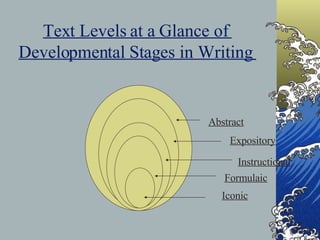
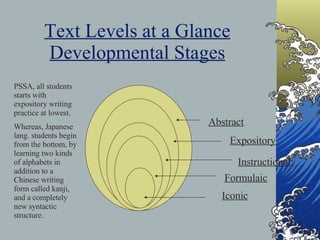
Text Levels at a Glance of  Developmental Stages in Writing   Iconic Formulaic Instructional Expository Abstract
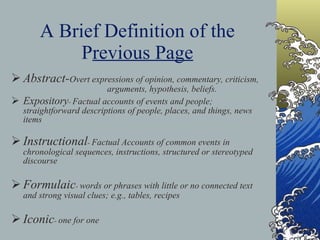
A Brief Definition of the P revious Page Abstract- Overt expressions of opinion, commentary, criticism,  arguments, hypothesis, beliefs. Expository -  Factual accounts of events and people; straightforward descriptions of people, places, and things, news items  Instructional -  Factual Accounts of common events in chronological sequences, instructions, structured or stereotyped discourse Formulaic -  words or phrases with little or no connected text and strong visual clues; e.g., tables, recipes Iconic -  one for one
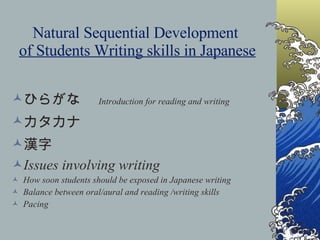
Natural Sequential Development  of Students Writing skills in Japanese ひらがな  Introduction for reading and writing  カタカナ 漢字 Issues involving writing How soon students should be exposed in Japanese writing Balance between oral/aural and reading /writing skills Pacing
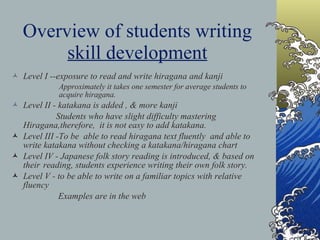
Overview of students writing  skill development Level I --exposure to read and write hiragana and kanji   Approximately it takes one semester for average students to    acquire hiragana.  Level II - katakana is added , & more kanji Students who have slight difficulty mastering Hiragana,therefore,  it is not easy to add katakana. Level III -To be  able to read hiragana text fluently  and able to write katakana without checking a katakana/hiragana chart Level IV - Japanese folk story reading is introduced, & based on their  reading, students experience writing their own folk story. Level V - to be able to write on a familiar topics with relative fluency Examples are in the web
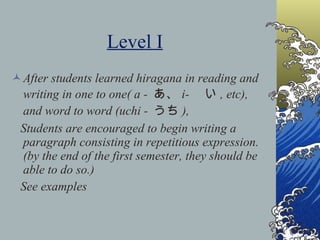
Level I   After students learned hiragana in reading and writing in one to one( a -  あ、 i-  い , etc), and word to word (uchi -  うち ), Students are encouraged to begin writing a paragraph consisting in repetitious expression.  (by the end of the first semester, they should be able to do so.) See examples
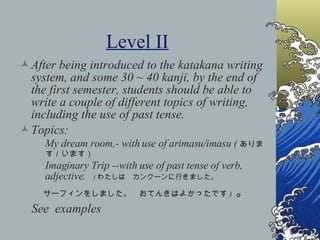
Level II After being introduced to the katakana writing system, and some 30 ~ 40 kanji, by the end of the first semester, students should be able to write a couple of different topics of writing,  including the use of past tense.  Topics: My dream room,- with use of arimasu/imasu ( あります/います) Imaginary Trip --with use of past tense of verb, adjective.  ( わたしは カンクーンに行きました。    サーフィンをしました。 おてんきはよかったです )  。 See  examples    
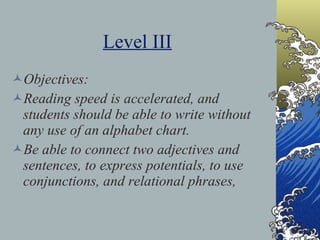
Level III Objectives:  Reading speed is accelerated, and students should be able to write without any use of an alphabet chart.  Be able to connect two adjectives and sentences, to express potentials, to use conjunctions, and relational phrases,
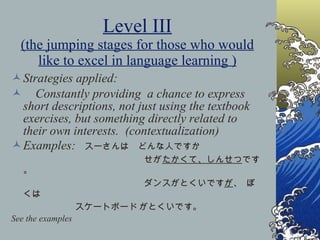
Level III (the jumping stages for those who would like to excel in language learning ) Strategies applied: Constantly providing  a chance to express short descriptions, not just using the textbook exercises, but something directly related to their own interests.  (contextualization) Examples:  スーさんは どんな人ですか せが たかくて、しんせつ です。 ダンスがとくいです が 、   ぼくは  スケートボード がとくいです。 See the examples
Level IV Not only expressing the enhanced self introduction with a variety of newly learned grammatical structures, students will be able to produce a short story writing in Japanese after reading a Japanese folk story. See student’s story writing examples.
Level V Among several topics that students could express in writing. Here is a guideline of the students self-introduction assignment.  (next page) The topic might remain the same as in Level I through IV about expressing self, the content is in depth,the grammatical structure is more complex, the quantity is greater overall, the completion speed is accelerated without sacrificing the quality. .  The orthography is more accurate and more kanji.  SAT II and AP Japanese don’t include a writing requirement, but there is a reading section, for which kanji knowledge is a prerequisite.
Benefits & Significance of the  Contest Participation Benefits and Strength Students sense their own accomplishment as their own exit of their five years’ study of Japanese language Relationship between teacher and student become closer. The contest deadline motivate their work to be completed on a certain date.  Students learn a Japanese students profile.  Problem There are students who can’t cope with the pressure of keeping the assignment’s  deadline.
PSSA & Foreign Language Writing At our Shaler Area High School, the Principal asked all subject teachers to submit our lesson plans directly relating to PSSA writing as a collaborative effort to enhance students written skills.
Pennsylvania’s PSSA Writing standards and the collaboration with its goals from the foreign language  teaching perspectives Common grounds and limitations of writing between the student’s native language and a second language. Two modes of writing  Informational (Research papers, analyses, evaluations, essays)  Persuasive (Pennsylvania Academic Standards -Types of Writing--1.4.11.B, and 1.4.11.C.)
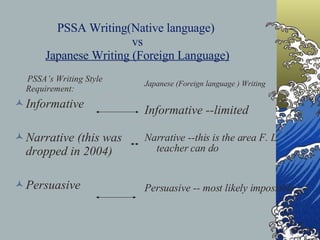
PSSA Writing(Native language)  vs Japanese Writing (Foreign Language) PSSA’s Writing Style  Requirement: Informative Narrative (this was dropped in 2004)  Persuasive  Japanese (Foreign language ) Writing Informative --limited Narrative --this is the area F. L. teacher can do Persuasive -- most likely impossible.
Why is our, foreign language teacher’s contribution limited to PSSA Writing?
Explanation #1 Go to page 4
Text Levels at a Glance Developmental Stages Iconic Formulaic Instructional Expository Abstract PSSA, all students starts with expository writing practice at lowest. Whereas, Japanese lang. students begin from the bottom, by learning two kinds of alphabets in addition to a Chinese writing form called kanji, and a completely new syntactic structure.
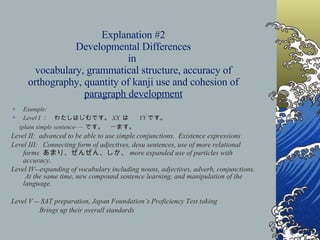
Explanation #2 Developmental Differences in  vocabulary, grammatical structure, accuracy of orthography, quantity of kanji use and cohesion of  paragraph development Example: Level I : わたしはじむです。 XX  は   YY です。   (plain simple sentence- ~  です。  〜 ます。 Level II:  advanced to be able to use simple conjunctions.  Existence expressions Level III:  Connecting form of adjectives, desu sentences, use of more relational forms  あまり、ぜんぜん、しか、 more expanded use of particles with accuracy,  Level IV--expanding of vocabulary including nouns, adjectives, adverb, conjunctions.  At the same time, new compound sentence learning, and manipulation of the language.  Level V -- SAT preparation, Japan Foundation’s Proficiency Test taking  Brings up their overall standards
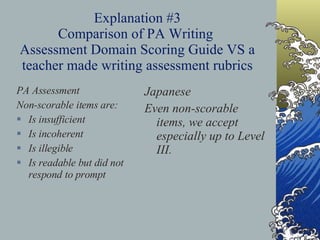
Explanation #3 Comparison of PA Writing  Assessment Domain Scoring Guide VS a teacher made writing assessment rubrics PA Assessment  Non-scorable items are: Is insufficient Is incoherent  Is illegible Is readable but did not respond to prompt Japanese Even non-scorable items, we accept especially up to Level III.
Language section is over.   Shall we discuss about advocacy of foreign language in general?

HS Japanese Students 's work

  • 1.
    Beyond the Japan-Bowl,There is a Place that Our Students Display Their Work and May Have an Opportunity to Be Invited to Visit Japan The process of high school students’ Japanese writing skills development is focused from the perspective of not only the instructional strategies, which are articulated on each level (from Level I through 5), but also the ways of integrating them with the Pennsylvania writing standards. My students’ written work on various levels will be used as reference samples. Language teaching/learning is comprised of other skills besides writing, and it is beyond this one session to discuss about it. I would like to take the liberty to use this presentation as a meeting ground with other Japanese language teachers and to expand this particular session as a forum so that other Japanese language teachers may express their instructional as well as Japanese language advocacy issues and concerns.
  • 2.
    Students Writing InternationalContest Sponsored by Japan Forum “ Beyond the Japan-Bowl, “ is meant by: Uploaded Site: Let’s take a look http://www. tjf .or. jp / photoessaycafe /essay/n_america.html
  • 3.
    Writing as oneactivity of developing communicative competence The communication goal contains three macro domains according to ACTFL standards. They are: The interpretive-- understanding spoken and written texts The Interpersonal--direct interaction Presentational -expressing ideas, information, feelings & experience through both spoken and written words. ( Foreign language Standards: Linking Research, Theories, and Practices, by June Phillips, National Textbook Company, 1999, p.18)
  • 4.
    Text Levels ata Glance of Developmental Stages in Writing Iconic Formulaic Instructional Expository Abstract
  • 5.
    A Brief Definitionof the P revious Page Abstract- Overt expressions of opinion, commentary, criticism, arguments, hypothesis, beliefs. Expository - Factual accounts of events and people; straightforward descriptions of people, places, and things, news items Instructional - Factual Accounts of common events in chronological sequences, instructions, structured or stereotyped discourse Formulaic - words or phrases with little or no connected text and strong visual clues; e.g., tables, recipes Iconic - one for one
  • 6.
    Natural Sequential Development of Students Writing skills in Japanese ひらがな  Introduction for reading and writing カタカナ 漢字 Issues involving writing How soon students should be exposed in Japanese writing Balance between oral/aural and reading /writing skills Pacing
  • 7.
    Overview of studentswriting skill development Level I --exposure to read and write hiragana and kanji Approximately it takes one semester for average students to acquire hiragana. Level II - katakana is added , & more kanji Students who have slight difficulty mastering Hiragana,therefore, it is not easy to add katakana. Level III -To be able to read hiragana text fluently and able to write katakana without checking a katakana/hiragana chart Level IV - Japanese folk story reading is introduced, & based on their reading, students experience writing their own folk story. Level V - to be able to write on a familiar topics with relative fluency Examples are in the web
  • 8.
    Level I After students learned hiragana in reading and writing in one to one( a - あ、 i-  い , etc), and word to word (uchi - うち ), Students are encouraged to begin writing a paragraph consisting in repetitious expression. (by the end of the first semester, they should be able to do so.) See examples
  • 9.
    Level II Afterbeing introduced to the katakana writing system, and some 30 ~ 40 kanji, by the end of the first semester, students should be able to write a couple of different topics of writing, including the use of past tense. Topics: My dream room,- with use of arimasu/imasu ( あります/います) Imaginary Trip --with use of past tense of verb, adjective. ( わたしは カンクーンに行きました。    サーフィンをしました。 おてんきはよかったです ) 。 See examples    
  • 10.
    Level III Objectives: Reading speed is accelerated, and students should be able to write without any use of an alphabet chart. Be able to connect two adjectives and sentences, to express potentials, to use conjunctions, and relational phrases,
  • 11.
    Level III (thejumping stages for those who would like to excel in language learning ) Strategies applied: Constantly providing a chance to express short descriptions, not just using the textbook exercises, but something directly related to their own interests. (contextualization) Examples: スーさんは どんな人ですか せが たかくて、しんせつ です。 ダンスがとくいです が 、 ぼくは  スケートボード がとくいです。 See the examples
  • 12.
    Level IV Notonly expressing the enhanced self introduction with a variety of newly learned grammatical structures, students will be able to produce a short story writing in Japanese after reading a Japanese folk story. See student’s story writing examples.
  • 13.
    Level V Amongseveral topics that students could express in writing. Here is a guideline of the students self-introduction assignment. (next page) The topic might remain the same as in Level I through IV about expressing self, the content is in depth,the grammatical structure is more complex, the quantity is greater overall, the completion speed is accelerated without sacrificing the quality. . The orthography is more accurate and more kanji. SAT II and AP Japanese don’t include a writing requirement, but there is a reading section, for which kanji knowledge is a prerequisite.
  • 14.
    Benefits & Significanceof the Contest Participation Benefits and Strength Students sense their own accomplishment as their own exit of their five years’ study of Japanese language Relationship between teacher and student become closer. The contest deadline motivate their work to be completed on a certain date. Students learn a Japanese students profile. Problem There are students who can’t cope with the pressure of keeping the assignment’s deadline.
  • 15.
    PSSA & ForeignLanguage Writing At our Shaler Area High School, the Principal asked all subject teachers to submit our lesson plans directly relating to PSSA writing as a collaborative effort to enhance students written skills.
  • 16.
    Pennsylvania’s PSSA Writingstandards and the collaboration with its goals from the foreign language teaching perspectives Common grounds and limitations of writing between the student’s native language and a second language. Two modes of writing Informational (Research papers, analyses, evaluations, essays) Persuasive (Pennsylvania Academic Standards -Types of Writing--1.4.11.B, and 1.4.11.C.)
  • 17.
    PSSA Writing(Native language) vs Japanese Writing (Foreign Language) PSSA’s Writing Style Requirement: Informative Narrative (this was dropped in 2004) Persuasive Japanese (Foreign language ) Writing Informative --limited Narrative --this is the area F. L. teacher can do Persuasive -- most likely impossible.
  • 18.
    Why is our,foreign language teacher’s contribution limited to PSSA Writing?
  • 19.
  • 20.
    Text Levels ata Glance Developmental Stages Iconic Formulaic Instructional Expository Abstract PSSA, all students starts with expository writing practice at lowest. Whereas, Japanese lang. students begin from the bottom, by learning two kinds of alphabets in addition to a Chinese writing form called kanji, and a completely new syntactic structure.
  • 21.
    Explanation #2 DevelopmentalDifferences in vocabulary, grammatical structure, accuracy of orthography, quantity of kanji use and cohesion of paragraph development Example: Level I : わたしはじむです。 XX は YY です。   (plain simple sentence- ~ です。  〜 ます。 Level II: advanced to be able to use simple conjunctions. Existence expressions Level III: Connecting form of adjectives, desu sentences, use of more relational forms あまり、ぜんぜん、しか、 more expanded use of particles with accuracy, Level IV--expanding of vocabulary including nouns, adjectives, adverb, conjunctions. At the same time, new compound sentence learning, and manipulation of the language. Level V -- SAT preparation, Japan Foundation’s Proficiency Test taking Brings up their overall standards
  • 22.
    Explanation #3 Comparisonof PA Writing Assessment Domain Scoring Guide VS a teacher made writing assessment rubrics PA Assessment Non-scorable items are: Is insufficient Is incoherent Is illegible Is readable but did not respond to prompt Japanese Even non-scorable items, we accept especially up to Level III.
  • 23.
    Language section isover. Shall we discuss about advocacy of foreign language in general?