



3 Key Strategies on
Teaching Grammar
Rodolfo
Chaviano
“Learning without thought is labor lost”
Confucius (551-479 B.C.)
CCNN Conference
Managua August 7th, 2014
rchaviano11@Gmail.com
R. Chaviano August 7, 2014
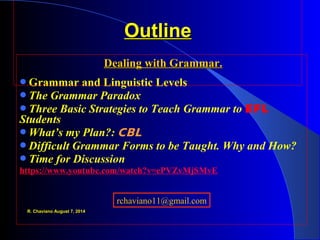
  Dealing with Grammar.Dealing with Grammar.
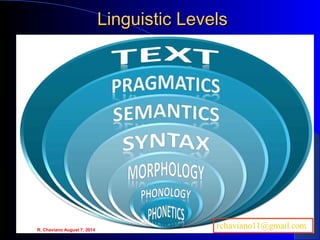
Grammar and Linguistic Levels
The Grammar Paradox
Three Basic Strategies to Teach Grammar to EFL 
Students
What’s my Plan?: CBL
Difficult Grammar Forms to be Taught. Why and How?
Time for Discussion
https://www.youtube.com/watch?v=ePVZvMjSMvE
 
OutlineOutline
rchaviano11@gmail.com
R. Chaviano August 7, 2014
https://www.youtube.com/watch?v=ePVZvMjSMvE
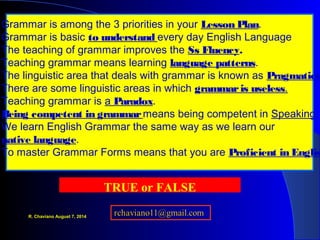
Grammar is among the 3 priorities in your Lesson Plan.
Grammar is basic to understand every day English Language
The teaching of grammar improves the Ss Fluency.
Teaching grammar means learning language patterns.
The linguistic area that deals with grammar is known as Pragmatics
There are some linguistic areas in which grammaris useless.
Teaching grammar is a Paradox.
Being competent in grammarmeans being competent in Speaking.
We learn English Grammar the same way as we learn our
native language.
To master Grammar Forms means that you are Proficient in Englis
TRUE or FALSE
R. Chaviano August 7, 2014
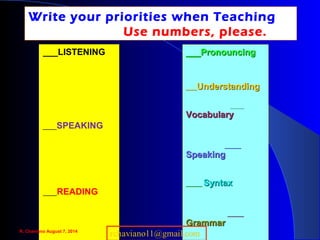
___LISTENING
____SPEAKING
____READING
___Pronouncing___Pronouncing
________UnderstandingUnderstanding
__________
VocabularyVocabulary
____________
SpeakingSpeaking
____________ SyntaxSyntax
____________
GrammarGrammar
Write your priorities when Teaching
Use numbers, please.
R. Chaviano August 7, 2014
Linguistic LevelsLinguistic Levels
R. Chaviano August 7, 2014
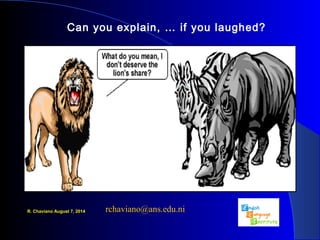
Can you explain, … if you laughed?
R. Chaviano August 7, 2014 rchaviano@ans.edu.ni
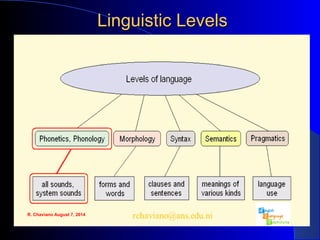
Linguistic LevelsLinguistic Levels
R. Chaviano August 7, 2014
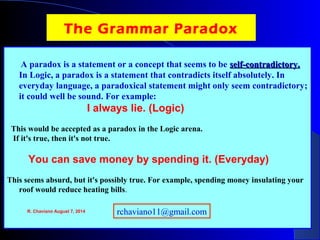
The Grammar Paradox
A paradox is a statement or a concept that seems to be self-contradictory.self-contradictory.
In Logic, a paradox is a statement that contradicts itself absolutely. In
everyday language, a paradoxical statement might only seem contradictory;
it could well be sound. For example:
I always lie. (Logic)
This would be accepted as a paradox in the Logic arena.
If it's true, then it's not true.
You can save money by spending it. (Everyday)
This seems absurd, but it's possibly true. For example, spending money insulating your
roof would reduce heating bills.
R. Chaviano August 7, 2014 rchaviano11@gmail.com
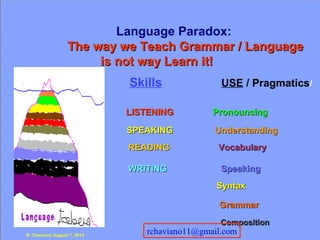
Language Paradox:
The way we Teach Grammar / LanguageThe way we Teach Grammar / Language
is not way Learn it!is not way Learn it!
Skills USE / Pragmatics/
LISTENINGLISTENING PronouncingPronouncing
SPEAKINGSPEAKING UnderstandingUnderstanding
READINGREADING VocabularyVocabulary
WRITINGWRITING SpeakingSpeaking
SyntaxSyntax
GrammarGrammar
CompositionComposition
Language Paradox:
The way we Teach Grammar / LanguageThe way we Teach Grammar / Language
is not way Learn it!is not way Learn it!
Skills USE / Pragmatics/
LISTENINGLISTENING PronouncingPronouncing
SPEAKINGSPEAKING UnderstandingUnderstanding
READINGREADING VocabularyVocabulary
WRITINGWRITING SpeakingSpeaking
SyntaxSyntax
GrammarGrammar
CompositionComposition
R. Chaviano August 7, 2014
rchaviano11@gmail.com
Would you explain the message in this comics?
R. Chaviano August 7, 2014
rchaviano11@gmail.com
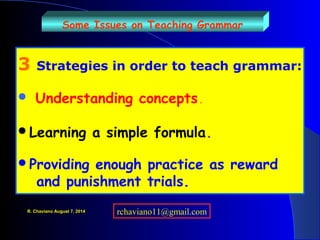
Some Issues on Teaching Grammar
3 Strategies in order to teach grammar:
 Understanding concepts.
Learning a simple formula.
Providing enough practice as reward
and punishment trials.
R. Chaviano August 7, 2014 rchaviano11@gmail.com
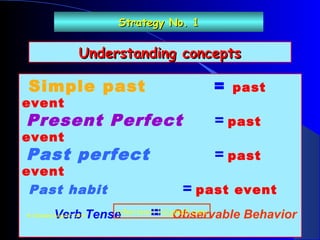
Understanding conceptsUnderstanding concepts
Simple past = past
event
Present Perfect = past
event
Past perfect = past
event
Past habit = past event
Verb Tense = Observable Behavior
Strategy No. 1Strategy No. 1
R. Chaviano August 7, 2014
rchaviano11@gmail.com
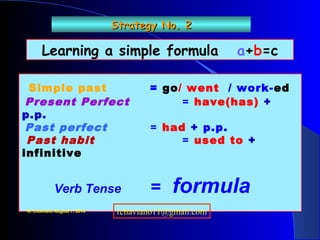
Learning a simple formula a+b=c
Simple past = go/ went / work-ed
Present Perfect = have(has) +
p.p.
Past perfect = had + p.p.
Past habit = used to +
infinitive
Verb Tense = formula
Strategy No. 2Strategy No. 2
R. Chaviano August 7, 2014 rchaviano11@gmail.com
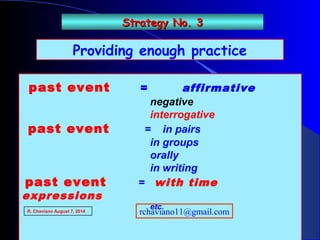
Providing enough practice
past event = affirmative
negative
interrogative
past event = in pairs
in groups
orally
in writing
past event = with time
expressions
etc.
Strategy No. 3Strategy No. 3
R. Chaviano August 7, 2014 rchaviano11@gmail.com
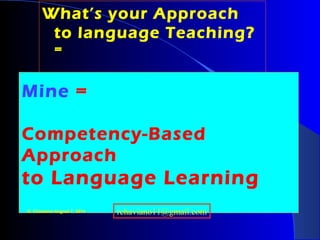
What’s your Approach
to language Teaching?
=
Mine =
Competency-Based
Approach
to Language Learning
R. Chaviano August 7, 2014 rchaviano11@gmail.com
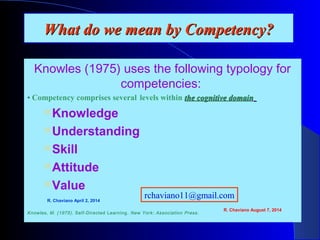
What do we mean by Competency?What do we mean by Competency?
Knowles (1975) uses the following typology for
competencies:
• Competency comprises several levels within the cognitive domainthe cognitive domain
Knowledge
Understanding
Skill
Attitude
Value
Knowles, M. (1975). Self-Directed Learning. New York: Association Press.
R. Chaviano April 2, 2014
R. Chaviano August 7, 2014
rchaviano11@gmail.com
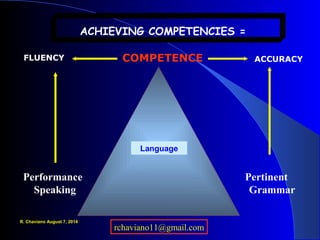
ACHIEVING COMPETENCIES =
Performance Pertinent
Speaking Grammar
Language
FLUENCY ACCURACYCOMPETENCE
R. Chaviano August 7, 2014
rchaviano11@gmail.com
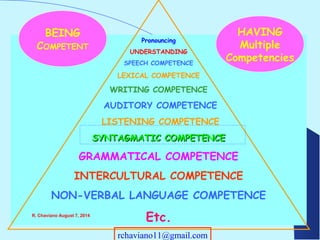
Pronouncing
UNDERSTANDING
SPEECH COMPETENCE
LEXICAL COMPETENCE
WRITING COMPETENCE
AUDITORY COMPETENCE
LISTENING COMPETENCE
SYNTAGMATIC COMPETENCESYNTAGMATIC COMPETENCE
GRAMMATICAL COMPETENCE
INTERCULTURAL COMPETENCE
NON-VERBAL LANGUAGE COMPETENCE
Etc.
BEING
COMPETENT
HAVING
Multiple
Competencies
R. Chaviano August 7, 2014
rchaviano11@gmail.com


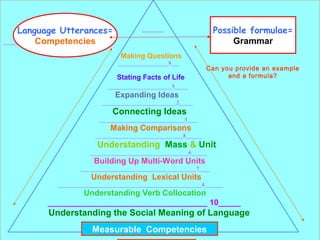
                                                                                                                                         ___________
 
______________1___
 
                                                                            Making Questions
                                                                                      ___________________9___
 
Stating Facts of Life
     ________________________5_____
              Expanding Ideas
                                                                          ____________________________2_____
                                    Connecting Ideas
________________________________3____
Making Comparisons
                                                                     _________________________________8______
Understanding Mass & Unit
                                                                 _____________________________________6______
Building Up Multi-Word Units
                                                          ___ ________________________________________7____
                                                                  Understanding Lexical Units
                                         ______________________________________________________4_______
Understanding Verb Collocation
____________________________________ 10_____
                                  Understanding the Social Meaning of Language
                                                                                                                                                                                       
Language Utterances=
Competencies
Possible formulae=
Grammar
Measurable Competencies
Can you provide an example
and a formula?
Please name 2
Difficult Grammar Forms to be
Taught
Why Difficult?
How to deal with difficult 
grammar Forms
R. Chaviano August 7, 2014
rchaviano11@gmail.com
References
 Sanghi, S. (2007). The Handbook of Competency Mapping: Understanding,
Designing and Implementing Competency Models in Organizations. New Delhi: 
Sage Publications.
http://www.nwlink.com/~donclark/hrd/case/competencies.html
http://www.nwlink.com/~donclark/performance/competencies.html
 Knowles, M. (1975). Self-Directed Learning.
New York: Association Press.
 Pinker, Steven (1997). How the Mind Works.
New York: W. W. Norton & Company.
 R. Chaviano (2012) Competency-Based Approach to Language Learning.
Nicatesol Conference. Dec 10,2014
R. Chaviano April 2, 2014
Thank you very
much!
Rodolfo Chaviano. August 7, 2014
rchaviano11@Gmail.com
R. Chaviano August 7, 2014

2014 grammar issues 3 Key Strategies

  • 1.
    3 Key Strategieson Teaching Grammar Rodolfo Chaviano “Learning without thought is labor lost” Confucius (551-479 B.C.) CCNN Conference Managua August 7th, 2014 rchaviano11@Gmail.com
  • 2.
  • 4.
      Dealing with Grammar.Dealingwith Grammar. Grammar and Linguistic Levels The Grammar Paradox Three Basic Strategies to Teach Grammar to EFL  Students What’s my Plan?: CBL Difficult Grammar Forms to be Taught. Why and How? Time for Discussion https://www.youtube.com/watch?v=ePVZvMjSMvE   OutlineOutline rchaviano11@gmail.com R. Chaviano August 7, 2014
  • 5.
  • 6.
    Grammar is amongthe 3 priorities in your Lesson Plan. Grammar is basic to understand every day English Language The teaching of grammar improves the Ss Fluency. Teaching grammar means learning language patterns. The linguistic area that deals with grammar is known as Pragmatics There are some linguistic areas in which grammaris useless. Teaching grammar is a Paradox. Being competent in grammarmeans being competent in Speaking. We learn English Grammar the same way as we learn our native language. To master Grammar Forms means that you are Proficient in Englis TRUE or FALSE R. Chaviano August 7, 2014
  • 7.
  • 8.
  • 9.
    Can you explain,… if you laughed? R. Chaviano August 7, 2014 rchaviano@ans.edu.ni
  • 10.
  • 11.
    The Grammar Paradox Aparadox is a statement or a concept that seems to be self-contradictory.self-contradictory. In Logic, a paradox is a statement that contradicts itself absolutely. In everyday language, a paradoxical statement might only seem contradictory; it could well be sound. For example: I always lie. (Logic) This would be accepted as a paradox in the Logic arena. If it's true, then it's not true. You can save money by spending it. (Everyday) This seems absurd, but it's possibly true. For example, spending money insulating your roof would reduce heating bills. R. Chaviano August 7, 2014 rchaviano11@gmail.com
  • 12.
    Language Paradox: The waywe Teach Grammar / LanguageThe way we Teach Grammar / Language is not way Learn it!is not way Learn it! Skills USE / Pragmatics/ LISTENINGLISTENING PronouncingPronouncing SPEAKINGSPEAKING UnderstandingUnderstanding READINGREADING VocabularyVocabulary WRITINGWRITING SpeakingSpeaking SyntaxSyntax GrammarGrammar CompositionComposition Language Paradox: The way we Teach Grammar / LanguageThe way we Teach Grammar / Language is not way Learn it!is not way Learn it! Skills USE / Pragmatics/ LISTENINGLISTENING PronouncingPronouncing SPEAKINGSPEAKING UnderstandingUnderstanding READINGREADING VocabularyVocabulary WRITINGWRITING SpeakingSpeaking SyntaxSyntax GrammarGrammar CompositionComposition R. Chaviano August 7, 2014 rchaviano11@gmail.com
  • 13.
    Would you explainthe message in this comics? R. Chaviano August 7, 2014 rchaviano11@gmail.com
  • 14.
    Some Issues onTeaching Grammar 3 Strategies in order to teach grammar:  Understanding concepts. Learning a simple formula. Providing enough practice as reward and punishment trials. R. Chaviano August 7, 2014 rchaviano11@gmail.com
  • 15.
    Understanding conceptsUnderstanding concepts Simplepast = past event Present Perfect = past event Past perfect = past event Past habit = past event Verb Tense = Observable Behavior Strategy No. 1Strategy No. 1 R. Chaviano August 7, 2014 rchaviano11@gmail.com
  • 16.
    Learning a simpleformula a+b=c Simple past = go/ went / work-ed Present Perfect = have(has) + p.p. Past perfect = had + p.p. Past habit = used to + infinitive Verb Tense = formula Strategy No. 2Strategy No. 2 R. Chaviano August 7, 2014 rchaviano11@gmail.com
  • 17.
    Providing enough practice pastevent = affirmative negative interrogative past event = in pairs in groups orally in writing past event = with time expressions etc. Strategy No. 3Strategy No. 3 R. Chaviano August 7, 2014 rchaviano11@gmail.com
  • 18.
    What’s your Approach tolanguage Teaching? = Mine = Competency-Based Approach to Language Learning R. Chaviano August 7, 2014 rchaviano11@gmail.com
  • 19.
    What do wemean by Competency?What do we mean by Competency? Knowles (1975) uses the following typology for competencies: • Competency comprises several levels within the cognitive domainthe cognitive domain Knowledge Understanding Skill Attitude Value Knowles, M. (1975). Self-Directed Learning. New York: Association Press. R. Chaviano April 2, 2014 R. Chaviano August 7, 2014 rchaviano11@gmail.com
  • 20.
    ACHIEVING COMPETENCIES = PerformancePertinent Speaking Grammar Language FLUENCY ACCURACYCOMPETENCE R. Chaviano August 7, 2014 rchaviano11@gmail.com
  • 21.
    Pronouncing UNDERSTANDING SPEECH COMPETENCE LEXICAL COMPETENCE WRITINGCOMPETENCE AUDITORY COMPETENCE LISTENING COMPETENCE SYNTAGMATIC COMPETENCESYNTAGMATIC COMPETENCE GRAMMATICAL COMPETENCE INTERCULTURAL COMPETENCE NON-VERBAL LANGUAGE COMPETENCE Etc. BEING COMPETENT HAVING Multiple Competencies R. Chaviano August 7, 2014 rchaviano11@gmail.com
  • 22.
                                                                                                                                                     ___________   ______________1___                                                                               Making Questions                                                                                       ___________________9___   Stating Factsof Life      ________________________5_____               Expanding Ideas                                                                           ____________________________2_____                                     Connecting Ideas ________________________________3____ Making Comparisons                                                                      _________________________________8______ Understanding Mass & Unit                                                                  _____________________________________6______ Building Up Multi-Word Units                                                           ___ ________________________________________7____                                                                   Understanding Lexical Units                                          ______________________________________________________4_______ Understanding Verb Collocation ____________________________________ 10_____                                   Understanding the Social Meaning of Language                                                                                                                                                                                         Language Utterances= Competencies Possible formulae= Grammar Measurable Competencies Can you provide an example and a formula?
  • 23.
    Please name 2 DifficultGrammar Forms to be Taught Why Difficult? How to deal with difficult  grammar Forms R. Chaviano August 7, 2014 rchaviano11@gmail.com
  • 24.
    References  Sanghi, S. (2007). The Handbookof Competency Mapping: Understanding, Designing and Implementing Competency Models in Organizations. New Delhi:  Sage Publications. http://www.nwlink.com/~donclark/hrd/case/competencies.html http://www.nwlink.com/~donclark/performance/competencies.html  Knowles, M. (1975). Self-Directed Learning. New York: Association Press.  Pinker, Steven (1997). How the Mind Works. New York: W. W. Norton & Company.  R. Chaviano (2012) Competency-Based Approach to Language Learning. Nicatesol Conference. Dec 10,2014 R. Chaviano April 2, 2014
  • 25.
    Thank you very much! RodolfoChaviano. August 7, 2014 rchaviano11@Gmail.com R. Chaviano August 7, 2014