Esl Readers And Writers In Higher Education
Understanding Challenges Providing Support
Norman W Evans download
https://ebookbell.com/product/esl-readers-and-writers-in-higher-
education-understanding-challenges-providing-support-norman-w-
evans-34413580
Explore and download more ebooks at ebookbell.com
Here are some recommended products that we believe you will be
interested in. You can click the link to download.
Town Mouse And Country Mouse Penguin Young Readers Level 1 1st Edition
Arlene Wong
https://ebookbell.com/product/town-mouse-and-country-mouse-penguin-
young-readers-level-1-1st-edition-arlene-wong-2127320
The Gift Of The Magi And Other Stories Penguin Readers Level 1 1st O
Henry
https://ebookbell.com/product/the-gift-of-the-magi-and-other-stories-
penguin-readers-level-1-1st-o-henry-1669394
Tales Of Mystery And Imagination With Mp3 Audio Penguin Readers Level
5 Edgar Allan Poe Original
https://ebookbell.com/product/tales-of-mystery-and-imagination-with-
mp3-audio-penguin-readers-level-5-edgar-allan-poe-original-2544154
King Arthur And The Knights Of The Round Table Level 2 Penguin Readers
Illustrated Edition Swan
https://ebookbell.com/product/king-arthur-and-the-knights-of-the-
round-table-level-2-penguin-readers-illustrated-edition-swan-1307706
The Holy Bible For Esl Readers Nirv Zonderkidz Zonderkidz
https://ebookbell.com/product/the-holy-bible-for-esl-readers-nirv-
zonderkidz-zonderkidz-33535958
The Holy Bible For Esl English As A Second Language Readers Nirv
Zonderkidz
https://ebookbell.com/product/the-holy-bible-for-esl-english-as-a-
second-language-readers-nirv-zonderkidz-33056564
Robin Hood Penguin Readers Level 2 1st Swan
https://ebookbell.com/product/robin-hood-penguin-readers-level-2-1st-
swan-2161644
The Time Machine Penguin Readers Level 4 Herbert George Wells
https://ebookbell.com/product/the-time-machine-penguin-readers-
level-4-herbert-george-wells-1277826
Call Of The Wild Pearson English Active Readers Level 2 1st Edition
Jack London
https://ebookbell.com/product/call-of-the-wild-pearson-english-active-
readers-level-2-1st-edition-jack-london-54189878
For too long, U.S. higher education has viewed ESL students as a homo-
geneous (and needy) population. This volume explicitly challenges such
views and encourages us to see the successes of ESL students as integral to
the wider success of the institution. Going further, it provides accessible
resources for collective thinking on how to promote such success.
Dudley W. Reynolds, Carnegie Mellon University Qatar
This important and timely volume combines literacy skills (reading and
writing), which are often separated in books on second language learners.
It will be useful for TESL programs as well as a reference for other higher
ed administrators looking to support second language students at their
institutions.
Sarah Rilling, Kent State University, USA
This page intentionally left blank
ESL READERS AND WRITERS IN
HIGHER EDUCATION
ESL Readers and Writers in Higher Education describes the challenges ESL students
in U.S. postsecondary institutions face when studying in a second language, and
offers suggestions for how teachers, advisors, tutors, and institutions might
provide support that meets the reading and writing needs of this very important
student population.
Because the ESL profession as a whole, including what professionals are doing
in the classroom, sits under the umbrella of an institutional response to a
language-related challenge, some solutions aimed at helping students achieve
optimal proficiency lie outside of the classroom. As such, this book is based on
the assertion that language development support is not the sole responsibility of
language teachers. Everyone on campuses that host ESL students bears some
responsibility for these students’ language development. Chapters are therefore
intentionally adapted to appeal to a wide variety of readers from classroom
teachers, and teachers in training, to admissions officers, academic advisors, and
international student advisors.
Norman W. Evans is Associate Professor, Department of Linguistics and
English Language, and Coordinator, English Language Center, Brigham Young
University, USA.
Neil J Anderson is Professor, Department of English Language Teaching and
Learning, Brigham Young University–Hawaii, USA.
William G. Eggington is Ludwig-Weber-Siebach Humanities Professor, Depart-
ment of Linguistics and English Language, Brigham Young University, USA, and
Visiting Professor, Kyung Hee University, Global Campus, South Korea.
ESL & Applied Linguistics Professional Series
Eli Hinkel, Series Editor
Evans/Anderson/Eggington, Eds. • ESL Readers and Writers in Higher Education:
Understanding Challenges, Providing Support
Hinkel • Effective Curriculum for Teaching L2 Writing: Principles and Techniques
Farrell • Promoting Teacher Reflection in Second-Language Education: A Framework for
TESOL Professionals
Nunan/Richards • Language Learning Beyond the Classroom
Christison/Murray • What English Language Teachers Need to Know Volume III:
Designing Curriculum
Turner • Using Statistics in Small-scale Language Education Research: Focus on Non-parametric
Data
Hong/Pawan • The Pedagogy and Practice of Western-trained Chinese English Language
Teachers: Foreign Education, Chinese Meanings
Lantolf/Poehner • Sociocultural Theory and the Pedagogical Imperative in L2 Education:
Vygotskian Praxis and the Research/Practice Divide
Brown • Pronunciation and Phonetics: A Practical Guide for English Language Teachers
Birch • English Grammar Pedagogy: A Global Perspective
Liu • Describing and Explaining Grammar and Vocabulary in ELT: Key Theories and Effective
Practices
deOliviera/Silva, Eds. • L2 Writing in Secondary Classrooms: Student Experiences,
Academic Issues, and Teacher Education
Andrade/Evans • Principles and Practices for Response in Second Language Writing:
Developing Self-Regulated Learners
Sayer • Ambiguities and Tensions in English Language Teaching: Portraits of EFL Teachers as
Legitimate Speakers
Alsagoff/McKay/Hu/Renandya, Eds. Principles and Practices of Teaching English as an
International Language
Kumaravadivelu • Language Teacher Education for a Global Society: A Modular Model for
Knowing, Analyzing, Recognizing, Doing, and Seeing
Vandergrift/Goh • Teaching and Learning Second Language Listening: Metacognition in
Action
LoCastro • Pragmatics for Language Educators: A Sociolinguistic Perspective
Nelson • Intelligibility in World Englishes: Theory and Practice
Nation/Macalister, Eds. • Case Studies in Language Curriculum Design: Concepts and
Approaches in Action Around the World
Johnson/Golumbek, Eds. • Research on Second Language Teacher Education: A
Sociocultural Perspective on Professional Development
Hinkel, Ed. • Handbook of Research in Second Language Teaching and Learning, Volume II
Nassaji/Fotos • Teaching Grammar in Second Language Classrooms: Integrating Form-
Focused Instruction in Communicative Context
Murray/Christison • What English Language Teachers Need to Know Volume I:
Understanding Learning
Murray/Christison • What English Language Teachers Need to Know Volume II:
Facilitating Learning
Wong/Waring • Conversation Analysis and Second Language Pedagogy: A Guide for
ESL/EFL Teachers
Nunan/Choi, Eds. • Language and Culture: Reflective Narratives and the Emergence of
Identity
Braine • Nonnative Speaker English Teachers: Research, Pedagogy, and Professional Growth
Burns • Doing Action Research in English Language Teaching: A Guide for Practitioners
Nation/Macalister • Language Curriculum Design
Birch • The English Language Teacher and Global Civil Society
Johnson • Second Language Teacher Education: A Sociocultural Perspective
Nation • Teaching ESL/EFL Reading and Writing
Nation/Newton • Teaching ESL/EFL Listening and Speaking
Kachru/Smith • Cultures, Contexts, and World Englishes
McKay/Bokhosrt-Heng • International English in its Sociolinguistic Contexts: Towards a
Socially Sensitive EIL Pedagogy
Christison/Murray, Eds. • Leadership in English Language Education: Theoretical
Foundations and Practical Skills for Changing Times
McCafferty/Stam, Eds. • Gesture: Second Language Acquisition and Classroom Research
Liu • Idioms: Description, Comprehension, Acquisition, and Pedagogy
Chapelle/Enright/Jamieson, Eds. • Building a Validity Argument for the Test of English
as a Foreign Language™
Kondo-Brown/Brown, Eds. • Teaching Chinese, Japanese, and Korean Heritage Language
Students Curriculum Needs, Materials, and Assessments
Youmans • Chicano-Anglo Conversations: Truth, Honesty, and Politeness
Birch • English L2 Reading: Getting to the Bottom, Second Edition
Luk/Lin • Classroom Interactions as Cross-cultural Encounters: Native Speakers in EFL
Lessons
Levy/Stockwell • CALL Dimensions: Issues and Options in Computer Assisted Language
Learning
Nero, Ed. • Dialects, Englishes, Creoles, and Education
Basturkmen • Ideas and Options in English for Specific Purposes
Kumaravadivelu • Understanding Language Teaching: From Method to Postmethod
McKay • Researching Second Language Classrooms
Egbert/Petrie, Eds. • CALL Research Perspectives
Canagarajah, Ed. • Reclaiming the Local in Language Policy and Practice
Adamson • Language Minority Students in American Schools: An Education in English
Fotos/Browne, Eds. • New Perspectives on CALL for Second Language Classrooms
Hinkel • Teaching Academic ESL Writing: Practical Techniques in Vocabulary and Grammar
Hinkel/Fotos, Eds. • New Perspectives on Grammar Teaching in Second Language
Classrooms
Hinkel • Second Language Writers’ Text: Linguistic and Rhetorical Features
Visit www.routledge.com/education for additional information on titles in the
ESL & Applied Linguistics Professional Series
This page intentionally left blank
ESL READERS AND
WRITERS IN HIGHER
EDUCATION
Understanding Challenges,
Providing Support
Edited by Norman W. Evans,
Neil J Anderson, and
William G. Eggington
First published 2015
by Routledge
711 Third Avenue, New York, NY 10017
and by Routledge
2 Park Square, Milton Park, Abingdon, Oxon OX14 4RN
Routledge is an imprint of the Taylor & Francis Group, an informa business
© 2015 Taylor & Francis
The right of the editors to be identified as the authors of the editorial
matter, and of the authors for their individual chapters, has been asserted
in accordance with sections 77 and 78 of the Copyright, Designs and
Patents Act 1988.
All rights reserved. No part of this book may be reprinted or reproduced
or utilized in any form or by any electronic, mechanical, or other means,
now known or hereafter invented, including photocopying and
recording, or in any information storage or retrieval system, without
permission in writing from the publishers.
Trademark notice: Product or corporate names may be trademarks or
registered trademarks, and are used only for identification and
explanation without intent to infringe.
Library of Congress Cataloging-in-Publication Data
ESL readers and writers in higher education : understanding challenges,
providing support / edited by Norman W. Evans, Neil J Anderson, &
William G. Eggington.
pages cm
Includes bibliographical references and index.
1. English language–Study and teaching (Higher)–Foreign speakers.
I. Evans, Norman W., editor. II. Anderson, Neil J., editor.
III. Eggington, William, editor.
PE1128.A2E7687 2015
428.0071–dc23 2014049066
ISBN: 978-1-138-79170-1 (hbk)
ISBN: 978-1-138-79171-8 (pbk)
ISBN: 978-1-315-76265-4 (ebk)
Typeset in Bembo
by Wearset Ltd, Boldon, Tyne and Wear
CONTENTS
Preface xi
Acknowledgments xiv
PART I
Understanding Challenges 1
1 Understanding Challenges, Providing Support:
ESL Readers and Writers in Higher Education 3
Norman W. Evans and Maureen Snow Andrade
2 Perceptions and Realities of ESL Students in Higher
Education: An Overview of Institutional Practices 18
Maureen Snow Andrade, Norman W. Evans,
and K. James Hartshorn
3 Focusing on the Challenges: Institutional Language
Planning 36
William G. Eggington
4 Writing Centers: Finding a Center for ESL Writers 49
Lucie Moussu and Nicholas David
5 Writing Instruction for Matriculated International
Students: A Lived Case Study 64
Tony Silva
x Contents
6 Familiar Strangers: International Students in the U.S.
Composition Course 80
Elena Lawrick and Fatima Esseili
7 Academic Reading Expectations and Challenges 95
Neil J Anderson
PART II
Providing Support 111
8 Developing Self-Regulated Learners: Helping Students
Meet Challenges 113
Maureen Snow Andrade and Norman W. Evans
9 The Research–Instruction Cycle in Second Language Reading 130
William Grabe and Xiangying Jiang
10 Supporting Multilingual Writers through the Challenges
of Academic Literacy: Principles of English for Academic
Purposes and Composition Instruction 147
Dana Ferris
11 Assisting ESP Students in Reading and Writing
Disciplinary Genres 164
Fredricka L. Stoller and Marin S. Robinson
12 Corpus-Based Vocabulary Support for University
Reading and Writing 180
Mark Davies and Dee Gardner
13 When Everything’s Right, but It’s Still Wrong: Cultural
Influences on Written Discourse 198
William G. Eggington
14 Using Technology to Teach ESL Readers and Writers 209
Greg Kessler
15 Integrated Reading and Writing Assessment: History,
Processes, and Challenges 223
Mark Wolfersberger and Christine Coombe
Contributors 236
Index 239
PREFACE
This volume began as a lecture series in the Department of Linguistics and
English Language at Brigham Young University. We invited prominent scholars
to our campus to share their insights on the challenges second language readers
and writers face once they transition into demanding discipline studies in higher
education. After only the second lecture, we realized the need to share this
scholarship more broadly in order to increase understanding of the linguistic
challenges that nonnative English speakers (NNESs) encounter in academic
reading and writing contexts, and offer professionally informed suggestions for
support. To do this, we have assembled the writing of 20 different authors, all
of whom are professionally involved in various aspects of ESL related to reading
and writing in higher education.
This book is based on three premises. First, ESL students in higher educa-
tion, while certainly skillful second language users (the majority have likely
“passed” language admission requirements), may not have fully developed the
English language skills, especially academic reading and writing, that are neces-
sary to meet the demands that higher education exacts of them. Second, a stu-
dent’s success is directly related to the degree of support that is available for the
challenges at hand. In other words, the amount of challenge a person can abide
is highly correlated to the available support. Third, both students and institu-
tions share a common goal: student success.
From the outset, we wanted to make this volume accessible to the many in
higher education who work with NNESs. It is our assertion that language
development support is not the sole responsibility of language teachers.
Everyone on campuses that host ESL students bears some responsibility for these
students’ language development from the time they enter the university until
they exit. We have, therefore, intentionally adapted the chapters to appeal to a
xii Preface
wide variety of readers from classroom teachers, and teachers in training, to
admissions officers, academic advisors, and international student advisors.
The concept of challenge and support is based on the work of Nevitt Sanford
(1967), a preeminent scholar on college student development. Sanford maintains
that learning occurs best in an environment of optimal dissonance. By this he
means that an appropriate balance of challenge and support is needed in an
environment for positive development to occur. This is a concept similar to
Vygotsky’s Zone of Proximal Development. A setting with too much challenge,
such as the situations many NNESs face in higher education, can be over-
whelming, resulting in limited or no development. With too little challenge,
students may feel safe, but their development is restricted as a consequence. As
Eggington quotes in Chapter 3, “there is no growth in a comfort zone, and
there is no comfort in a growth zone.”
Overview
The volume is divided into two parts: Understanding Challenges and Providing
Support. This dual focus is used to build a culture of inclusion, so that all
involved in NNESs’ education, teachers and administrators alike, understand the
difficulties these students face and at the same time are informed of helpful ped-
agogical practices.
Part 1 presents a number of relevant issues primarily from the institutional
perspective. In Chapter 1, Evans and Andrade provide an overview and profile
of the NNES population and the various challenges these students face, as well
as some of the most common misperceptions of these students’ linguistic needs
and lacks. Andrade, Evans, and Hartshorn (Chapter 2) follow with an overview
based on a national survey of what support services are actually being offered in
higher education across the country and how much more can and needs to be
done. Following on the needs described in Chapter 2, Eggington (Chapter 3)
reports on a commitment made by a small U.S. university to help its NNESs by
developing and implementing a comprehensive language plan that follows
established language planning procedures. And in the spirit of providing mean-
ingful support, Moussu and David (Chapter 4) discuss one of the most common
kinds of institutional support, the Writing Center, and how it must be recon-
ceptualized to meet the growing NNES population. In Chapters 5 and 6, Silva
and Lawrick and Esseili provide valuable insights from Purdue University,
which has one of the largest NNES student populations in the country. In these
two chapters we see essential characteristics of Purdue’s writing program, such
as its history, goals, and its relationship to other units, specifically the graduate
programs Introductory Composition Program and the Writing Lab. In Chapter
6, Lawrick and Esseili present findings from data collected from Purdue’s stu-
dents to provide a current profile of second language writers and the skills, abil-
ities, and attitudes they bring to a first-year writing course. Finally, Anderson
Preface xiii
reports in Chapter 7 on data from a national survey that answers several valuable
research questions related to reading challenges: How much and what kinds of
reading are expected of students in their first semester in their major, and how
might these expectations vary across majors?
Part II considers the issues of challenge and support from a pedagogical per-
spective. Each of the chapters offers insight on practices that can help NNESs
develop their English skills as readers and writers. In Chapter 8, Andrade and
Evans introduce self-regulated learning (SRL) to the English language teaching
context with the objective of helping learners help themselves. Grabe and Jiang
conceptualize in Chapter 9 the second language reading research and instruction
relationship as a cyclic process that eventually leads to improved student learn-
ing outcomes. Dana Ferris (Chapter 10) then presents valuable principles for
teaching composition in an “English for academic purposes” (EAP) context.
Professors Stoller and Robinson (Chapter 11) address the challenges NNESs
face in the various reading genres they face in higher education. They explore a
read–analyze and write instructional approach as a viable form of assistance for
students making transitions into various disciplines. In Chapter 12, Davies and
Gardner provide concrete examples of the ways in which university-level stu-
dents can use the freely available, 425 million word Corpus of Contemporary
American English (COCA) for individualized, independent vocabulary learning.
The foundational assumption of Eggington’s chapter (Chapter 13) is that under-
standings of what we consider to be universal qualities of clear writing are actu-
ally bound to particular cultural values and rhetorical contexts. Eggington takes
this foundation, and illustrates how it can help teachers better understand and
thus support their students to develop as writers.
No volume such as this would be complete without a discussion of techno-
logy and assessment. Kessler (Chapter 14) argues that teaching reading and
writing skills requires teachers to develop a critical perspective on the use of
digital tools and the skills and practices associated with their use. Finally, Wolf-
ersberger and Coombe review in Chapter 15 current trends in assessing reading
and writing for academic purposes, with a particular focus on integrated assess-
ment. Their aim is to provide useful information for EAP teachers and curric-
ulum designers and university personnel who must make competent decisions.
Finally, to make this book more applicable to a classroom context, we have
included at the end of each chapter discussion questions that the authors think
might be considered to further the readers’ understanding of critical, related
issues. In addition, the authors have provided suggested chapters, articles, and
books for further reading on the subject presented in their chapters.
Reference
Sanford, N. (1967). Where colleges fail: A study of the student as a person. San Francisco, CA:
Jossey-Bass.
ACKNOWLEDGMENTS
We wish to thank Naomi Silverman and Eli Hinkel from Routledge, Jennifer
McDaniel and Mel Thorne from Brigham Young University and their team of
editors in the Faculty Editing Service at Brigham Young University, and the
Brigham Young University College of Humanities for their input and support.
We are also indebted to each of the authors for their contributions to this
volume.
PART I
Understanding
Challenges
This page intentionally left blank
1
UNDERSTANDING CHALLENGES,
PROVIDING SUPPORT
ESL Readers and Writers in Higher Education
Norman W. Evans and Maureen Snow Andrade
Vignette
A small but rapidly growing U.S.-based company is expanding into various Asian coun-
tries. They are seeking new employees who have three essential qualifications: solid aca-
demic training from a reputable business school, native proficiency in an Asian language,
and very strong English skills—particularly in speaking and writing. Since “native profi-
ciency” in an Asian language is required, a number of promising applicants are citizens of
Asian countries who studied business abroad in the United States. To determine the quality
of the applicants’ English skills, the committee has face-to-face interviews with applicants
and asks them to respond in writing to a memo that outlines a proposed business plan. The
search committee soon discovers that these applicants’ English skills, especially in writing,
are not at all what they expected from people who have spent years in the United States
studying at accredited universities. In some cases, the low level of English is disturbing.
Introduction and Overview of the Challenges
Students for whom English is a second language (ESL) not only benefit individ-
ually from higher education but contribute globally to the human condition and
public good.
There is a wealth of evidence that increased [educational] attainment
improves health, lowers crime rates, and yields citizens who are both glo-
bally aware and participate more in civic and democratic processes such as
voting and volunteering, all of which have enormous implications for our
democracy.
Lumina Foundation, 2013, p. 3
4 N. W. Evans and M. S. Andrade
Recognizing these benefits, postsecondary institutions around the world are
providing access to greater numbers of individuals from diverse backgrounds
rather than limiting opportunity to an elite few.
By the year 2020, 65% of all jobs in the United States will require a postsec-
ondary certificate or degree (Lumina Foundation, 2013). Currently, only 38.7%
of Americans aged 25 to 64 possess a two- or four-year degree (Lumina
Foundation, 2013). In other countries, such as the United Kingdom, govern-
ments are widening participation by raising awareness, increasing aspirations,
motivating students, and supporting attainment (Grundy, 2007). To prepare
individuals for future professions, promote global economic development, and
build a worldwide knowledge community, populations previously underrepre-
sented for reasons of race, gender, socioeconomic status, or low levels of aca-
demic preparation must be both welcomed and supported.
Increasing access for diverse student populations, and specifically, nonnative
English language speakers (NNESs), entails careful consideration of linguistic
skills. Institutions may do little to provide, encourage, or require further devel-
opment of English language skills beyond requiring specific admission scores on
standardized proficiency tests. NNESs, consisting of both international students
and residents, may receive minimal attention aside from possible ESL courses
prior to or immediately after admission (see Chapter 2). These courses predomi-
nantly focus on international students rather than residents, though residents
may also lack the English language proficiency needed for academic tasks.
Consistent with this book’s theme of challenges and support, this chapter
first provides information related to challenges with common assumptions about
NNESs in higher education. It then explicates issues related to NNESs’ linguis-
tic and cultural needs, details current support practices, and discusses related
theory. The chapter ends with implications for support.
Common Assumptions
Many institutions operate on faulty assumptions about the language needs and
abilities of NNESs. This is true for both international and resident students.
These assumptions are based on a lack of understanding of language testing and
what standardized test scores represent, and the need for further language devel-
opment post-admission and how to support this. Following is a discussion of the
two most common assumptions.
Assumption 1
The first major assumption that institutions make is that once NNESs meet
admission requirements, they have adequate English language skills to succeed
in postsecondary-level academic work. In reality, NNESs come from different
backgrounds with varying language skill sets; some are international students in
Understanding Challenges, Providing Support 5
the United States on a short-term basis, while others—often referred to as Gen-
eration 1.5—are residents who arrived as children (early arrivals) or in their
preteen or teenage years (late arrivals) (Ferris, 2009; Kanno & Harklau, 2012).
Though international students must generally pass an English proficiency exam
to be admitted, they face significant cultural and linguistic challenges for which
their developing language skills may be inadequate (Andrade & Evans, 2009;
Ferris, 2009). Resident students also enroll with varying levels of English lan-
guage proficiency, often insufficient for the linguistic rigors of postsecondary
education (Ferris, 2009), yet these students are not typically required to establish
their level of English language proficiency prior to admission or even declare
themselves as NNESs.
The TOEFL and similar exams, required for international NNESs, are
designed to be a minimal indicator of the linguistic skill necessary for academic
success. These “institutional English language entry requirements can assist but
do not ensure that students will enter university at a sufficiently high level of
proficiency” (Barrett-Lennard, Dunworth, & Harris, 2011, p. 100). Resident
NNESs’ linguistic skills may be similar to or even weaker than those of inter-
national students, yet institutions may not assess these students. In some cases,
post-admission basic skills screening occurs. Even then, however, these students
may be directed to remedial reading and writing courses that do not address
their linguistic needs. Additionally, testing requirements may differ depending
on institutional type (e.g., community college or four-year university), although
students have similar linguistic needs across institutional type.
This situation is largely due to misunderstanding what second language learn-
ers must accomplish in terms of academic language once they have been admit-
ted to college. Both groups of NNESs have significant language development
needs. As such, though they meet required admission standards, many of these
students are likely to require further language development and instruction, as
indicated in the following statement:
Successful participation in academic and professional discourse com-
munities such as business, science, engineering, and medicine requires a
strong foundation of very advanced language and common core academic
skills. To participate successfully at the postsecondary level, learners
require additional knowledge and expertise in content, specialized vocab-
ulary, grammar, discourse structure, and pragmatics.
Teaching English to Speakers of Other Languages [TESOL], 2010, p. 1
Assumption 2
The second major assumption that institutions make is that since second lan-
guage students are immersed in an English-speaking environment once they
enroll, their academic language skills (i.e., reading and writing) will naturally
6 N. W. Evans and M. S. Andrade
continue to develop as they progress through their studies at the institution; by
extension, these students will be proficient English users by the time they
graduate. This assumption is not supported by language acquisition theory. The
reality is that many students’ writing skills plateau once they complete their
first-year English courses (Ferris, 2009; Storch, 2009). While some students in
majors with extensive writing requirements generally do improve their skills,
many others do not. Additionally, writing demands for specific disciplines may
differ from what is taught in ESL preparatory programs, or students may fail to
apply these strategies effectively and consistently (Anderson, Evans, & Hart-
shorn, 2014; Counsell, 2011). In other cases, the general academic skills taught
in ESL programs may not prepare students adequately for study in their chosen
disciplines (Benzie, 2011). Faculty members expect students to be linguistically
capable of managing the rigors of coursework; however, they find that NNESs
lack the linguistic skills necessary for them to function on par with their native-
English-speaking peers. Even so, the faculty do not alter their curriculum to
accommodate NNESs’ limited linguistic skills and indicate having little, if any,
time to help students with their English language needs (Andrade & Evans,
2007).
Compounding this is the fact that “individual learners develop language pro-
ficiency at variable rates influenced by factors such as educational background,
first language, learning style, cognitive style, motivation, and personality, as well
as sociocultural factors” (TESOL, 2010, p. 2). The development of linguistic
proficiency is gradual and requires complementary programming and support
across the institution (Barrett-Lennard et al., 2011). Indeed, faculty members
feel strongly that it is the institution’s responsibility to provide support services
such as tutors, learning centers, and special English classes for NNESs (Andrade
& Evans, 2007).
Linguistic and Cultural Issues
A fairly extensive amount of literature on international students indicates their
linguistic, cultural, and social challenges (Andrade, 2006, 2008; Andrade &
Evans, 2009; Ritz, 2010; Russell, Rosenthal, & Thomson, 2009; Tochkov,
Levine, & Sanaka, 2010). Levels of English language proficiency can compound
or alleviate cultural and social transitions (Galloway & Jenkins, 2009; Lee, Park,
& Kim, 2009; Sherry, Thomas, & Chui, 2010) as well as affect academic adjust-
ment. The same is true of resident NNESs. In both cases, “incoming students
must ... negotiate a new range of sociocultural situations such as faculty office
hours, team work, public presentations, and frequently, independent living”
(TESOL, 2010, p. 1). Mismatches between teaching and learning styles and
related expectations also cause difficulties (Huang, 2009; Xiao, 2006). NNESs
may struggle with academic vocabulary, written and oral discourse patterns,
expectations for synthesis and critical analysis, classroom interaction patterns,
Understanding Challenges, Providing Support 7
class participation, and the amount and difficulty level of reading materials,
among other issues (see Chapter 13).
Recent findings at a community college point to another very real problem:
though nearly 86% of immigrants who attended high school in another country
needed to attend remedial classes, only 25% actually enrolled in these classes
during their first semester. Possibly, this is because they did not want to be con-
sidered remedial and believed that “over time the natural acquisition of English
language skills might enable them to test out of remedial requirements”
(Conway, 2010, p. 229). These findings indicate that students are not taking
advantage of the help they need, even when it is available, and supports
Assumption 2, mentioned earlier, related to misunderstanding about language
acquisition.
Linguistic Theory
As a foundation to understanding these challenges, a brief background in the
theory of language acquisition is needed—specifically, what it means to learn
versus to acquire a language and what level of proficiency is required for aca-
demic success. An important distinction in language learning is the level of pro-
ficiency or functionality students have with the language. Many language
teaching methodologies focus on teaching students about a language rather than
teaching them how to use it (Celce-Murcia, 2014). As such, the endeavor
becomes a study of content like history or biology, rather than a study of man-
aging tasks in a second language. While this can produce learners who know
much about a language, it does not result in learners who have acquired a lan-
guage. When learners acquire language, they have gone beyond simply being
able to explain or understand a linguistic feature; they are able to use it auto-
matically. Using a second language in such a spontaneous way requires years of
practice and extensive exposure (DeKeser, 2007; Ellis, Sheen, Murakami, &
Takashima, 2008).
To address the issue of what level of proficiency a learner needs in order to
succeed at a university and how long this takes to achieve, we turn to the work
of Cummins (2008). The level of English proficiency needed for daily interper-
sonal interactions is quite different from the English proficiency needed to study
the complex and abstract concepts encountered in university courses. The
former is referred to as BICS (basic interpersonal communication skills) and the
latter as CALP (cognitive academic language proficiency). NNESs who have
attained a high degree of fluency and accuracy in everyday spoken English
cannot be assumed to have a comparable level of academic language proficiency.
It takes NNESs two to three years to acquire BICS and five to seven years in
sum to gain CALP, and possibly longer depending on the age of the learner,
with older learners requiring more time (Collier, 1987; Collier & Thomas,
1989).
8 N. W. Evans and M. S. Andrade
A similar line of research in determining how long it takes to acquire a lan-
guage is the distance between the first and second languages (R. Clifford, per-
sonal communication, September 2008; Omaggio Hadley, 2000). The greater
the distance between the two languages, as measured by such factors as syntac-
tic, morphological, or phonological characteristics, the longer it takes to acquire
the second language. This is especially relevant when considering student
origins. Given the dramatic differences between Korean and English, for
example, Korean speakers will likely have greater challenges attaining academic-
level English than Spanish speakers.
Self-Theories
Self-theories, or beliefs about oneself and how these beliefs guide behavior, are
also relevant to the success of NNESs. Self-theories affect motivation and
account for views about learning, effort, and intelligence. In particular, two
views of intelligence—fixed or entity and malleable or incremental—are influ-
enced by educational and cultural background. Learners who hold an entity
theory of intelligence believe that they are born with a certain amount of intel-
ligence, which cannot be changed (Dweck, 2000). According to this theory,
learners focus on performance goals, or easy, low-effort tasks that make them
look smart and win praise from peers, teachers, and parents. They avoid chal-
lenging tasks at which they fear they cannot succeed and miss valuable learning
opportunities to master new concepts and skills. These learners focus on grades
as a sign of intelligence and a source of motivation. In contrast, learners with an
incremental theory of intelligence believe intelligence can be enhanced through
effort. They are willing to take on challenges to increase their levels of know-
ledge and skill. They focus on learning and are not concerned with how others
may perceive their intelligence. Difficult tasks are viewed as opportunities to
learn.
Many educational systems have traditionally focused on rote learning, test
scores, and grades. International students or recently arrived immigrants may be
accustomed to these systems, as are NNESs coming from U.S. high schools,
which also emphasize performance based on grades; such students feel that the
surest way to succeed is to not take on anything that is too challenging. Lan-
guage learning does not lend itself well to a performance orientation, as it
involves risk-taking, making mistakes, trial and error, and a willingness to show
a lack of knowledge or ability. NNESs in higher education may mask their lin-
guistic incompetence or lack of confidence by not participating, avoiding chal-
lenging courses or majors, not asking questions, or not seeking help.
One framework to address the need to change students’ views of intelligence
is self-regulated learning (SRL), defined as the learner’s ability to control the
factors and conditions that affect learning (Dembo, Junge, & Lynch, 2006; also
see Chapter 8). A practical application of this theory can be accomplished
Understanding Challenges, Providing Support 9
through activities related to the six dimensions of SRL: motive (reasons for
learning and goal-setting), methods (learning strategies), time (time management
and avoiding procrastination), physical environment (external and internal dis-
tracters), social environment (seeking and evaluating help), and performance
(monitoring, reflecting, and revising goals). These dimensions have been linked
to academic achievement in a variety of contexts (Dembo et al., 2006; Zimmer-
man 1994; Zimmerman & Risemberg, 1997), including language learning—
specifically L2 writing (Andrade & Evans, 2013) and distance English language
learning (Andrade & Bunker, 2011).
Support Issues
Institutions cannot serve a population of whom they are unaware (Kanno &
Harklau, 2012). Although NNESs constitute a significant portion of higher
education enrollments, benchmarks specific to this population are largely
unavailable. Approximately 95% of international students come from countries
where English is not the predominant language (Institute of International
Education, 2011), and 21% of elementary and secondary-level students speak a
language other than English at home, with 5% speaking English with difficulty
(Aud et al., 2011); however, this information is obscured in higher education
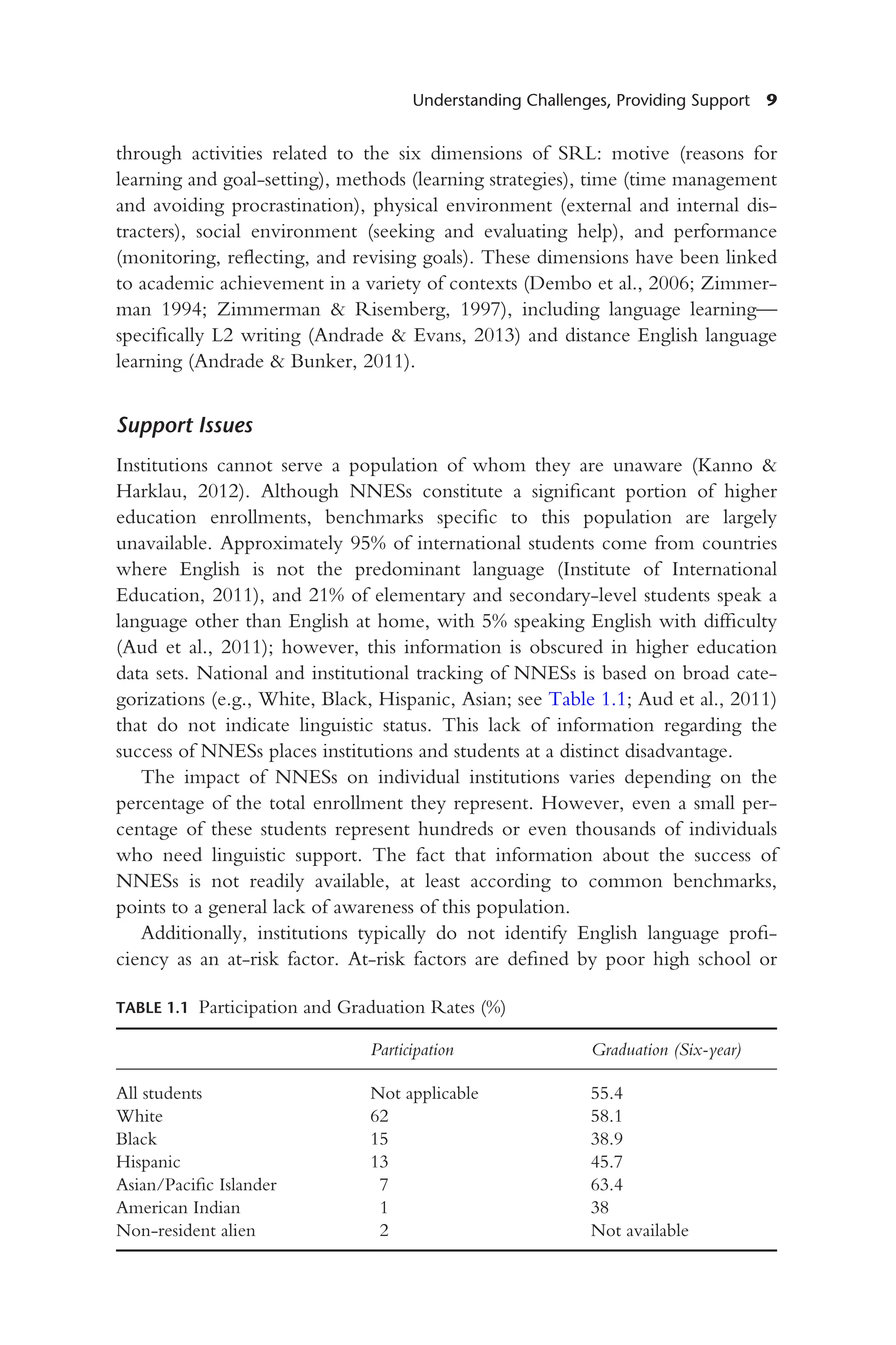
data sets. National and institutional tracking of NNESs is based on broad cate-
gorizations (e.g., White, Black, Hispanic, Asian; see Table 1.1; Aud et al., 2011)
that do not indicate linguistic status. This lack of information regarding the
success of NNESs places institutions and students at a distinct disadvantage.
The impact of NNESs on individual institutions varies depending on the
percentage of the total enrollment they represent. However, even a small per-
centage of these students represent hundreds or even thousands of individuals
who need linguistic support. The fact that information about the success of
NNESs is not readily available, at least according to common benchmarks,
points to a general lack of awareness of this population.
Additionally, institutions typically do not identify English language profi-
ciency as an at-risk factor. At-risk factors are defined by poor high school or
TABLE 1.1 Participation and Graduation Rates (%)
Participation Graduation (Six-year)
All students Not applicable 55.4
White 62 58.1
Black 15 38.9
Hispanic 13 45.7
Asian/Pacific Islander 7 63.4
American Indian 1 38
Non-resident alien 2 Not available
10 N. W. Evans and M. S. Andrade
transfer grade point averages, first-generation or nontraditional status, low
college entrance or placement test scores, and minority/ethnicity categories.
Although students from minority or ethnic groups may be NNES, they are not
specifically identified as such. In essence, NNESs are invisible at the institutional
level in terms of their English language proficiency, and therefore, appropriate
programming is typically not designed to address their needs, and these needs
are not accounted for as a possible factor impacting poor academic performance
or lack of persistence.
Implications and Applications
Due, in large part, to faulty assumptions, institutions frequently lack a campus-
wide approach to helping NNESs develop their reading and writing skills after
admission, or, if an approach exists, it fails to distinguish among variations in
nonnative English-speaking populations and their linguistic and cultural needs
(see Chapter 3 in this volume). Research suggests that “only at an institution-
wide level is it possible to map language development across the whole univer-
sity, and to identify broad graduate attributes that incorporate high-level English
language proficiency and communicative competence in a disciplinary environ-
ment” (Barrett-Lennard et al., 2011, p. 102). Leaving English language support
to faculty members and departments may have some efficacy; however, research
indicates that the former expect a comprehensive and structured plan to ensure
that NNESs receive the appropriate linguistic support (Andrade & Evans, 2007).
Without this institution-wide approach, NNESs will not only struggle during
their higher education experience but graduate with inadequate professional
English language skills.
A first step to supporting NNESs is for institutions to gather and track data
that identify NNESs and provide a clear understanding of their needs and levels
of success. Without this, substantive and lasting change will not occur, nor will
it reflect actual needs (Kanno & Harklau, 2012). This information will inform
the development of appropriate programming. Considerable institutional
resources are directed at first-year programming and retention on most cam-
puses. These initiatives must consider both individual students and specific pop-
ulations needing support. They must also differentiate among the needs of
various populations, rather than trying to incorporate the same best practices at
all institutions. This section delineates examples of support related to the issues
raised. These can be a starting point for further discussion, exploration, and
development.
One innovative approach to addressing needs specific to Generation 1.5
students is to identify their competencies through appropriate testing and
require a combination of course work, including a basic skills course for
reading and writing, an ESL course for grammatical accuracy, and supplemental
support through tutoring (Miele, 2003). This type of intervention demonstrates
Understanding Challenges, Providing Support 11
institutional flexibility and responsiveness to meeting the linguistic needs of a
specific population rather than forcing NNESs into courses that may only par-
tially address what they lack in terms of English proficiency, a challenge dis-
cussed earlier.
Other examples of academic support programming include embedded
instruction, which involves teaching language and academic skills along with
content (Brooman-Jones, Cunningham, Hanna, & Wilson, 2011; Harris &
Ashton, 2011), collaborations between professors and learning advisors to help
local and international students navigate academic tasks and align assessments
with course objectives (Stratilas, 2011), and the use of technology to support lit-
eracy development (Yakimchuk, 2010). Additionally, institutions may offer pre-
paratory English courses (Green & Agosti, 2011; Rosenstiel, Taafee, & Thomas,
2009), tutorials, and support groups for thesis writing (Sundstrom, 2009). First-
year seminars assist with linguistic and cultural transitions (Andrade, 2006,
2009), and collaborative programming involving both student affairs and aca-
demic affairs offers a holistic approach (Andrade & Evans, 2009).
Language learning encompasses more than linguistic features; it requires a
comprehensive approach. Entity and SRL theories, discussed earlier, address
affective factors and beliefs about learning to help learners use different lenses,
adopt new views of themselves and their potential, and make needed changes.
Training NNESs in these areas can increase their awareness and understanding
of their behaviors and their learning and cultural approaches. This training
must involve identifying student beliefs about intelligence, how these beliefs
have been informed, and how to help students adopt approaches that enable
learning (Dörnyei & Ushioda, 2009). Faculty need to probe student views
of learning and help them reflect on and understand the goals of higher educa-
tion: learning not performance.
A well-known approach—the SIOP Model (Vogt & Echevarria, 2005)—is
commonly used to support NNESs in K–12 contexts. This model involves
identifying language and content objectives in each lesson and encouraging
learning by using strategies such as providing background, simplifying content,
focusing on strategy instruction, organizing pair and group work for interaction
purposes, and providing opportunities for practice. Unfortunately, no similar
teaching and learning models exist to support NNESs in U.S. institutions of
higher education, nor are any widespread discussions occurring related to this
direction.
Other countries, however, have made some progress on this issue. In Aus-
tralia, for example, increasing numbers of NNESs entering postsecondary insti-
tutions (24% of the total higher education enrollment is international;
Choudaha, Chang, & Kono, 2013) has resulted in the development of Good
Practice Principles for English Language Proficiency for International Students
(Arkoudis, Baik, & Richardson, 2012; Australian Universities Quality Agency,
2009). These principles are being adopted across disciplines, are applied across
12 N. W. Evans and M. S. Andrade
learner populations, and are resulting in discussions of how to define, measure,
and develop English language proficiency in academic and professional contexts
(Barrett-Lennard et al., 2011; Harris & Ashton, 2011). Centralized language and
skills workshops have not addressed NNESs’ needs, thus alternative approaches
that define communication practices within a discipline and integrate related
language and academic skills in individual courses are becoming increasingly
common.
Conclusion
The goal to increase higher education opportunities and successes has resulted
in a more diverse population in colleges and universities, and this trend
will only continue. The benefits of this diverse population are readily
acknowledged; however, despite this, institutions of higher education have
not fully recognized that NNESs need post-admission support related to lan-
guage skills, particularly the development of academic reading and writing
competencies.
This inattention may be due, in part, to a misunderstanding of NNESs’ lin-
guistic limits. However, as the vignette at the beginning of this chapter points
out, until these issues are addressed, NNESs will not graduate with the skills
needed to fully benefit from their experience, institutional reputations may be at
stake, and society will likely not reap the full rewards of a well-educated citi-
zenry. Hosting institutions bear the responsibility of providing NNESs with the
educational resources necessary for academic success (Green & Agosti, 2011,
Kennelly, Maldoni, & Davies, 2010). Arguably no other factor is more central
to the success of NNESs than their facility with the English language (Andrade
& Evans, 2007; Ferris, 2009, Grabe, 2009).
Summary
• Many institutions of higher education assume that if NNESs meet the lan-
guage proficiency requirement for admissions, they have the language skills
necessary to succeed at the university.
• Similarly, many institutions assume that when NNESs are immersed in a
higher education English-speaking environment, their English skills will
naturally develop along with their academic skills.
• The interaction between linguistic competency and cultural adjustment
cannot be ignored when considering NNESs’ abilities to adjust and succeed
in their academic endeavors. This includes the concept of self-theories,
which often develop from students’ educational and cultural backgrounds.
• One possible explanation for institutions operating on the fallacious
assumptions presented in this chapter is a lack of understanding of how lan-
guages are learned and acquired.
Understanding Challenges, Providing Support 13
• While there are clear indications that appropriate institutional attention to
NNESs’ language development needs is lacking, there are many possibilities
for training and programming. This chapter, as well as this volume, present
possible ideas and directions.
Discussion Questions
1. This chapter presents two assumptions. The first states that once NNESs
meet admission requirements, they have adequate English language skills to
succeed in postsecondary-level academic work. This can have far-reaching
consequences for students and institutions alike. What are some con-
sequences NNESs may face? How might an institution be impacted? Can
you think of others who might be impacted?
2. The second assumption presented in this chapter states that because second
language students are immersed in an English-speaking environment once
they enroll, their academic language skills (i.e., reading and writing) will
naturally continue to develop as they progress through their studies. Why is
this thinking flawed? Can you think of specific examples to illustrate this?
3. A major concern identified in this chapter is that many institutions do not
track the progress of NNES students. Discuss this concern in terms of what
may be causing this institutional neglect and specifically how it may impact
the students.
4. The impact linguistic limitations have on cultural adjustment cannot be
overlooked. How might an institution address the issue to ensure students
make successful adjustments?
5. Suggestions for helping NNESs often focus on the students. What are some
possible ways support might be focused on faculty and administrators to
help students achieve academic success?
Further Reading
Andrade, M. S., & Evans, N. W. (Eds.). (2009). International students: Strengthening a crit-
ical resource. Westport, CT: ACE/Rowman Littlefield.
Andrade, M. S., Evans, N. W., & Hartshorn, K. J. (2014). Linguistic support for non-
native English speakers: Higher education practices in the United States. Journal of
Student Affairs Research and Practice, 51(2), 207–221.
Arkoudis, S., Baik, C., & Richardson, S. (2012). English language standards in higher educa-
tion: From entry to exit. Camberwell, Australia: Australian Council for Educational
Research.
Kanno, Y., & Harklau, L. (2012). Linguistic minority students go to college: Preparation, access,
and persistence. New York, NY: Routledge.
14 N. W. Evans and M. S. Andrade
References
Anderson, N. J., Evans, N. W., & Hartshorn, K. J. (2014, March). Discipline-specific expec-
tations of faculty for reading and writing. Paper presented at the American Association for
Applied Linguistics (AAAL), Portland, OR.
Andrade, M. S. (2006). International students in English-speaking universities: Adjust-
ment factors. Journal of Research in International Education, 5(2), 131–154.
Andrade, M. S. (2008). International graduate students: Adjusting to study in the United
States. In K. A. Tokuno (Ed.), Graduate students in transition: Assisting students through
the first year (pp. 71–88). Columbia, SC: National Resource Center for the First Year
Experience & Students in Transition.
Andrade, M. S. (2009). The value of a first-year seminar: International students’ insights
in retrospect. Journal of College Student Retention: Research, Theory, & Practice, 10(4),
483–506.
Andrade, M. S., & Bunker, E. L. (2011). The role of SRL and TELEs in distance educa-
tion: Narrowing the gap. In G. Dettori & D. Persico (Eds.), Fostering self-regulated learn-
ing through ICTs (pp. 105–121). Hershey, PA: IGI Global.
Andrade, M., & Evans, N. (2007). University instructors’ views of ESL students: Implica-
tions for training. In G. Poedjosoedarmo (Ed.), Teacher education in language teaching,
anthology series 48 (pp. 224–249). Singapore: SEAMEO Regional Language Centre.
Andrade, M. S., & Evans, N. W. (Eds.). (2009). International students: Strengthening a crit-
ical resource. Westport, CT: ACE/Rowman Littlefield.
Andrade, M. S., & Evans, N. W. (Eds.). (2013). Principles and practices for response in second
language writing: Developing self-regulated learners. New York, NY: Routledge/Taylor &
Francis.
Arkoudis, S., Baik, C., & Richardson, S. (2012). English language standards in higher educa-
tion: From entry to exit. Camberwell, Australia: Australian Council for Educational
Research.
Aud, S., Hussar, W., Kena, G., Bianco, K., Frohlich, L., Kemp, J., & Tahan, K. (2011).
The condition of education 2011 (NCES 2011-033). U.S. Department of Education,
National Center for Education Statistics. Washington, DC: U.S. Government Printing
Office. Retrieved February 10, 2015, from http://nces.ed.gov/pubsearch/pubsinfo.
asp?pubid=2011033.
Australian Universities Quality Agency (AUQA). (2009). Good practice principles for English
language proficiency for international students in Australian universities. Report to the
Department of Education, Employment and Workplace Relations, Canberra.
Retrieved February 10, 2015, from www.auqa.edu.au/files/otherpublications/good%
20practice%20principles%20for%20english%20language%20proficiency%20report.pdf.
Barrett-Lennard, S., Dunworth, K., & Harris, A. (2011). The good practice principles:
Silver bullet or starter gun? Journal of Academic Language & Learning, 5(2), A99–A106.
Benzie, H. (2011). A pathway into degree program: Forging better links. Journal of Aca-
demic Language & Literacy, 5(2), A107–A117.
Brooman-Jones, S., Cunningham, G., Hanna, L., & Wilson, D. N. (2011). Embedding
academic literacy: A case study in business at UTS: Insearch. Journal of Academic Lan-
guage & Literacy, 5(2), A1–A13.
Celce-Murcia, M. (2006). Language teaching approaches: An overview. In M. Celce-
Murcia (Ed.), Teaching English as a second or foreign language (3rd ed., pp. 3–11). Boston,
MA: Heinle & Heinle.
Choudaha, R., Chang, L., & Kono, Y. (2013, March). International student mobility
Understanding Challenges, Providing Support 15
trends 2013: Towards responsive recruitment strategies. World Education News & Review,
26(2). Retrieved February 10, 2015, from www.wes.org/ewenr/13mar/feature.htm
Collier, V. P. (1987). Age and rate of acquisition of second language for academic pur-
poses. TESOL Quarterly, 21, 617–641.
Collier, V. P., & Thomas, W. P. (1989). How quickly can immigrants become proficient
in school English? Journal of Educational Issues of Language Minority Students, 5, 26–38
Conway, K. M. (2010). Educational aspirations in urban community college: Differences
between immigrant and native student groups. Community College Review, 37(3),
209–242.
Counsell, J. (2011). How effectively and consistently do international postgraduate stu-
dents apply the writing strategies they have been taught in a generic skills-based course
to their subsequent discipline-based studies? Journal of Academic Language & Literacy,
5(1), A1–A17.
Cummins, J. (2008). BICS and CALP: Empirical and theoretical status of the distinction.
In B. Street & N. H. Hornberger (Eds.), Encyclopedia of Language and Education, (2nd
ed., Vol. 2, pp. 71–83). New York, NY: Springer.
DeKeser, R. M. (2007). Practice in a second language: Perspectives from applied linguistics and
cognitive psychology. New York: Cambridge University Press.
Dembo, M. H., Junge, L. G., & Lynch, R. (2006). Becoming a self-regulated learner:
Implications for web-based education. In H. F. O’Neil & R. S. Perez (Eds.), Web-
based learning: Theory, research, and practice (pp. 185–202). Mahwah, NJ: Lawrence
Erlbaum Associates.
Dörnyei, Z., & Ushioda, E. (2009). Motivation, language identity and the L2 self. Bristol:
Multilingual Matters.
Dweck, C. S. (2000). Self-theories: Their role in motivation, personality, and development.
New York, NY: Psychology Press.
Ellis, R., Sheen, Y., Murakami, M., & Takashima, H. (2008). The effects of focused and
unfocused corrective feedback in an English as a foreign language context. System, 36,
353–371.
Ferris, D. R. (2009). Teaching college writing to diverse student populations. Ann Arbor, MI:
University of Michigan Press.
Galloway, F. J., & Jenkins, J. R. (2009). The adjustment problems faced by international
students in the United States: A comparison of international students and administra-
tive perceptions at two private, religiously affiliated universities. NASPA Journal,
46(4), 661–673.
Grabe, W. (2009). Reflections on second language reading: Research and instruction. In
Z. H. Han & N. Anderson (Eds.), Second language reading: Research and instruction (pp.
192–205). Ann Arbor, MI: University of Michigan Press.
Green, T., & Agosti, C. (2011). Apprenticing students to academic discourse: Using
student and teacher feedback to analyse the extent to which a discipline-specific aca-
demic literacies program works. Journal of Academic Language & Learning, 5(2), A18–
A35.
Grundy, S. (2007). Higher education related learning framework: Toward a universal framework.
London: Specialist Schools and Academies Trust. Retrieved February 10, 2015, from
www.docstoc.com/docs/129379399/Higher-Education-Related-Learning.
Harris, A., & Ashton, J. (2011). Embedding and integrating language and academic skills:
An innovative approach. Journal of Academic Language & Learning, 5(2), A73–A87.
Huang, J. (2009). What happens when two cultures meet in the classroom? Journal of
Instructional Psychology, 36(4), 335–342.
16 N. W. Evans and M. S. Andrade
Institute of International Education. (2011). Top 25 institutions hosting international
students, 2010/11. Open Doors Report on International Educational Exchange. Retrieved
February 10, 2015, from www.iie.org/opendoors.
Kanno, Y., & Harklau, L. (2012). Linguistic minority students go to college: Preparation, access,
and persistence. New York, NY: Routledge.
Kennelly, R., Maldoni, A., & Davies, D. (2010). A case study: Do discipline-based pro-
grammes improve student learning outcomes? International Journal for Educational Integ-
rity, 6(1), 61–73.
Lee, S. A., Park, H. S., & Kim, W. (2009). Gender differences in international students’
adjustment. College Student Journal, 43(4), 1217–1227.
Lumina Foundation. (2013, February). Strategic plan 2013 to 2016. Retrieved from www.
luminafoundation.org/publications/A_stronger_nation_through_higher_education-
2013.pdf.
Miele, C. (2003). Bergen Community College meets Generation 1.5. Community College
Journal of Research and Practice, 27, 603–612.
Omaggio Hadley, A. (2000). Teaching language in context (3rd ed.). Boston, MA: Heinle
& Heinle.
Ritz, A. A. (2010). International students and transformative learning in a multicultural
formal educational context. The Educational Forum, 74, 158–166, doi:10.1060/00131
72100360S497.
Rosenstiel, E. D, Taafee, J., & Thomas, L. J. (2009). The graduate preparation program
at the Ohio State University. In M. S. Andrade & N. W. Evans (Eds.), International
students: Strengthening a critical resource (pp. 147–151). Washington, DC: ACE/Rowman
Littlefield.
Russell, J., Rosenthal, D., & Thomson, G. (2009). The international student experience.
Higher Education, 60, 235–249.
Sherry, M., Thomas, P., & Chui, W. H. (2010). International students: A vulnerable
student population. Higher Education, 60, 33–46. doi:10.1007/s10734-009-9284-z.
Storch, N. (2009). The impact of studying in a second language (L2) medium university
on the development of L2 writing. Journal of Second Language Writing, 18(2), 103–118.
Stratilas, K. (2011). The evolving nature of support: A new horizon. Journal of Academic
Language & Literacy, 5(2), A44–A49.
Sundstrom, C. J. (2009). Graduate support program: The least we owe international
graduate students. In M. S. Andrade & N. W. Evans (Eds.), International students:
Strengthening a critical resource (pp. 157–162). Washington, DC: ACE/Rowman Little-
field.
Teaching English to Speakers of Other Languages, Inc. (TESOL) (2010). Position state-
ment on the acquisition of academic proficiency in English at the postsecondary level. Washing-
ton, DC: Author. Retrieved February 10, 2015, from www.tesol.org/about-tesol/
press-room/position-statements/higher-education-position-statements.
Tochkov, K., Levine, L., & Sanaka, A. (2010). Variation in the prediction of cross-
cultural adjustment by Asian-Indian students in the United States. College Student
Journal, 44(3), 677–689.
Vogt, M., & Echevarria, J. (2005). Teaching ideas for implementing the SIOP model. Glen-
ville, IL: Lesson Lab/Pearson Education, Inc.
Xiao, L. (2006). Bridging the gap between teaching styles and learning styles: A cross-
cultural perspective. TESL-EJ, 10(3), 1–15.
Yakimchuk, D. T. (2010). Literacy-based technology support for post-secondary second
language learners. Canadian Journal of Educational Administration and Policy, 112, 1–21.
Understanding Challenges, Providing Support 17
Zimmerman, B. J. (1994). Dimensions of academic self-regulation: A conceptual frame-
work for education. In D. H. Schunk & B. J. Zimmerman (Eds.), Self-regulation of
learning and performance (pp. 3–21). Hillsdale, NJ: Lawrence Erlbaum Associates.
Zimmerman, B. J., & Risemberg, R. (1997). Self-regulatory dimensions of academic
learning and motivation. In G. D. Phye (Ed.), Handbook of academic learning: Construc-
tion of knowledge (pp. 105–125). San Diego, CA: Academic Press.
2
PERCEPTIONS AND REALITIES OF
ESL STUDENTS IN HIGHER
EDUCATION
An Overview of Institutional Practices
Maureen Snow Andrade, Norman W. Evans, and
K. James Hartshorn
Vignette
The director of international services at a large university has requested a meeting with the
vice president of student life. He is concerned that the university’s initiatives to interna-
tionalize the campus over the past three years have had consequences that the administra-
tion may be unaware of. For instance, the decision to keep the Test of English as a
Foreign Language (TOEFL iBT) at 70 allows the university to meet targets for enroll-
ment and tuition revenue, but it also seems to allow students into the university with
language skills below what is necessary for them to succeed academically.
The support services and faculty don’t know how to help. This is evidenced by the fact
that directors of the writing and learning centers have reported that their staffs have no
English as a second language (ESL) training. They tell him, “We don’t know what to
do for the international students who are constantly coming in for help,” and they struggle
particularly with those whose needs seem to differ from those of the student body who are
native speakers. Faculty in the business, engineering, and English departments have fre-
quently communicated similar concerns. “We have many international students that need
help with their writing and speaking,” they say. The international services director’s first
question for the vice president is “Beyond enrollment numbers, does the university track
these students?” The director is startled by her reply: “Once students have been admitted
with the appropriate score, we have found no reason to track this group of students.”
Overview of the Challenges
Though the United States ranked first for two- and four-year degree attainment
in 1960 (Lumina Foundation for Education, 2010), it now ranks sixth in the
world for the percentage of 25- to 64-year-olds with an associate degree or
Perceptions and Realities of ESL 19
higher (Lee & Rawls, 2010). Despite this, increasing numbers of individuals are
pursuing postsecondary education in the United States. From 2000 to 2009,
enrollments of undergraduate students rose by 34%—from 13.2 to 17.6 million
students (U.S. Department of Education, National Center for Education Statis-
tics, 2011). These numbers will increase even further, as 66% of all jobs in the
United States are projected to require some form of postsecondary education by
the year 2020 (Carnevale, Smith, & Strohl, 2010).
To support the need for further education, completion goals have been set
by federal and state governments as well as nonprofit educational institutions
and organizations (e.g., Lumina Foundation for Education; Commission on
Access, Admissions and Success in Higher Education; the National Governor’s
Association). These goals include increasing the percentage of college graduates
by anywhere from 55% to 60% within the next several years (Lee & Rawls,
2010; Lumina Foundation for Education, 2010). To achieve these goals, higher
education institutions must be prepared to expand access to students from a
wide range of backgrounds and to provide related support services to ensure
success.
Access and success are familiar concepts on both two- and four-year cam-
puses. Degree completion, in particular, is receiving more attention than ever
before in the history of U.S. higher education. The Lumina Foundation for
Education (2010) notes that 22% of Americans, more than 37 million people,
have enrolled in college without achieving a degree. Lumina’s goal, and that of
others, is not only to increase the number of college degrees for Americans, but
to close the gap in attainment for underrepresented students. The latter includes
ethnic minorities, first-generation students, and low-income students.
The current focus on the attainment gap (providing access to those previ-
ously marginalized from higher education and recognition of the range of chal-
lenges that affect completion) has not yet addressed those who may lack
adequate preparation or struggle with educational pursuits due to limited aca-
demic English language proficiency. Both national and global discussions on
access and success must include those for whom English is not a first language.
English language proficiency is not recognized as contributing to a lack of parti-
cipation or completion, primarily because the ESL population is generally not
identified or tracked at institutional or national levels.
The literature reveals fairly extensive information on the experiences of non-
native English speakers (NNES) in higher education (see Chapter 1), particu-
larly international students; however, national data are lacking regarding
documenting institutional practices for admitting and testing, supporting, and
tracking these students. A recent study reveals common themes among these
areas (Andrade, Evans, & Hartshorn, 2014). The remainder of the chapter will
summarize these findings to illustrate how some institutional practices may
exacerbate the challenges that ESL populations face and will then discuss prac-
tices that may help institutions ensure greater success for this population.
20 M. S. Andrade et al.
Insufficient Admissions and Language Testing
The challenges facing any student entering higher education can be daunting.
To counter this, most universities go to great lengths to ensure that admitted
students are academically prepared for the rigors of a university, imposing mul-
tiple measures of academic readiness such as test scores, class rankings, and grade
point averages (GPAs). Multiple measures ensure accuracy in the admission
process. Logic suggests that multiple measures of linguistic readiness of NNES
would also be a good idea; unfortunately, such is generally not the case. It is not
uncommon for NNES to be deemed linguistically ready for university based on
a single measure, such as a language test or country of origin.
The potential problems with such a practice are substantial. Andrade et al.
(2014), gathered data from 138 U.S. institutions with high enrollments of inter-
national students (comprising approximately 33% of the total international
student population in the United States). These sources indicate that more than
half of the institutions identify prospective students as NNES in the admissions
process based on criteria such as the applicant’s country of origin or the appli-
cant’s claim of English prevalence in the home. More than three-fourths of the
institutions excuse students from English language testing during admission
screening if English is considered the native language in the potential student’s
country of origin, and more than two-thirds of these institutions exempt stu-
dents if they attended an educational institution in which English was the pre-
dominant language. Where language testing is required in the admission process,
only two-thirds of the institutions require a writing sample and hardly any
require a speaking sample.
These practices seem reasonable in contexts of limited resources. However,
on closer examination, critical issues emerge. For example, that a student comes
from a country where English is predominantly used or obtained some
education in an English-medium environment may have little bearing on
that individual’s English language proficiency. It is not unreasonable, for
example, to expect that a student might come from a country where English is
predominant but grew up in a rural setting where opportunities for English
development were extremely limited. In this case, the student’s language skills
may be well below the average language proficiency profile of students from
that country. Exempting students from needed language support by not prop-
erly assessing their abilities may not be in the best interests of the student or the
institution.
Deficient Language Support
NNES in higher education need language support, and this is evidenced by the
various forms of language support offered by many institutions. Andrade et al.
(2014) report that nearly 80% of the institutions they surveyed provide language
Perceptions and Realities of ESL 21
support of some kind for their undergraduate students, and about half provide
services for graduate students. It is encouraging that these needs are recognized
at some institutions; however, several facts cannot be ignored. First, institutional
support is lacking for 20% of the undergraduate and 50% of graduate NNES.
Furthermore, and perhaps more importantly, the support that is offered may not
be contributing to the long-term language development needs of NNES.
While some institutions offer language support in the form of skill centers,
coursework, tutoring programs, workshops, and modules (Andrade et al., 2014),
a close inspection of how institutions offer these services is informative. For
example, most language support services are optional. This suggests that, in
general, there is no systematic approach to supporting language development for
NNES over the course of their study in a university. Support services seem to
be tangential to students’ course of study. This approach is based in the “deficit
model of language learning” (Arkoudis, Baik, & Richardson, 2012, p. 2), which
assumes that once students have passed or are exempt from language admission
requirements, they have the necessary language skills to cope with the demands
of their studies. Such a model ignores two important facts: learning a language is
a long-term developmental process and an institution has a basic role to make
sure that the students it admits are appropriately supported to achieve success.
Inadequate Tracking
Data gathered by Andrade et al. (2014) from institutions across the United States
with high percentages of international students also suggest that tracking the
success of NNES is sorely lacking. Andrade et al. inquired to what extent insti-
tutions used key indicators such as GPA, retention, or persistence to graduation
to determine student success. Some institutions employed various methods of
tracking the success of NNES, but 40% of the institutions did not track success
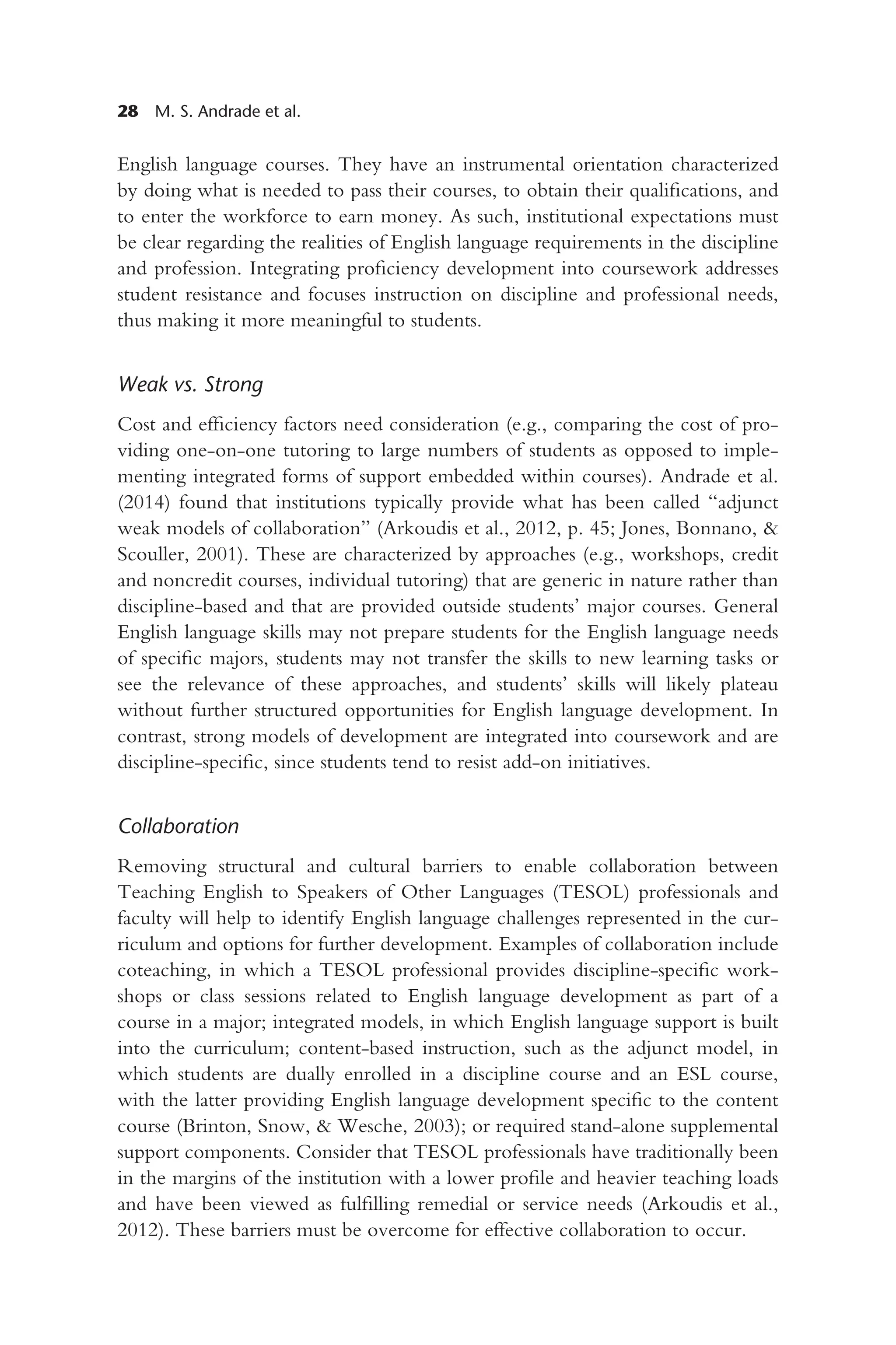
in any way. Many of the survey participants perceived this as an institutional
weakness. Responses varied in explaining why this population was not tracked.
Some reasons were rather pragmatic. For example, one respondent indicated,
“We don’t have the manpower or resources to track these students,” while
another declared, “They all tend to do exceptionally well” (Andrade et al.,
2014, p. 215).
If we accept the premise that an institution has an ethical obligation to admit
only those students who are linguistically prepared or who are adequately sup-
ported by the institution, then systems that carefully monitor key indicators of
student success ought to be in place. Nationwide data further suggest that the
deficit model of language learning is commonly accepted. Comments made by
several survey participants illustrate this attitude succinctly: “If they meet our
admissions criteria, they have demonstrated adequate English understanding and
as such no further monitoring is performed”; “Once students have been
admitted with the appropriate score [note the use of the singular form], the
22 M. S. Andrade et al.
Admissions Office has found no reason to track students” (Andrade et al., 2014,
p. 214). Clearly, there is much room for improvement in the tracking proce-
dures on the part of institutions that admit and educate NNES.
A Web of Disconnects
While the factors described are interconnected, they result in an overall dis-
connect in terms of NNES in higher education. Obviously, if students are not
identified as NNES in the admission process, they will not be required to dem-
onstrate their proficiency in English. Consequently, they will not receive
needed support. If they are not tracked as a distinct group (or two distinct
groups—international and resident), the institution can only assume they are
succeeding. Thus, institutions may be completely unaware of the challenges
these students face, and the students may be excluded from institutional,
national, and global discussions regarding student success.
Even if students are identified as NNES, which generally occurs for inter-
national students, lenient criteria often exempt them from pre-admission testing.
Frequently, further assessment after admission is not required. However, such
testing could be used with standardized proficiency tests to identify potential
weaknesses in academic reading and writing skills and types of support needed.
These oversights increase the likelihood that these students will face challenges
that could have been avoided. Such administrative practices also point to the
very real possibility that learners will graduate from the institution with weak
English skills, such as has been occurring in Australia, where 21.4% of higher
education enrollments consist of international students, most of them NNES
(Institute of International Education [IIE], 2012).
Australia represents an interesting case. Australian higher education institu-
tions admit NNES based on a standardized proficiency exam (Birrell, 2006).
They also offer residency to international students who graduate from Australian
universities in order to address work sector needs. However, these students have
had difficulty finding jobs due to their weak English language skills. Therefore,
the country instituted an English language proficiency test score requirement
that must be met to qualify for permanent residency. Nearly one-third of those
applying could not pass the test, even though the same score was required for
university admission.
Some of these students may have entered the country for other types of
educational programs (e.g., intensive English language study or high school) and
then entered universities. As such, they would not have had to submit scores
from a standardized English language proficiency test. Additionally, anecdotal
evidence suggests that universities may have lowered the English demands in
their courses and that students cope by getting help from native English speakers
(Birell, 2006). This is because universities do not want to require supplementary
English courses due to competition with English-medium universities in other
Perceptions and Realities of ESL 23
countries to attract students. They believe that remaining competitive would be
difficult if they required students to spend additional time and money taking
English language courses.
This case powerfully demonstrates the effects of institutional decisions related
to admission practices (e.g., a single score from a standardized proficiency test,
no identification of resident NNES), assessment of English language proficiency
(e.g., no post-admission testing), support (e.g., reluctance to require further
English language study), and tracking (e.g., lack of awareness that students’ pro-
ficiency was too low for employment after graduation and that one-third of stu-
dents had lower English proficiency scores after graduation than when initially
accepted to the institution).
Findings of the national study cited earlier (Andrade et al., 2014) indicate
that similar practices are prevalent in the United States. However, this issue
remains hidden due to the fact that only 3.7% of the total enrollment in U.S.
higher education institutions is international (IIE, 2012), in contrast to the
21.4% in Australia. However, the former figure represents over 700,000 inter-
national students. Additionally, the United States is still the premier destination
for international students, attracting the largest market share at 19%, well ahead
of the United Kingdom at 12%, which is in second place (IIE, 2012). Further-
more, the number of resident students in U.S. higher education institutions
who are NNES is unknown, which indicates even further need for improved
systems related to ESL populations in higher education, particularly in the
context of access and completion initiatives.
This issue is clearly not only a national higher education issue but a global
one. As nations compete with each other to attract international students, rigor
and standards may be compromised. Figure 2.1 illustrates current practices and
summarizes the key issues of challenges identified in the national study. We
refer to these challenges as a web of disconnects—a series of poorly informed
practices that create a disconnected experience, leading to unknown outcomes
for the considerable population of NNES in higher education.
Implications and Applications
Institutions will need to consider context- and mission-appropriate responses to
the challenges identified in the previous section. To assist in this process, we
introduce an institutional framework for English language development. The
framework encourages institutions to establish structures that enable collabora-
tion among stakeholders in order to establish a foundation from which to
identify and implement specific English language development strategies.
This section introduces the foundational steps in the framework, followed by
an overview of concepts that potentially influence institutional action. It then
provides examples of possible implementation strategies that specifically address
the challenges identified by the research findings cited earlier. These include
24 M. S. Andrade et al.
incomplete indications of learners’ proficiency levels, lack of success indicators
for NNES, non-innovative forms of English language support, and failure to
provide ongoing English language development opportunities.
An Institutional Framework for English Language
Development
The foundation to the framework consists of a sequence of four steps as follows:
examine views and beliefs; establish guiding principles; base policies and prac-
tices on principles; and design an assessment plan (see Figure 2.2). These com-
ponents serve as a point of reference for institutions to consider as they
determine how to best demonstrate their commitment to English language
development for NNES.
Views and Beliefs
Institutions must examine and address stakeholders’ views and beliefs about lan-
guage learning (e.g., see Andrade & Evans, 2007). Furthermore, they must
determine how faculty members see their role in terms of responsibility for
helping students further their English language skills. In order for change to be
1
Liberal admissions
test exemptions
2
Single proficiency
test for admission
3
Limited post-
admission testing
4
Limited opportunity for
continued proficiency
development
5
Lack of tracking of
key success indicators
6
Unknown
outcomes
FIGURE 2.1 A Web of Disconnects.
Perceptions and Realities of ESL 25
successful, it is critical to recognize the linguistic and transitional issues faced by
NNES and to understand the implications for institutional practice. This aware-
ness must be shared by decision makers and by the faculty and staff who develop
policies and procedures, provide support, teach, or interact with NNES to any
extent.
Guiding Principles
Institutions should identify guiding principles (e.g., see Australian Universities
Quality Agency, 2009, in Appendix A) that support a philosophy of success spe-
cifically related to English language proficiency development for NNES. These
principles must be informed by linguistic theory in terms of language acquisi-
tion, general academic and discipline-specific English language proficiency, the
length of time required to develop these proficiencies, and expected outcomes.
Principles should be aimed at shifting the focus from a philosophy of support to
a philosophy of English language development (Arkoudis et al., 2012). This
support must extend to all areas of the institution, from the classroom to aca-
demic services to social engagement.
Policies and Practices
Institutions need to examine policies and practices for admission, assessment,
English language development, and tracking outcomes in terms of the guiding
principles to determine where adjustments should and can occur. Furthermore,
they should consider how current systems and practices support underrepre-
sented and ethnic minority students and examine their strengths and weaknesses
related to developing the English language skills of NNES. Institutions must
Examine views
and beliefs
Establish guiding
principles
Base policies and
practices on principles
Design an assessment
plan
FIGURE 2.2 Foundational Steps to the Framework.
26 M. S. Andrade et al.
have an inclusive approach that extends to all of the students they admit and
that focuses on specific areas where additional development must occur for stu-
dents to be academically successful.
Assessment Plan
Institutions must determine and implement a process to measure students’
English language skills at entrance, exit, and post-enrollment (see Figure 2.3).
They must also determine criteria to determine which students need to be tested
on entry and to ensure this information is communicated clearly to students and
other stakeholders prior to admission. To avoid the criticism that post-admission
assessment is retesting or repeating the testing required for admission purposes,
institutions should ensure that the plan has diagnostic characteristics that enable
support systems and further opportunities to be activated. They should develop
assessment tasks relevant to specific disciplines accompanied by feedback to stu-
dents and recommendations for directed learning opportunities (Arkoudis &
Starfield, 2007; Arkoudis et al., 2012). Finally, institutions should consider how
to require or incentivize participation in exit and post-enrollment assessments.
(See the Influencing Concepts section in this chapter for an explanation of weak
vs. strong in Figure 2.3; see the Strategies section in this chapter for more
information on ongoing data collection and analysis.)
Matriculation
C
o
m
p
l
e
t
i
o
n
Develop
m
e
n
t
1. Admission
Identify NNES; assess
general academic English
language skills
2. Entrance
Require diagnostic English
language testing that may reflect
discipline-specific language tasks
3. Linguistic needs
Identify potential linguistic
needs and report results to
students and departments
4. Linguistic development
Activate opportunities;
consider weak vs. strong
factors
5. Ongoing assessment and tracking
Provide demographic and student success data
to departments and relevant entities; adjust
language development approaches as needed
with ongoing measurement and analysis
6. Graduation
Measure professional-level
English proficiency institutionally
or within specific programs
7. Post-graduation
Collect data from employers
and students on adequacy of
English language
preparation and use data to
adjust policy and practice
Assessment plan
FIGURE 2.3 Assessment Plan.
Perceptions and Realities of ESL 27
Influencing Concepts
The next four components of the framework demonstrate concepts that influ-
ence action and must be considered once the foundational steps (i.e., examining
views and beliefs, establishing guiding principles, basing policies and practices
on the principles, and designing an assessment plan) are in place. Figure 2.4
illustrates the relationship among all of the parts of the framework. The influen-
cing concepts are layered over the foundational steps to demonstrate the next
level of action required in order to fully implement the framework. The final
component of the framework is the specific implementation strategies, examples
of which are discussed in the Implementation Strategies section.
Optional vs. Required
Related to support practices, remember the adage “Students don’t do optional.”
Often, the students who need the most help are the least likely to access it.
They need all of their available time to focus on passing their courses, and they
don’t recognize that stronger skills would facilitate their success and decrease the
amount of time needed for study. Typically, NNES do not want to spend more
time and money on add-on models such as stand-alone credit or noncredit
Examine views
and beliefs
Establish guiding
principles
Base policies and
practices on principles
Design an assessment
plan
Influencing concepts
Optional vs. required
Weak vs. strong
Collaboration
Flexible pathways
Implementation strategies
Foundational steps
FIGURE 2.4 Institutional Framework for English Language Development.
28 M. S. Andrade et al.
English language courses. They have an instrumental orientation characterized
by doing what is needed to pass their courses, to obtain their qualifications, and
to enter the workforce to earn money. As such, institutional expectations must
be clear regarding the realities of English language requirements in the discipline
and profession. Integrating proficiency development into coursework addresses
student resistance and focuses instruction on discipline and professional needs,
thus making it more meaningful to students.
Weak vs. Strong
Cost and efficiency factors need consideration (e.g., comparing the cost of pro-
viding one-on-one tutoring to large numbers of students as opposed to imple-
menting integrated forms of support embedded within courses). Andrade et al.
(2014) found that institutions typically provide what has been called “adjunct
weak models of collaboration” (Arkoudis et al., 2012, p. 45; Jones, Bonnano, &
Scouller, 2001). These are characterized by approaches (e.g., workshops, credit
and noncredit courses, individual tutoring) that are generic in nature rather than
discipline-based and that are provided outside students’ major courses. General
English language skills may not prepare students for the English language needs
of specific majors, students may not transfer the skills to new learning tasks or
see the relevance of these approaches, and students’ skills will likely plateau
without further structured opportunities for English language development. In
contrast, strong models of development are integrated into coursework and are
discipline-specific, since students tend to resist add-on initiatives.
Collaboration
Removing structural and cultural barriers to enable collaboration between
Teaching English to Speakers of Other Languages (TESOL) professionals and
faculty will help to identify English language challenges represented in the cur-
riculum and options for further development. Examples of collaboration include
coteaching, in which a TESOL professional provides discipline-specific work-
shops or class sessions related to English language development as part of a
course in a major; integrated models, in which English language support is built
into the curriculum; content-based instruction, such as the adjunct model, in
which students are dually enrolled in a discipline course and an ESL course,
with the latter providing English language development specific to the content
course (Brinton, Snow, & Wesche, 2003); or required stand-alone supplemental
support components. Consider that TESOL professionals have traditionally been
in the margins of the institution with a lower profile and heavier teaching loads
and have been viewed as fulfilling remedial or service needs (Arkoudis et al.,
2012). These barriers must be overcome for effective collaboration to occur.
Perceptions and Realities of ESL 29
Flexible Pathways
Institutions must determine which students need English language skill develop-
ment and where and to what extent English language skill development is
needed. Then they must provide multiple pathways to related opportunities that
are sufficiently flexible to accommodate needs in majors with large numbers of
NNES, individual courses with perhaps one or two struggling students, or indi-
viduals (faculty and students) independently seeking opportunities and services.
These pathways should be part of the institution’s overall plan for English lan-
guage development, should indicate various levels and types of intervention, as
well as points of intervention, and should specify how coordination among units
will occur (see the Resources section in this chapter). This plan would be the
result of a needs analysis based on collected data.
Implementation Strategies
Depending on individual contexts, infrastructures, and resources, the following
strategies are possibilities for implementing the guiding framework. As institu-
tions typically have budget constraints, choices for how to best commit to con-
tinued English language development must be strategic. Priorities need to be set
and approaches evaluated in order to make these decisions. Many of the sugges-
tions that follow could be implemented with faculty reassigned time or con-
sidered within the parameters of faculty service. Another option is to redirect
how opportunities are provided (e.g., rather than stand-alone general ESL
courses, TESOL professionals could develop English language strands within
discipline-based curriculum and teach modules in courses in a major program).
Other approaches might entail refocusing existing budgets on specific projects
related to English language development for NNES (e.g., institutional research,
marketing, learning assistance center or faculty center training, or resource
development projects).
Entry Testing
Institutions must provide required training for admission staff related to English
language proficiency instruments, test scores, score comparisons, score interpre-
tations, processes for setting cut scores, and test limitations. Furthermore,
standard measures of error related to proficiency tests must be recognized, along
with the extent to which gains on standardized proficiency tests can be
expected. Institutions should also create opportunities for TESOL professionals
to collaborate in this training and should establish systems that support collabo-
ration between TESOL professionals, admissions officers, and decision makers
involved in setting English language entrance and matriculation standards.
30 M. S. Andrade et al.
Awareness-Raising
Providing regularly scheduled and required training (possibly incentivized) will
help staff who interact with NNES (e.g., learning assistance personnel, multicul-
tural and international center staff, faculty, and peer tutors). Training should be
tailored to the staff’s roles and should be focused on raising their awareness of
language acquisition and transition issues. Campus TESOL professionals should
also be involved in this training.
Teaching Strategies
Institutions must create a system through which teaching strategies can be
accessed and shared. While more intensive and formal professional development
initiatives can be provided, for those who may not be able to invest the time, a
discussion forum, database, or website with straightforward strategies can be
provided. These strategies will likely benefit not only NNES, but all enrolled
students and would reflect overall good teaching practice. For example, strat-
egies might include ideas on lecturing, using small groups, encouraging class
participation, developing students’ critical thinking skills, addressing plagiarism,
and planning interaction (Arkoudis et al., 2012). Strategies should demonstrate a
range of possibilities from those that require minimal intervention to those that
involve a greater level of intervention (Arkoudis et al., 2012). Examples of strat-
egies involving minimal work include simply listing language learning develop-
ment expectations on a course syllabus (indicating both language and content
objectives as part of a class session; Echevarria, Vogt, & Short, 2008) or identify-
ing language proficiency standards on grading rubrics or other assessment meas-
ures. A more intensive intervention would be revising the curriculum to include
English language support or attending workshops to learn more about how to
respond to the needs of NNES.
Resources
Institutions attuned to the needs of NNES should offer resources to faculty and
staff that help them create materials and implement services that support devel-
opment of both general and discipline-specific English language skills. These
might include learning assistance resources, websites or databases, e-learning
tools or modules (commercial or proprietary), and embedded workshops offered
by TESOL professionals or faculty development and innovation center staff.
Experts from across campus—TESOL professionals, technology experts, learn-
ing assistance and curriculum office specialists—could be called on to develop
and provide these resources. Additionally, a centralized office for English lan-
guage support would coordinate these efforts and serve as a first point of refer-
ence for faculty, staff, and students. Many institutions have a student success and
Perceptions and Realities of ESL 31
retention center of some sort; it is therefore appropriate to have a center focused
on English language development or include this as a part of a student success
unit.
Ongoing Data Collection and Analysis
Institutions must establish data collection and analysis processes to ensure they
can provide relevant data to programs; these data should include major-specific
information on NNES, including the number enrolled in a program, GPAs,
first-year retention, graduation rates, and job placement. It should also evaluate
various English language proficiency development models that may be in place
institutionally or within programs. The latter can provide crucial data for
making decisions about the viability and efficiency of specific approaches. Insti-
tutions should also provide resources to departments, particularly those with
substantial percentages of NNES, so they can conduct research on transition and
success issues through surveys, student and faculty focus groups, and other
means; they should also receive resources to ensure departments can act on their
findings and implement appropriate opportunities for English language develop-
ment. Institutional research could be conducted to determine faculty and
student perspectives on the English language skills of NNES and how the latter
view their own skills and experiences.
Postgraduation Feedback
When possible, institutions should obtain employer and alumni feedback
through surveys or other means to determine the use of and satisfaction
with NNES English language skills in their chosen professions. This monitor-
ing will help institutions determine their success in terms of English language
development and preparing students with professional skills. Institutions must
also determine clear standards for ensuring that students graduate with the
English proficiency needed for their future careers by coordinating with
employers and examining job placement rates for NNES in English-speaking
contexts. These data should then be used to convince students of the import-
ance of attaining strong English language proficiency during their postsecond-
ary education.
Communication
Finally, institutions should work with faculty, staff, and others committed to
English language development to promote, market, and disseminate information
about the institutional principles of support, the expectations for NNES to
develop discipline-specific and professional English language skills, the available
resources, and the institutional commitment to English language learning
32 M. S. Andrade et al.
outcomes. Public relations campaigns could include employer and alumni feed-
back and findings from institutional data. These needs, plans, opportunities, and
successes should be clearly communicated across campus.
Conclusion
We began this chapter by describing the all too common situation of universi-
ties typically admitting international students on a limited language proficiency
profile, usually a single language test, and then assuming that these students have
the English language necessary to succeed. This deficit model is flawed in a
variety of ways: admission screening for language skills is often insufficient,
support for language development is lacking, tracking of this population is fre-
quently nonexistent or limited at best. This model is based on the idea that lan-
guage deficiencies can be corrected by providing support services that are
tangential, not central, to the curricular needs of these students.
While NNES represent only 3.7% of the total enrollment in U.S. higher
education, that percentage equates to nearly three-fourths of a million students
whose hopes and futures are based on success in the university. As Seidman
(2006) has correctly admonished, “do not recruit students to your campus who
will not be successful unless you are willing to provide programs and services to
help overcome deficiencies. Philosophy does not have to follow finance” (p.
32). The aim of this chapter has been to present a model that will provide pro-
grams and services to ensure NNES success by focusing on language develop-
ment from the time students enter the university until they graduate. This
design is based on such foundational steps as identifying beliefs and principles
that inform policies and practices that can then be used to create an institutional
assessment plan. These foundational steps then allow for influencing concepts
such as collaboration and flexible pathways to lead to implementation strategies.
Each of these steps are intended to help an institution centralize English lan-
guage development within the various curricula of the disciplines that NNES
study. NNES’ academic and linguistic attainment are the objectives of this
model.
Summary
• The enrollment of NNES at English-medium institutions of higher learn-
ing is on the rise.
• Many institutions of higher learning lack adequate methods to identify
NNES, to confirm that they are linguistically prepared for their course-
work, and to track their success.
• Students who are NNES and who are not properly identified or tracked
are not likely to receive the linguistic support needed to ensure adequate
language development and employment following graduation.
Perceptions and Realities of ESL 33
• Institutions of higher learning who accept tuition from NNES should re-
evaluate their commitment to NNES and should establish principles and
strategies that better ensure the language development, academic success,
and future employability of this population.
• The initial, foundational steps institutions should take include examining
views and beliefs, establishing guiding principles, basing policies and prac-
tices on those principles, and designing an assessment plan.
• With the foundational steps in place, institutions need to determine
whether resources to facilitate language development will be optional or
required, align with weak or strong models of English language develop-
ment, benefit from effective collaboration, and utilize flexibility in accom-
modating student needs.
• Institutions will also benefit from various implementation strategies such as
entry testing, raising awareness, specific teaching strategies, allocation of
resources, ongoing data collection and analysis, post-graduation feedback,
and effective communication across the institution.
Discussion Questions
1. What are the key issues identified in this chapter related to admitting,
assessing, supporting, and tracking NNES in higher education?
2. How do these issues present challenges for NNES and the institutions that
host them?
3. What do you see as the difference between English language support and
English language development as explained in this chapter? What implica-
tions do these two philosophies have for NNES and higher education
institutions?
4. Review Figure 2.4 regarding the institutional framework for English lan-
guage development. How does the figure address the challenges presented
in this chapter? What challenges might arise in implementing this model?
What processes and levels of support would need to be in place for success-
ful implication of the framework?
5. Analyze your own institution or one with which you are familiar and iden-
tify its processes for admitting, assessing, supporting, and tracking NNES.
Gather further information as needed, and then create a plan for imple-
menting the framework. Note the individuals who would need to be
involved. Also note potential barriers, but do not let these prevent innova-
tive thinking at this point.
34 M. S. Andrade et al.
Appendix A: 10 Good Practice Principles
1. Universities are responsible for ensuring that their students are sufficiently
competent in the English language to participate effectively in their univer-
sity studies.
2. Resourcing for English language development is adequate to meet students’
needs throughout their studies.
3. Students have responsibilities for further developing their English language
proficiency during their study at universities and are advised of these
responsibilities prior to enrollment.
4. Universities ensure that the English language entry pathways they approve
for the admission of students enable these students to participate effectively
in their studies.
5. English language proficiency and communication skills are important grad-
uate attributes for all students.
6. Development of English language proficiency is integrated with curriculum
design, assessment practices, and course delivery through a variety of
methods.
7. Students’ English language development needs are diagnosed early in their
studies and addressed, with ongoing opportunities for self-assessment.
8. International students are supported from the outset to adapt to their aca-
demic, sociocultural, and linguistic environments.
9. International students are encouraged and supported to enhance their
English language development through effective social interaction on and
off campus.
10. Universities use evidence from a variety of sources to monitor and improve
their English language development activities.
Australian Universities Quality Agency, 2009, p. 3
Further Reading
Andrade, M. S. (2008). International graduate students: Adjusting to study in the United
States. In K. A. Tokuno (Ed.), Graduate students in transition: Assisting students through
the first year (pp. 71–88). Columbia, SC: National Resource Center for the First Year
Experience & Students in Transition.
Andrade, M. S., & Evans, N. W. (Eds.). (2009). International students: Strengthening a crit-
ical resource. Westport, CT: ACE/Rowman Littlefield.
Andrade, M. S., Evans, N. W., & Hartshorn, K. J. (2014). Linguistic support for non-
native English speakers: Higher education practices in the United States. Journal of
Student Affairs Research and Practice, 51(2), 207–221.
Arkoudis, S., Baik, C., & Richardson, S. (2012). English language standards in higher educa-
tion: From entry to exit. Camberwell, Australia: Australian Council for Educational
Research.
Perceptions and Realities of ESL 35
References
Andrade, M. S., & Evans, N. (2007). University instructors’ views of ESL students:
Implications for training. In G. Poedjosoedarmo (Ed.), Teacher education in language
teaching, anthology series 48 (pp. 224–249). Singapore: SEAMEO Regional Language
Centre.
Andrade, M. S., Evans, N. W., & Hartshorn, K. J. (2014). Linguistic support for non-
native English speakers: Higher education practices in the United States. Journal of
Student Affairs Research and Practice, 51(2), 207–221.
Arkoudis, S., Baik, C., & Richardson, S. (2012). English language standards in higher education:
From entry to exit. Camberwell, Australia: Australian Council for Educational Research.
Arkoudis, S., & Starfield, S. (2007). In-course English language development and support.
Canberra, Australia: Australian Education International.
Australian Universities Quality Agency (AUQA). (2009). Good practice principles for English
language proficiency for international students in Australian universities. Canberra, Australia:
Department of Education, Employment and Workplace Relations. Retrieved February
10, 2015, from www.teqsa.gov.au.
Birrell, B. (2006). Implications of low English standards among overseas students at Aus-
tralian universities. People and Place, 14(4), 53–64.
Brinton, D. M., Snow, M. A., & Wesche, M. B. (2003). Content-based second language
instruction. Ann Arbor, MI: University of Michigan Press.
Carnevale, A. P., Smith, N., & Strohl, J. (2010, June). Help wanted: Projections of jobs and
education requirements through 2018. Retrieved February 10, 2015, from http://files.eric.
ed.gov/fulltext/ED512538.pdf.
Echevarria, J., Vogt, M., & Short, D. (2008). Making content comprehensible for English
learners: The SIOP model. Boston, MA: Pearson Education, Inc.
Institute of International Education. (2012). Project atlas. Retrieved February 10, 2015,
from www.iie.org/Research-and-Publications/Project-Atlas.
Jones, J., Bonanno, H., & Scouller, K. (2001). Staff and student roles in central and
faculty-based learning-support: Changing partnerships. In B. James, A. Percy, J.
Skillen, & N. Trivett (Eds.), Changing identities: Proceedings of the Australian language and
academic skills conference. Retrieved February 10, 2015, from http://learning.uow.edu.
au/LAS2001/selected/jones_1.pdf.
Lee, J. M., & Rawls, A. (2010). The college completion agenda, 2010 progress report.
Retrieved February 10, 2015, from: http://advocacy.collegeboard.org/sites/default/
files/Progress_Report_2010.pdf.
Lumina Foundation for Education. (2010, September). A stronger nation through higher
education. Retrieved February 10, 2015, from https://cew.georgetown.edu/wp-
content/uploads/2014/12/fullreport.pdf .
Seidman, A. (2006). A retention formula for student success. Retreived April 15, 2015,
http://r.search.yahoo.com/_ylt=A86.J7_36S9VvB0AVSsnnIlQ;_ylu=X3oDMTByNzh
wY2hkBHNlYwNzcgRwb3MDMgRjb2xvA2dxMQR2dGlkAw--/RV=2/
RE=1429232248/RO=10/RU=http%3a%2f%2fwww.cscsr.org%2fdocs%2fRetentionF
ormulaUpdateForWeb2006.pdf/RK=0/RS=.B0Ug8JGPrW2XFtbeDQoSXc8h2E-
U.S. Department of Education, National Center for Education Statistics. (2011). The con-
dition of education 2011 (NCES 2011-033). Washington, DC: Government Printing
Office. Retrieved February 10, 2015, from http://nces.ed.gov/pubsearch/pubsinfo.
asp?pubid=2011033.
Discovering Diverse Content Through
Random Scribd Documents
and then—" He smiled, then added reflectively: "They say it is an
easy death."
Pablo Quintanar winced. He felt himself in the toils, and had
some difficulty in resisting the impulse to throw himself upon his
visitor and end the interview with a knife-thrust. But he felt that Don
Miguel, with all his languid urbanity, was fully on his guard, and
choking down his animosity he replied:
"What does the Señor wish me to do?"
Don Miguel's voice throughout the interview had been carefully
modulated to defeat any eavesdropping. He now rose quietly, and,
rapidly opening the door, peered out on to the landing. There was no
one in view. He stretched himself over the balustrade and saw, on
the flight below, what appeared to be a tall figure lurking in the
shadow. He seemed satisfied. Quietly re-entering the room, he
closed the door.
Then began a long colloquy between the two men, Miguel
giving precise directions as to the whereabouts of a certain box, and
the means whereby it could be secured.
"I think, my friend, there is nothing more to say," he remarked
in conclusion. "The matter now rests with you."
"One moment, Señor," said Quintanar, motioning him to be
seated. He had listened deferentially to what Miguel had been
saying, and had obediently fallen in with every proposition; but there
was now a vindictive look in his eyes that caused Miguel a strange
uneasiness.
"Certainly," he replied, "but I have little time to spare."
"I will not detain you long—not longer, Señor, than you wish,
though I think that when you have heard what I have to say, you
may not be in such a hurry. The point is this. If—mind, I say 'if'—I
knew the whereabouts of a letter in which your name is mentioned
in connection with a little affair on the Barcelona road—you
remember?—a couple of years ago?—if, I say, I had such a letter,
that is, if I knew where such a letter was to be found, would it be
worth anything to you, Don Miguel?"
Pablo Quintanar grinned maliciously. He had been the victim for
the past half-hour; it was now his turn. Miguel had done his best to
dissemble his start of surprise and anxiety; but the man's searching
gaze was upon him, and though he replied with a show of
confidence he felt that it was not convincing.
"My name has no doubt been mentioned in a good many letters,
my friend; but I am quite indifferent whether I am well or ill spoken
of. Hard words break no bones."
"That may be, Señor, but they sometimes break reputations,
and you are dancing on a thin rope. But if I tell you that this letter
also has a message about a sum of money hidden by the writer, how
does that alter the case?"
"I can tell you better if you inform me what the message is, and
what the name of the writer is."
"Well, I can tell you the name of the writer; it is the late Señor
Alvarez."
"Ah! I heard that a letter had been lost—that, then, was what
you found instead of the plan. Do you know, my friend, that this
places you in a very awkward position? You will do well to hand the
letter over to me. The slightest whisper of suspicion—"
The man glared viciously at the speaker, then snapped out:
"You may be quite sure that as you are the only man who
knows anything about it, I shall take care that you swing on the
same gallows."
Don Miguel shifted his feet uneasily.
"You need not fear, my friend; I am not the man to betray you. I
merely thought it would be safer for you if this letter were in my
possession."
"Oh, no doubt! but, Señor," added Quintanar with a harsh
laugh, "I couldn't allow you to take the risk—especially as the letter
is of no value to you. I need not detain you, Señor."
Miguel considered a moment, tapping the floor lightly with his
foot.
"What do you want for the paper?"
"Well, Señor, I am not unreasonable. Let us say one thousand
pesetas down and a quarter of the treasure when you find it."
Miguel laughed softly.
"Thank you, my friend! Before I pay a thousand pesetas I
should like to know what I am paying it for."
Quintanar, hesitating for a moment, slowly drew out a blue
paper from beneath his jacket, and said:
"What do you think of this?
'I am convinced that Miguel Priego was at the bottom of this
dastardly outrage. Unfortunately, we have no proof at present that
would satisfy a judge, but if any of the men who assisted him can be
found and induced to give evidence it is still possible that he may be
brought to book.'
What do you think of that, Don Miguel? Ah! I thought I should
interest you."
Miguel forced a smile, and, waving his hand airily, said:
"If that is all the letter contains I would not offer a maravedi for
it."
"Oh, there is more, a good deal more! I need not read it all, but
listen to this:
"The sum saved from Miguel's brigands, together with a large
amount in jewels and bullion, I have thought it best to secrete until
more settled times. You will find appended to this letter instructions
which, taken together with a communication I have made to your
son Jack, will enable you or him, or such other person as you may
be so good as to depute, to find them in the event of anything
happening to my servant José Pinzon, who is fully acquainted with
all my dispositions."
Don Miguel, greed written in every lineament, leaned forward on his
chair, listening eagerly.
"Well," he said impatiently, as the man concluded, "what are the
instructions?"
"Those, Señor, I cannot read. They are in some strange tongue;
but no doubt you, having education, will be able to make them out.
That is to say, if you make it worth my while to hand you the letter.
You know my price."
Carefully refolding the letter, Quintanar replaced it in a pocket
inside his jacket. In doing so he took his eyes for a moment off
Miguel, whom he had been watching with the utmost vigilance, to
assure himself that the document was safely stowed away.
The other, his face aflame with rage and cupidity, instantly
seized the opportunity. Drawing his feet quietly beneath him, he
sprang from his chair and bore the guerrillero to the ground. But the
man, although taken unawares, recovered himself with surprising
agility. Before Miguel had time to draw his knife he had clutched him
by the throat, and with a dexterous turn had reversed their
positions, Miguel now being on the ground, Quintanar above him, his
long knife uplifted to strike.
CHAPTER XXV
Pepito finds a Clue
Morning Light—Bombarded—An Afrancesado—From the Roofs—In the Casa Vallejo
—A Fight at Daybreak—Anticipated—The Jesus Convent—New Barricades—
Repulsed—Borrowing a Gun—Round-Shot and Grape—Out of Action—Odds and
Evens
Jack was awakened next morning by the sounds of altercation
outside the small room on the ground floor of the Casa Alvarez that
he had reserved for himself.
"You shall not!" he heard Pepito cry in his shrill voice. "The
Señor sleeps; you—shall—not—"
Then his voice was stifled by the noise of scuffling. A heavy
thud shook the door, as though some massive body had been driven
against it. Springing from his bed, on which he had lain down in all
his clothes save his boots, Jack went to the door, opened it, and saw
Antonio, the guerrillero, raining blow after blow on the small form of
Pepito, who had twisted himself about one of the big man's legs and
held on grimly, though he must have suffered not a little.
"Come, come!" said Jack; "what is it, Antonio? Pepito, let him
go!"
Pepito sprang away instantly.
"The Busno wanted to wake the Señor," he piped, with a fierce
look at Antonio.
"You waked me between you. Well, Antonio?"
"Señor, I was on night duty; I was to be relieved at two o'clock,
so it was arranged by Don Cristobal; the chief was to relieve me. He
did not come. I waited, one hour, two hours; he did not come. The
Señor knows I would not leave my post. At five came Don Cristobal
on his round of the posts. I told him; he put a man in my place and I
went home tired as a dog, and there, in the top room I share with
the chief, there, Señor, I saw him, Pablo Quintanar, on the floor, still,
dead, and blood all round him."
Jack looked sharply at the man. There was every sign of
amazement and agitation in his face, but Jack remembered that he
had quarrelled with his chief on the previous day, and could not but
suspect there had been a repetition of the dispute when the men
met in their lodging, and that, possibly by accident, it was Antonio's
knife that had done the fatal work. Antonio appeared to guess what
was passing in his captain's mind.
"I swear I did not do it, Señor. I knew nothing of it till I saw him
there on the floor. We quarrelled; yes, the Señor knows that, but I
keep my knife for the French; I would not—"
"Take me to the place," interrupted Jack coldly. Staying only to
pull on his boots, he accompanied the man to the dirty lane and into
the dingy house from which Miguel had stealthily issued some six
hours before. Pepito was at his heels as he climbed the filthy
staircase; the gipsy sniffed and snorted at the foul odours his nostrils
encountered, and put his hand on his knife as he passed each
doorway.
They entered the attic. The gray light of a dull morning coming
through a narrow skylight barely illuminated the sordid room. On the
floor, stretched on his face, with arms extended towards the door,
lay the figure of the guerrillero. This was no death in fair fight, face
to face with his enemy; but the base, stealthy thrust of an assassin.
"That is how I found him, Señor," said Antonio.
"Yes; it is the Spanish way."
He had noticed that the dead man's hand clasped a knife.
Stooping, he removed it from his grasp; the steel was bright and
clear, as though it had never been used for any but innocent
purposes. Jack, as he held the weapon, reflected. The man had
drawn his knife. It must have been for attack or for self-defence
against an enemy in front of him; therefore the blow from behind
that killed him must have been dealt by a second person. Antonio
was scarcely likely to have brought another man into his personal
quarrel; Jack was inclined to believe that he was guiltless, as he
said. He looked around the room; there were few signs of a scuffle.
It was useless to institute an enquiry among the other people in the
house, and the sound of musketry and cannon-shots without already
called him to his duties.
"Bury the poor wretch," he said, "and then come to me."
"The Señor believes I did not do it?"
"Yes, yes; we have no time for enquiries. There is work for us
who are left alive."
He hurried away. There had been something sinister about the
guerrillero, something that Jack could not fathom; perhaps it was
resentment at a stranger being brought in and placed above him;
but Jack could not help feeling a passing pity for the Spaniard who
had met his death by the hands presumably of one of his own
countrymen, instead of in heroic combat with the enemy.
He returned to his post. The situation as it had been left on the
previous evening had now been complicated. The cannon-shots he
had heard in the attic had been fired from two pieces mounted by
the French at the angle of the street. An epaulement of sand-bags
and gabions had been thrown across between the ruined blocks, and
from that point of vantage the French gunners were pointing their
cannon so that their shots fell plump upon the walls of the Casas
Vega and Tobar. These, it was clear, would before long be a heap of
ruins. Jack sent men to the end of his subterranean galleries to
listen whether mining operations had been resumed by the French.
When they returned, reporting that no sound could be heard, he
concluded that the signal failure of their last mines had been enough
for the enemy, and that in future they would probably trust entirely
to cannonade, followed by attacks in force. He could not reply to
their artillery; all that lay in his power was to hold his men in
readiness to repel a charge, and to fire his long Y-shaped mines
when the French attack was being pressed home.
Some two hours later he was consulting with Don Cristobal on
the possibilities of capturing the French guns in a night attack, when
Pepito came up, looking even more than usually mysterious. He
stood before Jack with his hands behind him, waiting until his
master, now deeply engrossed in conversation, should notice him.
"I should dearly like to make the attempt," Jack was saying,
"but your arguments are, I am afraid, conclusive. We can't afford to
lose any of our men unless we can be sure of success, and after
their recent warnings I don't think we shall catch the French
napping. We must give up the idea, I suppose, but you will see that
our men keep a keen watch on the epaulement, Señor— Well, what
is it, Pepito?"
Pepito came forward carelessly.
"I found these, Señor," he said, handing two papers to Jack,
who took them carelessly. Without unfolding them, he asked:
"Where did you get these?"
"In the tall house, Señor."
"Which tall house?"
"Where the Señor went just now."
"Where the man was murdered?"
"Sí, Señor. The big Antonio took him away. I was there. In a
minute, two men came in. 'Now we get a bed,' they say. They pull
the dirty quilt off the bed. One man carries it; the other pulls off the
mattress. There, on the boards, I see two papers. I snatch them,
and say: 'I take these to the Señor Capitan'. The man laughs; and
here they are, Señor."
Jack unfolded the papers and glanced at them curiously.
Suddenly he started, and keenly scrutinized one of them.
"It is explained now, Señor," he said to Don Cristobal, at the
same time laying the papers before him. "Quintanar was a spy."
"An afrancesado!" ejaculated the Spaniard.
"Unhappily. One of the papers, you see, is a pass through the
French lines; the other a rough plan of our defences. See, the
miserable fellow had begun to dot in our mines under the houses
opposite. Someone must have discovered his treachery, and killed
him without remorse."
"So perish all traitors!" said Don Cristobal.
At this moment a man rushed in with the news that a small
breach had been made in the wall of the Casa Tobar.
"We must do something to check them," said Jack, rising. "A
few good marksmen on the top of this house might pick off their
gunners; let us go and see."
They went up the staircase towards the roof, Pepito, left alone,
put his hand into his pocket, and drew out a small silver buckle, such
as Spanish burghers and officers wore on their shoes.
"Señor has the papers," he muttered. "Ca! I have the buckle.
The buckle is better than the papers."
He swung it round his forefinger, humming under his breath,
and was still toying with it when Jack came downstairs again. Then
he hurriedly thrust it into his pocket, and stood unconcernedly as
though waiting for orders.
A moment's glance had shown Jack that his plan of placing
marksmen on the roof would be useless. The Casas Vega and Tobar,
though much lower than the Casa Alvarez, were not low enough to
allow an effective fire over them. But what could not be done from
the Casa Alvarez might be done from the lower roofs nearer the
guns. Jack lost no time in making his way to the flat roof of the Casa
Tobar. Carefully crawling along and peeping over, he saw that the
angle of depression was just sharp enough to allow a good
marksman to take aim at the gunners' heads. It would be dangerous
work, for the French would instantly perceive the source of the
shots, and would bring a concentrated fire to bear in return. There
was no parapet to the roof, but a parapet could perhaps be
extemporized with sand-bags, between which the Spaniards'
muskets might be placed.
Returning to the ground, Jack explained what he had in his
mind, and Antonio at once volunteered to make the attempt. With
some of his men he climbed to the roof, where they pushed sand-
bags along until they came to the edge. Then one of the men tried a
shot. He missed. But Antonio took more deliberate aim, through the
interstice between two sand-bags, and hit one of the French
gunners in the arm.
Three Frenchmen had been hit before the enemy discovered
whence came these disconcerting shots. Then bullets began to
patter on the walls and roof. But the Spaniards were too well
protected by their extemporized parapet to be in much fear, and
continued their firing without suffering serious loss. Before the day
was out the French found it the part of discretion to withdraw their
gunners, and for the time being the cannon were useless.
Jack was not surprised next morning to learn that the French
mining work had been renewed. This time the sounds were heard in
the Casa Vallejo. The French had evidently seen that their only
chance of carrying the position was by reverting to the slow
burrowing which had been successful in earlier days. Jack went
himself to the attacked house. The sounds through the wall were
very faint, but there could be no doubt that the enemy were
engaged in repairing the gallery destroyed in the sortie, though they
were as yet thirty or forty feet away. It was probable that they had
resumed, or would soon resume, operations in the Casas Vega and
Tobar also, and dispositions must be made to meet them.
It was Jack's practice every morning to call the roll of the men
under his charge. Every day the force dwindled, and the physical
weakness of the survivors had patently increased. Wishing to spare
them as much as possible, he had been indisposed to set them to
the arduous work of mining until he felt sure that he was seriously
threatened. The fact that the French had resumed their tunnelling
showed that there was now no time to be lost, and the morning was
but little advanced when men were busily engaged in clearing out
the galleries, in Vega and Tobar, that had been tamped and fired, so
that they might be recharged. But while the sounds of mining grew
clearer in front of Vallejo, hours passed without the Spaniards
detecting any signs of activity towards the other two houses.
Leaving men to keep watch there, and report if any change took
place, Jack returned to Vallejo, where it seemed evident that the
only present danger was to be apprehended.
He stood with Don Cristobal near the end of the short gallery
beneath Vallejo and the ruined house beyond. About eleven o'clock
he was struck by a difference in the sounds, which up to the present
had been fitfully interrupted.
"Listen, Señor!" he said to Don Cristobal. "I fancy the French
are making several tunnels this time. Don't you think so? There is no
break in the sound now, as there would be if they were driving only
one or two; and yet there is a slight difference in the quality of the
sound at successive moments. Do you hear? There; that was a
deeper sound than the one before it."
"You are right, Señor," returned the Spaniard. "We can do little
on our side, I fear."
"No. You see what a piece of arrant folly that rush of Santiago
Sass was. Several of our best miners were killed; and what with the
necessity of defending the barricades, and maintaining constant
garrisons in the houses, we simply can't hope to match the French
underground. All we can do is to wait till the right moment comes,
and then explode our little mine first. If we let the French anticipate
us, the explosion of several mines at once will blow ours up or make
it useless, and all our work will be thrown away."
"How many galleries do you think the enemy are cutting?"
"If we listen carefully we can tell."
They were silent, and after about a quarter of an hour Jack
declared that he had counted four separate operations. He sent for
one of the more experienced miners, and asked him to count
independently. The man confirmed his opinion, adding that he
thought there would be no danger of explosions from the French
side for a day or two.
The rest of that day passed quietly. But early next morning the
necessity of maintaining adequate guards at the exposed points of
his position was brought home to Jack. During the night a large
number of French had been silently posted in the ruined house at
the end of the lane to the north of the Casa Vega. Issuing from
these ruins, almost as soon as day dawned, they rushed towards the
barricade, bearing fascines and scaling-ladders. But Don Cristobal,
who was in command at this point, proved equal to the occasion. He
sent off a messenger to Jack in the Casa Alvarez as soon as he saw
signs of the French movement, and with the thirty resolute men of
his command he held the enemy off, showing much coolness in
awaiting their onset and ordering his men to fire at the right
moment. When Jack came up at the head of a considerable
reinforcement, the French were decisively driven off, leaving more
than a score of dead behind them. They retired in confusion, some
going into the ruins from which the attack had been made, others
retreating down the street until they found protection from the
Spaniards' musketry at the sharp bend in the roadway.
Hastening then to the Casa Vallejo, Jack found that the sounds
of miners at work had been steadily growing more distinct. It was
clearly time to prepare his own mine. The gallery extended some six
feet beneath the floor of the ruined house adjoining. A heavy charge
was laid in it; then the mine was tamped as quickly as possible. All
was now in readiness. Through that day Jack scarcely left the place
for a moment. It was of the utmost importance that the time for
exploding the mine should be well chosen. He dared not run the risk
of allowing the French to drive the heads of their tunnels past his
own, for indeed they might not pass it, but come clean upon it, in
which case they would either explode it themselves, or more
probably withdraw the charge. His object was to allow them to
approach as near as seemed safe, and then to fire the train. After an
anxious day he retired to rest, convinced that a sharp conflict could
no longer be much delayed.
At ten o'clock next morning, the 8th of February, he judged that
the French miners could only be a few feet distant. Withdrawing all
his men from the Casa Vallejo to the Casa Hontanon, next door, he
waited tensely for a few minutes, then himself fired the train. There
was a thunderous explosion, the walls of the room in which he was
seemed to rock, then came the crash of falling beams, followed by a
death-like silence. The mine had done its terrible work effectually;
for the rest of the day there was no further sound of the French.
Meanwhile, on the other side of the Ebro the French were
gradually preparing for a grand assault. The part of the city along
the river bank had been hitherto little damaged, for it was protected
by the transpontine suburb of San Lazaro, and to some extent by a
few gun-boats moored near the bridge. The key to the position was
the Jesus Convent, a building of bricks, with a ditch on the French
side of it. The French batteries had made large breaches in its
masonry, but in order to carry it by storm it was first necessary for
the enemy to trench their way towards it by slow degrees, every
step having to be taken under fire from the walls. Their work was
delayed for a time by a sudden rise of the river inundating their
trenches and driving them back for several hundred yards—a flood
hailed with joy by the defenders, who regarded it as another
miraculous interposition on the part of Our Lady of the Pillar.
Their condition was becoming pitiful in the extreme. All fresh
meat and vegetables were exhausted; they had nothing now to
subsist on but fish and salt meat. The few chickens that could be got
each sold for a sum equivalent to an English pound. The French had
seized all the water-mills along the banks of the river, so that the
corn, of which the Spaniards yet possessed large stores, could not
be ground, and they were forced to make a rough unwholesome
bread of grain merely crushed or bruised. Fever, bred in the damp
vaults in which most of the people lived, was carrying off hundreds
every day; yet the emaciated survivors scarcely murmured, and the
faintest suggestion of surrender was still sufficient to carry a man to
the gibbet. Cheered by their brave untiring priests, they hoped
against hope that relief would come.
But the floods subsided, and there was no sign of the long-
expected succour. On the morning of February 8th, twenty-two
French guns opened fire on the convent. Within a few hours the
outer walls were battered down; then Marshal Lannes in person
ordered the place to be carried by assault. Five hundred men
instantly sprang from the trenches. The Spaniards in the convent,
mingled regulars and monks, made what resistance they could, but
they were unnerved by the preceding cannonade, and before the
furious rush of the French grenadiers they fled and left the convent
to its fate. Within the walls the French found hundreds of wounded
and sick, and in the courtyard there were some two hundred
corpses, men, women, and children, piled up awaiting burial. Even
the French were sick at heart when they saw on these pale cold
faces the terrible signs of fasting and disease. They themselves had
suffered in their trenches. Among them too men fell fast; and even
in their ranks there were heard murmurs against the long waiting of
this cruel siege.
But though they had gained possession of the convent, their
capture of the whole suburb was to be delayed for yet a few days.
News was brought in to the French marshal, from his outlying
positions, that a Spanish army was marching towards the city. The
captain-general's brother, Francisco Palafox, had succeeded in raising
a small force of 4000 men, and was now but twenty miles away. The
attack could not be pressed in this quarter until the exact strength of
the new enemy was ascertained. Marshal Lannes himself, therefore,
drew off with 12,000 men, and once more the hopes of the
dwindling garrison within the walls flickered up into the semblance
of a flame.
Meanwhile Jack, in his little district, had become convinced that
the defence could not be maintained for many more days. But he
was determined to hold his own to the very end. After his explosion
beyond the Casa Vallejo there had been a prolonged silence on the
French side, but in the evening renewed sounds of mining in two
quarters showed that though two of the four French galleries had
been injured, the other two were still workable. It was only a matter
of hours before the wall must fall. All that Jack could do was to
ensure that the house should be held as long as possible after the
explosion of the French mines, and that this should cause his men
the minimum of loss. During the night of the 8th he built a fresh
barricade between Vallejo and Tobar, some yards in the rear of the
first one, leaving a means of ingress into the threatened house. On
the roof of Tobar he stationed men, just before dawn, to give notice
of any French movements in the ruins at the farther end of the
block. Meanwhile the garrison of Vallejo were withdrawn behind the
barricade, with orders to rush in and reoccupy the house as soon as
the explosion had taken place.
At seven o'clock on the morning of the 9th a deep rumbling
noise, as of a miniature earthquake, shook the quarter. Volumes of
pungent smoke rolled along the lanes, and the crashing sounds
proclaimed that the party-wall of Vallejo had fallen in.
"Into the house!" shouted Jack.
The men burst into the building. Taking advantage of the cover
afforded by heaps of shattered masonry, woodwork, and furniture,
they stood firm to meet the attack of the French, who, as soon as
the dust and smoke began to clear, charged furiously up to the
ruined wall. Their front ranks were mowed down by the withering
fire of the Spaniards, but the gaps were instantly filled, and the
undaunted enemy pressed on again. The volumes of smoke and the
heaped wreckage of the house made it difficult sometimes for the
combatants to see one another. For the moment the advantage was
with the Spaniards. Nothing could dislodge them from behind their
barricades of brickwork, furniture, even piles of books. But the
French were swarming in at the other end of the block of buildings,
and some, mounting on heaps of débris, were able to fire over the
heads of the men in front of them into the Spanish position. Jack
saw that with the fall of the party-wall of Vallejo the remains of the
roof and front wall of the house beyond had also come down.
Profiting by this circumstance, he sent a number of men on to the
roof of Tobar, whence they were able to enfilade the French
marksmen. They were assisted by a strong fire from the front
barricade, where Antonio, now the leader of the guerrilleros, was
doing yeoman service. Finding that after repeated charges no
impression had been made on the Spanish defences, the French
drew back disheartened, and, unwilling to face the risk of meeting
again such heavy losses, made no further serious attempt during the
morning to carry the position. The action degenerated into a fitful
exchange of musket-shots, whenever a Frenchman or a Spaniard
incautiously exposed himself.
"Well done, hombres!" said Jack, who had gone from point to
point cheering them on, reinforcing weak spots, narrowly escaping
the enemy's bullets as he moved at times across the line of fire. He
had been quick to mark instances of special bravery or skill, and the
few words of praise he spoke nerved the ardent Spaniards to still
more strenuous exertions.
In the afternoon, as he was resting in the Casa Alvarez, news
was brought that the French had been seen clearing away parts of
the débris in the ruins at the farther end of the Vallejo block.
"What does that mean?" he exclaimed, starting up. "They will
only expose themselves to direct fire from the roofs and the
barricade."
Hastening with Don Cristobal to the roof of the Casa Tobar, he
sought for an explanation of the new movement. Suddenly it
occurred to him: the French were about to bring the gun, which had
been driven away from the angle of the street, to a position whence
it would bear upon Vallejo, and the work they were doing was for
the purpose of clearing away anything that might intercept its fire.
"We can't hold Vallejo against a bombardment," he remarked.
"Stay! Perhaps Don Casimir would lend us a gun from his ramparts.
Things have been pretty quiet with him lately. Antonio, run off with
twenty men and ask Don Casimir to let you have an eight-pounder,
with grape and round-shot. If we can get a gun to bear, Señor, the
work the French are doing will assist us as much as themselves."
"Can we mount the gun?" asked Don Cristobal, descending with
Jack.
"We can but try. 'Where there's a will there's a way', as we say
in England."
Twenty minutes later Antonio returned with his men, hauling the
eight-pounder briskly along towards the barricade. It was easily
taken into the patio of the Casa Vallejo, but to move it thence into a
position facing the French would necessitate the breaking of the wall
of one of the ground-floor rooms.
It was approaching nightfall when, from his post of observation
on the roof of Tobar, Jack saw that the French had completed their
work. He could just perceive the muzzle of their gun, carefully
blinded with beams, protruding from a sort of screen in the ruins of
the second house from Vallejo. He was confident that they would not
begin their bombardment until the following morning, and he hoped
to use the hours of darkness to place his own gun. Before darkness
fell, with Don Cristobal's help he took, from several points, careful
observations of the position of the French gun, and on the stone
floor of the room opening on to the patio in Vallejo he drew chalk
lines indicating what appeared to be a suitable position for his eight-
pounder.
As soon as it was dark he set two men to break a way with
picks through the wall of the patio, at a spot where there was a
window. The work was carried out with the aid of dark lanterns,
large pieces of cloth being hung over every gap to conceal any
glimmer of light from the French. The gun was then hauled through
the hole and laid by the chalk lines; it was screened with bags of
earth, and then, after it had been loaded with ball, a horse-blanket
was hung over the muzzle, which alone was in sight of the enemy.
"Now we can get some sleep, Señor," said Jack. "We've had a
hard day's work. I confess I'm longing for the morning, to see
whether we can once more get in first. You have arranged the
sentries for the night?"
"Yes. Nothing has been neglected."
"A special guard for the gun?"
"Antonio and two of his guerrilleros will take turns through the
night."
"We haven't any better men. I can hardly keep my eyes open.
Come along."
There was but a faint glimmer of light beyond the Ebro when
Jack again took his place beside the gun.
"I'm not a gunner," he remarked to Don Cristobal, "but I fancy I
can manage to lay and fire it myself; it's point-blank range, you see;
I can hardly miss. Now, hombres," he said, turning to the eight men
with him, "everything depends on our shooting first, so keep as
mum as door-mats."
Waiting till the increasing light showed him clearly the muzzle of
the enemy's gun, he carefully pointed his own piece. He aimed at a
beam covering the gun at a point which, as nearly as he could
judge, corresponded with the trunnion. Don Cristobal watched him
anxiously as he lit the match. What would be the result of the shot?
One moment of suspense, then Jack applied the match; there was a
flash and a roar, followed immediately by the crashing of timber.
It was impossible to see the effect of the shot through the cloud
of smoke that hung between the buildings; but, whatever it was,
Jack knew that it would awake the enemy to feverish activity.
Running his piece in, he had it rapidly sponged and then reloaded
with grape. While this was being done, he sent orders to the
garrison to open fire on the French position, to which there would
certainly be a rush. As soon as the smoke cleared he saw that the
French gun had also been run in. Before it could be loaded, however,
Jack applied his second match; his canister of grape searched every
square foot of the area around the French gun, and the men serving
it were annihilated. Before another complement of gunners could be
brought up, Jack had his piece cleaned and charged again, this time
with round-shot. He saw now that the first shot had broken and
splintered the beam; the third shivered it to fragments. A great
cheer arose from the garrison when they saw the damage already
done. A second charge of grape, together with sharp musketry-fire
from every point occupied by the Spaniards, scattered the French
reinforcements who were now attempting frantically to withdraw the
gun out of range. Again Jack loaded with shot, and a fierce shout of
exultation broke from the Spaniards on the roof-tops as they saw the
enemy's gun completely dismounted, and the remnant of the French
fly in all haste to the rear.
This spirited defence had the effect of keeping the French quiet
in that quarter for the rest of the day. Jack maintained his vigilance
unrelaxed, but there was no movement from the enemy's direction
either above or below ground.
"Another day saved!" said Jack to Don Casimir, who, having
heard of what had happened, had come to congratulate him on his
successful manipulation of the gun.
"Yes, one more day. But how long can we still hold out?" replied
Don Casimir. "Surely, Señor Lumsden, you are not among the
credulous people who think that we shall save the city?"
"Since you ask me plainly, Don Casimir, I am not. But what does
that matter? We have to hold our quarters, and I confess that I
Welcome to our website – the perfect destination for book lovers and
knowledge seekers. We believe that every book holds a new world,
offering opportunities for learning, discovery, and personal growth.
That’s why we are dedicated to bringing you a diverse collection of
books, ranging from classic literature and specialized publications to
self-development guides and children's books.
More than just a book-buying platform, we strive to be a bridge
connecting you with timeless cultural and intellectual values. With an
elegant, user-friendly interface and a smart search system, you can
quickly find the books that best suit your interests. Additionally,
our special promotions and home delivery services help you save time
and fully enjoy the joy of reading.
Join us on a journey of knowledge exploration, passion nurturing, and
personal growth every day!
ebookbell.com

Esl Readers And Writers In Higher Education Understanding Challenges Providing Support Norman W Evans
  • 1.
    Esl Readers AndWriters In Higher Education Understanding Challenges Providing Support Norman W Evans download https://ebookbell.com/product/esl-readers-and-writers-in-higher- education-understanding-challenges-providing-support-norman-w- evans-34413580 Explore and download more ebooks at ebookbell.com
  • 2.
    Here are somerecommended products that we believe you will be interested in. You can click the link to download. Town Mouse And Country Mouse Penguin Young Readers Level 1 1st Edition Arlene Wong https://ebookbell.com/product/town-mouse-and-country-mouse-penguin- young-readers-level-1-1st-edition-arlene-wong-2127320 The Gift Of The Magi And Other Stories Penguin Readers Level 1 1st O Henry https://ebookbell.com/product/the-gift-of-the-magi-and-other-stories- penguin-readers-level-1-1st-o-henry-1669394 Tales Of Mystery And Imagination With Mp3 Audio Penguin Readers Level 5 Edgar Allan Poe Original https://ebookbell.com/product/tales-of-mystery-and-imagination-with- mp3-audio-penguin-readers-level-5-edgar-allan-poe-original-2544154 King Arthur And The Knights Of The Round Table Level 2 Penguin Readers Illustrated Edition Swan https://ebookbell.com/product/king-arthur-and-the-knights-of-the- round-table-level-2-penguin-readers-illustrated-edition-swan-1307706
  • 3.
    The Holy BibleFor Esl Readers Nirv Zonderkidz Zonderkidz https://ebookbell.com/product/the-holy-bible-for-esl-readers-nirv- zonderkidz-zonderkidz-33535958 The Holy Bible For Esl English As A Second Language Readers Nirv Zonderkidz https://ebookbell.com/product/the-holy-bible-for-esl-english-as-a- second-language-readers-nirv-zonderkidz-33056564 Robin Hood Penguin Readers Level 2 1st Swan https://ebookbell.com/product/robin-hood-penguin-readers-level-2-1st- swan-2161644 The Time Machine Penguin Readers Level 4 Herbert George Wells https://ebookbell.com/product/the-time-machine-penguin-readers- level-4-herbert-george-wells-1277826 Call Of The Wild Pearson English Active Readers Level 2 1st Edition Jack London https://ebookbell.com/product/call-of-the-wild-pearson-english-active- readers-level-2-1st-edition-jack-london-54189878
  • 6.
    For too long,U.S. higher education has viewed ESL students as a homo- geneous (and needy) population. This volume explicitly challenges such views and encourages us to see the successes of ESL students as integral to the wider success of the institution. Going further, it provides accessible resources for collective thinking on how to promote such success. Dudley W. Reynolds, Carnegie Mellon University Qatar This important and timely volume combines literacy skills (reading and writing), which are often separated in books on second language learners. It will be useful for TESL programs as well as a reference for other higher ed administrators looking to support second language students at their institutions. Sarah Rilling, Kent State University, USA
  • 7.
  • 8.
    ESL READERS ANDWRITERS IN HIGHER EDUCATION ESL Readers and Writers in Higher Education describes the challenges ESL students in U.S. postsecondary institutions face when studying in a second language, and offers suggestions for how teachers, advisors, tutors, and institutions might provide support that meets the reading and writing needs of this very important student population. Because the ESL profession as a whole, including what professionals are doing in the classroom, sits under the umbrella of an institutional response to a language-related challenge, some solutions aimed at helping students achieve optimal proficiency lie outside of the classroom. As such, this book is based on the assertion that language development support is not the sole responsibility of language teachers. Everyone on campuses that host ESL students bears some responsibility for these students’ language development. Chapters are therefore intentionally adapted to appeal to a wide variety of readers from classroom teachers, and teachers in training, to admissions officers, academic advisors, and international student advisors. Norman W. Evans is Associate Professor, Department of Linguistics and English Language, and Coordinator, English Language Center, Brigham Young University, USA. Neil J Anderson is Professor, Department of English Language Teaching and Learning, Brigham Young University–Hawaii, USA. William G. Eggington is Ludwig-Weber-Siebach Humanities Professor, Depart- ment of Linguistics and English Language, Brigham Young University, USA, and Visiting Professor, Kyung Hee University, Global Campus, South Korea.
  • 9.
    ESL & AppliedLinguistics Professional Series Eli Hinkel, Series Editor Evans/Anderson/Eggington, Eds. • ESL Readers and Writers in Higher Education: Understanding Challenges, Providing Support Hinkel • Effective Curriculum for Teaching L2 Writing: Principles and Techniques Farrell • Promoting Teacher Reflection in Second-Language Education: A Framework for TESOL Professionals Nunan/Richards • Language Learning Beyond the Classroom Christison/Murray • What English Language Teachers Need to Know Volume III: Designing Curriculum Turner • Using Statistics in Small-scale Language Education Research: Focus on Non-parametric Data Hong/Pawan • The Pedagogy and Practice of Western-trained Chinese English Language Teachers: Foreign Education, Chinese Meanings Lantolf/Poehner • Sociocultural Theory and the Pedagogical Imperative in L2 Education: Vygotskian Praxis and the Research/Practice Divide Brown • Pronunciation and Phonetics: A Practical Guide for English Language Teachers Birch • English Grammar Pedagogy: A Global Perspective Liu • Describing and Explaining Grammar and Vocabulary in ELT: Key Theories and Effective Practices deOliviera/Silva, Eds. • L2 Writing in Secondary Classrooms: Student Experiences, Academic Issues, and Teacher Education Andrade/Evans • Principles and Practices for Response in Second Language Writing: Developing Self-Regulated Learners Sayer • Ambiguities and Tensions in English Language Teaching: Portraits of EFL Teachers as Legitimate Speakers Alsagoff/McKay/Hu/Renandya, Eds. Principles and Practices of Teaching English as an International Language Kumaravadivelu • Language Teacher Education for a Global Society: A Modular Model for Knowing, Analyzing, Recognizing, Doing, and Seeing Vandergrift/Goh • Teaching and Learning Second Language Listening: Metacognition in Action LoCastro • Pragmatics for Language Educators: A Sociolinguistic Perspective Nelson • Intelligibility in World Englishes: Theory and Practice Nation/Macalister, Eds. • Case Studies in Language Curriculum Design: Concepts and Approaches in Action Around the World Johnson/Golumbek, Eds. • Research on Second Language Teacher Education: A Sociocultural Perspective on Professional Development Hinkel, Ed. • Handbook of Research in Second Language Teaching and Learning, Volume II Nassaji/Fotos • Teaching Grammar in Second Language Classrooms: Integrating Form- Focused Instruction in Communicative Context Murray/Christison • What English Language Teachers Need to Know Volume I: Understanding Learning Murray/Christison • What English Language Teachers Need to Know Volume II: Facilitating Learning Wong/Waring • Conversation Analysis and Second Language Pedagogy: A Guide for ESL/EFL Teachers
  • 10.
    Nunan/Choi, Eds. •Language and Culture: Reflective Narratives and the Emergence of Identity Braine • Nonnative Speaker English Teachers: Research, Pedagogy, and Professional Growth Burns • Doing Action Research in English Language Teaching: A Guide for Practitioners Nation/Macalister • Language Curriculum Design Birch • The English Language Teacher and Global Civil Society Johnson • Second Language Teacher Education: A Sociocultural Perspective Nation • Teaching ESL/EFL Reading and Writing Nation/Newton • Teaching ESL/EFL Listening and Speaking Kachru/Smith • Cultures, Contexts, and World Englishes McKay/Bokhosrt-Heng • International English in its Sociolinguistic Contexts: Towards a Socially Sensitive EIL Pedagogy Christison/Murray, Eds. • Leadership in English Language Education: Theoretical Foundations and Practical Skills for Changing Times McCafferty/Stam, Eds. • Gesture: Second Language Acquisition and Classroom Research Liu • Idioms: Description, Comprehension, Acquisition, and Pedagogy Chapelle/Enright/Jamieson, Eds. • Building a Validity Argument for the Test of English as a Foreign Language™ Kondo-Brown/Brown, Eds. • Teaching Chinese, Japanese, and Korean Heritage Language Students Curriculum Needs, Materials, and Assessments Youmans • Chicano-Anglo Conversations: Truth, Honesty, and Politeness Birch • English L2 Reading: Getting to the Bottom, Second Edition Luk/Lin • Classroom Interactions as Cross-cultural Encounters: Native Speakers in EFL Lessons Levy/Stockwell • CALL Dimensions: Issues and Options in Computer Assisted Language Learning Nero, Ed. • Dialects, Englishes, Creoles, and Education Basturkmen • Ideas and Options in English for Specific Purposes Kumaravadivelu • Understanding Language Teaching: From Method to Postmethod McKay • Researching Second Language Classrooms Egbert/Petrie, Eds. • CALL Research Perspectives Canagarajah, Ed. • Reclaiming the Local in Language Policy and Practice Adamson • Language Minority Students in American Schools: An Education in English Fotos/Browne, Eds. • New Perspectives on CALL for Second Language Classrooms Hinkel • Teaching Academic ESL Writing: Practical Techniques in Vocabulary and Grammar Hinkel/Fotos, Eds. • New Perspectives on Grammar Teaching in Second Language Classrooms Hinkel • Second Language Writers’ Text: Linguistic and Rhetorical Features Visit www.routledge.com/education for additional information on titles in the ESL & Applied Linguistics Professional Series
  • 11.
  • 12.
    ESL READERS AND WRITERSIN HIGHER EDUCATION Understanding Challenges, Providing Support Edited by Norman W. Evans, Neil J Anderson, and William G. Eggington
  • 13.
    First published 2015 byRoutledge 711 Third Avenue, New York, NY 10017 and by Routledge 2 Park Square, Milton Park, Abingdon, Oxon OX14 4RN Routledge is an imprint of the Taylor & Francis Group, an informa business © 2015 Taylor & Francis The right of the editors to be identified as the authors of the editorial matter, and of the authors for their individual chapters, has been asserted in accordance with sections 77 and 78 of the Copyright, Designs and Patents Act 1988. All rights reserved. No part of this book may be reprinted or reproduced or utilized in any form or by any electronic, mechanical, or other means, now known or hereafter invented, including photocopying and recording, or in any information storage or retrieval system, without permission in writing from the publishers. Trademark notice: Product or corporate names may be trademarks or registered trademarks, and are used only for identification and explanation without intent to infringe. Library of Congress Cataloging-in-Publication Data ESL readers and writers in higher education : understanding challenges, providing support / edited by Norman W. Evans, Neil J Anderson, & William G. Eggington. pages cm Includes bibliographical references and index. 1. English language–Study and teaching (Higher)–Foreign speakers. I. Evans, Norman W., editor. II. Anderson, Neil J., editor. III. Eggington, William, editor. PE1128.A2E7687 2015 428.0071–dc23 2014049066 ISBN: 978-1-138-79170-1 (hbk) ISBN: 978-1-138-79171-8 (pbk) ISBN: 978-1-315-76265-4 (ebk) Typeset in Bembo by Wearset Ltd, Boldon, Tyne and Wear
  • 14.
    CONTENTS Preface xi Acknowledgments xiv PARTI Understanding Challenges 1 1 Understanding Challenges, Providing Support: ESL Readers and Writers in Higher Education 3 Norman W. Evans and Maureen Snow Andrade 2 Perceptions and Realities of ESL Students in Higher Education: An Overview of Institutional Practices 18 Maureen Snow Andrade, Norman W. Evans, and K. James Hartshorn 3 Focusing on the Challenges: Institutional Language Planning 36 William G. Eggington 4 Writing Centers: Finding a Center for ESL Writers 49 Lucie Moussu and Nicholas David 5 Writing Instruction for Matriculated International Students: A Lived Case Study 64 Tony Silva
  • 15.
    x Contents 6 FamiliarStrangers: International Students in the U.S. Composition Course 80 Elena Lawrick and Fatima Esseili 7 Academic Reading Expectations and Challenges 95 Neil J Anderson PART II Providing Support 111 8 Developing Self-Regulated Learners: Helping Students Meet Challenges 113 Maureen Snow Andrade and Norman W. Evans 9 The Research–Instruction Cycle in Second Language Reading 130 William Grabe and Xiangying Jiang 10 Supporting Multilingual Writers through the Challenges of Academic Literacy: Principles of English for Academic Purposes and Composition Instruction 147 Dana Ferris 11 Assisting ESP Students in Reading and Writing Disciplinary Genres 164 Fredricka L. Stoller and Marin S. Robinson 12 Corpus-Based Vocabulary Support for University Reading and Writing 180 Mark Davies and Dee Gardner 13 When Everything’s Right, but It’s Still Wrong: Cultural Influences on Written Discourse 198 William G. Eggington 14 Using Technology to Teach ESL Readers and Writers 209 Greg Kessler 15 Integrated Reading and Writing Assessment: History, Processes, and Challenges 223 Mark Wolfersberger and Christine Coombe Contributors 236 Index 239
  • 16.
    PREFACE This volume beganas a lecture series in the Department of Linguistics and English Language at Brigham Young University. We invited prominent scholars to our campus to share their insights on the challenges second language readers and writers face once they transition into demanding discipline studies in higher education. After only the second lecture, we realized the need to share this scholarship more broadly in order to increase understanding of the linguistic challenges that nonnative English speakers (NNESs) encounter in academic reading and writing contexts, and offer professionally informed suggestions for support. To do this, we have assembled the writing of 20 different authors, all of whom are professionally involved in various aspects of ESL related to reading and writing in higher education. This book is based on three premises. First, ESL students in higher educa- tion, while certainly skillful second language users (the majority have likely “passed” language admission requirements), may not have fully developed the English language skills, especially academic reading and writing, that are neces- sary to meet the demands that higher education exacts of them. Second, a stu- dent’s success is directly related to the degree of support that is available for the challenges at hand. In other words, the amount of challenge a person can abide is highly correlated to the available support. Third, both students and institu- tions share a common goal: student success. From the outset, we wanted to make this volume accessible to the many in higher education who work with NNESs. It is our assertion that language development support is not the sole responsibility of language teachers. Everyone on campuses that host ESL students bears some responsibility for these students’ language development from the time they enter the university until they exit. We have, therefore, intentionally adapted the chapters to appeal to a
  • 17.
    xii Preface wide varietyof readers from classroom teachers, and teachers in training, to admissions officers, academic advisors, and international student advisors. The concept of challenge and support is based on the work of Nevitt Sanford (1967), a preeminent scholar on college student development. Sanford maintains that learning occurs best in an environment of optimal dissonance. By this he means that an appropriate balance of challenge and support is needed in an environment for positive development to occur. This is a concept similar to Vygotsky’s Zone of Proximal Development. A setting with too much challenge, such as the situations many NNESs face in higher education, can be over- whelming, resulting in limited or no development. With too little challenge, students may feel safe, but their development is restricted as a consequence. As Eggington quotes in Chapter 3, “there is no growth in a comfort zone, and there is no comfort in a growth zone.” Overview The volume is divided into two parts: Understanding Challenges and Providing Support. This dual focus is used to build a culture of inclusion, so that all involved in NNESs’ education, teachers and administrators alike, understand the difficulties these students face and at the same time are informed of helpful ped- agogical practices. Part 1 presents a number of relevant issues primarily from the institutional perspective. In Chapter 1, Evans and Andrade provide an overview and profile of the NNES population and the various challenges these students face, as well as some of the most common misperceptions of these students’ linguistic needs and lacks. Andrade, Evans, and Hartshorn (Chapter 2) follow with an overview based on a national survey of what support services are actually being offered in higher education across the country and how much more can and needs to be done. Following on the needs described in Chapter 2, Eggington (Chapter 3) reports on a commitment made by a small U.S. university to help its NNESs by developing and implementing a comprehensive language plan that follows established language planning procedures. And in the spirit of providing mean- ingful support, Moussu and David (Chapter 4) discuss one of the most common kinds of institutional support, the Writing Center, and how it must be recon- ceptualized to meet the growing NNES population. In Chapters 5 and 6, Silva and Lawrick and Esseili provide valuable insights from Purdue University, which has one of the largest NNES student populations in the country. In these two chapters we see essential characteristics of Purdue’s writing program, such as its history, goals, and its relationship to other units, specifically the graduate programs Introductory Composition Program and the Writing Lab. In Chapter 6, Lawrick and Esseili present findings from data collected from Purdue’s stu- dents to provide a current profile of second language writers and the skills, abil- ities, and attitudes they bring to a first-year writing course. Finally, Anderson
  • 18.
    Preface xiii reports inChapter 7 on data from a national survey that answers several valuable research questions related to reading challenges: How much and what kinds of reading are expected of students in their first semester in their major, and how might these expectations vary across majors? Part II considers the issues of challenge and support from a pedagogical per- spective. Each of the chapters offers insight on practices that can help NNESs develop their English skills as readers and writers. In Chapter 8, Andrade and Evans introduce self-regulated learning (SRL) to the English language teaching context with the objective of helping learners help themselves. Grabe and Jiang conceptualize in Chapter 9 the second language reading research and instruction relationship as a cyclic process that eventually leads to improved student learn- ing outcomes. Dana Ferris (Chapter 10) then presents valuable principles for teaching composition in an “English for academic purposes” (EAP) context. Professors Stoller and Robinson (Chapter 11) address the challenges NNESs face in the various reading genres they face in higher education. They explore a read–analyze and write instructional approach as a viable form of assistance for students making transitions into various disciplines. In Chapter 12, Davies and Gardner provide concrete examples of the ways in which university-level stu- dents can use the freely available, 425 million word Corpus of Contemporary American English (COCA) for individualized, independent vocabulary learning. The foundational assumption of Eggington’s chapter (Chapter 13) is that under- standings of what we consider to be universal qualities of clear writing are actu- ally bound to particular cultural values and rhetorical contexts. Eggington takes this foundation, and illustrates how it can help teachers better understand and thus support their students to develop as writers. No volume such as this would be complete without a discussion of techno- logy and assessment. Kessler (Chapter 14) argues that teaching reading and writing skills requires teachers to develop a critical perspective on the use of digital tools and the skills and practices associated with their use. Finally, Wolf- ersberger and Coombe review in Chapter 15 current trends in assessing reading and writing for academic purposes, with a particular focus on integrated assess- ment. Their aim is to provide useful information for EAP teachers and curric- ulum designers and university personnel who must make competent decisions. Finally, to make this book more applicable to a classroom context, we have included at the end of each chapter discussion questions that the authors think might be considered to further the readers’ understanding of critical, related issues. In addition, the authors have provided suggested chapters, articles, and books for further reading on the subject presented in their chapters. Reference Sanford, N. (1967). Where colleges fail: A study of the student as a person. San Francisco, CA: Jossey-Bass.
  • 19.
    ACKNOWLEDGMENTS We wish tothank Naomi Silverman and Eli Hinkel from Routledge, Jennifer McDaniel and Mel Thorne from Brigham Young University and their team of editors in the Faculty Editing Service at Brigham Young University, and the Brigham Young University College of Humanities for their input and support. We are also indebted to each of the authors for their contributions to this volume.
  • 20.
  • 21.
  • 22.
    1 UNDERSTANDING CHALLENGES, PROVIDING SUPPORT ESLReaders and Writers in Higher Education Norman W. Evans and Maureen Snow Andrade Vignette A small but rapidly growing U.S.-based company is expanding into various Asian coun- tries. They are seeking new employees who have three essential qualifications: solid aca- demic training from a reputable business school, native proficiency in an Asian language, and very strong English skills—particularly in speaking and writing. Since “native profi- ciency” in an Asian language is required, a number of promising applicants are citizens of Asian countries who studied business abroad in the United States. To determine the quality of the applicants’ English skills, the committee has face-to-face interviews with applicants and asks them to respond in writing to a memo that outlines a proposed business plan. The search committee soon discovers that these applicants’ English skills, especially in writing, are not at all what they expected from people who have spent years in the United States studying at accredited universities. In some cases, the low level of English is disturbing. Introduction and Overview of the Challenges Students for whom English is a second language (ESL) not only benefit individ- ually from higher education but contribute globally to the human condition and public good. There is a wealth of evidence that increased [educational] attainment improves health, lowers crime rates, and yields citizens who are both glo- bally aware and participate more in civic and democratic processes such as voting and volunteering, all of which have enormous implications for our democracy. Lumina Foundation, 2013, p. 3
  • 23.
    4 N. W.Evans and M. S. Andrade Recognizing these benefits, postsecondary institutions around the world are providing access to greater numbers of individuals from diverse backgrounds rather than limiting opportunity to an elite few. By the year 2020, 65% of all jobs in the United States will require a postsec- ondary certificate or degree (Lumina Foundation, 2013). Currently, only 38.7% of Americans aged 25 to 64 possess a two- or four-year degree (Lumina Foundation, 2013). In other countries, such as the United Kingdom, govern- ments are widening participation by raising awareness, increasing aspirations, motivating students, and supporting attainment (Grundy, 2007). To prepare individuals for future professions, promote global economic development, and build a worldwide knowledge community, populations previously underrepre- sented for reasons of race, gender, socioeconomic status, or low levels of aca- demic preparation must be both welcomed and supported. Increasing access for diverse student populations, and specifically, nonnative English language speakers (NNESs), entails careful consideration of linguistic skills. Institutions may do little to provide, encourage, or require further devel- opment of English language skills beyond requiring specific admission scores on standardized proficiency tests. NNESs, consisting of both international students and residents, may receive minimal attention aside from possible ESL courses prior to or immediately after admission (see Chapter 2). These courses predomi- nantly focus on international students rather than residents, though residents may also lack the English language proficiency needed for academic tasks. Consistent with this book’s theme of challenges and support, this chapter first provides information related to challenges with common assumptions about NNESs in higher education. It then explicates issues related to NNESs’ linguis- tic and cultural needs, details current support practices, and discusses related theory. The chapter ends with implications for support. Common Assumptions Many institutions operate on faulty assumptions about the language needs and abilities of NNESs. This is true for both international and resident students. These assumptions are based on a lack of understanding of language testing and what standardized test scores represent, and the need for further language devel- opment post-admission and how to support this. Following is a discussion of the two most common assumptions. Assumption 1 The first major assumption that institutions make is that once NNESs meet admission requirements, they have adequate English language skills to succeed in postsecondary-level academic work. In reality, NNESs come from different backgrounds with varying language skill sets; some are international students in
  • 24.
    Understanding Challenges, ProvidingSupport 5 the United States on a short-term basis, while others—often referred to as Gen- eration 1.5—are residents who arrived as children (early arrivals) or in their preteen or teenage years (late arrivals) (Ferris, 2009; Kanno & Harklau, 2012). Though international students must generally pass an English proficiency exam to be admitted, they face significant cultural and linguistic challenges for which their developing language skills may be inadequate (Andrade & Evans, 2009; Ferris, 2009). Resident students also enroll with varying levels of English lan- guage proficiency, often insufficient for the linguistic rigors of postsecondary education (Ferris, 2009), yet these students are not typically required to establish their level of English language proficiency prior to admission or even declare themselves as NNESs. The TOEFL and similar exams, required for international NNESs, are designed to be a minimal indicator of the linguistic skill necessary for academic success. These “institutional English language entry requirements can assist but do not ensure that students will enter university at a sufficiently high level of proficiency” (Barrett-Lennard, Dunworth, & Harris, 2011, p. 100). Resident NNESs’ linguistic skills may be similar to or even weaker than those of inter- national students, yet institutions may not assess these students. In some cases, post-admission basic skills screening occurs. Even then, however, these students may be directed to remedial reading and writing courses that do not address their linguistic needs. Additionally, testing requirements may differ depending on institutional type (e.g., community college or four-year university), although students have similar linguistic needs across institutional type. This situation is largely due to misunderstanding what second language learn- ers must accomplish in terms of academic language once they have been admit- ted to college. Both groups of NNESs have significant language development needs. As such, though they meet required admission standards, many of these students are likely to require further language development and instruction, as indicated in the following statement: Successful participation in academic and professional discourse com- munities such as business, science, engineering, and medicine requires a strong foundation of very advanced language and common core academic skills. To participate successfully at the postsecondary level, learners require additional knowledge and expertise in content, specialized vocab- ulary, grammar, discourse structure, and pragmatics. Teaching English to Speakers of Other Languages [TESOL], 2010, p. 1 Assumption 2 The second major assumption that institutions make is that since second lan- guage students are immersed in an English-speaking environment once they enroll, their academic language skills (i.e., reading and writing) will naturally
  • 25.
    6 N. W.Evans and M. S. Andrade continue to develop as they progress through their studies at the institution; by extension, these students will be proficient English users by the time they graduate. This assumption is not supported by language acquisition theory. The reality is that many students’ writing skills plateau once they complete their first-year English courses (Ferris, 2009; Storch, 2009). While some students in majors with extensive writing requirements generally do improve their skills, many others do not. Additionally, writing demands for specific disciplines may differ from what is taught in ESL preparatory programs, or students may fail to apply these strategies effectively and consistently (Anderson, Evans, & Hart- shorn, 2014; Counsell, 2011). In other cases, the general academic skills taught in ESL programs may not prepare students adequately for study in their chosen disciplines (Benzie, 2011). Faculty members expect students to be linguistically capable of managing the rigors of coursework; however, they find that NNESs lack the linguistic skills necessary for them to function on par with their native- English-speaking peers. Even so, the faculty do not alter their curriculum to accommodate NNESs’ limited linguistic skills and indicate having little, if any, time to help students with their English language needs (Andrade & Evans, 2007). Compounding this is the fact that “individual learners develop language pro- ficiency at variable rates influenced by factors such as educational background, first language, learning style, cognitive style, motivation, and personality, as well as sociocultural factors” (TESOL, 2010, p. 2). The development of linguistic proficiency is gradual and requires complementary programming and support across the institution (Barrett-Lennard et al., 2011). Indeed, faculty members feel strongly that it is the institution’s responsibility to provide support services such as tutors, learning centers, and special English classes for NNESs (Andrade & Evans, 2007). Linguistic and Cultural Issues A fairly extensive amount of literature on international students indicates their linguistic, cultural, and social challenges (Andrade, 2006, 2008; Andrade & Evans, 2009; Ritz, 2010; Russell, Rosenthal, & Thomson, 2009; Tochkov, Levine, & Sanaka, 2010). Levels of English language proficiency can compound or alleviate cultural and social transitions (Galloway & Jenkins, 2009; Lee, Park, & Kim, 2009; Sherry, Thomas, & Chui, 2010) as well as affect academic adjust- ment. The same is true of resident NNESs. In both cases, “incoming students must ... negotiate a new range of sociocultural situations such as faculty office hours, team work, public presentations, and frequently, independent living” (TESOL, 2010, p. 1). Mismatches between teaching and learning styles and related expectations also cause difficulties (Huang, 2009; Xiao, 2006). NNESs may struggle with academic vocabulary, written and oral discourse patterns, expectations for synthesis and critical analysis, classroom interaction patterns,
  • 26.
    Understanding Challenges, ProvidingSupport 7 class participation, and the amount and difficulty level of reading materials, among other issues (see Chapter 13). Recent findings at a community college point to another very real problem: though nearly 86% of immigrants who attended high school in another country needed to attend remedial classes, only 25% actually enrolled in these classes during their first semester. Possibly, this is because they did not want to be con- sidered remedial and believed that “over time the natural acquisition of English language skills might enable them to test out of remedial requirements” (Conway, 2010, p. 229). These findings indicate that students are not taking advantage of the help they need, even when it is available, and supports Assumption 2, mentioned earlier, related to misunderstanding about language acquisition. Linguistic Theory As a foundation to understanding these challenges, a brief background in the theory of language acquisition is needed—specifically, what it means to learn versus to acquire a language and what level of proficiency is required for aca- demic success. An important distinction in language learning is the level of pro- ficiency or functionality students have with the language. Many language teaching methodologies focus on teaching students about a language rather than teaching them how to use it (Celce-Murcia, 2014). As such, the endeavor becomes a study of content like history or biology, rather than a study of man- aging tasks in a second language. While this can produce learners who know much about a language, it does not result in learners who have acquired a lan- guage. When learners acquire language, they have gone beyond simply being able to explain or understand a linguistic feature; they are able to use it auto- matically. Using a second language in such a spontaneous way requires years of practice and extensive exposure (DeKeser, 2007; Ellis, Sheen, Murakami, & Takashima, 2008). To address the issue of what level of proficiency a learner needs in order to succeed at a university and how long this takes to achieve, we turn to the work of Cummins (2008). The level of English proficiency needed for daily interper- sonal interactions is quite different from the English proficiency needed to study the complex and abstract concepts encountered in university courses. The former is referred to as BICS (basic interpersonal communication skills) and the latter as CALP (cognitive academic language proficiency). NNESs who have attained a high degree of fluency and accuracy in everyday spoken English cannot be assumed to have a comparable level of academic language proficiency. It takes NNESs two to three years to acquire BICS and five to seven years in sum to gain CALP, and possibly longer depending on the age of the learner, with older learners requiring more time (Collier, 1987; Collier & Thomas, 1989).
  • 27.
    8 N. W.Evans and M. S. Andrade A similar line of research in determining how long it takes to acquire a lan- guage is the distance between the first and second languages (R. Clifford, per- sonal communication, September 2008; Omaggio Hadley, 2000). The greater the distance between the two languages, as measured by such factors as syntac- tic, morphological, or phonological characteristics, the longer it takes to acquire the second language. This is especially relevant when considering student origins. Given the dramatic differences between Korean and English, for example, Korean speakers will likely have greater challenges attaining academic- level English than Spanish speakers. Self-Theories Self-theories, or beliefs about oneself and how these beliefs guide behavior, are also relevant to the success of NNESs. Self-theories affect motivation and account for views about learning, effort, and intelligence. In particular, two views of intelligence—fixed or entity and malleable or incremental—are influ- enced by educational and cultural background. Learners who hold an entity theory of intelligence believe that they are born with a certain amount of intel- ligence, which cannot be changed (Dweck, 2000). According to this theory, learners focus on performance goals, or easy, low-effort tasks that make them look smart and win praise from peers, teachers, and parents. They avoid chal- lenging tasks at which they fear they cannot succeed and miss valuable learning opportunities to master new concepts and skills. These learners focus on grades as a sign of intelligence and a source of motivation. In contrast, learners with an incremental theory of intelligence believe intelligence can be enhanced through effort. They are willing to take on challenges to increase their levels of know- ledge and skill. They focus on learning and are not concerned with how others may perceive their intelligence. Difficult tasks are viewed as opportunities to learn. Many educational systems have traditionally focused on rote learning, test scores, and grades. International students or recently arrived immigrants may be accustomed to these systems, as are NNESs coming from U.S. high schools, which also emphasize performance based on grades; such students feel that the surest way to succeed is to not take on anything that is too challenging. Lan- guage learning does not lend itself well to a performance orientation, as it involves risk-taking, making mistakes, trial and error, and a willingness to show a lack of knowledge or ability. NNESs in higher education may mask their lin- guistic incompetence or lack of confidence by not participating, avoiding chal- lenging courses or majors, not asking questions, or not seeking help. One framework to address the need to change students’ views of intelligence is self-regulated learning (SRL), defined as the learner’s ability to control the factors and conditions that affect learning (Dembo, Junge, & Lynch, 2006; also see Chapter 8). A practical application of this theory can be accomplished
  • 28.
    Understanding Challenges, ProvidingSupport 9 through activities related to the six dimensions of SRL: motive (reasons for learning and goal-setting), methods (learning strategies), time (time management and avoiding procrastination), physical environment (external and internal dis- tracters), social environment (seeking and evaluating help), and performance (monitoring, reflecting, and revising goals). These dimensions have been linked to academic achievement in a variety of contexts (Dembo et al., 2006; Zimmer- man 1994; Zimmerman & Risemberg, 1997), including language learning— specifically L2 writing (Andrade & Evans, 2013) and distance English language learning (Andrade & Bunker, 2011). Support Issues Institutions cannot serve a population of whom they are unaware (Kanno & Harklau, 2012). Although NNESs constitute a significant portion of higher education enrollments, benchmarks specific to this population are largely unavailable. Approximately 95% of international students come from countries where English is not the predominant language (Institute of International Education, 2011), and 21% of elementary and secondary-level students speak a language other than English at home, with 5% speaking English with difficulty (Aud et al., 2011); however, this information is obscured in higher education data sets. National and institutional tracking of NNESs is based on broad cate- gorizations (e.g., White, Black, Hispanic, Asian; see Table 1.1; Aud et al., 2011) that do not indicate linguistic status. This lack of information regarding the success of NNESs places institutions and students at a distinct disadvantage. The impact of NNESs on individual institutions varies depending on the percentage of the total enrollment they represent. However, even a small per- centage of these students represent hundreds or even thousands of individuals who need linguistic support. The fact that information about the success of NNESs is not readily available, at least according to common benchmarks, points to a general lack of awareness of this population. Additionally, institutions typically do not identify English language profi- ciency as an at-risk factor. At-risk factors are defined by poor high school or TABLE 1.1 Participation and Graduation Rates (%) Participation Graduation (Six-year) All students Not applicable 55.4 White 62 58.1 Black 15 38.9 Hispanic 13 45.7 Asian/Pacific Islander 7 63.4 American Indian 1 38 Non-resident alien 2 Not available
  • 29.
    10 N. W.Evans and M. S. Andrade transfer grade point averages, first-generation or nontraditional status, low college entrance or placement test scores, and minority/ethnicity categories. Although students from minority or ethnic groups may be NNES, they are not specifically identified as such. In essence, NNESs are invisible at the institutional level in terms of their English language proficiency, and therefore, appropriate programming is typically not designed to address their needs, and these needs are not accounted for as a possible factor impacting poor academic performance or lack of persistence. Implications and Applications Due, in large part, to faulty assumptions, institutions frequently lack a campus- wide approach to helping NNESs develop their reading and writing skills after admission, or, if an approach exists, it fails to distinguish among variations in nonnative English-speaking populations and their linguistic and cultural needs (see Chapter 3 in this volume). Research suggests that “only at an institution- wide level is it possible to map language development across the whole univer- sity, and to identify broad graduate attributes that incorporate high-level English language proficiency and communicative competence in a disciplinary environ- ment” (Barrett-Lennard et al., 2011, p. 102). Leaving English language support to faculty members and departments may have some efficacy; however, research indicates that the former expect a comprehensive and structured plan to ensure that NNESs receive the appropriate linguistic support (Andrade & Evans, 2007). Without this institution-wide approach, NNESs will not only struggle during their higher education experience but graduate with inadequate professional English language skills. A first step to supporting NNESs is for institutions to gather and track data that identify NNESs and provide a clear understanding of their needs and levels of success. Without this, substantive and lasting change will not occur, nor will it reflect actual needs (Kanno & Harklau, 2012). This information will inform the development of appropriate programming. Considerable institutional resources are directed at first-year programming and retention on most cam- puses. These initiatives must consider both individual students and specific pop- ulations needing support. They must also differentiate among the needs of various populations, rather than trying to incorporate the same best practices at all institutions. This section delineates examples of support related to the issues raised. These can be a starting point for further discussion, exploration, and development. One innovative approach to addressing needs specific to Generation 1.5 students is to identify their competencies through appropriate testing and require a combination of course work, including a basic skills course for reading and writing, an ESL course for grammatical accuracy, and supplemental support through tutoring (Miele, 2003). This type of intervention demonstrates
  • 30.
    Understanding Challenges, ProvidingSupport 11 institutional flexibility and responsiveness to meeting the linguistic needs of a specific population rather than forcing NNESs into courses that may only par- tially address what they lack in terms of English proficiency, a challenge dis- cussed earlier. Other examples of academic support programming include embedded instruction, which involves teaching language and academic skills along with content (Brooman-Jones, Cunningham, Hanna, & Wilson, 2011; Harris & Ashton, 2011), collaborations between professors and learning advisors to help local and international students navigate academic tasks and align assessments with course objectives (Stratilas, 2011), and the use of technology to support lit- eracy development (Yakimchuk, 2010). Additionally, institutions may offer pre- paratory English courses (Green & Agosti, 2011; Rosenstiel, Taafee, & Thomas, 2009), tutorials, and support groups for thesis writing (Sundstrom, 2009). First- year seminars assist with linguistic and cultural transitions (Andrade, 2006, 2009), and collaborative programming involving both student affairs and aca- demic affairs offers a holistic approach (Andrade & Evans, 2009). Language learning encompasses more than linguistic features; it requires a comprehensive approach. Entity and SRL theories, discussed earlier, address affective factors and beliefs about learning to help learners use different lenses, adopt new views of themselves and their potential, and make needed changes. Training NNESs in these areas can increase their awareness and understanding of their behaviors and their learning and cultural approaches. This training must involve identifying student beliefs about intelligence, how these beliefs have been informed, and how to help students adopt approaches that enable learning (Dörnyei & Ushioda, 2009). Faculty need to probe student views of learning and help them reflect on and understand the goals of higher educa- tion: learning not performance. A well-known approach—the SIOP Model (Vogt & Echevarria, 2005)—is commonly used to support NNESs in K–12 contexts. This model involves identifying language and content objectives in each lesson and encouraging learning by using strategies such as providing background, simplifying content, focusing on strategy instruction, organizing pair and group work for interaction purposes, and providing opportunities for practice. Unfortunately, no similar teaching and learning models exist to support NNESs in U.S. institutions of higher education, nor are any widespread discussions occurring related to this direction. Other countries, however, have made some progress on this issue. In Aus- tralia, for example, increasing numbers of NNESs entering postsecondary insti- tutions (24% of the total higher education enrollment is international; Choudaha, Chang, & Kono, 2013) has resulted in the development of Good Practice Principles for English Language Proficiency for International Students (Arkoudis, Baik, & Richardson, 2012; Australian Universities Quality Agency, 2009). These principles are being adopted across disciplines, are applied across
  • 31.
    12 N. W.Evans and M. S. Andrade learner populations, and are resulting in discussions of how to define, measure, and develop English language proficiency in academic and professional contexts (Barrett-Lennard et al., 2011; Harris & Ashton, 2011). Centralized language and skills workshops have not addressed NNESs’ needs, thus alternative approaches that define communication practices within a discipline and integrate related language and academic skills in individual courses are becoming increasingly common. Conclusion The goal to increase higher education opportunities and successes has resulted in a more diverse population in colleges and universities, and this trend will only continue. The benefits of this diverse population are readily acknowledged; however, despite this, institutions of higher education have not fully recognized that NNESs need post-admission support related to lan- guage skills, particularly the development of academic reading and writing competencies. This inattention may be due, in part, to a misunderstanding of NNESs’ lin- guistic limits. However, as the vignette at the beginning of this chapter points out, until these issues are addressed, NNESs will not graduate with the skills needed to fully benefit from their experience, institutional reputations may be at stake, and society will likely not reap the full rewards of a well-educated citi- zenry. Hosting institutions bear the responsibility of providing NNESs with the educational resources necessary for academic success (Green & Agosti, 2011, Kennelly, Maldoni, & Davies, 2010). Arguably no other factor is more central to the success of NNESs than their facility with the English language (Andrade & Evans, 2007; Ferris, 2009, Grabe, 2009). Summary • Many institutions of higher education assume that if NNESs meet the lan- guage proficiency requirement for admissions, they have the language skills necessary to succeed at the university. • Similarly, many institutions assume that when NNESs are immersed in a higher education English-speaking environment, their English skills will naturally develop along with their academic skills. • The interaction between linguistic competency and cultural adjustment cannot be ignored when considering NNESs’ abilities to adjust and succeed in their academic endeavors. This includes the concept of self-theories, which often develop from students’ educational and cultural backgrounds. • One possible explanation for institutions operating on the fallacious assumptions presented in this chapter is a lack of understanding of how lan- guages are learned and acquired.
  • 32.
    Understanding Challenges, ProvidingSupport 13 • While there are clear indications that appropriate institutional attention to NNESs’ language development needs is lacking, there are many possibilities for training and programming. This chapter, as well as this volume, present possible ideas and directions. Discussion Questions 1. This chapter presents two assumptions. The first states that once NNESs meet admission requirements, they have adequate English language skills to succeed in postsecondary-level academic work. This can have far-reaching consequences for students and institutions alike. What are some con- sequences NNESs may face? How might an institution be impacted? Can you think of others who might be impacted? 2. The second assumption presented in this chapter states that because second language students are immersed in an English-speaking environment once they enroll, their academic language skills (i.e., reading and writing) will naturally continue to develop as they progress through their studies. Why is this thinking flawed? Can you think of specific examples to illustrate this? 3. A major concern identified in this chapter is that many institutions do not track the progress of NNES students. Discuss this concern in terms of what may be causing this institutional neglect and specifically how it may impact the students. 4. The impact linguistic limitations have on cultural adjustment cannot be overlooked. How might an institution address the issue to ensure students make successful adjustments? 5. Suggestions for helping NNESs often focus on the students. What are some possible ways support might be focused on faculty and administrators to help students achieve academic success? Further Reading Andrade, M. S., & Evans, N. W. (Eds.). (2009). International students: Strengthening a crit- ical resource. Westport, CT: ACE/Rowman Littlefield. Andrade, M. S., Evans, N. W., & Hartshorn, K. J. (2014). Linguistic support for non- native English speakers: Higher education practices in the United States. Journal of Student Affairs Research and Practice, 51(2), 207–221. Arkoudis, S., Baik, C., & Richardson, S. (2012). English language standards in higher educa- tion: From entry to exit. Camberwell, Australia: Australian Council for Educational Research. Kanno, Y., & Harklau, L. (2012). Linguistic minority students go to college: Preparation, access, and persistence. New York, NY: Routledge.
  • 33.
    14 N. W.Evans and M. S. Andrade References Anderson, N. J., Evans, N. W., & Hartshorn, K. J. (2014, March). Discipline-specific expec- tations of faculty for reading and writing. Paper presented at the American Association for Applied Linguistics (AAAL), Portland, OR. Andrade, M. S. (2006). International students in English-speaking universities: Adjust- ment factors. Journal of Research in International Education, 5(2), 131–154. Andrade, M. S. (2008). International graduate students: Adjusting to study in the United States. In K. A. Tokuno (Ed.), Graduate students in transition: Assisting students through the first year (pp. 71–88). Columbia, SC: National Resource Center for the First Year Experience & Students in Transition. Andrade, M. S. (2009). The value of a first-year seminar: International students’ insights in retrospect. Journal of College Student Retention: Research, Theory, & Practice, 10(4), 483–506. Andrade, M. S., & Bunker, E. L. (2011). The role of SRL and TELEs in distance educa- tion: Narrowing the gap. In G. Dettori & D. Persico (Eds.), Fostering self-regulated learn- ing through ICTs (pp. 105–121). Hershey, PA: IGI Global. Andrade, M., & Evans, N. (2007). University instructors’ views of ESL students: Implica- tions for training. In G. Poedjosoedarmo (Ed.), Teacher education in language teaching, anthology series 48 (pp. 224–249). Singapore: SEAMEO Regional Language Centre. Andrade, M. S., & Evans, N. W. (Eds.). (2009). International students: Strengthening a crit- ical resource. Westport, CT: ACE/Rowman Littlefield. Andrade, M. S., & Evans, N. W. (Eds.). (2013). Principles and practices for response in second language writing: Developing self-regulated learners. New York, NY: Routledge/Taylor & Francis. Arkoudis, S., Baik, C., & Richardson, S. (2012). English language standards in higher educa- tion: From entry to exit. Camberwell, Australia: Australian Council for Educational Research. Aud, S., Hussar, W., Kena, G., Bianco, K., Frohlich, L., Kemp, J., & Tahan, K. (2011). The condition of education 2011 (NCES 2011-033). U.S. Department of Education, National Center for Education Statistics. Washington, DC: U.S. Government Printing Office. Retrieved February 10, 2015, from http://nces.ed.gov/pubsearch/pubsinfo. asp?pubid=2011033. Australian Universities Quality Agency (AUQA). (2009). Good practice principles for English language proficiency for international students in Australian universities. Report to the Department of Education, Employment and Workplace Relations, Canberra. Retrieved February 10, 2015, from www.auqa.edu.au/files/otherpublications/good% 20practice%20principles%20for%20english%20language%20proficiency%20report.pdf. Barrett-Lennard, S., Dunworth, K., & Harris, A. (2011). The good practice principles: Silver bullet or starter gun? Journal of Academic Language & Learning, 5(2), A99–A106. Benzie, H. (2011). A pathway into degree program: Forging better links. Journal of Aca- demic Language & Literacy, 5(2), A107–A117. Brooman-Jones, S., Cunningham, G., Hanna, L., & Wilson, D. N. (2011). Embedding academic literacy: A case study in business at UTS: Insearch. Journal of Academic Lan- guage & Literacy, 5(2), A1–A13. Celce-Murcia, M. (2006). Language teaching approaches: An overview. In M. Celce- Murcia (Ed.), Teaching English as a second or foreign language (3rd ed., pp. 3–11). Boston, MA: Heinle & Heinle. Choudaha, R., Chang, L., & Kono, Y. (2013, March). International student mobility
  • 34.
    Understanding Challenges, ProvidingSupport 15 trends 2013: Towards responsive recruitment strategies. World Education News & Review, 26(2). Retrieved February 10, 2015, from www.wes.org/ewenr/13mar/feature.htm Collier, V. P. (1987). Age and rate of acquisition of second language for academic pur- poses. TESOL Quarterly, 21, 617–641. Collier, V. P., & Thomas, W. P. (1989). How quickly can immigrants become proficient in school English? Journal of Educational Issues of Language Minority Students, 5, 26–38 Conway, K. M. (2010). Educational aspirations in urban community college: Differences between immigrant and native student groups. Community College Review, 37(3), 209–242. Counsell, J. (2011). How effectively and consistently do international postgraduate stu- dents apply the writing strategies they have been taught in a generic skills-based course to their subsequent discipline-based studies? Journal of Academic Language & Literacy, 5(1), A1–A17. Cummins, J. (2008). BICS and CALP: Empirical and theoretical status of the distinction. In B. Street & N. H. Hornberger (Eds.), Encyclopedia of Language and Education, (2nd ed., Vol. 2, pp. 71–83). New York, NY: Springer. DeKeser, R. M. (2007). Practice in a second language: Perspectives from applied linguistics and cognitive psychology. New York: Cambridge University Press. Dembo, M. H., Junge, L. G., & Lynch, R. (2006). Becoming a self-regulated learner: Implications for web-based education. In H. F. O’Neil & R. S. Perez (Eds.), Web- based learning: Theory, research, and practice (pp. 185–202). Mahwah, NJ: Lawrence Erlbaum Associates. Dörnyei, Z., & Ushioda, E. (2009). Motivation, language identity and the L2 self. Bristol: Multilingual Matters. Dweck, C. S. (2000). Self-theories: Their role in motivation, personality, and development. New York, NY: Psychology Press. Ellis, R., Sheen, Y., Murakami, M., & Takashima, H. (2008). The effects of focused and unfocused corrective feedback in an English as a foreign language context. System, 36, 353–371. Ferris, D. R. (2009). Teaching college writing to diverse student populations. Ann Arbor, MI: University of Michigan Press. Galloway, F. J., & Jenkins, J. R. (2009). The adjustment problems faced by international students in the United States: A comparison of international students and administra- tive perceptions at two private, religiously affiliated universities. NASPA Journal, 46(4), 661–673. Grabe, W. (2009). Reflections on second language reading: Research and instruction. In Z. H. Han & N. Anderson (Eds.), Second language reading: Research and instruction (pp. 192–205). Ann Arbor, MI: University of Michigan Press. Green, T., & Agosti, C. (2011). Apprenticing students to academic discourse: Using student and teacher feedback to analyse the extent to which a discipline-specific aca- demic literacies program works. Journal of Academic Language & Learning, 5(2), A18– A35. Grundy, S. (2007). Higher education related learning framework: Toward a universal framework. London: Specialist Schools and Academies Trust. Retrieved February 10, 2015, from www.docstoc.com/docs/129379399/Higher-Education-Related-Learning. Harris, A., & Ashton, J. (2011). Embedding and integrating language and academic skills: An innovative approach. Journal of Academic Language & Learning, 5(2), A73–A87. Huang, J. (2009). What happens when two cultures meet in the classroom? Journal of Instructional Psychology, 36(4), 335–342.
  • 35.
    16 N. W.Evans and M. S. Andrade Institute of International Education. (2011). Top 25 institutions hosting international students, 2010/11. Open Doors Report on International Educational Exchange. Retrieved February 10, 2015, from www.iie.org/opendoors. Kanno, Y., & Harklau, L. (2012). Linguistic minority students go to college: Preparation, access, and persistence. New York, NY: Routledge. Kennelly, R., Maldoni, A., & Davies, D. (2010). A case study: Do discipline-based pro- grammes improve student learning outcomes? International Journal for Educational Integ- rity, 6(1), 61–73. Lee, S. A., Park, H. S., & Kim, W. (2009). Gender differences in international students’ adjustment. College Student Journal, 43(4), 1217–1227. Lumina Foundation. (2013, February). Strategic plan 2013 to 2016. Retrieved from www. luminafoundation.org/publications/A_stronger_nation_through_higher_education- 2013.pdf. Miele, C. (2003). Bergen Community College meets Generation 1.5. Community College Journal of Research and Practice, 27, 603–612. Omaggio Hadley, A. (2000). Teaching language in context (3rd ed.). Boston, MA: Heinle & Heinle. Ritz, A. A. (2010). International students and transformative learning in a multicultural formal educational context. The Educational Forum, 74, 158–166, doi:10.1060/00131 72100360S497. Rosenstiel, E. D, Taafee, J., & Thomas, L. J. (2009). The graduate preparation program at the Ohio State University. In M. S. Andrade & N. W. Evans (Eds.), International students: Strengthening a critical resource (pp. 147–151). Washington, DC: ACE/Rowman Littlefield. Russell, J., Rosenthal, D., & Thomson, G. (2009). The international student experience. Higher Education, 60, 235–249. Sherry, M., Thomas, P., & Chui, W. H. (2010). International students: A vulnerable student population. Higher Education, 60, 33–46. doi:10.1007/s10734-009-9284-z. Storch, N. (2009). The impact of studying in a second language (L2) medium university on the development of L2 writing. Journal of Second Language Writing, 18(2), 103–118. Stratilas, K. (2011). The evolving nature of support: A new horizon. Journal of Academic Language & Literacy, 5(2), A44–A49. Sundstrom, C. J. (2009). Graduate support program: The least we owe international graduate students. In M. S. Andrade & N. W. Evans (Eds.), International students: Strengthening a critical resource (pp. 157–162). Washington, DC: ACE/Rowman Little- field. Teaching English to Speakers of Other Languages, Inc. (TESOL) (2010). Position state- ment on the acquisition of academic proficiency in English at the postsecondary level. Washing- ton, DC: Author. Retrieved February 10, 2015, from www.tesol.org/about-tesol/ press-room/position-statements/higher-education-position-statements. Tochkov, K., Levine, L., & Sanaka, A. (2010). Variation in the prediction of cross- cultural adjustment by Asian-Indian students in the United States. College Student Journal, 44(3), 677–689. Vogt, M., & Echevarria, J. (2005). Teaching ideas for implementing the SIOP model. Glen- ville, IL: Lesson Lab/Pearson Education, Inc. Xiao, L. (2006). Bridging the gap between teaching styles and learning styles: A cross- cultural perspective. TESL-EJ, 10(3), 1–15. Yakimchuk, D. T. (2010). Literacy-based technology support for post-secondary second language learners. Canadian Journal of Educational Administration and Policy, 112, 1–21.
  • 36.
    Understanding Challenges, ProvidingSupport 17 Zimmerman, B. J. (1994). Dimensions of academic self-regulation: A conceptual frame- work for education. In D. H. Schunk & B. J. Zimmerman (Eds.), Self-regulation of learning and performance (pp. 3–21). Hillsdale, NJ: Lawrence Erlbaum Associates. Zimmerman, B. J., & Risemberg, R. (1997). Self-regulatory dimensions of academic learning and motivation. In G. D. Phye (Ed.), Handbook of academic learning: Construc- tion of knowledge (pp. 105–125). San Diego, CA: Academic Press.
  • 37.
    2 PERCEPTIONS AND REALITIESOF ESL STUDENTS IN HIGHER EDUCATION An Overview of Institutional Practices Maureen Snow Andrade, Norman W. Evans, and K. James Hartshorn Vignette The director of international services at a large university has requested a meeting with the vice president of student life. He is concerned that the university’s initiatives to interna- tionalize the campus over the past three years have had consequences that the administra- tion may be unaware of. For instance, the decision to keep the Test of English as a Foreign Language (TOEFL iBT) at 70 allows the university to meet targets for enroll- ment and tuition revenue, but it also seems to allow students into the university with language skills below what is necessary for them to succeed academically. The support services and faculty don’t know how to help. This is evidenced by the fact that directors of the writing and learning centers have reported that their staffs have no English as a second language (ESL) training. They tell him, “We don’t know what to do for the international students who are constantly coming in for help,” and they struggle particularly with those whose needs seem to differ from those of the student body who are native speakers. Faculty in the business, engineering, and English departments have fre- quently communicated similar concerns. “We have many international students that need help with their writing and speaking,” they say. The international services director’s first question for the vice president is “Beyond enrollment numbers, does the university track these students?” The director is startled by her reply: “Once students have been admitted with the appropriate score, we have found no reason to track this group of students.” Overview of the Challenges Though the United States ranked first for two- and four-year degree attainment in 1960 (Lumina Foundation for Education, 2010), it now ranks sixth in the world for the percentage of 25- to 64-year-olds with an associate degree or
  • 38.
    Perceptions and Realitiesof ESL 19 higher (Lee & Rawls, 2010). Despite this, increasing numbers of individuals are pursuing postsecondary education in the United States. From 2000 to 2009, enrollments of undergraduate students rose by 34%—from 13.2 to 17.6 million students (U.S. Department of Education, National Center for Education Statis- tics, 2011). These numbers will increase even further, as 66% of all jobs in the United States are projected to require some form of postsecondary education by the year 2020 (Carnevale, Smith, & Strohl, 2010). To support the need for further education, completion goals have been set by federal and state governments as well as nonprofit educational institutions and organizations (e.g., Lumina Foundation for Education; Commission on Access, Admissions and Success in Higher Education; the National Governor’s Association). These goals include increasing the percentage of college graduates by anywhere from 55% to 60% within the next several years (Lee & Rawls, 2010; Lumina Foundation for Education, 2010). To achieve these goals, higher education institutions must be prepared to expand access to students from a wide range of backgrounds and to provide related support services to ensure success. Access and success are familiar concepts on both two- and four-year cam- puses. Degree completion, in particular, is receiving more attention than ever before in the history of U.S. higher education. The Lumina Foundation for Education (2010) notes that 22% of Americans, more than 37 million people, have enrolled in college without achieving a degree. Lumina’s goal, and that of others, is not only to increase the number of college degrees for Americans, but to close the gap in attainment for underrepresented students. The latter includes ethnic minorities, first-generation students, and low-income students. The current focus on the attainment gap (providing access to those previ- ously marginalized from higher education and recognition of the range of chal- lenges that affect completion) has not yet addressed those who may lack adequate preparation or struggle with educational pursuits due to limited aca- demic English language proficiency. Both national and global discussions on access and success must include those for whom English is not a first language. English language proficiency is not recognized as contributing to a lack of parti- cipation or completion, primarily because the ESL population is generally not identified or tracked at institutional or national levels. The literature reveals fairly extensive information on the experiences of non- native English speakers (NNES) in higher education (see Chapter 1), particu- larly international students; however, national data are lacking regarding documenting institutional practices for admitting and testing, supporting, and tracking these students. A recent study reveals common themes among these areas (Andrade, Evans, & Hartshorn, 2014). The remainder of the chapter will summarize these findings to illustrate how some institutional practices may exacerbate the challenges that ESL populations face and will then discuss prac- tices that may help institutions ensure greater success for this population.
  • 39.
    20 M. S.Andrade et al. Insufficient Admissions and Language Testing The challenges facing any student entering higher education can be daunting. To counter this, most universities go to great lengths to ensure that admitted students are academically prepared for the rigors of a university, imposing mul- tiple measures of academic readiness such as test scores, class rankings, and grade point averages (GPAs). Multiple measures ensure accuracy in the admission process. Logic suggests that multiple measures of linguistic readiness of NNES would also be a good idea; unfortunately, such is generally not the case. It is not uncommon for NNES to be deemed linguistically ready for university based on a single measure, such as a language test or country of origin. The potential problems with such a practice are substantial. Andrade et al. (2014), gathered data from 138 U.S. institutions with high enrollments of inter- national students (comprising approximately 33% of the total international student population in the United States). These sources indicate that more than half of the institutions identify prospective students as NNES in the admissions process based on criteria such as the applicant’s country of origin or the appli- cant’s claim of English prevalence in the home. More than three-fourths of the institutions excuse students from English language testing during admission screening if English is considered the native language in the potential student’s country of origin, and more than two-thirds of these institutions exempt stu- dents if they attended an educational institution in which English was the pre- dominant language. Where language testing is required in the admission process, only two-thirds of the institutions require a writing sample and hardly any require a speaking sample. These practices seem reasonable in contexts of limited resources. However, on closer examination, critical issues emerge. For example, that a student comes from a country where English is predominantly used or obtained some education in an English-medium environment may have little bearing on that individual’s English language proficiency. It is not unreasonable, for example, to expect that a student might come from a country where English is predominant but grew up in a rural setting where opportunities for English development were extremely limited. In this case, the student’s language skills may be well below the average language proficiency profile of students from that country. Exempting students from needed language support by not prop- erly assessing their abilities may not be in the best interests of the student or the institution. Deficient Language Support NNES in higher education need language support, and this is evidenced by the various forms of language support offered by many institutions. Andrade et al. (2014) report that nearly 80% of the institutions they surveyed provide language
  • 40.
    Perceptions and Realitiesof ESL 21 support of some kind for their undergraduate students, and about half provide services for graduate students. It is encouraging that these needs are recognized at some institutions; however, several facts cannot be ignored. First, institutional support is lacking for 20% of the undergraduate and 50% of graduate NNES. Furthermore, and perhaps more importantly, the support that is offered may not be contributing to the long-term language development needs of NNES. While some institutions offer language support in the form of skill centers, coursework, tutoring programs, workshops, and modules (Andrade et al., 2014), a close inspection of how institutions offer these services is informative. For example, most language support services are optional. This suggests that, in general, there is no systematic approach to supporting language development for NNES over the course of their study in a university. Support services seem to be tangential to students’ course of study. This approach is based in the “deficit model of language learning” (Arkoudis, Baik, & Richardson, 2012, p. 2), which assumes that once students have passed or are exempt from language admission requirements, they have the necessary language skills to cope with the demands of their studies. Such a model ignores two important facts: learning a language is a long-term developmental process and an institution has a basic role to make sure that the students it admits are appropriately supported to achieve success. Inadequate Tracking Data gathered by Andrade et al. (2014) from institutions across the United States with high percentages of international students also suggest that tracking the success of NNES is sorely lacking. Andrade et al. inquired to what extent insti- tutions used key indicators such as GPA, retention, or persistence to graduation to determine student success. Some institutions employed various methods of tracking the success of NNES, but 40% of the institutions did not track success in any way. Many of the survey participants perceived this as an institutional weakness. Responses varied in explaining why this population was not tracked. Some reasons were rather pragmatic. For example, one respondent indicated, “We don’t have the manpower or resources to track these students,” while another declared, “They all tend to do exceptionally well” (Andrade et al., 2014, p. 215). If we accept the premise that an institution has an ethical obligation to admit only those students who are linguistically prepared or who are adequately sup- ported by the institution, then systems that carefully monitor key indicators of student success ought to be in place. Nationwide data further suggest that the deficit model of language learning is commonly accepted. Comments made by several survey participants illustrate this attitude succinctly: “If they meet our admissions criteria, they have demonstrated adequate English understanding and as such no further monitoring is performed”; “Once students have been admitted with the appropriate score [note the use of the singular form], the
  • 41.
    22 M. S.Andrade et al. Admissions Office has found no reason to track students” (Andrade et al., 2014, p. 214). Clearly, there is much room for improvement in the tracking proce- dures on the part of institutions that admit and educate NNES. A Web of Disconnects While the factors described are interconnected, they result in an overall dis- connect in terms of NNES in higher education. Obviously, if students are not identified as NNES in the admission process, they will not be required to dem- onstrate their proficiency in English. Consequently, they will not receive needed support. If they are not tracked as a distinct group (or two distinct groups—international and resident), the institution can only assume they are succeeding. Thus, institutions may be completely unaware of the challenges these students face, and the students may be excluded from institutional, national, and global discussions regarding student success. Even if students are identified as NNES, which generally occurs for inter- national students, lenient criteria often exempt them from pre-admission testing. Frequently, further assessment after admission is not required. However, such testing could be used with standardized proficiency tests to identify potential weaknesses in academic reading and writing skills and types of support needed. These oversights increase the likelihood that these students will face challenges that could have been avoided. Such administrative practices also point to the very real possibility that learners will graduate from the institution with weak English skills, such as has been occurring in Australia, where 21.4% of higher education enrollments consist of international students, most of them NNES (Institute of International Education [IIE], 2012). Australia represents an interesting case. Australian higher education institu- tions admit NNES based on a standardized proficiency exam (Birrell, 2006). They also offer residency to international students who graduate from Australian universities in order to address work sector needs. However, these students have had difficulty finding jobs due to their weak English language skills. Therefore, the country instituted an English language proficiency test score requirement that must be met to qualify for permanent residency. Nearly one-third of those applying could not pass the test, even though the same score was required for university admission. Some of these students may have entered the country for other types of educational programs (e.g., intensive English language study or high school) and then entered universities. As such, they would not have had to submit scores from a standardized English language proficiency test. Additionally, anecdotal evidence suggests that universities may have lowered the English demands in their courses and that students cope by getting help from native English speakers (Birell, 2006). This is because universities do not want to require supplementary English courses due to competition with English-medium universities in other
  • 42.
    Perceptions and Realitiesof ESL 23 countries to attract students. They believe that remaining competitive would be difficult if they required students to spend additional time and money taking English language courses. This case powerfully demonstrates the effects of institutional decisions related to admission practices (e.g., a single score from a standardized proficiency test, no identification of resident NNES), assessment of English language proficiency (e.g., no post-admission testing), support (e.g., reluctance to require further English language study), and tracking (e.g., lack of awareness that students’ pro- ficiency was too low for employment after graduation and that one-third of stu- dents had lower English proficiency scores after graduation than when initially accepted to the institution). Findings of the national study cited earlier (Andrade et al., 2014) indicate that similar practices are prevalent in the United States. However, this issue remains hidden due to the fact that only 3.7% of the total enrollment in U.S. higher education institutions is international (IIE, 2012), in contrast to the 21.4% in Australia. However, the former figure represents over 700,000 inter- national students. Additionally, the United States is still the premier destination for international students, attracting the largest market share at 19%, well ahead of the United Kingdom at 12%, which is in second place (IIE, 2012). Further- more, the number of resident students in U.S. higher education institutions who are NNES is unknown, which indicates even further need for improved systems related to ESL populations in higher education, particularly in the context of access and completion initiatives. This issue is clearly not only a national higher education issue but a global one. As nations compete with each other to attract international students, rigor and standards may be compromised. Figure 2.1 illustrates current practices and summarizes the key issues of challenges identified in the national study. We refer to these challenges as a web of disconnects—a series of poorly informed practices that create a disconnected experience, leading to unknown outcomes for the considerable population of NNES in higher education. Implications and Applications Institutions will need to consider context- and mission-appropriate responses to the challenges identified in the previous section. To assist in this process, we introduce an institutional framework for English language development. The framework encourages institutions to establish structures that enable collabora- tion among stakeholders in order to establish a foundation from which to identify and implement specific English language development strategies. This section introduces the foundational steps in the framework, followed by an overview of concepts that potentially influence institutional action. It then provides examples of possible implementation strategies that specifically address the challenges identified by the research findings cited earlier. These include
  • 43.
    24 M. S.Andrade et al. incomplete indications of learners’ proficiency levels, lack of success indicators for NNES, non-innovative forms of English language support, and failure to provide ongoing English language development opportunities. An Institutional Framework for English Language Development The foundation to the framework consists of a sequence of four steps as follows: examine views and beliefs; establish guiding principles; base policies and prac- tices on principles; and design an assessment plan (see Figure 2.2). These com- ponents serve as a point of reference for institutions to consider as they determine how to best demonstrate their commitment to English language development for NNES. Views and Beliefs Institutions must examine and address stakeholders’ views and beliefs about lan- guage learning (e.g., see Andrade & Evans, 2007). Furthermore, they must determine how faculty members see their role in terms of responsibility for helping students further their English language skills. In order for change to be 1 Liberal admissions test exemptions 2 Single proficiency test for admission 3 Limited post- admission testing 4 Limited opportunity for continued proficiency development 5 Lack of tracking of key success indicators 6 Unknown outcomes FIGURE 2.1 A Web of Disconnects.
  • 44.
    Perceptions and Realitiesof ESL 25 successful, it is critical to recognize the linguistic and transitional issues faced by NNES and to understand the implications for institutional practice. This aware- ness must be shared by decision makers and by the faculty and staff who develop policies and procedures, provide support, teach, or interact with NNES to any extent. Guiding Principles Institutions should identify guiding principles (e.g., see Australian Universities Quality Agency, 2009, in Appendix A) that support a philosophy of success spe- cifically related to English language proficiency development for NNES. These principles must be informed by linguistic theory in terms of language acquisi- tion, general academic and discipline-specific English language proficiency, the length of time required to develop these proficiencies, and expected outcomes. Principles should be aimed at shifting the focus from a philosophy of support to a philosophy of English language development (Arkoudis et al., 2012). This support must extend to all areas of the institution, from the classroom to aca- demic services to social engagement. Policies and Practices Institutions need to examine policies and practices for admission, assessment, English language development, and tracking outcomes in terms of the guiding principles to determine where adjustments should and can occur. Furthermore, they should consider how current systems and practices support underrepre- sented and ethnic minority students and examine their strengths and weaknesses related to developing the English language skills of NNES. Institutions must Examine views and beliefs Establish guiding principles Base policies and practices on principles Design an assessment plan FIGURE 2.2 Foundational Steps to the Framework.
  • 45.
    26 M. S.Andrade et al. have an inclusive approach that extends to all of the students they admit and that focuses on specific areas where additional development must occur for stu- dents to be academically successful. Assessment Plan Institutions must determine and implement a process to measure students’ English language skills at entrance, exit, and post-enrollment (see Figure 2.3). They must also determine criteria to determine which students need to be tested on entry and to ensure this information is communicated clearly to students and other stakeholders prior to admission. To avoid the criticism that post-admission assessment is retesting or repeating the testing required for admission purposes, institutions should ensure that the plan has diagnostic characteristics that enable support systems and further opportunities to be activated. They should develop assessment tasks relevant to specific disciplines accompanied by feedback to stu- dents and recommendations for directed learning opportunities (Arkoudis & Starfield, 2007; Arkoudis et al., 2012). Finally, institutions should consider how to require or incentivize participation in exit and post-enrollment assessments. (See the Influencing Concepts section in this chapter for an explanation of weak vs. strong in Figure 2.3; see the Strategies section in this chapter for more information on ongoing data collection and analysis.) Matriculation C o m p l e t i o n Develop m e n t 1. Admission Identify NNES; assess general academic English language skills 2. Entrance Require diagnostic English language testing that may reflect discipline-specific language tasks 3. Linguistic needs Identify potential linguistic needs and report results to students and departments 4. Linguistic development Activate opportunities; consider weak vs. strong factors 5. Ongoing assessment and tracking Provide demographic and student success data to departments and relevant entities; adjust language development approaches as needed with ongoing measurement and analysis 6. Graduation Measure professional-level English proficiency institutionally or within specific programs 7. Post-graduation Collect data from employers and students on adequacy of English language preparation and use data to adjust policy and practice Assessment plan FIGURE 2.3 Assessment Plan.
  • 46.
    Perceptions and Realitiesof ESL 27 Influencing Concepts The next four components of the framework demonstrate concepts that influ- ence action and must be considered once the foundational steps (i.e., examining views and beliefs, establishing guiding principles, basing policies and practices on the principles, and designing an assessment plan) are in place. Figure 2.4 illustrates the relationship among all of the parts of the framework. The influen- cing concepts are layered over the foundational steps to demonstrate the next level of action required in order to fully implement the framework. The final component of the framework is the specific implementation strategies, examples of which are discussed in the Implementation Strategies section. Optional vs. Required Related to support practices, remember the adage “Students don’t do optional.” Often, the students who need the most help are the least likely to access it. They need all of their available time to focus on passing their courses, and they don’t recognize that stronger skills would facilitate their success and decrease the amount of time needed for study. Typically, NNES do not want to spend more time and money on add-on models such as stand-alone credit or noncredit Examine views and beliefs Establish guiding principles Base policies and practices on principles Design an assessment plan Influencing concepts Optional vs. required Weak vs. strong Collaboration Flexible pathways Implementation strategies Foundational steps FIGURE 2.4 Institutional Framework for English Language Development.
  • 47.
    28 M. S.Andrade et al. English language courses. They have an instrumental orientation characterized by doing what is needed to pass their courses, to obtain their qualifications, and to enter the workforce to earn money. As such, institutional expectations must be clear regarding the realities of English language requirements in the discipline and profession. Integrating proficiency development into coursework addresses student resistance and focuses instruction on discipline and professional needs, thus making it more meaningful to students. Weak vs. Strong Cost and efficiency factors need consideration (e.g., comparing the cost of pro- viding one-on-one tutoring to large numbers of students as opposed to imple- menting integrated forms of support embedded within courses). Andrade et al. (2014) found that institutions typically provide what has been called “adjunct weak models of collaboration” (Arkoudis et al., 2012, p. 45; Jones, Bonnano, & Scouller, 2001). These are characterized by approaches (e.g., workshops, credit and noncredit courses, individual tutoring) that are generic in nature rather than discipline-based and that are provided outside students’ major courses. General English language skills may not prepare students for the English language needs of specific majors, students may not transfer the skills to new learning tasks or see the relevance of these approaches, and students’ skills will likely plateau without further structured opportunities for English language development. In contrast, strong models of development are integrated into coursework and are discipline-specific, since students tend to resist add-on initiatives. Collaboration Removing structural and cultural barriers to enable collaboration between Teaching English to Speakers of Other Languages (TESOL) professionals and faculty will help to identify English language challenges represented in the cur- riculum and options for further development. Examples of collaboration include coteaching, in which a TESOL professional provides discipline-specific work- shops or class sessions related to English language development as part of a course in a major; integrated models, in which English language support is built into the curriculum; content-based instruction, such as the adjunct model, in which students are dually enrolled in a discipline course and an ESL course, with the latter providing English language development specific to the content course (Brinton, Snow, & Wesche, 2003); or required stand-alone supplemental support components. Consider that TESOL professionals have traditionally been in the margins of the institution with a lower profile and heavier teaching loads and have been viewed as fulfilling remedial or service needs (Arkoudis et al., 2012). These barriers must be overcome for effective collaboration to occur.
  • 48.
    Perceptions and Realitiesof ESL 29 Flexible Pathways Institutions must determine which students need English language skill develop- ment and where and to what extent English language skill development is needed. Then they must provide multiple pathways to related opportunities that are sufficiently flexible to accommodate needs in majors with large numbers of NNES, individual courses with perhaps one or two struggling students, or indi- viduals (faculty and students) independently seeking opportunities and services. These pathways should be part of the institution’s overall plan for English lan- guage development, should indicate various levels and types of intervention, as well as points of intervention, and should specify how coordination among units will occur (see the Resources section in this chapter). This plan would be the result of a needs analysis based on collected data. Implementation Strategies Depending on individual contexts, infrastructures, and resources, the following strategies are possibilities for implementing the guiding framework. As institu- tions typically have budget constraints, choices for how to best commit to con- tinued English language development must be strategic. Priorities need to be set and approaches evaluated in order to make these decisions. Many of the sugges- tions that follow could be implemented with faculty reassigned time or con- sidered within the parameters of faculty service. Another option is to redirect how opportunities are provided (e.g., rather than stand-alone general ESL courses, TESOL professionals could develop English language strands within discipline-based curriculum and teach modules in courses in a major program). Other approaches might entail refocusing existing budgets on specific projects related to English language development for NNES (e.g., institutional research, marketing, learning assistance center or faculty center training, or resource development projects). Entry Testing Institutions must provide required training for admission staff related to English language proficiency instruments, test scores, score comparisons, score interpre- tations, processes for setting cut scores, and test limitations. Furthermore, standard measures of error related to proficiency tests must be recognized, along with the extent to which gains on standardized proficiency tests can be expected. Institutions should also create opportunities for TESOL professionals to collaborate in this training and should establish systems that support collabo- ration between TESOL professionals, admissions officers, and decision makers involved in setting English language entrance and matriculation standards.
  • 49.
    30 M. S.Andrade et al. Awareness-Raising Providing regularly scheduled and required training (possibly incentivized) will help staff who interact with NNES (e.g., learning assistance personnel, multicul- tural and international center staff, faculty, and peer tutors). Training should be tailored to the staff’s roles and should be focused on raising their awareness of language acquisition and transition issues. Campus TESOL professionals should also be involved in this training. Teaching Strategies Institutions must create a system through which teaching strategies can be accessed and shared. While more intensive and formal professional development initiatives can be provided, for those who may not be able to invest the time, a discussion forum, database, or website with straightforward strategies can be provided. These strategies will likely benefit not only NNES, but all enrolled students and would reflect overall good teaching practice. For example, strat- egies might include ideas on lecturing, using small groups, encouraging class participation, developing students’ critical thinking skills, addressing plagiarism, and planning interaction (Arkoudis et al., 2012). Strategies should demonstrate a range of possibilities from those that require minimal intervention to those that involve a greater level of intervention (Arkoudis et al., 2012). Examples of strat- egies involving minimal work include simply listing language learning develop- ment expectations on a course syllabus (indicating both language and content objectives as part of a class session; Echevarria, Vogt, & Short, 2008) or identify- ing language proficiency standards on grading rubrics or other assessment meas- ures. A more intensive intervention would be revising the curriculum to include English language support or attending workshops to learn more about how to respond to the needs of NNES. Resources Institutions attuned to the needs of NNES should offer resources to faculty and staff that help them create materials and implement services that support devel- opment of both general and discipline-specific English language skills. These might include learning assistance resources, websites or databases, e-learning tools or modules (commercial or proprietary), and embedded workshops offered by TESOL professionals or faculty development and innovation center staff. Experts from across campus—TESOL professionals, technology experts, learn- ing assistance and curriculum office specialists—could be called on to develop and provide these resources. Additionally, a centralized office for English lan- guage support would coordinate these efforts and serve as a first point of refer- ence for faculty, staff, and students. Many institutions have a student success and
  • 50.
    Perceptions and Realitiesof ESL 31 retention center of some sort; it is therefore appropriate to have a center focused on English language development or include this as a part of a student success unit. Ongoing Data Collection and Analysis Institutions must establish data collection and analysis processes to ensure they can provide relevant data to programs; these data should include major-specific information on NNES, including the number enrolled in a program, GPAs, first-year retention, graduation rates, and job placement. It should also evaluate various English language proficiency development models that may be in place institutionally or within programs. The latter can provide crucial data for making decisions about the viability and efficiency of specific approaches. Insti- tutions should also provide resources to departments, particularly those with substantial percentages of NNES, so they can conduct research on transition and success issues through surveys, student and faculty focus groups, and other means; they should also receive resources to ensure departments can act on their findings and implement appropriate opportunities for English language develop- ment. Institutional research could be conducted to determine faculty and student perspectives on the English language skills of NNES and how the latter view their own skills and experiences. Postgraduation Feedback When possible, institutions should obtain employer and alumni feedback through surveys or other means to determine the use of and satisfaction with NNES English language skills in their chosen professions. This monitor- ing will help institutions determine their success in terms of English language development and preparing students with professional skills. Institutions must also determine clear standards for ensuring that students graduate with the English proficiency needed for their future careers by coordinating with employers and examining job placement rates for NNES in English-speaking contexts. These data should then be used to convince students of the import- ance of attaining strong English language proficiency during their postsecond- ary education. Communication Finally, institutions should work with faculty, staff, and others committed to English language development to promote, market, and disseminate information about the institutional principles of support, the expectations for NNES to develop discipline-specific and professional English language skills, the available resources, and the institutional commitment to English language learning
  • 51.
    32 M. S.Andrade et al. outcomes. Public relations campaigns could include employer and alumni feed- back and findings from institutional data. These needs, plans, opportunities, and successes should be clearly communicated across campus. Conclusion We began this chapter by describing the all too common situation of universi- ties typically admitting international students on a limited language proficiency profile, usually a single language test, and then assuming that these students have the English language necessary to succeed. This deficit model is flawed in a variety of ways: admission screening for language skills is often insufficient, support for language development is lacking, tracking of this population is fre- quently nonexistent or limited at best. This model is based on the idea that lan- guage deficiencies can be corrected by providing support services that are tangential, not central, to the curricular needs of these students. While NNES represent only 3.7% of the total enrollment in U.S. higher education, that percentage equates to nearly three-fourths of a million students whose hopes and futures are based on success in the university. As Seidman (2006) has correctly admonished, “do not recruit students to your campus who will not be successful unless you are willing to provide programs and services to help overcome deficiencies. Philosophy does not have to follow finance” (p. 32). The aim of this chapter has been to present a model that will provide pro- grams and services to ensure NNES success by focusing on language develop- ment from the time students enter the university until they graduate. This design is based on such foundational steps as identifying beliefs and principles that inform policies and practices that can then be used to create an institutional assessment plan. These foundational steps then allow for influencing concepts such as collaboration and flexible pathways to lead to implementation strategies. Each of these steps are intended to help an institution centralize English lan- guage development within the various curricula of the disciplines that NNES study. NNES’ academic and linguistic attainment are the objectives of this model. Summary • The enrollment of NNES at English-medium institutions of higher learn- ing is on the rise. • Many institutions of higher learning lack adequate methods to identify NNES, to confirm that they are linguistically prepared for their course- work, and to track their success. • Students who are NNES and who are not properly identified or tracked are not likely to receive the linguistic support needed to ensure adequate language development and employment following graduation.
  • 52.
    Perceptions and Realitiesof ESL 33 • Institutions of higher learning who accept tuition from NNES should re- evaluate their commitment to NNES and should establish principles and strategies that better ensure the language development, academic success, and future employability of this population. • The initial, foundational steps institutions should take include examining views and beliefs, establishing guiding principles, basing policies and prac- tices on those principles, and designing an assessment plan. • With the foundational steps in place, institutions need to determine whether resources to facilitate language development will be optional or required, align with weak or strong models of English language develop- ment, benefit from effective collaboration, and utilize flexibility in accom- modating student needs. • Institutions will also benefit from various implementation strategies such as entry testing, raising awareness, specific teaching strategies, allocation of resources, ongoing data collection and analysis, post-graduation feedback, and effective communication across the institution. Discussion Questions 1. What are the key issues identified in this chapter related to admitting, assessing, supporting, and tracking NNES in higher education? 2. How do these issues present challenges for NNES and the institutions that host them? 3. What do you see as the difference between English language support and English language development as explained in this chapter? What implica- tions do these two philosophies have for NNES and higher education institutions? 4. Review Figure 2.4 regarding the institutional framework for English lan- guage development. How does the figure address the challenges presented in this chapter? What challenges might arise in implementing this model? What processes and levels of support would need to be in place for success- ful implication of the framework? 5. Analyze your own institution or one with which you are familiar and iden- tify its processes for admitting, assessing, supporting, and tracking NNES. Gather further information as needed, and then create a plan for imple- menting the framework. Note the individuals who would need to be involved. Also note potential barriers, but do not let these prevent innova- tive thinking at this point.
  • 53.
    34 M. S.Andrade et al. Appendix A: 10 Good Practice Principles 1. Universities are responsible for ensuring that their students are sufficiently competent in the English language to participate effectively in their univer- sity studies. 2. Resourcing for English language development is adequate to meet students’ needs throughout their studies. 3. Students have responsibilities for further developing their English language proficiency during their study at universities and are advised of these responsibilities prior to enrollment. 4. Universities ensure that the English language entry pathways they approve for the admission of students enable these students to participate effectively in their studies. 5. English language proficiency and communication skills are important grad- uate attributes for all students. 6. Development of English language proficiency is integrated with curriculum design, assessment practices, and course delivery through a variety of methods. 7. Students’ English language development needs are diagnosed early in their studies and addressed, with ongoing opportunities for self-assessment. 8. International students are supported from the outset to adapt to their aca- demic, sociocultural, and linguistic environments. 9. International students are encouraged and supported to enhance their English language development through effective social interaction on and off campus. 10. Universities use evidence from a variety of sources to monitor and improve their English language development activities. Australian Universities Quality Agency, 2009, p. 3 Further Reading Andrade, M. S. (2008). International graduate students: Adjusting to study in the United States. In K. A. Tokuno (Ed.), Graduate students in transition: Assisting students through the first year (pp. 71–88). Columbia, SC: National Resource Center for the First Year Experience & Students in Transition. Andrade, M. S., & Evans, N. W. (Eds.). (2009). International students: Strengthening a crit- ical resource. Westport, CT: ACE/Rowman Littlefield. Andrade, M. S., Evans, N. W., & Hartshorn, K. J. (2014). Linguistic support for non- native English speakers: Higher education practices in the United States. Journal of Student Affairs Research and Practice, 51(2), 207–221. Arkoudis, S., Baik, C., & Richardson, S. (2012). English language standards in higher educa- tion: From entry to exit. Camberwell, Australia: Australian Council for Educational Research.
  • 54.
    Perceptions and Realitiesof ESL 35 References Andrade, M. S., & Evans, N. (2007). University instructors’ views of ESL students: Implications for training. In G. Poedjosoedarmo (Ed.), Teacher education in language teaching, anthology series 48 (pp. 224–249). Singapore: SEAMEO Regional Language Centre. Andrade, M. S., Evans, N. W., & Hartshorn, K. J. (2014). Linguistic support for non- native English speakers: Higher education practices in the United States. Journal of Student Affairs Research and Practice, 51(2), 207–221. Arkoudis, S., Baik, C., & Richardson, S. (2012). English language standards in higher education: From entry to exit. Camberwell, Australia: Australian Council for Educational Research. Arkoudis, S., & Starfield, S. (2007). In-course English language development and support. Canberra, Australia: Australian Education International. Australian Universities Quality Agency (AUQA). (2009). Good practice principles for English language proficiency for international students in Australian universities. Canberra, Australia: Department of Education, Employment and Workplace Relations. Retrieved February 10, 2015, from www.teqsa.gov.au. Birrell, B. (2006). Implications of low English standards among overseas students at Aus- tralian universities. People and Place, 14(4), 53–64. Brinton, D. M., Snow, M. A., & Wesche, M. B. (2003). Content-based second language instruction. Ann Arbor, MI: University of Michigan Press. Carnevale, A. P., Smith, N., & Strohl, J. (2010, June). Help wanted: Projections of jobs and education requirements through 2018. Retrieved February 10, 2015, from http://files.eric. ed.gov/fulltext/ED512538.pdf. Echevarria, J., Vogt, M., & Short, D. (2008). Making content comprehensible for English learners: The SIOP model. Boston, MA: Pearson Education, Inc. Institute of International Education. (2012). Project atlas. Retrieved February 10, 2015, from www.iie.org/Research-and-Publications/Project-Atlas. Jones, J., Bonanno, H., & Scouller, K. (2001). Staff and student roles in central and faculty-based learning-support: Changing partnerships. In B. James, A. Percy, J. Skillen, & N. Trivett (Eds.), Changing identities: Proceedings of the Australian language and academic skills conference. Retrieved February 10, 2015, from http://learning.uow.edu. au/LAS2001/selected/jones_1.pdf. Lee, J. M., & Rawls, A. (2010). The college completion agenda, 2010 progress report. Retrieved February 10, 2015, from: http://advocacy.collegeboard.org/sites/default/ files/Progress_Report_2010.pdf. Lumina Foundation for Education. (2010, September). A stronger nation through higher education. Retrieved February 10, 2015, from https://cew.georgetown.edu/wp- content/uploads/2014/12/fullreport.pdf . Seidman, A. (2006). A retention formula for student success. Retreived April 15, 2015, http://r.search.yahoo.com/_ylt=A86.J7_36S9VvB0AVSsnnIlQ;_ylu=X3oDMTByNzh wY2hkBHNlYwNzcgRwb3MDMgRjb2xvA2dxMQR2dGlkAw--/RV=2/ RE=1429232248/RO=10/RU=http%3a%2f%2fwww.cscsr.org%2fdocs%2fRetentionF ormulaUpdateForWeb2006.pdf/RK=0/RS=.B0Ug8JGPrW2XFtbeDQoSXc8h2E- U.S. Department of Education, National Center for Education Statistics. (2011). The con- dition of education 2011 (NCES 2011-033). Washington, DC: Government Printing Office. Retrieved February 10, 2015, from http://nces.ed.gov/pubsearch/pubsinfo. asp?pubid=2011033.
  • 55.
    Discovering Diverse ContentThrough Random Scribd Documents
  • 56.
    and then—" Hesmiled, then added reflectively: "They say it is an easy death." Pablo Quintanar winced. He felt himself in the toils, and had some difficulty in resisting the impulse to throw himself upon his visitor and end the interview with a knife-thrust. But he felt that Don Miguel, with all his languid urbanity, was fully on his guard, and choking down his animosity he replied: "What does the Señor wish me to do?" Don Miguel's voice throughout the interview had been carefully modulated to defeat any eavesdropping. He now rose quietly, and, rapidly opening the door, peered out on to the landing. There was no one in view. He stretched himself over the balustrade and saw, on the flight below, what appeared to be a tall figure lurking in the shadow. He seemed satisfied. Quietly re-entering the room, he closed the door. Then began a long colloquy between the two men, Miguel giving precise directions as to the whereabouts of a certain box, and the means whereby it could be secured. "I think, my friend, there is nothing more to say," he remarked in conclusion. "The matter now rests with you." "One moment, Señor," said Quintanar, motioning him to be seated. He had listened deferentially to what Miguel had been saying, and had obediently fallen in with every proposition; but there was now a vindictive look in his eyes that caused Miguel a strange uneasiness. "Certainly," he replied, "but I have little time to spare." "I will not detain you long—not longer, Señor, than you wish, though I think that when you have heard what I have to say, you
  • 57.
    may not bein such a hurry. The point is this. If—mind, I say 'if'—I knew the whereabouts of a letter in which your name is mentioned in connection with a little affair on the Barcelona road—you remember?—a couple of years ago?—if, I say, I had such a letter, that is, if I knew where such a letter was to be found, would it be worth anything to you, Don Miguel?" Pablo Quintanar grinned maliciously. He had been the victim for the past half-hour; it was now his turn. Miguel had done his best to dissemble his start of surprise and anxiety; but the man's searching gaze was upon him, and though he replied with a show of confidence he felt that it was not convincing. "My name has no doubt been mentioned in a good many letters, my friend; but I am quite indifferent whether I am well or ill spoken of. Hard words break no bones." "That may be, Señor, but they sometimes break reputations, and you are dancing on a thin rope. But if I tell you that this letter also has a message about a sum of money hidden by the writer, how does that alter the case?" "I can tell you better if you inform me what the message is, and what the name of the writer is." "Well, I can tell you the name of the writer; it is the late Señor Alvarez." "Ah! I heard that a letter had been lost—that, then, was what you found instead of the plan. Do you know, my friend, that this places you in a very awkward position? You will do well to hand the letter over to me. The slightest whisper of suspicion—" The man glared viciously at the speaker, then snapped out:
  • 58.
    "You may bequite sure that as you are the only man who knows anything about it, I shall take care that you swing on the same gallows." Don Miguel shifted his feet uneasily. "You need not fear, my friend; I am not the man to betray you. I merely thought it would be safer for you if this letter were in my possession." "Oh, no doubt! but, Señor," added Quintanar with a harsh laugh, "I couldn't allow you to take the risk—especially as the letter is of no value to you. I need not detain you, Señor." Miguel considered a moment, tapping the floor lightly with his foot. "What do you want for the paper?" "Well, Señor, I am not unreasonable. Let us say one thousand pesetas down and a quarter of the treasure when you find it." Miguel laughed softly. "Thank you, my friend! Before I pay a thousand pesetas I should like to know what I am paying it for." Quintanar, hesitating for a moment, slowly drew out a blue paper from beneath his jacket, and said: "What do you think of this? 'I am convinced that Miguel Priego was at the bottom of this dastardly outrage. Unfortunately, we have no proof at present that would satisfy a judge, but if any of the men who assisted him can be found and induced to give evidence it is still possible that he may be brought to book.'
  • 59.
    What do youthink of that, Don Miguel? Ah! I thought I should interest you." Miguel forced a smile, and, waving his hand airily, said: "If that is all the letter contains I would not offer a maravedi for it." "Oh, there is more, a good deal more! I need not read it all, but listen to this: "The sum saved from Miguel's brigands, together with a large amount in jewels and bullion, I have thought it best to secrete until more settled times. You will find appended to this letter instructions which, taken together with a communication I have made to your son Jack, will enable you or him, or such other person as you may be so good as to depute, to find them in the event of anything happening to my servant José Pinzon, who is fully acquainted with all my dispositions." Don Miguel, greed written in every lineament, leaned forward on his chair, listening eagerly. "Well," he said impatiently, as the man concluded, "what are the instructions?" "Those, Señor, I cannot read. They are in some strange tongue; but no doubt you, having education, will be able to make them out. That is to say, if you make it worth my while to hand you the letter. You know my price." Carefully refolding the letter, Quintanar replaced it in a pocket inside his jacket. In doing so he took his eyes for a moment off
  • 60.
    Miguel, whom hehad been watching with the utmost vigilance, to assure himself that the document was safely stowed away. The other, his face aflame with rage and cupidity, instantly seized the opportunity. Drawing his feet quietly beneath him, he sprang from his chair and bore the guerrillero to the ground. But the man, although taken unawares, recovered himself with surprising agility. Before Miguel had time to draw his knife he had clutched him by the throat, and with a dexterous turn had reversed their positions, Miguel now being on the ground, Quintanar above him, his long knife uplifted to strike. CHAPTER XXV Pepito finds a Clue Morning Light—Bombarded—An Afrancesado—From the Roofs—In the Casa Vallejo —A Fight at Daybreak—Anticipated—The Jesus Convent—New Barricades— Repulsed—Borrowing a Gun—Round-Shot and Grape—Out of Action—Odds and Evens Jack was awakened next morning by the sounds of altercation outside the small room on the ground floor of the Casa Alvarez that he had reserved for himself. "You shall not!" he heard Pepito cry in his shrill voice. "The Señor sleeps; you—shall—not—" Then his voice was stifled by the noise of scuffling. A heavy thud shook the door, as though some massive body had been driven
  • 61.
    against it. Springingfrom his bed, on which he had lain down in all his clothes save his boots, Jack went to the door, opened it, and saw Antonio, the guerrillero, raining blow after blow on the small form of Pepito, who had twisted himself about one of the big man's legs and held on grimly, though he must have suffered not a little. "Come, come!" said Jack; "what is it, Antonio? Pepito, let him go!" Pepito sprang away instantly. "The Busno wanted to wake the Señor," he piped, with a fierce look at Antonio. "You waked me between you. Well, Antonio?" "Señor, I was on night duty; I was to be relieved at two o'clock, so it was arranged by Don Cristobal; the chief was to relieve me. He did not come. I waited, one hour, two hours; he did not come. The Señor knows I would not leave my post. At five came Don Cristobal on his round of the posts. I told him; he put a man in my place and I went home tired as a dog, and there, in the top room I share with the chief, there, Señor, I saw him, Pablo Quintanar, on the floor, still, dead, and blood all round him." Jack looked sharply at the man. There was every sign of amazement and agitation in his face, but Jack remembered that he had quarrelled with his chief on the previous day, and could not but suspect there had been a repetition of the dispute when the men met in their lodging, and that, possibly by accident, it was Antonio's knife that had done the fatal work. Antonio appeared to guess what was passing in his captain's mind. "I swear I did not do it, Señor. I knew nothing of it till I saw him there on the floor. We quarrelled; yes, the Señor knows that, but I
  • 62.
    keep my knifefor the French; I would not—" "Take me to the place," interrupted Jack coldly. Staying only to pull on his boots, he accompanied the man to the dirty lane and into the dingy house from which Miguel had stealthily issued some six hours before. Pepito was at his heels as he climbed the filthy staircase; the gipsy sniffed and snorted at the foul odours his nostrils encountered, and put his hand on his knife as he passed each doorway. They entered the attic. The gray light of a dull morning coming through a narrow skylight barely illuminated the sordid room. On the floor, stretched on his face, with arms extended towards the door, lay the figure of the guerrillero. This was no death in fair fight, face to face with his enemy; but the base, stealthy thrust of an assassin. "That is how I found him, Señor," said Antonio. "Yes; it is the Spanish way." He had noticed that the dead man's hand clasped a knife. Stooping, he removed it from his grasp; the steel was bright and clear, as though it had never been used for any but innocent purposes. Jack, as he held the weapon, reflected. The man had drawn his knife. It must have been for attack or for self-defence against an enemy in front of him; therefore the blow from behind that killed him must have been dealt by a second person. Antonio was scarcely likely to have brought another man into his personal quarrel; Jack was inclined to believe that he was guiltless, as he said. He looked around the room; there were few signs of a scuffle. It was useless to institute an enquiry among the other people in the house, and the sound of musketry and cannon-shots without already called him to his duties.
  • 63.
    "Bury the poorwretch," he said, "and then come to me." "The Señor believes I did not do it?" "Yes, yes; we have no time for enquiries. There is work for us who are left alive." He hurried away. There had been something sinister about the guerrillero, something that Jack could not fathom; perhaps it was resentment at a stranger being brought in and placed above him; but Jack could not help feeling a passing pity for the Spaniard who had met his death by the hands presumably of one of his own countrymen, instead of in heroic combat with the enemy. He returned to his post. The situation as it had been left on the previous evening had now been complicated. The cannon-shots he had heard in the attic had been fired from two pieces mounted by the French at the angle of the street. An epaulement of sand-bags and gabions had been thrown across between the ruined blocks, and from that point of vantage the French gunners were pointing their cannon so that their shots fell plump upon the walls of the Casas Vega and Tobar. These, it was clear, would before long be a heap of ruins. Jack sent men to the end of his subterranean galleries to listen whether mining operations had been resumed by the French. When they returned, reporting that no sound could be heard, he concluded that the signal failure of their last mines had been enough for the enemy, and that in future they would probably trust entirely to cannonade, followed by attacks in force. He could not reply to their artillery; all that lay in his power was to hold his men in readiness to repel a charge, and to fire his long Y-shaped mines when the French attack was being pressed home.
  • 64.
    Some two hourslater he was consulting with Don Cristobal on the possibilities of capturing the French guns in a night attack, when Pepito came up, looking even more than usually mysterious. He stood before Jack with his hands behind him, waiting until his master, now deeply engrossed in conversation, should notice him. "I should dearly like to make the attempt," Jack was saying, "but your arguments are, I am afraid, conclusive. We can't afford to lose any of our men unless we can be sure of success, and after their recent warnings I don't think we shall catch the French napping. We must give up the idea, I suppose, but you will see that our men keep a keen watch on the epaulement, Señor— Well, what is it, Pepito?" Pepito came forward carelessly. "I found these, Señor," he said, handing two papers to Jack, who took them carelessly. Without unfolding them, he asked: "Where did you get these?" "In the tall house, Señor." "Which tall house?" "Where the Señor went just now." "Where the man was murdered?" "Sí, Señor. The big Antonio took him away. I was there. In a minute, two men came in. 'Now we get a bed,' they say. They pull the dirty quilt off the bed. One man carries it; the other pulls off the mattress. There, on the boards, I see two papers. I snatch them, and say: 'I take these to the Señor Capitan'. The man laughs; and here they are, Señor." Jack unfolded the papers and glanced at them curiously. Suddenly he started, and keenly scrutinized one of them.
  • 65.
    "It is explainednow, Señor," he said to Don Cristobal, at the same time laying the papers before him. "Quintanar was a spy." "An afrancesado!" ejaculated the Spaniard. "Unhappily. One of the papers, you see, is a pass through the French lines; the other a rough plan of our defences. See, the miserable fellow had begun to dot in our mines under the houses opposite. Someone must have discovered his treachery, and killed him without remorse." "So perish all traitors!" said Don Cristobal. At this moment a man rushed in with the news that a small breach had been made in the wall of the Casa Tobar. "We must do something to check them," said Jack, rising. "A few good marksmen on the top of this house might pick off their gunners; let us go and see." They went up the staircase towards the roof, Pepito, left alone, put his hand into his pocket, and drew out a small silver buckle, such as Spanish burghers and officers wore on their shoes. "Señor has the papers," he muttered. "Ca! I have the buckle. The buckle is better than the papers." He swung it round his forefinger, humming under his breath, and was still toying with it when Jack came downstairs again. Then he hurriedly thrust it into his pocket, and stood unconcernedly as though waiting for orders. A moment's glance had shown Jack that his plan of placing marksmen on the roof would be useless. The Casas Vega and Tobar, though much lower than the Casa Alvarez, were not low enough to allow an effective fire over them. But what could not be done from the Casa Alvarez might be done from the lower roofs nearer the
  • 66.
    guns. Jack lostno time in making his way to the flat roof of the Casa Tobar. Carefully crawling along and peeping over, he saw that the angle of depression was just sharp enough to allow a good marksman to take aim at the gunners' heads. It would be dangerous work, for the French would instantly perceive the source of the shots, and would bring a concentrated fire to bear in return. There was no parapet to the roof, but a parapet could perhaps be extemporized with sand-bags, between which the Spaniards' muskets might be placed. Returning to the ground, Jack explained what he had in his mind, and Antonio at once volunteered to make the attempt. With some of his men he climbed to the roof, where they pushed sand- bags along until they came to the edge. Then one of the men tried a shot. He missed. But Antonio took more deliberate aim, through the interstice between two sand-bags, and hit one of the French gunners in the arm. Three Frenchmen had been hit before the enemy discovered whence came these disconcerting shots. Then bullets began to patter on the walls and roof. But the Spaniards were too well protected by their extemporized parapet to be in much fear, and continued their firing without suffering serious loss. Before the day was out the French found it the part of discretion to withdraw their gunners, and for the time being the cannon were useless. Jack was not surprised next morning to learn that the French mining work had been renewed. This time the sounds were heard in the Casa Vallejo. The French had evidently seen that their only chance of carrying the position was by reverting to the slow burrowing which had been successful in earlier days. Jack went
  • 67.
    himself to theattacked house. The sounds through the wall were very faint, but there could be no doubt that the enemy were engaged in repairing the gallery destroyed in the sortie, though they were as yet thirty or forty feet away. It was probable that they had resumed, or would soon resume, operations in the Casas Vega and Tobar also, and dispositions must be made to meet them. It was Jack's practice every morning to call the roll of the men under his charge. Every day the force dwindled, and the physical weakness of the survivors had patently increased. Wishing to spare them as much as possible, he had been indisposed to set them to the arduous work of mining until he felt sure that he was seriously threatened. The fact that the French had resumed their tunnelling showed that there was now no time to be lost, and the morning was but little advanced when men were busily engaged in clearing out the galleries, in Vega and Tobar, that had been tamped and fired, so that they might be recharged. But while the sounds of mining grew clearer in front of Vallejo, hours passed without the Spaniards detecting any signs of activity towards the other two houses. Leaving men to keep watch there, and report if any change took place, Jack returned to Vallejo, where it seemed evident that the only present danger was to be apprehended. He stood with Don Cristobal near the end of the short gallery beneath Vallejo and the ruined house beyond. About eleven o'clock he was struck by a difference in the sounds, which up to the present had been fitfully interrupted. "Listen, Señor!" he said to Don Cristobal. "I fancy the French are making several tunnels this time. Don't you think so? There is no break in the sound now, as there would be if they were driving only
  • 68.
    one or two;and yet there is a slight difference in the quality of the sound at successive moments. Do you hear? There; that was a deeper sound than the one before it." "You are right, Señor," returned the Spaniard. "We can do little on our side, I fear." "No. You see what a piece of arrant folly that rush of Santiago Sass was. Several of our best miners were killed; and what with the necessity of defending the barricades, and maintaining constant garrisons in the houses, we simply can't hope to match the French underground. All we can do is to wait till the right moment comes, and then explode our little mine first. If we let the French anticipate us, the explosion of several mines at once will blow ours up or make it useless, and all our work will be thrown away." "How many galleries do you think the enemy are cutting?" "If we listen carefully we can tell." They were silent, and after about a quarter of an hour Jack declared that he had counted four separate operations. He sent for one of the more experienced miners, and asked him to count independently. The man confirmed his opinion, adding that he thought there would be no danger of explosions from the French side for a day or two. The rest of that day passed quietly. But early next morning the necessity of maintaining adequate guards at the exposed points of his position was brought home to Jack. During the night a large number of French had been silently posted in the ruined house at the end of the lane to the north of the Casa Vega. Issuing from these ruins, almost as soon as day dawned, they rushed towards the barricade, bearing fascines and scaling-ladders. But Don Cristobal,
  • 69.
    who was incommand at this point, proved equal to the occasion. He sent off a messenger to Jack in the Casa Alvarez as soon as he saw signs of the French movement, and with the thirty resolute men of his command he held the enemy off, showing much coolness in awaiting their onset and ordering his men to fire at the right moment. When Jack came up at the head of a considerable reinforcement, the French were decisively driven off, leaving more than a score of dead behind them. They retired in confusion, some going into the ruins from which the attack had been made, others retreating down the street until they found protection from the Spaniards' musketry at the sharp bend in the roadway. Hastening then to the Casa Vallejo, Jack found that the sounds of miners at work had been steadily growing more distinct. It was clearly time to prepare his own mine. The gallery extended some six feet beneath the floor of the ruined house adjoining. A heavy charge was laid in it; then the mine was tamped as quickly as possible. All was now in readiness. Through that day Jack scarcely left the place for a moment. It was of the utmost importance that the time for exploding the mine should be well chosen. He dared not run the risk of allowing the French to drive the heads of their tunnels past his own, for indeed they might not pass it, but come clean upon it, in which case they would either explode it themselves, or more probably withdraw the charge. His object was to allow them to approach as near as seemed safe, and then to fire the train. After an anxious day he retired to rest, convinced that a sharp conflict could no longer be much delayed. At ten o'clock next morning, the 8th of February, he judged that the French miners could only be a few feet distant. Withdrawing all
  • 70.
    his men fromthe Casa Vallejo to the Casa Hontanon, next door, he waited tensely for a few minutes, then himself fired the train. There was a thunderous explosion, the walls of the room in which he was seemed to rock, then came the crash of falling beams, followed by a death-like silence. The mine had done its terrible work effectually; for the rest of the day there was no further sound of the French. Meanwhile, on the other side of the Ebro the French were gradually preparing for a grand assault. The part of the city along the river bank had been hitherto little damaged, for it was protected by the transpontine suburb of San Lazaro, and to some extent by a few gun-boats moored near the bridge. The key to the position was the Jesus Convent, a building of bricks, with a ditch on the French side of it. The French batteries had made large breaches in its masonry, but in order to carry it by storm it was first necessary for the enemy to trench their way towards it by slow degrees, every step having to be taken under fire from the walls. Their work was delayed for a time by a sudden rise of the river inundating their trenches and driving them back for several hundred yards—a flood hailed with joy by the defenders, who regarded it as another miraculous interposition on the part of Our Lady of the Pillar. Their condition was becoming pitiful in the extreme. All fresh meat and vegetables were exhausted; they had nothing now to subsist on but fish and salt meat. The few chickens that could be got each sold for a sum equivalent to an English pound. The French had seized all the water-mills along the banks of the river, so that the corn, of which the Spaniards yet possessed large stores, could not be ground, and they were forced to make a rough unwholesome bread of grain merely crushed or bruised. Fever, bred in the damp
  • 71.
    vaults in whichmost of the people lived, was carrying off hundreds every day; yet the emaciated survivors scarcely murmured, and the faintest suggestion of surrender was still sufficient to carry a man to the gibbet. Cheered by their brave untiring priests, they hoped against hope that relief would come. But the floods subsided, and there was no sign of the long- expected succour. On the morning of February 8th, twenty-two French guns opened fire on the convent. Within a few hours the outer walls were battered down; then Marshal Lannes in person ordered the place to be carried by assault. Five hundred men instantly sprang from the trenches. The Spaniards in the convent, mingled regulars and monks, made what resistance they could, but they were unnerved by the preceding cannonade, and before the furious rush of the French grenadiers they fled and left the convent to its fate. Within the walls the French found hundreds of wounded and sick, and in the courtyard there were some two hundred corpses, men, women, and children, piled up awaiting burial. Even the French were sick at heart when they saw on these pale cold faces the terrible signs of fasting and disease. They themselves had suffered in their trenches. Among them too men fell fast; and even in their ranks there were heard murmurs against the long waiting of this cruel siege. But though they had gained possession of the convent, their capture of the whole suburb was to be delayed for yet a few days. News was brought in to the French marshal, from his outlying positions, that a Spanish army was marching towards the city. The captain-general's brother, Francisco Palafox, had succeeded in raising a small force of 4000 men, and was now but twenty miles away. The
  • 72.
    attack could notbe pressed in this quarter until the exact strength of the new enemy was ascertained. Marshal Lannes himself, therefore, drew off with 12,000 men, and once more the hopes of the dwindling garrison within the walls flickered up into the semblance of a flame. Meanwhile Jack, in his little district, had become convinced that the defence could not be maintained for many more days. But he was determined to hold his own to the very end. After his explosion beyond the Casa Vallejo there had been a prolonged silence on the French side, but in the evening renewed sounds of mining in two quarters showed that though two of the four French galleries had been injured, the other two were still workable. It was only a matter of hours before the wall must fall. All that Jack could do was to ensure that the house should be held as long as possible after the explosion of the French mines, and that this should cause his men the minimum of loss. During the night of the 8th he built a fresh barricade between Vallejo and Tobar, some yards in the rear of the first one, leaving a means of ingress into the threatened house. On the roof of Tobar he stationed men, just before dawn, to give notice of any French movements in the ruins at the farther end of the block. Meanwhile the garrison of Vallejo were withdrawn behind the barricade, with orders to rush in and reoccupy the house as soon as the explosion had taken place. At seven o'clock on the morning of the 9th a deep rumbling noise, as of a miniature earthquake, shook the quarter. Volumes of pungent smoke rolled along the lanes, and the crashing sounds proclaimed that the party-wall of Vallejo had fallen in. "Into the house!" shouted Jack.
  • 73.
    The men burstinto the building. Taking advantage of the cover afforded by heaps of shattered masonry, woodwork, and furniture, they stood firm to meet the attack of the French, who, as soon as the dust and smoke began to clear, charged furiously up to the ruined wall. Their front ranks were mowed down by the withering fire of the Spaniards, but the gaps were instantly filled, and the undaunted enemy pressed on again. The volumes of smoke and the heaped wreckage of the house made it difficult sometimes for the combatants to see one another. For the moment the advantage was with the Spaniards. Nothing could dislodge them from behind their barricades of brickwork, furniture, even piles of books. But the French were swarming in at the other end of the block of buildings, and some, mounting on heaps of débris, were able to fire over the heads of the men in front of them into the Spanish position. Jack saw that with the fall of the party-wall of Vallejo the remains of the roof and front wall of the house beyond had also come down. Profiting by this circumstance, he sent a number of men on to the roof of Tobar, whence they were able to enfilade the French marksmen. They were assisted by a strong fire from the front barricade, where Antonio, now the leader of the guerrilleros, was doing yeoman service. Finding that after repeated charges no impression had been made on the Spanish defences, the French drew back disheartened, and, unwilling to face the risk of meeting again such heavy losses, made no further serious attempt during the morning to carry the position. The action degenerated into a fitful exchange of musket-shots, whenever a Frenchman or a Spaniard incautiously exposed himself.
  • 74.
    "Well done, hombres!"said Jack, who had gone from point to point cheering them on, reinforcing weak spots, narrowly escaping the enemy's bullets as he moved at times across the line of fire. He had been quick to mark instances of special bravery or skill, and the few words of praise he spoke nerved the ardent Spaniards to still more strenuous exertions. In the afternoon, as he was resting in the Casa Alvarez, news was brought that the French had been seen clearing away parts of the débris in the ruins at the farther end of the Vallejo block. "What does that mean?" he exclaimed, starting up. "They will only expose themselves to direct fire from the roofs and the barricade." Hastening with Don Cristobal to the roof of the Casa Tobar, he sought for an explanation of the new movement. Suddenly it occurred to him: the French were about to bring the gun, which had been driven away from the angle of the street, to a position whence it would bear upon Vallejo, and the work they were doing was for the purpose of clearing away anything that might intercept its fire. "We can't hold Vallejo against a bombardment," he remarked. "Stay! Perhaps Don Casimir would lend us a gun from his ramparts. Things have been pretty quiet with him lately. Antonio, run off with twenty men and ask Don Casimir to let you have an eight-pounder, with grape and round-shot. If we can get a gun to bear, Señor, the work the French are doing will assist us as much as themselves." "Can we mount the gun?" asked Don Cristobal, descending with Jack. "We can but try. 'Where there's a will there's a way', as we say in England."
  • 75.
    Twenty minutes laterAntonio returned with his men, hauling the eight-pounder briskly along towards the barricade. It was easily taken into the patio of the Casa Vallejo, but to move it thence into a position facing the French would necessitate the breaking of the wall of one of the ground-floor rooms. It was approaching nightfall when, from his post of observation on the roof of Tobar, Jack saw that the French had completed their work. He could just perceive the muzzle of their gun, carefully blinded with beams, protruding from a sort of screen in the ruins of the second house from Vallejo. He was confident that they would not begin their bombardment until the following morning, and he hoped to use the hours of darkness to place his own gun. Before darkness fell, with Don Cristobal's help he took, from several points, careful observations of the position of the French gun, and on the stone floor of the room opening on to the patio in Vallejo he drew chalk lines indicating what appeared to be a suitable position for his eight- pounder. As soon as it was dark he set two men to break a way with picks through the wall of the patio, at a spot where there was a window. The work was carried out with the aid of dark lanterns, large pieces of cloth being hung over every gap to conceal any glimmer of light from the French. The gun was then hauled through the hole and laid by the chalk lines; it was screened with bags of earth, and then, after it had been loaded with ball, a horse-blanket was hung over the muzzle, which alone was in sight of the enemy. "Now we can get some sleep, Señor," said Jack. "We've had a hard day's work. I confess I'm longing for the morning, to see
  • 76.
    whether we canonce more get in first. You have arranged the sentries for the night?" "Yes. Nothing has been neglected." "A special guard for the gun?" "Antonio and two of his guerrilleros will take turns through the night." "We haven't any better men. I can hardly keep my eyes open. Come along." There was but a faint glimmer of light beyond the Ebro when Jack again took his place beside the gun. "I'm not a gunner," he remarked to Don Cristobal, "but I fancy I can manage to lay and fire it myself; it's point-blank range, you see; I can hardly miss. Now, hombres," he said, turning to the eight men with him, "everything depends on our shooting first, so keep as mum as door-mats." Waiting till the increasing light showed him clearly the muzzle of the enemy's gun, he carefully pointed his own piece. He aimed at a beam covering the gun at a point which, as nearly as he could judge, corresponded with the trunnion. Don Cristobal watched him anxiously as he lit the match. What would be the result of the shot? One moment of suspense, then Jack applied the match; there was a flash and a roar, followed immediately by the crashing of timber. It was impossible to see the effect of the shot through the cloud of smoke that hung between the buildings; but, whatever it was, Jack knew that it would awake the enemy to feverish activity. Running his piece in, he had it rapidly sponged and then reloaded with grape. While this was being done, he sent orders to the garrison to open fire on the French position, to which there would
  • 77.
    certainly be arush. As soon as the smoke cleared he saw that the French gun had also been run in. Before it could be loaded, however, Jack applied his second match; his canister of grape searched every square foot of the area around the French gun, and the men serving it were annihilated. Before another complement of gunners could be brought up, Jack had his piece cleaned and charged again, this time with round-shot. He saw now that the first shot had broken and splintered the beam; the third shivered it to fragments. A great cheer arose from the garrison when they saw the damage already done. A second charge of grape, together with sharp musketry-fire from every point occupied by the Spaniards, scattered the French reinforcements who were now attempting frantically to withdraw the gun out of range. Again Jack loaded with shot, and a fierce shout of exultation broke from the Spaniards on the roof-tops as they saw the enemy's gun completely dismounted, and the remnant of the French fly in all haste to the rear. This spirited defence had the effect of keeping the French quiet in that quarter for the rest of the day. Jack maintained his vigilance unrelaxed, but there was no movement from the enemy's direction either above or below ground. "Another day saved!" said Jack to Don Casimir, who, having heard of what had happened, had come to congratulate him on his successful manipulation of the gun. "Yes, one more day. But how long can we still hold out?" replied Don Casimir. "Surely, Señor Lumsden, you are not among the credulous people who think that we shall save the city?" "Since you ask me plainly, Don Casimir, I am not. But what does that matter? We have to hold our quarters, and I confess that I
  • 78.
    Welcome to ourwebsite – the perfect destination for book lovers and knowledge seekers. We believe that every book holds a new world, offering opportunities for learning, discovery, and personal growth. That’s why we are dedicated to bringing you a diverse collection of books, ranging from classic literature and specialized publications to self-development guides and children's books. More than just a book-buying platform, we strive to be a bridge connecting you with timeless cultural and intellectual values. With an elegant, user-friendly interface and a smart search system, you can quickly find the books that best suit your interests. Additionally, our special promotions and home delivery services help you save time and fully enjoy the joy of reading. Join us on a journey of knowledge exploration, passion nurturing, and personal growth every day! ebookbell.com